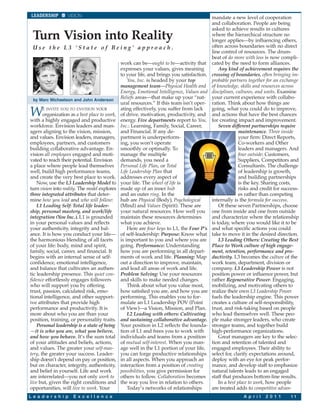
Excellence
              L E A D E R S H I P


THE MAGAZINE OF LEADERSHIP DEVELOPMENT, MANAGERIAL EFFECTIVENESS, AND ORGANIZATIONAL PRODUCTIVITY


                                                                                  APRIL 2011


                                                                               Humble
                                                                               Inquiry
                                                          Why Leaders Fail
                                                                         Collective
     Henrik Ekelund
     CEO BTS
                                                                        Leadership
         “Leadership Excellence is an exceptional
                                                         Unite Diverse Groups
         way to learn and then apply the best and
         latest ideas in the field of leadership.”
                           —WARREN BENNIS, AUTHOR AND
                           USC PROFESSOR OF MANAGEMENT
                                                          w w w . L e a d e r E x c e l . c o m
Excellence
                       L E A D E R S H I P


 THE MAGAZINE OF LEADERSHIP DEVELOPMENT, MANAGERIAL EFFECTIVENESS, AND ORGANIZATIONAL PRODUCTIVITY
VOL. 28 NO. 4                            THE GLOBAL LEADERSHIP DEVELOPMENT RESOURCE                                                  A P R I L 2 0 11


                   Scenic Hazard                                                                                               Most leaders who
                                                                                                                                 are standing in
                                                                                                                                the tee box enjoy
                                                                                                                               a telescopic vision
                                                                                                                                 or scenic vista,
                                                                                                                                 yet all they can
                                                                                                                                 see in the fore-
                                                                                                                                ground is the pox
                                                                                                                                of sand traps and
                                                                                                                               ocean waves with
                                                                                                                               many ways to fail
                                                                                                                                  and few safe
                                                                                                                                 places to drive
                                                                                                                                 business, save
                                                                                                                                strokes, or make
                                                                                                                                     money.


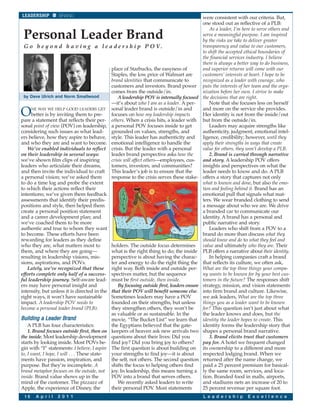
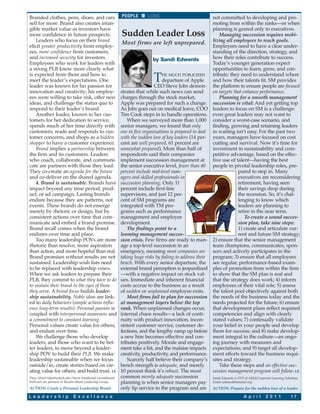
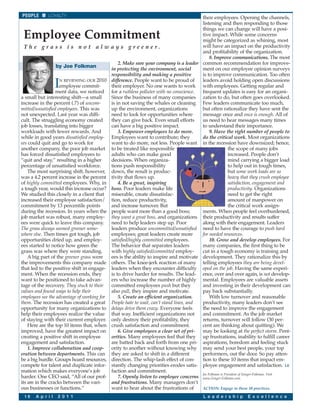
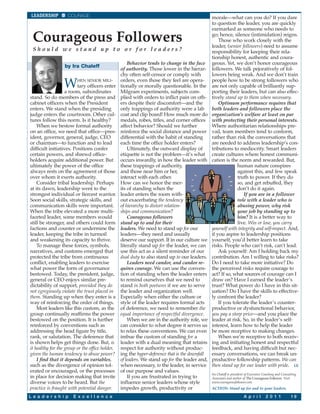
 JAMES QUIGLEY AND                      GARY D. BURNISON                     Turn Vision into Reality             Personal Leader Brand
 STEPHEN LANGTON                        Beyond Perception                    Great companies become               Go beyond having a
 Collective Leadership                  Stay connected to what               real communities. . . . . . .11      leader point of view. . . . 16
 Unite diverse groups in a              matters the most . . . . . . . .7
 common purpose. . . . . . . 3                                               STEVE ARNESON
                                                                                                                  SANDI EDWARDS
                                        CHIP R. BELL AND                     Employee Bill of Rights              Sudden Leader Loss
 EDGAR H. SCHEIN                                                             Every person deserves to
                                        JOHN R. PATTERSON                                                         Most organizations
                                                                             have certain rights. . . . . .12
 Humble Inquiry                         Cultivate Innovation                                                      are very ill-prepared . . . .17
 For leaders, helping others            It requires you to exercise          HENRIK EKELUND
 is complicated. . . . . . . . . . .4                                                                             JOE FOLKMAN
                                        bold leadership. . . . . . . . . 8   Practice Makes Perfect
                                                                             Put and keep the company             Employee Commitment
 MARK NYMAN                                                                                                       The grass is not always
                                        SHEILA MURRAY BETHEL                 on the right course. . . . . 13
 Function Misalignment                                                                                            greener elsewhere. . . . . .18
 Align the purpose
                                        Effective Leadership
                                        You can take three steps to          JONAS AKERMAN
 with the strategy. . . . . . . . 5                                                                               IRA CHALEFF
                                        enhance authenticity. . . . 9        Effective Simulations
                                                                             10 key elements of success-          Courageous Followers
 E. TED PRINCE                                                               ful simulations. . . . . . . . .13   Would we stand up
                                        DANA C. ACKLEY
 Money Makers                                                                                                     for or to our leaders. . . . .19
 Very few managers or                   Glass Walls                          IRVING BUCHEN
 leaders create revenue. . . .5         Break through to a                                                        BEVERLY KAYE AND
                                        brighter future. . . . . . . . .10
                                                                             Why Leaders Fail
                                                                             Avoid 10 dead-ends. . . . .14        BEVERLY CROWELL
 LARRY SENN                                                                                                       Coaching for Engagement
 Leader’s Job #1                        MARC MICHAELSON AND                  DAVE ULRICH AND                      Tap into discretionary
 Align strategy and culture. . .6       JOHN ANDERSON                        NORM SMALLWOOD                       energy and effort. . . . . . .20
Volume 28 Issue 4
                       E . D . I . T . O . R ’ S             N . O . T . E                             Leadership Excellence (ISSN 8756-2308) is
                                                                                                       published monthly by Executive Excellence


Principle-Centered                                                                                     Publishing, LLC (dba Leadership Excellence),
                                                                                                       1806 North 1120 West, Provo, UT 84604.

                                                                                                       Editorial Purpose:
 I feel that I’ve come full circle.                                                                    Our mission is to promote personal and organi-
                                                                                                       zational leadership based on constructive values,
                                                                                                       sound ethics, and timeless principles.
                                                                                                       Basic Annual Rate:
                   by Ken Shelton                  C o m i n g F u l l C i r cl e                      US $99 one year (12 issues))
                                                       Also in March I visited the offices of The      Corporate Bulk Rates (to same address)
                                                   Full Circle Group, aiming to deliver on the         Ask about logo and custom editions


                   I
                                                                                                       and foreign bulk rates.
                   N MARCH LEADERSHIP Excel-       promise of effective leadership and business
                   lence co-sponsored the Prin- performance. Developing effective leader-              Article Reprints:
                 ciple-Centered Leadership         ship is now a strategic priority, says partner      For reprints of 100 or more, please contact the
                                                                                                       editorial department at 801-375-4060
Conference at Utah State University Hunts-         Bill Adams. “Given the high impact that             or email CustomerService@LeaderExcel.com.
                                                                                                       Permission PDF US: $75.
man School of Management, home of the              effective leadership has on performance, it
Covey Center for Leadership.                       is tempting to treat leadership development         Internet Address: www.LeaderExcel.com
   In 1984, we started publishing Leadership as an activity separate from running the                  Submissions & Correspondence:
Excellence under the banner of the Institute       business. Our unique approach engages               All correspondence, articles, letters, and
                                                                                                       requests to reprint articles should be sent to:
for Principle-Centered Leadership—as a             organizations in leader development within          Editorial Department, Executive Excellence,
joint-venture alliance with the Covey Leader- the context of business performance. This inte-          1806 North 1120 West, Provo, Utah 84604;
                                                                                                       801-375-4060, or editorial@LeaderExcel.com.
ship Center. That same year, I started writing gration is our governing principle, and
two books with Stephen R. Covey: 7 Habits          when this principle is put into practice, it        Customer Service/Circulation:
                                                                                                       For information on products and
of Highly Effective People and Principle-Center- helps organizations develop leadership as a           services call 1-877-250-1983 or
ed Leadership. While 7 Habits sold more            competitive advantage.                              email: CustomerService@LeaderExcel.com.
copies (one of the top 20 best-selling                             Again in March, I welcomed          Executive Excellence Publishing:
nonfiction books of all-time), the                            home a son, Chris, who had been          Ken Shelton, CEO, Editor-in-Chief
                                                                                                       Sean Beck, Circulation Manager
idea of PCL may be more useful as a                           serving two years in Sweden, and
leadership development paradigm.                              (within two days) welcomed two           Contributing Editors:
                                                                                                       Chip Bell, Warren Bennis, Dianna Booher,
   In a nutshell, PCL is based on the                         granddaughters (Kora and Zoey)           Kevin Cashman, Marshall Goldsmith, Howard
notion that Universal Principles ulti-                        into the world. This, indeed, is         Guttman, Jim Kouzes, Jim Loehr, Tom Peters,
                                                                                                       Norm Smallwood
mately govern in life and leadership.                         coming full circle.
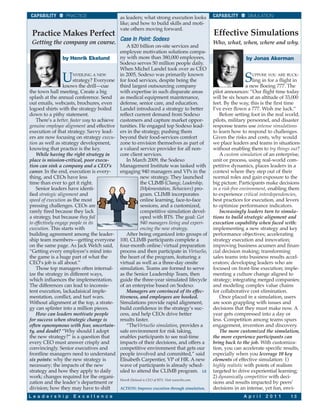
As Covey has proven, when people                                   I selected the great golf art of    The table of contents art is a detail from
                                                                                                       2010 U.S. Open Championship, The 9th Hole, Pebble
seek to develop a value system,                               Linda Hartough for the cover this        Beach Golf Links (image cropped) © Linda
they identify the same basic values        Linda Hartough month because all of us face a hard,         Hartough, and is courtesy of the artist and
                                                                                                       art print publisher Greenwich Workshop.
when four conditions are met: you                             tough situation like the ninth hole at
get enough people interacting; there is a          Pebble Beach. Whether we are new-born or            For additional information on artwork by
                                                                                                       Linda Hartough, please contact:
spirit of trust and openness; people are           born again or coming full circle, the cycle of      Greenwich Workshop
                                                                                                       151 Main Street
informed about the problems and issues;            life and leadership presents challenges. The        Saymour, CT 06483
and they feel they can communicate freely          vision or vista may be appealing, but in the        1-800-243-4246
                                                                                                       www.greenwichworkshop.com
and synergistically. And these universal val- foreground we see nothing but rough traps.
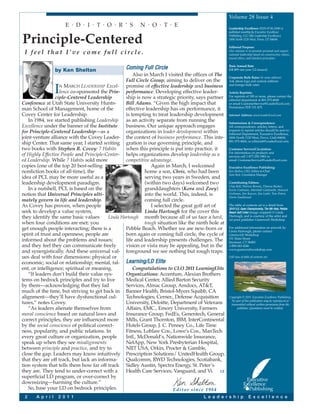
ues deal with four dimensions: physical or                                                             Full view of table of contents art.

economic; social or relationship; mental, tal- L e a r n i n g / L D E l i t e
ent, or intelligence; spiritual or meaning.            Congratulations to CLO 2011 LearningElite
   “If leaders don’t build their value sys-        Organizations: Accenture, Alexian Brothers
tems on bedrock principles and try to live         Medical Center, Allied Barton Security
by them—acknowledging that they fail               Services, Almac Group, Amdocs, AT&T,
much of the time, but striving to get back in Banner Health, Bristol-Myers Squibb, CA
alignment—they’ll have dysfunctional cul-          Technologies, Cerner., Defense Acquisition          Copyright © 2011 Executive Excellence Publishing.
                                                                                                        No part of this publication may be reproduced or
tures,” notes Covey.                               University, Deloitte, Department of Veterans         transmitted without written permission from the
   “As leaders alienate themselves from            Affairs, EMC., Emory University, Farmers                  publisher. Quotations must be credited.

moral conscience based on natural laws and         Insurance Group, FedEx, Genentech, General
correct principles, they are influenced more Mills, Grant Thornton, IBM, InterContinental
by the social conscience of political correct-     Hotels Group, J. C. Penney Co., Life Time
ness, popularity, and public relations. In         Fitness, Loblaw Cos., Lowe’s Cos., ManTech
every great culture or organization, people        Intl., McDonald’s, Nationwide Insurance,
speak up when they see misalignments               NetApp, New York Presbyterian Hospital,
between principle and practice, and try to         NIIT USA, Orkin, Procter & Gamble,
close the gap. Leaders may know intuitively Prescription Solutions/ UnitedHealth Group,
that they are off track, but lack an informa-      Qualcomm, RWD Technologies, Scotiabank,
tion system that tells them how far off track Sidley Austin, Spectra Energy, St. Peter’s
they are. They tend to under-correct with a        Health Care Services, Vanguard, and Vi. LE
superficial LD program, or over-correct by
downsizing—harming the culture.”
   So, base your LD on bedrock principles.                                     Editor since 1984
 2     A p r i l    2 0 1 1                                                              L e a d e r s h i p            E x c e l l e n c e
LEADERSHIP        ARCHETYPES                                                               project; their carefully selected teams
                                                                                            make it happen. Ideas are developed
                                                                                            through frequent meetings and interac-
 Collective Leadership                                                                      tions and an open culture of collabora-
                                                                                            tion. Long-term success depends on
 Go from platitude to practice.                                                             constant innovation and reinvention.
                                                                                               5. General and soldiers. Soldiers focus
                                                   How do you track common interpre-        on well-defined and scripted tasks, mo-
                                               tations of rather abstract mental models?    tivated by hierarchical structure and
                                               How do you concretize collective leader-     the prospects of promotion. Extensive
                                               ship? To make the As One diagnostic          training is needed for recruits to under-
                                               robust, we had to find an answer. Tra-       stand the culture and to learn specific
                                               ditional leadership theory wasn’t helpful.   skills. The generals’ authority—their
                                               The twin poles of command-and-control        ability to command respect—is just as
 by James Quigley and Stephen Langton
                                               and hierarchy on the one hand and col-       important as their mission. Without it,

C    OLLECTIVE LEADERSHIP—THE ABILITY
     to unite diverse groups of people
in a common purpose, to achieve
                                               laboration and flat-and-fluid structure on
                                               the other could not tell the whole story.
                                                                                            the organization disintegrates.
                                                                                               6. Architect and builders. Leaders need
                                                                                            a team of skilled followers to bring their
teamwork on a grand scale—is the               Eight Models or Archetypes                   blueprint to life. Builders are master
lifeblood of successful organizations.            Using a self-organizing map (SOM),        craftsmen and innovators capable of
Every project, strategy, meta-goal or          we drew out the relationships among          finding new solutions to technical and
vision depends on effective teams, on          our 60 case studies and compiled a set       practical problems. Interdependent links
collaboration. A leader is nothing without     of eight distinct archetypes:                in a project management chain, they
followers; no manager is an island.               1. Landlords and tenants. In this         strive to achieve milestones mapped to
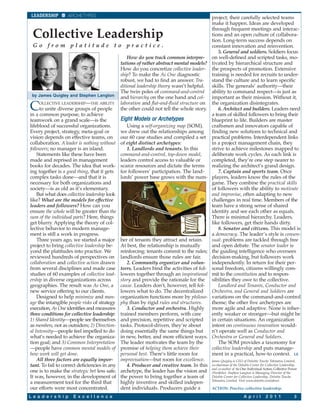
    Statements like these have been            command-and-control, top-down model,         deliberate work cycles. As each link is
made and reprised in management                leaders control access to valuable or        completed, they’re one step nearer to
books for decades. The idea that work-         scarce resources and dictate the terms       realizing the architect’s grand design.
ing together is a good thing, that it gets     for followers’ participation. The land-         7. Captain and sports team. Once
complex tasks done—and that it is              lords’ power base grows with the num-        players, leaders know the rules of the
necessary for both organizations and                                                        game. They combine the practical skills
society—is as old as it’s elementary.                                                       of followers with the ability to motivate
    But what does collective leadership look                                                and improvise, often adapting to new
like? What are the models for effective                                                     challenges in real time. Members of the
leaders and followers? How can you                                                          team have a strong sense of shared
ensure the whole will be greater than the                                                   identity and see each other as equals.
sum of the individual parts? Here, things                                                   There is minimal hierarchy. Leaders,
get blurry. Applying the theory of col-                                                     like followers, get their hands dirty.
lective behavior to modern manage-                                                             8. Senator and citizens. This model is
ment is still a work in progress.                                                           a democracy. The leader’s style is consen-
    Three years ago, we started a major        ber of tenants they attract and retain.      sual: problems are tackled through free
project to bring collective leadership be-     At best, the relationship is mutually        and open debate. The senator leader is
yond the platitudes into practice. We          reinforcing: tenants commit to the rules;    the guiding intelligence who oversees
reviewed hundreds of perspectives on           landlords ensure those rules are fair.       decision-making, but followers work
collaboration and collective action drawn         2. Community organizer and volun-         independently. In return for their per-
from several disciplines and made case         teers. Leaders bind the activities of fol-   sonal freedom, citizens willingly com-
studies of 60 examples of collective lead-     lowers together through an inspirational     mit to the constitution and to respon-
ership in diverse organizations across         story and provide the rationale for the      sibilities they owe to the collective.
geographies. The result was As One, a          cause. Leaders don’t, however, tell fol-        Landlord and Tenants, Conductor and
new service offering to our clients.           lowers what to do. The decentralized         Orchestra, and General and Soldiers are
    Designed to help minimize and man-         organization functions more by philoso-      variations on the command-and-control
age the intangible people risks of strategy    phy than by rigid rules and structures.      theme; the other five archetypes are
execution, As One identifies and measures         3. Conductor and orchestra. Highly        more agile and adaptive. None is inher-
three conditions for collective leadership:    trained members perform, with care           ently weaker or stronger—but might be
1) Shared Identity—people see themselves       and precision, repetitive and scripted       in certain situations. An organization
as members, not as outsiders; 2) Direction-    tasks. Protocol-driven, they’re about        intent on continuous innovation would-
al Intensity—people feel impelled to do        doing essentially the same things but        n’t operate well as Conductor and
what’s needed to achieve the organiza-         in new, better, and more efficient ways.     Orchestra or General and Soldiers.
tion goal; and 3) Common Interpretation        The leader motivates the team by the            The SOM provides a taxonomy for
—people have common mental models of           promise of helping them achieve their        collective leadership and puts manage-
how work will get done.                        personal best. There’s little room for       ment in a practical, how-to context. LE
    All three factors are equally impor-       improvisation—but room for excellence.       James Quigley is CEO of Deloitte Touche Tohmatsu Limited,
tant. To fail to correct deficiencies in any      4. Producer and creative team. In this    co-chairman of the Deloitte Center for Collective Leadership,
                                                                                            and co-author of As One: Individual Action, Collective Power
one is to make the strategic bet less safe.    archetype, the leader has the vision and     (Portfolio). Stephen Langton is Managing Director of the
It was, however, in the development of         the power to bring together a team of        Deloitte Center for Collective Leadership, Deloitte Touche
                                                                                            Tohmatsu Limited. Visit www.deloitte.com/about.
a measurement tool for the third that          highly inventive and skilled indepen-
our efforts were most concentrated.            dent individuals. Producers guide a          ACTION: Practice collective leadership.

L e a d e r s h i p   E x c e l l e n c e                                                                         A p r i l       2 0 1 1              3
CAPABILITY         LEARNING                     uation. The person being asked for help             1. Learning how to ask the right ques-
                                                must be sensitive to the vulnerability of       tions. Different questions have different
                                                the help seeker and ensure that he or           impacts. Do we want respondents: a) to
 Humble Inquiry                                 she does not make matters worse by              continue their story (humble inquiry), or
 It’s the key to helping.                       belittling the seeker, giving premature         b) to become more diagnostic by asking
                                                advice, jumping to conclusions about            many “why” and “what did you do”
                                                what might be helpful, or reinforcing           questions, or c) do we want to confront
                   by Edgar H. Schein           the one downness of the seeker. And, the        them: “Have you thought about doing
                                                seeker must be clear about what he or           this?” (advice in the form of questions).
                                                she needs, not asking something irrele-             Knowing when to ask what type of

                   S INCE LEADERS ARE SUP-
                      posed to set direction,
                  display wisdom, and tell
                                                vant just to test the potential helper. The
                                                biggest trap for the seeker is to ask the
                                                wrong question; the biggest trap for the
                                                                                                question and assessing the impact of
                                                                                                different questions requires practice. As
                                                                                                leaders, we tend to use confrontative
their followers what to do, we’ve become        giver is to answer that wrong question.         questions. We think that being a leader
obsessed with leadership competencies              For help to be helpful, the leader seek-     means knowing what to do and offering
that emphasize action, direction, and           ing help must reveal the real problem,          guidance and advice. In the new world,
charisma. That works in a simple world          and those being asked to help must              often formal leaders won’t know the
where leaders can figure out what to            enable the leader to reveal the real            answer and need to create a helping sit-
do. Alas, that is not the world of today.       problem. Hence, a relationship of trust         uation in which they and others solve
   In a world of complexity, globalism,         must either exist or be built.                  the problem together (mutual helping).
multiculturalism, dispersion, and social           Humble inquiry is the most reliable              2. Learning what role to take in the
responsibility, formal leaders won’t know       way to test or build a relationship of          helping situation. Do we want: a) to be
enough to be decisive, will depend              trust. By humble, I mean that the helper        the expert and provide information or a
more on the knowledge and skill of              must ask a question to which he or she          service, b) to be the doctor who will
colleagues, will manage networks of             does not already know the answer. If            diagnose the problem and offer a pre-
people from different cultures, and will        we are asking just to check our expec-          scription, or c) to enable the client to
factor in new priorities in decision            tation or presupposition or assumption          solve his/her own problem by being
making. These requirements force us                                                             more of a process consultant.
to focus anew on Greenleaf’s concept                                                                If the seeker clearly wants informa-
of servant leadership and my concept of                                                         tion or a service, we provide it, but we
the leader as a giver and receiver of help.                                                     must be sure that what the seeker asks
   Leaders can’t give direction if they                                                         for is, in fact, the problem to be solved.
don’t understand the complex realities                                                          Often in building the helping relation-
of the situation, which means: 1) seek-                                                         ship, we discover that since the situa-
ing help from many others to provide                                                            tion is complicated we have to take on
the information needed, 2) creating sit-                                                        more of a doctor role. If human systems
uations in which others are motivated                                                           are involved, we also discover that we
to provide such information, and 3)                                                             can never learn enough about the
helping others implement the desired            or hypothesis, we won’t learn what the          client’s system to offer answers or
courses of actions. Leaders need to             person seeking help needs or wants. If          advice, but we can become a process
seek, offer, provide and accept help—           the seeker is the leader or boss, the sub-      consultant, a role in which we focus on
and often they are not very good at it.         ordinate or peer has to ask some hum-           helping the client to solve his/her own
                                                ble questions. If the group member or           problem. In this case, the helper and
Key to Successful Helping                       subordinate comes to the boss for help,         client become a team working together
    Helping is complicated, since in most       the leader or boss must humbly inquire          to diagnose and figure out what to do.
cultures being a competent adult means          what is really being asked.                         We often assume that the leader must
not needing help. To ask for help puts the          By inquiry I mean that the first steps in   give the answer or be the doctor; in the
person one-down and puts the potential          the helping process must be questions, espe-    multicultural new world, leadership
helper temporarily one-up. To ask for           cially by helpers. Even if the seeker asks a    will require more of a process consulta-
help makes you vulnerable. To be asked          question, if helpers do not engage in           tion role, since only the team members
for help makes you powerful. To offer           some humble inquiry, they won’t know            will have the knowledge and capacity
help when it has not been asked for is          whether what was asked was the real pro-        to solve the problem. Leadership will in-
displaying power. The situation is ini-         blem on which help is needed. Inquiry           volve a constant shifting of roles as the task
tially unbalanced. Normal social pro-           does not have to be a set of questions.         demands change. All team members need
cesses are balanced and equitable. We           Showing an open attentive demeanor,             to ask for and provide help as needed.
know our roles and the rules of tact            encouraging the seeker by staying               Leadership becomes a distributed function.
insure that most conversations are equi-        silent, or saying tell me more will reveal      From this view, teamwork can then be
table in terms of the social economics. When    relevant information. If the seeker feels       seen as perpetual mutual helping, requir-
one person speaks, others pay attention!        listened to, that equilibrates the social       ing each team member to engage in
Asking for help or offering it when it is       situation. It builds a momentary helping        humble inquiry with other members.
not asked for disrupts this process. And        relationship in which both parties can              Mutual helping is a critical leadership
for a leader to ask for help is a double dis-   more easily say what is on their minds.         skill—and humble inquiry is the key to
ruption of leader/follower expectations.                                                        creating mutual helping relationships. LE
    So what can go wrong? The person Master Tw o N e w S k i l l s                              Edgar H. Schein is the author of Helping: How to Offer, Give
asking for help must trust the potential      Two sets of skills are involved in                and Receive Help (Berret-Koehler). Visit mitsloan.mit.edu.
helper not to take advantage of the sit- developing helpful relationships:                      ACTION: Engage in humble inquiry.

 4     A p r i l   2 0 1 1                                                                      L e a d e r s h i p             E x c e l l e n c e
MANAGEMENT           ALIGNMENT                to be available whenever someone wants                      CAPABILITY       FINANCIAL
                                               their services but also be lean enough that
 Function Alignment                            their people are being fully utilized. As with
                                               technology tools, managing utilization                      Money Makers
 Align with the purpose and strategy.          versus availability often feels like a no-                  Do your leaders have it?
                                               win situation. In fact, trying to do both
                                               is a no-win. Functions must be clear
                by Mark Nyman                  about the primary drivers of business                                       by E. Ted Prince
                                               success to determine where they apply
                                               utilization or availability as organizing

                I  N GOOD AND BAD ECON-
                   omies, functions such
                 as HR, Finance, and IT
                                               principles. And support organizations
                                               need a clear method for prioritizing
                                               their work and who they respond to
                                                                                                                           L   EADERSHIP DEVELOP-
                                                                                                                                 ment approaches
                                                                                                                             should include business
are in a continual cycle of growing then       first to keep the business running.                         acumen within their ambit, and these
shrinking and centralizing only to decen-          4. Solutions looking for problems. Too                  approaches need models with the
tralize. They are reengineering, down-         many improvement efforts are solutions                      power to predict leadership acumen.
sizing, outsourcing, or creating shared        looking for problems. Many functions, in                        Do your executives have what it
service organizations. One day they are        being proactive with good intentions,                       takes to create capital? My goal is to
asked to increase responsiveness, the next     identify a concept that they find com-                      assess the business acumen of managers
they’re asked to cut cost and improve effi-    pelling, get management support, and                        and leaders; predict their impact on the
ciency. Most change efforts focused on         implement the concept without under-                        financial outcomes; predict the finan-
support functions have unin-                              standing the relevance or                        cial impact of teams; predict financial
tended negative results. For                              application on day-to-day                        impact using metrics that appear in
example, when the HR func-                                work. Creating work for oth-                     financial statements; and translate these
tion makes what they feel are                             ers tends to create the biggest                  into predictions of valuation impact.
positive changes, line leaders                            credibility gap between func-                        My work is a part of the emerging
often have a negative view.                               tions and those they serve. So,                  discipline of behavioral finance. This
While they value the contri-                              always identify what business                    shows how cognitive biases impact
bution of the HR people                                   need you are meeting. Other-                     decision-making. We enable the pre-
assigned to them, they don’t                              wise, your leaders may see                       diction of financial impact by identify-
value the contribution of the                             your work as an added bur-                       ing how the cognitive biases of
function. Why? The changes HR makes to         den or distraction from real work.                          managers impact financial outcomes.
improve the function do not help the line          5. Accountability confusion. This                           Business acumen can be measured—
leaders improve business results.              occurs when functions police budgets,                       and its impact predicted. One aspect of
   When functions try to improve with-         policies, and procedures that belong to                     our work shows what behaviors charac-
out aligning with the organization as          the line and become accountable for                         terize managers with exceptional capabili-
the primary outcome, they tend to hurt         issues that belong to the line. It’s                        ties for creating capital—the personalities
rather than help business performance.         alarming how many functions desire                          of people who excel at making money.
                                               this responsibility. It creates misalign-                       We’ve developed three core psycho-
Five Types of Misalignment                     ment, victims out of those who are                          metric assessment instruments:
   Five types of misalignments occur:          being policed, and becomes a rationale                       • Financial Outcome Assessment (FOA)
   1. Optimizing the function. Often a         for the line not taking responsibility                      measures the financial signature of man-
function will implement changes that           and accountability for results.                             agers—their propensity to create capital.
make their work more efficient or easi-            Solutions to misalignment involve                        • Executive Outcome Assessment (EXOA)
er while making it harder for the orga-        understanding requirements (what effec-                     measures the behavioral characteristics
nization to achieve its goals. Support         tive support looks like) and determin-                      that lead to specific outcomes—how a
functions must know who they are con-          ing what responses drive the most value.                    manager’s behavior impacts financial
nected to and how their actions and improve-   This includes looking at the work you                       outcomes in practice in his situation.
ments will impact the core business. When      are doing and understanding how to                           • Corporate Financial Outcome Assess-
you are in a support role, most of the         best position the work for the good of                      ment (CFOA) measures the financial
requirements need to flow from the             the business. The most lasting solution                     mission based on behavioral data. This
business needs out rather than from the        comes from understanding business                           enables us to evaluate alignment and
support organization to the business.          purpose and strategy and aligning all                       measure competitive prowess from a
   2. Standardization versus custom-           functions to the same end result. Most                      behavioral perspective.
ization. Standardization is a common           leaders see the need for alignment but                          Since many executives have experi-
solution in cost-cutting initiatives and       don’t address what is being aligned.                        enced these assessments, we can now
streamlining functions. When properly          Alignment implies direction or a reference                  look at the behaviors associated with
applied, it creates great value and cost       point to align everything else with.                        capital creation and financial impact
savings. But when business drivers                 Support functions that are aligned                      and correlate the financial signatures of
call for customization, standardization        to the business have clear priorities                       managers with leadership outcomes.
results in rework, shadow organiza-            and those working in the function
tions, and other drains on people’s            clearly see the role their work plays. LE                   Exceptional Money-Makers Are Rare
time. The belief that work is scalable is                                                                     We focus on the most exceptional
                                               Mark Nyman is an expert on HR Transformation with Results
not enough of a reason to standardize.         Based Leadership. Call 801-492-6955 or visit www.rbl.net.   types of propensity for capital creation.
   3. Utilization versus availability.                                                                     Most managers do not create capital—they
Functional groups are often challenged         ACTION: Align functions with business strategy.             consume it (only 12 percent create capital).
L e a d e r s h i p   E x c e l l e n c e                                                                                 A p r i l   2 0 1 1       5
Four personality types have excep-                            LEADERSHIP        ALIGNMENT                   up in several ways. Cultural traits we
tional capabilities in creating capital                                                                         commonly see that create barriers to
(yet even within these groups, only a                                                                           change include turf issues, trust issues
small subset excel in creating capital):                          Leader’s Job One                              or people working in silos. These all
 • Alchemists are introverted and street-                         Align strategy, structure and culture.        get in the way when changes require
wise, meaning they distrust logic. They                                                                         collaboration across the enterprise.
invariably create a new high-value                                                                              There is also a need for more agility
product that creates new market seg-                                                                            and innovation than ever before.
                                                                                  by Larry Senn
ments. To qualify for this characteristic,                                                                          Acquisitions are a part of the
the person is usually intensely introvert-                                                                      growth strategy for many companies
ed and streetwise. Usually the compa-
ny founded by this person does well,
even though the founder is highly
                                                                                  C    EOS AND SENIOR TEAMS
                                                                                       have a lot—usually
                                                                                   too much—on their
                                                                                                                and it is well known that the biggest
                                                                                                                reason for shortfall in acquisitions and
                                                                                                                mergers is “cultural clash”. So, if that
introverted, because the product is rev-                          plates, especially today. So, what are        is the strategy, creating an acquisition
olutionary enough that it attracts more                           the blue chips, the highest value things      friendly and aware culture is an
market interest and sales support that                            for CEOs to focus on? We believe there        imperative. Other companies are seek-
the founder himself can’t attract.                                are three powerful drivers of perfor-         ing to change their structure, such as
 • Visionaries are extremely forward                              mance that deserve their attention.           moving from a holding company or
looking and strongly oriented to giving                               1. Purpose and direction—connect-         decentralized model to a “one compa-
up the present for a far-off future. If                           ing people at all levels to the mission       ny” shared business model. In both sit-
they are too altruistic or too individual-                        and their declared strategy for fulfill-      uations, the cultural traits that need
istic, they will fail to generate revenue.                        ing that mission.                             strengthening are trust and collabora-
They can be only mildly altruistic or                                 2. Structure and enabling processes       tion for the greater good.
mildly individualist; however, being                              —creating the best organization struc-            To eliminate the Jaws of Culture, we
mildly visionary is insufficient—the                              ture and supporting system to drive           advise CEOs to focus on the culture to
psychological impulse to look forward                             that strategy.                                support the strategy, beginning at the
must be intense; otherwise, the person                                3. An enabling culture—ensuring the       senior team because those leaders set
will not show exceptional money-mak-                              behaviors in the organization are the         the example for the rest of the organi-
ing and capital creation propensity.                              specific ones needed to make the struc-       zation. One CEO who did this to great
 • Customer analysts are strongly sales                           ture and strategy work.                       success is Zappos CEO Tony Hsieh. He
oriented, rather than product oriented.                               While this appears to be                               regularly points out that he
However, if they are too strongly sales-                          a reasonable agenda, sever-                                had to get the culture right
oriented, they won’t have a high                                  al factors make this difficult                             to succeed at creating the
propensity to create capital. They are                            to do. First, these drivers                                best customer experience.
also strongly financially oriented. This                          are vital but not time                                     Why? Because it is the
does not mean that they will have                                 urgent, and culture is the                                 behaviors of employees
financial qualifications; in fact, usually                        hardest to shift into align-                               that affect the experience
they will not. Rather their zone of psy-                          ment. Most CEOs and their                                  customers have. Hsieh is
chological comfort is exceptionally                               top teams can effectively                                  an example of a CEO who
strong in dealings with finances.                                 adjust their strategies.                                   focused on culture to sup-
 • Generals are disciplined planners, but                         They’re also good at devis-                                port his service strategy
if they are too strongly planning oriented,                       ing new organizational                                     and by doing so created a
they are too slow in adapting to market con-                      structures. But as Ed Schein, one of the      distinctive competitive advantage.
ditions and thus lose market opportuni-                           pioneers in culture, said, “An organi-            In order to make their culture a
ties. In addition, these managers can’t                           zation’s culture is its response to the       launching pad for success, CEOs and
be extremely consensual or command-                               way things used to be.”                       their teams should define or revisit
oriented in their styles. If they become                              In other words, the culture lags and      their organizations’ cultural defini-
too strong in these areas, they lose the                          can become the anchor out the back of         tions. Do the value statements cover
propensity to create capital.                                     the boat. We call this the Jaws of Culture.   the kinds of behaviors the company
    Where a manager or leader falls on                            We all encounter those jaws at one time       needs to win at this moment in time? If
the money propensity scale depends                                or another when we go to implement a          not, they need to be adjusted. If the
on their behavioral characteristics and                           change and it doesn’t go easily.              cultural definitions are fine but the
their intensity. You can use the results                              Culture represents the collective norms   behaviors don’t match, CEOs need to
of these assessments to boost your self-                          and behaviors in the organization. Most       first find ways to ensure the team at
awareness so that you can improve                                 companies have solid core values and          the top is living and modeling the
your financial and valuation impact—                              cultural traits that have made them           desired behaviors. This is because
and thus align better with the financial                          great. They also have historic habits         organizations become shadows of their
mission of the organization and with                              that haven’t changed with the times.          leaders. Special training processes and
its valuation goals. Seek training in                             Those habits can get in the way, espe-        reinforcement systems can be used to
business acumen. Complete the assess-                             cially when strategy or structure/pro-        bring the desired culture to all levels in
ments, link your behaviors to business                            cess changes or when higher levels of         the organization.                       LE
outcomes, and create self-awareness as                            performance are needed. If not system-
                                                                                                                Larry Senn, Ph.D., is Chairman of Senn Delaney, shaping cul-
to how this can improve your impact. LE                           atically addressed, these cultural barri-     tures that enhance spirit and performance. Call 562-426-5400,
E. Ted Prince, Ph.D., is CEO of the Perth Leadership Institute.   ers act like jaws in the culture that can     email lsenn@senndelaney.com or visit www.senndelaney.com.
                                                                                                                This article is adapted from his interview in The CEO Forum.
Call 352-333-3768 or visit www.perthleadership.org.               chew up strategies and initiatives.
ACTION: Boost your money-making capability.                           In terms of cultural traits, this shows   ACTION: Align strategy, structure, and culture.

  6        A p r i l       2 0 1 1                                                                              L e a d e r s h i p           E x c e l l e n c e
LEADERSHIP       SERVICE                                                              which the signs are faint, leaders must
                                                                                       get close to customers and employees to
                                                                                       separate perception from reality.
 Beyond Perception                                                                        Although it sounds simple, it can be
                                                                                       difficult to do. Leaders who have spent
 Perception becomes reality.                                                           their careers climbing a pyramid to
                                                                                       reach the pinnacle can become insulat-
                                                                                       ed and even isolated if they don’t sepa-
                                          opportunities for growth. Others are         rate who they are from what they do.
                 by Gary D. Burnison
                                          innovating to capture consumer inter-        They often become engrossed in the
                                          est in global markets. And, it’s not just    inverted pyramid that suddenly appears

                C     ONSIDER THIS STORY: technological innovation. I think of
                      A group of settlers Nestlé, which launched its first floating
                 in a remote village of   supermarket on the Brazilian Amazon,
                                                                                       above them—layers of constituencies,
                                                                                       including the media, special interest
                                                                                       groups, stockholders, financial analysts,
Outpost were preparing for winter.        a retail barge that extends its reach to     and so on. At the intersection of the two
The group’s leader, unschooled in the more than 800,000 customers.                     pyramids is the CEO, who must not
old ways, guessed that the winter            This global view contrasts sharply        only look over the horizon, but relent-
would be cold and that people should with the perception of those who have             lessly execute today, for that deter-
gather firewood. One day, he traveled relied more on Western economies for             mines the starting point for tomorrow.
to the nearest town and called the        growth. Those CEOs are more subdued.            That means being connected to what
National Weather Service, which con- As they wait for consumers to crank up            matters the most. This is what Mulcahy
firmed his suspicion: the winter was      their spending again, the cup is not         called “logging the miles,” traveling to
indeed going to be cold. The leader       only half empty, but leaking steadily.       meet with employees and customers in
ordered more firewood to be collected,       So who’s right and who’s wrong? It        person. It’s a high-touch style of lead-
and checked in with the NWS again a depends upon your perception. In this              ership that allows not just communica-
week later, which amended its fore-       case, however, throw away percep-            tion from the leader, but dialogue with
cast—not only for a cold winter, but a tion—the classical lens of West versus          the people who are the closest to the
very cold winter. So the people of        East or developed versus emerging has        marketplace. As she observed, “I don’t
Outpost gathered even more wood.                                                       think people can get the sense of the
   When the leader checked in with                                                     leadership dynamic of the company
the NWS a third time, the prediction                                                   without the ability to touch and see
was now for a very, very cold winter.                                                  and interact on a personal basis.”
Finally, having asked for every branch                                                    Her comments bring to mind the
and twig to be gathered, the leader                                                    observation by Muhtar Kent, CEO of
asked the NWS how they could be so                                                     The Coca-Cola Company. His first task
sure. The answer: “The people of Out-                                                  in changing the culture into one of con-
post are gathering a lot of firewood.”                                                 nection was to visit major and minor
   In a directionless economy, it is very                                              markets and to meet customers. It was
easy for perceptions to become reality.                                                the same tactic he used when he was in
The levers of growth are not as appar- blurred. The world’s axis has tilted and        charge of Asia for Coca-Cola. “The first
ent as they were in the days of con-      the compass spins in all directions.         thing I did was to go to every country
spicuous consumption and fast credit.        Leadership, however, is timeless and      (39). Back then, most of our people
   Myopically focusing on the decline can’t wait for clarity. It is about making       didn’t even know the names of our
in Western consumer sentiment, you        and seizing opportunity—not by sitting       biggest customers,” Kent recalled.
will undoubtedly perceive an econo-       home consumed by pundits and prog-              The experiences of Kent and Mulcahy
my that, while officially out of the      nosticators, but by leaders listening        should serve as a wake-up call for CEOs
great recession, is barely growing. If    and learning from those who matter           and other leaders to consider where
so, you are probably preparing for a      most: customers and employees.               they are spending most of their time. If
long cold winter of anemic growth.           Some months ago, on the eve of her        they dwell at the intersection of the
   Not every leader, however, sees        retirement as chairwoman of Xerox, I         pyramid tips, they will be squeezed. If
things the same way. This past sum-       met with Anne Mulcahy. She recalled          they overly rely on perceptions, it
mer, I spent much of my time on the       her early days as CEO of Xerox when          undoubtedly will be myopic and cer-
road in Europe, talking to leaders from the company teetered on the brink of           tainly will be filtered. If that happens,
Paul Bulcke, CEO of Nestlé, to former bankruptcy. As the new CEO in those              they shouldn’t be surprised if they
Prime Minister of Hungary Gordon          days, Mulcahy was pulled in countless        spend most of their time hunkering
Bajnai. My mission was twofold: to be directions until she received some sage          down for a long, cold winter.
with employees and clients outside of advice from Warren Buffett: “There is               Those who empower others while
the United States and to engage in dis- only one way you are going to get results,     venturing out themselves to listen and
cussions with other leaders on what       and that’s by keeping your customers loyal   learn will discover astonishing new
they see, hear, and experience.           and your people engaged and motivated.       levers of growth. For them, there will
   In every conversation, I was struck    Get everything else out of the way.”         be pockets of spring where potential
by the bifurcation in perceptions. For       By focusing on customers and employ-      blooms and opportunity grows.           LE
those who lead global enterprises, the ees—Mulcahy accomplished the near-
                                                                                       Gary D. Burnison is CEO of KornFerry International and
proverbial glass is half full and contin- impossible: saving Xerox.                    author of No Fear of Failure. Visit www.kornferry.com.
uing to fill. They are investing and hir-    The mission for leaders today is no
ing and expanding because they see        different. In a directionless economy in     ACTION: Focus on customers and employees.

L e a d e r s h i p   E x c e l l e n c e                                                                   A p r i l      2 0 1 1              7
CHANGE        INNOVATION                                                                      of their accomplishments that represent
                                                                                              examples of the vision and purpose.
                                                                                              And, they make certain their actions are
 Cultivate Innovation                                                                         consistent with the vision and purpose.
                                                                                                  Boldness happens when employees
                                                                                              do not fear error. Boldness would not
 It all requires bold leadership.
                                                                                              be daring were there not potential for
                                                                                              error. Leaders foster a healthy attitude
                                                                                              toward failure. When Thomas Edison
                                            mostly a superstition. It does not exist          was asked about failure associated with
                                            in nature. Avoiding danger is no safer in         his quest for invention he said: “I never
                                            the long run than outright exposure. Life is      failed once. It just happened to be a
                                            either a daring adventure or nothing.”            2,000-step process.” Edison held over
                                                The remove rather than add approach           1,000 patents. How you deal with error
  by Chip R. Bell and John R. Patterson     means leaders focus on eliminating all            can communicate volumes about your
                                            that exists in the work world that fuels          commitment to fostering innovation.

I  N TODAY’S INNOVATION-DEPRIVED ECON- the opposite of boldness—timidity,
   omy, proactive leaders adopt the
proverb: “Fortune favors the bold but
                                            hesitance, doubt, and reserve.
                                                Boldness is borne of purpose. Stok-
                                                                                              When you meet error with rebuke, you
                                                                                              send a different message than when
                                                                                              you see error as an opportunity for
abandons the timid.”                        ing the flames of boldness begins with            learning and problem-solving.
    Once we consulted with a financial a wide-eyed focus on a dream or pur-                       As part of encouraging bold leader-
services company as their leaders con- pose rather than a squint-eyed look at                 ship, recognize that employees don’t resist
sidered launching a change manage-          the task or job. Caution comes from               change as much as they resist the predic-
ment effort that would foster a more        being mired in day-to-day activity. As            tion of pain over which they have no con-
innovative approach to their market-        the trees block your forest vista, you            trol. Helping employees view change as
place. Every meeting, phone call and        are soon left blind to aspirations and            opportunity not threat requires candid
email was painted the color of timidi- dreams. “I came to my last job,” said                  communication as well as an atmos-
ty. “Why the extreme caution?” we           one retired leader, “with a great sense           phere of inclusion. The more employ-
asked them at the end of another do-        of purpose. But, I got so enmeshed in             ees are in the know and find their
nothing-but-talk meeting? The COO                                                             fingerprints on change initiatives, the
replied, “We’ve been in a bunker mind-                                                        more they will replace fear with fervor.
set so long we’ve forgotten that chutz-                                                           Without risk, there’s no creativity.
pah has been the key to our success.”                                                         However with risk come honest mis-
    A steady diet of cut-backs, layoffs,                                                      takes. It is easier to gently rein in an
and budget crunches has introduced                                                            overzealous, go-the-extra-mile employ-
an abundance of caution into most lead-                                                       ee than to find one with an enthusiastic
ers. The Great Recession trimmed their                                                        attitude in the first place. Fostering dar-
wings—turning them into activity-seek-                                                        ing is a manifestation of trust—the
ers instead of results-makers.                                                                greater the trust, the greater the freedom.
    Now’s the time for leadership bold-                                                       But, with freedom comes with respon-
ness. The key to progress and growth                                                          sibility. The bold leader’s job is to coach
is innovation—and innovation is never       what I had to do that I soon forgot what I        employees to feel more comfortable
spawned in a culture of reticence.          had hoped to be. It was not until I was           with more and more responsibility.
“Boldness has genius, power, and            ready to retire that I realized I had got-            Examine policies and procedures.
magic in it,” wrote Scottish explorer       ten more defensive and less daring.”              Are employees clear on what is a thou
W.H. Murray. “Until one is committed,           Boldness is a choice based on a com-          shalt not law versus an it would be better
there is hesitancy, the chance to draw      mitment to a future state. It’s not a reac-       if you didn’t guideline? Are rules of thumb
back, and always ineffectiveness.”          tion but deliberate action. It is pro-action at   and rules of law treated the same? Are
    Innovation is counter cultural, against its finest—a step toward the light. It is         metrics so abusive that employees feel
the grain, and unconventional. It is        borne of a noble reach beyond the                 that leaders are pulling plants out of the
sometimes cut from unfamiliar cloth.        mediocre of the moment and the ordi-              dirt to determine if they are growing? Are
While the specific output of innova-        nariness of the status quo. Daring with-          employees publicly given the benefit of
tion might not be that controversial, it out recklessness requires awareness of               the doubt? Do they get more coaching
springs from a restless, unsettled place a purpose or vision and a desire to                  or more critiquing? How many times
that today’s leaders must occupy if         move in the direction of that future.             do employees get praised for excellent
they are to inspire innovation. It is the Bold leaders have a valued dream that               efforts that failed to work? Are employ-
habitat of ground-breaking pioneers         serves as the compass for their courage           ees commended for seeking assistance
and norm-breaking entrepreneurs.            and an inspiration to associates.                 from others, including other leaders?
Inventors and artists of all types reside       Bold leaders, intent on fostering
there as well. And, the company or          innovation, talk often about mission and          Responsible Freedom
country that leads the innovation           vision. They focus on what they want a                People need guidelines, not unlimited
space corners the marketplace.              unit or organization to BE, not just DO.          license. The leader who says, “Just go
    Leading boldness is not about some- Such leaders communicate the whys                     do whatever you think is best,” is
thing leaders add as much as some-          when making assignments, not just the             demonstrating abdication, not encour-
thing they remove. Boldness resides in whats and whens. They affirm heroes by                 aging boldness. But guidelines need
us all. Helen Keller wrote: “Security is telling their stories—especially the details         elbow room for people to adapt to the
 8     A p r i l   2 0 1 1                                                                    L e a d e r s h i p   E x c e l l e n c e
situation. Risk taking is not a blank check                           LEADERSHIP          STRATEGIES                 more aware and sensitive to how their
to be foolhardy and reckless. Sensible risk                                                                          part fits into the whole. You also have
taking comes from knowing how to                                                                                     people who can step in and help, in a
balance great performance with responsi-                              Effective Leadership                           variety of areas, when needed. Deep
ble stewardship. It is “owner-thinking.” If                           Three strategies for tough times.              training is one of the best uses of your
employees are to make front-line deci-                                                                               times while business is slow. Also, as
sions like owners, they need the benefit                                                                             the economy turns around you will
of owner-type information.                                                            by Sheila Murray Bethel        have a competitive edge and reap the
    “A lot of us think that success is                                                                               benefits of having highly trained staff.
about the boldness of the gamble,”                                                                                    • Leadership Lesson: The sense of
says Harvard Business School profes-
sor Nancy Koehn. “Success is about
understanding what’s bold about the bold-
                                                                                      I T IS NEVER EASY TO LEAD,
                                                                                          and in these turbulent
                                                                                        times it is harder than
                                                                                                                     shared responsibility is the end product of
                                                                                                                     training in tough times.
                                                                                                                         3. Be a hope giver. Here is where
ness, about knowing how to keep the                                   ever before. The big question is, what         your ability to use aspirational language
risk from coming back to bite you, and                                can you do today to be a more effective        comes to the forefront. Your words can
about knowing what your organization                                  leader? How can you help your people           inspire or discourage, hurt or help, di-
will get from taking such a big step.”                                through these tough economic times?            vide or connect, cause fear or give hope.
    Boldness does not mean the absence of                                 Here are three actions you can take to         Once again, gather your teams
fear. People who are daredevils think                                 relieve employee stress, increase pro-         together and reassure them that it may
they are invincible. Their arrogance                                  ductivity, and enhance your leadership         not be easy, but pulling together is the
causes them to miss seeing the signals                                authenticity.                                  only way to survive in these tough
and cues needed as guidance to suc-                                       1. Focus on A priorities. We are all       times. Have a discussion about why
cess. Sometimes hotdogs get lucky; in                                 bombarded daily by bad news that               your enterprise exists and have the
time, they crash and burn. Innovation-                                affects our self-confidence, attitude          group clarify your statement of pur-
focused leaders help associates respect fear                          and work product. One of your most             pose. Ask each person to share ideas
and channel it. They provide outlets for                              important leadership skills is to help         about how you benefit your cus-
people to talk about their apprehen-                                  people stay focused on the tasks that          tomers. Ask them to define what they
sions and deliver support and encour-                                 are the anchor of your business. These         believe brings you all together in a
agement when people have doubts.                                      are the basics and almost always bring         shared sense of purpose.
    Examine your reward and recogni-                                  the highest results. Help your team                American Express lost 11 employees
tion practices. Which is more valued:                                 emphasize best practices                                    on 9/11. On 9/12 Kenneth
creativity or compliance? Being resourceful                           and the most valuable                                       Chennault, CEO, knew that
or being always right? Who gets praised                               processes and procedures in                                 he would need to commu-
or promoted—and for what? Former 3M                                   their job description.                                      nicate a strong dose of hope
CEO Lew Lehr said: “If you place too                                      A recent client asked me                                in the face of such an over-
many fences around people they can                                    to help improve company                                     whelming tragedy. Nine
easily become pastures of sheep. How                                  morale. The first thing we                                  days later he brought the
many patents are assigned to sheep?”                                  did was gather the various                                  entire New York City staff
    Surround your unit with bold people.                              teams together. Each team                                   to Madison Square Garden
Seek the council of others who exhibit                                had a leader that guided                                    for a team meeting. He told
daring. Invite card-carrying mavericks                                them through a short exer-                                  them that it would take
to your meetings. Read biographies of                                 cise in which each person                                   courage and hard work, but
pioneers who overcame personal limi-                                  listed the most productive and impor-          he was confident that they would all
tations to achieve greatness. Visit orga-                             tant things they do in their job. They         pull through together. His calm
nizations famous for breakthrough                                     then evaluated the least effective activ-      demeanor, quiet grace, and words of
thinking—R&D facilities, art studios,                                 ities and quickly saw where to put             hope, gave his followers the confi-
and culinary institutes. While your                                   their energies and effort. As they             dence they needed to carry on.
approach needs to be relevant to your                                 cleared away less important tasks, and          • Leadership Lesson: Feelings of opti-
unit, others can offer insightful suggestions.                        focused on basics they felt more               mism and expectation are greatly enhanced
    As an old expression notes: Only dead                             assured and much of their stress was           by your ability to help followers step outside
fish swim with the current. Smart fish swim                           relieved as they got to work on their          of themselves and serve a higher purpose.
in all directions, but the pull of the cur-                           “A” list of jobs.                                  Yes, times are tough. It takes excep-
rent does not influence their choice.                                  • Leadership Lesson: Help your people         tional leadership to move your team
Innovation never comes from follow-                                   focus on A priorities, all else can wait for   forward. If you help everyone keep a
ing the herd. Bold leaders bent on culti-                             better times. Get back to the basics and       better perspective on which to focus
vating innovation live the vision, drive                              results will follow.                           priorities, train them to support one
fear out, and encourage employees to                                      2. Train Train Train. As they say in       another, and use aspirational language
think and feel like owners. The byprod-                               sports, “go deep on the bench”. Which          to uplift and give hope, you are using
uct is the assurance of business creativ-                             translates into: train, retrain and cross-     three of the most powerful 21st century
ity that brings the best and brightest to                             train your followers so that they have         leadership skills.                          LE
the marketplace leading to valued                                     a broader depth of appreciation for all
                                                                                                                     Sheila Murray Bethel, Ph.D., is CEO Bethel Leadership Institute,
progress and consistent growth.              LE                       parts of your business. You will be            speaker, author of A New Breed Of Leader, 8 Qualities That
                                                                      building a strong team of players who          Matter Most in the Real World, and Global Leadership, Change
Chip R. Bell and John R. Patterson are customer loyalty consultants                                                  and Customer Service Expert. Visit www.bethelinstitute.com,
and authors of Wired and Dangerous: How Customers Have Chang-         understand not only their jobs but             email Sheila@bethelinstitute.com, or call 925-935-5258.
ed and What to Do About It. Visit www.wiredanddangerous.com.          those of their fellow workers.
ACTION: Exercise bold leadership in innovation.                           The benefit is that everyone becomes       ACTION: Adopt these three priorities.

L e a d e r s h i p              E x c e l l e n c e                                                                                       A p r i l       2 0 1 1              9
CAPABILITY         BREAKTHROUGHS            blinded him to the need to develop his      skills that you didn’t need when you
                                             staff. Once he identified his assump-      relied on old strengths—like hard work
                                             tion, he could see that to handle his      and cheerfulness—alone. Breaking
 Glass Walls                                 current demands he needed to devel-
                                             op the talent that reported to him. Carl
                                                                                        down your glass walls gives you access
                                                                                        to more of your performance potential.
  C h a l l e n g e a s s u m p t i o n s . asked a promising direct to take over       Tr y Self-Coaching
                                             some of his duties. And it paid off! The
                                            man stepped up to the plate with                If you don’t have a coach, try this:
                   by Dana C. Ackley        enthusiasm and effectiveness, delighted         First, ask yourself some questions:
                                            with the trust that Carl placed in him.     What do I admire most in others? Who are
                                                Second, Carl assumed his cheerful-      my heroes? When have I been proudest of

                   C   ARL IS A HIGH-POTEN- ness would win the day. Since cheerful-
                       tial leader. He is   ness had brought him so much success,
                  smart, good looking, and he worried when he wasn’t cheerful.
                                                                                        myself? The answers will tell you some-
                                                                                        thing about your espoused beliefs and
                                                                                        values. These are the thoughts you
has a cheerful personality that draws       When he was upset with underperform-        have that you would like to believe
people to him. He is well regarded at       ers, for example, he tried to deny his      guide your behavior. (“I’m a no-non-
work. Some think he has it all together.    feelings. This strategy created problems.   sense guy. I tell it like it is. You always
    I know better. I’ve spent 40 years      When a direct report was under-per-         know where you stand with me.”)
working with highly successful people. forming, Carl needed to notice his feel-             Next, consider your behavior over the
I hear about their successes, and about ings of displeasure so that he could            past week. Take a hard look at discrep-
where they get stuck. And they all get take appropriate developmental action,           ancies between your stated beliefs and
stuck at some point. What gets in their hopefully while the situation was still         your behavior. For example, maybe
way? Paradoxically, it’s often the one      salvageable. When lost in his cheerful-     you value courage, but avoid necessary
thing that’s made them so successful.       ness, Carl let poor performance go too      conflict. Maybe you compliment some-
    Here’s how it works: Behaviors that     long. His job also required him to deal     one you should be taking to task.
help you get what you want get repeated.    with tough personalities. Sometimes             Note the times that you don’t behave
With enough success and repetition,                                                     in alignment with your stated values.
these behaviors become habits. When                                                     These times signal the presence of hid-
a behavior becomes habitual, it falls                                                   den assumptions (glass walls) that are
out of your awareness. You do it auto-                                                  channeling your behavior in unintend-
matically, without thinking whether                                                     ed directions, blocking you from reach-
you should or not. You assume it is the                                                 ing the results you’re seeking. These
right thing to do. For example, you                                                     hidden assumptions, not your stated values,
might assume that in order to become                                                    are guiding your behavior. (Maybe you
successful, you need to work hard.                                                      really think that people aren’t strong
    Assumptions bring order out of                                                      enough to take what you have to say.
chaos, enabling you to narrow the                                                       Ask yourself what might be making
countless choices available to you                                                      you believe that. Or you may worry
every time you act, without forcing         his cheerfulness diffused the situation;    that someone might not like you if you
you to examine each possibility every at other times, Carl needed to be tough           told them what you think, and believe
time. They bring predictability and         himself. Showing resolve, perhaps with      being liked at all times is crucial to success.)
efficiency. Questioning assumptions         a splash of annoyance, would be more            Ask what might be compelling you
every time you make a choice about          useful. But Carl hated to feel annoyed,     to act as you do when a behavior con-
how to act would defeat their purpose. since feeling annoyed created a sense            flicts with your espoused values. This
    But as circumstances change, the        of failure. Breaking through this glass     question can bring your hidden assump-
assumptions you hold may no longer          wall involved learning to recognize that    tions to light. These are your glass walls.
be valid. Yet, your outdated assump-        annoyance—even anger—could promote              Give yourself permission to be
tions continue to guide your behav-         needed outcomes, such as not letting a      imperfect. Taking a close look at your-
ior—off course, functionally barring        bully intimidate him or others.             self isn’t easy. Accepting your imperfec-
you from getting where you want to              What about you? What are your glass     tions will free you up to work on them.
go. Unseen yet powerful, they have lit- walls? You can let them control your behav-         Your past success doesn’t guarantee
erally become glass walls.                  ior, or you can take control, changing      your future success. As you progress, you
                                            assumptions that were once valid, but       will confront new situations that require
Carl’s Glass Walls                          no longer serve you well. Identifying       changed responses. The hardest part of
    Although he seemed to have every- assumptions that create glass walls isn’t         change is identifying limiting assump-
thing going for him, Carl was actually easy (they’re invisible—outside aware-           tions, or glass walls. Once you achieve
struggling. He worked overtime to suc-      ness); nor is it for the faint of heart.    that, learning new skills and responses
ceed, but felt that he wasn’t measuring up.     Talking with an executive coach or      becomes much more manageable. As
    In our work together, we discov-        other trusted advisor is one approach.      you do so, you’ll break through to a
ered two glass walls:                       Your organization might provide lead-       brighter future, perhaps with a key to
    First, Carl assumed that the solution ership skill development (including an        the executive wash room.                     LE
to any problem was to work harder.          executive coach) to enable you to learn
                                                                                        Dana C. Ackley, Ph.D., is CEO of EQ Leader, an executive
Over a series of promotions, he had         about your glass walls. Once you learn      coaching and leader development firm, and author of EQ
accumulated increasing responsibili-        about them, you are empowered to            Leader and BreakGlassWall Programs. Email
                                                                                        dana.ackley@eqleader.net, or visit http://www.eqleader.net.
ties that exceeded what any one per-        make a choice about how to handle
son could do. His drive to work hard        them. Then you can begin building           ACTION: Challenge your assumptions.

 10    A p r i l   2 0 1 1                                                              L e a d e r s h i p              E x c e l l e n c e
FLASH FORESIGHT
A New York Times, Wall Street Journal and USA Today Bestseller


HOW TO SEE THE INVISIBLE
AND DO THE IMPOSSIBLE
In his new best selling book, Flash Foresight: How to See
the Invisible and Do the Impossible (HarperBusiness;
January 2011; hardcover), Daniel Burrus takes the
concept of looking into the future and transforms it
into a new paradigm for running highly successful
businesses now and in the future.

Order Your Copy Today at www.FlashForesight.com


             “I love this book! It’s as much fun to read as it is inspiring to
              learn from. Buy it, read it, and put it to use—in a flash!”
             — ALAN M. WEBBER, CO-FOUNDER, FAST COMPANY MAGAZINE
LEADERSHIP        VISION                                                                   mandate a new level of cooperation
                                                                                            and collaboration. People are being
                                                                                            asked to achieve results in cultures
 Turn Vision into Reality                                                                   where the hierarchical structure no
                                                                                            longer applies—by influencing others,
 Use the L3 ‘State of Being’ approach.                                                      often across boundaries with no direct
                                                                                            line control of resources. The drum-
                                                                                            beat of do more with less is now compli-
                                               work can be—ought to be—activity that        cated by the need to form alliances.
                                               expresses your values, gives meaning             Any kind of achievement requires the
                                               to your life, and brings you satisfaction.   crossing of boundaries, often bringing im-
                                                   You, Inc. is headed by your top          probable partners together for an exchange
                                               management team—Physical Health and          of knowledge, skills and resources across
                                               Energy, Emotional Intelligence, Values and   disciplines, cultures, and units. Examine
  by Marc Michaelson and John Anderson
                                               Beliefs areas—that make up your “nat-        your current experience with collabo-
                                               ural resources.” If this team isn’t oper-    ration. Think about how things are

W     E INVITE YOU TO ENVISION YOUR
       organization as a best place to work,
with a highly engaged and productive
                                               ating effectively, you suffer from lack
                                               of drive, motivation, productivity, and
                                               energy. Five departments report to You,
                                                                                            going, what you could do to improve,
                                                                                            and actions that have the best chances
                                                                                            for creating impact and improvement.
workforce. Envision leaders and man-           Inc.: Learning, Family, Social, Career,          Seven different partnerships require
agers aligning to the vision, mission,         and Financial. If any de-                                   maintenance. Three inside
and values. Envision leaders, managers,        partment is underperform-                                   your firm: Direct Reports,
employees, partners, and customers             ing, you won’t operate                                      Co-workers and Other
building collaborative advantage. En-          smoothly or optimally. To                                   leaders and managers. And
vision all employees engaged and moti-         manage the multiple                                         four outside: Customers,
vated to reach their potential. Envision       demands, you need a                                         Suppliers, Competitors and
a place where people lead themselves           Personal Life Plan, or Total                                Consultants. The challenge
well, build high performance teams,            Life Leadership Plan that                                   of leadership is growth,
and create the very best place to work.        addresses every aspect of                                   and building partnerships
    Now, use the L3 Leadership Model to        your life. The wheel of life is                             is the key. Sharing costs,
turn vision into reality. The model explores   made up of an inner hub                                     risks and credit for success-
three integrated attributes that deter-        and an outer ring. In the                                   es rather than competing
mine how you lead and who will follow:         hub are Physical (Body), Psychological       internally is the formula for success.
    L1 Leading Self: Total life leader-        (Mind) and Values (Spirit). These are            Of these seven Partnerships, choose
ship, personal mastery, and work/life          your natural resources. How well you         one from inside and one from outside
integration (You Inc.). L1 is grounded         maintain these resources determines          and characterize where the relationship
in your personal values and reflects           what you achieve.                            is today, where you would like it to be
your authenticity, integrity and bal-              Here are four keys to L1, the Four P’s   and what specific actions you could
ance. It is how you conduct your life—         of self-leadership: Purpose: Know what       take to move it in the desired direction.
the harmonious blending of all facets          is important to you and where you are            L3 Leading Others: Creating the Best
of your life: body, mind and spirit,           going. Performance: Understanding            Place to Work culture of high engage-
family, social, career, and financial. It      how you are performing in all depart-        ment, retention, performance and pro-
begins with an internal sense of self-         ments of work and life. Planning: Map        ductivity. L3 becomes the culture of the
confidence, emotional intelligence,            out a direction to improve, maintain,        work team, department, division or
and balance that cultivates an authen-         and lead all areas of work and life.         company. L3 Leadership Power is not
tic leadership presence. This quiet con-       Problem Solving: Use your resources          position power or influence power, but
fidence effortlessly engages followers         and skills to make needed changes.           rather Regenerative Power. Engaging,
who will support you by offering                   Think about what you value most,         mobilizing, and motivating others to
trust, passion, calculated risk, emo-          how satisfied you are, and how you are       realize their own L3 Leadership Power
tional intelligence, and other support-        performing. This enables you to for-         fuels the leadership engine. This power
ive attributes that provide high               mulate an L1 Leadership POV (Point           creates a culture of self-responsibility,
performance and productivity. It is            of View)—a Vision, Mission, and Plan.        trust, and risk-taking based on people
more about who you are than your                   L2 Leading with others: Cultivating      who lead themselves well. These peo-
position, training, or personality traits.     and sustaining collaborative advantage.      ple make stronger leaders, who create
    Personal leadership is a state of being    Your position in L2 reflects the founda-     stronger teams, and together build
—it is who you are, what you believe,          tion of L1 and frees you to work with        high-performance organizations.
and how you behave. It’s the sum total         individuals and teams from a position            Great managers are key to the selec-
of your attitudes and beliefs, actions,        of mutual self-interest. When you man-       tion and retention of talented and
and values. The greater your self-mas-         age well in the L1 portion of your life,     engaged employees. Their ability to
tery, the greater your success. Leader-        you can forge productive relationships       select for, clarify expectations around,
ship doesn’t depend on pay or position,        in all aspects. When you approach an         deploy with an eye for peak perfor-
but on character, integrity, authenticity,     interaction from a position of creating      mance, and develop staff to emphasize
and belief in yourself. Life and work          possibilities, you give permission for       natural talents leads to an engaged
are interrelated—you not only work to          others to follow. Collaboration becomes      staff that produces bottom-line results.
live but, given the right conditions and       the way you live in relation to others.          In a best place to work, how people
opportunities, will live to work. Your             Today’s networks of relationships        are treated adds to competitive advan-
L e a d e r s h i p   E x c e l l e n c e                                                                   A p r i l   2 0 1 1    11
tages. Such workplaces receive more                                 LEADERSHIP         RIGHTS                       the strategy process and involve people.
qualified applications, experience a                                                                                   3. Timely and useful performance
lower turnover, reduce health care                                                                                  feedback. Everyone deserves feedback.
costs, enjoy higher customer satisfac-                              Employee Bill of Rights                         Employees have a right to know how
tion and loyalty, foster greater innova-                             It’s every leader’s responsibility.            they’re doing, and how they can get
tion, creativity and risk-taking,                                                                                   better. Leaders need to conduct perfor-
outperform competition, and have                                                                                    mance reviews in a way that’s honest,
higher sustained profits.                                                                                           fair and robust. This alone would cause
                                                                                     by Steve Arneson
   When you invest in your people,                                                                                  a lot of leaders to step up their game!
you invest in your success. We see a                                                                                   4. Opportunity to contribute ideas
positive relationship between training,
motivating, and empowering employ-
ees and gains in productivity, employee
                                                                                    E     VERY LEADER IS UNIQUE.
                                                                                          Leaders bring differ-
                                                                                      ent experiences to their
                                                                                                                    and innovation. All employees have
                                                                                                                    the right to offer suggestions and ideas.
                                                                                                                    Leaders must create a safe environment
satisfaction and financial performance.                             roles, motivate differently, and have their     where employees feel comfortable chal-
   Leaders can create a Best Place to                               own style. There is no one way to lead.         lenging the status quo. Leaders must
Work Culture by first creating a culture                            In fact, one challenge of working for           solicit ideas and listen to them.
of trust. In the L3 model, trust is com-                            different leaders is adapting to their             5. Frequent, honest communication.
posed of three dimensions: Credibility,                             mannerisms or approaches.                       Leaders must tell employees what they
Respect, and Fairness. Credibility means                                It’s good that leaders are unique. But      know, when they know it. Communication
managers regularly communicate with                                 unique is one thing; ineffective is anoth-      must be clear, frequent, and candid.
employees about direction and plans—                                er. We all know managers who are use-           Leaders who can’t or won’t communi-
and solicit their ideas. It involves coor-                          less, if not counter-productive, as leaders.    cate honestly won’t be tolerated.
dinating people and resources. It’s the                             They don’t inspire or develop their peo-           6. Empowerment—everyone deserves
integrity management brings: words are                              ple; worse, they alienate and de-motivate       to be empowered. Leaders should set
followed by appropriate actions. Respect                            good employees. No one deserves a bad           high (but fair) expectations and give em-
involves providing employees with the                               manager, yet they are everywhere. But           ployees the resources and time to do
equipment, resources, and training they                             what if we could change that?                   great things. Employees must be allow-
need, and appreciating good work and                                    What we need is a set of leadership         ed to do it their way as much as possible;
extra effort. It includes making partners                           standards—and a mandate that all lead-          an empowered team is an engaged team.
of employees, fostering a spirit of col-                            ers must follow them. What if there were           7. Recognition for great performance.
laboration. Fairness suggests sharing                               a set of universal rules, prin-                               All employees like to be
economic success and recognition equi-                              ciples or behaviors for lead-                                 recognized for hard work.
tably. Decisions on hiring and promo-                               ing others? What if leaders                                   Leaders must praise people
tions are made impartially, and the                                 were held accountable to                                      when they do great things
workplace seeks to free itself of dis-                              them? What if employees                                       and recognize team accom-
crimination, with clear processes for                               had universal expectations for                                plishments (people respond
appealing and adjudicating disputes.                                their leaders? Having a set                                   well to positive reinforcement).
   As companies become great, the work-                             of universal rights and                                          8. Career development.
place becomes a community. Employees                                accountabilities might make                                   People want to learn, grow
take pride in their job, their team, and                            for some interesting behav-                                   and move their careers for-
company. People take pleasure in their                              ior change, help us identify                                  ward. Leaders must help
work—and in the people they work                                    bad managers, and have                                        people stretch, grow and
with—in a deep, lasting way.                                        standard consequences for bad behavior:         move up, even if it means exporting
                                                                    ignore one employee right, and you’re           talent across the company. Leaders
L e a d e r s h i p L e g a c y—L1, 2 a n d 3                       reprimanded; break two, and you lose            can’t hoard talent or keep people in
   Whatever your position, if you                                   your bonus; break three, you’re fired.          the same role for years.
influence change in the lives of those                              That would get leaders’ attention!                 9. A mature, professional workplace.
around you, you are engaged in an act                                                                               Everyone wants to work in a first-class
of leadership. And you are creating a                               Employee Bill of Rights                         firm where everything is done with strong
leadership legacy—the sum total of the                                 Here are 10 rights that every employ-        values and a high degree of excellence.
difference you make in people’s lives.                              ee should expect from their leaders:            Leaders must value diversity, lead by
   When you honor the tenants of L1 and                                1. Clear and compelling vision. Every        example, and do the right thing.
L2, you create L3 Leadership Capacity, the                          employee deserves a sense of purpose and           10. Respect as an individual. No
basic elements being: Integrity—the                                 a chance to “sign up” for something             harassment or stupid rules. Employees
quality or condition of being whole or                              meaningful and inspiring. Leaders need          deserve to be treated respectfully, and
undivided, complete; Authenticity—being                             to paint a clear picture of why the team        valued for their talents. Leaders will
authentic, trustworthy, genuine; Balance                            exists. Those who can’t explain the pur-        say “thank you” (a lot), and work hard
—a harmonious or satisfying arrange-                                pose shouldn’t be leading the group.            to bring out the best in everyone.
ment or proportion of parts or elements.                               2. Opportunity to participate in set-           All leaders are obliged to advance
   By acting with integrity and authentici-                         ting strategy. Every employee gets a            the art of the craft. Ensuring these 10
ty and modeling total life integration, you                         say in how the vision will be realized.         rights is a good place to start.           LE
set the tone for peak performance.        LE                        Strategy equals how, and leaders must
                                                                                                                    Steve Arneson, Ph.D., is a leadership coach and speaker,
Marc Michaelson and John Anderson are principals of Glowan          figure out how to solicit and listen to input   President, Arneson Leadership Consulting, and author of
Consulting Group. Marc is a consultant, trainer, executive coach,
and author. John has served as a GM, CEO, and is author of          about the strategy. After all, employees        Bootstrap Leadership. Visit www.arnesonleadership.com;
                                                                                                                    steve@arnesonleadership.com.
Running the Corporate Rapids. Visit www.glowan.com.                 doing the work have a sense of how it
ACTION: Create a leadership legacy.                                 can best be done. Leaders need to open          ACTION: Set your own bill of rights.

  12       A p r i l       2 0 1 1                                                                                  L e a d e r s h i p            E x c e l l e n c e
CAPABILITY       PRACTICE                    as leaders; what strong execution looks            CAPABILITY       SIMULATION
                                              like; and how to build skills and moti-
                                              vate others moving forward.
 Practice Makes Perfect                                                                          Effective Simulations
                                              C a s e I n Po i n t : S o d e x o
 Getting the company on course.                                                                  Who, what, when, where and why.
                                                 A $20 billion on-site services and
                                              employee motivation solutions compa-
                by Henrik Ekelund             ny with more than 380,000 employees,                               by Jonas Akerman
                                              Sodexo serves 50 million people daily.
                                              When Michel Landel took over as CEO

                U     NVEILING A NEW
                        strategy? Everyone
                  knows the drill—cue
                                              in 2005, Sodexo was primarily known
                                              for food services, despite being the
                                              third largest outsourcing company
                                                                                                                 S  UPPOSE YOU ARE BUCK-
                                                                                                                      ling in for a flight in
                                                                                                                  a new Boeing 777. The
the town hall meeting. Create a big           with expertise in such disparate areas             pilot announces: “Our flight time today
splash at the annual conference. Send         as medical equipment maintenance,                  will be six hours at an altitude of 33,000
out emails, webcasts, brochures, even         defense, senior care, and education.               feet. By the way, this is the first time
logoed shirts with the strategy boiled        Landel introduced a strategy to better             I’ve ever flown a 777. Wish me luck.”
down to a pithy statement.                    reflect current demand from Sodexo                    Before setting foot in the real world,
    There’s a better, faster way to achieve   customers and capture market oppor-                pilots, military personnel, and disaster
genuine employee alignment and effective      tunities. He engaged top Sodexo lead-              response teams use intense simulations
execution of that strategy. Savvy lead-       ers in the strategy, pushing them                  to learn how to respond to challenges.
ers are now focusing on strategy execu-       beyond their food-services comfort                 Given the risks and costs, why would
tion as well as strategy development,         zone to envision themselves as part of             we place leaders and teams in situations
knowing that practice is the key.             a valued service provider for all non-             without enabling them to try things out?
    While having the right strategy in        core client services.                                 A custom simulation of an enterprise,
place is mission-critical, poor execu-           In March 2009, the Sodexo                       unit or process, using real-world com-
tion can sink a company and a CEO’s           Management Institute was tasked with               petitive dynamics, places leaders in a
career. In the end, execution is every-       engaging 940 managers and VPs in the               context where they step out of their
thing, and CEOs have less                               new strategy. They launched              normal roles and gain exposure to the
time than ever to get it right.                         the CLIMB (Change, Leadership,           big picture. Participants make decisions
    Senior leaders have identi-                         IMplementation, Behaviors) pro-          in a risk-free environment, enabling them
fied strategic alignment and                            gram. CLIMB incorporates                 to experience critical interdependencies,
speed of execution as the most                          online learning, face-to-face            best practices for execution, and levers
pressing challenges. CEOs are                           sessions, and a customized,              to optimize performance indicators.
rarely fired because they lack                          competitive simulation devel-               Increasingly leaders turn to simula-
a strategy, but because they fail                       oped with BTS. The goal: Get             tions to build strategic alignment and
to effectively engage people in its                     940 managers living and experi-          execution capability when faced with:
execution. This starts with                             encing the new strategy.                 implementing a new strategy and key
building agreement among the leader-             After being organized into groups of            performance objectives; accelerating
ship team members—getting everyone            100, CLIMB participants complete a                 strategy execution and innovation;
on the same page. As Jack Welch said,         four-month online/virtual preparation              improving business acumen and finan-
“Getting every employee’s mind into           process and then participate in VirtuoSo,          cial decision making; transforming
the game is a huge part of what the           the heart of the program, featuring a              sales teams into business results accel-
CEO’s job is all about.”                      virtual as well as a three-day onsite              erators; developing leaders who are
    Those top managers often internal-        simulation. Teams are formed to serve              focused on front-line execution; imple-
ize the strategy in different ways,           as the Senior Leadership Team, then                menting a culture change aligned to
which influences the implementation.          guide the three-year simulated lifecycle           strategy; integrating merged companies;
The differences can lead to inconsis-         of an enterprise based on Sodexo.                  and modeling complex value chains
tent execution, lackadaisical imple-             Managers are convinced of its effec-            for collaborative cost elimination.
mentation, conflict, and turf wars.           tiveness, and employees are hooked.                   Once placed in a simulation, users
Without alignment at the top, a strate-       Simulations provide rapid alignment,               are soon grappling with issues and
gy can splinter into a million pieces.        build confidence in the strategy’s suc-            decisions that they must make now. A
    How can leaders motivate people           cess, and help CEOs drive better                   year gets compressed into a day or
for success when strategic change is          results faster.                                    less. Competition among teams spurs
often synonymous with fear, uncertain-           “TheVirtuoSo simulation, provides a             engagement, invention and discovery.
ty, and doubt? “Why should I adopt            safe environment for risk taking,                     The more customized the simulation,
the new strategy?” is a question that         enables participants to see real-time              the more experience participants can
every CEO must answer crisply and             impacts of their decisions, and offers a           bring back to the job. With customiza-
convincingly. Senior executives and           competitive environment that gets our              tion, you can accelerate specific results,
frontline managers need to understand         people involved and committed,” said               especially when you leverage 10 key
six points: why the new strategy is           Elisabeth Carpentier, VP of HR. A new              elements of effective simulation: 1)
necessary; the impacts of the new             wave of participants is already sched-             highly realistic with points of realism
strategy and how they apply to daily          uled to attend the CLIMB program. LE               targeted to drive experiential learning;
work; changes required for the organi-                                                           2) dynamically competitive with deci-
                                              Henrik Ekelund is CEO of BTS. Visit www.bts.com.
zation and the leader’s department or                                                            sions and results impacted by peers’
division; how they may have to shift          ACTION: Improve execution through simulation.      decisions in an intense, yet fun, envi-
L e a d e r s h i p   E x c e l l e n c e                                                                       A p r i l   2 0 1 1     13
ronment; 3) illustrative, not prescriptive              LEADERSHIP        FAILURE                    ways not to need people at all—not
or deterministic; focused on new ways                                                                just now but never. When such a grim
of thinking; 4) catalyzes discussion of crit-                                                        work environment is managed in bru-
ical issues with learning coming from                   Why Leaders Fail                             tal fashion by lousy bosses, we regress
discussion within teams and among                         Av o i d t h e s e 1 0 d e a d - e n d s . to the workhouse world of Charles
individuals; 5) business-relevant feedback,                                                          Dickens who called them “bullies of
to relate the simulation experience to                                                               humility.” To this day, we have not
key strategic priorities; 6) delivered with                                                          heeded one of Deming’s laws: drive
                                                                         by Irving Buchen
excellence, including group discussion,                                                              fear from the workplace.
humor, coaching and competition that                                                                     3. Speaking only English. A bi-lin-
make the experience interactive, intri-
guing, emotional, fun, and satisfying; 7)
user driven: progress is controlled by
                                                                       M       ANAGING FAILURE
                                                                               has become a
                                                                                                     gual culture, resisted for decades in
                                                                                                     America, was only reluctantly accept-
                                                                         required leadership tal- ed recently when we discovered that
participants and accommodates many                      ent. Instead of focusing on how we are       many of our customers and voters are
learning and work styles; 8) designed for               doing, we now ask what can go wrong.         Hispanic. Because of our insistence on
a specific target audience, level and busi-             In place of standard progress reports,       speaking and writing English, we
ness need; 9) outcome focused, so changes               we recalibrate our metrics to detect         inadvertently strip from language its
in mindset lead to concrete actions; and                slippage. Instead of focusing on what        function of being a culture carrier and
10) builds community: networks are cre-                 our competition is up to, we want to         lost access to multi-cultural sources at
ated and extended through chat rooms,                   know what is coming out of left field.       work. How to rescue linguistic variety
threaded discussions, and issue-focused                 In place of hiring only American             as part of our embrace of diversity has
e-mail groups.                                          MBAs, we seek graduates who speak            remained an obstacle to creating a
    Simulations are even more powerful                  Mandarin, Hindi, or Portuguese.              multi-cultural workplace. We need to
in combination. Comprehensive simula-                       In the process, two disturbing pat-      reclaim the mosaic that is distinctly
tion and experiential learning programs com-            terns surface. The first profiles the        American, support English as a world
bine live and online experiences. The                   structural lapses of companies and           language, and recover and value all
deepest alignment, mindset shift, and                   what has not worked well. The second the languages of workers as our global
capability-building occurs over time                    identifies leaders whose executive           grass roots. CEOs have to lead the
through a series of well-designed activ-                decisions have led us down the garden charge by learning a new language
ities. Maximize impact by involving                     path. Although ideally interfacing both and by providing language instruction.
leadership and linking engagement and                   would be mutually defin-                                     4. Clinging to tried-and-
skill building to organizational goals.                 ing, the issue of leadership                              true best practices. Often
    Well-designed simulations accelerate                steals the spotlight.                                     what gets us out of the box
the time to value of initiatives. A new                     What then are the 10                                  becomes the new box.
strategy can be delivered to a global                   most dead-end directions                                  Whatever value best prac-
workforce and execution capability can                  of failed leaders?                                        tices offer as a model, its
be developed quickly, consistently, and                     1. Limiting the range of                              emulation is offset by hav-
cost-effectively. Back on the job, partici-             competition to the near and                               ing them often serve pre-
pants own the new strategy and share                    the known. CEOs favor and                                 maturely and inadvertently
their enthusiasm and commitment.                        monitor a world they                                      as a ceiling of how far we
    Use simulations to align vision, exe-               know. Familiar ground is                                  can go. At best it is a tem-
cute strategy, and accelerate to results.               their comfort zone. They                                  porary state of perfection.
In July 2008, when Paul Maritz became                   seldom look overseas or acknowledge But it needs tracking. Each best prac-
CEO of VMware, he realized that to                      wild cards. They inhabit a mental            tice should be given a date when it
ignite growth, VMware needed to lead                    Maginot line. They have not assigned         first was elevated to fame as well as its
the industry through the anticipated                    anyone to track patents or monitor the departmental or divisional source.
IT transformation. Maritz and Tod                       new hires of competitors. In their           That would serve to benchmark excel-
Nielsen, Co-President, Applications                     search for the new and experimental,         lence, to measure how long we have
Platform, VMware, worked with BTS                       they read the same journals, attend the been coasting, and to ask those sources
on a custom simulation that provided a                  same conferences. Few are members of what they have done for us lately. The
high-impact, experiential program for                   the World Future Society or Copen-           CEO has to use best practices as pres-
building alignment and execution capability.            hagen Future Studies Group. The ivory sure points not to meet but to exceed.
    Simulations drive strategic align-                  tower has few windows at the top and             5. Remaining vanilla. Many univer-
ment, business acumen, leadership devel-                never a 360-degree view.                     sity classrooms are known by elabo-
opment and sales force transformation.                      2. Allowing fear, insecurity and boss- rate signage—bearing the name of a
An experiential learning program cements                ism to rule the culture. With productiv- corporation who has endowed or
strategic alignment and builds execu-                   ity in the driver’s seat and downsizing bought that room as a way of a
tion capability. Results can be measured                its accelerator, company loyalty has         acknowledging the alumni they’ve
in company alignment, team effective-                   virtually disappeared. Trying to moti-       hired for years. Often, the contribu-
ness, revenue growth, and share price.                  vate and appeal to such maternal or          tions are extended to endowed chairs.
    You don’t need to fly blind. You can                paternal commitments falls on deaf           Tenure is now doubled, as such profes-
sit back and relax, knowing your pilot                  ears. People work hard because they          sors are also tenured in that chair for
honed his flight skills in simulation. LE               have to. They do not want be victims         their academic life. Such a cozy mutual
                                                        of the faceless, unfeeling statistics of     admiration society dramatizes the
Jonas Akerman is President of BTS. Visit www.bts.com.
                                                        productivity. Unemployment remains           extent to which organizations hire
ACTION: Use simulations to drive desired results.       high because managers have found             from the same universities, often from
  14      A p r i l      2 0 1 1                                                                   L e a d e r s h i p   E x c e l l e n c e
the CEO’s alma mater. If leaders value      paternalistic image of father knows           own company, struggles to remain
diversifying their teams and perspec-       best—of a caring parent or benevolent         viable. In many cases, CEOs offer sus-
tives, they can’t keep returning to the     overseer. But such overlords had clay         tainability as a token contribution. But
same old watering trough. The MBA,          feet, their charismatic golden wings          to others it has become a more inte-
for all its accreditation standardiza-      were made of tin or wax, they were            grated goal. Leadership now requires
tion, is not the same from one univer-      found to have their hands in the cook-        raising the ante of competition, adjust-
sity to another. So diversifying hiring     ie jar, they betrayed trust and lofty         ing to a global economy and accepting
broadly enables companies to offer          causes, they alienated and lost follow-       a world in which they are no longer
many flavors—not just vanilla.              ers—in short they made mistakes, they         top dog and their standing is not
   6. Planning only for familiar and        were not infallible, and they tarnished       assured or respected. But the second
favorable futures. Bad planning gets        charisma perhaps forever as an infalli-       task is harder. It requires a new
leaders in greater trouble than not         ble sign of authentic leadership.             mode—collaboration—and the accep-
planning at all. CEOs need not one          Disillusioned followers, however,             tance of being a member of an interna-
but two executive teams: the conven-        saved the day. In effect, they devel-         tional collective that confesses they are
tional group of VPs; and the strategic      oped a new leadership code and                both responsible for the problem, often
planning group. The timelines of each       guidelines as conditions of followship,       innocently, but now charged with the
are different but overlap. The first is     such as a new insistence on knowing           solution. The first executive step is to
short term: one year with focus on          what CEOs know. Bad or dumb deci-             expand and factor into the parameters
quarterly reports for stockholders. The     sions led to challenging the executive        of individual companies the plight of
second is mid to long term: minimally       monopoly on information, followed by          the planet earth; to raise moral con-
five years. The former deals with mis-      a critique of the entire decision-mak-        sciousness and explain what that means
sion, the latter with vision. These two     ing process. Transparency                                   to the future of all those
forecasts need to be aligned, requiring     and access were called for.                                 who inhabit the earth; and
vigilant coordination by the CEO. Since     Equal access to information                                 to inculcate a new work
planning has become so slippery, re-        marked the end of uncriti-                                  ethic of coopetition.
quiring so much guess work, all plan-       cal charismatic leadership                                     If these 10 failures were
ning has become contingency planning—       and accelerated efforts to                                  used to evaluate current
a world of best guesses and estimates.      get rid of such hangover                                    leaders, few would survive.
Intuition has ascended as forecasting       rulers from the past.                                       Evaluate your leaders
has become more art than science and            9. Not experimenting with                               against this list and
the CEO has been reinvested with the        different leadership models.                                describe how CEOs could
greater fallibility of being a visionary.   The egos of CEOs and the                                    be pried away from play-
   7. Not teaming everything. Team          hero worship they encour-                                   ing it safe; requiring
performance is one area of unquali-         age lead them to conclude that they are       always a level playing field; not firing
fied success, often compensating for        equal to all tasks. But no leader is 360      all the lousy bosses; shaping a multi-
lapses at the top. Leaders, companies       or that good; to believe so is the ulti-      lingual acceptable Tower of Babel;
and individuals may fail, but teams         mate blind spot of hubris. One obvious        questioning its infallible problem-solv-
rarely do. Somehow they overcome or         corrective is rotational leadership of CEOs   ing tool kits and best practices; hiring
mute diversity conflicts; and identify      and their teams. Such rotation would          look-alikes and me-tooers; practicing
and eliminate unproductive slippage         serve not only as a systematic ongoing        safe forecasting; knee-jerking with
between divisions. Teams increase           internal chain of command, but also as        technology; humoring the egos of
company use of various talent assess-       a succession plan in the event of the         hubris and narcissism; failing to exper-
ment tools and create a rare environ-       CEO’s departure. The general shift in         iment with rotational leadership,
ment for workers to apply those talents     leadership models is directional—from         hybrid amalgams, and cyborgs of the
in ways that reinforce the differences      vertical to horizontal, from a Pharaoh        singularity; and failing to call for a
of others. Teams are also a leadership      holding all the cards to power sharing,       new moral ecological commitment.
incubator, often training leaders better    from a monopoly at the top to differ-             Cleaning house may not appear to
than the official LD program, as theo-      entiated, distributed and dispersed           be so drastic. The worry is allowing the
ry is made to function in reality and       leadership. There is not one but many         momentum of failure to continue and to
leadership roles are rotated.               leaders, all aligned to goals, all first      shape the next crop of dead-enders.
   8. The CEO as Savior. Charisma           among equals, all carrying the compa-         What is needed is not just a wake-up
imparts an aura of being naturally          ny flag. The principle of experimental        call across the board but also an histor-
endowed—being born to the task and          leadership models is enabling the com-        ical jolt from the future that their days
role—hailed as a calling. It is reserved    pany to make as many decisions as it          of leading business as usual are num-
for leaders because it inspires loyal       can. The correctives of checks and bal-       bered. We have to get off the merry-
support, sanctions a cause of salva-        ances are built into the process.             go-round, stop going up a down
tion, and is selfless. Followers certify        10. Failing to communicate, embrace,      escalator, and develop succession
the power of those leaders to com-          and manage the new world order. All           plans for professionals to take over.
mand, that their causes or missions         American leaders face a hard sell. On         Their debt to current CEOs would be
are noble and unique; leaders return        the one hand, their basic task is to sur-     basically negative. Their legacy would
the favor by conferring upon loyal          vive—to be productive and profitable          be enshrining their dead-ends into the
supporters a shared halo of charisma.       in a more competitive global market.          Ten Commandments of Failure.             LE
In the past, such halos were reserved       On the other hand, they’re asked to be
                                                                                          Irving Buchen is a faculty member of Capella University.
for pioneers of business and giants of      statesmen and alert their employees           Visit www.Capella.edu.
industry who brought about miracles.        and customers to the condition of a
That was followed by adopting a             precarious planet which, like their           ACTION: Evaluate your leaders on the 10 points.

L e a d e r s h i p   E x c e l l e n c e                                                                       A p r i l       2 0 1 1              15
LEADERSHIP         BRAND                                                                      were consistent with our criteria. But,
                                                                                              one stood out as reflective of a PLB:
                                                                                                  As a leader, I’m here to serve others and
 Personal Leader Brand                                                                        serve a meaningful purpose. I am inspired
                                                                                              by the risks we take to deliver greater
 G o b e y o n d h a v i n g a l e a d e r s h i p P O V.                                     transparency and value to our customers,
                                                                                              to shift the accepted ethical boundaries of
                                                                                              the financial services industry. I believe
                                                                                              there is always a better way to do business,
                                              place of Starbucks, the easyness of             and superior returns will come with our
                                              Staples, the low price of Walmart are           customers’ interests at heart. I hope to be
                                              brand identities that communicate to            recognized as a leader with courage, who
                                              customers and investors. Brand power            puts the interests of her team and the orga-
                                              comes from the outside/in.                      nization before her own. I strive to make
 by Dave Ulrich and Norm Smallwood                A leadership POV is internally focused      the decisions that are right.
                                              —it’s about who I am as a leader. A per-            Note that she focuses less on herself

O     NE WAY WE HELP GOOD LEADERS GET sonal leader brand is outside/in and
      better is by inviting them to pre-      focuses on how my leadership impacts
pare a statement that reflects their per- others. When a crisis hits, a leader with
                                                                                              and more on the service she provides.
                                                                                              Her identity is not from the inside/out
                                                                                              but from the outside/in.
sonal point of view (POV) on leadership, a personal POV focuses inside to get                     Leaders may acquire strengths like
considering such issues as what lead-         grounded on values, strengths, and              authenticity, judgment, emotional intel-
ers believe, how they aspire to behave, style. This leader has authenticity and               ligence, credibility; however, until they
and who they are and want to become. emotional intelligence to handle the                     apply their strengths in ways that create
    We’ve enabled individuals to reflect crisis. But the leader with a personal               value for others, they won’t develop a PLB.
on their leadership in several ways:          leader brand perspective asks how the               2. Brand is carried through narrative
we’ve shown film clips of inspiring           crisis will affect others—employees, cus-       and story. A leadership POV offers
leaders who articulate their dreams,          tomers, investors, and communities?             insights and perspectives on what the
and then invite the individual to craft This leader’s job is to ensure that the               leader needs to know and do. A PLB
a personal vision; we’ve asked them           response to the crisis serves these stake-      offers a story that captures not only
to do a time log and probe the extent                                                         what is known and done, but also the emo-
to which their actions reflect their                                                          tion and feeling behind it. Brand has an
intentions; we’ve given them feedback                                                         emotional pull that signals what mat-
assessments that identify their predis-                                                       ters. We wear branded clothing to send
positions and style, then helped them                                                         a message about who we are. We drive
create a personal position statement                                                          a branded car to communicate our
and a career development plan; and                                                            identity. A brand has a personal and
we’ve coached them to be more                                                                 public narrative and story.
authentic and true to whom they want                                                              Leaders who shift from a POV to a
to become. These efforts have been                                                            brand do more than discuss what they
rewarding for leaders as they define                                                          should know and do to what they feel and
who they are, what matters most to            holders. The outside focus determines           value and ultimately who they are. Their
them, and where they are going—               what is the right thing to do; the inside       PLB offers a narrative about their identity.
resulting in leadership visions, mis-         perspective is about having the charac-             In helping companies craft a brand
sions, aspirations, and POVs.                 ter and energy to do the right thing the        that reflects its culture, we often ask,
    Lately, we’ve recognized that these right way. Both inside and outside per-               What are the top three things your compa-
efforts complete only half of a success- spectives matter, but the sequence                   ny wants to be known for by your best cus-
ful leadership journey. Self-aware lead- must be first outside, then inside.                  tomers in the future? The responses shift
ers may have personal insight and                 By focusing outside first, leaders ensure   strategy, mission, and vision statements
intensity, but unless it is directed in the that their POV will benefit someone else.         into firm brand and culture. Likewise,
right ways, it won’t have sustainable         Sometimes leaders may have a POV                we ask leaders, What are the top three
impact. A leadership POV needs to             founded on their strengths, but unless          things you as a leader want to be known
become a personal leader brand (PLB).         they strengthen others, they won’t be           for? This question isn’t just about what
                                              as valuable or as sustainable. In the           the leader knows and does, but the
Building a Leader Brand                       movie, “The Bucket List” we learn that          identity the leader hopes to create. This
    A PLB has four characteristics:           the Egyptians believed that the gate-           identity forms the leadership story that
    1. Brand focuses outside first, then on keepers of heaven ask new arrivals two            shapes a personal brand narrative.
the inside. Most leadership development questions about their lives: Did you                      3. Brand elicits trust that customers
starts by looking inside. Most POVs be- find joy? Did you bring joy to others?                pay for. A hotel we frequent changed
gin with “I” statements: I believe, I aspire The first question is about building on          its ownership to a different and more
to, I want, I hope, I will . . . These state- your strengths to find joy—it is about          respected lodging brand. When we
ments have passion, inspiration, and          the self, not others. The second question       returned after the name change, we
purpose. But they’re incomplete. A            shifts the focus to helping others find         paid a 25 percent premium for basical-
brand metaphor focuses on the outside, not joy. In leadership, this means turning a           ly the same room, services, and loca-
inside. Brand value shows up in the           POV into a brand that serves others.            tion. Branded food in malls, airports,
mind of the customer. The pizzazz of              We recently asked leaders to write          and stadiums nets an increase of 20 to
Apple, the experience of Disney, the          their personal POV. Most statements             25 percent revenue per square foot.
 16    A p r i l   2 0 1 1                                                                    L e a d e r s h i p    E x c e l l e n c e
Branded clothes, pens, shoes, and cars                      PEOPLE         LOSS                           not committed to developing and pro-
sell for more. Brand also creates intan-                                                                  moting from within the ranks—or when
gible market value as investors have                                                                      planning is geared only to executives.
more confidence in future prospects.                        Sudden Leader Loss                                Managing succession requires mobi-
    Leaders who focus on their brand                         Most firms are left unprepared.              lizing all employees to reach goals.
elicit greater productivity from employ-                                                                  Employees need to have a clear under-
ees, more confidence from customers,                                                                      standing of the direction, strategy, and
and increased security for investors.                                        by Sandi Edwards             how their roles contribute to success.
Employees who work for leaders with                                                                       Today’s younger generation expect
a strong PLB know more clearly what                                                                       opportunities to learn, grow, and con-
is expected from them and how to
meet the leader’s expectations. One
leader was known for his passion for
                                                                              T   HE MUCH PUBLICIZED
                                                                                  departure of Apple
                                                                                                          tribute; they need to understand where
                                                                                                          and how their talents fit. SM provides
                                                                              CEO Steve Jobs demon- the platform to ensure people are focused
innovation and creativity; his employ-                      strates that while such news can send         on targets that enhance performance.
ees were willing to take risk, offer new                    charges through the stock market,                 Planning for a smooth management
ideas, and challenge the status quo to                      Apple was prepared for such a change. succession is vital: And yet getting top
respond to their leader’s brand.                            As Jobs goes out on medical leave, COO leaders to focus on SM is a challenge:
    Another leader, known to her cus-                       Tim Cook steps in to handle operations. even great leaders may not want to
tomers for her dedication to service,                           When we surveyed more than 1,000 consider a worst-case scenario, and
spends much of her time directly with                       senior managers, we found that only           finding, growing and retaining leaders
customers, reads and responds to cus-                       one in five organizations is prepared to deal in waiting isn’t easy. For the past two
tomer concerns, and shops as a hidden                       with the sudden loss of key leaders (14 per- years, managers have focused on cost
shopper to have a customer experience.                      cent are well prepared, 61 percent are        cutting and survival. Now it’s time for
    Brand implies a partnership between                     somewhat prepared). More than half of         investment in sustainability and com-
the firm and its customers. Leaders                         respondents said their companies              petitive advantage, based on the effec-
who coach, collaborate, and communi-                        implement succession management at            tive use of talent—having the best
cate are partners with those they lead.                     the senior executive level, fewer than 40 people in pivotal leadership roles, pre-
They co-create an agenda for the future                     percent include mid-level man-                                 pared to step in. Many
and co-deliver on the shared agenda.                        agers and skilled professionals in                             executives are reconsidering
    4. Brand is sustainable. Brands have                    succession planning. Only 11                                   retirement, having seen
impact beyond any time period, prod-                        percent include first-line                                     their savings drop during
uct, or ad campaign. Lasting brands                         supervisors, and just 12 per-                                  the recession. So, it’s chal-
endure because they are patterns, not                       cent of SM programs are                                        lenging to know which
events. These brands do not emerge                          integrated with TM pro-                                        leaders are planning to
merely by rhetoric or design, but by                        grams such as performance                                      retire in the near term.
consistent actions over time that com-                      management and employee                                           To create a sound succes-
municate and embed a brand promise.                         development.                                                   sion plan, take nine steps:
Brand recall comes when the brand                               The findings point to a                                    1) create and articulate cur-
endures over time and place.                                looming management succes-                                     rent and future SM strategy;
    Too many leadership POVs are more                       sion crisis. Few firms are ready to man- 2) ensure that the senior management
rhetoric than resolve, more aspiration                      age a top-level succession in an              team champions, communicates, spon-
than action, and more hopeful than real.                    emergency, meaning most companies are sors and actively participates in the
Brand promises without results are not                      taking huge risks by failing to address their program; 3) ensure that all employees
sustained. Leadership wish lists need                       bench. With every senior departure, the see regular, performance-based exam-
to be replaced with leadership vows.                        external brand perception is jeopardized ples of promotion from within the firm
When we ask leaders to prepare their                        —with a negative impact on stock val- to show that the SM plan is real and
PLB, they commit to what they have to do                    ues. Immediate and inherent financial         that the strategy does work; 4) inform
to sustain their brand in the eyes of those                 costs accrue to the business as a result      employees of their vital role; 5) assess
they serve. A brand focus builds leader-                    of sudden or unplanned employee exits.        the talent pool objectively against both
ship sustainability. Noble ideas are link-                      Most firms fail to plan for succession the needs of the business today and the
ed to daily behaviors (simple actions influ-                at management layers below the top            needs projected for the future; 6) ensure
ence long-term results). Personal passion is                rank. When unplanned changes occur,           that development plans reflect required
coupled with interpersonal awareness and                    internal chaos results—a lack of conti-       competencies and align with clearly
a commitment to constant learning.                          nuity with product innovation, incon-         stated values; 7) continually validate
Personal values create value for others,                    sistent customer service, customer de-        your belief in your people and develop
and endure over time.                                       fections, and the lengthy ramp up before them for success; and 8) make develop-
    We challenge those who develop                          a new hire becomes effective and con-         ment integral to the culture—an ongo-
leaders, and those who want to be bet-                      tributes positively. Morale and engage-       ing journey with measures and
ter leaders, to move beyond a leader-                       ment take a hit, and the malaise impacts expectations; and 9) target all develop-
ship POV to build their PLB. We make                        creativity, productivity, and performance. ment efforts toward the business requi-
leadership sustainable when we focus                            Scarcely half believe their company’s sites and strategy.
outside/in, create stories based on cre-                    bench strength is adequate, and merely            Take these steps and an effective suc-
ating value for others, and build trust. LE                 10 percent think it’s robust. The most        cession management program will follow. LE
Dave Ulrich (dou@umich.edu) Norm Smallwood (nsmallwood      common merely adequate succession             Sandi Edwards is SVP of AMA/Corporate Learning Solutions.
@rbl.net) are partners in Results-Based Leadership Group.   planning is when senior managers pay Email sedwards@amanet.org.
ACTION: Create a Personal Leadership Brand.                 only lip service to the program and are ACTION: Prepare for the sudden loss of a leader.
L e a d e r s h i p          E x c e l l e n c e                                                                                  A p r i l    2 0 1 1       17
PEOPLE       LOYALTY                                                                  their employees. Opening the channels,
                                                                                      listening and then responding to those
                                                                                      things we can change will have a posi-
 Employee Commitment                                                                  tive impact. While some concerns
                                                                                      might be categorized as whining, most
  The grass is not always greener.                                                    will have an impact on the productivity
                                                                                      and profitability of the organization.
                                                                                           8. Improve communications. The most
                                               2. Make sure your company is a leader common recommendation for improve-
                  by Joe Folkman
                                           in protecting the environment, social      ment on our employee opinion surveys
                                           responsibility and making a positive       is to improve communication. Too often

                   IN REVIEWING OUR 2010 difference. People want to be proud of
                    employee commit-
                                                                                      leaders avoid holding open discussions
                                           their employer. No one wants to work with employees. Getting regular and
                  ment data, we noticed for a ruthless polluter with no conscience.   frequent updates is easy for an organi-
a small but interesting shift—a small      Since the business of many companies zation to do, but often goes overlooked.
increase in the percent (.7) of uncom-     is in not saving the whales or cleaning Few leaders communicate too much,
mitted/unsatisfied employees. This was     up the environment, organizations          but often rationalize they have sent the
not unexpected. Last year was diffi-       need to look for opportunities where       message once and once is enough. All of
cult. The struggling economy created       they can give back. Even small efforts     us need to hear messages many times
job losses, translating into bigger        can have a big positive impact.            to understand their importance.
workloads with fewer rewards. And              3. Empower employees to do more.            9. Have the right number of people to
while in good years dissatisfied employ- Employees want to contribute; they           do the critical work. Most organizations
ees could quit and go to work for          want to do more, not less. People want in the recession have downsized; hence,
another company, the poor job market to be treated like responsible                                    the scope of many jobs
has forced dissatisfied employees to       adults who can make good                                    increased. People don’t
“quit and stay,” resulting in a higher     decisions. When organiza-                                   mind carrying a bigger load
percentage of unsatisfied workforce.       tions push responsibility                                   to help out in tough times,
    The most surprising shift, however, down, the result is produc-                                    but some work loads are so
was a 4.2 percent increase in the percent tivity that flows up.                                        heavy that they crush employee
of highly committed employees. Why, in         4. Be a great, inspiring                                satisfaction, engagement and
a tough year, would this increase occur? boss. Poor leaders make life                                  productivity. Organizations
We studied this closely in a client that miserable, create dissatisfac-                                need to get the right
increased their employee satisfaction/ tion, reduce productivity,                                      amount of manpower on
commitment by 13 percentile points         and increase turnover. But                                  the critical work assign-
during the recession. In years when the people want more than a good boss;            ments. When people feel overburdened,
job market was robust, many employ- they want a great boss, and organizations their productivity and results suffer
ees were quick to leave this company. need to help leaders step up. Poor              along with their engagement. Leaders
The grass always seemed greener some-      leaders produce uncommitted/unsatisfied need to have the courage to push hard
where else. Then times got tough, job      employees; great leaders create more       for needed resources.
opportunities dried up, and employ-        satisfied/highly committed employees.           10. Grow and develop employees. For
ees started to notice how green the        The behavior that separates leaders        many companies, the first thing to be
grass was where they were standing.        with highly satisfied/committed employ-    cut in a tough economy is training and
    A big part of the greener grass were   ees is the ability to inspire and motivate development. They rationalize this by
the improvements this company made others. The knee-jerk reaction of many telling employees they are being devel-
that led to the positive shift in engage- leaders when they encounter difficulty oped on the job. Having the same experi-
ment. When the recession ends, they        is to drive harder for results. The lead- ence, over and over again, is not develop-
want to be positioned to take advan-       ers who increase the number of highly mental. Employees are valuable assets
tage of the recovery. They stuck to their  committed employees push but they          and investing in their development can
values and found ways to help their        also pull, they inspire and motivate.      pay back substantially.
employees see the advantage of working for     5. Create an efficient organization.        With low turnover and reasonable
them. The recession has created a great People hate to wait, can’t stand lines, and   productivity, many leaders don’t see
opportunity for many organizations to delays drive them crazy. Everyone feels         the need to improve the engagement
help their employees realize the value that way. Inefficient organizations not        and commitment. As the job market
of staying with their current employer. only destroy their profitability, they        returns, turnover will follow (30 per-
    Here are the top 10 items that, when crush satisfaction and commitment.           cent are thinking about quitting). We
improved, have the greatest impact on          6. Give employees a clear set of pri-  may be looking at the perfect storm. Pent-
creating a positive shift in employee      orities. Many employees feel that they up frustrations, inability to fulfill career
engagement and satisfaction.               are batted back and forth from one pri- aspirations, boredom and feeling stuck
    1. Improve collaboration and coop- ority to another without knowing why may send your best people, your top
eration between departments. This can they are asked to shift in a different          performers, out the door. So pay atten-
be a big hurdle. Groups hoard resources, direction. The whip-lash effect of con-      tion to these 10 items that impact em-
compete for talent and duplicate infor- stantly changing priorities erodes satis- ployee engagement and satisfaction. LE
mation which makes everyone’s job          faction and commitment.
                                                                                      Joe Folkman is President of Zenger-Folkman. Visit
harder. One CEO said, “All of our prof-        7. Openly listen to employee concerns www.Zenger-Folkman.com.
its are in the cracks between the vari-    and frustrations. Many managers don’t
ous businesses or functions.”              want to hear about the frustrations of     ACTION: Engage in these 10 practices.

 18    A p r i l   2 0 1 1                                                                 L e a d e r s h i p   E x c e l l e n c e
LEADERSHIP         COURAGE                                                                     morale—what can you do? If you dare
                                                                                                to question the leader, you are quickly
                                                                                                earmarked as someone who needs to

 Courageous Followers                                                                           go; hence, silence (intimidation) reigns.
                                                                                                    Those who work closely with the
                                                                                                leader, (senior followers) need to assume
 Should we stand up to or for leaders?                                                          responsibility for keeping their rela-
                                                                                                tionship honest, authentic and coura-
                                                     Behavior tends to change in the face       geous. Yet, we don’t honor courageous
                  by Ira Chaleff
                                                 of authority. Those lower in the hierar-       followers. We talk pejoratively of fol-
                                                 chy often self-censor or comply with           lowers being weak. And we don’t train

                  W      HEN SENIOR MILI-
                         tary officers enter
                   a room, subordinates
                                                 orders, even those they feel are opera-
                                                 tionally or morally questionable. In the
                                                 Milgram experiments, subjects com-
                                                                                                people how to be strong followers who
                                                                                                are not only capable of brilliantly sup-
                                                                                                porting their leaders, but can also effec-
stand. So do members of the press and            plied with orders to inflict pain on oth-      tively stand up to them when necessary.
cabinet officers when the President              ers despite their discomfort—and the               Optimum performance requires that
enters. We stand when the presiding              only trappings of authority were a lab         both leaders and followers place the
judge enters the courtroom. Other cul-           coat and clip board! How much more do          organization’s welfare at least on par
tures follow this norm. Is it healthy?           medals, robes, titles, and corner offices      with protecting their personal interests.
    When we bestow formal authority              affect behavior? Should we further             Where authoritarian relationships pre-
on an office, we need that office—pres-          reinforce the social distance and power        vail, team members tend to conform,
ident, governor, general, judge, CEO             differential with the habit of standing        rather than risk the conversations that
or chairman—to function and to lead              each time the office holder enters?            are needed to address leadership’s con-
difficult initiatives. Positions confer              Ultimately, the outward display of         tributions to mediocrity. Smart leaders
certain powers, and shrewd office-               etiquette is not the problem—it’s what         create cultures where honest communi-
holders acquire additional power. But            occurs inwardly, in how the leader with        cation is the norm and rewarded. But,
ultimately the power of the office               these trappings of authority,                               human nature conspires
always rests on the agreement of those           and those near him or her,                                  against this, and few speak
over whom it exerts authority.                   interact with each other.                                   truth to power. If they do
    Consider tribal leadership. Perhaps          How can we honor the mer-                                   so, and get rebuffed, they
at its dawn, leadership went to the              its of standing when the                                    don’t do it again.
strongest individual or fiercest warrior.        leader enters the room with-                                    If you are in a follower
Soon social skills, strategic skills, and        out exacerbating the tendency                               role with a leader who is
communication skills were important.             of hierarchy to distort relation-                           abusing power, why risk
When the tribe elevated a more multi-            ships and communication?                                    your job by standing up to
faceted leader, some members would                   Courageous followers                                    him? It is a better way to
still be stronger, and others could form         stand up to and for their                                   live. Win or lose, you carry
factions and counter or undermine the            leaders. We need to stand up for our           yourself with integrity and self-respect. And,
leader, keeping the tribe in turmoil             leaders—they need and usually                  if you aspire to leadership positions
and weakening its capacity to thrive.            deserve our support. If in our culture we      yourself, you’d better learn to take
    To manage these forces, symbols,             literally stand up for the leader, we can      risks. People who can’t risk, can’t lead.
narratives, and customs emerged that             use this act as a silent reminder of our           Ask yourself: Am I holding back my
protected the tribe from continuous              dual duty to also stand up to our leaders.     contribution. Am I willing to take risks?
conflict, enabling leaders to exercise               Leaders need candor, and candor re-        Do I need to take more initiative? Do
what power the form of governance                quires courage. We can use the conven-         the perceived risks require courage to
bestowed. Today, the president, judge,           tion of standing when the leader enters        act? If so, what sources of courage can I
general or CEO enjoys similar pre-               to remind ourselves that we need to            draw on? Have I earned the leader’s
dictability of support, provided they do         stand in both postures if we are to serve      trust? What power do I have in this sit-
not egregiously violate the trust placed in      the leader and organization well.              uation? Do I have the skills to effective-
them. Standing up when they enter is a           Especially when either the culture or          ly confront the leader?
way of reinforcing the order of things.          style of the leader requires formal acts           If you tolerate the leader’s counter-
    Most leaders like this custom, as the        of deference, we need to remember the          productive or dysfunctional behavior,
group continually reaffirms the power            equal importance of respectful divergence.     you pay a steep price—and you place the
bestowed on the position. It is further              When we are in the authority role, we      leader at risk. So, in the leader’s self-
reinforced by conventions such as                can consider to what degree it serves us       interest, learn how to help the leader
addressing the head figure by title,             to relax these conventions. We can even        be more receptive to making changes.
rank, or salutation. The deference that          imbue the custom of standing for a                 When we’re receptive to both receiv-
is shown helps get things done. But, is          leader with a dual meaning that retains        ing and initiating honest and respectful
it healthy for the group or the office holder,   respect for authority without produc-          feedback, and having difficult but nec-
given the human tendency to abuse power?         ing the hyper-deference that is the downfall   essary conversations, we can break un-
    I find that it depends on variables,         of leaders. We stand up for the leader and,    productive followship patterns. We can
such as the divergence of opinion tol-           when necessary, to the leader, in service      then stand up for our leader with pride. LE
erated or encouraged, or the processes           of our purpose and values.
                                                                                                Ira Chaleff is president of Executive Coaching and Consulting
in place for decision making that invite             If you are frustrated in trying to         Associates and author of The Courageous Follower. Visit
diverse voices to be heard. But the              influence senior leaders whose style           www.courageousfollower.com.
practice is fraught with potential danger.       impedes growth, productivity or                ACTION: Stand up for and to your leaders.

L e a d e r s h i p    E x c e l l e n c e                                                                             A p r i l      2 0 1 1            19
PEOPLE        ENGAGEMENT                                                                      ests, and values. Offer your perspective,
                                                                                              discuss trends and options, and co-
                                                                                              design a career action plan.
 Coaching for Engagement                                                                       • Link people to others who can help
                                                                                              them achieve their professional goals.
 Tap into your employees’ discretionary energy and efforts.                                    • Take time to mentor your employees.
                                                                                              Share your success stories and failures.
                                                                                              Teach organizational realities and let
                                               ers leaders to tap into their employee’s       employees mentor you too.
                                               discretionary effort and bring that ener-          If an employee doesn’t feel valued,
                                               gy to work. When coaching is directed          build loyalty by trying the following:
                                               at these issues, it helps leaders find          • Recognize employees for a job well
                                               meaningful ways to engage their talent         done. Offer praise that is specific, pur-
                                               beyond the everyday distractions.              poseful, and tailored to each person.
 by Beverly Kaye and Beverly Crowell
                                                   Skilled engagement coaches under-           • Notice your employees. As you walk
                                               stand the unique employee engagement and       the halls, say hello to them by name.

C     OMPANIES SPEND MILLIONS ASKING
     employees how they feel about
work. Are you satisfied? Does your boss
                                               retention challenges of each leader. Surveys
                                               provide a great place to begin analysis
                                               since leaders can learn about the
                                                                                               • Get honest feedback. Get a clear picture
                                                                                              of how you look to others. Do you have
                                                                                              any high-risk behaviors that may be
communicate with you daily? Do you sup-        engagement needs of their team; how-           getting in the way of your efforts?
port the company mission and values?           ever, true value comes from frequent               If your employees want to work in a
    Sadly, many companies compile the          conversations. Surveys set the tone, but       place they love, try these ideas:
data, report back, and check engagement        conversations set the direction.                             • Have fun at work. Do
off the to do list without changing how            Leaders have a big impact                               something new or different,
employee’s feel about their work, their        in retaining and engaging                                   or create a culture where
boss, or the company. Engagement and           people. Employees want this                                 it’s okay to laugh and smile.
retention require a sustained one-on-          relationship. They feel en-                                  • Show enthusiasm for what
one effort by everyone who manages             gaged by their work and                                     you do (it will enthuse oth-
people to get at the heart of what really      cared for by their leaders                                  ers). Disengaged leaders
matters to employees.                          when they have open, hon-                                   won’t engage their people.
    Organizations spend big money on           est, two-way conversations                                   • Align your values with
surveys, and then build processes and          about their ideas, careers,                                 your work. You will then
procedures to sustain employee engage-         motivations, and challenges.                                find it meaningful, pur-
ment. These plans create new programs,         They need leaders who listen (more than        poseful and important.
policies and some short-term victories,        once a year) to their perspectives, offer          Much of coaching for engagement re-
but rarely change leader’s behaviors.          their own points of view, and provide          volves around common sense approaches
    For example, one company heard             encouragement, guidance and opportu-           to good leadership. One approach, the
from employees that lack of career devel-      nities. When individuals feel understood       stay interview (before the dreaded exit
opment opportunities is a key dissatisfier.    and valued by their leader, they commit        interview), asks “what can I do to keep
A team was assembled to address the            more of their energy and enthusiasm.           you?” providing data managers need.
problem, and an employee career resource           Engagement builds or diminishes in             Beyond providing insight to leaders,
center was created. Great news, except         every interaction between leaders and          the coaching partnership can motivate
for the employee who asked his boss if         employees. Purposeful engagement is the        leaders need to do what they know
he could go to the center and heard,           ability to focus on employee talent in every   should be done. Leaders with engage-
“You don’t have time for that. You need        interaction with employees. You don’t nec-     ment coaches often remark that the
to get the work done at your desk.”            essarily have to do more to engage your        coaching reminds them to put these
    For such leaders, engagement and           employees, but you need to commit to           common-sense strategies into practice.
retention are defined as the annual sat-       specific actions that meet the engagement          Success happens when leaders assume
isfaction survey and the tedious action        needs of each employee.                        the role of engagement coaches. While
plan that has to be created as a result.           Once a leader accepts this responsi-       leaders can be catalysts for engagement
All the best plans will fall short if they     bility, the engagement coach can serve         and retention, employees must step up
aren’t supported. That’s where coaching        as a resource to generate ideas and pro-       to identify what actions they can take to
for engagement and retention can create a      vide questions that can be asked so that       find more satisfaction at work.
sustained and measurable difference.           leaders learn more about what matters              The coaching relationship goes beyond
    Disengaged workers, those who quit         to their employees. The coach also             what a coach can do to grow the leader
but stay, cost organizations billions of       works with the leader to explore the           to what the coach can do to grow the
dollars annually in lost productivity, turn-   difference between engagement and per-         organization. Done well, coaching for
over, and reduced quality and safety.          formance. Leaders and employees tend           engagement and retention creates lead-
The task of re-engaging them falls on          to talk about performance—but what             ers who think of their talent first and
the leadership team. While many lead-          engages us is different and personal.          employees who commit to bringing the
ers know the importance of engaging            Engagement conversations get to the            best of their capabilities to work.      LE
their talent, the “how” and “all that          true motivations of each employee.
                                                                                              Beverly Kaye is CEO of Career Systems International and
soft, fuzzy stuff” are often left up to the        If an employee wants more options          author of Up Is Not The Only Way; Beverly Crowell is Senior
HR team. After all, isn’t that their job?      to learn and grow, try this:                   Consultant with CSI and Principal Consultant of Crowell
                                                                                              Consulting. Visit www.crowellconsultants.com.
    Coaching leaders on engagement and          • Conduct a career conversation to learn
retention reduces the risk and empow-          more about their unique skills, inter-         ACTION: Start coaching for engagement.

 20     A p r i l   2 0 1 1                                                                   L e a d e r s h i p            E x c e l l e n c e
Leadership Excellence
                    Introducing the Excellence 2011 Campaign
                     Make Leadership Excellence part of your people development.
                                                                                                                           Ken Shelton, editor

                      Leadership Excellence - Digital Edition                                                   Use our FREE Development Tools:
                      Organizational Leadership Development                                                     ■ Personal Excellence Plan, an easy-to-use
                                                                                                                  guide designed to help you create and imple-
                      Brings together the best thinking in the world, from all                                    ment vision, mission, goals, and priorities.
                      the top practitioners, in a time-effective format.                                        ■ Leadership Excellence Guide, the perfect
                                                                                                                  way to bring Excellence into your leader-
                      Recent contributors include: Marshall Goldsmith, Jim Collins, Tom Peters, Anne Mulcahy,
                      Warren Bennis, Michael Porter, Margaret Wheatley, Patrick Lencioni, and many others!        ship development program.

                       “Leadership Excellence is an exceptional way to learn and then apply the best and
                       latest ideas in the field of leadership.”
                                                                 —WARREN BENNIS, USC PROFESSOR OF MANAGEMENT
                                                                                                                                       26-Year Instant
                                                                                                                                        Consultant
                                                                                                                                          Online
                      Sales & Service Excellence - Digital Edition                                                                           Comprehensive,
                                                                                                                                           searchable database
                      Sales/Service Team Leadership                                                                                       of the best ideas and
                                                                                                                                        strategies on manage-
                      Covers seven dimensions of sales, marketing, and                                                             ment, leadership, and per-
                      service excellence.                                                                        formance. Instantly access over 6,200 arti-
                      Recent contributors include: Tom Hopkins, Jim Rohn, Dianna Booher, Oren Harari, Debbie        cles by best-selling authors, leadership
                      Allen, Adrian Gostick, T. Scott Gross, Brian Tracy, Jeff Thull, and many others!             experts, coaches, and consultants. Plus:
                                                                                                                 access to 16 Leadership Learning modules.
                       “Sales and Service Excellence is a phenomenal resource for sales professionals who
                       want to grow and achieve more in their careers.”
                                                                    —TOM HOPKINS, AMERICA’S #1 SALES TRAINER
                                                                                                                            Online Access:
                                                                                                                              ■ $199 per year

                      Personal Excellence - Digital Edition
                      Personal/Professional/Self-Leadership                                                       Please start my membership!
                                                                                                                  Please sign me up for the item(s) checked.
                      Covers seven dimensions of personal and
                      professional development.                                                                   Name ___________________________
                       Recent contributors include: Laura Schlessinger, Tony Alessandra, Tom DeCotiis, Kurt       Company_________________________
                       DuNard, Bob Davies, Marshall Goldsmith, Wayne Dyer, Peter Block, and many others!
                                                                                                                  Address __________________________
                       “Personal Excellence is the only reading you’ll need to do for continual self-improve-
                       ment both personally and professionally!”                                                   _________________________________
                                   —SHARLENE HAWKES, FORMER MISS AMERICA, AWARD-WINNING ESPN BROADCASTER
                                                                                                                   _________________________________

             Now Receive all three digital editions in the                                                        Phone ___________________________

    2011 Leadership Excellence Membership                                                                         Email ____________________________

   Leadership, Personal, and Sales & Service Excellence                                                                ■ Visa ■ MC ■ Amex ■ Bill me

                ONE YEAR FOR ONLY $99.00                                                                          # ______________________ exp. _____

      Add access to the Instant Consultant Online Archive for only $199                                           Signature _________________________


Get Started           Fax this form to: 801-377-5960, Call: 1-877-250-1983
                      Email: CustomerService@LeaderExcel.com
                                                                                                                             L EADERSHIP


 Today!               Visit: www.LeaderExcel.com                                                                        PERFORMANCE SYSTEM
                                        Call 1-877-250-1983 for multi-user discounts.

Leadership Excellence April 2011

  • 1.
    Excellence L E A D E R S H I P THE MAGAZINE OF LEADERSHIP DEVELOPMENT, MANAGERIAL EFFECTIVENESS, AND ORGANIZATIONAL PRODUCTIVITY APRIL 2011 Humble Inquiry Why Leaders Fail Collective Henrik Ekelund CEO BTS Leadership “Leadership Excellence is an exceptional Unite Diverse Groups way to learn and then apply the best and latest ideas in the field of leadership.” —WARREN BENNIS, AUTHOR AND USC PROFESSOR OF MANAGEMENT w w w . L e a d e r E x c e l . c o m
  • 3.
    Excellence L E A D E R S H I P THE MAGAZINE OF LEADERSHIP DEVELOPMENT, MANAGERIAL EFFECTIVENESS, AND ORGANIZATIONAL PRODUCTIVITY VOL. 28 NO. 4 THE GLOBAL LEADERSHIP DEVELOPMENT RESOURCE A P R I L 2 0 11 Scenic Hazard Most leaders who are standing in the tee box enjoy a telescopic vision or scenic vista, yet all they can see in the fore- ground is the pox of sand traps and ocean waves with many ways to fail and few safe places to drive business, save strokes, or make money. JAMES QUIGLEY AND GARY D. BURNISON Turn Vision into Reality Personal Leader Brand STEPHEN LANGTON Beyond Perception Great companies become Go beyond having a Collective Leadership Stay connected to what real communities. . . . . . .11 leader point of view. . . . 16 Unite diverse groups in a matters the most . . . . . . . .7 common purpose. . . . . . . 3 STEVE ARNESON SANDI EDWARDS CHIP R. BELL AND Employee Bill of Rights Sudden Leader Loss EDGAR H. SCHEIN Every person deserves to JOHN R. PATTERSON Most organizations have certain rights. . . . . .12 Humble Inquiry Cultivate Innovation are very ill-prepared . . . .17 For leaders, helping others It requires you to exercise HENRIK EKELUND is complicated. . . . . . . . . . .4 JOE FOLKMAN bold leadership. . . . . . . . . 8 Practice Makes Perfect Put and keep the company Employee Commitment MARK NYMAN The grass is not always SHEILA MURRAY BETHEL on the right course. . . . . 13 Function Misalignment greener elsewhere. . . . . .18 Align the purpose Effective Leadership You can take three steps to JONAS AKERMAN with the strategy. . . . . . . . 5 IRA CHALEFF enhance authenticity. . . . 9 Effective Simulations 10 key elements of success- Courageous Followers E. TED PRINCE ful simulations. . . . . . . . .13 Would we stand up DANA C. ACKLEY Money Makers for or to our leaders. . . . .19 Very few managers or Glass Walls IRVING BUCHEN leaders create revenue. . . .5 Break through to a BEVERLY KAYE AND brighter future. . . . . . . . .10 Why Leaders Fail Avoid 10 dead-ends. . . . .14 BEVERLY CROWELL LARRY SENN Coaching for Engagement Leader’s Job #1 MARC MICHAELSON AND DAVE ULRICH AND Tap into discretionary Align strategy and culture. . .6 JOHN ANDERSON NORM SMALLWOOD energy and effort. . . . . . .20
  • 4.
    Volume 28 Issue4 E . D . I . T . O . R ’ S N . O . T . E Leadership Excellence (ISSN 8756-2308) is published monthly by Executive Excellence Principle-Centered Publishing, LLC (dba Leadership Excellence), 1806 North 1120 West, Provo, UT 84604. Editorial Purpose: I feel that I’ve come full circle. Our mission is to promote personal and organi- zational leadership based on constructive values, sound ethics, and timeless principles. Basic Annual Rate: by Ken Shelton C o m i n g F u l l C i r cl e US $99 one year (12 issues)) Also in March I visited the offices of The Corporate Bulk Rates (to same address) Full Circle Group, aiming to deliver on the Ask about logo and custom editions I and foreign bulk rates. N MARCH LEADERSHIP Excel- promise of effective leadership and business lence co-sponsored the Prin- performance. Developing effective leader- Article Reprints: ciple-Centered Leadership ship is now a strategic priority, says partner For reprints of 100 or more, please contact the editorial department at 801-375-4060 Conference at Utah State University Hunts- Bill Adams. “Given the high impact that or email CustomerService@LeaderExcel.com. Permission PDF US: $75. man School of Management, home of the effective leadership has on performance, it Covey Center for Leadership. is tempting to treat leadership development Internet Address: www.LeaderExcel.com In 1984, we started publishing Leadership as an activity separate from running the Submissions & Correspondence: Excellence under the banner of the Institute business. Our unique approach engages All correspondence, articles, letters, and requests to reprint articles should be sent to: for Principle-Centered Leadership—as a organizations in leader development within Editorial Department, Executive Excellence, joint-venture alliance with the Covey Leader- the context of business performance. This inte- 1806 North 1120 West, Provo, Utah 84604; 801-375-4060, or editorial@LeaderExcel.com. ship Center. That same year, I started writing gration is our governing principle, and two books with Stephen R. Covey: 7 Habits when this principle is put into practice, it Customer Service/Circulation: For information on products and of Highly Effective People and Principle-Center- helps organizations develop leadership as a services call 1-877-250-1983 or ed Leadership. While 7 Habits sold more competitive advantage. email: CustomerService@LeaderExcel.com. copies (one of the top 20 best-selling Again in March, I welcomed Executive Excellence Publishing: nonfiction books of all-time), the home a son, Chris, who had been Ken Shelton, CEO, Editor-in-Chief Sean Beck, Circulation Manager idea of PCL may be more useful as a serving two years in Sweden, and leadership development paradigm. (within two days) welcomed two Contributing Editors: Chip Bell, Warren Bennis, Dianna Booher, In a nutshell, PCL is based on the granddaughters (Kora and Zoey) Kevin Cashman, Marshall Goldsmith, Howard notion that Universal Principles ulti- into the world. This, indeed, is Guttman, Jim Kouzes, Jim Loehr, Tom Peters, Norm Smallwood mately govern in life and leadership. coming full circle. As Covey has proven, when people I selected the great golf art of The table of contents art is a detail from 2010 U.S. Open Championship, The 9th Hole, Pebble seek to develop a value system, Linda Hartough for the cover this Beach Golf Links (image cropped) © Linda they identify the same basic values Linda Hartough month because all of us face a hard, Hartough, and is courtesy of the artist and art print publisher Greenwich Workshop. when four conditions are met: you tough situation like the ninth hole at get enough people interacting; there is a Pebble Beach. Whether we are new-born or For additional information on artwork by Linda Hartough, please contact: spirit of trust and openness; people are born again or coming full circle, the cycle of Greenwich Workshop 151 Main Street informed about the problems and issues; life and leadership presents challenges. The Saymour, CT 06483 and they feel they can communicate freely vision or vista may be appealing, but in the 1-800-243-4246 www.greenwichworkshop.com and synergistically. And these universal val- foreground we see nothing but rough traps. ues deal with four dimensions: physical or Full view of table of contents art. economic; social or relationship; mental, tal- L e a r n i n g / L D E l i t e ent, or intelligence; spiritual or meaning. Congratulations to CLO 2011 LearningElite “If leaders don’t build their value sys- Organizations: Accenture, Alexian Brothers tems on bedrock principles and try to live Medical Center, Allied Barton Security by them—acknowledging that they fail Services, Almac Group, Amdocs, AT&T, much of the time, but striving to get back in Banner Health, Bristol-Myers Squibb, CA alignment—they’ll have dysfunctional cul- Technologies, Cerner., Defense Acquisition Copyright © 2011 Executive Excellence Publishing. No part of this publication may be reproduced or tures,” notes Covey. University, Deloitte, Department of Veterans transmitted without written permission from the “As leaders alienate themselves from Affairs, EMC., Emory University, Farmers publisher. Quotations must be credited. moral conscience based on natural laws and Insurance Group, FedEx, Genentech, General correct principles, they are influenced more Mills, Grant Thornton, IBM, InterContinental by the social conscience of political correct- Hotels Group, J. C. Penney Co., Life Time ness, popularity, and public relations. In Fitness, Loblaw Cos., Lowe’s Cos., ManTech every great culture or organization, people Intl., McDonald’s, Nationwide Insurance, speak up when they see misalignments NetApp, New York Presbyterian Hospital, between principle and practice, and try to NIIT USA, Orkin, Procter & Gamble, close the gap. Leaders may know intuitively Prescription Solutions/ UnitedHealth Group, that they are off track, but lack an informa- Qualcomm, RWD Technologies, Scotiabank, tion system that tells them how far off track Sidley Austin, Spectra Energy, St. Peter’s they are. They tend to under-correct with a Health Care Services, Vanguard, and Vi. LE superficial LD program, or over-correct by downsizing—harming the culture.” So, base your LD on bedrock principles. Editor since 1984 2 A p r i l 2 0 1 1 L e a d e r s h i p E x c e l l e n c e
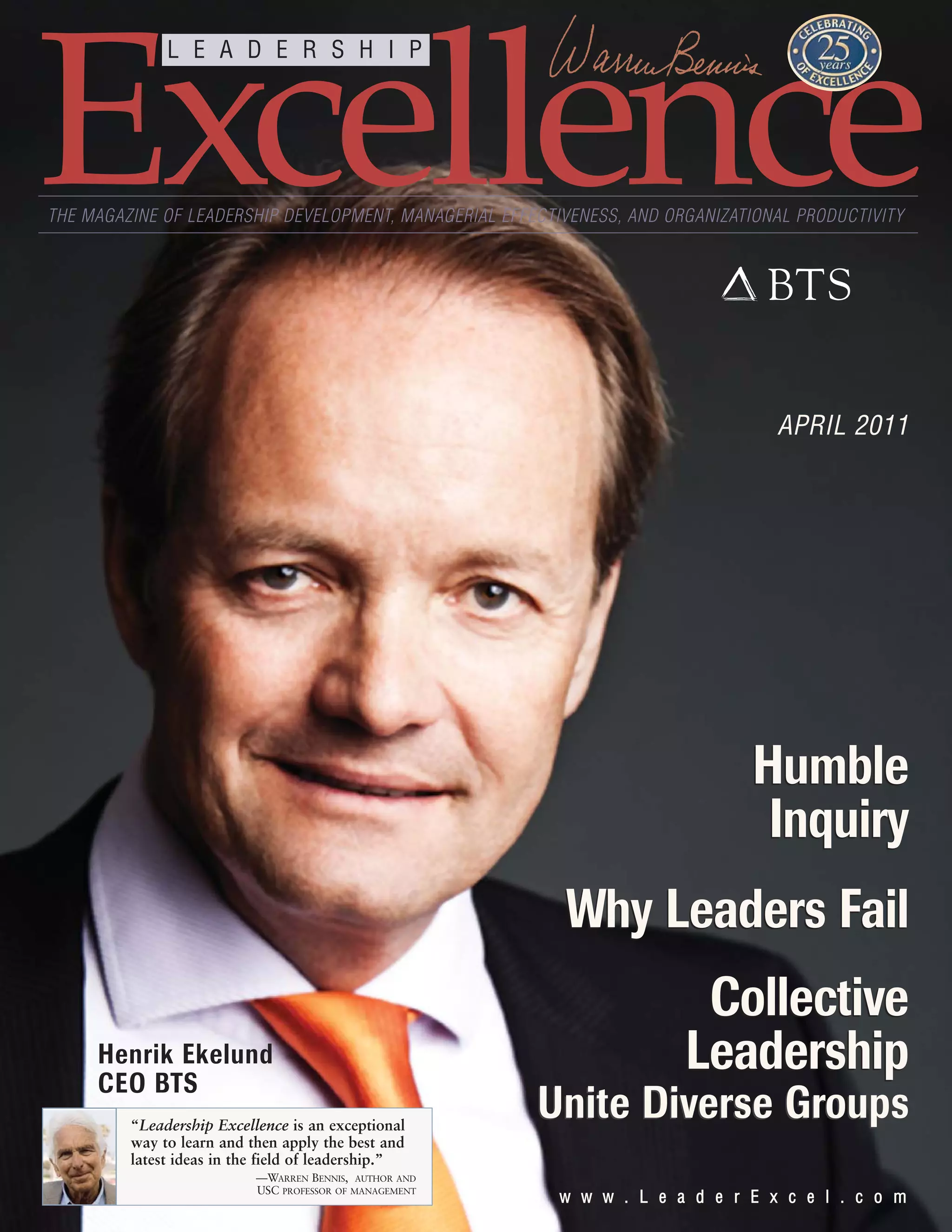
  • 5.
    LEADERSHIP ARCHETYPES project; their carefully selected teams make it happen. Ideas are developed through frequent meetings and interac- Collective Leadership tions and an open culture of collabora- tion. Long-term success depends on Go from platitude to practice. constant innovation and reinvention. 5. General and soldiers. Soldiers focus How do you track common interpre- on well-defined and scripted tasks, mo- tations of rather abstract mental models? tivated by hierarchical structure and How do you concretize collective leader- the prospects of promotion. Extensive ship? To make the As One diagnostic training is needed for recruits to under- robust, we had to find an answer. Tra- stand the culture and to learn specific ditional leadership theory wasn’t helpful. skills. The generals’ authority—their The twin poles of command-and-control ability to command respect—is just as by James Quigley and Stephen Langton and hierarchy on the one hand and col- important as their mission. Without it, C OLLECTIVE LEADERSHIP—THE ABILITY to unite diverse groups of people in a common purpose, to achieve laboration and flat-and-fluid structure on the other could not tell the whole story. the organization disintegrates. 6. Architect and builders. Leaders need a team of skilled followers to bring their teamwork on a grand scale—is the Eight Models or Archetypes blueprint to life. Builders are master lifeblood of successful organizations. Using a self-organizing map (SOM), craftsmen and innovators capable of Every project, strategy, meta-goal or we drew out the relationships among finding new solutions to technical and vision depends on effective teams, on our 60 case studies and compiled a set practical problems. Interdependent links collaboration. A leader is nothing without of eight distinct archetypes: in a project management chain, they followers; no manager is an island. 1. Landlords and tenants. In this strive to achieve milestones mapped to Statements like these have been command-and-control, top-down model, deliberate work cycles. As each link is made and reprised in management leaders control access to valuable or completed, they’re one step nearer to books for decades. The idea that work- scarce resources and dictate the terms realizing the architect’s grand design. ing together is a good thing, that it gets for followers’ participation. The land- 7. Captain and sports team. Once complex tasks done—and that it is lords’ power base grows with the num- players, leaders know the rules of the necessary for both organizations and game. They combine the practical skills society—is as old as it’s elementary. of followers with the ability to motivate But what does collective leadership look and improvise, often adapting to new like? What are the models for effective challenges in real time. Members of the leaders and followers? How can you team have a strong sense of shared ensure the whole will be greater than the identity and see each other as equals. sum of the individual parts? Here, things There is minimal hierarchy. Leaders, get blurry. Applying the theory of col- like followers, get their hands dirty. lective behavior to modern manage- 8. Senator and citizens. This model is ment is still a work in progress. a democracy. The leader’s style is consen- Three years ago, we started a major ber of tenants they attract and retain. sual: problems are tackled through free project to bring collective leadership be- At best, the relationship is mutually and open debate. The senator leader is yond the platitudes into practice. We reinforcing: tenants commit to the rules; the guiding intelligence who oversees reviewed hundreds of perspectives on landlords ensure those rules are fair. decision-making, but followers work collaboration and collective action drawn 2. Community organizer and volun- independently. In return for their per- from several disciplines and made case teers. Leaders bind the activities of fol- sonal freedom, citizens willingly com- studies of 60 examples of collective lead- lowers together through an inspirational mit to the constitution and to respon- ership in diverse organizations across story and provide the rationale for the sibilities they owe to the collective. geographies. The result was As One, a cause. Leaders don’t, however, tell fol- Landlord and Tenants, Conductor and new service offering to our clients. lowers what to do. The decentralized Orchestra, and General and Soldiers are Designed to help minimize and man- organization functions more by philoso- variations on the command-and-control age the intangible people risks of strategy phy than by rigid rules and structures. theme; the other five archetypes are execution, As One identifies and measures 3. Conductor and orchestra. Highly more agile and adaptive. None is inher- three conditions for collective leadership: trained members perform, with care ently weaker or stronger—but might be 1) Shared Identity—people see themselves and precision, repetitive and scripted in certain situations. An organization as members, not as outsiders; 2) Direction- tasks. Protocol-driven, they’re about intent on continuous innovation would- al Intensity—people feel impelled to do doing essentially the same things but n’t operate well as Conductor and what’s needed to achieve the organiza- in new, better, and more efficient ways. Orchestra or General and Soldiers. tion goal; and 3) Common Interpretation The leader motivates the team by the The SOM provides a taxonomy for —people have common mental models of promise of helping them achieve their collective leadership and puts manage- how work will get done. personal best. There’s little room for ment in a practical, how-to context. LE All three factors are equally impor- improvisation—but room for excellence. James Quigley is CEO of Deloitte Touche Tohmatsu Limited, tant. To fail to correct deficiencies in any 4. Producer and creative team. In this co-chairman of the Deloitte Center for Collective Leadership, and co-author of As One: Individual Action, Collective Power one is to make the strategic bet less safe. archetype, the leader has the vision and (Portfolio). Stephen Langton is Managing Director of the It was, however, in the development of the power to bring together a team of Deloitte Center for Collective Leadership, Deloitte Touche Tohmatsu Limited. Visit www.deloitte.com/about. a measurement tool for the third that highly inventive and skilled indepen- our efforts were most concentrated. dent individuals. Producers guide a ACTION: Practice collective leadership. L e a d e r s h i p E x c e l l e n c e A p r i l 2 0 1 1 3
  • 6.
    CAPABILITY LEARNING uation. The person being asked for help 1. Learning how to ask the right ques- must be sensitive to the vulnerability of tions. Different questions have different the help seeker and ensure that he or impacts. Do we want respondents: a) to Humble Inquiry she does not make matters worse by continue their story (humble inquiry), or It’s the key to helping. belittling the seeker, giving premature b) to become more diagnostic by asking advice, jumping to conclusions about many “why” and “what did you do” what might be helpful, or reinforcing questions, or c) do we want to confront by Edgar H. Schein the one downness of the seeker. And, the them: “Have you thought about doing seeker must be clear about what he or this?” (advice in the form of questions). she needs, not asking something irrele- Knowing when to ask what type of S INCE LEADERS ARE SUP- posed to set direction, display wisdom, and tell vant just to test the potential helper. The biggest trap for the seeker is to ask the wrong question; the biggest trap for the question and assessing the impact of different questions requires practice. As leaders, we tend to use confrontative their followers what to do, we’ve become giver is to answer that wrong question. questions. We think that being a leader obsessed with leadership competencies For help to be helpful, the leader seek- means knowing what to do and offering that emphasize action, direction, and ing help must reveal the real problem, guidance and advice. In the new world, charisma. That works in a simple world and those being asked to help must often formal leaders won’t know the where leaders can figure out what to enable the leader to reveal the real answer and need to create a helping sit- do. Alas, that is not the world of today. problem. Hence, a relationship of trust uation in which they and others solve In a world of complexity, globalism, must either exist or be built. the problem together (mutual helping). multiculturalism, dispersion, and social Humble inquiry is the most reliable 2. Learning what role to take in the responsibility, formal leaders won’t know way to test or build a relationship of helping situation. Do we want: a) to be enough to be decisive, will depend trust. By humble, I mean that the helper the expert and provide information or a more on the knowledge and skill of must ask a question to which he or she service, b) to be the doctor who will colleagues, will manage networks of does not already know the answer. If diagnose the problem and offer a pre- people from different cultures, and will we are asking just to check our expec- scription, or c) to enable the client to factor in new priorities in decision tation or presupposition or assumption solve his/her own problem by being making. These requirements force us more of a process consultant. to focus anew on Greenleaf’s concept If the seeker clearly wants informa- of servant leadership and my concept of tion or a service, we provide it, but we the leader as a giver and receiver of help. must be sure that what the seeker asks Leaders can’t give direction if they for is, in fact, the problem to be solved. don’t understand the complex realities Often in building the helping relation- of the situation, which means: 1) seek- ship, we discover that since the situa- ing help from many others to provide tion is complicated we have to take on the information needed, 2) creating sit- more of a doctor role. If human systems uations in which others are motivated are involved, we also discover that we to provide such information, and 3) can never learn enough about the helping others implement the desired or hypothesis, we won’t learn what the client’s system to offer answers or courses of actions. Leaders need to person seeking help needs or wants. If advice, but we can become a process seek, offer, provide and accept help— the seeker is the leader or boss, the sub- consultant, a role in which we focus on and often they are not very good at it. ordinate or peer has to ask some hum- helping the client to solve his/her own ble questions. If the group member or problem. In this case, the helper and Key to Successful Helping subordinate comes to the boss for help, client become a team working together Helping is complicated, since in most the leader or boss must humbly inquire to diagnose and figure out what to do. cultures being a competent adult means what is really being asked. We often assume that the leader must not needing help. To ask for help puts the By inquiry I mean that the first steps in give the answer or be the doctor; in the person one-down and puts the potential the helping process must be questions, espe- multicultural new world, leadership helper temporarily one-up. To ask for cially by helpers. Even if the seeker asks a will require more of a process consulta- help makes you vulnerable. To be asked question, if helpers do not engage in tion role, since only the team members for help makes you powerful. To offer some humble inquiry, they won’t know will have the knowledge and capacity help when it has not been asked for is whether what was asked was the real pro- to solve the problem. Leadership will in- displaying power. The situation is ini- blem on which help is needed. Inquiry volve a constant shifting of roles as the task tially unbalanced. Normal social pro- does not have to be a set of questions. demands change. All team members need cesses are balanced and equitable. We Showing an open attentive demeanor, to ask for and provide help as needed. know our roles and the rules of tact encouraging the seeker by staying Leadership becomes a distributed function. insure that most conversations are equi- silent, or saying tell me more will reveal From this view, teamwork can then be table in terms of the social economics. When relevant information. If the seeker feels seen as perpetual mutual helping, requir- one person speaks, others pay attention! listened to, that equilibrates the social ing each team member to engage in Asking for help or offering it when it is situation. It builds a momentary helping humble inquiry with other members. not asked for disrupts this process. And relationship in which both parties can Mutual helping is a critical leadership for a leader to ask for help is a double dis- more easily say what is on their minds. skill—and humble inquiry is the key to ruption of leader/follower expectations. creating mutual helping relationships. LE So what can go wrong? The person Master Tw o N e w S k i l l s Edgar H. Schein is the author of Helping: How to Offer, Give asking for help must trust the potential Two sets of skills are involved in and Receive Help (Berret-Koehler). Visit mitsloan.mit.edu. helper not to take advantage of the sit- developing helpful relationships: ACTION: Engage in humble inquiry. 4 A p r i l 2 0 1 1 L e a d e r s h i p E x c e l l e n c e
  • 7.
    MANAGEMENT ALIGNMENT to be available whenever someone wants CAPABILITY FINANCIAL their services but also be lean enough that Function Alignment their people are being fully utilized. As with technology tools, managing utilization Money Makers Align with the purpose and strategy. versus availability often feels like a no- Do your leaders have it? win situation. In fact, trying to do both is a no-win. Functions must be clear by Mark Nyman about the primary drivers of business by E. Ted Prince success to determine where they apply utilization or availability as organizing I N GOOD AND BAD ECON- omies, functions such as HR, Finance, and IT principles. And support organizations need a clear method for prioritizing their work and who they respond to L EADERSHIP DEVELOP- ment approaches should include business are in a continual cycle of growing then first to keep the business running. acumen within their ambit, and these shrinking and centralizing only to decen- 4. Solutions looking for problems. Too approaches need models with the tralize. They are reengineering, down- many improvement efforts are solutions power to predict leadership acumen. sizing, outsourcing, or creating shared looking for problems. Many functions, in Do your executives have what it service organizations. One day they are being proactive with good intentions, takes to create capital? My goal is to asked to increase responsiveness, the next identify a concept that they find com- assess the business acumen of managers they’re asked to cut cost and improve effi- pelling, get management support, and and leaders; predict their impact on the ciency. Most change efforts focused on implement the concept without under- financial outcomes; predict the finan- support functions have unin- standing the relevance or cial impact of teams; predict financial tended negative results. For application on day-to-day impact using metrics that appear in example, when the HR func- work. Creating work for oth- financial statements; and translate these tion makes what they feel are ers tends to create the biggest into predictions of valuation impact. positive changes, line leaders credibility gap between func- My work is a part of the emerging often have a negative view. tions and those they serve. So, discipline of behavioral finance. This While they value the contri- always identify what business shows how cognitive biases impact bution of the HR people need you are meeting. Other- decision-making. We enable the pre- assigned to them, they don’t wise, your leaders may see diction of financial impact by identify- value the contribution of the your work as an added bur- ing how the cognitive biases of function. Why? The changes HR makes to den or distraction from real work. managers impact financial outcomes. improve the function do not help the line 5. Accountability confusion. This Business acumen can be measured— leaders improve business results. occurs when functions police budgets, and its impact predicted. One aspect of When functions try to improve with- policies, and procedures that belong to our work shows what behaviors charac- out aligning with the organization as the line and become accountable for terize managers with exceptional capabili- the primary outcome, they tend to hurt issues that belong to the line. It’s ties for creating capital—the personalities rather than help business performance. alarming how many functions desire of people who excel at making money. this responsibility. It creates misalign- We’ve developed three core psycho- Five Types of Misalignment ment, victims out of those who are metric assessment instruments: Five types of misalignments occur: being policed, and becomes a rationale • Financial Outcome Assessment (FOA) 1. Optimizing the function. Often a for the line not taking responsibility measures the financial signature of man- function will implement changes that and accountability for results. agers—their propensity to create capital. make their work more efficient or easi- Solutions to misalignment involve • Executive Outcome Assessment (EXOA) er while making it harder for the orga- understanding requirements (what effec- measures the behavioral characteristics nization to achieve its goals. Support tive support looks like) and determin- that lead to specific outcomes—how a functions must know who they are con- ing what responses drive the most value. manager’s behavior impacts financial nected to and how their actions and improve- This includes looking at the work you outcomes in practice in his situation. ments will impact the core business. When are doing and understanding how to • Corporate Financial Outcome Assess- you are in a support role, most of the best position the work for the good of ment (CFOA) measures the financial requirements need to flow from the the business. The most lasting solution mission based on behavioral data. This business needs out rather than from the comes from understanding business enables us to evaluate alignment and support organization to the business. purpose and strategy and aligning all measure competitive prowess from a 2. Standardization versus custom- functions to the same end result. Most behavioral perspective. ization. Standardization is a common leaders see the need for alignment but Since many executives have experi- solution in cost-cutting initiatives and don’t address what is being aligned. enced these assessments, we can now streamlining functions. When properly Alignment implies direction or a reference look at the behaviors associated with applied, it creates great value and cost point to align everything else with. capital creation and financial impact savings. But when business drivers Support functions that are aligned and correlate the financial signatures of call for customization, standardization to the business have clear priorities managers with leadership outcomes. results in rework, shadow organiza- and those working in the function tions, and other drains on people’s clearly see the role their work plays. LE Exceptional Money-Makers Are Rare time. The belief that work is scalable is We focus on the most exceptional Mark Nyman is an expert on HR Transformation with Results not enough of a reason to standardize. Based Leadership. Call 801-492-6955 or visit www.rbl.net. types of propensity for capital creation. 3. Utilization versus availability. Most managers do not create capital—they Functional groups are often challenged ACTION: Align functions with business strategy. consume it (only 12 percent create capital). L e a d e r s h i p E x c e l l e n c e A p r i l 2 0 1 1 5
  • 8.
    Four personality typeshave excep- LEADERSHIP ALIGNMENT up in several ways. Cultural traits we tional capabilities in creating capital commonly see that create barriers to (yet even within these groups, only a change include turf issues, trust issues small subset excel in creating capital): Leader’s Job One or people working in silos. These all • Alchemists are introverted and street- Align strategy, structure and culture. get in the way when changes require wise, meaning they distrust logic. They collaboration across the enterprise. invariably create a new high-value There is also a need for more agility product that creates new market seg- and innovation than ever before. by Larry Senn ments. To qualify for this characteristic, Acquisitions are a part of the the person is usually intensely introvert- growth strategy for many companies ed and streetwise. Usually the compa- ny founded by this person does well, even though the founder is highly C EOS AND SENIOR TEAMS have a lot—usually too much—on their and it is well known that the biggest reason for shortfall in acquisitions and mergers is “cultural clash”. So, if that introverted, because the product is rev- plates, especially today. So, what are is the strategy, creating an acquisition olutionary enough that it attracts more the blue chips, the highest value things friendly and aware culture is an market interest and sales support that for CEOs to focus on? We believe there imperative. Other companies are seek- the founder himself can’t attract. are three powerful drivers of perfor- ing to change their structure, such as • Visionaries are extremely forward mance that deserve their attention. moving from a holding company or looking and strongly oriented to giving 1. Purpose and direction—connect- decentralized model to a “one compa- up the present for a far-off future. If ing people at all levels to the mission ny” shared business model. In both sit- they are too altruistic or too individual- and their declared strategy for fulfill- uations, the cultural traits that need istic, they will fail to generate revenue. ing that mission. strengthening are trust and collabora- They can be only mildly altruistic or 2. Structure and enabling processes tion for the greater good. mildly individualist; however, being —creating the best organization struc- To eliminate the Jaws of Culture, we mildly visionary is insufficient—the ture and supporting system to drive advise CEOs to focus on the culture to psychological impulse to look forward that strategy. support the strategy, beginning at the must be intense; otherwise, the person 3. An enabling culture—ensuring the senior team because those leaders set will not show exceptional money-mak- behaviors in the organization are the the example for the rest of the organi- ing and capital creation propensity. specific ones needed to make the struc- zation. One CEO who did this to great • Customer analysts are strongly sales ture and strategy work. success is Zappos CEO Tony Hsieh. He oriented, rather than product oriented. While this appears to be regularly points out that he However, if they are too strongly sales- a reasonable agenda, sever- had to get the culture right oriented, they won’t have a high al factors make this difficult to succeed at creating the propensity to create capital. They are to do. First, these drivers best customer experience. also strongly financially oriented. This are vital but not time Why? Because it is the does not mean that they will have urgent, and culture is the behaviors of employees financial qualifications; in fact, usually hardest to shift into align- that affect the experience they will not. Rather their zone of psy- ment. Most CEOs and their customers have. Hsieh is chological comfort is exceptionally top teams can effectively an example of a CEO who strong in dealings with finances. adjust their strategies. focused on culture to sup- • Generals are disciplined planners, but They’re also good at devis- port his service strategy if they are too strongly planning oriented, ing new organizational and by doing so created a they are too slow in adapting to market con- structures. But as Ed Schein, one of the distinctive competitive advantage. ditions and thus lose market opportuni- pioneers in culture, said, “An organi- In order to make their culture a ties. In addition, these managers can’t zation’s culture is its response to the launching pad for success, CEOs and be extremely consensual or command- way things used to be.” their teams should define or revisit oriented in their styles. If they become In other words, the culture lags and their organizations’ cultural defini- too strong in these areas, they lose the can become the anchor out the back of tions. Do the value statements cover propensity to create capital. the boat. We call this the Jaws of Culture. the kinds of behaviors the company Where a manager or leader falls on We all encounter those jaws at one time needs to win at this moment in time? If the money propensity scale depends or another when we go to implement a not, they need to be adjusted. If the on their behavioral characteristics and change and it doesn’t go easily. cultural definitions are fine but the their intensity. You can use the results Culture represents the collective norms behaviors don’t match, CEOs need to of these assessments to boost your self- and behaviors in the organization. Most first find ways to ensure the team at awareness so that you can improve companies have solid core values and the top is living and modeling the your financial and valuation impact— cultural traits that have made them desired behaviors. This is because and thus align better with the financial great. They also have historic habits organizations become shadows of their mission of the organization and with that haven’t changed with the times. leaders. Special training processes and its valuation goals. Seek training in Those habits can get in the way, espe- reinforcement systems can be used to business acumen. Complete the assess- cially when strategy or structure/pro- bring the desired culture to all levels in ments, link your behaviors to business cess changes or when higher levels of the organization. LE outcomes, and create self-awareness as performance are needed. If not system- Larry Senn, Ph.D., is Chairman of Senn Delaney, shaping cul- to how this can improve your impact. LE atically addressed, these cultural barri- tures that enhance spirit and performance. Call 562-426-5400, E. Ted Prince, Ph.D., is CEO of the Perth Leadership Institute. ers act like jaws in the culture that can email lsenn@senndelaney.com or visit www.senndelaney.com. This article is adapted from his interview in The CEO Forum. Call 352-333-3768 or visit www.perthleadership.org. chew up strategies and initiatives. ACTION: Boost your money-making capability. In terms of cultural traits, this shows ACTION: Align strategy, structure, and culture. 6 A p r i l 2 0 1 1 L e a d e r s h i p E x c e l l e n c e
  • 9.
    LEADERSHIP SERVICE which the signs are faint, leaders must get close to customers and employees to separate perception from reality. Beyond Perception Although it sounds simple, it can be difficult to do. Leaders who have spent Perception becomes reality. their careers climbing a pyramid to reach the pinnacle can become insulat- ed and even isolated if they don’t sepa- opportunities for growth. Others are rate who they are from what they do. by Gary D. Burnison innovating to capture consumer inter- They often become engrossed in the est in global markets. And, it’s not just inverted pyramid that suddenly appears C ONSIDER THIS STORY: technological innovation. I think of A group of settlers Nestlé, which launched its first floating in a remote village of supermarket on the Brazilian Amazon, above them—layers of constituencies, including the media, special interest groups, stockholders, financial analysts, Outpost were preparing for winter. a retail barge that extends its reach to and so on. At the intersection of the two The group’s leader, unschooled in the more than 800,000 customers. pyramids is the CEO, who must not old ways, guessed that the winter This global view contrasts sharply only look over the horizon, but relent- would be cold and that people should with the perception of those who have lessly execute today, for that deter- gather firewood. One day, he traveled relied more on Western economies for mines the starting point for tomorrow. to the nearest town and called the growth. Those CEOs are more subdued. That means being connected to what National Weather Service, which con- As they wait for consumers to crank up matters the most. This is what Mulcahy firmed his suspicion: the winter was their spending again, the cup is not called “logging the miles,” traveling to indeed going to be cold. The leader only half empty, but leaking steadily. meet with employees and customers in ordered more firewood to be collected, So who’s right and who’s wrong? It person. It’s a high-touch style of lead- and checked in with the NWS again a depends upon your perception. In this ership that allows not just communica- week later, which amended its fore- case, however, throw away percep- tion from the leader, but dialogue with cast—not only for a cold winter, but a tion—the classical lens of West versus the people who are the closest to the very cold winter. So the people of East or developed versus emerging has marketplace. As she observed, “I don’t Outpost gathered even more wood. think people can get the sense of the When the leader checked in with leadership dynamic of the company the NWS a third time, the prediction without the ability to touch and see was now for a very, very cold winter. and interact on a personal basis.” Finally, having asked for every branch Her comments bring to mind the and twig to be gathered, the leader observation by Muhtar Kent, CEO of asked the NWS how they could be so The Coca-Cola Company. His first task sure. The answer: “The people of Out- in changing the culture into one of con- post are gathering a lot of firewood.” nection was to visit major and minor In a directionless economy, it is very markets and to meet customers. It was easy for perceptions to become reality. the same tactic he used when he was in The levers of growth are not as appar- blurred. The world’s axis has tilted and charge of Asia for Coca-Cola. “The first ent as they were in the days of con- the compass spins in all directions. thing I did was to go to every country spicuous consumption and fast credit. Leadership, however, is timeless and (39). Back then, most of our people Myopically focusing on the decline can’t wait for clarity. It is about making didn’t even know the names of our in Western consumer sentiment, you and seizing opportunity—not by sitting biggest customers,” Kent recalled. will undoubtedly perceive an econo- home consumed by pundits and prog- The experiences of Kent and Mulcahy my that, while officially out of the nosticators, but by leaders listening should serve as a wake-up call for CEOs great recession, is barely growing. If and learning from those who matter and other leaders to consider where so, you are probably preparing for a most: customers and employees. they are spending most of their time. If long cold winter of anemic growth. Some months ago, on the eve of her they dwell at the intersection of the Not every leader, however, sees retirement as chairwoman of Xerox, I pyramid tips, they will be squeezed. If things the same way. This past sum- met with Anne Mulcahy. She recalled they overly rely on perceptions, it mer, I spent much of my time on the her early days as CEO of Xerox when undoubtedly will be myopic and cer- road in Europe, talking to leaders from the company teetered on the brink of tainly will be filtered. If that happens, Paul Bulcke, CEO of Nestlé, to former bankruptcy. As the new CEO in those they shouldn’t be surprised if they Prime Minister of Hungary Gordon days, Mulcahy was pulled in countless spend most of their time hunkering Bajnai. My mission was twofold: to be directions until she received some sage down for a long, cold winter. with employees and clients outside of advice from Warren Buffett: “There is Those who empower others while the United States and to engage in dis- only one way you are going to get results, venturing out themselves to listen and cussions with other leaders on what and that’s by keeping your customers loyal learn will discover astonishing new they see, hear, and experience. and your people engaged and motivated. levers of growth. For them, there will In every conversation, I was struck Get everything else out of the way.” be pockets of spring where potential by the bifurcation in perceptions. For By focusing on customers and employ- blooms and opportunity grows. LE those who lead global enterprises, the ees—Mulcahy accomplished the near- Gary D. Burnison is CEO of KornFerry International and proverbial glass is half full and contin- impossible: saving Xerox. author of No Fear of Failure. Visit www.kornferry.com. uing to fill. They are investing and hir- The mission for leaders today is no ing and expanding because they see different. In a directionless economy in ACTION: Focus on customers and employees. L e a d e r s h i p E x c e l l e n c e A p r i l 2 0 1 1 7
  • 10.
    CHANGE INNOVATION of their accomplishments that represent examples of the vision and purpose. And, they make certain their actions are Cultivate Innovation consistent with the vision and purpose. Boldness happens when employees do not fear error. Boldness would not It all requires bold leadership. be daring were there not potential for error. Leaders foster a healthy attitude toward failure. When Thomas Edison mostly a superstition. It does not exist was asked about failure associated with in nature. Avoiding danger is no safer in his quest for invention he said: “I never the long run than outright exposure. Life is failed once. It just happened to be a either a daring adventure or nothing.” 2,000-step process.” Edison held over The remove rather than add approach 1,000 patents. How you deal with error by Chip R. Bell and John R. Patterson means leaders focus on eliminating all can communicate volumes about your that exists in the work world that fuels commitment to fostering innovation. I N TODAY’S INNOVATION-DEPRIVED ECON- the opposite of boldness—timidity, omy, proactive leaders adopt the proverb: “Fortune favors the bold but hesitance, doubt, and reserve. Boldness is borne of purpose. Stok- When you meet error with rebuke, you send a different message than when you see error as an opportunity for abandons the timid.” ing the flames of boldness begins with learning and problem-solving. Once we consulted with a financial a wide-eyed focus on a dream or pur- As part of encouraging bold leader- services company as their leaders con- pose rather than a squint-eyed look at ship, recognize that employees don’t resist sidered launching a change manage- the task or job. Caution comes from change as much as they resist the predic- ment effort that would foster a more being mired in day-to-day activity. As tion of pain over which they have no con- innovative approach to their market- the trees block your forest vista, you trol. Helping employees view change as place. Every meeting, phone call and are soon left blind to aspirations and opportunity not threat requires candid email was painted the color of timidi- dreams. “I came to my last job,” said communication as well as an atmos- ty. “Why the extreme caution?” we one retired leader, “with a great sense phere of inclusion. The more employ- asked them at the end of another do- of purpose. But, I got so enmeshed in ees are in the know and find their nothing-but-talk meeting? The COO fingerprints on change initiatives, the replied, “We’ve been in a bunker mind- more they will replace fear with fervor. set so long we’ve forgotten that chutz- Without risk, there’s no creativity. pah has been the key to our success.” However with risk come honest mis- A steady diet of cut-backs, layoffs, takes. It is easier to gently rein in an and budget crunches has introduced overzealous, go-the-extra-mile employ- an abundance of caution into most lead- ee than to find one with an enthusiastic ers. The Great Recession trimmed their attitude in the first place. Fostering dar- wings—turning them into activity-seek- ing is a manifestation of trust—the ers instead of results-makers. greater the trust, the greater the freedom. Now’s the time for leadership bold- But, with freedom comes with respon- ness. The key to progress and growth sibility. The bold leader’s job is to coach is innovation—and innovation is never what I had to do that I soon forgot what I employees to feel more comfortable spawned in a culture of reticence. had hoped to be. It was not until I was with more and more responsibility. “Boldness has genius, power, and ready to retire that I realized I had got- Examine policies and procedures. magic in it,” wrote Scottish explorer ten more defensive and less daring.” Are employees clear on what is a thou W.H. Murray. “Until one is committed, Boldness is a choice based on a com- shalt not law versus an it would be better there is hesitancy, the chance to draw mitment to a future state. It’s not a reac- if you didn’t guideline? Are rules of thumb back, and always ineffectiveness.” tion but deliberate action. It is pro-action at and rules of law treated the same? Are Innovation is counter cultural, against its finest—a step toward the light. It is metrics so abusive that employees feel the grain, and unconventional. It is borne of a noble reach beyond the that leaders are pulling plants out of the sometimes cut from unfamiliar cloth. mediocre of the moment and the ordi- dirt to determine if they are growing? Are While the specific output of innova- nariness of the status quo. Daring with- employees publicly given the benefit of tion might not be that controversial, it out recklessness requires awareness of the doubt? Do they get more coaching springs from a restless, unsettled place a purpose or vision and a desire to or more critiquing? How many times that today’s leaders must occupy if move in the direction of that future. do employees get praised for excellent they are to inspire innovation. It is the Bold leaders have a valued dream that efforts that failed to work? Are employ- habitat of ground-breaking pioneers serves as the compass for their courage ees commended for seeking assistance and norm-breaking entrepreneurs. and an inspiration to associates. from others, including other leaders? Inventors and artists of all types reside Bold leaders, intent on fostering there as well. And, the company or innovation, talk often about mission and Responsible Freedom country that leads the innovation vision. They focus on what they want a People need guidelines, not unlimited space corners the marketplace. unit or organization to BE, not just DO. license. The leader who says, “Just go Leading boldness is not about some- Such leaders communicate the whys do whatever you think is best,” is thing leaders add as much as some- when making assignments, not just the demonstrating abdication, not encour- thing they remove. Boldness resides in whats and whens. They affirm heroes by aging boldness. But guidelines need us all. Helen Keller wrote: “Security is telling their stories—especially the details elbow room for people to adapt to the 8 A p r i l 2 0 1 1 L e a d e r s h i p E x c e l l e n c e
  • 11.
    situation. Risk takingis not a blank check LEADERSHIP STRATEGIES more aware and sensitive to how their to be foolhardy and reckless. Sensible risk part fits into the whole. You also have taking comes from knowing how to people who can step in and help, in a balance great performance with responsi- Effective Leadership variety of areas, when needed. Deep ble stewardship. It is “owner-thinking.” If Three strategies for tough times. training is one of the best uses of your employees are to make front-line deci- times while business is slow. Also, as sions like owners, they need the benefit the economy turns around you will of owner-type information. by Sheila Murray Bethel have a competitive edge and reap the “A lot of us think that success is benefits of having highly trained staff. about the boldness of the gamble,” • Leadership Lesson: The sense of says Harvard Business School profes- sor Nancy Koehn. “Success is about understanding what’s bold about the bold- I T IS NEVER EASY TO LEAD, and in these turbulent times it is harder than shared responsibility is the end product of training in tough times. 3. Be a hope giver. Here is where ness, about knowing how to keep the ever before. The big question is, what your ability to use aspirational language risk from coming back to bite you, and can you do today to be a more effective comes to the forefront. Your words can about knowing what your organization leader? How can you help your people inspire or discourage, hurt or help, di- will get from taking such a big step.” through these tough economic times? vide or connect, cause fear or give hope. Boldness does not mean the absence of Here are three actions you can take to Once again, gather your teams fear. People who are daredevils think relieve employee stress, increase pro- together and reassure them that it may they are invincible. Their arrogance ductivity, and enhance your leadership not be easy, but pulling together is the causes them to miss seeing the signals authenticity. only way to survive in these tough and cues needed as guidance to suc- 1. Focus on A priorities. We are all times. Have a discussion about why cess. Sometimes hotdogs get lucky; in bombarded daily by bad news that your enterprise exists and have the time, they crash and burn. Innovation- affects our self-confidence, attitude group clarify your statement of pur- focused leaders help associates respect fear and work product. One of your most pose. Ask each person to share ideas and channel it. They provide outlets for important leadership skills is to help about how you benefit your cus- people to talk about their apprehen- people stay focused on the tasks that tomers. Ask them to define what they sions and deliver support and encour- are the anchor of your business. These believe brings you all together in a agement when people have doubts. are the basics and almost always bring shared sense of purpose. Examine your reward and recogni- the highest results. Help your team American Express lost 11 employees tion practices. Which is more valued: emphasize best practices on 9/11. On 9/12 Kenneth creativity or compliance? Being resourceful and the most valuable Chennault, CEO, knew that or being always right? Who gets praised processes and procedures in he would need to commu- or promoted—and for what? Former 3M their job description. nicate a strong dose of hope CEO Lew Lehr said: “If you place too A recent client asked me in the face of such an over- many fences around people they can to help improve company whelming tragedy. Nine easily become pastures of sheep. How morale. The first thing we days later he brought the many patents are assigned to sheep?” did was gather the various entire New York City staff Surround your unit with bold people. teams together. Each team to Madison Square Garden Seek the council of others who exhibit had a leader that guided for a team meeting. He told daring. Invite card-carrying mavericks them through a short exer- them that it would take to your meetings. Read biographies of cise in which each person courage and hard work, but pioneers who overcame personal limi- listed the most productive and impor- he was confident that they would all tations to achieve greatness. Visit orga- tant things they do in their job. They pull through together. His calm nizations famous for breakthrough then evaluated the least effective activ- demeanor, quiet grace, and words of thinking—R&D facilities, art studios, ities and quickly saw where to put hope, gave his followers the confi- and culinary institutes. While your their energies and effort. As they dence they needed to carry on. approach needs to be relevant to your cleared away less important tasks, and • Leadership Lesson: Feelings of opti- unit, others can offer insightful suggestions. focused on basics they felt more mism and expectation are greatly enhanced As an old expression notes: Only dead assured and much of their stress was by your ability to help followers step outside fish swim with the current. Smart fish swim relieved as they got to work on their of themselves and serve a higher purpose. in all directions, but the pull of the cur- “A” list of jobs. Yes, times are tough. It takes excep- rent does not influence their choice. • Leadership Lesson: Help your people tional leadership to move your team Innovation never comes from follow- focus on A priorities, all else can wait for forward. If you help everyone keep a ing the herd. Bold leaders bent on culti- better times. Get back to the basics and better perspective on which to focus vating innovation live the vision, drive results will follow. priorities, train them to support one fear out, and encourage employees to 2. Train Train Train. As they say in another, and use aspirational language think and feel like owners. The byprod- sports, “go deep on the bench”. Which to uplift and give hope, you are using uct is the assurance of business creativ- translates into: train, retrain and cross- three of the most powerful 21st century ity that brings the best and brightest to train your followers so that they have leadership skills. LE the marketplace leading to valued a broader depth of appreciation for all Sheila Murray Bethel, Ph.D., is CEO Bethel Leadership Institute, progress and consistent growth. LE parts of your business. You will be speaker, author of A New Breed Of Leader, 8 Qualities That building a strong team of players who Matter Most in the Real World, and Global Leadership, Change Chip R. Bell and John R. Patterson are customer loyalty consultants and Customer Service Expert. Visit www.bethelinstitute.com, and authors of Wired and Dangerous: How Customers Have Chang- understand not only their jobs but email Sheila@bethelinstitute.com, or call 925-935-5258. ed and What to Do About It. Visit www.wiredanddangerous.com. those of their fellow workers. ACTION: Exercise bold leadership in innovation. The benefit is that everyone becomes ACTION: Adopt these three priorities. L e a d e r s h i p E x c e l l e n c e A p r i l 2 0 1 1 9
  • 12.
    CAPABILITY BREAKTHROUGHS blinded him to the need to develop his skills that you didn’t need when you staff. Once he identified his assump- relied on old strengths—like hard work tion, he could see that to handle his and cheerfulness—alone. Breaking Glass Walls current demands he needed to devel- op the talent that reported to him. Carl down your glass walls gives you access to more of your performance potential. C h a l l e n g e a s s u m p t i o n s . asked a promising direct to take over Tr y Self-Coaching some of his duties. And it paid off! The man stepped up to the plate with If you don’t have a coach, try this: by Dana C. Ackley enthusiasm and effectiveness, delighted First, ask yourself some questions: with the trust that Carl placed in him. What do I admire most in others? Who are Second, Carl assumed his cheerful- my heroes? When have I been proudest of C ARL IS A HIGH-POTEN- ness would win the day. Since cheerful- tial leader. He is ness had brought him so much success, smart, good looking, and he worried when he wasn’t cheerful. myself? The answers will tell you some- thing about your espoused beliefs and values. These are the thoughts you has a cheerful personality that draws When he was upset with underperform- have that you would like to believe people to him. He is well regarded at ers, for example, he tried to deny his guide your behavior. (“I’m a no-non- work. Some think he has it all together. feelings. This strategy created problems. sense guy. I tell it like it is. You always I know better. I’ve spent 40 years When a direct report was under-per- know where you stand with me.”) working with highly successful people. forming, Carl needed to notice his feel- Next, consider your behavior over the I hear about their successes, and about ings of displeasure so that he could past week. Take a hard look at discrep- where they get stuck. And they all get take appropriate developmental action, ancies between your stated beliefs and stuck at some point. What gets in their hopefully while the situation was still your behavior. For example, maybe way? Paradoxically, it’s often the one salvageable. When lost in his cheerful- you value courage, but avoid necessary thing that’s made them so successful. ness, Carl let poor performance go too conflict. Maybe you compliment some- Here’s how it works: Behaviors that long. His job also required him to deal one you should be taking to task. help you get what you want get repeated. with tough personalities. Sometimes Note the times that you don’t behave With enough success and repetition, in alignment with your stated values. these behaviors become habits. When These times signal the presence of hid- a behavior becomes habitual, it falls den assumptions (glass walls) that are out of your awareness. You do it auto- channeling your behavior in unintend- matically, without thinking whether ed directions, blocking you from reach- you should or not. You assume it is the ing the results you’re seeking. These right thing to do. For example, you hidden assumptions, not your stated values, might assume that in order to become are guiding your behavior. (Maybe you successful, you need to work hard. really think that people aren’t strong Assumptions bring order out of enough to take what you have to say. chaos, enabling you to narrow the Ask yourself what might be making countless choices available to you you believe that. Or you may worry every time you act, without forcing his cheerfulness diffused the situation; that someone might not like you if you you to examine each possibility every at other times, Carl needed to be tough told them what you think, and believe time. They bring predictability and himself. Showing resolve, perhaps with being liked at all times is crucial to success.) efficiency. Questioning assumptions a splash of annoyance, would be more Ask what might be compelling you every time you make a choice about useful. But Carl hated to feel annoyed, to act as you do when a behavior con- how to act would defeat their purpose. since feeling annoyed created a sense flicts with your espoused values. This But as circumstances change, the of failure. Breaking through this glass question can bring your hidden assump- assumptions you hold may no longer wall involved learning to recognize that tions to light. These are your glass walls. be valid. Yet, your outdated assump- annoyance—even anger—could promote Give yourself permission to be tions continue to guide your behav- needed outcomes, such as not letting a imperfect. Taking a close look at your- ior—off course, functionally barring bully intimidate him or others. self isn’t easy. Accepting your imperfec- you from getting where you want to What about you? What are your glass tions will free you up to work on them. go. Unseen yet powerful, they have lit- walls? You can let them control your behav- Your past success doesn’t guarantee erally become glass walls. ior, or you can take control, changing your future success. As you progress, you assumptions that were once valid, but will confront new situations that require Carl’s Glass Walls no longer serve you well. Identifying changed responses. The hardest part of Although he seemed to have every- assumptions that create glass walls isn’t change is identifying limiting assump- thing going for him, Carl was actually easy (they’re invisible—outside aware- tions, or glass walls. Once you achieve struggling. He worked overtime to suc- ness); nor is it for the faint of heart. that, learning new skills and responses ceed, but felt that he wasn’t measuring up. Talking with an executive coach or becomes much more manageable. As In our work together, we discov- other trusted advisor is one approach. you do so, you’ll break through to a ered two glass walls: Your organization might provide lead- brighter future, perhaps with a key to First, Carl assumed that the solution ership skill development (including an the executive wash room. LE to any problem was to work harder. executive coach) to enable you to learn Dana C. Ackley, Ph.D., is CEO of EQ Leader, an executive Over a series of promotions, he had about your glass walls. Once you learn coaching and leader development firm, and author of EQ accumulated increasing responsibili- about them, you are empowered to Leader and BreakGlassWall Programs. Email dana.ackley@eqleader.net, or visit http://www.eqleader.net. ties that exceeded what any one per- make a choice about how to handle son could do. His drive to work hard them. Then you can begin building ACTION: Challenge your assumptions. 10 A p r i l 2 0 1 1 L e a d e r s h i p E x c e l l e n c e
  • 16.
    FLASH FORESIGHT A NewYork Times, Wall Street Journal and USA Today Bestseller HOW TO SEE THE INVISIBLE AND DO THE IMPOSSIBLE In his new best selling book, Flash Foresight: How to See the Invisible and Do the Impossible (HarperBusiness; January 2011; hardcover), Daniel Burrus takes the concept of looking into the future and transforms it into a new paradigm for running highly successful businesses now and in the future. Order Your Copy Today at www.FlashForesight.com “I love this book! It’s as much fun to read as it is inspiring to learn from. Buy it, read it, and put it to use—in a flash!” — ALAN M. WEBBER, CO-FOUNDER, FAST COMPANY MAGAZINE
  • 17.
    LEADERSHIP VISION mandate a new level of cooperation and collaboration. People are being asked to achieve results in cultures Turn Vision into Reality where the hierarchical structure no longer applies—by influencing others, Use the L3 ‘State of Being’ approach. often across boundaries with no direct line control of resources. The drum- beat of do more with less is now compli- work can be—ought to be—activity that cated by the need to form alliances. expresses your values, gives meaning Any kind of achievement requires the to your life, and brings you satisfaction. crossing of boundaries, often bringing im- You, Inc. is headed by your top probable partners together for an exchange management team—Physical Health and of knowledge, skills and resources across Energy, Emotional Intelligence, Values and disciplines, cultures, and units. Examine by Marc Michaelson and John Anderson Beliefs areas—that make up your “nat- your current experience with collabo- ural resources.” If this team isn’t oper- ration. Think about how things are W E INVITE YOU TO ENVISION YOUR organization as a best place to work, with a highly engaged and productive ating effectively, you suffer from lack of drive, motivation, productivity, and energy. Five departments report to You, going, what you could do to improve, and actions that have the best chances for creating impact and improvement. workforce. Envision leaders and man- Inc.: Learning, Family, Social, Career, Seven different partnerships require agers aligning to the vision, mission, and Financial. If any de- maintenance. Three inside and values. Envision leaders, managers, partment is underperform- your firm: Direct Reports, employees, partners, and customers ing, you won’t operate Co-workers and Other building collaborative advantage. En- smoothly or optimally. To leaders and managers. And vision all employees engaged and moti- manage the multiple four outside: Customers, vated to reach their potential. Envision demands, you need a Suppliers, Competitors and a place where people lead themselves Personal Life Plan, or Total Consultants. The challenge well, build high performance teams, Life Leadership Plan that of leadership is growth, and create the very best place to work. addresses every aspect of and building partnerships Now, use the L3 Leadership Model to your life. The wheel of life is is the key. Sharing costs, turn vision into reality. The model explores made up of an inner hub risks and credit for success- three integrated attributes that deter- and an outer ring. In the es rather than competing mine how you lead and who will follow: hub are Physical (Body), Psychological internally is the formula for success. L1 Leading Self: Total life leader- (Mind) and Values (Spirit). These are Of these seven Partnerships, choose ship, personal mastery, and work/life your natural resources. How well you one from inside and one from outside integration (You Inc.). L1 is grounded maintain these resources determines and characterize where the relationship in your personal values and reflects what you achieve. is today, where you would like it to be your authenticity, integrity and bal- Here are four keys to L1, the Four P’s and what specific actions you could ance. It is how you conduct your life— of self-leadership: Purpose: Know what take to move it in the desired direction. the harmonious blending of all facets is important to you and where you are L3 Leading Others: Creating the Best of your life: body, mind and spirit, going. Performance: Understanding Place to Work culture of high engage- family, social, career, and financial. It how you are performing in all depart- ment, retention, performance and pro- begins with an internal sense of self- ments of work and life. Planning: Map ductivity. L3 becomes the culture of the confidence, emotional intelligence, out a direction to improve, maintain, work team, department, division or and balance that cultivates an authen- and lead all areas of work and life. company. L3 Leadership Power is not tic leadership presence. This quiet con- Problem Solving: Use your resources position power or influence power, but fidence effortlessly engages followers and skills to make needed changes. rather Regenerative Power. Engaging, who will support you by offering Think about what you value most, mobilizing, and motivating others to trust, passion, calculated risk, emo- how satisfied you are, and how you are realize their own L3 Leadership Power tional intelligence, and other support- performing. This enables you to for- fuels the leadership engine. This power ive attributes that provide high mulate an L1 Leadership POV (Point creates a culture of self-responsibility, performance and productivity. It is of View)—a Vision, Mission, and Plan. trust, and risk-taking based on people more about who you are than your L2 Leading with others: Cultivating who lead themselves well. These peo- position, training, or personality traits. and sustaining collaborative advantage. ple make stronger leaders, who create Personal leadership is a state of being Your position in L2 reflects the founda- stronger teams, and together build —it is who you are, what you believe, tion of L1 and frees you to work with high-performance organizations. and how you behave. It’s the sum total individuals and teams from a position Great managers are key to the selec- of your attitudes and beliefs, actions, of mutual self-interest. When you man- tion and retention of talented and and values. The greater your self-mas- age well in the L1 portion of your life, engaged employees. Their ability to tery, the greater your success. Leader- you can forge productive relationships select for, clarify expectations around, ship doesn’t depend on pay or position, in all aspects. When you approach an deploy with an eye for peak perfor- but on character, integrity, authenticity, interaction from a position of creating mance, and develop staff to emphasize and belief in yourself. Life and work possibilities, you give permission for natural talents leads to an engaged are interrelated—you not only work to others to follow. Collaboration becomes staff that produces bottom-line results. live but, given the right conditions and the way you live in relation to others. In a best place to work, how people opportunities, will live to work. Your Today’s networks of relationships are treated adds to competitive advan- L e a d e r s h i p E x c e l l e n c e A p r i l 2 0 1 1 11
  • 18.
    tages. Such workplacesreceive more LEADERSHIP RIGHTS the strategy process and involve people. qualified applications, experience a 3. Timely and useful performance lower turnover, reduce health care feedback. Everyone deserves feedback. costs, enjoy higher customer satisfac- Employee Bill of Rights Employees have a right to know how tion and loyalty, foster greater innova- It’s every leader’s responsibility. they’re doing, and how they can get tion, creativity and risk-taking, better. Leaders need to conduct perfor- outperform competition, and have mance reviews in a way that’s honest, higher sustained profits. fair and robust. This alone would cause by Steve Arneson When you invest in your people, a lot of leaders to step up their game! you invest in your success. We see a 4. Opportunity to contribute ideas positive relationship between training, motivating, and empowering employ- ees and gains in productivity, employee E VERY LEADER IS UNIQUE. Leaders bring differ- ent experiences to their and innovation. All employees have the right to offer suggestions and ideas. Leaders must create a safe environment satisfaction and financial performance. roles, motivate differently, and have their where employees feel comfortable chal- Leaders can create a Best Place to own style. There is no one way to lead. lenging the status quo. Leaders must Work Culture by first creating a culture In fact, one challenge of working for solicit ideas and listen to them. of trust. In the L3 model, trust is com- different leaders is adapting to their 5. Frequent, honest communication. posed of three dimensions: Credibility, mannerisms or approaches. Leaders must tell employees what they Respect, and Fairness. Credibility means It’s good that leaders are unique. But know, when they know it. Communication managers regularly communicate with unique is one thing; ineffective is anoth- must be clear, frequent, and candid. employees about direction and plans— er. We all know managers who are use- Leaders who can’t or won’t communi- and solicit their ideas. It involves coor- less, if not counter-productive, as leaders. cate honestly won’t be tolerated. dinating people and resources. It’s the They don’t inspire or develop their peo- 6. Empowerment—everyone deserves integrity management brings: words are ple; worse, they alienate and de-motivate to be empowered. Leaders should set followed by appropriate actions. Respect good employees. No one deserves a bad high (but fair) expectations and give em- involves providing employees with the manager, yet they are everywhere. But ployees the resources and time to do equipment, resources, and training they what if we could change that? great things. Employees must be allow- need, and appreciating good work and What we need is a set of leadership ed to do it their way as much as possible; extra effort. It includes making partners standards—and a mandate that all lead- an empowered team is an engaged team. of employees, fostering a spirit of col- ers must follow them. What if there were 7. Recognition for great performance. laboration. Fairness suggests sharing a set of universal rules, prin- All employees like to be economic success and recognition equi- ciples or behaviors for lead- recognized for hard work. tably. Decisions on hiring and promo- ing others? What if leaders Leaders must praise people tions are made impartially, and the were held accountable to when they do great things workplace seeks to free itself of dis- them? What if employees and recognize team accom- crimination, with clear processes for had universal expectations for plishments (people respond appealing and adjudicating disputes. their leaders? Having a set well to positive reinforcement). As companies become great, the work- of universal rights and 8. Career development. place becomes a community. Employees accountabilities might make People want to learn, grow take pride in their job, their team, and for some interesting behav- and move their careers for- company. People take pleasure in their ior change, help us identify ward. Leaders must help work—and in the people they work bad managers, and have people stretch, grow and with—in a deep, lasting way. standard consequences for bad behavior: move up, even if it means exporting ignore one employee right, and you’re talent across the company. Leaders L e a d e r s h i p L e g a c y—L1, 2 a n d 3 reprimanded; break two, and you lose can’t hoard talent or keep people in Whatever your position, if you your bonus; break three, you’re fired. the same role for years. influence change in the lives of those That would get leaders’ attention! 9. A mature, professional workplace. around you, you are engaged in an act Everyone wants to work in a first-class of leadership. And you are creating a Employee Bill of Rights firm where everything is done with strong leadership legacy—the sum total of the Here are 10 rights that every employ- values and a high degree of excellence. difference you make in people’s lives. ee should expect from their leaders: Leaders must value diversity, lead by When you honor the tenants of L1 and 1. Clear and compelling vision. Every example, and do the right thing. L2, you create L3 Leadership Capacity, the employee deserves a sense of purpose and 10. Respect as an individual. No basic elements being: Integrity—the a chance to “sign up” for something harassment or stupid rules. Employees quality or condition of being whole or meaningful and inspiring. Leaders need deserve to be treated respectfully, and undivided, complete; Authenticity—being to paint a clear picture of why the team valued for their talents. Leaders will authentic, trustworthy, genuine; Balance exists. Those who can’t explain the pur- say “thank you” (a lot), and work hard —a harmonious or satisfying arrange- pose shouldn’t be leading the group. to bring out the best in everyone. ment or proportion of parts or elements. 2. Opportunity to participate in set- All leaders are obliged to advance By acting with integrity and authentici- ting strategy. Every employee gets a the art of the craft. Ensuring these 10 ty and modeling total life integration, you say in how the vision will be realized. rights is a good place to start. LE set the tone for peak performance. LE Strategy equals how, and leaders must Steve Arneson, Ph.D., is a leadership coach and speaker, Marc Michaelson and John Anderson are principals of Glowan figure out how to solicit and listen to input President, Arneson Leadership Consulting, and author of Consulting Group. Marc is a consultant, trainer, executive coach, and author. John has served as a GM, CEO, and is author of about the strategy. After all, employees Bootstrap Leadership. Visit www.arnesonleadership.com; steve@arnesonleadership.com. Running the Corporate Rapids. Visit www.glowan.com. doing the work have a sense of how it ACTION: Create a leadership legacy. can best be done. Leaders need to open ACTION: Set your own bill of rights. 12 A p r i l 2 0 1 1 L e a d e r s h i p E x c e l l e n c e
  • 19.
    CAPABILITY PRACTICE as leaders; what strong execution looks CAPABILITY SIMULATION like; and how to build skills and moti- vate others moving forward. Practice Makes Perfect Effective Simulations C a s e I n Po i n t : S o d e x o Getting the company on course. Who, what, when, where and why. A $20 billion on-site services and employee motivation solutions compa- by Henrik Ekelund ny with more than 380,000 employees, by Jonas Akerman Sodexo serves 50 million people daily. When Michel Landel took over as CEO U NVEILING A NEW strategy? Everyone knows the drill—cue in 2005, Sodexo was primarily known for food services, despite being the third largest outsourcing company S UPPOSE YOU ARE BUCK- ling in for a flight in a new Boeing 777. The the town hall meeting. Create a big with expertise in such disparate areas pilot announces: “Our flight time today splash at the annual conference. Send as medical equipment maintenance, will be six hours at an altitude of 33,000 out emails, webcasts, brochures, even defense, senior care, and education. feet. By the way, this is the first time logoed shirts with the strategy boiled Landel introduced a strategy to better I’ve ever flown a 777. Wish me luck.” down to a pithy statement. reflect current demand from Sodexo Before setting foot in the real world, There’s a better, faster way to achieve customers and capture market oppor- pilots, military personnel, and disaster genuine employee alignment and effective tunities. He engaged top Sodexo lead- response teams use intense simulations execution of that strategy. Savvy lead- ers in the strategy, pushing them to learn how to respond to challenges. ers are now focusing on strategy execu- beyond their food-services comfort Given the risks and costs, why would tion as well as strategy development, zone to envision themselves as part of we place leaders and teams in situations knowing that practice is the key. a valued service provider for all non- without enabling them to try things out? While having the right strategy in core client services. A custom simulation of an enterprise, place is mission-critical, poor execu- In March 2009, the Sodexo unit or process, using real-world com- tion can sink a company and a CEO’s Management Institute was tasked with petitive dynamics, places leaders in a career. In the end, execution is every- engaging 940 managers and VPs in the context where they step out of their thing, and CEOs have less new strategy. They launched normal roles and gain exposure to the time than ever to get it right. the CLIMB (Change, Leadership, big picture. Participants make decisions Senior leaders have identi- IMplementation, Behaviors) pro- in a risk-free environment, enabling them fied strategic alignment and gram. CLIMB incorporates to experience critical interdependencies, speed of execution as the most online learning, face-to-face best practices for execution, and levers pressing challenges. CEOs are sessions, and a customized, to optimize performance indicators. rarely fired because they lack competitive simulation devel- Increasingly leaders turn to simula- a strategy, but because they fail oped with BTS. The goal: Get tions to build strategic alignment and to effectively engage people in its 940 managers living and experi- execution capability when faced with: execution. This starts with encing the new strategy. implementing a new strategy and key building agreement among the leader- After being organized into groups of performance objectives; accelerating ship team members—getting everyone 100, CLIMB participants complete a strategy execution and innovation; on the same page. As Jack Welch said, four-month online/virtual preparation improving business acumen and finan- “Getting every employee’s mind into process and then participate in VirtuoSo, cial decision making; transforming the game is a huge part of what the the heart of the program, featuring a sales teams into business results accel- CEO’s job is all about.” virtual as well as a three-day onsite erators; developing leaders who are Those top managers often internal- simulation. Teams are formed to serve focused on front-line execution; imple- ize the strategy in different ways, as the Senior Leadership Team, then menting a culture change aligned to which influences the implementation. guide the three-year simulated lifecycle strategy; integrating merged companies; The differences can lead to inconsis- of an enterprise based on Sodexo. and modeling complex value chains tent execution, lackadaisical imple- Managers are convinced of its effec- for collaborative cost elimination. mentation, conflict, and turf wars. tiveness, and employees are hooked. Once placed in a simulation, users Without alignment at the top, a strate- Simulations provide rapid alignment, are soon grappling with issues and gy can splinter into a million pieces. build confidence in the strategy’s suc- decisions that they must make now. A How can leaders motivate people cess, and help CEOs drive better year gets compressed into a day or for success when strategic change is results faster. less. Competition among teams spurs often synonymous with fear, uncertain- “TheVirtuoSo simulation, provides a engagement, invention and discovery. ty, and doubt? “Why should I adopt safe environment for risk taking, The more customized the simulation, the new strategy?” is a question that enables participants to see real-time the more experience participants can every CEO must answer crisply and impacts of their decisions, and offers a bring back to the job. With customiza- convincingly. Senior executives and competitive environment that gets our tion, you can accelerate specific results, frontline managers need to understand people involved and committed,” said especially when you leverage 10 key six points: why the new strategy is Elisabeth Carpentier, VP of HR. A new elements of effective simulation: 1) necessary; the impacts of the new wave of participants is already sched- highly realistic with points of realism strategy and how they apply to daily uled to attend the CLIMB program. LE targeted to drive experiential learning; work; changes required for the organi- 2) dynamically competitive with deci- Henrik Ekelund is CEO of BTS. Visit www.bts.com. zation and the leader’s department or sions and results impacted by peers’ division; how they may have to shift ACTION: Improve execution through simulation. decisions in an intense, yet fun, envi- L e a d e r s h i p E x c e l l e n c e A p r i l 2 0 1 1 13
  • 20.
    ronment; 3) illustrative,not prescriptive LEADERSHIP FAILURE ways not to need people at all—not or deterministic; focused on new ways just now but never. When such a grim of thinking; 4) catalyzes discussion of crit- work environment is managed in bru- ical issues with learning coming from Why Leaders Fail tal fashion by lousy bosses, we regress discussion within teams and among Av o i d t h e s e 1 0 d e a d - e n d s . to the workhouse world of Charles individuals; 5) business-relevant feedback, Dickens who called them “bullies of to relate the simulation experience to humility.” To this day, we have not key strategic priorities; 6) delivered with heeded one of Deming’s laws: drive by Irving Buchen excellence, including group discussion, fear from the workplace. humor, coaching and competition that 3. Speaking only English. A bi-lin- make the experience interactive, intri- guing, emotional, fun, and satisfying; 7) user driven: progress is controlled by M ANAGING FAILURE has become a gual culture, resisted for decades in America, was only reluctantly accept- required leadership tal- ed recently when we discovered that participants and accommodates many ent. Instead of focusing on how we are many of our customers and voters are learning and work styles; 8) designed for doing, we now ask what can go wrong. Hispanic. Because of our insistence on a specific target audience, level and busi- In place of standard progress reports, speaking and writing English, we ness need; 9) outcome focused, so changes we recalibrate our metrics to detect inadvertently strip from language its in mindset lead to concrete actions; and slippage. Instead of focusing on what function of being a culture carrier and 10) builds community: networks are cre- our competition is up to, we want to lost access to multi-cultural sources at ated and extended through chat rooms, know what is coming out of left field. work. How to rescue linguistic variety threaded discussions, and issue-focused In place of hiring only American as part of our embrace of diversity has e-mail groups. MBAs, we seek graduates who speak remained an obstacle to creating a Simulations are even more powerful Mandarin, Hindi, or Portuguese. multi-cultural workplace. We need to in combination. Comprehensive simula- In the process, two disturbing pat- reclaim the mosaic that is distinctly tion and experiential learning programs com- terns surface. The first profiles the American, support English as a world bine live and online experiences. The structural lapses of companies and language, and recover and value all deepest alignment, mindset shift, and what has not worked well. The second the languages of workers as our global capability-building occurs over time identifies leaders whose executive grass roots. CEOs have to lead the through a series of well-designed activ- decisions have led us down the garden charge by learning a new language ities. Maximize impact by involving path. Although ideally interfacing both and by providing language instruction. leadership and linking engagement and would be mutually defin- 4. Clinging to tried-and- skill building to organizational goals. ing, the issue of leadership true best practices. Often Well-designed simulations accelerate steals the spotlight. what gets us out of the box the time to value of initiatives. A new What then are the 10 becomes the new box. strategy can be delivered to a global most dead-end directions Whatever value best prac- workforce and execution capability can of failed leaders? tices offer as a model, its be developed quickly, consistently, and 1. Limiting the range of emulation is offset by hav- cost-effectively. Back on the job, partici- competition to the near and ing them often serve pre- pants own the new strategy and share the known. CEOs favor and maturely and inadvertently their enthusiasm and commitment. monitor a world they as a ceiling of how far we Use simulations to align vision, exe- know. Familiar ground is can go. At best it is a tem- cute strategy, and accelerate to results. their comfort zone. They porary state of perfection. In July 2008, when Paul Maritz became seldom look overseas or acknowledge But it needs tracking. Each best prac- CEO of VMware, he realized that to wild cards. They inhabit a mental tice should be given a date when it ignite growth, VMware needed to lead Maginot line. They have not assigned first was elevated to fame as well as its the industry through the anticipated anyone to track patents or monitor the departmental or divisional source. IT transformation. Maritz and Tod new hires of competitors. In their That would serve to benchmark excel- Nielsen, Co-President, Applications search for the new and experimental, lence, to measure how long we have Platform, VMware, worked with BTS they read the same journals, attend the been coasting, and to ask those sources on a custom simulation that provided a same conferences. Few are members of what they have done for us lately. The high-impact, experiential program for the World Future Society or Copen- CEO has to use best practices as pres- building alignment and execution capability. hagen Future Studies Group. The ivory sure points not to meet but to exceed. Simulations drive strategic align- tower has few windows at the top and 5. Remaining vanilla. Many univer- ment, business acumen, leadership devel- never a 360-degree view. sity classrooms are known by elabo- opment and sales force transformation. 2. Allowing fear, insecurity and boss- rate signage—bearing the name of a An experiential learning program cements ism to rule the culture. With productiv- corporation who has endowed or strategic alignment and builds execu- ity in the driver’s seat and downsizing bought that room as a way of a tion capability. Results can be measured its accelerator, company loyalty has acknowledging the alumni they’ve in company alignment, team effective- virtually disappeared. Trying to moti- hired for years. Often, the contribu- ness, revenue growth, and share price. vate and appeal to such maternal or tions are extended to endowed chairs. You don’t need to fly blind. You can paternal commitments falls on deaf Tenure is now doubled, as such profes- sit back and relax, knowing your pilot ears. People work hard because they sors are also tenured in that chair for honed his flight skills in simulation. LE have to. They do not want be victims their academic life. Such a cozy mutual of the faceless, unfeeling statistics of admiration society dramatizes the Jonas Akerman is President of BTS. Visit www.bts.com. productivity. Unemployment remains extent to which organizations hire ACTION: Use simulations to drive desired results. high because managers have found from the same universities, often from 14 A p r i l 2 0 1 1 L e a d e r s h i p E x c e l l e n c e
  • 21.
    the CEO’s almamater. If leaders value paternalistic image of father knows own company, struggles to remain diversifying their teams and perspec- best—of a caring parent or benevolent viable. In many cases, CEOs offer sus- tives, they can’t keep returning to the overseer. But such overlords had clay tainability as a token contribution. But same old watering trough. The MBA, feet, their charismatic golden wings to others it has become a more inte- for all its accreditation standardiza- were made of tin or wax, they were grated goal. Leadership now requires tion, is not the same from one univer- found to have their hands in the cook- raising the ante of competition, adjust- sity to another. So diversifying hiring ie jar, they betrayed trust and lofty ing to a global economy and accepting broadly enables companies to offer causes, they alienated and lost follow- a world in which they are no longer many flavors—not just vanilla. ers—in short they made mistakes, they top dog and their standing is not 6. Planning only for familiar and were not infallible, and they tarnished assured or respected. But the second favorable futures. Bad planning gets charisma perhaps forever as an infalli- task is harder. It requires a new leaders in greater trouble than not ble sign of authentic leadership. mode—collaboration—and the accep- planning at all. CEOs need not one Disillusioned followers, however, tance of being a member of an interna- but two executive teams: the conven- saved the day. In effect, they devel- tional collective that confesses they are tional group of VPs; and the strategic oped a new leadership code and both responsible for the problem, often planning group. The timelines of each guidelines as conditions of followship, innocently, but now charged with the are different but overlap. The first is such as a new insistence on knowing solution. The first executive step is to short term: one year with focus on what CEOs know. Bad or dumb deci- expand and factor into the parameters quarterly reports for stockholders. The sions led to challenging the executive of individual companies the plight of second is mid to long term: minimally monopoly on information, followed by the planet earth; to raise moral con- five years. The former deals with mis- a critique of the entire decision-mak- sciousness and explain what that means sion, the latter with vision. These two ing process. Transparency to the future of all those forecasts need to be aligned, requiring and access were called for. who inhabit the earth; and vigilant coordination by the CEO. Since Equal access to information to inculcate a new work planning has become so slippery, re- marked the end of uncriti- ethic of coopetition. quiring so much guess work, all plan- cal charismatic leadership If these 10 failures were ning has become contingency planning— and accelerated efforts to used to evaluate current a world of best guesses and estimates. get rid of such hangover leaders, few would survive. Intuition has ascended as forecasting rulers from the past. Evaluate your leaders has become more art than science and 9. Not experimenting with against this list and the CEO has been reinvested with the different leadership models. describe how CEOs could greater fallibility of being a visionary. The egos of CEOs and the be pried away from play- 7. Not teaming everything. Team hero worship they encour- ing it safe; requiring performance is one area of unquali- age lead them to conclude that they are always a level playing field; not firing fied success, often compensating for equal to all tasks. But no leader is 360 all the lousy bosses; shaping a multi- lapses at the top. Leaders, companies or that good; to believe so is the ulti- lingual acceptable Tower of Babel; and individuals may fail, but teams mate blind spot of hubris. One obvious questioning its infallible problem-solv- rarely do. Somehow they overcome or corrective is rotational leadership of CEOs ing tool kits and best practices; hiring mute diversity conflicts; and identify and their teams. Such rotation would look-alikes and me-tooers; practicing and eliminate unproductive slippage serve not only as a systematic ongoing safe forecasting; knee-jerking with between divisions. Teams increase internal chain of command, but also as technology; humoring the egos of company use of various talent assess- a succession plan in the event of the hubris and narcissism; failing to exper- ment tools and create a rare environ- CEO’s departure. The general shift in iment with rotational leadership, ment for workers to apply those talents leadership models is directional—from hybrid amalgams, and cyborgs of the in ways that reinforce the differences vertical to horizontal, from a Pharaoh singularity; and failing to call for a of others. Teams are also a leadership holding all the cards to power sharing, new moral ecological commitment. incubator, often training leaders better from a monopoly at the top to differ- Cleaning house may not appear to than the official LD program, as theo- entiated, distributed and dispersed be so drastic. The worry is allowing the ry is made to function in reality and leadership. There is not one but many momentum of failure to continue and to leadership roles are rotated. leaders, all aligned to goals, all first shape the next crop of dead-enders. 8. The CEO as Savior. Charisma among equals, all carrying the compa- What is needed is not just a wake-up imparts an aura of being naturally ny flag. The principle of experimental call across the board but also an histor- endowed—being born to the task and leadership models is enabling the com- ical jolt from the future that their days role—hailed as a calling. It is reserved pany to make as many decisions as it of leading business as usual are num- for leaders because it inspires loyal can. The correctives of checks and bal- bered. We have to get off the merry- support, sanctions a cause of salva- ances are built into the process. go-round, stop going up a down tion, and is selfless. Followers certify 10. Failing to communicate, embrace, escalator, and develop succession the power of those leaders to com- and manage the new world order. All plans for professionals to take over. mand, that their causes or missions American leaders face a hard sell. On Their debt to current CEOs would be are noble and unique; leaders return the one hand, their basic task is to sur- basically negative. Their legacy would the favor by conferring upon loyal vive—to be productive and profitable be enshrining their dead-ends into the supporters a shared halo of charisma. in a more competitive global market. Ten Commandments of Failure. LE In the past, such halos were reserved On the other hand, they’re asked to be Irving Buchen is a faculty member of Capella University. for pioneers of business and giants of statesmen and alert their employees Visit www.Capella.edu. industry who brought about miracles. and customers to the condition of a That was followed by adopting a precarious planet which, like their ACTION: Evaluate your leaders on the 10 points. L e a d e r s h i p E x c e l l e n c e A p r i l 2 0 1 1 15
  • 22.
    LEADERSHIP BRAND were consistent with our criteria. But, one stood out as reflective of a PLB: As a leader, I’m here to serve others and Personal Leader Brand serve a meaningful purpose. I am inspired by the risks we take to deliver greater G o b e y o n d h a v i n g a l e a d e r s h i p P O V. transparency and value to our customers, to shift the accepted ethical boundaries of the financial services industry. I believe there is always a better way to do business, place of Starbucks, the easyness of and superior returns will come with our Staples, the low price of Walmart are customers’ interests at heart. I hope to be brand identities that communicate to recognized as a leader with courage, who customers and investors. Brand power puts the interests of her team and the orga- comes from the outside/in. nization before her own. I strive to make by Dave Ulrich and Norm Smallwood A leadership POV is internally focused the decisions that are right. —it’s about who I am as a leader. A per- Note that she focuses less on herself O NE WAY WE HELP GOOD LEADERS GET sonal leader brand is outside/in and better is by inviting them to pre- focuses on how my leadership impacts pare a statement that reflects their per- others. When a crisis hits, a leader with and more on the service she provides. Her identity is not from the inside/out but from the outside/in. sonal point of view (POV) on leadership, a personal POV focuses inside to get Leaders may acquire strengths like considering such issues as what lead- grounded on values, strengths, and authenticity, judgment, emotional intel- ers believe, how they aspire to behave, style. This leader has authenticity and ligence, credibility; however, until they and who they are and want to become. emotional intelligence to handle the apply their strengths in ways that create We’ve enabled individuals to reflect crisis. But the leader with a personal value for others, they won’t develop a PLB. on their leadership in several ways: leader brand perspective asks how the 2. Brand is carried through narrative we’ve shown film clips of inspiring crisis will affect others—employees, cus- and story. A leadership POV offers leaders who articulate their dreams, tomers, investors, and communities? insights and perspectives on what the and then invite the individual to craft This leader’s job is to ensure that the leader needs to know and do. A PLB a personal vision; we’ve asked them response to the crisis serves these stake- offers a story that captures not only to do a time log and probe the extent what is known and done, but also the emo- to which their actions reflect their tion and feeling behind it. Brand has an intentions; we’ve given them feedback emotional pull that signals what mat- assessments that identify their predis- ters. We wear branded clothing to send positions and style, then helped them a message about who we are. We drive create a personal position statement a branded car to communicate our and a career development plan; and identity. A brand has a personal and we’ve coached them to be more public narrative and story. authentic and true to whom they want Leaders who shift from a POV to a to become. These efforts have been brand do more than discuss what they rewarding for leaders as they define should know and do to what they feel and who they are, what matters most to holders. The outside focus determines value and ultimately who they are. Their them, and where they are going— what is the right thing to do; the inside PLB offers a narrative about their identity. resulting in leadership visions, mis- perspective is about having the charac- In helping companies craft a brand sions, aspirations, and POVs. ter and energy to do the right thing the that reflects its culture, we often ask, Lately, we’ve recognized that these right way. Both inside and outside per- What are the top three things your compa- efforts complete only half of a success- spectives matter, but the sequence ny wants to be known for by your best cus- ful leadership journey. Self-aware lead- must be first outside, then inside. tomers in the future? The responses shift ers may have personal insight and By focusing outside first, leaders ensure strategy, mission, and vision statements intensity, but unless it is directed in the that their POV will benefit someone else. into firm brand and culture. Likewise, right ways, it won’t have sustainable Sometimes leaders may have a POV we ask leaders, What are the top three impact. A leadership POV needs to founded on their strengths, but unless things you as a leader want to be known become a personal leader brand (PLB). they strengthen others, they won’t be for? This question isn’t just about what as valuable or as sustainable. In the the leader knows and does, but the Building a Leader Brand movie, “The Bucket List” we learn that identity the leader hopes to create. This A PLB has four characteristics: the Egyptians believed that the gate- identity forms the leadership story that 1. Brand focuses outside first, then on keepers of heaven ask new arrivals two shapes a personal brand narrative. the inside. Most leadership development questions about their lives: Did you 3. Brand elicits trust that customers starts by looking inside. Most POVs be- find joy? Did you bring joy to others? pay for. A hotel we frequent changed gin with “I” statements: I believe, I aspire The first question is about building on its ownership to a different and more to, I want, I hope, I will . . . These state- your strengths to find joy—it is about respected lodging brand. When we ments have passion, inspiration, and the self, not others. The second question returned after the name change, we purpose. But they’re incomplete. A shifts the focus to helping others find paid a 25 percent premium for basical- brand metaphor focuses on the outside, not joy. In leadership, this means turning a ly the same room, services, and loca- inside. Brand value shows up in the POV into a brand that serves others. tion. Branded food in malls, airports, mind of the customer. The pizzazz of We recently asked leaders to write and stadiums nets an increase of 20 to Apple, the experience of Disney, the their personal POV. Most statements 25 percent revenue per square foot. 16 A p r i l 2 0 1 1 L e a d e r s h i p E x c e l l e n c e
  • 23.
    Branded clothes, pens,shoes, and cars PEOPLE LOSS not committed to developing and pro- sell for more. Brand also creates intan- moting from within the ranks—or when gible market value as investors have planning is geared only to executives. more confidence in future prospects. Sudden Leader Loss Managing succession requires mobi- Leaders who focus on their brand Most firms are left unprepared. lizing all employees to reach goals. elicit greater productivity from employ- Employees need to have a clear under- ees, more confidence from customers, standing of the direction, strategy, and and increased security for investors. by Sandi Edwards how their roles contribute to success. Employees who work for leaders with Today’s younger generation expect a strong PLB know more clearly what opportunities to learn, grow, and con- is expected from them and how to meet the leader’s expectations. One leader was known for his passion for T HE MUCH PUBLICIZED departure of Apple tribute; they need to understand where and how their talents fit. SM provides CEO Steve Jobs demon- the platform to ensure people are focused innovation and creativity; his employ- strates that while such news can send on targets that enhance performance. ees were willing to take risk, offer new charges through the stock market, Planning for a smooth management ideas, and challenge the status quo to Apple was prepared for such a change. succession is vital: And yet getting top respond to their leader’s brand. As Jobs goes out on medical leave, COO leaders to focus on SM is a challenge: Another leader, known to her cus- Tim Cook steps in to handle operations. even great leaders may not want to tomers for her dedication to service, When we surveyed more than 1,000 consider a worst-case scenario, and spends much of her time directly with senior managers, we found that only finding, growing and retaining leaders customers, reads and responds to cus- one in five organizations is prepared to deal in waiting isn’t easy. For the past two tomer concerns, and shops as a hidden with the sudden loss of key leaders (14 per- years, managers have focused on cost shopper to have a customer experience. cent are well prepared, 61 percent are cutting and survival. Now it’s time for Brand implies a partnership between somewhat prepared). More than half of investment in sustainability and com- the firm and its customers. Leaders respondents said their companies petitive advantage, based on the effec- who coach, collaborate, and communi- implement succession management at tive use of talent—having the best cate are partners with those they lead. the senior executive level, fewer than 40 people in pivotal leadership roles, pre- They co-create an agenda for the future percent include mid-level man- pared to step in. Many and co-deliver on the shared agenda. agers and skilled professionals in executives are reconsidering 4. Brand is sustainable. Brands have succession planning. Only 11 retirement, having seen impact beyond any time period, prod- percent include first-line their savings drop during uct, or ad campaign. Lasting brands supervisors, and just 12 per- the recession. So, it’s chal- endure because they are patterns, not cent of SM programs are lenging to know which events. These brands do not emerge integrated with TM pro- leaders are planning to merely by rhetoric or design, but by grams such as performance retire in the near term. consistent actions over time that com- management and employee To create a sound succes- municate and embed a brand promise. development. sion plan, take nine steps: Brand recall comes when the brand The findings point to a 1) create and articulate cur- endures over time and place. looming management succes- rent and future SM strategy; Too many leadership POVs are more sion crisis. Few firms are ready to man- 2) ensure that the senior management rhetoric than resolve, more aspiration age a top-level succession in an team champions, communicates, spon- than action, and more hopeful than real. emergency, meaning most companies are sors and actively participates in the Brand promises without results are not taking huge risks by failing to address their program; 3) ensure that all employees sustained. Leadership wish lists need bench. With every senior departure, the see regular, performance-based exam- to be replaced with leadership vows. external brand perception is jeopardized ples of promotion from within the firm When we ask leaders to prepare their —with a negative impact on stock val- to show that the SM plan is real and PLB, they commit to what they have to do ues. Immediate and inherent financial that the strategy does work; 4) inform to sustain their brand in the eyes of those costs accrue to the business as a result employees of their vital role; 5) assess they serve. A brand focus builds leader- of sudden or unplanned employee exits. the talent pool objectively against both ship sustainability. Noble ideas are link- Most firms fail to plan for succession the needs of the business today and the ed to daily behaviors (simple actions influ- at management layers below the top needs projected for the future; 6) ensure ence long-term results). Personal passion is rank. When unplanned changes occur, that development plans reflect required coupled with interpersonal awareness and internal chaos results—a lack of conti- competencies and align with clearly a commitment to constant learning. nuity with product innovation, incon- stated values; 7) continually validate Personal values create value for others, sistent customer service, customer de- your belief in your people and develop and endure over time. fections, and the lengthy ramp up before them for success; and 8) make develop- We challenge those who develop a new hire becomes effective and con- ment integral to the culture—an ongo- leaders, and those who want to be bet- tributes positively. Morale and engage- ing journey with measures and ter leaders, to move beyond a leader- ment take a hit, and the malaise impacts expectations; and 9) target all develop- ship POV to build their PLB. We make creativity, productivity, and performance. ment efforts toward the business requi- leadership sustainable when we focus Scarcely half believe their company’s sites and strategy. outside/in, create stories based on cre- bench strength is adequate, and merely Take these steps and an effective suc- ating value for others, and build trust. LE 10 percent think it’s robust. The most cession management program will follow. LE Dave Ulrich (dou@umich.edu) Norm Smallwood (nsmallwood common merely adequate succession Sandi Edwards is SVP of AMA/Corporate Learning Solutions. @rbl.net) are partners in Results-Based Leadership Group. planning is when senior managers pay Email sedwards@amanet.org. ACTION: Create a Personal Leadership Brand. only lip service to the program and are ACTION: Prepare for the sudden loss of a leader. L e a d e r s h i p E x c e l l e n c e A p r i l 2 0 1 1 17
  • 24.
    PEOPLE LOYALTY their employees. Opening the channels, listening and then responding to those things we can change will have a posi- Employee Commitment tive impact. While some concerns might be categorized as whining, most The grass is not always greener. will have an impact on the productivity and profitability of the organization. 8. Improve communications. The most 2. Make sure your company is a leader common recommendation for improve- by Joe Folkman in protecting the environment, social ment on our employee opinion surveys responsibility and making a positive is to improve communication. Too often IN REVIEWING OUR 2010 difference. People want to be proud of employee commit- leaders avoid holding open discussions their employer. No one wants to work with employees. Getting regular and ment data, we noticed for a ruthless polluter with no conscience. frequent updates is easy for an organi- a small but interesting shift—a small Since the business of many companies zation to do, but often goes overlooked. increase in the percent (.7) of uncom- is in not saving the whales or cleaning Few leaders communicate too much, mitted/unsatisfied employees. This was up the environment, organizations but often rationalize they have sent the not unexpected. Last year was diffi- need to look for opportunities where message once and once is enough. All of cult. The struggling economy created they can give back. Even small efforts us need to hear messages many times job losses, translating into bigger can have a big positive impact. to understand their importance. workloads with fewer rewards. And 3. Empower employees to do more. 9. Have the right number of people to while in good years dissatisfied employ- Employees want to contribute; they do the critical work. Most organizations ees could quit and go to work for want to do more, not less. People want in the recession have downsized; hence, another company, the poor job market to be treated like responsible the scope of many jobs has forced dissatisfied employees to adults who can make good increased. People don’t “quit and stay,” resulting in a higher decisions. When organiza- mind carrying a bigger load percentage of unsatisfied workforce. tions push responsibility to help out in tough times, The most surprising shift, however, down, the result is produc- but some work loads are so was a 4.2 percent increase in the percent tivity that flows up. heavy that they crush employee of highly committed employees. Why, in 4. Be a great, inspiring satisfaction, engagement and a tough year, would this increase occur? boss. Poor leaders make life productivity. Organizations We studied this closely in a client that miserable, create dissatisfac- need to get the right increased their employee satisfaction/ tion, reduce productivity, amount of manpower on commitment by 13 percentile points and increase turnover. But the critical work assign- during the recession. In years when the people want more than a good boss; ments. When people feel overburdened, job market was robust, many employ- they want a great boss, and organizations their productivity and results suffer ees were quick to leave this company. need to help leaders step up. Poor along with their engagement. Leaders The grass always seemed greener some- leaders produce uncommitted/unsatisfied need to have the courage to push hard where else. Then times got tough, job employees; great leaders create more for needed resources. opportunities dried up, and employ- satisfied/highly committed employees. 10. Grow and develop employees. For ees started to notice how green the The behavior that separates leaders many companies, the first thing to be grass was where they were standing. with highly satisfied/committed employ- cut in a tough economy is training and A big part of the greener grass were ees is the ability to inspire and motivate development. They rationalize this by the improvements this company made others. The knee-jerk reaction of many telling employees they are being devel- that led to the positive shift in engage- leaders when they encounter difficulty oped on the job. Having the same experi- ment. When the recession ends, they is to drive harder for results. The lead- ence, over and over again, is not develop- want to be positioned to take advan- ers who increase the number of highly mental. Employees are valuable assets tage of the recovery. They stuck to their committed employees push but they and investing in their development can values and found ways to help their also pull, they inspire and motivate. pay back substantially. employees see the advantage of working for 5. Create an efficient organization. With low turnover and reasonable them. The recession has created a great People hate to wait, can’t stand lines, and productivity, many leaders don’t see opportunity for many organizations to delays drive them crazy. Everyone feels the need to improve the engagement help their employees realize the value that way. Inefficient organizations not and commitment. As the job market of staying with their current employer. only destroy their profitability, they returns, turnover will follow (30 per- Here are the top 10 items that, when crush satisfaction and commitment. cent are thinking about quitting). We improved, have the greatest impact on 6. Give employees a clear set of pri- may be looking at the perfect storm. Pent- creating a positive shift in employee orities. Many employees feel that they up frustrations, inability to fulfill career engagement and satisfaction. are batted back and forth from one pri- aspirations, boredom and feeling stuck 1. Improve collaboration and coop- ority to another without knowing why may send your best people, your top eration between departments. This can they are asked to shift in a different performers, out the door. So pay atten- be a big hurdle. Groups hoard resources, direction. The whip-lash effect of con- tion to these 10 items that impact em- compete for talent and duplicate infor- stantly changing priorities erodes satis- ployee engagement and satisfaction. LE mation which makes everyone’s job faction and commitment. Joe Folkman is President of Zenger-Folkman. Visit harder. One CEO said, “All of our prof- 7. Openly listen to employee concerns www.Zenger-Folkman.com. its are in the cracks between the vari- and frustrations. Many managers don’t ous businesses or functions.” want to hear about the frustrations of ACTION: Engage in these 10 practices. 18 A p r i l 2 0 1 1 L e a d e r s h i p E x c e l l e n c e
  • 25.
    LEADERSHIP COURAGE morale—what can you do? If you dare to question the leader, you are quickly earmarked as someone who needs to Courageous Followers go; hence, silence (intimidation) reigns. Those who work closely with the leader, (senior followers) need to assume Should we stand up to or for leaders? responsibility for keeping their rela- tionship honest, authentic and coura- Behavior tends to change in the face geous. Yet, we don’t honor courageous by Ira Chaleff of authority. Those lower in the hierar- followers. We talk pejoratively of fol- chy often self-censor or comply with lowers being weak. And we don’t train W HEN SENIOR MILI- tary officers enter a room, subordinates orders, even those they feel are opera- tionally or morally questionable. In the Milgram experiments, subjects com- people how to be strong followers who are not only capable of brilliantly sup- porting their leaders, but can also effec- stand. So do members of the press and plied with orders to inflict pain on oth- tively stand up to them when necessary. cabinet officers when the President ers despite their discomfort—and the Optimum performance requires that enters. We stand when the presiding only trappings of authority were a lab both leaders and followers place the judge enters the courtroom. Other cul- coat and clip board! How much more do organization’s welfare at least on par tures follow this norm. Is it healthy? medals, robes, titles, and corner offices with protecting their personal interests. When we bestow formal authority affect behavior? Should we further Where authoritarian relationships pre- on an office, we need that office—pres- reinforce the social distance and power vail, team members tend to conform, ident, governor, general, judge, CEO differential with the habit of standing rather than risk the conversations that or chairman—to function and to lead each time the office holder enters? are needed to address leadership’s con- difficult initiatives. Positions confer Ultimately, the outward display of tributions to mediocrity. Smart leaders certain powers, and shrewd office- etiquette is not the problem—it’s what create cultures where honest communi- holders acquire additional power. But occurs inwardly, in how the leader with cation is the norm and rewarded. But, ultimately the power of the office these trappings of authority, human nature conspires always rests on the agreement of those and those near him or her, against this, and few speak over whom it exerts authority. interact with each other. truth to power. If they do Consider tribal leadership. Perhaps How can we honor the mer- so, and get rebuffed, they at its dawn, leadership went to the its of standing when the don’t do it again. strongest individual or fiercest warrior. leader enters the room with- If you are in a follower Soon social skills, strategic skills, and out exacerbating the tendency role with a leader who is communication skills were important. of hierarchy to distort relation- abusing power, why risk When the tribe elevated a more multi- ships and communication? your job by standing up to faceted leader, some members would Courageous followers him? It is a better way to still be stronger, and others could form stand up to and for their live. Win or lose, you carry factions and counter or undermine the leaders. We need to stand up for our yourself with integrity and self-respect. And, leader, keeping the tribe in turmoil leaders—they need and usually if you aspire to leadership positions and weakening its capacity to thrive. deserve our support. If in our culture we yourself, you’d better learn to take To manage these forces, symbols, literally stand up for the leader, we can risks. People who can’t risk, can’t lead. narratives, and customs emerged that use this act as a silent reminder of our Ask yourself: Am I holding back my protected the tribe from continuous dual duty to also stand up to our leaders. contribution. Am I willing to take risks? conflict, enabling leaders to exercise Leaders need candor, and candor re- Do I need to take more initiative? Do what power the form of governance quires courage. We can use the conven- the perceived risks require courage to bestowed. Today, the president, judge, tion of standing when the leader enters act? If so, what sources of courage can I general or CEO enjoys similar pre- to remind ourselves that we need to draw on? Have I earned the leader’s dictability of support, provided they do stand in both postures if we are to serve trust? What power do I have in this sit- not egregiously violate the trust placed in the leader and organization well. uation? Do I have the skills to effective- them. Standing up when they enter is a Especially when either the culture or ly confront the leader? way of reinforcing the order of things. style of the leader requires formal acts If you tolerate the leader’s counter- Most leaders like this custom, as the of deference, we need to remember the productive or dysfunctional behavior, group continually reaffirms the power equal importance of respectful divergence. you pay a steep price—and you place the bestowed on the position. It is further When we are in the authority role, we leader at risk. So, in the leader’s self- reinforced by conventions such as can consider to what degree it serves us interest, learn how to help the leader addressing the head figure by title, to relax these conventions. We can even be more receptive to making changes. rank, or salutation. The deference that imbue the custom of standing for a When we’re receptive to both receiv- is shown helps get things done. But, is leader with a dual meaning that retains ing and initiating honest and respectful it healthy for the group or the office holder, respect for authority without produc- feedback, and having difficult but nec- given the human tendency to abuse power? ing the hyper-deference that is the downfall essary conversations, we can break un- I find that it depends on variables, of leaders. We stand up for the leader and, productive followship patterns. We can such as the divergence of opinion tol- when necessary, to the leader, in service then stand up for our leader with pride. LE erated or encouraged, or the processes of our purpose and values. Ira Chaleff is president of Executive Coaching and Consulting in place for decision making that invite If you are frustrated in trying to Associates and author of The Courageous Follower. Visit diverse voices to be heard. But the influence senior leaders whose style www.courageousfollower.com. practice is fraught with potential danger. impedes growth, productivity or ACTION: Stand up for and to your leaders. L e a d e r s h i p E x c e l l e n c e A p r i l 2 0 1 1 19
  • 26.
    PEOPLE ENGAGEMENT ests, and values. Offer your perspective, discuss trends and options, and co- design a career action plan. Coaching for Engagement • Link people to others who can help them achieve their professional goals. Tap into your employees’ discretionary energy and efforts. • Take time to mentor your employees. Share your success stories and failures. Teach organizational realities and let ers leaders to tap into their employee’s employees mentor you too. discretionary effort and bring that ener- If an employee doesn’t feel valued, gy to work. When coaching is directed build loyalty by trying the following: at these issues, it helps leaders find • Recognize employees for a job well meaningful ways to engage their talent done. Offer praise that is specific, pur- beyond the everyday distractions. poseful, and tailored to each person. by Beverly Kaye and Beverly Crowell Skilled engagement coaches under- • Notice your employees. As you walk stand the unique employee engagement and the halls, say hello to them by name. C OMPANIES SPEND MILLIONS ASKING employees how they feel about work. Are you satisfied? Does your boss retention challenges of each leader. Surveys provide a great place to begin analysis since leaders can learn about the • Get honest feedback. Get a clear picture of how you look to others. Do you have any high-risk behaviors that may be communicate with you daily? Do you sup- engagement needs of their team; how- getting in the way of your efforts? port the company mission and values? ever, true value comes from frequent If your employees want to work in a Sadly, many companies compile the conversations. Surveys set the tone, but place they love, try these ideas: data, report back, and check engagement conversations set the direction. • Have fun at work. Do off the to do list without changing how Leaders have a big impact something new or different, employee’s feel about their work, their in retaining and engaging or create a culture where boss, or the company. Engagement and people. Employees want this it’s okay to laugh and smile. retention require a sustained one-on- relationship. They feel en- • Show enthusiasm for what one effort by everyone who manages gaged by their work and you do (it will enthuse oth- people to get at the heart of what really cared for by their leaders ers). Disengaged leaders matters to employees. when they have open, hon- won’t engage their people. Organizations spend big money on est, two-way conversations • Align your values with surveys, and then build processes and about their ideas, careers, your work. You will then procedures to sustain employee engage- motivations, and challenges. find it meaningful, pur- ment. These plans create new programs, They need leaders who listen (more than poseful and important. policies and some short-term victories, once a year) to their perspectives, offer Much of coaching for engagement re- but rarely change leader’s behaviors. their own points of view, and provide volves around common sense approaches For example, one company heard encouragement, guidance and opportu- to good leadership. One approach, the from employees that lack of career devel- nities. When individuals feel understood stay interview (before the dreaded exit opment opportunities is a key dissatisfier. and valued by their leader, they commit interview), asks “what can I do to keep A team was assembled to address the more of their energy and enthusiasm. you?” providing data managers need. problem, and an employee career resource Engagement builds or diminishes in Beyond providing insight to leaders, center was created. Great news, except every interaction between leaders and the coaching partnership can motivate for the employee who asked his boss if employees. Purposeful engagement is the leaders need to do what they know he could go to the center and heard, ability to focus on employee talent in every should be done. Leaders with engage- “You don’t have time for that. You need interaction with employees. You don’t nec- ment coaches often remark that the to get the work done at your desk.” essarily have to do more to engage your coaching reminds them to put these For such leaders, engagement and employees, but you need to commit to common-sense strategies into practice. retention are defined as the annual sat- specific actions that meet the engagement Success happens when leaders assume isfaction survey and the tedious action needs of each employee. the role of engagement coaches. While plan that has to be created as a result. Once a leader accepts this responsi- leaders can be catalysts for engagement All the best plans will fall short if they bility, the engagement coach can serve and retention, employees must step up aren’t supported. That’s where coaching as a resource to generate ideas and pro- to identify what actions they can take to for engagement and retention can create a vide questions that can be asked so that find more satisfaction at work. sustained and measurable difference. leaders learn more about what matters The coaching relationship goes beyond Disengaged workers, those who quit to their employees. The coach also what a coach can do to grow the leader but stay, cost organizations billions of works with the leader to explore the to what the coach can do to grow the dollars annually in lost productivity, turn- difference between engagement and per- organization. Done well, coaching for over, and reduced quality and safety. formance. Leaders and employees tend engagement and retention creates lead- The task of re-engaging them falls on to talk about performance—but what ers who think of their talent first and the leadership team. While many lead- engages us is different and personal. employees who commit to bringing the ers know the importance of engaging Engagement conversations get to the best of their capabilities to work. LE their talent, the “how” and “all that true motivations of each employee. Beverly Kaye is CEO of Career Systems International and soft, fuzzy stuff” are often left up to the If an employee wants more options author of Up Is Not The Only Way; Beverly Crowell is Senior HR team. After all, isn’t that their job? to learn and grow, try this: Consultant with CSI and Principal Consultant of Crowell Consulting. Visit www.crowellconsultants.com. Coaching leaders on engagement and • Conduct a career conversation to learn retention reduces the risk and empow- more about their unique skills, inter- ACTION: Start coaching for engagement. 20 A p r i l 2 0 1 1 L e a d e r s h i p E x c e l l e n c e
  • 28.
    Leadership Excellence Introducing the Excellence 2011 Campaign Make Leadership Excellence part of your people development. Ken Shelton, editor Leadership Excellence - Digital Edition Use our FREE Development Tools: Organizational Leadership Development ■ Personal Excellence Plan, an easy-to-use guide designed to help you create and imple- Brings together the best thinking in the world, from all ment vision, mission, goals, and priorities. the top practitioners, in a time-effective format. ■ Leadership Excellence Guide, the perfect way to bring Excellence into your leader- Recent contributors include: Marshall Goldsmith, Jim Collins, Tom Peters, Anne Mulcahy, Warren Bennis, Michael Porter, Margaret Wheatley, Patrick Lencioni, and many others! ship development program. “Leadership Excellence is an exceptional way to learn and then apply the best and latest ideas in the field of leadership.” —WARREN BENNIS, USC PROFESSOR OF MANAGEMENT 26-Year Instant Consultant Online Sales & Service Excellence - Digital Edition Comprehensive, searchable database Sales/Service Team Leadership of the best ideas and strategies on manage- Covers seven dimensions of sales, marketing, and ment, leadership, and per- service excellence. formance. Instantly access over 6,200 arti- Recent contributors include: Tom Hopkins, Jim Rohn, Dianna Booher, Oren Harari, Debbie cles by best-selling authors, leadership Allen, Adrian Gostick, T. Scott Gross, Brian Tracy, Jeff Thull, and many others! experts, coaches, and consultants. Plus: access to 16 Leadership Learning modules. “Sales and Service Excellence is a phenomenal resource for sales professionals who want to grow and achieve more in their careers.” —TOM HOPKINS, AMERICA’S #1 SALES TRAINER Online Access: ■ $199 per year Personal Excellence - Digital Edition Personal/Professional/Self-Leadership Please start my membership! Please sign me up for the item(s) checked. Covers seven dimensions of personal and professional development. Name ___________________________ Recent contributors include: Laura Schlessinger, Tony Alessandra, Tom DeCotiis, Kurt Company_________________________ DuNard, Bob Davies, Marshall Goldsmith, Wayne Dyer, Peter Block, and many others! Address __________________________ “Personal Excellence is the only reading you’ll need to do for continual self-improve- ment both personally and professionally!” _________________________________ —SHARLENE HAWKES, FORMER MISS AMERICA, AWARD-WINNING ESPN BROADCASTER _________________________________ Now Receive all three digital editions in the Phone ___________________________ 2011 Leadership Excellence Membership Email ____________________________ Leadership, Personal, and Sales & Service Excellence ■ Visa ■ MC ■ Amex ■ Bill me ONE YEAR FOR ONLY $99.00 # ______________________ exp. _____ Add access to the Instant Consultant Online Archive for only $199 Signature _________________________ Get Started Fax this form to: 801-377-5960, Call: 1-877-250-1983 Email: CustomerService@LeaderExcel.com L EADERSHIP Today! Visit: www.LeaderExcel.com PERFORMANCE SYSTEM Call 1-877-250-1983 for multi-user discounts.