Chapter 8
Data Analysis and
Representation
Questions for Discussion
• What ethical issues may arise during data analysis?
• What are common data analysis strategies used in
qualitative research?
• How might the overall data analysis process be
conceptualized in qualitative research?
• What are specific data analysis procedures used
within each of the approaches to inquiry, and how do
they differ?
• What are the procedures available in qualitative
computer analysis programs and how would these
procedures differ by approach to qualitative inquiry?
2Creswell, Qualitative Inquiry & Research Design 4e.
SAGE Publishing, 2018.
Ethical Considerations for Data
Analysis
• Protection of participants from harm
– Avoid disclosing potentially harmful
information
– Situations where data might be identifiable
• Disclosure of comprehensive findings
– Limited access to analysis procedures
– Siding with participants
– Disclosing only positive results
3Creswell, Qualitative Inquiry & Research Design 4e.
SAGE Publishing, 2018.
General Steps to Analysis
• Preparing data
– E.g. transcripts
• Reducing data
– Coding and condensing into themes
• Representing data
– Figures, tables, and discussion
4Creswell, Qualitative Inquiry & Research Design 4e.
SAGE Publishing, 2018.
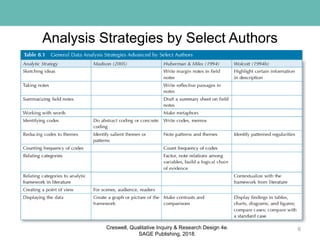
Three Analysis Strategies
• Madison (2005, 2012)
– Interpretive framework from critical
ethnography
• Huberman & Miles (1994)
– Systematic approach
• Wolcott (1994)
– Traditional approach from ethnography and
case study
5Creswell, Qualitative Inquiry & Research Design 4e.
SAGE Publishing, 2018.
Analysis Strategies by Select Authors
6Creswell, Qualitative Inquiry & Research Design 4e.
SAGE Publishing, 2018.
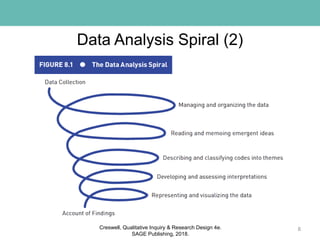
The Data Analysis Spiral
• Data analysis
– Custom-built, revised, ‘choreographed’
(Huberman & Miles, 1994)
• Data collection, data analysis, and report
writing
– Interrelated & simultaneous
• 3 “I’s” of qualitative research
– Insight, intuition, and impression (Dey, 1995)
• Contour of analysis = data analysis spiral
7Creswell, Qualitative Inquiry & Research Design 4e.
SAGE Publishing, 2018.
Data Analysis Spiral (2)
8Creswell, Qualitative Inquiry & Research Design 4e.
SAGE Publishing, 2018.
Managing and Organizing the Data
• Organize digital files and create file
naming systems
• Decide appropriate text units and
audiovisual representations
• Consider impact on future analysis
9Creswell, Qualitative Inquiry & Research Design 4e.
SAGE Publishing, 2018.
Reading and Memoing Emergent Ideas
• Read to gain a sense of the whole database
• Write notes or memos in margins
• Memos: short phrases, ideas, or key
concepts that occur to the researcher
• Recommendations
– Prioritize memoing throughout the analysis
– Develop a system to organize memos
– Embed sorting strategies to retrieve memos
10Creswell, Qualitative Inquiry & Research Design 4e.
SAGE Publishing, 2018.
Describing and Classifying Codes
into Themes
• Forming codes and categories (interchangeable
term)
• Detailed description
• In situ: in setting of person / place / event
• Coding
– Aggregating text or visual data into small categories
– Seeking evidence for the code
– Assigning a label to the code
• Lean coding
11Creswell, Qualitative Inquiry & Research Design 4e.
SAGE Publishing, 2018.
Coding Issues
• Count codes?
• Preexisting or a priori codes?
– ‘Prefigured’ or ‘emergent’ (Crabtree & Miller, 1992)
• Origin of code names
– In vivo: exact words or segments
– Codes that represent information researchers
expected, found surprising, was conceptually
interested
• Types of information to code
– E.g., Stories, experiences, processes, cultural
themes, and detailed description
12Creswell, Qualitative Inquiry & Research Design 4e.
SAGE Publishing, 2018.
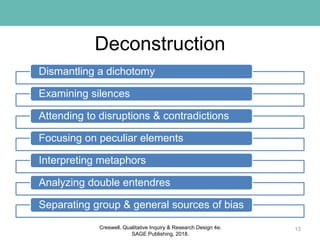
Deconstruction
Dismantling a dichotomy
Examining silences
Attending to disruptions & contradictions
Focusing on peculiar elements
Interpreting metaphors
Analyzing double entendres
Separating group & general sources of bias
13Creswell, Qualitative Inquiry & Research Design 4e.
SAGE Publishing, 2018.
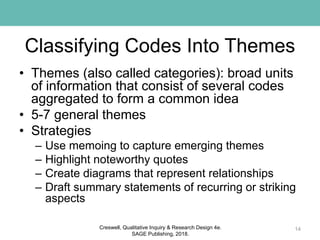
Classifying Codes Into Themes
• Themes (also called categories): broad units
of information that consist of several codes
aggregated to form a common idea
• 5-7 general themes
• Strategies
– Use memoing to capture emerging themes
– Highlight noteworthy quotes
– Create diagrams that represent relationships
– Draft summary statements of recurring or striking
aspects
14Creswell, Qualitative Inquiry & Research Design 4e.
SAGE Publishing, 2018.
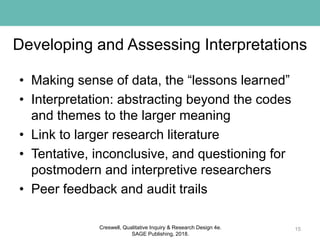
Developing and Assessing Interpretations
• Making sense of data, the “lessons learned”
• Interpretation: abstracting beyond the codes
and themes to the larger meaning
• Link to larger research literature
• Tentative, inconclusive, and questioning for
postmodern and interpretive researchers
• Peer feedback and audit trails
15Creswell, Qualitative Inquiry & Research Design 4e.
SAGE Publishing, 2018.
Representing and Visualizing the Data
• In text, tables, or figures
• Creating matrix displays
– Search data and select level and type of data to
display (e.g., quotes)
– Sketch and seek feedback on initial formatting
– Assess completeness and readability: ambiguous
data, reduce number of rows and columns (5-6 max)
– Note patterns and possible comparisons and clusters
– Revisit text to ensure it offers explanations and
conclusions
16Creswell, Qualitative Inquiry & Research Design 4e.
SAGE Publishing, 2018.
Levels of Abstraction
17
Creswell, Qualitative Inquiry & Research Design 4e.
SAGE Publishing, 2018.
Source: Asmussen and Creswell (1995).
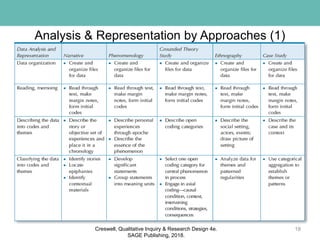
Analysis & Representation by Approaches (1)
18Creswell, Qualitative Inquiry & Research Design 4e.
SAGE Publishing, 2018.
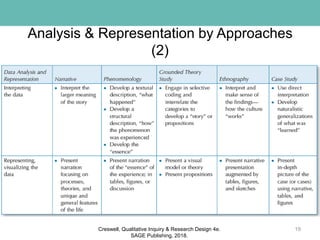
Analysis & Representation by Approaches
(2)
19Creswell, Qualitative Inquiry & Research Design 4e.
SAGE Publishing, 2018.
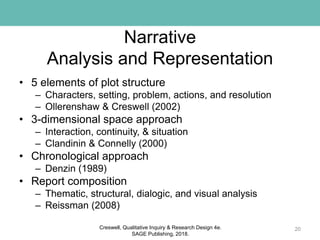
Narrative
Analysis and Representation
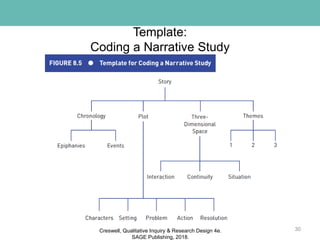
• 5 elements of plot structure
– Characters, setting, problem, actions, and resolution
– Ollerenshaw & Creswell (2002)
• 3-dimensional space approach
– Interaction, continuity, & situation
– Clandinin & Connelly (2000)
• Chronological approach
– Denzin (1989)
• Report composition
– Thematic, structural, dialogic, and visual analysis
– Reissman (2008)
20Creswell, Qualitative Inquiry & Research Design 4e.
SAGE Publishing, 2018.
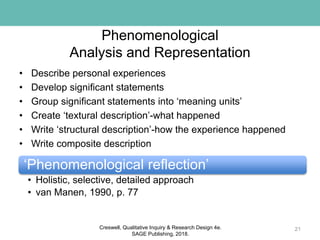
Phenomenological
Analysis and Representation
• Describe personal experiences
• Develop significant statements
• Group significant statements into ‘meaning units’
• Create ‘textural description’-what happened
• Write ‘structural description’-how the experience happened
• Write composite description
21
‘Phenomenological reflection’
• Holistic, selective, detailed approach
• van Manen, 1990, p. 77
Creswell, Qualitative Inquiry & Research Design 4e.
SAGE Publishing, 2018.
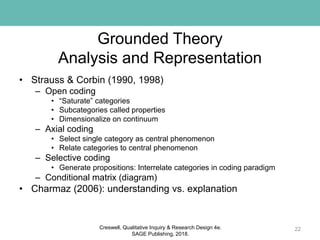
Grounded Theory
Analysis and Representation
• Strauss & Corbin (1990, 1998)
– Open coding
• “Saturate” categories
• Subcategories called properties
• Dimensionalize on continuum
– Axial coding
• Select single category as central phenomenon
• Relate categories to central phenomenon
– Selective coding
• Generate propositions: Interrelate categories in coding paradigm
– Conditional matrix (diagram)
• Charmaz (2006): understanding vs. explanation
22Creswell, Qualitative Inquiry & Research Design 4e.
SAGE Publishing, 2018.
Ethnographic
Analysis and Representation
• Wolcott (1994)
– Description: story-telling
• ‘day in the life’
• Critical or key event
– Analysis: patterned regularities
• Compare, evaluate, and critique
– Interpretation of culture-sharing group
• Speculate, infer, and personalize
• Poetry, fiction, and performance
• Fetterman (2010)
– Triangulating data, looking for patterns
– Draw maps, charts, and design matrices
23Creswell, Qualitative Inquiry & Research Design 4e.
SAGE Publishing, 2018.
Case Study
Analysis and Representation
• Stake (1995)
– Categorical aggregation, collection of instances
– Direct interpretation: single instance, draw
meaning
– Patterns: between 2+ categories
• Table
• Cross-case synthesis (Yin, 2014)
– Naturalistic generalizations
24Creswell, Qualitative Inquiry & Research Design 4e.
SAGE Publishing, 2018.
Comparing the 5 Approaches
• Most detailed
– Grounded theory and phenomenology
• Common analysis and procedures
– Ethnography and case study
• Least structured
– Narrative
25Creswell, Qualitative Inquiry & Research Design 4e.
SAGE Publishing, 2018.
Computer Use in
Qualitative Data Analysis
Advantages
• Organize storage
• Locate material easily
• Look closely at data
• Visual representations
• Link memos with codes,
themes, and documents
• Collaborative analysis
with a team
Disadvantages
• Time to learn
• Distance or hinder
creativity
• Machine between
researcher & data
• Changing categories /
moving information
• Limited guidance
• Selecting appropriate
programs
26Creswell, Qualitative Inquiry & Research Design 4e.
SAGE Publishing, 2018.
How to Decide Whether to Use
• What expertise do I bring to qualitative data
analysis?
• How proficient am I with any computer
program in qualitative data analysis?
• How complex is my study database?
• What analysis features do I anticipate
needing?
• What is the anticipated researcher
configuration for my study? (e.g., a team)
27Creswell, Qualitative Inquiry & Research Design 4e.
SAGE Publishing, 2018.
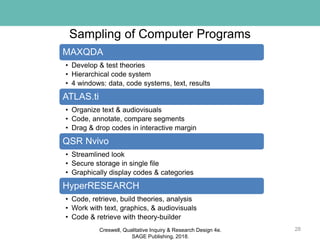
Sampling of Computer Programs
28
MAXQDA
• Develop & test theories
• Hierarchical code system
• 4 windows: data, code systems, text, results
ATLAS.ti
• Organize text & audiovisuals
• Code, annotate, compare segments
• Drag & drop codes in interactive margin
QSR Nvivo
• Streamlined look
• Secure storage in single file
• Graphically display codes & categories
HyperRESEARCH
• Code, retrieve, build theories, analysis
• Work with text, graphics, & audiovisuals
• Code & retrieve with theory-builder
Creswell, Qualitative Inquiry & Research Design 4e.
SAGE Publishing, 2018.
Use of Software Programs
• Storing and organizing qualitative data
• Locating and sorting text or image segments
• Retrieving common passages or segments
• Comparing and relating among code labels
• Conceptualizing different levels of abstraction
• Representing and visualizing codes & themes
• Writing and managing memos
• Creating and applying templates for coding
29Creswell, Qualitative Inquiry & Research Design 4e.
SAGE Publishing, 2018.
Template:
Coding a Narrative Study
30Creswell, Qualitative Inquiry & Research Design 4e.
SAGE Publishing, 2018.
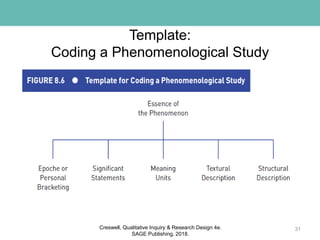
Template:
Coding a Phenomenological Study
31Creswell, Qualitative Inquiry & Research Design 4e.
SAGE Publishing, 2018.
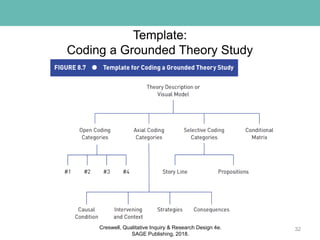
Template:
Coding a Grounded Theory Study
32Creswell, Qualitative Inquiry & Research Design 4e.
SAGE Publishing, 2018.
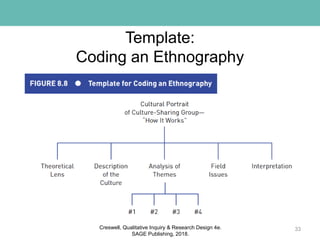
Template:
Coding an Ethnography
33Creswell, Qualitative Inquiry & Research Design 4e.
SAGE Publishing, 2018.
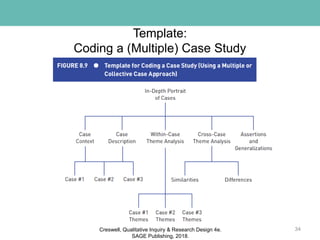
Template:
Coding a (Multiple) Case Study
34Creswell, Qualitative Inquiry & Research Design 4e.
SAGE Publishing, 2018.
How to Choose Among the Computer Programs
• Ease of integration
• Diversity of data accepted
• Reading and searching features
• Memo writing features
• Coding and reviewing features
• Sorting and categorizing features
• Diagramming features
• Importing/exporting features
• Merging, storing, security features
35Creswell, Qualitative Inquiry & Research Design 4e.
SAGE Publishing, 2018.

LEAD 901 Chapter 8

  • 1.
    Chapter 8 Data Analysisand Representation
  • 2.
    Questions for Discussion •What ethical issues may arise during data analysis? • What are common data analysis strategies used in qualitative research? • How might the overall data analysis process be conceptualized in qualitative research? • What are specific data analysis procedures used within each of the approaches to inquiry, and how do they differ? • What are the procedures available in qualitative computer analysis programs and how would these procedures differ by approach to qualitative inquiry? 2Creswell, Qualitative Inquiry & Research Design 4e. SAGE Publishing, 2018.
  • 3.
    Ethical Considerations forData Analysis • Protection of participants from harm – Avoid disclosing potentially harmful information – Situations where data might be identifiable • Disclosure of comprehensive findings – Limited access to analysis procedures – Siding with participants – Disclosing only positive results 3Creswell, Qualitative Inquiry & Research Design 4e. SAGE Publishing, 2018.
  • 4.
    General Steps toAnalysis • Preparing data – E.g. transcripts • Reducing data – Coding and condensing into themes • Representing data – Figures, tables, and discussion 4Creswell, Qualitative Inquiry & Research Design 4e. SAGE Publishing, 2018.
  • 5.
    Three Analysis Strategies •Madison (2005, 2012) – Interpretive framework from critical ethnography • Huberman & Miles (1994) – Systematic approach • Wolcott (1994) – Traditional approach from ethnography and case study 5Creswell, Qualitative Inquiry & Research Design 4e. SAGE Publishing, 2018.
  • 6.
    Analysis Strategies bySelect Authors 6Creswell, Qualitative Inquiry & Research Design 4e. SAGE Publishing, 2018.
  • 7.
    The Data AnalysisSpiral • Data analysis – Custom-built, revised, ‘choreographed’ (Huberman & Miles, 1994) • Data collection, data analysis, and report writing – Interrelated & simultaneous • 3 “I’s” of qualitative research – Insight, intuition, and impression (Dey, 1995) • Contour of analysis = data analysis spiral 7Creswell, Qualitative Inquiry & Research Design 4e. SAGE Publishing, 2018.
  • 8.
    Data Analysis Spiral(2) 8Creswell, Qualitative Inquiry & Research Design 4e. SAGE Publishing, 2018.
  • 9.
    Managing and Organizingthe Data • Organize digital files and create file naming systems • Decide appropriate text units and audiovisual representations • Consider impact on future analysis 9Creswell, Qualitative Inquiry & Research Design 4e. SAGE Publishing, 2018.
  • 10.
    Reading and MemoingEmergent Ideas • Read to gain a sense of the whole database • Write notes or memos in margins • Memos: short phrases, ideas, or key concepts that occur to the researcher • Recommendations – Prioritize memoing throughout the analysis – Develop a system to organize memos – Embed sorting strategies to retrieve memos 10Creswell, Qualitative Inquiry & Research Design 4e. SAGE Publishing, 2018.
  • 11.
    Describing and ClassifyingCodes into Themes • Forming codes and categories (interchangeable term) • Detailed description • In situ: in setting of person / place / event • Coding – Aggregating text or visual data into small categories – Seeking evidence for the code – Assigning a label to the code • Lean coding 11Creswell, Qualitative Inquiry & Research Design 4e. SAGE Publishing, 2018.
  • 12.
    Coding Issues • Countcodes? • Preexisting or a priori codes? – ‘Prefigured’ or ‘emergent’ (Crabtree & Miller, 1992) • Origin of code names – In vivo: exact words or segments – Codes that represent information researchers expected, found surprising, was conceptually interested • Types of information to code – E.g., Stories, experiences, processes, cultural themes, and detailed description 12Creswell, Qualitative Inquiry & Research Design 4e. SAGE Publishing, 2018.
  • 13.
    Deconstruction Dismantling a dichotomy Examiningsilences Attending to disruptions & contradictions Focusing on peculiar elements Interpreting metaphors Analyzing double entendres Separating group & general sources of bias 13Creswell, Qualitative Inquiry & Research Design 4e. SAGE Publishing, 2018.
  • 14.
    Classifying Codes IntoThemes • Themes (also called categories): broad units of information that consist of several codes aggregated to form a common idea • 5-7 general themes • Strategies – Use memoing to capture emerging themes – Highlight noteworthy quotes – Create diagrams that represent relationships – Draft summary statements of recurring or striking aspects 14Creswell, Qualitative Inquiry & Research Design 4e. SAGE Publishing, 2018.
  • 15.
    Developing and AssessingInterpretations • Making sense of data, the “lessons learned” • Interpretation: abstracting beyond the codes and themes to the larger meaning • Link to larger research literature • Tentative, inconclusive, and questioning for postmodern and interpretive researchers • Peer feedback and audit trails 15Creswell, Qualitative Inquiry & Research Design 4e. SAGE Publishing, 2018.
  • 16.
    Representing and Visualizingthe Data • In text, tables, or figures • Creating matrix displays – Search data and select level and type of data to display (e.g., quotes) – Sketch and seek feedback on initial formatting – Assess completeness and readability: ambiguous data, reduce number of rows and columns (5-6 max) – Note patterns and possible comparisons and clusters – Revisit text to ensure it offers explanations and conclusions 16Creswell, Qualitative Inquiry & Research Design 4e. SAGE Publishing, 2018.
  • 17.
    Levels of Abstraction 17 Creswell,Qualitative Inquiry & Research Design 4e. SAGE Publishing, 2018. Source: Asmussen and Creswell (1995).
  • 18.
    Analysis & Representationby Approaches (1) 18Creswell, Qualitative Inquiry & Research Design 4e. SAGE Publishing, 2018.
  • 19.
    Analysis & Representationby Approaches (2) 19Creswell, Qualitative Inquiry & Research Design 4e. SAGE Publishing, 2018.
  • 20.
    Narrative Analysis and Representation •5 elements of plot structure – Characters, setting, problem, actions, and resolution – Ollerenshaw & Creswell (2002) • 3-dimensional space approach – Interaction, continuity, & situation – Clandinin & Connelly (2000) • Chronological approach – Denzin (1989) • Report composition – Thematic, structural, dialogic, and visual analysis – Reissman (2008) 20Creswell, Qualitative Inquiry & Research Design 4e. SAGE Publishing, 2018.
  • 21.
    Phenomenological Analysis and Representation •Describe personal experiences • Develop significant statements • Group significant statements into ‘meaning units’ • Create ‘textural description’-what happened • Write ‘structural description’-how the experience happened • Write composite description 21 ‘Phenomenological reflection’ • Holistic, selective, detailed approach • van Manen, 1990, p. 77 Creswell, Qualitative Inquiry & Research Design 4e. SAGE Publishing, 2018.
  • 22.
    Grounded Theory Analysis andRepresentation • Strauss & Corbin (1990, 1998) – Open coding • “Saturate” categories • Subcategories called properties • Dimensionalize on continuum – Axial coding • Select single category as central phenomenon • Relate categories to central phenomenon – Selective coding • Generate propositions: Interrelate categories in coding paradigm – Conditional matrix (diagram) • Charmaz (2006): understanding vs. explanation 22Creswell, Qualitative Inquiry & Research Design 4e. SAGE Publishing, 2018.
  • 23.
    Ethnographic Analysis and Representation •Wolcott (1994) – Description: story-telling • ‘day in the life’ • Critical or key event – Analysis: patterned regularities • Compare, evaluate, and critique – Interpretation of culture-sharing group • Speculate, infer, and personalize • Poetry, fiction, and performance • Fetterman (2010) – Triangulating data, looking for patterns – Draw maps, charts, and design matrices 23Creswell, Qualitative Inquiry & Research Design 4e. SAGE Publishing, 2018.
  • 24.
    Case Study Analysis andRepresentation • Stake (1995) – Categorical aggregation, collection of instances – Direct interpretation: single instance, draw meaning – Patterns: between 2+ categories • Table • Cross-case synthesis (Yin, 2014) – Naturalistic generalizations 24Creswell, Qualitative Inquiry & Research Design 4e. SAGE Publishing, 2018.
  • 25.
    Comparing the 5Approaches • Most detailed – Grounded theory and phenomenology • Common analysis and procedures – Ethnography and case study • Least structured – Narrative 25Creswell, Qualitative Inquiry & Research Design 4e. SAGE Publishing, 2018.
  • 26.
    Computer Use in QualitativeData Analysis Advantages • Organize storage • Locate material easily • Look closely at data • Visual representations • Link memos with codes, themes, and documents • Collaborative analysis with a team Disadvantages • Time to learn • Distance or hinder creativity • Machine between researcher & data • Changing categories / moving information • Limited guidance • Selecting appropriate programs 26Creswell, Qualitative Inquiry & Research Design 4e. SAGE Publishing, 2018.
  • 27.
    How to DecideWhether to Use • What expertise do I bring to qualitative data analysis? • How proficient am I with any computer program in qualitative data analysis? • How complex is my study database? • What analysis features do I anticipate needing? • What is the anticipated researcher configuration for my study? (e.g., a team) 27Creswell, Qualitative Inquiry & Research Design 4e. SAGE Publishing, 2018.
  • 28.
    Sampling of ComputerPrograms 28 MAXQDA • Develop & test theories • Hierarchical code system • 4 windows: data, code systems, text, results ATLAS.ti • Organize text & audiovisuals • Code, annotate, compare segments • Drag & drop codes in interactive margin QSR Nvivo • Streamlined look • Secure storage in single file • Graphically display codes & categories HyperRESEARCH • Code, retrieve, build theories, analysis • Work with text, graphics, & audiovisuals • Code & retrieve with theory-builder Creswell, Qualitative Inquiry & Research Design 4e. SAGE Publishing, 2018.
  • 29.
    Use of SoftwarePrograms • Storing and organizing qualitative data • Locating and sorting text or image segments • Retrieving common passages or segments • Comparing and relating among code labels • Conceptualizing different levels of abstraction • Representing and visualizing codes & themes • Writing and managing memos • Creating and applying templates for coding 29Creswell, Qualitative Inquiry & Research Design 4e. SAGE Publishing, 2018.
  • 30.
    Template: Coding a NarrativeStudy 30Creswell, Qualitative Inquiry & Research Design 4e. SAGE Publishing, 2018.
  • 31.
    Template: Coding a PhenomenologicalStudy 31Creswell, Qualitative Inquiry & Research Design 4e. SAGE Publishing, 2018.
  • 32.
    Template: Coding a GroundedTheory Study 32Creswell, Qualitative Inquiry & Research Design 4e. SAGE Publishing, 2018.
  • 33.
    Template: Coding an Ethnography 33Creswell,Qualitative Inquiry & Research Design 4e. SAGE Publishing, 2018.
  • 34.
    Template: Coding a (Multiple)Case Study 34Creswell, Qualitative Inquiry & Research Design 4e. SAGE Publishing, 2018.
  • 35.
    How to ChooseAmong the Computer Programs • Ease of integration • Diversity of data accepted • Reading and searching features • Memo writing features • Coding and reviewing features • Sorting and categorizing features • Diagramming features • Importing/exporting features • Merging, storing, security features 35Creswell, Qualitative Inquiry & Research Design 4e. SAGE Publishing, 2018.