Chapter 6
Introducing and
Focusing the
Study
Questions for Discussion
• What does evidence of interrelationship across the
research problem, purpose, and questions look like?
• How can the problem statement be best written to
reflect one of the approaches to qualitative research?
• How can the purpose statement be best written to
convey the orientation of an approach to research?
• How can a central question be written so that it
encodes and foreshadows an approach to qualitative
research?
• How can subquestions be presented so that they
subdivide the central question into several parts?
2Creswell, Qualitative Inquiry & Research Design 4e.
SAGE Publishing, 2018.
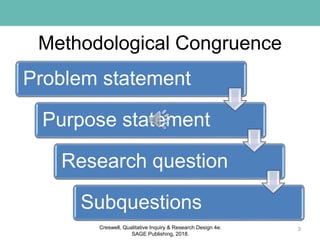
Methodological Congruence
Problem statement
Purpose statement
Research question
Subquestions
3Creswell, Qualitative Inquiry & Research Design 4e.
SAGE Publishing, 2018.
The Research Problem
Statement
• Need for study
• Create a rationale
• Opening passage
4Creswell, Qualitative Inquiry & Research Design 4e.
SAGE Publishing, 2018.
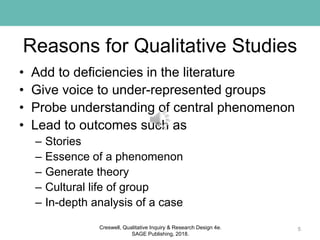
Reasons for Qualitative Studies
• Add to deficiencies in the literature
• Give voice to under-represented groups
• Probe understanding of central phenomenon
• Lead to outcomes such as
– Stories
– Essence of a phenomenon
– Generate theory
– Cultural life of group
– In-depth analysis of a case
5Creswell, Qualitative Inquiry & Research Design 4e.
SAGE Publishing, 2018.
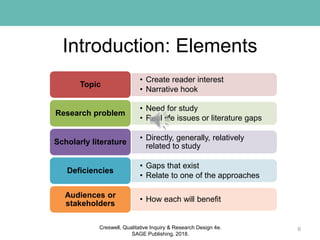
Introduction: Elements
6
• Create reader interest
• Narrative hook
Topic
• Need for study
• Real life issues or literature gaps
Research problem
• Directly, generally, relatively
related to study
Scholarly literature
• Gaps that exist
• Relate to one of the approaches
Deficiencies
• How each will benefit
Audiences or
stakeholders
Creswell, Qualitative Inquiry & Research Design 4e.
SAGE Publishing, 2018.
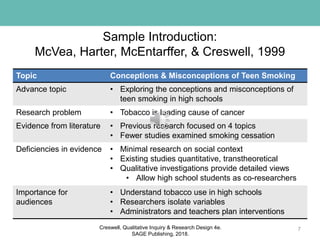
Sample Introduction:
McVea, Harter, McEntarffer, & Creswell, 1999
7
Topic Conceptions & Misconceptions of Teen Smoking
Advance topic • Exploring the conceptions and misconceptions of
teen smoking in high schools
Research problem • Tobacco is leading cause of cancer
Evidence from literature • Previous research focused on 4 topics
• Fewer studies examined smoking cessation
Deficiencies in evidence • Minimal research on social context
• Existing studies quantitative, transtheoretical
• Qualitative investigations provide detailed views
• Allow high school students as co-researchers
Importance for
audiences
• Understand tobacco use in high schools
• Researchers isolate variables
• Administrators and teachers plan interventions
Creswell, Qualitative Inquiry & Research Design 4e.
SAGE Publishing, 2018.
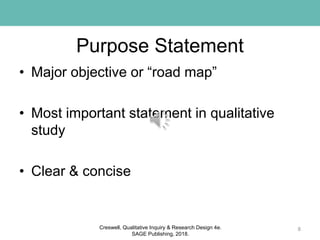
Purpose Statement
• Major objective or “road map”
• Most important statement in qualitative
study
• Clear & concise
8Creswell, Qualitative Inquiry & Research Design 4e.
SAGE Publishing, 2018.
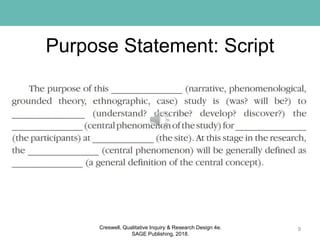
Purpose Statement: Script
9Creswell, Qualitative Inquiry & Research Design 4e.
SAGE Publishing, 2018.
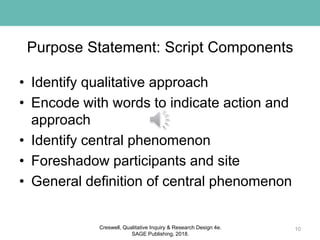
Purpose Statement: Script Components
• Identify qualitative approach
• Encode with words to indicate action and
approach
• Identify central phenomenon
• Foreshadow participants and site
• General definition of central phenomenon
10Creswell, Qualitative Inquiry & Research Design 4e.
SAGE Publishing, 2018.
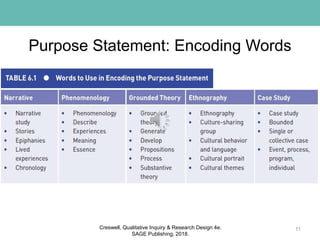
Purpose Statement: Encoding Words
11Creswell, Qualitative Inquiry & Research Design 4e.
SAGE Publishing, 2018.
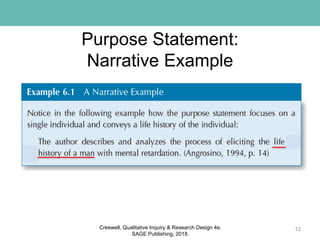
Purpose Statement:
Narrative Example
12Creswell, Qualitative Inquiry & Research Design 4e.
SAGE Publishing, 2018.
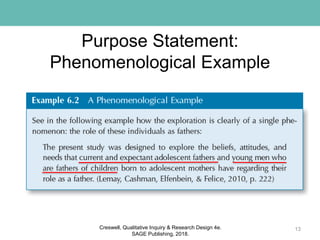
Purpose Statement:
Phenomenological Example
13Creswell, Qualitative Inquiry & Research Design 4e.
SAGE Publishing, 2018.
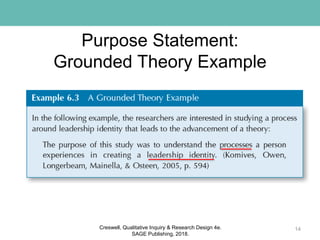
Purpose Statement:
Grounded Theory Example
14Creswell, Qualitative Inquiry & Research Design 4e.
SAGE Publishing, 2018.
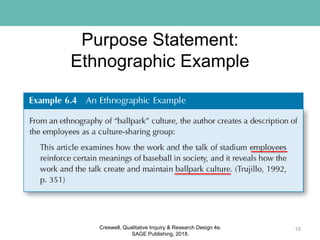
Purpose Statement:
Ethnographic Example
15Creswell, Qualitative Inquiry & Research Design 4e.
SAGE Publishing, 2018.
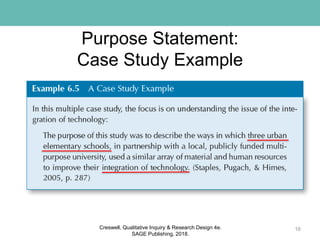
Purpose Statement:
Case Study Example
16Creswell, Qualitative Inquiry & Research Design 4e.
SAGE Publishing, 2018.
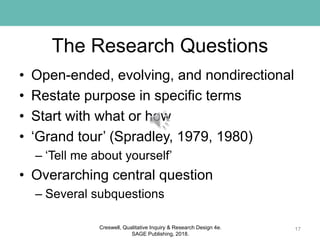
The Research Questions
• Open-ended, evolving, and nondirectional
• Restate purpose in specific terms
• Start with what or how
• ‘Grand tour’ (Spradley, 1979, 1980)
– ‘Tell me about yourself’
• Overarching central question
– Several subquestions
17Creswell, Qualitative Inquiry & Research Design 4e.
SAGE Publishing, 2018.
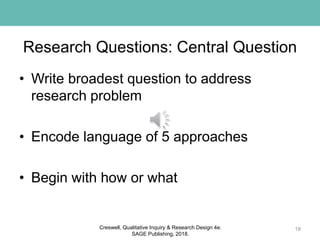
Research Questions: Central Question
• Write broadest question to address
research problem
• Encode language of 5 approaches
• Begin with how or what
18Creswell, Qualitative Inquiry & Research Design 4e.
SAGE Publishing, 2018.
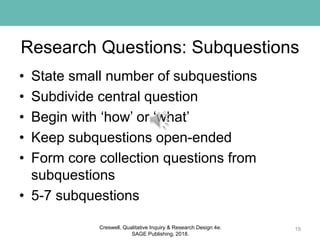
Research Questions: Subquestions
• State small number of subquestions
• Subdivide central question
• Begin with ‘how’ or ‘what’
• Keep subquestions open-ended
• Form core collection questions from
subquestions
• 5-7 subquestions
19Creswell, Qualitative Inquiry & Research Design 4e.
SAGE Publishing, 2018.
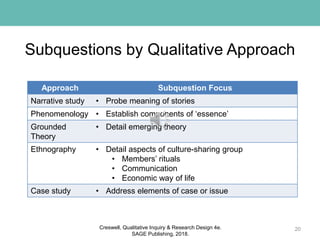
Subquestions by Qualitative Approach
20
Approach Subquestion Focus
Narrative study • Probe meaning of stories
Phenomenology • Establish components of ‘essence’
Grounded
Theory
• Detail emerging theory
Ethnography • Detail aspects of culture-sharing group
• Members’ rituals
• Communication
• Economic way of life
Case study • Address elements of case or issue
Creswell, Qualitative Inquiry & Research Design 4e.
SAGE Publishing, 2018.

LEAD 901 Chapter 6

  • 1.
  • 2.
    Questions for Discussion •What does evidence of interrelationship across the research problem, purpose, and questions look like? • How can the problem statement be best written to reflect one of the approaches to qualitative research? • How can the purpose statement be best written to convey the orientation of an approach to research? • How can a central question be written so that it encodes and foreshadows an approach to qualitative research? • How can subquestions be presented so that they subdivide the central question into several parts? 2Creswell, Qualitative Inquiry & Research Design 4e. SAGE Publishing, 2018.
  • 3.
    Methodological Congruence Problem statement Purposestatement Research question Subquestions 3Creswell, Qualitative Inquiry & Research Design 4e. SAGE Publishing, 2018.
  • 4.
    The Research Problem Statement •Need for study • Create a rationale • Opening passage 4Creswell, Qualitative Inquiry & Research Design 4e. SAGE Publishing, 2018.
  • 5.
    Reasons for QualitativeStudies • Add to deficiencies in the literature • Give voice to under-represented groups • Probe understanding of central phenomenon • Lead to outcomes such as – Stories – Essence of a phenomenon – Generate theory – Cultural life of group – In-depth analysis of a case 5Creswell, Qualitative Inquiry & Research Design 4e. SAGE Publishing, 2018.
  • 6.
    Introduction: Elements 6 • Createreader interest • Narrative hook Topic • Need for study • Real life issues or literature gaps Research problem • Directly, generally, relatively related to study Scholarly literature • Gaps that exist • Relate to one of the approaches Deficiencies • How each will benefit Audiences or stakeholders Creswell, Qualitative Inquiry & Research Design 4e. SAGE Publishing, 2018.
  • 7.
    Sample Introduction: McVea, Harter,McEntarffer, & Creswell, 1999 7 Topic Conceptions & Misconceptions of Teen Smoking Advance topic • Exploring the conceptions and misconceptions of teen smoking in high schools Research problem • Tobacco is leading cause of cancer Evidence from literature • Previous research focused on 4 topics • Fewer studies examined smoking cessation Deficiencies in evidence • Minimal research on social context • Existing studies quantitative, transtheoretical • Qualitative investigations provide detailed views • Allow high school students as co-researchers Importance for audiences • Understand tobacco use in high schools • Researchers isolate variables • Administrators and teachers plan interventions Creswell, Qualitative Inquiry & Research Design 4e. SAGE Publishing, 2018.
  • 8.
    Purpose Statement • Majorobjective or “road map” • Most important statement in qualitative study • Clear & concise 8Creswell, Qualitative Inquiry & Research Design 4e. SAGE Publishing, 2018.
  • 9.
    Purpose Statement: Script 9Creswell,Qualitative Inquiry & Research Design 4e. SAGE Publishing, 2018.
  • 10.
    Purpose Statement: ScriptComponents • Identify qualitative approach • Encode with words to indicate action and approach • Identify central phenomenon • Foreshadow participants and site • General definition of central phenomenon 10Creswell, Qualitative Inquiry & Research Design 4e. SAGE Publishing, 2018.
  • 11.
    Purpose Statement: EncodingWords 11Creswell, Qualitative Inquiry & Research Design 4e. SAGE Publishing, 2018.
  • 12.
    Purpose Statement: Narrative Example 12Creswell,Qualitative Inquiry & Research Design 4e. SAGE Publishing, 2018.
  • 13.
    Purpose Statement: Phenomenological Example 13Creswell,Qualitative Inquiry & Research Design 4e. SAGE Publishing, 2018.
  • 14.
    Purpose Statement: Grounded TheoryExample 14Creswell, Qualitative Inquiry & Research Design 4e. SAGE Publishing, 2018.
  • 15.
    Purpose Statement: Ethnographic Example 15Creswell,Qualitative Inquiry & Research Design 4e. SAGE Publishing, 2018.
  • 16.
    Purpose Statement: Case StudyExample 16Creswell, Qualitative Inquiry & Research Design 4e. SAGE Publishing, 2018.
  • 17.
    The Research Questions •Open-ended, evolving, and nondirectional • Restate purpose in specific terms • Start with what or how • ‘Grand tour’ (Spradley, 1979, 1980) – ‘Tell me about yourself’ • Overarching central question – Several subquestions 17Creswell, Qualitative Inquiry & Research Design 4e. SAGE Publishing, 2018.
  • 18.
    Research Questions: CentralQuestion • Write broadest question to address research problem • Encode language of 5 approaches • Begin with how or what 18Creswell, Qualitative Inquiry & Research Design 4e. SAGE Publishing, 2018.
  • 19.
    Research Questions: Subquestions •State small number of subquestions • Subdivide central question • Begin with ‘how’ or ‘what’ • Keep subquestions open-ended • Form core collection questions from subquestions • 5-7 subquestions 19Creswell, Qualitative Inquiry & Research Design 4e. SAGE Publishing, 2018.
  • 20.
    Subquestions by QualitativeApproach 20 Approach Subquestion Focus Narrative study • Probe meaning of stories Phenomenology • Establish components of ‘essence’ Grounded Theory • Detail emerging theory Ethnography • Detail aspects of culture-sharing group • Members’ rituals • Communication • Economic way of life Case study • Address elements of case or issue Creswell, Qualitative Inquiry & Research Design 4e. SAGE Publishing, 2018.