July 27 th , 2010 reensboro Land Development Ordinance (LDO) G The City of North Carolina
OUTLINE FOR TODAY’S DISCUSSION Organization and Purpose Specific changes by article Further transition issues
Process May, 2003:   Comprehensive Plan  adopted, including recommendations for changes to regulations. Fall, 2004:  Hired  consultant  team, led by Duncan Associates, to help in developing changes; did ordinance “ critique ” first. April, 2005:   37   “Listening Sessions” @ LDO kickoff   process; top priority:  make ordinance easier to use. May, 2005:  City Manager names 18-member Citizens   Advisory Team ( CAT ) to oversee process  ( 37+ mtgs!). CC also to receive briefing  at each part of process.
LDO Purpose Make it Easier to: Find:  reorganize regulations, more indices. Read :   give ordinance a new format, graphics. Understand:  add definitions, clarify standards.  Process efficiency:  more appropriate (i.e., modifications). Reduce text and districts :  combining, move to  manuals . More flexible:   give options for standards, processes. Comprehensive Plan:  changes specified. Encourage  compatible infill  , design & context standards Encourage  mixed-use and urban  development Protect  neighborhoods and natural resources
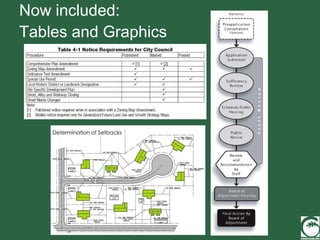
Now included: Tables and Graphics
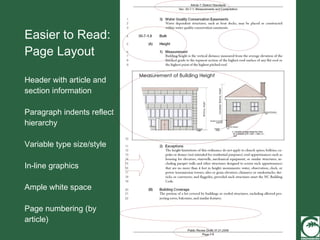
Easier to Read: Page Layout Header with article and section information Paragraph indents reflect hierarchy Variable type size/style In-line graphics Ample white space Page numbering (by article)
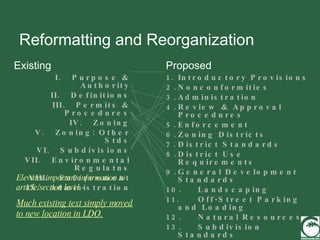
Reformatting and Reorganization Existing I.  Purpose & Authority II.  Definitions III.  Permits & Procedures IV.  Zoning V.  Zoning: Other Stds VI.  Subdivisions VII.  Environmental Regulatns VIII.  Enforcement IX.  Administration Proposed 1. Introductory Provisions 2. Nonconformities 3. Administration 4. Review & Approval Procedures 5. Enforcement 6. Zoning Districts 7. District Standards 8. District Use Requirements 9. General Development Standards 10. Landscaping 11. Off-Street Parking and Loading 12. Natural Resources 13. Subdivision Standards 14. Sign Regulations 15. Definitions Elevates important information to article/section level – Much existing text simply moved to new location in LDO.
Administrative provisions consolidated in the first part of the ordinance. Article 1: Introductory Provisions Article 2: Nonconformities Article 3: Administrative Bodies
Article 2 (Nonconformities) Article 2: Clarified current language regarding rebuilding of townhomes and condominiums (i.e. Mazzurco Amendment) , Separated out  and address “Billboards” in its own category Clarified and added flexibility on how valuation is determined for a number of nonconformities.
Article 3 (Administration) Article 3: 4/5ths voting requirement for certain types of BOA hearings. Applies to variances, special exceptions, and other issues.
Article 4 (Review and Approval Procedures) Article 4: Codified the notification mailing distance standards (600 foot requirement) for rezoning hearings. Clarified procedures for notifications of split-zoned properties; must now apply to whole property Neighborhood Summary  now requirement for conditional rezonings within 600 feet of residential uses. Protest petition requirements found in this Article. Criteria now established for the Planning Director to determine if “Substantial Changes” occurred in a development proposal.
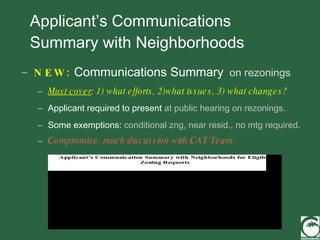
Applicant’s Communications Summary with Neighborhoods NEW:  Communications Summary   on rezonings Must cover : 1) what efforts, 2)what issues, 3) what changes?   Applicant required to present  at public hearing on rezonings. Some exemptions:  conditional zng, near resid., no mtg required.   Compromise: much discussion with CAT Team.
Zoning district descriptions, standards, and use requirements consolidated together Article 6: Zoning Districts Article 7: District Standards Article 8: District Use Requirements Primary “go-to” sections for the day-to-day administrators of the ordinance. Consolidates Districts  Provides for district standards in one location
Article 6 (Zoning Districts) Article 6: District conversion table is on first page of Article! Very short article. Goes over the district description and intent statements New zoning districts introduced:  RM-40 MU-H, MU-M, MU-L PNR ACO – Activity Center Overlay DDO –Downtown Design Overlay
Article 7 (District Standards) All former appendix graphics now updated and added to the document. Added new concept of “build-to” lines Beginning on page 7-11,  all setback, dimensional, and development standards are now found in charts for each district. Special setbacks on thoroughfares have been eliminated.
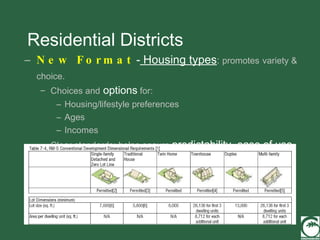
Residential Districts New Format  -  Housing types :  promotes   variety & choice. Choices and  options  for: Housing/lifestyle preferences Ages Incomes Clear standards: helps ensure  predictability, ease of use.
Article 7 (Cont.) Residential Contextual Infill Option NEW!!  Provides developers with option to develop in accordance with established development patterns Development standards for new MU districts found here! Outlines residential and non-residential components and specific standards New graphics available to aid in interpretation Current PUD districts collapsed into one district, new standards for the single PUD district found here!
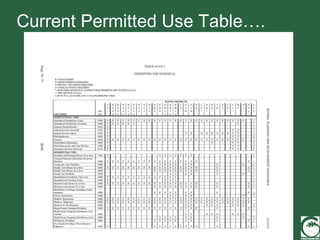
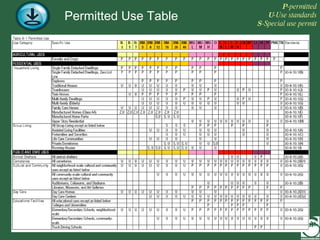
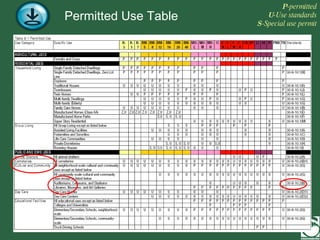
Article 8 (Zoning Districts) Permitted Use Table found here! Table classification format has changed Provides less “guess-work” in making interpretations of uses allowed. Development standards for specific uses immediately following Table; separated out by Macro-use group Many of the uses and by-right uses have changed per districts;  look up before giving information! Use Groups found immediately after table
Current Permitted Use Table….
Permitted Use Table   P -permitted U -Use standards S -Special use permit
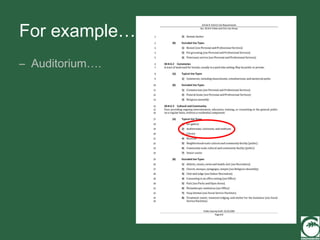
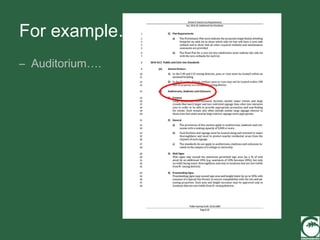
For example…. Auditorium….
Permitted Use Table   P -permitted U -Use standards S -Special use permit
For example…. Auditorium….
Article 9 (General Development Standards) Small changes to commonly used development standards IMUD now applicable to 2 or more uses (prior was three) New!!  Standards for outdoor lighting; stresses fixture type, pole heights, etc; new standard for review in TRC process New!!  Provisions for  transit facilities  now required for new development; tied to site plan submission, level of service provision dependant upon degree of development proposed.
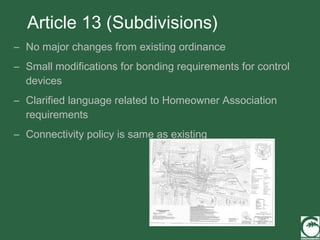
Article 13 (Subdivisions) No major changes from existing ordinance Small modifications for bonding requirements for control devices Clarified language related to Homeowner Association requirements Connectivity policy is same as existing
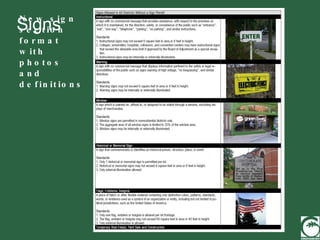
New sign section format with photos and definitions Signs
Definitions Expanded number  of definitions, w/ + 22 pgs. Consolidated  definitions in 1 place, exc. for signs. New & updated  definitions to help reader. Still  use a dictionary  for words in “common usage”.
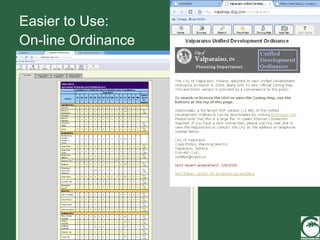
Easier to Use: On-line Ordinance
Proposed Transition Provisions 12 months -  choice of  LDO or UDO use  -  between  LDO adoption & date of July1, 2011. 12 months –  Free fix:   priority/no fee  text amendments or rezonings , when LDO has  inadvertently created a nonconformity. Copies of  all Manuals will be compiled in P&CD Department, draft list available UPCOMING!! Book of tables and charts! “ Focused” training  sessions  available upon request
Contacts [email_address] LDO download: www.greensboro-nc.gov\ldo
Comments, Questions

LDO Changes

  • 1.
    July 27 th, 2010 reensboro Land Development Ordinance (LDO) G The City of North Carolina
  • 2.
    OUTLINE FOR TODAY’SDISCUSSION Organization and Purpose Specific changes by article Further transition issues
  • 3.
    Process May, 2003: Comprehensive Plan adopted, including recommendations for changes to regulations. Fall, 2004: Hired consultant team, led by Duncan Associates, to help in developing changes; did ordinance “ critique ” first. April, 2005: 37 “Listening Sessions” @ LDO kickoff process; top priority: make ordinance easier to use. May, 2005: City Manager names 18-member Citizens Advisory Team ( CAT ) to oversee process ( 37+ mtgs!). CC also to receive briefing at each part of process.
  • 4.
    LDO Purpose Makeit Easier to: Find: reorganize regulations, more indices. Read : give ordinance a new format, graphics. Understand: add definitions, clarify standards. Process efficiency: more appropriate (i.e., modifications). Reduce text and districts : combining, move to manuals . More flexible: give options for standards, processes. Comprehensive Plan: changes specified. Encourage compatible infill , design & context standards Encourage mixed-use and urban development Protect neighborhoods and natural resources
  • 5.
  • 6.
    Easier to Read:Page Layout Header with article and section information Paragraph indents reflect hierarchy Variable type size/style In-line graphics Ample white space Page numbering (by article)
  • 7.
    Reformatting and ReorganizationExisting I.  Purpose & Authority II.  Definitions III.  Permits & Procedures IV.  Zoning V.  Zoning: Other Stds VI.  Subdivisions VII.  Environmental Regulatns VIII.  Enforcement IX.  Administration Proposed 1. Introductory Provisions 2. Nonconformities 3. Administration 4. Review & Approval Procedures 5. Enforcement 6. Zoning Districts 7. District Standards 8. District Use Requirements 9. General Development Standards 10. Landscaping 11. Off-Street Parking and Loading 12. Natural Resources 13. Subdivision Standards 14. Sign Regulations 15. Definitions Elevates important information to article/section level – Much existing text simply moved to new location in LDO.
  • 8.
    Administrative provisions consolidatedin the first part of the ordinance. Article 1: Introductory Provisions Article 2: Nonconformities Article 3: Administrative Bodies
  • 9.
    Article 2 (Nonconformities)Article 2: Clarified current language regarding rebuilding of townhomes and condominiums (i.e. Mazzurco Amendment) , Separated out and address “Billboards” in its own category Clarified and added flexibility on how valuation is determined for a number of nonconformities.
  • 10.
    Article 3 (Administration)Article 3: 4/5ths voting requirement for certain types of BOA hearings. Applies to variances, special exceptions, and other issues.
  • 11.
    Article 4 (Reviewand Approval Procedures) Article 4: Codified the notification mailing distance standards (600 foot requirement) for rezoning hearings. Clarified procedures for notifications of split-zoned properties; must now apply to whole property Neighborhood Summary now requirement for conditional rezonings within 600 feet of residential uses. Protest petition requirements found in this Article. Criteria now established for the Planning Director to determine if “Substantial Changes” occurred in a development proposal.
  • 12.
    Applicant’s Communications Summarywith Neighborhoods NEW: Communications Summary on rezonings Must cover : 1) what efforts, 2)what issues, 3) what changes? Applicant required to present at public hearing on rezonings. Some exemptions: conditional zng, near resid., no mtg required. Compromise: much discussion with CAT Team.
  • 13.
    Zoning district descriptions,standards, and use requirements consolidated together Article 6: Zoning Districts Article 7: District Standards Article 8: District Use Requirements Primary “go-to” sections for the day-to-day administrators of the ordinance. Consolidates Districts Provides for district standards in one location
  • 14.
    Article 6 (ZoningDistricts) Article 6: District conversion table is on first page of Article! Very short article. Goes over the district description and intent statements New zoning districts introduced: RM-40 MU-H, MU-M, MU-L PNR ACO – Activity Center Overlay DDO –Downtown Design Overlay
  • 15.
    Article 7 (DistrictStandards) All former appendix graphics now updated and added to the document. Added new concept of “build-to” lines Beginning on page 7-11, all setback, dimensional, and development standards are now found in charts for each district. Special setbacks on thoroughfares have been eliminated.
  • 16.
    Residential Districts NewFormat - Housing types : promotes variety & choice. Choices and options for: Housing/lifestyle preferences Ages Incomes Clear standards: helps ensure predictability, ease of use.
  • 17.
    Article 7 (Cont.)Residential Contextual Infill Option NEW!! Provides developers with option to develop in accordance with established development patterns Development standards for new MU districts found here! Outlines residential and non-residential components and specific standards New graphics available to aid in interpretation Current PUD districts collapsed into one district, new standards for the single PUD district found here!
  • 18.
    Article 8 (ZoningDistricts) Permitted Use Table found here! Table classification format has changed Provides less “guess-work” in making interpretations of uses allowed. Development standards for specific uses immediately following Table; separated out by Macro-use group Many of the uses and by-right uses have changed per districts; look up before giving information! Use Groups found immediately after table
  • 19.
  • 20.
    Permitted Use Table P -permitted U -Use standards S -Special use permit
  • 21.
  • 22.
    Permitted Use Table P -permitted U -Use standards S -Special use permit
  • 23.
  • 24.
    Article 9 (GeneralDevelopment Standards) Small changes to commonly used development standards IMUD now applicable to 2 or more uses (prior was three) New!! Standards for outdoor lighting; stresses fixture type, pole heights, etc; new standard for review in TRC process New!! Provisions for transit facilities now required for new development; tied to site plan submission, level of service provision dependant upon degree of development proposed.
  • 25.
    Article 13 (Subdivisions)No major changes from existing ordinance Small modifications for bonding requirements for control devices Clarified language related to Homeowner Association requirements Connectivity policy is same as existing
  • 26.
    New sign sectionformat with photos and definitions Signs
  • 27.
    Definitions Expanded number of definitions, w/ + 22 pgs. Consolidated definitions in 1 place, exc. for signs. New & updated definitions to help reader. Still use a dictionary for words in “common usage”.
  • 28.
    Easier to Use:On-line Ordinance
  • 29.
    Proposed Transition Provisions12 months - choice of LDO or UDO use - between LDO adoption & date of July1, 2011. 12 months – Free fix: priority/no fee text amendments or rezonings , when LDO has inadvertently created a nonconformity. Copies of all Manuals will be compiled in P&CD Department, draft list available UPCOMING!! Book of tables and charts! “ Focused” training sessions available upon request
  • 30.
    Contacts [email_address] LDOdownload: www.greensboro-nc.gov\ldo
  • 31.

Editor's Notes

  • #2 07/29/10 Module 1B
  • #5 07/29/10 Module 1B
  • #6 07/29/10 Module 1B
  • #7 07/29/10 Module 1B
  • #8 07/29/10 Module 1B Article 1, “Introductory Provisions” is similar to current Article 1, “Purpose and Authority” and is in the same location in the new LDO. Article 2, “Nonconformities” is moved from Section 30-4-11, “Nonconforming Situations” of the current UDO. Nonconforming Signs has been moved from “Sign Regulations” (Section 30-5-5). Article 3, “Administrative Bodies” has been extracted from Article 9, “Administration” in the current UDO. The new Article 3 contains the provisions establishing the different administrative and interpretive bodies and general rules of procedure for each particular body. The specific procedures, such as “Zoning Map Amendments” will be in Article 4, “Review and Approval Procedures.”
  • #17 07/29/10 Module 1B
  • #21 07/29/10 Module 1B
  • #23 07/29/10 Module 1B
  • #27 07/29/10 Module 1B
  • #29 07/29/10 Module 1B