Numismatics: a case study in Linked Data
Andrew Meadows
Ethan Gruber
What’s so great about coins?
Known point of origin (Places)
Known issuer (People; roles)
Known point of discovery
(Places; contexts)
Decorated (Iconography; religion)
Inscribed (Titulature;Text)
ΤΥΡΟΥΙΕΡΑΣΚΑΙΑΣΥΛΟΥ
SPQR ImperatoriCaesari Quod
ViaeMunitaeSunt Ex Ea Pecunia
Quae IussuSenatus Ad
AerariumDelataEst
Quantifiable (Statistics)
Civic coin production, 450-400 BC
Athens
Sicyon Ephesus . Sparta
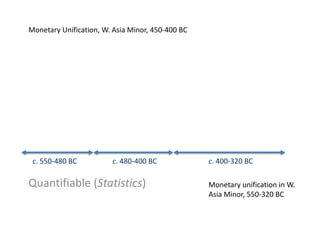
Quantifiable (Statistics)
Monetary Unification, W. Asia Minor, 450-400 BC
c. 550-480 BC c. 480-400 BC c. 400-320 BC
Monetary unification in W.
Asia Minor, 550-320 BC
Good News: it survives in huge quantities
Collection Approx No.
New York 200, 000
London 200, 000
Berlin 200, 000
Paris 200, 000
Vienna 100, 000
PAS 300, 000
Total 1 Million +
Bad News: it survives in huge quantities
• Over 20 collections of 20,000+ ancient coins
• At least 5 different national
Fundmünzenschemes
• All catalogue in their own systems, with their
own standards, in their own languages
• All are at different stages in their digital
journeys
It gets worse…
• Many of the standard catalogues and corpora
are more than 50 years old
• None of them exist digitally
• There is no international co-ordinating body
for their creation
The Answer: Linked Data
1. Use URIs as names for things
2. Use HTTP URIs so that people can look up those
names.
3. When someone looks up a URI, provide useful
information, using the standards (RDF*, SPARQL)
4. Include links to other URIs. so that they can
discover more things.
(1) and (2) Easy: HTTP URIs for things
Difficult: RDF
Nobody has created a vocabulary for coins:
E.g. How do we give URIs to concepts such as?
• ‘Minted in’
• ‘Has a die-axis of’
• ‘was struck under the authority of’
• ‘the mint of Antioch’
• ‘Vespasian striking as Caesar’
An attempt at an answer
Nomisma.org is a collaborative effort to provide stable digital
representations of numismatic concepts and entities.
A mint for numismatic URIs
nomisma.org/id/mint
nomisma.org/id/denarius
nomisma.org/id/aspendus
Nomisma.org/id/
3. When someone looks up a URI, provide useful information
4. Include links to other URIs. so that they can discover more things
Hoards Finds
Corpora/
Mint studies
Collections
Specimen
Specimen
Specimen
SpecimenSpecimen
Reference
Reference ReferenceReferenceReference
Identifiers already exist: Example 1. Coin Hoards
Identifiers already exist: Example 2. Types
(Roman Imperial Coinage – RIC)
( )
RIC Hadrian 920
RIC Hadrian 920
RIC I (second edition) Augustus 4b →
http://numismatics.org/ocre/id/ric.1(2).aug.4b
ObjectType: nm:coin
Manufacture: nm:struck
Denomination: nm:denarius
Material: nm:ar
Authority: nm:augustus
Etc.
Online Coins of the Roman Empire (OCRE)
http://numismatics.org/ocre
Using SPARQL to Do Stuff
NomismaSPARQL endpoint: http://nomisma.org/sparql
(not yet open for business!)
<rdf:RDFxmlns:rdf="http://www.w3.org/1999/02/22-rdf-syntax-ns#"
xmlns:dcterms="http://purl.org/dc/terms/"
xmlns:skos="http://www.w3.org/2004/02/skos/core#"
xmlns:nm="http://nomisma.org/id/">
<nm:coinrdf:about="http://www.smb.museum/ikmk/object.php?id=18207926">
<nm:type_series_itemrdf:resource="http://numismatics.org/ocre/id/ric.1(2).aug.1a"/
>
<dcterms:titlexml:lang="de">Augustus, ca. 25-23 v. Chr.</dcterms:title>
<dcterms:identifier>18207926</dcterms:identifier>
<dcterms:publisher>MK Berlin</dcterms:publisher>
<nm:numismatic_termrdf:resource="http://nomisma.org/id/coin"/>
<nm:collection>MK Berlin</nm:collection>
<nm:axisrdf:datatype="xs:integer">6</nm:axis>
<nm:diameterrdf:datatype="xs:decimal">13</nm:diameter>
<nm:weightrdf:datatype="xs:decimal">1.32</nm:weight>
<nm:reverseReferencerdf:resource="http://www.smb.museum/mk_edit/images/8099/r
s_opt.jpg"/>
<nm:obverseReferencerdf:resource="http://www.smb.museum/mk_edit/images/8099/
vs_opt.jpg"/>
</nm:coin>
</rdf:RDF>
Ingesting RDF (coin)
<rdf:RDFxmlns:rdf="http://www.w3.org/1999/02/22-rdf-syntax-ns#"
xmlns:dcterms="http://purl.org/dc/terms/"
xmlns:skos="http://www.w3.org/2004/02/skos/core#"
xmlns:nm="http://nomisma.org/id/">
<nm:hoardrdf:about="http://admin.numismatics.org/chrr/id/ZAR">
<dcterms:titlexml:lang="en">Zara (Italy; ZAR)</dcterms:title>
<dcterms:publisher>American Numismatic Society</dcterms:publisher>
<nm:findspotrdf:resource="http://www.geonames.org/6486176/"/>
<nm:closing_daterdf:datatype="xs:gYear">-0017</nm:closing_date>
<nm:type_series_itemrdf:resource="http://numismatics.org/ocre/id/ric.1(2).aug.4b"/
>
</nm:hoard>
</rdf:RDF>
Ingesting RDF (hoard)
Aim: Associate other objects (coins, hoards) with coin types
Nomisma
RDF triplestore (Fuseki)
OCRE
APIs
Berlin
ANS
UVA
CHRR
Data
Nomisma

Lawdi2013