DEPT OF COMPUTERSCIENCE
GOVERNMENT FIRST GRADE COLLEGE
ProjectSeminaron
" LAUNDRY MANAGEMENT SYSTEM"
SubmittedTo: SubmittedBy:
Meenakshi.T. Jayshree.J(U03DQ22S0025)
Harini.M(U03DQ22S0220)
BENGALURU UNIVERSITY
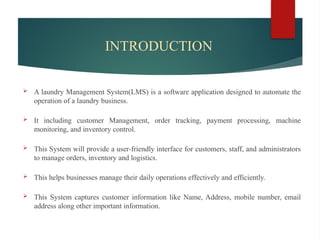
INTRODUCTION
A laundryManagement System(LMS) is a software application designed to automate the
operation of a laundry business.
It including customer Management, order tracking, payment processing, machine
monitoring, and inventory control.
This System will provide a user-friendly interface for customers, staff, and administrators
to manage orders, inventory and logistics.
This helps businesses manage their daily operations effectively and efficiently.
This System captures customer information like Name, Address, mobile number, email
address along other important information.
4.
OBJECTIVES
Improve InventoryManagement: Accurately track inventory levels, monitor usage, and
automate replenishment to reduce stockouts and overstocking.
Support Sustainability: Implement energy-efficient practices, reduce water
consumption, and promote eco-friendly laundry practices to minimize environment
impact.
Expand Market Share: Increase market share through improved customer
satisfaction, competitive pricing, and expanded services.
Support Business Growth: Provide a scalable and flexible platform to support
business growth, expansion, and diversification.
These objectives can serve as a starting point for developing a comprehensive Laundry Management System
(LMS) that meets the needs of laundry businesses, customer, and stakeholders.
5.
SCOPE
Order Management:Manage customer order, including order placement, tracking,
and status updates.
Inventory Management: Track and manage laundry inventory, including supplies,
equipment, and linen.
Equipment Monitoring: Monitor and track laundry equipment performance,
Including usage, maintenance, and repair.
Billing and payment: Manage billing and payment processes, including invoice,
payment tracking, and reporting.
Customer Management: Manage customer information, including contact details,
order history, and preferences
USER MODULE
UserSignup – In this section user can register himself. After successful
signup, he/she can sign in into the system.
Dashboard: In this section, the user can view the status of his laundry
request and price of the laundry.
Laundry Request: In this section, user can send the laundry request by
filling the laundry detail form.
Request Status: In this section, user can check his/her laundry request
status which is done by admin(means his/her request is at what step).
A user can also update his/ her profile, change the password and recover
the password.
8.
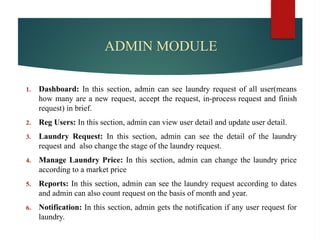
ADMIN MODULE
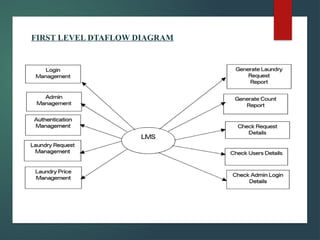
1. Dashboard:In this section, admin can see laundry request of all user(means
how many are a new request, accept the request, in-process request and finish
request) in brief.
2. Reg Users: In this section, admin can view user detail and update user detail.
3. Laundry Request: In this section, admin can see the detail of the laundry
request and also change the stage of the laundry request.
4. Manage Laundry Price: In this section, admin can change the laundry price
according to a market price
5. Reports: In this section, admin can see the laundry request according to dates
and admin can also count request on the basis of month and year.
6. Notification: In this section, admin gets the notification if any user request for
laundry.
HARDWARE REQUIRMENT
R ClientSide M
51RAM
512 MB
2 MB
Server Side
RAM
RAM 512 MB
Hard Disk 10GB
Processor 1.0GHz
RAM 1GB
Hard Disk 20GB
Processor 2.0GHz
26.
SOFTWARE REQUIRMENT
R ClientSide
Server Side
Web Browser Google Chrome or any
compatible browser
Operating System Windows or any equivalent OS
Web Server APACHE
Server Side Language PHP5.6 or above version
Database Server MySQL
Web Browser Google Chrome or any
compatible browser
Operating System Windows or any equivalent OS
27.
CONCLUSION
The package wasdesigned in such a way that future modifications can be done easily. The
following conclusion can be deduced from the development of the project.
Automation of the entire system improves the efficiency.
It provides a friendly graphical user interface which proves to be better when
compared to the existing system.
It provides a friendly graphical user interface which proves to be better when compared
to the existing system.
It gives appropriate access to the authorized users depending on their permissions.
It effectively overcomes the delay in communications.
Updating of information becomes so easier.
System security, data security and reliability are the striking features.
The System has adequate scope for modification in future if it is necessary.