1
A laboratory study on
the drilling of laterals by
jetting
Geothermal Get Together
12 July 2018
Dr. Richard Bakker
The	SURE	project	has	received	funding	from	the	European	Union’s	Horizon	2020	
research	and	innovation	programmeunder	grant	agreement	No	654662
2
Radial Jet Drilling
• Jet-drilling of laterals
– Enhancing flow paths
– Less water usage compared to hydraulic
fracturing
– Less risk of induced seismicity
• Research questions
– Is there a damage zone around the jetted
hole?
– How does jet-drilling perform when rocks
under (true-triaxial) stress?
3
Radial Jet Drilling
S.	Hahn,	personal	communication.
4
Is there damage around a jetted
borehole?
Bakker	&	Barnhoorn,	in	review
Journ.	Rock	Mech	Rock	Eng
5
CT scan results
Bakker	&	Barnhoorn,	in	review
6
Calculated porosity per slice
Bakker	&	Barnhoorn,	in	review
7
Acoustic wave speeds
Bakker	&	Barnhoorn,	in	review
8
Tensile strength tests
Bakker	&	Barnhoorn,	in	review
9
Uniaxial compression tests
Bakker	&	Barnhoorn,	in	review
10
True-triaxial testing
• 3 orthogonal
loading directions
• Max. 350 tonnes
per direction
– ~ 39 MPa with
30x30 cm2 area
– equivalent load of
~400 Fiat 500’s
11
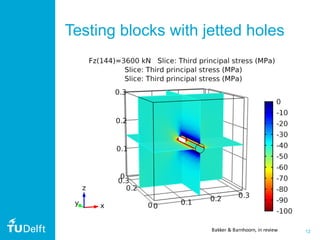
Testing blocks with jetted holes
Bakker	&	Barnhoorn,	in	review
12
Testing blocks with jetted holes
Bakker	&	Barnhoorn,	in	review
13Bakker	&	Barnhoorn,	in	review
14
Initial jetting test
Jetted	hole	
trajectory?
25	MPa
5	MPa300	-350	mm
15
Jetted laterals
310	mm
16
Story so far
• No significant damage around the jetted
borehole
– .. for this rock type
• More jetting tests in the true triaxial
apparatus planned..
– Higher jetting nozzle pressure (300 bar
compared to 140 bar before)
– Various stress orientations
– Various stress magnitudes
– Various rock types (sandstone & chalk)
17
Thank you for your attention
r.r.bakker@tudelft.nl

Lateral drilling