Copyright © 2013 Pearson Education, Inc. Publishing as Prentice Hall.
CHAPTER 1:
BRANDS AND BRAND
MANAGEMENT
Copyright © 2013 Pearson Education, Inc. Publishing as Prentice Hall.
What is a Brand?
Brand Elements
Brands versus Products
Copyright © 2013 Pearson Education, Inc. Publishing as Prentice Hall.
Brand Elements
¨ Different components that identifies and
differentiates a brand
¤ Name, logo, symbol, package design, or other
characteristic
¨ Can be based on people, places, things, and
abstract images
Copyright © 2013 Pearson Education, Inc. Publishing as Prentice Hall.
Brand versus Product
Brand Product
Has dimensions that differentiate it in
some way from other products designed
to satisfy the same need
Anything available in the market for use
or consumption, that may satisfy a need
or want
Can be differentiated on the basis of:
• Packaging
• Services provided
• Customer advice
• Financing
• Delivery arrangements
• Warehousing
• Other things valued by the customers
Can be categorized into five levels
namely:
• Core benefit level
• Generic product level
• Expected product level
• Augmented product level
• Potential product level
C G E A P
What	is	the	difference	between	
symbol,	logo	and	trademark?
• A symbol is a graphic image that has some attached meaning, such as
an on screen icon or sign on a door. The meaning is attached to all
uses of that graphic.
• A logo attaches ownership to the graphic image, it could be a
company, a brand, a service, an institution.
• A trademark protects the use of the symbol/logo. To get a
trademark, you must prove to the registrar that you have a
unique symbol/logo, that no one else is using it. There then
follows a period of time when everyone can see your application
and object if they can prove they are using something similar or
identical, or that it would be confuse their business with yours.
Copyright © 2013 Pearson Education, Inc. Publishing as Prentice Hall.
Why Do Brands Matter?
Consumers
Firms
Copyright © 2013 Pearson Education, Inc. Publishing as Prentice Hall.
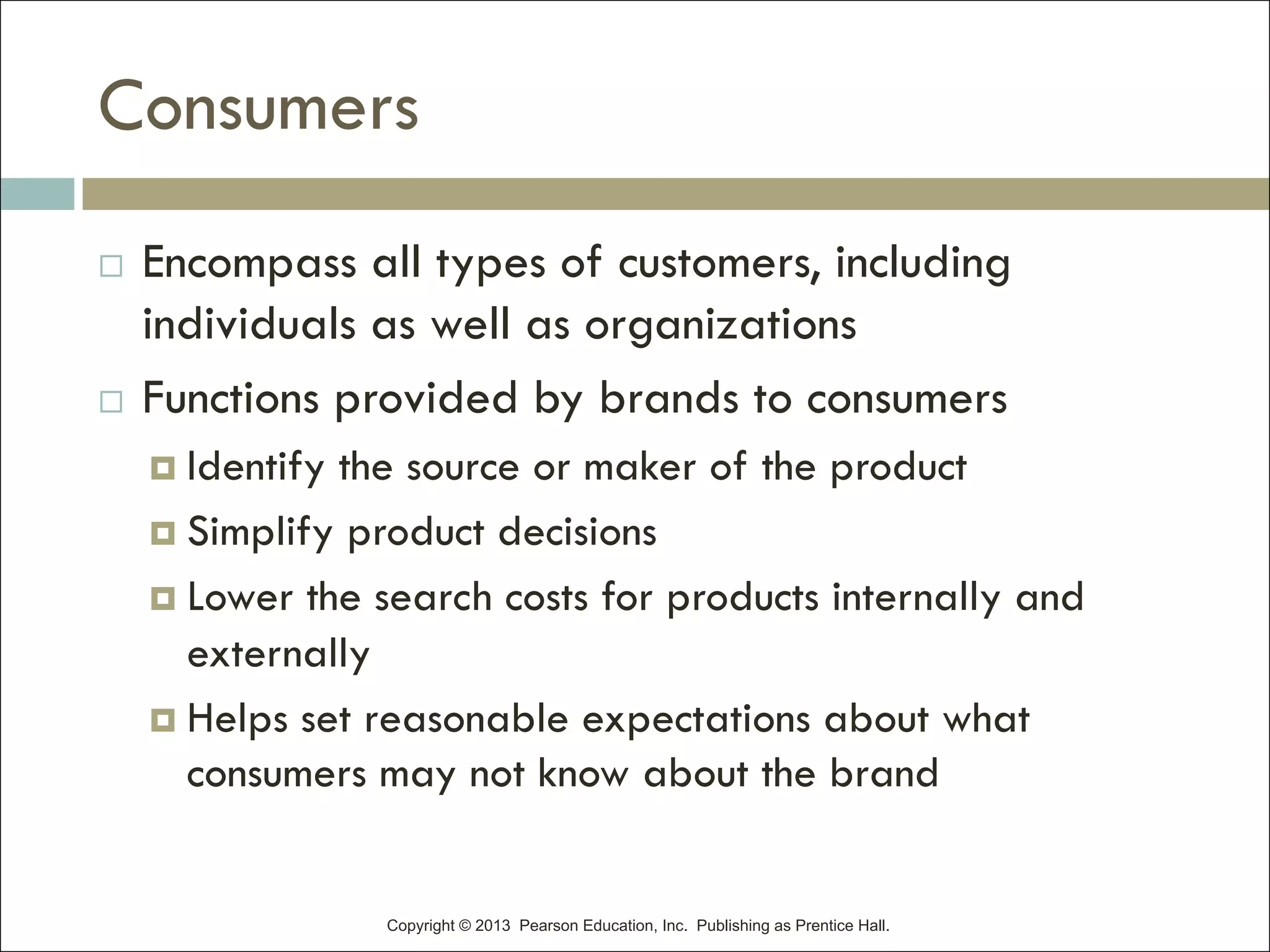
Consumers
¨ Encompass all types of customers, including
individuals as well as organizations
¨ Functions provided by brands to consumers
¤ Identify the source or maker of the product
¤ Simplify product decisions
¤ Lower the search costs for products internally and
externally
¤ Helps set reasonable expectations about what
consumers may not know about the brand
Copyright © 2013 Pearson Education, Inc. Publishing as Prentice Hall.
Consumers
¤ Signal product characteristics and attributes
n On the basis of attributes products can be classified as:
n Search goods
n Experience goods
n Credence goods
¤ Reduce risks in product decision
n These risk can be categorised as
n Functional ,physical, financial, social psychological, and time
Copyright © 2013 Pearson Education, Inc. Publishing as Prentice Hall.
Firms
¨ Brands provide valuable functions
¤ Simplify product handling and tracing
¤ Help organizing inventory and accounting records
¤ Offer the firm legal protection for unique features or
aspects of the product
¤ Provide predictability and security of demand for the
firm and creates barriers of entry for competitors
¤ Provide a powerful means to secure competitive
advantage
Copyright © 2013 Pearson Education, Inc. Publishing as Prentice Hall.
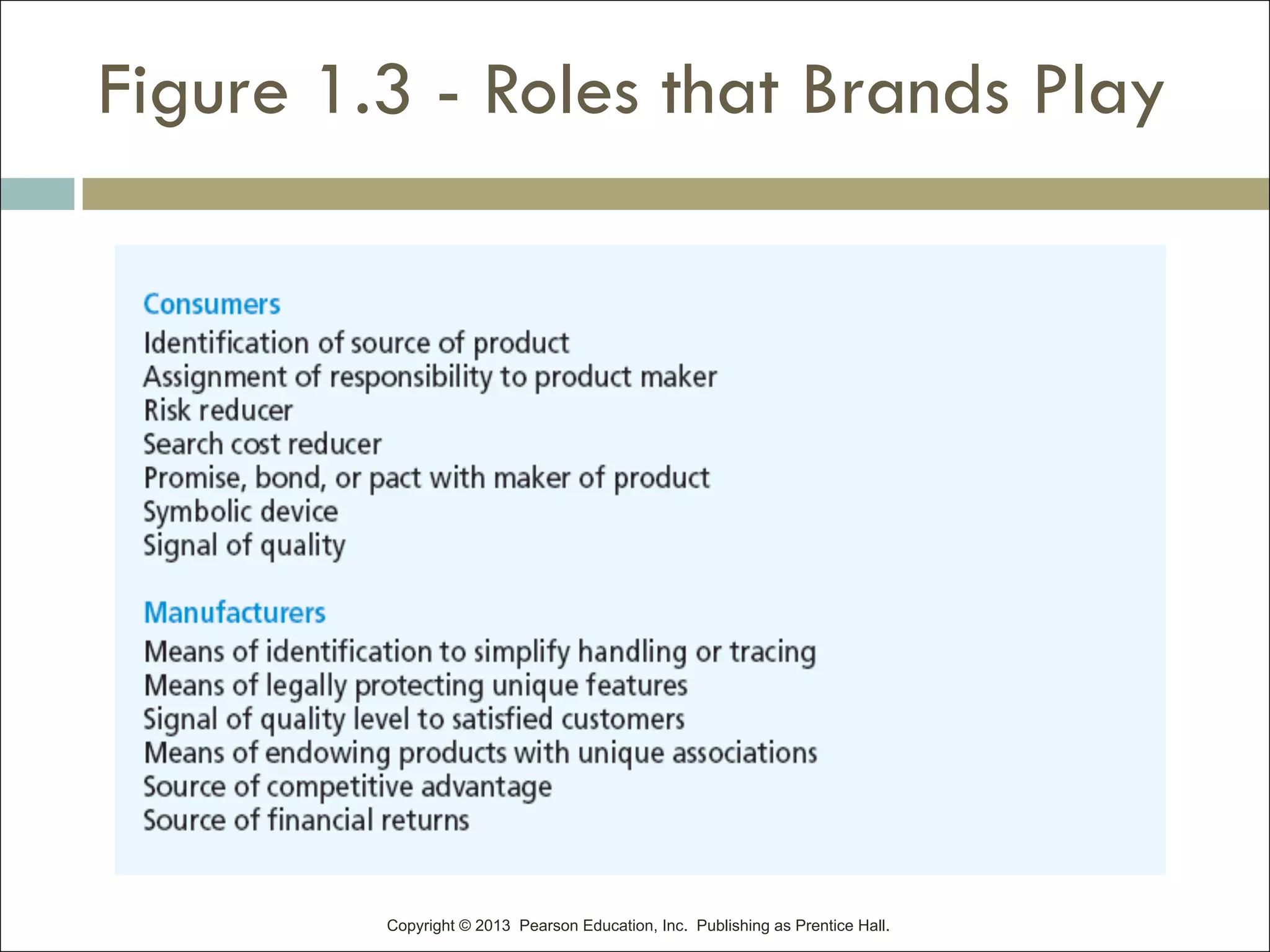
Figure 1.3 - Roles that Brands Play

last chapter copy 2.pdf

  • 1.
    Copyright © 2013Pearson Education, Inc. Publishing as Prentice Hall. CHAPTER 1: BRANDS AND BRAND MANAGEMENT
  • 2.
    Copyright © 2013Pearson Education, Inc. Publishing as Prentice Hall. What is a Brand? Brand Elements Brands versus Products
  • 3.
    Copyright © 2013Pearson Education, Inc. Publishing as Prentice Hall. Brand Elements ¨ Different components that identifies and differentiates a brand ¤ Name, logo, symbol, package design, or other characteristic ¨ Can be based on people, places, things, and abstract images
  • 4.
    Copyright © 2013Pearson Education, Inc. Publishing as Prentice Hall. Brand versus Product Brand Product Has dimensions that differentiate it in some way from other products designed to satisfy the same need Anything available in the market for use or consumption, that may satisfy a need or want Can be differentiated on the basis of: • Packaging • Services provided • Customer advice • Financing • Delivery arrangements • Warehousing • Other things valued by the customers Can be categorized into five levels namely: • Core benefit level • Generic product level • Expected product level • Augmented product level • Potential product level C G E A P
  • 5.
    What is the difference between symbol, logo and trademark? • A symbolis a graphic image that has some attached meaning, such as an on screen icon or sign on a door. The meaning is attached to all uses of that graphic. • A logo attaches ownership to the graphic image, it could be a company, a brand, a service, an institution. • A trademark protects the use of the symbol/logo. To get a trademark, you must prove to the registrar that you have a unique symbol/logo, that no one else is using it. There then follows a period of time when everyone can see your application and object if they can prove they are using something similar or identical, or that it would be confuse their business with yours.
  • 6.
    Copyright © 2013Pearson Education, Inc. Publishing as Prentice Hall. Why Do Brands Matter? Consumers Firms
  • 7.
    Copyright © 2013Pearson Education, Inc. Publishing as Prentice Hall. Consumers ¨ Encompass all types of customers, including individuals as well as organizations ¨ Functions provided by brands to consumers ¤ Identify the source or maker of the product ¤ Simplify product decisions ¤ Lower the search costs for products internally and externally ¤ Helps set reasonable expectations about what consumers may not know about the brand
  • 8.
    Copyright © 2013Pearson Education, Inc. Publishing as Prentice Hall. Consumers ¤ Signal product characteristics and attributes n On the basis of attributes products can be classified as: n Search goods n Experience goods n Credence goods ¤ Reduce risks in product decision n These risk can be categorised as n Functional ,physical, financial, social psychological, and time
  • 9.
    Copyright © 2013Pearson Education, Inc. Publishing as Prentice Hall. Firms ¨ Brands provide valuable functions ¤ Simplify product handling and tracing ¤ Help organizing inventory and accounting records ¤ Offer the firm legal protection for unique features or aspects of the product ¤ Provide predictability and security of demand for the firm and creates barriers of entry for competitors ¤ Provide a powerful means to secure competitive advantage
  • 10.
    Copyright © 2013Pearson Education, Inc. Publishing as Prentice Hall. Figure 1.3 - Roles that Brands Play