Prof. Dr. Salah Ibrahim Hassab Elnaby
Introduction to Laser Theory
    Prof. Dr. Salah I. Hassab Elnaby
                  NILES
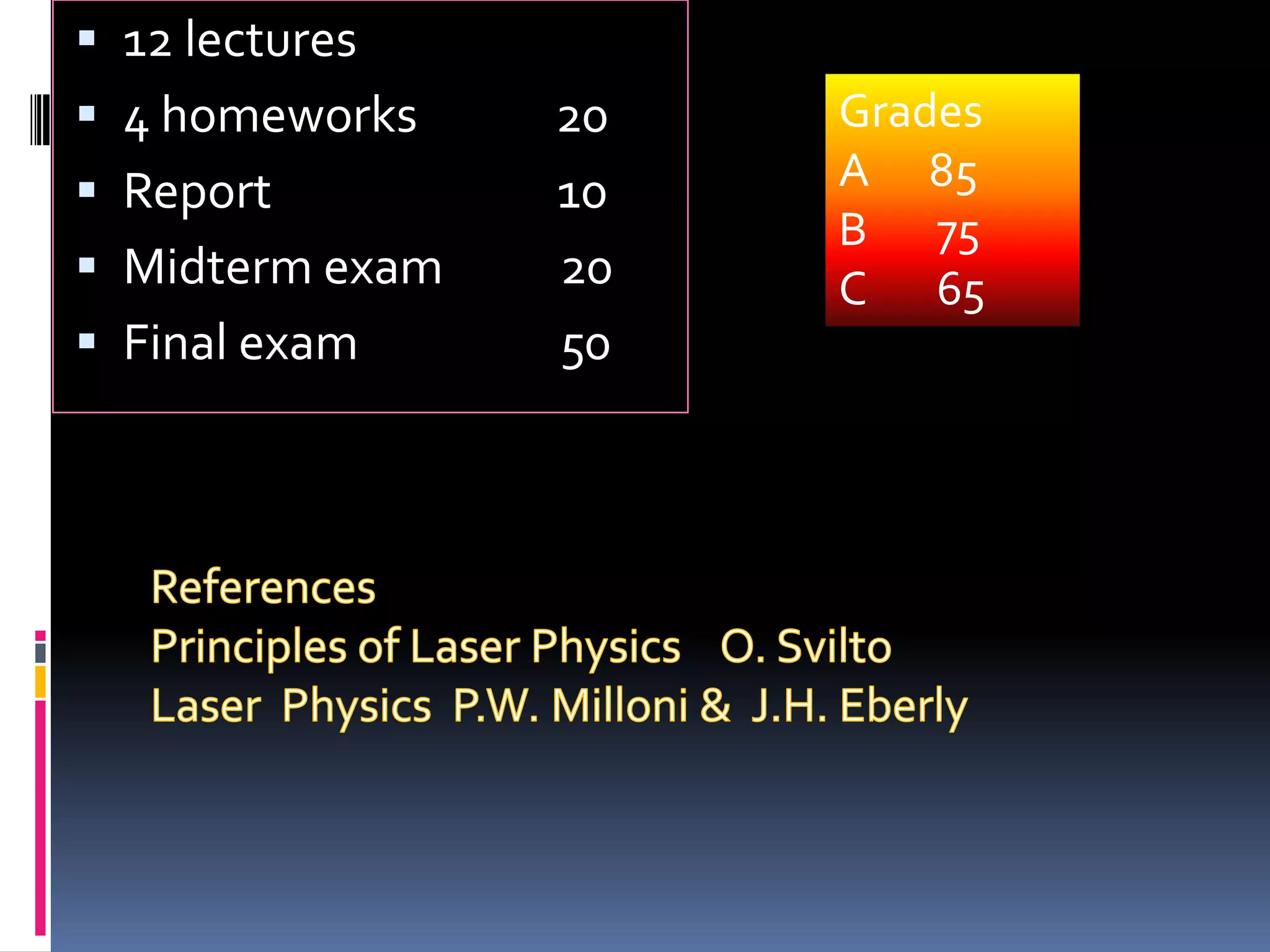
 12 lectures
 4 homeworks    20   Grades
 Report         10   A 85
                      B 75
 Midterm exam   20   C 65
 Final exam     50
Contents
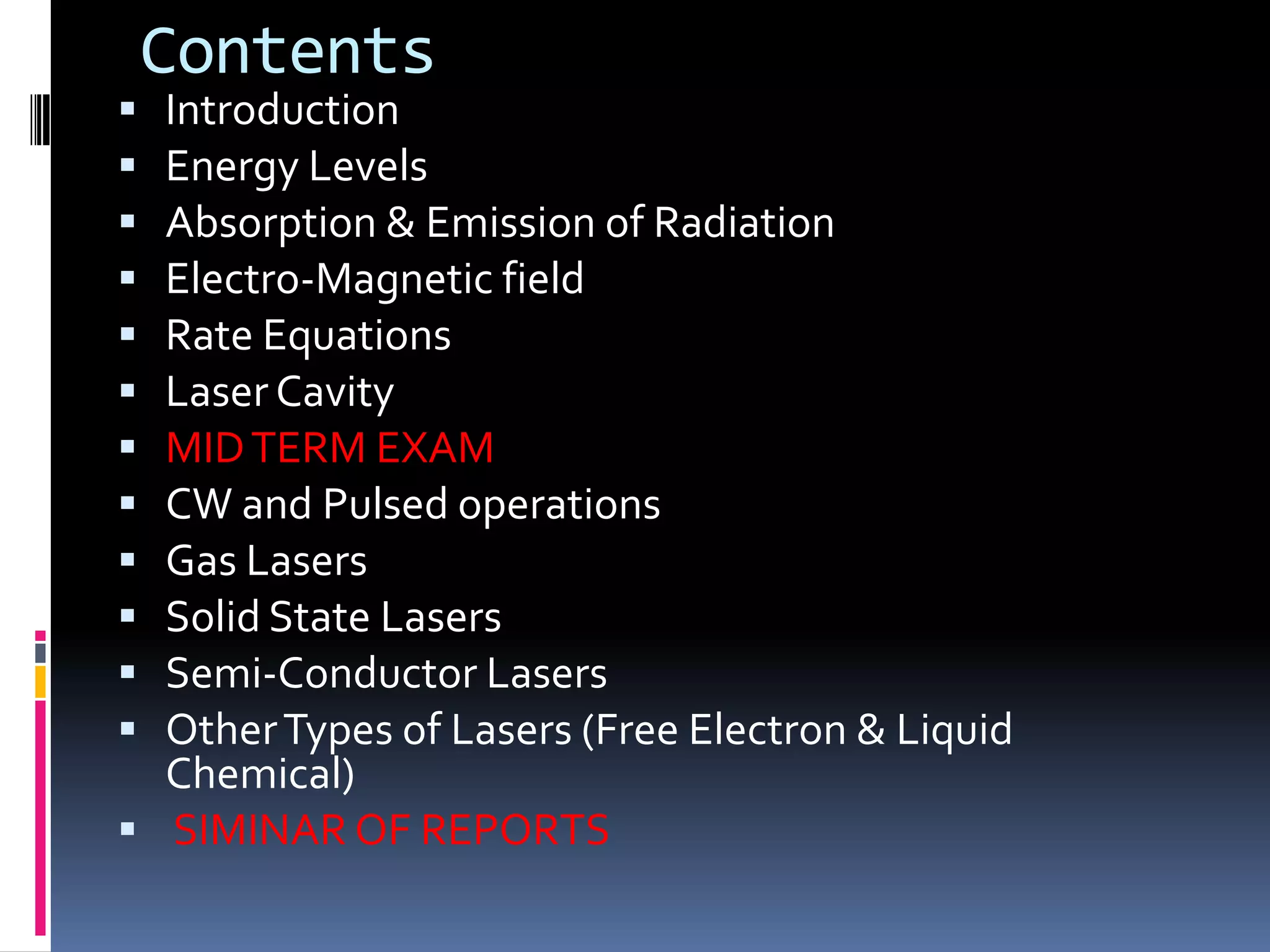
 Introduction
 Energy Levels
 Absorption & Emission of Radiation
 Electro-Magnetic field
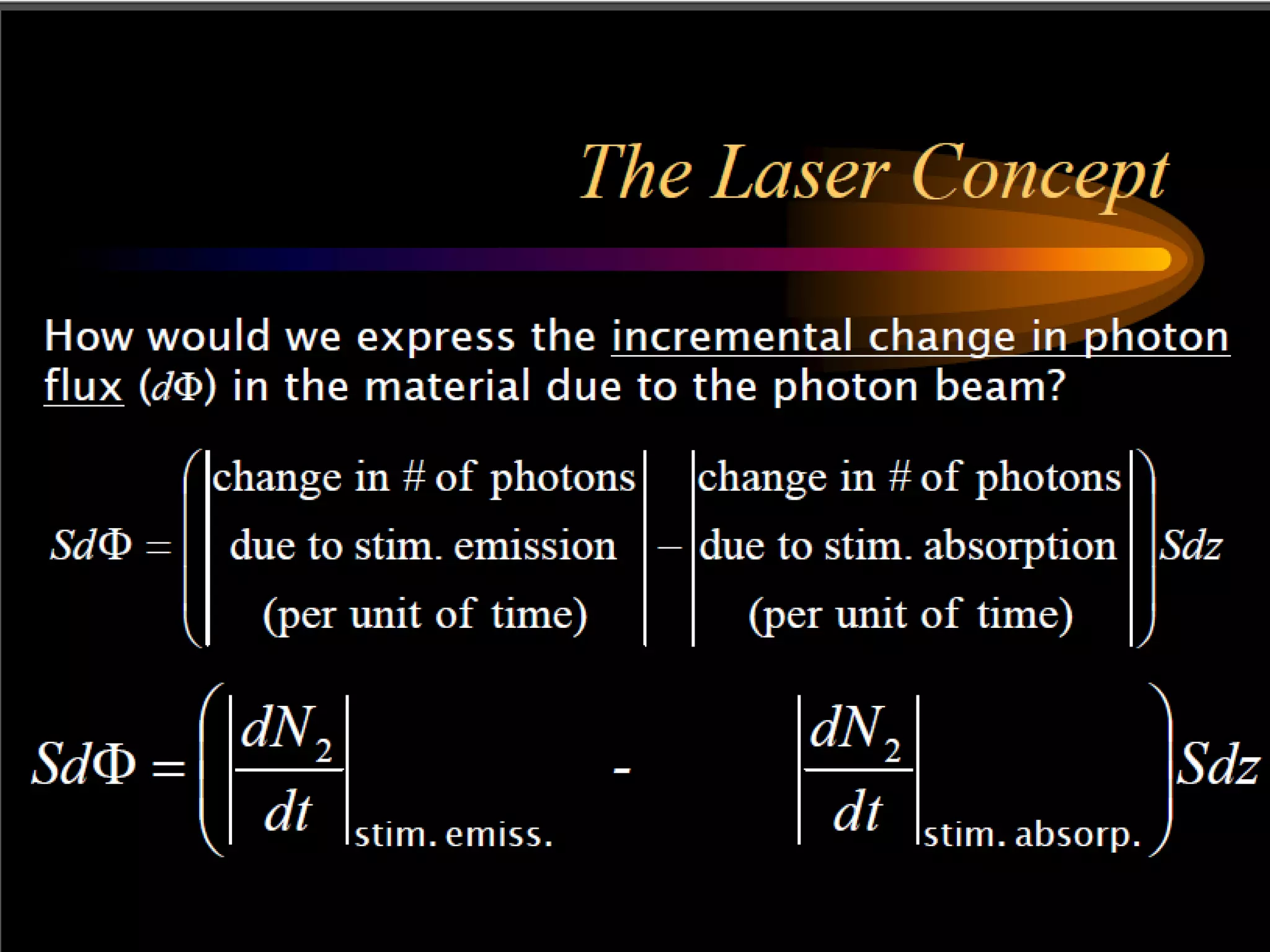
 Rate Equations
 Laser Cavity
 MID TERM EXAM
 CW and Pulsed operations
 Gas Lasers
 Solid State Lasers
 Semi-Conductor Lasers
 Other Types of Lasers (Free Electron & Liquid
  Chemical)
 SIMINAR OF REPORTS
Types of Laser
Based on the mode of operation
      (i) Pulsed Laser systems
      (ii) High power Q-switched systems
      (iii) Continuous wave Laser systems
Based on the mechanism in which Population
Inversion is achieved
      (i) Three level lasers
      (ii) Four level lasers
Based on state of active medium used
      (i) Gas Laser
      (ii) Solid state Laser
      (iii) Semiconductor Laser
      (iv) Tunable dye Laser
7
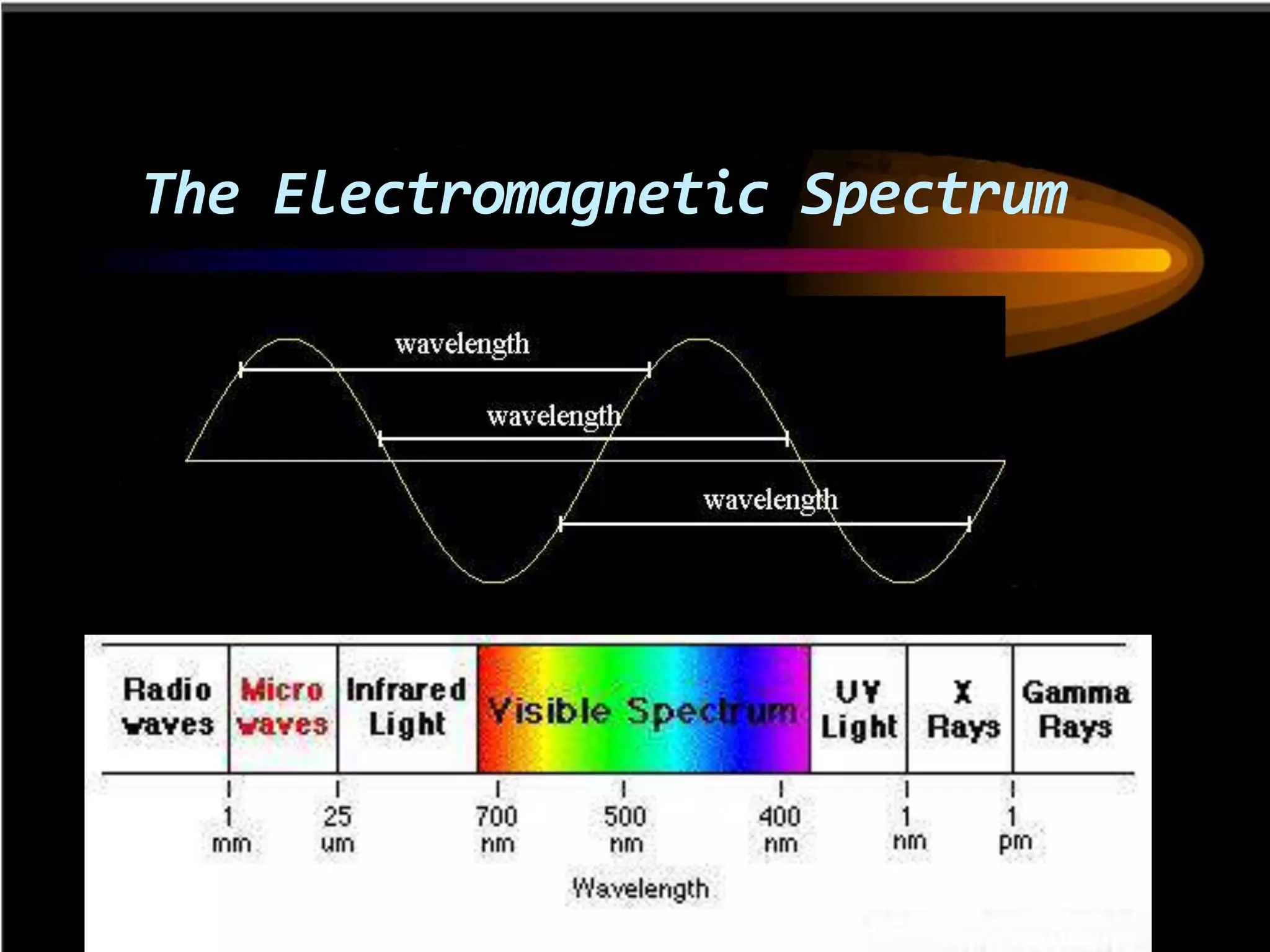
The Electromagnetic Spectrum
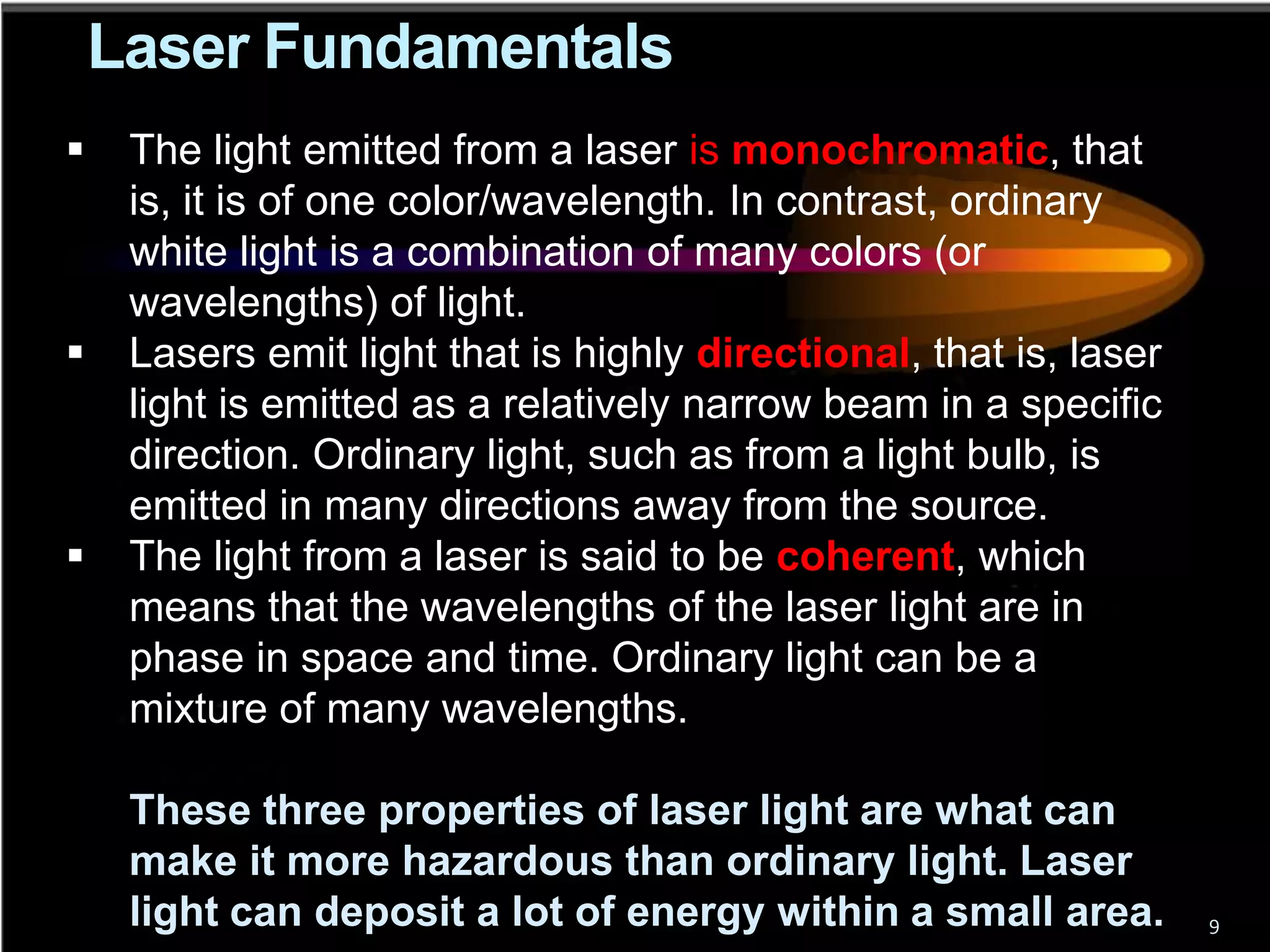
Laser Fundamentals
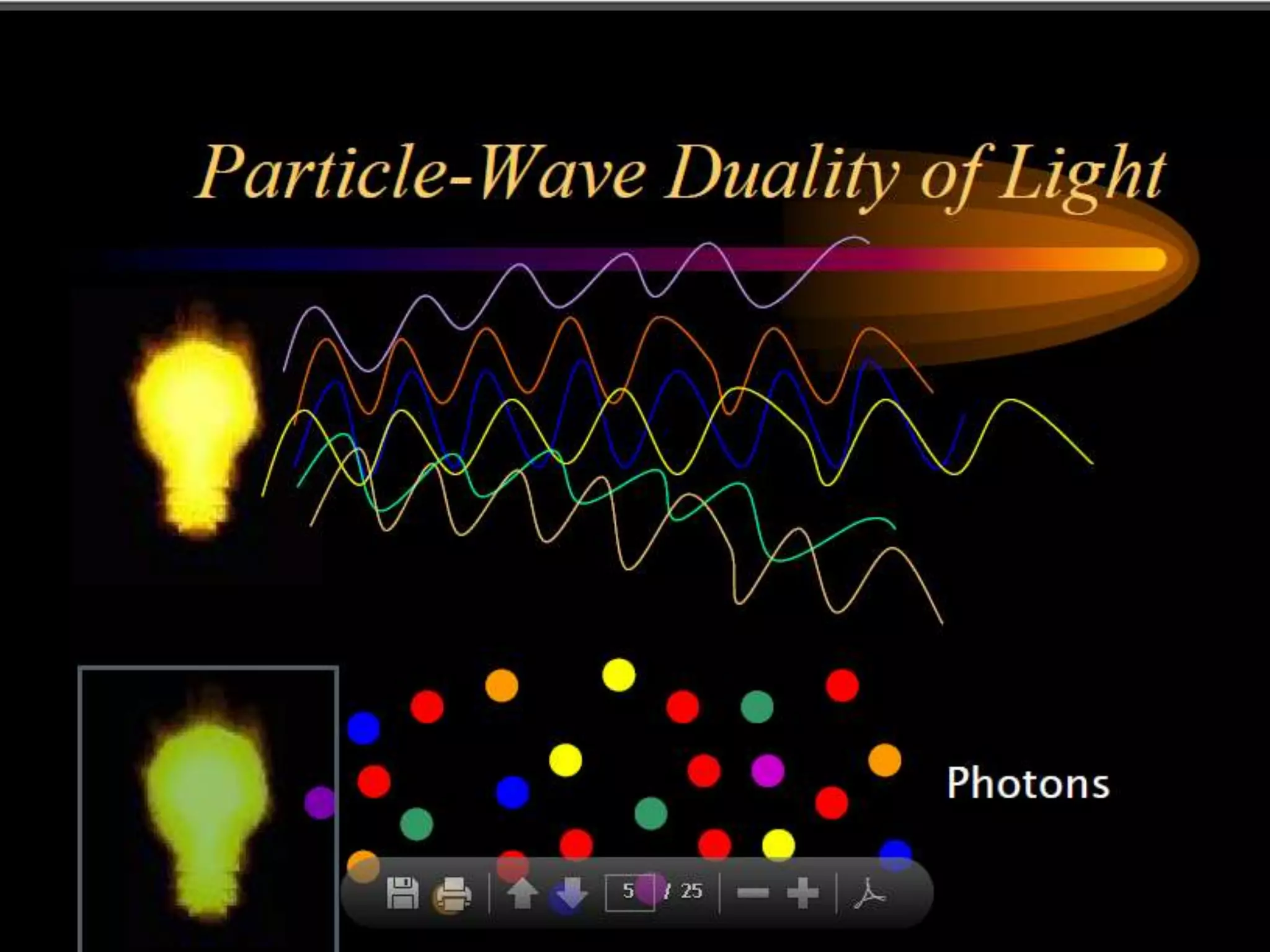
    The light emitted from a laser is monochromatic, that
     is, it is of one color/wavelength. In contrast, ordinary
     white light is a combination of many colors (or
     wavelengths) of light.
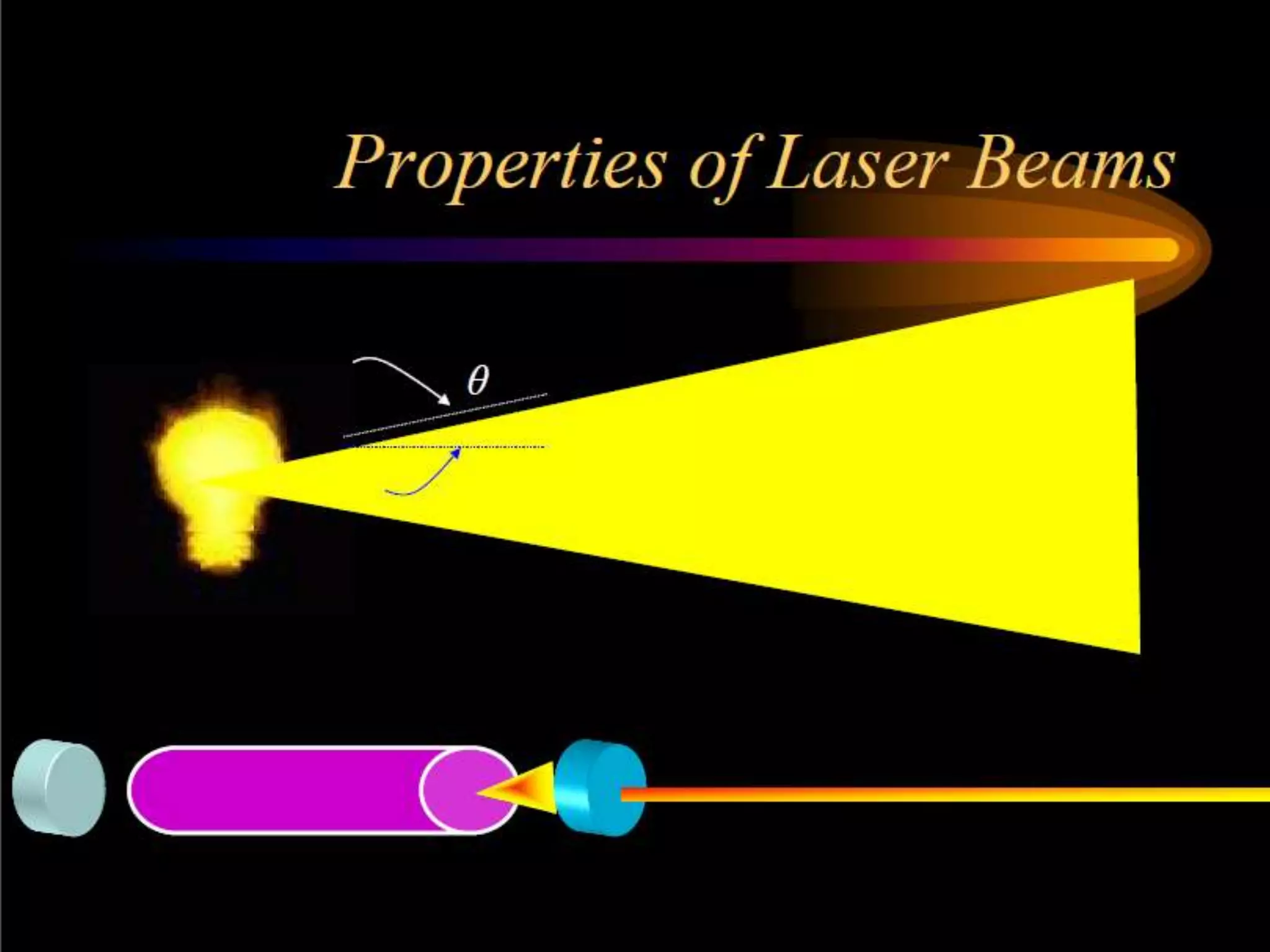
    Lasers emit light that is highly directional, that is, laser
     light is emitted as a relatively narrow beam in a specific
     direction. Ordinary light, such as from a light bulb, is
     emitted in many directions away from the source.
    The light from a laser is said to be coherent, which
     means that the wavelengths of the laser light are in
     phase in space and time. Ordinary light can be a
     mixture of many wavelengths.

     These three properties of laser light are what can
     make it more hazardous than ordinary light. Laser
     light can deposit a lot of energy within a small area.         9
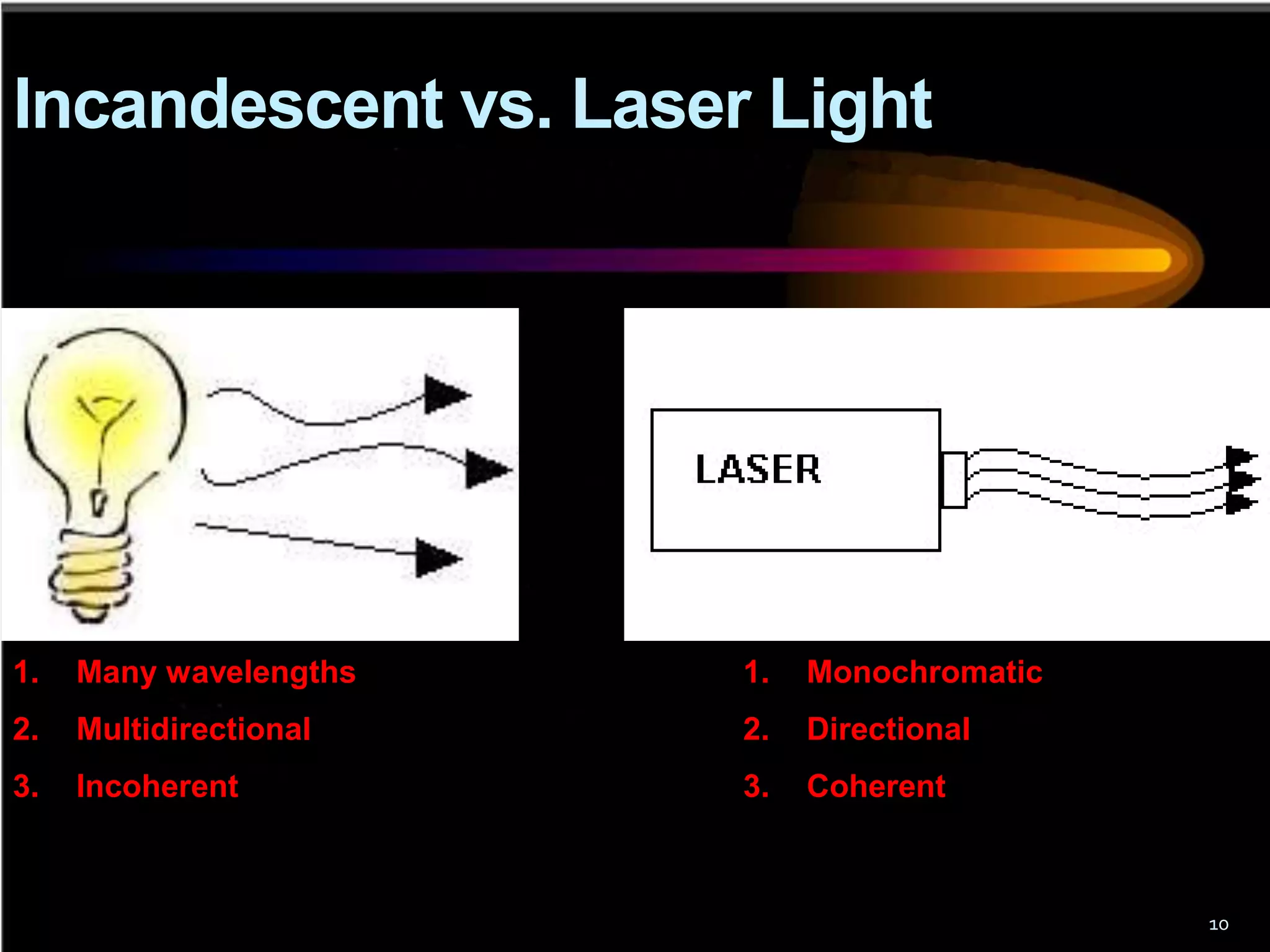
Incandescent vs. Laser Light


1.   Many wavelengths   1.   Monochromatic
2.   Multidirectional   2.   Directional
3.   Incoherent         3.   Coherent


                                             10
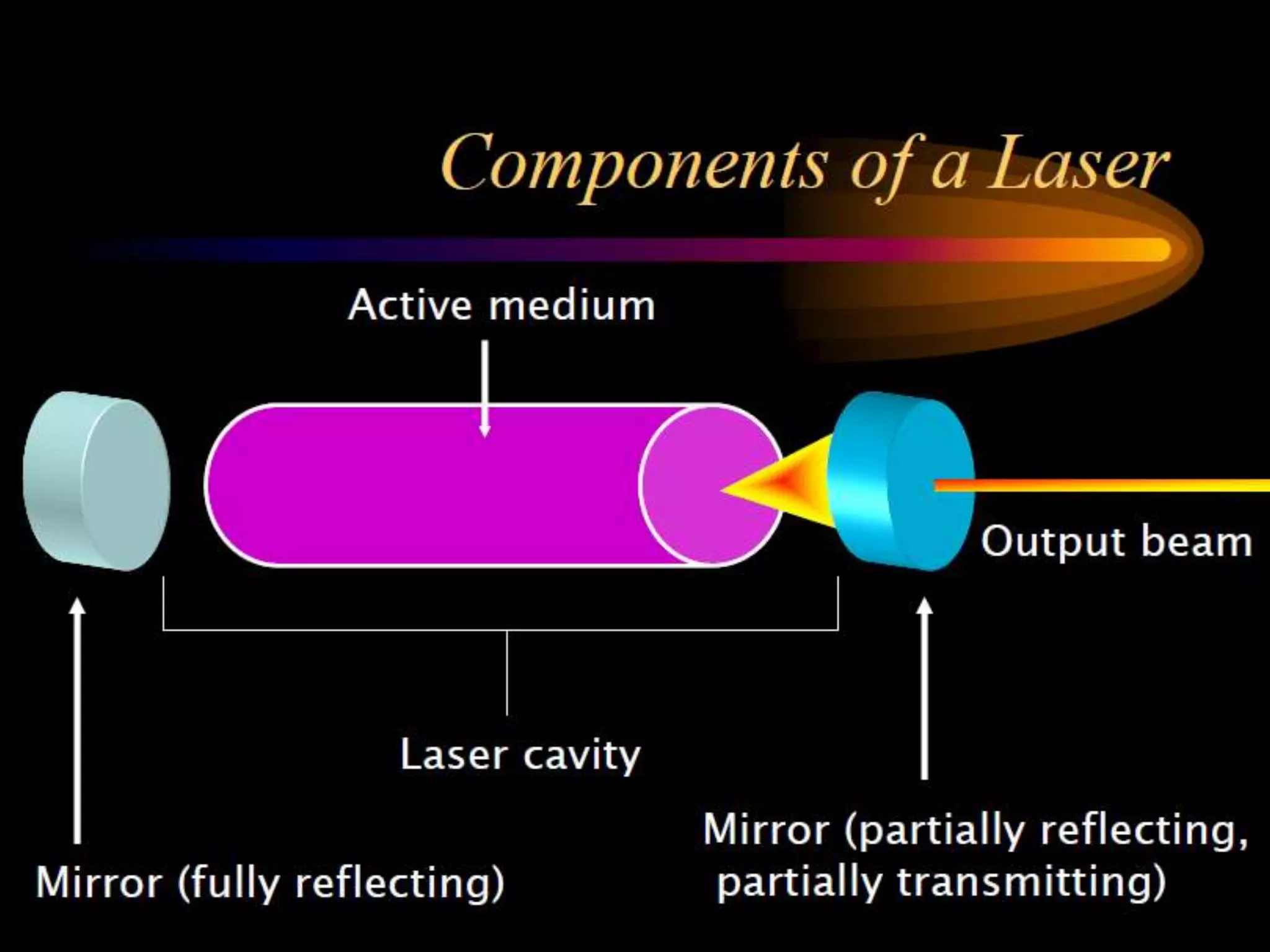
Common Components of all Lasers
1. Active Medium
   The active medium may be solid crystals such as ruby or Nd:YAG,
   liquid dyes, gases like CO2 or Helium/Neon, or semiconductors
   such as GaAs. Active mediums contain atoms whose electrons
   may be excited to a metastable energy level by an energy source.
2. Excitation Mechanism
   Excitation mechanisms pump energy into the active medium by
   one or more of three basic methods; optical, electrical or
   chemical.
3. High Reflectance Mirror
   A mirror which reflects essentially 100% of the laser light.
4. Partially Transmissive Mirror
   A mirror which reflects less than 100% of the laser light and
   transmits the remainder.
                                                                      11
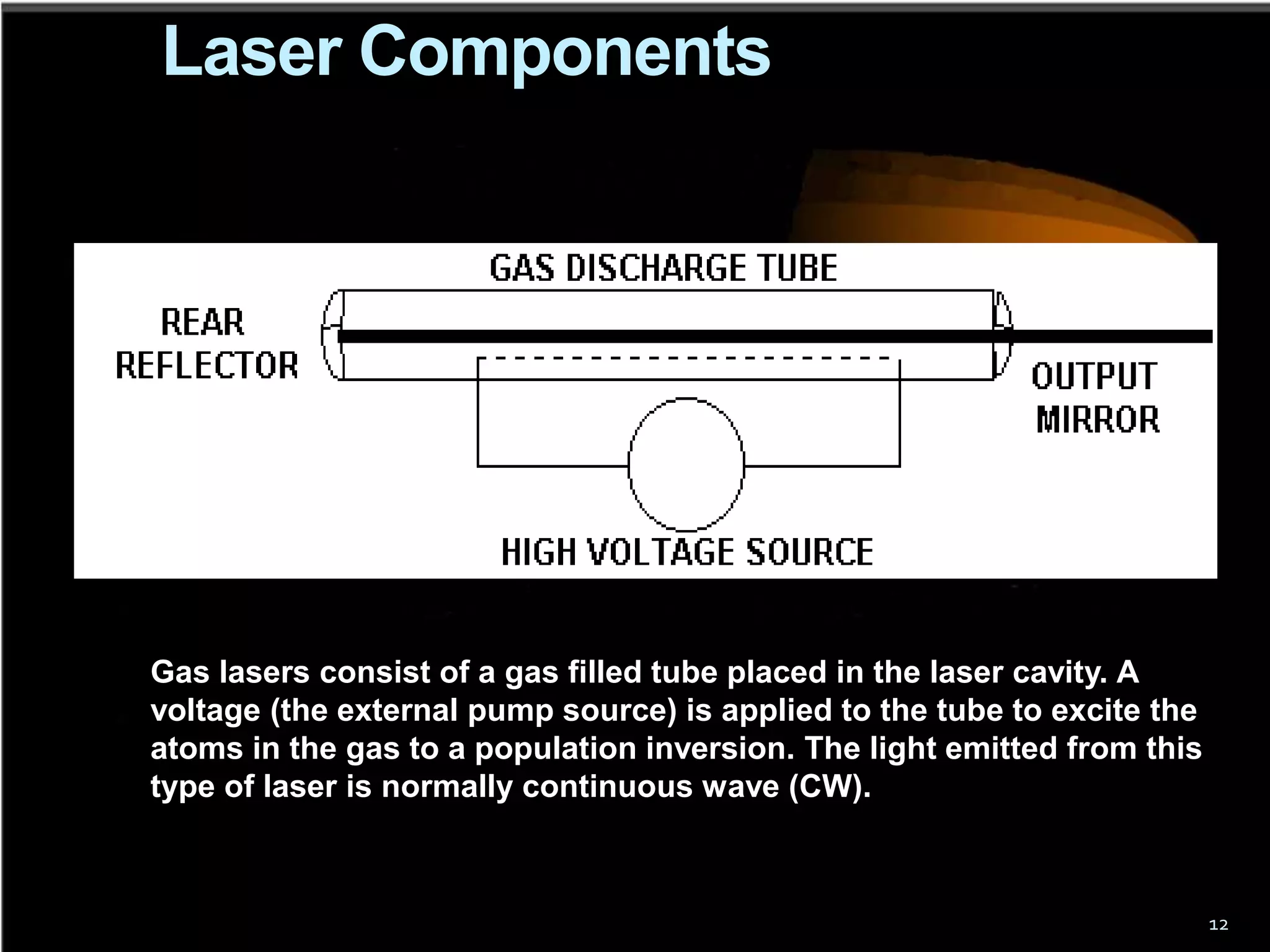
Laser Components


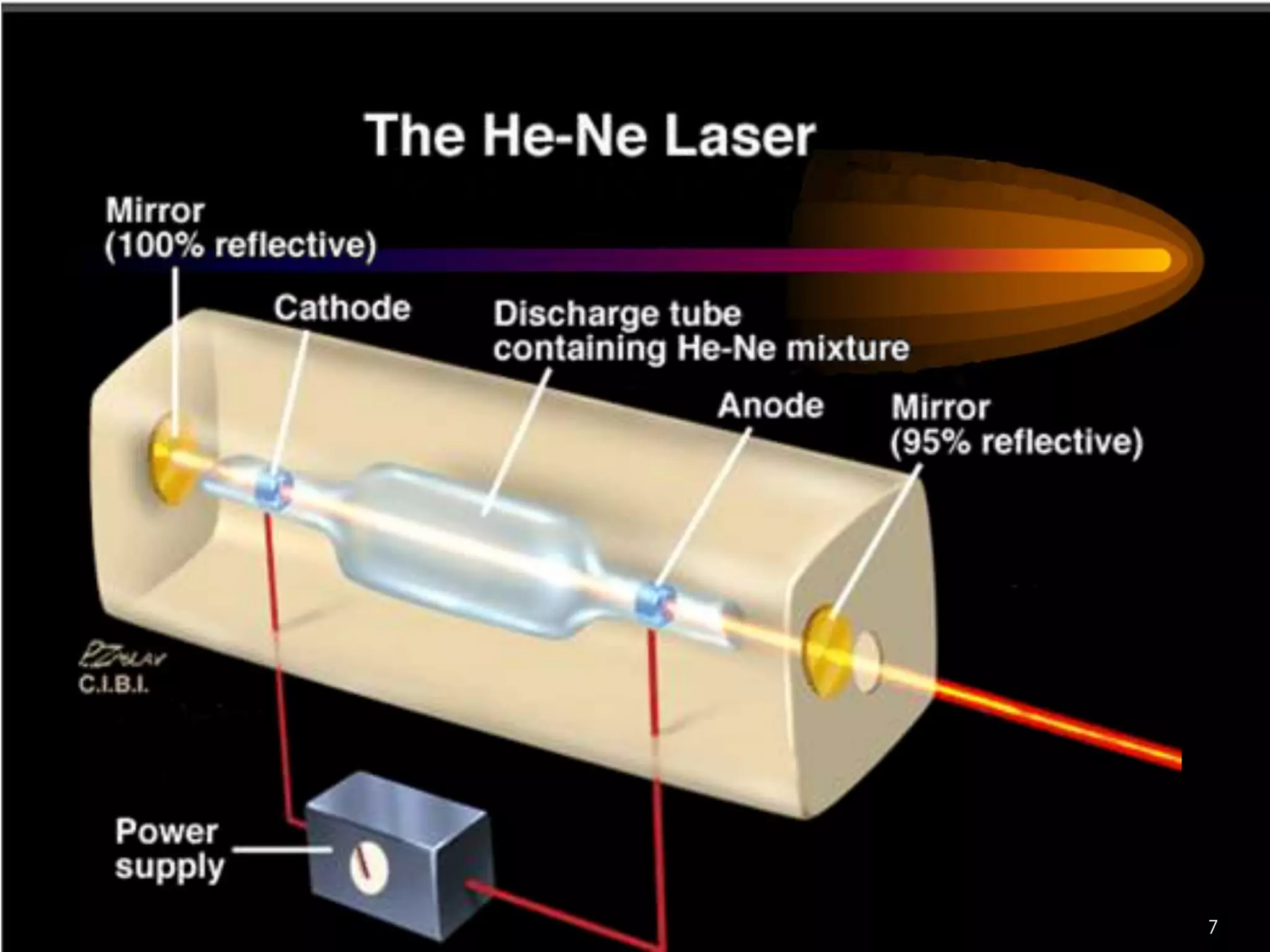
Gas lasers consist of a gas filled tube placed in the laser cavity. A
voltage (the external pump source) is applied to the tube to excite the
atoms in the gas to a population inversion. The light emitted from this
type of laser is normally continuous wave (CW).


                                                                          12
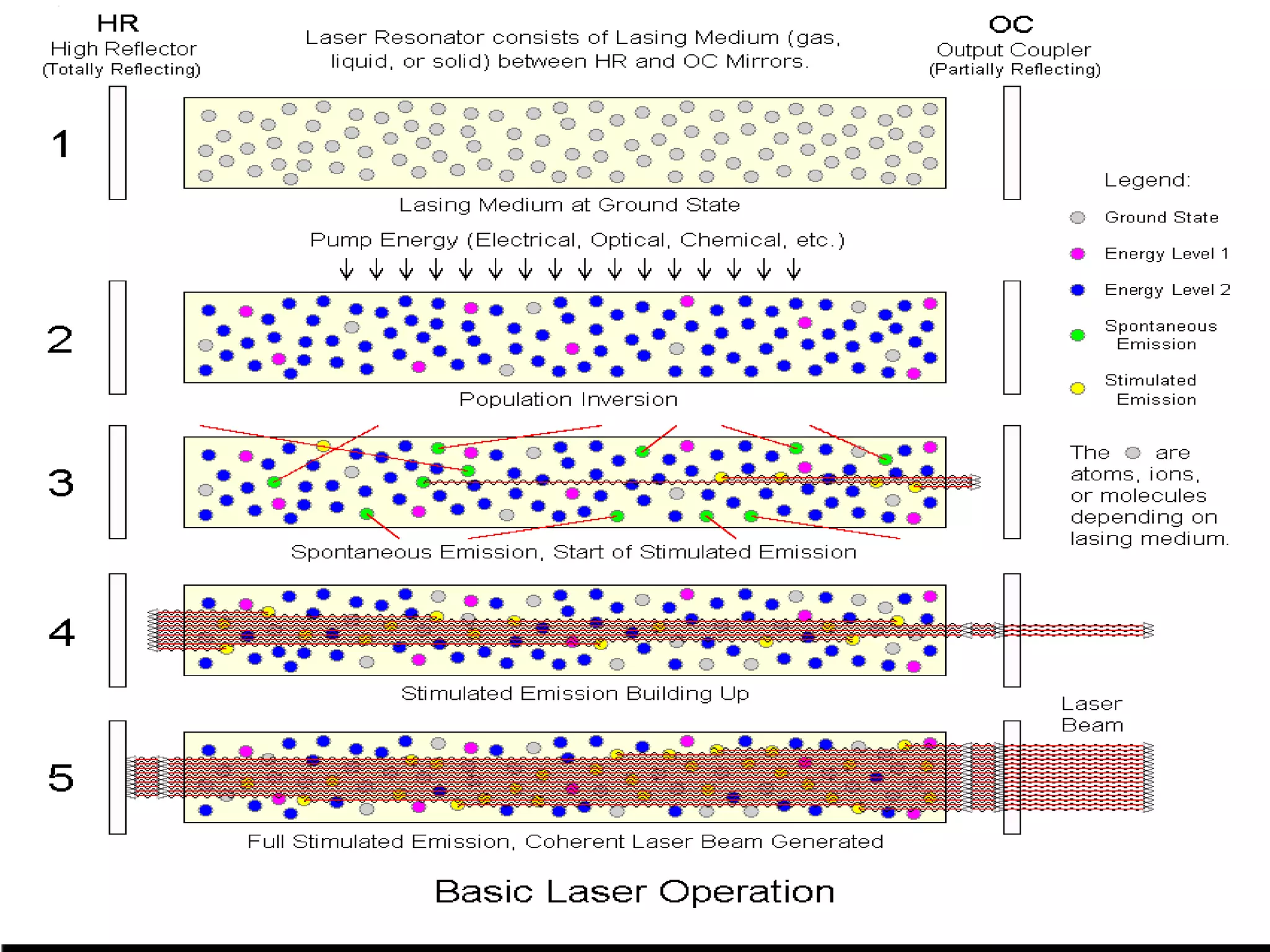
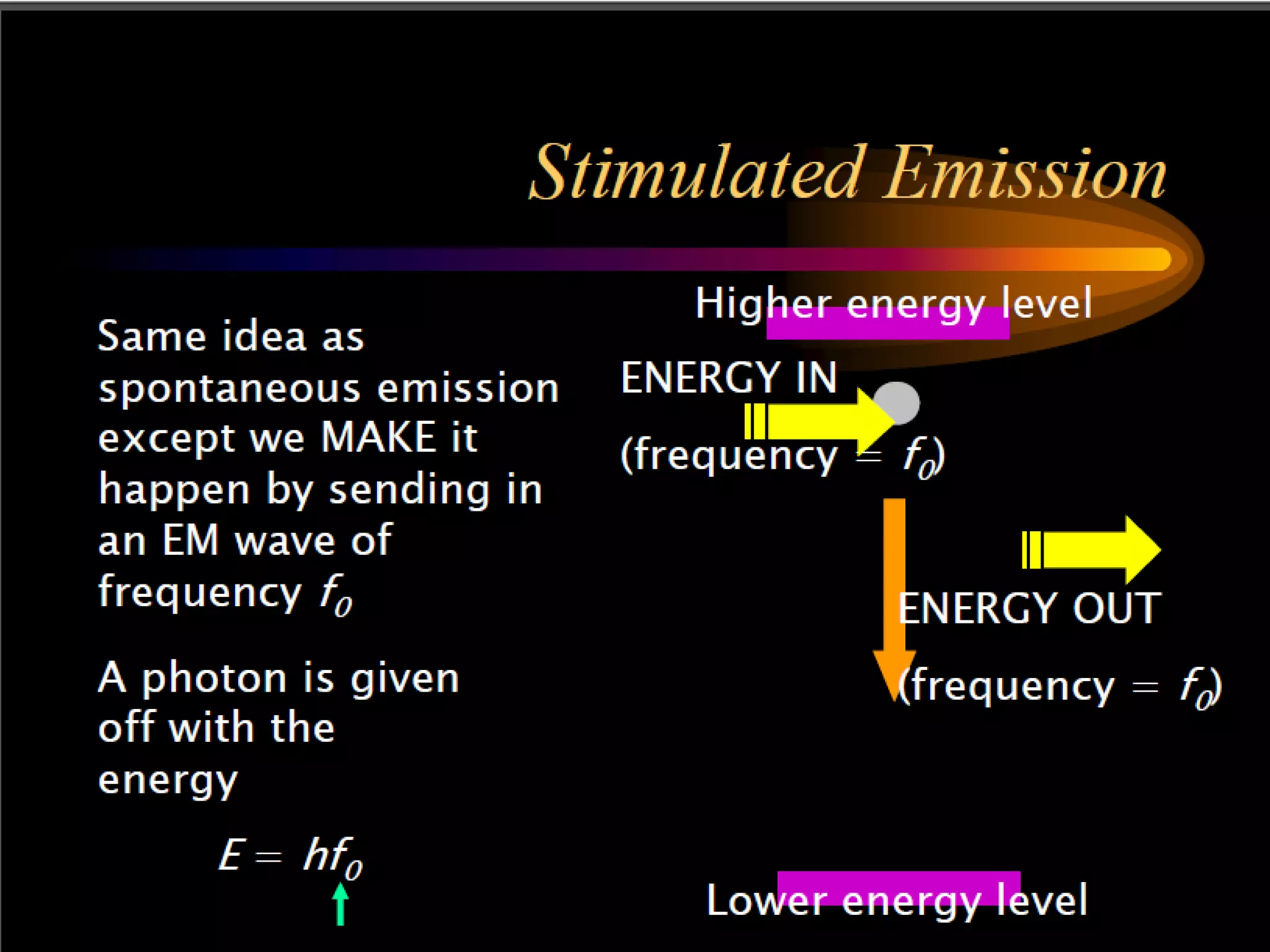
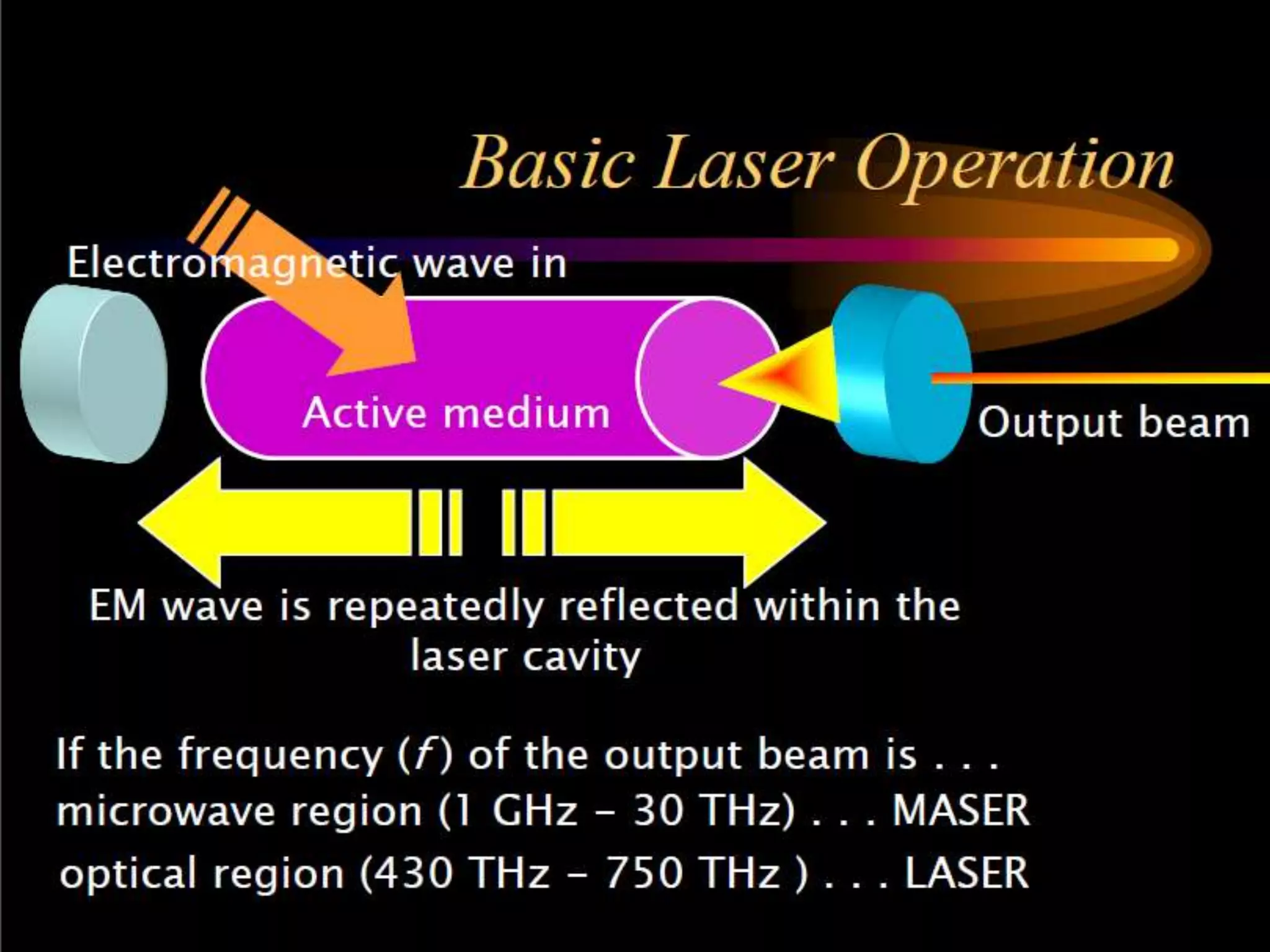
Lasing Action
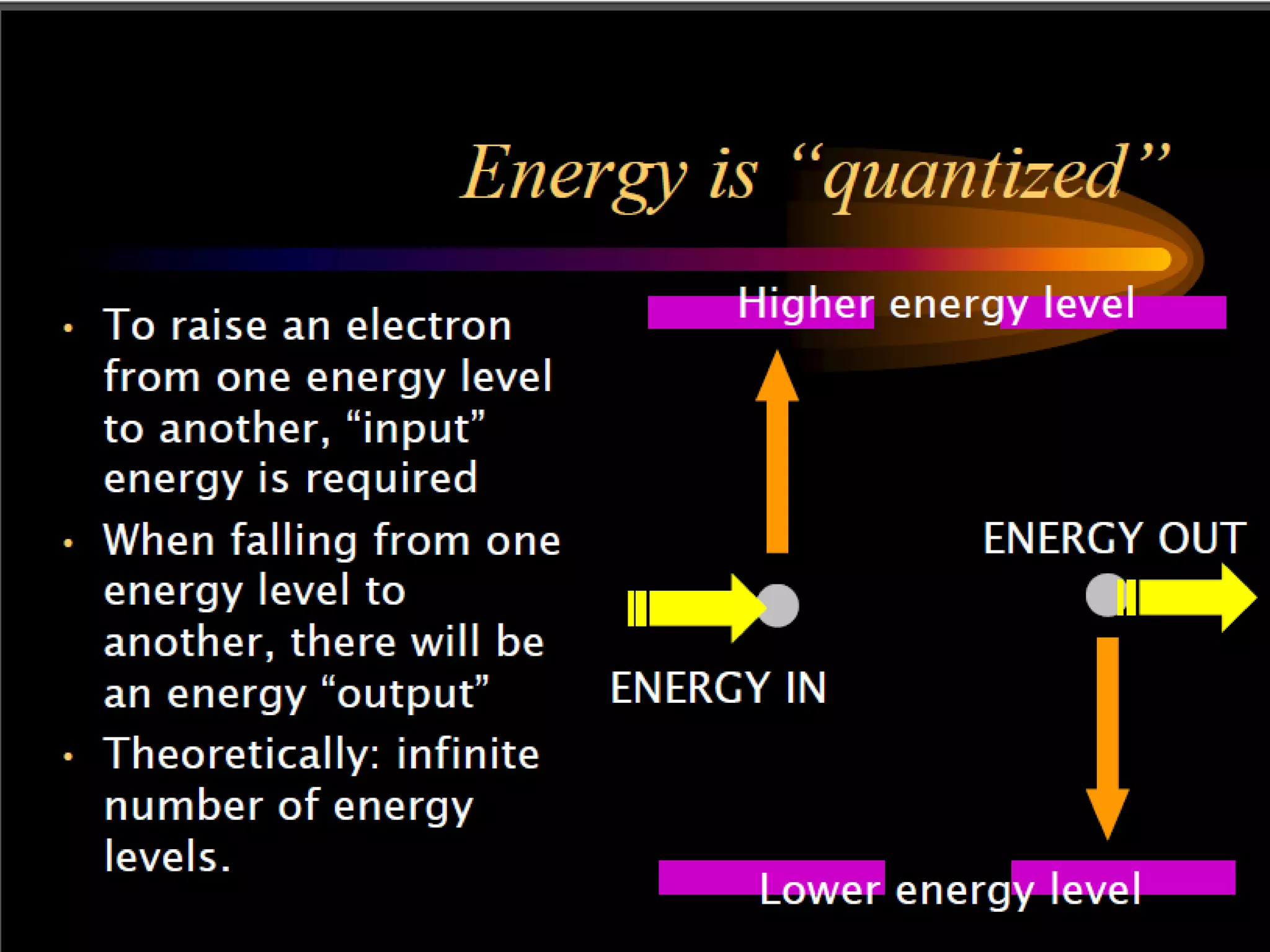
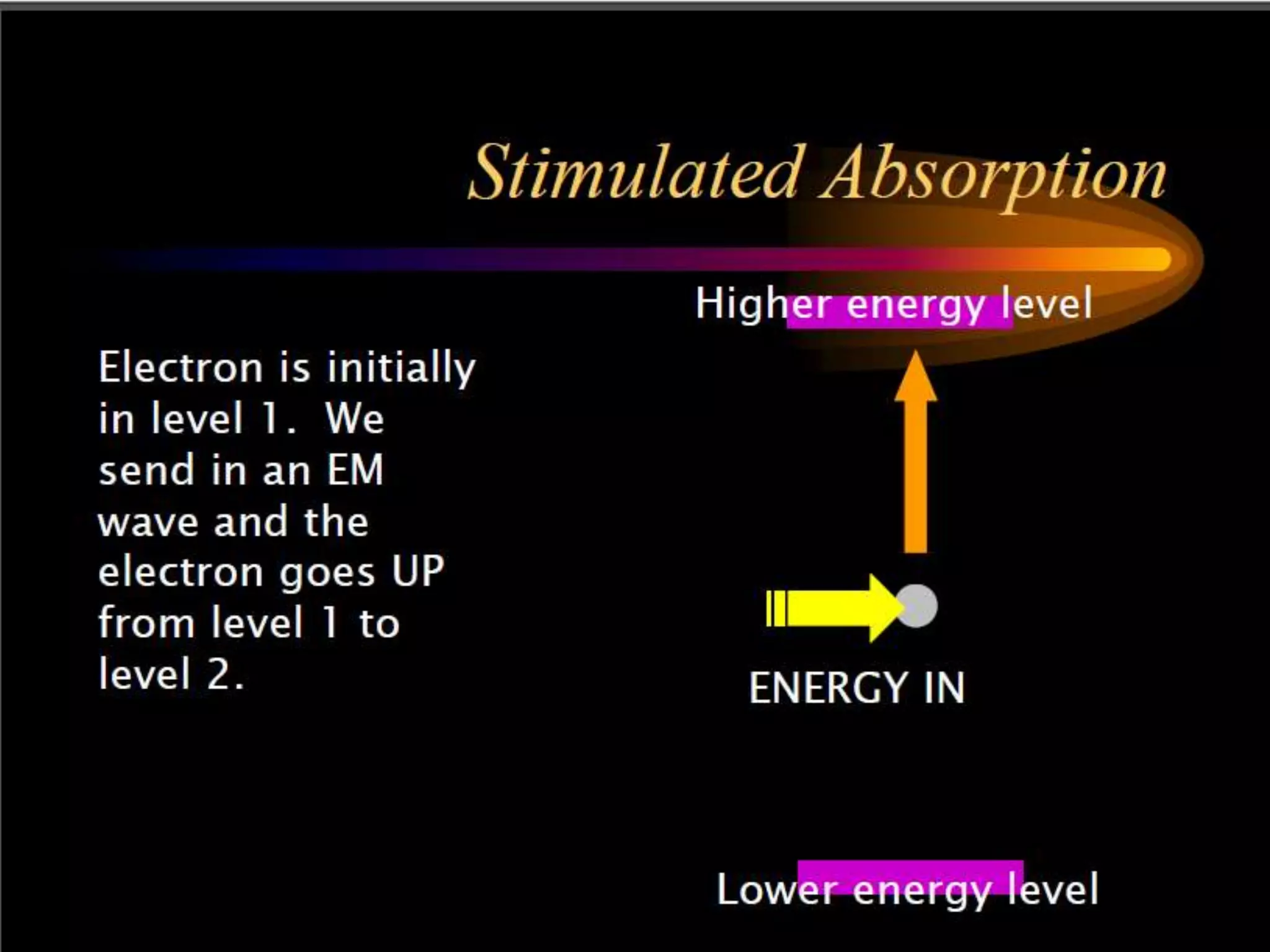
1.   Energy is applied to a medium raising electrons to an unstable
     energy level.
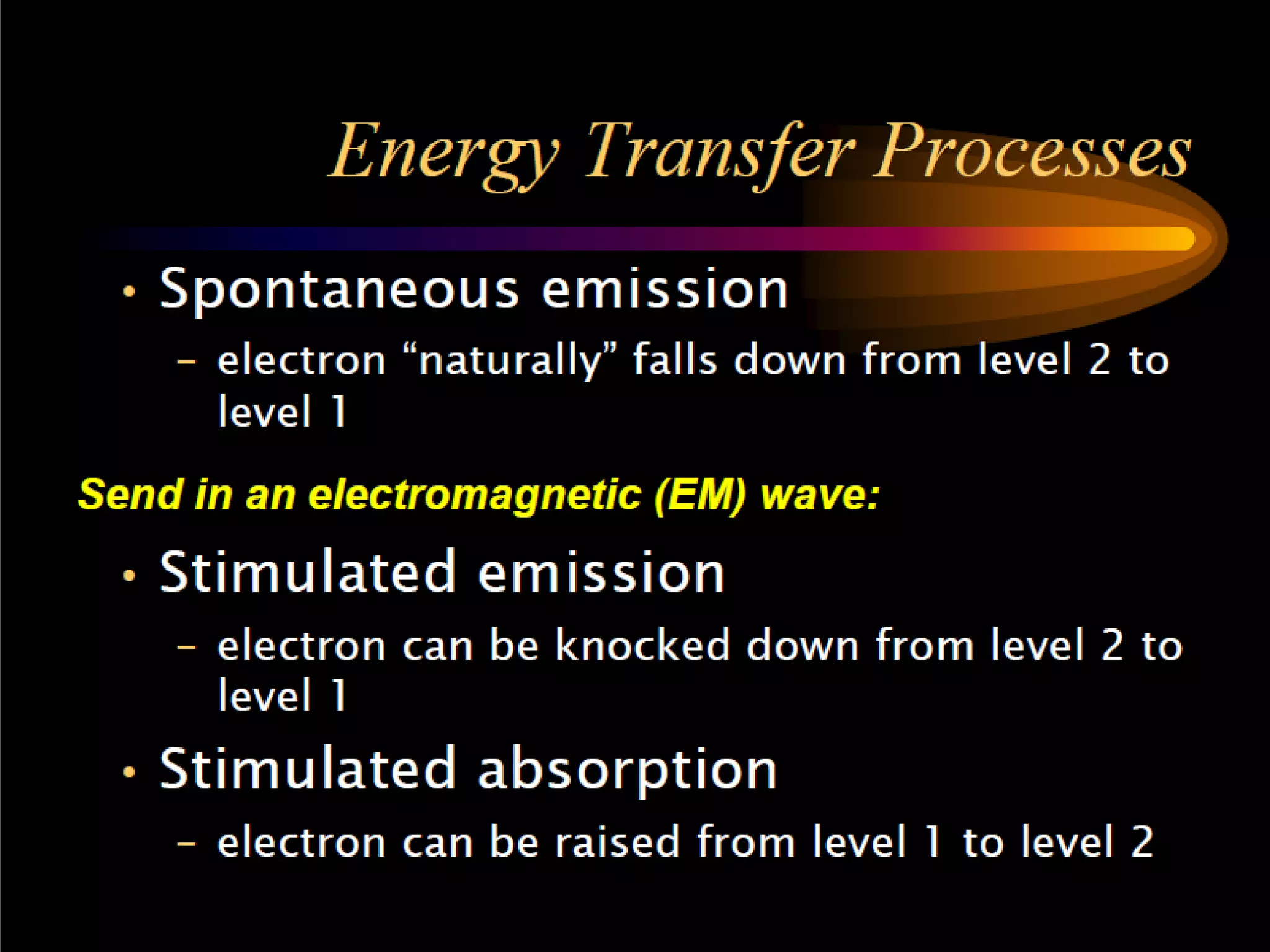
2.   These atoms spontaneously decay to a relatively long-lived, lower
     energy, metastable state.
3.   A population inversion is achieved when the majority of atoms have
     reached this metastable state.
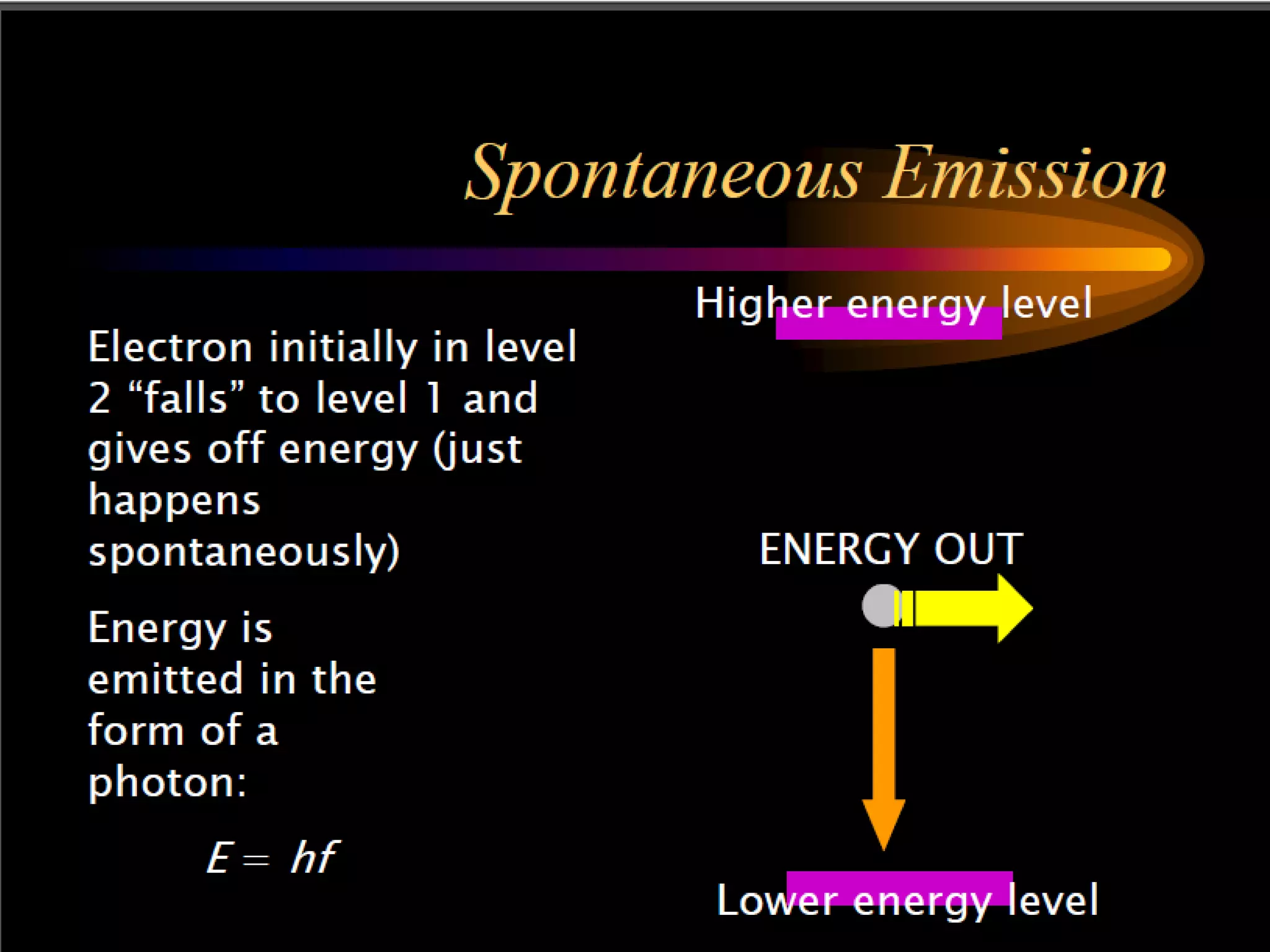
4.   Lasing action occurs when an electron spontaneously returns to its
     ground state and produces a photon.
5.   If the energy from this photon is of the precise wavelength, it will
     stimulate the production of another photon of the same wavelength
     and resulting in a cascading effect.
6.   The highly reflective mirror and partially reflective mirror continue
     the reaction by directing photons back through the medium along
     the long axis of the laser.
7.   The partially reflective mirror allows the transmission of a small
     amount of coherent radiation that we observe as the “beam”.
8.   Laser radiation will continue as long as energy is applied to the
     lasing medium.


                                                                             13
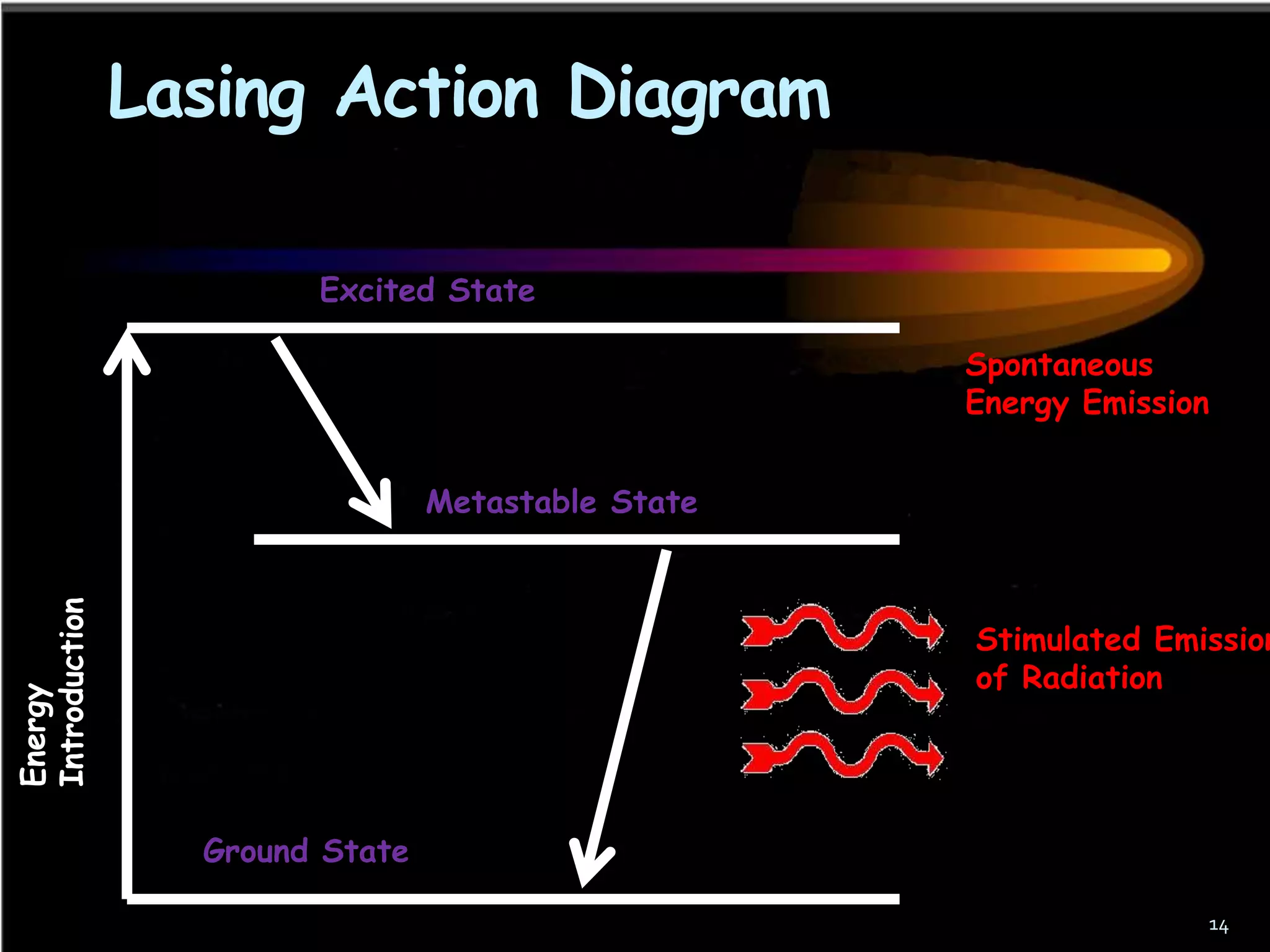
Lasing Action Diagram

                       Excited State

                                                   Spontaneous
                                                   Energy Emission


                                Metastable State
Introduction


                                                   Stimulated Emission
                                                   of Radiation
Energy


                 Ground State

                                                                 14
15
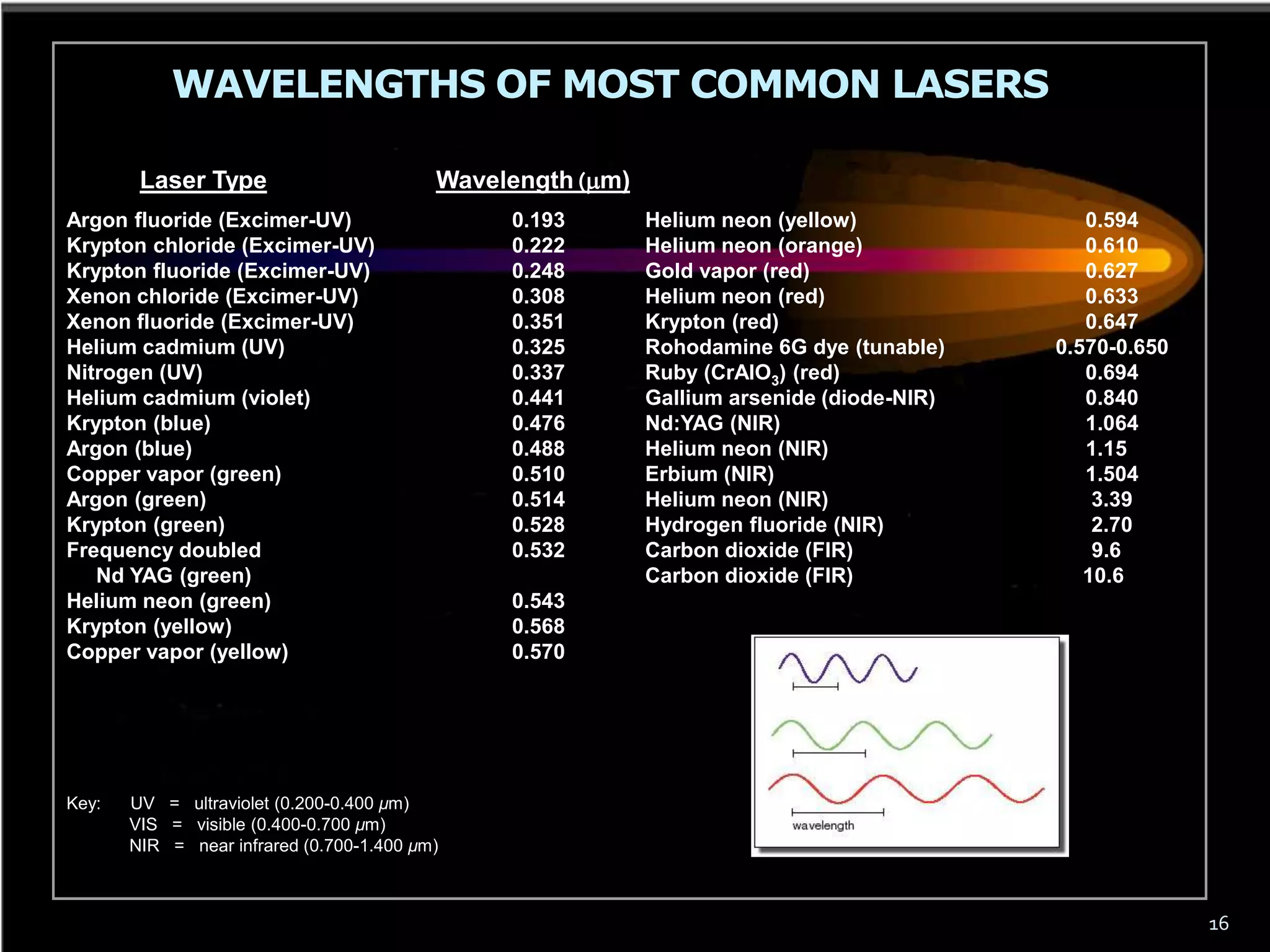
WAVELENGTHS OF MOST COMMON LASERS

        Laser Type                        Wavelength (mm)
Argon fluoride (Excimer-UV)                    0.193        Helium neon (yellow)              0.594
Krypton chloride (Excimer-UV)                  0.222        Helium neon (orange)              0.610
Krypton fluoride (Excimer-UV)                  0.248        Gold vapor (red)                  0.627
Xenon chloride (Excimer-UV)                    0.308        Helium neon (red)                 0.633
Xenon fluoride (Excimer-UV)                    0.351        Krypton (red)                     0.647
Helium cadmium (UV)                            0.325        Rohodamine 6G dye (tunable)    0.570-0.650
Nitrogen (UV)                                  0.337        Ruby (CrAlO3) (red)               0.694
Helium cadmium (violet)                        0.441        Gallium arsenide (diode-NIR)      0.840
Krypton (blue)                                 0.476        Nd:YAG (NIR)                      1.064
Argon (blue)                                   0.488        Helium neon (NIR)                 1.15
Copper vapor (green)                           0.510        Erbium (NIR)                      1.504
Argon (green)                                  0.514        Helium neon (NIR)                  3.39
Krypton (green)                                0.528        Hydrogen fluoride (NIR)            2.70
Frequency doubled                              0.532        Carbon dioxide (FIR)               9.6
   Nd YAG (green)                                           Carbon dioxide (FIR)              10.6
Helium neon (green)                            0.543
Krypton (yellow)                               0.568
Copper vapor (yellow)                          0.570


Key:   UV = ultraviolet (0.200-0.400 µm)
       VIS = visible (0.400-0.700 µm)
       NIR = near infrared (0.700-1.400 µm)


                                                                                                         16
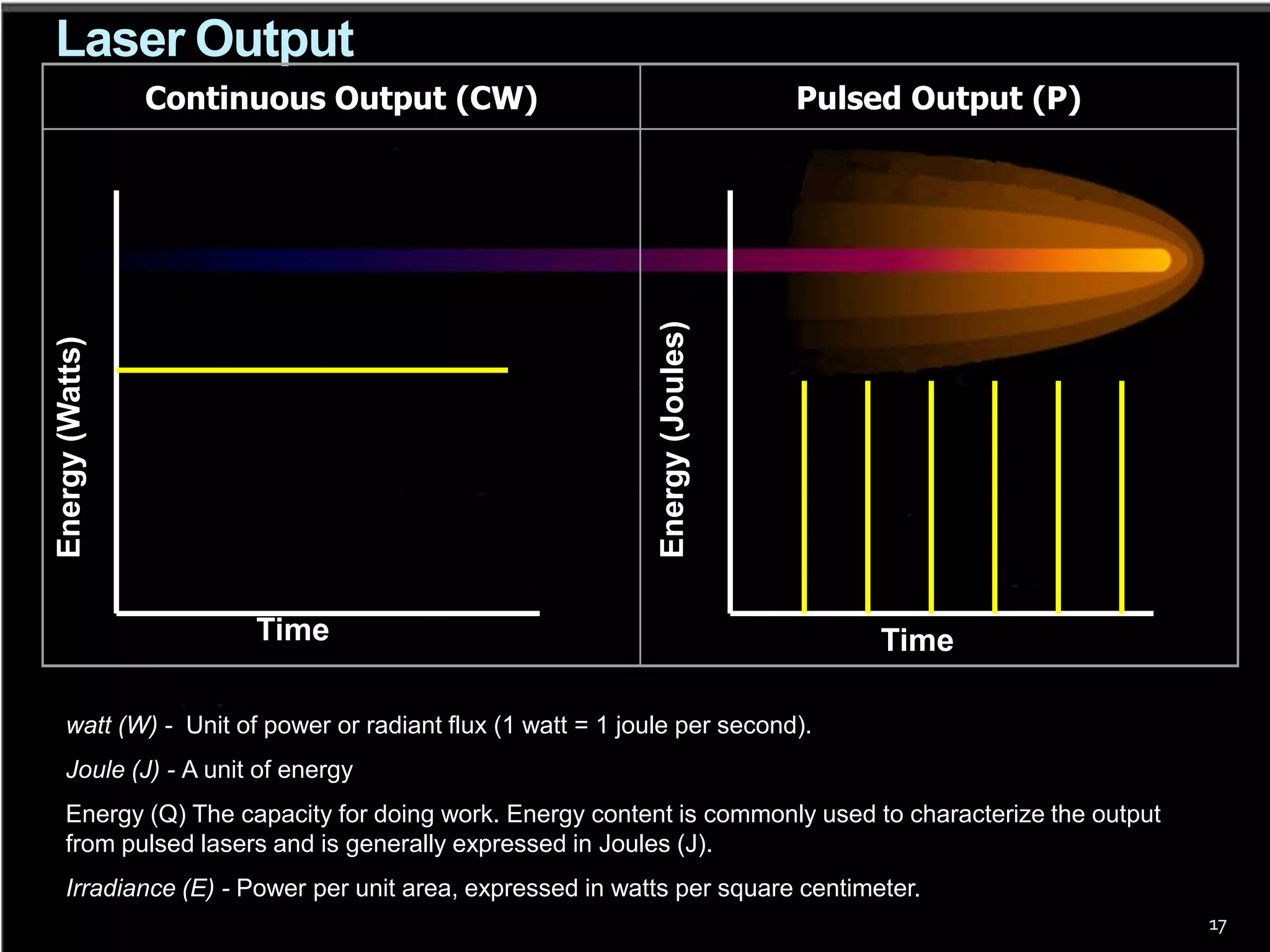
Laser Output
                 Continuous Output (CW)                                       Pulsed Output (P)


                                                            Energy (Joules)
Energy (Watts)


                       Time                                                        Time

    watt (W) - Unit of power or radiant flux (1 watt = 1 joule per second).
    Joule (J) - A unit of energy
    Energy (Q) The capacity for doing work. Energy content is commonly used to characterize the output
    from pulsed lasers and is generally expressed in Joules (J).
    Irradiance (E) - Power per unit area, expressed in watts per square centimeter.
                                                                                                         17
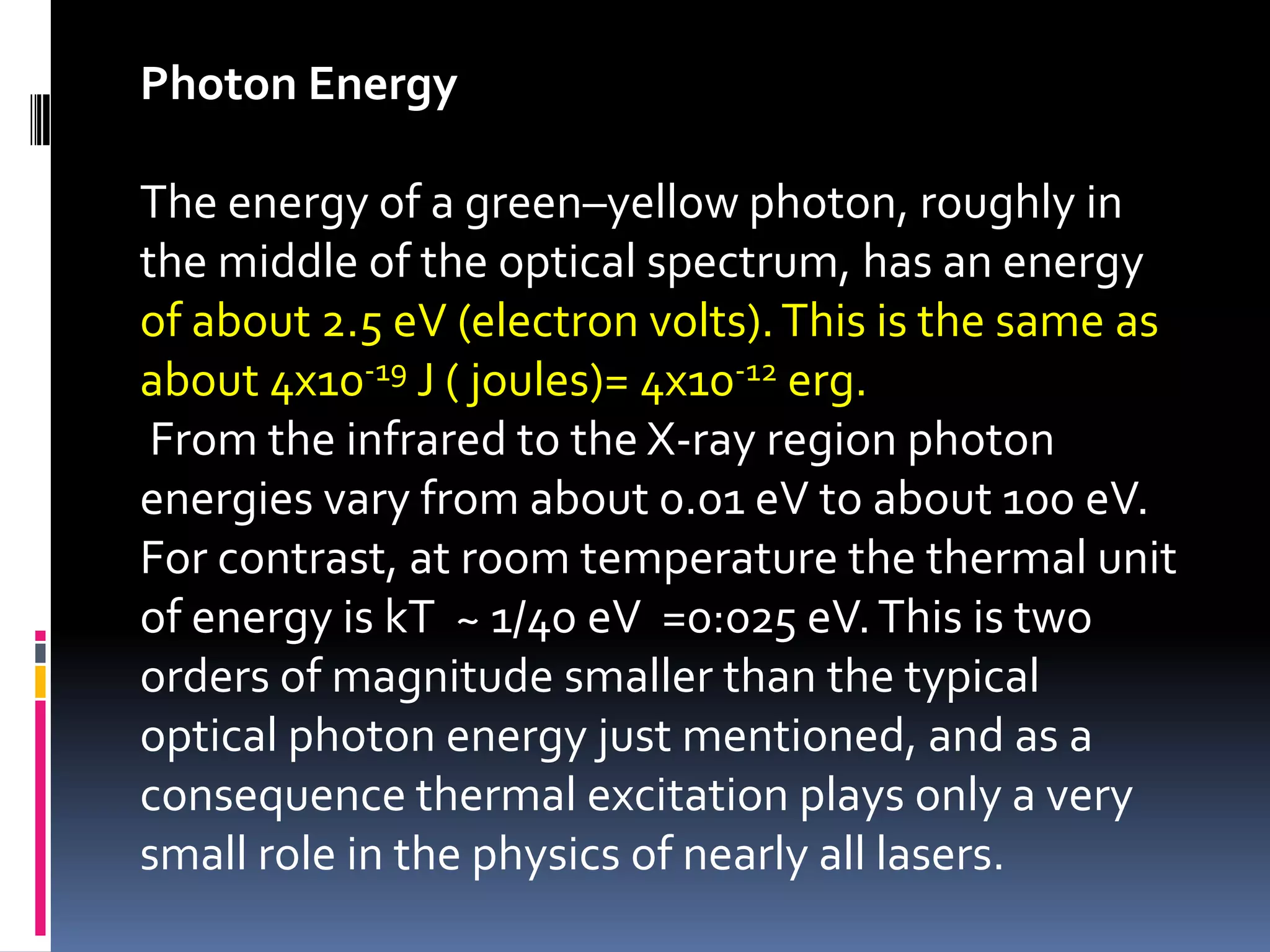
Photon Energy

The energy of a green–yellow photon, roughly in
the middle of the optical spectrum, has an energy
of about 2.5 eV (electron volts). This is the same as
about 4x10-19 J ( joules)= 4x10-12 erg.
 From the infrared to the X-ray region photon
energies vary from about 0.01 eV to about 100 eV.
For contrast, at room temperature the thermal unit
of energy is kT ~ 1/40 eV =0:025 eV. This is two
orders of magnitude smaller than the typical
optical photon energy just mentioned, and as a
consequence thermal excitation plays only a very
small role in the physics of nearly all lasers.
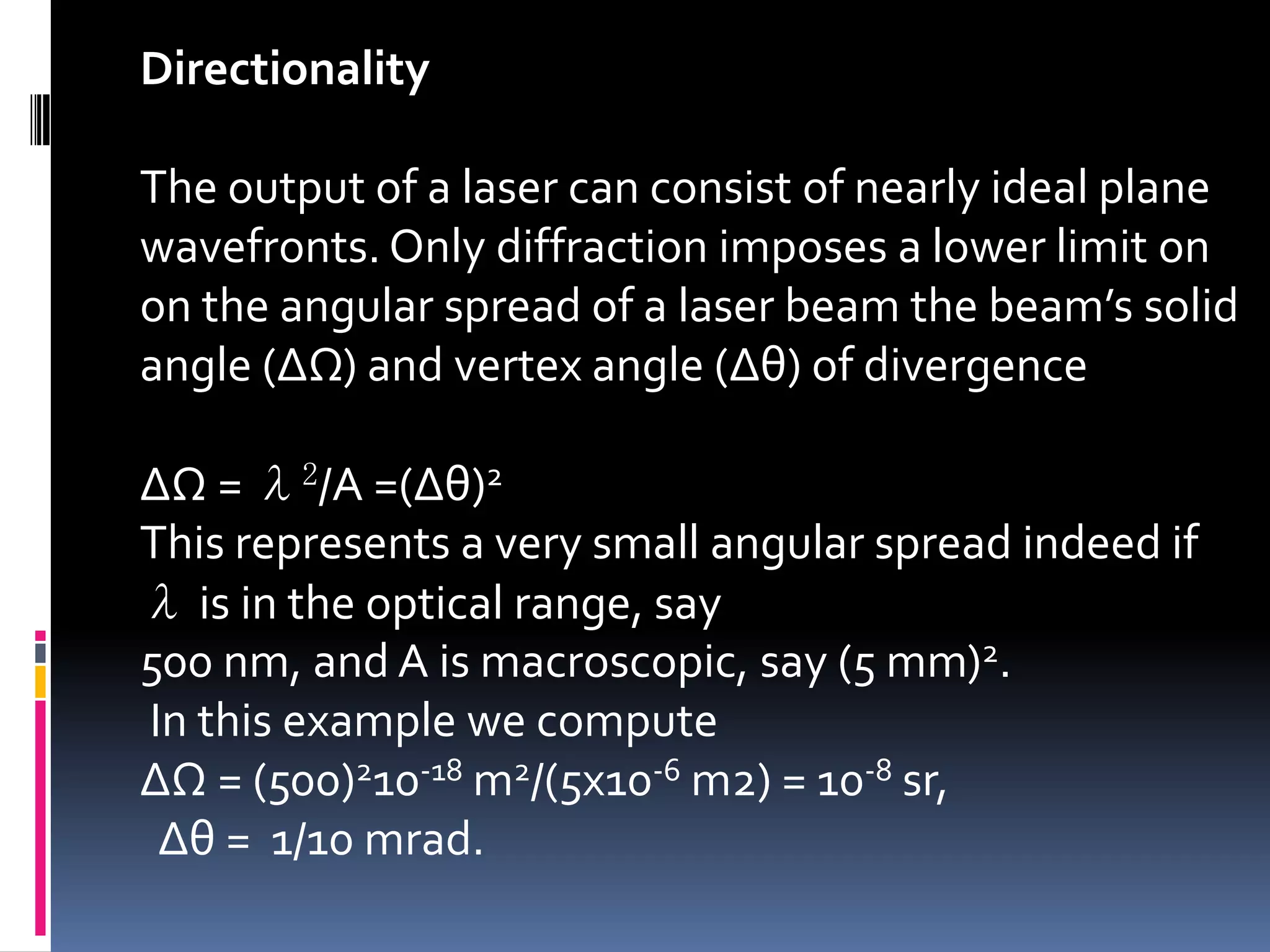
Directionality

The output of a laser can consist of nearly ideal plane
wavefronts. Only diffraction imposes a lower limit on
on the angular spread of a laser beam the beam’s solid
angle (ΔΩ) and vertex angle (Δθ) of divergence

ΔΩ = λ2/A =(Δθ)2
This represents a very small angular spread indeed if
λ is in the optical range, say
500 nm, and A is macroscopic, say (5 mm)2.
In this example we compute
ΔΩ = (500)210-18 m2/(5x10-6 m2) = 10-8 sr,
 Δθ = 1/10 mrad.
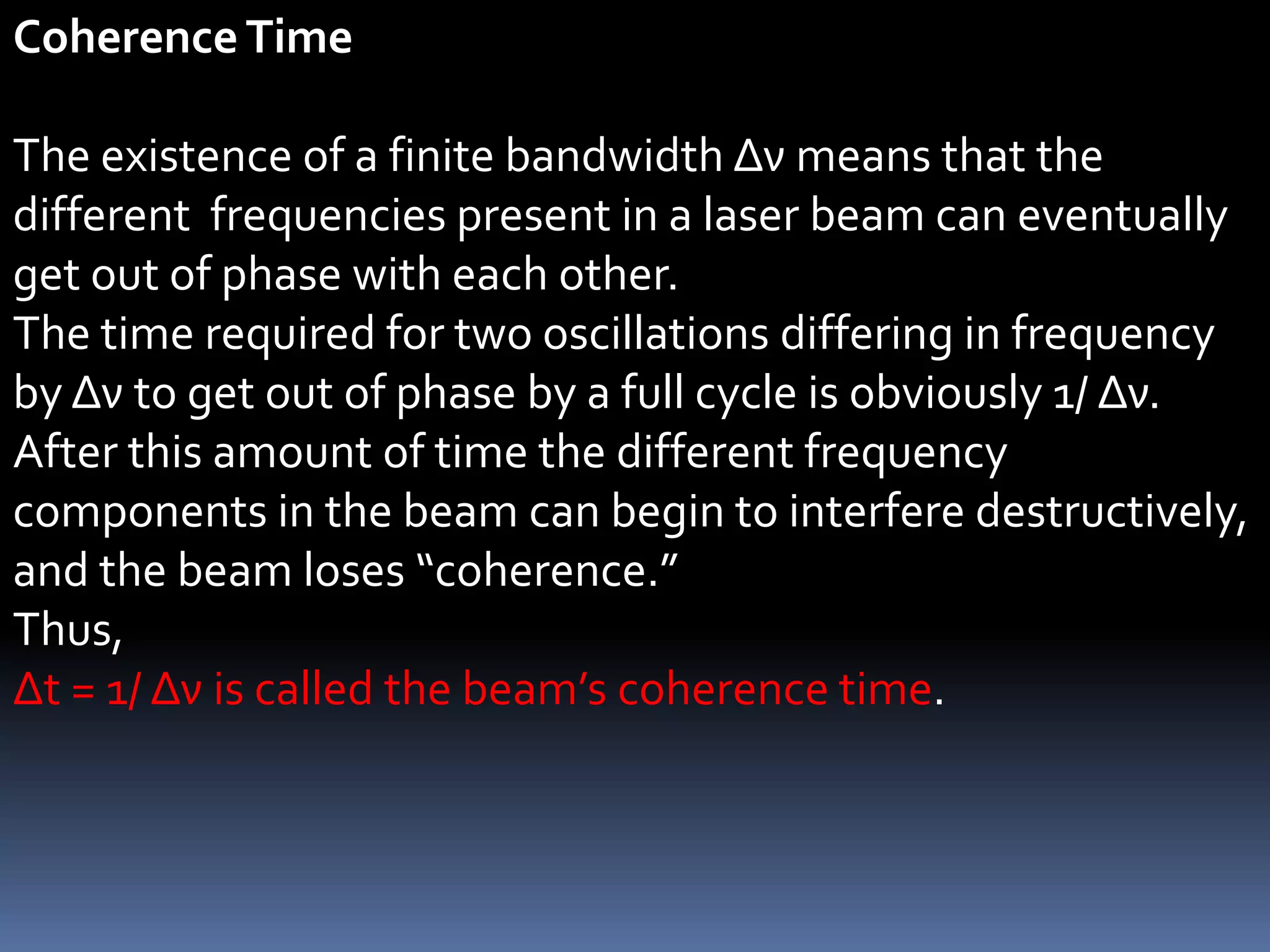
Coherence Time

The existence of a finite bandwidth Δν means that the
different frequencies present in a laser beam can eventually
get out of phase with each other.
The time required for two oscillations differing in frequency
by Δν to get out of phase by a full cycle is obviously 1/ Δν.
After this amount of time the different frequency
components in the beam can begin to interfere destructively,
and the beam loses “coherence.”
Thus,
Δt = 1/ Δν is called the beam’s coherence time.
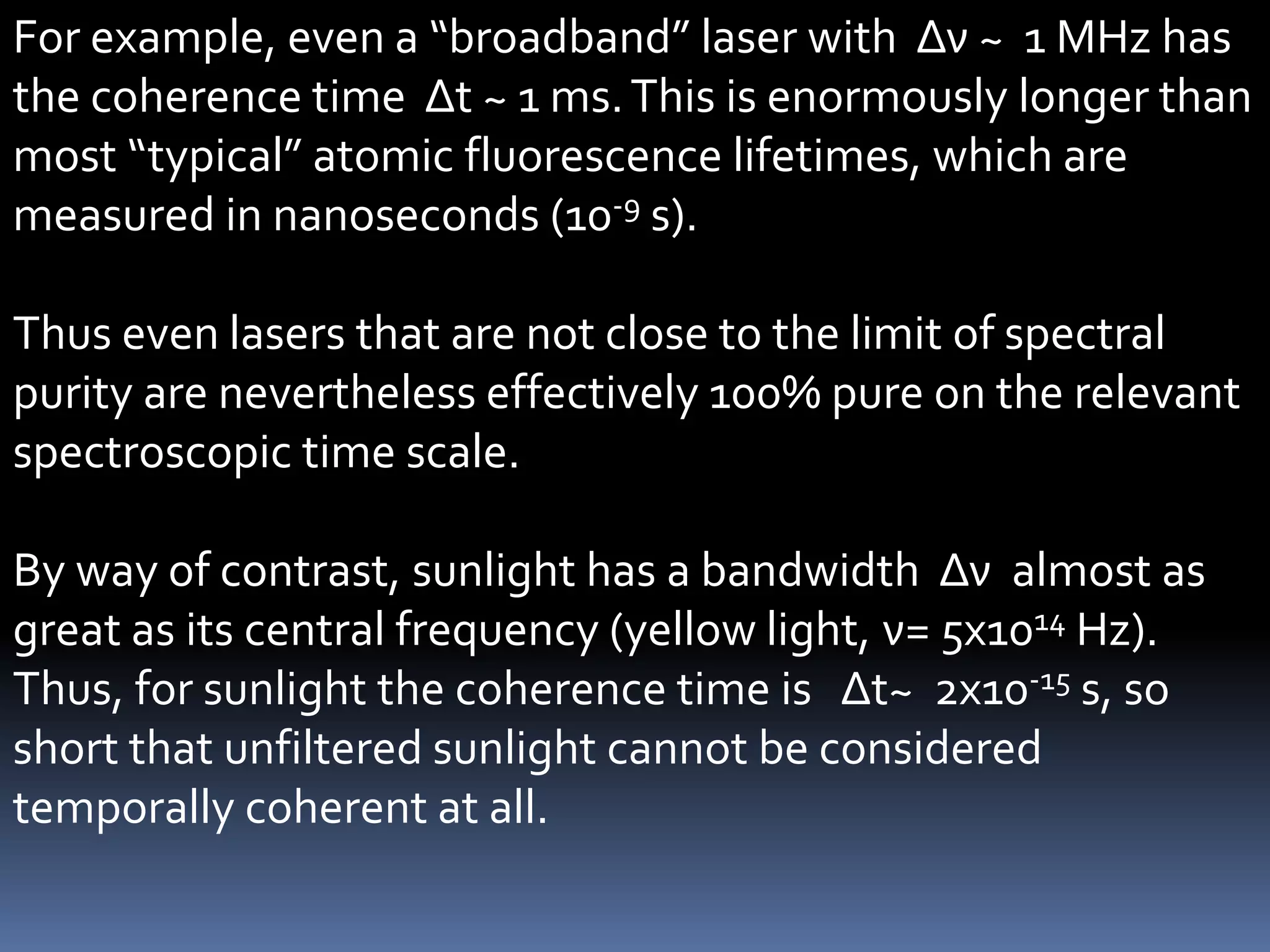
For example, even a “broadband” laser with Δν ~ 1 MHz has
the coherence time Δt ~ 1 ms. This is enormously longer than
most “typical” atomic fluorescence lifetimes, which are
measured in nanoseconds (10-9 s).

Thus even lasers that are not close to the limit of spectral
purity are nevertheless effectively 100% pure on the relevant
spectroscopic time scale.

By way of contrast, sunlight has a bandwidth Δν almost as
great as its central frequency (yellow light, ν= 5x10¹⁴ Hz).
Thus, for sunlight the coherence time is Δt~ 2x10-15 s, so
short that unfiltered sunlight cannot be considered
temporally coherent at all.
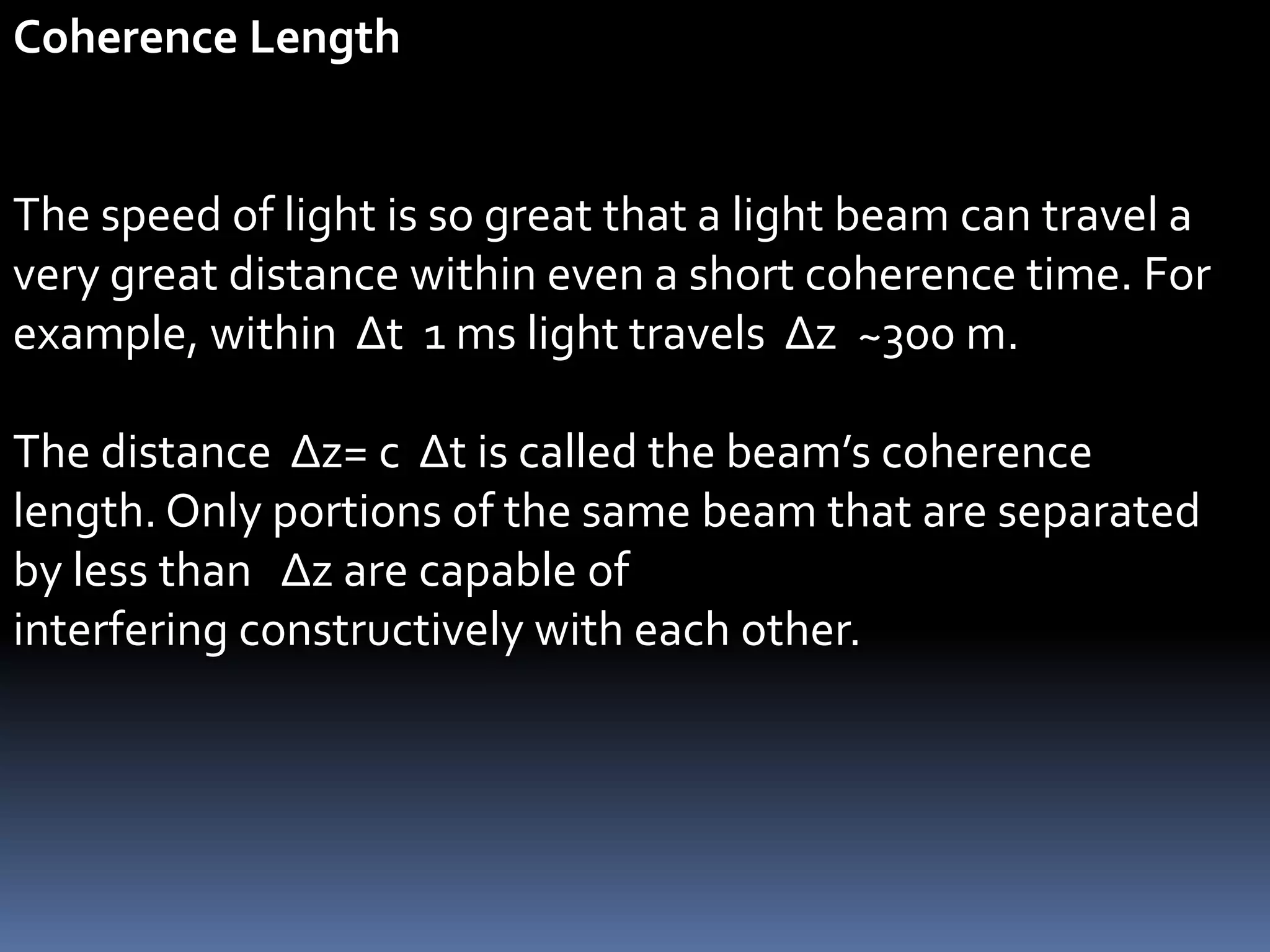
Coherence Length


The speed of light is so great that a light beam can travel a
very great distance within even a short coherence time. For
example, within Δt 1 ms light travels Δz ~300 m.

The distance Δz= c Δt is called the beam’s coherence
length. Only portions of the same beam that are separated
by less than Δz are capable of
interfering constructively with each other.
Spectral Brightness

A light beam from a finite source can be characterized by its
beam divergence ΔΩ, source size (usually surface area A),
bandwidth Δν, and spectral power density Pν
(watts per hertz of bandwidth). From these parameters it is
useful to determine the spectral brightness βν of the source,
which is defined to be the power flow per unit area, unit
bandwidth, and steradian, namely

                 βν= Pν/A ΔΩΔν.
Notice that Pν/A Δν is the spectral intensity, so βν can also be
thought of as the spectral intensity per steradian.
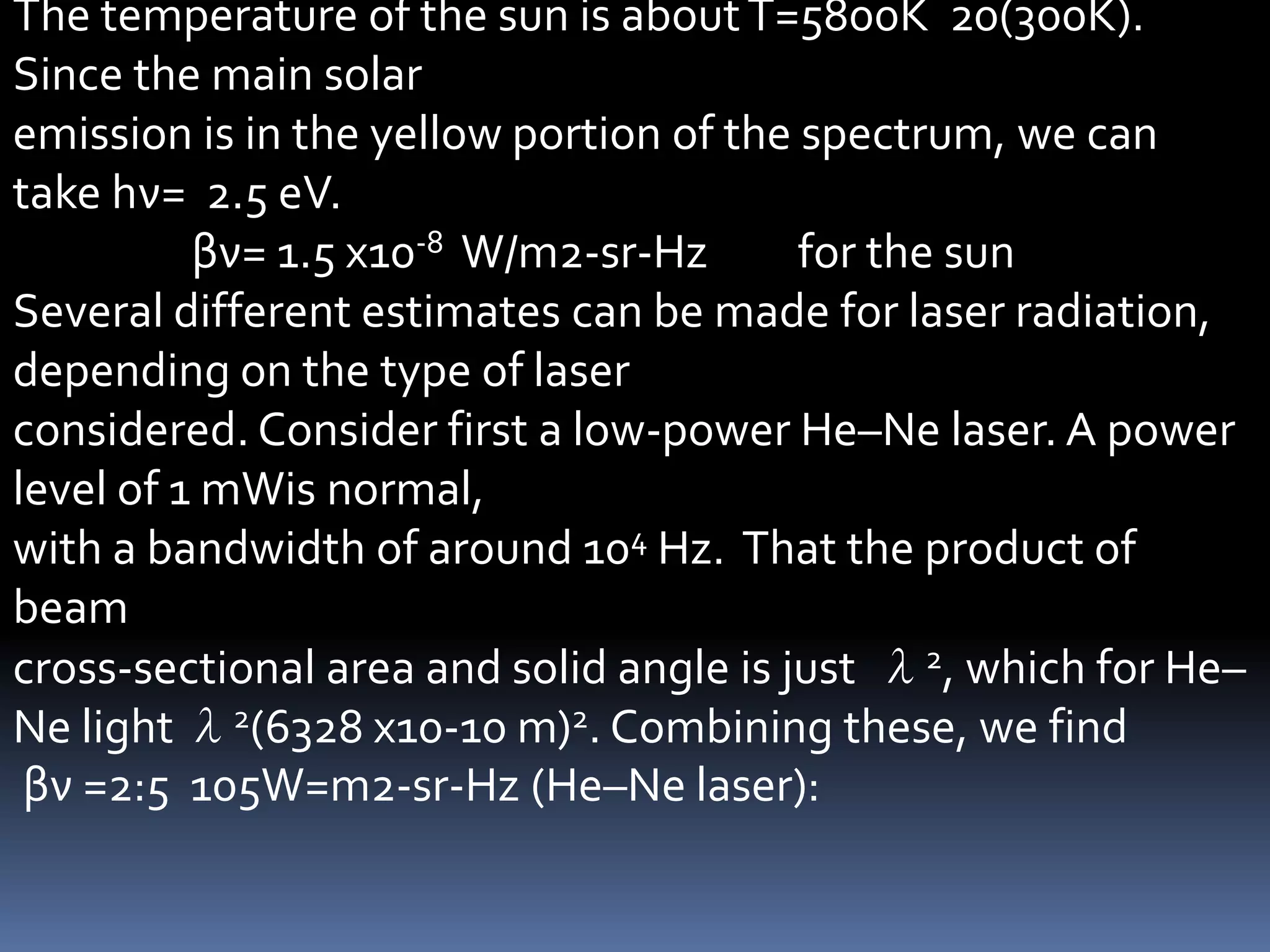
For an ordinary nonlaser optical source, brightness can be
estimated directly from the blackbody formula for ρ(ν), the
spectral energy density (J/m3-Hz):


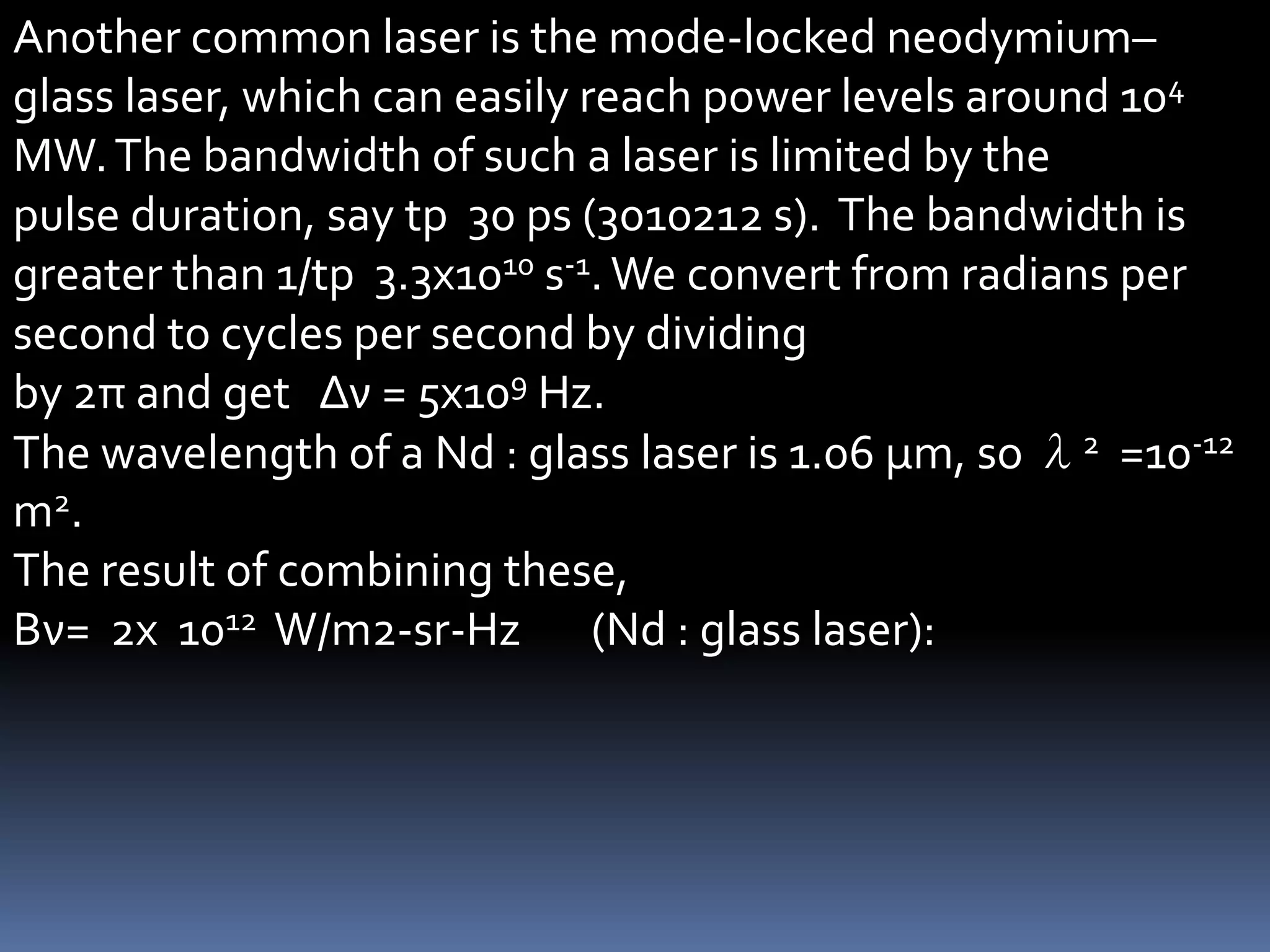
 The spectral intensity (W/m2-Hz) is thus cρr, and c ρ /Δν is
 the desired spectral intensity per steradian. Taking Δν= 4p
 for a blackbody, we have
The temperature of the sun is about T=5800K 20(300K).
Since the main solar
emission is in the yellow portion of the spectrum, we can
take hν= 2.5 eV.
          βν= 1.5 x10⁻⁸ W/m2-sr-Hz       for the sun
Several different estimates can be made for laser radiation,
depending on the type of laser
considered. Consider first a low-power He–Ne laser. A power
level of 1 mWis normal,
with a bandwidth of around 104 Hz. That the product of
beam
cross-sectional area and solid angle is just λ2, which for He–
Ne light λ2(6328 x10-10 m)2. Combining these, we find
 βν =2:5 105W=m2-sr-Hz (He–Ne laser):
Another common laser is the mode-locked neodymium–
glass laser, which can easily reach power levels around 104
MW. The bandwidth of such a laser is limited by the
pulse duration, say tp 30 ps (3010212 s). The bandwidth is
greater than 1/tp 3.3x10¹⁰ s-1. We convert from radians per
second to cycles per second by dividing
by 2π and get Δν = 5x10⁹ Hz.
The wavelength of a Nd : glass laser is 1.06 μm, so λ2 =10-12
m2.
The result of combining these,
Βν= 2x 10¹² W/m2-sr-Hz (Nd : glass laser):
Laser physics lect1 (1)

Laser physics lect1 (1)

  • 1.
    Prof. Dr. SalahIbrahim Hassab Elnaby Introduction to Laser Theory Prof. Dr. Salah I. Hassab Elnaby NILES
  • 2.
     12 lectures 4 homeworks 20 Grades  Report 10 A 85 B 75  Midterm exam 20 C 65  Final exam 50
  • 3.
    Contents  Introduction  EnergyLevels  Absorption & Emission of Radiation  Electro-Magnetic field  Rate Equations  Laser Cavity  MID TERM EXAM  CW and Pulsed operations  Gas Lasers  Solid State Lasers  Semi-Conductor Lasers  Other Types of Lasers (Free Electron & Liquid Chemical)  SIMINAR OF REPORTS
  • 6.
    Types of Laser Basedon the mode of operation (i) Pulsed Laser systems (ii) High power Q-switched systems (iii) Continuous wave Laser systems Based on the mechanism in which Population Inversion is achieved (i) Three level lasers (ii) Four level lasers Based on state of active medium used (i) Gas Laser (ii) Solid state Laser (iii) Semiconductor Laser (iv) Tunable dye Laser
  • 7.
  • 8.
  • 9.
    Laser Fundamentals  The light emitted from a laser is monochromatic, that is, it is of one color/wavelength. In contrast, ordinary white light is a combination of many colors (or wavelengths) of light.  Lasers emit light that is highly directional, that is, laser light is emitted as a relatively narrow beam in a specific direction. Ordinary light, such as from a light bulb, is emitted in many directions away from the source.  The light from a laser is said to be coherent, which means that the wavelengths of the laser light are in phase in space and time. Ordinary light can be a mixture of many wavelengths. These three properties of laser light are what can make it more hazardous than ordinary light. Laser light can deposit a lot of energy within a small area. 9
  • 10.
    Incandescent vs. LaserLight 1. Many wavelengths 1. Monochromatic 2. Multidirectional 2. Directional 3. Incoherent 3. Coherent 10
  • 11.
    Common Components ofall Lasers 1. Active Medium The active medium may be solid crystals such as ruby or Nd:YAG, liquid dyes, gases like CO2 or Helium/Neon, or semiconductors such as GaAs. Active mediums contain atoms whose electrons may be excited to a metastable energy level by an energy source. 2. Excitation Mechanism Excitation mechanisms pump energy into the active medium by one or more of three basic methods; optical, electrical or chemical. 3. High Reflectance Mirror A mirror which reflects essentially 100% of the laser light. 4. Partially Transmissive Mirror A mirror which reflects less than 100% of the laser light and transmits the remainder. 11
  • 12.
    Laser Components Gas lasersconsist of a gas filled tube placed in the laser cavity. A voltage (the external pump source) is applied to the tube to excite the atoms in the gas to a population inversion. The light emitted from this type of laser is normally continuous wave (CW). 12
  • 13.
    Lasing Action 1. Energy is applied to a medium raising electrons to an unstable energy level. 2. These atoms spontaneously decay to a relatively long-lived, lower energy, metastable state. 3. A population inversion is achieved when the majority of atoms have reached this metastable state. 4. Lasing action occurs when an electron spontaneously returns to its ground state and produces a photon. 5. If the energy from this photon is of the precise wavelength, it will stimulate the production of another photon of the same wavelength and resulting in a cascading effect. 6. The highly reflective mirror and partially reflective mirror continue the reaction by directing photons back through the medium along the long axis of the laser. 7. The partially reflective mirror allows the transmission of a small amount of coherent radiation that we observe as the “beam”. 8. Laser radiation will continue as long as energy is applied to the lasing medium. 13
  • 14.
    Lasing Action Diagram Excited State Spontaneous Energy Emission Metastable State Introduction Stimulated Emission of Radiation Energy Ground State 14
  • 15.
  • 16.
    WAVELENGTHS OF MOSTCOMMON LASERS Laser Type Wavelength (mm) Argon fluoride (Excimer-UV) 0.193 Helium neon (yellow) 0.594 Krypton chloride (Excimer-UV) 0.222 Helium neon (orange) 0.610 Krypton fluoride (Excimer-UV) 0.248 Gold vapor (red) 0.627 Xenon chloride (Excimer-UV) 0.308 Helium neon (red) 0.633 Xenon fluoride (Excimer-UV) 0.351 Krypton (red) 0.647 Helium cadmium (UV) 0.325 Rohodamine 6G dye (tunable) 0.570-0.650 Nitrogen (UV) 0.337 Ruby (CrAlO3) (red) 0.694 Helium cadmium (violet) 0.441 Gallium arsenide (diode-NIR) 0.840 Krypton (blue) 0.476 Nd:YAG (NIR) 1.064 Argon (blue) 0.488 Helium neon (NIR) 1.15 Copper vapor (green) 0.510 Erbium (NIR) 1.504 Argon (green) 0.514 Helium neon (NIR) 3.39 Krypton (green) 0.528 Hydrogen fluoride (NIR) 2.70 Frequency doubled 0.532 Carbon dioxide (FIR) 9.6 Nd YAG (green) Carbon dioxide (FIR) 10.6 Helium neon (green) 0.543 Krypton (yellow) 0.568 Copper vapor (yellow) 0.570 Key: UV = ultraviolet (0.200-0.400 µm) VIS = visible (0.400-0.700 µm) NIR = near infrared (0.700-1.400 µm) 16
  • 17.
    Laser Output Continuous Output (CW) Pulsed Output (P) Energy (Joules) Energy (Watts) Time Time watt (W) - Unit of power or radiant flux (1 watt = 1 joule per second). Joule (J) - A unit of energy Energy (Q) The capacity for doing work. Energy content is commonly used to characterize the output from pulsed lasers and is generally expressed in Joules (J). Irradiance (E) - Power per unit area, expressed in watts per square centimeter. 17
  • 24.
    Photon Energy The energyof a green–yellow photon, roughly in the middle of the optical spectrum, has an energy of about 2.5 eV (electron volts). This is the same as about 4x10-19 J ( joules)= 4x10-12 erg. From the infrared to the X-ray region photon energies vary from about 0.01 eV to about 100 eV. For contrast, at room temperature the thermal unit of energy is kT ~ 1/40 eV =0:025 eV. This is two orders of magnitude smaller than the typical optical photon energy just mentioned, and as a consequence thermal excitation plays only a very small role in the physics of nearly all lasers.
  • 25.
    Directionality The output ofa laser can consist of nearly ideal plane wavefronts. Only diffraction imposes a lower limit on on the angular spread of a laser beam the beam’s solid angle (ΔΩ) and vertex angle (Δθ) of divergence ΔΩ = λ2/A =(Δθ)2 This represents a very small angular spread indeed if λ is in the optical range, say 500 nm, and A is macroscopic, say (5 mm)2. In this example we compute ΔΩ = (500)210-18 m2/(5x10-6 m2) = 10-8 sr, Δθ = 1/10 mrad.
  • 26.
    Coherence Time The existenceof a finite bandwidth Δν means that the different frequencies present in a laser beam can eventually get out of phase with each other. The time required for two oscillations differing in frequency by Δν to get out of phase by a full cycle is obviously 1/ Δν. After this amount of time the different frequency components in the beam can begin to interfere destructively, and the beam loses “coherence.” Thus, Δt = 1/ Δν is called the beam’s coherence time.
  • 27.
    For example, evena “broadband” laser with Δν ~ 1 MHz has the coherence time Δt ~ 1 ms. This is enormously longer than most “typical” atomic fluorescence lifetimes, which are measured in nanoseconds (10-9 s). Thus even lasers that are not close to the limit of spectral purity are nevertheless effectively 100% pure on the relevant spectroscopic time scale. By way of contrast, sunlight has a bandwidth Δν almost as great as its central frequency (yellow light, ν= 5x10¹⁴ Hz). Thus, for sunlight the coherence time is Δt~ 2x10-15 s, so short that unfiltered sunlight cannot be considered temporally coherent at all.
  • 28.
    Coherence Length The speedof light is so great that a light beam can travel a very great distance within even a short coherence time. For example, within Δt 1 ms light travels Δz ~300 m. The distance Δz= c Δt is called the beam’s coherence length. Only portions of the same beam that are separated by less than Δz are capable of interfering constructively with each other.
  • 29.
    Spectral Brightness A lightbeam from a finite source can be characterized by its beam divergence ΔΩ, source size (usually surface area A), bandwidth Δν, and spectral power density Pν (watts per hertz of bandwidth). From these parameters it is useful to determine the spectral brightness βν of the source, which is defined to be the power flow per unit area, unit bandwidth, and steradian, namely βν= Pν/A ΔΩΔν.
  • 30.
    Notice that Pν/AΔν is the spectral intensity, so βν can also be thought of as the spectral intensity per steradian. For an ordinary nonlaser optical source, brightness can be estimated directly from the blackbody formula for ρ(ν), the spectral energy density (J/m3-Hz): The spectral intensity (W/m2-Hz) is thus cρr, and c ρ /Δν is the desired spectral intensity per steradian. Taking Δν= 4p for a blackbody, we have
  • 31.
    The temperature ofthe sun is about T=5800K 20(300K). Since the main solar emission is in the yellow portion of the spectrum, we can take hν= 2.5 eV. βν= 1.5 x10⁻⁸ W/m2-sr-Hz for the sun Several different estimates can be made for laser radiation, depending on the type of laser considered. Consider first a low-power He–Ne laser. A power level of 1 mWis normal, with a bandwidth of around 104 Hz. That the product of beam cross-sectional area and solid angle is just λ2, which for He– Ne light λ2(6328 x10-10 m)2. Combining these, we find βν =2:5 105W=m2-sr-Hz (He–Ne laser):
  • 32.
    Another common laseris the mode-locked neodymium– glass laser, which can easily reach power levels around 104 MW. The bandwidth of such a laser is limited by the pulse duration, say tp 30 ps (3010212 s). The bandwidth is greater than 1/tp 3.3x10¹⁰ s-1. We convert from radians per second to cycles per second by dividing by 2π and get Δν = 5x10⁹ Hz. The wavelength of a Nd : glass laser is 1.06 μm, so λ2 =10-12 m2. The result of combining these, Βν= 2x 10¹² W/m2-sr-Hz (Nd : glass laser):