By.
SANJAI SRINIVAAS
CARBON-DI-OXIDE(CO2) LASER
 Carbon-di-oxide lasers are highest power
continuous lasers.
 It is quite efficient laser.
 It produces a beam of infared light with
principle wave length bands around 9.6 and
10.6 micrometers.
Principle of CO2 laser
 Two conditions for laser action
1.Population inversion between two energy levels.
2.Incerase in density of incident radiation.
• Working principle
The laser transition between takes place between the
vibrational states or modes of co2 molecules by acheiveing
population inversion.
Vibrational modes of CO2 molecule
 There are three modes of vibration in co2 molecule.
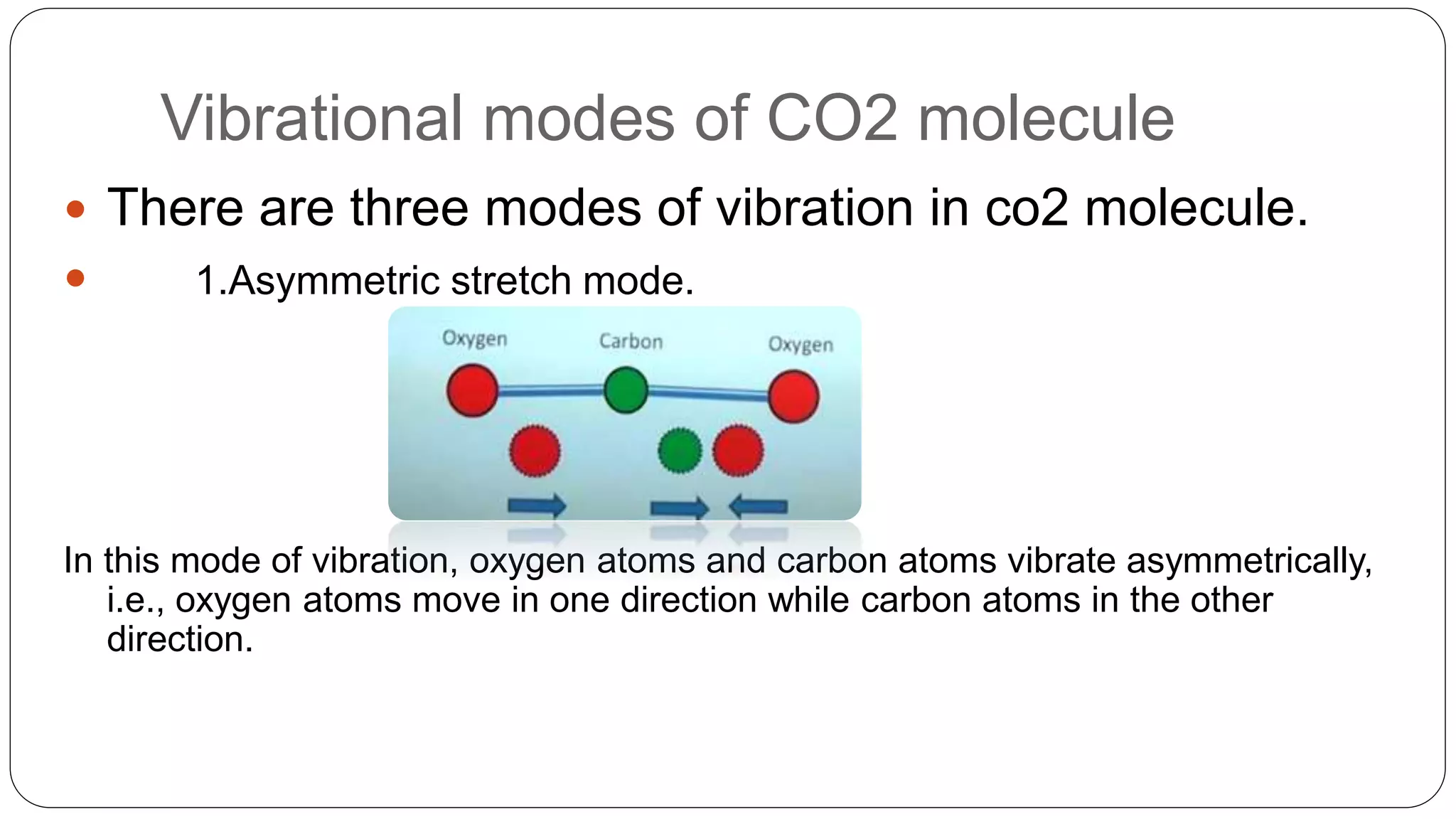
 1.Asymmetric stretch mode.
In this mode of vibration, oxygen atoms and carbon atoms vibrate asymmetrically,
i.e., oxygen atoms move in one direction while carbon atoms in the other
direction.
 2.Bending Mode
 In this mode of vibration, oxygen atoms and carbon atoms vibrate
perpendicular to molecular axis.
 3.Symentric mode.
 Carbon remains at same position whereas oxygen atoms
displaces in equal distance.
Construction
Carbon dioxide laser consists of a discharge tube having a
diameter of 2.5cm and a length of about 5m. Two optically plane
and parallel mirrors.
The discharge tube is filled with a mixture of carbon dioxide,
nitrogen and helium gases in the ratio of 1:2:3 with water vapors.
Pressures maintained are about P (for He)= 7 Torr, P (for N2)=
1.2 Torr and P (for CO2 = 0.33 Torr).
Active medium and active centers= The active medium is the CO2, N2 and
He in the ratio of 1:2:3. The active centers are the carbon dioxide molecules
because laser will be achieved due to these molecules.
Pumping source= Electric discharge method is used for pumping and
achieving population inversion. In this method, electrons will collide with
CO2 molecules and pump them to excited states.
 The purpose of N2 is to help in excitation of CO2 molecules by colliding with
CO2 molecules and transferring the energy to them. So N2 molecules
increases the pumping efficiency.
 Optical resonator system= All the gas mixtures is enclosed between a set of
mirrors which forms the optical resonator system. One of mirrors is completely
reflecting and the other is partially reflecting.
Working of laser
When an electric discharge occurs in the gas, the electrons collide with nitrogen
molecules and they are raised to excited states. This process is represented by the
equation
N2 + e* = N2* + e
Now N2 molecules in the excited state collide with CO2 atoms in ground state and
excite to higher electronic, vibrational and rotational levels.
N2* + CO2 = CO2* + N2
 Since the excited level of nitrogen is very close to the E5 level of CO2 atom,
population in E5 level increases.
 As soon as population inversion is reached, any of the spontaneously emitted
photon will trigger laser action in the tube. There are two types of laser transition
possible.
Applications.
 1. High power CO2 laser finds applications in material processing,
welding, drilling, cutting soldering etc.
 2. The low atmospheric attenuation (10.6μm makes CO2 laser suitable
for open air communication.
 3. It is used for remote sensing
 4. It is used for treatment of liver and lung diseases.
 5. It is mostly used in neuro surgery and general surgery.

CARBON-DI-OXIDE(CO2) LASER.pptx

  • 1.
  • 2.
     Carbon-di-oxide lasersare highest power continuous lasers.  It is quite efficient laser.  It produces a beam of infared light with principle wave length bands around 9.6 and 10.6 micrometers.
  • 3.
    Principle of CO2laser  Two conditions for laser action 1.Population inversion between two energy levels. 2.Incerase in density of incident radiation. • Working principle The laser transition between takes place between the vibrational states or modes of co2 molecules by acheiveing population inversion.
  • 4.
    Vibrational modes ofCO2 molecule  There are three modes of vibration in co2 molecule.  1.Asymmetric stretch mode. In this mode of vibration, oxygen atoms and carbon atoms vibrate asymmetrically, i.e., oxygen atoms move in one direction while carbon atoms in the other direction.
  • 5.
     2.Bending Mode In this mode of vibration, oxygen atoms and carbon atoms vibrate perpendicular to molecular axis.
  • 6.
     3.Symentric mode. Carbon remains at same position whereas oxygen atoms displaces in equal distance.
  • 7.
    Construction Carbon dioxide laserconsists of a discharge tube having a diameter of 2.5cm and a length of about 5m. Two optically plane and parallel mirrors. The discharge tube is filled with a mixture of carbon dioxide, nitrogen and helium gases in the ratio of 1:2:3 with water vapors. Pressures maintained are about P (for He)= 7 Torr, P (for N2)= 1.2 Torr and P (for CO2 = 0.33 Torr).
  • 8.
    Active medium andactive centers= The active medium is the CO2, N2 and He in the ratio of 1:2:3. The active centers are the carbon dioxide molecules because laser will be achieved due to these molecules. Pumping source= Electric discharge method is used for pumping and achieving population inversion. In this method, electrons will collide with CO2 molecules and pump them to excited states.
  • 9.
     The purposeof N2 is to help in excitation of CO2 molecules by colliding with CO2 molecules and transferring the energy to them. So N2 molecules increases the pumping efficiency.  Optical resonator system= All the gas mixtures is enclosed between a set of mirrors which forms the optical resonator system. One of mirrors is completely reflecting and the other is partially reflecting.
  • 10.
    Working of laser Whenan electric discharge occurs in the gas, the electrons collide with nitrogen molecules and they are raised to excited states. This process is represented by the equation N2 + e* = N2* + e Now N2 molecules in the excited state collide with CO2 atoms in ground state and excite to higher electronic, vibrational and rotational levels. N2* + CO2 = CO2* + N2
  • 11.
     Since theexcited level of nitrogen is very close to the E5 level of CO2 atom, population in E5 level increases.  As soon as population inversion is reached, any of the spontaneously emitted photon will trigger laser action in the tube. There are two types of laser transition possible.
  • 12.
    Applications.  1. Highpower CO2 laser finds applications in material processing, welding, drilling, cutting soldering etc.  2. The low atmospheric attenuation (10.6μm makes CO2 laser suitable for open air communication.  3. It is used for remote sensing  4. It is used for treatment of liver and lung diseases.  5. It is mostly used in neuro surgery and general surgery.