Download to read offline




![Syntax details
# Short form
password: [ 'required', {min_length: 10} ]
# Full form
password: [ {required: [ ] }, { min_length: [10] } ]](https://image.slidesharecdn.com/livr2-170917133729/85/Language-Independent-Validation-Rules-2-0-Viktor-Turskyi-talk-at-OSDN-2017-29-320.jpg)
![Example: validate nested object
{
name: 'required',
phone: {max_length: 10},
address: { 'nested_object': {
city: 'required',
zip: ['required', 'positive_integer']
}}
}](https://image.slidesharecdn.com/livr2-170917133729/85/Language-Independent-Validation-Rules-2-0-Viktor-Turskyi-talk-at-OSDN-2017-30-320.jpg)
![Example: validate list
{
order_id: ['required', 'positive_integer'],
product_ids: { 'list_of': [
'required',
'positive_integer'
] }
}](https://image.slidesharecdn.com/livr2-170917133729/85/Language-Independent-Validation-Rules-2-0-Viktor-Turskyi-talk-at-OSDN-2017-31-320.jpg)
![Example: validate list of objects
{
order_id: ['required', 'positive_integer'],
products: [ 'not_empty_list', { 'list_of_objects': {
product_id: ['required','positive_integer'],
quantity: ['required', 'positive_integer']
}}]
}](https://image.slidesharecdn.com/livr2-170917133729/85/Language-Independent-Validation-Rules-2-0-Viktor-Turskyi-talk-at-OSDN-2017-32-320.jpg)
![Example: output modification
(pipelines)
{
email: [ 'trim', 'required', 'email', 'to_lc' ]
}](https://image.slidesharecdn.com/livr2-170917133729/85/Language-Independent-Validation-Rules-2-0-Viktor-Turskyi-talk-at-OSDN-2017-33-320.jpg)


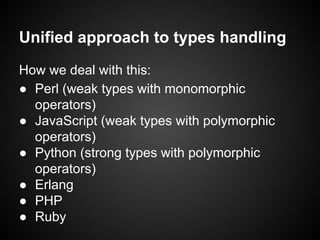


The document discusses Language Independent Validation Rules (LIVR) 2.0, detailing its purpose to validate various types of data across different platforms. It identifies 10 common issues with existing validators and proposes solutions, highlighting features like custom rules, hierarchical data support, and understandable error codes. Examples provided illustrate the validation of different data structures and the importance of customizing output types for consistent handling across programming languages.


![Lect 1 Number systems and base conversions. [Autosaved].pptx](https://cdn.slidesharecdn.com/ss_thumbnails/lect1numbersystemsandbaseconversions-260111134109-67c2d865-thumbnail.jpg?width=640&height=640&fit=bounds)


