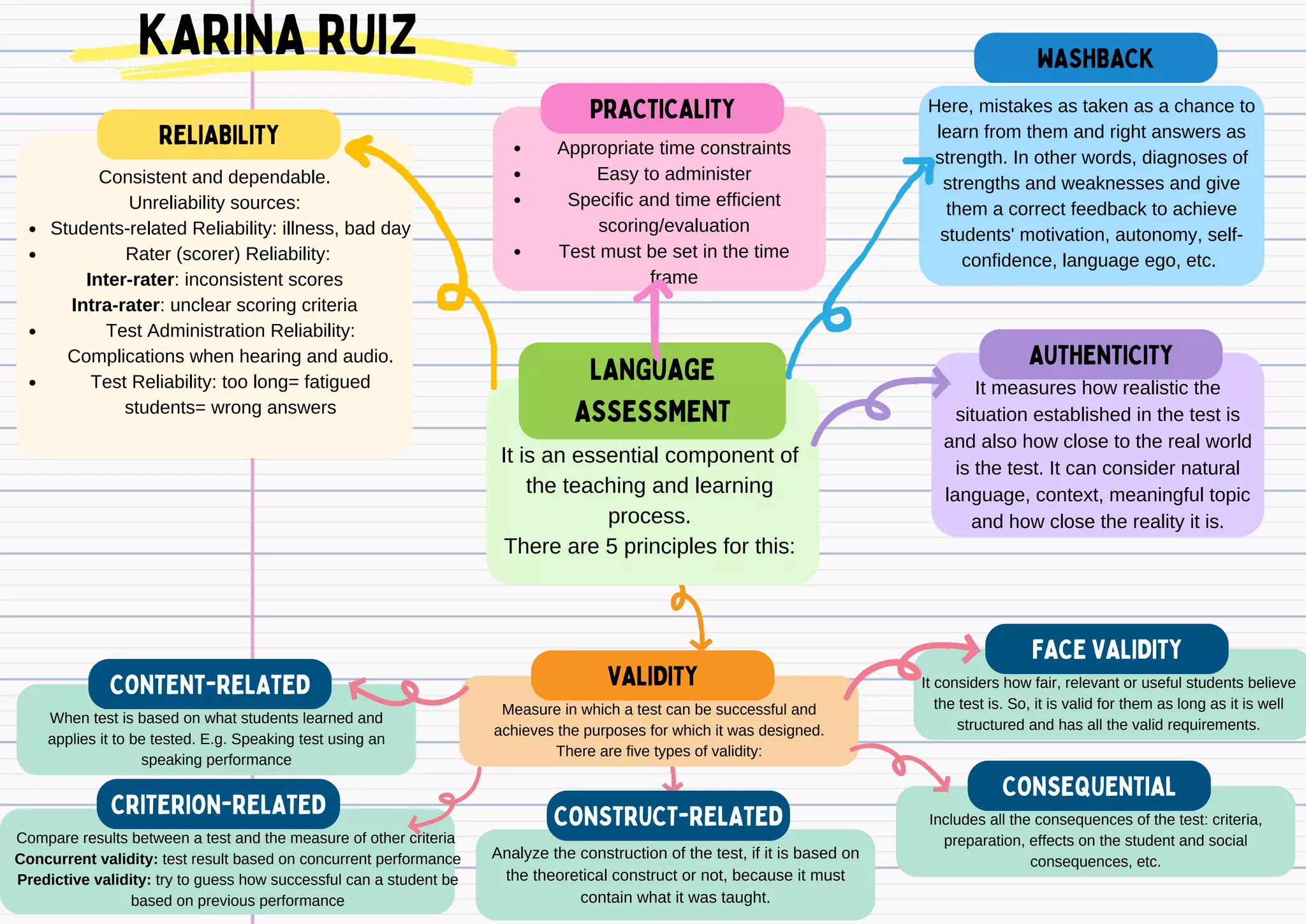
LANGUAGE
ASSESSMENT
RELIABILITY
PRACTICALITY
AUTHENTICITY
WASHBACK
It is an essential component of
the teaching and learning
process.
There are 5 principles for this:
KARINA RUIZ
Students-related Reliability: illness, bad day
Rater (scorer) Reliability:
Test Administration Reliability:
Complications when hearing and audio.
Test Reliability: too long= fatigued
students= wrong answers
Consistent and dependable.
Unreliability sources:
Inter-rater: inconsistent scores
Intra-rater: unclear scoring criteria
Appropriate time constraints
Easy to administer
Specific and time efficient
scoring/evaluation
Test must be set in the time
frame
It measures how realistic the
situation established in the test is
and also how close to the real world
is the test. It can consider natural
language, context, meaningful topic
and how close the reality it is.
Here, mistakes as taken as a chance to
learn from them and right answers as
strength. In other words, diagnoses of
strengths and weaknesses and give
them a correct feedback to achieve
students' motivation, autonomy, self-
confidence, language ego, etc.
Measure in which a test can be successful and
achieves the purposes for which it was designed.
There are five types of validity:
VALIDITY It considers how fair, relevant or useful students believe
the test is. So, it is valid for them as long as it is well
structured and has all the valid requirements.
FACE VALIDITY
Includes all the consequences of the test: criteria,
preparation, effects on the student and social
consequences, etc.
CONSEQUENTIAL
Analyze the construction of the test, if it is based on
the theoretical construct or not, because it must
contain what it was taught.
CONSTRUCT-RELATED
When test is based on what students learned and
applies it to be tested. E.g. Speaking test using an
speaking performance
CONTENT-RELATED
Compare results between a test and the measure of other criteria
Concurrent validity: test result based on concurrent performance
Predictive validity: try to guess how successful can a student be
based on previous performance
CRITERION-RELATED

Language assessment.pdf

  • 1.
    LANGUAGE ASSESSMENT RELIABILITY PRACTICALITY AUTHENTICITY WASHBACK It is anessential component of the teaching and learning process. There are 5 principles for this: KARINA RUIZ Students-related Reliability: illness, bad day Rater (scorer) Reliability: Test Administration Reliability: Complications when hearing and audio. Test Reliability: too long= fatigued students= wrong answers Consistent and dependable. Unreliability sources: Inter-rater: inconsistent scores Intra-rater: unclear scoring criteria Appropriate time constraints Easy to administer Specific and time efficient scoring/evaluation Test must be set in the time frame It measures how realistic the situation established in the test is and also how close to the real world is the test. It can consider natural language, context, meaningful topic and how close the reality it is. Here, mistakes as taken as a chance to learn from them and right answers as strength. In other words, diagnoses of strengths and weaknesses and give them a correct feedback to achieve students' motivation, autonomy, self- confidence, language ego, etc. Measure in which a test can be successful and achieves the purposes for which it was designed. There are five types of validity: VALIDITY It considers how fair, relevant or useful students believe the test is. So, it is valid for them as long as it is well structured and has all the valid requirements. FACE VALIDITY Includes all the consequences of the test: criteria, preparation, effects on the student and social consequences, etc. CONSEQUENTIAL Analyze the construction of the test, if it is based on the theoretical construct or not, because it must contain what it was taught. CONSTRUCT-RELATED When test is based on what students learned and applies it to be tested. E.g. Speaking test using an speaking performance CONTENT-RELATED Compare results between a test and the measure of other criteria Concurrent validity: test result based on concurrent performance Predictive validity: try to guess how successful can a student be based on previous performance CRITERION-RELATED