Comparative Essay
Language Analysis
Multiple Texts
11 English - 2017
Things to note
Talk about visuals always.
Equal weight to each text regardless of length.
You don’t really need to compare the two texts. (A handful of
comparative phrases and a reference to both in topic and concluding
sentence is sufficient).
The important thing is insight into the argument and techniques (this
essentially means showing off and using impressive vocab to say things
that show interesting observations about the argumentation).
The important thing is insight into the argument and
techniques (this essentially means showing off and using
impressive vocab to provide analysis).
• …she provides an idyllic, almost romanticised image where she imagines ‘people
who will eat at our beautiful bakery’ and ‘socialise at our historic pub’. This
imparts a sense of uninterrupted tranquillity, a tranquillity which perhaps does
not exist in the lives of many readers, bring to mind their own hectic schedules
and routines. In this way, a desire for perfect serenity is evoked. In a blunt and
almost brusque way, Wiley brings readers back to reality by asserting that ‘we
need their money’, this serving to impart a sense of realism and perhaps urgency
in that there may be a trade-off. This tranquillity will not exist without this money.
The important thing is insight into the argument and
techniques (this essentially means showing off and using
impressive vocab to make original or compelling insights)
• Both authors spark discussion about the beauty of their town and the effects of
implementing a large tourist attraction. Wiley addresses the attraction as ‘grand’
and ‘soring high’, alluding to the idea that this will become something the town
will be known for, compelling community members to feel proud for the town and
its assets. Conversely, Warwick believes that this ‘giant’ attraction will be ‘ugly’
and a ‘monstrosity’, urging the council to realise that they may not want a huge
‘ugly’ attraction taking away from the ‘beauty’ of their town.
Talk about visuals always, Examples:
In a similar manner, the cartoon by the newspaper’s cartoonist justifies the establishment of a giant monument. Jovial in mood,
the cartoon provides an insight into the construction of a monument. The clear skies and scene represent the optimistic future of
the town in the presence of the giant monument. The contrast of the empty highway versus the bustling town is symbolic of the
town’s exposure and its ability to combat adversity. The giant watermelon as a symbol of the town’s fresh produce positioned
beside the watermelon stand illustrates the projects ability to generate revenue. In so doing, the cartoonist presents that Mayor’s
as viable and suitable in assisting its economic state and exposure to a more global society.
The cartoon depicts a scenario in which the town has embraced the idea of constructing a large attraction, and its quality of
produce to attract tourists to the town. The ridiculous figure of a giant watermelon, taller than trees and St Martin’s Church,
highlights the future of the town following the Mayor’s approach to construct large attractions… Furthermore, the cartoon
highlights how tourists have become attracted to the giant watermelon and have lost focus on other treasures of the town,
suggesting how the construction has resulted in tourists becoming less appreciative of the town’s unique qualities. Thus the
cartoon vilifies Wiley’s approach that giant attractions will bring prosperity to the town, and prompts readers to reflect where
their values lie.
When the cartoon is viewed in tow with Warwick’s letter, the audience discovers the cartoonist may perhaps be ridiculing Wiley’s
contention, arguing that Lawton will forever be immortalised as the ‘home of the giant watermelon’ – one that sticks out like a
sore thumb within the town centre – and not as the town of fresh produce and arts and craft that it wishes to purport itself to
be. In highlighting the potential flaws behind such a construction, the cartoonist, similar to Warwick, intends to illustrate the
salient flaws with undergoing such a construction, leaving the audience to carefully reconsider the actual inspirational nature of
building such an attraction.
Judgement – The skill is important, writing about it is
not.
Avoid judgement or limit to one sentence before the linking sentence
2014 It is also worth noting that the instructions focus on the intent, not the result.
Students should be wary of making claims about the exact response from the
reading audience but are expected to analyse the intention of the writer.
2015 examiners report notes: Note that the task focuses on the intent (“attempt to
persuade‟), not on the result. Some students spent time making judgments about
how the audience would react. This is not necessarily incorrect, but it does move
away from the essential task.
2016 examiners report notes: Very few went outside the task and evaluated which
was more effective – this was clearly not the task.
Consider Language Analysis as a trap.
You need to talk about everything
provided:
Refer to the prompt / question.
Refer to the Context box.
Refer to all images.
Refer to each and every text.
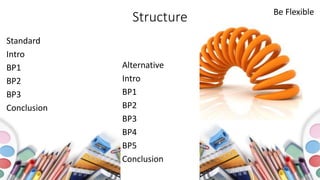
Structure
Alternative
Intro
BP1
BP2
BP3
BP4
BP5
Conclusion
Standard
Intro
BP1
BP2
BP3
Conclusion
Be Flexible
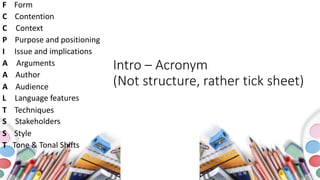
Intro – Acronym
(Not structure, rather tick sheet)
F Form
C Contention
C Context
P Purpose and positioning
I Issue and implications
A Arguments
A Author
A Audience
L Language features
T Techniques
S Stakeholders
S Style
T Tone & Tonal Shifts
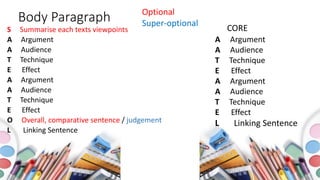
Body Paragraph
S Summarise each texts viewpoints
A Argument
A Audience
T Technique
E Effect
A Argument
A Audience
T Technique
E Effect
O Overall, comparative sentence / judgement
L Linking Sentence
A Argument
A Audience
T Technique
E Effect
A Argument
A Audience
T Technique
E Effect
L Linking Sentence
Optional
Super-optional
CORE
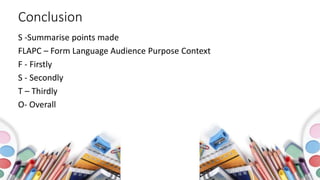
Conclusion
S -Summarise points made
FLAPC – Form Language Audience Purpose Context
F - Firstly
S - Secondly
T – Thirdly
O- Overall
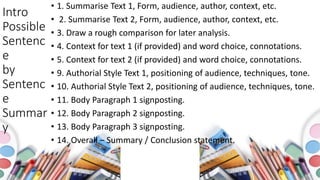
Intro
Possible
Sentenc
e
by
Sentenc
e
Summar
y
• 1. Summarise Text 1, Form, audience, author, context, etc.
• 2. Summarise Text 2, Form, audience, author, context, etc.
• 3. Draw a rough comparison for later analysis.
• 4. Context for text 1 (if provided) and word choice, connotations.
• 5. Context for text 2 (if provided) and word choice, connotations.
• 9. Authorial Style Text 1, positioning of audience, techniques, tone.
• 10. Authorial Style Text 2, positioning of audience, techniques, tone.
• 11. Body Paragraph 1 signposting.
• 12. Body Paragraph 2 signposting.
• 13. Body Paragraph 3 signposting.
• 14. Overall – Summary / Conclusion statement.
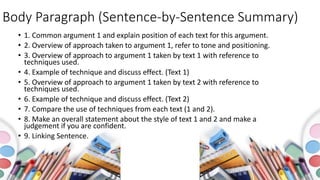
Body Paragraph (Sentence-by-Sentence Summary)
• 1. Common argument 1 and explain position of each text for this argument.
• 2. Overview of approach taken to argument 1, refer to tone and positioning.
• 3. Overview of approach to argument 1 taken by text 1 with reference to
techniques used.
• 4. Example of technique and discuss effect. (Text 1)
• 5. Overview of approach to argument 1 taken by text 2 with reference to
techniques used.
• 6. Example of technique and discuss effect. (Text 2)
• 7. Compare the use of techniques from each text (1 and 2).
• 8. Make an overall statement about the style of text 1 and 2 and make a
judgement if you are confident.
• 9. Linking Sentence.
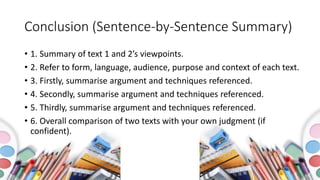
Conclusion (Sentence-by-Sentence Summary)
• 1. Summary of text 1 and 2’s viewpoints.
• 2. Refer to form, language, audience, purpose and context of each text.
• 3. Firstly, summarise argument and techniques referenced.
• 4. Secondly, summarise argument and techniques referenced.
• 5. Thirdly, summarise argument and techniques referenced.
• 6. Overall comparison of two texts with your own judgment (if
confident).

Language Analysis Structure - For Language Analysis Essay (English / EAL)

  • 1.
  • 2.
    Things to note Talkabout visuals always. Equal weight to each text regardless of length. You don’t really need to compare the two texts. (A handful of comparative phrases and a reference to both in topic and concluding sentence is sufficient). The important thing is insight into the argument and techniques (this essentially means showing off and using impressive vocab to say things that show interesting observations about the argumentation).
  • 3.
    The important thingis insight into the argument and techniques (this essentially means showing off and using impressive vocab to provide analysis). • …she provides an idyllic, almost romanticised image where she imagines ‘people who will eat at our beautiful bakery’ and ‘socialise at our historic pub’. This imparts a sense of uninterrupted tranquillity, a tranquillity which perhaps does not exist in the lives of many readers, bring to mind their own hectic schedules and routines. In this way, a desire for perfect serenity is evoked. In a blunt and almost brusque way, Wiley brings readers back to reality by asserting that ‘we need their money’, this serving to impart a sense of realism and perhaps urgency in that there may be a trade-off. This tranquillity will not exist without this money.
  • 4.
    The important thingis insight into the argument and techniques (this essentially means showing off and using impressive vocab to make original or compelling insights) • Both authors spark discussion about the beauty of their town and the effects of implementing a large tourist attraction. Wiley addresses the attraction as ‘grand’ and ‘soring high’, alluding to the idea that this will become something the town will be known for, compelling community members to feel proud for the town and its assets. Conversely, Warwick believes that this ‘giant’ attraction will be ‘ugly’ and a ‘monstrosity’, urging the council to realise that they may not want a huge ‘ugly’ attraction taking away from the ‘beauty’ of their town.
  • 5.
    Talk about visualsalways, Examples: In a similar manner, the cartoon by the newspaper’s cartoonist justifies the establishment of a giant monument. Jovial in mood, the cartoon provides an insight into the construction of a monument. The clear skies and scene represent the optimistic future of the town in the presence of the giant monument. The contrast of the empty highway versus the bustling town is symbolic of the town’s exposure and its ability to combat adversity. The giant watermelon as a symbol of the town’s fresh produce positioned beside the watermelon stand illustrates the projects ability to generate revenue. In so doing, the cartoonist presents that Mayor’s as viable and suitable in assisting its economic state and exposure to a more global society. The cartoon depicts a scenario in which the town has embraced the idea of constructing a large attraction, and its quality of produce to attract tourists to the town. The ridiculous figure of a giant watermelon, taller than trees and St Martin’s Church, highlights the future of the town following the Mayor’s approach to construct large attractions… Furthermore, the cartoon highlights how tourists have become attracted to the giant watermelon and have lost focus on other treasures of the town, suggesting how the construction has resulted in tourists becoming less appreciative of the town’s unique qualities. Thus the cartoon vilifies Wiley’s approach that giant attractions will bring prosperity to the town, and prompts readers to reflect where their values lie. When the cartoon is viewed in tow with Warwick’s letter, the audience discovers the cartoonist may perhaps be ridiculing Wiley’s contention, arguing that Lawton will forever be immortalised as the ‘home of the giant watermelon’ – one that sticks out like a sore thumb within the town centre – and not as the town of fresh produce and arts and craft that it wishes to purport itself to be. In highlighting the potential flaws behind such a construction, the cartoonist, similar to Warwick, intends to illustrate the salient flaws with undergoing such a construction, leaving the audience to carefully reconsider the actual inspirational nature of building such an attraction.
  • 6.
    Judgement – Theskill is important, writing about it is not. Avoid judgement or limit to one sentence before the linking sentence 2014 It is also worth noting that the instructions focus on the intent, not the result. Students should be wary of making claims about the exact response from the reading audience but are expected to analyse the intention of the writer. 2015 examiners report notes: Note that the task focuses on the intent (“attempt to persuade‟), not on the result. Some students spent time making judgments about how the audience would react. This is not necessarily incorrect, but it does move away from the essential task. 2016 examiners report notes: Very few went outside the task and evaluated which was more effective – this was clearly not the task.
  • 7.
    Consider Language Analysisas a trap. You need to talk about everything provided: Refer to the prompt / question. Refer to the Context box. Refer to all images. Refer to each and every text.
  • 8.
  • 9.
    Intro – Acronym (Notstructure, rather tick sheet) F Form C Contention C Context P Purpose and positioning I Issue and implications A Arguments A Author A Audience L Language features T Techniques S Stakeholders S Style T Tone & Tonal Shifts
  • 10.
    Body Paragraph S Summariseeach texts viewpoints A Argument A Audience T Technique E Effect A Argument A Audience T Technique E Effect O Overall, comparative sentence / judgement L Linking Sentence A Argument A Audience T Technique E Effect A Argument A Audience T Technique E Effect L Linking Sentence Optional Super-optional CORE
  • 11.
    Conclusion S -Summarise pointsmade FLAPC – Form Language Audience Purpose Context F - Firstly S - Secondly T – Thirdly O- Overall
  • 12.
    Intro Possible Sentenc e by Sentenc e Summar y • 1. SummariseText 1, Form, audience, author, context, etc. • 2. Summarise Text 2, Form, audience, author, context, etc. • 3. Draw a rough comparison for later analysis. • 4. Context for text 1 (if provided) and word choice, connotations. • 5. Context for text 2 (if provided) and word choice, connotations. • 9. Authorial Style Text 1, positioning of audience, techniques, tone. • 10. Authorial Style Text 2, positioning of audience, techniques, tone. • 11. Body Paragraph 1 signposting. • 12. Body Paragraph 2 signposting. • 13. Body Paragraph 3 signposting. • 14. Overall – Summary / Conclusion statement.
  • 13.
    Body Paragraph (Sentence-by-SentenceSummary) • 1. Common argument 1 and explain position of each text for this argument. • 2. Overview of approach taken to argument 1, refer to tone and positioning. • 3. Overview of approach to argument 1 taken by text 1 with reference to techniques used. • 4. Example of technique and discuss effect. (Text 1) • 5. Overview of approach to argument 1 taken by text 2 with reference to techniques used. • 6. Example of technique and discuss effect. (Text 2) • 7. Compare the use of techniques from each text (1 and 2). • 8. Make an overall statement about the style of text 1 and 2 and make a judgement if you are confident. • 9. Linking Sentence.
  • 14.
    Conclusion (Sentence-by-Sentence Summary) •1. Summary of text 1 and 2’s viewpoints. • 2. Refer to form, language, audience, purpose and context of each text. • 3. Firstly, summarise argument and techniques referenced. • 4. Secondly, summarise argument and techniques referenced. • 5. Thirdly, summarise argument and techniques referenced. • 6. Overall comparison of two texts with your own judgment (if confident).