Interviews
Louise Parker
Nick Rees
Angus Stirling
Julia Copus
Geoffrey &
Catherine Bass

Taunton Literary Festival
Programme
Calendar of Events
Somerset Art Works
Binham Grange Art Exhibition
Importance of Being Earnest
Quartz Festival
Illumina
Short Story

Free

July-Sep 2012

Shining a light on literature, art, music and performance in Taunton & West Somerset

The Literary Festival
Comes To Town!
Each one of our sofas is unique.
Unless you want two of them.

Create your sofa your way...
Made in Britain

Taunton store 151-152 East Reach, Taunton, Somerset, TA1 3HN
Tel:01823 282144 www.multiyork.co.uk

Call in and get comfortable in over 55 local stores

Visit us at www.multiyork.co.uk Call for a brochure 0800 0407 171
Contents
We have been delighted
by the positive response
the first issue of the
LAMP magazine has
received and welcome
you to the second issue
for August/September,
increased from 40 to 48
pages. It includes the full programme
of the second Taunton Literary Festival,
which takes place between 22-30 September.

05 Introduction by Jeremy Harvey
06 Louis Parker: Jazz Singer
10 The Fourth Binham Grange Summer Art
Exhibition
14 The Importance of Being Earnest
17 Taunton Literary Festival Programme
27 Calendar of Events
32 Somerset Art Works
33 A Potters Life: Nick Rees & John Leach
34 Artists Angus & Kitty Stirling
36 Quartz Festival
38 Julia Copus: Poet
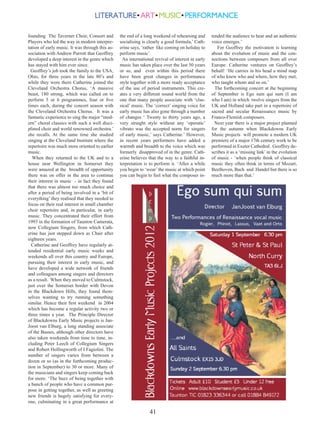
40 Early Blackdowns Music
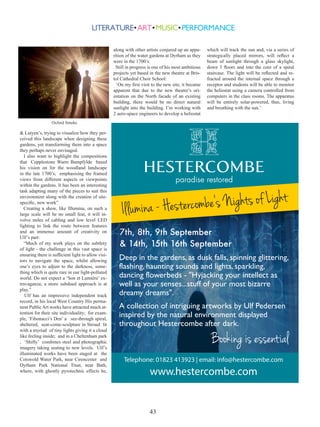
42 Illumina at Hestercombe Gardens
44 Short Story: Anthony Howcroft

Lionel Ward

Editor: Lionel Ward
Copy Editor: Jo Ward
Advertising: Clair Bennett
Events Compiler: Julie Munckton
All enquiries:
lampmagazine1@gmail.com
01823 337742
c/o Brendon Books,
Bath Place, Taunton


The views expressed in Lamp are
not necessarily those of the editorial
team. Copyright, unless otherwise
stated, is that of the magazine or the
individual authors. We do not accept
liability for the content or accuracy
of the magazine including that of the
advertisers.
OPEN DAY

B E PA RT O F T H E E X P E R I E N C E

Saturday 6th October —10 am arrival
Please call us to reserve your place.

Co-educational day  boarding: ages 13 –18  telephone: 01823 328204
admissions@kings-taunton.co.uk  www.kings-taunton.co.uk
Dear Reader
Taunton is a good place in which to live. Three reasons, among many, are the excellent
service at Brendon Books, the Literary Festival, and the support LAMP is giving to the
arts.
Lionel Ward acquired his bookshop in February, 1989. He ran our first Literary Festival
in 2011. By then he saw the need for a magazine to cover the arts in depth, available to
anyone. He knew there were lots of good things happening in and around Taunton but
that the coverage of them was ‘severely lacking’. To test his hunch he looked at costs,
conducted some interviews, realised he had good material, and received encouraging
feedback. And so LAMP was published this May.
Since when he has been amazed by the ‘positive comments’ he has received, indeed
overwhelmed by them. He sees his bookshop, the festival and the magazine as linked in
a natural way, each helping the others. His success has motivated him to bring out further
copies of LAMP, his huge initial input having proved very rewarding.
LAMP will continue if he receives enough advertising support. Secondly, he needs you
and me to call in and pick up a batch of this edition to distribute among our friends, neighbours and organisations in order that the magazine may be distibuted as widely as possible.
Thank you, Lionel, and many congratulations. I look forward to reading this new number.
Jeremy Harvey
Chairman of the Somerset Art Gallery Trust (SAGT)
Feeling
Good:
Louise
Parker
Growing up in a musical family and being named after Louis
Armstrong all helped
to shape talented singer Louise Parker’s future jazz career. She is
looking forward to her
forthcoming performance at Ilminster Arts
Centre in August.
Having a father in the army meant the
young Louise was constantly on the
move, growing up mostly in Germany, but
also different parts of the UK, and even a
stint in the Far East. ‘So I don’t have any
roots anywhere’, she says, quickly adding, ‘my roots are now firmly in Devon.’
It was during a cycling holiday to
Devon and Cornwall that she fell in love
with the West Country, finding the beauty of the region and the friendly people
particularly appealing. She had been
living in London for two years, where
she had been training in Hackney to be
a midwife. She describes how returning
from holiday to London was ‘a shock to
the system’ and decided it was time for a
change. In 1988 she moved to Plymouth,
taking up a post at Freedom Fields Hospital-and hasn’t looked back since!

Louise Parker in performance

Both Louise’s parents were music lovers, with an extensive and wide ranging
collection of records. While her mother
enjoyed listening to folk, calypso and
opera, it was her father in particular who
was an avid jazz fan, playing records
by artists from Louis Armstrong and
Bix Beiderbecke through to [John] Coltrane and [Charlie] Parker. ‘As a child
he would sit me down and we would
listen to music together’ Louise fondly
recalls. ‘He was always keen to point out
virtuoso solos, inventive arrangements
or beautiful melodies. His sense of rapture and enthusiasm was infectious and
I learned how music can transport you
- make you laugh and cry, and all other
emotions in between.’
Her mother grew up in Jamaica and as
a child sang in the choir at her local Baptist church. ‘She used to sing at home all
the time’, remembers Louise, ‘and has
an absolutely beautiful soprano voice,
but was always too shy to sing in public.’ Her father on the other hand would
sometimes sit in to sing with jazz bands,
including Kenny Ball’s Jazz Men (singing Dr Jazz).

As a teenager Louise discovered Billie Holiday, and subsequently became
completely obsessed with her and music in general, but unlike her idol never
thought to do it herself until she reached
her late thirties.
Over the past decade her own vocal
talents have earned her a great reputation
in the jazz world, and she has enjoyed
performing with (among many others)
the likes of BBC Jazz Award winners
Alan Barnes and Craig Milverton, as
well as the late great Humphrey Lyttelton who regarded Louise as his favourite
singer and described her as “a splendid
new voice on the block” with a sound
that “swings like fury”. Indeed, Louise
Parker became a regular performer on
Humph’s Best of Jazz - the BBC Radio
2 show he presented from 1968 until
shortly before his death in 2008, and
recorded with him on his last CD Cornucopia 3.
Her debut album, Don’t Explain was
recorded live in 2004 and gives a wonderful insight into her abilities, doing
justice to covers such as the Newley/
Bricusse-penned Feeling Good- a song
first performed by Cy Grant, but which
Nina Simone made her own on her 1965
album I Put a Spell on You, plus Gershwin’s classic Summertime, and other jazz
standards such as You Go To My Head,
Afro Blue, and a nod to Billie Holiday in
the album’s title track Don’t Explain.
A powerful live performer, Louise has
become a big hit on the festival circuit,
wowing audiences at Glastonbury, Port

lie Holiday’ she says when asked what
the audience can expect from her forthcoming show at Ilminster Arts Centre,
‘but I will be doing some other stuff as
well...I mostly do jazz and blues standards, with one or two reggae influenced
tunes and a couple of gospel numbers.’
She will be joined on the night by The
Craig Milverton Trio, with whom Louise
has just recorded a live album. ‘We’ve

Louise Parker with Humphrey Lyttelton

Eliot and the Isle of Wight International
Jazz Festival with her skilful interpretations of various musical styles, incorporating swing, blues and gospel classics
in her repertoire. She has a warm, bluesy
gospel sound to her voice that captures
the passion and spirit of some of the
great jazz divas, not least her early inspiration Billie Holiday, ‘I’ve been asked to
do some numbers from my tribute to Bil-

been playing together for five or six
years now...we know how each other operates but there are still surprises!’ Craig
Milverton also played piano on her second album No More Strangers which
was highly praised by Humphrey Lyttelton on his Best of Jazz radio show, and
who described Craig as “someone who’s
given Louise much encouragement, and
should feel well rewarded by this hugely

impressive self-produced album.”
Louise says she is looking forward to
play Ilminster Arts Centre once again,
having received a warm and enthusiastic
reception when she last played there 2
years ago. No doubt the venue is pleased
to welcome her back, as with a number
of new projects lined up, Louise is most
certainly in demand.
‘At the moment I am summoning up
the courage to learn some Nina Simone
material’ explains Louise of her being
booked to do a tribute concert at Cornwall’s Calstock Chapel in March next
year. She has also recently joined an
African-influenced band, with original
music written by the band leader Pete
Scott, which she describes as being ‘very
up-tempo and good to dance to’, and is
considering starting up a funk band, adding ‘I am also the lead soloist in a local
gospel choir - phew! - now I know why
I’m never in!’
There are a number of musicians
she would like to work with given the
chance, among them Christian McBride,
Monty Alexander, Gareth Williams,
Dave Green, Joe Sample, Buena Vista
Social Club and Herbie Hancock.
‘Be patient. Learn your skill by doing as many gigs as you can get in the
book’ is her advice to upcoming young
performers just starting their careers in
music, ‘listen to music as much as you
can. The audience might not listen to
you. Don’t worry about it, one day they
will. A lot of the time, being a musician
is not glamorous - it’s hard work. Most
importantly, keep going and never lose
the joy’.
By Sara Loveridge

Hear Louise perform on Friday 3rd August
Ilminster Arts Centre at The Meeting House, East Street, Ilminster. TA19 0AN. At 8pm.
Tickets: £12. Pre-Show Supper £9.50 (at 7pm). Box Office: 01460 54973. Website:
www.themeetinghouse.org.uk.
ALLETSONS
SOLICITORS
FAMILY L AW  CARE CASES ∙ COLL ABOR ATIVE L AW  DIVORCE
CRIME ∙ CONVEYANCING ∙ HOUSING ∙ WILLS  PROBATE

FREE INITIAL CONSULTATION

BRIDGWATER 01278 456 621
8 Castle Street ∙ Bridgwater ∙ Somerset ∙ TA6 3DB
W W W.ALLETSONS.CO.UK

Something not quite right?...

SING FOR FUN
with

Company Of Voices

Piles or period pain, acne or eczema, hayfever
or halitosis - they may not threaten your life,
but they can make it a misery.

Taunton Community Choir Company of Voices welcoms new members whether colmplete beginners or experienced singers, male or
female. Harmony songs from around the world are all taught by choir
leader Claire Anstee - so there are no auditions and members don;t
need ot read music.
We are part of the ‘natural Voice Network’ and we occasionally perform
to raise funds for water aid. We sing at ‘Dunster by Candlelight’ and
we’ve performed at various events in Taunton, in Bridgwater Arts Centre,
and we join other community choirs from the whole region each year for
The Big Sing’in Bristol. however, there is no pressue on members to
perform and sessions are always relaxed, friendly and fun.

Homeopathic medicine takes a different approach.
Why don’t you?
Call Ruth Hermolle, registered homeopath:
01823 252191 or 01823 338968

Our next term starts on Thursday 13 September, at 7.30pm at Holway
Park Community Primary School, TAunton
For more details email: admin@companyofvoice.co.uk
phone: 01278 741184

Clinics in Taunton and Wellington
www.holistics-uk.com
www.the-terrace.co.uk

or visit our website: www.companyof voices.co.uk
The Fourth Binham Grange
Summer Art Exhibition

The Binham Grange
Summer Art Exhibition is now firmly established as part of the
August calendar. Melanie Deegan looks back
at its origins and development and looks
forward to this years
exhibition.

During a casual conversation at a West
Somerset business development meeting
in March 2009 the seeds for what would
become Gallery 4 Art were sown.
Jim Munnion (painter and printmaker),
Melanie Deegan (sculptor) and a number
of others interested in art were discussing the lack of suitable venues for group
art exhibitions in the area. One of the
group who had recently dined at Binham Grange suggested approaching the
venue with a view to using their barn to
hold an exhibition. A meeting was soon
arranged and Marie Thomas of Binham
Grange was keen to give the idea a go.
Binham Grange is a unique Jacobean

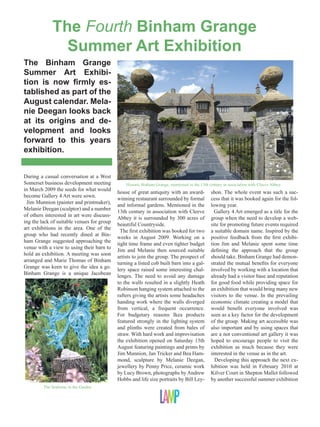
The Seahorse in the Garden

Historic Binham Grange, mentioned in the 13th century in association with Cleeve Abbey

house of great antiquity with an awardwinning restaurant surrounded by formal
and informal gardens. Mentioned in the
13th century in association with Cleeve
Abbey it is surrounded by 300 acres of
beautiful Countryside.
The first exhibition was booked for two
weeks in August 2009. Working on a
tight time frame and even tighter budget
Jim and Melanie then sourced suitable
artists to join the group. The prospect of
turning a listed cob built barn into a gallery space raised some interesting challenges. The need to avoid any damage
to the walls resulted in a slightly Heath
Robinson hanging system attached to the
rafters giving the artists some headaches
handing work where the walls diverged
from vertical, a frequent occurrence.
For budgetary reasons Ikea products
featured strongly in the lighting system
and plinths were created from bales of
straw. With hard work and improvisation
the exhibition opened on Saturday 15th
August featuring paintings and prints by
Jim Munnion, Jan Tricker and Bea Hammond, sculpture by Melanie Deegan,
jewellery by Penny Price, ceramic work
by Lucy Brown, photographs by Andrew
Hobbs and life size portraits by Bill Ley-

shon. The whole event was such a success that it was booked again for the following year.
Gallery 4 Art emerged as a title for the
group when the need to develop a website for promoting future events required
a suitable domain name. Inspired by the
positive feedback from the first exhibition Jim and Melanie spent some time
defining the approach that the group
should take. Binham Grange had demonstrated the mutual benefits for everyone
involved by working with a location that
already had a visitor base and reputation
for good food while providing space for
an exhibition that would bring many new
visitors to the venue. In the prevailing
economic climate creating a model that
would benefit everyone involved was
seen as a key factor for the development
of the group. Making art accessible was
also important and by using spaces that
are a not conventional art gallery it was
hoped to encourage people to visit the
exhibition as much because they were
interested in the venue as in the art.
Developing this approach the next exhibition was held in February 2010 at
Kilver Court in Shepton Mallet followed
by another successful summer exhibition
THE LYNDA COTTON GALLERY
46 Swain Street, Watchet.

ANGUS STIRLING KITTY STIRLING









‘COMMON GROUND’
An exhibition of work by Father  Daughter.

Monday 10th - Sunday 22nd September
The Lynda Cotton Gallery
46 Swain Street,
Watchet.
TA23 0AG.







Open daily 10:00am - 5:30pm.
(01984) 631814
www.thelyndacottongallery.co.uk

11
at Binham Grange in August 2010.
Each exhibition has added more to
the identity and infrastructure for the
group building on the collection of
display panels, lighting systems, signage and catalogues for events. The
membership has also grown and well
over thirty artists have now exhibited
with Gallery 4 Art.
Another chance conversation resulted in the winter exhibition for 2011
being held at Blackmore Farm near
Cannington, a 15th Century manor
with great hall and chapel. The prospect of sitting beside large log fires
in February made the venue particularly attractive for the artists. Again
an interesting challenge as a gallery
space with suits of armour and implements of destruction to work around.
The farm shop café provided food for
visitors who were often queued out of
the door. Blackmore has now become
a regular winter venue for the group
and the exhibition for February 2013
is already booked.
This year will be the fourth summer
at Binham Grange. The exhibition
will run for three weeks from 11th
August until the 2nd September and is
open every day from 10.30am to 5pm.
There is plenty of parking and entry
to the exhibition is free of charge.
Artists work will be displayed the in
the barns and gardens surrounding the
house. The Grange Restaurant will be
serving coffee, lunches and afternoon
tea each day in the formal dinning
room and on the garden terrace.
Providing a vibrant and varied exhibition is important and artistic styles
within the group vary considerably.
The delicate, subtle, architectural

Some of the artists exhibiting in the 2009 Binham Grange Summer Exhibition

drawings of Rebecca Birtwhistle contrast with the dramatic, vibrant abstract paintings of Diane Burnell. Ceramic artists Lucy Brown and Renee
Kilburn have very different styles.
Renee’s work is detailed, tactile and
oozing with colour while Lucy creates delicate, almost ghost-like lamps
or quirky jugs and bowls. Photographer Andrew Hobbs produces observant, often black and white studies of local landscapes and people.
Nic Wingate’s photography is often a
very different high-speed sports shots
in vivid colours, Nic also provides
much of the printed signage for the
group and a photographic record of
exhibitions. Other regular exhibitors
include Tracey Hatton whose drawings and paintings have a strong link
to the local landscape. Alison Jacobs
detailed images of animals with their
plain coloured backgrounds sit well in

the barns around Binham Grange.
Jenny Barron, Leo Davey, Sara Dudman, Louise Waugh and Penny Elfick
have also participated in previous exhibitions. The outdoor sculpture collection has featured work by Fiona
Campbell, Tom Wood, Jay Davey,
Sam Jeffs, Anthony Rogers, Kate
Semple, and Chris Webb.
Later in the year Gallery 4 Art will
be participating in the Hilliers Autumn Festival, Romsey, Hampshire, a
new venture for the group to explore
opportunities outside the local area.
The group have also been recently
approached by Children’s Hospice
South West about the possibility of
participating the Art for Life event
in Devon during September. Longer
term Gallery 4 Art intend to explore
other opportunities further afield and
to investigate the possibilities for
pop-up exhibitions.

Binham Grange Summer Art Exhibition
11 August - 2 September 2012
10.30am to 5pm every day
Binham Grange, Old Cleeve, nr Minehead, Somerset TA24 6HX

The Fire
13
A Trivial Comedy for Serious People
The Importance of Being Earnest, Oscar Wilde (1854-1900)

T

he importance of Being Ernest was first performed on Valentine’s Day 1895 at St James’s Theatre, London, when Wilde was at the pinnacle of his success. It followed the success of Lady Windermer’s Fan (1892), A Woman of No Importance (1893), and An Ideal Husband (also 1895).
It also marked the beginning of his downfall. Wilde sued The Marquess of Queensberry for comments he had
made about him as a result of his relationship with his son. Though Wilde withdrew from the libel action, the
activities of the defence in delving into his private life led to him being arrested, charged and convicted of
gross indecency, resulting in his imprisonment.
The negative publicity also meant that the play had a much shorter run than it would otherwise have had
(though there were 83 perfomances). However, it remains his most popular play and has been successfully
translated into several languages.

Antecedents
Both Oscar Wilde’s father and mother were writers. His father Sir William, was a noted ear and eye surgeon at a hospital in Dublin who
also wrote books on biography, medicine, archaelogy and folklore. His mother, Jane, also wrote poetry under the name of ‘Speranza’
(hope in Italian) for the nationalist Young Irelanders and was the author of a critically aclaimed translation of The First Temptation by M.
Schwab. They were not the most conventional of couples. It was not widely known that Sir William had three illegitimate children before
his marriage to Jane, though this did not seem to be resented by her. The eldest of the children, named Henry Wilson, was born in 1838 and
employed by Sir William in his hospital. The two girls, Emily and Mary (born in 1847 and 1849), and were adopted by his brother. They
died in a bizarre accident when their crinolene dresses went up in flames while they were admiring them in front of an open fire. In later
life, following the receipt of his knighthood, he was embroiled in controversy and a trial, foreshadowing his son’s trial some 30 years later.
A patient of his, Mary Travers, claimed she had been seduced by him two years earlier. She circulated a pamplet parodying the Wilde’s and
her supposed seduction under the influence of choloroform. When Lady Wilde complained to Mary Traver’s father, Mary brought a libel
case against Lady Wilde. Sir William refused to take the stand. Mary Travers won the case but was only awarded a farthing in damages.
Lady Wilde had to pay £2,000 in legal costs.

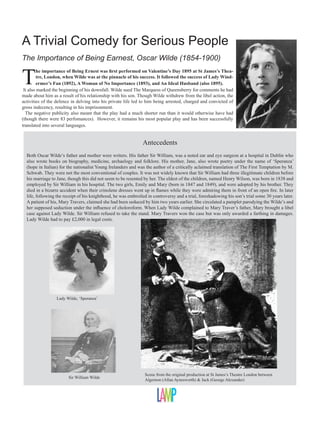
Lady Wilde, ‘Speranza’

Sir William Wilde

Scene from the original production at St James’s Theatre London between
Algernon (Allan Aynesworth)  Jack (George Alexander)
Set in the year 1912, with
the Titanic sinking, mass
production just beginning
on the Morris Oxford and
the Turkey Trot causing
outrage across the dance
floors of polite society, this
tale of the strange contents of a handbag found
at Victoria station has been
subtly adapted to extract
every drip of humour and
contemporary relevance in
this open air production by
the Miracle Theatre which
takes place in Vivary Park,
Taunton.
Finding there was very little theatre to
speak of in Cornwall in the late seventies,
Bill Scott got together a group of likeminded actors (Bill had studied drama at
Birmingham University) and formed The
Cornish Miracle Theatre. They put on their
first production in the summer of 1979, The
Beginning of the World or Origo Mundi, the
first part of the Ordinalia or Cornish Miracle Plays. They adapted the play and gave
it their own interpretation and were pleased
with the response from the audience. It was
intended as a one-off performance but they
soon began to establish themselves with
regular outdoor performances, putting on
other classic plays, though usually adapted,
for example, to suit a small cast of actors. They also began to perform original
works, many of them written by Bill (and
in which, in the early days, he acted). They
toured English Heritage sights producing
humorous interpretations of events in history (such as the Spanish Armada) accompanying medieval jousting tournaments
and battles reenacted by The Sealed Knott.
Looking back at their productions over 30

or more years, they have produced a breath-taking variety of repertoire and brought high quality theatre to outdoor venues across Cornwall
and the South West. In addition to Miracle Plays,
adaptions of Shakespeare, Victor Hugo, Gogol and
other classics and tongue-in-cheek histories, their
productions have iincluded Georgian-style pantomimes, a Victorian music hall show about Dr Livingstone, a medieval farce (The Scapegoat), pieces
of science fiction (20,000 Leagues Under the Sea,
The Time Machine and Cat’s Cradle) as well as
the modern masterpieces of Beckett’s Waiting for
Godot and Eugene Ionesco’s The Chairs.

selves on a sound footing by attracting a
big enough audience, he believes, does require investment in marketing in addition
to energy and commitment for, ‘Only so
much can be achieved by word of mouth.’
It was, therefore, with great relief as well
as surprise that they were granted an arts
council award six years ago. For the first
time they were able to employ a Theatre
Manager and a Communication Manager.
Since then, Bill feels that their company
has gone from strength to strength.
They are now in the middle of their latest
production, The Importance of Being Earnest, which comes to Taunton’s Vivary Park
at the end of August. Though they have had
their share of problems with the awful June
weather they only had to cancel one performance on their tour - when they found
the field in which they were due to perform
was under two feet of water. The audiences
and actors have soldiered on through the
rain or sometimes they have been offered
alternative indoor venues. They performed

The Full Cast

Finding sufficient funding, as ever in the world
of the theatre, has sometimes been a challenge.
In the early days they were grateful for what they
could get. Recently, Bill donated some of their
old material to a performing arts archive and discovered a letter from bygone years from a local
garage agreeing to sponsor them for £25 and another from their local council - also offering £25
funding. He remembers these as ‘red letter days.’
Being able to develop the theatre and put them-

for a whole week at the exposed Minack
Theatre. However, despite the occasional
weather problems they achieved near sell
out audiences for all the performances.
Now that the weather seems to be taking
a kinder direction they look forward to another well attended performance in Vivary
Park - for surely one of the funniest plays
in the English language - perhaps in the dry
or even in glorious sunshine.

See The Importance of Being Earnest
at Vivary Park, Taunton
Friday 31 August - Saturday 1 September
2pm 7.30pm
Tickets from The Brewhouse Theatre:
Full £12 60+ £12 Conc. £8
Box Office: 01823 283244 www.thebrewhouse.net
Miracle at St Mawes

15
Creative Writing for Beginners

The Victoria Rooms, Fore Street, Milverton,TA4 1JU

A new course begins Thurs 20th Sept (1-3pm)
This warm  supportive class provides the opportunity for both
new  experienced writers to get pen to paper  amass lots
of fresh writing material, from which fiction or autobiographybased projects may be developed.
Briony uses simple techniques designed to open the writer up
to a world of tantalising images, ideas, memories, sensations
 associations.
Via a variety
of forms, from
lists to letters,
poetry to prose,
monologue to
dialogue, travel
writing to dream
writing, students
will explore the
nature of their
own voices 
learn how to use them with confidence  flare.
A 10 week course costs £120. For more info  bookings email
brionygoffin@gmail.com or go to www.brionygoffin.co.uk
Briony Goffin teaches Creative Writing at Cardiff University,
alongside facilitating courses  workshops in the community.
She has published widely on the art of teaching creative writing
 supporting the student writer to fulfil their creative potential.
In May 2012 she was awarded ‘Inspirational Tutor of the Year’
by NIACE in Wales.

Wood Street
Community Choir
All welcome!
Wednesdays 7.30-9.15pm
Northtown School, central Taunton
Leader: Catherine Mowat
•	 All kinds of songs – bop to pop, groove to gospel,
float to folk, plus lots more!
•	 Songs in luscious harmony, unaccompanied

•	
Friendly and welcoming
•	 Teaching mainly by ear
•	 Term starts September 26th
£5 /session or £45 for the 10 week term

For further information:
01458 250655 or
cemowat@gmail.com
www.singfromtheheart.wordpress.com
Taunton Literary Festival

22-30 September 2012

Over the following pages you will find the full programme for the
second Taunton Literary Festival organised by Brendon Books of
Bath Place, Taunton There are more than 40 events spread over
9 days over a wide range of subject areas. We would particularly
like to thank the participation of the following schools, colleges and
local institutions who have provided the venues:
The Castle Hotel, Hestercombe Gardens, Taunton School,
Tacchi-Morris Arts Centre, Queen’s College, King’s College,
Richard Huish College, The Brewhouse Theatre and Somerset
County Museum.
Many of the tickets for the daytime events at the schools are at a
special student rate and we hope that students form schools other
than the participating venues may be able to take advantage of this.
We would also like to thank the Somerset Council and the Creative Industries Development
Fund, Taunton Deane Borough Council and all businesses, local institutions and volunteers
that give their support over the coming months. It would be marvellous if the festival could
become an established part of the calendar and part of a vibrant cultural and artistic sector for
the Taunton area.
Each of the events typically lasts an hour with a talk and or/reading, questions followed by
a signing. Directions and maps to the venues are available at the literary festival website at
www.tauntonliteraryfestival.net where tickets may also be ordered. Tickets are also available
by personal visit, phone or by emailing Brendon Books except for the Brewhouse Theatre
events or for the literary dining events at The Castle Hotel (see details on following pages).

Venuesfor the 2012 Festival
Saturday 22: The Castle Hotel
Sunday 23: Hestercombe Gardens
Monday 24 Taunton School
Tuesday 25: Taccchi-Morris Arts Centre
Wednesday 26: Queen’s College
Thursday 27: King’s College
Friday 28: Richard Huish College
Saturday 29: The Brewhouse Theatre
Sunday 30: Somerset Museum
17

Brendon Books, Bath Place,
Taunton TA1 4ER 01823 337742
brendonbooks@gmail.com
Taunton Literary Festival
22-30 September

Day 1, Saturday 22nd September
The Castle Hotel, Castle Green,
Taunton TA1 1NF
See below for ticket options
11.00am Sir Roger Carrick: Diplomatic Anecdotage; Around the World in 40
Years

There will be an opportunity at this event to have lunch at The Castle Hotel in the company of the
author after the talk and signing. Talk followed by a 3 course lunch. Price £39.00 For this option
please contact the Castle Hotel for tickets. 01823 272671 or www.the-castle-hotel.com
Tickets for the talk only may be purchased from Brendon Books, price £6.50
From Bulgaria to Berkeley, Indonesia to Australia, Roger Carrick has travelled the world as an English diplomat. He
was shadowed by the secret police in Sofia, witnessed the 1968 riots in Paris, befriended Shirley Temple at Stanford
University and negotiated the withdrawal of British troops from Singapore. In between he rose to the heights of
ambassador to Indonesia and High Commissioner to Australia. All in a day’s work for a distinguished diplomat. Diplomatic Anecdotage is
a reflection on the ups and downs of diplomatic life. A fascinating insider’s view to diplomatic life - full of humour, wisdom and good sense
about how to navigate our way through a dangerous world. Chris Patten. A diplomat’s life isn’t boring, at least Roger Carrick’s wasn’t.
Amusing, informative and fun. Lord Carrington.

4.00pm Alexander Waugh. Alexander will be talking about his father, Auberon, with

particular reference to a recent collection of his works, Kiss Me Chudleigh: The World
According to Auberon Waugh which will be available at the talk.

There will be an opportunity at this event to have tea in the company of the author after the talk
and signing. Price £20.00. For this option please contact the Castle Hotel for tickets. 01823 272671
or www.the-castle-hotel.com. Tickets for the talk only may be purchased from Brendon Books,
price £6.50
Auberon Waugh has been compared to Jonathan Swift. He was an outrageous satirist who slaughtered whole herds
of sacred cows and turned peoples heartfelt convictions on their heads. The best of his writing, collected in Kiss Me
Chudleigh, is as timeless as Gulliver’s Travels and has much power to outrage as the day it was written. Auberon Waugh was a master of
the art of going too far, but above all, he was very funny. Kiss Me, Chudleigh is a collection of Waugh’s best writing and is also a compact
biography.

6.30pm Felix Francis: Bloodline

There will be an opportunity at this event to have dinner in the company of the author after the talk
and signing. Talk followed by a 3 course dinner. Price £49.00. For this option please contact the
Castle Hotel, 01823 272671 or www.the-castle-hotel.com. Tickets for the talk only may be purchased from Brendon Books, price £6.50
From Felix Francis, bestselling author of Gamble and co-author (with Dick Francis) of Even Money and Crossfire,
comes Bloodline the latest Dick Francis novel. Set in the cut-throat world of horse racing, Bloodline is a thriller packed
full of suspense, mystery and intrigue. When Mark Shillingford commentates on a race in which his twin sister Clare,
an accomplished and successful jockey, comes in third, he can’t help but be suspicious. As a professional race-caller,
he knows she should have won. Did she lose on purpose? Was the race fixed? Why on earth would she do something so out of
character? That night, Mark confronts Clare with his suspicions, but she storms off after an explosive argument. It’s the last
time Mark sees her alive. Hours later, Clare jumps to her death from the balcony of a London hotel ...or so it seems. Devastated
by her death, and almost overcome with guilt, Mark goes in search of answers. Felix also has some interesting stories about his
father.

Tickets for Talks: Brendon Books, Bath Place, Taunton TA1 4ER Tel. 01823 337742
www.tauntonliteraryfestival.net or email: brendonbooks@gmail.com
Taunton Literary Festival
22-30 September

Day 2, Sunday 23rd September
Hestercombe Gardens, Cheddon Fitzpaine,
Taunton TA2 8LG

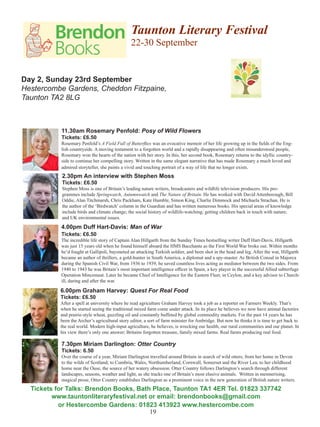
11.30am Rosemary Penfold: Posy of Wild Flowers
Tickets: £6.50

Rosemary Penfold’s A Field Full of Butterflies was an evocative memoir of her life growing up in the fields of the English countryside. A moving testament to a forgotten world and a rapidly disappearing and often misunderstood people,
Rosemary won the hearts of the nation with her story. In this, her second book, Rosemary returns to the idyllic countryside to continue her compelling story. Written in the same elegant narrative that has made Rosemary a much loved and
admired storyteller, she paints a vivid and touching portrait of a way of life that no longer exists.

2.30pm An interview with Stephen Moss
Tickets: £6.50

Stephen Moss is one of Britain’s leading nature writers, broadcasters and wildlife television producers. His programmes include Springwatch, Autumnwatch and The Nature of Britain. He has worked with David Attenborough, Bill
Oddie, Alan Titchmarsh, Chris Packham, Kate Humble, Simon King, Charlie Dimmock and Michaela Strachan. He is
the author of the ‘Birdwatch’ column in the Guardian and has written numerous books. His special areas of knowledge
include birds and climate change; the social history of wildlife-watching; getting children back in touch with nature;
and UK environmental issues.

4.00pm Duff Hart-Davis: Man of War
Tickets: £6.50

The incredible life story of Captain Alan Hillgarth from the Sunday Times bestselling writer Duff Hart-Davis. Hillgarth
was just 15 years old when he found himself aboard the HMS Bacchante as the First World War broke out. Within months
he’d fought at Gallipoli, bayoneted an attacking Turkish soldier, and been shot in the head and leg. After the war, Hillgarth
became an author of thrillers, a gold-hunter in South America, a diplomat and a spy-master. As British Consul in Majorca
during the Spanish Civil War, from 1936 to 1939, he saved countless lives acting as mediator between the two sides. From
1940 to 1943 he was Britain’s most important intelligence officer in Spain, a key player in the successful Allied subterfuge
Operation Mincemeat. Later he became Chief of Intelligence for the Eastern Fleet, in Ceylon, and a key advisor to Churchill, during and after the war.

6.00pm Graham Harvey: Quest For Real Food
Tickets: £6.50

After a spell at university where he read agriculture Graham Harvey took a job as a reporter on Farmers Weekly. That’s
when he started seeing the traditional mixed farm come under attack. In its place he believes we now have animal factories
and prairie-style wheat, guzzling oil and constantly buffeted by global commodity markets. For the past 14 years he has
been the Archer’s agricultural story editor, a sort of farm minister for Ambridge. But now he thinks it is time to get back to
the real world. Modern high-input agriculture, he believes, is wrecking our health, our rural communities and our planet. In
his view there’s only one answer; Britains forgotten treasure, family mixed farms. Real farms producing real food.

7.30pm Miriam Darlington: Otter Country
Tickets: 6.50

Over the course of a year, Miriam Darlington travelled around Britain in search of wild otters; from her home in Devon
to the wilds of Scotland; to Cumbria, Wales, Northumberland, Cornwall, Somerset and the River Lea; to her childhood
home near the Ouse, the source of her watery obsession. Otter Country follows Darlington’s search through different
landscapes, seasons, weather and light, as she tracks one of Britain’s most elusive animals. Written in mesmerising,
magical prose, Otter Country establishes Darlington as a prominent voice in the new generation of British nature writers.

Tickets for Talks: Brendon Books, Bath Place, Taunton TA1 4ER Tel. 01823 337742
www.tauntonliteraryfestival.net or email: brendonbooks@gmail.com
or Hestercombe Gardens: 01823 413923 www.hestercombe.com
19
Taunton Literary Festival
22-30 September

Day 3, Monday 24th September
Taunton School, Staplegrove Rd, Taunton TA2 6AD
2.00pm Chris Ewan: Safe House
Tickets: £6.50 Schools:£2.50

Chris Ewan’s most recent novel is Safe House (published by Faber  Faber), a stand-alone thriller set on the Isle of Man.
He is the award-winning author of four previous novels. In 2011, he was voted one of America’s favourite British authors
by a Huffington Post poll. Born in Taunton in 1976, Chris attended Bishop Henderson Primary School, The Castle School
and Richard Huish College before graduating from the University of Nottingham. He now lives on the Isle of Man with
his wife Jo, where he writes full-time.

4.30pm Ally Kennen: Bullet Boys
Tickets: £2.50

This is an electrifyingly dark teen thriller from the author of Beast and Quarry. Alex, Levi and Max follow the young
soldiers from the local army camp on the moor. But harmless rivalry develops into something far more incendiary. When
the boys discover a cache of buried weapons near the training grounds, deadly forces are brought into play. Ally reached
no. 41 in the UK charts in 2001 with a song she wrote and sang and subsequently toured round the world. She lives in
Somerset with her husband, her daughter and two sons, four chickens and a curmudgeonly cat.

6.00pm John Darwin: Unfinished Empire
Tickets: £6.50 Schools: £2.50

John Darwin won the Wolfson History Prize for his book After Tamerlane: The Rise and Fall of Global Empires. In
Unfinished Empire he examines the enormous influence of the British Empire. It has shaped the world in countless ways:
repopulating continents, carving out modern nations, imposing its own language, technology and values. For perhaps two
centuries its existence, expansion and final collapse were the single largest determinant of historical events.

7.30pm Gervase Phinn: Trouble at the Little Village School
Tickets: £6.50

Elisabeth Devine certainly rocked the boat when she arrived in Barton-in-the-Dale to take over as the head-teacher
of the little primary school. Now it’s January, and after winning over the wary locals, she can finally settle in to her
new role. Or so she thinks . . . For the school is hit by a brand-new bombshell: it’s to be merged with its arch rival,
and Elisabeth has to fight for the new headship with Urebank’s ruthless and calculating headmaster. She has her
work cut out for her. But add in some gossip and a helping of scandal, not to mention various newcomers bringing
good things and bad to Barton, and that’s not the only trouble that’s brewing in the village.

Tickets for Talks: Brendon Books, Bath Place, Taunton TA1 4ER Tel. 01823 337742
www.tauntonliteraryfestival.net or email: brendonbooks@gmail.com
Taunton Literary Festival
22-30 September

Day 4, Tuesday 25th September
Tacchi-Morris Arts Centre, School Rd,
Monkton Heathfield, Taunton TA2 8PD
12.00 Ginny Baily, author of Africa Junction will talk on the subject of ‘The impossibility of getting to Timbuktu’ - how Africa, Mali in particular, inspired ‘Africa Junction’
Tickets: £6.50 Schools £2.50

Adele is in a mess. On her own with her young son, struggling to cope with her job as a teacher, and stuck in a disastrous affair - her life is unravelling. Her memories of idyllic years as a child in Senegal are fading, but she’s haunted
by a vision of her childhood friend, Ellena. Africa is in her head. Ellena’s childhood in exile from brutal conflict in
Liberia was far removed from the vibrant Senegal Adele remembers, and a careless, heartless act by Adele destroyed
the girls’ friendship and jeopardised Ellena’s fragile family. Adele must return to Africa to try and make amends and

2.30pm Beth Webb: Star Dancer Series
Tickets: £6.50 Schools: £2.50

It is 58 AD. As the Romans tighten their grip on Britain, so the tribes’ resistance increases. But lust for power knows
no loyalty. A demon promises failed King Admidios untold wealth and glory in exchange for the soul of Tegen, the
young ‘Star Dancer’ druid in training - Britain’s only hope. Unaware of this dark bargain, Tegen sets off to find Mona,
the elusive Isle of the Druids, where she hopes to learn the magic that will defend her homeland. On the way, she
meets Owein, another young druid who is not what he seems and knows far more than he is willing to tell - even to
Tegen. Owein offers to take her to a Grand Council of druids and war leaders, where, he assures her, she will find a
guide. But Admidios is also waiting there, poised with all his demonic powers. Then a murder by magic brings the
British alliance tottering on the brink of disaster, and a black raven of ill-omen flies in the face of all Tegen holds dear.
Her only hope is to dare to walk through the flames of Sacred Fire.

6.00pm Open Mic Session organised by John Stuart of the Fire River Poets. A kaleidoscope of poetry in an open mic session for local poets.
Tickets: £5.00 Students: £2.00

The organisers do not know who will take part but we do know that many excellent poets live and work in
and around Taunton so this should be a fascinating whirlwind of different styles and subjects. Poets who
would like to take part in the open mic should book themselves their five minute slot in advance through
John Stuart (wj.stuart@sky.com or 01823 352486).

8.00pm James Forrester (Ian Mortimer)Title of Talk: The Senses of Elizabethan
England: an exploration of the audio and visual senses in Elizabethan England
Based on the historical fiction books of James Forrester.
Latest book: The Final Sacrament.
Tickets: £8.00

James Forrester is the fiction-writing persona (the middle names) of the historian, Dr Ian J. F. Mortimer. As Ian Mortimer he has pioneered a number of new literary forms in history, from writing guidebooks for those ‘visiting’ the past
(The Time Traveller’s Guide to Medieval England) to a day-by-day account of a king over a particular year (1415:
Henry V’s Year of Glory).

Tickets for Talks: Brendon Books, Bath Place, Taunton TA1 4ER Tel. 01823 337742
www.tauntonliteraryfestival.net or email: brendonbooks@gmail.com
or Tacchi Morris Arts Centre 01823 414141 www.tacchi-morrris.com

21
Taunton Literary Festival
22-30 September

Day 5, Wednesday 26th September
Queen’s College, Trull Road, Taunton TA1 4QS
11.00am Keith Gibbs: The Resourceful Physics Teacher
Tickets: £2.50

The aim of the talk is to show some fun and informative experiments that demonstrate some of the ideas in Physics. There will be between twenty and thirty experiments from spinning coat hangers and jellies to singing rods!
The experiments are not only enjoyable but also all demonstrate an important piece of Physics. They form the
basis of a collection of over seven hundred which appears in a new book The New Resourceful Physics Teacher.
This teaching resource comprises 400 demonstration experiments and ideas for pupils in physics. The author,
Keith Gibbs has drawn on 30 years experience of teaching physics to assemble these ideas.

2.00pm Patricia Ferguson: The Midwife’s Daughter
Tickets: £6.50 Schools: £2.50

The new novel from Orange Prize listed author Patricia Ferguson. Violet, the Holy Terror, has delivered
many of the town children - and often their children - in her capacity as handywoman. But Violet’s
calling is dying out as, with medicine’s advances, the good old ways are no longer good enough. Grace,
Violet’s adopted daughter, is a symbol of change herself. In the place where she has grown up and
everyone knows her, she is accepted, though most of the locals never before saw a girl with skin that
colour. For Violet and Grace the coming war will bring more upheaval into their lives: can they endure
it, or will they, like so many, be swept aside by history’s tide?

4.30pm Helen Dunmore: Stormswept
Tickets: £6.50 Schools: £2.50

Morveren lives with her parents and twin sister Jenna on an island off the coast of Cornwall. As Morveren and Jenna’s relationship shifts and changes, like driftwood on the tide, Morveren finds a beautiful
teenage boy in a rock pool after a storm. Going to his rescue, she is shocked to see that he is not human
but a Merboy. With Jenna refusing to face the truth, Morveren finds herself alone at the worst possible
time. Because when the worlds of Air and Mer meet, the consequences can be terrible! Helen Dunmore
has won awards for her fiction (the Society of Authors’ McKitterick Prize and the Orange Prize) and
also for her poetry (she has won the Cardiff International Poetry Prize, been shortlisted for the T. S.
Eliot Prize and had her books named as Poetry Book Society Choice and Recommendations). Dunmore
is a Fellow of the Royal Society of Literature (FRSL).

6.00pm Christopher Clark: Sleepwalkers
Tickets: £6.50 Schools: £2.50

In The Sleepwalkers acclaimed historian and author of Iron Kingdom, Christopher Clark, examines the causes
of the First World War. The moments that it took Gavrilo Princip to step forward to the stalled car and shoot
dead Franz Ferdinand and his wife were perhaps the most fateful of the modern era. An act of terrorism of staggering efficiency, it fulfilled its every aim: it would liberate Bosnia from Habsburg rule and it created a powerful new Serbia, but it also brought down four great empires, killed millions of men and destroyed a civilization.
What made a seemingly prosperous and complacent Europe so vulnerable to the impact of this assassination? In
The Sleepwalkers Christopher Clark retells the story of the outbreak of the First World War and its causes.

7.30pm Pam Ayres: The Necessary Aptitude
Price: £8.00

Pam Ayres comes to the Taunton Literary Festival to talk about her autobiography, The Necessary Aptitude, which is now published in paperback. It was the UK’s best selling female autobiography when it was
first published in hardback last year. The Necessary Aptitude tells the story of Pam’s 1950s childhood, as
the youngest of a family of six, growing up in the Vale of the White Horse in Berkshire. In her autobiography Pam describes her journey from a modest start to becoming a bestselling author and successful solo
theatre performer.

Tickets for Talks: Brendon Books, Bath Place, Taunton TA1 4ER Tel. 01823 337742
www.tauntonliteraryfestival.net or email: brendonbooks@gmail.com
Taunton Literary Festival
22-30 September

Day 6, Thursday 27th September
Kings’s College, South Rd, Taunton TA1 3LA
11.00am Doctor John Godrich:The Mountains of Moab: The Diary of Victor Godrich
Tickets: £2.50

Memoirs of a young soldier who joined the Territorial Army in 1905, aged 18, and was shipped to Egypt with his
horse after the outbreak of the First World War. He was posted to Shiva Bay, Gallipolli. This is the story of the
close-knit life of a country cavalry regiment. The diary of Victor Godrich, published by his son, Dr John Godrich

2.00pm Karen Maitland: Falcons of Ice and Fire
Tickets: £6.50 Schools:£2.50

Karen Maitland, the author of the hugely popular ‘Company of Liars’, has written a powerful historical thriller which
takes you right back to the darkest corners of the 16th century. Intelligently written and meticulously researched, ‘The
Falcons of Fire and Ice’; is a real treat for all fans of CJ Sansom and Umberto Eco’s ‘The Name of the Rose’ ,’A tour
de force: dark and woven with the supernatural’ Daily Mail. Step back in time with Karen Maitland’s “Dark Tales”
and discover a world full of imagination in “The Falcons of Fire and Ice” - “A thrilling horrible vision of the Dark
Ages”. (“Metro”). Karen Maitland travelled and worked in many parts of the United Kingdom before finally settling
in the beautiful medieval city of Lincoln.

4.30pm Peter Benson: Isabel’s Skin
Tickets: £6.50 Schools: £2.50

David Morris lives the quiet life of a book-valuer for a London auction house, travelling every day by bus to his
office in the Strand. When he is asked to make a trip to rural Somerset to value the library of the recently deceased
Lord Buff-Orpington, the sense of trepidation he feels as he heads into the country is confirmed the moment he
reaches his destination, the dark and impoverished village of Ashbrittle. These feelings turn to dread when he meets
the enigmatic Professor Richard Hunt and catches a glimpse of a screaming woman he keeps prisoner in his house.

6.00pm Nicci French: Tuesday’s Gone
Tickets: £6.50 Schools: £2.50

Nicci French is in fact the pesuedonym of the English husband-and-wife team of Nicci Gerrard
and Sean French. They are the bestselling authors of What to do When Someone Dies and
Losing You. Nicci French returns with the second book in the gripping new series that began
with Top Ten Bestseller Blue Monday. Fans of Peter James, Roy Grace and Peter Robinson DCI
Banks series will love central character psychotherapist Frieda Klein, who is consulted on a
grisly and seemingly unsolvable crime.

7.30pm Paddy Ashdown: A Brilliant Little Operation: The Cockleshell Heroes
Tickets: £6.50

The complete story of the remarkable canoe raid on German ships in Bordeaux Harbour - by the man who himself
served in the Special Boat Squadron. In 1942, before El Alamein turned the tide of war, the German merchant fleet
was re-supplying its war machine with impunity. So Operation Frankton, a daring and secret raid, was launched by
Mountbatten’s Combined Operations and led by the enigmatic ‘Blondie’ Hasler - to paddle ‘Cockleshell’ canoes
right into Bordeaux harbour and sink the ships at anchor. It was a desperately hazardous mission from the start
- dropped by submarine to canoe some hundred miles up the Gironde into the heart of Vichy France, surviving terrifying tidal races, only to face the biggest challenge of all: escaping across the Pyrenees.

Tickets for Talks: Brendon Books, Bath Place, Taunton TA1 4ER Tel. 01823 337742
www.tauntonliteraryfestival.net or email: brendonbooks@gmail.com

23
Taunton Literary Festival
22-30 September

Day 7, Friday 28th September
Richard Huish College, South Rd, Taunton TA1 1XP
11.15am Katie Ward: Girl Reading
Tickets: £6.50 Schools: £2.50

Seven portraits. Seven artists. Seven girls and women. A young orphan poses nervously for a Renaissance maestro
in medieval Sienna, and an artist’s servant girl in 17th-century Amsterdam snatches a moment away from her work
to lose herself in tales of knights and battles. A young woman reading in a Shoreditch bar catches the eye of a young
man who takes her picture, and a Victorian medium holds a book that she barely acknowledges while she waits for the
exposure.Each chapter of this richly textured debut takes us into a perfectly imagined tale of how each portrait came
to be, and as the connections accumulate, the narrative leads us into the present and beyond; an inspired celebration of
women reading and the artists who have caught them in the act.

1.15pm Tim Kevan: Law  Peace
Tickets: £6.50 Schools: £2.50

Chronicling the hilarious and sometimes almost unbelievable absurdities of the modern bar, and peopled by a cast
of unforgettable characters, Law and Peace is a funny, fast-paced Machiavellian romp through the legal world. Tim
Kevan is a barrister and writer. His first novel Law and Disorder (Bloomsbury) (originally called Baby Barista and the
Art of War) was described by broadcaster Jeremy Vine as ‘a wonderful, racing read - well-drawn, smartly plotted and
laugh out loud’; and by The Times as ‘a cross between The Talented Mr Ripley, Rumpole and Bridget Jones’s Diary’. It
is based on the BabyBarista Blog which he writes for The Guardian.

4.30pm Sophia Kingshill: Fabled Coast
Tickets: £6.50 Schools:£2.50

Pirates and smugglers, ghost ships and sea-serpents, fishermen’s prayers and sailors’ rituals - the coastline of the British Isles plays host to an astonishingly rich variety of local legends, customs and superstitions. In The Fabled Coast,
renowned folklorists Sophia Kingshill and Jennifer Westwood gather together the most enthralling tales and traditions,
tracing their origins and examining the facts behind the legends. The result is an endlessly fascinating, often surprising
journey through our island history.

6.00pm Helen Harvey: Dog at the End of the World
Tickets: £2.50

In a collection meandering from mermaids to garden sheds, from ghosts to PE teachers you’ll find a to-do list by God,
a public health warning for books, and (possibly) the longest excuse for not replying to an email you’ll ever read.
Helen Harvey’s first poetry collection blurs the everyday with the absurd, speaks in voices from every corner of space,
time, fantasy and reality, and riddles you never will guess. She has been published in numerous journals and anthologies: most recently her flash fic;Rob meets Pterodactyl; was included in the collection Under the Stairs (Divertir,
2011), and her poem;’Mermaids in the Thames’; featured in Polluto.

7.30pm Jerry Brotton: A History of the World in Twelve Maps
Tickets: £6.50 Schools: £2.50

Jerry Brotton is the presenter of the acclaimed BBC4 series Maps: Power, Plunder and Possession. Here he tells the
story of our world through maps. Throughout history, maps have been fundamental in shaping our view of the world,
and our place in it. But far from being purely scientific objects, world maps are unavoidably ideological and subjective, intimately bound up with the systems of power and authority of particular times and places. Mapmakers do not
simply represent the world, they construct it out of the ideas of their age. In this scintillating book, Jerry Brotton
examines the significance of 12 maps - from the mystical representations of ancient history to the satellite derived
imagery of today.

Tickets for Talks: Brendon Books, Bath Place, Taunton TA1 4ER Tel. 01823 337742
www.tauntonliteraryfestival.net or email: brendonbooks@gmail.com
Taunton Literary Festival
22-30 September

Day 8, Saturday 29th September
The Brewhouse Theatre, Coal Orchard, Taunton TA1 1JL
2.30pm Jane Robinson: A Force to be Reckoned With
Tickets: £10.00 Ticket and Book(RRP £9.99): £16.00

Everyone knows three things about the Women’s Institute: that they spent the war making jam; the sensational Calendar Girls were from the WI; and, more recently, that slow-handclapping of Tony Blair. 215,000 women in the UK
belong to the WI. Their membership crosses class and has recently begun to recruit huge numbers of young women. It
was founded in 1915, not by worthy ladies in tweeds but by the feistiest women in the country, including suffragettes,
academics and social crusaders who discovered the heady power of sisterhood, changing women’s lives and their
world in the process. Certainly its members made jam and sang ‘Jerusalem’, but they did, and do, much more besides.

4.30pm Victoria Eveleigh: A Stallion Called Midnight
Tickets: £4.00

Jenny secretly befriends ‘Midnight’, a wild horse on the island of Lundy. Midnight won’t let anyone tame him.
Anyone, that is, except Jenny - but that’s their secret. A perfect story for pony-lovers based on the real legend of
‘Midnight’ the Lundy Stallion. Jenny has to leave him on their island home and go away to school. Rumours are
spreading that Midnight is dangerous. How can Jenny keep Midnight safe and free if she’s not there to protect
him?

6.00pm Gavin Esler: Lessons From the Top; How Leaders Succeed Through the
Power of Stories
Tickets: £12.00 Ticket and Book (RRP £12.99): £20.00

Great leaders have always understood the great power of stories. Through the stories they tell, the most successful
leaders educate, persuade and bring about change, but we rarely have the background knowledge to explore how
they do so. In this hugely insightful guide to getting to the top, leading journalist Gavin Esler presents first hand
knowledge of the secrets of those who achieve power based on over thirty years experience interviewing world famous figures from Bill Clinton to Angelina Jolie. Gavin Esler is an award winning television and radio broadcaster,
novelist and journalist. He is the author of five novels and a non-fiction book about the United States, The United
States of Anger.

8.00pm Kate Mosse: The Languedoc Triology
Tickets: £12.00

The second novel in Kate’s Languedoc Trilogy, Sepulchre, was an international and UK number 1 bestseller.
Citadel, the final novel in the series, will be published this Autumn. Her short stories have appeared in a range of
collections including Midsummer Nights (Quercus) and The Book Lovers’ Appreciation Society (Orion). A guest
presenter for A Good Read for BBC Radio 4, Kate is also a regular guest on BBC Breakfast and The Review Show.
Mosse is the Co-Founder  Honorary Director of the prestigious Orange Prize for Fiction, set up in 1996 to
celebrate outstanding fiction by women throughout the world. A regular judge of writing, literary and art awards
at national and local level - including the Asham Award, the Aventis Award, Orange Futures, the Harper’s Bazaar /
Short Story Competition - she is a well known campaigner for literacy and one of the authors leading the campaign
against library closures in the UK. In 2011, she was named by the Guardian and by the Bookseller as one of the top
50 most influential people in UK publishing.

Please note, tickets for the events on this page only should be ordered direct from:
The Brewhouse Theatre, Coal Orchard, Taunton TA1 1JL
Box Office: 01823 283244 www.thebrewhouse.net
Taunton Literary Festival
22-30 September

Day 9, Sunday 30th September
Museum of Somerset, Castle Green, Taunton TA1 4AB
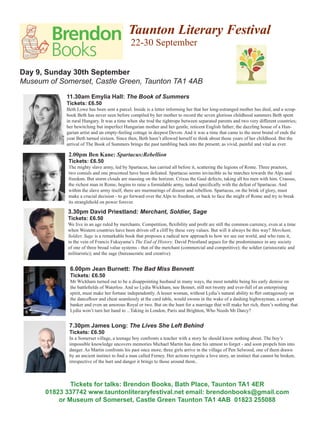
11.30am Emylia Hall: The Book of Summers
Tickets: £6.50

Beth Lowe has been sent a parcel. Inside is a letter informing her that her long-estranged mother has died, and a scrapbook Beth has never seen before compiled by her mother to record the seven glorious childhood summers Beth spent
in rural Hungary. It was a time when she trod the tightrope between separated parents and two very different countries;
her bewitching but imperfect Hungarian mother and her gentle, reticent English father; the dazzling house of a Hungarian artist and an empty-feeling cottage in deepest Devon. And it was a time that came to the most brutal of ends the
year Beth turned sixteen. Since then, Beth hasn’t allowed herself to think about those years of her childhood. But the
arrival of The Book of Summers brings the past tumbling back into the present; as vivid, painful and vital as ever.

2.00pm Ben Kane: Spartacus:Rebellion
Tickets: £6.50

The mighty slave army, led by Spartacus, has carried all before it, scattering the legions of Rome. Three praetors,
two consuls and one proconsul have been defeated. Spartacus seems invincible as he marches towards the Alps and
freedom. But storm clouds are massing on the horizon. Crixus the Gaul defects, taking all his men with him. Crassus,
the richest man in Rome, begins to raise a formidable army, tasked specifically with the defeat of Spartacus. And
within the slave army itself, there are murmurings of dissent and rebellion. Spartacus, on the brink of glory, must
make a crucial decision - to go forward over the Alps to freedom, or back to face the might of Rome and try to break
its stranglehold on power forever.

3.30pm David Priestland: Merchant, Soldier, Sage
Tickets: £6.50

We live in an age ruled by merchants. Competition, flexibility and profit are still the common currency, even at a time
when Western countries have been driven off a cliff by these very values. But will it always be this way? Merchant,
Soldier, Sage is a remarkable book that proposes a radical new approach to how we see our world, and who runs it,
in the vein of Francis Fukuyama’s The End of History. David Priestland argues for the predominance in any society
of one of three broad value systems - that of the merchant (commercial and competitive); the soldier (aristocratic and
militaristic); and the sage (bureaucratic and creative).

6.00pm Jean Burnett: The Bad Miss Bennett
Tickets: £6.50

Mr Wickham turned out to be a disappointing husband in many ways, the most notable being his early demise on
the battlefields of Waterloo. And so Lydia Wickham, nee Bennet, still not twenty and ever-full of an enterprising
spirit, must make her fortune independently. A lesser woman, without Lydia’s natural ability to flirt outrageously on
the dancefloor and cheat seamlessly at the card table, would swoon in the wake of a dashing highwayman, a corrupt
banker and even an amorous Royal or two. But on the hunt for a marriage that will make her rich, there’s nothing that
Lydia won’t turn her hand to ...Taking in London, Paris and Brighton, Who Needs Mr Darcy?

7.30pm James Long: The Lives She Left Behind
Tickets: £6.50

In a Somerset village, a teenage boy confronts a teacher with a story he should know nothing about. The boy’s
impossible knowledge uncovers memories Michael Martin has done his utmost to forget - and soon propels him into
danger. As Martin confronts his past once more, three girls arrive in the village of Pen Selwood, one of them drawn
by an ancient instinct to find a man called Ferney. Her actions reignite a love story, an instinct that cannot be broken,
irrespective of the hurt and danger it brings to those around them..

Tickets for talks: Brendon Books, Bath Place, Taunton TA1 4ER
01823 337742 www.tauntonliteraryfestival.net email: brendonbooks@gmail.com
or Museum of Somerset, Castle Green Taunton TA1 4AB 01823 255088
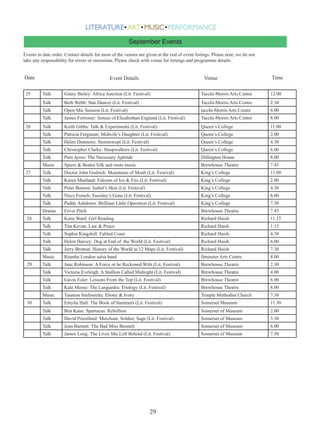
August Events
Events in date order. Contact details for most of the venues are given at the end of event listings. Please note, we do not
take any responsibility for errors or omissions. Please check with venue for timings and programme details.

Event Details

Date

Venue

Time

1st

Music

Vida Guitar Quartet

Dillington House

8.00

2nd

Music

English Guitar Quartet

Dillington House

8.00

Talk

Toni Davey talkes about her art

The Barn, Obridge Hosue

7.30

Photography

Cyanotype Photography Workshop

Bishop’s Hull House

10.00

Music

There on the Mountain: Folk Music From East Europe

St John’s Church (Taunt)

10.00

3rd

Music

Louise Parker  The Craig Milverton Trio (Jazz)

Ilminster Arts Centre

8.00

4th

Photography

Photography Workshop with George Reekie

St Michael’s Church (Galm)

2.00

5th

Music

George Formby with Sam Shepherd

Friends of Wellington Park

2.30

6th

Talks

Helen Keenan: Dipped Toes  Lasting Passions (Somerset Quilters)

Taunton Catholic Centre

7.15

8-18th

Musical

Sweet Charity MATA Summer Show

Regal Theatre

7.30

10th

Art

‘Loosen Up’ Workshop with artist Gwyn Ardyth

Bishop’s Hull House

9.30am

12th

Music

Yorkie - Wide Variety of Popular Music

Friends Wellington Park

2.30

Music

Taunton Sunday Band Concert

Vivary Park Bandstand

3.00

14th

Talk

Insect Photography - John Bebbington

Brendon Books

7.00

17th

Drama

Much Ado About Nothing - Folksy Theatre

Walled Gardens Cannington

8.00

18th

Writing

Creative Writing with Robin Brumby

St Michael’s Church (Galm)

2.00

Music

Wellington Acoustic Music Club

Wellington Arts Centre

8.00

Drama

Much Ado About Nothing - Folksy Theatre

Hestercombe Gardens

tbc

Music

Sapphire Easy Listening Music

Friends Wellington Park

2.30

Music

Stoke Sub Hamdon Band

Vivary Park Bandstand

3.00

Music

Much Ado About Nothing - Folksy Theatre

Hestercombe

tbc

Music

Dillington House Jazz Week Concert

Dillington Hosue

8.00

Music

19th

20

Tailgate Ramble  Swing

Dillington House

8.00

22-25th Drama

His Dark Materials Part 1 - Brewhouse Young Company

Brewhouse

2.30/7

24-26th Music

Honk Musical - Pezazz Performing Arts

Regal, Minehead

6.30

24th

Gadjo Guitars - Jazz

Ilmintser Arts Centre

8.00

Music

27
September Events
Events in date order. Contact details for most of the venues are given at the end of event listings. Please note, we do not
take any responsibility for errors or omissions. Please check with venue for timings and programme details.

Date
1st

Event Details

Venue

Time

Importance of Being Earnest - Miracle Theatre

Brewhouse (Vivary Park)

2/7.30

Music

Ego sum qui sum - Blackdowns Early Music

North Curry Parish Church

6.30

Music
2

Talk

Tir Na Gog Contemporary Folk Music

Wellington Arts Centre

7.30

Music

Ego sum wui sum - Blackdowns Early Music

Culmstock Parish Church

6.30

Music

Taunton Burtle Silver Band

Vivary Park

3.00

6

Poetry

Fire River Poets

Brewhouse Studio

8.00

7

Music

Viola Oboe Recital - Ex pupils of Wells Cathedral

St John’s Church, Taunton

12.30

Music

Twelth Day Folk Music

Bridgwater Arts Centre

8.00

Comedy

Jethro

Regal Theatre, Minehead

7.30

Music

Julian Stringle  Jim Hart  Craig Milverton Trio

Ilminster Arts Centre

8.00

Music

Gilmore Roberts Contemporary Folk Music

Wellington Arts Centre

7.30

7-16

Lighshow

Hestercombe Gardens Illumina- Lighting up the garden

Hestercombe Gardens

8.00

8

Music

Live ‘N’ Up @ Brew Crew

Brewhouse Studio

8.00

Music

Oak Manor Golf Club Summer Ball

Oake Manor

8.00

12

Drama

Celebration of Tom Lehrer

Bridgwater Arts Centre

8.00

13

Drama

Adolf - Pip Utton

Tacchi-Morris

7.30

Music

The Upbeat Beatles

Brewhouse Theatre

7.45

14

Music

Wessex Baroque

Ilminster Arts Centre

8.00

19

Music

Melvyn Tan: International Piano Concert Series

Brewhouse Theatre

7.45

19-22

Drama

Monkey Bars - Chris Goode and Company

Brewhouse Studio

8.00

21

Dance

Taunton Tango! Tango!

Brewhouse Theatre

7.45

22

Talk

Sir Roger Carrick: Diplomatic Anecdotage (Lit. Festival)

Castle Hotel

11.00

Talk

Alexander Waugh: Kiss Me Chudleigh ( Lit. Festival)

Castle Hotel

4.00

Talk

Felix Francis: Bloodline (Lit. Festival)

Castle Hotel

6.30

Music

Hoorah! Amici accompanied by Ron Prentice Jazz Trio

Kingston St Mary Church

7.30

Music

Carry on Singing - Chris Dean’s Syd Lawrence Orchestra

Brewhouse Theatre

7.45

Music

The Alberni String Quartet

Dillngton House

8.00

Talk

Rosemary Penfold: Posy of Wild Flowers ( Lit. Festival)

Hestercombe Gardens

11.30

Talk

Stephen Moss Interview (Lit. Festival)

Hestercombe Gardens

2.30

Talk

Duff Hart Davis: Man of War (Lit. Festival)

Hestercombe Gardens

4.00

Talk

Graham Harvey: Quest for Real Food (Lit. Festival)

Hestercombe Gardens

6.00

Talk

Miriam Darlington: Otter Country (Lit. Festival)

Hestercombe Gardens

7.30

Talk

Chris Ewan: Safe House (Lit. Festival)

Taunton School

2.00

Talk

Ally Kennen: Bullet Boys (Lit. Festival)

Taunton School

4.30

Talk

John Darwin: Unfinished Empire (Lit. Festival)

Taunton School

6.00

Talk

Gervase Phinn: Village School (Lit. Festival)

Taunton School

7.30

23

24
September Events
Events in date order. Contact details for most of the venues are given at the end of event listings. Please note, we do not
take any responsibility for errors or omissions. Please check with venue for timings and programme details.

Date
25

Venue

Event Details

Time

Tacchi-Morris Arts Centre

2.30

Open Mic Session (Lit. Festival)

tacchi-Morris Arts Centre

6.00

James Forrester: Senses of Elizabethan England (Lit. Festival)

Tacchi-Morris Arts Centre

8.00

Talk

Keith Gibbs: Talk  Experiments (Lit. Festival)

Queen’s College

11.00

Patricia Ferguson: Midwife’s Daughter (Lit. Festival)

Queen’s College

2.00

Talk

Helen Dunmore: Stormswept (Lit. Festival)

Queen’s College

4.30

Talk

Christopher Clarke: Sleepwalkers (Lit. Festival)

Queen’s College

6.00

Talk

Pam Ayres: The Necessary Aptitide

Dillington House

8.00

Music

Spiers  Boden folk and roots music

Brewhouse Theatre

7.45

Talk

Doctor John Godrich: Mountains of Moab (Lit. Festival)

King’s College

11.00

Talk

Karen Maitland: Falcons of Ice  Fire (Lit. Festival)

King’s College

2.00

Talk

Peter Benson: Isabel’s Skin (Lit. Festival)

King’s College

4.30

Talk

Nicci French: Tuesday’s Gone (Lit. Festival)

King’s College

6.00

Talk

Paddy Ashdown: Brilliant Little Operation (Lit. Festival)

King’s College

7.30

Drama

Fever Pitch

Brewhouse Theatre

7.45

Talk

Katie Ward: Girl Reading

Richard Huish

11.15

Talk

Tim Kevan: Law  Peace

Richard Huish

1.15

Talk

Sophia Kingshill: Fabled Coast

Richard Huish

4.30

Talk

Helen Harvey: Dog at End of the World (Lit. Festival)

Richard Huish

6.00

Talk

Jerry Brotton: History of the World in 12 Maps (Lit. Festival)

Richard Huish

7.30

Music

Riamba London salsa band

Ilminster Arts Centre

8.00

Talk

Jane Robinson: A Force ot be Reckoned With (Lit. Festival)

Brewhouse Theatre

2.30

Talk

Victoria Eveleigh: A Stallion Called Midnight (Lit. Festival)

Brewhouse Theatre

4.00

Talk

Gavin Esler: Lessons From the Top (Lit. Festival)

Brewhouse Theatre

6.00

Talk

Kate Mosse: The Languedoc Triology (Lit. Festival)

Brewhosue Theatre

8.00

Music
30

Beth Webb: Star Dancer (Lit. Festival)

Talk

29

12.00

Talk

28

Tacchi-Morris Arts Centre

Talk

27

Ginny Bailey: Africa Junction (Lit. Festival)

Talk

26

Talk

Taunton Sinfonietta: Ebony  Ivory

Temple Methodist Church

7.30

Talk

Emylia Hall: The Book of Summers (Lit. Festival)

Somerset Museum

11.30

Talk

Ben Kane: Spartacus: Rebellion

Somerset of Museum

2.00

Talk

David Priestland: Merchant, Soldier, Sage (Lit. Festival)

Somerset of Museum

3.30

Talk

Jean Burnett: The Bad Miss Bennett

Somerset of Museum

6.00

Talk

James Long: The Lives She Left Behind (Lit. Festival)

Somerset of Museum

7.30

29
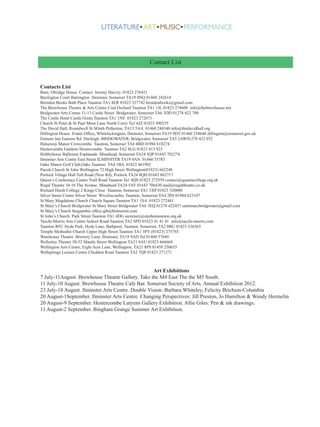
Contact List

Contacts List

Barn, Obridge House. Contact: Jeremy Harvey. 01823 276421
Barrington Court Barrington  Ilminster, Somerset TA19 0NQ 01460 242614
Brendon Books Bath Place Taunton TA1 4ER 01823 337742 brendonbooks@gmail.com
The Brewhouse Theatre  Arts Centre Coal Orchard Taunton TA1 1JL 01823 274608 info@thebrewhouse.net
Bridgwater Arts Centre 11-13 Castle Street  Bridgwater, Somerset TA6 3DD 01278 422 700
The Castle Hotel Castle Green Taunton TA1 1NF 01823 272671
Church St Peter  St Paul Moor Lane North Curry Ta3 6JZ 01823 490255
The David Hall, Roundwell St SOuth Petherton. TA13 5AA 01460 240340 info@thedavidhall.org
Dillington House  Estate Office, Whitelackington, Ilminster, Somerset TA19 9DT 01460 258648 dillington@somerset.gov.uk
Enmore Inn Enmore Rd  Durleigh, BRIDGWATER, Bridgwater, Somerset TA5 2AW01278 422 052
Halseway Manor Crowcombe  Taunton, Somerset TA4 4BD 01984 618274
Hestercombe Gardens Hestercombe  Taunton TA2 8LG 01823 413 923
Hobbyhorse Ballroom Esplanade  Minehead, Somerset TA24 5QP 01643 702274
Ilminster Arts Centre East Street ILMINSTER TA19 0AN 01460 55783 
Oake Manor Golf Club,Oake Taunton  TA4 1BA 01823 461992
Parish Church St John Wellington 72 High Street Wellington(01823) 662248
Porlock Village Hall Toll Road (New Rd), Porlock TA24 8QD 01643 862717
Queen’s Conference Centre Trull Road Taunton Ta1 4QS 01823 272559 contact@queenscollege.org.uk
Regal Theatre 10-16 The Avenue  Minehead TA24 5AY 01643 706430 mail@regaltheatre.co.uk
Richard Huish College 2 Kings Close  Taunton, Somerset TA1 3XP 01823 320800
Silver Street Centre Silver Street  Wiveliscombe, Taunton, Somerset TA4 2PA 01984 623107
St Mary Magdalene Church Church Square Taunton TA1 1SA 01823 272441
St Mary’s Church Bridgwater St Mary Street Bridgwater TA6 3EQ 01278 422437 saintmarybridgwater@gmail.com
St Mary’s Church Stogumber office.qtb@btinternet.com
St John’s Church Park Street Taunton TA1 4DG secretary@stjohnstaunton.org.uk
Tacchi-Morris Arts Centre School Road Taunton TA2 8PD 01823 41 41 41 info@tacchi-morris.com
Taunton RFC Hyde Park, Hyde Lane, Bathpool, Taunton, Somerset, TA2 8BU 01823 336363
Temple Methodist Church Upper High Street Taunton TA1 3PY (01823) 275765
Warehouse Theatre  Brewery Lane, Ilminster, TA19 9AD Tel 01460 57049
Wellesley Theatre 50-52 Mantle Street Wellington TA21 8AU 01823 666668
Wellington Arts Centre, Eight Acre Lane, Wellington, TA21 8PS 01458 250655
Wellsprings Leisure Centre Cheddon Road Taunton TA2 7QP 01823 271271

Art Exhibitions
7 July-11August. Brewhouse Theatre Gallery. Take the M4 East The the M5 South.
11 July-10 August. Brewhouse Theatre Cafe Bar. Somerset Society of Arts. Annual Exhibition 2012.
23 July-18 August. Ilminster Arts Centre. Double Vision: Barbara Whiteley, Felicity Brichien-Columbia
20 August-1September. Ilminster Arts Centre. Changing Perspectives: Jill Preston, Jo Hamilton  Wendy Hermelin
20 August-9 September. Hestercombe Lutyens Gallery Exhibition. Allie Giles: Pen  ink drawings.
11 August-2 September. Bingham Grange Summer Art Exhibition.
Piano Lessons
Experienced Teacher
Home Visits
Exams or Pleasure

Harry Sherman
01823 338842
31
Somerset Arts works takes
place between 15-30 September and makes up the
majority of the visual arts
programme in the area in
Somerset in September
with over 350 artists at
around 221 studios, barns
streets and other venues
across Somerset plus an
exhibition programme.
Amongst the highlights at this year’s Somerset
Art Weeks 2012 are beautiful garden ceramics,
wood sculpture and bowls from sustainable local sources, a silent auction for a Goldsmith’s
graduate’s paintings, site-specific weaving and
light installations, colourful limited edition
etchings, and dreamy watercolours inspired
by the Somerset landscape. These, and over
300 other inspirational, diverse artworks will
be on display in houses, barns, halls, studios
and streets during Somerset Art Weeks 2012,
September 15 – 30. Purchase or commission
unique artworks, craft, jewellery and ceramics, or just enjoy Somerset’s art and culture.
Many artists have international reputations,
all have a story to tell, and positively encourage conversation about their work. Most studios are family friendly and some also cater
for people with disabilities.
To complement the Somerset spirit of artistic
adventure, Somerset Art Works are also staging several events and exhibitions. SAW has
commissioned Chantelle Henocq from Fire 
Ice to work with graduate photographer Sebastian King and Somerset based writer David Davis to produce images and words around
the theme ‘Artists and their creative space’.
The commission will be exhibited at the Cafe
Gallery at the Brewhouse Theatre in Taunton
during the Art Weeks. The Brewhouse Theatre will also be transformed into temporary
artists’ studios to host resident exchange artists from Stroud and an emerging artist from
Somerset. 
Showcasing SAW’s curatorial programme,
Maximum Exposure, will be a 13 metre inflatable sculpture to celebrate Yeovil’s glove
making history (bouncing welcome!) and a
film documenting the moving art happening
from Illuminos where projections and illuminations highlighted pill boxes of the old Taun-

ton Stop Line- 300 military bunkers built during WWII to stop a potential German advance
from the West. Visitors can see the unique film
at Illminster Warehouse Theatre.
Artistic interpretations of the Great Crane
Project - the re-introduction of the majestic
crane back to the Somerset Levels - will be on
show at the Somerset Craft Centre, including
hundreds of origami cranes created by community groups, as well as sculpture, jewellery
and painting.
Somerset Art Weeks is organised by Somerset Art Works (SAW Ltd,) a not-for-profit
organisation which promotes the visual arts
and creates opportunities for visual artists
and makers in Somerset by advocacy, promotion and development.

Further Information
A comprehensive full colour guides
available from libraries and Tourist Information Centres throughout
Somerset as well as a number of
other pick-up points or by sending A5 SAE for £1.20 to SAW Ltd,
Town Hall, Bow St, Langport TA10
9QR. Alternatively see online venue
map and list of participants at the
following website addresses: www.
somersetartworks.org.uk/venue/
map and www.somersetartworks.
org.uk/SAW12_participant.
A Potters Life
Nick Rees, master
potter, celebrates 40
years at Muchelney
Pottery
Anyone who’s ever tried throwing a pot by
hand on a wheel will know how incredibly
difficult it is to control that spinning lump of
wet clay. Imagine then the challenge of handthrowing fifty or a hundred pots, one after another, all to the same design.
But Master Potter Nick Rees, right-hand man
at John Leach’s famous Muchelney Pottery,
near Langport, Somerset has achieved that.
And much more. As well as taking a major role
in producing Muchelney Pottery’s renowned
catalogue range of handmade kitchenware for
the past forty years, Nick has been closely involved with the pottery shop and the business
bookkeeping; managing the crucial and gruelling two-day firing of the pottery kiln, and explaining the workings of the pottery to visitors
from all over the world.
John Leach is quick to acknowledge that the
continuing success of Muchelney Pottery
owes much to Nick’s deft hand, critical eye
and potting skills. “He’s amazing. I feel we’re
more like partners than employer and employee,” says John. “The shapes of Muchelney
pots may be my designs, but Nick is fantastic
at interpreting them. And, it may seem a small
thing, but he is an absolute master at getting
lids to fit! He could make, say, fifty garlic pots
with lids – and the lids would all be interchangeable. Incredible.”
The pots that Nick makes range from mugs
and bowls to jugs and plates. “Goodness
knows how many I’ve made over the years – it
must be tens of thousands,” he estimates.
Looking back over his forty-year career Nick,
a highly intelligent but unassuming man, sums
it up: “I’ve been so privileged to work with
John at Muchelney. I love the pot designs and
my nature is such that I positively enjoy the
precision and the discipline needed to achieve
and maintain the level of craftsmanship handmade pottery demands.”
The physical toll of the work is demanding,
he admits. Mixing the heavy clay; carrying boards of unfired pots from workshop to
kilnshed; incredibly hot, back-breaking hours
feeding wood into the kiln. But the rigours
have always been immensely rewarding, not
only in the satisfaction of mastering the required potting skills but in the excitement
of discovery at each kiln opening and in the

ultimate contentment of using one’s hands to
produce desirable, useful objects.
Even in his spare time, Nick continues to
make pots, but to his own personal designs.
Pots which, although founded on his years of
experience in the Leach tradition, are noticeably different from the sturdy, classic shapes
of his “day job”. Nick’s decorative pots have
an elegance and a subtle refinement in outline
and their surfaces are accentuated by carving
and fluting and experiments with slips and
glazes.
“Making my own designs has been about finding a voice and making a spiritual statement”,
he explains.
Most of his designs are fired in the Muchelney
kiln which gives them the unique, organic signature of wood-firing. But two years ago Nick
began experimenting with an electric kiln and
this has led him to new exploration into the
possibilities of oxidised firing, “a process that
allows no hiding places.”
Since his first one-man exhibition at a prestigious gallery in Ringwood in 1990, Nick
has established a laudable reputation for his
distinctive personal work in stoneware and
porcelain. More exhibitions have followed
and his pots are now for sale in a selection of
leading galleries throughout the country. They
are also in the Leach Pottery at St Ives and in
the gallery at Muchelney Pottery.
It is here that an exhibition is planned for September to celebrate Nick’s achievements over
40 years, with the launch of his latest collection of individual, signed pots.
Nick’s career could have been very different.
Somerset-born in 1949, he initially trained as

33

a teacher in creative design at Loughborough
College of Education and spent two years
teaching woodwork in a Coventry comprehensive school before deciding to change direction and train to be a potter.
But Nick’s teaching abilities have proved very
useful at Muchelney. During public kiln opening events at the pottery, he is always on hand
to answer visitors’ questions about the making
process. “And he has been so good at running
a practised eye over the work of students and
apprentices who have trained with us over the
years,” adds John.
Nick remembers his own 1972 initial “trial period” at Muchelney very clearly. John Leach
set him the task of making 150 coffee mugs.
After inspecting the finished work, John threw
out 148 of the mugs and passed just two as
saleable. “I didn’t think he’d keep any of
them” was Nick’s reaction.
It was this reaction which helped to convince
John that Nick had the right kind of temperament to become a potter and that they would
work well together. “I really admired his patience – and I still do,” says John.
John’s confidence was fulfilled. With the aid
of a government grant Nick successfully completed his five-year apprenticeship. Then, at
John’s suggestion, he left Muchelney temporarily to experience work in Brian and Julia
Newman’s nearby Aller Pottery. Three months
later he returned and the rest, as they say, is
history.
In 1998 Nick was elected a Fellow of the Craft
Potters Association and in 2005 was elected a
Full Member of the Devon Guild of Craftsmen.
Colour Matters

Painting is the latest
of several careers in
Angus Stirling’s life.
In September he will
hold a joint exhibition with his daughter, Kitty.

After he left university Angus worked as a
trainee at Christie’s auctioneers before becoming a merchant banker at Lazar Brothers for 10
years. It stood him in good stead for the rest
of his life. ‘It gave me invaluable business
experience,’He explains. ‘I could not have
done any of things that I did afterwards without it.’
But art was never far away from his vision.
After Hazard’s he spent a brief spell as the administrative director of the Paul Mellon Foundation who published literature on British art.
Following that he became deputy director of
the Arts Council where he remained for ‘nine
very happy years.’ He then joined the National Trust where he became director general and
where he was to stay for 17 years.
Angus was clear before his retirement that
he would devote himself to art and has done
so since then. He has a studio at his Somerset
home at the foot of the Quantocks. It is not his
exclusive interest (he retains some non-executive posts in London and enjoys walking and
photography among other pastimes), but it is
art that continues to inspire him - and he does
not like to be too long away from his studio.
He may have inherited a talent for painting
from his mother. She trained as an artist in her
twenties and was a talented figurative painter,
mainly of landscapes. She brought him up to
look at pictures from the age of 3 or 4. From
the age of 5 or 6 he received painting tuition.
His great-grandfather (on his mother’s side),
was also a fine painter; a traveller and explorer
who painted watercolours wherever he went.
Both his mother and father collected painting.
His father, who was a banker, preferred old
masters while his mother collected twentieth
century art.
After retiring, Angus sought out Robin Child
who had been recommended to him as an art
tutor. He has high praise for Child. ‘He taught
with great insight other artists work” He gave
him the intellectual stimulus to understand
what he was doing though Angus believes that
at some stage you have to launch out on your

own as, ‘Otherwise your painting can become
too derivative.’
Child also gave him a thorough grounding
in the technical side of producing art which he
believes he has improved on over the years.
Before painting in oils, for example, he takes
a great deal of trouble to prepare his palette,
setting up the warms and cools before deciding whether the general tone of the painting is
to be light or dark, believing that if you set up
your palette carefully in this way you are less
likely to paint a bad picture.
Angus’s training also embraced fundamental
principles governing the organisation of the
picture space. ‘It is a question of instinctive
awareness of where the golden section and
the square of the rectangle lie on the canvas,
in order to make the composition secure and
interesting. It is not always easy, but it is one of
the keys that unlocks a good picture.
When painting the human figure Angus will
usually sketch onto the canvas first though he
is less likely to when he is painting a landscape
or abstract painting. He often takes a small
pocket sketchbook and does a series of drawings, say a landscape or a building, especially
if travelling. These will usually be figurative
drawings. He will then take them back to the
studio and explore what the drawings make
him feel and reinterpret them in the form of
a painting.
What emerges is often very different from the
drawing. In fact, sometimes there is no obvious relationship between the drawing and the
painting. Sometimes the paintings that result
are abstract and sometimes they are not.
He is often approached by people who do not
think they like an abstract painting. They will
make such comments as what does it mean or
what is it supposed to represent. His answer is
to suggest the adoption of the same approach
that you would when you go to a music concert

Evocation of the garden of Ninfa

Angus Stirling in his studio

when you do not ask that question.
For him colour matters almost more than
anything else – he loves the effect produced
by their juxtaposition. Angus also attempts to
explore the form of the painting through the
colour as well as through the composition. He
particularly likes the American Expressionists,
‘because of their use of colour and the exciting
way they handle paint – in a free and expressive manner.’
‘I have no interest in reproducing accurately
what I see,’ he adds, ‘which does not mean that
I do not admire those who do’
He is influenced by the relationship of music to painting. ‘It does not mean that I listen
to a piece of music try to turn that music directly into a painting,’ he explains ‘but if I am
listening to a piece of music, say by Berlioz
whose music is particularly colourful I may
draw something from the rhythm and counterpoint and the tonal values – which also apply
to painting.’
Poetry can also sometimes be an influence
on his painting, particularly the poetry of A.E.
Houseman, Yeats and John Clare. He sold three
pictures inspired by John Clare in an open studio event for Somerset Arts Week a few years
ago.
Angus goes on to describe how he is searching for a kind of meaning when he paints a
picture especially ones which features nature.
He is interested in the spiritual value that you
can try to convey – albeit elusive and difficult
to find. ‘I’m not trying to make an image, but
rather to search for and discover an assemble
of mass, line, colour and texture that will blend
into a painting that conveys what I am trying
to say. If it then also speaks to the viewer, you
have gone some way to succeed.’
In order to give an example of this he turns to
his painter hero, Cezanne, citing the numerous
landscapes that Cezanne painted of St Victoire.
‘I think there were few artists of the twenti-
eth century that were not influenced in some way
by Cezanne,’ he continues. ‘I think he was the artist that understood the wholeness of nature. He was
truly original. He created a new way of looking and
interpreting landscape, figures and still life, integrating all elements of the picture and in his later years
foreshadowing the cubism developed by Braque and
Picasso.’
Angus has three children, all of whom have been
capable painters, but it is Kitty, his youngest daughter who has always wanted to be an artist since she
was a young child and is now a professional artist
and tutor. Angus and Kitty frequently work together
and share the experience of both the creative act of
painting and looking at art of all kinds. He believes
she has helped him appreciate how to use space in
a painting and admires her paintings. They shared
an exhibition at Cork Street Gallery in London in
November 2010. The exhibition was a tremendous
success. They sold 57 pictures in a week between
them in approximately equal numbers. Other galleries have since taken an interest in both their
works and now they are to repeat the joint approach

Early Morning, Quantock Hills oil on canvas

Exhibition by Angus Stirling and Kitty Stirling at the Lynda Cotton
Gallery 46-47 Swain Street, Watchet TA23 OAG 01984 631814
SEPTEMBER 10 - 22 SEPTEMBER. OPEN MONDAY TO SUNDAY
10.00AM - 5.30PM

KITTY STIRLING
Kitty Stirling says of her father, ‘ I have my father to thank for being an artist. When I was
young, despite his dedicated career in the Arts, he always enjoyed painting when the time allowed and my mother and he would do a lot of sketching on holiday. In 1976, aged 10, my father and I went to see a Turner exhibition at Tate Britain which had a big effect in my thinking
about painting. The exhibition as I remember, juxtaposed Turner with Rembrandt, two great
masters. Struck by the magnificent light emanating from these paintings, I was also taken in
by the window they created to another world, a coherent vision of nature. My father lifted me
up to the paintings so I could see them closely and in an instance I entered the world of paint.
That day I discovered that light was equal to white. In recent years, my father has become an
artist in his own right and I visit him in his studio from time to time to look at what he’s been
doing. I’m struck by his boldness in colour and his painterly expression. I enjoy his passion
and feel immensely proud of him. ‘
Kitty studied Fine Art at Chelsea School of Art and Byam Shaw School of Art and her work
has been regularly exhibited in solo and group exhibitions since 1990. Much of her life has
Kitty and Angus
been spent in the Quantock Hills of Somerset. Between 1999 and 2007 she divided her time
between England and Greece, where she taught and painted. Most recently represented by Caroline Wiseman Modern and
Contemporary, her work is in private collection and has been selected for the Lyn Painter Stainers Prize (2010) and the Royal
Academy Summer Exhibition (2012). Since 2009, Kitty Stirling has roamed freely inside the private allotments of Child’s Hill,
drawing a community of outsiders (in Greek idiotikes) whose personal stories led each one there; nurturing plants as a means
to nurturing themselves, returning there because there embodies the place in which they feel most at home. For the artist
such inanimate traces of human life offer an opportunity for contemplation, as if the last personon earth has just departed.
There is something unexpectedly poignant about these personal spaces, and to study them is an act of gentle voyeurism to
which the viewers are an intimate party.

Plot 42 North

35

Birdcage 1
Quartz Visual Arts Festival 2012
John Marston,
the Quartz Festival
Director looks
forward to the
2012 programme.
In the seven years since the inaugural
Quartz arts festival began in 2005 this
annual exhibition of paintings and
sculpture by some of the South West’s
most renowned artists has become a
key event in the region’s artistic life.
The evening performance events have
attracted audiences from all over region;
headlining acts such as Seth Lakeman,
the late and great Humphrey Lyttelton,
Sandy Toksvig and many others have
been boosting and refreshing the town’s
cultural profile for the last seven years.
Leading exponents of classical
music, jazz, folk rock, and theatre
groups, comics and poets have played to
audiences in the Queen’s Hall, and children from across the county’s schools
have been visiting the festival’s art and
enjoying the performance events. The
aim of the festival both in terms of performance and the art work has always
been to provide Taunton with a mix of
the popular and the provocative. The

John Hegley

Lesley Garrett

festival organisers have aimed to create
an intense ten day festival of art and
acts with strong flavour and an eclectic
appeal.
This year the tradition looks to
continue, both in terms of the high
profile artists exhibiting, some for the
first time, and for the diversity of the
performances in the evenings. Events
from the small scale intimate theatre of
Chris Larner, whose Edinburgh Festival’s award winning and bitter-sweet
exploration of assisted suicide will sit
alongside the well established acts of
Lesley Garrett and Elkie Brooks. In the
midst of this the festival we will also
welcome the poet comic John Hegley,
known as the ‘people’s laureate’, and
the idiosyncratic cricket commentator
Henry Blofeld, whose extraordinary
life story is worth hearing. The range of

appeal looks to be absorbing and should
create a buzz around Taunton as next
Autumn begins to take hold. Lesley
Garrett, whose early career included
engagements with Glyndebourne and
the English National opera, and who is
now established as one of the country’s

Louise Baker
Sara Dudman

most popular sopranos, will be coming to the festival for the first time.
Elkie Brooks, recently described by
the guardian as ‘still one of Britain’s

best voices’, returns to the festival after
seven years with her six piece band and
a new album..
This year the festival has widened the
remit of the exhibition to include not
only painting and sculpture but also
the Applied Arts; Furniture, Ceramics,
Jewellery, Textiles and Photography.
About 40 Artists will be showing this
year, some new to the venue: Matthew
Ensor, Maggie King, Paul Anderson,
Sara Dudman and some regular Exhibitors George Hider, Melanie Deegan
and Claire Western. There will be on
show a series of short accessible Artists
Films on a closed loop in the café and
the hope is to have an Andy Goldsworthy style Sculpture taking shape as the
festival progresses in the Gardens at
Queen’s. A series of fringe performances, as members of the public look
around the art work, will also take
place. These are to take place at 4.15
pm on each day of the festival. It’s
certainly worth looking out for the
clowning and visually stunning street
performers Le Navet Bete, who tour
internationally at 6th October 2012. For
tickets: www.quartzfestival.org.uk and
will be performing on Friday 28th of
September. There is to be a programme
of informal Artists talks in the Exhibi-

Artists on Display from Wed 26 Sep - Sat 6 Oct 2012
Maggie King, Nicky Clarke, Susan Deakin, Sam Photic, Waiyuk Kennedy,
Michael Tarr, Pauline Zelinkski, Sarah Thompson-Engels, Caroline
Mcmillan Davey, Judy Willoughby, Le Navet Bete, Mathew Ensor, Ursula
Leach, Chris Webb, Claire Schmidt-Norris, Claire Western, Heather
Hughes and Jenni Dutton.

Event Line-up
Date			
Thur 27 Sep 2012	
Mon 01 Oct 2012	
Tue 02 Oct 2012	
Wed 03 Oct 2012	
Thu 04 Oct		
Fri 05 Oct 2012	

Event			
Lesley Garrett		
Harrison Richards	
Henry Blofield		
John Hegley		
Elkie Brooks		
Chris Larner	

Time
7.30pm
7.30pm
7.30pm
2.00pm
7.30pm
7.30pm

Queen’s College, Trull Road, Taunton TA1 4QS
Enquiries: 01823 340805 or email quartz@queenscollege.org.uk

37

Lucy Hinds

tion Hall from 2-3pm on most days,
creating accessibility and added enjoyment to the experience. The festival will
welcome visitors new to the festival and
of course those re-visiting. The gallery
is open between 11.00 am and 5.00 pm.
Visitors can enjoy the art at their own
leisure and find good quality coffee and
cakes in the adjacent café. The evening
events are best booked online. Some
shows are likely to be sold out so it
might be wise to book early.
The World’s Two Smallest Humans
Julia Copus has won a
string of poetry awards
and is one of the nations
foremost poets. Her eagerly awaited new volume, The World’s Two
Smallest Humans, has
aleady received fulsome
praise and is proving a
poetry best-seller.
Julia Copus reading to a packed audience at Brendon Books

Her love of writing began in primary school
when she wrote long stories for the school
paper, The Baddesley Bundle. Though she
did write some poetry at school and in her
early years at University, her serious engagement with poetry came later.
‘Most writers feel that there is a definitive moment; for me it was reading Sylvia
Plath’s The Bell Jar,’ she recalls
This particular book is not poetry but a
semi-autobiographical novel concerning a
descent into mental illness. However, that
was the hook that led her to Plath’s poetry.
Though she enjoyed The Bell Jar, she
found the poetry more affecting, powerful
and vigorous. The poem, Daddy, moved
her so much that she could not read it without crying. Moreover, Julia felt that she
had found a way into this magical world
and was capable of producing serious poetry herself. She was twenty-two when she
began writing poetry in earnest. She saw
an advert for the Swanage Arts festival, put
a group of poems together and won first
prize. It was confirmation of her own talent. ‘You need these boosts for reassurance
and confirmation,’ she explains. She now
felt justified in continuing to write poetry.
Julia had accepted a place to train as a
teacher at Honiton College, Cambridge.
However, just before she was due to take
up her post she won a prestigious Eric Gregory Award, given each year to the best
four or five aspiring poets under 30. Previous winners of the award read like a rollcall of the best of modern poets so its im-

portance cannot be underestimated. Julia
remembers the irony of the situation when
she collected the award. While clutching
a cheque for £6,000 she missed the last
train home and did not have any money
for a hotel, so she ended up spending the
night on a parked train. ‘It is the most uncomfortable night I have ever spent,’ she
says with feeling. In the longer term, she
now had a dilemma: should she take up
her teaching post or pursue a career as a
poet? She discussed the situation with the
teacher-training college and between them
they achieved the perfect compromise. Julia would try and make her way as a poet
while they would keep the teaching post
open for her. ‘As far as I know,’ she says
wryly, ‘it is still open.’
Shortly after making that decision, she
was one of ten winners of another competition judged by Neil Astley, the founder
of prestigious poetry publishers Bloodaxe
Books. At the prize-giving ceremony, she
was required to read one of her poems, but
was so nervous that Neil Astley read it for
her. Afterwards she says, ‘I did something
you should never do: I gave him some of
my poems that I had in my bag.’ He did,
however, read them on the train on the way
home, and afterwards sent her an encouraging letter and praised her in particular
for a poem about her father, written in a
new form (in which the second half of the
poem is an exact mirror of the first). He
indicated that if she could come up with a
further 15 poems of this quality he would

be interested in publishing her. When she
finally received her first contract, she was
so excited she ripped her thumb on the
staples of the jiffy bag in which he’d also
enclosed some Bloodaxe books as a gift.
She still has the letter – decorated with the
stain from her blood.
After that, she started writing furiously.
‘Slowly, but furiously,’ she qualifies. She
published a booklet and then a first collection with Bloodaxe came out, The
Shuttered Eye. It had good reviews and
received a Poetry Book Society Recommendation (awarded each quarter to the
best four new releases).
There was a long gap before her next
volume of poetry. For Julia, the process of
producing a volume of poetry is all encompassing. After the book is finished there are
the readings and the marketing of the book.
She feels that she requires a mental space
between beginning another volume.
The Shuttered Eye included a number of
myths and fairy tales. In Defence of Adultery, when it came, was more metaphysical
and science based. In one of the poems,
she compares the process of falling in love
with water seeping into a sponge by capillary action: We don’t fall in love: it rises
through us. She has, in fact, attracted the
tag of a metaphysical poet because of the
way that she expresses emotions in such a
tangible and physical way. In Defence of
Adultery confirmed her place as one of the
most accomplished modern poets.
There have also been a couple of radio
plays. For one of them she won the Alfred
Bradley Award. Writing a radio drama was
completely different to writing poetry and
in some ways a simpler and more straightforward experience as she was able to follow a distinct narrative thread.
She explains that prizes are an unavoidable part of the poetry world.
‘If I have a rejection I get over it quickly,’
she says. ‘I don’t have a huge ego and usually think that they are probably right. I
think it is quite a female way of looking at
things. I think perhaps boys are brought up
differently. If they get rejected and do not
win a prize at school it seems to me they
very often challenge the thinking behind
that decision.’
Surprisingly, perhaps, Julia did not like
studying poetry at school. She did not
like the way that it was represented as
something that you have to have a special
knowledge to understand, and she particularly dislikes poems that have so many allusions that you have to have an encyclopedia next to you while reading them. ‘I
think you are asking people to work too
hard,’ she explains. ‘The reason for writing anything is to communicate. A poem
draws lots of attention to itself. It is like a
painting hanging on the wall that says I am
really important. It should make you think,
provide depth and intensity and make life a
little more magical.’
Julia is grateful for what poetry has given
her, and gives particular credit to the Royal
Literary Fund who gave her a generous
grant when she originally moved down to
Somerset to a tumbledown cottage. ‘Poetry
has pretty much shaped my adult life,’ she
says.
Her eagerly awaited new poetry collection, The World’s Two Smallest Humans,
has just been published, and that event
has happily coincided with her marriage
to Andrew, who teaches English at a local
secondary school. She has been published
by Faber, the Rolls-Royce of poetry publishers, for the first time. She admits the
process of being published is ‘a bit nerve
racking,’ as she awaits reviews and how
her new book fares in a pool of competitions. But she is also looking forward to the
next stage of the process as the book makes
its way into the world and takes on a life
of its own. If the rapturous reaction of the
packed audience is anything to go by, at the
recent regional launch of her new volume
at Brendon Books, she need have nothing
to fear about her new progeny.

A Soft-edged Reed of light
That was the house where you asked me to remain
on the eve of my planned departure. Do you remember?
The house remembers it – the deal table
with the late September sun stretched on its back.
As long as you like, you said, and the chairs, the clock,
the diamond leaded lights in the pine-clad alcove
of that 1960s breakfast-room were our witnesses.
I had only meant to stay for a week
but you reached out a hand, the soft white cuff of your shirt
open at the wrist, and out in the yard,
the walls of the house considered themselves
in the murk of the lily-pond, and it was done.
Done. Whatever gods had bent to us then to whisper,
Here is your remedy – take it – here, your future,
either they lied or we misheard.
How changed we are now, how superior
after the end of it – the unborn children,
the mornings that came with a soft-edged reed of light
over and over, the empty rooms we woke to.
And yet if that same dark-haired boy
were to lean towards me now, with one shy hand
bathed in September sun, as if to say,
All things are possible – then why not this?
I’d take it still, praying it might be so.
Julia Copus

Bibliography
2012 The World’s Two Smallest Humans
2009 Brilliant Writing Tips for Students,
Palgrave Macmillan
2003 In Defence of Adultery, Bloodaxe
1995 The Shuttered Eye, Bloodaxe
1994 Walking in the Shadows, Smith/
Doorstop
Awards
2010 Forward Poetry Prize (Best Single
Poem), ‘An Easy Passage’
2005 Arts Council Writers’ Award
2002 National Poetry Competition, First
Prize - ‘Breaking the Rule’
2002 BBC/Gulbenkian Writers Award
2002 BBC Alfred Bradley Bursary
Award, Eenie Meenie Macka Racka,
Best New Radio Playwright
2001 Arts Council Writers’ Award
1997 Forward Poetry Prize (Best First
Collection), The Shuttered Eye
1995 Hawthornden Fellowship
1994 Eric Gregory Award

39

Signed copies available from
Brendon Books, Bath Place,
Taunton TA1 4ER
01823 337742
email: brendonbooks@gmail.com
Blackdowns
Early Music
Project
What started as a oneoff weekend workshop in
2004, bringing together
experienced singers with
a specialist music director
to work on a programme
of renaissance music, has
become a regular feature
in the lives of Catherine
and Geoffrey Bass.
Since that first workshop they have organized
and hosted around 20 residential weekends
culminating in highly acclaimed concerts in
and around the Blackdown Hills, offering
programmes of infrequently performed early
music to modern audiences.
‘We perform more or less anything written before 1720. After that music started to

Catherine  Geoffrey Bass

become very much more complex, composers began to write works that were designed
for very large forces of players and singers,
and instruments were changing, becoming
larger and noisier to fill the acoustic of the
massive opera houses and concert halls that
were springing up all over Europe,’ Geoffrey
explains. ‘Blackdowns Early Music Projects
specialises in music that was principally
designed for performance in churches and
more intimate chamber acoustics, so the concerts frequently include a cappella vocal music, or works supported by just a small group
of continuos players, a chamber organ and

JanJoost van Elburg conducts Blackdown Early Music Singers

perhaps a violone and viola da gamba.’ On
occasion there have been some extravagant
departures from this pattern, for example
when Catherine’s birthday present to Geoffrey was a period orchestra to accompany a
Blackdowns Early Music performance of the
F min Requiem by Heinrich Biber and the
vespers of 1640 by Monteverdi.
Both Catherine and Geoffrey developed an
early interest in music. Catherine has been
singing in choirs of one sort or another since
she was seven and cannot remember a time
when she has not been involved with singing, either as a choral society member, in a
chamber ensemble or indeed as a soloist. Geoffrey’s musical experience was sparked in
his home town of Winchester; he learned the
tuba at school in Marlborough College, where
he was a member of an accomplished brass
quintet with Crispian Steele-Perkins as first
trumpet (now an internationally renowned
natural early trumpet player). Geoffrey went
on to gain a place playing the tuba in the British National Youth Orchestra.
Geoffrey and Catherine met in Reading
where they were both worked, Geoffrey in
the print finishing industry and Catherine as a
research microbiologist. In their leisure time
they were involved in music administration
and performance, Geoffrey as chairman of
the local Symphony Orchestra while Catherine was secretary of a large choral society.
Reading was an ideal location as it was not
too far away to attract young talented music
graduates from London or Oxford who took
posts with provincial societies to expand
their musical experience and repertoire. One
such (Oxford) graduate was Andrew Parrott
who became musical director of the Reading
Symphony Orchestra, while at the same time
founding The Taverner Choir, Consort and
Players who led the way in modern interpretation of early music. It was through this association with Andrew Parrott that Geoffrey
developed a deep interest in the genre which
has stayed with him ever since.
Geoffrey’s job took the family to the USA,
Ohio, for three years in the late 80’s and
while they were there Catherine joined the
Cleveland Orchestra Chorus, ‘A massive
beast, 180 strong, which was called on to
perform 5 or 6 programmes, four or five
times each, during the concert season with
the Cleveland Orchestra Chorus. It was a
fantastic experience to sing the major “modern” choral classics with such a well disciplined choir and world renowned orchestra.’
she recalls. At the same time she studied
singing at the Cleveland Institute where the
repertoire was much more oriented to earlier
music.
When they returned to the UK and to a
house near Wellington in Somerset they
were amazed at the breadth of opportunity
there was on offer in the area to continue
their interest in music - in fact they found
that there was almost too much choice and
after a period of being involved in a ‘bit of
everything’ they realised that they needed to
focus on their real interest in small chamber
choir repertoire and, in particular, in early
music. They concentrated their effort from
1993 in the formation of Taunton Camerata,
now Collegium Singers, from which Catherine has just stepped down as Chair after
eighteen years.
Catherine and Geoffrey have regularly attended residential early music weeks and
weekends all over this country and Europe,
pursuing their interest in early music, and
have developed a wide network of friends
and colleagues among singers and directors
as a result. When they moved to Culmstock,
just over the Somerset border with Devon
in the Blackdown Hills, they found themselves wanting to try running something
similar. Hence their first weekend in 2004
which has become a regular activity two or
three times a year. The Principle Director
of Blackdowns Early Music projects is JanJoost van Elburg, a long standing associate
of the Basses, although other directors have
also taken weekends from time to time, including Peter Leech of Collegium Singers
and Robert Hollingworth of I Fagiolini. The
number of singers varies from between a
dozen or so (as in the forthcoming production in September) to 30 or more. Many of
the musicians and singers keep coming back
for more. ‘The buzz of being together with
a bunch of people who have a common purpose in getting together, as well as greeting
new friends is hugely satisfying for everyone, culminating in a great performance at

the end of a long weekend of rehearsing and
socialising is clearly a good formula,’ Catherine says, ‘rather like coming on holiday to
perform music’.
An international revival of interest in early
music has taken place over the last 50 years
or so, and even within this period there
have been great changes in performance
style together with a more ready acceptance
of the use of period instruments. This creates a very different sound world from the
one that many people associate with ‘classical’ music. The ‘correct’ singing voice for
early music has also gone through a number
of changes ‘ Twenty to thirty years ago, a
very straight style without any ‘operatic’
vibrato was the accepted norm for singers
of early music,’ says Catherine.’ However,
in recent years performers have added a
warmth and breadth to the voice which was
formerly disapproved of in the genre. Catherine believes that the way to a faithful interpretation is to perform it. ‘After a while
you begin to ‘wear’ the music at which point
you can begin to feel what the composer in-

41

tended the audience to hear and an authentic
voice emerges.’
For Geoffrey the motivation is learning
about the evolution of music and the connections between composers from all over
Europe. Catherine ventures on Geoffrey’s
behalf: ‘He carries in his head a mind map
of who knew who and where, how they met,
who taught whom and so on.’
The forthcoming concert at the beginning
of September is Ego sum qui sum (I am
who I am) in which twelve singers from the
UK and Holland take part in a repertoire of
sacred and secular Renaissance music by
Franco-Flemish composers.
Next year there is a major project planned
for the autumn when Blackdowns Early
Music projects will promote a modern UK
premiere of a major 17th century work to be
performed in Exeter Cathedral. Geoffrey describes it as a ‘missing link’ in the evolution
of music - ‘when people think of classical
music they often think in terms of Mozart,
Beethoven, Bach and Handel but there is so
much more than that.’
Shining a Light on Hestercombe Gardens
This September, the
gardens at Hestercombe are taking
on an entirely different guise, which
promises to take
the beauties of the
gardens into a bold,
and sensitive new
direction.
Visitors will be able to experience Hestercombe at night with large tracts of the
gardens and surrounding landscape being
transformed by a web of unique, artistic,

light focused installations.
‘Illumina’ as it is being called, is building
on the success of a one-off nocturnal event
held last year which attracted so many people that The Hestercombe Gardens Trust
are developing and expanding it this year
to run over two long weekends (September
7th, 8th and 9th and September 14th, 15th
and 16th).
The installations will be created by world
renowned, Bristol based artist, Ulf Pedersen, famed for his work with Power Plant,
a ground breaking event involving 5 artists
who have set up light and sound based interventions in various botanical gardens,
including Durham and Edinburgh as well
as staging sell out exhibitions at Arts Festivals in Sydney, Hong Kong and Hobart.
Ulf will be going solo for Hestercombe’s
‘Illumina,’ it’s the ideal place for him to
showcase his talents combining hi and lowfi technologies to highlight the poetic potential of this world renowned garden. Key
amongst Ulf’s armoury of skills is the use

Hestercombe House illuminated

of digital and slide projection utilised to
give, in many instances, an entirely different interpretation to every day outdoor
objects. Much of his work is fun as well
as being memorably arresting. He harnesses photographic lenticular technology
to combine photographic sequences into
animated works, for example, creating the
sensation of walking in a forest under a
canopy of trees. It’s clever stuff!
Amongst the treats in store at Hestercombe
will be a giant projection across the lake,
ethereal smoke projections in the Orangery,
an animated neon sculpture in the Grade
One listed garden and projections on the
imposing Hestercombe House. Pedersen
is looking forward to the metamorphosis
about to take place at Hestercombe::
“It’s a terrific opportunity for me to showcase my work in such a stunning landscape.
Its diversity from wild woodland to formal
gardens make this an interesting, yet exciting space to illuminate. It’s a privilege for
me to be following in the footsteps of Jekyll
along with other artists conjured up an apparition of the water gardens at Dyrham as they
were in the 1700’s.
Still in progress is one of his most ambitious
projects yet based in the new theatre at Bristol Cathedral Choir School:
‘On my first visit to the new site, it became
apparent that due to the new theatre’s orientation on the North facade of an existing
building, there would be no direct natural
sunlight into the building. I’m working with
2 aero-space engineers to develop a heliostat

which will track the sun and, via a series of
strategically placed mirrors, will reflect a
beam of sunlight through a glass skylight,
down 3 floors and into the core of a spiral
staircase. The light will be reflected and refracted around the internal space through a
receptor and students will be able to monitor
the heliostat using a camera controlled from
computers in the class rooms. The apparatus
will be entirely solar-powered, thus, living
and breathing with the sun.’

Oxford Smoke

 Lutyen’s, trying to visualize how they perceived this landscape when designing these
gardens, yet transforming them into a space
they perhaps never envisaged.
I also want to highlight the compositions
that Copplestone Warre Bampfylde based
his vision on for the woodland landscape
in the late 1700’s; emphasising the framed
views from different aspects or viewpoints
within the gardens. It has been an interesting
task adapting many of the pieces to suit this
environment along with the creation of sitespecific, new work”
Creating a show, like Illumina, on such a
large scale will be no small feat, it will involve miles of cabling and low level LED
lighting to link the route between features
and an immense amount of creativity on
Ulf’s part:
“Much of my work plays on the subtlety
of light - the challenge in this vast space is
ensuring there is sufficient light to allow visitors to navigate the space, whilst allowing
one’s eyes to adjust to the darkness, something which is quite rare in our light-polluted
world. Do not expect a ‘Son et Lumiére’ extravaganza; a more subdued approach is at
play.”
Ulf has an impressive independent track
record, in his local West Country His permanent Public Art works have attracted much attention for their site individuality; for example, ‘Fibonacci’s Den’ a see-through spiral,
sheltered, seat-come-sculpture in Stroud lit
with a myriad of tiny lights giving it a cloud
like feeling inside; and in a Cheltenham park
, ‘Shifty’ combines steel and photographic
imagery taking seating to new levels. Ulf’s
illuminated works have been staged at the
Cotswold Water Park, near Cirencester and
Dyrham Park National Trust, near Bath,
where, with ghostly pyrotechnic effects he,

Deep in the gardens, as dusk falls, spinning glittering,
flashing, haunting sounds and lights, sparkling,
dancing flowerbeds - Hyjacking your intellect as
well as your senses...stuff of your most bizarre
dreamy dreams.
A collection of intriguing artworks by Ulf Pedersen
inspired by the natural environment displayed
throughout Hestercombe after dark.

43
Short Story
Ginny Bailey will be joing the
Taunton Literary Festival to talk
about her prize-winning book
Africa Junction. She is also
co-editor along with Sally Flint
the of the Exeter based Riptide
Journal, a bi- annual anthology of new short story fiction.
The following short story is The
Grass Ocean and Beyond by
Anthony Howcroft and is from
the latest volume.

I want to carve a heart but my father’s knife feels
guilty in my hands. I breathe in deeply but this high
in the tree there’s no air, only a green smell that can
make you dizzy. I gaze across the canopy. The distance shifts in the summer heat as though it’s not real.
It doesn’t matter how high you climb, the horizon is
never clear. I turn to the bark I’ve chosen as my page.
Hearts are not easy. They need to be carved like two
bass clefs with both sides matching. Mrs Luxton says
cutting a tree makes it bleed. I don’t think I love anyone enough to hurt a tree, although often I wish I did.
A movement disturbs the meadow. I swivel my head
to see bobbing hair: two boys who must be tourists –
grockles we call them. I sit very still and wish I hadn’t
worn my yellow dress. They jump the stile and run up
the path crushed through the barley. At the crest, the
taller boy turns and looks in my direction. He’s barechested with his shirt tied casually around his waist.
He’s a long way off and I don’t think he saw me. They
enter the copse that we call the island because it’s cast
adrift amongst the crops. The boys are heading for the
cave like all the grockles do. I scramble down the tree
as quickly as I can.
The best way to get to the other side fast is to reach the
edge of the woods and run between the old trees that
lean on the moss-covered walls. I duck under brambles and skip over rabbit holes and the abandoned
badger sett that’s crumbled the wall. My feet know
the exact rhythm of steps and jumps on this secret
path so that it feels like I’m dancing. My favourite
thing is that you stay hidden the whole time. When
you’re ready you can cut deeper into the woods or
rush into the sunshine flooding the field.
Following the moss-wall I leap down a drop where
you have to hopscotch the rocks to avoid the mud that
shelters here all summer. I reach the sweet-chestnut
roots and squeeze through the shord, where there’s a
gap in both the hedge and wall. The back of the copse
lies in front of me, a floating-island in the long-grass
of the meadow. The crops are away to my right and
even today, with no wind, the field sways gently and
creaks like an old ship, as the barley cracks in the
heat.
The grockles will already be on the winding path to the
cave, unless the Rose brothers have ambushed them.
Ian, Derek and Alan Rose. My mum says they’re all
doughnose and I should keep away.

I run through the meadow. Too much speed and the
grass snatches your ankles until you fall over. I feel it
whip my legs as my dress swishes behind me. The sun
drips heat like treacle toffee, until everything is stuck
together. I’m glad to finally slip beneath a camouflage
of leaves and roll under the cool yew hedge. A branch
grazes my arm and it stings. I don’t make a sound.
I listen. Even the oodwail has stopped tapping. They
must have reached the cave already. I’ll need to be fast
if I want to scare them. The cave is our place. Not for
grockles with their crisp packets and wee. I leap from
the earth bank to catch the branch and swing. You have
to time this right or you fall into the gorse. I land softly
on the sandy earth and shift into the ferns.
‘Sshh! What was that?’
‘It was the MONSTER!’ The taller boy laughs. It
sounds so good he shouts it again. ‘MONSTER!’
The smaller boy has blond curls and a T-Rex T-shirt.
‘Cut it out,’ he says.
They haven’t brought a torch and they’re nervous. Even
Bare-chest is reluctant to go further, but the younger
boy expects it of him. I creep up the rocks at the side.
They’re not easy to climb. I crawl on my tummy and
peep through the crack, careful not to block the light.
They should be talking in nervous squeaky voices
by now and shouting Hello to hear the echo. Instead
they’re poking something with the stick. I can’t see
what it is. As they turn to come out of the cave I jump
down in front of the entrance to startle them. Barechest has brown skin, not the usual pink, red or white.
He pulls one hand behind his back and I can see his
eyes are wide-open and alert. T-Rex-shirt moves back
a half-step behind his friend.
‘What you got?’ I demand.
‘What’s it to you?’
‘This is my cave,’ I say and move forwards.
‘Then these must be your eggs.’
From behind his back Bare-chest brings out his hand
and gently opens his fist, hoping to get a reaction from
me. I don’t flinch. He holds two delicate pale-green
eggs. One is cracked and inside I can see a slit-eye and
scales.
I want it, even more than the bike that I nagged Dad
about all summer. I want the brown-skinned boy to
give it me.
‘Vipers,’ the small kid says.
‘May be something else.’ Bare-chest looks annoyed,
like the other kid is talking down their dark-cave-find,
in a forest where every rock is covered with witches’
lichen.
‘They’re mine,’ I say.
The young kid seems scared but Bare-chest is looking
at me carefully. Derek Rose does that sometimes and I
hate it. I don’t mind it so much with this one.
‘Finders keepers,’ he says. ‘Although we might sell
one.’
‘I ain’t got any money,’ I tell him.
‘There is one thing you could do.’ His eyes are alive
and he smiles. I like him and I want the egg. A green
pine cone lands with a sudden phwump beside me.
This time I jump as much as T-Rex. Bare-chest grins.
‘The price of this egg is one kiss,’ he says.
I can see T-Rex is mad and he’s going to say something. Before they can discuss it any more I nod yes.
‘Only one,’ I say firmly.
Summer has disintegrated. This year it only took a
week. It wasn’t the rain or the disappearance of the final grockles or even the fire-dance of leaves. Autumn

strode in like a mean giant with the northwest
wind and stole all the smiles. Proper job. Even the
tractor man was distracted and silent as though
he was lost. Those of a worse temper were to be
avoided. The Rose brothers were cruel and dangerous enough in summer. I ran across them in the
lower orchard, in a fall mood.
‘Hey, look who it is. Your bint.’ That’s Ian, the
middle brother.
He looks at Derek who’s chopping at something
with his knife. Derek is my age and the youngest
of the three. Derek starts most of the trouble. He
always carries a knife as big as my father’s and
rumour says he used it once for real.
I turn to run back the way I’ve come.
Alan steps out from behind a tree. The eldest. He
doesn’t say much but he’s the really nasty one.
He finishes whatever trouble Derek starts. He’s
blocking my route. The Rose brothers are hard as
a dog’s head, thicker than blood, chaotic, callous,
sick, vake, wild. That’s what people say. The Rose
brothers are to be avoided, that’s what I think.
‘You’re just in time.’ Ian says.
‘What for?’ I ask.
‘The Game.’
The Game is a giant version of hide and seek
with practically no boundaries. One team hunts
and the other keeps moving. There’s no time limit, no specific goal, simply an endless pursuit. I
think of my excuses but don’t offer them up. You
need four to play. The sides are chosen without
anything being said since teams pair forever, like
swans. I’m with Ian, the middle brother. At least I
don’t have to spend any time with Alan or Derek
and his knife.
‘Just the woods,’ Ian states the notional limits.
‘Plus the island and the meadows,’ I say.
Alan nods and that’s settled.
A coin is tossed and Ian calls tails for our team
and wins. ‘We’ll hide first,’ he says.
Alan starts counting slowly and quietly. Everything he does carries a threat. We have one hundred seconds to make our escape. Ian streaks away
and all I can do is try to stay with him. He’s the
quickest runner on the estate and two years older
than me. We have to get far enough away that the
others can’t see us. Without turning I know that
Derek will be cheating, secretly watching which
way we go.
It doesn’t take long for my lungs to start burning.
Then my legs shake like jelly and my stomach
hurts. There’s something terrifying about being
caught, even though it’s a game.
We run across a field of tattered sheep and into the
woods on the other side.
‘Here,’ Ian says but I can’t see him. I look around
and see the two brothers already tracing our path
across the field.
‘Where?’ I say in a hushed tone.
Ian’s face pops out below a hedge and he holds
back a branch. I slip into the ditch with him. He
holds his finger to his mouth and makes a shush
sound. We shuffle a little further along and crouch
low. The ditch under the hedge forms a corridor,
almost a room. The hawthorn is so thick you can’t
see in or out. I can hear the loud thump of my
heart and the calls of Alan and Derek. They’re
combing the area, looking for any sign. Using
their voices as weapons of intimidation they try
to flush us from shelter. They’re coming closer.
‘You’re slow.’ Alan’s voice, reprimanding his
brother.
‘They must be close.’ I hear the thwack as Derek
hurls his knife into the ground in frustration,
perhaps only ten yards away. ‘They’re probably
miles away by now.’ Alan again.
Ian smiles at me and I want to laugh. I’ve stopped
breathing in case they can hear. Now my stomach
hurts from holding in the laughter. It’s funny at
first and then painful. Ian laughs silently too and
we share the agony.
‘I know something about her.’ Derek is trying to
get some respect back from his big brother. I try
and think what he might know, what he might say.
My mind leaps to the cave and the summer. My
guilt has been neatly folded and pushed deep in a
drawer like my father’s stolen knife. I suddenly
recall the pine cone and see it hit the ground next
to me. The stalk was cut clean through. Squirrels
gnaw, knives cut.
The voices fade as they move past us. I strain to
catch what Derek says next. I hear the rumble of
his newly-broken voice but can’t make out the
words.
We give them five minutes and then crawl out.
Ian leads us down the path. We talk quietly. Ian’s
not so bad when he’s not with the others. Perhaps
they’re all better on their own. We stare out over
the field. The island and its cave of secrets are a
short distance ahead of us and up the hill. It’s only
a few hundred yards and the crop is high but we
would still be exposed if we crossed it.
‘We’ll have to use the path or we’ll leave a track.’
Ian says.
I watch the waves moving across the surface of
the field, gently breaking on the distant hedgerow.
The path curves to the gate on one side of the peak
where the tree line starts. It kinks three quarters of
the way up and has two sharp switchbacks. I want
to stay here and shelter under another hedge. Ian
reads my mind.
‘Once we’re on the island, we can see them approach and move off in the opposite direction. It
makes us safe. The only risk is being seen as we
cross the field, but they’ll still be searching by
Woodward’s pond. Let’s go.’
I follow him and we move quickly along the
path. We’re about halfway up when they appear
suddenly at the top of the hill, vaulting over the
gate. They must have doubled back earlier. Derek
moves off to one side of the path and Alan takes
the other. They’re walking slowly, cutting a trail
through the faded barley. They have the advantage of the high ground. They’ll be able to plummet down on us like falcons. We can never get
past them running uphill. Ian says we need to split
up as we sprint back to the woods and hope they
only follow one of us.
‘Go!’ Ian shouts.
We hurtle down the path. Ian peels off to one side
and heads for the stile in the far corner. I focus on
the woods and once across the boundary I turn
and rush along the edge. I swerve under brambles laden with green and red blackberries then
dance over the rabbit holes towards the shord. I
hear Derek shouting and he sounds close. I’ve
read enough fairy tales to know you should never
look back.
Finally the moss-wall tumbles over the slope’s
edge and I reach the familiar sweet-chestnut roots

and throw myself through the gap. I count ten strides
into the field and make three leaps sideways then fall
to the ground. This is my secret place. The deep tractor rut through the meadow creates a dip where I can
lie and be completely hidden. Even someone on the
path or running below the ridge would miss me. I
wait, counting heartbeats.
Less than ten fast beats and Derek appears at the
wall. He steps into the shord and peers out towards
the island. He stays forever, like a sailor seeking
a ship on the horizon. He’s thinking. I’ve never
seen him do that before. Derek never stops cutting,
twitching, throwing and stabbing. I don’t want to
know what he’s thinking about. His face twists. He
runs his tongue over his fat lips and all the time he
stares towards the horizon. Just when I think I’ll
never breathe again he vanishes. I lie there without
moving for several minutes. Then I roll onto my
back and watch the clouds, fierce and dark as warships they gather and move inland. I use my summer
memories to keep me warm.
When it gets too cold and the light starts failing I
head home. Our lit houses huddle together in a small
clearing. Coming out of the trees I find the Rose
brothers. Ian leans against the walnut tree. Derek
sits idle on the swing and his elder brother props up
the timber support.
‘Well done. Where were you hiding?’ asks Ian. I
smile but say nothing.
‘They got me,’ he says.
‘You cheated,’ Alan states and jabs his finger at me.
I know better than to argue with him. I shrug and
wait for their judgement. I’m hoping my Mum will
call me for dinner first. They take a long time to decide what will happen next and they do it without
speaking. I don’t know which one will deliver the
verdict. They stand motionless apart from Derek
pushing forwards and back on the swing, like they’re
communicating telepathically. Derek carves something in his kiffy way but it’s too dark to see what.
He speaks first.
‘There is one thing you could do,’ he says and smiles
at this borrowed phrase. I bite my tongue. The others glance at him, not quite sure they’ve understood.
‘You could show us your snake egg.’ He carries on
carving but I know he’s smirking.
I walk over to my house with all three hot like breath
on my shoulder. I pull it out from under the shed,
wrapped in a plastic bag. I give Derek the egg.
‘You can keep it,’ I say.
‘What’s the price?’ Derek asks.
‘It’s free.’
‘That’s a shame,’ he says.
Winter comes early. The ground turns to rock. The
pond gleams a thin and tempting invitation to play.
I’m not fooled so easily anymore. I walk to the edge
of the woods. The island has been unreachable for
weeks, marooned by a sea of mud, earth toppling
over in sodden crests. I decide to visit the cave.
I have gloves where my fingertips poke out. I wriggle my fingers and begin to cross the frozen earth
to the island. It’s slippery and parts give way, collapsing beneath my feet like weak breakers on the
board-sands. I’m really cold by the time I get there.
It’s silent and the air seems to fix sounds as though
they were needled in place by icicles. The trees are
stripped bare apart from the evergreens by the cave.
The ground crunches underfoot. I stare into the cave
then sense someone watching me.
‘Look who it is,’ Derek says.	

45

I’m cornered with the cave behind me. I look for his
brothers, but for once he’s alone.
‘You look pretty,’ he says.
I start to move sideways but Derek steps across. He’s
ulking. ‘You like snakes, don’t you?’ He says in a voice
like his eldest brother, quiet and full of intent.
‘Yes,’ I answer.
‘I’m going to show you one.’
He points over my shoulder to the gawping mouth of the
cave. ‘In there.’
For each pace forward he takes, I make one back. As I
move into the cave, the outside world retreats into a ring
of white frost with Derek silhouetted. For once, he has
something other than a knife in his hand. Its red-head
pokes out of his trousers and he points it at me, moving
his hand slowly like he was stroking a pet. ‘Hiss,’ he
murmurs, and the sound echoes inside the cave.
I wasn’t going to come to the island today. I was going
to climb a tree and carve a heart. That’s why I have my
father’s knife. I stand still as Derek moves towards me.
The knife no longer feels guilty.
‘Let me see it,’ I say.
I guess the heart will have to wait.
The blade catches a spark of pale light. Derek crumples
and I run past him. I still don’t know if trees bleed, but
snakes do.
My legs propel me out of the copse with my breath billowing like clouds of sea fog. I veer away from home,
and know I’m on a different course now. I steer away
from the island towards the grass oceans beyond.

Anthony Howcroft is a technology entrepreneur and writer. He was co-founder of a Californian software company sold to Microsoft,
and now runs InkTears – a website championing the cause of the short story. His stories have
appeared in many magazines, anthologies, and
been broadcast on BBC Radio.

The above and other stories can be
found in volume 7 of Riptide which is
available from Brendon Books, Bath
Place, Taunton TA1 4ER
01823 337742 brendonbooks@gmail.com
My Favourite...
We asked Simon Leach, a botanist working for Natural England and
based in Taunton, to tell us about his favourite books and pieces of
art, music and drama.
Books are a particular passion of mine. The
house is overrun with them. If I had to pick a
novel, it would be Graham Swift’s Waterland
or (nearer to home) Peter Benson’s The Levels; or, for poetry, something by Ted Hughes
or Gerard Manley Hopkins. But mostly I read
non-fiction, especially ‘nature writing’ – recent favourites have included The Running
Sky (Tim Dee), Findings (Kathleen Jamie)
and The Snow Geese (William Fiennes).
Any of these could have topped my list, were
it not for A Land, by Jacquetta Hawkes. As a
student this book changed my life. It defies
neat categorisations: when it first appeared in
1951 booksellers didn’t know where to put it
on their shelves. Part geology, part archaeology, it is a magnificent marriage of science

poets and painters as by changes of climate
and vegetation.” Republished last month in
the Collins ‘Nature Library’ series, today’s
readers will rightly struggle with certain aspects of its post-War patriotism, and some of
the science, too, is clearly outdated – it was
written, for instance, before the ‘discovery’
of plate tectonics – but, for all that, it remains
for me an awe-inspiring book.
I am a great fan of wildlife artists like Robert
Gillmor, John Busby, Kim Atkinson and Carrie Akroyd; and then there’s John Piper’s gloIan Anderson of Jethro Tull
Photo: Stratocus

David Measures from Simon’s kitchen

A Land, Jaquetta Hawkes
Republished by Harpercollins

and art, a breathtaking tour de force, pitch
perfect, passionate and with a spell-binding
turn of phrase. Essentially, A Land tells the
story of Britain from its geological beginnings to the present day; the image evoked is
a profound one “... in which past and present,
nature, man and art appear all in one piece...
a land as much affected by the creations of its

rious paintings of buildings and landscapes,
Henry Moore’s sculptures (and sheep drawings), Andy Goldsworthy’s ‘constructions’
and Mike Dodd’s and John Leach’s pots. But
top spot for ‘art’ goes to David Measures and
a little oil painting – a field sketch, really – of
small tortoiseshell butterflies and common
blues in a summer meadow. I did botanical
surveys in this same patch of grassland in the
late 1980s, and his painting captures perfectly my own experience of the place. It hangs
on our kitchen wall, where it never fails to
brighten even the dullest of days.
Classical music, for me, is like wine: I enjoy
it greatly, but I’m no connoisseur. My musical favourites are ‘pop’ rather than classical:
Rumours (Fleetwood Mac), Songs from the
Wood (Jethro Tull), Reggatta de Blanc (The

Police), I am the Walrus (Beatles) and pretty
much anything by The Kinks. Each recalls
an especially significant moment, place or
person in my life; choosing between them is,
frankly, impossible – so I won’t.
As for ‘performance’, three films vie for pole
position, one French (Amelie) and two Irish
(Waking Ned and Once). If pressed, it would
have to be Waking Ned: an affectionate, gentle and humorous film with a cracking storyline. It is quintessentially Irish, except for the
fact that (like so many Irish films these days)
it was actually shot on the Isle of Man.

Waking Ned
BOOKS: New  Old
Ordnance Survey Map Stockists
Named as one of the top 50 of all bookshops in the UK
by the Independent Newspaper in February 2012

01823 337742
brendonbooks@gmail.com
www.brendonbooksonline.co.uk
47
not just another estate agent...

The Old Rectory, Rectory Rd, Norton Fitzwarren, Taunton TA2 6SE
				

For Sale: £500,000

Nestling at the bottom of an iron age fort in a small enclave of houses on the edge of the village, The Old
Rectory is ideally situated just 3 miles from the town centre comprising reception hall, drawing room, sitting
room, study, snug, kitchen/breakfast room, utility, boiler room, 6 bedrooms (4 of which are ensuite) and a family
bathroom. Originally dating back to the 16th century, it was extensively added to in Victorian times and includes
many character features which the owners have sought to retain. The grounds extend to about an acre with
south-facing bricked courtyard and extensive lawns and a double garage. The village has its own shop and post
office and a new doctor’s surgery and further shops are currently under construction.

RICS

01823 230230

robertcooney.co.uk
Lampjuly2012

Lampjuly2012

  • 1.
    Interviews Louise Parker Nick Rees AngusStirling Julia Copus Geoffrey & Catherine Bass Taunton Literary Festival Programme Calendar of Events Somerset Art Works Binham Grange Art Exhibition Importance of Being Earnest Quartz Festival Illumina Short Story Free July-Sep 2012 Shining a light on literature, art, music and performance in Taunton & West Somerset The Literary Festival Comes To Town!
  • 2.
    Each one ofour sofas is unique. Unless you want two of them. Create your sofa your way... Made in Britain Taunton store 151-152 East Reach, Taunton, Somerset, TA1 3HN Tel:01823 282144 www.multiyork.co.uk Call in and get comfortable in over 55 local stores Visit us at www.multiyork.co.uk Call for a brochure 0800 0407 171
  • 3.
    Contents We have beendelighted by the positive response the first issue of the LAMP magazine has received and welcome you to the second issue for August/September, increased from 40 to 48 pages. It includes the full programme of the second Taunton Literary Festival, which takes place between 22-30 September. 05 Introduction by Jeremy Harvey 06 Louis Parker: Jazz Singer 10 The Fourth Binham Grange Summer Art Exhibition 14 The Importance of Being Earnest 17 Taunton Literary Festival Programme 27 Calendar of Events 32 Somerset Art Works 33 A Potters Life: Nick Rees & John Leach 34 Artists Angus & Kitty Stirling 36 Quartz Festival 38 Julia Copus: Poet 40 Early Blackdowns Music 42 Illumina at Hestercombe Gardens 44 Short Story: Anthony Howcroft Lionel Ward Editor: Lionel Ward Copy Editor: Jo Ward Advertising: Clair Bennett Events Compiler: Julie Munckton All enquiries: lampmagazine1@gmail.com 01823 337742 c/o Brendon Books, Bath Place, Taunton The views expressed in Lamp are not necessarily those of the editorial team. Copyright, unless otherwise stated, is that of the magazine or the individual authors. We do not accept liability for the content or accuracy of the magazine including that of the advertisers.
  • 4.
    OPEN DAY B EPA RT O F T H E E X P E R I E N C E Saturday 6th October —10 am arrival Please call us to reserve your place. Co-educational day boarding: ages 13 –18 telephone: 01823 328204 admissions@kings-taunton.co.uk www.kings-taunton.co.uk
  • 5.
    Dear Reader Taunton isa good place in which to live. Three reasons, among many, are the excellent service at Brendon Books, the Literary Festival, and the support LAMP is giving to the arts. Lionel Ward acquired his bookshop in February, 1989. He ran our first Literary Festival in 2011. By then he saw the need for a magazine to cover the arts in depth, available to anyone. He knew there were lots of good things happening in and around Taunton but that the coverage of them was ‘severely lacking’. To test his hunch he looked at costs, conducted some interviews, realised he had good material, and received encouraging feedback. And so LAMP was published this May. Since when he has been amazed by the ‘positive comments’ he has received, indeed overwhelmed by them. He sees his bookshop, the festival and the magazine as linked in a natural way, each helping the others. His success has motivated him to bring out further copies of LAMP, his huge initial input having proved very rewarding. LAMP will continue if he receives enough advertising support. Secondly, he needs you and me to call in and pick up a batch of this edition to distribute among our friends, neighbours and organisations in order that the magazine may be distibuted as widely as possible. Thank you, Lionel, and many congratulations. I look forward to reading this new number. Jeremy Harvey Chairman of the Somerset Art Gallery Trust (SAGT)
  • 6.
    Feeling Good: Louise Parker Growing up ina musical family and being named after Louis Armstrong all helped to shape talented singer Louise Parker’s future jazz career. She is looking forward to her forthcoming performance at Ilminster Arts Centre in August. Having a father in the army meant the young Louise was constantly on the move, growing up mostly in Germany, but also different parts of the UK, and even a stint in the Far East. ‘So I don’t have any roots anywhere’, she says, quickly adding, ‘my roots are now firmly in Devon.’ It was during a cycling holiday to Devon and Cornwall that she fell in love with the West Country, finding the beauty of the region and the friendly people particularly appealing. She had been living in London for two years, where she had been training in Hackney to be a midwife. She describes how returning from holiday to London was ‘a shock to the system’ and decided it was time for a change. In 1988 she moved to Plymouth, taking up a post at Freedom Fields Hospital-and hasn’t looked back since! Louise Parker in performance Both Louise’s parents were music lovers, with an extensive and wide ranging collection of records. While her mother enjoyed listening to folk, calypso and opera, it was her father in particular who was an avid jazz fan, playing records by artists from Louis Armstrong and Bix Beiderbecke through to [John] Coltrane and [Charlie] Parker. ‘As a child he would sit me down and we would listen to music together’ Louise fondly recalls. ‘He was always keen to point out virtuoso solos, inventive arrangements or beautiful melodies. His sense of rapture and enthusiasm was infectious and I learned how music can transport you - make you laugh and cry, and all other emotions in between.’ Her mother grew up in Jamaica and as a child sang in the choir at her local Baptist church. ‘She used to sing at home all the time’, remembers Louise, ‘and has an absolutely beautiful soprano voice, but was always too shy to sing in public.’ Her father on the other hand would sometimes sit in to sing with jazz bands, including Kenny Ball’s Jazz Men (singing Dr Jazz). As a teenager Louise discovered Billie Holiday, and subsequently became completely obsessed with her and music in general, but unlike her idol never thought to do it herself until she reached her late thirties. Over the past decade her own vocal talents have earned her a great reputation in the jazz world, and she has enjoyed performing with (among many others) the likes of BBC Jazz Award winners Alan Barnes and Craig Milverton, as well as the late great Humphrey Lyttelton who regarded Louise as his favourite singer and described her as “a splendid new voice on the block” with a sound that “swings like fury”. Indeed, Louise Parker became a regular performer on Humph’s Best of Jazz - the BBC Radio 2 show he presented from 1968 until shortly before his death in 2008, and recorded with him on his last CD Cornucopia 3. Her debut album, Don’t Explain was recorded live in 2004 and gives a wonderful insight into her abilities, doing justice to covers such as the Newley/ Bricusse-penned Feeling Good- a song
  • 7.
    first performed byCy Grant, but which Nina Simone made her own on her 1965 album I Put a Spell on You, plus Gershwin’s classic Summertime, and other jazz standards such as You Go To My Head, Afro Blue, and a nod to Billie Holiday in the album’s title track Don’t Explain. A powerful live performer, Louise has become a big hit on the festival circuit, wowing audiences at Glastonbury, Port lie Holiday’ she says when asked what the audience can expect from her forthcoming show at Ilminster Arts Centre, ‘but I will be doing some other stuff as well...I mostly do jazz and blues standards, with one or two reggae influenced tunes and a couple of gospel numbers.’ She will be joined on the night by The Craig Milverton Trio, with whom Louise has just recorded a live album. ‘We’ve Louise Parker with Humphrey Lyttelton Eliot and the Isle of Wight International Jazz Festival with her skilful interpretations of various musical styles, incorporating swing, blues and gospel classics in her repertoire. She has a warm, bluesy gospel sound to her voice that captures the passion and spirit of some of the great jazz divas, not least her early inspiration Billie Holiday, ‘I’ve been asked to do some numbers from my tribute to Bil- been playing together for five or six years now...we know how each other operates but there are still surprises!’ Craig Milverton also played piano on her second album No More Strangers which was highly praised by Humphrey Lyttelton on his Best of Jazz radio show, and who described Craig as “someone who’s given Louise much encouragement, and should feel well rewarded by this hugely impressive self-produced album.” Louise says she is looking forward to play Ilminster Arts Centre once again, having received a warm and enthusiastic reception when she last played there 2 years ago. No doubt the venue is pleased to welcome her back, as with a number of new projects lined up, Louise is most certainly in demand. ‘At the moment I am summoning up the courage to learn some Nina Simone material’ explains Louise of her being booked to do a tribute concert at Cornwall’s Calstock Chapel in March next year. She has also recently joined an African-influenced band, with original music written by the band leader Pete Scott, which she describes as being ‘very up-tempo and good to dance to’, and is considering starting up a funk band, adding ‘I am also the lead soloist in a local gospel choir - phew! - now I know why I’m never in!’ There are a number of musicians she would like to work with given the chance, among them Christian McBride, Monty Alexander, Gareth Williams, Dave Green, Joe Sample, Buena Vista Social Club and Herbie Hancock. ‘Be patient. Learn your skill by doing as many gigs as you can get in the book’ is her advice to upcoming young performers just starting their careers in music, ‘listen to music as much as you can. The audience might not listen to you. Don’t worry about it, one day they will. A lot of the time, being a musician is not glamorous - it’s hard work. Most importantly, keep going and never lose the joy’. By Sara Loveridge Hear Louise perform on Friday 3rd August Ilminster Arts Centre at The Meeting House, East Street, Ilminster. TA19 0AN. At 8pm. Tickets: £12. Pre-Show Supper £9.50 (at 7pm). Box Office: 01460 54973. Website: www.themeetinghouse.org.uk.
  • 8.
    ALLETSONS SOLICITORS FAMILY L AW CARE CASES ∙ COLL ABOR ATIVE L AW DIVORCE CRIME ∙ CONVEYANCING ∙ HOUSING ∙ WILLS PROBATE FREE INITIAL CONSULTATION BRIDGWATER 01278 456 621 8 Castle Street ∙ Bridgwater ∙ Somerset ∙ TA6 3DB W W W.ALLETSONS.CO.UK Something not quite right?... SING FOR FUN with Company Of Voices Piles or period pain, acne or eczema, hayfever or halitosis - they may not threaten your life, but they can make it a misery. Taunton Community Choir Company of Voices welcoms new members whether colmplete beginners or experienced singers, male or female. Harmony songs from around the world are all taught by choir leader Claire Anstee - so there are no auditions and members don;t need ot read music. We are part of the ‘natural Voice Network’ and we occasionally perform to raise funds for water aid. We sing at ‘Dunster by Candlelight’ and we’ve performed at various events in Taunton, in Bridgwater Arts Centre, and we join other community choirs from the whole region each year for The Big Sing’in Bristol. however, there is no pressue on members to perform and sessions are always relaxed, friendly and fun. Homeopathic medicine takes a different approach. Why don’t you? Call Ruth Hermolle, registered homeopath: 01823 252191 or 01823 338968 Our next term starts on Thursday 13 September, at 7.30pm at Holway Park Community Primary School, TAunton For more details email: admin@companyofvoice.co.uk phone: 01278 741184 Clinics in Taunton and Wellington www.holistics-uk.com www.the-terrace.co.uk or visit our website: www.companyof voices.co.uk
  • 9.
    The Fourth BinhamGrange Summer Art Exhibition The Binham Grange Summer Art Exhibition is now firmly established as part of the August calendar. Melanie Deegan looks back at its origins and development and looks forward to this years exhibition. During a casual conversation at a West Somerset business development meeting in March 2009 the seeds for what would become Gallery 4 Art were sown. Jim Munnion (painter and printmaker), Melanie Deegan (sculptor) and a number of others interested in art were discussing the lack of suitable venues for group art exhibitions in the area. One of the group who had recently dined at Binham Grange suggested approaching the venue with a view to using their barn to hold an exhibition. A meeting was soon arranged and Marie Thomas of Binham Grange was keen to give the idea a go. Binham Grange is a unique Jacobean The Seahorse in the Garden Historic Binham Grange, mentioned in the 13th century in association with Cleeve Abbey house of great antiquity with an awardwinning restaurant surrounded by formal and informal gardens. Mentioned in the 13th century in association with Cleeve Abbey it is surrounded by 300 acres of beautiful Countryside. The first exhibition was booked for two weeks in August 2009. Working on a tight time frame and even tighter budget Jim and Melanie then sourced suitable artists to join the group. The prospect of turning a listed cob built barn into a gallery space raised some interesting challenges. The need to avoid any damage to the walls resulted in a slightly Heath Robinson hanging system attached to the rafters giving the artists some headaches handing work where the walls diverged from vertical, a frequent occurrence. For budgetary reasons Ikea products featured strongly in the lighting system and plinths were created from bales of straw. With hard work and improvisation the exhibition opened on Saturday 15th August featuring paintings and prints by Jim Munnion, Jan Tricker and Bea Hammond, sculpture by Melanie Deegan, jewellery by Penny Price, ceramic work by Lucy Brown, photographs by Andrew Hobbs and life size portraits by Bill Ley- shon. The whole event was such a success that it was booked again for the following year. Gallery 4 Art emerged as a title for the group when the need to develop a website for promoting future events required a suitable domain name. Inspired by the positive feedback from the first exhibition Jim and Melanie spent some time defining the approach that the group should take. Binham Grange had demonstrated the mutual benefits for everyone involved by working with a location that already had a visitor base and reputation for good food while providing space for an exhibition that would bring many new visitors to the venue. In the prevailing economic climate creating a model that would benefit everyone involved was seen as a key factor for the development of the group. Making art accessible was also important and by using spaces that are a not conventional art gallery it was hoped to encourage people to visit the exhibition as much because they were interested in the venue as in the art. Developing this approach the next exhibition was held in February 2010 at Kilver Court in Shepton Mallet followed by another successful summer exhibition
  • 10.
    THE LYNDA COTTONGALLERY 46 Swain Street, Watchet. ANGUS STIRLING KITTY STIRLING         ‘COMMON GROUND’ An exhibition of work by Father Daughter. Monday 10th - Sunday 22nd September The Lynda Cotton Gallery 46 Swain Street, Watchet. TA23 0AG.      Open daily 10:00am - 5:30pm. (01984) 631814 www.thelyndacottongallery.co.uk 11
  • 11.
    at Binham Grangein August 2010. Each exhibition has added more to the identity and infrastructure for the group building on the collection of display panels, lighting systems, signage and catalogues for events. The membership has also grown and well over thirty artists have now exhibited with Gallery 4 Art. Another chance conversation resulted in the winter exhibition for 2011 being held at Blackmore Farm near Cannington, a 15th Century manor with great hall and chapel. The prospect of sitting beside large log fires in February made the venue particularly attractive for the artists. Again an interesting challenge as a gallery space with suits of armour and implements of destruction to work around. The farm shop café provided food for visitors who were often queued out of the door. Blackmore has now become a regular winter venue for the group and the exhibition for February 2013 is already booked. This year will be the fourth summer at Binham Grange. The exhibition will run for three weeks from 11th August until the 2nd September and is open every day from 10.30am to 5pm. There is plenty of parking and entry to the exhibition is free of charge. Artists work will be displayed the in the barns and gardens surrounding the house. The Grange Restaurant will be serving coffee, lunches and afternoon tea each day in the formal dinning room and on the garden terrace. Providing a vibrant and varied exhibition is important and artistic styles within the group vary considerably. The delicate, subtle, architectural Some of the artists exhibiting in the 2009 Binham Grange Summer Exhibition drawings of Rebecca Birtwhistle contrast with the dramatic, vibrant abstract paintings of Diane Burnell. Ceramic artists Lucy Brown and Renee Kilburn have very different styles. Renee’s work is detailed, tactile and oozing with colour while Lucy creates delicate, almost ghost-like lamps or quirky jugs and bowls. Photographer Andrew Hobbs produces observant, often black and white studies of local landscapes and people. Nic Wingate’s photography is often a very different high-speed sports shots in vivid colours, Nic also provides much of the printed signage for the group and a photographic record of exhibitions. Other regular exhibitors include Tracey Hatton whose drawings and paintings have a strong link to the local landscape. Alison Jacobs detailed images of animals with their plain coloured backgrounds sit well in the barns around Binham Grange. Jenny Barron, Leo Davey, Sara Dudman, Louise Waugh and Penny Elfick have also participated in previous exhibitions. The outdoor sculpture collection has featured work by Fiona Campbell, Tom Wood, Jay Davey, Sam Jeffs, Anthony Rogers, Kate Semple, and Chris Webb. Later in the year Gallery 4 Art will be participating in the Hilliers Autumn Festival, Romsey, Hampshire, a new venture for the group to explore opportunities outside the local area. The group have also been recently approached by Children’s Hospice South West about the possibility of participating the Art for Life event in Devon during September. Longer term Gallery 4 Art intend to explore other opportunities further afield and to investigate the possibilities for pop-up exhibitions. Binham Grange Summer Art Exhibition 11 August - 2 September 2012 10.30am to 5pm every day Binham Grange, Old Cleeve, nr Minehead, Somerset TA24 6HX The Fire
  • 12.
  • 13.
    A Trivial Comedyfor Serious People The Importance of Being Earnest, Oscar Wilde (1854-1900) T he importance of Being Ernest was first performed on Valentine’s Day 1895 at St James’s Theatre, London, when Wilde was at the pinnacle of his success. It followed the success of Lady Windermer’s Fan (1892), A Woman of No Importance (1893), and An Ideal Husband (also 1895). It also marked the beginning of his downfall. Wilde sued The Marquess of Queensberry for comments he had made about him as a result of his relationship with his son. Though Wilde withdrew from the libel action, the activities of the defence in delving into his private life led to him being arrested, charged and convicted of gross indecency, resulting in his imprisonment. The negative publicity also meant that the play had a much shorter run than it would otherwise have had (though there were 83 perfomances). However, it remains his most popular play and has been successfully translated into several languages. Antecedents Both Oscar Wilde’s father and mother were writers. His father Sir William, was a noted ear and eye surgeon at a hospital in Dublin who also wrote books on biography, medicine, archaelogy and folklore. His mother, Jane, also wrote poetry under the name of ‘Speranza’ (hope in Italian) for the nationalist Young Irelanders and was the author of a critically aclaimed translation of The First Temptation by M. Schwab. They were not the most conventional of couples. It was not widely known that Sir William had three illegitimate children before his marriage to Jane, though this did not seem to be resented by her. The eldest of the children, named Henry Wilson, was born in 1838 and employed by Sir William in his hospital. The two girls, Emily and Mary (born in 1847 and 1849), and were adopted by his brother. They died in a bizarre accident when their crinolene dresses went up in flames while they were admiring them in front of an open fire. In later life, following the receipt of his knighthood, he was embroiled in controversy and a trial, foreshadowing his son’s trial some 30 years later. A patient of his, Mary Travers, claimed she had been seduced by him two years earlier. She circulated a pamplet parodying the Wilde’s and her supposed seduction under the influence of choloroform. When Lady Wilde complained to Mary Traver’s father, Mary brought a libel case against Lady Wilde. Sir William refused to take the stand. Mary Travers won the case but was only awarded a farthing in damages. Lady Wilde had to pay £2,000 in legal costs. Lady Wilde, ‘Speranza’ Sir William Wilde Scene from the original production at St James’s Theatre London between Algernon (Allan Aynesworth) Jack (George Alexander)
  • 14.
    Set in theyear 1912, with the Titanic sinking, mass production just beginning on the Morris Oxford and the Turkey Trot causing outrage across the dance floors of polite society, this tale of the strange contents of a handbag found at Victoria station has been subtly adapted to extract every drip of humour and contemporary relevance in this open air production by the Miracle Theatre which takes place in Vivary Park, Taunton. Finding there was very little theatre to speak of in Cornwall in the late seventies, Bill Scott got together a group of likeminded actors (Bill had studied drama at Birmingham University) and formed The Cornish Miracle Theatre. They put on their first production in the summer of 1979, The Beginning of the World or Origo Mundi, the first part of the Ordinalia or Cornish Miracle Plays. They adapted the play and gave it their own interpretation and were pleased with the response from the audience. It was intended as a one-off performance but they soon began to establish themselves with regular outdoor performances, putting on other classic plays, though usually adapted, for example, to suit a small cast of actors. They also began to perform original works, many of them written by Bill (and in which, in the early days, he acted). They toured English Heritage sights producing humorous interpretations of events in history (such as the Spanish Armada) accompanying medieval jousting tournaments and battles reenacted by The Sealed Knott. Looking back at their productions over 30 or more years, they have produced a breath-taking variety of repertoire and brought high quality theatre to outdoor venues across Cornwall and the South West. In addition to Miracle Plays, adaptions of Shakespeare, Victor Hugo, Gogol and other classics and tongue-in-cheek histories, their productions have iincluded Georgian-style pantomimes, a Victorian music hall show about Dr Livingstone, a medieval farce (The Scapegoat), pieces of science fiction (20,000 Leagues Under the Sea, The Time Machine and Cat’s Cradle) as well as the modern masterpieces of Beckett’s Waiting for Godot and Eugene Ionesco’s The Chairs. selves on a sound footing by attracting a big enough audience, he believes, does require investment in marketing in addition to energy and commitment for, ‘Only so much can be achieved by word of mouth.’ It was, therefore, with great relief as well as surprise that they were granted an arts council award six years ago. For the first time they were able to employ a Theatre Manager and a Communication Manager. Since then, Bill feels that their company has gone from strength to strength. They are now in the middle of their latest production, The Importance of Being Earnest, which comes to Taunton’s Vivary Park at the end of August. Though they have had their share of problems with the awful June weather they only had to cancel one performance on their tour - when they found the field in which they were due to perform was under two feet of water. The audiences and actors have soldiered on through the rain or sometimes they have been offered alternative indoor venues. They performed The Full Cast Finding sufficient funding, as ever in the world of the theatre, has sometimes been a challenge. In the early days they were grateful for what they could get. Recently, Bill donated some of their old material to a performing arts archive and discovered a letter from bygone years from a local garage agreeing to sponsor them for £25 and another from their local council - also offering £25 funding. He remembers these as ‘red letter days.’ Being able to develop the theatre and put them- for a whole week at the exposed Minack Theatre. However, despite the occasional weather problems they achieved near sell out audiences for all the performances. Now that the weather seems to be taking a kinder direction they look forward to another well attended performance in Vivary Park - for surely one of the funniest plays in the English language - perhaps in the dry or even in glorious sunshine. See The Importance of Being Earnest at Vivary Park, Taunton Friday 31 August - Saturday 1 September 2pm 7.30pm Tickets from The Brewhouse Theatre: Full £12 60+ £12 Conc. £8 Box Office: 01823 283244 www.thebrewhouse.net Miracle at St Mawes 15
  • 15.
    Creative Writing forBeginners The Victoria Rooms, Fore Street, Milverton,TA4 1JU A new course begins Thurs 20th Sept (1-3pm) This warm supportive class provides the opportunity for both new experienced writers to get pen to paper amass lots of fresh writing material, from which fiction or autobiographybased projects may be developed. Briony uses simple techniques designed to open the writer up to a world of tantalising images, ideas, memories, sensations associations. Via a variety of forms, from lists to letters, poetry to prose, monologue to dialogue, travel writing to dream writing, students will explore the nature of their own voices learn how to use them with confidence flare. A 10 week course costs £120. For more info bookings email brionygoffin@gmail.com or go to www.brionygoffin.co.uk Briony Goffin teaches Creative Writing at Cardiff University, alongside facilitating courses workshops in the community. She has published widely on the art of teaching creative writing supporting the student writer to fulfil their creative potential. In May 2012 she was awarded ‘Inspirational Tutor of the Year’ by NIACE in Wales. Wood Street Community Choir All welcome! Wednesdays 7.30-9.15pm Northtown School, central Taunton Leader: Catherine Mowat • All kinds of songs – bop to pop, groove to gospel, float to folk, plus lots more! • Songs in luscious harmony, unaccompanied • Friendly and welcoming • Teaching mainly by ear • Term starts September 26th £5 /session or £45 for the 10 week term For further information: 01458 250655 or cemowat@gmail.com www.singfromtheheart.wordpress.com
  • 16.
    Taunton Literary Festival 22-30September 2012 Over the following pages you will find the full programme for the second Taunton Literary Festival organised by Brendon Books of Bath Place, Taunton There are more than 40 events spread over 9 days over a wide range of subject areas. We would particularly like to thank the participation of the following schools, colleges and local institutions who have provided the venues: The Castle Hotel, Hestercombe Gardens, Taunton School, Tacchi-Morris Arts Centre, Queen’s College, King’s College, Richard Huish College, The Brewhouse Theatre and Somerset County Museum. Many of the tickets for the daytime events at the schools are at a special student rate and we hope that students form schools other than the participating venues may be able to take advantage of this. We would also like to thank the Somerset Council and the Creative Industries Development Fund, Taunton Deane Borough Council and all businesses, local institutions and volunteers that give their support over the coming months. It would be marvellous if the festival could become an established part of the calendar and part of a vibrant cultural and artistic sector for the Taunton area. Each of the events typically lasts an hour with a talk and or/reading, questions followed by a signing. Directions and maps to the venues are available at the literary festival website at www.tauntonliteraryfestival.net where tickets may also be ordered. Tickets are also available by personal visit, phone or by emailing Brendon Books except for the Brewhouse Theatre events or for the literary dining events at The Castle Hotel (see details on following pages). Venuesfor the 2012 Festival Saturday 22: The Castle Hotel Sunday 23: Hestercombe Gardens Monday 24 Taunton School Tuesday 25: Taccchi-Morris Arts Centre Wednesday 26: Queen’s College Thursday 27: King’s College Friday 28: Richard Huish College Saturday 29: The Brewhouse Theatre Sunday 30: Somerset Museum 17 Brendon Books, Bath Place, Taunton TA1 4ER 01823 337742 brendonbooks@gmail.com
  • 17.
    Taunton Literary Festival 22-30September Day 1, Saturday 22nd September The Castle Hotel, Castle Green, Taunton TA1 1NF See below for ticket options 11.00am Sir Roger Carrick: Diplomatic Anecdotage; Around the World in 40 Years There will be an opportunity at this event to have lunch at The Castle Hotel in the company of the author after the talk and signing. Talk followed by a 3 course lunch. Price £39.00 For this option please contact the Castle Hotel for tickets. 01823 272671 or www.the-castle-hotel.com Tickets for the talk only may be purchased from Brendon Books, price £6.50 From Bulgaria to Berkeley, Indonesia to Australia, Roger Carrick has travelled the world as an English diplomat. He was shadowed by the secret police in Sofia, witnessed the 1968 riots in Paris, befriended Shirley Temple at Stanford University and negotiated the withdrawal of British troops from Singapore. In between he rose to the heights of ambassador to Indonesia and High Commissioner to Australia. All in a day’s work for a distinguished diplomat. Diplomatic Anecdotage is a reflection on the ups and downs of diplomatic life. A fascinating insider’s view to diplomatic life - full of humour, wisdom and good sense about how to navigate our way through a dangerous world. Chris Patten. A diplomat’s life isn’t boring, at least Roger Carrick’s wasn’t. Amusing, informative and fun. Lord Carrington. 4.00pm Alexander Waugh. Alexander will be talking about his father, Auberon, with particular reference to a recent collection of his works, Kiss Me Chudleigh: The World According to Auberon Waugh which will be available at the talk. There will be an opportunity at this event to have tea in the company of the author after the talk and signing. Price £20.00. For this option please contact the Castle Hotel for tickets. 01823 272671 or www.the-castle-hotel.com. Tickets for the talk only may be purchased from Brendon Books, price £6.50 Auberon Waugh has been compared to Jonathan Swift. He was an outrageous satirist who slaughtered whole herds of sacred cows and turned peoples heartfelt convictions on their heads. The best of his writing, collected in Kiss Me Chudleigh, is as timeless as Gulliver’s Travels and has much power to outrage as the day it was written. Auberon Waugh was a master of the art of going too far, but above all, he was very funny. Kiss Me, Chudleigh is a collection of Waugh’s best writing and is also a compact biography. 6.30pm Felix Francis: Bloodline There will be an opportunity at this event to have dinner in the company of the author after the talk and signing. Talk followed by a 3 course dinner. Price £49.00. For this option please contact the Castle Hotel, 01823 272671 or www.the-castle-hotel.com. Tickets for the talk only may be purchased from Brendon Books, price £6.50 From Felix Francis, bestselling author of Gamble and co-author (with Dick Francis) of Even Money and Crossfire, comes Bloodline the latest Dick Francis novel. Set in the cut-throat world of horse racing, Bloodline is a thriller packed full of suspense, mystery and intrigue. When Mark Shillingford commentates on a race in which his twin sister Clare, an accomplished and successful jockey, comes in third, he can’t help but be suspicious. As a professional race-caller, he knows she should have won. Did she lose on purpose? Was the race fixed? Why on earth would she do something so out of character? That night, Mark confronts Clare with his suspicions, but she storms off after an explosive argument. It’s the last time Mark sees her alive. Hours later, Clare jumps to her death from the balcony of a London hotel ...or so it seems. Devastated by her death, and almost overcome with guilt, Mark goes in search of answers. Felix also has some interesting stories about his father. Tickets for Talks: Brendon Books, Bath Place, Taunton TA1 4ER Tel. 01823 337742 www.tauntonliteraryfestival.net or email: brendonbooks@gmail.com
  • 18.
    Taunton Literary Festival 22-30September Day 2, Sunday 23rd September Hestercombe Gardens, Cheddon Fitzpaine, Taunton TA2 8LG 11.30am Rosemary Penfold: Posy of Wild Flowers Tickets: £6.50 Rosemary Penfold’s A Field Full of Butterflies was an evocative memoir of her life growing up in the fields of the English countryside. A moving testament to a forgotten world and a rapidly disappearing and often misunderstood people, Rosemary won the hearts of the nation with her story. In this, her second book, Rosemary returns to the idyllic countryside to continue her compelling story. Written in the same elegant narrative that has made Rosemary a much loved and admired storyteller, she paints a vivid and touching portrait of a way of life that no longer exists. 2.30pm An interview with Stephen Moss Tickets: £6.50 Stephen Moss is one of Britain’s leading nature writers, broadcasters and wildlife television producers. His programmes include Springwatch, Autumnwatch and The Nature of Britain. He has worked with David Attenborough, Bill Oddie, Alan Titchmarsh, Chris Packham, Kate Humble, Simon King, Charlie Dimmock and Michaela Strachan. He is the author of the ‘Birdwatch’ column in the Guardian and has written numerous books. His special areas of knowledge include birds and climate change; the social history of wildlife-watching; getting children back in touch with nature; and UK environmental issues. 4.00pm Duff Hart-Davis: Man of War Tickets: £6.50 The incredible life story of Captain Alan Hillgarth from the Sunday Times bestselling writer Duff Hart-Davis. Hillgarth was just 15 years old when he found himself aboard the HMS Bacchante as the First World War broke out. Within months he’d fought at Gallipoli, bayoneted an attacking Turkish soldier, and been shot in the head and leg. After the war, Hillgarth became an author of thrillers, a gold-hunter in South America, a diplomat and a spy-master. As British Consul in Majorca during the Spanish Civil War, from 1936 to 1939, he saved countless lives acting as mediator between the two sides. From 1940 to 1943 he was Britain’s most important intelligence officer in Spain, a key player in the successful Allied subterfuge Operation Mincemeat. Later he became Chief of Intelligence for the Eastern Fleet, in Ceylon, and a key advisor to Churchill, during and after the war. 6.00pm Graham Harvey: Quest For Real Food Tickets: £6.50 After a spell at university where he read agriculture Graham Harvey took a job as a reporter on Farmers Weekly. That’s when he started seeing the traditional mixed farm come under attack. In its place he believes we now have animal factories and prairie-style wheat, guzzling oil and constantly buffeted by global commodity markets. For the past 14 years he has been the Archer’s agricultural story editor, a sort of farm minister for Ambridge. But now he thinks it is time to get back to the real world. Modern high-input agriculture, he believes, is wrecking our health, our rural communities and our planet. In his view there’s only one answer; Britains forgotten treasure, family mixed farms. Real farms producing real food. 7.30pm Miriam Darlington: Otter Country Tickets: 6.50 Over the course of a year, Miriam Darlington travelled around Britain in search of wild otters; from her home in Devon to the wilds of Scotland; to Cumbria, Wales, Northumberland, Cornwall, Somerset and the River Lea; to her childhood home near the Ouse, the source of her watery obsession. Otter Country follows Darlington’s search through different landscapes, seasons, weather and light, as she tracks one of Britain’s most elusive animals. Written in mesmerising, magical prose, Otter Country establishes Darlington as a prominent voice in the new generation of British nature writers. Tickets for Talks: Brendon Books, Bath Place, Taunton TA1 4ER Tel. 01823 337742 www.tauntonliteraryfestival.net or email: brendonbooks@gmail.com or Hestercombe Gardens: 01823 413923 www.hestercombe.com 19
  • 19.
    Taunton Literary Festival 22-30September Day 3, Monday 24th September Taunton School, Staplegrove Rd, Taunton TA2 6AD 2.00pm Chris Ewan: Safe House Tickets: £6.50 Schools:£2.50 Chris Ewan’s most recent novel is Safe House (published by Faber Faber), a stand-alone thriller set on the Isle of Man. He is the award-winning author of four previous novels. In 2011, he was voted one of America’s favourite British authors by a Huffington Post poll. Born in Taunton in 1976, Chris attended Bishop Henderson Primary School, The Castle School and Richard Huish College before graduating from the University of Nottingham. He now lives on the Isle of Man with his wife Jo, where he writes full-time. 4.30pm Ally Kennen: Bullet Boys Tickets: £2.50 This is an electrifyingly dark teen thriller from the author of Beast and Quarry. Alex, Levi and Max follow the young soldiers from the local army camp on the moor. But harmless rivalry develops into something far more incendiary. When the boys discover a cache of buried weapons near the training grounds, deadly forces are brought into play. Ally reached no. 41 in the UK charts in 2001 with a song she wrote and sang and subsequently toured round the world. She lives in Somerset with her husband, her daughter and two sons, four chickens and a curmudgeonly cat. 6.00pm John Darwin: Unfinished Empire Tickets: £6.50 Schools: £2.50 John Darwin won the Wolfson History Prize for his book After Tamerlane: The Rise and Fall of Global Empires. In Unfinished Empire he examines the enormous influence of the British Empire. It has shaped the world in countless ways: repopulating continents, carving out modern nations, imposing its own language, technology and values. For perhaps two centuries its existence, expansion and final collapse were the single largest determinant of historical events. 7.30pm Gervase Phinn: Trouble at the Little Village School Tickets: £6.50 Elisabeth Devine certainly rocked the boat when she arrived in Barton-in-the-Dale to take over as the head-teacher of the little primary school. Now it’s January, and after winning over the wary locals, she can finally settle in to her new role. Or so she thinks . . . For the school is hit by a brand-new bombshell: it’s to be merged with its arch rival, and Elisabeth has to fight for the new headship with Urebank’s ruthless and calculating headmaster. She has her work cut out for her. But add in some gossip and a helping of scandal, not to mention various newcomers bringing good things and bad to Barton, and that’s not the only trouble that’s brewing in the village. Tickets for Talks: Brendon Books, Bath Place, Taunton TA1 4ER Tel. 01823 337742 www.tauntonliteraryfestival.net or email: brendonbooks@gmail.com
  • 20.
    Taunton Literary Festival 22-30September Day 4, Tuesday 25th September Tacchi-Morris Arts Centre, School Rd, Monkton Heathfield, Taunton TA2 8PD 12.00 Ginny Baily, author of Africa Junction will talk on the subject of ‘The impossibility of getting to Timbuktu’ - how Africa, Mali in particular, inspired ‘Africa Junction’ Tickets: £6.50 Schools £2.50 Adele is in a mess. On her own with her young son, struggling to cope with her job as a teacher, and stuck in a disastrous affair - her life is unravelling. Her memories of idyllic years as a child in Senegal are fading, but she’s haunted by a vision of her childhood friend, Ellena. Africa is in her head. Ellena’s childhood in exile from brutal conflict in Liberia was far removed from the vibrant Senegal Adele remembers, and a careless, heartless act by Adele destroyed the girls’ friendship and jeopardised Ellena’s fragile family. Adele must return to Africa to try and make amends and 2.30pm Beth Webb: Star Dancer Series Tickets: £6.50 Schools: £2.50 It is 58 AD. As the Romans tighten their grip on Britain, so the tribes’ resistance increases. But lust for power knows no loyalty. A demon promises failed King Admidios untold wealth and glory in exchange for the soul of Tegen, the young ‘Star Dancer’ druid in training - Britain’s only hope. Unaware of this dark bargain, Tegen sets off to find Mona, the elusive Isle of the Druids, where she hopes to learn the magic that will defend her homeland. On the way, she meets Owein, another young druid who is not what he seems and knows far more than he is willing to tell - even to Tegen. Owein offers to take her to a Grand Council of druids and war leaders, where, he assures her, she will find a guide. But Admidios is also waiting there, poised with all his demonic powers. Then a murder by magic brings the British alliance tottering on the brink of disaster, and a black raven of ill-omen flies in the face of all Tegen holds dear. Her only hope is to dare to walk through the flames of Sacred Fire. 6.00pm Open Mic Session organised by John Stuart of the Fire River Poets. A kaleidoscope of poetry in an open mic session for local poets. Tickets: £5.00 Students: £2.00 The organisers do not know who will take part but we do know that many excellent poets live and work in and around Taunton so this should be a fascinating whirlwind of different styles and subjects. Poets who would like to take part in the open mic should book themselves their five minute slot in advance through John Stuart (wj.stuart@sky.com or 01823 352486). 8.00pm James Forrester (Ian Mortimer)Title of Talk: The Senses of Elizabethan England: an exploration of the audio and visual senses in Elizabethan England Based on the historical fiction books of James Forrester. Latest book: The Final Sacrament. Tickets: £8.00 James Forrester is the fiction-writing persona (the middle names) of the historian, Dr Ian J. F. Mortimer. As Ian Mortimer he has pioneered a number of new literary forms in history, from writing guidebooks for those ‘visiting’ the past (The Time Traveller’s Guide to Medieval England) to a day-by-day account of a king over a particular year (1415: Henry V’s Year of Glory). Tickets for Talks: Brendon Books, Bath Place, Taunton TA1 4ER Tel. 01823 337742 www.tauntonliteraryfestival.net or email: brendonbooks@gmail.com or Tacchi Morris Arts Centre 01823 414141 www.tacchi-morrris.com 21
  • 21.
    Taunton Literary Festival 22-30September Day 5, Wednesday 26th September Queen’s College, Trull Road, Taunton TA1 4QS 11.00am Keith Gibbs: The Resourceful Physics Teacher Tickets: £2.50 The aim of the talk is to show some fun and informative experiments that demonstrate some of the ideas in Physics. There will be between twenty and thirty experiments from spinning coat hangers and jellies to singing rods! The experiments are not only enjoyable but also all demonstrate an important piece of Physics. They form the basis of a collection of over seven hundred which appears in a new book The New Resourceful Physics Teacher. This teaching resource comprises 400 demonstration experiments and ideas for pupils in physics. The author, Keith Gibbs has drawn on 30 years experience of teaching physics to assemble these ideas. 2.00pm Patricia Ferguson: The Midwife’s Daughter Tickets: £6.50 Schools: £2.50 The new novel from Orange Prize listed author Patricia Ferguson. Violet, the Holy Terror, has delivered many of the town children - and often their children - in her capacity as handywoman. But Violet’s calling is dying out as, with medicine’s advances, the good old ways are no longer good enough. Grace, Violet’s adopted daughter, is a symbol of change herself. In the place where she has grown up and everyone knows her, she is accepted, though most of the locals never before saw a girl with skin that colour. For Violet and Grace the coming war will bring more upheaval into their lives: can they endure it, or will they, like so many, be swept aside by history’s tide? 4.30pm Helen Dunmore: Stormswept Tickets: £6.50 Schools: £2.50 Morveren lives with her parents and twin sister Jenna on an island off the coast of Cornwall. As Morveren and Jenna’s relationship shifts and changes, like driftwood on the tide, Morveren finds a beautiful teenage boy in a rock pool after a storm. Going to his rescue, she is shocked to see that he is not human but a Merboy. With Jenna refusing to face the truth, Morveren finds herself alone at the worst possible time. Because when the worlds of Air and Mer meet, the consequences can be terrible! Helen Dunmore has won awards for her fiction (the Society of Authors’ McKitterick Prize and the Orange Prize) and also for her poetry (she has won the Cardiff International Poetry Prize, been shortlisted for the T. S. Eliot Prize and had her books named as Poetry Book Society Choice and Recommendations). Dunmore is a Fellow of the Royal Society of Literature (FRSL). 6.00pm Christopher Clark: Sleepwalkers Tickets: £6.50 Schools: £2.50 In The Sleepwalkers acclaimed historian and author of Iron Kingdom, Christopher Clark, examines the causes of the First World War. The moments that it took Gavrilo Princip to step forward to the stalled car and shoot dead Franz Ferdinand and his wife were perhaps the most fateful of the modern era. An act of terrorism of staggering efficiency, it fulfilled its every aim: it would liberate Bosnia from Habsburg rule and it created a powerful new Serbia, but it also brought down four great empires, killed millions of men and destroyed a civilization. What made a seemingly prosperous and complacent Europe so vulnerable to the impact of this assassination? In The Sleepwalkers Christopher Clark retells the story of the outbreak of the First World War and its causes. 7.30pm Pam Ayres: The Necessary Aptitude Price: £8.00 Pam Ayres comes to the Taunton Literary Festival to talk about her autobiography, The Necessary Aptitude, which is now published in paperback. It was the UK’s best selling female autobiography when it was first published in hardback last year. The Necessary Aptitude tells the story of Pam’s 1950s childhood, as the youngest of a family of six, growing up in the Vale of the White Horse in Berkshire. In her autobiography Pam describes her journey from a modest start to becoming a bestselling author and successful solo theatre performer. Tickets for Talks: Brendon Books, Bath Place, Taunton TA1 4ER Tel. 01823 337742 www.tauntonliteraryfestival.net or email: brendonbooks@gmail.com
  • 22.
    Taunton Literary Festival 22-30September Day 6, Thursday 27th September Kings’s College, South Rd, Taunton TA1 3LA 11.00am Doctor John Godrich:The Mountains of Moab: The Diary of Victor Godrich Tickets: £2.50 Memoirs of a young soldier who joined the Territorial Army in 1905, aged 18, and was shipped to Egypt with his horse after the outbreak of the First World War. He was posted to Shiva Bay, Gallipolli. This is the story of the close-knit life of a country cavalry regiment. The diary of Victor Godrich, published by his son, Dr John Godrich 2.00pm Karen Maitland: Falcons of Ice and Fire Tickets: £6.50 Schools:£2.50 Karen Maitland, the author of the hugely popular ‘Company of Liars’, has written a powerful historical thriller which takes you right back to the darkest corners of the 16th century. Intelligently written and meticulously researched, ‘The Falcons of Fire and Ice’; is a real treat for all fans of CJ Sansom and Umberto Eco’s ‘The Name of the Rose’ ,’A tour de force: dark and woven with the supernatural’ Daily Mail. Step back in time with Karen Maitland’s “Dark Tales” and discover a world full of imagination in “The Falcons of Fire and Ice” - “A thrilling horrible vision of the Dark Ages”. (“Metro”). Karen Maitland travelled and worked in many parts of the United Kingdom before finally settling in the beautiful medieval city of Lincoln. 4.30pm Peter Benson: Isabel’s Skin Tickets: £6.50 Schools: £2.50 David Morris lives the quiet life of a book-valuer for a London auction house, travelling every day by bus to his office in the Strand. When he is asked to make a trip to rural Somerset to value the library of the recently deceased Lord Buff-Orpington, the sense of trepidation he feels as he heads into the country is confirmed the moment he reaches his destination, the dark and impoverished village of Ashbrittle. These feelings turn to dread when he meets the enigmatic Professor Richard Hunt and catches a glimpse of a screaming woman he keeps prisoner in his house. 6.00pm Nicci French: Tuesday’s Gone Tickets: £6.50 Schools: £2.50 Nicci French is in fact the pesuedonym of the English husband-and-wife team of Nicci Gerrard and Sean French. They are the bestselling authors of What to do When Someone Dies and Losing You. Nicci French returns with the second book in the gripping new series that began with Top Ten Bestseller Blue Monday. Fans of Peter James, Roy Grace and Peter Robinson DCI Banks series will love central character psychotherapist Frieda Klein, who is consulted on a grisly and seemingly unsolvable crime. 7.30pm Paddy Ashdown: A Brilliant Little Operation: The Cockleshell Heroes Tickets: £6.50 The complete story of the remarkable canoe raid on German ships in Bordeaux Harbour - by the man who himself served in the Special Boat Squadron. In 1942, before El Alamein turned the tide of war, the German merchant fleet was re-supplying its war machine with impunity. So Operation Frankton, a daring and secret raid, was launched by Mountbatten’s Combined Operations and led by the enigmatic ‘Blondie’ Hasler - to paddle ‘Cockleshell’ canoes right into Bordeaux harbour and sink the ships at anchor. It was a desperately hazardous mission from the start - dropped by submarine to canoe some hundred miles up the Gironde into the heart of Vichy France, surviving terrifying tidal races, only to face the biggest challenge of all: escaping across the Pyrenees. Tickets for Talks: Brendon Books, Bath Place, Taunton TA1 4ER Tel. 01823 337742 www.tauntonliteraryfestival.net or email: brendonbooks@gmail.com 23
  • 23.
    Taunton Literary Festival 22-30September Day 7, Friday 28th September Richard Huish College, South Rd, Taunton TA1 1XP 11.15am Katie Ward: Girl Reading Tickets: £6.50 Schools: £2.50 Seven portraits. Seven artists. Seven girls and women. A young orphan poses nervously for a Renaissance maestro in medieval Sienna, and an artist’s servant girl in 17th-century Amsterdam snatches a moment away from her work to lose herself in tales of knights and battles. A young woman reading in a Shoreditch bar catches the eye of a young man who takes her picture, and a Victorian medium holds a book that she barely acknowledges while she waits for the exposure.Each chapter of this richly textured debut takes us into a perfectly imagined tale of how each portrait came to be, and as the connections accumulate, the narrative leads us into the present and beyond; an inspired celebration of women reading and the artists who have caught them in the act. 1.15pm Tim Kevan: Law Peace Tickets: £6.50 Schools: £2.50 Chronicling the hilarious and sometimes almost unbelievable absurdities of the modern bar, and peopled by a cast of unforgettable characters, Law and Peace is a funny, fast-paced Machiavellian romp through the legal world. Tim Kevan is a barrister and writer. His first novel Law and Disorder (Bloomsbury) (originally called Baby Barista and the Art of War) was described by broadcaster Jeremy Vine as ‘a wonderful, racing read - well-drawn, smartly plotted and laugh out loud’; and by The Times as ‘a cross between The Talented Mr Ripley, Rumpole and Bridget Jones’s Diary’. It is based on the BabyBarista Blog which he writes for The Guardian. 4.30pm Sophia Kingshill: Fabled Coast Tickets: £6.50 Schools:£2.50 Pirates and smugglers, ghost ships and sea-serpents, fishermen’s prayers and sailors’ rituals - the coastline of the British Isles plays host to an astonishingly rich variety of local legends, customs and superstitions. In The Fabled Coast, renowned folklorists Sophia Kingshill and Jennifer Westwood gather together the most enthralling tales and traditions, tracing their origins and examining the facts behind the legends. The result is an endlessly fascinating, often surprising journey through our island history. 6.00pm Helen Harvey: Dog at the End of the World Tickets: £2.50 In a collection meandering from mermaids to garden sheds, from ghosts to PE teachers you’ll find a to-do list by God, a public health warning for books, and (possibly) the longest excuse for not replying to an email you’ll ever read. Helen Harvey’s first poetry collection blurs the everyday with the absurd, speaks in voices from every corner of space, time, fantasy and reality, and riddles you never will guess. She has been published in numerous journals and anthologies: most recently her flash fic;Rob meets Pterodactyl; was included in the collection Under the Stairs (Divertir, 2011), and her poem;’Mermaids in the Thames’; featured in Polluto. 7.30pm Jerry Brotton: A History of the World in Twelve Maps Tickets: £6.50 Schools: £2.50 Jerry Brotton is the presenter of the acclaimed BBC4 series Maps: Power, Plunder and Possession. Here he tells the story of our world through maps. Throughout history, maps have been fundamental in shaping our view of the world, and our place in it. But far from being purely scientific objects, world maps are unavoidably ideological and subjective, intimately bound up with the systems of power and authority of particular times and places. Mapmakers do not simply represent the world, they construct it out of the ideas of their age. In this scintillating book, Jerry Brotton examines the significance of 12 maps - from the mystical representations of ancient history to the satellite derived imagery of today. Tickets for Talks: Brendon Books, Bath Place, Taunton TA1 4ER Tel. 01823 337742 www.tauntonliteraryfestival.net or email: brendonbooks@gmail.com
  • 24.
    Taunton Literary Festival 22-30September Day 8, Saturday 29th September The Brewhouse Theatre, Coal Orchard, Taunton TA1 1JL 2.30pm Jane Robinson: A Force to be Reckoned With Tickets: £10.00 Ticket and Book(RRP £9.99): £16.00 Everyone knows three things about the Women’s Institute: that they spent the war making jam; the sensational Calendar Girls were from the WI; and, more recently, that slow-handclapping of Tony Blair. 215,000 women in the UK belong to the WI. Their membership crosses class and has recently begun to recruit huge numbers of young women. It was founded in 1915, not by worthy ladies in tweeds but by the feistiest women in the country, including suffragettes, academics and social crusaders who discovered the heady power of sisterhood, changing women’s lives and their world in the process. Certainly its members made jam and sang ‘Jerusalem’, but they did, and do, much more besides. 4.30pm Victoria Eveleigh: A Stallion Called Midnight Tickets: £4.00 Jenny secretly befriends ‘Midnight’, a wild horse on the island of Lundy. Midnight won’t let anyone tame him. Anyone, that is, except Jenny - but that’s their secret. A perfect story for pony-lovers based on the real legend of ‘Midnight’ the Lundy Stallion. Jenny has to leave him on their island home and go away to school. Rumours are spreading that Midnight is dangerous. How can Jenny keep Midnight safe and free if she’s not there to protect him? 6.00pm Gavin Esler: Lessons From the Top; How Leaders Succeed Through the Power of Stories Tickets: £12.00 Ticket and Book (RRP £12.99): £20.00 Great leaders have always understood the great power of stories. Through the stories they tell, the most successful leaders educate, persuade and bring about change, but we rarely have the background knowledge to explore how they do so. In this hugely insightful guide to getting to the top, leading journalist Gavin Esler presents first hand knowledge of the secrets of those who achieve power based on over thirty years experience interviewing world famous figures from Bill Clinton to Angelina Jolie. Gavin Esler is an award winning television and radio broadcaster, novelist and journalist. He is the author of five novels and a non-fiction book about the United States, The United States of Anger. 8.00pm Kate Mosse: The Languedoc Triology Tickets: £12.00 The second novel in Kate’s Languedoc Trilogy, Sepulchre, was an international and UK number 1 bestseller. Citadel, the final novel in the series, will be published this Autumn. Her short stories have appeared in a range of collections including Midsummer Nights (Quercus) and The Book Lovers’ Appreciation Society (Orion). A guest presenter for A Good Read for BBC Radio 4, Kate is also a regular guest on BBC Breakfast and The Review Show. Mosse is the Co-Founder Honorary Director of the prestigious Orange Prize for Fiction, set up in 1996 to celebrate outstanding fiction by women throughout the world. A regular judge of writing, literary and art awards at national and local level - including the Asham Award, the Aventis Award, Orange Futures, the Harper’s Bazaar / Short Story Competition - she is a well known campaigner for literacy and one of the authors leading the campaign against library closures in the UK. In 2011, she was named by the Guardian and by the Bookseller as one of the top 50 most influential people in UK publishing. Please note, tickets for the events on this page only should be ordered direct from: The Brewhouse Theatre, Coal Orchard, Taunton TA1 1JL Box Office: 01823 283244 www.thebrewhouse.net
  • 25.
    Taunton Literary Festival 22-30September Day 9, Sunday 30th September Museum of Somerset, Castle Green, Taunton TA1 4AB 11.30am Emylia Hall: The Book of Summers Tickets: £6.50 Beth Lowe has been sent a parcel. Inside is a letter informing her that her long-estranged mother has died, and a scrapbook Beth has never seen before compiled by her mother to record the seven glorious childhood summers Beth spent in rural Hungary. It was a time when she trod the tightrope between separated parents and two very different countries; her bewitching but imperfect Hungarian mother and her gentle, reticent English father; the dazzling house of a Hungarian artist and an empty-feeling cottage in deepest Devon. And it was a time that came to the most brutal of ends the year Beth turned sixteen. Since then, Beth hasn’t allowed herself to think about those years of her childhood. But the arrival of The Book of Summers brings the past tumbling back into the present; as vivid, painful and vital as ever. 2.00pm Ben Kane: Spartacus:Rebellion Tickets: £6.50 The mighty slave army, led by Spartacus, has carried all before it, scattering the legions of Rome. Three praetors, two consuls and one proconsul have been defeated. Spartacus seems invincible as he marches towards the Alps and freedom. But storm clouds are massing on the horizon. Crixus the Gaul defects, taking all his men with him. Crassus, the richest man in Rome, begins to raise a formidable army, tasked specifically with the defeat of Spartacus. And within the slave army itself, there are murmurings of dissent and rebellion. Spartacus, on the brink of glory, must make a crucial decision - to go forward over the Alps to freedom, or back to face the might of Rome and try to break its stranglehold on power forever. 3.30pm David Priestland: Merchant, Soldier, Sage Tickets: £6.50 We live in an age ruled by merchants. Competition, flexibility and profit are still the common currency, even at a time when Western countries have been driven off a cliff by these very values. But will it always be this way? Merchant, Soldier, Sage is a remarkable book that proposes a radical new approach to how we see our world, and who runs it, in the vein of Francis Fukuyama’s The End of History. David Priestland argues for the predominance in any society of one of three broad value systems - that of the merchant (commercial and competitive); the soldier (aristocratic and militaristic); and the sage (bureaucratic and creative). 6.00pm Jean Burnett: The Bad Miss Bennett Tickets: £6.50 Mr Wickham turned out to be a disappointing husband in many ways, the most notable being his early demise on the battlefields of Waterloo. And so Lydia Wickham, nee Bennet, still not twenty and ever-full of an enterprising spirit, must make her fortune independently. A lesser woman, without Lydia’s natural ability to flirt outrageously on the dancefloor and cheat seamlessly at the card table, would swoon in the wake of a dashing highwayman, a corrupt banker and even an amorous Royal or two. But on the hunt for a marriage that will make her rich, there’s nothing that Lydia won’t turn her hand to ...Taking in London, Paris and Brighton, Who Needs Mr Darcy? 7.30pm James Long: The Lives She Left Behind Tickets: £6.50 In a Somerset village, a teenage boy confronts a teacher with a story he should know nothing about. The boy’s impossible knowledge uncovers memories Michael Martin has done his utmost to forget - and soon propels him into danger. As Martin confronts his past once more, three girls arrive in the village of Pen Selwood, one of them drawn by an ancient instinct to find a man called Ferney. Her actions reignite a love story, an instinct that cannot be broken, irrespective of the hurt and danger it brings to those around them.. Tickets for talks: Brendon Books, Bath Place, Taunton TA1 4ER 01823 337742 www.tauntonliteraryfestival.net email: brendonbooks@gmail.com or Museum of Somerset, Castle Green Taunton TA1 4AB 01823 255088
  • 26.
    August Events Events indate order. Contact details for most of the venues are given at the end of event listings. Please note, we do not take any responsibility for errors or omissions. Please check with venue for timings and programme details. Event Details Date Venue Time 1st Music Vida Guitar Quartet Dillington House 8.00 2nd Music English Guitar Quartet Dillington House 8.00 Talk Toni Davey talkes about her art The Barn, Obridge Hosue 7.30 Photography Cyanotype Photography Workshop Bishop’s Hull House 10.00 Music There on the Mountain: Folk Music From East Europe St John’s Church (Taunt) 10.00 3rd Music Louise Parker The Craig Milverton Trio (Jazz) Ilminster Arts Centre 8.00 4th Photography Photography Workshop with George Reekie St Michael’s Church (Galm) 2.00 5th Music George Formby with Sam Shepherd Friends of Wellington Park 2.30 6th Talks Helen Keenan: Dipped Toes Lasting Passions (Somerset Quilters) Taunton Catholic Centre 7.15 8-18th Musical Sweet Charity MATA Summer Show Regal Theatre 7.30 10th Art ‘Loosen Up’ Workshop with artist Gwyn Ardyth Bishop’s Hull House 9.30am 12th Music Yorkie - Wide Variety of Popular Music Friends Wellington Park 2.30 Music Taunton Sunday Band Concert Vivary Park Bandstand 3.00 14th Talk Insect Photography - John Bebbington Brendon Books 7.00 17th Drama Much Ado About Nothing - Folksy Theatre Walled Gardens Cannington 8.00 18th Writing Creative Writing with Robin Brumby St Michael’s Church (Galm) 2.00 Music Wellington Acoustic Music Club Wellington Arts Centre 8.00 Drama Much Ado About Nothing - Folksy Theatre Hestercombe Gardens tbc Music Sapphire Easy Listening Music Friends Wellington Park 2.30 Music Stoke Sub Hamdon Band Vivary Park Bandstand 3.00 Music Much Ado About Nothing - Folksy Theatre Hestercombe tbc Music Dillington House Jazz Week Concert Dillington Hosue 8.00 Music 19th 20 Tailgate Ramble Swing Dillington House 8.00 22-25th Drama His Dark Materials Part 1 - Brewhouse Young Company Brewhouse 2.30/7 24-26th Music Honk Musical - Pezazz Performing Arts Regal, Minehead 6.30 24th Gadjo Guitars - Jazz Ilmintser Arts Centre 8.00 Music 27
  • 27.
    September Events Events indate order. Contact details for most of the venues are given at the end of event listings. Please note, we do not take any responsibility for errors or omissions. Please check with venue for timings and programme details. Date 1st Event Details Venue Time Importance of Being Earnest - Miracle Theatre Brewhouse (Vivary Park) 2/7.30 Music Ego sum qui sum - Blackdowns Early Music North Curry Parish Church 6.30 Music 2 Talk Tir Na Gog Contemporary Folk Music Wellington Arts Centre 7.30 Music Ego sum wui sum - Blackdowns Early Music Culmstock Parish Church 6.30 Music Taunton Burtle Silver Band Vivary Park 3.00 6 Poetry Fire River Poets Brewhouse Studio 8.00 7 Music Viola Oboe Recital - Ex pupils of Wells Cathedral St John’s Church, Taunton 12.30 Music Twelth Day Folk Music Bridgwater Arts Centre 8.00 Comedy Jethro Regal Theatre, Minehead 7.30 Music Julian Stringle Jim Hart Craig Milverton Trio Ilminster Arts Centre 8.00 Music Gilmore Roberts Contemporary Folk Music Wellington Arts Centre 7.30 7-16 Lighshow Hestercombe Gardens Illumina- Lighting up the garden Hestercombe Gardens 8.00 8 Music Live ‘N’ Up @ Brew Crew Brewhouse Studio 8.00 Music Oak Manor Golf Club Summer Ball Oake Manor 8.00 12 Drama Celebration of Tom Lehrer Bridgwater Arts Centre 8.00 13 Drama Adolf - Pip Utton Tacchi-Morris 7.30 Music The Upbeat Beatles Brewhouse Theatre 7.45 14 Music Wessex Baroque Ilminster Arts Centre 8.00 19 Music Melvyn Tan: International Piano Concert Series Brewhouse Theatre 7.45 19-22 Drama Monkey Bars - Chris Goode and Company Brewhouse Studio 8.00 21 Dance Taunton Tango! Tango! Brewhouse Theatre 7.45 22 Talk Sir Roger Carrick: Diplomatic Anecdotage (Lit. Festival) Castle Hotel 11.00 Talk Alexander Waugh: Kiss Me Chudleigh ( Lit. Festival) Castle Hotel 4.00 Talk Felix Francis: Bloodline (Lit. Festival) Castle Hotel 6.30 Music Hoorah! Amici accompanied by Ron Prentice Jazz Trio Kingston St Mary Church 7.30 Music Carry on Singing - Chris Dean’s Syd Lawrence Orchestra Brewhouse Theatre 7.45 Music The Alberni String Quartet Dillngton House 8.00 Talk Rosemary Penfold: Posy of Wild Flowers ( Lit. Festival) Hestercombe Gardens 11.30 Talk Stephen Moss Interview (Lit. Festival) Hestercombe Gardens 2.30 Talk Duff Hart Davis: Man of War (Lit. Festival) Hestercombe Gardens 4.00 Talk Graham Harvey: Quest for Real Food (Lit. Festival) Hestercombe Gardens 6.00 Talk Miriam Darlington: Otter Country (Lit. Festival) Hestercombe Gardens 7.30 Talk Chris Ewan: Safe House (Lit. Festival) Taunton School 2.00 Talk Ally Kennen: Bullet Boys (Lit. Festival) Taunton School 4.30 Talk John Darwin: Unfinished Empire (Lit. Festival) Taunton School 6.00 Talk Gervase Phinn: Village School (Lit. Festival) Taunton School 7.30 23 24
  • 28.
    September Events Events indate order. Contact details for most of the venues are given at the end of event listings. Please note, we do not take any responsibility for errors or omissions. Please check with venue for timings and programme details. Date 25 Venue Event Details Time Tacchi-Morris Arts Centre 2.30 Open Mic Session (Lit. Festival) tacchi-Morris Arts Centre 6.00 James Forrester: Senses of Elizabethan England (Lit. Festival) Tacchi-Morris Arts Centre 8.00 Talk Keith Gibbs: Talk Experiments (Lit. Festival) Queen’s College 11.00 Patricia Ferguson: Midwife’s Daughter (Lit. Festival) Queen’s College 2.00 Talk Helen Dunmore: Stormswept (Lit. Festival) Queen’s College 4.30 Talk Christopher Clarke: Sleepwalkers (Lit. Festival) Queen’s College 6.00 Talk Pam Ayres: The Necessary Aptitide Dillington House 8.00 Music Spiers Boden folk and roots music Brewhouse Theatre 7.45 Talk Doctor John Godrich: Mountains of Moab (Lit. Festival) King’s College 11.00 Talk Karen Maitland: Falcons of Ice Fire (Lit. Festival) King’s College 2.00 Talk Peter Benson: Isabel’s Skin (Lit. Festival) King’s College 4.30 Talk Nicci French: Tuesday’s Gone (Lit. Festival) King’s College 6.00 Talk Paddy Ashdown: Brilliant Little Operation (Lit. Festival) King’s College 7.30 Drama Fever Pitch Brewhouse Theatre 7.45 Talk Katie Ward: Girl Reading Richard Huish 11.15 Talk Tim Kevan: Law Peace Richard Huish 1.15 Talk Sophia Kingshill: Fabled Coast Richard Huish 4.30 Talk Helen Harvey: Dog at End of the World (Lit. Festival) Richard Huish 6.00 Talk Jerry Brotton: History of the World in 12 Maps (Lit. Festival) Richard Huish 7.30 Music Riamba London salsa band Ilminster Arts Centre 8.00 Talk Jane Robinson: A Force ot be Reckoned With (Lit. Festival) Brewhouse Theatre 2.30 Talk Victoria Eveleigh: A Stallion Called Midnight (Lit. Festival) Brewhouse Theatre 4.00 Talk Gavin Esler: Lessons From the Top (Lit. Festival) Brewhouse Theatre 6.00 Talk Kate Mosse: The Languedoc Triology (Lit. Festival) Brewhosue Theatre 8.00 Music 30 Beth Webb: Star Dancer (Lit. Festival) Talk 29 12.00 Talk 28 Tacchi-Morris Arts Centre Talk 27 Ginny Bailey: Africa Junction (Lit. Festival) Talk 26 Talk Taunton Sinfonietta: Ebony Ivory Temple Methodist Church 7.30 Talk Emylia Hall: The Book of Summers (Lit. Festival) Somerset Museum 11.30 Talk Ben Kane: Spartacus: Rebellion Somerset of Museum 2.00 Talk David Priestland: Merchant, Soldier, Sage (Lit. Festival) Somerset of Museum 3.30 Talk Jean Burnett: The Bad Miss Bennett Somerset of Museum 6.00 Talk James Long: The Lives She Left Behind (Lit. Festival) Somerset of Museum 7.30 29
  • 29.
    Contact List Contacts List Barn,Obridge House. Contact: Jeremy Harvey. 01823 276421 Barrington Court Barrington  Ilminster, Somerset TA19 0NQ 01460 242614 Brendon Books Bath Place Taunton TA1 4ER 01823 337742 brendonbooks@gmail.com The Brewhouse Theatre Arts Centre Coal Orchard Taunton TA1 1JL 01823 274608 info@thebrewhouse.net Bridgwater Arts Centre 11-13 Castle Street  Bridgwater, Somerset TA6 3DD 01278 422 700 The Castle Hotel Castle Green Taunton TA1 1NF 01823 272671 Church St Peter St Paul Moor Lane North Curry Ta3 6JZ 01823 490255 The David Hall, Roundwell St SOuth Petherton. TA13 5AA 01460 240340 info@thedavidhall.org Dillington House  Estate Office, Whitelackington, Ilminster, Somerset TA19 9DT 01460 258648 dillington@somerset.gov.uk Enmore Inn Enmore Rd  Durleigh, BRIDGWATER, Bridgwater, Somerset TA5 2AW01278 422 052 Halseway Manor Crowcombe  Taunton, Somerset TA4 4BD 01984 618274 Hestercombe Gardens Hestercombe  Taunton TA2 8LG 01823 413 923 Hobbyhorse Ballroom Esplanade  Minehead, Somerset TA24 5QP 01643 702274 Ilminster Arts Centre East Street ILMINSTER TA19 0AN 01460 55783  Oake Manor Golf Club,Oake Taunton  TA4 1BA 01823 461992 Parish Church St John Wellington 72 High Street Wellington(01823) 662248 Porlock Village Hall Toll Road (New Rd), Porlock TA24 8QD 01643 862717 Queen’s Conference Centre Trull Road Taunton Ta1 4QS 01823 272559 contact@queenscollege.org.uk Regal Theatre 10-16 The Avenue  Minehead TA24 5AY 01643 706430 mail@regaltheatre.co.uk Richard Huish College 2 Kings Close  Taunton, Somerset TA1 3XP 01823 320800 Silver Street Centre Silver Street  Wiveliscombe, Taunton, Somerset TA4 2PA 01984 623107 St Mary Magdalene Church Church Square Taunton TA1 1SA 01823 272441 St Mary’s Church Bridgwater St Mary Street Bridgwater TA6 3EQ 01278 422437 saintmarybridgwater@gmail.com St Mary’s Church Stogumber office.qtb@btinternet.com St John’s Church Park Street Taunton TA1 4DG secretary@stjohnstaunton.org.uk Tacchi-Morris Arts Centre School Road Taunton TA2 8PD 01823 41 41 41 info@tacchi-morris.com Taunton RFC Hyde Park, Hyde Lane, Bathpool, Taunton, Somerset, TA2 8BU 01823 336363 Temple Methodist Church Upper High Street Taunton TA1 3PY (01823) 275765 Warehouse Theatre  Brewery Lane, Ilminster, TA19 9AD Tel 01460 57049 Wellesley Theatre 50-52 Mantle Street Wellington TA21 8AU 01823 666668 Wellington Arts Centre, Eight Acre Lane, Wellington, TA21 8PS 01458 250655 Wellsprings Leisure Centre Cheddon Road Taunton TA2 7QP 01823 271271 Art Exhibitions 7 July-11August. Brewhouse Theatre Gallery. Take the M4 East The the M5 South. 11 July-10 August. Brewhouse Theatre Cafe Bar. Somerset Society of Arts. Annual Exhibition 2012. 23 July-18 August. Ilminster Arts Centre. Double Vision: Barbara Whiteley, Felicity Brichien-Columbia 20 August-1September. Ilminster Arts Centre. Changing Perspectives: Jill Preston, Jo Hamilton Wendy Hermelin 20 August-9 September. Hestercombe Lutyens Gallery Exhibition. Allie Giles: Pen ink drawings. 11 August-2 September. Bingham Grange Summer Art Exhibition.
  • 30.
    Piano Lessons Experienced Teacher HomeVisits Exams or Pleasure Harry Sherman 01823 338842 31
  • 31.
    Somerset Arts workstakes place between 15-30 September and makes up the majority of the visual arts programme in the area in Somerset in September with over 350 artists at around 221 studios, barns streets and other venues across Somerset plus an exhibition programme. Amongst the highlights at this year’s Somerset Art Weeks 2012 are beautiful garden ceramics, wood sculpture and bowls from sustainable local sources, a silent auction for a Goldsmith’s graduate’s paintings, site-specific weaving and light installations, colourful limited edition etchings, and dreamy watercolours inspired by the Somerset landscape. These, and over 300 other inspirational, diverse artworks will be on display in houses, barns, halls, studios and streets during Somerset Art Weeks 2012, September 15 – 30. Purchase or commission unique artworks, craft, jewellery and ceramics, or just enjoy Somerset’s art and culture. Many artists have international reputations, all have a story to tell, and positively encourage conversation about their work. Most studios are family friendly and some also cater for people with disabilities. To complement the Somerset spirit of artistic adventure, Somerset Art Works are also staging several events and exhibitions. SAW has commissioned Chantelle Henocq from Fire Ice to work with graduate photographer Sebastian King and Somerset based writer David Davis to produce images and words around the theme ‘Artists and their creative space’. The commission will be exhibited at the Cafe Gallery at the Brewhouse Theatre in Taunton during the Art Weeks. The Brewhouse Theatre will also be transformed into temporary artists’ studios to host resident exchange artists from Stroud and an emerging artist from Somerset.  Showcasing SAW’s curatorial programme, Maximum Exposure, will be a 13 metre inflatable sculpture to celebrate Yeovil’s glove making history (bouncing welcome!) and a film documenting the moving art happening from Illuminos where projections and illuminations highlighted pill boxes of the old Taun- ton Stop Line- 300 military bunkers built during WWII to stop a potential German advance from the West. Visitors can see the unique film at Illminster Warehouse Theatre. Artistic interpretations of the Great Crane Project - the re-introduction of the majestic crane back to the Somerset Levels - will be on show at the Somerset Craft Centre, including hundreds of origami cranes created by community groups, as well as sculpture, jewellery and painting. Somerset Art Weeks is organised by Somerset Art Works (SAW Ltd,) a not-for-profit organisation which promotes the visual arts and creates opportunities for visual artists and makers in Somerset by advocacy, promotion and development. Further Information A comprehensive full colour guides available from libraries and Tourist Information Centres throughout Somerset as well as a number of other pick-up points or by sending A5 SAE for £1.20 to SAW Ltd, Town Hall, Bow St, Langport TA10 9QR. Alternatively see online venue map and list of participants at the following website addresses: www. somersetartworks.org.uk/venue/ map and www.somersetartworks. org.uk/SAW12_participant.
  • 32.
    A Potters Life NickRees, master potter, celebrates 40 years at Muchelney Pottery Anyone who’s ever tried throwing a pot by hand on a wheel will know how incredibly difficult it is to control that spinning lump of wet clay. Imagine then the challenge of handthrowing fifty or a hundred pots, one after another, all to the same design. But Master Potter Nick Rees, right-hand man at John Leach’s famous Muchelney Pottery, near Langport, Somerset has achieved that. And much more. As well as taking a major role in producing Muchelney Pottery’s renowned catalogue range of handmade kitchenware for the past forty years, Nick has been closely involved with the pottery shop and the business bookkeeping; managing the crucial and gruelling two-day firing of the pottery kiln, and explaining the workings of the pottery to visitors from all over the world. John Leach is quick to acknowledge that the continuing success of Muchelney Pottery owes much to Nick’s deft hand, critical eye and potting skills. “He’s amazing. I feel we’re more like partners than employer and employee,” says John. “The shapes of Muchelney pots may be my designs, but Nick is fantastic at interpreting them. And, it may seem a small thing, but he is an absolute master at getting lids to fit! He could make, say, fifty garlic pots with lids – and the lids would all be interchangeable. Incredible.” The pots that Nick makes range from mugs and bowls to jugs and plates. “Goodness knows how many I’ve made over the years – it must be tens of thousands,” he estimates. Looking back over his forty-year career Nick, a highly intelligent but unassuming man, sums it up: “I’ve been so privileged to work with John at Muchelney. I love the pot designs and my nature is such that I positively enjoy the precision and the discipline needed to achieve and maintain the level of craftsmanship handmade pottery demands.” The physical toll of the work is demanding, he admits. Mixing the heavy clay; carrying boards of unfired pots from workshop to kilnshed; incredibly hot, back-breaking hours feeding wood into the kiln. But the rigours have always been immensely rewarding, not only in the satisfaction of mastering the required potting skills but in the excitement of discovery at each kiln opening and in the ultimate contentment of using one’s hands to produce desirable, useful objects. Even in his spare time, Nick continues to make pots, but to his own personal designs. Pots which, although founded on his years of experience in the Leach tradition, are noticeably different from the sturdy, classic shapes of his “day job”. Nick’s decorative pots have an elegance and a subtle refinement in outline and their surfaces are accentuated by carving and fluting and experiments with slips and glazes. “Making my own designs has been about finding a voice and making a spiritual statement”, he explains. Most of his designs are fired in the Muchelney kiln which gives them the unique, organic signature of wood-firing. But two years ago Nick began experimenting with an electric kiln and this has led him to new exploration into the possibilities of oxidised firing, “a process that allows no hiding places.” Since his first one-man exhibition at a prestigious gallery in Ringwood in 1990, Nick has established a laudable reputation for his distinctive personal work in stoneware and porcelain. More exhibitions have followed and his pots are now for sale in a selection of leading galleries throughout the country. They are also in the Leach Pottery at St Ives and in the gallery at Muchelney Pottery. It is here that an exhibition is planned for September to celebrate Nick’s achievements over 40 years, with the launch of his latest collection of individual, signed pots. Nick’s career could have been very different. Somerset-born in 1949, he initially trained as 33 a teacher in creative design at Loughborough College of Education and spent two years teaching woodwork in a Coventry comprehensive school before deciding to change direction and train to be a potter. But Nick’s teaching abilities have proved very useful at Muchelney. During public kiln opening events at the pottery, he is always on hand to answer visitors’ questions about the making process. “And he has been so good at running a practised eye over the work of students and apprentices who have trained with us over the years,” adds John. Nick remembers his own 1972 initial “trial period” at Muchelney very clearly. John Leach set him the task of making 150 coffee mugs. After inspecting the finished work, John threw out 148 of the mugs and passed just two as saleable. “I didn’t think he’d keep any of them” was Nick’s reaction. It was this reaction which helped to convince John that Nick had the right kind of temperament to become a potter and that they would work well together. “I really admired his patience – and I still do,” says John. John’s confidence was fulfilled. With the aid of a government grant Nick successfully completed his five-year apprenticeship. Then, at John’s suggestion, he left Muchelney temporarily to experience work in Brian and Julia Newman’s nearby Aller Pottery. Three months later he returned and the rest, as they say, is history. In 1998 Nick was elected a Fellow of the Craft Potters Association and in 2005 was elected a Full Member of the Devon Guild of Craftsmen.
  • 33.
    Colour Matters Painting isthe latest of several careers in Angus Stirling’s life. In September he will hold a joint exhibition with his daughter, Kitty. After he left university Angus worked as a trainee at Christie’s auctioneers before becoming a merchant banker at Lazar Brothers for 10 years. It stood him in good stead for the rest of his life. ‘It gave me invaluable business experience,’He explains. ‘I could not have done any of things that I did afterwards without it.’ But art was never far away from his vision. After Hazard’s he spent a brief spell as the administrative director of the Paul Mellon Foundation who published literature on British art. Following that he became deputy director of the Arts Council where he remained for ‘nine very happy years.’ He then joined the National Trust where he became director general and where he was to stay for 17 years. Angus was clear before his retirement that he would devote himself to art and has done so since then. He has a studio at his Somerset home at the foot of the Quantocks. It is not his exclusive interest (he retains some non-executive posts in London and enjoys walking and photography among other pastimes), but it is art that continues to inspire him - and he does not like to be too long away from his studio. He may have inherited a talent for painting from his mother. She trained as an artist in her twenties and was a talented figurative painter, mainly of landscapes. She brought him up to look at pictures from the age of 3 or 4. From the age of 5 or 6 he received painting tuition. His great-grandfather (on his mother’s side), was also a fine painter; a traveller and explorer who painted watercolours wherever he went. Both his mother and father collected painting. His father, who was a banker, preferred old masters while his mother collected twentieth century art. After retiring, Angus sought out Robin Child who had been recommended to him as an art tutor. He has high praise for Child. ‘He taught with great insight other artists work” He gave him the intellectual stimulus to understand what he was doing though Angus believes that at some stage you have to launch out on your own as, ‘Otherwise your painting can become too derivative.’ Child also gave him a thorough grounding in the technical side of producing art which he believes he has improved on over the years. Before painting in oils, for example, he takes a great deal of trouble to prepare his palette, setting up the warms and cools before deciding whether the general tone of the painting is to be light or dark, believing that if you set up your palette carefully in this way you are less likely to paint a bad picture. Angus’s training also embraced fundamental principles governing the organisation of the picture space. ‘It is a question of instinctive awareness of where the golden section and the square of the rectangle lie on the canvas, in order to make the composition secure and interesting. It is not always easy, but it is one of the keys that unlocks a good picture. When painting the human figure Angus will usually sketch onto the canvas first though he is less likely to when he is painting a landscape or abstract painting. He often takes a small pocket sketchbook and does a series of drawings, say a landscape or a building, especially if travelling. These will usually be figurative drawings. He will then take them back to the studio and explore what the drawings make him feel and reinterpret them in the form of a painting. What emerges is often very different from the drawing. In fact, sometimes there is no obvious relationship between the drawing and the painting. Sometimes the paintings that result are abstract and sometimes they are not. He is often approached by people who do not think they like an abstract painting. They will make such comments as what does it mean or what is it supposed to represent. His answer is to suggest the adoption of the same approach that you would when you go to a music concert Evocation of the garden of Ninfa Angus Stirling in his studio when you do not ask that question. For him colour matters almost more than anything else – he loves the effect produced by their juxtaposition. Angus also attempts to explore the form of the painting through the colour as well as through the composition. He particularly likes the American Expressionists, ‘because of their use of colour and the exciting way they handle paint – in a free and expressive manner.’ ‘I have no interest in reproducing accurately what I see,’ he adds, ‘which does not mean that I do not admire those who do’ He is influenced by the relationship of music to painting. ‘It does not mean that I listen to a piece of music try to turn that music directly into a painting,’ he explains ‘but if I am listening to a piece of music, say by Berlioz whose music is particularly colourful I may draw something from the rhythm and counterpoint and the tonal values – which also apply to painting.’ Poetry can also sometimes be an influence on his painting, particularly the poetry of A.E. Houseman, Yeats and John Clare. He sold three pictures inspired by John Clare in an open studio event for Somerset Arts Week a few years ago. Angus goes on to describe how he is searching for a kind of meaning when he paints a picture especially ones which features nature. He is interested in the spiritual value that you can try to convey – albeit elusive and difficult to find. ‘I’m not trying to make an image, but rather to search for and discover an assemble of mass, line, colour and texture that will blend into a painting that conveys what I am trying to say. If it then also speaks to the viewer, you have gone some way to succeed.’ In order to give an example of this he turns to his painter hero, Cezanne, citing the numerous landscapes that Cezanne painted of St Victoire. ‘I think there were few artists of the twenti-
  • 34.
    eth century thatwere not influenced in some way by Cezanne,’ he continues. ‘I think he was the artist that understood the wholeness of nature. He was truly original. He created a new way of looking and interpreting landscape, figures and still life, integrating all elements of the picture and in his later years foreshadowing the cubism developed by Braque and Picasso.’ Angus has three children, all of whom have been capable painters, but it is Kitty, his youngest daughter who has always wanted to be an artist since she was a young child and is now a professional artist and tutor. Angus and Kitty frequently work together and share the experience of both the creative act of painting and looking at art of all kinds. He believes she has helped him appreciate how to use space in a painting and admires her paintings. They shared an exhibition at Cork Street Gallery in London in November 2010. The exhibition was a tremendous success. They sold 57 pictures in a week between them in approximately equal numbers. Other galleries have since taken an interest in both their works and now they are to repeat the joint approach Early Morning, Quantock Hills oil on canvas Exhibition by Angus Stirling and Kitty Stirling at the Lynda Cotton Gallery 46-47 Swain Street, Watchet TA23 OAG 01984 631814 SEPTEMBER 10 - 22 SEPTEMBER. OPEN MONDAY TO SUNDAY 10.00AM - 5.30PM KITTY STIRLING Kitty Stirling says of her father, ‘ I have my father to thank for being an artist. When I was young, despite his dedicated career in the Arts, he always enjoyed painting when the time allowed and my mother and he would do a lot of sketching on holiday. In 1976, aged 10, my father and I went to see a Turner exhibition at Tate Britain which had a big effect in my thinking about painting. The exhibition as I remember, juxtaposed Turner with Rembrandt, two great masters. Struck by the magnificent light emanating from these paintings, I was also taken in by the window they created to another world, a coherent vision of nature. My father lifted me up to the paintings so I could see them closely and in an instance I entered the world of paint. That day I discovered that light was equal to white. In recent years, my father has become an artist in his own right and I visit him in his studio from time to time to look at what he’s been doing. I’m struck by his boldness in colour and his painterly expression. I enjoy his passion and feel immensely proud of him. ‘ Kitty studied Fine Art at Chelsea School of Art and Byam Shaw School of Art and her work has been regularly exhibited in solo and group exhibitions since 1990. Much of her life has Kitty and Angus been spent in the Quantock Hills of Somerset. Between 1999 and 2007 she divided her time between England and Greece, where she taught and painted. Most recently represented by Caroline Wiseman Modern and Contemporary, her work is in private collection and has been selected for the Lyn Painter Stainers Prize (2010) and the Royal Academy Summer Exhibition (2012). Since 2009, Kitty Stirling has roamed freely inside the private allotments of Child’s Hill, drawing a community of outsiders (in Greek idiotikes) whose personal stories led each one there; nurturing plants as a means to nurturing themselves, returning there because there embodies the place in which they feel most at home. For the artist such inanimate traces of human life offer an opportunity for contemplation, as if the last personon earth has just departed. There is something unexpectedly poignant about these personal spaces, and to study them is an act of gentle voyeurism to which the viewers are an intimate party. Plot 42 North 35 Birdcage 1
  • 35.
    Quartz Visual ArtsFestival 2012 John Marston, the Quartz Festival Director looks forward to the 2012 programme. In the seven years since the inaugural Quartz arts festival began in 2005 this annual exhibition of paintings and sculpture by some of the South West’s most renowned artists has become a key event in the region’s artistic life. The evening performance events have attracted audiences from all over region; headlining acts such as Seth Lakeman, the late and great Humphrey Lyttelton, Sandy Toksvig and many others have been boosting and refreshing the town’s cultural profile for the last seven years. Leading exponents of classical music, jazz, folk rock, and theatre groups, comics and poets have played to audiences in the Queen’s Hall, and children from across the county’s schools have been visiting the festival’s art and enjoying the performance events. The aim of the festival both in terms of performance and the art work has always been to provide Taunton with a mix of the popular and the provocative. The John Hegley Lesley Garrett festival organisers have aimed to create an intense ten day festival of art and acts with strong flavour and an eclectic appeal. This year the tradition looks to continue, both in terms of the high profile artists exhibiting, some for the first time, and for the diversity of the performances in the evenings. Events from the small scale intimate theatre of Chris Larner, whose Edinburgh Festival’s award winning and bitter-sweet exploration of assisted suicide will sit alongside the well established acts of Lesley Garrett and Elkie Brooks. In the midst of this the festival we will also welcome the poet comic John Hegley, known as the ‘people’s laureate’, and the idiosyncratic cricket commentator Henry Blofeld, whose extraordinary life story is worth hearing. The range of appeal looks to be absorbing and should create a buzz around Taunton as next Autumn begins to take hold. Lesley Garrett, whose early career included engagements with Glyndebourne and the English National opera, and who is now established as one of the country’s Louise Baker
  • 36.
    Sara Dudman most popularsopranos, will be coming to the festival for the first time. Elkie Brooks, recently described by the guardian as ‘still one of Britain’s best voices’, returns to the festival after seven years with her six piece band and a new album.. This year the festival has widened the remit of the exhibition to include not only painting and sculpture but also the Applied Arts; Furniture, Ceramics, Jewellery, Textiles and Photography. About 40 Artists will be showing this year, some new to the venue: Matthew Ensor, Maggie King, Paul Anderson, Sara Dudman and some regular Exhibitors George Hider, Melanie Deegan and Claire Western. There will be on show a series of short accessible Artists Films on a closed loop in the café and the hope is to have an Andy Goldsworthy style Sculpture taking shape as the festival progresses in the Gardens at Queen’s. A series of fringe performances, as members of the public look around the art work, will also take place. These are to take place at 4.15 pm on each day of the festival. It’s certainly worth looking out for the clowning and visually stunning street performers Le Navet Bete, who tour internationally at 6th October 2012. For tickets: www.quartzfestival.org.uk and will be performing on Friday 28th of September. There is to be a programme of informal Artists talks in the Exhibi- Artists on Display from Wed 26 Sep - Sat 6 Oct 2012 Maggie King, Nicky Clarke, Susan Deakin, Sam Photic, Waiyuk Kennedy, Michael Tarr, Pauline Zelinkski, Sarah Thompson-Engels, Caroline Mcmillan Davey, Judy Willoughby, Le Navet Bete, Mathew Ensor, Ursula Leach, Chris Webb, Claire Schmidt-Norris, Claire Western, Heather Hughes and Jenni Dutton. Event Line-up Date Thur 27 Sep 2012 Mon 01 Oct 2012 Tue 02 Oct 2012 Wed 03 Oct 2012 Thu 04 Oct Fri 05 Oct 2012 Event Lesley Garrett Harrison Richards Henry Blofield John Hegley Elkie Brooks Chris Larner Time 7.30pm 7.30pm 7.30pm 2.00pm 7.30pm 7.30pm Queen’s College, Trull Road, Taunton TA1 4QS Enquiries: 01823 340805 or email quartz@queenscollege.org.uk 37 Lucy Hinds tion Hall from 2-3pm on most days, creating accessibility and added enjoyment to the experience. The festival will welcome visitors new to the festival and of course those re-visiting. The gallery is open between 11.00 am and 5.00 pm. Visitors can enjoy the art at their own leisure and find good quality coffee and cakes in the adjacent café. The evening events are best booked online. Some shows are likely to be sold out so it might be wise to book early.
  • 37.
    The World’s TwoSmallest Humans Julia Copus has won a string of poetry awards and is one of the nations foremost poets. Her eagerly awaited new volume, The World’s Two Smallest Humans, has aleady received fulsome praise and is proving a poetry best-seller. Julia Copus reading to a packed audience at Brendon Books Her love of writing began in primary school when she wrote long stories for the school paper, The Baddesley Bundle. Though she did write some poetry at school and in her early years at University, her serious engagement with poetry came later. ‘Most writers feel that there is a definitive moment; for me it was reading Sylvia Plath’s The Bell Jar,’ she recalls This particular book is not poetry but a semi-autobiographical novel concerning a descent into mental illness. However, that was the hook that led her to Plath’s poetry. Though she enjoyed The Bell Jar, she found the poetry more affecting, powerful and vigorous. The poem, Daddy, moved her so much that she could not read it without crying. Moreover, Julia felt that she had found a way into this magical world and was capable of producing serious poetry herself. She was twenty-two when she began writing poetry in earnest. She saw an advert for the Swanage Arts festival, put a group of poems together and won first prize. It was confirmation of her own talent. ‘You need these boosts for reassurance and confirmation,’ she explains. She now felt justified in continuing to write poetry. Julia had accepted a place to train as a teacher at Honiton College, Cambridge. However, just before she was due to take up her post she won a prestigious Eric Gregory Award, given each year to the best four or five aspiring poets under 30. Previous winners of the award read like a rollcall of the best of modern poets so its im- portance cannot be underestimated. Julia remembers the irony of the situation when she collected the award. While clutching a cheque for £6,000 she missed the last train home and did not have any money for a hotel, so she ended up spending the night on a parked train. ‘It is the most uncomfortable night I have ever spent,’ she says with feeling. In the longer term, she now had a dilemma: should she take up her teaching post or pursue a career as a poet? She discussed the situation with the teacher-training college and between them they achieved the perfect compromise. Julia would try and make her way as a poet while they would keep the teaching post open for her. ‘As far as I know,’ she says wryly, ‘it is still open.’ Shortly after making that decision, she was one of ten winners of another competition judged by Neil Astley, the founder of prestigious poetry publishers Bloodaxe Books. At the prize-giving ceremony, she was required to read one of her poems, but was so nervous that Neil Astley read it for her. Afterwards she says, ‘I did something you should never do: I gave him some of my poems that I had in my bag.’ He did, however, read them on the train on the way home, and afterwards sent her an encouraging letter and praised her in particular for a poem about her father, written in a new form (in which the second half of the poem is an exact mirror of the first). He indicated that if she could come up with a further 15 poems of this quality he would be interested in publishing her. When she finally received her first contract, she was so excited she ripped her thumb on the staples of the jiffy bag in which he’d also enclosed some Bloodaxe books as a gift. She still has the letter – decorated with the stain from her blood. After that, she started writing furiously. ‘Slowly, but furiously,’ she qualifies. She published a booklet and then a first collection with Bloodaxe came out, The Shuttered Eye. It had good reviews and received a Poetry Book Society Recommendation (awarded each quarter to the best four new releases). There was a long gap before her next volume of poetry. For Julia, the process of producing a volume of poetry is all encompassing. After the book is finished there are the readings and the marketing of the book. She feels that she requires a mental space between beginning another volume. The Shuttered Eye included a number of myths and fairy tales. In Defence of Adultery, when it came, was more metaphysical and science based. In one of the poems, she compares the process of falling in love with water seeping into a sponge by capillary action: We don’t fall in love: it rises through us. She has, in fact, attracted the tag of a metaphysical poet because of the way that she expresses emotions in such a tangible and physical way. In Defence of Adultery confirmed her place as one of the most accomplished modern poets. There have also been a couple of radio
  • 38.
    plays. For oneof them she won the Alfred Bradley Award. Writing a radio drama was completely different to writing poetry and in some ways a simpler and more straightforward experience as she was able to follow a distinct narrative thread. She explains that prizes are an unavoidable part of the poetry world. ‘If I have a rejection I get over it quickly,’ she says. ‘I don’t have a huge ego and usually think that they are probably right. I think it is quite a female way of looking at things. I think perhaps boys are brought up differently. If they get rejected and do not win a prize at school it seems to me they very often challenge the thinking behind that decision.’ Surprisingly, perhaps, Julia did not like studying poetry at school. She did not like the way that it was represented as something that you have to have a special knowledge to understand, and she particularly dislikes poems that have so many allusions that you have to have an encyclopedia next to you while reading them. ‘I think you are asking people to work too hard,’ she explains. ‘The reason for writing anything is to communicate. A poem draws lots of attention to itself. It is like a painting hanging on the wall that says I am really important. It should make you think, provide depth and intensity and make life a little more magical.’ Julia is grateful for what poetry has given her, and gives particular credit to the Royal Literary Fund who gave her a generous grant when she originally moved down to Somerset to a tumbledown cottage. ‘Poetry has pretty much shaped my adult life,’ she says. Her eagerly awaited new poetry collection, The World’s Two Smallest Humans, has just been published, and that event has happily coincided with her marriage to Andrew, who teaches English at a local secondary school. She has been published by Faber, the Rolls-Royce of poetry publishers, for the first time. She admits the process of being published is ‘a bit nerve racking,’ as she awaits reviews and how her new book fares in a pool of competitions. But she is also looking forward to the next stage of the process as the book makes its way into the world and takes on a life of its own. If the rapturous reaction of the packed audience is anything to go by, at the recent regional launch of her new volume at Brendon Books, she need have nothing to fear about her new progeny. A Soft-edged Reed of light That was the house where you asked me to remain on the eve of my planned departure. Do you remember? The house remembers it – the deal table with the late September sun stretched on its back. As long as you like, you said, and the chairs, the clock, the diamond leaded lights in the pine-clad alcove of that 1960s breakfast-room were our witnesses. I had only meant to stay for a week but you reached out a hand, the soft white cuff of your shirt open at the wrist, and out in the yard, the walls of the house considered themselves in the murk of the lily-pond, and it was done. Done. Whatever gods had bent to us then to whisper, Here is your remedy – take it – here, your future, either they lied or we misheard. How changed we are now, how superior after the end of it – the unborn children, the mornings that came with a soft-edged reed of light over and over, the empty rooms we woke to. And yet if that same dark-haired boy were to lean towards me now, with one shy hand bathed in September sun, as if to say, All things are possible – then why not this? I’d take it still, praying it might be so. Julia Copus Bibliography 2012 The World’s Two Smallest Humans 2009 Brilliant Writing Tips for Students, Palgrave Macmillan 2003 In Defence of Adultery, Bloodaxe 1995 The Shuttered Eye, Bloodaxe 1994 Walking in the Shadows, Smith/ Doorstop Awards 2010 Forward Poetry Prize (Best Single Poem), ‘An Easy Passage’ 2005 Arts Council Writers’ Award 2002 National Poetry Competition, First Prize - ‘Breaking the Rule’ 2002 BBC/Gulbenkian Writers Award 2002 BBC Alfred Bradley Bursary Award, Eenie Meenie Macka Racka, Best New Radio Playwright 2001 Arts Council Writers’ Award 1997 Forward Poetry Prize (Best First Collection), The Shuttered Eye 1995 Hawthornden Fellowship 1994 Eric Gregory Award 39 Signed copies available from Brendon Books, Bath Place, Taunton TA1 4ER 01823 337742 email: brendonbooks@gmail.com
  • 39.
    Blackdowns Early Music Project What startedas a oneoff weekend workshop in 2004, bringing together experienced singers with a specialist music director to work on a programme of renaissance music, has become a regular feature in the lives of Catherine and Geoffrey Bass. Since that first workshop they have organized and hosted around 20 residential weekends culminating in highly acclaimed concerts in and around the Blackdown Hills, offering programmes of infrequently performed early music to modern audiences. ‘We perform more or less anything written before 1720. After that music started to Catherine Geoffrey Bass become very much more complex, composers began to write works that were designed for very large forces of players and singers, and instruments were changing, becoming larger and noisier to fill the acoustic of the massive opera houses and concert halls that were springing up all over Europe,’ Geoffrey explains. ‘Blackdowns Early Music Projects specialises in music that was principally designed for performance in churches and more intimate chamber acoustics, so the concerts frequently include a cappella vocal music, or works supported by just a small group of continuos players, a chamber organ and JanJoost van Elburg conducts Blackdown Early Music Singers perhaps a violone and viola da gamba.’ On occasion there have been some extravagant departures from this pattern, for example when Catherine’s birthday present to Geoffrey was a period orchestra to accompany a Blackdowns Early Music performance of the F min Requiem by Heinrich Biber and the vespers of 1640 by Monteverdi. Both Catherine and Geoffrey developed an early interest in music. Catherine has been singing in choirs of one sort or another since she was seven and cannot remember a time when she has not been involved with singing, either as a choral society member, in a chamber ensemble or indeed as a soloist. Geoffrey’s musical experience was sparked in his home town of Winchester; he learned the tuba at school in Marlborough College, where he was a member of an accomplished brass quintet with Crispian Steele-Perkins as first trumpet (now an internationally renowned natural early trumpet player). Geoffrey went on to gain a place playing the tuba in the British National Youth Orchestra. Geoffrey and Catherine met in Reading where they were both worked, Geoffrey in the print finishing industry and Catherine as a research microbiologist. In their leisure time they were involved in music administration and performance, Geoffrey as chairman of the local Symphony Orchestra while Catherine was secretary of a large choral society. Reading was an ideal location as it was not too far away to attract young talented music graduates from London or Oxford who took posts with provincial societies to expand their musical experience and repertoire. One such (Oxford) graduate was Andrew Parrott who became musical director of the Reading Symphony Orchestra, while at the same time
  • 40.
    founding The TavernerChoir, Consort and Players who led the way in modern interpretation of early music. It was through this association with Andrew Parrott that Geoffrey developed a deep interest in the genre which has stayed with him ever since. Geoffrey’s job took the family to the USA, Ohio, for three years in the late 80’s and while they were there Catherine joined the Cleveland Orchestra Chorus, ‘A massive beast, 180 strong, which was called on to perform 5 or 6 programmes, four or five times each, during the concert season with the Cleveland Orchestra Chorus. It was a fantastic experience to sing the major “modern” choral classics with such a well disciplined choir and world renowned orchestra.’ she recalls. At the same time she studied singing at the Cleveland Institute where the repertoire was much more oriented to earlier music. When they returned to the UK and to a house near Wellington in Somerset they were amazed at the breadth of opportunity there was on offer in the area to continue their interest in music - in fact they found that there was almost too much choice and after a period of being involved in a ‘bit of everything’ they realised that they needed to focus on their real interest in small chamber choir repertoire and, in particular, in early music. They concentrated their effort from 1993 in the formation of Taunton Camerata, now Collegium Singers, from which Catherine has just stepped down as Chair after eighteen years. Catherine and Geoffrey have regularly attended residential early music weeks and weekends all over this country and Europe, pursuing their interest in early music, and have developed a wide network of friends and colleagues among singers and directors as a result. When they moved to Culmstock, just over the Somerset border with Devon in the Blackdown Hills, they found themselves wanting to try running something similar. Hence their first weekend in 2004 which has become a regular activity two or three times a year. The Principle Director of Blackdowns Early Music projects is JanJoost van Elburg, a long standing associate of the Basses, although other directors have also taken weekends from time to time, including Peter Leech of Collegium Singers and Robert Hollingworth of I Fagiolini. The number of singers varies from between a dozen or so (as in the forthcoming production in September) to 30 or more. Many of the musicians and singers keep coming back for more. ‘The buzz of being together with a bunch of people who have a common purpose in getting together, as well as greeting new friends is hugely satisfying for everyone, culminating in a great performance at the end of a long weekend of rehearsing and socialising is clearly a good formula,’ Catherine says, ‘rather like coming on holiday to perform music’. An international revival of interest in early music has taken place over the last 50 years or so, and even within this period there have been great changes in performance style together with a more ready acceptance of the use of period instruments. This creates a very different sound world from the one that many people associate with ‘classical’ music. The ‘correct’ singing voice for early music has also gone through a number of changes ‘ Twenty to thirty years ago, a very straight style without any ‘operatic’ vibrato was the accepted norm for singers of early music,’ says Catherine.’ However, in recent years performers have added a warmth and breadth to the voice which was formerly disapproved of in the genre. Catherine believes that the way to a faithful interpretation is to perform it. ‘After a while you begin to ‘wear’ the music at which point you can begin to feel what the composer in- 41 tended the audience to hear and an authentic voice emerges.’ For Geoffrey the motivation is learning about the evolution of music and the connections between composers from all over Europe. Catherine ventures on Geoffrey’s behalf: ‘He carries in his head a mind map of who knew who and where, how they met, who taught whom and so on.’ The forthcoming concert at the beginning of September is Ego sum qui sum (I am who I am) in which twelve singers from the UK and Holland take part in a repertoire of sacred and secular Renaissance music by Franco-Flemish composers. Next year there is a major project planned for the autumn when Blackdowns Early Music projects will promote a modern UK premiere of a major 17th century work to be performed in Exeter Cathedral. Geoffrey describes it as a ‘missing link’ in the evolution of music - ‘when people think of classical music they often think in terms of Mozart, Beethoven, Bach and Handel but there is so much more than that.’
  • 41.
    Shining a Lighton Hestercombe Gardens This September, the gardens at Hestercombe are taking on an entirely different guise, which promises to take the beauties of the gardens into a bold, and sensitive new direction. Visitors will be able to experience Hestercombe at night with large tracts of the gardens and surrounding landscape being transformed by a web of unique, artistic, light focused installations. ‘Illumina’ as it is being called, is building on the success of a one-off nocturnal event held last year which attracted so many people that The Hestercombe Gardens Trust are developing and expanding it this year to run over two long weekends (September 7th, 8th and 9th and September 14th, 15th and 16th). The installations will be created by world renowned, Bristol based artist, Ulf Pedersen, famed for his work with Power Plant, a ground breaking event involving 5 artists who have set up light and sound based interventions in various botanical gardens, including Durham and Edinburgh as well as staging sell out exhibitions at Arts Festivals in Sydney, Hong Kong and Hobart. Ulf will be going solo for Hestercombe’s ‘Illumina,’ it’s the ideal place for him to showcase his talents combining hi and lowfi technologies to highlight the poetic potential of this world renowned garden. Key amongst Ulf’s armoury of skills is the use Hestercombe House illuminated of digital and slide projection utilised to give, in many instances, an entirely different interpretation to every day outdoor objects. Much of his work is fun as well as being memorably arresting. He harnesses photographic lenticular technology to combine photographic sequences into animated works, for example, creating the sensation of walking in a forest under a canopy of trees. It’s clever stuff! Amongst the treats in store at Hestercombe will be a giant projection across the lake, ethereal smoke projections in the Orangery, an animated neon sculpture in the Grade One listed garden and projections on the imposing Hestercombe House. Pedersen is looking forward to the metamorphosis about to take place at Hestercombe:: “It’s a terrific opportunity for me to showcase my work in such a stunning landscape. Its diversity from wild woodland to formal gardens make this an interesting, yet exciting space to illuminate. It’s a privilege for me to be following in the footsteps of Jekyll
  • 42.
    along with otherartists conjured up an apparition of the water gardens at Dyrham as they were in the 1700’s. Still in progress is one of his most ambitious projects yet based in the new theatre at Bristol Cathedral Choir School: ‘On my first visit to the new site, it became apparent that due to the new theatre’s orientation on the North facade of an existing building, there would be no direct natural sunlight into the building. I’m working with 2 aero-space engineers to develop a heliostat which will track the sun and, via a series of strategically placed mirrors, will reflect a beam of sunlight through a glass skylight, down 3 floors and into the core of a spiral staircase. The light will be reflected and refracted around the internal space through a receptor and students will be able to monitor the heliostat using a camera controlled from computers in the class rooms. The apparatus will be entirely solar-powered, thus, living and breathing with the sun.’ Oxford Smoke Lutyen’s, trying to visualize how they perceived this landscape when designing these gardens, yet transforming them into a space they perhaps never envisaged. I also want to highlight the compositions that Copplestone Warre Bampfylde based his vision on for the woodland landscape in the late 1700’s; emphasising the framed views from different aspects or viewpoints within the gardens. It has been an interesting task adapting many of the pieces to suit this environment along with the creation of sitespecific, new work” Creating a show, like Illumina, on such a large scale will be no small feat, it will involve miles of cabling and low level LED lighting to link the route between features and an immense amount of creativity on Ulf’s part: “Much of my work plays on the subtlety of light - the challenge in this vast space is ensuring there is sufficient light to allow visitors to navigate the space, whilst allowing one’s eyes to adjust to the darkness, something which is quite rare in our light-polluted world. Do not expect a ‘Son et Lumiére’ extravaganza; a more subdued approach is at play.” Ulf has an impressive independent track record, in his local West Country His permanent Public Art works have attracted much attention for their site individuality; for example, ‘Fibonacci’s Den’ a see-through spiral, sheltered, seat-come-sculpture in Stroud lit with a myriad of tiny lights giving it a cloud like feeling inside; and in a Cheltenham park , ‘Shifty’ combines steel and photographic imagery taking seating to new levels. Ulf’s illuminated works have been staged at the Cotswold Water Park, near Cirencester and Dyrham Park National Trust, near Bath, where, with ghostly pyrotechnic effects he, Deep in the gardens, as dusk falls, spinning glittering, flashing, haunting sounds and lights, sparkling, dancing flowerbeds - Hyjacking your intellect as well as your senses...stuff of your most bizarre dreamy dreams. A collection of intriguing artworks by Ulf Pedersen inspired by the natural environment displayed throughout Hestercombe after dark. 43
  • 43.
    Short Story Ginny Baileywill be joing the Taunton Literary Festival to talk about her prize-winning book Africa Junction. She is also co-editor along with Sally Flint the of the Exeter based Riptide Journal, a bi- annual anthology of new short story fiction. The following short story is The Grass Ocean and Beyond by Anthony Howcroft and is from the latest volume. I want to carve a heart but my father’s knife feels guilty in my hands. I breathe in deeply but this high in the tree there’s no air, only a green smell that can make you dizzy. I gaze across the canopy. The distance shifts in the summer heat as though it’s not real. It doesn’t matter how high you climb, the horizon is never clear. I turn to the bark I’ve chosen as my page. Hearts are not easy. They need to be carved like two bass clefs with both sides matching. Mrs Luxton says cutting a tree makes it bleed. I don’t think I love anyone enough to hurt a tree, although often I wish I did. A movement disturbs the meadow. I swivel my head to see bobbing hair: two boys who must be tourists – grockles we call them. I sit very still and wish I hadn’t worn my yellow dress. They jump the stile and run up the path crushed through the barley. At the crest, the taller boy turns and looks in my direction. He’s barechested with his shirt tied casually around his waist. He’s a long way off and I don’t think he saw me. They enter the copse that we call the island because it’s cast adrift amongst the crops. The boys are heading for the cave like all the grockles do. I scramble down the tree as quickly as I can. The best way to get to the other side fast is to reach the edge of the woods and run between the old trees that lean on the moss-covered walls. I duck under brambles and skip over rabbit holes and the abandoned badger sett that’s crumbled the wall. My feet know the exact rhythm of steps and jumps on this secret path so that it feels like I’m dancing. My favourite thing is that you stay hidden the whole time. When you’re ready you can cut deeper into the woods or rush into the sunshine flooding the field. Following the moss-wall I leap down a drop where you have to hopscotch the rocks to avoid the mud that shelters here all summer. I reach the sweet-chestnut roots and squeeze through the shord, where there’s a gap in both the hedge and wall. The back of the copse lies in front of me, a floating-island in the long-grass of the meadow. The crops are away to my right and even today, with no wind, the field sways gently and creaks like an old ship, as the barley cracks in the heat. The grockles will already be on the winding path to the cave, unless the Rose brothers have ambushed them. Ian, Derek and Alan Rose. My mum says they’re all doughnose and I should keep away. I run through the meadow. Too much speed and the grass snatches your ankles until you fall over. I feel it whip my legs as my dress swishes behind me. The sun drips heat like treacle toffee, until everything is stuck together. I’m glad to finally slip beneath a camouflage of leaves and roll under the cool yew hedge. A branch grazes my arm and it stings. I don’t make a sound. I listen. Even the oodwail has stopped tapping. They must have reached the cave already. I’ll need to be fast if I want to scare them. The cave is our place. Not for grockles with their crisp packets and wee. I leap from the earth bank to catch the branch and swing. You have to time this right or you fall into the gorse. I land softly on the sandy earth and shift into the ferns. ‘Sshh! What was that?’ ‘It was the MONSTER!’ The taller boy laughs. It sounds so good he shouts it again. ‘MONSTER!’ The smaller boy has blond curls and a T-Rex T-shirt. ‘Cut it out,’ he says. They haven’t brought a torch and they’re nervous. Even Bare-chest is reluctant to go further, but the younger boy expects it of him. I creep up the rocks at the side. They’re not easy to climb. I crawl on my tummy and peep through the crack, careful not to block the light. They should be talking in nervous squeaky voices by now and shouting Hello to hear the echo. Instead they’re poking something with the stick. I can’t see what it is. As they turn to come out of the cave I jump down in front of the entrance to startle them. Barechest has brown skin, not the usual pink, red or white. He pulls one hand behind his back and I can see his eyes are wide-open and alert. T-Rex-shirt moves back a half-step behind his friend. ‘What you got?’ I demand. ‘What’s it to you?’ ‘This is my cave,’ I say and move forwards. ‘Then these must be your eggs.’ From behind his back Bare-chest brings out his hand and gently opens his fist, hoping to get a reaction from me. I don’t flinch. He holds two delicate pale-green eggs. One is cracked and inside I can see a slit-eye and scales. I want it, even more than the bike that I nagged Dad about all summer. I want the brown-skinned boy to give it me. ‘Vipers,’ the small kid says. ‘May be something else.’ Bare-chest looks annoyed, like the other kid is talking down their dark-cave-find, in a forest where every rock is covered with witches’ lichen. ‘They’re mine,’ I say. The young kid seems scared but Bare-chest is looking at me carefully. Derek Rose does that sometimes and I hate it. I don’t mind it so much with this one. ‘Finders keepers,’ he says. ‘Although we might sell one.’ ‘I ain’t got any money,’ I tell him. ‘There is one thing you could do.’ His eyes are alive and he smiles. I like him and I want the egg. A green pine cone lands with a sudden phwump beside me. This time I jump as much as T-Rex. Bare-chest grins. ‘The price of this egg is one kiss,’ he says. I can see T-Rex is mad and he’s going to say something. Before they can discuss it any more I nod yes. ‘Only one,’ I say firmly. Summer has disintegrated. This year it only took a week. It wasn’t the rain or the disappearance of the final grockles or even the fire-dance of leaves. Autumn strode in like a mean giant with the northwest wind and stole all the smiles. Proper job. Even the tractor man was distracted and silent as though he was lost. Those of a worse temper were to be avoided. The Rose brothers were cruel and dangerous enough in summer. I ran across them in the lower orchard, in a fall mood. ‘Hey, look who it is. Your bint.’ That’s Ian, the middle brother. He looks at Derek who’s chopping at something with his knife. Derek is my age and the youngest of the three. Derek starts most of the trouble. He always carries a knife as big as my father’s and rumour says he used it once for real. I turn to run back the way I’ve come. Alan steps out from behind a tree. The eldest. He doesn’t say much but he’s the really nasty one. He finishes whatever trouble Derek starts. He’s blocking my route. The Rose brothers are hard as a dog’s head, thicker than blood, chaotic, callous, sick, vake, wild. That’s what people say. The Rose brothers are to be avoided, that’s what I think. ‘You’re just in time.’ Ian says. ‘What for?’ I ask. ‘The Game.’ The Game is a giant version of hide and seek with practically no boundaries. One team hunts and the other keeps moving. There’s no time limit, no specific goal, simply an endless pursuit. I think of my excuses but don’t offer them up. You need four to play. The sides are chosen without anything being said since teams pair forever, like swans. I’m with Ian, the middle brother. At least I don’t have to spend any time with Alan or Derek and his knife. ‘Just the woods,’ Ian states the notional limits. ‘Plus the island and the meadows,’ I say. Alan nods and that’s settled. A coin is tossed and Ian calls tails for our team and wins. ‘We’ll hide first,’ he says. Alan starts counting slowly and quietly. Everything he does carries a threat. We have one hundred seconds to make our escape. Ian streaks away and all I can do is try to stay with him. He’s the quickest runner on the estate and two years older than me. We have to get far enough away that the others can’t see us. Without turning I know that Derek will be cheating, secretly watching which way we go. It doesn’t take long for my lungs to start burning. Then my legs shake like jelly and my stomach hurts. There’s something terrifying about being caught, even though it’s a game. We run across a field of tattered sheep and into the woods on the other side. ‘Here,’ Ian says but I can’t see him. I look around and see the two brothers already tracing our path across the field. ‘Where?’ I say in a hushed tone. Ian’s face pops out below a hedge and he holds back a branch. I slip into the ditch with him. He holds his finger to his mouth and makes a shush sound. We shuffle a little further along and crouch low. The ditch under the hedge forms a corridor, almost a room. The hawthorn is so thick you can’t see in or out. I can hear the loud thump of my heart and the calls of Alan and Derek. They’re combing the area, looking for any sign. Using their voices as weapons of intimidation they try
  • 44.
    to flush usfrom shelter. They’re coming closer. ‘You’re slow.’ Alan’s voice, reprimanding his brother. ‘They must be close.’ I hear the thwack as Derek hurls his knife into the ground in frustration, perhaps only ten yards away. ‘They’re probably miles away by now.’ Alan again. Ian smiles at me and I want to laugh. I’ve stopped breathing in case they can hear. Now my stomach hurts from holding in the laughter. It’s funny at first and then painful. Ian laughs silently too and we share the agony. ‘I know something about her.’ Derek is trying to get some respect back from his big brother. I try and think what he might know, what he might say. My mind leaps to the cave and the summer. My guilt has been neatly folded and pushed deep in a drawer like my father’s stolen knife. I suddenly recall the pine cone and see it hit the ground next to me. The stalk was cut clean through. Squirrels gnaw, knives cut. The voices fade as they move past us. I strain to catch what Derek says next. I hear the rumble of his newly-broken voice but can’t make out the words. We give them five minutes and then crawl out. Ian leads us down the path. We talk quietly. Ian’s not so bad when he’s not with the others. Perhaps they’re all better on their own. We stare out over the field. The island and its cave of secrets are a short distance ahead of us and up the hill. It’s only a few hundred yards and the crop is high but we would still be exposed if we crossed it. ‘We’ll have to use the path or we’ll leave a track.’ Ian says. I watch the waves moving across the surface of the field, gently breaking on the distant hedgerow. The path curves to the gate on one side of the peak where the tree line starts. It kinks three quarters of the way up and has two sharp switchbacks. I want to stay here and shelter under another hedge. Ian reads my mind. ‘Once we’re on the island, we can see them approach and move off in the opposite direction. It makes us safe. The only risk is being seen as we cross the field, but they’ll still be searching by Woodward’s pond. Let’s go.’ I follow him and we move quickly along the path. We’re about halfway up when they appear suddenly at the top of the hill, vaulting over the gate. They must have doubled back earlier. Derek moves off to one side of the path and Alan takes the other. They’re walking slowly, cutting a trail through the faded barley. They have the advantage of the high ground. They’ll be able to plummet down on us like falcons. We can never get past them running uphill. Ian says we need to split up as we sprint back to the woods and hope they only follow one of us. ‘Go!’ Ian shouts. We hurtle down the path. Ian peels off to one side and heads for the stile in the far corner. I focus on the woods and once across the boundary I turn and rush along the edge. I swerve under brambles laden with green and red blackberries then dance over the rabbit holes towards the shord. I hear Derek shouting and he sounds close. I’ve read enough fairy tales to know you should never look back. Finally the moss-wall tumbles over the slope’s edge and I reach the familiar sweet-chestnut roots and throw myself through the gap. I count ten strides into the field and make three leaps sideways then fall to the ground. This is my secret place. The deep tractor rut through the meadow creates a dip where I can lie and be completely hidden. Even someone on the path or running below the ridge would miss me. I wait, counting heartbeats. Less than ten fast beats and Derek appears at the wall. He steps into the shord and peers out towards the island. He stays forever, like a sailor seeking a ship on the horizon. He’s thinking. I’ve never seen him do that before. Derek never stops cutting, twitching, throwing and stabbing. I don’t want to know what he’s thinking about. His face twists. He runs his tongue over his fat lips and all the time he stares towards the horizon. Just when I think I’ll never breathe again he vanishes. I lie there without moving for several minutes. Then I roll onto my back and watch the clouds, fierce and dark as warships they gather and move inland. I use my summer memories to keep me warm. When it gets too cold and the light starts failing I head home. Our lit houses huddle together in a small clearing. Coming out of the trees I find the Rose brothers. Ian leans against the walnut tree. Derek sits idle on the swing and his elder brother props up the timber support. ‘Well done. Where were you hiding?’ asks Ian. I smile but say nothing. ‘They got me,’ he says. ‘You cheated,’ Alan states and jabs his finger at me. I know better than to argue with him. I shrug and wait for their judgement. I’m hoping my Mum will call me for dinner first. They take a long time to decide what will happen next and they do it without speaking. I don’t know which one will deliver the verdict. They stand motionless apart from Derek pushing forwards and back on the swing, like they’re communicating telepathically. Derek carves something in his kiffy way but it’s too dark to see what. He speaks first. ‘There is one thing you could do,’ he says and smiles at this borrowed phrase. I bite my tongue. The others glance at him, not quite sure they’ve understood. ‘You could show us your snake egg.’ He carries on carving but I know he’s smirking. I walk over to my house with all three hot like breath on my shoulder. I pull it out from under the shed, wrapped in a plastic bag. I give Derek the egg. ‘You can keep it,’ I say. ‘What’s the price?’ Derek asks. ‘It’s free.’ ‘That’s a shame,’ he says. Winter comes early. The ground turns to rock. The pond gleams a thin and tempting invitation to play. I’m not fooled so easily anymore. I walk to the edge of the woods. The island has been unreachable for weeks, marooned by a sea of mud, earth toppling over in sodden crests. I decide to visit the cave. I have gloves where my fingertips poke out. I wriggle my fingers and begin to cross the frozen earth to the island. It’s slippery and parts give way, collapsing beneath my feet like weak breakers on the board-sands. I’m really cold by the time I get there. It’s silent and the air seems to fix sounds as though they were needled in place by icicles. The trees are stripped bare apart from the evergreens by the cave. The ground crunches underfoot. I stare into the cave then sense someone watching me. ‘Look who it is,’ Derek says. 45 I’m cornered with the cave behind me. I look for his brothers, but for once he’s alone. ‘You look pretty,’ he says. I start to move sideways but Derek steps across. He’s ulking. ‘You like snakes, don’t you?’ He says in a voice like his eldest brother, quiet and full of intent. ‘Yes,’ I answer. ‘I’m going to show you one.’ He points over my shoulder to the gawping mouth of the cave. ‘In there.’ For each pace forward he takes, I make one back. As I move into the cave, the outside world retreats into a ring of white frost with Derek silhouetted. For once, he has something other than a knife in his hand. Its red-head pokes out of his trousers and he points it at me, moving his hand slowly like he was stroking a pet. ‘Hiss,’ he murmurs, and the sound echoes inside the cave. I wasn’t going to come to the island today. I was going to climb a tree and carve a heart. That’s why I have my father’s knife. I stand still as Derek moves towards me. The knife no longer feels guilty. ‘Let me see it,’ I say. I guess the heart will have to wait. The blade catches a spark of pale light. Derek crumples and I run past him. I still don’t know if trees bleed, but snakes do. My legs propel me out of the copse with my breath billowing like clouds of sea fog. I veer away from home, and know I’m on a different course now. I steer away from the island towards the grass oceans beyond. Anthony Howcroft is a technology entrepreneur and writer. He was co-founder of a Californian software company sold to Microsoft, and now runs InkTears – a website championing the cause of the short story. His stories have appeared in many magazines, anthologies, and been broadcast on BBC Radio. The above and other stories can be found in volume 7 of Riptide which is available from Brendon Books, Bath Place, Taunton TA1 4ER 01823 337742 brendonbooks@gmail.com
  • 45.
    My Favourite... We askedSimon Leach, a botanist working for Natural England and based in Taunton, to tell us about his favourite books and pieces of art, music and drama. Books are a particular passion of mine. The house is overrun with them. If I had to pick a novel, it would be Graham Swift’s Waterland or (nearer to home) Peter Benson’s The Levels; or, for poetry, something by Ted Hughes or Gerard Manley Hopkins. But mostly I read non-fiction, especially ‘nature writing’ – recent favourites have included The Running Sky (Tim Dee), Findings (Kathleen Jamie) and The Snow Geese (William Fiennes). Any of these could have topped my list, were it not for A Land, by Jacquetta Hawkes. As a student this book changed my life. It defies neat categorisations: when it first appeared in 1951 booksellers didn’t know where to put it on their shelves. Part geology, part archaeology, it is a magnificent marriage of science poets and painters as by changes of climate and vegetation.” Republished last month in the Collins ‘Nature Library’ series, today’s readers will rightly struggle with certain aspects of its post-War patriotism, and some of the science, too, is clearly outdated – it was written, for instance, before the ‘discovery’ of plate tectonics – but, for all that, it remains for me an awe-inspiring book. I am a great fan of wildlife artists like Robert Gillmor, John Busby, Kim Atkinson and Carrie Akroyd; and then there’s John Piper’s gloIan Anderson of Jethro Tull Photo: Stratocus David Measures from Simon’s kitchen A Land, Jaquetta Hawkes Republished by Harpercollins and art, a breathtaking tour de force, pitch perfect, passionate and with a spell-binding turn of phrase. Essentially, A Land tells the story of Britain from its geological beginnings to the present day; the image evoked is a profound one “... in which past and present, nature, man and art appear all in one piece... a land as much affected by the creations of its rious paintings of buildings and landscapes, Henry Moore’s sculptures (and sheep drawings), Andy Goldsworthy’s ‘constructions’ and Mike Dodd’s and John Leach’s pots. But top spot for ‘art’ goes to David Measures and a little oil painting – a field sketch, really – of small tortoiseshell butterflies and common blues in a summer meadow. I did botanical surveys in this same patch of grassland in the late 1980s, and his painting captures perfectly my own experience of the place. It hangs on our kitchen wall, where it never fails to brighten even the dullest of days. Classical music, for me, is like wine: I enjoy it greatly, but I’m no connoisseur. My musical favourites are ‘pop’ rather than classical: Rumours (Fleetwood Mac), Songs from the Wood (Jethro Tull), Reggatta de Blanc (The Police), I am the Walrus (Beatles) and pretty much anything by The Kinks. Each recalls an especially significant moment, place or person in my life; choosing between them is, frankly, impossible – so I won’t. As for ‘performance’, three films vie for pole position, one French (Amelie) and two Irish (Waking Ned and Once). If pressed, it would have to be Waking Ned: an affectionate, gentle and humorous film with a cracking storyline. It is quintessentially Irish, except for the fact that (like so many Irish films these days) it was actually shot on the Isle of Man. Waking Ned
  • 46.
    BOOKS: New Old Ordnance Survey Map Stockists Named as one of the top 50 of all bookshops in the UK by the Independent Newspaper in February 2012 01823 337742 brendonbooks@gmail.com www.brendonbooksonline.co.uk 47
  • 47.
    not just anotherestate agent... The Old Rectory, Rectory Rd, Norton Fitzwarren, Taunton TA2 6SE For Sale: £500,000 Nestling at the bottom of an iron age fort in a small enclave of houses on the edge of the village, The Old Rectory is ideally situated just 3 miles from the town centre comprising reception hall, drawing room, sitting room, study, snug, kitchen/breakfast room, utility, boiler room, 6 bedrooms (4 of which are ensuite) and a family bathroom. Originally dating back to the 16th century, it was extensively added to in Victorian times and includes many character features which the owners have sought to retain. The grounds extend to about an acre with south-facing bricked courtyard and extensive lawns and a double garage. The village has its own shop and post office and a new doctor’s surgery and further shops are currently under construction. RICS 01823 230230 robertcooney.co.uk