Lambdas in Java 8
Start programming in a more functional style
Background
Who am I?
• Tobias Coetzee
• I’m a Technical Lead at BBD
• I present the Java Expert Level Certifications at BBD (EJB,
JPA, etc.)
• I’m currently a banker
• Part of the JoziJug organising committee
• I like to run
• This presentation is based on a Simon Ritter course
• @tobiascode
• https://github.com/Jozi-JUG/lamdatraining
ASK QUESTIONS, SWAG FOR
EVERYONE!!
Outcomes
What are the take away’s?
• Why should we care about lambdas
• Apply lambdas to everyday problems
• Determine when to apply lambdas (and when not to!)
• How does the lambda syntax work?
• What are functional interfaces?
• Convert anonymous classes to lambda expressions
• Debug lambda expressions
Why Lambdas?
Why lambdas?
Why care about concurrency in Java?
• CPU’s are getting much faster, but we are getting more cores to use.
• We need to parallelise our processing.
• The functional programming paradigm lends itself better to parallel
processing as there is no external state.
Concurrency history in Java
• Java 1 had threads.
• Java 5 had java.util.concurrent (BlockingQueue, Executers, etc.).
• Java 7 had Fork/Join framework.
• Java 8 gives us Lambdas.
Demo: Intro to functional
programming in Java 8
When do we use lambdas?
Usages
• Inject functionality into methods, the same way we inject
values into methods.
• Look where methods are very similar except for 1 or 2 lines of
code.
• Look at streams for clues, filtering, mapping, finding,
matching, etc.
• Enhance library methods, look at new Collection methods.
• Small one line functions.
• To shorten your code, remove inner classes and anonymous
classes.
• If you want to use streams.
When don’t we use lambdas?
Non-Usages
• Lambdas were introduced into Java for 2 reasons, to
allow programming in a functional paradigm and to
make code shorter and more concise.
• If it isn’t used for one or both these reasons, rethink the
usage.
• Avoid huge lambdas, e.g. 20 lines of code.
• Because it is cool!
Lambda Syntax
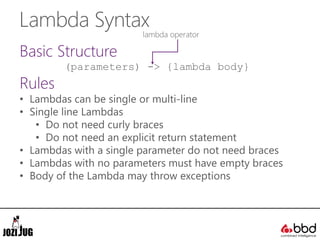
Lambda Syntax
Basic Structure
(parameters) -> {lambda body}
Rules
• Lambdas can be single or multi-line
• Single line Lambdas
• Do not need curly braces
• Do not need an explicit return statement
• Lambdas with a single parameter do not need braces
• Lambdas with no parameters must have empty braces
• Body of the Lambda may throw exceptions
lambda operator
Lambda Syntax
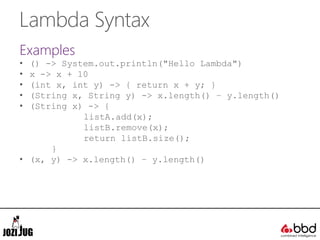
Examples
• () -> System.out.println("Hello Lambda")
• x -> x + 10
• (int x, int y) -> { return x + y; }
• (String x, String y) -> x.length() – y.length()
• (String x) -> {
listA.add(x);
listB.remove(x);
return listB.size();
}
• (x, y) -> x.length() – y.length()
Exercise: Lambda
Functions
Functional Interfaces
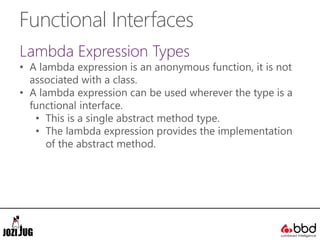
Lambda Expression Types
• A lambda expression is an anonymous function, it is not
associated with a class.
• A lambda expression can be used wherever the type is a
functional interface.
• This is a single abstract method type.
• The lambda expression provides the implementation
of the abstract method.
Functional Interfaces
Definition
• An interface that has only one abstract method.
• Before Java 8 this was obvious, only one method.
• Java 8 introduced default methods
• Multiple inheritance of behaviour for Java
• Java 8 also now allows static methods in interfaces
• @FunctionalInterface annotation
• Previously known as SAM’s, Single Abstract Methods
• java.lang.Runnable, java.awt.event.ActionListener,
java.util.Comparator, java.util.concurrent.Callable
True or False: Functional
Interfaces
Functional Interfaces
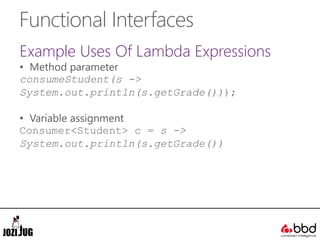
Example Uses Of Lambda Expressions
• Method parameter
consumeStudent(s ->
System.out.println(s.getGrade()));
• Variable assignment
Consumer<Student> c = s ->
System.out.println(s.getGrade())
Functional Interfaces
java.util.function Package
• Well defined set of general purpose functional interfaces.
• All have only one abstract method.
• Lambda expressions can be used wherever these types
are referenced.
• Used extensively in the Java class libraries.
• Especially with the Stream API.
• Includes several static methods to help with
composing/chaining.
• Variations on number of arguments and specific for
primitive types.
Functional Interfaces
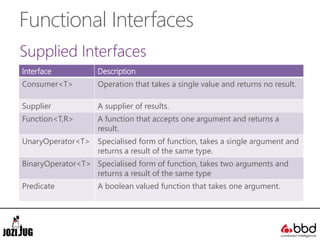
Supplied Interfaces
Interface Description
Consumer<T> Operation that takes a single value and returns no result.
Supplier A supplier of results.
Function<T,R> A function that accepts one argument and returns a
result.
UnaryOperator<T> Specialised form of function, takes a single argument and
returns a result of the same type.
BinaryOperator<T> Specialised form of function, takes two arguments and
returns a result of the same type
Predicate A boolean valued function that takes one argument.
Demo: General Functional
Interfaces
Method and Constructor
References
Method&Constructor References
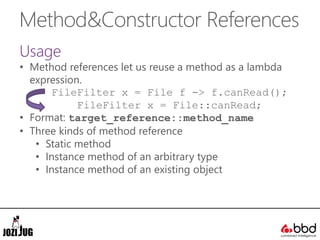
Usage
• Method references let us reuse a method as a lambda
expression.
FileFilter x = File f -> f.canRead();
FileFilter x = File::canRead;
• Format: target_reference::method_name
• Three kinds of method reference
• Static method
• Instance method of an arbitrary type
• Instance method of an existing object
Method&Constructor References
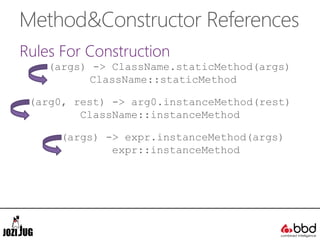
Rules For Construction
(args) -> ClassName.staticMethod(args)
ClassName::staticMethod
(arg0, rest) -> arg0.instanceMethod(rest)
ClassName::instanceMethod
(args) -> expr.instanceMethod(args)
expr::instanceMethod
Method&Constructor References
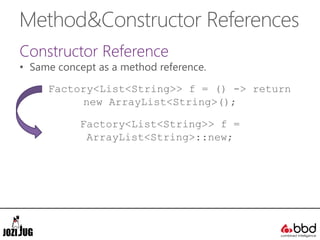
Constructor Reference
• Same concept as a method reference.
Factory<List<String>> f = () -> return
new ArrayList<String>();
Factory<List<String>> f =
ArrayList<String>::new;
Referencing External
Variables
Referencing External Variables
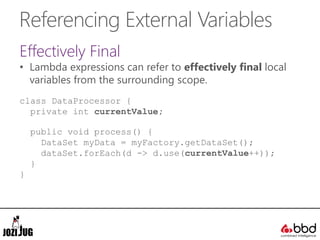
Effectively Final
• Lambda expressions can refer to effectively final local
variables from the surrounding scope.
class DataProcessor {
private int currentValue;
public void process() {
DataSet myData = myFactory.getDataSet();
dataSet.forEach(d -> d.use(currentValue++));
}
}
Referencing External Variables
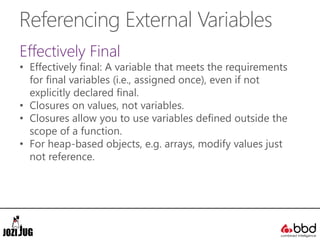
Effectively Final
• Effectively final: A variable that meets the requirements
for final variables (i.e., assigned once), even if not
explicitly declared final.
• Closures on values, not variables.
• Closures allow you to use variables defined outside the
scope of a function.
• For heap-based objects, e.g. arrays, modify values just
not reference.
Referencing External Variables
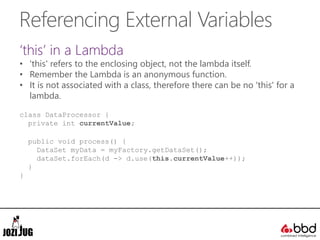
‘this’ in a Lambda
• 'this' refers to the enclosing object, not the lambda itself.
• Remember the Lambda is an anonymous function.
• It is not associated with a class, therefore there can be no 'this' for a
lambda.
class DataProcessor {
private int currentValue;
public void process() {
DataSet myData = myFactory.getDataSet();
dataSet.forEach(d -> d.use(this.currentValue++));
}
}
Debugging Lambda
Methods
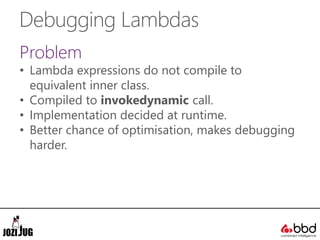
Debugging Lambdas
Problem
• Lambda expressions do not compile to
equivalent inner class.
• Compiled to invokedynamic call.
• Implementation decided at runtime.
• Better chance of optimisation, makes debugging
harder.
Debugging Lambdas
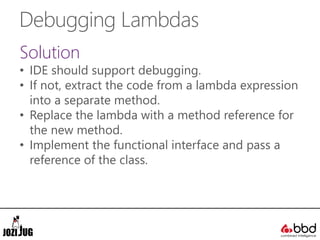
Solution
• IDE should support debugging.
• If not, extract the code from a lambda expression
into a separate method.
• Replace the lambda with a method reference for
the new method.
• Implement the functional interface and pass a
reference of the class.
Demo: Debugging a
lambda function
New Lambda Methods in
Java 8
New Lambda Methods
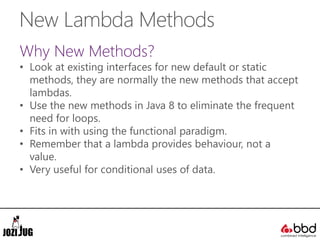
Why New Methods?
• Look at existing interfaces for new default or static
methods, they are normally the new methods that accept
lambdas.
• Use the new methods in Java 8 to eliminate the frequent
need for loops.
• Fits in with using the functional paradigm.
• Remember that a lambda provides behaviour, not a
value.
• Very useful for conditional uses of data.
Functional Interfaces
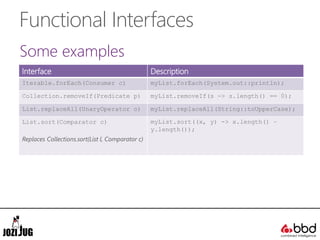
Some examples
Interface Description
Iterable.forEach(Consumer c) myList.forEach(System.out::println);
Collection.removeIf(Predicate p) myList.removeIf(s -> s.length() == 0);
List.replaceAll(UnaryOperator o) myList.replaceAll(String::toUpperCase);
List.sort(Comparator c)
Replaces Collections.sort(List l, Comparator c)
myList.sort((x, y) -> x.length() –
y.length());
Exercises
Exercises
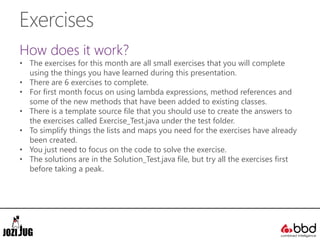
How does it work?
• The exercises for this month are all small exercises that you will complete
using the things you have learned during this presentation.
• There are 6 exercises to complete.
• For first month focus on using lambda expressions, method references and
some of the new methods that have been added to existing classes.
• There is a template source file that you should use to create the answers to
the exercises called Exercise_Test.java under the test folder.
• To simplify things the lists and maps you need for the exercises have already
been created.
• You just need to focus on the code to solve the exercise.
• The solutions are in the Solution_Test.java file, but try all the exercises first
before taking a peak.
Thank you!

Lambdas in Java 8

  • 1.
    Lambdas in Java8 Start programming in a more functional style
  • 2.
    Background Who am I? •Tobias Coetzee • I’m a Technical Lead at BBD • I present the Java Expert Level Certifications at BBD (EJB, JPA, etc.) • I’m currently a banker • Part of the JoziJug organising committee • I like to run • This presentation is based on a Simon Ritter course • @tobiascode • https://github.com/Jozi-JUG/lamdatraining
  • 3.
    ASK QUESTIONS, SWAGFOR EVERYONE!!
  • 4.
    Outcomes What are thetake away’s? • Why should we care about lambdas • Apply lambdas to everyday problems • Determine when to apply lambdas (and when not to!) • How does the lambda syntax work? • What are functional interfaces? • Convert anonymous classes to lambda expressions • Debug lambda expressions
  • 5.
  • 6.
    Why lambdas? Why careabout concurrency in Java? • CPU’s are getting much faster, but we are getting more cores to use. • We need to parallelise our processing. • The functional programming paradigm lends itself better to parallel processing as there is no external state. Concurrency history in Java • Java 1 had threads. • Java 5 had java.util.concurrent (BlockingQueue, Executers, etc.). • Java 7 had Fork/Join framework. • Java 8 gives us Lambdas.
  • 7.
    Demo: Intro tofunctional programming in Java 8
  • 8.
    When do weuse lambdas? Usages • Inject functionality into methods, the same way we inject values into methods. • Look where methods are very similar except for 1 or 2 lines of code. • Look at streams for clues, filtering, mapping, finding, matching, etc. • Enhance library methods, look at new Collection methods. • Small one line functions. • To shorten your code, remove inner classes and anonymous classes. • If you want to use streams.
  • 9.
    When don’t weuse lambdas? Non-Usages • Lambdas were introduced into Java for 2 reasons, to allow programming in a functional paradigm and to make code shorter and more concise. • If it isn’t used for one or both these reasons, rethink the usage. • Avoid huge lambdas, e.g. 20 lines of code. • Because it is cool!
  • 10.
  • 11.
    Lambda Syntax Basic Structure (parameters)-> {lambda body} Rules • Lambdas can be single or multi-line • Single line Lambdas • Do not need curly braces • Do not need an explicit return statement • Lambdas with a single parameter do not need braces • Lambdas with no parameters must have empty braces • Body of the Lambda may throw exceptions lambda operator
  • 12.
    Lambda Syntax Examples • ()-> System.out.println("Hello Lambda") • x -> x + 10 • (int x, int y) -> { return x + y; } • (String x, String y) -> x.length() – y.length() • (String x) -> { listA.add(x); listB.remove(x); return listB.size(); } • (x, y) -> x.length() – y.length()
  • 13.
  • 14.
  • 15.
    Functional Interfaces Lambda ExpressionTypes • A lambda expression is an anonymous function, it is not associated with a class. • A lambda expression can be used wherever the type is a functional interface. • This is a single abstract method type. • The lambda expression provides the implementation of the abstract method.
  • 16.
    Functional Interfaces Definition • Aninterface that has only one abstract method. • Before Java 8 this was obvious, only one method. • Java 8 introduced default methods • Multiple inheritance of behaviour for Java • Java 8 also now allows static methods in interfaces • @FunctionalInterface annotation • Previously known as SAM’s, Single Abstract Methods • java.lang.Runnable, java.awt.event.ActionListener, java.util.Comparator, java.util.concurrent.Callable
  • 17.
    True or False:Functional Interfaces
  • 18.
    Functional Interfaces Example UsesOf Lambda Expressions • Method parameter consumeStudent(s -> System.out.println(s.getGrade())); • Variable assignment Consumer<Student> c = s -> System.out.println(s.getGrade())
  • 19.
    Functional Interfaces java.util.function Package •Well defined set of general purpose functional interfaces. • All have only one abstract method. • Lambda expressions can be used wherever these types are referenced. • Used extensively in the Java class libraries. • Especially with the Stream API. • Includes several static methods to help with composing/chaining. • Variations on number of arguments and specific for primitive types.
  • 20.
    Functional Interfaces Supplied Interfaces InterfaceDescription Consumer<T> Operation that takes a single value and returns no result. Supplier A supplier of results. Function<T,R> A function that accepts one argument and returns a result. UnaryOperator<T> Specialised form of function, takes a single argument and returns a result of the same type. BinaryOperator<T> Specialised form of function, takes two arguments and returns a result of the same type Predicate A boolean valued function that takes one argument.
  • 21.
  • 22.
  • 23.
    Method&Constructor References Usage • Methodreferences let us reuse a method as a lambda expression. FileFilter x = File f -> f.canRead(); FileFilter x = File::canRead; • Format: target_reference::method_name • Three kinds of method reference • Static method • Instance method of an arbitrary type • Instance method of an existing object
  • 24.
    Method&Constructor References Rules ForConstruction (args) -> ClassName.staticMethod(args) ClassName::staticMethod (arg0, rest) -> arg0.instanceMethod(rest) ClassName::instanceMethod (args) -> expr.instanceMethod(args) expr::instanceMethod
  • 25.
    Method&Constructor References Constructor Reference •Same concept as a method reference. Factory<List<String>> f = () -> return new ArrayList<String>(); Factory<List<String>> f = ArrayList<String>::new;
  • 26.
  • 27.
    Referencing External Variables EffectivelyFinal • Lambda expressions can refer to effectively final local variables from the surrounding scope. class DataProcessor { private int currentValue; public void process() { DataSet myData = myFactory.getDataSet(); dataSet.forEach(d -> d.use(currentValue++)); } }
  • 28.
    Referencing External Variables EffectivelyFinal • Effectively final: A variable that meets the requirements for final variables (i.e., assigned once), even if not explicitly declared final. • Closures on values, not variables. • Closures allow you to use variables defined outside the scope of a function. • For heap-based objects, e.g. arrays, modify values just not reference.
  • 29.
    Referencing External Variables ‘this’in a Lambda • 'this' refers to the enclosing object, not the lambda itself. • Remember the Lambda is an anonymous function. • It is not associated with a class, therefore there can be no 'this' for a lambda. class DataProcessor { private int currentValue; public void process() { DataSet myData = myFactory.getDataSet(); dataSet.forEach(d -> d.use(this.currentValue++)); } }
  • 30.
  • 31.
    Debugging Lambdas Problem • Lambdaexpressions do not compile to equivalent inner class. • Compiled to invokedynamic call. • Implementation decided at runtime. • Better chance of optimisation, makes debugging harder.
  • 32.
    Debugging Lambdas Solution • IDEshould support debugging. • If not, extract the code from a lambda expression into a separate method. • Replace the lambda with a method reference for the new method. • Implement the functional interface and pass a reference of the class.
  • 33.
  • 34.
  • 35.
    New Lambda Methods WhyNew Methods? • Look at existing interfaces for new default or static methods, they are normally the new methods that accept lambdas. • Use the new methods in Java 8 to eliminate the frequent need for loops. • Fits in with using the functional paradigm. • Remember that a lambda provides behaviour, not a value. • Very useful for conditional uses of data.
  • 36.
    Functional Interfaces Some examples InterfaceDescription Iterable.forEach(Consumer c) myList.forEach(System.out::println); Collection.removeIf(Predicate p) myList.removeIf(s -> s.length() == 0); List.replaceAll(UnaryOperator o) myList.replaceAll(String::toUpperCase); List.sort(Comparator c) Replaces Collections.sort(List l, Comparator c) myList.sort((x, y) -> x.length() – y.length());
  • 37.
  • 38.
    Exercises How does itwork? • The exercises for this month are all small exercises that you will complete using the things you have learned during this presentation. • There are 6 exercises to complete. • For first month focus on using lambda expressions, method references and some of the new methods that have been added to existing classes. • There is a template source file that you should use to create the answers to the exercises called Exercise_Test.java under the test folder. • To simplify things the lists and maps you need for the exercises have already been created. • You just need to focus on the code to solve the exercise. • The solutions are in the Solution_Test.java file, but try all the exercises first before taking a peak.
  • 39.