Visit https://ebookultra.com to download the full version and
explore more ebooks
Laboratory Documents Development and Control
Approved Guideline 5th Edition Clsi
_____ Click the link below to download _____
https://ebookultra.com/download/laboratory-documents-
development-and-control-approved-guideline-5th-edition-
clsi/
Explore and download more ebooks at ebookultra.com
Here are some suggested products you might be interested in.
Click the link to download
Performance Standards for Antimicrobial Susceptibility
Testing Twenty Fifth Informational Supplement CLSI
document M100 S25 Wayne PA Clinical and Laboratory
Standards Institute 2015 25th Edition Clsi
https://ebookultra.com/download/performance-standards-for-
antimicrobial-susceptibility-testing-twenty-fifth-informational-
supplement-clsi-document-m100-s25-wayne-pa-clinical-and-laboratory-
standards-institute-2015-25th-edition-clsi/
Learning Human Anatomy A Laboratory Text and Workbook 5th
Edition Julia Guy
https://ebookultra.com/download/learning-human-anatomy-a-laboratory-
text-and-workbook-5th-edition-julia-guy/
Integrated Human Anatomy and Physiology I Laboratory 5th
Edition Richard A. Jones
https://ebookultra.com/download/integrated-human-anatomy-and-
physiology-i-laboratory-5th-edition-richard-a-jones/
Clinical Laboratory Science Review A Bottom Line Approach
5th Edition Mhs
https://ebookultra.com/download/clinical-laboratory-science-review-a-
bottom-line-approach-5th-edition-mhs/
Economic Development 5th Edition E. Wayne Nafziger
https://ebookultra.com/download/economic-development-5th-edition-e-
wayne-nafziger/
HPLC Methods for Recently Approved Pharmaceuticals 1st
Edition George Lunn
https://ebookultra.com/download/hplc-methods-for-recently-approved-
pharmaceuticals-1st-edition-george-lunn/
Quality Assurance and Quality Control in the Analytical
Chemical Laboratory A Practical Approach Analytical
Chemistry Piotr Konieczka
https://ebookultra.com/download/quality-assurance-and-quality-control-
in-the-analytical-chemical-laboratory-a-practical-approach-analytical-
chemistry-piotr-konieczka/
Cost Management Accounting and Control 5th Edition Don
R.(Don R. Hansen) Hansen
https://ebookultra.com/download/cost-management-accounting-and-
control-5th-edition-don-r-don-r-hansen-hansen/
Employee Training Development 5th Edition Raymond Andrew
Noe
https://ebookultra.com/download/employee-training-development-5th-
edition-raymond-andrew-noe/
Laboratory Documents Development and Control
Approved Guideline 5th Edition Clsi Digital Instant
Download
Author(s): CLSI
ISBN(s): 9781562386009, 156238600X
Edition: 5
File Details: PDF, 1.00 MB
Year: 2006
Language: english
™
Licensed to: Cameron Wannamaker
This document is protected by copyright. CLSI order # 71377, id # 477046, Downloaded on 12/11/2009.
Clinical and Laboratory Standards Institute
Advancing Quality in Healthcare Testing
Clinical and Laboratory Standards Institute (CLSI
formerly NCCLS) is an international, interdisciplinary,
nonprofit, standards-developing, and educational
organization that promotes the development and use of
voluntary consensus standards and guidelines within the
healthcare community. It is recognized worldwide for the
application of its unique consensus process in the
development of standards and guidelines for patient
examination and related healthcare issues. Our process is
based on the principle that consensus is an effective and
cost-effective way to improve patient examination and
healthcare services.
In addition to developing and promoting the use of
voluntary consensus standards and guidelines, we
provide an open and unbiased forum to address critical
issues affecting the quality of patient examination and
health care.
PUBLICATIONS
A document is published as a standard, guideline, or
committee report.
Standard A document developed through the consensus
process that clearly identifies specific, essential
requirements for materials, methods, or practices for use
in an unmodified form. A standard may, in addition,
contain discretionary elements, which are clearly
identified.
Guideline A document developed through the
consensus process describing criteria for a general
operating practice, procedure, or material for voluntary
use. A guideline may be used as written or modified by
the user to fit specific needs.
Report A document that has not been subjected to
consensus review and is released by the Board of
Directors.
CONSENSUS PROCESS
The CLSI voluntary consensus process is a protocol
establishing formal criteria for:
• the authorization of a project
• the development and open review of documents
• the revision of documents in response to comments
by users
• the acceptance of a document as a consensus
standard or guideline.
Most documents are subject to two levels of consensus—
“proposed” and “approved.” Depending on the need for
field evaluation or data collection, documents may also be
made available for review at an intermediate consensus
level.
Proposed A consensus document undergoes the first stage
of review by the healthcare community as a proposed
standard or guideline. The document should receive a wide
and thorough technical review, including an overall review
of its scope, approach, and utility, and a line-by-line review
of its technical and editorial content.
Approved An approved standard or guideline has achieved
consensus within the healthcare community. It should be
reviewed to assess the utility of the final document, to
ensure attainment of consensus (i.e., that comments on
earlier versions have been satisfactorily addressed), and to
identify the need for additional consensus documents.
Our standards and guidelines represent a consensus opinion
on good practices and reflect the substantial agreement by
materially affected, competent, and interested parties
obtained by following CLSI’s established consensus
procedures. Provisions in CLSI standards and guidelines
may be more or less stringent than applicable regulations.
Consequently, conformance to this voluntary consensus
document does not relieve the user of responsibility for
compliance with applicable regulations.
COMMENTS
The comments of users are essential to the consensus
process. Anyone may submit a comment, and all comments
are addressed, according to the consensus process, by the
committee that wrote the document. All comments,
including those that result in a change to the document when
published at the next consensus level and those that do not
result in a change, are responded to by the committee in an
appendix to the document. Readers are strongly encouraged
to comment in any form and at any time on any document.
Address comments to Clinical and Laboratory Standards
Institute, 940 West Valley Road, Suite 1400, Wayne, PA
19087, USA.
VOLUNTEER PARTICIPATION
Healthcare professionals in all specialties are urged to
volunteer for participation in CLSI projects. Please contact
us at customerservice@clsi.org or +610.688.0100 for
additional information on committee participation.
Licensed to: Cameron Wannamaker
This document is protected by copyright. CLSI order # 71377, id # 477046, Downloaded on 12/11/2009.
GP2-A5
ISBN 1-56238-600-X
Volume 26 Number 12 ISSN 0273-3099
Laboratory Documents: Development and Control; Approved
Guideline—Fifth Edition
Lucia M. Berte, MA, MT(ASCP), SBB, DLM; CQA(ASQ)CQMgr
Donald R. Callihan, PhD
Joan Carlson, MLT(CSMLA), BSc(MLS), MT(ASCP)
Beverly J. Charlton, CLC(AMT)
Christine D. Flaherty, MHA, MT(ASCP)
Mary H. Hopper, MA, MT(ASCP)
Barb Kirkley, MT(ASCP)
Oliver Ndimbie, MD, FCAP
Jennifer Schiffgens, MBA, MT(ASCP)
Peggy J. Stupca, MS, CLSp(CG)
Nita Sudderth, MT(ASCP), CQMgr(ASQ)
Joyce I. Wilson, MS, MT(ASCP)
Shelia M. Woodcock, MBA, FCSMLS(D)
Abstract
Clinical and Laboratory Standards Institute document GP2-A5—Laboratory Documents: Development and Control; Approved
Guideline—Fifth Edition presents the important components of writing and managing documents for the clinical laboratory. This
guideline describes common and specific sections for inclusion in laboratory documents. Several examples of process and
procedure documents for preexamination, examination, and postexamination laboratory activities are provided in the form of
appendixes; such appendixes are simply illustrative, and not prescriptive.
Clinical and Laboratory Standards Institute (CLSI). Laboratory Documents: Development and Control; Approved Guideline—
Fifth Edition. CLSI document GP2-A5 (ISBN 1-56238-600-X). Clinical and Laboratory Standards Institute, 940 West Valley
Road, Suite 1400, Wayne, Pennsylvania 19087-1898 USA, 2006.
The Clinical and Laboratory Standards Institute consensus process, which is the mechanism for moving a document through
two or more levels of review by the healthcare community, is an ongoing process. Users should expect revised editions of any
given document. Because rapid changes in technology may affect the procedures, methods, and protocols in a standard or
guideline, users should replace outdated editions with the current editions of CLSI/NCCLS documents. Current editions are
listed in the CLSI catalog, which is distributed to member organizations, and to nonmembers on request. If your organization is
not a member and would like to become one, and to request a copy of the catalog, contact us at: Telephone: 610.688.0100; Fax:
610.688.0700; E-Mail: customerservice@clsi.org; Website: www.clsi.org
Licensed to: Cameron Wannamaker
This document is protected by copyright. CLSI order # 71377, id # 477046, Downloaded on 12/11/2009.
Number 12 GP2-A5
ii
This publication is protected by copyright. No part of it may be reproduced, stored in a retrieval system,
transmitted, or made available in any form or by any means (electronic, mechanical, photocopying,
recording, or otherwise) without prior written permission from Clinical and Laboratory Standards
Institute, except as stated below.
Clinical and Laboratory Standards Institute hereby grants permission to reproduce limited portions of this
publication for use in laboratory procedure manuals at a single site, for interlibrary loan, or for use in
educational programs provided that multiple copies of such reproduction shall include the following
notice, be distributed without charge, and, in no event, contain more than 20% of the document’s text.
Reproduced with permission, from CLSI publication GP2-A5—Laboratory Documents:
Development and Control; Approved Guideline—Fifth Edition (ISBN 1-56238-600-X).
Copies of the current edition may be obtained from Clinical and Laboratory Standards
Institute, 940 West Valley Road, Suite 1400, Wayne, Pennsylvania 19087-1898, USA.
Permission to reproduce or otherwise use the text of this document to an extent that exceeds the
exemptions granted here or under the Copyright Law must be obtained from Clinical and Laboratory
Standards Institute by written request. To request such permission, address inquiries to the Executive Vice
President, Clinical and Laboratory Standards Institute, 940 West Valley Road, Suite 1400, Wayne,
Pennsylvania 19087-1898, USA.
Copyright ©
2006. Clinical and Laboratory Standards Institute.
Suggested Citation
(Clinical and Laboratory Standards Institute. Laboratory Documents: Development and Control;
Approved Guideline—Fifth Edition. CLSI document GP2-A5 [ISBN 1-56238-600-X]. Clinical and
Laboratory Standards Institute, 940 West Valley Road, Suite 1400, Wayne, Pennsylvania 19087-1898
USA, 2006.)
Proposed Guideline Approved Guideline—Third Edition
May 1980 December 1996
Tentative Guideline Approved Guideline—Fourth Edition
June 1981 April 2002
Approved Guideline Approved Guideline—Fifth Edition
February 1984 March 2006
Approved Guideline—Second Edition
July 1992
ISBN 1-56238-600-X
ISSN 0273-3099
Licensed to: Cameron Wannamaker
This document is protected by copyright. CLSI order # 71377, id # 477046, Downloaded on 12/11/2009.
Volume 26 GP2-A5
iii
Committee Membership
Area Committee on General Laboratory Practices
Sheila M. Woodcock, MBA,
FCSMLS(D)
Chairholder
QSE Consulting
Rose Bay, Nova Scotia, Canada
Albert Rabinovitch, MD, PhD
Vice-Chairholder
Abbott Hematology
Santa Clara, California
Eric Arendash, MT(ASCP)
Centers for Medicare & Medicaid
Services
Philadelphia, Pennsylvania
Lucia M. Berte, MA, MT(ASCP),
SBB, DLM; CQA(ASQ)CQMgr.
Quality Systems Consultant
Westminster, Colorado
Theresa D. Billups, MBA,
MT(ASCP)DLM
Remel Inc.
Lake Charles, Louisiana
Margaret M. Grimes, MD
Virginia Commonwealth University
Richmond, Virginia
Bruce David Tually, BAppSc,
MAppSc
Hunter Area Pathology Service
New South Wales, Australia
Advisors
Kay M. Creed
St. Mary’s Hospital
Richmond, Virginia
Dennis J. Ernst, MT(ASCP)
Center for Phlebotomy Education
Ramsey, Indiana
Steven I. Gutman, MD, MBA
FDA Ctr. for Devices/Rad. Health
Rockville, Maryland
Stephen J. Sarewitz, MD
Valley Medical Center
Renton, Washington
Jennifer Schiffgens, MBA,
MT(ASCP)
California Pacific Medical Center
San Francisco, California
Daniel W. Tholen, MS
American Association for
Laboratory Accreditation
Traverse City, Michigan
Marla Thomas
Litton Pathology Associates
Blue Springs, Missouri
Eleanor M. Travers, MD, MHA
State of Connecticut Dept. of Public
Health
Hartford, Connecticut
Working Group on Technical Procedure Manuals
Lucia M. Berte, MA, MT(ASCP),
SBB, DLM: CQA(ASQ)CQMgr
Chairholder
Quality Systems Consultant
Westminster, Colorado
Donald R. Callihan, PhD
BD Diagnostic Systems
Sparks, Maryland
Joan Carlson, MLT(CSMLS),
BSc(MLS), MT(ASCP)
University of Alberta Hospital
Edmonton, Alberta, Canada
Beverly J. Charlton, CLC(AMT)
University of Pittsburgh Medical
Center
Pittsburgh, Pennsylvania
Christine D. Flaherty, MHA,
MT(ASCP)
Sutter Health
Sacramento, California
Mary H. Hopper, MA, MT(ASCP)
Mayo Clinic
Rochester, Minnesota
Barb Kirkley, MT(ASCP)
The Cleveland Clinic Foundation
Cleveland, Ohio
Oliver Ndimbie, MD, FCAP
Abbott Diagnostics
Irving, Texas
Jennifer Schiffgens, MBA,
MT(ASCP)
California Pacific Medical Center
San Francisco, California
Peggy J. Stupca, MS, CLSp(CG)
Mayo Clinic
Rochester, Minnesota
Nita Sudderth, MT(ASCP),
CQMgr(ASQ)
UroCor, Inc.
Oklahoma City, Oklahoma
Joyce I. Wilson, MS, MT(ASCP)
University of Alabama-Birmingham
Hospital
Birmingham, Alabama
Sheila M. Woodcock, MBA,
FCSMLS(D)
QSE Consulting
Rose Bay, Nova Scotia, Canada
Staff
Clinical and Laboratory Standards
Institute
Wayne, Pennsylvania
John J. Zlockie, MBA
Vice President, Standards
Jennifer K. McGeary, MT(ASCP),
MSHA
Staff Liaison
Donna M. Wilhelm
Editor
Melissa A. Lewis
Assistant Editor
Licensed to: Cameron Wannamaker
This document is protected by copyright. CLSI order # 71377, id # 477046, Downloaded on 12/11/2009.
Number 12 GP2-A5
iv
Licensed to: Cameron Wannamaker
This document is protected by copyright. CLSI order # 71377, id # 477046, Downloaded on 12/11/2009.
Volume 26 GP2-A5
v
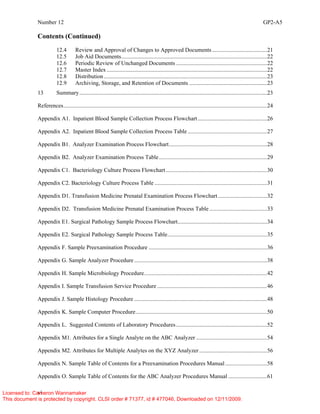
Contents
Abstract....................................................................................................................................................i
Committee Membership........................................................................................................................ iii
Foreword................................................................................................................................................ix
1 Scope..........................................................................................................................................1
2 Introduction................................................................................................................................1
3 Definitions .................................................................................................................................1
4 Path of Workflow.......................................................................................................................2
4.1 Preexamination Processes.............................................................................................2
4.2 Examination Processes .................................................................................................3
4.3 Postexamination Processes ...........................................................................................3
5 Process – The Sequence of Laboratory Activities .....................................................................4
5.1 Key Work Processes .....................................................................................................4
5.2 Process as a Basis for Training and Competence Assessment......................................4
6 Procedure – How to Do It..........................................................................................................4
7 Elements Common to Process and Procedure Documents ........................................................4
7.1 Title...............................................................................................................................4
7.2 Purpose or Principle......................................................................................................5
7.3 Process Flowchart or Table...........................................................................................5
7.4 Procedure Instructions ..................................................................................................5
7.5 Related Documents.......................................................................................................5
7.6 References.....................................................................................................................5
7.7 Appendixes or Attachments..........................................................................................6
7.8 Author...........................................................................................................................6
7.9 Approval Signatures .....................................................................................................6
8 Process Documents....................................................................................................................6
8.1 Benefits of Process Documents ....................................................................................6
8.2 Suggested Template for Process Documents................................................................7
9 Procedure Documents – Specific for the Path of Workflow......................................................7
9.1 Preexamination Procedures...........................................................................................7
9.2 Examination Procedures .............................................................................................11
9.3 Postexamination Procedures.......................................................................................17
10 Form Documents......................................................................................................................19
11 Procedures Manuals.................................................................................................................20
12 Document Management...........................................................................................................20
12.1 Document Identification .............................................................................................20
12.2 Master File..................................................................................................................21
12.3 Review and Approval of New Documents .................................................................21
Licensed to: Cameron Wannamaker
This document is protected by copyright. CLSI order # 71377, id # 477046, Downloaded on 12/11/2009.
Number 12 GP2-A5
vi
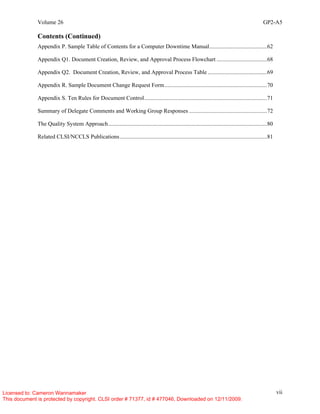
Contents (Continued)
12.4 Review and Approval of Changes to Approved Documents ......................................21
12.5 Job Aid Documents.....................................................................................................22
12.6 Periodic Review of Unchanged Documents ...............................................................22
12.7 Master Index ...............................................................................................................22
12.8 Distribution.................................................................................................................23
12.9 Archiving, Storage, and Retention of Documents ......................................................23
13 Summary..................................................................................................................................23
References.............................................................................................................................................24
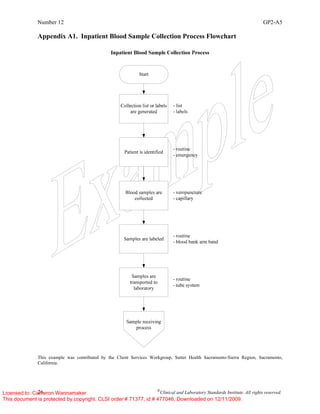
Appendix A1. Inpatient Blood Sample Collection Process Flowchart................................................26
Appendix A2. Inpatient Blood Sample Collection Process Table .......................................................27
Appendix B1. Analyzer Examination Process Flowchart....................................................................28
Appendix B2. Analyzer Examination Process Table...........................................................................29
Appendix C1. Bacteriology Culture Process Flowchart ......................................................................30
Appendix C2. Bacteriology Culture Process Table ..............................................................................31
Appendix D1. Transfusion Medicine Prenatal Examination Process Flowchart..................................32
Appendix D2. Transfusion Medicine Prenatal Examination Process Table ........................................33
Appendix E1. Surgical Pathology Sample Process Flowchart..............................................................34
Appendix E2. Surgical Pathology Sample Process Table.....................................................................35
Appendix F. Sample Preexamination Procedure ..................................................................................36
Appendix G. Sample Analyzer Procedure ............................................................................................38
Appendix H. Sample Microbiology Procedure.....................................................................................42
Appendix I. Sample Transfusion Service Procedure ............................................................................46
Appendix J. Sample Histology Procedure ............................................................................................48
Appendix K. Sample Computer Procedure...........................................................................................50
Appendix L. Suggested Contents of Laboratory Procedures...............................................................52
Appendix M1. Attributes for a Single Analyte on the ABC Analyzer .................................................54
Appendix M2. Attributes for Multiple Analytes on the XYZ Analyzer...............................................56
Appendix N. Sample Table of Contents for a Preexamination Procedures Manual.............................58
Appendix O. Sample Table of Contents for the ABC Analyzer Procedures Manual ...........................61
Licensed to: Cameron Wannamaker
This document is protected by copyright. CLSI order # 71377, id # 477046, Downloaded on 12/11/2009.
Volume 26 GP2-A5
vii
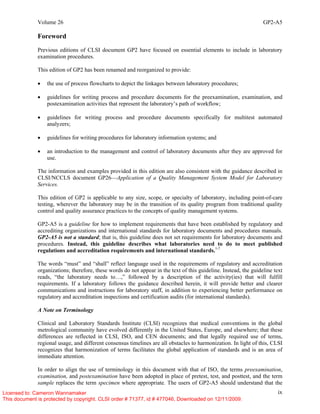
Contents (Continued)
Appendix P. Sample Table of Contents for a Computer Downtime Manual........................................62
Appendix Q1. Document Creation, Review, and Approval Process Flowchart ...................................68
Appendix Q2. Document Creation, Review, and Approval Process Table .........................................69
Appendix R. Sample Document Change Request Form.......................................................................70
Appendix S. Ten Rules for Document Control.....................................................................................71
Summary of Delegate Comments and Working Group Responses ......................................................72
The Quality System Approach..............................................................................................................80
Related CLSI/NCCLS Publications......................................................................................................81
Licensed to: Cameron Wannamaker
This document is protected by copyright. CLSI order # 71377, id # 477046, Downloaded on 12/11/2009.
Number 12 GP2-A5
viii
Licensed to: Cameron Wannamaker
This document is protected by copyright. CLSI order # 71377, id # 477046, Downloaded on 12/11/2009.
Volume 26 GP2-A5
ix
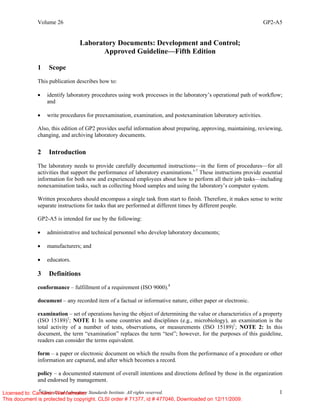
Foreword
Previous editions of CLSI document GP2 have focused on essential elements to include in laboratory
examination procedures.
This edition of GP2 has been renamed and reorganized to provide:
• the use of process flowcharts to depict the linkages between laboratory procedures;
• guidelines for writing process and procedure documents for the preexamination, examination, and
postexamination activities that represent the laboratory’s path of workflow;
• guidelines for writing process and procedure documents specifically for multitest automated
analyzers;
• guidelines for writing procedures for laboratory information systems; and
• an introduction to the management and control of laboratory documents after they are approved for
use.
The information and examples provided in this edition are also consistent with the guidance described in
CLSI/NCCLS document GP26—Application of a Quality Management System Model for Laboratory
Services.
This edition of GP2 is applicable to any size, scope, or specialty of laboratory, including point-of-care
testing, wherever the laboratory may be in the transition of its quality program from traditional quality
control and quality assurance practices to the concepts of quality management systems.
GP2-A5 is a guideline for how to implement requirements that have been established by regulatory and
accrediting organizations and international standards for laboratory documents and procedures manuals.
GP2-A5 is not a standard; that is, this guideline does not set requirements for laboratory documents and
procedures. Instead, this guideline describes what laboratories need to do to meet published
regulations and accreditation requirements and international standards.1-7
The words “must” and “shall” reflect language used in the requirements of regulatory and accreditation
organizations; therefore, these words do not appear in the text of this guideline. Instead, the guideline text
reads, “the laboratory needs to…,” followed by a description of the activity(ies) that will fulfill
requirements. If a laboratory follows the guidance described herein, it will provide better and clearer
communications and instructions for laboratory staff, in addition to experiencing better performance on
regulatory and accreditation inspections and certification audits (for international standards).
A Note on Terminology
Clinical and Laboratory Standards Institute (CLSI) recognizes that medical conventions in the global
metrological community have evolved differently in the United States, Europe, and elsewhere; that these
differences are reflected in CLSI, ISO, and CEN documents; and that legally required use of terms,
regional usage, and different consensus timelines are all obstacles to harmonization. In light of this, CLSI
recognizes that harmonization of terms facilitates the global application of standards and is an area of
immediate attention.
In order to align the use of terminology in this document with that of ISO, the terms preexamination,
examination, and postexamination have been adopted in place of pretest, test, and posttest, and the term
sample replaces the term specimen where appropriate. The users of GP2-A5 should understand that the
Licensed to: Cameron Wannamaker
This document is protected by copyright. CLSI order # 71377, id # 477046, Downloaded on 12/11/2009.
Number 12 GP2-A5
x
fundamental meanings of the terms are identical in many cases, and are defined in the guideline’s
Definitions section (see Section 3). The terms in this document are consistent with those defined in the
ISO 15189, ISO 17025, and ISO 9000 series of standards.
Key Words
Computer procedure, document, document management, electronic procedures, laboratory procedure,
laboratory process, procedures manual, technical procedures
Licensed to: Cameron Wannamaker
This document is protected by copyright. CLSI order # 71377, id # 477046, Downloaded on 12/11/2009.
Volume 26 GP2-A5
©
Clinical and Laboratory Standards Institute. All rights reserved. 1
Laboratory Documents: Development and Control;
Approved Guideline—Fifth Edition
1 Scope
This publication describes how to:
• identify laboratory procedures using work processes in the laboratory’s operational path of workflow;
and
• write procedures for preexamination, examination, and postexamination laboratory activities.
Also, this edition of GP2 provides useful information about preparing, approving, maintaining, reviewing,
changing, and archiving laboratory documents.
2 Introduction
The laboratory needs to provide carefully documented instructions—in the form of procedures—for all
activities that support the performance of laboratory examinations.1-7
These instructions provide essential
information for both new and experienced employees about how to perform all their job tasks—including
nonexamination tasks, such as collecting blood samples and using the laboratory’s computer system.
Written procedures should encompass a single task from start to finish. Therefore, it makes sense to write
separate instructions for tasks that are performed at different times by different people.
GP2-A5 is intended for use by the following:
• administrative and technical personnel who develop laboratory documents;
• manufacturers; and
• educators.
3 Definitions
conformance – fulfillment of a requirement (ISO 9000).8
document – any recorded item of a factual or informative nature, either paper or electronic.
examination – set of operations having the object of determining the value or characteristics of a property
(ISO 15189)1
; NOTE 1: In some countries and disciplines (e.g., microbiology), an examination is the
total activity of a number of tests, observations, or measurements (ISO 15189)1
; NOTE 2: In this
document, the term “examination” replaces the term “test”; however, for the purposes of this guideline,
readers can consider the terms equivalent.
form – a paper or electronic document on which the results from the performance of a procedure or other
information are captured, and after which becomes a record.
policy – a documented statement of overall intentions and directions defined by those in the organization
and endorsed by management.
Licensed to: Cameron Wannamaker
This document is protected by copyright. CLSI order # 71377, id # 477046, Downloaded on 12/11/2009.
Number 12 GP2-A5
2 ©
Clinical and Laboratory Standards Institute. All rights reserved.
procedure – a specified way to carry out an activity or a process (ISO 9000)8
; NOTE: For a quality
system, a procedure is a set of instructions that describe the stepwise actions taken to complete activities
identified in processes.
process – set of interrelated or interacting activities that transform inputs into outputs (ISO 9000)8
;
NOTE: A process may be documented as a flowchart or table that describes operations in the laboratory’s
path of workflow.
sample – one or more parts taken from a system and intended to provide information on the system, often
to serve as a basis for decision on the system or its production (ISO 15189)1
; NOTE 1: For example, a
volume of serum taken from a larger volume of serum (ISO 15189)1
; NOTE 2: In this document, the term
“sample” replaces the term “specimen”; however, for the purposes of this guideline, readers can consider
the terms equivalent.
4 Path of Workflow
Laboratory work is a sequence of key processes in which the laboratory uses resources such as people,
instruments, methods, and materials, to transform orders for laboratory examinations into results and
reports for patient management. Key processes for the laboratory are referred to as the “path of
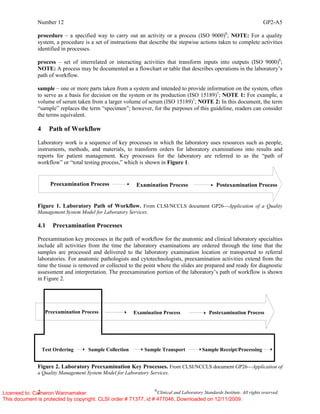
workflow” or “total testing process,” which is shown in Figure 1.
Figure 1. Laboratory Path of Workflow. From CLSI/NCCLS document GP26—Application of a Quality
Management System Model for Laboratory Services.
4.1 Preexamination Processes
Preexamination key processes in the path of workflow for the anatomic and clinical laboratory specialties
include all activities from the time the laboratory examinations are ordered through the time that the
samples are processed and delivered to the laboratory examination location or transported to referral
laboratories. For anatomic pathologists and cytotechnologists, preexamination activities extend from the
time the tissue is removed or collected to the point where the slides are prepared and ready for diagnostic
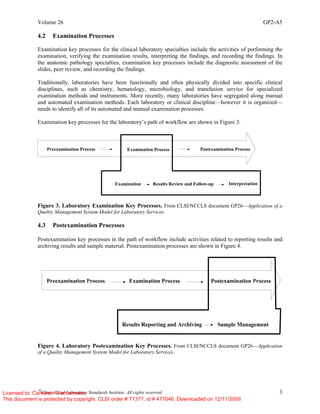
assessment and interpretation. The preexamination portion of the laboratory’s path of workflow is shown
in Figure 2.
Figure 2. Laboratory Preexamination Key Processes. From CLSI/NCCLS document GP26—Application of
a Quality Management System Model for Laboratory Services.
Preexamination Process Examination Process Postexamination Process
Test Ordering Sample Transport Sample Receipt/Processing
Sample Collection
Licensed to: Cameron Wannamaker
This document is protected by copyright. CLSI order # 71377, id # 477046, Downloaded on 12/11/2009.
Volume 26 GP2-A5
©
Clinical and Laboratory Standards Institute. All rights reserved. 3
4.2 Examination Processes
Examination key processes for the clinical laboratory specialties include the activities of performing the
examination, verifying the examination results, interpreting the findings, and recording the findings. In
the anatomic pathology specialties, examination key processes include the diagnostic assessment of the
slides, peer review, and recording the findings.
Traditionally, laboratories have been functionally and often physically divided into specific clinical
disciplines, such as chemistry, hematology, microbiology, and transfusion service for specialized
examination methods and instruments. More recently, many laboratories have segregated along manual
and automated examination methods. Each laboratory or clinical discipline—however it is organized—
needs to identify all of its automated and manual examination processes.
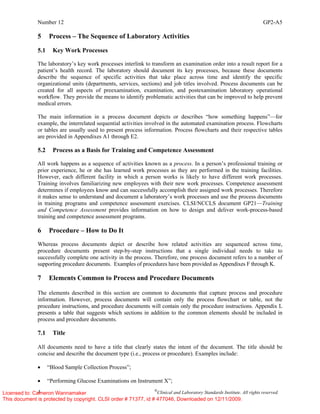
Examination key processes for the laboratory’s path of workflow are shown in Figure 3.
Figure 3. Laboratory Examination Key Processes. From CLSI/NCCLS document GP26—Application of a
Quality Management System Model for Laboratory Services.
4.3 Postexamination Processes
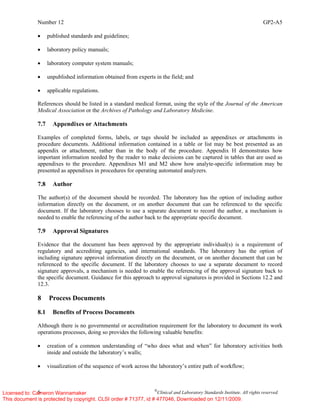
Postexamination key processes in the path of workflow include activities related to reporting results and
archiving results and sample material. Postexamination processes are shown in Figure 4.
Figure 4. Laboratory Postexamination Key Processes. From CLSI/NCCLS document GP26—Application
of a Quality Management System Model for Laboratory Services.
Examination Results Review and Follow-up Interpretation
Preexamination Process Examination Process Postexamination Process
Licensed to: Cameron Wannamaker
This document is protected by copyright. CLSI order # 71377, id # 477046, Downloaded on 12/11/2009.
Number 12 GP2-A5
4 ©
Clinical and Laboratory Standards Institute. All rights reserved.
5 Process – The Sequence of Laboratory Activities
5.1 Key Work Processes
The laboratory’s key work processes interlink to transform an examination order into a result report for a
patient’s health record. The laboratory should document its key processes, because these documents
describe the sequence of specific activities that take place across time and identify the specific
organizational units (departments, services, sections) and job titles involved. Process documents can be
created for all aspects of preexamination, examination, and postexamination laboratory operational
workflow. They provide the means to identify problematic activities that can be improved to help prevent
medical errors.
The main information in a process document depicts or describes “how something happens”—for
example, the interrelated sequential activities involved in the automated examination process. Flowcharts
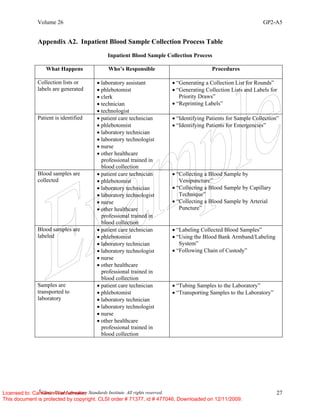
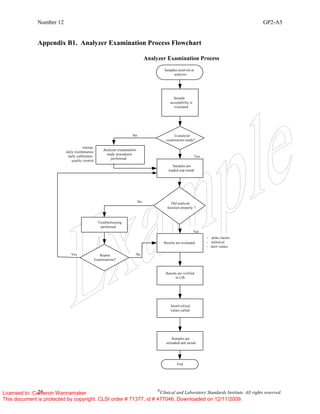
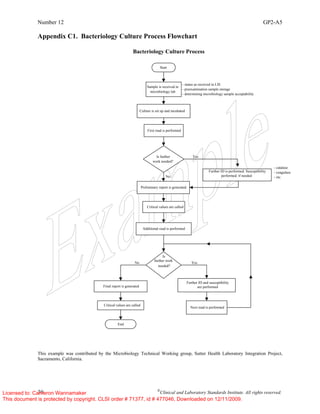
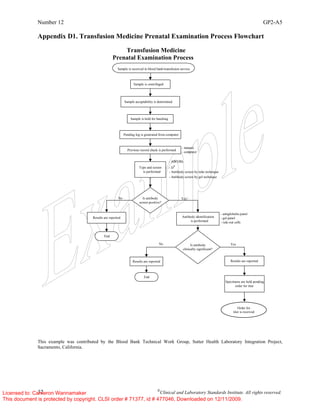
or tables are usually used to present process information. Process flowcharts and their respective tables
are provided in Appendixes A1 through E2.
5.2 Process as a Basis for Training and Competence Assessment
All work happens as a sequence of activities known as a process. In a person’s professional training or
prior experience, he or she has learned work processes as they are performed in the training facilities.
However, each different facility in which a person works is likely to have different work processes.
Training involves familiarizing new employees with their new work processes. Competence assessment
determines if employees know and can successfully accomplish their assigned work processes. Therefore
it makes sense to understand and document a laboratory’s work processes and use the process documents
in training programs and competence assessment exercises. CLSI/NCCLS document GP21—Training
and Competence Assessment provides information on how to design and deliver work-process-based
training and competence assessment programs.
6 Procedure – How to Do It
Whereas process documents depict or describe how related activities are sequenced across time,
procedure documents present step-by-step instructions that a single individual needs to take to
successfully complete one activity in the process. Therefore, one process document refers to a number of
supporting procedure documents. Examples of procedures have been provided as Appendixes F through K.
7 Elements Common to Process and Procedure Documents
The elements described in this section are common to documents that capture process and procedure
information. However, process documents will contain only the process flowchart or table, not the
procedure instructions, and procedure documents will contain only the procedure instructions. Appendix L
presents a table that suggests which sections in addition to the common elements should be included in
process and procedure documents.
7.1 Title
All documents need to have a title that clearly states the intent of the document. The title should be
concise and describe the document type (i.e., process or procedure). Examples include:
• “Blood Sample Collection Process”;
• “Performing Glucose Examinations on Instrument X”;
Licensed to: Cameron Wannamaker
This document is protected by copyright. CLSI order # 71377, id # 477046, Downloaded on 12/11/2009.
Volume 26 GP2-A5
©
Clinical and Laboratory Standards Institute. All rights reserved. 5
• “Waterbath Temperature Monitoring Procedure”; and
• “Preparing Gram Stain Working Solutions.”
The word “process” should appear in the title of a process document. The gerund form of a verb (i.e.,
“ing”) can be used to replace the word “procedure” in the title of a procedure document.
7.2 Purpose or Principle
The document should open with a section that simply states its purpose. For example, the “Purpose”
section of a process could be stated as, “This process describes how [name of process here, e.g., sample
accession] happens in this laboratory.” The “Purpose” section of a procedure could be stated as, “This
procedure provides instructions for collecting fingerstick samples for glucose analysis.” The words, “This
process describes how…” and “This procedure provides instructions for…” can be standardized in the
template and therefore included in each process and procedure document.
Information regarding the theory, clinical implications of the examination or examination methodology,
or historical background may be included at the beginning of a procedure document to provide an
educational, clinical, and scientific framework for the reader and user. However, because this information
can be technical and lengthy, it may also be placed at the end of a procedure document. Analyte-specific
information may be placed in analyte attribute tables, such as those provided in Appendixes M1 and M2.
7.3 Process Flowchart or Table
The primary focus of a process document is to describe the sequence of activities that leads to the correct
outcome. For example, the blood sample collection process presents the activities (i.e., the procedures)
that need to be correctly sequenced and performed to obtain a blood sample for a specified laboratory
examination.
7.4 Procedure Instructions
The primary focus of a procedure is to provide instructions for “how to do” a particular task in a stepwise
fashion—for example, the steps involved in verifying patient identification at the time of blood sample
collection.
7.5 Related Documents
If used, this section provides a listing of other procedures that were referred to in this procedure. For
example, Step 1 of a procedure might say, “Log onto the laboratory computer system. See procedure
#XXX, How to Log On to the LIS.” The Related Documents Sections would list: Procedure XXX: How to
Log On to the LIS.
7.6 References
Process documents do not need references because the sequence of activities is usually facility-specific.
Procedures need to reference the source of the information, where applicable. The references may
originate from any of the following:
• manufacturer’s product literature, such as package inserts and operator’s manuals;
• text books;
Licensed to: Cameron Wannamaker
This document is protected by copyright. CLSI order # 71377, id # 477046, Downloaded on 12/11/2009.
Number 12 GP2-A5
6 ©
Clinical and Laboratory Standards Institute. All rights reserved.
• published standards and guidelines;
• laboratory policy manuals;
• laboratory computer system manuals;
• unpublished information obtained from experts in the field; and
• applicable regulations.
References should be listed in a standard medical format, using the style of the Journal of the American
Medical Association or the Archives of Pathology and Laboratory Medicine.
7.7 Appendixes or Attachments
Examples of completed forms, labels, or tags should be included as appendixes or attachments in
procedure documents. Additional information contained in a table or list may be best presented as an
appendix or attachment, rather than in the body of the procedure. Appendix H demonstrates how
important information needed by the reader to make decisions can be captured in tables that are used as
appendixes to the procedure. Appendixes M1 and M2 show how analyte-specific information may be
presented as appendixes in procedures for operating automated analyzers.
7.8 Author
The author(s) of the document should be recorded. The laboratory has the option of including author
information directly on the document, or on another document that can be referenced to the specific
document. If the laboratory chooses to use a separate document to record the author, a mechanism is
needed to enable the referencing of the author back to the appropriate specific document.
7.9 Approval Signatures
Evidence that the document has been approved by the appropriate individual(s) is a requirement of
regulatory and accrediting agencies, and international standards. The laboratory has the option of
including signature approval information directly on the document, or on another document that can be
referenced to the specific document. If the laboratory chooses to use a separate document to record
signature approvals, a mechanism is needed to enable the referencing of the approval signature back to
the specific document. Guidance for this approach to approval signatures is provided in Sections 12.2 and
12.3.
8 Process Documents
8.1 Benefits of Process Documents
Although there is no governmental or accreditation requirement for the laboratory to document its work
operations processes, doing so provides the following valuable benefits:
• creation of a common understanding of “who does what and when” for laboratory activities both
inside and outside the laboratory’s walls;
• visualization of the sequence of work across the laboratory’s entire path of workflow;
Licensed to: Cameron Wannamaker
This document is protected by copyright. CLSI order # 71377, id # 477046, Downloaded on 12/11/2009.
Volume 26 GP2-A5
©
Clinical and Laboratory Standards Institute. All rights reserved. 7
• the opportunity to identify where improvements in efficiency (i.e., use of resources) and effectiveness
(i.e., meeting requirements) in work processes can be made; and
• identification of the tasks for which documented instructions (i.e., procedures) are needed.
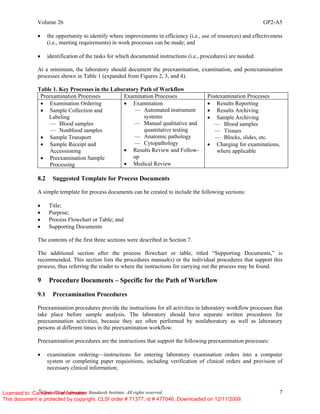
At a minimum, the laboratory should document the preexamination, examination, and postexamination
processes shown in Table 1 (expanded from Figures 2, 3, and 4).
Table 1. Key Processes in the Laboratory Path of Workflow
Preexamination Processes Examination Processes Postexamination Processes
• Examination Ordering
• Sample Collection and
Labeling
— Blood samples
— Nonblood samples
• Sample Transport
• Sample Receipt and
Accessioning
• Preexamination Sample
Processing
• Examination
— Automated instrument
systems
— Manual qualitative and
quantitative testing
— Anatomic pathology
— Cytopathology
• Results Review and Follow-
up
• Medical Review
• Results Reporting
• Results Archiving
• Sample Archiving
— Blood samples
— Tissues
— Blocks, slides, etc.
• Charging for examinations,
where applicable
8.2 Suggested Template for Process Documents
A simple template for process documents can be created to include the following sections:
• Title;
• Purpose;
• Process Flowchart or Table; and
• Supporting Documents
The contents of the first three sections were described in Section 7.
The additional section after the process flowchart or table, titled “Supporting Documents,” is
recommended. This section lists the procedures manual(s) or the individual procedures that support this
process, thus referring the reader to where the instructions for carrying out the process may be found.
9 Procedure Documents – Specific for the Path of Workflow
9.1 Preexamination Procedures
Preexamination procedures provide the instructions for all activities in laboratory workflow processes that
take place before sample analysis. The laboratory should have separate written procedures for
preexamination activities, because they are often performed by nonlaboratory as well as laboratory
persons at different times in the preexamination workflow.
Preexamination procedures are the instructions that support the following preexamination processes:
• examination ordering—instructions for entering laboratory examination orders into a computer
system or completing paper requisitions, including verification of clinical orders and provision of
necessary clinical information;
Licensed to: Cameron Wannamaker
This document is protected by copyright. CLSI order # 71377, id # 477046, Downloaded on 12/11/2009.
Number 12 GP2-A5
8 ©
Clinical and Laboratory Standards Institute. All rights reserved.
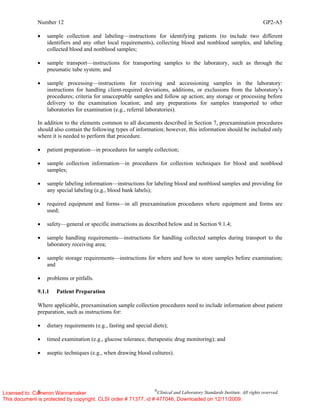
• sample collection and labeling—instructions for identifying patients (to include two different
identifiers and any other local requirements), collecting blood and nonblood samples, and labeling
collected blood and nonblood samples;
• sample transport—instructions for transporting samples to the laboratory, such as through the
pneumatic tube system; and
• sample processing—instructions for receiving and accessioning samples in the laboratory:
instructions for handling client-required deviations, additions, or exclusions from the laboratory’s
procedures; criteria for unacceptable samples and follow up action; any storage or processing before
delivery to the examination location; and any preparations for samples transported to other
laboratories for examination (e.g., referral laboratories).
In addition to the elements common to all documents described in Section 7, preexamination procedures
should also contain the following types of information; however, this information should be included only
where it is needed to perform that procedure.
• patient preparation—in procedures for sample collection;
• sample collection information—in procedures for collection techniques for blood and nonblood
samples;
• sample labeling information—instructions for labeling blood and nonblood samples and providing for
any special labeling (e.g., blood bank labels);
• required equipment and forms—in all preexamination procedures where equipment and forms are
used;
• safety—general or specific instructions as described below and in Section 9.1.4;
• sample handling requirements—instructions for handling collected samples during transport to the
laboratory receiving area;
• sample storage requirements—instructions for where and how to store samples before examination;
and
• problems or pitfalls.
9.1.1 Patient Preparation
Where applicable, preexamination sample collection procedures need to include information about patient
preparation, such as instructions for:
• dietary requirements (e.g., fasting and special diets);
• timed examination (e.g., glucose tolerance, therapeutic drug monitoring); and
• aseptic techniques (e.g., when drawing blood cultures).
Licensed to: Cameron Wannamaker
This document is protected by copyright. CLSI order # 71377, id # 477046, Downloaded on 12/11/2009.
Volume 26 GP2-A5
©
Clinical and Laboratory Standards Institute. All rights reserved. 9
9.1.2 Sample Collection and Labeling
Where applicable, preexamination sample collection procedures need to include information about sample
collection techniques that are:
• age-specific;
• sex-specific (e.g., clean-catch urine); and
• collection-site-specific (e.g., the presence of intravenous lines, and alternatives to the antecubital
collection site [capillary puncture, arterial puncture, line draw, etc.]).
Sample collection procedures need to include instructions for how to record the identity of the person who
collected the sample.
In addition, prepare procedures for patient-collected samples that provide information and instructions to
the patient about:
• special preparation (see Section 9.1.1 above);
• type and amount of sample to collect;
• how to do the procedure (e.g., collect a clean-catch urine);
• special timing of collection (e.g., 24 hour urine);
• labeling of the sample; and
• special handling between the time of collection and time received by laboratory personnel (e.g.,
refrigeration, warming, immediate delivery).
Labeling procedures need to include clear instructions about:
• required label information, and
• placement of label on the sample (e.g., on the container, not the lid; position of bar code, etc.).
9.1.3 Required Equipment and Forms
Where applicable, preexamination procedures need to include information about the required equipment
used, and forms and the use of forms needed for the procedure. For example:
• examination requisitions and labels;
• bar-code readers
• sample collection devices and materials (e.g., blood collection tubes, culture media, swabs);
• sample containers; and
• instruments (tourniquets, hemostats, scissors, etc.).
Licensed to: Cameron Wannamaker
This document is protected by copyright. CLSI order # 71377, id # 477046, Downloaded on 12/11/2009.
Number 12 GP2-A5
10 ©
Clinical and Laboratory Standards Institute. All rights reserved.
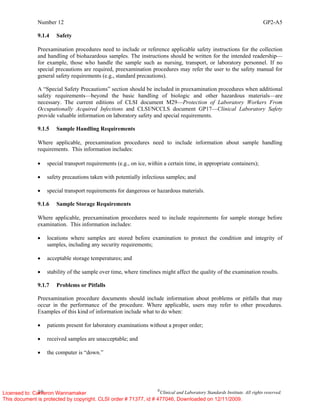
9.1.4 Safety
Preexamination procedures need to include or reference applicable safety instructions for the collection
and handling of biohazardous samples. The instructions should be written for the intended readership—
for example, those who handle the sample such as nursing, transport, or laboratory personnel. If no
special precautions are required, preexamination procedures may refer the user to the safety manual for
general safety requirements (e.g., standard precautions).
A “Special Safety Precautions” section should be included in preexamination procedures when additional
safety requirements—beyond the basic handling of biologic and other hazardous materials—are
necessary. The current editions of CLSI document M29—Protection of Laboratory Workers From
Occupationally Acquired Infections and CLSI/NCCLS document GP17—Clinical Laboratory Safety
provide valuable information on laboratory safety and special requirements.
9.1.5 Sample Handling Requirements
Where applicable, preexamination procedures need to include information about sample handling
requirements. This information includes:
• special transport requirements (e.g., on ice, within a certain time, in appropriate containers);
• safety precautions taken with potentially infectious samples; and
• special transport requirements for dangerous or hazardous materials.
9.1.6 Sample Storage Requirements
Where applicable, preexamination procedures need to include requirements for sample storage before
examination. This information includes:
• locations where samples are stored before examination to protect the condition and integrity of
samples, including any security requirements;
• acceptable storage temperatures; and
• stability of the sample over time, where timelines might affect the quality of the examination results.
9.1.7 Problems or Pitfalls
Preexamination procedure documents should include information about problems or pitfalls that may
occur in the performance of the procedure. Where applicable, users may refer to other procedures.
Examples of this kind of information include what to do when:
• patients present for laboratory examinations without a proper order;
• received samples are unacceptable; and
• the computer is “down.”
Licensed to: Cameron Wannamaker
This document is protected by copyright. CLSI order # 71377, id # 477046, Downloaded on 12/11/2009.
Volume 26 GP2-A5
©
Clinical and Laboratory Standards Institute. All rights reserved. 11
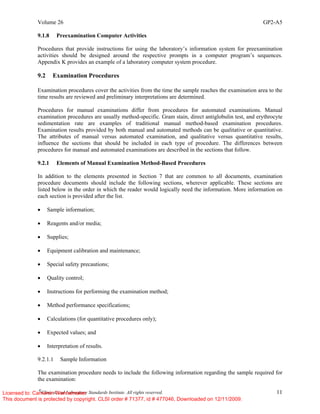
9.1.8 Preexamination Computer Activities
Procedures that provide instructions for using the laboratory’s information system for preexamination
activities should be designed around the respective prompts in a computer program’s sequences.
Appendix K provides an example of a laboratory computer system procedure.
9.2 Examination Procedures
Examination procedures cover the activities from the time the sample reaches the examination area to the
time results are reviewed and preliminary interpretations are determined.
Procedures for manual examinations differ from procedures for automated examinations. Manual
examination procedures are usually method-specific. Gram stain, direct antiglobulin test, and erythrocyte
sedimentation rate are examples of traditional manual method-based examination procedures.
Examination results provided by both manual and automated methods can be qualitative or quantitative.
The attributes of manual versus automated examination, and qualitative versus quantitative results,
influence the sections that should be included in each type of procedure. The differences between
procedures for manual and automated examinations are described in the sections that follow.
9.2.1 Elements of Manual Examination Method-Based Procedures
In addition to the elements presented in Section 7 that are common to all documents, examination
procedure documents should include the following sections, wherever applicable. These sections are
listed below in the order in which the reader would logically need the information. More information on
each section is provided after the list.
• Sample information;
• Reagents and/or media;
• Supplies;
• Equipment calibration and maintenance;
• Special safety precautions;
• Quality control;
• Instructions for performing the examination method;
• Method performance specifications;
• Calculations (for quantitative procedures only);
• Expected values; and
• Interpretation of results.
9.2.1.1 Sample Information
The examination procedure needs to include the following information regarding the sample required for
the examination:
Licensed to: Cameron Wannamaker
This document is protected by copyright. CLSI order # 71377, id # 477046, Downloaded on 12/11/2009.
Number 12 GP2-A5
12 ©
Clinical and Laboratory Standards Institute. All rights reserved.
• sample type;
• sample source;
• amount of sample required, including minimum requirements;
• acceptable collection containers and sterility requirements;
• sample stability and storage requirements; and
• criteria for unacceptable samples and follow-up action.
9.2.1.2 Reagents and Media
The procedure needs to include a list of the reagents or media used in performing the procedure.
An examination procedure should provide instructions for preparing reagents only when the reagents are
prepared each time the procedure is performed. Instructions for stock and working solutions of reagents
and stains that are prepared at times other than performance of the actual procedure should be written into
separate procedures. For example, the “Reagents” section in a procedure that provides instructions for
performing a Gram stain should only list the reagents used to stain smear samples. There should be
separate procedures for preparing, labeling, and storing the different stock and working solutions. This
reduces the length of the examination procedure and allows for keeping reagent “recipes” in a separate
place where they can be easily referenced and located.
Receipt of reagents and materials in the laboratory does not take place at the time of performing
examinations; therefore, a separate procedure is needed for receiving, inspecting, and appropriately
evaluating laboratory reagents and examination kits before use.
Procedures for reagent and media preparation should include the following:
• list of required reagents and/or media;
• reagent name or chemical formula;
• acceptable reagent grade;
• special safety requirements (e.g., general category or class of hazard; special handling instructions);
• step-by-step instructions for reagent or media preparation;
• degree of accuracy, and any special handling instructions for measuring devices;
• QC of reagents or media (e.g., pH testing or visual assessment);
• labeling requirements, including expiration;
• storage requirements, including containers and stability; and
• regulatory classifications where applicable.
Licensed to: Cameron Wannamaker
This document is protected by copyright. CLSI order # 71377, id # 477046, Downloaded on 12/11/2009.
Volume 26 GP2-A5
©
Clinical and Laboratory Standards Institute. All rights reserved. 13
9.2.1.3 Supplies
Receipt of supplies and other materials in the laboratory does not take place at the time of performing
examinations; therefore, a separate procedure is needed for receiving, inspecting, and appropriately
evaluating laboratory supplies and materials before they are used in examination procedures.
The examination procedure needs to include a list of the supplies used to perform the procedure.
Examples of supplies that could be listed include:
• disposable pipettes;
• pipette tips;
• gauze;
• bibulous paper;
• immersion oil;
• test tube rack;
• test tubes;
• scissors; and
• other applicable supplies.
9.2.1.4 Equipment Calibration and Maintenance
Instructions for calibration and maintenance should be included in the examination performance
procedure only when these activities are performed each time the procedure is done. Instructions for
equipment calibration, calibration verification, and maintenance that are performed at a time remote from
the use of such equipment in the performance of an examination procedure should be written as separate
procedures. Directions for the preparation of calibration standards should be included in a separate
calibration procedure.
Procedures for equipment calibration and maintenance need to include the following information:
Calibration:
• schedule for performing calibration—daily, weekly, monthly, semiannually, etc.;
• schedule for performing calibration verifications (which are the assaying of calibration materials in
the same manner as patient samples to confirm that the calibration of the instrument, kit, or
examination system has remained stable throughout the laboratory’s reportable range for patient
examination results);
• source of the calibration material;
• calibration material specifications;
• calibration material preparation and storage;
• step-by-step instructions for performing the calibration, including expected instrument readings;
• troubleshooting guidelines; and
• documentation methods and storage requirements for calibration records.
Licensed to: Cameron Wannamaker
This document is protected by copyright. CLSI order # 71377, id # 477046, Downloaded on 12/11/2009.
Number 12 GP2-A5
14 ©
Clinical and Laboratory Standards Institute. All rights reserved.
Maintenance:
• schedule for performing maintenance—daily, weekly, monthly, semiannually, annually, etc.;
• step-by-step instructions for performing maintenance activities; and
• troubleshooting guidelines.
9.2.1.5 Special Safety Precautions
All laboratory personnel need to receive training about precautions taken when handling biologic and
other hazardous materials. Because all laboratory examinations use biologic samples, it is redundant to
repeat routine safety precautions, such as the requirement for wearing of gowns and gloves, in every
procedure. If no special precautions are required, the examination procedure may refer the user to the
safety manual for general safety requirements.
The examination procedure needs to include a special safety precautions section when additional safety
requirements—beyond the basic handling of biologic and other hazardous materials—are necessary. The
special safety precautions section should include the following:
• engineering controls (e.g., use of a biohazard cabinet);
• personal protective equipment (e.g., respirators, special gloves, face shields); and
• work practice controls (e.g., beginning a step only after certain conditions have been met or
precautions have been taken).
9.2.1.6 Quality Control (QC)
Instructions for QC should be included in the examination performance procedure only when QC is
performed each time the examination procedure is performed. Instructions for performing QC when it is
performed at a time remote from the performance of the examination procedure should be written as a
separate procedure. For example, the instructions for performing the positive and negative controls for a
rheumatoid factor examination need to be in the rheumatoid factor examination procedure, because these
controls are included every time a batch of samples is examined. On the other hand, the instructions for
performing the QC of anti-A, anti-B, and anti-D reagents should be in a procedure separate from that of
determining patient ABO and Rh types, because reagent QC examination is performed and recorded
separately from patient examinations.
QC procedures need to include the following information:
• frequency with which controls should be examined;
• number of levels of controls to use;
• type of quality control material to use;
• instructions for preparation and handling of control materials;
• the expected QC values and/or ranges;
Licensed to: Cameron Wannamaker
This document is protected by copyright. CLSI order # 71377, id # 477046, Downloaded on 12/11/2009.
Volume 26 GP2-A5
©
Clinical and Laboratory Standards Institute. All rights reserved. 15
• explanation of control criteria (e.g., criteria for accepting or rejecting QC results and examination
data);
• corrective action to take if controls exceed expected criteria;
• instructions for documentation of QC data; and
• alternate QC measures, such as procedural controls or clinical correlation.
Proficiency testing samples (also known as “external quality assurance”) often need different handling
and preparation than patient samples. Therefore, separate instructions are needed for:
• receiving proficiency testing samples in the laboratory;
• distributing and rotating samples for examination;
• handling and preparing proficiency testing samples;
• transcribing and submitting results;
• reviewing reports; and
• taking and documenting any necessary follow-up action.
9.2.1.7 Instructions for Performing the Examination Method
The examination method should be reflected in the title of the procedure document. For example:
• “Antibody Screen by Gel Technique;”
• “Microscopic Urinalysis by Phase Microscopy;”
• “Gram Stain Procedure;”
• “Fingerstick Glucose Examinations on the XYZ Instrument.”
This section should present the stepwise instructions for performing the examination by the method
validated in the laboratory (before use on patient samples) that was derived from the manufacturer’s
package insert, or operator’s manual or reference method. When procedure instructions in the validated
method are altered or deleted, the examination method performance may change and, therefore,
appropriate verification that the changed method provides the expected results needs to be performed and
documented.
See Appendixes F through K for examples of how to present procedure instructions.
9.2.1.8 Method Performance Specifications9
The examination procedure needs to include information about the performance characteristics of the
examination method. Where applicable, this section needs to include the following:
• analytic sensitivity (lower limit of detection, biological limit of detection);
Licensed to: Cameron Wannamaker
This document is protected by copyright. CLSI order # 71377, id # 477046, Downloaded on 12/11/2009.
Number 12 GP2-A5
16 ©
Clinical and Laboratory Standards Institute. All rights reserved.
• analytic specificity (including effect of interfering substances, such as chemicals [preservatives],
drugs, cold agglutinins);
• reportable range;
• appropriate dilution and concentration protocols or reporting instructions if the reporting range is
exceeded;
• analytic accuracy (bias); and
• analytic precision.
Appendixes M1 and M2 provide a means to present analyte-specific information by analyte or analyzer in
a tabular format for easier comprehension. These tables can serve as useful references when answering
questions about examinations and methods.
9.2.1.9 Calculations for Quantitative Procedures
Quantitative examination procedures need to include the equations for calculations when they are
applicable to the examination. The calculation section needs to include:
• the full equation;
• step-by-step instructions to solve the equation; and
• an example of how to solve the equation.
This section is not needed for qualitative examination procedures (e.g., dipstick examinations, slide
examinations, immunohematology examinations).
A separate documented procedure is needed for periodically verifying calculations performed by the
laboratory information system, because verification of calculations made by the computer does not take
place at the time of performing examinations.
9.2.1.10 Expected Values
The examination procedure needs to include the range of expected values for the analyte or examination
result. The expected values encompass the reference range relevant to the following:
• sample type; and
• demographic variables, such as sex, age, and race.
9.2.1.11 Interpretation of Results
The examination procedure needs to include guidelines for interpreting examination results when
applicable. This section should include:
• comparison of the results to the expected values or diagnostic findings to determine if the result is
normal, abnormal, or indeterminate;
• follow-up for indeterminate results;
Licensed to: Cameron Wannamaker
This document is protected by copyright. CLSI order # 71377, id # 477046, Downloaded on 12/11/2009.
Volume 26 GP2-A5
©
Clinical and Laboratory Standards Institute. All rights reserved. 17
• recognition of results that fall outside the reportable range, and reference back to the Method
Limitations section; and
• recognition of results that exceed critical limits (see Section 9.3.1).
9.2.2 Procedures for Automated Instruments and Manufacturers’ Operator’s Manuals
Multitest, random-access analyzers require documents that reflect the instructions for readying the
analyzer for examinations; performing scheduled QC, calibration, or calibration verification; performing
required maintenance and function checks; and troubleshooting problems.
Automated examinations are centered on:
• preparing the instrument for examinations (e.g., start-up diagnostics, reagent sufficiency);
• loading patient and nonpatient samples for examinations;
• selecting the analytes to examine;
• making decisions based on the values of controls and patient examination results; and
• handling instrument problems.
Therefore, it is important that procedures clearly and accurately describe what the operator needs to do
and how to do it.
The laboratory may write its own procedures for performing these activities or may use those in the
instrument operators’ manuals. The laboratory needs to review the manufacturers’ manuals to determine
if the procedures match the laboratory’s practice. Where there are differences, revise the procedures to
reflect actual practice and verify to ensure expected performance. When manufacturer procedures
manuals are adopted as the laboratory’s procedures (after proper validation and documentation of
validation), the guidance provided herein for revision and approval should be followed.
In addition to the common elements described in Section 7 for all documents, procedures for automated
examinations need to cover all of the information discussed in Sections 9.2.1.1 through 9.2.1.11.
Important information about analytes that are examined on analyzers can be presented in one or more
tables that summarize analyte-specific information for easy reference. Examples of these types of tables
are presented in Appendixes M1 and M2.
9.3 Postexamination Procedures
Postexamination procedures address the activities from reporting patient examination results to archiving
results and samples. In addition to the common elements described in Section 7 for all documents,
postexamination procedures need to include the following, where applicable:
• how results are prioritized;
• entry of results into the laboratory reporting system;
• guidelines for notification of appropriate individuals of examination results;
Licensed to: Cameron Wannamaker
This document is protected by copyright. CLSI order # 71377, id # 477046, Downloaded on 12/11/2009.
Number 12 GP2-A5
18 ©
Clinical and Laboratory Standards Institute. All rights reserved.
• archiving results and report documents; and
• sample retention.
9.3.1 Prioritizing Results
Postexamination procedures need to include instructions for prioritizing results that:
• are normal;
• fall outside the reference range;
• exceed the critical limits;
• fall outside the reportable range (e.g., the use of greater than [>] and less than [<]); and
• use interpretative text. NOTE: Examples of such text should be included in the procedure.
Instructions are also needed for:
• rounding numbers; and
• the acceptable units for reporting (e.g., mL, mmol, µg).
Include instructions for supervisory and/or medical review of examination results, where such review is
required.
9.3.2 Entry of Results Into the Laboratory Reporting System
The laboratory needs to have postexamination procedures for result reporting that describe all electronic
and manual methods that are used. These postexamination procedures need to include instructions for
reporting results:
• by electronic transfer of data from an instrument or analyzer into a computer system;
• by manual entry of data into a computer system; and
• manually, on paper report forms.
Procedures that provide instructions for entering patient examination results into the laboratory’s
information system (whether manually or by electronic transfer) should contain instructions for the user at
each prompt in the computer program sequence. Appendix K provides an example of a template that can
be used for writing computer procedure instructions.
A separate procedure is needed for periodically verifying the accuracy of electronic transmission of
laboratory examination results, because this verification does not take place at the time of performing
patient examinations.
A separate procedure is needed for how to change results that have been erroneously entered into the
reporting system (for whatever reason) and are thus available for review and use by clinicians and
caregivers.
Licensed to: Cameron Wannamaker
This document is protected by copyright. CLSI order # 71377, id # 477046, Downloaded on 12/11/2009.
Volume 26 GP2-A5
©
Clinical and Laboratory Standards Institute. All rights reserved. 19
9.3.3 Guidelines for Notification of Appropriate Individuals of Examination Results
Postexamination procedures need to include guidelines for notifying the appropriate individual(s) of
results that exceed critical clinical limits. Instructions are also needed for documentation of the
notification and verification that the results and notification have been received. If the laboratory has a
separate procedure for notification and documentation of notification, the postexamination procedure may
refer the user to that procedure.
9.3.4 Archiving Results
The laboratory needs to have postexamination processes and procedures that address the archiving of
patient results. The processes and procedures need to provide the activities and instructions for electronic
and/or paper identification collection, indexing, access, filing storage maintenance and disposal of patient
records. Data storage procedures need to provide instructions for storing patient records so as to prevent
loss, damage, or unauthorized access, and promote easy retrieval.
In addition, the laboratory needs to have a schedule for the duration of patient record retention, as defined
by regulatory or accreditation requirements, and organizational needs. CLSI/NCCLS guideline GP26—
Application of a Quality Management System Model for Laboratory Services provides an example of a
laboratory record retention schedule.
9.3.5 Sample Retention
Postexamination procedures for sample retention need to include step-by-step instructions for archiving
sample material, such as compatibility testing samples, hematology slides, and histology and cytology
tissue blocks and slides in such a way as to be readily retrievable when needed.
In addition, the laboratory needs to have a schedule for the duration of sample retention as defined by
regulatory or accreditation requirements, and organizational needs. CLSI/NCCLS guideline GP26—
Application of a Quality Management System Model for Laboratory Services provides an example of a
laboratory record retention schedule.
The laboratory also needs to have instructions for disposal of samples after they have exceeded their
established retention times.
10 Form Documents
Forms are the blank documents (or computer screens) onto which the results generated from the
performance of a given procedure are recorded. Form documents need to include:
• a title that describes the form’s purpose;
• facility name and location;
• effective date;
• fields in which to record information generated from performing the procedure (e.g., results,
interpretations, date, time, initials); and
• a means to link the form to its respective procedure document (e.g., through the document numbering
system).
Licensed to: Cameron Wannamaker
This document is protected by copyright. CLSI order # 71377, id # 477046, Downloaded on 12/11/2009.
Number 12 GP2-A5
20 ©
Clinical and Laboratory Standards Institute. All rights reserved.
Examples of properly completed forms, labels, tags, and registers should be included with their respective
procedures in the procedures manual. These examples can be placed in the Appendixes (or Attachments)
section of their respective procedures.
11 Procedures Manuals
Procedures manuals should be organized in a way that can be easily followed by laboratory personnel and
should contain the following elements:
• table of contents;
• process descriptions (optional, but strongly recommended; see Appendixes A1 through E2);
• procedures; and
• associated forms.
Appendixes N and O provide examples of procedures manual content. These Appendixes suggest that
procedures can be organized into subgroups that represent the sequence of work activities (i.e., work
processes), rather than arranging in alphabetical order, but that is entirely at the discretion of each
laboratory. However, the organization of procedures by work processes makes information much easier
for staff to find and also provides a useful training tool for orienting new employees to “how we do it in
our laboratory.” An alphabetized or topic index could also be included in the manual for easy location of
individual procedures. Appendix P is an example of the table of contents for a laboratory information
system computer downtime manual.
12 Document Management
The laboratory needs to have a document management system in place to ensure that all documents in use
are written in the approved formats, reflect the current version, and are reviewed and approved by the
appropriate individual(s) in a timely manner. The document management system may be either paper-
based or electronic-based; however, an extensive review of electronic systems is beyond the scope of this
guideline. Although this guideline contains information primarily about the paper-based systems used in
many laboratories, the document management concepts may be handled differently by the different
electronic systems. Readers are encouraged to review the key features about electronic document control
systems.10
12.1 Document Identification
To facilitate the document management system, it is recommended that the laboratory have a document
identification system that enables the reader to determine the type of document, its location, and how it is
used.
Document identification tells the individual what type of document it is (e.g., policy, process, procedure,
or form). A combination of alpha and numeric characters can be used to identify appropriate placement or
ordering of the document within the laboratory operational workflow. In addition, version identification
provides a means to ensure that only the latest approved version of a laboratory document is in use.
Version identification also enables the tracking of changes to documents over time. Document names and
effective dates can also serve as identification of documents stored electronically.
Licensed to: Cameron Wannamaker
This document is protected by copyright. CLSI order # 71377, id # 477046, Downloaded on 12/11/2009.
Volume 26 GP2-A5
©
Clinical and Laboratory Standards Institute. All rights reserved. 21
Creative applications of the document identification system can be used to link documents to:
• laboratory location (e.g., in a region or system);
• laboratory section (e.g., a clinical discipline or division);
• work bench (e.g., microbiology enterics, anaerobes, respiratory);
• instrumentation (e.g., chemistry, hematology, or coagulation); or
• operations process (e.g., sample collection, compatibility testing).
12.2 Master File
Each document should have a master file that contains the current and all previous versions of the
document. Documents can be stored either as electronic files in “virtual” folders or as the original paper
copy in a paper file folder. The master file serves as the original paper or electronic source from which
working copies of the current version are generated. The master file is the historic record of the document
and includes master copies of previous versions as required. The laboratory may decide to include in the
master file the signature file for all the author, reviewer, and approval signatures for each version.
12.3 Review and Approval of New Documents
Laboratories need to establish a process for the timely review and approval of new documents before they
are placed into use. This process needs to specify:
• who is responsible for the review (e.g., laboratory director, supervisors, senior staff);
• who has the approval authority; and
• how the review is recorded.
Document management software systems often provide for electronic capture and tracking of approval
signatures.
12.4 Review and Approval of Changes to Approved Documents
Laboratory services need to have a process for the timely revision, review, and approval of formerly
approved documents. This process needs to include the following activities:
• establishing the need for revision;
• revising the document and any related documents that also need to be changed;
• reviewing the revised document;
• approving the revisions and recording the approval;
• archiving the new version of the document in its respective master file;
• notifying staff of the changes; and
Licensed to: Cameron Wannamaker
This document is protected by copyright. CLSI order # 71377, id # 477046, Downloaded on 12/11/2009.
Number 12 GP2-A5
22 ©
Clinical and Laboratory Standards Institute. All rights reserved.
• providing working copies of the approved, revised document to all appropriate personnel.
Laboratory control over changes to documents provides a means to ensure that:
• only authorized changes are made to approved documents;
• all changes are reviewed and approved before use; and
• all copies of the document in use reflect the change.
All signed approvals of new and changed documents need to be dated.
Appendixes Q1 and Q2 provide an example of the document control process as a flowchart and as a table.
When changes to a particular procedure document are made, the laboratory service should also determine
what other documents will be affected by the change. This is facilitated by review of the appropriate
process flowchart or table and the procedure’s Related Documents and Appendixes (or Attachments)
sections. If additional procedure documents need revision, the change process described above needs to
be initiated for those documents, as well. One mechanism that can facilitate this is to adopt the use of a
document change request form. The completed document change request form is kept with the changed
document in its respective master file.
Appendix R is an example of a document change request form for approving new documents or changing
previously approved documents.
NOTE: This change request form has a place for signature approval of the document. When this type of
form is used and retained for each document, working copies of the document do not need signature(s),
because the document change control process is such that only approved current versions are available to
staff.
Document management software systems can electronically track changes and revisions to provide a
documented audit trail.
12.5 Job Aid Documents
If any additional job aids are used (e.g., index card files; posted diagrams, forms, or instruction sheets;
wall charts), they also need review to be sure that they are current, complete, correct, and traceable to the
“parent” document, and that the effective date is listed. If changes are needed, initiate the document
change process.
12.6 Periodic Review of Unchanged Documents
When documents are managed using a document control process, such as that described in this guideline,
periodic review of unchanged documents may be useful to detect errors, oversights, or work practices that
have diverged from the formal procedures. In the absence of an effective document control process,
however, annual review of documents is required.
12.7 Master Index
The master index is a spreadsheet, database, or hard copy log that lists all documents currently in use in
the laboratory. The master index can be organized for the entire laboratory, or it can be subdivided into
the laboratory’s defined work units.
Licensed to: Cameron Wannamaker
This document is protected by copyright. CLSI order # 71377, id # 477046, Downloaded on 12/11/2009.
Volume 26 GP2-A5
©
Clinical and Laboratory Standards Institute. All rights reserved. 23
At a minimum, the elements of the master index need to include document name and effective date. The
document number and version, and the locations of each working copy of the document.
The master index provides laboratory staff with the means to identify the most current version of the
document. Whenever a document is changed and updated to a new version, update the master index.
12.8 Distribution
Revised documents need to be available to all appropriate personnel. The laboratory uses the document
master index to locate the active working copies of the documents. Where paper copies or nonlinked
electronic copies of the document are used, the master copy is used to make new working copies that are
distributed to the locations listed on the master index. Old working copies can be destroyed because the
current and previous master copies of each document have been retained in the master file.
12.9 Archiving, Storage, and Retention of Documents
Store the current version and all previous versions of a laboratory document in the document’s respective
master file. When a document is changed, the new version becomes the new master document, and the
previous version is retired and archived in the master file. A notation or stamp indicating the retirement
date is needed to identify the document as obsolete and prevent its unintended use.
Store document master files in a manner that prevents loss, damage, or unauthorized access, and promotes
easy retrieval. Duration of retention of archived laboratory documents is defined in regulations,
accreditation requirements, and by the organization. The laboratory must have documented processes for
short-term and long-term storage for both on-site and off-site locations.
A summary of useful document control rules is presented in Appendix S.
13 Summary
Process documents provide valuable information to staff about how the work operations processes
sequence work through the laboratory. Procedure documents provide the staff with instructions for how to
perform the individual tasks that comprise the work processes.
When process and procedure documents are used as the basis for the laboratory’s training and
competence assessment programs, personnel can become functional in the actual work operations
environment more quickly. Staff can more easily identify where process problems exist and which
documents need revision.
A document management process is vital for ensuring that staff access and use only the most current
versions of documents, and that everyone is following the same process sequence and procedure
instructions. In so doing, performance variations that can affect the quality of laboratory services and
results are greatly reduced or actually eliminated.
Licensed to: Cameron Wannamaker
This document is protected by copyright. CLSI order # 71377, id # 477046, Downloaded on 12/11/2009.
Number 12 GP2-A5
24 ©
Clinical and Laboratory Standards Institute. All rights reserved.
References
1
ISO. Medical laboratories—Particular requirements for quality and competence. EN/ISO 15189. Geneva: International Organization for
Standardization; 2003.
2
ISO. General requirements for the competence of testing and calibration laboratories. ISO/IEC 17025:1999. Geneva: International
organization for Standardization; 1999.
3
Centers for Medicare and Medicaid Services. Department of Health and Human Services. Part 493—Laboratory Requirements: Clinical
Laboratory Improvement Amendments of 1988. 42 CFR, Parts 430 to end. U.S. Government Printing Office. Published annually.
4
Joint Commission on Accreditation of Healthcare Organizations. Comprehensive Accreditation Manual for Pathology and Laboratory
Services. Oakbrook Terrace, IL: JCAHO. Published annually.
5
College of American Pathologists. Laboratory Accreditation Checklists. Northfield, IL: College of American Pathologists. Available at:
www.cap.org.
6
American Association of Blood Banks. Standards for Blood Banks and Transfusion Services. 23rd
ed. Bethesda, MD: AABB; 2005.
7
COLA. Laboratory Accreditation Manual. Columbia, MD: COLA; 2001.
8
ISO. Quality management systems—Fundamentals and vocabulary. ISO 9000. Geneva: International Organization for Standardization;
2000.
9
Westgard JO. Basic Method Validation. 2nd
edition. Madison, WI: Westgard QC Inc.; 2003.
10
Woodcock SM. Quality management software. Lab Medicine. 2005;36(6):333-336.
Licensed to: Cameron Wannamaker
This document is protected by copyright. CLSI order # 71377, id # 477046, Downloaded on 12/11/2009.
Volume 26 GP2-A5
©
Clinical and Laboratory Standards Institute. All rights reserved. 25
This page is intentionally left blank.
Licensed to: Cameron Wannamaker
This document is protected by copyright. CLSI order # 71377, id # 477046, Downloaded on 12/11/2009.
Number 12 GP2-A5
26 ©
Clinical and Laboratory Standards Institute. All rights reserved.
Appendix A1. Inpatient Blood Sample Collection Process Flowchart
This example was contributed by the Client Services Workgroup, Sutter Health Sacramento-Sierra Region, Sacramento,
California.
Licensed to: Cameron Wannamaker
This document is protected by copyright. CLSI order # 71377, id # 477046, Downloaded on 12/11/2009.
Volume 26 GP2-A5
©
Clinical and Laboratory Standards Institute. All rights reserved. 27
Appendix A2. Inpatient Blood Sample Collection Process Table
Inpatient Blood Sample Collection Process
What Happens Who’s Responsible Procedures
Collection lists or
labels are generated
• laboratory assistant
• phlebotomist
• clerk
• technician
• technologist
• “Generating a Collection List for Rounds”
• “Generating Collection Lists and Labels for
Priority Draws”
• “Reprinting Labels”
Patient is identified • patient care technician
• phlebotomist
• laboratory technician
• laboratory technologist
• nurse
• other healthcare
professional trained in
blood collection
• “Identifying Patients for Sample Collection”
• “Identifying Patients for Emergencies”
Blood samples are
collected
• patient care technician
• phlebotomist
• laboratory technician
• laboratory technologist
• nurse
• other healthcare
professional trained in
blood collection
• “Collecting a Blood Sample by
Venipuncture”
• “Collecting a Blood Sample by Capillary
Technique”
• “Collecting a Blood Sample by Arterial
Puncture”
Blood samples are
labeled
• patient care technician
• phlebotomist
• laboratory technician
• laboratory technologist
• nurse
• other healthcare
professional trained in
blood collection
• “Labeling Collected Blood Samples”
• “Using the Blood Bank Armband/Labeling
System”
• “Following Chain of Custody”
Samples are
transported to
laboratory
• patient care technician
• phlebotomist
• laboratory technician
• laboratory technologist
• nurse
• other healthcare
professional trained in
blood collection
• “Tubing Samples to the Laboratory”
• “Transporting Samples to the Laboratory”
Licensed to: Cameron Wannamaker
This document is protected by copyright. CLSI order # 71377, id # 477046, Downloaded on 12/11/2009.
Number 12 GP2-A5
28 ©
Clinical and Laboratory Standards Institute. All rights reserved.
Appendix B1. Analyzer Examination Process Flowchart
Licensed to: Cameron Wannamaker
This document is protected by copyright. CLSI order # 71377, id # 477046, Downloaded on 12/11/2009.
Volume 26 GP2-A5
©
Clinical and Laboratory Standards Institute. All rights reserved. 29
Appendix B2. Analyzer Examination Process Table
Analyzer Examination Process
What Happens Who’s Responsible Procedures
Sample acceptability is
evaluated
• technician, or
• technologist
• “Evaluating Sample Acceptability”
Analyzer examination-
ready procedures are
performed
• technician, or
• technologist
• “Starting Up the ABC Analyzer”
• “Performing Daily Maintenance on the ABC
Analyzer”
• “Performing and Evaluating Daily Calibration on the
ABC Analyzer”
• “Performing and Evaluating Controls on the ABC
Analyzer”
Samples are loaded
and examined
• technician, or
• technologist
• “Generating an LIS Pending Log for the ABC
Analyzer”
• “Programming Patient Samples on the ABC
Analyzer
• “Loading Routine and Stat Racks on the ABC
Analyzer”
Troubleshooting
procedures are
performed
• technician,
• technologist, or
• supervisor
• [Troubleshooting procedures from the
manufacturer’s manual]
Results are evaluated • technologist, or
• supervisor
• “Evaluating Patient Results”
• “Following Up on Delta Checks”
• “Following Up on Technical Limit Flags”
Alert/critical values
called
• technologist • “Calling Alert Values”
Results are verified in
LIS
• technologist • “Verifying Results in the LIS”
Samples are unloaded
and stored
• technologist, or
• technician
• “Storing Patient Examination Samples”
This example was contributed by the Central Clinical Laboratory of the Mayo Clinic Department of Laboratory of Medicine and
Pathology, Rochester, Minnesota.
Licensed to: Cameron Wannamaker
This document is protected by copyright. CLSI order # 71377, id # 477046, Downloaded on 12/11/2009.
Number 12 GP2-A5
30 ©
Clinical and Laboratory Standards Institute. All rights reserved.
Appendix C1. Bacteriology Culture Process Flowchart
This example was contributed by the Microbiology Technical Working group, Sutter Health Laboratory Integration Project,
Sacramento, California.
Start
Sample is received in
microbiology lab
Culture is set up and incubated
First read is performed
Is further
work needed?
Further ID is performed. Susceptibility
performed, if needed
Preliminary report is generated
Critical values are called
Additional read is performed
Is
further work
needed?
Final report is generated
Critical values are called
End
Further ID and susceptibility
are performed
Next read is performed
Bacteriology Culture Process
Yes
No
No Yes
- status as received in LIS
- preexamination sample storage
- determining microbiology sample acceptability
- catalase
- coagulase
- etc.
Licensed to: Cameron Wannamaker
This document is protected by copyright. CLSI order # 71377, id # 477046, Downloaded on 12/11/2009.
Volume 26 GP2-A5
©
Clinical and Laboratory Standards Institute. All rights reserved. 31
Appendix C2. Bacteriology Culture Process Table
Bacteriology Culture Process
What Happens Who’s Responsible Procedures
Sample is received in
Microbiology
• laboratory assistant,
• technician, or
• technologist
• “Changing Microbiology Sample
Status to Received in the LIS”
• “Storing Microbiology Samples
Before Processing/Examining”
• “Evaluating Microbiology Sample
Acceptability”
Sample is processed • laboratory assistant,
• technician, or
• technologist
• “Centrifuging Samples”
• “Grinding Samples”
Culture is set up • laboratory assistant,
• technician, or
• technologist
• Media selection table
• Incubating cultures table
• “Streaking Agar Plates”
• “Inoculating Tube Media”
• “Making Sample Smears”
• “Postinoculation Microbiology
Sample Storage”
First read is performed
Second read is performed
• technician, or
• technologist
• “Urine Cultures: Reading and
Interpreting”
• “Enteric Cultures: Reading and
Interpreting”
• [Additional procedures for reading
and interpreting other cultures]
Further identification is made • technician, or
• technologist
• [Instrument procedures]
• [Examination-specific procedures
such as catalase, gram stain, etc.]
Susceptibility is performed • technician, or
• technologist
• [Instrument and examination-specific
procedures]
Critical values are called • technician, or
• technologist
• “Calling Alert Values”
Preliminary report and
final report are issued
• technician, or
• technologist
• “Generating Microbiology Reports:
Preliminary and Final”
Licensed to: Cameron Wannamaker
This document is protected by copyright. CLSI order # 71377, id # 477046, Downloaded on 12/11/2009.
Number 12 GP2-A5
32 ©
Clinical and Laboratory Standards Institute. All rights reserved.
Appendix D1. Transfusion Medicine Prenatal Examination Process Flowchart
This example was contributed by the Blood Bank Technical Work Group, Sutter Health Laboratory Integration Project,
Sacramento, California.
Sample is received in blood bank/transfusion service
Sample is centrifuged
Sample acceptability is determined
Sample is held for batching
Pending log is generated from computer
Type and screen
is performed
Is antibody
screen positive?
Results are reported
End
Antibody identification
is performed
Is antibody
clinically significant?
Results are reported
End
Results are reported
Specimens are held pending
order for titer
Yes
No
Yes
No
- antiglobulin panel
- gel panel
- rule-out cells
- ABO/Rh
- D
u
- Antibody screen by gel technique
- Antibody screen by tube technique
Previous record check is performed
Transfusion Medicine
Prenatal Examination Process
- manual
- computer
Order for
titer is received
Licensed to: Cameron Wannamaker
This document is protected by copyright. CLSI order # 71377, id # 477046, Downloaded on 12/11/2009.
Volume 26 GP2-A5
©
Clinical and Laboratory Standards Institute. All rights reserved. 33
Appendix D2. Transfusion Medicine Prenatal Examination Process Table
Transfusion Medicine Prenatal Examination Process
What Happens Who’s Responsible Procedures
Sample acceptability is
determined
• technician
• technologist
• “Evaluating Blood Bank Samples”
Sample is held for
batching
• laboratory assistant
• technician
• technologist
• “Batching Blood Bank Samples for Future
Examinations”
Computer pending log is
generated
• laboratory assistant
• technician
• “Generating a Pending Log From the LIS”
Previous record check is
performed
• technician
• technologist
• “Checking Blood Bank Patient History Files”
Type and screen is
performed
• technician
• technologist
• “ABO and Rh by Tube Method”
• “Weak D (Du
Examination)”
• “Antibody Screen by Gel Technique”
• “Antibody Screen by Tube Technique”
Antibody identification is
performed, when
necessary
• technologist • “Identifying Antibodies by the Antiglobulin
Panel”
• “Identifying Antibodies by the Gel Technique”
• “Using Rule-Out Cells in Antibody Identification”
• [Additional specific antibody identification
procedures]
Results are reported • technologist • “Reporting Blood Bank Results in the LIS”
• Antibody Identification Report Form
Samples are stored • laboratory assistant • “Storing Blood Bank Samples”
Licensed to: Cameron Wannamaker
This document is protected by copyright. CLSI order # 71377, id # 477046, Downloaded on 12/11/2009.
Another Random Scribd Document
with Unrelated Content
[3] The well-known statesman, who influenced Alexander I
between the years 1806 and 1812.—Speránsky, the son of a poor
village priest, and socially (though not legally) on the level of the
peasants, was educated at an ecclesiastical academy, and became
the professor of mathematics and philosophy in the ecclesiastical
school of St Alexander Névsky, in St. Petersburg. Thence his rise
was as follows: he became the tutor of a nobleman's children;
secretary to the Chancellor of the Imperial Council; Secretary of
State. He was an ardent admirer of Napoleon I., as was Alexander
I., and to this, no doubt, was due much of his influence over the
Emperor. The Code Napoléon was his ideal of legislation, and
formed the foundation for a scheme of reforms and laws which he
carried into effect, in part. He thereby antagonized all classes of
society: the aristocracy were offended by his boldness, which they
resented in a man of such low extraction, the peasants were
enraged by the increase in their taxes; and so forth. He was
suddenly sent into polite exile, as the governor of Nizhni
Nóvgorod Province, in March, 1812, but was speedily deprived of
his office, and subjected to strict surveillance. Later on, for a
couple of years, his exile took the form of the governorship of
Siberia, whence he returned to St. Petersburg in 1821. But he
never recovered his standing or influence. He had been created a
Count by Alexander I., and, as the male line of his descendants
died out, his descendants in the female line,—the Russian branch
of the Princes Kantakiúzin (Cantacuzéne),—petitioned the
Emperor, in 1872, for permission to add the title of "Count
Speránsky" to their own title, which was granted.—Translator.
"Why, do you read?"—inquired Ippolít Sergyéevitch, attentively
scanning the intelligent, eagle-like face of the young man, who was
lightly tossing the oars into the boat.
"And as for the laws, as she say,"—and Grigóry indicated Várya with
his bold eyes.—"The tenth volume of them fell into my hands by
accident ... I looked through it, and saw that it was interesting and
necessary. I began to read.... And now I have the first volume....
The first article in it is so straight, and says: 'no one,' it says, 'can
excuse himself through ignorance of the laws,' Well, so I thought to
myself, that nobody does know them, and it isn't necessary for
everybody to know them all.... And the teacher is soon going to get
me the statutes about the peasants;—it's very interesting to read—
and see what they are like...."
"You see what he is?"—inquired Várenka.
"And do you read much?—" Ippolít Sergyéevitch pursued his inquiry,
as he recalled Gógol's Petrúshka.
"I read, when I have time. There are a great many little books
here.... Elizavéta Sergyéevna alone must have as many as a
thousand. Only, hers are all romances, and various stories...."
The boat floated smoothly against the current, the shores moved to
meet it, and all around was intoxicatingly beautiful: bright, still,
fragrant. Ippolít Sergyéevitch gazed at Várenka's face, which was
turned with curiosity toward the broad-chested rower, while the
latter, cutting the mirror-like surface of the river in measured strokes,
chatted about his literary tastes, content that the learned gentleman
so gladly listened to him. Love and pride beamed in the eyes of
Másha, who was watching them from beneath her drooping lashes.
"I don't like to read about how the sun sets and rises ... and, in
general, about nature. I have seen those sunrises more than a
thousand times, I think.... I know all about the woods and the rivers,
also; why should I read about them? But that sort of thing is in
every book ... and, in my opinion, it's entirely superfluous....
Everybody understands the sunset after his own fashion.... And
everybody has his own eyes for that purpose. But about the life of
people—that's interesting. You read, and you say to yourself:—' and
what would you do yourself, if you were placed on that line?'
Although you know that the whole of it is false."
"What is false?"—asked Ippolít Sergyéevitch.
"Why, the little books. They're invented. About the peasant, for
example.... Are they the sort of folks they appear in books?
Everybody writes about them compassionately, and makes them out
to be such petty fools ... it isn't well! Folks read, and think and, as a
matter of fact, they can't understand the peasant ... because in the
books he's ... terribly stupid, and bad...."
Várenka must have found these remarks tiresome, for she began to
sing, in a low tone, as she gazed at the shores with dimming eyes.
"See here—Ippolít Sergyéevitch, let's get out and go on foot through
the forest. But here we are, sitting and baking in the sun—is that the
way to take a pleasure trip? Grigóry and Másha can row on to
Savyóloff dell, land there, and prepare tea for us, and meet us....
Grigóry, bring the boat to the shore. I'm awfully fond of eating and
drinking in the forest, in the air, in the sunshine.... One, somehow,
feels like a free vagabond...."
"There, you see," she said, with animation, as she sprang from the
boat upon the sandy shore,—"you touch earth, and immediately
there is something which ... raises the soul in revolt. Here I've got
my boots full of sand ... and have wet one foot in the water.... That's
unpleasant and pleasant, that means—it is good, because it makes
one feel oneself.... Look, how swiftly the boat has moved on!"
The river lay at their feet, and disturbed by the boat, it plashed
softly against the shore. The boat flew, like an arrow, in the direction
of the forest, leaving behind it a long wake, which glittered like silver
in the sunlight. They could see that Grigóry was laughing, as he
looked at Másha, while she was threatening him with her fist.
"That's a pair of lovers,"—remarked Várenka, with a smile;—"Másha
has already asked Elizavéta Sergyéevna's permission to marry
Grigóry. But Elizavéta Sergyéevna will not allow it, for the present;
she does not like married servants. But Grigóry's term of service
ends in the autumn, and then he'll take Másha away from you ...
They're both splendid people. Grigóry is begging me to sell him a
small plot of ground to be paid for in instalments ... or to let him
have it on a long lease ... he wants ten desyatinas. But I cannot, as
long as papa is alive, and it's a pity ... I know that he would pay me
all, and very punctually ... he's a good hand at everything ... a
locksmith, and a blacksmith, and he's serving at your place as
under-coachman.... Kokóvitch—the county chief, and my suitor—says
this to me about him: 6 that's a dangerous beast, do you know—he
doesn't respect his superiors!'"
"Who is that Kokóvitch? A Pole?"[4]—inquired Ippolít Sergyéevitch,
admiring her grimaces.
[4] Várenka has mimicked Kokóvitch's pronunciation, which leads
to this question.—Translator.
"A Mordvinian, a Tchuvásh—I don't know! He has a frightfully long
and thick tongue, there isn't room for it in his mouth, and it
interferes with his speech.... Ugh! What mud!"
Their path was blocked by a puddle of water covered with green
scum, and surrounded by a border of greasy mud. Ippolít
Sergyéevitch inspected his feet, remarking:
"We must go around it."
"Aren't you going to jump over it? I thought it was already dried
up...." exclaimed Várenka, indignantly, stamping her foot.... "It is a
long way round, and then, I shall tear my gown there.... Try to leap
across it! It's easy, see—o-one!"
She sprang, and flung herself forward; it seemed to him that her
gown had been tom from her shoulders, and was fluttering through
the air. But she stood on the other side of the puddle, and cried,
with regret:
"Aï, how I have spattered myself! Ho, do you go round it ... fie, how
horrid!"
He looked at her, and smiled wanly, catching within him a dark
thought which stimulated him, and feeling that his feet were sinking
into the sticky dampness. On the other side of the mud, Várenka
was shaking her gown, it emitted a soft rustle, and amid its
fluttering, Ippolít Sergyéevitch caught sight of dainty, striped
stockings on the well-formed little feet. For an instant, it seemed to
him as though the mud which separated them from each other, held
a sense of warning for him or for her. But he roughly tore himself
away, calling this prick in the heart stupid childishness, and hastily
stepped aside from the road, into the bushes which bordered it,
where, nevertheless, he was obliged to walk through water
concealed by the grass. With wet feet, and a resolve which was not
yet clear to himself, he emerged beside her, and she, showing him
her gown, with a grimace, said:
"Look at that—is that nice? Bah!"
He looked—large, black spots smote the eye, as they triumphantly
decorated the white material.
"I love, and am accustomed to behold thee so sacredly pure, that
even a spot of mud on thy gown would cast a black shadow on my
soul ..." said Ippolít Sergyéevitch slowly, and ceasing, he began to
gaze into the astonished face of Várenka with a smile hovering over
his lips. Her eyes rested questioningly on his face, but he felt as
though his breast were filling up with burning froth, which was on
the point of being converted into wondrous words, such as he had
never yet uttered to anyone, for he had never known them until that
moment.
"What was that you said?"—inquired Várenka firmly.
He shuddered, for her question sounded stem, and endeavoring to
be calm, he began seriously to explain to her: "I was reciting verses
... in Russian they sound like prose ... but you hear that they are
verses, do you not? They are Italian verses, I think ... really, I do not
remember.... However, perhaps it was prose, from some romance....
It just happened to come into my head...."
"How did it go—say it again?" she asked him, suddenly becoming
thoughtful.
"I love...." he paused, and wiped his brow with his hand.—"Will you
believe it? I have forgotten what I said! On my word of honor—I
have forgotten!"
"Well ... let us go on!—" and she moved forward with decision.
For several minutes Ippolít Sergyéevitch tried to understand and
explain to himself this strange scene, which had placed between him
and the young girl a barrier of mutual distrust—tried, and could get
nothing out of himself, except a consciousness of awkwardness
before Várenka. She walked by his side, in silence, and with bowed
head, not looking at him.
"How am I to explain it all to her?" Ippolít Sergyéevitch reflected.
Her silence was crushing; it seemed as though she were thinking of
him, and not thinking well of him. And unable to devise any
explanation of his outburst, he suddenly remarked, with forced
cheerfulness:
"Your suitors ought to know how you are spending your time!"
She glanced at him, as though, by his words, he had called her back
from somewhere far away, but gradually, her face changed from
seriousness to simplicity, and an expression of childlike sweetness.
"Yes! It would—offend them! But they shall know, oh! they shall
know! And, perhaps they ... will think ill of me!"
"Are you afraid of that?"
"I? Of them?—" she inquired, softly but angrily.
"Pardon me for the question."
"Never mind.... You see, you do not know me ... you do not know
how repulsive they all are to me! Sometimes I feel like hurling them
under my feet, and trampling on their faces ... treading on their lips,
so that they could not say anything. Ugh! How detestable they all
are!"
Wrath and heartlessness sparkled so clearly in her eyes, that it made
him uncomfortable to look at her, and he turned away, saying to her:
"How sad, that you are compelled to live among people whom you
detest.... Can it be, that there is not one among them who would ...
strike you as well-bred...."
"No! You know, there are frightfully few interesting people in the
world.... Everybody is so stupid, so uninspired, so repulsive...."
He smiled at her complaint, and said with a touch of irony, which
was incomprehensible even to himself:
"It is early yet for you to talk in that way. But wait a little, and you
will meet a man who will satisfy you ... you will find him interesting
in every way...."
"Who is he?"—she asked quickly, and even halted.
"Your future husband."
"But who is he?"
"How can I know that?—" Ippolít Sergyéevitch shrugged his
shoulders, feeling displeased at the animation of her questions.
"But tell me!"—she sighed, and moved on.
They were walking through bushes, which barely reached their
shoulders; the road ran through this underbrush, like a lost ribbon,
all in capricious curves. Now, in front of them, the dense forest
made its appearance. "And do you wish to marry?"—asked Ippolít
Sergyéevitch. "Yes.... I don't know! I'm not thinking about that...."
she replied simply. The glance of her beautiful eyes, fixed on the far
distance, was as concentrated as though she were recalling
something far away and dear to her.
"You ought to spend the winter in town,—there your beauty would
attract to you universal attention, and you would soon find what you
want.... For many would strongly desire to call you their wife,—" he
said, slowly, in a low tone, as he thoughtfully scanned her figure.
"It would be necessary that I should permit that!"
"How can you forbid men to desire it?"
"Ah, yes! Of course ... let them desire it...."
They walked a few steps in silence.
She, pensively gazing into the distance, still was intent on recalling
something, but he, for some reason, was counting the spots of mud
on the front of her gown. There were seven of them: three large
ones, which resembled stars, two, like commas in shape, and one,
like a daub from a brush. By their black color, and their arrangement
on the material, they signified something to him. But what—he did
not know.
"Have you been in love?"—her voice suddenly rang out, serious and
searching.
"I?"—shuddered Ippolít Sergyéevitch.—"Yes ... only, it was long ago,
when I was a young fellow...."
"So have I, long ago," she informed him.
"Ah ... who was he?—" inquired Polkánoff,[5] not conscious of the
awkwardness of the question, and tearing off a branch which came
under his hand, he flung it far away from himself.
[5] It must be borne in mind that the surname is not used in
Russian speech or novels nearly as often as the Christian name
followed by the patronymic, which is more definite as to the
precise individual, and the precise member of the family.—
Translator.
"He? He was a horse-thief.... Three years have passed since I saw
him last, I was seventeen years old then.... They caught him one
day, beat him, and brought him to our court-yard. He lay there,
bound with ropes, and said nothing, but looked at me.... I was
standing on the porch of the house. I remember, it was such a bright
morning—it was early in the morning, and everyone at our house
was still asleep...."
She paused, buried in her memories.
"Under the cart there was a pool of blood—such a thick pool—and
into it fell heavy drops from him.... His name was Sáshka Rémezoff.
The peasants came into the court-yard, and as they looked at him,
they growled like dogs. All of them had evil eyes, but he, that
Sáshka, stared at them all quite calmly.... And I felt that he—
although he was beaten and bound—considered himself better than
all of them. He looked so ... his eyes were large, and brown. I felt
sorry for him, and afraid of him.... I went into the house, and poured
him out a glass of vódka.... Then I went out and gave it to him. But
his hands were bound, and he could not drink it ... and he said to
me, raising his head a little—and his head was all covered with
blood: 'Put it in my mouth, my lady,' I held it to his lips, and he
drank so slowly, so slowly, and said: 'Thank you, my lady! God grant
you happiness!'—Then, all at once, I whispered to him: 'Run!' But he
answered aloud:—'If I live, I certainly will run. You may trust me for
that!'—And I was awfully pleased, that he had said it so loudly, that,
everyone in the court-yard heard him. Then he said: 'My lady! Order
them to wash my face!, I told Dúnya, and she washed it ... although
his face remained blue and swollen from the blows ... yes! They
soon carried him away, and when the cart drove out of the
courtyard, I looked at him, and he bowed to me, and smiled with his
eyes ... although he was very badly bruised.... How I wept for him!
How I prayed to God that he might run away...."
"Do you mean ..." Ippolít Sergyéevitch ironically interrupted her,
—"that perhaps you are waiting for him to make his escape and
present himself before you, and then ... you will marry him?"
She either did not hear or did not understand the irony, for she
answered simply:
"Well, and why should he show himself here?"
"But if he did—would you marry him?"
"Marry a peasant? I don't know ...? no, I think not!"
Polkánoff waxed angry.
"You have ruined your brain with your romances, that's what I have
to say to you, Varvára Vasílievna.—" he remarked severely.
At the sound of his harsh voice, she glanced at his face with
amazement, and began, silently and attentively, to listen to his stem,
almost castigating words. And he demonstrated to her, how that
literature which she loved depraved mind and soul, always distorted
reality, was foreign to ennobling ideas, was indifferent to the sad
truth of life, to the desires and tortures of mankind. His voice rang
out harshly in the silence of the forest which surrounded them, and
frequently, in the wayside branches, a timorous rustling resounded—
some one was hiding there. From the foliage fragrant twilight peered
forth upon the road, now and then, athwart the forest, a prolonged
sound was wafted, which resembled a stifled sigh, and the foliage
quivered faintly, as in slumber.
"You must read and respect only those books which teach you to
understand the meaning of life, to understand the aspirations of
men, and the true motives of their actions. To understand people
means,—to pardon them their defects. You must know how badly
people live, and how well they might live, if they were only more
sensible, and if they paid more respect to the rights of one another.
For, of course, all men desire one thing—happiness, but they
proceed toward it by different paths, and those paths are,
sometimes, very ignominious, but that is only because they do not
understand in what happiness consists. Hence, it is the duty of all
practical and honest literature, to explain to men in what happiness
consists, and how to attain to it. But those books which you read, do
not occupy themselves with such problems.. they merely lie, and lie
crudely. Here, they have inculcated in you ... an uncivilized notion of
heroism.. And what is the result? Now you will be seeking in life
such people as those in the books...."
"No, of course I shall not!..." said the young girl seriously.—"I know
that there are no such men. But the books are nice precisely for the
reason that they depict that which does not exist. The commonplace
is everywhere ... all life is commonplace.... There is a great deal said
about suffering.... That certainly is false, but if it is false—why is it
not a good thing to say a great deal about that of which there is so
little! Here, you say, that in books one must seek?... exemplary
feelings and thoughts,... and that all men err, and do not understand
themselves.... But, surely, the books are written by men, also! And
how am I to know what I ought to believe, and what is best? And in
those books, which you assail, there is a great deal that is noble...."
"You have not understood me...." he exclaimed, with vexation.
"Really? And you are angry with me for that?—" she asked, in a
penitent tone.
"No! Of course, I am not angry ... as if there could be any question
of such a thing!"
"You are angry, I know it, I know it! For, you see, I always get
provoked myself, when people do not agree with me! But why do
you find it necessary that I should agree with you? And I think,
also.... In general, why does everybody always quarrel and insist
that others should agree with them? Then there would be nothing
whatever to talk about."
She laughed, and in the midst of her laugh, she concluded:
"It's exactly as though everybody wanted to have only one word left
out of all the words—'yes!' It's awfully amusing!"
"You ask, why I find it necessary...."
"No, I understand; you have got used to teaching, so you regard it
as indispensable that no one should impede you with objections."
"That's not so at all!—" exclaimed Polkánoff bitterly.—"I wish to
arouse in you the faculty of criticising everything that goes on
around you, and in your own soul."
"Why?"—she inquired, ingenuously looking him straight in the eye.
"Good heavens! What do you mean by 'why'? In order that you may
know how to scrutinize your emotions, your thoughts, your actions..
in order that you may bear yourself reasonably toward life, toward
yourself."
"Well, that must be ... difficult. To scrutinize oneself, to criticise
oneself.. what for? And how is it to be done? Am I to split myself in
two, pray? I don't understand at all! You make it out, that truth is
known to you alone.... Let us assume that I know some truth, and
that everybody else knows some.... But, it appears, everyone is
mistaken! For you say, that truth is one for all men, don't you?... But
look—see what a beautiful glade!"
He gazed, and made no reply to her words. Within him raged a
feeling of dissatisfaction with himself, for his reason had been
insulted by this girl, who would not yield to his efforts to subdue her,
to bring her thoughts to a halt even for a moment, and then turn her
into the right road, directly opposed to the one along which she had
been proceeding up to this time, without encountering any
opposition. He had become accustomed to regard as stupid those
people who did not agree with him; at best, he set them down as
devoid of the capacity of development beyond that point, on which
their mind already stood,—and toward such people, he always bore
himself with disdain, mingled with compassion. But this young girl
did not strike him as stupid, and did not arouse in him his customary
sentiments toward his opponents. Why was this so, and what was
she? And he answered himself: "Undoubtedly merely, because she
was so stunningly handsome.... Her wild speeches might, really, not
be regarded as a fault ... simply because they were original, and
originality, on the whole, is rarely met with, especially in women."
As a man of lofty culture, he outwardly bore himself toward women
as beings who were mentally his equals, but in the depths of his
own soul, like all men, he thought of women sceptically and with
irony. In the heart of man there is much space for faith, but very
little for conviction.
They strolled slowly across the broad, almost perfectly circular glade.
The road cut across it, in two dark lines of wheel-ruts, and
disappeared again in the forest. In the centre of the glade, stood a
small clump of graceful young birch-trees, casting lace-like shadows
on the blades of the mown grass. Not far away from them, a half-
ruined hut, constructed of branches, bowed toward the earth; inside
it one could catch a glimpse of hay, and on it perched two daws. To
Ippolít Sergyéevitch they appeared entirely unnecessary and absurd,
in the midst of this tiny, lovely wilderness, surrounded on all sides by
the dark walls of the mysteriously mute forest. But the daws cast
sidelong glances at the people who were walking along the road,
and in their attitude there was a certain fearlessness and confidence,
—as though, perched there upon the hut, they were guarding the
entrance to it, and were conscious that they were thereby
discharging their duty.
"Are not you fatigued?"—inquired Polkánoff, with a feeling akin to
anger, as he stared at the daws, pompous and sullen in their
immobility.
"I? Fatigued with walking? It is a downright insult to hear that!
Moreover, it is not more than one verst further to the place where
they are awaiting us ... we shall enter the forest in a moment, and
the road runs down hill."
She told him how beautiful was the spot which was their goal, and
he felt that a soft, agreeable indolence was taking possession of
him, which prevented his paying due heed to her remarks.
"It is a pine forest there, and stands on a hillock, and is called
Savyóloff's Crest. The pine-trees are huge, and there are no
branches on their boles, except that away up aloft, each one has a
dark-green canopy. It is quiet in that forest, even painfully quiet, the
ground is all carpeted with pine needles, and the forest seems to
have been swept up neatly. When I ramble in it, I always think of
God, for some reason or other ... it must be awe-inspiring like that
around His throne ... and the angels do not sing praises to Him—that
is not true! What need has He of praises? Does not He know of
Himself how great He is?"
A brilliant thought flashed through Ippolít Sergyéevitch's mind:
"What if I were to take advantage of dogma, to plough up the virgin
soil of her soul?"
But he instantly, and proudly rejected this involuntary confession of
his weakness before her. It would not be honorable to employ a
force, in whose existence he did not believe.
"You ... do not believe in God?"—she inquired, as though divining his
thought.
"What makes you think that?"
"Why ... none of the learned men do believe...."
"None of them, indeed!" he laughed, not caring to talk to her on that
subject. But she would not let him off.
"Isn't it true that all are unbelievers? But how is it that they do not
believe? Please to tell me about those who do not believe in Him at
all.... I do not understand how that can be. Whence has all this
made its appearance?"
He paused, arousing his mind, which had fallen into a sweet doze
beneath the sounds of her voice. Then he began to talk about the
origin of the world, as he understood it:
"Mighty, unknown powers are eternally moving, coming into conflict,
and their vast movement gives rise to the world which we see, in
which the life of thought and of the grass-blade are subjected to the
same, identical laws. This movement had no beginning, and will
have no end...."
The young girl listened attentively to him, and frequently asked him
to explain one point or another. He explained with pleasure,
perceiving the tension of thought in her face. She was thinking,
thinking! But when he had finished, she asked him ingenuously, after
pausing for a minute:
"So it was not begun from the beginning! But in the beginning was
God. How is that? There is simply no mention of Him there, and can
that be what is meant by not believing in Him?"
He wanted to retort, but he understood, from the expression of her
face, that that was useless at the moment. She was a believer—to
that her eyes, which were blazing with mystical fire, bore witness.
Softly, timidly, she told him something strange. He did not catch the
beginning of her speech.
"When you look at people, and see how hateful everything about
them is, and then remember God and the Last Judgment—your
heart fairly contracts! Because, assuredly, He can demand an
accounting at any time-to-day, to-morrow, an hour hence.... And,
you know, it sometimes seems to me—that it will be soon! It will be
by day ... and first the sun will be extinguished ... and then a new
flame will flash up, and in it He will appear."
Ippolít Sergyéevitch listened to her ravings, and said to himself:
"She possesses everything except the one thing which she ought to
have...."
Her remarks called forth pallor on her face, and there was terror in
her eyes. In this low-spirited condition she walked on for a long
time, so that the curiosity with which Ippolít Sergyéevitch had been
listening to her, began to die out, and give place to weariness.
But her delirium suddenly vanished, when a loud laugh was wafted
to their ears, as it rang out somewhere in the immediate vicinity.
"Do you hear that? It is Másha ... We have arrived!"
She hastened her pace, and shouted:
"Másha, á-oo!"
"Why does she shout?" thought Ippolít Sergyéevitch
compassionately.
They emerged upon the bank of the river; it sloped down to the
water, and on it cheerful clumps of birch-trees and aspens were
capriciously scattered. And on the opposite shore, at the very
water's edge, stood the lofty, silent pines, filling the air with their
heavy, resinous fragrance. There everything was gloomy, motionless,
monotonous, and permeated with stem dignity, but on this side—the
graceful birch-trees rocked their supple branches to and fro, the
silvery foliage of the aspens quivered; the wild snow-ball, and hazel
bushes stood in luxuriant masses, reflected in the water; yonder the
sand gleamed yellow, sprinkled with reddish pine-needles; here,
under their feet, the second growth of grass, barely peeping forth
from among the shorn stalks, showed green, and the scent of new-
mown hay emanated from the haycocks which had been tossed up
under the trees. The river, calm and cold, reflected like a mirror
these two worlds, so unlike one to the other.
In the shade of a group of birches a gay-colored rug had been
spread, on it stood the samovár, emitting clouds of steam and blue
smoke, and beside it, squatting on her heels, Másha was busying
herself, teapot in hand. Her face was red and happy, her hair was
damp.
"Have you been in bathing?" Várenka asked her, "And where is
Grigóry?"
"He has gone to take a bath also. He'll soon be back."
"Well, I don't want him. I want to eat, drink, and ... eat and drink!
That I do! And how about you, Ippolít Sergyéevitch?"
"I shall not refuse, you know,—" he laughed.
"Be quick, Másha!"
"What do you command first? Chicken, the pasty...."
"Serve everything at once, and you may disappear! Perhaps
someone is waiting for you?"
"Just nobody at all," smiled Másha softly, gazing at her with grateful
eyes.
"Well, all right, go on pretending!"
*
"How simply she says all that," thought Ippolít Sergyéevitch,
attacking the chicken.—"Can it be that she is acquainted with the
sense and the details of such relations? Very likely, seeing that the
country is so frank and coarse in that sphere."
But Várenka, with a laugh, jested away to the confusion of Másha,
who stood before her with downcast eyes, and with a smile of
happiness on her face.
"Wait, he'll take you in hand!"—she threatened.
"Of co-ourse! And I shall give myself to him!... I ... you know ... I
put him...." and covering her face with her apron, she rocked to and
fro, in a fit of uncontrollable laughter.—"On the way, I pushed him
into the water!"
"Did you! That's a clever girl! And what did he do?"
"He swam after the boat.. and ... and he kept beseeching me, to ...
let him ... into the boat ... but I ... flung him ... a rope, from the
stern!"
The infectious laughter of the two women forced Ippolít
Sergyéevitch to burst into laughter also. He laughed not because he
imagined to himself Grigóry swimming after the boat, but because it
did him good to laugh. A sensation of freedom from himself
pervaded him, and, now and then, he seemed to be surprised at
himself from somewhere in the distance, that he had never before
been so simply joyous as at that moment. Then Másha vanished,
and again they remained alone together.
Várenka half reclined on the rug, and drank tea, while Ippolít
Sergyéevitch gazed at her, as through the mist of dreams. Around
them reigned stillness, only the samovár hummed a pensive melody,
and, from time to time, something rustled in the grass.
"What makes you so taciturn?" inquired Várenka, casting an anxious
glance at him. "Perhaps you are bored?"
"No, I'm enjoying myself," he said slowly, "but I don't feel like
talking."
"That's the way I feel, too," and the girl grew animated,—"when it is
still, I don't like at all to chatter. For with words you cannot say
much, because there are feelings for which there are no words at all.
And when people say—'silence,' it is nonsense:—one cannot speak of
silence without destroying it,... can one?"
She paused, gazed at the pine forest, and pointing at it with her
hand, she said, with a quiet smile:
"See, the pines seem to be listening to something. There, among
them, it is still, so still. Sometimes it seems to me that the best way
to live is like that, in silence. But it is fine, too, in a thunderstorm ...
akh, how fine! The sky is black, the lightning is vicious, it is dark, the
wind roars.. at such times I feel like going out into the fields, and
standing there, and singing—singing loudly, or running through the
rain, against the wind. It's the same in winter. Do you know, I once
got lost in a snow-storm and came near freezing to death."
"Tell me, how that happened," he requested her. He found it
pleasant to listen to her,—it seemed as though she were talking in a
language which was new to him, although comprehensible.
"I was driving from the town, late at night," she began, moving
nearer to him, and fixing her softly-smiling eyes upon his face.—"The
coachman was Yákoff, such a stem old peasant. And the snow-storm
began, a snow-storm of terrible force, and blew straight in our faces.
The wind came in gusts, and hurled a whole cloud of snow on us, so
that the horses backed, and Yákoff reeled on the box. Everything
around seethed as though in a kettle, and we were in a cold foam.
We drove and drove, and then I saw Yákoff take his cap from his
head and cross himself. 'What's the matter?'—'Pray, my lady, to the
Lord and to Varvára the Great Martyr, she will help against sudden
death.' He spoke simply, and without fear, so that I was not
frightened: I asked—'Have we lost our way?'—'Yes,' said he.—'But
perhaps we shall escape?'—'How are we to escape, in such a
blizzard! Now, I'm going to let go of the reins, and perhaps the
horses will find the way themselves; but do you call God to mind, all
the same!' He is very devout, that Yákoff. The horses halted, and
stood still, and the snow drifted over us. How cold it was! The snow
cut our faces. Yákoff moved from the box, and sat beside me, so
that both of us might be warmer, and we put the rug that was in the
sledge over our heads. I sat there and thought: 'Well, I am lost! And
I shall not eat the bonbons I have brought from the town....' But I
was not afraid, because Yákoff kept talking all the while. I remember
that he said: 'I'm sorry for you, my lady![6] 'Why should you perish?
—' 'Why, you will be frozen also?—' 'I'm of no consequence, I've
lived my life, but here are you ...' and he kept on about me. He is
very fond of me, he even scolds sometimes, you know, growls at
me, he's so cross-grained:—'akh, you impious creature, you mad-
cap, you shameless weathercock!..."
[6] Bárynya, for a married woman of noble birth, báryshmsya, for
an unmarried woman, are more nearly equivalent to "mistress"
and "young mistress." But these are inconvenient, in many
instances. In general, they are used precisely as "my lady" is used
by English people of the lower class to those of superior rank.—
Translator.
She assumed a surly mien, and spoke in a deep bass voice, drawling
out her words. The memory of Yákoff had diverted her from her
story, and Ippolít Sergyéevitch was obliged to ask her:
"And how did you find the road?"
"Why, the horses got chilled, and started ahead of their own accord,
and they went on, and on until they reached a village thirteen versts
away from ours. You know, our village is near here, about four
versts distant. If you were to go along the shore, and then by the
footpath, through the forest, to the right, you would come upon a
hollow, and our home-farm would be in sight. But by the highway, it
is ten versts from here."
Several saucy birds hovered around them, and perching upon the
branches of the bushes, twittered valiantly, as though imparting to
one another their impressions concerning these two persons, alone
there in the heart of the forest. From afar laughter, talking and the
splash of oars was wafted to them,—probably from Grigóry and
Másha as they rowed on the river.
"Suppose we call them, and go in that direction, among the
pines?"—suggested Várenka.
He assented, and placing her hand to her mouth like a trumpet, she
began to shout:
"Row thi-is wa-ay!"
Her bosom strained with the cry, and Ippolít Sergyéevitch admired
her in silence. He had to think of some-thing—of something very
serious, he felt,—but he did not wish to think, and this faint appeal
of his mind did not prevent his calmly and freely resigning himself to
the more powerful command of his feelings.
The boat came in sight. Grigóry's face was sly and rather guilty;
Másha's bore a fictitious expression of anger; but Várenka, as she
took her seat in the boat, glanced at them, and laughed, and then
they both began to laugh, confused and happy.
"Venus and her petted slaves," said Ippolít Sergyéevitch to himself.
In the pine forest it was solemn and still as in a temple, and the
mighty, stately tree-trunks stood like columns, supporting a heavy
vault of dark verdure. A warm, heavy odor of resin filled the air, and
under their feet the dry pine-needles crackled softly. In front,
behind, on every side, stood the reddish pines, and only here and
there, at their roots, through a layer of needles, did a pallid green
force its way. In the stillness and in silence the two people strolled
slowly amid this dumb life, turning now to the right, now to the left,
to avoid trees which barred their path.
"We shall not go astray?"—inquired Ippolít Sergyéevitch.
"I go astray?" said Várenka in surprise.—"I can always, everywhere
find the way I require ... all one has to do is to look at the sun."
He did not ask her how the sun pointed out the road to her, he did
not, in the least, wish to speak, although he felt, at times, that he
might say a very great deal to her. But these were internal impulses
of desire, flashing up on the surface of his calm mood, and dying out
again in a second, without agitating him. Várenka walked by his
side, and on her face he beheld the reflection of quiet ecstasy.
"Is this nice?" she asked him, now and then, and a caressing smile
caused her lips to quiver.
"Yes, very," he replied briefly, and again they fell silent, as they
roamed through the forest. It seemed to him that he was a young
man, devoutly in love, a stranger to sinful intentions, and to all
inward conflict with himself. But every time that his eyes fell upon
the spots of mud on her gown, a disquieting shadow fell upon his
Welcome to our website – the ideal destination for book lovers and
knowledge seekers. With a mission to inspire endlessly, we offer a
vast collection of books, ranging from classic literary works to
specialized publications, self-development books, and children's
literature. Each book is a new journey of discovery, expanding
knowledge and enriching the soul of the reade
Our website is not just a platform for buying books, but a bridge
connecting readers to the timeless values of culture and wisdom. With
an elegant, user-friendly interface and an intelligent search system,
we are committed to providing a quick and convenient shopping
experience. Additionally, our special promotions and home delivery
services ensure that you save time and fully enjoy the joy of reading.
Let us accompany you on the journey of exploring knowledge and
personal growth!
ebookultra.com

Laboratory Documents Development and Control Approved Guideline 5th Edition Clsi

  • 1.
    Visit https://ebookultra.com todownload the full version and explore more ebooks Laboratory Documents Development and Control Approved Guideline 5th Edition Clsi _____ Click the link below to download _____ https://ebookultra.com/download/laboratory-documents- development-and-control-approved-guideline-5th-edition- clsi/ Explore and download more ebooks at ebookultra.com
  • 2.
    Here are somesuggested products you might be interested in. Click the link to download Performance Standards for Antimicrobial Susceptibility Testing Twenty Fifth Informational Supplement CLSI document M100 S25 Wayne PA Clinical and Laboratory Standards Institute 2015 25th Edition Clsi https://ebookultra.com/download/performance-standards-for- antimicrobial-susceptibility-testing-twenty-fifth-informational- supplement-clsi-document-m100-s25-wayne-pa-clinical-and-laboratory- standards-institute-2015-25th-edition-clsi/ Learning Human Anatomy A Laboratory Text and Workbook 5th Edition Julia Guy https://ebookultra.com/download/learning-human-anatomy-a-laboratory- text-and-workbook-5th-edition-julia-guy/ Integrated Human Anatomy and Physiology I Laboratory 5th Edition Richard A. Jones https://ebookultra.com/download/integrated-human-anatomy-and- physiology-i-laboratory-5th-edition-richard-a-jones/ Clinical Laboratory Science Review A Bottom Line Approach 5th Edition Mhs https://ebookultra.com/download/clinical-laboratory-science-review-a- bottom-line-approach-5th-edition-mhs/
  • 3.
    Economic Development 5thEdition E. Wayne Nafziger https://ebookultra.com/download/economic-development-5th-edition-e- wayne-nafziger/ HPLC Methods for Recently Approved Pharmaceuticals 1st Edition George Lunn https://ebookultra.com/download/hplc-methods-for-recently-approved- pharmaceuticals-1st-edition-george-lunn/ Quality Assurance and Quality Control in the Analytical Chemical Laboratory A Practical Approach Analytical Chemistry Piotr Konieczka https://ebookultra.com/download/quality-assurance-and-quality-control- in-the-analytical-chemical-laboratory-a-practical-approach-analytical- chemistry-piotr-konieczka/ Cost Management Accounting and Control 5th Edition Don R.(Don R. Hansen) Hansen https://ebookultra.com/download/cost-management-accounting-and- control-5th-edition-don-r-don-r-hansen-hansen/ Employee Training Development 5th Edition Raymond Andrew Noe https://ebookultra.com/download/employee-training-development-5th- edition-raymond-andrew-noe/
  • 5.
    Laboratory Documents Developmentand Control Approved Guideline 5th Edition Clsi Digital Instant Download Author(s): CLSI ISBN(s): 9781562386009, 156238600X Edition: 5 File Details: PDF, 1.00 MB Year: 2006 Language: english
  • 6.
    ™ Licensed to: CameronWannamaker This document is protected by copyright. CLSI order # 71377, id # 477046, Downloaded on 12/11/2009.
  • 7.
    Clinical and LaboratoryStandards Institute Advancing Quality in Healthcare Testing Clinical and Laboratory Standards Institute (CLSI formerly NCCLS) is an international, interdisciplinary, nonprofit, standards-developing, and educational organization that promotes the development and use of voluntary consensus standards and guidelines within the healthcare community. It is recognized worldwide for the application of its unique consensus process in the development of standards and guidelines for patient examination and related healthcare issues. Our process is based on the principle that consensus is an effective and cost-effective way to improve patient examination and healthcare services. In addition to developing and promoting the use of voluntary consensus standards and guidelines, we provide an open and unbiased forum to address critical issues affecting the quality of patient examination and health care. PUBLICATIONS A document is published as a standard, guideline, or committee report. Standard A document developed through the consensus process that clearly identifies specific, essential requirements for materials, methods, or practices for use in an unmodified form. A standard may, in addition, contain discretionary elements, which are clearly identified. Guideline A document developed through the consensus process describing criteria for a general operating practice, procedure, or material for voluntary use. A guideline may be used as written or modified by the user to fit specific needs. Report A document that has not been subjected to consensus review and is released by the Board of Directors. CONSENSUS PROCESS The CLSI voluntary consensus process is a protocol establishing formal criteria for: • the authorization of a project • the development and open review of documents • the revision of documents in response to comments by users • the acceptance of a document as a consensus standard or guideline. Most documents are subject to two levels of consensus— “proposed” and “approved.” Depending on the need for field evaluation or data collection, documents may also be made available for review at an intermediate consensus level. Proposed A consensus document undergoes the first stage of review by the healthcare community as a proposed standard or guideline. The document should receive a wide and thorough technical review, including an overall review of its scope, approach, and utility, and a line-by-line review of its technical and editorial content. Approved An approved standard or guideline has achieved consensus within the healthcare community. It should be reviewed to assess the utility of the final document, to ensure attainment of consensus (i.e., that comments on earlier versions have been satisfactorily addressed), and to identify the need for additional consensus documents. Our standards and guidelines represent a consensus opinion on good practices and reflect the substantial agreement by materially affected, competent, and interested parties obtained by following CLSI’s established consensus procedures. Provisions in CLSI standards and guidelines may be more or less stringent than applicable regulations. Consequently, conformance to this voluntary consensus document does not relieve the user of responsibility for compliance with applicable regulations. COMMENTS The comments of users are essential to the consensus process. Anyone may submit a comment, and all comments are addressed, according to the consensus process, by the committee that wrote the document. All comments, including those that result in a change to the document when published at the next consensus level and those that do not result in a change, are responded to by the committee in an appendix to the document. Readers are strongly encouraged to comment in any form and at any time on any document. Address comments to Clinical and Laboratory Standards Institute, 940 West Valley Road, Suite 1400, Wayne, PA 19087, USA. VOLUNTEER PARTICIPATION Healthcare professionals in all specialties are urged to volunteer for participation in CLSI projects. Please contact us at customerservice@clsi.org or +610.688.0100 for additional information on committee participation. Licensed to: Cameron Wannamaker This document is protected by copyright. CLSI order # 71377, id # 477046, Downloaded on 12/11/2009.
  • 8.
    GP2-A5 ISBN 1-56238-600-X Volume 26Number 12 ISSN 0273-3099 Laboratory Documents: Development and Control; Approved Guideline—Fifth Edition Lucia M. Berte, MA, MT(ASCP), SBB, DLM; CQA(ASQ)CQMgr Donald R. Callihan, PhD Joan Carlson, MLT(CSMLA), BSc(MLS), MT(ASCP) Beverly J. Charlton, CLC(AMT) Christine D. Flaherty, MHA, MT(ASCP) Mary H. Hopper, MA, MT(ASCP) Barb Kirkley, MT(ASCP) Oliver Ndimbie, MD, FCAP Jennifer Schiffgens, MBA, MT(ASCP) Peggy J. Stupca, MS, CLSp(CG) Nita Sudderth, MT(ASCP), CQMgr(ASQ) Joyce I. Wilson, MS, MT(ASCP) Shelia M. Woodcock, MBA, FCSMLS(D) Abstract Clinical and Laboratory Standards Institute document GP2-A5—Laboratory Documents: Development and Control; Approved Guideline—Fifth Edition presents the important components of writing and managing documents for the clinical laboratory. This guideline describes common and specific sections for inclusion in laboratory documents. Several examples of process and procedure documents for preexamination, examination, and postexamination laboratory activities are provided in the form of appendixes; such appendixes are simply illustrative, and not prescriptive. Clinical and Laboratory Standards Institute (CLSI). Laboratory Documents: Development and Control; Approved Guideline— Fifth Edition. CLSI document GP2-A5 (ISBN 1-56238-600-X). Clinical and Laboratory Standards Institute, 940 West Valley Road, Suite 1400, Wayne, Pennsylvania 19087-1898 USA, 2006. The Clinical and Laboratory Standards Institute consensus process, which is the mechanism for moving a document through two or more levels of review by the healthcare community, is an ongoing process. Users should expect revised editions of any given document. Because rapid changes in technology may affect the procedures, methods, and protocols in a standard or guideline, users should replace outdated editions with the current editions of CLSI/NCCLS documents. Current editions are listed in the CLSI catalog, which is distributed to member organizations, and to nonmembers on request. If your organization is not a member and would like to become one, and to request a copy of the catalog, contact us at: Telephone: 610.688.0100; Fax: 610.688.0700; E-Mail: customerservice@clsi.org; Website: www.clsi.org Licensed to: Cameron Wannamaker This document is protected by copyright. CLSI order # 71377, id # 477046, Downloaded on 12/11/2009.
  • 9.
    Number 12 GP2-A5 ii Thispublication is protected by copyright. No part of it may be reproduced, stored in a retrieval system, transmitted, or made available in any form or by any means (electronic, mechanical, photocopying, recording, or otherwise) without prior written permission from Clinical and Laboratory Standards Institute, except as stated below. Clinical and Laboratory Standards Institute hereby grants permission to reproduce limited portions of this publication for use in laboratory procedure manuals at a single site, for interlibrary loan, or for use in educational programs provided that multiple copies of such reproduction shall include the following notice, be distributed without charge, and, in no event, contain more than 20% of the document’s text. Reproduced with permission, from CLSI publication GP2-A5—Laboratory Documents: Development and Control; Approved Guideline—Fifth Edition (ISBN 1-56238-600-X). Copies of the current edition may be obtained from Clinical and Laboratory Standards Institute, 940 West Valley Road, Suite 1400, Wayne, Pennsylvania 19087-1898, USA. Permission to reproduce or otherwise use the text of this document to an extent that exceeds the exemptions granted here or under the Copyright Law must be obtained from Clinical and Laboratory Standards Institute by written request. To request such permission, address inquiries to the Executive Vice President, Clinical and Laboratory Standards Institute, 940 West Valley Road, Suite 1400, Wayne, Pennsylvania 19087-1898, USA. Copyright © 2006. Clinical and Laboratory Standards Institute. Suggested Citation (Clinical and Laboratory Standards Institute. Laboratory Documents: Development and Control; Approved Guideline—Fifth Edition. CLSI document GP2-A5 [ISBN 1-56238-600-X]. Clinical and Laboratory Standards Institute, 940 West Valley Road, Suite 1400, Wayne, Pennsylvania 19087-1898 USA, 2006.) Proposed Guideline Approved Guideline—Third Edition May 1980 December 1996 Tentative Guideline Approved Guideline—Fourth Edition June 1981 April 2002 Approved Guideline Approved Guideline—Fifth Edition February 1984 March 2006 Approved Guideline—Second Edition July 1992 ISBN 1-56238-600-X ISSN 0273-3099 Licensed to: Cameron Wannamaker This document is protected by copyright. CLSI order # 71377, id # 477046, Downloaded on 12/11/2009.
  • 10.
    Volume 26 GP2-A5 iii CommitteeMembership Area Committee on General Laboratory Practices Sheila M. Woodcock, MBA, FCSMLS(D) Chairholder QSE Consulting Rose Bay, Nova Scotia, Canada Albert Rabinovitch, MD, PhD Vice-Chairholder Abbott Hematology Santa Clara, California Eric Arendash, MT(ASCP) Centers for Medicare & Medicaid Services Philadelphia, Pennsylvania Lucia M. Berte, MA, MT(ASCP), SBB, DLM; CQA(ASQ)CQMgr. Quality Systems Consultant Westminster, Colorado Theresa D. Billups, MBA, MT(ASCP)DLM Remel Inc. Lake Charles, Louisiana Margaret M. Grimes, MD Virginia Commonwealth University Richmond, Virginia Bruce David Tually, BAppSc, MAppSc Hunter Area Pathology Service New South Wales, Australia Advisors Kay M. Creed St. Mary’s Hospital Richmond, Virginia Dennis J. Ernst, MT(ASCP) Center for Phlebotomy Education Ramsey, Indiana Steven I. Gutman, MD, MBA FDA Ctr. for Devices/Rad. Health Rockville, Maryland Stephen J. Sarewitz, MD Valley Medical Center Renton, Washington Jennifer Schiffgens, MBA, MT(ASCP) California Pacific Medical Center San Francisco, California Daniel W. Tholen, MS American Association for Laboratory Accreditation Traverse City, Michigan Marla Thomas Litton Pathology Associates Blue Springs, Missouri Eleanor M. Travers, MD, MHA State of Connecticut Dept. of Public Health Hartford, Connecticut Working Group on Technical Procedure Manuals Lucia M. Berte, MA, MT(ASCP), SBB, DLM: CQA(ASQ)CQMgr Chairholder Quality Systems Consultant Westminster, Colorado Donald R. Callihan, PhD BD Diagnostic Systems Sparks, Maryland Joan Carlson, MLT(CSMLS), BSc(MLS), MT(ASCP) University of Alberta Hospital Edmonton, Alberta, Canada Beverly J. Charlton, CLC(AMT) University of Pittsburgh Medical Center Pittsburgh, Pennsylvania Christine D. Flaherty, MHA, MT(ASCP) Sutter Health Sacramento, California Mary H. Hopper, MA, MT(ASCP) Mayo Clinic Rochester, Minnesota Barb Kirkley, MT(ASCP) The Cleveland Clinic Foundation Cleveland, Ohio Oliver Ndimbie, MD, FCAP Abbott Diagnostics Irving, Texas Jennifer Schiffgens, MBA, MT(ASCP) California Pacific Medical Center San Francisco, California Peggy J. Stupca, MS, CLSp(CG) Mayo Clinic Rochester, Minnesota Nita Sudderth, MT(ASCP), CQMgr(ASQ) UroCor, Inc. Oklahoma City, Oklahoma Joyce I. Wilson, MS, MT(ASCP) University of Alabama-Birmingham Hospital Birmingham, Alabama Sheila M. Woodcock, MBA, FCSMLS(D) QSE Consulting Rose Bay, Nova Scotia, Canada Staff Clinical and Laboratory Standards Institute Wayne, Pennsylvania John J. Zlockie, MBA Vice President, Standards Jennifer K. McGeary, MT(ASCP), MSHA Staff Liaison Donna M. Wilhelm Editor Melissa A. Lewis Assistant Editor Licensed to: Cameron Wannamaker This document is protected by copyright. CLSI order # 71377, id # 477046, Downloaded on 12/11/2009.
  • 11.
    Number 12 GP2-A5 iv Licensedto: Cameron Wannamaker This document is protected by copyright. CLSI order # 71377, id # 477046, Downloaded on 12/11/2009.
  • 12.
    Volume 26 GP2-A5 v Contents Abstract....................................................................................................................................................i CommitteeMembership........................................................................................................................ iii Foreword................................................................................................................................................ix 1 Scope..........................................................................................................................................1 2 Introduction................................................................................................................................1 3 Definitions .................................................................................................................................1 4 Path of Workflow.......................................................................................................................2 4.1 Preexamination Processes.............................................................................................2 4.2 Examination Processes .................................................................................................3 4.3 Postexamination Processes ...........................................................................................3 5 Process – The Sequence of Laboratory Activities .....................................................................4 5.1 Key Work Processes .....................................................................................................4 5.2 Process as a Basis for Training and Competence Assessment......................................4 6 Procedure – How to Do It..........................................................................................................4 7 Elements Common to Process and Procedure Documents ........................................................4 7.1 Title...............................................................................................................................4 7.2 Purpose or Principle......................................................................................................5 7.3 Process Flowchart or Table...........................................................................................5 7.4 Procedure Instructions ..................................................................................................5 7.5 Related Documents.......................................................................................................5 7.6 References.....................................................................................................................5 7.7 Appendixes or Attachments..........................................................................................6 7.8 Author...........................................................................................................................6 7.9 Approval Signatures .....................................................................................................6 8 Process Documents....................................................................................................................6 8.1 Benefits of Process Documents ....................................................................................6 8.2 Suggested Template for Process Documents................................................................7 9 Procedure Documents – Specific for the Path of Workflow......................................................7 9.1 Preexamination Procedures...........................................................................................7 9.2 Examination Procedures .............................................................................................11 9.3 Postexamination Procedures.......................................................................................17 10 Form Documents......................................................................................................................19 11 Procedures Manuals.................................................................................................................20 12 Document Management...........................................................................................................20 12.1 Document Identification .............................................................................................20 12.2 Master File..................................................................................................................21 12.3 Review and Approval of New Documents .................................................................21 Licensed to: Cameron Wannamaker This document is protected by copyright. CLSI order # 71377, id # 477046, Downloaded on 12/11/2009.
  • 13.
    Number 12 GP2-A5 vi Contents(Continued) 12.4 Review and Approval of Changes to Approved Documents ......................................21 12.5 Job Aid Documents.....................................................................................................22 12.6 Periodic Review of Unchanged Documents ...............................................................22 12.7 Master Index ...............................................................................................................22 12.8 Distribution.................................................................................................................23 12.9 Archiving, Storage, and Retention of Documents ......................................................23 13 Summary..................................................................................................................................23 References.............................................................................................................................................24 Appendix A1. Inpatient Blood Sample Collection Process Flowchart................................................26 Appendix A2. Inpatient Blood Sample Collection Process Table .......................................................27 Appendix B1. Analyzer Examination Process Flowchart....................................................................28 Appendix B2. Analyzer Examination Process Table...........................................................................29 Appendix C1. Bacteriology Culture Process Flowchart ......................................................................30 Appendix C2. Bacteriology Culture Process Table ..............................................................................31 Appendix D1. Transfusion Medicine Prenatal Examination Process Flowchart..................................32 Appendix D2. Transfusion Medicine Prenatal Examination Process Table ........................................33 Appendix E1. Surgical Pathology Sample Process Flowchart..............................................................34 Appendix E2. Surgical Pathology Sample Process Table.....................................................................35 Appendix F. Sample Preexamination Procedure ..................................................................................36 Appendix G. Sample Analyzer Procedure ............................................................................................38 Appendix H. Sample Microbiology Procedure.....................................................................................42 Appendix I. Sample Transfusion Service Procedure ............................................................................46 Appendix J. Sample Histology Procedure ............................................................................................48 Appendix K. Sample Computer Procedure...........................................................................................50 Appendix L. Suggested Contents of Laboratory Procedures...............................................................52 Appendix M1. Attributes for a Single Analyte on the ABC Analyzer .................................................54 Appendix M2. Attributes for Multiple Analytes on the XYZ Analyzer...............................................56 Appendix N. Sample Table of Contents for a Preexamination Procedures Manual.............................58 Appendix O. Sample Table of Contents for the ABC Analyzer Procedures Manual ...........................61 Licensed to: Cameron Wannamaker This document is protected by copyright. CLSI order # 71377, id # 477046, Downloaded on 12/11/2009.
  • 14.
    Volume 26 GP2-A5 vii Contents(Continued) Appendix P. Sample Table of Contents for a Computer Downtime Manual........................................62 Appendix Q1. Document Creation, Review, and Approval Process Flowchart ...................................68 Appendix Q2. Document Creation, Review, and Approval Process Table .........................................69 Appendix R. Sample Document Change Request Form.......................................................................70 Appendix S. Ten Rules for Document Control.....................................................................................71 Summary of Delegate Comments and Working Group Responses ......................................................72 The Quality System Approach..............................................................................................................80 Related CLSI/NCCLS Publications......................................................................................................81 Licensed to: Cameron Wannamaker This document is protected by copyright. CLSI order # 71377, id # 477046, Downloaded on 12/11/2009.
  • 15.
    Number 12 GP2-A5 viii Licensedto: Cameron Wannamaker This document is protected by copyright. CLSI order # 71377, id # 477046, Downloaded on 12/11/2009.
  • 16.
    Volume 26 GP2-A5 ix Foreword Previouseditions of CLSI document GP2 have focused on essential elements to include in laboratory examination procedures. This edition of GP2 has been renamed and reorganized to provide: • the use of process flowcharts to depict the linkages between laboratory procedures; • guidelines for writing process and procedure documents for the preexamination, examination, and postexamination activities that represent the laboratory’s path of workflow; • guidelines for writing process and procedure documents specifically for multitest automated analyzers; • guidelines for writing procedures for laboratory information systems; and • an introduction to the management and control of laboratory documents after they are approved for use. The information and examples provided in this edition are also consistent with the guidance described in CLSI/NCCLS document GP26—Application of a Quality Management System Model for Laboratory Services. This edition of GP2 is applicable to any size, scope, or specialty of laboratory, including point-of-care testing, wherever the laboratory may be in the transition of its quality program from traditional quality control and quality assurance practices to the concepts of quality management systems. GP2-A5 is a guideline for how to implement requirements that have been established by regulatory and accrediting organizations and international standards for laboratory documents and procedures manuals. GP2-A5 is not a standard; that is, this guideline does not set requirements for laboratory documents and procedures. Instead, this guideline describes what laboratories need to do to meet published regulations and accreditation requirements and international standards.1-7 The words “must” and “shall” reflect language used in the requirements of regulatory and accreditation organizations; therefore, these words do not appear in the text of this guideline. Instead, the guideline text reads, “the laboratory needs to…,” followed by a description of the activity(ies) that will fulfill requirements. If a laboratory follows the guidance described herein, it will provide better and clearer communications and instructions for laboratory staff, in addition to experiencing better performance on regulatory and accreditation inspections and certification audits (for international standards). A Note on Terminology Clinical and Laboratory Standards Institute (CLSI) recognizes that medical conventions in the global metrological community have evolved differently in the United States, Europe, and elsewhere; that these differences are reflected in CLSI, ISO, and CEN documents; and that legally required use of terms, regional usage, and different consensus timelines are all obstacles to harmonization. In light of this, CLSI recognizes that harmonization of terms facilitates the global application of standards and is an area of immediate attention. In order to align the use of terminology in this document with that of ISO, the terms preexamination, examination, and postexamination have been adopted in place of pretest, test, and posttest, and the term sample replaces the term specimen where appropriate. The users of GP2-A5 should understand that the Licensed to: Cameron Wannamaker This document is protected by copyright. CLSI order # 71377, id # 477046, Downloaded on 12/11/2009.
  • 17.
    Number 12 GP2-A5 x fundamentalmeanings of the terms are identical in many cases, and are defined in the guideline’s Definitions section (see Section 3). The terms in this document are consistent with those defined in the ISO 15189, ISO 17025, and ISO 9000 series of standards. Key Words Computer procedure, document, document management, electronic procedures, laboratory procedure, laboratory process, procedures manual, technical procedures Licensed to: Cameron Wannamaker This document is protected by copyright. CLSI order # 71377, id # 477046, Downloaded on 12/11/2009.
  • 18.
    Volume 26 GP2-A5 © Clinicaland Laboratory Standards Institute. All rights reserved. 1 Laboratory Documents: Development and Control; Approved Guideline—Fifth Edition 1 Scope This publication describes how to: • identify laboratory procedures using work processes in the laboratory’s operational path of workflow; and • write procedures for preexamination, examination, and postexamination laboratory activities. Also, this edition of GP2 provides useful information about preparing, approving, maintaining, reviewing, changing, and archiving laboratory documents. 2 Introduction The laboratory needs to provide carefully documented instructions—in the form of procedures—for all activities that support the performance of laboratory examinations.1-7 These instructions provide essential information for both new and experienced employees about how to perform all their job tasks—including nonexamination tasks, such as collecting blood samples and using the laboratory’s computer system. Written procedures should encompass a single task from start to finish. Therefore, it makes sense to write separate instructions for tasks that are performed at different times by different people. GP2-A5 is intended for use by the following: • administrative and technical personnel who develop laboratory documents; • manufacturers; and • educators. 3 Definitions conformance – fulfillment of a requirement (ISO 9000).8 document – any recorded item of a factual or informative nature, either paper or electronic. examination – set of operations having the object of determining the value or characteristics of a property (ISO 15189)1 ; NOTE 1: In some countries and disciplines (e.g., microbiology), an examination is the total activity of a number of tests, observations, or measurements (ISO 15189)1 ; NOTE 2: In this document, the term “examination” replaces the term “test”; however, for the purposes of this guideline, readers can consider the terms equivalent. form – a paper or electronic document on which the results from the performance of a procedure or other information are captured, and after which becomes a record. policy – a documented statement of overall intentions and directions defined by those in the organization and endorsed by management. Licensed to: Cameron Wannamaker This document is protected by copyright. CLSI order # 71377, id # 477046, Downloaded on 12/11/2009.
  • 19.
    Number 12 GP2-A5 2© Clinical and Laboratory Standards Institute. All rights reserved. procedure – a specified way to carry out an activity or a process (ISO 9000)8 ; NOTE: For a quality system, a procedure is a set of instructions that describe the stepwise actions taken to complete activities identified in processes. process – set of interrelated or interacting activities that transform inputs into outputs (ISO 9000)8 ; NOTE: A process may be documented as a flowchart or table that describes operations in the laboratory’s path of workflow. sample – one or more parts taken from a system and intended to provide information on the system, often to serve as a basis for decision on the system or its production (ISO 15189)1 ; NOTE 1: For example, a volume of serum taken from a larger volume of serum (ISO 15189)1 ; NOTE 2: In this document, the term “sample” replaces the term “specimen”; however, for the purposes of this guideline, readers can consider the terms equivalent. 4 Path of Workflow Laboratory work is a sequence of key processes in which the laboratory uses resources such as people, instruments, methods, and materials, to transform orders for laboratory examinations into results and reports for patient management. Key processes for the laboratory are referred to as the “path of workflow” or “total testing process,” which is shown in Figure 1. Figure 1. Laboratory Path of Workflow. From CLSI/NCCLS document GP26—Application of a Quality Management System Model for Laboratory Services. 4.1 Preexamination Processes Preexamination key processes in the path of workflow for the anatomic and clinical laboratory specialties include all activities from the time the laboratory examinations are ordered through the time that the samples are processed and delivered to the laboratory examination location or transported to referral laboratories. For anatomic pathologists and cytotechnologists, preexamination activities extend from the time the tissue is removed or collected to the point where the slides are prepared and ready for diagnostic assessment and interpretation. The preexamination portion of the laboratory’s path of workflow is shown in Figure 2. Figure 2. Laboratory Preexamination Key Processes. From CLSI/NCCLS document GP26—Application of a Quality Management System Model for Laboratory Services. Preexamination Process Examination Process Postexamination Process Test Ordering Sample Transport Sample Receipt/Processing Sample Collection Licensed to: Cameron Wannamaker This document is protected by copyright. CLSI order # 71377, id # 477046, Downloaded on 12/11/2009.
  • 20.
    Volume 26 GP2-A5 © Clinicaland Laboratory Standards Institute. All rights reserved. 3 4.2 Examination Processes Examination key processes for the clinical laboratory specialties include the activities of performing the examination, verifying the examination results, interpreting the findings, and recording the findings. In the anatomic pathology specialties, examination key processes include the diagnostic assessment of the slides, peer review, and recording the findings. Traditionally, laboratories have been functionally and often physically divided into specific clinical disciplines, such as chemistry, hematology, microbiology, and transfusion service for specialized examination methods and instruments. More recently, many laboratories have segregated along manual and automated examination methods. Each laboratory or clinical discipline—however it is organized— needs to identify all of its automated and manual examination processes. Examination key processes for the laboratory’s path of workflow are shown in Figure 3. Figure 3. Laboratory Examination Key Processes. From CLSI/NCCLS document GP26—Application of a Quality Management System Model for Laboratory Services. 4.3 Postexamination Processes Postexamination key processes in the path of workflow include activities related to reporting results and archiving results and sample material. Postexamination processes are shown in Figure 4. Figure 4. Laboratory Postexamination Key Processes. From CLSI/NCCLS document GP26—Application of a Quality Management System Model for Laboratory Services. Examination Results Review and Follow-up Interpretation Preexamination Process Examination Process Postexamination Process Licensed to: Cameron Wannamaker This document is protected by copyright. CLSI order # 71377, id # 477046, Downloaded on 12/11/2009.
  • 21.
    Number 12 GP2-A5 4© Clinical and Laboratory Standards Institute. All rights reserved. 5 Process – The Sequence of Laboratory Activities 5.1 Key Work Processes The laboratory’s key work processes interlink to transform an examination order into a result report for a patient’s health record. The laboratory should document its key processes, because these documents describe the sequence of specific activities that take place across time and identify the specific organizational units (departments, services, sections) and job titles involved. Process documents can be created for all aspects of preexamination, examination, and postexamination laboratory operational workflow. They provide the means to identify problematic activities that can be improved to help prevent medical errors. The main information in a process document depicts or describes “how something happens”—for example, the interrelated sequential activities involved in the automated examination process. Flowcharts or tables are usually used to present process information. Process flowcharts and their respective tables are provided in Appendixes A1 through E2. 5.2 Process as a Basis for Training and Competence Assessment All work happens as a sequence of activities known as a process. In a person’s professional training or prior experience, he or she has learned work processes as they are performed in the training facilities. However, each different facility in which a person works is likely to have different work processes. Training involves familiarizing new employees with their new work processes. Competence assessment determines if employees know and can successfully accomplish their assigned work processes. Therefore it makes sense to understand and document a laboratory’s work processes and use the process documents in training programs and competence assessment exercises. CLSI/NCCLS document GP21—Training and Competence Assessment provides information on how to design and deliver work-process-based training and competence assessment programs. 6 Procedure – How to Do It Whereas process documents depict or describe how related activities are sequenced across time, procedure documents present step-by-step instructions that a single individual needs to take to successfully complete one activity in the process. Therefore, one process document refers to a number of supporting procedure documents. Examples of procedures have been provided as Appendixes F through K. 7 Elements Common to Process and Procedure Documents The elements described in this section are common to documents that capture process and procedure information. However, process documents will contain only the process flowchart or table, not the procedure instructions, and procedure documents will contain only the procedure instructions. Appendix L presents a table that suggests which sections in addition to the common elements should be included in process and procedure documents. 7.1 Title All documents need to have a title that clearly states the intent of the document. The title should be concise and describe the document type (i.e., process or procedure). Examples include: • “Blood Sample Collection Process”; • “Performing Glucose Examinations on Instrument X”; Licensed to: Cameron Wannamaker This document is protected by copyright. CLSI order # 71377, id # 477046, Downloaded on 12/11/2009.
  • 22.
    Volume 26 GP2-A5 © Clinicaland Laboratory Standards Institute. All rights reserved. 5 • “Waterbath Temperature Monitoring Procedure”; and • “Preparing Gram Stain Working Solutions.” The word “process” should appear in the title of a process document. The gerund form of a verb (i.e., “ing”) can be used to replace the word “procedure” in the title of a procedure document. 7.2 Purpose or Principle The document should open with a section that simply states its purpose. For example, the “Purpose” section of a process could be stated as, “This process describes how [name of process here, e.g., sample accession] happens in this laboratory.” The “Purpose” section of a procedure could be stated as, “This procedure provides instructions for collecting fingerstick samples for glucose analysis.” The words, “This process describes how…” and “This procedure provides instructions for…” can be standardized in the template and therefore included in each process and procedure document. Information regarding the theory, clinical implications of the examination or examination methodology, or historical background may be included at the beginning of a procedure document to provide an educational, clinical, and scientific framework for the reader and user. However, because this information can be technical and lengthy, it may also be placed at the end of a procedure document. Analyte-specific information may be placed in analyte attribute tables, such as those provided in Appendixes M1 and M2. 7.3 Process Flowchart or Table The primary focus of a process document is to describe the sequence of activities that leads to the correct outcome. For example, the blood sample collection process presents the activities (i.e., the procedures) that need to be correctly sequenced and performed to obtain a blood sample for a specified laboratory examination. 7.4 Procedure Instructions The primary focus of a procedure is to provide instructions for “how to do” a particular task in a stepwise fashion—for example, the steps involved in verifying patient identification at the time of blood sample collection. 7.5 Related Documents If used, this section provides a listing of other procedures that were referred to in this procedure. For example, Step 1 of a procedure might say, “Log onto the laboratory computer system. See procedure #XXX, How to Log On to the LIS.” The Related Documents Sections would list: Procedure XXX: How to Log On to the LIS. 7.6 References Process documents do not need references because the sequence of activities is usually facility-specific. Procedures need to reference the source of the information, where applicable. The references may originate from any of the following: • manufacturer’s product literature, such as package inserts and operator’s manuals; • text books; Licensed to: Cameron Wannamaker This document is protected by copyright. CLSI order # 71377, id # 477046, Downloaded on 12/11/2009.
  • 23.
    Number 12 GP2-A5 6© Clinical and Laboratory Standards Institute. All rights reserved. • published standards and guidelines; • laboratory policy manuals; • laboratory computer system manuals; • unpublished information obtained from experts in the field; and • applicable regulations. References should be listed in a standard medical format, using the style of the Journal of the American Medical Association or the Archives of Pathology and Laboratory Medicine. 7.7 Appendixes or Attachments Examples of completed forms, labels, or tags should be included as appendixes or attachments in procedure documents. Additional information contained in a table or list may be best presented as an appendix or attachment, rather than in the body of the procedure. Appendix H demonstrates how important information needed by the reader to make decisions can be captured in tables that are used as appendixes to the procedure. Appendixes M1 and M2 show how analyte-specific information may be presented as appendixes in procedures for operating automated analyzers. 7.8 Author The author(s) of the document should be recorded. The laboratory has the option of including author information directly on the document, or on another document that can be referenced to the specific document. If the laboratory chooses to use a separate document to record the author, a mechanism is needed to enable the referencing of the author back to the appropriate specific document. 7.9 Approval Signatures Evidence that the document has been approved by the appropriate individual(s) is a requirement of regulatory and accrediting agencies, and international standards. The laboratory has the option of including signature approval information directly on the document, or on another document that can be referenced to the specific document. If the laboratory chooses to use a separate document to record signature approvals, a mechanism is needed to enable the referencing of the approval signature back to the specific document. Guidance for this approach to approval signatures is provided in Sections 12.2 and 12.3. 8 Process Documents 8.1 Benefits of Process Documents Although there is no governmental or accreditation requirement for the laboratory to document its work operations processes, doing so provides the following valuable benefits: • creation of a common understanding of “who does what and when” for laboratory activities both inside and outside the laboratory’s walls; • visualization of the sequence of work across the laboratory’s entire path of workflow; Licensed to: Cameron Wannamaker This document is protected by copyright. CLSI order # 71377, id # 477046, Downloaded on 12/11/2009.
  • 24.
    Volume 26 GP2-A5 © Clinicaland Laboratory Standards Institute. All rights reserved. 7 • the opportunity to identify where improvements in efficiency (i.e., use of resources) and effectiveness (i.e., meeting requirements) in work processes can be made; and • identification of the tasks for which documented instructions (i.e., procedures) are needed. At a minimum, the laboratory should document the preexamination, examination, and postexamination processes shown in Table 1 (expanded from Figures 2, 3, and 4). Table 1. Key Processes in the Laboratory Path of Workflow Preexamination Processes Examination Processes Postexamination Processes • Examination Ordering • Sample Collection and Labeling — Blood samples — Nonblood samples • Sample Transport • Sample Receipt and Accessioning • Preexamination Sample Processing • Examination — Automated instrument systems — Manual qualitative and quantitative testing — Anatomic pathology — Cytopathology • Results Review and Follow- up • Medical Review • Results Reporting • Results Archiving • Sample Archiving — Blood samples — Tissues — Blocks, slides, etc. • Charging for examinations, where applicable 8.2 Suggested Template for Process Documents A simple template for process documents can be created to include the following sections: • Title; • Purpose; • Process Flowchart or Table; and • Supporting Documents The contents of the first three sections were described in Section 7. The additional section after the process flowchart or table, titled “Supporting Documents,” is recommended. This section lists the procedures manual(s) or the individual procedures that support this process, thus referring the reader to where the instructions for carrying out the process may be found. 9 Procedure Documents – Specific for the Path of Workflow 9.1 Preexamination Procedures Preexamination procedures provide the instructions for all activities in laboratory workflow processes that take place before sample analysis. The laboratory should have separate written procedures for preexamination activities, because they are often performed by nonlaboratory as well as laboratory persons at different times in the preexamination workflow. Preexamination procedures are the instructions that support the following preexamination processes: • examination ordering—instructions for entering laboratory examination orders into a computer system or completing paper requisitions, including verification of clinical orders and provision of necessary clinical information; Licensed to: Cameron Wannamaker This document is protected by copyright. CLSI order # 71377, id # 477046, Downloaded on 12/11/2009.
  • 25.
    Number 12 GP2-A5 8© Clinical and Laboratory Standards Institute. All rights reserved. • sample collection and labeling—instructions for identifying patients (to include two different identifiers and any other local requirements), collecting blood and nonblood samples, and labeling collected blood and nonblood samples; • sample transport—instructions for transporting samples to the laboratory, such as through the pneumatic tube system; and • sample processing—instructions for receiving and accessioning samples in the laboratory: instructions for handling client-required deviations, additions, or exclusions from the laboratory’s procedures; criteria for unacceptable samples and follow up action; any storage or processing before delivery to the examination location; and any preparations for samples transported to other laboratories for examination (e.g., referral laboratories). In addition to the elements common to all documents described in Section 7, preexamination procedures should also contain the following types of information; however, this information should be included only where it is needed to perform that procedure. • patient preparation—in procedures for sample collection; • sample collection information—in procedures for collection techniques for blood and nonblood samples; • sample labeling information—instructions for labeling blood and nonblood samples and providing for any special labeling (e.g., blood bank labels); • required equipment and forms—in all preexamination procedures where equipment and forms are used; • safety—general or specific instructions as described below and in Section 9.1.4; • sample handling requirements—instructions for handling collected samples during transport to the laboratory receiving area; • sample storage requirements—instructions for where and how to store samples before examination; and • problems or pitfalls. 9.1.1 Patient Preparation Where applicable, preexamination sample collection procedures need to include information about patient preparation, such as instructions for: • dietary requirements (e.g., fasting and special diets); • timed examination (e.g., glucose tolerance, therapeutic drug monitoring); and • aseptic techniques (e.g., when drawing blood cultures). Licensed to: Cameron Wannamaker This document is protected by copyright. CLSI order # 71377, id # 477046, Downloaded on 12/11/2009.
  • 26.
    Volume 26 GP2-A5 © Clinicaland Laboratory Standards Institute. All rights reserved. 9 9.1.2 Sample Collection and Labeling Where applicable, preexamination sample collection procedures need to include information about sample collection techniques that are: • age-specific; • sex-specific (e.g., clean-catch urine); and • collection-site-specific (e.g., the presence of intravenous lines, and alternatives to the antecubital collection site [capillary puncture, arterial puncture, line draw, etc.]). Sample collection procedures need to include instructions for how to record the identity of the person who collected the sample. In addition, prepare procedures for patient-collected samples that provide information and instructions to the patient about: • special preparation (see Section 9.1.1 above); • type and amount of sample to collect; • how to do the procedure (e.g., collect a clean-catch urine); • special timing of collection (e.g., 24 hour urine); • labeling of the sample; and • special handling between the time of collection and time received by laboratory personnel (e.g., refrigeration, warming, immediate delivery). Labeling procedures need to include clear instructions about: • required label information, and • placement of label on the sample (e.g., on the container, not the lid; position of bar code, etc.). 9.1.3 Required Equipment and Forms Where applicable, preexamination procedures need to include information about the required equipment used, and forms and the use of forms needed for the procedure. For example: • examination requisitions and labels; • bar-code readers • sample collection devices and materials (e.g., blood collection tubes, culture media, swabs); • sample containers; and • instruments (tourniquets, hemostats, scissors, etc.). Licensed to: Cameron Wannamaker This document is protected by copyright. CLSI order # 71377, id # 477046, Downloaded on 12/11/2009.
  • 27.
    Number 12 GP2-A5 10© Clinical and Laboratory Standards Institute. All rights reserved. 9.1.4 Safety Preexamination procedures need to include or reference applicable safety instructions for the collection and handling of biohazardous samples. The instructions should be written for the intended readership— for example, those who handle the sample such as nursing, transport, or laboratory personnel. If no special precautions are required, preexamination procedures may refer the user to the safety manual for general safety requirements (e.g., standard precautions). A “Special Safety Precautions” section should be included in preexamination procedures when additional safety requirements—beyond the basic handling of biologic and other hazardous materials—are necessary. The current editions of CLSI document M29—Protection of Laboratory Workers From Occupationally Acquired Infections and CLSI/NCCLS document GP17—Clinical Laboratory Safety provide valuable information on laboratory safety and special requirements. 9.1.5 Sample Handling Requirements Where applicable, preexamination procedures need to include information about sample handling requirements. This information includes: • special transport requirements (e.g., on ice, within a certain time, in appropriate containers); • safety precautions taken with potentially infectious samples; and • special transport requirements for dangerous or hazardous materials. 9.1.6 Sample Storage Requirements Where applicable, preexamination procedures need to include requirements for sample storage before examination. This information includes: • locations where samples are stored before examination to protect the condition and integrity of samples, including any security requirements; • acceptable storage temperatures; and • stability of the sample over time, where timelines might affect the quality of the examination results. 9.1.7 Problems or Pitfalls Preexamination procedure documents should include information about problems or pitfalls that may occur in the performance of the procedure. Where applicable, users may refer to other procedures. Examples of this kind of information include what to do when: • patients present for laboratory examinations without a proper order; • received samples are unacceptable; and • the computer is “down.” Licensed to: Cameron Wannamaker This document is protected by copyright. CLSI order # 71377, id # 477046, Downloaded on 12/11/2009.
  • 28.
    Volume 26 GP2-A5 © Clinicaland Laboratory Standards Institute. All rights reserved. 11 9.1.8 Preexamination Computer Activities Procedures that provide instructions for using the laboratory’s information system for preexamination activities should be designed around the respective prompts in a computer program’s sequences. Appendix K provides an example of a laboratory computer system procedure. 9.2 Examination Procedures Examination procedures cover the activities from the time the sample reaches the examination area to the time results are reviewed and preliminary interpretations are determined. Procedures for manual examinations differ from procedures for automated examinations. Manual examination procedures are usually method-specific. Gram stain, direct antiglobulin test, and erythrocyte sedimentation rate are examples of traditional manual method-based examination procedures. Examination results provided by both manual and automated methods can be qualitative or quantitative. The attributes of manual versus automated examination, and qualitative versus quantitative results, influence the sections that should be included in each type of procedure. The differences between procedures for manual and automated examinations are described in the sections that follow. 9.2.1 Elements of Manual Examination Method-Based Procedures In addition to the elements presented in Section 7 that are common to all documents, examination procedure documents should include the following sections, wherever applicable. These sections are listed below in the order in which the reader would logically need the information. More information on each section is provided after the list. • Sample information; • Reagents and/or media; • Supplies; • Equipment calibration and maintenance; • Special safety precautions; • Quality control; • Instructions for performing the examination method; • Method performance specifications; • Calculations (for quantitative procedures only); • Expected values; and • Interpretation of results. 9.2.1.1 Sample Information The examination procedure needs to include the following information regarding the sample required for the examination: Licensed to: Cameron Wannamaker This document is protected by copyright. CLSI order # 71377, id # 477046, Downloaded on 12/11/2009.
  • 29.
    Number 12 GP2-A5 12© Clinical and Laboratory Standards Institute. All rights reserved. • sample type; • sample source; • amount of sample required, including minimum requirements; • acceptable collection containers and sterility requirements; • sample stability and storage requirements; and • criteria for unacceptable samples and follow-up action. 9.2.1.2 Reagents and Media The procedure needs to include a list of the reagents or media used in performing the procedure. An examination procedure should provide instructions for preparing reagents only when the reagents are prepared each time the procedure is performed. Instructions for stock and working solutions of reagents and stains that are prepared at times other than performance of the actual procedure should be written into separate procedures. For example, the “Reagents” section in a procedure that provides instructions for performing a Gram stain should only list the reagents used to stain smear samples. There should be separate procedures for preparing, labeling, and storing the different stock and working solutions. This reduces the length of the examination procedure and allows for keeping reagent “recipes” in a separate place where they can be easily referenced and located. Receipt of reagents and materials in the laboratory does not take place at the time of performing examinations; therefore, a separate procedure is needed for receiving, inspecting, and appropriately evaluating laboratory reagents and examination kits before use. Procedures for reagent and media preparation should include the following: • list of required reagents and/or media; • reagent name or chemical formula; • acceptable reagent grade; • special safety requirements (e.g., general category or class of hazard; special handling instructions); • step-by-step instructions for reagent or media preparation; • degree of accuracy, and any special handling instructions for measuring devices; • QC of reagents or media (e.g., pH testing or visual assessment); • labeling requirements, including expiration; • storage requirements, including containers and stability; and • regulatory classifications where applicable. Licensed to: Cameron Wannamaker This document is protected by copyright. CLSI order # 71377, id # 477046, Downloaded on 12/11/2009.
  • 30.
    Volume 26 GP2-A5 © Clinicaland Laboratory Standards Institute. All rights reserved. 13 9.2.1.3 Supplies Receipt of supplies and other materials in the laboratory does not take place at the time of performing examinations; therefore, a separate procedure is needed for receiving, inspecting, and appropriately evaluating laboratory supplies and materials before they are used in examination procedures. The examination procedure needs to include a list of the supplies used to perform the procedure. Examples of supplies that could be listed include: • disposable pipettes; • pipette tips; • gauze; • bibulous paper; • immersion oil; • test tube rack; • test tubes; • scissors; and • other applicable supplies. 9.2.1.4 Equipment Calibration and Maintenance Instructions for calibration and maintenance should be included in the examination performance procedure only when these activities are performed each time the procedure is done. Instructions for equipment calibration, calibration verification, and maintenance that are performed at a time remote from the use of such equipment in the performance of an examination procedure should be written as separate procedures. Directions for the preparation of calibration standards should be included in a separate calibration procedure. Procedures for equipment calibration and maintenance need to include the following information: Calibration: • schedule for performing calibration—daily, weekly, monthly, semiannually, etc.; • schedule for performing calibration verifications (which are the assaying of calibration materials in the same manner as patient samples to confirm that the calibration of the instrument, kit, or examination system has remained stable throughout the laboratory’s reportable range for patient examination results); • source of the calibration material; • calibration material specifications; • calibration material preparation and storage; • step-by-step instructions for performing the calibration, including expected instrument readings; • troubleshooting guidelines; and • documentation methods and storage requirements for calibration records. Licensed to: Cameron Wannamaker This document is protected by copyright. CLSI order # 71377, id # 477046, Downloaded on 12/11/2009.
  • 31.
    Number 12 GP2-A5 14© Clinical and Laboratory Standards Institute. All rights reserved. Maintenance: • schedule for performing maintenance—daily, weekly, monthly, semiannually, annually, etc.; • step-by-step instructions for performing maintenance activities; and • troubleshooting guidelines. 9.2.1.5 Special Safety Precautions All laboratory personnel need to receive training about precautions taken when handling biologic and other hazardous materials. Because all laboratory examinations use biologic samples, it is redundant to repeat routine safety precautions, such as the requirement for wearing of gowns and gloves, in every procedure. If no special precautions are required, the examination procedure may refer the user to the safety manual for general safety requirements. The examination procedure needs to include a special safety precautions section when additional safety requirements—beyond the basic handling of biologic and other hazardous materials—are necessary. The special safety precautions section should include the following: • engineering controls (e.g., use of a biohazard cabinet); • personal protective equipment (e.g., respirators, special gloves, face shields); and • work practice controls (e.g., beginning a step only after certain conditions have been met or precautions have been taken). 9.2.1.6 Quality Control (QC) Instructions for QC should be included in the examination performance procedure only when QC is performed each time the examination procedure is performed. Instructions for performing QC when it is performed at a time remote from the performance of the examination procedure should be written as a separate procedure. For example, the instructions for performing the positive and negative controls for a rheumatoid factor examination need to be in the rheumatoid factor examination procedure, because these controls are included every time a batch of samples is examined. On the other hand, the instructions for performing the QC of anti-A, anti-B, and anti-D reagents should be in a procedure separate from that of determining patient ABO and Rh types, because reagent QC examination is performed and recorded separately from patient examinations. QC procedures need to include the following information: • frequency with which controls should be examined; • number of levels of controls to use; • type of quality control material to use; • instructions for preparation and handling of control materials; • the expected QC values and/or ranges; Licensed to: Cameron Wannamaker This document is protected by copyright. CLSI order # 71377, id # 477046, Downloaded on 12/11/2009.
  • 32.
    Volume 26 GP2-A5 © Clinicaland Laboratory Standards Institute. All rights reserved. 15 • explanation of control criteria (e.g., criteria for accepting or rejecting QC results and examination data); • corrective action to take if controls exceed expected criteria; • instructions for documentation of QC data; and • alternate QC measures, such as procedural controls or clinical correlation. Proficiency testing samples (also known as “external quality assurance”) often need different handling and preparation than patient samples. Therefore, separate instructions are needed for: • receiving proficiency testing samples in the laboratory; • distributing and rotating samples for examination; • handling and preparing proficiency testing samples; • transcribing and submitting results; • reviewing reports; and • taking and documenting any necessary follow-up action. 9.2.1.7 Instructions for Performing the Examination Method The examination method should be reflected in the title of the procedure document. For example: • “Antibody Screen by Gel Technique;” • “Microscopic Urinalysis by Phase Microscopy;” • “Gram Stain Procedure;” • “Fingerstick Glucose Examinations on the XYZ Instrument.” This section should present the stepwise instructions for performing the examination by the method validated in the laboratory (before use on patient samples) that was derived from the manufacturer’s package insert, or operator’s manual or reference method. When procedure instructions in the validated method are altered or deleted, the examination method performance may change and, therefore, appropriate verification that the changed method provides the expected results needs to be performed and documented. See Appendixes F through K for examples of how to present procedure instructions. 9.2.1.8 Method Performance Specifications9 The examination procedure needs to include information about the performance characteristics of the examination method. Where applicable, this section needs to include the following: • analytic sensitivity (lower limit of detection, biological limit of detection); Licensed to: Cameron Wannamaker This document is protected by copyright. CLSI order # 71377, id # 477046, Downloaded on 12/11/2009.
  • 33.
    Number 12 GP2-A5 16© Clinical and Laboratory Standards Institute. All rights reserved. • analytic specificity (including effect of interfering substances, such as chemicals [preservatives], drugs, cold agglutinins); • reportable range; • appropriate dilution and concentration protocols or reporting instructions if the reporting range is exceeded; • analytic accuracy (bias); and • analytic precision. Appendixes M1 and M2 provide a means to present analyte-specific information by analyte or analyzer in a tabular format for easier comprehension. These tables can serve as useful references when answering questions about examinations and methods. 9.2.1.9 Calculations for Quantitative Procedures Quantitative examination procedures need to include the equations for calculations when they are applicable to the examination. The calculation section needs to include: • the full equation; • step-by-step instructions to solve the equation; and • an example of how to solve the equation. This section is not needed for qualitative examination procedures (e.g., dipstick examinations, slide examinations, immunohematology examinations). A separate documented procedure is needed for periodically verifying calculations performed by the laboratory information system, because verification of calculations made by the computer does not take place at the time of performing examinations. 9.2.1.10 Expected Values The examination procedure needs to include the range of expected values for the analyte or examination result. The expected values encompass the reference range relevant to the following: • sample type; and • demographic variables, such as sex, age, and race. 9.2.1.11 Interpretation of Results The examination procedure needs to include guidelines for interpreting examination results when applicable. This section should include: • comparison of the results to the expected values or diagnostic findings to determine if the result is normal, abnormal, or indeterminate; • follow-up for indeterminate results; Licensed to: Cameron Wannamaker This document is protected by copyright. CLSI order # 71377, id # 477046, Downloaded on 12/11/2009.
  • 34.
    Volume 26 GP2-A5 © Clinicaland Laboratory Standards Institute. All rights reserved. 17 • recognition of results that fall outside the reportable range, and reference back to the Method Limitations section; and • recognition of results that exceed critical limits (see Section 9.3.1). 9.2.2 Procedures for Automated Instruments and Manufacturers’ Operator’s Manuals Multitest, random-access analyzers require documents that reflect the instructions for readying the analyzer for examinations; performing scheduled QC, calibration, or calibration verification; performing required maintenance and function checks; and troubleshooting problems. Automated examinations are centered on: • preparing the instrument for examinations (e.g., start-up diagnostics, reagent sufficiency); • loading patient and nonpatient samples for examinations; • selecting the analytes to examine; • making decisions based on the values of controls and patient examination results; and • handling instrument problems. Therefore, it is important that procedures clearly and accurately describe what the operator needs to do and how to do it. The laboratory may write its own procedures for performing these activities or may use those in the instrument operators’ manuals. The laboratory needs to review the manufacturers’ manuals to determine if the procedures match the laboratory’s practice. Where there are differences, revise the procedures to reflect actual practice and verify to ensure expected performance. When manufacturer procedures manuals are adopted as the laboratory’s procedures (after proper validation and documentation of validation), the guidance provided herein for revision and approval should be followed. In addition to the common elements described in Section 7 for all documents, procedures for automated examinations need to cover all of the information discussed in Sections 9.2.1.1 through 9.2.1.11. Important information about analytes that are examined on analyzers can be presented in one or more tables that summarize analyte-specific information for easy reference. Examples of these types of tables are presented in Appendixes M1 and M2. 9.3 Postexamination Procedures Postexamination procedures address the activities from reporting patient examination results to archiving results and samples. In addition to the common elements described in Section 7 for all documents, postexamination procedures need to include the following, where applicable: • how results are prioritized; • entry of results into the laboratory reporting system; • guidelines for notification of appropriate individuals of examination results; Licensed to: Cameron Wannamaker This document is protected by copyright. CLSI order # 71377, id # 477046, Downloaded on 12/11/2009.
  • 35.
    Number 12 GP2-A5 18© Clinical and Laboratory Standards Institute. All rights reserved. • archiving results and report documents; and • sample retention. 9.3.1 Prioritizing Results Postexamination procedures need to include instructions for prioritizing results that: • are normal; • fall outside the reference range; • exceed the critical limits; • fall outside the reportable range (e.g., the use of greater than [>] and less than [<]); and • use interpretative text. NOTE: Examples of such text should be included in the procedure. Instructions are also needed for: • rounding numbers; and • the acceptable units for reporting (e.g., mL, mmol, µg). Include instructions for supervisory and/or medical review of examination results, where such review is required. 9.3.2 Entry of Results Into the Laboratory Reporting System The laboratory needs to have postexamination procedures for result reporting that describe all electronic and manual methods that are used. These postexamination procedures need to include instructions for reporting results: • by electronic transfer of data from an instrument or analyzer into a computer system; • by manual entry of data into a computer system; and • manually, on paper report forms. Procedures that provide instructions for entering patient examination results into the laboratory’s information system (whether manually or by electronic transfer) should contain instructions for the user at each prompt in the computer program sequence. Appendix K provides an example of a template that can be used for writing computer procedure instructions. A separate procedure is needed for periodically verifying the accuracy of electronic transmission of laboratory examination results, because this verification does not take place at the time of performing patient examinations. A separate procedure is needed for how to change results that have been erroneously entered into the reporting system (for whatever reason) and are thus available for review and use by clinicians and caregivers. Licensed to: Cameron Wannamaker This document is protected by copyright. CLSI order # 71377, id # 477046, Downloaded on 12/11/2009.
  • 36.
    Volume 26 GP2-A5 © Clinicaland Laboratory Standards Institute. All rights reserved. 19 9.3.3 Guidelines for Notification of Appropriate Individuals of Examination Results Postexamination procedures need to include guidelines for notifying the appropriate individual(s) of results that exceed critical clinical limits. Instructions are also needed for documentation of the notification and verification that the results and notification have been received. If the laboratory has a separate procedure for notification and documentation of notification, the postexamination procedure may refer the user to that procedure. 9.3.4 Archiving Results The laboratory needs to have postexamination processes and procedures that address the archiving of patient results. The processes and procedures need to provide the activities and instructions for electronic and/or paper identification collection, indexing, access, filing storage maintenance and disposal of patient records. Data storage procedures need to provide instructions for storing patient records so as to prevent loss, damage, or unauthorized access, and promote easy retrieval. In addition, the laboratory needs to have a schedule for the duration of patient record retention, as defined by regulatory or accreditation requirements, and organizational needs. CLSI/NCCLS guideline GP26— Application of a Quality Management System Model for Laboratory Services provides an example of a laboratory record retention schedule. 9.3.5 Sample Retention Postexamination procedures for sample retention need to include step-by-step instructions for archiving sample material, such as compatibility testing samples, hematology slides, and histology and cytology tissue blocks and slides in such a way as to be readily retrievable when needed. In addition, the laboratory needs to have a schedule for the duration of sample retention as defined by regulatory or accreditation requirements, and organizational needs. CLSI/NCCLS guideline GP26— Application of a Quality Management System Model for Laboratory Services provides an example of a laboratory record retention schedule. The laboratory also needs to have instructions for disposal of samples after they have exceeded their established retention times. 10 Form Documents Forms are the blank documents (or computer screens) onto which the results generated from the performance of a given procedure are recorded. Form documents need to include: • a title that describes the form’s purpose; • facility name and location; • effective date; • fields in which to record information generated from performing the procedure (e.g., results, interpretations, date, time, initials); and • a means to link the form to its respective procedure document (e.g., through the document numbering system). Licensed to: Cameron Wannamaker This document is protected by copyright. CLSI order # 71377, id # 477046, Downloaded on 12/11/2009.
  • 37.
    Number 12 GP2-A5 20© Clinical and Laboratory Standards Institute. All rights reserved. Examples of properly completed forms, labels, tags, and registers should be included with their respective procedures in the procedures manual. These examples can be placed in the Appendixes (or Attachments) section of their respective procedures. 11 Procedures Manuals Procedures manuals should be organized in a way that can be easily followed by laboratory personnel and should contain the following elements: • table of contents; • process descriptions (optional, but strongly recommended; see Appendixes A1 through E2); • procedures; and • associated forms. Appendixes N and O provide examples of procedures manual content. These Appendixes suggest that procedures can be organized into subgroups that represent the sequence of work activities (i.e., work processes), rather than arranging in alphabetical order, but that is entirely at the discretion of each laboratory. However, the organization of procedures by work processes makes information much easier for staff to find and also provides a useful training tool for orienting new employees to “how we do it in our laboratory.” An alphabetized or topic index could also be included in the manual for easy location of individual procedures. Appendix P is an example of the table of contents for a laboratory information system computer downtime manual. 12 Document Management The laboratory needs to have a document management system in place to ensure that all documents in use are written in the approved formats, reflect the current version, and are reviewed and approved by the appropriate individual(s) in a timely manner. The document management system may be either paper- based or electronic-based; however, an extensive review of electronic systems is beyond the scope of this guideline. Although this guideline contains information primarily about the paper-based systems used in many laboratories, the document management concepts may be handled differently by the different electronic systems. Readers are encouraged to review the key features about electronic document control systems.10 12.1 Document Identification To facilitate the document management system, it is recommended that the laboratory have a document identification system that enables the reader to determine the type of document, its location, and how it is used. Document identification tells the individual what type of document it is (e.g., policy, process, procedure, or form). A combination of alpha and numeric characters can be used to identify appropriate placement or ordering of the document within the laboratory operational workflow. In addition, version identification provides a means to ensure that only the latest approved version of a laboratory document is in use. Version identification also enables the tracking of changes to documents over time. Document names and effective dates can also serve as identification of documents stored electronically. Licensed to: Cameron Wannamaker This document is protected by copyright. CLSI order # 71377, id # 477046, Downloaded on 12/11/2009.
  • 38.
    Volume 26 GP2-A5 © Clinicaland Laboratory Standards Institute. All rights reserved. 21 Creative applications of the document identification system can be used to link documents to: • laboratory location (e.g., in a region or system); • laboratory section (e.g., a clinical discipline or division); • work bench (e.g., microbiology enterics, anaerobes, respiratory); • instrumentation (e.g., chemistry, hematology, or coagulation); or • operations process (e.g., sample collection, compatibility testing). 12.2 Master File Each document should have a master file that contains the current and all previous versions of the document. Documents can be stored either as electronic files in “virtual” folders or as the original paper copy in a paper file folder. The master file serves as the original paper or electronic source from which working copies of the current version are generated. The master file is the historic record of the document and includes master copies of previous versions as required. The laboratory may decide to include in the master file the signature file for all the author, reviewer, and approval signatures for each version. 12.3 Review and Approval of New Documents Laboratories need to establish a process for the timely review and approval of new documents before they are placed into use. This process needs to specify: • who is responsible for the review (e.g., laboratory director, supervisors, senior staff); • who has the approval authority; and • how the review is recorded. Document management software systems often provide for electronic capture and tracking of approval signatures. 12.4 Review and Approval of Changes to Approved Documents Laboratory services need to have a process for the timely revision, review, and approval of formerly approved documents. This process needs to include the following activities: • establishing the need for revision; • revising the document and any related documents that also need to be changed; • reviewing the revised document; • approving the revisions and recording the approval; • archiving the new version of the document in its respective master file; • notifying staff of the changes; and Licensed to: Cameron Wannamaker This document is protected by copyright. CLSI order # 71377, id # 477046, Downloaded on 12/11/2009.
  • 39.
    Number 12 GP2-A5 22© Clinical and Laboratory Standards Institute. All rights reserved. • providing working copies of the approved, revised document to all appropriate personnel. Laboratory control over changes to documents provides a means to ensure that: • only authorized changes are made to approved documents; • all changes are reviewed and approved before use; and • all copies of the document in use reflect the change. All signed approvals of new and changed documents need to be dated. Appendixes Q1 and Q2 provide an example of the document control process as a flowchart and as a table. When changes to a particular procedure document are made, the laboratory service should also determine what other documents will be affected by the change. This is facilitated by review of the appropriate process flowchart or table and the procedure’s Related Documents and Appendixes (or Attachments) sections. If additional procedure documents need revision, the change process described above needs to be initiated for those documents, as well. One mechanism that can facilitate this is to adopt the use of a document change request form. The completed document change request form is kept with the changed document in its respective master file. Appendix R is an example of a document change request form for approving new documents or changing previously approved documents. NOTE: This change request form has a place for signature approval of the document. When this type of form is used and retained for each document, working copies of the document do not need signature(s), because the document change control process is such that only approved current versions are available to staff. Document management software systems can electronically track changes and revisions to provide a documented audit trail. 12.5 Job Aid Documents If any additional job aids are used (e.g., index card files; posted diagrams, forms, or instruction sheets; wall charts), they also need review to be sure that they are current, complete, correct, and traceable to the “parent” document, and that the effective date is listed. If changes are needed, initiate the document change process. 12.6 Periodic Review of Unchanged Documents When documents are managed using a document control process, such as that described in this guideline, periodic review of unchanged documents may be useful to detect errors, oversights, or work practices that have diverged from the formal procedures. In the absence of an effective document control process, however, annual review of documents is required. 12.7 Master Index The master index is a spreadsheet, database, or hard copy log that lists all documents currently in use in the laboratory. The master index can be organized for the entire laboratory, or it can be subdivided into the laboratory’s defined work units. Licensed to: Cameron Wannamaker This document is protected by copyright. CLSI order # 71377, id # 477046, Downloaded on 12/11/2009.
  • 40.
    Volume 26 GP2-A5 © Clinicaland Laboratory Standards Institute. All rights reserved. 23 At a minimum, the elements of the master index need to include document name and effective date. The document number and version, and the locations of each working copy of the document. The master index provides laboratory staff with the means to identify the most current version of the document. Whenever a document is changed and updated to a new version, update the master index. 12.8 Distribution Revised documents need to be available to all appropriate personnel. The laboratory uses the document master index to locate the active working copies of the documents. Where paper copies or nonlinked electronic copies of the document are used, the master copy is used to make new working copies that are distributed to the locations listed on the master index. Old working copies can be destroyed because the current and previous master copies of each document have been retained in the master file. 12.9 Archiving, Storage, and Retention of Documents Store the current version and all previous versions of a laboratory document in the document’s respective master file. When a document is changed, the new version becomes the new master document, and the previous version is retired and archived in the master file. A notation or stamp indicating the retirement date is needed to identify the document as obsolete and prevent its unintended use. Store document master files in a manner that prevents loss, damage, or unauthorized access, and promotes easy retrieval. Duration of retention of archived laboratory documents is defined in regulations, accreditation requirements, and by the organization. The laboratory must have documented processes for short-term and long-term storage for both on-site and off-site locations. A summary of useful document control rules is presented in Appendix S. 13 Summary Process documents provide valuable information to staff about how the work operations processes sequence work through the laboratory. Procedure documents provide the staff with instructions for how to perform the individual tasks that comprise the work processes. When process and procedure documents are used as the basis for the laboratory’s training and competence assessment programs, personnel can become functional in the actual work operations environment more quickly. Staff can more easily identify where process problems exist and which documents need revision. A document management process is vital for ensuring that staff access and use only the most current versions of documents, and that everyone is following the same process sequence and procedure instructions. In so doing, performance variations that can affect the quality of laboratory services and results are greatly reduced or actually eliminated. Licensed to: Cameron Wannamaker This document is protected by copyright. CLSI order # 71377, id # 477046, Downloaded on 12/11/2009.
  • 41.
    Number 12 GP2-A5 24© Clinical and Laboratory Standards Institute. All rights reserved. References 1 ISO. Medical laboratories—Particular requirements for quality and competence. EN/ISO 15189. Geneva: International Organization for Standardization; 2003. 2 ISO. General requirements for the competence of testing and calibration laboratories. ISO/IEC 17025:1999. Geneva: International organization for Standardization; 1999. 3 Centers for Medicare and Medicaid Services. Department of Health and Human Services. Part 493—Laboratory Requirements: Clinical Laboratory Improvement Amendments of 1988. 42 CFR, Parts 430 to end. U.S. Government Printing Office. Published annually. 4 Joint Commission on Accreditation of Healthcare Organizations. Comprehensive Accreditation Manual for Pathology and Laboratory Services. Oakbrook Terrace, IL: JCAHO. Published annually. 5 College of American Pathologists. Laboratory Accreditation Checklists. Northfield, IL: College of American Pathologists. Available at: www.cap.org. 6 American Association of Blood Banks. Standards for Blood Banks and Transfusion Services. 23rd ed. Bethesda, MD: AABB; 2005. 7 COLA. Laboratory Accreditation Manual. Columbia, MD: COLA; 2001. 8 ISO. Quality management systems—Fundamentals and vocabulary. ISO 9000. Geneva: International Organization for Standardization; 2000. 9 Westgard JO. Basic Method Validation. 2nd edition. Madison, WI: Westgard QC Inc.; 2003. 10 Woodcock SM. Quality management software. Lab Medicine. 2005;36(6):333-336. Licensed to: Cameron Wannamaker This document is protected by copyright. CLSI order # 71377, id # 477046, Downloaded on 12/11/2009.
  • 42.
    Volume 26 GP2-A5 © Clinicaland Laboratory Standards Institute. All rights reserved. 25 This page is intentionally left blank. Licensed to: Cameron Wannamaker This document is protected by copyright. CLSI order # 71377, id # 477046, Downloaded on 12/11/2009.
  • 43.
    Number 12 GP2-A5 26© Clinical and Laboratory Standards Institute. All rights reserved. Appendix A1. Inpatient Blood Sample Collection Process Flowchart This example was contributed by the Client Services Workgroup, Sutter Health Sacramento-Sierra Region, Sacramento, California. Licensed to: Cameron Wannamaker This document is protected by copyright. CLSI order # 71377, id # 477046, Downloaded on 12/11/2009.
  • 44.
    Volume 26 GP2-A5 © Clinicaland Laboratory Standards Institute. All rights reserved. 27 Appendix A2. Inpatient Blood Sample Collection Process Table Inpatient Blood Sample Collection Process What Happens Who’s Responsible Procedures Collection lists or labels are generated • laboratory assistant • phlebotomist • clerk • technician • technologist • “Generating a Collection List for Rounds” • “Generating Collection Lists and Labels for Priority Draws” • “Reprinting Labels” Patient is identified • patient care technician • phlebotomist • laboratory technician • laboratory technologist • nurse • other healthcare professional trained in blood collection • “Identifying Patients for Sample Collection” • “Identifying Patients for Emergencies” Blood samples are collected • patient care technician • phlebotomist • laboratory technician • laboratory technologist • nurse • other healthcare professional trained in blood collection • “Collecting a Blood Sample by Venipuncture” • “Collecting a Blood Sample by Capillary Technique” • “Collecting a Blood Sample by Arterial Puncture” Blood samples are labeled • patient care technician • phlebotomist • laboratory technician • laboratory technologist • nurse • other healthcare professional trained in blood collection • “Labeling Collected Blood Samples” • “Using the Blood Bank Armband/Labeling System” • “Following Chain of Custody” Samples are transported to laboratory • patient care technician • phlebotomist • laboratory technician • laboratory technologist • nurse • other healthcare professional trained in blood collection • “Tubing Samples to the Laboratory” • “Transporting Samples to the Laboratory” Licensed to: Cameron Wannamaker This document is protected by copyright. CLSI order # 71377, id # 477046, Downloaded on 12/11/2009.
  • 45.
    Number 12 GP2-A5 28© Clinical and Laboratory Standards Institute. All rights reserved. Appendix B1. Analyzer Examination Process Flowchart Licensed to: Cameron Wannamaker This document is protected by copyright. CLSI order # 71377, id # 477046, Downloaded on 12/11/2009.
  • 46.
    Volume 26 GP2-A5 © Clinicaland Laboratory Standards Institute. All rights reserved. 29 Appendix B2. Analyzer Examination Process Table Analyzer Examination Process What Happens Who’s Responsible Procedures Sample acceptability is evaluated • technician, or • technologist • “Evaluating Sample Acceptability” Analyzer examination- ready procedures are performed • technician, or • technologist • “Starting Up the ABC Analyzer” • “Performing Daily Maintenance on the ABC Analyzer” • “Performing and Evaluating Daily Calibration on the ABC Analyzer” • “Performing and Evaluating Controls on the ABC Analyzer” Samples are loaded and examined • technician, or • technologist • “Generating an LIS Pending Log for the ABC Analyzer” • “Programming Patient Samples on the ABC Analyzer • “Loading Routine and Stat Racks on the ABC Analyzer” Troubleshooting procedures are performed • technician, • technologist, or • supervisor • [Troubleshooting procedures from the manufacturer’s manual] Results are evaluated • technologist, or • supervisor • “Evaluating Patient Results” • “Following Up on Delta Checks” • “Following Up on Technical Limit Flags” Alert/critical values called • technologist • “Calling Alert Values” Results are verified in LIS • technologist • “Verifying Results in the LIS” Samples are unloaded and stored • technologist, or • technician • “Storing Patient Examination Samples” This example was contributed by the Central Clinical Laboratory of the Mayo Clinic Department of Laboratory of Medicine and Pathology, Rochester, Minnesota. Licensed to: Cameron Wannamaker This document is protected by copyright. CLSI order # 71377, id # 477046, Downloaded on 12/11/2009.
  • 47.
    Number 12 GP2-A5 30© Clinical and Laboratory Standards Institute. All rights reserved. Appendix C1. Bacteriology Culture Process Flowchart This example was contributed by the Microbiology Technical Working group, Sutter Health Laboratory Integration Project, Sacramento, California. Start Sample is received in microbiology lab Culture is set up and incubated First read is performed Is further work needed? Further ID is performed. Susceptibility performed, if needed Preliminary report is generated Critical values are called Additional read is performed Is further work needed? Final report is generated Critical values are called End Further ID and susceptibility are performed Next read is performed Bacteriology Culture Process Yes No No Yes - status as received in LIS - preexamination sample storage - determining microbiology sample acceptability - catalase - coagulase - etc. Licensed to: Cameron Wannamaker This document is protected by copyright. CLSI order # 71377, id # 477046, Downloaded on 12/11/2009.
  • 48.
    Volume 26 GP2-A5 © Clinicaland Laboratory Standards Institute. All rights reserved. 31 Appendix C2. Bacteriology Culture Process Table Bacteriology Culture Process What Happens Who’s Responsible Procedures Sample is received in Microbiology • laboratory assistant, • technician, or • technologist • “Changing Microbiology Sample Status to Received in the LIS” • “Storing Microbiology Samples Before Processing/Examining” • “Evaluating Microbiology Sample Acceptability” Sample is processed • laboratory assistant, • technician, or • technologist • “Centrifuging Samples” • “Grinding Samples” Culture is set up • laboratory assistant, • technician, or • technologist • Media selection table • Incubating cultures table • “Streaking Agar Plates” • “Inoculating Tube Media” • “Making Sample Smears” • “Postinoculation Microbiology Sample Storage” First read is performed Second read is performed • technician, or • technologist • “Urine Cultures: Reading and Interpreting” • “Enteric Cultures: Reading and Interpreting” • [Additional procedures for reading and interpreting other cultures] Further identification is made • technician, or • technologist • [Instrument procedures] • [Examination-specific procedures such as catalase, gram stain, etc.] Susceptibility is performed • technician, or • technologist • [Instrument and examination-specific procedures] Critical values are called • technician, or • technologist • “Calling Alert Values” Preliminary report and final report are issued • technician, or • technologist • “Generating Microbiology Reports: Preliminary and Final” Licensed to: Cameron Wannamaker This document is protected by copyright. CLSI order # 71377, id # 477046, Downloaded on 12/11/2009.
  • 49.
    Number 12 GP2-A5 32© Clinical and Laboratory Standards Institute. All rights reserved. Appendix D1. Transfusion Medicine Prenatal Examination Process Flowchart This example was contributed by the Blood Bank Technical Work Group, Sutter Health Laboratory Integration Project, Sacramento, California. Sample is received in blood bank/transfusion service Sample is centrifuged Sample acceptability is determined Sample is held for batching Pending log is generated from computer Type and screen is performed Is antibody screen positive? Results are reported End Antibody identification is performed Is antibody clinically significant? Results are reported End Results are reported Specimens are held pending order for titer Yes No Yes No - antiglobulin panel - gel panel - rule-out cells - ABO/Rh - D u - Antibody screen by gel technique - Antibody screen by tube technique Previous record check is performed Transfusion Medicine Prenatal Examination Process - manual - computer Order for titer is received Licensed to: Cameron Wannamaker This document is protected by copyright. CLSI order # 71377, id # 477046, Downloaded on 12/11/2009.
  • 50.
    Volume 26 GP2-A5 © Clinicaland Laboratory Standards Institute. All rights reserved. 33 Appendix D2. Transfusion Medicine Prenatal Examination Process Table Transfusion Medicine Prenatal Examination Process What Happens Who’s Responsible Procedures Sample acceptability is determined • technician • technologist • “Evaluating Blood Bank Samples” Sample is held for batching • laboratory assistant • technician • technologist • “Batching Blood Bank Samples for Future Examinations” Computer pending log is generated • laboratory assistant • technician • “Generating a Pending Log From the LIS” Previous record check is performed • technician • technologist • “Checking Blood Bank Patient History Files” Type and screen is performed • technician • technologist • “ABO and Rh by Tube Method” • “Weak D (Du Examination)” • “Antibody Screen by Gel Technique” • “Antibody Screen by Tube Technique” Antibody identification is performed, when necessary • technologist • “Identifying Antibodies by the Antiglobulin Panel” • “Identifying Antibodies by the Gel Technique” • “Using Rule-Out Cells in Antibody Identification” • [Additional specific antibody identification procedures] Results are reported • technologist • “Reporting Blood Bank Results in the LIS” • Antibody Identification Report Form Samples are stored • laboratory assistant • “Storing Blood Bank Samples” Licensed to: Cameron Wannamaker This document is protected by copyright. CLSI order # 71377, id # 477046, Downloaded on 12/11/2009.
  • 51.
    Another Random ScribdDocument with Unrelated Content
  • 52.
    [3] The well-knownstatesman, who influenced Alexander I between the years 1806 and 1812.—Speránsky, the son of a poor village priest, and socially (though not legally) on the level of the peasants, was educated at an ecclesiastical academy, and became the professor of mathematics and philosophy in the ecclesiastical school of St Alexander Névsky, in St. Petersburg. Thence his rise was as follows: he became the tutor of a nobleman's children; secretary to the Chancellor of the Imperial Council; Secretary of State. He was an ardent admirer of Napoleon I., as was Alexander I., and to this, no doubt, was due much of his influence over the Emperor. The Code Napoléon was his ideal of legislation, and formed the foundation for a scheme of reforms and laws which he carried into effect, in part. He thereby antagonized all classes of society: the aristocracy were offended by his boldness, which they resented in a man of such low extraction, the peasants were enraged by the increase in their taxes; and so forth. He was suddenly sent into polite exile, as the governor of Nizhni Nóvgorod Province, in March, 1812, but was speedily deprived of his office, and subjected to strict surveillance. Later on, for a couple of years, his exile took the form of the governorship of Siberia, whence he returned to St. Petersburg in 1821. But he never recovered his standing or influence. He had been created a Count by Alexander I., and, as the male line of his descendants died out, his descendants in the female line,—the Russian branch of the Princes Kantakiúzin (Cantacuzéne),—petitioned the Emperor, in 1872, for permission to add the title of "Count Speránsky" to their own title, which was granted.—Translator. "Why, do you read?"—inquired Ippolít Sergyéevitch, attentively scanning the intelligent, eagle-like face of the young man, who was lightly tossing the oars into the boat. "And as for the laws, as she say,"—and Grigóry indicated Várya with his bold eyes.—"The tenth volume of them fell into my hands by accident ... I looked through it, and saw that it was interesting and necessary. I began to read.... And now I have the first volume.... The first article in it is so straight, and says: 'no one,' it says, 'can excuse himself through ignorance of the laws,' Well, so I thought to myself, that nobody does know them, and it isn't necessary for everybody to know them all.... And the teacher is soon going to get
  • 53.
    me the statutesabout the peasants;—it's very interesting to read— and see what they are like...." "You see what he is?"—inquired Várenka. "And do you read much?—" Ippolít Sergyéevitch pursued his inquiry, as he recalled Gógol's Petrúshka. "I read, when I have time. There are a great many little books here.... Elizavéta Sergyéevna alone must have as many as a thousand. Only, hers are all romances, and various stories...." The boat floated smoothly against the current, the shores moved to meet it, and all around was intoxicatingly beautiful: bright, still, fragrant. Ippolít Sergyéevitch gazed at Várenka's face, which was turned with curiosity toward the broad-chested rower, while the latter, cutting the mirror-like surface of the river in measured strokes, chatted about his literary tastes, content that the learned gentleman so gladly listened to him. Love and pride beamed in the eyes of Másha, who was watching them from beneath her drooping lashes. "I don't like to read about how the sun sets and rises ... and, in general, about nature. I have seen those sunrises more than a thousand times, I think.... I know all about the woods and the rivers, also; why should I read about them? But that sort of thing is in every book ... and, in my opinion, it's entirely superfluous.... Everybody understands the sunset after his own fashion.... And everybody has his own eyes for that purpose. But about the life of people—that's interesting. You read, and you say to yourself:—' and what would you do yourself, if you were placed on that line?' Although you know that the whole of it is false." "What is false?"—asked Ippolít Sergyéevitch. "Why, the little books. They're invented. About the peasant, for example.... Are they the sort of folks they appear in books? Everybody writes about them compassionately, and makes them out to be such petty fools ... it isn't well! Folks read, and think and, as a matter of fact, they can't understand the peasant ... because in the books he's ... terribly stupid, and bad...."
  • 54.
    Várenka must havefound these remarks tiresome, for she began to sing, in a low tone, as she gazed at the shores with dimming eyes. "See here—Ippolít Sergyéevitch, let's get out and go on foot through the forest. But here we are, sitting and baking in the sun—is that the way to take a pleasure trip? Grigóry and Másha can row on to Savyóloff dell, land there, and prepare tea for us, and meet us.... Grigóry, bring the boat to the shore. I'm awfully fond of eating and drinking in the forest, in the air, in the sunshine.... One, somehow, feels like a free vagabond...." "There, you see," she said, with animation, as she sprang from the boat upon the sandy shore,—"you touch earth, and immediately there is something which ... raises the soul in revolt. Here I've got my boots full of sand ... and have wet one foot in the water.... That's unpleasant and pleasant, that means—it is good, because it makes one feel oneself.... Look, how swiftly the boat has moved on!" The river lay at their feet, and disturbed by the boat, it plashed softly against the shore. The boat flew, like an arrow, in the direction of the forest, leaving behind it a long wake, which glittered like silver in the sunlight. They could see that Grigóry was laughing, as he looked at Másha, while she was threatening him with her fist. "That's a pair of lovers,"—remarked Várenka, with a smile;—"Másha has already asked Elizavéta Sergyéevna's permission to marry Grigóry. But Elizavéta Sergyéevna will not allow it, for the present; she does not like married servants. But Grigóry's term of service ends in the autumn, and then he'll take Másha away from you ... They're both splendid people. Grigóry is begging me to sell him a small plot of ground to be paid for in instalments ... or to let him have it on a long lease ... he wants ten desyatinas. But I cannot, as long as papa is alive, and it's a pity ... I know that he would pay me all, and very punctually ... he's a good hand at everything ... a locksmith, and a blacksmith, and he's serving at your place as under-coachman.... Kokóvitch—the county chief, and my suitor—says this to me about him: 6 that's a dangerous beast, do you know—he doesn't respect his superiors!'"
  • 55.
    "Who is thatKokóvitch? A Pole?"[4]—inquired Ippolít Sergyéevitch, admiring her grimaces. [4] Várenka has mimicked Kokóvitch's pronunciation, which leads to this question.—Translator. "A Mordvinian, a Tchuvásh—I don't know! He has a frightfully long and thick tongue, there isn't room for it in his mouth, and it interferes with his speech.... Ugh! What mud!" Their path was blocked by a puddle of water covered with green scum, and surrounded by a border of greasy mud. Ippolít Sergyéevitch inspected his feet, remarking: "We must go around it." "Aren't you going to jump over it? I thought it was already dried up...." exclaimed Várenka, indignantly, stamping her foot.... "It is a long way round, and then, I shall tear my gown there.... Try to leap across it! It's easy, see—o-one!" She sprang, and flung herself forward; it seemed to him that her gown had been tom from her shoulders, and was fluttering through the air. But she stood on the other side of the puddle, and cried, with regret: "Aï, how I have spattered myself! Ho, do you go round it ... fie, how horrid!" He looked at her, and smiled wanly, catching within him a dark thought which stimulated him, and feeling that his feet were sinking into the sticky dampness. On the other side of the mud, Várenka was shaking her gown, it emitted a soft rustle, and amid its fluttering, Ippolít Sergyéevitch caught sight of dainty, striped stockings on the well-formed little feet. For an instant, it seemed to him as though the mud which separated them from each other, held a sense of warning for him or for her. But he roughly tore himself away, calling this prick in the heart stupid childishness, and hastily stepped aside from the road, into the bushes which bordered it, where, nevertheless, he was obliged to walk through water
  • 56.
    concealed by thegrass. With wet feet, and a resolve which was not yet clear to himself, he emerged beside her, and she, showing him her gown, with a grimace, said: "Look at that—is that nice? Bah!" He looked—large, black spots smote the eye, as they triumphantly decorated the white material. "I love, and am accustomed to behold thee so sacredly pure, that even a spot of mud on thy gown would cast a black shadow on my soul ..." said Ippolít Sergyéevitch slowly, and ceasing, he began to gaze into the astonished face of Várenka with a smile hovering over his lips. Her eyes rested questioningly on his face, but he felt as though his breast were filling up with burning froth, which was on the point of being converted into wondrous words, such as he had never yet uttered to anyone, for he had never known them until that moment. "What was that you said?"—inquired Várenka firmly. He shuddered, for her question sounded stem, and endeavoring to be calm, he began seriously to explain to her: "I was reciting verses ... in Russian they sound like prose ... but you hear that they are verses, do you not? They are Italian verses, I think ... really, I do not remember.... However, perhaps it was prose, from some romance.... It just happened to come into my head...." "How did it go—say it again?" she asked him, suddenly becoming thoughtful. "I love...." he paused, and wiped his brow with his hand.—"Will you believe it? I have forgotten what I said! On my word of honor—I have forgotten!" "Well ... let us go on!—" and she moved forward with decision. For several minutes Ippolít Sergyéevitch tried to understand and explain to himself this strange scene, which had placed between him and the young girl a barrier of mutual distrust—tried, and could get nothing out of himself, except a consciousness of awkwardness
  • 57.
    before Várenka. Shewalked by his side, in silence, and with bowed head, not looking at him. "How am I to explain it all to her?" Ippolít Sergyéevitch reflected. Her silence was crushing; it seemed as though she were thinking of him, and not thinking well of him. And unable to devise any explanation of his outburst, he suddenly remarked, with forced cheerfulness: "Your suitors ought to know how you are spending your time!" She glanced at him, as though, by his words, he had called her back from somewhere far away, but gradually, her face changed from seriousness to simplicity, and an expression of childlike sweetness. "Yes! It would—offend them! But they shall know, oh! they shall know! And, perhaps they ... will think ill of me!" "Are you afraid of that?" "I? Of them?—" she inquired, softly but angrily. "Pardon me for the question." "Never mind.... You see, you do not know me ... you do not know how repulsive they all are to me! Sometimes I feel like hurling them under my feet, and trampling on their faces ... treading on their lips, so that they could not say anything. Ugh! How detestable they all are!" Wrath and heartlessness sparkled so clearly in her eyes, that it made him uncomfortable to look at her, and he turned away, saying to her: "How sad, that you are compelled to live among people whom you detest.... Can it be, that there is not one among them who would ... strike you as well-bred...." "No! You know, there are frightfully few interesting people in the world.... Everybody is so stupid, so uninspired, so repulsive...." He smiled at her complaint, and said with a touch of irony, which was incomprehensible even to himself:
  • 58.
    "It is earlyyet for you to talk in that way. But wait a little, and you will meet a man who will satisfy you ... you will find him interesting in every way...." "Who is he?"—she asked quickly, and even halted. "Your future husband." "But who is he?" "How can I know that?—" Ippolít Sergyéevitch shrugged his shoulders, feeling displeased at the animation of her questions. "But tell me!"—she sighed, and moved on. They were walking through bushes, which barely reached their shoulders; the road ran through this underbrush, like a lost ribbon, all in capricious curves. Now, in front of them, the dense forest made its appearance. "And do you wish to marry?"—asked Ippolít Sergyéevitch. "Yes.... I don't know! I'm not thinking about that...." she replied simply. The glance of her beautiful eyes, fixed on the far distance, was as concentrated as though she were recalling something far away and dear to her. "You ought to spend the winter in town,—there your beauty would attract to you universal attention, and you would soon find what you want.... For many would strongly desire to call you their wife,—" he said, slowly, in a low tone, as he thoughtfully scanned her figure. "It would be necessary that I should permit that!" "How can you forbid men to desire it?" "Ah, yes! Of course ... let them desire it...." They walked a few steps in silence. She, pensively gazing into the distance, still was intent on recalling something, but he, for some reason, was counting the spots of mud on the front of her gown. There were seven of them: three large ones, which resembled stars, two, like commas in shape, and one, like a daub from a brush. By their black color, and their arrangement
  • 59.
    on the material,they signified something to him. But what—he did not know. "Have you been in love?"—her voice suddenly rang out, serious and searching. "I?"—shuddered Ippolít Sergyéevitch.—"Yes ... only, it was long ago, when I was a young fellow...." "So have I, long ago," she informed him. "Ah ... who was he?—" inquired Polkánoff,[5] not conscious of the awkwardness of the question, and tearing off a branch which came under his hand, he flung it far away from himself. [5] It must be borne in mind that the surname is not used in Russian speech or novels nearly as often as the Christian name followed by the patronymic, which is more definite as to the precise individual, and the precise member of the family.— Translator. "He? He was a horse-thief.... Three years have passed since I saw him last, I was seventeen years old then.... They caught him one day, beat him, and brought him to our court-yard. He lay there, bound with ropes, and said nothing, but looked at me.... I was standing on the porch of the house. I remember, it was such a bright morning—it was early in the morning, and everyone at our house was still asleep...." She paused, buried in her memories. "Under the cart there was a pool of blood—such a thick pool—and into it fell heavy drops from him.... His name was Sáshka Rémezoff. The peasants came into the court-yard, and as they looked at him, they growled like dogs. All of them had evil eyes, but he, that Sáshka, stared at them all quite calmly.... And I felt that he— although he was beaten and bound—considered himself better than all of them. He looked so ... his eyes were large, and brown. I felt sorry for him, and afraid of him.... I went into the house, and poured him out a glass of vódka.... Then I went out and gave it to him. But his hands were bound, and he could not drink it ... and he said to
  • 60.
    me, raising hishead a little—and his head was all covered with blood: 'Put it in my mouth, my lady,' I held it to his lips, and he drank so slowly, so slowly, and said: 'Thank you, my lady! God grant you happiness!'—Then, all at once, I whispered to him: 'Run!' But he answered aloud:—'If I live, I certainly will run. You may trust me for that!'—And I was awfully pleased, that he had said it so loudly, that, everyone in the court-yard heard him. Then he said: 'My lady! Order them to wash my face!, I told Dúnya, and she washed it ... although his face remained blue and swollen from the blows ... yes! They soon carried him away, and when the cart drove out of the courtyard, I looked at him, and he bowed to me, and smiled with his eyes ... although he was very badly bruised.... How I wept for him! How I prayed to God that he might run away...." "Do you mean ..." Ippolít Sergyéevitch ironically interrupted her, —"that perhaps you are waiting for him to make his escape and present himself before you, and then ... you will marry him?" She either did not hear or did not understand the irony, for she answered simply: "Well, and why should he show himself here?" "But if he did—would you marry him?" "Marry a peasant? I don't know ...? no, I think not!" Polkánoff waxed angry. "You have ruined your brain with your romances, that's what I have to say to you, Varvára Vasílievna.—" he remarked severely. At the sound of his harsh voice, she glanced at his face with amazement, and began, silently and attentively, to listen to his stem, almost castigating words. And he demonstrated to her, how that literature which she loved depraved mind and soul, always distorted reality, was foreign to ennobling ideas, was indifferent to the sad truth of life, to the desires and tortures of mankind. His voice rang out harshly in the silence of the forest which surrounded them, and frequently, in the wayside branches, a timorous rustling resounded—
  • 61.
    some one washiding there. From the foliage fragrant twilight peered forth upon the road, now and then, athwart the forest, a prolonged sound was wafted, which resembled a stifled sigh, and the foliage quivered faintly, as in slumber. "You must read and respect only those books which teach you to understand the meaning of life, to understand the aspirations of men, and the true motives of their actions. To understand people means,—to pardon them their defects. You must know how badly people live, and how well they might live, if they were only more sensible, and if they paid more respect to the rights of one another. For, of course, all men desire one thing—happiness, but they proceed toward it by different paths, and those paths are, sometimes, very ignominious, but that is only because they do not understand in what happiness consists. Hence, it is the duty of all practical and honest literature, to explain to men in what happiness consists, and how to attain to it. But those books which you read, do not occupy themselves with such problems.. they merely lie, and lie crudely. Here, they have inculcated in you ... an uncivilized notion of heroism.. And what is the result? Now you will be seeking in life such people as those in the books...." "No, of course I shall not!..." said the young girl seriously.—"I know that there are no such men. But the books are nice precisely for the reason that they depict that which does not exist. The commonplace is everywhere ... all life is commonplace.... There is a great deal said about suffering.... That certainly is false, but if it is false—why is it not a good thing to say a great deal about that of which there is so little! Here, you say, that in books one must seek?... exemplary feelings and thoughts,... and that all men err, and do not understand themselves.... But, surely, the books are written by men, also! And how am I to know what I ought to believe, and what is best? And in those books, which you assail, there is a great deal that is noble...." "You have not understood me...." he exclaimed, with vexation. "Really? And you are angry with me for that?—" she asked, in a penitent tone.
  • 62.
    "No! Of course,I am not angry ... as if there could be any question of such a thing!" "You are angry, I know it, I know it! For, you see, I always get provoked myself, when people do not agree with me! But why do you find it necessary that I should agree with you? And I think, also.... In general, why does everybody always quarrel and insist that others should agree with them? Then there would be nothing whatever to talk about." She laughed, and in the midst of her laugh, she concluded: "It's exactly as though everybody wanted to have only one word left out of all the words—'yes!' It's awfully amusing!" "You ask, why I find it necessary...." "No, I understand; you have got used to teaching, so you regard it as indispensable that no one should impede you with objections." "That's not so at all!—" exclaimed Polkánoff bitterly.—"I wish to arouse in you the faculty of criticising everything that goes on around you, and in your own soul." "Why?"—she inquired, ingenuously looking him straight in the eye. "Good heavens! What do you mean by 'why'? In order that you may know how to scrutinize your emotions, your thoughts, your actions.. in order that you may bear yourself reasonably toward life, toward yourself." "Well, that must be ... difficult. To scrutinize oneself, to criticise oneself.. what for? And how is it to be done? Am I to split myself in two, pray? I don't understand at all! You make it out, that truth is known to you alone.... Let us assume that I know some truth, and that everybody else knows some.... But, it appears, everyone is mistaken! For you say, that truth is one for all men, don't you?... But look—see what a beautiful glade!" He gazed, and made no reply to her words. Within him raged a feeling of dissatisfaction with himself, for his reason had been
  • 63.
    insulted by thisgirl, who would not yield to his efforts to subdue her, to bring her thoughts to a halt even for a moment, and then turn her into the right road, directly opposed to the one along which she had been proceeding up to this time, without encountering any opposition. He had become accustomed to regard as stupid those people who did not agree with him; at best, he set them down as devoid of the capacity of development beyond that point, on which their mind already stood,—and toward such people, he always bore himself with disdain, mingled with compassion. But this young girl did not strike him as stupid, and did not arouse in him his customary sentiments toward his opponents. Why was this so, and what was she? And he answered himself: "Undoubtedly merely, because she was so stunningly handsome.... Her wild speeches might, really, not be regarded as a fault ... simply because they were original, and originality, on the whole, is rarely met with, especially in women." As a man of lofty culture, he outwardly bore himself toward women as beings who were mentally his equals, but in the depths of his own soul, like all men, he thought of women sceptically and with irony. In the heart of man there is much space for faith, but very little for conviction. They strolled slowly across the broad, almost perfectly circular glade. The road cut across it, in two dark lines of wheel-ruts, and disappeared again in the forest. In the centre of the glade, stood a small clump of graceful young birch-trees, casting lace-like shadows on the blades of the mown grass. Not far away from them, a half- ruined hut, constructed of branches, bowed toward the earth; inside it one could catch a glimpse of hay, and on it perched two daws. To Ippolít Sergyéevitch they appeared entirely unnecessary and absurd, in the midst of this tiny, lovely wilderness, surrounded on all sides by the dark walls of the mysteriously mute forest. But the daws cast sidelong glances at the people who were walking along the road, and in their attitude there was a certain fearlessness and confidence, —as though, perched there upon the hut, they were guarding the entrance to it, and were conscious that they were thereby discharging their duty.
  • 64.
    "Are not youfatigued?"—inquired Polkánoff, with a feeling akin to anger, as he stared at the daws, pompous and sullen in their immobility. "I? Fatigued with walking? It is a downright insult to hear that! Moreover, it is not more than one verst further to the place where they are awaiting us ... we shall enter the forest in a moment, and the road runs down hill." She told him how beautiful was the spot which was their goal, and he felt that a soft, agreeable indolence was taking possession of him, which prevented his paying due heed to her remarks. "It is a pine forest there, and stands on a hillock, and is called Savyóloff's Crest. The pine-trees are huge, and there are no branches on their boles, except that away up aloft, each one has a dark-green canopy. It is quiet in that forest, even painfully quiet, the ground is all carpeted with pine needles, and the forest seems to have been swept up neatly. When I ramble in it, I always think of God, for some reason or other ... it must be awe-inspiring like that around His throne ... and the angels do not sing praises to Him—that is not true! What need has He of praises? Does not He know of Himself how great He is?" A brilliant thought flashed through Ippolít Sergyéevitch's mind: "What if I were to take advantage of dogma, to plough up the virgin soil of her soul?" But he instantly, and proudly rejected this involuntary confession of his weakness before her. It would not be honorable to employ a force, in whose existence he did not believe. "You ... do not believe in God?"—she inquired, as though divining his thought. "What makes you think that?" "Why ... none of the learned men do believe...."
  • 65.
    "None of them,indeed!" he laughed, not caring to talk to her on that subject. But she would not let him off. "Isn't it true that all are unbelievers? But how is it that they do not believe? Please to tell me about those who do not believe in Him at all.... I do not understand how that can be. Whence has all this made its appearance?" He paused, arousing his mind, which had fallen into a sweet doze beneath the sounds of her voice. Then he began to talk about the origin of the world, as he understood it: "Mighty, unknown powers are eternally moving, coming into conflict, and their vast movement gives rise to the world which we see, in which the life of thought and of the grass-blade are subjected to the same, identical laws. This movement had no beginning, and will have no end...." The young girl listened attentively to him, and frequently asked him to explain one point or another. He explained with pleasure, perceiving the tension of thought in her face. She was thinking, thinking! But when he had finished, she asked him ingenuously, after pausing for a minute: "So it was not begun from the beginning! But in the beginning was God. How is that? There is simply no mention of Him there, and can that be what is meant by not believing in Him?" He wanted to retort, but he understood, from the expression of her face, that that was useless at the moment. She was a believer—to that her eyes, which were blazing with mystical fire, bore witness. Softly, timidly, she told him something strange. He did not catch the beginning of her speech. "When you look at people, and see how hateful everything about them is, and then remember God and the Last Judgment—your heart fairly contracts! Because, assuredly, He can demand an accounting at any time-to-day, to-morrow, an hour hence.... And, you know, it sometimes seems to me—that it will be soon! It will be
  • 66.
    by day ...and first the sun will be extinguished ... and then a new flame will flash up, and in it He will appear." Ippolít Sergyéevitch listened to her ravings, and said to himself: "She possesses everything except the one thing which she ought to have...." Her remarks called forth pallor on her face, and there was terror in her eyes. In this low-spirited condition she walked on for a long time, so that the curiosity with which Ippolít Sergyéevitch had been listening to her, began to die out, and give place to weariness. But her delirium suddenly vanished, when a loud laugh was wafted to their ears, as it rang out somewhere in the immediate vicinity. "Do you hear that? It is Másha ... We have arrived!" She hastened her pace, and shouted: "Másha, á-oo!" "Why does she shout?" thought Ippolít Sergyéevitch compassionately. They emerged upon the bank of the river; it sloped down to the water, and on it cheerful clumps of birch-trees and aspens were capriciously scattered. And on the opposite shore, at the very water's edge, stood the lofty, silent pines, filling the air with their heavy, resinous fragrance. There everything was gloomy, motionless, monotonous, and permeated with stem dignity, but on this side—the graceful birch-trees rocked their supple branches to and fro, the silvery foliage of the aspens quivered; the wild snow-ball, and hazel bushes stood in luxuriant masses, reflected in the water; yonder the sand gleamed yellow, sprinkled with reddish pine-needles; here, under their feet, the second growth of grass, barely peeping forth from among the shorn stalks, showed green, and the scent of new- mown hay emanated from the haycocks which had been tossed up under the trees. The river, calm and cold, reflected like a mirror these two worlds, so unlike one to the other.
  • 67.
    In the shadeof a group of birches a gay-colored rug had been spread, on it stood the samovár, emitting clouds of steam and blue smoke, and beside it, squatting on her heels, Másha was busying herself, teapot in hand. Her face was red and happy, her hair was damp. "Have you been in bathing?" Várenka asked her, "And where is Grigóry?" "He has gone to take a bath also. He'll soon be back." "Well, I don't want him. I want to eat, drink, and ... eat and drink! That I do! And how about you, Ippolít Sergyéevitch?" "I shall not refuse, you know,—" he laughed. "Be quick, Másha!" "What do you command first? Chicken, the pasty...." "Serve everything at once, and you may disappear! Perhaps someone is waiting for you?" "Just nobody at all," smiled Másha softly, gazing at her with grateful eyes. "Well, all right, go on pretending!" * "How simply she says all that," thought Ippolít Sergyéevitch, attacking the chicken.—"Can it be that she is acquainted with the sense and the details of such relations? Very likely, seeing that the country is so frank and coarse in that sphere." But Várenka, with a laugh, jested away to the confusion of Másha, who stood before her with downcast eyes, and with a smile of happiness on her face. "Wait, he'll take you in hand!"—she threatened. "Of co-ourse! And I shall give myself to him!... I ... you know ... I put him...." and covering her face with her apron, she rocked to and
  • 68.
    fro, in afit of uncontrollable laughter.—"On the way, I pushed him into the water!" "Did you! That's a clever girl! And what did he do?" "He swam after the boat.. and ... and he kept beseeching me, to ... let him ... into the boat ... but I ... flung him ... a rope, from the stern!" The infectious laughter of the two women forced Ippolít Sergyéevitch to burst into laughter also. He laughed not because he imagined to himself Grigóry swimming after the boat, but because it did him good to laugh. A sensation of freedom from himself pervaded him, and, now and then, he seemed to be surprised at himself from somewhere in the distance, that he had never before been so simply joyous as at that moment. Then Másha vanished, and again they remained alone together. Várenka half reclined on the rug, and drank tea, while Ippolít Sergyéevitch gazed at her, as through the mist of dreams. Around them reigned stillness, only the samovár hummed a pensive melody, and, from time to time, something rustled in the grass. "What makes you so taciturn?" inquired Várenka, casting an anxious glance at him. "Perhaps you are bored?" "No, I'm enjoying myself," he said slowly, "but I don't feel like talking." "That's the way I feel, too," and the girl grew animated,—"when it is still, I don't like at all to chatter. For with words you cannot say much, because there are feelings for which there are no words at all. And when people say—'silence,' it is nonsense:—one cannot speak of silence without destroying it,... can one?" She paused, gazed at the pine forest, and pointing at it with her hand, she said, with a quiet smile: "See, the pines seem to be listening to something. There, among them, it is still, so still. Sometimes it seems to me that the best way to live is like that, in silence. But it is fine, too, in a thunderstorm ...
  • 69.
    akh, how fine!The sky is black, the lightning is vicious, it is dark, the wind roars.. at such times I feel like going out into the fields, and standing there, and singing—singing loudly, or running through the rain, against the wind. It's the same in winter. Do you know, I once got lost in a snow-storm and came near freezing to death." "Tell me, how that happened," he requested her. He found it pleasant to listen to her,—it seemed as though she were talking in a language which was new to him, although comprehensible. "I was driving from the town, late at night," she began, moving nearer to him, and fixing her softly-smiling eyes upon his face.—"The coachman was Yákoff, such a stem old peasant. And the snow-storm began, a snow-storm of terrible force, and blew straight in our faces. The wind came in gusts, and hurled a whole cloud of snow on us, so that the horses backed, and Yákoff reeled on the box. Everything around seethed as though in a kettle, and we were in a cold foam. We drove and drove, and then I saw Yákoff take his cap from his head and cross himself. 'What's the matter?'—'Pray, my lady, to the Lord and to Varvára the Great Martyr, she will help against sudden death.' He spoke simply, and without fear, so that I was not frightened: I asked—'Have we lost our way?'—'Yes,' said he.—'But perhaps we shall escape?'—'How are we to escape, in such a blizzard! Now, I'm going to let go of the reins, and perhaps the horses will find the way themselves; but do you call God to mind, all the same!' He is very devout, that Yákoff. The horses halted, and stood still, and the snow drifted over us. How cold it was! The snow cut our faces. Yákoff moved from the box, and sat beside me, so that both of us might be warmer, and we put the rug that was in the sledge over our heads. I sat there and thought: 'Well, I am lost! And I shall not eat the bonbons I have brought from the town....' But I was not afraid, because Yákoff kept talking all the while. I remember that he said: 'I'm sorry for you, my lady![6] 'Why should you perish? —' 'Why, you will be frozen also?—' 'I'm of no consequence, I've lived my life, but here are you ...' and he kept on about me. He is very fond of me, he even scolds sometimes, you know, growls at
  • 70.
    me, he's socross-grained:—'akh, you impious creature, you mad- cap, you shameless weathercock!..." [6] Bárynya, for a married woman of noble birth, báryshmsya, for an unmarried woman, are more nearly equivalent to "mistress" and "young mistress." But these are inconvenient, in many instances. In general, they are used precisely as "my lady" is used by English people of the lower class to those of superior rank.— Translator. She assumed a surly mien, and spoke in a deep bass voice, drawling out her words. The memory of Yákoff had diverted her from her story, and Ippolít Sergyéevitch was obliged to ask her: "And how did you find the road?" "Why, the horses got chilled, and started ahead of their own accord, and they went on, and on until they reached a village thirteen versts away from ours. You know, our village is near here, about four versts distant. If you were to go along the shore, and then by the footpath, through the forest, to the right, you would come upon a hollow, and our home-farm would be in sight. But by the highway, it is ten versts from here." Several saucy birds hovered around them, and perching upon the branches of the bushes, twittered valiantly, as though imparting to one another their impressions concerning these two persons, alone there in the heart of the forest. From afar laughter, talking and the splash of oars was wafted to them,—probably from Grigóry and Másha as they rowed on the river. "Suppose we call them, and go in that direction, among the pines?"—suggested Várenka. He assented, and placing her hand to her mouth like a trumpet, she began to shout: "Row thi-is wa-ay!" Her bosom strained with the cry, and Ippolít Sergyéevitch admired her in silence. He had to think of some-thing—of something very serious, he felt,—but he did not wish to think, and this faint appeal
  • 71.
    of his minddid not prevent his calmly and freely resigning himself to the more powerful command of his feelings. The boat came in sight. Grigóry's face was sly and rather guilty; Másha's bore a fictitious expression of anger; but Várenka, as she took her seat in the boat, glanced at them, and laughed, and then they both began to laugh, confused and happy. "Venus and her petted slaves," said Ippolít Sergyéevitch to himself. In the pine forest it was solemn and still as in a temple, and the mighty, stately tree-trunks stood like columns, supporting a heavy vault of dark verdure. A warm, heavy odor of resin filled the air, and under their feet the dry pine-needles crackled softly. In front, behind, on every side, stood the reddish pines, and only here and there, at their roots, through a layer of needles, did a pallid green force its way. In the stillness and in silence the two people strolled slowly amid this dumb life, turning now to the right, now to the left, to avoid trees which barred their path. "We shall not go astray?"—inquired Ippolít Sergyéevitch. "I go astray?" said Várenka in surprise.—"I can always, everywhere find the way I require ... all one has to do is to look at the sun." He did not ask her how the sun pointed out the road to her, he did not, in the least, wish to speak, although he felt, at times, that he might say a very great deal to her. But these were internal impulses of desire, flashing up on the surface of his calm mood, and dying out again in a second, without agitating him. Várenka walked by his side, and on her face he beheld the reflection of quiet ecstasy. "Is this nice?" she asked him, now and then, and a caressing smile caused her lips to quiver. "Yes, very," he replied briefly, and again they fell silent, as they roamed through the forest. It seemed to him that he was a young man, devoutly in love, a stranger to sinful intentions, and to all inward conflict with himself. But every time that his eyes fell upon the spots of mud on her gown, a disquieting shadow fell upon his
  • 72.
    Welcome to ourwebsite – the ideal destination for book lovers and knowledge seekers. With a mission to inspire endlessly, we offer a vast collection of books, ranging from classic literary works to specialized publications, self-development books, and children's literature. Each book is a new journey of discovery, expanding knowledge and enriching the soul of the reade Our website is not just a platform for buying books, but a bridge connecting readers to the timeless values of culture and wisdom. With an elegant, user-friendly interface and an intelligent search system, we are committed to providing a quick and convenient shopping experience. Additionally, our special promotions and home delivery services ensure that you save time and fully enjoy the joy of reading. Let us accompany you on the journey of exploring knowledge and personal growth! ebookultra.com