Spring Semester 2011-12
                                      University of Puerto Rico - Cayey
                                                RISE Program

                     Instructions for Laboratory Writing Assignments
1. For each assignment you should write a summary paragraph of 8-10 sentences and a range
    from 160 -170 words.
2. A template for each assignment is attached. Once you complete the template email it to Dr. Elena
    Gonzalez; she will grade it using the rubric below and return it to you. Within the next two days, you will
    email it to me with the corrections incorporated. In your summary include a reference to each one of the
    criteria in the rubric below.
3. Email subject should include: Your register number; first name; Assignment # and hand-in date.
    Example: 9. Gretel Assignment 3 May 4, 2012


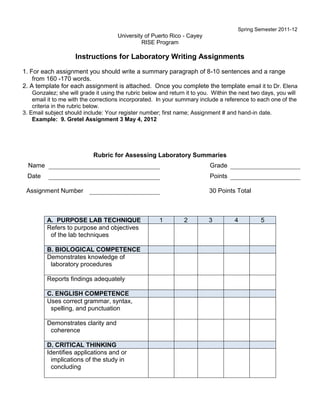
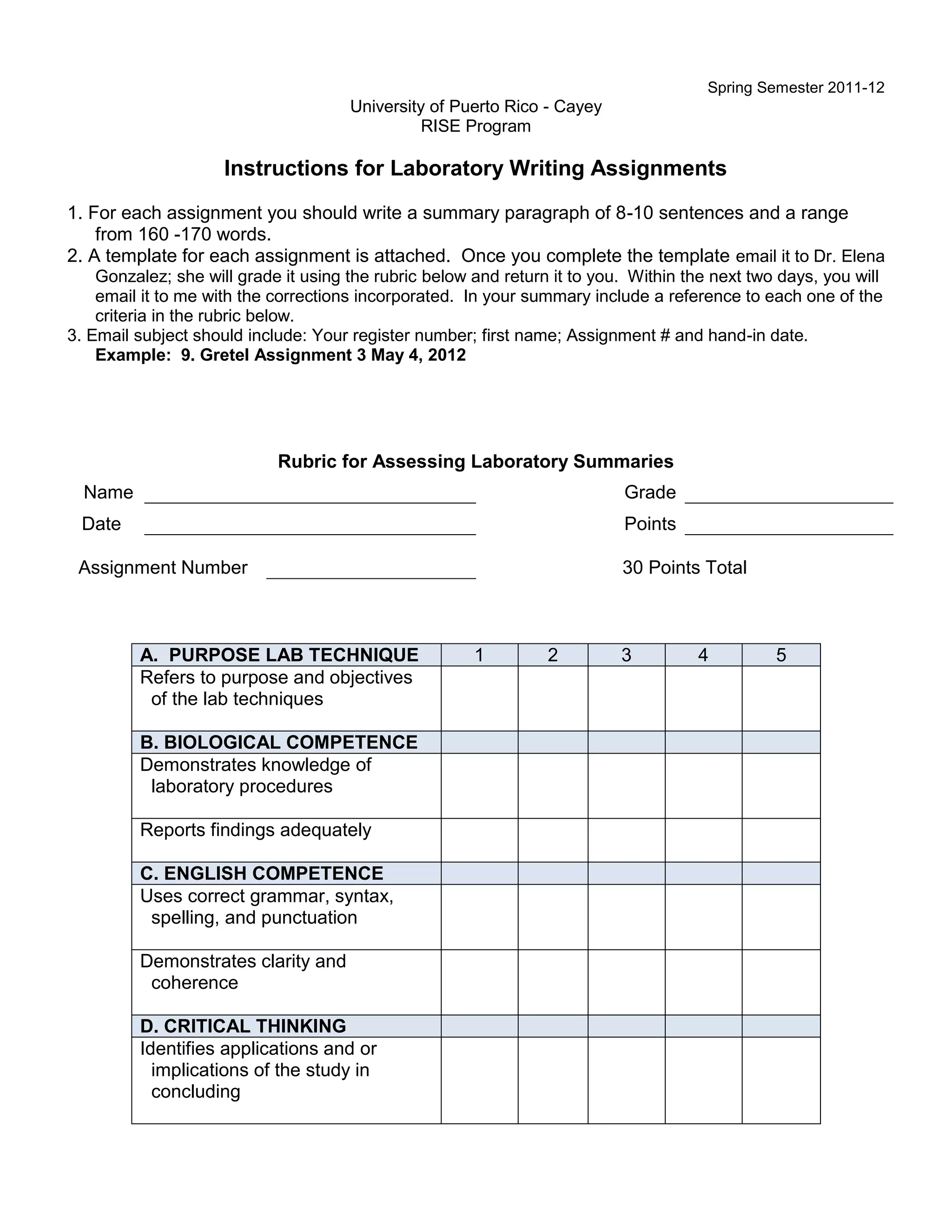
                            Rubric for Assessing Laboratory Summaries
  Name                                                                     Grade
 Date                                                                      Points

 Assignment Number                                                         30 Points Total


         A. PURPOSE LAB TECHNIQUE                      1         2         3         4          5
         Refers to purpose and objectives
          of the lab techniques

         B. BIOLOGICAL COMPETENCE
         Demonstrates knowledge of
          laboratory procedures

         Reports findings adequately

         C. ENGLISH COMPETENCE
         Uses correct grammar, syntax,
          spelling, and punctuation

         Demonstrates clarity and
          coherence

         D. CRITICAL THINKING
         Identifies applications and or
           implications of the study in
           concluding
University of Puerto Rico - Cayey
                                                   RISE Program

Template for Laboratory Summaries of Assignment 3Biol. 4997-BiomedicalTechniques
Due date May 4, 2012

Reg.# 15             Name      Juan Carlos Torres Sánchez                  Date:   May 4, 2012

Paragraph 7. Classification of Mycobacteriophagesfrom Tropical Soil +


                       Paragraph not required. The report will be evaluated for this topic.

Paragraph 8. Nanotechnology and Electron Microscopy+
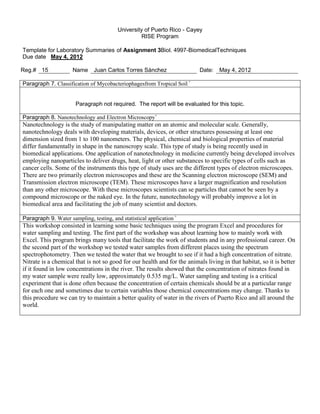
Nanotechnology is the study of manipulating matter on an atomic and molecular scale. Generally,
nanotechnology deals with developing materials, devices, or other structures possessing at least one
dimension sized from 1 to 100 nanometers. The physical, chemical and biological properties of material
differ fundamentally in shape in the nanoscropy scale. This type of study is being recently used in
biomedical applications. One application of nanotechnology in medicine currently being developed involves
employing nanoparticles to deliver drugs, heat, light or other substances to specific types of cells such as
cancer cells. Some of the instruments this type of study uses are the different types of electron microscopes.
There are two primarily electron microscopes and these are the Scanning electron microscope (SEM) and
Transmission electron microscope (TEM). These microscopes have a larger magnification and resolution
than any other microscope. With these microscopes scientists can se particles that cannot be seen by a
compound microscope or the naked eye. In the future, nanotechnology will probably improve a lot in
biomedical area and facilitating the job of many scientist and doctors.

Paragraph 9. Water sampling, testing, and statistical application +
This workshop consisted in learning some basic techniques using the program Excel and procedures for
water sampling and testing. The first part of the workshop was about learning how to mainly work with
Excel. This program brings many tools that facilitate the work of students and in any professional career. On
the second part of the workshop we tested water samples from different places using the spectrum
spectrophotometry. Then we tested the water that we brought to see if it had a high concentration of nitrate.
Nitrate is a chemical that is not so good for our health and for the animals living in that habitat, so it is better
if it found in low concentrations in the river. The results showed that the concentration of nitrates found in
my water sample were really low, approximately 0.535 mg/L. Water sampling and testing is a critical
experiment that is done often because the concentration of certain chemicals should be at a particular range
for each one and sometimes due to certain variables those chemical concentrations may change. Thanks to
this procedure we can try to maintain a better quality of water in the rivers of Puerto Rico and all around the
world.

Lab assignment 3

  • 1.
    Spring Semester 2011-12 University of Puerto Rico - Cayey RISE Program Instructions for Laboratory Writing Assignments 1. For each assignment you should write a summary paragraph of 8-10 sentences and a range from 160 -170 words. 2. A template for each assignment is attached. Once you complete the template email it to Dr. Elena Gonzalez; she will grade it using the rubric below and return it to you. Within the next two days, you will email it to me with the corrections incorporated. In your summary include a reference to each one of the criteria in the rubric below. 3. Email subject should include: Your register number; first name; Assignment # and hand-in date. Example: 9. Gretel Assignment 3 May 4, 2012 Rubric for Assessing Laboratory Summaries Name Grade Date Points Assignment Number 30 Points Total A. PURPOSE LAB TECHNIQUE 1 2 3 4 5 Refers to purpose and objectives of the lab techniques B. BIOLOGICAL COMPETENCE Demonstrates knowledge of laboratory procedures Reports findings adequately C. ENGLISH COMPETENCE Uses correct grammar, syntax, spelling, and punctuation Demonstrates clarity and coherence D. CRITICAL THINKING Identifies applications and or implications of the study in concluding
  • 2.
    University of PuertoRico - Cayey RISE Program Template for Laboratory Summaries of Assignment 3Biol. 4997-BiomedicalTechniques Due date May 4, 2012 Reg.# 15 Name Juan Carlos Torres Sánchez Date: May 4, 2012 Paragraph 7. Classification of Mycobacteriophagesfrom Tropical Soil + Paragraph not required. The report will be evaluated for this topic. Paragraph 8. Nanotechnology and Electron Microscopy+ Nanotechnology is the study of manipulating matter on an atomic and molecular scale. Generally, nanotechnology deals with developing materials, devices, or other structures possessing at least one dimension sized from 1 to 100 nanometers. The physical, chemical and biological properties of material differ fundamentally in shape in the nanoscropy scale. This type of study is being recently used in biomedical applications. One application of nanotechnology in medicine currently being developed involves employing nanoparticles to deliver drugs, heat, light or other substances to specific types of cells such as cancer cells. Some of the instruments this type of study uses are the different types of electron microscopes. There are two primarily electron microscopes and these are the Scanning electron microscope (SEM) and Transmission electron microscope (TEM). These microscopes have a larger magnification and resolution than any other microscope. With these microscopes scientists can se particles that cannot be seen by a compound microscope or the naked eye. In the future, nanotechnology will probably improve a lot in biomedical area and facilitating the job of many scientist and doctors. Paragraph 9. Water sampling, testing, and statistical application + This workshop consisted in learning some basic techniques using the program Excel and procedures for water sampling and testing. The first part of the workshop was about learning how to mainly work with Excel. This program brings many tools that facilitate the work of students and in any professional career. On the second part of the workshop we tested water samples from different places using the spectrum spectrophotometry. Then we tested the water that we brought to see if it had a high concentration of nitrate. Nitrate is a chemical that is not so good for our health and for the animals living in that habitat, so it is better if it found in low concentrations in the river. The results showed that the concentration of nitrates found in my water sample were really low, approximately 0.535 mg/L. Water sampling and testing is a critical experiment that is done often because the concentration of certain chemicals should be at a particular range for each one and sometimes due to certain variables those chemical concentrations may change. Thanks to this procedure we can try to maintain a better quality of water in the rivers of Puerto Rico and all around the world.