Hugo Cuello
(cdhugo@hotmail.com)
Octubre 2012
 Ha buscado proveer de liquidez en situaciones
de tensión en el mercado
 Compra de deuda directa a principios de la crisis
(aunque fuera ilegal en sus estatutos)
 Programas para facilitar la liquidez: Diciembre
2011, Febrero 2012. Programas de refinanciación
 Impulsor de la Unión Bancaria con una regulación
común
 6 de Septiembre - Programa de compra de
deuda (Outright Monetary Transactions) -
Compras ilimitadas de deuda a corto plazo,
poniendo a la vez coto al poder de las agencias de
calificación y eliminando la preferencia de su deuda
para motivar a inversores. A cambio, rescate
“blando” por parte del MEDE.
 En definitiva, el BCE ha dado tiempo para que
los lideres actúen
 “El BCE hará cuanto sea necesario para mantener la
estabilidad de los precios. Mantendrá su independencia. Y
lo hará dentro del marco de acción contemplado en su
mandato. Sin embargo, resulta relevante comprender que
nuestro mandato nos exige que, a veces, vayamos más allá
de las medidas político-monetarias ordinarias. […]
 En ocasiones, exige medidas extraordinarias. Tomar estas
medidas, si llega el caso, es nuestra responsabilidad como
banco central para toda la zona euro. […]
 Sería recomendable que se renovase la arquitectura de la
zona euro, porque únicamente así se podrá alcanzar la
prosperidad y garantizar la estabilidad a largo plazo, tanto
para la zona monetaria en general como, más
concretamente, para Alemania.”
Mario Draghi en Die Zeit. 30 agosto 2012
 Cambio en el equilibrio de fuerzas tras la
desaparición del duo Merkozy
 “Salvador del Euro”- Capaz que actuar por el
interés europeo mejor que gobiernos o
bancos centrales nacionales
◦ Reclamación de abandonar los “rescates a la griega”
◦ Hace aceptar a unos la condicionalidad, y a otros el
hecho de que sin solidaridad financiera la Eurozona
se rompe
◦ Único supervisor bancario
 Tiene más atención y credibilidad que los
Jefes de Estado y de Gobierno
 Transformación radical de la imagen de
Draghi en Alemania
 Compra ilimitada es un apoyo tácito a los
países de la periferia (“droga para los países
con economías débiles”)
 Inflación e implicación en política fiscal
 “Unión de endeudamiento” – Tesoro y
Eurobonos
 Condicionalidad del BCE – Unión entre política
monetaria y política fiscal
 Participación en todas las grandes reuniones
 Participación directa en documentos de
carácter político
 Presión a los Estados para cumplimentar
medidas concretas
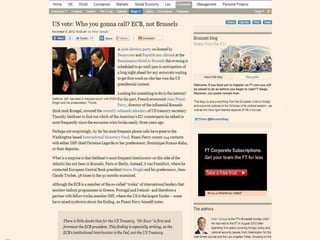
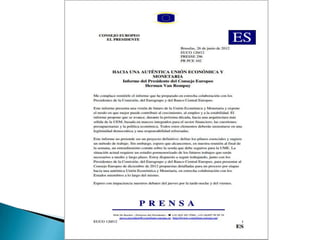
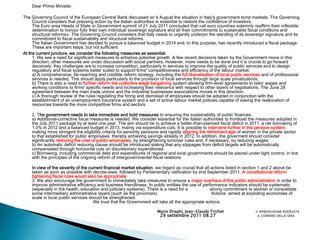
Dear Prime Minister,
The Governing Council of the European Central Bank discussed on 4 August the situation in Italy's government bond markets. The Governing
Council considers that pressing action by the Italian authorities is essential to restore the confidence of investors.
The Euro area Heads of State or Government summit of 21 July 2011 concluded that «all euro countries solemnly reaffirm their inflexible
determination to honour fully their own individual sovereign signature and all their commitments to sustainable fiscal conditions and
structural reforms». The Governing Council considers that Italy needs to urgently underpin the standing of its sovereign signature and its
commitment to fiscal sustainability and structural reforms.
The Italian Government has decided to pursue a balanced budget in 2014 and, to this purpose, has recently introduced a fiscal package.
These are important steps, but not sufficient.
At the current juncture, we consider the following measures as essential:
1. We see a need for significant measures to enhance potential growth. A few recent decisions taken by the Government move in this
direction; other measures are under discussion with social partners. However, more needs to be done and it is crucial to go forward
decisively. Key challenges are to increase competition, particularly in services to improve the quality of public services and to design
regulatory and fiscal systems better suited to support firms' competitiveness and efficiency of the labour market.
a) A comprehensive, far-reaching and credible reform strategy, including the full liberalisation of local public services and of professional
services is needed. This should apply particularly to the provision of local services through large scale privatizations.
b) There is also a need to further reform the collective wage bargaining system allowing firm-level agreements to tailor wages and
working conditions to firms' specific needs and increasing their relevance with respect to other layers of negotiations. The June 28
agreement between the main trade unions and the industrial businesses associations moves in this direction.
c) A thorough review of the rules regulating the hiring and dismissal of employees should be adopted in conjunction with the
establishment of an unemployment insurance system and a set of active labour market policies capable of easing the reallocation of
resources towards the more competitive firms and sectors.
2. The government needs to take immediate and bold measures to ensuring the sustainability of public finances.
a) Additional-corrective fiscal measures is needed. We consider essential for the Italian authorities to frontload the measures adopted in
the July 2011 package by at least one year. The aim should be to achieve a better-than-planned fiscal deficit in 2011, a net borrowing of
1.0% in 2012 and a balanced budget in 2013, mainly via expenditure cuts. It is possible to intervene further in the pension system,
making more stringent the eligibility criteria for seniority pensions and rapidly aligning the retirement age of women in the private sector
to that established for public employees. thereby achieving savings already in 2012. In addition, the goverment should consider
significantly reducing the cost of public employees, by strenghtening turnover rules and, if necessary, by reducing wages.
b) An automatic deficit reducing clause should be introduced stating that any slippages from deficit targets will be automatically
compensated through horizontal cuts on discretionary expenditures.
c) Borrowing, including commercial debt and expenditures of regional and local governments should be placed under tight control, in line
with the principles of the ongoing reform of intergovernmental fiscal relations.
In view of the severity of the current financial market situation, we regard as crucial that all actions listed in section 1 and 2 above be
taken as soon as possible with decree-laws, followed by Parliamentary ratification by end September 2011. A constitutional reform
tightening fiscal rules would also be appropriate.
3. We also encourage the government to immediately take measures to ensure a major overhaul of the public administration in order to
improve administrative efficiency and business friendliness. In public entities the use of performance indicators should be systematic
(especially in the health, education and judiciary systems). There is a need for a . strong commitment to abolish or consolidate
some intermediary administrative layers (such as the provinces). Actions aimed at exploiting economies of
scale in local public services should be strengthened.
We trust that the Government will take all the appropriate actions.
Mario Draghi, Jean-Claude Trichet © RIPRODUZIONE RISERVATA
29 settembre 2011 08:27 IL CORRIERE DELLA SERA
 Sus decisiones han afectado directamente a
su legitimidad y su papel en la Crisis del Euro
◦ Al perder su independencia en materia política
pierde legitimidad
◦ Al convertirse en el “Game Changer”, gana
legitimidad como actor relevante
 Se presiona al BCE para que actúe porque
nadie más lo hace, pero a la vez se le exige
que no se salga de sus limitadas
competencias que no sean de política
monetaria
 “La Crisis del Euro es fundamentalmente política, no
monetaria o financiera. El BCE no puede solucionar el euro,
sólo puede ganar tiempo.
En este sentido, el Sr. Weidmann tiene razón al decir que,
si ha de haber mutualización de los riesgos, no se debe
hacer por la puerta trasera del BCE, sino a través de la
puerta de entrada (por ejemplo, con Eurobonos) y con el
acuerdo de los parlamentos nacionales.
Algunos en el BCE creen que la crisis tendrá que empeorar
antes de que los políticos tomen medidas tan radicales.
Pero ya sea porque no puede o porque no quiere, el señor
Draghi no será siempre el llanero solitario.”
The Economist. 1 Septiembre 2012
Hugo Cuello para la Universidad Complutense de Madrid

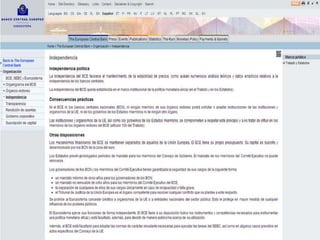
Independencia del BCE

  • 1.
  • 3.
     Ha buscadoproveer de liquidez en situaciones de tensión en el mercado  Compra de deuda directa a principios de la crisis (aunque fuera ilegal en sus estatutos)  Programas para facilitar la liquidez: Diciembre 2011, Febrero 2012. Programas de refinanciación  Impulsor de la Unión Bancaria con una regulación común
  • 4.
     6 deSeptiembre - Programa de compra de deuda (Outright Monetary Transactions) - Compras ilimitadas de deuda a corto plazo, poniendo a la vez coto al poder de las agencias de calificación y eliminando la preferencia de su deuda para motivar a inversores. A cambio, rescate “blando” por parte del MEDE.  En definitiva, el BCE ha dado tiempo para que los lideres actúen
  • 5.
     “El BCEhará cuanto sea necesario para mantener la estabilidad de los precios. Mantendrá su independencia. Y lo hará dentro del marco de acción contemplado en su mandato. Sin embargo, resulta relevante comprender que nuestro mandato nos exige que, a veces, vayamos más allá de las medidas político-monetarias ordinarias. […]  En ocasiones, exige medidas extraordinarias. Tomar estas medidas, si llega el caso, es nuestra responsabilidad como banco central para toda la zona euro. […]  Sería recomendable que se renovase la arquitectura de la zona euro, porque únicamente así se podrá alcanzar la prosperidad y garantizar la estabilidad a largo plazo, tanto para la zona monetaria en general como, más concretamente, para Alemania.” Mario Draghi en Die Zeit. 30 agosto 2012
  • 6.
     Cambio enel equilibrio de fuerzas tras la desaparición del duo Merkozy  “Salvador del Euro”- Capaz que actuar por el interés europeo mejor que gobiernos o bancos centrales nacionales ◦ Reclamación de abandonar los “rescates a la griega” ◦ Hace aceptar a unos la condicionalidad, y a otros el hecho de que sin solidaridad financiera la Eurozona se rompe ◦ Único supervisor bancario  Tiene más atención y credibilidad que los Jefes de Estado y de Gobierno
  • 8.
     Transformación radicalde la imagen de Draghi en Alemania  Compra ilimitada es un apoyo tácito a los países de la periferia (“droga para los países con economías débiles”)  Inflación e implicación en política fiscal  “Unión de endeudamiento” – Tesoro y Eurobonos
  • 9.
     Condicionalidad delBCE – Unión entre política monetaria y política fiscal  Participación en todas las grandes reuniones  Participación directa en documentos de carácter político  Presión a los Estados para cumplimentar medidas concretas
  • 11.
    Dear Prime Minister, TheGoverning Council of the European Central Bank discussed on 4 August the situation in Italy's government bond markets. The Governing Council considers that pressing action by the Italian authorities is essential to restore the confidence of investors. The Euro area Heads of State or Government summit of 21 July 2011 concluded that «all euro countries solemnly reaffirm their inflexible determination to honour fully their own individual sovereign signature and all their commitments to sustainable fiscal conditions and structural reforms». The Governing Council considers that Italy needs to urgently underpin the standing of its sovereign signature and its commitment to fiscal sustainability and structural reforms. The Italian Government has decided to pursue a balanced budget in 2014 and, to this purpose, has recently introduced a fiscal package. These are important steps, but not sufficient. At the current juncture, we consider the following measures as essential: 1. We see a need for significant measures to enhance potential growth. A few recent decisions taken by the Government move in this direction; other measures are under discussion with social partners. However, more needs to be done and it is crucial to go forward decisively. Key challenges are to increase competition, particularly in services to improve the quality of public services and to design regulatory and fiscal systems better suited to support firms' competitiveness and efficiency of the labour market. a) A comprehensive, far-reaching and credible reform strategy, including the full liberalisation of local public services and of professional services is needed. This should apply particularly to the provision of local services through large scale privatizations. b) There is also a need to further reform the collective wage bargaining system allowing firm-level agreements to tailor wages and working conditions to firms' specific needs and increasing their relevance with respect to other layers of negotiations. The June 28 agreement between the main trade unions and the industrial businesses associations moves in this direction. c) A thorough review of the rules regulating the hiring and dismissal of employees should be adopted in conjunction with the establishment of an unemployment insurance system and a set of active labour market policies capable of easing the reallocation of resources towards the more competitive firms and sectors. 2. The government needs to take immediate and bold measures to ensuring the sustainability of public finances. a) Additional-corrective fiscal measures is needed. We consider essential for the Italian authorities to frontload the measures adopted in the July 2011 package by at least one year. The aim should be to achieve a better-than-planned fiscal deficit in 2011, a net borrowing of 1.0% in 2012 and a balanced budget in 2013, mainly via expenditure cuts. It is possible to intervene further in the pension system, making more stringent the eligibility criteria for seniority pensions and rapidly aligning the retirement age of women in the private sector to that established for public employees. thereby achieving savings already in 2012. In addition, the goverment should consider significantly reducing the cost of public employees, by strenghtening turnover rules and, if necessary, by reducing wages. b) An automatic deficit reducing clause should be introduced stating that any slippages from deficit targets will be automatically compensated through horizontal cuts on discretionary expenditures. c) Borrowing, including commercial debt and expenditures of regional and local governments should be placed under tight control, in line with the principles of the ongoing reform of intergovernmental fiscal relations. In view of the severity of the current financial market situation, we regard as crucial that all actions listed in section 1 and 2 above be taken as soon as possible with decree-laws, followed by Parliamentary ratification by end September 2011. A constitutional reform tightening fiscal rules would also be appropriate. 3. We also encourage the government to immediately take measures to ensure a major overhaul of the public administration in order to improve administrative efficiency and business friendliness. In public entities the use of performance indicators should be systematic (especially in the health, education and judiciary systems). There is a need for a . strong commitment to abolish or consolidate some intermediary administrative layers (such as the provinces). Actions aimed at exploiting economies of scale in local public services should be strengthened. We trust that the Government will take all the appropriate actions. Mario Draghi, Jean-Claude Trichet © RIPRODUZIONE RISERVATA 29 settembre 2011 08:27 IL CORRIERE DELLA SERA
  • 12.
     Sus decisioneshan afectado directamente a su legitimidad y su papel en la Crisis del Euro ◦ Al perder su independencia en materia política pierde legitimidad ◦ Al convertirse en el “Game Changer”, gana legitimidad como actor relevante  Se presiona al BCE para que actúe porque nadie más lo hace, pero a la vez se le exige que no se salga de sus limitadas competencias que no sean de política monetaria
  • 13.
     “La Crisisdel Euro es fundamentalmente política, no monetaria o financiera. El BCE no puede solucionar el euro, sólo puede ganar tiempo. En este sentido, el Sr. Weidmann tiene razón al decir que, si ha de haber mutualización de los riesgos, no se debe hacer por la puerta trasera del BCE, sino a través de la puerta de entrada (por ejemplo, con Eurobonos) y con el acuerdo de los parlamentos nacionales. Algunos en el BCE creen que la crisis tendrá que empeorar antes de que los políticos tomen medidas tan radicales. Pero ya sea porque no puede o porque no quiere, el señor Draghi no será siempre el llanero solitario.” The Economist. 1 Septiembre 2012 Hugo Cuello para la Universidad Complutense de Madrid