Dr. Meenakshi Sood
Associate Professor, NITTTR Chandigarh
meenkashi@nitttrchd.ac.in
Input
signal
Synaptic
weights
Summing
function
Bias
b
Activation
function
Local
Field
v Output
y
x1
x2
xm
w2
wm
w
1
 
 )
(

3
Properties of Artificial Neural Nets
(ANNs)
 Many simple neuron-like threshold switching units
 Many weighted interconnections among units
 Input is high-dimensional discrete or real-valued (e.g.
raw sensor input)
 Output is discrete or real valued
 Output is a vector of values
 Form of target function sometimes unknown
 Highly parallel, distributed processing
 Learning by tuning the connection weights
4/8/2020 M Sood NITTTR CHD
4
Types of Layers
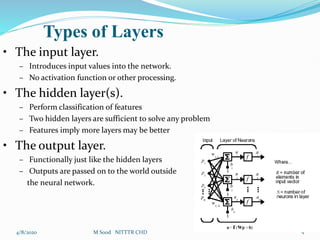
• The input layer.
– Introduces input values into the network.
– No activation function or other processing.
• The hidden layer(s).
– Perform classification of features
– Two hidden layers are sufficient to solve any problem
– Features imply more layers may be better
• The output layer.
– Functionally just like the hidden layers
– Outputs are passed on to the world outside
the neural network.
4/8/2020 M Sood NITTTR CHD
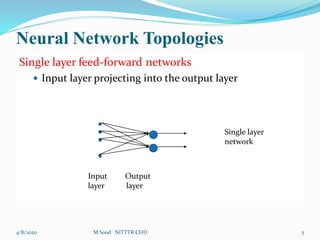
Neural Network Topologies
Single layer feed-forward networks
 Input layer projecting into the output layer
Input Output
layer layer
Single layer
network
4/8/2020 5
M Sood NITTTR CHD
Cont...
Multi-layer feed-forward networks
 One or more hidden layers. Input projects only from
previous layers onto a layer.
Input Hidden Output
layer layer layer
2-layer or
1-hidden layer
fully connected
network
Organized into different layers
Unidirectional connections
memory-less: output depends only on the present
input
4/8/2020 6
M Sood NITTTR CHD
k
O
jk
w
Output nodes
Input nodes
Hidden nodes
Output Class
Input Record : xi
wij - weights
Network is fully connected
j
O
A Multilayer Neural Network
4/8/2020 7
M Sood NITTTR CHD
Neural Netwok Architecture
 Feed forward Architecture
 Feedback (Recurrent ) Architecture
 Competitive network
4/8/2020 8
M Sood NITTTR CHD
Feed Forward Neural Networks
 The information is propagated
from the inputs to the outputs
 The first layer is the input and the
last layer is the output.
 The activities of the neurons in
each layer are a non-linear
function of the activities in the
layer below.
 Time has no role (NO cycle
between outputs and inputs)
x1 x2 xn
…..
1st hidden
layer
2nd hidden
layer
Output layer
4/8/2020 9
M Sood NITTTR CHD
Recurrent Neural Networks
 A network with feedback, where some of its inputs are
connected to some of its outputs (discrete time).
 Delays are associated to a specific weight
 Training is more difficult
 Stable Outputs may be more difficult to evaluate
 Unexpected behavior (oscillation, chaos, …)
4/8/2020 10
M Sood NITTTR CHD
11/48
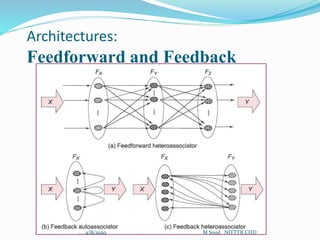
Architectures:
Feedforward and Feedback
4/8/2020 M Sood NITTTR CHD
12/48
Feedforward vs Feedback:
 Possess no dynamics
 Demonstrate powerful properties
 Universal function approximation
 Find widespread applications in pattern
classification.
X ∈ Rn S = f (X)
Multilayer Perceptrons
4/8/2020 M Sood NITTTR CHD
13/48
Feedforward vs
Feedback:
 Non-linear dynamical systems
 New state of the network is a
function of the current input and
the present state of the network
 Capable of performing powerful
tasks such as
 pattern completion
 topological feature
mapping
 pattern recognition
Recurrent Neural Networks
4/8/2020 M Sood NITTTR CHD
Competitive Networks ( later
sessions)
4/8/2020
14 M Sood NITTTR CHD
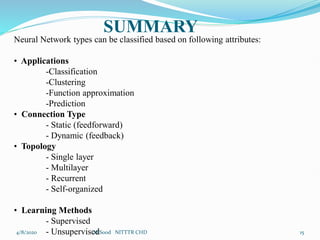
Neural Network types can be classified based on following attributes:
• Applications
-Classification
-Clustering
-Function approximation
-Prediction
• Connection Type
- Static (feedforward)
- Dynamic (feedback)
• Topology
- Single layer
- Multilayer
- Recurrent
- Self-organized
• Learning Methods
- Supervised
- Unsupervised
SUMMARY
4/8/2020 15
M Sood NITTTR CHD
TRAINING A NEURAL NETWORK
4/8/2020
16 M Sood NITTTR CHD
Overview
The ability of the neural network (NN) to learn from
its environment and to improve its performance
through learning.
- The NN is stimulated by an environment
- The NN undergoes changes in its free parameteres
- The NN responds in a new way to the environment
4/8/2020 17
M Sood NITTTR CHD
Definition of Learning
 Learning is a process by which the free parameters of a
neural network are adapted through a process of
stimulation by the environment in which the network
is embedded.
 The type of the learning is determined by the manner
in which the parameter changes take place.
4/8/2020 18
M Sood NITTTR CHD
A Simple Artificial Neuron
It receives input from some other units, or perhaps from an external source.
Each input has an associated weight w, which can be modified so as to model
synaptic learning.
The unit computes some function f of the weighted sum of its inputs
•Its output, in turn, can serve as input to other units.
•Note that wij refers to the weight from unit j to unit
i (not the other way around).
•The function f is the unit's activation function. In the
simplest case, f is the identity function, and the unit's
output is just its net input. This is called a linear unit.
4/8/2020 19
M Sood NITTTR CHD
x y
Hidden Neurons
Output Neuron
Input
Output
yhid,1
(u)
yout
(u)
yhid,2
(u)
yhid,N
(u)
whid,1
whid,2
wout,1
wout,2
wout,N
whid,N
Adjust weights (w) to learn a given target
function: y = f(x)
Given a set of training data X→Y
Represent a single input single output functions: y = f(x)
INPUT DATA SET- X
CORRESPONDING OUTPUT - Y
4/8/2020 20
M Sood NITTTR CHD
x1 y1
Hidden Neurons Output Neurons
Inputs Outputs
x2 y2
xn ym
yh1
(u) yo1
(u)
yo2
(u)
yh2
(u)
yhn
(u) yom
(u)
 Weight update formula:
w
k
w
k
w 


 )
(
)
( 1
w
i
e
i
w




)
(
*
)
( 
2
2
1
)
( train
out y
y
e 

ERROR FUNCTION/ COST FUNCTION
4/8/2020 21
M Sood NITTTR CHD
LEARNING PROCESS
 NN is stimulated by environment
 NN undergoes changes in its free parameter( weights)
 NN responds in a new way to the environment
Set of well defined rules fort the solution is called LEARNING ALGORITHM
4/8/2020 22
M Sood NITTTR CHD
23
Learning Rule
 Learning rule: a procedure (training algorithm) for
modifying the weights and the biases of a network.
 The purpose of the learning rule is to train the
network to perform some task.
4/8/2020 M Sood NITTTR CHD
Supervised learning,
Unsupervised learning and
Reinforcement learning.
4/8/2020 24
M Sood NITTTR CHD
Rudimentary Example of classification
for Understanding Supervised and Unsupervised
Learning
A
B
A
B A
B
4/8/2020 25
M Sood NITTTR CHD
Two possible Solutions…
A
B
A
B
A
B
A
B A
B
A
B
4/8/2020
26 M Sood NITTTR CHD
Supervised Learning
 It is based on a labeled
training set.
 The class of each piece
of data in training set is
known.
 Class labels are pre-
determined and
provided in the training
phase.
A
B
A
B
A
B
 Class
 Class
 Class
 Class
 Class
 Class
4/8/2020
27 M Sood NITTTR CHD
28
Supervised Learning
 The learning rule is provided with a set of examples (the
training set) of proper network behavior: {x1,y1},
{x2,y2},…, {xQ,yQ} where xq is an input to the network
and yq is the corresponding correct (target) output.
 As the inputs are applied to the network, the network
outputs are compared to the targets. The learning rule is
then used to adjust the weights and biases of the network
in order to move the network outputs closer to the targets.
4/8/2020 M Sood NITTTR CHD
Supervised learning
 In supervised training, both the inputs and the outputs are
provided.
 The network then processes the inputs and compares its resulting
outputs against the desired outputs.
 Errors are then propagated back through the system, causing the
system to adjust the weights which control the network.
 This process occurs over and over as the weights are continually
tweaked. The set of data which enables the training is called the
training set.
 During the training of a network the same set of data is processed
many times as the connection weights are ever refined.
 Example architectures : Multilayer perceptions
4/8/2020 29
M Sood NITTTR CHD
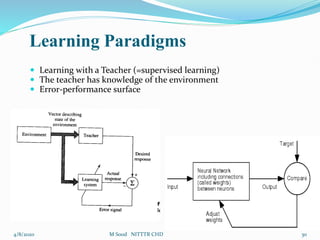
Learning Paradigms
 Learning with a Teacher (=supervised learning)
 The teacher has knowledge of the environment
 Error-performance surface
4/8/2020 30
M Sood NITTTR CHD
Unsupervised learning
 In unsupervised training, the network is provided with
inputs but not with desired outputs.
 The system itself must then decide what features it will use
to group the input data. This is often referred to as self-
organization or adaption.
 Example architectures : Kohonen, ART
4/8/2020 31
M Sood NITTTR CHD
4/8/2020 32
Unsupervised Learning
 The weights and biases are modified in response
to network inputs only. There are no target
outputs available.
 Most of these algorithms perform some kind of
clustering operation. They learn to categorize
the input patterns into a finite number of classes.
This is especially in such applications as vector
quantization.
M Sood NITTTR CHD
Unsupervised Learning
 There is no external teacher or critic to oversee the
learning process.
 The provision is made for a task independent measure
of the quality of representation that the network is
required to learn.
The training process extracts the statistical properties of the
training set and groups similar vectors into classes.
4/8/2020 33
M Sood NITTTR CHD
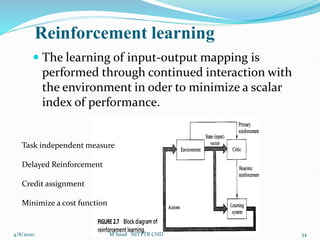
Reinforcement learning
 The learning of input-output mapping is
performed through continued interaction with
the environment in oder to minimize a scalar
index of performance.
Task independent measure
Delayed Reinforcement
Credit assignment
Minimize a cost function
4/8/2020 34
M Sood NITTTR CHD
4/8/2020 35
Reinforcement Learning
 The learning rule is similar to supervised
learning, except that, instead of being provided
with the correct output for each network input,
the algorithm is only given a grade.
 The grade (score) is a measure of the network
performance over some sequence of inputs.
 It appears to be most suited to control system
applications.
M Sood NITTTR CHD
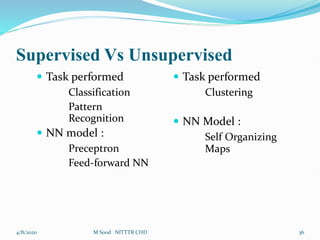
Supervised Vs Unsupervised
 Task performed
Classification
Pattern
Recognition
 NN model :
Preceptron
Feed-forward NN
 Task performed
Clustering
 NN Model :
Self Organizing
Maps
4/8/2020 36
M Sood NITTTR CHD
37
Learning algorithm
Epoch : Presentation of the entire training set to the neural network.
In the case of the AND function an epoch consists of four sets of
inputs being presented to the network (i.e. [0,0], [0,1], [1,0], [1,1])
Error: The error value is the amount by which the value output by the network
differs from the target value. For example, if we required the network
to output 0 and it output a 1, then Error = -1
4/8/2020 M Sood NITTTR CHD
38
Learning algorithm
Target Value, T : When we are training a network we not only present it with
the input but also with a value that we require the network to
produce. For example, if we present the network with [1,1] for the
AND function the training value will be 1
Output , O : The output value from the neuron
Ij : Inputs being presented to the neuron
Wj : Weight from input neuron (Ij) to the output neuron
LR : The learning rate. This dictates how quickly the network converges. It is set
by a matter of experimentation. It is typically 0.1
4/8/2020 M Sood NITTTR CHD
4/8/2020 39
M Sood NITTTR CHD

L-3 classification.pdf

  • 1.
    Dr. Meenakshi Sood AssociateProfessor, NITTTR Chandigarh meenkashi@nitttrchd.ac.in Input signal Synaptic weights Summing function Bias b Activation function Local Field v Output y x1 x2 xm w2 wm w 1    ) ( 
  • 3.
    3 Properties of ArtificialNeural Nets (ANNs)  Many simple neuron-like threshold switching units  Many weighted interconnections among units  Input is high-dimensional discrete or real-valued (e.g. raw sensor input)  Output is discrete or real valued  Output is a vector of values  Form of target function sometimes unknown  Highly parallel, distributed processing  Learning by tuning the connection weights 4/8/2020 M Sood NITTTR CHD
  • 4.
    4 Types of Layers •The input layer. – Introduces input values into the network. – No activation function or other processing. • The hidden layer(s). – Perform classification of features – Two hidden layers are sufficient to solve any problem – Features imply more layers may be better • The output layer. – Functionally just like the hidden layers – Outputs are passed on to the world outside the neural network. 4/8/2020 M Sood NITTTR CHD
  • 5.
    Neural Network Topologies Singlelayer feed-forward networks  Input layer projecting into the output layer Input Output layer layer Single layer network 4/8/2020 5 M Sood NITTTR CHD
  • 6.
    Cont... Multi-layer feed-forward networks One or more hidden layers. Input projects only from previous layers onto a layer. Input Hidden Output layer layer layer 2-layer or 1-hidden layer fully connected network Organized into different layers Unidirectional connections memory-less: output depends only on the present input 4/8/2020 6 M Sood NITTTR CHD
  • 7.
    k O jk w Output nodes Input nodes Hiddennodes Output Class Input Record : xi wij - weights Network is fully connected j O A Multilayer Neural Network 4/8/2020 7 M Sood NITTTR CHD
  • 8.
    Neural Netwok Architecture Feed forward Architecture  Feedback (Recurrent ) Architecture  Competitive network 4/8/2020 8 M Sood NITTTR CHD
  • 9.
    Feed Forward NeuralNetworks  The information is propagated from the inputs to the outputs  The first layer is the input and the last layer is the output.  The activities of the neurons in each layer are a non-linear function of the activities in the layer below.  Time has no role (NO cycle between outputs and inputs) x1 x2 xn ….. 1st hidden layer 2nd hidden layer Output layer 4/8/2020 9 M Sood NITTTR CHD
  • 10.
    Recurrent Neural Networks A network with feedback, where some of its inputs are connected to some of its outputs (discrete time).  Delays are associated to a specific weight  Training is more difficult  Stable Outputs may be more difficult to evaluate  Unexpected behavior (oscillation, chaos, …) 4/8/2020 10 M Sood NITTTR CHD
  • 11.
  • 12.
    12/48 Feedforward vs Feedback: Possess no dynamics  Demonstrate powerful properties  Universal function approximation  Find widespread applications in pattern classification. X ∈ Rn S = f (X) Multilayer Perceptrons 4/8/2020 M Sood NITTTR CHD
  • 13.
    13/48 Feedforward vs Feedback:  Non-lineardynamical systems  New state of the network is a function of the current input and the present state of the network  Capable of performing powerful tasks such as  pattern completion  topological feature mapping  pattern recognition Recurrent Neural Networks 4/8/2020 M Sood NITTTR CHD
  • 14.
    Competitive Networks (later sessions) 4/8/2020 14 M Sood NITTTR CHD
  • 15.
    Neural Network typescan be classified based on following attributes: • Applications -Classification -Clustering -Function approximation -Prediction • Connection Type - Static (feedforward) - Dynamic (feedback) • Topology - Single layer - Multilayer - Recurrent - Self-organized • Learning Methods - Supervised - Unsupervised SUMMARY 4/8/2020 15 M Sood NITTTR CHD
  • 16.
    TRAINING A NEURALNETWORK 4/8/2020 16 M Sood NITTTR CHD
  • 17.
    Overview The ability ofthe neural network (NN) to learn from its environment and to improve its performance through learning. - The NN is stimulated by an environment - The NN undergoes changes in its free parameteres - The NN responds in a new way to the environment 4/8/2020 17 M Sood NITTTR CHD
  • 18.
    Definition of Learning Learning is a process by which the free parameters of a neural network are adapted through a process of stimulation by the environment in which the network is embedded.  The type of the learning is determined by the manner in which the parameter changes take place. 4/8/2020 18 M Sood NITTTR CHD
  • 19.
    A Simple ArtificialNeuron It receives input from some other units, or perhaps from an external source. Each input has an associated weight w, which can be modified so as to model synaptic learning. The unit computes some function f of the weighted sum of its inputs •Its output, in turn, can serve as input to other units. •Note that wij refers to the weight from unit j to unit i (not the other way around). •The function f is the unit's activation function. In the simplest case, f is the identity function, and the unit's output is just its net input. This is called a linear unit. 4/8/2020 19 M Sood NITTTR CHD
  • 20.
    x y Hidden Neurons OutputNeuron Input Output yhid,1 (u) yout (u) yhid,2 (u) yhid,N (u) whid,1 whid,2 wout,1 wout,2 wout,N whid,N Adjust weights (w) to learn a given target function: y = f(x) Given a set of training data X→Y Represent a single input single output functions: y = f(x) INPUT DATA SET- X CORRESPONDING OUTPUT - Y 4/8/2020 20 M Sood NITTTR CHD
  • 21.
    x1 y1 Hidden NeuronsOutput Neurons Inputs Outputs x2 y2 xn ym yh1 (u) yo1 (u) yo2 (u) yh2 (u) yhn (u) yom (u)  Weight update formula: w k w k w     ) ( ) ( 1 w i e i w     ) ( * ) (  2 2 1 ) ( train out y y e   ERROR FUNCTION/ COST FUNCTION 4/8/2020 21 M Sood NITTTR CHD
  • 22.
    LEARNING PROCESS  NNis stimulated by environment  NN undergoes changes in its free parameter( weights)  NN responds in a new way to the environment Set of well defined rules fort the solution is called LEARNING ALGORITHM 4/8/2020 22 M Sood NITTTR CHD
  • 23.
    23 Learning Rule  Learningrule: a procedure (training algorithm) for modifying the weights and the biases of a network.  The purpose of the learning rule is to train the network to perform some task. 4/8/2020 M Sood NITTTR CHD
  • 24.
    Supervised learning, Unsupervised learningand Reinforcement learning. 4/8/2020 24 M Sood NITTTR CHD
  • 25.
    Rudimentary Example ofclassification for Understanding Supervised and Unsupervised Learning A B A B A B 4/8/2020 25 M Sood NITTTR CHD
  • 26.
    Two possible Solutions… A B A B A B A BA B A B 4/8/2020 26 M Sood NITTTR CHD
  • 27.
    Supervised Learning  Itis based on a labeled training set.  The class of each piece of data in training set is known.  Class labels are pre- determined and provided in the training phase. A B A B A B  Class  Class  Class  Class  Class  Class 4/8/2020 27 M Sood NITTTR CHD
  • 28.
    28 Supervised Learning  Thelearning rule is provided with a set of examples (the training set) of proper network behavior: {x1,y1}, {x2,y2},…, {xQ,yQ} where xq is an input to the network and yq is the corresponding correct (target) output.  As the inputs are applied to the network, the network outputs are compared to the targets. The learning rule is then used to adjust the weights and biases of the network in order to move the network outputs closer to the targets. 4/8/2020 M Sood NITTTR CHD
  • 29.
    Supervised learning  Insupervised training, both the inputs and the outputs are provided.  The network then processes the inputs and compares its resulting outputs against the desired outputs.  Errors are then propagated back through the system, causing the system to adjust the weights which control the network.  This process occurs over and over as the weights are continually tweaked. The set of data which enables the training is called the training set.  During the training of a network the same set of data is processed many times as the connection weights are ever refined.  Example architectures : Multilayer perceptions 4/8/2020 29 M Sood NITTTR CHD
  • 30.
    Learning Paradigms  Learningwith a Teacher (=supervised learning)  The teacher has knowledge of the environment  Error-performance surface 4/8/2020 30 M Sood NITTTR CHD
  • 31.
    Unsupervised learning  Inunsupervised training, the network is provided with inputs but not with desired outputs.  The system itself must then decide what features it will use to group the input data. This is often referred to as self- organization or adaption.  Example architectures : Kohonen, ART 4/8/2020 31 M Sood NITTTR CHD
  • 32.
    4/8/2020 32 Unsupervised Learning The weights and biases are modified in response to network inputs only. There are no target outputs available.  Most of these algorithms perform some kind of clustering operation. They learn to categorize the input patterns into a finite number of classes. This is especially in such applications as vector quantization. M Sood NITTTR CHD
  • 33.
    Unsupervised Learning  Thereis no external teacher or critic to oversee the learning process.  The provision is made for a task independent measure of the quality of representation that the network is required to learn. The training process extracts the statistical properties of the training set and groups similar vectors into classes. 4/8/2020 33 M Sood NITTTR CHD
  • 34.
    Reinforcement learning  Thelearning of input-output mapping is performed through continued interaction with the environment in oder to minimize a scalar index of performance. Task independent measure Delayed Reinforcement Credit assignment Minimize a cost function 4/8/2020 34 M Sood NITTTR CHD
  • 35.
    4/8/2020 35 Reinforcement Learning The learning rule is similar to supervised learning, except that, instead of being provided with the correct output for each network input, the algorithm is only given a grade.  The grade (score) is a measure of the network performance over some sequence of inputs.  It appears to be most suited to control system applications. M Sood NITTTR CHD
  • 36.
    Supervised Vs Unsupervised Task performed Classification Pattern Recognition  NN model : Preceptron Feed-forward NN  Task performed Clustering  NN Model : Self Organizing Maps 4/8/2020 36 M Sood NITTTR CHD
  • 37.
    37 Learning algorithm Epoch :Presentation of the entire training set to the neural network. In the case of the AND function an epoch consists of four sets of inputs being presented to the network (i.e. [0,0], [0,1], [1,0], [1,1]) Error: The error value is the amount by which the value output by the network differs from the target value. For example, if we required the network to output 0 and it output a 1, then Error = -1 4/8/2020 M Sood NITTTR CHD
  • 38.
    38 Learning algorithm Target Value,T : When we are training a network we not only present it with the input but also with a value that we require the network to produce. For example, if we present the network with [1,1] for the AND function the training value will be 1 Output , O : The output value from the neuron Ij : Inputs being presented to the neuron Wj : Weight from input neuron (Ij) to the output neuron LR : The learning rate. This dictates how quickly the network converges. It is set by a matter of experimentation. It is typically 0.1 4/8/2020 M Sood NITTTR CHD
  • 39.