Data
Structures
AND ALGORITHMS
Data Structures is about how data can be stored in different structures.
Algorithms is about how to solve different problems, often by searching through
and manipulating data structures.
Theory about Data Structures and Algorithms (DSA) helps us to use large
amounts of data to solve problems efficiently.
Data Structures
We structure data in different ways depending on what data we
have, and what we want to do with it.
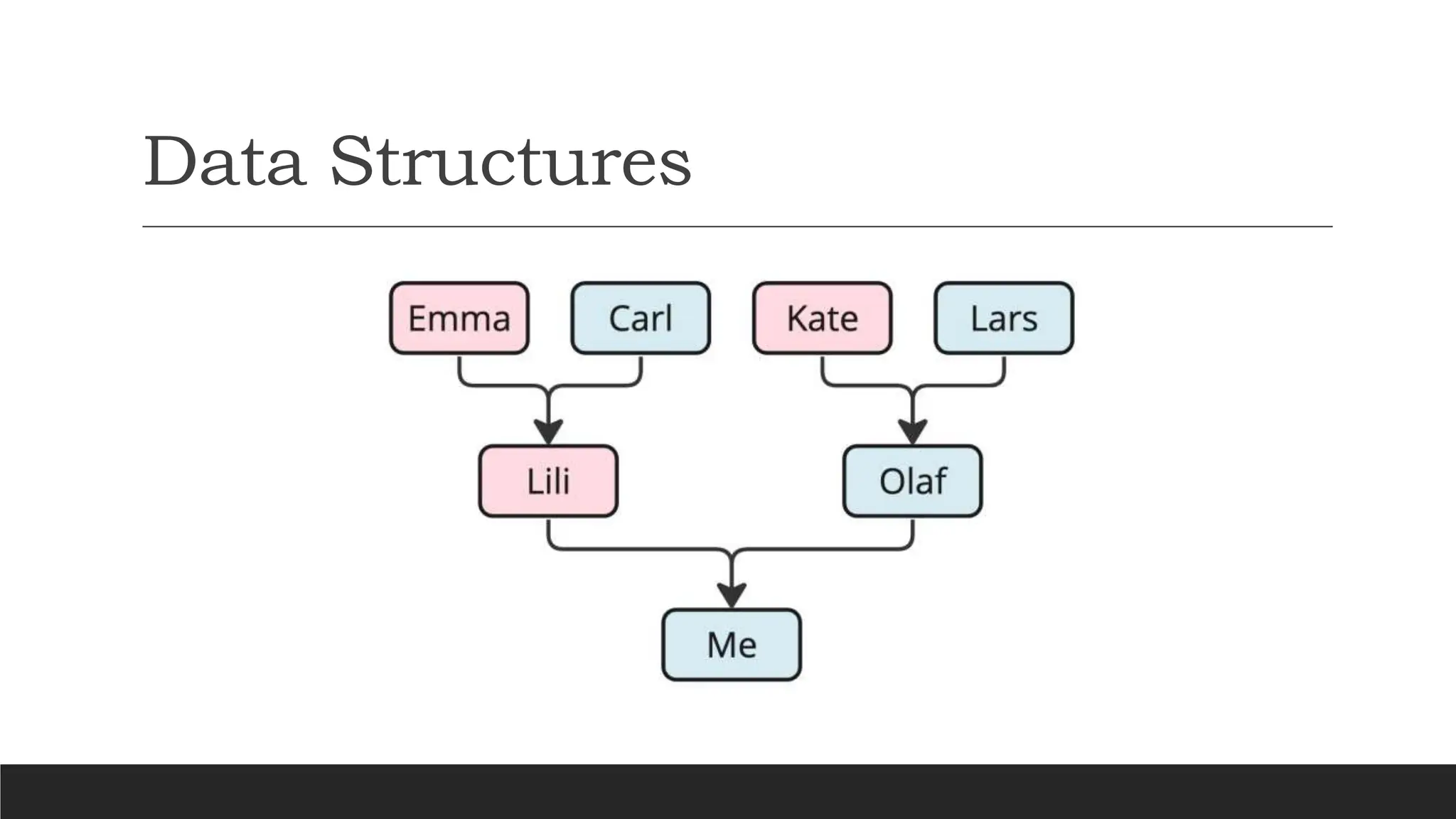
If we want to store data about people we are related to, we use
a family tree as the data structure. We choose a family tree as
the data structure because we have information about people
we are related to and how they are related, and we want an
overview so that we can easily find a specific family member,
several generations back.
With such a family tree data structure, it is easy to see, for
example, who my mother's mother is—it is 'Emma,' right? But
without the links from child to parents that this data structure
provides, it would be difficult to determine how the individuals
are related.
Data structures give us the possibility to manage large amounts
of data efficiently for uses such as large databases and internet
indexing services.
Data structures are essential ingredients in creating fast and
powerful algorithms. They help in managing and organizing
data, reduce complexity, and increase efficiency.
Two different kinds of data
structures.
Primitive Data Structures are basic data structures provided
by programming languages to represent single values, such as
integers, floating-point numbers, characters, and booleans.
Abstract Data Structures are higher-level data structures that
are built using primitive data types and provide more complex
and specialized operations. Some common examples of abstract
data structures include arrays, linked lists, stacks, queues,
trees, and graphs.
What are Algorithms?
An algorithm is a set of step-by-step instructions to solve a
given problem or achieve a specific goal.
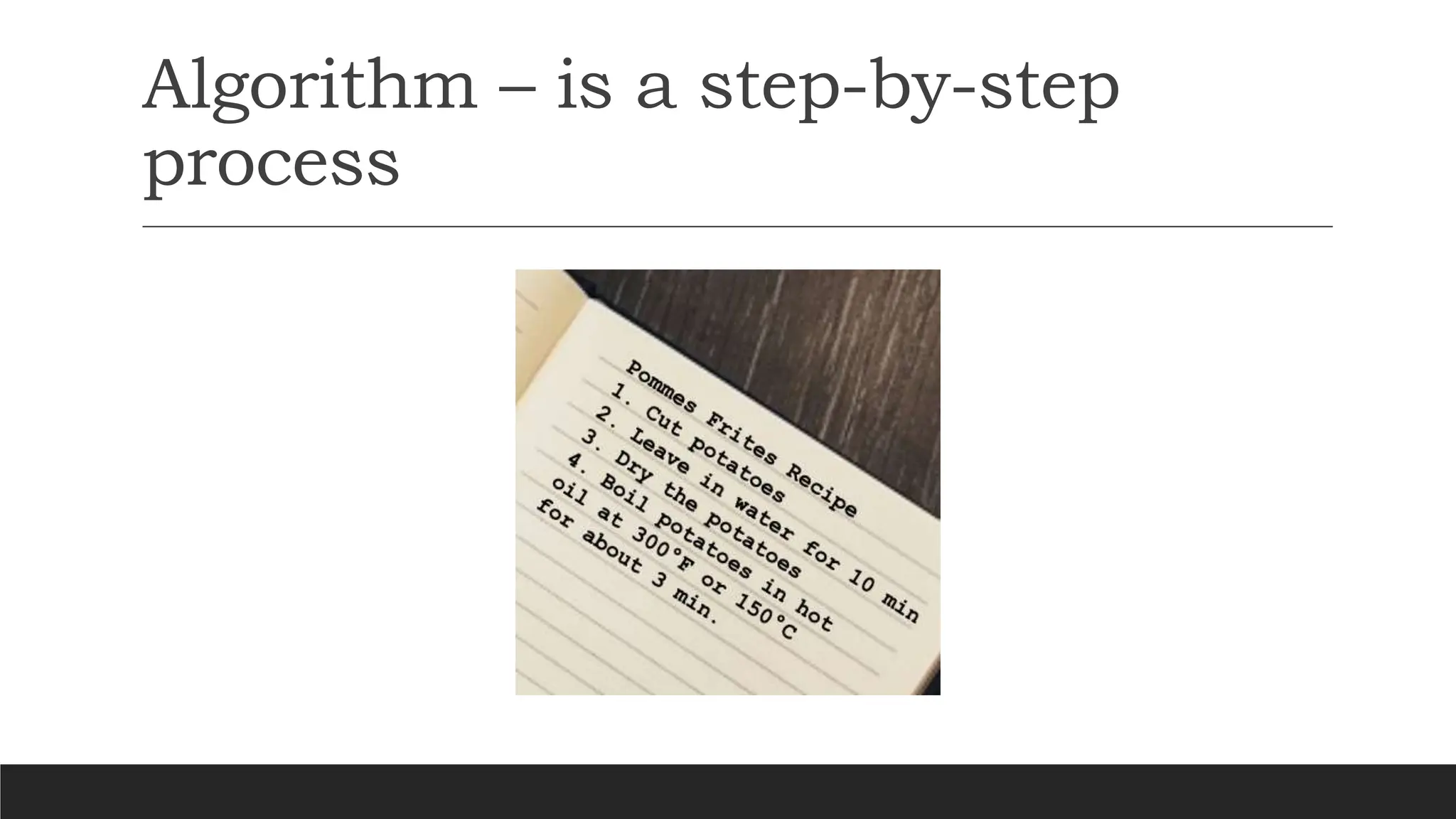
A cooking recipe written on a piece of paper is an example of an
algorithm, where the goal is to make a certain dinner. The steps
needed to make a specific dinner are described exactly.
When we talk about algorithms in Computer Science, the step-
by-step instructions are written in a programming language,
and instead of food ingredients, an algorithm uses data
structures.
Algorithm – is a step-by-step
process
Algorithms are fundamental to computer programming as they
provide step-by-step instructions for executing tasks. An
efficient algorithm can help us to find the solution we are
looking for, and to transform a slow program into a faster one.
By studying algorithms, developers can write better programs.
Algorithm examples:
1. Finding the fastest route in a GPS navigation system
2. Navigating an airplane or a car (cruise control)
3. Finding what users search for (search engine)
4. Sorting, for example sorting movies by rating
The algorithms are designed to solve specific problems, and are
often made to work on specific data structures. For example,
the 'Bubble Sort' algorithm is designed to sort values, and is
made to work on arrays.
Data Structures together with
Algorithms
Data structures and algorithms (DSA) go hand in hand. A data
structure is not worth much if you cannot search through it or
manipulate it efficiently using algorithms, and the algorithms in
this tutorial are not worth much without a data structure to
work on.
Data Structures together with
Algorithms
DSA is about finding efficient ways to store and retrieve data, to
perform operations on data, and to solve specific problems.
By understanding DSA, you can:
•Decide which data structure or algorithm is best for a given
situation.
•Make programs that run faster or use less memory.
•Understand how to approach complex problems and solve them
in a systematic way.
Where is Data Structures and
Algorithms Needed?
Data Structures and Algorithms (DSA) are used in virtually every software system,
from operating systems to web applications:
•For managing large amounts of data, such as in a social network or a search engine.
•For scheduling tasks, to decide which task a computer should do first.
•For planning routes, like in a GPS system to find the shortest path from A to B.
•For optimizing processes, such as arranging tasks so they can be completed as
quickly as possible.
•For solving complex problems: From finding the best way to pack a truck to making a
computer 'learn' from data.
DSA is fundamental in nearly
every part of the software world:
•Operating Systems
•Database Systems
•Web Applications
•Machine Learning
•Video Games
•Cryptographic Systems
•Data Analysis
•Search Engines
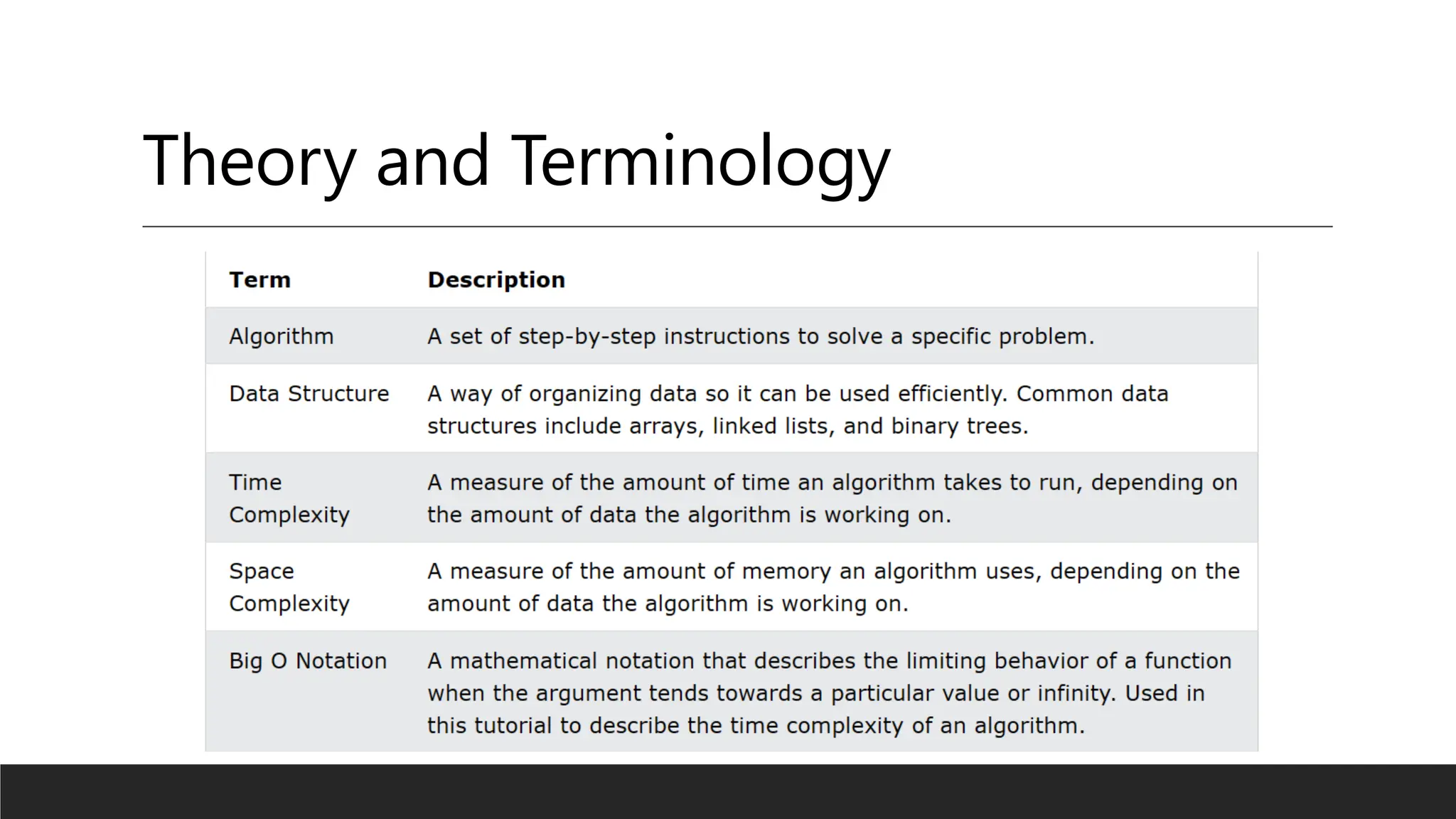
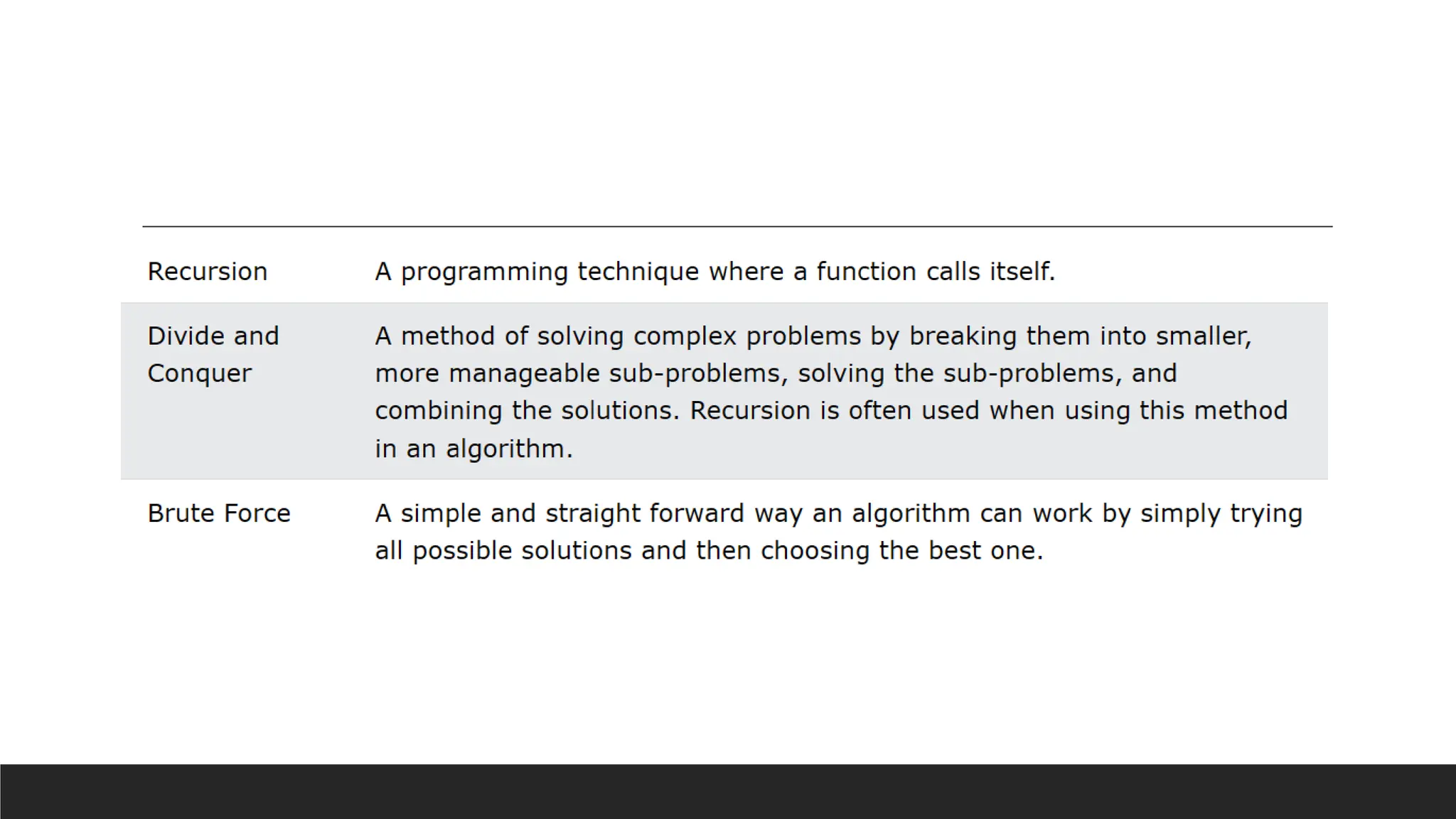
Theory and Terminology
Algorithm Example
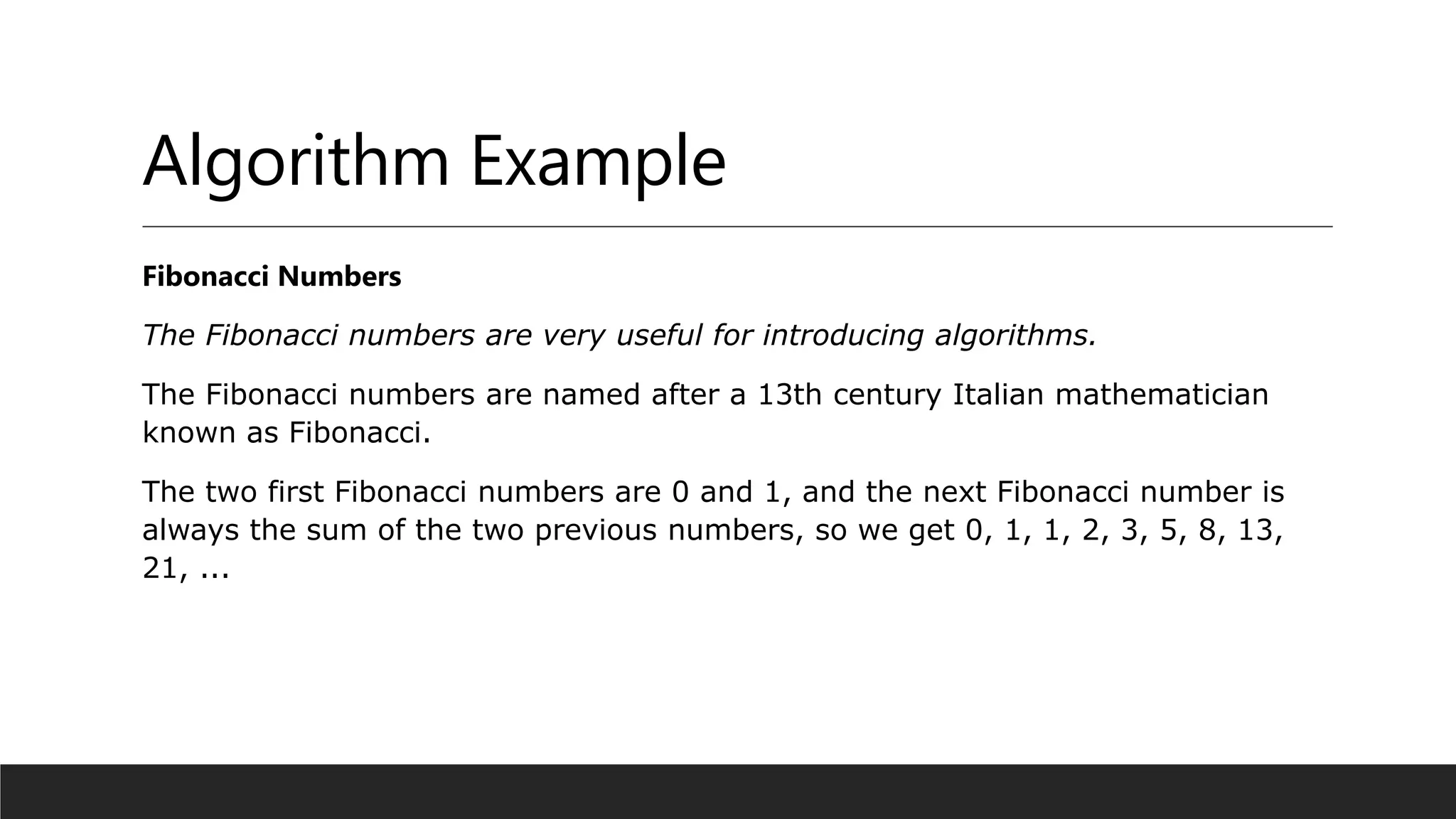
Fibonacci Numbers
The Fibonacci numbers are very useful for introducing algorithms.
The Fibonacci numbers are named after a 13th century Italian mathematician
known as Fibonacci.
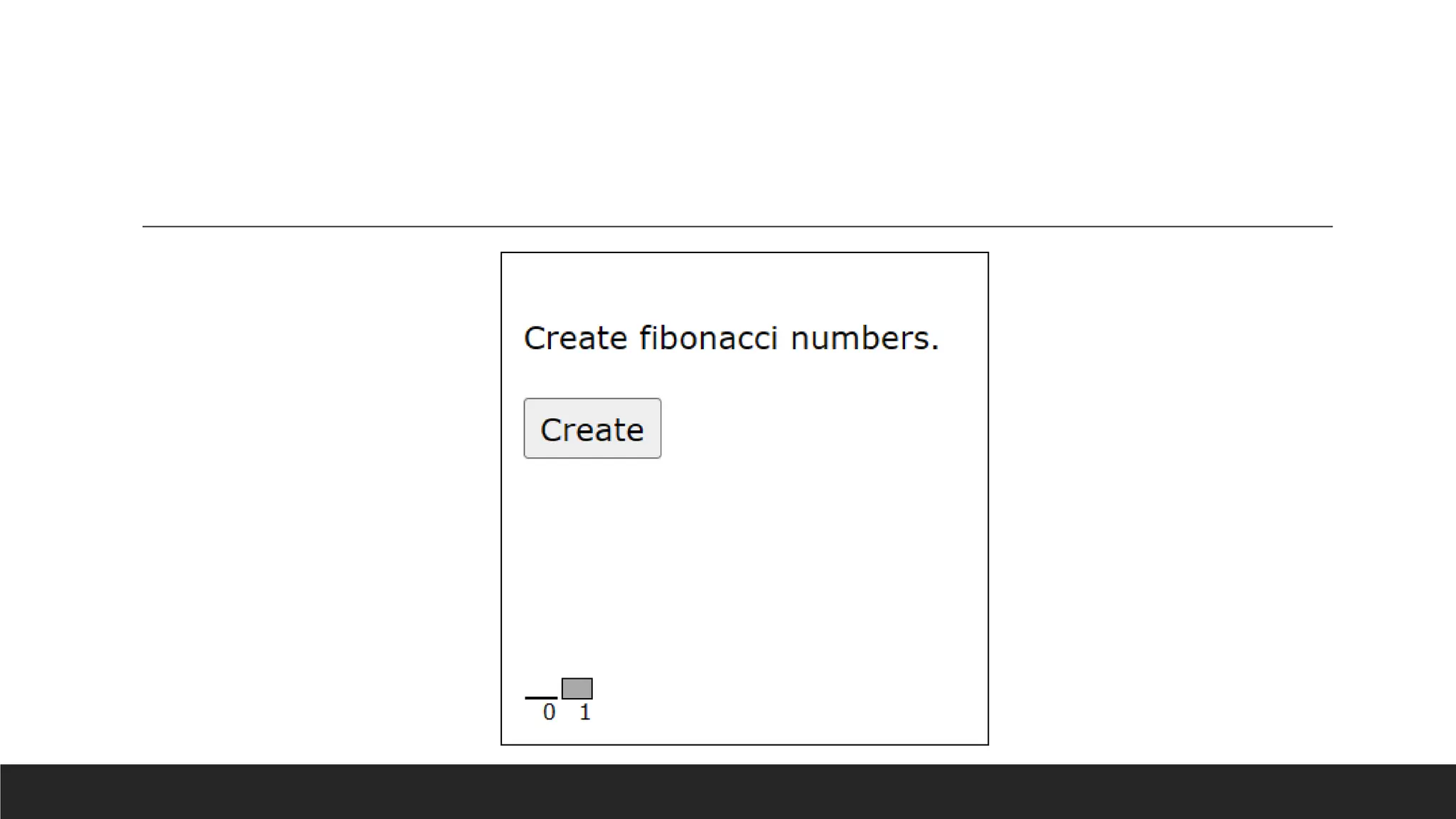
The two first Fibonacci numbers are 0 and 1, and the next Fibonacci number is
always the sum of the two previous numbers, so we get 0, 1, 1, 2, 3, 5, 8, 13,
21, ...
The Fibonacci Number Algorithm
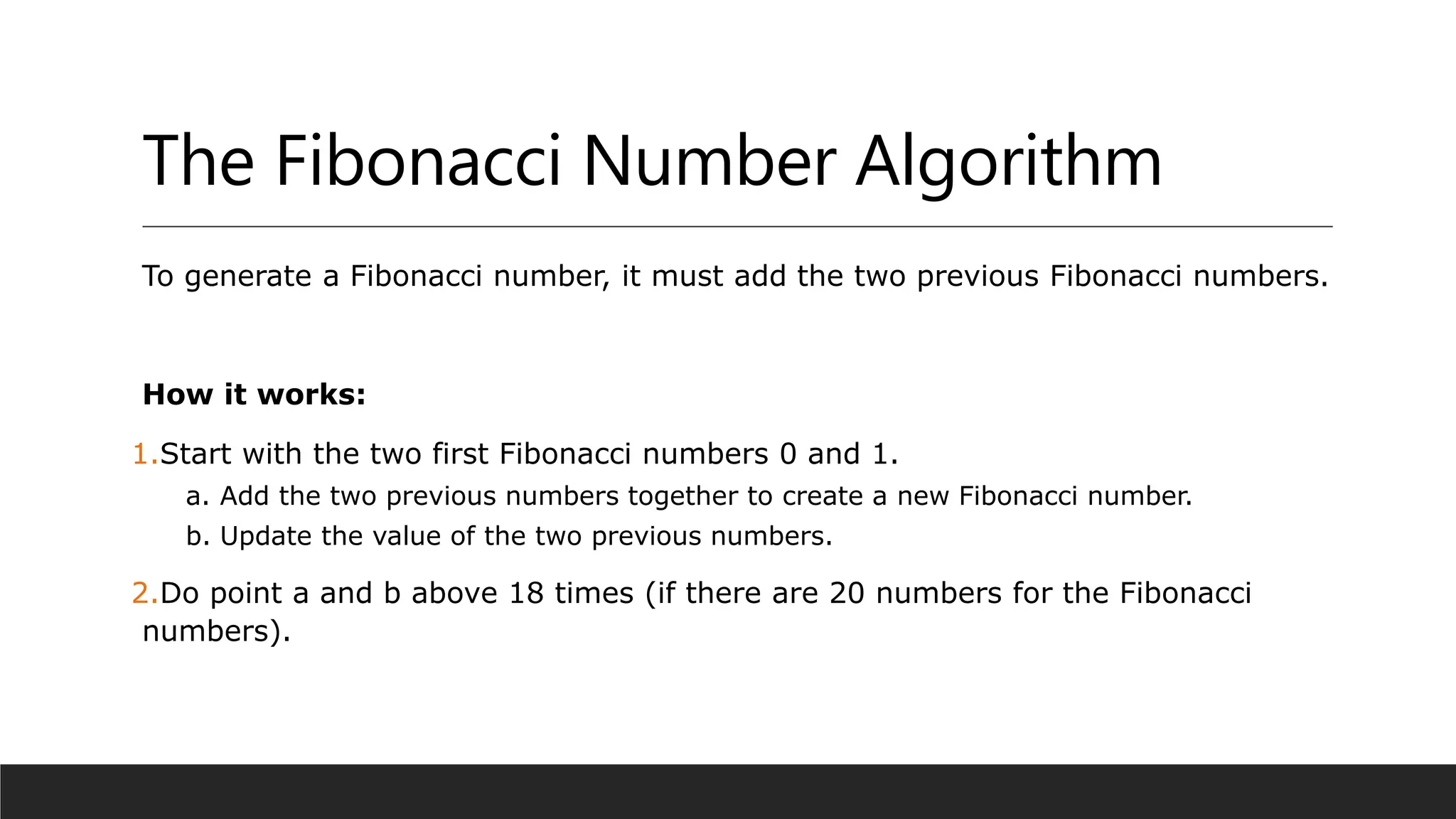
To generate a Fibonacci number, it must add the two previous Fibonacci numbers.
How it works:
1.Start with the two first Fibonacci numbers 0 and 1.
a. Add the two previous numbers together to create a new Fibonacci number.
b. Update the value of the two previous numbers.
2.Do point a and b above 18 times (if there are 20 numbers for the Fibonacci
numbers).
Loops vs Recursion
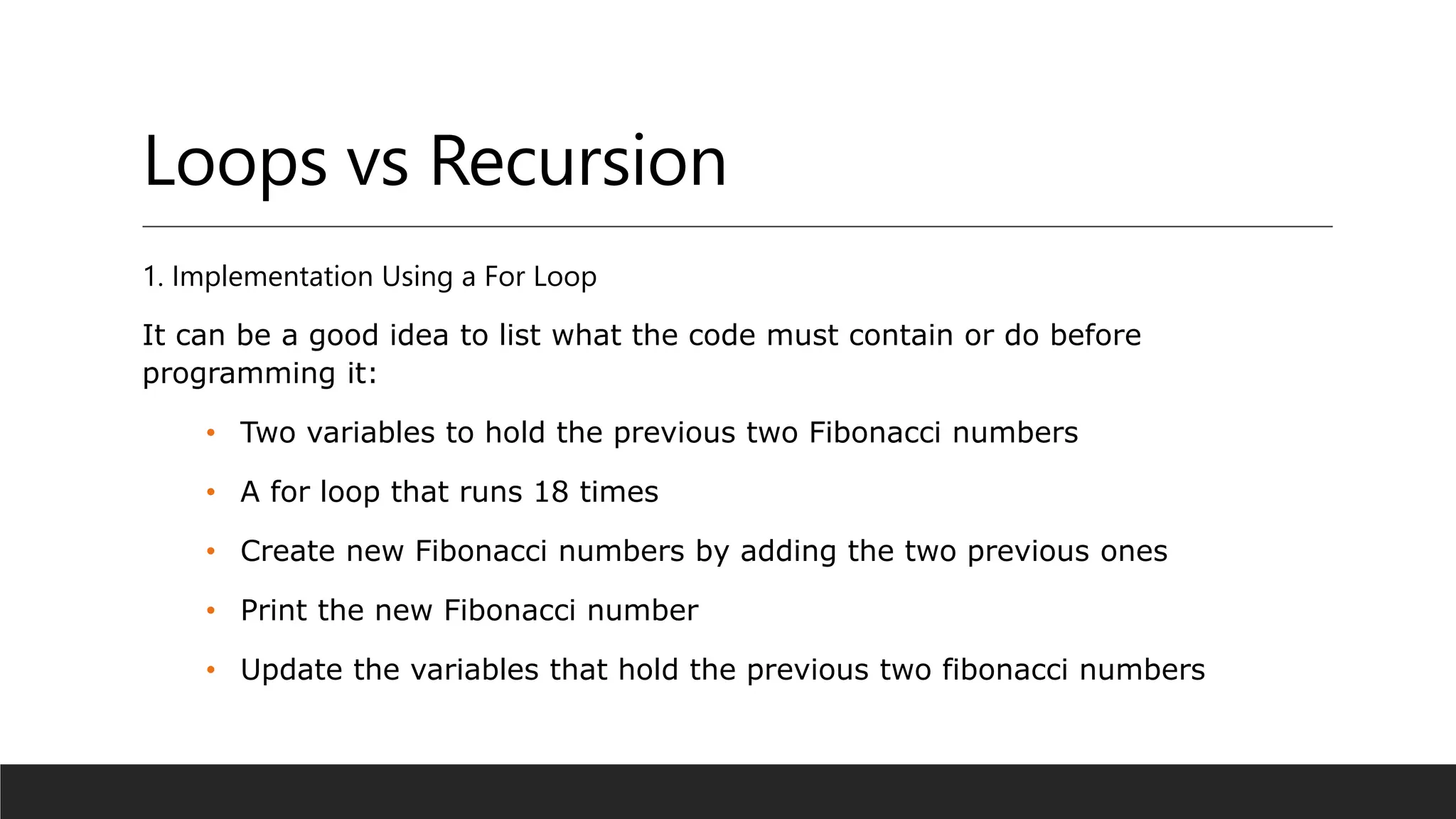
1. Implementation Using a For Loop
It can be a good idea to list what the code must contain or do before
programming it:
• Two variables to hold the previous two Fibonacci numbers
• A for loop that runs 18 times
• Create new Fibonacci numbers by adding the two previous ones
• Print the new Fibonacci number
• Update the variables that hold the previous two fibonacci numbers
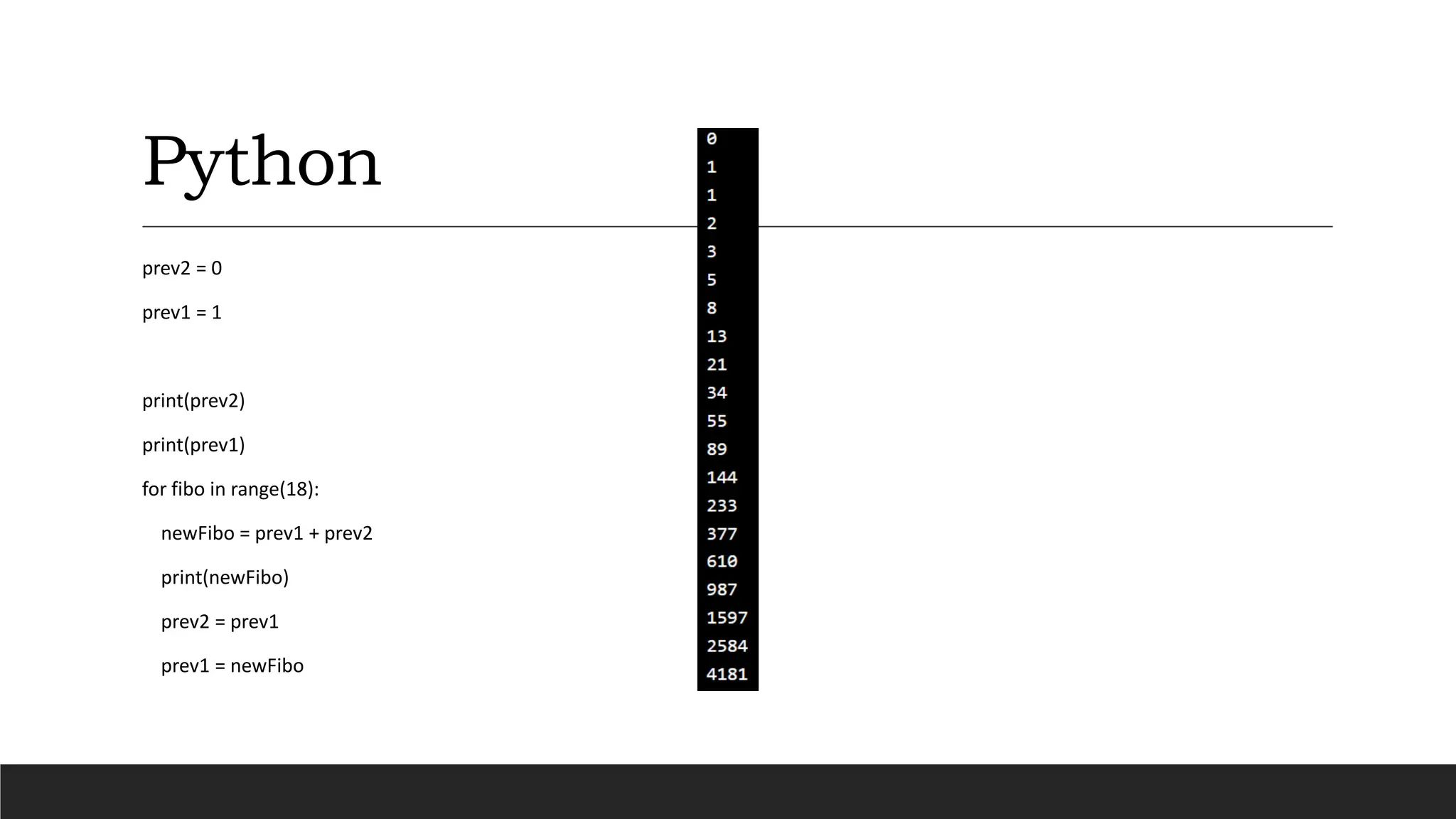
Python
prev2 = 0
prev1 = 1
print(prev2)
print(prev1)
for fibo in range(18):
newFibo = prev1 + prev2
print(newFibo)
prev2 = prev1
prev1 = newFibo
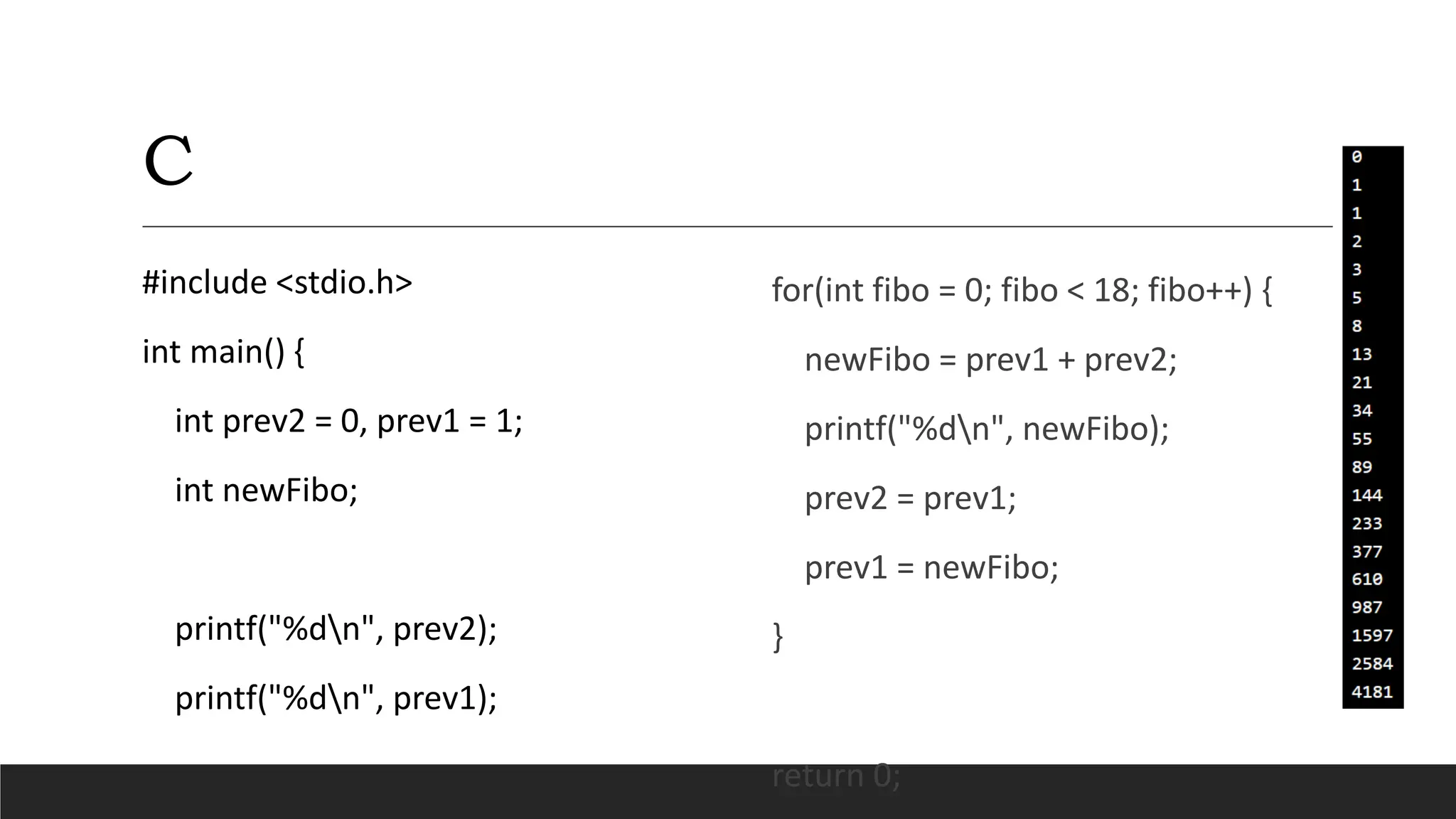
C
#include <stdio.h>
int main() {
int prev2 = 0, prev1 = 1;
int newFibo;
printf("%dn", prev2);
printf("%dn", prev1);
for(int fibo = 0; fibo < 18; fibo++) {
newFibo = prev1 + prev2;
printf("%dn", newFibo);
prev2 = prev1;
prev1 = newFibo;
}
return 0;
Java
public class Main {
public static void main(String[] args) {
int prev2 = 0;
int prev1 = 1;
System.out.println(prev2);
System.out.println(prev1);
for(int fibo = 0; fibo < 18; fibo++) {
int newFibo = prev1 + prev2;
System.out.println(newFibo);
prev2 = prev1;
prev1 = newFibo;
}
}
}
Implementation Using Recursion
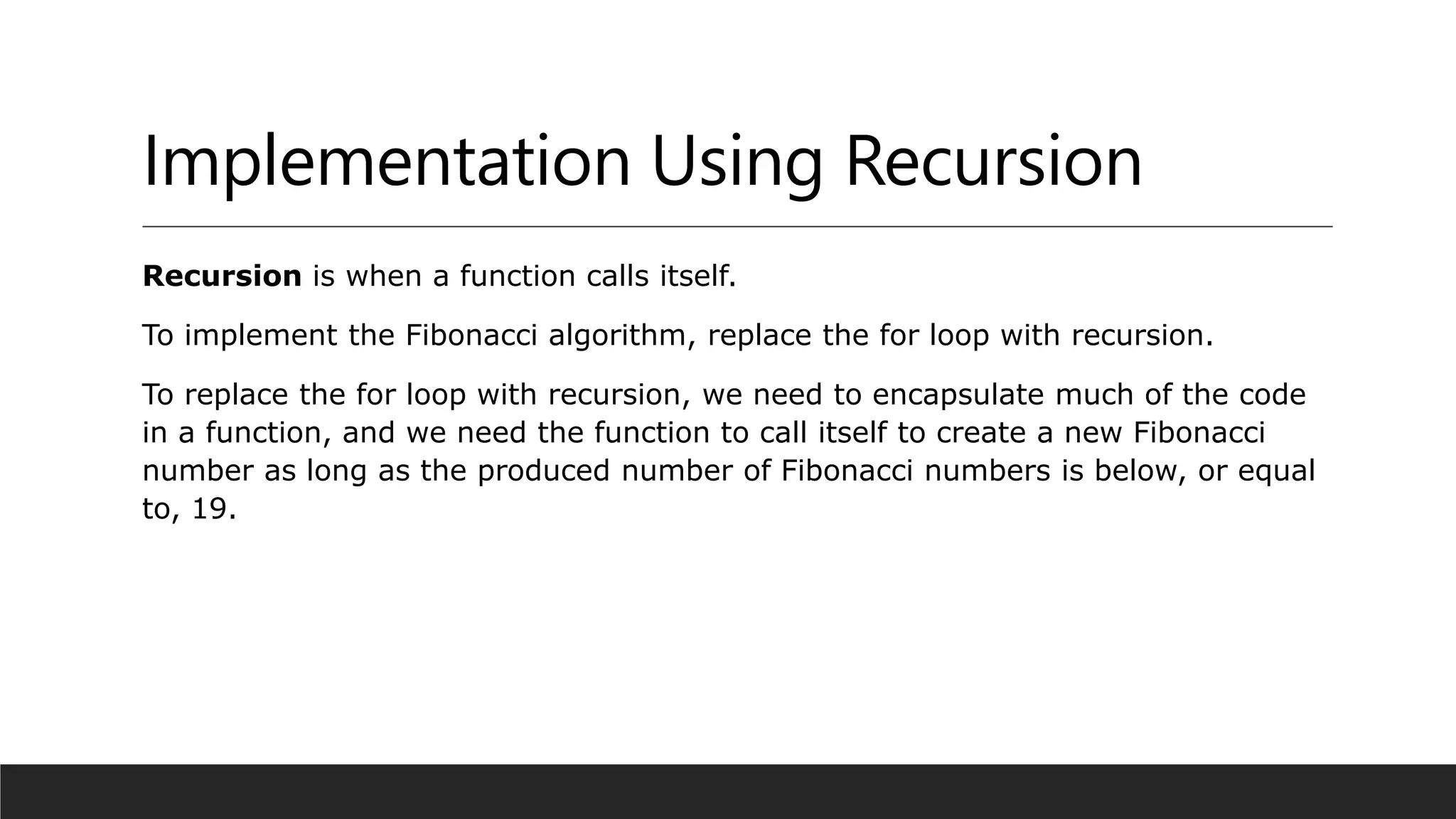
Recursion is when a function calls itself.
To implement the Fibonacci algorithm, replace the for loop with recursion.
To replace the for loop with recursion, we need to encapsulate much of the code
in a function, and we need the function to call itself to create a new Fibonacci
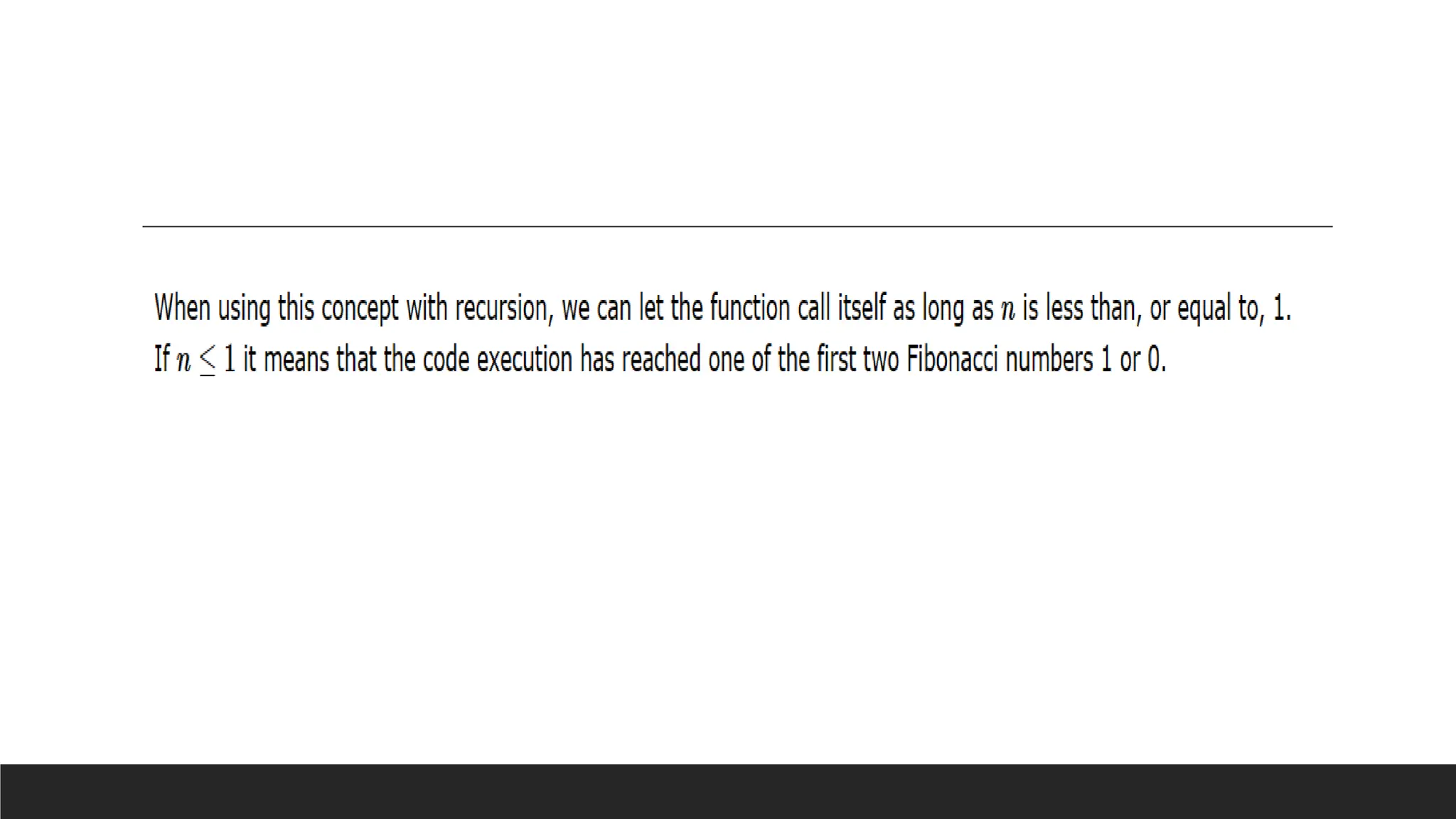
number as long as the produced number of Fibonacci numbers is below, or equal
to, 19.
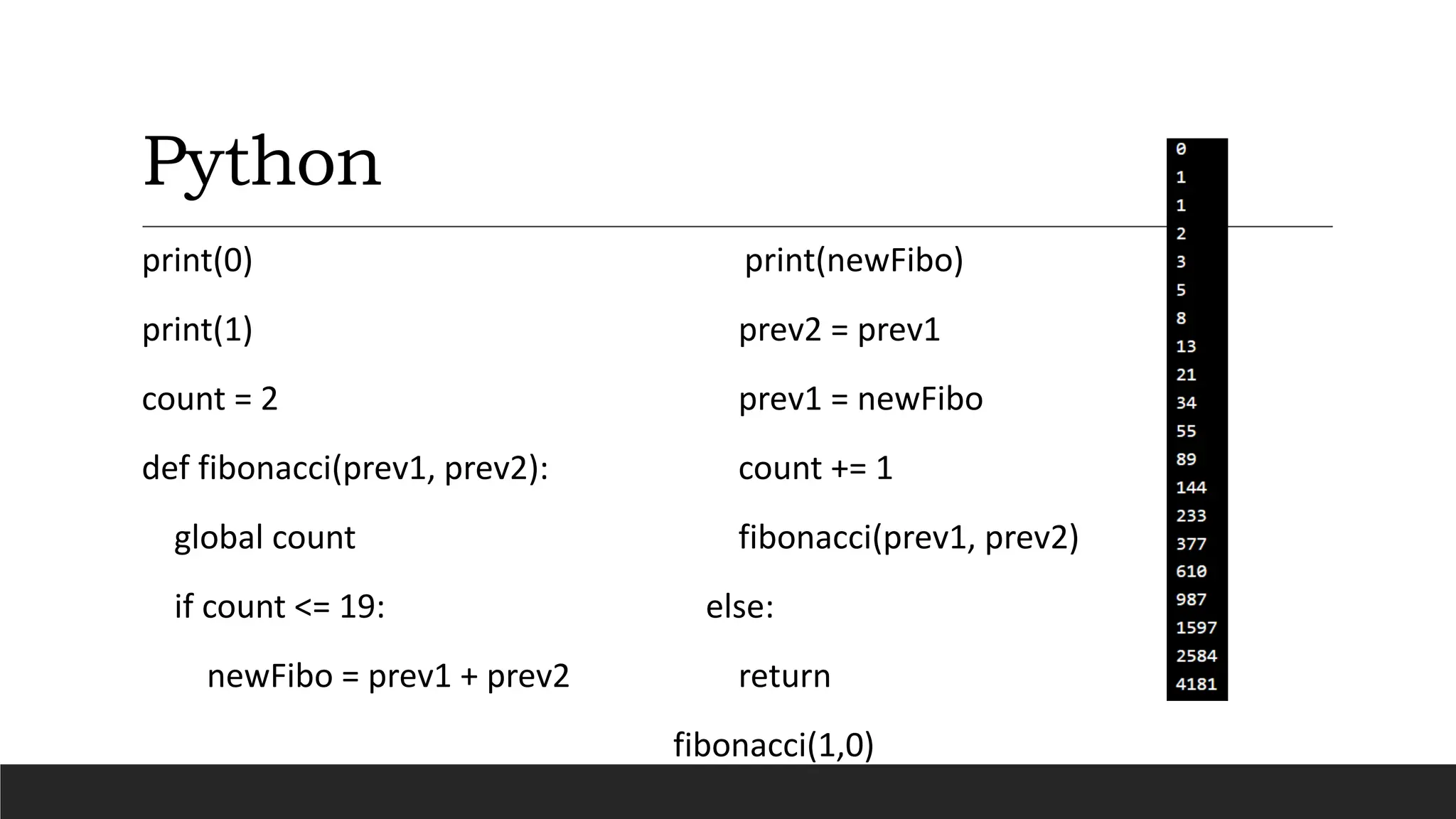
Python
print(0)
print(1)
count = 2
def fibonacci(prev1, prev2):
global count
if count <= 19:
newFibo = prev1 + prev2
print(newFibo)
prev2 = prev1
prev1 = newFibo
count += 1
fibonacci(prev1, prev2)
else:
return
fibonacci(1,0)
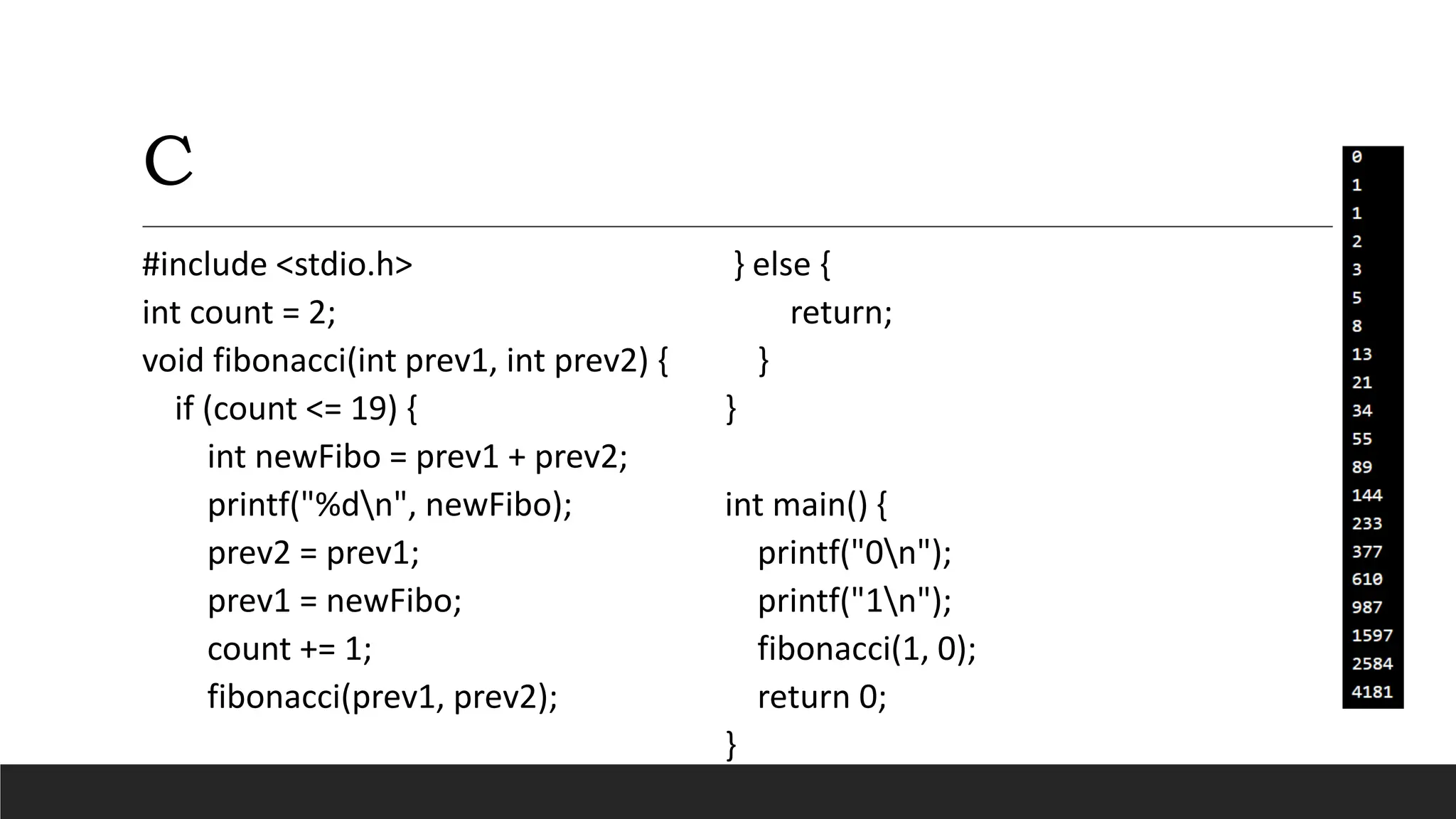
C
#include <stdio.h>
int count = 2;
void fibonacci(int prev1, int prev2) {
if (count <= 19) {
int newFibo = prev1 + prev2;
printf("%dn", newFibo);
prev2 = prev1;
prev1 = newFibo;
count += 1;
fibonacci(prev1, prev2);
} else {
return;
}
}
int main() {
printf("0n");
printf("1n");
fibonacci(1, 0);
return 0;
}
Java
public class Main {
static int count = 2;
public static void fibonacci(int prev1, int prev2) {
if (count <= 19) {
int newFibo = prev1 + prev2;
System.out.println(newFibo);
prev2 = prev1;
prev1 = newFibo;
count += 1;
fibonacci(prev1, prev2);
} else {
return;
}
}
public static void main(String[] args) {
System.out.println(0);
System.out.println(1);
fibonacci(1, 0);
}
}
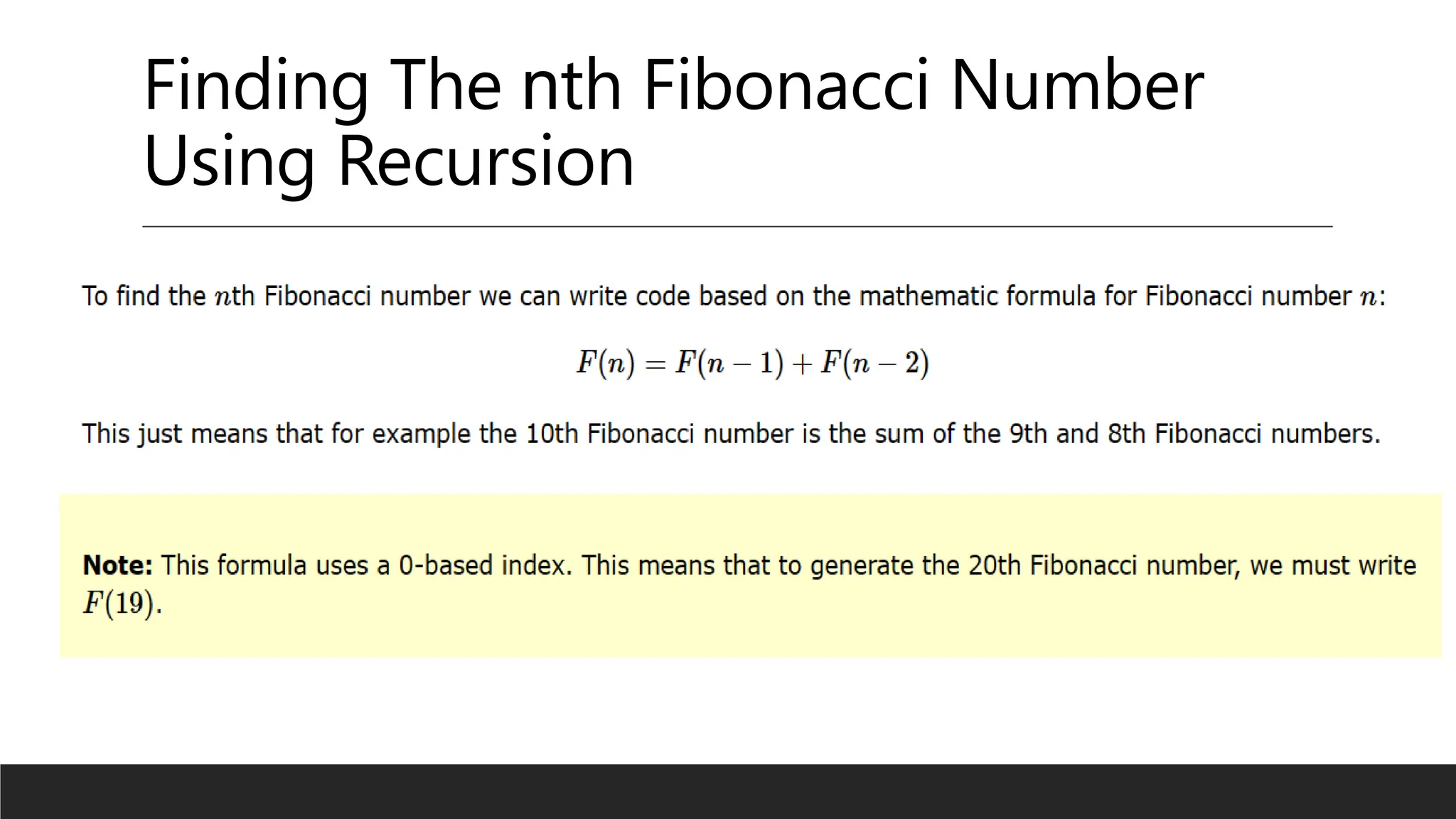
Finding The nth Fibonacci Number
Using Recursion
Python
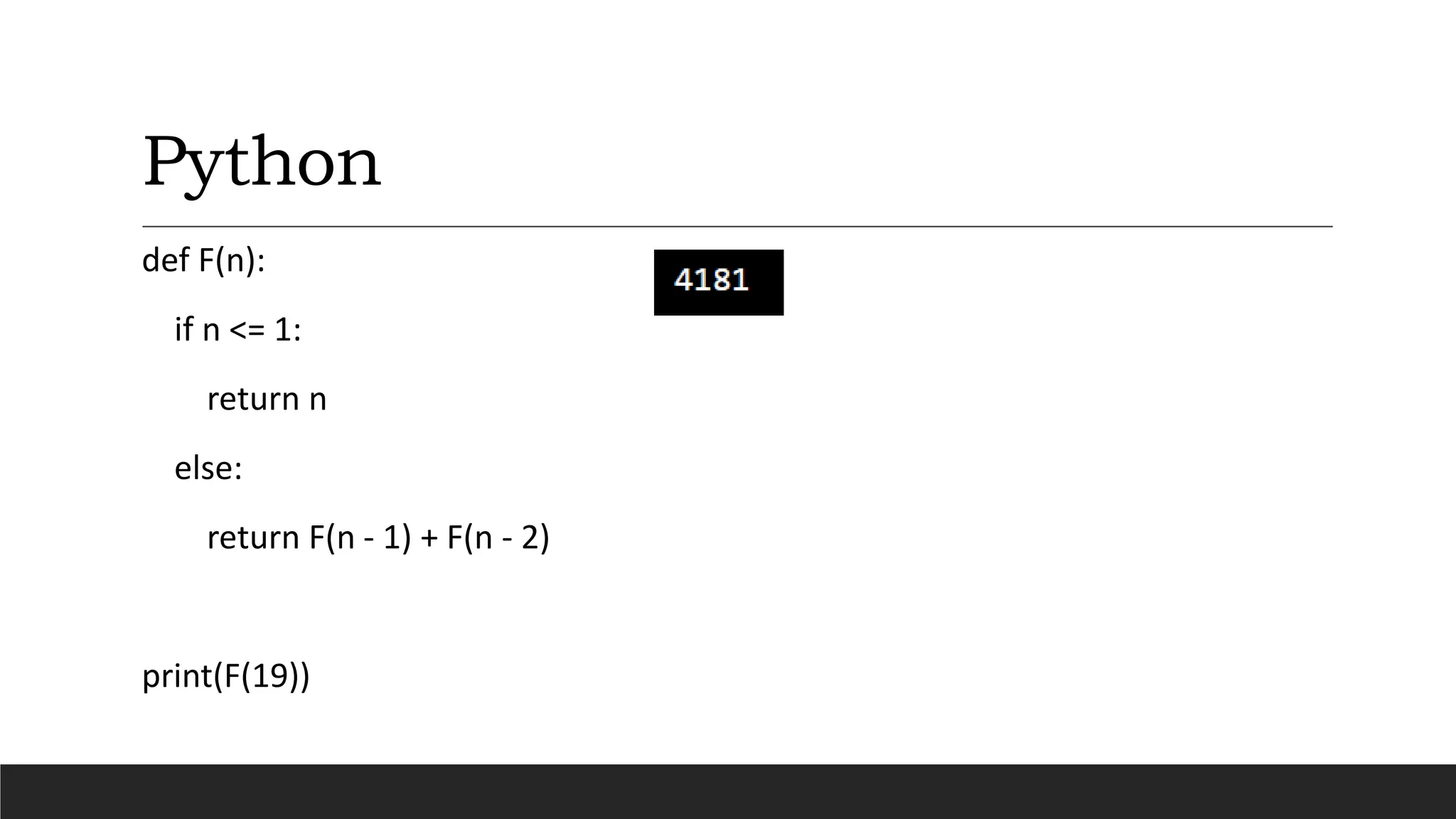
def F(n):
if n <= 1:
return n
else:
return F(n - 1) + F(n - 2)
print(F(19))
C
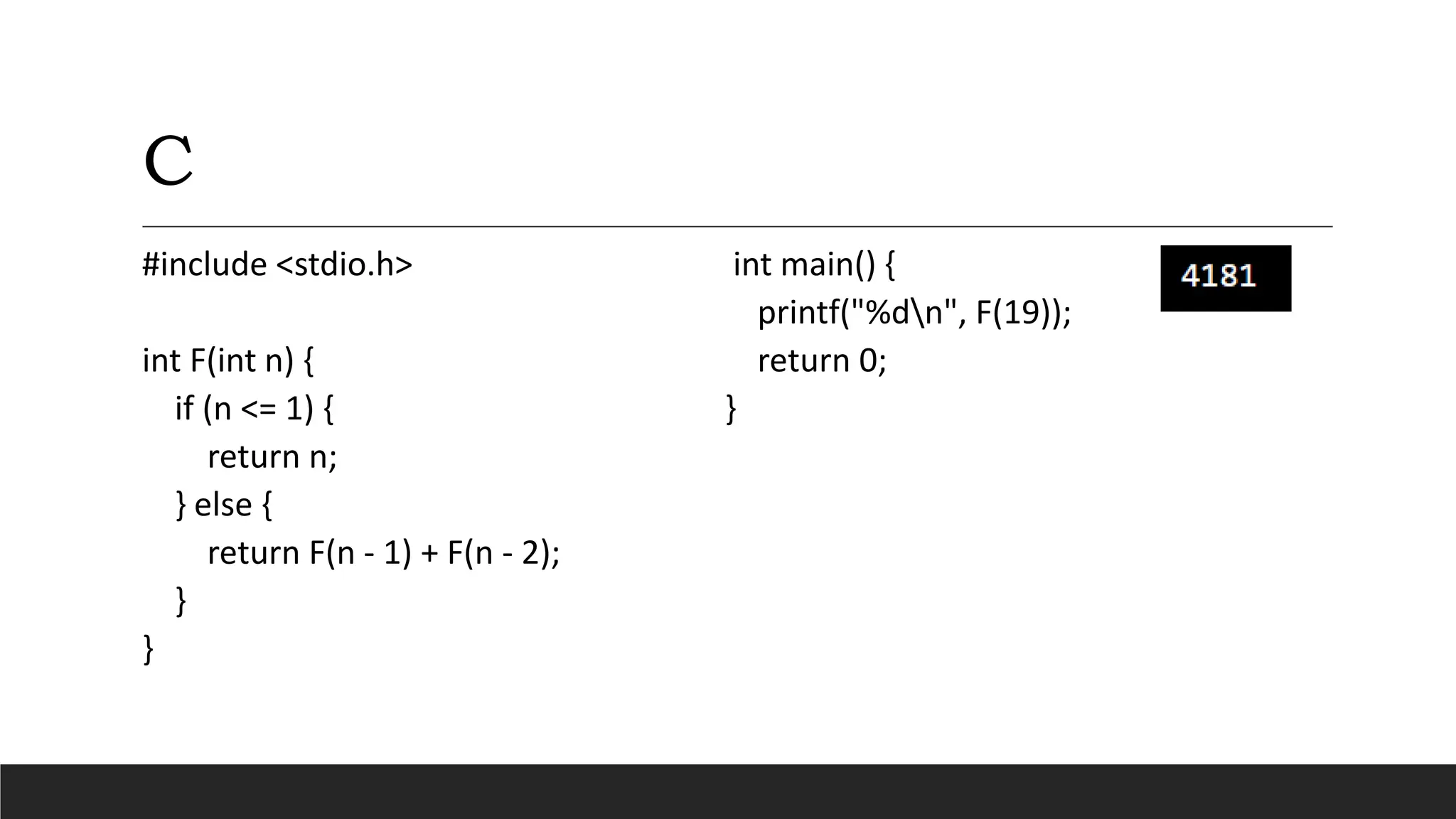
#include <stdio.h>
int F(int n) {
if (n <= 1) {
return n;
} else {
return F(n - 1) + F(n - 2);
}
}
int main() {
printf("%dn", F(19));
return 0;
}
Java
public class Main {
public static int F(int n) {
if (n <= 1) {
return n;
} else {
return F(n - 1) + F(n - 2);
}
}
public static void main(String[] args) {
System.out.println(F(19));
}
}
Analysis
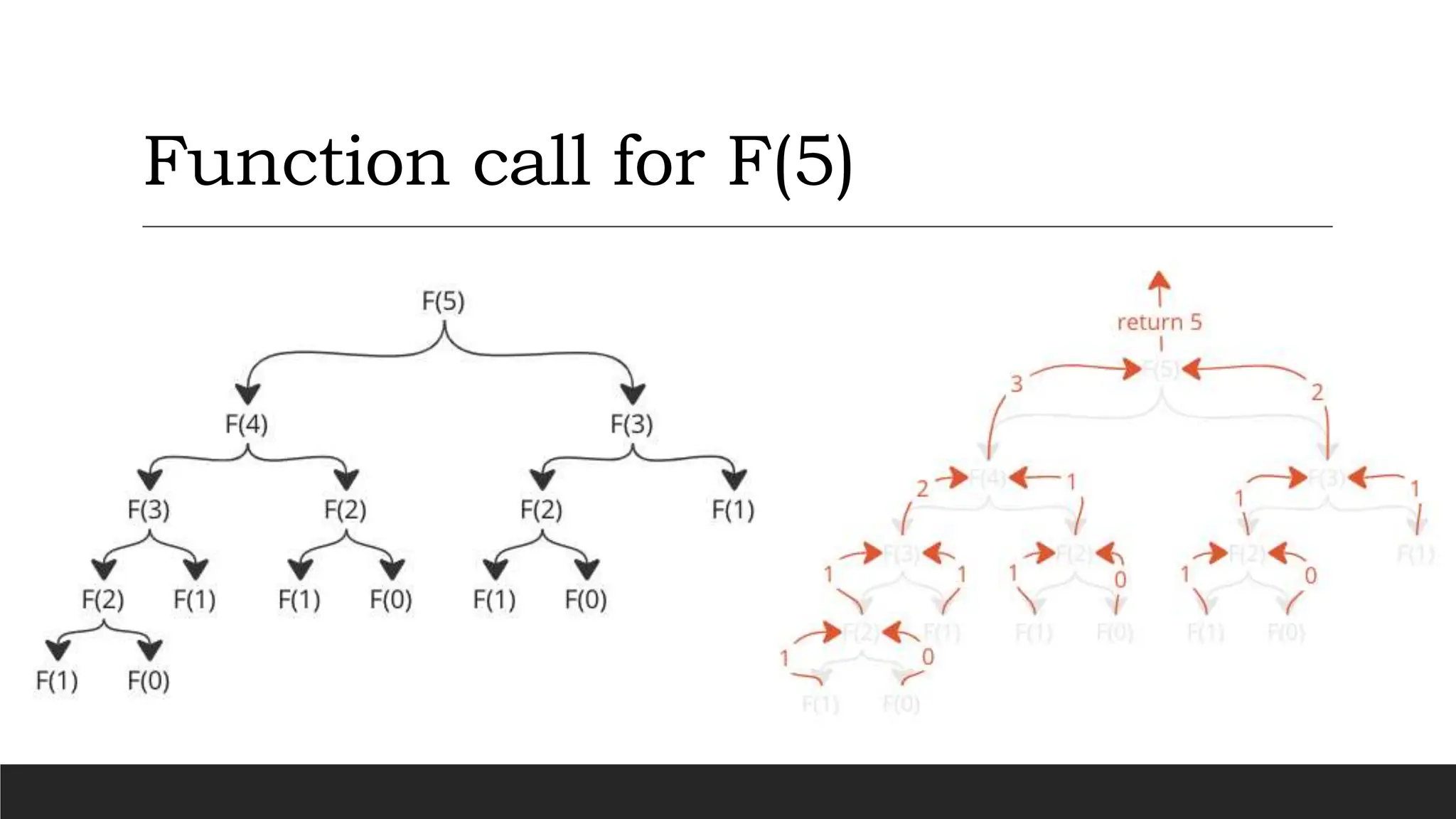
Notice that this recursive method calls itself two times, not just one. This makes
a huge difference in how the program will actually run on our computer. The
number of calculations will explode when we increase the number of the
Fibonacci number we want. To be more precise, the number of function calls will
double every time we increase the Fibonacci number we want by one.
Function call for F(5)
Thank you

L1-Introduction for Computer Science.pptx

  • 1.
  • 2.
    Data Structures isabout how data can be stored in different structures. Algorithms is about how to solve different problems, often by searching through and manipulating data structures. Theory about Data Structures and Algorithms (DSA) helps us to use large amounts of data to solve problems efficiently.
  • 3.
  • 4.
    We structure datain different ways depending on what data we have, and what we want to do with it. If we want to store data about people we are related to, we use a family tree as the data structure. We choose a family tree as the data structure because we have information about people we are related to and how they are related, and we want an overview so that we can easily find a specific family member, several generations back.
  • 5.
    With such afamily tree data structure, it is easy to see, for example, who my mother's mother is—it is 'Emma,' right? But without the links from child to parents that this data structure provides, it would be difficult to determine how the individuals are related.
  • 6.
    Data structures giveus the possibility to manage large amounts of data efficiently for uses such as large databases and internet indexing services. Data structures are essential ingredients in creating fast and powerful algorithms. They help in managing and organizing data, reduce complexity, and increase efficiency.
  • 7.
    Two different kindsof data structures. Primitive Data Structures are basic data structures provided by programming languages to represent single values, such as integers, floating-point numbers, characters, and booleans. Abstract Data Structures are higher-level data structures that are built using primitive data types and provide more complex and specialized operations. Some common examples of abstract data structures include arrays, linked lists, stacks, queues, trees, and graphs.
  • 9.
    What are Algorithms? Analgorithm is a set of step-by-step instructions to solve a given problem or achieve a specific goal. A cooking recipe written on a piece of paper is an example of an algorithm, where the goal is to make a certain dinner. The steps needed to make a specific dinner are described exactly. When we talk about algorithms in Computer Science, the step- by-step instructions are written in a programming language, and instead of food ingredients, an algorithm uses data structures.
  • 10.
    Algorithm – isa step-by-step process
  • 11.
    Algorithms are fundamentalto computer programming as they provide step-by-step instructions for executing tasks. An efficient algorithm can help us to find the solution we are looking for, and to transform a slow program into a faster one. By studying algorithms, developers can write better programs.
  • 12.
    Algorithm examples: 1. Findingthe fastest route in a GPS navigation system 2. Navigating an airplane or a car (cruise control) 3. Finding what users search for (search engine) 4. Sorting, for example sorting movies by rating
  • 13.
    The algorithms aredesigned to solve specific problems, and are often made to work on specific data structures. For example, the 'Bubble Sort' algorithm is designed to sort values, and is made to work on arrays.
  • 14.
    Data Structures togetherwith Algorithms Data structures and algorithms (DSA) go hand in hand. A data structure is not worth much if you cannot search through it or manipulate it efficiently using algorithms, and the algorithms in this tutorial are not worth much without a data structure to work on.
  • 15.
    Data Structures togetherwith Algorithms DSA is about finding efficient ways to store and retrieve data, to perform operations on data, and to solve specific problems. By understanding DSA, you can: •Decide which data structure or algorithm is best for a given situation. •Make programs that run faster or use less memory. •Understand how to approach complex problems and solve them in a systematic way.
  • 16.
    Where is DataStructures and Algorithms Needed? Data Structures and Algorithms (DSA) are used in virtually every software system, from operating systems to web applications: •For managing large amounts of data, such as in a social network or a search engine. •For scheduling tasks, to decide which task a computer should do first. •For planning routes, like in a GPS system to find the shortest path from A to B. •For optimizing processes, such as arranging tasks so they can be completed as quickly as possible. •For solving complex problems: From finding the best way to pack a truck to making a computer 'learn' from data.
  • 17.
    DSA is fundamentalin nearly every part of the software world: •Operating Systems •Database Systems •Web Applications •Machine Learning •Video Games •Cryptographic Systems •Data Analysis •Search Engines
  • 18.
  • 20.
    Algorithm Example Fibonacci Numbers TheFibonacci numbers are very useful for introducing algorithms. The Fibonacci numbers are named after a 13th century Italian mathematician known as Fibonacci. The two first Fibonacci numbers are 0 and 1, and the next Fibonacci number is always the sum of the two previous numbers, so we get 0, 1, 1, 2, 3, 5, 8, 13, 21, ...
  • 22.
    The Fibonacci NumberAlgorithm To generate a Fibonacci number, it must add the two previous Fibonacci numbers. How it works: 1.Start with the two first Fibonacci numbers 0 and 1. a. Add the two previous numbers together to create a new Fibonacci number. b. Update the value of the two previous numbers. 2.Do point a and b above 18 times (if there are 20 numbers for the Fibonacci numbers).
  • 23.
    Loops vs Recursion 1.Implementation Using a For Loop It can be a good idea to list what the code must contain or do before programming it: • Two variables to hold the previous two Fibonacci numbers • A for loop that runs 18 times • Create new Fibonacci numbers by adding the two previous ones • Print the new Fibonacci number • Update the variables that hold the previous two fibonacci numbers
  • 24.
    Python prev2 = 0 prev1= 1 print(prev2) print(prev1) for fibo in range(18): newFibo = prev1 + prev2 print(newFibo) prev2 = prev1 prev1 = newFibo
  • 25.
    C #include <stdio.h> int main(){ int prev2 = 0, prev1 = 1; int newFibo; printf("%dn", prev2); printf("%dn", prev1); for(int fibo = 0; fibo < 18; fibo++) { newFibo = prev1 + prev2; printf("%dn", newFibo); prev2 = prev1; prev1 = newFibo; } return 0;
  • 26.
    Java public class Main{ public static void main(String[] args) { int prev2 = 0; int prev1 = 1; System.out.println(prev2); System.out.println(prev1); for(int fibo = 0; fibo < 18; fibo++) { int newFibo = prev1 + prev2; System.out.println(newFibo); prev2 = prev1; prev1 = newFibo; } } }
  • 27.
    Implementation Using Recursion Recursionis when a function calls itself. To implement the Fibonacci algorithm, replace the for loop with recursion. To replace the for loop with recursion, we need to encapsulate much of the code in a function, and we need the function to call itself to create a new Fibonacci number as long as the produced number of Fibonacci numbers is below, or equal to, 19.
  • 28.
    Python print(0) print(1) count = 2 deffibonacci(prev1, prev2): global count if count <= 19: newFibo = prev1 + prev2 print(newFibo) prev2 = prev1 prev1 = newFibo count += 1 fibonacci(prev1, prev2) else: return fibonacci(1,0)
  • 29.
    C #include <stdio.h> int count= 2; void fibonacci(int prev1, int prev2) { if (count <= 19) { int newFibo = prev1 + prev2; printf("%dn", newFibo); prev2 = prev1; prev1 = newFibo; count += 1; fibonacci(prev1, prev2); } else { return; } } int main() { printf("0n"); printf("1n"); fibonacci(1, 0); return 0; }
  • 30.
    Java public class Main{ static int count = 2; public static void fibonacci(int prev1, int prev2) { if (count <= 19) { int newFibo = prev1 + prev2; System.out.println(newFibo); prev2 = prev1; prev1 = newFibo; count += 1; fibonacci(prev1, prev2); } else { return; } } public static void main(String[] args) { System.out.println(0); System.out.println(1); fibonacci(1, 0); } }
  • 31.
    Finding The nthFibonacci Number Using Recursion
  • 33.
    Python def F(n): if n<= 1: return n else: return F(n - 1) + F(n - 2) print(F(19))
  • 34.
    C #include <stdio.h> int F(intn) { if (n <= 1) { return n; } else { return F(n - 1) + F(n - 2); } } int main() { printf("%dn", F(19)); return 0; }
  • 35.
    Java public class Main{ public static int F(int n) { if (n <= 1) { return n; } else { return F(n - 1) + F(n - 2); } } public static void main(String[] args) { System.out.println(F(19)); } }
  • 36.
    Analysis Notice that thisrecursive method calls itself two times, not just one. This makes a huge difference in how the program will actually run on our computer. The number of calculations will explode when we increase the number of the Fibonacci number we want. To be more precise, the number of function calls will double every time we increase the Fibonacci number we want by one.
  • 37.
  • 38.