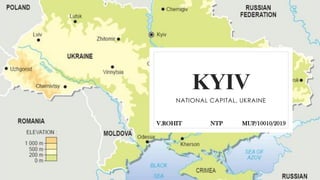
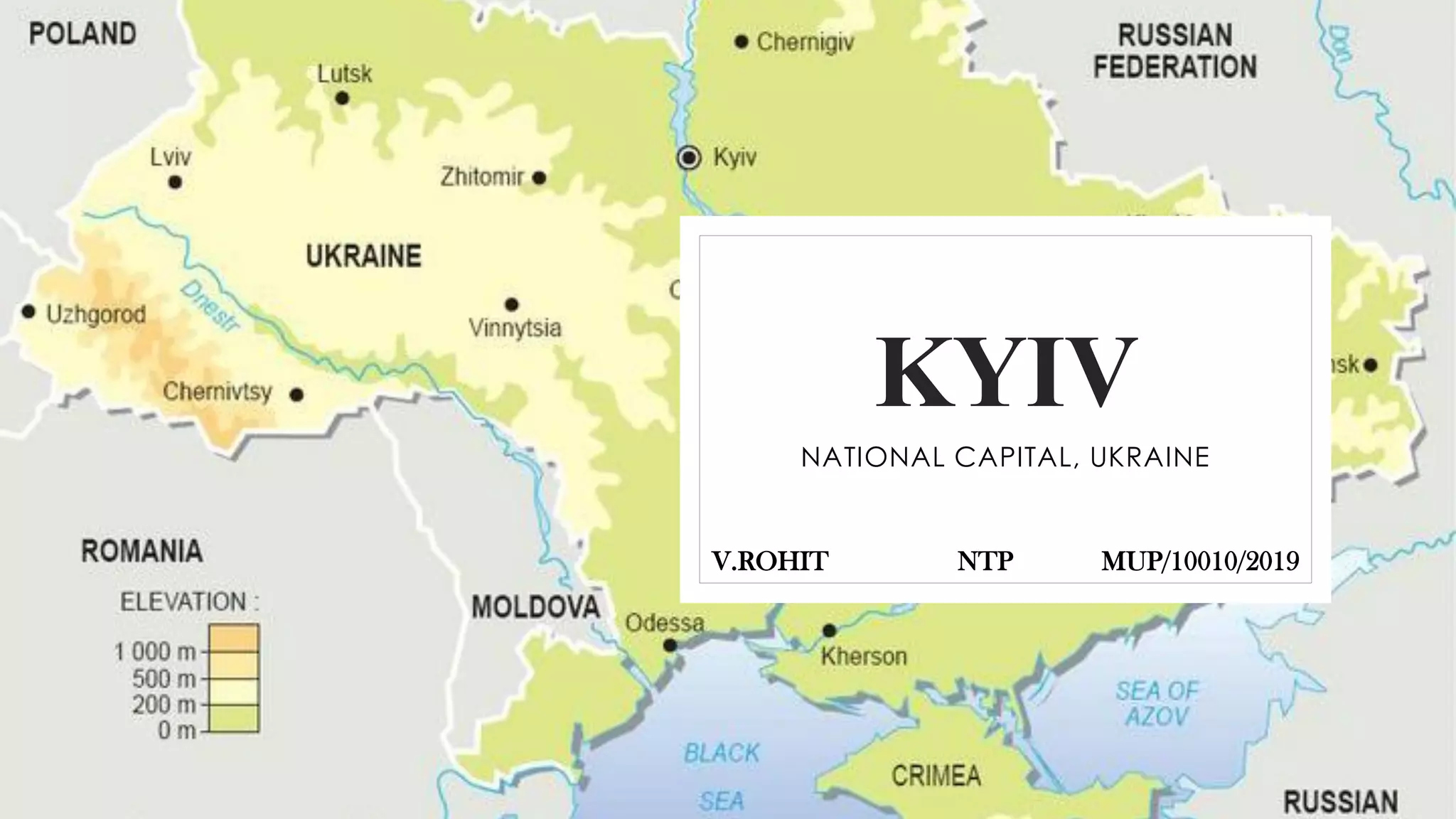







KYIV
NATIONAL CAPITAL, UKRAINE
V.ROHIT NTP MUP/10010/2019
INTRODUCTION:-
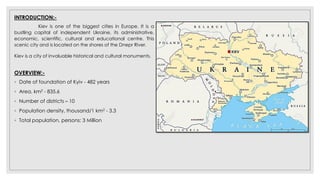
Kiev is one of the biggest cities in Europe. It is a
bustling capital of independent Ukraine, its administrative,
economic, scientific, cultural and educational centre. This
scenic city and is located on the shores of the Dnepr River.
Kiev is a city of invaluable historical and cultural monuments.
OVERVIEW:-
◦ Date of foundation of Kyiv - 482 years
◦ Area, km2 - 835.6
◦ Number of districts – 10
◦ Population density, thousand/1 km2 - 3.3
◦ Total population, persons: 3 Million
THE GEOGRAPHICAL LOCATION AND CLIMATIC FEATURES OF THE KYIV
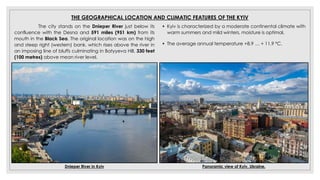
The city stands on the Dnieper River just below its
confluence with the Desna and 591 miles (951 km) from its
mouth in the Black Sea. The original location was on the high
and steep right (western) bank, which rises above the river in
an imposing line of bluffs culminating in Batyyeva Hill, 330 feet
(100 metres) above mean river level.
Dnieper River in Kyiv
 Kyiv is characterized by a moderate continental climate with
warm summers and mild winters, moisture is optimal.
 The average annual temperature +8.9 … + 11.9 ºC.
Panoramic view of Kyiv, Ukraine.
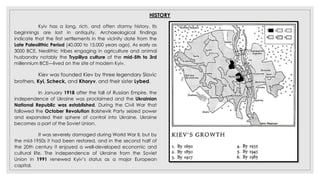
HISTORY
Kyiv has a long, rich, and often stormy history. Its
beginnings are lost in antiquity. Archaeological findings
indicate that the first settlements in the vicinity date from the
Late Paleolithic Period (40,000 to 15,000 years ago). As early as
3000 BCE, Neolithic tribes engaging in agriculture and animal
husbandry notably the Trypillya culture of the mid-5th to 3rd
millennium BCE—lived on the site of modern Kyiv.
Kiev was founded Kiev by three legendary Slavic
brothers, Kyi, Scheck, and Khoryv, and their sister Lybed.
In January 1918 after the fall of Russian Empire, the
independence of Ukraine was proclaimed and the Ukrainian
National Republic was established. During the Civil War that
followed the October Revolution Bolshevik Party seized power
and expanded their sphere of control into Ukraine. Ukraine
becomes a part of the Soviet Union.
It was severely damaged during World War II, but by
the mid-1950s it had been restored, and in the second half of
the 20th century it enjoyed a well-developed economic and
cultural life. The independence of Ukraine from the Soviet
Union in 1991 renewed Kyiv’s status as a major European
capital.
1
2
3
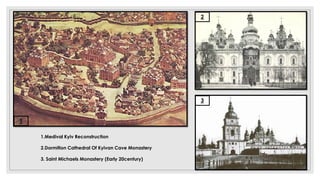
1.Medival Kyiv Reconstruction
2.Dormition Cathedral Of Kyivan Cave Monastery
3. Saint Michaels Monastery (Early 20century)
ECONOMY
Kyiv, has major administrative functions, with
considerable employment in the offices of ministries
responsible for the economy. Its also an important industrial
centre, possessing a wide range of manufactures. Factories
are found in all quarters of the city, with major concentrations
to the west of the city centre and on the left bank of the
Dnieper.
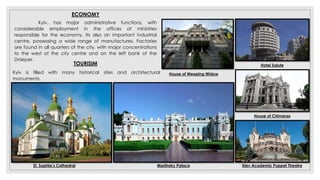
TOURISIM
Kyiv is filled with many historical sites and architectural
monuments.
House of Weeping Widow
Hotel Salute
Mariinsky PalaceSt. Sophia’s Cathedral Kiev Academic Puppet Theatre
House of Chimeras
SWOT ANALYSIS
◦ STRENGTHS
◦ Economic and financial center of ukraine, “center of gravity” for capital and resources;
◦ Highly qualified workforce, significant concentration of science and research personnel;
◦ Relatively low cost of living;
◦ High loyalty and city’s emotional appeal among the citizens.
◦ High level of personal safety;
◦ The lowest level of atmosphere emissions of pollutants among the compared cities.
◦ WEAKNESSES
◦ Very worn-out engineering and transport infrastructure;
◦ Insufficient transparency and unpredictability for investors and economic agents;
◦ Unfavorable environment for business development – a large number of procedures, permits and oversight bodies;
◦ Low popularity of active life style, deterioration of health indicators among the citizens, a sustainable trend toward the
growth of consumption of alcohol and tobacco;
◦ Chaotic real estate development and continued loss of the historical appearance of the city;
◦ Absence of a clear focus on competition in the sphere of future economic development;
◦ Weakly differentiated base of the budget incomes, growing withdrawals to the state budget that limit budget financing of
the city development.
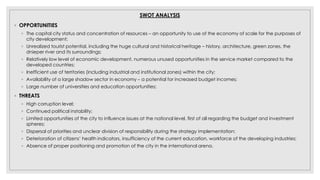
SWOT ANALYSIS
◦ OPPORTUNITIES
◦ The capital city status and concentration of resources – an opportunity to use of the economy of scale for the purposes of
city development;
◦ Unrealized tourist potential, including the huge cultural and historical heritage – history, architecture, green zones, the
dnieper river and its surroundings;
◦ Relatively low level of economic development, numerous unused opportunities in the service market compared to the
developed countries;
◦ Inefficient use of territories (including industrial and institutional zones) within the city;
◦ Availability of a large shadow sector in economy – a potential for increased budget incomes;
◦ Large number of universities and education opportunities;
◦ THREATS
◦ High corruption level;
◦ Continued political instability;
◦ Limited opportunities of the city to influence issues at the national level, first of all regarding the budget and investment
spheres;
◦ Dispersal of priorities and unclear division of responsibility during the strategy implementation;
◦ Deterioration of citizens’ health indicators, insufficiency of the current education, workforce of the developing industries;
◦ Absence of proper positioning and promotion of the city in the international arena.
MAJOR PROBLEMS IDENTIFIED IN THE CITY
1. EconomicDevelopment,Private Entrepreneurship And Investment
2. Transport Infrastructure
3. Engineering infrastructure.
4. Ecology and environmental safety
5. Tourist infrastructure
6. Increasing affordability of health care
7. Educational services
8. Social protection and safety
9. Labour market and employment.
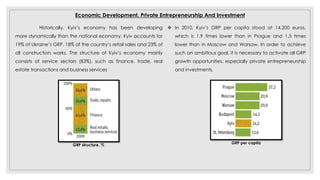
Economic Development, Private Entrepreneurship And Investment
Historically, Kyiv’s economy has been developing
more dynamically than the national economy. Kyiv accounts for
19% of Ukraine’s GRP, 18% of the country’s retail sales and 23% of
all construction works. The structure of Kyiv’s economy mainly
consists of service sectors (83%), such as finance, trade, real
estate transactions and business services
GRP structure, %
 In 2010, Kyiv’s GRP per capita stood at 14,200 euros,
which is 1.9 times lower than in Prague and 1.5 times
lower than in Moscow and Warsaw, In order to achieve
such an ambitious goal, it is necessary to activate all GRP
growth opportunities, especially private entrepreneurship
and investments.
GRP per capita
Transport Infrastructure
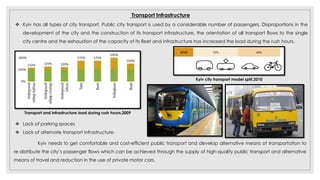
 Kyiv has all types of city transport. Public city transport is used by a considerable number of passengers, Disproportions in the
development of the city and the construction of its transport infrastructure, the orientation of all transport flows to the single
city centre and the exhaustion of the capacity of its fleet and infrastructure has increased the load during the rush hours.
Transport and infrastructure load during rush hours,2009
 Lack of parking spaces
 Lack of alternate transport infrastructure.
Kyiv needs to get comfortable and cost-efficient public transport and develop alternative means of transportation to
re-distribute the city’s passenger flows which can be achieved through the supply of high-quality public transport and alternative
means of travel and reduction in the use of private motor cars.
Kyiv city transport model split,2010
Engineering infrastructure
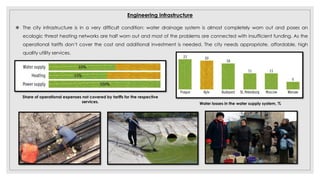
 The city infrastructure is in a very difficult condition: water drainage system is almost completely worn out and poses an
ecologic threat heating networks are half worn out and most of the problems are connected with insufficient funding. As the
operational tariffs don’t cover the cost and additional investment is needed. The city needs appropriate, affordable, high
quality utility services.
Share of operational expenses not covered by tariffs for the respective
services. Water losses in the water supply system, %
Ecology and environmental safety
 Kyiv had been historically developing as a green city, fact but lately due to asymmetric city development the landscape
vegetation areas have shrunken.
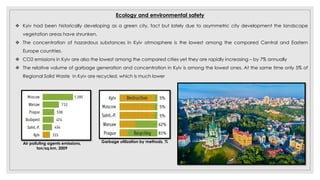
 The concentration of hazardous substances in Kyiv atmosphere is the lowest among the compared Central and Eastern
Europe countries.
 CO2 emissions in Kyiv are also the lowest among the compared cities yet they are rapidly increasing – by 7% annually
 The relative volume of garbage generation and concentration in Kyiv is among the lowest ones. At the same time only 5% of
Regional Solid Waste in Kyiv are recycled, which is much lower
Air polluting agents emissions,
ton/sq.km, 2009
Garbage utilization by methods, %
Tourist infrastructure
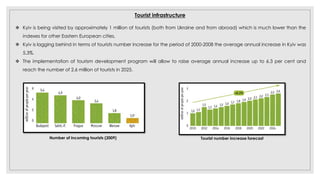
 Kyiv is being visited by approximately 1 million of tourists (both from Ukraine and from abroad) which is much lower than the
indexes for other Eastern European cities.
 Kyiv is lagging behind in terms of tourists number increase for the period of 2000-2008 the average annual increase in Kyiv was
5.3%.
 The implementation of tourism development program will allow to raise average annual increase up to 6.3 per cent and
reach the number of 2.6 million of tourists in 2025.
Number of incoming tourists (2009) Tourist number increase forecast
Increasing affordability of health care
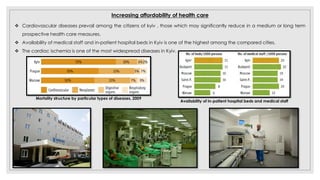
 Cardiovascular diseases prevail among the citizens of kyiv , those which may significantly reduce in a medium or long term
prospective health care measures.
 Availability of medical staff and in-patient hospital beds in Kyiv is one of the highest among the compared cities.
 The cardiac ischemia is one of the most widespread diseases in Kyiv.
Mortality structure by particular types of diseases, 2009
Availability of in-patient hospital beds and medical staff
Educational services
 Kyiv is the educational centre of ukraine, the city has approximately 116 higher education institutions.
 Secondary education coverage in kyiv is one of the highest among the compared cities pre-school education is behind with
63% coverage.
 Educational infrastructure availability is unequal throughout kyiv.
 The ratio of the number of children attending pre-school facilities to the number of places in kyiv pre-school facilities is 112%
 Ratio of the number of places in Primary Education Infrastructure to the number of children aged 2-6 is only 72%
Coverage with pre-school and school education
Kindergartens places use ratio I-III grade schools load ratio, index
Social protection and safety
 Kyiv is a city with significant stratification of population in terms of income when incomes of one fifth of all kyiv citizens are
below the real minimum subsistence level.
 Despite the availability of the basic social infrastructure, kyiv experiences an acute shortage of institutions for caring about
persons with psycho-neurological diseases.
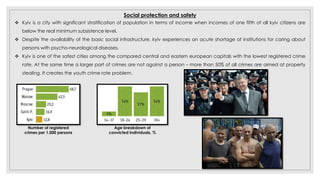
 Kyiv is one of the safest cities among the compared central and eastern european capitals with the lowest registered crime
rate. At the same time a larger part of crimes are not against a person – more than 50% of all crimes are aimed at property
stealing. It creates the youth crime rate problem.
Number of registered
crimes per 1,000 persons
Age breakdown of
convicted individuals, %
Labour market and employment
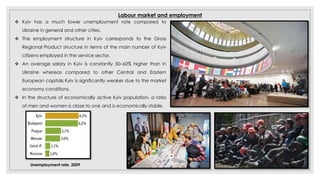
 Kyiv has a much lower unemployment rate compared to
Ukraine in general and other cities.
 The employment structure in Kyiv corresponds to the Gross
Regional Product structure in terms of the main number of Kyiv
citizens employed in the service sector.
 An average salary in Kyiv is constantly 50–60% higher than in
Ukraine whereas compared to other Central and Eastern
European capitals Kyiv is significantly weaker due to the market
economy conditions.
 In the structure of economically active Kyiv population, a ratio
of men and women is close to one and is economically stable.
Unemployment rate, 2009
DEVELOPMENT STRATEGY
The Kyiv City Administration has been working on a new
general plan for the city since September 2008 to replace the current
one, which was ineffective in guiding the city’s development.
“Kyiv Development Strategy until 2025” provides a visionary strategic
document defining the key priorities, targets, actions and budget for
socioeconomic development of Kyiv.
Principles of the Kyiv Development Strategy :
 Measurability
 Ambitiousness
 Sustainability
 Practicality
 Fairness
 Transparency
The plan promotes sustainable regional development and
rational use of the city’s limited land resources. It also includes a
balanced territorial development of Kyiv utilizing a number of
sustainability principles and approaches, including compact city,
polycentricism and multi-functionality, green city, the city of culture
and business, balanced metropolitan development.
“To improve the quality of life of its residents, which is
determined by the economic welfare and comfort of life along with
enrichment of the historical tradition of the city”
References
 Richard Antony French, https://www.britannica.com/ - Kyiv
 https://www.worldbank.org/ (February 8, 2012) - Kiev: Bringing an Ancient City into the Future
 Scott Bay (Jul. 24, 2018), https://www.thedailybeast.com/ - Why Kiev Should Be on Your Architecture Bucket List
 SRAS STUDENTS (1 FEBRUARY 2015), https://geohistory.today/ - Kiev
 Volodymyr Kubijovyč, Vadym Pavlovsky, Ihor Stebelsky, Arkadii Zhukovsky (2017), http://www.encyclopediaofukraine.com/ -
Internet Encyclopaedia of Ukraine
 Optima Tours, www.kiev.info - History of Kiev
Kyiv City Development Strategies Plan

Kyiv City Development Strategies Plan

  • 1.
  • 2.
    INTRODUCTION:- Kiev is oneof the biggest cities in Europe. It is a bustling capital of independent Ukraine, its administrative, economic, scientific, cultural and educational centre. This scenic city and is located on the shores of the Dnepr River. Kiev is a city of invaluable historical and cultural monuments. OVERVIEW:- ◦ Date of foundation of Kyiv - 482 years ◦ Area, km2 - 835.6 ◦ Number of districts – 10 ◦ Population density, thousand/1 km2 - 3.3 ◦ Total population, persons: 3 Million
  • 3.
    THE GEOGRAPHICAL LOCATIONAND CLIMATIC FEATURES OF THE KYIV The city stands on the Dnieper River just below its confluence with the Desna and 591 miles (951 km) from its mouth in the Black Sea. The original location was on the high and steep right (western) bank, which rises above the river in an imposing line of bluffs culminating in Batyyeva Hill, 330 feet (100 metres) above mean river level. Dnieper River in Kyiv  Kyiv is characterized by a moderate continental climate with warm summers and mild winters, moisture is optimal.  The average annual temperature +8.9 … + 11.9 ºC. Panoramic view of Kyiv, Ukraine.
  • 4.
    HISTORY Kyiv has along, rich, and often stormy history. Its beginnings are lost in antiquity. Archaeological findings indicate that the first settlements in the vicinity date from the Late Paleolithic Period (40,000 to 15,000 years ago). As early as 3000 BCE, Neolithic tribes engaging in agriculture and animal husbandry notably the Trypillya culture of the mid-5th to 3rd millennium BCE—lived on the site of modern Kyiv. Kiev was founded Kiev by three legendary Slavic brothers, Kyi, Scheck, and Khoryv, and their sister Lybed. In January 1918 after the fall of Russian Empire, the independence of Ukraine was proclaimed and the Ukrainian National Republic was established. During the Civil War that followed the October Revolution Bolshevik Party seized power and expanded their sphere of control into Ukraine. Ukraine becomes a part of the Soviet Union. It was severely damaged during World War II, but by the mid-1950s it had been restored, and in the second half of the 20th century it enjoyed a well-developed economic and cultural life. The independence of Ukraine from the Soviet Union in 1991 renewed Kyiv’s status as a major European capital.
  • 6.
    1 2 3 1.Medival Kyiv Reconstruction 2.DormitionCathedral Of Kyivan Cave Monastery 3. Saint Michaels Monastery (Early 20century)
  • 7.
    ECONOMY Kyiv, has majoradministrative functions, with considerable employment in the offices of ministries responsible for the economy. Its also an important industrial centre, possessing a wide range of manufactures. Factories are found in all quarters of the city, with major concentrations to the west of the city centre and on the left bank of the Dnieper. TOURISIM Kyiv is filled with many historical sites and architectural monuments. House of Weeping Widow Hotel Salute Mariinsky PalaceSt. Sophia’s Cathedral Kiev Academic Puppet Theatre House of Chimeras
  • 8.
    SWOT ANALYSIS ◦ STRENGTHS ◦Economic and financial center of ukraine, “center of gravity” for capital and resources; ◦ Highly qualified workforce, significant concentration of science and research personnel; ◦ Relatively low cost of living; ◦ High loyalty and city’s emotional appeal among the citizens. ◦ High level of personal safety; ◦ The lowest level of atmosphere emissions of pollutants among the compared cities. ◦ WEAKNESSES ◦ Very worn-out engineering and transport infrastructure; ◦ Insufficient transparency and unpredictability for investors and economic agents; ◦ Unfavorable environment for business development – a large number of procedures, permits and oversight bodies; ◦ Low popularity of active life style, deterioration of health indicators among the citizens, a sustainable trend toward the growth of consumption of alcohol and tobacco; ◦ Chaotic real estate development and continued loss of the historical appearance of the city; ◦ Absence of a clear focus on competition in the sphere of future economic development; ◦ Weakly differentiated base of the budget incomes, growing withdrawals to the state budget that limit budget financing of the city development.
  • 9.
    SWOT ANALYSIS ◦ OPPORTUNITIES ◦The capital city status and concentration of resources – an opportunity to use of the economy of scale for the purposes of city development; ◦ Unrealized tourist potential, including the huge cultural and historical heritage – history, architecture, green zones, the dnieper river and its surroundings; ◦ Relatively low level of economic development, numerous unused opportunities in the service market compared to the developed countries; ◦ Inefficient use of territories (including industrial and institutional zones) within the city; ◦ Availability of a large shadow sector in economy – a potential for increased budget incomes; ◦ Large number of universities and education opportunities; ◦ THREATS ◦ High corruption level; ◦ Continued political instability; ◦ Limited opportunities of the city to influence issues at the national level, first of all regarding the budget and investment spheres; ◦ Dispersal of priorities and unclear division of responsibility during the strategy implementation; ◦ Deterioration of citizens’ health indicators, insufficiency of the current education, workforce of the developing industries; ◦ Absence of proper positioning and promotion of the city in the international arena.
  • 10.
    MAJOR PROBLEMS IDENTIFIEDIN THE CITY 1. EconomicDevelopment,Private Entrepreneurship And Investment 2. Transport Infrastructure 3. Engineering infrastructure. 4. Ecology and environmental safety 5. Tourist infrastructure 6. Increasing affordability of health care 7. Educational services 8. Social protection and safety 9. Labour market and employment.
  • 11.
    Economic Development, PrivateEntrepreneurship And Investment Historically, Kyiv’s economy has been developing more dynamically than the national economy. Kyiv accounts for 19% of Ukraine’s GRP, 18% of the country’s retail sales and 23% of all construction works. The structure of Kyiv’s economy mainly consists of service sectors (83%), such as finance, trade, real estate transactions and business services GRP structure, %  In 2010, Kyiv’s GRP per capita stood at 14,200 euros, which is 1.9 times lower than in Prague and 1.5 times lower than in Moscow and Warsaw, In order to achieve such an ambitious goal, it is necessary to activate all GRP growth opportunities, especially private entrepreneurship and investments. GRP per capita
  • 12.
    Transport Infrastructure  Kyivhas all types of city transport. Public city transport is used by a considerable number of passengers, Disproportions in the development of the city and the construction of its transport infrastructure, the orientation of all transport flows to the single city centre and the exhaustion of the capacity of its fleet and infrastructure has increased the load during the rush hours. Transport and infrastructure load during rush hours,2009  Lack of parking spaces  Lack of alternate transport infrastructure. Kyiv needs to get comfortable and cost-efficient public transport and develop alternative means of transportation to re-distribute the city’s passenger flows which can be achieved through the supply of high-quality public transport and alternative means of travel and reduction in the use of private motor cars. Kyiv city transport model split,2010
  • 13.
    Engineering infrastructure  Thecity infrastructure is in a very difficult condition: water drainage system is almost completely worn out and poses an ecologic threat heating networks are half worn out and most of the problems are connected with insufficient funding. As the operational tariffs don’t cover the cost and additional investment is needed. The city needs appropriate, affordable, high quality utility services. Share of operational expenses not covered by tariffs for the respective services. Water losses in the water supply system, %
  • 14.
    Ecology and environmentalsafety  Kyiv had been historically developing as a green city, fact but lately due to asymmetric city development the landscape vegetation areas have shrunken.  The concentration of hazardous substances in Kyiv atmosphere is the lowest among the compared Central and Eastern Europe countries.  CO2 emissions in Kyiv are also the lowest among the compared cities yet they are rapidly increasing – by 7% annually  The relative volume of garbage generation and concentration in Kyiv is among the lowest ones. At the same time only 5% of Regional Solid Waste in Kyiv are recycled, which is much lower Air polluting agents emissions, ton/sq.km, 2009 Garbage utilization by methods, %
  • 15.
    Tourist infrastructure  Kyivis being visited by approximately 1 million of tourists (both from Ukraine and from abroad) which is much lower than the indexes for other Eastern European cities.  Kyiv is lagging behind in terms of tourists number increase for the period of 2000-2008 the average annual increase in Kyiv was 5.3%.  The implementation of tourism development program will allow to raise average annual increase up to 6.3 per cent and reach the number of 2.6 million of tourists in 2025. Number of incoming tourists (2009) Tourist number increase forecast
  • 16.
    Increasing affordability ofhealth care  Cardiovascular diseases prevail among the citizens of kyiv , those which may significantly reduce in a medium or long term prospective health care measures.  Availability of medical staff and in-patient hospital beds in Kyiv is one of the highest among the compared cities.  The cardiac ischemia is one of the most widespread diseases in Kyiv. Mortality structure by particular types of diseases, 2009 Availability of in-patient hospital beds and medical staff
  • 17.
    Educational services  Kyivis the educational centre of ukraine, the city has approximately 116 higher education institutions.  Secondary education coverage in kyiv is one of the highest among the compared cities pre-school education is behind with 63% coverage.  Educational infrastructure availability is unequal throughout kyiv.  The ratio of the number of children attending pre-school facilities to the number of places in kyiv pre-school facilities is 112%  Ratio of the number of places in Primary Education Infrastructure to the number of children aged 2-6 is only 72% Coverage with pre-school and school education Kindergartens places use ratio I-III grade schools load ratio, index
  • 18.
    Social protection andsafety  Kyiv is a city with significant stratification of population in terms of income when incomes of one fifth of all kyiv citizens are below the real minimum subsistence level.  Despite the availability of the basic social infrastructure, kyiv experiences an acute shortage of institutions for caring about persons with psycho-neurological diseases.  Kyiv is one of the safest cities among the compared central and eastern european capitals with the lowest registered crime rate. At the same time a larger part of crimes are not against a person – more than 50% of all crimes are aimed at property stealing. It creates the youth crime rate problem. Number of registered crimes per 1,000 persons Age breakdown of convicted individuals, %
  • 19.
    Labour market andemployment  Kyiv has a much lower unemployment rate compared to Ukraine in general and other cities.  The employment structure in Kyiv corresponds to the Gross Regional Product structure in terms of the main number of Kyiv citizens employed in the service sector.  An average salary in Kyiv is constantly 50–60% higher than in Ukraine whereas compared to other Central and Eastern European capitals Kyiv is significantly weaker due to the market economy conditions.  In the structure of economically active Kyiv population, a ratio of men and women is close to one and is economically stable. Unemployment rate, 2009
  • 20.
    DEVELOPMENT STRATEGY The KyivCity Administration has been working on a new general plan for the city since September 2008 to replace the current one, which was ineffective in guiding the city’s development. “Kyiv Development Strategy until 2025” provides a visionary strategic document defining the key priorities, targets, actions and budget for socioeconomic development of Kyiv. Principles of the Kyiv Development Strategy :  Measurability  Ambitiousness  Sustainability  Practicality  Fairness  Transparency The plan promotes sustainable regional development and rational use of the city’s limited land resources. It also includes a balanced territorial development of Kyiv utilizing a number of sustainability principles and approaches, including compact city, polycentricism and multi-functionality, green city, the city of culture and business, balanced metropolitan development. “To improve the quality of life of its residents, which is determined by the economic welfare and comfort of life along with enrichment of the historical tradition of the city”
  • 22.
    References  Richard AntonyFrench, https://www.britannica.com/ - Kyiv  https://www.worldbank.org/ (February 8, 2012) - Kiev: Bringing an Ancient City into the Future  Scott Bay (Jul. 24, 2018), https://www.thedailybeast.com/ - Why Kiev Should Be on Your Architecture Bucket List  SRAS STUDENTS (1 FEBRUARY 2015), https://geohistory.today/ - Kiev  Volodymyr Kubijovyč, Vadym Pavlovsky, Ihor Stebelsky, Arkadii Zhukovsky (2017), http://www.encyclopediaofukraine.com/ - Internet Encyclopaedia of Ukraine  Optima Tours, www.kiev.info - History of Kiev