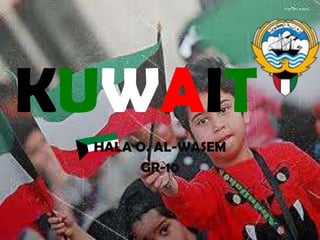
KUWAIT
 HALA O. AL-WASEM
      GR-10
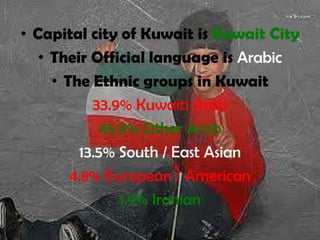
• Capital city of Kuwait is Kuwait City
   • Their Official language is Arabic
     • The Ethnic groups in Kuwait
           33.9% Kuwaiti Arab
            45.9% Other Arab
         13.5% South / East Asian
        4.8% European / American
               1.9% Iranian
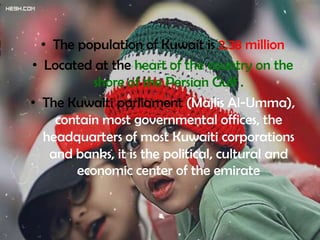
• The population of Kuwait is 2.38 million
• Located at the heart of the country on the
           shore of the Persian Gulf .
• The Kuwaiti parliament (Majlis Al-Umma),
    contain most governmental offices, the
  headquarters of most Kuwaiti corporations
   and banks, it is the political, cultural and
        economic center of the emirate
Kuwait has a geographically small, but wealthy, relatively open
  economy with crude oil reserves of about 104 billion barrels -
  about 7% of world reserves. Petroleum accounts for nearly half of
  GDP, 95% of export revenues, and 95% of government income.
  The rise in global oil prices throughout 2011 is reviving
  government consumption and economic growth. Kuwait has
  experienced a 20% increase in government budget revenue,
  which has led to higher budget expenditures, particularly wage
  hikes for many public sector employees. Kuwait has done little to
  diversify its economy, in part, because of this positive fiscal
  situation, and, in part, due to the poor business climate and the
  acrimonious relationship between the National Assembly and the
  executive branch, which has stymied most movement on
  economic reforms
Kuwait City was first settled in the early 18th
  century by the Al-Sabāh clan, later the ruling
  family of Kuwait and a branch of the Al-Utūb
  tribe (that also included the Al-Khalīfah clan,
  the ruling family of Bahrain), and their leader,
  Sheikh Sabāh I. Its name may have derived from
  an earlier abandoned fort located there, called
  "Kūt" Arabic for a fortress by the sea.
The settlement grew quickly, and by the time its
  first wall was built (1760), the town had its own
  dhow fleet of about 800 and trading relations to
  Baghdad and Damascus. It was a successful and
  thriving sea port by the early 19th century.
In exchange for British naval protection, Mubārak was not to
       negotiate or give territory to any other foreign power
  without British consent. With the discovery of oil in 1936, the
    city’s standard of living improved dramatically, including
                  health and education services.
On August 2, 1990, Iraqi forces invaded Kuwait and seized the
     city. On August 8, Iraq annexed the emirate. During the
    occupation, the city was extensively damaged and many
      buildings were destroyed after it, including the Kuwait
                         National Museum.
When U.S.-led United Nations (UN) forces expelled Iraqi forces
      from Kuwait in February 1991 during Operation Desert
   Storm, foreign investors and the Kuwaiti government were
 actively involved in modernizing the city and turning it into a
    world-class business hub. Many hotels, shopping malls and
  offices were built in the city indicating the economic growth
                            since the war.
In April 14–16, 1993, former U.S. President George H. W.
     Bush was visiting the city to celebrate a coalition's
       victory over Iraq in the 1991 Persian Gulf War.
   However, a day before the visit, agents of the Iraqi
    Intelligence Service (IIS) smuggled a car bomb into
     Kuwait in intent of killing Bush during his visit to
   that city. However the plan was foiled and Kuwaiti
     officials arrested 17 persons suspected of carry out
        the plot after a car bomb was found. Later,
   Saddam's agents admitted carrying out the attack
              under the direction from the IIS.[3]
 On June 26–27 of that year, U.S. President Bill Clinton
   responded to an attempted assassination by the IIS
       on Bush by firing 23 Tomahawk cruise missiles
       against the Iraqi Intelligence headquarters in
   downtown Baghdad. Around 8 civilians were killed
                         in the attack.
LOVE KUWAIT <333

Kuwait

  • 1.
    KUWAIT HALA O.AL-WASEM GR-10
  • 2.
    • Capital cityof Kuwait is Kuwait City • Their Official language is Arabic • The Ethnic groups in Kuwait 33.9% Kuwaiti Arab 45.9% Other Arab 13.5% South / East Asian 4.8% European / American 1.9% Iranian
  • 3.
    • The populationof Kuwait is 2.38 million • Located at the heart of the country on the shore of the Persian Gulf . • The Kuwaiti parliament (Majlis Al-Umma), contain most governmental offices, the headquarters of most Kuwaiti corporations and banks, it is the political, cultural and economic center of the emirate
  • 4.
    Kuwait has ageographically small, but wealthy, relatively open economy with crude oil reserves of about 104 billion barrels - about 7% of world reserves. Petroleum accounts for nearly half of GDP, 95% of export revenues, and 95% of government income. The rise in global oil prices throughout 2011 is reviving government consumption and economic growth. Kuwait has experienced a 20% increase in government budget revenue, which has led to higher budget expenditures, particularly wage hikes for many public sector employees. Kuwait has done little to diversify its economy, in part, because of this positive fiscal situation, and, in part, due to the poor business climate and the acrimonious relationship between the National Assembly and the executive branch, which has stymied most movement on economic reforms
  • 5.
    Kuwait City wasfirst settled in the early 18th century by the Al-Sabāh clan, later the ruling family of Kuwait and a branch of the Al-Utūb tribe (that also included the Al-Khalīfah clan, the ruling family of Bahrain), and their leader, Sheikh Sabāh I. Its name may have derived from an earlier abandoned fort located there, called "Kūt" Arabic for a fortress by the sea. The settlement grew quickly, and by the time its first wall was built (1760), the town had its own dhow fleet of about 800 and trading relations to Baghdad and Damascus. It was a successful and thriving sea port by the early 19th century.
  • 6.
    In exchange forBritish naval protection, Mubārak was not to negotiate or give territory to any other foreign power without British consent. With the discovery of oil in 1936, the city’s standard of living improved dramatically, including health and education services. On August 2, 1990, Iraqi forces invaded Kuwait and seized the city. On August 8, Iraq annexed the emirate. During the occupation, the city was extensively damaged and many buildings were destroyed after it, including the Kuwait National Museum. When U.S.-led United Nations (UN) forces expelled Iraqi forces from Kuwait in February 1991 during Operation Desert Storm, foreign investors and the Kuwaiti government were actively involved in modernizing the city and turning it into a world-class business hub. Many hotels, shopping malls and offices were built in the city indicating the economic growth since the war.
  • 7.
    In April 14–16,1993, former U.S. President George H. W. Bush was visiting the city to celebrate a coalition's victory over Iraq in the 1991 Persian Gulf War. However, a day before the visit, agents of the Iraqi Intelligence Service (IIS) smuggled a car bomb into Kuwait in intent of killing Bush during his visit to that city. However the plan was foiled and Kuwaiti officials arrested 17 persons suspected of carry out the plot after a car bomb was found. Later, Saddam's agents admitted carrying out the attack under the direction from the IIS.[3] On June 26–27 of that year, U.S. President Bill Clinton responded to an attempted assassination by the IIS on Bush by firing 23 Tomahawk cruise missiles against the Iraqi Intelligence headquarters in downtown Baghdad. Around 8 civilians were killed in the attack.
  • 8.