History
 Kuveyt Turk was established in 1989 in the status of Private Financial
Institution.
 Regarding the capital of Kuveyt Turk, 62% is owned by Kuwait Finance
House, 9% by the Public Institution for Social Security, 9% by the Islamic
Development Bank, 18% by General Directorate for Foundations and 2%
by other shareholders
Board of directors
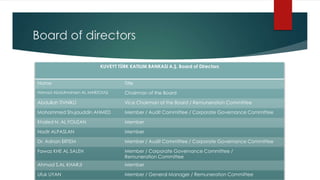
KUVEYT TÜRK KATILIM BANKASI A.Ş. Board of Directors
Name Title
Hamad Abdulmohsen AL MARZOUQ Chairman of the Board
Abdullah TİVNİKLİ Vice Chairman of the Board / Remuneration Committee
Mohammed Shujauddin AHMED Member / Audit Committee / Corporate Governance Committee
Khaled N. AL FOUZAN Member
Nadir ALPASLAN Member
Dr. Adnan ERTEM Member / Audit Committee / Corporate Governance Committee
Fawaz KHE AL SALEH Member / Corporate Governance Committee /
Remuneration Committee
Ahmad S.AL KHARJI Member
Ufuk UYAN Member / General Manager / Remuneration Committee
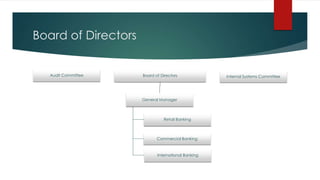
Board of Directors
Audit Committee Board of Directors
General Manager
Retail Banking
Commercial Banking
International Banking
Internal Systems Committee
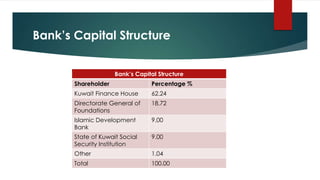
Bank’s Capital Structure
Shareholder Percentage %
Kuwait Finance House 62.24
Directorate General of
Foundations
18.72
Islamic Development
Bank
9.00
State of Kuwait Social
Security Institution
9.00
Other 1.04
Total 100.00
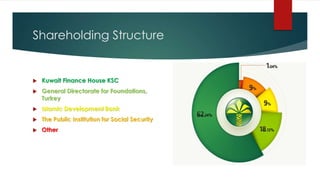
Shareholding Structure
 Kuwait Finance House KSC
 General Directorate for Foundations,
Turkey
 Islamic Development Bank
 The Public Institution for Social Security
 Other
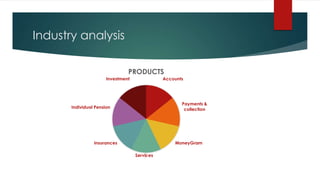
Industry analysis
Accounts
Payments &
collection
MoneyGram
Services
Insurances
Individual Pension
Investment
PRODUCTS
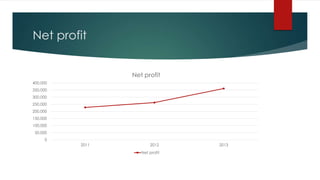
Net profit
0
50,000
100,000
150,000
200,000
250,000
300,000
350,000
400,000
2011 2012 2013
Net profit
Net profit
Corporate strategy
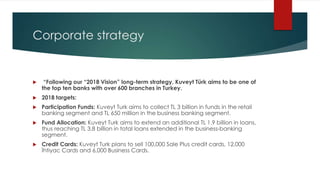
 “Following our “2018 Vision” long-term strategy, Kuveyt Türk aims to be one of
the top ten banks with over 600 branches in Turkey.
 2018 targets:
 Participation Funds: Kuveyt Turk aims to collect TL 3 billion in funds in the retail
banking segment and TL 650 million in the business banking segment.
 Fund Allocation: Kuveyt Turk aims to extend an additional TL 1.9 billion in loans,
thus reaching TL 3.8 billion in total loans extended in the business-banking
segment.
 Credit Cards: Kuveyt Turk plans to sell 100,000 Sale Plus credit cards, 12,000
İhtiyac Cards and 6,000 Business Cards.
SWOT analysis
 Strength
 High potential growth “370M in 2014”
 A huge reserve of gold
 A pioneer Islamic bank among few Islamic banks in Turkey
 “Kuwaiti capital”
SWOT analysis
 Weaknesses
 National saving is considered to be very low
 A big gap in understanding of Islamic finance
 A big gap in understanding of Middle Eastern capital.
 Banking market is controlled by a few big banks.
 Participation banks market share stands at only 5% of total banking sector
SWOT analysis
 Opportunities
 A large amount of foreign investment is attracted.
 It has strong potential of growth.
 Islamic Banking is a growing market segment that offers attractive
opportunities to potential and existing customers
 E-banking facility is also a new opportunity which is a flourishing business in
foreign countries and can also be here
SWOT analysis
 Threats
 Exchange rate and inflation risk
 Increasing competition in the banking sector
 Huge number of banks in Turkey
 ‘Adhering to Islamic rules’ a critical challenge to participation banking
adoption
Recommendations
 Increasing number of ATMs.
 Sponsoring some events to improve the public image of the bank.
 Being more flexible with foreigners in banking transactions.
 Offering foreign languages courses to the employees.

Kuveyt Turk bank

  • 2.
    History  Kuveyt Turkwas established in 1989 in the status of Private Financial Institution.  Regarding the capital of Kuveyt Turk, 62% is owned by Kuwait Finance House, 9% by the Public Institution for Social Security, 9% by the Islamic Development Bank, 18% by General Directorate for Foundations and 2% by other shareholders
  • 3.
    Board of directors KUVEYTTÜRK KATILIM BANKASI A.Ş. Board of Directors Name Title Hamad Abdulmohsen AL MARZOUQ Chairman of the Board Abdullah TİVNİKLİ Vice Chairman of the Board / Remuneration Committee Mohammed Shujauddin AHMED Member / Audit Committee / Corporate Governance Committee Khaled N. AL FOUZAN Member Nadir ALPASLAN Member Dr. Adnan ERTEM Member / Audit Committee / Corporate Governance Committee Fawaz KHE AL SALEH Member / Corporate Governance Committee / Remuneration Committee Ahmad S.AL KHARJI Member Ufuk UYAN Member / General Manager / Remuneration Committee
  • 4.
    Board of Directors AuditCommittee Board of Directors General Manager Retail Banking Commercial Banking International Banking Internal Systems Committee
  • 5.
    Bank’s Capital Structure Bank’sCapital Structure Shareholder Percentage % Kuwait Finance House 62.24 Directorate General of Foundations 18.72 Islamic Development Bank 9.00 State of Kuwait Social Security Institution 9.00 Other 1.04 Total 100.00
  • 6.
    Shareholding Structure  KuwaitFinance House KSC  General Directorate for Foundations, Turkey  Islamic Development Bank  The Public Institution for Social Security  Other
  • 7.
  • 8.
  • 9.
    Corporate strategy  “Followingour “2018 Vision” long-term strategy, Kuveyt Türk aims to be one of the top ten banks with over 600 branches in Turkey.  2018 targets:  Participation Funds: Kuveyt Turk aims to collect TL 3 billion in funds in the retail banking segment and TL 650 million in the business banking segment.  Fund Allocation: Kuveyt Turk aims to extend an additional TL 1.9 billion in loans, thus reaching TL 3.8 billion in total loans extended in the business-banking segment.  Credit Cards: Kuveyt Turk plans to sell 100,000 Sale Plus credit cards, 12,000 İhtiyac Cards and 6,000 Business Cards.
  • 10.
    SWOT analysis  Strength High potential growth “370M in 2014”  A huge reserve of gold  A pioneer Islamic bank among few Islamic banks in Turkey  “Kuwaiti capital”
  • 11.
    SWOT analysis  Weaknesses National saving is considered to be very low  A big gap in understanding of Islamic finance  A big gap in understanding of Middle Eastern capital.  Banking market is controlled by a few big banks.  Participation banks market share stands at only 5% of total banking sector
  • 12.
    SWOT analysis  Opportunities A large amount of foreign investment is attracted.  It has strong potential of growth.  Islamic Banking is a growing market segment that offers attractive opportunities to potential and existing customers  E-banking facility is also a new opportunity which is a flourishing business in foreign countries and can also be here
  • 13.
    SWOT analysis  Threats Exchange rate and inflation risk  Increasing competition in the banking sector  Huge number of banks in Turkey  ‘Adhering to Islamic rules’ a critical challenge to participation banking adoption
  • 14.
    Recommendations  Increasing numberof ATMs.  Sponsoring some events to improve the public image of the bank.  Being more flexible with foreigners in banking transactions.  Offering foreign languages courses to the employees.