KRYSTOL®
VOLUME 18 | ISSUE 1 1
KRYSTOL
®
THE CONCRETE WATERPROOFING MAGAZINEwww.kryton.com
Volume 18 | Issue 1
Spotlight on Dry Concrete in
New York City
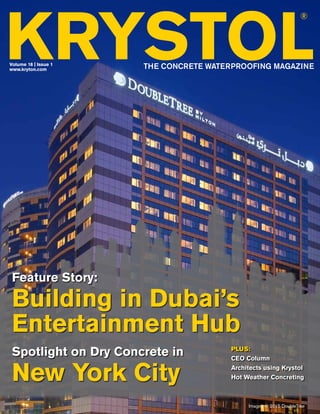
Feature Story:
Building in Dubai’s
Entertainment Hub
PLUS:
CEO Column
Architects using Krystol
Hot Weather Concreting
Images © 2015 DoubleTree
2 WWW.KRYTON.COM
Compared to membrane solutions, Kryton protects even better with time.
Our self-sealing technology and comprehensive support system transform
concrete into a permanent waterproof barrier. Short term, you’ll shave weeks
off construction schedules, cut waterproofing costs, and build your footprint
to the property line. Long term, you’ll avoid leaks, discoloration and costly
callbacks. And have the peace of mind of an industry-best 25-year warranty.
THEY CHOSE KRYTON WATERPROOFING.
www.kryton.com
+1.604.324.8280
KRYTON TAKES THE RISK OUT OF CONCRETE WATERPROOFING.
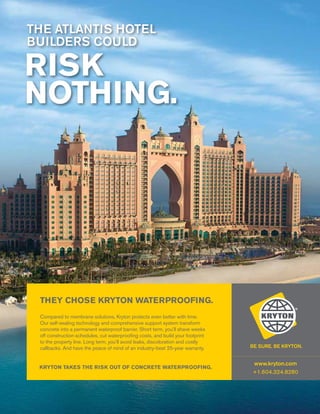
RISK
NOTHING.
THE ATLANTIS HOTEL
BUILDERS COULD
KRYSTOL®
VOLUME 18 | ISSUE 1 3
CONTENTS	 VOLUME 18 | ISSUE 1
4 	
TOP 4
ARCHITECTURE
FIRMS WHO USE
KRYSTOL
7	
CEO COLUMN
The ‘Holy Trinity’ of
Concrete Building
8	
COVER STORY
Waterproofing Dubai’s
DoubleTree By Hilton -
Al Barasha
11	
LEAK REPAIR
A look at Kryton’s new
Krystol Repair Grout
12	
KRYTON NEWS
13	
ASK AN EXPERT
What are the
challenges when hot
weather concreting?
14	
REGIONAL
SPOTLIGHT
Kryton in the Big
Apple!
Editor: Jason Bryant
Art Director: Yvonne Lee
Contributors:
Alireza Biparva
Jeff Bowman
Jason Bryant
Jillian Turner
Kari Yuers
Rolf Skala
Krystol®
Magazine is printed by
Kryton International Inc.
1645 East Kent Avenue
Vancouver, BC, V5P 2S8, Canada
www.kryton.com
For information about
this publication,
email info@kryton.com
or call 1.800.267.8280
or +1.604.324.8280
Copyright ©2015
Kryton International Inc.
All rights reserved.
14
Cover image: Double Tree by
Hilton - Al Barasha
REGIONAL SPOTLIGHT
4 WWW.KRYTON.COM
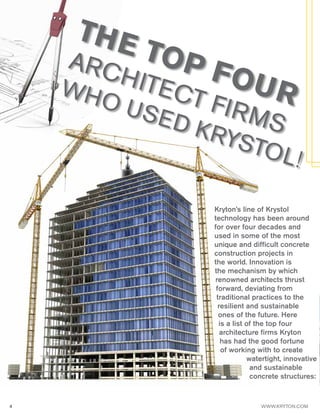
THE TOP FOUR
ARCHITECT FIRMS
WHO USED KRYSTOL!
Kryton’s line of Krystol
technology has been around
for over four decades and
used in some of the most
unique and difficult concrete
construction projects in
the world. Innovation is
the mechanism by which
renowned architects thrust
forward, deviating from
traditional practices to the
resilient and sustainable
ones of the future. Here
is a list of the top four
architecture firms Kryton
has had the good fortune
of working with to create
watertight, innovative
and sustainable
concrete structures:
KRYSTOL®
VOLUME 18 | ISSUE 1
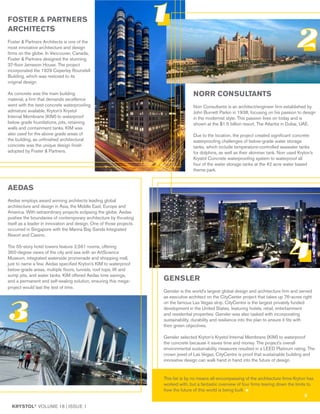
FOSTER & PARTNERS
ARCHITECTS
Foster & Partners Architects is one of the
most innovative architecture and design
firms on the globe. In Vancouver, Canada,
Foster & Partners designed the stunning
37-floor Jameson House. The project
incorporated the 1929 Ceperley Rounsfell
Building, which was restored to its
original design.
As concrete was the main building
material, a firm that demands excellence
went with the best concrete waterproofing
admixture available, Kryton’s Krystol
Internal Membrane (KIM) to waterproof
below grade foundations, pits, retaining
walls and containment tanks. KIM was
also used for the above grade areas of
the building, as unfinished architectural
concrete was the unique design finish
adopted by Foster & Partners.
NORR CONSULTANTS
Norr Consultants is an architect/engineer firm established by
John Burnett Parkin in 1938, focusing on his passion to design
in the modernist style. This passion lives on today and is
shown at the $1.5 billion resort, The Atlantis in Dubai, UAE.
Due to the location, the project created significant concrete
waterproofing challenges of below-grade water storage
tanks, which include temperature-controlled seawater tanks
for dolphins, as well as their skimmer tank. Norr used Kryton’s
Krystol Concrete waterproofing system to waterproof all
four of the water storage tanks at the 42 acre water based
theme park.
4
AEDAS
Aedas employs award winning architects leading global
architecture and design in Asia, the Middle East, Europe and
America. With extraordinary projects eclipsing the globe, Aedas
pushes the boundaries of contemporary architecture by thrusting
itself as a leader in innovation and design. One of those projects
occurred in Singapore with the Marina Bay Sands Integrated
Resort and Casino.
The 55-story hotel towers feature 2,561 rooms, offering
360-degree views of the city and sea with an ArtScience
Museum, integrated waterside promenade and shopping mall,
just to name a few. Aedas specified Kryton’s KIM to waterproof
below-grade areas, multiple floors, tunnels, roof tops, lift and
sump pits, and water tanks. KIM offered Aedas time savings,
and a permanent and self-sealing solution, ensuring this mega-
project would last the test of time.
GENSLER
Gensler is the world’s largest global design and architecture firm and served
as executive architect on the CityCenter project that takes up 76-acres right
on the famous Las Vegas strip. CityCentre is the largest privately funded
development in the United States, featuring hotels, retail, entertainment
and residential properties. Gensler was also tasked with incorporating
sustainability, durability and resilience into the plan to ensure it fits with
their green objectives.
Gensler selected Kryton’s Krystol Internal Membrane (KIM) to waterproof
the concrete because it saves time and money. The project’s overall
environmental sustainability measures resulted in a LEED Platinum rating. The
crown jewel of Las Vegas, CityCentre is proof that sustainable building and
innovative design can walk hand in hand into the future of design.
1
2
4
3
This list is by no means all-encompassing of the architecture firms Kryton has
worked with, but a fantastic overview of four firms tearing down the limits to
how the future of this world is being built.
5
6 WWW.KRYTON.COM
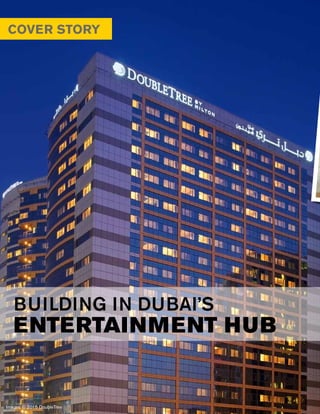
COVER STORY
BUILDING IN DUBAI’S
ENTERTAINMENT HUB
Images © 2015 DoubleTree
KRYSTOL®
VOLUME 18 | ISSUE 1 7
When we talk about “prime” real-estate,
thoughts of London, Vancouver, and New
York City come directly to mind. However,
Dubai’s exclusivity has it building structures
higher than anywhere else in the world.
From the Burj Khalifa to the Mall of the
Emirates, each structure dotting the
enhanced skyline of Dubai is remarkable.
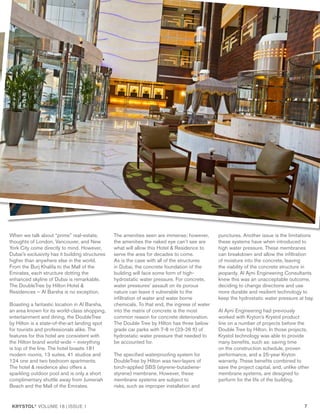
The DoubleTree by Hilton Hotel &
Residences – Al Barsha is no exception.
Boasting a fantastic location in Al Barsha,
an area known for its world-class shopping,
entertainment and dining, the DoubleTree
by Hilton is a state-of-the-art landing spot
for tourists and professionals alike. The
features for this hotel are consistent with
the Hilton brand world-wide – everything
is top of the line. The hotel boasts 181
modern rooms, 13 suites, 41 studios and
124 one and two bedroom apartments.
The hotel & residence also offers a
sparkling outdoor pool and is only a short
complimentary shuttle away from Jumeriah
Beach and the Mall of the Emirates.
The amenities seen are immense; however,
the amenities the naked eye can’t see are
what will allow this Hotel & Residence to
serve the area for decades to come.
As is the case with all of the structures
in Dubai, the concrete foundation of the
building will face some form of high-
hydrostatic water pressure. For concrete,
water pressures’ assault on its porous
nature can leave it vulnerable to the
infiltration of water and water borne
chemicals. To that end, the ingress of water
into the matrix of concrete is the most
common reason for concrete deterioration.
The Double Tree by Hilton has three below
grade car parks with 7-8 m (23-26 ft) of
hydrostatic water pressure that needed to
be accounted for.
The specified waterproofing system for
DoubleTree by Hilton was two-layers of
torch-applied SBS (styrene-butadiene-
styrene) membrane. However, these
membrane systems are subject to
risks, such as improper installation and
punctures. Another issue is the limitations
these systems have when introduced to
high water pressure. These membranes
can breakdown and allow the infiltration
of moisture into the concrete, leaving
the viability of the concrete structure in
jeopardy. Al Ajmi Engineering Consultants
knew this was an unacceptable outcome,
deciding to change directions and use
more durable and resilient technology to
keep the hydrostatic water pressure at bay.
Al Ajmi Engineering had previously
worked with Kryton’s Krystol product
line on a number of projects before the
Double Tree by Hilton. In those projects,
Krystol technology was able to provide
many benefits, such as: saving time
on the construction schedule, proven
performance, and a 25-year Kryton
warranty. These benefits combined to
save the project capital, and, unlike other
membrane systems, are designed to
perform for the life of the building.
8 WWW.KRYTON.COM
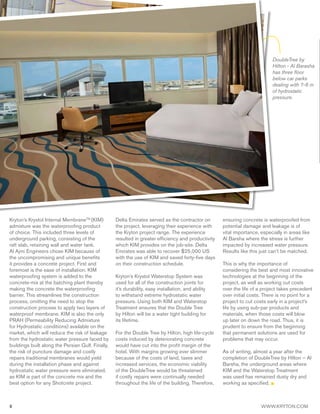
DoubleTree by
Hilton - Al Barasha
has three floor
below car parks
dealing with 7-8 m
of hydrostatic
pressure.
Kryton’s Krystol Internal MembraneTM
(KIM)
admixture was the waterproofing product
of choice. This included three levels of
underground parking, consisting of the
raft slab, retaining wall and water tank.
Al Ajmi Engineers chose KIM because of
the uncompromising and unique benefits
it provides a concrete project. First and
foremost is the ease of installation. KIM
waterproofing system is added to the
concrete-mix at the batching plant thereby
making the concrete the waterproofing
barrier. This streamlines the construction
process, omitting the need to stop the
construction process to apply two layers of
waterproof membrane. KIM is also the only
PRAH (Permeability Reducing Admixture
for Hydrostatic conditions) available on the
market, which will reduce the risk of leakage
from the hydrostatic water pressure faced by
buildings built along the Persian Gulf. Finally,
the risk of puncture damage and costly
repairs traditional membranes would yield
during the installation phase and against
hydrostatic water pressure were eliminated,
as KIM is part of the concrete mix and the
best option for any Shotcrete project.
Delta Emirates served as the contractor on
the project, leveraging their experience with
the Kryton project range. The experience
resulted in greater efficiency and productivity
which KIM provides on the job-site. Delta
Emirates was able to recover $25,000 US
with the use of KIM and saved forty-five days
on their construction schedule.
Kryton’s Krystol Waterstop System was
used for all of the construction joints for
it’s durability, easy installation, and ability
to withstand extreme hydrostatic water
pressure. Using both KIM and Waterstop
Treatment ensures that the Double Tree
by Hilton will be a water tight building for
its lifetime.
For the Double Tree by Hilton, high life-cycle
costs induced by deteriorating concrete
would have cut into the profit margin of the
hotel. With margins growing ever slimmer
because of the costs of land, taxes and
increased services, the economic viability
of the DoubleTree would be threatened
if costly repairs were continually needed
throughout the life of the building. Therefore,
ensuring concrete is waterproofed from
potential damage and leakage is of
vital importance, especially in areas like
Al Barsha where the stress is further
impacted by increased water pressure.
Results like this just can’t be matched.
This is why the importance of
considering the best and most innovative
technologies at the beginning of the
project, as well as working out costs
over the life of a project takes precedent
over initial costs. There is no point for a
project to cut costs early in a project’s
life by using sub-par products and
materials, when those costs will blow
up later on down the road. Thus, it is
prudent to ensure from the beginning
that permanent solutions are used for
problems that may occur.
As of writing, almost a year after the
completion of DoubleTree by Hilton – Al
Barsha, the underground areas where
KIM and the Waterstop Treatment
was used has remained dusty dry and
working as specified.
KRYSTOL®
VOLUME 18 | ISSUE 1 9
CEO COLUMN
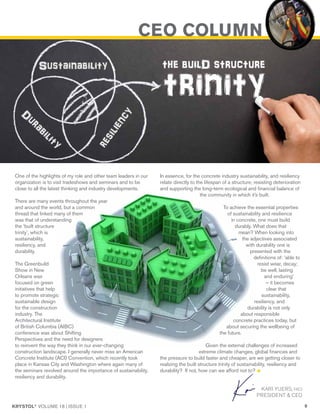
One of the highlights of my role and other team leaders in our
organization is to visit tradeshows and seminars and to be
close to all the latest thinking and industry developments.
There are many events throughout the year
and around the world, but a common
thread that linked many of them
was that of understanding
the ‘built structure
trinity’, which is
sustainability,
resiliency, and
durability.
The Greenbuild
Show in New
Orleans was
focused on green
initiatives that help
to promote strategic
sustainable design
for the construction
industry. The
Architectural Institute
of British Columbia (AIBC)
conference was about Shifting
Perspectives and the need for designers
to reinvent the way they think in our ever-changing
construction landscape. I generally never miss an American
Concrete Institute (ACI) Convention, which recently took
place in Kansas City and Washington where again many of
the seminars revolved around the importance of sustainability,
resiliency and durability.
KARI YUERS, FACI
PRESIDENT & CEO
In essence, for the concrete industry sustainability, and resiliency
relate directly to the lifespan of a structure; resisting deterioration
and supporting the long-term ecological and financial balance of
the community in which it’s built.
To achieve the essential properties
of sustainability and resilience
in concrete, one must build
durably. What does that
mean? When looking into
the adjectives associated
with durability one is
presented with the
definitions of: ‘able to
resist wear, decay;
be well, lasting
and enduring’
– it becomes
clear that
sustainability,
resiliency, and
durability is not only
about responsible
concrete practices today, but
about securing the wellbeing of
the future.
Given the external challenges of increased
extreme climate changes, global finances and
the pressure to build faster and cheaper, are we getting closer to
realizing the built structure trinity of sustainability, resiliency and
durability? If not, how can we afford not to?
10 WWW.KRYTON.COM
PROPERTIES
OF A GOOD
LEAK REPAIR
PRODUCT
Jeff Bowman, B.Sc.
Technical Manager, R&D
KRYSTOL®
VOLUME 18 | ISSUE 1 11
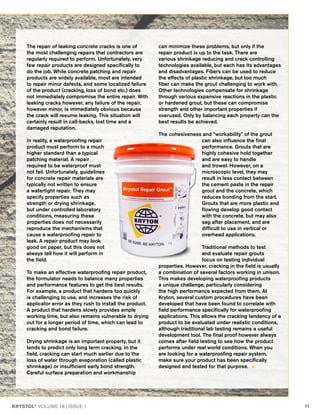
The repair of leaking concrete cracks is one of
the most challenging repairs that contractors are
regularly required to perform. Unfortunately, very
few repair products are designed specifically to
do the job. While concrete patching and repair
products are widely available, most are intended
to repair minor defects, and some localized failure
of the product (cracking, loss of bond etc.) does
not immediately compromise the entire repair. With
leaking cracks however, any failure of the repair,
however minor, is immediately obvious because
the crack will resume leaking. This situation will
certainly result in call-backs, lost time and a
damaged reputation.
In reality, a waterproofing repair
product must perform to a much
higher standard than a typical
patching material. A repair
required to be waterproof must
not fail. Unfortunately, guidelines
for concrete repair materials are
typically not written to ensure
a watertight repair. They may
specify properties such as
strength or drying shrinkage,
but under controlled laboratory
conditions, measuring these
properties does not necessarily
reproduce the mechanisms that
cause a waterproofing repair to
leak. A repair product may look
good on paper, but this does not
always tell how it will perform in
the field.
To make an effective waterproofing repair product,
the formulator needs to balance many properties
and performance features to get the best results.
For example, a product that hardens too quickly
is challenging to use, and increases the risk of
applicator error as they rush to install the product.
A product that hardens slowly provides ample
working time, but also remains vulnerable to drying
out for a longer period of time, which can lead to
cracking and bond failure.
Drying shrinkage is an important property, but it
tends to predict only long term cracking. In the
field, cracking can start much earlier due to the
loss of water through evaporation (called plastic
shrinkage) or insufficient early bond strength.
Careful surface preparation and workmanship
can minimize these problems, but only if the
repair product is up to the task. There are
various shrinkage reducing and crack controlling
technologies available, but each has its advantages
and disadvantages. Fibers can be used to reduce
the effects of plastic shrinkage, but too much
fiber can make the grout challenging to work with.
Other technologies compensate for shrinkage
through various expansive reactions in the plastic
or hardened grout, but these can compromise
strength and other important properties if
overused. Only by balancing each property can the
best results be achieved.
The cohesiveness and “workability” of the grout
can also influence the final
performance. Grouts that are
highly cohesive hold together
and are easy to handle
and trowel. However, on a
microscopic level, they may
result in less contact between
the cement paste in the repair
grout and the concrete, which
reduces bonding from the start.
Grouts that are more plastic and
flowing develop good contact
with the concrete, but may also
sag after placement, and are
difficult to use in vertical or
overhead applications.
Traditional methods to test
and evaluate repair grouts
focus on testing individual
properties. However, cracking in the field is usually
a combination of several factors working in unison.
This makes developing waterproofing products
a unique challenge, particularly considering
the high performance expected from them. At
Kryton, several custom procedures have been
developed that have been found to correlate with
field performance specifically for waterproofing
applications. This allows the cracking tendency of a
product to be evaluated under realistic conditions,
although traditional lab testing remains a useful
development tool. The final proof however always
comes after field testing to see how the product
performs under real world conditions. When you
are looking for a waterproofing repair system,
make sure your product has been specifically
designed and tested for that purpose.
12 WWW.KRYTON.COM
KRYTON NEWS
Events
Record Breaking Year celebrated
with entire company in
2014 was a record-breaking year for Kryton and
to celebrate the success every staff member
world-wide basked in the sun-drenched
beaches of Puerto Vallarta, Mexico in April.
The company took all global staff on an
all-inclusive trip to Mexico. Kryton staff from
offices in China, UAE, Singapore, UK, and
Texas were flown into Vancouver and then on
to Mexico together.
President and CEO, Kari Yuers believes
whole heartedly in the importance of
teamwork, through recognition of every employee in the
company, regardless of position or location. “2014 was the best year we’ve ever had in
Kryton’s 42-year history,” Yuers says. “The credit for this tremendous success goes to every
single Krytonite from across the globe.
Price Honored
with MLK Award
David Price is the Owner of Kryton distributor
Price Builders & Developers in Ohio. Price
routinely volunteers his time, experience and
money to local charities and community
empowering efforts throughout the year, asking
nothing in return. On Martin Luther King Jr.
Day he was recognized with the Governor’s
Humanitarian Award. The award is given to those who has given
their time and service freely to those in need without question and often without
recognition. From all of us at Kryton - Congratulations David!
Kryton Launches Two New
Products at WOC
World of Concrete 2015 saw Kryton launch two
new products: Krytonite Swelling Waterstop and
Krystol Repair Grout.
Krystol Repair Grout will simplify Kryton’s proven
Leak Repair System, making repairs even
more effective while at the same time allowing
easier and faster application. Krytonite Swelling
Waterstop is part of a new waterproof joint design
that achieves the ultimate protection for concrete
construction joints against the penetration of water
– even under extreme hydrostatic pressure.
Both innovative products are available now – visit
www.kryton.com for more detailed information.
Kryton Gives Back During
ChristmasKryton’s New Global Sales Director!
Kryton is proud to announce that Kaja Salovsky has been
appointed to lead their international sales team as Director
of Sales - Global.
Kaja brings to Kryton over 20-years of senior sales
leadership experience in building high-performance sales
teams. His most recent roles include: Executive Director
of Sales (Essilor Canada), Regional Sales Manager
(Canwel Hardware) and Area Sales Director (DHL
Express).
“We are thrilled to have Kaja join Kryton as the new
Director of Sales,” says Kari Yuers, President & CEO of
Kryton. “Kaja’s experience in building sales organizations
and his vision for strong business growth will have a
huge impact as we continue our rapid global expansion.”
Kryton is looking forward to another great year in 2015 with Kaja at the helm of the
sales team.
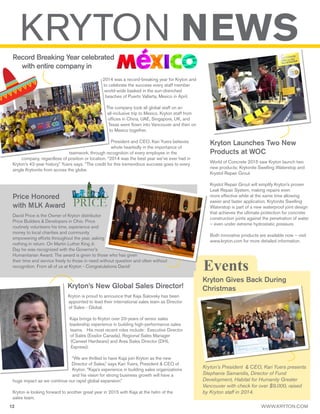
Kryton’s President & CEO, Kari Yuers presents
Stephanie Samaridis, Director of Fund
Development, Habitat for Humanity Greater
Vancouver with check for over $9,000, raised
by Kryton staff in 2014.
KRYSTOL®
VOLUME 18 | ISSUE 1 13
ASK AN EXPERT
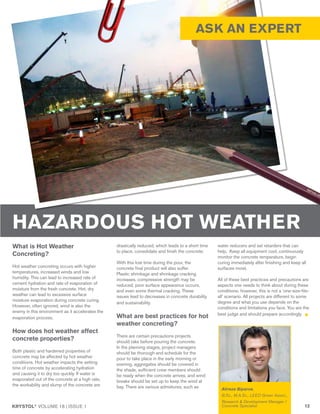
What is Hot Weather
Concreting?
Hot weather concreting occurs with higher
temperatures, increased winds and low
humidity. This can lead to increased rate of
cement hydration and rate of evaporation of
moisture from the fresh concrete. Hot, dry
weather can lead to excessive surface
moisture evaporation during concrete curing.
However, often ignored, wind is also the
enemy in this environment as it accelerates the
evaporation process.
How does hot weather affect
concrete properties?
Both plastic and hardened properties of
concrete may be affected by hot weather
conditions. Hot weather impacts the setting
time of concrete by accelerating hydration
and causing it to dry too quickly. If water is
evaporated out of the concrete at a high rate,
the workability and slump of the concrete are
drastically reduced, which leads to a short time
to place, consolidate and finish the concrete.
With this lost time during the pour, the
concrete final product will also suffer.
Plastic shrinkage and shrinkage cracking
increases, compressive strength may be
reduced, poor surface appearance occurs,
and even some thermal cracking. These
issues lead to decreases in concrete durability
and sustainability.
What are best practices for hot
weather concreting?
There are certain precautions projects
should take before pouring the concrete.
In the planning stages, project managers
should be thorough and schedule for the
pour to take place in the early morning or
evening, aggregates should be covered in
the shade, sufficient crew members should
be ready when the concrete arrives, and wind
breaks should be set up to keep the wind at
bay. There are various admixtures, such as
water reducers and set retarders that can
help. Keep all equipment cool, continuously
monitor the concrete temperature, begin
curing immediately after finishing and keep all
surfaces moist.
All of these best practices and precautions are
aspects one needs to think about during these
conditions; however, this is not a ‘one-size-fits-
all’ scenario. All projects are different to some
degree and what you use depends on the
conditions and limitations you face. You are the
best judge and should prepare accordingly.
HAZARDOUS HOT WEATHER
Alireza Biparva,
B.Sc., M.A.Sc., LEED Green Assoc.,
Research & Development Manager /
Concrete Specialist
14 WWW.KRYTON.COM
SPOTLIGHT
DRY CONCRETE
New Hampshire, Maine, Vermont, Massachusetts,
Rhode Island, Connecticut, New York, New Jersey,
Pennsylvania, USA
Contact: 	 Greg Maugeri or William DellaSorte
Telephone: 646.404.7272 (Greg)
	 203.791.0557 (William)
Fax: 	 914.591.5000
E-mail: 	 Greg@dryconcrete.com
	 Billy@dryconcrete.com
Website: 	 www.dryconcrete.com
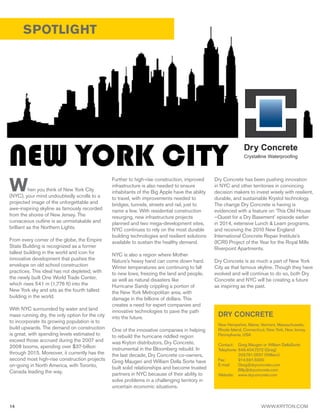
When you think of New York City
(NYC), your mind undoubtedly scrolls to a
projected image of the unforgettable and
awe-inspiring skyline as famously recorded
from the shores of New Jersey. The
curvaceous outline is as unmistakable and
brilliant as the Northern Lights.
From every corner of the globe, the Empire
State Building is recognized as a former
tallest building in the world and icon for
innovative development that pushes the
envelope on old school construction
practices. This ideal has not depleted, with
the newly built One World Trade Center,
which rises 541 m (1,776 ft) into the
New York sky and sits as the fourth tallest
building in the world.
With NYC surrounded by water and land
mass running dry, the only option for the city
to incorporate its growing population is to
build upwards. The demand on construction
is great, with spending levels estimated to
exceed those accrued during the 2007 and
2008 booms, spending over $37-billion
through 2015. Moreover, it currently has the
second most high-rise construction projects
on-going in North America, with Toronto,
Canada leading the way.
NEW YORK CITYFurther to high-rise construction, improved
infrastructure is also needed to ensure
inhabitants of the Big Apple have the ability
to travel, with improvements needed to
bridges, tunnels, streets and rail, just to
name a few. With residential construction
resurging, new infrastructure projects
planned and two mega-development sites,
NYC continues to rely on the most durable
building technologies and resilient solutions
available to sustain the healthy demand.
NYC is also a region where Mother
Nature’s heavy hand can come down hard.
Winter temperatures are continuing to fall
to new lows, freezing the land and people,
as well as natural disasters like
Hurricane Sandy crippling a portion of
the New York Metropolitan area, with
damage in the billions of dollars. This
creates a need for expert companies and
innovative technologies to pave the path
into the future.
One of the innovative companies in helping
to rebuild the hurricane riddled region
was Kryton distributors, Dry Concrete,
instrumental in the Bloomberg rebuild. In
the last decade, Dry Concrete co-owners,
Greg Maugeri and William Della Sorte have
built solid relationships and become trusted
partners in NYC because of their ability to
solve problems in a challenging territory in
uncertain economic situations.
Dry Concrete has been pushing innovation
in NYC and other territories in convincing
decision makers to invest wisely with resilient,
durable, and sustainable Krystol technology.
The change Dry Concrete is having is
evidenced with a feature on ‘This Old House
–Quest for a Dry Basement’ episode earlier
in 2014, extensive Lunch & Learn programs,
and receiving the 2010 New England
International Concrete Repair Institute’s
(ICRI) Project of the Year for the Royal Mills
Riverpoint Apartments.
Dry Concrete is as much a part of New York
City as that famous skyline. Though they have
evolved and will continue to do so, both Dry
Concrete and NYC will be creating a future
as inspiring as the past.
KRYSTOL®
VOLUME 18 | ISSUE 1 15
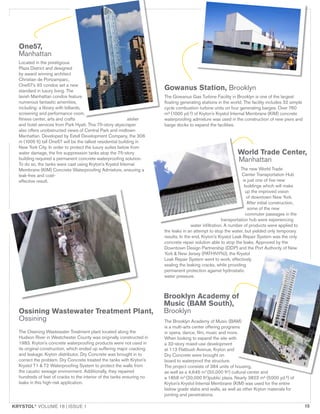
Located in the prestigious
Plaza District and designed
by award winning architect
Christian de Portzamparc,
One57’s 93 condos set a new
standard in luxury living. The
lavish Manhattan condos feature
numerous fantastic amenities,
including: a library with billiards,
screening and performance room,
fitness center, arts and crafts atelier
and hotel services from Park Hyatt. This 75-story skyscraper
also offers unobstructed views of Central Park and midtown
Manhattan. Developed by Extell Development Company, the 306
m (1005 ft) tall One57 will be the tallest residential building in
New York City. In order to protect the luxury suites below from
water damage, the fire suppression tanks atop the 75-story
building required a permanent concrete waterproofing solution.
To do so, the tanks were cast using Kryton’s Krystol Internal
Membrane (KIM) Concrete Waterproofing Admixture, ensuring a
leak-free and cost-
effective result.
The Gowanus Gas Turbine Facility in Brooklyn is one of the largest
floating generating stations in the world. The facility includes 32 simple
cycle combustion turbine units on four generating barges. Over 760
m3 (1000 yd.3) of Kryton’s Krystol Internal Membrane (KIM) concrete
waterproofing admixture was used in the construction of new piers and
barge docks to expand the facilities.
The new World Trade
Center Transportation Hub
is just one of five new
buildings which will make
up the improved vision
of downtown New York.
After initial construction,
some of the new
commuter passages in the
transportation hub were experiencing
water infiltration. A number of products were applied to
the leaks in an attempt to stop the water, but yielded only temporary
results. In the end, Kryton’s Krystol Leak Repair System was the only
concrete repair solution able to stop the leaks. Approved by the
Downtown Design Partnership (DDP) and the Port Authority of New
York & New Jersey (PATHNYNJ), the Krystol
Leak Repair System went to work, effectively
sealing the leaking cracks, while providing
permanent protection against hydrostatic
water pressure.
The Ossining Wastewater Treatment plant located along the
Hudson River in Westchester County was originally constructed in
1983. Kryton’s concrete waterproofing products were not used in
its original construction, which ended up suffering major cracking
and leakage. Kryton distributor, Dry Concrete was brought in to
correct the problem. Dry Concrete treated the tanks with Kryton’s
Krystol T1 & T2 Waterproofing System to protect the walls from
the caustic sewage environment. Additionally, they repaired
hundreds of feet of cracks to the interior of the tanks ensuring no
leaks in this high-risk application.
The Brooklyn Academy of Music (BAM)
is a multi-arts center offering programs
in opera, dance, film, music and more.
When looking to expand the site with
a 32-story mixed-use development
at 113 Flatbush Avenue, Kryton and
Dry Concrete were brought on
board to waterproof the structure.
The project consists of 384 units of housing,
as well as a 4,645 m2
(50,000 ft2) cultural center and
a 1858 m2
(20,000 ft2)public plaza. Nearly 3823 m3 (5000 yd.3) of
Kryton’s Krystol Internal Membrane (KIM) was used for the entire
below grade slabs and walls, as well as other Kryton materials for
jointing and penetrations.
Gowanus Station, Brooklyn
World Trade Center,
Manhattan
Brooklyn Academy of
Music (BAM South),
Brooklyn
One57,
Manhattan
Ossining Wastewater Treatment Plant,
Ossining
16 WWW.KRYTON.COM
AT STAKE.
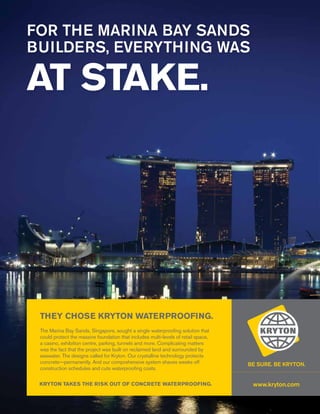
FOR THE MARINA BAY SANDS
BUILDERS, EVERYTHING WAS
The Marina Bay Sands, Singapore, sought a single waterproofing solution that
could protect the massive foundation that includes multi-levels of retail space,
a casino, exhibition centre, parking, tunnels and more. Complicating matters
was the fact that the project was built on reclaimed land and surrounded by
seawater. The designs called for Kryton. Our crystalline technology protects
concrete—permanently. And our comprehensive system shaves weeks off
construction schedules and cuts waterproofing costs.
THEY CHOSE KRYTON WATERPROOFING.
www.kryton.comKRYTON TAKES THE RISK OUT OF CONCRETE WATERPROOFING.

Krystol Magazine 18.1

  • 1.
    KRYSTOL® VOLUME 18 |ISSUE 1 1 KRYSTOL ® THE CONCRETE WATERPROOFING MAGAZINEwww.kryton.com Volume 18 | Issue 1 Spotlight on Dry Concrete in New York City Feature Story: Building in Dubai’s Entertainment Hub PLUS: CEO Column Architects using Krystol Hot Weather Concreting Images © 2015 DoubleTree
  • 2.
    2 WWW.KRYTON.COM Compared tomembrane solutions, Kryton protects even better with time. Our self-sealing technology and comprehensive support system transform concrete into a permanent waterproof barrier. Short term, you’ll shave weeks off construction schedules, cut waterproofing costs, and build your footprint to the property line. Long term, you’ll avoid leaks, discoloration and costly callbacks. And have the peace of mind of an industry-best 25-year warranty. THEY CHOSE KRYTON WATERPROOFING. www.kryton.com +1.604.324.8280 KRYTON TAKES THE RISK OUT OF CONCRETE WATERPROOFING. RISK NOTHING. THE ATLANTIS HOTEL BUILDERS COULD
  • 3.
    KRYSTOL® VOLUME 18 |ISSUE 1 3 CONTENTS VOLUME 18 | ISSUE 1 4 TOP 4 ARCHITECTURE FIRMS WHO USE KRYSTOL 7 CEO COLUMN The ‘Holy Trinity’ of Concrete Building 8 COVER STORY Waterproofing Dubai’s DoubleTree By Hilton - Al Barasha 11 LEAK REPAIR A look at Kryton’s new Krystol Repair Grout 12 KRYTON NEWS 13 ASK AN EXPERT What are the challenges when hot weather concreting? 14 REGIONAL SPOTLIGHT Kryton in the Big Apple! Editor: Jason Bryant Art Director: Yvonne Lee Contributors: Alireza Biparva Jeff Bowman Jason Bryant Jillian Turner Kari Yuers Rolf Skala Krystol® Magazine is printed by Kryton International Inc. 1645 East Kent Avenue Vancouver, BC, V5P 2S8, Canada www.kryton.com For information about this publication, email info@kryton.com or call 1.800.267.8280 or +1.604.324.8280 Copyright ©2015 Kryton International Inc. All rights reserved. 14 Cover image: Double Tree by Hilton - Al Barasha REGIONAL SPOTLIGHT
  • 4.
    4 WWW.KRYTON.COM THE TOPFOUR ARCHITECT FIRMS WHO USED KRYSTOL! Kryton’s line of Krystol technology has been around for over four decades and used in some of the most unique and difficult concrete construction projects in the world. Innovation is the mechanism by which renowned architects thrust forward, deviating from traditional practices to the resilient and sustainable ones of the future. Here is a list of the top four architecture firms Kryton has had the good fortune of working with to create watertight, innovative and sustainable concrete structures:
  • 5.
    KRYSTOL® VOLUME 18 |ISSUE 1 FOSTER & PARTNERS ARCHITECTS Foster & Partners Architects is one of the most innovative architecture and design firms on the globe. In Vancouver, Canada, Foster & Partners designed the stunning 37-floor Jameson House. The project incorporated the 1929 Ceperley Rounsfell Building, which was restored to its original design. As concrete was the main building material, a firm that demands excellence went with the best concrete waterproofing admixture available, Kryton’s Krystol Internal Membrane (KIM) to waterproof below grade foundations, pits, retaining walls and containment tanks. KIM was also used for the above grade areas of the building, as unfinished architectural concrete was the unique design finish adopted by Foster & Partners. NORR CONSULTANTS Norr Consultants is an architect/engineer firm established by John Burnett Parkin in 1938, focusing on his passion to design in the modernist style. This passion lives on today and is shown at the $1.5 billion resort, The Atlantis in Dubai, UAE. Due to the location, the project created significant concrete waterproofing challenges of below-grade water storage tanks, which include temperature-controlled seawater tanks for dolphins, as well as their skimmer tank. Norr used Kryton’s Krystol Concrete waterproofing system to waterproof all four of the water storage tanks at the 42 acre water based theme park. 4 AEDAS Aedas employs award winning architects leading global architecture and design in Asia, the Middle East, Europe and America. With extraordinary projects eclipsing the globe, Aedas pushes the boundaries of contemporary architecture by thrusting itself as a leader in innovation and design. One of those projects occurred in Singapore with the Marina Bay Sands Integrated Resort and Casino. The 55-story hotel towers feature 2,561 rooms, offering 360-degree views of the city and sea with an ArtScience Museum, integrated waterside promenade and shopping mall, just to name a few. Aedas specified Kryton’s KIM to waterproof below-grade areas, multiple floors, tunnels, roof tops, lift and sump pits, and water tanks. KIM offered Aedas time savings, and a permanent and self-sealing solution, ensuring this mega- project would last the test of time. GENSLER Gensler is the world’s largest global design and architecture firm and served as executive architect on the CityCenter project that takes up 76-acres right on the famous Las Vegas strip. CityCentre is the largest privately funded development in the United States, featuring hotels, retail, entertainment and residential properties. Gensler was also tasked with incorporating sustainability, durability and resilience into the plan to ensure it fits with their green objectives. Gensler selected Kryton’s Krystol Internal Membrane (KIM) to waterproof the concrete because it saves time and money. The project’s overall environmental sustainability measures resulted in a LEED Platinum rating. The crown jewel of Las Vegas, CityCentre is proof that sustainable building and innovative design can walk hand in hand into the future of design. 1 2 4 3 This list is by no means all-encompassing of the architecture firms Kryton has worked with, but a fantastic overview of four firms tearing down the limits to how the future of this world is being built. 5
  • 6.
    6 WWW.KRYTON.COM COVER STORY BUILDINGIN DUBAI’S ENTERTAINMENT HUB Images © 2015 DoubleTree
  • 7.
    KRYSTOL® VOLUME 18 |ISSUE 1 7 When we talk about “prime” real-estate, thoughts of London, Vancouver, and New York City come directly to mind. However, Dubai’s exclusivity has it building structures higher than anywhere else in the world. From the Burj Khalifa to the Mall of the Emirates, each structure dotting the enhanced skyline of Dubai is remarkable. The DoubleTree by Hilton Hotel & Residences – Al Barsha is no exception. Boasting a fantastic location in Al Barsha, an area known for its world-class shopping, entertainment and dining, the DoubleTree by Hilton is a state-of-the-art landing spot for tourists and professionals alike. The features for this hotel are consistent with the Hilton brand world-wide – everything is top of the line. The hotel boasts 181 modern rooms, 13 suites, 41 studios and 124 one and two bedroom apartments. The hotel & residence also offers a sparkling outdoor pool and is only a short complimentary shuttle away from Jumeriah Beach and the Mall of the Emirates. The amenities seen are immense; however, the amenities the naked eye can’t see are what will allow this Hotel & Residence to serve the area for decades to come. As is the case with all of the structures in Dubai, the concrete foundation of the building will face some form of high- hydrostatic water pressure. For concrete, water pressures’ assault on its porous nature can leave it vulnerable to the infiltration of water and water borne chemicals. To that end, the ingress of water into the matrix of concrete is the most common reason for concrete deterioration. The Double Tree by Hilton has three below grade car parks with 7-8 m (23-26 ft) of hydrostatic water pressure that needed to be accounted for. The specified waterproofing system for DoubleTree by Hilton was two-layers of torch-applied SBS (styrene-butadiene- styrene) membrane. However, these membrane systems are subject to risks, such as improper installation and punctures. Another issue is the limitations these systems have when introduced to high water pressure. These membranes can breakdown and allow the infiltration of moisture into the concrete, leaving the viability of the concrete structure in jeopardy. Al Ajmi Engineering Consultants knew this was an unacceptable outcome, deciding to change directions and use more durable and resilient technology to keep the hydrostatic water pressure at bay. Al Ajmi Engineering had previously worked with Kryton’s Krystol product line on a number of projects before the Double Tree by Hilton. In those projects, Krystol technology was able to provide many benefits, such as: saving time on the construction schedule, proven performance, and a 25-year Kryton warranty. These benefits combined to save the project capital, and, unlike other membrane systems, are designed to perform for the life of the building.
  • 8.
    8 WWW.KRYTON.COM DoubleTree by Hilton- Al Barasha has three floor below car parks dealing with 7-8 m of hydrostatic pressure. Kryton’s Krystol Internal MembraneTM (KIM) admixture was the waterproofing product of choice. This included three levels of underground parking, consisting of the raft slab, retaining wall and water tank. Al Ajmi Engineers chose KIM because of the uncompromising and unique benefits it provides a concrete project. First and foremost is the ease of installation. KIM waterproofing system is added to the concrete-mix at the batching plant thereby making the concrete the waterproofing barrier. This streamlines the construction process, omitting the need to stop the construction process to apply two layers of waterproof membrane. KIM is also the only PRAH (Permeability Reducing Admixture for Hydrostatic conditions) available on the market, which will reduce the risk of leakage from the hydrostatic water pressure faced by buildings built along the Persian Gulf. Finally, the risk of puncture damage and costly repairs traditional membranes would yield during the installation phase and against hydrostatic water pressure were eliminated, as KIM is part of the concrete mix and the best option for any Shotcrete project. Delta Emirates served as the contractor on the project, leveraging their experience with the Kryton project range. The experience resulted in greater efficiency and productivity which KIM provides on the job-site. Delta Emirates was able to recover $25,000 US with the use of KIM and saved forty-five days on their construction schedule. Kryton’s Krystol Waterstop System was used for all of the construction joints for it’s durability, easy installation, and ability to withstand extreme hydrostatic water pressure. Using both KIM and Waterstop Treatment ensures that the Double Tree by Hilton will be a water tight building for its lifetime. For the Double Tree by Hilton, high life-cycle costs induced by deteriorating concrete would have cut into the profit margin of the hotel. With margins growing ever slimmer because of the costs of land, taxes and increased services, the economic viability of the DoubleTree would be threatened if costly repairs were continually needed throughout the life of the building. Therefore, ensuring concrete is waterproofed from potential damage and leakage is of vital importance, especially in areas like Al Barsha where the stress is further impacted by increased water pressure. Results like this just can’t be matched. This is why the importance of considering the best and most innovative technologies at the beginning of the project, as well as working out costs over the life of a project takes precedent over initial costs. There is no point for a project to cut costs early in a project’s life by using sub-par products and materials, when those costs will blow up later on down the road. Thus, it is prudent to ensure from the beginning that permanent solutions are used for problems that may occur. As of writing, almost a year after the completion of DoubleTree by Hilton – Al Barsha, the underground areas where KIM and the Waterstop Treatment was used has remained dusty dry and working as specified.
  • 9.
    KRYSTOL® VOLUME 18 |ISSUE 1 9 CEO COLUMN One of the highlights of my role and other team leaders in our organization is to visit tradeshows and seminars and to be close to all the latest thinking and industry developments. There are many events throughout the year and around the world, but a common thread that linked many of them was that of understanding the ‘built structure trinity’, which is sustainability, resiliency, and durability. The Greenbuild Show in New Orleans was focused on green initiatives that help to promote strategic sustainable design for the construction industry. The Architectural Institute of British Columbia (AIBC) conference was about Shifting Perspectives and the need for designers to reinvent the way they think in our ever-changing construction landscape. I generally never miss an American Concrete Institute (ACI) Convention, which recently took place in Kansas City and Washington where again many of the seminars revolved around the importance of sustainability, resiliency and durability. KARI YUERS, FACI PRESIDENT & CEO In essence, for the concrete industry sustainability, and resiliency relate directly to the lifespan of a structure; resisting deterioration and supporting the long-term ecological and financial balance of the community in which it’s built. To achieve the essential properties of sustainability and resilience in concrete, one must build durably. What does that mean? When looking into the adjectives associated with durability one is presented with the definitions of: ‘able to resist wear, decay; be well, lasting and enduring’ – it becomes clear that sustainability, resiliency, and durability is not only about responsible concrete practices today, but about securing the wellbeing of the future. Given the external challenges of increased extreme climate changes, global finances and the pressure to build faster and cheaper, are we getting closer to realizing the built structure trinity of sustainability, resiliency and durability? If not, how can we afford not to?
  • 10.
    10 WWW.KRYTON.COM PROPERTIES OF AGOOD LEAK REPAIR PRODUCT Jeff Bowman, B.Sc. Technical Manager, R&D
  • 11.
    KRYSTOL® VOLUME 18 |ISSUE 1 11 The repair of leaking concrete cracks is one of the most challenging repairs that contractors are regularly required to perform. Unfortunately, very few repair products are designed specifically to do the job. While concrete patching and repair products are widely available, most are intended to repair minor defects, and some localized failure of the product (cracking, loss of bond etc.) does not immediately compromise the entire repair. With leaking cracks however, any failure of the repair, however minor, is immediately obvious because the crack will resume leaking. This situation will certainly result in call-backs, lost time and a damaged reputation. In reality, a waterproofing repair product must perform to a much higher standard than a typical patching material. A repair required to be waterproof must not fail. Unfortunately, guidelines for concrete repair materials are typically not written to ensure a watertight repair. They may specify properties such as strength or drying shrinkage, but under controlled laboratory conditions, measuring these properties does not necessarily reproduce the mechanisms that cause a waterproofing repair to leak. A repair product may look good on paper, but this does not always tell how it will perform in the field. To make an effective waterproofing repair product, the formulator needs to balance many properties and performance features to get the best results. For example, a product that hardens too quickly is challenging to use, and increases the risk of applicator error as they rush to install the product. A product that hardens slowly provides ample working time, but also remains vulnerable to drying out for a longer period of time, which can lead to cracking and bond failure. Drying shrinkage is an important property, but it tends to predict only long term cracking. In the field, cracking can start much earlier due to the loss of water through evaporation (called plastic shrinkage) or insufficient early bond strength. Careful surface preparation and workmanship can minimize these problems, but only if the repair product is up to the task. There are various shrinkage reducing and crack controlling technologies available, but each has its advantages and disadvantages. Fibers can be used to reduce the effects of plastic shrinkage, but too much fiber can make the grout challenging to work with. Other technologies compensate for shrinkage through various expansive reactions in the plastic or hardened grout, but these can compromise strength and other important properties if overused. Only by balancing each property can the best results be achieved. The cohesiveness and “workability” of the grout can also influence the final performance. Grouts that are highly cohesive hold together and are easy to handle and trowel. However, on a microscopic level, they may result in less contact between the cement paste in the repair grout and the concrete, which reduces bonding from the start. Grouts that are more plastic and flowing develop good contact with the concrete, but may also sag after placement, and are difficult to use in vertical or overhead applications. Traditional methods to test and evaluate repair grouts focus on testing individual properties. However, cracking in the field is usually a combination of several factors working in unison. This makes developing waterproofing products a unique challenge, particularly considering the high performance expected from them. At Kryton, several custom procedures have been developed that have been found to correlate with field performance specifically for waterproofing applications. This allows the cracking tendency of a product to be evaluated under realistic conditions, although traditional lab testing remains a useful development tool. The final proof however always comes after field testing to see how the product performs under real world conditions. When you are looking for a waterproofing repair system, make sure your product has been specifically designed and tested for that purpose.
  • 12.
    12 WWW.KRYTON.COM KRYTON NEWS Events RecordBreaking Year celebrated with entire company in 2014 was a record-breaking year for Kryton and to celebrate the success every staff member world-wide basked in the sun-drenched beaches of Puerto Vallarta, Mexico in April. The company took all global staff on an all-inclusive trip to Mexico. Kryton staff from offices in China, UAE, Singapore, UK, and Texas were flown into Vancouver and then on to Mexico together. President and CEO, Kari Yuers believes whole heartedly in the importance of teamwork, through recognition of every employee in the company, regardless of position or location. “2014 was the best year we’ve ever had in Kryton’s 42-year history,” Yuers says. “The credit for this tremendous success goes to every single Krytonite from across the globe. Price Honored with MLK Award David Price is the Owner of Kryton distributor Price Builders & Developers in Ohio. Price routinely volunteers his time, experience and money to local charities and community empowering efforts throughout the year, asking nothing in return. On Martin Luther King Jr. Day he was recognized with the Governor’s Humanitarian Award. The award is given to those who has given their time and service freely to those in need without question and often without recognition. From all of us at Kryton - Congratulations David! Kryton Launches Two New Products at WOC World of Concrete 2015 saw Kryton launch two new products: Krytonite Swelling Waterstop and Krystol Repair Grout. Krystol Repair Grout will simplify Kryton’s proven Leak Repair System, making repairs even more effective while at the same time allowing easier and faster application. Krytonite Swelling Waterstop is part of a new waterproof joint design that achieves the ultimate protection for concrete construction joints against the penetration of water – even under extreme hydrostatic pressure. Both innovative products are available now – visit www.kryton.com for more detailed information. Kryton Gives Back During ChristmasKryton’s New Global Sales Director! Kryton is proud to announce that Kaja Salovsky has been appointed to lead their international sales team as Director of Sales - Global. Kaja brings to Kryton over 20-years of senior sales leadership experience in building high-performance sales teams. His most recent roles include: Executive Director of Sales (Essilor Canada), Regional Sales Manager (Canwel Hardware) and Area Sales Director (DHL Express). “We are thrilled to have Kaja join Kryton as the new Director of Sales,” says Kari Yuers, President & CEO of Kryton. “Kaja’s experience in building sales organizations and his vision for strong business growth will have a huge impact as we continue our rapid global expansion.” Kryton is looking forward to another great year in 2015 with Kaja at the helm of the sales team. Kryton’s President & CEO, Kari Yuers presents Stephanie Samaridis, Director of Fund Development, Habitat for Humanity Greater Vancouver with check for over $9,000, raised by Kryton staff in 2014.
  • 13.
    KRYSTOL® VOLUME 18 |ISSUE 1 13 ASK AN EXPERT What is Hot Weather Concreting? Hot weather concreting occurs with higher temperatures, increased winds and low humidity. This can lead to increased rate of cement hydration and rate of evaporation of moisture from the fresh concrete. Hot, dry weather can lead to excessive surface moisture evaporation during concrete curing. However, often ignored, wind is also the enemy in this environment as it accelerates the evaporation process. How does hot weather affect concrete properties? Both plastic and hardened properties of concrete may be affected by hot weather conditions. Hot weather impacts the setting time of concrete by accelerating hydration and causing it to dry too quickly. If water is evaporated out of the concrete at a high rate, the workability and slump of the concrete are drastically reduced, which leads to a short time to place, consolidate and finish the concrete. With this lost time during the pour, the concrete final product will also suffer. Plastic shrinkage and shrinkage cracking increases, compressive strength may be reduced, poor surface appearance occurs, and even some thermal cracking. These issues lead to decreases in concrete durability and sustainability. What are best practices for hot weather concreting? There are certain precautions projects should take before pouring the concrete. In the planning stages, project managers should be thorough and schedule for the pour to take place in the early morning or evening, aggregates should be covered in the shade, sufficient crew members should be ready when the concrete arrives, and wind breaks should be set up to keep the wind at bay. There are various admixtures, such as water reducers and set retarders that can help. Keep all equipment cool, continuously monitor the concrete temperature, begin curing immediately after finishing and keep all surfaces moist. All of these best practices and precautions are aspects one needs to think about during these conditions; however, this is not a ‘one-size-fits- all’ scenario. All projects are different to some degree and what you use depends on the conditions and limitations you face. You are the best judge and should prepare accordingly. HAZARDOUS HOT WEATHER Alireza Biparva, B.Sc., M.A.Sc., LEED Green Assoc., Research & Development Manager / Concrete Specialist
  • 14.
    14 WWW.KRYTON.COM SPOTLIGHT DRY CONCRETE NewHampshire, Maine, Vermont, Massachusetts, Rhode Island, Connecticut, New York, New Jersey, Pennsylvania, USA Contact: Greg Maugeri or William DellaSorte Telephone: 646.404.7272 (Greg) 203.791.0557 (William) Fax: 914.591.5000 E-mail: Greg@dryconcrete.com Billy@dryconcrete.com Website: www.dryconcrete.com When you think of New York City (NYC), your mind undoubtedly scrolls to a projected image of the unforgettable and awe-inspiring skyline as famously recorded from the shores of New Jersey. The curvaceous outline is as unmistakable and brilliant as the Northern Lights. From every corner of the globe, the Empire State Building is recognized as a former tallest building in the world and icon for innovative development that pushes the envelope on old school construction practices. This ideal has not depleted, with the newly built One World Trade Center, which rises 541 m (1,776 ft) into the New York sky and sits as the fourth tallest building in the world. With NYC surrounded by water and land mass running dry, the only option for the city to incorporate its growing population is to build upwards. The demand on construction is great, with spending levels estimated to exceed those accrued during the 2007 and 2008 booms, spending over $37-billion through 2015. Moreover, it currently has the second most high-rise construction projects on-going in North America, with Toronto, Canada leading the way. NEW YORK CITYFurther to high-rise construction, improved infrastructure is also needed to ensure inhabitants of the Big Apple have the ability to travel, with improvements needed to bridges, tunnels, streets and rail, just to name a few. With residential construction resurging, new infrastructure projects planned and two mega-development sites, NYC continues to rely on the most durable building technologies and resilient solutions available to sustain the healthy demand. NYC is also a region where Mother Nature’s heavy hand can come down hard. Winter temperatures are continuing to fall to new lows, freezing the land and people, as well as natural disasters like Hurricane Sandy crippling a portion of the New York Metropolitan area, with damage in the billions of dollars. This creates a need for expert companies and innovative technologies to pave the path into the future. One of the innovative companies in helping to rebuild the hurricane riddled region was Kryton distributors, Dry Concrete, instrumental in the Bloomberg rebuild. In the last decade, Dry Concrete co-owners, Greg Maugeri and William Della Sorte have built solid relationships and become trusted partners in NYC because of their ability to solve problems in a challenging territory in uncertain economic situations. Dry Concrete has been pushing innovation in NYC and other territories in convincing decision makers to invest wisely with resilient, durable, and sustainable Krystol technology. The change Dry Concrete is having is evidenced with a feature on ‘This Old House –Quest for a Dry Basement’ episode earlier in 2014, extensive Lunch & Learn programs, and receiving the 2010 New England International Concrete Repair Institute’s (ICRI) Project of the Year for the Royal Mills Riverpoint Apartments. Dry Concrete is as much a part of New York City as that famous skyline. Though they have evolved and will continue to do so, both Dry Concrete and NYC will be creating a future as inspiring as the past.
  • 15.
    KRYSTOL® VOLUME 18 |ISSUE 1 15 Located in the prestigious Plaza District and designed by award winning architect Christian de Portzamparc, One57’s 93 condos set a new standard in luxury living. The lavish Manhattan condos feature numerous fantastic amenities, including: a library with billiards, screening and performance room, fitness center, arts and crafts atelier and hotel services from Park Hyatt. This 75-story skyscraper also offers unobstructed views of Central Park and midtown Manhattan. Developed by Extell Development Company, the 306 m (1005 ft) tall One57 will be the tallest residential building in New York City. In order to protect the luxury suites below from water damage, the fire suppression tanks atop the 75-story building required a permanent concrete waterproofing solution. To do so, the tanks were cast using Kryton’s Krystol Internal Membrane (KIM) Concrete Waterproofing Admixture, ensuring a leak-free and cost- effective result. The Gowanus Gas Turbine Facility in Brooklyn is one of the largest floating generating stations in the world. The facility includes 32 simple cycle combustion turbine units on four generating barges. Over 760 m3 (1000 yd.3) of Kryton’s Krystol Internal Membrane (KIM) concrete waterproofing admixture was used in the construction of new piers and barge docks to expand the facilities. The new World Trade Center Transportation Hub is just one of five new buildings which will make up the improved vision of downtown New York. After initial construction, some of the new commuter passages in the transportation hub were experiencing water infiltration. A number of products were applied to the leaks in an attempt to stop the water, but yielded only temporary results. In the end, Kryton’s Krystol Leak Repair System was the only concrete repair solution able to stop the leaks. Approved by the Downtown Design Partnership (DDP) and the Port Authority of New York & New Jersey (PATHNYNJ), the Krystol Leak Repair System went to work, effectively sealing the leaking cracks, while providing permanent protection against hydrostatic water pressure. The Ossining Wastewater Treatment plant located along the Hudson River in Westchester County was originally constructed in 1983. Kryton’s concrete waterproofing products were not used in its original construction, which ended up suffering major cracking and leakage. Kryton distributor, Dry Concrete was brought in to correct the problem. Dry Concrete treated the tanks with Kryton’s Krystol T1 & T2 Waterproofing System to protect the walls from the caustic sewage environment. Additionally, they repaired hundreds of feet of cracks to the interior of the tanks ensuring no leaks in this high-risk application. The Brooklyn Academy of Music (BAM) is a multi-arts center offering programs in opera, dance, film, music and more. When looking to expand the site with a 32-story mixed-use development at 113 Flatbush Avenue, Kryton and Dry Concrete were brought on board to waterproof the structure. The project consists of 384 units of housing, as well as a 4,645 m2 (50,000 ft2) cultural center and a 1858 m2 (20,000 ft2)public plaza. Nearly 3823 m3 (5000 yd.3) of Kryton’s Krystol Internal Membrane (KIM) was used for the entire below grade slabs and walls, as well as other Kryton materials for jointing and penetrations. Gowanus Station, Brooklyn World Trade Center, Manhattan Brooklyn Academy of Music (BAM South), Brooklyn One57, Manhattan Ossining Wastewater Treatment Plant, Ossining
  • 16.
    16 WWW.KRYTON.COM AT STAKE. FORTHE MARINA BAY SANDS BUILDERS, EVERYTHING WAS The Marina Bay Sands, Singapore, sought a single waterproofing solution that could protect the massive foundation that includes multi-levels of retail space, a casino, exhibition centre, parking, tunnels and more. Complicating matters was the fact that the project was built on reclaimed land and surrounded by seawater. The designs called for Kryton. Our crystalline technology protects concrete—permanently. And our comprehensive system shaves weeks off construction schedules and cuts waterproofing costs. THEY CHOSE KRYTON WATERPROOFING. www.kryton.comKRYTON TAKES THE RISK OUT OF CONCRETE WATERPROOFING.