Assessing Contribution & Value
With a little help from persistent identifiers
NISO Humanities Roundtable, 20 Oct 2021
Liz Krznarich, Adoption Manager, DataCite & ROR
https://orcid.org/0000-0001-6622-4910
Hello! A little about me
● Currently: Adoption manager
at DataCite and ROR
(Research Organization Registry)
● Formerly: Tech lead/developer/
jack of all trades at ORCID
● Librarian by training, technologist
by accident; started digital archival collections
● Persistent identifier nerd; believes that most problems
can be solved with identifiers and metadata
Whoa, wait! Why is DataCite here?
Am I in the right meeting? This is supposed to be
about humanities & monographs.
Why am I here?
DOIs (digital object identifiers) and other PIDs
(persistent identifiers) are an important part of the
digital scholarly infrastructure that includes all types of
resources/outputs and all disciplines.
Why am I here?
PIDs like DOIs, ORCID iDs and ROR IDs increase
discovery, access, citation, reuse, and recognition
of resources that support monograph creation
(as well as monographs themselves)
VALUE
Why am I here?
Adoption and use of PIDs by humanities scholars
and digital collections that support scholarship
makes contributions of both scholars and collections
more visible (and therefore more valuable) to
institutions, funders, users & other stakeholders.
Jargon alert!
What is a persistent identifier (PID)?
https://datadryad.org/stash/dataset/
doi:10.5061/dryad.708gr
https://doi.org/10.5061/dryad.708gr
Special URL that’s registered in a known
system, like DOI, ORCID or ROR
Always points to the same resource
(or a metadata representation)
DOIs for scholarly outputs
https://doi.org/10.5281/
zenodo.3630248
ORCID iDs for people
https://orcid.org/
0000-0001-6622-4910
ROR IDs for research
organizations
https://ror.org/01y2jtd41
Jargon alert!
Why do PIDs exist?
● Find a resource at the same URL, regardless of whether its location in the
Web changes
● Disambiguation - identify a specific resource (person, place or thing)
● Cite a resource with confidence that the URL won’t break over time
● Enable machine-readable connections between resources that support
discovery, automation & other neat things (we’ll get to that!)
The interconnected
Monograph
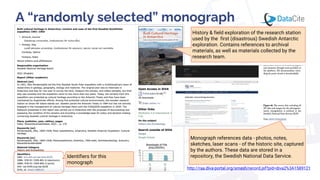
Monograph references data - photos, notes,
sketches, laser scans - of the historic site, captured
by the authors. These data are stored in a
repository, the Swedish National Data Service.
A “randomly selected” monograph
History & field exploration of the research station
used by the first (disastrous) Swedish Antarctic
exploration. Contains references to archival
materials, as well as materials collected by the
research team.
http://raa.diva-portal.org/smash/record.jsf?pid=diva2%3A1589121
Identifiers for this
monograph
The related data collection
https://snd.gu.se/en/catalogue/collection/chaq2020---cultural-heritage-antarctica
Individual dataset repository record
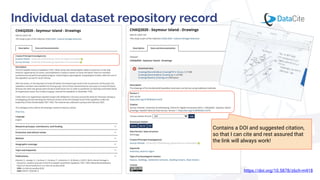
Contains a DOI and suggested citation,
so that I can cite and rest assured that
the link will always work!
https://doi.org/10.5878/z6ch-m418
Individual dataset repository record
Links to ORCID IDs, where I can find more
about the authors and their work
Links to the institutions, where I can find
more about their programs/projects
Funder information, in case I want to know
more about projects they support, funding
opportunities, etc
How did I find this “random” monograph and its related data?
Hint: I did not read the book (and funders, deans of research,
librarians, etc may not read the book, either)
I don’t have magical insight into all 22+ million DataCite DOIs!
I used the power of DOI metadata!
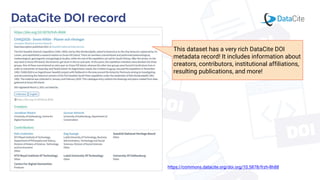
DataCite DOI record
https://commons.datacite.org/doi.org/10.5878/frzh-8h88
This dataset has a very rich DataCite DOI
metadata record! It includes information about
creators, contributors, institutional affiliations,
resulting publications, and more!
DataCite DOI record
"creators": [
{
"name": "Westin, Jonathan",
"nameType": "Personal",
"givenName": "Jonathan",
"familyName": "Westin",
"affiliation": [
{
"name": "University of Gothenburg, Centre for Digital Humanities"
}
],
"nameIdentifiers": [
{
"schemeUri": "https://orcid.org",
"nameIdentifier": "https://orcid.org/0000-0003-3901-2650",
"nameIdentifierScheme": "ORCID"
}
]
},
...
Affiliations and ORCID iDs for scholars
(creators/contributors)
https://api.datacite.org/application/vnd.datacite.datacite+json/10.5878/frzh-8h88
DataCite DOI record
{
"name": "Swedish National Heritage Board",
"nameType": "Organizational",
"affiliation": [],
"contributorType": "Other",
"nameIdentifiers": [
{
"schemeUri": "https://ror.org/",
"nameIdentifier": "https://ror.org/041pfpb15",
"nameIdentifierScheme": "ROR"
}
]
},
{
"name": "University Of Gothenburg",
"nameType": "Organizational",
"affiliation": [],
"contributorType": "Other",
"nameIdentifiers": [
{
"schemeUri": "https://ror.org/",
"nameIdentifier": "https://ror.org/01tm6cn81",
"nameIdentifierScheme": "ROR"
}
]
},
...
ROR identifiers for affiliated institutions
https://api.datacite.org/application/vnd.datac
ite.datacite+json/10.5878/frzh-8h88
DataCite DOI record
"relatedIdentifiers": [
{
"relationType": "IsCitedBy",
"relatedIdentifier": "978-91-7209-891-6",
"relatedIdentifierType": "ISBN"
},
{
"relationType": "IsCitedBy",
"relatedIdentifier": "urn:nbn:se:raa:diva-
6230",
"relatedIdentifierType": "URN"
},
{
"relationType": "HasPart",
"relatedIdentifier": "10.5878/y68g-4v67",
"relatedIdentifierType": "DOI"
}
]
ISBN (and other identifiers) for
the monograph that cited this
dataset!
https://api.datacite.org/application/vnd.datac
ite.datacite+json/10.5878/frzh-8h88
Discoveing PID metadata
As a funder or institution, I (or, more likely, the tools I
use) can find out about outputs associated with my
organization, even if their spread across multiple
repositories!
The power of PID metadata
● Aggregation One-stop shop for indexing services and
analytics platforms to discover scholarly resources and
connections (no need to visit every repository/source)
● Integration Integrations between PID services - ORCID, ROR,
Crossref - and other systems allow data to flow auto-
magically, making connections and usage data discoverable
across tools and services, and reducing manual entry/data
collection
Takeaways
& actions
PIDs are for everyone!
All disciplines, all resource types
DOIs are not just for publications. They’re unique
identifiers and persistent URLs, not status symbols.
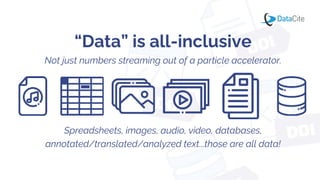
“Data” is all-inclusive
Not just numbers streaming out of a particle accelerator.
Spreadsheets, images, audio, video, databases,
annotated/translated/analyzed text...those are all data!
Can I register a DOI for that?
In most cases, yes!
Audiovisual, Collection,
ComputationalNotebook, Event, Image,
InteractiveResource, Model,
OutputManagementPlan, PeerReview,
PhysicalObject, Service, Software,
Sound, Workflow, Other
Book, BookChapter,
ConferencePaper,
ConferenceProceeding, DataPaper,
Dissertation, Journal, JournalArticle,
Preprint, Report, Standard, Text
Scholar action steps
1.Deposit your data (source materials you generate) in a repository
that registers DOIs
2.Fill out the metadata form as completely as possible! Include
your ORCID iD, affiliation, funding information
3.Cite your data in publications using DOIs
4.Add your work to ORCID - publications and datasets
Scholar action steps: Deposit your
data
No institutional repository that
can accept your resource
type? Try a generalist
repository, like Zenodo or
Figshare
● Free
● Registers DOIs
● Accepts many data types
● Usage stats (also aggregated
into DataCite)
● ORCID connection (via DataCite)
https://doi.org/10.5281/zenodo.4560934
Scholar action steps: Complete metadata
These fields maximize
connections, automation, and
visibility:
● ORCID iD
● Affiliation
● Funding information
● Related identifiers - ISBNs for
books/book chapters, DOIs for
journal articles
● License
● Contributors
Example: Zenodo upload form
Scholar action steps: Cite your data
Use DOIs in citations to ensure links
don’t break over time!
Did you know?
DataCite/Crossref offer a citation
formatter - cite any DOI in a wide
range of styles!
https://citation.crosscite.org
Example: Zenodo record page
Scholar action steps: Add works to ORCID
Use the wizards! Add works >
Search & Link
● Enable DataCite and Crossref
wizards to automatically add works
with DOIs that include your ORCID
iD
● Import works from MLA, Scopus
and regional sources
● No ISBN wizard, but books can be
added manually
Organization action steps
Institutions/Libraries
● Register DOIs for your repository, digital collection, digital
archival content. Improves citability/visibility for your content!
● Spread the word on your campus - LibGuides, workshops, one
on one interactions (check out DARIAH training resources)
Organization action steps
Publishers (and libraries/institutions, too)
Incorporate PIDs into your workflows for books.
● ORCID iDs for authors
○ See ORCID in books working group recommendations
https://info.orcid.org/orcid-in-books-today-and-tomorrow
● ROR for author affiliations
● Can I register DOIs for books? Absolutely! Some eBook
platforms support this: Pressbooks, Ubiquity Press, Open
Monograph Press
This sounds like a lot of work
Plus, we still have to write, edit, submit, edit some more,
format, publish, and distribute that monograph!
Publishing a monograph is
a lot of work!
We might as well maximize that effort by making the inputs (and
the monograph) as visible, connected and reusable as possible!
Resources
● DataCite knowledgebase https://support.datacite.org
● ROR knowledgbase https://ror.readme.io/
● ORCID knowledgebase https://support.orcid.org/hc/en-us
○ ORCID in books workflows
https://info.orcid.org/documentation/workflows/books-
workflow/
○ Add works to ORCID https://support.orcid.org/hc/en-
us/articles/360006973133-Add-works-to-your-ORCID-
record
Get in touch!
Emial us:
info@datacite.org
Follow us:
@datacite
Talk to us:
pidforum.org
Read about us:
datacite.org
Get support:
support.datacite.org
support@datacite.org

Krnarich "Assessing Contribution & Value"

  • 1.
    Assessing Contribution &Value With a little help from persistent identifiers NISO Humanities Roundtable, 20 Oct 2021 Liz Krznarich, Adoption Manager, DataCite & ROR https://orcid.org/0000-0001-6622-4910
  • 2.
    Hello! A littleabout me ● Currently: Adoption manager at DataCite and ROR (Research Organization Registry) ● Formerly: Tech lead/developer/ jack of all trades at ORCID ● Librarian by training, technologist by accident; started digital archival collections ● Persistent identifier nerd; believes that most problems can be solved with identifiers and metadata
  • 3.
    Whoa, wait! Whyis DataCite here? Am I in the right meeting? This is supposed to be about humanities & monographs.
  • 4.
    Why am Ihere? DOIs (digital object identifiers) and other PIDs (persistent identifiers) are an important part of the digital scholarly infrastructure that includes all types of resources/outputs and all disciplines.
  • 5.
    Why am Ihere? PIDs like DOIs, ORCID iDs and ROR IDs increase discovery, access, citation, reuse, and recognition of resources that support monograph creation (as well as monographs themselves) VALUE
  • 6.
    Why am Ihere? Adoption and use of PIDs by humanities scholars and digital collections that support scholarship makes contributions of both scholars and collections more visible (and therefore more valuable) to institutions, funders, users & other stakeholders.
  • 7.
    Jargon alert! What isa persistent identifier (PID)? https://datadryad.org/stash/dataset/ doi:10.5061/dryad.708gr https://doi.org/10.5061/dryad.708gr Special URL that’s registered in a known system, like DOI, ORCID or ROR Always points to the same resource (or a metadata representation) DOIs for scholarly outputs https://doi.org/10.5281/ zenodo.3630248 ORCID iDs for people https://orcid.org/ 0000-0001-6622-4910 ROR IDs for research organizations https://ror.org/01y2jtd41
  • 8.
    Jargon alert! Why doPIDs exist? ● Find a resource at the same URL, regardless of whether its location in the Web changes ● Disambiguation - identify a specific resource (person, place or thing) ● Cite a resource with confidence that the URL won’t break over time ● Enable machine-readable connections between resources that support discovery, automation & other neat things (we’ll get to that!)
  • 9.
  • 10.
    Monograph references data- photos, notes, sketches, laser scans - of the historic site, captured by the authors. These data are stored in a repository, the Swedish National Data Service. A “randomly selected” monograph History & field exploration of the research station used by the first (disastrous) Swedish Antarctic exploration. Contains references to archival materials, as well as materials collected by the research team. http://raa.diva-portal.org/smash/record.jsf?pid=diva2%3A1589121 Identifiers for this monograph
  • 11.
    The related datacollection https://snd.gu.se/en/catalogue/collection/chaq2020---cultural-heritage-antarctica
  • 12.
    Individual dataset repositoryrecord Contains a DOI and suggested citation, so that I can cite and rest assured that the link will always work! https://doi.org/10.5878/z6ch-m418
  • 13.
    Individual dataset repositoryrecord Links to ORCID IDs, where I can find more about the authors and their work Links to the institutions, where I can find more about their programs/projects Funder information, in case I want to know more about projects they support, funding opportunities, etc
  • 14.
    How did Ifind this “random” monograph and its related data? Hint: I did not read the book (and funders, deans of research, librarians, etc may not read the book, either) I don’t have magical insight into all 22+ million DataCite DOIs! I used the power of DOI metadata!
  • 15.
    DataCite DOI record https://commons.datacite.org/doi.org/10.5878/frzh-8h88 Thisdataset has a very rich DataCite DOI metadata record! It includes information about creators, contributors, institutional affiliations, resulting publications, and more!
  • 16.
    DataCite DOI record "creators":[ { "name": "Westin, Jonathan", "nameType": "Personal", "givenName": "Jonathan", "familyName": "Westin", "affiliation": [ { "name": "University of Gothenburg, Centre for Digital Humanities" } ], "nameIdentifiers": [ { "schemeUri": "https://orcid.org", "nameIdentifier": "https://orcid.org/0000-0003-3901-2650", "nameIdentifierScheme": "ORCID" } ] }, ... Affiliations and ORCID iDs for scholars (creators/contributors) https://api.datacite.org/application/vnd.datacite.datacite+json/10.5878/frzh-8h88
  • 17.
    DataCite DOI record { "name":"Swedish National Heritage Board", "nameType": "Organizational", "affiliation": [], "contributorType": "Other", "nameIdentifiers": [ { "schemeUri": "https://ror.org/", "nameIdentifier": "https://ror.org/041pfpb15", "nameIdentifierScheme": "ROR" } ] }, { "name": "University Of Gothenburg", "nameType": "Organizational", "affiliation": [], "contributorType": "Other", "nameIdentifiers": [ { "schemeUri": "https://ror.org/", "nameIdentifier": "https://ror.org/01tm6cn81", "nameIdentifierScheme": "ROR" } ] }, ... ROR identifiers for affiliated institutions https://api.datacite.org/application/vnd.datac ite.datacite+json/10.5878/frzh-8h88
  • 18.
    DataCite DOI record "relatedIdentifiers":[ { "relationType": "IsCitedBy", "relatedIdentifier": "978-91-7209-891-6", "relatedIdentifierType": "ISBN" }, { "relationType": "IsCitedBy", "relatedIdentifier": "urn:nbn:se:raa:diva- 6230", "relatedIdentifierType": "URN" }, { "relationType": "HasPart", "relatedIdentifier": "10.5878/y68g-4v67", "relatedIdentifierType": "DOI" } ] ISBN (and other identifiers) for the monograph that cited this dataset! https://api.datacite.org/application/vnd.datac ite.datacite+json/10.5878/frzh-8h88
  • 19.
    Discoveing PID metadata Asa funder or institution, I (or, more likely, the tools I use) can find out about outputs associated with my organization, even if their spread across multiple repositories!
  • 20.
    The power ofPID metadata ● Aggregation One-stop shop for indexing services and analytics platforms to discover scholarly resources and connections (no need to visit every repository/source) ● Integration Integrations between PID services - ORCID, ROR, Crossref - and other systems allow data to flow auto- magically, making connections and usage data discoverable across tools and services, and reducing manual entry/data collection
  • 21.
  • 22.
    PIDs are foreveryone! All disciplines, all resource types DOIs are not just for publications. They’re unique identifiers and persistent URLs, not status symbols.
  • 23.
    “Data” is all-inclusive Notjust numbers streaming out of a particle accelerator. Spreadsheets, images, audio, video, databases, annotated/translated/analyzed text...those are all data!
  • 24.
    Can I registera DOI for that? In most cases, yes! Audiovisual, Collection, ComputationalNotebook, Event, Image, InteractiveResource, Model, OutputManagementPlan, PeerReview, PhysicalObject, Service, Software, Sound, Workflow, Other Book, BookChapter, ConferencePaper, ConferenceProceeding, DataPaper, Dissertation, Journal, JournalArticle, Preprint, Report, Standard, Text
  • 25.
    Scholar action steps 1.Deposityour data (source materials you generate) in a repository that registers DOIs 2.Fill out the metadata form as completely as possible! Include your ORCID iD, affiliation, funding information 3.Cite your data in publications using DOIs 4.Add your work to ORCID - publications and datasets
  • 26.
    Scholar action steps:Deposit your data No institutional repository that can accept your resource type? Try a generalist repository, like Zenodo or Figshare ● Free ● Registers DOIs ● Accepts many data types ● Usage stats (also aggregated into DataCite) ● ORCID connection (via DataCite) https://doi.org/10.5281/zenodo.4560934
  • 27.
    Scholar action steps:Complete metadata These fields maximize connections, automation, and visibility: ● ORCID iD ● Affiliation ● Funding information ● Related identifiers - ISBNs for books/book chapters, DOIs for journal articles ● License ● Contributors Example: Zenodo upload form
  • 28.
    Scholar action steps:Cite your data Use DOIs in citations to ensure links don’t break over time! Did you know? DataCite/Crossref offer a citation formatter - cite any DOI in a wide range of styles! https://citation.crosscite.org Example: Zenodo record page
  • 29.
    Scholar action steps:Add works to ORCID Use the wizards! Add works > Search & Link ● Enable DataCite and Crossref wizards to automatically add works with DOIs that include your ORCID iD ● Import works from MLA, Scopus and regional sources ● No ISBN wizard, but books can be added manually
  • 30.
    Organization action steps Institutions/Libraries ●Register DOIs for your repository, digital collection, digital archival content. Improves citability/visibility for your content! ● Spread the word on your campus - LibGuides, workshops, one on one interactions (check out DARIAH training resources)
  • 31.
    Organization action steps Publishers(and libraries/institutions, too) Incorporate PIDs into your workflows for books. ● ORCID iDs for authors ○ See ORCID in books working group recommendations https://info.orcid.org/orcid-in-books-today-and-tomorrow ● ROR for author affiliations ● Can I register DOIs for books? Absolutely! Some eBook platforms support this: Pressbooks, Ubiquity Press, Open Monograph Press
  • 32.
    This sounds likea lot of work Plus, we still have to write, edit, submit, edit some more, format, publish, and distribute that monograph!
  • 33.
    Publishing a monographis a lot of work! We might as well maximize that effort by making the inputs (and the monograph) as visible, connected and reusable as possible!
  • 34.
    Resources ● DataCite knowledgebasehttps://support.datacite.org ● ROR knowledgbase https://ror.readme.io/ ● ORCID knowledgebase https://support.orcid.org/hc/en-us ○ ORCID in books workflows https://info.orcid.org/documentation/workflows/books- workflow/ ○ Add works to ORCID https://support.orcid.org/hc/en- us/articles/360006973133-Add-works-to-your-ORCID- record
  • 35.
    Get in touch! Emialus: info@datacite.org Follow us: @datacite Talk to us: pidforum.org Read about us: datacite.org Get support: support.datacite.org support@datacite.org