Back to Godhead September/October 2007
By Karuna Dharini Devi Dasi
When Krishna leaves Vrindavana to become the
ruler of a great kingdom, He remains the same
Krishna, the treasure of His devotees’ hearts.
The Krishna deity worshiped at the Hare Krishna
temple in Los Angeles, where I live, is named
Dvarakadhisha, “the Lord of Dvaraka.
” Dvaraka is the pristine island Lord Krishna rules in
His adult years.
(Although Krishna lived in Dvaraka when He was
present on earth five thousand years ago, Dvaraka
exists eternally in the spiritual world. Therefore, in
this article I’ll sometimes use the present tense
when referring to Dvaraka and Krishna’s activities
there.) Generally devotees of Krishna think of Him
primarily as the
who speaks the Bhagavad-gita and performs
wonderful spiritual pastimes in the cowherd village
of Vrindavana. In that rural setting, He plays and
enjoys life among many relatives and friends.
Gaudiya Vaishnavas, or followers of Sri Chaitanya
Mahaprabhu, know that Krishna as a cowherd boy
exchanges the most intimate feelings with His
devotees. Still, Krishna is always Krishna, and
devotees love Him when He displays Himself in
other ways as well. For example, He is also
endearing in
His role as Dvarakadhisha.
Krishna is no ordinary ruler. Kings or presidents
represent what is grand and powerful in this world.
Yet even the finest and most awesome personality
is only a small indication of the opulence of the
Supreme Personality of Godhead. His very body is
constituted of eternity, knowledge, and bliss.
Though Krishna as Dvarakadhisha enjoys many
sporting battles, He has no one to conquer and
nothing to achieve, being always complete in
Himself. He always knows exactly what to do in His
regal duties in relationship to His citizens, ministers,
and soldiers. His brows are never furrowed with the
anxiety of diplomatic responsibilities.
Though , He is in
fact nava yauvanam, eternally youthful. According
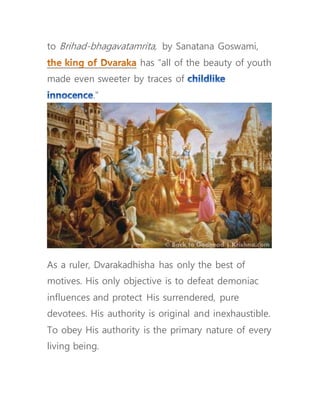
to Brihad-bhagavatamrita, by Sanatana Goswami,
has “all of the beauty of youth
made even sweeter by traces of
.”
As a ruler, Dvarakadhisha has only the best of
motives. His only objective is to defeat demoniac
influences and protect His surrendered, pure
devotees. His authority is original and inexhaustible.
To obey His authority is the primary nature of every
living being.
An Extraordinary Kingdom
Srila Prabhupada’s book Krishna: The Supreme
Personality of Godheaddescribes Dvaraka as the
most superb and beautiful city in the history of the
world. The island of Dvaraka is decorated with
900,000 extraordinary mansions built of first-class
marble, with gates and doors made of silver and
jewels. The clear blue-green ocean lies on all sides.
The residents of the mansions, all pure devotees of
Krishna, are of very fine beauty.
Dvaraka’s innumerable gardens and parks are full of
a variety of sweet, colorful flowers, and orchards
abound with an array of fruit. Beautiful chirping
birds, intoxicated peacocks, and ponds filled with
lilies and lotuses delight the senses. The residents
decorate every lane and walkway with water pots,
festoons, banana trees, and fragrant flowers, just in
anticipation of Krishna’s strolling there.
Srila Rupa Goswami’s Bhakti-rasamrita-
sindhu describes, “The servitors in the abode of
Dvaraka always worship Krishna as the most
respectable and revered Personality of Godhead.
They are captivated by Krishna because of His
superexcellent opulences.”
From Brihad-bhagavatamrita we learn that although
Dvarakadhisha is truly
enjoying in all opulence, He is also
humble, friendly, and full of unlimited love. His
devotees, in a mood of ecstatic servitude, awe, and
reverence, are absorbed in loving sentiments for
their Lord.
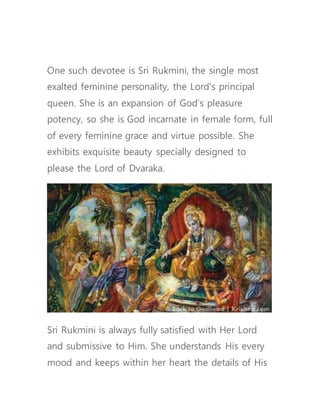
One such devotee is Sri Rukmini, the single most
exalted feminine personality, the Lord’s principal
queen. She is an expansion of God’s pleasure
potency, so she is God incarnate in female form, full
of every feminine grace and virtue possible. She
exhibits exquisite beauty specially designed to
please the Lord of Dvaraka.
Sri Rukmini is always fully satisfied with Her Lord
and submissive to Him. She understands His every
mood and keeps within her heart the details of His
childhood and youth. Although hundreds of
qualified maidservants attend to His every need,
She fans Him Herself, holding the snow-
whitechamara in her young bejeweled hand.
Jealousy and anger never beset her.
An Extraordinary King
In His youth, Krishna left Vrindavana and traveled to
the city of Mathura, where He assumed His
leadership role in the Yadava dynasty. He fought
with and killed the most feared despot of His time,
Kamsa, and released His parents from Kamsa’s
prison. He then built a fort on the island of Dvaraka
and transferred all of the citizens of Mathura there
to protect them from the attacks of Kamsa’s
ruthless relatives who sought revenge.
Shortly thereafter Lord Krishna kidnapped His
queen, the young princess Rukmini. Her brother
had arranged a marriage for her as part of a
political alliance. But she only wanted Krishna as her
husband, so she requested Him, through a
messenger, to come to her aid. Kidnapping a
princess was common for kings in those days, but
Krishna did this single-handedly against an army of
angry, heroic princes. Krishna took the hand of
many other superbly beautiful, opulent princesses in
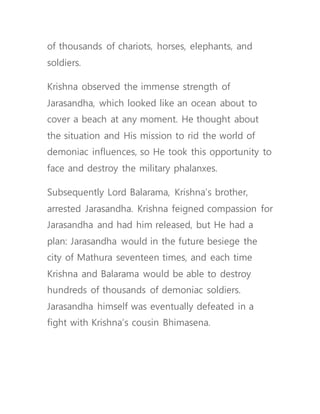
various daring ways. He rescued
being held captive by the cruel king Bhaumasura.
He married every one of them and provided each a
royal palace on the island of Dvaraka. For many
hopeful lifetimes of penance and austerity they had
prayed for Krishna’s favor upon them.
The Nectar of Devotion states, “While Krishna was
living in Dvaraka, He expanded Himself into 16,108
forms, and each and every expansion resided in a
palace with a queen. Not only was Krishna happily
living with His queens in those palaces, but He gave
in charity from each palace an aggregate number of
13,054 cows completely decorated with nice
clothing and ornaments daily. This means that
13,054 multiplied by 16,108 cows were being given
in charity by Krishna every day.
That was the system of Krishna’s daily affairs while
He was living in Dvaraka.”
Many amazing battles took place between
and a variety of King
Jarasandha, Kamsa’s father-in-law, attacked Dvaraka
with numerous military phalanxes consisting of tens
of thousands of chariots, horses, elephants, and
soldiers.
Krishna observed the immense strength of
Jarasandha, which looked like an ocean about to
cover a beach at any moment. He thought about
the situation and His mission to rid the world of
demoniac influences, so He took this opportunity to
face and destroy the military phalanxes.
Subsequently Lord Balarama, Krishna’s brother,
arrested Jarasandha. Krishna feigned compassion for
Jarasandha and had him released, but He had a
plan: Jarasandha would in the future besiege the
city of Mathura seventeen times, and each time
Krishna and Balarama would be able to destroy
hundreds of thousands of demoniac soldiers.
Jarasandha himself was eventually defeated in a
fight with Krishna’s cousin Bhimasena.
The Syamantaka Jewel and Other Episodes
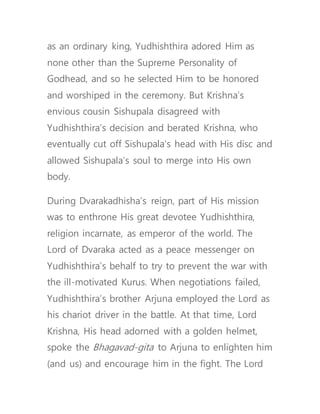
Because of intrigue involving a jewel known as
Syamantaka, Krishna was once wrongly defamed.
The Syamantaka could produce gold by its mystic
power. Many people coveted the jewel, and when it
went missing, some people accused Krishna of
stealing it. The jewel was actually in the hands of
persons who could not properly take care of it and
were almost driven mad by its potency. One citizen
finally surrendered both the jewel and his daughter
to Krishna, having come to realize that all valuable
things are the measure of Krishna’s benevolence
and should be offered in His service.
One crazy rival named Paundraka was so jealous of
the superexcellent qualities of Krishna that he
became convinced that he himself was Krishna.
He set out to defeat Dvarakadhisha by donning an
extra set of arms and carrying imitation weapons
only wielded by Vishnu Himself. Declaring himself
to be God, he set out to kill the Lord. Eventually
Krishna beheaded Paundraka, who achieved
liberation for having meditated so intensely on the
Personality of Godhead in his meager attempt to be
Him.
Lord Dvarakadhisha’s fellow king and cousin
Maharaja Yudhishthira once held a great sacrifice,
which included a ceremony to honor the best
person in attendance. Although Krishna was posing
as an ordinary king, Yudhishthira adored Him as
none other than the Supreme Personality of
Godhead, and so he selected Him to be honored
and worshiped in the ceremony. But Krishna’s
envious cousin Sishupala disagreed with
Yudhishthira’s decision and berated Krishna, who
eventually cut off Sishupala’s head with His disc and
allowed Sishupala’s soul to merge into His own
body.
During Dvarakadhisha’s reign, part of His mission
was to enthrone His great devotee Yudhishthira,
religion incarnate, as emperor of the world. The
Lord of Dvaraka acted as a peace messenger on
Yudhishthira’s behalf to try to prevent the war with
the ill-motivated Kurus. When negotiations failed,
Yudhishthira’s brother Arjuna employed the Lord as
his chariot driver in the battle. At that time, Lord
Krishna, His head adorned with a golden helmet,
spoke the Bhagavad-gita to Arjuna to enlighten him
(and us) and encourage him in the fight. The Lord
was fully capable of fighting the battle and winning
it at once for Arjuna. But He wanted to serve and
glorify His devotee Arjuna by engaging him to fight
as a matter of Krishna conscious duty.
seems full of amazing
events, just consider how amazing He seems to His
reverent, respectful servants at Dvaraka. They are
often surprised by His unpredictability. They
remember when Sudama, Krishna’s friend from His
school days, came to visit. Krishna’s guards and
wives witnessed what looked like a homeless
person going into the Lord’s rooms unchecked. To
their wonder they saw how Krishna reacted with
spontaneous love at the sight of His dear old friend.
Though Sudama was very thin and dressed in
shabby cloth, Dvarakadhisha embraced him, sat him
down on His own bed, and bathed his feet while
Rukmini fanned him.
When Sudama shyly offered Krishna his only
possession, a bag of plain dried rice, Dvaraka’s
queens observed with amazement the way the Lord
took the rice as though it was the most irresistible
gift.
More cause for surprise is found in Uddhava-
sandesha, where Rupa Goswami says that
Dvarakadhisha becomes emotional by remembering
His family and friends in His old cowherd village
home. He misses them too much. He asks Uddhava,
His cousin and closest friend, to deliver a message
to them from Him. Though a king with many wives
and a great kingdom to govern, to Uddhava’s
amazement the Lord remembers every person and
detail that Uddhava will encounter when he tours
the cowherd village.
Perhaps the most surprising event occurred at a
great festival held at Kurukshetra during a solar
eclipse, when the residents of Dvaraka met the
residents of Vrindavana. The simple Vrindavana
cowherds felt extremely fortunate to see Krishna
again. From within their hearts they spontaneously
recalled all of Krishna’s childhood pastimes. Though
unhappy seeing Him dressed as a king, they could
not think of going back to Vrindavana without Him,
so Krishna stayed in Kurukshetra longer than He
had planned. Upon seeing the simple villagers’ love
for Krishna, the residents of Dvaraka felt great
ecstasy. The Jagannatha Rathayatra festival
commemorates this pastime. In Krishna, Srila
Prabhupada writes, “The Rathayatra festival
observed by Lord Chaitanya is the emotional
process of taking Krishna back to Vrindavana.”
Krishna is not a material person, and His actions are
not the activities of this world. His unique,
unrestricted pastime of rejoicing in the association
of His simple cowherd family and friends is at the
heart of Gaudiya Vaishnavism. Lord Chaitanya
teaches that above reverential worship of God is
pure love in the most intimate relationships, such as
friend, son, or lover. If the Lord sets aside His kingly
worship in awe and reverence for the sake of
Vrindavana’s sweet, familiar, and spontaneous love,
it is only another example of His transcendent love
as the God who is the loyal devotee of His
devotees.
Krishna is the original supreme enjoyer. To meditate
on Him as the king of kings is solid spiritual
nourishment. It helps us understand the unlimited
dimensions of pure power and pure love in their
original spiritual forms. Dvarakadhisha’s pastimes
give us transcendental insight into the love,
potency, and compassion of the greatest spiritual
hero and leader of all eternity.
Karuna Dharini Devi Dasi, a disciple of Virabahu
Maharaja, practices Krishna consciousness in New
Dwaraka, the temple community established by Srila
Prabhupada in Los Angeles, California. She cooks
for and attends to the temple's beautiful Radha-
Krishna deities, Sri Sri Rukmini-Dwarakadisa.
~~~~~~~~~~~~~~~~~~~~~~~~~~~~~~~~~~~~~~~~~~~~~~~~~

Krishna as king.

  • 1.
    Back to GodheadSeptember/October 2007 By Karuna Dharini Devi Dasi When Krishna leaves Vrindavana to become the ruler of a great kingdom, He remains the same Krishna, the treasure of His devotees’ hearts. The Krishna deity worshiped at the Hare Krishna temple in Los Angeles, where I live, is named Dvarakadhisha, “the Lord of Dvaraka.
  • 2.
    ” Dvaraka isthe pristine island Lord Krishna rules in His adult years. (Although Krishna lived in Dvaraka when He was present on earth five thousand years ago, Dvaraka exists eternally in the spiritual world. Therefore, in this article I’ll sometimes use the present tense when referring to Dvaraka and Krishna’s activities there.) Generally devotees of Krishna think of Him primarily as the who speaks the Bhagavad-gita and performs wonderful spiritual pastimes in the cowherd village of Vrindavana. In that rural setting, He plays and enjoys life among many relatives and friends. Gaudiya Vaishnavas, or followers of Sri Chaitanya Mahaprabhu, know that Krishna as a cowherd boy exchanges the most intimate feelings with His devotees. Still, Krishna is always Krishna, and devotees love Him when He displays Himself in
  • 3.
    other ways aswell. For example, He is also endearing in His role as Dvarakadhisha. Krishna is no ordinary ruler. Kings or presidents represent what is grand and powerful in this world. Yet even the finest and most awesome personality is only a small indication of the opulence of the Supreme Personality of Godhead. His very body is constituted of eternity, knowledge, and bliss. Though Krishna as Dvarakadhisha enjoys many sporting battles, He has no one to conquer and nothing to achieve, being always complete in Himself. He always knows exactly what to do in His regal duties in relationship to His citizens, ministers, and soldiers. His brows are never furrowed with the anxiety of diplomatic responsibilities. Though , He is in fact nava yauvanam, eternally youthful. According
  • 4.
    to Brihad-bhagavatamrita, bySanatana Goswami, has “all of the beauty of youth made even sweeter by traces of .” As a ruler, Dvarakadhisha has only the best of motives. His only objective is to defeat demoniac influences and protect His surrendered, pure devotees. His authority is original and inexhaustible. To obey His authority is the primary nature of every living being.
  • 5.
    An Extraordinary Kingdom SrilaPrabhupada’s book Krishna: The Supreme Personality of Godheaddescribes Dvaraka as the most superb and beautiful city in the history of the world. The island of Dvaraka is decorated with 900,000 extraordinary mansions built of first-class marble, with gates and doors made of silver and jewels. The clear blue-green ocean lies on all sides. The residents of the mansions, all pure devotees of Krishna, are of very fine beauty. Dvaraka’s innumerable gardens and parks are full of a variety of sweet, colorful flowers, and orchards abound with an array of fruit. Beautiful chirping birds, intoxicated peacocks, and ponds filled with lilies and lotuses delight the senses. The residents decorate every lane and walkway with water pots,
  • 6.
    festoons, banana trees,and fragrant flowers, just in anticipation of Krishna’s strolling there. Srila Rupa Goswami’s Bhakti-rasamrita- sindhu describes, “The servitors in the abode of Dvaraka always worship Krishna as the most respectable and revered Personality of Godhead. They are captivated by Krishna because of His superexcellent opulences.” From Brihad-bhagavatamrita we learn that although Dvarakadhisha is truly enjoying in all opulence, He is also humble, friendly, and full of unlimited love. His devotees, in a mood of ecstatic servitude, awe, and reverence, are absorbed in loving sentiments for their Lord.
  • 7.
    One such devoteeis Sri Rukmini, the single most exalted feminine personality, the Lord’s principal queen. She is an expansion of God’s pleasure potency, so she is God incarnate in female form, full of every feminine grace and virtue possible. She exhibits exquisite beauty specially designed to please the Lord of Dvaraka. Sri Rukmini is always fully satisfied with Her Lord and submissive to Him. She understands His every mood and keeps within her heart the details of His
  • 8.
    childhood and youth.Although hundreds of qualified maidservants attend to His every need, She fans Him Herself, holding the snow- whitechamara in her young bejeweled hand. Jealousy and anger never beset her. An Extraordinary King In His youth, Krishna left Vrindavana and traveled to the city of Mathura, where He assumed His leadership role in the Yadava dynasty. He fought with and killed the most feared despot of His time, Kamsa, and released His parents from Kamsa’s prison. He then built a fort on the island of Dvaraka and transferred all of the citizens of Mathura there to protect them from the attacks of Kamsa’s ruthless relatives who sought revenge. Shortly thereafter Lord Krishna kidnapped His queen, the young princess Rukmini. Her brother had arranged a marriage for her as part of a political alliance. But she only wanted Krishna as her
  • 9.
    husband, so sherequested Him, through a messenger, to come to her aid. Kidnapping a princess was common for kings in those days, but Krishna did this single-handedly against an army of angry, heroic princes. Krishna took the hand of many other superbly beautiful, opulent princesses in various daring ways. He rescued being held captive by the cruel king Bhaumasura. He married every one of them and provided each a royal palace on the island of Dvaraka. For many hopeful lifetimes of penance and austerity they had prayed for Krishna’s favor upon them.
  • 10.
    The Nectar ofDevotion states, “While Krishna was living in Dvaraka, He expanded Himself into 16,108 forms, and each and every expansion resided in a palace with a queen. Not only was Krishna happily living with His queens in those palaces, but He gave in charity from each palace an aggregate number of 13,054 cows completely decorated with nice clothing and ornaments daily. This means that 13,054 multiplied by 16,108 cows were being given in charity by Krishna every day. That was the system of Krishna’s daily affairs while He was living in Dvaraka.” Many amazing battles took place between and a variety of King Jarasandha, Kamsa’s father-in-law, attacked Dvaraka with numerous military phalanxes consisting of tens
  • 11.
    of thousands ofchariots, horses, elephants, and soldiers. Krishna observed the immense strength of Jarasandha, which looked like an ocean about to cover a beach at any moment. He thought about the situation and His mission to rid the world of demoniac influences, so He took this opportunity to face and destroy the military phalanxes. Subsequently Lord Balarama, Krishna’s brother, arrested Jarasandha. Krishna feigned compassion for Jarasandha and had him released, but He had a plan: Jarasandha would in the future besiege the city of Mathura seventeen times, and each time Krishna and Balarama would be able to destroy hundreds of thousands of demoniac soldiers. Jarasandha himself was eventually defeated in a fight with Krishna’s cousin Bhimasena.
  • 12.
    The Syamantaka Jeweland Other Episodes Because of intrigue involving a jewel known as Syamantaka, Krishna was once wrongly defamed. The Syamantaka could produce gold by its mystic power. Many people coveted the jewel, and when it went missing, some people accused Krishna of stealing it. The jewel was actually in the hands of persons who could not properly take care of it and were almost driven mad by its potency. One citizen
  • 13.
    finally surrendered boththe jewel and his daughter to Krishna, having come to realize that all valuable things are the measure of Krishna’s benevolence and should be offered in His service. One crazy rival named Paundraka was so jealous of the superexcellent qualities of Krishna that he became convinced that he himself was Krishna. He set out to defeat Dvarakadhisha by donning an extra set of arms and carrying imitation weapons only wielded by Vishnu Himself. Declaring himself to be God, he set out to kill the Lord. Eventually Krishna beheaded Paundraka, who achieved liberation for having meditated so intensely on the Personality of Godhead in his meager attempt to be Him. Lord Dvarakadhisha’s fellow king and cousin Maharaja Yudhishthira once held a great sacrifice, which included a ceremony to honor the best person in attendance. Although Krishna was posing
  • 14.
    as an ordinaryking, Yudhishthira adored Him as none other than the Supreme Personality of Godhead, and so he selected Him to be honored and worshiped in the ceremony. But Krishna’s envious cousin Sishupala disagreed with Yudhishthira’s decision and berated Krishna, who eventually cut off Sishupala’s head with His disc and allowed Sishupala’s soul to merge into His own body. During Dvarakadhisha’s reign, part of His mission was to enthrone His great devotee Yudhishthira, religion incarnate, as emperor of the world. The Lord of Dvaraka acted as a peace messenger on Yudhishthira’s behalf to try to prevent the war with the ill-motivated Kurus. When negotiations failed, Yudhishthira’s brother Arjuna employed the Lord as his chariot driver in the battle. At that time, Lord Krishna, His head adorned with a golden helmet, spoke the Bhagavad-gita to Arjuna to enlighten him (and us) and encourage him in the fight. The Lord
  • 15.
    was fully capableof fighting the battle and winning it at once for Arjuna. But He wanted to serve and glorify His devotee Arjuna by engaging him to fight as a matter of Krishna conscious duty. seems full of amazing events, just consider how amazing He seems to His reverent, respectful servants at Dvaraka. They are often surprised by His unpredictability. They remember when Sudama, Krishna’s friend from His school days, came to visit. Krishna’s guards and wives witnessed what looked like a homeless person going into the Lord’s rooms unchecked. To their wonder they saw how Krishna reacted with spontaneous love at the sight of His dear old friend. Though Sudama was very thin and dressed in shabby cloth, Dvarakadhisha embraced him, sat him
  • 16.
    down on Hisown bed, and bathed his feet while Rukmini fanned him. When Sudama shyly offered Krishna his only possession, a bag of plain dried rice, Dvaraka’s queens observed with amazement the way the Lord took the rice as though it was the most irresistible gift. More cause for surprise is found in Uddhava- sandesha, where Rupa Goswami says that Dvarakadhisha becomes emotional by remembering His family and friends in His old cowherd village home. He misses them too much. He asks Uddhava, His cousin and closest friend, to deliver a message to them from Him. Though a king with many wives and a great kingdom to govern, to Uddhava’s amazement the Lord remembers every person and
  • 17.
    detail that Uddhavawill encounter when he tours the cowherd village. Perhaps the most surprising event occurred at a great festival held at Kurukshetra during a solar eclipse, when the residents of Dvaraka met the residents of Vrindavana. The simple Vrindavana cowherds felt extremely fortunate to see Krishna again. From within their hearts they spontaneously recalled all of Krishna’s childhood pastimes. Though unhappy seeing Him dressed as a king, they could not think of going back to Vrindavana without Him, so Krishna stayed in Kurukshetra longer than He had planned. Upon seeing the simple villagers’ love for Krishna, the residents of Dvaraka felt great ecstasy. The Jagannatha Rathayatra festival commemorates this pastime. In Krishna, Srila Prabhupada writes, “The Rathayatra festival observed by Lord Chaitanya is the emotional process of taking Krishna back to Vrindavana.”
  • 18.
    Krishna is nota material person, and His actions are not the activities of this world. His unique, unrestricted pastime of rejoicing in the association of His simple cowherd family and friends is at the heart of Gaudiya Vaishnavism. Lord Chaitanya teaches that above reverential worship of God is pure love in the most intimate relationships, such as friend, son, or lover. If the Lord sets aside His kingly worship in awe and reverence for the sake of Vrindavana’s sweet, familiar, and spontaneous love, it is only another example of His transcendent love as the God who is the loyal devotee of His devotees. Krishna is the original supreme enjoyer. To meditate on Him as the king of kings is solid spiritual nourishment. It helps us understand the unlimited dimensions of pure power and pure love in their
  • 19.
    original spiritual forms.Dvarakadhisha’s pastimes give us transcendental insight into the love, potency, and compassion of the greatest spiritual hero and leader of all eternity. Karuna Dharini Devi Dasi, a disciple of Virabahu Maharaja, practices Krishna consciousness in New Dwaraka, the temple community established by Srila Prabhupada in Los Angeles, California. She cooks for and attends to the temple's beautiful Radha- Krishna deities, Sri Sri Rukmini-Dwarakadisa. ~~~~~~~~~~~~~~~~~~~~~~~~~~~~~~~~~~~~~~~~~~~~~~~~~