KJAER ADVICE
assists your company
in forming the right
partnerships, thereby
multiplying your
business potential
Business at it’s best: innovating to meet
society’s needs and build a profitable
­enterprise. Creating shared value is about
achieving those twin goals. Shared value
thinking represents the next competitive
frontier for companies.
Corporate leaders have awakened to that
fact. They realize that social problems
present both daunting constraints to
their operations and vast opportunities
for growth.
According to a survey, conducted by
analysts at ‘Monday Morning’, Danish
top-leaders mention disruption as a key
focus area on their business agenda.
Instead of waiting inactively for new
players to enter the scene and destroy
the business for established compa-
nies, still more Danish companies are
working to invent the Netflix or Airbnb
solution that may change the business
sector. But even if disruption has become
the hot topic at both CEO-level and in
boardrooms, it is evident that many are
struggling to plan for concrete action.
Many experience that something in the
periphery of their business may threaten
to erode their existence within few years.
But only few have a concrete answer to
this acknowledged challenge, the com-
mentary concludes.
STRATEGIC
PARTNERSHIPS AND
MULTI-STAKEHOLDER
COLLABORATION
– CREATING SHARED VALUE FOR
YOUR BUSINESS AND SOCIETY
KJAER ADVICE
IDEATION STRATEGY ACTION
How companies can take ­action
to change the world – right now
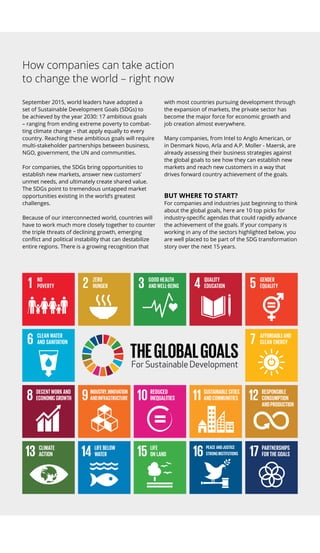
September 2015, world leaders have ­adopted a
set of Sustainable Development Goals (SDGs) to
be achieved by the year 2030: 17 ambitious goals
– ranging from ending extreme poverty to combat-
ting climate change – that apply equally to every
country. Reaching these ambitious goals will require
multi-stakeholder ­partnerships between business,
NGO, government, the UN and communities.
For companies, the SDGs bring opportunities to
establish new markets, answer new customers’
unmet needs, and ultimately create shared value.
The SDGs point to tremendous untapped market
opportunities existing in the world’s greatest
challenges.
Because of our interconnected world, countries will
have to work much more closely together to counter
the triple threats of declining growth, emerging
conflict and political instability that can destabilize
entire regions. There is a growing recognition that
with most countries pursuing development through
the expansion of markets, the private sector has
­become the major force for economic growth and
job creation almost everywhere.
Many companies, from Intel to Anglo American, or
in Denmark Novo, Arla and A.P. Moller - Maersk, are
­already assessing their business strategies against
the global goals to see how they can establish new
markets and reach new customers in a way that
drives forward country achievement of the goals.
BUT WHERE TO START?
For companies and industries just beginning to think
about the global goals, here are 10 top picks for
­industry-specific agendas that could rapidly advance
the achievement of the goals. If your company is
working in any of the sectors highlighted below, you
are well placed to be part of the SDG transformation
story over the next 15 years.
The financial sector is well positioned to drive progress on
three of the most critical goals – Goals 1 (poverty), 8 (jobs),
and 10 (inequality) – simply by aggressively advocating for
trade liberalization, by investing in pro-jobs companies
and sectors, and by expanding access to health and social
insurance.
The food, beverage, and agriculture sectors should
take advantage of the untapped opportunities to advance
Goals 2 (nutrition) and 12 (sustainable consumption) by
producing nutritious, fortified foods and beverages and
marketing them in ways that change the food behaviors
of populations everywhere. Every country in the world is
now struggling with some form of malnutrition and over
time, the economic and social costs of undernutrition and
obesity will increasingly threaten economic growth and
human development.
The information technology sector could drive achieve-
ment of Goal 4 (education) by developing specialized
products and delivery methods to eradicate illiteracy,
especially among adult women. 700 million adults in the
world are illiterate, 2/3 of them women, and literacy is
the basic building block of a productive workforce and
strong consumer base. With so many new tools to reach
and teach people directly in their homes and places of
work, this sector could completely disrupt dysfunctional
education systems and open up access to populations
previously denied.
Pharmaceutical and consumer goods companies
should embrace one of the highest impact investments
in global development – contraception – and deliver on
Goal 5 (gender equity). By dramatically expanding access
to modern contraceptives, fertility rates decline, child
survival increases, women’s education, and labor force
performance. It is not enough to produce affordable
­contraceptive devices. Generations of women and girls
need to be educated to understand their value and use.
The infrastructure and utilities industry should focus
on both Goals 6 (water and sanitation) by finding new ways
to provide clean water and sanitation where governments
have failed. Basic public health infrastructure is the foun-
dation for development, especially in societies experiencing
rapid urbanization. With a tidal wave of urban growth
around the corner in many parts of the world, especially in
Africa and South Asia, companies investing in clean cities
can make a major contribution to the global goals.
The energy sector should target Goals 7 (energy) and 11
(cities) and invest now in meeting the energy needs of the
underserved mega-cities of the future like Delhi, Mumbai,
Mexico City or Kinshasa – each forecast to have popula-
tions above 20 million by 2030. Companies with new clean
­energy technologies that can leapfrog the mistakes of
the past and the bad energy behavior of many developed
­country cities and forge new paths in low and middle-
income countries will be among the stars of the new
­development era.
The transport industry should lead on Goals 13, 14, and
15, all of which relate to climate change, by developing
alternative forms of energy-efficient transportation. With
such an interconnected world and such high and growing
demand for mobility both within and between countries,
the time is ripe for new transportation solutions that do
not threaten the planet.
The telecommunications industry should target Goal
16 (corruption and bribery) by expanding access to mobile
phones as tools for exposing corruption and holding
­authorities accountable. The world has already witnessed
the extraordinary rise in the use of phone technology and
social media platforms like Facebook and Twitter to expose
human rights abuses and corruption and to support social
movements that challenge dysfunctional regimes. The
industry should weigh in to keep the balance in favor of
democracy, freedom and human rights.
The extractives industry has the potential to transform
population health (Goal 3) in many of the countries
struggling with the highest burdens of early death and
disability, by investing in health care infrastructure –
including roads, water, and energy systems – alongside
but not limited to, their areas of operation.
And finally, all industries can make a positive impact on
Goal 17 (partnership). Shared value is not just a corporate
agenda. It is a high-impact development strategy that
involves active collaboration with local and national
governments, the UN and the NGO community forming
cross-sector partnerships. Lack of knowledge and
understanding or even mistrust are often barriers to
constructive dialogue and action.
We need bold leaders from all sectors to step forward
to strike transformative partnerships.
Source: sharedvalue.org
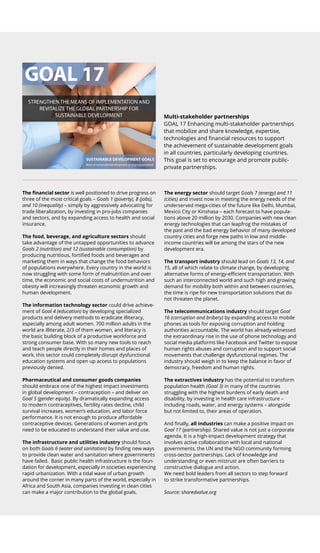
Multi-stakeholder partnerships
GOAL 17 Enhancing multi-stakeholder partnerships
that mobilize and share knowledge, expertise,
­technologies and financial resources to support
the achievement of sustainable development goals
in all countries, ­particularly developing countries.
This goal is set to ­encourage and promote public-­
private partnerships.
KJAER ADVICE
assists your company
in forming the right
partnerships, thereby
multiplying your
business potential
Business at it’s best: innovating to meet
society’s needs and build a profitable
­enterprise. Creating shared value is about
achieving those twin goals. Shared value
thinking represents the next competitive
frontier for companies.
Corporate leaders have awakened to that
fact. They realize that social problems
present both daunting constraints to
their operations and vast opportunities
for growth.
According to a survey, conducted by
analysts at ‘Monday Morning’, Danish
top-leaders mention disruption as a key
focus area on their business agenda.
Instead of waiting inactively for new
players to enter the scene and destroy
the business for established compa-
nies, still more Danish companies are
working to invent the Netflix or Airbnb
solution that may change the business
sector. But even if disruption has become
the hot topic at both CEO-level and in
boardrooms, it is evident that many are
struggling to plan for concrete action.
Many experience that something in the
periphery of their business may threaten
to erode their existence within few years.
But only few have a concrete answer to
this acknowledged challenge, the com-
mentary concludes.
KJAER ADVICE
IDEATION STRATEGY ACTION
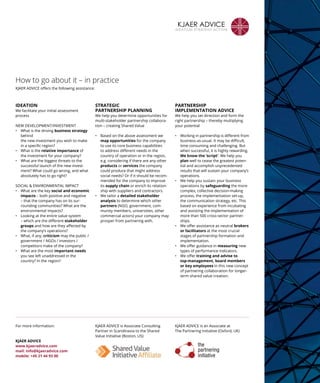
How to go about it – in practice
KJAER ADVICE offers the following ­assistance:
IDEATION
We facilitate your initial assessment
­process
NEW DEVELOPMENT/INVESTMENT
• What is the driving business strategy
behind
the new investment you wish to make
in a ­specific region?
• What is the relative importance of
the ­investment for your company?
• What are the biggest threats to the
successful launch of the new invest-
ment? What could go wrong, and what
absolutely has to go right?
SOCIAL  ENVIRONMENTAL IMPACT
• What are the key social and economic
impacts – both positive and negative
– that the company has on its sur-
rounding communities? What are the
environmental impacts?
• Looking at the entire value system
– which are the different stakeholder
groups and how are they affected by
the company’s operations?
• What, if any, criticism may the public /
government / NGOs / investors /
­competitors make of the company?
• What are the most important needs
you see left unaddressed in the
­country? In the region?
STRATEGIC
PARTNERSHIP PLANNING
We help you determine opportunities for
multi-stakeholder partnership collabora-
tion – creating Shared Value
• Based on the above assessment we
map opportunities for the company
to use its core business capabilities
to address different needs in the
country of operation or in the region,
e.g. considering if there are any other
products or services the company
could produce that might address
social needs? Or if it should be recom-
mended for the company to improve
its supply chain or enrich its relation-
ship with suppliers and contractors.
• We tailor a detailed stakeholder
analysis to determine which other
partners (NGO, government, com-
munity members, universities, other
commercial actors) your company may
prosper from partnering with.
PARTNERSHIP ­
IMPLEMENTATION ADVICE
We help you set direction and form the
right partnership – thereby multiplying
your potential
• Working in partnership is different from
business-as-usual. It may be difficult,
time consuming and challenging. But
when successful, it is highly rewarding.
We know the ‘script’. We help you
plan well to cease the greatest poten-
tial and accomplish unprecedented
results that will sustain your company’s
operations.
• We help you sustain your business
operations by safeguarding the more
complex, collective decision-making
process, the implementation set-up,
the communication strategy, etc. This
based on experience from incubating
and assisting the implementation of
more than 500 cross-sector partner-
ships.
• We offer assistance as neutral brokers
or facilitators at the most crucial
stages of partnership formation and
implementation.
• We offer guidance in measuring new
types of performance indicators.
• We offer training and advise to
top-management, board members
or key employees in this new concept
of partnering collaboration for longer-
term shared value creation.
KJAER ADVICE is Associate Consulting
Partner in ­Scandinavia to the Shared
Value Initiative (Boston, US)
KJAER ADVICE is an Associate at
The Partnering Initiative (Oxford, UK)
For more information:
KJAER ADVICE
www.kjaeradvice.com
mail: info@kjaeradvice.com
mobile: +45 21 44 93 00
KJAER ADVICE
IDEATION STRATEGY ACTION

KJAER ADVICE Strategic Partnerships Brochure

  • 1.
    KJAER ADVICE assists yourcompany in forming the right partnerships, thereby multiplying your business potential Business at it’s best: innovating to meet society’s needs and build a profitable ­enterprise. Creating shared value is about achieving those twin goals. Shared value thinking represents the next competitive frontier for companies. Corporate leaders have awakened to that fact. They realize that social problems present both daunting constraints to their operations and vast opportunities for growth. According to a survey, conducted by analysts at ‘Monday Morning’, Danish top-leaders mention disruption as a key focus area on their business agenda. Instead of waiting inactively for new players to enter the scene and destroy the business for established compa- nies, still more Danish companies are working to invent the Netflix or Airbnb solution that may change the business sector. But even if disruption has become the hot topic at both CEO-level and in boardrooms, it is evident that many are struggling to plan for concrete action. Many experience that something in the periphery of their business may threaten to erode their existence within few years. But only few have a concrete answer to this acknowledged challenge, the com- mentary concludes. STRATEGIC PARTNERSHIPS AND MULTI-STAKEHOLDER COLLABORATION – CREATING SHARED VALUE FOR YOUR BUSINESS AND SOCIETY KJAER ADVICE IDEATION STRATEGY ACTION
  • 2.
    How companies cantake ­action to change the world – right now September 2015, world leaders have ­adopted a set of Sustainable Development Goals (SDGs) to be achieved by the year 2030: 17 ambitious goals – ranging from ending extreme poverty to combat- ting climate change – that apply equally to every country. Reaching these ambitious goals will require multi-stakeholder ­partnerships between business, NGO, government, the UN and communities. For companies, the SDGs bring opportunities to establish new markets, answer new customers’ unmet needs, and ultimately create shared value. The SDGs point to tremendous untapped market opportunities existing in the world’s greatest challenges. Because of our interconnected world, countries will have to work much more closely together to counter the triple threats of declining growth, emerging conflict and political instability that can destabilize entire regions. There is a growing recognition that with most countries pursuing development through the expansion of markets, the private sector has ­become the major force for economic growth and job creation almost everywhere. Many companies, from Intel to Anglo American, or in Denmark Novo, Arla and A.P. Moller - Maersk, are ­already assessing their business strategies against the global goals to see how they can establish new markets and reach new customers in a way that drives forward country achievement of the goals. BUT WHERE TO START? For companies and industries just beginning to think about the global goals, here are 10 top picks for ­industry-specific agendas that could rapidly advance the achievement of the goals. If your company is working in any of the sectors highlighted below, you are well placed to be part of the SDG transformation story over the next 15 years.
  • 3.
    The financial sectoris well positioned to drive progress on three of the most critical goals – Goals 1 (poverty), 8 (jobs), and 10 (inequality) – simply by aggressively advocating for trade liberalization, by investing in pro-jobs companies and sectors, and by expanding access to health and social insurance. The food, beverage, and agriculture sectors should take advantage of the untapped opportunities to advance Goals 2 (nutrition) and 12 (sustainable consumption) by producing nutritious, fortified foods and beverages and marketing them in ways that change the food behaviors of populations everywhere. Every country in the world is now struggling with some form of malnutrition and over time, the economic and social costs of undernutrition and obesity will increasingly threaten economic growth and human development. The information technology sector could drive achieve- ment of Goal 4 (education) by developing specialized products and delivery methods to eradicate illiteracy, especially among adult women. 700 million adults in the world are illiterate, 2/3 of them women, and literacy is the basic building block of a productive workforce and strong consumer base. With so many new tools to reach and teach people directly in their homes and places of work, this sector could completely disrupt dysfunctional education systems and open up access to populations previously denied. Pharmaceutical and consumer goods companies should embrace one of the highest impact investments in global development – contraception – and deliver on Goal 5 (gender equity). By dramatically expanding access to modern contraceptives, fertility rates decline, child survival increases, women’s education, and labor force performance. It is not enough to produce affordable ­contraceptive devices. Generations of women and girls need to be educated to understand their value and use. The infrastructure and utilities industry should focus on both Goals 6 (water and sanitation) by finding new ways to provide clean water and sanitation where governments have failed. Basic public health infrastructure is the foun- dation for development, especially in societies experiencing rapid urbanization. With a tidal wave of urban growth around the corner in many parts of the world, especially in Africa and South Asia, companies investing in clean cities can make a major contribution to the global goals. The energy sector should target Goals 7 (energy) and 11 (cities) and invest now in meeting the energy needs of the underserved mega-cities of the future like Delhi, Mumbai, Mexico City or Kinshasa – each forecast to have popula- tions above 20 million by 2030. Companies with new clean ­energy technologies that can leapfrog the mistakes of the past and the bad energy behavior of many developed ­country cities and forge new paths in low and middle- income countries will be among the stars of the new ­development era. The transport industry should lead on Goals 13, 14, and 15, all of which relate to climate change, by developing alternative forms of energy-efficient transportation. With such an interconnected world and such high and growing demand for mobility both within and between countries, the time is ripe for new transportation solutions that do not threaten the planet. The telecommunications industry should target Goal 16 (corruption and bribery) by expanding access to mobile phones as tools for exposing corruption and holding ­authorities accountable. The world has already witnessed the extraordinary rise in the use of phone technology and social media platforms like Facebook and Twitter to expose human rights abuses and corruption and to support social movements that challenge dysfunctional regimes. The industry should weigh in to keep the balance in favor of democracy, freedom and human rights. The extractives industry has the potential to transform population health (Goal 3) in many of the countries struggling with the highest burdens of early death and disability, by investing in health care infrastructure – including roads, water, and energy systems – alongside but not limited to, their areas of operation. And finally, all industries can make a positive impact on Goal 17 (partnership). Shared value is not just a corporate agenda. It is a high-impact development strategy that involves active collaboration with local and national governments, the UN and the NGO community forming cross-sector partnerships. Lack of knowledge and understanding or even mistrust are often barriers to constructive dialogue and action. We need bold leaders from all sectors to step forward to strike transformative partnerships. Source: sharedvalue.org Multi-stakeholder partnerships GOAL 17 Enhancing multi-stakeholder partnerships that mobilize and share knowledge, expertise, ­technologies and financial resources to support the achievement of sustainable development goals in all countries, ­particularly developing countries. This goal is set to ­encourage and promote public-­ private partnerships. KJAER ADVICE assists your company in forming the right partnerships, thereby multiplying your business potential Business at it’s best: innovating to meet society’s needs and build a profitable ­enterprise. Creating shared value is about achieving those twin goals. Shared value thinking represents the next competitive frontier for companies. Corporate leaders have awakened to that fact. They realize that social problems present both daunting constraints to their operations and vast opportunities for growth. According to a survey, conducted by analysts at ‘Monday Morning’, Danish top-leaders mention disruption as a key focus area on their business agenda. Instead of waiting inactively for new players to enter the scene and destroy the business for established compa- nies, still more Danish companies are working to invent the Netflix or Airbnb solution that may change the business sector. But even if disruption has become the hot topic at both CEO-level and in boardrooms, it is evident that many are struggling to plan for concrete action. Many experience that something in the periphery of their business may threaten to erode their existence within few years. But only few have a concrete answer to this acknowledged challenge, the com- mentary concludes. KJAER ADVICE IDEATION STRATEGY ACTION
  • 4.
    How to goabout it – in practice KJAER ADVICE offers the following ­assistance: IDEATION We facilitate your initial assessment ­process NEW DEVELOPMENT/INVESTMENT • What is the driving business strategy behind the new investment you wish to make in a ­specific region? • What is the relative importance of the ­investment for your company? • What are the biggest threats to the successful launch of the new invest- ment? What could go wrong, and what absolutely has to go right? SOCIAL ENVIRONMENTAL IMPACT • What are the key social and economic impacts – both positive and negative – that the company has on its sur- rounding communities? What are the environmental impacts? • Looking at the entire value system – which are the different stakeholder groups and how are they affected by the company’s operations? • What, if any, criticism may the public / government / NGOs / investors / ­competitors make of the company? • What are the most important needs you see left unaddressed in the ­country? In the region? STRATEGIC PARTNERSHIP PLANNING We help you determine opportunities for multi-stakeholder partnership collabora- tion – creating Shared Value • Based on the above assessment we map opportunities for the company to use its core business capabilities to address different needs in the country of operation or in the region, e.g. considering if there are any other products or services the company could produce that might address social needs? Or if it should be recom- mended for the company to improve its supply chain or enrich its relation- ship with suppliers and contractors. • We tailor a detailed stakeholder analysis to determine which other partners (NGO, government, com- munity members, universities, other commercial actors) your company may prosper from partnering with. PARTNERSHIP ­ IMPLEMENTATION ADVICE We help you set direction and form the right partnership – thereby multiplying your potential • Working in partnership is different from business-as-usual. It may be difficult, time consuming and challenging. But when successful, it is highly rewarding. We know the ‘script’. We help you plan well to cease the greatest poten- tial and accomplish unprecedented results that will sustain your company’s operations. • We help you sustain your business operations by safeguarding the more complex, collective decision-making process, the implementation set-up, the communication strategy, etc. This based on experience from incubating and assisting the implementation of more than 500 cross-sector partner- ships. • We offer assistance as neutral brokers or facilitators at the most crucial stages of partnership formation and implementation. • We offer guidance in measuring new types of performance indicators. • We offer training and advise to top-management, board members or key employees in this new concept of partnering collaboration for longer- term shared value creation. KJAER ADVICE is Associate Consulting Partner in ­Scandinavia to the Shared Value Initiative (Boston, US) KJAER ADVICE is an Associate at The Partnering Initiative (Oxford, UK) For more information: KJAER ADVICE www.kjaeradvice.com mail: info@kjaeradvice.com mobile: +45 21 44 93 00 KJAER ADVICE IDEATION STRATEGY ACTION