1	
LONDON	SCHOOL	OF	ECONOMICS	AND	POLITICAL	SCIENCE	
CANDIDATE:	K.	J.	KRAMER		
WORD	COUNT:	9,962	


Adapting	arabica	
Weighing	scientific	and	economic	influences	in	national	responses	to	global	
climate	change	and	its	threat	to	Coffea	arabica	


Abstract		
This	paper	examines	the	response	of	national	governments	to	climate	change	threats	to	
Coffea	arabica	production	and	correlates	those	responses	to	macro-economic	data	and	
scientific	 studies	 on	 coffee’s	 future	 suitability	 in	 each	 region.	 Analysis	 shows	 that	
countries	without	adaptation	plans	for	coffee	are	those	in	which	coffee	exports	make	a	
negligible	 contribution	 to	 total	 exports.	 Countries	 in	 which	 coffee	 makes	 a	 more	
significant	contribution	to	total	exports	either	have	general	adaptation	plans	that	include	
coffee	 or	 have	 coffee-specific	 adaptation	 plans.	 No	 strong	 correlations	 were	 found	
between	projected	hectares	suitable	for	growing	coffee	and	government	response,	most	
likely	due	to	the	high	uncertainty	and	resulting	extreme	variability	of	the	land	area	loss	
projections.
2	
Acknowledgements	
I	offer	a	very	sincere	thank	you	to	my	dissertation	advisor,	Dr.	Declan	Conway	for	helping	
to	corral	and	guide	my	ideas	during	their	many	evolutions	over	the	past	several	months.	
I	would	also	like	to	thank	Paul	Watkiss	for	meeting	with	me	early	on	in	the	process.	His	
insight	and	knowledge	of	coffee	adaptation	provided	me	with	a	solid	foundation	to	start	
this	work.		
	
A	special	thanks	to	those	who	made	this	such	an	enriching	year,	including	(but	by	no	
means	 limited	 to)	 my	 academic	 advisor,	 Dr.	 Michael	 Mason,	 for	 all	 his	 guidance;	 the	
captain	of	the	EPR	ship,	Dr.	Richard	Perkins,	for	charting	a	great	course;	and	the	entire	
cohort	of	environmental	students	for	being	an	amazing	source	of	support	and	friendship.		
	
Most	of	all,	I	am	eternally	grateful	to	my	parents.	I	bet	they	never	dreamed	they	would	
one	day	know	this	much	about	coffee.
3	
List	of	Abbreviations	
	
AOPC	 Arabica-only	producing	countries	(and	Brazil)	
CDKN	 Climate	Development	and	Knowledge	Network	
CSP	 Coffee-specific	plan	
FAO	 Food	and	Agriculture	Organization	of	the	United	Nations	
FNC	 Federación	Nacional	de	Cafeteros	
GCC	 Global	climate	change	
GDP	 Gross	domestic	product	
GIS	 Geographic	information	system	
GPCC	 Greater	plan	citing	coffee	
ICA	 International	Coffee	Agreement	
ICO	 International	Coffee	Organization	
IFC	 International	Finance	Corporation,	World	Bank	Group	
IGC	 International	Growth	Centre	
INCUNFCCC	 Initial	National	Communication	under	the	UNFCCC	
IPCC	 Intergovernmental	Panel	on	Climate	Change	
ITC	 International	Trade	Centre	
LDC	 Least	developed	country	
MNCC	 Multi-national	coffee	corporation	
MoAD	 Government	of	Nepal,	Ministry	of	Agricultural	Development	
NAPA	 National	Adaptation	Programme	of	Action	
NGO	 Non-governmental	organization	
NTCB	 National	Tea	and	Coffee	Development	Board	(Nepal)	
PES	 Payments	for	ecosystem	services	
UN	 United	Nations	
UNFCCC	 United	Nations	Framework	Convention	on	Climate	Change	
USAID	 United	States	Agency	for	International	Development	
USD	 United	States	dollars	
USDA	 United	States	Department	of	Agriculture	
USDA	FAS	 USDA	Foreign	Agricultural	Service	
USDOC	 United	States	Department	of	Commerce	
YCP	 Yemen	Coffee	Program
4	
Table	of	Contents	
ABSTRACT	........................................................................................................................................................	1	
ACKNOWLEDGEMENTS	................................................................................................................................	2	
LIST	OF	ABBREVIATIONS	............................................................................................................................	3	
TABLE	OF	CONTENTS	...................................................................................................................................	4	
1	INTRODUCTION	..........................................................................................................................................	6	
2	BACKGROUND	AND	LITERATURE	REVIEW	........................................................................................	7	
2.1	BIOPHYSICAL	IMPACTS	OF	CLIMATE	CHANGE	ON	COFFEE	....................................................................................	7	
2.2	ADAPTATION	OPTIONS	FOR	COFFEE	........................................................................................................................	9	
2.2.1	Plant	adaptation	.................................................................................................................................................	9	
2.2.2	Location	adaptation	.......................................................................................................................................	11	
2.2.3	Adapting	on-farm	practices	........................................................................................................................	12	
2.2.4	Other	adaptations	...........................................................................................................................................	12	
2.3	BARRIERS	TO	ADAPTATION	AT	THE	FARM	LEVEL	...............................................................................................	13	
2.4	IMPLICATIONS	...........................................................................................................................................................	14	
3	METHODOLOGY	.......................................................................................................................................	15	
3.1	ECONOMIC	DATA	......................................................................................................................................................	15	
3.2	PROJECTED	SUITABILITY	OF	COFFEE	....................................................................................................................	16	
3.3	PUBLIC	ADAPTATION	PLANS	..................................................................................................................................	16	
3.4	SUMMARY	..................................................................................................................................................................	17	
4	RESULTS	.....................................................................................................................................................	19	
4.1	ADAPTATION	PLANS	................................................................................................................................................	19	
4.2	ROLE	OF	COFFEE	IN	THE	ECONOMY	.......................................................................................................................	19	
4.2.1	Relative	importance	of	coffee	to	the	economy	....................................................................................	20	
4.2.2	Coffee	in	the	LDCs	............................................................................................................................................	21	
4.3	PROJECTED	AREAS	OF	SUITABILITY	IN	2050	......................................................................................................	22	
5	DISCUSSION	...............................................................................................................................................	24	
5.1	COFFEE	ADAPTATION	IN	NONLDCS	......................................................................................................................	24	
5.1.1	Coffee	adaptation	as	a	tool	..........................................................................................................................	24	
5.1.2	Jamaica	.................................................................................................................................................................	25	
5.1.3	Brazil	.....................................................................................................................................................................	26	
5.2	COFFEE	ADAPTATION	IN	LDCS	..............................................................................................................................	27	
5.2.1	Zambia	..................................................................................................................................................................	27	
5.2.2	Malawi	..................................................................................................................................................................	28	
5.2.3	Ethiopia	................................................................................................................................................................	28	
5.2.4	Opportunities	in	East	Africa	........................................................................................................................	29	
5.2.5	Opportunities	outside	of	the	tropics	........................................................................................................	31	
5.3	UNCERTAINTY	...........................................................................................................................................................	32	
5.3.1	Uncertainty	of	the	projections	...................................................................................................................	32	
5.3.2	Uncertainty	of	market	response	................................................................................................................	35	
5.4	A	STRATEGY	FORWARD	...........................................................................................................................................	36	
5.4.1	Economic	considerations	and	flexible,	site-specific	adaptations	................................................	37	
5.4.2	Low-risk,	no-regret	adaptations	...............................................................................................................	38	
5.4.3	Addressing	barriers	........................................................................................................................................	38	
6	CONCLUSION	.............................................................................................................................................	40	
ANNEXES	............................................................................................................................................................	I	
ANNEX	I.	WORKS	CITED	....................................................................................................................................................	II	
ANNEX	II.	SUITABILITY	STUDIES	.....................................................................................................................................	X
5	
	
Figures	and	Tables	
FIGURE	1.	GLOBAL	SHARE	OF	ARABICA	PRODUCTION	IN	DIFFERENT	COUNTRIES	.......................................	19	
FIGURE	2.	EXPORTS	OF	ARABICA	FROM	LDC	COUNTRIES	...............................................................................	22	
FIGURE	3.	JAMAICAN	PRICE	PREMIUM	...............................................................................................................	26	
FIGURE	4.	ARABICA	PRODUCTION	IN	ZAMBIA	..................................................................................................	28	
FIGURE	5.	THE	DECLINING	SHARE	OF	COFFEE	AS	A	PERCENTAGE	OF	BURUNDI’S	EXPORTS	.......................	30	
FIGURE	6.	RANGE	OF	SUITABILITY	PROJECTIONS	.............................................................................................	32	
	
TABLE	1.	SUMMARY	OF	ADAPTATION	PLANS.	...................................................................................................	19	
TABLE	2.	TOP	TEN	COUNTRIES	BY	COFFEE	PRODUCTION	AND	COFFEE	EXPORTS	........................................	21	
TABLE	3.	DISTRIBUTION	OF	THE	IMPORTANCE	OF	COFFEE	EXPORTS.	...........................................................	21	
TABLE	4.	COMPARING	ADAPTATION	PLANS	AND	COFFEE	EXPORTS.	..............................................................	24
6	
1	Introduction	
From	its	origins	in	the	shady	Ethiopian	forests,	the	coffee	plant	has	a	long	and	storied	
history	of	cultivation	in	tropical	climates	around	the	world.	The	importance	of	this	plant	
and	 its	 saga	 of	 expansion	 are	 well	 documented.	 Knowing	 its	 critical	 role,	 national	
governments	have	long	sought	to	protect	this	plant	–	in	past	centuries,	harsh	penalties	
were	imposed	on	merchant	sailors	smuggling	seeds,	and	prohibitions	were	placed	on	
delivery	of	beans	to	foreign	countries.	
	
Today,	climate	change	threatens	the	plant’s	habitat,	and	its	disappearance	would	have	
dire	repercussions	for	the	25	million	growers,	most	of	whom	are	smallholder	farmers,	
who	depend	on	the	plant	for	survival,	and	the	additional	100	million	people	around	the	
world	who	make	their	living	in	the	greater	coffee	industry.	Through	data	analysis	and	
review	of	governmental	policies,	scientific	studies,	grey	literature,	and	academic	work,	
this	 dissertation	 examines	 the	 links	 between	 the	 economic	 and	 projected	 climatic	
conditions	of	coffee-producing	countries,	and	the	adaptation	strategies	that	governments	
employ	to	ensure	the	coffee	plant’s	continued	growth	in	our	changing	climate.
7	
2	Background	and	literature	review	
Coffee	is	a	highly	traded	global	commodity	and	the	second	most	valuable	commodity	
exported	 from	 the	 developing	 world	 (Talbot	 2004).	 From	 production	 to	 brewing,	 an	
estimated	125	million	people	worldwide	derive	their	livelihood	from	coffee	(Bunn	2015).	
Production	in	the	2015/16	growing	year	was	estimated	at	153	million	60kg	bags	(USDA	
FAS1	2015)	and	is	projected	to	rise	to	almost	156	million	bags	in	2016/17	(USDA	FAS	
2015)	to	keep	up	with	consumption,	which	is	increasing	at	a	rate	of	2%	a	year	(Lewin	et	
al.	2004;	Perez	2016;	ICO2	2016).	The	top	four	producing	countries	in	the	world	-	Brazil,	
Vietnam,	Colombia,	and	Indonesia	—	account	for	65%	of	global	coffee	production	(Ovalle-
Rivera	et	al.	2015).	Coffee	plays	a	critical	role	in	the	economies	of	many	developing	and	
least	developed	countries	(LDCs).	In	Uganda,	Burundi,	Rwanda,	and	Ethiopia,	coffee	is	the	
main	source	of	foreign	exchange	(DaMatta	&	Ramalho	2006).	It	is	estimated	that	around	
25	 million	 people	 globally	 grow	 coffee,	 the	 vast	 majority	 of	 whom	 are	 smallholder	
farmers	(Ovalle-Rivera	et	al.	2015;	DaMatta	&	Ramalho	2006).	For	instance,	in	Ethiopia,	
around	95%	of	coffee	comes	from	such	growers	(ICO	2015).		
	
Coffee	has	two	main	species,	Coffea	arabica	(arabica)	and	Coffea	canephora	(robusta).	
Roughly	two-thirds	of	coffee	grown	is	arabica,	with	robusta	compromising	the	remainder	
(USDA	 FAS	 2016;	 ICO	 2016).	 Arabica’s	 higher	 quality	 allows	 it	 to	 command	 a	 price	
premium	on	the	global	market,	generally	fetching	twice	the	price	of	robusta	(Van	Der	
Vossen	et	al.	2015).	
	
2.1	Biophysical	impacts	of	climate	change	on	coffee	
Coffee	thrives	in	very	specific	climates.	The	plant	prefers	sloped	hills	of	fertile	red	earth	
volcanic	soils	or	deep	sandy	loam	(Assefa	et	al.	2015).	The	two	species	have	differing	
temperature	preferences:	arabica	prefers	the	slightly	lower	temperatures	(18°C	-	21°C)	
of	tropical	highlands	(Davis	et	al.	2012),	while	robusta	can	be	found	at	lower	altitudes	
with	temperatures	between	22°C	and	26°C	(DaMatta	&	Ramalho	2006).	These	specific	
conditions	make	the	plant	highly	sensitive	to	the	effects	of	climate	change	(Bunn	et	al.	
																																																								
1	United	States	Department	of	Agriculture	Foreign	Agricultural	Service	
2	International	Coffee	Organization
8	
2015).	 Yields	 in	 terms	 of	 both	 quantity	 and	 quality	 are	 subject	 to	 variations	 in	
temperature,	 rainfall,	 pests,	 diseases,	 and	 extreme	 weather	 events	 (Bunn	 et	 al.	 2014;	
DaMatta	&	Ramalho	2006;	Davis	et	al.	2012;	Jaramillo	et	al.	2009).	Coffee	is	grown	at	low	
latitudes	 almost	 exclusively	 between	 the	 tropics	 of	 Cancer	 and	 Capricorn.	 This	 is	
particularly	 concerning	 because	 this	 Equatorial	 band	 is	 projected	 by	 the	
Intergovernmental	Panel	on	Climate	Change	(IPCC,	2014)	to	be	hit	relatively	harder	by	
global	climate	change	(GCC)	than	the	higher	latitudes.		
	
Already	in	the	latter	part	of	the	20th	century,	many	growing	regions	had	begun		witnessing	
steady	 temperature	 increases	 (Malhi	 &	 Wright	 2004).	 While	 both	 species	 are	
temperature	sensitive,	arabica	is	more	affected	by	a	rise	in	mean	temperature	(Craparo	
et	al.	2015);	the	more	heat	tolerant	robusta	is	more	affected	by	increased	temperature	
variability	 –	 specifically,	 diurnal	 temperature	 ranges	 and	 intra-seasonal	 temperature	
variations	(Bunn	et	al.	2014).	Higher	temperatures	 adversely	 affect	 arabica’s	 growth,	
flowering,	 and	 fruiting,	 resulting	 in	 lower	 yields	 (Ovalle-Rivera	 et	 al.	 2015).	 These	
temperatures	also	shorten	the	berries’	ripening	time,	affecting	quality	(Baker	&	Haggar	
2007),	and	ultimately	the	price	the	farmer	receives	for	the	harvest.	
	
Higher	 temperatures	 also	 increase	 the	 incidence	 and	 reach	 of	 pests	 and	 diseases	
(Jaramillo	et	al.	2011).	For	example,	in	a	study	on	the	H.	hampei	pest	(also	known	as	a	
berry	borer),	Jaramillo	et	al.	(2011)	found	that	warming	temperatures	have	allowed	this	
pest’s	habitat	to	creep	up	to	higher	altitudes	on	Mount	Kilimanjaro	by	300m	in	only	ten	
years.	It	is	estimated	that	the	berry	borer	is	responsible	for	$500	million3	in	annual	losses	
in	East	Africa	alone.	The	incidence	of	pests	and	diseases	such	as	the	berry	borer,	leaf	rust,	
and	nematodes	is	only	increasing	as	temperatures	continue	to	rise	(ITC4	2010).		Other	
GCC-related	variables	can	also	affect	crops.	Changes	in	rainfall	patterns	in	Nicaragua	have	
reportedly	led	to	erratic	flowering	and	incomplete	maturation	of	coffee	crops	(Ovalle-
Rivera	et	al.	2015).	Extreme	events	such	as	floods	or	heavy	rainfall	can	cause	erosion	of	
soil	on	the	sloping	lands	(Ovalle-Rivera	et	al.	2015).	Droughts	and	frosts	also	can	be	
detrimental	to	the	plants	(Davis	et	al.	2012).	
																																																								
3	United	States	dollars	
4	International	Trade	Centre
9	
2.2	Adaptation	options	for	coffee	
In	 the	 context	 of	 farming	 in	 a	 changing	 climate,	 human	 interventions	 become	 more	
critical.	Adaptation	–	the	human	input	–	is	the	planning	and	management	practices	used	
to	mitigate	the	effects	of	climate	change,	allowing	for	continued	production	in	the	context	
of	 an	 altered	 climate.	 Watkiss	 (unpub.)	 compares	 the	 studies	 on	 future	 suitability	 of	
indigenous	coffee	(Davis	et	al.	2012)	to	predictions	on	managed	plantations	(Bunn	et	al.	
2014).	He	writes,		“the	divergence	of	the	results	[…]	indicates	the	effect	that	management	
and	adaptation	of	production	systems	can	have”	(Watkiss	unpub.).	Furthermore,	we	have	
seen	that	coffee	supply,	keeping	pace	with	demand,	has	grown	about	2%	a	year	(Bunn	
2015);	less	than	a	quarter	of	this	growth	is	attributed	to	increases	in	land	area,	while	the	
rest	is	from	increases	in	yield	(Bunn	2015).	This	gives	weight	to	the	idea	that	proper	
management	 practices	 may	 be	 able	 to	 offset	 some	 of	 the	 projected	 area	 losses	 from	
climate	change.	
	
The	literature	outlines	a	number	of	possible	adaptations	for	coffee	growing,	which	this	
dissertation	categorizes	as	(1)	plant	adaptation,	(2)	location	adaptation,	(3)	adapting	on-
farm	practices,	and	(4)	other	adaptations.		
	
2.2.1	Plant	adaptation	
As	arabica	is	susceptible	to	climate	change,	there	has	been	some	discussion	of	switching	
the	type	of	coffee	grown	to	a	more	robust	variety	(such	as	robusta),	or	even	breeding	new	
varieties	of	enhanced	cultivars	(Hein	&	Gatzweiler	2006).	Although	robusta	can	manage	
in	higher	temperatures,	it	is	not	entirely	immune	to	GCC,	requiring	limited	intra-seasonal	
variability	(which	relegates	it	to	lower	latitudes)	(Bunn	et	al.	2014).	Robusta’s	lower	
quality	also	makes	it	a	markedly	different	product.	Although	some	advances	are	being	
made	 in	 techniques	 to	 remove	 the	 harshness	 of	 robusta	 (Baffes	 et	 al.	 2005),	 the	
techniques	have	not	yet	led,	and	may	not	ever	lead,	to	perfect	market	substitutability	
between	arabica	and	robusta	species.		
	
New	 coffee	 hybrids	 have	 the	 potential	 to	 be	 more	 resilient,	 with	 lower	 sensitivity	 to	
warmer	 and	 drier	 climates	 (Baker	 &	 Haggar	 2007)	 and	 even	 resistance	 to	 pests	 and	
diseases	(Schroth	et	al.	2009).	In	early	20th	century	Colombia,	the	Federación	Nacional	de
10	
Cafeteros	 (FNC)	 encouraged	 farmers	 to	 replace	 the	 traditional	 arabica	 varietals	 of	
Bourbon	and	Typica	with	the	more	densely-planted	Caturra	varietal,	allowing	farmers	to	
produce	more	on	the	same	amount	of	land.	But	the	dense	planting	meant	that	Caturra	
was	more	susceptible	to	disease.	The	response	by	FNC’s	research	institute	was	to	develop	
and	promote	the	Castillo	varietal,	which	is	more	resistant	to	disease	and	climate	change	
(Owen	2015).	
	
But	breeding	new	varietals	has	its	obstacles.	Coffee	plants	live	decades,	so	the	transition	
to	new	plants	may	be	slow.	Farmers	may	be	resistant	to	change,	worried	about	the	quality	
of	beans	they	will	be	producing	and	the	price	the	beans	will	fetch.	In	the	FNC’s	attempt	to	
overcome	such	resistance	to	Castillo,	they	even	went	so	far	as	to	make	false	claims	that	
the	winning	beans	in	a	prestigious	coffee	competition	were	Castillo	beans,	when	later	
reports	revealed	they	were	not	(Owen	2015;	Kaufman	2011).	Switching	to	new	varietals	
is	a	very	long-term	adaptation	option,	as	it	takes	years	to	breed	new	plants	and	even	
longer	for	a	new	varietal’s	acceptance	and	wide	dispersal	(Watkiss	unpub.).	
	
The	adoption	of	new	varietals	is	further	complicated	by	the	diminishing	gene	pool	of	
arabica.	Germplasm	collections	(or	genebanks)	for	coffee	are	quite	expensive	to	maintain	
as	they	require	living	plants,	and	as	such,	they	have	fallen	into	disrepair	(World	Coffee	
Research	2016).	Climate	change	is	also	threatening	these	genebanks,	and	the	genetic	
resources	they	contain	are	seldom	shared.	There	are	19	coffee	genebanks	in	the	world,	
but	only	one5	is	party	to	an	international	treaty	keeping	its	genetic	resources	in	the	public	
domain.	A	review	by	Taye	(2010)	found	that	Ethiopia’s	genebanks	contained	between	
89.9%	and	99.8%	of	arabica	genetic	diversity,	but	the	combination	of	climate	change	and	
neglect	of	the	genebanks	have	already	led	to	the	loss	of	many	of	the	trees	in	the	collections	
(World	 Coffee	 Research	 2016).	 The	 rapid	 disappearance	 of	 these	 critical	 genetic	
resources	in	Ethiopia	and	around	the	world	threatens	the	potential	for	breeding	more	
climate-resilient	arabica	varietals.		
	
																																																								
5	Centro	Agronómico	Tropical	de	Investigación	y	Enseñanza	in	Costa	Rica
11	
2.2.2	Location	adaptation	
Migration	of	coffee	plantations	is	another	adaptation.	Baker	&	Haggar	(2007)	estimate	
that	coffee	plantations	will	have	to	migrate	to	higher	altitudes	at	a	rate	of	150ft	(45.72m)	
per	decade.	Over	the	potentially	50-year	life	of	a	coffee	plant,	this	could	mean	a	750ft	
(228.6m)	altitudinal	shift.	There	may	be	opportunities	for	latitudinal	migration	as	well.	
For	the	most	part,	latitudinal	migrations	will	be	limited	due	to	the	plant’s	need	for	low	
temperature	volatility	and	its	critical	need	to	avoid	frost	(Bunn	et	al.	2014).		
	
Adaptation	 through	 migration	 has	 its	 obstacles	 as	 well.	 Smallholders	 with	 limited	
financial	wherewithal	are	reluctant	to	replace	existing	trees	with	new	varietals	because	
of	the	decline	in	production	during	the	three	to	five-year	maturation	process.	In	addition,	
the	long	life	of	the	plant	means	that	trees	planted	today	must	be	located	in	climates	that	
will	be	suitable	for	coffee	both	now	and	20-50	years	from	now.	Some	studies	imply	that	
location	adaptation	may	be	an	implausible	option.	For	instance,	Jaramillo	et	al.	(2011)	
found	that	East	African	countries	will	need	to	shift	production	from	current	elevations	of	
1400-1600m	to	1600-1800m	by	2050.	With	no	overlap	in	those	ranges,	there	is	no	clear	
picture	of	where	to	plant	new	trees	today.		
	
Migration	of	plants	may	have	negative	externalities,	or	might	not	be	possible	at	all.	As	is	
the	 case	 in	 Tanzania,	 new	 suitable	 areas	 could	 be	 home	 to	 substantial	 biodiversity	
(Craparo	et	al.	2015).	The	new	land	may	be	protected	forests,	national	reserves,	or	fall	
under	 restrictions	 such	 as	 a	 watershed	 protection	 scheme	 (Baker	 &	 Haggar	 2007).	
Deforestation	of	these	valuable	ecosystems	is	of	particular	concern.	Migration	of	coffee	
plantations	could	displace	other	crops,	which	may	have	food	security	implications	or	
result	in	indirect	deforestation	as	those	crops	are	moved	to	new	land.	In	Rwanda,	coffee	
is	relegated	to	less	fertile	soils	that	have	been	degraded	by	erosion	or	intensive	cropping,	
reserving	the	more	fertile	soils	for	staple	foods	(Nzeyimana	et	al.	2014).	Baker	&	Haggar	
(2007)	 write	 that	 opportunities	 for	 migrational	 adaptation	 may	 actually	 be	 small	 in	
practice.	 In	 some	 places,	 migration	 to	 new	 land	 is	 just	 not	 a	 viable	 option	 as	 higher	
altitudes	 may	 lack	 the	 plant’s	 preferred	 soil	 or	 other	 climatic	 conditions.	 New	 areas	
simply	 may	 not	 exist	 or	 may	 be	 more	 remote	 and	 lack	 necessary	 infrastructure	 for	
economically	viable	production	and	delivery	to	markets.
12	
	
2.2.3	Adapting	on-farm	practices	
One	 of	 the	 most	 widely	 suggested	 adaptations	 is	 the	 use	 of	 shade	 trees	 on	 coffee	
plantations.	For	most	of	its	history,	coffee	has	thrived	under	shaded	conditions.	However,	
during	the	green	revolution	of	the	mid	20th	century,	coffee	farmers	adopted	a	sun-grown	
system,	hoping	to	boost	production	(Bacon	et	al.	2012).	Returning	to	shade-grown	coffee	
offers	a	myriad	of	benefits,	proving	to	be	an	effective	adaptation	method.	Studies	have	
found	that	the	shade	provided	can	decrease	ambient	temperatures	around	the	coffee	
plants	by	up	to	four	degrees	(Jaramillo	et	al.	2011).	Shade	trees	also	increase	biodiversity	
(Jha	et	al.	2014;	Perfecto	et	al.	1996)	and	are	beneficial	to	arthropods	that	keep	certain	
harmful	 pests	 under	 control.	 Shade	 trees	 aid	 soil	 and	 water	 conservation	 and	
management	as	the	trees	increase	relative	humidity	around	the	coffee	plants,	and	the	
more	complex	root	structures	reduce	landslides	(Philpott	et	al.	2008).	Compared	with	
monocultures,	 providing	 shade	 by	 intercropping	 bananas,	 macadamia,	 rubber,	 or	
coconut	has	been	shown	to	improve	soil	fertility,	carbon	pools	and	nitrogen	(Zake	et	al.	
2015;	Watkiss	unpub.),	and	the	additional	crop	revenue	can	potentially	increase	farmers’	
incomes	by	50%	(Van	Asten	et	al.	2011).	
	
For	areas	where	reduced	rainfall	or	increased	evaporation	will	be	an	issue,	farmers	may	
need	to	employ	water-focused	adaptation	strategies.	As	very	few	coffee	farms	have	any	
form	 of	 irrigation	 (World	 Bank	 2016),	 conservation	 of	 soil	 moisture	 through	
“composting,	 hedgerows,	 envelope	 forking	 (loosening	 soil	 without	 turning),	 burying	
prunings,	 and	 mulching”	 (Watkiss	 unpub.,	 p.7)	 will	 be	 important.	 Other	 on-farm	
adaptations	include,	but	are	not	limited	to,	proper	spacing	of	the	plants	(Craparo	et	al.	
2015),	adding	windbreaks,	and	fertilization	(Rahn	et	al.	2014).	
	
2.2.4	Other	adaptations	
Other	 adaptation	 options	 require	 a	 broader	 coordinated	 or	 institutional	 effort.	 These	
strategies	include	conservation	efforts	focused	on	insects	involved	in	coffee	pollination.	
Berecha	 et	 al.	 (2014,	 p.1)	 found	 a	 correlation	 between	 “impoverishment	 of	 insect	
communities”	 and	 adverse	 effects	 on	 the	 resilience	 of	 coffee	 production.	 Rahn	 et	 al.
13	
(2014)	 suggest	 reforestation	 and	 restoration	 of	 degraded	 and	 risk-prone	 sites	 where	
possible.	
	
Other	strategies	could	address	the	financial	constraints	typically	faced	by	coffee	growers.	
The	large	volatility	in	the	coffee	market	means	that	farmers	do	not	know	the	price	they	
will	receive	for	their	crop	at	harvest	time	(Owen	2015).	Some	direct	buyers	will	guarantee	
prices,	but	even	those	considered	“long”	buying	agreements	are	only	for	three	to	five	
years	(Owen	2015).	Farmers	may	not	have	access	to	credit	markets	(Baca	et	al.	2014).	
This	 leads	 to	 short-run	 cost-cutting	 measures,	 which	 may	 run	 counter	 to	 long-term	
adaptation	and	sustainability	goals.	Reliance	on	a	single	crop	exposes	farmers	to	added	
risk,	as	climate	change	may	increase	the	incidence	of	extreme	events	that	adversely	affect	
yields	on	one	crop	more	than	others.	Measures	to	increase	farmer	security	include	crop	
diversification,	crop	insurance	(Rahn	et	al.	2014),	increasing	access	to	credit	markets,	and	
modifying	the	payment	structure	for	coffee	to	include	some	or	larger	upfront	payments	
or	longer-term	contracts	with	buyers.	Increased	financial	security	could	enable	farmers	
to	adopt	long-term,	and	often	more	effective,	solutions	(Borsy	&	Techel	2015).	
	
2.3	Barriers	to	adaptation	at	the	farm	level		
The	quantity	and	quality	of	coffee	yields	depend	upon	the	varietal	that	is	planted,	where	
it	is	planted,	and	the	adaptation	strategies	employed	to	keep	current	and	future	trees	
viable.	Individual	coffee	farmers	cannot	be	expected	to	do	this	on	their	own.	A	study	by	
the	 Coffee	 &	 Climate	 Initiative	 (Borsy	 &	 Techel	 2015)	 provided	 an	 online	 adaptation	
toolbox	(with	guidance	and	resources)	to	coffee	farmers	in	four	regions	and	noted	the	
uptake	 rates	 of	 various	 adaptive	 actions.	 They	 found	 that	 while	 “farmers	 frequently	
undertake	autonomous	adaptations	that	they	are	familiar	with	and	that	are	low	cost”	
(Borsy	&	Techel	2015:24),	various	hurdles	exist	that	limit	adoption	of	some	of	the	more	
effective	adaptations.	Some	of	the	largest	barriers	to	adaptation	include:		
• Uncertainty	of	benefits:	While	many	farmers	in	the	study	were	aware	of	the	
adaptive	measures,	they	had	yet	to	see	conclusive	evidence	of	the	benefits	(Borsy	
&	 Techel	 2015)	 and	 thus	 were	 apprehensive	 to	 make	 investments	 in	 the	
interventions.
14	
• Financial	restrictions:	Many	farmers	lack	the	financial	resources	to	make	even	
small	upfront	investments	in	their	farms	(Baca	et	al.	2014).	There	may	also	be	
reluctance	by	creditors	or	insurance	providers.	Farmers	may	lack	awareness	or	
understanding	of	available	financial	tools	(Borsy	&	Techel	2015).	
• Lack	 of	 coordinated	 effort:	 Rural	 farmers	 in	 developing	 and	 LDC	 countries	
cannot	be	expected	to	undertake	suitability	studies	or	coffee	breeding	programs	
on	 their	 own.	 Van	 Der	 Vossen	 et	 al.	 (2015)	 suggest	 a	 world-wide	 coordinated	
breeding	program	is	needed.	This	is	not	something	that	can	be	done	on	the	farm	
level.	
• Limited	knowledge	of	programs:	Lack	of	awareness	of	available	programs	may	
also	 diminish	 adaptation	 uptake.	 Interviewing	 farmers	 in	 Mexico,	 Baca	 et	 al.	
(2014,	p.8)	found	that	families	“had	knowledge	of	only	one	to	three	coffee	sector	
or	 environmental	 policies,	 and	 they	 did	 not	 have	 active	 participation	 in	 the	
application	of	these	laws.”	
	
2.4	Implications	
Because	coffee	is	produced	mostly	on	smallholder	farms	in	developing	countries	and	
LDCs,	adaptation	strategies	have	tremendous	implications	for	livelihoods	and	poverty	
reduction	(DaMatta	&	Ramalho	2006).	While	changes	in	suitable	growing	regions	will	
impact	 the	 allocation	 of	 coffee	 crops	 around	 the	 tropics,	 Watkiss	 (unpub.,	 p.2)	 notes	
“there	is	a	dearth	of	literature	projecting	the	[resulting]	economic	and	trade	impacts.”	To	
make	any	projections	on	future	shifts,	one	must	look	not	only	at	suitability	projections,	
but	on	the	response	by	producers.	The	long	life	of	coffee	trees	means	that	adaptation	
decisions	need	to	be	made	now	or	in	the	near	future	despite	the	lack	of	clear	guidance.	
Adaptation	will	be	required	for	coffee	production	to	remain	viable	in	many	areas.	As	
many	coffee	adaptations	are	not	within	the	adaptive	capacity	of	individual	farmers,	they	
will	require	some	form	of	institutional	support.		
	
This	paper	(a)	examines	the	response	of	national	governments	to	GCC	and	its	threat	to	
coffee	 production	 and	 (b)	 correlates	 those	 responses	 to	 macro-economic	 data	 and	
scientific	studies	on	coffee’s	future	suitability	in	each	region.	From	this,	we	hope	to	infer	
how	economics	and	science	may	be	informing	these	responses.
15	
3	Methodology	
The	objective	of	this	dissertation	is	to	find	what	correlations	(if	any)	exist	between	the	
projected	suitability	for	coffee-growing	under	GCC,	the	economic	importance	of	the	coffee	
industry,	and	public	climate	change	adaptation	plans	in	a	region.	The	data	collected	is	
from	coffee-producing	regions	and	falls	into	three	categories:		
(1)	Economic	data	
(2)	Projected	suitability	of	coffee	
(3)	Public	adaptation	plans	
	
3.1	Economic	data6	
Macro-level	economic	data	was	gathered	for	selected	coffee	producing	countries	(total	
exports,	gross	domestic	product	(GDP),	etc.),	as	well	as	macro-level	data	on	the	coffee	
industry	 in	 each	 country	 (coffee	 production	 value,	 coffee	 exports,	 etc.)7.	 From	 this	
information	we	can	infer	the	relative	importance	of	the	coffee	sector	to	each	country—
either	by	total	size	of	the	sector	or	by	relative	size	based	on	coffee	as	a	percentage	of	GDP	
or	coffee	exports	as	a	percentage	of	total	exports.	Other	illustrative	data	(agricultural	
employment	 rates,	 rural	 poverty	 rates,	 irrigation	 rates,	 etc.)	 were	 gathered	 when	
available.	As	disaggregated	data	on	coffee	exports	could	not	be	found,	analysis	in	this	
paper	is	primarily	limited	to	countries	that	produce	only	the	arabica	species	of	coffee.		
	
Data	sources	include:	
• Food	and	Agriculture	Organization	of	the	United	Nations	(FAO)	
• International	Trade	Centre	(ITC)	
• International	Coffee	Organization	(ICO)	
• United	States	Department	of	Agriculture	Foreign	Agricultural	Service	(USDA	FAS)	
• United	States	Department	of	Commerce	(USDOC)	
• The	World	Bank	


6	All	data	is	in	United	States	dollars	(USD).		
7	All	numbers	in	this	report	are	averages	of	years	2011-2015	unless	otherwise	noted.
16	
3.2	Projected	suitability	of	coffee	
A	review	of	the	scientific	and	academic	literature	on	coffee	suitability	projections	for	
various	 regions	 and	 countries	 was	 completed.	 Suitability	 projections	 are	 made	 by	
comparing	optimal	growing	conditions	for	coffee	plants	with	conditions	that	are	expected	
to	exist	in	2050.	The	end	result	is	a	binary	designation	of	“suitable”	or	“unsuitable”	for	a	
specific	 hectare	 (ha)	 of	 land.	 The	 change	 in	 current	 suitable	 hectares	 and	 suitable	
hectares	in	2050	gives	a	projected	suitability	loss	for	an	area.	Although	these	projections	
vary	widely	depending	on	each	study’s	methodology	and	the	specifications	of	climatic	
and	agricultural	variables	that	are	taken	into	account,	they	can	provide	a	general	idea	of	
the	effect	GCC	will	have	on	each	region’s	coffee	sector.	
	
While	this	dissertation	looks	at	many	suitability	studies,	for	data	comparison,	results	
from	Sachs	et	al.	(2015)	were	used,	as	this	study	takes	into	account,	builds	upon,	and	
refines	 many	 notable	 previous	 coffee	 suitability	 studies.	 This	 data	 is	 also	 the	 most	
comprehensive	publically	available	information,	showing	not	only	the	overall	predicted	
suitability	change	for	each	country,	but	also	disaggregates	the	data	into	the	amount	of	
new	suitable	area	(increases),	suitable	area	lost	(decreases),	and	decreases	occurring	on	
currently	harvested	land.	All	suitability	numbers	in	this	dissertation	are	taken	from	or	
calculated	using	data	from	Sachs	et	al.	(2015)	unless	otherwise	noted.	
	
3.3	Public	adaptation	plans		
Government	climate	adaptation	plans	were	gathered	and	sorted	into	three	categories.	
Any	 document	 containing	 specific	 plans	 for	 coffee	 adaptation	 was	 labeled	 a	 “coffee-
specific	plan”	(CSP).	Plans	for	general	agricultural	adaptation	that	mentioned	or	included	
coffee,	but	did	not	note	what	would	be	done	specifically	for	coffee,	were	labeled	as	a	
“greater	plan	citing	coffee”	(GPCC).	When	no	mention	of	coffee	could	be	found	in	a	state-
related	plan,	such	country	was	placed	in	the	category	“no	mention.”		
	
Much	adaptation	work	is	being	done	by	private	actors;	a	term	that	can	include	multi-
national	coffee	corporations	(MNCCs),	farming	cooperatives,	or	individual	farmers.	There	
is	a	significant	amount	being	done	by	the	civil	sector	as	well,	including	non-governmental
17	
organizations	 (NGOs),	 charities,	 and	 academia.	 These	 actors	 do	 not	 always	 act	
independently	of	each	other.	In	fact,	public-private	partnerships	are	quite	common.		
	
Despite	the	fact	that	a	large	part	of	coffee	adaptation	work	is	being	done	by	the	private	
sector,	this	dissertation	examines	only	public	(state-sponsored,	endorsed,	or	supported)	
adaptation	strategies.	This	was	done	for	two	reasons.	The	first	is	about	reliability	and	
accessibility	of	data.	It	is	unclear	how	much	public	information	on	work	done	by	MNCCs,	
such	as	Starbucks	and	Nescafé,	is	for	marketing	and	public	relations.	Meaningful	adaptive	
practices	or	technology	might	be	trade	secrets	kept	out	of	public	documents.	With	respect	
to	farmers	and	cooperatives,	it	would	be	logistically	impossible	to	interview	and	gather	
data	from	a	representative	sample	around	the	world	in	a	timely	manner.		
	
The	second	reason	for	omitting	private	actors	is	the	differing	interests	by	various	actors.	
Farmers	and	local	cooperatives	have	a	much	larger	stake	in	their	personal	farm	and	the	
farms	in	the	cooperative	than	they	do	in	the	economy	as	a	whole.	In	fact,	classic	economics	
would	dictate	that	as	coffee	becomes	more	scarce,	the	value	of	every	bag	produced	should	
go	up	(Nelson	et	al.	2014).	MNCCs	are	mostly	concerned	about	productivity	in	the	short-
run.	MNCCs	generally	do	not	grow	coffee	themselves,	but	rather	buy	their	coffee	(directly	
or	indirectly)	from	smallholder	farmers	on	yearly	or	short-term	contracts.	MNCCs	are	
less	concerned	with	long-term	productivity	of	any	particular	area	because	they	can	easily	
buy	coffee	elsewhere	in	the	world	as	suitable	growing	areas	change.	MNCCs	are	also	
concerned	with	getting	the	lowest	price	for	a	certain	quality	of	coffee	and	not	as	much	
about	the	welfare	of	those	who	grow	it.	Governments,	on	the	other	hand,	have	to	think	on	
a	longer	and	broader	scale	for	the	welfare	of	their	citizens.		
	
3.4	Summary		
This	data	was	analyzed	for	correlations	between	point	(3)	(public	adaptation	plans)	and	
point	(1)	(economic	data)	and	also	correlations	between	point	(3)	and	point	(2)	(the	
projected	suitability	of	coffee).	Due	to	the	lack	of	adequate	data	on	coffee	disaggregated	
between	arabica	and	robusta,	this	paper	examines	those	29	countries	where	production	
of	arabica	accounts	for	95%	or	more	of	total	coffee	production.	In	addition,	because	of	its	
industry	dominance,	Brazil	is	included	even	though	Arabica	accounts	for	only	71%	(USDA
18	
FAS	2016)	of	its	total	coffee	production,	bringing	the	total	number	of	countries	to	30.	
These	 countries	 will	 collectively	 be	 referred	 to	 as	 arabica-only	 producing	 countries	
(AOPCs).
19	
4	Results	
4.1	Adaptation	plans	
The	following	is	a	summary	of	adaptation	plans	for	the	AOPCs.	These	plans	were	placed	
into	three	categories:	
	 All	
countries	
LDC	 nonLDC	
Coffee-specific	plans	(CSP)	 14	 7	 7	
Greater	plan	citing	coffee	(GPCC)	 8	 --	 8	
No	mention	of	coffee	in	any	adaptation	plan	 8	 2	 6	
Table	1.	Summary	of	adaptation	plans.	
	
Plan	specifics	will	be	examined	in	“Discussion”	section.		
	
4.2	Role	of	coffee	in	the	economy	
	
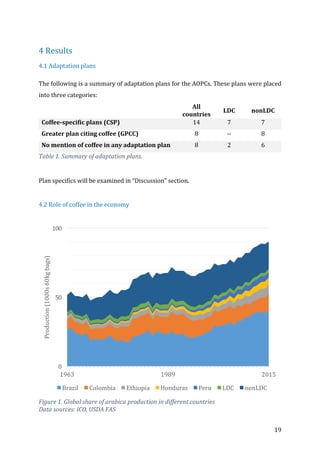
Figure	1.	Global	share	of	arabica	production	in	different	countries	
Data	sources:	ICO,	USDA	FAS	
0
50
100
1963 1989 2015
Production	(1000s	60kg	bags)
Brazil Colombia Ethiopia Honduras Peru LDC nonLDC
20	
On	a	global	scale,	the	long-term	coffee	production	and	consumption	trends	are	increasing	
at	 a	 fairly	 steady	 pace	 of	 2%	 a	 year	 (ICO	 2016).	 This	 consistent	 increase	 in	 coffee	
consumption	results	from	new	demand	in	developed	countries	as	well	as	newly	emerging	
demand	in	countries	from	the	developing	world.	Bunn	(2015,	p.150)	calculated	that	the	
“area	necessary	to	meet	future	coffee	demand	will	double	in	the	future.”	
	
4.2.1	Relative	importance	of	coffee	to	the	economy	
Coffee’s	 importance	 to	 a	 nation’s	 economy	 varies	 by	 country.	 The	 coffee	 sector’s	
contribution	to	national	welfare	can	be	measured	in	a	variety	of	ways,	such	as	the	number	
of	people	employed	or	the	total	production.	Moreover,	the	reach	of	the	coffee	sector	in	an	
economy	goes	beyond	those	who	farm	it.	For	instance,	in	Costa	Rica,	for	every	one	of	the	
50,000	 coffee	 farmers,	 there	 are	 seven	 more	 direct	 or	 indirect	 beneficiaries	 (Quirós	
2013).		
	
Some	of	the	top	arabica-producing	countries	in	the	world	also	happen	to	have	quite	large	
economies.	So	while	the	sector	might	affect	more	total	people	in	these	countries,	it	affects	
a	higher	proportion	of	the	population	in	smaller	economies	such	as	Burundi	and	Rwanda.	
Analysis	 of	 the	 data	 found	 that	 the	 majority	 of	 AOPCs	 exported	 over	 half	 of	 their	
production.	 One-third	 of	 the	 countries	 exported	 over	 90%.	 As	 this	 paper	 looks	 at	
national-level	adaptation	plans,	and	as	exports	can	be	viewed	as	a	country-level	source	
of	income,	this	analysis	chose	to	use	a	country’s	coffee	exports	as	a	percentage	of	its	total	
exports	as	the	parameter	to	control	for	population	and	economy	size	when	comparing	
countries.
21	
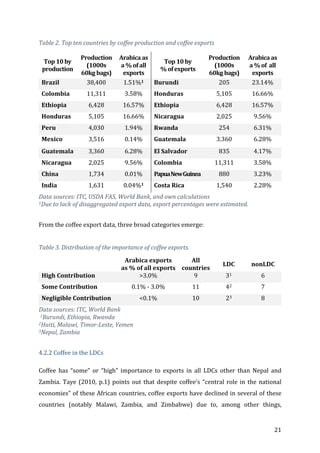
Table	2.	Top	ten	countries	by	coffee	production	and	coffee	exports	
Top	10	by	
production	
Production	
(1000s	
60kg	bags)	
Arabica	as	
a	%	of	all	
exports	
Top	10	by		
%	of	exports	
Production	
(1000s	
60kg	bags)	
Arabica	as	
a	%	of		all	
exports	
Brazil	 38,400	 1.51%1	 Burundi	 205	 23.14%	
Colombia	 11,311	 3.58%	 Honduras	 5,105	 16.66%	
Ethiopia	 6,428	 16.57%	 Ethiopia	 6,428	 16.57%	
Honduras	 5,105	 16.66%	 Nicaragua	 2,025	 9.56%	
Peru	 4,030	 1.94%	 Rwanda	 254	 6.31%	
Mexico	 3,516	 0.14%	 Guatemala	 3.360	 6.28%	
Guatemala	 3,360	 6.28%	 El	Salvador	 835	 4.17%	
Nicaragua	 2,025	 9.56%	 Colombia	 11,311	 3.58%	
China	 1,734	 0.01%	 Papua	New	Guinea	 880	 3.23%	
India	 1,631	 0.04%1	 Costa	Rica	 1,540	 2.28%	
Data	sources:	ITC,	USDA	FAS,	World	Bank,	and	own	calculations	
1Due	to	lack	of	disaggregated	export	data,	export	percentages	were	estimated.	
	
From	the	coffee	export	data,	three	broad	categories	emerge:		
	
Table	3.	Distribution	of	the	importance	of	coffee	exports.	
	 Arabica	exports	
as	%	of	all	exports	
All	
countries	
LDC	 nonLDC	
High	Contribution	 >3.0%	 9	 31	 6	
Some	Contribution	 0.1%	-	3.0%	 11	 42	 7	
Negligible	Contribution	 <0.1%	 10	 23	 8	
Data	sources:	ITC,	World	Bank	
	1Burundi,	Ethiopia,	Rwanda	
2Haiti,	Malawi,	Timor-Leste,	Yemen	
3Nepal,	Zambia	
	
4.2.2	Coffee	in	the	LDCs	
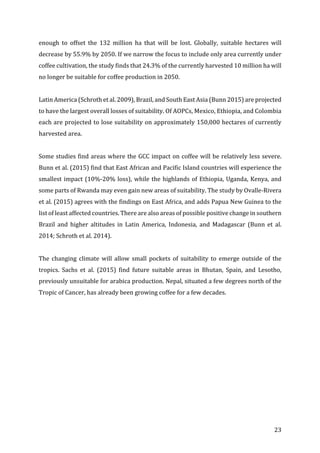
Coffee	 has	 “some”	 or	 “high”	 importance	 to	 exports	 in	 all	 LDCs	 other	 than	 Nepal	 and	
Zambia.	Taye	(2010,	p.1)	points	out	that	despite	coffee’s	“central	role	in	the	national	
economies”	of	these	African	countries,	coffee	exports	have	declined	in	several	of	these	
countries	 (notably	 Malawi,	 Zambia,	 and	 Zimbabwe)	 due	 to,	 among	 other	 things,
22	
deficiencies	in	policy	(particularly	as	it	relates	to	availability	of	financial	tools)	and	lack	
of	access	to	improved	technologies.	
	
	
Figure	2.	Exports	of	arabica	from	LDC	countries	
Data	source:	ICO	
	
4.3	Projected	areas	of	suitability	in	2050	
In	this	analysis,	suitability	refers	to	the	area	of	land	in	hectares	that	will	be	suitable	for	
growing	coffee	in	the	year	2050.	Models	by	Ovalle-Rivera	et	al.	(2015),	Bunn	et	al.	(2014),	
Sachs	 et	 al.	 (2015),	 and	 others	 show	 an	 array	 of	 regional	 loss	 projections.	 While	 the	
impact	of	GCC	is	difficult	to	assess	and	predict,	and	the	dynamic	nature	of	GCC	creates	
vastly	different	conclusions	among	studies,	almost	all	have	projected	aggregate	global	
loss	of	suitable	area	to	be	approximately	50%.	
	
The	results	from	Sachs	et	al.	(2015)	show	almost	across	the	board	decreases	in	suitable	
area	for	arabica	production.	Currently,	187.6	million	ha	of	land	are	suitable	for	arabica	
cultivation,	of	which	only	10	million	ha	are	currently	used	for	coffee	production.	While	
climate	change	will	open	up	over	27	million	ha	of	new	suitable	area,	these	gains	are	not	
0
2
4
1994 2001 2008 2015
Exports	(millions	60kg	bags)
Ethiopia
Timor-Leste
Zambia
Nepal
Malawi
Haiti
Zimbabwe
Yemen
Rwanda
Burundi
23	
enough	 to	 offset	 the	 132	 million	 ha	 that	 will	 be	 lost.	 Globally,	 suitable	 hectares	 will	
decrease	by	55.9%	by	2050.	If	we	narrow	the	focus	to	include	only	area	currently	under	
coffee	cultivation,	the	study	finds	that	24.3%	of	the	currently	harvested	10	million	ha	will	
no	longer	be	suitable	for	coffee	production	in	2050.		
	
Latin	America	(Schroth	et	al.	2009),	Brazil,	and	South	East	Asia	(Bunn	2015)	are	projected	
to	have	the	largest	overall	losses	of	suitability.	Of	AOPCs,	Mexico,	Ethiopia,	and	Colombia	
each	are	projected	to	lose	suitability	on	approximately	150,000	hectares	of	currently	
harvested	area.		
	
Some	studies	find	areas	where	the	GCC	impact	on	coffee	will	be	relatively	less	severe.	
Bunn	et	al.	(2015)	find	that	East	African	and	Pacific	Island	countries	will	experience	the	
smallest	impact	(10%-20%	loss),	while	the	highlands	of	Ethiopia,	Uganda,	Kenya,	and	
some	parts	of	Rwanda	may	even	gain	new	areas	of	suitability.	The	study	by	Ovalle-Rivera	
et	al.	(2015)	agrees	with	the	findings	on	East	Africa,	and	adds	Papua	New	Guinea	to	the	
list	of	least	affected	countries.	There	are	also	areas	of	possible	positive	change	in	southern	
Brazil	 and	 higher	 altitudes	 in	 Latin	 America,	 Indonesia,	 and	 Madagascar	 (Bunn	 et	 al.	
2014;	Schroth	et	al.	2014).	
	
The	 changing	 climate	 will	 allow	 small	 pockets	 of	 suitability	 to	 emerge	 outside	 of	 the	
tropics.	 Sachs	 et	 al.	 (2015)	 find	 future	 suitable	 areas	 in	 Bhutan,	 Spain,	 and	 Lesotho,	
previously	unsuitable	for	arabica	production.	Nepal,	situated	a	few	degrees	north	of	the	
Tropic	of	Cancer,	has	already	been	growing	coffee	for	a	few	decades.
24	
5	Discussion	
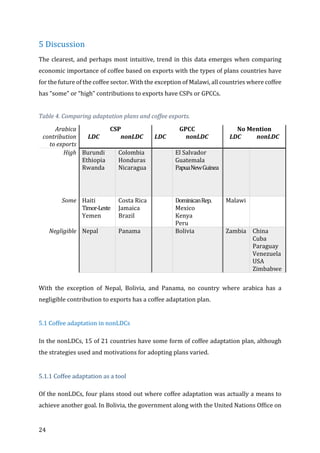
The	clearest,	and	perhaps	most	intuitive,	trend	in	this	data	emerges	when	comparing	
economic	importance	of	coffee	based	on	exports	with	the	types	of	plans	countries	have	
for	the	future	of	the	coffee	sector.	With	the	exception	of	Malawi,	all	countries	where	coffee	
has	“some”	or	“high”	contributions	to	exports	have	CSPs	or	GPCCs.	
	
Table	4.	Comparing	adaptation	plans	and	coffee	exports.	
Arabica	
contribution	
to	exports	
CSP	
LDC															nonLDC	
GPCC	
LDC														nonLDC	
No	Mention	
LDC											nonLDC	
High	 Burundi	
Ethiopia	
Rwanda	
Colombia	
Honduras	
Nicaragua	
	 El	Salvador	
Guatemala	
Papua	New	Guinea	
	 	
Some	 Haiti	
Timor-Leste	
Yemen	
Costa	Rica	
Jamaica		
Brazil	
	 Dominican	Rep.	
Mexico	
Kenya	
Peru	
Malawi	 	
Negligible	 Nepal	 Panama	 	 Bolivia	 Zambia	 China	
Cuba	
Paraguay	
Venezuela	
USA	
Zimbabwe	
	
With	 the	 exception	 of	 Nepal,	 Bolivia,	 and	 Panama,	 no	 country	 where	 arabica	 has	 a	
negligible	contribution	to	exports	has	a	coffee	adaptation	plan.		
	
5.1	Coffee	adaptation	in	nonLDCs	
In	the	nonLDCs,	15	of	21	countries	have	some	form	of	coffee	adaptation	plan,	although	
the	strategies	used	and	motivations	for	adopting	plans	varied.		
	
5.1.1	Coffee	adaptation	as	a	tool	
Of	the	nonLDCs,	four	plans	stood	out	where	coffee	adaptation	was	actually	a	means	to	
achieve	another	goal.	In	Bolivia,	the	government	along	with	the	United	Nations	Office	on
25	
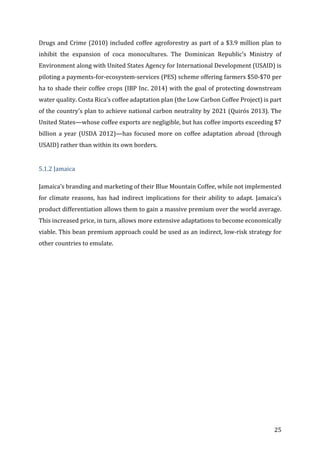
Drugs	and	Crime	(2010)	included	coffee	agroforestry	as	part	of	a	$3.9	million	plan	to	
inhibit	 the	 expansion	 of	 coca	 monocultures.	 The	 Dominican	 Republic’s	 Ministry	 of	
Environment	along	with	United	States	Agency	for	International	Development	(USAID)	is	
piloting	a	payments-for-ecosystem-services	(PES)	scheme	offering	farmers	$50-$70	per	
ha	to	shade	their	coffee	crops	(IBP	Inc.	2014)	with	the	goal	of	protecting	downstream	
water	quality.	Costa	Rica’s	coffee	adaptation	plan	(the	Low	Carbon	Coffee	Project)	is	part	
of	the	country’s	plan	to	achieve	national	carbon	neutrality	by	2021	(Quirós	2013).	The	
United	States—whose	coffee	exports	are	negligible,	but	has	coffee	imports	exceeding	$7	
billion	a	year	(USDA	2012)—has	focused	more	on	coffee	adaptation	abroad	(through	
USAID)	rather	than	within	its	own	borders.	
	
5.1.2	Jamaica	
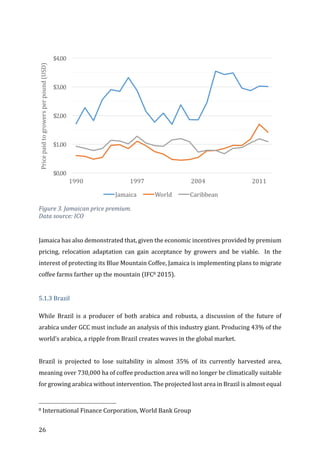
Jamaica’s	branding	and	marketing	of	their	Blue	Mountain	Coffee,	while	not	implemented	
for	 climate	 reasons,	 has	 had	 indirect	 implications	 for	 their	 ability	 to	 adapt.	 Jamaica’s	
product	differentiation	allows	them	to	gain	a	massive	premium	over	the	world	average.	
This	increased	price,	in	turn,	allows	more	extensive	adaptations	to	become	economically	
viable.	This	bean	premium	approach	could	be	used	as	an	indirect,	low-risk	strategy	for	
other	countries	to	emulate.
26	
	
	
Figure	3.	Jamaican	price	premium.	
Data	source:	ICO	
	
Jamaica	has	also	demonstrated	that,	given	the	economic	incentives	provided	by	premium	
pricing,	 relocation	 adaptation	 can	 gain	 acceptance	 by	 growers	 and	 be	 viable.	 	 In	 the	
interest	of	protecting	its	Blue	Mountain	Coffee,	Jamaica	is	implementing	plans	to	migrate	
coffee	farms	farther	up	the	mountain	(IFC8	2015).	
	
5.1.3	Brazil	
While	 Brazil	 is	 a	 producer	 of	 both	 arabica	 and	 robusta,	 a	 discussion	 of	 the	 future	 of	
arabica	under	GCC	must	include	an	analysis	of	this	industry	giant.	Producing	43%	of	the	
world’s	arabica,	a	ripple	from	Brazil	creates	waves	in	the	global	market.		
	
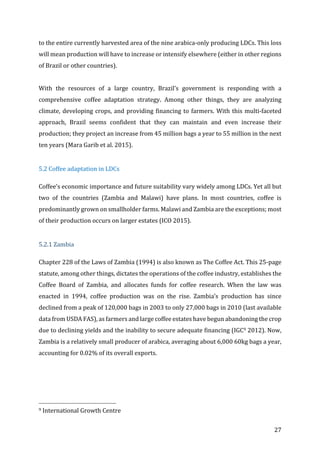
Brazil	 is	 projected	 to	 lose	 suitability	 in	 almost	 35%	 of	 its	 currently	 harvested	 area,	
meaning	over	730,000	ha	of	coffee	production	area	will	no	longer	be	climatically	suitable	
for	growing	arabica	without	intervention.	The	projected	lost	area	in	Brazil	is	almost	equal	
																																																								
8	International	Finance	Corporation,	World	Bank	Group	
$0.00
$1.00
$2.00
$3.00
$4.00
1990 1997 2004 2011
Price	paid	to	growers	per	pound	(USD)
Jamaica World Caribbean
27	
to	the	entire	currently	harvested	area	of	the	nine	arabica-only	producing	LDCs.	This	loss	
will	mean	production	will	have	to	increase	or	intensify	elsewhere	(either	in	other	regions	
of	Brazil	or	other	countries).		
	
With	 the	 resources	 of	 a	 large	 country,	 Brazil’s	 government	 is	 responding	 with	 a	
comprehensive	 coffee	 adaptation	 strategy.	 Among	 other	 things,	 they	 are	 analyzing	
climate,	developing	crops,	and	providing	financing	to	farmers.	With	this	multi-faceted	
approach,	 Brazil	 seems	 confident	 that	 they	 can	 maintain	 and	 even	 increase	 their	
production;	they	project	an	increase	from	45	million	bags	a	year	to	55	million	in	the	next	
ten	years	(Mara	Garib	et	al.	2015).	
		
5.2	Coffee	adaptation	in	LDCs	
Coffee’s	economic	importance	and	future	suitability	vary	widely	among	LDCs.	Yet	all	but	
two	 of	 the	 countries	 (Zambia	 and	 Malawi)	 have	 plans.	 In	 most	 countries,	 coffee	 is	
predominantly	grown	on	smallholder	farms.	Malawi	and	Zambia	are	the	exceptions;	most	
of	their	production	occurs	on	larger	estates	(ICO	2015).			
	 	
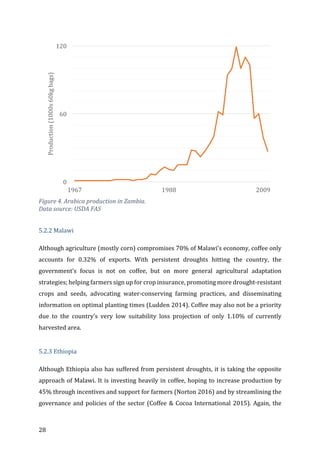
5.2.1	Zambia	
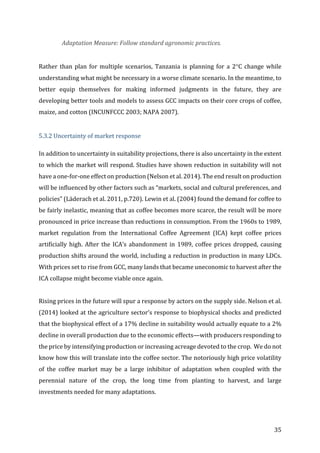
Chapter	228	of	the	Laws	of	Zambia	(1994)	is	also	known	as	The	Coffee	Act.	This	25-page	
statute,	among	other	things,	dictates	the	operations	of	the	coffee	industry,	establishes	the	
Coffee	 Board	 of	 Zambia,	 and	 allocates	 funds	 for	 coffee	 research.	 When	 the	 law	 was	
enacted	 in	 1994,	 coffee	 production	 was	 on	 the	 rise.	 Zambia’s	 production	 has	 since	
declined	from	a	peak	of	120,000	bags	in	2003	to	only	27,000	bags	in	2010	(last	available	
data	from	USDA	FAS),	as	farmers	and	large	coffee	estates	have	begun	abandoning	the	crop	
due	to	declining	yields	and	the	inability	to	secure	adequate	financing	(IGC9	2012).	Now,	
Zambia	is	a	relatively	small	producer	of	arabica,	averaging	about	6,000	60kg	bags	a	year,	
accounting	for	0.02%	of	its	overall	exports.		
	
																																																								
9	International	Growth	Centre
28	
	
Figure	4.	Arabica	production	in	Zambia.	
Data	source:	USDA	FAS	
	
5.2.2	Malawi	
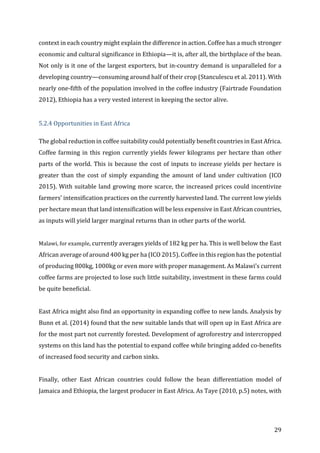
Although	agriculture	(mostly	corn)	compromises	70%	of	Malawi’s	economy,	coffee	only	
accounts	 for	 0.32%	 of	 exports.	 With	 persistent	 droughts	 hitting	 the	 country,	 the	
government’s	 focus	 is	 not	 on	 coffee,	 but	 on	 more	 general	 agricultural	 adaptation	
strategies;	helping	farmers	sign	up	for	crop	insurance,	promoting	more	drought-resistant	
crops	 and	 seeds,	 advocating	 water-conserving	 farming	 practices,	 and	 disseminating	
information	on	optimal	planting	times	(Ludden	2014).	Coffee	may	also	not	be	a	priority	
due	 to	 the	 country’s	 very	 low	 suitability	 loss	 projection	 of	 only	 1.10%	 of	 currently	
harvested	area.	
	
5.2.3	Ethiopia	
Although	Ethiopia	also	has	suffered	from	persistent	droughts,	it	is	taking	the	opposite	
approach	of	Malawi.	It	is	investing	heavily	in	coffee,	hoping	to	increase	production	by	
45%	through	incentives	and	support	for	farmers	(Norton	2016)	and	by	streamlining	the	
governance	and	policies	of	the	sector	(Coffee	&	Cocoa	International	2015).	Again,	the	
0
60
120
1967 1988 2009
Production	(1000s	60kg	bags)
29	
context	in	each	country	might	explain	the	difference	in	action.	Coffee	has	a	much	stronger	
economic	and	cultural	significance	in	Ethiopia—it	is,	after	all,	the	birthplace	of	the	bean.	
Not	only	is	it	one	of	the	largest	exporters,	but	in-country	demand	is	unparalleled	for	a	
developing	country—consuming	around	half	of	their	crop	(Stanculescu	et	al.	2011).	With	
nearly	one-fifth	of	the	population	involved	in	the	coffee	industry	(Fairtrade	Foundation	
2012),	Ethiopia	has	a	very	vested	interest	in	keeping	the	sector	alive.		
	
5.2.4	Opportunities	in	East	Africa	
The	global	reduction	in	coffee	suitability	could	potentially	benefit	countries	in	East	Africa.	
Coffee	farming	in	this	region	currently	yields	fewer	kilograms	per	hectare	than	other	
parts	of	the	world.	This	is	because	the	cost	of	inputs	to	increase	yields	per	hectare	is	
greater	 than	 the	 cost	 of	 simply	 expanding	 the	 amount	 of	 land	 under	 cultivation	 (ICO	
2015).	With	suitable	land	growing	more	scarce,	the	increased	prices	could	incentivize	
farmers’	intensification	practices	on	the	currently	harvested	land.	The	current	low	yields	
per	hectare	mean	that	land	intensification	will	be	less	expensive	in	East	African	countries,	
as	inputs	will	yield	larger	marginal	returns	than	in	other	parts	of	the	world.		
	
Malawi,	for	example,	currently	averages	yields	of	182	kg	per	ha.	This	is	well	below	the	East	
African	average	of	around	400	kg	per	ha	(ICO	2015).	Coffee	in	this	region	has	the	potential	
of	producing	800kg,	1000kg	or	even	more	with	proper	management.	As	Malawi’s	current	
coffee	farms	are	projected	to	lose	such	little	suitability,	investment	in	these	farms	could	
be	quite	beneficial.		
	
East	Africa	might	also	find	an	opportunity	in	expanding	coffee	to	new	lands.	Analysis	by	
Bunn	et	al.	(2014)	found	that	the	new	suitable	lands	that	will	open	up	in	East	Africa	are	
for	the	most	part	not	currently	forested.	Development	of	agroforestry	and	intercropped	
systems	on	this	land	has	the	potential	to	expand	coffee	while	bringing	added	co-benefits	
of	increased	food	security	and	carbon	sinks.		
	
Finally,	 other	 East	 African	 countries	 could	 follow	 the	 bean	 differentiation	 model	 of	
Jamaica	and	Ethiopia,	the	largest	producer	in	East	Africa.	As	Taye	(2010,	p.5)	notes,	with
30	
proper	funding,	these	countries	can	“excel	at	the	sustainable	supply	of	superior	quality	
coffees	to	global	customers.”		
	
5.2.4.1	Burundi	
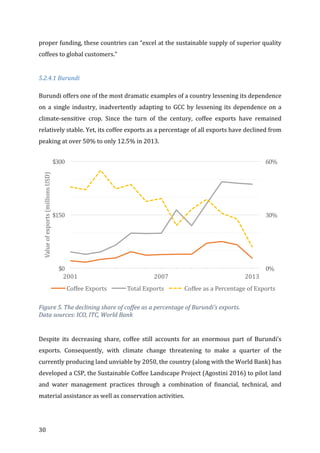
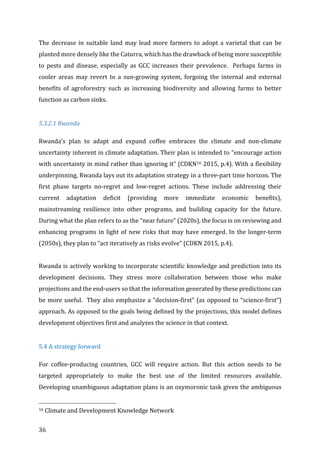
Burundi	offers	one	of	the	most	dramatic	examples	of	a	country	lessening	its	dependence	
on	a	single	industry,	inadvertently	adapting	to	GCC	by	lessening	its	dependence	on	a	
climate-sensitive	 crop.	 Since	 the	 turn	 of	 the	 century,	 coffee	 exports	 have	 remained	
relatively	stable.	Yet,	its	coffee	exports	as	a	percentage	of	all	exports	have	declined	from	
peaking	at	over	50%	to	only	12.5%	in	2013.		
	
Figure	5.	The	declining	share	of	coffee	as	a	percentage	of	Burundi’s	exports.
Data	sources:	ICO,	ITC,	World	Bank	
	
Despite	 its	 decreasing	 share,	 coffee	 still	 accounts	 for	 an	 enormous	 part	 of	 Burundi’s	
exports.	 Consequently,	 with	 climate	 change	 threatening	 to	 make	 a	 quarter	 of	 the	
currently	producing	land	unviable	by	2050,	the	country	(along	with	the	World	Bank)	has	
developed	a	CSP,	the	Sustainable	Coffee	Landscape	Project	(Agostini	2016)	to	pilot	land	
and	 water	 management	 practices	 through	 a	 combination	 of	 financial,	 technical,	 and	
material	assistance	as	well	as	conservation	activities.		
	
0%	
30%	
60%	
$0
$150
$300
2001 2007 2013
Value	of	exports	(millions	USD)
Coffee	Exports Total	Exports Coffee	as	a	Percentage	of	Exports
31	
5.2.5	Opportunities	outside	of	the	tropics	
While	latitudinal	shifts	in	suitability	are	limited	due	to	coffee’s	temperamental	needs,	
there	 are	 a	 few	 pockets	 that	 might	 become	 suitable	 in	 the	 future,	 including	 Bhutan,	
Lesotho,	and	Florida,	United	States.	Suitable	land	has	already	emerged	in	Nepal,	and	the	
government	now	views	coffee	cultivation	as	a	viable	economic	engine.		
	
5.2.5.1	Nepal	
Nepal,	located	a	few	degrees	north	of	the	Tropic	of	Cancer,	is	an	interesting	case	of	an	
area	that	is	new	to	production,	having	received	its	first	seeds	from	Myanmar	in	the	1970s	
(NTCDB10	 2015).	 While	 production	 was	 attempted	 in	 the	 subsequent	 decades,	 the	
practice	was	abandoned	by	many.	From	the	FNCCI/AEC11	(2006,	p.3):		
The	major	complaints	for	this	were,		
• Lack	of	technical	know-how	on	coffee	farming.		
• Severe	attack	by	stem	borer	and	failure	to	control	it.		
• Lack	of	price	information,	adequate	marketing	system	and	
institutional	infrastructures.		
	
Recognizing	 coffee’s	 “high	 potential	 to	 export	 and	 earn	 foreign	 currency”	 and	
“[contribution]	to	the	improvement	of	rural	livelihoods”	(MoAD12	&	NTCDB	2014,	pp.2–
6),	the	government	has	worked	to	increase	coffee	production	in	the	country	with	the	
formation	 of	 the	 National	 Tea	 and	 Coffee	 Development	 Board	 (NTCDB)	 in	 1993,	
partnering	with	the	private	sector	and	NGOs	in	2006	on	the	Coffee	Promotion	Program,	
and	in	2014	undertaking	a	meticulous	country-wide	study	of	current	and	potential	new	
areas	for	farms	(MoAD	&	NTCDB	2014).		
	
Optimistically,	the	government	is	working	to	address	the	barriers	to	adaptation	cited	by	
farmers,	by	providing	them	with	technical	and	financial	assistance,	and	promoting	win-
win	adaptations	like	banana-coffee	intercropping	(Ranjitkar	et	al.	2015).	While	the	Coffee	
Database	in	Nepal	presents	detailed	maps	of	potential	areas	for	new	coffee	plantations,	
the	 report	 acknowledges	 that	 these	 are	 based	 only	 on	 two	 factors	 (altitude	 and	
																																																								
10	National	Tea	and	Coffee	Development	Board	
11	Federation	of	Nepalese	Chambers	of	Commerce	and	Industry	Agro	Enterprise	Center	
12	Government	of	Nepal	Ministry	of	Agricultural	Development
32	
availability	of	the	land)	and	ignore	other	variables	(soil,	rainfall,	temperature,	and	access	
to	infrastructure)	that	are	required	for	viable	plantations.	
	
5.3	Uncertainty	
In	assessing	and	projecting	GCC,	uncertainty	is	a	hovering	specter,	lurking	in	both	the	
suitability	projections	and	in	the	market	response	to	changing	conditions.		
	
5.3.1	Uncertainty	of	the	projections	
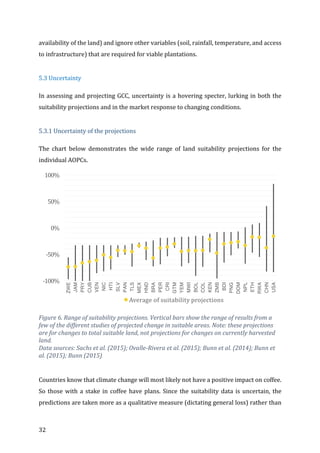
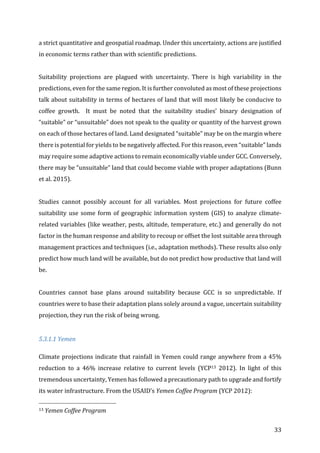
The	 chart	 below	 demonstrates	 the	 wide	 range	 of	 land	 suitability	 projections	 for	 the	
individual	AOPCs.		
	
Figure	6.	Range	of	suitability	projections.	Vertical	bars	show	the	range	of	results	from	a	
few	of	the	different	studies	of	projected	change	in	suitable	areas.	Note:	these	projections	
are	for	changes	to	total	suitable	land,	not	projections	for	changes	on	currently	harvested	
land.		
Data	sources:	Sachs	et	al.	(2015);	Ovalle-Rivera	et	al.	(2015);	Bunn	et	al.	(2014);	Bunn	et	
al.	(2015);	Bunn	(2015)	
	
Countries	know	that	climate	change	will	most	likely	not	have	a	positive	impact	on	coffee.	
So	those	with	a	stake	in	coffee	have	plans.	Since	the	suitability	data	is	uncertain,	the	
predictions	are	taken	more	as	a	qualitative	measure	(dictating	general	loss)	rather	than	
-100%	
-50%	
0%	
50%	
100%	
ZWE
JAM
PRY
CUB
VEN
NIC
HTI
SLV
PAN
TLS
MEX
HND
BRA
PER
CRI
GTM
YEM
MWI
BOL
COL
KEN
ZMB
BDI
PNG
DOM
NPL
ETH
RWA
CHN
USA
Average	of	suitability	projections
33	
a	strict	quantitative	and	geospatial	roadmap.	Under	this	uncertainty,	actions	are	justified	
in	economic	terms	rather	than	with	scientific	predictions.	
	
Suitability	 projections	 are	 plagued	 with	 uncertainty.	 There	 is	 high	 variability	 in	 the	
predictions,	even	for	the	same	region.	It	is	further	convoluted	as	most	of	these	projections	
talk	about	suitability	in	terms	of	hectares	of	land	that	will	most	likely	be	conducive	to	
coffee	 growth.	 	 It	 must	 be	 noted	 that	 the	 suitability	 studies’	 binary	 designation	 of	
“suitable”	or	“unsuitable”	does	not	speak	to	the	quality	or	quantity	of	the	harvest	grown	
on	each	of	those	hectares	of	land.	Land	designated	“suitable”	may	be	on	the	margin	where	
there	is	potential	for	yields	to	be	negatively	affected.	For	this	reason,	even	“suitable”	lands	
may	require	some	adaptive	actions	to	remain	economically	viable	under	GCC.	Conversely,	
there	may	be	“unsuitable”	land	that	could	become	viable	with	proper	adaptations	(Bunn	
et	al.	2015).	
	
Studies	 cannot	 possibly	 account	 for	 all	 variables.	 Most	 projections	 for	 future	 coffee	
suitability	use	some	form	of	geographic	information	system	(GIS)	to	analyze	climate-
related	variables	(like	weather,	pests,	altitude,	temperature,	etc.)	and	generally	do	not	
factor	in	the	human	response	and	ability	to	recoup	or	offset	the	lost	suitable	area	through	
management	practices	and	techniques	(i.e.,	adaptation	methods).	These	results	also	only	
predict	how	much	land	will	be	available,	but	do	not	predict	how	productive	that	land	will	
be.		
	
Countries	 cannot	 base	 plans	 around	 suitability	 because	 GCC	 is	 so	 unpredictable.	 If	
countries	were	to	base	their	adaptation	plans	solely	around	a	vague,	uncertain	suitability	
projection,	they	run	the	risk	of	being	wrong.		
	
5.3.1.1	Yemen	
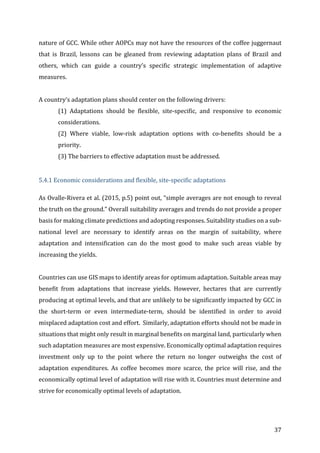
Climate	projections	indicate	that	rainfall	in	Yemen	could	range	anywhere	from	a	45%	
reduction	 to	 a	 46%	 increase	 relative	 to	 current	 levels	 (YCP13	 2012).	 In	 light	 of	 this	
tremendous	uncertainty,	Yemen	has	followed	a	precautionary	path	to	upgrade	and	fortify	
its	water	infrastructure.	From	the	USAID’s	Yemen	Coffee	Program	(YCP	2012):	
																																																								
13	Yemen	Coffee	Program
34	
The	overall	production	potential	is	limited	primarily	by	lack	of	regular	
water	 supply	 and	 secondarily	 by	 poor	 cultivation	 and	 resource	
management	 practices.	 Yet,	 there	 is	 certainly	 room	 for	 a	 significant	
increase	in	production	volumes.	However,	any	increases	will	have	to	come	
from	 more	 intensive	 and—	 importantly—more	 resource-efficient	
methods	and	not	from	using	more	water	or	more	land.	
	
Yemen’s	five-year	agricultural	plan	lays	out	specific	strategies	and	allocates	funding	for	
coffee	 plantation	 development	 (via	 improving	 production	 methods	 and	 marketing	
efficiency),	climate	change	awareness,	and	government	pilot	projects	on	coffee	disease	
and	pest-control	(Giovannucci	2005;	YCP	2012).	Yemen	adopted	this	approach	in	hopes	
of	doubling	coffee	production	in	five	years,	and	plans	to	continue	production	regardless	
of	climate	outcomes	(Al-Arashi	2013).	
	
5.3.1.2	Tanzania	
Tanzania	produces	both	arabica	and	robusta	coffee	and	was	therefore	omitted	from	the	
greater	analysis	in	this	paper.	However,	its	course	of	action	regarding	coffee	adaptation	
under	 known	 uncertainty	 provides	 a	 contrast	 to	 the	 path	 taken	 by	 Yemen.	 Coffee	 is	
Tanzania’s	 most	 important	 export	 crop	 (Borsy	 &	 Techel	 2015).	 While	 studies	 have	
projected	decreases	of	25%	(Bunn	et	al.	2014)	and	22%	(Sachs	et	al.	2015)	in	suitable	
area,	the	Tanzanian	government	expects	that	as	long	as	climate	change	stays	within	2°C14,	
the	resulting	increases	in	rainfall	will	increase	coffee	yields	by	17%	(NAPA15	2007).	While	
the	 official	 communications	 acknowledge	 that	 (quite	 possible)	 warming	 above	 2°C	
change	would	require	irrigation,	water	conservation	practices,	and	the	development	of	
drought	 and	 disease	 resistant	 coffee	 to	 avoid	 significant	 losses,	 the	 government	 is	
charting	 a	 path	 using	 the	 more	 optimistic	 scenario.	 From	 their	 Initial	 National	
Communication	under	the	United	Nations	Framework	Convention	on	Climate	Change	
(INCUNFCCC)	(2003,	p.47):	
Vulnerability:	 […]	 	 Simple	 linear	 regression	 models	 showed	 that	 coffee	
production	yields	are	likely	to	increase	as	long	as	standard	agronomic	
practices	are	followed.	
																																																								
14	Above	pre-industrial	levels	
15	The	United	Republic	of	Tanzania’s	Naptional	Adaptation	Programme	of	Action
35	
Adaptation	Measure:	Follow	standard	agronomic	practices.	
	
Rather	than	plan	for	multiple	scenarios,	Tanzania	is	planning	for	a	2°C	change	while	
understanding	what	might	be	necessary	in	a	worse	climate	scenario.	In	the	meantime,	to	
better	 equip	 themselves	 for	 making	 informed	 judgments	 in	 the	 future,	 they	 are	
developing	better	tools	and	models	to	assess	GCC	impacts	on	their	core	crops	of	coffee,	
maize,	and	cotton	(INCUNFCCC	2003;	NAPA	2007).		
	
5.3.2	Uncertainty	of	market	response	
In	addition	to	uncertainty	in	suitability	projections,	there	is	also	uncertainty	in	the	extent	
to	which	the	market	will	respond.	Studies	have	shown	reduction	in	suitability	will	not	
have	a	one-for-one	effect	on	production	(Nelson	et	al.	2014).	The	end	result	on	production	
will	be	influenced	by	other	factors	such	as	“markets,	social	and	cultural	preferences,	and	
policies”	(Läderach	et	al.	2011,	p.720).	Lewin	et	al.	(2004)	found	the	demand	for	coffee	to	
be	fairly	inelastic,	meaning	that	as	coffee	becomes	more	scarce,	the	result	will	be	more	
pronounced	in	price	increase	than	reductions	in	consumption.	From	the	1960s	to	1989,	
market	 regulation	 from	 the	 International	 Coffee	 Agreement	 (ICA)	 kept	 coffee	 prices	
artificially	high.	After	the	ICA’s	abandonment	in	1989,	coffee	prices	dropped,	causing	
production	shifts	around	the	world,	including	a	reduction	in	production	in	many	LDCs.	
With	prices	set	to	rise	from	GCC,	many	lands	that	became	uneconomic	to	harvest	after	the	
ICA	collapse	might	become	viable	once	again.		
	
Rising	prices	in	the	future	will	spur	a	response	by	actors	on	the	supply	side.	Nelson	et	al.	
(2014)	looked	at	the	agriculture	sector’s	response	to	biophysical	shocks	and	predicted	
that	the	biophysical	effect	of	a	17%	decline	in	suitability	would	actually	equate	to	a	2%	
decline	in	overall	production	due	to	the	economic	effects—with	producers	responding	to	
the	price	by	intensifying	production	or	increasing	acreage	devoted	to	the	crop.		We	do	not	
know	how	this	will	translate	into	the	coffee	sector.	The	notoriously	high	price	volatility	
of	 the	 coffee	 market	 may	 be	 a	 large	 inhibitor	 of	 adaptation	 when	 coupled	 with	 the	
perennial	 nature	 of	 the	 crop,	 the	 long	 time	 from	 planting	 to	 harvest,	 and	 large	
investments	needed	for	many	adaptations.
36	
The	decrease	in	suitable	land	may	lead	more	farmers	to	adopt	a	varietal	that	can	be	
planted	more	densely	like	the	Caturra,	which	has	the	drawback	of	being	more	susceptible	
to	 pests	 and	 disease,	 especially	 as	 GCC	 increases	 their	 prevalence.	 	 Perhaps	 farms	 in	
cooler	 areas	 may	 revert	 to	 a	 sun-growing	 system,	 forgoing	 the	 internal	 and	 external	
benefits	 of	 agroforestry	 such	 as	 increasing	 biodiversity	 and	 allowing	 farms	 to	 better	
function	as	carbon	sinks.	
	
5.3.2.1	Rwanda	
Rwanda’s	 plan	 to	 adapt	 and	 expand	 coffee	 embraces	 the	 climate	 and	 non-climate	
uncertainty	inherent	in	climate	adaptation.	Their	plan	is	intended	to	“encourage	action	
with	uncertainty	in	mind	rather	than	ignoring	it”	(CDKN16	2015,	p.4).	With	a	flexibility	
underpinning,	Rwanda	lays	out	its	adaptation	strategy	in	a	three-part	time	horizon.	The	
first	 phase	 targets	 no-regret	 and	 low-regret	 actions.	 These	 include	 addressing	 their	
current	 adaptation	 deficit	 (providing	 more	 immediate	 economic	 benefits),	
mainstreaming	 resilience	 into	 other	 programs,	 and	 building	 capacity	 for	 the	 future.	
During	what	the	plan	refers	to	as	the	“near	future”	(2020s),	the	focus	is	on	reviewing	and	
enhancing	programs	in	light	of	new	risks	that	may	have	emerged.	In	the	longer-term	
(2050s),	they	plan	to	“act	iteratively	as	risks	evolve”	(CDKN	2015,	p.4).	
	
Rwanda	is	actively	working	to	incorporate	scientific	knowledge	and	prediction	into	its	
development	 decisions.	 They	 stress	 more	 collaboration	 between	 those	 who	 make	
projections	and	the	end-users	so	that	the	information	generated	by	these	predictions	can	
be	more	useful.		They	also	emphasize	a	“decision-first”	(as	opposed	to	“science-first”)	
approach.	As	opposed	to	the	goals	being	defined	by	the	projections,	this	model	defines	
development	objectives	first	and	analyzes	the	science	in	that	context.	
	
5.4	A	strategy	forward	
For	 coffee-producing	 countries,	 GCC	 will	 require	 action.	 But	 this	 action	 needs	 to	 be	
targeted	 appropriately	 to	 make	 the	 best	 use	 of	 the	 limited	 resources	 available.	
Developing	unambiguous	adaptation	plans	is	an	oxymoronic	task	given	the	ambiguous	
																																																								
16	Climate	and	Development	Knowledge	Network
37	
nature	of	GCC.	While	other	AOPCs	may	not	have	the	resources	of	the	coffee	juggernaut	
that	 is	 Brazil,	 lessons	 can	 be	 gleaned	 from	 reviewing	 adaptation	 plans	 of	 Brazil	 and	
others,	 which	 can	 guide	 a	 country’s	 specific	 strategic	 implementation	 of	 adaptive	
measures.		
	
A	country’s	adaptation	plans	should	center	on	the	following	drivers:	
(1)	 Adaptations	 should	 be	 flexible,	 site-specific,	 and	 responsive	 to	 economic	
considerations.		
(2)	 Where	 viable,	 low-risk	 adaptation	 options	 with	 co-benefits	 should	 be	 a	
priority.	
(3)	The	barriers	to	effective	adaptation	must	be	addressed.	
	
5.4.1	Economic	considerations	and	flexible,	site-specific	adaptations	
As	Ovalle-Rivera	et	al.	(2015,	p.5)	point	out,	“simple	averages	are	not	enough	to	reveal	
the	truth	on	the	ground.”	Overall	suitability	averages	and	trends	do	not	provide	a	proper	
basis	for	making	climate	predictions	and	adopting	responses.	Suitability	studies	on	a	sub-
national	 level	 are	 necessary	 to	 identify	 areas	 on	 the	 margin	 of	 suitability,	 where	
adaptation	 and	 intensification	 can	 do	 the	 most	 good	 to	 make	 such	 areas	 viable	 by	
increasing	the	yields.	
	
Countries	can	use	GIS	maps	to	identify	areas	for	optimum	adaptation.	Suitable	areas	may	
benefit	 from	 adaptations	 that	 increase	 yields.	 However,	 hectares	 that	 are	 currently	
producing	at	optimal	levels,	and	that	are	unlikely	to	be	significantly	impacted	by	GCC	in	
the	 short-term	 or	 even	 intermediate-term,	 should	 be	 identified	 in	 order	 to	 avoid	
misplaced	adaptation	cost	and	effort.		Similarly,	adaptation	efforts	should	not	be	made	in	
situations	that	might	only	result	in	marginal	benefits	on	marginal	land,	particularly	when	
such	adaptation	measures	are	most	expensive.	Economically	optimal	adaptation	requires	
investment	 only	 up	 to	 the	 point	 where	 the	 return	 no	 longer	 outweighs	 the	 cost	 of	
adaptation	 expenditures.	 As	 coffee	 becomes	 more	 scarce,	 the	 price	 will	 rise,	 and	 the	
economically	optimal	level	of	adaptation	will	rise	with	it.	Countries	must	determine	and	
strive	for	economically	optimal	levels	of	adaptation.
38	
An	 analysis	 of	 coffee	 in	 Haiti	 by	 the	 Centro	 Internacional	 de	 Agricultura	 Tropical	
acknowledges	the	site-specific	nature	of	coffee	adaptation.	From	Eitzinger	et	al.	(2013,	
p.34):	
Areas	that	will	increase	in	suitability	need	strategic	investment.	Areas	that	
will	 lose	 some	 suitability	 are	 likely	 to	 be	 maintained	 through	 targeted	
strategies	 such	 as	 irrigation,	 shade	 management	 and	 change	 to	 more	
drought	resistant	varieties.	Areas	that	are	likely	to	suffer	from	significant	
decrease	 in	 suitability	 need	 to	 start	 diversifying	 in	 order	 to	 switch	 to	
different	crops,	such	as	cocoa,	once	coffee	is	not	suitable	any	more.		
	
5.4.2	Low-risk,	no-regret	adaptations	
Adaptive	actions	should	focus	on	measures	that	can	benefit	farmers	regardless	of	the	
level	of	future	climate	changes.	These	low-risk,	no-regret	strategies	are	preferable	for	
countries	with	limited	resources	that	cannot	afford,	or	are	unwilling,	to	guard	against	a	
risk	that	might	never	happen.	The	experience	of	Jamaica’s	Blue	Mountain	Coffee	brand	
(see	5.1.2)	showcases	the	rewards	of	a	low-risk,	no-regret	adaptation.				
	
Similarly,	some	certification	schemes	(Rainforest	Alliance,	Bird	Friendly,	Organic,	etc.)	
have	requirements	that	parallel	many	adaptation	strategies:	shade	cover,	water	and	soil	
conservation,	and	pest	management.	Certification	of	farms	could	have	a	double	benefit	of	
allowing	farmers	to	command	higher	prices	for	their	yields,	while	buffering	against	the	
harms	 of	 increasing	 temperatures.	 Shade	 trees,	 agroforestry,	 and	 intercropping	 have	
been	dubbed	“triple	wins”	(Watkiss	unpub.,	p.6)	due	to	their	positive	implications	on	food	
security,	carbon	uptake,	and	GCC	adaptation.	Government	assistance	in	overcoming	the	
financial	costs	of	certification	can	help	farmers	gain	resources	they	could	use	for	further	
adaptation.				
	
5.4.3	Addressing	barriers	
For	effective	national-level	adaptation	plans,	awareness	of	the	constraints	of	the	targeted	
population	 of	 farmers	 is	 key.	 Any	 program	 needs	 to	 have	 proper	 monitoring	 and	
evaluation	tools	built	into	the	design.	The	benefits	of	this	are	two-fold.	First,	it	allows	for	
better	 program	 design	 in	 the	 future.	 Second,	 it	 reduces	 uncertainty	 for	 farmers.
39	
Information	on	the	effectiveness	and	real	costs	of	various	adaptation	instruments	allows	
farmers	to	better	assess	the	fit	for	their	farms.		
	
Smallholder	 farmers	 could	 also	 benefit	 from	 better	 access	 to	 financing	 to	 enable	
investment	 in	 adaptation.	 This	 may	 require	 guidance	 and	 incentives	 for	 financial	
institutions	to	provide	adaptation	lending	and	crop	insurance	for	coffee,	as	Kenya	did	
with	the	establishment	of	its	Coffee	Development	Fund	in	2006	(ICO	2015).	Additionally,	
education	of	farmers	on	financial	tools	available	to	them	could	increase	the	effectiveness	
of	these	resources.	Finally,	the	existence	of	a	program	does	little	without	awareness	by	
the	targeted	population.	Dissemination	of	information	to	stakeholders	is	key	to	turning	
programs	into	production.		
	
Governments	 of	 LDCs	 and	 developing	 countries	 often	 face	 hurdles	 of	 instability,	
corruption,	extremely	limited	resources,	and	the	presence	of	trumping	issues	(like	famine	
or	war).	However,	addressing	the	institutional	constraints	to	enacting	effective	policies	
merits	extensive	study	in	its	own	right.	Acting	with	these	limits	in	mind,	a	government’s	
dominant	strategy	may	be	to	provide	a	guiding	role	in	partnerships	with	MNCCs,	NGOs,	
and	researchers	operating	in	the	coffee	sector	in	their	country.	For	instance,	a	recently-
completed	$500	million	bond	offering	by	Starbucks	for	farmer	welfare	and	mitigating	the	
effects	of	GCC	on	coffee	crops	(Chasan	2016)	could	be	a	welcomed	infusion	of	resources	
for	 governments	 with	 those	 same	 goals.	 Through	 these	 public-private	 partnerships,	
governments	can	take	advantage	of	the	technical	and	financial	resources	of	these	non-
state	actors,	while	managing	activities	to	avoid	redundant	or	unproductive	work.
40	
6	Conclusion	
When	comparing	economic	and	scientific	data	to	the	response	of	governments	related	to	
adaptation	plans	for	Coffea	arabica,	this	study	found:	
(1)	There	was	very	little	correlation	between	the	projected	future	suitability	of	
coffee	growing	and	the	existence	of	adaptation	plans.		
(2)	Countries	in	which	coffee	made	up	over	0.3%	of	exports	were	more	likely	to	
have	plans	for	coffee	adaptation,	or	to	cite	coffee	specifically	in	an	overall	climate	
plan.			
(3)	Countries	in	which	coffee	contributed	insignificantly	to	exports	were	less	likely	
to	have	coffee	adaptation	plans,	or	mention	coffee	in	a	greater	adaptation	plan.		
	
Additionally,	 it	 was	 found	 that	 suitability	 projections	 vary	 widely	 based	 on	 the	
methodology	 of	 the	 study.	 Observations	 on	 global	 and	 country-level	 trends	 in	 coffee	
suitability	miss	the	critical	details	at	the	sub-national	level	that	are	essential	to	making	
informed	 adaptation	 decisions.	 The	 benefits	 of	 some	 adaptations	 strategies	 are	 also	
uncertain.	These	uncertainties	can	deter	the	implementation	of	adaptation	measures;	
governments	are	reluctant	to	allocate	limited	resources	to	programs	that	may	or	may	not	
be	needed	or	that	may	or	may	not	succeed.	Economic	rationale,	rather	than	science-based	
suitability	trends,	provides	a	less	ambiguous	basis	for	allocating	resources	to	adaptation	
needs.		
	
One	 promising	 take-away	 is	 that	 many	 of	 these	 governments,	 located	 mostly	 in	
developing	countries	and	LDCs,	are	responding	despite	the	lack	of	an	unambiguous	path	
or	 a	 clear	 light	 to	 find	 one.	 Adaptation	 plans	 are	 being	 developed	 under	 economic	
rationale	in	an	attempt	to	protect	the	many	smallholder	farmers	who	depend	on	this	crop	
for	their	livelihoods.	Some	countries	have	even	found	ways	to	use	this	bean	to	promote	
other	goals,	such	as	water	quality	and	GCC	mitigation	goals.		
	
In	future	studies,	it	would	be	interesting	to	see	how	the	presence	of	non-state	actors,	such	
as	 local	 coffee	 cooperatives,	 MNCCs,	 NGOs,	 and	 universities	 can	 affect	 or	 influence	
national	 governments	 in	 adaptation	 planning	 (whether	 by	 reducing,	 increasing	 or	
somehow	 changing	 their	 courses	 of	 action).	 It	 would	 also	 be	 interesting	 so	 see	 what
41	
actions	 are	 being	 taken	 by	 countries	 that	 produce	 both	 arabica	 and	 robusta.	 Finally,	
although	the	existence	of	an	adaptation	plan	is	of	utmost	importance,	it	is	only	a	first	step	
toward	climate	resilience.	Future	studies	should	look	at	the	impact	of	different	plans	on	
the	uptake	by	farmers	and	ultimately	the	production	in	the	country.	This	can	help	policy-
makers	understand	what	types	of	national	plans	translate	into	optimum	results	for	their	
country.	
	
Rising	demand	coupled	with	decreased	global	suitability	for	coffee	means	that	countries	
that	can	adapt	and	continue	to	grow	arabica	will	see	higher	prices	for	every	bag	they	
export.	To	take	advantage	of	this	opportunity,	countries	must	create	national	adaptation	
plans	that	can	facilitate	economically	viable	adaptation	by	providing	institutional	support	
that	can	reduce	barriers	to	adaptation.		
	
Ultimately,	economic	forces	will	influence	adaptive	actions.	Countries	that	see	the	need,	
and	 have	 the	 will,	 to	 formulate	 and	 implement	 adaptation	 plans	 will	 do	 so.	 These	
countries	 and	 their	 growers	 will	 have	 a	 better	 opportunity	 to	 prosper	 in	 the	 coffee	
industry	despite	the	threat	of	global	climate	change.
i	


Annexes
ii	
Annex	I.	Works	Cited	
Agostini,	P.	(2016)	Burundi	-	Sustainable	Coffee	Landscape	Project	(P127258):	
Implementation	Status	Results	Report:	Sequence	05,	Washington,	D.C.:	World	Bank	
Group.	[Online].	Available	from:	
http://documents.worldbank.org/curated/en/2016/02/25912986/burundi-
sustainable-coffee-landscape-project-p127258-implementation-status-results-
report-sequence-05	[Accessed:	26	July	2016].	
Al-Arashi,	F.	(2013)	Yemen	Plans	To	Double	Coffee	Production	In	5	Years.	National	
Yemen.	[Online].	Available	from:	http://nationalyemen.com/2015/01/18/yemen-
plans-to-double-coffee-production-in-5-years/.	
Assefa,	E.,	Alemayehu,	A.,	Seti,	A.	&	Tirun,	A.	(2015)	Performance	Evaluation	of	
Improved	Coffee	(Coffea	arabica	L.)	Varieties	in	the	Mid	Altitude	Areas	of	Kafa	
Zone,	South	Ethiopia.	Journal	of	Biology.	5	(3),	222–226.	
van	Asten,	P.J.A.,	Wairegi,	L.W.I.,	Mukasa,	D.	&	Uringi,	N.O.	(2011)	Agronomic	and	
economic	benefits	of	coffee-banana	intercropping	in	Uganda’s	smallholder	farming	
systems.	Agricultural	Systems.	[Online].	104	(4),	326–334.	Available	from:	
doi:10.1016/j.agsy.2010.12.004.	
Baca,	M.,	Läderach,	P.,	Haggar,	J.,	Schroth,	G.,	et	al.	(2014)	An	integrated	framework	for	
assessing	vulnerability	to	climate	change	and	developing	adaptation	strategies	for	
coffee	growing	families	in	Mesoamerica.	PLoS	ONE.	[Online].	9	(2).	Available	from:	
doi:10.1371/journal.pone.0088463.	
Bacon,	C.M.,	Getz,	C.,	Kraus,	S.,	Montenegro,	M.,	et	al.	(2012)	The	social	dimensions	of	
sustainability	and	change	in	diversified	farming	systems.	Ecology	and	Society,	
17(4).	[Online].	17	(4).	Available	from:	doi:10.5751/ES-05226-170441.	
Baffes,	J.,	Lewin,	B.	&	Varangis,	P.	(2005)	Coffee:	Market	Setting	and	Policies.	In	M.	A.	
Aksoy	&	J.	C	Beghin	(eds.).	Global	Agricultural	Trade	and	Developing	Countries.	
Washington,	D.C.:	The	International	Bank	for	Reconstruction	and	Development,	The	
World	Bank.	pp.	297–309.	
Baker,	P.	&	Haggar,	J.	(2007)	Global	Warming:	the	impact	on	global	coffee.	In:	SCAA	
Conference.	2007	pp.	1–14.	
Berecha,	G.,	Aerts,	R.,	Muys,	B.	&	Honnay,	O.	(2014)	Fragmentation	and	Management	of	
Ethiopian	Moist	Evergreen	Forest	Drive	Compositional	Shifts	of	Insect	
Communities	Visiting	Wild	Arabica	Coffee	Flowers.	Environmental	Management.	
[Online].	55	(2),	373–382.	Available	from:	doi:10.1007/s00267-014-0393-9.	
Borsy,	P.	&	Techel,	G.	(2015)	Coffee	&	Climate	Initiative:	Project	Evaluation,	Freiburg,	
Germany:	Coffee	&	Climate	Initiative.	[Online].	Available	from:	
coffeeandclimate.org.
iii	
Brazil.	Ministério	da	Agricultura,	Pecuária	e	Abastecimento, Assessoria	de	Gestão	
Estratégica,	Gabinete	da	Ministra.	Mara	Garib,	T.,	et	al.	(2015)	Projeções	do	
Agronegocio:	Brasil	2014/15	a	2024/25	Projeções	de	Longo	Prazo.	Brasília,	DF,	
Brazil.	[Online].	Available	from:	
http://www.sapc.embrapa.br/arquivos/consorcio/informe_estatistico/Projecoes_
Agronegocio_CAFE_Mapa_2015_2025.pdf	[Accessed:	16	August	2016].	
Bunn,	C.	(2015)	Modeling	the	climate	change	impacts	on	global	coffee	production.	
[Online].	Humboldt-Universität	zu	Berlin.	Available	from:	http://edoc.hu-
berlin.de/dissertationen/bunn-christian-2015-10-
16/METADATA/abstract.php?id=42152.	
Bunn,	C.,	Läderach,	P.,	Ovalle-Rivera,	O.	&	Kirschke,	D.	(2014)	A	bitter	cup:	climate	
change	profile	of	global	production	of	Arabica	and	Robusta	coffee.	Climatic	Change.	
[Online].	129	(1-2),	89–101.	Available	from:	doi:10.1007/s10584-014-1306-x.	
Bunn,	C.,	Läderach,	P.,	Pérez	Jimenez,	J.G.,	Montagnon,	C.,	et	al.	(2015)	Multiclass	
Classification	of	Agro-Ecological	Zones	for	Arabica	Coffee:	An	Improved	
Understanding	of	the	Impacts	of	Climate	Change.	PloS	ONE.	[Online].	10	(10),	
e0140490.	Available	from:	doi:10.1371/journal.pone.0140490	[Accessed:	5	August	
2016].	
Chasan,	E.	(2016)	Starbucks	Raises	$500	Million	With	Its	First	Sustainability	Bond.	
Bloomberg.	[Online].	16	May.	Available	from:	
www.bloomberg.com/news/articles/2016-05-16/starbucks-raises-500-million-
with-its-first-sustainability-bond.	
Coffee	&	Cocoa	International	(2015)	Ethiopia	to	streamline	regulation	of	coffee	sector.	
Coffee	&	Cocoa	International	Magazine.	[Online].	Available	from:	
http://www.coffeeandcocoa.net/2015/08/21/ethiopia-to-streamline-regulation-
of-coffee-sector/.	
Craparo,	A.C.W.,	Van	Asten,	P.J.A.,	Läderach,	P.,	Jassogne,	L.T.P.,	et	al.	(2015)	Coffea	
arabica	yields	decline	in	Tanzania	due	to	climate	change:	Global	implications.	
Agricultural	and	Forest	Meteorology.	[Online].	Available	from:	
doi:10.1016/j.agrformet.2015.04.020.	
DaMatta,	F.M.	&	Ramalho,	J.D.C.	(2006)	Impacts	of	drought	and	temperature	stress	on	
coffee	physiology	and	production:	a	review.	Brazilian	Journal	of	Plant	Physiology.	
[Online].	18	(1),	55–81.	Available	from:	doi:10.1590/S1677-04202006000100006	
[Accessed:	1	December	2015].	
Davis,	A.P.,	Gole,	T.W.,	Baena,	S.	&	Moat,	J.	(2012)	The	impact	of	climate	change	on	
indigenous	Arabica	coffee	(Coffea	arabica):	predicting	future	trends	and	identifying	
priorities.	PloS	ONE.	[Online].	7	(11),	e47981.	Available	from:	
doi:10.1371/journal.pone.0047981	[Accessed:	9	December	2015].	
ECIAfrica	Consulting	(Pty)	Ltd	(2012)	Potential	of	Non-Traditional	Exports	in	Zambia:	
Growth,	Employment	and	Distribution	of	Wealth	and	Income	(F-41007-ZMB-1).
iv	
International	Growth	Centre.	[Online].	Available	from:	http://www.theigc.org/wp-
content/uploads/2012/06/ECIAfricaConsulting-2012-Working-Paper.pdf.	
Eitzinger,	A.,	Läderach,	P.,	Carmona,	S.,	Navarro,	C.,	et	al.	(2013)	Prediction	of	the	impact	
of	climate	change	on	coffee	and	mango	growing	areas	in	Haiti.	Full	Technical	
Report.	Centro	Internacional	de	Agricultura	Tropical.	(August).	
Fairtrade	Foundation	(2012)	Fairtrade	and	Coffee:	Commodity	Briefing, London, United
Kingdom:	Fairtrade	Foundation.	[Online].	(May).	Available	from:	
http://www.fairtrade.net/fileadmin/user_upload/content/2009/resources/2012_
Fairtrade_and_coffee_Briefing.pdf.	
Federation	of	Nepalese	Chambers	of	Commerce	and	Industry	Agro	Enterprise	Center	
(2006)	The	Study	Report	On	Trade	Competitiveness	of	Nepalese	Coffee,	Kathmandu,	
Nepal.	[Online].	Available	from:	http://www.aec-fncci.org/wp-
content/uploads/2015/01/Trade-competitiveness-study-Report-Coffee-Full.pdf	
[Accessed:	18	August	2016].	
Future	Climate	for	Africa,	Climate	and	Development	Knowledge	Network,	United	
Kingdom	Department	for	International	Development,	et	al.	(2015)	Mainstreaming	
climate	information	into	sector	development	plans:	the	case	of	Rwanda’s	tea	and	
coffee	sectors	2nd	ed. Future Climate for Africa, Climate	and	Development	
Knowledge	Network,	Global	Climate	Adaptation	Partnership,	United	Kingdom	
Department	for	International	Development,	National	Environment	Research	
Council.	(December).	
Giovannucci,	D.	(2005)	Moving	Yemen	Coffee	Forward	Assessment	of	the	Coffee	Industry	
in	Yemen	to	Sustainably	Improve	Incomes	and	Expand	Trade.	United	States	Agency	
for	International	Development.	[Online].	Available	from:	
http://www.dgiovannucci.net/docs/yemen_coffee_giovannucci.pdf	[Accessed:	25	
July	2016].	
Hein,	L.	&	Gatzweiler,	F.	(2006)	The	economic	value	of	coffee	(Coffea	arabica)	genetic	
resources.	Ecological	Economics.	[Online].	60	(1),	176–185.	Available	from:	
doi:10.1016/j.ecolecon.2005.11.022.	
IBP	Inc.	(2014)	Dominican	Republic:	US	Assistance	to	the	Dominican	Republic	Handbook	-	
Strategic	Information	and	Developments.	
Intergovernmental	Panel	on	Climate	Change	(2014)	Climate	Change	2014:	Impacts,	
Adaptation,	and	Vulnerability.	Summaries,	Frequently	Asked	Questions,	and	Cross-
Chapter	Boxes.	A	contribution	of	Working	Group	II	to	the	Fifth	Assessment	Report	of	
the	Intergovernmental	Panel	on	Climate	Change	C.B.	Field,	V.R.	Barros,	D.J.	Dokken,	
K.J.	Mach,	et	al.	(eds.),	Geneva,	Switzerland:	World	Meteorological	Organization.	
[Online].	Available	from:	http://ipcc-wg2.gov/AR5/images/uploads/WGIIAR5-
IntegrationBrochure_FINAL.pdf.
v	
International	Coffee	Organization	(2016)	Historical	Data	on	the	Global	Coffee	Trade	-	
Total	production.	[Online].	2016.	Available	from:	
http://www.ico.org/new_historical.asp	[Accessed:	2	January	2016].	
International	Coffee	Organization	(2016)	Historical	Data	on	the	Global	Coffee	Trade	-	
Domestic	Consumption.	[Online].	2016.	Available	from:	
http://www.ico.org/new_historical.asp	[Accessed:	2	January	2016].	
International	Coffee	Organization	(2016)	Historical	Data	on	the	Global	Coffee	Trade	-	
Exports.	[Online].	2016.	Available	from:	http://www.ico.org/new_historical.asp	
[Accessed:	2	January	2016].	
International	Coffee	Organization	(2016)	Historical	Data	on	the	Global	Coffee	Trade	-	Re-
Exports.	[Online].	2016.	Available	from:	http://www.ico.org/new_historical.asp	
[Accessed:	2	January	2016].	
International	Coffee	Organization	(2016)	Historical	Data	on	the	Global	Coffee	Trade	-	
Prices	to	growers.	[Online].	2016.	Available	from:	
http://www.ico.org/new_historical.asp	[Accessed:	2	January	2016].	
International	Coffee	Organization	(2015)	Sustainability	of	the	coffee	sector	in	Africa.	In:	
International	Coffee	Council	115th	Session.	[Online].	2015	Milan,	Italy.	Available	
from:	http://www.ico.org/documents/cy2014-15/icc-114-5-r1e-overview-coffee-
sector-africa.pdf	[Accessed:	22	February	2016].	
International	Finance	Corporation	(2015)	Jamaica	Coffee.	[Online].	2015.	World	Bank	
Group.	Available	from:	
http://ifcextapps.ifc.org/ifcext/spiwebsite1.nsf/a24f910d8d23aa078525753d006
58ca8/315e2c4d248c4c1285257f17006a88ab?opendocument.	
International	Trade	Centre	(2010)	Climate	Change	and	the	Coffee	Industry.	The	Coffee	
Guide,	International	Trade	Centre.	(6),	28.	
Jaramillo,	J.,	Chabi-Olaye,	A.,	Kamonjo,	C.,	Jaramillo,	A.,	et	al.	(2009)	Thermal	tolerance	of	
the	coffee	berry	borer	Hypothenemus	hampei:	predictions	of	climate	change	
impact	on	a	tropical	insect	pest.	PloS	ONE.	[Online].	4	(8),	e6487.	Available	from:	
doi:10.1371/journal.pone.0006487	[Accessed:	5	August	2016].	
Jaramillo,	J.,	Muchugu,	E.,	Vega,	F.E.,	Davis,	A.,	et	al.	(2011)	Some	like	it	hot:	The	
influence	and	implications	of	climate	change	on	coffee	berry	borer	(Hypothenemus	
hampei)	and	coffee	production	in	East	Africa.	PLoS	ONE.	[Online].	6	(9).	Available	
from:	doi:10.1371/journal.pone.0024528.	
Jha,	S.,	Bacon,	C.M.,	Philpott,	S.M.,	Méndez,	V.E.,	et	al.	(2014)	Shade	coffee:	Update	on	a	
disappearing	refuge	for	biodiversity.	BioScience.	[Online].	64	(5)	pp.416–428.	
Available	from:	doi:10.1093/biosci/biu038.
vi	
Kaufman,	F.	(2011)	Sip,	Spit,	Grade:	Coffee	experts	crown	Colombia’s	best	beans.	Wired.	
[Online].	28	June.	Available	from:	
http://www.wired.com/2011/06/ff_cupofexcellence/.	
Läderach,	P.,	Lundy,	M.,	Jarvis,	A.,	Ramirez,	J.,	et	al.	(2011)	Predicted	Impact	of	Climate	
Change	on	Coffee	Supply	Chains.	In:	The	Economic,	Social	and	Political	Elements	of	
Climate	Change.	[Online].	pp.	703–723.	Available	from:	doi:10.1007/978-3-642-
14776-0.	
Lewin,	B.,	Giovannucci,	D.	&	Varangis,	P.	(2004)	Coffee	Markets:	New	Paradigms	in	Global	
Supply	and	Coffee	Markets	Supply	and	Demand,	Washington,	D.C.	
Ludden,	J.	(2014)	Malawian	Farmers	Say	Adapt	To	Climate	Change	Or	Die.	[Online].	
Available	from:	
http://www.npr.org/sections/thesalt/2014/01/01/250482654/malawian-
farmers-say-adapt-to-climate-change-or-die.	
Malhi,	Y.	&	Wright,	J.	(2004)	Spatial	patterns	and	recent	trends	in	the	climate	of	tropical	
rainforest	regions.	Philosophical	transactions	of	the	Royal	Society	of	London.	Series	
B,	Biological	sciences.	[Online].	359	(1443),	311–329.	Available	from:	
doi:10.1098/rstb.2003.1433.	
Nelson,	G.C.,	Valin,	H.,	Sands,	R.D.,	Havlík,	P.,	et	al.	(2014)	Climate	change	effects	on	
agriculture:	economic	responses	to	biophysical	shocks.	Proceedings	of	the	National	
Academy	of	Sciences	of	the	United	States	of	America.	[Online].	111	(9),	3274–3279.	
Available	from:	doi:10.1073/pnas.1222465110	[Accessed:	3	November	2015].	
Nepal.	Ministry	of	Agricultural	Development	&	National	Tea	and	Coffee	Development	
Board	(2014)	Coffee	database	in	Nepal.	[Online].	Available	from:	
http://assets.helvetas.org/downloads/coffee_database_in_nepal__2014_.pdf	
[Accessed:	24	July	2016].	
Nepal.	National	Tea	and	Coffee	Development	Board	(2015)	History	of	Coffee	in	Nepal.	
[Online].	2015.	Available	from:	
http://www.teacoffee.gov.np/en/detail.php?section=coffee&nav_id=13&nav_name
=history-of-coffee-in-nepal.	
Norton,	S.	(2016)	Ethiopia’s	coffee	could	be	its	salvation	against	growing	drought.	
Independent.	[Online].	27	February.	Available	from:	
http://www.independent.co.uk/news/world/africa/ethiopia-s-coffee-could-be-its-
salvation-against-growing-drought-a6900791.html.	
Nzeyimana,	I.,	Hartemink,	A.E.	&	Geissen,	V.	(2014)	GIS-based	multi-criteria	analysis	for	
Arabica	coffee	expansion	in	Rwanda.	PLoS	ONE.	[Online].	9	(10).	Available	from:	
doi:10.1371/journal.pone.0107449.	
Ovalle-Rivera,	O.,	Läderach,	P.,	Bunn,	C.,	Obersteiner,	M.,	et	al.	(2015)	Projected	shifts	in	
Coffea	arabica	suitability	among	major	global	producing	regions	due	to	climate
vii	
change.	PLoS	ONE.	[Online].	10	(4).	Available	from:	
doi:10.1371/journal.pone.0124155.	
Owen,	T.	(2015)	Interview	with	Henao,	L.	published	13	November	2015.	Coffee	
Cultivation	in	Colombia	PART	2.	[podcast]	Sweet	Maria's	Coffee.	Available	from:	
http://legacy.sweetmarias.com/library/weblog/podcast-coffee-cultivation-
colombia-part-2.	
Perez,	M.G.	(2016)	U.S.	Caffeine	Binge	Drives	Global	Coffee	Demand	Higher:	Chart.	
Bloomberg.	[Online].	4	July.	Available	from:	
http://www.bloomberg.com/news/articles/2016-07-04/u-s-caffeine-binge-
drives-global-coffee-demand-higher-chart.	
Perfecto,	I.,	Rice,	R.	&	Greenberg,	R.	(1996)	Shade	Coffee:	A	Disappearing	Refuge	for	
Biodiversity.	BioScience.	[Online].	46	(8),	598–608.	Available	from:	
doi:10.2307/1312989.	
Philpott,	S.M.,	Arendt,	W.J.,	Armbrecht,	I.,	Bichier,	P.,	et	al.	(2008)	Biodiversity	loss	in	
Latin	American	coffee	landscapes:	Review	of	the	evidence	on	ants,	birds,	and	trees.	
Conservation	Biology.	[Online].	22	(5)	pp.1093–1105.	Available	from:	
doi:10.1111/j.1523-1739.2008.01029.x.	
Plurinational	State	of	Bolivia	&	United	Nations	Office	on	Drugs	and	Crime	(2010)	The	
Bolivia	Country	Program	2010-2015:	Capacity	building	in	response	to	drugs,	
organized	crime,	terrorism,	corruption,	and	economic	crime	threats	in	Bolivia,	La	Paz,	
Bolivia.	[Online].	Available	from:	
https://www.unodc.org/documents/bolivia/proyectos_bolivia/The_UNODC_Bolivi
a_Country_Program_2010-2015.pdf	[Accessed:	27	July	2016].	
Quirós,	L.Z.	(2013)	Coffee	of	Costa	Rica:	Keeping	Coffee	Growers	and	Farming	Families	in	
Business,	San	Jose,	Costa	Rica.	[Online].	Available	from:	
http://ccap.org/assets/Costa_Rica_Coffee_May	
2013_NAMA_Executive_Summary.pdf	[Accessed:	27	July	2016].	
Rahn,	E.,	Läderach,	P.,	Baca,	M.,	Cressy,	C.,	et	al.	(2014)	Climate	change	adaptation,	
mitigation	and	livelihood	benefits	in	coffee	production:	where	are	the	synergies?	
Mitigation	and	Adaptation	Strategies	for	Global	Change.	[Online].	19	(8)	pp.1119–
1137.	Available	from:	doi:10.1007/s11027-013-9467-x.	
Ranjitkar,	S.,	Sujakhu,	N.M.,	Budhamagar,	K.,	Rimal,	S.,	et	al.	(2015)	Projected	climatic	
change	impact	on	climatic	suitability	and	geographical	distribution	of	banana	and	
coffee	plantations	in	Nepal,	Heilongtan.	[Online].	Available	from:	
doi:http://dx.doi.org/10.5716/WP15294.PDF	[Accessed:	24	July	2016].	
Republic	of	Yemen.	Ministry	of	Agriculture	and	Irrigation	(2012)	A	Promising	Sector	for	
Diversified	Economy	in	Yemen:	National	Agriculture	Sector	Strategy.	[Online].	
(March	2012).	Available	from:	
http://www.ye.undp.org/content/dam/yemen/PovRed/Docs/Yemen_National	
Agriculture	Sector	Strategy	2012-2016	En.pdf	[Accessed:	25	July	2016].
viii	
	
Republic	of	Zambia.	Ministry	of	Legal	Affairs	(1994)	The	Laws	of	Zambia,	Chapter	228:	
The	Coffee	Act.	[Online].	Available	from:	
http://www.parliament.gov.zm/sites/default/files/documents/acts/Coffee	Act.pdf	
[Accessed:	26	July	2016].	
Sachs,	J.,	Rising,	J.,	Foreman,	T.,	Simmons,	J.,	et	al.	(2015)	Climate	suitability.	In:	The	
Earth	Institute	Coffee	Report.	The	impacts	of	climate	change	on	coffee:	trouble	
brewing.	The	Earth	Institute,	Colombia	University.	[Online].	Available	from:	
http://eicoffee.net	
Schroth,	G.,	Läderach,	P.,	Blackburn	Cuero,	D.S.,	Neilson,	J.,	et	al.	(2014)	Winner	or	loser	
of	climate	change?	A	modeling	study	of	current	and	future	climatic	suitability	of	
Arabica	coffee	in	Indonesia.	Regional	Environmental	Change.	[Online].	15	(7),	1473–
1482.	Available	from:	doi:10.1007/s10113-014-0713-x	[Accessed:	21	July	2016].	
Schroth,	G.,	Laderach,	P.,	Dempewolf,	J.,	Philpott,	S.,	et	al.	(2009)	Towards	a	climate	
change	adaptation	strategy	for	coffee	communities	and	ecosystems	in	the	Sierra	
Madre	de	Chiapas,	Mexico.	Mitigation	and	Adaptation	Strategies	for	Global	Change.	
[Online].	14	(7),	605–625.	Available	from:	doi:10.1007/s11027-009-9186-5.	
Stanculescu,	D.,	Scholer,	M.	&	Kotecha,	S.	(2011)	Ethiopian	Coffee	Quality	Improvement;	
2011	Aid	for	Trade	Global	Review:	Case	Story,	Geneva,	Switzerland:	International	
Trade	Centre.	
Talbot,	J.M.	(2004)	Grounds	for	Agreement:	The	Political	Economy	of	the	Coffee	
Commodity	Chain.	Lantham,	Rowman	&	Littlefield	Publishers,	Inc.		
Taye,	K.	(2010)	Environmental	Sustainability	and	Coffee	Diversity	in	Africa,	Jimma,	
Ethiopia:	International	Coffee	Organization.	[Online].	Available	from:	
http://www.ico.org/event_pdfs/wcc2010/presentations/wcc2010-kufa-notes-
e.pdf	[Accessed:	3	January	2016].	
United	Republic	of	Tanzania.	Vice	President’s	Office	(2003)	Initial	National	
Communication	under	the	United	Nations	Framework	Convention	on	Climate	Change	
(UNFCCC),	Dar	es	Salaam,	Tanzania.	[Online].	Available	from:	
http://unfccc.int/resource/docs/natc/tannc1.pdf.	
United	Republic	of	Tanzania.	Vice	President’s	Office	Division	of	the	Environment	(2007)	
The	United	Republic	of	Tanzania.	National	Adaptation	Programme	of	Action	(NAPA).	
Government	of	Tanzania.		
United	States	Department	of	Agriculture	(2012)	Climate	change	and	agriculture	in	the	
United	States:	effects	and	adaptation,	Washington,	DC.,	United	States.	[Online].	
Available	from:	http://www.usda.gov/oce/climate_change/effects.htm	[Accessed:	
27	July	2016].
ix	
United	States	Department	of	Agriculture	Foreign	Agricultural	Service	(2016)	
Production,	Supply,	and	Distribution	Online.	[Online].	2016.	Available	from:	
http://apps.fas.usda.gov/psdonline/psdQuery.aspx.	
United	States	Department	of	Agriculture	Foreign	Agricultural	Service	Office	of	Global	
Analysis	(2016)	Coffee:	world	markets	and	trade.	[Online].	Available	from:	
https://apps.fas.usda.gov/psdonline/circulars/coffee.pdf.	
van	der	Vossen,	H.,	Bertrand,	B.	&	Charrier,	A.	(2015)	Next	generation	variety	
development	for	sustainable	production	of	arabica	coffee	(Coffea	arabica	L.):	a	
review.	Euphytica.	[Online].	243–256.	Available	from:	doi:10.1007/s10681-015-
1398-z.	
Watkiss,	P.	(n.d.)	Climate	change	impacts	on	coffee	and	tea	production	in	Rwanda:	
Literature	Review.	[Unpublished.]	
World	Bank	(2016)	Agricultural	irrigated	land	(%	of	total	agricultural	land).	[Custom	
range	of	data].	Available	from:	http://data.worldbank.org.	
World	Bank	(2016)	Exports	of	goods	and	services	(%	of	GDP).	[Online].	Available	from:	
http://data.worldbank.org.	
World	Bank	(2016)	GDP	per	capita,	PPP	(current	US$).	[Custom	range	of	data].	Available	
from:	http://data.worldbank.org.	
World	Bank	(2016)	GDP	per	capita	(current	US$).	[Custom	range	of	data].	Available	
from:	http://data.worldbank.org.	
World	Bank	(2016)	GDP	at	market	prices	(current	US$).	[Custom	range	of	data].	
Available	from:	http://data.worldbank.org.	
World	Coffee	Research	(2016)	Global	Coffee	Conservation	Strategy.	World	Coffee	
Research	[Online].	2016.	Available	from:	
https://worldcoffeeresearch.org/work/global-coffee-conservation-strategy/.	
Zake,	J.,	Pietsch,	S.A.,	Friedel,	J.K.	&	Zechmeister-Boltenstern,	S.	(2015)	Can	agroforestry	
improve	soil	fertility	and	carbon	storage	in	smallholder	banana	farming	systems?	
Journal	of	Plant	Nutrition	and	Soil	Science.	[Online].	178	(2),	237–249.	Available	
from:	doi:10.1002/jpln.201400281.
x	
Annex	II.	Suitability	Studies	
Suitability	studies	reviewed,	but	not	necessarily	cited	in	main	document.		
Agricultural	Risk	Management	Team	of	the	Agricultural	and	Rural	Development	
Department	of	The	World	Bank	(2010)	Haiti	Coffee	Supply	Chain	Risk	Assessment.	
The	World	Bank.	
Baca,	M.,	Läderach,	P.,	Haggar,	J.,	Schroth,	G.,	et	al.	(2014)	An	integrated	framework	for	
assessing	vulnerability	to	climate	change	and	developing	adaptation	strategies	for	
coffee	growing	families	in	mesoamerica.	PLoS	ONE.	[Online].	9	(2).	Available	from:	
doi:10.1371/journal.pone.0088463.	
Baker,	P.	&	Haggar,	J.	(2007)	Global	Warming:	the	impact	on	global	coffee.	In:	SCAA	
Conference.	2007	pp.	1–14.	
Brown,	D.	(2012)	Climate	change	impacts,	vulnerability	and	adaptation	in	Zimbabwe.	
Climate	Change.	[Online].	Available	from:	
doi:10.1023/B:GEJO.0000003613.15101.d9	[Accessed:	27	July	2016].	
Bunn,	C.	(2015)	Modeling	the	climate	change	impacts	on	global	coffee	production.	
[Online].	Humboldt-Universität	zu	Berlin.	Available	from:	http://edoc.hu-
berlin.de/dissertationen/bunn-christian-2015-10-
16/METADATA/abstract.php?id=42152.	
Bunn,	C.,	Läderach,	P.,	Ovalle-Rivera,	O.	&	Kirschke,	D.	(2014)	A	bitter	cup:	climate	
change	profile	of	global	production	of	Arabica	and	Robusta	coffee.	Climatic	Change.	
[Online].	129	(1-2),	89–101.	Available	from:	doi:10.1007/s10584-014-1306-x.	
Bunn,	C.,	Läderach,	P.,	Pérez	Jimenez,	J.G.,	Montagnon,	C.,	et	al.	(2015)	Multiclass	
Classification	of	Agro-Ecological	Zones	for	Arabica	Coffee:	An	Improved	
Understanding	of	the	Impacts	of	Climate	Change.	PloS	ONE.	[Online].	10	(10),	
e0140490.	Available	from:	doi:10.1371/journal.pone.0140490	[Accessed:	5	August	
2016].	
Craparo,	A.C.W.C.W.,	Van	Asten,	P.J.A.J.A.,	Läderach,	P.,	Jassogne,	L.T.P.T.P.,	et	al.	(2015)	
Coffea	arabica	yields	decline	in	Tanzania	due	to	climate	change:	Global	
implications.	Agricultural	and	Forest	Meteorology.	[Online].	2011–10.	Available	
from:	doi:10.1016/j.agrformet.2015.04.020.	
Davis,	A.P.,	Gole,	T.W.,	Baena,	S.	&	Moat,	J.	(2012)	The	impact	of	climate	change	on	
indigenous	Arabica	coffee	(Coffea	arabica):	predicting	future	trends	and	identifying	
priorities.	PloS	ONE.	[Online].	7	(11),	e47981.	Available	from:	
doi:10.1371/journal.pone.0047981	[Accessed:	9	December	2015].	
Deryng,	D.,	Conway,	D.,	Ramankutty,	N.,	Price,	J.,	et	al.	(2014)	Global	crop	yield	response	
to	extreme	heat	stress	under	multiple	climate	change	futures.	Environmental	
Research	Letters.	[Online].	9	(3),	034011.	Available	from:	doi:10.1088/1748-
9326/9/3/034011	[Accessed:	15	August	2015].
xi	
Dinar,	A.,	Hassan,	R.,	Mendelsohn,	R.,	Benhin,	J.,	et	al.	(2008)	Climate	Change	and	
Agriculture	in	Africa:	Impact	Assessment	and	Adaptation	Strategies.	[Online].	
Hoboken:	Earthscan,	2012.	-	223	p.	Available	from:	http://gateway-
bayern.de/BV041004323	[Accessed:	3	January	2016].	
Eitzinger,	A.,	Läderach,	P.,	Carmona,	S.,	Navarro,	C.,	et	al.	(2013)	Prediction	of	the	impact	
of	climate	change	on	coffee	and	mango	growing	areas	in	Haiti.	Full	Technical	
Report.	Centro	Internacional	de	Agricultura	Tropical.	(August),	44.	
Haggar,	J.	(2011)	Coffee	and	Climate	Change-	Desk	Study:	Impacts	of	Climate	Change	in	
the	Pilot	Country	Guatemala	of	the	Coffee	&	Climate	Initiative.	[Online].	p.20.	
Available	from:	
http://www.nri.org/images/documents/promotional_material/D5930-
11_NRI_Coffee_Climate_Change_WEB.pdf.	
International	Coffee	Organization	(2015)	Coffee	In	China.	In:	International	Coffee	Council	
115th	Session.	2015	Milan,	Italy.	pp.	0–9.	
Jaramillo,	J.,	Chabi-Olaye,	A.,	Kamonjo,	C.,	Jaramillo,	A.,	et	al.	(2009)	Thermal	tolerance	of	
the	coffee	berry	borer	Hypothenemus	hampei:	predictions	of	climate	change	
impact	on	a	tropical	insect	pest.	PloS	ONE.	[Online].	4	(8),	e6487.	Available	from:	
doi:10.1371/journal.pone.0006487	[Accessed:	5	August	2016].	
Jassogne,	L.,	Läderach,	P.	&	Asten,	P.V.	a	N.	(2013)	The	Impact	of	Climate	Change	on	
Coffee	in	Uganda.	Oxfam	Research	Reports.	Oxfam	Policy	and	Practice:	Climate	
change	and	Resilience.	9	(April),	51–66.	
Jones,	P.	&	Thornton,	P.	(2003)	The	potential	impacts	of	climate	change	on	maize	
production	in	Africa	and	Latin	America	in	2055.	Global	Environmental	Change.	
[Online].	13	(1),	51–59.	Available	from:	doi:10.1016/S0959-3780(02)00090-0	
[Accessed:	19	November	2014].	
Läderach,	P.,	Lundy,	M.,	Jarvis,	A.,	Ramirez,	J.,	et	al.	(2011)	Predicted	Impact	of	Climate	
Change	on	Coffee	Supply	Chains.	In:	The	Economic,	Social	and	Political	Elements	of	
Climate	Change.	[Online].	pp.	703–723.	Available	from:	doi:10.1007/978-3-642-
14776-0.	
Malhi,	Y.	&	Wright,	J.	(2004)	Spatial	patterns	and	recent	trends	in	the	climate	of	tropical	
rainforest	regions.	Philosophical	transactions	of	the	Royal	Society	of	London.	Series	
B,	Biological	sciences.	[Online].	359	(1443),	311–329.	Available	from:	
doi:10.1098/rstb.2003.1433.	
Mendelsohn,	R.,	Dinar,	A.	&	Williams,	L.	(2006)	The	distributional	impact	of	climate	
change	on	rich	and	poor	countries.	Environment	and	Development	Economics.	
[Online].	11	(02),	159.	
Nzeyimana,	I.,	Hartemink,	A.E.	&	Geissen,	V.	(2014)	GIS-based	multi-criteria	analysis	for	
Arabica	coffee	expansion	in	Rwanda.	PLoS	ONE.	[Online].	9	(10).	Available	from:	
doi:10.1371/journal.pone.0107449.
xii	
Ovalle-Rivera,	O.,	Läderach,	P.,	Bunn,	C.,	Obersteiner,	M.,	et	al.	(2015)	Projected	shifts	in	
Coffea	arabica	suitability	among	major	global	producing	regions	due	to	climate	
change.	PLoS	ONE.	[Online].	10	(4).	Available	from:	
doi:10.1371/journal.pone.0124155.	
Ranjitkar,	S.,	Sujakhu,	N.M.,	Budhamagar,	K.,	Rimal,	S.,	et	al.	(2015)	Projected	climatic	
change	impact	on	climatic	suitability	and	geographical	distribution	of	banana	and	
coffee	plantations	in	Nepal.	[Online].	Available	from:	doi:	
http://dx.doi.org/10.5716/WP15294.PDF	[Accessed:	24	July	2016].	
Sachs,	J.,	Rising,	J.,	Foreman,	T.,	Simmons,	J.,	et	al.	(2015)	Climate	suitability.	In:	The	
impacts	of	climate	change	on	coffee:	trouble	brewing.	
Schroth,	G.,	Läderach,	P.,	Blackburn	Cuero,	D.S.,	Neilson,	J.,	et	al.	(2014)	Winner	or	loser	
of	climate	change?	A	modeling	study	of	current	and	future	climatic	suitability	of	
Arabica	coffee	in	Indonesia.	Regional	Environmental	Change.	[Online].	15	(7),	1473–
1482.	Available	from:	doi:10.1007/s10113-014-0713-x	[Accessed:	21	July	2016].	
Schroth,	G.,	Läderach,	P.,	Dempewolf,	J.,	Philpott,	S.,	et	al.	(2009)	Towards	a	climate	
change	adaptation	strategy	for	coffee	communities	and	ecosystems	in	the	Sierra	
Madre	de	Chiapas,	Mexico.	Mitigation	and	Adaptation	Strategies	for	Global	Change.	
[Online].	14	(7),	605–625.	Available	from:	doi:10.1007/s11027-009-9186-5.	
Taye,	K.	(2010)	Environmental	Sustainability	and	Coffee	Diversity	in	Africa.	[Online].	
Available	from:	
http://www.ico.org/event_pdfs/wcc2010/presentations/wcc2010-kufa-notes-
e.pdf	[Accessed:	3	January	2016].	
Zullo,	J.,	Pinto,	H.S.,	Assad,	E.D.	&	de	Ávila,	A.M.H.	(2011)	Potential	for	growing	Arabica	
coffee	in	the	extreme	south	of	Brazil	in	a	warmer	world.	Climatic	Change.	[Online].	
109	(3-4),	535–548.	Available	from:	doi:10.1007/s10584-011-0058-0.

KJ Kramer Coffee Dissertation