The place wherefruits, vegetables,
and herbs are grown for domestic use
In this type of garden, you can grow
vegetables, fruits, and herbs in the
small portion of your garden.
3.
Kitchen Garden alwayshas a
separate space from the residential
garden, the lawn areas and the
ornamental plants.
Is the household production of fruits
and vegetables for family members
consumption.
4.
Production of vegetablesand herbs in and around
household make a substantial and appreciated
contribution to the food security of the poorest
segments of the society.
In big cities for home gardening, the availability of
land is limited.
The inhabitant likes to produce as much as possible
on a small piece of land by following a very intensive
method of cultivation which includes also growing
vegetables in pots, boxes and such other structures
Importance
5.
Fresh, cheaper, healthyand pesticide free
vegetables at home level are produced.
Healthy and productive activity for the young
generation/female gender and family members.
This type of garden is easy to build at home.
you can plant vegetable, herbs, and fruits in such
type of garden.
Low capital is required for such a garden
6.
Advantages of kitchengarden
Children involvement and grooming: When children assist you in the garden
it increases the chance that they will eat more fresh fruits and vegetables,
learn too.
Pesticides free produce: While growing fruits and vegetable in your own
garden give us the opportunity to reduce the number of pesticides that you
use in your garden.
Save money and kitchen budget: Producing fruits and vegetables at home
definitely save money at the grocery
Physical activity and exercise: It increases physical It is a great way to
engage the whole family in physical activity and let them take the
responsibility of the garden.
Rich source of vitamins and minerals: Growing vegetables and fruit in your
garden will promote health because they are highly rich in nutrients,
especially in anti-oxidants, photochemical, vitamin C, vitamin A, and
Returns of your effort: The real sense of appreciation comes from gardening
when you can see the bounty of your efforts
The appreciation get bigger when you have the opportunity to see the things
grow.
Great time and memories : Planning a garden with your children give you
great time and memories that can last for a lifetime.
7.
Benefits for Kitchengarden to
health
Clean air
Herbs are detoxifying
Aesthetic value:
Creative hobby
Grounding and getting connected to the earth
You can spend time with your family
Healthy activity
You will mental fitness
8.
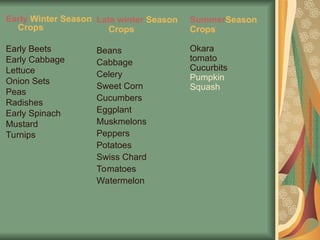
Early Winter Season
Crops
EarlyBeets
Early Cabbage
Lettuce
Onion Sets
Peas
Radishes
Early Spinach
Mustard
Turnips
Late winter Season
Crops
Beans
Cabbage
Celery
Sweet Corn
Cucumbers
Eggplant
Muskmelons
Peppers
Potatoes
Swiss Chard
Tomatoes
Watermelon
SummerSeason
Crops
Okara
tomato
Cucurbits
Pumpkin
Squash
9.
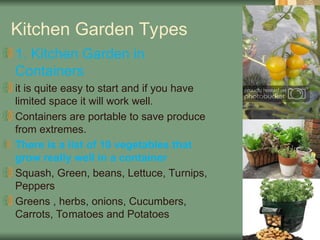
Kitchen Garden Types
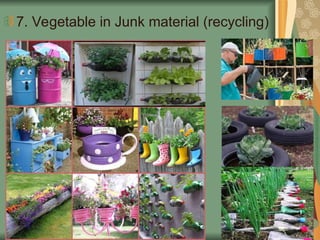
1.Kitchen Garden in
Containers
it is quite easy to start and if you have
limited space it will work well.
Containers are portable to save produce
from extremes.
There is a list of 10 vegetables that
grow really well in a container
Squash, Green, beans, Lettuce, Turnips,
Peppers
Greens , herbs, onions, Cucumbers,
Carrots, Tomatoes and Potatoes
10.
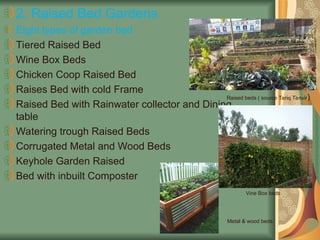
2. Raised BedGardens
Eight types of garden bed
Tiered Raised Bed
Wine Box Beds
Chicken Coop Raised Bed
Raises Bed with cold Frame
Raised Bed with Rainwater collector and Dining
table
Watering trough Raised Beds
Corrugated Metal and Wood Beds
Keyhole Garden Raised
Bed with inbuilt Composter
Raised beds ( source Tariq Tanvir)
Vine Box beds
Metal & wood beds
11.
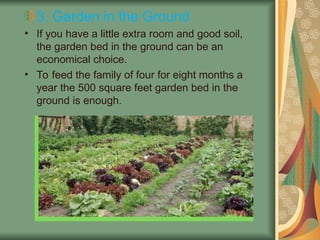
3. Garden inthe Ground
• If you have a little extra room and good soil,
the garden bed in the ground can be an
economical choice.
• To feed the family of four for eight months a
year the 500 square feet garden bed in the
ground is enough.
12.
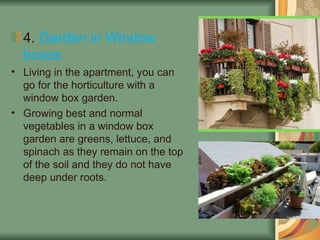
4. Garden inWindow
boxes
• Living in the apartment, you can
go for the horticulture with a
window box garden.
• Growing best and normal
vegetables in a window box
garden are greens, lettuce, and
spinach as they remain on the top
of the soil and they do not have
deep under roots.
13.
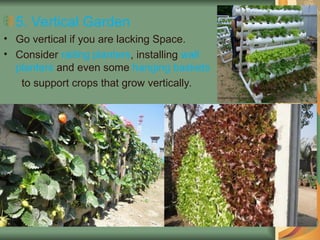
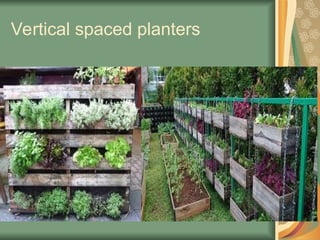
5. Vertical Garden
•Go vertical if you are lacking Space.
• Consider railing planters, installing wall
planters and even some hanging baskets
to support crops that grow vertically.
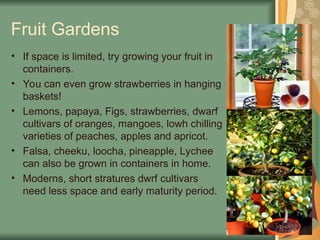
Fruit Gardens
• Ifspace is limited, try growing your fruit in
containers.
• You can even grow strawberries in hanging
baskets!
• Lemons, papaya, Figs, strawberries, dwarf
cultivars of oranges, mangoes, lowh chilling
varieties of peaches, apples and apricot.
• Falsa, cheeku, loocha, pineapple, Lychee
can also be grown in containers in home.
• Moderns, short stratures dwrf cultivars
need less space and early maturity period.
17.
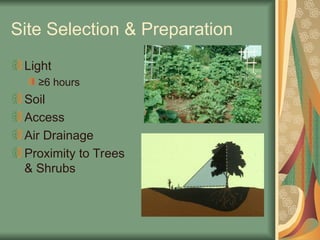
Site Selection &Preparation
Light
≥6 hours
Soil
Access
Air Drainage
Proximity to Trees
& Shrubs
18.
Access
Near the house.
Easyto get to when harvesting.
Accessible for weeding, cultivating, & staking plants.
Close to water.
You will also want to locate your vegetable garden relatively close to the
house so you have access to water if irrigation is needed and so you
won’t have to haul your bountiful harvest a great distance to the kitchen.
Likewise, a vegetable garden nearby will encourage you to spend a few
minutes here and there weeding, cultivating, and staking plants as
needed.
Finally, a garden near the house may deter some of the wildlife that may
find your garden appealing such as rabbits, various birds, and stray
beetles and reptiles.
In some cases, the garden may need to be fenced to keep out all grazing
animals.
19.
Air Drainage
Low-lying areasare subject to
unseasonable frosts & water-logged
soils.
South-facing slopes warm more
quickly.
Wind protection is desirable in rural
gardens.
Prevents physical damage to plants.
Reduces water loss.
Preserves heat that may be lost through
transpiration.
20.
Proximity to Trees& Shrubs
Unwanted shade.
Competition for water and nutrients.
Juglone toxicity.
Site the garden at least 10 feet from
any tree or shrub.
21.
Weed Control
Compete withplants for sunlight, water, nutrients, &
space.
Reduce perennial weeds before planting.
Solarization with black plastic.
Herbicides.
Hoe regularly to keep annual weeds under control.
Carrots, onions, radishes, & beets need more vigilant
weed management because of their small canopy.
22.
Physical Requirements:
Day Length
Increasingor decreasing day length affects
Flower initiation
Bulbing & tuber development
Short day plants:
Sweet potato
Long day plants flower when light exceeds a
certain number of hours.
Lettuce
Spinach
Radish
Day neutral plants – flowering not related to light
Cucumber
Peas
Beans
Peppers
Physical Requirements:
Nutrients &Organic Matter
Soil test
Done the fall before planting and every 3
years thereafter.
Sample 6-7 inches deep in 5 areas of
the garden.
pH – 6.0-6.8
Phosphorus
Potassium
Organic matter
25.
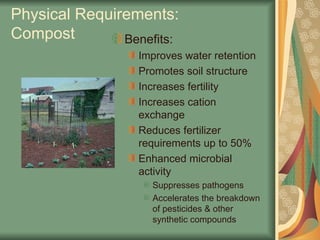
Physical Requirements:
Compost Benefits:
Improveswater retention
Promotes soil structure
Increases fertility
Increases cation
exchange
Reduces fertilizer
requirements up to 50%
Enhanced microbial
activity
Suppresses pathogens
Accelerates the breakdown
of pesticides & other
synthetic compounds
26.
Physical Requirements:
Temperature
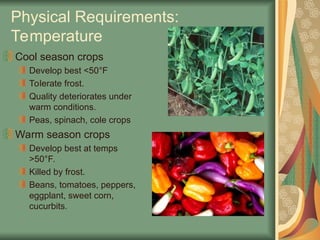
Cool seasoncrops
Develop best <50°F
Tolerate frost.
Quality deteriorates under
warm conditions.
Peas, spinach, cole crops
Warm season crops
Develop best at temps
>50°F.
Killed by frost.
Beans, tomatoes, peppers,
eggplant, sweet corn,
cucurbits.
27.
Physical Requirements:
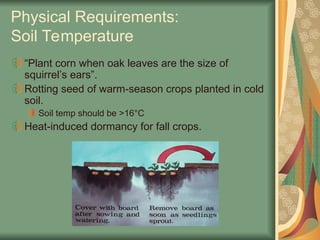
Soil Temperature
“Plantcorn when oak leaves are the size of
squirrel’s ears”.
Rotting seed of warm-season crops planted in cold
soil.
Soil temp should be >16°C
Heat-induced dormancy for fall crops.
Variety Selection:
Disease Resistance
Selectresistant varieties if practical.
No one variety is resistant to all
diseases of that vegetable.
Seed catalogs will indicate what
varieties are resistant.
30.
Variety Selection:
Saving Seed
Somediseases are carried on or in
the seed.
Don’t save seed from cross-pollinated
plants – vine crops in particular.
Self-pollinated crops include
Beans
Eggplant
Peas
Pepper
Tomato
Timing
Soil temperature
Cool-season crops= 40°
Warm-season crops = 50-60°
Avoidance of pest problems
Onions – onion maggot
Cole crops – cabbage maggot, flea
beetles
Seed corn maggots
33.
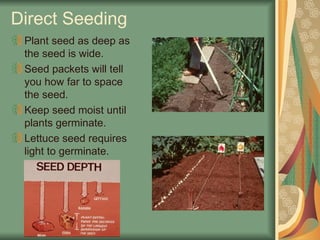
Direct Seeding
Plant seedas deep as
the seed is wide.
Seed packets will tell
you how far to space
the seed.
Keep seed moist until
plants germinate.
Lettuce seed requires
light to germinate.
34.
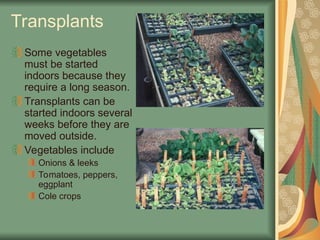
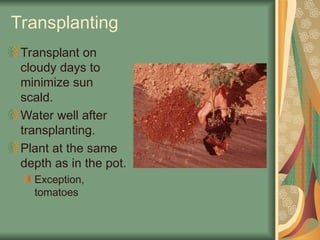
Transplants
Some vegetables
must bestarted
indoors because they
require a long season.
Transplants can be
started indoors several
weeks before they are
moved outside.
Vegetables include
Onions & leeks
Tomatoes, peppers,
eggplant
Cole crops
35.
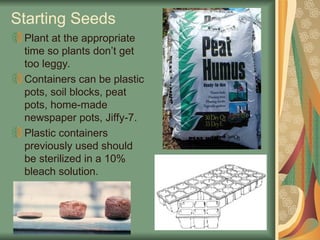
Starting Seeds
Plant atthe appropriate
time so plants don’t get
too leggy.
Containers can be plastic
pots, soil blocks, peat
pots, home-made
newspaper pots, Jiffy-7.
Plastic containers
previously used should
be sterilized in a 10%
bleach solution.
36.
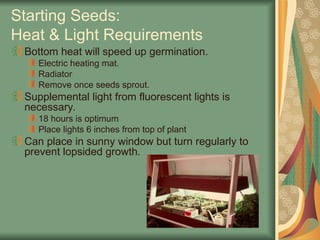
Starting Seeds:
Heat &Light Requirements
Bottom heat will speed up germination.
Electric heating mat.
Radiator
Remove once seeds sprout.
Supplemental light from fluorescent lights is
necessary.
18 hours is optimum
Place lights 6 inches from top of plant
Can place in sunny window but turn regularly to
prevent lopsided growth.
37.
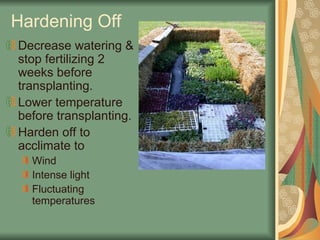
Hardening Off
Decrease watering&
stop fertilizing 2
weeks before
transplanting.
Lower temperature
before transplanting.
Harden off to
acclimate to
Wind
Intense light
Fluctuating
temperatures
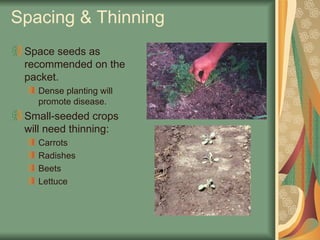
Spacing & Thinning
Spaceseeds as
recommended on the
packet.
Dense planting will
promote disease.
Small-seeded crops
will need thinning:
Carrots
Radishes
Beets
Lettuce
40.
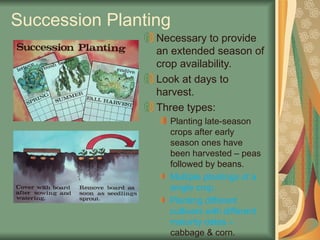
Succession Planting
Necessary toprovide
an extended season of
crop availability.
Look at days to
harvest.
Three types:
Planting late-season
crops after early
season ones have
been harvested – peas
followed by beans.
Multiple plantings of a
single crop.
Planting different
cultivars with different
maturity dates –
cabbage & corn.
41.
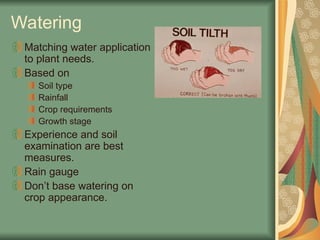
Watering
Matching water application
toplant needs.
Based on
Soil type
Rainfall
Crop requirements
Growth stage
Experience and soil
examination are best
measures.
Rain gauge
Don’t base watering on
crop appearance.
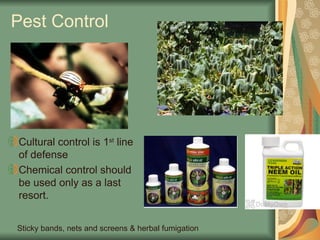
Pest Control
Cultural controlis 1st
line
of defense
Chemical control should
be used only as a last
resort.
Sticky bands, nets and screens & herbal fumigation
44.
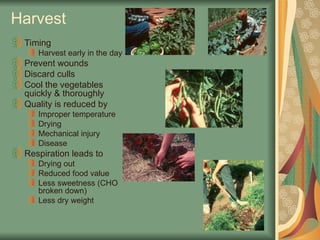
Harvest
Timing
Harvest early inthe day
Prevent wounds
Discard culls
Cool the vegetables
quickly & thoroughly
Quality is reduced by
Improper temperature
Drying
Mechanical injury
Disease
Respiration leads to
Drying out
Reduced food value
Less sweetness (CHO
broken down)
Less dry weight
45.
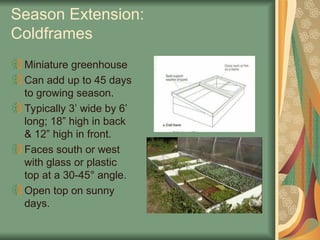
Season Extension:
Coldframes
Miniature greenhouse
Canadd up to 45 days
to growing season.
Typically 3’ wide by 6’
long; 18” high in back
& 12” high in front.
Faces south or west
with glass or plastic
top at a 30-45° angle.
Open top on sunny
days.
46.
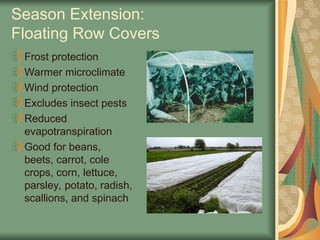
Season Extension:
Floating RowCovers
Frost protection
Warmer microclimate
Wind protection
Excludes insect pests
Reduced
evapotranspiration
Good for beans,
beets, carrot, cole
crops, corn, lettuce,
parsley, potato, radish,
scallions, and spinach
47.
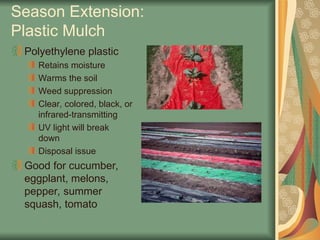
Season Extension:
Plastic Mulch
Polyethyleneplastic
Retains moisture
Warms the soil
Weed suppression
Clear, colored, black, or
infrared-transmitting
UV light will break
down
Disposal issue
Good for cucumber,
eggplant, melons,
pepper, summer
squash, tomato
48.
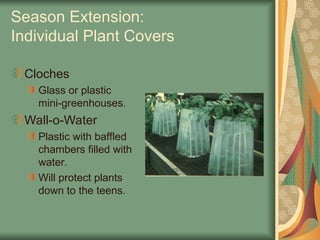
Season Extension:
Individual PlantCovers
Cloches
Glass or plastic
mini-greenhouses.
Wall-o-Water
Plastic with baffled
chambers filled with
water.
Will protect plants
down to the teens.
#17 When selecting a location for a vegetable garden, you should take into consideration several site characteristics such as the amount of light the site receives, the soil type, and the microclimate of the location. Vegetables should be planted in a place that is sunny, level, and protected from frost pockets or excessive wind.
#22 Increasing or decreasing daylength, depending on the plant species, promotes development of reproductive structures — often in conjunction with other factors, such as temperature. Daylength also affects other processes, such as bulbing in onions and tuber development in potato. The time of year when specific vegetables are planted can therefore influence whether the plants produce the appropriate edible parts (reproductive or vegetative).
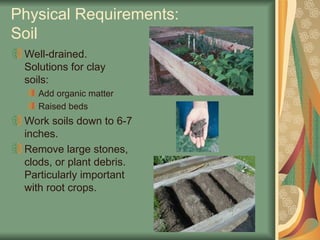
#23 Few vegetable plants tolerate soggy soil, so good drainage is essential. However, sandy soils may dry out too quickly, leaving plants susceptible to drought.
The level of essential soil nutrients is of less importance, since they can be amended with a wide variety of natural or synthetic fertilizers.
#24 Fertilizers can come from organic or inorganic sources. With adequate environmental conditions, soil microbes break down organic matter and supply the chemicals that plants need to their roots. Organic fertilizers can also improve soil structure and health, as well as fertility. The nutrients released from the breakdown of organic amendments is made available over a longer period of time. Inorganic fertilizers can be used to quickly supply nutrients to plants that are suffering a deficiency.
#25 Composting is controlled decomposition or the natural breakdown of organic residue.
The supply of carbon to nitrogen is important when adding materials to compost.
The ideal C:N Ratio is 25:1 to 35:1
High C:N ratios will use up all the nitrogen to break down the carbon while low C:N ratios will have excess nitrogen which may lead to ammonia gas production and odor problems.
Fruit and vegetable waste is easily composted because they are comprised mostly of simple carbohydrates.
Water requirements are between 45-60% - >60% will lead to anaerobic conditions while <45% will slow decomposition.
#26 Every plant’s rate of growth, water and nutrient uptake, flowering and fruit set, and quality and yield are affected by temperature. Temperatures above 85ºF can cause blossoms of peppers and tomatoes to abort.
Frost tolerance varies among vegetable plants. Warm season crops will be heavily damaged from a light frost (28-32ºF), while cool season crops can survive moderate frosts down to about 24ºF. Below this temperature most plants not in a dormant condition will be killed.
#27 Soil temperatures at planting greatly influence germination, and some plants will develop at much cooler temperatures than others. Most cool season crops can be sown as soon as the soil is workable and they will germinate and grow. Wait until the soil temperature is above 60ºF to direct seed or transplant warm-season crops.
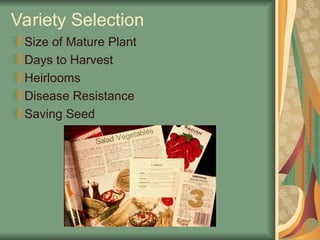
#28 Cultivar selection should be based on the growth habit of the plant, characteristics of the plant part eaten, disease resistance, and how well suited it is to growing conditions.
Make sure you consider how much space you have when selecting varieties. Standard variety vine crops can cover enormous spaces, while bush types are better suited to small gardens. Similarly, determinant varieties of tomatoes are smaller in size than their indeterminate relatives. Dwarf types are particularly suited for container culture.
You should also be aware that if you save your own seed from one year to the next that some plant diseases are carried on, or in, the seed and this is one way for diseases to survive from year to year.
#29 Many fruit & vegetable varieties are resistant to, or tolerant of, specific plant diseases. Resistance is not immunity – these cultivars will still develop some disease but yield and quality won’t be greatly affected. Check seed catalogs for disease resistance ratings.
#35 For large-seeded crops, sow individual seeds in each pot.
Use seed starting mix or other indoor planting medium. You can purchase soilless mixes or create your own from one part each of vermiculite, perlite and either sphagnum peat moss or potting soil. Moisten the growing medium well so it is evenly moist, not soggy.
#36 Keep seeds and young seedlings constantly moist, but not wet to avoid disease problems. Water carefully to prevent displacing seeds or knocking over tiny seedlings. After one set of true leaves emerges, thin the pots to one plant each. Fertilize seedlings once or twice a week with a water-soluble fertilizer (less if there is soil in the planting medium).
#40 Succession planting is done so garden space is put to its most efficient use. With this method, there is never an unplanted area in the vegetable plot. As soon as one crop is harvested, the space is immediately replanted with a different crop. This method of succession planting uses groupings of cool-season and warm-season crops. In the simplest scheme, succession planting involves planning for spring, summer, and fall crops.
#41 The best way to determine if a crop needs water is to measure rainfall, evaporation, and the feel of the soil. This, along with experience will provide crops with the necessary water they need. Don’t rely on the look of the crop. Often they’ve passed the critical wilting point before they show symptoms of water stress.
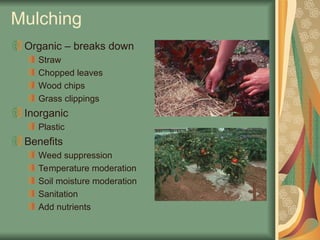
#42 With the exception of plastic mulch used to warm the soil, all mulches should be applied after the soil warms up in the spring and after the seedlings have emerged or transplants have become established. Make any fertilizer or organic matter applications before applying mulch to a garden so you don’t have to remove the mulch later to do so.
The thickness of the mulch will vary depending on type. Plastic or paper mulches will be relatively thin while organic mulches must be applied in a layer thick enough to suppress weeds. Two to three inches is typically recommended for organic mulches; the exception is straw, which is light and airy initially, but will compact with time. Straw mulches may be applied as thick as 6 inches initially.
If you choose to use grass clippings as mulch, do not do so if you have applied a broadleaf weed killer to the lawn within the last 4-6 weeks. Residual herbicide will be in clippings and may cause abnormal growth of susceptible plants, particularly tomatoes.
#44 When vegetables are harvested, some life processes continue. The warmer the conditions in which the crop is harvested and subsequently stored, the higher the rate of respiration (loss of water) and the more rapidly the quality deteriorates. Ideally, vegetables should be harvested in the morning while they are still cool and haven’t absorbed the day’s heat. However, to prevent the spread of plant diseases, it is best to wait until the plants are dry before performing any activity in the garden. For perishable vegetables, remove any excess soil in the garden, bring the plants into the house immediately and wash off any remaining soil or debris and refrigerate those vegetables that require cool storage conditions. Some vegetables, such as carrots, need to be stored near 32ºF or they will continue growing.
#45 Plants can be planted directly in the soil beneath or potted plants placed within it. Cold frames are ideal for hardening off flats of tender young vegetable transplants in the spring, or for a wonderful fall crop of lettuce, spinach and radishes.
The hardest part of using a cold frame is keeping it from getting too hot. When the sun is bright, the temperature inside can climb quickly and injure the plants if the cold frame is not vented. Placing shade cloth or floating row cover over the top of the cold frame can help prevent overheating. On warm days it may be necessary to prop the lid an inch or more to let heat escape, but remember to close the lid before the sun sets. A thermostatically controlled vent opener can be purchased to do this automatically.
#46 Floating row cover is a spun-bonded polyester fabric that is light enough to be placed directly on top of plants. These fabrics, which come in different weights for different purposes, allow water and air to penetrate, but they don’t cause excessive heat buildup when it’s warm. They do trap some heat – providing three or four degrees of protection – as well as providing protection from insects, and won’t impede upward plant growth.
To hold the floating row cover in place, use wire anchors or mound soil along the edges of the fabric to hold it down. Alternatively, the fabric can be draped over supports to create a tunnel. This works especially well for tall plants or for a few plants, such as spinach, whose delicate leaves can be abraded by the fabric when it moves in the wind.
Remember to remove floating row covers on those crops requiring pollination by bees to produce the vegetable you will sell.
One downside of row covers is they may tear (or blow away) in the wind.