Chapter 4 Human Development
Development The pattern of continuity and change that occurs throughout the lifespan Physical processes Cognitive processes Socioemotional processes
Nature and Nurture Nature – Biological Inheritance Nurture – Environmental Experiences Optimal experiences – Individuals take  active roles in their own development Early Experience versus Later Experience
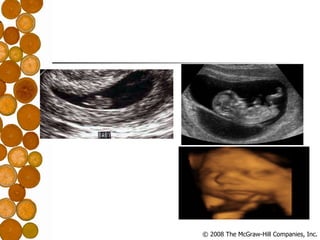
Prenatal Development Conception: Fertilization Zygote – fertilized egg Germinal Period: Weeks 1-2 Embryonic Period: Weeks 3-8 Fetal Period: Months 2-9
 
Prenatal Development Parental Age Teratogens: Agents that cause birth defects Rubella Thalidomide Heroin Alcohol: Fetal Alcohol Syndrome (FAS) Effects of teratogens depend on… Timing of exposure Genetic characteristics Postnatal environment
Physical Development Reflexes – genetically wired behaviors that are crucial for survival Grasping Sucking Stepping Startle Few reflexes persist throughout life Allow for neurological diagnosis Most replaced by voluntary control over their behavior.
Physical Development Perceptual and Motor Skills Hearing, vision, touch Humans Infants and Imitation Preferential Looking Give “choice” and measure preferences Habituation – Decrease in responding to a stimulus after repeated presentations
Brain Development Myelination continues after birth Visual pathways: 6 months Auditory pathways: 4-5 years Dramatic increase in synaptic connections
Cognitive Development Jean Piaget (1896-1980) Children  actively construct  their cognitive world using… Schemas – concepts or frameworks that  organize information Assimilation – incorporate new info into  existing schemas Accomodation – adjust existing schemas to incorporate new information
Piaget’s Theory Sensorimotor Stage: Birth - 2 years Coordinate sensations with movements Object permanence Preoperational Stage: 2 - 7 years Symbolic thinking/Intuitive reasoning Egocentrism Concrete Operational Stage: 7 – 11 years Operational thinking (e.g., conservation) Classification skills Logical thinking in  concrete  contexts Formal Operational Stage: 11-15 years Lasts through adulthood Abstract and idealistic thought Hypothetical-deductive reasoning
Evaluating Piaget’s Theory Some cognitive abilities emerge earlier than  Piaget thought Emphasized stages and ignored individual differences Culture and environment also influence development
Socioemotional Development Erik Erikson (1902-1994) Theory emphasizes lifelong development Eight stages, each with a developmental task Crisis that must be resolved Personal competence or weakness
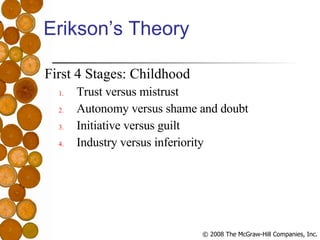
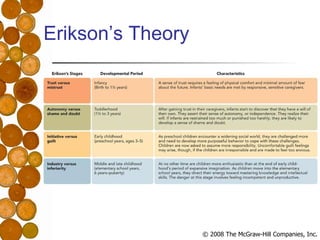
Erikson’s Theory First 4 Stages: Childhood Trust versus mistrust Autonomy versus shame and doubt Initiative versus guilt Industry versus inferiority
Erikson’s Theory
Evaluating Erikson’s Theory Development is a lifelong challenge Adolescents more than just sexual beings Primary focus on case-study research Omitted important developmental tasks
Infant Attachment The close emotional bond between an infant and its caregiver Typically develops during first year of life May provide important foundation for subsequent development Attachment intensifies at 6-7 months
Infant Attachment Harry Harlow – Infant rhesus monkeys What matters? Nourishment or contact Choose between two surrogate “mothers” Cold wire mother versus warm cloth mother Infants preferred cloth mother across situations Contact comfort is critical to attachment
Infant Attachment Mary Ainsworth – Strange Situation Procedure: Caregivers leave infant alone with stranger, then return Secure Attachment Insecure Attachment Avoidant, ambivilient, disorganized
Temperament An individual’s behavioral style or characteristic way of responding Three clusters of temperament Easy, difficult, and slow-to-warm-up
Parenting Styles Authoritarian Parents are controlling and punitive Correlated with lack of initiative, poor communication skills, social incompetence Authoritative Parents encourage independence with limits Correlated with social competence, social responsibility, and self-control Authoritarian Parents are controlling and punitive Correlated with lack of initiative, poor communication skills, social incompetence Authoritative Parents encourage independence with limits Correlated with social competence, social responsibility, and self-control
Moral Development Lawrence Kohlberg (1927-1987) presented moral dilemmas and analyzed responses Preconventional Behavior guided by punishments and rewards Conventional Standards learned from parents and society Postconventional Standards of society and abstract principles (personal moral code)
Evaluating Kohlberg’s Theory Moral Reasoning ≠ Moral Behavior What we say and do are not always consistent Women generally score lower than men Justice perspective (men) Focus on the rights of the individual Care perspective (women) – Carol Gilligan Focus on interpersonal communication Interconnectedness with other people
Gender Development Gender influenced by nature and nurture Biological Influences (Nature) Androgens – primary male sex hormones Estrogens – primary female sex hormones Social Role View (Nurture) Gender Roles – Expectations for how males and females should think, feel, and act How do social experiences and culture influence gender development? Traditional male and females gender roles Gender: Nature or Nurture?
Resilient Children Resilience – A person’s ability to recover from or adapt to difficult times Resilient children become capable adults  Advantages possessed by resilient children Individual factors Family factors Extrafamilial factors
Understanding Adolescence Transition from childhood to adulthood Balance positive and negative aspects Marked by the search for identity
Physical Development Puberty Rapid skeletal and sexual maturation Occurs two years earlier for girls than for boys Testosterone (boys) Genital development, height, voice changes Estrogen (girls) Breast, uterine, and skeletal development
Cognitive Development Piaget’s Formal Operational Stage Abstract, idealistic, and logical thought Hypothetical-deductive reasoning Adolescent Egocentrism The belief that others are as preoccupied with the adolescent as he or she is Sense of uniqueness Sense of invincibility    risky behaviors
Socioemotional Development Erikson: Psychosocial Development Stage 5: Identity versus identity confusion James Marcia’s Four Identity Statuses Exploration and Commitment Identity diffusion Identity foreclosure Identity moratorium Identity achievement
Adult Development and Aging Emerging Adulthood Five Key Features Identity exploration Instability Self-focused Feeling in-between The age of possibilities Health and well-being generally improves
Physical Changes  in Adulthood Early Adulthood Most reach the peak of physical development Middle Adulthood Most lose height, many gain weight Menopause for women (late 40s or early 50s) Late Adulthood Life expectancy has increased, life span has not
Biological Theories of Aging Both look within our body’s cells Cellular-Clock Theory Maximum # of cell divisions are possible Predicts human life span of about 120 years Free-Radical Theory Unstable oxygen molecules within cells Cause DNA and cell damage
Alzheimer’s Disease A progressive irreversible brain disorder characterized by a gradual deterioration in Memory, reasoning, language Physical functioning Disease marked by pronounced Tangles (tied bundles of proteins) Plaques (deposits in brain’s blood vessels) Acetylcholine deficiency
Cognitive Development Early adulthood Marked by relative and reflective thinking Considerable variation influenced by education Middle adulthood Crystallized intelligence increases Our accumulated knowledge and verbal skills Fluid intelligence begins to decline Our ability to reason abstractly
Cognitive Development Cross-Sectional versus Longitudinal Research Studies produce slightly different findings Peak performance for both types of intelligence may actually occur in middle adulthood Late Adulthood Speed of processing generally declines Memories fade and retrieval skills fail Wisdom might actually increase in some individuals
Socioemotional Development Erikson’s Theory: Last 4 Stages Identity versus role confusion (adolescence) Intimacy versus isolation Generativity versus stagnation Integrity versus despair
Marriage and Parenting Women and men are marrying later Principles for Successful Marriages Nurturing fondness and admiration Turning toward each other as friends Giving up some power Solving conflicts together Parenting can    Generativity (Erikson)
Socioemotional Development Midlife Crisis or Midlife Consciousness? Research reveals that midlife Is not particularly tumultuous, mostly positive Is relatively low in experienced anxiety Adults show resilience and good coping skills Brings few illnesses, but poor physical fitness Awareness of gap between young and old
Socioemotional Development Activity    Satisfaction and Good Health Value Emotional Satisfaction Spend time with family and friends Narrow Social Interactions Restrict contact with less familiar individuals Positive Psychology and Aging
Chapter 5 Sensation and Perception
Basic Principles Sensation The process of receiving stimulus energies from the external environment Transduction The process of transforming physical energy into electrochemical energy (action potential) Perception The process of organizing and interpreting sensory information
Sensory Thresholds Absolute Threshold The minimum amount of energy an organism can detect 50% of the time Subliminal stimulation Noise – Irrelevant and competing stimuli Varies by individual: Sensory abilities, age, etc.
Sensory Thresholds Difference Thresholds Just Noticeable Difference (JND) How much stimulus change is necessary for detection? Weber’s Law Large stimuli needs a greater change to be noticeable Smaller stimuli needs less of a change to be noticeable
Signal Detection Theory Decision making when uncertain involves Information acquisition Criterion Influenced by Motivation and costs/rewards Weight of a false detection vs. missing it Fatigue
Factors Affecting Perception Attention Selective attention Cocktail party effect Novelty, size, color, movement Sensory Adaptation Evolutionary vs. Everyday value
Intersection:  Ethnicity and Perception Do expectations influence perception? Harmless objects or deadly weapons? Ethnicity and perceptual errors Reactions influenced not by personal prejudice but by knowledge of cultural stereotypes Does practice reduce ethnic bias?
Visual Perception Organizing and interpreting visual signals Dimensions Shape Depth Motion Constancy Shape: Figure-ground relationship
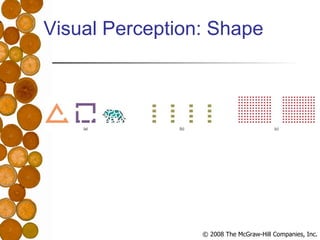
Visual Perception: Shape Gestalt Psychology Perceptions are naturally organized according to certain patterns Whole is different from the sum of the parts Gestalt Principles Figure-ground relationship Closure Proximity Similarity
Visual Perception: Shape
Visual Perception: Motion Humans have specialized motion detectors Apparent Movement – Phi Phenomenon Stroboscopic Motion Movement Aftereffects
Visual Perception: Constancy Perceptual Constancies Recognition that objects do not physically change despite changes in sensory input Size, Shape, and Brightness Constancies
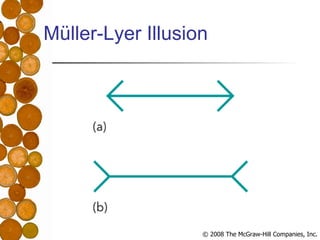
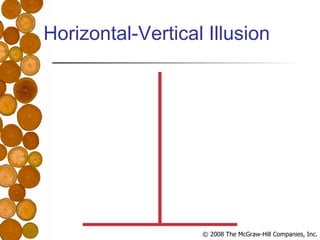
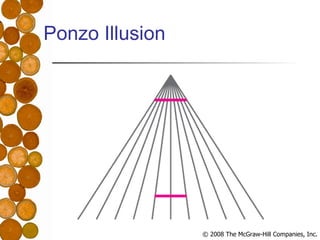
Visual Perception: Illusions Discrepancy between reality and perception Incorrect, but not abnormal perceptions Müller-Lyer illusion Horizontal-vertical illusion Ponzo illusion Moon illusion Devil’s tuning fork
Müller-Lyer Illusion
Horizontal-Vertical Illusion
Ponzo Illusion
Moon Illusion
Chapter 6: States of Consciousness
The Nature of Consciousness What is consciousness? Our  awareness  of external events and internal sensations which occurs under conditions of  arousal
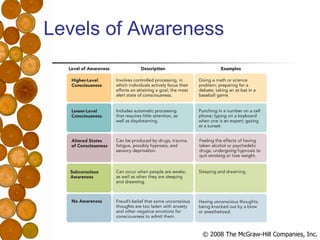
Levels of Awareness
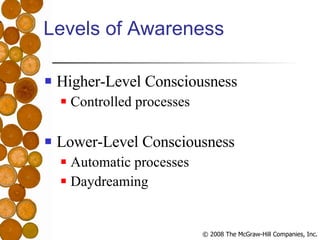
Levels of Awareness Higher-Level Consciousness Controlled processes Lower-Level Consciousness Automatic processes Daydreaming
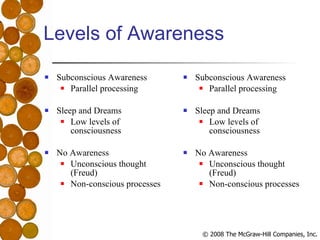
Levels of Awareness Subconscious Awareness Parallel processing Sleep and Dreams Low levels of consciousness No Awareness Unconscious thought (Freud) Non-conscious processes Subconscious Awareness Parallel processing Sleep and Dreams Low levels of consciousness No Awareness Unconscious thought (Freud) Non-conscious processes
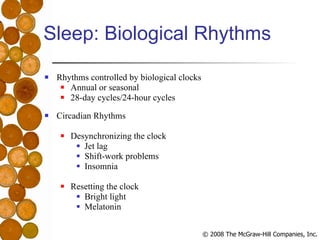
Sleep: Biological Rhythms Rhythms controlled by biological clocks Annual or seasonal 28-day cycles/24-hour cycles Circadian Rhythms Desynchronizing the clock Jet lag Shift-work problems Insomnia Resetting the clock Bright light Melatonin
Why Do We Sleep? Benefits of Sleep Important for physical and mental functioning Restorative Function Adaptive Evolutionary Function Growth and Development Memory
Sleep Deprivation Chronic sleep deprivation results in… Decreased alertness and cognitive performance Inability to sustain attention Less complex brain activity Adverse effects on decision making Research indicates we should get at least 8 hours of sleep each night!
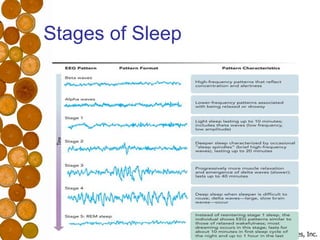
Stages of Sleep EEG measures electrical activity in the brain Awake Stage 1:  light sleep Stage 2:  light sleep Sleep spindles Stage 3: deep sleep Stage 4:  deep sleep Difficult to wake sleepers REM sleep
Stages of Sleep
REM Sleep Rapid-Eye-Movement Sleep = REM sleep Rapid eye movement; dreaming Stage 1-4: Non-REM Sleep Lack of rapid eye movement; little dreaming Dreams: Non-REM versus REM Sleep Developmental Changes in REM Sleep
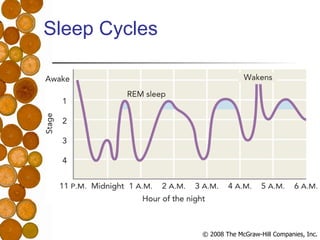
Sleep Cycles 90-100 minutes per cycle Sleep patterns change during the night. Typical night 60% - Stages 1 & 2 sleep 20% - Stages 3 & 4 sleep 20% - REM sleep
Sleep Cycles
Sleep Disorders Insomnia Sleepwalking, Sleep Talking, Sleep Eating Nightmares versus Night Terrors Narcolepsy Sleep Apnea
Theories of Dreaming Historical, Personal, Religious Significance Cognitive Theory of Dreaming Information processing and problem solving Criticisms? Activation-Synthesis Theory Brain makes “sense” out of random activity Criticisms?
Hypnosis Hypnosis marked by Altered attention and awareness Unusual receptiveness to suggestions Four Steps in Hypnosis Distractions are minimized Told to concentrate on something specific Told what to expect Suggest events or feelings sure to occur
Explaining Hypnosis Susceptibility to Hypnosis Is hypnosis dangerous? Divided State of Consciousness Social Cognitive Behavior View\ Applications of Hypnosis
Psychoactive Drugs Various substances alter consciousness,  modify perceptions, and change moods Why do people take drugs? Continued use can lead to… Tolerance Physical dependence and withdrawal Psychological dependence Addiction
Drugs and the Brain The Brain’s Reward Pathway Dopamine Ventral tegmental area (VTA) Nucleus accumbens (NAc) Prefrontal cortex and limbic system These drugs increase DA transmission Agonist Antagonist
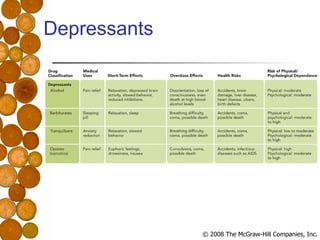
Psychoactive Drugs: Depressants Alcohol Barbiturates Tranquilizers Opiates
Depressants
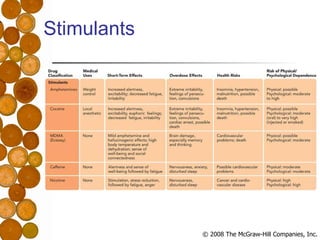
Psychoactive Drugs: Stimulants Caffeine Nicotine Amphetamines Cocaine Inhalants
Stimulants
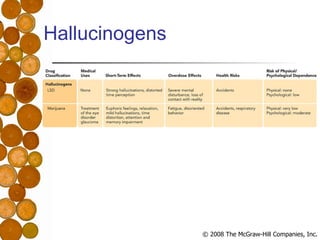
Psychoactive Drugs: Hallucinogens Marijuana Ecstasy (MDMA) LSD
Hallucinogens
Critical Controversy Medicinal uses for psychedelic drugs? LSD Medical Marijuana Psychedelic Drugs, Insight, and Creativity

King1 Ppt Ch04 6

  • 1.
    Chapter 4 HumanDevelopment
  • 2.
    Development The patternof continuity and change that occurs throughout the lifespan Physical processes Cognitive processes Socioemotional processes
  • 3.
    Nature and NurtureNature – Biological Inheritance Nurture – Environmental Experiences Optimal experiences – Individuals take active roles in their own development Early Experience versus Later Experience
  • 4.
    Prenatal Development Conception:Fertilization Zygote – fertilized egg Germinal Period: Weeks 1-2 Embryonic Period: Weeks 3-8 Fetal Period: Months 2-9
  • 5.
  • 6.
    Prenatal Development ParentalAge Teratogens: Agents that cause birth defects Rubella Thalidomide Heroin Alcohol: Fetal Alcohol Syndrome (FAS) Effects of teratogens depend on… Timing of exposure Genetic characteristics Postnatal environment
  • 7.
    Physical Development Reflexes– genetically wired behaviors that are crucial for survival Grasping Sucking Stepping Startle Few reflexes persist throughout life Allow for neurological diagnosis Most replaced by voluntary control over their behavior.
  • 8.
    Physical Development Perceptualand Motor Skills Hearing, vision, touch Humans Infants and Imitation Preferential Looking Give “choice” and measure preferences Habituation – Decrease in responding to a stimulus after repeated presentations
  • 9.
    Brain Development Myelinationcontinues after birth Visual pathways: 6 months Auditory pathways: 4-5 years Dramatic increase in synaptic connections
  • 10.
    Cognitive Development JeanPiaget (1896-1980) Children actively construct their cognitive world using… Schemas – concepts or frameworks that organize information Assimilation – incorporate new info into existing schemas Accomodation – adjust existing schemas to incorporate new information
  • 11.
    Piaget’s Theory SensorimotorStage: Birth - 2 years Coordinate sensations with movements Object permanence Preoperational Stage: 2 - 7 years Symbolic thinking/Intuitive reasoning Egocentrism Concrete Operational Stage: 7 – 11 years Operational thinking (e.g., conservation) Classification skills Logical thinking in concrete contexts Formal Operational Stage: 11-15 years Lasts through adulthood Abstract and idealistic thought Hypothetical-deductive reasoning
  • 12.
    Evaluating Piaget’s TheorySome cognitive abilities emerge earlier than Piaget thought Emphasized stages and ignored individual differences Culture and environment also influence development
  • 13.
    Socioemotional Development ErikErikson (1902-1994) Theory emphasizes lifelong development Eight stages, each with a developmental task Crisis that must be resolved Personal competence or weakness
  • 14.
    Erikson’s Theory First4 Stages: Childhood Trust versus mistrust Autonomy versus shame and doubt Initiative versus guilt Industry versus inferiority
  • 15.
  • 16.
    Evaluating Erikson’s TheoryDevelopment is a lifelong challenge Adolescents more than just sexual beings Primary focus on case-study research Omitted important developmental tasks
  • 17.
    Infant Attachment Theclose emotional bond between an infant and its caregiver Typically develops during first year of life May provide important foundation for subsequent development Attachment intensifies at 6-7 months
  • 18.
    Infant Attachment HarryHarlow – Infant rhesus monkeys What matters? Nourishment or contact Choose between two surrogate “mothers” Cold wire mother versus warm cloth mother Infants preferred cloth mother across situations Contact comfort is critical to attachment
  • 19.
    Infant Attachment MaryAinsworth – Strange Situation Procedure: Caregivers leave infant alone with stranger, then return Secure Attachment Insecure Attachment Avoidant, ambivilient, disorganized
  • 20.
    Temperament An individual’sbehavioral style or characteristic way of responding Three clusters of temperament Easy, difficult, and slow-to-warm-up
  • 21.
    Parenting Styles AuthoritarianParents are controlling and punitive Correlated with lack of initiative, poor communication skills, social incompetence Authoritative Parents encourage independence with limits Correlated with social competence, social responsibility, and self-control Authoritarian Parents are controlling and punitive Correlated with lack of initiative, poor communication skills, social incompetence Authoritative Parents encourage independence with limits Correlated with social competence, social responsibility, and self-control
  • 22.
    Moral Development LawrenceKohlberg (1927-1987) presented moral dilemmas and analyzed responses Preconventional Behavior guided by punishments and rewards Conventional Standards learned from parents and society Postconventional Standards of society and abstract principles (personal moral code)
  • 23.
    Evaluating Kohlberg’s TheoryMoral Reasoning ≠ Moral Behavior What we say and do are not always consistent Women generally score lower than men Justice perspective (men) Focus on the rights of the individual Care perspective (women) – Carol Gilligan Focus on interpersonal communication Interconnectedness with other people
  • 24.
    Gender Development Genderinfluenced by nature and nurture Biological Influences (Nature) Androgens – primary male sex hormones Estrogens – primary female sex hormones Social Role View (Nurture) Gender Roles – Expectations for how males and females should think, feel, and act How do social experiences and culture influence gender development? Traditional male and females gender roles Gender: Nature or Nurture?
  • 25.
    Resilient Children Resilience– A person’s ability to recover from or adapt to difficult times Resilient children become capable adults Advantages possessed by resilient children Individual factors Family factors Extrafamilial factors
  • 26.
    Understanding Adolescence Transitionfrom childhood to adulthood Balance positive and negative aspects Marked by the search for identity
  • 27.
    Physical Development PubertyRapid skeletal and sexual maturation Occurs two years earlier for girls than for boys Testosterone (boys) Genital development, height, voice changes Estrogen (girls) Breast, uterine, and skeletal development
  • 28.
    Cognitive Development Piaget’sFormal Operational Stage Abstract, idealistic, and logical thought Hypothetical-deductive reasoning Adolescent Egocentrism The belief that others are as preoccupied with the adolescent as he or she is Sense of uniqueness Sense of invincibility  risky behaviors
  • 29.
    Socioemotional Development Erikson:Psychosocial Development Stage 5: Identity versus identity confusion James Marcia’s Four Identity Statuses Exploration and Commitment Identity diffusion Identity foreclosure Identity moratorium Identity achievement
  • 30.
    Adult Development andAging Emerging Adulthood Five Key Features Identity exploration Instability Self-focused Feeling in-between The age of possibilities Health and well-being generally improves
  • 31.
    Physical Changes in Adulthood Early Adulthood Most reach the peak of physical development Middle Adulthood Most lose height, many gain weight Menopause for women (late 40s or early 50s) Late Adulthood Life expectancy has increased, life span has not
  • 32.
    Biological Theories ofAging Both look within our body’s cells Cellular-Clock Theory Maximum # of cell divisions are possible Predicts human life span of about 120 years Free-Radical Theory Unstable oxygen molecules within cells Cause DNA and cell damage
  • 33.
    Alzheimer’s Disease Aprogressive irreversible brain disorder characterized by a gradual deterioration in Memory, reasoning, language Physical functioning Disease marked by pronounced Tangles (tied bundles of proteins) Plaques (deposits in brain’s blood vessels) Acetylcholine deficiency
  • 34.
    Cognitive Development Earlyadulthood Marked by relative and reflective thinking Considerable variation influenced by education Middle adulthood Crystallized intelligence increases Our accumulated knowledge and verbal skills Fluid intelligence begins to decline Our ability to reason abstractly
  • 35.
    Cognitive Development Cross-Sectionalversus Longitudinal Research Studies produce slightly different findings Peak performance for both types of intelligence may actually occur in middle adulthood Late Adulthood Speed of processing generally declines Memories fade and retrieval skills fail Wisdom might actually increase in some individuals
  • 36.
    Socioemotional Development Erikson’sTheory: Last 4 Stages Identity versus role confusion (adolescence) Intimacy versus isolation Generativity versus stagnation Integrity versus despair
  • 37.
    Marriage and ParentingWomen and men are marrying later Principles for Successful Marriages Nurturing fondness and admiration Turning toward each other as friends Giving up some power Solving conflicts together Parenting can  Generativity (Erikson)
  • 38.
    Socioemotional Development MidlifeCrisis or Midlife Consciousness? Research reveals that midlife Is not particularly tumultuous, mostly positive Is relatively low in experienced anxiety Adults show resilience and good coping skills Brings few illnesses, but poor physical fitness Awareness of gap between young and old
  • 39.
    Socioemotional Development Activity  Satisfaction and Good Health Value Emotional Satisfaction Spend time with family and friends Narrow Social Interactions Restrict contact with less familiar individuals Positive Psychology and Aging
  • 40.
    Chapter 5 Sensationand Perception
  • 41.
    Basic Principles SensationThe process of receiving stimulus energies from the external environment Transduction The process of transforming physical energy into electrochemical energy (action potential) Perception The process of organizing and interpreting sensory information
  • 42.
    Sensory Thresholds AbsoluteThreshold The minimum amount of energy an organism can detect 50% of the time Subliminal stimulation Noise – Irrelevant and competing stimuli Varies by individual: Sensory abilities, age, etc.
  • 43.
    Sensory Thresholds DifferenceThresholds Just Noticeable Difference (JND) How much stimulus change is necessary for detection? Weber’s Law Large stimuli needs a greater change to be noticeable Smaller stimuli needs less of a change to be noticeable
  • 44.
    Signal Detection TheoryDecision making when uncertain involves Information acquisition Criterion Influenced by Motivation and costs/rewards Weight of a false detection vs. missing it Fatigue
  • 45.
    Factors Affecting PerceptionAttention Selective attention Cocktail party effect Novelty, size, color, movement Sensory Adaptation Evolutionary vs. Everyday value
  • 46.
    Intersection: Ethnicityand Perception Do expectations influence perception? Harmless objects or deadly weapons? Ethnicity and perceptual errors Reactions influenced not by personal prejudice but by knowledge of cultural stereotypes Does practice reduce ethnic bias?
  • 47.
    Visual Perception Organizingand interpreting visual signals Dimensions Shape Depth Motion Constancy Shape: Figure-ground relationship
  • 48.
    Visual Perception: ShapeGestalt Psychology Perceptions are naturally organized according to certain patterns Whole is different from the sum of the parts Gestalt Principles Figure-ground relationship Closure Proximity Similarity
  • 49.
  • 50.
    Visual Perception: MotionHumans have specialized motion detectors Apparent Movement – Phi Phenomenon Stroboscopic Motion Movement Aftereffects
  • 51.
    Visual Perception: ConstancyPerceptual Constancies Recognition that objects do not physically change despite changes in sensory input Size, Shape, and Brightness Constancies
  • 52.
    Visual Perception: IllusionsDiscrepancy between reality and perception Incorrect, but not abnormal perceptions Müller-Lyer illusion Horizontal-vertical illusion Ponzo illusion Moon illusion Devil’s tuning fork
  • 53.
  • 54.
  • 55.
  • 56.
  • 57.
    Chapter 6: Statesof Consciousness
  • 58.
    The Nature ofConsciousness What is consciousness? Our awareness of external events and internal sensations which occurs under conditions of arousal
  • 59.
  • 60.
    Levels of AwarenessHigher-Level Consciousness Controlled processes Lower-Level Consciousness Automatic processes Daydreaming
  • 61.
    Levels of AwarenessSubconscious Awareness Parallel processing Sleep and Dreams Low levels of consciousness No Awareness Unconscious thought (Freud) Non-conscious processes Subconscious Awareness Parallel processing Sleep and Dreams Low levels of consciousness No Awareness Unconscious thought (Freud) Non-conscious processes
  • 62.
    Sleep: Biological RhythmsRhythms controlled by biological clocks Annual or seasonal 28-day cycles/24-hour cycles Circadian Rhythms Desynchronizing the clock Jet lag Shift-work problems Insomnia Resetting the clock Bright light Melatonin
  • 63.
    Why Do WeSleep? Benefits of Sleep Important for physical and mental functioning Restorative Function Adaptive Evolutionary Function Growth and Development Memory
  • 64.
    Sleep Deprivation Chronicsleep deprivation results in… Decreased alertness and cognitive performance Inability to sustain attention Less complex brain activity Adverse effects on decision making Research indicates we should get at least 8 hours of sleep each night!
  • 65.
    Stages of SleepEEG measures electrical activity in the brain Awake Stage 1: light sleep Stage 2: light sleep Sleep spindles Stage 3: deep sleep Stage 4: deep sleep Difficult to wake sleepers REM sleep
  • 66.
  • 67.
    REM Sleep Rapid-Eye-MovementSleep = REM sleep Rapid eye movement; dreaming Stage 1-4: Non-REM Sleep Lack of rapid eye movement; little dreaming Dreams: Non-REM versus REM Sleep Developmental Changes in REM Sleep
  • 68.
    Sleep Cycles 90-100minutes per cycle Sleep patterns change during the night. Typical night 60% - Stages 1 & 2 sleep 20% - Stages 3 & 4 sleep 20% - REM sleep
  • 69.
  • 70.
    Sleep Disorders InsomniaSleepwalking, Sleep Talking, Sleep Eating Nightmares versus Night Terrors Narcolepsy Sleep Apnea
  • 71.
    Theories of DreamingHistorical, Personal, Religious Significance Cognitive Theory of Dreaming Information processing and problem solving Criticisms? Activation-Synthesis Theory Brain makes “sense” out of random activity Criticisms?
  • 72.
    Hypnosis Hypnosis markedby Altered attention and awareness Unusual receptiveness to suggestions Four Steps in Hypnosis Distractions are minimized Told to concentrate on something specific Told what to expect Suggest events or feelings sure to occur
  • 73.
    Explaining Hypnosis Susceptibilityto Hypnosis Is hypnosis dangerous? Divided State of Consciousness Social Cognitive Behavior View\ Applications of Hypnosis
  • 74.
    Psychoactive Drugs Varioussubstances alter consciousness, modify perceptions, and change moods Why do people take drugs? Continued use can lead to… Tolerance Physical dependence and withdrawal Psychological dependence Addiction
  • 75.
    Drugs and theBrain The Brain’s Reward Pathway Dopamine Ventral tegmental area (VTA) Nucleus accumbens (NAc) Prefrontal cortex and limbic system These drugs increase DA transmission Agonist Antagonist
  • 76.
    Psychoactive Drugs: DepressantsAlcohol Barbiturates Tranquilizers Opiates
  • 77.
  • 78.
    Psychoactive Drugs: StimulantsCaffeine Nicotine Amphetamines Cocaine Inhalants
  • 79.
  • 80.
    Psychoactive Drugs: HallucinogensMarijuana Ecstasy (MDMA) LSD
  • 81.
  • 82.
    Critical Controversy Medicinaluses for psychedelic drugs? LSD Medical Marijuana Psychedelic Drugs, Insight, and Creativity