Chapter 13
Physical and Cognitive
Development in Middle
            Adulthood


                                                        1

    © 2006 Pearson Education/Prentice-Hall Publishing
I. Physical Development in Middle Adulthood
                         A. The Double Standard

   Middle adulthood > begin to be aware of gradual
    changes in body that marks the aging process.
   Characterized by variations
   Better educated, more productive than a generation
    ago. (Starts later, lasts longer.) Most educated, most
    affluent cohort.
   Double standard in terms of appearance?


                                                             15-2
B. Biological changes (senescence)

   Bio functions decline
   Sarcopenia – age-related loss of muscle mass and
    strength
       exercise reduces the decline
   Cartilage and connective tissue becomes less
    efficient
       joint stiffness and difficulty in movement
   Visible signs
       skin begins to wrinkle and sag
       areas of pigmentation in skin produce age spots
       gray hair

                                                          15-3
B. Biological changes (cont’d)


       Women 2X the rate of bone loss
           Bones break more easily and heal more slowly
       Ht reaches a max during mid/ late teens to
        early 20’s; remains stable until ~ 55.
       After ~ 55, bones become less dense; women
        lose ~2 inches; men lose ~1 inch in ht. Up to 4
           Women more prone to declining height due to
            Osteoporosis
             lack of calcium
             lack of exercise.


                                                           15-4
Osteoporosis
   Sloping shoulders
   Curve in the back
   Height loss
   Back pain
   Hunched posture
   Protruding abdomen


                         15-5
C. The Senses
                 1. Hearing


   Presbycusis – Conductive
    hearing loss
       ~10% at 50
       ~50% at 75
       There will be large
        increases!
   More men than women
   Men lose sensitivity earlier

                              15-7
D. Reaction time

   Reaction time increases due to slight loss of muscle;
    slower NS processing
   Can compensate


                                                            15-8
II. Health
     A. Chronic health complaints
   Arthritis
   Diabetes
   Hypertension
   Death rate between 40 and 60 is less than half
    of what it was in 1940


                                                     15-9
B. Ethnic and Gender Variations in Health

       Differences in health among blacks and whites
        disappear when holding SES constant.
       Gender also makes a difference in health.
         E.g., Arthritis more common
          in men < 45;
          in women > 45


                                                        15-10
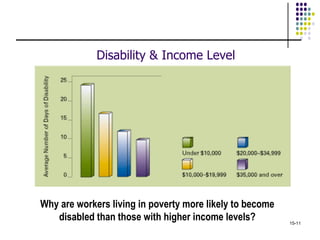
Disability & Income Level


Why are workers living in poverty more likely to become
   disabled than those with higher income levels?         15-11
C. Stress in Middle Adulthood

   Stress continues to significantly impact health during
    middle adulthood.
   Psychoneuroimmunology (PNI)


                                                             15-12
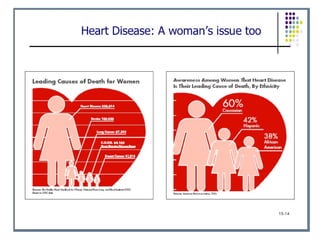
Heart Disease: A woman’s issue too
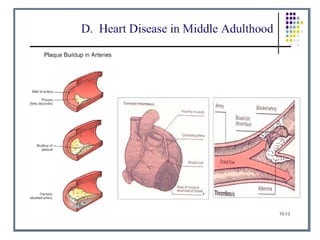
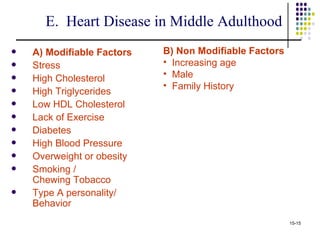
E. Heart Disease in Middle Adulthood
   A) Modifiable Factors   B) Non Modifiable Factors
   Stress                  • Increasing age
   High Cholesterol        • Male
                            • Family History
   High Triglycerides
   Low HDL Cholesterol
   Lack of Exercise
   Diabetes
   High Blood Pressure
   Overweight or obesity
   Smoking /
    Chewing Tobacco
   Type A personality/
    Behavior
                                                        15-15
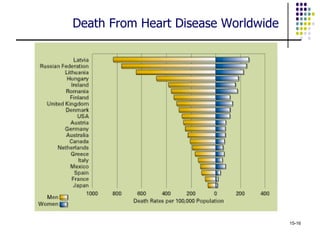
Death From Heart Disease Worldwide


                                     15-16
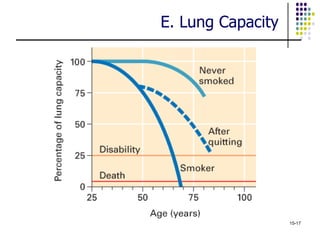
E. Lung Capacity


                   15-17
F. Sleep Problems

Why are there more sleep problems in
middle adulthood?


                                       15-18
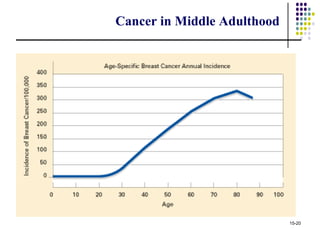
H. Cancer in Middle Adulthood

       Cancer is associated with several risk factors.
          Genetics (family history)
          Poor nutrition, smoking, alcohol, sunlight, exposure to radiation,
           occupational hazards (e.g., certain chemicals)
       With early detection (and sometimes without), survival rate
        is VERY high for most forms of cancer
          E.g., breast cancer: 81% for < 45 years old; 45-64: 85%; > 65: 86%
       Incidence of breast cancer increases with age:
          By 30 > 1 out of 2,212
          By 50 > 1 out of 54
          By 70 > 1 out of 14
          Ever > 1 out of 7 (13%)

                                                                          15-19
Cancer in Middle Adulthood


                             15-20
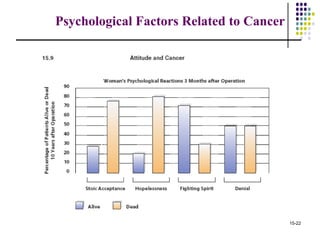
Psychological Factors Related to Cancer

   Close family ties
   Group therapy reduces anxiety and
    pain; increases survival rates.
   A + psychological outlook >
    tendency to adhere to a strict
    treatment regimen.
   A + psychological outlook may
    boost the body's immune system.

[next]

                                                   15-21
Psychological Factors Related to Cancer


                                          15-22
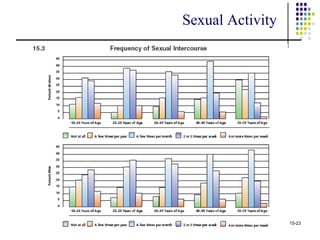
Sexual Activity


                  15-23
Female Climacteric & Menopause
       Female Climacteric –transition from being able to bear children to being
        unable to do so. ~ 45. The transition lasts ~15-20 years.
          Perimenopause – changes in hormones beginning about 10 years prior to
           menopause
          Menopause = cessation of menstruation for 1 year
               Irregular periods for a couple of years
               Drop in Estrogen and Progesterone production
           Side effects vary
           Racial and ethnic differences.
           ~Half of women have few, if any, symptoms
           Men too


                                                                                   15-24
III. Cognitive Development

      Results are complicated because many IQ
       tests include a physical performance
       portion.
         Results may be due to physical changes
          not cognitive changes


                                                   15-26
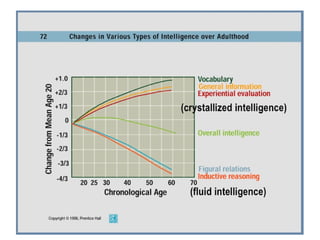
Cognitive Development

   Cross-sectional studies - older people scored worse
    than younger people on traditional IQ tests.
      “Intelligence peaks at 18,
     stays steady until mid-20s,
     and declines till end of life.”
         Crystallized or fluid? [next]


                                                        15-27
(fluid intelligence)
Memory

       Most people show only minimal losses, and many
        exhibit no memory loss in middle adulthood.
       Sensory memory and ST memory > no decline in middle
        age.
       Long-term memory
          Some decline in middle age.
          Storage is less efficient.
          A reduction in efficiency
           of retrieval.
         Effective strategies stave off
          some inefficiencies


                                                              15-29

Lifespan Chapter 13 Online Stud

  • 1.
    Chapter 13 Physical andCognitive Development in Middle Adulthood 1 © 2006 Pearson Education/Prentice-Hall Publishing
  • 2.
    I. Physical Developmentin Middle Adulthood A. The Double Standard  Middle adulthood > begin to be aware of gradual changes in body that marks the aging process.  Characterized by variations  Better educated, more productive than a generation ago. (Starts later, lasts longer.) Most educated, most affluent cohort.  Double standard in terms of appearance? 15-2
  • 3.
    B. Biological changes(senescence)  Bio functions decline  Sarcopenia – age-related loss of muscle mass and strength  exercise reduces the decline  Cartilage and connective tissue becomes less efficient  joint stiffness and difficulty in movement  Visible signs  skin begins to wrinkle and sag  areas of pigmentation in skin produce age spots  gray hair 15-3
  • 4.
    B. Biological changes(cont’d)  Women 2X the rate of bone loss  Bones break more easily and heal more slowly  Ht reaches a max during mid/ late teens to early 20’s; remains stable until ~ 55.  After ~ 55, bones become less dense; women lose ~2 inches; men lose ~1 inch in ht. Up to 4  Women more prone to declining height due to Osteoporosis  lack of calcium  lack of exercise. 15-4
  • 5.
    Osteoporosis  Sloping shoulders  Curve in the back  Height loss  Back pain  Hunched posture  Protruding abdomen 15-5
  • 7.
    C. The Senses 1. Hearing  Presbycusis – Conductive hearing loss  ~10% at 50  ~50% at 75  There will be large increases!  More men than women  Men lose sensitivity earlier 15-7
  • 8.
    D. Reaction time  Reaction time increases due to slight loss of muscle; slower NS processing  Can compensate 15-8
  • 9.
    II. Health A. Chronic health complaints  Arthritis  Diabetes  Hypertension  Death rate between 40 and 60 is less than half of what it was in 1940 15-9
  • 10.
    B. Ethnic andGender Variations in Health  Differences in health among blacks and whites disappear when holding SES constant.  Gender also makes a difference in health.  E.g., Arthritis more common in men < 45; in women > 45 15-10
  • 11.
    Disability & IncomeLevel Why are workers living in poverty more likely to become disabled than those with higher income levels? 15-11
  • 12.
    C. Stress inMiddle Adulthood  Stress continues to significantly impact health during middle adulthood.  Psychoneuroimmunology (PNI) 15-12
  • 14.
    Heart Disease: Awoman’s issue too
  • 15.
    E. Heart Diseasein Middle Adulthood  A) Modifiable Factors B) Non Modifiable Factors  Stress • Increasing age  High Cholesterol • Male • Family History  High Triglycerides  Low HDL Cholesterol  Lack of Exercise  Diabetes  High Blood Pressure  Overweight or obesity  Smoking / Chewing Tobacco  Type A personality/ Behavior 15-15
  • 16.
    Death From HeartDisease Worldwide 15-16
  • 17.
  • 18.
    F. Sleep Problems Whyare there more sleep problems in middle adulthood? 15-18
  • 19.
    H. Cancer inMiddle Adulthood  Cancer is associated with several risk factors.  Genetics (family history)  Poor nutrition, smoking, alcohol, sunlight, exposure to radiation, occupational hazards (e.g., certain chemicals)  With early detection (and sometimes without), survival rate is VERY high for most forms of cancer  E.g., breast cancer: 81% for < 45 years old; 45-64: 85%; > 65: 86%  Incidence of breast cancer increases with age:  By 30 > 1 out of 2,212  By 50 > 1 out of 54  By 70 > 1 out of 14  Ever > 1 out of 7 (13%) 15-19
  • 20.
    Cancer in MiddleAdulthood 15-20
  • 21.
    Psychological Factors Relatedto Cancer  Close family ties  Group therapy reduces anxiety and pain; increases survival rates.  A + psychological outlook > tendency to adhere to a strict treatment regimen.  A + psychological outlook may boost the body's immune system. [next] 15-21
  • 22.
  • 23.
  • 24.
    Female Climacteric &Menopause  Female Climacteric –transition from being able to bear children to being unable to do so. ~ 45. The transition lasts ~15-20 years.  Perimenopause – changes in hormones beginning about 10 years prior to menopause  Menopause = cessation of menstruation for 1 year  Irregular periods for a couple of years  Drop in Estrogen and Progesterone production  Side effects vary  Racial and ethnic differences.  ~Half of women have few, if any, symptoms  Men too 15-24
  • 26.
    III. Cognitive Development  Results are complicated because many IQ tests include a physical performance portion.  Results may be due to physical changes not cognitive changes 15-26
  • 27.
    Cognitive Development  Cross-sectional studies - older people scored worse than younger people on traditional IQ tests.  “Intelligence peaks at 18, stays steady until mid-20s, and declines till end of life.”  Crystallized or fluid? [next] 15-27
  • 28.
  • 29.
    Memory  Most people show only minimal losses, and many exhibit no memory loss in middle adulthood.  Sensory memory and ST memory > no decline in middle age.  Long-term memory  Some decline in middle age.  Storage is less efficient.  A reduction in efficiency of retrieval.  Effective strategies stave off some inefficiencies 15-29