Chapter 4 Human Development
What’s It For? Developmental Solutions Developing Physically Developing Intellectually Developing Socially and Personally
Developing Physically: Learning Goals Describe the physical changes that occur prenatally. Discuss how we grow from infancy through adolescence. Discuss adulthood and the aging body and brain.
Stages of Prenatal Development Germinal period: 0-2 weeks Time from conception to the implantation of  the zygote (fertilized egg) Embryonic period: 2-8 weeks Heartbeat begins; recognizable body parts appear; sexual differentiation begins Fetal period: 9th week - birth Last 3 months: Rapid growth of body and brain
Environmental Hazards Fetus or embryo affected by: mother’s health mother’s diet substances such as nicotine, alcohol certain diseases, such as German measles (rubella) Teratogens: Environmental agents that can damage the developing child
Even moderate drinking (1 drink/day) may cause significant problems With heavy drinking (5 or more drinks/day),  fetal alcohol syndrome may occur Physical and facial deformities Increased risk of mental retardation Effects of Alcohol
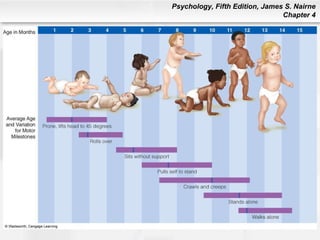
Growth During Infancy Weight quadruples in first 2 years Brain growth: Reaches 75% of adult size by age 2 Most growth is in size/complexity of neurons, not addition of new neurons Environment affects brain development Motor development Most crawl, stand, and walk at roughly same ages
 
Growth: Toddlerhood to Adolescence Coordination, general processing speed increase throughout childhood Puberty (sexual maturity) Girls: Menarche (first menstrual flow) occurs around age 12 or 13 Boys: Androgens cause appearance of facial hair, voice change, ability to ejaculate at around age 13 or 14 Ability to reproduce usually occurs several months later
The Aging Body Strength and agility begin to decline in the 20s Note: There are individual differences Reproductive changes: Women Menopause occurs at around age 50 Ovulation, menstruation stop Reproductive changes: Men Some men lose ability to father children, some do not
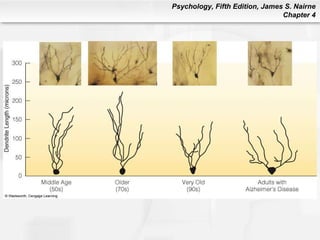
The Aging Brain Neurons do die with age However, they can continue to increase in complexity Dementia: Loss in mental functioning caused by physical changes in the brain Fewer than 1% of those over 65 have dementia About 20% over 80 have dementia
 
Developing Intellectually: Learning Goals Explain the research tools used to study infant perception and memory. Describe an infant’s perceptual capabilities. Characterize memory loss in the elderly. Discuss and evaluate Piaget’s theory of cognitive development. Discuss and evaluate Kohlberg’s theory of moral development.
The Tools of Investigation Longitudinal designs test the same person or group of persons repeatedly at different points in time Cross-sectional designs test different people of different ages at the same point in time
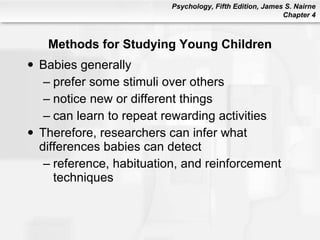
Methods for Studying Young Children Babies generally prefer some stimuli over others notice new or different things can learn to repeat rewarding activities Therefore, researchers can infer what differences babies can detect reference, habituation, and reinforcement techniques
 
 
Infants’ Perceptual Abilities Hearing: Can recognize voices within a day or two of birth At birth or soon after, infants can Tell sour, sweet, salty apart Recognize mother’s smell Experience pain, soothing touch Vision: 2-6 months: Can perceive a dropoff But: Newborn vision blurry, lacks detail
Aging and Memory Ability to recall declines, but recognition ability stays nearly the same Why? Less able to focus? Influenced by age-related stereotypes? Age differences reduced when older adults: Are allowed to use expertise Are given supportive cues, extra time
 
The Development of Thought: Piaget’s Work Jean Piaget:  Swiss scholar, examined development of children’s thought Children think, organize the world meaningfully -- but differently than adults Schemata: Mental models guiding and interpreting experiences Inaccurate early in childhood Become more adultlike throughout childhood
How Schemata Change Assimilation: Fitting experiences into schemata Example: Seeing a horse for the first time and classifying it as a “doggie” Accommodation: Changing schemata to incorporate new experiences Example: Creating a new category called “horses”
Piaget’s Stages Children’s thought develops systematically in a series of four stages: sensorimotor stage (ages 0-2) preoperational period (ages 2-7) concrete operational period (ages 7-11) formal operational period (age 11+)
The Sensorimotor Period (ages 0-2) Schemata revolve around babies’ sensory, motor abilities Early in first year, babies lack object permanence: They fail to realize that objects still exist when out of sight By age 1: Can remember, represent objects symbolically
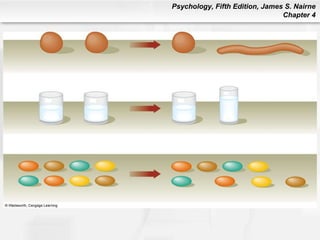
The Preoperational Period (ages 2-7) Schemata become more sophisticated But: Some errors still persist Difficulty understanding conservation Why?  Possibly centration, difficulty understanding reversibility Egocentrism: Seeing world from own perspective only
 
The Concrete Operational Period (ages 7-11) Now have the ability to verbalize, visualize, and mentally manipulate objects Understand reversibility, conservation Can perform elementary logical tasks (math, problem solving), but… Difficulty with true abstract thinking Example: Hypothetical questions
The Formal Operational Period (ages 11+) Approximately adolescence  Can consider imaginary concepts, hypothesize, think in the abstract Can use systematic ways of solving problems Thinking is now adultlike
Was Piaget Right? Well-accepted contribution: Children have unique schemata that change systematically over time Challenges: Piaget tended to underestimate children’s cognitive abilities, such as object permanence Stages may not be as rigid as he thought Culture affects cognitive development too
 
Moral Development Morality: Ability to tell appropriate from inappropriate actions (or: right from wrong) Kohlberg: Modeled a series of moral development stages after Piaget’s ideas Tested individuals’ moral development by posing moral dilemmas, such as A sick woman’s husband cannot afford a drug that will save her life.  Should he steal it?
Three Main Levels of Moral Development Preconventional: Based on consequences Don’t steal -- you will be punished Conventional: Based on rules, social order Don’t steal -- stealing is against the law Postconventional: Based on abstract principles Don’t steal -- without the rule of law, society will descend into chaos
Was Kohlberg Right? Observational studies confirm some of his ideas Challenges: Too much emphasis on an abstract code of justice? Too much emphasis on individualism rather than collective goals, not enough on group welfare? May reflect bias toward Western culture
Developing Socially and Personally: Learning Goals Discuss the short- and long-term characteristics of early attachments. Explain Erik Erikson’s stage theory of personal identity development. Describe the issues that affect gender-role development. Discuss the psychological issues associated with death and dying.
Attachment in Infancy Attachments: Strong emotional ties formed to one or more intimate companions How does attachment start? Contact comfort: Warm physical contact Harlow’s research: Newborn rhesus monkeys become attached to soft objects What if a hard wire object gives food, soft one gives nothing?  -> Attach to soft object anyway
Temperament and Early Attachments Temperament: General level of emotional reactivity Affects the kinds of comforting responses the baby gets from caregivers Strong biological basis Stable across the life span Temperament types: Easy, difficult, slow-to-warm-up
Attachment Types Gauged with the strange-situation test Secure: Upset when caregiver leaves, happy when he or she returns Resistant: Upset when caregiver leaves, but may seem upset when caregiver returns too Avoidant: Not upset when caregiver leaves, little reaction when he or she returns Disorganized/disoriented: Inconsistent
What About Child Care? Preschoolers in quality day care tend to Have improved reading and math skills Have better social adjustment  Show small or no differences in attachment Quality day care means: Safe and clean physical environment Well-trained, positive, cheerful staff Low child-teacher ratio
The Long-Term Effect of Early Attachments Some cautions: Attachment quality may vary over time, across caregivers Research findings are correlational Later in childhood and on into adulthood  friendships are particularly important Strong social networks improve well-being and even health
Personal Identity Development: Erikson’s Stage Theory Sense of self shaped by psychosocial crises at certain points in life Stages in childhood: Infancy: Trust versus mistrust Toddlerhood: Autonomy vs. shame/doubt 3 to 6: Initiative vs. guilt 6 to 12: Industry vs. inferiority Adolescence: Identity vs. role confusion
Erikson’s Stages in Adulthood Young adulthood: Intimacy vs. isolation Middle age: Generativity vs. stagnation Old age: Identity vs. despair
Was Erikson Right? Well-accepted contributions: Personal development is lifelong Emphasis on social and cultural interactions  Challenges: Sharp transitions between stages? Mechanisms that allow for resolution? Difficult to test scientifically
Gender-Role Development Gender roles: Patterns of behavior consistent with society’s dictates Gender identity (sense of self as male or female) begins to develop by 2 or 3 Children usually do not understand that gender is permanent until elementary age Social learning view:  Masculine/feminine behavior is mainly learned from environment
Growing Old in Society Ageism: Discrimination or prejudice against a person based on age Common stereotypes involving the elderly: most are sick, in mental decline, lonely, depressed In fact, older people tend to be more contented, less depressed than younger people Some positive stereotypes as well
Death and Dying: Kubler-Ross’ Stages Based on interviews with the terminally ill, Kubler-Ross proposed that the typical sequence is denial, anger, bargaining, depression, and acceptance Well-accepted contribution: Denial, anger, and depression are normal reactions Challenges: Not all dying people go through these stages in this order Alternate idea: Dying trajectories

Psychology 101: Chapter 4

  • 1.
    Chapter 4 HumanDevelopment
  • 2.
    What’s It For?Developmental Solutions Developing Physically Developing Intellectually Developing Socially and Personally
  • 3.
    Developing Physically: LearningGoals Describe the physical changes that occur prenatally. Discuss how we grow from infancy through adolescence. Discuss adulthood and the aging body and brain.
  • 4.
    Stages of PrenatalDevelopment Germinal period: 0-2 weeks Time from conception to the implantation of the zygote (fertilized egg) Embryonic period: 2-8 weeks Heartbeat begins; recognizable body parts appear; sexual differentiation begins Fetal period: 9th week - birth Last 3 months: Rapid growth of body and brain
  • 5.
    Environmental Hazards Fetusor embryo affected by: mother’s health mother’s diet substances such as nicotine, alcohol certain diseases, such as German measles (rubella) Teratogens: Environmental agents that can damage the developing child
  • 6.
    Even moderate drinking(1 drink/day) may cause significant problems With heavy drinking (5 or more drinks/day), fetal alcohol syndrome may occur Physical and facial deformities Increased risk of mental retardation Effects of Alcohol
  • 7.
    Growth During InfancyWeight quadruples in first 2 years Brain growth: Reaches 75% of adult size by age 2 Most growth is in size/complexity of neurons, not addition of new neurons Environment affects brain development Motor development Most crawl, stand, and walk at roughly same ages
  • 8.
  • 9.
    Growth: Toddlerhood toAdolescence Coordination, general processing speed increase throughout childhood Puberty (sexual maturity) Girls: Menarche (first menstrual flow) occurs around age 12 or 13 Boys: Androgens cause appearance of facial hair, voice change, ability to ejaculate at around age 13 or 14 Ability to reproduce usually occurs several months later
  • 10.
    The Aging BodyStrength and agility begin to decline in the 20s Note: There are individual differences Reproductive changes: Women Menopause occurs at around age 50 Ovulation, menstruation stop Reproductive changes: Men Some men lose ability to father children, some do not
  • 11.
    The Aging BrainNeurons do die with age However, they can continue to increase in complexity Dementia: Loss in mental functioning caused by physical changes in the brain Fewer than 1% of those over 65 have dementia About 20% over 80 have dementia
  • 12.
  • 13.
    Developing Intellectually: LearningGoals Explain the research tools used to study infant perception and memory. Describe an infant’s perceptual capabilities. Characterize memory loss in the elderly. Discuss and evaluate Piaget’s theory of cognitive development. Discuss and evaluate Kohlberg’s theory of moral development.
  • 14.
    The Tools ofInvestigation Longitudinal designs test the same person or group of persons repeatedly at different points in time Cross-sectional designs test different people of different ages at the same point in time
  • 15.
    Methods for StudyingYoung Children Babies generally prefer some stimuli over others notice new or different things can learn to repeat rewarding activities Therefore, researchers can infer what differences babies can detect reference, habituation, and reinforcement techniques
  • 16.
  • 17.
  • 18.
    Infants’ Perceptual AbilitiesHearing: Can recognize voices within a day or two of birth At birth or soon after, infants can Tell sour, sweet, salty apart Recognize mother’s smell Experience pain, soothing touch Vision: 2-6 months: Can perceive a dropoff But: Newborn vision blurry, lacks detail
  • 19.
    Aging and MemoryAbility to recall declines, but recognition ability stays nearly the same Why? Less able to focus? Influenced by age-related stereotypes? Age differences reduced when older adults: Are allowed to use expertise Are given supportive cues, extra time
  • 20.
  • 21.
    The Development ofThought: Piaget’s Work Jean Piaget: Swiss scholar, examined development of children’s thought Children think, organize the world meaningfully -- but differently than adults Schemata: Mental models guiding and interpreting experiences Inaccurate early in childhood Become more adultlike throughout childhood
  • 22.
    How Schemata ChangeAssimilation: Fitting experiences into schemata Example: Seeing a horse for the first time and classifying it as a “doggie” Accommodation: Changing schemata to incorporate new experiences Example: Creating a new category called “horses”
  • 23.
    Piaget’s Stages Children’sthought develops systematically in a series of four stages: sensorimotor stage (ages 0-2) preoperational period (ages 2-7) concrete operational period (ages 7-11) formal operational period (age 11+)
  • 24.
    The Sensorimotor Period(ages 0-2) Schemata revolve around babies’ sensory, motor abilities Early in first year, babies lack object permanence: They fail to realize that objects still exist when out of sight By age 1: Can remember, represent objects symbolically
  • 25.
    The Preoperational Period(ages 2-7) Schemata become more sophisticated But: Some errors still persist Difficulty understanding conservation Why? Possibly centration, difficulty understanding reversibility Egocentrism: Seeing world from own perspective only
  • 26.
  • 27.
    The Concrete OperationalPeriod (ages 7-11) Now have the ability to verbalize, visualize, and mentally manipulate objects Understand reversibility, conservation Can perform elementary logical tasks (math, problem solving), but… Difficulty with true abstract thinking Example: Hypothetical questions
  • 28.
    The Formal OperationalPeriod (ages 11+) Approximately adolescence Can consider imaginary concepts, hypothesize, think in the abstract Can use systematic ways of solving problems Thinking is now adultlike
  • 29.
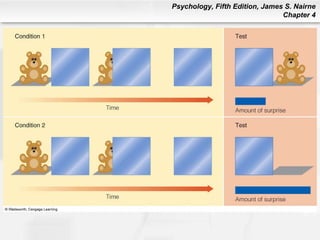
    Was Piaget Right?Well-accepted contribution: Children have unique schemata that change systematically over time Challenges: Piaget tended to underestimate children’s cognitive abilities, such as object permanence Stages may not be as rigid as he thought Culture affects cognitive development too
  • 30.
  • 31.
    Moral Development Morality:Ability to tell appropriate from inappropriate actions (or: right from wrong) Kohlberg: Modeled a series of moral development stages after Piaget’s ideas Tested individuals’ moral development by posing moral dilemmas, such as A sick woman’s husband cannot afford a drug that will save her life. Should he steal it?
  • 32.
    Three Main Levelsof Moral Development Preconventional: Based on consequences Don’t steal -- you will be punished Conventional: Based on rules, social order Don’t steal -- stealing is against the law Postconventional: Based on abstract principles Don’t steal -- without the rule of law, society will descend into chaos
  • 33.
    Was Kohlberg Right?Observational studies confirm some of his ideas Challenges: Too much emphasis on an abstract code of justice? Too much emphasis on individualism rather than collective goals, not enough on group welfare? May reflect bias toward Western culture
  • 34.
    Developing Socially andPersonally: Learning Goals Discuss the short- and long-term characteristics of early attachments. Explain Erik Erikson’s stage theory of personal identity development. Describe the issues that affect gender-role development. Discuss the psychological issues associated with death and dying.
  • 35.
    Attachment in InfancyAttachments: Strong emotional ties formed to one or more intimate companions How does attachment start? Contact comfort: Warm physical contact Harlow’s research: Newborn rhesus monkeys become attached to soft objects What if a hard wire object gives food, soft one gives nothing? -> Attach to soft object anyway
  • 36.
    Temperament and EarlyAttachments Temperament: General level of emotional reactivity Affects the kinds of comforting responses the baby gets from caregivers Strong biological basis Stable across the life span Temperament types: Easy, difficult, slow-to-warm-up
  • 37.
    Attachment Types Gaugedwith the strange-situation test Secure: Upset when caregiver leaves, happy when he or she returns Resistant: Upset when caregiver leaves, but may seem upset when caregiver returns too Avoidant: Not upset when caregiver leaves, little reaction when he or she returns Disorganized/disoriented: Inconsistent
  • 38.
    What About ChildCare? Preschoolers in quality day care tend to Have improved reading and math skills Have better social adjustment Show small or no differences in attachment Quality day care means: Safe and clean physical environment Well-trained, positive, cheerful staff Low child-teacher ratio
  • 39.
    The Long-Term Effectof Early Attachments Some cautions: Attachment quality may vary over time, across caregivers Research findings are correlational Later in childhood and on into adulthood friendships are particularly important Strong social networks improve well-being and even health
  • 40.
    Personal Identity Development:Erikson’s Stage Theory Sense of self shaped by psychosocial crises at certain points in life Stages in childhood: Infancy: Trust versus mistrust Toddlerhood: Autonomy vs. shame/doubt 3 to 6: Initiative vs. guilt 6 to 12: Industry vs. inferiority Adolescence: Identity vs. role confusion
  • 41.
    Erikson’s Stages inAdulthood Young adulthood: Intimacy vs. isolation Middle age: Generativity vs. stagnation Old age: Identity vs. despair
  • 42.
    Was Erikson Right?Well-accepted contributions: Personal development is lifelong Emphasis on social and cultural interactions Challenges: Sharp transitions between stages? Mechanisms that allow for resolution? Difficult to test scientifically
  • 43.
    Gender-Role Development Genderroles: Patterns of behavior consistent with society’s dictates Gender identity (sense of self as male or female) begins to develop by 2 or 3 Children usually do not understand that gender is permanent until elementary age Social learning view: Masculine/feminine behavior is mainly learned from environment
  • 44.
    Growing Old inSociety Ageism: Discrimination or prejudice against a person based on age Common stereotypes involving the elderly: most are sick, in mental decline, lonely, depressed In fact, older people tend to be more contented, less depressed than younger people Some positive stereotypes as well
  • 45.
    Death and Dying:Kubler-Ross’ Stages Based on interviews with the terminally ill, Kubler-Ross proposed that the typical sequence is denial, anger, bargaining, depression, and acceptance Well-accepted contribution: Denial, anger, and depression are normal reactions Challenges: Not all dying people go through these stages in this order Alternate idea: Dying trajectories

Editor's Notes

  • #2 The Chapter 4 slides are relevant to APA Outcome 1.2a(4). Specific slides are additionally relevant to other outcomes as noted on the notes page associated with the relevant slide.
  • #7 This slide may be relevant to Outcome 4.2a.
  • #9 Figure 4.2. Although psychologists are reluctant to tie developmental milestones closely to age, most children learn to crawl, stand alone, and walk at about the same age.
  • #13 Figure 4.4. Notice that the dendrites of adult hippocampal neurons actually increase in length and complexity between 50 and 70, declining only in late old age or with Alzheimer’s disease.
  • #15 This slide and the next one describe research methods some psychologists use and are thus relevant to Outcome 2.2.
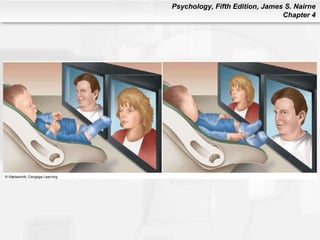
  • #17 Figure 4.5. Babies prefer some visual stimuli over others. In this case, the infant demonstrates a preference for a female face by tracking its location across trials. (The preference can be determined by simply recording how long the baby looks at each face.)
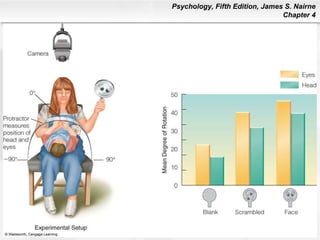
  • #18 Figure 4.6. In this experiment, babies were shown either a blank stimulus, a stimulus with scrambled facial features, or a face. Each stimulus was first positioned over the baby’s head and then moved from side to side. The dependent variable measured the extent to which the baby tracked each stimulus by head turning. As the results show, the babies tracked the face stimulus more than the others. (Graph adapted from Johnson et al., 1991.)
  • #19 Infants’ perceptual abilities are relevant to debates regarding the origin or knowledge, Outcome 1.2d(1).
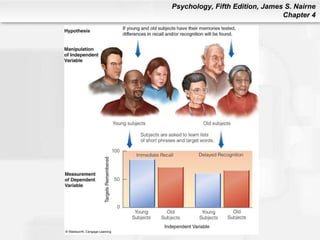
  • #21 Figure 4.7. A group with an average age of 20.7 years and a group with an average age of 72.8 years were asked to learn and then recall or recognize target words. Although the younger subjects recalled more targets than the older subjects, the advantage disappeared for recognition. (Craik & McDowd, 1987.) The bottom portion of this slide is relevant to the quantitative literacy objectives described as a component of Outcome 7.3.
  • #27 Figure 4.8. Understanding conservation means recognizing that the physical properties of objects remain the same even though the objects may superficially change in appearance. Preoperational children often fail conservation problems - they fail to detect, for example, that the objects to the right of the arrows still retain the same volume or number.
  • #30 The discussion noted in this slide of the cross-cultural generality of Piaget’s theory relates to Outcome 2.6d -- recognizing that individual differences and sociocultural contexts may influence the applicability of research findings .
  • #31 Figure 4.9. In this experiment, a screen was moved in front of a toy, blocking it from the infant’s view. Moments later when the screen was removed, the baby’s level of surprise (defined as a change in heart rate) was measured. In one conditions, the toy appeared behind the screen; in a second condition, it had vanished. Babies showed more surprise when the toy was absent, suggesting that object permanence may develop earlier than Piaget suspected. (Bower, 1982.)
  • #34 The discussion noted in this slide of the cross-cultural generality of Kohlberg’s theory relates to Outcome 2.6d.
  • #37 This slide relates the nature/nurture debate, Outcome 1.2d(1).
  • #43 The discussion noted in this slide of the cross-cultural generality of Erikson’s theory relates to Outcome 2.6d.