Kindle According to Norman
Brittney Huntington
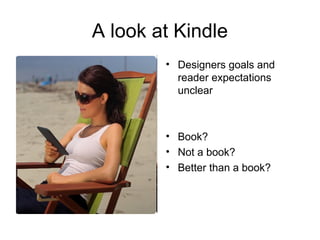
A look at Kindle
• Designers goals and
reader expectations
unclear
• Book?
• Not a book?
• Better than a book?
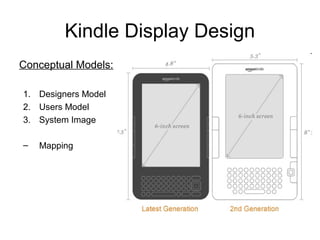
Kindle Display Design
Conceptual Models:
1. Designers Model
2. Users Model
3. System Image
– Mapping
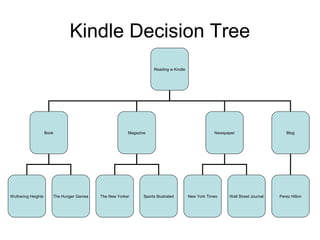
Kindle Decision Tree
Reading w Kindle
Book Magazine Newspaper
Wuthering Heights New York Times Wall Street Journal
Blog
The Hunger Games The New Yorker Sports Illustrated Perez Hilton
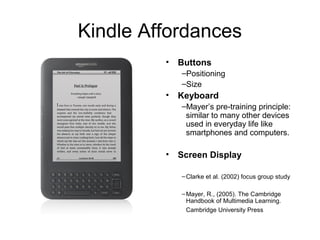
Kindle Affordances
• Buttons
–Positioning
–Size
• Keyboard
–Mayer’s pre-training principle:
similar to many other devices
used in everyday life like
smartphones and computers.
• Screen Display
–Clarke et al. (2002) focus group study
–Mayer, R., (2005). The Cambridge
Handbook of Multimedia Learning.
Cambridge University Press
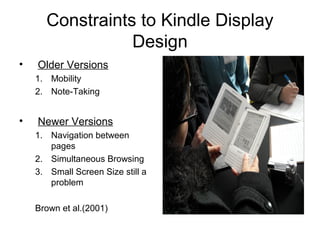
Constraints to Kindle Display
Design
• Older Versions
1. Mobility
2. Note-Taking
• Newer Versions
1. Navigation between
pages
2. Simultaneous Browsing
3. Small Screen Size still a
problem
Brown et al.(2001)
References
• Clarke, D., Goodwin, S., Samuelson, T., Coker, C.
(2002). A Qualitative assessment of the Kindle e- book
reader: results from initial focus groups.
Performance Measurement and Metrics, 9, 118-129.
• Brown, G.J. (2001). Beyond Print: Reading Digitally,
Library Hi Tech, 19, 390-399.
• Mayer, R. (2005). The Cambridge Handbook of
Multimedia Learning. Cambridge University Press.
• Norman, R. (1969) The Design of Everyday Things.
Currency and Doubleday: New York.

Kindle according to norman

  • 1.
    Kindle According toNorman Brittney Huntington
  • 2.
    A look atKindle • Designers goals and reader expectations unclear • Book? • Not a book? • Better than a book?
  • 3.
    Kindle Display Design ConceptualModels: 1. Designers Model 2. Users Model 3. System Image – Mapping
  • 4.
    Kindle Decision Tree Readingw Kindle Book Magazine Newspaper Wuthering Heights New York Times Wall Street Journal Blog The Hunger Games The New Yorker Sports Illustrated Perez Hilton
  • 5.
    Kindle Affordances • Buttons –Positioning –Size •Keyboard –Mayer’s pre-training principle: similar to many other devices used in everyday life like smartphones and computers. • Screen Display –Clarke et al. (2002) focus group study –Mayer, R., (2005). The Cambridge Handbook of Multimedia Learning. Cambridge University Press
  • 6.
    Constraints to KindleDisplay Design • Older Versions 1. Mobility 2. Note-Taking • Newer Versions 1. Navigation between pages 2. Simultaneous Browsing 3. Small Screen Size still a problem Brown et al.(2001)
  • 7.
    References • Clarke, D.,Goodwin, S., Samuelson, T., Coker, C. (2002). A Qualitative assessment of the Kindle e- book reader: results from initial focus groups. Performance Measurement and Metrics, 9, 118-129. • Brown, G.J. (2001). Beyond Print: Reading Digitally, Library Hi Tech, 19, 390-399. • Mayer, R. (2005). The Cambridge Handbook of Multimedia Learning. Cambridge University Press. • Norman, R. (1969) The Design of Everyday Things. Currency and Doubleday: New York.