KIMconference 2013
Monetizing
Intellectual
Property
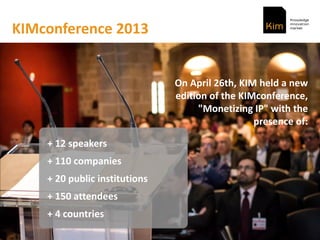
KIMconference 2013
+ 12 speakers
+ 110 companies
+ 20 public institutions
+ 150 attendees
+ 4 countries
On April 26th, KIM held a new
edition of the KIMconference,
"Monetizing IP" with the
presence of:
Lessons learned
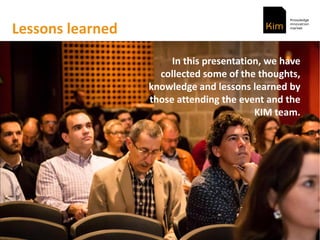
In this presentation, we have
collected some of the thoughts,
knowledge and lessons learned by
those attending the event and the
KIM team.
#Lesson1
"Intellectual property is a passive defense. It is
an asset that must be activated in different
ways, so as to generate return on investment in
their generation. "
"It is critical to think about the knowledge that
organizations have as a tradable asset."
"To accelerate the transfer processes is
necessary to think of collaboration with
specialized agents."
#Lesson2
"The target market is no longer our city, region
or country, the knowledge market is the world.
Therefore it is necessary that organizations
structure their culture around an international
focus.
"The economic map and knowledge of the world
has completely changed and we must be aware
of this and adapt. Asia, Latin America, and even
Africa, are real markets. "
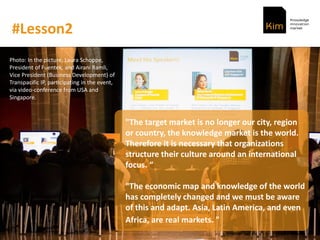
Photo: In the picture, Laura Schoppe,
President of Fuentek, and Airani Ramli,
Vice President (Business Development) of
Transpacific IP, participating in the event,
via video-conference from USA and
Singapore.
#Lesson3
"There are always opportunities but
organizations have to work in their niche
market, being aware that technology and
knowledge are often controlled by large
companies.
Work, strategy and collaboration are key to
the competitiveness of organizations. They
have to move fast, use the knowledge of
others and, above all, start selling. "
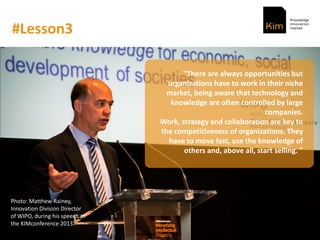
Photo: Matthew Rainey,
Innovation Division Director
of WIPO, during his speech at
the KIMconference 2013.
#Lesson4
500 of world´s largest companies,
own more than 70% of the world
technology supply ,
Alex Blauensteiner,
Managing Director (Europe) of
Technology Reserve
and guest speaker
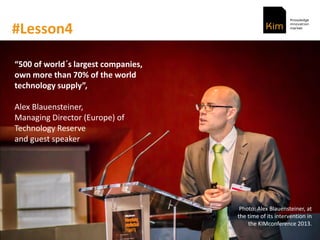
Photo: Alex Blauensteiner, at
the time of its intervention in
the KIMconference 2013.
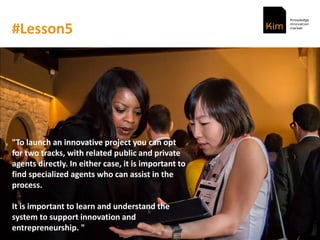
#Lesson5
"To launch an innovative project you can opt
for two tracks, with related public and private
agents directly. In either case, it is important to
find specialized agents who can assist in the
process.
It is important to learn and understand the
system to support innovation and
entrepreneurship. "
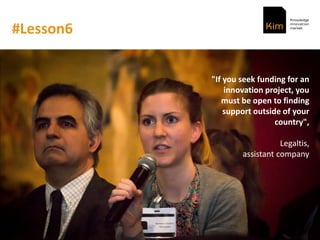
#Lesson6
"If you seek funding for an
innovation project, you
must be open to finding
support outside of your
country",
Legaltis,
assistant company
Thanks!
From KIM, we would like to
thank the speakers and the
audience, who have shared
with us their knowledge
and thoughts about the
monetization of
intellectual property.
More info?
Visit:
http://www.kimbcn.org/kimconference

KIMconference 2013: Monetizing intellectual property | Lessons learned

  • 1.
  • 2.
    KIMconference 2013 + 12speakers + 110 companies + 20 public institutions + 150 attendees + 4 countries On April 26th, KIM held a new edition of the KIMconference, "Monetizing IP" with the presence of:
  • 3.
    Lessons learned In thispresentation, we have collected some of the thoughts, knowledge and lessons learned by those attending the event and the KIM team.
  • 4.
    #Lesson1 "Intellectual property isa passive defense. It is an asset that must be activated in different ways, so as to generate return on investment in their generation. " "It is critical to think about the knowledge that organizations have as a tradable asset." "To accelerate the transfer processes is necessary to think of collaboration with specialized agents."
  • 5.
    #Lesson2 "The target marketis no longer our city, region or country, the knowledge market is the world. Therefore it is necessary that organizations structure their culture around an international focus. "The economic map and knowledge of the world has completely changed and we must be aware of this and adapt. Asia, Latin America, and even Africa, are real markets. " Photo: In the picture, Laura Schoppe, President of Fuentek, and Airani Ramli, Vice President (Business Development) of Transpacific IP, participating in the event, via video-conference from USA and Singapore.
  • 6.
    #Lesson3 "There are alwaysopportunities but organizations have to work in their niche market, being aware that technology and knowledge are often controlled by large companies. Work, strategy and collaboration are key to the competitiveness of organizations. They have to move fast, use the knowledge of others and, above all, start selling. " Photo: Matthew Rainey, Innovation Division Director of WIPO, during his speech at the KIMconference 2013.
  • 7.
    #Lesson4 500 of world´slargest companies, own more than 70% of the world technology supply , Alex Blauensteiner, Managing Director (Europe) of Technology Reserve and guest speaker Photo: Alex Blauensteiner, at the time of its intervention in the KIMconference 2013.
  • 8.
    #Lesson5 "To launch aninnovative project you can opt for two tracks, with related public and private agents directly. In either case, it is important to find specialized agents who can assist in the process. It is important to learn and understand the system to support innovation and entrepreneurship. "
  • 9.
    #Lesson6 "If you seekfunding for an innovation project, you must be open to finding support outside of your country", Legaltis, assistant company
  • 10.
    Thanks! From KIM, wewould like to thank the speakers and the audience, who have shared with us their knowledge and thoughts about the monetization of intellectual property.
  • 11.