TOPIC:-
MANAGEMENT BY
OBJECTIVES
BY
K.DHEERAJ
INTRODUCTION:-
• Every organization is
established for the purpose of
achieving some objectives.
•These objectives may differ
from one organization to
another organization.
•Every organization has its own
objectives.
Therefore,
Objectives may be defined as the
expectation of end results for
which an organisation is
established and which it tries to
achieve.
MANAGEMENT BY
OBJECTIVES (MBO)
• MBO is the system of organisation
attempting to manage their employees
by introducing set of specific goals,
• That both employees and organisation
strive together to achieve in the near
future and working to meet the goals
accordingly.
HISTORY OF MBO
This concept was first introduced by,
Peter Drucker in 1954,
In his book “ The Practice of
Management.”
• While the basic ideas of MBO were not
the original to Peter.
• He had adopted from other sources of
management practices to create a
complete one.
• These ideas were taken from the essay
“ The giving of orders” presented by
Mary Parker Follett’s in 1926.
• In later years,
• George Odiorne, popularised this
concept, by developing ideas in his
book,
“ Management Decisions by
objectives.” published in mid-1960s.
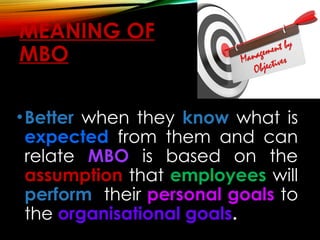
MEANING OF
MBO
•Better when they know what is
expected from them and can
relate MBO is based on the
assumption that employees will
perform their personal goals to
the organisational goals.
• The system of MBO can be described
as a process whereby –
• Superior and subordinate managers
jointly identify its common goals,
• Define each individual's major areas of
responsibility (KRA) interms of result
expected from him.
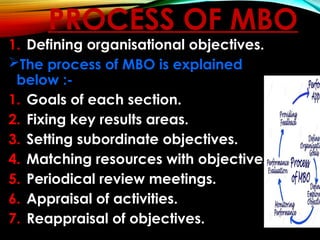
PROCESS OF MBO
1. Defining organisational objectives.
The process of MBO is explained
below :-
1. Goals of each section.
2. Fixing key results areas.
3. Setting subordinate objectives.
4. Matching resources with objectives.
5. Periodical review meetings.
6. Appraisal of activities.
7. Reappraisal of objectives.

KD TOPIC PRESENTATION ON THE MANAGEMENT OBJECTIVES

KD TOPIC PRESENTATION ON THE MANAGEMENT OBJECTIVES

  • 1.
  • 2.
    INTRODUCTION:- • Every organizationis established for the purpose of achieving some objectives. •These objectives may differ from one organization to another organization. •Every organization has its own objectives.
  • 3.
    Therefore, Objectives may bedefined as the expectation of end results for which an organisation is established and which it tries to achieve.
  • 4.
    MANAGEMENT BY OBJECTIVES (MBO) •MBO is the system of organisation attempting to manage their employees by introducing set of specific goals, • That both employees and organisation strive together to achieve in the near future and working to meet the goals accordingly.
  • 5.
    HISTORY OF MBO Thisconcept was first introduced by, Peter Drucker in 1954, In his book “ The Practice of Management.” • While the basic ideas of MBO were not the original to Peter. • He had adopted from other sources of management practices to create a complete one.
  • 6.
    • These ideaswere taken from the essay “ The giving of orders” presented by Mary Parker Follett’s in 1926. • In later years, • George Odiorne, popularised this concept, by developing ideas in his book, “ Management Decisions by objectives.” published in mid-1960s.
  • 7.
    MEANING OF MBO •Better whenthey know what is expected from them and can relate MBO is based on the assumption that employees will perform their personal goals to the organisational goals.
  • 8.
    • The systemof MBO can be described as a process whereby – • Superior and subordinate managers jointly identify its common goals, • Define each individual's major areas of responsibility (KRA) interms of result expected from him.
  • 9.
    PROCESS OF MBO 1.Defining organisational objectives. The process of MBO is explained below :- 1. Goals of each section. 2. Fixing key results areas. 3. Setting subordinate objectives. 4. Matching resources with objectives. 5. Periodical review meetings. 6. Appraisal of activities. 7. Reappraisal of objectives.