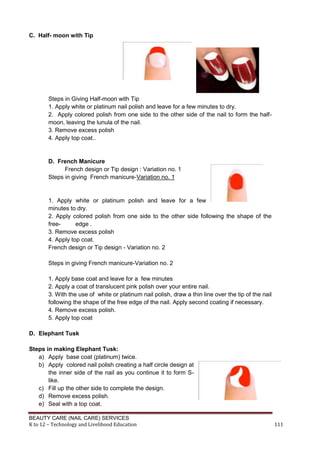
K to 12 Basic Education Curriculum
Technology and Livelihood Education
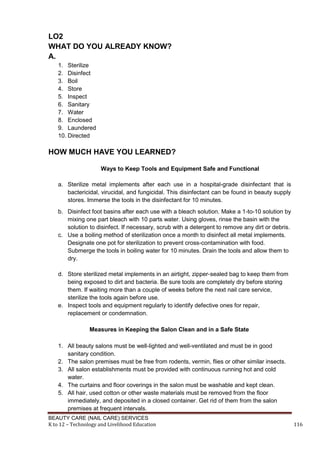
Learning Module
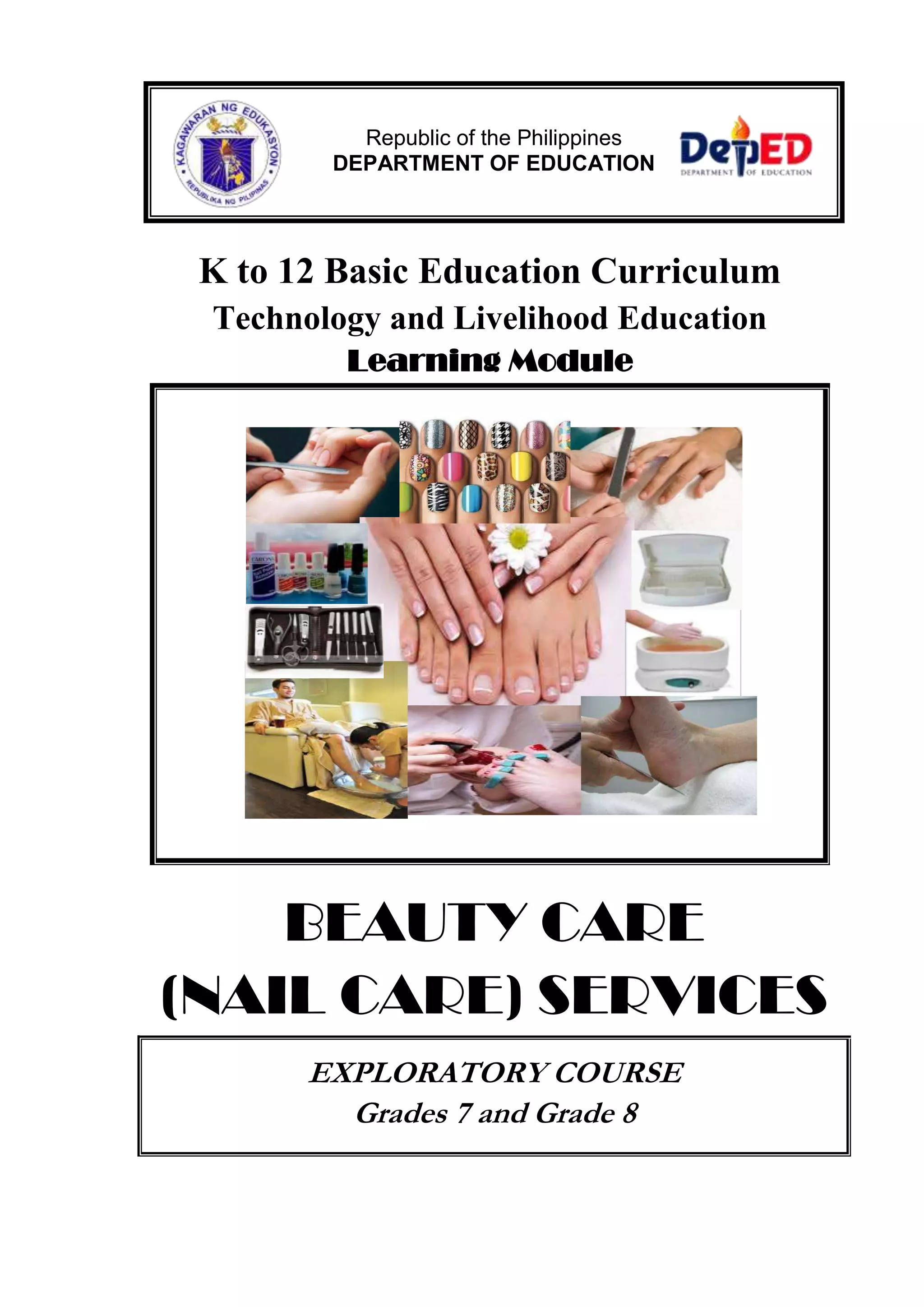
BEAUTY CARE
(NAIL CARE) SERVICES
EXPLORATORY COURSE
Grades 7 and Grade 8
Republic of the Philippines
DEPARTMENT OF EDUCATION
BEAUTY CARE (NAIL CARE) SERVICES
K to 12 – Technology and Livelihood Education 1
TABLE OF CONTENTS
Page
What is this Module About? ……………………………………….........................2
How do you Use this Module? ………………………………………………… 3
LESSON 1 – Use of Nail Care Tools and Equipment ……………….…4 - 35
LESSON 2 – Maintain Tools and Equipment …………………………36 - 61
LESSON 3 – Practice Occupational Health and Safety Procedure …..62 - 89
LESSON 4 – Practice Basic Nail Designs ……………………………90 - 113
Answer Keys ………………………………………………………….. 114 - 120
Acknowledgment …………………………………………………………….121
BEAUTY CARE (NAIL CARE) SERVICES
K to 12 – Technology and Livelihood Education 2
Welcome to the world of Beauty Care (Nail Care) Services!
This Module is an exploratory course which leads you to Beauty Care (Nail Care)
Services National Certificate Level II ( NC II)
1
. It covers 4 common competencies that a Grade 7
/ Grade 8 Technology and Livelihood Education (TLE) student like you ought to possess, namely:
1) Use of Nail Care Tools and Equipment;
2) Maintain Tools and Equipment;
3) Practice Occupational Health and Safety Procedure; and
4) Practice basic nail designs
These 4 common competencies are covered separately in 4 Lessons. As shown below, each
Lesson is directed to the attainment of one or two learning outcomes:
Lesson 1 – Use of Nail Care Tools and Equipment
LO1. Prepare the necessary tools and equipment for the specific nail care
activity.
LO2. Use nail care tools and equipment.
Lesson 2 – Maintain Tools and Equipment
LO1. Check condition of nail care tools and equipment
LO2. Perform basic preventive and corrective maintenance
LO3. Store nail care tools and equipment
Lesson 3 – Practice Occupational Health and Safety Procedure
LO1. Identify hazards and risks
LO2. Evaluate and control hazards and risks
Lesson 4 – Practice basic nail designs
LO1. Identify nail structure, shapes and nail diseases/disorders
LO2. Create basic nail designs
1NATIONAL CERTIFICATE (NC) is a certification issued to individuals who achieved all the required units of competency for a national
qualification as defined under the Training Regulations. NCs are aligned to specific levels within the PTQF. (TESDA Board Resolution
No. 2004-13, Training Regulations Framework)
NATIONAL CERTIFICATE LEVEL refers to the four (4) qualification levels defined in the Philippine TVET Qualifications Framework
(PTQF) where the worker with:
a. NC I performs a routine and predictable tasks; has little judgment; and, works under supervision;
b. NC II performs prescribe range of functions involving known routines and procedures; has limited choice and complexity of
functions, and has little accountability;
What Is This Module About?
BEAUTY CARE (NAIL CARE) SERVICES
K to 12 – Technology and Livelihood Education 3
This Module has 4 Lessons. Each Lesson has the following:
 Learning Outcome/s
 Performance Standard
 Materials /Resources
 Definition of Terms
 What Do You Already Know?
 What Do You Need to Know?
 How Much Have You Learned?
 How Do You Apply What You Have Learned?
 How Well Did You Perform?
 What is your Score?
 References
To get the most from this Module, you’ve got to do the following:
 Begin by reading and understanding the Learning Outcome/s and Performance
Standard/s. These tell you what you should know and be able to do at the end of this
Module.
 Find out what you already know by taking the Pretest then check your answer based
on the Answer Key. If you get 99 to 100% of the items correctly, you may proceed to
the next Lesson. This means that you have no need to go through the Lesson
because you already know what it is supposed to teach you. If you failed to get 99
to 100% of the items correctly, repeat the Lesson and review especially those
items which you failed to get.
 Do the required Learning Activities. It begins with one or more Information Sheets.
An Information Sheet contains important notes or basic information that you need to
know.
After reading the Information Sheet , test yourself on how much you learned way
of the Self-check. Refer to the Answer Key for correction. Do not hesitate to go back
to the Information Sheet when you do not get all test items correctly. This will
ensure your mastery of basic information.
 It is not enough that you acquire content or information. You must be able to
demonstrate what you learned by doing what the Activity / Operation /Job Sheet
directs you to do. In other words, you must be able to apply what you learned in real
life.
 How well did you perform? Accomplish the Scoring Rubrics.
Each Lesson also provides you with references and definition of key terms for your guide.
They can be of great help . Use them fully.
If you have questions, don’t hesitate to ask your teacher for assistance
How Do You Use This Module?
BEAUTY CARE (NAIL CARE) SERVICES
K to 12 – Technology and Livelihood Education 4
LO 1. Prepare the necessary tools and equipment for the
specific nail care activity; and
LO 2. Use nail care tools and equipment.
LEARNING OUTCOMES:
At the end of this Lesson, you are expected to do the
following:
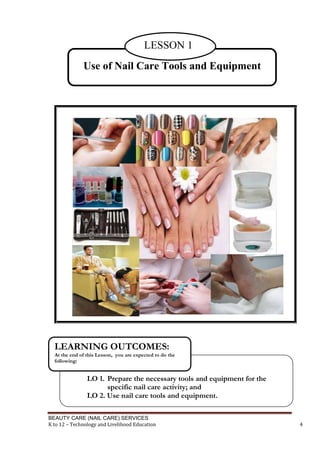
Use of Nail Care Tools and Equipment
LESSON 1
BEAUTY CARE (NAIL CARE) SERVICES
K to 12 – Technology and Livelihood Education 5
Bevel - a term in manicuring and pedicuring that means to shape the edge of something
Dispose of - to throw away
Hygiene - the science concerned with maintaining good health and cleanliness
Implements - articles or tools used in manicuring that are durable
Infection - a condition caused by a germ or a pathogen
Pathogen - a microbe or microorganism such as a virus, bacterium, prion, or fungus that
causes disease
Sterilization - a term referring to any process that eliminates (removes) or kills all forms of
microbial life
Radiation - a process in which energy is transmitted in the form of waves or particles that
can
be used to destroy micro-organisms
Disinfectant - an agent, such as heat, radiation, or a chemical, that destroys, neutralizes, or
prevents the growth of disease-carrying microorganisms
Antiseptic - a substance, milder than a disinfectant, that prevents the growth and
development
of micro-organisms
Cuticle - the nonliving epidermis that surrounds the edges of the fingernail or toenail
Moisten - make wet or damp
Nail bed - the portion of the skin upon which the nail plate rests
Effleurage - a French word meaning "to skim" or "to touch lightly on", is a series of massage
strokes used in Swedish massage to warm up the muscle
Spa - a beauty care service where curative minerals are present for beautification
Hand Spa - a beauty care service using natural oils, vitamins and minerals, having curative
effect to the body
Paraffin - a waxy white or colorless solid hydrocarbon mixture used to make candles, wax
paper, lubricants, and sealing materials
Foot Spa - a beauty care service offered by salons to relax and moisturize the feet
Definition of Terms
BEAUTY CARE (NAIL CARE) SERVICES
K to 12 – Technology and Livelihood Education 6
 Hand tools, equipment and specifications
 Tools condition report forms
 Workplace/simulated environment
Directions: Choose the letter of the correct answer. Write your answer on a separate sheet.
1. A tool that is used to push back or loosen the cuticles.
a. Cuticle remover c. Cuticle nail pusher
b. Nail File d. Emery board
2. An implement that is used to shape the free edges of the nail with the coarse side
and bevel the nail with the finer side.
a. Nail Cutter c. Nail Trimmer
b. Nail File d. Nail Buffer
What Do You Already Know?
Materials
Prepare the necessary nail care tools and equipment for the
specific nail care activity.
LEARNING OUTCOME 1
Let us determine how much you already know about the use of nail care tools and
equipment. Take this test.
Pretest LO 1
 Tools and equipment are prepared based on salon procedure and policies.
 Tools and equipment are identified and checked according to task requirements.
PERFORMANCE STANDARDS
BEAUTY CARE (NAIL CARE) SERVICES
K to 12 – Technology and Livelihood Education 7
3. The equipment which is used to sanitize or kill bacteria or micro-organisms in metal
implements.
a. Hand Spa Machine c. Solvent
b. Buffer d. Sterilizer
4. The implement with pointed and rounded ends to remove excess polish.
a. Orangewood Stick c. Nail Buffer
b. Nail File d. Emery board
5. The electronic gadget which is used to soothe pain of arthritis, muscle spasms and
dry skin of the hands.
a. Sterilizer c. Hand Spa Machine
b. Foot Spa Machine d. Manicure Table
6. It is used to: smooth out ridges on the nails ,give nails a healthy shine and remove
any surface stain.
a. Sterilizer c. Nail file
b. Buffer d. Orangewood stick
7. A type of volcanic rock used to remove callouses.
a. Foot spa basin c. Pumice stone
b. Foot spa tray d. Cotton
8. It is a wheeled cart that is pushed by hand and used for transporting manicuring and
pedicuring tools and materials.
a. Trolley c. Manicure tray
b. Supply tray d. Foot file
9. It is an organic compound used as sanitizer in nail salons.
a. Base coat c. Alcohol
b. Top coat d. Cuticle solvent
10. It is a clear polish applied to the nail plate before the application of colored polish.
a. Base coat c. Alcohol
b. Top coat d. Cuticle solvent
BEAUTY CARE (NAIL CARE) SERVICES
K to 12 – Technology and Livelihood Education 8
NAIL CARE TOOLS AND EQUIPMENT
TOOLS are the articles used in any nail care service which are durable or permanent and
are hand-held. Tools are also referred to as implements.
The tools commonly used in giving manicure and pedicure are the following:
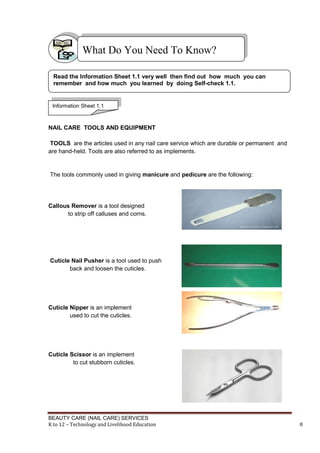
Callous Remover is a tool designed
to strip off calluses and corns.
Cuticle Nail Pusher is a tool used to push
back and loosen the cuticles.
Cuticle Nipper is an implement
used to cut the cuticles.
Cuticle Scissor is an implement
to cut stubborn cuticles.
What Do You Need To Know?
Read the Information Sheet 1.1 very well then find out how much you can
remember and how much you learned by doing Self-check 1.1.
Information Sheet 1.1
BEAUTY CARE (NAIL CARE) SERVICES
K to 12 – Technology and Livelihood Education 9
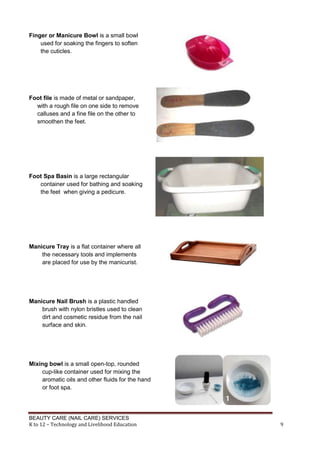
Finger or Manicure Bowl is a small bowl
used for soaking the fingers to soften
the cuticles.
Foot file is made of metal or sandpaper,
with a rough file on one side to remove
calluses and a fine file on the other to
smoothen the feet.
Foot Spa Basin is a large rectangular
container used for bathing and soaking
the feet when giving a pedicure.
Manicure Tray is a flat container where all
the necessary tools and implements
are placed for use by the manicurist.
Manicure Nail Brush is a plastic handled
brush with nylon bristles used to clean
dirt and cosmetic residue from the nail
surface and skin.
Mixing bowl is a small open-top, rounded
cup-like container used for mixing the
aromatic oils and other fluids for the hand
or foot spa.
BEAUTY CARE (NAIL CARE) SERVICES
K to 12 – Technology and Livelihood Education 10
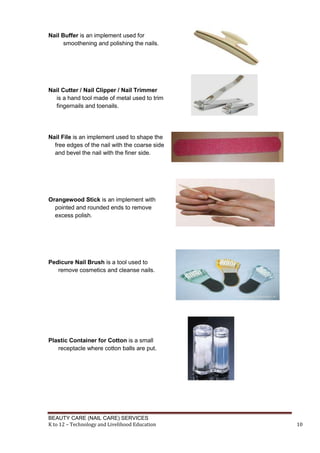
Nail Buffer is an implement used for
smoothening and polishing the nails.
Nail Cutter / Nail Clipper / Nail Trimmer
is a hand tool made of metal used to trim
fingernails and toenails.
Nail File is an implement used to shape the
free edges of the nail with the coarse side
and bevel the nail with the finer side.
Orangewood Stick is an implement with
pointed and rounded ends to remove
excess polish.
Pedicure Nail Brush is a tool used to
remove cosmetics and cleanse nails.
Plastic Container for Cotton is a small
receptacle where cotton balls are put.
BEAUTY CARE (NAIL CARE) SERVICES
K to 12 – Technology and Livelihood Education 11
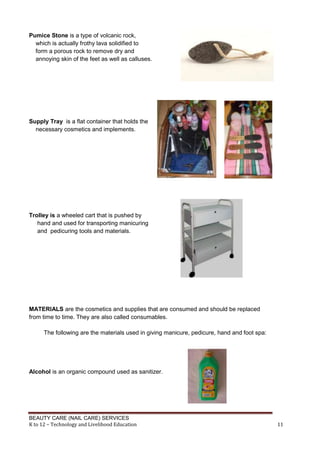
Pumice Stone is a type of volcanic rock,
which is actually frothy lava solidified to
form a porous rock to remove dry and
annoying skin of the feet as well as calluses.
Supply Tray is a flat container that holds the
necessary cosmetics and implements.
Trolley is a wheeled cart that is pushed by
hand and used for transporting manicuring
and pedicuring tools and materials.
MATERIALS are the cosmetics and supplies that are consumed and should be replaced
from time to time. They are also called consumables.
The following are the materials used in giving manicure, pedicure, hand and foot spa:
Alcohol is an organic compound used as sanitizer.
BEAUTY CARE (NAIL CARE) SERVICES
K to 12 – Technology and Livelihood Education 12
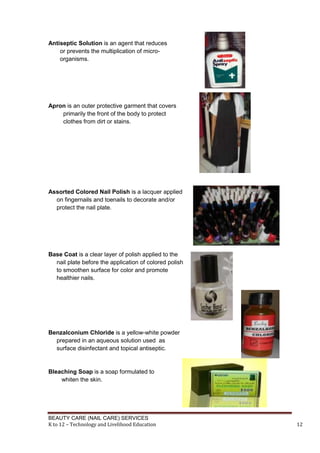
Antiseptic Solution is an agent that reduces
or prevents the multiplication of micro-
organisms.
Apron is an outer protective garment that covers
primarily the front of the body to protect
clothes from dirt or stains.
Assorted Colored Nail Polish is a lacquer applied
on fingernails and toenails to decorate and/or
protect the nail plate.
Base Coat is a clear layer of polish applied to the
nail plate before the application of colored polish
to smoothen surface for color and promote
healthier nails.
Benzalconium Chloride is a yellow-white powder
prepared in an aqueous solution used as
surface disinfectant and topical antiseptic.
Bleaching Soap is a soap formulated to
whiten the skin.
BEAUTY CARE (NAIL CARE) SERVICES
K to 12 – Technology and Livelihood Education 13
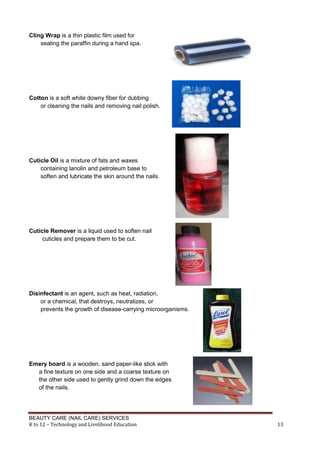
Cling Wrap is a thin plastic film used for
sealing the paraffin during a hand spa.
Cotton is a soft white downy fiber for dubbing
or cleaning the nails and removing nail polish.
Cuticle Oil is a mixture of fats and waxes
containing lanolin and petroleum base to
soften and lubricate the skin around the nails.
Cuticle Remover is a liquid used to soften nail
cuticles and prepare them to be cut.
Disinfectant is an agent, such as heat, radiation,
or a chemical, that destroys, neutralizes, or
prevents the growth of disease-carrying microorganisms.
Emery board is a wooden, sand paper-like stick with
a fine texture on one side and a coarse texture on
the other side used to gently grind down the edges
of the nails.
BEAUTY CARE (NAIL CARE) SERVICES
K to 12 – Technology and Livelihood Education 14
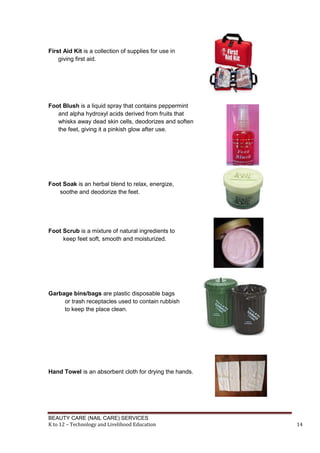
First Aid Kit is a collection of supplies for use in
giving first aid.
Foot Blush is a liquid spray that contains peppermint
and alpha hydroxyl acids derived from fruits that
whisks away dead skin cells, deodorizes and soften
the feet, giving it a pinkish glow after use.
Foot Soak is an herbal blend to relax, energize,
soothe and deodorize the feet.
Foot Scrub is a mixture of natural ingredients to
keep feet soft, smooth and moisturized.
Garbage bins/bags are plastic disposable bags
or trash receptacles used to contain rubbish
to keep the place clean.
Hand Towel is an absorbent cloth for drying the hands.
BEAUTY CARE (NAIL CARE) SERVICES
K to 12 – Technology and Livelihood Education 15
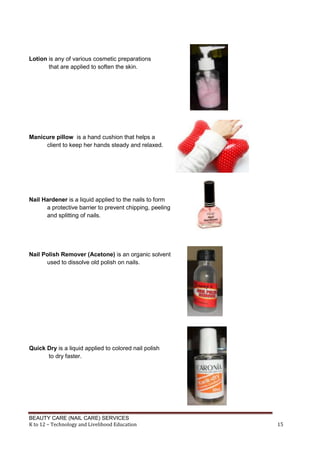
Lotion is any of various cosmetic preparations
that are applied to soften the skin.
Manicure pillow is a hand cushion that helps a
client to keep her hands steady and relaxed.
Nail Hardener is a liquid applied to the nails to form
a protective barrier to prevent chipping, peeling
and splitting of nails.
Nail Polish Remover (Acetone) is an organic solvent
used to dissolve old polish on nails.
Quick Dry is a liquid applied to colored nail polish
to dry faster.
BEAUTY CARE (NAIL CARE) SERVICES
K to 12 – Technology and Livelihood Education 16
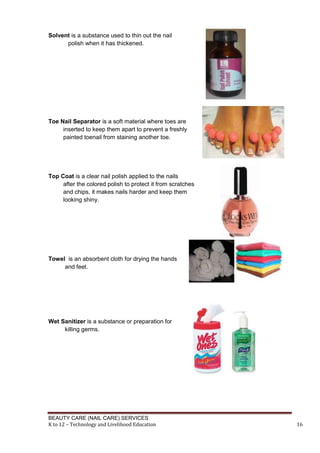
Solvent is a substance used to thin out the nail
polish when it has thickened.
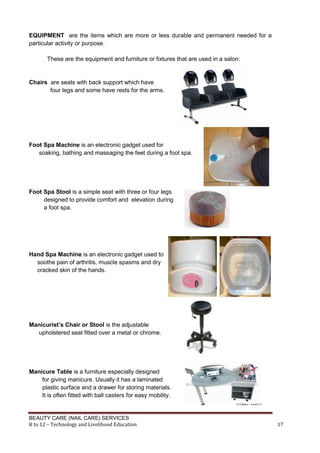
Toe Nail Separator is a soft material where toes are
inserted to keep them apart to prevent a freshly
painted toenail from staining another toe.
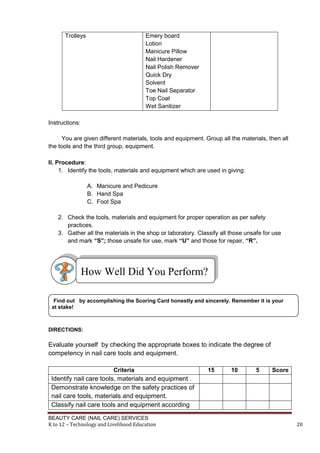
Top Coat is a clear nail polish applied to the nails
after the colored polish to protect it from scratches
and chips, it makes nails harder and keep them
looking shiny.
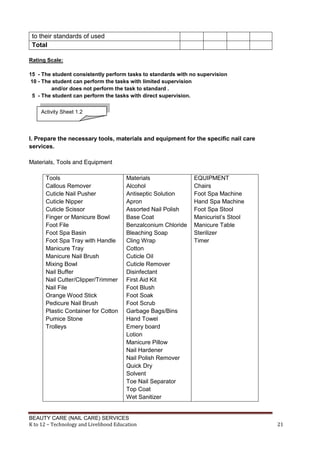
Towel is an absorbent cloth for drying the hands
and feet.
Wet Sanitizer is a substance or preparation for
killing germs.
BEAUTY CARE (NAIL CARE) SERVICES
K to 12 – Technology and Livelihood Education 17
EQUIPMENT are the items which are more or less durable and permanent needed for a
particular activity or purpose.
These are the equipment and furniture or fixtures that are used in a salon:
Chairs are seats with back support which have
four legs and some have rests for the arms.
Foot Spa Machine is an electronic gadget used for
soaking, bathing and massaging the feet during a foot spa.
Foot Spa Stool is a simple seat with three or four legs
designed to provide comfort and elevation during
a foot spa.
Hand Spa Machine is an electronic gadget used to
soothe pain of arthritis, muscle spasms and dry
cracked skin of the hands.
Manicurist’s Chair or Stool is the adjustable
upholstered seat fitted over a metal or chrome.
Manicure Table is a furniture especially designed
for giving manicure. Usually it has a laminated
plastic surface and a drawer for storing materials.
It is often fitted with ball casters for easy mobility.
BEAUTY CARE (NAIL CARE) SERVICES
K to 12 – Technology and Livelihood Education 18
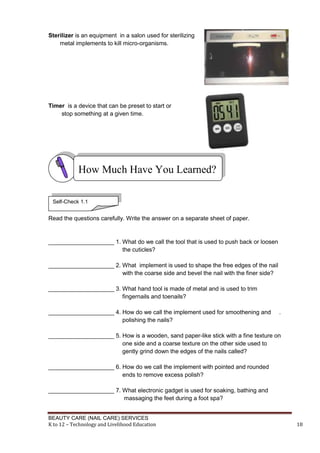
Sterilizer is an equipment in a salon used for sterilizing
metal implements to kill micro-organisms.
Timer is a device that can be preset to start or
stop something at a given time.
Read the questions carefully. Write the answer on a separate sheet of paper.
____________________ 1. What do we call the tool that is used to push back or loosen
the cuticles?
____________________ 2. What implement is used to shape the free edges of the nail
with the coarse side and bevel the nail with the finer side?
____________________ 3. What hand tool is made of metal and is used to trim
fingernails and toenails?
____________________ 4. How do we call the implement used for smoothening and .
polishing the nails?
____________________ 5. How is a wooden, sand paper-like stick with a fine texture on
one side and a coarse texture on the other side used to
gently grind down the edges of the nails called?
____________________ 6. How do we call the implement with pointed and rounded
ends to remove excess polish?
____________________ 7. What electronic gadget is used for soaking, bathing and
massaging the feet during a foot spa?
How Much Have You Learned?
Self-Check 1.1
BEAUTY CARE (NAIL CARE) SERVICES
K to 12 – Technology and Livelihood Education 19
____________________ 8. What do we call the equipment in a salon that is used for
sterilizing metal implements to kill micro-organisms?
____________________ 9. How do we call the simple seat with three or four legs
designed to provide comfort and elevation during a foot
spa?
____________________10. What electronic gadget is used to soothe pain of
arthritis, muscle spasms and dry cracked skin of the hands?
I. Identification of Tools and Equipment According to Task Requirement
Materials, Tools and Equipment
Tools
Callous Remover
Cuticle Nail Pusher
Cuticle Nipper
Cuticle Scissor
Finger or Manicure Bowl
Foot File
Foot Spa Basin
Foot Spa Tray with Handle
Manicure Tray
Manicure Nail Brush
Mixing Bowl
Nail Buffer
Nail Cutter/Clipper/Trimmer
Nail File
Orange Wood Stick
Pedicure Nail Brush
Plastic Container for Cotton
Pumice Stone
Materials
Alcohol
Antiseptic Solution
Apron
Assorted Nail Polish
Base Coat
Benzalconium Chloride
Bleaching Soap
Cling Wrap
Cotton
Cuticle Oil
Cuticle Remover
Disinfectant
First Aid Kit
Foot Blush
Foot Soak
Foot Scrub
Garbage Bags/Bins
Hand Towel
Equipment
Chairs
Foot Spa Machine
Hand Spa Machine
Foot Spa Stool
Manicurist’s Stool
Manicure Table
Sterilizer
Timer
Refer to the Answer Key. What is your score?
Show that you learned something by doing this activity
HowDo YouApplyWhatYou HaveLearned?
Activity Sheet 1.1
BEAUTY CARE (NAIL CARE) SERVICES
K to 12 – Technology and Livelihood Education 20
Trolleys Emery board
Lotion
Manicure Pillow
Nail Hardener
Nail Polish Remover
Quick Dry
Solvent
Toe Nail Separator
Top Coat
Wet Sanitizer
Instructions:
You are given different materials, tools and equipment. Group all the materials, then all
the tools and the third group, equipment.
II. Procedure:
1. Identify the tools, materials and equipment which are used in giving:
A. Manicure and Pedicure
B. Hand Spa
C. Foot Spa
2. Check the tools, materials and equipment for proper operation as per safety
practices.
3. Gather all the materials in the shop or laboratory. Classify all those unsafe for use
and mark “S”; those unsafe for use, mark “U” and those for repair, “R”.
DIRECTIONS:
Evaluate yourself by checking the appropriate boxes to indicate the degree of
competency in nail care tools and equipment.
Criteria 15 10 5 Score
Identify nail care tools, materials and equipment .
Demonstrate knowledge on the safety practices of
nail care tools, materials and equipment.
Classify nail care tools and equipment according
Find out by accomplishing the Scoring Card honestly and sincerely. Remember it is your
learning at stake!
How Well Did You Perform?
BEAUTY CARE (NAIL CARE) SERVICES
K to 12 – Technology and Livelihood Education 21
to their standards of used
Total
Rating Scale:
15 - The student consistently perform tasks to standards with no supervision
10 - The student can perform the tasks with limited supervision
and/or does not perform the task to standard .
5 - The student can perform the tasks with direct supervision.
I. Prepare the necessary tools, materials and equipment for the specific nail care
services.
Materials, Tools and Equipment
Tools
Callous Remover
Cuticle Nail Pusher
Cuticle Nipper
Cuticle Scissor
Finger or Manicure Bowl
Foot File
Foot Spa Basin
Foot Spa Tray with Handle
Manicure Tray
Manicure Nail Brush
Mixing Bowl
Nail Buffer
Nail Cutter/Clipper/Trimmer
Nail File
Orange Wood Stick
Pedicure Nail Brush
Plastic Container for Cotton
Pumice Stone
Trolleys
Materials
Alcohol
Antiseptic Solution
Apron
Assorted Nail Polish
Base Coat
Benzalconium Chloride
Bleaching Soap
Cling Wrap
Cotton
Cuticle Oil
Cuticle Remover
Disinfectant
First Aid Kit
Foot Blush
Foot Soak
Foot Scrub
Garbage Bags/Bins
Hand Towel
Emery board
Lotion
Manicure Pillow
Nail Hardener
Nail Polish Remover
Quick Dry
Solvent
Toe Nail Separator
Top Coat
Wet Sanitizer
EQUIPMENT
Chairs
Foot Spa Machine
Hand Spa Machine
Foot Spa Stool
Manicurist’s Stool
Manicure Table
Sterilizer
Timer
Activity Sheet 1.2
BEAUTY CARE (NAIL CARE) SERVICES
K to 12 – Technology and Livelihood Education 22
Instructions:
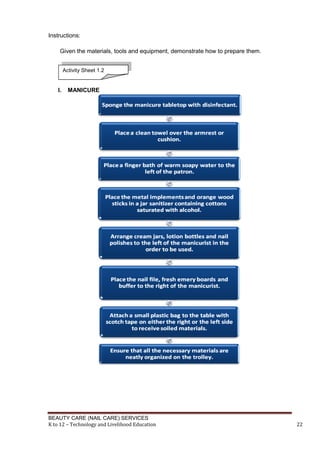
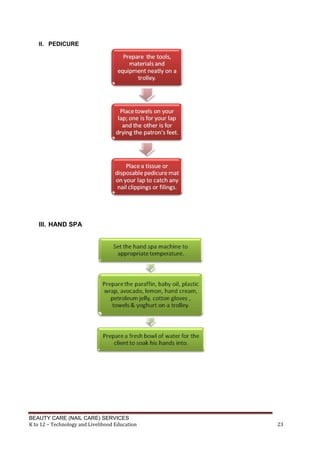
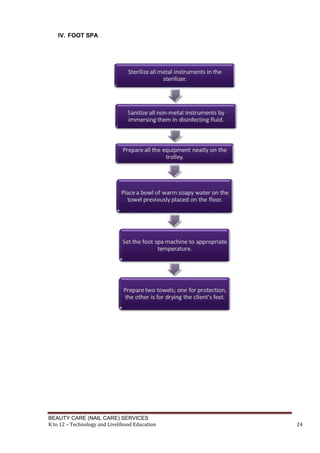
Given the materials, tools and equipment, demonstrate how to prepare them.
I. MANICURE
Activity Sheet 1.2
BEAUTY CARE (NAIL CARE) SERVICES
K to 12 – Technology and Livelihood Education 23
II. PEDICURE
III. HAND SPA
BEAUTY CARE (NAIL CARE) SERVICES
K to 12 – Technology and Livelihood Education 24
IV. FOOT SPA
BEAUTY CARE (NAIL CARE) SERVICES
K to 12 – Technology and Livelihood Education 25
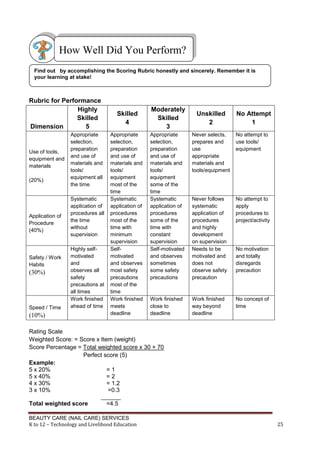
Rubric for Performance
Dimension
Highly
Skilled
5
Skilled
4
Moderately
Skilled
3
Unskilled
2
No Attempt
1
Use of tools,
equipment and
materials
(20%)
Appropriate
selection,
preparation
and use of
materials and
tools/
equipment all
the time
Appropriate
selection,
preparation
and use of
materials and
tools/
equipment
most of the
time
Appropriate
selection,
preparation
and use of
materials and
tools/
equipment
some of the
time
Never selects,
prepares and
use
appropriate
materials and
tools/equipment
No attempt to
use tools/
equipment
Application of
Procedure
(40%)
Systematic
application of
procedures all
the time
without
supervision
Systematic
application of
procedures
most of the
time with
minimum
supervision
Systematic
application of
procedures
some of the
time with
constant
supervision
Never follows
systematic
application of
procedures
and highly
development
on supervision
No attempt to
apply
procedures to
project/activity
Safety / Work
Habits
(30%)
Highly self-
motivated
and
observes all
safety
precautions at
all times
Self-
motivated
and observes
most safety
precautions
most of the
time
Self-motivated
and observes
sometimes
some safety
precautions
Needs to be
motivated and
does not
observe safety
precaution
No motivation
and totally
disregards
precaution
Speed / Time
(10%)
Work finished
ahead of time
Work finished
meets
deadline
Work finished
close to
deadline
Work finished
way beyond
deadline
No concept of
time
Rating Scale
Weighted Score: = Score x Item (weight)
Score Percentage = Total weighted score x 30 + 70
Perfect score (5)
Example:
5 x 20% = 1
5 x 40% = 2
4 x 30% = 1.2
3 x 10% =0.3
______
Total weighted score =4.5
Find out by accomplishing the Scoring Rubric honestly and sincerely. Remember it is
your learning at stake!
How Well Did You Perform?
BEAUTY CARE (NAIL CARE) SERVICES
K to 12 – Technology and Livelihood Education 26
Score Percentage
= 4.5 x 30 + 70
5
Grade = 97
Note: If you want to consider a higher grade of your students adjust score percentage, you
can change it to 40 + 60.
I. Directions: After learning about the different tools, materials and equipment, with
your own sets of nail care tools, materials and equipment, classify them using
the grid below. Do this on a separate sheet of paper.
TOOLS MATERIALS EQUIPMENT
1.
2.
3.
4.
5.
6.
7.
8.
9.
10.
11.
12.
13.
14.
15.
16.
17.
18.
19.
20.
21.
22.
23
How Do You Extend Your Learning?
BEAUTY CARE (NAIL CARE) SERVICES
K to 12 – Technology and Livelihood Education 27
 Hand tools, equipment and specification
 Personal protective equipment (PPE)
 Workplace/simulated environment
Directions: Match the word in column A with its description in column B. Write the letter of
the correct answer on a separate sheet.
Column A Column B
1. Emery board
2. Nail buffer
3. Callous remover
4. Foot spa machine
5. Cuticle nipper
6. Cuticle pusher
7. Foot scrub
8. Orangewood stick
a. an electronic gadget that is used in giving foot spa.
b. a tool that is used to give the nail a natural glow
c. an implement that is used to bevel and smoothen
the nail.
d. a tool that is used to remove callouses
e. it is used to remove nail polish
f. it is a soft material inserted to toes
g. It is an implement with pointed and rounded ends
Materials
What Do You Already Know?
Use nail care tools and equipment
LEARNING OUTCOME 2
Let us determine how much you already know about the use nail care tools and
equipment. Take this test.
Pretest LO 2
 Tools and equipment are used according to task requirements.
 Safety procedure of using tools and equipment are observed.
PERFORMANCE STANDARDS
BEAUTY CARE (NAIL CARE) SERVICES
K to 12 – Technology and Livelihood Education 28
9. Acetone
10. Toe nail separator
used to remove excess polish
h. an implement used to push dead cuticle
i. it is a mixture of natural ingredients to keep feet soft
,smooth and moisturized
Nail Care, once considered as a luxury for the few or as a mark of distinction
between the rich and the poor, is now within the reach of the general public. In fact, part of a
person’s grooming and a form of inexpensive relaxation is a regular nail care activity – be it
manicure, pedicure, hand spa or foot spa.
The following shows the proper way of holding and handling some nail care tools
or implements and equipment.
MANICURE AND PEDICURE
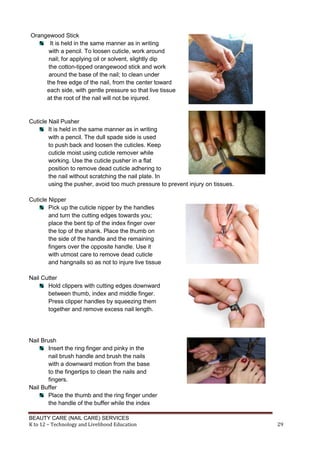
Nail File
Hold the file firmly in the right or left hand
(as the case may be), with the thumb
underneath it for support and the other
four fingers on its upper surface. Place
the file slightly under the free edge and
file the nail from corner to center, shaping
the nail. Never file back and forth; this would
cause the nails to crack and split. Do not file
deep into the corners; this weakens the nails,
hurt the skin and cause ingrown nails.
Emery Board
It is held in the same manner as the
nail file. Bevel the rough surface
of the nail using the fine side to
smoothen it. Emery boards are discarded
after use on one person.
What Do You Need To Know?
Read the Information Sheet 2.1 very well then find out how much you can
remember and how much you learned by doing Self-check 2.1.
Information Sheet 2.1
BEAUTY CARE (NAIL CARE) SERVICES
K to 12 – Technology and Livelihood Education 29
Orangewood Stick
It is held in the same manner as in writing
with a pencil. To loosen cuticle, work around
nail; for applying oil or solvent, slightly dip
the cotton-tipped orangewood stick and work
around the base of the nail; to clean under
the free edge of the nail, from the center toward
each side, with gentle pressure so that live tissue
at the root of the nail will not be injured.
Cuticle Nail Pusher
It is held in the same manner as in writing
with a pencil. The dull spade side is used
to push back and loosen the cuticles. Keep
cuticle moist using cuticle remover while
working. Use the cuticle pusher in a flat
position to remove dead cuticle adhering to
the nail without scratching the nail plate. In
using the pusher, avoid too much pressure to prevent injury on tissues.
Cuticle Nipper
Pick up the cuticle nipper by the handles
and turn the cutting edges towards you;
place the bent tip of the index finger over
the top of the shank. Place the thumb on
the side of the handle and the remaining
fingers over the opposite handle. Use it
with utmost care to remove dead cuticle
and hangnails so as not to injure live tissue
Nail Cutter
Hold clippers with cutting edges downward
between thumb, index and middle finger.
Press clipper handles by squeezing them
together and remove excess nail length.
Nail Brush
Insert the ring finger and pinky in the
nail brush handle and brush the nails
with a downward motion from the base
to the fingertips to clean the nails and
fingers.
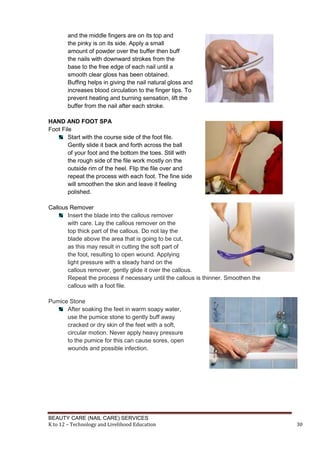
Nail Buffer
Place the thumb and the ring finger under
the handle of the buffer while the index
BEAUTY CARE (NAIL CARE) SERVICES
K to 12 – Technology and Livelihood Education 30
and the middle fingers are on its top and
the pinky is on its side. Apply a small
amount of powder over the buffer then buff
the nails with downward strokes from the
base to the free edge of each nail until a
smooth clear gloss has been obtained.
Buffing helps in giving the nail natural gloss and
increases blood circulation to the finger tips. To
prevent heating and burning sensation, lift the
buffer from the nail after each stroke.
HAND AND FOOT SPA
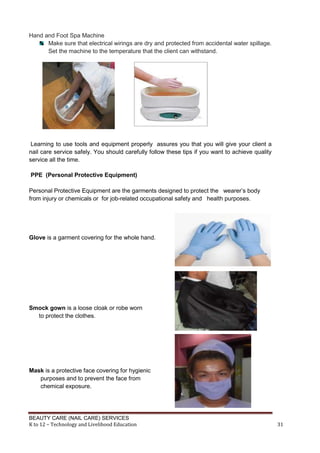
Foot File
Start with the course side of the foot file.
Gently slide it back and forth across the ball
of your foot and the bottom the toes. Still with
the rough side of the file work mostly on the
outside rim of the heel. Flip the file over and
repeat the process with each foot. The fine side
will smoothen the skin and leave it feeling
polished.
Callous Remover
Insert the blade into the callous remover
with care. Lay the callous remover on the
top thick part of the callous. Do not lay the
blade above the area that is going to be cut,
as this may result in cutting the soft part of
the foot, resulting to open wound. Applying
light pressure with a steady hand on the
callous remover, gently glide it over the callous.
Repeat the process if necessary until the callous is thinner. Smoothen the
callous with a foot file.
Pumice Stone
After soaking the feet in warm soapy water,
use the pumice stone to gently buff away
cracked or dry skin of the feet with a soft,
circular motion. Never apply heavy pressure
to the pumice for this can cause sores, open
wounds and possible infection.
BEAUTY CARE (NAIL CARE) SERVICES
K to 12 – Technology and Livelihood Education 31
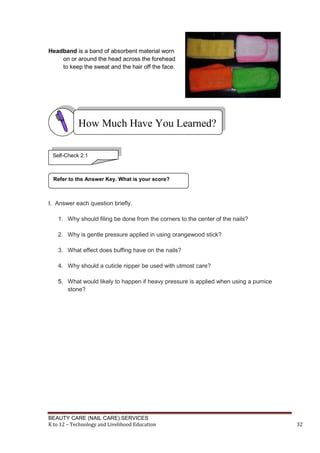
Hand and Foot Spa Machine
Make sure that electrical wirings are dry and protected from accidental water spillage.
Set the machine to the temperature that the client can withstand.
Learning to use tools and equipment properly assures you that you will give your client a
nail care service safely. You should carefully follow these tips if you want to achieve quality
service all the time.
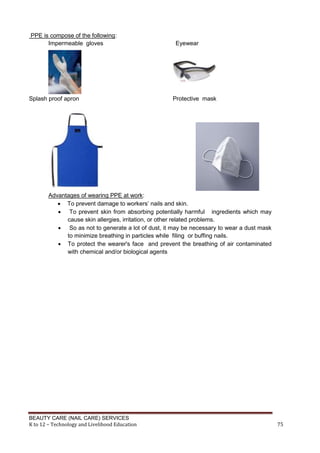
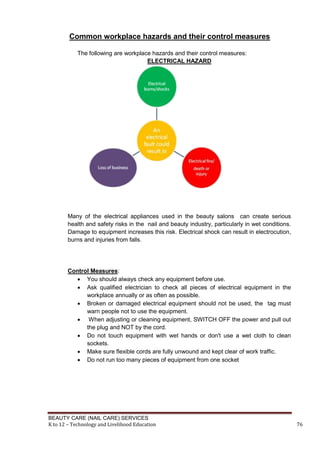
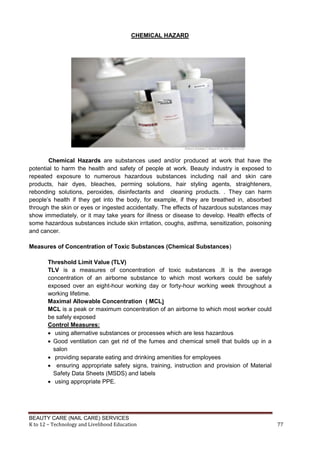
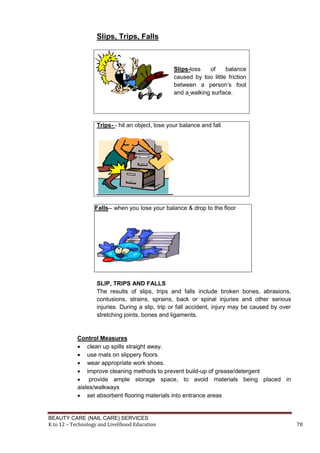
PPE (Personal Protective Equipment)
Personal Protective Equipment are the garments designed to protect the wearer’s body
from injury or chemicals or for job-related occupational safety and health purposes.
Glove is a garment covering for the whole hand.
Smock gown is a loose cloak or robe worn
to protect the clothes.
Mask is a protective face covering for hygienic
purposes and to prevent the face from
chemical exposure.
BEAUTY CARE (NAIL CARE) SERVICES
K to 12 – Technology and Livelihood Education 32
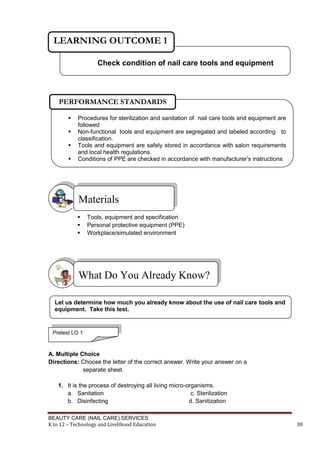
Headband is a band of absorbent material worn
on or around the head across the forehead
to keep the sweat and the hair off the face.
I. Answer each question briefly.
1. Why should filing be done from the corners to the center of the nails?
2. Why is gentle pressure applied in using orangewood stick?
3. What effect does buffing have on the nails?
4. Why should a cuticle nipper be used with utmost care?
5. What would likely to happen if heavy pressure is applied when using a pumice
stone?
Refer to the Answer Key. What is your score?
How Much Have You Learned?
Self-Check 2.1
BEAUTY CARE (NAIL CARE) SERVICES
K to 12 – Technology and Livelihood Education 33
I. Demonstration on the proper use of nail care tools and equipment
Materials, Tools and Equipment
Materials
Cuticle Remover Hand Towel First Aid Kit Antiseptic Solutions
Tools
Nail File Orangewood Stick Cuticle Nail Pusher Nail Cutter
Equipment
Foot Spa Machine
Procedure:
1. Demonstrate the proper use of the following tools:
a. Cuticle Nail Pusher
b. Nail File
c. Orangewood Stick
d. Nail Cutter
2. Show how to set the hand spa machine for use.
3. Act out how to set a foot spa machine for use.
II-A. Materials and Tools:
Materials
Cuticle Remover Cotton Hand Towel
Tools
Orangewood Stick Cuticle Nail Pusher
Instructions:
1. Apply cuticle remover to cuticle in one stroke. Spread it with a brush.
2. Allow to stand for 1 minute.
3. Hold orangewood stick tipped with cotton or cuticle nail pusher 2.5 cm from tip.
4. Starting at one side of the nail, gently begin to loosen the cuticle with a rotating
action. Work from one side of the nail to the other.
5. Using tip of the implement, remove matter from under the free-edge.
6. Using a cotton, carefully mold back skin, wiping off remaining cuticle remover.
Show that you learned something by doing this activity
HowDo YouApplyWhatYou HaveLearned?
Operation Sheet 2.1
BEAUTY CARE (NAIL CARE) SERVICES
K to 12 – Technology and Livelihood Education 34
III-B. Materials and Tools:
Materials
Antiseptic Solution Cotton First Aid Kit
Tools
Nail Cutter/Clipper
Instructions:
1. Adjust clipper in working position.
2. Turn client’s palm up.
3. Hold client’s finger upright between your thumb and fingers.
4. Hold clippers with cutting edges downward between thumb and index and middle
fingers.
5. Place nail plate between cutting edges, holding clipper to cut straight across nail
plate.
6. Gauge the desired length of nail (not shorter than 3mm).
7. Press clipper handles by squeezing handles together, and remove excess length.
Rating Scale:
15 - Very Good
10 -Good
5 - Fair
1 –Needs Improvement
Criteria Weight
Demonstrated the proper way of using all nail care
tools and equipment 15 pts.
Demonstrated the proper way of using most of the nail
care tools and equipment 10 pts.
Demonstrated the proper way of using some of the nail
care tools and equipment. 5 pts.
Failed to demonstrate the proper way of using nail care
tools and equipment
1 pt.
Find out by accomplishing the Scoring Rubric honestly and sincerely. Remember it is
your learning at stake!
How Well Did You Perform?
BEAUTY CARE (NAIL CARE) SERVICES
K to 12 – Technology and Livelihood Education 35
After learning how to use the different nail care tools and equipment properly, you will be
shaping the nail using the emery board on your own.
1. Hold emery board between thumb and index finger of the dominant hand.
2. Hold the client’s fingertip between thumb and index finger of auxiliary hand.
3. Position the emery board under the free edge of the nail.
4. Slide emery board across free edge to center of nail edge in one stroke. Work from
the corner to the center of the nail.
5. Place the emery board on the opposite side of the nail and repeat procedure.
6. Repeat until desired shape is achieved.
7. Check nail edge for rough spots. Bevel nail by lightly filing edge downward with the
fine side of the emery board.
When you are finished, check your work and then show it to your teacher for critiquing
Congratulations! You did a great job! Rest and
relax a while then move on to the next lesson.
Good luck!
How Do You Extend Your Learning?
LO1
 Kibbe, Constance V. Standard Textbook of Cosmetology. Milady
Publishing Corp: 1984
 Moore, Oakley and Franco. The World of Cosmetology. McGraw-Hill
Book Company: 1980
LO 2
 Nordmann, Lorraine, et. al. Beauty Therapy – The Foundation. Thomson
Learning: 2001
 Kibbe, Constance V. Standard Textbook of Cosmetology. Milady
Publishing Corp: 1984
 Moore, Oakley and Franco. The World of Cosmetology. McGraw-Hill
Book Company: 1980
REFERENCES
BEAUTY CARE (NAIL CARE) SERVICES
K to 12 – Technology and Livelihood Education 36
Maintain tools and equipment
LESSON 2
LO 1. Check condition of nail care tools and equipment;
LO 2. Perform basic preventive and corrective maintenance;
and
LO 3. Store nail care tools and equipment.
LEARNING OUTCOMES:
At the end of this Lesson you are expected to do the
following:
BEAUTY CARE (NAIL CARE) SERVICES
K to 12 – Technology and Livelihood Education 37
Antiseptic - a substance, milder than a disinfectant, that prevents the growth and
development
of micro-organisms
Contaminated wastes - materials which are infected or with some measure of decay
Disinfectant - an agent, such as heat, radiation, or a chemical, that destroys, neutralizes, or
prevents the growth of disease-carrying microorganisms
Dispose of - to throw away
Foot Spa - a beauty care service offered by salons to relax and moisturize the feet
Hand Spa - a beauty care service using natural oils, vitamins and minerals, having curative
effect to the body
Hygiene - the science concerned with maintaining good health and cleanliness
Implements - articles or tools used in manicuring that are durable
Infection - a condition caused by a germ or a pathogen
Pathogen - a microbe or microorganism such as a virus, bacterium, prion, or fungus that
causes disease
Polythene - a kind of plastic commonly used as grocery bags, shampoo bottles, children’s
toys
among others
PPE (Personal Protective Equipment) - protective clothing designed to protect the
wearer’s body from injury or chemicals or for job-related occupational safety and
health purposes
Radiation - a process in which energy in transmitted in the form of waves or particles that
can
be used to destroy micro-organisms
Spa - a beauty care service where curative minerals are present for beautification
Sterilization - a term referring to any process that eliminates (removes) or kills all forms of
microbial life
Definition of Terms
BEAUTY CARE (NAIL CARE) SERVICES
K to 12 – Technology and Livelihood Education 38
 Tools, equipment and specification
 Personal protective equipment (PPE)
 Workplace/simulated environment
A. Multiple Choice
Directions: Choose the letter of the correct answer. Write your answer on a
separate sheet.
1. It is the process of destroying all living micro-organisms.
a. Sanitation c. Sterilization
b. Disinfecting d. Sanitization
What Do You Already Know?
Materials
Check condition of nail care tools and equipment
LEARNING OUTCOME 1
 Procedures for sterilization and sanitation of nail care tools and equipment are
followed
 Non-functional tools and equipment are segregated and labeled according to
classification.
 Tools and equipment are safely stored in accordance with salon requirements
and local health regulations.
 Conditions of PPE are checked in accordance with manufacturer’s instructions
PERFORMANCE STANDARDS
Let us determine how much you already know about the use of nail care tools and
equipment. Take this test.
Pretest LO 1
BEAUTY CARE (NAIL CARE) SERVICES
K to 12 – Technology and Livelihood Education 39
2. It is the process of destroying some, but not all micro-organisms using heat or
antiseptics.
a. Sanitation c. Sterilization
b. Disinfecting d. Sanitization
3. It is a substance used to control micro-organisms on non-living surfaces.
a. Antiseptic c. Disinfectant
b. Solvent d. Nail Hardener
4. It is an agent that prevents the multiplication of micro-organisms.
a. Antiseptic c. Disinfectant
b. Solvent d. Nail Hardener
5. It is the application of measures to promote public health and prevent the spread of
infectious diseases.
a. Sanitation c. Sterilization
b. Disinfecting d. Sanitization
B. Essay
Directions: Briefly discuss the following questions
1. A strong emphasis is placed on sanitizing all implements and equipment. Why
is sanitizing so important in nail care?
2. Differentiate sanitation from sterilization.
Check condition of tools and equipment
It is important to assemble, sanitize and sterilize all the necessary items before
starting any nail care activity. Sanitation is the application of measures to promote public
health and prevent the spread of infectious diseases. The observance of safety rules in the
salon industry can be of great help in preventing accidents and injury to anyone in the salon.
What Do You Need To Know?
Read the Information Sheet 1.1 very well then find out how much you can
remember and how much you learned by doing Self-check 1.1.
Information Sheet 1.1
BEAUTY CARE (NAIL CARE) SERVICES
K to 12 – Technology and Livelihood Education 40
What is meant by Sterilization? What is Sanitization?
Sterilization is the process of destroying all living micro-organisms. Sanitization is the
process of destroying some, but not all micro-organisms. Sterilization and sanitization
techniques which are being practiced in the beauty salon involve the use of physical agents
like heat and radiation; and chemical agents like antiseptics and vapor fumigants.
What is the difference between disinfectant and antiseptic?
A disinfectant is a substance used to control micro-organisms on non-living surfaces
such as tools, equipment, and furniture/ fixtures. An antiseptic is an agent that prevents the
multiplication of micro-organisms. Since it is milder than a disinfectant, it can be used directly
on the skin.
Preparation of Equipment to be Sanitized
a. Read directions on disinfectant.
b. Measure and mix disinfectant as directed.
c. Saturate a cleaning cloth with disinfectant solution and wipe entire surface area
of equipment.
d. Wipe the surface with paper towel to dry it.
e. Dispose of sanitizing solution and used towels.
Preparation of Metals Implements for Sterilization
a. Soak the tools/ implements in hot, soapy water solution to remove any debris and
oil residue. Rinse them thoroughly.
b. Place the tools/implements in a 70% to 90% alcohol solution for 20 minutes.
c. Remove the tools/implements from solution, wipe them dry, and place them into a
dry sterilizer.
Preparation of the Sanitizing Jar
a. Cleanse sanitizing jar with disinfectant and wipe it dry.
b. Place thin layer of sterile cotton at the bottom of jar.
c. Remove implements from wet or dry sanitizer and place them into the jar,
handles up, except for metal nail files.
d. Fill jar with 70% to 90% alcohol solution to cover cutting edges and tips of
orangewood sticks.
Keep in mind that all tools/implements and equipment should not be used unless
effectively sanitized or sterilized so as to prevent possible diseases and that all materials are
neatly organized on the trolley. All beauticians should maintain a high standard of personal
hygiene. Wherever possible, use disposable products.
Make sure that the client’s safety and comfort is ensured by using tools and
equipment which are in good condition and that he/she is provided with the appropriate
personal protective clothing.
Your goal is to give the highest professional nail care service to each client thus,
tools and equipment are checked thoroughly to identify those which function efficiently and
BEAUTY CARE (NAIL CARE) SERVICES
K to 12 – Technology and Livelihood Education 41
those which are not; Functional tools and equipment are stored safely in accordance with
salon requirements and local health regulations. Non-functional or faulty tools and
equipment are segregated and labeled properly either for repair or for discarding.
After every working session, the following should be done:
a. Tools which are made of plastic should be kept clean and sanitized properly in
preparation for the next patron.
b. Empty bottles and containers are discarded in a covered trash bin.
c. Used treatment products and other chemicals are stored, arranged and properly
labeled in the cabinet.
d. Finger bowls must be sanitized before use of every client.
e. The hand and foot spa machines must be flushed with a solution of about 5% bleach
and circulate the liquid through the system for at least 10 minutes.
f. Leave the solution in the hand and foot spa machines overnight or at least 5-10
hours before draining the machines so that they are thoroughly sanitized.
g. Table tops and door handles are wiped with disinfectant and the floor should be
mopped with disinfectant as well.
h. Metal tools and instruments must be sterilized following proper sterilization
techniques. After the process, store in a dry cabinet until needed.
i. Tools/Implements which are made of porous materials such as nail files, buffers, nail
brushes and orangewood sticks can harbor bacteria easily. Since they are wood
products which cannot be sterilized, these tools should not be reused.
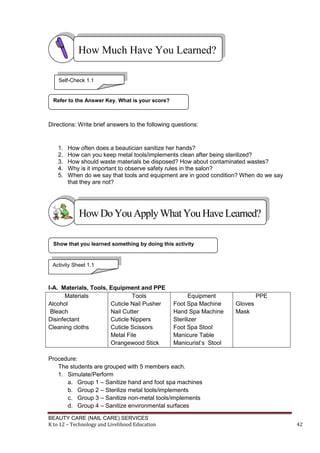
j. Waste materials should be disposed properly in an enclosed waste bin fitted with
polythene bag. The bin should be sanitized with disinfectant regularly in a well-
ventilated area. Remember to wear protective gloves while doing this.
k. Contaminated wastes should be disposed off as recommended by local authority.
l. Any tool or equipment in poor condition must be repaired immediately or disposed
properly so as not to pose danger to the clients as well as the beauticians
BEAUTY CARE (NAIL CARE) SERVICES
K to 12 – Technology and Livelihood Education 42
Directions: Write brief answers to the following questions:
1. How often does a beautician sanitize her hands?
2. How can you keep metal tools/implements clean after being sterilized?
3. How should waste materials be disposed? How about contaminated wastes?
4. Why is it important to observe safety rules in the salon?
5. When do we say that tools and equipment are in good condition? When do we say
that they are not?
I-A. Materials, Tools, Equipment and PPE
Materials
Alcohol
Bleach
Disinfectant
Cleaning cloths
Tools
Cuticle Nail Pusher
Nail Cutter
Cuticle Nippers
Cuticle Scissors
Metal File
Orangewood Stick
Equipment
Foot Spa Machine
Hand Spa Machine
Sterilizer
Foot Spa Stool
Manicure Table
Manicurist’s Stool
PPE
Gloves
Mask
Procedure:
The students are grouped with 5 members each.
1. Simulate/Perform
a. Group 1 – Sanitize hand and foot spa machines
b. Group 2 – Sterilize metal tools/implements
c. Group 3 – Sanitize non-metal tools/implements
d. Group 4 – Sanitize environmental surfaces
Show that you learned something by doing this activity
Refer to the Answer Key. What is your score?
How Much Have You Learned?
HowDo YouApplyWhatYou HaveLearned?
Self-Check 1.1
Activity Sheet 1.1
BEAUTY CARE (NAIL CARE) SERVICES
K to 12 – Technology and Livelihood Education 43
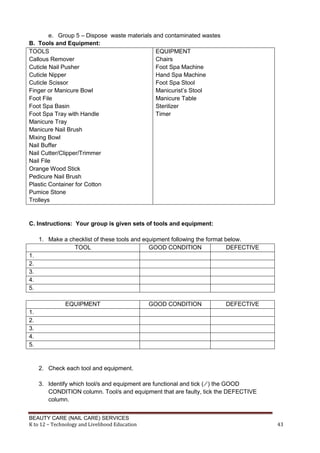
e. Group 5 – Dispose waste materials and contaminated wastes
B. Tools and Equipment:
TOOLS
Callous Remover
Cuticle Nail Pusher
Cuticle Nipper
Cuticle Scissor
Finger or Manicure Bowl
Foot File
Foot Spa Basin
Foot Spa Tray with Handle
Manicure Tray
Manicure Nail Brush
Mixing Bowl
Nail Buffer
Nail Cutter/Clipper/Trimmer
Nail File
Orange Wood Stick
Pedicure Nail Brush
Plastic Container for Cotton
Pumice Stone
Trolleys
EQUIPMENT
Chairs
Foot Spa Machine
Hand Spa Machine
Foot Spa Stool
Manicurist’s Stool
Manicure Table
Sterilizer
Timer
C. Instructions: Your group is given sets of tools and equipment:
1. Make a checklist of these tools and equipment following the format below.
TOOL GOOD CONDITION DEFECTIVE
1.
2.
3.
4.
5.
EQUIPMENT GOOD CONDITION DEFECTIVE
1.
2.
3.
4.
5.
2. Check each tool and equipment.
3. Identify which tool/s and equipment are functional and tick ( ∕ ) the GOOD
CONDITION column. Tool/s and equipment that are faulty, tick the DEFECTIVE
column.
BEAUTY CARE (NAIL CARE) SERVICES
K to 12 – Technology and Livelihood Education 44
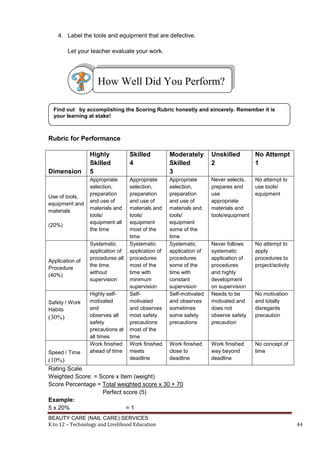
4. Label the tools and equipment that are defective.
Let your teacher evaluate your work.
Rubric for Performance
Dimension
Highly
Skilled
5
Skilled
4
Moderately
Skilled
3
Unskilled
2
No Attempt
1
Use of tools,
equipment and
materials
(20%)
Appropriate
selection,
preparation
and use of
materials and
tools/
equipment all
the time
Appropriate
selection,
preparation
and use of
materials and
tools/
equipment
most of the
time
Appropriate
selection,
preparation
and use of
materials and
tools/
equipment
some of the
time
Never selects,
prepares and
use
appropriate
materials and
tools/equipment
No attempt to
use tools/
equipment
Application of
Procedure
(40%)
Systematic
application of
procedures all
the time
without
supervision
Systematic
application of
procedures
most of the
time with
minimum
supervision
Systematic
application of
procedures
some of the
time with
constant
supervision
Never follows
systematic
application of
procedures
and highly
development
on supervision
No attempt to
apply
procedures to
project/activity
Safety / Work
Habits
(30%)
Highly self-
motivated
and
observes all
safety
precautions at
all times
Self-
motivated
and observes
most safety
precautions
most of the
time
Self-motivated
and observes
sometimes
some safety
precautions
Needs to be
motivated and
does not
observe safety
precaution
No motivation
and totally
disregards
precaution
Speed / Time
(10%)
Work finished
ahead of time
Work finished
meets
deadline
Work finished
close to
deadline
Work finished
way beyond
deadline
No concept of
time
Rating Scale
Weighted Score: = Score x Item (weight)
Score Percentage = Total weighted score x 30 + 70
Perfect score (5)
Example:
5 x 20% = 1
Find out by accomplishing the Scoring Rubric honestly and sincerely. Remember it is
your learning at stake!
How Well Did You Perform?
BEAUTY CARE (NAIL CARE) SERVICES
K to 12 – Technology and Livelihood Education 45
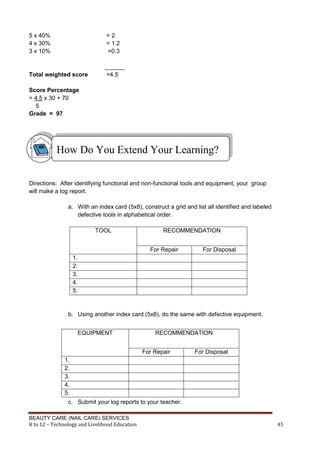
5 x 40% = 2
4 x 30% = 1.2
3 x 10% =0.3
______
Total weighted score =4.5
Score Percentage
= 4.5 x 30 + 70
5
Grade = 97
Directions: After identifying functional and non-functional tools and equipment, your group
will make a log report.
a. With an index card (5x8), construct a grid and list all identified and labeled
defective tools in alphabetical order.
TOOL RECOMMENDATION
For Repair For Disposal
1.
2.
3.
4.
5.
b. Using another index card (5x8), do the same with defective equipment.
c. Submit your log reports to your teacher.
EQUIPMENT RECOMMENDATION
For Repair For Disposal
1.
2.
3.
4.
5.
How Do You Extend Your Learning?
BEAUTY CARE (NAIL CARE) SERVICES
K to 12 – Technology and Livelihood Education 46
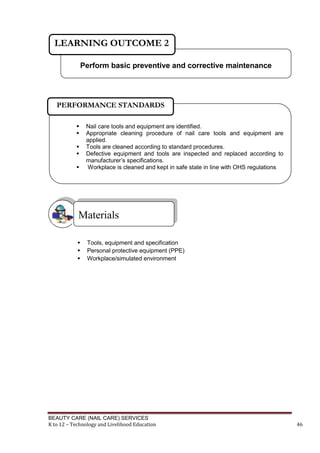
 Tools, equipment and specification
 Personal protective equipment (PPE)
 Workplace/simulated environment
Materials
Perform basic preventive and corrective maintenance
LEARNING OUTCOME 2
 Nail care tools and equipment are identified.
 Appropriate cleaning procedure of nail care tools and equipment are
applied.
 Tools are cleaned according to standard procedures.
 Defective equipment and tools are inspected and replaced according to
manufacturer’s specifications.
 Workplace is cleaned and kept in safe state in line with OHS regulations
PERFORMANCE STANDARDS
BEAUTY CARE (NAIL CARE) SERVICES
K to 12 – Technology and Livelihood Education 47
Directions: Supply an appropriate word to make each statement complete. Choose the
answer from the pool below and write it on a separate sheet of paper.
1. _________ metal
implements after every use to avoid infection or possible diseases.
2. _________ foot basins after each use with a bleach solution.
3. _________ metal implements once a month in a pot for 10 minutes.
4. _________ sterilized metal instruments in an airtight, zipper-sealed bag to keep them
from being exposed to dirt and bacteria.
5. _________ tools and equipment regularly to identify defective ones.
6. All beauty salons must be well-lighted and ventilated and must be in good_______
condition.
7. Salon establishments must be provided with continuous running hot and
cold___________.
8. All waste materials should be disposed of in an __________waste bin fitted with
polythene bin liner.
9. Each client must be provided with a freshly _______towel.
10. Measure and mix disinfectant as _________.
Water Store Inspect Boil
Enclosed Sterilize Disinfect Sanitary
Laundered Directed
What Do You Already Know?
Let us determine how much you already know about the basic preventive and
corrective maintenance of nail care tools and equipment. Take this test.
Pretest LO 2
BEAUTY CARE (NAIL CARE) SERVICES
K to 12 – Technology and Livelihood Education 48
How can tools and equipment be kept safe, clean and
functional?
It is vital to sterilize metal implements, sanitize wooden tools, disinfect hand
and foot spa machines as well as environmental surfaces before and after each use.
Contaminated tools can cause bacterial and fungal infections that are unsightly, painful and
sometimes, fatal. There are several methods of cleaning and sterilization. Do a cursory
cleaning after each nail care service and deep-clean monthly to keep tools safe and useful
all the time.
1. Sterilize metal implements after each use in a hospital-grade disinfectant that is
bactericidal, virucidal, and fungicidal. This disinfectant can be found in beauty supply
stores. Immerse the tools in the disinfectant for 10 minutes.
2. Disinfect foot basins after each use with a bleach solution. Make a 1-to-10 solution by
mixing one part bleach with 10 parts water. Using gloves, rinse the basin with the
solution to disinfect. If necessary, scrub with a detergent to remove any dirt or debris.
3. Use a boiling method of sterilization once a month to disinfect all metal implements.
Designate one pot for sterilization to prevent cross-contamination with food.
Submerge the tools in boiling water for 10 minutes. Drain the tools and allow them to
dry.
4. Store sterilized metal implements in an airtight, zipper-sealed bag to keep them from
being exposed to dirt and bacteria. Be sure tools are completely dry before storing
them. If waiting more than a couple of weeks before the next nail care service,
sterilize the tools again before use.
5. Inspect tools and equipment regularly to identify defective ones for repair,
replacement or condemnation.
Keeping the Workplace Clean and Safe
1. All beauty salons must be well-lighted and well-ventilated and must be in good
sanitary condition.
What Do You Need To Know?
Read the Information Sheet 1.1 very well then find out how much you can
remember and how much you learned by doing Self-check 1.1.
Information Sheet 2.1
BEAUTY CARE (NAIL CARE) SERVICES
K to 12 – Technology and Livelihood Education 49
2. The salon premises must be free from rodents, vermin, flies or other similar insects.
3. All salon establishments must be provided with continuous running hot and cold
water.
4. The curtains and floor coverings in the salon must be washable and kept clean.
5. All hair, used cotton or other waste materials must be removed from the floor
immediately, and deposited in a closed container. Get rid of them from the salon
premises at frequent intervals.
6. The rest rooms must be well-sanitized and be provided with individual towels.
7. Each beautician must wear a washable uniform while working on clients.
8. Each client must be provided with a freshly laundered towel.
9. All waste materials should be disposed of in an enclosed waste bin fitted with
polythene bin liner, durable enough to resist tearing.
Directions: Enumerate the following:
1. 5 Ways/Means to Keep Tools and Equipment Safe and Functional.
2. 7 Measures in Keeping the Salon Clean and in a Safe State.
A. Group Activity
Directions:
In your school’s beauty salon, conduct a visit and follow the proper way of keeping
the workplace clean and safe to individual clients. Make necessary recommendations if it is
beyond your limitations.
Show that you learned something by doing this activity
Refer to the Answer Key. What is your score?
How Much Have You Learned?
Self-Check 2.1
HowDo YouApplyWhatYou HaveLearned?
Operation Sheet 2.1
BEAUTY CARE (NAIL CARE) SERVICES
K to 12 – Technology and Livelihood Education 50
1. See to it that the premises are free from rodents, vermin, flies or other similar insects.
2. Make sure that the place is provided with continuous running hot and cold water.
3. Inspect the curtains and floor coverings if they are washed and ironed.
4. Ensure that all used cotton or other waste materials are removed from the floor
immediately, and deposited in a closed container. Get rid of them from the salon
premises at frequent intervals.
5. Sanitize the rest room, its door knob and provide it with individual towels.
6. Check if waste materials are disposed of in an enclosed waste bin fitted with
polythene bin liner, durable enough to resist tearing.
B. Materials, Tools, Equipment and PPE
Materials
Alcohol Bleach Disinfectant Cleaning cloths
Tools
Cuticle Nail Pusher Nail Cutter Cuticle Nippers
Cuticle Scissors Metal File Orangewood Stick
Equipment
Foot Spa Machine Hand Spa Machine Sterilizer
Foot Spa Stool Manicure Table Manicurist’s Stool
PPE
Gloves Mask
Procedure:
1. Steps in Sanitizing an Equipment
a. Read directions on disinfectant.
b. Measure and mix disinfectant as directed.
c. Saturate a cleaning cloth with disinfectant solution and wipe entire surface area
of equipment.
d. Wipe the surface with paper towel to dry it.
e. Dispose of sanitizing solution and used towels.
2. Steps in Sterilizing Metal Implements
a. Soak the tools/ implements in hot, soapy water solution to remove any debris and
oil residue. Rinse them thoroughly.
b. Place the tools/implements in a 70% to 90% alcohol solution for 20 minutes.
c. Remove the tools/implements from solution, wipe them dry, and place them into a
dry sterilizer.
BEAUTY CARE (NAIL CARE) SERVICES
K to 12 – Technology and Livelihood Education 51
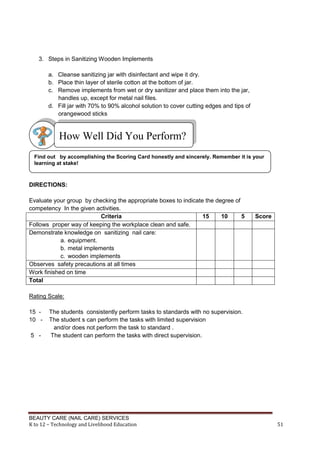
3. Steps in Sanitizing Wooden Implements
a. Cleanse sanitizing jar with disinfectant and wipe it dry.
b. Place thin layer of sterile cotton at the bottom of jar.
c. Remove implements from wet or dry sanitizer and place them into the jar,
handles up, except for metal nail files.
d. Fill jar with 70% to 90% alcohol solution to cover cutting edges and tips of
orangewood sticks
DIRECTIONS:
Evaluate your group by checking the appropriate boxes to indicate the degree of
competency In the given activities.
Criteria 15 10 5 Score
Follows proper way of keeping the workplace clean and safe.
Demonstrate knowledge on sanitizing nail care:
a. equipment.
b. metal implements
c. wooden implements
Observes safety precautions at all times
Work finished on time
Total
Rating Scale:
15 - The students consistently perform tasks to standards with no supervision.
10 - The student s can perform the tasks with limited supervision
and/or does not perform the task to standard .
5 - The student can perform the tasks with direct supervision.
Find out by accomplishing the Scoring Card honestly and sincerely. Remember it is your
learning at stake!
How Well Did You Perform?
BEAUTY CARE (NAIL CARE) SERVICES
K to 12 – Technology and Livelihood Education 52
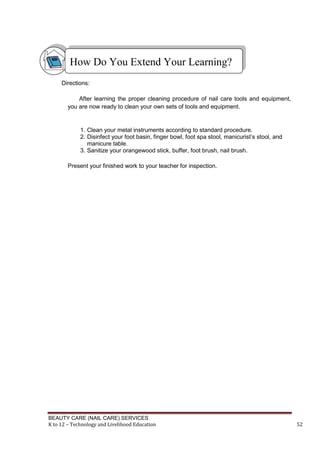
Directions:
After learning the proper cleaning procedure of nail care tools and equipment,
you are now ready to clean your own sets of tools and equipment.
1. Clean your metal instruments according to standard procedure.
2. Disinfect your foot basin, finger bowl, foot spa stool, manicurist’s stool, and
manicure table.
3. Sanitize your orangewood stick, buffer, foot brush, nail brush.
Present your finished work to your teacher for inspection.
How Do You Extend Your Learning?
BEAUTY CARE (NAIL CARE) SERVICES
K to 12 – Technology and Livelihood Education 53
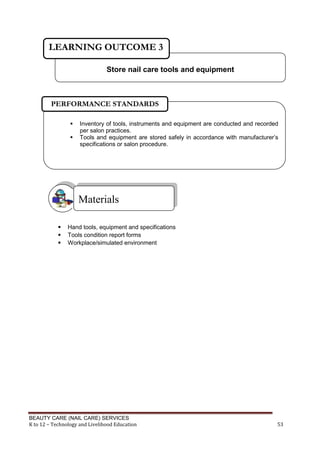
 Hand tools, equipment and specifications
 Tools condition report forms
 Workplace/simulated environment
Materials
Store nail care tools and equipment
LEARNING OUTCOME 3
 Inventory of tools, instruments and equipment are conducted and recorded
per salon practices.
 Tools and equipment are stored safely in accordance with manufacturer’s
specifications or salon procedure.
PERFORMANCE STANDARDS
BEAUTY CARE (NAIL CARE) SERVICES
K to 12 – Technology and Livelihood Education 54
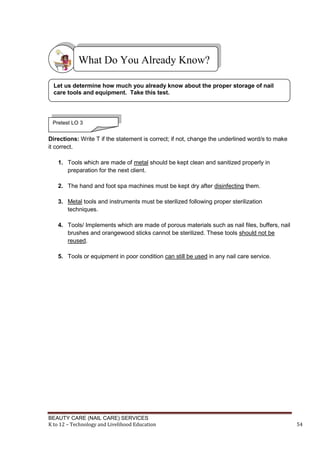
Directions: Write T if the statement is correct; if not, change the underlined word/s to make
it correct.
1. Tools which are made of metal should be kept clean and sanitized properly in
preparation for the next client.
2. The hand and foot spa machines must be kept dry after disinfecting them.
3. Metal tools and instruments must be sterilized following proper sterilization
techniques.
4. Tools/ Implements which are made of porous materials such as nail files, buffers, nail
brushes and orangewood sticks cannot be sterilized. These tools should not be
reused.
5. Tools or equipment in poor condition can still be used in any nail care service.
What Do You Already Know?
Let us determine how much you already know about the proper storage of nail
care tools and equipment. Take this test.
Pretest LO 3
BEAUTY CARE (NAIL CARE) SERVICES
K to 12 – Technology and Livelihood Education 55
At the end of every working session, make an inventory of the things that should be
done:
a. Tools which are made of plastic should be kept clean and sanitized properly in
preparation for the next client.
b. Empty bottles and containers are discarded in a covered trash bin.
c. Used treatment products and other chemicals are stored, arranged and properly
labeled in the cabinet.
d. Finger bowls must be sanitized before another client use them.
e. The hand and foot spa machines must be kept dry after disinfecting them.
f. Table tops and door handles are wiped with disinfectant and the floor should be
mopped with disinfectant as well.
g. Metal tools and instruments must be sterilized following proper sterilization
techniques. After the process, store in a dry cabinet until needed.
h. Tools/Implements which are made of porous materials such as nail files, buffers, nail
brushes and orangewood sticks can harbor bacteria easily. Since they are wood
products which cannot be sterilized, these tools should not be reused.
i. Waste materials should be disposed of properly in an enclosed waste bin fitted with
polythene bag. The bin should be sanitized with disinfectant regularly in a well-
ventilated are. Remember to wear protective gloves while doing this.
j. Any tool or equipment in poor condition must be repaired immediately, replaced or
disposed of properly so as not to pose danger not only to the clients but also to the
beauticians.
Storage:
What Do You Need To Know?
Read the Information Sheet 1.1 very well then find out how much you can
remember and how much you learned by doing Self-check 1.1.
Information Sheet 3.1
BEAUTY CARE (NAIL CARE) SERVICES
K to 12 – Technology and Livelihood Education 56
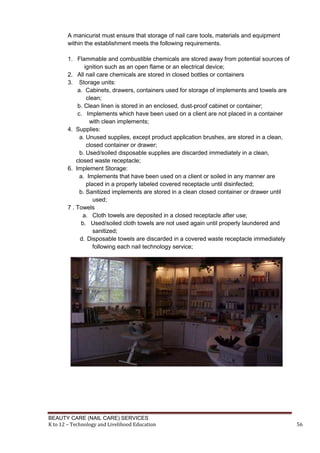
A manicurist must ensure that storage of nail care tools, materials and equipment
within the establishment meets the following requirements.
1. Flammable and combustible chemicals are stored away from potential sources of
ignition such as an open flame or an electrical device;
2. All nail care chemicals are stored in closed bottles or containers
3. Storage units:
a. Cabinets, drawers, containers used for storage of implements and towels are
clean;
b. Clean linen is stored in an enclosed, dust-proof cabinet or container;
c. Implements which have been used on a client are not placed in a container
with clean implements;
4. Supplies:
a. Unused supplies, except product application brushes, are stored in a clean,
closed container or drawer;
b. Used/soiled disposable supplies are discarded immediately in a clean,
closed waste receptacle;
6. Implement Storage:
a. Implements that have been used on a client or soiled in any manner are
placed in a properly labeled covered receptacle until disinfected;
b. Sanitized implements are stored in a clean closed container or drawer until
used;
7 . Towels
a. Cloth towels are deposited in a closed receptacle after use;
b. Used/soiled cloth towels are not used again until properly laundered and
sanitized;
d. Disposable towels are discarded in a covered waste receptacle immediately
following each nail technology service;
BEAUTY CARE (NAIL CARE) SERVICES
K to 12 – Technology and Livelihood Education 57
In not less than 5 sentences, describe how tools and equipment are stored.
Scoring rubric
Fair
5pts
Good
10 pts
Very Good
15 pts
Knowledge and
understanding
Student was able to
convey limited ideas
on the topic with little
knowledge
Student was able to
convey a few ideas
on the topic with
some degree of
knowledge
Student was able to
convey several ideas
on the topic with a
good degree of
knowledge
Accuracy Work was organized
and planned with
little effectiveness
Work was organized
and planned with
some effectiveness
Work was organized
and planned with
considerable
effectiveness
Effort Student put little or
no effort into this
activity.
Student put some
effort into this
activity.
Student put full effort
into this activity.
Rating Scale:
15 pts.=Very Good
10 pts.=Good
5 pts.= Fair
How Much Have You Learned?
Self-Check 3.1
BEAUTY CARE (NAIL CARE) SERVICES
K to 12 – Technology and Livelihood Education 58
I-A. Materials, Tools and Equipment
Tools
Callous Remover
Cuticle Nail Pusher
Cuticle Nipper
Cuticle Scissor
Finger or Manicure Bowl
Foot File
Foot Spa Basin
Foot Spa Tray with Handle
Manicure Tray
Manicure Nail Brush
Mixing Bowl
Nail Buffer
Nail Cutter/Clipper/Trimmer
Nail File
Orange Wood Stick
Pedicure Nail Brush
Plastic Container for Cotton
Pumice Stone
Trolleys
Materials
Alcohol
Antiseptic Solution
Apron
Assorted Nail Polish
Base Coat
Benzalconium Chloride
Bleaching Soap
Cling Wrap
Cotton
Cuticle Oil
Cuticle Remover
Disinfectant
First Aid Kit
Foot Blush
Foot Soak
Foot Scrub
Garbage Bags/Bins
Hand Towel
Emery board
Lotion
Manicure Pillow
Nail Hardener
Nail Polish Remover
Quick Dry
Solvent
Toe Nail Separator
Top Coat
Wet Sanitizer
EQUIPMENT
Chairs
Foot Spa Machine
Hand Spa Machine
Foot Spa Stool
Manicurist’s Stool
Manicure Table
Sterilizer
Timer
Show that you learned something by doing this activity
HowDo YouApplyWhatYou HaveLearned?
Operation Sheet 3.1
BEAUTY CARE (NAIL CARE) SERVICES
K to 12 – Technology and Livelihood Education 59
Procedure:
1. Given the list of materials, tools and equipment in nail care, show how to properly store
them.
B. Materials, Tools and Equipment
All the materials, tools and equipment provided in the workplace
Instructions:
Simulate the proper safekeeping and storage of tools and equipment.
Score Card
DIRECTIONS:
Evaluate yourself by checking the appropriate boxes to indicate the degree of competency
In the given activities.
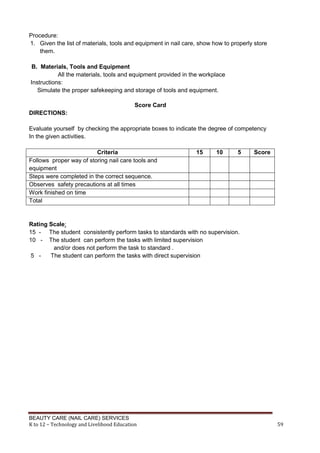
Criteria 15 10 5 Score
Follows proper way of storing nail care tools and
equipment
Steps were completed in the correct sequence.
Observes safety precautions at all times
Work finished on time
Total
Rating Scale:
15 - The student consistently perform tasks to standards with no supervision.
10 - The student can perform the tasks with limited supervision
and/or does not perform the task to standard .
5 - The student can perform the tasks with direct supervision
BEAUTY CARE (NAIL CARE) SERVICES
K to 12 – Technology and Livelihood Education 60
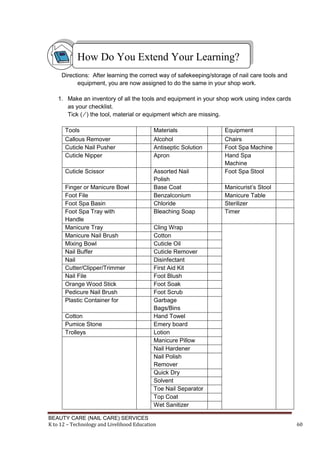
Directions: After learning the correct way of safekeeping/storage of nail care tools and
equipment, you are now assigned to do the same in your shop work.
1. Make an inventory of all the tools and equipment in your shop work using index cards
as your checklist.
Tick ( ∕ ) the tool, material or equipment which are missing.
Tools Materials Equipment
Callous Remover Alcohol Chairs
Cuticle Nail Pusher Antiseptic Solution Foot Spa Machine
Cuticle Nipper Apron Hand Spa
Machine
Cuticle Scissor Assorted Nail
Polish
Foot Spa Stool
Finger or Manicure Bowl Base Coat Manicurist’s Stool
Foot File Benzalconium Manicure Table
Foot Spa Basin Chloride Sterilizer
Foot Spa Tray with
Handle
Bleaching Soap Timer
Manicure Tray Cling Wrap
Manicure Nail Brush Cotton
Mixing Bowl Cuticle Oil
Nail Buffer Cuticle Remover
Nail Disinfectant
Cutter/Clipper/Trimmer First Aid Kit
Nail File Foot Blush
Orange Wood Stick Foot Soak
Pedicure Nail Brush Foot Scrub
Plastic Container for Garbage
Bags/Bins
Cotton Hand Towel
Pumice Stone Emery board
Trolleys Lotion
Manicure Pillow
Nail Hardener
Nail Polish
Remover
Quick Dry
Solvent
Toe Nail Separator
Top Coat
Wet Sanitizer
How Do You Extend Your Learning?
BEAUTY CARE (NAIL CARE) SERVICES
K to 12 – Technology and Livelihood Education 61
Congratulations! You did a great job! Rest and
relax a while then move on to the next lesson.
Good luck!
LO1
 Nordmann, Lorraine, et. al. Beauty Therapy – The Foundation. Thomson
Learning: 2001
 Kibbe, Constance V. Standard Textbook of Cosmetology. Milady
Publishing Corp: 1984
 Moore, Oakley and Franco. The World of Cosmetology. McGraw-Hill Book
Company: 1980
LO 2
 Nordmann, Lorraine, et. al. Beauty Therapy – The Foundation. Thomson
Learning: 2001
 Kibbe, Constance V. Standard Textbook of Cosmetology. Milady
Publishing Corp: 1984
 Moore, Oakley and Franco. The World of Cosmetology. McGraw-Hill Book
Company: 198
LO 3
 Nordmann, Lorraine, et. al. Beauty Therapy – The Foundation. Thomson
Learning: 2001
 Kibbe, Constance V. Standard Textbook of Cosmetology. Milady
Publishing Corp: 1984
 Moore, Oakley and Franco. The World of Cosmetology. McGraw-Hill Book
Company: 198
REFERENCES
BEAUTY CARE (NAIL CARE) SERVICES
K to 12 – Technology and Livelihood Education 62
Practice Occupational Health and Safety
Procedures
LESSON 3
LO 1.Identify hazards and risks; and
LO 2. Evaluate and control hazards and risks;
LEARNING OUTCOMES:
At the end of this Lesson you are expected to do the
following:
BEAUTY CARE (NAIL CARE) SERVICES
K to 12 – Technology and Livelihood Education 63
Chemical Hazards are substances used and/or produced at work that have the potential
to harm the health and safety of people at work
Infection is a condition when micro-organisms invade the body and multiply causing
illness
Infection control is a process that minimizes the risk of spreading infection while
performing procedures on client
Harm are adverse health effects on something or someone under certain conditions at
work.
Maximal Allowable Concentration ( MCL) is a peak or maximum concentration of an
airborne, to which most workers could be safely exposed
Occupational Hazards - are various environmental factors or stresses that can cause
sickness, impaired health, or significant discomfort in workers and can be classified as
chemical, physical, biological or ergonomic
Occupational health and safety (OHS) is a planned system of working to prevent
illness and injury, where you work by recognizing and identifying hazards and risks.
OSH Trainings - are interventions conducted to facilitate learning on occupational safety
and health, the results of which can contribute to the attainment of better and improved
OSH conditions.
Skin penetration means any process, whether intentionally or otherwise, that involves
the shaving, piercing, cutting, puncturing, tearing of the skin or mucous membrane.
Threshold Limit Value (TLV) is a measure of concentration of toxic substances that
client can withstand.
Workplace - refers to the office, premises or worksite where a worker is temporary or
habitually assigned. Where there is no fixed or definite workplace, the term shall include
the place where the worker actually performs regular work, or where he regularly reports
to render service or to take an assignment.
Definition of Terms
BEAUTY CARE (NAIL CARE) SERVICES
K to 12 – Technology and Livelihood Education 64
 Lcd projector, Video clips, Laptop
 Workplace/simulated environment
Materials
Identify hazards and risks
LEARNING OUTCOME 1
 Workplace hazards and risks are identified
 Hazards and risks and their corresponding indicators are
identified in the workplace
 Effects of hazards are determined.
PERFORMANCE STANDARDS
BEAUTY CARE (NAIL CARE) SERVICES
K to 12 – Technology and Livelihood Education 65
Multiple choice: Directions: Read the following statements and select the best
answer.
1.It is the chance or probability that a person will be harmed or will experience an
adverse health effect if exposed to a hazard
a. harm
b. risk
c. ergonomics
2. It is an adverse health effect on something or someone under certain conditions
at work.
a. harm
b. risk
c .ergonomics
3. It involves identifying the hazards present and then evaluating the risk, taking into
account the existing precautions.
a, risk assessment
b. training
c. experience
4.It is important to give the health and safety experience to new or inexperienced
workers, including those that have been away from the workforce for some time
a. training
b. exposure
c .hygiene
5. It is a practice in some beauty salons that may affect the health of customers and
workers that may lead to exposure to biological hazards that cause infectious
diseases.
a. unsafe practices
b. fungi
c. activities
What Do You Already Know?
Let us determine how much you already know about the hazards and risks in the
workplace. Take this test.
Pretest LO 1
BEAUTY CARE (NAIL CARE) SERVICES
K to 12 – Technology and Livelihood Education 66
Occupational health and safety (OHS) is a planned system of working to prevent
illness and injury where you work by recognizing and identifying hazards and risks. Health
and safety procedure is the responsibility of all persons in the beauty service industries. You
must identify the hazards where you are working and evaluate and control how dangerous
they are. Eliminate the hazard or modify the risk that it presents.
An occupational health and safety management system should follow the following
elements:
1. Management Commitment-management can show their commitment to OHS by
 establishing an OHS policy
 identifying its objectives
2. Planning- planning includes setting standards for management and employees by
establishing:
 How the business ensures sound OHS practices are implemented?
 Who is assigned and responsible for the implementation? This person will
coordinate the assessment, delegate tasks and be responsible for taking
notes and writing up information for the register
 What resources are required for the implementation?
 When will the OHS practices be implemented?
 How will workers identify and report hazards to employer?
3. Consultation- consult and work with your employees, It is important that
employees have a basic understanding of what could be considered high –risk
activities in the salon. There should be a two way communication where
employers listen to and cooperate with employees then management can ensure
OHS decisions are based on the best and most up-to –date information.
4. Training- it is important to give the health and safety training to new or
inexperienced workers, including those that have been away from the workforce
for some time.
5. Risk management- involves identifying the hazards present and then evaluating
the risk, taking into account the existing precautions.
What Do You Need To Know?
Read the Information Sheet 1.1 very well then find out how much you can
remember and how much you learned by doing Self-check 1.1.
Information Sheet 1.1
BEAUTY CARE (NAIL CARE) SERVICES
K to 12 – Technology and Livelihood Education 67
The following are the steps of risk assessment:
1. Identifying hazards and risks
2. Evaluate and control hazards and risks
3. Control hazards and risks
- harm or adverse health effects on something or someone under certain
conditions at work.
- the chance or probability that a person will be harmed or experience
an adverse health effect if exposed to a hazard.
IDENTIFY HAZARDS AND RISKS- Identifying workplace hazards means looking for
those things at your workplace that have the potential to cause harm.
Step1.Identifying hazards and risks
There are many hazards present at a beauty salon that deserve your attention. Use
this guide as a starting point for conducting a risk assessment at your facility to correct
potential hazards and keep your client safe. Identifying hazards and risks should include the
following:
 consulting with salon employees
 conducting a worker survey
 inspecting the workplace
 ensuring that the information supplied by manufacturers and suppliers is
regularly updated and made available to all in the workplace.
Common hazards in a beauty salon include:
1. Electricity
-common accidents in the workplace can result from contact with
faulty electrical equipment that may have become “live” or from
contact with worn or damaged power cords and switches, the
presence of water in the salon increases the risk of electrocution or
injury.
2. Chemical hazard
-chemicals used in the beauty salon like nail polish, nail polish
removers, callus removers, and acrylic powders for artificial nails are
common products found in many nail salons. It causes skin irritations and
respiratory problems. Information on chemical hazards can be obtained
from the following:
 the product label
 material safety data sheet (MSDS) -This sheet will provide
information on how to properly handle, store, discard and
care for potentially hazardous chemicals. It will also provide
BEAUTY CARE (NAIL CARE) SERVICES
K to 12 – Technology and Livelihood Education 68
information on what to do if you are exposed to the
chemical and has bad reaction
 the manufacturer
3. Slips, Trips, Falls
-Slips, trips and falls are common occurrences in workplaces. People slip
and trip on slippery, rough or uneven surfaces and may fall down from
stairs or off ladders.
4. Fire
The range, number and 'portability' of electrical equipment used in salons,
together with their proximity to water, make for potentially hazardous
situations
5. Manual handling of material and tools
-Lifting and moving heavy stock materials and working at poorly
designed workstations can cause injuries and muscle strains.
Injury due to cutting with cuticle nippers, cuticle scissors and cuticle pusher.
6. Infection hazards
Unsafe or unhygienic practices in the beauty salon may affect the health
of customers and workers that may lead to exposure to biological hazards that
cause infectious diseases such as blood borne pathogens (Hepatitis B, Hepatitis C,
and HIV), fungal infections (Ringworm),
7. Ergonomic Hazards
Ergonomics is the scientific study of people at work. The goal of
ergonomics is to reduce stress and eliminate injuries and disorders associated
with the overuse of muscles, bad posture and repeated tasks..
Directions: Write the word True if the statement is correct and False if the statement is
incorrect.
1. MSDS provides information on how to handle, store, discard and care for
potentially hazardous chemicals
2. OHS is a planned system of working to prevent illness and injury where you work
by recognizing and identifying hazards and risks in the nail salon.
3. Identifying workplace hazards means looking for those things at your workplace
that have the potential to cause harm.
4. Damaged equipment may cause an accident or injury if it is not working correctly
Refer to the Answer Key. What is your score?
How Much Have You Learned?
Self-Check 1.1
BEAUTY CARE (NAIL CARE) SERVICES
K to 12 – Technology and Livelihood Education 69
5. In any occupation where there is exposure to blood and other bodily fluids, there
is always the potential for the transmission of blood borne allergy
6. To avoid injury and harm to health of salon's client, it is important that new or
inexperienced workers be adequately trained in OHS.
7. Ergonomic is to reduce stress and eliminate injuries and disorders associated
with the overuse of muscles, bad posture and repeated tasks
8. PPE is used to protect workers from chemical hazards.
9. Back injuries are most commonly caused by wrong posture or position and can
be prevented.
10. Nail workers have an obligation to their client's health and safety.
I. Venn Diagram Learning Activity
Procedure
1. Group yourselves into 5 members
2. Choose your reporter and complete the Venn Diagram.
3. List down common hazards that might be encountered in the following areas:
 Malls
 School
 Market
4. Report the common hazards in class
5. Keep the summarized common hazards notes ,it will be used in the next lesson
on how to prevent hazards and risks in malls, school and market.
Show that you learned something by doing this activity
HowDo YouApplyWhatYou HaveLearned?
Activity Sheet 1.1
BEAUTY CARE (NAIL CARE) SERVICES
K to 12 – Technology and Livelihood Education 70
School
Mall Market
Scoring Rubrics
Fair
5pts
Good
10 pts
Very Good
15 pts
Knowledge and
understanding
Students were able
to convey limited
ideas on the topic
with little knowledge
Student were able to
convey a few ideas
on the topic with
some degree of
knowledge
Students were able
to convey several
ideas on the topic
with a good degree
of knowledge
Accuracy Work was organized
and planned with
little effectiveness
Work was organized
and planned with
some effectiveness
Work was organized
and planned with
considerable
effectiveness
Effort Students put little or
no effort into this
activity.
Students put some
effort into this
activity.
Students put full
effort into this
activity.
Find out by accomplishing the Scoring Rubric honestly and sincerely. Remember it is
your learning at stake!
How Well Did You Perform?
HAZARD RECOGNITION ACTIVITY
BEAUTY CARE (NAIL CARE) SERVICES
K to 12 – Technology and Livelihood Education 71
Rating Scale
15 - The students consistently perform tasks to standards with no supervision.
10 - The student s can perform the tasks with limited supervision
and/or does not perform the task to standard .
5 - The students can perform the tasks with direct supervision
Directions: Look for hazards and risks that might be present in your house. Place a sticker
whenever you find possible hazards inside your house . Identify and give the possible risks
that might happen in your house.
PARTS OF THE
HOUSE
HAZARDS RISKS
1.
2.
3.
4.
5.
How Do You Extend Your Learning?
BEAUTY CARE (NAIL CARE) SERVICES
K to 12 – Technology and Livelihood Education 72
 Lcd projector, Video clips, Laptop
 Workplace/simulated environment
Materials
Evaluate and control hazards and risks
LEARNING OUTCOME 2
 Terms of maximum tolerable limits are identified based on threshold
limit values (TLV)
 Evaluate and control hazards and risks
 OHS issues and concerns are identified in accordance with workplace
requirements
PERFORMANCE STANDARDS
BEAUTY CARE (NAIL CARE) SERVICES
K to 12 – Technology and Livelihood Education 73
Directions: Answer the following questions to demonstrate your prior knowledge on
health and safety issues in the workplace.
1. If spillage occurs
a. walk over it
b. shout for help
c. throw towel over it
d. identify the spillage to everyone and clean up appropriately
2. To avoid product contamination always:
a. dispose of used or remaining product between clients
b. use an applicator bottle or dropper to apply the product.
c. Use single-use disposable implements to remove products from containers for
application or remove product with a clean and disinfected spatula and put product
to be used into a disposable or disinfectable service cup.
d. all of the above
3. If you are carrying out a nail service and the alarm sounds , you should
a. leave the workplace and run
b. leave the client to relax while you go out to safe area
c. ignore it-it might be false alarm
d. assist your client to the nearest exit and safe place
4. Occupational health and safety risk assessment is carried out to
a. make the nail salon look professional
b. assess the risk of using chemical substances
c. assess the risk of using equipment
d. preventing injury, infection or accidents
5. An overloaded socket requires you to
a. repair and obtain an extension wire until new sockets can be fitted.
b. keep on using it
c. ensure candles are not near to it
d. inform people of wet floor
What Do You Already Know?
Let us determine how much you already know about the evaluation and control of
hazards and risks. Take this test.
Pretest LO 2
BEAUTY CARE (NAIL CARE) SERVICES
K to 12 – Technology and Livelihood Education 74
Evaluating hazards and risks is the process of determining the level of risk created by
the hazard and the likelihood of injury or illness occurring. The priority of control
increases as the established level of risk increases. Person identifying the risk of harm
or injury from a hazard in a salon should consider these questions:
 how likely that it is a hazard will cause harm;
 how serious that harm is likely to be;
 how often (and how many) workers are exposed.
You must have a record of every risk assessment. If this injury or harm
happen again, it is possible that you will go back to the original records to see if
the original assessment overlook a possible hazard. The assessment stage is
essential because it will determine the type(s) of control methods required.
Reminder: a risk is the chance,( high or low) that somebody may be
harmed by a hazard
Control Hazards and Risks
Where the assessment reveals a problem, preventive measures must be
designed and implemented. Control measures should now be selected according to
the list of control priorities. First, try to eliminate the hazard. If this is not possible,
prevent or minimize exposure to the risk by one or a combination of:
a) substituting a less hazardous material, process or equipment
b) redesigning equipment or work processes c) isolating the hazard
When exposure to the risk is not (or cannot be) minimized by other means:
a) Introduce administrative controls like safe work methods and operating
procedures . Written work procedures control the way the work is done.
b) Use appropriate personal protective equipment
Personal Protective Equipment (PPE) at Work
``Personal protective equipment is clothing equipment designed to be worn by a nail
technician or salon workers to protect them from risks of injury or illness. It should only be
considered as a control measure when exposure to a risk cannot be minimized in another
way, or when used in conjunction with other control measures as a final barrier between the
nail salon worker from the chemical hazard and other cause of hazards..These clothing
equipment does not control hazard at the source equipment which will protect you from risks
to health and safety.
What Do You Need To Know?
Read the Information Sheet 2.1 very well then find out how much you can
remember and how much you learned by doing Self-check 2.1.
Information Sheet 2.1
BEAUTY CARE (NAIL CARE) SERVICES
K to 12 – Technology and Livelihood Education 75
PPE is compose of the following:
Impermeable gloves Eyewear
Splash proof apron Protective mask
Advantages of wearing PPE at work:
 To prevent damage to workers’ nails and skin.
 To prevent skin from absorbing potentially harmful ingredients which may
cause skin allergies, irritation, or other related problems.
 So as not to generate a lot of dust, it may be necessary to wear a dust mask
to minimize breathing in particles while filing or buffing nails.
 To protect the wearer's face and prevent the breathing of air contaminated
with chemical and/or biological agents
BEAUTY CARE (NAIL CARE) SERVICES
K to 12 – Technology and Livelihood Education 76
Common workplace hazards and their control measures
The following are workplace hazards and their control measures:
ELECTRICAL HAZARD
Many of the electrical appliances used in the beauty salons can create serious
health and safety risks in the nail and beauty industry, particularly in wet conditions.
Damage to equipment increases this risk. Electrical shock can result in electrocution,
burns and injuries from falls.
Control Measures:
 You should always check any equipment before use.
 Ask qualified electrician to check all pieces of electrical equipment in the
workplace annually or as often as possible.
 Broken or damaged electrical equipment should not be used, the tag must
warn people not to use the equipment.
 When adjusting or cleaning equipment, SWITCH OFF the power and pull out
the plug and NOT by the cord.
 Do not touch equipment with wet hands or don't use a wet cloth to clean
sockets.
 Make sure flexible cords are fully unwound and kept clear of work traffic.
 Do not run too many pieces of equipment from one socket
BEAUTY CARE (NAIL CARE) SERVICES
K to 12 – Technology and Livelihood Education 77
CHEMICAL HAZARD
Chemical Hazards are substances used and/or produced at work that have the
potential to harm the health and safety of people at work. Beauty industry is exposed to
repeated exposure to numerous hazardous substances including nail and skin care
products, hair dyes, bleaches, perming solutions, hair styling agents, straighteners,
rebonding solutions, peroxides, disinfectants and cleaning products. . They can harm
people’s health if they get into the body, for example, if they are breathed in, absorbed
through the skin or eyes or ingested accidentally. The effects of hazardous substances may
show immediately, or it may take years for illness or disease to develop. Health effects of
some hazardous substances include skin irritation, coughs, asthma, sensitization, poisoning
and cancer.
Measures of Concentration of Toxic Substances (Chemical Substances)
Threshold Limit Value (TLV)
TLV is a measures of concentration of toxic substances .It is the average
concentration of an airborne substance to which most workers could be safely
exposed over an eight-hour working day or forty-hour working week throughout a
working lifetime.
Maximal Allowable Concentration ( MCL)
MCL is a peak or maximum concentration of an airborne to which most worker could
be safely exposed
Control Measures:
 using alternative substances or processes which are less hazardous
 Good ventilation can get rid of the fumes and chemical smell that builds up in a
salon
 providing separate eating and drinking amenities for employees
 ensuring appropriate safety signs, training, instruction and provision of Material
Safety Data Sheets (MSDS) and labels
 using appropriate PPE.
BEAUTY CARE (NAIL CARE) SERVICES
K to 12 – Technology and Livelihood Education 78
Slips, Trips, Falls
Slips-loss of balance
caused by too little friction
between a person’s foot
and a walking surface.
Trips- - hit an object, lose your balance and fall
Falls-- when you lose your balance & drop to the floor
SLIP, TRIPS AND FALLS
The results of slips, trips and falls include broken bones, abrasions,
contusions, strains, sprains, back or spinal injuries and other serious
injuries. During a slip, trip or fall accident, injury may be caused by over
stretching joints, bones and ligaments.
Control Measures
 clean up spills straight away.
 use mats on slippery floors.
 wear appropriate work shoes.
 improve cleaning methods to prevent build-up of grease/detergent
 provide ample storage space, to avoid materials being placed in
aisles/walkways
 set absorbent flooring materials into entrance areas
BEAUTY CARE (NAIL CARE) SERVICES
K to 12 – Technology and Livelihood Education 79
FIRE SAFETY
As a beauty salon staff, you must be aware of and trained in fire and emergency
evacuation procedures in the workplace. Emergency exit route will be the easiest route
by which all of the clients and staff can leave the building or salon safely.
Control Measures:
 . Keep all escape routes and fire exits clear, and make regular checks to ensure
this case.
 Firefighting equipment must be available, located in specified area. you can
include fire extinguishers, blankets, sand buckets and water hoses.
 Store products, particularly aerosols, away from naked flames or sources of
heat, at or below room temperature and in a dry atmosphere.
 Switch off and unplug all electrical appliances before leaving the workplace .
 Make sure that all workers in the salon are aware of the action that must takes
in the event of a fire.
MANUAL HANDLING
BEAUTY CARE (NAIL CARE) SERVICES
K to 12 – Technology and Livelihood Education 80
Manual handling involves any activity that requires the use of force exerted by a
person to lift, lower, push, pull, carry or otherwise move any load. These can result in
injuries to any part of the body.
Nail salon workers use forceful repetitive movements such as filing and buffing
nails and holding uncomfortable positions for long periods of time, thereby increasing
risk for joint and musculoskeletal injuries
Control measures:
 plan the lift before you begin
 position your feet shoulder width apart
 bend your knees without moving your upper body, squat down to the floor. Keep
the shoulders level and facing in the same directions as the hips.
 get a firm grip and keep the arms within a boundary formed by the legs
 keep the load as close to the body as possible
 lift the load smoothly, do not jerk
 if an item is too high, use a stepladder or stool to help you
BIOLOGICAL HAZARDS
Biological hazards, also known as biohazards, refer to biological substances that
pose a threat to the health of living organisms, primarily that of humans. Micro-organisms are
everywhere and are continually introduced into the environment. They live on skin, in food
and dirt. Micro-organisms are easily spread between clients and operators and are easily
transferred by contact with unwashed hands, soiled equipment or contact with blood and
body substances. Nail technicians must assume that all blood and other body substances
are potential sources of infection. To minimize transfer of micro-organisms, you must
perform all procedures in a safe and hygienic manner, following all infection control
techniques and procedures. Skin that is intact, without cuts or abrasions, is a natural
protective barrier against infection
Control Measures:
The following are the methods on how to control infectious diseases:
1. Cleaning is the removal of soil and a reduction in the number of micro-organisms
from equipment surfaces by washing in detergent and warm water.
Methods of Cleaning:
1. Rinse the equipment in warm water (15-30°C) to remove any blood or body
fluids. Hot water used at this stage will cause coagulation and the substances will
stick to the instrument. Cold water will harden fats making cleaning more difficult.
2. Wash the equipment in a sink filled with warm water and a mild alkaline
detergent to remove all visible soiling (strong alkaline detergents may damage
some instruments). Hold the items low in the sink to limit the generation of
aerosols during scrubbing. Use of a scouring pad can assist in removing stains.
3. Rinse the equipment thoroughly in running water.
4. Dry with a cotton cloth. Drying prevents residues from damaging equipment
during sterilization.
5.Store under cover in a clean, dry and dust free environment.
BEAUTY CARE (NAIL CARE) SERVICES
K to 12 – Technology and Livelihood Education 81
2. Disinfection is the removal of micro-organisms by chemical or physical means. The level
of decontamination depends on duration of exposure to lethal levels of disinfectants. Unlike
sterilization, disinfection does not remove all microorganisms but reduces the population to
safe levels.
Proper use of disinfectants:
 All implements must be thoroughly cleaned of all visible matter or residue before
soaking in disinfectant and prevent them from being effective.
 Implements and tools must be completely immersed in disinfectant solution for the
time specified on the product label. Complete immersion of tools and implements
means enough liquid to cover all surfaces of the item including the handles.
3. Sterilization is the total destruction of all living micro-organisms and their spores.
Method of sterilization:
1. Physical agents such as radiation and heat
2. Chemical agents, such as antiseptics, disinfectants and vapor fumigants
ERGONOMICS
Ergonomics is the study of how equipment and furniture can be arranged in order
that people can do work or other activities more efficiently and comfortably . It is
important in the adaptation of work conditions to the physical and psychological
nature of people.
Below are pictures showing how ergonomics can help reduce strain to your
bodies on the proper posture during manicure and pedicure services .
A nail technician should consider the three main factors in nail servicing:
1. Supporting the weight of the client's arm or leg
2. Working while looking down at the hand or foot of the model
3. Looking forward at the hand or foot of the model
The following pictures show how you are going to position the hand and foot of your
client when giving a manicure and pedicure services to avoid pain in your hands,
shoulders and back
A. Correct position of hand while giving a manicure
Correct position of client's hand Incorrect position of client's hand
Use rolled towel or hand cushion in giving a manicure,client's arm weight will rest on
the cushioin instead of holding it.Repetitive motion ,takes a toll on your muscles and joints
and can cause long-term problems,such as arthritis and carpal tunnel syndrome.( Carpal
BEAUTY CARE (NAIL CARE) SERVICES
K to 12 – Technology and Livelihood Education 82
tunnel syndrome. It is a type of compression neuropathy , a nerve damage caused by
compression and irritation of the median nerve in the wrist. The nerve is compressed within
the carpal tunnel, a bony canal in the palm side of the wrist that provides passage for the
median nerve to the hand and can be due to trauma from repetitive works.)
B. Correct position of foot while a giving a pedicure
Correct position of client's leg Incorrect position of client's leg
Correct position of client's leg
Elevate client's feet and place their feet or legs on a footrest that bears their weight.
During the massage portion of a service, the footrests can bear the majority of the weight so
nail technician can limit pressure on their back, shoulders, and neck
Incorrect position of client's foot :
Don’t bear the weight of a client’s leg by resting the foot in your lap or by using your
own strength to lift and lower the leg. This position will cause strains in the muscles in your
shoulders and back, and, because you are connected to the client, it also reduces your
mobility to be agile as you work through the different steps of the service
C. Correct position of a pedicurist in giving a pedicure service
Correct position of pedicurist Incorrect position of pedicurist
Correct position of pedicurist
You should keep your back straight and supported while giving a pedicure service, and use
both the height adjustment of your chair and of the footrest to keep the foot at a workable
level instead of straining the body. Suggest your client to bend their knees and move their
feet to appropriate positions.
BEAUTY CARE (NAIL CARE) SERVICES
K to 12 – Technology and Livelihood Education 83
Incorrect position of nail technician while giving a pedicure service
If you need to perform close-up, detailed work, there is a tendency to round the shoulders
and extend the neck to get as close to the foot as possible, which will cause strain to the
muscles in the upper body and the entire back. Worse will happen because you will add
enormous strain to your body as you try to get into a position that will give you best
perspective.
D. Correct position of a pedicurist feet while giving a manicure service
Correct position of pedicurist's feet Incorrect position of pedicurist's feet
Correct position of pedicurist's feet
As nail technician, you may twist your chair because you want to get closer to your work.
Instead of contorting yourself into this position, it might benefit you from a table with a cut-
out that allows you to sit straight in your chair but still work on the client’s hands from an
angle. You can improve your posture even without a cut-out in the desk by strengthening
your core muscles so you are able to sit straight for longer periods of time. It is also
important to develop a habit of keeping both feet on the floor to prevent the unbalanced
compression.
Incorrect position of pedicurist's legs
This nail technician has her shoulders rolled forward, her left arm is resting on the table,
which pushes her shoulder up, she is twisted in her chair, and her legs are crossed. This will
cause more compression on one side of the body than the other.
BEAUTY CARE (NAIL CARE) SERVICES
K to 12 – Technology and Livelihood Education 84
Completion Test: Evaluation and Controlling hazards and risks
Directions: Choose the word from the box given below to complete the
sentences.
reduction burns slips microorganism
clear, health injury illness
airborne syndrome
1. Disinfection does not remove all _________________ but reduces
the population to safe levels.
2. Person identifying the risk of harm from an__________________of
hazard in a salon should be aware of the OHS procedures.
3. . Cleaning is the removal of soil and a ________________ in the
number of micro-organisms from equipment surfaces by washing in
detergent and warm water.
4. . Keep all escape routes and fire exits______________ and make
regular checks to ensure this cases.
5. During a__________ , trip or fall accident, injury may be caused by
over stretching joints, bones and ligaments
6. Personal protective equipment is clothing equipment designed to be
worn by a nail technician or salon workers to protect them from risks of
injury or_______________.
7. Electrical shock can result in electrocution_____________ and injuries
from falls.
8. _______________ effects of some hazardous substances include skin
irritation, coughs, asthma, sensitization, poisoning and cancer.
9. Carpal tunnel________________ is a type of compression neuropathy ,
a nerve damage caused by compression and irritation of the median
nerve in the wrist..
10. MCL is a peak or maximum concentration of an______________to which
most worker could be safely exposed.
Refer to the Answer Key. What is your score?
How Much Have You Learned?
Self-Check 2.1
BEAUTY CARE (NAIL CARE) SERVICES
K to 12 – Technology and Livelihood Education 85
I. Directions: Group activity: Visit and make an interview in a nail salon nearby your
place, use the checklist below to serve as your basis in evaluating hazards and risks in a
nail salon.
CHECKLIST
The checklist consist of questions on types of occupational hazards. The questions
can be answered by “YES” or “NO”. Measures that can be taken to eliminate or reduce
hazard are often already indicated by questions themselves. This checklist is not
intended to cover all the risks of every workplace but
to help you put the method into practice.
Does the hazard exist at the workplace?
Physical load and ergonomic workplace design YES NO
QUESTIONS
1. Do clients’ and nail technicians’ seats enable a
good working posture for the variety of different tasks
carried out by a nail technician?
2. Does the amount of working space cause
uncomfortable working postures?
3. Do nail technicians work in solid shoes (without
heels) that give good support and enable a good
working posture?
4. Do nail technicians complain about the climate or
smell in the salon
5. Is there sufficient light for safe and efficient task
performance?
Working with chemicals hazards
QUESTIONS
1. Are all information about the hazards of the
chemicals available and known to all employees?
2. Are employees sufficiently protected from
exposure to chemical
3. Are the manufacturers’ safety instructions
followed?
Show that you learned something by doing this activity
HowDo YouApplyWhatYou HaveLearned?
Activity Sheet 2.1
BEAUTY CARE (NAIL CARE) SERVICES
K to 12 – Technology and Livelihood Education 86
4. Have employees been instructed on working
safely with dangerous materials?
5. Are protective gloves routinely being used for
chemical tasks and for cleaning tasks by all
employees?
6. Are all employees instructed in the use of, and
encouraged to use, protective gloves and creams?
Electrical risks, slips, trips, and falls
QUESTIONS
1. Are the floors slippery and dirty, during work time?
2. Are aisles or passageways tidy free from cords,
electrical cables and extension boards lying on the
floor?
3. Do the employees wear slippery shoes?
4. Is electrical equipment (foot spa machine) used
according to the suppliers’ safety instruction?
5. Are the electrical devices and cables undamaged
and regularly examined?
6. Are electrical devices protected against splash
water?
II. FILM CLIPS VIEWING
You are going to view film clips that will provide a basic introduction to health and
safety signs and symbols found in the workplace. They provide a useful guide for you and
other people who will undergo other services in the industry. Different workplace situations
are shown where safety signs are important. The film is suitable for all sectors and all levels
of employees but especially for young people in training or work experience. This design will
inform you about safety signs at work, to promote the importance of respecting the signs,
and to learn and identify the meaning of the signs through their form and the color.
Directions:
1. Watch the Napo film clip provided.
 Film: Safe Start, Scene: Watch Out For Others Too
 Film: Danger, Chemicals, Scene: Dangerous to the environment
 Film: Risky Business, Scenes: Assess The Risks and Act On Risks
 Film: Safety Inside and Outside of Work, Scene: An edited section (for
example from the stairs to the football)
Activity Sheet 2.2
BEAUTY CARE (NAIL CARE) SERVICES
K to 12 – Technology and Livelihood Education 87
2. Group yourselves into 5
 Discuss the hazards shown in the scenes.
 Explain to class what is hazard and risk and give your recommendations on
how to prevent hazards and risks according to the film clips shown
.
Scoring Rubric
15 pts 10 pts. 5 pts.
Content and
Development
 Content is
comprehensive and
accurate.
Major points are
stated clearly and are
well supported.
Content is accurate.
Major points are
stated.
Content is
Co incomplete
Major points are
not clear and /or
persuasive.
Accuracy
Students used 5
sentences with
accurate, factual
information.
Students have 4
sentences with
accurate, factual
information.
Major errors in
factual
information with 2
or less sentence
Effort Students put full
effort into this activity
Students put some
effort into this
activity.
Students put little
or no effort into
this activity
Rating Scale
15= Very Good
10= Good
5= Fair
Find out by accomplishing the Scoring Rubric honestly and sincerely. Remember it is
your learning at stake!
How Well Did You Perform?
BEAUTY CARE (NAIL CARE) SERVICES
K to 12 – Technology and Livelihood Education 88
Directions:
In your assignment notebook, identify the hazards shown in the film clips.
Discuss how some risks are more dangerous than others by making a list of the
risks in order of most severe consequences to less severe and which risks
require the most urgent intervention.
IDENTIFIED RISKS RANKING
Congratulations! You did a great job! Rest
and relax a while then move on to the next
lesson. Good luck!
How Do You Extend Your Learning?
BEAUTY CARE (NAIL CARE) SERVICES
K to 12 – Technology and Livelihood Education 89
LO1
 www.cdc.gov
 hhtp.//www.workcover.nsw.gov.au/forms publications
 http://www.deir.qld.gov.au/workplace/subjects/hairdressing/guide/hazar
ds/electric/index.htm
 http://www.dh.sa.gov.au/
 http://www.hsa.ie/eng/
 http://www.nailsmag.com/article/1138/posture-primer
LO 2
 www.cdc.gov
 http.//www.workcover.nsw.gov.au/forms publications
 http://www.deir.qld.gov.au/workplace/subjects/hairdressing/guide
/hazards/electric/index.htm
 http://www.dh.sa.gov.au/
 http://www.hsa.ie/eng/
 http://www.nailsmag.com/article/1138/posture-primer
 http://www.ehow.com/how_2100263_lift-heavy-objects-
safely.html#ixzz1mtGQB0GW
 www.dhrm.state.va.us/workerscomp/.../STF

REFERENCES
BEAUTY CARE (NAIL CARE) SERVICES
K to 12 – Technology and Livelihood Education 90
Practice Basic Nail Design
LESSON 4
LO1 Identify nail structure and shapes; and
LO2 Create basic nail designs
LEARNING OUTCOMES
At the end of this Lesson you are expected to do the
following:
BEAUTY CARE (NAIL CARE) SERVICES
K to 12 – Technology and Livelihood Education 91
Nail - a plate of keratin that lies on the tips of the fingers and toes
Keratin -a sulfur-containing fibrous protein constituting the main structural protein of hard
epidermal tissues, such as horn , hair, feathers, nails, claws, hoofs, and the like.
Dermis - the second layer of skin, it contains blood vessels, nerves, hair roots and sweat
glands.
Hyponychium - the epithelium of the nail bed , particularly its proximal part in the region of
the nail root and lunula , forming the nail matrix .
Epidermis - the upper or outer layer of the two main layers of cells that make up the skin.
The epidermis is mostly made up of flat, scale-like cells called squamous cells These cells are
round cells called basal cells. The deepest part of the epidermis also contains melanocytes
Definition of Terms
BEAUTY CARE (NAIL CARE) SERVICES
K to 12 – Technology and Livelihood Education 92
 Tools, equipment and specification
 Pictures
 Workplace/simulated environment
Materials
 Nail structure and shapes are identified;
 Nails are trimmed and varied shapes are applied;
 Nails diseases and disorders are identified.
PERFORMANCE STANDARDS
Identify nail structures and shapes
LEARNING OUTCOME 1
BEAUTY CARE (NAIL CARE) SERVICES
K to 12 – Technology and Livelihood Education 93
Directions:
1. Label the different parts of nail.
2. Identify the different shapes of nail.
a)_____________ b)___________ c)___________
d)___________ e)____________________
What Do You Already Know?
Let us determine how much you already know about the nail structure and basic
nail designs. Take this test.
Pretest LO 1
1
23
4
5
BEAUTY CARE (NAIL CARE) SERVICES
K to 12 – Technology and Livelihood Education 94
A. Nail Diseases and Disorders
Directions: Match the statement in column A with column B. Write the letter of your choice on
the space before the number.
Column A Column B
1. a vertical splitting or separation of
the nail plate layers at the distal
(free) edge of the nail plate
a. Blue nails
2. extreme thickening curvature of
the nails, usually it is caused by
varying degree of hyperkeratosis
b. Brittle nails
3. A condition nail plate which
separates from the nail bed
c. Claw nails
4. Nail condition in which the cuticle
splits around the nail.
d. Eggshell nails
5. chronic inflammation of the nail fold
and nail bed (matrix)
e. Hangnails
6. is referred to ingrown nails which
affect the fingers and toenails
f. Onychauxis or hypertrophy
7. infectious disease caused by a
vegetable parasite
g. Onychia
8. deformity of nail plate caused by
biting nails
h. Onychocryptosis
9. an overgrowth of cuticle which
sticks to the surfaces of nail plate
i. Onychomycosis
10. is caused by uneven growth of the
nails, usually resulting from illness.
j. Onychophagy or bitten nail
k. Pterygium
l. Ridges
BEAUTY CARE (NAIL CARE) SERVICES
K to 12 – Technology and Livelihood Education 95
Basic Information About Nail
Nail is a plate of keratin that lies on the tips of the fingers and toes. The main
purpose of the nail is to protect the fingers and toes, however, the fingernail also
assists with certain physical activities in daily life.
Below are the diagrams of the nail and its structure.
Structures of Nail
1. Lunula - the pearly coloured and crescent shaped is due to the cells
being pushed closely together, the blood capillaries cannot be seen
through the lunula because of this.
2. Cuticle - the overlapping epidermis around the nail. It is the
transparent skin, which is called the 'true cuticle', that is removed
during the manicuring process
3. Free edge -the part of the nail that can be filed and shaped. It is an
extension of the nail plate that overlaps the hyponychium
4. Matrix - the only living reproducing part of the nail. This is situated
directly below the cuticle. New cells form here and continually push
towards to produce the nail plate. It also contains blood vessels and
What Do You Need To Know?
Read the Information Sheet 1.1 very well then find out how much you can
remember and how much you learned by doing Self-check 1.1.
Information Sheet 1.1
BEAUTY CARE (NAIL CARE) SERVICES
K to 12 – Technology and Livelihood Education 96
nerves. Blood supply provides the cells with nourishment. If the
matrix is damaged the nail will grow deformed.
5. Nail bed - the part of the nail where the nail plate rests on, also a
continuation of the matrix. It is abundantly supplied with blood
vessels and nerves, having numerous parallel ridges which dovetail
exactly with the ridges on the under surface of the nail plate.
6. Nail walls - the folds of skin that overlap the sides of the nail. They
hold your nail in place and protect the nail plate edges.
7. Nail Plate - is visible nail that rests on the nail bed up to the free
edge. This is made up from dead cells and minimum amount of
moisture. The nail is semi-transparent – allowing the color of blood
supply of the dermis to show.
Shapes of Nail
The shape of nail conforms to that of finger tips of an individual.
1. Oval nail - this is common among people with long, perfect nail beds. It may be
styled slightly rounded at the base and slightly pointed at the fingertips. Most often
this type of nail has a natural look and looks very good in a short-medium length.
2. Round nail - ideal for shorter nails, the nail is allowed to grow out straight at the
sides for approximately 1.5 mm and then the tip is filed into a rounded shape. This is
a strong shape which is great for those who keep their nails short.
3. Stiletto/ pointed nail - filed away at the sides to a point at the tip; this shape is very
weak as the sides of the nail (which provide the strength) are totally lost
4. Squoval - As above, but followed by squaring off the tip, this gives the nail tip
strength over the oval shape
5. Square nail- The square-shaped nails are the most famous among the nail
shapes. It is created by allowing the nail to grow out straight and then filing the tip
straight across at right angles with the rest of the nail plate.
BEAUTY CARE (NAIL CARE) SERVICES
K to 12 – Technology and Livelihood Education 97
NAIL DISEASES AND DISORDERS
Nail diseases are conditions of both the nail, and the surrounding skin which result
from bacterial, fungal and viral infections. Some conditions will show a green, yellow or black
discoloration of the nail, depending on the nature of the infection. The main course for
infection is through damaged cuticles and broken skin.
Many disorders can affect the nails. These disorders can affect any portion of the nail
unit and can impact the appearance of the nail plate itself. Nail disorders can r
Given below is a list of the few important nail diseases and disorders and their
characteristics.
Nail Disorders Characteristics
1. Blue nails
i. It is bluish in color, may be attributed
to poor blood circulation or heart
disorder.
2. Brittle nails
It is a vertical splitting or separation
of the nail plate layers at the distal
(free) edge of the nail plate. Over
exposure to detergent soap and other
chemical solvents may attribute to the
effect.
3. Bruised nails It shows dark purplish (almost
black or brown) spots in the nail.
This is usually due to injury and
bleeding of the nail bed. As the nail
grows, dried blood in the nail bed will
also go out.
4. Eggshell nails The nail plate separates from the nail-
bed and curves at the free edge. It may
be caused by chronic illness of the
systemic or nervous origin.
5. Furrows These are long ridges that run either
lengthwise or across the nail. Some
lengthwise ridges are normal in adults.
These ridges increase with age and can
also be caused by psoriasis, poor
circulation and frostbite.
Ridges that run across the nail are
caused by high fevers, pregnancy &
measles.
BEAUTY CARE (NAIL CARE) SERVICES
K to 12 – Technology and Livelihood Education 98
6. Hangnails It is a condition in which the cuticle
splits around the nail. Carelessness in
removing the cuticle, dryness, cutting
off too much may result in hangnails. It
may cause infection if not treated.
7. Leconychia or
white spot
White spot appears frequently in the
nails. They may be caused by injury to
the base of the nail. As the nail
continues to grow, these white spots
eventually disappear
8. Pterygium It is an overgrowth of cuticle which
sticks to the surfaces of nail plate.
Carefully remove the adhering growth
by means of a cuticle nipper.
9. Onychatrophia It is describe as wasting away of the
nail . The nail loses its luster, shrinks
and falls This can be caused by injury
to the nail matrix or by internal disease.
10. Onychauxis
or hypertrophy
It is an overgrowth of the nail usually in
thickness rather than length. It is
caused by an internal imbalance, such
as local infection or heredity.
11. Onychophagy
or bitten nail
It is a deformity of nail plate caused by
biting nails. It is an acquired nervous
habit which prompts the individual to
chew the nail or the hardened cuticle.
12. Onychorrhexis
or split or brittle
nails
It refers to split or brittle nails caused
by an injury to the finger, careless filing
of the nails, excessive use of cuticle
solvents and nail polish removers. The
nails may be extremely dry because of
some granular disorder..
BEAUTY CARE (NAIL CARE) SERVICES
K to 12 – Technology and Livelihood Education 99
Nail Diseases Characteristics
1. Onychomycosis It is an infectious disease caused by a
vegetable parasite. The onset of the
disease takes about two to three
months and the attack is rarely on
more than one or two nails. The
appearance of the nail is frayed (worn
out), brittle with furrowed surface,
opaque, grayish, or yellowish in color
and is lifted-up by an accumulation of
epidermis underneath.
2. Onychia Is a term applicable to chronic
inflammation of the nail fold and nail
bed (matrix). It results from the
introduction of microscopic
pathogen through small wounds.
3. Onychocryptosis It is referred to ingrown nails which
affect the fingers and toenails. It is
marked by nail growth into surrounding
tissues and may cause infection.
Incorrect trimming a shaping of nails
are often responsible for ingrown nails.
4. Onychoptosis It is the periodic shedding of one or
more nails, either in the whole or in
part. This condition maybe a symptom
of a more alarm disease such as
syphilis or can result from fever, trauma
systematic upset or adverse reaction to
13. Ridges
It is caused by uneven growth of the
nails, usually resulting from illness.
Buffing the nails with paste polish will
help remove ridges.
14. Treating cuts It is caused by an accident during
manicure service. Apply an antiseptic
immediately. Do not apply nail polish
on the affected area
BEAUTY CARE (NAIL CARE) SERVICES
K to 12 – Technology and Livelihood Education 100
drug
5. Onycholysis
It refers to the detachment of the nail
from the nail bed, starting at its distal
and/or lateral attachment. The most
common cause of onycholysis is
psoriasis
6. Onychogryphosis
or claw nails
It pertains to extreme thickening
curvature of the nails, usually it is
caused by varying degree of
hyperkeratosis (skin disease in which
the skin gets thicker) on the distal
portion of the nail bed that detaches
and lifts the plate off the bed
Test 1. ENUMERATION:
Directions: Enumerate the following items listed below.
A. Parts surrounding the nail
B. Shapes of nails
Test II. FILL IN THE BLANK
Directions: Fill in the blanks with the correct answer.
1. Free edge is the part of the nail that can be filed and shaped. It is an extension of the
_____________ that overlaps the hyponychium.
2 ____________are the folds of skin that overlap the sides of the nail. It holds your nail in
place and protects the nail plate edges.
3. Nail bed is the part of the nail that the nail plate ______________ on, also a continuation
of the matrix. It is abundantly supplied with blood vessels and nerves, having numerous
parallel ridges which dovetail exactly with the ridges on the under surface of the nail plate.
4. Matrix is the only living reproducing part of the nail, this is situated directly below the
___________. New cells form here and continually push towards to produce the nail
How Much Have You Learned?
Self-Check 1.1
BEAUTY CARE (NAIL CARE) SERVICES
K to 12 – Technology and Livelihood Education 101
plate. It also contains blood vessels and nerves. Blood supply provides the cells with
nourishment. If the matrix is damaged the nail will grow deformed.
5. ____________is a visible nail that rests on the nail bed up to the free edge. This is made
up from dead cells and minimum amount of moisture.
COMPLETION TEST
Directions: Each sentence below has a blank space; each blank indicates that
something has been omitted. Inside the box are words that fits the meaning of the
sentence as a whole. Write your answers on the space provided for.
Hyperkeratosis Bluish
Onychia Uneven Eggshell nails Furrows
Treating cuts Shedding Detachment
Hangnail
1. ____________are long ridges that run either lengthwise or across the nail.
2. __________is a term applicable to chronic inflammation of the nail fold and
nail bed .
3. Onychogryphosis pertains to extreme thickening curvature of the nails,
usually it is caused by varying degree of ___________________.
4. Onychoptosis is the periodic_________ of one or more nails, either in the
whole or in part.
5. Ridges are caused by ___________growth of the nails, usually resulting from
illness
6. Blue nail is __________in color, may be attributed to poor blood circulation or
heart disorder.
7. ___________are caused by an accident during manicure service.
8. _____________ is a condition in which the cuticle splits around the nail
9. _________separates from the nail-bed and curves at the free edge.
10.Onycholysis refers to the _________of the nail from the nail bed, starting at
its distal and/or lateral attachment
Refer to the Answer Key. What is your score?
BEAUTY CARE (NAIL CARE) SERVICES
K to 12 – Technology and Livelihood Education 102
Trim your nails
Trimming of nail plays a very vital role. It is very easy task but sometime it causes little
problems such as unwanted abrasions and ingrown nails, when done not properly Apply the
following steps while cutting nails.
Step 01:
Prepare the types of instruments for this task. Nail cutter, who has small or medium slightly
curved blades, which are suitable for trimming the finger nails. Nail cutters with straight
blades are suitable for use.
Step 02:
Before using your nail cutter, make sure that it is clean. Wash your nail cutter to remove dust
and germs, specially when you are sharing your nail cutter with someone else. Dry
thoroughly after washing it.
Step 03:
Wash your hands. Wipe dry with any towel or tissue paper to remove extra water. This
process cleans your fingernails, and beside cleaning fingernails it also helps in softening
your nails and easier to cut them
Step 04:
You must cut your nails in a place where you can clearly see what you are doing. Put a small
container near you in which you can collect the nails.
Step 05:
Decide the shape of your nails. Decide which shape you actually want. After deciding, lift the
nail cutter and start cutting your nails.
Step 06:
Start cutting your nails starting from your little finger,
Step 07
Click on the nail cutter that can cut through the nail. You can make at least two or three cuts
of a finger nail until everything is snug. Follow the curve of the nail to get a clean cut. Check
skin flaps after each cut and remove carefully.
Step 08:
Sit comfortably and crouch your knee side to easily reach up and see the nails clearly. Be
sure not to set up deep razor to prevent scratches. Adjust the position of razor if you feel any
discomfort.
HowDo YouApplyWhatYou HaveLearned?
Show that you learned something by doing this activity
Operation Sheet 1.1
BEAUTY CARE (NAIL CARE) SERVICES
K to 12 – Technology and Livelihood Education 103
Step 09:
After cutting your nails, use a nail file to smooth any rough and odd surface of newly trimmed
nails. When you file, do it in on tilt – from the corner of the nail to go down.
Step 10:
Apply some moisturizer on your hands to keep the cuticles moisturized and smooth.
Criteria for Judging Points Score
General Appearance
 Different nail shapes are applied
 proportion of the different nail shapes
were observed
35
Workmanship
 neatness in work were observed
35
Cleanliness
 work area is cleaned
20
Speed
 finished based on allotted time
10
TOTAL
How Well Did You Perform?
Find out by accomplishing the Scoring Rubric honestly and sincerely. Remember it is
your learning at stake!
BEAUTY CARE (NAIL CARE) SERVICES
K to 12 – Technology and Livelihood Education 104
 Tools, equipment and specification
 Pictures
 Workplace/simulated environment
Materials
 Different basic nail designs are explained and
demonstrated thru visuals ;and
 Different basic nail designs are created in mock nails.
PERFORMANCE STANDARDS
Create Basic Nail Designs
LEARNING OUTCOME 2
BEAUTY CARE (NAIL CARE) SERVICES
K to 12 – Technology and Livelihood Education 105
I. Directions: Identification. Identify the names of the following basic nail designs
.
1.___________ 2.____________
3. _______________ 4. _________ 5.___________
What Do You Already Know?
Let us determine how much you already know about the different basic nail
designs. Take this test.
BEAUTY CARE (NAIL CARE) SERVICES
K to 12 – Technology and Livelihood Education 106
Different basic nail designs
The following are basic nail designs which you can offer in a nail salon. Steps and
illustrations are shown below.
A. Plain manicure
It is the traditional application of nail polish to the entire nail plate.
Steps in Plain manicure
1. Apply base coat
 Begin with little finger of one hand. Repeat polish application on the other
hand
2. Apply two coats of polish
 Use light long strokes from nail base to free edge
 Apply polish to the middle of the nail first and then to the sides.
 Repeat second coat of polish to both hands
 Remove excess polish around nail with a cotton tipped orangewood stick
3. Apply top coat
 Apply a top coat over the entire nail plate .
Tips
Learn the history of color by buying an artist color wheel. You can use
what you learn to help clients select complementary colors that match
their skin tone.
What Do You Need To Know?
Information Sheet 2.1
Read the Information Sheet 2.1 very well then find out how much you can
remember and how much you learned by doing Self-check 2.1.
BEAUTY CARE (NAIL CARE) SERVICES
K to 12 – Technology and Livelihood Education 107
B. Half-Moon
Half moon is a style that involves applying of nail polish over the whole nail
plate except the area of lunula.
Steps in giving Half-moon nail design
1. Apply base coat
2. Apply white or platinum nail polish and leave for a few
minutes to dry.
3. Apply colored polish from one side to the other side of the nail following the shape of the
lunula. Repeat the application of the nail polish if necessary.
4. Remove excess polish from the skin .
5. Apply top coat.
C. Half- Moon with Tip
It involves the application of colored polish over the whole nail plate except the
area of lunula and tip of the nail.
Steps in Giving Half-moon with Tip
1. Apply base coat
2. Apply white or platinum nail polish and leave for a few
minutes to dry
3. . Apply colored nail polish from one side to the other side of the nail to form a half-moon,
leaving the lunula of the nail Leave the part of the free edge. The free edge should be
seen. as in fig 5.Repeat the application of nail polish if necessary.
4. Remove excess polish
5. Apply top coat..
BEAUTY CARE (NAIL CARE) SERVICES
K to 12 – Technology and Livelihood Education 108
C .French Manicure or Tip design :
It is a design which involves the application of colored polish over the whole
part of the nail except the area of the free-edge.
Steps in giving French Manicure-Variation no. 1
1. Apply base coat and leave for a few minutes to dry.
2. Apply white or platinum nail polish and leave for a few
minutes to dry.
3. Apply colored nail polish from one side to the other side of the nail following the shape
of the free- edge . Repeat the application of nail polish if necessary
4. Remove excess polish
5. Apply top coat.
French Manicure or Tip design - Variation no. 2
It involves the application of white nail polish or colored polish on the tips and
coating the rest of the nail with a sheer polish . It’s suitable for short nails and those
with moderate length of nails
Steps in giving French manicure-Variation no. 2
1. Apply base coat and leave for a few minutes
2. Apply a coat of translucent pink polish over your entire nail.
3. With the use of white or colored nail polish, draw a thin
line over the tip of the nail following the shape of the free
edge of the nail. Apply second coating if necessary.
4. Remove excess polish.
5. Apply top coat.
BEAUTY CARE (NAIL CARE) SERVICES
K to 12 – Technology and Livelihood Education 109
E. Elephant Tusk
Elephant tusk is a style that involves the application of nail
polish to create S curve, leaving a slightly larger gap along the
nail walls.
Steps in making Elephant Tusk:
a) Apply white or platinum nail polish and leave for a few
minutes to dry.
b) Apply colored nail polish creating a half circle design at
the inner side of the nail as you continue it to form S-like.
c) Fill up the other side to complete the design.
d) Remove excess polish.
e) Seal with a top coat.
Directions: Identify the following nail designs: Write your answer on the blank before
each number.
__________1. It is the traditional application of nail polish to the entire nail plate.
__________2. It involves the application of colored polish over the whole nail plate
except the area of lunula and tip of the toe nail.
__________3. It is a style that involves applying of nail polish over the whole nail
plate except the area of lunula.
__________4. It is a style that involves the application of nail polish to create S
curve, leaving a slightly lager gap along the nail walls.
__________5. It is a design which involves the application of colored polish over
the whole part of the nail except the area of the free-edge.
How Much Have You Learned?
Refer to the Answer Key. What is your score?
Self-Check 2.1
BEAUTY CARE (NAIL CARE) SERVICES
K to 12 – Technology and Livelihood Education 110
Objectives:
To learn the techniques in applying Plain manicure, Half- moon, Half-moon with tip,
French manicure, and Elephant tusk designs using plastic spoons thru group activity.
Equipment tools and materials:
Base coat, Colored polish, Top coat, Acetone, Cotton, Orange wood stick, Plastic
spoons
Directions:
1. Prepare all the materials needed in basic nail designs.
2. Follow the given instructions in every nail designs
3. Consider the size, color, shapes of your plastic spoons when doing your project.
4. Display your finished project on used illustration board .
A. Plain manicure
Steps in Plain manicure
1. Apply base coat
2. Apply two coats of polish
3. Apply top coat
B. Half-moon
Steps in giving Half-moon:
2. Apply white or platinum nail polish and leave for a few minutes to dry.
3. Apply colored polish from one side to the other side of the nail following the shape
of the lunula.. Repeat the application of nail polish if necessary.
4. Remove excess polish from the skin.
5. Apply top coat.
Show that you learned something by doing this activity
HowDo YouApplyWhatYou HaveLearned?
Operation Sheet 1.1
BEAUTY CARE (NAIL CARE) SERVICES
K to 12 – Technology and Livelihood Education 111
C. Half- moon with Tip
Steps in Giving Half-moon with Tip
1. Apply white or platinum nail polish and leave for a few minutes to dry.
2. Apply colored polish from one side to the other side of the nail to form the half-
moon, leaving the lunula of the nail.
3. Remove excess polish
4. Apply top coat..
D. French Manicure
French design or Tip design : Variation no. 1
Steps in giving French manicure-Variation no. 1
1. Apply white or platinum polish and leave for a few
minutes to dry.
2. Apply colored polish from one side to the other side following the shape of the
free- edge .
3. Remove excess polish
4. Apply top coat.
French design or Tip design - Variation no. 2
Steps in giving French manicure-Variation no. 2
1. Apply base coat and leave for a few minutes
2. Apply a coat of translucent pink polish over your entire nail.
3. With the use of white or platinum nail polish, draw a thin line over the tip of the nail
following the shape of the free edge of the nail. Apply second coating if necessary.
4. Remove excess polish.
5. Apply top coat
D. Elephant Tusk
Steps in making Elephant Tusk:
a) Apply base coat (platinum) twice.
b) Apply colored nail polish creating a half circle design at
the inner side of the nail as you continue it to form S-
like.
c) Fill up the other side to complete the design.
d) Remove excess polish.
e) Seal with a top coat.
BEAUTY CARE (NAIL CARE) SERVICES
K to 12 – Technology and Livelihood Education 112
Criteria for Judging Points Score
General Appearance
 color combinations of nail polish
are evident
 nail designs were artistically
applied
 proportion of the different nail
designs were observed
35
Workmanship
 nail polish coat were evenly
applied
 neatness in work were observed
35
Quality
 durability of the finished project
were observed
20
Speed
 finished and submitted on the
required time
10
TOTAL
Rating Scale
95-100 =Outstanding
85-94 =Very satisfactory
75-84 =Satisfactory
65-74 =Needs improvement
Congratulations! You did a great job! Rest and
relax a while then move on to the next lesson.
Good luck!
Find out by accomplishing the Score Card honestly and sincerely. Remember it is your
learning at stake!
How Well Did You Perform?
BEAUTY CARE (NAIL CARE) SERVICES
K to 12 – Technology and Livelihood Education 113
Lo1
 kreativestudios.com
 http://www.google.com.ph/imgres
 www.cbd.int/ibd/2008/Resources/teachers/appendix3.shtml
 http://en.wikipedia.org/wiki/Nail_disease
 http://www.beautyweb.com/
LO 2
 kreativestudios.com
 Http://www.google.com.ph/imgre


 ]

 http://www.google.com.ph/imgres
REFERENCES
BEAUTY CARE (NAIL CARE) SERVICES
K to 12 – Technology and Livelihood Education 114
ANSWER KEYS:
LESSON 1
LO1
WHAT DO YOU ALREADY KNOW?
1. Cuticle Nail Pusher
2. Nail File
3. Sterilizer
4. Orangewood Stick
5. Hand Spa Machine
6. Buffer
7. Pumice Stone
8. Trolley
9. Alcohol
10. Base coat
HOW MUCH HAVE YOU LEARNED?
1. Cuticle Nail Pusher
2. Nail File
3. Nail Cutter/Nail Clipper/Nail Trimmer
4. Nail Buffer
5. Emery board
6. Orangewood Stick
7. Foot Spa Machine
8. Sterilizer
9. Foot Spa Stool
10. Hand Spa Machine
LO2
WHAT DO YOU ALREADY KNOW?
1. D
2. C
3. E
4. B
5. A
6. I
7. J
8. H
9. F
10. G
BEAUTY CARE (NAIL CARE) SERVICES
K to 12 – Technology and Livelihood Education 115
HOW MUCH HAVE YOU LEARNED?
1. To avoid cracking and splitting of the nails.
2. So that live tissue at the root of the nail will not be injured.
3. Buffing gives the nails natural gloss and increases the circulation of the blood to the
fingernails.
4. So as not to injure live tissues.
5. It can cause sores, open wounds and possible infection.
LESSON 2
LO1
WHAT DO YOU ALREADY KNOW?
A.
1. C
2. D
3. C
4. A
5. A
B.
1. Sanitizing implements and equipment is essential because it kills and prevents the
growth of germs. Unsanitized equipment can spread germs from one person to another,
potentially leading to serious infections. both for you and your client .
2. Sterilization is the process of destroying all living micro-organisms while sanitation is
the process of destroying some, but not all micro-organisms.
HOW MUCH HAVE YOU LEARNED?
1. Before and after each nail care service.
2. After metal tools and equipment have been sterilized, they must be stored in a
cabinet until needed.
3. Waste materials should be disposed of properly in an enclosed bin with polythene
bag while contaminated materials should be disposed of as recommended by local
authority.
4. To prevent accidents, injury and possible spread of diseases and to give the highest
professional nail care service.
5. Tools and equipment are in good condition when they are not defective and can be
used efficiently. They are not in good condition if they are already faulty, rusty and do
not function efficiently.
BEAUTY CARE (NAIL CARE) SERVICES
K to 12 – Technology and Livelihood Education 116
LO2
WHAT DO YOU ALREADY KNOW?
A.
1. Sterilize
2. Disinfect
3. Boil
4. Store
5. Inspect,
6. Sanitary
7. Water
8. Enclosed
9. Laundered
10. Directed an
HOW MUCH HAVE YOU LEARNED?
Ways to Keep Tools and Equipment Safe and Functional
a. Sterilize metal implements after each use in a hospital-grade disinfectant that is
bactericidal, virucidal, and fungicidal. This disinfectant can be found in beauty supply
stores. Immerse the tools in the disinfectant for 10 minutes.
b. Disinfect foot basins after each use with a bleach solution. Make a 1-to-10 solution by
mixing one part bleach with 10 parts water. Using gloves, rinse the basin with the
solution to disinfect. If necessary, scrub with a detergent to remove any dirt or debris.
c. Use a boiling method of sterilization once a month to disinfect all metal implements.
Designate one pot for sterilization to prevent cross-contamination with food.
Submerge the tools in boiling water for 10 minutes. Drain the tools and allow them to
dry.
d. Store sterilized metal implements in an airtight, zipper-sealed bag to keep them from
being exposed to dirt and bacteria. Be sure tools are completely dry before storing
them. If waiting more than a couple of weeks before the next nail care service,
sterilize the tools again before use.
e. Inspect tools and equipment regularly to identify defective ones for repair,
replacement or condemnation.
Measures in Keeping the Salon Clean and in a Safe State
1. All beauty salons must be well-lighted and well-ventilated and must be in good
sanitary condition.
2. The salon premises must be free from rodents, vermin, flies or other similar insects.
3. All salon establishments must be provided with continuous running hot and cold
water.
4. The curtains and floor coverings in the salon must be washable and kept clean.
5. All hair, used cotton or other waste materials must be removed from the floor
immediately, and deposited in a closed container. Get rid of them from the salon
premises at frequent intervals.
BEAUTY CARE (NAIL CARE) SERVICES
K to 12 – Technology and Livelihood Education 117
6. The rest rooms must be well-sanitized and be provided with individual towels.
7. All waste materials should be disposed of in an enclosed waste bin fitted with
polythene bin liner, durable enough to resist tearing.
LO3
WHAT DO YOU ALREADY KNOW?
1. Plastic
2. T
3. T
4. T
5. Repaired/replaced/disposed of
HOW MUCH HAVE YOU LEARNED?
Metal tools and instruments must be sterilized following proper sterilization
techniques. After the process, store in a dry cabinet until needed. Tools/Implements
which are made of porous materials such as nail files, buffers, nail brushes and
orangewood sticks can harbor bacteria easily. Since they are wood products which
cannot be sterilized, these tools should not be reused. The hand and foot spa
machines must be kept dry after disinfecting them.
LESSON 3
ANSWER KEYS:
LO1
WHAT DO YOU ALREADY KNOW?
1. Risk
2.Harm
3.Risk assessment
4. Training
5. Unsafe practices
HOW MUCH HAVE YOU LEARNED?
1.True
2.True
3.True
4. True
5. False
6. True
7. False
8. True
BEAUTY CARE (NAIL CARE) SERVICES
K to 12 – Technology and Livelihood Education 118
9. True
10.True
LO2
WHAT DO YOU ALREADY KNOW?
1. Identify the spillage to everyone and clean up appropriately
2. All of the above
3. Assist your client to the nearest exit and safe place
4. Preventing injury, infection or accidents
5. Unsafe practices
HOW MUCH HAVE YOU LEARNED?
1. Microorganism
2. Injury
3. Reduction
4. Clear
5. Slips
6.Illness
7. Burns
8. Health
9. Syndrome
10. Airborne
LESSON 4
LO1.
WHAT DO YOU ALREADY KNOW?
LO1.
Test 1
Test ll.
1 Stiletto
2. Squoval
3. Round
4. Square
BEAUTY CARE (NAIL CARE) SERVICES
K to 12 – Technology and Livelihood Education 119
5. Oval/Almond
Test lll.
1. B
2. D
3. K
4. J
5. L
6. E
7. G
8. H
9. C
10. I
HOW MUCH HAVE YOU LEARNED?
Test 1.
A.
B
1. Oval
2. Pointed
3. Square
4. Round
5. Squoval
Test II.
A. FILL IN THE BLANK
1. Nail plate
2. Nail walls
3. Rest
4. Cuticle
5. Nail plate
B. Completion Test
1. Furrows
2. Onychia
3. Hyperkeratosis
4. Shedding
5. Uneven
6. Bluish
7. Treating Cuts
8. Hangnails
9. Eggshell nails
10. Detachment
BEAUTY CARE (NAIL CARE) SERVICES
K to 12 – Technology and Livelihood Education 120
LO2.
WHAT DO YOU ALREADY KNOW?
1. Half -moon with Tip
2. French Manicure
3. Plain manicure
4. Half moon
5. Elephant tusk
HOW MUCH HAVE YOU LEARNED?
1. Plain Manicure
2. Half-Moon with Tip
3. Half Moon
4. Elephant Tusk
5. French Manicure
BEAUTY CARE (NAIL CARE) SERVICES
K to 12 – Technology and Livelihood Education 121
Acknowledgement
This Learning Module was developed for the Exploratory Courses in Technology and
Livelihood Education, Grades 7 and 8 of the K to 12 Curriculum with the assistance of the
following persons:
This Learning Module on Nail Care was developed by the following personnel:
MODULE WRITERS
BEATRIZ A. ADRIANO
Principal IV
E. Rodriguez Voc'l High School
Nagtahan, Manila
ANNABEL L. GUARDIAN
Head Teacher III
Carlos L. Albert High School
Brixton Hill, Santol, Quezon City
REVIEWERS
GIL P. CASUGA
Chief TESD Specialist
REYNALDO S. DANTES
Senior TESD Specialist
MARIA A. ROQUE
Senior TESD Specialist
BERNADETTE S. AUDIJE
Senior TESD Specialist
VICTORIO N. MEDRANO
Principal IV, SPRCNHS
PARALUMAN R. GIRON, Ed.D.
Chair, Sub-TWG on K to 10
BRENDA B. CORPUZ, Ph.D.
TA for K to 12 Curriculum
OFELIA O. FLOJO
Retired Assistant Chief, EED, Region IV-A
BEATRIZ A. ADRIANO
Principal IV, ERVHS
AIDA T. GALURA
VSA II, ACNTS
DOMINGA CAROLINA F. CHAVEZ
Principal II, MBHS
DOCUMENTORS / SECRETARIAT
PRISCILLA E. ONG
K to 12 Secretariat
FREDERICK G. DEL ROSARIO
Head Teacher III, BNAHS
EMMANUEL V. DIONISIO
Head Teacher III, AFGBMTS
LYMWEL P. LOPEZ
Teacher I, AFGBMTS
DANTE D. VERMON JR.
Teacher I, AFGBMTS
LOUIE ANGELES
Teacher I, BNAHS
JOANNA LISA C. CARPIO
Teacher I, BNAHS
ROMANO T. LOPEZ
Teacher I, BNAHS
Dir. IMELDA B. TAGANAS
Executive Director, Qualifications Standards Office
K to 12 Learning Area Team Convenor, TLE/TVE
K 20to-2012-20nail-20care-20learning-20module-131227142941-phpapp01

K 20to-2012-20nail-20care-20learning-20module-131227142941-phpapp01

  • 1.
    K to 12Basic Education Curriculum Technology and Livelihood Education Learning Module BEAUTY CARE (NAIL CARE) SERVICES EXPLORATORY COURSE Grades 7 and Grade 8 Republic of the Philippines DEPARTMENT OF EDUCATION
  • 2.
    BEAUTY CARE (NAILCARE) SERVICES K to 12 – Technology and Livelihood Education 1 TABLE OF CONTENTS Page What is this Module About? ……………………………………….........................2 How do you Use this Module? ………………………………………………… 3 LESSON 1 – Use of Nail Care Tools and Equipment ……………….…4 - 35 LESSON 2 – Maintain Tools and Equipment …………………………36 - 61 LESSON 3 – Practice Occupational Health and Safety Procedure …..62 - 89 LESSON 4 – Practice Basic Nail Designs ……………………………90 - 113 Answer Keys ………………………………………………………….. 114 - 120 Acknowledgment …………………………………………………………….121
  • 3.
    BEAUTY CARE (NAILCARE) SERVICES K to 12 – Technology and Livelihood Education 2 Welcome to the world of Beauty Care (Nail Care) Services! This Module is an exploratory course which leads you to Beauty Care (Nail Care) Services National Certificate Level II ( NC II) 1 . It covers 4 common competencies that a Grade 7 / Grade 8 Technology and Livelihood Education (TLE) student like you ought to possess, namely: 1) Use of Nail Care Tools and Equipment; 2) Maintain Tools and Equipment; 3) Practice Occupational Health and Safety Procedure; and 4) Practice basic nail designs These 4 common competencies are covered separately in 4 Lessons. As shown below, each Lesson is directed to the attainment of one or two learning outcomes: Lesson 1 – Use of Nail Care Tools and Equipment LO1. Prepare the necessary tools and equipment for the specific nail care activity. LO2. Use nail care tools and equipment. Lesson 2 – Maintain Tools and Equipment LO1. Check condition of nail care tools and equipment LO2. Perform basic preventive and corrective maintenance LO3. Store nail care tools and equipment Lesson 3 – Practice Occupational Health and Safety Procedure LO1. Identify hazards and risks LO2. Evaluate and control hazards and risks Lesson 4 – Practice basic nail designs LO1. Identify nail structure, shapes and nail diseases/disorders LO2. Create basic nail designs 1NATIONAL CERTIFICATE (NC) is a certification issued to individuals who achieved all the required units of competency for a national qualification as defined under the Training Regulations. NCs are aligned to specific levels within the PTQF. (TESDA Board Resolution No. 2004-13, Training Regulations Framework) NATIONAL CERTIFICATE LEVEL refers to the four (4) qualification levels defined in the Philippine TVET Qualifications Framework (PTQF) where the worker with: a. NC I performs a routine and predictable tasks; has little judgment; and, works under supervision; b. NC II performs prescribe range of functions involving known routines and procedures; has limited choice and complexity of functions, and has little accountability; What Is This Module About?
  • 4.
    BEAUTY CARE (NAILCARE) SERVICES K to 12 – Technology and Livelihood Education 3 This Module has 4 Lessons. Each Lesson has the following:  Learning Outcome/s  Performance Standard  Materials /Resources  Definition of Terms  What Do You Already Know?  What Do You Need to Know?  How Much Have You Learned?  How Do You Apply What You Have Learned?  How Well Did You Perform?  What is your Score?  References To get the most from this Module, you’ve got to do the following:  Begin by reading and understanding the Learning Outcome/s and Performance Standard/s. These tell you what you should know and be able to do at the end of this Module.  Find out what you already know by taking the Pretest then check your answer based on the Answer Key. If you get 99 to 100% of the items correctly, you may proceed to the next Lesson. This means that you have no need to go through the Lesson because you already know what it is supposed to teach you. If you failed to get 99 to 100% of the items correctly, repeat the Lesson and review especially those items which you failed to get.  Do the required Learning Activities. It begins with one or more Information Sheets. An Information Sheet contains important notes or basic information that you need to know. After reading the Information Sheet , test yourself on how much you learned way of the Self-check. Refer to the Answer Key for correction. Do not hesitate to go back to the Information Sheet when you do not get all test items correctly. This will ensure your mastery of basic information.  It is not enough that you acquire content or information. You must be able to demonstrate what you learned by doing what the Activity / Operation /Job Sheet directs you to do. In other words, you must be able to apply what you learned in real life.  How well did you perform? Accomplish the Scoring Rubrics. Each Lesson also provides you with references and definition of key terms for your guide. They can be of great help . Use them fully. If you have questions, don’t hesitate to ask your teacher for assistance How Do You Use This Module?
  • 5.
    BEAUTY CARE (NAILCARE) SERVICES K to 12 – Technology and Livelihood Education 4 LO 1. Prepare the necessary tools and equipment for the specific nail care activity; and LO 2. Use nail care tools and equipment. LEARNING OUTCOMES: At the end of this Lesson, you are expected to do the following: Use of Nail Care Tools and Equipment LESSON 1
  • 6.
    BEAUTY CARE (NAILCARE) SERVICES K to 12 – Technology and Livelihood Education 5 Bevel - a term in manicuring and pedicuring that means to shape the edge of something Dispose of - to throw away Hygiene - the science concerned with maintaining good health and cleanliness Implements - articles or tools used in manicuring that are durable Infection - a condition caused by a germ or a pathogen Pathogen - a microbe or microorganism such as a virus, bacterium, prion, or fungus that causes disease Sterilization - a term referring to any process that eliminates (removes) or kills all forms of microbial life Radiation - a process in which energy is transmitted in the form of waves or particles that can be used to destroy micro-organisms Disinfectant - an agent, such as heat, radiation, or a chemical, that destroys, neutralizes, or prevents the growth of disease-carrying microorganisms Antiseptic - a substance, milder than a disinfectant, that prevents the growth and development of micro-organisms Cuticle - the nonliving epidermis that surrounds the edges of the fingernail or toenail Moisten - make wet or damp Nail bed - the portion of the skin upon which the nail plate rests Effleurage - a French word meaning "to skim" or "to touch lightly on", is a series of massage strokes used in Swedish massage to warm up the muscle Spa - a beauty care service where curative minerals are present for beautification Hand Spa - a beauty care service using natural oils, vitamins and minerals, having curative effect to the body Paraffin - a waxy white or colorless solid hydrocarbon mixture used to make candles, wax paper, lubricants, and sealing materials Foot Spa - a beauty care service offered by salons to relax and moisturize the feet Definition of Terms
  • 7.
    BEAUTY CARE (NAILCARE) SERVICES K to 12 – Technology and Livelihood Education 6  Hand tools, equipment and specifications  Tools condition report forms  Workplace/simulated environment Directions: Choose the letter of the correct answer. Write your answer on a separate sheet. 1. A tool that is used to push back or loosen the cuticles. a. Cuticle remover c. Cuticle nail pusher b. Nail File d. Emery board 2. An implement that is used to shape the free edges of the nail with the coarse side and bevel the nail with the finer side. a. Nail Cutter c. Nail Trimmer b. Nail File d. Nail Buffer What Do You Already Know? Materials Prepare the necessary nail care tools and equipment for the specific nail care activity. LEARNING OUTCOME 1 Let us determine how much you already know about the use of nail care tools and equipment. Take this test. Pretest LO 1  Tools and equipment are prepared based on salon procedure and policies.  Tools and equipment are identified and checked according to task requirements. PERFORMANCE STANDARDS
  • 8.
    BEAUTY CARE (NAILCARE) SERVICES K to 12 – Technology and Livelihood Education 7 3. The equipment which is used to sanitize or kill bacteria or micro-organisms in metal implements. a. Hand Spa Machine c. Solvent b. Buffer d. Sterilizer 4. The implement with pointed and rounded ends to remove excess polish. a. Orangewood Stick c. Nail Buffer b. Nail File d. Emery board 5. The electronic gadget which is used to soothe pain of arthritis, muscle spasms and dry skin of the hands. a. Sterilizer c. Hand Spa Machine b. Foot Spa Machine d. Manicure Table 6. It is used to: smooth out ridges on the nails ,give nails a healthy shine and remove any surface stain. a. Sterilizer c. Nail file b. Buffer d. Orangewood stick 7. A type of volcanic rock used to remove callouses. a. Foot spa basin c. Pumice stone b. Foot spa tray d. Cotton 8. It is a wheeled cart that is pushed by hand and used for transporting manicuring and pedicuring tools and materials. a. Trolley c. Manicure tray b. Supply tray d. Foot file 9. It is an organic compound used as sanitizer in nail salons. a. Base coat c. Alcohol b. Top coat d. Cuticle solvent 10. It is a clear polish applied to the nail plate before the application of colored polish. a. Base coat c. Alcohol b. Top coat d. Cuticle solvent
  • 9.
    BEAUTY CARE (NAILCARE) SERVICES K to 12 – Technology and Livelihood Education 8 NAIL CARE TOOLS AND EQUIPMENT TOOLS are the articles used in any nail care service which are durable or permanent and are hand-held. Tools are also referred to as implements. The tools commonly used in giving manicure and pedicure are the following: Callous Remover is a tool designed to strip off calluses and corns. Cuticle Nail Pusher is a tool used to push back and loosen the cuticles. Cuticle Nipper is an implement used to cut the cuticles. Cuticle Scissor is an implement to cut stubborn cuticles. What Do You Need To Know? Read the Information Sheet 1.1 very well then find out how much you can remember and how much you learned by doing Self-check 1.1. Information Sheet 1.1
  • 10.
    BEAUTY CARE (NAILCARE) SERVICES K to 12 – Technology and Livelihood Education 9 Finger or Manicure Bowl is a small bowl used for soaking the fingers to soften the cuticles. Foot file is made of metal or sandpaper, with a rough file on one side to remove calluses and a fine file on the other to smoothen the feet. Foot Spa Basin is a large rectangular container used for bathing and soaking the feet when giving a pedicure. Manicure Tray is a flat container where all the necessary tools and implements are placed for use by the manicurist. Manicure Nail Brush is a plastic handled brush with nylon bristles used to clean dirt and cosmetic residue from the nail surface and skin. Mixing bowl is a small open-top, rounded cup-like container used for mixing the aromatic oils and other fluids for the hand or foot spa.
  • 11.
    BEAUTY CARE (NAILCARE) SERVICES K to 12 – Technology and Livelihood Education 10 Nail Buffer is an implement used for smoothening and polishing the nails. Nail Cutter / Nail Clipper / Nail Trimmer is a hand tool made of metal used to trim fingernails and toenails. Nail File is an implement used to shape the free edges of the nail with the coarse side and bevel the nail with the finer side. Orangewood Stick is an implement with pointed and rounded ends to remove excess polish. Pedicure Nail Brush is a tool used to remove cosmetics and cleanse nails. Plastic Container for Cotton is a small receptacle where cotton balls are put.
  • 12.
    BEAUTY CARE (NAILCARE) SERVICES K to 12 – Technology and Livelihood Education 11 Pumice Stone is a type of volcanic rock, which is actually frothy lava solidified to form a porous rock to remove dry and annoying skin of the feet as well as calluses. Supply Tray is a flat container that holds the necessary cosmetics and implements. Trolley is a wheeled cart that is pushed by hand and used for transporting manicuring and pedicuring tools and materials. MATERIALS are the cosmetics and supplies that are consumed and should be replaced from time to time. They are also called consumables. The following are the materials used in giving manicure, pedicure, hand and foot spa: Alcohol is an organic compound used as sanitizer.
  • 13.
    BEAUTY CARE (NAILCARE) SERVICES K to 12 – Technology and Livelihood Education 12 Antiseptic Solution is an agent that reduces or prevents the multiplication of micro- organisms. Apron is an outer protective garment that covers primarily the front of the body to protect clothes from dirt or stains. Assorted Colored Nail Polish is a lacquer applied on fingernails and toenails to decorate and/or protect the nail plate. Base Coat is a clear layer of polish applied to the nail plate before the application of colored polish to smoothen surface for color and promote healthier nails. Benzalconium Chloride is a yellow-white powder prepared in an aqueous solution used as surface disinfectant and topical antiseptic. Bleaching Soap is a soap formulated to whiten the skin.
  • 14.
    BEAUTY CARE (NAILCARE) SERVICES K to 12 – Technology and Livelihood Education 13 Cling Wrap is a thin plastic film used for sealing the paraffin during a hand spa. Cotton is a soft white downy fiber for dubbing or cleaning the nails and removing nail polish. Cuticle Oil is a mixture of fats and waxes containing lanolin and petroleum base to soften and lubricate the skin around the nails. Cuticle Remover is a liquid used to soften nail cuticles and prepare them to be cut. Disinfectant is an agent, such as heat, radiation, or a chemical, that destroys, neutralizes, or prevents the growth of disease-carrying microorganisms. Emery board is a wooden, sand paper-like stick with a fine texture on one side and a coarse texture on the other side used to gently grind down the edges of the nails.
  • 15.
    BEAUTY CARE (NAILCARE) SERVICES K to 12 – Technology and Livelihood Education 14 First Aid Kit is a collection of supplies for use in giving first aid. Foot Blush is a liquid spray that contains peppermint and alpha hydroxyl acids derived from fruits that whisks away dead skin cells, deodorizes and soften the feet, giving it a pinkish glow after use. Foot Soak is an herbal blend to relax, energize, soothe and deodorize the feet. Foot Scrub is a mixture of natural ingredients to keep feet soft, smooth and moisturized. Garbage bins/bags are plastic disposable bags or trash receptacles used to contain rubbish to keep the place clean. Hand Towel is an absorbent cloth for drying the hands.
  • 16.
    BEAUTY CARE (NAILCARE) SERVICES K to 12 – Technology and Livelihood Education 15 Lotion is any of various cosmetic preparations that are applied to soften the skin. Manicure pillow is a hand cushion that helps a client to keep her hands steady and relaxed. Nail Hardener is a liquid applied to the nails to form a protective barrier to prevent chipping, peeling and splitting of nails. Nail Polish Remover (Acetone) is an organic solvent used to dissolve old polish on nails. Quick Dry is a liquid applied to colored nail polish to dry faster.
  • 17.
    BEAUTY CARE (NAILCARE) SERVICES K to 12 – Technology and Livelihood Education 16 Solvent is a substance used to thin out the nail polish when it has thickened. Toe Nail Separator is a soft material where toes are inserted to keep them apart to prevent a freshly painted toenail from staining another toe. Top Coat is a clear nail polish applied to the nails after the colored polish to protect it from scratches and chips, it makes nails harder and keep them looking shiny. Towel is an absorbent cloth for drying the hands and feet. Wet Sanitizer is a substance or preparation for killing germs.
  • 18.
    BEAUTY CARE (NAILCARE) SERVICES K to 12 – Technology and Livelihood Education 17 EQUIPMENT are the items which are more or less durable and permanent needed for a particular activity or purpose. These are the equipment and furniture or fixtures that are used in a salon: Chairs are seats with back support which have four legs and some have rests for the arms. Foot Spa Machine is an electronic gadget used for soaking, bathing and massaging the feet during a foot spa. Foot Spa Stool is a simple seat with three or four legs designed to provide comfort and elevation during a foot spa. Hand Spa Machine is an electronic gadget used to soothe pain of arthritis, muscle spasms and dry cracked skin of the hands. Manicurist’s Chair or Stool is the adjustable upholstered seat fitted over a metal or chrome. Manicure Table is a furniture especially designed for giving manicure. Usually it has a laminated plastic surface and a drawer for storing materials. It is often fitted with ball casters for easy mobility.
  • 19.
    BEAUTY CARE (NAILCARE) SERVICES K to 12 – Technology and Livelihood Education 18 Sterilizer is an equipment in a salon used for sterilizing metal implements to kill micro-organisms. Timer is a device that can be preset to start or stop something at a given time. Read the questions carefully. Write the answer on a separate sheet of paper. ____________________ 1. What do we call the tool that is used to push back or loosen the cuticles? ____________________ 2. What implement is used to shape the free edges of the nail with the coarse side and bevel the nail with the finer side? ____________________ 3. What hand tool is made of metal and is used to trim fingernails and toenails? ____________________ 4. How do we call the implement used for smoothening and . polishing the nails? ____________________ 5. How is a wooden, sand paper-like stick with a fine texture on one side and a coarse texture on the other side used to gently grind down the edges of the nails called? ____________________ 6. How do we call the implement with pointed and rounded ends to remove excess polish? ____________________ 7. What electronic gadget is used for soaking, bathing and massaging the feet during a foot spa? How Much Have You Learned? Self-Check 1.1
  • 20.
    BEAUTY CARE (NAILCARE) SERVICES K to 12 – Technology and Livelihood Education 19 ____________________ 8. What do we call the equipment in a salon that is used for sterilizing metal implements to kill micro-organisms? ____________________ 9. How do we call the simple seat with three or four legs designed to provide comfort and elevation during a foot spa? ____________________10. What electronic gadget is used to soothe pain of arthritis, muscle spasms and dry cracked skin of the hands? I. Identification of Tools and Equipment According to Task Requirement Materials, Tools and Equipment Tools Callous Remover Cuticle Nail Pusher Cuticle Nipper Cuticle Scissor Finger or Manicure Bowl Foot File Foot Spa Basin Foot Spa Tray with Handle Manicure Tray Manicure Nail Brush Mixing Bowl Nail Buffer Nail Cutter/Clipper/Trimmer Nail File Orange Wood Stick Pedicure Nail Brush Plastic Container for Cotton Pumice Stone Materials Alcohol Antiseptic Solution Apron Assorted Nail Polish Base Coat Benzalconium Chloride Bleaching Soap Cling Wrap Cotton Cuticle Oil Cuticle Remover Disinfectant First Aid Kit Foot Blush Foot Soak Foot Scrub Garbage Bags/Bins Hand Towel Equipment Chairs Foot Spa Machine Hand Spa Machine Foot Spa Stool Manicurist’s Stool Manicure Table Sterilizer Timer Refer to the Answer Key. What is your score? Show that you learned something by doing this activity HowDo YouApplyWhatYou HaveLearned? Activity Sheet 1.1
  • 21.
    BEAUTY CARE (NAILCARE) SERVICES K to 12 – Technology and Livelihood Education 20 Trolleys Emery board Lotion Manicure Pillow Nail Hardener Nail Polish Remover Quick Dry Solvent Toe Nail Separator Top Coat Wet Sanitizer Instructions: You are given different materials, tools and equipment. Group all the materials, then all the tools and the third group, equipment. II. Procedure: 1. Identify the tools, materials and equipment which are used in giving: A. Manicure and Pedicure B. Hand Spa C. Foot Spa 2. Check the tools, materials and equipment for proper operation as per safety practices. 3. Gather all the materials in the shop or laboratory. Classify all those unsafe for use and mark “S”; those unsafe for use, mark “U” and those for repair, “R”. DIRECTIONS: Evaluate yourself by checking the appropriate boxes to indicate the degree of competency in nail care tools and equipment. Criteria 15 10 5 Score Identify nail care tools, materials and equipment . Demonstrate knowledge on the safety practices of nail care tools, materials and equipment. Classify nail care tools and equipment according Find out by accomplishing the Scoring Card honestly and sincerely. Remember it is your learning at stake! How Well Did You Perform?
  • 22.
    BEAUTY CARE (NAILCARE) SERVICES K to 12 – Technology and Livelihood Education 21 to their standards of used Total Rating Scale: 15 - The student consistently perform tasks to standards with no supervision 10 - The student can perform the tasks with limited supervision and/or does not perform the task to standard . 5 - The student can perform the tasks with direct supervision. I. Prepare the necessary tools, materials and equipment for the specific nail care services. Materials, Tools and Equipment Tools Callous Remover Cuticle Nail Pusher Cuticle Nipper Cuticle Scissor Finger or Manicure Bowl Foot File Foot Spa Basin Foot Spa Tray with Handle Manicure Tray Manicure Nail Brush Mixing Bowl Nail Buffer Nail Cutter/Clipper/Trimmer Nail File Orange Wood Stick Pedicure Nail Brush Plastic Container for Cotton Pumice Stone Trolleys Materials Alcohol Antiseptic Solution Apron Assorted Nail Polish Base Coat Benzalconium Chloride Bleaching Soap Cling Wrap Cotton Cuticle Oil Cuticle Remover Disinfectant First Aid Kit Foot Blush Foot Soak Foot Scrub Garbage Bags/Bins Hand Towel Emery board Lotion Manicure Pillow Nail Hardener Nail Polish Remover Quick Dry Solvent Toe Nail Separator Top Coat Wet Sanitizer EQUIPMENT Chairs Foot Spa Machine Hand Spa Machine Foot Spa Stool Manicurist’s Stool Manicure Table Sterilizer Timer Activity Sheet 1.2
  • 23.
    BEAUTY CARE (NAILCARE) SERVICES K to 12 – Technology and Livelihood Education 22 Instructions: Given the materials, tools and equipment, demonstrate how to prepare them. I. MANICURE Activity Sheet 1.2
  • 24.
    BEAUTY CARE (NAILCARE) SERVICES K to 12 – Technology and Livelihood Education 23 II. PEDICURE III. HAND SPA
  • 25.
    BEAUTY CARE (NAILCARE) SERVICES K to 12 – Technology and Livelihood Education 24 IV. FOOT SPA
  • 26.
    BEAUTY CARE (NAILCARE) SERVICES K to 12 – Technology and Livelihood Education 25 Rubric for Performance Dimension Highly Skilled 5 Skilled 4 Moderately Skilled 3 Unskilled 2 No Attempt 1 Use of tools, equipment and materials (20%) Appropriate selection, preparation and use of materials and tools/ equipment all the time Appropriate selection, preparation and use of materials and tools/ equipment most of the time Appropriate selection, preparation and use of materials and tools/ equipment some of the time Never selects, prepares and use appropriate materials and tools/equipment No attempt to use tools/ equipment Application of Procedure (40%) Systematic application of procedures all the time without supervision Systematic application of procedures most of the time with minimum supervision Systematic application of procedures some of the time with constant supervision Never follows systematic application of procedures and highly development on supervision No attempt to apply procedures to project/activity Safety / Work Habits (30%) Highly self- motivated and observes all safety precautions at all times Self- motivated and observes most safety precautions most of the time Self-motivated and observes sometimes some safety precautions Needs to be motivated and does not observe safety precaution No motivation and totally disregards precaution Speed / Time (10%) Work finished ahead of time Work finished meets deadline Work finished close to deadline Work finished way beyond deadline No concept of time Rating Scale Weighted Score: = Score x Item (weight) Score Percentage = Total weighted score x 30 + 70 Perfect score (5) Example: 5 x 20% = 1 5 x 40% = 2 4 x 30% = 1.2 3 x 10% =0.3 ______ Total weighted score =4.5 Find out by accomplishing the Scoring Rubric honestly and sincerely. Remember it is your learning at stake! How Well Did You Perform?
  • 27.
    BEAUTY CARE (NAILCARE) SERVICES K to 12 – Technology and Livelihood Education 26 Score Percentage = 4.5 x 30 + 70 5 Grade = 97 Note: If you want to consider a higher grade of your students adjust score percentage, you can change it to 40 + 60. I. Directions: After learning about the different tools, materials and equipment, with your own sets of nail care tools, materials and equipment, classify them using the grid below. Do this on a separate sheet of paper. TOOLS MATERIALS EQUIPMENT 1. 2. 3. 4. 5. 6. 7. 8. 9. 10. 11. 12. 13. 14. 15. 16. 17. 18. 19. 20. 21. 22. 23 How Do You Extend Your Learning?
  • 28.
    BEAUTY CARE (NAILCARE) SERVICES K to 12 – Technology and Livelihood Education 27  Hand tools, equipment and specification  Personal protective equipment (PPE)  Workplace/simulated environment Directions: Match the word in column A with its description in column B. Write the letter of the correct answer on a separate sheet. Column A Column B 1. Emery board 2. Nail buffer 3. Callous remover 4. Foot spa machine 5. Cuticle nipper 6. Cuticle pusher 7. Foot scrub 8. Orangewood stick a. an electronic gadget that is used in giving foot spa. b. a tool that is used to give the nail a natural glow c. an implement that is used to bevel and smoothen the nail. d. a tool that is used to remove callouses e. it is used to remove nail polish f. it is a soft material inserted to toes g. It is an implement with pointed and rounded ends Materials What Do You Already Know? Use nail care tools and equipment LEARNING OUTCOME 2 Let us determine how much you already know about the use nail care tools and equipment. Take this test. Pretest LO 2  Tools and equipment are used according to task requirements.  Safety procedure of using tools and equipment are observed. PERFORMANCE STANDARDS
  • 29.
    BEAUTY CARE (NAILCARE) SERVICES K to 12 – Technology and Livelihood Education 28 9. Acetone 10. Toe nail separator used to remove excess polish h. an implement used to push dead cuticle i. it is a mixture of natural ingredients to keep feet soft ,smooth and moisturized Nail Care, once considered as a luxury for the few or as a mark of distinction between the rich and the poor, is now within the reach of the general public. In fact, part of a person’s grooming and a form of inexpensive relaxation is a regular nail care activity – be it manicure, pedicure, hand spa or foot spa. The following shows the proper way of holding and handling some nail care tools or implements and equipment. MANICURE AND PEDICURE Nail File Hold the file firmly in the right or left hand (as the case may be), with the thumb underneath it for support and the other four fingers on its upper surface. Place the file slightly under the free edge and file the nail from corner to center, shaping the nail. Never file back and forth; this would cause the nails to crack and split. Do not file deep into the corners; this weakens the nails, hurt the skin and cause ingrown nails. Emery Board It is held in the same manner as the nail file. Bevel the rough surface of the nail using the fine side to smoothen it. Emery boards are discarded after use on one person. What Do You Need To Know? Read the Information Sheet 2.1 very well then find out how much you can remember and how much you learned by doing Self-check 2.1. Information Sheet 2.1
  • 30.
    BEAUTY CARE (NAILCARE) SERVICES K to 12 – Technology and Livelihood Education 29 Orangewood Stick It is held in the same manner as in writing with a pencil. To loosen cuticle, work around nail; for applying oil or solvent, slightly dip the cotton-tipped orangewood stick and work around the base of the nail; to clean under the free edge of the nail, from the center toward each side, with gentle pressure so that live tissue at the root of the nail will not be injured. Cuticle Nail Pusher It is held in the same manner as in writing with a pencil. The dull spade side is used to push back and loosen the cuticles. Keep cuticle moist using cuticle remover while working. Use the cuticle pusher in a flat position to remove dead cuticle adhering to the nail without scratching the nail plate. In using the pusher, avoid too much pressure to prevent injury on tissues. Cuticle Nipper Pick up the cuticle nipper by the handles and turn the cutting edges towards you; place the bent tip of the index finger over the top of the shank. Place the thumb on the side of the handle and the remaining fingers over the opposite handle. Use it with utmost care to remove dead cuticle and hangnails so as not to injure live tissue Nail Cutter Hold clippers with cutting edges downward between thumb, index and middle finger. Press clipper handles by squeezing them together and remove excess nail length. Nail Brush Insert the ring finger and pinky in the nail brush handle and brush the nails with a downward motion from the base to the fingertips to clean the nails and fingers. Nail Buffer Place the thumb and the ring finger under the handle of the buffer while the index
  • 31.
    BEAUTY CARE (NAILCARE) SERVICES K to 12 – Technology and Livelihood Education 30 and the middle fingers are on its top and the pinky is on its side. Apply a small amount of powder over the buffer then buff the nails with downward strokes from the base to the free edge of each nail until a smooth clear gloss has been obtained. Buffing helps in giving the nail natural gloss and increases blood circulation to the finger tips. To prevent heating and burning sensation, lift the buffer from the nail after each stroke. HAND AND FOOT SPA Foot File Start with the course side of the foot file. Gently slide it back and forth across the ball of your foot and the bottom the toes. Still with the rough side of the file work mostly on the outside rim of the heel. Flip the file over and repeat the process with each foot. The fine side will smoothen the skin and leave it feeling polished. Callous Remover Insert the blade into the callous remover with care. Lay the callous remover on the top thick part of the callous. Do not lay the blade above the area that is going to be cut, as this may result in cutting the soft part of the foot, resulting to open wound. Applying light pressure with a steady hand on the callous remover, gently glide it over the callous. Repeat the process if necessary until the callous is thinner. Smoothen the callous with a foot file. Pumice Stone After soaking the feet in warm soapy water, use the pumice stone to gently buff away cracked or dry skin of the feet with a soft, circular motion. Never apply heavy pressure to the pumice for this can cause sores, open wounds and possible infection.
  • 32.
    BEAUTY CARE (NAILCARE) SERVICES K to 12 – Technology and Livelihood Education 31 Hand and Foot Spa Machine Make sure that electrical wirings are dry and protected from accidental water spillage. Set the machine to the temperature that the client can withstand. Learning to use tools and equipment properly assures you that you will give your client a nail care service safely. You should carefully follow these tips if you want to achieve quality service all the time. PPE (Personal Protective Equipment) Personal Protective Equipment are the garments designed to protect the wearer’s body from injury or chemicals or for job-related occupational safety and health purposes. Glove is a garment covering for the whole hand. Smock gown is a loose cloak or robe worn to protect the clothes. Mask is a protective face covering for hygienic purposes and to prevent the face from chemical exposure.
  • 33.
    BEAUTY CARE (NAILCARE) SERVICES K to 12 – Technology and Livelihood Education 32 Headband is a band of absorbent material worn on or around the head across the forehead to keep the sweat and the hair off the face. I. Answer each question briefly. 1. Why should filing be done from the corners to the center of the nails? 2. Why is gentle pressure applied in using orangewood stick? 3. What effect does buffing have on the nails? 4. Why should a cuticle nipper be used with utmost care? 5. What would likely to happen if heavy pressure is applied when using a pumice stone? Refer to the Answer Key. What is your score? How Much Have You Learned? Self-Check 2.1
  • 34.
    BEAUTY CARE (NAILCARE) SERVICES K to 12 – Technology and Livelihood Education 33 I. Demonstration on the proper use of nail care tools and equipment Materials, Tools and Equipment Materials Cuticle Remover Hand Towel First Aid Kit Antiseptic Solutions Tools Nail File Orangewood Stick Cuticle Nail Pusher Nail Cutter Equipment Foot Spa Machine Procedure: 1. Demonstrate the proper use of the following tools: a. Cuticle Nail Pusher b. Nail File c. Orangewood Stick d. Nail Cutter 2. Show how to set the hand spa machine for use. 3. Act out how to set a foot spa machine for use. II-A. Materials and Tools: Materials Cuticle Remover Cotton Hand Towel Tools Orangewood Stick Cuticle Nail Pusher Instructions: 1. Apply cuticle remover to cuticle in one stroke. Spread it with a brush. 2. Allow to stand for 1 minute. 3. Hold orangewood stick tipped with cotton or cuticle nail pusher 2.5 cm from tip. 4. Starting at one side of the nail, gently begin to loosen the cuticle with a rotating action. Work from one side of the nail to the other. 5. Using tip of the implement, remove matter from under the free-edge. 6. Using a cotton, carefully mold back skin, wiping off remaining cuticle remover. Show that you learned something by doing this activity HowDo YouApplyWhatYou HaveLearned? Operation Sheet 2.1
  • 35.
    BEAUTY CARE (NAILCARE) SERVICES K to 12 – Technology and Livelihood Education 34 III-B. Materials and Tools: Materials Antiseptic Solution Cotton First Aid Kit Tools Nail Cutter/Clipper Instructions: 1. Adjust clipper in working position. 2. Turn client’s palm up. 3. Hold client’s finger upright between your thumb and fingers. 4. Hold clippers with cutting edges downward between thumb and index and middle fingers. 5. Place nail plate between cutting edges, holding clipper to cut straight across nail plate. 6. Gauge the desired length of nail (not shorter than 3mm). 7. Press clipper handles by squeezing handles together, and remove excess length. Rating Scale: 15 - Very Good 10 -Good 5 - Fair 1 –Needs Improvement Criteria Weight Demonstrated the proper way of using all nail care tools and equipment 15 pts. Demonstrated the proper way of using most of the nail care tools and equipment 10 pts. Demonstrated the proper way of using some of the nail care tools and equipment. 5 pts. Failed to demonstrate the proper way of using nail care tools and equipment 1 pt. Find out by accomplishing the Scoring Rubric honestly and sincerely. Remember it is your learning at stake! How Well Did You Perform?
  • 36.
    BEAUTY CARE (NAILCARE) SERVICES K to 12 – Technology and Livelihood Education 35 After learning how to use the different nail care tools and equipment properly, you will be shaping the nail using the emery board on your own. 1. Hold emery board between thumb and index finger of the dominant hand. 2. Hold the client’s fingertip between thumb and index finger of auxiliary hand. 3. Position the emery board under the free edge of the nail. 4. Slide emery board across free edge to center of nail edge in one stroke. Work from the corner to the center of the nail. 5. Place the emery board on the opposite side of the nail and repeat procedure. 6. Repeat until desired shape is achieved. 7. Check nail edge for rough spots. Bevel nail by lightly filing edge downward with the fine side of the emery board. When you are finished, check your work and then show it to your teacher for critiquing Congratulations! You did a great job! Rest and relax a while then move on to the next lesson. Good luck! How Do You Extend Your Learning? LO1  Kibbe, Constance V. Standard Textbook of Cosmetology. Milady Publishing Corp: 1984  Moore, Oakley and Franco. The World of Cosmetology. McGraw-Hill Book Company: 1980 LO 2  Nordmann, Lorraine, et. al. Beauty Therapy – The Foundation. Thomson Learning: 2001  Kibbe, Constance V. Standard Textbook of Cosmetology. Milady Publishing Corp: 1984  Moore, Oakley and Franco. The World of Cosmetology. McGraw-Hill Book Company: 1980 REFERENCES
  • 37.
    BEAUTY CARE (NAILCARE) SERVICES K to 12 – Technology and Livelihood Education 36 Maintain tools and equipment LESSON 2 LO 1. Check condition of nail care tools and equipment; LO 2. Perform basic preventive and corrective maintenance; and LO 3. Store nail care tools and equipment. LEARNING OUTCOMES: At the end of this Lesson you are expected to do the following:
  • 38.
    BEAUTY CARE (NAILCARE) SERVICES K to 12 – Technology and Livelihood Education 37 Antiseptic - a substance, milder than a disinfectant, that prevents the growth and development of micro-organisms Contaminated wastes - materials which are infected or with some measure of decay Disinfectant - an agent, such as heat, radiation, or a chemical, that destroys, neutralizes, or prevents the growth of disease-carrying microorganisms Dispose of - to throw away Foot Spa - a beauty care service offered by salons to relax and moisturize the feet Hand Spa - a beauty care service using natural oils, vitamins and minerals, having curative effect to the body Hygiene - the science concerned with maintaining good health and cleanliness Implements - articles or tools used in manicuring that are durable Infection - a condition caused by a germ or a pathogen Pathogen - a microbe or microorganism such as a virus, bacterium, prion, or fungus that causes disease Polythene - a kind of plastic commonly used as grocery bags, shampoo bottles, children’s toys among others PPE (Personal Protective Equipment) - protective clothing designed to protect the wearer’s body from injury or chemicals or for job-related occupational safety and health purposes Radiation - a process in which energy in transmitted in the form of waves or particles that can be used to destroy micro-organisms Spa - a beauty care service where curative minerals are present for beautification Sterilization - a term referring to any process that eliminates (removes) or kills all forms of microbial life Definition of Terms
  • 39.
    BEAUTY CARE (NAILCARE) SERVICES K to 12 – Technology and Livelihood Education 38  Tools, equipment and specification  Personal protective equipment (PPE)  Workplace/simulated environment A. Multiple Choice Directions: Choose the letter of the correct answer. Write your answer on a separate sheet. 1. It is the process of destroying all living micro-organisms. a. Sanitation c. Sterilization b. Disinfecting d. Sanitization What Do You Already Know? Materials Check condition of nail care tools and equipment LEARNING OUTCOME 1  Procedures for sterilization and sanitation of nail care tools and equipment are followed  Non-functional tools and equipment are segregated and labeled according to classification.  Tools and equipment are safely stored in accordance with salon requirements and local health regulations.  Conditions of PPE are checked in accordance with manufacturer’s instructions PERFORMANCE STANDARDS Let us determine how much you already know about the use of nail care tools and equipment. Take this test. Pretest LO 1
  • 40.
    BEAUTY CARE (NAILCARE) SERVICES K to 12 – Technology and Livelihood Education 39 2. It is the process of destroying some, but not all micro-organisms using heat or antiseptics. a. Sanitation c. Sterilization b. Disinfecting d. Sanitization 3. It is a substance used to control micro-organisms on non-living surfaces. a. Antiseptic c. Disinfectant b. Solvent d. Nail Hardener 4. It is an agent that prevents the multiplication of micro-organisms. a. Antiseptic c. Disinfectant b. Solvent d. Nail Hardener 5. It is the application of measures to promote public health and prevent the spread of infectious diseases. a. Sanitation c. Sterilization b. Disinfecting d. Sanitization B. Essay Directions: Briefly discuss the following questions 1. A strong emphasis is placed on sanitizing all implements and equipment. Why is sanitizing so important in nail care? 2. Differentiate sanitation from sterilization. Check condition of tools and equipment It is important to assemble, sanitize and sterilize all the necessary items before starting any nail care activity. Sanitation is the application of measures to promote public health and prevent the spread of infectious diseases. The observance of safety rules in the salon industry can be of great help in preventing accidents and injury to anyone in the salon. What Do You Need To Know? Read the Information Sheet 1.1 very well then find out how much you can remember and how much you learned by doing Self-check 1.1. Information Sheet 1.1
  • 41.
    BEAUTY CARE (NAILCARE) SERVICES K to 12 – Technology and Livelihood Education 40 What is meant by Sterilization? What is Sanitization? Sterilization is the process of destroying all living micro-organisms. Sanitization is the process of destroying some, but not all micro-organisms. Sterilization and sanitization techniques which are being practiced in the beauty salon involve the use of physical agents like heat and radiation; and chemical agents like antiseptics and vapor fumigants. What is the difference between disinfectant and antiseptic? A disinfectant is a substance used to control micro-organisms on non-living surfaces such as tools, equipment, and furniture/ fixtures. An antiseptic is an agent that prevents the multiplication of micro-organisms. Since it is milder than a disinfectant, it can be used directly on the skin. Preparation of Equipment to be Sanitized a. Read directions on disinfectant. b. Measure and mix disinfectant as directed. c. Saturate a cleaning cloth with disinfectant solution and wipe entire surface area of equipment. d. Wipe the surface with paper towel to dry it. e. Dispose of sanitizing solution and used towels. Preparation of Metals Implements for Sterilization a. Soak the tools/ implements in hot, soapy water solution to remove any debris and oil residue. Rinse them thoroughly. b. Place the tools/implements in a 70% to 90% alcohol solution for 20 minutes. c. Remove the tools/implements from solution, wipe them dry, and place them into a dry sterilizer. Preparation of the Sanitizing Jar a. Cleanse sanitizing jar with disinfectant and wipe it dry. b. Place thin layer of sterile cotton at the bottom of jar. c. Remove implements from wet or dry sanitizer and place them into the jar, handles up, except for metal nail files. d. Fill jar with 70% to 90% alcohol solution to cover cutting edges and tips of orangewood sticks. Keep in mind that all tools/implements and equipment should not be used unless effectively sanitized or sterilized so as to prevent possible diseases and that all materials are neatly organized on the trolley. All beauticians should maintain a high standard of personal hygiene. Wherever possible, use disposable products. Make sure that the client’s safety and comfort is ensured by using tools and equipment which are in good condition and that he/she is provided with the appropriate personal protective clothing. Your goal is to give the highest professional nail care service to each client thus, tools and equipment are checked thoroughly to identify those which function efficiently and
  • 42.
    BEAUTY CARE (NAILCARE) SERVICES K to 12 – Technology and Livelihood Education 41 those which are not; Functional tools and equipment are stored safely in accordance with salon requirements and local health regulations. Non-functional or faulty tools and equipment are segregated and labeled properly either for repair or for discarding. After every working session, the following should be done: a. Tools which are made of plastic should be kept clean and sanitized properly in preparation for the next patron. b. Empty bottles and containers are discarded in a covered trash bin. c. Used treatment products and other chemicals are stored, arranged and properly labeled in the cabinet. d. Finger bowls must be sanitized before use of every client. e. The hand and foot spa machines must be flushed with a solution of about 5% bleach and circulate the liquid through the system for at least 10 minutes. f. Leave the solution in the hand and foot spa machines overnight or at least 5-10 hours before draining the machines so that they are thoroughly sanitized. g. Table tops and door handles are wiped with disinfectant and the floor should be mopped with disinfectant as well. h. Metal tools and instruments must be sterilized following proper sterilization techniques. After the process, store in a dry cabinet until needed. i. Tools/Implements which are made of porous materials such as nail files, buffers, nail brushes and orangewood sticks can harbor bacteria easily. Since they are wood products which cannot be sterilized, these tools should not be reused. j. Waste materials should be disposed properly in an enclosed waste bin fitted with polythene bag. The bin should be sanitized with disinfectant regularly in a well- ventilated area. Remember to wear protective gloves while doing this. k. Contaminated wastes should be disposed off as recommended by local authority. l. Any tool or equipment in poor condition must be repaired immediately or disposed properly so as not to pose danger to the clients as well as the beauticians
  • 43.
    BEAUTY CARE (NAILCARE) SERVICES K to 12 – Technology and Livelihood Education 42 Directions: Write brief answers to the following questions: 1. How often does a beautician sanitize her hands? 2. How can you keep metal tools/implements clean after being sterilized? 3. How should waste materials be disposed? How about contaminated wastes? 4. Why is it important to observe safety rules in the salon? 5. When do we say that tools and equipment are in good condition? When do we say that they are not? I-A. Materials, Tools, Equipment and PPE Materials Alcohol Bleach Disinfectant Cleaning cloths Tools Cuticle Nail Pusher Nail Cutter Cuticle Nippers Cuticle Scissors Metal File Orangewood Stick Equipment Foot Spa Machine Hand Spa Machine Sterilizer Foot Spa Stool Manicure Table Manicurist’s Stool PPE Gloves Mask Procedure: The students are grouped with 5 members each. 1. Simulate/Perform a. Group 1 – Sanitize hand and foot spa machines b. Group 2 – Sterilize metal tools/implements c. Group 3 – Sanitize non-metal tools/implements d. Group 4 – Sanitize environmental surfaces Show that you learned something by doing this activity Refer to the Answer Key. What is your score? How Much Have You Learned? HowDo YouApplyWhatYou HaveLearned? Self-Check 1.1 Activity Sheet 1.1
  • 44.
    BEAUTY CARE (NAILCARE) SERVICES K to 12 – Technology and Livelihood Education 43 e. Group 5 – Dispose waste materials and contaminated wastes B. Tools and Equipment: TOOLS Callous Remover Cuticle Nail Pusher Cuticle Nipper Cuticle Scissor Finger or Manicure Bowl Foot File Foot Spa Basin Foot Spa Tray with Handle Manicure Tray Manicure Nail Brush Mixing Bowl Nail Buffer Nail Cutter/Clipper/Trimmer Nail File Orange Wood Stick Pedicure Nail Brush Plastic Container for Cotton Pumice Stone Trolleys EQUIPMENT Chairs Foot Spa Machine Hand Spa Machine Foot Spa Stool Manicurist’s Stool Manicure Table Sterilizer Timer C. Instructions: Your group is given sets of tools and equipment: 1. Make a checklist of these tools and equipment following the format below. TOOL GOOD CONDITION DEFECTIVE 1. 2. 3. 4. 5. EQUIPMENT GOOD CONDITION DEFECTIVE 1. 2. 3. 4. 5. 2. Check each tool and equipment. 3. Identify which tool/s and equipment are functional and tick ( ∕ ) the GOOD CONDITION column. Tool/s and equipment that are faulty, tick the DEFECTIVE column.
  • 45.
    BEAUTY CARE (NAILCARE) SERVICES K to 12 – Technology and Livelihood Education 44 4. Label the tools and equipment that are defective. Let your teacher evaluate your work. Rubric for Performance Dimension Highly Skilled 5 Skilled 4 Moderately Skilled 3 Unskilled 2 No Attempt 1 Use of tools, equipment and materials (20%) Appropriate selection, preparation and use of materials and tools/ equipment all the time Appropriate selection, preparation and use of materials and tools/ equipment most of the time Appropriate selection, preparation and use of materials and tools/ equipment some of the time Never selects, prepares and use appropriate materials and tools/equipment No attempt to use tools/ equipment Application of Procedure (40%) Systematic application of procedures all the time without supervision Systematic application of procedures most of the time with minimum supervision Systematic application of procedures some of the time with constant supervision Never follows systematic application of procedures and highly development on supervision No attempt to apply procedures to project/activity Safety / Work Habits (30%) Highly self- motivated and observes all safety precautions at all times Self- motivated and observes most safety precautions most of the time Self-motivated and observes sometimes some safety precautions Needs to be motivated and does not observe safety precaution No motivation and totally disregards precaution Speed / Time (10%) Work finished ahead of time Work finished meets deadline Work finished close to deadline Work finished way beyond deadline No concept of time Rating Scale Weighted Score: = Score x Item (weight) Score Percentage = Total weighted score x 30 + 70 Perfect score (5) Example: 5 x 20% = 1 Find out by accomplishing the Scoring Rubric honestly and sincerely. Remember it is your learning at stake! How Well Did You Perform?
  • 46.
    BEAUTY CARE (NAILCARE) SERVICES K to 12 – Technology and Livelihood Education 45 5 x 40% = 2 4 x 30% = 1.2 3 x 10% =0.3 ______ Total weighted score =4.5 Score Percentage = 4.5 x 30 + 70 5 Grade = 97 Directions: After identifying functional and non-functional tools and equipment, your group will make a log report. a. With an index card (5x8), construct a grid and list all identified and labeled defective tools in alphabetical order. TOOL RECOMMENDATION For Repair For Disposal 1. 2. 3. 4. 5. b. Using another index card (5x8), do the same with defective equipment. c. Submit your log reports to your teacher. EQUIPMENT RECOMMENDATION For Repair For Disposal 1. 2. 3. 4. 5. How Do You Extend Your Learning?
  • 47.
    BEAUTY CARE (NAILCARE) SERVICES K to 12 – Technology and Livelihood Education 46  Tools, equipment and specification  Personal protective equipment (PPE)  Workplace/simulated environment Materials Perform basic preventive and corrective maintenance LEARNING OUTCOME 2  Nail care tools and equipment are identified.  Appropriate cleaning procedure of nail care tools and equipment are applied.  Tools are cleaned according to standard procedures.  Defective equipment and tools are inspected and replaced according to manufacturer’s specifications.  Workplace is cleaned and kept in safe state in line with OHS regulations PERFORMANCE STANDARDS
  • 48.
    BEAUTY CARE (NAILCARE) SERVICES K to 12 – Technology and Livelihood Education 47 Directions: Supply an appropriate word to make each statement complete. Choose the answer from the pool below and write it on a separate sheet of paper. 1. _________ metal implements after every use to avoid infection or possible diseases. 2. _________ foot basins after each use with a bleach solution. 3. _________ metal implements once a month in a pot for 10 minutes. 4. _________ sterilized metal instruments in an airtight, zipper-sealed bag to keep them from being exposed to dirt and bacteria. 5. _________ tools and equipment regularly to identify defective ones. 6. All beauty salons must be well-lighted and ventilated and must be in good_______ condition. 7. Salon establishments must be provided with continuous running hot and cold___________. 8. All waste materials should be disposed of in an __________waste bin fitted with polythene bin liner. 9. Each client must be provided with a freshly _______towel. 10. Measure and mix disinfectant as _________. Water Store Inspect Boil Enclosed Sterilize Disinfect Sanitary Laundered Directed What Do You Already Know? Let us determine how much you already know about the basic preventive and corrective maintenance of nail care tools and equipment. Take this test. Pretest LO 2
  • 49.
    BEAUTY CARE (NAILCARE) SERVICES K to 12 – Technology and Livelihood Education 48 How can tools and equipment be kept safe, clean and functional? It is vital to sterilize metal implements, sanitize wooden tools, disinfect hand and foot spa machines as well as environmental surfaces before and after each use. Contaminated tools can cause bacterial and fungal infections that are unsightly, painful and sometimes, fatal. There are several methods of cleaning and sterilization. Do a cursory cleaning after each nail care service and deep-clean monthly to keep tools safe and useful all the time. 1. Sterilize metal implements after each use in a hospital-grade disinfectant that is bactericidal, virucidal, and fungicidal. This disinfectant can be found in beauty supply stores. Immerse the tools in the disinfectant for 10 minutes. 2. Disinfect foot basins after each use with a bleach solution. Make a 1-to-10 solution by mixing one part bleach with 10 parts water. Using gloves, rinse the basin with the solution to disinfect. If necessary, scrub with a detergent to remove any dirt or debris. 3. Use a boiling method of sterilization once a month to disinfect all metal implements. Designate one pot for sterilization to prevent cross-contamination with food. Submerge the tools in boiling water for 10 minutes. Drain the tools and allow them to dry. 4. Store sterilized metal implements in an airtight, zipper-sealed bag to keep them from being exposed to dirt and bacteria. Be sure tools are completely dry before storing them. If waiting more than a couple of weeks before the next nail care service, sterilize the tools again before use. 5. Inspect tools and equipment regularly to identify defective ones for repair, replacement or condemnation. Keeping the Workplace Clean and Safe 1. All beauty salons must be well-lighted and well-ventilated and must be in good sanitary condition. What Do You Need To Know? Read the Information Sheet 1.1 very well then find out how much you can remember and how much you learned by doing Self-check 1.1. Information Sheet 2.1
  • 50.
    BEAUTY CARE (NAILCARE) SERVICES K to 12 – Technology and Livelihood Education 49 2. The salon premises must be free from rodents, vermin, flies or other similar insects. 3. All salon establishments must be provided with continuous running hot and cold water. 4. The curtains and floor coverings in the salon must be washable and kept clean. 5. All hair, used cotton or other waste materials must be removed from the floor immediately, and deposited in a closed container. Get rid of them from the salon premises at frequent intervals. 6. The rest rooms must be well-sanitized and be provided with individual towels. 7. Each beautician must wear a washable uniform while working on clients. 8. Each client must be provided with a freshly laundered towel. 9. All waste materials should be disposed of in an enclosed waste bin fitted with polythene bin liner, durable enough to resist tearing. Directions: Enumerate the following: 1. 5 Ways/Means to Keep Tools and Equipment Safe and Functional. 2. 7 Measures in Keeping the Salon Clean and in a Safe State. A. Group Activity Directions: In your school’s beauty salon, conduct a visit and follow the proper way of keeping the workplace clean and safe to individual clients. Make necessary recommendations if it is beyond your limitations. Show that you learned something by doing this activity Refer to the Answer Key. What is your score? How Much Have You Learned? Self-Check 2.1 HowDo YouApplyWhatYou HaveLearned? Operation Sheet 2.1
  • 51.
    BEAUTY CARE (NAILCARE) SERVICES K to 12 – Technology and Livelihood Education 50 1. See to it that the premises are free from rodents, vermin, flies or other similar insects. 2. Make sure that the place is provided with continuous running hot and cold water. 3. Inspect the curtains and floor coverings if they are washed and ironed. 4. Ensure that all used cotton or other waste materials are removed from the floor immediately, and deposited in a closed container. Get rid of them from the salon premises at frequent intervals. 5. Sanitize the rest room, its door knob and provide it with individual towels. 6. Check if waste materials are disposed of in an enclosed waste bin fitted with polythene bin liner, durable enough to resist tearing. B. Materials, Tools, Equipment and PPE Materials Alcohol Bleach Disinfectant Cleaning cloths Tools Cuticle Nail Pusher Nail Cutter Cuticle Nippers Cuticle Scissors Metal File Orangewood Stick Equipment Foot Spa Machine Hand Spa Machine Sterilizer Foot Spa Stool Manicure Table Manicurist’s Stool PPE Gloves Mask Procedure: 1. Steps in Sanitizing an Equipment a. Read directions on disinfectant. b. Measure and mix disinfectant as directed. c. Saturate a cleaning cloth with disinfectant solution and wipe entire surface area of equipment. d. Wipe the surface with paper towel to dry it. e. Dispose of sanitizing solution and used towels. 2. Steps in Sterilizing Metal Implements a. Soak the tools/ implements in hot, soapy water solution to remove any debris and oil residue. Rinse them thoroughly. b. Place the tools/implements in a 70% to 90% alcohol solution for 20 minutes. c. Remove the tools/implements from solution, wipe them dry, and place them into a dry sterilizer.
  • 52.
    BEAUTY CARE (NAILCARE) SERVICES K to 12 – Technology and Livelihood Education 51 3. Steps in Sanitizing Wooden Implements a. Cleanse sanitizing jar with disinfectant and wipe it dry. b. Place thin layer of sterile cotton at the bottom of jar. c. Remove implements from wet or dry sanitizer and place them into the jar, handles up, except for metal nail files. d. Fill jar with 70% to 90% alcohol solution to cover cutting edges and tips of orangewood sticks DIRECTIONS: Evaluate your group by checking the appropriate boxes to indicate the degree of competency In the given activities. Criteria 15 10 5 Score Follows proper way of keeping the workplace clean and safe. Demonstrate knowledge on sanitizing nail care: a. equipment. b. metal implements c. wooden implements Observes safety precautions at all times Work finished on time Total Rating Scale: 15 - The students consistently perform tasks to standards with no supervision. 10 - The student s can perform the tasks with limited supervision and/or does not perform the task to standard . 5 - The student can perform the tasks with direct supervision. Find out by accomplishing the Scoring Card honestly and sincerely. Remember it is your learning at stake! How Well Did You Perform?
  • 53.
    BEAUTY CARE (NAILCARE) SERVICES K to 12 – Technology and Livelihood Education 52 Directions: After learning the proper cleaning procedure of nail care tools and equipment, you are now ready to clean your own sets of tools and equipment. 1. Clean your metal instruments according to standard procedure. 2. Disinfect your foot basin, finger bowl, foot spa stool, manicurist’s stool, and manicure table. 3. Sanitize your orangewood stick, buffer, foot brush, nail brush. Present your finished work to your teacher for inspection. How Do You Extend Your Learning?
  • 54.
    BEAUTY CARE (NAILCARE) SERVICES K to 12 – Technology and Livelihood Education 53  Hand tools, equipment and specifications  Tools condition report forms  Workplace/simulated environment Materials Store nail care tools and equipment LEARNING OUTCOME 3  Inventory of tools, instruments and equipment are conducted and recorded per salon practices.  Tools and equipment are stored safely in accordance with manufacturer’s specifications or salon procedure. PERFORMANCE STANDARDS
  • 55.
    BEAUTY CARE (NAILCARE) SERVICES K to 12 – Technology and Livelihood Education 54 Directions: Write T if the statement is correct; if not, change the underlined word/s to make it correct. 1. Tools which are made of metal should be kept clean and sanitized properly in preparation for the next client. 2. The hand and foot spa machines must be kept dry after disinfecting them. 3. Metal tools and instruments must be sterilized following proper sterilization techniques. 4. Tools/ Implements which are made of porous materials such as nail files, buffers, nail brushes and orangewood sticks cannot be sterilized. These tools should not be reused. 5. Tools or equipment in poor condition can still be used in any nail care service. What Do You Already Know? Let us determine how much you already know about the proper storage of nail care tools and equipment. Take this test. Pretest LO 3
  • 56.
    BEAUTY CARE (NAILCARE) SERVICES K to 12 – Technology and Livelihood Education 55 At the end of every working session, make an inventory of the things that should be done: a. Tools which are made of plastic should be kept clean and sanitized properly in preparation for the next client. b. Empty bottles and containers are discarded in a covered trash bin. c. Used treatment products and other chemicals are stored, arranged and properly labeled in the cabinet. d. Finger bowls must be sanitized before another client use them. e. The hand and foot spa machines must be kept dry after disinfecting them. f. Table tops and door handles are wiped with disinfectant and the floor should be mopped with disinfectant as well. g. Metal tools and instruments must be sterilized following proper sterilization techniques. After the process, store in a dry cabinet until needed. h. Tools/Implements which are made of porous materials such as nail files, buffers, nail brushes and orangewood sticks can harbor bacteria easily. Since they are wood products which cannot be sterilized, these tools should not be reused. i. Waste materials should be disposed of properly in an enclosed waste bin fitted with polythene bag. The bin should be sanitized with disinfectant regularly in a well- ventilated are. Remember to wear protective gloves while doing this. j. Any tool or equipment in poor condition must be repaired immediately, replaced or disposed of properly so as not to pose danger not only to the clients but also to the beauticians. Storage: What Do You Need To Know? Read the Information Sheet 1.1 very well then find out how much you can remember and how much you learned by doing Self-check 1.1. Information Sheet 3.1
  • 57.
    BEAUTY CARE (NAILCARE) SERVICES K to 12 – Technology and Livelihood Education 56 A manicurist must ensure that storage of nail care tools, materials and equipment within the establishment meets the following requirements. 1. Flammable and combustible chemicals are stored away from potential sources of ignition such as an open flame or an electrical device; 2. All nail care chemicals are stored in closed bottles or containers 3. Storage units: a. Cabinets, drawers, containers used for storage of implements and towels are clean; b. Clean linen is stored in an enclosed, dust-proof cabinet or container; c. Implements which have been used on a client are not placed in a container with clean implements; 4. Supplies: a. Unused supplies, except product application brushes, are stored in a clean, closed container or drawer; b. Used/soiled disposable supplies are discarded immediately in a clean, closed waste receptacle; 6. Implement Storage: a. Implements that have been used on a client or soiled in any manner are placed in a properly labeled covered receptacle until disinfected; b. Sanitized implements are stored in a clean closed container or drawer until used; 7 . Towels a. Cloth towels are deposited in a closed receptacle after use; b. Used/soiled cloth towels are not used again until properly laundered and sanitized; d. Disposable towels are discarded in a covered waste receptacle immediately following each nail technology service;
  • 58.
    BEAUTY CARE (NAILCARE) SERVICES K to 12 – Technology and Livelihood Education 57 In not less than 5 sentences, describe how tools and equipment are stored. Scoring rubric Fair 5pts Good 10 pts Very Good 15 pts Knowledge and understanding Student was able to convey limited ideas on the topic with little knowledge Student was able to convey a few ideas on the topic with some degree of knowledge Student was able to convey several ideas on the topic with a good degree of knowledge Accuracy Work was organized and planned with little effectiveness Work was organized and planned with some effectiveness Work was organized and planned with considerable effectiveness Effort Student put little or no effort into this activity. Student put some effort into this activity. Student put full effort into this activity. Rating Scale: 15 pts.=Very Good 10 pts.=Good 5 pts.= Fair How Much Have You Learned? Self-Check 3.1
  • 59.
    BEAUTY CARE (NAILCARE) SERVICES K to 12 – Technology and Livelihood Education 58 I-A. Materials, Tools and Equipment Tools Callous Remover Cuticle Nail Pusher Cuticle Nipper Cuticle Scissor Finger or Manicure Bowl Foot File Foot Spa Basin Foot Spa Tray with Handle Manicure Tray Manicure Nail Brush Mixing Bowl Nail Buffer Nail Cutter/Clipper/Trimmer Nail File Orange Wood Stick Pedicure Nail Brush Plastic Container for Cotton Pumice Stone Trolleys Materials Alcohol Antiseptic Solution Apron Assorted Nail Polish Base Coat Benzalconium Chloride Bleaching Soap Cling Wrap Cotton Cuticle Oil Cuticle Remover Disinfectant First Aid Kit Foot Blush Foot Soak Foot Scrub Garbage Bags/Bins Hand Towel Emery board Lotion Manicure Pillow Nail Hardener Nail Polish Remover Quick Dry Solvent Toe Nail Separator Top Coat Wet Sanitizer EQUIPMENT Chairs Foot Spa Machine Hand Spa Machine Foot Spa Stool Manicurist’s Stool Manicure Table Sterilizer Timer Show that you learned something by doing this activity HowDo YouApplyWhatYou HaveLearned? Operation Sheet 3.1
  • 60.
    BEAUTY CARE (NAILCARE) SERVICES K to 12 – Technology and Livelihood Education 59 Procedure: 1. Given the list of materials, tools and equipment in nail care, show how to properly store them. B. Materials, Tools and Equipment All the materials, tools and equipment provided in the workplace Instructions: Simulate the proper safekeeping and storage of tools and equipment. Score Card DIRECTIONS: Evaluate yourself by checking the appropriate boxes to indicate the degree of competency In the given activities. Criteria 15 10 5 Score Follows proper way of storing nail care tools and equipment Steps were completed in the correct sequence. Observes safety precautions at all times Work finished on time Total Rating Scale: 15 - The student consistently perform tasks to standards with no supervision. 10 - The student can perform the tasks with limited supervision and/or does not perform the task to standard . 5 - The student can perform the tasks with direct supervision
  • 61.
    BEAUTY CARE (NAILCARE) SERVICES K to 12 – Technology and Livelihood Education 60 Directions: After learning the correct way of safekeeping/storage of nail care tools and equipment, you are now assigned to do the same in your shop work. 1. Make an inventory of all the tools and equipment in your shop work using index cards as your checklist. Tick ( ∕ ) the tool, material or equipment which are missing. Tools Materials Equipment Callous Remover Alcohol Chairs Cuticle Nail Pusher Antiseptic Solution Foot Spa Machine Cuticle Nipper Apron Hand Spa Machine Cuticle Scissor Assorted Nail Polish Foot Spa Stool Finger or Manicure Bowl Base Coat Manicurist’s Stool Foot File Benzalconium Manicure Table Foot Spa Basin Chloride Sterilizer Foot Spa Tray with Handle Bleaching Soap Timer Manicure Tray Cling Wrap Manicure Nail Brush Cotton Mixing Bowl Cuticle Oil Nail Buffer Cuticle Remover Nail Disinfectant Cutter/Clipper/Trimmer First Aid Kit Nail File Foot Blush Orange Wood Stick Foot Soak Pedicure Nail Brush Foot Scrub Plastic Container for Garbage Bags/Bins Cotton Hand Towel Pumice Stone Emery board Trolleys Lotion Manicure Pillow Nail Hardener Nail Polish Remover Quick Dry Solvent Toe Nail Separator Top Coat Wet Sanitizer How Do You Extend Your Learning?
  • 62.
    BEAUTY CARE (NAILCARE) SERVICES K to 12 – Technology and Livelihood Education 61 Congratulations! You did a great job! Rest and relax a while then move on to the next lesson. Good luck! LO1  Nordmann, Lorraine, et. al. Beauty Therapy – The Foundation. Thomson Learning: 2001  Kibbe, Constance V. Standard Textbook of Cosmetology. Milady Publishing Corp: 1984  Moore, Oakley and Franco. The World of Cosmetology. McGraw-Hill Book Company: 1980 LO 2  Nordmann, Lorraine, et. al. Beauty Therapy – The Foundation. Thomson Learning: 2001  Kibbe, Constance V. Standard Textbook of Cosmetology. Milady Publishing Corp: 1984  Moore, Oakley and Franco. The World of Cosmetology. McGraw-Hill Book Company: 198 LO 3  Nordmann, Lorraine, et. al. Beauty Therapy – The Foundation. Thomson Learning: 2001  Kibbe, Constance V. Standard Textbook of Cosmetology. Milady Publishing Corp: 1984  Moore, Oakley and Franco. The World of Cosmetology. McGraw-Hill Book Company: 198 REFERENCES
  • 63.
    BEAUTY CARE (NAILCARE) SERVICES K to 12 – Technology and Livelihood Education 62 Practice Occupational Health and Safety Procedures LESSON 3 LO 1.Identify hazards and risks; and LO 2. Evaluate and control hazards and risks; LEARNING OUTCOMES: At the end of this Lesson you are expected to do the following:
  • 64.
    BEAUTY CARE (NAILCARE) SERVICES K to 12 – Technology and Livelihood Education 63 Chemical Hazards are substances used and/or produced at work that have the potential to harm the health and safety of people at work Infection is a condition when micro-organisms invade the body and multiply causing illness Infection control is a process that minimizes the risk of spreading infection while performing procedures on client Harm are adverse health effects on something or someone under certain conditions at work. Maximal Allowable Concentration ( MCL) is a peak or maximum concentration of an airborne, to which most workers could be safely exposed Occupational Hazards - are various environmental factors or stresses that can cause sickness, impaired health, or significant discomfort in workers and can be classified as chemical, physical, biological or ergonomic Occupational health and safety (OHS) is a planned system of working to prevent illness and injury, where you work by recognizing and identifying hazards and risks. OSH Trainings - are interventions conducted to facilitate learning on occupational safety and health, the results of which can contribute to the attainment of better and improved OSH conditions. Skin penetration means any process, whether intentionally or otherwise, that involves the shaving, piercing, cutting, puncturing, tearing of the skin or mucous membrane. Threshold Limit Value (TLV) is a measure of concentration of toxic substances that client can withstand. Workplace - refers to the office, premises or worksite where a worker is temporary or habitually assigned. Where there is no fixed or definite workplace, the term shall include the place where the worker actually performs regular work, or where he regularly reports to render service or to take an assignment. Definition of Terms
  • 65.
    BEAUTY CARE (NAILCARE) SERVICES K to 12 – Technology and Livelihood Education 64  Lcd projector, Video clips, Laptop  Workplace/simulated environment Materials Identify hazards and risks LEARNING OUTCOME 1  Workplace hazards and risks are identified  Hazards and risks and their corresponding indicators are identified in the workplace  Effects of hazards are determined. PERFORMANCE STANDARDS
  • 66.
    BEAUTY CARE (NAILCARE) SERVICES K to 12 – Technology and Livelihood Education 65 Multiple choice: Directions: Read the following statements and select the best answer. 1.It is the chance or probability that a person will be harmed or will experience an adverse health effect if exposed to a hazard a. harm b. risk c. ergonomics 2. It is an adverse health effect on something or someone under certain conditions at work. a. harm b. risk c .ergonomics 3. It involves identifying the hazards present and then evaluating the risk, taking into account the existing precautions. a, risk assessment b. training c. experience 4.It is important to give the health and safety experience to new or inexperienced workers, including those that have been away from the workforce for some time a. training b. exposure c .hygiene 5. It is a practice in some beauty salons that may affect the health of customers and workers that may lead to exposure to biological hazards that cause infectious diseases. a. unsafe practices b. fungi c. activities What Do You Already Know? Let us determine how much you already know about the hazards and risks in the workplace. Take this test. Pretest LO 1
  • 67.
    BEAUTY CARE (NAILCARE) SERVICES K to 12 – Technology and Livelihood Education 66 Occupational health and safety (OHS) is a planned system of working to prevent illness and injury where you work by recognizing and identifying hazards and risks. Health and safety procedure is the responsibility of all persons in the beauty service industries. You must identify the hazards where you are working and evaluate and control how dangerous they are. Eliminate the hazard or modify the risk that it presents. An occupational health and safety management system should follow the following elements: 1. Management Commitment-management can show their commitment to OHS by  establishing an OHS policy  identifying its objectives 2. Planning- planning includes setting standards for management and employees by establishing:  How the business ensures sound OHS practices are implemented?  Who is assigned and responsible for the implementation? This person will coordinate the assessment, delegate tasks and be responsible for taking notes and writing up information for the register  What resources are required for the implementation?  When will the OHS practices be implemented?  How will workers identify and report hazards to employer? 3. Consultation- consult and work with your employees, It is important that employees have a basic understanding of what could be considered high –risk activities in the salon. There should be a two way communication where employers listen to and cooperate with employees then management can ensure OHS decisions are based on the best and most up-to –date information. 4. Training- it is important to give the health and safety training to new or inexperienced workers, including those that have been away from the workforce for some time. 5. Risk management- involves identifying the hazards present and then evaluating the risk, taking into account the existing precautions. What Do You Need To Know? Read the Information Sheet 1.1 very well then find out how much you can remember and how much you learned by doing Self-check 1.1. Information Sheet 1.1
  • 68.
    BEAUTY CARE (NAILCARE) SERVICES K to 12 – Technology and Livelihood Education 67 The following are the steps of risk assessment: 1. Identifying hazards and risks 2. Evaluate and control hazards and risks 3. Control hazards and risks - harm or adverse health effects on something or someone under certain conditions at work. - the chance or probability that a person will be harmed or experience an adverse health effect if exposed to a hazard. IDENTIFY HAZARDS AND RISKS- Identifying workplace hazards means looking for those things at your workplace that have the potential to cause harm. Step1.Identifying hazards and risks There are many hazards present at a beauty salon that deserve your attention. Use this guide as a starting point for conducting a risk assessment at your facility to correct potential hazards and keep your client safe. Identifying hazards and risks should include the following:  consulting with salon employees  conducting a worker survey  inspecting the workplace  ensuring that the information supplied by manufacturers and suppliers is regularly updated and made available to all in the workplace. Common hazards in a beauty salon include: 1. Electricity -common accidents in the workplace can result from contact with faulty electrical equipment that may have become “live” or from contact with worn or damaged power cords and switches, the presence of water in the salon increases the risk of electrocution or injury. 2. Chemical hazard -chemicals used in the beauty salon like nail polish, nail polish removers, callus removers, and acrylic powders for artificial nails are common products found in many nail salons. It causes skin irritations and respiratory problems. Information on chemical hazards can be obtained from the following:  the product label  material safety data sheet (MSDS) -This sheet will provide information on how to properly handle, store, discard and care for potentially hazardous chemicals. It will also provide
  • 69.
    BEAUTY CARE (NAILCARE) SERVICES K to 12 – Technology and Livelihood Education 68 information on what to do if you are exposed to the chemical and has bad reaction  the manufacturer 3. Slips, Trips, Falls -Slips, trips and falls are common occurrences in workplaces. People slip and trip on slippery, rough or uneven surfaces and may fall down from stairs or off ladders. 4. Fire The range, number and 'portability' of electrical equipment used in salons, together with their proximity to water, make for potentially hazardous situations 5. Manual handling of material and tools -Lifting and moving heavy stock materials and working at poorly designed workstations can cause injuries and muscle strains. Injury due to cutting with cuticle nippers, cuticle scissors and cuticle pusher. 6. Infection hazards Unsafe or unhygienic practices in the beauty salon may affect the health of customers and workers that may lead to exposure to biological hazards that cause infectious diseases such as blood borne pathogens (Hepatitis B, Hepatitis C, and HIV), fungal infections (Ringworm), 7. Ergonomic Hazards Ergonomics is the scientific study of people at work. The goal of ergonomics is to reduce stress and eliminate injuries and disorders associated with the overuse of muscles, bad posture and repeated tasks.. Directions: Write the word True if the statement is correct and False if the statement is incorrect. 1. MSDS provides information on how to handle, store, discard and care for potentially hazardous chemicals 2. OHS is a planned system of working to prevent illness and injury where you work by recognizing and identifying hazards and risks in the nail salon. 3. Identifying workplace hazards means looking for those things at your workplace that have the potential to cause harm. 4. Damaged equipment may cause an accident or injury if it is not working correctly Refer to the Answer Key. What is your score? How Much Have You Learned? Self-Check 1.1
  • 70.
    BEAUTY CARE (NAILCARE) SERVICES K to 12 – Technology and Livelihood Education 69 5. In any occupation where there is exposure to blood and other bodily fluids, there is always the potential for the transmission of blood borne allergy 6. To avoid injury and harm to health of salon's client, it is important that new or inexperienced workers be adequately trained in OHS. 7. Ergonomic is to reduce stress and eliminate injuries and disorders associated with the overuse of muscles, bad posture and repeated tasks 8. PPE is used to protect workers from chemical hazards. 9. Back injuries are most commonly caused by wrong posture or position and can be prevented. 10. Nail workers have an obligation to their client's health and safety. I. Venn Diagram Learning Activity Procedure 1. Group yourselves into 5 members 2. Choose your reporter and complete the Venn Diagram. 3. List down common hazards that might be encountered in the following areas:  Malls  School  Market 4. Report the common hazards in class 5. Keep the summarized common hazards notes ,it will be used in the next lesson on how to prevent hazards and risks in malls, school and market. Show that you learned something by doing this activity HowDo YouApplyWhatYou HaveLearned? Activity Sheet 1.1
  • 71.
    BEAUTY CARE (NAILCARE) SERVICES K to 12 – Technology and Livelihood Education 70 School Mall Market Scoring Rubrics Fair 5pts Good 10 pts Very Good 15 pts Knowledge and understanding Students were able to convey limited ideas on the topic with little knowledge Student were able to convey a few ideas on the topic with some degree of knowledge Students were able to convey several ideas on the topic with a good degree of knowledge Accuracy Work was organized and planned with little effectiveness Work was organized and planned with some effectiveness Work was organized and planned with considerable effectiveness Effort Students put little or no effort into this activity. Students put some effort into this activity. Students put full effort into this activity. Find out by accomplishing the Scoring Rubric honestly and sincerely. Remember it is your learning at stake! How Well Did You Perform? HAZARD RECOGNITION ACTIVITY
  • 72.
    BEAUTY CARE (NAILCARE) SERVICES K to 12 – Technology and Livelihood Education 71 Rating Scale 15 - The students consistently perform tasks to standards with no supervision. 10 - The student s can perform the tasks with limited supervision and/or does not perform the task to standard . 5 - The students can perform the tasks with direct supervision Directions: Look for hazards and risks that might be present in your house. Place a sticker whenever you find possible hazards inside your house . Identify and give the possible risks that might happen in your house. PARTS OF THE HOUSE HAZARDS RISKS 1. 2. 3. 4. 5. How Do You Extend Your Learning?
  • 73.
    BEAUTY CARE (NAILCARE) SERVICES K to 12 – Technology and Livelihood Education 72  Lcd projector, Video clips, Laptop  Workplace/simulated environment Materials Evaluate and control hazards and risks LEARNING OUTCOME 2  Terms of maximum tolerable limits are identified based on threshold limit values (TLV)  Evaluate and control hazards and risks  OHS issues and concerns are identified in accordance with workplace requirements PERFORMANCE STANDARDS
  • 74.
    BEAUTY CARE (NAILCARE) SERVICES K to 12 – Technology and Livelihood Education 73 Directions: Answer the following questions to demonstrate your prior knowledge on health and safety issues in the workplace. 1. If spillage occurs a. walk over it b. shout for help c. throw towel over it d. identify the spillage to everyone and clean up appropriately 2. To avoid product contamination always: a. dispose of used or remaining product between clients b. use an applicator bottle or dropper to apply the product. c. Use single-use disposable implements to remove products from containers for application or remove product with a clean and disinfected spatula and put product to be used into a disposable or disinfectable service cup. d. all of the above 3. If you are carrying out a nail service and the alarm sounds , you should a. leave the workplace and run b. leave the client to relax while you go out to safe area c. ignore it-it might be false alarm d. assist your client to the nearest exit and safe place 4. Occupational health and safety risk assessment is carried out to a. make the nail salon look professional b. assess the risk of using chemical substances c. assess the risk of using equipment d. preventing injury, infection or accidents 5. An overloaded socket requires you to a. repair and obtain an extension wire until new sockets can be fitted. b. keep on using it c. ensure candles are not near to it d. inform people of wet floor What Do You Already Know? Let us determine how much you already know about the evaluation and control of hazards and risks. Take this test. Pretest LO 2
  • 75.
    BEAUTY CARE (NAILCARE) SERVICES K to 12 – Technology and Livelihood Education 74 Evaluating hazards and risks is the process of determining the level of risk created by the hazard and the likelihood of injury or illness occurring. The priority of control increases as the established level of risk increases. Person identifying the risk of harm or injury from a hazard in a salon should consider these questions:  how likely that it is a hazard will cause harm;  how serious that harm is likely to be;  how often (and how many) workers are exposed. You must have a record of every risk assessment. If this injury or harm happen again, it is possible that you will go back to the original records to see if the original assessment overlook a possible hazard. The assessment stage is essential because it will determine the type(s) of control methods required. Reminder: a risk is the chance,( high or low) that somebody may be harmed by a hazard Control Hazards and Risks Where the assessment reveals a problem, preventive measures must be designed and implemented. Control measures should now be selected according to the list of control priorities. First, try to eliminate the hazard. If this is not possible, prevent or minimize exposure to the risk by one or a combination of: a) substituting a less hazardous material, process or equipment b) redesigning equipment or work processes c) isolating the hazard When exposure to the risk is not (or cannot be) minimized by other means: a) Introduce administrative controls like safe work methods and operating procedures . Written work procedures control the way the work is done. b) Use appropriate personal protective equipment Personal Protective Equipment (PPE) at Work ``Personal protective equipment is clothing equipment designed to be worn by a nail technician or salon workers to protect them from risks of injury or illness. It should only be considered as a control measure when exposure to a risk cannot be minimized in another way, or when used in conjunction with other control measures as a final barrier between the nail salon worker from the chemical hazard and other cause of hazards..These clothing equipment does not control hazard at the source equipment which will protect you from risks to health and safety. What Do You Need To Know? Read the Information Sheet 2.1 very well then find out how much you can remember and how much you learned by doing Self-check 2.1. Information Sheet 2.1
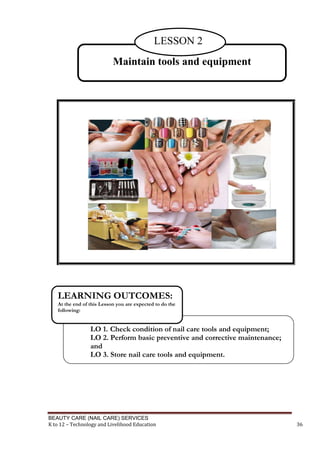
  • 76.
    BEAUTY CARE (NAILCARE) SERVICES K to 12 – Technology and Livelihood Education 75 PPE is compose of the following: Impermeable gloves Eyewear Splash proof apron Protective mask Advantages of wearing PPE at work:  To prevent damage to workers’ nails and skin.  To prevent skin from absorbing potentially harmful ingredients which may cause skin allergies, irritation, or other related problems.  So as not to generate a lot of dust, it may be necessary to wear a dust mask to minimize breathing in particles while filing or buffing nails.  To protect the wearer's face and prevent the breathing of air contaminated with chemical and/or biological agents
  • 77.
    BEAUTY CARE (NAILCARE) SERVICES K to 12 – Technology and Livelihood Education 76 Common workplace hazards and their control measures The following are workplace hazards and their control measures: ELECTRICAL HAZARD Many of the electrical appliances used in the beauty salons can create serious health and safety risks in the nail and beauty industry, particularly in wet conditions. Damage to equipment increases this risk. Electrical shock can result in electrocution, burns and injuries from falls. Control Measures:  You should always check any equipment before use.  Ask qualified electrician to check all pieces of electrical equipment in the workplace annually or as often as possible.  Broken or damaged electrical equipment should not be used, the tag must warn people not to use the equipment.  When adjusting or cleaning equipment, SWITCH OFF the power and pull out the plug and NOT by the cord.  Do not touch equipment with wet hands or don't use a wet cloth to clean sockets.  Make sure flexible cords are fully unwound and kept clear of work traffic.  Do not run too many pieces of equipment from one socket
  • 78.
    BEAUTY CARE (NAILCARE) SERVICES K to 12 – Technology and Livelihood Education 77 CHEMICAL HAZARD Chemical Hazards are substances used and/or produced at work that have the potential to harm the health and safety of people at work. Beauty industry is exposed to repeated exposure to numerous hazardous substances including nail and skin care products, hair dyes, bleaches, perming solutions, hair styling agents, straighteners, rebonding solutions, peroxides, disinfectants and cleaning products. . They can harm people’s health if they get into the body, for example, if they are breathed in, absorbed through the skin or eyes or ingested accidentally. The effects of hazardous substances may show immediately, or it may take years for illness or disease to develop. Health effects of some hazardous substances include skin irritation, coughs, asthma, sensitization, poisoning and cancer. Measures of Concentration of Toxic Substances (Chemical Substances) Threshold Limit Value (TLV) TLV is a measures of concentration of toxic substances .It is the average concentration of an airborne substance to which most workers could be safely exposed over an eight-hour working day or forty-hour working week throughout a working lifetime. Maximal Allowable Concentration ( MCL) MCL is a peak or maximum concentration of an airborne to which most worker could be safely exposed Control Measures:  using alternative substances or processes which are less hazardous  Good ventilation can get rid of the fumes and chemical smell that builds up in a salon  providing separate eating and drinking amenities for employees  ensuring appropriate safety signs, training, instruction and provision of Material Safety Data Sheets (MSDS) and labels  using appropriate PPE.
  • 79.
    BEAUTY CARE (NAILCARE) SERVICES K to 12 – Technology and Livelihood Education 78 Slips, Trips, Falls Slips-loss of balance caused by too little friction between a person’s foot and a walking surface. Trips- - hit an object, lose your balance and fall Falls-- when you lose your balance & drop to the floor SLIP, TRIPS AND FALLS The results of slips, trips and falls include broken bones, abrasions, contusions, strains, sprains, back or spinal injuries and other serious injuries. During a slip, trip or fall accident, injury may be caused by over stretching joints, bones and ligaments. Control Measures  clean up spills straight away.  use mats on slippery floors.  wear appropriate work shoes.  improve cleaning methods to prevent build-up of grease/detergent  provide ample storage space, to avoid materials being placed in aisles/walkways  set absorbent flooring materials into entrance areas
  • 80.
    BEAUTY CARE (NAILCARE) SERVICES K to 12 – Technology and Livelihood Education 79 FIRE SAFETY As a beauty salon staff, you must be aware of and trained in fire and emergency evacuation procedures in the workplace. Emergency exit route will be the easiest route by which all of the clients and staff can leave the building or salon safely. Control Measures:  . Keep all escape routes and fire exits clear, and make regular checks to ensure this case.  Firefighting equipment must be available, located in specified area. you can include fire extinguishers, blankets, sand buckets and water hoses.  Store products, particularly aerosols, away from naked flames or sources of heat, at or below room temperature and in a dry atmosphere.  Switch off and unplug all electrical appliances before leaving the workplace .  Make sure that all workers in the salon are aware of the action that must takes in the event of a fire. MANUAL HANDLING
  • 81.
    BEAUTY CARE (NAILCARE) SERVICES K to 12 – Technology and Livelihood Education 80 Manual handling involves any activity that requires the use of force exerted by a person to lift, lower, push, pull, carry or otherwise move any load. These can result in injuries to any part of the body. Nail salon workers use forceful repetitive movements such as filing and buffing nails and holding uncomfortable positions for long periods of time, thereby increasing risk for joint and musculoskeletal injuries Control measures:  plan the lift before you begin  position your feet shoulder width apart  bend your knees without moving your upper body, squat down to the floor. Keep the shoulders level and facing in the same directions as the hips.  get a firm grip and keep the arms within a boundary formed by the legs  keep the load as close to the body as possible  lift the load smoothly, do not jerk  if an item is too high, use a stepladder or stool to help you BIOLOGICAL HAZARDS Biological hazards, also known as biohazards, refer to biological substances that pose a threat to the health of living organisms, primarily that of humans. Micro-organisms are everywhere and are continually introduced into the environment. They live on skin, in food and dirt. Micro-organisms are easily spread between clients and operators and are easily transferred by contact with unwashed hands, soiled equipment or contact with blood and body substances. Nail technicians must assume that all blood and other body substances are potential sources of infection. To minimize transfer of micro-organisms, you must perform all procedures in a safe and hygienic manner, following all infection control techniques and procedures. Skin that is intact, without cuts or abrasions, is a natural protective barrier against infection Control Measures: The following are the methods on how to control infectious diseases: 1. Cleaning is the removal of soil and a reduction in the number of micro-organisms from equipment surfaces by washing in detergent and warm water. Methods of Cleaning: 1. Rinse the equipment in warm water (15-30°C) to remove any blood or body fluids. Hot water used at this stage will cause coagulation and the substances will stick to the instrument. Cold water will harden fats making cleaning more difficult. 2. Wash the equipment in a sink filled with warm water and a mild alkaline detergent to remove all visible soiling (strong alkaline detergents may damage some instruments). Hold the items low in the sink to limit the generation of aerosols during scrubbing. Use of a scouring pad can assist in removing stains. 3. Rinse the equipment thoroughly in running water. 4. Dry with a cotton cloth. Drying prevents residues from damaging equipment during sterilization. 5.Store under cover in a clean, dry and dust free environment.
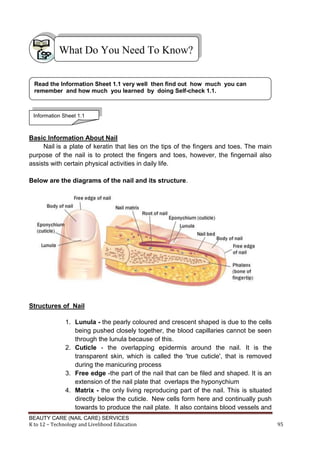
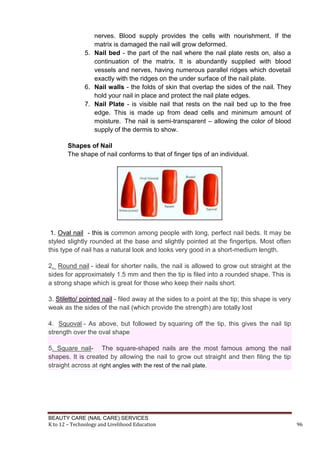
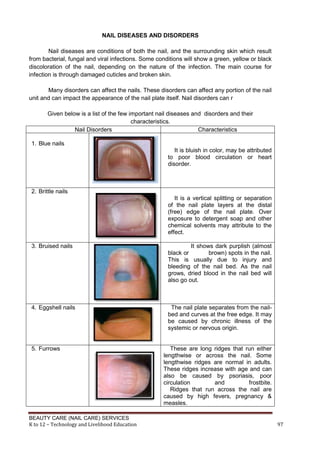
  • 82.
    BEAUTY CARE (NAILCARE) SERVICES K to 12 – Technology and Livelihood Education 81 2. Disinfection is the removal of micro-organisms by chemical or physical means. The level of decontamination depends on duration of exposure to lethal levels of disinfectants. Unlike sterilization, disinfection does not remove all microorganisms but reduces the population to safe levels. Proper use of disinfectants:  All implements must be thoroughly cleaned of all visible matter or residue before soaking in disinfectant and prevent them from being effective.  Implements and tools must be completely immersed in disinfectant solution for the time specified on the product label. Complete immersion of tools and implements means enough liquid to cover all surfaces of the item including the handles. 3. Sterilization is the total destruction of all living micro-organisms and their spores. Method of sterilization: 1. Physical agents such as radiation and heat 2. Chemical agents, such as antiseptics, disinfectants and vapor fumigants ERGONOMICS Ergonomics is the study of how equipment and furniture can be arranged in order that people can do work or other activities more efficiently and comfortably . It is important in the adaptation of work conditions to the physical and psychological nature of people. Below are pictures showing how ergonomics can help reduce strain to your bodies on the proper posture during manicure and pedicure services . A nail technician should consider the three main factors in nail servicing: 1. Supporting the weight of the client's arm or leg 2. Working while looking down at the hand or foot of the model 3. Looking forward at the hand or foot of the model The following pictures show how you are going to position the hand and foot of your client when giving a manicure and pedicure services to avoid pain in your hands, shoulders and back A. Correct position of hand while giving a manicure Correct position of client's hand Incorrect position of client's hand Use rolled towel or hand cushion in giving a manicure,client's arm weight will rest on the cushioin instead of holding it.Repetitive motion ,takes a toll on your muscles and joints and can cause long-term problems,such as arthritis and carpal tunnel syndrome.( Carpal
  • 83.
    BEAUTY CARE (NAILCARE) SERVICES K to 12 – Technology and Livelihood Education 82 tunnel syndrome. It is a type of compression neuropathy , a nerve damage caused by compression and irritation of the median nerve in the wrist. The nerve is compressed within the carpal tunnel, a bony canal in the palm side of the wrist that provides passage for the median nerve to the hand and can be due to trauma from repetitive works.) B. Correct position of foot while a giving a pedicure Correct position of client's leg Incorrect position of client's leg Correct position of client's leg Elevate client's feet and place their feet or legs on a footrest that bears their weight. During the massage portion of a service, the footrests can bear the majority of the weight so nail technician can limit pressure on their back, shoulders, and neck Incorrect position of client's foot : Don’t bear the weight of a client’s leg by resting the foot in your lap or by using your own strength to lift and lower the leg. This position will cause strains in the muscles in your shoulders and back, and, because you are connected to the client, it also reduces your mobility to be agile as you work through the different steps of the service C. Correct position of a pedicurist in giving a pedicure service Correct position of pedicurist Incorrect position of pedicurist Correct position of pedicurist You should keep your back straight and supported while giving a pedicure service, and use both the height adjustment of your chair and of the footrest to keep the foot at a workable level instead of straining the body. Suggest your client to bend their knees and move their feet to appropriate positions.
  • 84.
    BEAUTY CARE (NAILCARE) SERVICES K to 12 – Technology and Livelihood Education 83 Incorrect position of nail technician while giving a pedicure service If you need to perform close-up, detailed work, there is a tendency to round the shoulders and extend the neck to get as close to the foot as possible, which will cause strain to the muscles in the upper body and the entire back. Worse will happen because you will add enormous strain to your body as you try to get into a position that will give you best perspective. D. Correct position of a pedicurist feet while giving a manicure service Correct position of pedicurist's feet Incorrect position of pedicurist's feet Correct position of pedicurist's feet As nail technician, you may twist your chair because you want to get closer to your work. Instead of contorting yourself into this position, it might benefit you from a table with a cut- out that allows you to sit straight in your chair but still work on the client’s hands from an angle. You can improve your posture even without a cut-out in the desk by strengthening your core muscles so you are able to sit straight for longer periods of time. It is also important to develop a habit of keeping both feet on the floor to prevent the unbalanced compression. Incorrect position of pedicurist's legs This nail technician has her shoulders rolled forward, her left arm is resting on the table, which pushes her shoulder up, she is twisted in her chair, and her legs are crossed. This will cause more compression on one side of the body than the other.
  • 85.
    BEAUTY CARE (NAILCARE) SERVICES K to 12 – Technology and Livelihood Education 84 Completion Test: Evaluation and Controlling hazards and risks Directions: Choose the word from the box given below to complete the sentences. reduction burns slips microorganism clear, health injury illness airborne syndrome 1. Disinfection does not remove all _________________ but reduces the population to safe levels. 2. Person identifying the risk of harm from an__________________of hazard in a salon should be aware of the OHS procedures. 3. . Cleaning is the removal of soil and a ________________ in the number of micro-organisms from equipment surfaces by washing in detergent and warm water. 4. . Keep all escape routes and fire exits______________ and make regular checks to ensure this cases. 5. During a__________ , trip or fall accident, injury may be caused by over stretching joints, bones and ligaments 6. Personal protective equipment is clothing equipment designed to be worn by a nail technician or salon workers to protect them from risks of injury or_______________. 7. Electrical shock can result in electrocution_____________ and injuries from falls. 8. _______________ effects of some hazardous substances include skin irritation, coughs, asthma, sensitization, poisoning and cancer. 9. Carpal tunnel________________ is a type of compression neuropathy , a nerve damage caused by compression and irritation of the median nerve in the wrist.. 10. MCL is a peak or maximum concentration of an______________to which most worker could be safely exposed. Refer to the Answer Key. What is your score? How Much Have You Learned? Self-Check 2.1
  • 86.
    BEAUTY CARE (NAILCARE) SERVICES K to 12 – Technology and Livelihood Education 85 I. Directions: Group activity: Visit and make an interview in a nail salon nearby your place, use the checklist below to serve as your basis in evaluating hazards and risks in a nail salon. CHECKLIST The checklist consist of questions on types of occupational hazards. The questions can be answered by “YES” or “NO”. Measures that can be taken to eliminate or reduce hazard are often already indicated by questions themselves. This checklist is not intended to cover all the risks of every workplace but to help you put the method into practice. Does the hazard exist at the workplace? Physical load and ergonomic workplace design YES NO QUESTIONS 1. Do clients’ and nail technicians’ seats enable a good working posture for the variety of different tasks carried out by a nail technician? 2. Does the amount of working space cause uncomfortable working postures? 3. Do nail technicians work in solid shoes (without heels) that give good support and enable a good working posture? 4. Do nail technicians complain about the climate or smell in the salon 5. Is there sufficient light for safe and efficient task performance? Working with chemicals hazards QUESTIONS 1. Are all information about the hazards of the chemicals available and known to all employees? 2. Are employees sufficiently protected from exposure to chemical 3. Are the manufacturers’ safety instructions followed? Show that you learned something by doing this activity HowDo YouApplyWhatYou HaveLearned? Activity Sheet 2.1
  • 87.
    BEAUTY CARE (NAILCARE) SERVICES K to 12 – Technology and Livelihood Education 86 4. Have employees been instructed on working safely with dangerous materials? 5. Are protective gloves routinely being used for chemical tasks and for cleaning tasks by all employees? 6. Are all employees instructed in the use of, and encouraged to use, protective gloves and creams? Electrical risks, slips, trips, and falls QUESTIONS 1. Are the floors slippery and dirty, during work time? 2. Are aisles or passageways tidy free from cords, electrical cables and extension boards lying on the floor? 3. Do the employees wear slippery shoes? 4. Is electrical equipment (foot spa machine) used according to the suppliers’ safety instruction? 5. Are the electrical devices and cables undamaged and regularly examined? 6. Are electrical devices protected against splash water? II. FILM CLIPS VIEWING You are going to view film clips that will provide a basic introduction to health and safety signs and symbols found in the workplace. They provide a useful guide for you and other people who will undergo other services in the industry. Different workplace situations are shown where safety signs are important. The film is suitable for all sectors and all levels of employees but especially for young people in training or work experience. This design will inform you about safety signs at work, to promote the importance of respecting the signs, and to learn and identify the meaning of the signs through their form and the color. Directions: 1. Watch the Napo film clip provided.  Film: Safe Start, Scene: Watch Out For Others Too  Film: Danger, Chemicals, Scene: Dangerous to the environment  Film: Risky Business, Scenes: Assess The Risks and Act On Risks  Film: Safety Inside and Outside of Work, Scene: An edited section (for example from the stairs to the football) Activity Sheet 2.2
  • 88.
    BEAUTY CARE (NAILCARE) SERVICES K to 12 – Technology and Livelihood Education 87 2. Group yourselves into 5  Discuss the hazards shown in the scenes.  Explain to class what is hazard and risk and give your recommendations on how to prevent hazards and risks according to the film clips shown . Scoring Rubric 15 pts 10 pts. 5 pts. Content and Development  Content is comprehensive and accurate. Major points are stated clearly and are well supported. Content is accurate. Major points are stated. Content is Co incomplete Major points are not clear and /or persuasive. Accuracy Students used 5 sentences with accurate, factual information. Students have 4 sentences with accurate, factual information. Major errors in factual information with 2 or less sentence Effort Students put full effort into this activity Students put some effort into this activity. Students put little or no effort into this activity Rating Scale 15= Very Good 10= Good 5= Fair Find out by accomplishing the Scoring Rubric honestly and sincerely. Remember it is your learning at stake! How Well Did You Perform?
  • 89.
    BEAUTY CARE (NAILCARE) SERVICES K to 12 – Technology and Livelihood Education 88 Directions: In your assignment notebook, identify the hazards shown in the film clips. Discuss how some risks are more dangerous than others by making a list of the risks in order of most severe consequences to less severe and which risks require the most urgent intervention. IDENTIFIED RISKS RANKING Congratulations! You did a great job! Rest and relax a while then move on to the next lesson. Good luck! How Do You Extend Your Learning?
  • 90.
    BEAUTY CARE (NAILCARE) SERVICES K to 12 – Technology and Livelihood Education 89 LO1  www.cdc.gov  hhtp.//www.workcover.nsw.gov.au/forms publications  http://www.deir.qld.gov.au/workplace/subjects/hairdressing/guide/hazar ds/electric/index.htm  http://www.dh.sa.gov.au/  http://www.hsa.ie/eng/  http://www.nailsmag.com/article/1138/posture-primer LO 2  www.cdc.gov  http.//www.workcover.nsw.gov.au/forms publications  http://www.deir.qld.gov.au/workplace/subjects/hairdressing/guide /hazards/electric/index.htm  http://www.dh.sa.gov.au/  http://www.hsa.ie/eng/  http://www.nailsmag.com/article/1138/posture-primer  http://www.ehow.com/how_2100263_lift-heavy-objects- safely.html#ixzz1mtGQB0GW  www.dhrm.state.va.us/workerscomp/.../STF  REFERENCES
  • 91.
    BEAUTY CARE (NAILCARE) SERVICES K to 12 – Technology and Livelihood Education 90 Practice Basic Nail Design LESSON 4 LO1 Identify nail structure and shapes; and LO2 Create basic nail designs LEARNING OUTCOMES At the end of this Lesson you are expected to do the following:
  • 92.
    BEAUTY CARE (NAILCARE) SERVICES K to 12 – Technology and Livelihood Education 91 Nail - a plate of keratin that lies on the tips of the fingers and toes Keratin -a sulfur-containing fibrous protein constituting the main structural protein of hard epidermal tissues, such as horn , hair, feathers, nails, claws, hoofs, and the like. Dermis - the second layer of skin, it contains blood vessels, nerves, hair roots and sweat glands. Hyponychium - the epithelium of the nail bed , particularly its proximal part in the region of the nail root and lunula , forming the nail matrix . Epidermis - the upper or outer layer of the two main layers of cells that make up the skin. The epidermis is mostly made up of flat, scale-like cells called squamous cells These cells are round cells called basal cells. The deepest part of the epidermis also contains melanocytes Definition of Terms
  • 93.
    BEAUTY CARE (NAILCARE) SERVICES K to 12 – Technology and Livelihood Education 92  Tools, equipment and specification  Pictures  Workplace/simulated environment Materials  Nail structure and shapes are identified;  Nails are trimmed and varied shapes are applied;  Nails diseases and disorders are identified. PERFORMANCE STANDARDS Identify nail structures and shapes LEARNING OUTCOME 1
  • 94.
    BEAUTY CARE (NAILCARE) SERVICES K to 12 – Technology and Livelihood Education 93 Directions: 1. Label the different parts of nail. 2. Identify the different shapes of nail. a)_____________ b)___________ c)___________ d)___________ e)____________________ What Do You Already Know? Let us determine how much you already know about the nail structure and basic nail designs. Take this test. Pretest LO 1 1 23 4 5
  • 95.
    BEAUTY CARE (NAILCARE) SERVICES K to 12 – Technology and Livelihood Education 94 A. Nail Diseases and Disorders Directions: Match the statement in column A with column B. Write the letter of your choice on the space before the number. Column A Column B 1. a vertical splitting or separation of the nail plate layers at the distal (free) edge of the nail plate a. Blue nails 2. extreme thickening curvature of the nails, usually it is caused by varying degree of hyperkeratosis b. Brittle nails 3. A condition nail plate which separates from the nail bed c. Claw nails 4. Nail condition in which the cuticle splits around the nail. d. Eggshell nails 5. chronic inflammation of the nail fold and nail bed (matrix) e. Hangnails 6. is referred to ingrown nails which affect the fingers and toenails f. Onychauxis or hypertrophy 7. infectious disease caused by a vegetable parasite g. Onychia 8. deformity of nail plate caused by biting nails h. Onychocryptosis 9. an overgrowth of cuticle which sticks to the surfaces of nail plate i. Onychomycosis 10. is caused by uneven growth of the nails, usually resulting from illness. j. Onychophagy or bitten nail k. Pterygium l. Ridges
  • 96.
    BEAUTY CARE (NAILCARE) SERVICES K to 12 – Technology and Livelihood Education 95 Basic Information About Nail Nail is a plate of keratin that lies on the tips of the fingers and toes. The main purpose of the nail is to protect the fingers and toes, however, the fingernail also assists with certain physical activities in daily life. Below are the diagrams of the nail and its structure. Structures of Nail 1. Lunula - the pearly coloured and crescent shaped is due to the cells being pushed closely together, the blood capillaries cannot be seen through the lunula because of this. 2. Cuticle - the overlapping epidermis around the nail. It is the transparent skin, which is called the 'true cuticle', that is removed during the manicuring process 3. Free edge -the part of the nail that can be filed and shaped. It is an extension of the nail plate that overlaps the hyponychium 4. Matrix - the only living reproducing part of the nail. This is situated directly below the cuticle. New cells form here and continually push towards to produce the nail plate. It also contains blood vessels and What Do You Need To Know? Read the Information Sheet 1.1 very well then find out how much you can remember and how much you learned by doing Self-check 1.1. Information Sheet 1.1
  • 97.
    BEAUTY CARE (NAILCARE) SERVICES K to 12 – Technology and Livelihood Education 96 nerves. Blood supply provides the cells with nourishment. If the matrix is damaged the nail will grow deformed. 5. Nail bed - the part of the nail where the nail plate rests on, also a continuation of the matrix. It is abundantly supplied with blood vessels and nerves, having numerous parallel ridges which dovetail exactly with the ridges on the under surface of the nail plate. 6. Nail walls - the folds of skin that overlap the sides of the nail. They hold your nail in place and protect the nail plate edges. 7. Nail Plate - is visible nail that rests on the nail bed up to the free edge. This is made up from dead cells and minimum amount of moisture. The nail is semi-transparent – allowing the color of blood supply of the dermis to show. Shapes of Nail The shape of nail conforms to that of finger tips of an individual. 1. Oval nail - this is common among people with long, perfect nail beds. It may be styled slightly rounded at the base and slightly pointed at the fingertips. Most often this type of nail has a natural look and looks very good in a short-medium length. 2. Round nail - ideal for shorter nails, the nail is allowed to grow out straight at the sides for approximately 1.5 mm and then the tip is filed into a rounded shape. This is a strong shape which is great for those who keep their nails short. 3. Stiletto/ pointed nail - filed away at the sides to a point at the tip; this shape is very weak as the sides of the nail (which provide the strength) are totally lost 4. Squoval - As above, but followed by squaring off the tip, this gives the nail tip strength over the oval shape 5. Square nail- The square-shaped nails are the most famous among the nail shapes. It is created by allowing the nail to grow out straight and then filing the tip straight across at right angles with the rest of the nail plate.
  • 98.
    BEAUTY CARE (NAILCARE) SERVICES K to 12 – Technology and Livelihood Education 97 NAIL DISEASES AND DISORDERS Nail diseases are conditions of both the nail, and the surrounding skin which result from bacterial, fungal and viral infections. Some conditions will show a green, yellow or black discoloration of the nail, depending on the nature of the infection. The main course for infection is through damaged cuticles and broken skin. Many disorders can affect the nails. These disorders can affect any portion of the nail unit and can impact the appearance of the nail plate itself. Nail disorders can r Given below is a list of the few important nail diseases and disorders and their characteristics. Nail Disorders Characteristics 1. Blue nails i. It is bluish in color, may be attributed to poor blood circulation or heart disorder. 2. Brittle nails It is a vertical splitting or separation of the nail plate layers at the distal (free) edge of the nail plate. Over exposure to detergent soap and other chemical solvents may attribute to the effect. 3. Bruised nails It shows dark purplish (almost black or brown) spots in the nail. This is usually due to injury and bleeding of the nail bed. As the nail grows, dried blood in the nail bed will also go out. 4. Eggshell nails The nail plate separates from the nail- bed and curves at the free edge. It may be caused by chronic illness of the systemic or nervous origin. 5. Furrows These are long ridges that run either lengthwise or across the nail. Some lengthwise ridges are normal in adults. These ridges increase with age and can also be caused by psoriasis, poor circulation and frostbite. Ridges that run across the nail are caused by high fevers, pregnancy & measles.
  • 99.
    BEAUTY CARE (NAILCARE) SERVICES K to 12 – Technology and Livelihood Education 98 6. Hangnails It is a condition in which the cuticle splits around the nail. Carelessness in removing the cuticle, dryness, cutting off too much may result in hangnails. It may cause infection if not treated. 7. Leconychia or white spot White spot appears frequently in the nails. They may be caused by injury to the base of the nail. As the nail continues to grow, these white spots eventually disappear 8. Pterygium It is an overgrowth of cuticle which sticks to the surfaces of nail plate. Carefully remove the adhering growth by means of a cuticle nipper. 9. Onychatrophia It is describe as wasting away of the nail . The nail loses its luster, shrinks and falls This can be caused by injury to the nail matrix or by internal disease. 10. Onychauxis or hypertrophy It is an overgrowth of the nail usually in thickness rather than length. It is caused by an internal imbalance, such as local infection or heredity. 11. Onychophagy or bitten nail It is a deformity of nail plate caused by biting nails. It is an acquired nervous habit which prompts the individual to chew the nail or the hardened cuticle. 12. Onychorrhexis or split or brittle nails It refers to split or brittle nails caused by an injury to the finger, careless filing of the nails, excessive use of cuticle solvents and nail polish removers. The nails may be extremely dry because of some granular disorder..
  • 100.
    BEAUTY CARE (NAILCARE) SERVICES K to 12 – Technology and Livelihood Education 99 Nail Diseases Characteristics 1. Onychomycosis It is an infectious disease caused by a vegetable parasite. The onset of the disease takes about two to three months and the attack is rarely on more than one or two nails. The appearance of the nail is frayed (worn out), brittle with furrowed surface, opaque, grayish, or yellowish in color and is lifted-up by an accumulation of epidermis underneath. 2. Onychia Is a term applicable to chronic inflammation of the nail fold and nail bed (matrix). It results from the introduction of microscopic pathogen through small wounds. 3. Onychocryptosis It is referred to ingrown nails which affect the fingers and toenails. It is marked by nail growth into surrounding tissues and may cause infection. Incorrect trimming a shaping of nails are often responsible for ingrown nails. 4. Onychoptosis It is the periodic shedding of one or more nails, either in the whole or in part. This condition maybe a symptom of a more alarm disease such as syphilis or can result from fever, trauma systematic upset or adverse reaction to 13. Ridges It is caused by uneven growth of the nails, usually resulting from illness. Buffing the nails with paste polish will help remove ridges. 14. Treating cuts It is caused by an accident during manicure service. Apply an antiseptic immediately. Do not apply nail polish on the affected area
  • 101.
    BEAUTY CARE (NAILCARE) SERVICES K to 12 – Technology and Livelihood Education 100 drug 5. Onycholysis It refers to the detachment of the nail from the nail bed, starting at its distal and/or lateral attachment. The most common cause of onycholysis is psoriasis 6. Onychogryphosis or claw nails It pertains to extreme thickening curvature of the nails, usually it is caused by varying degree of hyperkeratosis (skin disease in which the skin gets thicker) on the distal portion of the nail bed that detaches and lifts the plate off the bed Test 1. ENUMERATION: Directions: Enumerate the following items listed below. A. Parts surrounding the nail B. Shapes of nails Test II. FILL IN THE BLANK Directions: Fill in the blanks with the correct answer. 1. Free edge is the part of the nail that can be filed and shaped. It is an extension of the _____________ that overlaps the hyponychium. 2 ____________are the folds of skin that overlap the sides of the nail. It holds your nail in place and protects the nail plate edges. 3. Nail bed is the part of the nail that the nail plate ______________ on, also a continuation of the matrix. It is abundantly supplied with blood vessels and nerves, having numerous parallel ridges which dovetail exactly with the ridges on the under surface of the nail plate. 4. Matrix is the only living reproducing part of the nail, this is situated directly below the ___________. New cells form here and continually push towards to produce the nail How Much Have You Learned? Self-Check 1.1
  • 102.
    BEAUTY CARE (NAILCARE) SERVICES K to 12 – Technology and Livelihood Education 101 plate. It also contains blood vessels and nerves. Blood supply provides the cells with nourishment. If the matrix is damaged the nail will grow deformed. 5. ____________is a visible nail that rests on the nail bed up to the free edge. This is made up from dead cells and minimum amount of moisture. COMPLETION TEST Directions: Each sentence below has a blank space; each blank indicates that something has been omitted. Inside the box are words that fits the meaning of the sentence as a whole. Write your answers on the space provided for. Hyperkeratosis Bluish Onychia Uneven Eggshell nails Furrows Treating cuts Shedding Detachment Hangnail 1. ____________are long ridges that run either lengthwise or across the nail. 2. __________is a term applicable to chronic inflammation of the nail fold and nail bed . 3. Onychogryphosis pertains to extreme thickening curvature of the nails, usually it is caused by varying degree of ___________________. 4. Onychoptosis is the periodic_________ of one or more nails, either in the whole or in part. 5. Ridges are caused by ___________growth of the nails, usually resulting from illness 6. Blue nail is __________in color, may be attributed to poor blood circulation or heart disorder. 7. ___________are caused by an accident during manicure service. 8. _____________ is a condition in which the cuticle splits around the nail 9. _________separates from the nail-bed and curves at the free edge. 10.Onycholysis refers to the _________of the nail from the nail bed, starting at its distal and/or lateral attachment Refer to the Answer Key. What is your score?
  • 103.
    BEAUTY CARE (NAILCARE) SERVICES K to 12 – Technology and Livelihood Education 102 Trim your nails Trimming of nail plays a very vital role. It is very easy task but sometime it causes little problems such as unwanted abrasions and ingrown nails, when done not properly Apply the following steps while cutting nails. Step 01: Prepare the types of instruments for this task. Nail cutter, who has small or medium slightly curved blades, which are suitable for trimming the finger nails. Nail cutters with straight blades are suitable for use. Step 02: Before using your nail cutter, make sure that it is clean. Wash your nail cutter to remove dust and germs, specially when you are sharing your nail cutter with someone else. Dry thoroughly after washing it. Step 03: Wash your hands. Wipe dry with any towel or tissue paper to remove extra water. This process cleans your fingernails, and beside cleaning fingernails it also helps in softening your nails and easier to cut them Step 04: You must cut your nails in a place where you can clearly see what you are doing. Put a small container near you in which you can collect the nails. Step 05: Decide the shape of your nails. Decide which shape you actually want. After deciding, lift the nail cutter and start cutting your nails. Step 06: Start cutting your nails starting from your little finger, Step 07 Click on the nail cutter that can cut through the nail. You can make at least two or three cuts of a finger nail until everything is snug. Follow the curve of the nail to get a clean cut. Check skin flaps after each cut and remove carefully. Step 08: Sit comfortably and crouch your knee side to easily reach up and see the nails clearly. Be sure not to set up deep razor to prevent scratches. Adjust the position of razor if you feel any discomfort. HowDo YouApplyWhatYou HaveLearned? Show that you learned something by doing this activity Operation Sheet 1.1
  • 104.
    BEAUTY CARE (NAILCARE) SERVICES K to 12 – Technology and Livelihood Education 103 Step 09: After cutting your nails, use a nail file to smooth any rough and odd surface of newly trimmed nails. When you file, do it in on tilt – from the corner of the nail to go down. Step 10: Apply some moisturizer on your hands to keep the cuticles moisturized and smooth. Criteria for Judging Points Score General Appearance  Different nail shapes are applied  proportion of the different nail shapes were observed 35 Workmanship  neatness in work were observed 35 Cleanliness  work area is cleaned 20 Speed  finished based on allotted time 10 TOTAL How Well Did You Perform? Find out by accomplishing the Scoring Rubric honestly and sincerely. Remember it is your learning at stake!
  • 105.
    BEAUTY CARE (NAILCARE) SERVICES K to 12 – Technology and Livelihood Education 104  Tools, equipment and specification  Pictures  Workplace/simulated environment Materials  Different basic nail designs are explained and demonstrated thru visuals ;and  Different basic nail designs are created in mock nails. PERFORMANCE STANDARDS Create Basic Nail Designs LEARNING OUTCOME 2
  • 106.
    BEAUTY CARE (NAILCARE) SERVICES K to 12 – Technology and Livelihood Education 105 I. Directions: Identification. Identify the names of the following basic nail designs . 1.___________ 2.____________ 3. _______________ 4. _________ 5.___________ What Do You Already Know? Let us determine how much you already know about the different basic nail designs. Take this test.
  • 107.
    BEAUTY CARE (NAILCARE) SERVICES K to 12 – Technology and Livelihood Education 106 Different basic nail designs The following are basic nail designs which you can offer in a nail salon. Steps and illustrations are shown below. A. Plain manicure It is the traditional application of nail polish to the entire nail plate. Steps in Plain manicure 1. Apply base coat  Begin with little finger of one hand. Repeat polish application on the other hand 2. Apply two coats of polish  Use light long strokes from nail base to free edge  Apply polish to the middle of the nail first and then to the sides.  Repeat second coat of polish to both hands  Remove excess polish around nail with a cotton tipped orangewood stick 3. Apply top coat  Apply a top coat over the entire nail plate . Tips Learn the history of color by buying an artist color wheel. You can use what you learn to help clients select complementary colors that match their skin tone. What Do You Need To Know? Information Sheet 2.1 Read the Information Sheet 2.1 very well then find out how much you can remember and how much you learned by doing Self-check 2.1.
  • 108.
    BEAUTY CARE (NAILCARE) SERVICES K to 12 – Technology and Livelihood Education 107 B. Half-Moon Half moon is a style that involves applying of nail polish over the whole nail plate except the area of lunula. Steps in giving Half-moon nail design 1. Apply base coat 2. Apply white or platinum nail polish and leave for a few minutes to dry. 3. Apply colored polish from one side to the other side of the nail following the shape of the lunula. Repeat the application of the nail polish if necessary. 4. Remove excess polish from the skin . 5. Apply top coat. C. Half- Moon with Tip It involves the application of colored polish over the whole nail plate except the area of lunula and tip of the nail. Steps in Giving Half-moon with Tip 1. Apply base coat 2. Apply white or platinum nail polish and leave for a few minutes to dry 3. . Apply colored nail polish from one side to the other side of the nail to form a half-moon, leaving the lunula of the nail Leave the part of the free edge. The free edge should be seen. as in fig 5.Repeat the application of nail polish if necessary. 4. Remove excess polish 5. Apply top coat..
  • 109.
    BEAUTY CARE (NAILCARE) SERVICES K to 12 – Technology and Livelihood Education 108 C .French Manicure or Tip design : It is a design which involves the application of colored polish over the whole part of the nail except the area of the free-edge. Steps in giving French Manicure-Variation no. 1 1. Apply base coat and leave for a few minutes to dry. 2. Apply white or platinum nail polish and leave for a few minutes to dry. 3. Apply colored nail polish from one side to the other side of the nail following the shape of the free- edge . Repeat the application of nail polish if necessary 4. Remove excess polish 5. Apply top coat. French Manicure or Tip design - Variation no. 2 It involves the application of white nail polish or colored polish on the tips and coating the rest of the nail with a sheer polish . It’s suitable for short nails and those with moderate length of nails Steps in giving French manicure-Variation no. 2 1. Apply base coat and leave for a few minutes 2. Apply a coat of translucent pink polish over your entire nail. 3. With the use of white or colored nail polish, draw a thin line over the tip of the nail following the shape of the free edge of the nail. Apply second coating if necessary. 4. Remove excess polish. 5. Apply top coat.
  • 110.
    BEAUTY CARE (NAILCARE) SERVICES K to 12 – Technology and Livelihood Education 109 E. Elephant Tusk Elephant tusk is a style that involves the application of nail polish to create S curve, leaving a slightly larger gap along the nail walls. Steps in making Elephant Tusk: a) Apply white or platinum nail polish and leave for a few minutes to dry. b) Apply colored nail polish creating a half circle design at the inner side of the nail as you continue it to form S-like. c) Fill up the other side to complete the design. d) Remove excess polish. e) Seal with a top coat. Directions: Identify the following nail designs: Write your answer on the blank before each number. __________1. It is the traditional application of nail polish to the entire nail plate. __________2. It involves the application of colored polish over the whole nail plate except the area of lunula and tip of the toe nail. __________3. It is a style that involves applying of nail polish over the whole nail plate except the area of lunula. __________4. It is a style that involves the application of nail polish to create S curve, leaving a slightly lager gap along the nail walls. __________5. It is a design which involves the application of colored polish over the whole part of the nail except the area of the free-edge. How Much Have You Learned? Refer to the Answer Key. What is your score? Self-Check 2.1
  • 111.
    BEAUTY CARE (NAILCARE) SERVICES K to 12 – Technology and Livelihood Education 110 Objectives: To learn the techniques in applying Plain manicure, Half- moon, Half-moon with tip, French manicure, and Elephant tusk designs using plastic spoons thru group activity. Equipment tools and materials: Base coat, Colored polish, Top coat, Acetone, Cotton, Orange wood stick, Plastic spoons Directions: 1. Prepare all the materials needed in basic nail designs. 2. Follow the given instructions in every nail designs 3. Consider the size, color, shapes of your plastic spoons when doing your project. 4. Display your finished project on used illustration board . A. Plain manicure Steps in Plain manicure 1. Apply base coat 2. Apply two coats of polish 3. Apply top coat B. Half-moon Steps in giving Half-moon: 2. Apply white or platinum nail polish and leave for a few minutes to dry. 3. Apply colored polish from one side to the other side of the nail following the shape of the lunula.. Repeat the application of nail polish if necessary. 4. Remove excess polish from the skin. 5. Apply top coat. Show that you learned something by doing this activity HowDo YouApplyWhatYou HaveLearned? Operation Sheet 1.1
  • 112.
    BEAUTY CARE (NAILCARE) SERVICES K to 12 – Technology and Livelihood Education 111 C. Half- moon with Tip Steps in Giving Half-moon with Tip 1. Apply white or platinum nail polish and leave for a few minutes to dry. 2. Apply colored polish from one side to the other side of the nail to form the half- moon, leaving the lunula of the nail. 3. Remove excess polish 4. Apply top coat.. D. French Manicure French design or Tip design : Variation no. 1 Steps in giving French manicure-Variation no. 1 1. Apply white or platinum polish and leave for a few minutes to dry. 2. Apply colored polish from one side to the other side following the shape of the free- edge . 3. Remove excess polish 4. Apply top coat. French design or Tip design - Variation no. 2 Steps in giving French manicure-Variation no. 2 1. Apply base coat and leave for a few minutes 2. Apply a coat of translucent pink polish over your entire nail. 3. With the use of white or platinum nail polish, draw a thin line over the tip of the nail following the shape of the free edge of the nail. Apply second coating if necessary. 4. Remove excess polish. 5. Apply top coat D. Elephant Tusk Steps in making Elephant Tusk: a) Apply base coat (platinum) twice. b) Apply colored nail polish creating a half circle design at the inner side of the nail as you continue it to form S- like. c) Fill up the other side to complete the design. d) Remove excess polish. e) Seal with a top coat.
  • 113.
    BEAUTY CARE (NAILCARE) SERVICES K to 12 – Technology and Livelihood Education 112 Criteria for Judging Points Score General Appearance  color combinations of nail polish are evident  nail designs were artistically applied  proportion of the different nail designs were observed 35 Workmanship  nail polish coat were evenly applied  neatness in work were observed 35 Quality  durability of the finished project were observed 20 Speed  finished and submitted on the required time 10 TOTAL Rating Scale 95-100 =Outstanding 85-94 =Very satisfactory 75-84 =Satisfactory 65-74 =Needs improvement Congratulations! You did a great job! Rest and relax a while then move on to the next lesson. Good luck! Find out by accomplishing the Score Card honestly and sincerely. Remember it is your learning at stake! How Well Did You Perform?
  • 114.
    BEAUTY CARE (NAILCARE) SERVICES K to 12 – Technology and Livelihood Education 113 Lo1  kreativestudios.com  http://www.google.com.ph/imgres  www.cbd.int/ibd/2008/Resources/teachers/appendix3.shtml  http://en.wikipedia.org/wiki/Nail_disease  http://www.beautyweb.com/ LO 2  kreativestudios.com  Http://www.google.com.ph/imgre    ]   http://www.google.com.ph/imgres REFERENCES
  • 115.
    BEAUTY CARE (NAILCARE) SERVICES K to 12 – Technology and Livelihood Education 114 ANSWER KEYS: LESSON 1 LO1 WHAT DO YOU ALREADY KNOW? 1. Cuticle Nail Pusher 2. Nail File 3. Sterilizer 4. Orangewood Stick 5. Hand Spa Machine 6. Buffer 7. Pumice Stone 8. Trolley 9. Alcohol 10. Base coat HOW MUCH HAVE YOU LEARNED? 1. Cuticle Nail Pusher 2. Nail File 3. Nail Cutter/Nail Clipper/Nail Trimmer 4. Nail Buffer 5. Emery board 6. Orangewood Stick 7. Foot Spa Machine 8. Sterilizer 9. Foot Spa Stool 10. Hand Spa Machine LO2 WHAT DO YOU ALREADY KNOW? 1. D 2. C 3. E 4. B 5. A 6. I 7. J 8. H 9. F 10. G
  • 116.
    BEAUTY CARE (NAILCARE) SERVICES K to 12 – Technology and Livelihood Education 115 HOW MUCH HAVE YOU LEARNED? 1. To avoid cracking and splitting of the nails. 2. So that live tissue at the root of the nail will not be injured. 3. Buffing gives the nails natural gloss and increases the circulation of the blood to the fingernails. 4. So as not to injure live tissues. 5. It can cause sores, open wounds and possible infection. LESSON 2 LO1 WHAT DO YOU ALREADY KNOW? A. 1. C 2. D 3. C 4. A 5. A B. 1. Sanitizing implements and equipment is essential because it kills and prevents the growth of germs. Unsanitized equipment can spread germs from one person to another, potentially leading to serious infections. both for you and your client . 2. Sterilization is the process of destroying all living micro-organisms while sanitation is the process of destroying some, but not all micro-organisms. HOW MUCH HAVE YOU LEARNED? 1. Before and after each nail care service. 2. After metal tools and equipment have been sterilized, they must be stored in a cabinet until needed. 3. Waste materials should be disposed of properly in an enclosed bin with polythene bag while contaminated materials should be disposed of as recommended by local authority. 4. To prevent accidents, injury and possible spread of diseases and to give the highest professional nail care service. 5. Tools and equipment are in good condition when they are not defective and can be used efficiently. They are not in good condition if they are already faulty, rusty and do not function efficiently.
  • 117.
    BEAUTY CARE (NAILCARE) SERVICES K to 12 – Technology and Livelihood Education 116 LO2 WHAT DO YOU ALREADY KNOW? A. 1. Sterilize 2. Disinfect 3. Boil 4. Store 5. Inspect, 6. Sanitary 7. Water 8. Enclosed 9. Laundered 10. Directed an HOW MUCH HAVE YOU LEARNED? Ways to Keep Tools and Equipment Safe and Functional a. Sterilize metal implements after each use in a hospital-grade disinfectant that is bactericidal, virucidal, and fungicidal. This disinfectant can be found in beauty supply stores. Immerse the tools in the disinfectant for 10 minutes. b. Disinfect foot basins after each use with a bleach solution. Make a 1-to-10 solution by mixing one part bleach with 10 parts water. Using gloves, rinse the basin with the solution to disinfect. If necessary, scrub with a detergent to remove any dirt or debris. c. Use a boiling method of sterilization once a month to disinfect all metal implements. Designate one pot for sterilization to prevent cross-contamination with food. Submerge the tools in boiling water for 10 minutes. Drain the tools and allow them to dry. d. Store sterilized metal implements in an airtight, zipper-sealed bag to keep them from being exposed to dirt and bacteria. Be sure tools are completely dry before storing them. If waiting more than a couple of weeks before the next nail care service, sterilize the tools again before use. e. Inspect tools and equipment regularly to identify defective ones for repair, replacement or condemnation. Measures in Keeping the Salon Clean and in a Safe State 1. All beauty salons must be well-lighted and well-ventilated and must be in good sanitary condition. 2. The salon premises must be free from rodents, vermin, flies or other similar insects. 3. All salon establishments must be provided with continuous running hot and cold water. 4. The curtains and floor coverings in the salon must be washable and kept clean. 5. All hair, used cotton or other waste materials must be removed from the floor immediately, and deposited in a closed container. Get rid of them from the salon premises at frequent intervals.
  • 118.
    BEAUTY CARE (NAILCARE) SERVICES K to 12 – Technology and Livelihood Education 117 6. The rest rooms must be well-sanitized and be provided with individual towels. 7. All waste materials should be disposed of in an enclosed waste bin fitted with polythene bin liner, durable enough to resist tearing. LO3 WHAT DO YOU ALREADY KNOW? 1. Plastic 2. T 3. T 4. T 5. Repaired/replaced/disposed of HOW MUCH HAVE YOU LEARNED? Metal tools and instruments must be sterilized following proper sterilization techniques. After the process, store in a dry cabinet until needed. Tools/Implements which are made of porous materials such as nail files, buffers, nail brushes and orangewood sticks can harbor bacteria easily. Since they are wood products which cannot be sterilized, these tools should not be reused. The hand and foot spa machines must be kept dry after disinfecting them. LESSON 3 ANSWER KEYS: LO1 WHAT DO YOU ALREADY KNOW? 1. Risk 2.Harm 3.Risk assessment 4. Training 5. Unsafe practices HOW MUCH HAVE YOU LEARNED? 1.True 2.True 3.True 4. True 5. False 6. True 7. False 8. True
  • 119.
    BEAUTY CARE (NAILCARE) SERVICES K to 12 – Technology and Livelihood Education 118 9. True 10.True LO2 WHAT DO YOU ALREADY KNOW? 1. Identify the spillage to everyone and clean up appropriately 2. All of the above 3. Assist your client to the nearest exit and safe place 4. Preventing injury, infection or accidents 5. Unsafe practices HOW MUCH HAVE YOU LEARNED? 1. Microorganism 2. Injury 3. Reduction 4. Clear 5. Slips 6.Illness 7. Burns 8. Health 9. Syndrome 10. Airborne LESSON 4 LO1. WHAT DO YOU ALREADY KNOW? LO1. Test 1 Test ll. 1 Stiletto 2. Squoval 3. Round 4. Square
  • 120.
    BEAUTY CARE (NAILCARE) SERVICES K to 12 – Technology and Livelihood Education 119 5. Oval/Almond Test lll. 1. B 2. D 3. K 4. J 5. L 6. E 7. G 8. H 9. C 10. I HOW MUCH HAVE YOU LEARNED? Test 1. A. B 1. Oval 2. Pointed 3. Square 4. Round 5. Squoval Test II. A. FILL IN THE BLANK 1. Nail plate 2. Nail walls 3. Rest 4. Cuticle 5. Nail plate B. Completion Test 1. Furrows 2. Onychia 3. Hyperkeratosis 4. Shedding 5. Uneven 6. Bluish 7. Treating Cuts 8. Hangnails 9. Eggshell nails 10. Detachment
  • 121.
    BEAUTY CARE (NAILCARE) SERVICES K to 12 – Technology and Livelihood Education 120 LO2. WHAT DO YOU ALREADY KNOW? 1. Half -moon with Tip 2. French Manicure 3. Plain manicure 4. Half moon 5. Elephant tusk HOW MUCH HAVE YOU LEARNED? 1. Plain Manicure 2. Half-Moon with Tip 3. Half Moon 4. Elephant Tusk 5. French Manicure
  • 122.
    BEAUTY CARE (NAILCARE) SERVICES K to 12 – Technology and Livelihood Education 121 Acknowledgement This Learning Module was developed for the Exploratory Courses in Technology and Livelihood Education, Grades 7 and 8 of the K to 12 Curriculum with the assistance of the following persons: This Learning Module on Nail Care was developed by the following personnel: MODULE WRITERS BEATRIZ A. ADRIANO Principal IV E. Rodriguez Voc'l High School Nagtahan, Manila ANNABEL L. GUARDIAN Head Teacher III Carlos L. Albert High School Brixton Hill, Santol, Quezon City REVIEWERS GIL P. CASUGA Chief TESD Specialist REYNALDO S. DANTES Senior TESD Specialist MARIA A. ROQUE Senior TESD Specialist BERNADETTE S. AUDIJE Senior TESD Specialist VICTORIO N. MEDRANO Principal IV, SPRCNHS PARALUMAN R. GIRON, Ed.D. Chair, Sub-TWG on K to 10 BRENDA B. CORPUZ, Ph.D. TA for K to 12 Curriculum OFELIA O. FLOJO Retired Assistant Chief, EED, Region IV-A BEATRIZ A. ADRIANO Principal IV, ERVHS AIDA T. GALURA VSA II, ACNTS DOMINGA CAROLINA F. CHAVEZ Principal II, MBHS DOCUMENTORS / SECRETARIAT PRISCILLA E. ONG K to 12 Secretariat FREDERICK G. DEL ROSARIO Head Teacher III, BNAHS EMMANUEL V. DIONISIO Head Teacher III, AFGBMTS LYMWEL P. LOPEZ Teacher I, AFGBMTS DANTE D. VERMON JR. Teacher I, AFGBMTS LOUIE ANGELES Teacher I, BNAHS JOANNA LISA C. CARPIO Teacher I, BNAHS ROMANO T. LOPEZ Teacher I, BNAHS Dir. IMELDA B. TAGANAS Executive Director, Qualifications Standards Office K to 12 Learning Area Team Convenor, TLE/TVE