1
COMP 144 Programming Language Concepts
Felix Hernandez-Campos
Lecture 32:
The Java Virtual Machine
COMP 144 Programming Language Concepts
Spring 2002
Felix Hernandez-Campos
April 12
The University of North Carolina at Chapel Hill
2
COMP 144 Programming Language Concepts
Felix Hernandez-Campos
The Java Virtual Machine
• Java Architecture
– Java Programming Language
– Java Virtual Machine (JVM)
– Java API
• We will use the JVM as a case study of an
intermediate program representation
3
COMP 144 Programming Language Concepts
Felix Hernandez-Campos
Reference
• The content of this lecture is based on Inside the
Java 2 Virtual Machine by Bill Venners
– Chapter 1Introduction to Java's Architecture
» http://www.artima.com/insidejvm/ed2/ch01IntroToJavasArchitect
urePrint.html
– Chapter 5 The Java Virtual Machine
» http://www.artima.com/insidejvm/ed2/ch05JavaVirtualMachine1.
html
– Interactive Illustrations
» http://www.artima.com/insidejvm/applets/index.html
4
COMP 144 Programming Language Concepts
Felix Hernandez-Campos
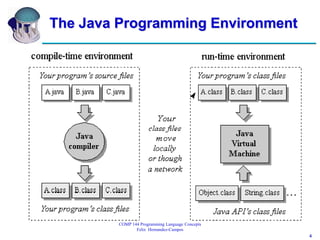
The Java Programming Environment
5
COMP 144 Programming Language Concepts
Felix Hernandez-Campos
The Java Platform
• The byte code generated by the Java front-end is an
intermediate form
– Compact
– Platform-independent
6
COMP 144 Programming Language Concepts
Felix Hernandez-Campos
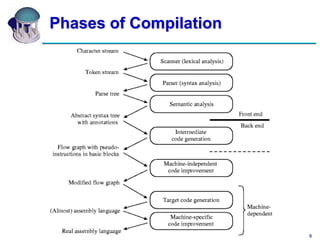
Phases of Compilation
7
COMP 144 Programming Language Concepts
Felix Hernandez-Campos
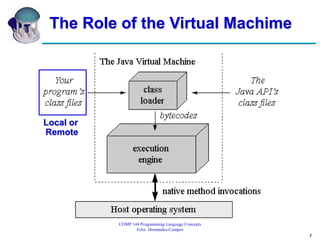
The Role of the Virtual Machime
Local or
Remote
8
COMP 144 Programming Language Concepts
Felix Hernandez-Campos
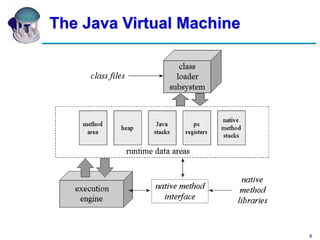
The Execution Engine
• Back-end transformation and execution
– Simple JVM: byte code interpretation
– Just-in-time compiler
» Method byte codes are compiled into machine code the first time
they are invoked
» The machine code is cached for subsequent invocation
» It requires more memory
– Adaptive optimization
» The interpreter monitors the activity of the program, compiling
the heavily used part of the program into machine code
» It is much faster than simple interpretation
» The memory requirement is only slightly larger due to the
20%/80% rule of program execution (In general, 20% of the code
is responsible for 80% of the execution)
9
COMP 144 Programming Language Concepts
Felix Hernandez-Campos
The Java Virtual Machine
10
COMP 144 Programming Language Concepts
Felix Hernandez-Campos
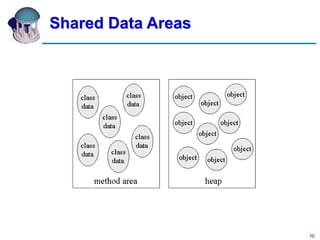
Shared Data Areas
11
COMP 144 Programming Language Concepts
Felix Hernandez-Campos
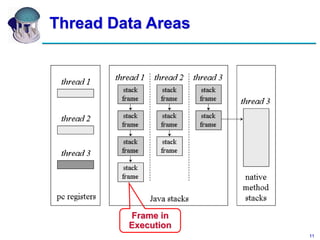
Thread Data Areas
Frame in
Execution
12
COMP 144 Programming Language Concepts
Felix Hernandez-Campos
Stack Frames
• Stack frames have three parts:
– Local variables
– Operand stack
– Frame data
13
COMP 144 Programming Language Concepts
Felix Hernandez-Campos
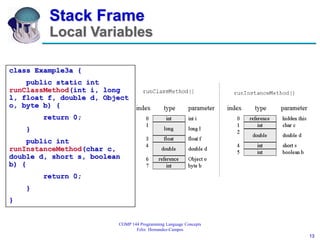
Stack Frame
Local Variables
class Example3a {
public static int
runClassMethod(int i, long
l, float f, double d, Object
o, byte b) {
return 0;
}
public int
runInstanceMethod(char c,
double d, short s, boolean
b) {
return 0;
}
}
14
COMP 144 Programming Language Concepts
Felix Hernandez-Campos
Stack Frame
Operand Stack
Adding 2 numbers
iload_0
iload_1
Iadd
istore_2
15
COMP 144 Programming Language Concepts
Felix Hernandez-Campos
Execution Model
• Eternal Math Example
– http://www.artima.com/insidejvm/applets/EternalMath.htm
l
16
COMP 144 Programming Language Concepts
Felix Hernandez-Campos
Stack Frame
Frame Data
• The stack frame also supports
– Constant pool resolution
– Normal method return
– Exception dispatch
17
COMP 144 Programming Language Concepts
Felix Hernandez-Campos
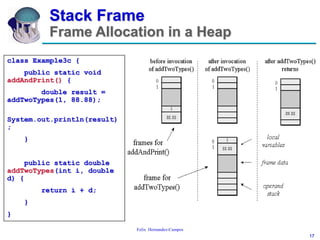
Stack Frame
Frame Allocation in a Heap
class Example3c {
public static void
addAndPrint() {
double result =
addTwoTypes(1, 88.88);
System.out.println(result)
;
}
public static double
addTwoTypes(int i, double
d) {
return i + d;
}
}
18
COMP 144 Programming Language Concepts
Felix Hernandez-Campos
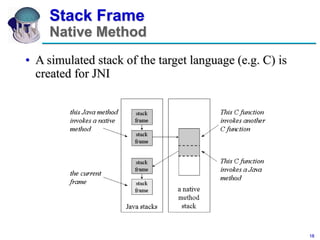
Stack Frame
Native Method
• A simulated stack of the target language (e.g. C) is
created for JNI
19
COMP 144 Programming Language Concepts
Felix Hernandez-Campos
The Heap
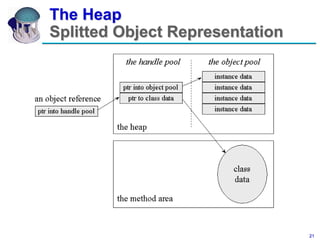
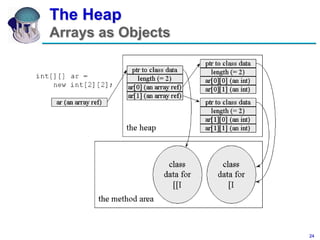
• Class instances and array are stores in a single,
shared heap
• Each Java application has its own heap
– Isolation
– But a JVM crash will break this isolation
• JVM heaps always implement garbage collection
mechanisms
20
COMP 144 Programming Language Concepts
Felix Hernandez-Campos
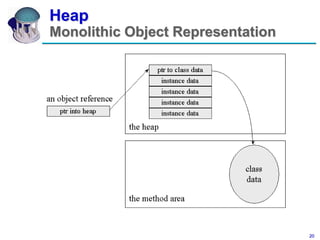
Heap
Monolithic Object Representation
21
COMP 144 Programming Language Concepts
Felix Hernandez-Campos
The Heap
Splitted Object Representation
22
COMP 144 Programming Language Concepts
Felix Hernandez-Campos
Example
• HeapOfFish
– http://www.artima.com/insidejvm/applets/HeapOfFish.htm
l
23
COMP 144 Programming Language Concepts
Felix Hernandez-Campos
The Heap
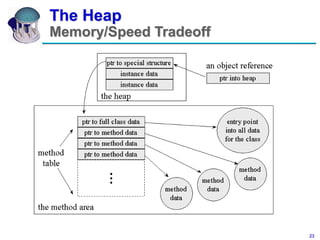
Memory/Speed Tradeoff
24
COMP 144 Programming Language Concepts
Felix Hernandez-Campos
The Heap
Arrays as Objects
25
COMP 144 Programming Language Concepts
Felix Hernandez-Campos
Reading Assignment
• Inside the Java 2 Virtual Machine by Bill Venners
– Ch 1
– Ch 5
– Illustrations

JVM ppt

  • 1.
    1 COMP 144 ProgrammingLanguage Concepts Felix Hernandez-Campos Lecture 32: The Java Virtual Machine COMP 144 Programming Language Concepts Spring 2002 Felix Hernandez-Campos April 12 The University of North Carolina at Chapel Hill
  • 2.
    2 COMP 144 ProgrammingLanguage Concepts Felix Hernandez-Campos The Java Virtual Machine • Java Architecture – Java Programming Language – Java Virtual Machine (JVM) – Java API • We will use the JVM as a case study of an intermediate program representation
  • 3.
    3 COMP 144 ProgrammingLanguage Concepts Felix Hernandez-Campos Reference • The content of this lecture is based on Inside the Java 2 Virtual Machine by Bill Venners – Chapter 1Introduction to Java's Architecture » http://www.artima.com/insidejvm/ed2/ch01IntroToJavasArchitect urePrint.html – Chapter 5 The Java Virtual Machine » http://www.artima.com/insidejvm/ed2/ch05JavaVirtualMachine1. html – Interactive Illustrations » http://www.artima.com/insidejvm/applets/index.html
  • 4.
    4 COMP 144 ProgrammingLanguage Concepts Felix Hernandez-Campos The Java Programming Environment
  • 5.
    5 COMP 144 ProgrammingLanguage Concepts Felix Hernandez-Campos The Java Platform • The byte code generated by the Java front-end is an intermediate form – Compact – Platform-independent
  • 6.
    6 COMP 144 ProgrammingLanguage Concepts Felix Hernandez-Campos Phases of Compilation
  • 7.
    7 COMP 144 ProgrammingLanguage Concepts Felix Hernandez-Campos The Role of the Virtual Machime Local or Remote
  • 8.
    8 COMP 144 ProgrammingLanguage Concepts Felix Hernandez-Campos The Execution Engine • Back-end transformation and execution – Simple JVM: byte code interpretation – Just-in-time compiler » Method byte codes are compiled into machine code the first time they are invoked » The machine code is cached for subsequent invocation » It requires more memory – Adaptive optimization » The interpreter monitors the activity of the program, compiling the heavily used part of the program into machine code » It is much faster than simple interpretation » The memory requirement is only slightly larger due to the 20%/80% rule of program execution (In general, 20% of the code is responsible for 80% of the execution)
  • 9.
    9 COMP 144 ProgrammingLanguage Concepts Felix Hernandez-Campos The Java Virtual Machine
  • 10.
    10 COMP 144 ProgrammingLanguage Concepts Felix Hernandez-Campos Shared Data Areas
  • 11.
    11 COMP 144 ProgrammingLanguage Concepts Felix Hernandez-Campos Thread Data Areas Frame in Execution
  • 12.
    12 COMP 144 ProgrammingLanguage Concepts Felix Hernandez-Campos Stack Frames • Stack frames have three parts: – Local variables – Operand stack – Frame data
  • 13.
    13 COMP 144 ProgrammingLanguage Concepts Felix Hernandez-Campos Stack Frame Local Variables class Example3a { public static int runClassMethod(int i, long l, float f, double d, Object o, byte b) { return 0; } public int runInstanceMethod(char c, double d, short s, boolean b) { return 0; } }
  • 14.
    14 COMP 144 ProgrammingLanguage Concepts Felix Hernandez-Campos Stack Frame Operand Stack Adding 2 numbers iload_0 iload_1 Iadd istore_2
  • 15.
    15 COMP 144 ProgrammingLanguage Concepts Felix Hernandez-Campos Execution Model • Eternal Math Example – http://www.artima.com/insidejvm/applets/EternalMath.htm l
  • 16.
    16 COMP 144 ProgrammingLanguage Concepts Felix Hernandez-Campos Stack Frame Frame Data • The stack frame also supports – Constant pool resolution – Normal method return – Exception dispatch
  • 17.
    17 COMP 144 ProgrammingLanguage Concepts Felix Hernandez-Campos Stack Frame Frame Allocation in a Heap class Example3c { public static void addAndPrint() { double result = addTwoTypes(1, 88.88); System.out.println(result) ; } public static double addTwoTypes(int i, double d) { return i + d; } }
  • 18.
    18 COMP 144 ProgrammingLanguage Concepts Felix Hernandez-Campos Stack Frame Native Method • A simulated stack of the target language (e.g. C) is created for JNI
  • 19.
    19 COMP 144 ProgrammingLanguage Concepts Felix Hernandez-Campos The Heap • Class instances and array are stores in a single, shared heap • Each Java application has its own heap – Isolation – But a JVM crash will break this isolation • JVM heaps always implement garbage collection mechanisms
  • 20.
    20 COMP 144 ProgrammingLanguage Concepts Felix Hernandez-Campos Heap Monolithic Object Representation
  • 21.
    21 COMP 144 ProgrammingLanguage Concepts Felix Hernandez-Campos The Heap Splitted Object Representation
  • 22.
    22 COMP 144 ProgrammingLanguage Concepts Felix Hernandez-Campos Example • HeapOfFish – http://www.artima.com/insidejvm/applets/HeapOfFish.htm l
  • 23.
    23 COMP 144 ProgrammingLanguage Concepts Felix Hernandez-Campos The Heap Memory/Speed Tradeoff
  • 24.
    24 COMP 144 ProgrammingLanguage Concepts Felix Hernandez-Campos The Heap Arrays as Objects
  • 25.
    25 COMP 144 ProgrammingLanguage Concepts Felix Hernandez-Campos Reading Assignment • Inside the Java 2 Virtual Machine by Bill Venners – Ch 1 – Ch 5 – Illustrations