The Federal Court
System
Standards Overview
SSCG13: Demonstrate knowledge of
the operation of the judicial branch of
government.
 SSCG13a: Describe the selection and
approval process for federal judges.
 SSCG13b: Explain the jurisdiction of the
Supreme Court, federal courts and the
state courts.
The Role of the Judicial Branch
 To interpret and define law
 This involves hearing individual
cases and deciding how the law
should apply
 Remember federalism – there are
federal courts for federal law, and
state courts for state laws!
The Federal Judiciary
 The judiciary is simply the judicial branch
of government, which includes the court
system and the judges.
 The President appoints federal judges
 The Senate Judiciary Committee holds
hearings to evaluate candidates and sends
it’s recommendations to the floor for the
final vote.
Appointment of Judges
 President nominates
someone to become
a judge
 Senate majority
vote confirms
 Remember –
Senatorial Courtesy!
 Judges serve for life
The Federal Judiciary
 When a judge retires, dies, or is removed from his or
her position, a vacancy appears that must be filled.
 There are 7 steps to filling a judicial vacancy:
1. The White House consults the state in order to find out
who they should appoint.
2. The candidates are vetted (backgrounds checked)
3. Nomination is made
4. The Senate Judiciary Committee conducts a hearing and
the candidate is asked many questions
5. The Senate Judiciary Committee votes.
6. The full floor vote is scheduled
7. The full floor of the Senate votes and the candidate is
confirmed.
Where Do the Courts’ Jurisdiction
Come From?
 Article III of the Constitution
creates “one supreme court, and
such inferior courts” that
Congress creates
 Thus, Congress creates the
system underneath Supreme
Court
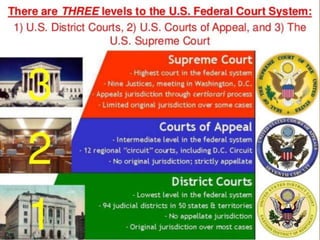
Federal Court System
The Federal Court system is a pyramid
with 3 levels of federal courts:
 Bottom: District Courts
 Middle: Appeals Courts
 Top: United States Supreme Court
District Courts
 Lower level of the federal
court system
 All states have at least
one
 Where trials are held and
lawsuits are begun
 For all federal cases,
district courts have
original jurisdiction
 Hear criminal and civil
cases
 Only courts that involve
witnesses and juries
Court of Appeals
 Intermediate level of the
federal court system
 Review decisions of the lower
courts/appellate jurisdiction
 Don’t decide guilt or
innocence but whether the
original trial was fair
 Most appeals are final
 Cases can be sent back to lower
courts for review
 Parties can ask the Supreme
Court to review the case
Supreme Court
 Highest federal court in the
U.S.
 The “Court of Last Resort”
 Decision cannot be
appealed
 Has both appellate and
original jurisdiction
 Has power of judicial
review
 Has 9 justices; 8 associate
justices and 1 chief justice
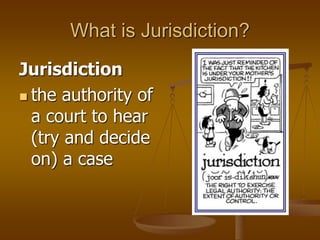
What is Jurisdiction?
Jurisdiction
 the authority of
a court to hear
(try and decide
on) a case
4 Types of Jurisdiction
1. Exclusive Jurisdiction
2. Concurrent Jurisdiction
3. Original Jurisdiction
4. Appellate Jurisdiction
Exclusive Jurisdiction
Exclusive
Jurisdiction
 only federal
court has
authority to
hear, state court
cannot.
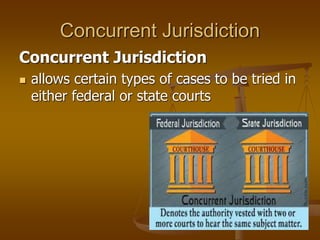
Concurrent Jurisdiction
 allows certain types of cases to be tried in
either federal or state courts
Original Jurisdiction
 authority to hear the case
for the first time
 trials are conducted,
evidence is presented,
and juries/judge decides
the outcome
 Federal District Courts and
the Supreme Court (in
certain cases) have
original jurisdiction
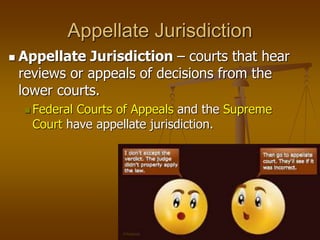
Appellate Jurisdiction
 Appellate Jurisdiction – courts that hear
reviews or appeals of decisions from the
lower courts.
 Federal Courts of Appeals and the Supreme
Court have appellate jurisdiction.
Video
Crash Course - Structure of the Court System

Judical Branch ppt.ppt

  • 1.
  • 2.
    Standards Overview SSCG13: Demonstrateknowledge of the operation of the judicial branch of government.  SSCG13a: Describe the selection and approval process for federal judges.  SSCG13b: Explain the jurisdiction of the Supreme Court, federal courts and the state courts.
  • 3.
    The Role ofthe Judicial Branch  To interpret and define law  This involves hearing individual cases and deciding how the law should apply  Remember federalism – there are federal courts for federal law, and state courts for state laws!
  • 4.
    The Federal Judiciary The judiciary is simply the judicial branch of government, which includes the court system and the judges.  The President appoints federal judges  The Senate Judiciary Committee holds hearings to evaluate candidates and sends it’s recommendations to the floor for the final vote.
  • 5.
    Appointment of Judges President nominates someone to become a judge  Senate majority vote confirms  Remember – Senatorial Courtesy!  Judges serve for life
  • 6.
    The Federal Judiciary When a judge retires, dies, or is removed from his or her position, a vacancy appears that must be filled.  There are 7 steps to filling a judicial vacancy: 1. The White House consults the state in order to find out who they should appoint. 2. The candidates are vetted (backgrounds checked) 3. Nomination is made 4. The Senate Judiciary Committee conducts a hearing and the candidate is asked many questions 5. The Senate Judiciary Committee votes. 6. The full floor vote is scheduled 7. The full floor of the Senate votes and the candidate is confirmed.
  • 7.
    Where Do theCourts’ Jurisdiction Come From?  Article III of the Constitution creates “one supreme court, and such inferior courts” that Congress creates  Thus, Congress creates the system underneath Supreme Court
  • 8.
    Federal Court System TheFederal Court system is a pyramid with 3 levels of federal courts:  Bottom: District Courts  Middle: Appeals Courts  Top: United States Supreme Court
  • 10.
    District Courts  Lowerlevel of the federal court system  All states have at least one  Where trials are held and lawsuits are begun  For all federal cases, district courts have original jurisdiction  Hear criminal and civil cases  Only courts that involve witnesses and juries
  • 11.
    Court of Appeals Intermediate level of the federal court system  Review decisions of the lower courts/appellate jurisdiction  Don’t decide guilt or innocence but whether the original trial was fair  Most appeals are final  Cases can be sent back to lower courts for review  Parties can ask the Supreme Court to review the case
  • 12.
    Supreme Court  Highestfederal court in the U.S.  The “Court of Last Resort”  Decision cannot be appealed  Has both appellate and original jurisdiction  Has power of judicial review  Has 9 justices; 8 associate justices and 1 chief justice
  • 13.
    What is Jurisdiction? Jurisdiction the authority of a court to hear (try and decide on) a case
  • 14.
    4 Types ofJurisdiction 1. Exclusive Jurisdiction 2. Concurrent Jurisdiction 3. Original Jurisdiction 4. Appellate Jurisdiction
  • 15.
    Exclusive Jurisdiction Exclusive Jurisdiction  onlyfederal court has authority to hear, state court cannot.
  • 16.
    Concurrent Jurisdiction Concurrent Jurisdiction allows certain types of cases to be tried in either federal or state courts
  • 17.
    Original Jurisdiction Original Jurisdiction authority to hear the case for the first time  trials are conducted, evidence is presented, and juries/judge decides the outcome  Federal District Courts and the Supreme Court (in certain cases) have original jurisdiction
  • 18.
    Appellate Jurisdiction  AppellateJurisdiction – courts that hear reviews or appeals of decisions from the lower courts.  Federal Courts of Appeals and the Supreme Court have appellate jurisdiction.
  • 19.
    Video Crash Course -Structure of the Court System