


JSR 354
Java Money and Currency API


             Werner Keil
    Build Manager, DevOps Expert,
             Agile Coach
             Maersk Line
         EG Member, JSR 354
             @wernerkeil
Werner Keil - Bio
 •   Consultant – Coach
 •   Creative Cosmopolitan
 •   Open Source Evangelist
 •   Software Architect
 •   Java Godfather
 •   JCP Executive Committee Member
 •   Eclipse UOMo Project Lead
 •   DevOps Guy

                                      2
Show me the Money!
Agenda
 •   History
 •   Motivation
 •   The JSR
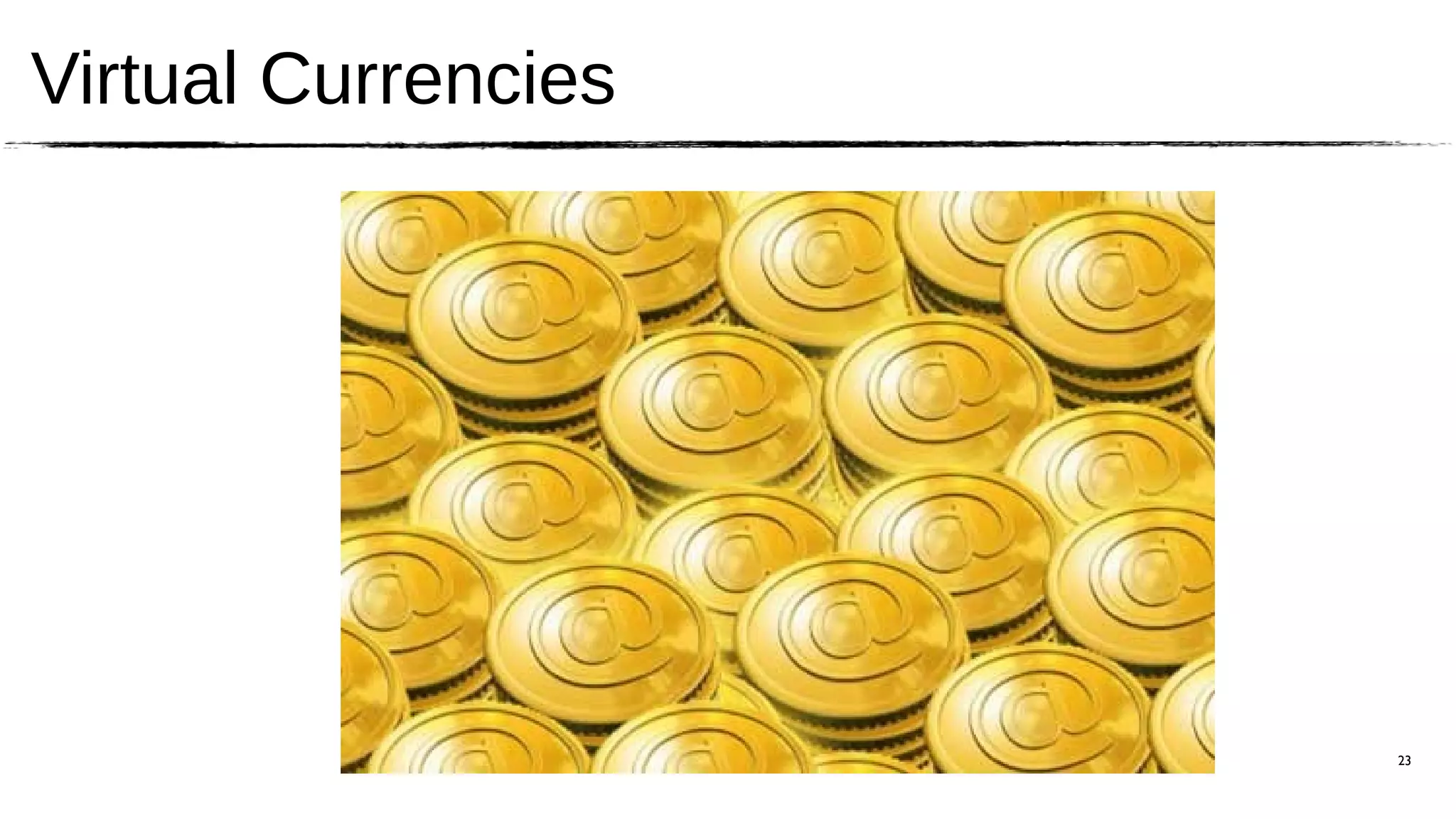
 •   Virtual Currencies
 •   Currency Exchange
 •   Demos
 •   Q&A


                          4
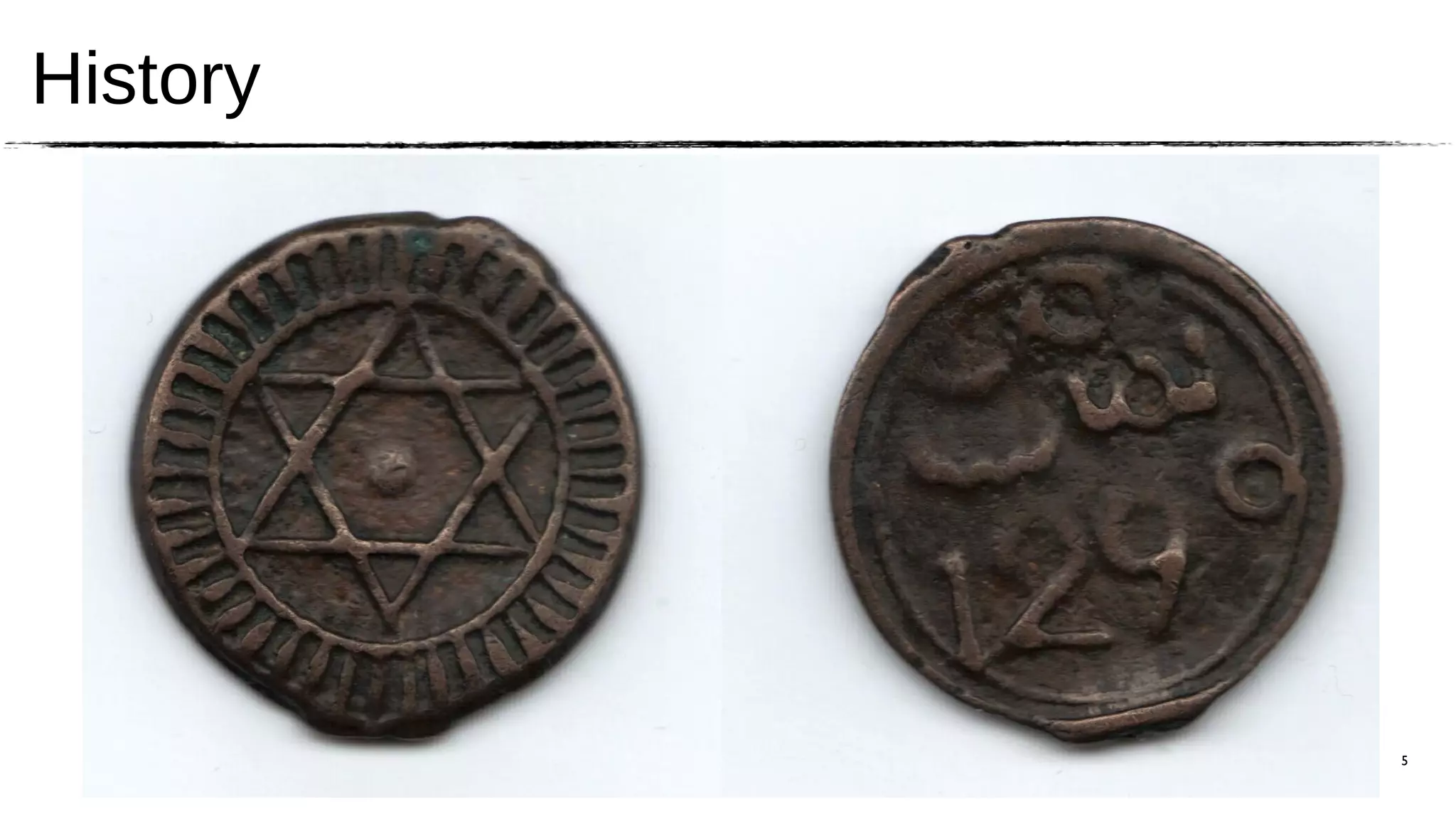
History


          5
Earlier Approaches
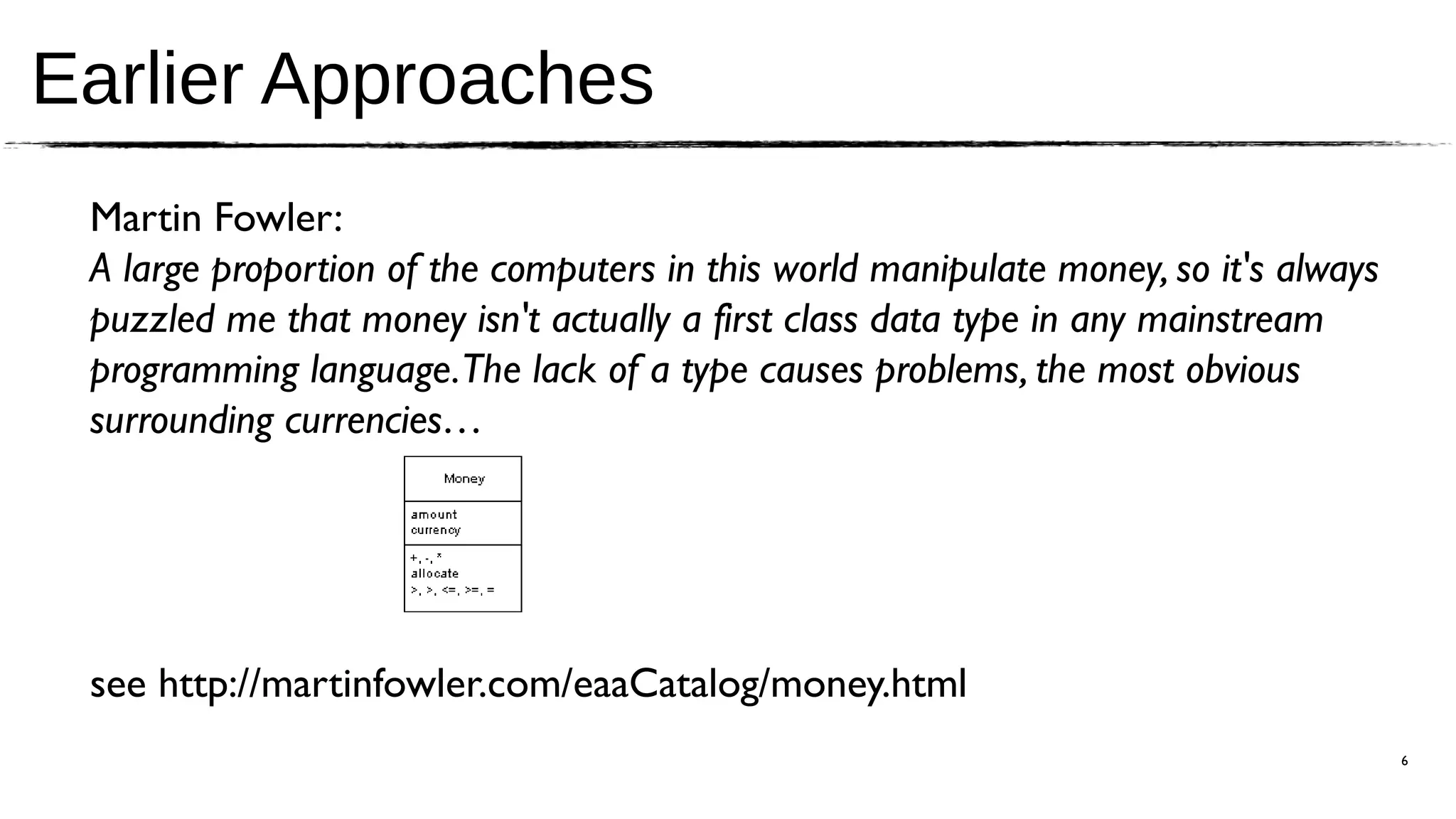
 Martin Fowler:
 A large proportion of the computers in this world manipulate money, so it's always
 puzzled me that money isn't actually a first class data type in any mainstream
 programming language.The lack of a type causes problems, the most obvious
 surrounding currencies…


 see http://martinfowler.com/eaaCatalog/money.html
                                                                                      6
Earlier Approaches (2)
 Eric Evans – Time and Money:
 On project after project, software developers have to reinvent the wheel, creating
 objects for simple recurring concepts such as "money" and "currency". Although
 most languages have a "date" or "time" object, these are rudimentary, and do not
 cover many needs, such as recurring sequences of time, durations of time, or
 intervals of time. …
 see http://timeandmoney.sourceforge.net/
 To be quite frank, their code isn‘t more than an academic POC, factories
 called dollars() or euros() are useless in real globally deployed frameworks,
 but he made a good point.
                                                                                      7
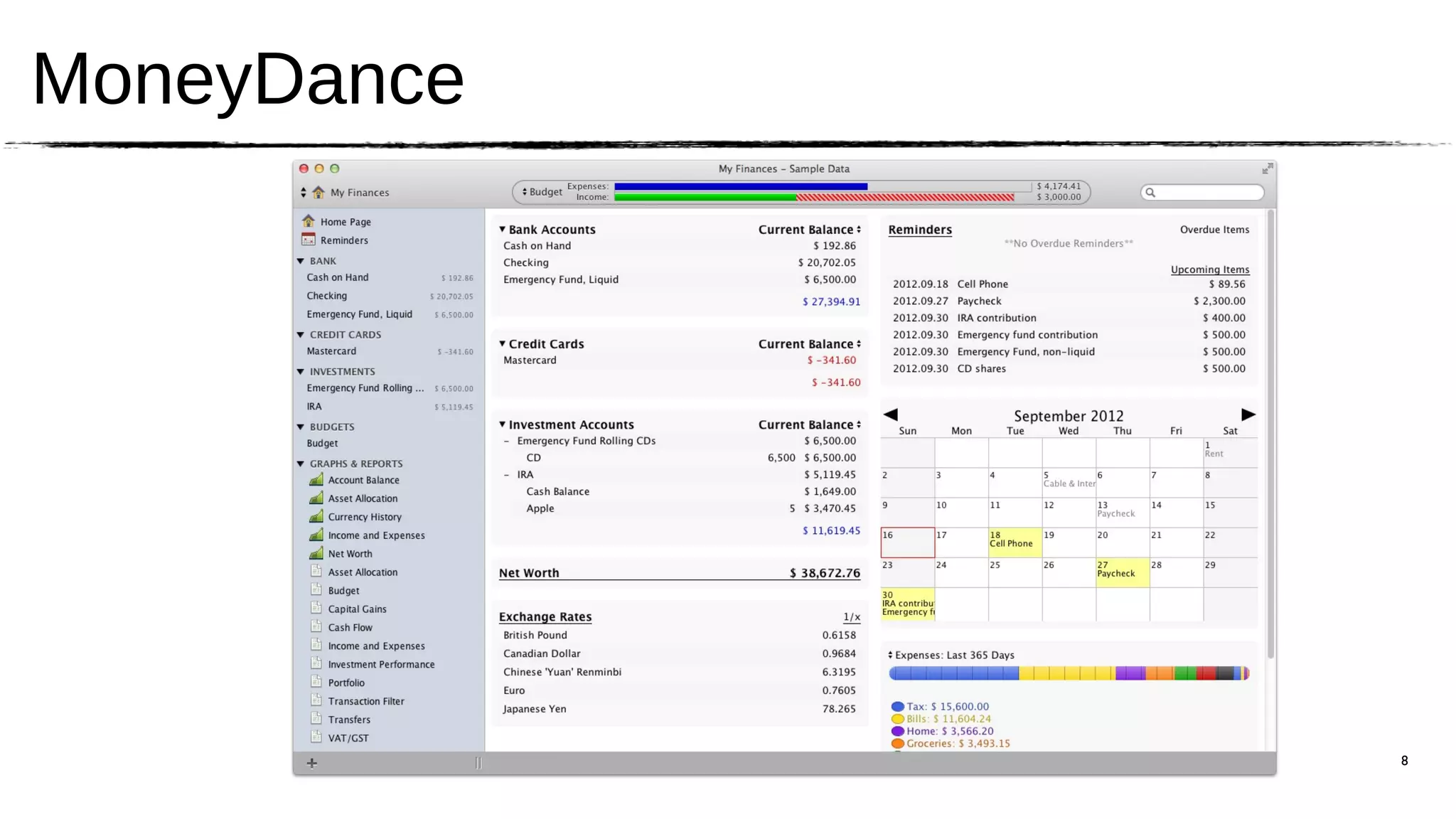
MoneyDance


             8
Motivation
Summary
 •   This JSR will provide a          money and currency API for Java,
     targeted at all users            of currencies      and monetary
     amounts in Java.
 •   The API will provide support for standard ISO-4217 and Custom
     (e.g. Virtual) currencies, as well as representation of a monetary amount.

 •   It willsupport currency arithmetic, even across different currencies, and
     foreign currency exchange.
 •   Additionally, implementation details surrounding serialization
     and thread safety       are to be considered
                                                                                  10
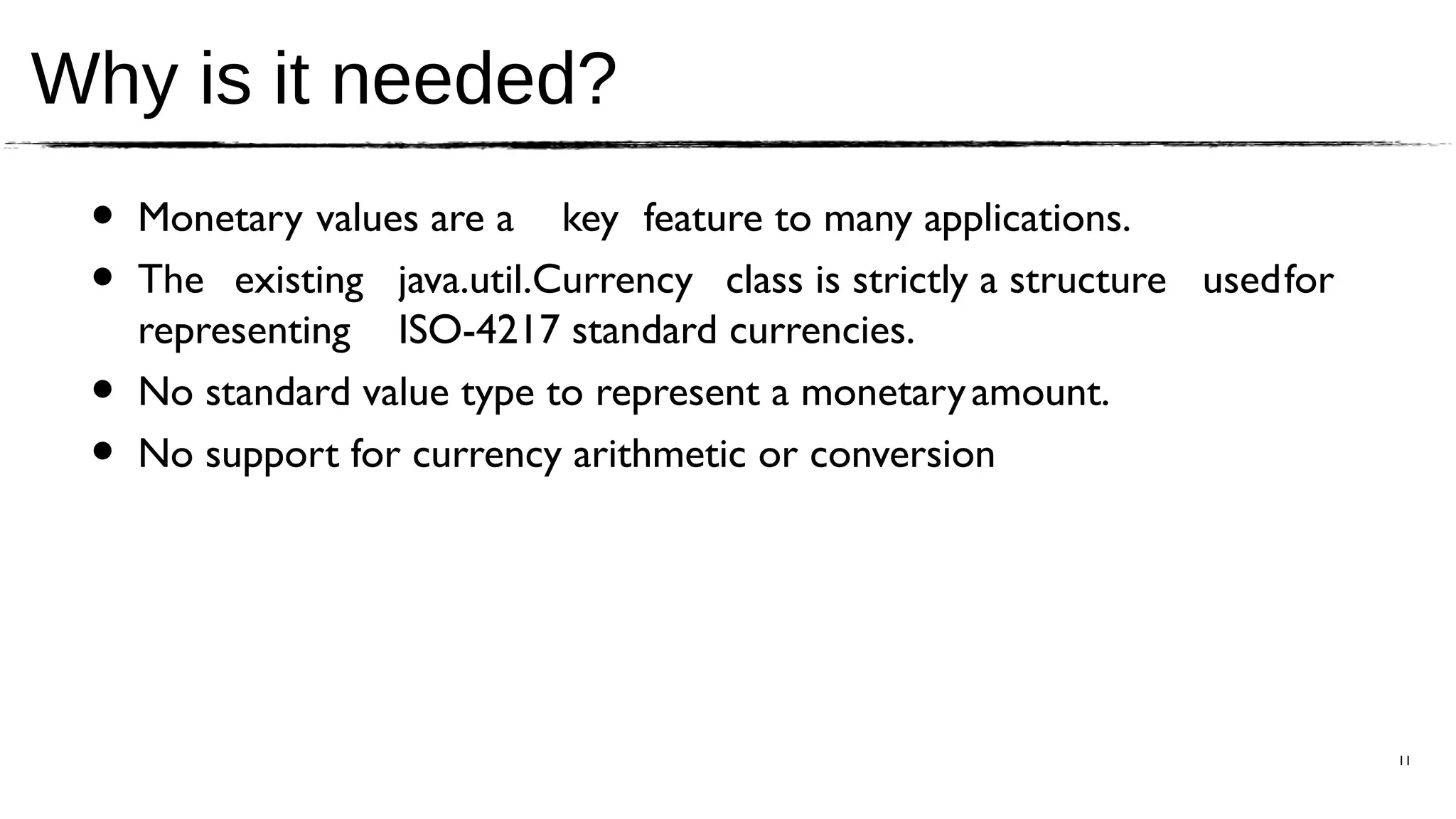
Why is it needed?
 •   Monetary values are a key feature to many applications.
 •   The existing java.util.Currency class is strictly a structure usedfor
     representing ISO-4217 standard currencies.
 •   No standard value type to represent a monetary amount.
 •   No support for currency arithmetic or conversion


                                                                             11
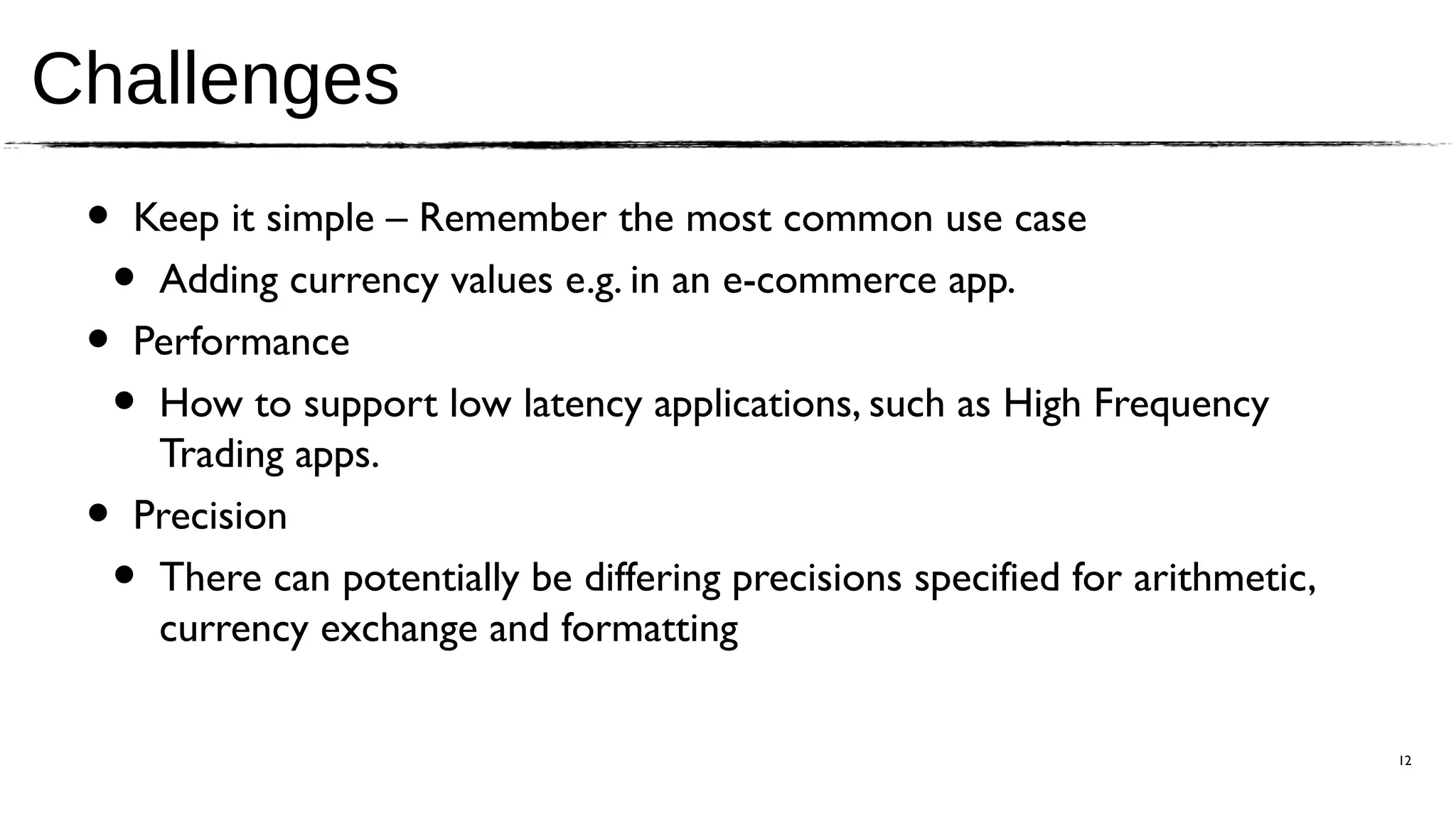
Challenges
 •   Keep it simple – Remember the most common use case
     •Adding currency values e.g. in an e-commerce app.
 •   Performance
     •How to support low latency applications, such as High Frequency
      Trading apps.
 •   Precision
     •There can potentially be differing precisions specified for arithmetic,
      currency exchange and formatting

                                                                                12
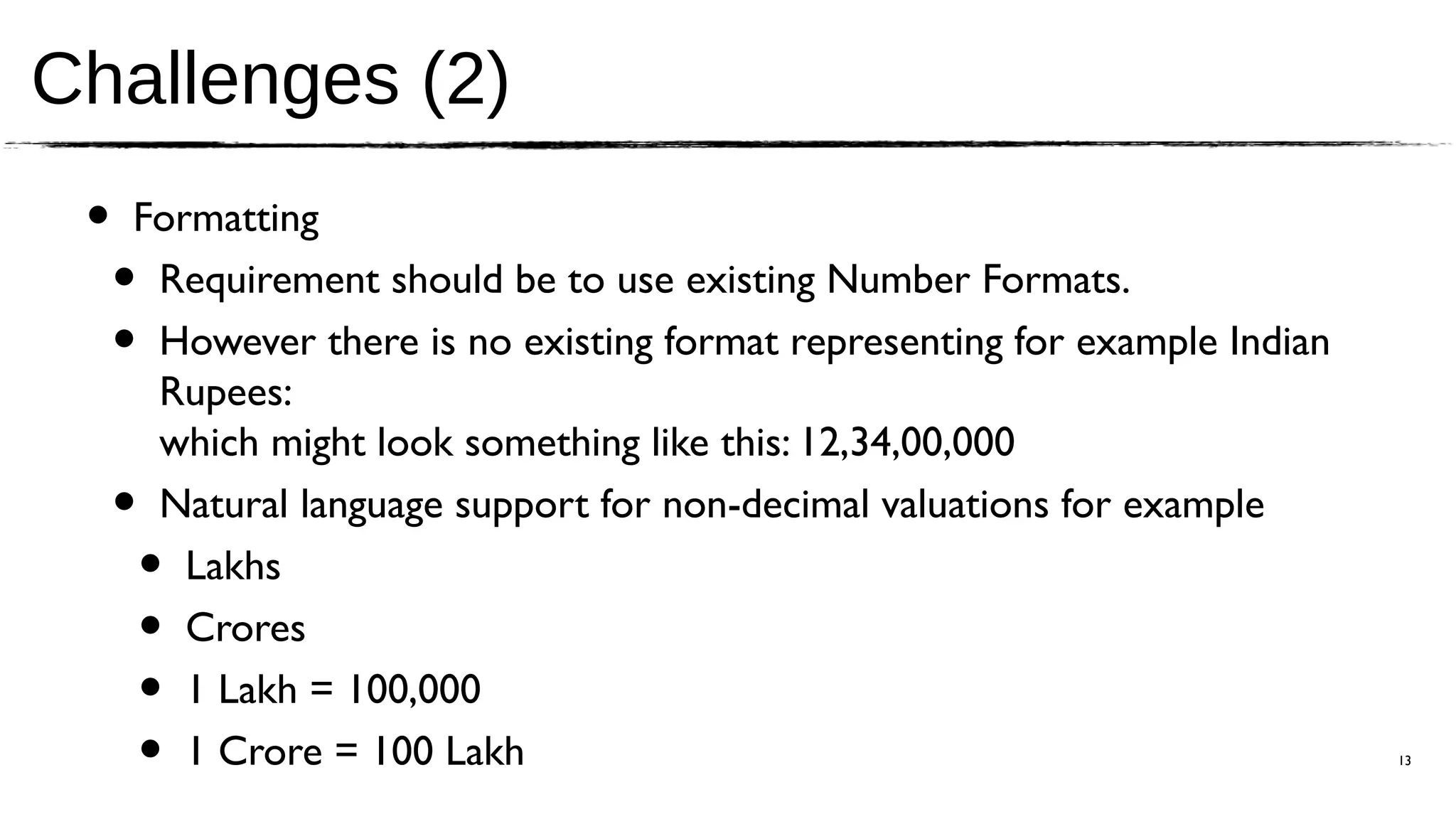
Challenges (2)
 •   Formatting
     •Requirement should be to use existing Number Formats.
     •However there is no existing format representing for example Indian
      Rupees:
      which might look something like this: 12,34,00,000
     •Natural language support for non-decimal valuations for example
         •
        Lakhs
         •
        Crores
         •
        1 Lakh = 100,000
         •
        1 Crore = 100 Lakh                                                  13
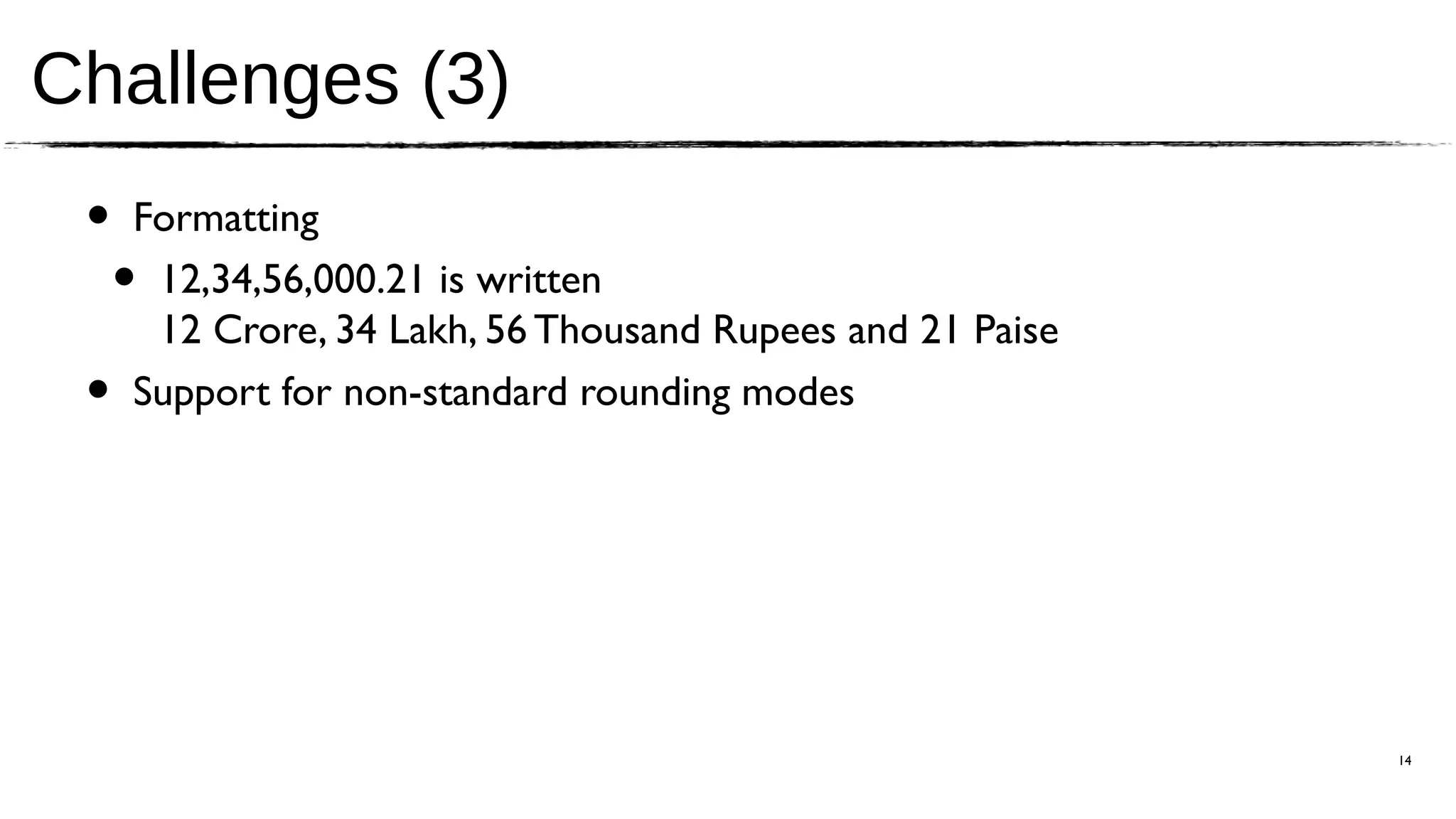
Challenges (3)
 •   Formatting
     •12,34,56,000.21 is written
      12 Crore, 34 Lakh, 56 Thousand Rupees and 21 Paise
 •   Support for non-standard rounding modes


                                                           14
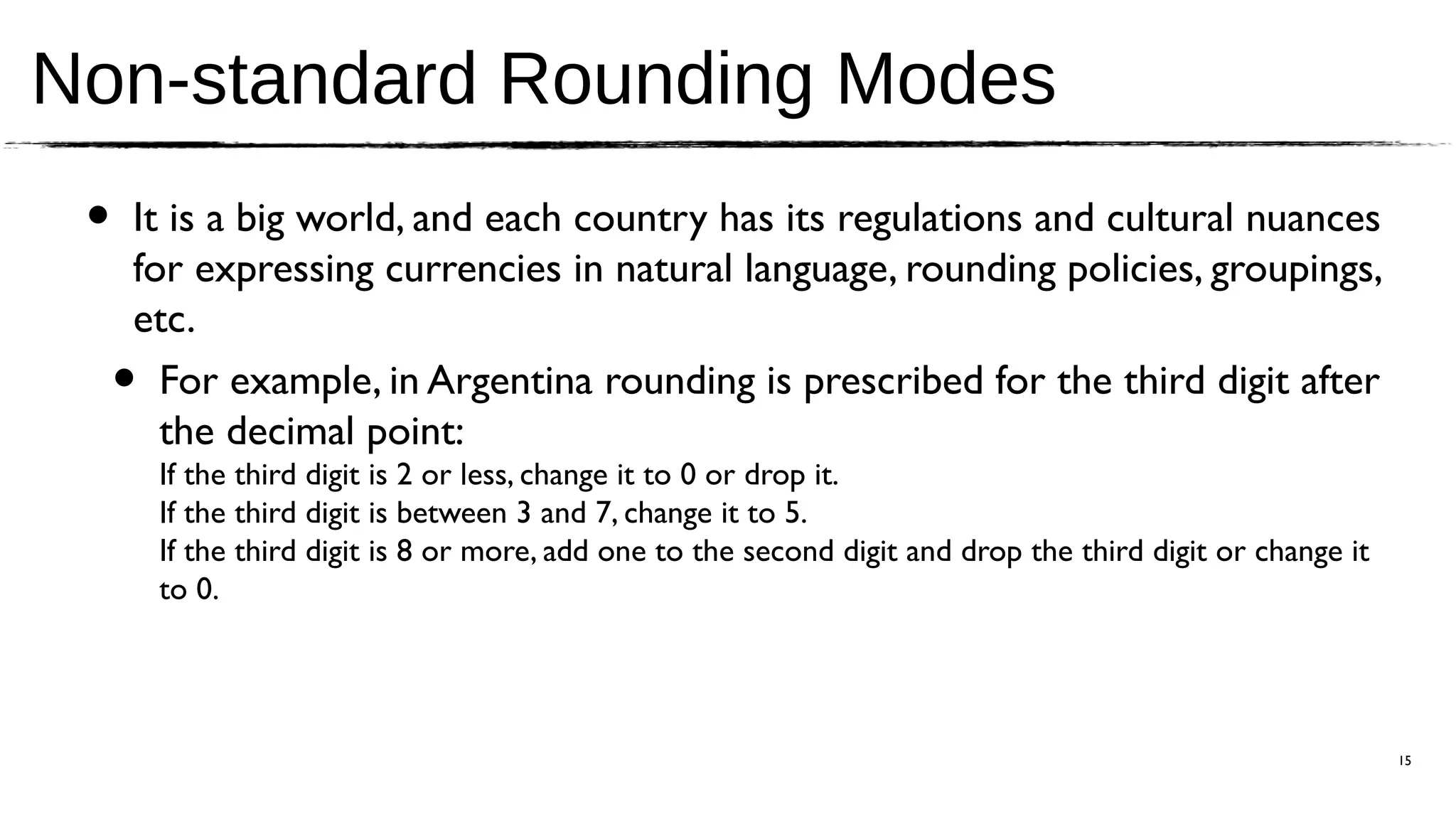
Non-standard Rounding Modes
 •   It is a big world, and each country has its regulations and cultural nuances
     for expressing currencies in natural language, rounding policies, groupings,
     etc.
     • For example, in Argentina rounding is prescribed for the third digit after
       the decimal point:
         If the third digit is 2 or less, change it to 0 or drop it.
         If the third digit is between 3 and 7, change it to 5.
         If the third digit is 8 or more, add one to the second digit and drop the third digit or change it
         to 0.


                                                                                                              15
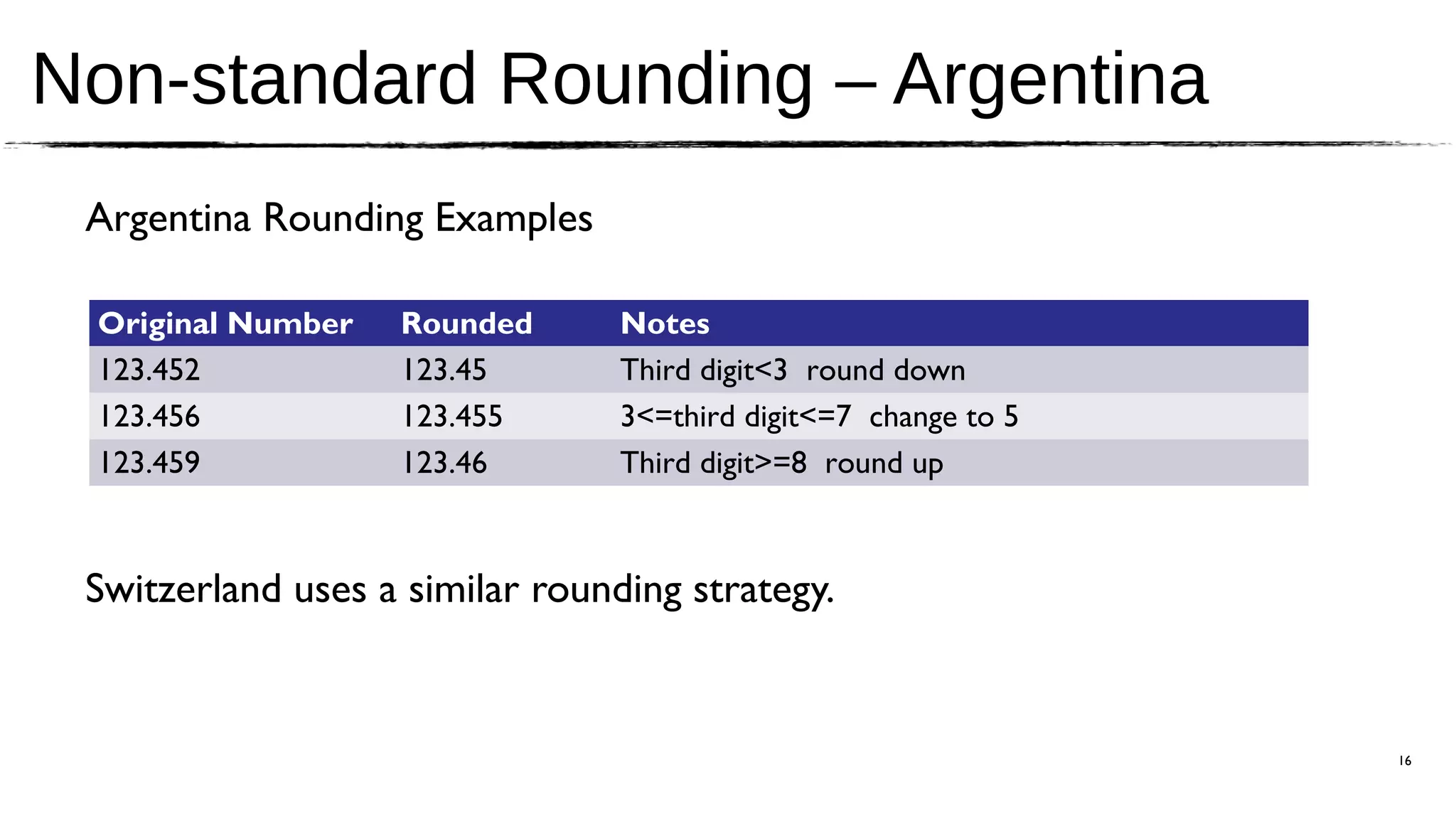
Non-standard Rounding – Argentina
 Argentina Rounding Examples

 Original Number   Rounded       Notes
 123.452           123.45        Third digit<3 round down
 123.456           123.455       3<=third digit<=7 change to 5
 123.459           123.46        Third digit>=8 round up


 Switzerland uses a similar rounding strategy.


                                                                 16
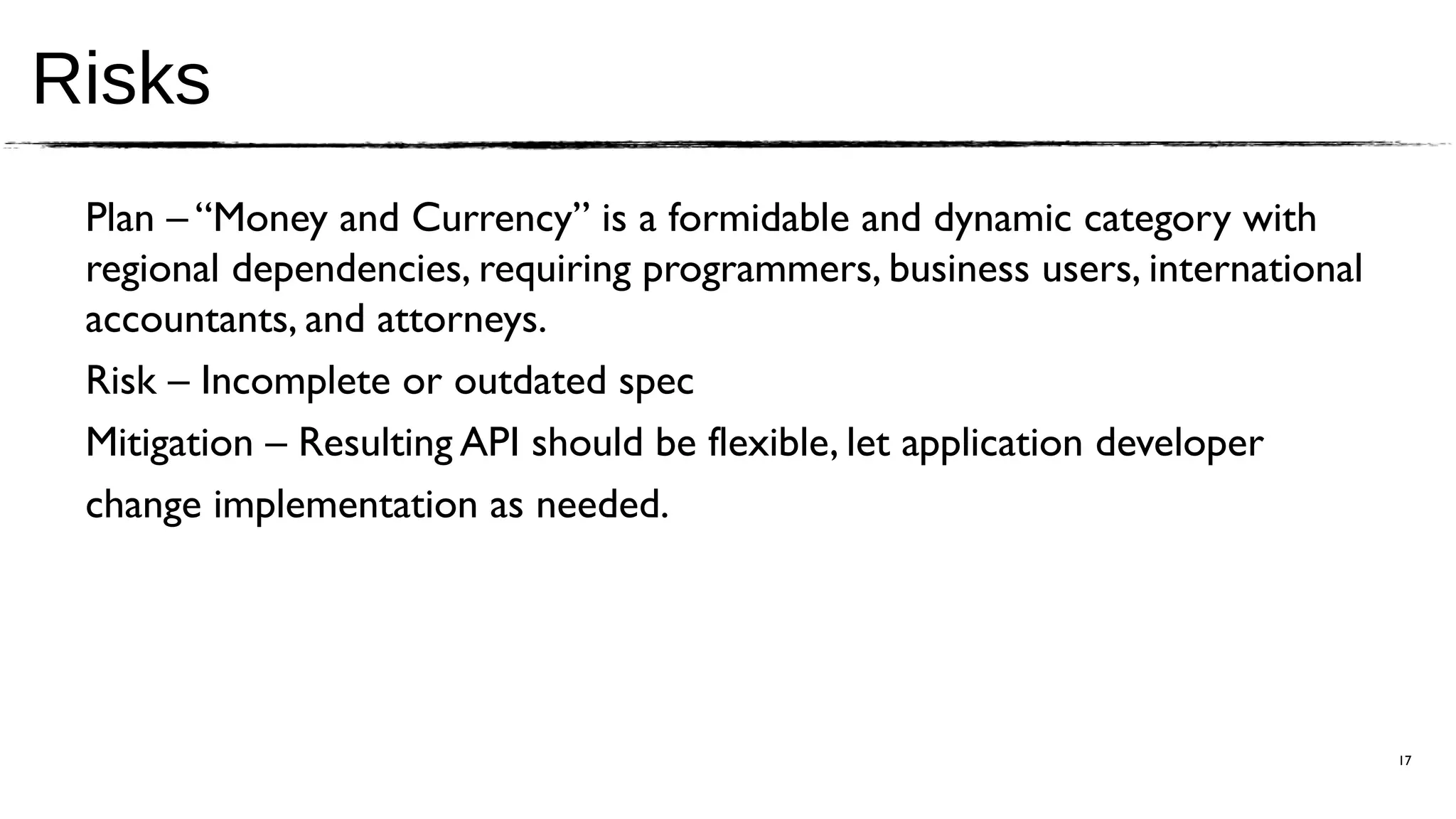
Risks
 Plan – “Money and Currency” is a formidable and dynamic category with
 regional dependencies, requiring programmers, business users, international
 accountants, and attorneys.
 Risk – Incomplete or outdated spec
 Mitigation – Resulting API should be flexible, let application developer
 change implementation as needed.


                                                                               17
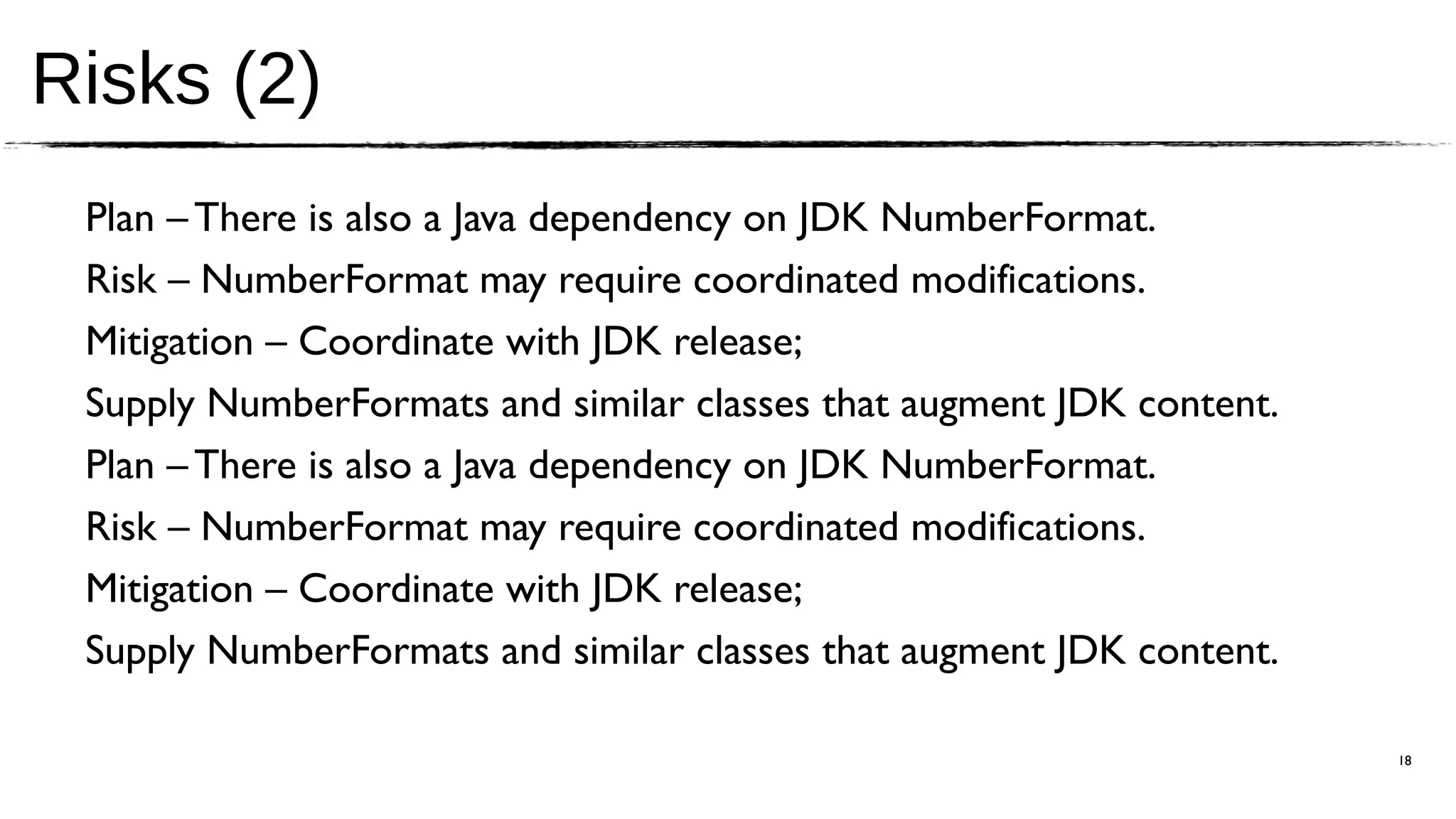
Risks (2)
 Plan – There is also a Java dependency on JDK NumberFormat.
 Risk – NumberFormat may require coordinated modifications.
 Mitigation – Coordinate with JDK release;
 Supply NumberFormats and similar classes that augment JDK content.
 Plan – There is also a Java dependency on JDK NumberFormat.
 Risk – NumberFormat may require coordinated modifications.
 Mitigation – Coordinate with JDK release;
 Supply NumberFormats and similar classes that augment JDK content.

                                                                      18
The JSR
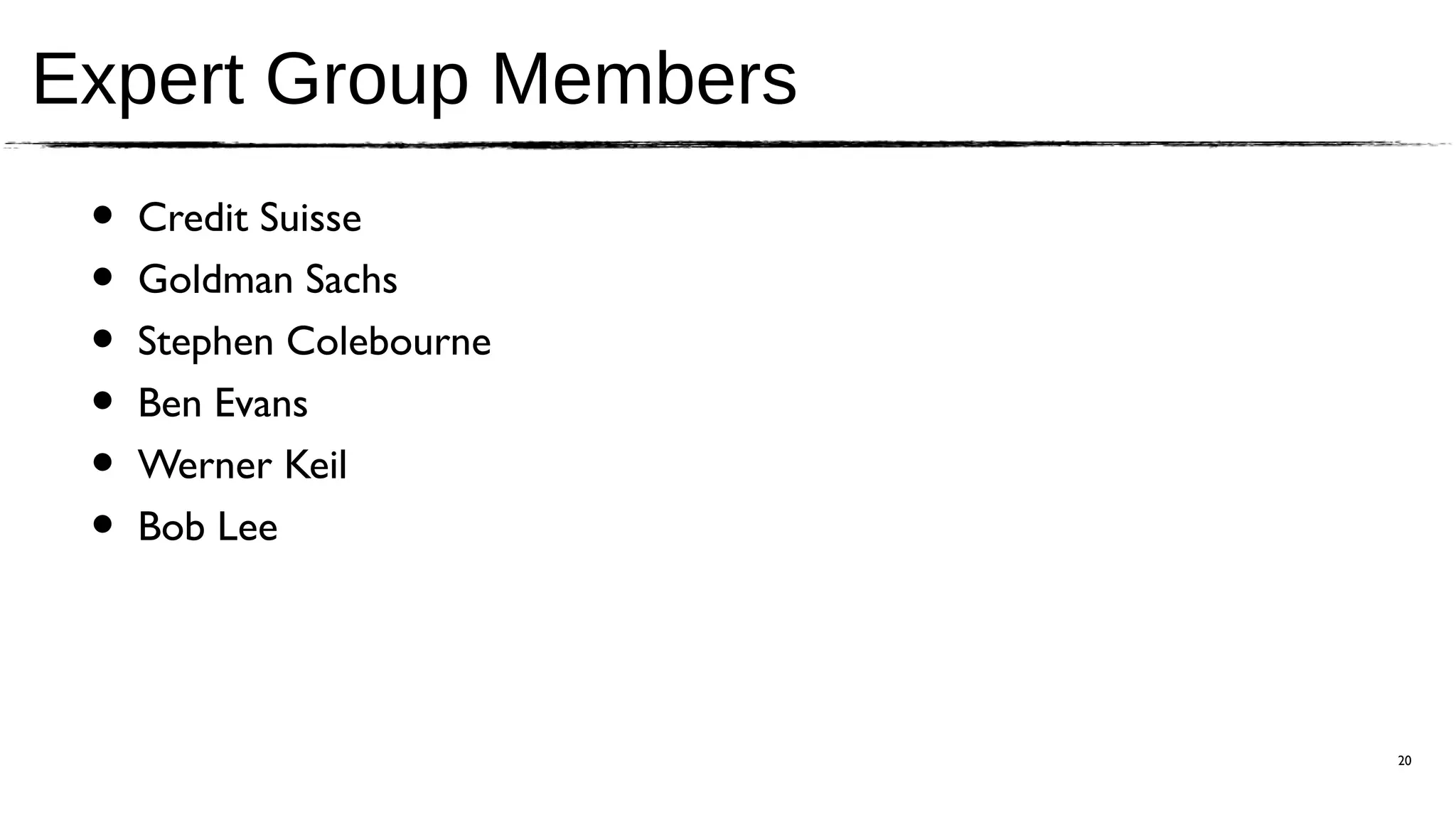
Expert Group Members
 •   Credit Suisse
 •   Goldman Sachs
 •   Stephen Colebourne
 •   Ben Evans
 •   Werner Keil
 •   Bob Lee


                          20
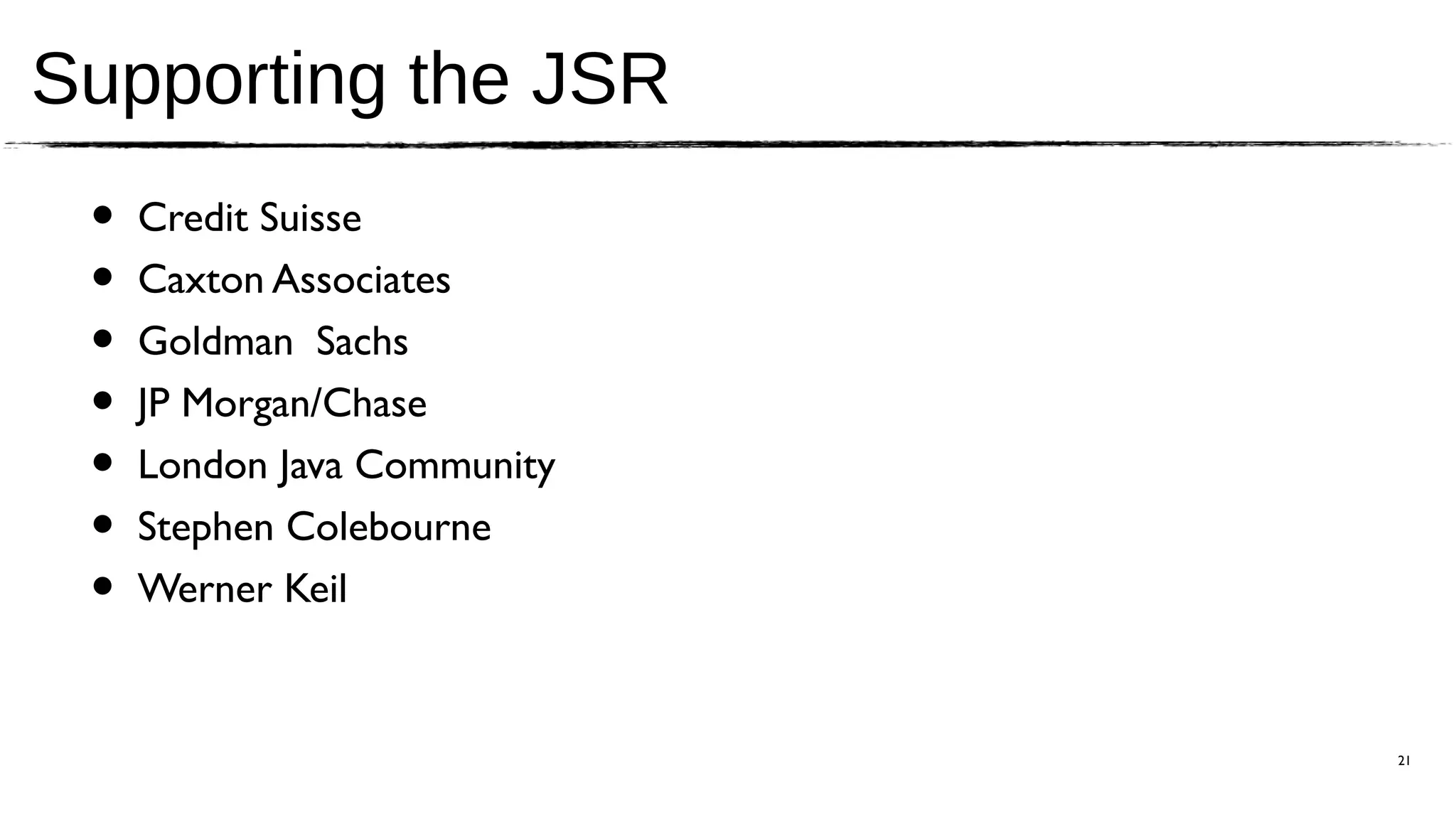
Supporting the JSR
 •   Credit Suisse
 •   Caxton Associates
 •   Goldman Sachs
 •   JP Morgan/Chase
 •   London Java Community
 •   Stephen Colebourne
 •   Werner Keil


                             21
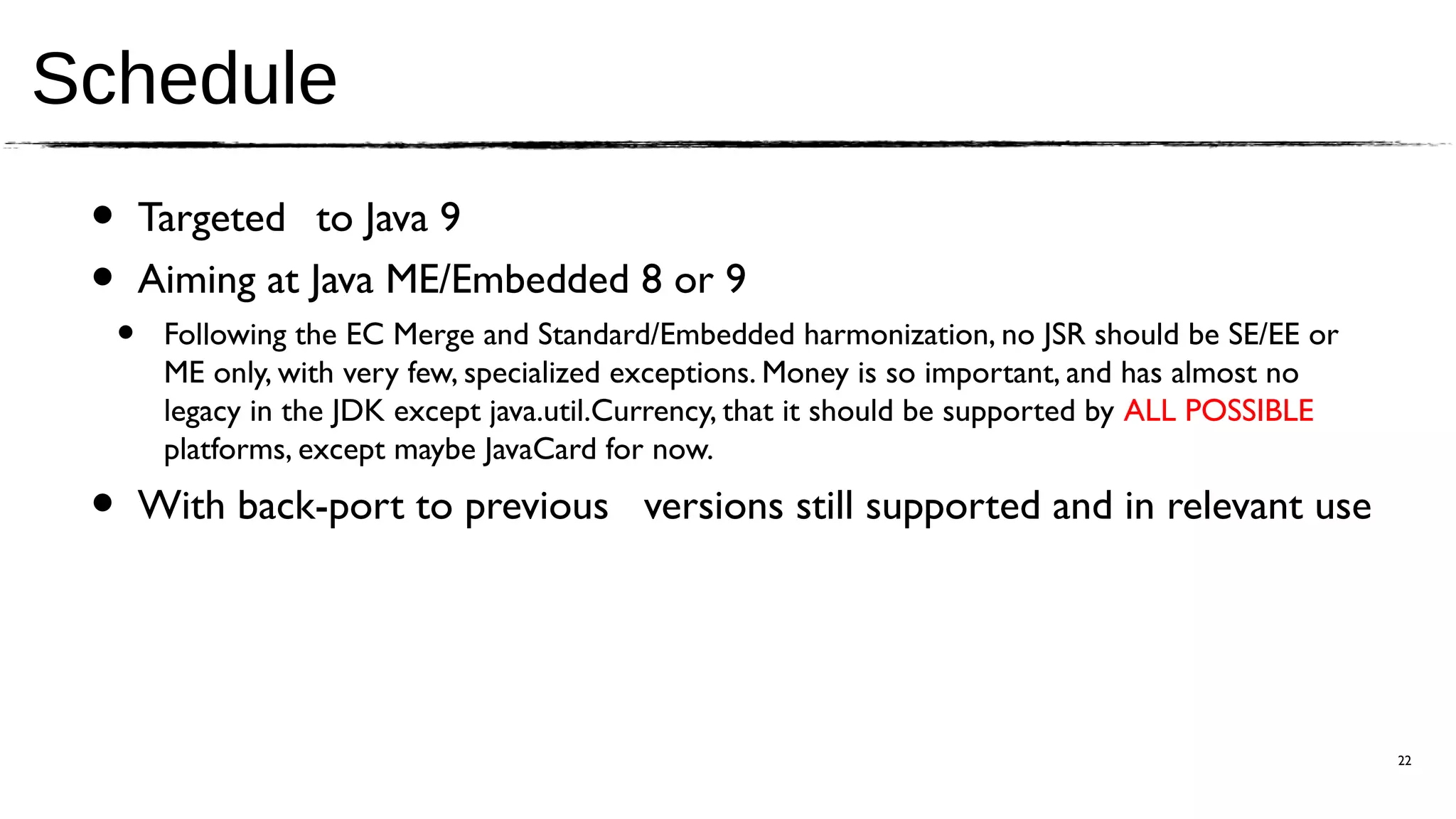
Schedule
 •       Targeted to Java 9
 •       Aiming at Java ME/Embedded 8 or 9
     •    Following the EC Merge and Standard/Embedded harmonization, no JSR should be SE/EE or
          ME only, with very few, specialized exceptions. Money is so important, and has almost no
          legacy in the JDK except java.util.Currency, that it should be supported by ALL POSSIBLE
          platforms, except maybe JavaCard for now.

 •       With back-port to previous versions still supported and in relevant use


                                                                                                     22
Virtual Currencies


                     23
Facebook Credits
 What are Facebook Credits?
 • Facebook Credits are a virtual currency you can use to buy virtual goods
 in any games or apps of the Facebook platform that accept payments. You
 can purchase Facebook Credits directly from within an app using your
 credit card, PayPal, mobile phone and many other local payment methods.

 ► Hence any such purchase is practically a conversion,
       similar to if you buy a foreign currency when
       travelling abroad☺

                                                                              24
Top 10 Video Game Currencies
 1. Gold
 2. Gil
 3. Rupees (not Indian;-)
 4. Credits
 5. Gold Rings
 6. Hearts
 7. Zenny
 8. Potch
 9. Munny
 10.Nuyen                      25
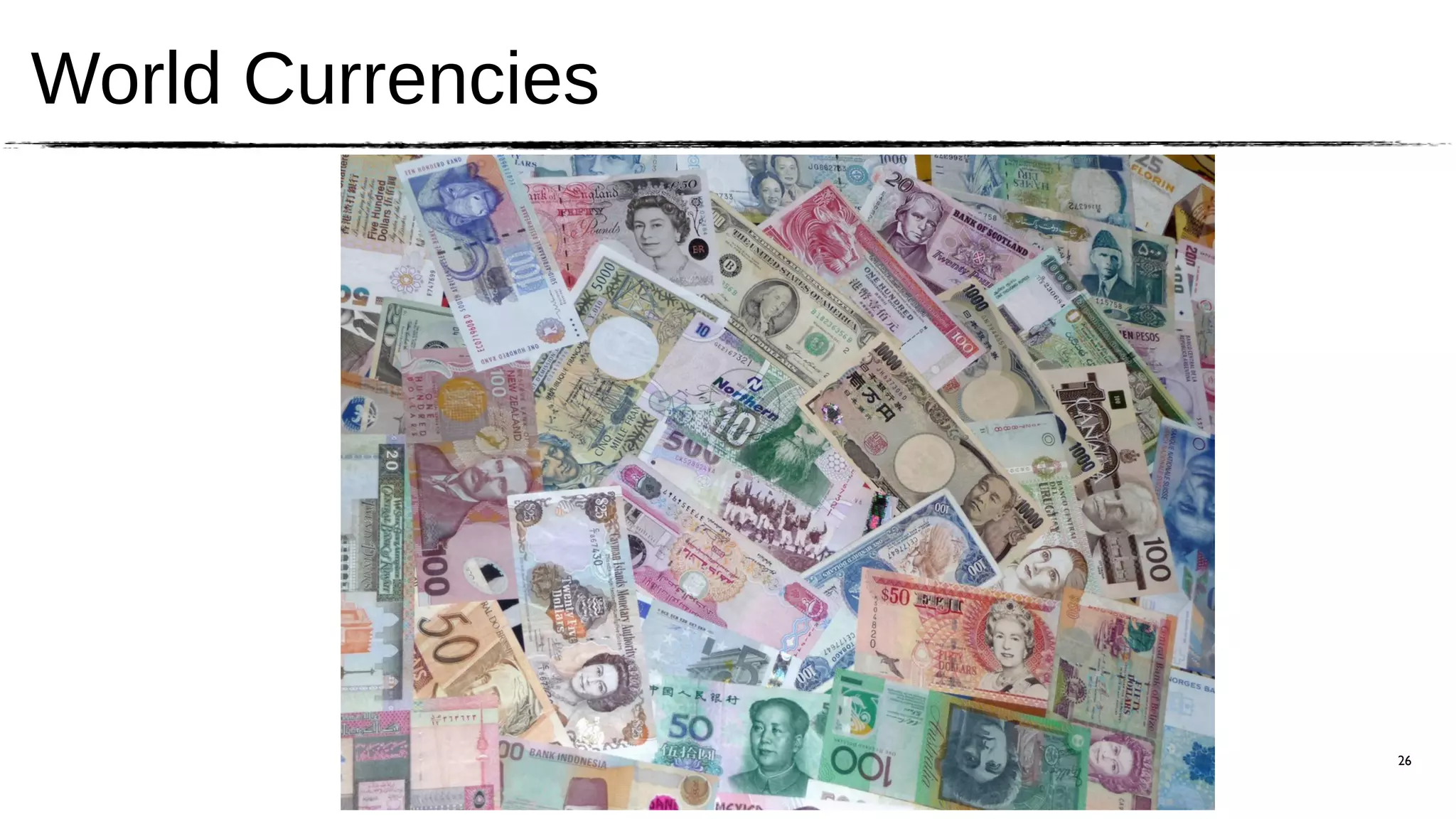
World Currencies


                   26
Currency Exchange
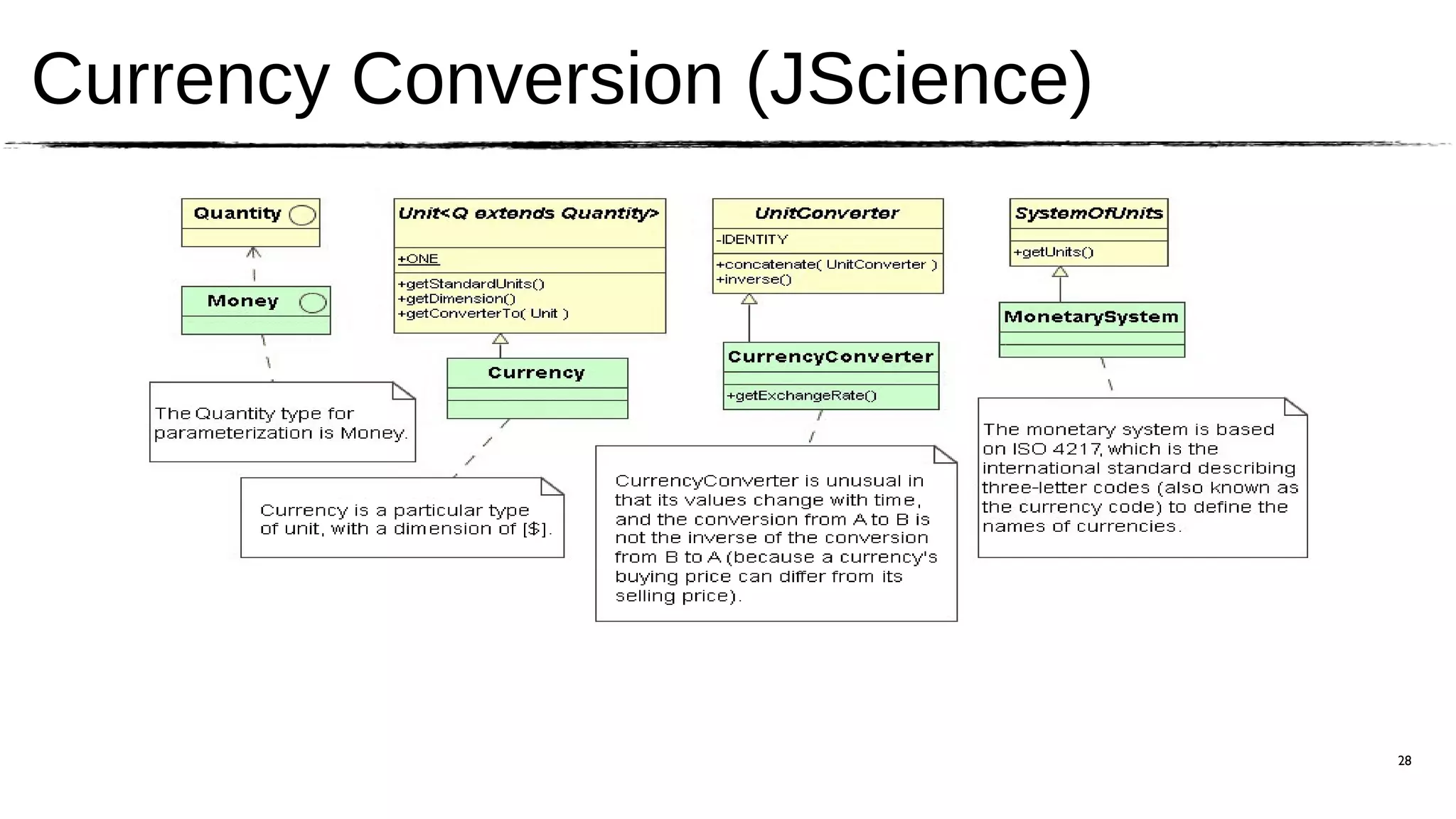
Currency Conversion (JScience)


                                 28
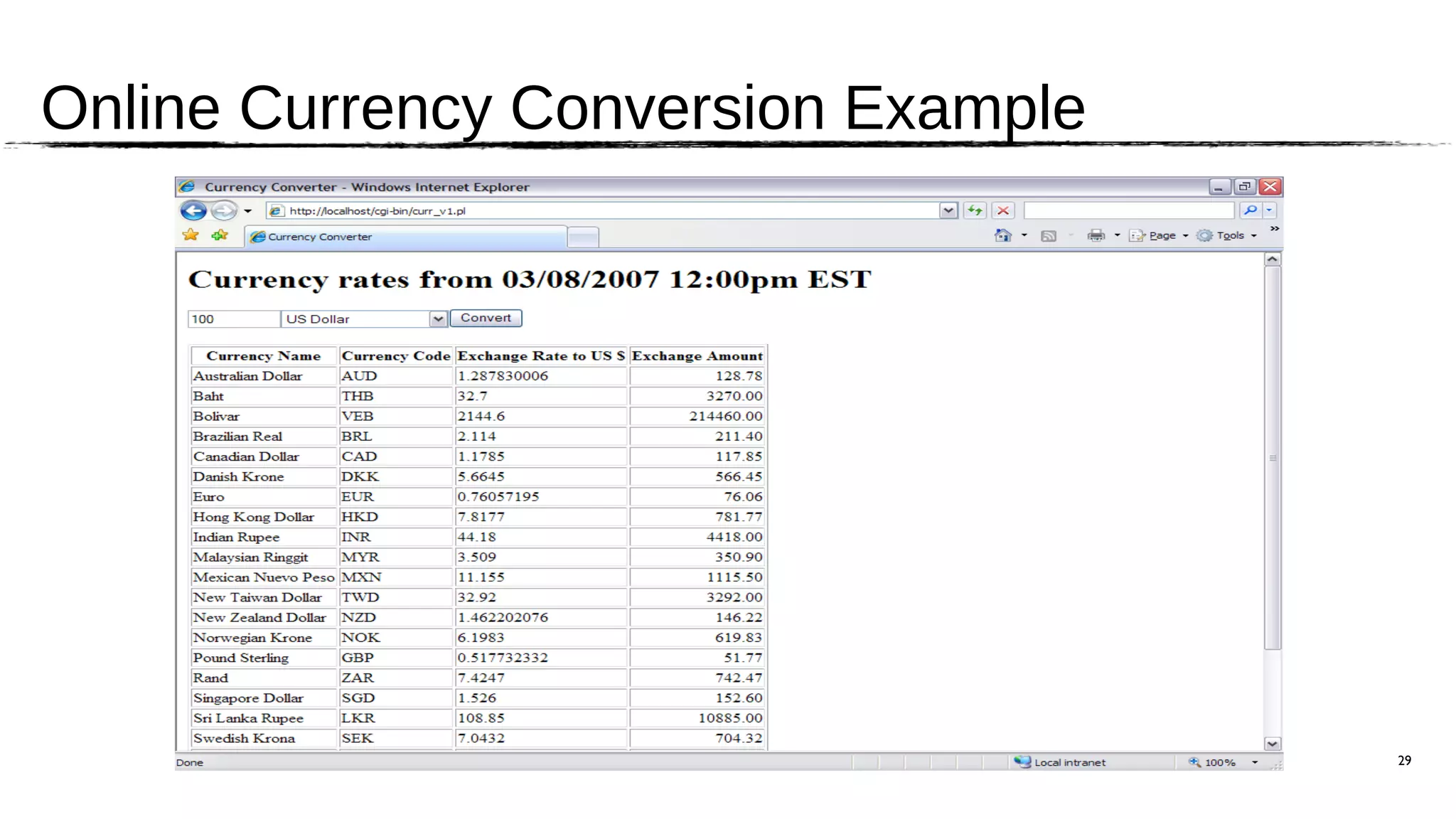
Online Currency Conversion Example


                                     29
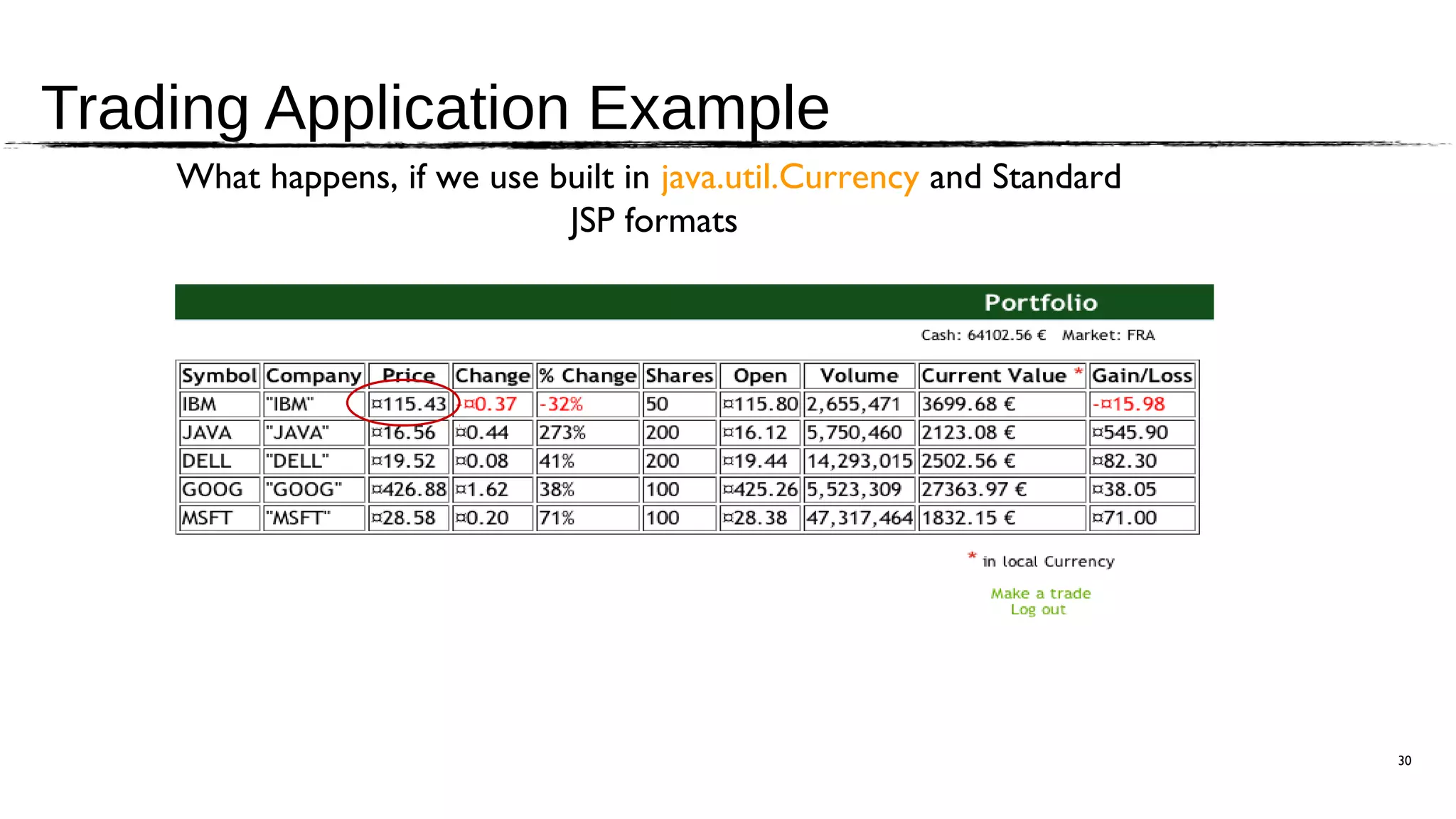
Trading Application Example
    What happens, if we use built in java.util.Currency and Standard
                             JSP formats


                                                                       30
Demos
Q&A
Links

   • The JSR: http://jcp.org/en/jsr/summary?
     id=354

   • java.net Project:
     http://java.net/projects/javamoney/

   • GitHub Project:
     http://github.com/JavaMoney/
Links (2)

   • Eclipse UOMo:
     http://www.eclipse.org/uomo/

   • JScience:
     http://www.jscience.org

   • JodaMoney:
     http://joda-money.sourceforge.net/

JSR 354 - Money and Currency API for Java

  • 1.
    JSR 354 Java Moneyand Currency API Werner Keil Build Manager, DevOps Expert, Agile Coach Maersk Line EG Member, JSR 354 @wernerkeil
  • 2.
    Werner Keil -Bio • Consultant – Coach • Creative Cosmopolitan • Open Source Evangelist • Software Architect • Java Godfather • JCP Executive Committee Member • Eclipse UOMo Project Lead • DevOps Guy 2
  • 3.
  • 4.
    Agenda • History • Motivation • The JSR • Virtual Currencies • Currency Exchange • Demos • Q&A 4
  • 5.
  • 6.
    Earlier Approaches MartinFowler: A large proportion of the computers in this world manipulate money, so it's always puzzled me that money isn't actually a first class data type in any mainstream programming language.The lack of a type causes problems, the most obvious surrounding currencies… see http://martinfowler.com/eaaCatalog/money.html 6
  • 7.
    Earlier Approaches (2) Eric Evans – Time and Money: On project after project, software developers have to reinvent the wheel, creating objects for simple recurring concepts such as "money" and "currency". Although most languages have a "date" or "time" object, these are rudimentary, and do not cover many needs, such as recurring sequences of time, durations of time, or intervals of time. … see http://timeandmoney.sourceforge.net/ To be quite frank, their code isn‘t more than an academic POC, factories called dollars() or euros() are useless in real globally deployed frameworks, but he made a good point. 7
  • 8.
  • 9.
  • 10.
    Summary • This JSR will provide a money and currency API for Java, targeted at all users of currencies and monetary amounts in Java. • The API will provide support for standard ISO-4217 and Custom (e.g. Virtual) currencies, as well as representation of a monetary amount. • It willsupport currency arithmetic, even across different currencies, and foreign currency exchange. • Additionally, implementation details surrounding serialization and thread safety are to be considered 10
  • 11.
    Why is itneeded? • Monetary values are a key feature to many applications. • The existing java.util.Currency class is strictly a structure usedfor representing ISO-4217 standard currencies. • No standard value type to represent a monetary amount. • No support for currency arithmetic or conversion 11
  • 12.
    Challenges • Keep it simple – Remember the most common use case •Adding currency values e.g. in an e-commerce app. • Performance •How to support low latency applications, such as High Frequency Trading apps. • Precision •There can potentially be differing precisions specified for arithmetic, currency exchange and formatting 12
  • 13.
    Challenges (2) • Formatting •Requirement should be to use existing Number Formats. •However there is no existing format representing for example Indian Rupees: which might look something like this: 12,34,00,000 •Natural language support for non-decimal valuations for example • Lakhs • Crores • 1 Lakh = 100,000 • 1 Crore = 100 Lakh 13
  • 14.
    Challenges (3) • Formatting •12,34,56,000.21 is written 12 Crore, 34 Lakh, 56 Thousand Rupees and 21 Paise • Support for non-standard rounding modes 14
  • 15.
    Non-standard Rounding Modes • It is a big world, and each country has its regulations and cultural nuances for expressing currencies in natural language, rounding policies, groupings, etc. • For example, in Argentina rounding is prescribed for the third digit after the decimal point: If the third digit is 2 or less, change it to 0 or drop it. If the third digit is between 3 and 7, change it to 5. If the third digit is 8 or more, add one to the second digit and drop the third digit or change it to 0. 15
  • 16.
    Non-standard Rounding –Argentina Argentina Rounding Examples Original Number Rounded Notes 123.452 123.45 Third digit<3 round down 123.456 123.455 3<=third digit<=7 change to 5 123.459 123.46 Third digit>=8 round up Switzerland uses a similar rounding strategy. 16
  • 17.
    Risks Plan –“Money and Currency” is a formidable and dynamic category with regional dependencies, requiring programmers, business users, international accountants, and attorneys. Risk – Incomplete or outdated spec Mitigation – Resulting API should be flexible, let application developer change implementation as needed. 17
  • 18.
    Risks (2) Plan– There is also a Java dependency on JDK NumberFormat. Risk – NumberFormat may require coordinated modifications. Mitigation – Coordinate with JDK release; Supply NumberFormats and similar classes that augment JDK content. Plan – There is also a Java dependency on JDK NumberFormat. Risk – NumberFormat may require coordinated modifications. Mitigation – Coordinate with JDK release; Supply NumberFormats and similar classes that augment JDK content. 18
  • 19.
  • 20.
    Expert Group Members • Credit Suisse • Goldman Sachs • Stephen Colebourne • Ben Evans • Werner Keil • Bob Lee 20
  • 21.
    Supporting the JSR • Credit Suisse • Caxton Associates • Goldman Sachs • JP Morgan/Chase • London Java Community • Stephen Colebourne • Werner Keil 21
  • 22.
    Schedule • Targeted to Java 9 • Aiming at Java ME/Embedded 8 or 9 • Following the EC Merge and Standard/Embedded harmonization, no JSR should be SE/EE or ME only, with very few, specialized exceptions. Money is so important, and has almost no legacy in the JDK except java.util.Currency, that it should be supported by ALL POSSIBLE platforms, except maybe JavaCard for now. • With back-port to previous versions still supported and in relevant use 22
  • 23.
  • 24.
    Facebook Credits Whatare Facebook Credits? • Facebook Credits are a virtual currency you can use to buy virtual goods in any games or apps of the Facebook platform that accept payments. You can purchase Facebook Credits directly from within an app using your credit card, PayPal, mobile phone and many other local payment methods. ► Hence any such purchase is practically a conversion, similar to if you buy a foreign currency when travelling abroad☺ 24
  • 25.
    Top 10 VideoGame Currencies 1. Gold 2. Gil 3. Rupees (not Indian;-) 4. Credits 5. Gold Rings 6. Hearts 7. Zenny 8. Potch 9. Munny 10.Nuyen 25
  • 26.
  • 27.
  • 28.
  • 29.
  • 30.
    Trading Application Example What happens, if we use built in java.util.Currency and Standard JSP formats 30
  • 31.
  • 32.
  • 33.
    Links • The JSR: http://jcp.org/en/jsr/summary? id=354 • java.net Project: http://java.net/projects/javamoney/ • GitHub Project: http://github.com/JavaMoney/
  • 34.
    Links (2) • Eclipse UOMo: http://www.eclipse.org/uomo/ • JScience: http://www.jscience.org • JodaMoney: http://joda-money.sourceforge.net/