your name
On the specification of the
Background Error Covariance Matrix
for Wave Data Assimilation Systems
• Jesús Portilla
your name
Introduction
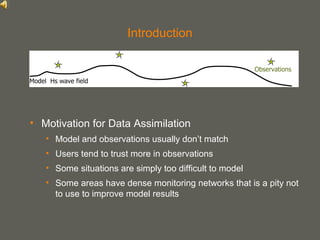
• Motivation for Data Assimilation
• Model and observations usually don’t match
• Users tend to trust more in observations
• Some situations are simply too difficult to model
• Some areas have dense monitoring networks that is a pity not
to use to improve model results
your name
Introduction
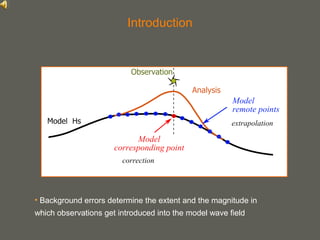
• Background errors determine the extent and the magnitude in
which observations get introduced into the model wave field
your name
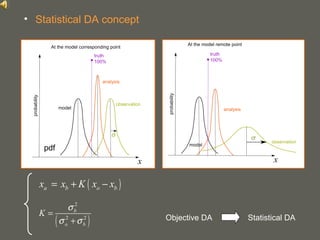
Objective DA Statistical DA
( )a b o bx x K x x= + −
( )
2
2 2
b
o b
K
σ
σ σ
=
+
• Statistical DA concept
pdf
your name
( )
1 2
,
,
i
o m
i j j
i j
J Q x x
−
= −∑
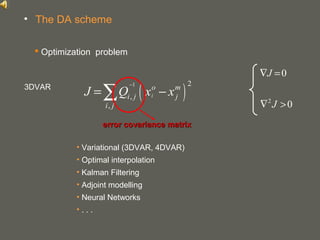
 Optimization problem
• The DA scheme
• Variational (3DVAR, 4DVAR)
• Optimal interpolation
• Kalman Filtering
• Adjoint modelling
• Neural Networks
• . . .
error covariance matrixerror covariance matrix
0J∇ =
2
0J∇ >
3DVAR
your name
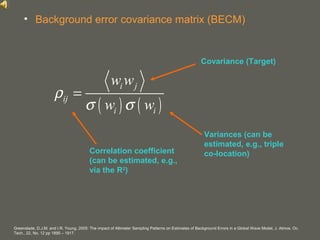
• Background error covariance matrix (BECM)
Covariance (Target)
Variances (can be
estimated, e.g., triple
co-location)Correlation coefficient
(can be estimated, e.g.,
via the R2
)
( ) ( )
i j
ij
i i
w w
w w
ρ
σ σ
=
Greenslade, D.J.M. and I.R. Young, 2005: The impact of Altimeter Sampling Patterns on Estimates of Background Errors in a Global Wave Model, J. Atmos. Oc.
Tech., 22, No. 12 pp 1895 – 1917.
your name
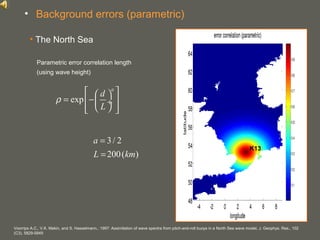
• The North Sea
Voorrips A.C., V.K. Makin, and S. Hasselmann., 1997: Assimilation of wave spectra from pitch-and-roll buoys in a North Sea wave model, J. Geophys. Res., 102
(C3), 5829-5849
Parametric error correlation length
(using wave height)
exp
a
d
L
ρ
  
= −  ÷
   
3/ 2
200( )
a
L km
=
=
• Background errors (parametric)
K13
your name
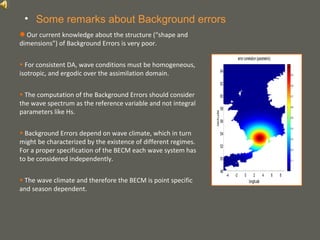
• Some remarks about Background errors
● Our current knowledge about the structure (“shape and
dimensions”) of Background Errors is very poor.
• For consistent DA, wave conditions must be homogeneous,
isotropic, and ergodic over the assimilation domain.
• The computation of the Background Errors should consider
the wave spectrum as the reference variable and not integral
parameters like Hs.
• Background Errors depend on wave climate, which in turn
might be characterized by the existence of different regimes.
For a proper specification of the BECM each wave system has
to be considered independently.
• The wave climate and therefore the BECM is point specific
and season dependent.
your name
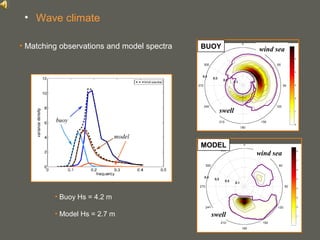
• Wave climate
MODEL
BUOY
wind sea
wind sea
swell
swell
• Buoy Hs = 4.2 m
• Model Hs = 2.7 m
• Matching observations and model spectra
your name
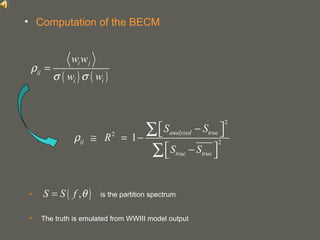
• is the partition spectrum
• The truth is emulated from WWIII model output
• Computation of the BECM
( ) ( )
i j
ij
i i
w w
w w
ρ
σ σ
=
2
2
2
1
analyzed true
ij
true true
S S
R
S S
ρ
 − ≅ = −
 − 
∑
∑
( ),S S f θ=
your name
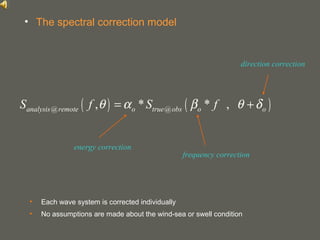
• The spectral correction model
( ) ( )@ @, * * ,analysis remote o true obs o oS f S fθ α β θ δ= +
energy correction
frequency correction
direction correction
• Each wave system is corrected individually
• No assumptions are made about the wind-sea or swell condition
your name
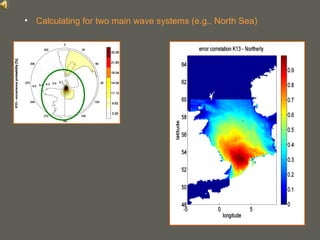
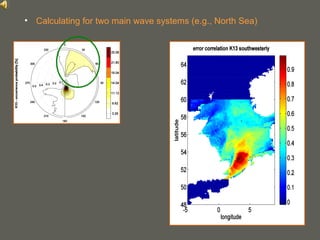
• Calculating for two main wave systems (e.g., North Sea)
your name
• Calculating for two main wave systems (e.g., North Sea)
your name
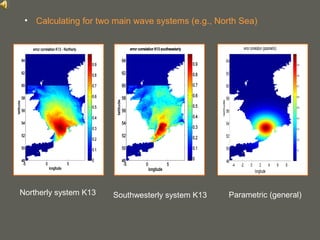
Northerly system K13 Southwesterly system K13 Parametric (general)
• Calculating for two main wave systems (e.g., North Sea)
your name
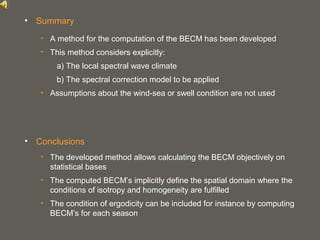
• Summary
• A method for the computation of the BECM has been developed
• This method considers explicitly:
a) The local spectral wave climate
b) The spectral correction model to be applied
• Assumptions about the wind-sea or swell condition are not used
• Conclusions
• The developed method allows calculating the BECM objectively on
statistical bases
• The computed BECM’s implicitly define the spatial domain where the
conditions of isotropy and homogeneity are fulfilled
• The condition of ergodicity can be included for instance by computing
BECM’s for each season
your name
References
Voorrips A.C., V.K. Makin, and S. Hasselmann., 1997: Assimilation of wave spectra
from pitch-and-roll buoys in a North Sea wave model, J. Geophys. Res., 102 (C3),
5829-5849
Greenslade, D.J.M. and I.R. Young, 2005: The impact of Altimeter Sampling
Patterns on Estimates of Background Errors in a Global Wave Model, J. Atmos.
Oc. Tech., 22, No. 12 pp 1895 – 1917.
Thanks for your attention!
your name

Jportilla cec2014

  • 1.
    your name On thespecification of the Background Error Covariance Matrix for Wave Data Assimilation Systems • Jesús Portilla
  • 2.
    your name Introduction • Motivationfor Data Assimilation • Model and observations usually don’t match • Users tend to trust more in observations • Some situations are simply too difficult to model • Some areas have dense monitoring networks that is a pity not to use to improve model results
  • 3.
    your name Introduction • Backgrounderrors determine the extent and the magnitude in which observations get introduced into the model wave field
  • 4.
    your name Objective DAStatistical DA ( )a b o bx x K x x= + − ( ) 2 2 2 b o b K σ σ σ = + • Statistical DA concept pdf
  • 5.
    your name ( ) 12 , , i o m i j j i j J Q x x − = −∑  Optimization problem • The DA scheme • Variational (3DVAR, 4DVAR) • Optimal interpolation • Kalman Filtering • Adjoint modelling • Neural Networks • . . . error covariance matrixerror covariance matrix 0J∇ = 2 0J∇ > 3DVAR
  • 6.
    your name • Backgrounderror covariance matrix (BECM) Covariance (Target) Variances (can be estimated, e.g., triple co-location)Correlation coefficient (can be estimated, e.g., via the R2 ) ( ) ( ) i j ij i i w w w w ρ σ σ = Greenslade, D.J.M. and I.R. Young, 2005: The impact of Altimeter Sampling Patterns on Estimates of Background Errors in a Global Wave Model, J. Atmos. Oc. Tech., 22, No. 12 pp 1895 – 1917.
  • 7.
    your name • TheNorth Sea Voorrips A.C., V.K. Makin, and S. Hasselmann., 1997: Assimilation of wave spectra from pitch-and-roll buoys in a North Sea wave model, J. Geophys. Res., 102 (C3), 5829-5849 Parametric error correlation length (using wave height) exp a d L ρ    = −  ÷     3/ 2 200( ) a L km = = • Background errors (parametric) K13
  • 8.
    your name • Someremarks about Background errors ● Our current knowledge about the structure (“shape and dimensions”) of Background Errors is very poor. • For consistent DA, wave conditions must be homogeneous, isotropic, and ergodic over the assimilation domain. • The computation of the Background Errors should consider the wave spectrum as the reference variable and not integral parameters like Hs. • Background Errors depend on wave climate, which in turn might be characterized by the existence of different regimes. For a proper specification of the BECM each wave system has to be considered independently. • The wave climate and therefore the BECM is point specific and season dependent.
  • 9.
    your name • Waveclimate MODEL BUOY wind sea wind sea swell swell • Buoy Hs = 4.2 m • Model Hs = 2.7 m • Matching observations and model spectra
  • 10.
    your name • isthe partition spectrum • The truth is emulated from WWIII model output • Computation of the BECM ( ) ( ) i j ij i i w w w w ρ σ σ = 2 2 2 1 analyzed true ij true true S S R S S ρ  − ≅ = −  −  ∑ ∑ ( ),S S f θ=
  • 11.
    your name • Thespectral correction model ( ) ( )@ @, * * ,analysis remote o true obs o oS f S fθ α β θ δ= + energy correction frequency correction direction correction • Each wave system is corrected individually • No assumptions are made about the wind-sea or swell condition
  • 12.
    your name • Calculatingfor two main wave systems (e.g., North Sea)
  • 13.
    your name • Calculatingfor two main wave systems (e.g., North Sea)
  • 14.
    your name Northerly systemK13 Southwesterly system K13 Parametric (general) • Calculating for two main wave systems (e.g., North Sea)
  • 15.
    your name • Summary •A method for the computation of the BECM has been developed • This method considers explicitly: a) The local spectral wave climate b) The spectral correction model to be applied • Assumptions about the wind-sea or swell condition are not used • Conclusions • The developed method allows calculating the BECM objectively on statistical bases • The computed BECM’s implicitly define the spatial domain where the conditions of isotropy and homogeneity are fulfilled • The condition of ergodicity can be included for instance by computing BECM’s for each season
  • 16.
    your name References Voorrips A.C.,V.K. Makin, and S. Hasselmann., 1997: Assimilation of wave spectra from pitch-and-roll buoys in a North Sea wave model, J. Geophys. Res., 102 (C3), 5829-5849 Greenslade, D.J.M. and I.R. Young, 2005: The impact of Altimeter Sampling Patterns on Estimates of Background Errors in a Global Wave Model, J. Atmos. Oc. Tech., 22, No. 12 pp 1895 – 1917. Thanks for your attention!
  • 17.