Copyright © 2014, Oracle and/or its aff iliates. All rights reserved. |
Join the Java Evolution for Victoria JUG
Java, JCP and Adopt-a-JSR
Heather VanCura
@heathervc
http://www.slideshare.net/heathervc
Java Community Process
July 21, 2015
Happy to be in Canada – thank you for inviting me!
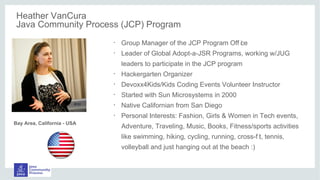
Heather VanCura
Java Community Process (JCP) Program
•
Group Manager of the JCP Program Off ice
•
Leader of Global Adopt-a-JSR Programs, working w/JUG
leaders to participate in the JCP program
•
Hackergarten Organizer
•
Devoxx4Kids/Kids Coding Events Volunteer Instructor
•
Started with Sun Microsystems in 2000
•
Native Californian from San Diego
•
Personal Interests: Fashion, Girls & Women in Tech events,
Adventure, Traveling, Music, Books, Fitness/sports activities
like swimming, hiking, cycling, running, cross-f it, tennis,
volleyball and just hanging out at the beach :)
Bay Area, California - USA
•
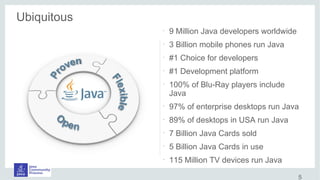
9 Million Java developers worldwide
•
3 Billion mobile phones run Java
•
#1 Choice for developers
•
#1 Development platform
•
100% of Blu-Ray players include
Java
•
97% of enterprise desktops run Java
•
89% of desktops in USA run Java
•
7 Billion Java Cards sold
•
5 Billion Java Cards in use
•
115 Million TV devices run Java
Ubiquitous
5
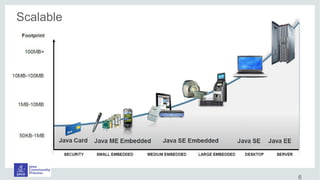
Scalable
6
Compatible
7
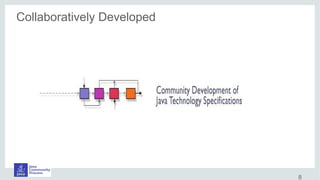
Collaboratively Developed
8
History
•
1995: Sun Microsystems develops Java.
•
1999: Sun opens up the development process to its competitors,
creating the Java Community Process.
•
2006: Sun open-sources Java SE and Java EE.
•
2007: Sun goes into f inancial decline; Java stagnates.
•
2010: Oracle acquires Sun and becomes the steward of Java.
9
Oracle infuses energy and funding into
Java and the JCP, resulting in:
• New revisions of each
of the three platforms:
Java SE, Java ME,
Java EE
• “JCP.Next” reforms to
improve the way the
Process operates
• Increased participation
and new initiatives
from Java User Groups
2011 - Present Day
10
Oracle as Java’s Steward
•
Oracle recognizes the great value of Java – to itself as well as to its
allies and competitors.
•
The value is derived from the open, collaborative, standards-based
process through which Java is developed and the vibrant developer
community that this process fosters.
– A proprietary platform could not have succeeded as Java has
– Java is everywhere
•
Oracle’s support and promotion of Java benef its everyone.
11
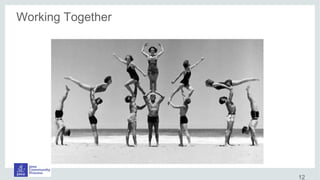
Working Together
12
Background
13
The Java Community Process
•
Java specif ications (JSRs) are developed collaboratively through an
open, formal process similar to that used by other SDOs. All
interested members of the Java Community may participate.
•
Oracle’s competitors are active participants.
– IBM, HP, and RedHat to name a few.
•
The Open Source and developer communities are also represented.
– The Eclipse Foundation, Java User Groups.
14
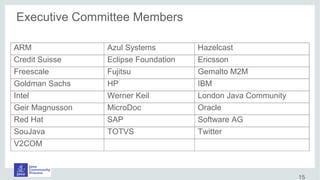
Executive Committee Members
ARM Azul Systems Hazelcast
Credit Suisse Eclipse Foundation Ericsson
Freescale Fujitsu Gemalto M2M
Goldman Sachs HP IBM
Intel Werner Keil London Java Community
Geir Magnusson MicroDoc Oracle
Red Hat SAP Software AG
SouJava TOTVS Twitter
V2COM
15
Open Source Implementations
•
The Reference Implementations of the Java SE and Java EE
platforms are also developed collaboratively and released under
open-source licenses.
– Java SE: OpenJDK
– Java EE: Project GlassFish
16
Click icon to add picture
Why Participate?
'The best way to predict the future is to create it'.
18
Why Participate
•
Acquire knowledge: learn from experts, early access.
•
Make Java better: specif ications based on real world experience.
•
Build your resume: add experience and skill development.
•
Increase professional visibility: curriculum, articles, workshops,
presentations.
•
Become famous :): grow your reputation and network.
•
Be altruistic: Create the future Java.
19
•
20
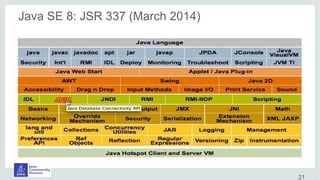
Java SE 8: JSR 337 (March 2014)
21
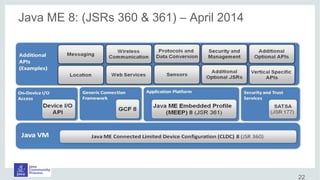
Java ME 8: (JSRs 360 & 361) – April 2014
22
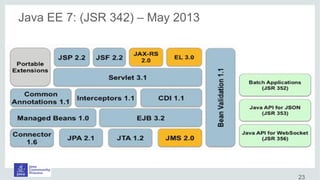
Java EE 7: (JSR 342) – May 2013
23
Open Standards & Open Source
•
Open source and open standards are complimentary.
•
Open standards implemented in open source makes it easier to
implement the standard and easier for developers to understand the
technology.
•
This will result in more implementations and greater adoption of the
standard.
•
An effective way to develop a standard is to start with an open
source project that has demonstrated the need for standardization.
•
•
24
How do we do it?
•
Java Specif ication Requests (JSRs).
– A JSR is a single version of a Java specif ication.
•
JSRs are led by a JCP member (the Spec Lead), with a group of
interested members (the Expert Group) helping with the day-to-day
decisions and work.
– Any JCP member can submit and lead a JSR.
•
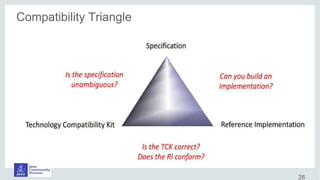
Each Expert Group must deliver:
– The Specif ication.
– A Reference Implementation (RI).
– A conformance test suite (Technology Compatibility Kit, or TCK).
25
Compatibility Triangle
Can you build an
implementation?
Is the specification
unambiguous?
Is the TCK correct?
Does the RI conform?
26
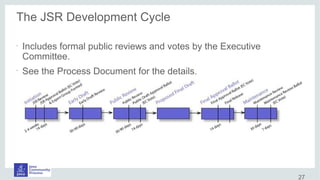
The JSR Development Cycle
•
Includes formal public reviews and votes by the Executive
Committee.
•
See the Process Document for the details.
27
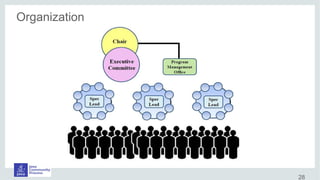
Organization
28
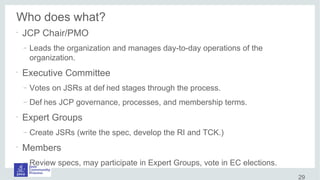
Who does what?
•
JCP Chair/PMO
– Leads the organization and manages day-to-day operations of the
organization.
•
Executive Committee
– Votes on JSRs at def ined stages through the process.
– Def ines JCP governance, processes, and membership terms.
•
Expert Groups
– Create JSRs (write the spec, develop the RI and TCK.)
•
Members
– Review specs, may participate in Expert Groups, vote in EC elections.
29
Executive Committee
•
The Executive Committee has 25 members – vote on JSRs, def ine
JCP program governance.
•
Oracle has a permanent seat.
•
16 seats are Ratif ied (Oracle nominates candidates and the entire
JCP membership must approve them by voting).
•
The remaining 8 seats are Elected (any JCP member may nominate
themselves and members choose by voting).
•
Annual Elections: each year half of the members must stand for re-
election.
30
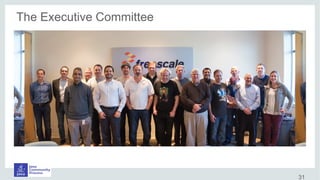
The Executive Committee
•
31
The Spec Lead
•
The JCP member responsible developing a JSR.
•
Must deliver the Spec, RI, and TCK.
•
Oracle is the Spec Lead for the three existing Platforms: Java ME,
Java SE, and Java EE.
32
The Expert Group
•
The Expert Group is recruited and led by the Spec Lead.
•
All members of the JCP are eligible to join.
•
Should represent all interested sectors of the Java community.
•
Works as a team to def ine the JSR and to develop the Spec.
•
Must operate transparently, so that JCP members and the public
can review and participate in its work.
33
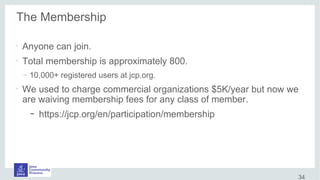
The Membership
•
Anyone can join.
•
Total membership is approximately 800.
– 10,000+ registered users at jcp.org.
•
We used to charge commercial organizations $5K/year but now we
are waiving membership fees for any class of member.
– https://jcp.org/en/participation/membership
34
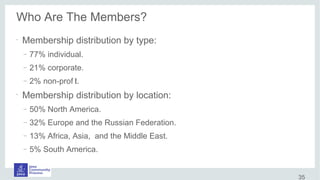
Who Are The Members?
•
Membership distribution by type:
– 77% individual.
– 21% corporate.
– 2% non-prof it.
•
Membership distribution by location:
– 50% North America.
– 32% Europe and the Russian Federation.
– 13% Africa, Asia, and the Middle East.
– 5% South America.
35
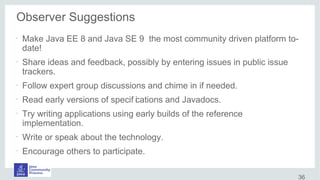
Observer Suggestions
•
Make Java EE 8 and Java SE 9 the most community driven platform to-
date!
•
Share ideas and feedback, possibly by entering issues in public issue
trackers.
•
Follow expert group discussions and chime in if needed.
•
Read early versions of specif ications and Javadocs.
•
Try writing applications using early builds of the reference
implementation.
•
Write or speak about the technology.
•
Encourage others to participate.
36
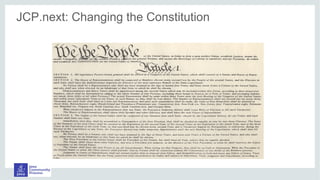
JCP.next: Changing the Constitution
Legal Framework and Governance
•
The Java Specif ication Participation Agreement (JSPA)
– A legal contract between members and Oracle.
– http://www.jcp.org/aboutJava/communityprocess/JSPA2.pdf.
•
The Process Document
– Def ines the governance of the organization.
– http://jcp.org/en/procedures/jcp2.
38
Using the Process to Change the Process
●
We modify the Process (as def ined in the JSPA and the Process
Document) by f iling JSRs.
●
The Chair&/or the PMO is the Spec Lead and the Executive
Committee members form the Expert Group for these JSRs.
●
Since 2011 we have been working on a series of four JSRs,
collectively referred to as JCP.next, to reform the our processes.
39
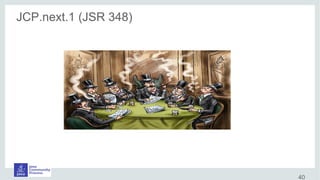
JCP.next.1 (JSR 348)
40
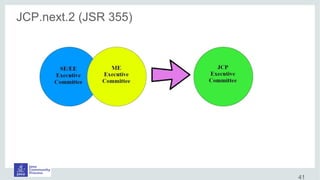
JCP.next.2 (JSR 355)
41
Now the lawyers are involved!
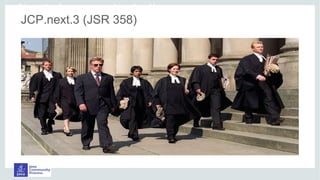
JCP.next.3 (JSR 358)
●
The JSPA has not been signif icantly modif ied since 2002.
●
Since then the organization and the environment in which we
operate have changed signif icantly.
●
This JSR will modify the JSPA and the Process Document,
def ining new (and hopefully simpler) IPR and licensing policies.
43
JCP.next.4 (JSR 364)
●
This JSR was spun-off from JSR 358 in order to implement
membership-related changes more quickly.
– Should be f inal in October 2015.
●
Goal: Broadening JCP Participation.
– Encourage more individuals to join and participate in the JCP
while ensuring that we have appropriate IP commitments.
– New Associate membership class for individuals.
●
New Partner membership class for Java User Groups.
●
Free membership for corporations.
45
The JCP is more open than before
•
Public JSR schedule--current, and updated regularly.
•
Public read and/or write page/wiki for the JSR.
•
Public discussion for the work of the JSR (archived).
•
Public feedback mechanism.
•
Public issue tracker.
•
One EC votes on all JSRs 3x in life of JSR with public results.
•
All JSRs have 3 open public review periods (30 days).
46
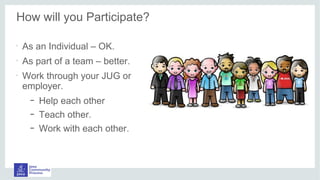
How will you Participate?
•
As an Individual – OK.
•
As part of a team – better.
•
Work through your JUG or
employer.
– Help each other
– Teach other.
– Work with each other.
Adopt-a-JSR
● A JUG-lead initiative to
improve Java standards.
● Groups of JUG members
work on JSRs.
– See
http://java.net/projects/adoptajsr
for full details.
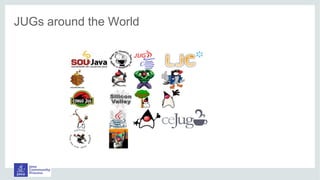
JUGs around the World
● 30+ JUGS participating:
– South America: Campinas JUG (Brazil), ceJUG (Brazil), GOJava (Brazil),
SouJava (Brazil), Brasilia, DF JUG (Brazil), GUJ Londrina (Brazil) Peru
JUG, Guadalajara JUG, GUJavaSC (Brazil).
– North America: Chicago JUG, Silicon Valley JUG, Houston JUG (USA),
Toronto JUG (Canada).
– Europe: London Java Community (UK), BeJUG (Belgium), Madrid JUG
(Spain), JUG Cologne (Germany), Istanbul JUG (Turkey), Greece.
– Asia: Indonesia JUG, JUG JogLoSemar (Indonesia), Hyderabad JUG
(India), JUG Chennai (India).
– Africa & Middle East: Congo, EGJUG (Egypt), Morocco JUG, Faso JUG
(Africa), Jozi JUG (South Africa), Mbale (Uganda).
Java User Group Adopters
• BeJUG: JSR 356, Java API for WebSocket - Hack day in March 2013/developed
Tic-Tac-Toe game included in Java EE 7 SDK.
• Chennai JUG: JSR 338, Java Persistence 2.1, JSR 344, JSF 2.2, JSR 352,
Batch, JSR 353, JSON, JSR 356, WebSocket - Urban Traveler application; JSR
354, Money & Currency API.
• London Java Community: JSR 310, Date and Time API and JSR 335, Lambda
Expressions (Martijn Verburg); myriad hack days, talks and events organized!
• SouJava: JSRs 310, 339, 344, and other JSRs; talks, books, articles, classes,
code dojos:
● http://soujava.org.br/servicos/adopt-a-jsr/
Adopt-a-JSR Use Cases of Adopters
.
Copyright © 2014, Oracle and/or its aff iliates. All rights reserved. |
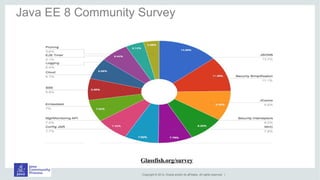
Java EE 8 Community Survey EE 8 Community Survey
Glassfish.org/survey
New JSRs
https://jcp.org/en/jsr/stage?listBy=active
Recently submitted:
Security (JSR 375)
Java EE Management (JSR 373)
JSON-P 1.1 (JSR 374)
Java Module System (JSR 376)
Desktop Application API (JSR
377)
Java EE 8 (JSR 366)
CDI 2 (JSR 365)
JSON-B (JSR 367)
JMS 2.1 (JSR 368)
Servlet 4 (JSR 369)
JAX-RS 2.1 (JSR 370)
MVC (JSR 371)
JSF 2.3 (JSR 372)
• Join the JCP as a JUG.
– Not required, but recommended. You need to do this in order to contribute code,
and you get voting rights and other benef its with this membership!
• Join the Adopt-a-JSR project:
– http://java.net/projects/adoptajsr/pages/Home
– Subscribe to members@adoptajsr.java.net (archive).
• Update the wiki to indicate your interest in a particular JSR and create a wiki page to
provide updates on your plans/progress.
• Communicate directly with the Specif ication Lead/Expert Group (links on jcp.org) or the
java.net users alias for the specif ication.
• Mail your JUG members to gather interest.
• Outline what the JSR is and why the JUG should get involved; identify areas that you
want to work on; coordinate this with the Spec Lead
• Share success on the wiki, list, twitter, etc.
How to get started on Adopt-a-JSR
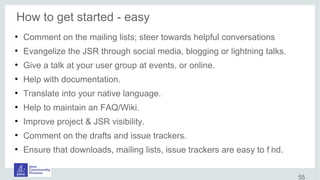
How to get started - easy
●
Comment on the mailing lists; steer towards helpful conversations
●
Evangelize the JSR through social media, blogging or lightning talks.
●
Give a talk at your user group at events, or online.
●
Help with documentation.
●
Translate into your native language.
●
Help to maintain an FAQ/Wiki.
●
Improve project & JSR visibility.
●
Comment on the drafts and issue trackers.
●
Ensure that downloads, mailing lists, issue trackers are easy to f ind.
55
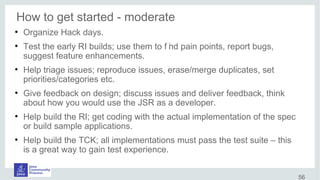
How to get started - moderate
●
Organize Hack days.
●
Test the early RI builds; use them to f ind pain points, report bugs,
suggest feature enhancements.
●
Help triage issues; reproduce issues, erase/merge duplicates, set
priorities/categories etc.
●
Give feedback on design; discuss issues and deliver feedback, think
about how you would use the JSR as a developer.
●
Help build the RI; get coding with the actual implementation of the spec
or build sample applications.
●
Help build the TCK; all implementations must pass the test suite – this
is a great way to gain test experience.
56
Copyright © 2014, Oracle and/or its aff iliates. All rights reserved. |
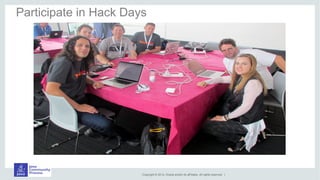
Participate in Hack Days EE 8 Community Survey
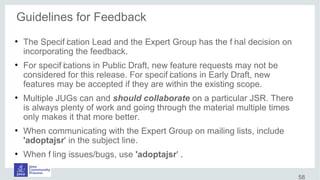
Guidelines for Feedback
●
The Specif ication Lead and the Expert Group has the f inal decision on
incorporating the feedback.
●
For specif ications in Public Draft, new feature requests may not be
considered for this release. For specif ications in Early Draft, new
features may be accepted if they are within the existing scope.
●
Multiple JUGs can and should collaborate on a particular JSR. There
is always plenty of work and going through the material multiple times
only makes it that more better.
●
When communicating with the Expert Group on mailing lists, include
'adoptajsr' in the subject line.
●
When f iling issues/bugs, use 'adoptajsr' .
58
How will this help our JUG?
●
Receive attention from local industry.
●
Become more professional – helps focus your group efforts.
●
Attract more developers to your community.
●
Be part of global movement – collaborate with other JUGs.
59
How will this help your company?
60
How will this help your company?
●
Tomitribe joined the JCP in 2014.
●
Value to business, developers and the community.
●
Participates on f ive Java EE Expert Groups:
– Java EE 8, CDI, JSON-B, JMS, Security JSRs.
61
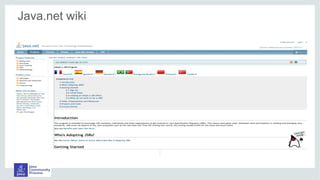
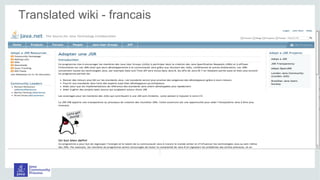
Java.net wiki
You expanded wiki into eight languages: Arabic, Chinese, English, French, German,
Portuguese, Spanish, Turkish...you choose who will translate next language!
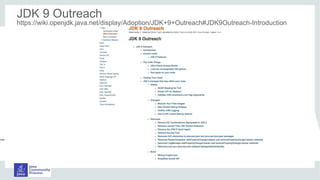
JDK 9 Outreach
https://wiki.openjdk.java.net/display/Adoption/JDK+9+Outreach#JDK9Outreach-Introduction
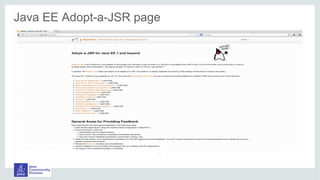
Java EE JSRs
Java EE Adopt-a-JSR page
Translated wiki - francais
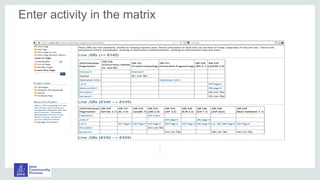
Enter activity in the matrix
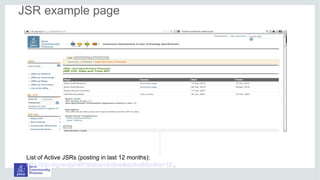
JSR example pageSR page
example
List of Active JSRs (posting in last 12 months):
http://jcp.org/en/jsr/all?status=Active&activeMonths=12 .
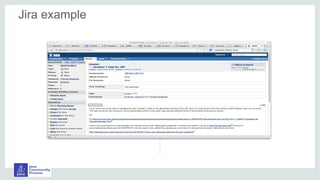
Jira example
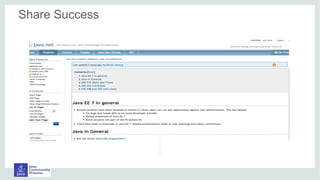
Share Success
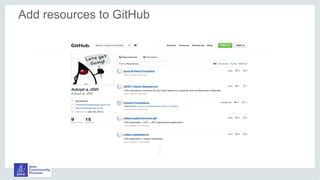
Add resources to GitHub
We want you!
•
Follow the JCP online: http://JCP.org
– Join the JCP: https://jcp.org/en/participation/membership
– Twitter @jcp_org #JCP
– blogs.oracle.com/jcp
– Facebook: Java Community Process
•
Adopt-a-JSR online:http://adoptajsr.java.net. #adoptajsr
– members@adoptajsr.java.net - the global mailing list
– IRC: #adoptajsr channel on irc.freenode.net
– GitHub: https://github.com/Adopt-a-JSR
71
Let's get going!
If you want to go fast, go alone. If you want to go far, go together.
72
thank you, dziekuje, tak, tack, merci,
grazie, gracias, danke, obrigado, bedankt,
kiitos, xie xie, ありがとう .
'Java is as Java Does' video link:
http://youtu.be/abSsrGD-SRw?list=LLtu8aQVpYKMUKIzXPNyE6Mg
h t t p ://www.slid e sh ar e .n e t /d e labasse e /d e v o xx-uk-ad o p t ajsr
h t t p ://fr .slid e sh ar e .n e t /an t o in e sd /ad o p t -jsr -cd i-2 0
h t t p ://www.slid e sh ar e .n e t /h e at h e r v c/ad o p t ajsr -fo r -jso n -p r o ce ssin g -1 1 -jsr -3 7 4
h t t p ://www.slid e sh ar e .n e t /e d bur n s/jsf-2 3 -ad o p t ajsr -1 0 -m in ut e -in fo d e ck
h t t p ://www.slid e sh ar e .n e t /e d bur n s/se r v le t -4 0 -ad o p t ajsr -1 0 -m in ut e -in fo d e ck
h t t p ://www.slid e sh ar e .n e t /R ich ar d W ar bur t o n /h o w-t o -r un -a-h ackd ay
h t t p ://www.slid e sh ar e .n e t /n e o m at r ix3 6 9 /h o w-is-jd kjv m -built -back-t h e n -an d -n o w

Join the Java Evolution for Victoria JUG

  • 1.
    Copyright © 2014,Oracle and/or its aff iliates. All rights reserved. | Join the Java Evolution for Victoria JUG Java, JCP and Adopt-a-JSR Heather VanCura @heathervc http://www.slideshare.net/heathervc Java Community Process July 21, 2015
  • 2.
    Happy to bein Canada – thank you for inviting me!
  • 3.
    Heather VanCura Java CommunityProcess (JCP) Program • Group Manager of the JCP Program Off ice • Leader of Global Adopt-a-JSR Programs, working w/JUG leaders to participate in the JCP program • Hackergarten Organizer • Devoxx4Kids/Kids Coding Events Volunteer Instructor • Started with Sun Microsystems in 2000 • Native Californian from San Diego • Personal Interests: Fashion, Girls & Women in Tech events, Adventure, Traveling, Music, Books, Fitness/sports activities like swimming, hiking, cycling, running, cross-f it, tennis, volleyball and just hanging out at the beach :) Bay Area, California - USA
  • 5.
    • 9 Million Javadevelopers worldwide • 3 Billion mobile phones run Java • #1 Choice for developers • #1 Development platform • 100% of Blu-Ray players include Java • 97% of enterprise desktops run Java • 89% of desktops in USA run Java • 7 Billion Java Cards sold • 5 Billion Java Cards in use • 115 Million TV devices run Java Ubiquitous 5
  • 6.
  • 7.
  • 8.
  • 9.
    History • 1995: Sun Microsystemsdevelops Java. • 1999: Sun opens up the development process to its competitors, creating the Java Community Process. • 2006: Sun open-sources Java SE and Java EE. • 2007: Sun goes into f inancial decline; Java stagnates. • 2010: Oracle acquires Sun and becomes the steward of Java. 9
  • 10.
    Oracle infuses energyand funding into Java and the JCP, resulting in: • New revisions of each of the three platforms: Java SE, Java ME, Java EE • “JCP.Next” reforms to improve the way the Process operates • Increased participation and new initiatives from Java User Groups 2011 - Present Day 10
  • 11.
    Oracle as Java’sSteward • Oracle recognizes the great value of Java – to itself as well as to its allies and competitors. • The value is derived from the open, collaborative, standards-based process through which Java is developed and the vibrant developer community that this process fosters. – A proprietary platform could not have succeeded as Java has – Java is everywhere • Oracle’s support and promotion of Java benef its everyone. 11
  • 12.
  • 13.
  • 14.
    The Java CommunityProcess • Java specif ications (JSRs) are developed collaboratively through an open, formal process similar to that used by other SDOs. All interested members of the Java Community may participate. • Oracle’s competitors are active participants. – IBM, HP, and RedHat to name a few. • The Open Source and developer communities are also represented. – The Eclipse Foundation, Java User Groups. 14
  • 15.
    Executive Committee Members ARMAzul Systems Hazelcast Credit Suisse Eclipse Foundation Ericsson Freescale Fujitsu Gemalto M2M Goldman Sachs HP IBM Intel Werner Keil London Java Community Geir Magnusson MicroDoc Oracle Red Hat SAP Software AG SouJava TOTVS Twitter V2COM 15
  • 16.
    Open Source Implementations • TheReference Implementations of the Java SE and Java EE platforms are also developed collaboratively and released under open-source licenses. – Java SE: OpenJDK – Java EE: Project GlassFish 16
  • 17.
    Click icon toadd picture Why Participate?
  • 18.
    'The best wayto predict the future is to create it'. 18
  • 19.
    Why Participate • Acquire knowledge:learn from experts, early access. • Make Java better: specif ications based on real world experience. • Build your resume: add experience and skill development. • Increase professional visibility: curriculum, articles, workshops, presentations. • Become famous :): grow your reputation and network. • Be altruistic: Create the future Java. 19
  • 20.
  • 21.
    Java SE 8:JSR 337 (March 2014) 21
  • 22.
    Java ME 8:(JSRs 360 & 361) – April 2014 22
  • 23.
    Java EE 7:(JSR 342) – May 2013 23
  • 24.
    Open Standards &Open Source • Open source and open standards are complimentary. • Open standards implemented in open source makes it easier to implement the standard and easier for developers to understand the technology. • This will result in more implementations and greater adoption of the standard. • An effective way to develop a standard is to start with an open source project that has demonstrated the need for standardization. • • 24
  • 25.
    How do wedo it? • Java Specif ication Requests (JSRs). – A JSR is a single version of a Java specif ication. • JSRs are led by a JCP member (the Spec Lead), with a group of interested members (the Expert Group) helping with the day-to-day decisions and work. – Any JCP member can submit and lead a JSR. • Each Expert Group must deliver: – The Specif ication. – A Reference Implementation (RI). – A conformance test suite (Technology Compatibility Kit, or TCK). 25
  • 26.
    Compatibility Triangle Can youbuild an implementation? Is the specification unambiguous? Is the TCK correct? Does the RI conform? 26
  • 27.
    The JSR DevelopmentCycle • Includes formal public reviews and votes by the Executive Committee. • See the Process Document for the details. 27
  • 28.
  • 29.
    Who does what? • JCPChair/PMO – Leads the organization and manages day-to-day operations of the organization. • Executive Committee – Votes on JSRs at def ined stages through the process. – Def ines JCP governance, processes, and membership terms. • Expert Groups – Create JSRs (write the spec, develop the RI and TCK.) • Members – Review specs, may participate in Expert Groups, vote in EC elections. 29
  • 30.
    Executive Committee • The ExecutiveCommittee has 25 members – vote on JSRs, def ine JCP program governance. • Oracle has a permanent seat. • 16 seats are Ratif ied (Oracle nominates candidates and the entire JCP membership must approve them by voting). • The remaining 8 seats are Elected (any JCP member may nominate themselves and members choose by voting). • Annual Elections: each year half of the members must stand for re- election. 30
  • 31.
  • 32.
    The Spec Lead • TheJCP member responsible developing a JSR. • Must deliver the Spec, RI, and TCK. • Oracle is the Spec Lead for the three existing Platforms: Java ME, Java SE, and Java EE. 32
  • 33.
    The Expert Group • TheExpert Group is recruited and led by the Spec Lead. • All members of the JCP are eligible to join. • Should represent all interested sectors of the Java community. • Works as a team to def ine the JSR and to develop the Spec. • Must operate transparently, so that JCP members and the public can review and participate in its work. 33
  • 34.
    The Membership • Anyone canjoin. • Total membership is approximately 800. – 10,000+ registered users at jcp.org. • We used to charge commercial organizations $5K/year but now we are waiving membership fees for any class of member. – https://jcp.org/en/participation/membership 34
  • 35.
    Who Are TheMembers? • Membership distribution by type: – 77% individual. – 21% corporate. – 2% non-prof it. • Membership distribution by location: – 50% North America. – 32% Europe and the Russian Federation. – 13% Africa, Asia, and the Middle East. – 5% South America. 35
  • 36.
    Observer Suggestions • Make JavaEE 8 and Java SE 9 the most community driven platform to- date! • Share ideas and feedback, possibly by entering issues in public issue trackers. • Follow expert group discussions and chime in if needed. • Read early versions of specif ications and Javadocs. • Try writing applications using early builds of the reference implementation. • Write or speak about the technology. • Encourage others to participate. 36
  • 37.
  • 38.
    Legal Framework andGovernance • The Java Specif ication Participation Agreement (JSPA) – A legal contract between members and Oracle. – http://www.jcp.org/aboutJava/communityprocess/JSPA2.pdf. • The Process Document – Def ines the governance of the organization. – http://jcp.org/en/procedures/jcp2. 38
  • 39.
    Using the Processto Change the Process ● We modify the Process (as def ined in the JSPA and the Process Document) by f iling JSRs. ● The Chair&/or the PMO is the Spec Lead and the Executive Committee members form the Expert Group for these JSRs. ● Since 2011 we have been working on a series of four JSRs, collectively referred to as JCP.next, to reform the our processes. 39
  • 40.
  • 41.
  • 42.
    Now the lawyersare involved! JCP.next.3 (JSR 358)
  • 43.
    JCP.next.3 (JSR 358) ● TheJSPA has not been signif icantly modif ied since 2002. ● Since then the organization and the environment in which we operate have changed signif icantly. ● This JSR will modify the JSPA and the Process Document, def ining new (and hopefully simpler) IPR and licensing policies. 43
  • 44.
  • 45.
    JCP.next.4 (JSR 364) ● ThisJSR was spun-off from JSR 358 in order to implement membership-related changes more quickly. – Should be f inal in October 2015. ● Goal: Broadening JCP Participation. – Encourage more individuals to join and participate in the JCP while ensuring that we have appropriate IP commitments. – New Associate membership class for individuals. ● New Partner membership class for Java User Groups. ● Free membership for corporations. 45
  • 46.
    The JCP ismore open than before • Public JSR schedule--current, and updated regularly. • Public read and/or write page/wiki for the JSR. • Public discussion for the work of the JSR (archived). • Public feedback mechanism. • Public issue tracker. • One EC votes on all JSRs 3x in life of JSR with public results. • All JSRs have 3 open public review periods (30 days). 46
  • 47.
    How will youParticipate? • As an Individual – OK. • As part of a team – better. • Work through your JUG or employer. – Help each other – Teach other. – Work with each other.
  • 48.
    Adopt-a-JSR ● A JUG-leadinitiative to improve Java standards. ● Groups of JUG members work on JSRs. – See http://java.net/projects/adoptajsr for full details.
  • 49.
  • 50.
    ● 30+ JUGSparticipating: – South America: Campinas JUG (Brazil), ceJUG (Brazil), GOJava (Brazil), SouJava (Brazil), Brasilia, DF JUG (Brazil), GUJ Londrina (Brazil) Peru JUG, Guadalajara JUG, GUJavaSC (Brazil). – North America: Chicago JUG, Silicon Valley JUG, Houston JUG (USA), Toronto JUG (Canada). – Europe: London Java Community (UK), BeJUG (Belgium), Madrid JUG (Spain), JUG Cologne (Germany), Istanbul JUG (Turkey), Greece. – Asia: Indonesia JUG, JUG JogLoSemar (Indonesia), Hyderabad JUG (India), JUG Chennai (India). – Africa & Middle East: Congo, EGJUG (Egypt), Morocco JUG, Faso JUG (Africa), Jozi JUG (South Africa), Mbale (Uganda). Java User Group Adopters
  • 51.
    • BeJUG: JSR356, Java API for WebSocket - Hack day in March 2013/developed Tic-Tac-Toe game included in Java EE 7 SDK. • Chennai JUG: JSR 338, Java Persistence 2.1, JSR 344, JSF 2.2, JSR 352, Batch, JSR 353, JSON, JSR 356, WebSocket - Urban Traveler application; JSR 354, Money & Currency API. • London Java Community: JSR 310, Date and Time API and JSR 335, Lambda Expressions (Martijn Verburg); myriad hack days, talks and events organized! • SouJava: JSRs 310, 339, 344, and other JSRs; talks, books, articles, classes, code dojos: ● http://soujava.org.br/servicos/adopt-a-jsr/ Adopt-a-JSR Use Cases of Adopters .
  • 52.
    Copyright © 2014,Oracle and/or its aff iliates. All rights reserved. | Java EE 8 Community Survey EE 8 Community Survey Glassfish.org/survey
  • 53.
    New JSRs https://jcp.org/en/jsr/stage?listBy=active Recently submitted: Security(JSR 375) Java EE Management (JSR 373) JSON-P 1.1 (JSR 374) Java Module System (JSR 376) Desktop Application API (JSR 377) Java EE 8 (JSR 366) CDI 2 (JSR 365) JSON-B (JSR 367) JMS 2.1 (JSR 368) Servlet 4 (JSR 369) JAX-RS 2.1 (JSR 370) MVC (JSR 371) JSF 2.3 (JSR 372)
  • 54.
    • Join theJCP as a JUG. – Not required, but recommended. You need to do this in order to contribute code, and you get voting rights and other benef its with this membership! • Join the Adopt-a-JSR project: – http://java.net/projects/adoptajsr/pages/Home – Subscribe to members@adoptajsr.java.net (archive). • Update the wiki to indicate your interest in a particular JSR and create a wiki page to provide updates on your plans/progress. • Communicate directly with the Specif ication Lead/Expert Group (links on jcp.org) or the java.net users alias for the specif ication. • Mail your JUG members to gather interest. • Outline what the JSR is and why the JUG should get involved; identify areas that you want to work on; coordinate this with the Spec Lead • Share success on the wiki, list, twitter, etc. How to get started on Adopt-a-JSR
  • 55.
    How to getstarted - easy ● Comment on the mailing lists; steer towards helpful conversations ● Evangelize the JSR through social media, blogging or lightning talks. ● Give a talk at your user group at events, or online. ● Help with documentation. ● Translate into your native language. ● Help to maintain an FAQ/Wiki. ● Improve project & JSR visibility. ● Comment on the drafts and issue trackers. ● Ensure that downloads, mailing lists, issue trackers are easy to f ind. 55
  • 56.
    How to getstarted - moderate ● Organize Hack days. ● Test the early RI builds; use them to f ind pain points, report bugs, suggest feature enhancements. ● Help triage issues; reproduce issues, erase/merge duplicates, set priorities/categories etc. ● Give feedback on design; discuss issues and deliver feedback, think about how you would use the JSR as a developer. ● Help build the RI; get coding with the actual implementation of the spec or build sample applications. ● Help build the TCK; all implementations must pass the test suite – this is a great way to gain test experience. 56
  • 57.
    Copyright © 2014,Oracle and/or its aff iliates. All rights reserved. | Participate in Hack Days EE 8 Community Survey
  • 58.
    Guidelines for Feedback ● TheSpecif ication Lead and the Expert Group has the f inal decision on incorporating the feedback. ● For specif ications in Public Draft, new feature requests may not be considered for this release. For specif ications in Early Draft, new features may be accepted if they are within the existing scope. ● Multiple JUGs can and should collaborate on a particular JSR. There is always plenty of work and going through the material multiple times only makes it that more better. ● When communicating with the Expert Group on mailing lists, include 'adoptajsr' in the subject line. ● When f iling issues/bugs, use 'adoptajsr' . 58
  • 59.
    How will thishelp our JUG? ● Receive attention from local industry. ● Become more professional – helps focus your group efforts. ● Attract more developers to your community. ● Be part of global movement – collaborate with other JUGs. 59
  • 60.
    How will thishelp your company? 60
  • 61.
    How will thishelp your company? ● Tomitribe joined the JCP in 2014. ● Value to business, developers and the community. ● Participates on f ive Java EE Expert Groups: – Java EE 8, CDI, JSON-B, JMS, Security JSRs. 61
  • 62.
    Java.net wiki You expandedwiki into eight languages: Arabic, Chinese, English, French, German, Portuguese, Spanish, Turkish...you choose who will translate next language!
  • 63.
  • 64.
    Java EE JSRs JavaEE Adopt-a-JSR page
  • 65.
  • 66.
  • 67.
    JSR example pageSRpage example List of Active JSRs (posting in last 12 months): http://jcp.org/en/jsr/all?status=Active&activeMonths=12 .
  • 68.
  • 69.
  • 70.
  • 71.
    We want you! • Followthe JCP online: http://JCP.org – Join the JCP: https://jcp.org/en/participation/membership – Twitter @jcp_org #JCP – blogs.oracle.com/jcp – Facebook: Java Community Process • Adopt-a-JSR online:http://adoptajsr.java.net. #adoptajsr – members@adoptajsr.java.net - the global mailing list – IRC: #adoptajsr channel on irc.freenode.net – GitHub: https://github.com/Adopt-a-JSR 71
  • 72.
    Let's get going! Ifyou want to go fast, go alone. If you want to go far, go together. 72
  • 73.
    thank you, dziekuje,tak, tack, merci, grazie, gracias, danke, obrigado, bedankt, kiitos, xie xie, ありがとう . 'Java is as Java Does' video link: http://youtu.be/abSsrGD-SRw?list=LLtu8aQVpYKMUKIzXPNyE6Mg h t t p ://www.slid e sh ar e .n e t /d e labasse e /d e v o xx-uk-ad o p t ajsr h t t p ://fr .slid e sh ar e .n e t /an t o in e sd /ad o p t -jsr -cd i-2 0 h t t p ://www.slid e sh ar e .n e t /h e at h e r v c/ad o p t ajsr -fo r -jso n -p r o ce ssin g -1 1 -jsr -3 7 4 h t t p ://www.slid e sh ar e .n e t /e d bur n s/jsf-2 3 -ad o p t ajsr -1 0 -m in ut e -in fo d e ck h t t p ://www.slid e sh ar e .n e t /e d bur n s/se r v le t -4 0 -ad o p t ajsr -1 0 -m in ut e -in fo d e ck h t t p ://www.slid e sh ar e .n e t /R ich ar d W ar bur t o n /h o w-t o -r un -a-h ackd ay h t t p ://www.slid e sh ar e .n e t /n e o m at r ix3 6 9 /h o w-is-jd kjv m -built -back-t h e n -an d -n o w