Resumes & Interviewing The view from HR
Getting Yourself Out There Network Write an article on a subject you are familiar with Blog Join a user group and help with issues/questions; become known as the go-to person Join sites like Linkedin Take a class in your field
Getting Yourself Out There Start searching the Internet Career sites Articles Networking events People Opportunities Researching sites
Linked In Supports passive sourcing by providing search information that helps match candidates to open positions Mutual Connections Check References/ View recommendations User Groups Job Postings/ User Group Blogs Free for users Paid subscriptions for Recruiters to help locate passive candidates Can be used for research
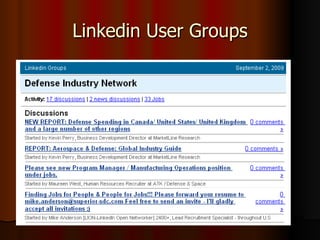
Linkedin User Groups
Where to Apply? Research companies of interest Know something about the job you are applying for Make sure you meet all minimum qualifications Don’t just network for openings; network for research sites and information
Resume Writing 101 Format appropriate Entry-level Mid-career Executive State accomplishments – don’t just list things you’ve done Be proud of what you have done Highlight the favorite things you’ve done Show diversity of experience and willingness to do what the job requires through accomplishments
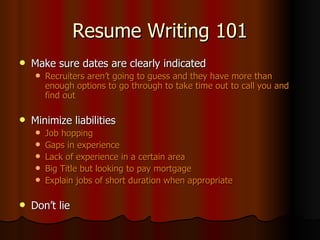
Resume Writing 101 Make sure dates are clearly indicated Recruiters aren’t going to guess and they have more than enough options to go through to take time out to call you and find out Minimize liabilities Job hopping Gaps in experience Lack of experience in a certain area Big Title but looking to pay mortgage Explain jobs of short duration when appropriate Don’t lie
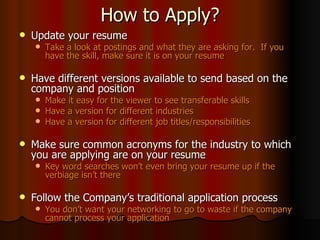
How to Apply? Update your resume Take a look at postings and what they are asking for.  If you have the skill, make sure it is on your resume Have different versions available to send based on the company and position Make it easy for the viewer to see transferable skills Have a version for different industries Have a version for different job titles/responsibilities Make sure common acronyms for the industry to which you are applying are on your resume Key word searches won’t even bring your resume up if the verbiage isn’t there Follow the Company’s traditional application process You don’t want your networking to go to waste if the company cannot process your application
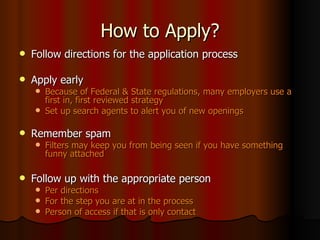
How to Apply? Follow directions for the application process Apply early Because of Federal & State regulations, many employers use a first in, first reviewed strategy Set up search agents to alert you of new openings Remember spam  Filters may keep you from being seen if you have something funny attached Follow up with the appropriate person Per directions For the step you are at in the process Person of access if that is only contact
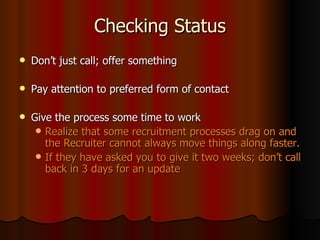
Checking Status Don’t just call; offer something Pay attention to preferred form of contact Give the process some time to work Realize that some recruitment processes drag on and the Recruiter cannot always move things along faster. If they have asked you to give it two weeks; don’t call back in 3 days for an update
Checking Status Remember the Recruiter has a job to do Prescreen & Prequalify Minimize Hiring Manager distractions Find out (linkedin, networks, etc.) what the person does at the company or about a common interest (good taste) Send an article of interest relating to his/her current assignment/project Value their time You want them to want to help, not screen your calls
Before The Interview Research, research, research Know more about the Company Have some questions ready Find out what you can about the interviewer If someone in your network knows the interviewer or works at the company, ask them to help you out with this Know how to get there and be 15 minutes early Be patient for interview to start.  You may be early but that won’t mean they will be ready early Dress appropriately
Interview Skills Practice- especially if you haven’t done this in a while Know what Behavioral Interviewing is Remember the interview starts while you are still in the parking lot Everyone you meet is an interviewer Check the God complex at the door but be proud of accomplishments Be excited about the opportunity – even if you don’t think you are after the opening question You want the offer; that doesn’t mean you have to take it
Odds & Ends Bring resumes to the interview Make sure they are professional and are the same version you sent in with your application Get a business card, or at least a name and email for  everyone  that you meet Ask what the next steps are Shows your interest in the process and the position Helps you understand the steps and timeframe in case you need to make a decision on something else or for proper follow up Send personalized thank you letters to  everyone DO NOT restate your resume, reflect the interview Send any pertinent follow up information the interviewer might like to have Value their time
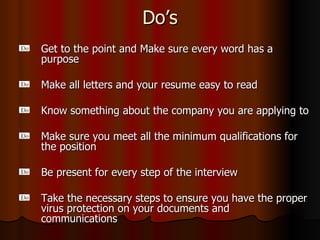
Do’s Get to the point and Make sure every word has a purpose Make all letters and your resume easy to read Know something about the company you are applying to Make sure you meet all the minimum qualifications for the position Be present for every step of the interview Take the necessary steps to ensure you have the proper virus protection on your documents and communications
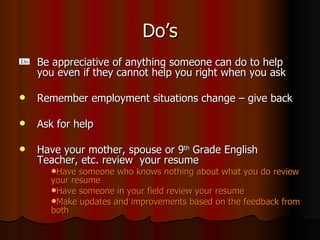
Do’s Be appreciative of anything someone can do to help you even if they cannot help you right when you ask  Remember employment situations change – give back  Ask for help Have your mother, spouse or 9 th  Grade English Teacher, etc. review  your resume  Have someone who knows nothing about what you do review your resume Have someone in your field review your resume Make updates and improvements based on the feedback from both
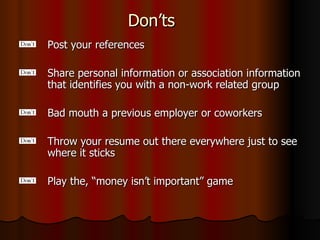
Don’ts Post your references Share personal information or association information that identifies you with a non-work related group Bad mouth a previous employer or coworkers Throw your resume out there everywhere just to see where it sticks Play the, “money isn’t important” game
Don’ts Chew gum, clip nails, play games, etc. at any point in the interview Have an advertisement attached as a signature to all email correspondence Have a wacky email address or voice mail message [email_address]   is not appropriate! Forget that Blogs, personal web pages, etc. are all public Blame yourself
Contact Information Cheri Wargo [email_address] http:// www.linkedin.com/in/cheriwargo

Job Search, Resume & Interview Tips

  • 1.
    Resumes & InterviewingThe view from HR
  • 2.
    Getting Yourself OutThere Network Write an article on a subject you are familiar with Blog Join a user group and help with issues/questions; become known as the go-to person Join sites like Linkedin Take a class in your field
  • 3.
    Getting Yourself OutThere Start searching the Internet Career sites Articles Networking events People Opportunities Researching sites
  • 4.
    Linked In Supportspassive sourcing by providing search information that helps match candidates to open positions Mutual Connections Check References/ View recommendations User Groups Job Postings/ User Group Blogs Free for users Paid subscriptions for Recruiters to help locate passive candidates Can be used for research
  • 5.
  • 6.
    Where to Apply?Research companies of interest Know something about the job you are applying for Make sure you meet all minimum qualifications Don’t just network for openings; network for research sites and information
  • 7.
    Resume Writing 101Format appropriate Entry-level Mid-career Executive State accomplishments – don’t just list things you’ve done Be proud of what you have done Highlight the favorite things you’ve done Show diversity of experience and willingness to do what the job requires through accomplishments
  • 8.
    Resume Writing 101Make sure dates are clearly indicated Recruiters aren’t going to guess and they have more than enough options to go through to take time out to call you and find out Minimize liabilities Job hopping Gaps in experience Lack of experience in a certain area Big Title but looking to pay mortgage Explain jobs of short duration when appropriate Don’t lie
  • 9.
    How to Apply?Update your resume Take a look at postings and what they are asking for. If you have the skill, make sure it is on your resume Have different versions available to send based on the company and position Make it easy for the viewer to see transferable skills Have a version for different industries Have a version for different job titles/responsibilities Make sure common acronyms for the industry to which you are applying are on your resume Key word searches won’t even bring your resume up if the verbiage isn’t there Follow the Company’s traditional application process You don’t want your networking to go to waste if the company cannot process your application
  • 10.
    How to Apply?Follow directions for the application process Apply early Because of Federal & State regulations, many employers use a first in, first reviewed strategy Set up search agents to alert you of new openings Remember spam Filters may keep you from being seen if you have something funny attached Follow up with the appropriate person Per directions For the step you are at in the process Person of access if that is only contact
  • 11.
    Checking Status Don’tjust call; offer something Pay attention to preferred form of contact Give the process some time to work Realize that some recruitment processes drag on and the Recruiter cannot always move things along faster. If they have asked you to give it two weeks; don’t call back in 3 days for an update
  • 12.
    Checking Status Rememberthe Recruiter has a job to do Prescreen & Prequalify Minimize Hiring Manager distractions Find out (linkedin, networks, etc.) what the person does at the company or about a common interest (good taste) Send an article of interest relating to his/her current assignment/project Value their time You want them to want to help, not screen your calls
  • 13.
    Before The InterviewResearch, research, research Know more about the Company Have some questions ready Find out what you can about the interviewer If someone in your network knows the interviewer or works at the company, ask them to help you out with this Know how to get there and be 15 minutes early Be patient for interview to start. You may be early but that won’t mean they will be ready early Dress appropriately
  • 14.
    Interview Skills Practice-especially if you haven’t done this in a while Know what Behavioral Interviewing is Remember the interview starts while you are still in the parking lot Everyone you meet is an interviewer Check the God complex at the door but be proud of accomplishments Be excited about the opportunity – even if you don’t think you are after the opening question You want the offer; that doesn’t mean you have to take it
  • 15.
    Odds & EndsBring resumes to the interview Make sure they are professional and are the same version you sent in with your application Get a business card, or at least a name and email for everyone that you meet Ask what the next steps are Shows your interest in the process and the position Helps you understand the steps and timeframe in case you need to make a decision on something else or for proper follow up Send personalized thank you letters to everyone DO NOT restate your resume, reflect the interview Send any pertinent follow up information the interviewer might like to have Value their time
  • 16.
    Do’s Get tothe point and Make sure every word has a purpose Make all letters and your resume easy to read Know something about the company you are applying to Make sure you meet all the minimum qualifications for the position Be present for every step of the interview Take the necessary steps to ensure you have the proper virus protection on your documents and communications
  • 17.
    Do’s Be appreciativeof anything someone can do to help you even if they cannot help you right when you ask Remember employment situations change – give back Ask for help Have your mother, spouse or 9 th Grade English Teacher, etc. review your resume Have someone who knows nothing about what you do review your resume Have someone in your field review your resume Make updates and improvements based on the feedback from both
  • 18.
    Don’ts Post yourreferences Share personal information or association information that identifies you with a non-work related group Bad mouth a previous employer or coworkers Throw your resume out there everywhere just to see where it sticks Play the, “money isn’t important” game
  • 19.
    Don’ts Chew gum,clip nails, play games, etc. at any point in the interview Have an advertisement attached as a signature to all email correspondence Have a wacky email address or voice mail message [email_address] is not appropriate! Forget that Blogs, personal web pages, etc. are all public Blame yourself
  • 20.
    Contact Information CheriWargo [email_address] http:// www.linkedin.com/in/cheriwargo