DR. RAVI DHAR: ROLE OF
FREEDOM TO OPERATE (FTO) IN
INTELLECTUAL PROPERTY
Ravi Dhar, Ph.D., f-STEM
in.linkedin.com/pub/ravi-dhar/18/71b/895
(Email: rdhar_in@yahoo.com)
10/9/2016
1RD_FTO_2016
Acknowledgements
10/9/2016RD_FTO_2016
2
 Various Web sites, Journals
 Colleagues (Dr. Vinita Jindal of BIRAC)
 Mentors
Freedom to Operate (FTO)
“FTO is the ability to capitalize
on an invention, without
challenges from other parties
(inventors, companies).
Obviously the inventor/s take
extra care not to use any other
products or processes that have
been previously patented by
others.”
Preferably, one should ensure
FTO screening before applying10/9/20163 RD_FTO_2016
10/9/20164 RD_FTO_2016
A word of caution
Inventions are time & resource
consuming
processes in which numerous raw
materials,
chemical reactions, techniques &
processes are
used by several investigators.
During the course of this journey one
needs to: a) Record all materials, tools &
processes
used
b) Identify & study any potentially
10/9/20165 RD_FTO_2016
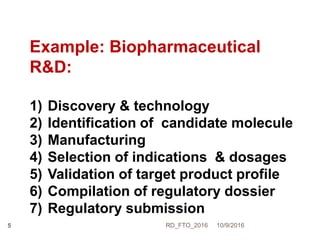
Example: Biopharmaceutical
R&D:
1) Discovery & technology
2) Identification of candidate molecule
3) Manufacturing
4) Selection of indications & dosages
5) Validation of target product profile
6) Compilation of regulatory dossier
7) Regulatory submission
10/9/2016RD_FTO_20166
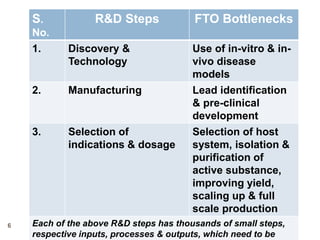
S.
No.
R&D Steps FTO Bottlenecks
1. Discovery &
Technology
Use of in-vitro & in-
vivo disease
models
2. Manufacturing Lead identification
& pre-clinical
development
3. Selection of
indications & dosage
Selection of host
system, isolation &
purification of
active substance,
improving yield,
scaling up & full
scale production
Each of the above R&D steps has thousands of small steps,
respective inputs, processes & outputs, which need to be
10/9/2016RD_FTO_20167
This is complex & in order to
circumvent or remove
obstacles on FTOs, one may:-
1) Pay to remove the obstacle
2) Exchange a technology with
other party
3) Invent around
4) Share patents
5) Share confidential information
for mutual benefit
10/9/2016RD_FTO_20168
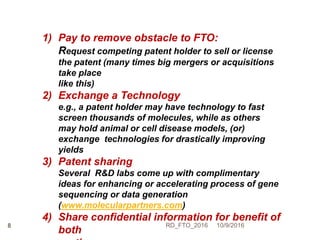
1) Pay to remove obstacle to FTO:
Request competing patent holder to sell or license
the patent (many times big mergers or acquisitions
take place
like this)
2) Exchange a Technology
e.g., a patent holder may have technology to fast
screen thousands of molecules, while as others
may hold animal or cell disease models, (or)
exchange technologies for drastically improving
yields
3) Patent sharing
Several R&D labs come up with complimentary
ideas for enhancing or accelerating process of gene
sequencing or data generation
(www.molecularpartners.com)
4) Share confidential information for benefit of
both
10/9/2016RD_FTO_20169
Obstacles should always be removed using
available legal channels in all cases.
No word of mouth agreements please
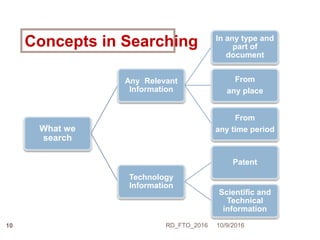
Concepts in Searching
What we
search
Any Relevant
Information
In any type and
part of
document
From
any place
From
any time period
Technology
Information
Patent
Scientific and
Technical
information
10/9/2016RD_FTO_201610
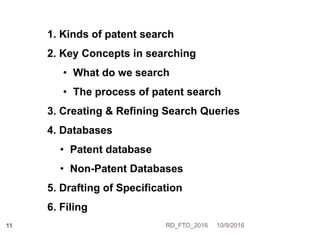
1. Kinds of patent search
2. Key Concepts in searching
• What do we search
• The process of patent search
3. Creating & Refining Search Queries
4. Databases
• Patent database
• Non-Patent Databases
5. Drafting of Specification
6. Filing
10/9/2016RD_FTO_201611
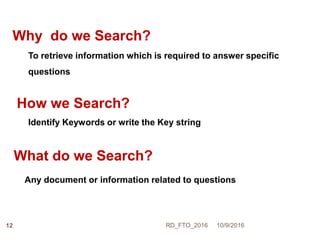
Why do we Search?
To retrieve information which is required to answer specific
questions
How we Search?
What do we Search?
Identify Keywords or write the Key string
Any document or information related to questions
10/9/2016RD_FTO_201612
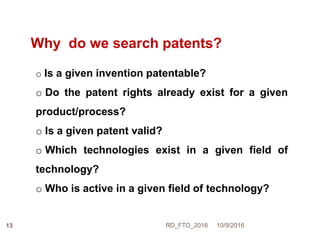
Why do we search patents?
o Is a given invention patentable?
o Do the patent rights already exist for a given
product/process?
o Is a given patent valid?
o Which technologies exist in a given field of
technology?
o Who is active in a given field of technology?
10/9/2016RD_FTO_201613
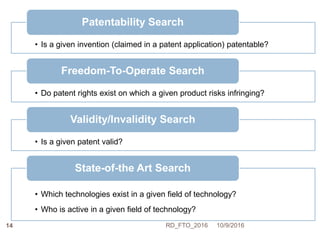
• Is a given invention (claimed in a patent application) patentable?
Patentability Search
• Do patent rights exist on which a given product risks infringing?
Freedom-To-Operate Search
• Is a given patent valid?
Validity/Invalidity Search
• Which technologies exist in a given field of technology?
• Who is active in a given field of technology?
State-of-the Art Search
10/9/2016RD_FTO_201614
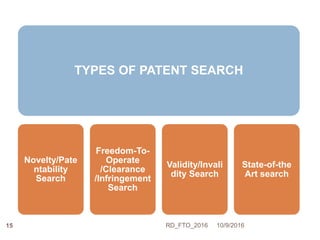
TYPES OF PATENT SEARCH
Novelty/Pate
ntability
Search
Freedom-To-
Operate
/Clearance
/Infringement
Search
Validity/Invali
dity Search
State-of-the
Art search
10/9/2016RD_FTO_201615
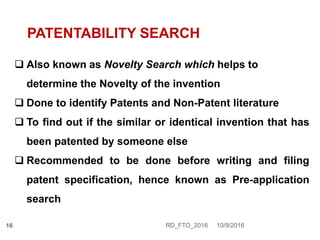
PATENTABILITY SEARCH
 Also known as Novelty Search which helps to
determine the Novelty of the invention
 Done to identify Patents and Non-Patent literature
 To find out if the similar or identical invention that has
been patented by someone else
 Recommended to be done before writing and filing
patent specification, hence known as Pre-application
search
10/9/2016RD_FTO_201616
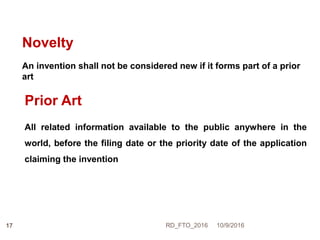
Novelty
An invention shall not be considered new if it forms part of a prior
art
Prior Art
All related information available to the public anywhere in the
world, before the filing date or the priority date of the application
claiming the invention
10/9/2016RD_FTO_201617
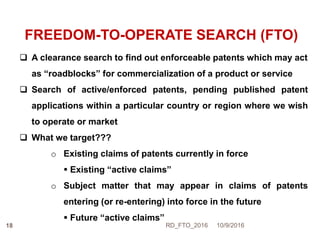
FREEDOM-TO-OPERATE SEARCH (FTO)
 A clearance search to find out enforceable patents which may act
as “roadblocks” for commercialization of a product or service
 Search of active/enforced patents, pending published patent
applications within a particular country or region where we wish
to operate or market
 What we target???
o Existing claims of patents currently in force
 Existing “active claims”
o Subject matter that may appear in claims of patents
entering (or re-entering) into force in the future
 Future “active claims”
10/9/2016RD_FTO_201618
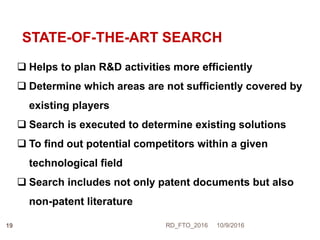
STATE-OF-THE-ART SEARCH
 Helps to plan R&D activities more efficiently
 Determine which areas are not sufficiently covered by
existing players
 Search is executed to determine existing solutions
 To find out potential competitors within a given
technological field
 Search includes not only patent documents but also
non-patent literature
10/9/2016RD_FTO_201619
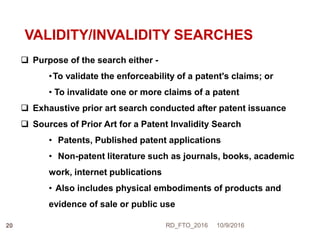
VALIDITY/INVALIDITY SEARCHES
 Purpose of the search either -
•To validate the enforceability of a patent's claims; or
• To invalidate one or more claims of a patent
 Exhaustive prior art search conducted after patent issuance
 Sources of Prior Art for a Patent Invalidity Search
• Patents, Published patent applications
• Non-patent literature such as journals, books, academic
work, internet publications
• Also includes physical embodiments of products and
evidence of sale or public use
10/9/2016RD_FTO_201620
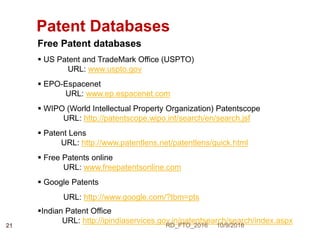
Patent Databases
Free Patent databases
 US Patent and TradeMark Office (USPTO)
URL: www.uspto.gov
 EPO-Espacenet
URL: www.ep.espacenet.com
 WIPO (World Intellectual Property Organization) Patentscope
URL: http://patentscope.wipo.int/search/en/search.jsf
 Patent Lens
URL: http://www.patentlens.net/patentlens/quick.html
 Free Patents online
URL: www.freepatentsonline.com
 Google Patents
URL: http://www.google.com/?tbm=pts
Indian Patent Office
URL: http://ipindiaservices.gov.in/patentsearch/search/index.aspx
10/9/2016RD_FTO_201621
10/9/2016RD_FTO_201622
Obstacles should always be removed using
available legal channels in all cases.
No word of mouth agreements please
10/9/2016RD_FTO_201623
Thank
you

Jipmer ipr 2016_f5

  • 1.
    DR. RAVI DHAR:ROLE OF FREEDOM TO OPERATE (FTO) IN INTELLECTUAL PROPERTY Ravi Dhar, Ph.D., f-STEM in.linkedin.com/pub/ravi-dhar/18/71b/895 (Email: rdhar_in@yahoo.com) 10/9/2016 1RD_FTO_2016
  • 2.
    Acknowledgements 10/9/2016RD_FTO_2016 2  Various Websites, Journals  Colleagues (Dr. Vinita Jindal of BIRAC)  Mentors
  • 3.
    Freedom to Operate(FTO) “FTO is the ability to capitalize on an invention, without challenges from other parties (inventors, companies). Obviously the inventor/s take extra care not to use any other products or processes that have been previously patented by others.” Preferably, one should ensure FTO screening before applying10/9/20163 RD_FTO_2016
  • 4.
    10/9/20164 RD_FTO_2016 A wordof caution Inventions are time & resource consuming processes in which numerous raw materials, chemical reactions, techniques & processes are used by several investigators. During the course of this journey one needs to: a) Record all materials, tools & processes used b) Identify & study any potentially
  • 5.
    10/9/20165 RD_FTO_2016 Example: Biopharmaceutical R&D: 1)Discovery & technology 2) Identification of candidate molecule 3) Manufacturing 4) Selection of indications & dosages 5) Validation of target product profile 6) Compilation of regulatory dossier 7) Regulatory submission
  • 6.
    10/9/2016RD_FTO_20166 S. No. R&D Steps FTOBottlenecks 1. Discovery & Technology Use of in-vitro & in- vivo disease models 2. Manufacturing Lead identification & pre-clinical development 3. Selection of indications & dosage Selection of host system, isolation & purification of active substance, improving yield, scaling up & full scale production Each of the above R&D steps has thousands of small steps, respective inputs, processes & outputs, which need to be
  • 7.
    10/9/2016RD_FTO_20167 This is complex& in order to circumvent or remove obstacles on FTOs, one may:- 1) Pay to remove the obstacle 2) Exchange a technology with other party 3) Invent around 4) Share patents 5) Share confidential information for mutual benefit
  • 8.
    10/9/2016RD_FTO_20168 1) Pay toremove obstacle to FTO: Request competing patent holder to sell or license the patent (many times big mergers or acquisitions take place like this) 2) Exchange a Technology e.g., a patent holder may have technology to fast screen thousands of molecules, while as others may hold animal or cell disease models, (or) exchange technologies for drastically improving yields 3) Patent sharing Several R&D labs come up with complimentary ideas for enhancing or accelerating process of gene sequencing or data generation (www.molecularpartners.com) 4) Share confidential information for benefit of both
  • 9.
    10/9/2016RD_FTO_20169 Obstacles should alwaysbe removed using available legal channels in all cases. No word of mouth agreements please
  • 10.
    Concepts in Searching Whatwe search Any Relevant Information In any type and part of document From any place From any time period Technology Information Patent Scientific and Technical information 10/9/2016RD_FTO_201610
  • 11.
    1. Kinds ofpatent search 2. Key Concepts in searching • What do we search • The process of patent search 3. Creating & Refining Search Queries 4. Databases • Patent database • Non-Patent Databases 5. Drafting of Specification 6. Filing 10/9/2016RD_FTO_201611
  • 12.
    Why do weSearch? To retrieve information which is required to answer specific questions How we Search? What do we Search? Identify Keywords or write the Key string Any document or information related to questions 10/9/2016RD_FTO_201612
  • 13.
    Why do wesearch patents? o Is a given invention patentable? o Do the patent rights already exist for a given product/process? o Is a given patent valid? o Which technologies exist in a given field of technology? o Who is active in a given field of technology? 10/9/2016RD_FTO_201613
  • 14.
    • Is agiven invention (claimed in a patent application) patentable? Patentability Search • Do patent rights exist on which a given product risks infringing? Freedom-To-Operate Search • Is a given patent valid? Validity/Invalidity Search • Which technologies exist in a given field of technology? • Who is active in a given field of technology? State-of-the Art Search 10/9/2016RD_FTO_201614
  • 15.
    TYPES OF PATENTSEARCH Novelty/Pate ntability Search Freedom-To- Operate /Clearance /Infringement Search Validity/Invali dity Search State-of-the Art search 10/9/2016RD_FTO_201615
  • 16.
    PATENTABILITY SEARCH  Alsoknown as Novelty Search which helps to determine the Novelty of the invention  Done to identify Patents and Non-Patent literature  To find out if the similar or identical invention that has been patented by someone else  Recommended to be done before writing and filing patent specification, hence known as Pre-application search 10/9/2016RD_FTO_201616
  • 17.
    Novelty An invention shallnot be considered new if it forms part of a prior art Prior Art All related information available to the public anywhere in the world, before the filing date or the priority date of the application claiming the invention 10/9/2016RD_FTO_201617
  • 18.
    FREEDOM-TO-OPERATE SEARCH (FTO) A clearance search to find out enforceable patents which may act as “roadblocks” for commercialization of a product or service  Search of active/enforced patents, pending published patent applications within a particular country or region where we wish to operate or market  What we target??? o Existing claims of patents currently in force  Existing “active claims” o Subject matter that may appear in claims of patents entering (or re-entering) into force in the future  Future “active claims” 10/9/2016RD_FTO_201618
  • 19.
    STATE-OF-THE-ART SEARCH  Helpsto plan R&D activities more efficiently  Determine which areas are not sufficiently covered by existing players  Search is executed to determine existing solutions  To find out potential competitors within a given technological field  Search includes not only patent documents but also non-patent literature 10/9/2016RD_FTO_201619
  • 20.
    VALIDITY/INVALIDITY SEARCHES  Purposeof the search either - •To validate the enforceability of a patent's claims; or • To invalidate one or more claims of a patent  Exhaustive prior art search conducted after patent issuance  Sources of Prior Art for a Patent Invalidity Search • Patents, Published patent applications • Non-patent literature such as journals, books, academic work, internet publications • Also includes physical embodiments of products and evidence of sale or public use 10/9/2016RD_FTO_201620
  • 21.
    Patent Databases Free Patentdatabases  US Patent and TradeMark Office (USPTO) URL: www.uspto.gov  EPO-Espacenet URL: www.ep.espacenet.com  WIPO (World Intellectual Property Organization) Patentscope URL: http://patentscope.wipo.int/search/en/search.jsf  Patent Lens URL: http://www.patentlens.net/patentlens/quick.html  Free Patents online URL: www.freepatentsonline.com  Google Patents URL: http://www.google.com/?tbm=pts Indian Patent Office URL: http://ipindiaservices.gov.in/patentsearch/search/index.aspx 10/9/2016RD_FTO_201621
  • 22.
    10/9/2016RD_FTO_201622 Obstacles should alwaysbe removed using available legal channels in all cases. No word of mouth agreements please
  • 23.