A fuel cell powered unmanned aerial vehicle for
low altitude surveillance missions
N. Lape~
na-Rey a,*
, J.A. Blanco a
, E. Ferreyra a
, J.L. Lemus a
, S. Pereira,
E. Serrot a
a
Boeing Research & Technology Europe, S.L.U, Spain
a r t i c l e i n f o
Article history:
Received 31 August 2016
Received in revised form
20 January 2017
Accepted 24 January 2017
Available online xxx
Keywords:
Unmanned aerial vehicle
Polymeric electrolyte membrane
fuel cell
Hydrogen
Hybrid power management
Sodium borohydride
Long endurance
a b s t r a c t
Boeing Research & Technology Europe has designed, developed and subsequently bench
and flight tested, in a wide range of different operative conditions, an electric Unmanned
Air Vehicle (UAV) powered by a hybrid energy source. The energy source features a 200 We
Polymer Electrolyte Membrane (PEM) fuel cell system fed by a chemical hydride hydrogen
generator that produces highly pure hydrogen at the fuel cell operating pressure from the
controlled hydrolysis of Sodium Borohydride (NaBH4), resulting in 900 Wh of energy from
1 L of chemical solution. Equipped also with high specific energy Lithium Polymer batteries,
this fuel cell powered UAV is able to achieve flight durations close to 4 h.
This paper summarizes the aircraft and systems design, the results of the bench and
flight tests along with the main challenges faced during this development and the lessons
learned for future optimization.
© 2017 Hydrogen Energy Publications LLC. Published by Elsevier Ltd. All rights reserved.
Introduction
Electric propulsion for mini-UAVs (Unmanned Air Vehicles
with Maximum Take of Weight, MTOW, below 25 kg) provides
a route for lower capital cost, reduced carbon footprint and
quieter Unmanned Aerial System (UAS) operations. However,
state-of-the-art advanced lithium polymer battery technology
offers limited specific energy, which provides a typical mini-
UAV with an endurance of 60e90 min and, therefore, limits
the flight mission or increases operational costs [1,2].
Combining batteries and fuel cells in hybrid propulsion
systems can significantly increase the UAV's endurance,
opening new mission capabilities not previously possible for
electric mini-UAVs [3e5]. Indeed, UAVs with MTOW below
25 kg are a niche application in which air cooled PEM fuel cells,
in their current maturity stage, already meet the weight tar-
gets while offering unique competitive advantages over con-
ventional power sources including: low noise and vibration so
the airplane can fly at lower altitudes without being discov-
ered and use simpler cameras, environmental benefits (no
greenhouse gases, GHG, emissions) and low thermal signa-
ture. Moreover, electric motors are more efficient and have far
better reliability than their non-electric counterparts.
* Corresponding author.
E-mail address: nieves.lapena@boeing.com (N. Lape~
na-Rey).
Available online at www.sciencedirect.com
ScienceDirect
journal homepage: www.elsevier.com/locate/he
i n t e r n a t i o n a l j o u r n a l o f h y d r o g e n e n e r g y x x x ( 2 0 1 7 ) 1 e1 5
http://dx.doi.org/10.1016/j.ijhydene.2017.01.137
0360-3199/© 2017 Hydrogen Energy Publications LLC. Published by Elsevier Ltd. All rights reserved.
Please cite this article in press as: Lape~
na-Rey N, et al., A fuel cell powered unmanned aerial vehicle for low altitude surveillance
missions, International Journal of Hydrogen Energy (2017), http://dx.doi.org/10.1016/j.ijhydene.2017.01.137
During the last decade the UAS industry has grown sub-
stantially, mainly through the development and maturation of
military applications, followed by a wide range of civil appli-
cations, such as: border control, coastguard, law enforcement
and police support, power line, water pipes and gas pipes
monitoring, terrain surveillance, environmental surveillance,
communications, etc. Market and application research seems
to show a growing trend towards mini-UASs mainly due to
lower cost and investment risk, along with less infrastructural
needs for tactical surveillance. The selection of this specific
type of UAVs would facilitate the upcoming certification pro-
cess and a larger number of fuel cell powered UAVs is expected
in the near future. Numerous flight demonstrations of hybrid
FC/battery-powered UAVs have been reported in recent years
from universities, research organizations and commercial
entities across the world for low and high altitude surveillance
[6e21]. Some of the prototypes that have successfully
demonstrated the feasibility of this application include: the
Global Observer [6], a high altitude long endurance (HALE) UAV
developed by AeroVironment (USA 2005); the mini-UAV
developed by Georgia Technical University [7] (USA, 2006);
the Spider-Lion [8], a micro-UAV developed by The Naval
Research Laboratory (USA, 2006); the Hyfish [9], a mini-UAV
developed by DLR & Horizon Energy Systems (Germany,
2007); the SAE Pterosoar [10] (California State University,
Oklahoma State University, Horizon Energy Systems, USA,
Nov 2007), the Puma [11] (AeroVironment & Adaptive Materials
Inc e SOFC, June 2007), the Endurance (Solar Bubbles &
Adaptive Materials, Inc., October 2008) [12], the Boomerang®
[13] (BlueBird Aero Systems & Horizon Energy Systems), which
was presented at the “Unmanned Systems 2009” conference,
and the WanderB®
[14] (BlueBird Aero Systems & Horizon En-
ergy Systems), capable of 10h endurance flights. The longest
endurance unofficial record is held by the Ion Tiger of The
Naval Research Laboratory (NRL's), Protonex Technology Cor-
poration, the University of Hawaii, and HyperComp Engi-
neering, which flew 48 h and 1 min in 2013 [15,16]. Other recent
demonstrations include: the first fuel cell powered unmanned
aerial vehicle (UAV) flights in India carried out by the Canadian
fuel cell specialist EnergyOr Technologies Inc. in collaboration
with Radiant Coral Digital Technologies (RCDT), an Indian
technology and engineering company that provides products
and services to the aerospace and defense sectors [17]; the
research done at Loughborough University UK (Skywalker X8)
using ArduPilot's autonomous take-off [18]; the automatically
controlled Thunderbird” (LN60F) UAV sponsored by the China
Aviation Industry Group and independently developed by
Liaoning General Aviation Academy [19] (the aircraft wingspan
width is 10.5 m, weights 257 kg with a cruise speed of 120 km/h
and the endurance was 4 h) or the UAV of KIMS (The Korean
Institute of Materials Research) [20]; finally, an electric proto-
type of one of the commercially available UAVs with longer
proven operation in real flight missions, the InSitu ScanEagle,
also successfully completed its first hydrogen-powered fuel
cell flight (two-and-a-half-hour flight test) making an impor-
tant step in the move toward hydrogen-powered fuel cell so-
lutions as an alternative to expensive gas and heavy fuel
solutions in UAVs [21]. The Naval Research Laboratory (NRL)
and United Technologies (UTC) took UTC's 1500 W (2 HP) fuel
cell and integrated it with NRL's hydrogen fueling solution into
a ScanEagle propulsion module. It is worth mentioning that
most of these developments are not well documented and,
thus, the characteristics, the performance, the reliability, the
practicality or the technology readiness level of the electric
propulsion systems used are not well known. In most cases,
the hydrogen generation or storage method is not even
mentioned. Finally, the capabilities of the UAVs (ceiling, power
consumption, flight speed, payload capability, etc.) are not
well known either.
To date, PEM fuel cells relying on hydrogen as fuel have
been most commonly used in mini-UAVs, mainly due to their
lower operating temperature (thus, low thermal signature)
and relative compactness compared to other types of fuel
cells. The majority of PEM fuel cell/Li ion batteries-powered
systems tested to date rely on compressed gas cylinders
which are delivered to the UAV user's location (and used to
refill the UAV hydrogen tanks on-site with a compressor) or
chemical hydride systems to produce hydrogen on-board.
The former option presents challenges related to safety,
fuel availability on site, limited UAV on-board storage capa-
bility (thus, compromising the UAV endurance), excessive
fuel costs (due to fuel transport to remote locations) and
unknown carbon footprint. On the other hand, most of the
chemical hydride systems developed so far still pose chal-
lenges related to low ambient temperature operation, by-
product disposal and, thus, UAV's weight loss (i.e., center of
gravity shift) during flight; also reliability and ability to scale
up (and therefore maximize the UAV flight endurance) are
yet to be demonstrated. Finally, the high maintenance
currently required needs to be decreased to make the tech-
nology more user friendly. However, once matured, this
technology would offer an excellent option for operation in
remote areas.
Aircraft and onboard systems design
Aircraft design
The ideal airframe configuration is that with very high aero-
dynamic efficiency and enough internal volume to accom-
modate the fuel cell system and the fuel system. It is worth
mentioning that, contrary to the fuel cells in this particular
power range, hydrogen based fuel systems are not yet opti-
mized in terms of weight and volume for most aeronautical
applications.
Fig. 1 e Aircraft design.
i n t e r n a t i o n a l j o u r n a l o f h y d r o g e n e n e r g y x x x ( 2 0 1 7 ) 1 e1 5
2
Please cite this article in press as: Lape~
na-Rey N, et al., A fuel cell powered unmanned aerial vehicle for low altitude surveillance
missions, International Journal of Hydrogen Energy (2017), http://dx.doi.org/10.1016/j.ijhydene.2017.01.137
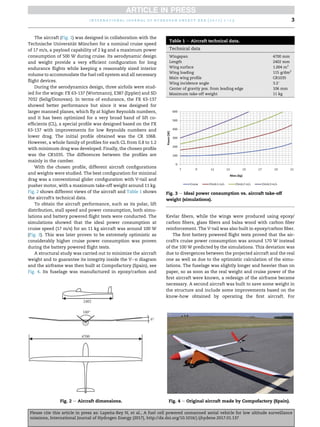
The aircraft (Fig. 1) was designed in collaboration with the
Technische Universit€
at München for a nominal cruise speed
of 17 m/s, a payload capability of 2 kg and a maximum power
consumption of 500 W during cruise. Its aerodynamic design
and weight provide a very efficient configuration for long
endurance flights while keeping a reasonably sized interior
volume to accommodate the fuel cell system and all necessary
flight devices.
During the aerodynamics design, three airfoils were stud-
ied for the wings: FX 63-137 (Wortmann), E387 (Eppler) and SD
7032 (Selig/Donovan). In terms of endurance, the FX 63-137
showed better performance but since it was designed for
larger manned planes, which fly at higher Reynolds numbers,
and it has been optimized for a very broad band of lift co-
efficients (CL), a special profile was designed based on the FX
63-137 with improvements for low Reynolds numbers and
lower drag. The initial profile obtained was the CR 1068.
However, a whole family of profiles for each CL from 0.8 to 1.2
with minimum drag was developed. Finally, the chosen profile
was the CR1035. The differences between the profiles are
mainly in the camber.
With the chosen profile, different aircraft configurations
and weights were studied. The best configuration for minimal
drag was a conventional glider configuration with V-tail and
pusher motor, with a maximum take-off weight around 11 kg.
Fig. 2 shows different views of the aircraft and Table 1 shows
the aircraft's technical data.
To obtain the aircraft performance, such as its polar, lift
distribution, stall speed and power consumption, both simu-
lations and battery powered flight tests were conducted. The
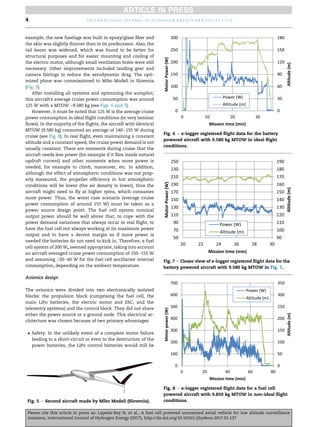
simulations showed that the ideal power consumption at
cruise speed (17 m/s) for an 11 kg aircraft was around 100 W
(Fig. 3). This was later proven to be extremely optimistic as
considerably higher cruise power consumption was proven
during the battery powered flight tests.
A structural study was carried out to minimize the aircraft
weight and to guarantee its integrity inside the Ven diagram
and the airframe was then built at Compofactory (Spain), see
Fig. 4. Its fuselage was manufactured in epoxy/carbon and
Kevlar fibers, while the wings were produced using epoxy/
carbon fibers, glass fibers and balsa wood with carbon fiber
reinforcement. The V-tail was also built in epoxy/carbon fiber.
The first battery powered flight tests proved that the air-
craft's cruise power consumption was around 170 W instead
of the 100 W predicted by the simulations. This deviation was
due to divergences between the projected aircraft and the real
one as well as due to the optimistic calculation of the simu-
lations. The fuselage was slightly longer and heavier than on
paper, so as soon as the real weight and cruise power of the
first aircraft were known, a redesign of the airframe became
necessary. A second aircraft was built to save some weight in
the structure and include some improvements based on the
know-how obtained by operating the first aircraft. For
Fig. 2 e Aircraft dimensions.
Table 1 e Aircraft technical data.
Technical data
Wingspan 4700 mm
Length 2402 mm
Wing surface 1.004 m2
Wing loading 115 g/dm2
Main wing profile CR1035
Wing incidence angle 3.2
Center of gravity pos. from leading edge 106 mm
Maximum take-off weight 11 kg
Fig. 3 e Ideal power consumption vs. aircraft take-off
weight (simulations).
Fig. 4 e Original aircraft made by Compofactory (Spain).
i n t e r n a t i o n a l j o u r n a l o f h y d r o g e n e n e r g y x x x ( 2 0 1 7 ) 1 e1 5 3
Please cite this article in press as: Lape~
na-Rey N, et al., A fuel cell powered unmanned aerial vehicle for low altitude surveillance
missions, International Journal of Hydrogen Energy (2017), http://dx.doi.org/10.1016/j.ijhydene.2017.01.137
example, the new fuselage was built in epoxy/glass fiber and
the skin was slightly thinner than in its predecessor. Also, the
tail boom was widened, which was found to be better for
structural purposes and for easier mounting and cooling of
the electric motor, although small ventilation holes were still
necessary. Other improvements included landing gear and
camera fairings to reduce the aerodynamic drag. The opti-
mized plane was commissioned to Mibo Modeli in Slovenia
(Fig. 5).
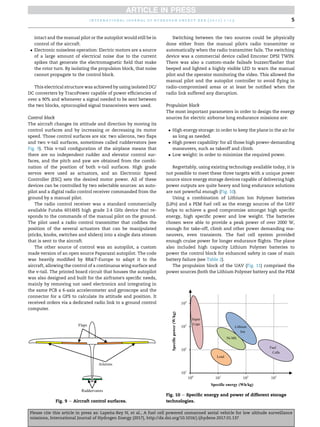
After installing all systems and optimizing the autopilot,
this aircraft's average cruise power consumption was around
125 W with a MTOW ~9.580 kg (see Figs. 6 and 7).
However, it must be noted that 125 W is the average cruise
power consumption in ideal flight conditions (in very laminar
flows). In the majority of the flights, the aircraft with identical
MTOW (9.580 kg) consumed an average of 140e155 W during
cruise (see Fig. 8). In real flight, even maintaining a constant
altitude and a constant speed, the cruise power demand is not
usually constant. There are moments during cruise that the
aircraft needs less power (for example if it flies inside natural
updraft current) and other moments when more power is
needed, for example to climb, maneuver, etc. In addition,
although the effect of atmospheric conditions was not prop-
erly measured, the propeller efficiency in hot atmospheric
conditions will be lower (the air density is lower), thus the
aircraft might need to fly at higher rpms, which consumes
more power. Thus, the worst case scenario (average cruise
power consumption of around 155 W) must be taken as a
power source design point. The fuel cell system nominal
output power should be well above that, to cope with the
power demand variations that always occur in real flight, to
have the fuel cell not always working at its maximum power
output and to have a decent margin so if more power is
needed the batteries do not need to kick in. Therefore, a fuel
cell system of 200 We seemed appropriate, taking into account
an aircraft averaged cruise power consumption of 150e155 W
and assuming ~20e40 W for the fuel cell ancillaries' internal
consumption, depending on the ambient temperature.
Avionics design
The avionics were divided into two electronically isolated
blocks: the propulsion block (comprising the fuel cell, the
main LiPo batteries, the electric motor and ESC, and the
telemetry systems) and the control block. They did not share
either the power source or a ground node. This electrical ar-
chitecture was chosen because of two primary advantages:
 Safety: In the unlikely event of a complete motor failure
leading to a short-circuit or even to the destruction of the
power batteries, the LiPo control batteries would still be
Fig. 5 e Second aircraft made by Mibo Modeli (Slovenia).
Fig. 6 e e-logger registered flight data for the battery
powered aircraft with 9.580 kg MTOW in ideal flight
conditions.
Fig. 7 e Closer view of e-logger registered flight data for the
battery powered aircraft with 9.580 kg MTOW in Fig. 7.
Fig. 8 e e-logger registered flight data for a fuel cell
powered aircraft with 9.850 kg MTOW in non-ideal flight
conditions.
i n t e r n a t i o n a l j o u r n a l o f h y d r o g e n e n e r g y x x x ( 2 0 1 7 ) 1 e1 5
4
Please cite this article in press as: Lape~
na-Rey N, et al., A fuel cell powered unmanned aerial vehicle for low altitude surveillance
missions, International Journal of Hydrogen Energy (2017), http://dx.doi.org/10.1016/j.ijhydene.2017.01.137
intact and the manual pilot or the autopilot would still be in
control of the aircraft.
 Electronic noiseless operation: Electric motors are a source
of a large amount of electrical noise due to the current
spikes that generate the electromagnetic field that make
the rotor turn. By isolating the propulsion block, that noise
cannot propagate to the control block.
This electrical structure was achieved by using isolated DC/
DC converters by TracoPower capable of power efficiencies of
over a 90% and whenever a signal needed to be sent between
the two blocks, optocoupled signal transceivers were used.
Control block
The aircraft changes its attitude and direction by moving its
control surfaces and by increasing or decreasing its motor
speed. Those control surfaces are six: two ailerons, two flaps
and two v-tail surfaces, sometimes called ruddervators (see
Fig. 9). This v-tail configuration of the airplane means that
there are no independent rudder and elevator control sur-
faces, and the pitch and yaw are obtained from the combi-
nation of the position of both v-tail surfaces. High grade
servos were used as actuators, and an Electronic Speed
Controller (ESC) sets the desired motor power. All of these
devices can be controlled by two selectable sources: an auto-
pilot and a digital radio control receiver commanded from the
ground by a manual pilot.
The radio control receiver was a standard commercially
available Futaba 6014HS high grade 2.4 GHz device that re-
sponds to the commands of the manual pilot on the ground.
The pilot used a radio control transmitter that codifies the
position of the several actuators that can be manipulated
(sticks, knobs, switches and sliders) into a single data stream
that is sent to the aircraft.
The other source of control was an autopilot, a custom
made version of an open source Paparazzi autopilot. The code
was heavily modified by BRT-Europe to adapt it to the
aircraft, allowing the control of a continuous wing surface and
the v-tail. The printed board circuit that houses the autopilot
was also designed and built for the airframe's specific needs,
mainly by removing not used electronics and integrating in
the same PCB a 6-axis accelerometer and gyroscope and the
connector for a GPS to calculate its attitude and position. It
received orders via a dedicated radio link to a ground control
computer.
Switching between the two sources could be physically
done either from the manual pilot's radio transmitter or
automatically when the radio transmitter fails. The switching
device was a commercial device called Emcotec DPSI TWIN.
There was also a custom-made failsafe buzzer/flasher that
beeped and lighted a highly visible LED to warn the manual
pilot and the operator monitoring the video. This allowed the
manual pilot and the autopilot controller to avoid flying in
radio-compromised areas or at least be notified when the
radio link suffered any disruption.
Propulsion block
The most important parameters in order to design the energy
sources for electric airborne long endurance missions are:
 High energy storage: in order to keep the plane in the air for
as long as needed.
 High power capability: for all those high power-demanding
maneuvers, such as takeoff and climb.
 Low weight: in order to minimize the required power.
Regrettably, using existing technology available today, it is
not possible to meet these three targets with a unique power
source since energy storage devices capable of delivering high
power outputs are quite heavy and long endurance solutions
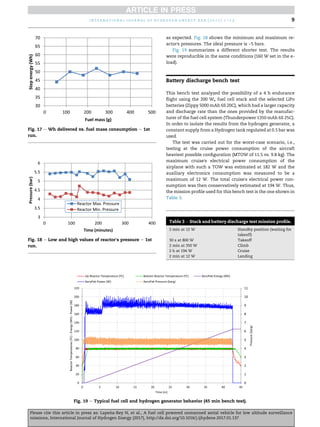
are not powerful enough (Fig. 10).
Using a combination of Lithium Ion Polymer batteries
(LiPo) and a PEM fuel cell as the energy sources of the UAV
helps to achieve a good compromise amongst high specific
energy, high specific power and low weight. The batteries
chosen were able to provide a peak power of over 2000 W,
enough for take-off, climb and other power demanding ma-
neuvers, even transients. The fuel cell system provided
enough cruise power for longer endurance flights. The plane
also included high capacity Lithium Polymer batteries to
power the control block for enhanced safety in case of main
battery failure (see Table 2).
The propulsion block of the UAV (Fig. 11) comprised the
power sources (both the Lithium Polymer battery and the PEM
Fig. 9 e Aircraft control surfaces.
Fig. 10 e Specific energy and power of different storage
technologies.
i n t e r n a t i o n a l j o u r n a l o f h y d r o g e n e n e r g y x x x ( 2 0 1 7 ) 1 e1 5 5
Please cite this article in press as: Lape~
na-Rey N, et al., A fuel cell powered unmanned aerial vehicle for low altitude surveillance
missions, International Journal of Hydrogen Energy (2017), http://dx.doi.org/10.1016/j.ijhydene.2017.01.137
fuel cell), the propulsion system (the electronic speed
controller or ESC and the electric motor) and a telemetry
system (to download data from the fuel cell system and other
sensors).
The fuel Cell/LiPo hybrid power source included a
commercially available fuel cell system from Horizon Energy
Systems, commercially available Lithium Polymer batteries
and a hybrid power management card designed also by Ho-
rizon Energy Systems. This system was chosen because it is
one of the most lightweight and compact commercially
available systems for this power range. A small fraction of a
typical UAV mission, mainly takeoff and climb stages, de-
mand an amount of power meaningfully higher than that for
the rest of the flight. To optimize the weight of the overall
system, the fuel cell was sized mainly for cruise flight whereas
the batteries provided the additional power required for
takeoff and climb as well as the power for transitory high-
powered maneuvers. The hybrid power management board
performs two tasks:
1. Merges the Lithium Polymer battery (5000 mh 6S 20C)
power and the fuel cell power directly into the propulsion
system, thanks to a high power Schottky diode.
2. Charges the lithium-polymer battery whenever there is a
surplus of energy generating capacity at the fuel cell and
the battery voltage is below a certain threshold.
The commercially available 200 We output rate fuel cell
system (Fig. 12 and Ref. [27]) had a rated capacity of 900 Wh
using 1 L of a solution of 20% wt. NaBH4 in water, and a fueled
weight close to 2.5 kg, including Thunderpower Lith-
iumePolymer batteries and the fuel generating cartridge. The
fuel cell stack produces electricity, water and heat from the
electrochemical reaction of the highly pure hydrogen,
generated from the controlled hydrolysis of NaBH4, and oxy-
gen from the air. Section 3 provides further details of the fuel
cell system.
The propulsion block consisted of the ESC and the electric
motor. The cruise speed was calculated for a 18.5  1200
pro-
peller turning at around 3200 rpm in-runner brushless motors
that provide such low speeds are very difficult to find, so a
combination with gearbox was necessary. The option selected
was the lightest, comprising a Hacker B50 19S electric brush-
less motor and a 6.7:1 gearbox integrated with the motor
(weighting 198 g in total). After the first battery flight tests in
which several propellers were tested, the initial calculations
proved to be optimum.
The electronic speed controller chosen was the Castle
Creations Phoenix ICE Lite 50, capable of withstanding a cur-
rent of 50 A, that is, 1200 W at 24 V weighing only 48 g. Its
Table 2 e Chosen energy storage systems.
Source Weight (kg) Maximum power (W) Energy (Wh) Power density (W/kg) Energy density (Wh/kg)
Fuel cell system 2 200 900 100 450
LiPo battery 0.8 2200 110 2750 138
Control LiPo battery 0.4 222 74 555 185
Fig. 11 e Propulsion block diagram.
Fig. 12 e Fuel cell system (200 We fuel cell
system þ 900 Wh H2 generator from NaBH4).
i n t e r n a t i o n a l j o u r n a l o f h y d r o g e n e n e r g y x x x ( 2 0 1 7 ) 1 e1 5
6
Please cite this article in press as: Lape~
na-Rey N, et al., A fuel cell powered unmanned aerial vehicle for low altitude surveillance
missions, International Journal of Hydrogen Energy (2017), http://dx.doi.org/10.1016/j.ijhydene.2017.01.137
weight is important since its position is far from the center of
gravity of the plane. The speed signal that comes from the
control block (see Section 2.2.1) was connected to this device
through an optocoupler to keep the blocks electrically
isolated.
The chosen telemetry system was a commercially avail-
able EagleTreeSystems set that allows First Person View (FPV)
with an On Screen Display (OSD) which indicates GPS data,
airspeed, heading, barometric altitude, propeller rpms and
outside air temperature and motor temperature and electric
indications, such as power and battery voltage. All the
telemetry data was both recorded in an on-board logger and
also sent to ground were a dedicated computer displayed and
recorded the values for later analysis and redundancy. These
indicators are essential for the pilot to control the plane and
also for the rest of the flight tests crew to calibrate the auto-
pilot's parameters and monitor the flight progress. The video
transmitter was placed on a custom made heat sink that was
placed where the normal flight air-flow could cool the whole
system. Its transmission band was centered in 1.2 GHz.
The fuel cell stack electronics provided an RS-232 serial
output that was sent to the ground control station via an
audiomodem designed and developed by BRTE for that
purpose. The audio generated at this audiomodem was sent
via the video transmitter audio channel.
Fuel cell system
Fuel cell stack
The application of the PEM fuel cells as a primary power
source in electric vehicles has received increasing attention in
the last few decades, mainly in the car industry. PEM fuel cells
use a dense and gas tight polymer membrane electrolyte,
which conducts hydrogen ions in a certain range of temper-
ature and humidity. On the contrary, both the anode and the
cathode are porous. The advantages of PEM fuel cells are that
the production of the cell is simple, they are able to withstand
large pressure differentials, material corrosion problems are
minimal, and they have demonstrated long life in several
stationary and transport applications.
In this type of fuel cell, hydrogen from the fuel gas stream
is consumed at the anode, yielding electrons that go through
an external circuit and hydrogen ions which go through the
electrolyte towards the cathode [22,23]. There, the protons
combine with the oxygen from the air and the electrons to
produce water.
Anode: 2H2 / 4Hþ
þ 4e
Cathode: O2 þ 4Hþ
þ 4e
/ 2H2O
Thus, the only product of the reaction is water, which does
not dissolve in the electrolyte and is, instead, expelled from
the cathode into the oxidant gas stream. As the PEMFC oper-
ates in the 60e70 
C temperature range, this water is pushed
out of the fuel cell by the excess oxidant flow.
An open cathode stack was chosen (Fig. 13) mainly because
it was commercially available, thus, helping to reduce the cost
of the project, and also because, in general, it is suitable for
low altitude flight surveillance missions (below 1000 m). The
stack can deliver up to 10 A in a voltage range from 32 V (0.91 V
per cell in open circuit) to 21 V (0.6 V per cell at maximum
load). The applicable altitude and temperature range for the
stack is shown in Fig. 14, where the red inner envelope (in the
web version) represents the operating conditions for the fuel
cell rated performance, while the yellow outer envelope (in
the web version) represents the operating conditions for
limited fuel cell performance. Operating altitude affects per-
formance since there is less oxidant for the electrochemical
reactor, leading to lower single cells voltage. A slight drop in
performance (power output) is expected typically at
1000 m ASL. One other factor affecting performance is the
ambient temperature. Higher temperature leads to drying the
PEM membrane inside the stack, reducing its conductivity
and, consequently, the power output of the fuel cell stack. Low
temperatures are counteracted using two methods. The first
Fig. 13 e 200 We fuel cell.
Fig. 14 e Applicable altitude (ASL) and temperature range
for the 200 We open cathode stack [28].
i n t e r n a t i o n a l j o u r n a l o f h y d r o g e n e n e r g y x x x ( 2 0 1 7 ) 1 e1 5 7
Please cite this article in press as: Lape~
na-Rey N, et al., A fuel cell powered unmanned aerial vehicle for low altitude surveillance
missions, International Journal of Hydrogen Energy (2017), http://dx.doi.org/10.1016/j.ijhydene.2017.01.137
one consists on reducing the throttle of the fans at the back of
the stack, effectively reducing the cold air pulling heat from
the cells. The second one consists on increasing the duration
of the conditioning short-circuits [25,26] of the stack, resulting
in the stack self-heating.
Hydrogen generator
The 900 Wh hydrogen generator from Horizon Energy Systems
produces hydrogen on demand, i.e., it produces the amount of
hydrogen that the fuel cell demands, which obviously de-
pends on the fuel cell power output.
The gaseous hydrogen for the fuel cell is obtained at the
right purity (99.99%) and at fuel cell operating pressure
(0.5e0.7 barg) from 1 L of a 20% wt. sodium borohydride
(NaBH4) solution in water via a catalyzed hydrolysis reaction:
NaBH4 þ 2H2O / 4H2 þ NaBO2
The reaction takes place inside a reactor packed with the
catalyst when reaching 70 
C. An intake pump feeds the fuel
from the fuel tanks into the reactor. Both the generated
gaseous hydrogen and the byproduct (sodium metaborate
NaBO2) are cooled down through a cooling coil before flowing
into a separator where light highly pure gaseous hydrogen
stays on top and the heavier byproduct stays at the bottom.
The hydrogen is then extracted through a filter/desiccator and
a pressure regulator that reduces the pressure from the 5 barg
in the reactor to the fuel cell operating pressure (0.5 barg)
before feeding the stack. The unreacted NaBH4 is forced again
towards the reactor to try to extract more hydrogen. The
byproduct is recirculated from the separator towards the
reactor where it exhausts the system through a purging valve
towards a tube which is ducted out of the aircraft. The
movement of the byproduct through the pipes in the system
poses the first challenge, operation at low ambient tempera-
tures, since the salt might precipitate in the tubes blocking the
system [24]. The purging procedure is controlled by the
hydrogen generator controller board that also informs the
stack of the relevant parameters such as the reactor's pres-
sure, and sends other data through the stack board to the user
(reactor's temperatures, sensor levels, etc.).
Exhausting the byproduct off the aircraft during flight al-
lows reducing weight progressively over the course of a flight.
Although this could theoretically be an advantage it poses the
second challenge, since the weight-shift and lose would
disrupt the aircraft center of gravity during the flight, which
might negatively affect the aircraft stability if the center of
gravity is shifted out of the its acceptable limits. This is thor-
oughly discussed in section 7.
Fig. 15 shows the fuel consumption rate at different power
outputs and ambient temperatures provided by the manu-
facturer. At ~200 W (which would constitute the worse-case
scenario for the UAV cruise power consumption, even in the
worst ambient temperature conditions (40 
C)) the fuel con-
sumption was always less than 250 g/h. Therefore, 1 kg of fuel
could lead up to minimum 4 h flights and up to 5 h flights at a
200 W continuous power draw. In practice, the power draw
will vary during flight, even during cruise.
Stack and hydrogen generator bench endurance
test
Prior to mounting the system onboard, the fuel cell was
thoroughly conditioned for several days with compressed
hydrogen gas until the power output was 200 We at 24.5 V (i.e.,
~0.7 V/cell). Once fully conditioned, the fuel cell was tested
with the hydrogen generator on the bench connected to an
electronic programmable load, which simulated the electric
motor, to prove the 900 Wh of energy stated by the manu-
facturer. 1 L of freshly made fuel mixture (20% wt. NaBH4 with
demineralized water) was poured into the fuel tank. After-
wards, the separator was usually primed with 15 ml of dem-
ineralized water. The system was then started and ran for
4.5e5 h at 160 W set in the electronic load.
The results of a typical test are summarized in Figs. 16e18,
which show smooth and successful performance. Fig. 16
shows the total energy (Wh) delivered vs. time during the
test. The straight ascending line looks as expected. Fig. 17
shows how every 20 min the system produced ~50 Wh and
this remained fairly constant with time, and how the Wh
delivered are proportional to the fuel mass consumption, both
Fig. 15 e Fuel consumption of the hydrogen generator [23].
Fig. 16 e Total energy (Wh) vs. time e 1st run.
i n t e r n a t i o n a l j o u r n a l o f h y d r o g e n e n e r g y x x x ( 2 0 1 7 ) 1 e1 5
8
Please cite this article in press as: Lape~
na-Rey N, et al., A fuel cell powered unmanned aerial vehicle for low altitude surveillance
missions, International Journal of Hydrogen Energy (2017), http://dx.doi.org/10.1016/j.ijhydene.2017.01.137
as expected. Fig. 18 shows the minimum and maximum re-
actor's pressures. The ideal pressure is ~5 bars.
Fig. 19 summarizes a different shorter test. The results
were reproducible in the same conditions (160 W set in the e-
load).
Battery discharge bench test
This bench test analyzed the possibility of a 4 h endurance
flight using the 200 We fuel cell stack and the selected LiPo
batteries (Zippy 5000 mAh 6S 20C), which had a larger capacity
and discharge rate than the ones provided by the manufac-
turer of the fuel cell system (Thunderpower 1350 mAh 6S 25C).
In order to isolate the results from the hydrogen generator, a
constant supply from a Hydrogen tank regulated at 0.5 bar was
used.
The test was carried out for the worst-case scenario, i.e.,
testing at the cruise power consumption of the aircraft
heaviest possible configuration (MTOW of 11.5 vs. 9.8 kg). The
maximum cruise's electrical power consumption of the
airplane with such a TOW was estimated at 182 W and the
auxiliary electronics consumption was measured to be a
maximum of 12 W. The total cruise's electrical power con-
sumption was then conservatively estimated at 194 W. Thus,
the mission profile used for this bench test is the one shown in
Table 3.
Fig. 17 e Wh delivered vs. fuel mass consumption e 1st
run.
Fig. 18 e Low and high values of reactor's pressure e 1st
run.
Fig. 19 e Typical fuel cell and hydrogen generator behavior (45 min bench test).
Table 3 e Stack and battery discharge test mission profile.
2 min at 12 W Standby position (waiting for
takeoff)
30 s at 800 W Takeoff
2 min at 350 W Climb
2 h at 194 W Cruise
2 min at 12 W Landing
i n t e r n a t i o n a l j o u r n a l o f h y d r o g e n e n e r g y x x x ( 2 0 1 7 ) 1 e1 5 9
Please cite this article in press as: Lape~
na-Rey N, et al., A fuel cell powered unmanned aerial vehicle for low altitude surveillance
missions, International Journal of Hydrogen Energy (2017), http://dx.doi.org/10.1016/j.ijhydene.2017.01.137
An oscilloscope logged Vbattery, Ibattery, Vload and Iload
(Fig. 20).
Fig. 21 shows the initial stages of the simulated flight
mission, and for each one, the discharge curve of the battery.
The take-off stage was the most current demanding, peaking
at 25 A from the battery. During climb simulation, the current
of the battery was mostly below 7 A and the stack was pro-
ducing the remaining 8 A. In this stage, the battery current
discharge was ~100 mV/min (Fig. 22).
After the recovery from climb, in the cruise stage, the
battery discharge stabilized and the slope suggested that the
discharge rate was below 200 mV/h (Fig. 23), which is slow
compared to the one during the climb stage (100 mV/min).
Although most of the power delivered to the load was gener-
ated by the fuel cell stack, the battery still needed to deliver
current:
 To power the electronics of the controller board of the
stack.
 To power the load while the self-heating short-circuits of
the stack occurred. These short-circuits keep the stack
conditioned [25,26] and happen in its normal operation
every 10 s and correspond to the negative spikes seen
throughout the test.
Drawing a conservative trend line, during 4 h of cruise the
voltage would drop only 0.8 V, i.e., from 24.5 to 23.7 V, which is
Fig. 20 e Stack and battery discharge test setup.
Fig. 21 e Battery and stack test: battery initial discharge.
Fig. 22 e Battery and stack test: climb battery discharge.
Fig. 23 e Battery and stack test: cruise battery discharge.
i n t e r n a t i o n a l j o u r n a l o f h y d r o g e n e n e r g y x x x ( 2 0 1 7 ) 1 e1 5
10
Please cite this article in press as: Lape~
na-Rey N, et al., A fuel cell powered unmanned aerial vehicle for low altitude surveillance
missions, International Journal of Hydrogen Energy (2017), http://dx.doi.org/10.1016/j.ijhydene.2017.01.137
perfectly fine for a 6 element LiPo battery. This indicated that
there might not be a need to recharge the battery in flight from
the fuel cell. In fact, completely removing the charger circuit
from the hybrid card would provide more power to the electric
motor.
Using a less conservative result of the same trend line, 4 h
cruise would make the battery voltage to drop only 0.5 V
(Fig. 24).
This test proved that 4 h endurance flights were theoreti-
cally feasible with the selected hybrid power source, although
it must be noted that a constant power requirement never
occurs in a real flight mission, unless the aircraft is forced to
fly in a constant power mode through the autopilot. Moreover,
the discharge profile of the battery will be slightly different in
each flight test, so the results were only taken as indicative.
In addition, this test also indicated that the battery suffers
a fast discharge if it is heavily used. And the charger included
in the hybrid card cannot reestablish the 24 V at its nominal
charging current if the flight is very power variable, which
again is normally the case in real flight conditions.
Flight tests
Many fuel cell powered flight tests were conducted in different
seasons and ambient conditions (from winter to summer,
different altitudes, etc.) to test the performance and the reli-
ability of the system in a wide range of operating conditions. It
must be clearly understood that the system was operated at
the lower and upper extremes of the operative temperature
range stated by the manufacturer (operating environment:
0 
Ce40 
C) on purpose in order to identify the limits of the
technology. The example shown here is one of the worst case
scenarios, i.e., flight testing in a really dry and hot day. This
was chosen on purpose to raise some interesting points for
discussion in Section 7.
On July the 18th 2013, BRT-Europe successfully per-
formed an endurance flight test with the fuel cell powered
prototype at Marug
an airfield (Segovia, Spain). The weather
conditions were dry (30% RH) and very hot (37 
C), so a poorer
response was expected from the fuel cell system since the
electrical consumption of the fuel cell fans considerably in-
creases in such hot ambient temperatures (typically up to 30
or 40 W at 40 
C vs. 20W at 20 
C).
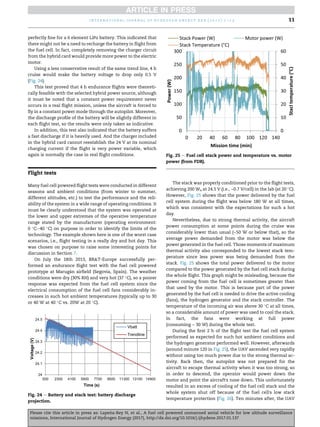
The stack was properly conditioned prior to the flight tests,
achieving 200 We at 24.5 V (i.e., ~0.7 V/cell) in the lab (at 20 
C).
However, Fig. 25 shows that the power delivered by the fuel
cell system during the flight was below 180 W at all times,
which was consistent with the expectations for such a hot
day.
Nevertheless, due to strong thermal activity, the aircraft
power consumption at some points during the cruise was
considerably lower than usual (~50 W or below that), so the
average power demanded from the motor was below the
power generated in the fuel cell. Those moments of maximum
thermal activity also corresponded to the lowest stack tem-
perature since less power was being demanded from the
stack. Fig. 25 shows the total power delivered to the motor
compared to the power generated by the fuel cell stack during
the whole flight. This graph might be misleading, because the
power coming from the fuel cell is sometimes greater than
that used by the motor. This is because part of the power
generated by the fuel cell is needed to drive the active cooling
(fans), the hydrogen generator and the stack controller. The
temperature of the incoming air was above 30 
C at all times,
so a considerable amount of power was used to cool the stack.
In fact, the fans were working at full power
(consuming ~ 30 W) during the whole test.
During the first 2 h of the flight test the fuel cell system
performed as expected for such hot ambient conditions and
the hydrogen generator performed well. However, afterwards
(around minute 120 in Fig. 25), the UAV ascended very rapidly
without using too much power due to the strong thermal ac-
tivity. Back then, the autopilot was not prepared for the
aircraft to escape thermal activity when it was too strong, so
in order to descend, the operator would power down the
motor and point the aircraft's nose down. This unfortunately
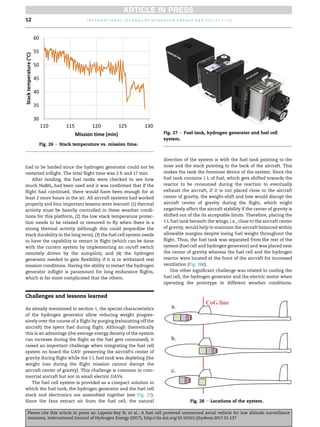
resulted in an excess of cooling of the fuel cell stack and the
whole system shut off because of the fuel cell's low stack
temperature protection (Fig. 26). Ten minutes after, the UAV
Fig. 24 e Battery and stack test: battery discharge
projection.
Fig. 25 e Fuel cell stack power and temperature vs. motor
power (from FDR).
i n t e r n a t i o n a l j o u r n a l o f h y d r o g e n e n e r g y x x x ( 2 0 1 7 ) 1 e1 5 11
Please cite this article in press as: Lape~
na-Rey N, et al., A fuel cell powered unmanned aerial vehicle for low altitude surveillance
missions, International Journal of Hydrogen Energy (2017), http://dx.doi.org/10.1016/j.ijhydene.2017.01.137
had to be landed since the hydrogen generator could not be
restarted inflight. The total flight time was 2 h and 17 min.
After landing, the fuel tanks were checked to see how
much NaBH4 had been used and it was confirmed that if the
flight had continued, there would have been enough for at
least 2 more hours in the air. All aircraft systems had worked
properly and four important lessons were learned: (1) thermal
activity must be heavily controlled in these weather condi-
tions for this platform, (2) the low stack temperature protec-
tion needs to be relaxed or removed to fly when there is a
strong thermal activity (although this could jeopardize the
stack durability in the long term), (3) the fuel cell system needs
to have the capability to restart in flight (which can be done
with the current system by implementing an on/off switch
remotely driven by the autopilot), and (4) the hydrogen
generator needed to gain flexibility if it is to withstand real
mission conditions. Having the ability to restart the hydrogen
generator inflight is paramount for long endurance flights,
which is far more complicated that the others.
Challenges and lessons learned
As already mentioned in section 4, the special characteristics
of the hydrogen generator allow reducing weight progres-
sively over the course of a flight by purging (exhausting off the
aircraft) the spent fuel during flight. Although theoretically
this is an advantage (the average energy density of the system
can increase during the flight as the fuel gets consumed), it
raised an important challenge when integrating the fuel cell
system on board the UAV: preserving the aircraft's center of
gravity during flight while the 1 L fuel tank was depleting (the
weight loss during the flight mission cannot disrupt the
aircraft center of gravity). This challenge is common in com-
mercial aircraft but not in small electric UAVs.
The fuel cell system is provided as a compact solution in
which the fuel tank, the hydrogen generator and the fuel cell
stack and electronics are assembled together (see Fig. 27).
Since the fans extract air from the fuel cell, the natural
direction of the system is with the fuel tank pointing to the
nose and the stack pointing to the back of the aircraft. This
makes the tank the foremost device of the system. Since the
fuel tank contains 1 L of fuel, which gets shifted towards the
reactor to be consumed during the reaction to eventually
exhaust the aircraft, if it is not placed close to the aircraft
center of gravity, the weight-shift and lose would disrupt the
aircraft center of gravity during the flight, which might
negatively affect the aircraft stability if the center of gravity is
shifted out of the its acceptable limits. Therefore, placing the
1 L fuel tank beneath the wings, i.e., close to the aircraft center
of gravity, would help to maintain the aircraft balanced within
allowable margins despite losing fuel weight throughout the
flight. Thus, the fuel tank was separated from the rest of the
system (fuel cell and hydrogen generator) and was placed near
the center of gravity whereas the fuel cell and the hydrogen
reactor were located at the front of the aircraft for increased
ventilation (Fig. 28c).
One other significant challenge was related to cooling the
fuel cell, the hydrogen generator and the electric motor when
operating the prototype in different weather conditions.
Fig. 26 e Stack temperature vs. mission time.
Fig. 27 e Fuel tank, hydrogen generator and fuel cell
system.
Fig. 28 e Locations of the system.
i n t e r n a t i o n a l j o u r n a l o f h y d r o g e n e n e r g y x x x ( 2 0 1 7 ) 1 e1 5
12
Please cite this article in press as: Lape~
na-Rey N, et al., A fuel cell powered unmanned aerial vehicle for low altitude surveillance
missions, International Journal of Hydrogen Energy (2017), http://dx.doi.org/10.1016/j.ijhydene.2017.01.137
Active cooling is imperative for that purpose since otherwise
the section of the cooling holes needs to be modified accord-
ingly prior to each operation, which is not practical for real
set-ups.
A further challenge was related to operation of the fuel cell
system in the very dynamic load demanding profiles. This is
never tested on the bench as one normally assumes that the
cruise demanded power is nearly constant when maintaining a
constant desired altitude and flight speed. However, the aircraft
needs to maneuver even during cruise since in general for
surveillance missions the UAV does not fly in a straight line but
in some kind of pattern or path that includes turns. For
example, during turns, the vertical component of the lift is
reduced so more power and pitch-up is needed afterwards to
maintain altitude. This occurs many times during a long
endurance flight. Although the load transients that are imposed
to the fuel cell in these situations are totally acceptable, the
challenge rises when there is thermal activity during the flight,
unless it is prevented by performing a constant power flight. It
must be noted that in long endurance flights in hot ambient
temperatures thermal activity is quite likely to occur.
If there is strong thermal activity and it is not properly
controlled, the aircraft can eventually ascend rapidly without
having to use too much power from the power source (i.e., the
stack temperature starts dropping since very little power is
being drawn and, on top of that, the ambient temperature gets
colder with altitude). In such case the stack might overcool.
Thus, although electrically the battery can certainly cope
with the load transients imposed to the system, very abrupt
load demands (from 200 We down to 50 We or below and vice-
versa) cause severe temperature changes in the stack. The
electrolyte is an ionic conductor within an optimum humidity
and temperature range. If taken out of such range, the per-
formance will be severely decreased as the ionic conductivity
will decrease, thus, less power will be drown from the stack. If
this does not happen frequently it is not harmful for the stack
but, if done repeatedly, it could decrease the durability of the
stack in the long term; that is normally why manufacturers set
a low stack temperature protection. The low temperature
protection might be released or removed if the stacks are
cheap or one does not care about durability but here we have
already encountered one of the limits of the technology even
within the operative range stated by the manufacturer
(0e40 
C) because of other factors affecting the real perfor-
mance during flight.
This challenge must therefore be controlled by developing
an autopilot software that is able to profit/escape from ther-
mal activity without jeopardizing the fuel cell system perfor-
mance. This work is already on-going but will not be
presented here as it is considered beyond the scope of this
publication.
One other important aspect that must be highlighted here
is that for a real product is paramount that the fuel cell and
hydrogen generator are safe, reliable and easy to use, with the
minimum previous preparation and maintenance. Requiring
maintenance increases the resources that need to be invested
and complicates implementation for unscheduled flight mis-
sions. In that sense, the fuel cell system was found to be very
reliable but required some periodic conditioning. It is reported
in the literature that the initial MEA activation plays a crucial
role in maintaining the performance of the stack. A close
cathode design would normally require less periodic mainte-
nance and would also widen the altitude range. This is also
clearly beyond the scope of the work presented here, which
only refers to low altitude flight tests (below 1000 m, which
was the range stated by the fuel cell manufacturer).
Finally, regarding the hydrogen generator based in the
hydrolysis of a solution of NaBH4 in distilled water, the system
works well and is reliable at ambient temperatures above 5 
C.
However, the system was found to require a high knowledge
of the technology and a very tedious maintenance, thus, not
being considered as user-friendly as expected. Some of the
drawbacks observed are mentioned below:
 The hydrolysis reaction is heterogeneous, i.e., needs a
catalyst. The catalyst used in this particular system needs
to be replaced after approximately 8e10 h of operation or it
would show decreased catalytic activity. The use of a
catalyst with such short catalytic activity requires main-
tenance, which again limits operability especially for un-
scheduled flight missions. Compared to other NaBH4 based
systems without catalyst, the reaction occurs at slightly
lower temperature and it does not need to be activated
with an acid.
 The fuel (premixed solution of NaBH4 solid and distilled
water) is irritant for the human skin and loses reactivity
with time, thus, it has to be freshly made by the user just
prior to any operation. This avoids rapid deployment and
also results in increased costs, since the fuel needs to be
disposed almost after every operation even if the fuel tank
is still quite full.
 The state of the art for this technology remains at 900 Wh
and 1800 Wh on a standard off-the-shelf basis for 200 W
fuel cell systems. Although the system capability has been
scaled up in various other power and energy storage con-
figurations including a 3 kW/10 kWh at system level for
some particular prototypes, it does not seem to be
economically practical beyond that, due to the excessive
fuel cost. Manufacturers are looking to simplify and
significantly drop the operational costs of the NaBH4 sys-
tem but for the time being this technology offers only a
limited endurance.
 Operation at low ambient temperature is limited by the by-
product salt precipitating in the piping and clogging the
system. Heating the pipes with an electric heater for
example would overcome this challenge but at the ex-
penses of higher electric consumption, which has to come
from the fuel cell system or the batteries.
 The system requires water flushing after each operation to
displace the byproduct salt that otherwise accumulates in
the piping. This was found to be one of the mayor draw-
backs as it does not allow restarting in flight, unless a water
tank is installed on board for this particular purpose
(although this would add weight) and the control of the
system is modified accordingly.
 As already mentioned, the fuel is consumed during flight
and the byproducts are exhausted off the aircraft. Thus,
the system loses weight during operation which rises a
balance challenge if not located very near the center of
gravity of the aircraft.
i n t e r n a t i o n a l j o u r n a l o f h y d r o g e n e n e r g y x x x ( 2 0 1 7 ) 1 e1 5 13
Please cite this article in press as: Lape~
na-Rey N, et al., A fuel cell powered unmanned aerial vehicle for low altitude surveillance
missions, International Journal of Hydrogen Energy (2017), http://dx.doi.org/10.1016/j.ijhydene.2017.01.137
Summarizing, the system works properly if a quality con-
trol is implemented but it is complex and requires rigorous
and tedious maintenance. The hydrogen generator is sold as a
swappable system and the required maintenance is done by
the manufacturer. However, that was not found to be practical
for field operation on the other side of the world. Therefore,
the technology must mature to be successfully implemented
in UAVs that aim to be products rather than prototypes.
However, it is theoretically a practical system in which pure
hydrogen is only produced in demand and at low pressure,
which is an incredible advantage that would greatly make
certification easier than with compressed hydrogen gas, for
example. It is also ideal for operation in remote areas, to avoid
mission disruption due to fuel logistics/high cost.
Other competing technologies include the hydrolysis of
NaBH4 but at higher temperature or using for example a water
based HCl or other acidic solution as an agent. Both of these
approaches are simpler, require considerably lower mainte-
nance and use fuel that does not get out of date. One other
interesting option is exploring new chemistries (such as
MgH2), which does not require a catalyst either, is a simpler
system, requires considerably lower maintenance and might
also resolve some of the practical challenges of the system
studied here. However, the considerably higher reaction
temperature poses a thermal management challenge. Finally,
the hydrolysis of alkaline metals (Na or Li) in inert atmo-
spheres seems also a feasible and very promising technology
to be studied. Within the hydrogen storage methods, both
compressed hydrogen and liquid hydrogen should be explored
although they require considerable fuel logistics and might be
less practical for operation in remote areas.
Conclusion
BRT-Europe has corroborated that fuel cell powered electric
UAV low altitude flight missions using off-the-shelf fuel cell
technology and chemical hydrides as a hydrogen source are
feasible.
The fuel cell system chosen was found to be one of the
most lightweight and compact commercially available sys-
tems for this power range. Despite the required maintenance,
the fuel cell system proved to be very reliable although chal-
lenges were encountered when operating in hot weather
conditions, especially with strong thermal activity. The
chemical hydride technology is very promising and once it
reaches the correct readiness level, it could allow having long
endurance electric UAVs without having to store high pres-
sure gaseous hydrogen or liquid hydrogen onboard, which
would be particularly useful for operating at remote locations
or for portable applications since it would simplify the ground
logistics and workflow. This prototype was designed for op-
timum aerodynamics (glider with an L/D ~20) and the flight
tests were all smooth in terms of maneuvering to maximize
endurance. In addition, as it is only a demonstrator, the
aircraft had no payload. These are ideal conditions, which are
not representative of most UAVs that normally have more
restrictive conditions. The ceiling set for this prototype was
~1000 m AGL whereas surveillance UAVs fly up to ~5000 m or
more. The atmospheric conditions at such altitudes are totally
different with much lower pressures and temperatures, and
thus, the fuel cell system design has to be adapted for such
conditions.
r e f e r e n c e s
[1] Unmanned Systems North America 2012. Protonex
announces commercial fuel cell power system for
unmanned applications at AUVSI's unmanned systems
North America 2012. August 2012.
[2] Verstraete D, Harvey JR, Palmer JL. Hardware-in-the-loop
simulation of fuel cell-based hybrid electrical UAV
propulsion. 28th International Congress of Aeronautical
Sciences. September 2012.
[3] Lape~
na-Rey N, Mosquera J, Bataller E, Orti F, Dudfield C,
Orsillo A. Environmentally friendly power sources for
aerospace applications. J Power Sources 2008;181:353e62.
[4] Reitz TL. AFRL/RZ fuel cell program. Propulsion Directorate,
Air Force Research Laboratory. 2010.
[5] Gertler J. US unmanned aerial systems. Congressional
Research Service, Report 7e5700 prepared for Members and
Committees of US Congress. January 2012.
[6] Global Observer from AeroVironment: http://www.avinc.
com/ADC_Project_Details.asp?Prodid¼35.
[7] Fuel Cell UAV from Georgia Institute of Technology: http://
gtresearchnews.gatech.edu/newsrelease/fuel-cell-aircraft.htm.
[8] SpiderLion from Navy Research Labs and Protonex: http://
www.designation-systems.net/dusrm/app4/spider-lion.
html.
[9] HYFISH from Deutsche Raum und Luftfahrt (DLR), Smartfish
and Horizon Energy Systems: http://www.militaryaero
space.com/articles/print/volume-18/issue-6/news/hydro
gen-fuel-cell-technology-takes-off-powering-hyfish-uav.
html.
[10] SAE Pterosoar from California State University, Oklahoma
State University, Horizon Energy systems: http://www.
worldrecordacademy.com/technology/longest_micro_UAV_
flight_world_record_set_by_Pterosoar_70905.htm.
[11] Puma from AeroVironment: http://www.avinc.com/uas/adc/
fuel_cell_puma/.
[12] Endurance from SolarBubbles: http://gas2.org/2008/11/23/
michigan-students-set-world-record-for-longest-flight-by-
fuel-cell-powered-plane/.
[13] Boomerang from BlueBird Aerosystems and Horizon Energy
Systems: http://www.bluebird-uav.com/Boomerang.html.
[14] http://www.flightglobal.com/news/articles/bluebird-unveils-
10h-endurance-wanderb-394566/.
[15] Ion tiger: http://www.nrl.navy.mil/media/news-releases/
2013/nrl-shatters-endurance-record-for-small-electric-uav.
[16] Rocheleau R, Virji M, Bethune K. Fuel cell stack testing and
durability in support of ion tiger UAV e final technical report.
Hawai Natural Energy Institute; June 2010.
[17] http://www.fuelcelltoday.com/news-events/news-archive/
2013/february/energyor-conducts-first-fuel-cell-uav-flights-
in-india.
[18] http://diydrones.com/profiles/blogs/hydrogen-fuel-cell-uav.
[19] http://www.suasnews.com/2012/08/18346/.
[20] http://www.engadget.com/2007/10/17/korean-researchers-
build-a-fuel-cell-uav-that-runs-for-10-hours/.
[21] http://www.insitu.com/press/hydrogen-powered-fuel-cell-
flies-scaneagle.
[22] Kordesch K, Simander J. Fuel cells and their applications.
VCH; 1996.
[23] Larminie J, Dicks A. Fuel cell systems explained. Wiley; 1999.
[24] Okumus E, San FGB, Okur O, Turk BE, Cengelci E, Kilic M,
et al. Development of boron-based hydrogen and fuel cell
i n t e r n a t i o n a l j o u r n a l o f h y d r o g e n e n e r g y x x x ( 2 0 1 7 ) 1 e1 5
14
Please cite this article in press as: Lape~
na-Rey N, et al., A fuel cell powered unmanned aerial vehicle for low altitude surveillance
missions, International Journal of Hydrogen Energy (2017), http://dx.doi.org/10.1016/j.ijhydene.2017.01.137
system for small unmanned aerial vehicle. Int J Hydrogen
Energy 2016. http://dx.doi.org/10.1016/j.ijhydene.2016.09.009.
September Edition.
[25] Gupta G, Wu B, Mylius S, Offer G. A systematic study on the
use of short circuiting for the improvement of proton
exchange membrane fuel cell performance. Int J Hydrogen
Energy 2016. http://dx.doi.org/10.1016/j.ijhydene.2016.10.080.
November Edition.
[26] Kim J, Kim D, Kim S, Nam S, Kim T. Humidification of
polymer electrolyte membrane fuel cell using short circuit
control for unmanned aerial vehicle applications. Int J
Hydrogen Energy 15 May 2014;39(15):7925e30.
[27] Horizon Energy Systems, HES: http://www.hes.sg.
[28] Aeropak technical datasheet (http://resources.arcolaenergy.
com/docs/TechnicalDataSheets/).
i n t e r n a t i o n a l j o u r n a l o f h y d r o g e n e n e r g y x x x ( 2 0 1 7 ) 1 e1 5 15
Please cite this article in press as: Lape~
na-Rey N, et al., A fuel cell powered unmanned aerial vehicle for low altitude surveillance
missions, International Journal of Hydrogen Energy (2017), http://dx.doi.org/10.1016/j.ijhydene.2017.01.137

j.ijhydene.2017.01.137.pdf

  • 1.
    A fuel cellpowered unmanned aerial vehicle for low altitude surveillance missions N. Lape~ na-Rey a,* , J.A. Blanco a , E. Ferreyra a , J.L. Lemus a , S. Pereira, E. Serrot a a Boeing Research & Technology Europe, S.L.U, Spain a r t i c l e i n f o Article history: Received 31 August 2016 Received in revised form 20 January 2017 Accepted 24 January 2017 Available online xxx Keywords: Unmanned aerial vehicle Polymeric electrolyte membrane fuel cell Hydrogen Hybrid power management Sodium borohydride Long endurance a b s t r a c t Boeing Research & Technology Europe has designed, developed and subsequently bench and flight tested, in a wide range of different operative conditions, an electric Unmanned Air Vehicle (UAV) powered by a hybrid energy source. The energy source features a 200 We Polymer Electrolyte Membrane (PEM) fuel cell system fed by a chemical hydride hydrogen generator that produces highly pure hydrogen at the fuel cell operating pressure from the controlled hydrolysis of Sodium Borohydride (NaBH4), resulting in 900 Wh of energy from 1 L of chemical solution. Equipped also with high specific energy Lithium Polymer batteries, this fuel cell powered UAV is able to achieve flight durations close to 4 h. This paper summarizes the aircraft and systems design, the results of the bench and flight tests along with the main challenges faced during this development and the lessons learned for future optimization. © 2017 Hydrogen Energy Publications LLC. Published by Elsevier Ltd. All rights reserved. Introduction Electric propulsion for mini-UAVs (Unmanned Air Vehicles with Maximum Take of Weight, MTOW, below 25 kg) provides a route for lower capital cost, reduced carbon footprint and quieter Unmanned Aerial System (UAS) operations. However, state-of-the-art advanced lithium polymer battery technology offers limited specific energy, which provides a typical mini- UAV with an endurance of 60e90 min and, therefore, limits the flight mission or increases operational costs [1,2]. Combining batteries and fuel cells in hybrid propulsion systems can significantly increase the UAV's endurance, opening new mission capabilities not previously possible for electric mini-UAVs [3e5]. Indeed, UAVs with MTOW below 25 kg are a niche application in which air cooled PEM fuel cells, in their current maturity stage, already meet the weight tar- gets while offering unique competitive advantages over con- ventional power sources including: low noise and vibration so the airplane can fly at lower altitudes without being discov- ered and use simpler cameras, environmental benefits (no greenhouse gases, GHG, emissions) and low thermal signa- ture. Moreover, electric motors are more efficient and have far better reliability than their non-electric counterparts. * Corresponding author. E-mail address: nieves.lapena@boeing.com (N. Lape~ na-Rey). Available online at www.sciencedirect.com ScienceDirect journal homepage: www.elsevier.com/locate/he i n t e r n a t i o n a l j o u r n a l o f h y d r o g e n e n e r g y x x x ( 2 0 1 7 ) 1 e1 5 http://dx.doi.org/10.1016/j.ijhydene.2017.01.137 0360-3199/© 2017 Hydrogen Energy Publications LLC. Published by Elsevier Ltd. All rights reserved. Please cite this article in press as: Lape~ na-Rey N, et al., A fuel cell powered unmanned aerial vehicle for low altitude surveillance missions, International Journal of Hydrogen Energy (2017), http://dx.doi.org/10.1016/j.ijhydene.2017.01.137
  • 2.
    During the lastdecade the UAS industry has grown sub- stantially, mainly through the development and maturation of military applications, followed by a wide range of civil appli- cations, such as: border control, coastguard, law enforcement and police support, power line, water pipes and gas pipes monitoring, terrain surveillance, environmental surveillance, communications, etc. Market and application research seems to show a growing trend towards mini-UASs mainly due to lower cost and investment risk, along with less infrastructural needs for tactical surveillance. The selection of this specific type of UAVs would facilitate the upcoming certification pro- cess and a larger number of fuel cell powered UAVs is expected in the near future. Numerous flight demonstrations of hybrid FC/battery-powered UAVs have been reported in recent years from universities, research organizations and commercial entities across the world for low and high altitude surveillance [6e21]. Some of the prototypes that have successfully demonstrated the feasibility of this application include: the Global Observer [6], a high altitude long endurance (HALE) UAV developed by AeroVironment (USA 2005); the mini-UAV developed by Georgia Technical University [7] (USA, 2006); the Spider-Lion [8], a micro-UAV developed by The Naval Research Laboratory (USA, 2006); the Hyfish [9], a mini-UAV developed by DLR & Horizon Energy Systems (Germany, 2007); the SAE Pterosoar [10] (California State University, Oklahoma State University, Horizon Energy Systems, USA, Nov 2007), the Puma [11] (AeroVironment & Adaptive Materials Inc e SOFC, June 2007), the Endurance (Solar Bubbles & Adaptive Materials, Inc., October 2008) [12], the Boomerang® [13] (BlueBird Aero Systems & Horizon Energy Systems), which was presented at the “Unmanned Systems 2009” conference, and the WanderB® [14] (BlueBird Aero Systems & Horizon En- ergy Systems), capable of 10h endurance flights. The longest endurance unofficial record is held by the Ion Tiger of The Naval Research Laboratory (NRL's), Protonex Technology Cor- poration, the University of Hawaii, and HyperComp Engi- neering, which flew 48 h and 1 min in 2013 [15,16]. Other recent demonstrations include: the first fuel cell powered unmanned aerial vehicle (UAV) flights in India carried out by the Canadian fuel cell specialist EnergyOr Technologies Inc. in collaboration with Radiant Coral Digital Technologies (RCDT), an Indian technology and engineering company that provides products and services to the aerospace and defense sectors [17]; the research done at Loughborough University UK (Skywalker X8) using ArduPilot's autonomous take-off [18]; the automatically controlled Thunderbird” (LN60F) UAV sponsored by the China Aviation Industry Group and independently developed by Liaoning General Aviation Academy [19] (the aircraft wingspan width is 10.5 m, weights 257 kg with a cruise speed of 120 km/h and the endurance was 4 h) or the UAV of KIMS (The Korean Institute of Materials Research) [20]; finally, an electric proto- type of one of the commercially available UAVs with longer proven operation in real flight missions, the InSitu ScanEagle, also successfully completed its first hydrogen-powered fuel cell flight (two-and-a-half-hour flight test) making an impor- tant step in the move toward hydrogen-powered fuel cell so- lutions as an alternative to expensive gas and heavy fuel solutions in UAVs [21]. The Naval Research Laboratory (NRL) and United Technologies (UTC) took UTC's 1500 W (2 HP) fuel cell and integrated it with NRL's hydrogen fueling solution into a ScanEagle propulsion module. It is worth mentioning that most of these developments are not well documented and, thus, the characteristics, the performance, the reliability, the practicality or the technology readiness level of the electric propulsion systems used are not well known. In most cases, the hydrogen generation or storage method is not even mentioned. Finally, the capabilities of the UAVs (ceiling, power consumption, flight speed, payload capability, etc.) are not well known either. To date, PEM fuel cells relying on hydrogen as fuel have been most commonly used in mini-UAVs, mainly due to their lower operating temperature (thus, low thermal signature) and relative compactness compared to other types of fuel cells. The majority of PEM fuel cell/Li ion batteries-powered systems tested to date rely on compressed gas cylinders which are delivered to the UAV user's location (and used to refill the UAV hydrogen tanks on-site with a compressor) or chemical hydride systems to produce hydrogen on-board. The former option presents challenges related to safety, fuel availability on site, limited UAV on-board storage capa- bility (thus, compromising the UAV endurance), excessive fuel costs (due to fuel transport to remote locations) and unknown carbon footprint. On the other hand, most of the chemical hydride systems developed so far still pose chal- lenges related to low ambient temperature operation, by- product disposal and, thus, UAV's weight loss (i.e., center of gravity shift) during flight; also reliability and ability to scale up (and therefore maximize the UAV flight endurance) are yet to be demonstrated. Finally, the high maintenance currently required needs to be decreased to make the tech- nology more user friendly. However, once matured, this technology would offer an excellent option for operation in remote areas. Aircraft and onboard systems design Aircraft design The ideal airframe configuration is that with very high aero- dynamic efficiency and enough internal volume to accom- modate the fuel cell system and the fuel system. It is worth mentioning that, contrary to the fuel cells in this particular power range, hydrogen based fuel systems are not yet opti- mized in terms of weight and volume for most aeronautical applications. Fig. 1 e Aircraft design. i n t e r n a t i o n a l j o u r n a l o f h y d r o g e n e n e r g y x x x ( 2 0 1 7 ) 1 e1 5 2 Please cite this article in press as: Lape~ na-Rey N, et al., A fuel cell powered unmanned aerial vehicle for low altitude surveillance missions, International Journal of Hydrogen Energy (2017), http://dx.doi.org/10.1016/j.ijhydene.2017.01.137
  • 3.
    The aircraft (Fig.1) was designed in collaboration with the Technische Universit€ at München for a nominal cruise speed of 17 m/s, a payload capability of 2 kg and a maximum power consumption of 500 W during cruise. Its aerodynamic design and weight provide a very efficient configuration for long endurance flights while keeping a reasonably sized interior volume to accommodate the fuel cell system and all necessary flight devices. During the aerodynamics design, three airfoils were stud- ied for the wings: FX 63-137 (Wortmann), E387 (Eppler) and SD 7032 (Selig/Donovan). In terms of endurance, the FX 63-137 showed better performance but since it was designed for larger manned planes, which fly at higher Reynolds numbers, and it has been optimized for a very broad band of lift co- efficients (CL), a special profile was designed based on the FX 63-137 with improvements for low Reynolds numbers and lower drag. The initial profile obtained was the CR 1068. However, a whole family of profiles for each CL from 0.8 to 1.2 with minimum drag was developed. Finally, the chosen profile was the CR1035. The differences between the profiles are mainly in the camber. With the chosen profile, different aircraft configurations and weights were studied. The best configuration for minimal drag was a conventional glider configuration with V-tail and pusher motor, with a maximum take-off weight around 11 kg. Fig. 2 shows different views of the aircraft and Table 1 shows the aircraft's technical data. To obtain the aircraft performance, such as its polar, lift distribution, stall speed and power consumption, both simu- lations and battery powered flight tests were conducted. The simulations showed that the ideal power consumption at cruise speed (17 m/s) for an 11 kg aircraft was around 100 W (Fig. 3). This was later proven to be extremely optimistic as considerably higher cruise power consumption was proven during the battery powered flight tests. A structural study was carried out to minimize the aircraft weight and to guarantee its integrity inside the Ven diagram and the airframe was then built at Compofactory (Spain), see Fig. 4. Its fuselage was manufactured in epoxy/carbon and Kevlar fibers, while the wings were produced using epoxy/ carbon fibers, glass fibers and balsa wood with carbon fiber reinforcement. The V-tail was also built in epoxy/carbon fiber. The first battery powered flight tests proved that the air- craft's cruise power consumption was around 170 W instead of the 100 W predicted by the simulations. This deviation was due to divergences between the projected aircraft and the real one as well as due to the optimistic calculation of the simu- lations. The fuselage was slightly longer and heavier than on paper, so as soon as the real weight and cruise power of the first aircraft were known, a redesign of the airframe became necessary. A second aircraft was built to save some weight in the structure and include some improvements based on the know-how obtained by operating the first aircraft. For Fig. 2 e Aircraft dimensions. Table 1 e Aircraft technical data. Technical data Wingspan 4700 mm Length 2402 mm Wing surface 1.004 m2 Wing loading 115 g/dm2 Main wing profile CR1035 Wing incidence angle 3.2 Center of gravity pos. from leading edge 106 mm Maximum take-off weight 11 kg Fig. 3 e Ideal power consumption vs. aircraft take-off weight (simulations). Fig. 4 e Original aircraft made by Compofactory (Spain). i n t e r n a t i o n a l j o u r n a l o f h y d r o g e n e n e r g y x x x ( 2 0 1 7 ) 1 e1 5 3 Please cite this article in press as: Lape~ na-Rey N, et al., A fuel cell powered unmanned aerial vehicle for low altitude surveillance missions, International Journal of Hydrogen Energy (2017), http://dx.doi.org/10.1016/j.ijhydene.2017.01.137
  • 4.
    example, the newfuselage was built in epoxy/glass fiber and the skin was slightly thinner than in its predecessor. Also, the tail boom was widened, which was found to be better for structural purposes and for easier mounting and cooling of the electric motor, although small ventilation holes were still necessary. Other improvements included landing gear and camera fairings to reduce the aerodynamic drag. The opti- mized plane was commissioned to Mibo Modeli in Slovenia (Fig. 5). After installing all systems and optimizing the autopilot, this aircraft's average cruise power consumption was around 125 W with a MTOW ~9.580 kg (see Figs. 6 and 7). However, it must be noted that 125 W is the average cruise power consumption in ideal flight conditions (in very laminar flows). In the majority of the flights, the aircraft with identical MTOW (9.580 kg) consumed an average of 140e155 W during cruise (see Fig. 8). In real flight, even maintaining a constant altitude and a constant speed, the cruise power demand is not usually constant. There are moments during cruise that the aircraft needs less power (for example if it flies inside natural updraft current) and other moments when more power is needed, for example to climb, maneuver, etc. In addition, although the effect of atmospheric conditions was not prop- erly measured, the propeller efficiency in hot atmospheric conditions will be lower (the air density is lower), thus the aircraft might need to fly at higher rpms, which consumes more power. Thus, the worst case scenario (average cruise power consumption of around 155 W) must be taken as a power source design point. The fuel cell system nominal output power should be well above that, to cope with the power demand variations that always occur in real flight, to have the fuel cell not always working at its maximum power output and to have a decent margin so if more power is needed the batteries do not need to kick in. Therefore, a fuel cell system of 200 We seemed appropriate, taking into account an aircraft averaged cruise power consumption of 150e155 W and assuming ~20e40 W for the fuel cell ancillaries' internal consumption, depending on the ambient temperature. Avionics design The avionics were divided into two electronically isolated blocks: the propulsion block (comprising the fuel cell, the main LiPo batteries, the electric motor and ESC, and the telemetry systems) and the control block. They did not share either the power source or a ground node. This electrical ar- chitecture was chosen because of two primary advantages: Safety: In the unlikely event of a complete motor failure leading to a short-circuit or even to the destruction of the power batteries, the LiPo control batteries would still be Fig. 5 e Second aircraft made by Mibo Modeli (Slovenia). Fig. 6 e e-logger registered flight data for the battery powered aircraft with 9.580 kg MTOW in ideal flight conditions. Fig. 7 e Closer view of e-logger registered flight data for the battery powered aircraft with 9.580 kg MTOW in Fig. 7. Fig. 8 e e-logger registered flight data for a fuel cell powered aircraft with 9.850 kg MTOW in non-ideal flight conditions. i n t e r n a t i o n a l j o u r n a l o f h y d r o g e n e n e r g y x x x ( 2 0 1 7 ) 1 e1 5 4 Please cite this article in press as: Lape~ na-Rey N, et al., A fuel cell powered unmanned aerial vehicle for low altitude surveillance missions, International Journal of Hydrogen Energy (2017), http://dx.doi.org/10.1016/j.ijhydene.2017.01.137
  • 5.
    intact and themanual pilot or the autopilot would still be in control of the aircraft. Electronic noiseless operation: Electric motors are a source of a large amount of electrical noise due to the current spikes that generate the electromagnetic field that make the rotor turn. By isolating the propulsion block, that noise cannot propagate to the control block. This electrical structure was achieved by using isolated DC/ DC converters by TracoPower capable of power efficiencies of over a 90% and whenever a signal needed to be sent between the two blocks, optocoupled signal transceivers were used. Control block The aircraft changes its attitude and direction by moving its control surfaces and by increasing or decreasing its motor speed. Those control surfaces are six: two ailerons, two flaps and two v-tail surfaces, sometimes called ruddervators (see Fig. 9). This v-tail configuration of the airplane means that there are no independent rudder and elevator control sur- faces, and the pitch and yaw are obtained from the combi- nation of the position of both v-tail surfaces. High grade servos were used as actuators, and an Electronic Speed Controller (ESC) sets the desired motor power. All of these devices can be controlled by two selectable sources: an auto- pilot and a digital radio control receiver commanded from the ground by a manual pilot. The radio control receiver was a standard commercially available Futaba 6014HS high grade 2.4 GHz device that re- sponds to the commands of the manual pilot on the ground. The pilot used a radio control transmitter that codifies the position of the several actuators that can be manipulated (sticks, knobs, switches and sliders) into a single data stream that is sent to the aircraft. The other source of control was an autopilot, a custom made version of an open source Paparazzi autopilot. The code was heavily modified by BRT-Europe to adapt it to the aircraft, allowing the control of a continuous wing surface and the v-tail. The printed board circuit that houses the autopilot was also designed and built for the airframe's specific needs, mainly by removing not used electronics and integrating in the same PCB a 6-axis accelerometer and gyroscope and the connector for a GPS to calculate its attitude and position. It received orders via a dedicated radio link to a ground control computer. Switching between the two sources could be physically done either from the manual pilot's radio transmitter or automatically when the radio transmitter fails. The switching device was a commercial device called Emcotec DPSI TWIN. There was also a custom-made failsafe buzzer/flasher that beeped and lighted a highly visible LED to warn the manual pilot and the operator monitoring the video. This allowed the manual pilot and the autopilot controller to avoid flying in radio-compromised areas or at least be notified when the radio link suffered any disruption. Propulsion block The most important parameters in order to design the energy sources for electric airborne long endurance missions are: High energy storage: in order to keep the plane in the air for as long as needed. High power capability: for all those high power-demanding maneuvers, such as takeoff and climb. Low weight: in order to minimize the required power. Regrettably, using existing technology available today, it is not possible to meet these three targets with a unique power source since energy storage devices capable of delivering high power outputs are quite heavy and long endurance solutions are not powerful enough (Fig. 10). Using a combination of Lithium Ion Polymer batteries (LiPo) and a PEM fuel cell as the energy sources of the UAV helps to achieve a good compromise amongst high specific energy, high specific power and low weight. The batteries chosen were able to provide a peak power of over 2000 W, enough for take-off, climb and other power demanding ma- neuvers, even transients. The fuel cell system provided enough cruise power for longer endurance flights. The plane also included high capacity Lithium Polymer batteries to power the control block for enhanced safety in case of main battery failure (see Table 2). The propulsion block of the UAV (Fig. 11) comprised the power sources (both the Lithium Polymer battery and the PEM Fig. 9 e Aircraft control surfaces. Fig. 10 e Specific energy and power of different storage technologies. i n t e r n a t i o n a l j o u r n a l o f h y d r o g e n e n e r g y x x x ( 2 0 1 7 ) 1 e1 5 5 Please cite this article in press as: Lape~ na-Rey N, et al., A fuel cell powered unmanned aerial vehicle for low altitude surveillance missions, International Journal of Hydrogen Energy (2017), http://dx.doi.org/10.1016/j.ijhydene.2017.01.137
  • 6.
    fuel cell), thepropulsion system (the electronic speed controller or ESC and the electric motor) and a telemetry system (to download data from the fuel cell system and other sensors). The fuel Cell/LiPo hybrid power source included a commercially available fuel cell system from Horizon Energy Systems, commercially available Lithium Polymer batteries and a hybrid power management card designed also by Ho- rizon Energy Systems. This system was chosen because it is one of the most lightweight and compact commercially available systems for this power range. A small fraction of a typical UAV mission, mainly takeoff and climb stages, de- mand an amount of power meaningfully higher than that for the rest of the flight. To optimize the weight of the overall system, the fuel cell was sized mainly for cruise flight whereas the batteries provided the additional power required for takeoff and climb as well as the power for transitory high- powered maneuvers. The hybrid power management board performs two tasks: 1. Merges the Lithium Polymer battery (5000 mh 6S 20C) power and the fuel cell power directly into the propulsion system, thanks to a high power Schottky diode. 2. Charges the lithium-polymer battery whenever there is a surplus of energy generating capacity at the fuel cell and the battery voltage is below a certain threshold. The commercially available 200 We output rate fuel cell system (Fig. 12 and Ref. [27]) had a rated capacity of 900 Wh using 1 L of a solution of 20% wt. NaBH4 in water, and a fueled weight close to 2.5 kg, including Thunderpower Lith- iumePolymer batteries and the fuel generating cartridge. The fuel cell stack produces electricity, water and heat from the electrochemical reaction of the highly pure hydrogen, generated from the controlled hydrolysis of NaBH4, and oxy- gen from the air. Section 3 provides further details of the fuel cell system. The propulsion block consisted of the ESC and the electric motor. The cruise speed was calculated for a 18.5 1200 pro- peller turning at around 3200 rpm in-runner brushless motors that provide such low speeds are very difficult to find, so a combination with gearbox was necessary. The option selected was the lightest, comprising a Hacker B50 19S electric brush- less motor and a 6.7:1 gearbox integrated with the motor (weighting 198 g in total). After the first battery flight tests in which several propellers were tested, the initial calculations proved to be optimum. The electronic speed controller chosen was the Castle Creations Phoenix ICE Lite 50, capable of withstanding a cur- rent of 50 A, that is, 1200 W at 24 V weighing only 48 g. Its Table 2 e Chosen energy storage systems. Source Weight (kg) Maximum power (W) Energy (Wh) Power density (W/kg) Energy density (Wh/kg) Fuel cell system 2 200 900 100 450 LiPo battery 0.8 2200 110 2750 138 Control LiPo battery 0.4 222 74 555 185 Fig. 11 e Propulsion block diagram. Fig. 12 e Fuel cell system (200 We fuel cell system þ 900 Wh H2 generator from NaBH4). i n t e r n a t i o n a l j o u r n a l o f h y d r o g e n e n e r g y x x x ( 2 0 1 7 ) 1 e1 5 6 Please cite this article in press as: Lape~ na-Rey N, et al., A fuel cell powered unmanned aerial vehicle for low altitude surveillance missions, International Journal of Hydrogen Energy (2017), http://dx.doi.org/10.1016/j.ijhydene.2017.01.137
  • 7.
    weight is importantsince its position is far from the center of gravity of the plane. The speed signal that comes from the control block (see Section 2.2.1) was connected to this device through an optocoupler to keep the blocks electrically isolated. The chosen telemetry system was a commercially avail- able EagleTreeSystems set that allows First Person View (FPV) with an On Screen Display (OSD) which indicates GPS data, airspeed, heading, barometric altitude, propeller rpms and outside air temperature and motor temperature and electric indications, such as power and battery voltage. All the telemetry data was both recorded in an on-board logger and also sent to ground were a dedicated computer displayed and recorded the values for later analysis and redundancy. These indicators are essential for the pilot to control the plane and also for the rest of the flight tests crew to calibrate the auto- pilot's parameters and monitor the flight progress. The video transmitter was placed on a custom made heat sink that was placed where the normal flight air-flow could cool the whole system. Its transmission band was centered in 1.2 GHz. The fuel cell stack electronics provided an RS-232 serial output that was sent to the ground control station via an audiomodem designed and developed by BRTE for that purpose. The audio generated at this audiomodem was sent via the video transmitter audio channel. Fuel cell system Fuel cell stack The application of the PEM fuel cells as a primary power source in electric vehicles has received increasing attention in the last few decades, mainly in the car industry. PEM fuel cells use a dense and gas tight polymer membrane electrolyte, which conducts hydrogen ions in a certain range of temper- ature and humidity. On the contrary, both the anode and the cathode are porous. The advantages of PEM fuel cells are that the production of the cell is simple, they are able to withstand large pressure differentials, material corrosion problems are minimal, and they have demonstrated long life in several stationary and transport applications. In this type of fuel cell, hydrogen from the fuel gas stream is consumed at the anode, yielding electrons that go through an external circuit and hydrogen ions which go through the electrolyte towards the cathode [22,23]. There, the protons combine with the oxygen from the air and the electrons to produce water. Anode: 2H2 / 4Hþ þ 4e Cathode: O2 þ 4Hþ þ 4e / 2H2O Thus, the only product of the reaction is water, which does not dissolve in the electrolyte and is, instead, expelled from the cathode into the oxidant gas stream. As the PEMFC oper- ates in the 60e70 C temperature range, this water is pushed out of the fuel cell by the excess oxidant flow. An open cathode stack was chosen (Fig. 13) mainly because it was commercially available, thus, helping to reduce the cost of the project, and also because, in general, it is suitable for low altitude flight surveillance missions (below 1000 m). The stack can deliver up to 10 A in a voltage range from 32 V (0.91 V per cell in open circuit) to 21 V (0.6 V per cell at maximum load). The applicable altitude and temperature range for the stack is shown in Fig. 14, where the red inner envelope (in the web version) represents the operating conditions for the fuel cell rated performance, while the yellow outer envelope (in the web version) represents the operating conditions for limited fuel cell performance. Operating altitude affects per- formance since there is less oxidant for the electrochemical reactor, leading to lower single cells voltage. A slight drop in performance (power output) is expected typically at 1000 m ASL. One other factor affecting performance is the ambient temperature. Higher temperature leads to drying the PEM membrane inside the stack, reducing its conductivity and, consequently, the power output of the fuel cell stack. Low temperatures are counteracted using two methods. The first Fig. 13 e 200 We fuel cell. Fig. 14 e Applicable altitude (ASL) and temperature range for the 200 We open cathode stack [28]. i n t e r n a t i o n a l j o u r n a l o f h y d r o g e n e n e r g y x x x ( 2 0 1 7 ) 1 e1 5 7 Please cite this article in press as: Lape~ na-Rey N, et al., A fuel cell powered unmanned aerial vehicle for low altitude surveillance missions, International Journal of Hydrogen Energy (2017), http://dx.doi.org/10.1016/j.ijhydene.2017.01.137
  • 8.
    one consists onreducing the throttle of the fans at the back of the stack, effectively reducing the cold air pulling heat from the cells. The second one consists on increasing the duration of the conditioning short-circuits [25,26] of the stack, resulting in the stack self-heating. Hydrogen generator The 900 Wh hydrogen generator from Horizon Energy Systems produces hydrogen on demand, i.e., it produces the amount of hydrogen that the fuel cell demands, which obviously de- pends on the fuel cell power output. The gaseous hydrogen for the fuel cell is obtained at the right purity (99.99%) and at fuel cell operating pressure (0.5e0.7 barg) from 1 L of a 20% wt. sodium borohydride (NaBH4) solution in water via a catalyzed hydrolysis reaction: NaBH4 þ 2H2O / 4H2 þ NaBO2 The reaction takes place inside a reactor packed with the catalyst when reaching 70 C. An intake pump feeds the fuel from the fuel tanks into the reactor. Both the generated gaseous hydrogen and the byproduct (sodium metaborate NaBO2) are cooled down through a cooling coil before flowing into a separator where light highly pure gaseous hydrogen stays on top and the heavier byproduct stays at the bottom. The hydrogen is then extracted through a filter/desiccator and a pressure regulator that reduces the pressure from the 5 barg in the reactor to the fuel cell operating pressure (0.5 barg) before feeding the stack. The unreacted NaBH4 is forced again towards the reactor to try to extract more hydrogen. The byproduct is recirculated from the separator towards the reactor where it exhausts the system through a purging valve towards a tube which is ducted out of the aircraft. The movement of the byproduct through the pipes in the system poses the first challenge, operation at low ambient tempera- tures, since the salt might precipitate in the tubes blocking the system [24]. The purging procedure is controlled by the hydrogen generator controller board that also informs the stack of the relevant parameters such as the reactor's pres- sure, and sends other data through the stack board to the user (reactor's temperatures, sensor levels, etc.). Exhausting the byproduct off the aircraft during flight al- lows reducing weight progressively over the course of a flight. Although this could theoretically be an advantage it poses the second challenge, since the weight-shift and lose would disrupt the aircraft center of gravity during the flight, which might negatively affect the aircraft stability if the center of gravity is shifted out of the its acceptable limits. This is thor- oughly discussed in section 7. Fig. 15 shows the fuel consumption rate at different power outputs and ambient temperatures provided by the manu- facturer. At ~200 W (which would constitute the worse-case scenario for the UAV cruise power consumption, even in the worst ambient temperature conditions (40 C)) the fuel con- sumption was always less than 250 g/h. Therefore, 1 kg of fuel could lead up to minimum 4 h flights and up to 5 h flights at a 200 W continuous power draw. In practice, the power draw will vary during flight, even during cruise. Stack and hydrogen generator bench endurance test Prior to mounting the system onboard, the fuel cell was thoroughly conditioned for several days with compressed hydrogen gas until the power output was 200 We at 24.5 V (i.e., ~0.7 V/cell). Once fully conditioned, the fuel cell was tested with the hydrogen generator on the bench connected to an electronic programmable load, which simulated the electric motor, to prove the 900 Wh of energy stated by the manu- facturer. 1 L of freshly made fuel mixture (20% wt. NaBH4 with demineralized water) was poured into the fuel tank. After- wards, the separator was usually primed with 15 ml of dem- ineralized water. The system was then started and ran for 4.5e5 h at 160 W set in the electronic load. The results of a typical test are summarized in Figs. 16e18, which show smooth and successful performance. Fig. 16 shows the total energy (Wh) delivered vs. time during the test. The straight ascending line looks as expected. Fig. 17 shows how every 20 min the system produced ~50 Wh and this remained fairly constant with time, and how the Wh delivered are proportional to the fuel mass consumption, both Fig. 15 e Fuel consumption of the hydrogen generator [23]. Fig. 16 e Total energy (Wh) vs. time e 1st run. i n t e r n a t i o n a l j o u r n a l o f h y d r o g e n e n e r g y x x x ( 2 0 1 7 ) 1 e1 5 8 Please cite this article in press as: Lape~ na-Rey N, et al., A fuel cell powered unmanned aerial vehicle for low altitude surveillance missions, International Journal of Hydrogen Energy (2017), http://dx.doi.org/10.1016/j.ijhydene.2017.01.137
  • 9.
    as expected. Fig.18 shows the minimum and maximum re- actor's pressures. The ideal pressure is ~5 bars. Fig. 19 summarizes a different shorter test. The results were reproducible in the same conditions (160 W set in the e- load). Battery discharge bench test This bench test analyzed the possibility of a 4 h endurance flight using the 200 We fuel cell stack and the selected LiPo batteries (Zippy 5000 mAh 6S 20C), which had a larger capacity and discharge rate than the ones provided by the manufac- turer of the fuel cell system (Thunderpower 1350 mAh 6S 25C). In order to isolate the results from the hydrogen generator, a constant supply from a Hydrogen tank regulated at 0.5 bar was used. The test was carried out for the worst-case scenario, i.e., testing at the cruise power consumption of the aircraft heaviest possible configuration (MTOW of 11.5 vs. 9.8 kg). The maximum cruise's electrical power consumption of the airplane with such a TOW was estimated at 182 W and the auxiliary electronics consumption was measured to be a maximum of 12 W. The total cruise's electrical power con- sumption was then conservatively estimated at 194 W. Thus, the mission profile used for this bench test is the one shown in Table 3. Fig. 17 e Wh delivered vs. fuel mass consumption e 1st run. Fig. 18 e Low and high values of reactor's pressure e 1st run. Fig. 19 e Typical fuel cell and hydrogen generator behavior (45 min bench test). Table 3 e Stack and battery discharge test mission profile. 2 min at 12 W Standby position (waiting for takeoff) 30 s at 800 W Takeoff 2 min at 350 W Climb 2 h at 194 W Cruise 2 min at 12 W Landing i n t e r n a t i o n a l j o u r n a l o f h y d r o g e n e n e r g y x x x ( 2 0 1 7 ) 1 e1 5 9 Please cite this article in press as: Lape~ na-Rey N, et al., A fuel cell powered unmanned aerial vehicle for low altitude surveillance missions, International Journal of Hydrogen Energy (2017), http://dx.doi.org/10.1016/j.ijhydene.2017.01.137
  • 10.
    An oscilloscope loggedVbattery, Ibattery, Vload and Iload (Fig. 20). Fig. 21 shows the initial stages of the simulated flight mission, and for each one, the discharge curve of the battery. The take-off stage was the most current demanding, peaking at 25 A from the battery. During climb simulation, the current of the battery was mostly below 7 A and the stack was pro- ducing the remaining 8 A. In this stage, the battery current discharge was ~100 mV/min (Fig. 22). After the recovery from climb, in the cruise stage, the battery discharge stabilized and the slope suggested that the discharge rate was below 200 mV/h (Fig. 23), which is slow compared to the one during the climb stage (100 mV/min). Although most of the power delivered to the load was gener- ated by the fuel cell stack, the battery still needed to deliver current: To power the electronics of the controller board of the stack. To power the load while the self-heating short-circuits of the stack occurred. These short-circuits keep the stack conditioned [25,26] and happen in its normal operation every 10 s and correspond to the negative spikes seen throughout the test. Drawing a conservative trend line, during 4 h of cruise the voltage would drop only 0.8 V, i.e., from 24.5 to 23.7 V, which is Fig. 20 e Stack and battery discharge test setup. Fig. 21 e Battery and stack test: battery initial discharge. Fig. 22 e Battery and stack test: climb battery discharge. Fig. 23 e Battery and stack test: cruise battery discharge. i n t e r n a t i o n a l j o u r n a l o f h y d r o g e n e n e r g y x x x ( 2 0 1 7 ) 1 e1 5 10 Please cite this article in press as: Lape~ na-Rey N, et al., A fuel cell powered unmanned aerial vehicle for low altitude surveillance missions, International Journal of Hydrogen Energy (2017), http://dx.doi.org/10.1016/j.ijhydene.2017.01.137
  • 11.
    perfectly fine fora 6 element LiPo battery. This indicated that there might not be a need to recharge the battery in flight from the fuel cell. In fact, completely removing the charger circuit from the hybrid card would provide more power to the electric motor. Using a less conservative result of the same trend line, 4 h cruise would make the battery voltage to drop only 0.5 V (Fig. 24). This test proved that 4 h endurance flights were theoreti- cally feasible with the selected hybrid power source, although it must be noted that a constant power requirement never occurs in a real flight mission, unless the aircraft is forced to fly in a constant power mode through the autopilot. Moreover, the discharge profile of the battery will be slightly different in each flight test, so the results were only taken as indicative. In addition, this test also indicated that the battery suffers a fast discharge if it is heavily used. And the charger included in the hybrid card cannot reestablish the 24 V at its nominal charging current if the flight is very power variable, which again is normally the case in real flight conditions. Flight tests Many fuel cell powered flight tests were conducted in different seasons and ambient conditions (from winter to summer, different altitudes, etc.) to test the performance and the reli- ability of the system in a wide range of operating conditions. It must be clearly understood that the system was operated at the lower and upper extremes of the operative temperature range stated by the manufacturer (operating environment: 0 Ce40 C) on purpose in order to identify the limits of the technology. The example shown here is one of the worst case scenarios, i.e., flight testing in a really dry and hot day. This was chosen on purpose to raise some interesting points for discussion in Section 7. On July the 18th 2013, BRT-Europe successfully per- formed an endurance flight test with the fuel cell powered prototype at Marug an airfield (Segovia, Spain). The weather conditions were dry (30% RH) and very hot (37 C), so a poorer response was expected from the fuel cell system since the electrical consumption of the fuel cell fans considerably in- creases in such hot ambient temperatures (typically up to 30 or 40 W at 40 C vs. 20W at 20 C). The stack was properly conditioned prior to the flight tests, achieving 200 We at 24.5 V (i.e., ~0.7 V/cell) in the lab (at 20 C). However, Fig. 25 shows that the power delivered by the fuel cell system during the flight was below 180 W at all times, which was consistent with the expectations for such a hot day. Nevertheless, due to strong thermal activity, the aircraft power consumption at some points during the cruise was considerably lower than usual (~50 W or below that), so the average power demanded from the motor was below the power generated in the fuel cell. Those moments of maximum thermal activity also corresponded to the lowest stack tem- perature since less power was being demanded from the stack. Fig. 25 shows the total power delivered to the motor compared to the power generated by the fuel cell stack during the whole flight. This graph might be misleading, because the power coming from the fuel cell is sometimes greater than that used by the motor. This is because part of the power generated by the fuel cell is needed to drive the active cooling (fans), the hydrogen generator and the stack controller. The temperature of the incoming air was above 30 C at all times, so a considerable amount of power was used to cool the stack. In fact, the fans were working at full power (consuming ~ 30 W) during the whole test. During the first 2 h of the flight test the fuel cell system performed as expected for such hot ambient conditions and the hydrogen generator performed well. However, afterwards (around minute 120 in Fig. 25), the UAV ascended very rapidly without using too much power due to the strong thermal ac- tivity. Back then, the autopilot was not prepared for the aircraft to escape thermal activity when it was too strong, so in order to descend, the operator would power down the motor and point the aircraft's nose down. This unfortunately resulted in an excess of cooling of the fuel cell stack and the whole system shut off because of the fuel cell's low stack temperature protection (Fig. 26). Ten minutes after, the UAV Fig. 24 e Battery and stack test: battery discharge projection. Fig. 25 e Fuel cell stack power and temperature vs. motor power (from FDR). i n t e r n a t i o n a l j o u r n a l o f h y d r o g e n e n e r g y x x x ( 2 0 1 7 ) 1 e1 5 11 Please cite this article in press as: Lape~ na-Rey N, et al., A fuel cell powered unmanned aerial vehicle for low altitude surveillance missions, International Journal of Hydrogen Energy (2017), http://dx.doi.org/10.1016/j.ijhydene.2017.01.137
  • 12.
    had to belanded since the hydrogen generator could not be restarted inflight. The total flight time was 2 h and 17 min. After landing, the fuel tanks were checked to see how much NaBH4 had been used and it was confirmed that if the flight had continued, there would have been enough for at least 2 more hours in the air. All aircraft systems had worked properly and four important lessons were learned: (1) thermal activity must be heavily controlled in these weather condi- tions for this platform, (2) the low stack temperature protec- tion needs to be relaxed or removed to fly when there is a strong thermal activity (although this could jeopardize the stack durability in the long term), (3) the fuel cell system needs to have the capability to restart in flight (which can be done with the current system by implementing an on/off switch remotely driven by the autopilot), and (4) the hydrogen generator needed to gain flexibility if it is to withstand real mission conditions. Having the ability to restart the hydrogen generator inflight is paramount for long endurance flights, which is far more complicated that the others. Challenges and lessons learned As already mentioned in section 4, the special characteristics of the hydrogen generator allow reducing weight progres- sively over the course of a flight by purging (exhausting off the aircraft) the spent fuel during flight. Although theoretically this is an advantage (the average energy density of the system can increase during the flight as the fuel gets consumed), it raised an important challenge when integrating the fuel cell system on board the UAV: preserving the aircraft's center of gravity during flight while the 1 L fuel tank was depleting (the weight loss during the flight mission cannot disrupt the aircraft center of gravity). This challenge is common in com- mercial aircraft but not in small electric UAVs. The fuel cell system is provided as a compact solution in which the fuel tank, the hydrogen generator and the fuel cell stack and electronics are assembled together (see Fig. 27). Since the fans extract air from the fuel cell, the natural direction of the system is with the fuel tank pointing to the nose and the stack pointing to the back of the aircraft. This makes the tank the foremost device of the system. Since the fuel tank contains 1 L of fuel, which gets shifted towards the reactor to be consumed during the reaction to eventually exhaust the aircraft, if it is not placed close to the aircraft center of gravity, the weight-shift and lose would disrupt the aircraft center of gravity during the flight, which might negatively affect the aircraft stability if the center of gravity is shifted out of the its acceptable limits. Therefore, placing the 1 L fuel tank beneath the wings, i.e., close to the aircraft center of gravity, would help to maintain the aircraft balanced within allowable margins despite losing fuel weight throughout the flight. Thus, the fuel tank was separated from the rest of the system (fuel cell and hydrogen generator) and was placed near the center of gravity whereas the fuel cell and the hydrogen reactor were located at the front of the aircraft for increased ventilation (Fig. 28c). One other significant challenge was related to cooling the fuel cell, the hydrogen generator and the electric motor when operating the prototype in different weather conditions. Fig. 26 e Stack temperature vs. mission time. Fig. 27 e Fuel tank, hydrogen generator and fuel cell system. Fig. 28 e Locations of the system. i n t e r n a t i o n a l j o u r n a l o f h y d r o g e n e n e r g y x x x ( 2 0 1 7 ) 1 e1 5 12 Please cite this article in press as: Lape~ na-Rey N, et al., A fuel cell powered unmanned aerial vehicle for low altitude surveillance missions, International Journal of Hydrogen Energy (2017), http://dx.doi.org/10.1016/j.ijhydene.2017.01.137
  • 13.
    Active cooling isimperative for that purpose since otherwise the section of the cooling holes needs to be modified accord- ingly prior to each operation, which is not practical for real set-ups. A further challenge was related to operation of the fuel cell system in the very dynamic load demanding profiles. This is never tested on the bench as one normally assumes that the cruise demanded power is nearly constant when maintaining a constant desired altitude and flight speed. However, the aircraft needs to maneuver even during cruise since in general for surveillance missions the UAV does not fly in a straight line but in some kind of pattern or path that includes turns. For example, during turns, the vertical component of the lift is reduced so more power and pitch-up is needed afterwards to maintain altitude. This occurs many times during a long endurance flight. Although the load transients that are imposed to the fuel cell in these situations are totally acceptable, the challenge rises when there is thermal activity during the flight, unless it is prevented by performing a constant power flight. It must be noted that in long endurance flights in hot ambient temperatures thermal activity is quite likely to occur. If there is strong thermal activity and it is not properly controlled, the aircraft can eventually ascend rapidly without having to use too much power from the power source (i.e., the stack temperature starts dropping since very little power is being drawn and, on top of that, the ambient temperature gets colder with altitude). In such case the stack might overcool. Thus, although electrically the battery can certainly cope with the load transients imposed to the system, very abrupt load demands (from 200 We down to 50 We or below and vice- versa) cause severe temperature changes in the stack. The electrolyte is an ionic conductor within an optimum humidity and temperature range. If taken out of such range, the per- formance will be severely decreased as the ionic conductivity will decrease, thus, less power will be drown from the stack. If this does not happen frequently it is not harmful for the stack but, if done repeatedly, it could decrease the durability of the stack in the long term; that is normally why manufacturers set a low stack temperature protection. The low temperature protection might be released or removed if the stacks are cheap or one does not care about durability but here we have already encountered one of the limits of the technology even within the operative range stated by the manufacturer (0e40 C) because of other factors affecting the real perfor- mance during flight. This challenge must therefore be controlled by developing an autopilot software that is able to profit/escape from ther- mal activity without jeopardizing the fuel cell system perfor- mance. This work is already on-going but will not be presented here as it is considered beyond the scope of this publication. One other important aspect that must be highlighted here is that for a real product is paramount that the fuel cell and hydrogen generator are safe, reliable and easy to use, with the minimum previous preparation and maintenance. Requiring maintenance increases the resources that need to be invested and complicates implementation for unscheduled flight mis- sions. In that sense, the fuel cell system was found to be very reliable but required some periodic conditioning. It is reported in the literature that the initial MEA activation plays a crucial role in maintaining the performance of the stack. A close cathode design would normally require less periodic mainte- nance and would also widen the altitude range. This is also clearly beyond the scope of the work presented here, which only refers to low altitude flight tests (below 1000 m, which was the range stated by the fuel cell manufacturer). Finally, regarding the hydrogen generator based in the hydrolysis of a solution of NaBH4 in distilled water, the system works well and is reliable at ambient temperatures above 5 C. However, the system was found to require a high knowledge of the technology and a very tedious maintenance, thus, not being considered as user-friendly as expected. Some of the drawbacks observed are mentioned below: The hydrolysis reaction is heterogeneous, i.e., needs a catalyst. The catalyst used in this particular system needs to be replaced after approximately 8e10 h of operation or it would show decreased catalytic activity. The use of a catalyst with such short catalytic activity requires main- tenance, which again limits operability especially for un- scheduled flight missions. Compared to other NaBH4 based systems without catalyst, the reaction occurs at slightly lower temperature and it does not need to be activated with an acid. The fuel (premixed solution of NaBH4 solid and distilled water) is irritant for the human skin and loses reactivity with time, thus, it has to be freshly made by the user just prior to any operation. This avoids rapid deployment and also results in increased costs, since the fuel needs to be disposed almost after every operation even if the fuel tank is still quite full. The state of the art for this technology remains at 900 Wh and 1800 Wh on a standard off-the-shelf basis for 200 W fuel cell systems. Although the system capability has been scaled up in various other power and energy storage con- figurations including a 3 kW/10 kWh at system level for some particular prototypes, it does not seem to be economically practical beyond that, due to the excessive fuel cost. Manufacturers are looking to simplify and significantly drop the operational costs of the NaBH4 sys- tem but for the time being this technology offers only a limited endurance. Operation at low ambient temperature is limited by the by- product salt precipitating in the piping and clogging the system. Heating the pipes with an electric heater for example would overcome this challenge but at the ex- penses of higher electric consumption, which has to come from the fuel cell system or the batteries. The system requires water flushing after each operation to displace the byproduct salt that otherwise accumulates in the piping. This was found to be one of the mayor draw- backs as it does not allow restarting in flight, unless a water tank is installed on board for this particular purpose (although this would add weight) and the control of the system is modified accordingly. As already mentioned, the fuel is consumed during flight and the byproducts are exhausted off the aircraft. Thus, the system loses weight during operation which rises a balance challenge if not located very near the center of gravity of the aircraft. i n t e r n a t i o n a l j o u r n a l o f h y d r o g e n e n e r g y x x x ( 2 0 1 7 ) 1 e1 5 13 Please cite this article in press as: Lape~ na-Rey N, et al., A fuel cell powered unmanned aerial vehicle for low altitude surveillance missions, International Journal of Hydrogen Energy (2017), http://dx.doi.org/10.1016/j.ijhydene.2017.01.137
  • 14.
    Summarizing, the systemworks properly if a quality con- trol is implemented but it is complex and requires rigorous and tedious maintenance. The hydrogen generator is sold as a swappable system and the required maintenance is done by the manufacturer. However, that was not found to be practical for field operation on the other side of the world. Therefore, the technology must mature to be successfully implemented in UAVs that aim to be products rather than prototypes. However, it is theoretically a practical system in which pure hydrogen is only produced in demand and at low pressure, which is an incredible advantage that would greatly make certification easier than with compressed hydrogen gas, for example. It is also ideal for operation in remote areas, to avoid mission disruption due to fuel logistics/high cost. Other competing technologies include the hydrolysis of NaBH4 but at higher temperature or using for example a water based HCl or other acidic solution as an agent. Both of these approaches are simpler, require considerably lower mainte- nance and use fuel that does not get out of date. One other interesting option is exploring new chemistries (such as MgH2), which does not require a catalyst either, is a simpler system, requires considerably lower maintenance and might also resolve some of the practical challenges of the system studied here. However, the considerably higher reaction temperature poses a thermal management challenge. Finally, the hydrolysis of alkaline metals (Na or Li) in inert atmo- spheres seems also a feasible and very promising technology to be studied. Within the hydrogen storage methods, both compressed hydrogen and liquid hydrogen should be explored although they require considerable fuel logistics and might be less practical for operation in remote areas. Conclusion BRT-Europe has corroborated that fuel cell powered electric UAV low altitude flight missions using off-the-shelf fuel cell technology and chemical hydrides as a hydrogen source are feasible. The fuel cell system chosen was found to be one of the most lightweight and compact commercially available sys- tems for this power range. Despite the required maintenance, the fuel cell system proved to be very reliable although chal- lenges were encountered when operating in hot weather conditions, especially with strong thermal activity. The chemical hydride technology is very promising and once it reaches the correct readiness level, it could allow having long endurance electric UAVs without having to store high pres- sure gaseous hydrogen or liquid hydrogen onboard, which would be particularly useful for operating at remote locations or for portable applications since it would simplify the ground logistics and workflow. This prototype was designed for op- timum aerodynamics (glider with an L/D ~20) and the flight tests were all smooth in terms of maneuvering to maximize endurance. In addition, as it is only a demonstrator, the aircraft had no payload. These are ideal conditions, which are not representative of most UAVs that normally have more restrictive conditions. The ceiling set for this prototype was ~1000 m AGL whereas surveillance UAVs fly up to ~5000 m or more. The atmospheric conditions at such altitudes are totally different with much lower pressures and temperatures, and thus, the fuel cell system design has to be adapted for such conditions. r e f e r e n c e s [1] Unmanned Systems North America 2012. Protonex announces commercial fuel cell power system for unmanned applications at AUVSI's unmanned systems North America 2012. August 2012. [2] Verstraete D, Harvey JR, Palmer JL. Hardware-in-the-loop simulation of fuel cell-based hybrid electrical UAV propulsion. 28th International Congress of Aeronautical Sciences. September 2012. [3] Lape~ na-Rey N, Mosquera J, Bataller E, Orti F, Dudfield C, Orsillo A. Environmentally friendly power sources for aerospace applications. J Power Sources 2008;181:353e62. [4] Reitz TL. AFRL/RZ fuel cell program. Propulsion Directorate, Air Force Research Laboratory. 2010. [5] Gertler J. US unmanned aerial systems. Congressional Research Service, Report 7e5700 prepared for Members and Committees of US Congress. January 2012. [6] Global Observer from AeroVironment: http://www.avinc. com/ADC_Project_Details.asp?Prodid¼35. [7] Fuel Cell UAV from Georgia Institute of Technology: http:// gtresearchnews.gatech.edu/newsrelease/fuel-cell-aircraft.htm. [8] SpiderLion from Navy Research Labs and Protonex: http:// www.designation-systems.net/dusrm/app4/spider-lion. html. [9] HYFISH from Deutsche Raum und Luftfahrt (DLR), Smartfish and Horizon Energy Systems: http://www.militaryaero space.com/articles/print/volume-18/issue-6/news/hydro gen-fuel-cell-technology-takes-off-powering-hyfish-uav. html. [10] SAE Pterosoar from California State University, Oklahoma State University, Horizon Energy systems: http://www. worldrecordacademy.com/technology/longest_micro_UAV_ flight_world_record_set_by_Pterosoar_70905.htm. [11] Puma from AeroVironment: http://www.avinc.com/uas/adc/ fuel_cell_puma/. [12] Endurance from SolarBubbles: http://gas2.org/2008/11/23/ michigan-students-set-world-record-for-longest-flight-by- fuel-cell-powered-plane/. [13] Boomerang from BlueBird Aerosystems and Horizon Energy Systems: http://www.bluebird-uav.com/Boomerang.html. [14] http://www.flightglobal.com/news/articles/bluebird-unveils- 10h-endurance-wanderb-394566/. [15] Ion tiger: http://www.nrl.navy.mil/media/news-releases/ 2013/nrl-shatters-endurance-record-for-small-electric-uav. [16] Rocheleau R, Virji M, Bethune K. Fuel cell stack testing and durability in support of ion tiger UAV e final technical report. Hawai Natural Energy Institute; June 2010. [17] http://www.fuelcelltoday.com/news-events/news-archive/ 2013/february/energyor-conducts-first-fuel-cell-uav-flights- in-india. [18] http://diydrones.com/profiles/blogs/hydrogen-fuel-cell-uav. [19] http://www.suasnews.com/2012/08/18346/. [20] http://www.engadget.com/2007/10/17/korean-researchers- build-a-fuel-cell-uav-that-runs-for-10-hours/. [21] http://www.insitu.com/press/hydrogen-powered-fuel-cell- flies-scaneagle. [22] Kordesch K, Simander J. Fuel cells and their applications. VCH; 1996. [23] Larminie J, Dicks A. Fuel cell systems explained. Wiley; 1999. [24] Okumus E, San FGB, Okur O, Turk BE, Cengelci E, Kilic M, et al. Development of boron-based hydrogen and fuel cell i n t e r n a t i o n a l j o u r n a l o f h y d r o g e n e n e r g y x x x ( 2 0 1 7 ) 1 e1 5 14 Please cite this article in press as: Lape~ na-Rey N, et al., A fuel cell powered unmanned aerial vehicle for low altitude surveillance missions, International Journal of Hydrogen Energy (2017), http://dx.doi.org/10.1016/j.ijhydene.2017.01.137
  • 15.
    system for smallunmanned aerial vehicle. Int J Hydrogen Energy 2016. http://dx.doi.org/10.1016/j.ijhydene.2016.09.009. September Edition. [25] Gupta G, Wu B, Mylius S, Offer G. A systematic study on the use of short circuiting for the improvement of proton exchange membrane fuel cell performance. Int J Hydrogen Energy 2016. http://dx.doi.org/10.1016/j.ijhydene.2016.10.080. November Edition. [26] Kim J, Kim D, Kim S, Nam S, Kim T. Humidification of polymer electrolyte membrane fuel cell using short circuit control for unmanned aerial vehicle applications. Int J Hydrogen Energy 15 May 2014;39(15):7925e30. [27] Horizon Energy Systems, HES: http://www.hes.sg. [28] Aeropak technical datasheet (http://resources.arcolaenergy. com/docs/TechnicalDataSheets/). i n t e r n a t i o n a l j o u r n a l o f h y d r o g e n e n e r g y x x x ( 2 0 1 7 ) 1 e1 5 15 Please cite this article in press as: Lape~ na-Rey N, et al., A fuel cell powered unmanned aerial vehicle for low altitude surveillance missions, International Journal of Hydrogen Energy (2017), http://dx.doi.org/10.1016/j.ijhydene.2017.01.137