JFinCoin - Decentralized Digital Lending
Platform and Ecosystem
Whitepaper Version 1.0a
JFin Team
JFinCoin@jventures.co.th
30 January 2018
Abstract
Over 72% of Southeast Asias population are unbanked or underbanked
lacking access to basic financial services such as cash deposits, money
transfers or loans. The majority of the people in Indochina are no ex-
ception, and what is crucially needed by them are basic banking ser-
vices such as deposit, withdrawal, and most importantly micro loans.
However, due to inefficiencies in the current financial system, it is too
costly for established banks to provide such services to the 72% of the
population who remain unbanked or underbanked. While the situation
in Thailand is better, there still remains a significant proportion of the
population who fall under this category. J Ventures introduces the JFin
ecosystem, which includes a platform and a decentralized blockchain net-
work. JFins sole purpose is to bring much needed banking services to
them, starting from peer-to-peer micro loans. JFins Decentralized Digital
Lending Platform (DDLP) has the potential to overcome this challenge
with blockchain technology and the digital transformation of loan pro-
cesses. Through the blockchain, a decentralized peer-to-peer network can
be built to replace the existing centralised system and enable frictionless
peer-to-peer transfers. Smart contracts will be used along with Proof-of-
Stake mechanism e.g. Tendermint will ensure backers are rewarded for
their support. To realise this vision of an ecosystem of financial services
that benefit the unbanked and underbanked, JFin is conducting an Initial
Coin Offering (ICO) of 100 million pre-mined JFin Coins (JFIN) to raise
US$20 million. The JFIN is a utility for JFin system that not only fuels
the system but also encourages the mass participation that supports the
P2P microloans and other financial services that uplift the unbanked and
underbanked. The ICO pre-sales start on 14 February 2018, while the
public sale will be on 1 March 2018. Please sign up now for the sale at
https://www.jfincoin.io/
Keywords: decentralized digital lending, lend-loan ecosystem, peer-to-peer
lending, personal finance, credit scoring, blockchain, smart contract, mobile
payment.
2
1 Company Profile
Jaymart Public Company Limited was founded in 1988 by Mr. Adisak
Sukumvitaya and Miss. Yuvadee Pong-acha. Initially, it was only selling elec-
trical appliances through financial installments. The Company later penetrated
into markets with major products including television, VCR, air conditioner,
mobile phone, and related products. However in 1997, the company turned
its focus into selling mobile phones and started to expand its retail presence
throughout Thailand. Finally in 2010, the company was listed in the Stock Ex-
change of Thailand (SET). Currently, its subsidiaries include businesses of debt
management and collection, financial leasing and lending, asset management,
and others. There are 6 subsidiaries and 1 associated company carrying out
their business as follows:
• Jaymart Mobile Co., Ltd (”Jaymart Mobile”) in which the company holds
shares accounting for 99.99 percent with the the fully-paid registered cap-
ital of 480 million baht as of 31 December 2016. The Company engages
in selling mobile phones and accessories as both retailer and wholesaler.
Currently, Jaymart Mobile is the core company of Jaymart PCL.
• JMT Network Services Public Company Limited (”JMT”) in which the
company holds shares accounting for 57.0 per cent with the paid-up capital
of 390.9 million baht. JMT engages in debt management and collection
and also provides finance leasing services and consumer lendings.
• JAS Asset Public Limited Company in which the company holds shares ac-
counting for 67.50 per cent with the fully-paid registered capital of 370.39
million baht.
• J Fintech Co., Ltd in which the company holds shares accounting for
95.66 per cent with the fully-paid registered capital of 1,220 million baht,
engages leasing and consumer lendings.
• J Capital Co., Ltd in which the company holds shares accounting for 99.99
per cent with the fully-paid registered capital of 81 million baht, runs a
business relating to investment.
• Singer Thailand Public Company Limited (”Singer”) in which the com-
pany holds shares as an associated company for 24.9 per cent with the
3
fully-paid registered capital of 270 million baht. Singer engages in direct
sale with hire-purchase for home and commercial appliances.
• J Ventures Co.,Ltd. in which the company holds shares accounting for
80.00 per cent with the fully-paid registered capital of 100 million baht,
runs digital transformation and synergy among companies in the group.
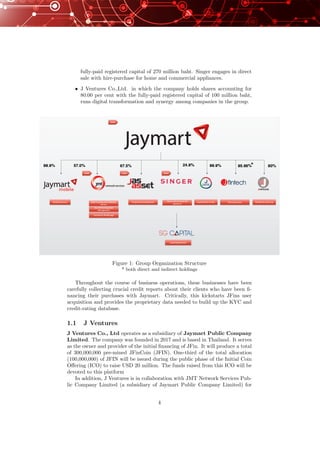
Figure 1: Group Organization Structure
* both direct and indirect holdings
Throughout the course of business operations, these businesses have been
carefully collecting crucial credit reports about their clients who have been fi-
nancing their purchases with Jaymart. Critically, this kickstarts JFins user
acquisition and provides the proprietary data needed to build up the KYC and
credit-rating database.
1.1 J Ventures
J Ventures Co., Ltd operates as a subsidiary of Jaymart Public Company
Limited. The company was founded in 2017 and is based in Thailand. It serves
as the owner and provider of the initial financing of JFin. It will produce a total
of 300,000,000 pre-mined JFinCoin (JFIN). One-third of the total allocation
(100,000,000) of JFIN will be issued during the public phase of the Initial Coin
Offering (ICO) to raise USD 20 million. The funds raised from this ICO will be
devoted to this platform
In addition, J Ventures is in collaboration with JMT Network Services Pub-
lic Company Limited (a subsidiary of Jaymart Public Company Limited) for
4
debt management and collection based in Thailand. This ensures that loan
defaults and non-performing loans (NPL) are taken care of efficiently. Credit
recovery is made through analysis and approval of proper recovery strategies
i.e. restructuring and legal proceedings.
We firmly believe that the competitive advantage of the synergy among our
subsidies will bring forth financial services that will successfully disrupt the
existing financial services in Thailand and around the globe. Crucially, it will
pioneer new approaches in extending financial inclusion to the unbanked and
underbanked in Thailand and the rest of Southeast Asia.
2 The Problem and Opportunities
Over 72% of Southeast Asias population are unbanked or underbanked lacking
access to basic financial services such as cash deposits, money transfers or loans.
The majority of the people in Indochina are no exception, and what is crucially
needed by them are basic banking services such as deposit, withdrawal, and
most importantly micro loans.
However, due to inefficiencies in the current financial system, it is too costly
for established banks to provide such services to the 72% of the population
who remain unbanked or underbanked. Further, all of this assumes that the
applicants have the documents and transaction histories required to apply for a
loan which is seldom the case for those in rural areas with poor records keeping
or migrant workers. According to the Thailand Ministry of Labour, there are
approximately 4 million migrant workers in Thailand.
The traditional loan process is slow and tedious. It requires lot of paperwork
and a long lead time from a day to a month to complete the whole process. The
process includes application, know-your-customer (KYC), credit checking, ap-
proval, and money transfer. In the worst case, after a long wait, the application
may be rejected due to various reasons.
Apart from the prolonged processes, the rejection rates for personal loan is
high. According to Ayudhya Capital Services, the personal loan rejection rate
was at 61% in September 2017. It increased from 57% in the previous month,
due to the new regulation that each person can only take personal loan from a
maximum of 3 companies at a time [3].
With limited access to the money that they need, loan applicants become
desperate and inevitably take higher risks by seeking illegal loans from so-called
loan sharks. These loan sharks mitigate their risks of non-performing loans/bad
debts is by offering loans that charge more than 150% in interest per year which
puts good borrowers at the receiving end while bad borrowers escape through
vaious means. As a result, the household debt in Thailand has been increasing
every year. According to Kasikorn Research Center, household debt in Thailand
is more than 16 trillion baht (0.5 trillion USD)[11].
Additionally, the interest rate gap in financing markets is vast, due to the
fact that banks offer low interest rates for savings account but take high interest
rates for loans. In Thailand, deposit and bond interest rate can be as low as
0.5% per year, compared to the interest rate for a personal loan at 20-28% per
year [10]. Without a good KYC process and centralised or totally decentralised
credit rating system, banks take the most conservative approach (similar to loan
sharks) by increasing the interest rate and letting good borrowers bear the brunt
5
of this burden. The solution to this problem is to have a distributed credit rat-
ing system that builds on immutable (that cannot be faked) and distributed (so
that it can be verified by multiple parties) blockchain technology. Creditworthy
borrowers should get a better loan interest rate whereas lenders should receive
a better return on investment. Decentralized lending bridges the gap by pro-
viding the possibility of creditworthy borrowers to meet lenders on an agreeable
contract, with the blockchain serving as a means of ensuring creditworthiness.
6
3 Design Approach
The challenge that arises from providing services to the unbanked and under-
banked is the low value of individual transactions, but large volume of transac-
tions which incurs high costs for financial service providers. Therefore, a good,
new low transaction cost technology is needed to facilitate the provision of this
service. Blockchain technology is exactly the means of facilitating this:
• The users (lenders and borrowers) personal information are distributed
and stored on individual ERC-20 compliance wallets (devices) and hence
reduces the need for the costs associated with centralized database (from
DBMS to servers to bandwidth and hosting services)
• Immutable blockchain maintains information integrity and yet without the
need for central custodian service and the cost associated with it.
• Transaction costs within the ecosystem is borne by the individual initiating
and executing the transaction and hence remove the cost associated with
maintaining a centralised transaction system
• Removal of ATM and physical tellers for greater cost saving.
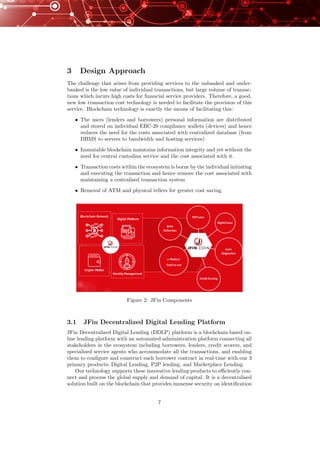
Figure 2: JFin Components
3.1 JFin Decentralized Digital Lending Platform
JFin Decentralized Digital Lending (DDLP) platform is a blockchain-based on-
line lending platform with an automated administration platform connecting all
stakeholders in the ecosystem including borrowers, lenders, credit scorers, and
specialized service agents who accommodate all the transactions, and enabling
them to configure and construct each borrower contract in real-time with our 3
primary products; Digital Lending, P2P lending, and Marketplace Lending.
Our technology supports these innovative lending products to efficiently con-
nect and process the global supply and demand of capital. It is a decentralised
solution built on the blockchain that provides immense security on identification
7
and privacy. There is no risk of losing the customer contract as the contract
is saved on a distributed ledger by the use of smart contract technology on
blockchain. JFin DDLP Platform consisted of 8 components:
• Loan Origination provides and facilitates borrower credit request within
predefined parameters.
• Credit Assessment and Scoring provides a credit score for each bor-
rower based on various factors, such as historical loan records, personal
finance, social interaction, etc. It is calculated from our proprietary data,
which includes online/offline transactions and behavioural traces.
• Lending Products provides extensive lending products to match with
borrowers requirement including
Digital Lending an online lending Services from JFin that harnesses
the power of e-signatures, e-KYC, and e-Consent*.
P2P Lending a perfect peer-to-peer platform where borrower can
meet lender instantly around the world*.
Marketplace Lending an online marketplace where borrower can
check and compare all the offer from all financial institutes and/or indi-
viduals.
• Loan Repayment Management provides an automatic loan payment
calculator to work out repayment figures for each loan.
• Debt Collection provides a process of pursuing payment of debts owed
by lenders under Thailands debt collection act.
• The JFin Identity provides Know Your Customers (KYC) process to
verify both borrowers and Lenders identity and authenticity.
• The Wallet Management provides an all-in-one digital wallet that fa-
cilitates money stores, transfers, requests, and purchasing items on stores.
• The JFin Blockchain Network provides a mean to record and execute
transactions on the network in a verifiable and permanent way.
Remark: * subjected to delay due to regulations and acquiring licensing.
8
Figure 3: JFin Ecosystem
3.1.1 Loan Origination
Loan Origination is a process by which a borrower applies for a new loan, which
typically includes the series of steps taken by the lender/bank from the point the
customer shows interest in a loan product all the way to disbursal of the funds.
The JFin Loan Origination platform will allow borrowers to complete documents
digitally, make online payments, and view their loan status at anytime during
the process.
3.1.2 Credit Scoring
The evaluation of individual loan requests is performed automatically via credit
scoring technique. Each borrower will be determined by the weight and calcula-
tions from the information given as well as their past financial and non-financial
records from other sources, such as payment history, social network interaction,
transaction history in JFin’s DDLP, etc. The information inputs are used for
calculating a maximum total credit limit, interest rate for a specific loan request,
and payment terms. Criteria for calculation of creditworthy of the borrowers
are determined dynamically by machine learning techniques.
Furthermore, as Jaymart has been in the space of consumer sales and finance
for decades, it has collected sufficient data on the ability of repayment for many
individuals (Jaymart customers). This is data that is uniquely Jaymarts and
allows it to develop a non-traditional credit scoring model. With the inclusion of
mobile top up history data, coupled with state-of-the-art machine learning algo-
rithms to better predict their ability for repayment, these individuals now have
their own credit-worthiness encoded in the blockchain, supported by their own
sound data analytics on their historical repayment capabilities, thus allowing
them to borrow effectively at lower interest rates.
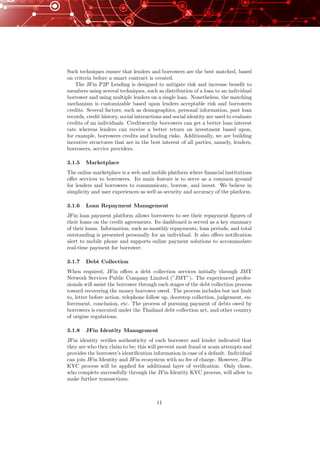
Several machine learning and statistics techniques are used to evaluate indi-
vidual credit scoring, for example, k-nearest neighbors-classifier, logistic classi-
fier, and random forest [6][5][7]. We performed back-testings by sampling credit
9
data from our customers, in a figure of hundred thousand, to evaluate techniques
and models. Additionally, several hundred factors are used for this evaluation.
The result of back-testing indicated that the random decision forests technique
yields the prominent result. Nevertheless, fine tuning algorithms and models is
taken place and re-evaluate models every month. The best model can change
over time. The more data feeds into the machine learning, the better prediction
of outcome and lower the odd is. We run several machine learning techniques
simultaneously, continuously perform evaluation, and adjust the models. This
is the key for the best credit scoring component.
Figure 4: Example of data sampling model result
3.1.3 Digital Lending
Loan or lending process, including Inquiry, Apply, Cashing, and Return/Collection,
can be executed and processed digitally with cost-effective and timely manner.
The improvement includes several aspects to enhance user experience while in-
crease accuracy. By introducing a mobile application, loan application, inquiry
of application progress, outstanding balances, and due date all can be done
at customers fingertips. Know-your-customer (KYC) process and anti-money
laundering (AML) process, regulated by Bank of Thailand (BoT), are also per-
formed in electronic manner, where a digital photograph of citizen ID card along
with applicants face could be used to validate the KYC process.
3.1.4 P2P Lending
Crowd lending is the next step toward sustainable ecosystem where lenders and
borrowers negotiate and agree on a contract on the JFin decentralized network.
Due to digital transformation on the loaning system, the whole process can be
done in friction-less manner. Multiple lenders are investors who invest and gain
profits from interest from the borrowers based on risks taken. Artificial intel-
ligence and machine learning help analyze loans and credits of the borrowers.
10
Such techniques ensure that lenders and borrowers are the best matched, based
on criteria before a smart contract is created.
The JFin P2P Lending is designed to mitigate risk and increase benefit to
members using several techniques, such as distribution of a loan to an individual
borrower and using multiple lenders on a single loan. Nonetheless, the matching
mechanism is customizable based upon lenders acceptable risk and borrowers
credits. Several factors, such as demographics, personal information, past loan
records, credit history, social interactions and social identity are used to evaluate
credits of an individuals. Creditworthy borrowers can get a better loan interest
rate whereas lenders can receive a better return on investment based upon,
for example, borrowers credits and lending risks. Additionally, we are building
incentive structures that are in the best interest of all parties, namely, lenders,
borrowers, service providers.
3.1.5 Marketplace
The online marketplace is a web and mobile platform where financial institutions
offer services to borrowers. Its main feature is to serve as a common ground
for lenders and borrowers to communicate, borrow, and invest. We believe in
simplicity and user experiences as well as security and accuracy of the platform.
3.1.6 Loan Repayment Management
JFin loan payment platform allows borrowers to see their repayment figures of
their loans on the credit agreements. Its dashboard is served as a key summary
of their loans. Information, such as monthly repayments, loan periods, and total
outstanding is presented personally for an individual. It also offers notification
alert to mobile phone and supports online payment solutions to accommodate
real-time payment for borrower.
3.1.7 Debt Collection
When required, JFin offers a debt collection services initially through JMT
Network Services Public Company Limited (”JMT”). The experienced profes-
sionals will assist the borrower through each stages of the debt collection process
toward recovering the money borrower owed. The process includes but not limit
to, letter before action, telephone follow up, doorstep collection, judgement, en-
forcement, conclusion, etc. The process of pursuing payment of debts owed by
borrowers is executed under the Thailand debt collection act, and other country
of origins regulations.
3.1.8 JFin Identity Management
JFin identity verifies authenticity of each borrower and lender indicated that
they are who they claim to be; this will prevent most fraud or scam attempts and
provides the borrower’s identification information in case of a default. Individual
can join JFin Identity and JFin ecosystem with no fee of charge. However, JFin
KYC process will be applied for additional layer of verification. Only those,
who complete successfully through the JFin Identity KYC process, will allow to
make further transactions.
11
The users of JFin are needed to provides KYC documents registered in a
digital form. All the information will be confidentially retained. The informa-
tion will be used to calculate credit scoring once required. The KYC procedures
are a critical function to assess and monitor customer risk and a legal require-
ment to comply with Anti-Money Laundering (AML) laws. After complete the
process, the Wallet ID will then be created.
3.1.9 JFin Wallet Management
JFin Wallet will be created for individual after JFin KYC is completed. It is a
secured digital wallet that holds an amount of funds that allows to be used to
purchase in store, cash out, or pay utility services.
The mobile application includes a JFin wallet that can be used to securely
hold money in various currencies. It has an ability to perform an international
money transfers, simple payments, fast withdrawal payouts and instant online
payments with low fees through the blockchain network.
Money return and collection according to loan terms are done via JFin Wallet
by top-up money back to the wallet prior to the due date. The blockchain
contract will enforce money transfer back automatically via blockchain network.
In case of NPL or loan defaults, debt collection agents will perform necessary
procedures to recover funds that are past due or accounts that are in default,
according to the Debt Collection Act.
3.1.10 JFin Decentralized Network
The JFin Decentralized Network (JDN) is a layer built on top of the blockchain.
The blockchain technology serves as a decentralized and distributed digital
ledger that records every transactions between two parties in the network in
a verifiable and permanent way [1] [8]. Once records are written in the block of
data, they cannot be altered retroactively without the alteration of all blocks
prior to the current block. Blockchains are secure by design and are an ex-
ample of a distributed computing system with high Byzantine fault tolerance.
Decentralized consensus has therefore been achieved with a blockchain[12].
We implement smart contracts in order to operate a lending service. Smart
Contracts are self-executing contracts written into lines of code to ensure the
terms and agreement between two parties. The code and the agreement are
contained and distributed in the JDN network. Smart Contracts allow transac-
tions and agreements to be carried out in a trust manner on trust-less networks
and parties. They deliver transactions with transparency, trace-ability, and
permanence[13].
We will use Tendermint or other proof-of-stake algorithms as a consensus
engine in the JDN that enables Byzantine fault tolerance on machines spread
across the globe, with strong security guarantees [4]. One possible example
is the use of Tendermint. Tendermint consensus algorithm provides benefit
such as speed, security, and scalability, as opposed to using Proof-Of-Work
systems, [2] [9]. Tendermint blocks can commit to finality in the order of 1
second. TendermintCore can handle transaction volume at the rate of 10,000
transactions per second for 250byte transactions. The algorithm can scale to
hundreds or thousands of validators unlike Proof-Of-Work technique [4].
12
Monetary exchanges are done in this network through the smart contract.
Transactions made on JDN are secure, audit-able and publicly verifiable on the
blockchain network. The JFinCoin is a crypto-token that is used internally. It
is an utility token, which is a fuel and circulated inside the JDN network. The
small transaction fee is taken from the successful transaction and is delivered
to the JDN Network in a form of JFinCoin. For the convenience of JFinCoin
holders , JFinCoin can be traded into fiat (e.g. US Dollars) or other cryp-
tocurrencies freely in external crypto-token market places, which are out of our
control, such as, TDAX, bx.in.th, etc.
3.2 JFin Flow Scenario
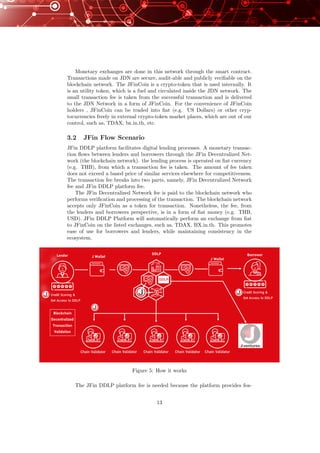
JFin DDLP platform facilitates digital lending processes. A monetary transac-
tion flows between lenders and borrowers through the JFin Decentralized Net-
work (the blockchain network). the lending process is operated on fiat currency
(e.g. THB), from which a transaction fee is taken. The amount of fee taken
does not exceed a based price of similar services elsewhere for competitiveness.
The transaction fee breaks into two parts, namely, JFin Decentralized Network
fee and JFin DDLP platform fee.
The JFin Decentralized Network fee is paid to the blockchain network who
performs verification and processing of the transaction. The blockchain network
accepts only JFinCoin as a token for transaction. Nonetheless, the fee, from
the lenders and borrowers perspective, is in a form of fiat money (e.g. THB,
USD). JFin DDLP Platform will automatically perform an exchange from fiat
to JFinCoin on the listed exchanges, such as, TDAX, BX.in.th. This promotes
ease of use for borrowers and lenders, while maintaining consistency in the
ecosystem.
Figure 5: How it works
The JFin DDLP platform fee is needed because the platform provides fea-
13
tures and functions benefiting to lending processes, such as, E-KYC, E-Consent,
unique and accurate credit scoring, web and mobile applications, E-Wallet, and
JFin Identity Management. It is inevitable that the platform needs to take fee
for such operations and for further improvements of the services. However, this
subject matter is very sensitive. We firmly assure that only reasonable amount
for service fee is introduced.
We present use-cases separated by each party, namely:
• Lender provides sources of fund, in return, he/she receives an interest
based upon an agreed interest rate. Risk management have to be consid-
ered to lend the fund.
• Borrower goes through E-KYC and E-Consent processes, then proceed
to create E-Wallet on which cash in and out can be performed. After
that, he/she can apply for loan on the JFin DDLP platform. The credit
limit, interest rate of specific loan is automatically calculated by credit
scoring in the platform. In case of loan default or non-performing loan,
debt collection services will take place immediately.
• Blockchain network (JFin Decentralized Network) processes any trans-
action that occurred from lenders to borrowers or vice-versa. Transaction
fee is a fuel to run the distributed network. A proof-of-stake algorithm, or
similar, will used as a consensus protocol on which who will process the
next batch (Block) of transactions.
14
4 Token Sale and Distribution
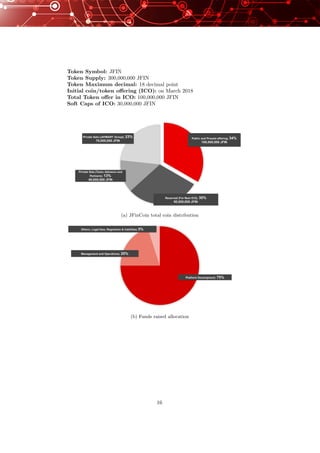
There is a total of 300,000,000 JFIN token supplied and all of them is pre-mined.
34 percent of the JFin (100,000,000 JFIN) is issued for initial public offering
(ICO) sale. The amount of funds raise on the ICO period will be allocated in
this manner:
• 75% will be used for platform development. It includes technology invest-
ments such as blockchain network, improved credit scoring, crypto-wallet,
big data analysis, mergers and acquisitions, development human resources,
to name a few.
• 20% will be for managements, operations, researches, and marketing cam-
paigns.
• 5% will be spent on others activities, legal and regulation fee.
We propose to manage 30 percent of the JFin (90,000,000 JFIN). It is
reserved for future uses, one possible use is a use for a next ICO with a new
technology development that benefits to JFinCoin Ecosystem. We assure that
this amount of JFinCoin tokens will only be used for promised services improve-
ments, introducing new products or services on the similar pipeline, to name a
few. Nonetheless, we concern the use of the reserved token. We will spend these
tokens only for the benefit of the ecosystem as a whole. This amount is locked
up until 1 October 2019.
We propose to manage 13 percent of the JFin (40,000,000 JFIN). It is
purchased by team members, advisors, and partners. This amount is locked up
until 1 October 2019.
We propose to manage 23 percent of the JFin (70,000,000 JFIN). It is a
private sale for purchasing by Jaymart Group and its subsidies.
• 7 % percent of the JFin (20,000,000 JFIN) is locked up until 1 October
2018.
• 16 % percent of the JFin (50,000,000 JFIN) is locked up until 1 October
2019.
The amount of JFinCoin leftover belongs to issuer, i.e., J Ventures Co., Ltd.
This allocation is subject to change based upon business directions and regula-
tions.
15
Token Symbol: JFIN
Token Supply: 300,000,000 JFIN
Token Maximum decimal: 18 decimal point
Initial coin/token offering (ICO): on March 2018
Total Token offer in ICO: 100,000,000 JFIN
Soft Caps of ICO: 30,000,000 JFIN
(a) JFinCoin total coin distribution
(b) Funds raised allocation
16
5 Team
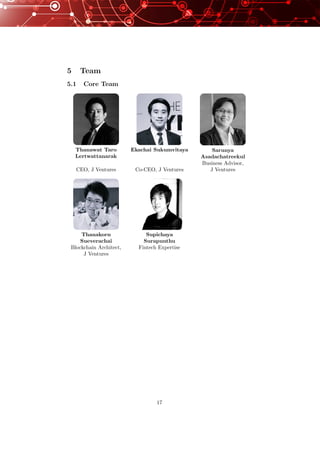
5.1 Core Team
Thanawat Taro
Lertwattanarak
CEO, J Ventures
Ekachai Sukumvitaya
Co-CEO, J Ventures
Sarunya
Asadachatreekul
Business Advisor,
J Ventures
Thanakorn
Sueverachai
Blockchain Architect,
J Ventures
Supichaya
Surapunthu
Fintech Expertise
17
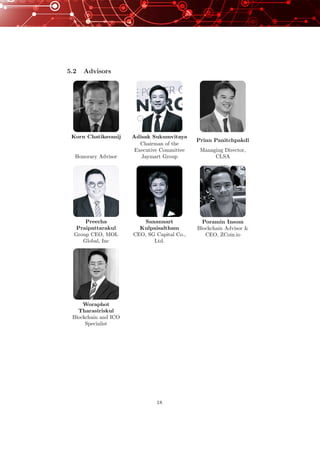
5.2 Advisors
Korn Chatikavanij
Honorary Advisor
Adisak Sukumvitaya
Chairman of the
Executive Committee
Jaymart Group
Prinn Panitchpakdi
Managing Director,
CLSA
Preecha
Praipattarakul
Group CEO, MOL
Global, Inc
Sanannart
Kulpaisaltham
CEO, SG Capital Co.,
Ltd.
Poramin Insom
Blockchain Advisor &
CEO, ZCoin.io
Woraphot
Tharasiriskul
Blockchain and ICO
Specialist
18
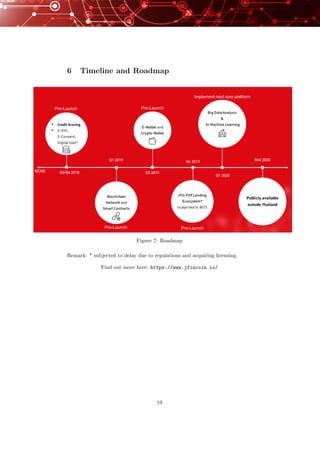
6 Timeline and Roadmap
Figure 7: Roadmap
Remark: * subjected to delay due to regulations and acquiring licensing.
Find out more here: https://www.jfincoin.io/
19
7 Potential Risks
7.1 Regulatory risks
The blockchain technology, including the issue of tokens and its usage, is a
brand-new concept in jurisdictions. Current regulations may not cover every
aspects of this emerging technologies. As a result, introducing new regulations
regarding blockchain technology may occur, as such may conflict with the JFin
Smart Contract setup. This may result in change of the JFin Smart Contract,
including but not limited to the loss of JFin Tokens.
J Ventures Co., Ltd is a subsidiary of Jaymart Public Company Limited
and operates under Thailand laws and regulations. The compliance of such will
absolutely be maintained. We are under the monitor of The Stock Exchange
of Thailand (SET) and The Securities and Exchange Commission, Thailand
(SEC). Additionally, E-KYC, E-Consent, and Digital loan are also subjected to
regulations and licensing acquirability. Although peer-to-peer lending is under
revision of the Bank of Thailands regulations, it is expected to be effective in
the very near future.
At the time of JFinCoin Initial Coin Offering (ICO), the Securities and Ex-
change Commission (SEC) in Thailand is currently in the process of drafting
and implementing regulations regarding initial coin offerings. When the regu-
lation has been enforced, the compliance of such regulations will be considered
to be maintained.
7.2 Value of JFinCoin
Once purchased, the value of JFinCoin may fluctuate due to various reasons.
We do not guarantee any specific value of the coin at any specific time. We shall
not be held responsible for any change in value of the JFinCoin. The value may
vary based on, but not limit to, supply and demand of services, judgments about
its future economic, competitive and market conditions, and business decisions.
These significant uncertainties are beyond the control of the JFin team, as the
results, it is difficult or impossible to accurately forecast its future value. Thus,
the forward-looking information contained herein should not be interpreted as
a warranty on the part of J Ventures or any other entities. Nevertheless, we
believe that assumptions underlying outlook statements are reasonable.
7.3 Other risks
Please note that the JFin project may be subject to other risks that are not
foreseen at this time.
20
8 Disclaimer
PLEASE READ THIS DISCLAIMER SECTION CAREFULLY. IF YOU ARE
IN ANY DOUBT AS TO THE ACTION YOU SHOULD TAKE, YOU SHOULD
CONSULT YOUR LEGAL, FINANCIAL, TAX, OR OTHER PROFESSIONAL
ADVISOR(S).
The information in this document is subject to change or update without
notice and should not be construed as a commitment by us. This document is
for informational purposes only and does not constitute an offer or solicitation to
sell shares or securities. Any such offer or solicitation will be made only by means
of a confidential offering memorandum and in accordance with the terms of all
applicable securities and other laws. The information set forth below may not be
exhaustive and does not imply any elements of a contractual relationship. While
we make every effort to ensure that any material in this document is accurate
and up to date, such material in no way constitutes the provision of professional
advice. We do not guarantee, and accepts no legal liability whatsoever arising
from or connected to, the accuracy, reliability, currency, or completeness of
any material contained in this document. Investors and potential token holders
should seek appropriate independent professional advice prior to relying on or
entering into any commitment or transaction based on, material published in
this document, which material is purely published for reference purposes alone.
There are risks and uncertainties associated with the respective businesses
and operations, the tokens, and the Initial Token Sale activities. This document,
any part thereof and any copy thereof must not be taken or transmitted to
any country where distribution or dissemination of Token Sale or Initial Coin
Offering like the one described in this document is prohibited or restricted. The
tokens are not intended to constitute securities in any jurisdiction. Therefore,
this document cannot constitute a prospectus or offer document for investment
in securities. This document does not constitute or form part of any opinion
on any advice to sell, or any solicitation of any offer to purchase any tokens or
give any help in any investment decision. We will not be intended to constitute
securities in any jurisdiction. This document does not constitute a prospectus
or offer document of any sort and is not intended to constitute an offer of
securities or a solicitation for investment in securities in any jurisdiction. We do
not provide any opinion on any advice to purchase, sell, or otherwise transact
with tokens and the fact of presentation of this document shall not form the basis
of, or be relied upon in connection with, any contract or investment decision.
No person is bound to enter into any contract or binding legal commitment in
relation to the sale and purchase of tokens, and no cryptocurrency or other form
of payment is to be accepted on the basis of this document.
IMPORTANT
You are not eligible and you are not to purchase any tokens if you are a
citizen or resident (tax or otherwise) of the People’s Republic of China (”PRC”),
or the United States of America. Furthermore because of current regulatory
uncertainty and before additional information is publicly released on the matter,
green card holders of the United States or citizens or residents (tax or otherwise)
of the UnitedStates of America, or China, or other U.S., Person or PRC Person,
are not eligible to register as Continuous Contributors. That limits the ability
of U.S., PRC persons to utilize tokens and participate in the future development
of the Platform as well as in the distribution of proceeds.
21
9 Conclusion
The JFin ecosystem is a means of reaching out to the 400 million unbanked
and underbanked in Thailand and the rest of Southeast Asia, to provide them
with sorely needed financial services. These financial services are a crucial step
in their upward mobility as the existing financial system finds it too costly to
service them.
Using Blockchain technology, JFin is able to provide the distributed banking
services to help these unbanked and underbanked, and build a profitable busi-
ness with this social need. Starting from loans that provide fair interest rates
to good borrowers, JFin will be able to overcome the approximately 60
To realize this good and grand vision, JFin is issuing 100m JFIN to raise
USD 20M for development and role out of the system in Thailand. The JFIN
is a utility for JFin system that not only fuels the system but also encourages
the mass participation that supports the P2P microloans and other financial
services that uplift the unbanked and underbanked.
In summary, we urge you to support the ICO of JFIN, so that together we
can create a sustainable and supportive financial system for the unbanked and
underbanked in Thailand. Lifting them out of their current economic difficulties,
and building a more cohesive society.
I urge you to support the JFIN ICO, so that we can build and serve those
who need this the most, and move towards a better and cohesive Thailand 4.0.
Please express your interest to participate and whitelist yourself at https:
//www.jfincoin.io/
10 Acknowledgements
Thanks to ICORA Team for input and feedback to this paper.
22
References
[1] Blockchain. Investopedia URL: https://www.investopedia.com/terms/b/blockchain.asp.
Retrieved 2017-01-01.
[2] Byzantine consensus algorithm. URL:
https://github.com/tendermint/tendermint/wiki/Byzantine-Consensus-
Algorithm. Retrieved 2017-12-01.
[3] Personal loan rejection rate soars from new regulation from bot. URL:
https://www.posttoday.com/economy/finance/514932. Retrieved 2017-12-
01.
[4] Tendermint. URL: https://github.com/tendermint/tendermint/wiki/. Re-
trieved 2017-12-01.
[5] N. S. Altman. An introduction to kernel and nearest-neighbor nonpara-
metric regression. The American Statistician, 46(3):175–185, August 1992.
[6] David A. Freedman. Statistical Models: Theory and Practice. Cambridge
University Press, 2009.
[7] Tin Kam Ho. Random decision forests. Proceedings of the 3rd International
Conference on Document Analysis and Recognition, Montreal, QC 14-16,
page 278282., 1995.
[8] Karim R. Iansiti, Marco; Lakhani. The truth about blockchain, January
2017.
[9] Jae Kwon. Tendermint: Consensus without mining. Draft v. 0.6, fall, 2014.
[10] Bank of Thailand. Interest rate statistic. URL:
https://www.bot.or.th/thai/statistics/ layouts/application/interest rate/in rate.aspx.
Retrieved 2017-12-01.
[11] The Secretariat of the House of Representatives. Loan shark issues and
way to overcome. Hot Issue, 2016.
[12] Siraj Raval. Decentralized Applications: Harnessing Bitcoin’s Blockchain
Technology. O’Reilly Media, Inc., 2016.
[13] Melanie Swan. Blockchain: Blueprint for a New Economy. O’Reilly Media,
Inc., 2015.
23
Jfincoin whitepaper

Jfincoin whitepaper

  • 2.
    JFinCoin - DecentralizedDigital Lending Platform and Ecosystem Whitepaper Version 1.0a JFin Team JFinCoin@jventures.co.th 30 January 2018 Abstract Over 72% of Southeast Asias population are unbanked or underbanked lacking access to basic financial services such as cash deposits, money transfers or loans. The majority of the people in Indochina are no ex- ception, and what is crucially needed by them are basic banking ser- vices such as deposit, withdrawal, and most importantly micro loans. However, due to inefficiencies in the current financial system, it is too costly for established banks to provide such services to the 72% of the population who remain unbanked or underbanked. While the situation in Thailand is better, there still remains a significant proportion of the population who fall under this category. J Ventures introduces the JFin ecosystem, which includes a platform and a decentralized blockchain net- work. JFins sole purpose is to bring much needed banking services to them, starting from peer-to-peer micro loans. JFins Decentralized Digital Lending Platform (DDLP) has the potential to overcome this challenge with blockchain technology and the digital transformation of loan pro- cesses. Through the blockchain, a decentralized peer-to-peer network can be built to replace the existing centralised system and enable frictionless peer-to-peer transfers. Smart contracts will be used along with Proof-of- Stake mechanism e.g. Tendermint will ensure backers are rewarded for their support. To realise this vision of an ecosystem of financial services that benefit the unbanked and underbanked, JFin is conducting an Initial Coin Offering (ICO) of 100 million pre-mined JFin Coins (JFIN) to raise US$20 million. The JFIN is a utility for JFin system that not only fuels the system but also encourages the mass participation that supports the P2P microloans and other financial services that uplift the unbanked and underbanked. The ICO pre-sales start on 14 February 2018, while the public sale will be on 1 March 2018. Please sign up now for the sale at https://www.jfincoin.io/ Keywords: decentralized digital lending, lend-loan ecosystem, peer-to-peer lending, personal finance, credit scoring, blockchain, smart contract, mobile payment. 2
  • 3.
    1 Company Profile JaymartPublic Company Limited was founded in 1988 by Mr. Adisak Sukumvitaya and Miss. Yuvadee Pong-acha. Initially, it was only selling elec- trical appliances through financial installments. The Company later penetrated into markets with major products including television, VCR, air conditioner, mobile phone, and related products. However in 1997, the company turned its focus into selling mobile phones and started to expand its retail presence throughout Thailand. Finally in 2010, the company was listed in the Stock Ex- change of Thailand (SET). Currently, its subsidiaries include businesses of debt management and collection, financial leasing and lending, asset management, and others. There are 6 subsidiaries and 1 associated company carrying out their business as follows: • Jaymart Mobile Co., Ltd (”Jaymart Mobile”) in which the company holds shares accounting for 99.99 percent with the the fully-paid registered cap- ital of 480 million baht as of 31 December 2016. The Company engages in selling mobile phones and accessories as both retailer and wholesaler. Currently, Jaymart Mobile is the core company of Jaymart PCL. • JMT Network Services Public Company Limited (”JMT”) in which the company holds shares accounting for 57.0 per cent with the paid-up capital of 390.9 million baht. JMT engages in debt management and collection and also provides finance leasing services and consumer lendings. • JAS Asset Public Limited Company in which the company holds shares ac- counting for 67.50 per cent with the fully-paid registered capital of 370.39 million baht. • J Fintech Co., Ltd in which the company holds shares accounting for 95.66 per cent with the fully-paid registered capital of 1,220 million baht, engages leasing and consumer lendings. • J Capital Co., Ltd in which the company holds shares accounting for 99.99 per cent with the fully-paid registered capital of 81 million baht, runs a business relating to investment. • Singer Thailand Public Company Limited (”Singer”) in which the com- pany holds shares as an associated company for 24.9 per cent with the 3
  • 4.
    fully-paid registered capitalof 270 million baht. Singer engages in direct sale with hire-purchase for home and commercial appliances. • J Ventures Co.,Ltd. in which the company holds shares accounting for 80.00 per cent with the fully-paid registered capital of 100 million baht, runs digital transformation and synergy among companies in the group. Figure 1: Group Organization Structure * both direct and indirect holdings Throughout the course of business operations, these businesses have been carefully collecting crucial credit reports about their clients who have been fi- nancing their purchases with Jaymart. Critically, this kickstarts JFins user acquisition and provides the proprietary data needed to build up the KYC and credit-rating database. 1.1 J Ventures J Ventures Co., Ltd operates as a subsidiary of Jaymart Public Company Limited. The company was founded in 2017 and is based in Thailand. It serves as the owner and provider of the initial financing of JFin. It will produce a total of 300,000,000 pre-mined JFinCoin (JFIN). One-third of the total allocation (100,000,000) of JFIN will be issued during the public phase of the Initial Coin Offering (ICO) to raise USD 20 million. The funds raised from this ICO will be devoted to this platform In addition, J Ventures is in collaboration with JMT Network Services Pub- lic Company Limited (a subsidiary of Jaymart Public Company Limited) for 4
  • 5.
    debt management andcollection based in Thailand. This ensures that loan defaults and non-performing loans (NPL) are taken care of efficiently. Credit recovery is made through analysis and approval of proper recovery strategies i.e. restructuring and legal proceedings. We firmly believe that the competitive advantage of the synergy among our subsidies will bring forth financial services that will successfully disrupt the existing financial services in Thailand and around the globe. Crucially, it will pioneer new approaches in extending financial inclusion to the unbanked and underbanked in Thailand and the rest of Southeast Asia. 2 The Problem and Opportunities Over 72% of Southeast Asias population are unbanked or underbanked lacking access to basic financial services such as cash deposits, money transfers or loans. The majority of the people in Indochina are no exception, and what is crucially needed by them are basic banking services such as deposit, withdrawal, and most importantly micro loans. However, due to inefficiencies in the current financial system, it is too costly for established banks to provide such services to the 72% of the population who remain unbanked or underbanked. Further, all of this assumes that the applicants have the documents and transaction histories required to apply for a loan which is seldom the case for those in rural areas with poor records keeping or migrant workers. According to the Thailand Ministry of Labour, there are approximately 4 million migrant workers in Thailand. The traditional loan process is slow and tedious. It requires lot of paperwork and a long lead time from a day to a month to complete the whole process. The process includes application, know-your-customer (KYC), credit checking, ap- proval, and money transfer. In the worst case, after a long wait, the application may be rejected due to various reasons. Apart from the prolonged processes, the rejection rates for personal loan is high. According to Ayudhya Capital Services, the personal loan rejection rate was at 61% in September 2017. It increased from 57% in the previous month, due to the new regulation that each person can only take personal loan from a maximum of 3 companies at a time [3]. With limited access to the money that they need, loan applicants become desperate and inevitably take higher risks by seeking illegal loans from so-called loan sharks. These loan sharks mitigate their risks of non-performing loans/bad debts is by offering loans that charge more than 150% in interest per year which puts good borrowers at the receiving end while bad borrowers escape through vaious means. As a result, the household debt in Thailand has been increasing every year. According to Kasikorn Research Center, household debt in Thailand is more than 16 trillion baht (0.5 trillion USD)[11]. Additionally, the interest rate gap in financing markets is vast, due to the fact that banks offer low interest rates for savings account but take high interest rates for loans. In Thailand, deposit and bond interest rate can be as low as 0.5% per year, compared to the interest rate for a personal loan at 20-28% per year [10]. Without a good KYC process and centralised or totally decentralised credit rating system, banks take the most conservative approach (similar to loan sharks) by increasing the interest rate and letting good borrowers bear the brunt 5
  • 6.
    of this burden.The solution to this problem is to have a distributed credit rat- ing system that builds on immutable (that cannot be faked) and distributed (so that it can be verified by multiple parties) blockchain technology. Creditworthy borrowers should get a better loan interest rate whereas lenders should receive a better return on investment. Decentralized lending bridges the gap by pro- viding the possibility of creditworthy borrowers to meet lenders on an agreeable contract, with the blockchain serving as a means of ensuring creditworthiness. 6
  • 7.
    3 Design Approach Thechallenge that arises from providing services to the unbanked and under- banked is the low value of individual transactions, but large volume of transac- tions which incurs high costs for financial service providers. Therefore, a good, new low transaction cost technology is needed to facilitate the provision of this service. Blockchain technology is exactly the means of facilitating this: • The users (lenders and borrowers) personal information are distributed and stored on individual ERC-20 compliance wallets (devices) and hence reduces the need for the costs associated with centralized database (from DBMS to servers to bandwidth and hosting services) • Immutable blockchain maintains information integrity and yet without the need for central custodian service and the cost associated with it. • Transaction costs within the ecosystem is borne by the individual initiating and executing the transaction and hence remove the cost associated with maintaining a centralised transaction system • Removal of ATM and physical tellers for greater cost saving. Figure 2: JFin Components 3.1 JFin Decentralized Digital Lending Platform JFin Decentralized Digital Lending (DDLP) platform is a blockchain-based on- line lending platform with an automated administration platform connecting all stakeholders in the ecosystem including borrowers, lenders, credit scorers, and specialized service agents who accommodate all the transactions, and enabling them to configure and construct each borrower contract in real-time with our 3 primary products; Digital Lending, P2P lending, and Marketplace Lending. Our technology supports these innovative lending products to efficiently con- nect and process the global supply and demand of capital. It is a decentralised solution built on the blockchain that provides immense security on identification 7
  • 8.
    and privacy. Thereis no risk of losing the customer contract as the contract is saved on a distributed ledger by the use of smart contract technology on blockchain. JFin DDLP Platform consisted of 8 components: • Loan Origination provides and facilitates borrower credit request within predefined parameters. • Credit Assessment and Scoring provides a credit score for each bor- rower based on various factors, such as historical loan records, personal finance, social interaction, etc. It is calculated from our proprietary data, which includes online/offline transactions and behavioural traces. • Lending Products provides extensive lending products to match with borrowers requirement including Digital Lending an online lending Services from JFin that harnesses the power of e-signatures, e-KYC, and e-Consent*. P2P Lending a perfect peer-to-peer platform where borrower can meet lender instantly around the world*. Marketplace Lending an online marketplace where borrower can check and compare all the offer from all financial institutes and/or indi- viduals. • Loan Repayment Management provides an automatic loan payment calculator to work out repayment figures for each loan. • Debt Collection provides a process of pursuing payment of debts owed by lenders under Thailands debt collection act. • The JFin Identity provides Know Your Customers (KYC) process to verify both borrowers and Lenders identity and authenticity. • The Wallet Management provides an all-in-one digital wallet that fa- cilitates money stores, transfers, requests, and purchasing items on stores. • The JFin Blockchain Network provides a mean to record and execute transactions on the network in a verifiable and permanent way. Remark: * subjected to delay due to regulations and acquiring licensing. 8
  • 9.
    Figure 3: JFinEcosystem 3.1.1 Loan Origination Loan Origination is a process by which a borrower applies for a new loan, which typically includes the series of steps taken by the lender/bank from the point the customer shows interest in a loan product all the way to disbursal of the funds. The JFin Loan Origination platform will allow borrowers to complete documents digitally, make online payments, and view their loan status at anytime during the process. 3.1.2 Credit Scoring The evaluation of individual loan requests is performed automatically via credit scoring technique. Each borrower will be determined by the weight and calcula- tions from the information given as well as their past financial and non-financial records from other sources, such as payment history, social network interaction, transaction history in JFin’s DDLP, etc. The information inputs are used for calculating a maximum total credit limit, interest rate for a specific loan request, and payment terms. Criteria for calculation of creditworthy of the borrowers are determined dynamically by machine learning techniques. Furthermore, as Jaymart has been in the space of consumer sales and finance for decades, it has collected sufficient data on the ability of repayment for many individuals (Jaymart customers). This is data that is uniquely Jaymarts and allows it to develop a non-traditional credit scoring model. With the inclusion of mobile top up history data, coupled with state-of-the-art machine learning algo- rithms to better predict their ability for repayment, these individuals now have their own credit-worthiness encoded in the blockchain, supported by their own sound data analytics on their historical repayment capabilities, thus allowing them to borrow effectively at lower interest rates. Several machine learning and statistics techniques are used to evaluate indi- vidual credit scoring, for example, k-nearest neighbors-classifier, logistic classi- fier, and random forest [6][5][7]. We performed back-testings by sampling credit 9
  • 10.
    data from ourcustomers, in a figure of hundred thousand, to evaluate techniques and models. Additionally, several hundred factors are used for this evaluation. The result of back-testing indicated that the random decision forests technique yields the prominent result. Nevertheless, fine tuning algorithms and models is taken place and re-evaluate models every month. The best model can change over time. The more data feeds into the machine learning, the better prediction of outcome and lower the odd is. We run several machine learning techniques simultaneously, continuously perform evaluation, and adjust the models. This is the key for the best credit scoring component. Figure 4: Example of data sampling model result 3.1.3 Digital Lending Loan or lending process, including Inquiry, Apply, Cashing, and Return/Collection, can be executed and processed digitally with cost-effective and timely manner. The improvement includes several aspects to enhance user experience while in- crease accuracy. By introducing a mobile application, loan application, inquiry of application progress, outstanding balances, and due date all can be done at customers fingertips. Know-your-customer (KYC) process and anti-money laundering (AML) process, regulated by Bank of Thailand (BoT), are also per- formed in electronic manner, where a digital photograph of citizen ID card along with applicants face could be used to validate the KYC process. 3.1.4 P2P Lending Crowd lending is the next step toward sustainable ecosystem where lenders and borrowers negotiate and agree on a contract on the JFin decentralized network. Due to digital transformation on the loaning system, the whole process can be done in friction-less manner. Multiple lenders are investors who invest and gain profits from interest from the borrowers based on risks taken. Artificial intel- ligence and machine learning help analyze loans and credits of the borrowers. 10
  • 11.
    Such techniques ensurethat lenders and borrowers are the best matched, based on criteria before a smart contract is created. The JFin P2P Lending is designed to mitigate risk and increase benefit to members using several techniques, such as distribution of a loan to an individual borrower and using multiple lenders on a single loan. Nonetheless, the matching mechanism is customizable based upon lenders acceptable risk and borrowers credits. Several factors, such as demographics, personal information, past loan records, credit history, social interactions and social identity are used to evaluate credits of an individuals. Creditworthy borrowers can get a better loan interest rate whereas lenders can receive a better return on investment based upon, for example, borrowers credits and lending risks. Additionally, we are building incentive structures that are in the best interest of all parties, namely, lenders, borrowers, service providers. 3.1.5 Marketplace The online marketplace is a web and mobile platform where financial institutions offer services to borrowers. Its main feature is to serve as a common ground for lenders and borrowers to communicate, borrow, and invest. We believe in simplicity and user experiences as well as security and accuracy of the platform. 3.1.6 Loan Repayment Management JFin loan payment platform allows borrowers to see their repayment figures of their loans on the credit agreements. Its dashboard is served as a key summary of their loans. Information, such as monthly repayments, loan periods, and total outstanding is presented personally for an individual. It also offers notification alert to mobile phone and supports online payment solutions to accommodate real-time payment for borrower. 3.1.7 Debt Collection When required, JFin offers a debt collection services initially through JMT Network Services Public Company Limited (”JMT”). The experienced profes- sionals will assist the borrower through each stages of the debt collection process toward recovering the money borrower owed. The process includes but not limit to, letter before action, telephone follow up, doorstep collection, judgement, en- forcement, conclusion, etc. The process of pursuing payment of debts owed by borrowers is executed under the Thailand debt collection act, and other country of origins regulations. 3.1.8 JFin Identity Management JFin identity verifies authenticity of each borrower and lender indicated that they are who they claim to be; this will prevent most fraud or scam attempts and provides the borrower’s identification information in case of a default. Individual can join JFin Identity and JFin ecosystem with no fee of charge. However, JFin KYC process will be applied for additional layer of verification. Only those, who complete successfully through the JFin Identity KYC process, will allow to make further transactions. 11
  • 12.
    The users ofJFin are needed to provides KYC documents registered in a digital form. All the information will be confidentially retained. The informa- tion will be used to calculate credit scoring once required. The KYC procedures are a critical function to assess and monitor customer risk and a legal require- ment to comply with Anti-Money Laundering (AML) laws. After complete the process, the Wallet ID will then be created. 3.1.9 JFin Wallet Management JFin Wallet will be created for individual after JFin KYC is completed. It is a secured digital wallet that holds an amount of funds that allows to be used to purchase in store, cash out, or pay utility services. The mobile application includes a JFin wallet that can be used to securely hold money in various currencies. It has an ability to perform an international money transfers, simple payments, fast withdrawal payouts and instant online payments with low fees through the blockchain network. Money return and collection according to loan terms are done via JFin Wallet by top-up money back to the wallet prior to the due date. The blockchain contract will enforce money transfer back automatically via blockchain network. In case of NPL or loan defaults, debt collection agents will perform necessary procedures to recover funds that are past due or accounts that are in default, according to the Debt Collection Act. 3.1.10 JFin Decentralized Network The JFin Decentralized Network (JDN) is a layer built on top of the blockchain. The blockchain technology serves as a decentralized and distributed digital ledger that records every transactions between two parties in the network in a verifiable and permanent way [1] [8]. Once records are written in the block of data, they cannot be altered retroactively without the alteration of all blocks prior to the current block. Blockchains are secure by design and are an ex- ample of a distributed computing system with high Byzantine fault tolerance. Decentralized consensus has therefore been achieved with a blockchain[12]. We implement smart contracts in order to operate a lending service. Smart Contracts are self-executing contracts written into lines of code to ensure the terms and agreement between two parties. The code and the agreement are contained and distributed in the JDN network. Smart Contracts allow transac- tions and agreements to be carried out in a trust manner on trust-less networks and parties. They deliver transactions with transparency, trace-ability, and permanence[13]. We will use Tendermint or other proof-of-stake algorithms as a consensus engine in the JDN that enables Byzantine fault tolerance on machines spread across the globe, with strong security guarantees [4]. One possible example is the use of Tendermint. Tendermint consensus algorithm provides benefit such as speed, security, and scalability, as opposed to using Proof-Of-Work systems, [2] [9]. Tendermint blocks can commit to finality in the order of 1 second. TendermintCore can handle transaction volume at the rate of 10,000 transactions per second for 250byte transactions. The algorithm can scale to hundreds or thousands of validators unlike Proof-Of-Work technique [4]. 12
  • 13.
    Monetary exchanges aredone in this network through the smart contract. Transactions made on JDN are secure, audit-able and publicly verifiable on the blockchain network. The JFinCoin is a crypto-token that is used internally. It is an utility token, which is a fuel and circulated inside the JDN network. The small transaction fee is taken from the successful transaction and is delivered to the JDN Network in a form of JFinCoin. For the convenience of JFinCoin holders , JFinCoin can be traded into fiat (e.g. US Dollars) or other cryp- tocurrencies freely in external crypto-token market places, which are out of our control, such as, TDAX, bx.in.th, etc. 3.2 JFin Flow Scenario JFin DDLP platform facilitates digital lending processes. A monetary transac- tion flows between lenders and borrowers through the JFin Decentralized Net- work (the blockchain network). the lending process is operated on fiat currency (e.g. THB), from which a transaction fee is taken. The amount of fee taken does not exceed a based price of similar services elsewhere for competitiveness. The transaction fee breaks into two parts, namely, JFin Decentralized Network fee and JFin DDLP platform fee. The JFin Decentralized Network fee is paid to the blockchain network who performs verification and processing of the transaction. The blockchain network accepts only JFinCoin as a token for transaction. Nonetheless, the fee, from the lenders and borrowers perspective, is in a form of fiat money (e.g. THB, USD). JFin DDLP Platform will automatically perform an exchange from fiat to JFinCoin on the listed exchanges, such as, TDAX, BX.in.th. This promotes ease of use for borrowers and lenders, while maintaining consistency in the ecosystem. Figure 5: How it works The JFin DDLP platform fee is needed because the platform provides fea- 13
  • 14.
    tures and functionsbenefiting to lending processes, such as, E-KYC, E-Consent, unique and accurate credit scoring, web and mobile applications, E-Wallet, and JFin Identity Management. It is inevitable that the platform needs to take fee for such operations and for further improvements of the services. However, this subject matter is very sensitive. We firmly assure that only reasonable amount for service fee is introduced. We present use-cases separated by each party, namely: • Lender provides sources of fund, in return, he/she receives an interest based upon an agreed interest rate. Risk management have to be consid- ered to lend the fund. • Borrower goes through E-KYC and E-Consent processes, then proceed to create E-Wallet on which cash in and out can be performed. After that, he/she can apply for loan on the JFin DDLP platform. The credit limit, interest rate of specific loan is automatically calculated by credit scoring in the platform. In case of loan default or non-performing loan, debt collection services will take place immediately. • Blockchain network (JFin Decentralized Network) processes any trans- action that occurred from lenders to borrowers or vice-versa. Transaction fee is a fuel to run the distributed network. A proof-of-stake algorithm, or similar, will used as a consensus protocol on which who will process the next batch (Block) of transactions. 14
  • 15.
    4 Token Saleand Distribution There is a total of 300,000,000 JFIN token supplied and all of them is pre-mined. 34 percent of the JFin (100,000,000 JFIN) is issued for initial public offering (ICO) sale. The amount of funds raise on the ICO period will be allocated in this manner: • 75% will be used for platform development. It includes technology invest- ments such as blockchain network, improved credit scoring, crypto-wallet, big data analysis, mergers and acquisitions, development human resources, to name a few. • 20% will be for managements, operations, researches, and marketing cam- paigns. • 5% will be spent on others activities, legal and regulation fee. We propose to manage 30 percent of the JFin (90,000,000 JFIN). It is reserved for future uses, one possible use is a use for a next ICO with a new technology development that benefits to JFinCoin Ecosystem. We assure that this amount of JFinCoin tokens will only be used for promised services improve- ments, introducing new products or services on the similar pipeline, to name a few. Nonetheless, we concern the use of the reserved token. We will spend these tokens only for the benefit of the ecosystem as a whole. This amount is locked up until 1 October 2019. We propose to manage 13 percent of the JFin (40,000,000 JFIN). It is purchased by team members, advisors, and partners. This amount is locked up until 1 October 2019. We propose to manage 23 percent of the JFin (70,000,000 JFIN). It is a private sale for purchasing by Jaymart Group and its subsidies. • 7 % percent of the JFin (20,000,000 JFIN) is locked up until 1 October 2018. • 16 % percent of the JFin (50,000,000 JFIN) is locked up until 1 October 2019. The amount of JFinCoin leftover belongs to issuer, i.e., J Ventures Co., Ltd. This allocation is subject to change based upon business directions and regula- tions. 15
  • 16.
    Token Symbol: JFIN TokenSupply: 300,000,000 JFIN Token Maximum decimal: 18 decimal point Initial coin/token offering (ICO): on March 2018 Total Token offer in ICO: 100,000,000 JFIN Soft Caps of ICO: 30,000,000 JFIN (a) JFinCoin total coin distribution (b) Funds raised allocation 16
  • 17.
    5 Team 5.1 CoreTeam Thanawat Taro Lertwattanarak CEO, J Ventures Ekachai Sukumvitaya Co-CEO, J Ventures Sarunya Asadachatreekul Business Advisor, J Ventures Thanakorn Sueverachai Blockchain Architect, J Ventures Supichaya Surapunthu Fintech Expertise 17
  • 18.
    5.2 Advisors Korn Chatikavanij HonoraryAdvisor Adisak Sukumvitaya Chairman of the Executive Committee Jaymart Group Prinn Panitchpakdi Managing Director, CLSA Preecha Praipattarakul Group CEO, MOL Global, Inc Sanannart Kulpaisaltham CEO, SG Capital Co., Ltd. Poramin Insom Blockchain Advisor & CEO, ZCoin.io Woraphot Tharasiriskul Blockchain and ICO Specialist 18
  • 19.
    6 Timeline andRoadmap Figure 7: Roadmap Remark: * subjected to delay due to regulations and acquiring licensing. Find out more here: https://www.jfincoin.io/ 19
  • 20.
    7 Potential Risks 7.1Regulatory risks The blockchain technology, including the issue of tokens and its usage, is a brand-new concept in jurisdictions. Current regulations may not cover every aspects of this emerging technologies. As a result, introducing new regulations regarding blockchain technology may occur, as such may conflict with the JFin Smart Contract setup. This may result in change of the JFin Smart Contract, including but not limited to the loss of JFin Tokens. J Ventures Co., Ltd is a subsidiary of Jaymart Public Company Limited and operates under Thailand laws and regulations. The compliance of such will absolutely be maintained. We are under the monitor of The Stock Exchange of Thailand (SET) and The Securities and Exchange Commission, Thailand (SEC). Additionally, E-KYC, E-Consent, and Digital loan are also subjected to regulations and licensing acquirability. Although peer-to-peer lending is under revision of the Bank of Thailands regulations, it is expected to be effective in the very near future. At the time of JFinCoin Initial Coin Offering (ICO), the Securities and Ex- change Commission (SEC) in Thailand is currently in the process of drafting and implementing regulations regarding initial coin offerings. When the regu- lation has been enforced, the compliance of such regulations will be considered to be maintained. 7.2 Value of JFinCoin Once purchased, the value of JFinCoin may fluctuate due to various reasons. We do not guarantee any specific value of the coin at any specific time. We shall not be held responsible for any change in value of the JFinCoin. The value may vary based on, but not limit to, supply and demand of services, judgments about its future economic, competitive and market conditions, and business decisions. These significant uncertainties are beyond the control of the JFin team, as the results, it is difficult or impossible to accurately forecast its future value. Thus, the forward-looking information contained herein should not be interpreted as a warranty on the part of J Ventures or any other entities. Nevertheless, we believe that assumptions underlying outlook statements are reasonable. 7.3 Other risks Please note that the JFin project may be subject to other risks that are not foreseen at this time. 20
  • 21.
    8 Disclaimer PLEASE READTHIS DISCLAIMER SECTION CAREFULLY. IF YOU ARE IN ANY DOUBT AS TO THE ACTION YOU SHOULD TAKE, YOU SHOULD CONSULT YOUR LEGAL, FINANCIAL, TAX, OR OTHER PROFESSIONAL ADVISOR(S). The information in this document is subject to change or update without notice and should not be construed as a commitment by us. This document is for informational purposes only and does not constitute an offer or solicitation to sell shares or securities. Any such offer or solicitation will be made only by means of a confidential offering memorandum and in accordance with the terms of all applicable securities and other laws. The information set forth below may not be exhaustive and does not imply any elements of a contractual relationship. While we make every effort to ensure that any material in this document is accurate and up to date, such material in no way constitutes the provision of professional advice. We do not guarantee, and accepts no legal liability whatsoever arising from or connected to, the accuracy, reliability, currency, or completeness of any material contained in this document. Investors and potential token holders should seek appropriate independent professional advice prior to relying on or entering into any commitment or transaction based on, material published in this document, which material is purely published for reference purposes alone. There are risks and uncertainties associated with the respective businesses and operations, the tokens, and the Initial Token Sale activities. This document, any part thereof and any copy thereof must not be taken or transmitted to any country where distribution or dissemination of Token Sale or Initial Coin Offering like the one described in this document is prohibited or restricted. The tokens are not intended to constitute securities in any jurisdiction. Therefore, this document cannot constitute a prospectus or offer document for investment in securities. This document does not constitute or form part of any opinion on any advice to sell, or any solicitation of any offer to purchase any tokens or give any help in any investment decision. We will not be intended to constitute securities in any jurisdiction. This document does not constitute a prospectus or offer document of any sort and is not intended to constitute an offer of securities or a solicitation for investment in securities in any jurisdiction. We do not provide any opinion on any advice to purchase, sell, or otherwise transact with tokens and the fact of presentation of this document shall not form the basis of, or be relied upon in connection with, any contract or investment decision. No person is bound to enter into any contract or binding legal commitment in relation to the sale and purchase of tokens, and no cryptocurrency or other form of payment is to be accepted on the basis of this document. IMPORTANT You are not eligible and you are not to purchase any tokens if you are a citizen or resident (tax or otherwise) of the People’s Republic of China (”PRC”), or the United States of America. Furthermore because of current regulatory uncertainty and before additional information is publicly released on the matter, green card holders of the United States or citizens or residents (tax or otherwise) of the UnitedStates of America, or China, or other U.S., Person or PRC Person, are not eligible to register as Continuous Contributors. That limits the ability of U.S., PRC persons to utilize tokens and participate in the future development of the Platform as well as in the distribution of proceeds. 21
  • 22.
    9 Conclusion The JFinecosystem is a means of reaching out to the 400 million unbanked and underbanked in Thailand and the rest of Southeast Asia, to provide them with sorely needed financial services. These financial services are a crucial step in their upward mobility as the existing financial system finds it too costly to service them. Using Blockchain technology, JFin is able to provide the distributed banking services to help these unbanked and underbanked, and build a profitable busi- ness with this social need. Starting from loans that provide fair interest rates to good borrowers, JFin will be able to overcome the approximately 60 To realize this good and grand vision, JFin is issuing 100m JFIN to raise USD 20M for development and role out of the system in Thailand. The JFIN is a utility for JFin system that not only fuels the system but also encourages the mass participation that supports the P2P microloans and other financial services that uplift the unbanked and underbanked. In summary, we urge you to support the ICO of JFIN, so that together we can create a sustainable and supportive financial system for the unbanked and underbanked in Thailand. Lifting them out of their current economic difficulties, and building a more cohesive society. I urge you to support the JFIN ICO, so that we can build and serve those who need this the most, and move towards a better and cohesive Thailand 4.0. Please express your interest to participate and whitelist yourself at https: //www.jfincoin.io/ 10 Acknowledgements Thanks to ICORA Team for input and feedback to this paper. 22
  • 23.
    References [1] Blockchain. InvestopediaURL: https://www.investopedia.com/terms/b/blockchain.asp. Retrieved 2017-01-01. [2] Byzantine consensus algorithm. URL: https://github.com/tendermint/tendermint/wiki/Byzantine-Consensus- Algorithm. Retrieved 2017-12-01. [3] Personal loan rejection rate soars from new regulation from bot. URL: https://www.posttoday.com/economy/finance/514932. Retrieved 2017-12- 01. [4] Tendermint. URL: https://github.com/tendermint/tendermint/wiki/. Re- trieved 2017-12-01. [5] N. S. Altman. An introduction to kernel and nearest-neighbor nonpara- metric regression. The American Statistician, 46(3):175–185, August 1992. [6] David A. Freedman. Statistical Models: Theory and Practice. Cambridge University Press, 2009. [7] Tin Kam Ho. Random decision forests. Proceedings of the 3rd International Conference on Document Analysis and Recognition, Montreal, QC 14-16, page 278282., 1995. [8] Karim R. Iansiti, Marco; Lakhani. The truth about blockchain, January 2017. [9] Jae Kwon. Tendermint: Consensus without mining. Draft v. 0.6, fall, 2014. [10] Bank of Thailand. Interest rate statistic. URL: https://www.bot.or.th/thai/statistics/ layouts/application/interest rate/in rate.aspx. Retrieved 2017-12-01. [11] The Secretariat of the House of Representatives. Loan shark issues and way to overcome. Hot Issue, 2016. [12] Siraj Raval. Decentralized Applications: Harnessing Bitcoin’s Blockchain Technology. O’Reilly Media, Inc., 2016. [13] Melanie Swan. Blockchain: Blueprint for a New Economy. O’Reilly Media, Inc., 2015. 23