JESUS WAS OTHER ORIENTED
EDITED BY GLENN PEASE
Romans 15:2-3 2Each of us should pleaseour
neighbors for their good, to build them up. 3For even
Christdid not pleasehimself but, as it is written: "The
insults of those who insultyou have fallen on me."
BIBLEHUB RESOURCES
Three Laws Of Christian Life
Romans 14:10-23 (with Romans 15:1-3)
C.H. Irwin
In these closing verses of the fourteenth chapter and the opening verses of the
fifteenth, three principles are laid down, one or other or all of which would
coveralmost every case ofdifference betweenfellow-Christians. These are -
I. THE LAW OF CHRISTIAN CHARITY. Where we differ from our fellow-
Christians in details of doctrine, worship, or practice, we are very prone to be
uncharitable in our judgments. We are inclined to doubt their Christianity
because they do not just see as we do on such matters. One greatfact the
apostle would have us remember when we are tempted to condemn our
brethren. It is the factof the judgement to come. "Why dost thou judge thy
brother? or why dost thou set at nought thy brother? for we shall all stand
before the judgment-seat of Christ" (ver. 10). "So then every one of us shall
give accountof himself to God. Let us not therefore judge one another any
more" (vers. 12, 13). It is not we who are to be the judges of our fellow-
Christians, but God. We should not like that they would be our judges: then
why should we judge them? The thought that we ourselves must stand before
a higher judgment-seat, where all our sins and secretthoughts and
unchristian motives shall be known, should make us more cautious in our
condemnation of others. And, as regards our fellow-Christians, is it not
enough for us that God will judge them? Surely we may leave their trial with
confidence in his hands.
II. THE LAW OF CHRISTIAN SELF-DENIAL. There is a gradual progress
in the principles here laid down. First of all, it is shown that we ought not to
judge our brethren. This is a purely negative command. The next command is
somewhatmore positive. "But judge this rather, that no man put a stumbling-
block or an occasionto fall in his brother's way" (ver. 13). The apostle
enforces the exhortation to Christian self-denial by three specialreasons.
1. The Christian should not injure those whom Christ has died to save.
"Destroynot him with thy meat, for whom Christ died" (ver. 15). This is the
true basis of total abstinence. "It is goodneither to eat flesh, nor to drink
wine, nor anything whereby thy brother stumbleth, or is offended, or is made
weak" (ver. 21).
2. The Christian has higher enjoyments than those of selfish indulgence. "For
the kingdom of God is not meat and drink; but righteousness,and peace, and
joy in the Holy Ghost" (ver. 17). The giving up of a merely bodily comfort or
enjoyment should not be a greathardship to the Christian. God is able to give
us much more than this.
3. The example of Christ is an example of self-denial. "Foreven Christ
pleasednot himself" (Romans 15:3). Self-denialis an essentialpart of truly
following Christ. "If any man will come after me, let him deny himself, and
take up his cross daily, and follow me." This law of Christian self-denial
covers a wide field. Not merely abstinence from meats and drinks, from bodily
indulgences which do harm to others; but also to put a bridle on our tongues,
lest by our words we should give offence to others; to abstain from gratifying
even lawful desires and wishes where the attainment of our purpose would
cause pain or injury to others; - this is self-denial, this is to follow the example
of Christ. Self-pleasing is a besetting sin with most of us.
III. THE LAW OF CHRISTIAN HELPFULNESS. Here the apostle takes
another forward step. Here he states a still higher principle. "Let us therefore
follow after the things which make for peace, andthings wherewithone may
edify another" (ver. 19); "Let every one of us please his neighbour for his
goodto edification" (Romans 15:2). Here is the truly positive principle of
Christian life. The Christian life should not be merely an abstinence from evil,
but a positive doing of what is good. We should not merely refrain from
injuring our neighbours, but we should be actively engaged, as Christians, in
rendering them all the spiritual help we can. As a rule, our Christianity is
negative rather than positive. It is too selfish. Many Christians are perfectly
content with attaining the salvationof their own souls, and going through the
world as harmlesslyas possible. This, after all, is but a low type of
Christianity True Christianity, the Christianity of the sermonon the mount, is
as the salt, the light, the leaven; an active, helpful, beneficent influence upon
those around us. - C.H.I.
Biblical Illustrator
Let every one of us please his neighbour for his goodto edification.
Romans 15:2, 3
The characterofChristian courtesy
J. Brewster.
The greataim of the gospelis to raise our views and desires above this life,
and furnish us with pure and powerful principles in the direction of our words
and actions, far above the will of fallen man. But while it invites us to lay up
our treasure in heaven, it instructs us in everything that may bestcontribute
to bless the life of man on earth.
I. THE DUTY HERE ENJOINED.
1. You are not to make the pleasing of men the reasonorrule of your conduct
in any case, forthe sake oftheir praise, or of any reward from them. That
would, indeed, be to please them rather than God, and instead of God. But
you are to study, if possible, to please your neighbour as a duty which God
requires, and which you must continue to do whether men praise you for it or
not.
2. This pleasing our neighbour is not, in any respect, to be placed in opposition
to the pleasing of God, or to be followedin anything that would be displeasing
in His sight. We are not allowedto put their good, or their good-will, in place
of the glory of God, but only in place of our own gratification;"not to please
ourselves, but every one to please his neighbour."
3. We are calledto sacrifice our own pleasure to his, wheneverour doing so
would tend to his good, or to the edification of others; but, when it would not
be for good, we must refuse to please any of our fellow-creatures, however
much it might expose us to their dislike.
4. Keeping these points in view, you will be better able to guard againsttwo
very opposite errors on this subject, which require to be considered.(1)There
is a pleasing of others which many study merely as an art, and to which young
persons are trained by certainforms, as a branch of their education. This is
only a seeming preference of others, which is far from real humility. This is a
preference of others also only in trifles, while they would refuse to do much
for the real goodof those whom they seem so desirous to please. It is in itself,
in short, as far as it is the invention of men, a mere tissue of hypocrisy, which
the children of this world castaround them, rather for the purpose of hiding
their selfish and malignant feelings than of expressing their benevolent
dispositions.(2)There is a disposition in some persons, on the other hand, not
only to neglectthe pleasing of others as an art, but also to despise it as a duty.
They think it sufficient that they give no just cause of offence to any one; but
take little care to guard againstthe appearance ofdisregarding them. They
will do much for men's real welfare, but will show no indulgence to their
weaknesses. The cleareryour knowledge, the sounder your judgment, the
strongeryour faith, the more may be expectedfrom you, in bearing the
infirmities, and even the censures ofothers, in denying yourselves in many
things for their sake, andin doing whateveryou lawfully may to please them
for their good.
II. THE REASON ASSIGNED FOR THIS DUTY. "Even Christ pleasednot
Himself."
1. Observe the force of the expression, "evenChrist." The act of submission
was lower, the degree of the sacrifice was greaterin His case, than it ever
possibly can be in ours; how shall we refuse to serve those with whom we must
rank in His sight as fellow-creatures?
2. But let us contemplate more particularly the characterof our Lord in the
respecthere specifiedby the apostle, namely, that "He pleasednot Himself."
In one sense, indeed, it may be said that He always pleasedHimself, inasmuch
as He never had one wish or feeling that was contrary to what He knew to be
right, and conducive to the goodof others. But let us considerwith how much
reasonHe might have insisted that others should please and honour Him in
every iota, insteadof His yielding any point to satisfy their prejudices or serve
their infirmities.
(J. Brewster.)
Pleasing oarneighbour for good
L. O. Thompson.
The gospeldoes not come down in its requirements to the level of our
imperfections. Its plan of perfectionis no treadmill. It is ever aheadof us.
I. WHO IS MY NEIGHBOUR?
1. He that dwells, near me.
2. He that is my countryman.
3. He that is my fellow-man.
4. He that is a followerof Christ.
II. THE SOCIAL DUTY HERE COMMENDEDAND COMMANDED.
1. Sympathy.
2. Tenderness.
3. Esteem.
4. To be more ready to speak goodof him than evil.
III. THE OBJECT TO BE HELD IN VIEW.
1. To please him for his good.
2. To please him for his edification, that his charactermay be built up in truth
and righteousness.
IV. SOME REASONS FOR THIS.
1. The example of Christ. He pleasednot Himself, but gave Himself for us all.
2. The imitation of Christ. Be ye followers ofMe.
V. REFLECTIONS.
1. In this Epistle we have elevenchapters devoted to the exposition of
doctrines, and five to some chief socialduties.
2. Were we to realise these socialduties, earth would become a place more like
heaven, and make it sweeterand easierfor us all to live.
(L. O. Thompson.)
On pleasing men
H. W. Beecher.
Some men seek to build up their fellow-men remotely, e.g., by education,
political economy, the application of natural laws. But, except as the
administrators of such forces, they have no personalrelation to the work.
They have no sympathy for individuals. Their pleasure is left out of the
question. Then there are others who seek to do good, but without any idea of
the relationof this goodto the characterto be formed in men. There are
persons that relieve suffering without asking how the relief canbuild up the
sufferer into permanent goodness. There are others who seek to give the most
transient pleasure without any concerneither for goodor for edification. They
please men without any considerationof whether the means which they
employ are right or wrong.
2. Now, the apostle joins all three together. You are to please men; and you
are to please them so that you shall do them good. But all this in such a wayas
to effecta permanent building of character. One man may go through a farm
only to gleanflowers and fruit, to find pleasure there, and to give pleasure
transiently. Another may find pleasure, to be sure, and he may also here and
them strive to do a little good. He may destroy some vermin, pluck up some
weeds, and plant and rear a few flowers. A third may unite all these things
with a comprehensive culture that shall deepenthe soil, augment its crops,
and develop its resources ofbeauty, pleasure, and profit at the same time.
This is the right way, and we are to cultivate eachother in the same way.
I. MEN ARE BENEFITED SIMPLYBY BEING PLEASED. Of course men
would not be profited by having only pleasure in this world. That is provided
for, however. Men need trouble, and they will have it. But men need pleasing
as well. And the art of pleasing is an important element in moral culture. For
when men are in a state of pleasedness theyare more inclined to good
influences than when they are not pleased. Dr. Kane said that there was no
nautical skill that was so important, while wintering in the North, as one man
among the crew that could play the fiddle. Why? Because itis indispensable,
under such circumstances, that the men should be kept in a cheerful state of
mind. And this same element of cheerfulness is necessaryin all the various
situations in life. It may be better to strike at deeper results; but it is not best
to despise those which be near the surface. It may be that a miner, by sinking
a shaft, will find more gold in the veins; but it is not best for him to despise the
specks ofgold that are thrown up with the soil in the process.
II. THE HABIT OF PLEASING MEN IS QUITE AS INDISPENSABLE FOR
OUR OWN SAKE AS FOR THEIRS. It keeps the mind and heart on the side
of benevolence. It gradually frames your characterinto the Divine. And a man
may be earnestand conscientious;and yet, if he carries himself in such a way
that the pleasing of others is no part of his daily conduct, he cannot be thought
to be a perfectman.
III. THE HUMAN MIND HAS BEEN ENDOWEDWITH FACULTIES
WHOSE VERY END SEEMS TO BE THE MINISTRATION OF
PLEASURE. People seemto think that God must be a greatutilitarian, and
that He always makes things for uses. But whereveryou see that God has
walkedin the world, you see that He has had an eye to beauty. There is
something on the globe besides what men caneat, drink, and wear. God made
the earth beautiful that the higher feelings might be fed. We are organisedfor
something more than the mere practical duties of life.
1. The human mind is made to actwith cheerfulness. You know the difference
betweena rusty and a polished piece of iron. The rusty piece reflects nothing.
Polishit, and how every one delights to look at it! Now, the difference between
polished and rusty iron is the difference betweencheerfulness and no
cheerfulness. A cheerful doctor gives his medicine the moment he steps inside
the room. Those sepulchral doctors — I wonderthat anybody gets well under
their care. A clergymanwhose face glows with health, hope, and cheerhas
lookedconsolationinto his friend before he has spokena word. But a minister,
whose face says, "Hark!from the tomb a doleful sound," I marvel how he
should be twice sent for, unless it might be on the ground of the benefits of
affliction! And in all relations of life the same is true.
2. The tendency to please is still more powerful where cheerfulness is joined to
good-nature. I sometimes preachbetter under the influence of the flowers that
stand on the desk before me. They do not know that they are helping me,
whether I do or not. There are persons that are pleasantwhen they come into
your presence, that are pleasantwhile they stay, and their memory is sweet
when they are gone. There are other persons whom you know to be good, and
who you feelassuredwant to do you good, but whose presence is painful to
you.
3. When God put wit and humour into the human soul, He put them there to
be to the soul what the hearth is to the family, whose burning woodsnaps and
sends up sparks, and throws light into all parts of the room, and chases
darkness, and imparts pleasure to all within the reach of its influence. But
such is the heathenism of public opinion, that where a man uses his conscience
to urge truth, and his reasonto enforce it, people think that is all right; but
that where a man uses mirthfulness to illustrate it and make it acceptable,
people think it is not right.
4. The same is true of imagination. You cannot conceive that the imagination
should be given a man except for pleasure. The imagination is what vines and
mosses are that coverhard places, and beautify things that are not lovely in
their own nature.
IV. WE NOW SEE THE MISTAKE OF MAKING MORAL QUALITIES
UNPLEASING, as though it was a necessitythat they should be so. Men
seeing that cheerfulness, fancy, etc., are concomitants of unlawful pleasure,
suppose them to be wicked, and steerawayfrom them because they see bad
men employ them. But because Cleopatra wore roses, must a virtuous woman
not wearone? Becauseorgiesare carriedon with music, is music defiled?
Things are not defiled because theyare used for bad purposes. There is an
impression that moral attributes have a certainhard and rugged nature of
their own, and that they are genuine in proportion as they are unlovely. Many
persons want a man to speak the truth very much as a bull-dog speaks.But
throughout the New Testamentmoral qualities are enjoined to be exercised
graciouslyand attractively. "Let your light so shine," etc. Hence bluntness,
coarseness, are not to be preferred. A disagreeable piety is impious by so
much as it is disagreeable. Virtue is lovely, and you are not to slander it by
acting as though to be pious was necessarilyto be void of everything that is
pleasure-giving.
V. THIS VIEW WILL PRESENTA MUCH HIGHER IDEA OF GOOD
MANNERS THAN IS OFTEN PRESENTED. We are usually taught good
manners, because they are important to our making our way in the world; but
goodmanners stand on a Christian ground. A man is bound so to conduct
himself in all the thousand usages ofsociety, as that his presence shallbe a
pleasantand not a disagreeable thing, or a burden to his fellow-men. There
are persons in societywho diffuse an element of comfort and joy wherever
they go. We sayof some persons, "Theyare well-bred."
VI. THIS VIEW WILL GIVE A MORAL SANCTION TO ALL THOSE
MINOR USAGES OF SOCIETYWHICH TEND TO MAKE MEN MORE
PLEASANT. Many persons say, "What is the use of salutations? Why should
I raise my hat to a lady, or say 'Goodmorning' when we meet, or 'Goodbye'
when we part?" Well, for my part, I think that even goodfolks, without such
little ceremonies, are like grapes packedfor marketwithout leaves between
them. They will crush, and come in mashed. Even good folks need to have
little courtesies Betweenthem to keepthem from attrition. And to take society
and divest it of all these little civilities, would be to deteriorate it and carry it
toward the savage state. And if you think that these things are of no use, it is
because you never put your heart into them. When you want to manage men,
do as beekeepers do. Here are two. One goes to the hive, thrusts his hand
rudely into the midst of them, and very soonhe has his bees all over him, and
he moves himself very rapidly! Another man gets a bowl of sugar and water
and washes his hands all over, and goes with the utmost quietness and
serenity, and opens the hive and puts his hand in gently, and the bees find
everything sweet, andthey will not sting him or fly away. And people say,
"Wonderful! that man has a real magnetic powerwith bees." So he has, when
he has sugarand wateron his hands. Now, when you want to manage men,
washyour hands with sugarand water!Conclusion:If you carry these
thoughts home, I think you will find there a greatsphere for the reformation
of minor morals. In the family the law of pleasing ought to extend from the
highest to the lowest. You are bound to please your children, and your
children eachother; and you are bound to please your servants, if you expect
them to please you. Some men are pleasantin the household, and nowhere
else. But the opposite is apt to be the case.We expend all our politeness in
places where it will be profitable — where it will bring silver and gold. My
friends, our kindness should begin at home. It should not stay there; but there
it should begin, and there it should be nourished.
(H. W. Beecher.)
On pleasing all men
John Wesley, M.A.
1. Undoubtedly this duty is incumbent on all — "everyman"; neighbour, too,
means every other man. Only as Paul says elsewhere,"Ifit be possible as
much as lieth in you live peaceablywith all men," so we are to please all men
if possible. But strictly speaking it is not; but if we use our utmost diligence,
let the event be what it may, we have done our duty.
2. The apostle limits this direction, otherwise it would be attended with
mischievous consequences. We are to please them for their good;not barely
for the sake ofpleasing them or ourselves, much less to their hurt; nor for
their temporal goodmerely, but for their edification, so as to conduce to their
spiritual and eternal good. We may do this —
I. BY REMOVING HINDRANCES. We must avoid everything which tends to
displease wise and goodmen.
1. Now cruelty, hatred, malice, etc., are displeasing, and so is that temper so
prevalent in common life — ill-nature. We must, then, avoid these, and
whateverresembles them, as sourness, sternness, sullenness onthe one hand;
peevishness and fretfulness on the other.
2. Next to these nothing is more disgustful than pride and haughtiness issuing
in an assuming, arrogant, overbearing behaviour. Even greatlearning and
shining talents will not make amends for this.
3. Almost as disgustful is a passionate temper and behaviour. Hence
passionate men have seldommany friends.
4. We must "put away all lying." Addison said, "Of all vices this has never
found an apologist";but he wrote before Lord Chesterfield, whose apology
for it is the best that could be made for so bad a cause. As lying cannever be
commendable, so neither can it be pleasing.
5. But is not flattery a species oflying, and has it not been regardedin all ages
as a means of pleasing? Yes, flattery is pleasing for a while, but when the
mask drops off we are pleasedno longer. If a man continues to flatter after his
insincerity is discoveredit is disgusting.
6. Dissimulationis displeasing, and guile, subtlety, cunning, and the whole art
of deceiving. Even those who practise it most are not pleasedwith it in others,
nor fond of conversing with those who practise it on themselves.
II. BY USING THE MEANS THAT DIRECTLYTEND TO THIS END. Only
remember that there are those whom we cannot expectto please. It is now as
when our Lord said, "The men of this generationare like unto children sitting
in the market-place," etc. Butleaving these froward ones to themselves, we
may hope to please others in the following way.
1. Let love not visit you as a transient guest, but be the constanttemper of
your soul. Let it pant in your heart, sparkle in your eyes, shine on all your
actions, and speak with your tongue.
2. Study to be lowly in heart. "Be clothedwith humility." Rejectthe favourite
maxim of the old heathen, "The more you value yourself the more others will
value you." Not So, Both God and man "resistthe proud."
3. Pray that you may be meek. Labour to be of a calm, dispassionate temper;
gentle to all men, pitiful, generous.
4. Be courteous to all, high or low, good or bad. Addison's definition of
politeness is "a constantdesire of pleasing all men, appearing through the
whole conversation." I have seenas real courtesyin an Irish cabin as could be
found in St. James's orthe Louvre.
5. What is the root of that desire to please which we call courtesy? The same
apostle that teaches itteaches us to honour all men, and the Masterteaches us
to love all men. Join all these together, and what will be the effect? When a
poor wretch cries to me for an alms, I look and see him coveredin rags. But
through these I see an immortal spirit redeemedby Christ's blood. The
courtesy, therefore, which I feel and show towardhim is a mixture of the
honour and love which I bear to the offspring of God, the purchase of Christ,
the candidate for immortality.
6. Take allproper opportunities of declaring to others the affectionyou really
feel for them. This may be done in such a manner as is not liable to the
imputation of flattery; and experience shows that honestmen are pleasedby
this.
7. Speak to all men the very truth in your heart. In all company and on all
occasions be a man of veracity. "In simplicity and godly sincerity," etc. — "an
Israelite indeed."
8. To sum up all: if you would please men, please God.
(John Wesley, M.A.)
Pleasing others
J. Lyth, D.D.
1. How far may we do this?
2. What should be our motive?
3. What are the best means of doing it?
(J. Lyth, D.D.)
Pleasing others
C. Neil, M.A.
There is such a thing as pleasing another by flattery, and encouraging him in
his prejudices. Hence the restrictive phrase "for his good." We are not to be
men-pleasers (1 Corinthians 10:33;Galatians 1:10), unworthy trimmers, and
religious weathercocks. Norare we to try to gain popularity by pandering to
the weaknessorfollies of others. We are, however, to lay ourselves out to
please our neighbour in the manner indicated. No one ever succeeds in an
undertaking unless he make it a matter of business. We must be professionals,
not amateurs, in the holy practice of advancing the spiritual interests of
others.
(C. Neil, M.A.)
The duty of pleasing others
J. Lyth, D.D.
is —
I. FOUNDED IN THE LAW OF CHRISTIAN LOVE.
II. LIMITED BY WHAT TENDS TO EDIFICATION.
III. FULFILLED by —
1. Bearing with their infirmities.
2. Acknowledging their excellencies.
3. Seeking their good.
(J. Lyth, D.D.)
Christ not pleasing Himself
J. Ker, D.D.
I. THE RULE OF FORBEARANCEAS LAID DOWN BY THE APOSTLE.
1. There were two classes in the Roman Church who refused liberty to others.
There were the men of despotic conscience, andthe men of despotic intellect;
and, that we may coverthe whole ground of character, we may add there are
men of despotic will. To one or other of these classesbelongs almostevery case
of undue interference with Christian and socialliberty. In all these cases there
may be much that is good, but there is a subtle form of self-gratificationatthe
root of it, a mistakenself-assertion, which does not leave room for other
natures to develop themselves in freedom.
2. It may be askedif, in no case, we are warrantedto interfere with our fellow-
men. Mostcertainly we cannot remain indifferent to what they do and are, if
we have any regard for God's truth and their welfare. But we should be very
sure that it is regard to God's truth and another's welfare that actuates us,
and not the mere wilfulness thai seeks its own way. We have to learn that,
within the limits of what is not positively wrong, every one has the right to be
himself. It is frequently very hard to allow this, especiallywhen there are close
relationships. Husband and wife, parents and children, brothers and sisters,
find it most difficult of all to make allowance foreachother's variety of
nature, and to remain side by side without undue interference with one
another's peculiarities.
3. It is here that the further principle of this passagecomes in, that we are not
merely to refrain from constraining others into our way, but, as far as we can,
we are to meet them in theirs. If there be a separationof taste, instead of
compelling them to surrender, we are to forbear, and if the thing be harmless
for us, and it will gratify them, we are to take part in their pursuits. But is
there no limit to this surrender? Yes. We are to please our neighbour "for his
goodto edification." This is the end, and the end prescribes the limit. Such a
principle saves Christian compliance from sycophancyor characterlessness.
But within two limits — the indulgence of our fellow-men in sin, and the
compromise of our own true nature — there is ample scope for the exercise of
endless charity and compliance. The tree that has its firm-fixed root and
upright stem has also its spreading branches and thousand waving twigs,
which yield to the breeze and salute the gentlestmovement of the surrounding
air. How beautiful strength is, when it thus melts awayat its extremities into
kindliness and courtesy!
II. THIS FORBEARANCEIS ILLUSTRATED BY CHRIST'S EXAMPLE
(ver. 3).
1. The quotation is from Psalm 69, in which the speakeris David; but the
apostle takes the words as completed in Christ, which this manner of dealing
with the Psalms gives us a light to read the Psalms in. Wherever a man is
uttering a breathing of the Divine life, it is not merely Christ that he is
implicitly looking forward to, but it is Christ that is breathing and speaking in
him.
2. To prove the disinterestedforbearance of Christ, he cites a passagethat
shows his self-devotionto God. Right action toward man flows naturally from
right feeling towardGod. If self-pleasing has been sacrificedon the Divine
altar, it has receivedits death-blow in every other form. We have to show that
this was a characteristic ofChrist in His intercourse with men — forbearance
and freedom. He presentedthe Divine will, and pressedit on men as the rule
of all life, but He refrained carefully from crushing their nature in its flee
development.(1) We see this in the variety of characterwhich His earthly life
drew around it. His disciples represent the extremes of temperament. He is
careful never to stamp on them a hard uniformity, but leaves them to their
own natural development, and aids them in it. Then, outside this circle, we
have groups of all possible colours. How different from founders of human
systems, who cannot be satisfiedunless their formulas are repeated, and their
minutest features reflected, by all their scholars.(2)Christ not merely
refrained from interfering with free growth Himself, but He interposed to
defend others when they were interfered with. What a lessonthere is to
contending, narrow-minded religionists, in Luke 9:49! What an admonition to
those who would impose their own way of work upon every other, when
Martha's complaint is so gently but firmly met! (John 12:7).(3) Turn now
from His earthly life to the work He carries on by His Spirit, which is to enter
into eachnature by itself, and unfold it from its own germ and centre. It is for
wise reasons that a visible Head is removed from the Christian Church. We
can perceive how the disciples started up into stronger, broader men, under
this new influence, and how their characters struck out on all sides into more
marked individuality. How different are the apostles and the epistles of the
same apostle, causedby the variety of development in the churches to which
they were addressed!And Christ is still teaching us to look with an approving
eye on every honest effort to do goodand to take pleasure in the wide variety
of human characterand Christian grace.
III. SOME OF THE ADVANTAGES THAT WOULD RESULT FROM
ACTING ON THIS PRINCIPLE.
1. If, in Christian or socialintercourse, we wish to deliver any man from what
we think error, we must do so by putting him in the wayof convincing
himself. To beat him down by unreasoning opposition, or even by an
irresistible argument, may please us, but is not likely to gain him. To respecta
man's freedom, never to press him so hard as to humiliate him, to give him the
clue that may help him to guide himself to the right, is according to the Divine
model, and would aid us in serving at the same time both our fellow-men and
the truth.
2. Take the family circle. Authority must exist, but when authority makes
itself felt at every turn, freedom is gone, and influence vanishes with it.
Constitutional government here, as elsewhere,is the greatthing to be aimed at
— that is, firm law on certain greatessentials, but freedom within this to grow
up according to taste and temperament. If we wish those we are influencing to
become valuable for anything, it must be by permitting them to be themselves.
They will do very little if they turn out dead transcripts of us.
3. In pursuing such a course we shall best succeedin elevating and broadening
our own nature. If we could bring all around us into our own mould, we
should only have narrowedourselves in the process ofconstraining others.
But, if we enter into sympathy with their pursuits, we not merely grow in
unselfishness, but add something to our intellectual nature which was not
there before. Conclusion:In all this work there are neededtwo greatqualities,
love and wisdom. Neither will suffice alone. Love in its earnestnessis often too
narrow, and wisdom in its breadth may be too cold. They are the light and
heat of the moral world which must go together.
(J. Ker, D.D.)
Making others happy
H. W. Beecher.
1. A man's soul is like a garden belonging to an old neglectedmansion. It is
full of excellentthings running to waste. Now a gardenhas no right to be
dilapidated. It is made on purpose to conferpleasure and profit. So the soul of
man is full of gooddispositions and kind impulses; but besides these it is full
of the stinging nettles of pride, and vanities flaunting coarse colours. Asoul's
powerto produce pleasure or pain in another is very great. We are
commanded, therefore, to produce pleasure. It is not left optional with us
whether men shall be made happier by our going among them. And not
occasionallyby a gleamand a smile. It is to enter into the whole carriage of
our lives.
2. This is neither a small nor an unimportant business. The making others
happy is one of the best manifestations of the Christian disposition, and the
closestimitation of Christ's example. Our duty as Christians is not simply to
go out after men outside of morality. All about us societyis full of men whose
lives average but very little sweetness. And it is for us to seek to make them
happier. Some men move through life as a band of music, flinging out
pleasure to every one, far and near. Some men fill the air with their sweetness
as orchards, in Octoberclays, fill the air with the perfume of ripe fruit. Some
women cling to their own houses like the honeysuckle overthe door, yet, like
it, fill all the region with the subtle fragrance oftheir goodness. How greata
bounty and a blessing is it so to hold the royal gifts of the soulthat they shall
be music to some, and fragrance to others, and life to all! It would be no
unworthy thing to live for to fill the atmosphere with a brightness which
others cannot create for themselves.
3. Men neglectfrequently these very simple and very obvious truths, because
there is still a remnant of asceticismamong goodmen. "Oh," say they, "make
men better, and then their happiness will take care of itself." But much of
men's selfishness and sin springs from their own unhappiness. And whatever
shall take that awaywill tend to make them better. Again, men say, "My
business is to be honest, and just, and not to make people laugh." Yet you
have no business to be just and honestin such a way that those who stand next
to you shall be less happy by your way of being so. No one has a better right to
be a hedgehog than a hedgehog;but is he a goodneighbour? A thistle belongs
to the ordained economyof nature; and yet is it the model of a man? How
many men there are who, rude of speech, go thrusting here, and piercing
there, and treading down sensitiveness onevery side, with no other excuse
exceptthis: "Well, 1 believe in a straight, out-and-out kind of man. Jack Blunt
is my model!" Undoubtedly, and a very bad model very well imitated, too!
4. We are not at liberty to please by pandering to the bad elements in men's
characters. We must move upon the right feelings in men, and not stir up the
wrong ones, nor the evil ones. In order to this there must be a discipline in
ourselves. In the free intercourse of human life you carry to men the faculties
that are active in you, and tend to excite in them preciselythe same feelings. If
you are irritable, you tend to produce irritation. If you are proud, you tend to
excite the resistance ofpride. And these feelings never, in you nor in any other
person, ministered to cheer. They are sand in the teeth. No man can be happy
himself, or promote happiness in other men, until he has learned to put to
sleepthese malign faculties every day. The whole machinery of life, then,
needs a greatdeal of oiling in you in order that you may minister to the wants
of others.
5. We are not simply to carry happiness to those that are around about us. In
the olden time it was thought that we should love our friends and hate our
enemies. In the modern time it has been thought that we should love our own
denomination, and hate those that are heretical. Therefore there has been felt
to be a solemnduty incumbent on the Catholic to hate Protestants, and there
has been felt to be a corresponding duty on the other side. Now, it is my
business as a ProtestantChristian man so to treat all Catholics that I shall
please them, for their good, to edification. For a thousand years the
experiment has been tried of bombarding men into love and faith; and with
what luck? Is it not time to see if we cannot please men into unity; if we
cannot drop the things that are disagreeable,and insist upon the things that
are pleasing, for good, to edification? As it is in religious matters, so should it
be in civil. There are times when men must stand in politics for principles, and
at such times men cannot avoid giving pain. But this furnishes no criterion for
the average ofcases. Ordinarily, men who come togetherknowing that they
are on different sides in philosophy, or in politics, or in business, if they be
Christian men, should bear in mind that they are to "please one anotherfor
goodto edification," and not irritate and chafe and hurt eachother.
6. If these views are correct, then there is a new element of personalpiety that
should enter into the conceptionof every one. We ask men whether they are
willing to leave off every knownsin, etc., but how seldom do we question men
as to beneficence ofdisposition! When, then, we are bringing men into the
kingdom of God we should inspire them with heroic enterprise in doing good;
but there are thousands of men who are attempting to do good, who never had
it enter their minds that they were to make happiness. If I were to carry home
this subjectto the household, are there not many families that would bear
some reformation? On the other hand, how many households are there that
call themselves Christians, and have a right to, because alldaylong eachone is
shining on the others;because eachone is removing obstructions, taking away
attritions, smoothing asperities, and seeking to make all amiable and all
happy? When, after the long, loathsome voyage, I entered the channel, and
saw, dim upon the horizon, the blue line of shore, and smelledthe strange
odour in the air, I said to the captain, "What is this smell?" "Bless your
heart!" said he, "it is the land-smell." All the smells of the sea put together
were never so sweetas that. There are persons so lovely that you cannotgo
near to them without perceiving that they exhale gladness and cheerand
happiness. Blessedare such! I believe in revivals; but I have never knownany
revivals that did not need to have ether revivals in them. I have known men
revived from intemperance and from wickedness,who went into churches and
into neighbourhoods where they set themselves up on their orthodoxy and
their propriety, and carried themselves so unsocially, so offensively, that they
exerted no happiness-producing power. No personhas drunk in the spirit of
the Lord Jesus Christwho does not make other persons happier when he
comes to them.
(H. W. Beecher.)
Making sunshine in shady places
R. H. Lovell.
1. Life is a big bundle of littles, intended to be tied togetherby love. Life's joy
depends on what cords bind you and what hand ties them. Bound togetherwe
must be, either by cords of silk or by iron fetters. How much our happiness is
placed in the power of others! The thoughts, looks, words, and actions of
others can in a moment fill us with joy or sorrow. The sensorium of our life
seems sometimes like a greatand beautiful spider's web, in which every
thread is sensitive, we at the centre giving out and receiving back again a
thousand pulsations of joy and sorrow. To change the figure, our hearts are a
telephonic centre, from which we send out varied messages, andget them
back, too. Messages oftenderness and of scorn, of healing and mischief. Who
of us canlive to ourselves?
2. How much we eachhave it in our power to make others happy! Surely here
is a realm of Christian duty little regardedby us, and I fear less practised.
How many persons in this age of keencompetition, when life is a race, have
pondered Christ's words about loving their neighbour as themselves? Evenin
family and sociallife how many need to ponder the sin of being constant
misery-makers!If one person kills anotherin passion, we callthat murder.
But if a hard, selfishnature frets anotherand a loving nature to death, what
do we call that? We find in our text —
I. A CENTRE.No man can please his neighbour who does not please himself.
We cannotgive what we have not got. Without a fixed centre there can be no
circle. Now, if a Christian man is to please himself, he needs that three
features shall be prominent in his experience.
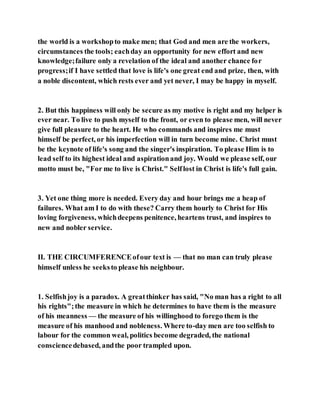
1. Let him make up his mind as to what is life's true idea, and lovingly pursue
it. Much of our joy in life depends on what we expect. If I expecta large gift
and geta little one, or nothing, I am vexed and disappointed; but if I expect
little and getmuch, then I am easilypleased. If I have made up my mind that
the world is a workshopto make men; that God and men are the workers,
circumstances the tools; eachday an opportunity for new effort and new
knowledge;failure only a revelation of the ideal and another chance for
progress;if I have settled that love is life's one great end and prize, then, with
a noble discontent, which rests ever and yet never, I may be happy in myself.
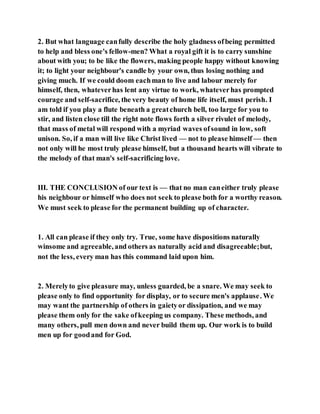
2. But this happiness will only be secure as my motive is right and my helper is
ever near. To live to push myself to the front, or even to please men, will never
give full pleasure to the heart. He who commands and inspires me must
himself be perfect, or his imperfection will in turn become mine. Christ must
be the keynote of life's song and the singer's inspiration. To please Him is to
lead self to its highest ideal and aspirationand joy. Would we please self, our
motto must be, "For me to live is Christ." Selflost in Christ is life's full gain.
3. Yet one thing more is needed. Every day and hour brings me a heap of
failures. What am I to do with these? Carry them hourly to Christ for His
loving forgiveness, whichdeepens penitence, heartens trust, and inspires to
new and nobler service.
II. THE CIRCUMFERENCEofour text is — that no man can truly please
himself unless he seeksto please his neighbour.
1. Selfishjoy is a paradox. A greatthinker has said, "No man has a right to all
his rights";the measure in which he determines to have them is the measure
of his meanness — the measure of his willinghood to forego them is the
measure of his manhood and nobleness. Where to-day men are too selfish to
labour for the common weal, politics become degraded, the national
consciencedebased, andthe poor trampled upon.
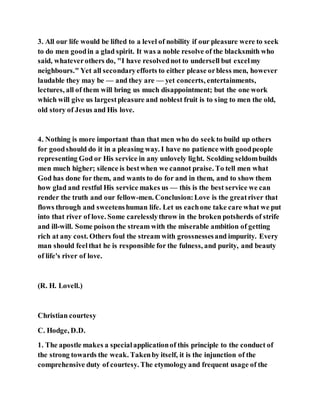
2. But what language canfully describe the holy gladness ofbeing permitted
to help and bless one's fellow-men? What a royal gift it is to carry sunshine
about with you; to be like the flowers, making people happy without knowing
it; to light your neighbour's candle by your own, thus losing nothing and
giving much. If we could doom eachman to live and labour merely for
himself, then, whateverhas lent any virtue to work, whateverhas prompted
courage and self-sacrifice, the very beauty of home life itself, must perish. I
am told if you play a flute beneath a greatchurch bell, too large for you to
stir, and listen close till the right note flows forth a silver rivulet of melody,
that mass of metal will respond with a myriad waves ofsound in low, soft
unison. So, if a man will live like Christ lived — not to please himself — then
not only will he most truly please himself, but a thousand hearts will vibrate to
the melody of that man's self-sacrificing love.
III. THE CONCLUSION of our text is — that no man caneither truly please
his neighbour or himself who does not seek to please both for a worthy reason.
We must seek to please for the permanent building up of character.
1. All can please if they only try. True, some have dispositions naturally
winsome and agreeable,and others as naturally acid and disagreeable;but,
not the less, every man has this command laid upon him.
2. Merelyto give pleasure may, unless guarded, be a snare. We may seek to
please only to find opportunity for display, or to secure men's applause. We
may want the partnership of others in gaietyor dissipation, and we may
please them only for the sake ofkeeping us company. These methods, and
many others, pull men down and never build them up. Our work is to build
men up for goodand for God.
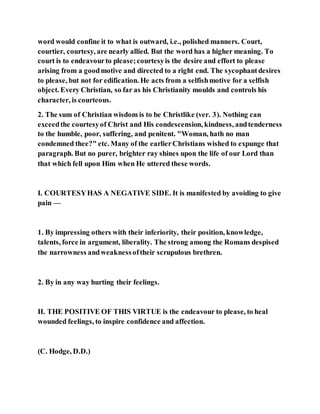
3. All our life would be lifted to a level of nobility if our pleasure were to seek
to do men goodin a glad spirit. It was a noble resolve of the blacksmith who
said, whateverothers do, "I have resolvednot to undersell but excelmy
neighbours." Yet all secondaryefforts to either please orbless men, however
laudable they may be — and they are — yet concerts, entertainments,
lectures, all of them will bring us much disappointment; but the one work
which will give us largestpleasure and noblest fruit is to sing to men the old,
old story of Jesus and His love.
4. Nothing is more important than that men who do seek to build up others
for goodshould do it in a pleasing way. I have no patience with goodpeople
representing God or His service in any unlovely light. Scolding seldombuilds
men much higher; silence is bestwhen we cannot praise. To tell men what
God has done for them, and wants to do for and in them, and to show them
how glad and restful His service makes us — this is the best service we can
render the truth and our fellow-men. Conclusion:Love is the greatriver that
flows through and sweetenshuman life. Let us eachone take care what we put
into that river of love. Some carelesslythrow in the broken potsherds of strife
and ill-will. Some poison the stream with the miserable ambition of getting
rich at any cost. Others foul the stream with grossnessesand impurity. Every
man should feelthat he is responsible for the fulness, and purity, and beauty
of life's river of love.
(R. H. Lovell.)
Christian courtesy
C. Hodge, D.D.
1. The apostle makes a specialapplicationof this principle to the conduct of
the strong towards the weak. Takenby itself, it is the injunction of the
comprehensive duty of courtesy. The etymologyand frequent usage of the
word would confine it to what is outward, i.e., polished manners. Court,
courtier, courtesy, are nearly allied. But the word has a higher meaning. To
court is to endeavourto please;courtesyis the desire and effort to please
arising from a goodmotive and directed to a right end. The sycophantdesires
to please, but not for edification. He acts from a selfishmotive for a selfish
object. Every Christian, so far as his Christianity moulds and controls his
character, is courteous.
2. The sum of Christian wisdom is to be Christlike (ver. 3). Nothing can
exceedthe courtesyof Christ and His condescension, kindness, andtenderness
to the humble, poor, suffering, and penitent. "Woman, hath no man
condemned thee?" etc. Many of the earlierChristians wished to expunge that
paragraph. But no purer, brighter ray shines upon the life of our Lord than
that which fell upon Him when He uttered these words.
I. COURTESYHAS A NEGATIVE SIDE. It is manifested by avoiding to give
pain —
1. By impressing others with their inferiority, their position, knowledge,
talents, force in argument, liberality. The strong among the Romans despised
the narrowness andweaknessoftheir scrupulous brethren.
2. By in any way hurting their feelings.
II. THE POSITIVE OF THIS VIRTUE is the endeavour to please, to heal
wounded feelings, to inspire confidence and affection.
(C. Hodge, D.D.)
Edification
J. W. Burn.
I. ITS NECESSITY. All need it.
1. Some have yet to be built. Children, e.g., have unformed characters which
require to be formed.
2. Some are built awry. Many young men have characters malformed, and the
task is to get them into form.
3. Some have tumbled down. There are those whose characteris a wreck, and
the work in their case is one of reformation.
II. ITS MEANS. The builder must conform to law. The greatprinciples on
which successfulbuilding depends must be "pleased."Outrage the laws of
gravitation, proportion, etc., and the builder will labour in vain.
1. Forthe want of "pleasing" them —(1) Some are never built at all. With the
best of intentions, abundant materials, and assiduous efforts, a builder may
erecta heap instead of an edifice. How much advice, instruction, etc., are
expended on a child, only to be thrown awaybecause expendedin a repulsive
form 1(2) Others are pulled down. When a man has gone wrong, insteadof
trying to put him straight in the proper way, his "friends" often take him to
pieces.(3)Whencharacterhas been ruined, insteadof collecting and re-
building the ruins, how often is it that they are scatteredbeyond recovery!
Harsh sensures, cutting sarcasms,so-called"plain truths" never yet
succeededin reforming a broken character.
2. In eachcase the one thing needful is to give pleasure. Put a child, a youth, a
man in goodhumour, give him hope, persuade him that duty is delightful, and
the work of constructionor reconstructionis almost half accomplished.The
application is —
1. To parents.
2. To preachers.
3. To teachers.
(J. W. Burn.)
Edification
J. W. Burn
In the process ofbuilding a material edifice four things are necessary. They
are equally essentialin the edification of character.
I. A STABLE FOUNDATION — Christ, the Rock ofAges.
II. SOUND MATERIALS — faith, hope, love, zeal, etc.
III. THE COMBINATION OF UTILITY AND GRACE IN THE
STRUCTURE. The Christian is to be beautiful as well as useful.
IV. PERFECTION AT THE FINISH. The Christian is to be a perfectman in
Christ Jesus.
(J. W. Burn)
Edification and pleasure
C. H. Spurgeon.
When Handel's oratorio of the "Messiah" hadwon the admiration of many of
the great, Lord Kinnoul took occasionto pay him some compliments on the
noble entertainment which he had lately given the town. "My lord," said
Handel, "I should be sorry if I only entertained them; I wish to make them
better." It is to be feared that many speech. makers atpublic meetings could
not sayas much; and yet how dare any of us waste the time of our fellow
immortals in mere amusing talk! If we have nothing to speak to edification,
how much better to hold our tongue!
(C. H. Spurgeon.)
Seeking to edify
A fine example of a word fitly spokenis found in Dr. Bushnell's biography. An
intelligent but not religious young lady, after spending a socialevening with
the gooddoctor's family, was escortedhome by her courteous host. On their
way the brilliant starlight led them to talk of astronomy. The doctorspoke of
the law of harmony which held eachlittle star in its appointed place, and then
turning to the bright-minded girl, with a winning smile, he said, "Sarah, I
want to see you in your place." This was all he said that was personal, but the
thought thrilled her young soul as if it had dropped upon her from the skies.
Its effect was to win her to discipleship. "A word spokenin season, how good
it is!"
COMMENTARIES
Ellicott's Commentary for English Readers
(2) For his good.—The objectofthis tender dealing with others is to be their
benefit and growth in spiritual perfection. It is grounded on the example of
Christ Himself.
Matthew Henry's Concise Commentary
15:1-7 Christian liberty was allowed, not for our pleasure, but for the glory of
God, and the goodof others. We must please our neighbour, for the goodof
his soul; not by serving his wickedwill, and humouring him in a sinful way; if
we thus seek to please men, we are not the servants of Christ. Christ's whole
life was a self-denying, self-displeasing life. And he is the most advanced
Christian, who is the most conformedto Christ. Considering his spotless
purity and holiness, nothing could be more contrary to him, than to be made
sin and a curse for us, and to have the reproaches ofGod fall upon him; the
just for the unjust. He bore the guilt of sin, and the curse for it; we are only
calledto bear a little of the trouble of it. He bore the presumptuous sins of the
wicked;we are calledonly to bear the failings of the weak. And should not we
be humble, self-denying, and ready to considerone another, who are members
one of another? The Scriptures are written for our use and benefit, as much as
for those to whom they were first given. Those are most learned who are most
mighty in the Scriptures. That comfort which springs from the word of God,
is the surestand sweetest, andthe greateststayto hope. The Spirit as a
Comforter, is the earnestof our inheritance. This like-mindedness must be
according to the precept of Christ, according to his pattern and example. It is
the gift of God; and a precious gift it is, for which we must earnestly seek unto
him. Our Divine Masterinvites his disciples, and encouragesthem by showing
himself as meek and lowly in spirit. The same disposition ought to mark the
conduct of his servants, especiallyof the strong towards the weak. The great
end in all our actions must be, that God may be glorified; nothing more
forwards this, than the mutual love and kindness of those who profess
religion. Those that agree in Christ may wellagree among themselves.
Barnes'Notes on the Bible
Please his neighbour - That is, all other persons, but especiallythe friends of
the Redeemer. The word "neighbor" here has specialreference to the
members of the church. It is often used, however, in a much largersense;see
Luke 10:36.
For his good- Not seek to secure for him indulgence in those things which
Would be injurious to him, but in all those things whereby his welfare would
be promoted.
To edification - See the note at Romans 14:19.
Jamieson-Fausset-BrownBible Commentary
2, 3. Let every one of us—lay himself out to
please his neighbour—not indeed for his mere gratification, but
for his good—witha view
to his edification.
Matthew Poole's Commentary
Having said we must not please ourselves, he immediately subjoins, we must
please others, viz. every one his neighbour: he means, that we should
condescendand accommodate ourselvesto others, and give them satisfaction
in all things; at leastso far as may tend to their goodand edification. You had
a like passage, Romans 14:19. The apostle exhorts the Corinthians to a
practice some what like this, 1 Corinthians 10:24; and he leads them the way
by is ownexample, 1 Corinthians 9:19 1 Corinthians 10:33. There is a pleasing
of men which is sinful, and there is a pleasing of men which is lawful; and that
is, when it is limited, as in this text.
Gill's Exposition of the Entire Bible
Let everyone of us please his neighbour,.... Every man, particularly his
Christian friend and brother, whom he should seek to please in all things, and
by all means lawful; he should carry it affably and courteously, should make
himself agreeable to him; should condescendand accommodate himselfto his
weakness,and bear his infirmities, and deny himself rather than displease
him. The Vulgate Latin version and some copies read, "let everyone of you";
but the other reading is preferable, and bestagrees with the context, Romans
15:1.
For his good; or as the Syriac renders it, "in goodthings"; for he is not to be
pleased, gratified, and indulged, in any thing that is evil: we are not to please
any man in anything that is contrary to the Gospelof Christ, for then we
should not be faithful servants of his; nor in anything repugnant to the
commands of God, and ordinances of Christ, who are to be obeyedand
pleased, rather than men; nor in anything that is of an immoral nature, we
are not to comply with, though it may be to the displeasure of the dearest
relation and friend; but in everything that is naturally, civilly, morally, or
evangelicallygood, we should study to please them; and in whatsoevermay be
for their good, temporal, spiritual, or eternal: and
to edification: of our neighbour, brother, and Christian friend, for the
establishment of his peace, the increase ofhis spiritual light, and the building
of him up in his most holy faith; and also of the whole community, or church,
to which eachbelong, whose peace andedification should be consulted, and
everything done, which may promote and secure it; and among which this is
one, every man to please his neighbour, in things lawful and laudable.
Geneva Study Bible
Let every one of us please his neighbour for his {b} good to edification.
(b) For his profit and edification.
EXEGETICAL(ORIGINAL LANGUAGES)
Meyer's NT Commentary
Romans 15:2. After ἕκαστος Elz. has γάρ, againstdecisive witnesses.
Romans 15:4. Insteadof the secondπροεγράφη, B C D E F G ‫,*א‬ 67** 80,
most VSS., and severalFathers have ἐγράφη. Approved by Griesb., adopted
by Lachm., Tisch., Fritzsche. Rightly; the compound is an intentional or
mechanicalrepetition.
Not so strongly attested(though by A B C* L ‫)א‬ is the διά repeatedbefore τῆς
παρακλ. in Griesb., Lachm., Tisch. 8, which, since the article againfollows,
became easilyadded.
Romans 15:7. ὑμᾶς]Elz.: ἡμᾶς, againstA C D** E F G L ‫,א‬ min., most VSS.,
and severalFathers. A correctgloss, indicating the reference ofὑμᾶς to the
Jewishand Gentile Christians.
Romans 15:8. γάρ] approved by Griesb., adopted also by Lachm. and Tisch.
But Elz. and Fritzsche have δέ; against which the evidence is decisive.
Moreover, λέγω δέ is the customary form with Paul for more precise
explanation, and hence also slipped in here.
γεγενῆσθαι)Lachm: γενέσθαι, according to B C* D* F G, Arm. Ath. But how
readily one of the two syllables ΓΕ might be passedover, and then the familiar
(comp. also Galatians 4:4) γενέσθαι would be produced!
Romans 15:11. After πάλιν Lachm. has λέγει, according to B D E F G, 1, and
severalVSS.;manifestly an addition in accordancewith Romans 15:10.
ἐπαινέσατε] Lachm. and Tisch.:ἐπαινεσάτωσαν, according to A B C D E ‫,א‬
39, Chrys. ms. Dam. Both readings are also found in the LXX., and may be
borrowedthence. The circumstance that after αἰνεῖτε the form ἐπαινέσατε, as
more conformable, readily offereditself, speaks in favour of ἐπαινεσάτωσαν.
Romans 15:15. ἀδελφοί]is wanting indeed in A B C ‫,*א‬ Copt. Aeth. Cyr.
Chrys. Ruf. Aug. (omitted by Lachm. and Tisch. 8), and stands in 3, 108, after
μέρους;but why should it have been added? On the other hand, its omission
was readily suggested, since it had just appeared for the first time in Romans
15:14, and since it seemedsimply to stand in the wayof the connectionof ἀπὸ
μέρ.; hence also that transposition in 3, 108.
Romans 15:17. καύχησιν]Rightly Lachm. and Tisch.:τὴν καύχησιν. The
reference of the preponderantly attestedarticle was not understood.
Romans 15:19. ἁγίου]So A C D E F G, min., and most VSS. and Fathers.
Adopted also by Griesb., Lachm., and Scholz. But Elz. (so also Matth.,
Fritzsche, Tisch. 8), in accordancewith ‫א‬ and D** LP, most min., Syr. Chrys.,
and others, has Θεοῦ. In B, Pel. Vigil, there is merely πνεύματος. So Tisch. 7.
Since there is absolutely no reasonwhy ἁγ. or Θεοῦ should have been omitted
or altered, probably the simple πνεύματος is the original, which was only
variously glossedby ἁγ. and Θεοῦ.
Romans 15:20. φιλοτιμούμενον]Lachm.: φιλοτιμοῦμαι,according to B D* F
G P. To facilitate the construction.
Romans 15:22. τὰ πολλά] B D E F G: πολλάκις, so Lachm. An interpretation
in accordancewith Romans 1:13.
Romans 15:23. πολλῶν] Tisch. 7 : ἱκανῶν, according to B C, 37, 59, 71, Dam.
A modifying gloss, according to an expressionpeculiarly well knownfrom the
book of Acts.
Romans 15:24. After Σπανίαν Elz. and Tisch. 7 have ἐλεύσομαι πρὸς ὑμᾶς,
which is omitted by Griesb., Lachm., and Tisch8. A contrastto Romans
15:22, written at the side, and then introduced, but rejectedby all uncials
exceptL ‫,**א‬ and by all VSS. exceptSyr. p.; attested, however, among the
Fathers by Theodoret, Theophylact, and Oecumenius, and preserved in nearly
all the cursives. This old interpolation occasionedthe insertion of an
illustrative γάρ after ἐλπίζω (so Elz., Tisch., and also Lachm.), the presence of
which also in principal witnesses (as A B C ‫,)א‬ in which ἐλεύς. πρ. ὑμ. is
wanting, does not point to the originality of these words, but only to a very
early addition and diffusion of them, so that in factthose witnessesrepresent
only a half-completed critical restorationof the original text, whilst those
which omit both (as F G) still contain the original text or a complete
purification of the text.
Instead of ὑφʼ ὑμῶν, Lachm. and Tisch. 7 have ὑφʼ ὑμῶν, according to D E F
G, min., which presents itself as genuine, and is explained by ὑφʼ ὑμῶν on
accountof the passive. B has ἀπὸ ὑμῶν.
Romans 15:29. Χριστοῦ] Elz.: τοῦ εὐαγγελίου τοῦ X., againstdecisive
evidence. A gloss.
Romans 15:31. διακονία]Lachm: δωροφορία,according to B D* F G, which,
however, Paul, considering the delicacyof designationhere throughout
observed, can hardly have written; it appears to be an explanation.
The repetition of ἵνα before ἡ διακ. (in Elz.) is, according to A B C D* F G ‫,*א‬
80, justly also omitted by Lachm. and Tisch.
Instead of ἡ εἰς Lachm. has ἡ ἐν, according to B D* F G, 213. Both
prepositions are suitable to the sense;but the omissionof the article in the
majority of witnesses enables us to perceive how ἡ ἐν arose. This omission,
namely, carried with it the alterationof εἰς into ἐν (66, Chrys. really have
merely ἐν), and then ἡ ἐν arose through an only partial criticalrestoration.
Romans 15:32. ἔλθω] A C ‫,*א‬ Copt. Arm. Ruf.: ἔλθων with omissionof the
subsequent καί. Too weaklysupported; an emendation of style, yet adopted by
Tisch. 8.
Instead of Θεοῦ, B has κυρίου Ἰησοῦ (so Lachm); D E F G, It.: Χριστοῦ
Ἰησοῦ;‫:*א‬ Ἰησοῦ Χρ. But the apostle never says διὰ θελήμ. Χριστοῦ, but
always τ. θ Θεοῦ (comp. Romans 1:10; 1 Corinthians 1:1; 2 Corinthians 1:1; 2
Corinthians 8:5, et al .), as throughout he uses θελήμα constantlyof God ,
when there is mention of His omnipotence or gracious will; where said of
Christ, the θελήμα is for him only the moral will (Ephesians 5:17). Hence
those readings are to be regarded as unsuitable glosses afterRomans 15:29-
30.
καὶ συναναπ. ὑμῖν] has been omitted by Lachm. on the authority of B only, in
which he is followedby Buttmann. From Romans 1:12 συμπαρακληθῆναι
would have been employed as an addition, and not συναναπ.; D E have
ἀναψύξω μεθʼ ὑμῶν (2 Timothy 1:16).
Romans 15:33. The omissionof the ἀμήν(bracketedby Lachm.) is too weakly
attested.
Romans 15:2. εἰς τὸ ἀγαθ.]for his benefit. Comp. 1 Corinthians 10:33;1
Thessalonians 2:4. A more specialdefinition thereof is πρὸς οἰκοδομήν, in
order to build up, to produce Christian perfection (in him). See on Romans
14:19. According to Fritzsche, εἰς τὸ ἀγαθ. is in respectof what is good,
whereby immoral men-pleasing is excluded. But its exclusionis understood of
itself, and is also implied in πρὸς οἰκοδομήν. Onthe interchange of εἰς and
πρός, comp. Romans 3:25-26.
Expositor's Greek Testament
Romans 15:2. τῷ πλησίον ἀρεσκέτω:this rule is qualified by εἰς τὸ ἀγαθὸν
πρὸς οἰκοδομήν. Without such qualification it is “men-pleasing” (Galatians
1:10) and inconsistentwith fidelity to Christ. Cf. 1 Corinthians 10:33, where
Paul presents himself as an example of the conduct he here commends. For εἰς
and πρὸς in this verse cf. chap. Romans 3:25 f. According to Gifford εἰς marks
the “aim”—the advantage orbenefit of our neighbour—and πρὸς the
standard of reference;the only “good” fora Christian is to be “built up” in
his Christian character.
Cambridge Bible for Schools andColleges
2. for his goodto edification] These words takentogetherperfectly define the
principle of Christian complaisance.Cp. 1 Corinthians 10:33, and contrast
Galatians 1:10, where St Paul treats the case ofradically false doctrine, not, as
here, a question of secondarypractice.—“Edification:”—seeonRomans
14:19. The Christian’s aim in “pleasing his neighbour” was to be the
harmony, advance, and strength, of the “blessedcompanyof the faithful” as a
united aggregate.
Bengel's Gnomen
Romans 15:2. Εἰς τὸ ἀγαθὸν, πρός οἰκοδομὴν, forgood, to edification) εἰς,
unto, denotes the internal end, in respectof God; πρὸς, to, the external end, in
respectof our neighbour. Good, the genus; edification, the species.
Romans 15:3 For even Christ pleasednot himself;but,
as it is written, The reproaches of them that
reproachedyou fell on me.
BIBLEHUB COMMENTARIES
Ellicott's Commentary for English Readers
(3) The reproaches. . . .—Literally, after the LXX. version of Psalm69:9, one
of those Psalms of suffering which, like Isaiah 53, afford a type of the
sufferings of the Messiah.
Reproachedthee fell on me.—The insults directed againstGodHimself fell
upon His servants.
Matthew Henry's Concise Commentary
15:1-7 Christian liberty was allowed, not for our pleasure, but for the glory of
God, and the goodof others. We must please our neighbour, for the goodof
his soul; not by serving his wickedwill, and humouring him in a sinful way; if
we thus seek to please men, we are not the servants of Christ. Christ's whole
life was a self-denying, self-displeasing life. And he is the most advanced
Christian, who is the most conformedto Christ. Considering his spotless
purity and holiness, nothing could be more contrary to him, than to be made
sin and a curse for us, and to have the reproaches ofGod fall upon him; the
just for the unjust. He bore the guilt of sin, and the curse for it; we are only
calledto bear a little of the trouble of it. He bore the presumptuous sins of the
wicked;we are calledonly to bear the failings of the weak. And should not we
be humble, self-denying, and ready to considerone another, who are members
one of another? The Scriptures are written for our use and benefit, as much as
for those to whom they were first given. Those are most learned who are most
mighty in the Scriptures. That comfort which springs from the word of God,
is the surestand sweetest, andthe greateststayto hope. The Spirit as a
Comforter, is the earnestof our inheritance. This like-mindedness must be
according to the precept of Christ, according to his pattern and example. It is
the gift of God; and a precious gift it is, for which we must earnestly seek unto
him. Our Divine Masterinvites his disciples, and encouragesthem by showing
himself as meek and lowly in spirit. The same disposition ought to mark the
conduct of his servants, especiallyof the strong towards the weak. The great
end in all our actions must be, that God may be glorified; nothing more
forwards this, than the mutual love and kindness of those who profess
religion. Those that agree in Christ may wellagree among themselves.
Barnes'Notes on the Bible
For even Christ - The apostle proceeds, in his usual manner, to illustrate what
he had said by the example of the Saviour. To a Christian, the example of the
Lord Jesus will furnish the most ready, certain, and happy illustration of the
nature and extent of his duty.
Pleasednothimself - This is not to be understood as if the Lord Jesus did not
voluntarily and cheerfully engage in his greatwork. He was not "compelled"
to come and suffer. Nor is it to be understood as if he did not "approve" the
work, or see its propriety and fitness. If he had not, he would never have
engagedin its sacrificesand self-denials. But the meaning may be expressedin
the following particulars:
(1) He came to do the will or desire of God in "undertaking" the work of
salvation. It was the will of God; it was agreeable to the divine purposes, and
the Mediatordid not consult his own happiness and honor in heaven, but
cheerfully came to "do the will" of God; Psalm40:7-8; compare Hebrews
10:4-10;Philippians 2:6; John 17:5.
(2) Christ when on earth, made it his greatobject to do the will of God, to
finish the work which God had given him to do, and not to seek his own
comfort and enjoyment. This he expressly affirms; John 6:38; John 5:30.
(3) he was willing for this to endure whatever trials and pains the will of God
might demand, not seeking to avoid them or to shrink from them. See
particularly his prayer in the garden; Luke 22:42.
(4) in his life, he did not seek personalcomfort, wealth, or friends, or honors.
He denied himself to promote the welfare of others;he was poor that they
might be rich; he was in lonely places that he might seek out the needy and
provide for them. Nay, he did not seek to preserve his own life when the
appointed time came to die, but gave himself up for all.
(5) there may be another idea which the apostle had here. He bore with
patience the ignorance, blindness, erroneous views, and ambitious projects of
his disciples. He evinced kindness to them when in error; and was not harsh,
censorious, orunkind, when they were filled with vain projects of ambition, or
perverted his words, or were dull of apprehension. So says the apostle, "we"
ought to do in relation to our brethren.
But as it is written - Psalm69:9. This psalm, and the former part of this verse,
is referred to the Messiah;compare Romans 15:21, with Matthew 27:34,
Matthew 27:48.
The reproaches - The calumnies, censures, harsh, opprobrious speeches.
Of them that reproachedthee - Of the wicked, who vilified and abusedthe law
and government of God.
Fell on me - In other words, Christ was willing to suffer reproachand
contempt in order to do good to others. tie endured calumny and contempt all
his life, from those who by their lips and lives calumniated God, or
reproachedtheir Maker. We may learn here,
(1) That the contempt of Jesus Christis contempt of him who appointed him.
(2) we may see the kindness of the Lord Jesus in being willing thus to "throw
himself" betweenthe sinner and God; to "intercept," as it were, our sins, and
to bear the effects ofthem in his own person. He stoodbetween"us" and God;
and both the reproaches and the divine displeasure due to them, "met" on his
sacredperson, and produced the sorrows ofthe atonement - his bitter agony
in the garden and on the cross. Jesus thus showedhis love of Godin being
willing to bear the reproaches aimed at him; and his love to "men" in being
willing to endure the sufferings necessaryto atone for these very sins.
(3) if Jesus thus bore reproaches,"we" shouldbe willing also to endure them.
We suffer in the cause where be has gone before us, and where he has set us
the example; and as "he" was abusedand vilified, we should be willing to be
so also.
Jamieson-Fausset-BrownBible Commentary
3. Foreven Christ pleasednot—lived not to please
himself; but, as it is written—(Ps 69:9).
The reproaches, &c.—seeMr 10:42-45.
Matthew Poole's Commentary
For even Christ pleasednot himself: he backs his exhortation in Romans 14:1,
with an argument takenfrom the practice of our Lord himself, who is our
perfect pattern, and hath left us an example, that we should follow his steps:
see John 13:15,34 1 Peter2:21 1Jo 2:6 4:17. By Christ’s not pleasing himself,
is meant his not indulging or sparing himself; he did not seek his own ease,
nor to satisfyinclination of the human nature, which abhorreth pain, and the
destruction of itself. He took such a course all along as sufficiently
demonstrated that he respectedour benefit, and not his own.
But; here is an ellipsis, something must he supplied to fill up the sense:either
the meaning is, he pleasednot himself, but others; or, he pleasednot himself,
but bore our infirmities and reproaches:or else, he pleasednot himself, but it
happened to him; or he so carriedhimself that it might be truly applied to
him, which is written, &c.
As it is written; viz. in Psalm69:9. That David uttered these words in the
person of Christ, or as a type of him, may appear from John 2:17.
Interpreters are divided about accommodating this testimony to the occasion
for which it is brought. Either the meaning is, that Christ did willingly expose
himself to all the reproaches and contumelies of men, in obedience to his
Father’s will; or else, that he and the same concernments with God the
Father, so that what befell God did also befall him; he was as tender of the
Father’s honour as of his own: or else, that the sins of men, which are things
that castreproachupon God, were takenby Christ upon himself, and he bore
them in his body upon a tree. Seeing then that Christ hath done so much for
our sakes, andhath not sought his own ease and benefit, we ought also to seek
the goodof others, and to deny ourselves:see Philippians 2:6-8.
Gill's Exposition of the Entire Bible
For even Christ pleasednot himself,.... He sought not his own ease, pleasure,
profit, honour, and glory, but to do his Father's will and work, John 4:34; and
he always did the things which pleasedhim, in his obedience, sufferings, and
death; and sought not his own, but his glory: moreover, what he did and
suffered were not for himself, but for us; he became incarnate for us; he
obeyed, suffered, and died for us; he came not to be ministered to, to be
attended upon as an earthly prince, enjoying his ownease and pleasure, things
grateful to nature, but to minister to others, Matthew 20:28;hence he
appearedin the form of a servant, did the work of one in life, and at last
became obedient to death, even the death of the cross, Philippians 2:7, not but
that he was well pleasedin doing and suffering all this; it was his delight to do
the will of God: it was his meat and drink to finish his work; yea, that part of
it which was most disagreeable to flesh and blood, was mostearnestly desired
by him, even the baptism of his sufferings; and in the view of the salvation of
his people, and of enjoying their company with him to all eternity, he endured
the cross patiently, and despisedthe shame with pleasure, Hebrews 12:2, but
then he met with many things which were far from being grateful to human
nature; such as the hardness and unbelief of the Jews, with which he was
grieved, their scoffs and insults, reproaches andjeers; the ignorance,
frowardness, and morosenessofhis own disciples, whose infirmities he bore;
and at last the sufferings of death, that bitter cup, which he as man desired
might pass from him; but, however, he submitted to his Father's will,
Matthew 26:39; all which prove what the apostle here affirms. This instance
of Christ, the man of God's right hand, the son of man, whom he has made
strong for himself, the head of the church, the leaderand commander of the
people, bearing the infirmities of the weak, and not pleasing himself, is very
pertinently produced, to enforce the above exhortations;who is an example to
his people in the exercise ofevery grace, and the discharge of every duty; as in
beneficence, forgiving of injuries, mutual love, meekness andhumility,
suffering of afflictions, and patience. The proof of it follows,
but as it is written, in Psalm69:9;
the reproaches ofthem that reproachedthee fell on me; which are the words
of Christ unto his Father, as the whole psalm is to be understood not of David,
but of the Messiah, as is clearfrom the citations out of it, and references to it
in the New Testament;see John2:17, comparedwith Psalm 69:9, and the
meaning of them is, either that the reproaches whichwere caston the house,
worship, and ordinances of God, affectedChrist as much as if they had been
castupon himself; which stirred up his zeal to take the method he did, to show
his resentmentat such indignities; see John2:15, or that the same persons by
whom the name of God was blasphemed, his sanctuary polluted, and his
ordinances reproached, also reproachedhim; and he bore in his bosom the
reproachof all the mighty people, which were in greatplenty poured upon
him; they reproachedhim with being a glutton, a winebibber, a friend of
publicans and sinners, Matthew 11:19;they said he was a Samaritan, and had
a devil, John 8:48, chargedhim with blasphemy and sedition, Matthew 26:65;
and when on the cross, mocked, reviled, and waggedtheir heads at him,
Matthew 27:39; all which he bore patiently, and reviled not again:moreover,
by "reproaches"may be meant the sins of his people, by which the name of
God was blasphemed, his law trampled upon with contempt, and the
perfections of his nature, as his justice and holiness, dishonoured; and which
fell upon Christ, not by chance, but by the appointment of God, and according
to his own voluntary agreement;and which he bore in his own body, and
made satisfactionfor; which though he did willingly, in order to obtain some
valuable ends, the salvation of his people, and the glorifying of the divine
perfections, the honouring of the law, and satisfying of justice, yet the bearing
of them, in itself, could not be grateful to him as such; neither the charge of
sin, nor the weight of punishment; and in this respecthe pleasednot himself,
or did that which was grateful to his pure and holy nature.
Geneva Study Bible
{2} Foreven Christ pleasednot himself; but, as it is written, The reproaches
of them that reproachedthee fell on me.
(2) A confirmation takenfrom the example of Christ, who suffered all things,
to bring not only the weak, but also his most cruel enemies, overcoming them
with patience, to his Father.
EXEGETICAL(ORIGINAL LANGUAGES)
Meyer's NT Commentary
Romans 15:3. Establishmentof this duty by the pattern: for Christ also, etc.
ἀλλὰ, καθὼς κ.τ.λ.]but, as it is written, the reproaches ofthose reproaching
thee fell on me. After ἀλλά a comma only is to be placed, and nothing is to be
supplied, neither sibi displicuit with Erasmus, nor fecit with Grotius and
others, nor ἐγένετο (Borger) and the like. Had Paul desired to express himself
in purely narrative form, he would have written instead of σέ: Θεόν, and
instead of ἐμέ: αὐτόν. But he retains the scriptural saying, which he adduces,
literally, enhancing thereby the direct force and vivacity of the discourse.
Comp. 1 Corinthians 1:31; Winer, 534, 556 [E. T. pp. 719, 749].
The passageis Psalm69:10 (literally after the LXX.), where the suffering
subject is a type of the Messiah(comp. Romans 11:9; John 2:17; John 15:25;
John 19:28).
That the reproaches ofthe enemies of God fell on Christ, i.e. that the enemies
of God vented their fury on Christ, proves that Christ was bent on pleasing
not Himself (for otherwise He would have abstainedfrom taking these His
sufferings upon Himself; comp. Hebrews 12:2-3, Php 2:6-8), but men,
inasmuch as He in order to their redemption surrendered Himself, with full
self-renunciation of His αὐτάρκεια, to the enmity againstGod of His
adversaries. Calvinand others: “Ita se Domino devovisse, ut descinderetur
animo, quoties sacrum ejus nomen patere impiorum maledicentiae videret,”
so that the idea of self-denying devotion to the cause ofGod (so also de Wette
and Philippi) is expressed. But according to the connection, it is the devotion
of Christ, not for the cause of God, but for the salvationof humanity (see
Romans 15:2), into fellowshipof suffering with which He entered, that is to be
proposedas an example. Comp. Matthew 20:28.
ὀνειδισμός belongs to later Greek. See Lobeck,adPhryn. p. 512.
Expositor's Greek Testament
Romans 15:3. καὶ γὰρ ὁ Χριστὸς κ.τ.λ. The duty of not pleasing ourselves is
enforcedby the example of Christ: He did not please Himself either. If this
required proof, we might have expectedPaul to prove it by adducing some
incident in Christ’s life; but this is not what he does. He appeals to a psalm,
which is in many places in the N.T. treated as having some reference to Christ
(e.g., John 2:17 = Psalm69:9, John 15:25 = Psalm69:4, Matthew 27:27-30 =
Psalm69:12, Matthew 27:34 = Psalm 69:21, Romans 11:9 = Psalm69:22, Acts
1:20 = Psalm 69:25 : see Perowne,The Psalms, i., p. 561 f.); and the words he
quotes from it—words spokenas it were by Christ Himself—describe our
Lord’s experiences in a way which shows that He was no self-pleaser. If He
had been, He would never have given Himself up willingly, as He did, to such
a fate. It is hardly conceivable that σε in Paul’s quotation indicates the man
whom Christ is supposedto address:it can quite well be God, as in the psalm.
Some have argued from this indirect proof of Christ’s characterthat Paul had
no acquaintance with the facts of His life; but the inference is unsound. It
would condemn all the N.T. writers of the same ignorance, for they never
appeal to incidents in Christ’s life; and this summary of the whole character
of Christ, possessing as it did for Paul and his readers the authority of
inspiration, was more impressive than any isolatedexample of non-
selfpleasing couldhave been.
Cambridge Bible for Schools andColleges
3. Foreven Christ] Here first in the Epistle St Paul explicitly quotes the
Lord’s Example. He soonrepeats the reference, Romans 15:7. The main
burthen of the Epistle has been His Sacrifice;but the more the Sacrifice is
apprehended, the more powerful will the Example be felt to be. It will
emphatically be “not merely a model, but a motive.”
pleasednot himself] “NotMy will, but Thine be done.”
To MessiahHimself, as to His people, suffering was in itself “not joyous, but
grievous;” and, in that sense, it was againstHis will. The doing of His Father’s
will involved sufferings; and in those sufferings He “pleasednot Himself,”
while yet He unutterably “delighted to do the will of Him that sent Him.”
(Psalm 40:8; John 4:34.)
as it is written] Psalms 69 (LXX. 68):9. The quotation is verbatim with
LXX.—It has been doubted whether we are meant in this passageto view the
Saviour as preferring the Father’s pleasure, or Man’s salvation, to His “own
will.” The context(Romans 15:1-2)favours the latter; the words of the
quotation favour the former. But as the two objects were inseparable in our
Lord’s work, both may well be in view here. His “bearing reproach” was the
necessarypath, alike to “finishing His Father’s work,” and to saving the lost.
Does not St Paul here allude speciallyto the conflict of Gethsemane, and to the
outrages which our Lord patiently bore just afterwards? He had scarcelysaid
“Thy will be done,” when the awful “reproaches”ofHis night of shame and
insult began.
reproachedthee] God was “reproached” in effect, by those who, while
claiming to act in His Name, were teaching and practising all that was alien to
His love and holiness.—Suchpersons, whenthey beheld His true Likeness in
His Son, inevitably hated and rejectedit.
Bengel's Gnomen
Romans 15:3. Ὁ Χριστὸς, Christ) who alone was truly δυνατὸς, strong, comp.
Romans 15:1 with ch. 5 and 6: δυνατοὶ strong, ἀσθενεῖς weak.—οὐχἑαυτῷ,
not Himself) Admirable συγκατάβασις, condescension!Not Himself but us,
Romans 15:7-8; Psalm69:32 : Christ procured ἀρέσκειαν, what is well-
pleasing to God for those, who see and are glad [Referring to Psalm 69:32,
which see].—ἀλλὰ)but, viz., He took that upon Himself, which is written.—
γέγραπται, it is written) Psalm 69:10, with which comp. Romans 15:11-12, in
the latter hemistich of either, it matters not which.—οἱ—ἐμὲ)So the LXX.—
ἐπέπεσον, fell on) By right Christ might have borne Himself as God, and have
enjoyed Divine honours, but He did not use His right, for our sakes, Php 2:6.
He indeed thoroughly felt the reproaches, whichwickedmen castupon God,
with that sorrow, which they ought to have felt, who gave utterance to them;
and He Himself bore and expiated those reproaches as patiently, as if He
Himself had been the guilty person. His whole sufferings are here intended;
He at that time performed the office of a minister [a servant], Matthew 20:28.
[At that time, He did not please Himself, but He interposed Himself, in order
that in respectto [in the case of]all who had dishonoured GOD, GOD might
receive what was well-pleasing [“caperetbeneplacitum.” Or rather, that God
might by the atonement, be enabled to exercise good-willconsistentlywith
justice]. It behoved Him to endure many things with patience, Romans 15:1;
Romans 15:4.—V. g.]
PRECEPTAUSTIN RESOURCES
BRUCE HURT MD
Romans 15:1 Now we who are strong ought to bear the weaknesses ofthose
without strength and not just please ourselves.
Greek:Opheilomen (1PPAI) de hemeis oi dunatoi ta asthenemata ton
adunaton bastazein (PAN) kai me heautois areskein(PAN)
Amplified: We who are strong [in our convictions and of robust faith] ought
to bear with the failings and the frailties and the tender scruples of the weak;
[we ought to help carry the doubts and qualms of others] and not to please
ourselves.
NLT: We may know that these things make no difference, but we cannot just
go ahead and do them to please ourselves. We must be considerate ofthe
doubts and fears of those who think these things are wrong.
Phillips: We who have strong faith ought to shoulder the burden of the doubts
and qualms of others and not just to go our own sweetway.
Wuest: As for us, then, the strong ones, we have a moral obligationto be
bearing the infirmities of those who are not strong, and not to be pleasing
ourselves.
Young's Literal: And we ought -- we who are strong -- to bear the infirmities
of the weak, andnot to please ourselves;
NOW WE WHO ARE STRONG OUGHT TO BEAR THE WEAKNESSES
OF THOSE WITHOUT STRENGTH:Opheilomen (1PPAI) de hemeis oi
dunatoi ta asthenemata ton adunaton bastazein (PAN ):
Ro 15:1, 27, 13:8, 1:14, 8:12) (Ro 14:1 1Co 8:1-13;9:22; 12:22, 23,24 Gal6:1,2
which refers to sin 1Th 5:14
Romans 15 Resources - Multiple Sermons and Commentaries
Remember that in Romans 14 and Romans 15 Paul is teaching how the one
who is being transformed by the renewing of their mind should demonstrate
this by a change in attitude toward those with whom they disagree or hold
different values.
Middletown Bible - The Law of Love (Romans 14:1-15:3)- For further help in
understanding how to live so as to not cause a brother to stumble, see our
paper entitled, "Guidance:67 Biblical Tests to Use in Deciding Upon a Course
of Action."
Spurgeon...
If any course of actionwhich would be safe to us would be dangerous to
weakerbrethren, we must considertheir infirmity and deny ourselves for
their sakes.
When we are free from scruples upon any point, and feelthat there are things
that we may do because we are strong, yet let us not do them if thereby we
should grieve others who are weak. Letus think of their infirmities; and
whateverliberty we may feel entitled to claim for ourselves, letus look at the
matter from the standpoint of other people as well as from our Own, that we
may bear the infirmities of the weak, andnot seek to please ourselves.
Now - The Greek conjunction"de" which could be translated "but" which
would emphasize the contrastwith the weak brother who doubts, eats, is
condemned and sins (cf Ro 14:23-note)
Note that this chapteris probably one of the most unfortunate chapter
divisions in the book of Romans because it breaks right into the flow of
thought that begins in (Ro 14:1-note) and continues through (Ro 15:13-note),
dealing with the area of the dynamics, dangers and duties of believer's
interrelating in this area of non essentials. So don't' begin your study on (Ro
15:1) thinking this is a new theme. You must go back and read in context to
understand Paul's flow of thought continuing the exhortation to brotherly
love and mutual kindness and forbearance as a practicalmanifestation of
having presentedour bodies to Godas a living and holy sacrifice (Ro 12:1-
note, Ro 12:2-note).
We Who is we? Paul identifies himself with the strong believers = those whose
personalconvictions allow them more freedom than the weak.
Ought (3784)(opheilo fromophéllo = heap up) means to owe something to
someone. Literally it speaks offinancial indebtedness and thus means to owe
money, to be in debt, or to describe that which is due (Mt 18:28, Lk 7:41, 16:5,
7, Philemon 1:18). The verb opheilo was sometimes used to describe "the
debt" itself. Figuratively, opheilo describes a sense ofindebtedness to someone
for something. For example, it was used to describe owing goodwill (1Co 7:3),
love (Ro 13:8 = we can never love enough and will always "owe" this debt).
Opheilo in most of the NT uses conveys the sense ofnecessity, duty or to be
under obligation (obligation = moral requirement which conveys the binding
force of civility, kindness or gratitude, when the performance of a duty cannot
be enforced by law). The idea is that one is held or bound by duty, moral
obligation or necessityto do something. Thus opheilo can mean that it
behooves one to do something (Mt 23:16, 18). Opheilo is used of a necessity
imposed either by law and duty, by reason, by the times, or by the nature of
the matter under consideration(Lk 17:10, Jn 13:14 = you also [because Jesus
washedtheir feet] ought to washone another's feet, Jn 19:7, Acts 17:29 =
ought not to think..., Ro 15:1, 27 = they are indebted to them...indebted to
minister, Eph 5:28 = husbands ought also to love their ownwives, 2Th 1:3,
2:13 = ought to give thanks to God; He 5:12 = ought to be teachers;1Jn 2:16 =
ought to walk [like Jesus], 1Jn3:16 = [Jesus laid down His life] we ought to
lay down our lives for the brethren; 1Jn 4:11 = [because ofGod's love] we also
ought to love one another; 3Jn 1:8 = we ought to support such men)
English dictionaries say that "ought" is used to express obligation[ought to
pay our debts], advisability [ought to take care of yourself], natural
expectation[ought to be here by now], or logicalconsequence [the result ought
to be infinity]. Ought expressesprudent expediency (you ought to be more
careful with your money)
Note that opheilo speaks ofa moral obligationas contrastedto a necessityin
the nature of the case as is dei [word study].
The original Greek sentence orderplaces emphasis on the obligation or debt
we owe (Young's literal = "and we ought - we who are strong..."). The sense is
because we are strong we have a debt or moral obligationto aid those who are
weak.
Paul uses the same verb, opheilo to explain our obligationto continually owe
(Ro 13:8-note). The implication is that the strong are to show agape love, that
love which reaches out and picks up the weak brother because it seekshis
highest goodand it does so expecting nothing in return. From the context
apparently the strong brethren in Rome were living to please self. Things
haven't changedmuch in the church have they?
Opheilo - 35x in 34vand is translated in the NAS as had(1), have(1),
indebted(2), must(1), obligated(3), ought(15), owe(4), owed(4),owes(1),
responsible(1), should(2).
Matthew 18:28 "But that slave went out and found one of his fellow slaves
who owedhim a hundred denarii; and he seizedhim and beganto choke him,
saying, 'Pay back what you owe.'
Matthew 18:30 "He was unwilling however, but went and threw him in prison
until he should pay back what was owed.
Matthew 18:34 "And his lord, moved with anger, handed him over to the
torturers until he should repay all that was owedhim.
Matthew 23:16 "Woe to you, blind guides, who say, 'Whoeverswears by the
temple, that is nothing; but whoeverswears by the gold of the temple, he is
obligated.'
Matthew 23:18 "And, 'Whoever swears by the altar, that is nothing, but
whoeverswears by the offering upon it, he is obligated.'
Luke 7:41 "A certainmoneylender had two debtors: one owedfive hundred
denarii, and the other fifty.
Luke 11:4 'And forgive us our sins, For we ourselves also forgive everyone
who is indebted to us. And lead us not into temptation.'"
Luke 16:5 "And he summoned eachone of his master's debtors, and he began
saying to the first, 'How much do you owe my master?'
Luke 16:7 "Then he said to another, 'And how much do you owe?'And he
said, 'A hundred measures of wheat.'He said to him, 'Take your bill, and
write eighty.'
Luke 17:10 "So you too, when you do all the things which are commanded
you, say, 'We are unworthy slaves;we have done only that which we ought to
have done.'"
John 13:14 "If I then, the Lord and the Teacher, washedyour feet, you also
ought to washone another's feet.
John 19:7 The Jews answeredhim, "We have a law, and by that law He ought
to die because He made Himself out to be the Son of God."
Acts 17:29 "Being then the offspring of God, we ought not to think that the
Divine Nature is like gold or silver or stone (idolatry is directly attackedas an
affront to God and a devaluation of Him), an image formed by the art and
thought of man .
Romans 13:8 Owe nothing to anyone exceptto love one another; for he who
loves his neighbor has fulfilled the law.
Romans 15:1 Now we who are strong ought to bear the weaknesses ofthose
without strength and not just please ourselves.
Romans 15:27 Yes, they were pleased to do so, and they are indebted to them
(the Jerusalemsaints). Forif the Gentiles have shared in their spiritual things,
they are indebted to minister to them also in material things.
1 Corinthians 5:10 I did not at all mean with the immoral people of this world,
or with the covetous and swindlers, or with idolaters;for then you would have
to go out of the world.
1 Corinthians 7:36 But if any man thinks that he is acting unbecomingly
toward his virgin daughter (either a fiancée, a daughter, or the ward of a
guardian), if she should be of full age (pastthe bloom of youth), and if it must
be so, let him do what he wishes, he does not sin; let her marry.
1 Corinthians 9:10 Or is He speaking altogetherforour sake? Yes, forour
sake it was written, because the plowman ought to plow in hope, and the
thresher to thresh in hope of sharing the crops.
1 Corinthians 11:7 For a man ought not to have his head covered, since he is
the image and glory of God; but the woman is the glory of man.
1 Corinthians 11:10 Therefore the woman ought to have a symbol of authority
on her head, because ofthe angels.
2 Corinthians 12:11 I have become foolish; you yourselves compelledme.
Actually I should have been commended by you, for in no respectwas I
inferior to the most eminent apostles, eventhough I am a nobody.
2 Corinthians 12:14 Here for this third time I am ready to come to you, and I
will not be a burden to you; for I do not seek whatis yours, but you; for
children are not responsible to save up for their parents (Literal = or the
children ought not for the parents to lay up), but parents for their children.
Ephesians 5:28 So husbands ought also to love their own wives as their own
bodies. He who loves his own wife loves himself;
2 Thessalonians 1:3 We ought always to give thanks to God for you, brethren,
as is only fitting, because your faith is greatly enlarged, and the love of each
one of you towardone another grows evergreater;
2 Thessalonians 2:13 But we should always give thanks to God for you,
brethren beloved by the Lord, because Godhas chosenyou from the
beginning for salvationthrough sanctificationby the Spirit and faith in the
truth.
Philemon 1:18 But if he has wrongedyou in any way, or owes you anything,
charge that to my account;
Hebrews 2:17 Therefore, He had to be made like His brethren in all things,
that He might become a merciful and faithful high priest in things pertaining
to God, to make propitiation for the sins of the people.
Hebrews 5:3 and because ofit he is obligated to offer sacrificesfor sins, as for
the people, so also for himself.
Hebrews 5:12 For though by this time you ought to be teachers, you have need
againfor someone to teachyou the elementaryprinciples of the oracles of
God, and you have come to need milk and not solid food.
1 John 2:6 the one who says he abides in Him ought himself to walk in the
same manner as He walked.
Comment: In other words your "actions speaklouder than your words" or as
James would say, "your faith has works" and thus your faith is genuine. If
you do not have godly conduct (note not "perfection" but one's general
"direction"), you are not a believer, no matter how loudly you claim (or
protest).
NET Bible Note:"Abides" = The Greek verb meno (which) is commonly
translated into contemporary English as "remain" or "abide," but both of
these translations have some problems: "Abide" has become in some circles
almost a "technicalterm" for some sort of specialintimate fellowship or close
relationship betweenthe Christian and God, so that one may speak of
Christians who are "abiding" and Christians who are not. It is accurate to say
the word indicates a close, intimate (and permanent) relationship betweenthe
believer and God. However, it is very important to note that for the author of
the GospelofJohn and the Johannine Epistles every genuine Christian has
this type of relationship with God, and the person who does not have this type
of relationship (cf. 2Jn 9) is not a believer at all (in spite of what he or she may
claim).
1 John 3:16 We know love by this, that He laid down His life for us; and we
ought to lay down our lives for the brethren.
1 John 4:11 Beloved, if God so loved us, we also ought to love one another.
3 John 1:8 Therefore we ought to support such men, that we may be fellow
workers with the truth.
Opheilo - 5x in the Septuagint - Deut 15:2; Job 6:20; Pr 14:9; Isa 24:2; Ezek
18:7
Strong (1415)(dunatos) pertains to having the ability to perform some
function by virtue of inherent ability and resources. The attribute of being
capable or competent, including in some uses political power or influence (cp
1Cor1:26). Dunatos is a Name given to the Lord God in Luke 1:49 (cp
Septuagint use in Ps 45:3-note)
Dunatos - 32x in 32v - Matt 19:26;24:24;26:39; Mark 9:23; 10:27; 13:22;
14:35, 36;Luke 1:49; 14:31;18:27; 24:19;Acts 2:24; 7:22; 11:17; 18:24;
20:16;25:5; Ro 4:21; 9:22; 11:23; 12:18;15:1; 1 Cor 1:26; 2 Cor 10:4; 12:10;
13:9; Gal 4:15; 2 Tim 1:12; Titus 1:9; Heb 11:19;Jas 3:2. The NAS renders
dunatos as able(6), could(1), impossible*(1), influential men(1), man of
power(1), mighty(3), Mighty One(1), possible(12), power(1), powerful(1),
strong(3), strong enough(1).
Some of the translations add strong "in the faith" which is not in the Greek
text but which is a reasonable interpretationin context.
The word Paul chose for "without strength" is adunatos (102)= a prefix
meaning w/o or negationof what follows + dunatós (1415)possible, able, or
powerful.
So adunatos (102)means without strength, powerless,disabled, incapable,
pertaining to not being able to do or experience something. Keep in mind that
"strong" & "weak" are relative terms in the church and we are all "strong"
in some respects & in some situations. The point is that what Paul is exhorting
cannot be easilyset aside as if it is advice only to someone else!
Adunatos - 10x in 10v - Matt 19:26;Mark 10:27;Luke 18:27; Acts 14:8; Rom
8:3; 15:1; Heb 6:4, 18; 10:4; 11:6
Bear(941)(bastazo)means to pick up and carry a weightand is used of
carrying a pitcher of water(Mark 14:13), of carrying a man (Acts 21:35).
Bastazo was usedof carrying the cross literally (John 19:17)and carrying the
cross, figuratively (Lk 14:27). It was used figuratively of bearing an obligation
(Acts 15:10).
Bastazo - 27xin 27v- Matt 3:11; 8:17; 20:12;Mark 14:13; Luke 7:14; 10:4;
11:27;14:27; 22:10;John 10:31; 12:6; 16:12; 19:17;20:15;Acts 3:2; 9:15;
15:10;21:35; Rom 11:18;15:1; Gal5:10; 6:2, 5, 17; Rev 2:2f; 17:7. The NAS
renders bastazo as bear(8), bearers(1), bearing(1), bore(1), borne(1),
carried(2), carried away(2),carries(1), carry(2), carrying(2), endure(1),
endured(1), pilfer(1), remove(1), supports(1), took up(1).
Bastazo conveys the idea to bear with, be indulgent to, endure patiently, or
not to contend with your weakerbrethren.
To bear the weaknessesoffellow believers is not simply to tolerate those
weaknessesbut to help carry them. Paul commands the Galatianbelievers to
Bear(bastazo in present tense = connotes carrying something with endurance)
one another's burdens (extra heavy loads = in this context = difficulties or
problems people have trouble dealing with), and thus fulfill the law of Christ.
(the law of love which fulfills the entire law)" (Gal 6:2)
Paul is referring to failures, temptations, testings, and trials and telling all of
us as believers that insteadof standing off at a distance and criticizing, we
should fly to the side of our brother or sisterin trouble or distress and help
them in every possible way. How are you doing with the call to bear
weaknessesand burdens of your brethren?
Beardoes not mean putting up with and forbearing with an attitude of
begrudging. It means to bear the weak along, to support them, to carry them
along as a father or mother would carry a child—in love and tenderness,
understanding and care. Don't getangry with them, don't defy them, don't cut
them off from your love and concern, but try to please them, patiently instruct
them, and edify them to their own good. They don't need criticism, they need
instruction. They don't need neglect, they need attention. Remember the -
Only the believer who has presented himself or herselfto Godas a living
sacrifice will carry out this duty with delight rather than drudgery.
How do we help carry weakerbrethren (in context of Romans 14)?
As Paul writes in the next verse the simple (but not really so simple in
everyday practice)answeris not to please ourselves. Notbeing judgmental,
critical or condescending and by showing respectfor the sincere views or
practices eventhough we don't necessarilyagree with them. As long as these
different views are concerning the "non essentials" where the Bible does not
give clearcut guidelines, we are to walk in love & pursue the things that make
for peace & the building up of the brother.
Compare Paul's similar command in (Php 2:3, 4 -note, cp Ga6:2 which also
uses the verb "bastazo" to carry or bear)....ifit is going to be a stumbling
block to our brother—we do not do it. We please, help, support, and live for
the goodof our brothers and sisters so that they might be edified and built up
in the faith.
Wuest explains that...
When an informed believer foregoesanaction which he knows is right, but
which a weakerChristian thinks to be wrong, and does it for the sake ofnot
offending that weakerChristian, he curtails his own freedom of action, denies
himself something that is legitimately his, and this is a burden to him. Denney
says,
“Paulsays, ‘bear’ their infirmities: because the restrictions and limitations
laid by this charity on the liberty of the strong are a burden to them.”
While Paul had in mind the particular case ofscruples, yet Alford thinks that
these infirmities are generaland include various types of weaknessesAt all
events, the principle applies to these latter also. (
Wuest, K. S. Wuest's Word Studies from the Greek New Testament:
Eerdmans
)
John MacArthur adds that...
"The idea is that of showing genuine, loving, and practicalconsiderationfor
other believers. We are not to argue about minor issues or be critical of those
who may still be sensitive about a former religious practice or taboo. The
injunction is for mature believers to voluntarily and lovingly refrain from
exercising their liberty in ways that might needlesslyoffend the consciences of
less mature brothers and sisters in Christ, those who are without
strength....He was not speaking ofcompromising the gospelor godly
standards of living in order to gain acceptanceandapproval by the world, a
sin he strongly condemned. (Gal1:10). On the contrary, he was speaking of
relinquishing personalliberties and advantages for the sake of fellow
believers—evenfor the sake ofunbelievers, if doing so might be instrumental
in leading them to Christ." (MacArthur, J: Romans 9-16. Chicago:Moody
Press)
Speaking of "do's, differences and don'ts" Ray Stedman adds this one:
"I was just reading this morning that Dr. Carl McIntire, the flamboyant
fundamentalist Presbyterianpreacher, is now attacking Christians for going
along with the change from Fahrenheitto Celsius, orcentigrade. He says it is
nothing but a sneakyCommunist plot to take over the world by degrees!So
there are a lot of things you could getupset about and divide over"
Stedman goes on to add that...
Someone has well said that Christians can be compared to porcupines on a
cold winter night, they need to huddle togetherin order to warm eachother,
but, as they draw together, their prickly spines dig into eachother and they
have to pull apart, so all night long it is a process ofhuddling togetherand
pulling apart. Many churches, I am afraid, fit that description very aptly. This
is the essentialproblem that Paul faces in the application of all the mighty
doctrine that we have had in Romans thus far -- the practicalmatter of
getting along with other Christians. The first thirteen verses of Chap15 deal
with two major causes ofdivision among Christians. There are those divisions
that arise from a difference of conviction, of point of view. Then there are
those divisions that arise from difference of background. These two factors
are at work today to divide Christians all over the world....Now, please, don't
look around and be glad that so-and-so is here this morning, listen patiently
yourself as we look at this...: The problem is those weak (or we might call
them legalistic)Christians who have the irritating habit of differing with us
about certain points of view. They are rather short-sighted, perhaps, in their
outlook, and they grow offended at the liberty others feel they have in
participating in actions and activities that the first group deplores...? Ithink
the factthat Christians differ in the matter of the use of the RSV as compared
with the KJV in public reading and teaching is one example of a different
point of view which cancreate divisions among Christians." (Powerto Please)
Weaknesses(asthenema from astheneo = to be weak or powerless)describes
the result of being weak (as indicated by the suffix -ma). Here Paul is
referring to the conscientious scruples (asthenema = plural in this passage)
which arise in those who are weak in the faith [cf. 2Co 11:29]. Paul is
describing the qualms or misgivings these saints have as the result of their
consciencebeing bound to legalistic requirements.
The NLT paraphrases the idea of weaknessesthis way...
We who are strong must be considerate ofthose who are sensitive about
things like this. We must not just please ourselves.
Without strength (102)(adunatos from a = without + dunatos [word study] =
possible, able, or powerful from dunamai [word study] = to be able or have
powerby virtue of inherent ability and resources.Note the stem duna- or
dyna- conveying the basic sense ofability or capability, power, strength,
might) means impossible, incapable of being or of occurring, incapable of
being done. Adunatos is used twice to convey the idea of one who is impotent,
has no strength or lacks capability in functioning adequately, once in a literal
sense (Acts 14:8 below = powerless)andhere in Romans 15:1 by Paul the
sense ofspiritual weakness, ofthose who do not "strongly" believe or have a
"strong" faith.
Regarding those who are without strength J C Ryle makes an interesting
statement...
There is a wide difference betweenthe highestand lowestmeasure of grace
possessedby those who are "born again." There are real and true Christians
who are only "babes" in spiritual attainments, and there are others who are
"strong," and vigorous, and able to do greatthings for Christ (1John 2:12, 13,
14). The Scripture speaks oflittle faith and greatfaith, of little strength and
greatstrength. One thing only is certain,--everyregenerate personhas more
or less the marks of regeneration, and he who has none of them is not born
again(Mt. 14:31, 15:28;Rev. 3:8; Ro 15:1). (J. C. Ryle. The Upper Room)
AND NOT JUST PLEASE OURSELVES:kai me heautois areskein( PAN ):
See cross references onselflessness -Proverbs 11:26 Proverbs 18:1 Proverbs
28:27 Romans 2:8 Romans 15:1-2 1 Cor. 13:5 Galatians 5:19-21a
Galatians 6:2 Phil. 2:3-4 2 Tim. 3:2-4 James 2:15-16 James 3:14-16 1 John
3:17
Romans 15 Resources - Multiple Sermons and Commentaries
In short if we live simply to please ourselves (the converse ofPhil 2:3, 4-note,
Php 2:5-note), we are clearlynot following in the steps of our Lord Jesus
Christ Who lived to please the Fatherby serving others (cp Mk 10:45)
Please (700)(aresko [wordstudy]) means behaving properly toward one with
whom one is related. The idea is that “we should not do just what we ourselves
want to do” or “we should not do just what is going to make us happy.” Does
this truth ever run counterto our modern societywhich is much like the days
of the Judges for "in those days there was no king in Israel; everyone did what
was right in his owneyes." (Judges 21:25-note)
What's the implication of Paul's admonition? That the saints at Rome were
focusedinward rather than outward. If you are prone towardbeing
judgmental and exclusive, this is a big pill to swallow. If you are the kind of
person who is sure he is right and must have his way, you doubtless are
finding yourself very uncomfortable with Paul's exhortation (and if we are
honest, this probably includes most of us!) We should be willing to deny
ourselves (Mark 8:34), if by it we may promote the edification of others.
In context Paul is referring particularly to "opinions" (Ro 14:1-note) about
meats, drinks and days. But the broader application is to Christian conduct in
general, where we are not to make our own gratificationthe standard of our
conduct, but are to seek the welfare of others. (See examples of Jesus'Phil 2:3,
4, 5-note & Paul 1Cor9:19,22, 1Cor10:33 cf 1Cor13:5, 10:24, Mt 6:24-note).
This does mot mean that we are never to do anything that we want to do, but
that we are never to do what pleases us regardless ofits effects on others.
Considerationfor weakerbrethren takes precedence overwhatwe ourselves
would like to do.
John MacArthur writes that "The right use of Christian liberty, which the
strong believerunderstands and appreciates, ofteninvolves self-sacrifice.
When our true motivation is to please Christ by helping “to bear the
weaknessesofthose without strength” (v1a), we can expectto forfeit certain
legitimate liberties, when exercising them would harm a weakerbrother or
sister....Butthe Lord does not grant those freedoms just so we can selfishly
please ourselves. He grants them for the benefit of His entire church. Every
believer has the same liberty in Christ as every other believer, but because
believers vary greatly in spiritual knowledge and maturity, the careless
exercise ofa liberty by one member can do greatharm to the conscienceand
spiritual well-being of another member and even to the well-being of an entire
congregation. (MacArthur, J: Romans 9-16. Chicago:Moody Press)
Mostof us are aware of churches that have split over the smallestissues, such
as where the piano ought to be placed or what color the carpet should be!
ILLUSTRATION - The story is told of two congregations thatwere located
only a few blocks from eachother in a small community. They thought it
might be better if they would merge and become one united, larger, and more
effective body rather than two struggling churches. They were not able to
consummate the amalgamationbecause theycould not agree on how they
would recite “The Lord’s Prayer”. One church preferred “forgive us our
trespasses,”while the other church favored “forgive us our debts.” The local
newspaperquipped “One church went back to its trespasseswhile the other
returned to its debts.”
Middletown Bible sums up this sectionof Romans - Here in Romans chapter
15, Paul continues his theme from Chapter 14, showing the strong believer’s
responsibility towardthe weakerbrother. Perhaps this is an unfortunate
chapter division, because the end of chapter 14 helps us to understand the
beginning of chapter 15. (Chapter divisions were added at a later time and
were not part of the original God-inspired text.)
Paul sets forth the responsibility of those strong in the faith. "We that are
strong"--Paulincludes himself among the strong. The word "ought" means
"we must, we are obligated." Thatis, we have a moral obligation. This moral
obligation is towards the weak. We owe them our love (Rom. 13:8). The term
"infirmities" means weaknesses, literally"lack of strength." The verb "bear"
means "to carry, to support as a burden, to bear a burden, bear patiently, put
up with." Consider the example of the Lord Jesus with His disciples. They
were weak in many ways but He patiently bore their infirmities, was patient
with them, and gently brought them along to maturity.
The responsibility of the strong believer towards the weak believer:
To receive the weak believer, as God has (Rom. 14:1,3)
To not despise the weak believer(Rom. 14:2)
To not put a stumbling block in his way (Rom. 14:13,20)
To walk "charitably," that is, according to love (Rom. 14:15)
To be willing to sacrifice ourown rights and liberties so as not to bring ruin to
our brother (Ro 14:15)
To pursue peace in the body of Christ (Rom. 14:17,19)
To edify and build up the weak believer, erecting stepping stones to growth
(Rom. 14:19)
To not flaunt our liberty before our weak brother (Rom. 14:22)
To bear patiently his weaknesses(Rom. 15:1)
To not be pleasing self (Rom. 15:1)
The strong believer is not to be pleasing himself. That is, he is not to be
gratifying his own selfishdesires. Our first concernmust not be for self-
gratificationbut the weak brother’s edification, even if this involves personal
sacrifice and self-denial(saying "NO" to self). (ROMANS CHAPTER 15)
Romans 15:2 Let eachof us please his neighbor for his good, to his edification.
Greek:hekastoshemonto plesionaresketo (3SPAM)eis to agathonpros
oikodomen:
Amplified: Let eachone of us make it a practice to please (make happy) his
neighbor for his goodand for his true welfare, to edify him [to strengthen him
and build him up spiritually].
NLT: We should please others. If we do what helps them, we will build them
up in the Lord.
Phillips: Our actions should mean the goodof others - should help them to
build up their characters.
Wuest: Eachone of us, let him be pleasing his neighbor with a view to his
good, resulting in his edification.
Young's Literal: for let eachone of us please the neighbour for good, unto
edification,d with you,
LET EACH OF US PLEASE HIS NEIGHBOR:hekastoshemonto plesion
aresketo(3SPAM):
Ro 14:19, 1Co 9:19, 20, 21, 22, 10:24,33,11:1, 13:5)
Romans 15 Resources - Multiple Sermons and Commentaries
Each(1538)(hekastos)means every one, every single one = eachone of a
totality.
Use of "each" seems to make this universal in its Christian applicationand is
a duty both weak and strong are to do. There is no list of exclusions or
exceptions.
Who is my neighbor? (Luke 10:29-37)Anyone "near" and anyone in "need"
(Ro 13:8, 9, 10-note).
In context it will difficult to obey this command if we are still seeking to please
ourselves (Ro 15:1). So first "put off the old" and then "put on the new". And
try to instruct and help them to see the reasons why you act the way you do
about these things, but don't cut them off. Don't treat them as something
inferior in the wayof Christians, but love them and please them in this sense.
Us - note that Paul does not excuse himself.
Please (700)(aresko)is a command (present imperative) for eachof us to
habitually behave properly toward those with whom we are related. This
command by Paul goes againstthe whole tenor of our times, which counsels
people to "look out for number one," (cp 2Ti 3:1,2-note)and despises those
who live lives of realsacrifice for the sake ofothers. Paul is not talking about
being a "man-pleaser." Sucha person may want to please his neighbor, but
not for his good. Paulis pointing the way to true joy and fulfillment in life -
get your eyes off of yourself, start building up others and you will find
yourself built up. It is more blessedto give than to receive. RealJOYcomes
about when we follow the order - Jesus, Others, Yourself!
Wuest nicely sums up this sectionwriting...
We are not to refuse to do this (bear the weaknessesofthose without strength)
and thus please ourselves.Denneyremarks,
It is very easyfor self-pleasing and mere willfulness to shelterthemselves
under the disguise of Christian principle. But there is only one Christian
principle which has no qualification—love.
The pleasing one’s neighbor in this context refers to the act of the believer
foregoing a legitimate actbecause that weakerChristianthinks it to be wrong.
It pleases him because it removes a source oftemptation to him to do that
thing, and makes his attempt to live a life pleasing to God easier. But the
strongerChristian is to do this only in the instance where the weaker
Christian would be edified or built up in the Christian life. Paul (Ro 15:3)
then enforces his exhortation by citing the example of our Lord Jesus who
pleasednot Himself. The writer to the Hebrews speaks ofthis in Heb 12:2
when he refers to our Lord who instead of (huper) the joy then presentwith
Him, endured the Cross. It was the joy of heaven, of the Father’s smile, of the
worship of the angels that was His legitimate prerogative, that He voluntarily
setaside to drink the Gethsemane cup, the ingredients of which He did not
want, namely, to be made sin and to lose the fellowshipof the Father as He
hung on the Cross. Paulquotes from a Messianic Psalm(Ps 69:9) in
substantiating his assertionrather than taking an incident from our Lord’s
life. (
Wuest, K. S. Wuest's Word Studies from the Greek New Testament:
Eerdmans
)
FOR HIS GOOD TO HIS EDIFICATION:eis to agathonpros oikodomen:
Ro 14:19, Phil 2:4, 5, Acts 20:35 Gal 6:2, Jas 1:27, 1Co 3:9, 14:3,5,12, 26 2Co
10:8, 12:19, 13:10 Eph 2:21, 4:12, 16, 29
Romans 15 Resources - Multiple Sermons and Commentaries
Good(18) (agathos [word study]) describes that which is "good" in its
characteror constitution and profitable or beneficial in its effect.
Edification (3619)(oikodome from oikos = dwelling + demo = to build) refers
literally to the building of a house but here refers to that which results in the
other's spiritual profit or advancement. Forexample, pastors and teachers are
chargedwith the duty of "equipping of the saints for the work of service, to
the building up (oikodome)of the body of Christ." (Ephesians 4:12-note)Paul
reminds the Corinthian church that "When you assemble, eachone has a
psalm, has a teaching, has a revelation, has a tongue, has an interpretation.
Let all things be done for edification (oikodome)." (1Cor14:26)
Paul himself in a sense practicedthis principle writing to the Corinthians "for
this reason(What reason? term of conclusionIn previous verse = that they
might be made fully ready, made spiritually mature, put in an appropriate
condition as when one outfits a ship for a voyage, equip an army for battle or ,
mend a broken bone or adjust a twisted ankle = this describes the purpose of
the epistle of 2Cor) I am writing these things while absent, in order that when
present I may not use severity, in accordancewith the authority which the
Lord gave me, for building up (oikodome)and not for tearing down
(demolishing you or destroying you)." (2Cor13:9)
One other practicaluse of oikodome is found in Ephesians where Paul
exhorted the brethren to
"Let no unwholesome (used of rotten fruit and spoiledfood ~ "rottenword")
word proceedfrom your mouth, but only such a word as is goodfor
edification (oikodome) according to the need of the moment, that it may give
grace to those who hear (the mature Christian not only speaks the truth but
speaks it in love)." (Ephesians 4:29-note)
Paul is reminding us that our speechshould edify our brethren by being
helpful, constructive, encouraging, instructive, and uplifting. Sometimes it
must be corrective but even then it is edifying when done in the right spirit for
as Pr 25:12 admonishes “Like an earring of gold and an ornament of fine gold
is a wise reprover to a listening ear.” The preacherof Ecclesiastes “soughtto
find delightful words and to write words of truth correctly,” and such words
spokenby a wise man “are like goads … and well–driven nails” (Eccl 12:10,
11).
Beware:This principle must be applied with care for greatharm is done when
Christians assume that they know what is goodfor others. This does not mean
that the weak controlthe church, that they have only to express a scruple and
all rush to conform.
As Morris says "Paulis not laying down a rule of conduct but enunciating a
principle of tender concern."
As regards our brothers in Christ we are to be building them up not hurting,
stumbling, destroying or tearing them down. This will probably entail the
sacrifice ofsome of our own welfare and pleasure. Note how life-changing this
point really is. The serious believer no longer asks if questionable behavior is
right and moral, but if is it goodfor his brother. Will this thing edify and
build up his brother? (Mk 12:30, 31 Jn 13:34, 35 Ro 13:10-note, Ro 14:19-note
Gal 5:14 Ep 4:29-note Jas 2:8). All too often, Christians find it easierto tear
eachother down instead of building eachother up; this is a classic strategyof
Satanagainstthe church that must be resisted.
PastorRayStedman writes:"There are two thumbnail rules to follow when
you have to make a quick decisionas to whether you ought to insist on liberty
in a certain area, or give wayto someone else'squalms, or prejudices, or
differences of viewpoint. The first rule is: Choose to please your neighbor
rather than yourself. Do not insist on your way of doing things; be quick to
give in. After all, this is what love does. Love does not insist on its own rights,
Paul tells us in First Corinthians 13. Therefore, if you are loving in your
approach, love will adjust and adapt to others....The secondrule, however,
says to be careful that your giving in does not allow your neighbor to be
confirmed in his weakness, thatyou do not leave him without encouragement
to grow, or to re-think his position. I think this is very important, and it
reflects some of the things that Paul has saidearlier in this account. We are to
seek to build one another up. As I have pointed out before, in all these kinds of
questions, if we do nothing but give way to people, and give in to their
weaknesses, the church eventually ends up living at the level of the weakest
consciencein its midst. This presents a twisted and distorted view of Christian
liberty, and the world gets false ideas about what is important, and what
Christianity is concernedabout. So this helps to balance the situation. Please
your neighbor, but for his own good, always leaving something there to
challenge his thinking, or make him reachout a bit, and possibly change his
viewpoint." (Our GreatExample)
Stedman tells this story: "In Sacramento this past week, a man made an
appointment to see me. He told me he was a teacherin a Christian school
there and he had been askedby the board of the schoolto enforce a rule
prohibiting students from wearing their hair long. It was a rule that he did not
agree with, so he found himself in a serious dilemma. If he did not enforce the
rule, the board had given him clearindication that he would lose his job. If he
did enforce it, he would be upsetting the students and their parents, who felt
that this was a matter that did not merit that kind of attention. Our culture
has long since changedfrom regarding long hair as a symbol of rebellion, so
this man found himself in betweena rock and a hard place. His plea to me
was, "Whatshall I do?" My counsel, whetherright or wrong, in line with
what we had learned here earlier in Romans 14, was that we should not push
our ideas of liberty to the degree that they would upset the peace. So I said to
him, "For the sake ofpeace, go along with the schoolboard and enforce the
rule for this year. But make a strong plea to the board to re-think their
position and to change their viewpoint. At the end of the year if they are
unwilling to do that, perhaps you might wellconsider moving to a different
place, or getting another position. That way you would not be upsetting
things, and creating a division or a faction within the school." (Our Great
Example)
Middletown Bible - Every single believer has a duty and obligation to please
his neighbor. Paul is not saying that we should be men pleasers. "Fordo I now
persuade men, or God? or do I seek to please men? for if I yet pleasedmen, I
should not be the servant of Christ" (Gal 1:10). Those who are pleasing men
are not pleasing Christ and not serving Him. The man pleaseris actually
pleasing himself. He is being nice to people for his own selfishbenefit and
advantage. The "neighbor pleaser" that Paul is describing in this verse is not
seeking his own advantage, but is seeking the goodof his neighbor. He is
willing to personally sacrifice forthe sake ofhis neighbor’s welfare. This is
further explained by Paul in 1Corinthians 10:33--"Evenas I please all men in
all things, not seeking mine own profit, but the profit of many, that they may
be saved." Compare 1Corinthians 13:5--"love seekethnot her own." Here’s
the proper attitude: "I love my neighbor and I am seeking his goodand his
welfare, evenGod’s highest and best for him. I want him to be edified and
built up, even if this requires greatpersonalsacrifice on my part. I want this
person to be spiritually healthy and spiritually wealthy!" (ROMANS
CHAPTER 15)
HELPFUL HONKS (Romans 15:1-6) - Eachfall we are visited by flocks of
migrating geesewho stopoff at a meadow near our home. Forseveralweeks
those birds fly in long, wavy V-formations over our house, honking as they go.
But then, as winter approaches, they are off againon their long flight south.
A student of mine furthered my education and my appreciationfor these
visitors from the north. I learned that geesefly at speeds of 40 to 50 miles per
hour. They travel in formation because as eachbird flaps its wings, it creates
an updraft for the bird behind it. They can go 70 percent farther in a group
than they could if they flew alone.
Christians are like that in a way. When we have a common purpose, we are
propelled by the thrust of others who share those same goals. We canget a lot
further togetherthan we can alone.
Geese alsohonk at one another. They are not critics but encouragers.Those in
the rearsound off to exhort those up front to stay on course and maintain
their speed. We too move ahead much more easily if there is someone behind
us encouraging us to stay on track and keepgoing.
Is there someone flying in formation with you today to whom you might give
some “helpful honks?”— Haddon W. Robinson(Our Daily Bread, Copyright
RBC Ministries, Grand Rapids, MI. Reprinted by permission. All rights
reserved)
Let’s encourage one another
As we seek to stay on track;
If we keepour goalbefore us,
We will not be looking back. —Sper
We cango a lot farther together
than we can alone.
Romans 15:3 For even Christ did not please Himself; but as it is written,
"THE REPROACHES OF THOSE WHO REPROACHED YOU FELL ON
ME."
CSB For even the Messiahdid not please Himself. On the contrary, as it is
written, The insults of those who insult You have fallen on Me.
ESV ForChrist did not please himself, but as it is written, "The reproaches
of those who reproachedyou fell on me."
KJV Foreven Christ pleasednot himself; but, as it is written, The reproaches
of them that reproachedthee fell on me.
GWN Christ did not think only of himself. Rather, as Scripture says, "The
insults of those who insult you have fallen on me."
NET For even Christ did not please himself, but just as it is written, "The
insults of those who insult you have fallen on me."
NAB For Christ did not please himself; but, as it is written, "The insults of
those who insult you fall upon me."
NIV For even Christ did not please himself but, as it is written: "The insults
of those who insult you have fallen on me."
NLT For even Christ didn't live to please himself. As the Scriptures say,
"The insults of those who insult you, O God, have fallen on me."
YLT for even the Christ did not please himself, but, according as it hath
been written, 'The reproaches ofthose reproaching Thee fell upon me;'
Paul quotes verbatim from last half of the Septuagint (LXX) (Greek
translation of Hebrew OT) of (Psalm 69:9-note). Here is the Septuagint
translation. Note how even the tenses of the verbs are the same in the
Septuagint (LXX) and the Romans passage.
hoti o zelos tou oikou soukatephagen(3SAAI: 1stpart quoted in John 2:17)
me kaihoi oneidismoiton oneidizonton (PAPMPG)se epepesan(3PAAI) ep
eme
FOR EVEN CHRIST DID NOT PLEASE HIMSELF : kai garo Christos
ouch heauto eresen(3SAAI):
Php 2:5, 6, 7, 8 Ps 40:6, 7, 8 Mt 26:39,42Jn 4:34; 5:30; 6:38; 8:29
Romans 15 Resources - Multiple Sermons and Commentaries
Spurgeoncomments that Christ "took the most trying place in the whole field
of battle; He stoodwhere the fray' was hottest. He did not seek to be among
His disciples as a king is in the midst of his troops, guarded and protectedin
the time of strife; but He exposedHimself to the fiercestpart of all the
conflict. What Jesus did, that should we who are His followers do, no one of us
considering himself, and his own interests, but all of us considering our
brethren and the cause ofChrist in general.
Paul is explaining why we should be willing to lay down our "rights", bear
other's weaknesses& seek to please our neighbor for his good& edification.
Christ did not please Himself but took the insults meant for God. (Luke 22:42,
Phil 2:4,5).
Speaking in Psalm40:8-note and prophetically describing Christ's
incarnation as the fulfillment of God's purpose, Christ declares that the will of
God was not just in His head—it was inscribed in His very heart...thus leaving
us the perfect example and motivation for fulfilling the preceding
exhortation...
"I delight to do Thy will, O my God; Thy Law is within my heart."
To the very end of His life this was Jesus'example, Matthew recording that in
the gardenof Gethsemane, on the eve of His crucifixion...
"He went a little beyond them (Peter, John, James), and fell on His face and
prayed, saying, “My Father, if it is possible, let this cup pass from Me;yet not
as I will, but as Thou wilt.” (Mt 26:39)
Hodge adds that Christ's example "is constantly held up, not merely as a
model, but as a motive."
Paul wants to give us encouragementto be willing to do this.
We hear so much today about "our rights" but Paul is saying for believers we
need to take the opposite approach. The issue is not your "rights" but your
willingness to do whatever you need to for the other person.
And so he give us Jesus Christas our Example (1Pe 2:21-note). Had Jesus
wanted to please Himself instead of His Father, He would not have divested
Himself of His glory and become a Man, certainly not a Bondservant.
Jesus'supreme purpose was to please His Fatherand to accomplishHis
Father’s will (Jn 4:34, 17:5, 5:30, 6:38, 8:25, 27, 28, 29 Heb 3:1, 2-note). So
Paul would say (as in Php 2:5-note) for us to have the attitude that was in
Christ Jesus -- give up your rights and build up the body (don't tear down).
BUT AS IT IS WRITTEN THE REPROACHES OF THOSE WHO
REPROACHED THEE FELLUPON ME: alla kathos gegraptai(3SRPI):hoi
oneidismoi ton oneidizonton se epepesan(3PAAI) ep eme:
Romans 15 Resources - Multiple Sermons and Commentaries
Written (1125)(grapho [word study]) is in the perfect tense meaning that (Ps
69:9-note) was written in the past and stands written, which speaks ofthe
permanence of God's perfectWord.
John quoted the first part of (Ps 69:9-note)to describe Jesus'purging the
temple of the money-changers in (Jn 2:17). Here Paul quotes the lasthalf of
this same psalm to present his readers (particularly the "strong")a "model"
to motivate them
Reproaches(3680)(oneidismos)refers insults or unjustifiable verbal abuse
inflicted by others. It describes things spokendisparagingly of a person in
manner not justified.
Reproached(3679)(oneidizo)means to assailwith abusive words, slander,
false accusations.
Jesus promised
"Blessed(being fully satisfiedno matter circumstances)are you when men
castinsults (oneidizo) at you, and persecute you, and sayall kinds of evil
againstyou falsely, on accountof Me." (Mt 5:11-note)
As Paul says, Jesus fulfilled the Scriptures that predicted that those who did
not like God's methods would take it out on Him. The reproaches thatwere
castagainstGod—the cursing, dishonor, unbelief, denial, hostility, all the
shame and rebellion againstGod—cutthe heart of Christ.
He suffered reproachon our behalf and thus we should be willing to accept
reproaches forHis sake. Thus Peterwrites...
"If you are reviled (oneidizo) for the name of Christ (insulted and treated
unfairly for being a representative of all that Christ is, and for the public
proclamation of the name of Christ), you are blessed, because the Spirit of
glory (the Spirit who has glory or who is glorious)and of Godrests upon you
(as the Shekinahglory cloud restedon the tabernacle in the OT, indicating the
presence ofGod - when a believer suffers, God’s presence speciallyrests and
lifts them to strength and endurance beyond their physical dimension). (1Pe
4:14-note).
The point of Paul's quote from (Ps 69:9-note)is that we should also have the
willingness to please the Lord despite misunderstanding, ridicule, slander,
deprivation, persecution, and even death. Why? to please our neighbors and
build them up.
We must follow Jesus'example even though it might mean that we have to
endure insults of some who demand their rights. Paul's exhortation is not
about rights but about your willingness to do whateverone needs to do and be
whateverone needs to be for the other person...no matter what it costs!
Middletown Bible comments that "Paulnow gives us the example of Christ.
No better example could be found of a man not pleasing Himself for the sake
of the welfare of others. Christ’s march to the cross was not a "self-pleasing"
experience. Paulquotes from Psalm69:9--"Forthe zeal of thine house hath
eatenme up; and the reproaches [insults, revilings] of them that reproached
thee are fallen upon me." These words are addressedto God the Father.
Christ came into a God-hating and God-reviling world. He representedthe
Father and took upon Himself the reviling and expressions ofhatred which
were directed at the Father. Likewise, we representthe Son and we must bear
His reproach(see Hebrews 13:13). When we are tempted to please SELF and
give ourselves overto SELF-INDULGENCE ratherthan to the building up of
another, then let us considerCalvary’s cross and the example of our blessed
Saviour who came not to be served, but to serve and to GIVE HIMSELF a
ransom for many (Mark 10:42-45). (ROMANS CHAPTER 15)
William Newellwrites that...
Christ never "lookedafter" Himself: the whole world knows this! "The foxes
have holes, and the birds of the heaven have nests;but the Son of man hath
not where to lay His head." Yet His whole life, from early morning till late at
night, and often into the night, was occupiedin ministry to others!The
constantdrawing upon Him by the multitudes,—upon His time, His love, His
teaching, His healing, was a marvelous proof that they could count on the
absolute absence ofself-pleasing, in Him!"
Ray Stedman comments: Jesus says, "Ididn't come to do my work, but yours.
But, in the doing of it, I have met reproach. That reproachbelongs to you, but
it has fallen on me." This, I think, is very indicative of the radicalcharacterof
true Christian conduct. It moves quite contrary to our natural inclinations.
We all like to please ourselves by nature, but, if we are living in the full
strength of the indwelling life of Christ, we discoverthat it is quite possible to
live to please our neighbor in this sense of edifying him to his own good. The
result will be that we demonstrate a life that is upsetting and disturbing to
people. They don't like it, and sometimes we are reproachedfor the very
liberty that we engage in and the attitude we show of wanting to live for
someone else. Have you ever noticed that? People who are genuinely unselfish
bother other people; they bother us sometimes. We don't want them around
because they make us feel uneasy. They are a little bit too thoughtful of others,
and they bother us. That is because the animal in us is very strong and
altogetherself-centered, andour initial reactionto someone who challenges
our liberty is to say, "What do I care what you think," and to go ahead and
please ourselves. Butif we do this, we are just following the philosophy of the
world, because this is the way that the world lives and thinks. (Powerto
Please)
GoodChurch Members (Romans 15:1-13)- Phillips Brooks (1835-1893), the
greatpreacher, askedthe operatorof a locallivery stable for the best horse he
had. Brooks explained, "I am taking a goodfriend for a ride and I want the
very best for the occasion."As the livery man hitched up a horse to a buggy,
he said, "This animal is about as perfectas a horse could be. It is kind, gentle,
intelligent, well-trained, obedient, willing, responds instantly to your every
command, never kicks, balks, or bites, and lives only to please its driver."
Brooks then quietly said to the owner, "Do you suppose you could getthat
horse to join my church?"
Yes, what a powerful church we could have if we all had those qualities! We
are naturally prone to think only of our owndesires and wishes and to forget
the goodof others. Paul said in Romans 15:2, "Let eachof us please his
neighbor for his good, leading to edification."
The more we grow in grace, the more we will think about the needs of others.
In our church life we should not think only of ourselves but always be willing
to yield our desires for the goodof the whole. Our example is the Head of the
church, Jesus Christ, for even He "did not please Himself" (Ro 15:3).
What kind of church member are you? —M. R. De Haan, M.D. (founder of
RBC Ministries) (Our Daily Bread, Copyright RBC Ministries, Grand
Rapids, MI. Reprinted by permission. All rights reserved)
To think Jesus died for me
Upon the cross ofCalvary
Should move my selfish heart to pray,
"Forothers, Lord, I'll live eachday." —DJD
What kind of church would my church be
if all its members were just like me?
ALBERT BARNES
Verse 1
We then that are strong - The apostle resumes the subject of the preceding
chapter; and continues the exhortation to brotherly love and mutual kindness
and forbearance. Bythe “strong” here he means the strong “in faith” in
respectto the matters under discussion;those whose minds were free from
doubts and perplexities. His own mind was free from doubt, and there were
many others, particularly of the Gentile converts, that had the same views.
But many also, particularly of the “Jewish” converts, hadmany doubts and
scruples.
Ought to bear - This word bear properly means to “lift up,” to “bearaway,”
to “remove.” But here it is used in a larger sense;“to bear with, to be
indulgent to, to endure patiently, not to contend with;” Galatians 6:2;
Revelation2:2, “Thou canstnot bear them that are evil.”
And not to please ourselves -Not to make it our main object to gratify our
own wills. We should be willing to deny ourselves, if by it we may promote the
happiness of others. This refers particularly to “opinions” about meats and
drinks; but it may be applied to Christian conduct generally, as denoting that
we are not to make our own happiness or gratificationthe standard of our
conduct, but are to seek the welfare of others;see the example of Paul, 1
Corinthians 9:19, 1 Corinthians 9:22; see also Philemon 2:4; 1 Corinthians
13:5, “Love seekethnother own;” 1 Corinthians 10:24, “Let no man seek his
own, but every man another‘s wealth; also Matthew 16:24.
Verse 2
Please his neighbour - That is, all other persons, but especiallythe friends of
the Redeemer. The word “neighbor” here has specialreference to the
members of the church. It is often used, however, in a much largersense;see
Luke 10:36.
For his good- Not seek to secure for him indulgence in those things which
Would be injurious to him, but in all those things whereby his welfare would
be promoted.
To edification - See the note at Romans 14:19.
Verse 3
For even Christ - The apostle proceeds, in his usual manner, to illustrate what
he had said by the example of the Saviour. To a Christian, the example of the
Lord Jesus will furnish the most ready, certain, and happy illustration of the
nature and extent of his duty.
Pleasednothimself - This is not to be understood as if the Lord Jesus did not
voluntarily and cheerfully engage in his greatwork. He was not “compelled”
to come and suffer. Nor is it to be understood as if he did not “approve” the
work, or see its propriety and fitness. If he had not, he would never have
engagedin its sacrificesand self-denials. But the meaning may be expressedin
the following particulars:
(1) He came to do the will or desire of God in “undertaking” the work of
salvation. It was the will of God; it was agreeable to the divine purposes, and
the Mediatordid not consult his own happiness and honor in heaven, but
cheerfully came to “do the will” of God; Psalm40:7-8; compare Hebrews
10:4-10;Philemon 2:6; John 17:5.
(2) Christ when on earth, made it his greatobject to do the will of God, to
finish the work which God had given him to do, and not to seek his own
comfort and enjoyment. This he expressly affirms; John 6:38; John 5:30.
(3) he was willing for this to endure whatever trials and pains the will of God
might demand, not seeking to avoid them or to shrink from them. See
particularly his prayer in the garden; Luke 22:42.
(4) in his life, he did not seek personalcomfort, wealth, or friends, or honors.
He denied himself to promote the welfare of others;he was poor that they
might be rich; he was in lonely places that he might seek out the needy and
provide for them. Nay, he did not seek to preserve his own life when the
appointed time came to die, but gave himself up for all.
(5) there may be another idea which the apostle had here. He bore with
patience the ignorance, blindness, erroneous views, and ambitious projects of
his disciples. He evinced kindness to them when in error; and was not harsh,
censorious, orunkind, when they were filled with vain projects of ambition, or
perverted his words, or were dull of apprehension. So says the apostle, “we”
ought to do in relation to our brethren.
But as it is written - Psalm69:9. This psalm, and the former part of this verse,
is referred to the Messiah;compare Romans 15:21, with Matthew 27:34,
Matthew 27:48.
The reproaches - The calumnies, censures, harsh, opprobrious speeches.
Of them that reproachedthee - Of the wicked, who vilified and abusedthe law
and government of God.
Fell on me - In other words, Christ was willing to suffer reproachand
contempt in order to do good to others. tie endured calumny and contempt all
his life, from those who by their lips and lives calumniated God, or
reproachedtheir Maker. We may learn here,
(1) That the contempt of Jesus Christis contempt of him who appointed him.
(2) we may see the kindness of the Lord Jesus in being willing thus to “throw
himself” betweenthe sinner and God; to “intercept,” as it were, our sins, and
to bear the effects ofthem in his own person. He stoodbetween“us” and God;
and both the reproaches and the divine displeasure due to them, “met” on his
sacredperson, and produced the sorrows ofthe atonement - his bitter agony
in the garden and on the cross. Jesus thus showedhis love of Godin being
willing to bear the reproaches aimed at him; and his love to “men” in being
willing to endure the sufferings necessaryto atone for these very sins.
(3) if Jesus thus bore reproaches,“we” shouldbe willing also to endure them.
We suffer in the cause where be has gone before us, and where he has set us
the example; and as “he” was abusedand vilified, we should be willing to be
so also.
JOSEPHBEET
Romans 15:1-2. Another reasonfor abstaining from food which injures
others, suggestedby the above contrastof those who have much and those
who have little faith; followedby a generalexhortation.
The strong: cp. Romans 4:20, “made strong by faith.”
Not-strong:cp. 1 Corinthians 8:9; 1 Corinthians 8:11. The man weak in faith
is altogetherweak.
Bear(or carry) the weaknessesetc.:put a restraint upon ourselves becauseof
their various kinds of weakness, thus bearing a burden, light to us who are
made strong by faith, but dangerously heavy to them: cp. Galatians 6:1-2.
Where mutual love is, weakness gives a claim to help from the strong. Thus
strength of faith, so far from being a ground of boasting, lays upon us an
obligation to help the weak. And if, as is often the case, ourstrongerfaith is a
result of more favourable circumstances, our obligationis still greater.
Not to please ourselves:selfishness, the true source ofrefusal to bear the
burdens of the weak.
Please his neighbour: exactopposite of pleasing self.
For his good: our aim in pleasing him. This makes the difference betweena
right and wrong pleasing of men: Galatians 1:10 : Ephesians 6:6; 1
Corinthians 10:33.
For edification: see under Romans 14:19 : the kind of goodwe are to have in
view
Romans 15:3. Supreme example of pleasing, not self, but others. It recalls the
argument in Romans 14:15.
As it is written: what Christ did, statedin the words of Psalms 69:9. This
reminds us that they who follow Christ walk also in the steps of the ancient
worthies. In this quotation lies an argument from greaterto less. If Christ,
instead of gratifying self, submitted to sufferings causedby His countrymen’s
inexcusable hostility to God, in order to save them from the well-merited
consequence oftheir hostility, can we refuse to save a brother-servant of
Christ from the terrible danger to which his weakness exposeshim, by
submitting to a restraint not otherwise needful?
CALVIN
Verse 1
1.We then who are strong, etc. Lest they who had made more advances than
others in the knowledge ofGod should think it unreasonable, that more
burden was to be laid on them than on others, he shows for what purpose this
strength, by which they excelledothers, was bestowedon them, even that they
might so sustainthe weak as to prevent them to fall. For as God has destined
those to whom he has granted superior knowledge to conveyinstruction to the
ignorant, so to those whom he makes strong he commits the duty of
supporting the weak by their strength; thus ought all gifts to be
communicated among all the members of Christ. The strongerthen any one is
in Christ, the more bound he is to bear with the weak. (437)
By saying that a Christian ought not to please himself, he intimates, that he
ought not to be bent on satisfying himself, as they are wont to be, who are
content with their own judgment, and heedlesslyneglectothers:and this is
indeed an admonition most suitable on the present subject; for nothing
impedes and checks acts ofkindness more than when any one is too much
swallowedup with himself, so that he has no care for others, and follows only
his owncounsels and feelings.
“We then who are able ought to bear (or carry)
the infirmities of the unable.” — Ed.
Verse 2
2.Let indeed (438)every one of us, etc. He teaches us here, that we are under
obligations to others, and that it is therefore our duty to please and to serve
them, and that there is no exceptionin which we ought not to accommodate
ourselves to our brethren when we can do so, according to God’s word, to
their edification.
There are here two things laid down, — that we are not to be content with our
own judgment, nor acquiescein our own desires, but ought to strive and labor
at all times to please our brethren, — and then, that in endeavoring to
accommodate ourselvesto our brethren, we ought to have regardto God, so
that our objectmay be their edification; for the greaterpart cannotbe pleased
exceptyou indulge their humor; so that if you wish to be in favor with most
men, their salvationmust not be so much regarded, but their folly must be
flattered; nor must you look to what is expedient, but to what they seek to
their own ruin. You must not then strive to please those to whom nothing is
pleasing but evil.
Verse 3
3.Foreven Christ pleasednot himself, etc. Since it is not right that a servant
should refuse what his lord has himself undertaken, it would be very strange
in us to wish an exemption from the duty of bearing the infirmities of others,
to which Christ, in whom we glory as our Lord and King, submitted himself;
for he having no regardfor himself, gave up himself wholly to this service. For
in him was really verified what the Prophet declares in Psalms 69:9 : and
among other things he mentions this, that “zealfor God’s house had eaten
him up,” and that “the reproaches ofthose who reproachedGod fell on him.”
By these words it is intimated, that he burned with so much fervor for God’s
glory that he was possessedby such a desire to promote his kingdom, that he
forgothimself, and was, as it were, absorbedwith this one thought, and that
he so devoted himself to the Lord that he was grieved in his soul wheneverhe
perceivedhis holy name exposedto the slandering of the ungodly. (439)
The secondpart, “the reproaches ofGod,” may indeed be understood in two
ways, — either that he was not less affectedby the contumelies which were
heaped on God, than if he himself had endured them, — or, that he grieved
not otherwise to see the wrong done to God, than if he himself had been the
cause. But if Christ reigns in us, as he must necessarilyreign in his people, this
feeling is also vigorous in our hearts, so that whateverderogates from the
glory of God does not otherwise grieve us than if it was done to ourselves.
Away then with those whose highest wish is to gain honors from them who
treat God’s name with all kinds of reproaches,treadChrist under foot,
contumeliously rend, and with the swordand the flame persecute his gospel. It
is not indeed safe to be so much honored by those by whom Christ is not only
despisedbut also reproachfully treated.
STEVEN COLE
Me First or Me Last? (Romans 15:1-3)
RelatedMedia
Here are a couple of phrases that you will never need to teachyour toddler:
“That’s mine!” and “Me first!” Becauseofthe fall, we all come pre-wired to
put ourselves in first place. We never hear a three-year-old naturally say,
“You can have the last cookie,”or, “Please,go aheadof me.” When I was a
boy and was acting selfishly towardmy sisteror brother, my mother would
always say, “The way you spell ‘joy’ is, Jesus first, Others next, and Yourself
last.” I always hated to hear that because in my heart I knew that she was
right. But at the moment, it never seemedlike the way to be happy or joyful.
But Jesus taught that self-denial is the path to true joy. He said to His
disciples (Matt. 16:24-25), “If anyone wishes to come after Me, he must deny
himself, and take up his cross and follow Me. Forwhoeverwishes to save his
life will lose it; but whoeverloses his life for My sake will find it.” The way to
true and lasting joy is for Jesus’sake to deny yourself for others.
In our text, Paul continues his discussionof how those who are strong in their
understanding of Christian liberty should relate to those in the church who
are weak. The strongerbelievers (Paul classes himselfwith them in 15:1)
knew that the Mosaic dietarylaws had been fulfilled in Christ. They also
knew that the Sabbath law was fulfilled in Christ. We’re not under obligation
to keepthe Sabbath in line with the strict Old Testamentrules. And they
knew that they were free to drink wine, even if it had been used in pagan
temple sacrifices, as long as they did not get drunk.
But in the church were weakerbelievers, probably from Jewishbackgrounds,
whose consciences wouldbe bothered if they ate certain foods or violated the
Sabbath (or other Jewishfeast days) or if they drank pagan wine. So Paul’s
direction to the strong was that they should not flaunt their liberty to do any
of these things if in so doing it causeda weakerbrother or sister to follow
their example in violation of his or her conscience. He sums it up (14:21), “It is
goodnot to eatmeat or to drink wine, or to do anything by which your
brother stumbles.” In other words, love for your weakerbrother should
trump your exercise ofliberty in matters where the Bible does not give direct
commands.
Now as Paul continues to emphasize the need to considerthe spiritual welfare
of our brother, he brings in Jesus Christas the greatexample. First and
foremost, Christ is our Savior and Lord; but also He is our example of self-
denial for the goodof others. To sum up Paul’s message here:
Following Christ’s example, we who are strong in the Lord should not live
selfishly, but sacrificiallyto build up others.
I offer four observations:
1. Godly relationships in the body of Christ are of utmost importance.
This observationcomes not only from these verses, but also from the fact that
Paul has been hammering on this theme pretty much from 12:3 on. In that
verse, he emphasizes the need for humility, since pride invariably damages
relationships. He went on (12:4-8) to talk about how eachof us is a gifted
member of the body of Christ and that we are to use our gifts to build up
others. Then he developedthe theme of love, extending it even toward those
who persecute you (12:9-21). After showing how Christians should relate to
government authorities (13:1-7), Paul picked up again with the theme of love,
saying that it is the debt or obligation which you never will be free from (13:8-
10). Then (13:11-14)he showedhow we should be morally pure in light of the
Lord’s coming. And then (14:1-23)he shows atlength how the weak and the
strong are to avoid judging or showing contempt for one another. In all of
this, Paul’s greatconcernwas for love and unity in a church made up of
people from very different and naturally antagonistic backgrounds:Jew and
Gentile.
But why was Paulso concernedabout healthy relationships in the church?
Why should we be very concernedabout this? Was it just so that everyone
would be happy? No, Paul’s ultimate concernwas that we would have healthy
relationships in the church and, by implication, in our homes, so that God
would be glorified. He writes (15:6-7), “so that with one accordyou may with
one voice glorify the God and Fatherof our Lord Jesus Christ. Therefore,
acceptone another, just as Christ also acceptedus to the glory of God.” He
brings it up again(15:9), “and for the Gentiles to glorify God for His
mercy….”
To glorify God through our relationships means to treat one another with
such uncommon love and considerationthat we make God look goodas He
truly is. Unbelievers should observe how we love one another and marvel,
“How can this be?” Our answeris, “Godhas changedour hearts from being
selfishto being concernedfor the goodof others. BecauseofHis love in our
hearts, we now gladly lay down our rights to help our brothers and sisters in
Christ.” So God gets the glory.
On the contrary, if we damage our relationships with others in the body of
Christ, we damage God’s reputation. That’s true not only when we getangry
with others or argue or say abusive things to them or about them. It’s also
true when we are just indifferent towardthose whom we may not like. We
don’t care how they feel. We don’t care about their needs. When we are
indifferent or unloving toward those for whom Christ died, we teardown the
work of God and He does not get the glory that He deserves.
So we need to put a premium on our relationships, beginning with our
immediate family members and extending outward to those in the local
church. Sometimes, even those who do not profess to know Christ recognize
the importance of healthy relationships. They aren’t doing it for the glory of
God, of course, but rather for the personalbenefits. But occasionallythey do
see it. The October, 2012 Money magazine has an interview (pp. 97-100)with
Harvard Business SchoolprofessorClaytonChristensen, who is one of the
most influential thinkers in managementtoday. He recently co-authoredHow
Will You Measure Your Life? in which he applies business-schooltheories to
finding happiness and integrity in life. I don’t know whether he is a believer in
Christ or not, but he says (p. 98), “I believe that the source of our deepest
happiness comes from investments we make in intimate relationships with our
spouse, children, and close friends.” He adds, “The way I ought to measure
my life is in terms of the others I helped to become better and happier people.
That’s the biggestthing to think about if you’re not happy.” So in the church,
godly relationships are of utmost importance.
2. A major key to godly relationships is that we considerothers above our
rights and our needs.
Rather than pleasing ourselves (v. 1), Paul says (15:2), “Eachofus is to please
his neighbor for his good, to his edification.” By “pleasing ourselves,” Paul
means standing up for our rights no matter how it affects a weakerbrother.
He may also be thinking, as I said, of just being indifferent or insensitive
toward others’needs as we pursue our own agendas.
By using “neighbor,” Paulcalls to mind the command from Leviticus 19:18,
cited in Romans 13:9, “You shall love your neighbor as yourself.” (Paul uses
“neighbor” in 13:8, 9, & 10.)“Neighbor” also extends the command beyond
the church to any person we have regular contactwith. In 1 Corinthians
10:31-33 Paulalso incorporates the idea of glorifying God by pleasing others,
even those outside the church: “Whether, then, you eator drink or whatever
you do, do all to the glory of God. Give no offense either to Jews orto Greeks
or to the church of God; just as I also please all men in all things, not seeking
my ownprofit but the profit of the many, so that they may be saved.”
You may wonder how Paul’s statementthat he pleasedall men fits with his
comments elsewhereaboutnot living to please others. In Galatians 1:10 he
says, “Foram I now seeking the favor of men, or of God? Or am I striving to
please men? If I were still trying to please men, I would not be a bond-servant
of Christ.” In 1 Thessalonians2:4, he writes, “but just as we have been
approved by God to be entrusted with the gospel, so we speak, not as pleasing
men, but God who examines our hearts.” How do these verses harmonize with
pleasing all men in all things?
The explanation is: when you have to choose betweenpleasing others or
pleasing yourself, deny yourself and seek to please others. Don’t do anything
needlesslyto offend them. While the gospelmessagemaybe offensive, you
shouldn’t be! But if you compromise the gospelby toning down sin or
repentance or if in your attempt to please others you do anything that would
displease God(such as joining unbelievers in their sin), then displease others
and please God.
So by pleasing our neighbor, Paul does not mean pleasing them at any cost.
He doesn’t mean avoiding or watering down the truth, because it might offend
the other person. He doesn’tmean avoiding confrontationthat might upset
your neighbor. He clarifies this by adding (15:2), “for his good, to his
edification.” It may be for your neighbor’s goodand edification to let him
suffer the consequencesofhis sin. It may be for his goodto let him fail even
when you could bail him out, so that he learns to be responsible for his
actions. It may be for his goodto confront him with his sin and to show him
from God’s Word that his sin will lead him to judgment if he does not repent.
But you should never do this out of a desire to geteven or “make him pay.”
Rather, your sincere motive should always be for him to getsaved and to grow
in his relationship with Jesus Christ. Love sincerely seeksthe highest goodof
the one loved, which is that he be conformed to Christ.
So a major keyto godly relationships is that we considerothers above our
rights and needs. Mostrelational problems in our homes or in the church just
stem from plain old selfishness. Iwant my way and if I don’t getmy way, I get
angry or assertive. Idemand my rights! When Cain grew angry and
depressedbefore he killed Abel, God conducted the first “counseling session”
in the Bible. He askedCain (Gen. 4:6-7), “Why are you angry? And why has
your countenance fallen? If you do well, will not your countenance be lifted
up? And if you do not do well, sin is crouching at the door; and its desire is for
you, but you must master it.”
Keep in mind that God never asks a question in order to get information.
Rather, He wanted Cain to think about the answer. Sadly, Cain did not
respond properly, but God’s question is a goodone to ask yourself when you
get angry or depressedabout a relationalproblem: Why am I angry or
depressed? How can I do well in this situation? What are the needs of the
other person? How can I meet those needs to help him or her grow in Christ?
The interview with the Harvard Business Schoolprofessorthat I referred to
earlier ends on an interesting note. ProfessorChristensen, who is 60, shares
that four years ago he had a heart attack. Thenit was discoveredthat he had
advancedcancerthat put him into chemotherapy. Then two years ago he had
a stroke. He had to learn to speak againone word at a time. He shares whathe
learned through these difficult trials:
“The more I focusedon the problems in my life, the more miserable I was.
And then somehow I realized focusing on myself and my problems wasn’t
making me happier. I started to say, ‘Every day of my life I need to find
somebody else who I could help to become a better personand a happier
person.’ Once I startedto reorientmy life in this direction, the happiness
returned.
“So if you look at retirement and you think, ‘Oh, finally I canfocus on
myself,’ you run the risk of becoming very bored very quickly. The most
important piece of planning for retirement most of us need to think about—of
course you need enough money to survive—is, How are we still going to orient
our lives on helping other people become better people?”
Again, I don’t know whether this man is a believer in Jesus Christor not, but
his counselcertainly reflects both what Jesus and Paul taught. Don’t live
selfishly, but considerthe needs of others above your rights and your needs.
This is the wayto true joy.
Thus, godly relationships in the body of Christ are of utmost importance. A
major key to godly relationships is that we considerothers above our rights
and our needs.
3. Those who are strongerin Christ especiallyhave an obligation toward those
who are weaker.
Romans 15:1: “Now we who are strong ought to bear the weaknessesofthose
without strength and not just please ourselves.”Thatstatementacknowledges
that there are going to be differences among members in the body of Christ.
Some are strong; some are weak. Also, we have different ages, different
genders, different races, different family backgrounds, different life
experiences, anddifferent spiritual gifts and natural abilities. All of those
factors mean that healthy relationships do not just happen by accident. We
have to work at them and learn to understand one another and acceptone
another (Rom. 15:7).
But Paul here especiallyputs the burden on the strongerbelievers to bear the
weaknessesofthose without strength and not just please themselves. His
exhortation implies that even strong believers have a propensity to live for
themselves. In other words, becoming more mature in Christ does not
annihilate the tendency toward selfishness that we all battle due to the fall.
One key mark of spiritual strength toward which we all ought to aim is to be
servants, rather than to expect to be served. As Jesus saidof Himself (Mark
10:45), “Foreven the Sonof Man did not come to be served, but to serve, and
to give His life a ransom for many.” If we aim to be like Jesus, we should aim
to become servants of others for His sake. Youwill turn a corner in your
Christian life when you come to church with the outlook, “How canI serve?”
rather than, “How canthe church serve me?”
But in families there are babies who need to be served. They can’t take care of
themselves, let alone be expected to care for others. The aim and hope is that
eventually they will grow up, learn to take responsibility for their own lives,
and learn to serve others. Maybe someday, instead of crying when they’re
hungry and expecting to be fed, they will learn how to fix their own food and
feed themselves. Eventually, maybe they’ll even earn enough to buy their own
food and, with a few miracles, learn to cleanup after the meal! I know that
sounds impossible, but that’s the goal!But until that day arrives, the stronger
have to help serve the weaker, bothin the family and in the church.
Paul uses the same verb here (“ought”) that he used in 13:8, “Owe nothing to
anyone, except to love one another.” The strong are indebted to help the weak
because in the past those who are strong now were weak and someone helped
them. That’s just the way that families work, including the family of God.
“Bear” does notmean “bearwith,” in the sense of“put up with,” while you
roll your eyes and think demeaning things about the weakerperson. Rather, it
means to carry or support, much as an older brother might pick up his
younger brother who is too tired to walk any farther. Paul uses the word in
Galatians 6:2, “Bearone another’s burdens, and thereby fulfill the law of
Christ.” Justthree verses later(6:5) he balances this by saying, “Foreachone
will bear his own load.” The idea is, we are to help the weak with things that
are beyond their ability to bear alone, but we are not to do for them things
that they are capable of doing for themselves.
Since the tendency of the strong is to look with contempt on those who are
weak (14:3), I would advise you to sit down and listen to the weakerbeliever’s
situation before you either offer help or write them off as hopeless. Sometimes
weakerChristians are carrying heavy burdens from the past. They may have
been abused or neglectedas children. They may be plagued with past or
present sins that have deeply wounded them. They may have mental or
personality issues that hinder their growth. Before you can help a weaker
brother or sister, you have to understand compassionatelywhere they’re at.
But perhaps some of the strongerbelievers would complain that it’s unfair
that they should have to bear the weaknessesofthose without strength. They
might impatiently complain, “Why don’t they just grow up?” Granted, they
should grow up eventually. But meanwhile, we are not to condemn or reject
those who are weak, but patiently bear with them. To help us do that, Paul
points us to our Savior, who laid aside His rights for our sake and for God’s
glory.
4. Jesus Christis our greatexample of one who did not live to please Himself,
but sacrificiallybore insults for God’s sake.
Romans 15:3: “Foreven Christ did not please Himself; but as it is written,
‘The reproaches of those who reproachedYou fell on Me.’” Just think how
different life would be if Jesus had lived to please Himself! He wouldn’t have
submitted to the cross, with its horrible insults, pain, and separationfrom the
Father. I realize that it was for the joy set before Him that He endured the
cross (Heb. 12:2), but it was not joy in the short run! But He did it for God’s
glory and out of love for you and me.
To support his point, Paul does not refer to any incident in Jesus’life, but
rather he cites Psalm69:9. That psalm is cited or alluded to often in the New
Testamentwith reference to Christ (Matt. 27:34-35 [parallels, Mark 15:35-36;
Luke 23:36; John 19:28-29];John 2:17; 15:25;with reference to Christ’s
betrayers or enemies, Acts 1:20; Rom. 11:9). The application is: In light of
what Jesus was willing to bear for your salvation, shouldn’t you be willing to
give up your rights to help your weakerbrotheror sister? Isn’t it worth
denying your selfishness to help others grow in their walk with Christ?
Conclusion
Shortly after the end of the Civil War, GeneralSherman’s victorious army
was scheduledto march in a victory parade in a large city. The night before,
GeneralSherman called GeneralOliver Howard to his room and said,
“General, you were at the head of one of the divisions that marched with me
through Georgia and you ought rightly to ride at the head of your division in
the parade tomorrow. But I’ve been askedto let the generalwho precededyou
in command representthe division. I don’t know what to do.”
GeneralHoward replied, “I think I am entitled to represent my division, since
I led them to victory.” “Yes, you are,” saidSherman. “But I believe you are a
Christian, and I was wondering if Christian considerations might lead you to
yield your rights for the sake ofpeace.”
“Oh,” said Howard, “in that case, ofcourse I’ll yield.” “All right,” said
GeneralSherman. “I will so arrange. And will you please report to me in the
morning at 9? You will be riding with me at the head of the army.” General
Howard’s willingness to deny himself his rightful place led to the position of
greatesthonor(from “Our Daily Bread,” June-August, 1983).
Are you looking for ways to serve others or is your focus on how others should
serve you? Think about where you may be acting selfishly or standing on your
rights. Focus insteadon how you can sacrificiallyserve others and you will
have rewards in heaven.
Application Questions
Are you putting the priority on godly relationships that the Bible does? Is
there a strained or broken relationship that you need to try to restore? What
should you do next?
Paul says that we are to please others, not ourselves. But obviously, there is a
balance point where we need time for ourselves or we will burn out. How do
we determine that point?
When we do for others what they should do for themselves, we actually do
more damage than good. Are you prone to this tendency? How can we know
when we cross that line?
Readthrough one of the gospels andlook for examples of when Jesus pleased
others for their good, to their edification, rather than pleasedHimself. Did
this ever involve confronting someone in his sin? Did He ever say no to
demands on His time? How canyou apply this?
Copyright, Steven J. Cole, 2012,All Rights Reserved.
THOMAS CONSTABLE
Verse 1
The strong ought to take the initiative in resolving the tensionbetweenthe
strong and the weak. Theyneed to be willing to limit their Christian liberty if
by doing so they can reduce the problems of their brethren. The weak need
knowledge, andthe strong need love. Paul was not saying that the strong must
determine to put up with the weak. He meant, "Those ofus who are strong
must acceptas our ownburden the tender scruples of the weak." [Note:
RevisedEnglish Bible.]
Verses 1-6
3. The importance of pleasing one another15:1-6
Paul now developedthe key conceptto which he referred in chapter14 ,
namely, putting the welfare of others before that of self(cf. Galatians 6:2).
This is love. He cited the example of Christ who lived free of taboos and
unnecessaryinhibitions but was always carefulto bear with the weaknesses of
others.
Verse 2
All Christians, not just the strong, need to apply this principle of love. Paul
was not saying that we should be "people pleasers" anddo whateveranyone
wants us to do simply because it will please them (cf. Galatians 1:10;
Galatians 1:19; Ephesians 6:6; Colossians 3:22;1 Thessalonians 2:4). The goal
of our behavior should be the other person"s welfare and spiritual edification
(cf. 1 Corinthians 9:19-23). We should not please others rather than God, but
we should please others rather than ourselves.
JAMES DENNY
Verse 1
Romans 15:1. ὀφείλομενδὲ: what constitutes the obligation is seenin chap. 14.
It arises out of our relation to others in Christ. Looking at them in the light of
what He has done for them as well as for us, and in the light of our
responsibility to the Judge of all, we cannotquestion that this is our duty,
ἡμεῖς οἱ δυνατοὶ:Paul classeshimselfwith the strong, and makes the
obligation his own. δυνατοὶ is of course usedas in chap. 14: not as in 1
Corinthians 1:26. τὰ ἀσθενήματα τῶν ἀδυνάτων:the things in which their
infirmity comes out, its manifestations:here only in N.T. Paul says “bear”
their infirmities: because the restrictions and limitations laid by this charity
on the liberty of the strong are a burden to them. For the word βαστάζεινand
the idea see Matthew 8:17, Galatians 6:2; Galatians 6:5; Galatians 6:17. μὴ
ἑαυτοῖς ἀρέσκειν:it is very easyfor self-pleasing and mere wilfulness to
shelter themselves under the disguise of Christian principle. But there is only
one Christian principle which has no qualification—love.
Verses 1-13
Romans 15:1-13. The fourteenth chapter has a certaincompleteness in itself,
and we can understand that if the Epistle to the Romans was sentas a circular
letter to different churches, some copies ofit might have ended with Romans
14:23 : to which the doxology, Romans 16:25-27, might be looselyappended,
as it is in A. L. and many other MSS. But it is manifestly the same subject
which is continued in Romans 15:1-13. The Apostle still treats of the relations
of the weak and the strong, though with a less precise reference to the
problems of the Roman Church at the time than in chap. 14. His argument
widens into a plea for patience and forbearance (enforcedby the example of
Christ) and for the union of all Christians, Jew and Gentile, in common
praise. It seems natural to infer from this that the distinction betweenweak
and strong had some relation to that betweenJew and Gentile; the prejudices
and scruples of the weak were probably of Jewishorigin.
Verse 2
Romans 15:2. τῷ πλησίον ἀρεσκέτω:this rule is qualified by εἰς τὸ ἀγαθὸν
πρὸς οἰκοδομήν. Without such qualification it is “men-pleasing” (Galatians
1:10) and inconsistentwith fidelity to Christ. Cf. 1 Corinthians 10:33, where
Paul presents himself as an example of the conduct he here commends. For εἰς
and πρὸς in this verse cf. chap. Romans 3:25 f. According to Gifford εἰς marks
the “aim”—the advantage orbenefit of our neighbour—and πρὸς the
standard of reference;the only “good” fora Christian is to be “built up” in
his Christian character.
Verse 3
Romans 15:3. καὶ γὰρ ὁ χριστὸς κ. τ. λ. The duty of not pleasing ourselves is
enforcedby the example of Christ: He did not please Himself either. If this
required proof, we might have expectedPaul to prove it by adducing some
incident in Christ’s life; but this is not what he does. He appeals to a psalm,
which is in many places in the N.T. treated as having some reference to Christ
(e.g., John 2:17 = Psalms 69:9, John 15:25 = Psalms 69:4, Matthew 27:27-30 =
Psalms 69:12, Matthew 27:34 = Psalms 69:21, Romans 11:9 = Psalms 69:22,
Acts 1:20 = Psalms 69:25 : see Perowne, The Psalms, i., p. 561 f.); and the
words he quotes from it—words spokenas it were by Christ Himself—
describe our Lord’s experiences in a waywhich shows that He was no self-
pleaser. If He had been, He would never have given Himself up willingly, as
He did, to such a fate. It is hardly conceivable that σε in Paul’s quotation
indicates the man whom Christ is supposedto address: it canquite well be
God, as in the psalm. Some have argued from this indirect proof of Christ’s
characterthat Paul had no acquaintance with the facts of His life; but the
inference is unsound. It would condemn all the N.T. writers of the same
ignorance, for they never appealto incidents in Christ’s life; and this
summary of the whole characterofChrist, possessing as it did for Paul and
his readers the authority of inspiration, was more impressive than any
isolatedexample of non-selfpleasing could have been.
JOHN GILL
Verse 1
We then that are strong,.... Meaning not only ministers of the Gospel, who are
men of strong parts, great abilities, mighty in the Scriptures, valiant for the
truth on earth, and pillars in God's house; for though the apostle includes
himself, yet not merely as such, but as expressing it to be his duty in common
with other Christians; and the rather he does this, to engage them to the
practice of it: but the strongerand more knowing part of private Christians
are here intended; the Apostle John's young men, who are strong, in
distinction from little children, or new born babes, that are at present
weaklings;and from fathers who are on the decline of life, and just going off
the stage;see 1 John 2:12; when these young men are in the bloom and flower
of a profession, in the prime of their judgment, and exercise ofgrace;who are
strong in Christ, and not in themselves, in the grace that is in him, out of
which they continually receive;who are strong in the grace offaith, and are
establishedand settledin the doctrine of it; and have a large and extensive
knowledge ofthe severaltruths of the Gospel;and, among the rest, of that of
Christian liberty:
ought to bear the infirmities of the weak;of them that are weak in faith and
knowledge, particularly in the knowledge oftheir freedom from Mosaical
observances:their "infirmities" are partly their ignorance, mistakes,and
errors, about things indifferent; which they considerand insist on, and would
impose upon others, as necessaryand obliging; and partly the peevishness and
morosenesswhichthey show, the hard words they give, and the rash
judgment and rigid censures they pass on their brethren, that differ from
them: such persons and their infirmities are to be borne with; they are not to
be despisedfor their weakness;and if in the church, are not to be excluded for
their mistakes;and if not members, are not to be refusedon accountof them;
since they arise from weakness,and are not subversive of the fundamental
doctrines of the Gospel:they are not to be treatedas wickedmen, but as weak
brethren; and their peevish tempers, morose dispositions and conduct, their
hard speeches andcensorious expressions, are patiently to be endured; they
should be consideredas from whence they arise, not from malice and ill will,
from a malignant spirit, but from weaknessandmisguided zeal, for what they
take to be in force, when it is abolished: moreover, they are to be complied
with in cases notsinful, as the apostle did in circumcising Timothy, Acts 16:3,
and purifying himself according to the law, Acts 21:26;and so to the weak he
became weak, to gain some, 1 Corinthians 9:22, and therefore could urge this
exhortation by his own example with greaterforce;and which he represents,
not only as what would be honourable, and a point of goodnature, and as
doing a kind action, but as what "ought" to be; what the law of love obliges to,
and what the grace of love, which "bears all things", 1 Corinthians 13:7,
constrains unto; and which indeed if not done, they that are strong do not
answerone end of their having that spiritual strength they have; and it is but
complying with the golden rule of Christ, to do as we would be done by,
Matthew 7:12,
and not please ourselves:either entertain pleasing thoughts of, and make
pleasing reflections on their strongerfaith, greaterdegree ofknowledge,
superior light and understanding; which being indulged, are apt to excite and
encourage spiritual pride and vanity, and generallyissue in the contempt of
weakerbrethren; nor do those things, which are pleasing and grateful to
themselves, to the offence and detriment of others; for instance, and which is
what the apostle has reference to, to gratify their appetite, by eating such meat
as is forbidden by the law of Moses,to the grieving of the weak brethren,
wounding their consciences, anddestroying their peace;these things should
not be done; strongerChristians should deny themselves the use of their
Christian liberty in things indifferent, when they cannot make use of it
without offence.
Verse 2
Let everyone of us please his neighbour,.... Every man, particularly his
Christian friend and brother, whom he should seek to please in all things, and
by all means lawful; he should carry it affably and courteously, should make
himself agreeable to him; should condescendand accommodate himselfto his
weakness,and bear his infirmities, and deny himself rather than displease
him. The Vulgate Latin version and some copies read, "let everyone of you";
but the other reading is preferable, and bestagrees with the context, Romans
15:1.
For his good; or as the Syriac renders it, ‫,אתבטב‬ "in goodthings"; for he is not
to be pleased, gratified, and indulged, in any thing that is evil: we are not to
please any man in anything that is contrary to the GospelofChrist, for then
we should not be faithful servants of his; nor in anything repugnant to the
commands of God, and ordinances of Christ, who are to be obeyedand
pleased, rather than men; nor in anything that is of an immoral nature, we
are not to comply with, though it may be to the displeasure of the dearest
relation and friend; but in everything that is naturally, civilly, morally, or
evangelicallygood, we should study to please them; and in whatsoevermay be
for their good, temporal, spiritual, or eternal: and
to edification: of our neighbour, brother, and Christian friend, for the
establishment of his peace, the increase ofhis spiritual light, and the building
of him up in his most holy faith; and also of the whole community, or church,
to which eachbelong, whose peace andedification should be consulted, and
everything done, which may promote and secure it; and among which this is
one, every man to please his neighbour, in things lawful and laudable.
Verse 3
For even Christ pleasednot himself,.... He sought not his own ease, pleasure,
profit, honour, and glory, but to do his Father's will and work, John 4:34; and
he always did the things which pleasedhim, in his obedience, sufferings, and
death; and sought not his own, but his glory: moreover, what he did and
suffered were not for himself, but for us; he became incarnate for us; he
obeyed, suffered, and died for us; he came not to be ministered to, to be
attended upon as an earthly prince, enjoying his ownease and pleasure, things
grateful to nature, but to minister to others, Matthew 20:28;hence he
appearedin the form of a servant, did the work of one in life, and at last
became obedient to death, even the death of the cross, Philippians 2:7, not but
that he was well pleasedin doing and suffering all this; it was his delight to do
the will of God: it was his meat and drink to finish his work; yea, that part of
it which was most disagreeable to flesh and blood, was mostearnestly desired
by him, even the baptism of his sufferings; and in the view of the salvation of
his people, and of enjoying their company with him to all eternity, he endured
the cross patiently, and despisedthe shame with pleasure, Hebrews 12:2, but
then he met with many things which were far from being grateful to human
nature; such as the hardness and unbelief of the Jews, with which he was
grieved, their scoffs and insults, reproaches andjeers; the ignorance,
frowardness, and morosenessofhis own disciples, whose infirmities he bore;
and at last the sufferings of death, that bitter cup, which he as man desired
might pass from him; but, however, he submitted to his Father's will,
Matthew 26:39; all which prove what the apostle here affirms. This instance
of Christ, the man of God's right hand, the son of man, whom he has made
strong for himself, the head of the church, the leaderand commander of the
people, bearing the infirmities of the weak, and not pleasing himself, is very
pertinently produced, to enforce the above exhortations;who is an example to
his people in the exercise ofevery grace, and the discharge of every duty; as in
beneficence, forgiving of injuries, mutual love, meekness andhumility,
suffering of afflictions, and patience. The proof of it follows,
but as it is written, in Psalm69:9;
the reproaches ofthem that reproachedthee fell on me; which are the words
of Christ unto his Father, as the whole psalm is to be understood not of David,
but of the Messiah, as is clearfrom the citations out of it, and references to it
in the New Testament;see John2:17, comparedwith Psalm 69:9, and the
meaning of them is, either that the reproaches whichwere caston the house,
worship, and ordinances of God, affectedChrist as much as if they had been
castupon himself; which stirred up his zeal to take the method he did, to show
his resentmentat such indignities; see John2:15, or that the same persons by
whom the name of God was blasphemed, his sanctuary polluted, and his
ordinances reproached, also reproachedhim; and he bore in his bosom the
reproachof all the mighty people, which were in greatplenty poured upon
him; they reproachedhim with being a glutton, a winebibber, a friend of
publicans and sinners, Matthew 11:19;they said he was a Samaritan, and had
a devil, John 8:48, chargedhim with blasphemy and sedition, Matthew 26:65;
and when on the cross, mocked, reviled, and waggedtheir heads at him,
Matthew 27:39; all which he bore patiently, and reviled not again:moreover,
by "reproaches"may be meant the sins of his people, by which the name of
God was blasphemed, his law trampled upon with contempt, and the
perfections of his nature, as his justice and holiness, dishonoured; and which
fell upon Christ, not by chance, but by the appointment of God, and according
to his own voluntary agreement;and which he bore in his own body, and
made satisfactionfor; which though he did willingly, in order to obtain some
valuable ends, the salvation of his people, and the glorifying of the divine
perfections, the honouring of the law, and satisfying of justice, yet the bearing
of them, in itself, could not be grateful to him as such; neither the charge of
sin, nor the weight of punishment; and in this respecthe pleasednot himself,
or did that which was grateful to his pure and holy nature.
HALDANE
Verse 1
We then that are strong ought to bear the infirmities of the weak, and not to
please ourselves.
WE then that are strong. — The Apostle continues here to treat of the subject
of mutual forbearance among Christians, raking himself with those who are
strong in the faith, and who know that under the new covenantthere is no
longerany distinction in the sight of God betweendifferent kinds of meat, or
any sanctity in the feastdays enjoined to be observedunder the Jewish
dispensation.
To know the mind of God, as revealedin the Scriptures, is to be strong; to be
ignorant of it, is to be weak. It is not the man of the greatestintellectualvigor
who is strong, nor the imbecile in understanding who is weak. Manyof those
who possessthe greatesttalents, and are most distinguished for mental
acquirements, even although Christians, may be weak in respectto the things
of God. And many who are of feeble intellect, may be strong in the knowledge
of Divine things.
Ought to bear the infirmities of the weak. — Mr. Stuart explains the word
here used as signifying ‘to bear with, to endure patiently, to tolerate.’The
word, indeed, denotes both to bear and to bear with; but here it is evidently to
be taken in the former signification. The allusion is to travelers assisting a
weak companion, by taking a part of his burden and carrying it for him. The
strong believeris to carry the weak believer’s burden, by acting as if he had
the same weakness, and abstaining from whatever would cause the weak
brother to sin. Strictly speaking, it is improper to speak ofone believer
bearing with, enduring, or tolerating the opinions of another, for over these he
has no control. God only is the Lord of the conscience. The man who speaks of
tolerating the belief of another speaks improperly.
And not to please ourselves. — If there be not a spirit of love, there will be a
proneness in men to bring forward, and to urge with vehemence anything in
which they have receivedmore light than their brethren. This is not for the
goodof their weak brethren, but to please themselves, and discovertheir own
superior acquirements.
Verse 2
Letevery one of us please his neighbor for His goodto edification.
Let every one of us please his neighbor. — Though no part of the truth of God
is to be sacrificedto peace, yet everything consistentwith truth ought to be
done to avoid giving offense, or stumbling weak brethren.
Some persons seemto value themselves on their setting at naught the opinion
of their brethren; but this we see is far from the doctrine of the Apostle. We
are not to gratify our own humor, but to do everything in our power,
consistentwith our duty, to please our brother.
For his good. — Mr. Stuart renders this ‘ in respectto that which is good,’or
‘so far as we may do so and do what is good.’The common versionis
preferable, and conveys the true meaning. We are to please our brethren only
for their good. It is for their goodnot to be urged to do what they cannot do
with a goodconscience;but it is not for their goodto have any part of the will
of God concealedfrom them. Besides, to abstain from meats is not a goodin
itself.
To edification. — This is the way in which it is for their goodto treat them in
the manner recommended. It is for their edification. Such treatment will
convince them of the love of those by whom they are so treated, and will be the
surestway to lead them forward to clearerviews in the points in which they
are ignorant. To urge them forward with dictatorial zeal, would shut their
eyes closer, and prevent them from perceiving the truth.
Verse 3
ForevenChrist pleasednot Himself, but, as it is written, The reproaches of
them that reproachedThee fell on Me.
For even Christ pleasednot Himself — The Apostle confirms his injunctions
by the example of Christ. He did not please Himself, or look for the favor of
men; but instead of this, voluntarily actedin such a way as to subject Himself
to every inconvenience and evil for the goodof His people. If, then, our Lord
Himself actedin this manner, how does it condemn a contrary practice in His
people, if they indulge their own humor at the expense of those for whom
Christ died! But, as it is written. — Instead of directly referring to the history
of the life of Christ, the Apostle refers to the Old Testament, which testified of
Him.
The chief facts in the life of Christ were in one way or other predicted, and
foreshownin the law and the Prophets. The manner in which they are quoted
by the Apostle at once shows their bearing, and attests their application to the
greatAntitype. The actions of our Lord were ordered in such a manner as to
fulfill what was written concerning Him.
The reproaches ofthem that reproachedThee fell on Me. — The reproaches
of those who reproachedHis Fatherfell upon His only-begottenSon when He
was in the world. This imports that all the reproaches castupon God’s people,
on accountof their obedience to God, are really directed againstGodHimself.
It imports that all the opposition made to Christ was really oppositionto His
Father. The reasonwhy Christ was so much hated and opposedwas, because
He revealed or manifested the Father. Had He avoided this, He would have
been applauded by the world. Men, even the most wicked, approve of morality
and acts of kindness to the human race. Theyhate Christ and Christians only
because oftheir holding forth the characterofGod, which they dislike. Had
Christ soughtto please Himself, He would have avoided whatever excitedthe
enmity of the multitude. When, therefore, the people reproachedHim,
because He pleasedHis Fatherand declaredHis will, it was His Father whom
they reproached. The greataim of the intercourse of Jesus Christ with men, as
it referred to them, was their good, and not His own pleasure. He bore the
infirmities of the weak, accommodating His instructions to the capacities of
those whom He addressed. But because ofthis condescensionHe was
reproachedby others. When He was found in company with the ignorant, to
teachthem, He was reproachedas ‘a friend of publicans and sinners.’This
appears to be the meaning and application of this quotation, which at first
sight does not seemclear.
GreatTexts of the Bible
The Privilege of the Strong
We that are strong ought to bear the infirmities of the weak.—Romans15:1.
1. It was essentialthat men whose prejudices and instincts were different
should live in the same church and eatat the same love feast. Formerly, as in
Syria and Palestine, it was the Jews who occupiedthe position of vantage in
the Christian communities, and were not disposed to tolerate the ways of the
Gentiles. Now the tables are turned, and the Gentiles are in the majority. And
the dangeris that those whose instincts are Gentile should bear hardly upon
the minority whose prejudices are more or less Jewish. This, St. Paul
anticipates, or knows from Priscilla and Aquila, will be the danger among the
Roman Christians. To be told he must not use his normal liberty, must not eat
his usual meal or drink his usual cup of wine, because it might scandalize
some Christian with the ascetic prejudices ofan Essene, oreveninduce him to
do the same againsthis own conscience—tobe told this was annoying to a
man who held the “strong” Christian conviction that all kinds of food were
indifferently allowable. The weak scruple of his brother Christian had become
an annoying burden of self-denialand self-restraint laid on himself.
“We”—who are the “we”? Christians;but among Christians, the strong. It is
very noticeable that the Apostle has no corresponding exhortation to the
weak. One would expect that he who writes to servants and masters, to wives
and husbands, at the same time, would, in a connectionlike this, address also
the weak while speaking to the strong. But it is not so. One reasonmay be that
he foresaw that very few would be willing to acceptthat term as descriptive of
themselves and their state—thatfor one who would go and stand under the
inscription, “the weak,” there would be ten ready to stand under the name
and title of “the strong.” Theymight hold those particular opinions and
prejudices regarding meats, and regarding the Mosaic law, which the Apostle
here expresslydeclares to be characteristic of“the weak,”in fact, to constitute
the weakness, yetthey themselves would be the last to allow or to perceive
this. They would rather be disposedto think themselves strong, and firm, and
faithful, holding on to truth and Divine commandment amid general
defection. The same difficulty would be found now in getting any considerable
number of people in a community to acknowledgethemselves “weak”in any
matter of Christian faith or intelligence. Therefore we do not need an
exhortation to the weak. It is the strong that we are to urge not to please
themselves.
How little difference there is betweenthe scruples of the JewishChristians
and those which vex the Church to-day. The scruples which perplex ordinary
Christian people, especiallyyoung Christians, to-day are commonly connected
either with the ritual or with the ethics of religion. Ought fermented wine to
be used in the Communion service? Canevery line of a hymn honestly express
the feeling of those who sing it? Is it wrong to play at cards or to smoke
cigarettes?Whatkinds of recreationare lawful for us on Sunday?1 [Note:T.
H. Darlow.]
2. St. Paul applies the law of Tolerance.He would have the followers ofChrist
forbearing one with another as the Masterwas forbearing with them. Christ
was pre-eminently broad and many-sided, touching and attracting human
nature in all its aspects.His disciples representthe extremes of temperament,
from the sanguine outspokenPeterto the quiet reflective John, and within
these all the rest move and actin their ownlikeness. He is never careful to
stamp on them a hard uniformity, but leaves them to their own natural
development, and aids them in it. Then, outside this circle, we have groups of
all possible colours,—the Pharisee andthe Publican, Nicodemus and
Zacchæus, Maryof Bethany and Mary Magdalene, the woman by the well
and the women at the sepulchre, the centurion beside the cross and the thief
upon it. He draws all men unto Him, and while there is a change in the depth
of their nature, while a higher life is infused into them, it unfolds itself in
every direction without constraint, as the earth in spring-time is drawn forth
into every form and colourof leafand flower by the all-sympathetic attraction
of the sun. We do not admire enoughthis generosityof mind in our great
Master, so different from that which prevails among the founders of human
systems, who cannot be satisfiedunless their formulas are repeated, and their
minutest features reflected, by all their scholars. His word “came with
power,” not to stamp with the uniformity of death, but to create the
manifoldness of life. How very different was the societywhich gathered round
Jesus ofNazareth from that harsh spiritual despotism which Loyola soughtto
create under His name!
Realtolerance means to have a belief, and to be aware of another man’s belief
which disagrees with it; to considerthe disagreementof essentialimportance;
to have the power, and be able to find an opportunity, of combating, perhaps
of extinguishing it; then, to forbear; even to let the adverse, the noxious thing
work. Not that I understand by tolerationa duty to stand neutral in the
contest. Only they in such circumstances canbe neutral who do not mind; for
whom to be tolerant is no virtue. With genuine tolerance the fullest loyal
exercise ofthe same liberty as is allowedto the other side is entirely consistent.
All which is inhibited is the use of unfair weapons in the strife.1 [Note: W.
Stebbing, Three Essays, 7.]
In the Life of Cardinal Vaughan, Mr. Wilfrid Meynell gives an accountof a
visit paid by the Cardinal, when he was Bishop of Manchester, to one of the
SalvationArmy Shelters. In one room sata number of women, mostly old
women, at various sorts of needlework. “Are any of my people here?” asked
the Bishop, addressing the assembly. And, dotted about the room, aged
dames, in the dignity of Poverty, stood up for their Faith. Then the Bishop
turned on the Captain: “And do these attend Protestantprayers?” “They
attend the praises of God every evening.” “And what do you preach?” “We
preach Christ and Him Crucified, and we shall be very pleasedif you will stay
and so preach Him this evening. We are quite unsectarian.” This was too
much. “Well, but if I told them that unless they were baptized they could not
be saved?” “I should tell them that it was not true,” said the Captain. “And I
should tell them that it was not true,” echoedCardinal Manning when we told
him the story an hour later; “I should explain to them the Church’s doctrine
of the Baptism of Desire.”2[Note:Life of Cardinal Vaughan, i. 481.]
Surely we might make more allowance forthe roads we walk in if the great
ends we aim at are the same. Our paths through life are like the greattracks
men map out on the seas. Theysay they go the same waythat the ships of old
have gone;they mean they seek the same harbour, round the same headlands,
shun the same quicksands, readthe same, silent, constantstars. But the waves
they plough have changeda myriad times; the great unrest or circumstance
has brokeninto confusion the unquiet road they travel, but they callit still the
same, because by the same greateternal sureties, it points them to the same
old heaven. So by the sure witness of faith we pass over the restless path of
human accidentto the greattruth harbour that we seek.1[Note:A. V. G.
Allen, Phillips Brooks,92.]
3. Christ did not merely refrain from interfering with free growth Himself, He
interposed to defend others when they were interfered with. His most marked
actionis in behalf of liberty, and He is strongestin rebuke when He checks the
attempt of any one to thrust his own characteronanother, to the destruction
of its genuineness. Whata lessonthere is to contending, narrow-minded
religionists, who can see nothing beyond their own circle, in His answer:
“Master, we saw one casting out devils in thy name; and we forbade him,
because he followeth not with us” (Luke 9:49). “Forbid him not; for he that is
not againstyou is for you.” It is as if He had said, “We must not narrow the
cause ofGod to our own party, but rejoice in goodnesswhereverit appears. If
we are right it is all coming our way.”
Crawford had cashieredor suspended his lieutenant-colonelfor the sore
offence of holding wrong opinions in religion. Cromwell’s rebuke (March
1643)is of the sharpest. “Surely you are not well advisedthus to turn off one
so faithful in the cause, and so able to serve you as this man is. Give me leave
to tell you, I cannot be of your judgment; cannot understand it, if a man
notorious for wickedness, foroaths, for drinking, hath as greata share in your
affectionas one who fears an oath, who fears to sin. Ay, but the man is an
Anabaptist. Are you sure of that? Admit that he be, shall that render him
incapable to serve the public? Sir, the State in choosing men to serve it takes
no notice of their opinions; if they be willing faithfully to serve it, that
satisfies. I advisedyou formerly to bearwith men of different minds from
yourself; if you had done it when I advised you to do it, I think you would not
have had so many stumbling-blocks in your way. Take heedof being sharp, or
too easilysharpened by others, againstthose to whom you can objectlittle but
that they square not with you in every opinion concerning matters of
religion.”1 [Note:John Morley, Oliver Cromwell, 131.]
The Government introduced a Bill to permit an affirmation to be made by
Mr. Bradlaugh. Gladstone made one of his most magnificent speeches in
support of this Bill. Never did he appearto me to greateradvantage. I should
think he literally loathed the theological—ornon-theological—opinions ofMr.
Bradlaugh. Betweenthe two men there could be no personalsympathy
whatever. But Mr. Gladstone saw in him the sign, symbol, and impersonation
of a gross politicalinjustice; and, rising superior to all petty, personal, or
sectarianfeelings, he pleaded with amazing and overpowering eloquence for
justice, equality, and freedom of opinion. He knew the folly of attempting in
any way to coerce opinionand to place any kind of penalty upon it.2 [Note:
Sir Wilfrid Lawson, 170.]
4. The exercise of this law of tolerance is possible since Christ ascendedas it
was not possible while He was on earth. His withdrawal from earth in His
visible personis in favour of free Christian development, since the very
presence ofa visible Lord and Lawgiver, howeverwise and tolerant, must
tend to uniformity in the characterofHis subjects. The principle of working
by His Spirit is to enter into eachnature by itself, and unfold it from its own
germ and centre. It is the lifting up and widening of the first overshadowing
canopy of His personalguidance, which was needful in its time, into the grand
arch of the heavens, beneathwhich all can grow up more freely and
expansively. It is for wise reasons, in regard to Christian growth, that a visible
Head is removed from the Christian Church, and that the liberal
unconstrained movements of faith are substituted, meanwhile, for the
limitation and fixity of sight. We can perceive how the disciples started up into
stronger, broader men, under this new influence, and how their characters
struck out on all sides into more marked individuality. There was a presence
of Christ to implant the first seeds, and fosterthem; then a departure, that
they might grow up more freely in His absence, till through His Spirit they
reacha full stature and firm character. When these are gained, and
individuality is fully formed, there can be a safe return to that closest
proximity to Him which is their highest happiness, and where, too, they shall
feel that the law of love is perfect liberty.
The natural history of tolerationseems simple, but it is in truth one of the
most complex of all the topics that engage eitherthe reasonerorthe ruler;
and until nations were by their mental state ready for religious toleration, a
statesmanresponsible for order naturally pausedbefore committing himself
to a system that might only mean that the members of rival communions
would fly at one another’s throats, like Catholics and Huguenots in France, or
Spaniards and Beggars in Holland. In history it is our business to try to
understand the possible reasons andmotives for everything, even for
intolerance.1 [Note:John Morley, Oliver Cromwell, 171.]
Christian freedom is no trifle, although it may concerna trifle.2 [Note:
Luther.]
5. Now, if we showedthis tolerance after the mind of Christ what effect would
it have on the “weak”? Wouldnot the kindly attention paid to their scruples—
the kindly respectevinced for them by those who did not share them—would
it not tend to softentheir prejudice againstthe views of the other side, to make
them more ready to weigharguments from thence, and more open to
conviction; winning them, perhaps, to re-examine the subject with a care and
a candour they had never previously given it, with a care and a candour that
might end in their ultimate conversionto truer ideas? The mistakenare too
frequently avertedfrom the truer ideas with which we would possess them,
and driven to hug more tenaciouslytheir own, by the contemptuous or
derisive treatment which these receive. With a lack of due tenderness and due
reverence on our part for what they honestly think, we help to keep them
where they are, and prevent the requisite listening to and entertainment on
their part, of what might otherwise gradually commend itself to them.
I
The Weak
1. Every community has its contingent of weaklings,who require much study
and care, and are more or less of a burden upon their comrades. Indeed, in
some places the Church of Jesus Christ seems to be made up of
valetudinarians. Its courts are as much thronged by the halt, the maimed, the
half-palsied, the crutch-going, as those gaybut depressing resorts that are
built near hot mineral springs. The weakness andinfirmity huddled together
in some places “where prayer is wont to be made” saddenthe observer. Men
who should be the strength and stay of discipleship, pillars in a spiritual
temple, are wind-shakenreeds, and pass through many ignoble moods of
faithlessness,wavering, egoism, and caprice. Christian societyshould be a
colony of giants. But to-day it resembles more an institution for sheltering
Mephibosheths who are lame in their feet than a training-schoolof Samsons.
2. Let us look at some of the causes ofthis lamentable weakness.
(1) In some casesmoraland religious weaknessis bound up with
constitutional infirmities. A hereditary blot, or perhaps an accumulation of
blots not flagrantly black, may explain the weaknessand wavering of
inconsistentmembers of the Church. Men may be disqualified for success in a
Christian society, or in the outside world, by the double handicap of birth and
training. They are amongst the stragglers in business matters, and have no
compensating recordin the Kingdom of God. An obvious lack of vitality
shows itself. The movements of hands, feet, blood, and brain are
indeterminate. The poor creatures are only half-alive, narrow-chested,
shallow-thoughted, shrunken-souled. The pace at which they crawljustifies
the most abjectwords of self-abasementused. The anæmic habit follows them
into religion. They think feebly, feellanguidly, actwithout promptness and
complete decision. Perhaps there is an intermittent touch of hectic spirituality
in their lives; but tone, emphasis, strongly marked Christian qualities, are
wanting. They may backslide atany moment, and their state calls out many
fears.
It is said that when heavy and continuous rain falls on the fells of the north
the ground becomes so soddenthat the sheepwill stand stupefied in the same
spot for hours, sinking deeper and deeper into the mire. They make no effort
to reacha sure foothold, and, unless “dogged” out, die in numbers. And some
of those who have put themselves within the care of the Church have to be
hunted againand againout of the gaming-club, the dram-shop, the place of
the scornful, and the scene oftainted pleasure. They seemto be mazed with
stupefaction, and to have lost all powerof helping themselves.1 [Note:T. G.
Selby.]
(2) But religious weaknesssometimes appears amongstthose forwhom little
or no excuse canbe made. A pious ancestry, with all its benefits, does not
always produce moral strength and vigour in the offspring. The descendants
of godly forefathers drift on summer tides into a superficialenjoyment of
religion, without soul-struggle and sharp sacrifice. The self-protective
instincts and equipments of sterner days are lost. Perhaps there is a recoil
from the rigour of home discipline, and the attempt to put too much into the
child has produced a feeling of satiety. The decrepit are many and the robust
few, and the children even of Christians need unsleeping care and attention if
they are to be kept in the right path. To-daythis man sleeps in the pleasant
arbour, and, on waking, finds that his roll is gone;to-morrow he is in Bypath
Meadow. Those whoseassociationwith the people of God is hereditary get
into Doubting Castle, as wellas pilgrims who have come straight from the
heart of Babylon.
Lord, not for light in darkness do we pray,
Not that the veil be lifted from our eyes,
Nor that the slow ascensionof our day
Be otherwise.
Not for a clearervision of the things
Whereofthe fashioning shall make us great,
Not for remission of the peril and stings
Of time and fate.
Not for a fuller knowledge ofthe end
Whereto we travel, bruised yet unafraid,
Nor that the little healing that we lend
Shall be repaid.
Not these, O Lord. We would not break the bars
Thy wisdom sets about us; we shall climb
Unfettered to the secretsofthe stars
In Thy goodtime.
We do not crave the high perception swift
When to refrain were well, and when fulfil,
Nor yet the understanding strong to sift
The goodfrom ill.
Not these, O Lord. Forthese Thou hastrevealed,
We know the golden seasonwhento reap
The heavy-fruited treasure of the field,
The hour to sleep.
Not these. We know the hemlock from the rose,
The pure from stained, the noble from the base,
The tranquil holy light of truth that glows
On Pity’s face.
We know the paths wherein our feet should press,
Across our hearts are written Thy decrees,
Yet now, O Lord, be merciful to bless
With more than these.
Grant us the will to fashion as we feel,
Grant us the strength to labour as we know,
Grant us the purpose ribbed and edgedwith steel,
To strike the blow.
Knowledge we ask not—knowledge Thouhas lent,
But, Lord, the will—there lies our bitter need,
Give us to build above the deep intent
The deed, the deed.1 [Note: John Drinkwater, Poems ofMen and Hours, 1.]
(3) Some of the laggards who vex and burden the Church have an impaired
religious experience because, atthe beginning, their surrender to the callof
the Gospelwas defective. Theyfailed to count the costof discipleship, and
have not hitherto thought it necessaryto repair the early omission. Buoyed up
with the promises of the evangel, which, like the early disciples, they
construed in a somewhatworldly sense, they came in with the others. Perhaps
they allowedthemselves to be draggedinto religion by the pressure of friends,
and made no firm, deliberate choice oftheir own. Upon the promise of the
world they are inclined to lean—much at some times, and not quite so much at
other times. The spiritual has never come to them with such convincing
demonstration that they canstake all their interests on it. In the comforts,
promises, associationsofreligion, they feelsome measure of satisfaction, but
would not like to be quite shut up to these things. A strain of respectable
selfishness enters into their religion.
Fain would I climb the heights that lead to God,
But my feet stumble and my steps are weak—
Warm are the valleys, and the hills are bleak:
Here, where I linger, flowers make soft the sod,
But those far heights that martyr feethave trod
Are sharp with flints, and from the farthest peak
The still, small voice but faintly seems to speak,
While here the drowsy lilies dream and nod.
I have dreamed with them, till the night draws nigh
In which I cannotclimb: still high above,
In the blue vastness ofthe awful sky,
Those unsealedpeaks my fatalweaknessprove—
Those shining heights that I must reach, or die
Afar from God, unquickened by His love.1 [Note:Louise Chandler Moulton.]
II
The Strong
St. Paul advises those who sympathize with him to subdue their impatience
with the scrupulosity of the feeble-minded and to put a tax on their own
Christian liberty if by such harmless concessions the peace and liberty of the
Church could be promoted. To do this is difficult enough, and it is good, but
after all it is a low level. Does the Apostle Paul, glowing with zeal and love,
mean no more by his exhortation “Bearthe infirmities of the weak”?His
words lift us into the high level of suffering. “Bearwith” is not enough. We
must “bear”—carrywith difficulty, perhaps bleed under—the burdens of
those others who are weakerthan ourselves.
We must not only tolerate the blind man who tramples down our flowers. The
loss of his sight must be felt by us as a personalloss.
1. The law that the strong are to care for, support, and cherish the weak is not
a natural law. We are confronted every day with the spectacleofa life in
which, so far from the strong bearing the infirmities of the weak, it is the
condition of their very existence that they should crush and destroy the weak.
Interesting analogieshave often been drawn betweenthe natural and the
spiritual life, and attempts have even been made to show that the same laws
hold goodin both. But here at leastwe have a case in which the law of the
spiritual world is the very reverse of that which obtains in the natural. The
law of nature, we are told, in regardto all the lowerforms of life, is successto
the strong, failure and extermination to the weak. Everywhere aroundus, it is
said, on the surface of the earth, there is going on a struggle for existence, in
which, as there is not room for all, the weak must inevitably succumb, while
the strong survive and multiply. The order of physical nature constitutes a
stern and unchangeable environment which favours, at the expense of all
others, those natures which have any specialfitness to combatwith its hostile,
or avail themselves of its favourable, conditions. To all others nature is
absolutely merciless. If we can trace advancementor progress in this sphere,
it is an advancementevery step of which is marked by the crushing out of the
feeble, and the survival only of the strongestand fittest.
If you plant a rose tree in the shadow of an oleander, the rose tree will die and
the oleanderwill flourish and fatten on its life. The weak succumbs to the
strong. The grip of the strangleris upon all feeble plants in field and forest.
The same holds true of animal life. Wolves rend in pieces a wounded member
of their pack. The lion devours the lamb, and grows strongerby absorbing the
strength of the vanquished.
The same law holds goodin politics as in nature. The Survival of the Fittest
has ever been the determining factor in international affairs. The weaker
nations have gone down, one by one, devoured by the strong, until in our time
there is a concentrationof authority in a voracious group knownas The Great
Powers. Waris the process by which their supremacy has been accomplished
and is being kept up. “War is hell,” said GeneralSherman; but what of that?
The monopoly must be maintained. Will you appeal to arbitration?
Arbitration will work only when war is inexpedient; that is, when both parties
to the controversyare afraid to fight.1 [Note: D. J. Burrell.]
2. In Christ’s Kingdom the law is changed. It is no longer the Survival of the
Fittest. It is the Survival of the Unfit. This change was not accomplished
easily. It came only through pain. Christ Himself had to come into the world
as God’s protestagainstthe Survival of the Fittest. He, the Fittest, had to die,
in order that the unfit might survive. It was for this that He came into the
world. It was for this that He emptied Himself of heaven’s wealth, that we,
through His poverty, might be made rich. It was for this that He climbed up
Calvary with our sins upon His breaking heart. “Come down from the cross,”
they cried, “if thou be the Son of God.” It was because He was the Sonof God
that He could not come down. As the Strong, He must die for the weak. Ofall
in earth and heaven He was the Fittest;and through His self-denialthe unfit
must live.
3. Having laid, in His own blood, the foundations of a new dispensation of
universal love and helpfulness, Christ sent forth a summons to all like-minded
with Himself. Follow me, in the setting up of a kingdom of love in the world—
a kingdom in which every man shall minister to the weakerman, in which ye
shall find life by losing it and serve God in caring for your fellows.
Our Lord served other people to the point of physical weaknessand
exhaustion, and even unto death. Our service too frequently ends where
blood-letting begins. We stop short of the promise of fertility. “The blood of
the martyrs is the seedof the Church.” Yes, and the blood of the servant
fertilizes the field of his service. “Ye have not yet resistedunto blood!” And it
is just at that point of resistance that we begin to win. It is just when our
service becomes costlythat it begins to pay. Life becomes contagious whenit
becomes sacrificial. Ourwork begins to tell when the workman is content to
suffer, when he persists evenunto blood. But is it not true that for many of us
our service ends just when we reachthe bitter cup? “Are ye able to drink the
cup that I drink?” No, we are not able, and when our service becomes bitter
we give it up. “From that time”—Calvaryin sight—“many of his disciples
went back, and walkedno more with him.”
We may have “allthings in common “with Christ; nay, it is the high sign and
sealof fellowship that we do sit with Him at the common board. But here is
our frequent mistake, that we regardthat table as laden only with welcome
provisions, and even with delicate and dainty luxuries. On that table there is
the provision of peace, and the provision of joy, and the provision of glory!
And over all the table, from end to end of it, there is the soft and healing light
of grace. Thatis how we think of the table, and, blessedbe God! all these rare
provisions are surely to be found at the feast, and we may have all these things
“in common” with the Lord. But there is also another cup upon the table, a
cup that is very near the Master’s hand, a cup which we very frequently
forgetor ignore. It is a bitter cup, the cup of the Lord’s sufferings.
“Are ye able to drink the cup that I drink?” Are we prepared to have “all
things in common”? We drink the cup of kindness, the overflowing cup of
redeeming grace. “Are ye able to drink the cup that I drink?” Now, it was
upon that cup that the agedApostle fixed his covetous eyes, thatcup that was
nearesthis Saviour’s hand, the cup of bitterness and woe. “I have tasted,” I
think I hear him say, “I have tastedand seenhow gracious He is; I have
drunk the cup of His salvation, but I thirst for a deeper communion still; not
only the sweetand palatable cup, but that dark and bitter cup would I taste;
that cup whose contents are as blood. I would have ‘all things in common.’ ”1
[Note:J. H. Jowett.]
This mood hath known all beauty, for it sees
O’erwhelmed majesties
In these pale forms, and kingly crowns of gold
On brows no longer bold,
And through the shadowyterrors of their hell
The love for which they fell,
And how desire which castthem in the deep
Called Godtoo from His sleep.
Oh, pity, only seer, who looking through
A heart melted like dew,
Seestthe long perished in the presentthus,
For ever dwell in us.
Whatevertime thy golden eyelids ope
They travel to a hope;
Not only backwardfrom these low degrees
To starry dynasties,
But, looking far where now the silence owns
And rules from empty thrones,
Thou seestthe enchantedhills of heavenburn
For joy at our return.
Thy tender kiss hath memory we are kings
For all our wanderings.
Thy shining eyes alreadysee the after
In hidden light and laughter.1 [Note:A. E., The Divine Vision.]
III
The Way of the Strong with the Weak
If the strong neglectthe weak they go back to the doctrine of a limited
redemption. Did Jesus Christ die only for the strong, the steadfast, the sound-
minded? Are morbid, irresolute, wavering souls reprobate from their birth?
If we believe in the redemption of the halt, the maimed, the half-palsied in will
and religious capacity, let us come back to first principles and actupon them.
Strength and perfection are often reachedthrough temporary inconsistency
and failure. The Bible is not afraid to lift up its voice for those men and
women of an infirm religion who so often vex us to scorn.
Christ stoopedto the little children. He took them up in His arms and called
them by their names, and breathed over them His blessing. So let me carry the
young lamb’s heart among the full-grown flocks.
He suffered long with backwarddisciples. He gave them line upon line,
precept upon precept, here a little, and there a little of the Word of Life. He
never lost patience with them—never once, howeverthey might provoke Him.
So let me bear and forbear.
He welcomedtimid and doubting souls. When one came to Him by night, He
did not rebuke his tearfulness, but took him and expounded to him the
salvationof God. So let me encourage the feeblestseekeraftertruth; I once
groped in the dim twilight myself.
He had hope for the worst. The woman of the city, and the grasping tax-
gatherer, and the robber on the tree—He hated their sin, but He redeemed
and savedthemselves. The jewelhad fallen into the mire, and was all
encrustedwith foulness; but to His eyes it was a jewelstill. So let me despair
of none.
He loved His enemies. Father, forgive them, He prayed almostwith His latest
breath. Nothing could kill or destroy His exceeding grace. Nothing could
vanquish His blessedoptimism. So let me overcome evil with good, and out of
ruins help to raise temples to the glory of God.1 [Note: A. Smellie, In the Hour
of Silence, 192.]
1. We may help the weak by personalencouragement.—Whenmenare poor,
meagre-souled, shabbyin their standards, wind and wave tossed, without
certain anchorage,with loose, shallow, unsubstantialfoundations of character
beneath them, it is because they have forgottenGod and have been living in a
universe bereft of its Almighty King. We are babes no longer when we acquire
the true sense of God. To the timid, vacillating soul, unstrung by morbid
moods, lacking spiritual soundness, we must address the message,“Godis
near. He comes to save you.” The foreign sailoror soldier of poor physique,
cringing with superstition, prone to panic, afraid of the darkness, puts on the
qualities of his Europeanor American leader when there is a sense of
comradeship. He is steadiedby the strength of the man who shows the way.
And so with weak disciples. A rapid change begins when they realize that God
is at hand.
Having abandoned the notion of classicalhonours—whichindeed are not very
easilyobtainable at Cambridge, even by those who have a bent in their
direction—the ordinary B.A. degree presentedno difficulty to the always
robust intelligence of Lockwood. He seems, however, to have calledin the aid
of the famous coachforthe pollmen of those and many other cheerful days,
Mr. Hamlin Smith, affectionatelyknownas “Big Smith,” whose encouraging
countenance was oftenseenduring periods of examination outside the Senate
House, where he was accustomedto receive the touching confidences of his
pupils, who would run up to him and tell him, as best they could, and in their
simple way, how they had fared at the hands of the common enemy. “If you
have really done three propositions,” I once overheardhim, with a somewhat
painful emphasis, sayto a pupil, “you are undoubtedly through.”2 [Note:2 A.
Birrell, Sir Frank Lockwood, 29.]
O Christian man dealgently with the sinner—
Think what an utter wintry waste is his
Whose heart of love has never been the winner,
To know how sweetit is—
Be pitiful, O Christian, to the sinner,
Think what a world is his!
He never heard the lisping and the trembling
Of Eden’s gracious leaves abouthis head—
His mirth is nothing but the poor dissembling
Of a great soulunfed—
Oh, bring him where the Eden-leaves are trembling,
And give him heavenly bread.
As Winter doth her shrivelled branches cover
With greenness, knowing spring-time’s soft desire,
Even so the soul, knowing Jesus fora lover,
Puts on a new attire—
A garment fair as snow, to meet the Lover
Who bids her come up higher.1 [Note:Alice Cary, Plea for Charity.]
2. We may help the weak by making their ways smooth.—Manyname their
righteousness in negative terms—they are not thieves, libertines, liars, or
drunkards, and therefore they are right with God. But Christianity is positive.
When man is enjoined to keephimself unspotted from the world, he is
commanded to defend his brother. He is judged by what he leaves undone,
and not only by what he does. Though he never placed a stone of stumbling on
the highway, he yet is keeper of the road on which his fellows travel. Our task
of helping those who are ready to perish must be workedat from two sides. If
we neglectthe duty of personalsuccour, encouragement, admonition, some
may perish because of our selfish slackness;and the same result may also
follow if we forgetto consummate our work for the weak by improving the
conditions in which they have to move, and making our part of the world an
easiersphere for the practice of virtue and godliness.
Here is a poor suicide, who, in a frantic moment in some wretched room to-
day, does that most cowardly and miserable sin, and with the pistol or the
poison flees from the post where God had put him. You never saw the man.
He never heard of you. Have you anything to do with his miserable dying? If
you have cheapenedlife; if you by sordidness and frivolity have made it seem
a poor instead of a noble thing to live; if you have consistentlygiven to life the
look of a luxury to be kept as long as it is pleasant, and to be flung awaythe
minute it becomes a burden, instead of a duty to be done at any cost, with any
pains, till it is finished; if this has been the meaning of your life in the
community and in the world, then you most certainly have something to do
with that poor wretch’s death. You helped to kill that suicide.1 [Note:Phillips
Brooks.]
What a gain when the path by which the sick, the maimed, the fainting must
travel to their goalof restis free from roughness, and has no unnecessary
windings! The straight, smooth road from the battle-field may make all the
difference betweenlife and death to some who have been smitten down in the
fight. If cliffs have to be scaledand mountain ranges crossed, the hale and
strong may be able to bear it, but it is torment to their less vigorous comrades,
and may be fatal. The straight path for the wasting flock of the shepherd
means escapefrom the jackals andvultures. The straight path for an army
moving through a strange land means victory, whilst the crookedand the
devious path may mean decimation and overthrow. And the straight path in
the Kingdom of God means this and more. But for the weariness ofthe way
the pilgrim soul would not be tempted into scenes ofjeopardy.2 [Note: T. G.
Selby.]
Yes, the actions of a little trivial soul like Hetty’s, struggling amidst the
serious, saddestinies of a human being, are strange. So are the motions of a
little vesselwithout ballast tossedabout on a stormy sea. How pretty it looked
with its parti-coloured sail in the sunlight mooredin the quiet bay!
“Let that man bear the loss who loosedit from its moorings.”
But that will not save the vessel—the pretty thing that might have been a
lasting joy.3 [Note: George Eliot, Adam Bede.]
To-day there is one dangerin the road which causesmore to stumble than all
other dangers. That danger is drink. It does more than anything else to fill the
gaol, and to bring men to the workhouse, and to send men to lunatic asylums,
to deprive little children of their food, of their education and evenof their
clothing; it brings cruelty more often than anything else within the sacred
circle of domestic life. What are we, the keepers of the road, doing to clearthe
highway of that danger, so that the weak may walk in safety?4 [Note:
Archbishop Temple.]
The Privilege of the Strong
The GreatTexts of the Bible - James Hastings
HODGE
Verse 2
Let eachone of us please his neighbor, for his goodfor edification. The
principle which is statednegatively at the close ofthe preceding verse, is here
statedaffirmatively. We are not to please ourselves, but others;the law of love
is to regulate our conduct; we are not simply to ask whatis right in itself, or
what is agreeable, but also what is benevolent and pleasing to our brethren.
The objectwhich we should have in view in accommodating ourselves to
others, however, is their good. Forgood to edificationmost probably means
with a view to his goodso that he may be edified. The latter words, to
edification, are, therefore, explanatory of the former; the goodwe should
contemplate is their religious improvement; which is the sense in which Paul
frequently uses the word ( οἰκοδομή) edification;Romans 14:19; 2
Corinthians 10:8; Ephesians 4:12, Ephesians 4:29. It is not therefore, a weak
compliance with the wishes of others, to which Paul exhorts us, but to the
exercise ofan enlightened benevolence;to such compliances as have the design
and tendency to promote the spiritual welfare of our neighbor.
Verse 3
For even Christ pleasednot himself, but as it is written, The reproaches of
them that reproachedthee fell on me. ‘For even Christ, so infinitely exalted
above all Christians, was perfectly disinterestedand condescending.'The
example of Christ is constantly held up, not merely as a model, but a motive.
The disinterestedness ofChrist is here illustrated by a reference to the fact
that he suffered not for himself, but for the glory of God. The sorrow which he
felt was not on accountof his own privations and injuries, but zeal for God's
service consumedhim, and it was the dishonor which was castonGod that
broke his heart. The simple point to be illustrated is the disinterestedness of
Christ, the factthat he did not please himself. And this is most affectingly
done by saying, in the language of the Psalmist(Psalms 69:9), "The zealof thy
house hath eaten me up; and the reproaches ofthem that reproachedthee are
fallen upon me;" that is, such was my zeal for thee, that the reproaches cast
on thee I felt as if directed againstmyself. This Psalmis so frequently quoted
and applied to Christ in the New Testament, that it must be consideredas
directly prophetical. Compare John 2:17; John 15:25; John 19:28;Acts
1:20.‹76›
MIDDLETOWN BIBLE CHURCH
Romans 15:1
Here in Romans chapter 15, Paul continues his theme from Chapter 14,
showing the strong believer’s responsibility toward the weakerbrother.
Perhaps this is an unfortunate chapter division, because the end of chapter 14
helps us to understand the beginning of chapter 15. (Chapter divisions were
added at a later time and were not part of the original God-inspired text.)
Paul sets forth the responsibility of those strong in the faith. "We that are
strong"--Paulincludes himself among the strong. The word "ought" means
"we must, we are obligated." Thatis, we have a moral obligation. This moral
obligation is towards the weak. We owe them our love (Rom. 13:8). The term
"infirmities" means weaknesses, literally"lack of strength." The verb "bear"
means "to carry, to support as a burden, to bear a burden, bear patiently, put
up with." Consider the example of the Lord Jesus with His disciples. They
were weak in many ways but He patiently bore their infirmities, was patient
with them, and gently brought them along to maturity.
The responsibility of the strong believer towards the weak believer:
To receive the weak believer, as God has (Rom. 14:1,3)
To not despise the weak believer(Rom. 14:2)
To not put a stumbling block in his way (Rom. 14:13,20)
To walk "charitably," that is, according to love (Rom. 14:15)
To be willing to sacrifice ourown rights and liberties so as not to bring ruin to
our brother (Rom. 14:15)
To pursue peace in the body of Christ (Rom. 14:17,19)
To edify and build up the weak believer, erecting stepping stones to growth
(Rom. 14:19)
To not flaunt our liberty before our weak brother (Rom. 14:22)
To bear patiently his weaknesses (Rom. 15:1)
To not be pleasing self (Rom. 15:1)
The strong believer is not to be pleasing himself. That is, he is not to be
gratifying his own selfishdesires. Our first concernmust not be for self-
gratificationbut the weak brother’s edification, even if this involves personal
sacrifice and self-denial(saying "NO" to self).
Romans 15:2
Every single believer has a duty and obligation to please his neighbor. Paul is
not saying that we should be men pleasers. "Fordo I now persuade men, or
God? or do I seek to please men? for if I yet pleasedmen, I should not be the
servant of Christ" (Gal. 1:10). Those who are pleasing men are not pleasing
Christ and not serving Him. The man pleaseris actually pleasing himself. He
is being nice to people for his own selfishbenefit and advantage. The
"neighbor pleaser" that Paul is describing in this verse is not seeking his own
advantage, but is seeking the good of his neighbor. He is willing to personally
sacrifice for the sake ofhis neighbor’s welfare. This is further explained by
Paul in 1 Corinthians 10:33--"Evenas I please all men in all things, not
seeking mine own profit, but the profit of many, that they may be saved."
Compare 1 Corinthians 13:5--"love seekethnot her own." Here’s the proper
attitude: "I love my neighbor and I am seeking his goodand his welfare, even
God’s highest and best for him. I want him to be edified and built up, even if
this requires greatpersonalsacrifice on my part. I want this person to be
spiritually healthy and spiritually wealthy!"
Romans 15:3
Paul now gives us the example of Christ. No better example could be found of
a man not pleasing Himself for the sake ofthe welfare of others. Christ’s
march to the cross was not a "self-pleasing"experience.Paulquotes from
Psalm69:9--"Forthe zeal of thine house hath eatenme up; and the
reproaches [insults, revilings] of them that reproachedthee are fallen upon
me." These words are addressedto God the Father. Christ came into a God-
hating and God-reviling world. He representedthe Fatherand took upon
Himself the reviling and expressions ofhatred which were directed at the
Father. Likewise, we representthe Sonand we must bear His reproach (see
Hebrews 13:13). When we are tempted to please SELF and give ourselves over
to SELF-INDULGENCE ratherthan to the building up of another, then let us
considerCalvary’s cross andthe example of our blessedSaviour who came
not to be served, but to serve and to GIVE HIMSELF a ransomfor many
(Mark 10:42-45).
Christ never "lookedafter" Himself: the whole world knows this! "The foxes
have holes, and the birds of the heaven have nests;but the Son of man hath
not where to lay His head." Yet His whole life, from early morning till late at
night, and often into the night, was occupiedin ministry to others!The
constantdrawing upon Him by the multitudes,—upon His time, His love, His
teaching, His healing, was a marvelous proof that they could count on the
absolute absence ofself-pleasing, in Him!"--William Newell
BRIAN BELL
Romans 15:1-13 9-30-12
One-Minded, Love-Minded!
I. Announce:
A. 3rd Service BabyDedication:Jeremy Philip Klamp
B. Haiti Pastors ConfUpdate: Sp. Warfare. Movies Courageous & Fireproof.
C. Lycia Harvey Interview:
1. Back to Kosovo this week. Whatchanges now w/the church? W/the cultural
center?
2. How canwe pray for you?
D. Charlotte Paulson:ICA
E. Help for a Temecula Military Family.
II. Intro:
A. Phillips Brooks (greatpreacher, saw his church in Boston. Wrote “Oh Lil
Townof Beth”)once askedthe
operatorof a locallivery stable for the best horse he had. He said, “I am
taking my wife for a
ride & I want the very bestfor the occasion.”The livery man hitched up the
buggy & led the
horse out, & said, “Dr. Brooks,this animal is as perfect as a horse could be. It
is kind, gentle,
intelligent, well-trained, obedient, willing, responds instantly to your every
command, never
kicks, balks, orbites, & lives only to please its driver.” The gooddoctor
listened to it all & then
whispered to the owner, “Do you suppose you could get that horse to join my
church?”
B. We continue our discussionfrom ch.14 regarding strong & weak
Christians…& their unity.
1. We move from: don’t despise other Christians for their liberties or lack
thereof in
gray issues. And, don’t hinder their conduct. To now in the positive, to follow
the
example of our Lord Jesus Christ.
C. Remember what we learned from Cain in Gen. 4:8,9 when askedwhere his
brother Abel was,
he responded, Am I my brother’s keeper?
1. New Cent. Vers. "I don't know. Is it my job to take care of my brother?"
2. NLT "Am I supposedto keeptrack of him whereverhe goes?"
a) Cain was a carelessworshipper, an angry son, a murderer, & a ruthless
wanderer.
Knowing his history we would be safe in listening to his opinion…& GOING
THE
OPPOSITEWAY!
b) The world says, “Am I my brother’s keeper”;but we should say, “I am my
brother’s
keeper”!
(1) Let’s learn how to care for them, as they are our kinsmen both in this life
&
in the next!
III. UNITY! (1-6)
1
A. Importance of Unity – It was on Jesus’mind right before He died. When
He prayed in Jn.
17:20,21 I do not pray for these alone, but also for those who will believe in
Me through their
word; "that they all may be one, as You, Father, are in Me, and I in You; that
they also may be
one in Us, that the world may believe that You sent Me.
1. Are we making this come true?
2. Are you making this come true?
a) We ask Jesus, “whywont You answermy prayer?”
Jesus asksus, “why wont you answerMy prayer???”
3. We like disputing doctrine with eachothers rather than gathering around
the
cross!
B. Our Obligation! (1,2)
C. (1) The strong must bear the weak & help them grow, & that takes love &
patience. (www)
1. And remember, Strength is for service not for status!
D. Bear– not just putting up with them, or tolerating them. It means to
personally shoulder their
burdens…as if they were your own.
E. (2) Why should we do this? Becausewe love them enough to want to help
them toward
maturity, toward their highestgood.
1. We need to stayclose enoughto them to be able to reachout & give them a
little bit
of steadying when it is needed.
2. You probably did that when you taught your child to ride a bike!
a) 1st you held him/her up. Then, as they began to learn how to balance you
just
kept a hand in place, w/a light touch, & correctedthe beginnings of a fall.
Then
you ran along side as they gainedconfidence in staying upright. Then you
stood
& watched& cheered. You cleanedup a few cuts & sent them out again.
Then you watchedthem ride off on their own...Competent!Stronger! You
helped!
F. Our Example! (3)
G. If we live to please ourselves, we will not follow the example of Christ who
lived to please the
Father & help others. (note: pleasing is Key, 3 x’s)
1. Jesus didn't come to gratify self but to give self.
H. Christ didn’t regardHis equality w/God, as something to be used for His
own pleasure.
1. He didn’t come as a reigning Sovereign(thoughHe could have)…but as a
Sacrifice!
I. (3b) From Ps.69:9. Notonly did Christ give up His robes of deity & His very
life…but He even
sacrificedHis innocence in exchange for our guilt. - For He made Him who
knew no sin to be
sin for us.
2
1. I suppose we could sacrifice a few of our own freedoms to bring another
believer to
greaterfreedoms.
J. Our Motivation! (4)
K. Since He just quoted the O.T. he briefly comments about its nature &
purpose.
1. Like Paul, we too can look to them for truth & guidance.
2. The OT is still relevant in the modern world, & will meet our deepestneeds!
3. It encouragesus…byreading about God’s Attributes & character. By
Reading the
biographies of saints who overcame greatobstacles.Bydirect Scriptures that
call
for endurance & speaks encouragement.
4. It gives us Hope – God has promised us a wonderful future. The O.T.
underlines,
highlights, & illustrates that promise!
L. Our Application! (5,6)
M. (5) Jesus Christ is our model for Christian conduct.
1. Check out all other deities, from the Assyrians, Babylonians, Phoenicians,
Egyptians, Persians, Greeks, Romans…checkoutall other Holy Books…No
holy
book calls God by such sympathetic & attractive names as the NT!
a) He is the...Godof all comfort, God of compassion, Godof consolation,
God of patience, God of peace, Godof grace, Godof glory, & the God of
Hope.
N. (6) One mind & One mouth - Someone saidto GeneralEisenhower, "It's
greathow you were
able to coordinate all the teams in that greatenterprise(WWII)." The General
quickly corrected
him: "Notteams," he said, "but team."
1. How canwe be a united team?
2. How canwe be like-minded, 1-minded, 1-mouthed?
3. Does it mean we as Christians should never disagree?
a) I like Ruth Graham’s philosophy, she said regarding marriage, “If 2 people
agree on
everything, one of them isn’t needed.”
4. See, it’s not about agreeing on everything, or coming to the same
conclusions.
(obvious from his discussionof weak/strong in ch.14)
5. He is looking for unity of perspective. Think as Christ thinks. Take on His
values &
priorities.
6. Unity produces symphony of praise to God.
a) In a choir there are those who sing Alto, some that sing Soprano, some
Tenor, some
Baritone, & some Bass.
(1) Different parts & different pitches…but, beautiful harmony!
3
(a) And all are following the same choir director.
b) In an orchestra there are those who play different instruments.
(1) Some play FrenchHorn, some play flute, some clarinet, some Baritone, &
some violin, trumpet, trombone.
(2) Different parts & different sounds…but, same song!
(a) All following the same conductor.
c) The body of Christ is no different.
(1) Ps: Remember before an orchestra plays, eachmusician must tune his own
individual instrument! (you in tune?)
O. (6b) One mouth/voice Glorify God – What a goal!
1. I think of the smile of the conductorat the end of a piece when he turns &
bows to
the audience.
a) Saw this at Biola when Zach was in their choir. He was sure proud of his
group!
b) I picture God the same way, so proud of His kids.
IV. EXAMPLE (7-12)
A. (7) Receive/Acceptone another = to open our arms and hearts to each
other.
1. To value the individual so much that he or she experiences warmth and
belonging.
B. (7b) This is the standard by which acceptanceis to be measured. “Justas
Christ has received/
welcomedus”.
1. So, how do we receive/acceptthem? As perfect, flawless? Ofcourse not!
a) When we trusted in Christ, He acceptedus as forgiven & as having
promise.
2. “We had to acceptbeing acceptedeven though we were unacceptable!”
a) So we must acceptone another though we may see some things in the other
that are
unacceptable!
b) One man was asked, “Are you associating withthat brother who is in
error?” To which he
replied, “That’s the only brothers I have!”
3. Receive one another= (pres. Imper) “keepon accepting orreceiving one
another”.
a) How? Greetthose you normally don’t talk to. Minimizing differences. Seek
common
ground for fellowship.
(1) Christ exemplified this unifying spirit when he brought Jews & Gentiles
togetherin one body.
C. (9-12)Praise!
1. These quotations are taken from all 3 divisions of the OT - The Law, The
Prophets,
and The Psalms.
4
a) David in a song vowedto Praise Godamong the Gentiles. (9) Ps.18:49;2
Sam.22:50
b) Moses sang in his great hymn of victory over Pharaoh. (10)Deut.32:43
c) The Psalmistcalledthe Gentiles to lift their voices in praise to God. (11)
Ps.117:1
(1) From both the shortestand the middle chapter of the Bible.
d) Isaiah shares the messianic prophecy of the Messiahcoming as a shoot
springing up
from the stump of David’s family line. (12) Is.11:10
2. No less than five different Greek words for praise are used in three brief
OT quotes,
reminding us how significant praise is in God’s sight.
a) Of all the songs in the book of Revelation, did you know not one is a solo!
(1) Ex: 4 living creatures sing; 24 elders; a multitude of angels;every
creature.
b) Spurgeon said, If someone askedwhatwe want the Church to be, we would
be pretty
close to right if we said that we wanted it to be a choir. We should be anxious
to build
lives, belonging to Jesus, which harmonize w/eachother in praise to God!
V. PROVISION!(13)
A. Hope = Confident expectation.
1. This is one who has complete assurance aboutthe future.
2. There is a Natural hope and a Spiritual hope:
3. Natural hope: (Dict. a feeling of expectation)
a) Benjamin Franklin said, "He that lives upon hope will die fasting."
b) An anonymous writer said that "hope is a quivering, nervous creature
trying to be
bright & cheerful but, alas, frequently sick abed with nervous prostration &
heart failure."
4. Spiritual hope:
a) Hebrews 6:19 says, This hope we have as an anchor of the soul.
5. Hopes overflow is what? but…Joy & Peace.
a) They are also the 1st things to flee when you loose hope.
6. Being glad is a decisionof my will, not an expressionof my emotions.
B. By the powerof the H.S. – We canstart building bridges of unity today!
1. Jesus & Paul placed a very high premium on unity…will you?
2. Will you work toward making Jesus’prayer of unity come true?
C. The Order Paul laid out...We believe in Christ(vs.12 in him); then we
experience fullness of
joy; then we experience fullness of peace;then we abound in Hope.
1. Our one greathope then is to believe on him. Will you?
5
D. END - A famous wagononce stoodin the city of Gordium in Asia Minor.
Its yoke and pole
were tied with an intricate knot. It was said that whoever untied the knot
would be ruler of
Asia. Alexander the Greatcame, severedthe knot with one stroke of his
sword, and the
Gordian knot became proverbial.
1. We were bound by sin. Christ from his cross setus free with one stroke!
BRIAN BILL
Romans 15:1-4 Holding On to Hope - 2/27/11
Dave Rice sent me this email recently…
There is a two-letterword in English that has more meanings than any other
two-letterword, and that word is ‘UP.’ It’s easyto understand UP, meaning
toward the sky or at the top of the list, but when we awakenin the morning,
why do we wake UP? At a meeting, why does a topic come UP? Why do we
speak UP, and why are the officers UP for election. Why is it UP to the
secretaryto write UP a report? We callUP our friends, brighten UP a room,
polish UP the silver, warm UP the leftovers, and clean UP the kitchen. We
lock UP the house and fix UP the old car.
At other times this little word is used in unusual ways. People stir UP trouble,
line UP for tickets, work UP an appetite, and think UP excuses. To be dressed
is one thing, but to be dressedUP is special!A drain must be opened UP
because it is stopped UP. We open UP a store in the morning but we close it
UP at night. We seemto be pretty mixed UP about the word UP! One could go
on and on, but I’ll wrap this UP for now because my time is UP!
Sorry, don’t get UP. The sermon’s not over. With all the uses of “up,” we
often get really down on people, don’t we?
I have some goodnews and some bad news this morning. The goodnews is
that everyone who has receivedJesus Christis going to heaven. The bad news
is that we’re traveling there together. It’s easyto get out of sorts with those
around us, isn’t it?
I heard a story about a little girl who was forced to eatalone at a small table
in the kitchen as part of her discipline for disobeying. As her parents tried to
ignore her, they heard her pray out loud: “I thank Thee, Lord, for preparing
a table for me in the presence ofmine enemies.”
Some of us have family friction on a regular basis and many of us have been
kickedby people in God’s kingdom.
A knight and his men returned to their castle after a long hard day of fighting.
“How are we faring?” asks the king. “Sire,” replies the knight, “I have been
robbing and pillaging on your behalf all day, burning the towns of your
enemies in the west.” “What?!?” shrieks the king. “I don’t have any enemies
to the west!” “Oh,” says the knight. “Well, you do now.”
Do you ever feel like you have enemies on the eastand are you wearyof those
on the west? Do you treat as nothing those to the north (in Wisconsin)or are
you out of sorts with those to the south? For some of us, no matter what point
of the compass we turn to, we run into conflict.
If the evil one can getus to become annoyed, upset, and out of sync with the
saints of God, our mission will be compromised. If we don’t work at it, our
idiosyncrasies willbecome irritants and our unity will unravel. That’s why we
must follow the exhortation in Ephesians 4:3 to:
Make every effort to keepthe unity of the Spirit through the bond of peace.
Eight years ago I checkedthe Internet for information about annoying people
(don’t ask me why I still have this information in my files). Amazingly, Google
listed over 1.1 million sites. When I checkedagainthis week the number had
grown to over 22 million sites. I don’t know if that means the number of
annoying people is growing or that we’re just letting more things get under
our skin.
In a book called “People I Could Do Without,” DonaldSmith presents a
commentary on conflictive people. He writes that our pent-up irritation can
send us into one of two modes:we can go on a “reactionaryrampage” orwe
can respond with a “silentseethe.” Romans 15:1-4 gives us some ways that we
can tolerate those who try our patience as we hold on to hope in the midst of
hard times. While it’s difficult to put up with people who drive us crazy, we
must learn to bear with those who bug us. The big idea for today is that those
who hang in there and hold on to Scripture will have hope.
Just for kicks, I lookedup to see how many times the word “up” is used in the
Bible. Any guesses?Over1,900 times!That alone tells us something. Let’s
look at four “ups” that we canput into practice.
· Put up (1)
· Build up (2)
· Look up (3)
· Grow up (4)
Paul is writing to two distinct groups of people in the church at Rome:the
weak and the strong. And eachgroup grated on the other. The big problem
back then was whether it was OK for a Christian to eatmeat that might have
been offered to an idol. The “strong” saints had no problem with this at all,
while others felt that by eating meat a person could become spiritually
contaminated.
We caneasily fall into thinking that the waywe do things, or our perspective,
is proper and right, and those who differ from us must somehow be wrong.
Some of us go out of our wayto try to control how other believers think and
behave, secretlyjudging them according to our own spiritual standards. In
fact, most of us would categorize ourselves as “strong”as we wonderwhy so
many people are “weaker”than we are.
Let me make an important point. What we’re talking about today is really not
a sin issue. We are not askedto tolerate someone’strespasses.
Instead, we’re calledto give grace to those who are wired differently than we
are. These differences are sometimes expressedin lifestyle choices orthey may
just be annoying habits. While the personwho rubs me the wrong waymay
not be sinning againstme, I canvery easily sin againsthim or her by my
attitude and actions.
1. Put up (Ro 15:1).
The first thing we’re calledto do is to put up with people. Look at Ro 15:1:
We who are strong ought to bear with the failings of the weak and not to
please ourselves.
The strongerbelievers are to bear with believers who behave differently than
they do. When Paul uses the word “ought,” he’s saying that we’re obligatedto
be gracious with others.
The word, “bear” means to “endure patiently and to be indulgent.” It’s the
idea of longsuffering and being slow to be angry. To bear with someone is to
be willing to suspend a rightful demand out of considerationfor the plight or
weakness ofanother. Unfortunately, we don’t tolerate much today. We sound
off, or run off, or run others off. Sometimes we square off and we may want to
knock someone off, but we seldom bearwith people. I read this quote this
week that I really like:
If you only love those who agree with you, your circle of love will exclude most
of the world.
Have you heard the phrase, “Opposites Attract?” It’s equally true that
“Opposites Attack.”
We’re called to endure the frustrations of living closelywith others, as we
tolerate disputable matters about which we disagree, oras we simply put up
with personality quirks and preferences. We’re challengedhere to restrain
our natural reaction towards odd or difficult people by just letting them be
themselves, without thinking that they need to become just like us.
The keyhere is found in the lastpart of the verse:“and not to please
ourselves.” This goes back to what we learned last week aboutserving others.
While our tendency is to strive for first place, we’re to lunge for last place as
we follow the example of the One who died in our place. Are you willing to put
up with sandpaper saints so that God’s work is not squandered?
One pastorsays that Ro 15:1 contains a challenge to live a crucified life and
Ro 15:2 tells us how to live a constructive life.
2. Build up (Ro 15:2).
We’re to put up with people and next we’re to build them up. Look at Ro
15:2:
Eachof us should please his neighbor for his good, to build him up.
The phrase “build up” is a constructionterm. When we bear with one
another, we allow God to use us to help construct Christians. When we blast
awayat people, we willingly or unwillingly participate in the process of
tearing them down. We’re not to just endure those around us but instead
we’re to encourage them.
God is committed to building people up and is greatly grievedwhen we pull
back or demolish that which He is constructing. Isaiah 57:14:
Build up, build up, prepare the road! Remove the obstacles outof the wayof
my people.”
Are you a hindrance or a help? God doesn’twant obstacles to stand in the
way of people’s growth. He longs for builders in the body of Christ. 1
Thessalonians 5:11:
Therefore encourageone another and build eachother up, just as in fact you
are doing.
I ran acrossthis quote this week that I found to be helpful: “Neverlook down
on anyone unless you are helping them up.”
3. Look up (Ro 15:3).
We canput up when we build up, but we canonly do that if we’re looking up.
Notice Ro 15:3:
For even Christ did not please himself but, as it is written: ‘The insults of
those who insult you have fallen on me.
As we fix our eyes on Jesus, we’llbe reminded that he did not come to be
served but to serve and to give His life a ransomfor many (Mark 10:45). Paul
is quoting Psalm69:9 here to show that Jesus embracedthe insults of
irritating people. He didn’t please Himself and He took on reproaches that
were not His to bear, so that goodcould come to others.
If you find yourself getting really mad at people, then it’s probably because
you’re not looking up enough. Matthew 17:8 describes whathappened when
three of the disciples saw Jesus transfiguredbefore their eyes:
When they lookedup,
they saw no one exceptJesus.
Friend, look up at Jesus and remember that He puts up with you and He puts
up with the person who is bugging you. Take your eyes off yourself and resist
the urge to judge others. Let’s look up and see Him alone.
Romans:Putting Others First, As Jesus Did
Sermon by J. Ligon Duncan on April 24, 2002
Romans 15:1-6
DownloadAudio
Print This Post
Romans 15:1-6
Putting Others First, As Jesus Did
Dr. Derek Thomas
Turn with me if you would to Romans chapter 15 as we try and pick up in the
exposition of Romans. Coming now this evening to chapter 15 and verses 1
through 6. Hear the word of God.
“Now we who are strong ought to bear the weaknessesofthose without
strength and not just please ourselves. Eachofus is to please his neighbor for
his good, to his edification.
For even Christ did not please Himself; but as it is written, ‘ THE
REPROACHES OF THOSE WHO REPROACHED YOU FELL ON ME."
For whateverwas written in earliertimes was written for our instruction, so
that through perseverance andthe encouragementof the Scriptures we might
have hope.”
Amen. May God bless to us the reading of His holy and inerrant word. Let's
pray together.
Father we ask now for Your blessing upon our time we pray that by Your
spirit You would be our teacherand instructor. Not only give us insight, but
we pray Lord, for grace to leave in a different way than when we came. For
Your glory for Jesus sake. Amen.
Now I am going to pick up this evening in the expositionof Romans. Brister
was dealing with some latter verses ofchapter 14 lastweek. Now this evening I
want us to look at these six verses of chapter 15. Paul is in fact saying here
three things that we will have to take in a different order if we are going to
make sense of it. At least, I'm going to take it in a different order because I
can't make sense of it in any other way. He says, first of all, something about
the Bible. Secondly, he says something about Jesus Christ. Thirdly, he says
something about us or something that we need to do. That's sounds pretty
simple doesn'tit. Let's see if we can keepit that simple.
I. The Bible
First of all, he tells us something about the Bible. He actually interjects it in
verse 4. He's just quoted Psalm 69, which we will see in a minute is a reference
and illusion to Christ, but he now feels the need to justify why it is that he has
drawn, what is a fairly obscure text from the Old Testament, and he is going
to build this huge edifice upon this text. He feels the need to interject
something and say something to us about the nature of the Bible, and the
nature of the Old Testament, and the nature of this passage thathe has just
quoted. So, he's saying to us, first of all, something about the Bible. Whatever
was written was written for our instruction, that through endurance and
through encouragementofthe Scriptures we might have hope.
He is actually saying four things about the Bible. He's saying first of all, that
the Bible is useful for teaching. What ever was written was written for our
instruction. What ever was written in the Bible that is. There is a clearsense
to what Paul is addressing here, that all of Scripture, in its totality, is useful
for instruction. We need to be instructed. We need to be edified. We need to
be taught. We need the Bible to inform and reshape our minds. There is no
godliness apart from right thinking. Now, godliness is more that right
thinking, but you can't have godliness unless you first of all have right
thoughts. The way to the heart, the way to the affections, is first of all,
invariably, by addressing the mind. That's why Paul spends a greatdeal of
time writing these letters to instruct, to edify, and to teach. This is the epistle
to the Romans, the magisterialepistle of the New Testament, in which Paul
has been setting forth the whole sweepof God's redemptive program, the
application of redemption in the hearts and lives of His people. The Bible is
useful for teaching. Calvin says it would be an insult to the Holy Spirit to
imagine that He had taught us anything that it is no advantage to know. What
ever God has written is for our instruction. It's for our edification. He wants
us to know it. He wants us to graspit, He wants us to thrilled by it. He wants
us to be captivated by it. It's for our edification.
Secondly, what ever was written was written to that we might endure, or
persevere. Now there is a grammatical point whether endurance and
encouragementare both to be linked to the Scriptures. I take it that it is and
I'm disagreeing with some commentators for reasons too technicalto go into
to. I'm going to take it in this way that Paul is actually saying that when we
read the Bible, we learn something about endurance, we learn something
about perseverance. We learnsomething about patience in the passive sense
and perseverance inthe active sense.
Endurance. This is one of Paul's favorite words. If you do a word study of
Paul's favorite words, this is one that pops up. He loves the word endurance.
He loves the word perseverance. He wants Christians to endure. Why?
Becausewe are facing obstacles anddifficulties and trials and opposition that
stop us from going forward. One of the things the Bible does is to show us and
to teachus to go forward. To endure, not to stop. I'm dealing with somewhat
of an obsessionwith The Lord of The Rings. I've gotto find somewhere where
it fits in a proper compartment in my life. Just at this point in time, it's a little
bit of an obsession. I love those sections where Frodo keeps on saying, when he
realizes the task that is now before him and where he must go, “I now know
what I must do,” he says, “I now know what I must do.” Realizing the
opposition and realizing the trial and realizing the difficulty and glimpsing
something of the horror into which he is stepping, he steels himself so that he
might endure, steels himself to persevere. The Bible teaches us that. It teaches
that by precept and teaches us that by example, in the lives of Abraham, in the
life of Joseph, in the life of Moses andthe life of David and the life of Paul,
and the life of Daniel. Over and over and over the Bible teaches us to endure.
Supremely, the Bible teaches that by giving us glimpses of Christ, Who, for
the joy that was setbefore Him. Despising the shame, He what? Endures, He
perseveres.
The third thing that the Bible does is that it enables us to gain encouragement.
Not only teaching, not only endurance, but encouragementthrough the
encouragementofthe Scriptures. It's using this wonderful Greek word
paraclete. I only use the Greek word because youknow the word in the sense
of the word paraclete, becauseit is one of the names that Jesus attachesto the
Holy Spirit. It's what the Holy Spirit does in our lives. He's a comforter, He is
our defender, He is the one who steps beside us to uphold and defend out case.
This is a word that is taken out of the legalsystem of the first century. You
know, if you find yourself in trouble in the first century, you wouldn't go
down the main streetto a firm of lawyers, you know, Abraham, Isaac &
Jacob, and you didn't know who they were. NO, if you find yourself in trouble
you would want a paraclete. Thatis somebody who actually knew you.
Somebody who could speak in your defense. Someone who knows you
intimately. That's what the Scriptures do. The Scriptures know us intimately.
The Scriptures engage in this ministry of encouragement, motivating us,
challenging us, equipping us, calling upon us to endure with the absolute
certainly of God's covenantalpromises attending our every step.
There is a fourth thing the Scriptures do, and that is they give us hope. They
give us hope. “What everwas written was written for our instruction that
through endurance and through the encouragementofthe Scriptures that we
might have hope.” We might have hope. We are tonight the most blessed
people in all the world. We are amongstthe company of people who have
hope. Out there in the world, there is no hope. There is a fleeting hope that
evaporates and disappears and is like the mist that appears in the morning
that disappears as soonas the sun rises. You come to work in the morning, if
you come to work in the dark, getanother job. If you come to work when it's
light in the morning, just when it's getting light, you come down I-55 or I-220,
or wherever it is, and there is a mist. It's only there for half and hour and it's
gone, it disappears. What hope there is in this world is like a passing mist, but
the hope that we have in Jesus Christ, the solid joys, the lasting treasures,
none but Zion's children know. That's what the Bible gives us, hope. Not the
hope of, “I hope so,” but the hope of absolute certainty. The hope that says, “I
know whom I have believed and am persuaded that He is able to keepthat
which I have committed unto Him againstthat day.” The hope that says,
“Nothing shall be able to separate me from the love of God which is in Jesus
Christ our Lord. Not life, nor death, nor angels, nor principalities, nor
powers, nor height, nor depth, nor things present, nor things to come, nor
anything in all of creation.” He says something to us about the Bible.
II. Jesus.
He says to us secondly, something about Jesus Christ. Look what he says
about Jesus Christ, in verse three, Christ did not please himself. He quotes to
them from Psalm 69, this verse that says “The reproaches ofthose who
reproachedyou fell on Me.” Psalm69 is one of the greatmessianic Psalms. If
you are not familiar with Psalm69, it's one of the greatmessianic psalms.
Sevenof its thirty-six verses are cited in the New Testament. Readthe psalm,
and when you read the psalm and have Jesus before you as you read every
line of it, it will become clearto you what the psalm is about. It's a psalm
about the suffering of Christ. It's a psalm about the self-denial of Christ. It's a
psalm about Jesus becoming our sin bearerand substitute. It's a psalm that
recalls how Jesus was marked, ridiculed, spat upon, how He was denied and
slanderedby His enemies, estrangedby his brothers, criticized by the rulers
and drunkards sang obscene songsaboutHim. That's what the psalm is
saying. It's a psalm that is fulfilled whenever they accuse our blessedLord of
being an illegitimate child of Mary and Joseph. It's a psalm that is fulfilled
wheneverPhillip tells Nathaniel, “We have found the one that Moses and the
law and the prophets wrote about, Jesus ofNazareth, the sonof Joseph.” Do
you remember what they said? “Nazareth, Nazareth, canany goodthing come
out of Nazareth?” Laterwhen Jesus castout demons, you remember what
they said about Him? “It is by the powerof Beelzebubthat He casts out
demons. Even on the cross, evenon the cross they ridiculed Him. “If you are
the Sonof God, come down and save Yourself,” they said to Him.
This passagetells us not only something about the Bible, but it tells us
specificallyabout Jesus. Whatdoes it say to us about Jesus? ThatHe did not
please Himself. That He did not lead His life ‘as me first, as number one first.’
No, He lived for others. He lived for you and He lived for His people. He lived
for those for whom He had come to die and shed His blood for and provide
atonement and reconciliation. He thought it not robbery to be equal with God,
and He made Himself of no reputation. He humbled Himself, and He became
obedient unto death, even death on the cross. That's our Savior. That is our
blessedLord who denied Himself again and again and again and again.
III. Us.
It tells us something about the Bible and it tells us something about Jesus, then
it tells us something about us. It tells us specificallysomething now what we
need to do as a consequence ofhaving told us something about the Bible and
as a consequence oftold us something about Jesus, who is quoted in the Bible
in Psalm 69.
What is it that Paul wants us to do? Well, you remember in the context, he's
just been speaking in chapter 14 about the whole issue of the weak and the
strong. What is Paul's advice in Romans 14, for Christians who have
disagreements aboutcertain issues:you must live not for yourselves, but you
must live for others. Paul is concernedaboutunity, unity betweenbrothers
and sisters, unity in the church of Jesus Christ, unity when some sectionof the
church is trampling upon the consciencesofother Christians in the church.
Now whether that be about meat that's been offered to idols or whether that
be about some other issue in the context of the early church, it's irrelevant to
us now.
The principle that Paul is now enumerating here is that here is a situation in
which one sectionof the church thinks they cando this, but another sectionof
the church is offended. Their consciencesoffendthem. There is fighting and
squabbling and people are being trampled on. Paul is drawing a contrast
betweenthe selfishness ofcertainChristians and their behavior, and the
selflessnessofJesus. So, he says in verse 1 of chapter 15, “We who are strong
have an obligation to bare with the failings of the weak and not to please
ourselves.”
There is the principle, there is the principle of living a godly upright, holy life.
In the context of the church it is not living to please ourselves;it's living with
others in mind. We are not to be full of our ownimportance. We may have a
right to do something, and Paul isn't denying that we have the right to do that,
but the Christian life is not about our rights. The Christian life is so often
about denying our rights. I will not have the weakerbrother tell me that I
have no right to do this. That's wrong. I do have a right to do this, but I will
deny myself my rights for your sake. Forthe sake ofpeace, for the sake of
harmony, for the sake ofthe blessing of the community, we are to bear with
our neighbors or weaknesses.We are to not please ourselves. We should seek
to build up, or to edify, or to strengthen our brother. That's what Paul is
saying.
We are so much concernedabout ourselves. “Oh, whata beautiful morning,
oh, what a beautiful day, I've gota beautiful feeling, everything is going my
way.” Aren't you glad I didn't sing it. Everything is going my way. You know
what the American national anthem is? Of course you do: “Oh, say can you
see, what's in it for me?” That's it isn't it? Sadly that's it. We are concerned
about ourselves, our own rights. Here is Paul's prayer, “Maythe God of
endurance and encouragementthat comes from Scripture, may the God of
endurance grant you to live in such harmony with one another in accordwith
Christ Jesus that togetheryou may with one voice glorify the God and Father
of our Lord Jesus Christ.” You see whatis on Paul's mind all the time? The
glory of God. You see whatis Paul's greatconcernof all the time? The glory
of God. We are so concernedabout ourselves, we are so concernedabout our
rights, and we get so hurt and offended, and the church ends up in squabbles
and fights and little cliques. Paul is saying, “Stop doing that. Look up and be
concernedabout God's glory.” You know how Godis glorified and you’re of
one mind and one heart. You may not all agree about every single issue, that's
not what Paul is saying, but you are agreedthat you will deny yourself your
right for the sake ofyour brother.
You know, ScottFitzgerald, the American writer. When he died they
discoveredamong his papers a list of plots for future stories. This was one of
them. “A widely separatedfamily inherits a house in which they have to live
forever.” Well, that's the plot of the Christian church now isn't it. A widely
separatedfamily inherits a house in which they have to live together. You do
realize we are going to live forever, for eternity. This is where we prepare for
that, here below.
There is a famous agony aunt I came across this week. Ann Landers. And I'm
certain I’ll get fired for this. A readerwrites to her and says to her, “My two
grown boys, who are thirty, my two grownboys fight so much it is impossible
to have them at family parties. They don't getalong with their sister, she
barely speaks to them. It's barely worth all the hate that's been generated.
Any suggestions?”Youknow what she says in reply? She gets paid a lot for
saying this. She says, “Thosestubborn fools will probably stay mad until there
is a death in the family. Wait until somebodydies.” That's the advice that the
world gives. Well maybe there will be a reconciliationand maybe not, but you
know in the household of God someone has alreadydied. Someone has already
died. It's as though Paul is saying, will you not come togethernow because
someone has died?
I read last week oftwo New York firemen's wives who never got along. After
September 11, when both of their husbands died, they are now best friends.
That's a part of what Paul is saying here in the life and context of the church –
“Because Jesus deniedHimself, now, will you not for Jesus’sake deny
yourself, that through the unity and bond and fellowship that generates, God
will be glorified.”
Do you know what effectthat would have on First PresbyterianChurch if all
of us covenantedthat we would live our lives to bring glory to God, that our
number one concernin everything that we do was to God's glory. Now that
would be renewal. Thatwould be revival. That would be transformational.
Let's pray together.
Our Fatherin Heaven, we thank You for Your word, and how wonderfully
rich and applicable it is even to us here. Though written so long ago, it is a
word that is able to make us wise unto salvationthrough faith in Jesus Christ.
Now bless us we pray for Jesus sake. Amen.
PHIL NEWTON
Where the Church is Headed
Romans 15:1-6
September 19, 2010
What is the direction of the church? That question has often been asked, as
those linked with localchurches seek to understand the motives, vision, and
goals oftheir churches. Does the church have particular numerical goals?
Does it have a plan for constructionof new facilities to accommodate the plans
of the church? Does it have a strategythat outlines the development of
programs and ministries for the future? Though all of these things may have
their part from time to time in the life of a church, they can also miss the
heart and soul of that question. A church is much more than numbers,
buildings, and programs! Thougha church can exist and continue with these
things as its focus, it likely will grow farther awayfrom the direction that
Christ has for His church.
Let me explain it like this. I am a student of the church. I’ve seriously studied
and observedchurches for the past 25 years, trying to learn more about what
a so-calledNew Testamentchurch looks like, how it functions, and where it is
headed. I’ve lookedat churches in the U.S. and in other countries; often they
do not resemble eachother! This is especiallytrue in areas where there is little
Christianity. Worshiping last year in an apartment along with 15–20 other
believers, as the Islamic call to prayer right across the streetblared through
the open windows, was considerablydifferent than pulling into a nice parking
lot, and entering a comfortable church facility that is designed to enhance the
teaching and worship experience. But I worshiped there!
A couple of years ago when in Brazil, my friend Mauricio took me to a
favella—a slum, where a church was gatheredto worship. I had been askedto
preach. Graffiti and gang symbols were evident all around, even on the
church building. Poverty and joblessnesswere evident. I sat on the front in the
little worship area as the building soonfilled with a wide variety of ages. They
had a few people on the small platform leading in the singing. A young fellow,
probably 10-12 played the drums as someone else playedguitar, another a
keyboard. What I did not see was anattempt to entertain the attendees. The
pastor calledthe people to worship. He read the Scripture and exhorted them.
They sang gospel-saturatedsongsinterspersedwith Scripture and a testimony
of God’s saving grace. Theyhad nothing fancy. By American standards, they
were far behind. But I worshiped, sensing a kinship and unity with these
brethren as we gloried in Jesus Christ.
I’ve had the same experience here at home, and most often right in this place
where we’ve gatheredto worship. Here’s what I’ve observed. It’s not about
the building or the agenda or the goals or the parking lot or the programs or
the clothing on attendees that led to worship. Ratherwhen my own cold heart
was warmed by the truth of Holy Scripture through the work of God’s Spirit,
and joined in unity around the gospelof Christ with like-minded brothers and
sisters, I’ve worshiped.
Now, back to the originalquestion. What is the direction of the church? Or
where is the church headed? Here it is, plain and simple. The church is
headed towardgreaterunity in worshiping the God and Fatherof our Lord
Jesus Christ. If a church, our church or any church, fails to keepthis focused
aim in mind, then it fails as a church. The more we are affectedby united
worship of our greatGod and Savior, the more impact we have on the
community and world around us. Worship gives us the right motive for
service and evangelismand missions. But if united worship becomes
secondarythen we fall prey to prodding and manipulating the church to
serve, evangelize, and do the work of missions.
What keeps churches from this kind of united worship of our greatGod and
Savior? At the risk of oversimplifying, I’m going to oversimplify! It boils
down to three primary issues:doctrinal understanding, personaldiscipline
and personalrelationships. Paul tackles those issuesin our text, and so will
we, focusing particularly on Christian relationships since that is the context of
our passage.
I. The goalin Christian relationships
Paul has been dealing with relationships from chapter 12 to the present. He
has particularly labored in the past chapter at how diverse people getalong
with eachother in the church. He has done this by highlighting the ‘strong’
and the ‘weak,’and the way they handle personalconvictions regarding food,
drink, and specialdays. While the food, drink, and specialdays are important,
much more important, and more of the focus, is on Christians genuinely
loving one another and thus displaying the gospelin relationships. The food,
drink, and specialdays were just sticking points in relationships. But in all of
this, Paul has a grand aim: that the church would “with one accord. . . with
one voice glorify the God and Fatherof our Lord Jesus Christ.”
We will begin with the goalin verses 5-6, and then start at the beginning of the
text while working toward the middle.
If we know where we are heading, we are more likely to getthere. If we have
no real sense of where the church is to be heading then we will move in dozens
of different directions, hoping that something will strike our fancy along the
way. But that should never be a problem for us. We’ve read the last book of
the Bible! We’ve seenthe church at worship in both greattimes of suffering
and in the final triumph as the bride of Christ. We’re not out to make a name
for ourselves orto be knownin the world for how wonderful we are. We’re a
people calledto worship the living God through Jesus Christ. He has
redeemedus through the price of the bloody death of His Son so that we might
worship Him forever. Consider how Paul develops this theme in these verses.
1. One mind
“Now may the God who gives perseveranceand encouragementgrantyou to
be of the same mind with one another according to Christ Jesus,” thatis, with
Jesus Christ as the focus of our unity [see John Stott, Romans: God’s Good
News for the World, 371]. Remember that Paul has been highlighting the
diversity in the localchurch. Some are weak, some are strong;some regard
one day above another, while some regardeveryday alike (14:5–6). Some are
convinced that they cannot eator drink certain things; others have no such
scruples, and so they eatand drink (14:13–23). Some have one gift, some have
another; eachdiffers according to the grace givento them (12:6). Some have
one function in the church, some have another; but, though many, all are part
of one body in Christ (12:4–5). Some are Jewishin backgroundand culture;
others are Gentile with a strong Roman bent. Some are fair-skinned, others
are dark-skinned;some are masters;others are slaves;some are wealthy,
others are poor.
It is in that kind of setting, that kind of diversity, that God grants “to be of the
same mind with one another according to Christ Jesus.” Whatdoes Paul
mean by “same mind”? Does it mean that they agree on everything? No, that
cannot be the case,since Paulhas spent much space in chapter 14 letting them
know that their diversity of views is okayon the non-essentials like eating
meat and drinking wine (14:6–9). So “same mind” is not a reference to
personalconvictions or scruples. That’s the inherent problem in
fundamentalism and legalism:they require same-mindedness in non-
essentials,and consequently, focus on secondaryand tertiary issues while
neglecting more important truths.
The “same mind with one another” has to do with the essentials ofthe faith—
doctrine—particularly those truths that tie us togetheras Christians: the
nature of God; the deity, Incarnation, and redeeming work of Christ; the fall
of man; salvation by grace through faith in Christ; the indwelling Holy Spirit;
the church as the body of Christ; and the certainty of Christ’s return. We may
disagree onmany things. We may enjoy a lively discussionabout our views on
spiritual gifts or the millennium or church polity. But when it comes to the
essentials,we must be “ofthe same mind with one another.” That stands at
the heart of Christian unity. That is why we must regularly work through the
Scripture and highlight and underscore these truths. Without them, we have
only an artificial unity that can be easily shatteredby the world But when we
are united in mind and heart “according to Christ Jesus,” thennothing can
divide us.
2. One voice
Paul moves from the foundation of truths we hold togetherto the aim of
truth—worshiping the Lord God. “So that with one accordyou may with one
voice [lit., “one mouth”] glorify the God and Fatherof our Lord Jesus
Christ.” Notice the purpose clause, “so that,” orin order to. In other words,
without being united in mind on the truths centeredin Jesus Christ, then we
will not be united in voice in worshiping the living God. So, while we may
admire the eloquent beauty of the Mormon Tabernacle Choiras they sing
Christian hymns, we cannot worship with them. We have a different mind
when it comes to the revelation of Holy Scripture concerning Jesus Christ.
Worship does not happen because ofgreatform, beautiful music, or
wonderful aesthetics. We worship“in spirit and in truth,” not in spirit and
form.
This brings up two important questions. (1) Are you intentional in seeking to
grow and mature in your worship of the Lord? We must not take worshipfor
granted. We must not just assume that worship is something that happens
between10:15 and 11:30 on Sundays, just because we show up and sit in our
seats. Norcanwe assume that just because we have birthdays and geta year
older that we’re simultaneously growing in worship. This passagecalls for
intentional development in worship.
(2) Do you see worshipas the greatgoalof our unity as a church? What Paul
has shownus in verse 5 affects the worship he calls for as the church’s aim, in
verse 6. If we’re not growing in “the same mind with one another” in the
truths of the gospel, then we cannotand will not grow in our worship. Satan
tries to hinder the unity in doctrine of the church because it has a direct
correlationto the worship of the church.
What does it mean to “glorify the God and Father of our Lord Jesus Christ.”
That’s just another way of expressing worship. To glorify is to express the
weightiness, beauty, wonder, awesomeness, grandeur, and worthiness of our
greatGod. Like the four living creatures and twenty-four elders gathered
around the throne in Revelation4-5, whose aim every moment is to “give
glory and honor and thanks to Him who sits on the throne, to Him who lives
forever and ever,” we move toward that same goal. We still have the
encumbrances of bodies that need sleep, bills that have to be paid, house
repairs that have to be made, commutes to work, etc. But the day will come
when nothing will encumber us! In the present, though, we’re learning to turn
from the busy demands of life to “glorify the God and Father of our Lord
Jesus Christ.” Do you find worshiping the Lord more satisfying now than last
year? Do you anticipate worshiping Him with greaterintensity and passion?
Let us give ourselves to Him in worship! Let us see that God has united us
with this body of believers so that we might be a people given to worship.
II. The challenge in our Christian relationships
But what gets in the way of our worship? Rememberthose three things we
identified earlier: doctrinal understanding, personaldiscipline and personal
relationships. Sometimes it is our lack of devotion to Christ through the Word
and prayer that hinders our worship. Often, it is conflictin our personal
relationships that gets in the way. Petertells husbands to live with your wives
in an understanding wayand show them honor as fellow heirs of the grace of
life, “so that your prayers will not be hindered” (1 Pet 3:7). Paul could not
commend the Corinthians regarding their gatherings for the Lord’s Supper
due to the brokenness andself-centerednessin relationships.
It is this same theme that the apostle addressesin verses 1-2. He continues the
discussionthat began in chapter 14 concerning the strong and the weak,
though here identifying them clearlyin those terms. The weak, in Paul’s use,
are those who are still encumbered by dietary laws or superstitions from their
days in idolatry. The strong are those who have understood their liberty in
Christ from those things. But the problem is that the weak were judging the
strong, and the strong were holding the weak in contempt. Paul let both know
that they canhold their own opinions without disunity. He reiterates that
same truth in these verses by showing us three aspects ofour challenge in
Christian relationships.
1. The challenge with one another
The tendency with those who have come to a point of greatliberty as a
Christian is to walk over those who do not have that same liberty. Instead,
Paul insists, “Now we who are strong ought to bear the weaknessesofthose
without strength and not just please ourselves.”He puts it as a moral debt
that we owe one another in the body of Christ (same word as 1:14). So, we are
united togetherin the body with obligations toward one another. In this case,
some struggle over various issues. Theyare up and down in their personal
discipline. They fret and worry. They slip into legalism. They fall prey to
discouragementand inconsistency. Theyexpress greatintentions but are weak
on their follow through. How are the strong to respond? The natural tendency
is to just by-pass them for greaterprogress in the Christian faith. But ‘No,’
Paul says, “bearthe weaknesses ofthose without strength.” Two things are
implied.
(1) This means that you do not abandon them or run past them but continue
to acceptthem as brothers and sisters in Christ. They may not have the same
level of devotion that you have or discipline that you practice, but do not hold
them at arm’s length. Embrace them. Accept them for the sake ofChrist.
Treatthem as dear brothers and sisters.
(2) Come alongside them to help their progress in the faith. Treatthem kindly
(Eph 4:32), gently, helping them with their weaknesses, nurturing them in the
Scriptures, showing patience in their slow progress, andconsciouslybearing
their burdens (Gal 6:1-5).
2. The challenge with ourselves
The default position for most of us is to satisfyourselves, and then if we have
anything left, we’ll help others. But Paul tells us just the opposite as we move
toward greaterunity in worship. “Bearthe weaknessesofthose without
strength and not just please ourselves.”We’llsee how he motivates us toward
this end in verse 3, but meanwhile, let us recognize the sin that candrive a
wedge in our relationships. We can think about pleasing ourselves—doing
what we want to do, satisfying our desires. But we have a largergoal—bearing
the weaknessesofthose without strength. Paul intentionally identifies the
weakerbrethren as “those without strength,” or it could be rendered, ‘you
who are able bear the weaknessesofthose who are unable.’ In other words,
these brothers and sisters have not developed as you may have, so you cannot
be so selfishas to think only of yourselves. You must considerhow you can
help them to grow and develop in their spiritual disciplines and worship of the
Lord.
The fruit of the Spirit speaks to this end, especiallylove, patience, kindness,
goodness,faithfulness, gentleness,and self-control(Gal 5:22-23). Think of how
those characterqualities wrought by the Spirit in our lives as the gospelworks
in us and through us, affect the way we relate to others in the body of Christ.
You feel exasperatedby the repeatederrors of a weakerbrother; but no, you
are calledto patience gentleness, andkindness toward them. You want to just
run off and leave them since they irritate you! But no, you are calledto love
them, treat them with kindness, and exercise self-controlin how you relate to
them. If we would grow in united worship then we must not seek to please
ourselves.
3. The challenge of mutual edification
Paul clarifies what he means. “Eachofus is to please his neighbor for his
good, to his edification.” The clarificationis necessarybecause we might get
the idea that we must lay aside our strength as a followerof Christ, that we
must compromise our convictions or cease to challenge the weakerbrother.
But that’s not the case. We are not to be ‘men-pleasers,’which is a sin, caving
to the impulses and desires of men. Rather we are to seek for our neighbor’s
goodand edification. In other words, there is an aim in our bearing the
weaknessesofthose without strength. We keepin mind their good. What will
help them to grow and develop in Christ? What will encourage them to walk
in greaterfaithfulness? What will make them more like Christ? That’s their
good. Aim for it.
That is further seenin the word “edification,” whichmeans to build one up.
It’s a term from the construction realm, as it was used for building a building.
So the challenge in our relationships is what can you and I do to build up one
another, especiallythose who are weakerin their Christian discipline and
walk? How can we come alongside them and bear the loadas they limp
through the years of spiritual immaturity?
Here’s the challenge for all of us. Invest in others. Are you investing some
time, energy, words, attention, prayers, encouragement, and occasional
correctionin others? Are you expending love and showing patience toward
those who are weakerin the faith?
Remember the grand aim. We are moving toward greaterunity in worshiping
the Godand Father of our Lord Jesus Christ. As we serve one another, bear
one another’s burdens, help one another in weaknesses, andedify one another
we move the church toward greaterunity in worship. We affectthe corporate
worship of the church by our actions towardone another. So how canwe do
this?
III. The provision for Christian relationships
As usual, the Lord does not leave us empty-handed! He is the God of grace—
so He already provides what is necessaryfor the timely needs at hand. Three
provisions are identified for enabling us in the challenge of Christian
relationships so that we might move towardthe goalof greaterunity in
worshiping our greatGod and Savior.
1. The example of Christ leading to pleasing our neighbor
Paul connects the example of Christ in v. 3 to the exhortation to please our
neighbor for his goodand edification in v. 2. “Foreven Christ did not please
Himself; but as it is written, ‘The reproaches ofthose who reproachedYou
fell on Me.’” He quotes from Psalm69, one of the most quoted of the Psalms
since it has strong messianic themes. In this case, he gives a comparison. You
are askedto bear with your weakerbrother, and to please him for his good
and edification. Jesus Christ did far more! He did not please Himself but
rather the insults, reviling, blasphemy, and angerof man towardGod—all of
our sins against God—fell upon Jesus Christ on our behalf. Once again, the
apostle motivates us by taking us to the cross of Christ. If we balk at helping a
weakerbrother then think of Christ bearing the reproaches ofHis enemies,
and not pleasing Himself. If you grow weak in helping your brother, look at
the cross ofChrist.
2. The Scriptures leading to hope
This deserves a lengthy treatment but I’m only able to offer a brief thought.
“Forwhateverwas written in earlier times was written for our instruction, so
that through perseverance andthe encouragementof the Scriptures we might
have hope.” That comes on the heels of his OT quotation. He illustrates in v. 3
and explains in v. 4. Do you struggle with persevering in the challenge of
Christian relationships? Then find your encouragementin the Scriptures!
They were written for our instruction—to teachus. That’s why we regularly
exhort you to read through the Scriptures every year, and to meditate and
memorize the Word. The greatconfidence that all Christ has accomplished—
our hope—willgrow strongeras we go to the Scriptures.
3. The answerto prayer leading to unified worship
Paul offers a prayer-wish, “Now may the God who gives perseverance and
encouragementgrantyou to be of the same mind with one another according
to Christ Jesus, so that with one accordyou may with one voice glorify the
God and Fatherof our Lord Jesus Christ.” God is pleasedto give by grace
perseverance andencouragementthat leads to unity in worshiping our great
God and Savior. So pray with that in mind. He is pleasedto transform our
worship as He gives grace for our relationships. In the end, He gets the glory
and we know the profound joy of worshiping Him who is altogetherworthy of
worship and praise for all eternity!
Where is the church heading? We’re heading towardgreaterunity in
worship, and along the way, we’re serving one another for eachone’s good
and edification.
Permissions:You are permitted and encouragedto reproduce and distribute
this material in any format provided that you do not alter the wording in any
way and you do not charge a fee beyond the costof reproduction. For web
posting, a link to this document on our website is preferred. Any exceptions to
the above must be explicitly approved by South Woods BaptistChurch.
Please include the following statement on any distributed copy:
Copyright South Woods BaptistChurch. Website: www.southwoodsbc.org.
Used by permission as granted on web site. Questions, comments, and
suggestionsaboutour site canbe senthere.
3175 GermantownRd. S. | Memphis, Tennessee| 38119| (901)758-1213
Copyright 2011, SouthWoods BaptistChurch, All Rights Reserved
Not Just Your PersonalSavior
By Terry Trivette
Bible Book:Romans 15 : 1-13
Subject: Others, Love for; Fellowship
Introduction
In 1969, Country singer Tom T. Hall releaseda song entitled Me and Jesus.
Aside from the bad grammar, the song also espousedsome bad theology.
In the chorus, Hall sang:
"Me and Jesus gotour own thing goin’,
Me and Jesus gotit all workedout,
Me and Jesus gotour own thing goin’,
We don’t need anybody to tell us what it’s all about."
Sadly, there are probably a lot of believers who might never have listened to
Tom T. Hall, who would nonetheless adopthis idea of Christianity.
Some people view their salvationas something purely betweenthemselves and
Jesus, as if the only personJesus has saved is them, and they are the only ones
who matter.
Some of the language we use in the church today even reflects this. We talk
about Jesus as our “personal” Savior, andhaving a “personalrelationship
with Jesus”.
While I understand what is behind those phrases, I also recognize that an
isolated, individualized Christianity is not what Jesus died for.
Jesus alone cansave you, but He does not and has not savedyou alone. There
is a whole host of people He has saved along with you, and your relationship
to Him includes your relationship to them.
Coming to Jesus for your salvationalso means coming into a relationship with
the other people who are believing upon Him for their salvation.
He is not just your personal Savior; He is the Savior of His whole Body – the
Church. He savedyou individually that He might include you with everyone
else He has saved.
As Paul nears the conclusionof this greatletter, he takes the truth of the
gospelhe has written about so powerfully, and he applies it very practically.
He teaches how someone who believes that gospelinteracts with everyone else
who has believed it.
Paul has alreadytaken the individual sinner to the foot of the cross and
pointed him up to Jesus as his only hope for salvation. Now, in a way, he says
to all those justified, believing sinners, “Look around. You are not the only
one here.”
How does Jesus as our Savior, not just your Savior, affecthow you live with
and love others? Let’s look at this text and considertogetherthat:
I. JESUS HAS SHOWN US TO CARE FOR OTHERS
What Paul was talking about in chapter 14 bleeds over into chapter 1We
recognize this when we see the reference to “the strong” and the “the weak” in
verse one.
But, Paul doesn’t simply instruct the strong on how they are to treat the weak,
or vice versa. He goes further, and points to Jesus as the example to be
followedin how we relate to one another.
Could there be anything – anyone – more compelling than Jesus? If He cared
for others, should we not also?
Notice how Jesus is put before our eyes as an example. We are pointed to:
A. How practicalfollowing His example is
Verse one is an instruction for strong believers, but as it connects with verse
two, the teaching is really for all believers. It says, “We then that are strong
ought to bear the infirmities of the weak, andnot to please ourselves. Let
every one of us please his neighbor for his goodto edification.”
Rather than just doing whateverI want to do, and whateverwill make me
happy, I am to considerwhat I can do that will help please someoneelse, and
build them up, even to the extent of carrying on myself their personal
struggles.
Selfishness is buried under a desire to bless others and help them grow in
grace.
To hammer home this practical, personalethic, Paul does not merely tell us
that it is the cordialand correctthing to do. He tells us that it is the Christ-
like thing to do.
Look at verse It says, “ForevenChrist pleasednot himself; but, as it is
written, The reproaches ofthem that reproachedthee fell on me.”
Paul quotes David from Psalm69, but he points to Jesus. He essentiallysays to
us, “Eventhe Lord Jesus, who had every right to seek His own pleasure, took
your sins and failures on Himself, in order to help you and give you grace.”
The principle is this: Don’t look so much at your brothers and sisters for
motivation and inspiration for how you should treat them. They may not give
you much incentive. Look to Jesus!
If you are following His example, you will see exactlywhy you are to care for
them, and how you are to do it.
Jesus isn’t just the Lifeguard who jumps in to save me when I am drowning.
He is the one who teaches me how to swim in a sea filled with others learning
how to swim alongside me.
He points us not only to how practicalfollowing the example of Jesus is, but
also then:
B. How powerful following His example is
In verse 3, Paul reachedback into Psalm69 to point us to the example of
Jesus. In verse 4, he pauses to make a point about the Scriptures.
He says, “Forwhatsoeverthings were written aforetime were written for our
learning, that we through patience and comfort of the scriptures might have
hope.”
This is such an important truth! The Bible is not just about getting you out of
hell and into heaven. It certainly teaches that, but it also teaches youhow to
live on earth until you get to heavenby following the life of Jesus.
And when we all seek to follow Him in practice, something powerful happens.
Verse 5 is written as a prayer, but it is a prayer that is answeredas we follow
the example of Jesus in our relationships with eachother.
Paul writes, “Now the God of patience and consolationgrantyou to be
likeminded one towardanother according to Christ Jesus.”
We are not naturally likeminded. Just as we all have our own set of eyes, so
we all see things a bit differently, and think about the world from our own
unique perspective. This can cause us to grow impatient with one another.
But, when we all are following the same model, and looking to the same
Master, it is amazing how our diversity can become unity.
In fact, verse 6 says this: “Thatye may with one mind and one mouth glorify
God, even the Father of our Lord Jesus Christ.”
I once visited an exhibit in an art museum that was an audio exhibit, rather
than a visual one. A large room had a collectionof speakersarrangedin a
circle.
A choir had been recorded, and eachindividual voice was recordedon a
separate track, and played through one of the speakers. As you walked
around the room, you could lean in and hear one, individual voice singing
through one speaker – a bass here, a soprano there.
However, as you satdown in the middle of the room, what you heard was the
unity of a single piece of music being sung.
When we show care for one another by following the example of Jesus, we
produce a single song sung by a chorus of voices, andthe lyrics tell the glory
of God and the story of Jesus.
Salvationis not about singing a solo for Jesus. It is about joining a choir that
sings for Him. We are reminded of this not only as we see that Jesus has
shown us to care for others, but we learn also that:
II. JESUS HAS SAVED US TO CONNECTTO OTHERS
Look at verse Paul summarizes our care for eachother by saying, “Wherefore
receive ye one another, as Christ also receivedus to the glory of God.”
How we welcome and love one another is supposedto be a reflectionof the
way we have all been welcomedand loved by Jesus in the gospel.
And how exactlydid Jesus welcome allof us, as different and diverse as we
are? How does His salvationconnectus when we would otherwise be
disconnected? Again, Paul points us to the dynamic of Jew and Gentile as a
way of showing how Jesus interconnects us all in salvation.
We are pointed here to:
A. What the ministry of Jesus confirmed
Look with me at verse It says, “Now I say that Jesus Christ was a minister of
the circumcisionfor the truth of God, to confirm the promises made unto the
fathers…”
Jesus submitted Himself to the covenant and constraints of Abraham and His
descendants. ThoughHe lived before Abraham, He became a son of Abraham
and kept the Law perfectly, where neither Abraham nor his offspring ever
had.
In other words, Jesus became a Jew, and in living out that life, He proved to
be the perfect Jew;the one who could rightfully inherit all that was promised
to those people.
I met a very interesting British family on a flight recently. They were Jewish,
and their little girl sat beside me on the plane.
She was very bright, and her mother informed me that though she was being
raisedJewish, she did read the New Testamentand knew a lot about Jesus.
For her part, the little girl spoke up and said that she didn’t really like the
New Testament, or Jesus. She actuallysaid, “I feel like I am not being true to
my Judaism.”
I didn’t really want to get into a theologicaldebate with a little girl, but my
response was simply this: “You know Jesus was a Jew, right?”
The life and ministry of Jesus was perfectly Jewish, eventhough the religious
leaders didn’t think so. What they didn’t know was that He was fulfilling for
them what all their religious efforts had drastically failed to do.
But His life and ministry were not just about saving Jews. No, He lived and
died and rose againto connecta whole lot of non-Jews to the covenants and
promises of God to His people.
Paul points us not only to what the ministry of Jesus confirmed, but also:
B. Who the mercy of Jesus called
Verse 9 continues the thought of verse 8, and says, “And that the Gentiles
might glorify God for his mercy…”
Jesus came and lived a wholly Jewish, and at the same time, perfectly sinless
life. And by His death on the cross for sinners, and by His resurrection as
Lord, He extended the hope of salvation far beyond the boundaries of Israel.
In fact, part of what He fulfilled by the ministry of His life was what the Jews
had failed to do – reaching out to the Gentile world on behalf of God.
Verses 9 – 12 cite quotations from every part of the Old Testament, the Law,
the Writings, and the Prophets. Eachof them speaks ofGentiles being
included in the worship of God.
Jesus is preached among the Gentiles, and they sing to God. They join in
rejoicing in His grace and promises, right along with the people of Abraham.
Verse 11 is a quote from Psalm 117, and it says, “Praisethe Lord, all ye
Gentiles;and laud him, all ye people.” Everybody is calledinto this chorus of
praise.
Verse 12 jumps to a quote from the Prophet Isaiah (Is. 11:10), which predicts
the coming of Jesus and His rule over all the nations of the earth as people like
us – who are not Jews – place our trust in Him.
What is Paul’s overall point? Jesus has wonderfully and powerfully combined
the different people of the world by His saving gospel. He has joined them – as
different and diverse as they are – in a unified body of people who praise His
name and glorify God.
If His salvationhas so connectedsuch diverse people together, then surely –
surely – He can help us to get along within the small circle of our localchurch.
If He canbring Jews andGentiles together, then surely He can help you to get
along with and connectto the sisterwho lives in the same city as you and sits
across the aisle from you on Sunday.
In fact, part of why He saved you was to connectyour life to hers, and to
integrate you togetheras His people.
The sun in the sky is not your personallight bulb. It cancertainly help you to
see the world, but it is big enoughto share with others, and big enough to help
you see them too.
The gospelis big enough, bright enough, and powerful enough to help you get
along with those who are standing with you in its light.
We are pointed further to this truth as we see also in this text that:
III. JESUS HAS STRENGTHENED US TO CONTINUE WITH OTHERS
Verse 13 is another prayer request from Paul. He prays on behalf of his
readers in Rome, saying, “Now the God of hope fill you with all joy and peace
in believing, that ye may abound in hope, through the powerof the Holy
Ghost.”
If you read that verse by itself, without knowing what Paul has been talking
about, you might think it just has to do with living out your own, individual
Christian life.
That is the kind of verse someone might even claim as their own “life” verse,
and write inside the coverof their Bible, as if that was God speaking just to
them.
The reality is, however, all of the wonderful things Paul prays for in that verse
are things given to help us with relating to eachother. This is a prayer request
for how we getalong togetherin the gospel.
In that light considerthis verse and recognize:
A. The resourceswe have in Jesus
Through Jesus and the gospel, we are given accessto the “God of hope”, and
that God of hope can fill us – not just give us a sip or two – but fill us with joy
and peace, through the power of the Holy Spirit.
But don’t mistake these resources.Goddoes not give out individual, single
servings of bottled joy and peace.
There is a wellof those resourcesaround which we all as believers gatherand
draw. We share them togetherin Jesus.
In other words, joy is not something you have by yourself, that you horde up
at your house and enjoy quite apart from everyone else.
Likewise, peaceis not something you have in isolation. In fact, it is something
you canreally only share with other people with whom you are at peace.
If you do not have joy when you are with other believers, what would make
you think any joy you do have apart from them is the joy that Jesus has
given?
If you are not at peace with your brothers and sisters in Christ, why would
you think any peace you may feelsitting on your couchat home is the peace of
God, given through His Spirit?
The joy and peace and power of the Spirit are given to eachof us for the sake
of all of us. Those resourcesare part of what prepares us all for heaven, and
helps us to getthere together.
The church is not an armada of a billion little sail boats all trying to capture
enough wind to sail to heaven. We are all on board the same massive vesselof
grace, and everything Jesus gives us, He give us to help us on our journey
together.
We all got on board that vesselthe same way, and for that matter, we stayon
board togetherthe same way as well.
In this prayer of verse 13, we are pointed not only to the resources we have in
Jesus, but also:
B. The relationship we have to Jesus
Don’t miss the statementPaul makes in the middle of that prayer. All of the
things he asks the God of hope to give us, He gives us “in believing”.
It is only in our believing upon Jesus – our relating to Him by faith – that we
have hope, joy, peace, and the power of the Spirit.
As we care for one another, and live out our salvation together, this is the
basis on which we not only relate to Jesus, but also to eachother.
I may not agree with you on every single thing, and you probably won’t agree
with me on every thing either. In fact, I haven’t always agreedwith myself!
What we do agree on, however, is that Jesus alone cansave us. His death for
our sins, and His resurrectionfrom the dead are the only hope that any of us
has.
If I believe that, and you believe that, then togetherwe can both look to Him
and love one another the way He has loved us.
Neither of us has a monopoly on Jesus. He has the monopoly on us. He is not
just my personalSavior. He is not just your personalSavior.
He is our Savior, and relating to Him by faith requires me to relate to you as
well, with joy, peace, andhope until the day we see Him togetherin eternity.
Through the years I have heard some things said in church that sounded
good, and at the time, I might even have said “amen”.
However, as I have read what God’s Word says, it has stepped in and messed
up some of the testimony theologyI have heard, and even said.
I have heard it said before that if I were the only person alive, Jesus would
have still come and died for me.
I understand the individual love of Jesus for me. I do. But, the truth is that He
didn’t just die for me. He died for you too.
And if I really understand the breadth of His love, not just for me, but for you
too, He will never be just my personal Savior, and I will never live as if He is
anything less than your Saviortoo.
Third Millennium Study Bible
Notes on Romans 15:3-6
Suffering for the benefit of others - Romans 15:3
Christ is our example. Paul could have used dozens of examples of Christ's
earthly life to demonstrate his point, but instead quotes one Old Testament
text! Paul quoted from Psalm69:9, "for zealfor your house consumes me, and
the insults of those who insult you fall on me." In view is Christ's whole
earthly life. Christ's willingness to deny himself and to suffer for the benefit of
others was to serve as an example to the Christians in Rome (cf. Phil. 2:4-5)
and for us at home. Boa says:
To demonstrate to his readers that there is something largerin life than one's
own personalconcerns, Pauluses a quotation from Psalm 69. In that psalm of
David, the king of Israelsuffers at the hand of the enemies of God because of
some sin (Psa. 69:5). But the king refuses to separate himself from the temple
or from God, preferring rather to identify with God in suffering than to
identify with those who are persecuting him. The early church, as they did
with many royal psalms, saw foreshadowingsofChrist in the words of the
psalmists, and this psalm is no exception (no psalm exceptPsa. 22 is quoted in
the New Testamentmore than this one).
The entire verse from which Paul quotes (Psa. 69:9), reads, "Forzealfor your
house consumes me, and the insults of those who insult you fall on me." In
John 2:17, the disciples of Jesus apply the first part of Psalm69:9 to the
occasionofChrist's cleansing of the temple in Jerusalem. And Paul applies the
secondpart of Psalm69:9 to Christ here, showing how Christ was more
concernedto do the will of God as a servant than he was to seek his own
comfort ("Notmy will, but yours be done," Luke 22:42). In the same way,
Paul says Christians are not to please themselves but those whom it is their
responsibility to serve.
In citing Psalm69:9 and applying it to Christ, Paul is making a transition to
the lastpart of this major sectionon maintaining unity in the church. He is
about to cite four major passagesfrom the Old Testamentto support his point
that Christ sought to bring people togetherby uniting Jews and Gentiles
togetherin one body - exactly what Paul is desirous of seeing happen in the
church in Rome. To tie Psalm69:9 togetherwith the upcoming four passages,
he says that everything that was written in the past was written to teachus, so
that through endurance and the encouragementofthe Scriptures we might
have hope.
15:1-4 Value of all Scriptures
Previous Next
Romans 15:1-4 “We who are strong ought to bear with the failings of the
weak and not to please ourselves. Eachof us should please his neighbour for
his good, to build him up. Foreven Christ did not please himself but, as it is
written: ‘The insults of those who insult you have fallen on me.’ For
everything that was written in the past was written to teach us, so that
through endurance and the encouragementofthe Scriptures we might have
hope.”
There was a division in the Roman congregation, a tearing apart of the body
of Christ, both painful and a worry to everyone. Division diverts people’s
attention from the Lord and the dying world in which we live. It is like a
disease that takes up all the attention of the person who has it. The Christian
life is so much greaterthan divisions betweenChristians. So when he deals
with this problem in this sectionPaulturns his readers’attention again and
againto all that is glorious and greatin Christianity, to the death and
resurrectionof Christ, to the day of judgment, and to the Christian life of
righteousness, peaceandjoy in the Holy Spirit. “Don’tlose sight of this,” he is
saying to them, “and see their relevance to how you treat one another.” So it is
that here once againin our text Paul is appealing to another great reality of
the faith and that is to divine revelation, in other words, to the Bible. “Never
lose your focus on the Bible,” he is inferring. “Don’t let these differences
detract from the rich living Word.” So let us start with that theme, first of all,
with the abiding relevance of the Bible.
I. THE BIBLE IS UNFAILINGLY HELPFUL TO ALL CHRISTIANS.
“Let me remind you againabout the Bible,” says Paul, but you don’t
immediately pick that up because this appears quite incidentally. What Paul
does is to quote a verse from Psalm69, in a reference to Christ’s submission to
his Father’s will. He is talking about the Messiahas the suffering servant of
God, but then perhaps Paul feels the need to justify why he should appeal to a
fairly obscure text from the Old Testament. Paul is going to build a great
edifice upon these words and so he interjects something at this juncture in the
letter (which is full of quotations from and references to the Old Testament)
about the nature of the Bible itself. What is this Old Testament, and why
should he appeal to these old words, and why should we respond, “Oh! It’s in
the Bible is it? Wow!”? How relevant to the people living in the greatbustling
city of Rome can these words be? They were written in what was even then a
dead language (BiblicalHebrew hadn’t been spokenfor hundreds of years
before Christ). These particular words from the book of psalms had been
penned by King David a thousand years before Paul. This is Paul’s answer,
“Whateverwas written in the Bible in the past was written for our
instruction, that through the endurance they generate, andthrough the
encouragementofthe Scriptures we might become people of hope.” There’d
be no endurance in living loving, godly lives, and no encouragementin this
dark age, and no hope without the Bible. So Paul says three or four great
truths about the Bible.
i] First of all, that the Bible was written with us in mind, in other words, they
were designedto teach us everything we will need to know. Whatever it
contains was written for our instruction. When God helped Moses to write the
book of Genesis the Lord had Aberystwyth in 2007 in mind. He had a rice
farmer 100 miles north of Singapore in mind. He had people in Papua and
New York and Siberia and Patagonia in our day in mind. The Bible has the
answers to our contemporary questions. What is man? Who is God? Why did
he create the heavens and the earth? Why is the world in the mess it’s in?
Who is Jesus Christ? What must I do to be saved? How then should I live?
What is the goodlife? What is death? What lies behind it? The answers to the
questions which the people of our generationask are here in the Bible. That is
why God breathed out the Scriptures, and it is in the Scriptures that we will
be instructed. We need to be edified. We need to be sanctified. We need the
Bible to do this, to elevate and reshape our minds. There is no godliness apart
from right thinking. Now, godliness is more that right thinking, but you can’t
have godliness unless you first of all have right thoughts. The way to the heart,
the wayto the affections, is first of all, invariably, by addressing the mind and
God has shapedthe Scriptures with the human brain and intelligence in mind.
That’s why Paul spent a greatdeal of time writing his letters to instruct, to
edify, and to inform our understanding. This is the epistle to the Romans, the
magisterialletter of the New Testament, a very logicallyordered document in
which Paul has been setting forth the whole sweepofGod’s redemptive
programme, the application of redemption in the hearts and lives of his
people. The Bible is the light illuminating the paths of all 21stcentury
Christians. Calvin says it would be an insult to the Holy Spirit to imagine that
he would breathe out anything that’s of no advantage to know. Whatever God
has written is for the instruction of a little Christian girl in Canada or Fiji or
Japantoday. The Bible is for the edificationof the whole church today. Paul
wants the Christians in proud and mighty Rome to know it. He wants us to be
confident of this. He wants us to thrilled by it. He wants us to be captivated by
it. God commissionedthe congregationto getto grips with Rome, and he gave
them the Bible to do it.
ii] Secondly, whatever Scripture contains was written in order that we might
endure. It gives us stickability. We can keepgoing because ofthe Bible. We
can plod on through life because ofScripture. That is how I’ve kept going. It
is no secret. Ihave avoided every gimmick. I have deplored stunts. The few I
have half-heartedly takenup have subsequently filled me with regret. Know
the Bible; learn the Bible; explain the Bible; preachthe Bible; teach the Bible,
every part of it from Genesis to Revelation. Keepopening it up and applying it
to the people whom God brings to Alfred Place. Thatis how I endure and that
is my encouragement. Endurance and encouragementare both linked by Paul
to Scripture. You will never keepsmiling when your job suddenly comes to an
end without the Bible. You will never endure when they tell you the lump is
malignant without the Bible. How will you cope when your wife leaves you
without the Bible? How else canyou nurture children, care for a mentally ill
husband, raise a girl with learning difficulties, carry on in your job under that
boss who has no morals and dislikes you without Holy Scripture? How can
you look at the reality that our lives are going to end in the grave – that we are
all going to die – without the encouragementthat we get from Scripture? Paul
is saying that when we read the Bible, we learn about endurance, and we are
taught it from Josephand Job and himself. We are given the right attitude to
tough providences from the Bible; “Life is hard; God is good.” We are given
sufficient grace to deal with them as we listen to the Bible being preachedand
as we develop a Bible mentality. The grace ofperseverance is given to us by
the means of the Bible. No Bible, no endurance. We learn something about
patience in the passive sense and perseverancein the active sense.
It is a surprise to discoverthat endurance is one of Paul’s favourite words. If
you do a word study of Paul’s writings, this is one that pops up. He loves the
word ‘endurance.’ He loves the word ‘perseverance.’He commends
Christians in the opening words of his letters for the way they are labouring
on and hanging in there. Why? Becauseeveryreal Christian faces obstacles,
difficulties, trials and opposition designedby the enemies of his soul to prevent
him going forward. One of the things the Bible does is put steelin our
backbones. It makes us goodsoldiers. It enables us to stand in an evil day and
having done all to stand. It teaches us to go forward, to endure, not to stop.
There is a phrase of Frodo’s in The Lord of The Rings; “I now know what I
must do,” he says, “I now know what I must do.” He realises the opposition
facing him, how difficult it is; he glimpses something of the horror aheadand
he steels himself so that he might persevere. The Bible teaches us that. We
learn that by its precepts;we give our obedience to what it tells us. It teaches
us that by the examples of its men and women – people of like passions as
ourselves, Abraham beginning his lonely pilgrimage, Moses waiting forty
years as a shepherd at the far side of a wilderness, David being hunted
through the desertlike a wild beast, and Daniel standing alone in Babylon.
Over and over againthe Bible encouragesus to endure. All those men
endured, and so canyou. Supremely the Bible teaches that by giving us
glimpses of Christ, who for the joy that was setbefore him endured the cross,
despising the shame. He did what? He persevered. We look unto him, and
where can we find him? In the Scriptures, and nowhere else.
iii] Thirdly whatever the Bible contains is there to teachus encouragement.
Not only is it relevant for us, not only teaching us endurance, but we are
encouragedby the Scriptures. Paul is using this wonderful Greek word
paraclete. I use the Greek word because it has come over into English, even
into our hymns. It is one of the names that Jesus attachesto the Holy Spirit.
It’s what the Holy Spirit does in our lives. He’s an encourager, an advocate
for us; he is our defender. He is the one who steps beside us to uphold us when
we are afraid and overwhelmed and he defends out case.
This is a word that is taken out of the legalsystem of the first century. If you
found yourself in trouble in the first century, you couldn’t go down the high
streetto a firm of lawyers with a brass plate outside the front door,
‘Abraham, Isaac & Jacob.’ No. If you found yourself in trouble during that
time you’d want a paraclete, that is, somebody who actually knew you and
had a measure of intelligence and eloquence and compassionand
understanding and sympathy for your predicament. You would ask this
paraclete to speak in your defense. He would be someone who knows you
intimately and loves you. Now here is a Book that loves you. The Scriptures
are Spirit and are life; the Word of God is alive and powerful, but not in the
way that an electric cable is full of powerbut rather like your dear father or
mother is powerfully loving towards you. Here is a Book that knows you
intimately, that cares about you, that engageswith you at this moment in the
midst of this providence. The Bible is the divinely appointed tool which is
wonderfully efficacious in the ministry of encouragement. It motivates us; it
challenges us;it equips us; it summons us to endure even the cross. It is
absolutely certainof God’s covenantalpromises and their relevance to our
lives. It attends our every step.
iv] Fourthly, whatever the Scriptures teachtheir purpose is to give us hope.
They make us the most optimistic people in the world; “Foreverything that
was written in the past was written to teachus, so that through endurance and
the encouragementof the Scriptures we might have hope.” We are tonight the
most blessedpeople in all the world. We are amongstthat small group of
people who have hope. Out there in the world, there is little optimism about
the future. One ominous sign of that is the crippling dependence on mood-
changing chemicals that characterizesmillions in our nation today, especially
of young people. They also have fleeting hopes that they will win the National
Lottery and those hopes evaporate eachSaturday night. Then this week-end
there will be thousands of relationships begun, but with little hope that they
will lastany longer than the other relationships men and women have known.
Disappearing hopes characterize our day like the sea mists that drift in from
the Irish Sea and then vanish as the sun shines on them, but the hope that we
have in Jesus Christ, the solid joys, the lasting treasures, none but Zion’s
children know.
That’s what the Bible gives us, hope, not that vague comment, “Well, I hope
so,” but the hope of absolute certainty. The hope of God’s greatpromises,
confirmed by Christ himself, and unforfeitable. The knowledge thatGod will
work all things togetherfor our good. The certainty that all sufficient grace
will keepus in the darkestof days. The confidence that God will supply all our
needs according to his riches in glory in Christ Jesus. The certainty of the
Spirit leading us day by day. Such promises give birth to such hope, and such
hope makes us cry, “Hallelujah! What a Saviour! I know whom I have
believed and am persuaded that He is able to keepthat which I have
committed unto Him againstthat day.” We thus affirm, “Nothing shall be
able to separate me from the love of God which is in Jesus Christ our Lord.
Not life, nor death, nor angels, nor principalities, nor powers, nor height, nor
depth, nor things present, nor things to come, nor anything in all of creation.”
These Bible words are guaranteedto give hope to everyone who knows and
believes them.
Do you remember the conversationon the road to Emmaus after the
resurrection, when the Lord Jesus Christ openedup his Old Testament? He
said, “Letme tell you something. This whole Book, this entire Old Testament,
is about me.” He preached to them the truth of the Messiah, the Saviour, from
the Old Testament. Now, if that’s true of the Old Testament, it’s even more
true of the New Testament. This whole book is about Jesus Christ, and so if
you believe in this book, if you continue in this book, if you persistin this
book, if you abide in this book, you are going to be trusting in Jesus Christ.
It ought to be the aspirationof every Christian to live according to the word of
God. Every Christian ought to be saying, in all the fullness of its meaning,
with the psalmist, “How I love your word, O Lord. I love every word of your
instruction. That word of instruction shows me my sin, my need. It shows me
the Saviour, and his grace. It shows me the way of faith and trust in Jesus
Christ, and it shows me the wayof life. This Book tells me everything I need to
know to live in this world glorifying and enjoying you for ever.” So every
Christian ought to aspire to live according to God’s word, and ought to
delight in that word of God. God’s word is truth, and we are to live by the
Book.
So Paul tells them about the abiding usefulness of the Word of God. Come
awayfrom these petty things about which you are arguing and dividing.
Think of the infallible word of God and the benefit that comes from it. There
is an illustration of this truth in the life of Wang Ming-Dao, a Chinese
evangelist. Wang Ming-Dao was arrestedby the communist regime in the
1950’s forrefusing to compromise with the state-organizedchurch. After
being interrogatedin prison by the worstkinds of cruelty, Wang Ming
recanted, and cooperatedwith the state. Soonafter his release, he was heard
muttering as he walkedthrough the streets, “I am Peter…,” andeven “I am
Judas….Iam Judas…” After some months of such torment, Wang Ming
turned himself in to the authorities and reported that he had made a false
statementwhen he confessedto them that he had recantedhis faith. He was
immediately put back in prison. For days, perhaps weeks – he couldn’t tell
how long – Wang lay in his cellin a state of abjectdespair. He had sinned, he
had betrayed Christ. Bereft of all comfort there now seemedlittle purpose in
living.
It was at this point of deep dejection that God in mercy shone a ray of light
into his gloom. A verse of Scripture, memorised long before, filtered into his
mind. It was Micahchapter seven, verses eight and nine, “Do not rejoice over
me, my enemy; when I fall, I will arise;when I sit in darkness the LORD will
be a light to me. I will bear the indignation of the LORD because I have
sinned againstHim, until he plead my cause”
Year succeededyear, but never againdid Wang Ming-Dao deny his Saviour.
The Cultural Revolution of 1966-79, whichaimed to crush the spirit of the
Chinese people and to extinguish the Christian church altogetherintensified
his sufferings. Sometimes he was seriouslyill, often mistreated, always denied
access to any means of grace, but Wang did not waver. To what did he
attribute his ability to overcome? It was the sustaining power of the Word of
God memorized in early years. In his own words, “It was the Word of God
that gave me the very best moment of my life when I overcame my lies . . . If it
were not for God’s protection, I would be dead by now, but it was the Word of
God that rescuedme” (Faith Cook, Singing in the Rain, p.32)
2. JESUS CHRIST IS THE CONSTANT MODELTO ALL CHRISTIANS.
Let us considerwhat the apostle says about Jesus Christ, in verse three, “even
Christ did not please himself.” There were the diet’n’days group in the
congregation, so earnestand uncompromising in promoting their agenda.
There were the group who were particularly antagonisedby them, who found
them the most infuriating people in the world and constantly grumbled about
them. Both groups were energeticallyusing the church to promote their
beliefs, talking constantly to people in the congregationabout their
convictions, while the world around was dying without Christ and without
hope. They argued, “Well, we have every right to do this. This is our Christian
liberty. This is important. The church will never be blesseduntil it takes our
position and sees things our way.”
Paul is absolutely devastating. He says, “EvenChrist did not please himself.”
Christ’s views were one hundred per cent true, but he didn’t please himself.
He was balanced and pastorally responsible for what he said, but he didn’t
please himself. He knew all the possible consequencesfor his words and deeds,
but he didn’t please himself. He loved God with all his heart and loved his
neighbour as himself, and he didn’t please himself. You see the implication?
“But you are pleasing yourselves in your decisions and actions, whom you are
speaking to and those whom you ignore, what meetings you come to and
which ones you shun, what issues you want to see the church raise and deal
with. You please yourself. You are number one, but even the Lord of Glory,
the eternalsinless Son of God didn’t please himself.”
Then to support that humbling observationhe quotes to them from Psalm69
these words of the ninth verse of that psalm, “The insults of those who
insulted you have fallen on me.” Psalm69 is comprehensive, 36 verses in
length, one of the greatmessianic psalms. In fact sevenof its thirty-six verses
are cited in the New Testament. When you read the psalm and have an
understanding of the Lord Jesus Christ in your heart and mind as you read its
words of it, it will become clearto you what the psalm is about. It’s a psalm
about the sufferings of our Saviour. It’s a psalm about the self-denial of our
Lord. It’s a psalm about Jesus becoming our sin bearer and substitute. It’s a
psalm that recalls how the Son of God was insulted, ridiculed, spat upon,
humiliated and slanderedby his enemies, estrangedby his brothers, criticized
by the rulers and drunkards who sang obscene songsabouthim. That’s what
this psalm is saying. It’s a psalm that was frequently fulfilled during the life of
Jesus ofNazareth, whenever they accusedourblessedLord of being an
illegitimate child of Mary and Joseph, when Phillip tells Nathaniel, “We have
found the one that Moses and the law and the prophets wrote about, Jesus of
Nazareth, the sonof Joseph.” Do you remember what they said? “Nazareth?
Nazareth? Can any goodthing come out of Nazareth?” Later when Jesus cast
out demons, you remember what they saidabout him? “It is by the power of
Beelzebub that he casts outdemons. Even on the cross itself, as he was
impaled in utter agony there, even during his crucifixion they ridiculed him.
“If you are the Son of God, come down and save yourself,” they said to him.
Those insults they relentlesslyfocusedupon him.
This passageis telling the Roman congregationand ourselves that God the
Son did not please himself, that he did not lead his life as ‘me first; I have to
have my ownway; I know best; number one comes first.’ No, he laid down his
life for those who rubbished him; he prayed for those who were despitefully
abused him; he spent himself for them until he felt the virtue run out of him.
He humbled himself for those who hated him. We ask God to make us more
humble, and when he choosesa certaintough way of doing this we get angry.
“Why are you letting people treat me in this way?” God replies, “Didn’t you
pray to become more humble?” Christ thought it not robbery to be equal with
God, and yet he made himself of no reputation. There was no group in the
world who would speak up for him on the first GoodFriday. His family said
he was a goodboy who had gone too far. His disciples said that he wouldn’t
listen to them. His fellow countrymen said, “Crucify him.” The chief priests
and Pilate said he had done things worthy of death. He made himself like that
– somebody who had no reputation. So why are we sinners concernedabout
our precious reputation? That’s our Saviour. Our blessedLord did not please
himself and so neither should we.
iii] WE OUGHT TO BEAR WITH OTHER CHRISTIANS AND BUILD
THEM UP.
That is what the opening words of this fifteenth chapter say; “We who are
strong ought to bear with the failings of the weak and not to please ourselves.
Eachof us should please his neighbour for his good, to build him up.” The
focus now turns to our lives and what we need to do. What is it that Paul
wants us to do? You remember in the context there is the whole issue of weak
Christians and strong Christians and handling their differences in the church,
and Paul’s counselto them all is not to live for themselves, but to live for
others. Don’t please yourselves – even though you are absolutelyright. There
are time when you please your neighbours who are dead wrong. Paul is
concernedabout unity in truth and unity in godly living, unity in loving one
another, unity betweenbrothers and sisters, unity when some people in the
church are constantly raising issues in the congregationortrampling upon the
consciencesofother church members. Now whether the issue is about meat
that’s been offered to idols, or keeping certain days, or drinking wine, or
being a vegetarianor some such issue in the context of the early church Paul’s
response is utterly and relevantly contemporary.
The principle that Paul is enumerating is focusedon a situation that had
emergedin one particularly significant congregation, a strong, large gospel
church in the throbbing heart of Rome and its empire. One sectionof the
church thinks they are free to actas they please while another sectionof the
church is offended by their conduct. Their consciences wouldconvictthem if
they should do the things the strong believers insist they should be doing.
There is retaliation, tension, suspicion, private debates, misunderstanding,
and as it is said, “whenthe elephants fight then the little creatures ofthe
jungle are hurt.” Paul is saying, “Hasn’t selfishness played too big a part in
this difference of opinion?” Then considerthe selflessnessofJesus. So, he
pleads in verse 1 of chapter 15, “We who are strong ought to bear with the
failings of the weak and not to please ourselves.”
That principle is the foundation of living a godly, upright, holy life in a
congregationof fellow sinners and fellow believers. In the church we are not
to live to please ourselves;always we live with the others in mind. We are not
to be full of our own importance. We are not to pride ourselves in what we
imagine is our own superior insight and discernment. We are not to think that
our lives are so significant and singular that we are free to ignore the things
that the rest of the congregationdoes because we are superiorand wiser; we
are the super Christians. That is your own foolishattitude; you have no divine
appointment to behave as you do. We may have a right to do certainthings,
and Paul isn’t denying that such rights exist, but the Christian life is not about
our rights. The Christian life is certainly about denying rights. “I won’t have
the weakerbrother tell me that I have no right to do this.” That’s a wrong
attitude. You may have the right to do what you do, but there are times when
you’ll deny yourself your rights for other Christians whom you may not like.
There are plenty of cranks in the church of Jesus Christ, but for the sake of
harmony, for the sake ofthe blessing of the community, we are to bear with
others in the congregationandtheir weaknesses.We are not to please
ourselves. We should seek to build up, to edify, and to strengthenour
brothers. That’s what Paul is saying.
We are over concernedabout ourselves. “Oh, what a beautiful morning, oh
what a beautiful day, I’ve gota beautiful feeling, everything’s going my way.”
It’s ‘my way; “I did it my way.” Things revolve around me; we are concerned
about ourselves, and our own rights, and here is Paul’s prayer, that the God
who gives that endurance and encouragementwhich come from Scripture,
that he grant us to live in such harmony with one another in accordwith
Christ Jesus that we bear with the failings of the weak, and please our
neighbours and build them up not tear them down. You see whatis on Paul’s
mind all the time? We are self-serving, we are inward looking, we are
absorbedwith ourselves, we are too sensitive concerning our rights. We get
hurt and offended, and so the church ends up in squabbles and cliques. Paul is
saying, “Stop doing that. Bearwith one another’s failings and build them up.”
This passageis reminding us that there is a diversity of emotional, spiritual
and doctrinal maturity in every congregation. There will always be a range of
understanding in the church. One size does not fit all. That’s why one-to-one
ministry is absolutely essentialin the church. I’m not just referring to all my
pastoring and evangelismbut to yours. Someone new to our congregationisn’t
going to get everything at once. He will take a time to tune in and understand
what I’m saying. The Holy Spirit will help him and I will consciouslyspeak in
a way that there will be times in almost every sermon in which the gospelitself
will be very simple and lucid. I will spell it out . . . A.B.C. But the whole
sermon will not always, week afterweek, morning and evening, be . . . A.B.C.
because Jesuswas not like that, and the Bible is not like that. We honour the
Scripture and cry to the Holy Spirit to assistus. So you must be the one to
speak to people who are not mature and try to explain to them what is the
truth, and what the Bible teaches. Thatis essentialin a church. There is not
just one single programme, a simple introduction to Christianity, that is
guaranteedto help everybody. It does not exist and never will, because we are
all at different levels of maturity. As we enter the kingdom of God we bring
with us a lot of baggage. We have different life stories. We all have various
experiences. We all have our own gaps, our ownpassions, our own dreams,
and our own abilities. So, in our discipleship, one size does not fit all. We must
be ready to be patient in the Christian nurture of converts and patient in
dealing with a whole congregationof individuals. Even churches are different.
There is a corporate personalitythat characterizesa church, let’s say that
eachchurch has an ‘angel.’I don’t mean by that guardian cherubim but its
own distinctive ethos. There are the personalities ofthe individual members,
and there is a corporate personality, an ‘angel.’ Churches are different and
Paul is reminding us here that we must be ready to be patient in our Christian
nurture of disciples and churches.
If God has made you strong and given you maturity, do you know why he’s
given you that strength? He’s given you that maturity for your brethren who
are weaker. Notso that you canlord it over them, but so that you can bear
with their failings. What strengths God has given to me also belong to you.
What God has given to you also belongs to me. We are here to please his
neighbour for his good, to build him up. So Paul says we need to live like that.
If we simply learned and did that then most of the problems that arise relating
to issues like these which Paul has to deal with in these chapters in Romans
would be takencare of. If we could only be patient with the failings of the
weak, and if we just pleasedour neighbours for their goodthen what blessing
there would be in a congregation.
Let’s discourage doubtful disputations. In other words we shouldn’t stir up
strife about matters of personaljudgment. Thomas Chalmers, the great
Scottishminister said this, “Insteadof contentious argumentation and
vexatious controversies, atonce endless and unfruitful, Paul inculcates here a
discrete silence.” All will come right at the lastwon’t it? So there is a time
simply not to open our mouths, not to encouragea dispute to develop, and
thus to be edifying to the body of Christ. This isn’t just a counselto pick your
fights carefully, it’s a counselto forbear from time to time for the sake ofthe
unity of the Spirit in the bond of peace. We should discourage doubtful
disputations.
Every member of the body of Christ, weak orstrong, should labour not to
despise or misrepresentother brethren. In these chapters there are two ways
of despising the brethren. There are those Christians who are strong looking
down on the weak, condemning them. Then there are those who are weak who
are looking at the strong and thinking, “They aren’t as spiritual as we are
because they’re not doing the things that we are doing.” Despising one
another is a two way streetand we need to labour in the body of Christ,
whether weak orstrong, not to despise the brethren. It is a very dangerous sin
to set at naught one of those little ones that had believed in Jesus.” Do you
remember what Jesus said? “Woe unto you who make one of these little ones
stumble [he is talking about fellow disciples not infants]. It would be better for
you if you had a millstone tied around you neck and you were thrown into the
sea.” Youcouldn’t geta more graphic warning about being a stumbling block
to a weakerbrother than that. Contempt and disdain are never virtues –
never! “We who are strong ought to bear with the failings of the weak and not
to please ourselves. Eachofus should please his neighbour for his good, to
build him up.”
7th January 2007 GEOFFTHOMAS
DAVID THOMPSON
EXPOSITION OF ROMANS
Message#52 Romans 15:1-6
What does the strong, mature believer owe to other believers coming up
through the ranks?
THE STRONG BELIEVER IS RESPONSIBLE TO BUILD UP THE WEAK
BELIEVER
SO THAT ALL BELIEVERS MAY END UP GLORIFYING GOD.
Let us remember that the strong believer is the one who knows he has liberty
in Christ when it
comes to gray area issues. The weak believer, in this context, is the one who
thinks his scruples
concerning gray areas makes him spiritual (i.e. Rom. 14:2).
These verses are addressedto the strong believer and by use of the pronoun
“we,” Paul.
classifies himselfas one of the strong believers.
Before we examine this issue, let us observe that nowhere in these verses does
God say that the
strong believermust agree with the weak believer. Nowhere in these verses
does it say that the
strong believershould encourage the prejudices of the weak believer. What
this text says is
that the strong believer is responsible to minister to the weak believer, and not
only to
fellow believers but even our own neighbor (Romans 15:2).
QUESTION #1 – What are the ministry responsibilities of the strong believer
to the weak
believer? 15:1-2
There are three main responsibilities set forth in these two verses:
Responsibility #1 - The strong believer has the responsibility to bear the
weakness ofthe
weak believer. 15:1a
The Greek word“bear” is one that means to endure, to lift and to take away.
This is more than
just a tolerationof the weakness;it is an attempt to help take the weakness
away. The word
“weakness”is a word used for one who is sick and lacks strengthas in some
bodily deficiency.
What Paul is saying here is that because ofthe weak person’s lack oftrue
Biblical and doctrinal
understanding of the “faith” system (14:1), he is deficient. It is the
responsibility of the strong
brother or sisterto endure the nonsense and work toward lifting that
deficiency. Weak people in
the faith are sick and they need help, and the strong believer in the church has
the responsibility
to help.
Now the actualway you help lift the deficiencyis by patiently enduring the
weakness andby
lovingly communicating the truth. This is the responsibility of the strong
believer to the weak.
Responsibility #2 - The strong believer has the responsibility not to please
himself . 15:1b
More than likely the Apostle Paul specificallyhad in his mind the kinds of
things a strong
believer has a tendency to want to do to the weak believerthat really pleases
himself:
1. Just let him go;2. Get rid of him; 3. Argue with him; 4. Look down on him.
This is generallywhat would please the strong believer.
Paul’s point is that the strong believer has the responsibility not to please
himself, but rather
create an environment and atmosphere in which the weak believermay be
helped out of his
weakness.Charles Hodge, professorofBiblical languages atPrinceton
TheologicalSeminary
in the mid-1800s, saidthis idea is that the strong believer must not do what he
has the right to do.
I want us to see animportant principle here - God does not grant us freedom
or liberty just so
we can please ourselves. Ourliberty is granted so that we may function in
various contexts to
reachothers and to minister to others. If pleasing ourselves is our primary
motive, we will have
a miserable existence.
Responsibility #3 - The strong believer has the responsibility to please his
neighbor . 15:2
I understand the conjunction “for” to introduce the purpose or reasonwhy
the strong believer is
to please his neighbor; because it is the thing that is for our neighbor’s good,
and it is the thing
that will edify him or build him up in the faith.
In other words we have the responsibility to be very careful in what we do and
say before our
neighbors.
QUESTION #2 – Why must the strong believer minister to the weak believer
in these ways?
15:3-6
The conjunction “for” of verse 3 introduces two simple reasons why the
strong believermust be
willing to minister to the weak believerin this way:
Reason#1 - Strong believers must minister to weak because ofChrist’s
example. 15:3-4
If ever there were a motivational reasonfor trying to minister to the weak
brother, it is the
example of Jesus Christ.
Jesus Christ was the most selfless personto everbe on this earth and He was
the strongestto
ever be on this earth. Jesus Christ was God in the flesh and He humbled
Himself to minister to
others. Think about this, Christ could have demanded immediate conformity
and had the power
to get the conformity. Instead, He patiently ministered in a world that hated
Him.
In verse 3, Paul quotes Psalm69:9, a Psalmof David. David was writing that
Psalmbecause he
had been hounded by Saul and his men. The reasonhe was being hounded
was because he had
been anointed by God to a position of power. The reproaches he experienced
were very real and
they were due to the fact that he was in a right relationship with God.
That is the personalinterpretation to that Psalm. However, Paul brings out a
deep prophetic
interpretation and applies it to Jesus Christ. Jesus Christ came through the
line of David and
all of the reproaches that He suffered, He suffered because ofHis presentation
of truth. He was
the Sonof Godand the Truth of God and it was that which causedHim
hardship in this world.
Think what it must have been like to be the Sonof God and be calleda drunk.
Think of what it must have been like to be the Son of God and chargedwith
associating with
prostitutes.
Think what it must have been like to be the Sonof God and have people
spread lies about you
saying that you were satanic and doing your miracles by the powerof Satan.
Think what it must have been like to have people say you were an uneducated
fool.
Think what it must have been like to be the Sonof God and be nailed to a
cross.
Why did He put up with all this verbal nonsense and take all of this reproach
from ignorant and
weak people? Paulanswers that question in II Corinthians 8:9: “Foryou
know the grace of
our Lord Jesus Christ, that though He was rich, yet for your sake He became
poor, that
you through His poverty might become rich.”
Jesus Christ put up with all of this nonsense for weak people like us. That is
why those who are
strong believers must be willing to put up with the nonsense ofthose who are
the weak believers.
Well the question now comes, where in the world do we get the strength to
respond like Jesus
Christ? Look carefully at Romans 15: 4 - from the written Scriptures !
Greatdevelopment for God comes from a proper and deep understanding of
Scripture.
Reason#2 - Strong believers must minister to weak because ofGod’s glory.
15:5-6
It is our responsibility to be a group of people who glorify God. The primary
emphasis
here is the strong believer. That verb “grant” is a Greek verb which means to
give or yield.
Paul’s prayer is that God might give the Romanchurch the ability to glorify
God. In fact,
Paul specificallystates three needed elements if we are to glorify God:
(Element #1) - The elementof perseverance. 15:5a
(Element #2) - The elementof encouragement. 15:5b
(Element #3) - The elementof unity . 15:6a
There are many ways to glorify God – 1) Go to church services;2) Carefully
listen to
God’s Word; 3) Faithfully serve in church; 4) Sing praises;5) Give offerings;
6) Witness.
But perhaps the toughestof all is to minister to eachother and help eachother
become healthy
as Christians
POWER TO PLEASE
A Sermon on Romans 15:1-13
by Dr. Jack L. Arnold
Perhaps you have heard about the prayer a little girl once prayed, “Lord,
please make the bad people goodand the goodpeople nice.” How to make
goodpeople nice is the subject of Romans 15:1-13. Christians may have right
doctrine and meticulous practice but be very irritating about it. The question
is, “How do we live with other Christians who persist in looking at things
differently from the way we do?” In other words, “How do we get along with
other Christians?”
There are two major causes ofdivisions among Christians, those that arise
from differences of conviction and those from differences of background.
These two factors are working today, dividing Christians all over the world.
HARMONY DESPITE DIFFERENCES OF CONVICTION — Romans 15:1-
6
“We then that are strong (able) ought to bear the infirmities of the weak”
(unable). In Romans 14, Paul has been speaking aboutdoubtful things. The
Holy Spirit convicted some Christians there that certainpractices were wrong
for them. They were weak in conscienceandunable to participate in those
things. Other Christians have freedom of conscienceto participate and are
able to exercise Christianliberty. These are not differences about doctrine but
about practice.
The strong brothers are to bear or assistthe weak brothers. While the weak
may be irritating and have a judging spirit, the strong are to acknowledge
these weaknessesand love them in spite of their faults. Christ died for both
the weak and the strong and they are to get along in a spirit of love and
harmony.
“And not to please ourselves.”Sometimes strong brothers in Christ exercise
their liberty because ofselfishness — they aren’t going to curb their lifestyle
for any narrow-minded Christian legalists. ButGod’s Word says the strong
brother must setaside selfout of love for the weakerbrother.
“Let every one of us please his neighbor for his goodto edification (building
up).” The strong are to make every reasonable attempt to please the weak for
the weak do not need criticism but instruction; they don’t need neglectbut
attention. The strong should not get angry at the weak, defy them, cut them
off from love and concern, but try to please them, patiently instruct them, and
build them up in the faith. The weak should be loved, not treatedas second-
class citizens.
Paul never compromised when preaching the gospel. “Fordo I now persuade
men, or God? or do I seek to please men? for if I yet pleasedmen, I should not
be the servant of Christ” (Gal. 1:10). Only in the area of doubtful things did
he seek to please his brethren in Christ.
“Give none offence, neither to the Jews, nor to the Gentiles, nor to the church
of God; Even as I please all men in all things, not seeking mine own profit, but
the profit of many, that they may be saved. Be ye followers ofme, even as I
also am of Christ” (I Cor. 10:32-11:1).
It is natural for us to want to please ourselves but through the strength of the
indwelling Christ we cansupernaturally learn to love and please our brethren
unto edification. If we live for self, we are adopting the philosophy of the
world, If we live for Christ, his love is soonformed in us for others.
“Foreven Christ pleasednot himself; but, as it is written, “The reproaches of
them that reproachedthee fell on me.” Paul appeals to Christ as the supreme
example. He never pleasedHimself but always soughtto do the will of the
Father. He left heaven’s glory, suffered the reproaches ofmen, and died an
ignominious death because He loved sinners. He took no thought for Himself
and always put others first. Christ was not selfish. Since Christ loved and died
for all who would trust him, then we should love and please all our brothers in
Christ, for we are one.
“Forwhatsoeverthings were written aforetime were written for our learning,
that we through patience and comfort of the scriptures might have hope.” The
Old Testamentstories are designedto teachus by graphic and lucid
illustrations how God taught men to live, not to please themselves, but to
please God.
“All Scripture is given by inspiration of God, and is profitable for doctrine,
for reproof, for correction, forinstruction in righteousness:That the man of
God may be perfect, thoroughly furnished unto all goodworks” (I Tim.
3:16—17).
The Bible brings comfort, patience, and hope to the Christian and we should
study it. Do you remember the Old Testamentstory of Jacob, that scheming,
shrewd operator?
He was a Big Time Operator, always looking for his percentage andalways
taking care of his self interest first. God dealt with him through the years of
his life until he was at last brought to wrestle with the angelalone beside the
Brook of Jabbok. There God touchedhim and rendered him helpless so all he
could do was cling to God. It was then that his name was changedfrom Jacob,
the usurper or imposter, to Israel, prince with God. Jacoblearned that
pleasing God and pleasing others were the most important things in life.
“Now the God of patience and consolationgrantyou to be likeminded one
toward another according to Christ Jesus:that ye may with one mind, and
one mouth glorify God, even the Father of our Lord Jesus Christ.” This
prayer is for the unity of believers, for their love for one another when there
are differences of convictionon questionable practices. Christianbrethren are
to be of one accord, one mind, and this canonly be done in accordwith Jesus
Christ. A Christian must be in constant fellowshipwith his Lord. Biting your
lip and trying to keepyour temper is not the secretofliving with difficult
people. The secretis a thankful heart that continually looks up to the Lord
Jesus saying, “Thank you, Lord, for the quietness and the calmness. The
purity and the love which is available to me through you.” A thankful heart
and an obedient will that seeksto please another for his own goodis the secret
of living with difficult people.
Despite the fact that Christians hold different points of view, they can be so
interestedin one another and so concernedabout one another that they can
live in harmony. The result will be that they will glorify God.
HARMONY DESPITE DIFFERENCES OF BACKGROUND — Romans
15:7-13
There were two groups in the localchurch at Rome — Jews and Gentiles.
Both were Christians but they came from varying backgrounds, and the
problem of divisions in the church arose overthese different backgrounds. It
is difficult for us today to understand just how greatthis cultural gap was. To
the Jew of Paul’s day, a Gentile did nothing right: He ate the wrong food, read
the wrong books, followedthe wrong leaders, observedthe wrong customs,
and even spoke the wrong language. Frictionbetweenthese two groups who
really loved the Lord Jesus Christ arose from the cultural and racialgap that
separatedthese true believers and Paul tells how to solve the problem.
“Wherefore receive (welcome)ye one another, as Christ also receivedus to the
glory of God.” — True Christians are to welcome (receive)eachother because
Christ died for and receivedeachsinner that has come to him through faith.
Racialand class distinctions are to make no difference among Christians.
These things are merely superficial, surface points of view. The important
thing is that God has receiveda man; therefore, we must receive him because
he is a brother in Christ.
A localchurch is not just for the rich or the poor. There can be no class
distinctions among true brothers in Christ. It is true that there will always be
upper, middle and lowerclass people in the world, but in Christ all men are
equal before God How easyit is to think of a church as being restrictedto a
certain income group. You may have heard Christians say (and I have been
guilty of it myself), “These are our kind of people,” implying that one
Christian may be better than another.
The racialstrain betweenJews and Gentiles could be comparedto what we
have today in our churches between blacks and whites. It is my firm
conviction, after studying the Bible, reading Church history and the history of
the American Negro, that segregatedlocalchurches are not biblical. No
matter what their color, men for whom Christ died should be able to sit in the
same church and worship God together. Segregatedchurches presenta false
image to the world about us, and the younger generationis laughing at the
church for its narrow-mindedness. Pleasedo not call me a liberal. This
conviction has come to me through years of studying the Bible. I do not
believe that the Bible teaches segregationnor does it teachforcedintegration.
No intellectually honestChristian can hold to the position of intentionally
segregatedlocalchurches.
The thing that saddens my heart is that almostevery major socialmovement
until 1912 (at the height of the liberal/fundamental controversy)was carried
on by evangelicalsin this country. Today the civil rights movement has been
turned over to the liberals. Evangelicalsshould be leading the movement,
setting forth a biblical emphasis.
When I speak of integrated churches I am not speaking aboutinterracial
marriage, for this is another problem in itself. I am speaking aboutthe fact
that men of all races should be able to worship the same Christ together. The
Bible certainly supports this point. Perhaps we would not have so many
problems with race today if Christians in the past had obeyedthe clear
teaching of Scripture, “Wherefore receive ye one another.”
“Now I say that Jesus Christwas a minister of the circumcisionfor the truth
of God, to confirm the promises made unto the fathers:And that the Gentiles
might glorify God for his mercy; as it is written, For this cause I will confess
to thee among the Gentiles, and sing unto thy name. And againhe saith,
‘Rejoice, ye Gentiles with his people.’ And again, ‘Praise the Lord, all ye
Gentiles;and laud him, all ye people.’ And again, ‘Esaias saith, “There shall
be a root of Jesse, andhe that shall rise to reign over the Gentiles;in him shall
the Gentiles trust.’” Christ died for Jews and Gentiles;therefore all must be
acceptedinto fellowship who have believed that Christ died for them.
“Now the God of hope fill you with all joy and peace in believing, that ye may
abound in hope, through the power of the Holy Ghost.” Paulcloses the main
argument of this epistle with prayer. When we begin to let God work in our
lives about the differences of convictions or backgrounds with other believers,
then joy and peace begin to flood our hearts giving us an assurance that we
are the children of God. The secretis that we must believe. Without faith, we
cannot please God. We must believe God’s Word and bring our lives into
conformity to what it teaches. Whenwe setaside our backgrounds, cultures,
and prejudices and follow Christ, then comes joy and peace from God.
It is not natural for people to live togetherin harmony when they have
different backgrounds. It is not natural for us to expect to see blessing come
out of differences, but when we believe, Christ does a supernatural work in us
so that we canovercome these socialproblems.
CONCLUSION
Jesus Christ came into this world to save sinners and any person who really
wants to be savedfrom his sins may do so by placing his faith and trust in
Jesus Christ as personalLord and Saviour. It is not enoughto acknowledge
that you are a sinner and separatedfrom God; you must personally flee to
Christ who promises to keepall who trust him from the wrath to come and
give them eternal life.
MATTHEW HENRY
Verses 1-4
Condescensionand Self-denialTenderness and Generosity. A. D. 58.
1 We then that are strong ought to bear the infirmities of the weak, and not to
please ourselves. 2 Let every one of us please his neighbour for his goodto
edification. 3 For even Christ pleasednot himself but, as it is written, The
reproaches ofthem that reproachedthee fell on me. 4 For whatsoeverthings
were written aforetime were written for our learning, that we through
patience and comfort of the scriptures might have hope.
The apostle here lays down two precepts, with reasons to enforce them,
showing the duty of the strong Christian to considerand condescendto the
weakest.
I. We must bear the infirmities of the weak, Romans 15:1. We all have our
infirmities but the weak are more subject to them than others--the weak in
knowledge orgrace, the bruised reed and the smoking flax. We must consider
these not trample upon them, but encourage them, and bear with their
infirmities. If through weaknessthey judge and censure us, and speak evil of
us, we must bear with them, pity them, and not have our affections alienated
from them. Alas! it is their weakness, theycannot help it. Thus Christ bore
with his weak disciples, and apologisedforthem. But there is more in it we
must also bear their infirmities by sympathizing with them, concerning
ourselves for them, ministering strength to them, as there is occasion. This is
bearing one another's burdens.
II. We must not please ourselves, but our neighbour, Romans 15:1,2. We must
deny our own humour, in considerationofour brethren's weaknessand
infirmity.
1. Christians must not please themselves. We must not make it our business to
gratify all the little appetites and desires ofour own heart it is goodfor us to
cross ourselves sometimes, and then we shall the better bear others crossing of
us. We shall be spoiled (as Adonijah was)if we be always humoured. The first
lessonwe have to learn is to deny ourselves, Matthew 16:24.
2. Christians must please their brethren. The designof Christianity is to
softenand meekenthe spirit, to teachus the art of obliging and true
complaisance notto be servants to the lust of any, but to the necessitiesand
infirmities of our brethren--to comply with all that we have to do with as fare
as we canwith a goodconscience. Christians should study to be pleasing. As
we must not please ourselves in the use of our Christian liberty (which was
allowedus, not for our own pleasure, but for the glory of God and the profit
and edificationof others), so we must please our neighbour. How amiable and
comfortable a societywould the church of Christ be if Christians would study
to please one another, as now we see them commonly industrious to cross, and
thwart, and contradict one another!--Please his neighbour, not in every thing,
it is not an unlimited rule but for his good, especiallyfor the goodof his soul:
not please him by serving his wickedwills, and humouring him in a sinful
way, or consenting to his enticements, or suffering sin upon him this is a base
way of pleasing our neighbour to the ruin of his soul: if we thus please men,
we are not the servants of Christ but please him for his goodnot for our own
seculargood, or to make a prey of him, but for his spiritual good.--To
edification, that is, not only for his profit, but for the profit of others, to edify
the body of Christ, by studying to oblige one another. The closerthe stones lie,
and the better they are squared to fit one another, the strongeris the building.
Now observe the reasonwhy Christians must please one another: For even
Christ pleasednot himself. The self-denial of our Lord Jesus is the best
argument againstthe selfishness ofChristians. Observe,
(1.) That Christ pleasednot himself. He did not consult his ownworldly
credit, ease, safety, norpleasure he had not where to lay his head, lived upon
alms, would not be made a king, detestedno proposal with greaterabhorrence
than that, Master, spare thyself, did not seek his own will (John 5:30), washed
his disciples'feet, endured the contradictionof sinners againsthimself,
troubled himself (John 11:33), did not consulthis own honour, and, in a word,
emptied himself, and made himself of no reputation: and all this for our sakes,
to bring in a righteousness forus, and to setus an example. His whole life was
a self-denying self-displeasing life. He bore the infirmities of the weak,
Hebrews 4:15.
(2.) That herein the scripture was fulfilled: As it is written, The reproaches of
those that reproachedthee fell on me. This is quoted out of Psalm69:9, the
former part of which verse is applied to Christ (John 2:17), The zeal of thine
house hath eaten me up and the latter part here for David was a type of
Christ, and his sufferings of Christ's sufferings. It is quoted to show that
Christ was so far from pleasing himself that he did in the highestdegree
displease himself. Notas if his undertaking, consideredon the whole, were a
task and grievance to him, for he was very willing to it and very cheerful in it
but in his humiliation the content and satisfactionof natural inclination were
altogethercrossedand denied. He preferred our benefit before his ownease
and pleasure. This the apostle choosesto express in scripture language for
how can the things of the Spirit of God be better spokenof than in the Spirit's
own words? And this scripture he alleges, The reproachesofthose that
reproachedthee fell on me. [1.] The shame of those reproaches, whichChrist
underwent. Whatever dishonour was done to God was a trouble to the Lord
Jesus. He was grieved for the hardness of people's hearts, beheld a sinful place
with sorrow and tears. When the saints were persecuted, Christ so far
displeasedhimself as to take what was done to them as done againsthimself:
Saul, Saul, why persecutestthou me? Christ also did himself endure the
greatestindignities there was much of reproachin his sufferings. [2.] The sin
of those reproaches, forwhich Christ undertook to satisfy so many
understand it. Every sin is a kind of reproachto God, especially
presumptuous sins now the guilt of these fell upon Christ, when he was made
sin, that is, a sacrifice, a sin-offering for us. When the Lord laid upon him the
iniquities of us all, and he bore our sins in his own body upon the tree, they
fell upon him as upon our surety. Upon me be the curse. This was the greatest
piece of self-displacencythat could be: considering his infinite spotless purity
and holiness, the infinite love of the Father to him, and his eternal concernfor
his Father's glory, nothing could be more contrary to him, nor more against
him, than to be made sin and a curse for us, and to have the reproaches of
God fall upon him, especiallyconsidering for whom he thus displeased
himself, for strangers, enemies, andtraitors, the just for the unjust, 1 Peter
3:18. This seems to come in as a reasonwhy we should bear the infirmities of
the weak. We must not please ourselves, forChrist pleasednot himself we
must bear the infirmities of the weak, forChrist bore the reproaches of those
that reproachedGod. He bore the guilt of sin and the curse for it we are only
calledto bear a little of the trouble of it. He bore the presumptuous sins of the
wickedwe are calledonly to bear the infirmities of the weak.--EvenChristkai
gar ho Christos. Even he who was infinitely happy in the enjoyment of
himself, who needed not us nor our services,--evenhe who thought it no
robbery to be equal with God, who had reasonenoughto pleas himself, and
no reasonto be concerned, much less to be crossed, forus,--even he pleased
not himself, even he bore our sins. And should not we be humble, and self-
denying, and ready to considerone another, who are members one of
another?
(3.) That therefore we must go and do likewise:Forwhatsoeverthings were
written aforetime were written for our learning. [1.] That which is written of
Christ, concerning his self-denialand sufferings, is written for our learning he
hath left us an example. If Christ denied himself, surely we should deny
ourselves, from a principle of ingenuousness andof gratitude, and especially
of conformity to his image. The example of Christ, in what he did and said, is
recordedfor our imitation. [2.] That which is written in the scriptures of the
Old Testamentin the generalis written for our learning. What David had said
in his own personPaul had just now applied to Christ. Now lest this should
look like a straining of the scripture, he gives us this excellentrule in general,
that all the scriptures of the Old Testament(much more those of the New)
were written for our learning, and are not to be lookedupon as of private
interpretation. What happened to the Old-Testamentsaint happened to them
for ensample and the scriptures of the Old Testamenthave many fulfillings.
The scriptures are left for a standing rule to us: they are written, that they
might remain for our use and benefit. First, Forour learning. There are many
things to be learned out of the scriptures and that is the best learning which is
drawn from these fountains. Those are the most learned that are most mighty
in the scriptures. We must therefore labour, not only to understand the literal
meaning of the scripture, but to learn out of it that which will do us goodand
we have need of help therefore not only to roll away the stone, but to draw out
the water, for in many places the wellis deep. Practicalobservations are more
necessarythan critical expositions. Secondly, That we through patience and
comfort of the scriptures might have hope. That hope which hath eternal life
for its objectis here proposed as the end of scripture-learning. The scripture
was written that we might know what to hope for from God, and upon what
grounds, and in what way. This should recommend the scripture to us that it
is a specialfriend to Christian hope. Now the way of attaining this hope is
through patience and comfort of the scripture. Patience andcomfort suppose
trouble and sorrow suchis the lot of the saints in this world and, were it not
so, we should have no occasionfor patience and comfort. But both these
befriend that hope which is the life of our souls. Patience worksexperience,
and experience hope, which makethnot ashamed, Romans 5:3-5. The more
patience we exercise under troubles the more hopefully we may look through
our troubles nothing more destructive to hope than impatience. And the
comfort of the scriptures, that comfort which springs from the word of God
(that is the surestand sweetestcomfort)is likewise a greatstay to hope, as it is
an earnestin hand of the goodhoped for. The Spirit, as a comforter, is the
earnestof our inheritance.
CHARLES SIMEON
Verses 1-3
DISCOURSE:1919
SELF-DENYING LOVE INCULCATED
Romans 15:1-3. We then that are strong ought to bear the infirmities of the
weak, and not to please ourselves. Let every one of us please his neighbour for
his goodto edification. For even Christ pleasednot himself; but, as it is
written, The reproaches ofthem that reproachedthee, fell on me.
WHILST many scarcelyever dwell upon the atonement of Christ, and on that
righteousness whichhe has wrought out for the redemption of a ruined world,
others insist on these, almostto the utter exclusion of all other topics. But the
Apostle Paul, who certainly was inferior to none in his regard for that
fundamental doctrine of the Gospel,—salvationby faith in the Lord Jesus,
was yet delighted to exhibit his Divine Masteras a pattern and example of
universal holiness. In respectto love in particular, he constantly urges us “to
love one another, as Christ loved us.” In the words before us, he seems almost
to go out of his way (if we may so speak)to introduce Christ to our notice in
this view. He brings forward, as illustrative of it, a passageofScripture, in
which a person less conversantwith the spiritual import of Scripture, or less
alive to this important point, would scarcelyhave found any thing bearing
upon his subject. Indeed he almost appears to apologize for this particular
quotation, by observing, that “Whatsoeverthings were written aforetime,
were written for our learning;” and that, consequently, this prophecy, even
though it should not be thought to bear so directly and obviously upon his
subject as some others, may properly be adduced in illustration of it. But this
very circumstance tends so much the more to shew the importance of the
subject in the precise view in which he has placedit. Let us considerthen,
I. The example here propounded to us—
Two things are said of our blessedLord,
1. He pleasednot himself—
[And how true is this! View him in his incarnation: Was it to please himself
that he left “the bosomof the Father,” and divested himself of all “the glory
that he had with the Father from all eternity?” Was it to please himself, that,
“when he was in the form of God, and thought it no robbery to be equal with
God, he made himself of no reputation, and took upon him the form of a
servant?” Was it to please himself that he was “made in the likeness ofsinful
flesh,” partaking of all our infirmities, and being “made like unto us in all
things, sin only excepted?” View him in his life: Was it to please himself that
till the age of thirty he workedas a common carpenter:and that, from the
time he took upon him his ministerial office, he was subjectedto evils and
distresses ofevery kind; being from first to last “a man of sorrows and
acquainted with grief,” as his daily and hourly companion? So poor was he,
that he had not a place where to lay his head: and so hated, that he was “a
sign spokenagainst,” a butt of contradiction to all the people of Israel. There
was not any thing he either said or did, that did not subject him to fresh
reproaches, andprove an occasionofoffence to all around him. Incessantly
was he representedas a deceiver, a blasphemer, and a devil, yea, as one who
should not be suffered to live. His very first sermonwould have been his last,
if he had not miraculously withdrawn himself from his persecutors. Was all
this undertaken and submitted to, to please himself? View him in his death.
Was it to please himself that he consentedto drink the cup of bitterness which
his Fatherput into his hands; or that he was bathed in a bloody sweatin the
garden of Gethsemane;or that he endured the hidings of his Father’s face,
and expired under all the shame and agonies ofcrucifixion? No: at no one
moment of his life do we find him consulting his own pleasure:his only object,
his very meat and drink, was to do the will of Him that sent him.]
2. He submitted to all manner of indignities purely for our sake—
[It had been foretold by David that he should do so. The passagecitedby the
Apostle undoubtedly refers to Christ. Whateverreference in a subordinate
way it had to David, its main import is that affixed to it in our text [Note:
Psalms 69:9; Psalms 69:20. The other passagesconnectedwith these in ver. 9
and 21. shew infallibly that the Apostle cites the text in its true, and not in an
accommodated, sense.]. Everyone that was an enemy to God the Father, was
an enemy to him: and every shaft directed againstthe Majestyof heaven,
pierced his breast. Nor did he withdraw himself from this inconceivably
distressing situation, till he had accomplishedall that his sufferings were
intended to effect. Such was his stupendous love to God, whose glory he
sought; and to men, whose souls he had undertaken to redeem! This was the
end which he proposed to himself in all: and “this was the joy that was set
before him, as his only inducement to endure the cross, and to despise the
shame.” Consultall the sacredrecords, the types and prophecies of the Old
Testament, or the uniform declarations of the New Testament, and the
salvationof man will be found to have been the one end of all that he either
did or suffered: “He who knew no sin was made sin for us, that we might be
made the righteousness ofGod in him” — — —]
Let us now proceedto consider,
II. The instruction founded upon it—
This is two-fold:
1. That we also should not please ourselves—
[There is a proneness in men to follow their own inclinations, without
considering what may be the effectof their conduct on the minds of others.
But in no case whatevershould we be guilty of this: it is directly contrary to
love, the invariable characterofwhich is, that it “seekethnot her own.” We
have perhaps a clearerinsight into the nature and extent of Christian liberty
than others: but shall we therefore use that liberty in a way that may ensnare
them, or wound their feelings? No:“the strong ought to bear with the
infirmities of the weak, and not to please themselves.”The sacrifice must be
made on the part of the strong; and the strongerany profess themselves to be,
the more should this self-denial be exercisedby them. This is a subject
peculiarly worthy the attention of all who “profess godliness.”It is much to be
lamented, that many carry their zeal for religious liberty to a very undue
extent: the mere circumstance of a thing being required by law or custom, is
sufficient to make them violent againstit: and they would rend the Church
into a thousand parties, rather than comply with a prescribedrite or
ceremony, even of the most innocent kind. We mean not by this observationto
justify the imposing of any thing which is wrong, or that admits of any serious
doubt: but there must be, and there are in every Church under heaven, some
rules and orders of human appointment; and, where there is no moral evil in
them, they should be observed“for the Lord’s sake:” and to be rigid and
fierce in our opposition to them, merely because theyare establishedby law,
whilst we conform to others that are establishedonly by this or that particular
societyof Christians, is unreasonable, inconsistent, and highly unbecoming.
Such was not the conduct of our blessedLord, who, though he had no sin to
washaway, submitted to John’s baptism, notwithstanding it had never been
enjoined by the Mosaic law;and wrought a miracle to pay a tax, from which
he might have justly pleaded his right of exemption. St. Paul also has in this
respectsetus a beautiful example, “making himself the servant of all,” and
“becoming all things to all men, for the Gospel’s sake[Note:1 Corinthians
9:19-23.].” This was a truly Christian spirit, which we should ever study to
imitate; submitting cheerfully to an abridgment of our liberty in matters of
indifference, instead of acrimoniouslyvindicating our rights, and “using our
liberty for a cloak of maliciousness.”]
2. That we should seek ratherthe edificationof others—
[To “please ourneighbour” is an objectwell worthy our pursuit: for it is by
pleasing him that we shall gain the more easyaccessto him, for the benefit of
his soul. Not that we should attempt to please him by any sinful compliance:
for “if in that sense we please men, we cannot be the servants of Jesus Christ.”
The proper limit to our compliance is here assigned:we must go so far only as
will be “for his good to edification.” Do we think him too much leaning to the
side of needless scrupulosityor superstitious fear? let us not despise his
weakness,but acttowards him with all imaginable tenderness and
forbearance. Do we behold in him a readiness to be offended or grieved at any
liberty in which we indulge ourselves? let us cheerfully condescendto his
infirmity in a way of conciliationand concession. To “winhis soul” should be
in our estimation a rich recompence for all the kindness we canmanifest, and
all the self-denial we can exercise. This was the line of conductwhich St. Paul
both enjoined to us, and himself practised:“Let no man seek his own, but
every man another’s wealth — — — even as I please all men in all things, not
seeking mine own profit, but the profit of many, that they may be saved [Note:
1 Corinthians 10:24; 1 Corinthians 10:33.].”
But to recur to the example of our blessedLord, to which our attention is
more especiallydirected. We see to what an extent he carried these virtues,
even to a relinquishment of all the glory of heaven, and to a suffering of all
“the pains of of hell,” for the welfare, not of his friends and brethren, but of
his most inveterate enemies:yes, “even christ” (whose pleasure the whole
universe ought incessantlyto consult) “pleasednot himself.” Shall we then be
backwardto deny ourselves? we, whoseonly hope is founded on the self-
denial that Christ has exercisedfor us; and who are bound even to “lay down
our lives for the brethren?” No:“Let the same mind be in us as was in Christ
Jesus;and let us look, not every man on his own things, but every man also on
the things of others [Note:Philippians 2:4-5.].”]
The subject thus viewed may well suggestto us the following reflections:
1. How extensive and amiable is true religion!
[Religionconsists not in notions, nor even in outward actions;but in the
habits and dispositions of the mind: it consists in a subjugation of self in all its
bearings, and in a conformity of heart to the mind that was in Christ Jesus.
And O! what a world would this be, if true religion universally prevailed!
Some have thought that piety thus exercisedwould excite admiration in all
who beheld it: but unhappily we know the contrary: for our blessedLord
exhibited it in its utmost possible perfection;and was the more hated on
accountof the brightness of his example. But still there is something in this
conduct that carries its own evidence along with it; and we cannot but feel,
that the more it prevails, the more happiness must be diffused all around us.
Only conceive, fora moment, every professorof Christianity “walking
preciselyas Christ walked,” “notpleasing himself” in any thing, but studying
in all things to please, and benefit, mankind! Conceive him to be so intent on
this blessedwork, as readily to bearall manner of reproaches and distresses
for the furtherance of it! Could this fail of diffusing happiness wherever he
went? Let it then be our endeavour to foster, both in ourselves and others, this
heavenly disposition: and “whateveris true, honest, just, pure, lovely, and of
goodreport, if there be any virtue, if there be any praise, let us think of these
things,” and practise these things [Note:Philippians 4:8.]; that so all men may
“see that we are Christ’s, by the Spirit which he has given us.”]
2. How little is there of true religion in the world!
[In polished societywe behold some semblance of this: the very essenceof
goodbreeding is, so to demean ourselves as to give no offence to any, but
pleasure and satisfactionto all. And it is happy for the world, that, where
higher principles are wanting, there is a substitute for piety in the established
usages ofmankind. But however this substitute may answermany valuable
purposes in society, it is of no value in the sight of God, since it is almost
always laid aside in the domestic circle, and never exercisedfrom any
principle of love to God. In truth, we cannotconceive any thing more contrary
to the deportment of the Lord Jesus Christ, than the insincere professions,
which pass for politeness among men: so that it is in vain to look for any
conformity to Christ in the world. Nor shall we find much even in the Church
itself. There is a deplorable want of a Christian spirit amongstthe generality
of those who profess the Gospel. Everyparty, instead of endeavouring by
kindness and concessionsto conciliate others, is ready to erecta barrier
againstothers, on purpose to prevent that harmony which should subsist
amongstall the members of Christ’s mystical body. “Brethren, these things
ought not so to be:” they are most offensive to God, and most injurious to
yourselves:and yet persons who live in the indulgence of these hateful
tempers, will call themselves followers ofChrist; as if “a fountain could at the
same place send forth sweetwaterand bitter [Note:James 3:9-12.].” But woe
be to those in whom “this earthly, sensual, devilish, wisdom” is found [Note:
James 3:14-15.]:they cannot on earth, nor will they in heaven, be found
acceptable worshippers before God. Pray then, brethren, to our common
Father, that your souls may be filled with more holy dispositions;and that,
“being made like-minded one towards another, according to Christ Jesus, ye
may with one mind and one mouth glorify God, even the Father of our Lord
Jesus Christ [Note:ver. 5, 6.].”]
3. How conducive to piety is an intimate acquaintance with the Holy
Scriptures!
[In reading the Holy Scriptures, we should aim particularly at our own
spiritual improvement: and, in that view, we should notice with peculiar care
the spirit that is inculcatedin the precepts, and the disposition that is
exercisedby the saints of God. If we are not principally attentive to this
object, we shall lose more than half the benefit that would result to us from
the perusalof them. It is probable, that, in the many hundred times that we
may have read the 69th Psalm, we never noticed the very point mentioned by
St. Paul, notwithstanding he has takensuch care to direct our attention to it!
Alas! it is to little purpose to read the Scriptures, if we do not read them with
a practicalapplication of them to our own souls. But if we read them in this
way, behold, what unspeakable benefit we may derive from them! Brethren,
let not a day pass without treasuring up in your minds some passage thatshall
lead you into a fuller knowledge ofthe Lord Jesus Christ, and a more entire
conformity to his image. We are told, that “whatsoeverthings were written
aforetime, were written for our learning [Note: ver. 4.]:” and we see in the
application of the prophecy before us, what valuable instruction is to be
drawn from that sacredsource. Treatevery passagethen in this way.
Treasure it up in your minds: considerall that it either expresses orimplies:
and apply it to your souls for your more abundant edificationin faith and
love. So shall you grow up into Christ as your living Head, and progressively
“be changedinto his image, from glory to glory, by the Spirit of the Lord.”]
WILLIAM NEWELL
Verse 1: Now we that are strong ought to bear [literally, are in debt to bear]
the infirmities of the weak, and not to please ourselves.
In Chapter 13:8 the word here translated “ought” (Greek, to owe), is used in
forbidding a Christian to be in debt to others exceptin the way of love. Paul
here addresses the “strong,” being himself of that number; in which company
may we also be found! It is those who are “spiritual” who canshow love to
others (Gal. 6:1). Note most carefully that it is not bearing with the infirmities
of others that Paul is speaking of. The old lady said in the testimony meeting,
“I have always gota lot of help out of that Bible verse that says, ‘Grin and
bear it!’ ” And the little California girl was heard singing, “When all my
neighbors and trials are o’er!” We are apt to think of others’ weaknessesand
infirmities as a burden we must put up with, for the Lord’s sake,—as“our
particular cross,”for the present! Instead, God’s Word here teaches us gladly
to bear, to take over as our own, these infirmities! “Bearye one another’s
burdens,” is the “law of Christ”! (Gal. 6:2). How our blessedLord bore the
infirmities of His disciples!—infirmities of ignorance, ofunbelief, of self-
confidence, of jealousyamong themselves,—until the disciples came into a
state of loving trust in their Lord which made even Thomas say, “Let us also
go, that we may die with Him”; and Peter:“Lord, I will lay down my life for
Thee.” Our RisenLord again setthe example of such “bearing.” Foreven
after they had forsakenHim in Gethsemane, in the upper room the Risen
Lord appeared to them with, “Peacebe unto you,”—and never a mention of
their utter failure! It is this ability, manifested by Divine grace in us,
constantly and without end to bear the infirmities of others, to take thought
for, and excuse their weaknesses;and to endure for them anything and
everything, that manifests Christ; and wins the trustful devotion of our fellow-
saints.266
Meyer wellsays, “In themselves strong and free, the strong become the
servants of the weak, as Paul, the servant of all.” “Pleasing ourselves”is the
exactthing eachof us will do unless we setourselves to pursue, to follow after,
love, until our Lord comes back!
Verse 2: Let eachone of us please his neighbor, in what is good, for [his]
edification. Of course Pauldoes not mean here to exhort us to man-pleasing in
the wayof selfishly seeking man’s favor. He himself says, “Am I now seeking
the favor of men, or of God? or am I striving to please men? if I were still
pleasing men, I should not be a servant of Christ” (Gal. 1:10). There is a man-
pleasing spirit that is very obnoxious to God. We may be “nice” to people for
our own selfishbenefit. But remember that this exhortation to please our
neighbor “for his benefit unto edifying,” indicates a studied care for others;
laying aside our own preferences, and pleasing them in every way that will in
the end benefit them spiritually. This, of course, does not mean that we are to
compromise with any evil our neighbor may be doing, by having fellowship
with him in a worldly path in order to “win” him. The expression“unto that
which is good,” shuts out that. Paul puts it beautifully in I Corinthians 10:32
to 11.1:“Give no occasionofstumbling, either to Jews, orto Greeks, orto the
Church of God: even as I also please all men in all things, not seeking mine
own profit, but the profit of the many, that they may be saved. Be ye imitators
of me, even as I also am of Christ.”
Verse 3: ForChrist also pleasednot Himself: but, as it is written, The
reproaches ofthem that reproachedThee fell upon Me—Christnever “looked
after” Himself: the whole world knows this! “The foxes have holes, and the
birds of the heaven have nests;but the Son of man hath not where to lay His
head.” Yet His whole life, from early morning till late at night, and often into
the night, was occupiedin ministry to others! The multitudes found out with
joy that here was One whose whole business was “going about doing good.”
The constantdrawing upon Him by the multitudes,—upon His time, His love,
His teaching, His healing, was a marvelous proof that they could count on the
absolute absence ofself-pleasing, in Him!
The Psalms, which give the inner heart-history of our Lord, reveal, (as, for
instance, does the Sixty-ninth Psalm, from which Paul here quotes,—the great
“Reproach”267Psalm), how difficult was our Lord’s path in a sinful, selfish.
God-hating world. Yet it is written of Him: “He pleasednot Himself.”
Welcome One Another to the Glory of God
Resource by John Piper Scripture: Romans 15:1–7 Topic:Fellowship&
Hospitality
Verse divisions and chapter divisions in the New Testamentwere added
centuries after the Bible was written. (The present chapter divisions were
added in 1205 by Stephen Langton and the verse divisions were added to the
New Testamentin 1551 by Robert Stephanus.) So be careful that you don’t
assume they divide the books in the best places. The chapterbreak at the
beginning of chapter 15 was not put in the best place, most commentators
agree. It would go much more naturally after Romans 15:13. The issue of
weak and strong Christians — those free to eatand drink without qualms of
conscience— continues from chapter14 right on into chapter 15.
Verses 1–2 make a familiar point: “We who are strong have an obligation to
bear with the failings of the weak, and not to please ourselves.Let eachof us
please his neighbor for his good, to build him up.” This is not new. We have
seenit before. Romans 14:15: “If your brother is grieved by what you eat, you
are no longerwalking in love.” Romans 14:19:“Let us pursue what makes for
peace and for mutual upbuilding.” Romans 14:21: “It is goodnot to eat meat
or drink wine or do anything that causes your brother to stumble.” So the
point throughout has been: be willing to forego your freedom in matters of
meat and drink and days if you canavoid destroying a weak brother and
instead build his faith.
Pleasing Our Neighbor, Not Ourselves
Paul simply says it a little differently in Romans 15:1–2. He talks about not
pleasing ourselves but pleasing our neighbor for his goodto build his faith.
We should make two clarifications about this issue of not pleasing ourselves
but pleasing others. One is that pleasing others functions as a guideline for
our behavior only when non-essentialthings are at stake and only when the
other person would really be built up in his faith.
“When the gospelis changedpeople are destroyed.”TweetShareonFacebook
We know these limits apply because, forexample, in Galatians 1:10, Paul says,
“Am I trying to please man? If I were still trying to please man, I would not
be a servant of Christ.” In other words, in Galatians, crucial issues aboutthe
content of the gospelare at stake and Paul will not change the gospelto
“please man.” Why? Becausewhenthe gospelis changedpeople are
destroyed. If we canplease people for their upbuilding, we do it, but if what
pleases destroys, we don’t.
The other clarificationis that “not pleasing ourselves,” to use the words at the
end of verse 1, does not mean that we can’t enjoy pleasing others. To be sure
there is such a thing as “self-denial” — that’s what Paul is talking about here.
Jesus said, “If anyone would come after me, let him deny himself and take up
his cross andfollow me” (Matthew 16:24). So there will be many things in the
Christian life that are not pleasantbut painful in themselves. Paulalways
taught his new churches, “Throughmany tribulations we must enter the
kingdom of God” (Acts 14:22). But we must always add that Paul also says,
“We rejoice in our afflictions” (Romans 5:3). Even when the service of God is
hard, the command stands: “Serve the Lord with gladness!” (Psalm 100:2).
So be carefulwhen you read, “We who are strong have an obligation to bear
with the failings of the weak, and not to please ourselves” — be careful not to
think it’s a sin to take joy in pleasing others for their goodand upbuilding. In
fact, something would be deeply wrong if you did not take pleasure in building
up other people’s faith.
So there are at leastthose two clarifications of verses 1 and 2: (1) Aim to
please others rather than yourselves if it will do them goodand build up their
faith, but not if it will distort the gospeland hurt people even while pleasing
them. And (2) never lose sight of what we call Christian Hedonism — it is a
virtue not a vice to be glad when you can build another person’s faith even if
it costs you some immediate pleasure. Godloves a cheerful giver, not a
begrudging one — whether we are talking about money, or time, or not eating
meat, or any other sacrifice (2 Corinthians 9:7).
Now where is all this going and how does Paulhelp us getthere? Where it’s
going is crystal clearfrom verses 6 and 7. Paul says it twice — it is all going
toward the glory of God. “That togetheryou may with one voice glorify the
God and Fatherof our Lord Jesus Christ. Therefore welcome one anotheras
Christ has welcomedyou, for the glory of God.”
Paul’s Goal: Display the Glory of God
Paul’s goalis never merely goodhuman relations — unless, of course, we
define “goodhuman relations” as God-glorifying, Christ-exalting human
relationships, which we should do. But the ultimate aim of Christ and his
apostle is to display the glory of God — the beauty of God, the greatnessof
God, the many-sided perfections of God. All of creation, all of redemption, all
of church, all of societyand culture exist to display God. Nothing and no one
is an end itself, but only God.
All things are “from him and through him and to him” (Romans 11:36).
Church worship services, churchSunday Schoolclasses,church nurseries,
church committee meetings, church small groups, church evangelism, church
missions — all of them exist for this one ultimate thing — to make much of
the greatnessofGod. That is why we say we exist to “spreada passionfor the
supremacy of God.”
Would you join me and pray with me that God make this the atmosphere at
Bethlehem? We will not have succeededif we are knownas a friendly place.
And we will not have succeededif we are known as an unfriendly place. We
will be on our way to true successif we are known as a people besottedwith
the glory of God. If our children speak of the glory of God. If our young
people love the glory of God more than the glory of sport or music or fashion.
If our careerpeople pursue the glory of God more than the glory of financial
success. If our older people rejoice in the hope of the glory of Godjust over
the horizon.
“Godloves a cheerful giver, not a begrudging one.”TweetShareonFacebook
Almost everything in American culture threatens this radically serious, God-
centeredpassionto see and savor and show the glory — the greatness and
beauty and worth of the full range of his perfections, his eternal being and
unchanging character, his independence and self-sufficiencyand holiness, his
infinite powerand wisdom and goodnessand justice and wrath and mercy
and patience and grace and love. Almost everything in American culture
threatens to make our devotion and our services and our mind and our heart
shallow and casualand chatty and — our most favorite blessing of choice —
fun.
I plead with you to pray with me that God staggerus with a proper sense of
his greatness, andto that end that he would give us what Paul calls a “spirit of
wisdom and of revelationin the knowledge ofhim” (Ephesians 1:17). Oh, how
we need to know God and to feel something of the wonder of his glory. Pray
with Moses in Exodus 33:18: “Show me your glory.”
So we know where Paul is going in this text — the same place he is always
going:“That togetheryou may with one voice glorify the God and Father of
our Lord Jesus Christ” (verse 6).
Now how does he help us get there? This is not a question of church programs
or relational mechanics or external technique. Paul’s question is: How do we
become the kind of people who are of one mind in denying ourselves,
sacrificing legitimate freedoms to please others, and being able with one voice
(in spite of all the differences betweenweak andstrong) to glorify God
together? The root issue is how we become that kind of people.
Five Things Paul Does to Help Us Become ThatKind of People
There are at leastfive things Paul does here to help us become the kind of
people who can joyfully not please ourselves forthe sake of building up others
and making God look glorious. I’ll just mention them briefly and then close
by focusing on the last one. Any of them could be a whole book. So take them
and go deeper.
First, Paul draws our attention to Christ. He mentions his example, but the
very example he choosesto mention is more than an example: it is the act by
which he saves us from the wrath of God. Verse 3: “ForChrist did not please
himself, but as it is written, ‘The reproaches ofthose who reproachedyou fell
on me.’” In other words, to become the kind of personwho joyfully serves
others rather than using them, considerChrist. Look at Christ. Especially
look at his sin-bearing, substitutionary work on the cross. This is how we
change:“Beholding the glory of the Lord, are being transformed into the
same image from one degree of glory to another” (2 Corinthians 3:18). Look
to Christ.
Second, Paulreminds us how essentialthe Scriptures are in becoming self-
denying servants of love. Verse 3 quoted Psalm69:9, and so Paul says in verse
4: “Forwhatever was written in former days was written for our instruction.”
The picture of Christ that he just gave us came from the Scriptures. Now the
gospels and the portraits of Christ we have available are powerful to change
us — if we would only give ourselves to the Scriptures.
Third, Paul pinpoints what it is about the Scriptures that is so helpful in
making us into self-denying servants of other people’s upbuilding. It’s their
powerto produce endurance and encouragement. Verse 4:“Whateverwas
written in former days was written for our instruction, that through
endurance and through the encouragementofthe Scriptures . . .” God has
designedthe Bible so that when you follow the meaning from story to story
and book to book the effectis “endurance and encouragement” — if that’s not
happening, you’re not reading it right. This is what it will take if are going to
be the kind of self-denying people who give glory to God with one unified
voice in spite of all our differences.
Fourth, Paul reminds us that we will never survive in the path of self-denying,
sacrificiallove if we don’t have hope. Verse 4 again: “Forwhateverwas
written in former days was written for our instruction, that through
endurance and through the encouragementofthe Scriptures we might have
hope” — hope that all will work togetherfor our goodand we will inherit
eternal life with God. How did Jesus endure through Gethsemane and
Golgotha? Hebrews 12:2 says it was the power of hope: “who for the joy that
was setbefore him endured the cross.” Thatis the only way we will endure in
love. Paul said it plainly in Colossians1:4–5, “We heard. . . the love that you
have for all the saints, because of the hope laid up for you in heaven.” Christ-
exalting hope is the greatpowerto endure in self-denying, sacrificiallove that
pleases others for their good.
“To become the kind of person who joyfully serves others rather than using
them, considerChrist.”TweetShareonFacebook
There is one final way that Paul shows us how to become this kind of persons.
Fifth he shows by example that we must pray for all this to happen, because it
is all God’s work in us. Verses 5–6 Paul shifts from teaching and exhorting to
praying, “Maythe God of endurance and encouragementgrantyou to live in
such harmony with one another, in accordwith Christ Jesus, that together
you may with one voice glorify the Godand Father of our Lord Jesus Christ.”
He is still speaking to them. But not mainly to them. Paul has reachedthe end
of his ability to persuade. His longings for this church are beyond the reachof
man. God must do it, or it won’t be done.
If we are going to look to Christ, God must incline our hearts to look to Christ
and open our eyes to see his glory (2 Thessalonians 3:5). If we are going to
meditate on his word, God must incline our hearts to his word (Psalm119:36).
If we are going to endure and be encouraged, God must give us the endurance
and encouragementthrough his word (2 Thessalonians 2:16). If we are going
to have hope that sustains our love, God must make it abound through the
Holy Spirit (Romans 15:13).
And if we are so dependent on God for Romans 14 and 15 to come true, then,
Bethlehem, let us give ourselves to the precious privilege of prayer. If Paul
had to pray to see his teaching change people, so must we.
John Piper (@JohnPiper) is founder and teacherof desiringGod.org and
chancellorof Bethlehem
Our GreatExample
Author: Ray C. Stedman
We are in the fifteenth chapter of this epistle of Romans, and Paul is
concluding his discussionof the different views on what is wrong and what is
right for Christians. Is it morally right for a Christian to drink wine, beer, or
cocktails,oris that wrong? Is it morally wrong for a Christian to keepspecial
days, such as Lent, or is that right? Is it morally wrong for a believerto
smoke, oris that right? Is it morally right to eat pork, or is that wrong?
These are but some of the questions that Christians have askedthrough the
years. You could go on and on, for there is an extensive list along these lines. I
was just reading this morning that Dr.Carl McIntire, the flamboyant
fundamentalist Presbyterianpreacher, is now attacking Christians for going
along with the change from Fahrenheitto Celsius, orcentigrade. He says it is
nothing but a sneakyCommunist plot to take over the world by degrees!
So there are a lot of things you could get upset about and divide over. The
apostle has been giving us some very helpful guidelines, and I am not going to
retrace these arguments for you as our messagesare in print. There is really
no need to retrace them anyway, for in the opening two verses of Chapter 15,
Paul summarizes them for us.
We who are strong ought to bear with the failings of the weak, and not to
please ourselves. Eachofus should please his neighbor for his good, to build
him up. (Romans 15:1-2 NIV)
There are two thumbnail rules to follow when you have to make a quick
decisionas to whether you ought to insist on liberty in a certain area, or give
way to someone else's qualms, or prejudices, or differences of viewpoint.
The first rule is: Choose to please your neighbor rather than yourself. Do not
insist on your wayof doing things; be quick to give in. After all, this is what
love does. Love does not insist on its own rights, Paul tells us in First
Corinthians 13. Therefore, if you are loving in your approach, love will adjust
and adapt to others. I like J. B. Philips' translation of this verse.
We who have strong faith ought to shoulder the burden of the doubts and
qualms of others, and not just to go our ownsweetway. (Romans 15:1 J. B.
Philips)
The secondrule, however, says to be careful that your giving in does not allow
your neighbor to be confirmed in his weakness, thatyou do not leave him
without encouragementto grow, or to re-think his position. I think this is very
important, and it reflects some of the things that Paul has said earlierin this
account. We are to seek to build one another up. As I have pointed out before,
in all these kinds of questions, if we do nothing but give wayto people, and
give in to their weaknesses,the church eventually ends up living at the level of
the weakestconscience inits midst. This presents a twisted and distorted view
of Christian liberty, and the world gets false ideas about what is important,
and what Christianity is concernedabout. So this helps to balance the
situation. Please yourneighbor, but for his own good, always leaving
something there to challenge his thinking, or make him reachout a bit, and
possibly change his viewpoint.
In Sacramento this past week, a man made an appointment to see me. He told
me he was a teacherin a Christian schoolthere and he had been askedby the
board of the schoolto enforce a rule prohibiting students from wearing their
hair long. It was a rule that he did not agree with, so he found himself in a
serious dilemma. If he did not enforce the rule, the board had given him clear
indication that he would lose his job. If he did enforce it, he would be
upsetting the students and their parents, who felt that this was a matter that
did not merit that kind of attention. Our culture has long since changedfrom
regarding long hair as a symbol of rebellion, so this man found himself in
betweena rock and a hard place. His plea to me was, "Whatshall I do?" My
counsel, whetherright or wrong, in line with what we had learned here earlier
in Romans 14, was that we should not push our ideas of liberty to the degree
that they would upset the peace. So I said to him, "Forthe sake of peace, go
along with the schoolboard and enforce the rule for this year. But make a
strong plea to the board to re-think their position and to change their
viewpoint. At the end of the year if they are unwilling to do that, perhaps you
might well considermoving to a different place, or getting another position.
That way you would not be upsetting things, and creating a division or a
faction within the school."
Now, I think that illustrates what Paul is bringing before us here. These kinds
of decisions are not easyto make. Oftentimes people can lose sight of the main
objectives of being togetheras Christians, and they get so focusedin on these
issues that a church can split right down the center. Or else these issues will
create sucharguing, bickering, fighting and dissensionwithin the group that
everyone is made unhappy, and the whole atmosphere of the church is
changed. Paul is saying to us that this is really not necessaryas there are
things that can be done to work these problems out. To encourage us in this,
he gives us three factors that we cancount on for help with these problems.
The first one is the encouragementofexample that comes to us from the past
(Verses 3-4):
For even Christ did not please himself but, as it is written: "The insults of
those who insult you have fallen on me." For everything that was written in
the pastwas written to teachus that through endurance and the
encouragementofthe Scripture, we might have hope. (Romans 15:3-4 NIV)
Paul's first example for us is Jesus himself. He ran into this kind of problem
though he was perfect, though he never did anything that was wrong or out of
line. Even though he never on any occasionconductedhimself in a way that
was in the slightestdegree displeasing to God the Father, nevertheless, he ran
into these kinds of antagonisms. As Paul says, Jesus fulfilled the Scriptures
that predicted that those who did not like God's methods would take it out on
him. "The insults of those who insult you," he says, "have fallen on me,"
(Psalms 69:9 NIV). And so our Lord had to bear with all the unhappiness and
sometimes the insults of those who could not be pleasedeven with what God
himself was doing.
Remember in Luke, Chapter 14, the Phariseesfelt that Jesus was not keeping
the Sabbath properly? They were very upset because he did things they felt
were wrong to do on the Sabbath. Now what did our Lord do? Did he give in
to their desire? No, he did not. He ignored their protestand went ahead and
did things that upset them even more, because if he had gone along with their
desires, they would never have learned what God intended the Sabbath to be.
So the Lord did not adjust to their antagonism. But on another occasionthe
Lord was accusedofnot paying his taxes. When the disciples told him about
this, he sent Peterdown to the lake to catcha fish, and in the fish's mouth he
would find a coin sufficient to pay the tax for both Peterand himself. Jesus
said he did this in order not to offend them. That is, he adjusted to their
complaint at that point.
If we think we have difficulty in applying these rules we must remember that
the Lord himself had difficulty in this, and there is still a third occasionwhen
he publicly acknowledgedthat there was no way to please everybody. Jesus
said, "WhenJohn the Baptist came to you, he came neither eating nor
drinking." That does not mean that John did not eat food; it means that he
carefully observedcertain dietary restrictions. He was probably a Nazirite
and had takena vow never to touch any kind of alcoholic beverage. So Jesus
said, "WhenJohn came neither eating nor drinking, you said of him, 'He has
a demon.' But when I came both eating and drinking, you called me a glutton
and a drunkard. So how can I please you?" (Matthew 11:18-19, Luke 7:33-
34). Jesus simply recognizedthe impossibility, at times, of adjusting to
everybody. Thus he went aheadand did what God had senthim to do and he
let God take care of the difficulties.
I think this is what Paul has in mind here. He tells us that our Lord is the
example, and there will be times when you cannotplease anybody. There will
be other times when you can, and, if you can, you should. But there will be
still other times when if you did, you would hinder people in their spiritual
growth, and then you should not seek to please them. Not only do we have our
Lord's life as our example, but the Old Testamentalso helps us here,
especiallyin the matter of yielding up our rights. Remember when Abraham
and Lot, his nephew, stoodlooking over the valley of the Jordan River? It was
evident that they would have to divide the land among them, and Abraham,
who was the older of the two, and the one who, by rights, ought to have had
the first choice, gave that choice to Lot. Lot chose first, and he chose the lush,
beautiful, greenareas of the Jordan valley, leaving Abraham the barren hills.
Now Abraham is an example of graciousness;he gave up his rights.
Remember when Moses,according to the record, gave up his place as a prince
in the householdof Pharaoh? As Hebrewstells us, he gave it up in order that
he might "sufferreproach with the people of God for a season,"(Hebrews
11:25-26). This is a beautiful example. Remember David and Jonathan who
were such close friends? We see Jonathanso gracefullyyielding his right to
the throne to David, his friend, because he knew Godhad chosenhim. And
Jonathanalso supported him againstthe wrath of his own father. What a
beautiful picture this is. Jonathanis willing to give up in order that David
might gain.
When you come to the New Testamentthere is that scene whenJohn the
Baptist says of Jesus, "He must increase;I must decrease,"(John3:30). And
yet none of these men who gave up ever lost anything. Now that is the point
the apostle is making. These men gained by this. Godwas glorified, and they
themselves ultimately gained, because, ingiving up, they achievedthe
objective that God was after. So Paul gives us this picture of willingness to
give up, refusing to do so only when it is going to be hurtful to somebody,
leaving them ignorant of the principles of Scripture, bound to some narrow,
rigid point of view.So we get help from the past. Not only that, Paul goes onto
show us there is encouragementright in the present. Verses 5-6:
May the Godwho gives endurance and encouragementgive you a spirit of
unity among yourselves as you follow Christ Jesus, so that with one heart and
mouth you may glorify the God and Father of our Lord Jesus Christ.
(Romans 15:5-6 NIV)
There is no need to panic or to be afraid that we cannot work these problems
out, Paul says. God candrastically change the situation. He is that kind of a
God. The apostle suggeststwo things we cando when we get involved in a
disagreementlike this:
First, there ought to be prayer, prayer for unity. Paul prays himself that God
may grant "a spirit of unity among yourselves." In Luke 11:13 (NIV), Jesus
said, "If you then, though you are evil, know how to give goodgifts to your
children, how much more will your Fatherin heavengive the Holy Spirit to
those that ask him!" Now Jesus does not mean that is the wayto getthe Spirit
of God to come into your life. He is talking there about problems and
difficulties in your life when you need a specialministry of the Holy Spirit. He
says, "If you know how to give goodgifts to your children, even though
basicallyyou have evil in your nature, how much more willing is the heavenly
Father to give the Holy Spirit to you in times of problems and difficulties, to
preserve the spirit of unity that you desperatelyneed."
This very week I learned of a situation of two brothers in Christ who had a
serious difference of viewpoint. Notonly did it bring them to a deadlock
where they were not able to resolve it (for both felt they were right, and
neither was able or willing to give in), but it affecteda whole program that
God was putting together, one that depended upon their working together. It
lookedas though the whole thing would come to an ignoble end; nothing could
be workedout. But when others heard about this, and the two men involved
beganto pray, asking God to intervene, then, at the final meeting that was
scheduled to try and work this out, one of the men said, "There is no need for
us to talk about this, because Godhas alreadybeen talking to me. He showed
me that I had been stubborn and obstinate about this, and I'm sorry. Let's go
on to other things now; let's get the program started." The whole difficulty
just faded awaybecause Godis able to change situations and bring about
unity. So prayer for unity is one of the most important things we cando when
there is this kind of disagreementamong us.
The secondthing the apostle says is to praise Godfor the relationship you
already have, "so that with one heart and mouth you may glorify the God and
Father of our Lord Jesus Christ." With one heart and mouth. Remember that
you are brothers. Give God thanks togetherfor what unites you, and
minimize the things that divide you. Remember the important thing is that in
the eyes of the watching world you manifest the unity of brotherhood that
God has brought about. You did not make yourselves brothers and sisters;
God did. Therefore he desires that to be visible to the world around. That is
why, in Ephesians 4, we are admonished to be "eagerto maintain the unity of
the Spirit in the bond of peace," (Ephesians 4:3). One of the present helps we
have is to pray, to ask God for the spirit of unity, and then to praise him for
the unity that alreadyexists. We have had encouragementfrom the past, and
encouragementfrom the present, and now Paul tells us to be encouragedby
what the future holds (Verses 7-12):
Accept one another, then, just as Christ acceptedyou, in order to bring praise
to God. For I tell you that Christ has become a servantof the Jews on behalf
of God's truth, to confirm the promises made to the patriarchs so that the
Gentiles may glorify God for his mercy, so it is written:
"Forthis reasonI will praise you among the Gentiles;
I will sing hymns to your name." [Psalm18:49]
Again, it says,
"Rejoice, O Gentiles, with his people." [Deuteronomy. 32:43]
And again,
"Praise the Lord, all you Gentiles,
and sing praises to him, all you peoples." [Psalm117:1]
And again, Isaiahsays,
"The root of Jesse willspring up,
one who will arise to rule over the nations;
the Gentiles will hope in him." [Isaiah 11:10] (Romans 15:7-12 NIV)
Now what Paul is saying here is that God is alreadyworking out a great
program that involves reconciling the Jews and the Gentiles. Godhas
announced that he is going to do that, and he will bring it to pass. It has
already started. It started when Christ acceptedboth Jews and Gentiles,
regardless ofthe great differences betweenthem.
I do not know if you have ever been involved in a church fight over an issue
like drinking or smoking or movies or dances or whatever, but if you have,
you know that tempers canget very hot. People canget very upset, and
factions can form; divisions and feuds break out. And yet I have never heard
of a church fight on those grounds that was any worse than the attitudes that
Jews and Gentiles had towardone another in Paul's day. The Jews held the
Gentiles in contempt; they calledthem dogs. They would have nothing to do
with them. The Jews evenregardedit as sinful to go into a Gentile's house and
they would never dream of eating with a Gentile. They regarded them with
utter contempt. In the book of Acts, Petergot into serious trouble with his
Jewishfriends because he went into the home of Cornelius the centurion, and
ate with him. It was only because Peterwas able to show that the Holy Spirit
sent him there, and used him there, that he was able to justify his conduct to
his friends.
Of course, if the Jews felt that way about the Gentiles, the Gentiles paid it
right back in kind. They hated the Jews. Theycalledthem all kinds of names;
they lookeddown on them. This is where modern anti-Semitism was born.
These were opposing factions who hated one another, and would have nothing
to do with one another, Yet, Paul says, that kind of division God is healing by
the work of Jesus. And how did Jesus do it? Paul's point is that Jesus began
his work by becoming himself a minister of circumcision. The version I have
says he "became a servant of the Jews."Thatis based on the idea that what
Paul wrote was, "Christ became a minister of the circumcision," which is
another name for the Jews. Actually what the text says is, "he became a
minister of circumcision," which does not necessarilyreferto the Jews as a
people, but refers to their customs and rituals and ceremonies.
What the apostle is arguing is that the Lord healed this breachbetweenthe
Jews and the Gentiles by his giving in and limiting his own liberty. He who
designedthe human body, he who made it perfect, exactly as it ought to be, he
himself consentedto the act of circumcision. His body was mutilated. That
part of his body which was the mark of the flesh was to be cut off. Jesus
consentedto that and limited himself in that way. He became a circumcised
Jew. He who declaredin his ministry that all foods are clean, and thus gave
clearevidence that he understood the liberty that God gives us in the matter
of eating, never once ate anything but kosherfood. He never had a ham
sandwich. He never had baconand eggs forbreakfast. He limited himself to
the Jewishdiet, even though he declaredthat all foods were clean.
He who was without sin insistedon a sinner's baptism. He came to John, and
John said, "Why are you coming to me? I need to be baptized by you. You do
not need to be baptized." Jesus said, "Allow it to be so, for in this way it
becomes us. It is fitting for us to fulfill all righteousness,"(Matthew 3:15). So
he who had no reasonto be baptized consentedto be baptized. He who longed
to heal the hurts of the world said that when he came, he limited himself to the
lost sheepof the house of Israel.
Now, Paul's argument is that the results of that limitation were that Jesus
broke the back of the argument and of the contempt betweenthe Jew and the
Gentile. He reachedboth Jews and Gentiles to the glory of God. If you trace
this through you can see that what Paul is saying is that in the death and
resurrectionof Jesus, Godshowedhis faithfulness to the Jews in fulfilling the
promises made to the patriarchs; and he showedhis mercy to the Gentiles,
saving them who were without any promises at all. Thus the two, Jew and
Gentile, shall fully become one, just as the Scriptures predict here.
You have quotations from the Psalms (the Writings); from Deuteronomy (the
Law); and from Isaiah (the Prophets). So you have the Law, the Prophets, and
the Writings all agreeing that God can work out these kinds of problems.
From the past, from the present, and from the future there is encouragement
to work them out. What Paul is really saying is, "You do not need to separate;
you do not need to split; you do not need to fight; you do not need to sue one
another; you do not need to quit. You canwork the problems out, for there is
help available from all these sources, andGod is honored and glorified when
you do so." Then Paul concludes with this magnificent benediction, Verse 13:
May the Godof hope fill you with greatjoy and peace so you trust in him, so
that you may overflow with hope by the powerof the Holy Spirit. (Romans
15:13 NIV)
What a magnificent verse! WheneverI am askedto give an autograph, I
almost always include this verse in it. It is such a beautiful expression. Look
how much you have gotgoing for you. All the greatwords of the Christian
faith appear here: hope, twice (once it is called"overflowing hope"); and joy,
greatjoy; and peace, calmnessand confidence;and trust, belief in a living
God; and finally, the powerof the Holy Spirit, the invisible force that can
open doors and no man shuts them, and can shut and no man opens -- the
powerof God releasedamong us.
Now I think we Christians need to remember this. I am delighted that here at
Peninsula Bible Church we have had very, very little of this kind of strife. I
am just so grateful for it. I have been in places where the whole testimony of
Christ in a community has been wreckedby the divisions and the attitudes
that people have had toward one another in these areas;when we presume to
write one another off because one has liberty we do not feel they should have;
when we talk down to people and disparage those who do not have the faith
and strength to act in liberty such as we do, we destroythe work of God.
What the apostle is urging us to do is to unite on the greatpositive words of
our faith, and that we allow these qualities of hope, and joy, and peace, and
trust, and power to be visible when others see us gatheredtogetheras
Christians. When they hear us talking about eachother we are to reflect these
qualities, rather than the miniscule divisions and arguments that many of us
have.
In some ways the letter to the Romans ends with that verse. Paul goes on, it is
true, to give some personalwords about his own ministry which we will be
looking at togethernext Sunday, and in the sixteenth chapter there is a long
list of his friends, and his greetings to them. But, in a sense, the whole
argument of this epistle is drawn to a close with this tremendous benediction:
May the Godof hope fill you with greatjoy and peace as you trust in him, so
that you may overflow with hope by the powerof the Holy Spirit. (Romans
15:13 NIV)
How I hope these will be the characteristicsthatwe manifest to the world
around.
Prayer
Our Father, we do thank you for the peace and joy and righteousnessthat are
gifts to us from your Spirit at work in our hearts. Thank you for the liberty
and freedom that you give us in these areas. We pray that we who regard
ourselves as strong, may be willing to bear the burdens of the weak, and not to
offend them or to hurt them or to slashat them. May love be evident among
us, Lord, but above all else, we pray that we may manifest a spirit of unity to
the watching world that knows no way to get divergent factions together. We
thank you for this miracle of unity among us, and ask that it be preservedin
the name of the Lord Jesus. Amen.
Jesus was other oriented

Jesus was other oriented

  • 1.
    JESUS WAS OTHERORIENTED EDITED BY GLENN PEASE Romans 15:2-3 2Each of us should pleaseour neighbors for their good, to build them up. 3For even Christdid not pleasehimself but, as it is written: "The insults of those who insultyou have fallen on me." BIBLEHUB RESOURCES Three Laws Of Christian Life Romans 14:10-23 (with Romans 15:1-3) C.H. Irwin In these closing verses of the fourteenth chapter and the opening verses of the fifteenth, three principles are laid down, one or other or all of which would coveralmost every case ofdifference betweenfellow-Christians. These are - I. THE LAW OF CHRISTIAN CHARITY. Where we differ from our fellow- Christians in details of doctrine, worship, or practice, we are very prone to be uncharitable in our judgments. We are inclined to doubt their Christianity because they do not just see as we do on such matters. One greatfact the apostle would have us remember when we are tempted to condemn our brethren. It is the factof the judgement to come. "Why dost thou judge thy brother? or why dost thou set at nought thy brother? for we shall all stand
  • 2.
    before the judgment-seatof Christ" (ver. 10). "So then every one of us shall give accountof himself to God. Let us not therefore judge one another any more" (vers. 12, 13). It is not we who are to be the judges of our fellow- Christians, but God. We should not like that they would be our judges: then why should we judge them? The thought that we ourselves must stand before a higher judgment-seat, where all our sins and secretthoughts and unchristian motives shall be known, should make us more cautious in our condemnation of others. And, as regards our fellow-Christians, is it not enough for us that God will judge them? Surely we may leave their trial with confidence in his hands. II. THE LAW OF CHRISTIAN SELF-DENIAL. There is a gradual progress in the principles here laid down. First of all, it is shown that we ought not to judge our brethren. This is a purely negative command. The next command is somewhatmore positive. "But judge this rather, that no man put a stumbling- block or an occasionto fall in his brother's way" (ver. 13). The apostle enforces the exhortation to Christian self-denial by three specialreasons. 1. The Christian should not injure those whom Christ has died to save. "Destroynot him with thy meat, for whom Christ died" (ver. 15). This is the true basis of total abstinence. "It is goodneither to eat flesh, nor to drink wine, nor anything whereby thy brother stumbleth, or is offended, or is made weak" (ver. 21). 2. The Christian has higher enjoyments than those of selfish indulgence. "For the kingdom of God is not meat and drink; but righteousness,and peace, and joy in the Holy Ghost" (ver. 17). The giving up of a merely bodily comfort or enjoyment should not be a greathardship to the Christian. God is able to give us much more than this.
  • 3.
    3. The exampleof Christ is an example of self-denial. "Foreven Christ pleasednot himself" (Romans 15:3). Self-denialis an essentialpart of truly following Christ. "If any man will come after me, let him deny himself, and take up his cross daily, and follow me." This law of Christian self-denial covers a wide field. Not merely abstinence from meats and drinks, from bodily indulgences which do harm to others; but also to put a bridle on our tongues, lest by our words we should give offence to others; to abstain from gratifying even lawful desires and wishes where the attainment of our purpose would cause pain or injury to others; - this is self-denial, this is to follow the example of Christ. Self-pleasing is a besetting sin with most of us. III. THE LAW OF CHRISTIAN HELPFULNESS. Here the apostle takes another forward step. Here he states a still higher principle. "Let us therefore follow after the things which make for peace, andthings wherewithone may edify another" (ver. 19); "Let every one of us please his neighbour for his goodto edification" (Romans 15:2). Here is the truly positive principle of Christian life. The Christian life should not be merely an abstinence from evil, but a positive doing of what is good. We should not merely refrain from injuring our neighbours, but we should be actively engaged, as Christians, in rendering them all the spiritual help we can. As a rule, our Christianity is negative rather than positive. It is too selfish. Many Christians are perfectly content with attaining the salvationof their own souls, and going through the world as harmlesslyas possible. This, after all, is but a low type of Christianity True Christianity, the Christianity of the sermonon the mount, is as the salt, the light, the leaven; an active, helpful, beneficent influence upon those around us. - C.H.I.
  • 4.
    Biblical Illustrator Let everyone of us please his neighbour for his goodto edification. Romans 15:2, 3 The characterofChristian courtesy J. Brewster. The greataim of the gospelis to raise our views and desires above this life, and furnish us with pure and powerful principles in the direction of our words and actions, far above the will of fallen man. But while it invites us to lay up our treasure in heaven, it instructs us in everything that may bestcontribute to bless the life of man on earth. I. THE DUTY HERE ENJOINED. 1. You are not to make the pleasing of men the reasonorrule of your conduct in any case, forthe sake oftheir praise, or of any reward from them. That would, indeed, be to please them rather than God, and instead of God. But you are to study, if possible, to please your neighbour as a duty which God requires, and which you must continue to do whether men praise you for it or not.
  • 5.
    2. This pleasingour neighbour is not, in any respect, to be placed in opposition to the pleasing of God, or to be followedin anything that would be displeasing in His sight. We are not allowedto put their good, or their good-will, in place of the glory of God, but only in place of our own gratification;"not to please ourselves, but every one to please his neighbour." 3. We are calledto sacrifice our own pleasure to his, wheneverour doing so would tend to his good, or to the edification of others; but, when it would not be for good, we must refuse to please any of our fellow-creatures, however much it might expose us to their dislike. 4. Keeping these points in view, you will be better able to guard againsttwo very opposite errors on this subject, which require to be considered.(1)There is a pleasing of others which many study merely as an art, and to which young persons are trained by certainforms, as a branch of their education. This is only a seeming preference of others, which is far from real humility. This is a preference of others also only in trifles, while they would refuse to do much for the real goodof those whom they seem so desirous to please. It is in itself, in short, as far as it is the invention of men, a mere tissue of hypocrisy, which the children of this world castaround them, rather for the purpose of hiding their selfish and malignant feelings than of expressing their benevolent dispositions.(2)There is a disposition in some persons, on the other hand, not only to neglectthe pleasing of others as an art, but also to despise it as a duty. They think it sufficient that they give no just cause of offence to any one; but take little care to guard againstthe appearance ofdisregarding them. They will do much for men's real welfare, but will show no indulgence to their weaknesses. The cleareryour knowledge, the sounder your judgment, the strongeryour faith, the more may be expectedfrom you, in bearing the infirmities, and even the censures ofothers, in denying yourselves in many things for their sake, andin doing whateveryou lawfully may to please them for their good.
  • 6.
    II. THE REASONASSIGNED FOR THIS DUTY. "Even Christ pleasednot Himself." 1. Observe the force of the expression, "evenChrist." The act of submission was lower, the degree of the sacrifice was greaterin His case, than it ever possibly can be in ours; how shall we refuse to serve those with whom we must rank in His sight as fellow-creatures? 2. But let us contemplate more particularly the characterof our Lord in the respecthere specifiedby the apostle, namely, that "He pleasednot Himself." In one sense, indeed, it may be said that He always pleasedHimself, inasmuch as He never had one wish or feeling that was contrary to what He knew to be right, and conducive to the goodof others. But let us considerwith how much reasonHe might have insisted that others should please and honour Him in every iota, insteadof His yielding any point to satisfy their prejudices or serve their infirmities. (J. Brewster.) Pleasing oarneighbour for good L. O. Thompson. The gospeldoes not come down in its requirements to the level of our imperfections. Its plan of perfectionis no treadmill. It is ever aheadof us. I. WHO IS MY NEIGHBOUR? 1. He that dwells, near me.
  • 7.
    2. He thatis my countryman. 3. He that is my fellow-man. 4. He that is a followerof Christ. II. THE SOCIAL DUTY HERE COMMENDEDAND COMMANDED. 1. Sympathy. 2. Tenderness. 3. Esteem. 4. To be more ready to speak goodof him than evil. III. THE OBJECT TO BE HELD IN VIEW. 1. To please him for his good. 2. To please him for his edification, that his charactermay be built up in truth and righteousness.
  • 8.
    IV. SOME REASONSFOR THIS. 1. The example of Christ. He pleasednot Himself, but gave Himself for us all. 2. The imitation of Christ. Be ye followers ofMe. V. REFLECTIONS. 1. In this Epistle we have elevenchapters devoted to the exposition of doctrines, and five to some chief socialduties. 2. Were we to realise these socialduties, earth would become a place more like heaven, and make it sweeterand easierfor us all to live. (L. O. Thompson.) On pleasing men H. W. Beecher. Some men seek to build up their fellow-men remotely, e.g., by education, political economy, the application of natural laws. But, except as the administrators of such forces, they have no personalrelation to the work. They have no sympathy for individuals. Their pleasure is left out of the question. Then there are others who seek to do good, but without any idea of the relationof this goodto the characterto be formed in men. There are persons that relieve suffering without asking how the relief canbuild up the sufferer into permanent goodness. There are others who seek to give the most
  • 9.
    transient pleasure withoutany concerneither for goodor for edification. They please men without any considerationof whether the means which they employ are right or wrong. 2. Now, the apostle joins all three together. You are to please men; and you are to please them so that you shall do them good. But all this in such a wayas to effecta permanent building of character. One man may go through a farm only to gleanflowers and fruit, to find pleasure there, and to give pleasure transiently. Another may find pleasure, to be sure, and he may also here and them strive to do a little good. He may destroy some vermin, pluck up some weeds, and plant and rear a few flowers. A third may unite all these things with a comprehensive culture that shall deepenthe soil, augment its crops, and develop its resources ofbeauty, pleasure, and profit at the same time. This is the right way, and we are to cultivate eachother in the same way. I. MEN ARE BENEFITED SIMPLYBY BEING PLEASED. Of course men would not be profited by having only pleasure in this world. That is provided for, however. Men need trouble, and they will have it. But men need pleasing as well. And the art of pleasing is an important element in moral culture. For when men are in a state of pleasedness theyare more inclined to good influences than when they are not pleased. Dr. Kane said that there was no nautical skill that was so important, while wintering in the North, as one man among the crew that could play the fiddle. Why? Because itis indispensable, under such circumstances, that the men should be kept in a cheerful state of mind. And this same element of cheerfulness is necessaryin all the various situations in life. It may be better to strike at deeper results; but it is not best to despise those which be near the surface. It may be that a miner, by sinking a shaft, will find more gold in the veins; but it is not best for him to despise the specks ofgold that are thrown up with the soil in the process. II. THE HABIT OF PLEASING MEN IS QUITE AS INDISPENSABLE FOR OUR OWN SAKE AS FOR THEIRS. It keeps the mind and heart on the side of benevolence. It gradually frames your characterinto the Divine. And a man
  • 10.
    may be earnestandconscientious;and yet, if he carries himself in such a way that the pleasing of others is no part of his daily conduct, he cannot be thought to be a perfectman. III. THE HUMAN MIND HAS BEEN ENDOWEDWITH FACULTIES WHOSE VERY END SEEMS TO BE THE MINISTRATION OF PLEASURE. People seemto think that God must be a greatutilitarian, and that He always makes things for uses. But whereveryou see that God has walkedin the world, you see that He has had an eye to beauty. There is something on the globe besides what men caneat, drink, and wear. God made the earth beautiful that the higher feelings might be fed. We are organisedfor something more than the mere practical duties of life. 1. The human mind is made to actwith cheerfulness. You know the difference betweena rusty and a polished piece of iron. The rusty piece reflects nothing. Polishit, and how every one delights to look at it! Now, the difference between polished and rusty iron is the difference betweencheerfulness and no cheerfulness. A cheerful doctor gives his medicine the moment he steps inside the room. Those sepulchral doctors — I wonderthat anybody gets well under their care. A clergymanwhose face glows with health, hope, and cheerhas lookedconsolationinto his friend before he has spokena word. But a minister, whose face says, "Hark!from the tomb a doleful sound," I marvel how he should be twice sent for, unless it might be on the ground of the benefits of affliction! And in all relations of life the same is true. 2. The tendency to please is still more powerful where cheerfulness is joined to good-nature. I sometimes preachbetter under the influence of the flowers that stand on the desk before me. They do not know that they are helping me, whether I do or not. There are persons that are pleasantwhen they come into your presence, that are pleasantwhile they stay, and their memory is sweet when they are gone. There are other persons whom you know to be good, and
  • 11.
    who you feelassuredwantto do you good, but whose presence is painful to you. 3. When God put wit and humour into the human soul, He put them there to be to the soul what the hearth is to the family, whose burning woodsnaps and sends up sparks, and throws light into all parts of the room, and chases darkness, and imparts pleasure to all within the reach of its influence. But such is the heathenism of public opinion, that where a man uses his conscience to urge truth, and his reasonto enforce it, people think that is all right; but that where a man uses mirthfulness to illustrate it and make it acceptable, people think it is not right. 4. The same is true of imagination. You cannot conceive that the imagination should be given a man except for pleasure. The imagination is what vines and mosses are that coverhard places, and beautify things that are not lovely in their own nature. IV. WE NOW SEE THE MISTAKE OF MAKING MORAL QUALITIES UNPLEASING, as though it was a necessitythat they should be so. Men seeing that cheerfulness, fancy, etc., are concomitants of unlawful pleasure, suppose them to be wicked, and steerawayfrom them because they see bad men employ them. But because Cleopatra wore roses, must a virtuous woman not wearone? Becauseorgiesare carriedon with music, is music defiled? Things are not defiled because theyare used for bad purposes. There is an impression that moral attributes have a certainhard and rugged nature of their own, and that they are genuine in proportion as they are unlovely. Many persons want a man to speak the truth very much as a bull-dog speaks.But throughout the New Testamentmoral qualities are enjoined to be exercised graciouslyand attractively. "Let your light so shine," etc. Hence bluntness, coarseness, are not to be preferred. A disagreeable piety is impious by so much as it is disagreeable. Virtue is lovely, and you are not to slander it by
  • 12.
    acting as thoughto be pious was necessarilyto be void of everything that is pleasure-giving. V. THIS VIEW WILL PRESENTA MUCH HIGHER IDEA OF GOOD MANNERS THAN IS OFTEN PRESENTED. We are usually taught good manners, because they are important to our making our way in the world; but goodmanners stand on a Christian ground. A man is bound so to conduct himself in all the thousand usages ofsociety, as that his presence shallbe a pleasantand not a disagreeable thing, or a burden to his fellow-men. There are persons in societywho diffuse an element of comfort and joy wherever they go. We sayof some persons, "Theyare well-bred." VI. THIS VIEW WILL GIVE A MORAL SANCTION TO ALL THOSE MINOR USAGES OF SOCIETYWHICH TEND TO MAKE MEN MORE PLEASANT. Many persons say, "What is the use of salutations? Why should I raise my hat to a lady, or say 'Goodmorning' when we meet, or 'Goodbye' when we part?" Well, for my part, I think that even goodfolks, without such little ceremonies, are like grapes packedfor marketwithout leaves between them. They will crush, and come in mashed. Even good folks need to have little courtesies Betweenthem to keepthem from attrition. And to take society and divest it of all these little civilities, would be to deteriorate it and carry it toward the savage state. And if you think that these things are of no use, it is because you never put your heart into them. When you want to manage men, do as beekeepers do. Here are two. One goes to the hive, thrusts his hand rudely into the midst of them, and very soonhe has his bees all over him, and he moves himself very rapidly! Another man gets a bowl of sugar and water and washes his hands all over, and goes with the utmost quietness and serenity, and opens the hive and puts his hand in gently, and the bees find everything sweet, andthey will not sting him or fly away. And people say, "Wonderful! that man has a real magnetic powerwith bees." So he has, when he has sugarand wateron his hands. Now, when you want to manage men, washyour hands with sugarand water!Conclusion:If you carry these
  • 13.
    thoughts home, Ithink you will find there a greatsphere for the reformation of minor morals. In the family the law of pleasing ought to extend from the highest to the lowest. You are bound to please your children, and your children eachother; and you are bound to please your servants, if you expect them to please you. Some men are pleasantin the household, and nowhere else. But the opposite is apt to be the case.We expend all our politeness in places where it will be profitable — where it will bring silver and gold. My friends, our kindness should begin at home. It should not stay there; but there it should begin, and there it should be nourished. (H. W. Beecher.) On pleasing all men John Wesley, M.A. 1. Undoubtedly this duty is incumbent on all — "everyman"; neighbour, too, means every other man. Only as Paul says elsewhere,"Ifit be possible as much as lieth in you live peaceablywith all men," so we are to please all men if possible. But strictly speaking it is not; but if we use our utmost diligence, let the event be what it may, we have done our duty. 2. The apostle limits this direction, otherwise it would be attended with mischievous consequences. We are to please them for their good;not barely for the sake ofpleasing them or ourselves, much less to their hurt; nor for their temporal goodmerely, but for their edification, so as to conduce to their spiritual and eternal good. We may do this — I. BY REMOVING HINDRANCES. We must avoid everything which tends to displease wise and goodmen.
  • 14.
    1. Now cruelty,hatred, malice, etc., are displeasing, and so is that temper so prevalent in common life — ill-nature. We must, then, avoid these, and whateverresembles them, as sourness, sternness, sullenness onthe one hand; peevishness and fretfulness on the other. 2. Next to these nothing is more disgustful than pride and haughtiness issuing in an assuming, arrogant, overbearing behaviour. Even greatlearning and shining talents will not make amends for this. 3. Almost as disgustful is a passionate temper and behaviour. Hence passionate men have seldommany friends. 4. We must "put away all lying." Addison said, "Of all vices this has never found an apologist";but he wrote before Lord Chesterfield, whose apology for it is the best that could be made for so bad a cause. As lying cannever be commendable, so neither can it be pleasing. 5. But is not flattery a species oflying, and has it not been regardedin all ages as a means of pleasing? Yes, flattery is pleasing for a while, but when the mask drops off we are pleasedno longer. If a man continues to flatter after his insincerity is discoveredit is disgusting. 6. Dissimulationis displeasing, and guile, subtlety, cunning, and the whole art of deceiving. Even those who practise it most are not pleasedwith it in others, nor fond of conversing with those who practise it on themselves. II. BY USING THE MEANS THAT DIRECTLYTEND TO THIS END. Only remember that there are those whom we cannot expectto please. It is now as
  • 15.
    when our Lordsaid, "The men of this generationare like unto children sitting in the market-place," etc. Butleaving these froward ones to themselves, we may hope to please others in the following way. 1. Let love not visit you as a transient guest, but be the constanttemper of your soul. Let it pant in your heart, sparkle in your eyes, shine on all your actions, and speak with your tongue. 2. Study to be lowly in heart. "Be clothedwith humility." Rejectthe favourite maxim of the old heathen, "The more you value yourself the more others will value you." Not So, Both God and man "resistthe proud." 3. Pray that you may be meek. Labour to be of a calm, dispassionate temper; gentle to all men, pitiful, generous. 4. Be courteous to all, high or low, good or bad. Addison's definition of politeness is "a constantdesire of pleasing all men, appearing through the whole conversation." I have seenas real courtesyin an Irish cabin as could be found in St. James's orthe Louvre. 5. What is the root of that desire to please which we call courtesy? The same apostle that teaches itteaches us to honour all men, and the Masterteaches us to love all men. Join all these together, and what will be the effect? When a poor wretch cries to me for an alms, I look and see him coveredin rags. But through these I see an immortal spirit redeemedby Christ's blood. The courtesy, therefore, which I feel and show towardhim is a mixture of the honour and love which I bear to the offspring of God, the purchase of Christ, the candidate for immortality.
  • 16.
    6. Take allproperopportunities of declaring to others the affectionyou really feel for them. This may be done in such a manner as is not liable to the imputation of flattery; and experience shows that honestmen are pleasedby this. 7. Speak to all men the very truth in your heart. In all company and on all occasions be a man of veracity. "In simplicity and godly sincerity," etc. — "an Israelite indeed." 8. To sum up all: if you would please men, please God. (John Wesley, M.A.) Pleasing others J. Lyth, D.D. 1. How far may we do this? 2. What should be our motive? 3. What are the best means of doing it? (J. Lyth, D.D.) Pleasing others C. Neil, M.A.
  • 17.
    There is sucha thing as pleasing another by flattery, and encouraging him in his prejudices. Hence the restrictive phrase "for his good." We are not to be men-pleasers (1 Corinthians 10:33;Galatians 1:10), unworthy trimmers, and religious weathercocks. Norare we to try to gain popularity by pandering to the weaknessorfollies of others. We are, however, to lay ourselves out to please our neighbour in the manner indicated. No one ever succeeds in an undertaking unless he make it a matter of business. We must be professionals, not amateurs, in the holy practice of advancing the spiritual interests of others. (C. Neil, M.A.) The duty of pleasing others J. Lyth, D.D. is — I. FOUNDED IN THE LAW OF CHRISTIAN LOVE. II. LIMITED BY WHAT TENDS TO EDIFICATION. III. FULFILLED by — 1. Bearing with their infirmities. 2. Acknowledging their excellencies. 3. Seeking their good.
  • 18.
    (J. Lyth, D.D.) Christnot pleasing Himself J. Ker, D.D. I. THE RULE OF FORBEARANCEAS LAID DOWN BY THE APOSTLE. 1. There were two classes in the Roman Church who refused liberty to others. There were the men of despotic conscience, andthe men of despotic intellect; and, that we may coverthe whole ground of character, we may add there are men of despotic will. To one or other of these classesbelongs almostevery case of undue interference with Christian and socialliberty. In all these cases there may be much that is good, but there is a subtle form of self-gratificationatthe root of it, a mistakenself-assertion, which does not leave room for other natures to develop themselves in freedom. 2. It may be askedif, in no case, we are warrantedto interfere with our fellow- men. Mostcertainly we cannot remain indifferent to what they do and are, if we have any regard for God's truth and their welfare. But we should be very sure that it is regard to God's truth and another's welfare that actuates us, and not the mere wilfulness thai seeks its own way. We have to learn that, within the limits of what is not positively wrong, every one has the right to be himself. It is frequently very hard to allow this, especiallywhen there are close relationships. Husband and wife, parents and children, brothers and sisters, find it most difficult of all to make allowance foreachother's variety of nature, and to remain side by side without undue interference with one another's peculiarities. 3. It is here that the further principle of this passagecomes in, that we are not merely to refrain from constraining others into our way, but, as far as we can,
  • 19.
    we are tomeet them in theirs. If there be a separationof taste, instead of compelling them to surrender, we are to forbear, and if the thing be harmless for us, and it will gratify them, we are to take part in their pursuits. But is there no limit to this surrender? Yes. We are to please our neighbour "for his goodto edification." This is the end, and the end prescribes the limit. Such a principle saves Christian compliance from sycophancyor characterlessness. But within two limits — the indulgence of our fellow-men in sin, and the compromise of our own true nature — there is ample scope for the exercise of endless charity and compliance. The tree that has its firm-fixed root and upright stem has also its spreading branches and thousand waving twigs, which yield to the breeze and salute the gentlestmovement of the surrounding air. How beautiful strength is, when it thus melts awayat its extremities into kindliness and courtesy! II. THIS FORBEARANCEIS ILLUSTRATED BY CHRIST'S EXAMPLE (ver. 3). 1. The quotation is from Psalm 69, in which the speakeris David; but the apostle takes the words as completed in Christ, which this manner of dealing with the Psalms gives us a light to read the Psalms in. Wherever a man is uttering a breathing of the Divine life, it is not merely Christ that he is implicitly looking forward to, but it is Christ that is breathing and speaking in him. 2. To prove the disinterestedforbearance of Christ, he cites a passagethat shows his self-devotionto God. Right action toward man flows naturally from right feeling towardGod. If self-pleasing has been sacrificedon the Divine altar, it has receivedits death-blow in every other form. We have to show that this was a characteristic ofChrist in His intercourse with men — forbearance and freedom. He presentedthe Divine will, and pressedit on men as the rule of all life, but He refrained carefully from crushing their nature in its flee
  • 20.
    development.(1) We seethis in the variety of characterwhich His earthly life drew around it. His disciples represent the extremes of temperament. He is careful never to stamp on them a hard uniformity, but leaves them to their own natural development, and aids them in it. Then, outside this circle, we have groups of all possible colours. How different from founders of human systems, who cannot be satisfiedunless their formulas are repeated, and their minutest features reflected, by all their scholars.(2)Christ not merely refrained from interfering with free growth Himself, but He interposed to defend others when they were interfered with. What a lessonthere is to contending, narrow-minded religionists, in Luke 9:49! What an admonition to those who would impose their own way of work upon every other, when Martha's complaint is so gently but firmly met! (John 12:7).(3) Turn now from His earthly life to the work He carries on by His Spirit, which is to enter into eachnature by itself, and unfold it from its own germ and centre. It is for wise reasons that a visible Head is removed from the Christian Church. We can perceive how the disciples started up into stronger, broader men, under this new influence, and how their characters struck out on all sides into more marked individuality. How different are the apostles and the epistles of the same apostle, causedby the variety of development in the churches to which they were addressed!And Christ is still teaching us to look with an approving eye on every honest effort to do goodand to take pleasure in the wide variety of human characterand Christian grace. III. SOME OF THE ADVANTAGES THAT WOULD RESULT FROM ACTING ON THIS PRINCIPLE. 1. If, in Christian or socialintercourse, we wish to deliver any man from what we think error, we must do so by putting him in the wayof convincing himself. To beat him down by unreasoning opposition, or even by an irresistible argument, may please us, but is not likely to gain him. To respecta man's freedom, never to press him so hard as to humiliate him, to give him the clue that may help him to guide himself to the right, is according to the Divine
  • 21.
    model, and wouldaid us in serving at the same time both our fellow-men and the truth. 2. Take the family circle. Authority must exist, but when authority makes itself felt at every turn, freedom is gone, and influence vanishes with it. Constitutional government here, as elsewhere,is the greatthing to be aimed at — that is, firm law on certain greatessentials, but freedom within this to grow up according to taste and temperament. If we wish those we are influencing to become valuable for anything, it must be by permitting them to be themselves. They will do very little if they turn out dead transcripts of us. 3. In pursuing such a course we shall best succeedin elevating and broadening our own nature. If we could bring all around us into our own mould, we should only have narrowedourselves in the process ofconstraining others. But, if we enter into sympathy with their pursuits, we not merely grow in unselfishness, but add something to our intellectual nature which was not there before. Conclusion:In all this work there are neededtwo greatqualities, love and wisdom. Neither will suffice alone. Love in its earnestnessis often too narrow, and wisdom in its breadth may be too cold. They are the light and heat of the moral world which must go together. (J. Ker, D.D.) Making others happy H. W. Beecher. 1. A man's soul is like a garden belonging to an old neglectedmansion. It is full of excellentthings running to waste. Now a gardenhas no right to be dilapidated. It is made on purpose to conferpleasure and profit. So the soul of man is full of gooddispositions and kind impulses; but besides these it is full
  • 22.
    of the stingingnettles of pride, and vanities flaunting coarse colours. Asoul's powerto produce pleasure or pain in another is very great. We are commanded, therefore, to produce pleasure. It is not left optional with us whether men shall be made happier by our going among them. And not occasionallyby a gleamand a smile. It is to enter into the whole carriage of our lives. 2. This is neither a small nor an unimportant business. The making others happy is one of the best manifestations of the Christian disposition, and the closestimitation of Christ's example. Our duty as Christians is not simply to go out after men outside of morality. All about us societyis full of men whose lives average but very little sweetness. And it is for us to seek to make them happier. Some men move through life as a band of music, flinging out pleasure to every one, far and near. Some men fill the air with their sweetness as orchards, in Octoberclays, fill the air with the perfume of ripe fruit. Some women cling to their own houses like the honeysuckle overthe door, yet, like it, fill all the region with the subtle fragrance oftheir goodness. How greata bounty and a blessing is it so to hold the royal gifts of the soulthat they shall be music to some, and fragrance to others, and life to all! It would be no unworthy thing to live for to fill the atmosphere with a brightness which others cannot create for themselves. 3. Men neglectfrequently these very simple and very obvious truths, because there is still a remnant of asceticismamong goodmen. "Oh," say they, "make men better, and then their happiness will take care of itself." But much of men's selfishness and sin springs from their own unhappiness. And whatever shall take that awaywill tend to make them better. Again, men say, "My business is to be honest, and just, and not to make people laugh." Yet you have no business to be just and honestin such a way that those who stand next to you shall be less happy by your way of being so. No one has a better right to be a hedgehog than a hedgehog;but is he a goodneighbour? A thistle belongs to the ordained economyof nature; and yet is it the model of a man? How many men there are who, rude of speech, go thrusting here, and piercing there, and treading down sensitiveness onevery side, with no other excuse
  • 23.
    exceptthis: "Well, 1believe in a straight, out-and-out kind of man. Jack Blunt is my model!" Undoubtedly, and a very bad model very well imitated, too! 4. We are not at liberty to please by pandering to the bad elements in men's characters. We must move upon the right feelings in men, and not stir up the wrong ones, nor the evil ones. In order to this there must be a discipline in ourselves. In the free intercourse of human life you carry to men the faculties that are active in you, and tend to excite in them preciselythe same feelings. If you are irritable, you tend to produce irritation. If you are proud, you tend to excite the resistance ofpride. And these feelings never, in you nor in any other person, ministered to cheer. They are sand in the teeth. No man can be happy himself, or promote happiness in other men, until he has learned to put to sleepthese malign faculties every day. The whole machinery of life, then, needs a greatdeal of oiling in you in order that you may minister to the wants of others. 5. We are not simply to carry happiness to those that are around about us. In the olden time it was thought that we should love our friends and hate our enemies. In the modern time it has been thought that we should love our own denomination, and hate those that are heretical. Therefore there has been felt to be a solemnduty incumbent on the Catholic to hate Protestants, and there has been felt to be a corresponding duty on the other side. Now, it is my business as a ProtestantChristian man so to treat all Catholics that I shall please them, for their good, to edification. For a thousand years the experiment has been tried of bombarding men into love and faith; and with what luck? Is it not time to see if we cannot please men into unity; if we cannot drop the things that are disagreeable,and insist upon the things that are pleasing, for good, to edification? As it is in religious matters, so should it be in civil. There are times when men must stand in politics for principles, and at such times men cannot avoid giving pain. But this furnishes no criterion for the average ofcases. Ordinarily, men who come togetherknowing that they are on different sides in philosophy, or in politics, or in business, if they be
  • 24.
    Christian men, shouldbear in mind that they are to "please one anotherfor goodto edification," and not irritate and chafe and hurt eachother. 6. If these views are correct, then there is a new element of personalpiety that should enter into the conceptionof every one. We ask men whether they are willing to leave off every knownsin, etc., but how seldom do we question men as to beneficence ofdisposition! When, then, we are bringing men into the kingdom of God we should inspire them with heroic enterprise in doing good; but there are thousands of men who are attempting to do good, who never had it enter their minds that they were to make happiness. If I were to carry home this subjectto the household, are there not many families that would bear some reformation? On the other hand, how many households are there that call themselves Christians, and have a right to, because alldaylong eachone is shining on the others;because eachone is removing obstructions, taking away attritions, smoothing asperities, and seeking to make all amiable and all happy? When, after the long, loathsome voyage, I entered the channel, and saw, dim upon the horizon, the blue line of shore, and smelledthe strange odour in the air, I said to the captain, "What is this smell?" "Bless your heart!" said he, "it is the land-smell." All the smells of the sea put together were never so sweetas that. There are persons so lovely that you cannotgo near to them without perceiving that they exhale gladness and cheerand happiness. Blessedare such! I believe in revivals; but I have never knownany revivals that did not need to have ether revivals in them. I have known men revived from intemperance and from wickedness,who went into churches and into neighbourhoods where they set themselves up on their orthodoxy and their propriety, and carried themselves so unsocially, so offensively, that they exerted no happiness-producing power. No personhas drunk in the spirit of the Lord Jesus Christwho does not make other persons happier when he comes to them. (H. W. Beecher.)
  • 25.
    Making sunshine inshady places R. H. Lovell. 1. Life is a big bundle of littles, intended to be tied togetherby love. Life's joy depends on what cords bind you and what hand ties them. Bound togetherwe must be, either by cords of silk or by iron fetters. How much our happiness is placed in the power of others! The thoughts, looks, words, and actions of others can in a moment fill us with joy or sorrow. The sensorium of our life seems sometimes like a greatand beautiful spider's web, in which every thread is sensitive, we at the centre giving out and receiving back again a thousand pulsations of joy and sorrow. To change the figure, our hearts are a telephonic centre, from which we send out varied messages, andget them back, too. Messages oftenderness and of scorn, of healing and mischief. Who of us canlive to ourselves? 2. How much we eachhave it in our power to make others happy! Surely here is a realm of Christian duty little regardedby us, and I fear less practised. How many persons in this age of keencompetition, when life is a race, have pondered Christ's words about loving their neighbour as themselves? Evenin family and sociallife how many need to ponder the sin of being constant misery-makers!If one person kills anotherin passion, we callthat murder. But if a hard, selfishnature frets anotherand a loving nature to death, what do we call that? We find in our text — I. A CENTRE.No man can please his neighbour who does not please himself. We cannotgive what we have not got. Without a fixed centre there can be no circle. Now, if a Christian man is to please himself, he needs that three features shall be prominent in his experience. 1. Let him make up his mind as to what is life's true idea, and lovingly pursue it. Much of our joy in life depends on what we expect. If I expecta large gift and geta little one, or nothing, I am vexed and disappointed; but if I expect little and getmuch, then I am easilypleased. If I have made up my mind that
  • 26.
    the world isa workshopto make men; that God and men are the workers, circumstances the tools; eachday an opportunity for new effort and new knowledge;failure only a revelation of the ideal and another chance for progress;if I have settled that love is life's one great end and prize, then, with a noble discontent, which rests ever and yet never, I may be happy in myself. 2. But this happiness will only be secure as my motive is right and my helper is ever near. To live to push myself to the front, or even to please men, will never give full pleasure to the heart. He who commands and inspires me must himself be perfect, or his imperfection will in turn become mine. Christ must be the keynote of life's song and the singer's inspiration. To please Him is to lead self to its highest ideal and aspirationand joy. Would we please self, our motto must be, "For me to live is Christ." Selflost in Christ is life's full gain. 3. Yet one thing more is needed. Every day and hour brings me a heap of failures. What am I to do with these? Carry them hourly to Christ for His loving forgiveness, whichdeepens penitence, heartens trust, and inspires to new and nobler service. II. THE CIRCUMFERENCEofour text is — that no man can truly please himself unless he seeksto please his neighbour. 1. Selfishjoy is a paradox. A greatthinker has said, "No man has a right to all his rights";the measure in which he determines to have them is the measure of his meanness — the measure of his willinghood to forego them is the measure of his manhood and nobleness. Where to-day men are too selfish to labour for the common weal, politics become degraded, the national consciencedebased, andthe poor trampled upon.
  • 27.
    2. But whatlanguage canfully describe the holy gladness ofbeing permitted to help and bless one's fellow-men? What a royal gift it is to carry sunshine about with you; to be like the flowers, making people happy without knowing it; to light your neighbour's candle by your own, thus losing nothing and giving much. If we could doom eachman to live and labour merely for himself, then, whateverhas lent any virtue to work, whateverhas prompted courage and self-sacrifice, the very beauty of home life itself, must perish. I am told if you play a flute beneath a greatchurch bell, too large for you to stir, and listen close till the right note flows forth a silver rivulet of melody, that mass of metal will respond with a myriad waves ofsound in low, soft unison. So, if a man will live like Christ lived — not to please himself — then not only will he most truly please himself, but a thousand hearts will vibrate to the melody of that man's self-sacrificing love. III. THE CONCLUSION of our text is — that no man caneither truly please his neighbour or himself who does not seek to please both for a worthy reason. We must seek to please for the permanent building up of character. 1. All can please if they only try. True, some have dispositions naturally winsome and agreeable,and others as naturally acid and disagreeable;but, not the less, every man has this command laid upon him. 2. Merelyto give pleasure may, unless guarded, be a snare. We may seek to please only to find opportunity for display, or to secure men's applause. We may want the partnership of others in gaietyor dissipation, and we may please them only for the sake ofkeeping us company. These methods, and many others, pull men down and never build them up. Our work is to build men up for goodand for God.
  • 28.
    3. All ourlife would be lifted to a level of nobility if our pleasure were to seek to do men goodin a glad spirit. It was a noble resolve of the blacksmith who said, whateverothers do, "I have resolvednot to undersell but excelmy neighbours." Yet all secondaryefforts to either please orbless men, however laudable they may be — and they are — yet concerts, entertainments, lectures, all of them will bring us much disappointment; but the one work which will give us largestpleasure and noblest fruit is to sing to men the old, old story of Jesus and His love. 4. Nothing is more important than that men who do seek to build up others for goodshould do it in a pleasing way. I have no patience with goodpeople representing God or His service in any unlovely light. Scolding seldombuilds men much higher; silence is bestwhen we cannot praise. To tell men what God has done for them, and wants to do for and in them, and to show them how glad and restful His service makes us — this is the best service we can render the truth and our fellow-men. Conclusion:Love is the greatriver that flows through and sweetenshuman life. Let us eachone take care what we put into that river of love. Some carelesslythrow in the broken potsherds of strife and ill-will. Some poison the stream with the miserable ambition of getting rich at any cost. Others foul the stream with grossnessesand impurity. Every man should feelthat he is responsible for the fulness, and purity, and beauty of life's river of love. (R. H. Lovell.) Christian courtesy C. Hodge, D.D. 1. The apostle makes a specialapplicationof this principle to the conduct of the strong towards the weak. Takenby itself, it is the injunction of the comprehensive duty of courtesy. The etymologyand frequent usage of the
  • 29.
    word would confineit to what is outward, i.e., polished manners. Court, courtier, courtesy, are nearly allied. But the word has a higher meaning. To court is to endeavourto please;courtesyis the desire and effort to please arising from a goodmotive and directed to a right end. The sycophantdesires to please, but not for edification. He acts from a selfishmotive for a selfish object. Every Christian, so far as his Christianity moulds and controls his character, is courteous. 2. The sum of Christian wisdom is to be Christlike (ver. 3). Nothing can exceedthe courtesyof Christ and His condescension, kindness, andtenderness to the humble, poor, suffering, and penitent. "Woman, hath no man condemned thee?" etc. Many of the earlierChristians wished to expunge that paragraph. But no purer, brighter ray shines upon the life of our Lord than that which fell upon Him when He uttered these words. I. COURTESYHAS A NEGATIVE SIDE. It is manifested by avoiding to give pain — 1. By impressing others with their inferiority, their position, knowledge, talents, force in argument, liberality. The strong among the Romans despised the narrowness andweaknessoftheir scrupulous brethren. 2. By in any way hurting their feelings. II. THE POSITIVE OF THIS VIRTUE is the endeavour to please, to heal wounded feelings, to inspire confidence and affection. (C. Hodge, D.D.)
  • 30.
    Edification J. W. Burn. I.ITS NECESSITY. All need it. 1. Some have yet to be built. Children, e.g., have unformed characters which require to be formed. 2. Some are built awry. Many young men have characters malformed, and the task is to get them into form. 3. Some have tumbled down. There are those whose characteris a wreck, and the work in their case is one of reformation. II. ITS MEANS. The builder must conform to law. The greatprinciples on which successfulbuilding depends must be "pleased."Outrage the laws of gravitation, proportion, etc., and the builder will labour in vain. 1. Forthe want of "pleasing" them —(1) Some are never built at all. With the best of intentions, abundant materials, and assiduous efforts, a builder may erecta heap instead of an edifice. How much advice, instruction, etc., are expended on a child, only to be thrown awaybecause expendedin a repulsive form 1(2) Others are pulled down. When a man has gone wrong, insteadof trying to put him straight in the proper way, his "friends" often take him to pieces.(3)Whencharacterhas been ruined, insteadof collecting and re- building the ruins, how often is it that they are scatteredbeyond recovery! Harsh sensures, cutting sarcasms,so-called"plain truths" never yet succeededin reforming a broken character.
  • 31.
    2. In eachcasethe one thing needful is to give pleasure. Put a child, a youth, a man in goodhumour, give him hope, persuade him that duty is delightful, and the work of constructionor reconstructionis almost half accomplished.The application is — 1. To parents. 2. To preachers. 3. To teachers. (J. W. Burn.) Edification J. W. Burn In the process ofbuilding a material edifice four things are necessary. They are equally essentialin the edification of character. I. A STABLE FOUNDATION — Christ, the Rock ofAges. II. SOUND MATERIALS — faith, hope, love, zeal, etc. III. THE COMBINATION OF UTILITY AND GRACE IN THE STRUCTURE. The Christian is to be beautiful as well as useful.
  • 32.
    IV. PERFECTION ATTHE FINISH. The Christian is to be a perfectman in Christ Jesus. (J. W. Burn) Edification and pleasure C. H. Spurgeon. When Handel's oratorio of the "Messiah" hadwon the admiration of many of the great, Lord Kinnoul took occasionto pay him some compliments on the noble entertainment which he had lately given the town. "My lord," said Handel, "I should be sorry if I only entertained them; I wish to make them better." It is to be feared that many speech. makers atpublic meetings could not sayas much; and yet how dare any of us waste the time of our fellow immortals in mere amusing talk! If we have nothing to speak to edification, how much better to hold our tongue! (C. H. Spurgeon.) Seeking to edify A fine example of a word fitly spokenis found in Dr. Bushnell's biography. An intelligent but not religious young lady, after spending a socialevening with the gooddoctor's family, was escortedhome by her courteous host. On their way the brilliant starlight led them to talk of astronomy. The doctorspoke of the law of harmony which held eachlittle star in its appointed place, and then turning to the bright-minded girl, with a winning smile, he said, "Sarah, I want to see you in your place." This was all he said that was personal, but the thought thrilled her young soul as if it had dropped upon her from the skies. Its effect was to win her to discipleship. "A word spokenin season, how good it is!"
  • 33.
    COMMENTARIES Ellicott's Commentary forEnglish Readers (2) For his good.—The objectofthis tender dealing with others is to be their benefit and growth in spiritual perfection. It is grounded on the example of Christ Himself. Matthew Henry's Concise Commentary 15:1-7 Christian liberty was allowed, not for our pleasure, but for the glory of God, and the goodof others. We must please our neighbour, for the goodof his soul; not by serving his wickedwill, and humouring him in a sinful way; if we thus seek to please men, we are not the servants of Christ. Christ's whole life was a self-denying, self-displeasing life. And he is the most advanced Christian, who is the most conformedto Christ. Considering his spotless purity and holiness, nothing could be more contrary to him, than to be made sin and a curse for us, and to have the reproaches ofGod fall upon him; the just for the unjust. He bore the guilt of sin, and the curse for it; we are only calledto bear a little of the trouble of it. He bore the presumptuous sins of the wicked;we are calledonly to bear the failings of the weak. And should not we be humble, self-denying, and ready to considerone another, who are members one of another? The Scriptures are written for our use and benefit, as much as for those to whom they were first given. Those are most learned who are most mighty in the Scriptures. That comfort which springs from the word of God, is the surestand sweetest, andthe greateststayto hope. The Spirit as a Comforter, is the earnestof our inheritance. This like-mindedness must be according to the precept of Christ, according to his pattern and example. It is the gift of God; and a precious gift it is, for which we must earnestly seek unto him. Our Divine Masterinvites his disciples, and encouragesthem by showing himself as meek and lowly in spirit. The same disposition ought to mark the conduct of his servants, especiallyof the strong towards the weak. The great
  • 34.
    end in allour actions must be, that God may be glorified; nothing more forwards this, than the mutual love and kindness of those who profess religion. Those that agree in Christ may wellagree among themselves. Barnes'Notes on the Bible Please his neighbour - That is, all other persons, but especiallythe friends of the Redeemer. The word "neighbor" here has specialreference to the members of the church. It is often used, however, in a much largersense;see Luke 10:36. For his good- Not seek to secure for him indulgence in those things which Would be injurious to him, but in all those things whereby his welfare would be promoted. To edification - See the note at Romans 14:19. Jamieson-Fausset-BrownBible Commentary 2, 3. Let every one of us—lay himself out to please his neighbour—not indeed for his mere gratification, but for his good—witha view to his edification. Matthew Poole's Commentary Having said we must not please ourselves, he immediately subjoins, we must please others, viz. every one his neighbour: he means, that we should condescendand accommodate ourselvesto others, and give them satisfaction
  • 35.
    in all things;at leastso far as may tend to their goodand edification. You had a like passage, Romans 14:19. The apostle exhorts the Corinthians to a practice some what like this, 1 Corinthians 10:24; and he leads them the way by is ownexample, 1 Corinthians 9:19 1 Corinthians 10:33. There is a pleasing of men which is sinful, and there is a pleasing of men which is lawful; and that is, when it is limited, as in this text. Gill's Exposition of the Entire Bible Let everyone of us please his neighbour,.... Every man, particularly his Christian friend and brother, whom he should seek to please in all things, and by all means lawful; he should carry it affably and courteously, should make himself agreeable to him; should condescendand accommodate himselfto his weakness,and bear his infirmities, and deny himself rather than displease him. The Vulgate Latin version and some copies read, "let everyone of you"; but the other reading is preferable, and bestagrees with the context, Romans 15:1. For his good; or as the Syriac renders it, "in goodthings"; for he is not to be pleased, gratified, and indulged, in any thing that is evil: we are not to please any man in anything that is contrary to the Gospelof Christ, for then we should not be faithful servants of his; nor in anything repugnant to the commands of God, and ordinances of Christ, who are to be obeyedand pleased, rather than men; nor in anything that is of an immoral nature, we are not to comply with, though it may be to the displeasure of the dearest relation and friend; but in everything that is naturally, civilly, morally, or evangelicallygood, we should study to please them; and in whatsoevermay be for their good, temporal, spiritual, or eternal: and to edification: of our neighbour, brother, and Christian friend, for the establishment of his peace, the increase ofhis spiritual light, and the building of him up in his most holy faith; and also of the whole community, or church, to which eachbelong, whose peace andedification should be consulted, and everything done, which may promote and secure it; and among which this is one, every man to please his neighbour, in things lawful and laudable.
  • 36.
    Geneva Study Bible Letevery one of us please his neighbour for his {b} good to edification. (b) For his profit and edification. EXEGETICAL(ORIGINAL LANGUAGES) Meyer's NT Commentary Romans 15:2. After ἕκαστος Elz. has γάρ, againstdecisive witnesses. Romans 15:4. Insteadof the secondπροεγράφη, B C D E F G ‫,*א‬ 67** 80, most VSS., and severalFathers have ἐγράφη. Approved by Griesb., adopted by Lachm., Tisch., Fritzsche. Rightly; the compound is an intentional or mechanicalrepetition. Not so strongly attested(though by A B C* L ‫)א‬ is the διά repeatedbefore τῆς παρακλ. in Griesb., Lachm., Tisch. 8, which, since the article againfollows, became easilyadded. Romans 15:7. ὑμᾶς]Elz.: ἡμᾶς, againstA C D** E F G L ‫,א‬ min., most VSS., and severalFathers. A correctgloss, indicating the reference ofὑμᾶς to the Jewishand Gentile Christians. Romans 15:8. γάρ] approved by Griesb., adopted also by Lachm. and Tisch. But Elz. and Fritzsche have δέ; against which the evidence is decisive. Moreover, λέγω δέ is the customary form with Paul for more precise explanation, and hence also slipped in here.
  • 37.
    γεγενῆσθαι)Lachm: γενέσθαι, accordingto B C* D* F G, Arm. Ath. But how readily one of the two syllables ΓΕ might be passedover, and then the familiar (comp. also Galatians 4:4) γενέσθαι would be produced! Romans 15:11. After πάλιν Lachm. has λέγει, according to B D E F G, 1, and severalVSS.;manifestly an addition in accordancewith Romans 15:10. ἐπαινέσατε] Lachm. and Tisch.:ἐπαινεσάτωσαν, according to A B C D E ‫,א‬ 39, Chrys. ms. Dam. Both readings are also found in the LXX., and may be borrowedthence. The circumstance that after αἰνεῖτε the form ἐπαινέσατε, as more conformable, readily offereditself, speaks in favour of ἐπαινεσάτωσαν. Romans 15:15. ἀδελφοί]is wanting indeed in A B C ‫,*א‬ Copt. Aeth. Cyr. Chrys. Ruf. Aug. (omitted by Lachm. and Tisch. 8), and stands in 3, 108, after μέρους;but why should it have been added? On the other hand, its omission was readily suggested, since it had just appeared for the first time in Romans 15:14, and since it seemedsimply to stand in the wayof the connectionof ἀπὸ μέρ.; hence also that transposition in 3, 108. Romans 15:17. καύχησιν]Rightly Lachm. and Tisch.:τὴν καύχησιν. The reference of the preponderantly attestedarticle was not understood. Romans 15:19. ἁγίου]So A C D E F G, min., and most VSS. and Fathers. Adopted also by Griesb., Lachm., and Scholz. But Elz. (so also Matth., Fritzsche, Tisch. 8), in accordancewith ‫א‬ and D** LP, most min., Syr. Chrys., and others, has Θεοῦ. In B, Pel. Vigil, there is merely πνεύματος. So Tisch. 7. Since there is absolutely no reasonwhy ἁγ. or Θεοῦ should have been omitted
  • 38.
    or altered, probablythe simple πνεύματος is the original, which was only variously glossedby ἁγ. and Θεοῦ. Romans 15:20. φιλοτιμούμενον]Lachm.: φιλοτιμοῦμαι,according to B D* F G P. To facilitate the construction. Romans 15:22. τὰ πολλά] B D E F G: πολλάκις, so Lachm. An interpretation in accordancewith Romans 1:13. Romans 15:23. πολλῶν] Tisch. 7 : ἱκανῶν, according to B C, 37, 59, 71, Dam. A modifying gloss, according to an expressionpeculiarly well knownfrom the book of Acts. Romans 15:24. After Σπανίαν Elz. and Tisch. 7 have ἐλεύσομαι πρὸς ὑμᾶς, which is omitted by Griesb., Lachm., and Tisch8. A contrastto Romans 15:22, written at the side, and then introduced, but rejectedby all uncials exceptL ‫,**א‬ and by all VSS. exceptSyr. p.; attested, however, among the Fathers by Theodoret, Theophylact, and Oecumenius, and preserved in nearly all the cursives. This old interpolation occasionedthe insertion of an illustrative γάρ after ἐλπίζω (so Elz., Tisch., and also Lachm.), the presence of which also in principal witnesses (as A B C ‫,)א‬ in which ἐλεύς. πρ. ὑμ. is wanting, does not point to the originality of these words, but only to a very early addition and diffusion of them, so that in factthose witnessesrepresent only a half-completed critical restorationof the original text, whilst those which omit both (as F G) still contain the original text or a complete purification of the text.
  • 39.
    Instead of ὑφʼὑμῶν, Lachm. and Tisch. 7 have ὑφʼ ὑμῶν, according to D E F G, min., which presents itself as genuine, and is explained by ὑφʼ ὑμῶν on accountof the passive. B has ἀπὸ ὑμῶν. Romans 15:29. Χριστοῦ] Elz.: τοῦ εὐαγγελίου τοῦ X., againstdecisive evidence. A gloss. Romans 15:31. διακονία]Lachm: δωροφορία,according to B D* F G, which, however, Paul, considering the delicacyof designationhere throughout observed, can hardly have written; it appears to be an explanation. The repetition of ἵνα before ἡ διακ. (in Elz.) is, according to A B C D* F G ‫,*א‬ 80, justly also omitted by Lachm. and Tisch. Instead of ἡ εἰς Lachm. has ἡ ἐν, according to B D* F G, 213. Both prepositions are suitable to the sense;but the omissionof the article in the majority of witnesses enables us to perceive how ἡ ἐν arose. This omission, namely, carried with it the alterationof εἰς into ἐν (66, Chrys. really have merely ἐν), and then ἡ ἐν arose through an only partial criticalrestoration. Romans 15:32. ἔλθω] A C ‫,*א‬ Copt. Arm. Ruf.: ἔλθων with omissionof the subsequent καί. Too weaklysupported; an emendation of style, yet adopted by Tisch. 8. Instead of Θεοῦ, B has κυρίου Ἰησοῦ (so Lachm); D E F G, It.: Χριστοῦ Ἰησοῦ;‫:*א‬ Ἰησοῦ Χρ. But the apostle never says διὰ θελήμ. Χριστοῦ, but always τ. θ Θεοῦ (comp. Romans 1:10; 1 Corinthians 1:1; 2 Corinthians 1:1; 2 Corinthians 8:5, et al .), as throughout he uses θελήμα constantlyof God ,
  • 40.
    when there ismention of His omnipotence or gracious will; where said of Christ, the θελήμα is for him only the moral will (Ephesians 5:17). Hence those readings are to be regarded as unsuitable glosses afterRomans 15:29- 30. καὶ συναναπ. ὑμῖν] has been omitted by Lachm. on the authority of B only, in which he is followedby Buttmann. From Romans 1:12 συμπαρακληθῆναι would have been employed as an addition, and not συναναπ.; D E have ἀναψύξω μεθʼ ὑμῶν (2 Timothy 1:16). Romans 15:33. The omissionof the ἀμήν(bracketedby Lachm.) is too weakly attested. Romans 15:2. εἰς τὸ ἀγαθ.]for his benefit. Comp. 1 Corinthians 10:33;1 Thessalonians 2:4. A more specialdefinition thereof is πρὸς οἰκοδομήν, in order to build up, to produce Christian perfection (in him). See on Romans 14:19. According to Fritzsche, εἰς τὸ ἀγαθ. is in respectof what is good, whereby immoral men-pleasing is excluded. But its exclusionis understood of itself, and is also implied in πρὸς οἰκοδομήν. Onthe interchange of εἰς and πρός, comp. Romans 3:25-26. Expositor's Greek Testament Romans 15:2. τῷ πλησίον ἀρεσκέτω:this rule is qualified by εἰς τὸ ἀγαθὸν πρὸς οἰκοδομήν. Without such qualification it is “men-pleasing” (Galatians 1:10) and inconsistentwith fidelity to Christ. Cf. 1 Corinthians 10:33, where Paul presents himself as an example of the conduct he here commends. For εἰς and πρὸς in this verse cf. chap. Romans 3:25 f. According to Gifford εἰς marks the “aim”—the advantage orbenefit of our neighbour—and πρὸς the standard of reference;the only “good” fora Christian is to be “built up” in his Christian character. Cambridge Bible for Schools andColleges
  • 41.
    2. for hisgoodto edification] These words takentogetherperfectly define the principle of Christian complaisance.Cp. 1 Corinthians 10:33, and contrast Galatians 1:10, where St Paul treats the case ofradically false doctrine, not, as here, a question of secondarypractice.—“Edification:”—seeonRomans 14:19. The Christian’s aim in “pleasing his neighbour” was to be the harmony, advance, and strength, of the “blessedcompanyof the faithful” as a united aggregate. Bengel's Gnomen Romans 15:2. Εἰς τὸ ἀγαθὸν, πρός οἰκοδομὴν, forgood, to edification) εἰς, unto, denotes the internal end, in respectof God; πρὸς, to, the external end, in respectof our neighbour. Good, the genus; edification, the species. Romans 15:3 For even Christ pleasednot himself;but, as it is written, The reproaches of them that reproachedyou fell on me. BIBLEHUB COMMENTARIES Ellicott's Commentary for English Readers (3) The reproaches. . . .—Literally, after the LXX. version of Psalm69:9, one of those Psalms of suffering which, like Isaiah 53, afford a type of the sufferings of the Messiah. Reproachedthee fell on me.—The insults directed againstGodHimself fell upon His servants.
  • 42.
    Matthew Henry's ConciseCommentary 15:1-7 Christian liberty was allowed, not for our pleasure, but for the glory of God, and the goodof others. We must please our neighbour, for the goodof his soul; not by serving his wickedwill, and humouring him in a sinful way; if we thus seek to please men, we are not the servants of Christ. Christ's whole life was a self-denying, self-displeasing life. And he is the most advanced Christian, who is the most conformedto Christ. Considering his spotless purity and holiness, nothing could be more contrary to him, than to be made sin and a curse for us, and to have the reproaches ofGod fall upon him; the just for the unjust. He bore the guilt of sin, and the curse for it; we are only calledto bear a little of the trouble of it. He bore the presumptuous sins of the wicked;we are calledonly to bear the failings of the weak. And should not we be humble, self-denying, and ready to considerone another, who are members one of another? The Scriptures are written for our use and benefit, as much as for those to whom they were first given. Those are most learned who are most mighty in the Scriptures. That comfort which springs from the word of God, is the surestand sweetest, andthe greateststayto hope. The Spirit as a Comforter, is the earnestof our inheritance. This like-mindedness must be according to the precept of Christ, according to his pattern and example. It is the gift of God; and a precious gift it is, for which we must earnestly seek unto him. Our Divine Masterinvites his disciples, and encouragesthem by showing himself as meek and lowly in spirit. The same disposition ought to mark the conduct of his servants, especiallyof the strong towards the weak. The great end in all our actions must be, that God may be glorified; nothing more forwards this, than the mutual love and kindness of those who profess religion. Those that agree in Christ may wellagree among themselves. Barnes'Notes on the Bible For even Christ - The apostle proceeds, in his usual manner, to illustrate what he had said by the example of the Saviour. To a Christian, the example of the
  • 43.
    Lord Jesus willfurnish the most ready, certain, and happy illustration of the nature and extent of his duty. Pleasednothimself - This is not to be understood as if the Lord Jesus did not voluntarily and cheerfully engage in his greatwork. He was not "compelled" to come and suffer. Nor is it to be understood as if he did not "approve" the work, or see its propriety and fitness. If he had not, he would never have engagedin its sacrificesand self-denials. But the meaning may be expressedin the following particulars: (1) He came to do the will or desire of God in "undertaking" the work of salvation. It was the will of God; it was agreeable to the divine purposes, and the Mediatordid not consult his own happiness and honor in heaven, but cheerfully came to "do the will" of God; Psalm40:7-8; compare Hebrews 10:4-10;Philippians 2:6; John 17:5. (2) Christ when on earth, made it his greatobject to do the will of God, to finish the work which God had given him to do, and not to seek his own comfort and enjoyment. This he expressly affirms; John 6:38; John 5:30. (3) he was willing for this to endure whatever trials and pains the will of God might demand, not seeking to avoid them or to shrink from them. See particularly his prayer in the garden; Luke 22:42. (4) in his life, he did not seek personalcomfort, wealth, or friends, or honors. He denied himself to promote the welfare of others;he was poor that they might be rich; he was in lonely places that he might seek out the needy and provide for them. Nay, he did not seek to preserve his own life when the appointed time came to die, but gave himself up for all.
  • 44.
    (5) there maybe another idea which the apostle had here. He bore with patience the ignorance, blindness, erroneous views, and ambitious projects of his disciples. He evinced kindness to them when in error; and was not harsh, censorious, orunkind, when they were filled with vain projects of ambition, or perverted his words, or were dull of apprehension. So says the apostle, "we" ought to do in relation to our brethren. But as it is written - Psalm69:9. This psalm, and the former part of this verse, is referred to the Messiah;compare Romans 15:21, with Matthew 27:34, Matthew 27:48. The reproaches - The calumnies, censures, harsh, opprobrious speeches. Of them that reproachedthee - Of the wicked, who vilified and abusedthe law and government of God. Fell on me - In other words, Christ was willing to suffer reproachand contempt in order to do good to others. tie endured calumny and contempt all his life, from those who by their lips and lives calumniated God, or reproachedtheir Maker. We may learn here, (1) That the contempt of Jesus Christis contempt of him who appointed him. (2) we may see the kindness of the Lord Jesus in being willing thus to "throw himself" betweenthe sinner and God; to "intercept," as it were, our sins, and to bear the effects ofthem in his own person. He stoodbetween"us" and God; and both the reproaches and the divine displeasure due to them, "met" on his sacredperson, and produced the sorrows ofthe atonement - his bitter agony
  • 45.
    in the gardenand on the cross. Jesus thus showedhis love of Godin being willing to bear the reproaches aimed at him; and his love to "men" in being willing to endure the sufferings necessaryto atone for these very sins. (3) if Jesus thus bore reproaches,"we" shouldbe willing also to endure them. We suffer in the cause where be has gone before us, and where he has set us the example; and as "he" was abusedand vilified, we should be willing to be so also. Jamieson-Fausset-BrownBible Commentary 3. Foreven Christ pleasednot—lived not to please himself; but, as it is written—(Ps 69:9). The reproaches, &c.—seeMr 10:42-45. Matthew Poole's Commentary For even Christ pleasednot himself: he backs his exhortation in Romans 14:1, with an argument takenfrom the practice of our Lord himself, who is our perfect pattern, and hath left us an example, that we should follow his steps: see John 13:15,34 1 Peter2:21 1Jo 2:6 4:17. By Christ’s not pleasing himself, is meant his not indulging or sparing himself; he did not seek his own ease, nor to satisfyinclination of the human nature, which abhorreth pain, and the destruction of itself. He took such a course all along as sufficiently demonstrated that he respectedour benefit, and not his own. But; here is an ellipsis, something must he supplied to fill up the sense:either the meaning is, he pleasednot himself, but others; or, he pleasednot himself, but bore our infirmities and reproaches:or else, he pleasednot himself, but it
  • 46.
    happened to him;or he so carriedhimself that it might be truly applied to him, which is written, &c. As it is written; viz. in Psalm69:9. That David uttered these words in the person of Christ, or as a type of him, may appear from John 2:17. Interpreters are divided about accommodating this testimony to the occasion for which it is brought. Either the meaning is, that Christ did willingly expose himself to all the reproaches and contumelies of men, in obedience to his Father’s will; or else, that he and the same concernments with God the Father, so that what befell God did also befall him; he was as tender of the Father’s honour as of his own: or else, that the sins of men, which are things that castreproachupon God, were takenby Christ upon himself, and he bore them in his body upon a tree. Seeing then that Christ hath done so much for our sakes, andhath not sought his own ease and benefit, we ought also to seek the goodof others, and to deny ourselves:see Philippians 2:6-8. Gill's Exposition of the Entire Bible For even Christ pleasednot himself,.... He sought not his own ease, pleasure, profit, honour, and glory, but to do his Father's will and work, John 4:34; and he always did the things which pleasedhim, in his obedience, sufferings, and death; and sought not his own, but his glory: moreover, what he did and suffered were not for himself, but for us; he became incarnate for us; he obeyed, suffered, and died for us; he came not to be ministered to, to be attended upon as an earthly prince, enjoying his ownease and pleasure, things grateful to nature, but to minister to others, Matthew 20:28;hence he appearedin the form of a servant, did the work of one in life, and at last became obedient to death, even the death of the cross, Philippians 2:7, not but that he was well pleasedin doing and suffering all this; it was his delight to do the will of God: it was his meat and drink to finish his work; yea, that part of it which was most disagreeable to flesh and blood, was mostearnestly desired by him, even the baptism of his sufferings; and in the view of the salvation of his people, and of enjoying their company with him to all eternity, he endured the cross patiently, and despisedthe shame with pleasure, Hebrews 12:2, but
  • 47.
    then he metwith many things which were far from being grateful to human nature; such as the hardness and unbelief of the Jews, with which he was grieved, their scoffs and insults, reproaches andjeers; the ignorance, frowardness, and morosenessofhis own disciples, whose infirmities he bore; and at last the sufferings of death, that bitter cup, which he as man desired might pass from him; but, however, he submitted to his Father's will, Matthew 26:39; all which prove what the apostle here affirms. This instance of Christ, the man of God's right hand, the son of man, whom he has made strong for himself, the head of the church, the leaderand commander of the people, bearing the infirmities of the weak, and not pleasing himself, is very pertinently produced, to enforce the above exhortations;who is an example to his people in the exercise ofevery grace, and the discharge of every duty; as in beneficence, forgiving of injuries, mutual love, meekness andhumility, suffering of afflictions, and patience. The proof of it follows, but as it is written, in Psalm69:9; the reproaches ofthem that reproachedthee fell on me; which are the words of Christ unto his Father, as the whole psalm is to be understood not of David, but of the Messiah, as is clearfrom the citations out of it, and references to it in the New Testament;see John2:17, comparedwith Psalm 69:9, and the meaning of them is, either that the reproaches whichwere caston the house, worship, and ordinances of God, affectedChrist as much as if they had been castupon himself; which stirred up his zeal to take the method he did, to show his resentmentat such indignities; see John2:15, or that the same persons by whom the name of God was blasphemed, his sanctuary polluted, and his ordinances reproached, also reproachedhim; and he bore in his bosom the reproachof all the mighty people, which were in greatplenty poured upon him; they reproachedhim with being a glutton, a winebibber, a friend of publicans and sinners, Matthew 11:19;they said he was a Samaritan, and had a devil, John 8:48, chargedhim with blasphemy and sedition, Matthew 26:65; and when on the cross, mocked, reviled, and waggedtheir heads at him, Matthew 27:39; all which he bore patiently, and reviled not again:moreover, by "reproaches"may be meant the sins of his people, by which the name of
  • 48.
    God was blasphemed,his law trampled upon with contempt, and the perfections of his nature, as his justice and holiness, dishonoured; and which fell upon Christ, not by chance, but by the appointment of God, and according to his own voluntary agreement;and which he bore in his own body, and made satisfactionfor; which though he did willingly, in order to obtain some valuable ends, the salvation of his people, and the glorifying of the divine perfections, the honouring of the law, and satisfying of justice, yet the bearing of them, in itself, could not be grateful to him as such; neither the charge of sin, nor the weight of punishment; and in this respecthe pleasednot himself, or did that which was grateful to his pure and holy nature. Geneva Study Bible {2} Foreven Christ pleasednot himself; but, as it is written, The reproaches of them that reproachedthee fell on me. (2) A confirmation takenfrom the example of Christ, who suffered all things, to bring not only the weak, but also his most cruel enemies, overcoming them with patience, to his Father. EXEGETICAL(ORIGINAL LANGUAGES) Meyer's NT Commentary Romans 15:3. Establishmentof this duty by the pattern: for Christ also, etc. ἀλλὰ, καθὼς κ.τ.λ.]but, as it is written, the reproaches ofthose reproaching thee fell on me. After ἀλλά a comma only is to be placed, and nothing is to be supplied, neither sibi displicuit with Erasmus, nor fecit with Grotius and others, nor ἐγένετο (Borger) and the like. Had Paul desired to express himself in purely narrative form, he would have written instead of σέ: Θεόν, and instead of ἐμέ: αὐτόν. But he retains the scriptural saying, which he adduces,
  • 49.
    literally, enhancing therebythe direct force and vivacity of the discourse. Comp. 1 Corinthians 1:31; Winer, 534, 556 [E. T. pp. 719, 749]. The passageis Psalm69:10 (literally after the LXX.), where the suffering subject is a type of the Messiah(comp. Romans 11:9; John 2:17; John 15:25; John 19:28). That the reproaches ofthe enemies of God fell on Christ, i.e. that the enemies of God vented their fury on Christ, proves that Christ was bent on pleasing not Himself (for otherwise He would have abstainedfrom taking these His sufferings upon Himself; comp. Hebrews 12:2-3, Php 2:6-8), but men, inasmuch as He in order to their redemption surrendered Himself, with full self-renunciation of His αὐτάρκεια, to the enmity againstGod of His adversaries. Calvinand others: “Ita se Domino devovisse, ut descinderetur animo, quoties sacrum ejus nomen patere impiorum maledicentiae videret,” so that the idea of self-denying devotion to the cause ofGod (so also de Wette and Philippi) is expressed. But according to the connection, it is the devotion of Christ, not for the cause of God, but for the salvationof humanity (see Romans 15:2), into fellowshipof suffering with which He entered, that is to be proposedas an example. Comp. Matthew 20:28. ὀνειδισμός belongs to later Greek. See Lobeck,adPhryn. p. 512. Expositor's Greek Testament Romans 15:3. καὶ γὰρ ὁ Χριστὸς κ.τ.λ. The duty of not pleasing ourselves is enforcedby the example of Christ: He did not please Himself either. If this required proof, we might have expectedPaul to prove it by adducing some incident in Christ’s life; but this is not what he does. He appeals to a psalm, which is in many places in the N.T. treated as having some reference to Christ (e.g., John 2:17 = Psalm69:9, John 15:25 = Psalm69:4, Matthew 27:27-30 = Psalm69:12, Matthew 27:34 = Psalm 69:21, Romans 11:9 = Psalm69:22, Acts
  • 50.
    1:20 = Psalm69:25 : see Perowne,The Psalms, i., p. 561 f.); and the words he quotes from it—words spokenas it were by Christ Himself—describe our Lord’s experiences in a way which shows that He was no self-pleaser. If He had been, He would never have given Himself up willingly, as He did, to such a fate. It is hardly conceivable that σε in Paul’s quotation indicates the man whom Christ is supposedto address:it can quite well be God, as in the psalm. Some have argued from this indirect proof of Christ’s characterthat Paul had no acquaintance with the facts of His life; but the inference is unsound. It would condemn all the N.T. writers of the same ignorance, for they never appeal to incidents in Christ’s life; and this summary of the whole character of Christ, possessing as it did for Paul and his readers the authority of inspiration, was more impressive than any isolatedexample of non- selfpleasing couldhave been. Cambridge Bible for Schools andColleges 3. Foreven Christ] Here first in the Epistle St Paul explicitly quotes the Lord’s Example. He soonrepeats the reference, Romans 15:7. The main burthen of the Epistle has been His Sacrifice;but the more the Sacrifice is apprehended, the more powerful will the Example be felt to be. It will emphatically be “not merely a model, but a motive.” pleasednot himself] “NotMy will, but Thine be done.” To MessiahHimself, as to His people, suffering was in itself “not joyous, but grievous;” and, in that sense, it was againstHis will. The doing of His Father’s will involved sufferings; and in those sufferings He “pleasednot Himself,” while yet He unutterably “delighted to do the will of Him that sent Him.” (Psalm 40:8; John 4:34.) as it is written] Psalms 69 (LXX. 68):9. The quotation is verbatim with LXX.—It has been doubted whether we are meant in this passageto view the
  • 51.
    Saviour as preferringthe Father’s pleasure, or Man’s salvation, to His “own will.” The context(Romans 15:1-2)favours the latter; the words of the quotation favour the former. But as the two objects were inseparable in our Lord’s work, both may well be in view here. His “bearing reproach” was the necessarypath, alike to “finishing His Father’s work,” and to saving the lost. Does not St Paul here allude speciallyto the conflict of Gethsemane, and to the outrages which our Lord patiently bore just afterwards? He had scarcelysaid “Thy will be done,” when the awful “reproaches”ofHis night of shame and insult began. reproachedthee] God was “reproached” in effect, by those who, while claiming to act in His Name, were teaching and practising all that was alien to His love and holiness.—Suchpersons, whenthey beheld His true Likeness in His Son, inevitably hated and rejectedit. Bengel's Gnomen Romans 15:3. Ὁ Χριστὸς, Christ) who alone was truly δυνατὸς, strong, comp. Romans 15:1 with ch. 5 and 6: δυνατοὶ strong, ἀσθενεῖς weak.—οὐχἑαυτῷ, not Himself) Admirable συγκατάβασις, condescension!Not Himself but us, Romans 15:7-8; Psalm69:32 : Christ procured ἀρέσκειαν, what is well- pleasing to God for those, who see and are glad [Referring to Psalm 69:32, which see].—ἀλλὰ)but, viz., He took that upon Himself, which is written.— γέγραπται, it is written) Psalm 69:10, with which comp. Romans 15:11-12, in the latter hemistich of either, it matters not which.—οἱ—ἐμὲ)So the LXX.— ἐπέπεσον, fell on) By right Christ might have borne Himself as God, and have enjoyed Divine honours, but He did not use His right, for our sakes, Php 2:6. He indeed thoroughly felt the reproaches, whichwickedmen castupon God, with that sorrow, which they ought to have felt, who gave utterance to them; and He Himself bore and expiated those reproaches as patiently, as if He Himself had been the guilty person. His whole sufferings are here intended; He at that time performed the office of a minister [a servant], Matthew 20:28.
  • 52.
    [At that time,He did not please Himself, but He interposed Himself, in order that in respectto [in the case of]all who had dishonoured GOD, GOD might receive what was well-pleasing [“caperetbeneplacitum.” Or rather, that God might by the atonement, be enabled to exercise good-willconsistentlywith justice]. It behoved Him to endure many things with patience, Romans 15:1; Romans 15:4.—V. g.] PRECEPTAUSTIN RESOURCES BRUCE HURT MD Romans 15:1 Now we who are strong ought to bear the weaknesses ofthose without strength and not just please ourselves. Greek:Opheilomen (1PPAI) de hemeis oi dunatoi ta asthenemata ton adunaton bastazein (PAN) kai me heautois areskein(PAN) Amplified: We who are strong [in our convictions and of robust faith] ought to bear with the failings and the frailties and the tender scruples of the weak; [we ought to help carry the doubts and qualms of others] and not to please ourselves. NLT: We may know that these things make no difference, but we cannot just go ahead and do them to please ourselves. We must be considerate ofthe doubts and fears of those who think these things are wrong.
  • 53.
    Phillips: We whohave strong faith ought to shoulder the burden of the doubts and qualms of others and not just to go our own sweetway. Wuest: As for us, then, the strong ones, we have a moral obligationto be bearing the infirmities of those who are not strong, and not to be pleasing ourselves. Young's Literal: And we ought -- we who are strong -- to bear the infirmities of the weak, andnot to please ourselves; NOW WE WHO ARE STRONG OUGHT TO BEAR THE WEAKNESSES OF THOSE WITHOUT STRENGTH:Opheilomen (1PPAI) de hemeis oi dunatoi ta asthenemata ton adunaton bastazein (PAN ): Ro 15:1, 27, 13:8, 1:14, 8:12) (Ro 14:1 1Co 8:1-13;9:22; 12:22, 23,24 Gal6:1,2 which refers to sin 1Th 5:14 Romans 15 Resources - Multiple Sermons and Commentaries Remember that in Romans 14 and Romans 15 Paul is teaching how the one who is being transformed by the renewing of their mind should demonstrate this by a change in attitude toward those with whom they disagree or hold different values. Middletown Bible - The Law of Love (Romans 14:1-15:3)- For further help in understanding how to live so as to not cause a brother to stumble, see our paper entitled, "Guidance:67 Biblical Tests to Use in Deciding Upon a Course of Action."
  • 54.
    Spurgeon... If any courseof actionwhich would be safe to us would be dangerous to weakerbrethren, we must considertheir infirmity and deny ourselves for their sakes. When we are free from scruples upon any point, and feelthat there are things that we may do because we are strong, yet let us not do them if thereby we should grieve others who are weak. Letus think of their infirmities; and whateverliberty we may feel entitled to claim for ourselves, letus look at the matter from the standpoint of other people as well as from our Own, that we may bear the infirmities of the weak, andnot seek to please ourselves. Now - The Greek conjunction"de" which could be translated "but" which would emphasize the contrastwith the weak brother who doubts, eats, is condemned and sins (cf Ro 14:23-note) Note that this chapteris probably one of the most unfortunate chapter divisions in the book of Romans because it breaks right into the flow of thought that begins in (Ro 14:1-note) and continues through (Ro 15:13-note), dealing with the area of the dynamics, dangers and duties of believer's interrelating in this area of non essentials. So don't' begin your study on (Ro 15:1) thinking this is a new theme. You must go back and read in context to understand Paul's flow of thought continuing the exhortation to brotherly love and mutual kindness and forbearance as a practicalmanifestation of having presentedour bodies to Godas a living and holy sacrifice (Ro 12:1- note, Ro 12:2-note).
  • 55.
    We Who iswe? Paul identifies himself with the strong believers = those whose personalconvictions allow them more freedom than the weak. Ought (3784)(opheilo fromophéllo = heap up) means to owe something to someone. Literally it speaks offinancial indebtedness and thus means to owe money, to be in debt, or to describe that which is due (Mt 18:28, Lk 7:41, 16:5, 7, Philemon 1:18). The verb opheilo was sometimes used to describe "the debt" itself. Figuratively, opheilo describes a sense ofindebtedness to someone for something. For example, it was used to describe owing goodwill (1Co 7:3), love (Ro 13:8 = we can never love enough and will always "owe" this debt). Opheilo in most of the NT uses conveys the sense ofnecessity, duty or to be under obligation (obligation = moral requirement which conveys the binding force of civility, kindness or gratitude, when the performance of a duty cannot be enforced by law). The idea is that one is held or bound by duty, moral obligation or necessityto do something. Thus opheilo can mean that it behooves one to do something (Mt 23:16, 18). Opheilo is used of a necessity imposed either by law and duty, by reason, by the times, or by the nature of the matter under consideration(Lk 17:10, Jn 13:14 = you also [because Jesus washedtheir feet] ought to washone another's feet, Jn 19:7, Acts 17:29 = ought not to think..., Ro 15:1, 27 = they are indebted to them...indebted to minister, Eph 5:28 = husbands ought also to love their ownwives, 2Th 1:3, 2:13 = ought to give thanks to God; He 5:12 = ought to be teachers;1Jn 2:16 = ought to walk [like Jesus], 1Jn3:16 = [Jesus laid down His life] we ought to lay down our lives for the brethren; 1Jn 4:11 = [because ofGod's love] we also ought to love one another; 3Jn 1:8 = we ought to support such men) English dictionaries say that "ought" is used to express obligation[ought to pay our debts], advisability [ought to take care of yourself], natural expectation[ought to be here by now], or logicalconsequence [the result ought
  • 56.
    to be infinity].Ought expressesprudent expediency (you ought to be more careful with your money) Note that opheilo speaks ofa moral obligationas contrastedto a necessityin the nature of the case as is dei [word study]. The original Greek sentence orderplaces emphasis on the obligation or debt we owe (Young's literal = "and we ought - we who are strong..."). The sense is because we are strong we have a debt or moral obligationto aid those who are weak. Paul uses the same verb, opheilo to explain our obligationto continually owe (Ro 13:8-note). The implication is that the strong are to show agape love, that love which reaches out and picks up the weak brother because it seekshis highest goodand it does so expecting nothing in return. From the context apparently the strong brethren in Rome were living to please self. Things haven't changedmuch in the church have they? Opheilo - 35x in 34vand is translated in the NAS as had(1), have(1), indebted(2), must(1), obligated(3), ought(15), owe(4), owed(4),owes(1), responsible(1), should(2). Matthew 18:28 "But that slave went out and found one of his fellow slaves who owedhim a hundred denarii; and he seizedhim and beganto choke him, saying, 'Pay back what you owe.' Matthew 18:30 "He was unwilling however, but went and threw him in prison until he should pay back what was owed.
  • 57.
    Matthew 18:34 "Andhis lord, moved with anger, handed him over to the torturers until he should repay all that was owedhim. Matthew 23:16 "Woe to you, blind guides, who say, 'Whoeverswears by the temple, that is nothing; but whoeverswears by the gold of the temple, he is obligated.' Matthew 23:18 "And, 'Whoever swears by the altar, that is nothing, but whoeverswears by the offering upon it, he is obligated.' Luke 7:41 "A certainmoneylender had two debtors: one owedfive hundred denarii, and the other fifty. Luke 11:4 'And forgive us our sins, For we ourselves also forgive everyone who is indebted to us. And lead us not into temptation.'" Luke 16:5 "And he summoned eachone of his master's debtors, and he began saying to the first, 'How much do you owe my master?' Luke 16:7 "Then he said to another, 'And how much do you owe?'And he said, 'A hundred measures of wheat.'He said to him, 'Take your bill, and write eighty.' Luke 17:10 "So you too, when you do all the things which are commanded you, say, 'We are unworthy slaves;we have done only that which we ought to have done.'"
  • 58.
    John 13:14 "IfI then, the Lord and the Teacher, washedyour feet, you also ought to washone another's feet. John 19:7 The Jews answeredhim, "We have a law, and by that law He ought to die because He made Himself out to be the Son of God." Acts 17:29 "Being then the offspring of God, we ought not to think that the Divine Nature is like gold or silver or stone (idolatry is directly attackedas an affront to God and a devaluation of Him), an image formed by the art and thought of man . Romans 13:8 Owe nothing to anyone exceptto love one another; for he who loves his neighbor has fulfilled the law. Romans 15:1 Now we who are strong ought to bear the weaknesses ofthose without strength and not just please ourselves. Romans 15:27 Yes, they were pleased to do so, and they are indebted to them (the Jerusalemsaints). Forif the Gentiles have shared in their spiritual things, they are indebted to minister to them also in material things. 1 Corinthians 5:10 I did not at all mean with the immoral people of this world, or with the covetous and swindlers, or with idolaters;for then you would have to go out of the world.
  • 59.
    1 Corinthians 7:36But if any man thinks that he is acting unbecomingly toward his virgin daughter (either a fiancée, a daughter, or the ward of a guardian), if she should be of full age (pastthe bloom of youth), and if it must be so, let him do what he wishes, he does not sin; let her marry. 1 Corinthians 9:10 Or is He speaking altogetherforour sake? Yes, forour sake it was written, because the plowman ought to plow in hope, and the thresher to thresh in hope of sharing the crops. 1 Corinthians 11:7 For a man ought not to have his head covered, since he is the image and glory of God; but the woman is the glory of man. 1 Corinthians 11:10 Therefore the woman ought to have a symbol of authority on her head, because ofthe angels. 2 Corinthians 12:11 I have become foolish; you yourselves compelledme. Actually I should have been commended by you, for in no respectwas I inferior to the most eminent apostles, eventhough I am a nobody. 2 Corinthians 12:14 Here for this third time I am ready to come to you, and I will not be a burden to you; for I do not seek whatis yours, but you; for children are not responsible to save up for their parents (Literal = or the children ought not for the parents to lay up), but parents for their children. Ephesians 5:28 So husbands ought also to love their own wives as their own bodies. He who loves his own wife loves himself;
  • 60.
    2 Thessalonians 1:3We ought always to give thanks to God for you, brethren, as is only fitting, because your faith is greatly enlarged, and the love of each one of you towardone another grows evergreater; 2 Thessalonians 2:13 But we should always give thanks to God for you, brethren beloved by the Lord, because Godhas chosenyou from the beginning for salvationthrough sanctificationby the Spirit and faith in the truth. Philemon 1:18 But if he has wrongedyou in any way, or owes you anything, charge that to my account; Hebrews 2:17 Therefore, He had to be made like His brethren in all things, that He might become a merciful and faithful high priest in things pertaining to God, to make propitiation for the sins of the people. Hebrews 5:3 and because ofit he is obligated to offer sacrificesfor sins, as for the people, so also for himself. Hebrews 5:12 For though by this time you ought to be teachers, you have need againfor someone to teachyou the elementaryprinciples of the oracles of God, and you have come to need milk and not solid food. 1 John 2:6 the one who says he abides in Him ought himself to walk in the same manner as He walked.
  • 61.
    Comment: In otherwords your "actions speaklouder than your words" or as James would say, "your faith has works" and thus your faith is genuine. If you do not have godly conduct (note not "perfection" but one's general "direction"), you are not a believer, no matter how loudly you claim (or protest). NET Bible Note:"Abides" = The Greek verb meno (which) is commonly translated into contemporary English as "remain" or "abide," but both of these translations have some problems: "Abide" has become in some circles almost a "technicalterm" for some sort of specialintimate fellowship or close relationship betweenthe Christian and God, so that one may speak of Christians who are "abiding" and Christians who are not. It is accurate to say the word indicates a close, intimate (and permanent) relationship betweenthe believer and God. However, it is very important to note that for the author of the GospelofJohn and the Johannine Epistles every genuine Christian has this type of relationship with God, and the person who does not have this type of relationship (cf. 2Jn 9) is not a believer at all (in spite of what he or she may claim). 1 John 3:16 We know love by this, that He laid down His life for us; and we ought to lay down our lives for the brethren. 1 John 4:11 Beloved, if God so loved us, we also ought to love one another. 3 John 1:8 Therefore we ought to support such men, that we may be fellow workers with the truth. Opheilo - 5x in the Septuagint - Deut 15:2; Job 6:20; Pr 14:9; Isa 24:2; Ezek 18:7
  • 62.
    Strong (1415)(dunatos) pertainsto having the ability to perform some function by virtue of inherent ability and resources. The attribute of being capable or competent, including in some uses political power or influence (cp 1Cor1:26). Dunatos is a Name given to the Lord God in Luke 1:49 (cp Septuagint use in Ps 45:3-note) Dunatos - 32x in 32v - Matt 19:26;24:24;26:39; Mark 9:23; 10:27; 13:22; 14:35, 36;Luke 1:49; 14:31;18:27; 24:19;Acts 2:24; 7:22; 11:17; 18:24; 20:16;25:5; Ro 4:21; 9:22; 11:23; 12:18;15:1; 1 Cor 1:26; 2 Cor 10:4; 12:10; 13:9; Gal 4:15; 2 Tim 1:12; Titus 1:9; Heb 11:19;Jas 3:2. The NAS renders dunatos as able(6), could(1), impossible*(1), influential men(1), man of power(1), mighty(3), Mighty One(1), possible(12), power(1), powerful(1), strong(3), strong enough(1). Some of the translations add strong "in the faith" which is not in the Greek text but which is a reasonable interpretationin context. The word Paul chose for "without strength" is adunatos (102)= a prefix meaning w/o or negationof what follows + dunatós (1415)possible, able, or powerful. So adunatos (102)means without strength, powerless,disabled, incapable, pertaining to not being able to do or experience something. Keep in mind that "strong" & "weak" are relative terms in the church and we are all "strong" in some respects & in some situations. The point is that what Paul is exhorting cannot be easilyset aside as if it is advice only to someone else!
  • 63.
    Adunatos - 10xin 10v - Matt 19:26;Mark 10:27;Luke 18:27; Acts 14:8; Rom 8:3; 15:1; Heb 6:4, 18; 10:4; 11:6 Bear(941)(bastazo)means to pick up and carry a weightand is used of carrying a pitcher of water(Mark 14:13), of carrying a man (Acts 21:35). Bastazo was usedof carrying the cross literally (John 19:17)and carrying the cross, figuratively (Lk 14:27). It was used figuratively of bearing an obligation (Acts 15:10). Bastazo - 27xin 27v- Matt 3:11; 8:17; 20:12;Mark 14:13; Luke 7:14; 10:4; 11:27;14:27; 22:10;John 10:31; 12:6; 16:12; 19:17;20:15;Acts 3:2; 9:15; 15:10;21:35; Rom 11:18;15:1; Gal5:10; 6:2, 5, 17; Rev 2:2f; 17:7. The NAS renders bastazo as bear(8), bearers(1), bearing(1), bore(1), borne(1), carried(2), carried away(2),carries(1), carry(2), carrying(2), endure(1), endured(1), pilfer(1), remove(1), supports(1), took up(1). Bastazo conveys the idea to bear with, be indulgent to, endure patiently, or not to contend with your weakerbrethren. To bear the weaknessesoffellow believers is not simply to tolerate those weaknessesbut to help carry them. Paul commands the Galatianbelievers to Bear(bastazo in present tense = connotes carrying something with endurance) one another's burdens (extra heavy loads = in this context = difficulties or problems people have trouble dealing with), and thus fulfill the law of Christ. (the law of love which fulfills the entire law)" (Gal 6:2)
  • 64.
    Paul is referringto failures, temptations, testings, and trials and telling all of us as believers that insteadof standing off at a distance and criticizing, we should fly to the side of our brother or sisterin trouble or distress and help them in every possible way. How are you doing with the call to bear weaknessesand burdens of your brethren? Beardoes not mean putting up with and forbearing with an attitude of begrudging. It means to bear the weak along, to support them, to carry them along as a father or mother would carry a child—in love and tenderness, understanding and care. Don't getangry with them, don't defy them, don't cut them off from your love and concern, but try to please them, patiently instruct them, and edify them to their own good. They don't need criticism, they need instruction. They don't need neglect, they need attention. Remember the - Only the believer who has presented himself or herselfto Godas a living sacrifice will carry out this duty with delight rather than drudgery. How do we help carry weakerbrethren (in context of Romans 14)? As Paul writes in the next verse the simple (but not really so simple in everyday practice)answeris not to please ourselves. Notbeing judgmental, critical or condescending and by showing respectfor the sincere views or practices eventhough we don't necessarilyagree with them. As long as these different views are concerning the "non essentials" where the Bible does not give clearcut guidelines, we are to walk in love & pursue the things that make for peace & the building up of the brother. Compare Paul's similar command in (Php 2:3, 4 -note, cp Ga6:2 which also uses the verb "bastazo" to carry or bear)....ifit is going to be a stumbling block to our brother—we do not do it. We please, help, support, and live for
  • 65.
    the goodof ourbrothers and sisters so that they might be edified and built up in the faith. Wuest explains that... When an informed believer foregoesanaction which he knows is right, but which a weakerChristian thinks to be wrong, and does it for the sake ofnot offending that weakerChristian, he curtails his own freedom of action, denies himself something that is legitimately his, and this is a burden to him. Denney says, “Paulsays, ‘bear’ their infirmities: because the restrictions and limitations laid by this charity on the liberty of the strong are a burden to them.” While Paul had in mind the particular case ofscruples, yet Alford thinks that these infirmities are generaland include various types of weaknessesAt all events, the principle applies to these latter also. ( Wuest, K. S. Wuest's Word Studies from the Greek New Testament: Eerdmans ) John MacArthur adds that... "The idea is that of showing genuine, loving, and practicalconsiderationfor other believers. We are not to argue about minor issues or be critical of those who may still be sensitive about a former religious practice or taboo. The injunction is for mature believers to voluntarily and lovingly refrain from
  • 66.
    exercising their libertyin ways that might needlesslyoffend the consciences of less mature brothers and sisters in Christ, those who are without strength....He was not speaking ofcompromising the gospelor godly standards of living in order to gain acceptanceandapproval by the world, a sin he strongly condemned. (Gal1:10). On the contrary, he was speaking of relinquishing personalliberties and advantages for the sake of fellow believers—evenfor the sake ofunbelievers, if doing so might be instrumental in leading them to Christ." (MacArthur, J: Romans 9-16. Chicago:Moody Press) Speaking of "do's, differences and don'ts" Ray Stedman adds this one: "I was just reading this morning that Dr. Carl McIntire, the flamboyant fundamentalist Presbyterianpreacher, is now attacking Christians for going along with the change from Fahrenheitto Celsius, orcentigrade. He says it is nothing but a sneakyCommunist plot to take over the world by degrees!So there are a lot of things you could getupset about and divide over" Stedman goes on to add that... Someone has well said that Christians can be compared to porcupines on a cold winter night, they need to huddle togetherin order to warm eachother, but, as they draw together, their prickly spines dig into eachother and they have to pull apart, so all night long it is a process ofhuddling togetherand pulling apart. Many churches, I am afraid, fit that description very aptly. This is the essentialproblem that Paul faces in the application of all the mighty doctrine that we have had in Romans thus far -- the practicalmatter of getting along with other Christians. The first thirteen verses of Chap15 deal with two major causes ofdivision among Christians. There are those divisions that arise from a difference of conviction, of point of view. Then there are
  • 67.
    those divisions thatarise from difference of background. These two factors are at work today to divide Christians all over the world....Now, please, don't look around and be glad that so-and-so is here this morning, listen patiently yourself as we look at this...: The problem is those weak (or we might call them legalistic)Christians who have the irritating habit of differing with us about certain points of view. They are rather short-sighted, perhaps, in their outlook, and they grow offended at the liberty others feel they have in participating in actions and activities that the first group deplores...? Ithink the factthat Christians differ in the matter of the use of the RSV as compared with the KJV in public reading and teaching is one example of a different point of view which cancreate divisions among Christians." (Powerto Please) Weaknesses(asthenema from astheneo = to be weak or powerless)describes the result of being weak (as indicated by the suffix -ma). Here Paul is referring to the conscientious scruples (asthenema = plural in this passage) which arise in those who are weak in the faith [cf. 2Co 11:29]. Paul is describing the qualms or misgivings these saints have as the result of their consciencebeing bound to legalistic requirements. The NLT paraphrases the idea of weaknessesthis way... We who are strong must be considerate ofthose who are sensitive about things like this. We must not just please ourselves. Without strength (102)(adunatos from a = without + dunatos [word study] = possible, able, or powerful from dunamai [word study] = to be able or have powerby virtue of inherent ability and resources.Note the stem duna- or dyna- conveying the basic sense ofability or capability, power, strength, might) means impossible, incapable of being or of occurring, incapable of being done. Adunatos is used twice to convey the idea of one who is impotent,
  • 68.
    has no strengthor lacks capability in functioning adequately, once in a literal sense (Acts 14:8 below = powerless)andhere in Romans 15:1 by Paul the sense ofspiritual weakness, ofthose who do not "strongly" believe or have a "strong" faith. Regarding those who are without strength J C Ryle makes an interesting statement... There is a wide difference betweenthe highestand lowestmeasure of grace possessedby those who are "born again." There are real and true Christians who are only "babes" in spiritual attainments, and there are others who are "strong," and vigorous, and able to do greatthings for Christ (1John 2:12, 13, 14). The Scripture speaks oflittle faith and greatfaith, of little strength and greatstrength. One thing only is certain,--everyregenerate personhas more or less the marks of regeneration, and he who has none of them is not born again(Mt. 14:31, 15:28;Rev. 3:8; Ro 15:1). (J. C. Ryle. The Upper Room) AND NOT JUST PLEASE OURSELVES:kai me heautois areskein( PAN ): See cross references onselflessness -Proverbs 11:26 Proverbs 18:1 Proverbs 28:27 Romans 2:8 Romans 15:1-2 1 Cor. 13:5 Galatians 5:19-21a Galatians 6:2 Phil. 2:3-4 2 Tim. 3:2-4 James 2:15-16 James 3:14-16 1 John 3:17 Romans 15 Resources - Multiple Sermons and Commentaries In short if we live simply to please ourselves (the converse ofPhil 2:3, 4-note, Php 2:5-note), we are clearlynot following in the steps of our Lord Jesus Christ Who lived to please the Fatherby serving others (cp Mk 10:45)
  • 69.
    Please (700)(aresko [wordstudy])means behaving properly toward one with whom one is related. The idea is that “we should not do just what we ourselves want to do” or “we should not do just what is going to make us happy.” Does this truth ever run counterto our modern societywhich is much like the days of the Judges for "in those days there was no king in Israel; everyone did what was right in his owneyes." (Judges 21:25-note) What's the implication of Paul's admonition? That the saints at Rome were focusedinward rather than outward. If you are prone towardbeing judgmental and exclusive, this is a big pill to swallow. If you are the kind of person who is sure he is right and must have his way, you doubtless are finding yourself very uncomfortable with Paul's exhortation (and if we are honest, this probably includes most of us!) We should be willing to deny ourselves (Mark 8:34), if by it we may promote the edification of others. In context Paul is referring particularly to "opinions" (Ro 14:1-note) about meats, drinks and days. But the broader application is to Christian conduct in general, where we are not to make our own gratificationthe standard of our conduct, but are to seek the welfare of others. (See examples of Jesus'Phil 2:3, 4, 5-note & Paul 1Cor9:19,22, 1Cor10:33 cf 1Cor13:5, 10:24, Mt 6:24-note). This does mot mean that we are never to do anything that we want to do, but that we are never to do what pleases us regardless ofits effects on others. Considerationfor weakerbrethren takes precedence overwhatwe ourselves would like to do. John MacArthur writes that "The right use of Christian liberty, which the strong believerunderstands and appreciates, ofteninvolves self-sacrifice. When our true motivation is to please Christ by helping “to bear the weaknessesofthose without strength” (v1a), we can expectto forfeit certain legitimate liberties, when exercising them would harm a weakerbrother or sister....Butthe Lord does not grant those freedoms just so we can selfishly
  • 70.
    please ourselves. Hegrants them for the benefit of His entire church. Every believer has the same liberty in Christ as every other believer, but because believers vary greatly in spiritual knowledge and maturity, the careless exercise ofa liberty by one member can do greatharm to the conscienceand spiritual well-being of another member and even to the well-being of an entire congregation. (MacArthur, J: Romans 9-16. Chicago:Moody Press) Mostof us are aware of churches that have split over the smallestissues, such as where the piano ought to be placed or what color the carpet should be! ILLUSTRATION - The story is told of two congregations thatwere located only a few blocks from eachother in a small community. They thought it might be better if they would merge and become one united, larger, and more effective body rather than two struggling churches. They were not able to consummate the amalgamationbecause theycould not agree on how they would recite “The Lord’s Prayer”. One church preferred “forgive us our trespasses,”while the other church favored “forgive us our debts.” The local newspaperquipped “One church went back to its trespasseswhile the other returned to its debts.” Middletown Bible sums up this sectionof Romans - Here in Romans chapter 15, Paul continues his theme from Chapter 14, showing the strong believer’s responsibility towardthe weakerbrother. Perhaps this is an unfortunate chapter division, because the end of chapter 14 helps us to understand the beginning of chapter 15. (Chapter divisions were added at a later time and were not part of the original God-inspired text.) Paul sets forth the responsibility of those strong in the faith. "We that are strong"--Paulincludes himself among the strong. The word "ought" means "we must, we are obligated." Thatis, we have a moral obligation. This moral
  • 71.
    obligation is towardsthe weak. We owe them our love (Rom. 13:8). The term "infirmities" means weaknesses, literally"lack of strength." The verb "bear" means "to carry, to support as a burden, to bear a burden, bear patiently, put up with." Consider the example of the Lord Jesus with His disciples. They were weak in many ways but He patiently bore their infirmities, was patient with them, and gently brought them along to maturity. The responsibility of the strong believer towards the weak believer: To receive the weak believer, as God has (Rom. 14:1,3) To not despise the weak believer(Rom. 14:2) To not put a stumbling block in his way (Rom. 14:13,20) To walk "charitably," that is, according to love (Rom. 14:15) To be willing to sacrifice ourown rights and liberties so as not to bring ruin to our brother (Ro 14:15) To pursue peace in the body of Christ (Rom. 14:17,19) To edify and build up the weak believer, erecting stepping stones to growth (Rom. 14:19)
  • 72.
    To not flauntour liberty before our weak brother (Rom. 14:22) To bear patiently his weaknesses(Rom. 15:1) To not be pleasing self (Rom. 15:1) The strong believer is not to be pleasing himself. That is, he is not to be gratifying his own selfishdesires. Our first concernmust not be for self- gratificationbut the weak brother’s edification, even if this involves personal sacrifice and self-denial(saying "NO" to self). (ROMANS CHAPTER 15) Romans 15:2 Let eachof us please his neighbor for his good, to his edification. Greek:hekastoshemonto plesionaresketo (3SPAM)eis to agathonpros oikodomen: Amplified: Let eachone of us make it a practice to please (make happy) his neighbor for his goodand for his true welfare, to edify him [to strengthen him and build him up spiritually]. NLT: We should please others. If we do what helps them, we will build them up in the Lord. Phillips: Our actions should mean the goodof others - should help them to build up their characters.
  • 73.
    Wuest: Eachone ofus, let him be pleasing his neighbor with a view to his good, resulting in his edification. Young's Literal: for let eachone of us please the neighbour for good, unto edification,d with you, LET EACH OF US PLEASE HIS NEIGHBOR:hekastoshemonto plesion aresketo(3SPAM): Ro 14:19, 1Co 9:19, 20, 21, 22, 10:24,33,11:1, 13:5) Romans 15 Resources - Multiple Sermons and Commentaries Each(1538)(hekastos)means every one, every single one = eachone of a totality. Use of "each" seems to make this universal in its Christian applicationand is a duty both weak and strong are to do. There is no list of exclusions or exceptions. Who is my neighbor? (Luke 10:29-37)Anyone "near" and anyone in "need" (Ro 13:8, 9, 10-note). In context it will difficult to obey this command if we are still seeking to please ourselves (Ro 15:1). So first "put off the old" and then "put on the new". And try to instruct and help them to see the reasons why you act the way you do about these things, but don't cut them off. Don't treat them as something inferior in the wayof Christians, but love them and please them in this sense.
  • 74.
    Us - notethat Paul does not excuse himself. Please (700)(aresko)is a command (present imperative) for eachof us to habitually behave properly toward those with whom we are related. This command by Paul goes againstthe whole tenor of our times, which counsels people to "look out for number one," (cp 2Ti 3:1,2-note)and despises those who live lives of realsacrifice for the sake ofothers. Paul is not talking about being a "man-pleaser." Sucha person may want to please his neighbor, but not for his good. Paulis pointing the way to true joy and fulfillment in life - get your eyes off of yourself, start building up others and you will find yourself built up. It is more blessedto give than to receive. RealJOYcomes about when we follow the order - Jesus, Others, Yourself! Wuest nicely sums up this sectionwriting... We are not to refuse to do this (bear the weaknessesofthose without strength) and thus please ourselves.Denneyremarks, It is very easyfor self-pleasing and mere willfulness to shelterthemselves under the disguise of Christian principle. But there is only one Christian principle which has no qualification—love. The pleasing one’s neighbor in this context refers to the act of the believer foregoing a legitimate actbecause that weakerChristianthinks it to be wrong. It pleases him because it removes a source oftemptation to him to do that thing, and makes his attempt to live a life pleasing to God easier. But the strongerChristian is to do this only in the instance where the weaker Christian would be edified or built up in the Christian life. Paul (Ro 15:3)
  • 75.
    then enforces hisexhortation by citing the example of our Lord Jesus who pleasednot Himself. The writer to the Hebrews speaks ofthis in Heb 12:2 when he refers to our Lord who instead of (huper) the joy then presentwith Him, endured the Cross. It was the joy of heaven, of the Father’s smile, of the worship of the angels that was His legitimate prerogative, that He voluntarily setaside to drink the Gethsemane cup, the ingredients of which He did not want, namely, to be made sin and to lose the fellowshipof the Father as He hung on the Cross. Paulquotes from a Messianic Psalm(Ps 69:9) in substantiating his assertionrather than taking an incident from our Lord’s life. ( Wuest, K. S. Wuest's Word Studies from the Greek New Testament: Eerdmans ) FOR HIS GOOD TO HIS EDIFICATION:eis to agathonpros oikodomen: Ro 14:19, Phil 2:4, 5, Acts 20:35 Gal 6:2, Jas 1:27, 1Co 3:9, 14:3,5,12, 26 2Co 10:8, 12:19, 13:10 Eph 2:21, 4:12, 16, 29 Romans 15 Resources - Multiple Sermons and Commentaries Good(18) (agathos [word study]) describes that which is "good" in its characteror constitution and profitable or beneficial in its effect. Edification (3619)(oikodome from oikos = dwelling + demo = to build) refers literally to the building of a house but here refers to that which results in the other's spiritual profit or advancement. Forexample, pastors and teachers are chargedwith the duty of "equipping of the saints for the work of service, to the building up (oikodome)of the body of Christ." (Ephesians 4:12-note)Paul reminds the Corinthian church that "When you assemble, eachone has a
  • 76.
    psalm, has ateaching, has a revelation, has a tongue, has an interpretation. Let all things be done for edification (oikodome)." (1Cor14:26) Paul himself in a sense practicedthis principle writing to the Corinthians "for this reason(What reason? term of conclusionIn previous verse = that they might be made fully ready, made spiritually mature, put in an appropriate condition as when one outfits a ship for a voyage, equip an army for battle or , mend a broken bone or adjust a twisted ankle = this describes the purpose of the epistle of 2Cor) I am writing these things while absent, in order that when present I may not use severity, in accordancewith the authority which the Lord gave me, for building up (oikodome)and not for tearing down (demolishing you or destroying you)." (2Cor13:9) One other practicaluse of oikodome is found in Ephesians where Paul exhorted the brethren to "Let no unwholesome (used of rotten fruit and spoiledfood ~ "rottenword") word proceedfrom your mouth, but only such a word as is goodfor edification (oikodome) according to the need of the moment, that it may give grace to those who hear (the mature Christian not only speaks the truth but speaks it in love)." (Ephesians 4:29-note) Paul is reminding us that our speechshould edify our brethren by being helpful, constructive, encouraging, instructive, and uplifting. Sometimes it must be corrective but even then it is edifying when done in the right spirit for as Pr 25:12 admonishes “Like an earring of gold and an ornament of fine gold is a wise reprover to a listening ear.” The preacherof Ecclesiastes “soughtto find delightful words and to write words of truth correctly,” and such words spokenby a wise man “are like goads … and well–driven nails” (Eccl 12:10, 11).
  • 77.
    Beware:This principle mustbe applied with care for greatharm is done when Christians assume that they know what is goodfor others. This does not mean that the weak controlthe church, that they have only to express a scruple and all rush to conform. As Morris says "Paulis not laying down a rule of conduct but enunciating a principle of tender concern." As regards our brothers in Christ we are to be building them up not hurting, stumbling, destroying or tearing them down. This will probably entail the sacrifice ofsome of our own welfare and pleasure. Note how life-changing this point really is. The serious believer no longer asks if questionable behavior is right and moral, but if is it goodfor his brother. Will this thing edify and build up his brother? (Mk 12:30, 31 Jn 13:34, 35 Ro 13:10-note, Ro 14:19-note Gal 5:14 Ep 4:29-note Jas 2:8). All too often, Christians find it easierto tear eachother down instead of building eachother up; this is a classic strategyof Satanagainstthe church that must be resisted. PastorRayStedman writes:"There are two thumbnail rules to follow when you have to make a quick decisionas to whether you ought to insist on liberty in a certain area, or give wayto someone else'squalms, or prejudices, or differences of viewpoint. The first rule is: Choose to please your neighbor rather than yourself. Do not insist on your way of doing things; be quick to give in. After all, this is what love does. Love does not insist on its own rights, Paul tells us in First Corinthians 13. Therefore, if you are loving in your approach, love will adjust and adapt to others....The secondrule, however, says to be careful that your giving in does not allow your neighbor to be confirmed in his weakness, thatyou do not leave him without encouragement to grow, or to re-think his position. I think this is very important, and it reflects some of the things that Paul has saidearlier in this account. We are to
  • 78.
    seek to buildone another up. As I have pointed out before, in all these kinds of questions, if we do nothing but give way to people, and give in to their weaknesses, the church eventually ends up living at the level of the weakest consciencein its midst. This presents a twisted and distorted view of Christian liberty, and the world gets false ideas about what is important, and what Christianity is concernedabout. So this helps to balance the situation. Please your neighbor, but for his own good, always leaving something there to challenge his thinking, or make him reachout a bit, and possibly change his viewpoint." (Our GreatExample) Stedman tells this story: "In Sacramento this past week, a man made an appointment to see me. He told me he was a teacherin a Christian school there and he had been askedby the board of the schoolto enforce a rule prohibiting students from wearing their hair long. It was a rule that he did not agree with, so he found himself in a serious dilemma. If he did not enforce the rule, the board had given him clearindication that he would lose his job. If he did enforce it, he would be upsetting the students and their parents, who felt that this was a matter that did not merit that kind of attention. Our culture has long since changedfrom regarding long hair as a symbol of rebellion, so this man found himself in betweena rock and a hard place. His plea to me was, "Whatshall I do?" My counsel, whetherright or wrong, in line with what we had learned here earlier in Romans 14, was that we should not push our ideas of liberty to the degree that they would upset the peace. So I said to him, "For the sake ofpeace, go along with the schoolboard and enforce the rule for this year. But make a strong plea to the board to re-think their position and to change their viewpoint. At the end of the year if they are unwilling to do that, perhaps you might wellconsider moving to a different place, or getting another position. That way you would not be upsetting things, and creating a division or a faction within the school." (Our Great Example)
  • 79.
    Middletown Bible -Every single believer has a duty and obligation to please his neighbor. Paul is not saying that we should be men pleasers. "Fordo I now persuade men, or God? or do I seek to please men? for if I yet pleasedmen, I should not be the servant of Christ" (Gal 1:10). Those who are pleasing men are not pleasing Christ and not serving Him. The man pleaseris actually pleasing himself. He is being nice to people for his own selfishbenefit and advantage. The "neighbor pleaser" that Paul is describing in this verse is not seeking his own advantage, but is seeking the goodof his neighbor. He is willing to personally sacrifice forthe sake ofhis neighbor’s welfare. This is further explained by Paul in 1Corinthians 10:33--"Evenas I please all men in all things, not seeking mine own profit, but the profit of many, that they may be saved." Compare 1Corinthians 13:5--"love seekethnot her own." Here’s the proper attitude: "I love my neighbor and I am seeking his goodand his welfare, evenGod’s highest and best for him. I want him to be edified and built up, even if this requires greatpersonalsacrifice on my part. I want this person to be spiritually healthy and spiritually wealthy!" (ROMANS CHAPTER 15) HELPFUL HONKS (Romans 15:1-6) - Eachfall we are visited by flocks of migrating geesewho stopoff at a meadow near our home. Forseveralweeks those birds fly in long, wavy V-formations over our house, honking as they go. But then, as winter approaches, they are off againon their long flight south. A student of mine furthered my education and my appreciationfor these visitors from the north. I learned that geesefly at speeds of 40 to 50 miles per hour. They travel in formation because as eachbird flaps its wings, it creates an updraft for the bird behind it. They can go 70 percent farther in a group than they could if they flew alone.
  • 80.
    Christians are likethat in a way. When we have a common purpose, we are propelled by the thrust of others who share those same goals. We canget a lot further togetherthan we can alone. Geese alsohonk at one another. They are not critics but encouragers.Those in the rearsound off to exhort those up front to stay on course and maintain their speed. We too move ahead much more easily if there is someone behind us encouraging us to stay on track and keepgoing. Is there someone flying in formation with you today to whom you might give some “helpful honks?”— Haddon W. Robinson(Our Daily Bread, Copyright RBC Ministries, Grand Rapids, MI. Reprinted by permission. All rights reserved) Let’s encourage one another As we seek to stay on track; If we keepour goalbefore us, We will not be looking back. —Sper We cango a lot farther together than we can alone. Romans 15:3 For even Christ did not please Himself; but as it is written, "THE REPROACHES OF THOSE WHO REPROACHED YOU FELL ON ME."
  • 81.
    CSB For eventhe Messiahdid not please Himself. On the contrary, as it is written, The insults of those who insult You have fallen on Me. ESV ForChrist did not please himself, but as it is written, "The reproaches of those who reproachedyou fell on me." KJV Foreven Christ pleasednot himself; but, as it is written, The reproaches of them that reproachedthee fell on me. GWN Christ did not think only of himself. Rather, as Scripture says, "The insults of those who insult you have fallen on me." NET For even Christ did not please himself, but just as it is written, "The insults of those who insult you have fallen on me." NAB For Christ did not please himself; but, as it is written, "The insults of those who insult you fall upon me." NIV For even Christ did not please himself but, as it is written: "The insults of those who insult you have fallen on me." NLT For even Christ didn't live to please himself. As the Scriptures say, "The insults of those who insult you, O God, have fallen on me." YLT for even the Christ did not please himself, but, according as it hath been written, 'The reproaches ofthose reproaching Thee fell upon me;'
  • 82.
    Paul quotes verbatimfrom last half of the Septuagint (LXX) (Greek translation of Hebrew OT) of (Psalm 69:9-note). Here is the Septuagint translation. Note how even the tenses of the verbs are the same in the Septuagint (LXX) and the Romans passage. hoti o zelos tou oikou soukatephagen(3SAAI: 1stpart quoted in John 2:17) me kaihoi oneidismoiton oneidizonton (PAPMPG)se epepesan(3PAAI) ep eme FOR EVEN CHRIST DID NOT PLEASE HIMSELF : kai garo Christos ouch heauto eresen(3SAAI): Php 2:5, 6, 7, 8 Ps 40:6, 7, 8 Mt 26:39,42Jn 4:34; 5:30; 6:38; 8:29 Romans 15 Resources - Multiple Sermons and Commentaries Spurgeoncomments that Christ "took the most trying place in the whole field of battle; He stoodwhere the fray' was hottest. He did not seek to be among His disciples as a king is in the midst of his troops, guarded and protectedin the time of strife; but He exposedHimself to the fiercestpart of all the conflict. What Jesus did, that should we who are His followers do, no one of us considering himself, and his own interests, but all of us considering our brethren and the cause ofChrist in general. Paul is explaining why we should be willing to lay down our "rights", bear other's weaknesses& seek to please our neighbor for his good& edification. Christ did not please Himself but took the insults meant for God. (Luke 22:42, Phil 2:4,5).
  • 83.
    Speaking in Psalm40:8-noteand prophetically describing Christ's incarnation as the fulfillment of God's purpose, Christ declares that the will of God was not just in His head—it was inscribed in His very heart...thus leaving us the perfect example and motivation for fulfilling the preceding exhortation... "I delight to do Thy will, O my God; Thy Law is within my heart." To the very end of His life this was Jesus'example, Matthew recording that in the gardenof Gethsemane, on the eve of His crucifixion... "He went a little beyond them (Peter, John, James), and fell on His face and prayed, saying, “My Father, if it is possible, let this cup pass from Me;yet not as I will, but as Thou wilt.” (Mt 26:39) Hodge adds that Christ's example "is constantly held up, not merely as a model, but as a motive." Paul wants to give us encouragementto be willing to do this. We hear so much today about "our rights" but Paul is saying for believers we need to take the opposite approach. The issue is not your "rights" but your willingness to do whatever you need to for the other person. And so he give us Jesus Christas our Example (1Pe 2:21-note). Had Jesus wanted to please Himself instead of His Father, He would not have divested Himself of His glory and become a Man, certainly not a Bondservant.
  • 84.
    Jesus'supreme purpose wasto please His Fatherand to accomplishHis Father’s will (Jn 4:34, 17:5, 5:30, 6:38, 8:25, 27, 28, 29 Heb 3:1, 2-note). So Paul would say (as in Php 2:5-note) for us to have the attitude that was in Christ Jesus -- give up your rights and build up the body (don't tear down). BUT AS IT IS WRITTEN THE REPROACHES OF THOSE WHO REPROACHED THEE FELLUPON ME: alla kathos gegraptai(3SRPI):hoi oneidismoi ton oneidizonton se epepesan(3PAAI) ep eme: Romans 15 Resources - Multiple Sermons and Commentaries Written (1125)(grapho [word study]) is in the perfect tense meaning that (Ps 69:9-note) was written in the past and stands written, which speaks ofthe permanence of God's perfectWord. John quoted the first part of (Ps 69:9-note)to describe Jesus'purging the temple of the money-changers in (Jn 2:17). Here Paul quotes the lasthalf of this same psalm to present his readers (particularly the "strong")a "model" to motivate them Reproaches(3680)(oneidismos)refers insults or unjustifiable verbal abuse inflicted by others. It describes things spokendisparagingly of a person in manner not justified. Reproached(3679)(oneidizo)means to assailwith abusive words, slander, false accusations.
  • 85.
    Jesus promised "Blessed(being fullysatisfiedno matter circumstances)are you when men castinsults (oneidizo) at you, and persecute you, and sayall kinds of evil againstyou falsely, on accountof Me." (Mt 5:11-note) As Paul says, Jesus fulfilled the Scriptures that predicted that those who did not like God's methods would take it out on Him. The reproaches thatwere castagainstGod—the cursing, dishonor, unbelief, denial, hostility, all the shame and rebellion againstGod—cutthe heart of Christ. He suffered reproachon our behalf and thus we should be willing to accept reproaches forHis sake. Thus Peterwrites... "If you are reviled (oneidizo) for the name of Christ (insulted and treated unfairly for being a representative of all that Christ is, and for the public proclamation of the name of Christ), you are blessed, because the Spirit of glory (the Spirit who has glory or who is glorious)and of Godrests upon you (as the Shekinahglory cloud restedon the tabernacle in the OT, indicating the presence ofGod - when a believer suffers, God’s presence speciallyrests and lifts them to strength and endurance beyond their physical dimension). (1Pe 4:14-note). The point of Paul's quote from (Ps 69:9-note)is that we should also have the willingness to please the Lord despite misunderstanding, ridicule, slander, deprivation, persecution, and even death. Why? to please our neighbors and build them up.
  • 86.
    We must followJesus'example even though it might mean that we have to endure insults of some who demand their rights. Paul's exhortation is not about rights but about your willingness to do whateverone needs to do and be whateverone needs to be for the other person...no matter what it costs! Middletown Bible comments that "Paulnow gives us the example of Christ. No better example could be found of a man not pleasing Himself for the sake of the welfare of others. Christ’s march to the cross was not a "self-pleasing" experience. Paulquotes from Psalm69:9--"Forthe zeal of thine house hath eatenme up; and the reproaches [insults, revilings] of them that reproached thee are fallen upon me." These words are addressedto God the Father. Christ came into a God-hating and God-reviling world. He representedthe Father and took upon Himself the reviling and expressions ofhatred which were directed at the Father. Likewise, we representthe Son and we must bear His reproach(see Hebrews 13:13). When we are tempted to please SELF and give ourselves overto SELF-INDULGENCE ratherthan to the building up of another, then let us considerCalvary’s cross and the example of our blessed Saviour who came not to be served, but to serve and to GIVE HIMSELF a ransom for many (Mark 10:42-45). (ROMANS CHAPTER 15) William Newellwrites that... Christ never "lookedafter" Himself: the whole world knows this! "The foxes have holes, and the birds of the heaven have nests;but the Son of man hath not where to lay His head." Yet His whole life, from early morning till late at night, and often into the night, was occupiedin ministry to others!The constantdrawing upon Him by the multitudes,—upon His time, His love, His teaching, His healing, was a marvelous proof that they could count on the absolute absence ofself-pleasing, in Him!"
  • 87.
    Ray Stedman comments:Jesus says, "Ididn't come to do my work, but yours. But, in the doing of it, I have met reproach. That reproachbelongs to you, but it has fallen on me." This, I think, is very indicative of the radicalcharacterof true Christian conduct. It moves quite contrary to our natural inclinations. We all like to please ourselves by nature, but, if we are living in the full strength of the indwelling life of Christ, we discoverthat it is quite possible to live to please our neighbor in this sense of edifying him to his own good. The result will be that we demonstrate a life that is upsetting and disturbing to people. They don't like it, and sometimes we are reproachedfor the very liberty that we engage in and the attitude we show of wanting to live for someone else. Have you ever noticed that? People who are genuinely unselfish bother other people; they bother us sometimes. We don't want them around because they make us feel uneasy. They are a little bit too thoughtful of others, and they bother us. That is because the animal in us is very strong and altogetherself-centered, andour initial reactionto someone who challenges our liberty is to say, "What do I care what you think," and to go ahead and please ourselves. Butif we do this, we are just following the philosophy of the world, because this is the way that the world lives and thinks. (Powerto Please) GoodChurch Members (Romans 15:1-13)- Phillips Brooks (1835-1893), the greatpreacher, askedthe operatorof a locallivery stable for the best horse he had. Brooks explained, "I am taking a goodfriend for a ride and I want the very best for the occasion."As the livery man hitched up a horse to a buggy, he said, "This animal is about as perfectas a horse could be. It is kind, gentle, intelligent, well-trained, obedient, willing, responds instantly to your every command, never kicks, balks, or bites, and lives only to please its driver." Brooks then quietly said to the owner, "Do you suppose you could getthat horse to join my church?" Yes, what a powerful church we could have if we all had those qualities! We are naturally prone to think only of our owndesires and wishes and to forget
  • 88.
    the goodof others.Paul said in Romans 15:2, "Let eachof us please his neighbor for his good, leading to edification." The more we grow in grace, the more we will think about the needs of others. In our church life we should not think only of ourselves but always be willing to yield our desires for the goodof the whole. Our example is the Head of the church, Jesus Christ, for even He "did not please Himself" (Ro 15:3). What kind of church member are you? —M. R. De Haan, M.D. (founder of RBC Ministries) (Our Daily Bread, Copyright RBC Ministries, Grand Rapids, MI. Reprinted by permission. All rights reserved) To think Jesus died for me Upon the cross ofCalvary Should move my selfish heart to pray, "Forothers, Lord, I'll live eachday." —DJD What kind of church would my church be if all its members were just like me? ALBERT BARNES Verse 1
  • 89.
    We then thatare strong - The apostle resumes the subject of the preceding chapter; and continues the exhortation to brotherly love and mutual kindness and forbearance. Bythe “strong” here he means the strong “in faith” in respectto the matters under discussion;those whose minds were free from doubts and perplexities. His own mind was free from doubt, and there were many others, particularly of the Gentile converts, that had the same views. But many also, particularly of the “Jewish” converts, hadmany doubts and scruples. Ought to bear - This word bear properly means to “lift up,” to “bearaway,” to “remove.” But here it is used in a larger sense;“to bear with, to be indulgent to, to endure patiently, not to contend with;” Galatians 6:2; Revelation2:2, “Thou canstnot bear them that are evil.” And not to please ourselves -Not to make it our main object to gratify our own wills. We should be willing to deny ourselves, if by it we may promote the happiness of others. This refers particularly to “opinions” about meats and drinks; but it may be applied to Christian conduct generally, as denoting that we are not to make our own happiness or gratificationthe standard of our conduct, but are to seek the welfare of others;see the example of Paul, 1 Corinthians 9:19, 1 Corinthians 9:22; see also Philemon 2:4; 1 Corinthians 13:5, “Love seekethnother own;” 1 Corinthians 10:24, “Let no man seek his own, but every man another‘s wealth; also Matthew 16:24. Verse 2 Please his neighbour - That is, all other persons, but especiallythe friends of the Redeemer. The word “neighbor” here has specialreference to the members of the church. It is often used, however, in a much largersense;see Luke 10:36.
  • 90.
    For his good-Not seek to secure for him indulgence in those things which Would be injurious to him, but in all those things whereby his welfare would be promoted. To edification - See the note at Romans 14:19. Verse 3 For even Christ - The apostle proceeds, in his usual manner, to illustrate what he had said by the example of the Saviour. To a Christian, the example of the Lord Jesus will furnish the most ready, certain, and happy illustration of the nature and extent of his duty. Pleasednothimself - This is not to be understood as if the Lord Jesus did not voluntarily and cheerfully engage in his greatwork. He was not “compelled” to come and suffer. Nor is it to be understood as if he did not “approve” the work, or see its propriety and fitness. If he had not, he would never have engagedin its sacrificesand self-denials. But the meaning may be expressedin the following particulars: (1) He came to do the will or desire of God in “undertaking” the work of salvation. It was the will of God; it was agreeable to the divine purposes, and the Mediatordid not consult his own happiness and honor in heaven, but cheerfully came to “do the will” of God; Psalm40:7-8; compare Hebrews 10:4-10;Philemon 2:6; John 17:5. (2) Christ when on earth, made it his greatobject to do the will of God, to finish the work which God had given him to do, and not to seek his own comfort and enjoyment. This he expressly affirms; John 6:38; John 5:30.
  • 91.
    (3) he waswilling for this to endure whatever trials and pains the will of God might demand, not seeking to avoid them or to shrink from them. See particularly his prayer in the garden; Luke 22:42. (4) in his life, he did not seek personalcomfort, wealth, or friends, or honors. He denied himself to promote the welfare of others;he was poor that they might be rich; he was in lonely places that he might seek out the needy and provide for them. Nay, he did not seek to preserve his own life when the appointed time came to die, but gave himself up for all. (5) there may be another idea which the apostle had here. He bore with patience the ignorance, blindness, erroneous views, and ambitious projects of his disciples. He evinced kindness to them when in error; and was not harsh, censorious, orunkind, when they were filled with vain projects of ambition, or perverted his words, or were dull of apprehension. So says the apostle, “we” ought to do in relation to our brethren. But as it is written - Psalm69:9. This psalm, and the former part of this verse, is referred to the Messiah;compare Romans 15:21, with Matthew 27:34, Matthew 27:48. The reproaches - The calumnies, censures, harsh, opprobrious speeches. Of them that reproachedthee - Of the wicked, who vilified and abusedthe law and government of God.
  • 92.
    Fell on me- In other words, Christ was willing to suffer reproachand contempt in order to do good to others. tie endured calumny and contempt all his life, from those who by their lips and lives calumniated God, or reproachedtheir Maker. We may learn here, (1) That the contempt of Jesus Christis contempt of him who appointed him. (2) we may see the kindness of the Lord Jesus in being willing thus to “throw himself” betweenthe sinner and God; to “intercept,” as it were, our sins, and to bear the effects ofthem in his own person. He stoodbetween“us” and God; and both the reproaches and the divine displeasure due to them, “met” on his sacredperson, and produced the sorrows ofthe atonement - his bitter agony in the garden and on the cross. Jesus thus showedhis love of Godin being willing to bear the reproaches aimed at him; and his love to “men” in being willing to endure the sufferings necessaryto atone for these very sins. (3) if Jesus thus bore reproaches,“we” shouldbe willing also to endure them. We suffer in the cause where be has gone before us, and where he has set us the example; and as “he” was abusedand vilified, we should be willing to be so also. JOSEPHBEET Romans 15:1-2. Another reasonfor abstaining from food which injures others, suggestedby the above contrastof those who have much and those who have little faith; followedby a generalexhortation.
  • 93.
    The strong: cp.Romans 4:20, “made strong by faith.” Not-strong:cp. 1 Corinthians 8:9; 1 Corinthians 8:11. The man weak in faith is altogetherweak. Bear(or carry) the weaknessesetc.:put a restraint upon ourselves becauseof their various kinds of weakness, thus bearing a burden, light to us who are made strong by faith, but dangerously heavy to them: cp. Galatians 6:1-2. Where mutual love is, weakness gives a claim to help from the strong. Thus strength of faith, so far from being a ground of boasting, lays upon us an obligation to help the weak. And if, as is often the case, ourstrongerfaith is a result of more favourable circumstances, our obligationis still greater. Not to please ourselves:selfishness, the true source ofrefusal to bear the burdens of the weak. Please his neighbour: exactopposite of pleasing self. For his good: our aim in pleasing him. This makes the difference betweena right and wrong pleasing of men: Galatians 1:10 : Ephesians 6:6; 1 Corinthians 10:33. For edification: see under Romans 14:19 : the kind of goodwe are to have in view Romans 15:3. Supreme example of pleasing, not self, but others. It recalls the argument in Romans 14:15.
  • 94.
    As it iswritten: what Christ did, statedin the words of Psalms 69:9. This reminds us that they who follow Christ walk also in the steps of the ancient worthies. In this quotation lies an argument from greaterto less. If Christ, instead of gratifying self, submitted to sufferings causedby His countrymen’s inexcusable hostility to God, in order to save them from the well-merited consequence oftheir hostility, can we refuse to save a brother-servant of Christ from the terrible danger to which his weakness exposeshim, by submitting to a restraint not otherwise needful? CALVIN Verse 1 1.We then who are strong, etc. Lest they who had made more advances than others in the knowledge ofGod should think it unreasonable, that more burden was to be laid on them than on others, he shows for what purpose this strength, by which they excelledothers, was bestowedon them, even that they might so sustainthe weak as to prevent them to fall. For as God has destined those to whom he has granted superior knowledge to conveyinstruction to the ignorant, so to those whom he makes strong he commits the duty of supporting the weak by their strength; thus ought all gifts to be communicated among all the members of Christ. The strongerthen any one is in Christ, the more bound he is to bear with the weak. (437) By saying that a Christian ought not to please himself, he intimates, that he ought not to be bent on satisfying himself, as they are wont to be, who are content with their own judgment, and heedlesslyneglectothers:and this is indeed an admonition most suitable on the present subject; for nothing impedes and checks acts ofkindness more than when any one is too much
  • 95.
    swallowedup with himself,so that he has no care for others, and follows only his owncounsels and feelings. “We then who are able ought to bear (or carry) the infirmities of the unable.” — Ed. Verse 2 2.Let indeed (438)every one of us, etc. He teaches us here, that we are under obligations to others, and that it is therefore our duty to please and to serve them, and that there is no exceptionin which we ought not to accommodate ourselves to our brethren when we can do so, according to God’s word, to their edification. There are here two things laid down, — that we are not to be content with our own judgment, nor acquiescein our own desires, but ought to strive and labor at all times to please our brethren, — and then, that in endeavoring to accommodate ourselvesto our brethren, we ought to have regardto God, so that our objectmay be their edification; for the greaterpart cannotbe pleased exceptyou indulge their humor; so that if you wish to be in favor with most men, their salvationmust not be so much regarded, but their folly must be flattered; nor must you look to what is expedient, but to what they seek to their own ruin. You must not then strive to please those to whom nothing is pleasing but evil. Verse 3 3.Foreven Christ pleasednot himself, etc. Since it is not right that a servant should refuse what his lord has himself undertaken, it would be very strange in us to wish an exemption from the duty of bearing the infirmities of others, to which Christ, in whom we glory as our Lord and King, submitted himself;
  • 96.
    for he havingno regardfor himself, gave up himself wholly to this service. For in him was really verified what the Prophet declares in Psalms 69:9 : and among other things he mentions this, that “zealfor God’s house had eaten him up,” and that “the reproaches ofthose who reproachedGod fell on him.” By these words it is intimated, that he burned with so much fervor for God’s glory that he was possessedby such a desire to promote his kingdom, that he forgothimself, and was, as it were, absorbedwith this one thought, and that he so devoted himself to the Lord that he was grieved in his soul wheneverhe perceivedhis holy name exposedto the slandering of the ungodly. (439) The secondpart, “the reproaches ofGod,” may indeed be understood in two ways, — either that he was not less affectedby the contumelies which were heaped on God, than if he himself had endured them, — or, that he grieved not otherwise to see the wrong done to God, than if he himself had been the cause. But if Christ reigns in us, as he must necessarilyreign in his people, this feeling is also vigorous in our hearts, so that whateverderogates from the glory of God does not otherwise grieve us than if it was done to ourselves. Away then with those whose highest wish is to gain honors from them who treat God’s name with all kinds of reproaches,treadChrist under foot, contumeliously rend, and with the swordand the flame persecute his gospel. It is not indeed safe to be so much honored by those by whom Christ is not only despisedbut also reproachfully treated. STEVEN COLE Me First or Me Last? (Romans 15:1-3) RelatedMedia
  • 97.
    Here are acouple of phrases that you will never need to teachyour toddler: “That’s mine!” and “Me first!” Becauseofthe fall, we all come pre-wired to put ourselves in first place. We never hear a three-year-old naturally say, “You can have the last cookie,”or, “Please,go aheadof me.” When I was a boy and was acting selfishly towardmy sisteror brother, my mother would always say, “The way you spell ‘joy’ is, Jesus first, Others next, and Yourself last.” I always hated to hear that because in my heart I knew that she was right. But at the moment, it never seemedlike the way to be happy or joyful. But Jesus taught that self-denial is the path to true joy. He said to His disciples (Matt. 16:24-25), “If anyone wishes to come after Me, he must deny himself, and take up his cross and follow Me. Forwhoeverwishes to save his life will lose it; but whoeverloses his life for My sake will find it.” The way to true and lasting joy is for Jesus’sake to deny yourself for others. In our text, Paul continues his discussionof how those who are strong in their understanding of Christian liberty should relate to those in the church who are weak. The strongerbelievers (Paul classes himselfwith them in 15:1) knew that the Mosaic dietarylaws had been fulfilled in Christ. They also knew that the Sabbath law was fulfilled in Christ. We’re not under obligation to keepthe Sabbath in line with the strict Old Testamentrules. And they knew that they were free to drink wine, even if it had been used in pagan temple sacrifices, as long as they did not get drunk. But in the church were weakerbelievers, probably from Jewishbackgrounds, whose consciences wouldbe bothered if they ate certain foods or violated the Sabbath (or other Jewishfeast days) or if they drank pagan wine. So Paul’s direction to the strong was that they should not flaunt their liberty to do any of these things if in so doing it causeda weakerbrother or sister to follow their example in violation of his or her conscience. He sums it up (14:21), “It is goodnot to eatmeat or to drink wine, or to do anything by which your
  • 98.
    brother stumbles.” Inother words, love for your weakerbrother should trump your exercise ofliberty in matters where the Bible does not give direct commands. Now as Paul continues to emphasize the need to considerthe spiritual welfare of our brother, he brings in Jesus Christas the greatexample. First and foremost, Christ is our Savior and Lord; but also He is our example of self- denial for the goodof others. To sum up Paul’s message here: Following Christ’s example, we who are strong in the Lord should not live selfishly, but sacrificiallyto build up others. I offer four observations: 1. Godly relationships in the body of Christ are of utmost importance. This observationcomes not only from these verses, but also from the fact that Paul has been hammering on this theme pretty much from 12:3 on. In that verse, he emphasizes the need for humility, since pride invariably damages relationships. He went on (12:4-8) to talk about how eachof us is a gifted member of the body of Christ and that we are to use our gifts to build up others. Then he developedthe theme of love, extending it even toward those who persecute you (12:9-21). After showing how Christians should relate to government authorities (13:1-7), Paul picked up again with the theme of love, saying that it is the debt or obligation which you never will be free from (13:8- 10). Then (13:11-14)he showedhow we should be morally pure in light of the Lord’s coming. And then (14:1-23)he shows atlength how the weak and the strong are to avoid judging or showing contempt for one another. In all of this, Paul’s greatconcernwas for love and unity in a church made up of people from very different and naturally antagonistic backgrounds:Jew and Gentile.
  • 99.
    But why wasPaulso concernedabout healthy relationships in the church? Why should we be very concernedabout this? Was it just so that everyone would be happy? No, Paul’s ultimate concernwas that we would have healthy relationships in the church and, by implication, in our homes, so that God would be glorified. He writes (15:6-7), “so that with one accordyou may with one voice glorify the God and Fatherof our Lord Jesus Christ. Therefore, acceptone another, just as Christ also acceptedus to the glory of God.” He brings it up again(15:9), “and for the Gentiles to glorify God for His mercy….” To glorify God through our relationships means to treat one another with such uncommon love and considerationthat we make God look goodas He truly is. Unbelievers should observe how we love one another and marvel, “How can this be?” Our answeris, “Godhas changedour hearts from being selfishto being concernedfor the goodof others. BecauseofHis love in our hearts, we now gladly lay down our rights to help our brothers and sisters in Christ.” So God gets the glory. On the contrary, if we damage our relationships with others in the body of Christ, we damage God’s reputation. That’s true not only when we getangry with others or argue or say abusive things to them or about them. It’s also true when we are just indifferent towardthose whom we may not like. We don’t care how they feel. We don’t care about their needs. When we are indifferent or unloving toward those for whom Christ died, we teardown the work of God and He does not get the glory that He deserves. So we need to put a premium on our relationships, beginning with our immediate family members and extending outward to those in the local church. Sometimes, even those who do not profess to know Christ recognize the importance of healthy relationships. They aren’t doing it for the glory of
  • 100.
    God, of course,but rather for the personalbenefits. But occasionallythey do see it. The October, 2012 Money magazine has an interview (pp. 97-100)with Harvard Business SchoolprofessorClaytonChristensen, who is one of the most influential thinkers in managementtoday. He recently co-authoredHow Will You Measure Your Life? in which he applies business-schooltheories to finding happiness and integrity in life. I don’t know whether he is a believer in Christ or not, but he says (p. 98), “I believe that the source of our deepest happiness comes from investments we make in intimate relationships with our spouse, children, and close friends.” He adds, “The way I ought to measure my life is in terms of the others I helped to become better and happier people. That’s the biggestthing to think about if you’re not happy.” So in the church, godly relationships are of utmost importance. 2. A major key to godly relationships is that we considerothers above our rights and our needs. Rather than pleasing ourselves (v. 1), Paul says (15:2), “Eachofus is to please his neighbor for his good, to his edification.” By “pleasing ourselves,” Paul means standing up for our rights no matter how it affects a weakerbrother. He may also be thinking, as I said, of just being indifferent or insensitive toward others’needs as we pursue our own agendas. By using “neighbor,” Paulcalls to mind the command from Leviticus 19:18, cited in Romans 13:9, “You shall love your neighbor as yourself.” (Paul uses “neighbor” in 13:8, 9, & 10.)“Neighbor” also extends the command beyond the church to any person we have regular contactwith. In 1 Corinthians 10:31-33 Paulalso incorporates the idea of glorifying God by pleasing others, even those outside the church: “Whether, then, you eator drink or whatever you do, do all to the glory of God. Give no offense either to Jews orto Greeks or to the church of God; just as I also please all men in all things, not seeking my ownprofit but the profit of the many, so that they may be saved.”
  • 101.
    You may wonderhow Paul’s statementthat he pleasedall men fits with his comments elsewhereaboutnot living to please others. In Galatians 1:10 he says, “Foram I now seeking the favor of men, or of God? Or am I striving to please men? If I were still trying to please men, I would not be a bond-servant of Christ.” In 1 Thessalonians2:4, he writes, “but just as we have been approved by God to be entrusted with the gospel, so we speak, not as pleasing men, but God who examines our hearts.” How do these verses harmonize with pleasing all men in all things? The explanation is: when you have to choose betweenpleasing others or pleasing yourself, deny yourself and seek to please others. Don’t do anything needlesslyto offend them. While the gospelmessagemaybe offensive, you shouldn’t be! But if you compromise the gospelby toning down sin or repentance or if in your attempt to please others you do anything that would displease God(such as joining unbelievers in their sin), then displease others and please God. So by pleasing our neighbor, Paul does not mean pleasing them at any cost. He doesn’t mean avoiding or watering down the truth, because it might offend the other person. He doesn’tmean avoiding confrontationthat might upset your neighbor. He clarifies this by adding (15:2), “for his good, to his edification.” It may be for your neighbor’s goodand edification to let him suffer the consequencesofhis sin. It may be for his goodto let him fail even when you could bail him out, so that he learns to be responsible for his actions. It may be for his goodto confront him with his sin and to show him from God’s Word that his sin will lead him to judgment if he does not repent. But you should never do this out of a desire to geteven or “make him pay.” Rather, your sincere motive should always be for him to getsaved and to grow in his relationship with Jesus Christ. Love sincerely seeksthe highest goodof the one loved, which is that he be conformed to Christ.
  • 102.
    So a majorkeyto godly relationships is that we considerothers above our rights and needs. Mostrelational problems in our homes or in the church just stem from plain old selfishness. Iwant my way and if I don’t getmy way, I get angry or assertive. Idemand my rights! When Cain grew angry and depressedbefore he killed Abel, God conducted the first “counseling session” in the Bible. He askedCain (Gen. 4:6-7), “Why are you angry? And why has your countenance fallen? If you do well, will not your countenance be lifted up? And if you do not do well, sin is crouching at the door; and its desire is for you, but you must master it.” Keep in mind that God never asks a question in order to get information. Rather, He wanted Cain to think about the answer. Sadly, Cain did not respond properly, but God’s question is a goodone to ask yourself when you get angry or depressedabout a relationalproblem: Why am I angry or depressed? How can I do well in this situation? What are the needs of the other person? How can I meet those needs to help him or her grow in Christ? The interview with the Harvard Business Schoolprofessorthat I referred to earlier ends on an interesting note. ProfessorChristensen, who is 60, shares that four years ago he had a heart attack. Thenit was discoveredthat he had advancedcancerthat put him into chemotherapy. Then two years ago he had a stroke. He had to learn to speak againone word at a time. He shares whathe learned through these difficult trials: “The more I focusedon the problems in my life, the more miserable I was. And then somehow I realized focusing on myself and my problems wasn’t making me happier. I started to say, ‘Every day of my life I need to find somebody else who I could help to become a better personand a happier person.’ Once I startedto reorientmy life in this direction, the happiness returned.
  • 103.
    “So if youlook at retirement and you think, ‘Oh, finally I canfocus on myself,’ you run the risk of becoming very bored very quickly. The most important piece of planning for retirement most of us need to think about—of course you need enough money to survive—is, How are we still going to orient our lives on helping other people become better people?” Again, I don’t know whether this man is a believer in Jesus Christor not, but his counselcertainly reflects both what Jesus and Paul taught. Don’t live selfishly, but considerthe needs of others above your rights and your needs. This is the wayto true joy. Thus, godly relationships in the body of Christ are of utmost importance. A major key to godly relationships is that we considerothers above our rights and our needs. 3. Those who are strongerin Christ especiallyhave an obligation toward those who are weaker. Romans 15:1: “Now we who are strong ought to bear the weaknessesofthose without strength and not just please ourselves.”Thatstatementacknowledges that there are going to be differences among members in the body of Christ. Some are strong; some are weak. Also, we have different ages, different genders, different races, different family backgrounds, different life experiences, anddifferent spiritual gifts and natural abilities. All of those factors mean that healthy relationships do not just happen by accident. We have to work at them and learn to understand one another and acceptone another (Rom. 15:7). But Paul here especiallyputs the burden on the strongerbelievers to bear the weaknessesofthose without strength and not just please themselves. His exhortation implies that even strong believers have a propensity to live for
  • 104.
    themselves. In otherwords, becoming more mature in Christ does not annihilate the tendency toward selfishness that we all battle due to the fall. One key mark of spiritual strength toward which we all ought to aim is to be servants, rather than to expect to be served. As Jesus saidof Himself (Mark 10:45), “Foreven the Sonof Man did not come to be served, but to serve, and to give His life a ransom for many.” If we aim to be like Jesus, we should aim to become servants of others for His sake. Youwill turn a corner in your Christian life when you come to church with the outlook, “How canI serve?” rather than, “How canthe church serve me?” But in families there are babies who need to be served. They can’t take care of themselves, let alone be expected to care for others. The aim and hope is that eventually they will grow up, learn to take responsibility for their own lives, and learn to serve others. Maybe someday, instead of crying when they’re hungry and expecting to be fed, they will learn how to fix their own food and feed themselves. Eventually, maybe they’ll even earn enough to buy their own food and, with a few miracles, learn to cleanup after the meal! I know that sounds impossible, but that’s the goal!But until that day arrives, the stronger have to help serve the weaker, bothin the family and in the church. Paul uses the same verb here (“ought”) that he used in 13:8, “Owe nothing to anyone, except to love one another.” The strong are indebted to help the weak because in the past those who are strong now were weak and someone helped them. That’s just the way that families work, including the family of God. “Bear” does notmean “bearwith,” in the sense of“put up with,” while you roll your eyes and think demeaning things about the weakerperson. Rather, it means to carry or support, much as an older brother might pick up his younger brother who is too tired to walk any farther. Paul uses the word in Galatians 6:2, “Bearone another’s burdens, and thereby fulfill the law of Christ.” Justthree verses later(6:5) he balances this by saying, “Foreachone
  • 105.
    will bear hisown load.” The idea is, we are to help the weak with things that are beyond their ability to bear alone, but we are not to do for them things that they are capable of doing for themselves. Since the tendency of the strong is to look with contempt on those who are weak (14:3), I would advise you to sit down and listen to the weakerbeliever’s situation before you either offer help or write them off as hopeless. Sometimes weakerChristians are carrying heavy burdens from the past. They may have been abused or neglectedas children. They may be plagued with past or present sins that have deeply wounded them. They may have mental or personality issues that hinder their growth. Before you can help a weaker brother or sister, you have to understand compassionatelywhere they’re at. But perhaps some of the strongerbelievers would complain that it’s unfair that they should have to bear the weaknessesofthose without strength. They might impatiently complain, “Why don’t they just grow up?” Granted, they should grow up eventually. But meanwhile, we are not to condemn or reject those who are weak, but patiently bear with them. To help us do that, Paul points us to our Savior, who laid aside His rights for our sake and for God’s glory. 4. Jesus Christis our greatexample of one who did not live to please Himself, but sacrificiallybore insults for God’s sake. Romans 15:3: “Foreven Christ did not please Himself; but as it is written, ‘The reproaches of those who reproachedYou fell on Me.’” Just think how different life would be if Jesus had lived to please Himself! He wouldn’t have submitted to the cross, with its horrible insults, pain, and separationfrom the Father. I realize that it was for the joy set before Him that He endured the cross (Heb. 12:2), but it was not joy in the short run! But He did it for God’s glory and out of love for you and me.
  • 106.
    To support hispoint, Paul does not refer to any incident in Jesus’life, but rather he cites Psalm69:9. That psalm is cited or alluded to often in the New Testamentwith reference to Christ (Matt. 27:34-35 [parallels, Mark 15:35-36; Luke 23:36; John 19:28-29];John 2:17; 15:25;with reference to Christ’s betrayers or enemies, Acts 1:20; Rom. 11:9). The application is: In light of what Jesus was willing to bear for your salvation, shouldn’t you be willing to give up your rights to help your weakerbrotheror sister? Isn’t it worth denying your selfishness to help others grow in their walk with Christ? Conclusion Shortly after the end of the Civil War, GeneralSherman’s victorious army was scheduledto march in a victory parade in a large city. The night before, GeneralSherman called GeneralOliver Howard to his room and said, “General, you were at the head of one of the divisions that marched with me through Georgia and you ought rightly to ride at the head of your division in the parade tomorrow. But I’ve been askedto let the generalwho precededyou in command representthe division. I don’t know what to do.” GeneralHoward replied, “I think I am entitled to represent my division, since I led them to victory.” “Yes, you are,” saidSherman. “But I believe you are a Christian, and I was wondering if Christian considerations might lead you to yield your rights for the sake ofpeace.” “Oh,” said Howard, “in that case, ofcourse I’ll yield.” “All right,” said GeneralSherman. “I will so arrange. And will you please report to me in the morning at 9? You will be riding with me at the head of the army.” General Howard’s willingness to deny himself his rightful place led to the position of greatesthonor(from “Our Daily Bread,” June-August, 1983).
  • 107.
    Are you lookingfor ways to serve others or is your focus on how others should serve you? Think about where you may be acting selfishly or standing on your rights. Focus insteadon how you can sacrificiallyserve others and you will have rewards in heaven. Application Questions Are you putting the priority on godly relationships that the Bible does? Is there a strained or broken relationship that you need to try to restore? What should you do next? Paul says that we are to please others, not ourselves. But obviously, there is a balance point where we need time for ourselves or we will burn out. How do we determine that point? When we do for others what they should do for themselves, we actually do more damage than good. Are you prone to this tendency? How can we know when we cross that line? Readthrough one of the gospels andlook for examples of when Jesus pleased others for their good, to their edification, rather than pleasedHimself. Did this ever involve confronting someone in his sin? Did He ever say no to demands on His time? How canyou apply this? Copyright, Steven J. Cole, 2012,All Rights Reserved. THOMAS CONSTABLE Verse 1
  • 108.
    The strong oughtto take the initiative in resolving the tensionbetweenthe strong and the weak. Theyneed to be willing to limit their Christian liberty if by doing so they can reduce the problems of their brethren. The weak need knowledge, andthe strong need love. Paul was not saying that the strong must determine to put up with the weak. He meant, "Those ofus who are strong must acceptas our ownburden the tender scruples of the weak." [Note: RevisedEnglish Bible.] Verses 1-6 3. The importance of pleasing one another15:1-6 Paul now developedthe key conceptto which he referred in chapter14 , namely, putting the welfare of others before that of self(cf. Galatians 6:2). This is love. He cited the example of Christ who lived free of taboos and unnecessaryinhibitions but was always carefulto bear with the weaknesses of others. Verse 2 All Christians, not just the strong, need to apply this principle of love. Paul was not saying that we should be "people pleasers" anddo whateveranyone wants us to do simply because it will please them (cf. Galatians 1:10; Galatians 1:19; Ephesians 6:6; Colossians 3:22;1 Thessalonians 2:4). The goal of our behavior should be the other person"s welfare and spiritual edification (cf. 1 Corinthians 9:19-23). We should not please others rather than God, but we should please others rather than ourselves.
  • 109.
    JAMES DENNY Verse 1 Romans15:1. ὀφείλομενδὲ: what constitutes the obligation is seenin chap. 14. It arises out of our relation to others in Christ. Looking at them in the light of what He has done for them as well as for us, and in the light of our responsibility to the Judge of all, we cannotquestion that this is our duty, ἡμεῖς οἱ δυνατοὶ:Paul classeshimselfwith the strong, and makes the obligation his own. δυνατοὶ is of course usedas in chap. 14: not as in 1 Corinthians 1:26. τὰ ἀσθενήματα τῶν ἀδυνάτων:the things in which their infirmity comes out, its manifestations:here only in N.T. Paul says “bear” their infirmities: because the restrictions and limitations laid by this charity on the liberty of the strong are a burden to them. For the word βαστάζεινand the idea see Matthew 8:17, Galatians 6:2; Galatians 6:5; Galatians 6:17. μὴ ἑαυτοῖς ἀρέσκειν:it is very easyfor self-pleasing and mere wilfulness to shelter themselves under the disguise of Christian principle. But there is only one Christian principle which has no qualification—love. Verses 1-13 Romans 15:1-13. The fourteenth chapter has a certaincompleteness in itself, and we can understand that if the Epistle to the Romans was sentas a circular letter to different churches, some copies ofit might have ended with Romans 14:23 : to which the doxology, Romans 16:25-27, might be looselyappended, as it is in A. L. and many other MSS. But it is manifestly the same subject which is continued in Romans 15:1-13. The Apostle still treats of the relations of the weak and the strong, though with a less precise reference to the problems of the Roman Church at the time than in chap. 14. His argument widens into a plea for patience and forbearance (enforcedby the example of Christ) and for the union of all Christians, Jew and Gentile, in common praise. It seems natural to infer from this that the distinction betweenweak and strong had some relation to that betweenJew and Gentile; the prejudices and scruples of the weak were probably of Jewishorigin.
  • 110.
    Verse 2 Romans 15:2.τῷ πλησίον ἀρεσκέτω:this rule is qualified by εἰς τὸ ἀγαθὸν πρὸς οἰκοδομήν. Without such qualification it is “men-pleasing” (Galatians 1:10) and inconsistentwith fidelity to Christ. Cf. 1 Corinthians 10:33, where Paul presents himself as an example of the conduct he here commends. For εἰς and πρὸς in this verse cf. chap. Romans 3:25 f. According to Gifford εἰς marks the “aim”—the advantage orbenefit of our neighbour—and πρὸς the standard of reference;the only “good” fora Christian is to be “built up” in his Christian character. Verse 3 Romans 15:3. καὶ γὰρ ὁ χριστὸς κ. τ. λ. The duty of not pleasing ourselves is enforcedby the example of Christ: He did not please Himself either. If this required proof, we might have expectedPaul to prove it by adducing some incident in Christ’s life; but this is not what he does. He appeals to a psalm, which is in many places in the N.T. treated as having some reference to Christ (e.g., John 2:17 = Psalms 69:9, John 15:25 = Psalms 69:4, Matthew 27:27-30 = Psalms 69:12, Matthew 27:34 = Psalms 69:21, Romans 11:9 = Psalms 69:22, Acts 1:20 = Psalms 69:25 : see Perowne, The Psalms, i., p. 561 f.); and the words he quotes from it—words spokenas it were by Christ Himself— describe our Lord’s experiences in a waywhich shows that He was no self- pleaser. If He had been, He would never have given Himself up willingly, as He did, to such a fate. It is hardly conceivable that σε in Paul’s quotation indicates the man whom Christ is supposedto address: it canquite well be God, as in the psalm. Some have argued from this indirect proof of Christ’s characterthat Paul had no acquaintance with the facts of His life; but the inference is unsound. It would condemn all the N.T. writers of the same ignorance, for they never appealto incidents in Christ’s life; and this summary of the whole characterofChrist, possessing as it did for Paul and his readers the authority of inspiration, was more impressive than any isolatedexample of non-selfpleasing could have been.
  • 111.
    JOHN GILL Verse 1 Wethen that are strong,.... Meaning not only ministers of the Gospel, who are men of strong parts, great abilities, mighty in the Scriptures, valiant for the truth on earth, and pillars in God's house; for though the apostle includes himself, yet not merely as such, but as expressing it to be his duty in common with other Christians; and the rather he does this, to engage them to the practice of it: but the strongerand more knowing part of private Christians are here intended; the Apostle John's young men, who are strong, in distinction from little children, or new born babes, that are at present weaklings;and from fathers who are on the decline of life, and just going off the stage;see 1 John 2:12; when these young men are in the bloom and flower of a profession, in the prime of their judgment, and exercise ofgrace;who are strong in Christ, and not in themselves, in the grace that is in him, out of which they continually receive;who are strong in the grace offaith, and are establishedand settledin the doctrine of it; and have a large and extensive knowledge ofthe severaltruths of the Gospel;and, among the rest, of that of Christian liberty: ought to bear the infirmities of the weak;of them that are weak in faith and knowledge, particularly in the knowledge oftheir freedom from Mosaical observances:their "infirmities" are partly their ignorance, mistakes,and errors, about things indifferent; which they considerand insist on, and would impose upon others, as necessaryand obliging; and partly the peevishness and morosenesswhichthey show, the hard words they give, and the rash judgment and rigid censures they pass on their brethren, that differ from them: such persons and their infirmities are to be borne with; they are not to be despisedfor their weakness;and if in the church, are not to be excluded for
  • 112.
    their mistakes;and ifnot members, are not to be refusedon accountof them; since they arise from weakness,and are not subversive of the fundamental doctrines of the Gospel:they are not to be treatedas wickedmen, but as weak brethren; and their peevish tempers, morose dispositions and conduct, their hard speeches andcensorious expressions, are patiently to be endured; they should be consideredas from whence they arise, not from malice and ill will, from a malignant spirit, but from weaknessandmisguided zeal, for what they take to be in force, when it is abolished: moreover, they are to be complied with in cases notsinful, as the apostle did in circumcising Timothy, Acts 16:3, and purifying himself according to the law, Acts 21:26;and so to the weak he became weak, to gain some, 1 Corinthians 9:22, and therefore could urge this exhortation by his own example with greaterforce;and which he represents, not only as what would be honourable, and a point of goodnature, and as doing a kind action, but as what "ought" to be; what the law of love obliges to, and what the grace of love, which "bears all things", 1 Corinthians 13:7, constrains unto; and which indeed if not done, they that are strong do not answerone end of their having that spiritual strength they have; and it is but complying with the golden rule of Christ, to do as we would be done by, Matthew 7:12, and not please ourselves:either entertain pleasing thoughts of, and make pleasing reflections on their strongerfaith, greaterdegree ofknowledge, superior light and understanding; which being indulged, are apt to excite and encourage spiritual pride and vanity, and generallyissue in the contempt of weakerbrethren; nor do those things, which are pleasing and grateful to themselves, to the offence and detriment of others; for instance, and which is what the apostle has reference to, to gratify their appetite, by eating such meat as is forbidden by the law of Moses,to the grieving of the weak brethren, wounding their consciences, anddestroying their peace;these things should not be done; strongerChristians should deny themselves the use of their Christian liberty in things indifferent, when they cannot make use of it without offence.
  • 113.
    Verse 2 Let everyoneof us please his neighbour,.... Every man, particularly his Christian friend and brother, whom he should seek to please in all things, and by all means lawful; he should carry it affably and courteously, should make himself agreeable to him; should condescendand accommodate himselfto his weakness,and bear his infirmities, and deny himself rather than displease him. The Vulgate Latin version and some copies read, "let everyone of you"; but the other reading is preferable, and bestagrees with the context, Romans 15:1. For his good; or as the Syriac renders it, ‫,אתבטב‬ "in goodthings"; for he is not to be pleased, gratified, and indulged, in any thing that is evil: we are not to please any man in anything that is contrary to the GospelofChrist, for then we should not be faithful servants of his; nor in anything repugnant to the commands of God, and ordinances of Christ, who are to be obeyedand pleased, rather than men; nor in anything that is of an immoral nature, we are not to comply with, though it may be to the displeasure of the dearest relation and friend; but in everything that is naturally, civilly, morally, or evangelicallygood, we should study to please them; and in whatsoevermay be for their good, temporal, spiritual, or eternal: and to edification: of our neighbour, brother, and Christian friend, for the establishment of his peace, the increase ofhis spiritual light, and the building of him up in his most holy faith; and also of the whole community, or church, to which eachbelong, whose peace andedification should be consulted, and everything done, which may promote and secure it; and among which this is one, every man to please his neighbour, in things lawful and laudable. Verse 3
  • 114.
    For even Christpleasednot himself,.... He sought not his own ease, pleasure, profit, honour, and glory, but to do his Father's will and work, John 4:34; and he always did the things which pleasedhim, in his obedience, sufferings, and death; and sought not his own, but his glory: moreover, what he did and suffered were not for himself, but for us; he became incarnate for us; he obeyed, suffered, and died for us; he came not to be ministered to, to be attended upon as an earthly prince, enjoying his ownease and pleasure, things grateful to nature, but to minister to others, Matthew 20:28;hence he appearedin the form of a servant, did the work of one in life, and at last became obedient to death, even the death of the cross, Philippians 2:7, not but that he was well pleasedin doing and suffering all this; it was his delight to do the will of God: it was his meat and drink to finish his work; yea, that part of it which was most disagreeable to flesh and blood, was mostearnestly desired by him, even the baptism of his sufferings; and in the view of the salvation of his people, and of enjoying their company with him to all eternity, he endured the cross patiently, and despisedthe shame with pleasure, Hebrews 12:2, but then he met with many things which were far from being grateful to human nature; such as the hardness and unbelief of the Jews, with which he was grieved, their scoffs and insults, reproaches andjeers; the ignorance, frowardness, and morosenessofhis own disciples, whose infirmities he bore; and at last the sufferings of death, that bitter cup, which he as man desired might pass from him; but, however, he submitted to his Father's will, Matthew 26:39; all which prove what the apostle here affirms. This instance of Christ, the man of God's right hand, the son of man, whom he has made strong for himself, the head of the church, the leaderand commander of the people, bearing the infirmities of the weak, and not pleasing himself, is very pertinently produced, to enforce the above exhortations;who is an example to his people in the exercise ofevery grace, and the discharge of every duty; as in beneficence, forgiving of injuries, mutual love, meekness andhumility, suffering of afflictions, and patience. The proof of it follows, but as it is written, in Psalm69:9;
  • 115.
    the reproaches ofthemthat reproachedthee fell on me; which are the words of Christ unto his Father, as the whole psalm is to be understood not of David, but of the Messiah, as is clearfrom the citations out of it, and references to it in the New Testament;see John2:17, comparedwith Psalm 69:9, and the meaning of them is, either that the reproaches whichwere caston the house, worship, and ordinances of God, affectedChrist as much as if they had been castupon himself; which stirred up his zeal to take the method he did, to show his resentmentat such indignities; see John2:15, or that the same persons by whom the name of God was blasphemed, his sanctuary polluted, and his ordinances reproached, also reproachedhim; and he bore in his bosom the reproachof all the mighty people, which were in greatplenty poured upon him; they reproachedhim with being a glutton, a winebibber, a friend of publicans and sinners, Matthew 11:19;they said he was a Samaritan, and had a devil, John 8:48, chargedhim with blasphemy and sedition, Matthew 26:65; and when on the cross, mocked, reviled, and waggedtheir heads at him, Matthew 27:39; all which he bore patiently, and reviled not again:moreover, by "reproaches"may be meant the sins of his people, by which the name of God was blasphemed, his law trampled upon with contempt, and the perfections of his nature, as his justice and holiness, dishonoured; and which fell upon Christ, not by chance, but by the appointment of God, and according to his own voluntary agreement;and which he bore in his own body, and made satisfactionfor; which though he did willingly, in order to obtain some valuable ends, the salvation of his people, and the glorifying of the divine perfections, the honouring of the law, and satisfying of justice, yet the bearing of them, in itself, could not be grateful to him as such; neither the charge of sin, nor the weight of punishment; and in this respecthe pleasednot himself, or did that which was grateful to his pure and holy nature. HALDANE Verse 1
  • 116.
    We then thatare strong ought to bear the infirmities of the weak, and not to please ourselves. WE then that are strong. — The Apostle continues here to treat of the subject of mutual forbearance among Christians, raking himself with those who are strong in the faith, and who know that under the new covenantthere is no longerany distinction in the sight of God betweendifferent kinds of meat, or any sanctity in the feastdays enjoined to be observedunder the Jewish dispensation. To know the mind of God, as revealedin the Scriptures, is to be strong; to be ignorant of it, is to be weak. It is not the man of the greatestintellectualvigor who is strong, nor the imbecile in understanding who is weak. Manyof those who possessthe greatesttalents, and are most distinguished for mental acquirements, even although Christians, may be weak in respectto the things of God. And many who are of feeble intellect, may be strong in the knowledge of Divine things. Ought to bear the infirmities of the weak. — Mr. Stuart explains the word here used as signifying ‘to bear with, to endure patiently, to tolerate.’The word, indeed, denotes both to bear and to bear with; but here it is evidently to be taken in the former signification. The allusion is to travelers assisting a weak companion, by taking a part of his burden and carrying it for him. The strong believeris to carry the weak believer’s burden, by acting as if he had the same weakness, and abstaining from whatever would cause the weak brother to sin. Strictly speaking, it is improper to speak ofone believer bearing with, enduring, or tolerating the opinions of another, for over these he has no control. God only is the Lord of the conscience. The man who speaks of tolerating the belief of another speaks improperly.
  • 117.
    And not toplease ourselves. — If there be not a spirit of love, there will be a proneness in men to bring forward, and to urge with vehemence anything in which they have receivedmore light than their brethren. This is not for the goodof their weak brethren, but to please themselves, and discovertheir own superior acquirements. Verse 2 Letevery one of us please his neighbor for His goodto edification. Let every one of us please his neighbor. — Though no part of the truth of God is to be sacrificedto peace, yet everything consistentwith truth ought to be done to avoid giving offense, or stumbling weak brethren. Some persons seemto value themselves on their setting at naught the opinion of their brethren; but this we see is far from the doctrine of the Apostle. We are not to gratify our own humor, but to do everything in our power, consistentwith our duty, to please our brother. For his good. — Mr. Stuart renders this ‘ in respectto that which is good,’or ‘so far as we may do so and do what is good.’The common versionis preferable, and conveys the true meaning. We are to please our brethren only for their good. It is for their goodnot to be urged to do what they cannot do with a goodconscience;but it is not for their goodto have any part of the will of God concealedfrom them. Besides, to abstain from meats is not a goodin itself. To edification. — This is the way in which it is for their goodto treat them in the manner recommended. It is for their edification. Such treatment will convince them of the love of those by whom they are so treated, and will be the
  • 118.
    surestway to leadthem forward to clearerviews in the points in which they are ignorant. To urge them forward with dictatorial zeal, would shut their eyes closer, and prevent them from perceiving the truth. Verse 3 ForevenChrist pleasednot Himself, but, as it is written, The reproaches of them that reproachedThee fell on Me. For even Christ pleasednot Himself — The Apostle confirms his injunctions by the example of Christ. He did not please Himself, or look for the favor of men; but instead of this, voluntarily actedin such a way as to subject Himself to every inconvenience and evil for the goodof His people. If, then, our Lord Himself actedin this manner, how does it condemn a contrary practice in His people, if they indulge their own humor at the expense of those for whom Christ died! But, as it is written. — Instead of directly referring to the history of the life of Christ, the Apostle refers to the Old Testament, which testified of Him. The chief facts in the life of Christ were in one way or other predicted, and foreshownin the law and the Prophets. The manner in which they are quoted by the Apostle at once shows their bearing, and attests their application to the greatAntitype. The actions of our Lord were ordered in such a manner as to fulfill what was written concerning Him. The reproaches ofthem that reproachedThee fell on Me. — The reproaches of those who reproachedHis Fatherfell upon His only-begottenSon when He was in the world. This imports that all the reproaches castupon God’s people, on accountof their obedience to God, are really directed againstGodHimself. It imports that all the opposition made to Christ was really oppositionto His Father. The reasonwhy Christ was so much hated and opposedwas, because
  • 119.
    He revealed ormanifested the Father. Had He avoided this, He would have been applauded by the world. Men, even the most wicked, approve of morality and acts of kindness to the human race. Theyhate Christ and Christians only because oftheir holding forth the characterofGod, which they dislike. Had Christ soughtto please Himself, He would have avoided whatever excitedthe enmity of the multitude. When, therefore, the people reproachedHim, because He pleasedHis Fatherand declaredHis will, it was His Father whom they reproached. The greataim of the intercourse of Jesus Christ with men, as it referred to them, was their good, and not His own pleasure. He bore the infirmities of the weak, accommodating His instructions to the capacities of those whom He addressed. But because ofthis condescensionHe was reproachedby others. When He was found in company with the ignorant, to teachthem, He was reproachedas ‘a friend of publicans and sinners.’This appears to be the meaning and application of this quotation, which at first sight does not seemclear. GreatTexts of the Bible The Privilege of the Strong We that are strong ought to bear the infirmities of the weak.—Romans15:1. 1. It was essentialthat men whose prejudices and instincts were different should live in the same church and eatat the same love feast. Formerly, as in Syria and Palestine, it was the Jews who occupiedthe position of vantage in the Christian communities, and were not disposed to tolerate the ways of the Gentiles. Now the tables are turned, and the Gentiles are in the majority. And the dangeris that those whose instincts are Gentile should bear hardly upon the minority whose prejudices are more or less Jewish. This, St. Paul
  • 120.
    anticipates, or knowsfrom Priscilla and Aquila, will be the danger among the Roman Christians. To be told he must not use his normal liberty, must not eat his usual meal or drink his usual cup of wine, because it might scandalize some Christian with the ascetic prejudices ofan Essene, oreveninduce him to do the same againsthis own conscience—tobe told this was annoying to a man who held the “strong” Christian conviction that all kinds of food were indifferently allowable. The weak scruple of his brother Christian had become an annoying burden of self-denialand self-restraint laid on himself. “We”—who are the “we”? Christians;but among Christians, the strong. It is very noticeable that the Apostle has no corresponding exhortation to the weak. One would expect that he who writes to servants and masters, to wives and husbands, at the same time, would, in a connectionlike this, address also the weak while speaking to the strong. But it is not so. One reasonmay be that he foresaw that very few would be willing to acceptthat term as descriptive of themselves and their state—thatfor one who would go and stand under the inscription, “the weak,” there would be ten ready to stand under the name and title of “the strong.” Theymight hold those particular opinions and prejudices regarding meats, and regarding the Mosaic law, which the Apostle here expresslydeclares to be characteristic of“the weak,”in fact, to constitute the weakness, yetthey themselves would be the last to allow or to perceive this. They would rather be disposedto think themselves strong, and firm, and faithful, holding on to truth and Divine commandment amid general defection. The same difficulty would be found now in getting any considerable number of people in a community to acknowledgethemselves “weak”in any matter of Christian faith or intelligence. Therefore we do not need an exhortation to the weak. It is the strong that we are to urge not to please themselves. How little difference there is betweenthe scruples of the JewishChristians and those which vex the Church to-day. The scruples which perplex ordinary Christian people, especiallyyoung Christians, to-day are commonly connected
  • 121.
    either with theritual or with the ethics of religion. Ought fermented wine to be used in the Communion service? Canevery line of a hymn honestly express the feeling of those who sing it? Is it wrong to play at cards or to smoke cigarettes?Whatkinds of recreationare lawful for us on Sunday?1 [Note:T. H. Darlow.] 2. St. Paul applies the law of Tolerance.He would have the followers ofChrist forbearing one with another as the Masterwas forbearing with them. Christ was pre-eminently broad and many-sided, touching and attracting human nature in all its aspects.His disciples representthe extremes of temperament, from the sanguine outspokenPeterto the quiet reflective John, and within these all the rest move and actin their ownlikeness. He is never careful to stamp on them a hard uniformity, but leaves them to their own natural development, and aids them in it. Then, outside this circle, we have groups of all possible colours,—the Pharisee andthe Publican, Nicodemus and Zacchæus, Maryof Bethany and Mary Magdalene, the woman by the well and the women at the sepulchre, the centurion beside the cross and the thief upon it. He draws all men unto Him, and while there is a change in the depth of their nature, while a higher life is infused into them, it unfolds itself in every direction without constraint, as the earth in spring-time is drawn forth into every form and colourof leafand flower by the all-sympathetic attraction of the sun. We do not admire enoughthis generosityof mind in our great Master, so different from that which prevails among the founders of human systems, who cannot be satisfiedunless their formulas are repeated, and their minutest features reflected, by all their scholars. His word “came with power,” not to stamp with the uniformity of death, but to create the manifoldness of life. How very different was the societywhich gathered round Jesus ofNazareth from that harsh spiritual despotism which Loyola soughtto create under His name! Realtolerance means to have a belief, and to be aware of another man’s belief which disagrees with it; to considerthe disagreementof essentialimportance;
  • 122.
    to have thepower, and be able to find an opportunity, of combating, perhaps of extinguishing it; then, to forbear; even to let the adverse, the noxious thing work. Not that I understand by tolerationa duty to stand neutral in the contest. Only they in such circumstances canbe neutral who do not mind; for whom to be tolerant is no virtue. With genuine tolerance the fullest loyal exercise ofthe same liberty as is allowedto the other side is entirely consistent. All which is inhibited is the use of unfair weapons in the strife.1 [Note: W. Stebbing, Three Essays, 7.] In the Life of Cardinal Vaughan, Mr. Wilfrid Meynell gives an accountof a visit paid by the Cardinal, when he was Bishop of Manchester, to one of the SalvationArmy Shelters. In one room sata number of women, mostly old women, at various sorts of needlework. “Are any of my people here?” asked the Bishop, addressing the assembly. And, dotted about the room, aged dames, in the dignity of Poverty, stood up for their Faith. Then the Bishop turned on the Captain: “And do these attend Protestantprayers?” “They attend the praises of God every evening.” “And what do you preach?” “We preach Christ and Him Crucified, and we shall be very pleasedif you will stay and so preach Him this evening. We are quite unsectarian.” This was too much. “Well, but if I told them that unless they were baptized they could not be saved?” “I should tell them that it was not true,” said the Captain. “And I should tell them that it was not true,” echoedCardinal Manning when we told him the story an hour later; “I should explain to them the Church’s doctrine of the Baptism of Desire.”2[Note:Life of Cardinal Vaughan, i. 481.] Surely we might make more allowance forthe roads we walk in if the great ends we aim at are the same. Our paths through life are like the greattracks men map out on the seas. Theysay they go the same waythat the ships of old have gone;they mean they seek the same harbour, round the same headlands, shun the same quicksands, readthe same, silent, constantstars. But the waves they plough have changeda myriad times; the great unrest or circumstance has brokeninto confusion the unquiet road they travel, but they callit still the
  • 123.
    same, because bythe same greateternal sureties, it points them to the same old heaven. So by the sure witness of faith we pass over the restless path of human accidentto the greattruth harbour that we seek.1[Note:A. V. G. Allen, Phillips Brooks,92.] 3. Christ did not merely refrain from interfering with free growth Himself, He interposed to defend others when they were interfered with. His most marked actionis in behalf of liberty, and He is strongestin rebuke when He checks the attempt of any one to thrust his own characteronanother, to the destruction of its genuineness. Whata lessonthere is to contending, narrow-minded religionists, who can see nothing beyond their own circle, in His answer: “Master, we saw one casting out devils in thy name; and we forbade him, because he followeth not with us” (Luke 9:49). “Forbid him not; for he that is not againstyou is for you.” It is as if He had said, “We must not narrow the cause ofGod to our own party, but rejoice in goodnesswhereverit appears. If we are right it is all coming our way.” Crawford had cashieredor suspended his lieutenant-colonelfor the sore offence of holding wrong opinions in religion. Cromwell’s rebuke (March 1643)is of the sharpest. “Surely you are not well advisedthus to turn off one so faithful in the cause, and so able to serve you as this man is. Give me leave to tell you, I cannot be of your judgment; cannot understand it, if a man notorious for wickedness, foroaths, for drinking, hath as greata share in your affectionas one who fears an oath, who fears to sin. Ay, but the man is an Anabaptist. Are you sure of that? Admit that he be, shall that render him incapable to serve the public? Sir, the State in choosing men to serve it takes no notice of their opinions; if they be willing faithfully to serve it, that satisfies. I advisedyou formerly to bearwith men of different minds from yourself; if you had done it when I advised you to do it, I think you would not have had so many stumbling-blocks in your way. Take heedof being sharp, or too easilysharpened by others, againstthose to whom you can objectlittle but
  • 124.
    that they squarenot with you in every opinion concerning matters of religion.”1 [Note:John Morley, Oliver Cromwell, 131.] The Government introduced a Bill to permit an affirmation to be made by Mr. Bradlaugh. Gladstone made one of his most magnificent speeches in support of this Bill. Never did he appearto me to greateradvantage. I should think he literally loathed the theological—ornon-theological—opinions ofMr. Bradlaugh. Betweenthe two men there could be no personalsympathy whatever. But Mr. Gladstone saw in him the sign, symbol, and impersonation of a gross politicalinjustice; and, rising superior to all petty, personal, or sectarianfeelings, he pleaded with amazing and overpowering eloquence for justice, equality, and freedom of opinion. He knew the folly of attempting in any way to coerce opinionand to place any kind of penalty upon it.2 [Note: Sir Wilfrid Lawson, 170.] 4. The exercise of this law of tolerance is possible since Christ ascendedas it was not possible while He was on earth. His withdrawal from earth in His visible personis in favour of free Christian development, since the very presence ofa visible Lord and Lawgiver, howeverwise and tolerant, must tend to uniformity in the characterofHis subjects. The principle of working by His Spirit is to enter into eachnature by itself, and unfold it from its own germ and centre. It is the lifting up and widening of the first overshadowing canopy of His personalguidance, which was needful in its time, into the grand arch of the heavens, beneathwhich all can grow up more freely and expansively. It is for wise reasons, in regard to Christian growth, that a visible Head is removed from the Christian Church, and that the liberal unconstrained movements of faith are substituted, meanwhile, for the limitation and fixity of sight. We can perceive how the disciples started up into stronger, broader men, under this new influence, and how their characters struck out on all sides into more marked individuality. There was a presence of Christ to implant the first seeds, and fosterthem; then a departure, that they might grow up more freely in His absence, till through His Spirit they
  • 125.
    reacha full statureand firm character. When these are gained, and individuality is fully formed, there can be a safe return to that closest proximity to Him which is their highest happiness, and where, too, they shall feel that the law of love is perfect liberty. The natural history of tolerationseems simple, but it is in truth one of the most complex of all the topics that engage eitherthe reasonerorthe ruler; and until nations were by their mental state ready for religious toleration, a statesmanresponsible for order naturally pausedbefore committing himself to a system that might only mean that the members of rival communions would fly at one another’s throats, like Catholics and Huguenots in France, or Spaniards and Beggars in Holland. In history it is our business to try to understand the possible reasons andmotives for everything, even for intolerance.1 [Note:John Morley, Oliver Cromwell, 171.] Christian freedom is no trifle, although it may concerna trifle.2 [Note: Luther.] 5. Now, if we showedthis tolerance after the mind of Christ what effect would it have on the “weak”? Wouldnot the kindly attention paid to their scruples— the kindly respectevinced for them by those who did not share them—would it not tend to softentheir prejudice againstthe views of the other side, to make them more ready to weigharguments from thence, and more open to conviction; winning them, perhaps, to re-examine the subject with a care and a candour they had never previously given it, with a care and a candour that might end in their ultimate conversionto truer ideas? The mistakenare too frequently avertedfrom the truer ideas with which we would possess them, and driven to hug more tenaciouslytheir own, by the contemptuous or derisive treatment which these receive. With a lack of due tenderness and due reverence on our part for what they honestly think, we help to keep them
  • 126.
    where they are,and prevent the requisite listening to and entertainment on their part, of what might otherwise gradually commend itself to them. I The Weak 1. Every community has its contingent of weaklings,who require much study and care, and are more or less of a burden upon their comrades. Indeed, in some places the Church of Jesus Christ seems to be made up of valetudinarians. Its courts are as much thronged by the halt, the maimed, the half-palsied, the crutch-going, as those gaybut depressing resorts that are built near hot mineral springs. The weakness andinfirmity huddled together in some places “where prayer is wont to be made” saddenthe observer. Men who should be the strength and stay of discipleship, pillars in a spiritual temple, are wind-shakenreeds, and pass through many ignoble moods of faithlessness,wavering, egoism, and caprice. Christian societyshould be a colony of giants. But to-day it resembles more an institution for sheltering Mephibosheths who are lame in their feet than a training-schoolof Samsons. 2. Let us look at some of the causes ofthis lamentable weakness. (1) In some casesmoraland religious weaknessis bound up with constitutional infirmities. A hereditary blot, or perhaps an accumulation of blots not flagrantly black, may explain the weaknessand wavering of inconsistentmembers of the Church. Men may be disqualified for success in a Christian society, or in the outside world, by the double handicap of birth and training. They are amongst the stragglers in business matters, and have no compensating recordin the Kingdom of God. An obvious lack of vitality
  • 127.
    shows itself. Themovements of hands, feet, blood, and brain are indeterminate. The poor creatures are only half-alive, narrow-chested, shallow-thoughted, shrunken-souled. The pace at which they crawljustifies the most abjectwords of self-abasementused. The anæmic habit follows them into religion. They think feebly, feellanguidly, actwithout promptness and complete decision. Perhaps there is an intermittent touch of hectic spirituality in their lives; but tone, emphasis, strongly marked Christian qualities, are wanting. They may backslide atany moment, and their state calls out many fears. It is said that when heavy and continuous rain falls on the fells of the north the ground becomes so soddenthat the sheepwill stand stupefied in the same spot for hours, sinking deeper and deeper into the mire. They make no effort to reacha sure foothold, and, unless “dogged” out, die in numbers. And some of those who have put themselves within the care of the Church have to be hunted againand againout of the gaming-club, the dram-shop, the place of the scornful, and the scene oftainted pleasure. They seemto be mazed with stupefaction, and to have lost all powerof helping themselves.1 [Note:T. G. Selby.] (2) But religious weaknesssometimes appears amongstthose forwhom little or no excuse canbe made. A pious ancestry, with all its benefits, does not always produce moral strength and vigour in the offspring. The descendants of godly forefathers drift on summer tides into a superficialenjoyment of religion, without soul-struggle and sharp sacrifice. The self-protective instincts and equipments of sterner days are lost. Perhaps there is a recoil from the rigour of home discipline, and the attempt to put too much into the child has produced a feeling of satiety. The decrepit are many and the robust few, and the children even of Christians need unsleeping care and attention if they are to be kept in the right path. To-daythis man sleeps in the pleasant arbour, and, on waking, finds that his roll is gone;to-morrow he is in Bypath Meadow. Those whoseassociationwith the people of God is hereditary get
  • 128.
    into Doubting Castle,as wellas pilgrims who have come straight from the heart of Babylon. Lord, not for light in darkness do we pray, Not that the veil be lifted from our eyes, Nor that the slow ascensionof our day Be otherwise. Not for a clearervision of the things Whereofthe fashioning shall make us great, Not for remission of the peril and stings Of time and fate. Not for a fuller knowledge ofthe end Whereto we travel, bruised yet unafraid,
  • 129.
    Nor that thelittle healing that we lend Shall be repaid. Not these, O Lord. We would not break the bars Thy wisdom sets about us; we shall climb Unfettered to the secretsofthe stars In Thy goodtime. We do not crave the high perception swift When to refrain were well, and when fulfil, Nor yet the understanding strong to sift The goodfrom ill. Not these, O Lord. Forthese Thou hastrevealed, We know the golden seasonwhento reap
  • 130.
    The heavy-fruited treasureof the field, The hour to sleep. Not these. We know the hemlock from the rose, The pure from stained, the noble from the base, The tranquil holy light of truth that glows On Pity’s face. We know the paths wherein our feet should press, Across our hearts are written Thy decrees, Yet now, O Lord, be merciful to bless With more than these. Grant us the will to fashion as we feel,
  • 131.
    Grant us thestrength to labour as we know, Grant us the purpose ribbed and edgedwith steel, To strike the blow. Knowledge we ask not—knowledge Thouhas lent, But, Lord, the will—there lies our bitter need, Give us to build above the deep intent The deed, the deed.1 [Note: John Drinkwater, Poems ofMen and Hours, 1.] (3) Some of the laggards who vex and burden the Church have an impaired religious experience because, atthe beginning, their surrender to the callof the Gospelwas defective. Theyfailed to count the costof discipleship, and have not hitherto thought it necessaryto repair the early omission. Buoyed up with the promises of the evangel, which, like the early disciples, they construed in a somewhatworldly sense, they came in with the others. Perhaps they allowedthemselves to be draggedinto religion by the pressure of friends, and made no firm, deliberate choice oftheir own. Upon the promise of the world they are inclined to lean—much at some times, and not quite so much at other times. The spiritual has never come to them with such convincing demonstration that they canstake all their interests on it. In the comforts, promises, associationsofreligion, they feelsome measure of satisfaction, but
  • 132.
    would not liketo be quite shut up to these things. A strain of respectable selfishness enters into their religion. Fain would I climb the heights that lead to God, But my feet stumble and my steps are weak— Warm are the valleys, and the hills are bleak: Here, where I linger, flowers make soft the sod, But those far heights that martyr feethave trod Are sharp with flints, and from the farthest peak The still, small voice but faintly seems to speak, While here the drowsy lilies dream and nod. I have dreamed with them, till the night draws nigh In which I cannotclimb: still high above,
  • 133.
    In the bluevastness ofthe awful sky, Those unsealedpeaks my fatalweaknessprove— Those shining heights that I must reach, or die Afar from God, unquickened by His love.1 [Note:Louise Chandler Moulton.] II The Strong St. Paul advises those who sympathize with him to subdue their impatience with the scrupulosity of the feeble-minded and to put a tax on their own Christian liberty if by such harmless concessions the peace and liberty of the Church could be promoted. To do this is difficult enough, and it is good, but after all it is a low level. Does the Apostle Paul, glowing with zeal and love, mean no more by his exhortation “Bearthe infirmities of the weak”?His words lift us into the high level of suffering. “Bearwith” is not enough. We must “bear”—carrywith difficulty, perhaps bleed under—the burdens of those others who are weakerthan ourselves. We must not only tolerate the blind man who tramples down our flowers. The loss of his sight must be felt by us as a personalloss.
  • 134.
    1. The lawthat the strong are to care for, support, and cherish the weak is not a natural law. We are confronted every day with the spectacleofa life in which, so far from the strong bearing the infirmities of the weak, it is the condition of their very existence that they should crush and destroy the weak. Interesting analogieshave often been drawn betweenthe natural and the spiritual life, and attempts have even been made to show that the same laws hold goodin both. But here at leastwe have a case in which the law of the spiritual world is the very reverse of that which obtains in the natural. The law of nature, we are told, in regardto all the lowerforms of life, is successto the strong, failure and extermination to the weak. Everywhere aroundus, it is said, on the surface of the earth, there is going on a struggle for existence, in which, as there is not room for all, the weak must inevitably succumb, while the strong survive and multiply. The order of physical nature constitutes a stern and unchangeable environment which favours, at the expense of all others, those natures which have any specialfitness to combatwith its hostile, or avail themselves of its favourable, conditions. To all others nature is absolutely merciless. If we can trace advancementor progress in this sphere, it is an advancementevery step of which is marked by the crushing out of the feeble, and the survival only of the strongestand fittest. If you plant a rose tree in the shadow of an oleander, the rose tree will die and the oleanderwill flourish and fatten on its life. The weak succumbs to the strong. The grip of the strangleris upon all feeble plants in field and forest. The same holds true of animal life. Wolves rend in pieces a wounded member of their pack. The lion devours the lamb, and grows strongerby absorbing the strength of the vanquished. The same law holds goodin politics as in nature. The Survival of the Fittest has ever been the determining factor in international affairs. The weaker nations have gone down, one by one, devoured by the strong, until in our time there is a concentrationof authority in a voracious group knownas The Great Powers. Waris the process by which their supremacy has been accomplished
  • 135.
    and is beingkept up. “War is hell,” said GeneralSherman; but what of that? The monopoly must be maintained. Will you appeal to arbitration? Arbitration will work only when war is inexpedient; that is, when both parties to the controversyare afraid to fight.1 [Note: D. J. Burrell.] 2. In Christ’s Kingdom the law is changed. It is no longer the Survival of the Fittest. It is the Survival of the Unfit. This change was not accomplished easily. It came only through pain. Christ Himself had to come into the world as God’s protestagainstthe Survival of the Fittest. He, the Fittest, had to die, in order that the unfit might survive. It was for this that He came into the world. It was for this that He emptied Himself of heaven’s wealth, that we, through His poverty, might be made rich. It was for this that He climbed up Calvary with our sins upon His breaking heart. “Come down from the cross,” they cried, “if thou be the Son of God.” It was because He was the Sonof God that He could not come down. As the Strong, He must die for the weak. Ofall in earth and heaven He was the Fittest;and through His self-denialthe unfit must live. 3. Having laid, in His own blood, the foundations of a new dispensation of universal love and helpfulness, Christ sent forth a summons to all like-minded with Himself. Follow me, in the setting up of a kingdom of love in the world— a kingdom in which every man shall minister to the weakerman, in which ye shall find life by losing it and serve God in caring for your fellows. Our Lord served other people to the point of physical weaknessand exhaustion, and even unto death. Our service too frequently ends where blood-letting begins. We stop short of the promise of fertility. “The blood of the martyrs is the seedof the Church.” Yes, and the blood of the servant fertilizes the field of his service. “Ye have not yet resistedunto blood!” And it is just at that point of resistance that we begin to win. It is just when our service becomes costlythat it begins to pay. Life becomes contagious whenit
  • 136.
    becomes sacrificial. Ourworkbegins to tell when the workman is content to suffer, when he persists evenunto blood. But is it not true that for many of us our service ends just when we reachthe bitter cup? “Are ye able to drink the cup that I drink?” No, we are not able, and when our service becomes bitter we give it up. “From that time”—Calvaryin sight—“many of his disciples went back, and walkedno more with him.” We may have “allthings in common “with Christ; nay, it is the high sign and sealof fellowship that we do sit with Him at the common board. But here is our frequent mistake, that we regardthat table as laden only with welcome provisions, and even with delicate and dainty luxuries. On that table there is the provision of peace, and the provision of joy, and the provision of glory! And over all the table, from end to end of it, there is the soft and healing light of grace. Thatis how we think of the table, and, blessedbe God! all these rare provisions are surely to be found at the feast, and we may have all these things “in common” with the Lord. But there is also another cup upon the table, a cup that is very near the Master’s hand, a cup which we very frequently forgetor ignore. It is a bitter cup, the cup of the Lord’s sufferings. “Are ye able to drink the cup that I drink?” Are we prepared to have “all things in common”? We drink the cup of kindness, the overflowing cup of redeeming grace. “Are ye able to drink the cup that I drink?” Now, it was upon that cup that the agedApostle fixed his covetous eyes, thatcup that was nearesthis Saviour’s hand, the cup of bitterness and woe. “I have tasted,” I think I hear him say, “I have tastedand seenhow gracious He is; I have drunk the cup of His salvation, but I thirst for a deeper communion still; not only the sweetand palatable cup, but that dark and bitter cup would I taste; that cup whose contents are as blood. I would have ‘all things in common.’ ”1 [Note:J. H. Jowett.] This mood hath known all beauty, for it sees
  • 137.
    O’erwhelmed majesties In thesepale forms, and kingly crowns of gold On brows no longer bold, And through the shadowyterrors of their hell The love for which they fell, And how desire which castthem in the deep Called Godtoo from His sleep. Oh, pity, only seer, who looking through A heart melted like dew, Seestthe long perished in the presentthus, For ever dwell in us.
  • 138.
    Whatevertime thy goldeneyelids ope They travel to a hope; Not only backwardfrom these low degrees To starry dynasties, But, looking far where now the silence owns And rules from empty thrones, Thou seestthe enchantedhills of heavenburn For joy at our return. Thy tender kiss hath memory we are kings For all our wanderings. Thy shining eyes alreadysee the after In hidden light and laughter.1 [Note:A. E., The Divine Vision.]
  • 139.
    III The Way ofthe Strong with the Weak If the strong neglectthe weak they go back to the doctrine of a limited redemption. Did Jesus Christ die only for the strong, the steadfast, the sound- minded? Are morbid, irresolute, wavering souls reprobate from their birth? If we believe in the redemption of the halt, the maimed, the half-palsied in will and religious capacity, let us come back to first principles and actupon them. Strength and perfection are often reachedthrough temporary inconsistency and failure. The Bible is not afraid to lift up its voice for those men and women of an infirm religion who so often vex us to scorn. Christ stoopedto the little children. He took them up in His arms and called them by their names, and breathed over them His blessing. So let me carry the young lamb’s heart among the full-grown flocks. He suffered long with backwarddisciples. He gave them line upon line, precept upon precept, here a little, and there a little of the Word of Life. He never lost patience with them—never once, howeverthey might provoke Him. So let me bear and forbear. He welcomedtimid and doubting souls. When one came to Him by night, He did not rebuke his tearfulness, but took him and expounded to him the salvationof God. So let me encourage the feeblestseekeraftertruth; I once groped in the dim twilight myself.
  • 140.
    He had hopefor the worst. The woman of the city, and the grasping tax- gatherer, and the robber on the tree—He hated their sin, but He redeemed and savedthemselves. The jewelhad fallen into the mire, and was all encrustedwith foulness; but to His eyes it was a jewelstill. So let me despair of none. He loved His enemies. Father, forgive them, He prayed almostwith His latest breath. Nothing could kill or destroy His exceeding grace. Nothing could vanquish His blessedoptimism. So let me overcome evil with good, and out of ruins help to raise temples to the glory of God.1 [Note: A. Smellie, In the Hour of Silence, 192.] 1. We may help the weak by personalencouragement.—Whenmenare poor, meagre-souled, shabbyin their standards, wind and wave tossed, without certain anchorage,with loose, shallow, unsubstantialfoundations of character beneath them, it is because they have forgottenGod and have been living in a universe bereft of its Almighty King. We are babes no longer when we acquire the true sense of God. To the timid, vacillating soul, unstrung by morbid moods, lacking spiritual soundness, we must address the message,“Godis near. He comes to save you.” The foreign sailoror soldier of poor physique, cringing with superstition, prone to panic, afraid of the darkness, puts on the qualities of his Europeanor American leader when there is a sense of comradeship. He is steadiedby the strength of the man who shows the way. And so with weak disciples. A rapid change begins when they realize that God is at hand. Having abandoned the notion of classicalhonours—whichindeed are not very easilyobtainable at Cambridge, even by those who have a bent in their direction—the ordinary B.A. degree presentedno difficulty to the always robust intelligence of Lockwood. He seems, however, to have calledin the aid of the famous coachforthe pollmen of those and many other cheerful days,
  • 141.
    Mr. Hamlin Smith,affectionatelyknownas “Big Smith,” whose encouraging countenance was oftenseenduring periods of examination outside the Senate House, where he was accustomedto receive the touching confidences of his pupils, who would run up to him and tell him, as best they could, and in their simple way, how they had fared at the hands of the common enemy. “If you have really done three propositions,” I once overheardhim, with a somewhat painful emphasis, sayto a pupil, “you are undoubtedly through.”2 [Note:2 A. Birrell, Sir Frank Lockwood, 29.] O Christian man dealgently with the sinner— Think what an utter wintry waste is his Whose heart of love has never been the winner, To know how sweetit is— Be pitiful, O Christian, to the sinner, Think what a world is his! He never heard the lisping and the trembling Of Eden’s gracious leaves abouthis head—
  • 142.
    His mirth isnothing but the poor dissembling Of a great soulunfed— Oh, bring him where the Eden-leaves are trembling, And give him heavenly bread. As Winter doth her shrivelled branches cover With greenness, knowing spring-time’s soft desire, Even so the soul, knowing Jesus fora lover, Puts on a new attire— A garment fair as snow, to meet the Lover Who bids her come up higher.1 [Note:Alice Cary, Plea for Charity.] 2. We may help the weak by making their ways smooth.—Manyname their righteousness in negative terms—they are not thieves, libertines, liars, or drunkards, and therefore they are right with God. But Christianity is positive. When man is enjoined to keephimself unspotted from the world, he is
  • 143.
    commanded to defendhis brother. He is judged by what he leaves undone, and not only by what he does. Though he never placed a stone of stumbling on the highway, he yet is keeper of the road on which his fellows travel. Our task of helping those who are ready to perish must be workedat from two sides. If we neglectthe duty of personalsuccour, encouragement, admonition, some may perish because of our selfish slackness;and the same result may also follow if we forgetto consummate our work for the weak by improving the conditions in which they have to move, and making our part of the world an easiersphere for the practice of virtue and godliness. Here is a poor suicide, who, in a frantic moment in some wretched room to- day, does that most cowardly and miserable sin, and with the pistol or the poison flees from the post where God had put him. You never saw the man. He never heard of you. Have you anything to do with his miserable dying? If you have cheapenedlife; if you by sordidness and frivolity have made it seem a poor instead of a noble thing to live; if you have consistentlygiven to life the look of a luxury to be kept as long as it is pleasant, and to be flung awaythe minute it becomes a burden, instead of a duty to be done at any cost, with any pains, till it is finished; if this has been the meaning of your life in the community and in the world, then you most certainly have something to do with that poor wretch’s death. You helped to kill that suicide.1 [Note:Phillips Brooks.] What a gain when the path by which the sick, the maimed, the fainting must travel to their goalof restis free from roughness, and has no unnecessary windings! The straight, smooth road from the battle-field may make all the difference betweenlife and death to some who have been smitten down in the fight. If cliffs have to be scaledand mountain ranges crossed, the hale and strong may be able to bear it, but it is torment to their less vigorous comrades, and may be fatal. The straight path for the wasting flock of the shepherd means escapefrom the jackals andvultures. The straight path for an army moving through a strange land means victory, whilst the crookedand the
  • 144.
    devious path maymean decimation and overthrow. And the straight path in the Kingdom of God means this and more. But for the weariness ofthe way the pilgrim soul would not be tempted into scenes ofjeopardy.2 [Note: T. G. Selby.] Yes, the actions of a little trivial soul like Hetty’s, struggling amidst the serious, saddestinies of a human being, are strange. So are the motions of a little vesselwithout ballast tossedabout on a stormy sea. How pretty it looked with its parti-coloured sail in the sunlight mooredin the quiet bay! “Let that man bear the loss who loosedit from its moorings.” But that will not save the vessel—the pretty thing that might have been a lasting joy.3 [Note: George Eliot, Adam Bede.] To-day there is one dangerin the road which causesmore to stumble than all other dangers. That danger is drink. It does more than anything else to fill the gaol, and to bring men to the workhouse, and to send men to lunatic asylums, to deprive little children of their food, of their education and evenof their clothing; it brings cruelty more often than anything else within the sacred circle of domestic life. What are we, the keepers of the road, doing to clearthe highway of that danger, so that the weak may walk in safety?4 [Note: Archbishop Temple.] The Privilege of the Strong The GreatTexts of the Bible - James Hastings
  • 145.
    HODGE Verse 2 Let eachoneof us please his neighbor, for his goodfor edification. The principle which is statednegatively at the close ofthe preceding verse, is here statedaffirmatively. We are not to please ourselves, but others;the law of love is to regulate our conduct; we are not simply to ask whatis right in itself, or what is agreeable, but also what is benevolent and pleasing to our brethren. The objectwhich we should have in view in accommodating ourselves to others, however, is their good. Forgood to edificationmost probably means with a view to his goodso that he may be edified. The latter words, to edification, are, therefore, explanatory of the former; the goodwe should contemplate is their religious improvement; which is the sense in which Paul frequently uses the word ( οἰκοδομή) edification;Romans 14:19; 2 Corinthians 10:8; Ephesians 4:12, Ephesians 4:29. It is not therefore, a weak compliance with the wishes of others, to which Paul exhorts us, but to the exercise ofan enlightened benevolence;to such compliances as have the design and tendency to promote the spiritual welfare of our neighbor. Verse 3 For even Christ pleasednot himself, but as it is written, The reproaches of them that reproachedthee fell on me. ‘For even Christ, so infinitely exalted above all Christians, was perfectly disinterestedand condescending.'The example of Christ is constantly held up, not merely as a model, but a motive. The disinterestedness ofChrist is here illustrated by a reference to the fact that he suffered not for himself, but for the glory of God. The sorrow which he felt was not on accountof his own privations and injuries, but zeal for God's service consumedhim, and it was the dishonor which was castonGod that broke his heart. The simple point to be illustrated is the disinterestedness of Christ, the factthat he did not please himself. And this is most affectingly
  • 146.
    done by saying,in the language of the Psalmist(Psalms 69:9), "The zealof thy house hath eaten me up; and the reproaches ofthem that reproachedthee are fallen upon me;" that is, such was my zeal for thee, that the reproaches cast on thee I felt as if directed againstmyself. This Psalmis so frequently quoted and applied to Christ in the New Testament, that it must be consideredas directly prophetical. Compare John 2:17; John 15:25; John 19:28;Acts 1:20.‹76› MIDDLETOWN BIBLE CHURCH Romans 15:1 Here in Romans chapter 15, Paul continues his theme from Chapter 14, showing the strong believer’s responsibility toward the weakerbrother. Perhaps this is an unfortunate chapter division, because the end of chapter 14 helps us to understand the beginning of chapter 15. (Chapter divisions were added at a later time and were not part of the original God-inspired text.) Paul sets forth the responsibility of those strong in the faith. "We that are strong"--Paulincludes himself among the strong. The word "ought" means "we must, we are obligated." Thatis, we have a moral obligation. This moral obligation is towards the weak. We owe them our love (Rom. 13:8). The term "infirmities" means weaknesses, literally"lack of strength." The verb "bear" means "to carry, to support as a burden, to bear a burden, bear patiently, put up with." Consider the example of the Lord Jesus with His disciples. They were weak in many ways but He patiently bore their infirmities, was patient with them, and gently brought them along to maturity. The responsibility of the strong believer towards the weak believer:
  • 147.
    To receive theweak believer, as God has (Rom. 14:1,3) To not despise the weak believer(Rom. 14:2) To not put a stumbling block in his way (Rom. 14:13,20) To walk "charitably," that is, according to love (Rom. 14:15) To be willing to sacrifice ourown rights and liberties so as not to bring ruin to our brother (Rom. 14:15) To pursue peace in the body of Christ (Rom. 14:17,19) To edify and build up the weak believer, erecting stepping stones to growth (Rom. 14:19) To not flaunt our liberty before our weak brother (Rom. 14:22) To bear patiently his weaknesses (Rom. 15:1) To not be pleasing self (Rom. 15:1) The strong believer is not to be pleasing himself. That is, he is not to be gratifying his own selfishdesires. Our first concernmust not be for self- gratificationbut the weak brother’s edification, even if this involves personal sacrifice and self-denial(saying "NO" to self). Romans 15:2 Every single believer has a duty and obligation to please his neighbor. Paul is not saying that we should be men pleasers. "Fordo I now persuade men, or God? or do I seek to please men? for if I yet pleasedmen, I should not be the servant of Christ" (Gal. 1:10). Those who are pleasing men are not pleasing Christ and not serving Him. The man pleaseris actually pleasing himself. He is being nice to people for his own selfishbenefit and advantage. The "neighbor pleaser" that Paul is describing in this verse is not seeking his own
  • 148.
    advantage, but isseeking the good of his neighbor. He is willing to personally sacrifice for the sake ofhis neighbor’s welfare. This is further explained by Paul in 1 Corinthians 10:33--"Evenas I please all men in all things, not seeking mine own profit, but the profit of many, that they may be saved." Compare 1 Corinthians 13:5--"love seekethnot her own." Here’s the proper attitude: "I love my neighbor and I am seeking his goodand his welfare, even God’s highest and best for him. I want him to be edified and built up, even if this requires greatpersonalsacrifice on my part. I want this person to be spiritually healthy and spiritually wealthy!" Romans 15:3 Paul now gives us the example of Christ. No better example could be found of a man not pleasing Himself for the sake ofthe welfare of others. Christ’s march to the cross was not a "self-pleasing"experience.Paulquotes from Psalm69:9--"Forthe zeal of thine house hath eatenme up; and the reproaches [insults, revilings] of them that reproachedthee are fallen upon me." These words are addressedto God the Father. Christ came into a God- hating and God-reviling world. He representedthe Fatherand took upon Himself the reviling and expressions ofhatred which were directed at the Father. Likewise, we representthe Sonand we must bear His reproach (see Hebrews 13:13). When we are tempted to please SELF and give ourselves over to SELF-INDULGENCE ratherthan to the building up of another, then let us considerCalvary’s cross andthe example of our blessedSaviour who came not to be served, but to serve and to GIVE HIMSELF a ransomfor many (Mark 10:42-45). Christ never "lookedafter" Himself: the whole world knows this! "The foxes have holes, and the birds of the heaven have nests;but the Son of man hath not where to lay His head." Yet His whole life, from early morning till late at night, and often into the night, was occupiedin ministry to others!The
  • 149.
    constantdrawing upon Himby the multitudes,—upon His time, His love, His teaching, His healing, was a marvelous proof that they could count on the absolute absence ofself-pleasing, in Him!"--William Newell BRIAN BELL Romans 15:1-13 9-30-12 One-Minded, Love-Minded! I. Announce: A. 3rd Service BabyDedication:Jeremy Philip Klamp B. Haiti Pastors ConfUpdate: Sp. Warfare. Movies Courageous & Fireproof. C. Lycia Harvey Interview: 1. Back to Kosovo this week. Whatchanges now w/the church? W/the cultural center? 2. How canwe pray for you? D. Charlotte Paulson:ICA E. Help for a Temecula Military Family. II. Intro: A. Phillips Brooks (greatpreacher, saw his church in Boston. Wrote “Oh Lil Townof Beth”)once askedthe operatorof a locallivery stable for the best horse he had. He said, “I am taking my wife for a ride & I want the very bestfor the occasion.”The livery man hitched up the buggy & led the
  • 150.
    horse out, &said, “Dr. Brooks,this animal is as perfect as a horse could be. It is kind, gentle, intelligent, well-trained, obedient, willing, responds instantly to your every command, never kicks, balks, orbites, & lives only to please its driver.” The gooddoctor listened to it all & then whispered to the owner, “Do you suppose you could get that horse to join my church?” B. We continue our discussionfrom ch.14 regarding strong & weak Christians…& their unity. 1. We move from: don’t despise other Christians for their liberties or lack thereof in gray issues. And, don’t hinder their conduct. To now in the positive, to follow the example of our Lord Jesus Christ. C. Remember what we learned from Cain in Gen. 4:8,9 when askedwhere his brother Abel was, he responded, Am I my brother’s keeper? 1. New Cent. Vers. "I don't know. Is it my job to take care of my brother?" 2. NLT "Am I supposedto keeptrack of him whereverhe goes?" a) Cain was a carelessworshipper, an angry son, a murderer, & a ruthless wanderer. Knowing his history we would be safe in listening to his opinion…& GOING THE OPPOSITEWAY! b) The world says, “Am I my brother’s keeper”;but we should say, “I am my brother’s
  • 151.
    keeper”! (1) Let’s learnhow to care for them, as they are our kinsmen both in this life & in the next! III. UNITY! (1-6) 1 A. Importance of Unity – It was on Jesus’mind right before He died. When He prayed in Jn. 17:20,21 I do not pray for these alone, but also for those who will believe in Me through their word; "that they all may be one, as You, Father, are in Me, and I in You; that they also may be one in Us, that the world may believe that You sent Me. 1. Are we making this come true? 2. Are you making this come true? a) We ask Jesus, “whywont You answermy prayer?” Jesus asksus, “why wont you answerMy prayer???” 3. We like disputing doctrine with eachothers rather than gathering around the cross! B. Our Obligation! (1,2) C. (1) The strong must bear the weak & help them grow, & that takes love & patience. (www) 1. And remember, Strength is for service not for status!
  • 152.
    D. Bear– notjust putting up with them, or tolerating them. It means to personally shoulder their burdens…as if they were your own. E. (2) Why should we do this? Becausewe love them enough to want to help them toward maturity, toward their highestgood. 1. We need to stayclose enoughto them to be able to reachout & give them a little bit of steadying when it is needed. 2. You probably did that when you taught your child to ride a bike! a) 1st you held him/her up. Then, as they began to learn how to balance you just kept a hand in place, w/a light touch, & correctedthe beginnings of a fall. Then you ran along side as they gainedconfidence in staying upright. Then you stood & watched& cheered. You cleanedup a few cuts & sent them out again. Then you watchedthem ride off on their own...Competent!Stronger! You helped! F. Our Example! (3) G. If we live to please ourselves, we will not follow the example of Christ who lived to please the Father & help others. (note: pleasing is Key, 3 x’s) 1. Jesus didn't come to gratify self but to give self. H. Christ didn’t regardHis equality w/God, as something to be used for His own pleasure.
  • 153.
    1. He didn’tcome as a reigning Sovereign(thoughHe could have)…but as a Sacrifice! I. (3b) From Ps.69:9. Notonly did Christ give up His robes of deity & His very life…but He even sacrificedHis innocence in exchange for our guilt. - For He made Him who knew no sin to be sin for us. 2 1. I suppose we could sacrifice a few of our own freedoms to bring another believer to greaterfreedoms. J. Our Motivation! (4) K. Since He just quoted the O.T. he briefly comments about its nature & purpose. 1. Like Paul, we too can look to them for truth & guidance. 2. The OT is still relevant in the modern world, & will meet our deepestneeds! 3. It encouragesus…byreading about God’s Attributes & character. By Reading the biographies of saints who overcame greatobstacles.Bydirect Scriptures that call for endurance & speaks encouragement. 4. It gives us Hope – God has promised us a wonderful future. The O.T. underlines, highlights, & illustrates that promise! L. Our Application! (5,6)
  • 154.
    M. (5) JesusChrist is our model for Christian conduct. 1. Check out all other deities, from the Assyrians, Babylonians, Phoenicians, Egyptians, Persians, Greeks, Romans…checkoutall other Holy Books…No holy book calls God by such sympathetic & attractive names as the NT! a) He is the...Godof all comfort, God of compassion, Godof consolation, God of patience, God of peace, Godof grace, Godof glory, & the God of Hope. N. (6) One mind & One mouth - Someone saidto GeneralEisenhower, "It's greathow you were able to coordinate all the teams in that greatenterprise(WWII)." The General quickly corrected him: "Notteams," he said, "but team." 1. How canwe be a united team? 2. How canwe be like-minded, 1-minded, 1-mouthed? 3. Does it mean we as Christians should never disagree? a) I like Ruth Graham’s philosophy, she said regarding marriage, “If 2 people agree on everything, one of them isn’t needed.” 4. See, it’s not about agreeing on everything, or coming to the same conclusions. (obvious from his discussionof weak/strong in ch.14) 5. He is looking for unity of perspective. Think as Christ thinks. Take on His values & priorities.
  • 155.
    6. Unity producessymphony of praise to God. a) In a choir there are those who sing Alto, some that sing Soprano, some Tenor, some Baritone, & some Bass. (1) Different parts & different pitches…but, beautiful harmony! 3 (a) And all are following the same choir director. b) In an orchestra there are those who play different instruments. (1) Some play FrenchHorn, some play flute, some clarinet, some Baritone, & some violin, trumpet, trombone. (2) Different parts & different sounds…but, same song! (a) All following the same conductor. c) The body of Christ is no different. (1) Ps: Remember before an orchestra plays, eachmusician must tune his own individual instrument! (you in tune?) O. (6b) One mouth/voice Glorify God – What a goal! 1. I think of the smile of the conductorat the end of a piece when he turns & bows to the audience. a) Saw this at Biola when Zach was in their choir. He was sure proud of his group! b) I picture God the same way, so proud of His kids. IV. EXAMPLE (7-12)
  • 156.
    A. (7) Receive/Acceptoneanother = to open our arms and hearts to each other. 1. To value the individual so much that he or she experiences warmth and belonging. B. (7b) This is the standard by which acceptanceis to be measured. “Justas Christ has received/ welcomedus”. 1. So, how do we receive/acceptthem? As perfect, flawless? Ofcourse not! a) When we trusted in Christ, He acceptedus as forgiven & as having promise. 2. “We had to acceptbeing acceptedeven though we were unacceptable!” a) So we must acceptone another though we may see some things in the other that are unacceptable! b) One man was asked, “Are you associating withthat brother who is in error?” To which he replied, “That’s the only brothers I have!” 3. Receive one another= (pres. Imper) “keepon accepting orreceiving one another”. a) How? Greetthose you normally don’t talk to. Minimizing differences. Seek common ground for fellowship. (1) Christ exemplified this unifying spirit when he brought Jews & Gentiles togetherin one body. C. (9-12)Praise!
  • 157.
    1. These quotationsare taken from all 3 divisions of the OT - The Law, The Prophets, and The Psalms. 4 a) David in a song vowedto Praise Godamong the Gentiles. (9) Ps.18:49;2 Sam.22:50 b) Moses sang in his great hymn of victory over Pharaoh. (10)Deut.32:43 c) The Psalmistcalledthe Gentiles to lift their voices in praise to God. (11) Ps.117:1 (1) From both the shortestand the middle chapter of the Bible. d) Isaiah shares the messianic prophecy of the Messiahcoming as a shoot springing up from the stump of David’s family line. (12) Is.11:10 2. No less than five different Greek words for praise are used in three brief OT quotes, reminding us how significant praise is in God’s sight. a) Of all the songs in the book of Revelation, did you know not one is a solo! (1) Ex: 4 living creatures sing; 24 elders; a multitude of angels;every creature. b) Spurgeon said, If someone askedwhatwe want the Church to be, we would be pretty close to right if we said that we wanted it to be a choir. We should be anxious to build lives, belonging to Jesus, which harmonize w/eachother in praise to God! V. PROVISION!(13)
  • 158.
    A. Hope =Confident expectation. 1. This is one who has complete assurance aboutthe future. 2. There is a Natural hope and a Spiritual hope: 3. Natural hope: (Dict. a feeling of expectation) a) Benjamin Franklin said, "He that lives upon hope will die fasting." b) An anonymous writer said that "hope is a quivering, nervous creature trying to be bright & cheerful but, alas, frequently sick abed with nervous prostration & heart failure." 4. Spiritual hope: a) Hebrews 6:19 says, This hope we have as an anchor of the soul. 5. Hopes overflow is what? but…Joy & Peace. a) They are also the 1st things to flee when you loose hope. 6. Being glad is a decisionof my will, not an expressionof my emotions. B. By the powerof the H.S. – We canstart building bridges of unity today! 1. Jesus & Paul placed a very high premium on unity…will you? 2. Will you work toward making Jesus’prayer of unity come true? C. The Order Paul laid out...We believe in Christ(vs.12 in him); then we experience fullness of joy; then we experience fullness of peace;then we abound in Hope. 1. Our one greathope then is to believe on him. Will you? 5 D. END - A famous wagononce stoodin the city of Gordium in Asia Minor. Its yoke and pole
  • 159.
    were tied withan intricate knot. It was said that whoever untied the knot would be ruler of Asia. Alexander the Greatcame, severedthe knot with one stroke of his sword, and the Gordian knot became proverbial. 1. We were bound by sin. Christ from his cross setus free with one stroke! BRIAN BILL Romans 15:1-4 Holding On to Hope - 2/27/11 Dave Rice sent me this email recently… There is a two-letterword in English that has more meanings than any other two-letterword, and that word is ‘UP.’ It’s easyto understand UP, meaning toward the sky or at the top of the list, but when we awakenin the morning, why do we wake UP? At a meeting, why does a topic come UP? Why do we speak UP, and why are the officers UP for election. Why is it UP to the secretaryto write UP a report? We callUP our friends, brighten UP a room, polish UP the silver, warm UP the leftovers, and clean UP the kitchen. We lock UP the house and fix UP the old car. At other times this little word is used in unusual ways. People stir UP trouble, line UP for tickets, work UP an appetite, and think UP excuses. To be dressed is one thing, but to be dressedUP is special!A drain must be opened UP because it is stopped UP. We open UP a store in the morning but we close it
  • 160.
    UP at night.We seemto be pretty mixed UP about the word UP! One could go on and on, but I’ll wrap this UP for now because my time is UP! Sorry, don’t get UP. The sermon’s not over. With all the uses of “up,” we often get really down on people, don’t we? I have some goodnews and some bad news this morning. The goodnews is that everyone who has receivedJesus Christis going to heaven. The bad news is that we’re traveling there together. It’s easyto get out of sorts with those around us, isn’t it? I heard a story about a little girl who was forced to eatalone at a small table in the kitchen as part of her discipline for disobeying. As her parents tried to ignore her, they heard her pray out loud: “I thank Thee, Lord, for preparing a table for me in the presence ofmine enemies.” Some of us have family friction on a regular basis and many of us have been kickedby people in God’s kingdom. A knight and his men returned to their castle after a long hard day of fighting. “How are we faring?” asks the king. “Sire,” replies the knight, “I have been robbing and pillaging on your behalf all day, burning the towns of your enemies in the west.” “What?!?” shrieks the king. “I don’t have any enemies to the west!” “Oh,” says the knight. “Well, you do now.” Do you ever feel like you have enemies on the eastand are you wearyof those on the west? Do you treat as nothing those to the north (in Wisconsin)or are
  • 161.
    you out ofsorts with those to the south? For some of us, no matter what point of the compass we turn to, we run into conflict. If the evil one can getus to become annoyed, upset, and out of sync with the saints of God, our mission will be compromised. If we don’t work at it, our idiosyncrasies willbecome irritants and our unity will unravel. That’s why we must follow the exhortation in Ephesians 4:3 to: Make every effort to keepthe unity of the Spirit through the bond of peace. Eight years ago I checkedthe Internet for information about annoying people (don’t ask me why I still have this information in my files). Amazingly, Google listed over 1.1 million sites. When I checkedagainthis week the number had grown to over 22 million sites. I don’t know if that means the number of annoying people is growing or that we’re just letting more things get under our skin. In a book called “People I Could Do Without,” DonaldSmith presents a commentary on conflictive people. He writes that our pent-up irritation can send us into one of two modes:we can go on a “reactionaryrampage” orwe can respond with a “silentseethe.” Romans 15:1-4 gives us some ways that we can tolerate those who try our patience as we hold on to hope in the midst of hard times. While it’s difficult to put up with people who drive us crazy, we must learn to bear with those who bug us. The big idea for today is that those who hang in there and hold on to Scripture will have hope. Just for kicks, I lookedup to see how many times the word “up” is used in the Bible. Any guesses?Over1,900 times!That alone tells us something. Let’s look at four “ups” that we canput into practice.
  • 162.
    · Put up(1) · Build up (2) · Look up (3) · Grow up (4) Paul is writing to two distinct groups of people in the church at Rome:the weak and the strong. And eachgroup grated on the other. The big problem back then was whether it was OK for a Christian to eatmeat that might have been offered to an idol. The “strong” saints had no problem with this at all, while others felt that by eating meat a person could become spiritually contaminated. We caneasily fall into thinking that the waywe do things, or our perspective, is proper and right, and those who differ from us must somehow be wrong. Some of us go out of our wayto try to control how other believers think and behave, secretlyjudging them according to our own spiritual standards. In fact, most of us would categorize ourselves as “strong”as we wonderwhy so many people are “weaker”than we are. Let me make an important point. What we’re talking about today is really not a sin issue. We are not askedto tolerate someone’strespasses.
  • 163.
    Instead, we’re calledtogive grace to those who are wired differently than we are. These differences are sometimes expressedin lifestyle choices orthey may just be annoying habits. While the personwho rubs me the wrong waymay not be sinning againstme, I canvery easily sin againsthim or her by my attitude and actions. 1. Put up (Ro 15:1). The first thing we’re calledto do is to put up with people. Look at Ro 15:1: We who are strong ought to bear with the failings of the weak and not to please ourselves. The strongerbelievers are to bear with believers who behave differently than they do. When Paul uses the word “ought,” he’s saying that we’re obligatedto be gracious with others. The word, “bear” means to “endure patiently and to be indulgent.” It’s the idea of longsuffering and being slow to be angry. To bear with someone is to be willing to suspend a rightful demand out of considerationfor the plight or weakness ofanother. Unfortunately, we don’t tolerate much today. We sound off, or run off, or run others off. Sometimes we square off and we may want to knock someone off, but we seldom bearwith people. I read this quote this week that I really like: If you only love those who agree with you, your circle of love will exclude most of the world.
  • 164.
    Have you heardthe phrase, “Opposites Attract?” It’s equally true that “Opposites Attack.” We’re called to endure the frustrations of living closelywith others, as we tolerate disputable matters about which we disagree, oras we simply put up with personality quirks and preferences. We’re challengedhere to restrain our natural reaction towards odd or difficult people by just letting them be themselves, without thinking that they need to become just like us. The keyhere is found in the lastpart of the verse:“and not to please ourselves.” This goes back to what we learned last week aboutserving others. While our tendency is to strive for first place, we’re to lunge for last place as we follow the example of the One who died in our place. Are you willing to put up with sandpaper saints so that God’s work is not squandered? One pastorsays that Ro 15:1 contains a challenge to live a crucified life and Ro 15:2 tells us how to live a constructive life. 2. Build up (Ro 15:2). We’re to put up with people and next we’re to build them up. Look at Ro 15:2: Eachof us should please his neighbor for his good, to build him up. The phrase “build up” is a constructionterm. When we bear with one another, we allow God to use us to help construct Christians. When we blast
  • 165.
    awayat people, wewillingly or unwillingly participate in the process of tearing them down. We’re not to just endure those around us but instead we’re to encourage them. God is committed to building people up and is greatly grievedwhen we pull back or demolish that which He is constructing. Isaiah 57:14: Build up, build up, prepare the road! Remove the obstacles outof the wayof my people.” Are you a hindrance or a help? God doesn’twant obstacles to stand in the way of people’s growth. He longs for builders in the body of Christ. 1 Thessalonians 5:11: Therefore encourageone another and build eachother up, just as in fact you are doing. I ran acrossthis quote this week that I found to be helpful: “Neverlook down on anyone unless you are helping them up.” 3. Look up (Ro 15:3). We canput up when we build up, but we canonly do that if we’re looking up. Notice Ro 15:3:
  • 166.
    For even Christdid not please himself but, as it is written: ‘The insults of those who insult you have fallen on me. As we fix our eyes on Jesus, we’llbe reminded that he did not come to be served but to serve and to give His life a ransomfor many (Mark 10:45). Paul is quoting Psalm69:9 here to show that Jesus embracedthe insults of irritating people. He didn’t please Himself and He took on reproaches that were not His to bear, so that goodcould come to others. If you find yourself getting really mad at people, then it’s probably because you’re not looking up enough. Matthew 17:8 describes whathappened when three of the disciples saw Jesus transfiguredbefore their eyes: When they lookedup, they saw no one exceptJesus. Friend, look up at Jesus and remember that He puts up with you and He puts up with the person who is bugging you. Take your eyes off yourself and resist the urge to judge others. Let’s look up and see Him alone. Romans:Putting Others First, As Jesus Did Sermon by J. Ligon Duncan on April 24, 2002 Romans 15:1-6
  • 167.
    DownloadAudio Print This Post Romans15:1-6 Putting Others First, As Jesus Did Dr. Derek Thomas Turn with me if you would to Romans chapter 15 as we try and pick up in the exposition of Romans. Coming now this evening to chapter 15 and verses 1 through 6. Hear the word of God. “Now we who are strong ought to bear the weaknessesofthose without strength and not just please ourselves. Eachofus is to please his neighbor for his good, to his edification. For even Christ did not please Himself; but as it is written, ‘ THE REPROACHES OF THOSE WHO REPROACHED YOU FELL ON ME." For whateverwas written in earliertimes was written for our instruction, so that through perseverance andthe encouragementof the Scriptures we might have hope.” Amen. May God bless to us the reading of His holy and inerrant word. Let's pray together. Father we ask now for Your blessing upon our time we pray that by Your spirit You would be our teacherand instructor. Not only give us insight, but we pray Lord, for grace to leave in a different way than when we came. For Your glory for Jesus sake. Amen.
  • 168.
    Now I amgoing to pick up this evening in the expositionof Romans. Brister was dealing with some latter verses ofchapter 14 lastweek. Now this evening I want us to look at these six verses of chapter 15. Paul is in fact saying here three things that we will have to take in a different order if we are going to make sense of it. At least, I'm going to take it in a different order because I can't make sense of it in any other way. He says, first of all, something about the Bible. Secondly, he says something about Jesus Christ. Thirdly, he says something about us or something that we need to do. That's sounds pretty simple doesn'tit. Let's see if we can keepit that simple. I. The Bible First of all, he tells us something about the Bible. He actually interjects it in verse 4. He's just quoted Psalm 69, which we will see in a minute is a reference and illusion to Christ, but he now feels the need to justify why it is that he has drawn, what is a fairly obscure text from the Old Testament, and he is going to build this huge edifice upon this text. He feels the need to interject something and say something to us about the nature of the Bible, and the nature of the Old Testament, and the nature of this passage thathe has just quoted. So, he's saying to us, first of all, something about the Bible. Whatever was written was written for our instruction, that through endurance and through encouragementofthe Scriptures we might have hope. He is actually saying four things about the Bible. He's saying first of all, that the Bible is useful for teaching. What ever was written was written for our instruction. What ever was written in the Bible that is. There is a clearsense to what Paul is addressing here, that all of Scripture, in its totality, is useful for instruction. We need to be instructed. We need to be edified. We need to be taught. We need the Bible to inform and reshape our minds. There is no godliness apart from right thinking. Now, godliness is more that right thinking, but you can't have godliness unless you first of all have right
  • 169.
    thoughts. The wayto the heart, the way to the affections, is first of all, invariably, by addressing the mind. That's why Paul spends a greatdeal of time writing these letters to instruct, to edify, and to teach. This is the epistle to the Romans, the magisterialepistle of the New Testament, in which Paul has been setting forth the whole sweepof God's redemptive program, the application of redemption in the hearts and lives of His people. The Bible is useful for teaching. Calvin says it would be an insult to the Holy Spirit to imagine that He had taught us anything that it is no advantage to know. What ever God has written is for our instruction. It's for our edification. He wants us to know it. He wants us to graspit, He wants us to thrilled by it. He wants us to be captivated by it. It's for our edification. Secondly, what ever was written was written to that we might endure, or persevere. Now there is a grammatical point whether endurance and encouragementare both to be linked to the Scriptures. I take it that it is and I'm disagreeing with some commentators for reasons too technicalto go into to. I'm going to take it in this way that Paul is actually saying that when we read the Bible, we learn something about endurance, we learn something about perseverance. We learnsomething about patience in the passive sense and perseverance inthe active sense. Endurance. This is one of Paul's favorite words. If you do a word study of Paul's favorite words, this is one that pops up. He loves the word endurance. He loves the word perseverance. He wants Christians to endure. Why? Becausewe are facing obstacles anddifficulties and trials and opposition that stop us from going forward. One of the things the Bible does is to show us and to teachus to go forward. To endure, not to stop. I'm dealing with somewhat of an obsessionwith The Lord of The Rings. I've gotto find somewhere where it fits in a proper compartment in my life. Just at this point in time, it's a little bit of an obsession. I love those sections where Frodo keeps on saying, when he realizes the task that is now before him and where he must go, “I now know what I must do,” he says, “I now know what I must do.” Realizing the
  • 170.
    opposition and realizingthe trial and realizing the difficulty and glimpsing something of the horror into which he is stepping, he steels himself so that he might endure, steels himself to persevere. The Bible teaches us that. It teaches that by precept and teaches us that by example, in the lives of Abraham, in the life of Joseph, in the life of Moses andthe life of David and the life of Paul, and the life of Daniel. Over and over and over the Bible teaches us to endure. Supremely, the Bible teaches that by giving us glimpses of Christ, Who, for the joy that was setbefore Him. Despising the shame, He what? Endures, He perseveres. The third thing that the Bible does is that it enables us to gain encouragement. Not only teaching, not only endurance, but encouragementthrough the encouragementofthe Scriptures. It's using this wonderful Greek word paraclete. I only use the Greek word because youknow the word in the sense of the word paraclete, becauseit is one of the names that Jesus attachesto the Holy Spirit. It's what the Holy Spirit does in our lives. He's a comforter, He is our defender, He is the one who steps beside us to uphold and defend out case. This is a word that is taken out of the legalsystem of the first century. You know, if you find yourself in trouble in the first century, you wouldn't go down the main streetto a firm of lawyers, you know, Abraham, Isaac & Jacob, and you didn't know who they were. NO, if you find yourself in trouble you would want a paraclete. Thatis somebody who actually knew you. Somebody who could speak in your defense. Someone who knows you intimately. That's what the Scriptures do. The Scriptures know us intimately. The Scriptures engage in this ministry of encouragement, motivating us, challenging us, equipping us, calling upon us to endure with the absolute certainly of God's covenantalpromises attending our every step. There is a fourth thing the Scriptures do, and that is they give us hope. They give us hope. “What everwas written was written for our instruction that
  • 171.
    through endurance andthrough the encouragementofthe Scriptures that we might have hope.” We might have hope. We are tonight the most blessed people in all the world. We are amongstthe company of people who have hope. Out there in the world, there is no hope. There is a fleeting hope that evaporates and disappears and is like the mist that appears in the morning that disappears as soonas the sun rises. You come to work in the morning, if you come to work in the dark, getanother job. If you come to work when it's light in the morning, just when it's getting light, you come down I-55 or I-220, or wherever it is, and there is a mist. It's only there for half and hour and it's gone, it disappears. What hope there is in this world is like a passing mist, but the hope that we have in Jesus Christ, the solid joys, the lasting treasures, none but Zion's children know. That's what the Bible gives us, hope. Not the hope of, “I hope so,” but the hope of absolute certainty. The hope that says, “I know whom I have believed and am persuaded that He is able to keepthat which I have committed unto Him againstthat day.” The hope that says, “Nothing shall be able to separate me from the love of God which is in Jesus Christ our Lord. Not life, nor death, nor angels, nor principalities, nor powers, nor height, nor depth, nor things present, nor things to come, nor anything in all of creation.” He says something to us about the Bible. II. Jesus. He says to us secondly, something about Jesus Christ. Look what he says about Jesus Christ, in verse three, Christ did not please himself. He quotes to them from Psalm 69, this verse that says “The reproaches ofthose who reproachedyou fell on Me.” Psalm69 is one of the greatmessianic Psalms. If you are not familiar with Psalm69, it's one of the greatmessianic psalms. Sevenof its thirty-six verses are cited in the New Testament. Readthe psalm, and when you read the psalm and have Jesus before you as you read every line of it, it will become clearto you what the psalm is about. It's a psalm about the suffering of Christ. It's a psalm about the self-denial of Christ. It's a psalm about Jesus becoming our sin bearerand substitute. It's a psalm that recalls how Jesus was marked, ridiculed, spat upon, how He was denied and slanderedby His enemies, estrangedby his brothers, criticized by the rulers
  • 172.
    and drunkards sangobscene songsaboutHim. That's what the psalm is saying. It's a psalm that is fulfilled whenever they accuse our blessedLord of being an illegitimate child of Mary and Joseph. It's a psalm that is fulfilled wheneverPhillip tells Nathaniel, “We have found the one that Moses and the law and the prophets wrote about, Jesus ofNazareth, the sonof Joseph.” Do you remember what they said? “Nazareth, Nazareth, canany goodthing come out of Nazareth?” Laterwhen Jesus castout demons, you remember what they said about Him? “It is by the powerof Beelzebubthat He casts out demons. Even on the cross, evenon the cross they ridiculed Him. “If you are the Sonof God, come down and save Yourself,” they said to Him. This passagetells us not only something about the Bible, but it tells us specificallyabout Jesus. Whatdoes it say to us about Jesus? ThatHe did not please Himself. That He did not lead His life ‘as me first, as number one first.’ No, He lived for others. He lived for you and He lived for His people. He lived for those for whom He had come to die and shed His blood for and provide atonement and reconciliation. He thought it not robbery to be equal with God, and He made Himself of no reputation. He humbled Himself, and He became obedient unto death, even death on the cross. That's our Savior. That is our blessedLord who denied Himself again and again and again and again. III. Us. It tells us something about the Bible and it tells us something about Jesus, then it tells us something about us. It tells us specificallysomething now what we need to do as a consequence ofhaving told us something about the Bible and as a consequence oftold us something about Jesus, who is quoted in the Bible in Psalm 69. What is it that Paul wants us to do? Well, you remember in the context, he's just been speaking in chapter 14 about the whole issue of the weak and the strong. What is Paul's advice in Romans 14, for Christians who have
  • 173.
    disagreements aboutcertain issues:youmust live not for yourselves, but you must live for others. Paul is concernedaboutunity, unity betweenbrothers and sisters, unity in the church of Jesus Christ, unity when some sectionof the church is trampling upon the consciencesofother Christians in the church. Now whether that be about meat that's been offered to idols or whether that be about some other issue in the context of the early church, it's irrelevant to us now. The principle that Paul is now enumerating here is that here is a situation in which one sectionof the church thinks they cando this, but another sectionof the church is offended. Their consciencesoffendthem. There is fighting and squabbling and people are being trampled on. Paul is drawing a contrast betweenthe selfishness ofcertainChristians and their behavior, and the selflessnessofJesus. So, he says in verse 1 of chapter 15, “We who are strong have an obligation to bare with the failings of the weak and not to please ourselves.” There is the principle, there is the principle of living a godly upright, holy life. In the context of the church it is not living to please ourselves;it's living with others in mind. We are not to be full of our ownimportance. We may have a right to do something, and Paul isn't denying that we have the right to do that, but the Christian life is not about our rights. The Christian life is so often about denying our rights. I will not have the weakerbrother tell me that I have no right to do this. That's wrong. I do have a right to do this, but I will deny myself my rights for your sake. Forthe sake ofpeace, for the sake of harmony, for the sake ofthe blessing of the community, we are to bear with our neighbors or weaknesses.We are to not please ourselves. We should seek to build up, or to edify, or to strengthen our brother. That's what Paul is saying.
  • 174.
    We are somuch concernedabout ourselves. “Oh, whata beautiful morning, oh, what a beautiful day, I've gota beautiful feeling, everything is going my way.” Aren't you glad I didn't sing it. Everything is going my way. You know what the American national anthem is? Of course you do: “Oh, say can you see, what's in it for me?” That's it isn't it? Sadly that's it. We are concerned about ourselves, our own rights. Here is Paul's prayer, “Maythe God of endurance and encouragementthat comes from Scripture, may the God of endurance grant you to live in such harmony with one another in accordwith Christ Jesus that togetheryou may with one voice glorify the God and Father of our Lord Jesus Christ.” You see whatis on Paul's mind all the time? The glory of God. You see whatis Paul's greatconcernof all the time? The glory of God. We are so concernedabout ourselves, we are so concernedabout our rights, and we get so hurt and offended, and the church ends up in squabbles and fights and little cliques. Paul is saying, “Stop doing that. Look up and be concernedabout God's glory.” You know how Godis glorified and you’re of one mind and one heart. You may not all agree about every single issue, that's not what Paul is saying, but you are agreedthat you will deny yourself your right for the sake ofyour brother. You know, ScottFitzgerald, the American writer. When he died they discoveredamong his papers a list of plots for future stories. This was one of them. “A widely separatedfamily inherits a house in which they have to live forever.” Well, that's the plot of the Christian church now isn't it. A widely separatedfamily inherits a house in which they have to live together. You do realize we are going to live forever, for eternity. This is where we prepare for that, here below. There is a famous agony aunt I came across this week. Ann Landers. And I'm certain I’ll get fired for this. A readerwrites to her and says to her, “My two grown boys, who are thirty, my two grownboys fight so much it is impossible to have them at family parties. They don't getalong with their sister, she barely speaks to them. It's barely worth all the hate that's been generated.
  • 175.
    Any suggestions?”Youknow whatshe says in reply? She gets paid a lot for saying this. She says, “Thosestubborn fools will probably stay mad until there is a death in the family. Wait until somebodydies.” That's the advice that the world gives. Well maybe there will be a reconciliationand maybe not, but you know in the household of God someone has alreadydied. Someone has already died. It's as though Paul is saying, will you not come togethernow because someone has died? I read last week oftwo New York firemen's wives who never got along. After September 11, when both of their husbands died, they are now best friends. That's a part of what Paul is saying here in the life and context of the church – “Because Jesus deniedHimself, now, will you not for Jesus’sake deny yourself, that through the unity and bond and fellowship that generates, God will be glorified.” Do you know what effectthat would have on First PresbyterianChurch if all of us covenantedthat we would live our lives to bring glory to God, that our number one concernin everything that we do was to God's glory. Now that would be renewal. Thatwould be revival. That would be transformational. Let's pray together. Our Fatherin Heaven, we thank You for Your word, and how wonderfully rich and applicable it is even to us here. Though written so long ago, it is a word that is able to make us wise unto salvationthrough faith in Jesus Christ. Now bless us we pray for Jesus sake. Amen. PHIL NEWTON
  • 176.
    Where the Churchis Headed Romans 15:1-6 September 19, 2010 What is the direction of the church? That question has often been asked, as those linked with localchurches seek to understand the motives, vision, and goals oftheir churches. Does the church have particular numerical goals? Does it have a plan for constructionof new facilities to accommodate the plans of the church? Does it have a strategythat outlines the development of programs and ministries for the future? Though all of these things may have their part from time to time in the life of a church, they can also miss the heart and soul of that question. A church is much more than numbers, buildings, and programs! Thougha church can exist and continue with these things as its focus, it likely will grow farther awayfrom the direction that Christ has for His church. Let me explain it like this. I am a student of the church. I’ve seriously studied and observedchurches for the past 25 years, trying to learn more about what a so-calledNew Testamentchurch looks like, how it functions, and where it is headed. I’ve lookedat churches in the U.S. and in other countries; often they do not resemble eachother! This is especiallytrue in areas where there is little Christianity. Worshiping last year in an apartment along with 15–20 other believers, as the Islamic call to prayer right across the streetblared through the open windows, was considerablydifferent than pulling into a nice parking lot, and entering a comfortable church facility that is designed to enhance the teaching and worship experience. But I worshiped there! A couple of years ago when in Brazil, my friend Mauricio took me to a favella—a slum, where a church was gatheredto worship. I had been askedto preach. Graffiti and gang symbols were evident all around, even on the church building. Poverty and joblessnesswere evident. I sat on the front in the little worship area as the building soonfilled with a wide variety of ages. They
  • 177.
    had a fewpeople on the small platform leading in the singing. A young fellow, probably 10-12 played the drums as someone else playedguitar, another a keyboard. What I did not see was anattempt to entertain the attendees. The pastor calledthe people to worship. He read the Scripture and exhorted them. They sang gospel-saturatedsongsinterspersedwith Scripture and a testimony of God’s saving grace. Theyhad nothing fancy. By American standards, they were far behind. But I worshiped, sensing a kinship and unity with these brethren as we gloried in Jesus Christ. I’ve had the same experience here at home, and most often right in this place where we’ve gatheredto worship. Here’s what I’ve observed. It’s not about the building or the agenda or the goals or the parking lot or the programs or the clothing on attendees that led to worship. Ratherwhen my own cold heart was warmed by the truth of Holy Scripture through the work of God’s Spirit, and joined in unity around the gospelof Christ with like-minded brothers and sisters, I’ve worshiped. Now, back to the originalquestion. What is the direction of the church? Or where is the church headed? Here it is, plain and simple. The church is headed towardgreaterunity in worshiping the God and Fatherof our Lord Jesus Christ. If a church, our church or any church, fails to keepthis focused aim in mind, then it fails as a church. The more we are affectedby united worship of our greatGod and Savior, the more impact we have on the community and world around us. Worship gives us the right motive for service and evangelismand missions. But if united worship becomes secondarythen we fall prey to prodding and manipulating the church to serve, evangelize, and do the work of missions. What keeps churches from this kind of united worship of our greatGod and Savior? At the risk of oversimplifying, I’m going to oversimplify! It boils down to three primary issues:doctrinal understanding, personaldiscipline
  • 178.
    and personalrelationships. Paultackles those issuesin our text, and so will we, focusing particularly on Christian relationships since that is the context of our passage. I. The goalin Christian relationships Paul has been dealing with relationships from chapter 12 to the present. He has particularly labored in the past chapter at how diverse people getalong with eachother in the church. He has done this by highlighting the ‘strong’ and the ‘weak,’and the way they handle personalconvictions regarding food, drink, and specialdays. While the food, drink, and specialdays are important, much more important, and more of the focus, is on Christians genuinely loving one another and thus displaying the gospelin relationships. The food, drink, and specialdays were just sticking points in relationships. But in all of this, Paul has a grand aim: that the church would “with one accord. . . with one voice glorify the God and Fatherof our Lord Jesus Christ.” We will begin with the goalin verses 5-6, and then start at the beginning of the text while working toward the middle. If we know where we are heading, we are more likely to getthere. If we have no real sense of where the church is to be heading then we will move in dozens of different directions, hoping that something will strike our fancy along the way. But that should never be a problem for us. We’ve read the last book of the Bible! We’ve seenthe church at worship in both greattimes of suffering and in the final triumph as the bride of Christ. We’re not out to make a name for ourselves orto be knownin the world for how wonderful we are. We’re a people calledto worship the living God through Jesus Christ. He has redeemedus through the price of the bloody death of His Son so that we might worship Him forever. Consider how Paul develops this theme in these verses.
  • 179.
    1. One mind “Nowmay the God who gives perseveranceand encouragementgrantyou to be of the same mind with one another according to Christ Jesus,” thatis, with Jesus Christ as the focus of our unity [see John Stott, Romans: God’s Good News for the World, 371]. Remember that Paul has been highlighting the diversity in the localchurch. Some are weak, some are strong;some regard one day above another, while some regardeveryday alike (14:5–6). Some are convinced that they cannot eator drink certain things; others have no such scruples, and so they eatand drink (14:13–23). Some have one gift, some have another; eachdiffers according to the grace givento them (12:6). Some have one function in the church, some have another; but, though many, all are part of one body in Christ (12:4–5). Some are Jewishin backgroundand culture; others are Gentile with a strong Roman bent. Some are fair-skinned, others are dark-skinned;some are masters;others are slaves;some are wealthy, others are poor. It is in that kind of setting, that kind of diversity, that God grants “to be of the same mind with one another according to Christ Jesus.” Whatdoes Paul mean by “same mind”? Does it mean that they agree on everything? No, that cannot be the case,since Paulhas spent much space in chapter 14 letting them know that their diversity of views is okayon the non-essentials like eating meat and drinking wine (14:6–9). So “same mind” is not a reference to personalconvictions or scruples. That’s the inherent problem in fundamentalism and legalism:they require same-mindedness in non- essentials,and consequently, focus on secondaryand tertiary issues while neglecting more important truths. The “same mind with one another” has to do with the essentials ofthe faith— doctrine—particularly those truths that tie us togetheras Christians: the nature of God; the deity, Incarnation, and redeeming work of Christ; the fall of man; salvation by grace through faith in Christ; the indwelling Holy Spirit; the church as the body of Christ; and the certainty of Christ’s return. We may
  • 180.
    disagree onmany things.We may enjoy a lively discussionabout our views on spiritual gifts or the millennium or church polity. But when it comes to the essentials,we must be “ofthe same mind with one another.” That stands at the heart of Christian unity. That is why we must regularly work through the Scripture and highlight and underscore these truths. Without them, we have only an artificial unity that can be easily shatteredby the world But when we are united in mind and heart “according to Christ Jesus,” thennothing can divide us. 2. One voice Paul moves from the foundation of truths we hold togetherto the aim of truth—worshiping the Lord God. “So that with one accordyou may with one voice [lit., “one mouth”] glorify the God and Fatherof our Lord Jesus Christ.” Notice the purpose clause, “so that,” orin order to. In other words, without being united in mind on the truths centeredin Jesus Christ, then we will not be united in voice in worshiping the living God. So, while we may admire the eloquent beauty of the Mormon Tabernacle Choiras they sing Christian hymns, we cannot worship with them. We have a different mind when it comes to the revelation of Holy Scripture concerning Jesus Christ. Worship does not happen because ofgreatform, beautiful music, or wonderful aesthetics. We worship“in spirit and in truth,” not in spirit and form. This brings up two important questions. (1) Are you intentional in seeking to grow and mature in your worship of the Lord? We must not take worshipfor granted. We must not just assume that worship is something that happens between10:15 and 11:30 on Sundays, just because we show up and sit in our seats. Norcanwe assume that just because we have birthdays and geta year older that we’re simultaneously growing in worship. This passagecalls for intentional development in worship.
  • 181.
    (2) Do yousee worshipas the greatgoalof our unity as a church? What Paul has shownus in verse 5 affects the worship he calls for as the church’s aim, in verse 6. If we’re not growing in “the same mind with one another” in the truths of the gospel, then we cannotand will not grow in our worship. Satan tries to hinder the unity in doctrine of the church because it has a direct correlationto the worship of the church. What does it mean to “glorify the God and Father of our Lord Jesus Christ.” That’s just another way of expressing worship. To glorify is to express the weightiness, beauty, wonder, awesomeness, grandeur, and worthiness of our greatGod. Like the four living creatures and twenty-four elders gathered around the throne in Revelation4-5, whose aim every moment is to “give glory and honor and thanks to Him who sits on the throne, to Him who lives forever and ever,” we move toward that same goal. We still have the encumbrances of bodies that need sleep, bills that have to be paid, house repairs that have to be made, commutes to work, etc. But the day will come when nothing will encumber us! In the present, though, we’re learning to turn from the busy demands of life to “glorify the God and Father of our Lord Jesus Christ.” Do you find worshiping the Lord more satisfying now than last year? Do you anticipate worshiping Him with greaterintensity and passion? Let us give ourselves to Him in worship! Let us see that God has united us with this body of believers so that we might be a people given to worship. II. The challenge in our Christian relationships But what gets in the way of our worship? Rememberthose three things we identified earlier: doctrinal understanding, personaldiscipline and personal relationships. Sometimes it is our lack of devotion to Christ through the Word and prayer that hinders our worship. Often, it is conflictin our personal relationships that gets in the way. Petertells husbands to live with your wives in an understanding wayand show them honor as fellow heirs of the grace of life, “so that your prayers will not be hindered” (1 Pet 3:7). Paul could not
  • 182.
    commend the Corinthiansregarding their gatherings for the Lord’s Supper due to the brokenness andself-centerednessin relationships. It is this same theme that the apostle addressesin verses 1-2. He continues the discussionthat began in chapter 14 concerning the strong and the weak, though here identifying them clearlyin those terms. The weak, in Paul’s use, are those who are still encumbered by dietary laws or superstitions from their days in idolatry. The strong are those who have understood their liberty in Christ from those things. But the problem is that the weak were judging the strong, and the strong were holding the weak in contempt. Paul let both know that they canhold their own opinions without disunity. He reiterates that same truth in these verses by showing us three aspects ofour challenge in Christian relationships. 1. The challenge with one another The tendency with those who have come to a point of greatliberty as a Christian is to walk over those who do not have that same liberty. Instead, Paul insists, “Now we who are strong ought to bear the weaknessesofthose without strength and not just please ourselves.”He puts it as a moral debt that we owe one another in the body of Christ (same word as 1:14). So, we are united togetherin the body with obligations toward one another. In this case, some struggle over various issues. Theyare up and down in their personal discipline. They fret and worry. They slip into legalism. They fall prey to discouragementand inconsistency. Theyexpress greatintentions but are weak on their follow through. How are the strong to respond? The natural tendency is to just by-pass them for greaterprogress in the Christian faith. But ‘No,’ Paul says, “bearthe weaknesses ofthose without strength.” Two things are implied. (1) This means that you do not abandon them or run past them but continue to acceptthem as brothers and sisters in Christ. They may not have the same
  • 183.
    level of devotionthat you have or discipline that you practice, but do not hold them at arm’s length. Embrace them. Accept them for the sake ofChrist. Treatthem as dear brothers and sisters. (2) Come alongside them to help their progress in the faith. Treatthem kindly (Eph 4:32), gently, helping them with their weaknesses, nurturing them in the Scriptures, showing patience in their slow progress, andconsciouslybearing their burdens (Gal 6:1-5). 2. The challenge with ourselves The default position for most of us is to satisfyourselves, and then if we have anything left, we’ll help others. But Paul tells us just the opposite as we move toward greaterunity in worship. “Bearthe weaknessesofthose without strength and not just please ourselves.”We’llsee how he motivates us toward this end in verse 3, but meanwhile, let us recognize the sin that candrive a wedge in our relationships. We can think about pleasing ourselves—doing what we want to do, satisfying our desires. But we have a largergoal—bearing the weaknessesofthose without strength. Paul intentionally identifies the weakerbrethren as “those without strength,” or it could be rendered, ‘you who are able bear the weaknessesofthose who are unable.’ In other words, these brothers and sisters have not developed as you may have, so you cannot be so selfishas to think only of yourselves. You must considerhow you can help them to grow and develop in their spiritual disciplines and worship of the Lord. The fruit of the Spirit speaks to this end, especiallylove, patience, kindness, goodness,faithfulness, gentleness,and self-control(Gal 5:22-23). Think of how those characterqualities wrought by the Spirit in our lives as the gospelworks in us and through us, affect the way we relate to others in the body of Christ. You feel exasperatedby the repeatederrors of a weakerbrother; but no, you are calledto patience gentleness, andkindness toward them. You want to just
  • 184.
    run off andleave them since they irritate you! But no, you are calledto love them, treat them with kindness, and exercise self-controlin how you relate to them. If we would grow in united worship then we must not seek to please ourselves. 3. The challenge of mutual edification Paul clarifies what he means. “Eachofus is to please his neighbor for his good, to his edification.” The clarificationis necessarybecause we might get the idea that we must lay aside our strength as a followerof Christ, that we must compromise our convictions or cease to challenge the weakerbrother. But that’s not the case. We are not to be ‘men-pleasers,’which is a sin, caving to the impulses and desires of men. Rather we are to seek for our neighbor’s goodand edification. In other words, there is an aim in our bearing the weaknessesofthose without strength. We keepin mind their good. What will help them to grow and develop in Christ? What will encourage them to walk in greaterfaithfulness? What will make them more like Christ? That’s their good. Aim for it. That is further seenin the word “edification,” whichmeans to build one up. It’s a term from the construction realm, as it was used for building a building. So the challenge in our relationships is what can you and I do to build up one another, especiallythose who are weakerin their Christian discipline and walk? How can we come alongside them and bear the loadas they limp through the years of spiritual immaturity? Here’s the challenge for all of us. Invest in others. Are you investing some time, energy, words, attention, prayers, encouragement, and occasional correctionin others? Are you expending love and showing patience toward those who are weakerin the faith?
  • 185.
    Remember the grandaim. We are moving toward greaterunity in worshiping the Godand Father of our Lord Jesus Christ. As we serve one another, bear one another’s burdens, help one another in weaknesses, andedify one another we move the church toward greaterunity in worship. We affectthe corporate worship of the church by our actions towardone another. So how canwe do this? III. The provision for Christian relationships As usual, the Lord does not leave us empty-handed! He is the God of grace— so He already provides what is necessaryfor the timely needs at hand. Three provisions are identified for enabling us in the challenge of Christian relationships so that we might move towardthe goalof greaterunity in worshiping our greatGod and Savior. 1. The example of Christ leading to pleasing our neighbor Paul connects the example of Christ in v. 3 to the exhortation to please our neighbor for his goodand edification in v. 2. “Foreven Christ did not please Himself; but as it is written, ‘The reproaches ofthose who reproachedYou fell on Me.’” He quotes from Psalm69, one of the most quoted of the Psalms since it has strong messianic themes. In this case, he gives a comparison. You are askedto bear with your weakerbrother, and to please him for his good and edification. Jesus Christ did far more! He did not please Himself but rather the insults, reviling, blasphemy, and angerof man towardGod—all of our sins against God—fell upon Jesus Christ on our behalf. Once again, the apostle motivates us by taking us to the cross of Christ. If we balk at helping a weakerbrother then think of Christ bearing the reproaches ofHis enemies, and not pleasing Himself. If you grow weak in helping your brother, look at the cross ofChrist. 2. The Scriptures leading to hope
  • 186.
    This deserves alengthy treatment but I’m only able to offer a brief thought. “Forwhateverwas written in earlier times was written for our instruction, so that through perseverance andthe encouragementof the Scriptures we might have hope.” That comes on the heels of his OT quotation. He illustrates in v. 3 and explains in v. 4. Do you struggle with persevering in the challenge of Christian relationships? Then find your encouragementin the Scriptures! They were written for our instruction—to teachus. That’s why we regularly exhort you to read through the Scriptures every year, and to meditate and memorize the Word. The greatconfidence that all Christ has accomplished— our hope—willgrow strongeras we go to the Scriptures. 3. The answerto prayer leading to unified worship Paul offers a prayer-wish, “Now may the God who gives perseverance and encouragementgrantyou to be of the same mind with one another according to Christ Jesus, so that with one accordyou may with one voice glorify the God and Fatherof our Lord Jesus Christ.” God is pleasedto give by grace perseverance andencouragementthat leads to unity in worshiping our great God and Savior. So pray with that in mind. He is pleasedto transform our worship as He gives grace for our relationships. In the end, He gets the glory and we know the profound joy of worshiping Him who is altogetherworthy of worship and praise for all eternity! Where is the church heading? We’re heading towardgreaterunity in worship, and along the way, we’re serving one another for eachone’s good and edification. Permissions:You are permitted and encouragedto reproduce and distribute this material in any format provided that you do not alter the wording in any way and you do not charge a fee beyond the costof reproduction. For web posting, a link to this document on our website is preferred. Any exceptions to the above must be explicitly approved by South Woods BaptistChurch.
  • 187.
    Please include thefollowing statement on any distributed copy: Copyright South Woods BaptistChurch. Website: www.southwoodsbc.org. Used by permission as granted on web site. Questions, comments, and suggestionsaboutour site canbe senthere. 3175 GermantownRd. S. | Memphis, Tennessee| 38119| (901)758-1213 Copyright 2011, SouthWoods BaptistChurch, All Rights Reserved Not Just Your PersonalSavior By Terry Trivette Bible Book:Romans 15 : 1-13 Subject: Others, Love for; Fellowship Introduction In 1969, Country singer Tom T. Hall releaseda song entitled Me and Jesus. Aside from the bad grammar, the song also espousedsome bad theology. In the chorus, Hall sang: "Me and Jesus gotour own thing goin’,
  • 188.
    Me and Jesusgotit all workedout, Me and Jesus gotour own thing goin’, We don’t need anybody to tell us what it’s all about." Sadly, there are probably a lot of believers who might never have listened to Tom T. Hall, who would nonetheless adopthis idea of Christianity. Some people view their salvationas something purely betweenthemselves and Jesus, as if the only personJesus has saved is them, and they are the only ones who matter. Some of the language we use in the church today even reflects this. We talk about Jesus as our “personal” Savior, andhaving a “personalrelationship with Jesus”. While I understand what is behind those phrases, I also recognize that an isolated, individualized Christianity is not what Jesus died for. Jesus alone cansave you, but He does not and has not savedyou alone. There is a whole host of people He has saved along with you, and your relationship to Him includes your relationship to them.
  • 189.
    Coming to Jesusfor your salvationalso means coming into a relationship with the other people who are believing upon Him for their salvation. He is not just your personal Savior; He is the Savior of His whole Body – the Church. He savedyou individually that He might include you with everyone else He has saved. As Paul nears the conclusionof this greatletter, he takes the truth of the gospelhe has written about so powerfully, and he applies it very practically. He teaches how someone who believes that gospelinteracts with everyone else who has believed it. Paul has alreadytaken the individual sinner to the foot of the cross and pointed him up to Jesus as his only hope for salvation. Now, in a way, he says to all those justified, believing sinners, “Look around. You are not the only one here.” How does Jesus as our Savior, not just your Savior, affecthow you live with and love others? Let’s look at this text and considertogetherthat: I. JESUS HAS SHOWN US TO CARE FOR OTHERS What Paul was talking about in chapter 14 bleeds over into chapter 1We recognize this when we see the reference to “the strong” and the “the weak” in verse one. But, Paul doesn’t simply instruct the strong on how they are to treat the weak, or vice versa. He goes further, and points to Jesus as the example to be followedin how we relate to one another.
  • 190.
    Could there beanything – anyone – more compelling than Jesus? If He cared for others, should we not also? Notice how Jesus is put before our eyes as an example. We are pointed to: A. How practicalfollowing His example is Verse one is an instruction for strong believers, but as it connects with verse two, the teaching is really for all believers. It says, “We then that are strong ought to bear the infirmities of the weak, andnot to please ourselves. Let every one of us please his neighbor for his goodto edification.” Rather than just doing whateverI want to do, and whateverwill make me happy, I am to considerwhat I can do that will help please someoneelse, and build them up, even to the extent of carrying on myself their personal struggles. Selfishness is buried under a desire to bless others and help them grow in grace. To hammer home this practical, personalethic, Paul does not merely tell us that it is the cordialand correctthing to do. He tells us that it is the Christ- like thing to do. Look at verse It says, “ForevenChrist pleasednot himself; but, as it is written, The reproaches ofthem that reproachedthee fell on me.”
  • 191.
    Paul quotes Davidfrom Psalm69, but he points to Jesus. He essentiallysays to us, “Eventhe Lord Jesus, who had every right to seek His own pleasure, took your sins and failures on Himself, in order to help you and give you grace.” The principle is this: Don’t look so much at your brothers and sisters for motivation and inspiration for how you should treat them. They may not give you much incentive. Look to Jesus! If you are following His example, you will see exactlywhy you are to care for them, and how you are to do it. Jesus isn’t just the Lifeguard who jumps in to save me when I am drowning. He is the one who teaches me how to swim in a sea filled with others learning how to swim alongside me. He points us not only to how practicalfollowing the example of Jesus is, but also then: B. How powerful following His example is In verse 3, Paul reachedback into Psalm69 to point us to the example of Jesus. In verse 4, he pauses to make a point about the Scriptures. He says, “Forwhatsoeverthings were written aforetime were written for our learning, that we through patience and comfort of the scriptures might have hope.”
  • 192.
    This is suchan important truth! The Bible is not just about getting you out of hell and into heaven. It certainly teaches that, but it also teaches youhow to live on earth until you get to heavenby following the life of Jesus. And when we all seek to follow Him in practice, something powerful happens. Verse 5 is written as a prayer, but it is a prayer that is answeredas we follow the example of Jesus in our relationships with eachother. Paul writes, “Now the God of patience and consolationgrantyou to be likeminded one towardanother according to Christ Jesus.” We are not naturally likeminded. Just as we all have our own set of eyes, so we all see things a bit differently, and think about the world from our own unique perspective. This can cause us to grow impatient with one another. But, when we all are following the same model, and looking to the same Master, it is amazing how our diversity can become unity. In fact, verse 6 says this: “Thatye may with one mind and one mouth glorify God, even the Father of our Lord Jesus Christ.” I once visited an exhibit in an art museum that was an audio exhibit, rather than a visual one. A large room had a collectionof speakersarrangedin a circle. A choir had been recorded, and eachindividual voice was recordedon a separate track, and played through one of the speakers. As you walked
  • 193.
    around the room,you could lean in and hear one, individual voice singing through one speaker – a bass here, a soprano there. However, as you satdown in the middle of the room, what you heard was the unity of a single piece of music being sung. When we show care for one another by following the example of Jesus, we produce a single song sung by a chorus of voices, andthe lyrics tell the glory of God and the story of Jesus. Salvationis not about singing a solo for Jesus. It is about joining a choir that sings for Him. We are reminded of this not only as we see that Jesus has shown us to care for others, but we learn also that: II. JESUS HAS SAVED US TO CONNECTTO OTHERS Look at verse Paul summarizes our care for eachother by saying, “Wherefore receive ye one another, as Christ also receivedus to the glory of God.” How we welcome and love one another is supposedto be a reflectionof the way we have all been welcomedand loved by Jesus in the gospel. And how exactlydid Jesus welcome allof us, as different and diverse as we are? How does His salvationconnectus when we would otherwise be disconnected? Again, Paul points us to the dynamic of Jew and Gentile as a way of showing how Jesus interconnects us all in salvation. We are pointed here to:
  • 194.
    A. What theministry of Jesus confirmed Look with me at verse It says, “Now I say that Jesus Christ was a minister of the circumcisionfor the truth of God, to confirm the promises made unto the fathers…” Jesus submitted Himself to the covenant and constraints of Abraham and His descendants. ThoughHe lived before Abraham, He became a son of Abraham and kept the Law perfectly, where neither Abraham nor his offspring ever had. In other words, Jesus became a Jew, and in living out that life, He proved to be the perfect Jew;the one who could rightfully inherit all that was promised to those people. I met a very interesting British family on a flight recently. They were Jewish, and their little girl sat beside me on the plane. She was very bright, and her mother informed me that though she was being raisedJewish, she did read the New Testamentand knew a lot about Jesus. For her part, the little girl spoke up and said that she didn’t really like the New Testament, or Jesus. She actuallysaid, “I feel like I am not being true to my Judaism.” I didn’t really want to get into a theologicaldebate with a little girl, but my response was simply this: “You know Jesus was a Jew, right?”
  • 195.
    The life andministry of Jesus was perfectly Jewish, eventhough the religious leaders didn’t think so. What they didn’t know was that He was fulfilling for them what all their religious efforts had drastically failed to do. But His life and ministry were not just about saving Jews. No, He lived and died and rose againto connecta whole lot of non-Jews to the covenants and promises of God to His people. Paul points us not only to what the ministry of Jesus confirmed, but also: B. Who the mercy of Jesus called Verse 9 continues the thought of verse 8, and says, “And that the Gentiles might glorify God for his mercy…” Jesus came and lived a wholly Jewish, and at the same time, perfectly sinless life. And by His death on the cross for sinners, and by His resurrection as Lord, He extended the hope of salvation far beyond the boundaries of Israel. In fact, part of what He fulfilled by the ministry of His life was what the Jews had failed to do – reaching out to the Gentile world on behalf of God. Verses 9 – 12 cite quotations from every part of the Old Testament, the Law, the Writings, and the Prophets. Eachof them speaks ofGentiles being included in the worship of God.
  • 196.
    Jesus is preachedamong the Gentiles, and they sing to God. They join in rejoicing in His grace and promises, right along with the people of Abraham. Verse 11 is a quote from Psalm 117, and it says, “Praisethe Lord, all ye Gentiles;and laud him, all ye people.” Everybody is calledinto this chorus of praise. Verse 12 jumps to a quote from the Prophet Isaiah (Is. 11:10), which predicts the coming of Jesus and His rule over all the nations of the earth as people like us – who are not Jews – place our trust in Him. What is Paul’s overall point? Jesus has wonderfully and powerfully combined the different people of the world by His saving gospel. He has joined them – as different and diverse as they are – in a unified body of people who praise His name and glorify God. If His salvationhas so connectedsuch diverse people together, then surely – surely – He can help us to get along within the small circle of our localchurch. If He canbring Jews andGentiles together, then surely He can help you to get along with and connectto the sisterwho lives in the same city as you and sits across the aisle from you on Sunday. In fact, part of why He saved you was to connectyour life to hers, and to integrate you togetheras His people.
  • 197.
    The sun inthe sky is not your personallight bulb. It cancertainly help you to see the world, but it is big enoughto share with others, and big enough to help you see them too. The gospelis big enough, bright enough, and powerful enough to help you get along with those who are standing with you in its light. We are pointed further to this truth as we see also in this text that: III. JESUS HAS STRENGTHENED US TO CONTINUE WITH OTHERS Verse 13 is another prayer request from Paul. He prays on behalf of his readers in Rome, saying, “Now the God of hope fill you with all joy and peace in believing, that ye may abound in hope, through the powerof the Holy Ghost.” If you read that verse by itself, without knowing what Paul has been talking about, you might think it just has to do with living out your own, individual Christian life. That is the kind of verse someone might even claim as their own “life” verse, and write inside the coverof their Bible, as if that was God speaking just to them. The reality is, however, all of the wonderful things Paul prays for in that verse are things given to help us with relating to eachother. This is a prayer request for how we getalong togetherin the gospel.
  • 198.
    In that lightconsiderthis verse and recognize: A. The resourceswe have in Jesus Through Jesus and the gospel, we are given accessto the “God of hope”, and that God of hope can fill us – not just give us a sip or two – but fill us with joy and peace, through the power of the Holy Spirit. But don’t mistake these resources.Goddoes not give out individual, single servings of bottled joy and peace. There is a wellof those resourcesaround which we all as believers gatherand draw. We share them togetherin Jesus. In other words, joy is not something you have by yourself, that you horde up at your house and enjoy quite apart from everyone else. Likewise, peaceis not something you have in isolation. In fact, it is something you canreally only share with other people with whom you are at peace. If you do not have joy when you are with other believers, what would make you think any joy you do have apart from them is the joy that Jesus has given? If you are not at peace with your brothers and sisters in Christ, why would you think any peace you may feelsitting on your couchat home is the peace of God, given through His Spirit?
  • 199.
    The joy andpeace and power of the Spirit are given to eachof us for the sake of all of us. Those resourcesare part of what prepares us all for heaven, and helps us to getthere together. The church is not an armada of a billion little sail boats all trying to capture enough wind to sail to heaven. We are all on board the same massive vesselof grace, and everything Jesus gives us, He give us to help us on our journey together. We all got on board that vesselthe same way, and for that matter, we stayon board togetherthe same way as well. In this prayer of verse 13, we are pointed not only to the resources we have in Jesus, but also: B. The relationship we have to Jesus Don’t miss the statementPaul makes in the middle of that prayer. All of the things he asks the God of hope to give us, He gives us “in believing”. It is only in our believing upon Jesus – our relating to Him by faith – that we have hope, joy, peace, and the power of the Spirit. As we care for one another, and live out our salvation together, this is the basis on which we not only relate to Jesus, but also to eachother.
  • 200.
    I may notagree with you on every single thing, and you probably won’t agree with me on every thing either. In fact, I haven’t always agreedwith myself! What we do agree on, however, is that Jesus alone cansave us. His death for our sins, and His resurrectionfrom the dead are the only hope that any of us has. If I believe that, and you believe that, then togetherwe can both look to Him and love one another the way He has loved us. Neither of us has a monopoly on Jesus. He has the monopoly on us. He is not just my personalSavior. He is not just your personalSavior. He is our Savior, and relating to Him by faith requires me to relate to you as well, with joy, peace, andhope until the day we see Him togetherin eternity. Through the years I have heard some things said in church that sounded good, and at the time, I might even have said “amen”. However, as I have read what God’s Word says, it has stepped in and messed up some of the testimony theologyI have heard, and even said. I have heard it said before that if I were the only person alive, Jesus would have still come and died for me.
  • 201.
    I understand theindividual love of Jesus for me. I do. But, the truth is that He didn’t just die for me. He died for you too. And if I really understand the breadth of His love, not just for me, but for you too, He will never be just my personal Savior, and I will never live as if He is anything less than your Saviortoo. Third Millennium Study Bible Notes on Romans 15:3-6 Suffering for the benefit of others - Romans 15:3 Christ is our example. Paul could have used dozens of examples of Christ's earthly life to demonstrate his point, but instead quotes one Old Testament text! Paul quoted from Psalm69:9, "for zealfor your house consumes me, and the insults of those who insult you fall on me." In view is Christ's whole earthly life. Christ's willingness to deny himself and to suffer for the benefit of others was to serve as an example to the Christians in Rome (cf. Phil. 2:4-5) and for us at home. Boa says: To demonstrate to his readers that there is something largerin life than one's own personalconcerns, Pauluses a quotation from Psalm 69. In that psalm of David, the king of Israelsuffers at the hand of the enemies of God because of some sin (Psa. 69:5). But the king refuses to separate himself from the temple or from God, preferring rather to identify with God in suffering than to identify with those who are persecuting him. The early church, as they did with many royal psalms, saw foreshadowingsofChrist in the words of the psalmists, and this psalm is no exception (no psalm exceptPsa. 22 is quoted in the New Testamentmore than this one).
  • 202.
    The entire versefrom which Paul quotes (Psa. 69:9), reads, "Forzealfor your house consumes me, and the insults of those who insult you fall on me." In John 2:17, the disciples of Jesus apply the first part of Psalm69:9 to the occasionofChrist's cleansing of the temple in Jerusalem. And Paul applies the secondpart of Psalm69:9 to Christ here, showing how Christ was more concernedto do the will of God as a servant than he was to seek his own comfort ("Notmy will, but yours be done," Luke 22:42). In the same way, Paul says Christians are not to please themselves but those whom it is their responsibility to serve. In citing Psalm69:9 and applying it to Christ, Paul is making a transition to the lastpart of this major sectionon maintaining unity in the church. He is about to cite four major passagesfrom the Old Testamentto support his point that Christ sought to bring people togetherby uniting Jews and Gentiles togetherin one body - exactly what Paul is desirous of seeing happen in the church in Rome. To tie Psalm69:9 togetherwith the upcoming four passages, he says that everything that was written in the past was written to teachus, so that through endurance and the encouragementofthe Scriptures we might have hope. 15:1-4 Value of all Scriptures Previous Next Romans 15:1-4 “We who are strong ought to bear with the failings of the weak and not to please ourselves. Eachof us should please his neighbour for his good, to build him up. Foreven Christ did not please himself but, as it is written: ‘The insults of those who insult you have fallen on me.’ For everything that was written in the past was written to teach us, so that
  • 203.
    through endurance andthe encouragementofthe Scriptures we might have hope.” There was a division in the Roman congregation, a tearing apart of the body of Christ, both painful and a worry to everyone. Division diverts people’s attention from the Lord and the dying world in which we live. It is like a disease that takes up all the attention of the person who has it. The Christian life is so much greaterthan divisions betweenChristians. So when he deals with this problem in this sectionPaulturns his readers’attention again and againto all that is glorious and greatin Christianity, to the death and resurrectionof Christ, to the day of judgment, and to the Christian life of righteousness, peaceandjoy in the Holy Spirit. “Don’tlose sight of this,” he is saying to them, “and see their relevance to how you treat one another.” So it is that here once againin our text Paul is appealing to another great reality of the faith and that is to divine revelation, in other words, to the Bible. “Never lose your focus on the Bible,” he is inferring. “Don’t let these differences detract from the rich living Word.” So let us start with that theme, first of all, with the abiding relevance of the Bible. I. THE BIBLE IS UNFAILINGLY HELPFUL TO ALL CHRISTIANS. “Let me remind you againabout the Bible,” says Paul, but you don’t immediately pick that up because this appears quite incidentally. What Paul does is to quote a verse from Psalm69, in a reference to Christ’s submission to his Father’s will. He is talking about the Messiahas the suffering servant of God, but then perhaps Paul feels the need to justify why he should appeal to a fairly obscure text from the Old Testament. Paul is going to build a great edifice upon these words and so he interjects something at this juncture in the letter (which is full of quotations from and references to the Old Testament) about the nature of the Bible itself. What is this Old Testament, and why should he appeal to these old words, and why should we respond, “Oh! It’s in
  • 204.
    the Bible isit? Wow!”? How relevant to the people living in the greatbustling city of Rome can these words be? They were written in what was even then a dead language (BiblicalHebrew hadn’t been spokenfor hundreds of years before Christ). These particular words from the book of psalms had been penned by King David a thousand years before Paul. This is Paul’s answer, “Whateverwas written in the Bible in the past was written for our instruction, that through the endurance they generate, andthrough the encouragementofthe Scriptures we might become people of hope.” There’d be no endurance in living loving, godly lives, and no encouragementin this dark age, and no hope without the Bible. So Paul says three or four great truths about the Bible. i] First of all, that the Bible was written with us in mind, in other words, they were designedto teach us everything we will need to know. Whatever it contains was written for our instruction. When God helped Moses to write the book of Genesis the Lord had Aberystwyth in 2007 in mind. He had a rice farmer 100 miles north of Singapore in mind. He had people in Papua and New York and Siberia and Patagonia in our day in mind. The Bible has the answers to our contemporary questions. What is man? Who is God? Why did he create the heavens and the earth? Why is the world in the mess it’s in? Who is Jesus Christ? What must I do to be saved? How then should I live? What is the goodlife? What is death? What lies behind it? The answers to the questions which the people of our generationask are here in the Bible. That is why God breathed out the Scriptures, and it is in the Scriptures that we will be instructed. We need to be edified. We need to be sanctified. We need the Bible to do this, to elevate and reshape our minds. There is no godliness apart from right thinking. Now, godliness is more that right thinking, but you can’t have godliness unless you first of all have right thoughts. The way to the heart, the wayto the affections, is first of all, invariably, by addressing the mind and God has shapedthe Scriptures with the human brain and intelligence in mind. That’s why Paul spent a greatdeal of time writing his letters to instruct, to edify, and to inform our understanding. This is the epistle to the Romans, the magisterialletter of the New Testament, a very logicallyordered document in which Paul has been setting forth the whole sweepofGod’s redemptive
  • 205.
    programme, the applicationof redemption in the hearts and lives of his people. The Bible is the light illuminating the paths of all 21stcentury Christians. Calvin says it would be an insult to the Holy Spirit to imagine that he would breathe out anything that’s of no advantage to know. Whatever God has written is for the instruction of a little Christian girl in Canada or Fiji or Japantoday. The Bible is for the edificationof the whole church today. Paul wants the Christians in proud and mighty Rome to know it. He wants us to be confident of this. He wants us to thrilled by it. He wants us to be captivated by it. God commissionedthe congregationto getto grips with Rome, and he gave them the Bible to do it. ii] Secondly, whatever Scripture contains was written in order that we might endure. It gives us stickability. We can keepgoing because ofthe Bible. We can plod on through life because ofScripture. That is how I’ve kept going. It is no secret. Ihave avoided every gimmick. I have deplored stunts. The few I have half-heartedly takenup have subsequently filled me with regret. Know the Bible; learn the Bible; explain the Bible; preachthe Bible; teach the Bible, every part of it from Genesis to Revelation. Keepopening it up and applying it to the people whom God brings to Alfred Place. Thatis how I endure and that is my encouragement. Endurance and encouragementare both linked by Paul to Scripture. You will never keepsmiling when your job suddenly comes to an end without the Bible. You will never endure when they tell you the lump is malignant without the Bible. How will you cope when your wife leaves you without the Bible? How else canyou nurture children, care for a mentally ill husband, raise a girl with learning difficulties, carry on in your job under that boss who has no morals and dislikes you without Holy Scripture? How can you look at the reality that our lives are going to end in the grave – that we are all going to die – without the encouragementthat we get from Scripture? Paul is saying that when we read the Bible, we learn about endurance, and we are taught it from Josephand Job and himself. We are given the right attitude to tough providences from the Bible; “Life is hard; God is good.” We are given sufficient grace to deal with them as we listen to the Bible being preachedand as we develop a Bible mentality. The grace ofperseverance is given to us by
  • 206.
    the means ofthe Bible. No Bible, no endurance. We learn something about patience in the passive sense and perseverancein the active sense. It is a surprise to discoverthat endurance is one of Paul’s favourite words. If you do a word study of Paul’s writings, this is one that pops up. He loves the word ‘endurance.’ He loves the word ‘perseverance.’He commends Christians in the opening words of his letters for the way they are labouring on and hanging in there. Why? Becauseeveryreal Christian faces obstacles, difficulties, trials and opposition designedby the enemies of his soul to prevent him going forward. One of the things the Bible does is put steelin our backbones. It makes us goodsoldiers. It enables us to stand in an evil day and having done all to stand. It teaches us to go forward, to endure, not to stop. There is a phrase of Frodo’s in The Lord of The Rings; “I now know what I must do,” he says, “I now know what I must do.” He realises the opposition facing him, how difficult it is; he glimpses something of the horror aheadand he steels himself so that he might persevere. The Bible teaches us that. We learn that by its precepts;we give our obedience to what it tells us. It teaches us that by the examples of its men and women – people of like passions as ourselves, Abraham beginning his lonely pilgrimage, Moses waiting forty years as a shepherd at the far side of a wilderness, David being hunted through the desertlike a wild beast, and Daniel standing alone in Babylon. Over and over againthe Bible encouragesus to endure. All those men endured, and so canyou. Supremely the Bible teaches that by giving us glimpses of Christ, who for the joy that was setbefore him endured the cross, despising the shame. He did what? He persevered. We look unto him, and where can we find him? In the Scriptures, and nowhere else. iii] Thirdly whatever the Bible contains is there to teachus encouragement. Not only is it relevant for us, not only teaching us endurance, but we are encouragedby the Scriptures. Paul is using this wonderful Greek word paraclete. I use the Greek word because it has come over into English, even into our hymns. It is one of the names that Jesus attachesto the Holy Spirit.
  • 207.
    It’s what theHoly Spirit does in our lives. He’s an encourager, an advocate for us; he is our defender. He is the one who steps beside us to uphold us when we are afraid and overwhelmed and he defends out case. This is a word that is taken out of the legalsystem of the first century. If you found yourself in trouble in the first century, you couldn’t go down the high streetto a firm of lawyers with a brass plate outside the front door, ‘Abraham, Isaac & Jacob.’ No. If you found yourself in trouble during that time you’d want a paraclete, that is, somebody who actually knew you and had a measure of intelligence and eloquence and compassionand understanding and sympathy for your predicament. You would ask this paraclete to speak in your defense. He would be someone who knows you intimately and loves you. Now here is a Book that loves you. The Scriptures are Spirit and are life; the Word of God is alive and powerful, but not in the way that an electric cable is full of powerbut rather like your dear father or mother is powerfully loving towards you. Here is a Book that knows you intimately, that cares about you, that engageswith you at this moment in the midst of this providence. The Bible is the divinely appointed tool which is wonderfully efficacious in the ministry of encouragement. It motivates us; it challenges us;it equips us; it summons us to endure even the cross. It is absolutely certainof God’s covenantalpromises and their relevance to our lives. It attends our every step. iv] Fourthly, whatever the Scriptures teachtheir purpose is to give us hope. They make us the most optimistic people in the world; “Foreverything that was written in the past was written to teachus, so that through endurance and the encouragementof the Scriptures we might have hope.” We are tonight the most blessedpeople in all the world. We are amongstthat small group of people who have hope. Out there in the world, there is little optimism about the future. One ominous sign of that is the crippling dependence on mood- changing chemicals that characterizesmillions in our nation today, especially of young people. They also have fleeting hopes that they will win the National
  • 208.
    Lottery and thosehopes evaporate eachSaturday night. Then this week-end there will be thousands of relationships begun, but with little hope that they will lastany longer than the other relationships men and women have known. Disappearing hopes characterize our day like the sea mists that drift in from the Irish Sea and then vanish as the sun shines on them, but the hope that we have in Jesus Christ, the solid joys, the lasting treasures, none but Zion’s children know. That’s what the Bible gives us, hope, not that vague comment, “Well, I hope so,” but the hope of absolute certainty. The hope of God’s greatpromises, confirmed by Christ himself, and unforfeitable. The knowledge thatGod will work all things togetherfor our good. The certainty that all sufficient grace will keepus in the darkestof days. The confidence that God will supply all our needs according to his riches in glory in Christ Jesus. The certainty of the Spirit leading us day by day. Such promises give birth to such hope, and such hope makes us cry, “Hallelujah! What a Saviour! I know whom I have believed and am persuaded that He is able to keepthat which I have committed unto Him againstthat day.” We thus affirm, “Nothing shall be able to separate me from the love of God which is in Jesus Christ our Lord. Not life, nor death, nor angels, nor principalities, nor powers, nor height, nor depth, nor things present, nor things to come, nor anything in all of creation.” These Bible words are guaranteedto give hope to everyone who knows and believes them. Do you remember the conversationon the road to Emmaus after the resurrection, when the Lord Jesus Christ openedup his Old Testament? He said, “Letme tell you something. This whole Book, this entire Old Testament, is about me.” He preached to them the truth of the Messiah, the Saviour, from the Old Testament. Now, if that’s true of the Old Testament, it’s even more true of the New Testament. This whole book is about Jesus Christ, and so if you believe in this book, if you continue in this book, if you persistin this book, if you abide in this book, you are going to be trusting in Jesus Christ.
  • 209.
    It ought tobe the aspirationof every Christian to live according to the word of God. Every Christian ought to be saying, in all the fullness of its meaning, with the psalmist, “How I love your word, O Lord. I love every word of your instruction. That word of instruction shows me my sin, my need. It shows me the Saviour, and his grace. It shows me the way of faith and trust in Jesus Christ, and it shows me the wayof life. This Book tells me everything I need to know to live in this world glorifying and enjoying you for ever.” So every Christian ought to aspire to live according to God’s word, and ought to delight in that word of God. God’s word is truth, and we are to live by the Book. So Paul tells them about the abiding usefulness of the Word of God. Come awayfrom these petty things about which you are arguing and dividing. Think of the infallible word of God and the benefit that comes from it. There is an illustration of this truth in the life of Wang Ming-Dao, a Chinese evangelist. Wang Ming-Dao was arrestedby the communist regime in the 1950’s forrefusing to compromise with the state-organizedchurch. After being interrogatedin prison by the worstkinds of cruelty, Wang Ming recanted, and cooperatedwith the state. Soonafter his release, he was heard muttering as he walkedthrough the streets, “I am Peter…,” andeven “I am Judas….Iam Judas…” After some months of such torment, Wang Ming turned himself in to the authorities and reported that he had made a false statementwhen he confessedto them that he had recantedhis faith. He was immediately put back in prison. For days, perhaps weeks – he couldn’t tell how long – Wang lay in his cellin a state of abjectdespair. He had sinned, he had betrayed Christ. Bereft of all comfort there now seemedlittle purpose in living. It was at this point of deep dejection that God in mercy shone a ray of light into his gloom. A verse of Scripture, memorised long before, filtered into his mind. It was Micahchapter seven, verses eight and nine, “Do not rejoice over
  • 210.
    me, my enemy;when I fall, I will arise;when I sit in darkness the LORD will be a light to me. I will bear the indignation of the LORD because I have sinned againstHim, until he plead my cause” Year succeededyear, but never againdid Wang Ming-Dao deny his Saviour. The Cultural Revolution of 1966-79, whichaimed to crush the spirit of the Chinese people and to extinguish the Christian church altogetherintensified his sufferings. Sometimes he was seriouslyill, often mistreated, always denied access to any means of grace, but Wang did not waver. To what did he attribute his ability to overcome? It was the sustaining power of the Word of God memorized in early years. In his own words, “It was the Word of God that gave me the very best moment of my life when I overcame my lies . . . If it were not for God’s protection, I would be dead by now, but it was the Word of God that rescuedme” (Faith Cook, Singing in the Rain, p.32) 2. JESUS CHRIST IS THE CONSTANT MODELTO ALL CHRISTIANS. Let us considerwhat the apostle says about Jesus Christ, in verse three, “even Christ did not please himself.” There were the diet’n’days group in the congregation, so earnestand uncompromising in promoting their agenda. There were the group who were particularly antagonisedby them, who found them the most infuriating people in the world and constantly grumbled about them. Both groups were energeticallyusing the church to promote their beliefs, talking constantly to people in the congregationabout their convictions, while the world around was dying without Christ and without hope. They argued, “Well, we have every right to do this. This is our Christian liberty. This is important. The church will never be blesseduntil it takes our position and sees things our way.”
  • 211.
    Paul is absolutelydevastating. He says, “EvenChrist did not please himself.” Christ’s views were one hundred per cent true, but he didn’t please himself. He was balanced and pastorally responsible for what he said, but he didn’t please himself. He knew all the possible consequencesfor his words and deeds, but he didn’t please himself. He loved God with all his heart and loved his neighbour as himself, and he didn’t please himself. You see the implication? “But you are pleasing yourselves in your decisions and actions, whom you are speaking to and those whom you ignore, what meetings you come to and which ones you shun, what issues you want to see the church raise and deal with. You please yourself. You are number one, but even the Lord of Glory, the eternalsinless Son of God didn’t please himself.” Then to support that humbling observationhe quotes to them from Psalm69 these words of the ninth verse of that psalm, “The insults of those who insulted you have fallen on me.” Psalm69 is comprehensive, 36 verses in length, one of the greatmessianic psalms. In fact sevenof its thirty-six verses are cited in the New Testament. When you read the psalm and have an understanding of the Lord Jesus Christ in your heart and mind as you read its words of it, it will become clearto you what the psalm is about. It’s a psalm about the sufferings of our Saviour. It’s a psalm about the self-denial of our Lord. It’s a psalm about Jesus becoming our sin bearer and substitute. It’s a psalm that recalls how the Son of God was insulted, ridiculed, spat upon, humiliated and slanderedby his enemies, estrangedby his brothers, criticized by the rulers and drunkards who sang obscene songsabouthim. That’s what this psalm is saying. It’s a psalm that was frequently fulfilled during the life of Jesus ofNazareth, whenever they accusedourblessedLord of being an illegitimate child of Mary and Joseph, when Phillip tells Nathaniel, “We have found the one that Moses and the law and the prophets wrote about, Jesus of Nazareth, the sonof Joseph.” Do you remember what they said? “Nazareth? Nazareth? Can any goodthing come out of Nazareth?” Later when Jesus cast out demons, you remember what they saidabout him? “It is by the power of Beelzebub that he casts outdemons. Even on the cross itself, as he was impaled in utter agony there, even during his crucifixion they ridiculed him.
  • 212.
    “If you arethe Son of God, come down and save yourself,” they said to him. Those insults they relentlesslyfocusedupon him. This passageis telling the Roman congregationand ourselves that God the Son did not please himself, that he did not lead his life as ‘me first; I have to have my ownway; I know best; number one comes first.’ No, he laid down his life for those who rubbished him; he prayed for those who were despitefully abused him; he spent himself for them until he felt the virtue run out of him. He humbled himself for those who hated him. We ask God to make us more humble, and when he choosesa certaintough way of doing this we get angry. “Why are you letting people treat me in this way?” God replies, “Didn’t you pray to become more humble?” Christ thought it not robbery to be equal with God, and yet he made himself of no reputation. There was no group in the world who would speak up for him on the first GoodFriday. His family said he was a goodboy who had gone too far. His disciples said that he wouldn’t listen to them. His fellow countrymen said, “Crucify him.” The chief priests and Pilate said he had done things worthy of death. He made himself like that – somebody who had no reputation. So why are we sinners concernedabout our precious reputation? That’s our Saviour. Our blessedLord did not please himself and so neither should we. iii] WE OUGHT TO BEAR WITH OTHER CHRISTIANS AND BUILD THEM UP. That is what the opening words of this fifteenth chapter say; “We who are strong ought to bear with the failings of the weak and not to please ourselves. Eachof us should please his neighbour for his good, to build him up.” The focus now turns to our lives and what we need to do. What is it that Paul wants us to do? You remember in the context there is the whole issue of weak Christians and strong Christians and handling their differences in the church, and Paul’s counselto them all is not to live for themselves, but to live for
  • 213.
    others. Don’t pleaseyourselves – even though you are absolutelyright. There are time when you please your neighbours who are dead wrong. Paul is concernedabout unity in truth and unity in godly living, unity in loving one another, unity betweenbrothers and sisters, unity when some people in the church are constantly raising issues in the congregationortrampling upon the consciencesofother church members. Now whether the issue is about meat that’s been offered to idols, or keeping certain days, or drinking wine, or being a vegetarianor some such issue in the context of the early church Paul’s response is utterly and relevantly contemporary. The principle that Paul is enumerating is focusedon a situation that had emergedin one particularly significant congregation, a strong, large gospel church in the throbbing heart of Rome and its empire. One sectionof the church thinks they are free to actas they please while another sectionof the church is offended by their conduct. Their consciences wouldconvictthem if they should do the things the strong believers insist they should be doing. There is retaliation, tension, suspicion, private debates, misunderstanding, and as it is said, “whenthe elephants fight then the little creatures ofthe jungle are hurt.” Paul is saying, “Hasn’t selfishness played too big a part in this difference of opinion?” Then considerthe selflessnessofJesus. So, he pleads in verse 1 of chapter 15, “We who are strong ought to bear with the failings of the weak and not to please ourselves.” That principle is the foundation of living a godly, upright, holy life in a congregationof fellow sinners and fellow believers. In the church we are not to live to please ourselves;always we live with the others in mind. We are not to be full of our own importance. We are not to pride ourselves in what we imagine is our own superior insight and discernment. We are not to think that our lives are so significant and singular that we are free to ignore the things that the rest of the congregationdoes because we are superiorand wiser; we are the super Christians. That is your own foolishattitude; you have no divine appointment to behave as you do. We may have a right to do certainthings,
  • 214.
    and Paul isn’tdenying that such rights exist, but the Christian life is not about our rights. The Christian life is certainly about denying rights. “I won’t have the weakerbrother tell me that I have no right to do this.” That’s a wrong attitude. You may have the right to do what you do, but there are times when you’ll deny yourself your rights for other Christians whom you may not like. There are plenty of cranks in the church of Jesus Christ, but for the sake of harmony, for the sake ofthe blessing of the community, we are to bear with others in the congregationandtheir weaknesses.We are not to please ourselves. We should seek to build up, to edify, and to strengthenour brothers. That’s what Paul is saying. We are over concernedabout ourselves. “Oh, what a beautiful morning, oh what a beautiful day, I’ve gota beautiful feeling, everything’s going my way.” It’s ‘my way; “I did it my way.” Things revolve around me; we are concerned about ourselves, and our own rights, and here is Paul’s prayer, that the God who gives that endurance and encouragementwhich come from Scripture, that he grant us to live in such harmony with one another in accordwith Christ Jesus that we bear with the failings of the weak, and please our neighbours and build them up not tear them down. You see whatis on Paul’s mind all the time? We are self-serving, we are inward looking, we are absorbedwith ourselves, we are too sensitive concerning our rights. We get hurt and offended, and so the church ends up in squabbles and cliques. Paul is saying, “Stop doing that. Bearwith one another’s failings and build them up.” This passageis reminding us that there is a diversity of emotional, spiritual and doctrinal maturity in every congregation. There will always be a range of understanding in the church. One size does not fit all. That’s why one-to-one ministry is absolutely essentialin the church. I’m not just referring to all my pastoring and evangelismbut to yours. Someone new to our congregationisn’t going to get everything at once. He will take a time to tune in and understand what I’m saying. The Holy Spirit will help him and I will consciouslyspeak in a way that there will be times in almost every sermon in which the gospelitself
  • 215.
    will be verysimple and lucid. I will spell it out . . . A.B.C. But the whole sermon will not always, week afterweek, morning and evening, be . . . A.B.C. because Jesuswas not like that, and the Bible is not like that. We honour the Scripture and cry to the Holy Spirit to assistus. So you must be the one to speak to people who are not mature and try to explain to them what is the truth, and what the Bible teaches. Thatis essentialin a church. There is not just one single programme, a simple introduction to Christianity, that is guaranteedto help everybody. It does not exist and never will, because we are all at different levels of maturity. As we enter the kingdom of God we bring with us a lot of baggage. We have different life stories. We all have various experiences. We all have our own gaps, our ownpassions, our own dreams, and our own abilities. So, in our discipleship, one size does not fit all. We must be ready to be patient in the Christian nurture of converts and patient in dealing with a whole congregationof individuals. Even churches are different. There is a corporate personalitythat characterizesa church, let’s say that eachchurch has an ‘angel.’I don’t mean by that guardian cherubim but its own distinctive ethos. There are the personalities ofthe individual members, and there is a corporate personality, an ‘angel.’ Churches are different and Paul is reminding us here that we must be ready to be patient in our Christian nurture of disciples and churches. If God has made you strong and given you maturity, do you know why he’s given you that strength? He’s given you that maturity for your brethren who are weaker. Notso that you canlord it over them, but so that you can bear with their failings. What strengths God has given to me also belong to you. What God has given to you also belongs to me. We are here to please his neighbour for his good, to build him up. So Paul says we need to live like that. If we simply learned and did that then most of the problems that arise relating to issues like these which Paul has to deal with in these chapters in Romans would be takencare of. If we could only be patient with the failings of the weak, and if we just pleasedour neighbours for their goodthen what blessing there would be in a congregation.
  • 216.
    Let’s discourage doubtfuldisputations. In other words we shouldn’t stir up strife about matters of personaljudgment. Thomas Chalmers, the great Scottishminister said this, “Insteadof contentious argumentation and vexatious controversies, atonce endless and unfruitful, Paul inculcates here a discrete silence.” All will come right at the lastwon’t it? So there is a time simply not to open our mouths, not to encouragea dispute to develop, and thus to be edifying to the body of Christ. This isn’t just a counselto pick your fights carefully, it’s a counselto forbear from time to time for the sake ofthe unity of the Spirit in the bond of peace. We should discourage doubtful disputations. Every member of the body of Christ, weak orstrong, should labour not to despise or misrepresentother brethren. In these chapters there are two ways of despising the brethren. There are those Christians who are strong looking down on the weak, condemning them. Then there are those who are weak who are looking at the strong and thinking, “They aren’t as spiritual as we are because they’re not doing the things that we are doing.” Despising one another is a two way streetand we need to labour in the body of Christ, whether weak orstrong, not to despise the brethren. It is a very dangerous sin to set at naught one of those little ones that had believed in Jesus.” Do you remember what Jesus said? “Woe unto you who make one of these little ones stumble [he is talking about fellow disciples not infants]. It would be better for you if you had a millstone tied around you neck and you were thrown into the sea.” Youcouldn’t geta more graphic warning about being a stumbling block to a weakerbrother than that. Contempt and disdain are never virtues – never! “We who are strong ought to bear with the failings of the weak and not to please ourselves. Eachofus should please his neighbour for his good, to build him up.” 7th January 2007 GEOFFTHOMAS
  • 217.
    DAVID THOMPSON EXPOSITION OFROMANS Message#52 Romans 15:1-6 What does the strong, mature believer owe to other believers coming up through the ranks? THE STRONG BELIEVER IS RESPONSIBLE TO BUILD UP THE WEAK BELIEVER SO THAT ALL BELIEVERS MAY END UP GLORIFYING GOD. Let us remember that the strong believer is the one who knows he has liberty in Christ when it comes to gray area issues. The weak believer, in this context, is the one who thinks his scruples concerning gray areas makes him spiritual (i.e. Rom. 14:2). These verses are addressedto the strong believer and by use of the pronoun “we,” Paul. classifies himselfas one of the strong believers. Before we examine this issue, let us observe that nowhere in these verses does God say that the strong believermust agree with the weak believer. Nowhere in these verses does it say that the strong believershould encourage the prejudices of the weak believer. What this text says is that the strong believer is responsible to minister to the weak believer, and not only to
  • 218.
    fellow believers buteven our own neighbor (Romans 15:2). QUESTION #1 – What are the ministry responsibilities of the strong believer to the weak believer? 15:1-2 There are three main responsibilities set forth in these two verses: Responsibility #1 - The strong believer has the responsibility to bear the weakness ofthe weak believer. 15:1a The Greek word“bear” is one that means to endure, to lift and to take away. This is more than just a tolerationof the weakness;it is an attempt to help take the weakness away. The word “weakness”is a word used for one who is sick and lacks strengthas in some bodily deficiency. What Paul is saying here is that because ofthe weak person’s lack oftrue Biblical and doctrinal understanding of the “faith” system (14:1), he is deficient. It is the responsibility of the strong brother or sisterto endure the nonsense and work toward lifting that deficiency. Weak people in the faith are sick and they need help, and the strong believer in the church has the responsibility to help. Now the actualway you help lift the deficiencyis by patiently enduring the weakness andby lovingly communicating the truth. This is the responsibility of the strong believer to the weak.
  • 219.
    Responsibility #2 -The strong believer has the responsibility not to please himself . 15:1b More than likely the Apostle Paul specificallyhad in his mind the kinds of things a strong believer has a tendency to want to do to the weak believerthat really pleases himself: 1. Just let him go;2. Get rid of him; 3. Argue with him; 4. Look down on him. This is generallywhat would please the strong believer. Paul’s point is that the strong believer has the responsibility not to please himself, but rather create an environment and atmosphere in which the weak believermay be helped out of his weakness.Charles Hodge, professorofBiblical languages atPrinceton TheologicalSeminary in the mid-1800s, saidthis idea is that the strong believer must not do what he has the right to do. I want us to see animportant principle here - God does not grant us freedom or liberty just so we can please ourselves. Ourliberty is granted so that we may function in various contexts to reachothers and to minister to others. If pleasing ourselves is our primary motive, we will have a miserable existence. Responsibility #3 - The strong believer has the responsibility to please his neighbor . 15:2 I understand the conjunction “for” to introduce the purpose or reasonwhy the strong believer is
  • 220.
    to please hisneighbor; because it is the thing that is for our neighbor’s good, and it is the thing that will edify him or build him up in the faith. In other words we have the responsibility to be very careful in what we do and say before our neighbors. QUESTION #2 – Why must the strong believer minister to the weak believer in these ways? 15:3-6 The conjunction “for” of verse 3 introduces two simple reasons why the strong believermust be willing to minister to the weak believerin this way: Reason#1 - Strong believers must minister to weak because ofChrist’s example. 15:3-4 If ever there were a motivational reasonfor trying to minister to the weak brother, it is the example of Jesus Christ. Jesus Christ was the most selfless personto everbe on this earth and He was the strongestto ever be on this earth. Jesus Christ was God in the flesh and He humbled Himself to minister to others. Think about this, Christ could have demanded immediate conformity and had the power to get the conformity. Instead, He patiently ministered in a world that hated Him. In verse 3, Paul quotes Psalm69:9, a Psalmof David. David was writing that Psalmbecause he
  • 221.
    had been houndedby Saul and his men. The reasonhe was being hounded was because he had been anointed by God to a position of power. The reproaches he experienced were very real and they were due to the fact that he was in a right relationship with God. That is the personalinterpretation to that Psalm. However, Paul brings out a deep prophetic interpretation and applies it to Jesus Christ. Jesus Christ came through the line of David and all of the reproaches that He suffered, He suffered because ofHis presentation of truth. He was the Sonof Godand the Truth of God and it was that which causedHim hardship in this world. Think what it must have been like to be the Sonof God and be calleda drunk. Think of what it must have been like to be the Son of God and chargedwith associating with prostitutes. Think what it must have been like to be the Sonof God and have people spread lies about you saying that you were satanic and doing your miracles by the powerof Satan. Think what it must have been like to have people say you were an uneducated fool. Think what it must have been like to be the Sonof God and be nailed to a cross. Why did He put up with all this verbal nonsense and take all of this reproach from ignorant and
  • 222.
    weak people? Paulanswersthat question in II Corinthians 8:9: “Foryou know the grace of our Lord Jesus Christ, that though He was rich, yet for your sake He became poor, that you through His poverty might become rich.” Jesus Christ put up with all of this nonsense for weak people like us. That is why those who are strong believers must be willing to put up with the nonsense ofthose who are the weak believers. Well the question now comes, where in the world do we get the strength to respond like Jesus Christ? Look carefully at Romans 15: 4 - from the written Scriptures ! Greatdevelopment for God comes from a proper and deep understanding of Scripture. Reason#2 - Strong believers must minister to weak because ofGod’s glory. 15:5-6 It is our responsibility to be a group of people who glorify God. The primary emphasis here is the strong believer. That verb “grant” is a Greek verb which means to give or yield. Paul’s prayer is that God might give the Romanchurch the ability to glorify God. In fact, Paul specificallystates three needed elements if we are to glorify God: (Element #1) - The elementof perseverance. 15:5a (Element #2) - The elementof encouragement. 15:5b (Element #3) - The elementof unity . 15:6a
  • 223.
    There are manyways to glorify God – 1) Go to church services;2) Carefully listen to God’s Word; 3) Faithfully serve in church; 4) Sing praises;5) Give offerings; 6) Witness. But perhaps the toughestof all is to minister to eachother and help eachother become healthy as Christians POWER TO PLEASE A Sermon on Romans 15:1-13 by Dr. Jack L. Arnold Perhaps you have heard about the prayer a little girl once prayed, “Lord, please make the bad people goodand the goodpeople nice.” How to make goodpeople nice is the subject of Romans 15:1-13. Christians may have right doctrine and meticulous practice but be very irritating about it. The question is, “How do we live with other Christians who persist in looking at things differently from the way we do?” In other words, “How do we get along with other Christians?” There are two major causes ofdivisions among Christians, those that arise from differences of conviction and those from differences of background. These two factors are working today, dividing Christians all over the world.
  • 224.
    HARMONY DESPITE DIFFERENCESOF CONVICTION — Romans 15:1- 6 “We then that are strong (able) ought to bear the infirmities of the weak” (unable). In Romans 14, Paul has been speaking aboutdoubtful things. The Holy Spirit convicted some Christians there that certainpractices were wrong for them. They were weak in conscienceandunable to participate in those things. Other Christians have freedom of conscienceto participate and are able to exercise Christianliberty. These are not differences about doctrine but about practice. The strong brothers are to bear or assistthe weak brothers. While the weak may be irritating and have a judging spirit, the strong are to acknowledge these weaknessesand love them in spite of their faults. Christ died for both the weak and the strong and they are to get along in a spirit of love and harmony. “And not to please ourselves.”Sometimes strong brothers in Christ exercise their liberty because ofselfishness — they aren’t going to curb their lifestyle for any narrow-minded Christian legalists. ButGod’s Word says the strong brother must setaside selfout of love for the weakerbrother. “Let every one of us please his neighbor for his goodto edification (building up).” The strong are to make every reasonable attempt to please the weak for the weak do not need criticism but instruction; they don’t need neglectbut attention. The strong should not get angry at the weak, defy them, cut them off from love and concern, but try to please them, patiently instruct them, and build them up in the faith. The weak should be loved, not treatedas second- class citizens.
  • 225.
    Paul never compromisedwhen preaching the gospel. “Fordo I now persuade men, or God? or do I seek to please men? for if I yet pleasedmen, I should not be the servant of Christ” (Gal. 1:10). Only in the area of doubtful things did he seek to please his brethren in Christ. “Give none offence, neither to the Jews, nor to the Gentiles, nor to the church of God; Even as I please all men in all things, not seeking mine own profit, but the profit of many, that they may be saved. Be ye followers ofme, even as I also am of Christ” (I Cor. 10:32-11:1). It is natural for us to want to please ourselves but through the strength of the indwelling Christ we cansupernaturally learn to love and please our brethren unto edification. If we live for self, we are adopting the philosophy of the world, If we live for Christ, his love is soonformed in us for others. “Foreven Christ pleasednot himself; but, as it is written, “The reproaches of them that reproachedthee fell on me.” Paul appeals to Christ as the supreme example. He never pleasedHimself but always soughtto do the will of the Father. He left heaven’s glory, suffered the reproaches ofmen, and died an ignominious death because He loved sinners. He took no thought for Himself and always put others first. Christ was not selfish. Since Christ loved and died for all who would trust him, then we should love and please all our brothers in Christ, for we are one. “Forwhatsoeverthings were written aforetime were written for our learning, that we through patience and comfort of the scriptures might have hope.” The Old Testamentstories are designedto teachus by graphic and lucid illustrations how God taught men to live, not to please themselves, but to please God.
  • 226.
    “All Scripture isgiven by inspiration of God, and is profitable for doctrine, for reproof, for correction, forinstruction in righteousness:That the man of God may be perfect, thoroughly furnished unto all goodworks” (I Tim. 3:16—17). The Bible brings comfort, patience, and hope to the Christian and we should study it. Do you remember the Old Testamentstory of Jacob, that scheming, shrewd operator? He was a Big Time Operator, always looking for his percentage andalways taking care of his self interest first. God dealt with him through the years of his life until he was at last brought to wrestle with the angelalone beside the Brook of Jabbok. There God touchedhim and rendered him helpless so all he could do was cling to God. It was then that his name was changedfrom Jacob, the usurper or imposter, to Israel, prince with God. Jacoblearned that pleasing God and pleasing others were the most important things in life. “Now the God of patience and consolationgrantyou to be likeminded one toward another according to Christ Jesus:that ye may with one mind, and one mouth glorify God, even the Father of our Lord Jesus Christ.” This prayer is for the unity of believers, for their love for one another when there are differences of convictionon questionable practices. Christianbrethren are to be of one accord, one mind, and this canonly be done in accordwith Jesus Christ. A Christian must be in constant fellowshipwith his Lord. Biting your lip and trying to keepyour temper is not the secretofliving with difficult people. The secretis a thankful heart that continually looks up to the Lord Jesus saying, “Thank you, Lord, for the quietness and the calmness. The purity and the love which is available to me through you.” A thankful heart and an obedient will that seeksto please another for his own goodis the secret of living with difficult people.
  • 227.
    Despite the factthat Christians hold different points of view, they can be so interestedin one another and so concernedabout one another that they can live in harmony. The result will be that they will glorify God. HARMONY DESPITE DIFFERENCES OF BACKGROUND — Romans 15:7-13 There were two groups in the localchurch at Rome — Jews and Gentiles. Both were Christians but they came from varying backgrounds, and the problem of divisions in the church arose overthese different backgrounds. It is difficult for us today to understand just how greatthis cultural gap was. To the Jew of Paul’s day, a Gentile did nothing right: He ate the wrong food, read the wrong books, followedthe wrong leaders, observedthe wrong customs, and even spoke the wrong language. Frictionbetweenthese two groups who really loved the Lord Jesus Christ arose from the cultural and racialgap that separatedthese true believers and Paul tells how to solve the problem. “Wherefore receive (welcome)ye one another, as Christ also receivedus to the glory of God.” — True Christians are to welcome (receive)eachother because Christ died for and receivedeachsinner that has come to him through faith. Racialand class distinctions are to make no difference among Christians. These things are merely superficial, surface points of view. The important thing is that God has receiveda man; therefore, we must receive him because he is a brother in Christ. A localchurch is not just for the rich or the poor. There can be no class distinctions among true brothers in Christ. It is true that there will always be upper, middle and lowerclass people in the world, but in Christ all men are equal before God How easyit is to think of a church as being restrictedto a certain income group. You may have heard Christians say (and I have been
  • 228.
    guilty of itmyself), “These are our kind of people,” implying that one Christian may be better than another. The racialstrain betweenJews and Gentiles could be comparedto what we have today in our churches between blacks and whites. It is my firm conviction, after studying the Bible, reading Church history and the history of the American Negro, that segregatedlocalchurches are not biblical. No matter what their color, men for whom Christ died should be able to sit in the same church and worship God together. Segregatedchurches presenta false image to the world about us, and the younger generationis laughing at the church for its narrow-mindedness. Pleasedo not call me a liberal. This conviction has come to me through years of studying the Bible. I do not believe that the Bible teaches segregationnor does it teachforcedintegration. No intellectually honestChristian can hold to the position of intentionally segregatedlocalchurches. The thing that saddens my heart is that almostevery major socialmovement until 1912 (at the height of the liberal/fundamental controversy)was carried on by evangelicalsin this country. Today the civil rights movement has been turned over to the liberals. Evangelicalsshould be leading the movement, setting forth a biblical emphasis. When I speak of integrated churches I am not speaking aboutinterracial marriage, for this is another problem in itself. I am speaking aboutthe fact that men of all races should be able to worship the same Christ together. The Bible certainly supports this point. Perhaps we would not have so many problems with race today if Christians in the past had obeyedthe clear teaching of Scripture, “Wherefore receive ye one another.”
  • 229.
    “Now I saythat Jesus Christwas a minister of the circumcisionfor the truth of God, to confirm the promises made unto the fathers:And that the Gentiles might glorify God for his mercy; as it is written, For this cause I will confess to thee among the Gentiles, and sing unto thy name. And againhe saith, ‘Rejoice, ye Gentiles with his people.’ And again, ‘Praise the Lord, all ye Gentiles;and laud him, all ye people.’ And again, ‘Esaias saith, “There shall be a root of Jesse, andhe that shall rise to reign over the Gentiles;in him shall the Gentiles trust.’” Christ died for Jews and Gentiles;therefore all must be acceptedinto fellowship who have believed that Christ died for them. “Now the God of hope fill you with all joy and peace in believing, that ye may abound in hope, through the power of the Holy Ghost.” Paulcloses the main argument of this epistle with prayer. When we begin to let God work in our lives about the differences of convictions or backgrounds with other believers, then joy and peace begin to flood our hearts giving us an assurance that we are the children of God. The secretis that we must believe. Without faith, we cannot please God. We must believe God’s Word and bring our lives into conformity to what it teaches. Whenwe setaside our backgrounds, cultures, and prejudices and follow Christ, then comes joy and peace from God. It is not natural for people to live togetherin harmony when they have different backgrounds. It is not natural for us to expect to see blessing come out of differences, but when we believe, Christ does a supernatural work in us so that we canovercome these socialproblems. CONCLUSION Jesus Christ came into this world to save sinners and any person who really wants to be savedfrom his sins may do so by placing his faith and trust in Jesus Christ as personalLord and Saviour. It is not enoughto acknowledge that you are a sinner and separatedfrom God; you must personally flee to
  • 230.
    Christ who promisesto keepall who trust him from the wrath to come and give them eternal life. MATTHEW HENRY Verses 1-4 Condescensionand Self-denialTenderness and Generosity. A. D. 58. 1 We then that are strong ought to bear the infirmities of the weak, and not to please ourselves. 2 Let every one of us please his neighbour for his goodto edification. 3 For even Christ pleasednot himself but, as it is written, The reproaches ofthem that reproachedthee fell on me. 4 For whatsoeverthings were written aforetime were written for our learning, that we through patience and comfort of the scriptures might have hope. The apostle here lays down two precepts, with reasons to enforce them, showing the duty of the strong Christian to considerand condescendto the weakest. I. We must bear the infirmities of the weak, Romans 15:1. We all have our infirmities but the weak are more subject to them than others--the weak in knowledge orgrace, the bruised reed and the smoking flax. We must consider these not trample upon them, but encourage them, and bear with their infirmities. If through weaknessthey judge and censure us, and speak evil of us, we must bear with them, pity them, and not have our affections alienated from them. Alas! it is their weakness, theycannot help it. Thus Christ bore with his weak disciples, and apologisedforthem. But there is more in it we must also bear their infirmities by sympathizing with them, concerning
  • 231.
    ourselves for them,ministering strength to them, as there is occasion. This is bearing one another's burdens. II. We must not please ourselves, but our neighbour, Romans 15:1,2. We must deny our own humour, in considerationofour brethren's weaknessand infirmity. 1. Christians must not please themselves. We must not make it our business to gratify all the little appetites and desires ofour own heart it is goodfor us to cross ourselves sometimes, and then we shall the better bear others crossing of us. We shall be spoiled (as Adonijah was)if we be always humoured. The first lessonwe have to learn is to deny ourselves, Matthew 16:24. 2. Christians must please their brethren. The designof Christianity is to softenand meekenthe spirit, to teachus the art of obliging and true complaisance notto be servants to the lust of any, but to the necessitiesand infirmities of our brethren--to comply with all that we have to do with as fare as we canwith a goodconscience. Christians should study to be pleasing. As we must not please ourselves in the use of our Christian liberty (which was allowedus, not for our own pleasure, but for the glory of God and the profit and edificationof others), so we must please our neighbour. How amiable and comfortable a societywould the church of Christ be if Christians would study to please one another, as now we see them commonly industrious to cross, and thwart, and contradict one another!--Please his neighbour, not in every thing, it is not an unlimited rule but for his good, especiallyfor the goodof his soul: not please him by serving his wickedwills, and humouring him in a sinful way, or consenting to his enticements, or suffering sin upon him this is a base way of pleasing our neighbour to the ruin of his soul: if we thus please men, we are not the servants of Christ but please him for his goodnot for our own seculargood, or to make a prey of him, but for his spiritual good.--To edification, that is, not only for his profit, but for the profit of others, to edify
  • 232.
    the body ofChrist, by studying to oblige one another. The closerthe stones lie, and the better they are squared to fit one another, the strongeris the building. Now observe the reasonwhy Christians must please one another: For even Christ pleasednot himself. The self-denial of our Lord Jesus is the best argument againstthe selfishness ofChristians. Observe, (1.) That Christ pleasednot himself. He did not consult his ownworldly credit, ease, safety, norpleasure he had not where to lay his head, lived upon alms, would not be made a king, detestedno proposal with greaterabhorrence than that, Master, spare thyself, did not seek his own will (John 5:30), washed his disciples'feet, endured the contradictionof sinners againsthimself, troubled himself (John 11:33), did not consulthis own honour, and, in a word, emptied himself, and made himself of no reputation: and all this for our sakes, to bring in a righteousness forus, and to setus an example. His whole life was a self-denying self-displeasing life. He bore the infirmities of the weak, Hebrews 4:15. (2.) That herein the scripture was fulfilled: As it is written, The reproaches of those that reproachedthee fell on me. This is quoted out of Psalm69:9, the former part of which verse is applied to Christ (John 2:17), The zeal of thine house hath eaten me up and the latter part here for David was a type of Christ, and his sufferings of Christ's sufferings. It is quoted to show that Christ was so far from pleasing himself that he did in the highestdegree displease himself. Notas if his undertaking, consideredon the whole, were a task and grievance to him, for he was very willing to it and very cheerful in it but in his humiliation the content and satisfactionof natural inclination were altogethercrossedand denied. He preferred our benefit before his ownease and pleasure. This the apostle choosesto express in scripture language for how can the things of the Spirit of God be better spokenof than in the Spirit's own words? And this scripture he alleges, The reproachesofthose that reproachedthee fell on me. [1.] The shame of those reproaches, whichChrist underwent. Whatever dishonour was done to God was a trouble to the Lord
  • 233.
    Jesus. He wasgrieved for the hardness of people's hearts, beheld a sinful place with sorrow and tears. When the saints were persecuted, Christ so far displeasedhimself as to take what was done to them as done againsthimself: Saul, Saul, why persecutestthou me? Christ also did himself endure the greatestindignities there was much of reproachin his sufferings. [2.] The sin of those reproaches, forwhich Christ undertook to satisfy so many understand it. Every sin is a kind of reproachto God, especially presumptuous sins now the guilt of these fell upon Christ, when he was made sin, that is, a sacrifice, a sin-offering for us. When the Lord laid upon him the iniquities of us all, and he bore our sins in his own body upon the tree, they fell upon him as upon our surety. Upon me be the curse. This was the greatest piece of self-displacencythat could be: considering his infinite spotless purity and holiness, the infinite love of the Father to him, and his eternal concernfor his Father's glory, nothing could be more contrary to him, nor more against him, than to be made sin and a curse for us, and to have the reproaches of God fall upon him, especiallyconsidering for whom he thus displeased himself, for strangers, enemies, andtraitors, the just for the unjust, 1 Peter 3:18. This seems to come in as a reasonwhy we should bear the infirmities of the weak. We must not please ourselves, forChrist pleasednot himself we must bear the infirmities of the weak, forChrist bore the reproaches of those that reproachedGod. He bore the guilt of sin and the curse for it we are only calledto bear a little of the trouble of it. He bore the presumptuous sins of the wickedwe are calledonly to bear the infirmities of the weak.--EvenChristkai gar ho Christos. Even he who was infinitely happy in the enjoyment of himself, who needed not us nor our services,--evenhe who thought it no robbery to be equal with God, who had reasonenoughto pleas himself, and no reasonto be concerned, much less to be crossed, forus,--even he pleased not himself, even he bore our sins. And should not we be humble, and self- denying, and ready to considerone another, who are members one of another? (3.) That therefore we must go and do likewise:Forwhatsoeverthings were written aforetime were written for our learning. [1.] That which is written of Christ, concerning his self-denialand sufferings, is written for our learning he
  • 234.
    hath left usan example. If Christ denied himself, surely we should deny ourselves, from a principle of ingenuousness andof gratitude, and especially of conformity to his image. The example of Christ, in what he did and said, is recordedfor our imitation. [2.] That which is written in the scriptures of the Old Testamentin the generalis written for our learning. What David had said in his own personPaul had just now applied to Christ. Now lest this should look like a straining of the scripture, he gives us this excellentrule in general, that all the scriptures of the Old Testament(much more those of the New) were written for our learning, and are not to be lookedupon as of private interpretation. What happened to the Old-Testamentsaint happened to them for ensample and the scriptures of the Old Testamenthave many fulfillings. The scriptures are left for a standing rule to us: they are written, that they might remain for our use and benefit. First, Forour learning. There are many things to be learned out of the scriptures and that is the best learning which is drawn from these fountains. Those are the most learned that are most mighty in the scriptures. We must therefore labour, not only to understand the literal meaning of the scripture, but to learn out of it that which will do us goodand we have need of help therefore not only to roll away the stone, but to draw out the water, for in many places the wellis deep. Practicalobservations are more necessarythan critical expositions. Secondly, That we through patience and comfort of the scriptures might have hope. That hope which hath eternal life for its objectis here proposed as the end of scripture-learning. The scripture was written that we might know what to hope for from God, and upon what grounds, and in what way. This should recommend the scripture to us that it is a specialfriend to Christian hope. Now the way of attaining this hope is through patience and comfort of the scripture. Patience andcomfort suppose trouble and sorrow suchis the lot of the saints in this world and, were it not so, we should have no occasionfor patience and comfort. But both these befriend that hope which is the life of our souls. Patience worksexperience, and experience hope, which makethnot ashamed, Romans 5:3-5. The more patience we exercise under troubles the more hopefully we may look through our troubles nothing more destructive to hope than impatience. And the comfort of the scriptures, that comfort which springs from the word of God (that is the surestand sweetestcomfort)is likewise a greatstay to hope, as it is
  • 235.
    an earnestin handof the goodhoped for. The Spirit, as a comforter, is the earnestof our inheritance. CHARLES SIMEON Verses 1-3 DISCOURSE:1919 SELF-DENYING LOVE INCULCATED Romans 15:1-3. We then that are strong ought to bear the infirmities of the weak, and not to please ourselves. Let every one of us please his neighbour for his goodto edification. For even Christ pleasednot himself; but, as it is written, The reproaches ofthem that reproachedthee, fell on me. WHILST many scarcelyever dwell upon the atonement of Christ, and on that righteousness whichhe has wrought out for the redemption of a ruined world, others insist on these, almostto the utter exclusion of all other topics. But the Apostle Paul, who certainly was inferior to none in his regard for that fundamental doctrine of the Gospel,—salvationby faith in the Lord Jesus, was yet delighted to exhibit his Divine Masteras a pattern and example of universal holiness. In respectto love in particular, he constantly urges us “to love one another, as Christ loved us.” In the words before us, he seems almost to go out of his way (if we may so speak)to introduce Christ to our notice in this view. He brings forward, as illustrative of it, a passageofScripture, in which a person less conversantwith the spiritual import of Scripture, or less alive to this important point, would scarcelyhave found any thing bearing
  • 236.
    upon his subject.Indeed he almost appears to apologize for this particular quotation, by observing, that “Whatsoeverthings were written aforetime, were written for our learning;” and that, consequently, this prophecy, even though it should not be thought to bear so directly and obviously upon his subject as some others, may properly be adduced in illustration of it. But this very circumstance tends so much the more to shew the importance of the subject in the precise view in which he has placedit. Let us considerthen, I. The example here propounded to us— Two things are said of our blessedLord, 1. He pleasednot himself— [And how true is this! View him in his incarnation: Was it to please himself that he left “the bosomof the Father,” and divested himself of all “the glory that he had with the Father from all eternity?” Was it to please himself, that, “when he was in the form of God, and thought it no robbery to be equal with God, he made himself of no reputation, and took upon him the form of a servant?” Was it to please himself that he was “made in the likeness ofsinful flesh,” partaking of all our infirmities, and being “made like unto us in all things, sin only excepted?” View him in his life: Was it to please himself that till the age of thirty he workedas a common carpenter:and that, from the time he took upon him his ministerial office, he was subjectedto evils and distresses ofevery kind; being from first to last “a man of sorrows and acquainted with grief,” as his daily and hourly companion? So poor was he, that he had not a place where to lay his head: and so hated, that he was “a sign spokenagainst,” a butt of contradiction to all the people of Israel. There was not any thing he either said or did, that did not subject him to fresh reproaches, andprove an occasionofoffence to all around him. Incessantly
  • 237.
    was he representedasa deceiver, a blasphemer, and a devil, yea, as one who should not be suffered to live. His very first sermonwould have been his last, if he had not miraculously withdrawn himself from his persecutors. Was all this undertaken and submitted to, to please himself? View him in his death. Was it to please himself that he consentedto drink the cup of bitterness which his Fatherput into his hands; or that he was bathed in a bloody sweatin the garden of Gethsemane;or that he endured the hidings of his Father’s face, and expired under all the shame and agonies ofcrucifixion? No: at no one moment of his life do we find him consulting his own pleasure:his only object, his very meat and drink, was to do the will of Him that sent him.] 2. He submitted to all manner of indignities purely for our sake— [It had been foretold by David that he should do so. The passagecitedby the Apostle undoubtedly refers to Christ. Whateverreference in a subordinate way it had to David, its main import is that affixed to it in our text [Note: Psalms 69:9; Psalms 69:20. The other passagesconnectedwith these in ver. 9 and 21. shew infallibly that the Apostle cites the text in its true, and not in an accommodated, sense.]. Everyone that was an enemy to God the Father, was an enemy to him: and every shaft directed againstthe Majestyof heaven, pierced his breast. Nor did he withdraw himself from this inconceivably distressing situation, till he had accomplishedall that his sufferings were intended to effect. Such was his stupendous love to God, whose glory he sought; and to men, whose souls he had undertaken to redeem! This was the end which he proposed to himself in all: and “this was the joy that was set before him, as his only inducement to endure the cross, and to despise the shame.” Consultall the sacredrecords, the types and prophecies of the Old Testament, or the uniform declarations of the New Testament, and the salvationof man will be found to have been the one end of all that he either did or suffered: “He who knew no sin was made sin for us, that we might be made the righteousness ofGod in him” — — —]
  • 238.
    Let us nowproceedto consider, II. The instruction founded upon it— This is two-fold: 1. That we also should not please ourselves— [There is a proneness in men to follow their own inclinations, without considering what may be the effectof their conduct on the minds of others. But in no case whatevershould we be guilty of this: it is directly contrary to love, the invariable characterofwhich is, that it “seekethnot her own.” We have perhaps a clearerinsight into the nature and extent of Christian liberty than others: but shall we therefore use that liberty in a way that may ensnare them, or wound their feelings? No:“the strong ought to bear with the infirmities of the weak, and not to please themselves.”The sacrifice must be made on the part of the strong; and the strongerany profess themselves to be, the more should this self-denial be exercisedby them. This is a subject peculiarly worthy the attention of all who “profess godliness.”It is much to be lamented, that many carry their zeal for religious liberty to a very undue extent: the mere circumstance of a thing being required by law or custom, is sufficient to make them violent againstit: and they would rend the Church into a thousand parties, rather than comply with a prescribedrite or ceremony, even of the most innocent kind. We mean not by this observationto justify the imposing of any thing which is wrong, or that admits of any serious doubt: but there must be, and there are in every Church under heaven, some rules and orders of human appointment; and, where there is no moral evil in them, they should be observed“for the Lord’s sake:” and to be rigid and fierce in our opposition to them, merely because theyare establishedby law, whilst we conform to others that are establishedonly by this or that particular
  • 239.
    societyof Christians, isunreasonable, inconsistent, and highly unbecoming. Such was not the conduct of our blessedLord, who, though he had no sin to washaway, submitted to John’s baptism, notwithstanding it had never been enjoined by the Mosaic law;and wrought a miracle to pay a tax, from which he might have justly pleaded his right of exemption. St. Paul also has in this respectsetus a beautiful example, “making himself the servant of all,” and “becoming all things to all men, for the Gospel’s sake[Note:1 Corinthians 9:19-23.].” This was a truly Christian spirit, which we should ever study to imitate; submitting cheerfully to an abridgment of our liberty in matters of indifference, instead of acrimoniouslyvindicating our rights, and “using our liberty for a cloak of maliciousness.”] 2. That we should seek ratherthe edificationof others— [To “please ourneighbour” is an objectwell worthy our pursuit: for it is by pleasing him that we shall gain the more easyaccessto him, for the benefit of his soul. Not that we should attempt to please him by any sinful compliance: for “if in that sense we please men, we cannot be the servants of Jesus Christ.” The proper limit to our compliance is here assigned:we must go so far only as will be “for his good to edification.” Do we think him too much leaning to the side of needless scrupulosityor superstitious fear? let us not despise his weakness,but acttowards him with all imaginable tenderness and forbearance. Do we behold in him a readiness to be offended or grieved at any liberty in which we indulge ourselves? let us cheerfully condescendto his infirmity in a way of conciliationand concession. To “winhis soul” should be in our estimation a rich recompence for all the kindness we canmanifest, and all the self-denial we can exercise. This was the line of conductwhich St. Paul both enjoined to us, and himself practised:“Let no man seek his own, but every man another’s wealth — — — even as I please all men in all things, not seeking mine own profit, but the profit of many, that they may be saved [Note: 1 Corinthians 10:24; 1 Corinthians 10:33.].”
  • 240.
    But to recurto the example of our blessedLord, to which our attention is more especiallydirected. We see to what an extent he carried these virtues, even to a relinquishment of all the glory of heaven, and to a suffering of all “the pains of of hell,” for the welfare, not of his friends and brethren, but of his most inveterate enemies:yes, “even christ” (whose pleasure the whole universe ought incessantlyto consult) “pleasednot himself.” Shall we then be backwardto deny ourselves? we, whoseonly hope is founded on the self- denial that Christ has exercisedfor us; and who are bound even to “lay down our lives for the brethren?” No:“Let the same mind be in us as was in Christ Jesus;and let us look, not every man on his own things, but every man also on the things of others [Note:Philippians 2:4-5.].”] The subject thus viewed may well suggestto us the following reflections: 1. How extensive and amiable is true religion! [Religionconsists not in notions, nor even in outward actions;but in the habits and dispositions of the mind: it consists in a subjugation of self in all its bearings, and in a conformity of heart to the mind that was in Christ Jesus. And O! what a world would this be, if true religion universally prevailed! Some have thought that piety thus exercisedwould excite admiration in all who beheld it: but unhappily we know the contrary: for our blessedLord exhibited it in its utmost possible perfection;and was the more hated on accountof the brightness of his example. But still there is something in this conduct that carries its own evidence along with it; and we cannot but feel, that the more it prevails, the more happiness must be diffused all around us. Only conceive, fora moment, every professorof Christianity “walking preciselyas Christ walked,” “notpleasing himself” in any thing, but studying in all things to please, and benefit, mankind! Conceive him to be so intent on this blessedwork, as readily to bearall manner of reproaches and distresses for the furtherance of it! Could this fail of diffusing happiness wherever he
  • 241.
    went? Let itthen be our endeavour to foster, both in ourselves and others, this heavenly disposition: and “whateveris true, honest, just, pure, lovely, and of goodreport, if there be any virtue, if there be any praise, let us think of these things,” and practise these things [Note:Philippians 4:8.]; that so all men may “see that we are Christ’s, by the Spirit which he has given us.”] 2. How little is there of true religion in the world! [In polished societywe behold some semblance of this: the very essenceof goodbreeding is, so to demean ourselves as to give no offence to any, but pleasure and satisfactionto all. And it is happy for the world, that, where higher principles are wanting, there is a substitute for piety in the established usages ofmankind. But however this substitute may answermany valuable purposes in society, it is of no value in the sight of God, since it is almost always laid aside in the domestic circle, and never exercisedfrom any principle of love to God. In truth, we cannotconceive any thing more contrary to the deportment of the Lord Jesus Christ, than the insincere professions, which pass for politeness among men: so that it is in vain to look for any conformity to Christ in the world. Nor shall we find much even in the Church itself. There is a deplorable want of a Christian spirit amongstthe generality of those who profess the Gospel. Everyparty, instead of endeavouring by kindness and concessionsto conciliate others, is ready to erecta barrier againstothers, on purpose to prevent that harmony which should subsist amongstall the members of Christ’s mystical body. “Brethren, these things ought not so to be:” they are most offensive to God, and most injurious to yourselves:and yet persons who live in the indulgence of these hateful tempers, will call themselves followers ofChrist; as if “a fountain could at the same place send forth sweetwaterand bitter [Note:James 3:9-12.].” But woe be to those in whom “this earthly, sensual, devilish, wisdom” is found [Note: James 3:14-15.]:they cannot on earth, nor will they in heaven, be found acceptable worshippers before God. Pray then, brethren, to our common Father, that your souls may be filled with more holy dispositions;and that,
  • 242.
    “being made like-mindedone towards another, according to Christ Jesus, ye may with one mind and one mouth glorify God, even the Father of our Lord Jesus Christ [Note:ver. 5, 6.].”] 3. How conducive to piety is an intimate acquaintance with the Holy Scriptures! [In reading the Holy Scriptures, we should aim particularly at our own spiritual improvement: and, in that view, we should notice with peculiar care the spirit that is inculcatedin the precepts, and the disposition that is exercisedby the saints of God. If we are not principally attentive to this object, we shall lose more than half the benefit that would result to us from the perusalof them. It is probable, that, in the many hundred times that we may have read the 69th Psalm, we never noticed the very point mentioned by St. Paul, notwithstanding he has takensuch care to direct our attention to it! Alas! it is to little purpose to read the Scriptures, if we do not read them with a practicalapplication of them to our own souls. But if we read them in this way, behold, what unspeakable benefit we may derive from them! Brethren, let not a day pass without treasuring up in your minds some passage thatshall lead you into a fuller knowledge ofthe Lord Jesus Christ, and a more entire conformity to his image. We are told, that “whatsoeverthings were written aforetime, were written for our learning [Note: ver. 4.]:” and we see in the application of the prophecy before us, what valuable instruction is to be drawn from that sacredsource. Treatevery passagethen in this way. Treasure it up in your minds: considerall that it either expresses orimplies: and apply it to your souls for your more abundant edificationin faith and love. So shall you grow up into Christ as your living Head, and progressively “be changedinto his image, from glory to glory, by the Spirit of the Lord.”]
  • 243.
    WILLIAM NEWELL Verse 1:Now we that are strong ought to bear [literally, are in debt to bear] the infirmities of the weak, and not to please ourselves. In Chapter 13:8 the word here translated “ought” (Greek, to owe), is used in forbidding a Christian to be in debt to others exceptin the way of love. Paul here addresses the “strong,” being himself of that number; in which company may we also be found! It is those who are “spiritual” who canshow love to others (Gal. 6:1). Note most carefully that it is not bearing with the infirmities of others that Paul is speaking of. The old lady said in the testimony meeting, “I have always gota lot of help out of that Bible verse that says, ‘Grin and bear it!’ ” And the little California girl was heard singing, “When all my neighbors and trials are o’er!” We are apt to think of others’ weaknessesand infirmities as a burden we must put up with, for the Lord’s sake,—as“our particular cross,”for the present! Instead, God’s Word here teaches us gladly to bear, to take over as our own, these infirmities! “Bearye one another’s burdens,” is the “law of Christ”! (Gal. 6:2). How our blessedLord bore the infirmities of His disciples!—infirmities of ignorance, ofunbelief, of self- confidence, of jealousyamong themselves,—until the disciples came into a state of loving trust in their Lord which made even Thomas say, “Let us also go, that we may die with Him”; and Peter:“Lord, I will lay down my life for Thee.” Our RisenLord again setthe example of such “bearing.” Foreven after they had forsakenHim in Gethsemane, in the upper room the Risen Lord appeared to them with, “Peacebe unto you,”—and never a mention of their utter failure! It is this ability, manifested by Divine grace in us, constantly and without end to bear the infirmities of others, to take thought for, and excuse their weaknesses;and to endure for them anything and everything, that manifests Christ; and wins the trustful devotion of our fellow- saints.266
  • 244.
    Meyer wellsays, “Inthemselves strong and free, the strong become the servants of the weak, as Paul, the servant of all.” “Pleasing ourselves”is the exactthing eachof us will do unless we setourselves to pursue, to follow after, love, until our Lord comes back! Verse 2: Let eachone of us please his neighbor, in what is good, for [his] edification. Of course Pauldoes not mean here to exhort us to man-pleasing in the wayof selfishly seeking man’s favor. He himself says, “Am I now seeking the favor of men, or of God? or am I striving to please men? if I were still pleasing men, I should not be a servant of Christ” (Gal. 1:10). There is a man- pleasing spirit that is very obnoxious to God. We may be “nice” to people for our own selfishbenefit. But remember that this exhortation to please our neighbor “for his benefit unto edifying,” indicates a studied care for others; laying aside our own preferences, and pleasing them in every way that will in the end benefit them spiritually. This, of course, does not mean that we are to compromise with any evil our neighbor may be doing, by having fellowship with him in a worldly path in order to “win” him. The expression“unto that which is good,” shuts out that. Paul puts it beautifully in I Corinthians 10:32 to 11.1:“Give no occasionofstumbling, either to Jews, orto Greeks, orto the Church of God: even as I also please all men in all things, not seeking mine own profit, but the profit of the many, that they may be saved. Be ye imitators of me, even as I also am of Christ.” Verse 3: ForChrist also pleasednot Himself: but, as it is written, The reproaches ofthem that reproachedThee fell upon Me—Christnever “looked after” Himself: the whole world knows this! “The foxes have holes, and the birds of the heaven have nests;but the Son of man hath not where to lay His head.” Yet His whole life, from early morning till late at night, and often into the night, was occupiedin ministry to others! The multitudes found out with joy that here was One whose whole business was “going about doing good.” The constantdrawing upon Him by the multitudes,—upon His time, His love,
  • 245.
    His teaching, Hishealing, was a marvelous proof that they could count on the absolute absence ofself-pleasing, in Him! The Psalms, which give the inner heart-history of our Lord, reveal, (as, for instance, does the Sixty-ninth Psalm, from which Paul here quotes,—the great “Reproach”267Psalm), how difficult was our Lord’s path in a sinful, selfish. God-hating world. Yet it is written of Him: “He pleasednot Himself.” Welcome One Another to the Glory of God Resource by John Piper Scripture: Romans 15:1–7 Topic:Fellowship& Hospitality Verse divisions and chapter divisions in the New Testamentwere added centuries after the Bible was written. (The present chapter divisions were added in 1205 by Stephen Langton and the verse divisions were added to the New Testamentin 1551 by Robert Stephanus.) So be careful that you don’t assume they divide the books in the best places. The chapterbreak at the beginning of chapter 15 was not put in the best place, most commentators agree. It would go much more naturally after Romans 15:13. The issue of weak and strong Christians — those free to eatand drink without qualms of conscience— continues from chapter14 right on into chapter 15. Verses 1–2 make a familiar point: “We who are strong have an obligation to bear with the failings of the weak, and not to please ourselves.Let eachof us please his neighbor for his good, to build him up.” This is not new. We have seenit before. Romans 14:15: “If your brother is grieved by what you eat, you are no longerwalking in love.” Romans 14:19:“Let us pursue what makes for peace and for mutual upbuilding.” Romans 14:21: “It is goodnot to eat meat
  • 246.
    or drink wineor do anything that causes your brother to stumble.” So the point throughout has been: be willing to forego your freedom in matters of meat and drink and days if you canavoid destroying a weak brother and instead build his faith. Pleasing Our Neighbor, Not Ourselves Paul simply says it a little differently in Romans 15:1–2. He talks about not pleasing ourselves but pleasing our neighbor for his goodto build his faith. We should make two clarifications about this issue of not pleasing ourselves but pleasing others. One is that pleasing others functions as a guideline for our behavior only when non-essentialthings are at stake and only when the other person would really be built up in his faith. “When the gospelis changedpeople are destroyed.”TweetShareonFacebook We know these limits apply because, forexample, in Galatians 1:10, Paul says, “Am I trying to please man? If I were still trying to please man, I would not be a servant of Christ.” In other words, in Galatians, crucial issues aboutthe content of the gospelare at stake and Paul will not change the gospelto “please man.” Why? Becausewhenthe gospelis changedpeople are destroyed. If we canplease people for their upbuilding, we do it, but if what pleases destroys, we don’t. The other clarificationis that “not pleasing ourselves,” to use the words at the end of verse 1, does not mean that we can’t enjoy pleasing others. To be sure there is such a thing as “self-denial” — that’s what Paul is talking about here. Jesus said, “If anyone would come after me, let him deny himself and take up his cross andfollow me” (Matthew 16:24). So there will be many things in the Christian life that are not pleasantbut painful in themselves. Paulalways taught his new churches, “Throughmany tribulations we must enter the kingdom of God” (Acts 14:22). But we must always add that Paul also says,
  • 247.
    “We rejoice inour afflictions” (Romans 5:3). Even when the service of God is hard, the command stands: “Serve the Lord with gladness!” (Psalm 100:2). So be carefulwhen you read, “We who are strong have an obligation to bear with the failings of the weak, and not to please ourselves” — be careful not to think it’s a sin to take joy in pleasing others for their goodand upbuilding. In fact, something would be deeply wrong if you did not take pleasure in building up other people’s faith. So there are at leastthose two clarifications of verses 1 and 2: (1) Aim to please others rather than yourselves if it will do them goodand build up their faith, but not if it will distort the gospeland hurt people even while pleasing them. And (2) never lose sight of what we call Christian Hedonism — it is a virtue not a vice to be glad when you can build another person’s faith even if it costs you some immediate pleasure. Godloves a cheerful giver, not a begrudging one — whether we are talking about money, or time, or not eating meat, or any other sacrifice (2 Corinthians 9:7). Now where is all this going and how does Paulhelp us getthere? Where it’s going is crystal clearfrom verses 6 and 7. Paul says it twice — it is all going toward the glory of God. “That togetheryou may with one voice glorify the God and Fatherof our Lord Jesus Christ. Therefore welcome one anotheras Christ has welcomedyou, for the glory of God.” Paul’s Goal: Display the Glory of God Paul’s goalis never merely goodhuman relations — unless, of course, we define “goodhuman relations” as God-glorifying, Christ-exalting human relationships, which we should do. But the ultimate aim of Christ and his apostle is to display the glory of God — the beauty of God, the greatnessof God, the many-sided perfections of God. All of creation, all of redemption, all
  • 248.
    of church, allof societyand culture exist to display God. Nothing and no one is an end itself, but only God. All things are “from him and through him and to him” (Romans 11:36). Church worship services, churchSunday Schoolclasses,church nurseries, church committee meetings, church small groups, church evangelism, church missions — all of them exist for this one ultimate thing — to make much of the greatnessofGod. That is why we say we exist to “spreada passionfor the supremacy of God.” Would you join me and pray with me that God make this the atmosphere at Bethlehem? We will not have succeededif we are knownas a friendly place. And we will not have succeededif we are known as an unfriendly place. We will be on our way to true successif we are known as a people besottedwith the glory of God. If our children speak of the glory of God. If our young people love the glory of God more than the glory of sport or music or fashion. If our careerpeople pursue the glory of God more than the glory of financial success. If our older people rejoice in the hope of the glory of Godjust over the horizon. “Godloves a cheerful giver, not a begrudging one.”TweetShareonFacebook Almost everything in American culture threatens this radically serious, God- centeredpassionto see and savor and show the glory — the greatness and beauty and worth of the full range of his perfections, his eternal being and unchanging character, his independence and self-sufficiencyand holiness, his infinite powerand wisdom and goodnessand justice and wrath and mercy and patience and grace and love. Almost everything in American culture threatens to make our devotion and our services and our mind and our heart shallow and casualand chatty and — our most favorite blessing of choice — fun.
  • 249.
    I plead withyou to pray with me that God staggerus with a proper sense of his greatness, andto that end that he would give us what Paul calls a “spirit of wisdom and of revelationin the knowledge ofhim” (Ephesians 1:17). Oh, how we need to know God and to feel something of the wonder of his glory. Pray with Moses in Exodus 33:18: “Show me your glory.” So we know where Paul is going in this text — the same place he is always going:“That togetheryou may with one voice glorify the God and Father of our Lord Jesus Christ” (verse 6). Now how does he help us get there? This is not a question of church programs or relational mechanics or external technique. Paul’s question is: How do we become the kind of people who are of one mind in denying ourselves, sacrificing legitimate freedoms to please others, and being able with one voice (in spite of all the differences betweenweak andstrong) to glorify God together? The root issue is how we become that kind of people. Five Things Paul Does to Help Us Become ThatKind of People There are at leastfive things Paul does here to help us become the kind of people who can joyfully not please ourselves forthe sake of building up others and making God look glorious. I’ll just mention them briefly and then close by focusing on the last one. Any of them could be a whole book. So take them and go deeper. First, Paul draws our attention to Christ. He mentions his example, but the very example he choosesto mention is more than an example: it is the act by which he saves us from the wrath of God. Verse 3: “ForChrist did not please himself, but as it is written, ‘The reproaches ofthose who reproachedyou fell
  • 250.
    on me.’” Inother words, to become the kind of personwho joyfully serves others rather than using them, considerChrist. Look at Christ. Especially look at his sin-bearing, substitutionary work on the cross. This is how we change:“Beholding the glory of the Lord, are being transformed into the same image from one degree of glory to another” (2 Corinthians 3:18). Look to Christ. Second, Paulreminds us how essentialthe Scriptures are in becoming self- denying servants of love. Verse 3 quoted Psalm69:9, and so Paul says in verse 4: “Forwhatever was written in former days was written for our instruction.” The picture of Christ that he just gave us came from the Scriptures. Now the gospels and the portraits of Christ we have available are powerful to change us — if we would only give ourselves to the Scriptures. Third, Paul pinpoints what it is about the Scriptures that is so helpful in making us into self-denying servants of other people’s upbuilding. It’s their powerto produce endurance and encouragement. Verse 4:“Whateverwas written in former days was written for our instruction, that through endurance and through the encouragementofthe Scriptures . . .” God has designedthe Bible so that when you follow the meaning from story to story and book to book the effectis “endurance and encouragement” — if that’s not happening, you’re not reading it right. This is what it will take if are going to be the kind of self-denying people who give glory to God with one unified voice in spite of all our differences. Fourth, Paul reminds us that we will never survive in the path of self-denying, sacrificiallove if we don’t have hope. Verse 4 again: “Forwhateverwas written in former days was written for our instruction, that through endurance and through the encouragementofthe Scriptures we might have hope” — hope that all will work togetherfor our goodand we will inherit eternal life with God. How did Jesus endure through Gethsemane and
  • 251.
    Golgotha? Hebrews 12:2says it was the power of hope: “who for the joy that was setbefore him endured the cross.” Thatis the only way we will endure in love. Paul said it plainly in Colossians1:4–5, “We heard. . . the love that you have for all the saints, because of the hope laid up for you in heaven.” Christ- exalting hope is the greatpowerto endure in self-denying, sacrificiallove that pleases others for their good. “To become the kind of person who joyfully serves others rather than using them, considerChrist.”TweetShareonFacebook There is one final way that Paul shows us how to become this kind of persons. Fifth he shows by example that we must pray for all this to happen, because it is all God’s work in us. Verses 5–6 Paul shifts from teaching and exhorting to praying, “Maythe God of endurance and encouragementgrantyou to live in such harmony with one another, in accordwith Christ Jesus, that together you may with one voice glorify the Godand Father of our Lord Jesus Christ.” He is still speaking to them. But not mainly to them. Paul has reachedthe end of his ability to persuade. His longings for this church are beyond the reachof man. God must do it, or it won’t be done. If we are going to look to Christ, God must incline our hearts to look to Christ and open our eyes to see his glory (2 Thessalonians 3:5). If we are going to meditate on his word, God must incline our hearts to his word (Psalm119:36). If we are going to endure and be encouraged, God must give us the endurance and encouragementthrough his word (2 Thessalonians 2:16). If we are going to have hope that sustains our love, God must make it abound through the Holy Spirit (Romans 15:13). And if we are so dependent on God for Romans 14 and 15 to come true, then, Bethlehem, let us give ourselves to the precious privilege of prayer. If Paul had to pray to see his teaching change people, so must we.
  • 252.
    John Piper (@JohnPiper)is founder and teacherof desiringGod.org and chancellorof Bethlehem Our GreatExample Author: Ray C. Stedman We are in the fifteenth chapter of this epistle of Romans, and Paul is concluding his discussionof the different views on what is wrong and what is right for Christians. Is it morally right for a Christian to drink wine, beer, or cocktails,oris that wrong? Is it morally wrong for a Christian to keepspecial days, such as Lent, or is that right? Is it morally wrong for a believerto smoke, oris that right? Is it morally right to eat pork, or is that wrong? These are but some of the questions that Christians have askedthrough the years. You could go on and on, for there is an extensive list along these lines. I was just reading this morning that Dr.Carl McIntire, the flamboyant fundamentalist Presbyterianpreacher, is now attacking Christians for going along with the change from Fahrenheitto Celsius, orcentigrade. He says it is nothing but a sneakyCommunist plot to take over the world by degrees! So there are a lot of things you could get upset about and divide over. The apostle has been giving us some very helpful guidelines, and I am not going to retrace these arguments for you as our messagesare in print. There is really no need to retrace them anyway, for in the opening two verses of Chapter 15, Paul summarizes them for us.
  • 253.
    We who arestrong ought to bear with the failings of the weak, and not to please ourselves. Eachofus should please his neighbor for his good, to build him up. (Romans 15:1-2 NIV) There are two thumbnail rules to follow when you have to make a quick decisionas to whether you ought to insist on liberty in a certain area, or give way to someone else's qualms, or prejudices, or differences of viewpoint. The first rule is: Choose to please your neighbor rather than yourself. Do not insist on your wayof doing things; be quick to give in. After all, this is what love does. Love does not insist on its own rights, Paul tells us in First Corinthians 13. Therefore, if you are loving in your approach, love will adjust and adapt to others. I like J. B. Philips' translation of this verse. We who have strong faith ought to shoulder the burden of the doubts and qualms of others, and not just to go our ownsweetway. (Romans 15:1 J. B. Philips) The secondrule, however, says to be careful that your giving in does not allow your neighbor to be confirmed in his weakness, thatyou do not leave him without encouragementto grow, or to re-think his position. I think this is very important, and it reflects some of the things that Paul has said earlierin this account. We are to seek to build one another up. As I have pointed out before, in all these kinds of questions, if we do nothing but give wayto people, and give in to their weaknesses,the church eventually ends up living at the level of the weakestconscience inits midst. This presents a twisted and distorted view of Christian liberty, and the world gets false ideas about what is important, and what Christianity is concernedabout. So this helps to balance the situation. Please yourneighbor, but for his own good, always leaving
  • 254.
    something there tochallenge his thinking, or make him reachout a bit, and possibly change his viewpoint. In Sacramento this past week, a man made an appointment to see me. He told me he was a teacherin a Christian schoolthere and he had been askedby the board of the schoolto enforce a rule prohibiting students from wearing their hair long. It was a rule that he did not agree with, so he found himself in a serious dilemma. If he did not enforce the rule, the board had given him clear indication that he would lose his job. If he did enforce it, he would be upsetting the students and their parents, who felt that this was a matter that did not merit that kind of attention. Our culture has long since changedfrom regarding long hair as a symbol of rebellion, so this man found himself in betweena rock and a hard place. His plea to me was, "Whatshall I do?" My counsel, whetherright or wrong, in line with what we had learned here earlier in Romans 14, was that we should not push our ideas of liberty to the degree that they would upset the peace. So I said to him, "Forthe sake of peace, go along with the schoolboard and enforce the rule for this year. But make a strong plea to the board to re-think their position and to change their viewpoint. At the end of the year if they are unwilling to do that, perhaps you might well considermoving to a different place, or getting another position. That way you would not be upsetting things, and creating a division or a faction within the school." Now, I think that illustrates what Paul is bringing before us here. These kinds of decisions are not easyto make. Oftentimes people can lose sight of the main objectives of being togetheras Christians, and they get so focusedin on these issues that a church can split right down the center. Or else these issues will create sucharguing, bickering, fighting and dissensionwithin the group that everyone is made unhappy, and the whole atmosphere of the church is changed. Paul is saying to us that this is really not necessaryas there are things that can be done to work these problems out. To encourage us in this, he gives us three factors that we cancount on for help with these problems.
  • 255.
    The first oneis the encouragementofexample that comes to us from the past (Verses 3-4): For even Christ did not please himself but, as it is written: "The insults of those who insult you have fallen on me." For everything that was written in the pastwas written to teachus that through endurance and the encouragementofthe Scripture, we might have hope. (Romans 15:3-4 NIV) Paul's first example for us is Jesus himself. He ran into this kind of problem though he was perfect, though he never did anything that was wrong or out of line. Even though he never on any occasionconductedhimself in a way that was in the slightestdegree displeasing to God the Father, nevertheless, he ran into these kinds of antagonisms. As Paul says, Jesus fulfilled the Scriptures that predicted that those who did not like God's methods would take it out on him. "The insults of those who insult you," he says, "have fallen on me," (Psalms 69:9 NIV). And so our Lord had to bear with all the unhappiness and sometimes the insults of those who could not be pleasedeven with what God himself was doing. Remember in Luke, Chapter 14, the Phariseesfelt that Jesus was not keeping the Sabbath properly? They were very upset because he did things they felt were wrong to do on the Sabbath. Now what did our Lord do? Did he give in to their desire? No, he did not. He ignored their protestand went ahead and did things that upset them even more, because if he had gone along with their desires, they would never have learned what God intended the Sabbath to be. So the Lord did not adjust to their antagonism. But on another occasionthe Lord was accusedofnot paying his taxes. When the disciples told him about this, he sent Peterdown to the lake to catcha fish, and in the fish's mouth he would find a coin sufficient to pay the tax for both Peterand himself. Jesus said he did this in order not to offend them. That is, he adjusted to their complaint at that point.
  • 256.
    If we thinkwe have difficulty in applying these rules we must remember that the Lord himself had difficulty in this, and there is still a third occasionwhen he publicly acknowledgedthat there was no way to please everybody. Jesus said, "WhenJohn the Baptist came to you, he came neither eating nor drinking." That does not mean that John did not eat food; it means that he carefully observedcertain dietary restrictions. He was probably a Nazirite and had takena vow never to touch any kind of alcoholic beverage. So Jesus said, "WhenJohn came neither eating nor drinking, you said of him, 'He has a demon.' But when I came both eating and drinking, you called me a glutton and a drunkard. So how can I please you?" (Matthew 11:18-19, Luke 7:33- 34). Jesus simply recognizedthe impossibility, at times, of adjusting to everybody. Thus he went aheadand did what God had senthim to do and he let God take care of the difficulties. I think this is what Paul has in mind here. He tells us that our Lord is the example, and there will be times when you cannotplease anybody. There will be other times when you can, and, if you can, you should. But there will be still other times when if you did, you would hinder people in their spiritual growth, and then you should not seek to please them. Not only do we have our Lord's life as our example, but the Old Testamentalso helps us here, especiallyin the matter of yielding up our rights. Remember when Abraham and Lot, his nephew, stoodlooking over the valley of the Jordan River? It was evident that they would have to divide the land among them, and Abraham, who was the older of the two, and the one who, by rights, ought to have had the first choice, gave that choice to Lot. Lot chose first, and he chose the lush, beautiful, greenareas of the Jordan valley, leaving Abraham the barren hills. Now Abraham is an example of graciousness;he gave up his rights. Remember when Moses,according to the record, gave up his place as a prince in the householdof Pharaoh? As Hebrewstells us, he gave it up in order that he might "sufferreproach with the people of God for a season,"(Hebrews
  • 257.
    11:25-26). This isa beautiful example. Remember David and Jonathan who were such close friends? We see Jonathanso gracefullyyielding his right to the throne to David, his friend, because he knew Godhad chosenhim. And Jonathanalso supported him againstthe wrath of his own father. What a beautiful picture this is. Jonathanis willing to give up in order that David might gain. When you come to the New Testamentthere is that scene whenJohn the Baptist says of Jesus, "He must increase;I must decrease,"(John3:30). And yet none of these men who gave up ever lost anything. Now that is the point the apostle is making. These men gained by this. Godwas glorified, and they themselves ultimately gained, because, ingiving up, they achievedthe objective that God was after. So Paul gives us this picture of willingness to give up, refusing to do so only when it is going to be hurtful to somebody, leaving them ignorant of the principles of Scripture, bound to some narrow, rigid point of view.So we get help from the past. Not only that, Paul goes onto show us there is encouragementright in the present. Verses 5-6: May the Godwho gives endurance and encouragementgive you a spirit of unity among yourselves as you follow Christ Jesus, so that with one heart and mouth you may glorify the God and Father of our Lord Jesus Christ. (Romans 15:5-6 NIV) There is no need to panic or to be afraid that we cannot work these problems out, Paul says. God candrastically change the situation. He is that kind of a God. The apostle suggeststwo things we cando when we get involved in a disagreementlike this: First, there ought to be prayer, prayer for unity. Paul prays himself that God may grant "a spirit of unity among yourselves." In Luke 11:13 (NIV), Jesus
  • 258.
    said, "If youthen, though you are evil, know how to give goodgifts to your children, how much more will your Fatherin heavengive the Holy Spirit to those that ask him!" Now Jesus does not mean that is the wayto getthe Spirit of God to come into your life. He is talking there about problems and difficulties in your life when you need a specialministry of the Holy Spirit. He says, "If you know how to give goodgifts to your children, even though basicallyyou have evil in your nature, how much more willing is the heavenly Father to give the Holy Spirit to you in times of problems and difficulties, to preserve the spirit of unity that you desperatelyneed." This very week I learned of a situation of two brothers in Christ who had a serious difference of viewpoint. Notonly did it bring them to a deadlock where they were not able to resolve it (for both felt they were right, and neither was able or willing to give in), but it affecteda whole program that God was putting together, one that depended upon their working together. It lookedas though the whole thing would come to an ignoble end; nothing could be workedout. But when others heard about this, and the two men involved beganto pray, asking God to intervene, then, at the final meeting that was scheduled to try and work this out, one of the men said, "There is no need for us to talk about this, because Godhas alreadybeen talking to me. He showed me that I had been stubborn and obstinate about this, and I'm sorry. Let's go on to other things now; let's get the program started." The whole difficulty just faded awaybecause Godis able to change situations and bring about unity. So prayer for unity is one of the most important things we cando when there is this kind of disagreementamong us. The secondthing the apostle says is to praise Godfor the relationship you already have, "so that with one heart and mouth you may glorify the God and Father of our Lord Jesus Christ." With one heart and mouth. Remember that you are brothers. Give God thanks togetherfor what unites you, and minimize the things that divide you. Remember the important thing is that in the eyes of the watching world you manifest the unity of brotherhood that
  • 259.
    God has broughtabout. You did not make yourselves brothers and sisters; God did. Therefore he desires that to be visible to the world around. That is why, in Ephesians 4, we are admonished to be "eagerto maintain the unity of the Spirit in the bond of peace," (Ephesians 4:3). One of the present helps we have is to pray, to ask God for the spirit of unity, and then to praise him for the unity that alreadyexists. We have had encouragementfrom the past, and encouragementfrom the present, and now Paul tells us to be encouragedby what the future holds (Verses 7-12): Accept one another, then, just as Christ acceptedyou, in order to bring praise to God. For I tell you that Christ has become a servantof the Jews on behalf of God's truth, to confirm the promises made to the patriarchs so that the Gentiles may glorify God for his mercy, so it is written: "Forthis reasonI will praise you among the Gentiles; I will sing hymns to your name." [Psalm18:49] Again, it says, "Rejoice, O Gentiles, with his people." [Deuteronomy. 32:43] And again, "Praise the Lord, all you Gentiles, and sing praises to him, all you peoples." [Psalm117:1] And again, Isaiahsays, "The root of Jesse willspring up, one who will arise to rule over the nations; the Gentiles will hope in him." [Isaiah 11:10] (Romans 15:7-12 NIV) Now what Paul is saying here is that God is alreadyworking out a great program that involves reconciling the Jews and the Gentiles. Godhas
  • 260.
    announced that heis going to do that, and he will bring it to pass. It has already started. It started when Christ acceptedboth Jews and Gentiles, regardless ofthe great differences betweenthem. I do not know if you have ever been involved in a church fight over an issue like drinking or smoking or movies or dances or whatever, but if you have, you know that tempers canget very hot. People canget very upset, and factions can form; divisions and feuds break out. And yet I have never heard of a church fight on those grounds that was any worse than the attitudes that Jews and Gentiles had towardone another in Paul's day. The Jews held the Gentiles in contempt; they calledthem dogs. They would have nothing to do with them. The Jews evenregardedit as sinful to go into a Gentile's house and they would never dream of eating with a Gentile. They regarded them with utter contempt. In the book of Acts, Petergot into serious trouble with his Jewishfriends because he went into the home of Cornelius the centurion, and ate with him. It was only because Peterwas able to show that the Holy Spirit sent him there, and used him there, that he was able to justify his conduct to his friends. Of course, if the Jews felt that way about the Gentiles, the Gentiles paid it right back in kind. They hated the Jews. Theycalledthem all kinds of names; they lookeddown on them. This is where modern anti-Semitism was born. These were opposing factions who hated one another, and would have nothing to do with one another, Yet, Paul says, that kind of division God is healing by the work of Jesus. And how did Jesus do it? Paul's point is that Jesus began his work by becoming himself a minister of circumcision. The version I have says he "became a servant of the Jews."Thatis based on the idea that what Paul wrote was, "Christ became a minister of the circumcision," which is another name for the Jews. Actually what the text says is, "he became a minister of circumcision," which does not necessarilyreferto the Jews as a people, but refers to their customs and rituals and ceremonies.
  • 261.
    What the apostleis arguing is that the Lord healed this breachbetweenthe Jews and the Gentiles by his giving in and limiting his own liberty. He who designedthe human body, he who made it perfect, exactly as it ought to be, he himself consentedto the act of circumcision. His body was mutilated. That part of his body which was the mark of the flesh was to be cut off. Jesus consentedto that and limited himself in that way. He became a circumcised Jew. He who declaredin his ministry that all foods are clean, and thus gave clearevidence that he understood the liberty that God gives us in the matter of eating, never once ate anything but kosherfood. He never had a ham sandwich. He never had baconand eggs forbreakfast. He limited himself to the Jewishdiet, even though he declaredthat all foods were clean. He who was without sin insistedon a sinner's baptism. He came to John, and John said, "Why are you coming to me? I need to be baptized by you. You do not need to be baptized." Jesus said, "Allow it to be so, for in this way it becomes us. It is fitting for us to fulfill all righteousness,"(Matthew 3:15). So he who had no reasonto be baptized consentedto be baptized. He who longed to heal the hurts of the world said that when he came, he limited himself to the lost sheepof the house of Israel. Now, Paul's argument is that the results of that limitation were that Jesus broke the back of the argument and of the contempt betweenthe Jew and the Gentile. He reachedboth Jews and Gentiles to the glory of God. If you trace this through you can see that what Paul is saying is that in the death and resurrectionof Jesus, Godshowedhis faithfulness to the Jews in fulfilling the promises made to the patriarchs; and he showedhis mercy to the Gentiles, saving them who were without any promises at all. Thus the two, Jew and Gentile, shall fully become one, just as the Scriptures predict here. You have quotations from the Psalms (the Writings); from Deuteronomy (the Law); and from Isaiah (the Prophets). So you have the Law, the Prophets, and
  • 262.
    the Writings allagreeing that God can work out these kinds of problems. From the past, from the present, and from the future there is encouragement to work them out. What Paul is really saying is, "You do not need to separate; you do not need to split; you do not need to fight; you do not need to sue one another; you do not need to quit. You canwork the problems out, for there is help available from all these sources, andGod is honored and glorified when you do so." Then Paul concludes with this magnificent benediction, Verse 13: May the Godof hope fill you with greatjoy and peace so you trust in him, so that you may overflow with hope by the powerof the Holy Spirit. (Romans 15:13 NIV) What a magnificent verse! WheneverI am askedto give an autograph, I almost always include this verse in it. It is such a beautiful expression. Look how much you have gotgoing for you. All the greatwords of the Christian faith appear here: hope, twice (once it is called"overflowing hope"); and joy, greatjoy; and peace, calmnessand confidence;and trust, belief in a living God; and finally, the powerof the Holy Spirit, the invisible force that can open doors and no man shuts them, and can shut and no man opens -- the powerof God releasedamong us. Now I think we Christians need to remember this. I am delighted that here at Peninsula Bible Church we have had very, very little of this kind of strife. I am just so grateful for it. I have been in places where the whole testimony of Christ in a community has been wreckedby the divisions and the attitudes that people have had toward one another in these areas;when we presume to write one another off because one has liberty we do not feel they should have; when we talk down to people and disparage those who do not have the faith and strength to act in liberty such as we do, we destroythe work of God.
  • 263.
    What the apostleis urging us to do is to unite on the greatpositive words of our faith, and that we allow these qualities of hope, and joy, and peace, and trust, and power to be visible when others see us gatheredtogetheras Christians. When they hear us talking about eachother we are to reflect these qualities, rather than the miniscule divisions and arguments that many of us have. In some ways the letter to the Romans ends with that verse. Paul goes on, it is true, to give some personalwords about his own ministry which we will be looking at togethernext Sunday, and in the sixteenth chapter there is a long list of his friends, and his greetings to them. But, in a sense, the whole argument of this epistle is drawn to a close with this tremendous benediction: May the Godof hope fill you with greatjoy and peace as you trust in him, so that you may overflow with hope by the powerof the Holy Spirit. (Romans 15:13 NIV) How I hope these will be the characteristicsthatwe manifest to the world around. Prayer Our Father, we do thank you for the peace and joy and righteousnessthat are gifts to us from your Spirit at work in our hearts. Thank you for the liberty and freedom that you give us in these areas. We pray that we who regard ourselves as strong, may be willing to bear the burdens of the weak, and not to offend them or to hurt them or to slashat them. May love be evident among us, Lord, but above all else, we pray that we may manifest a spirit of unity to the watching world that knows no way to get divergent factions together. We thank you for this miracle of unity among us, and ask that it be preservedin the name of the Lord Jesus. Amen.