JESUS WAS MAKING A NEW COVENANT
EDITED BY GLENN PEASE
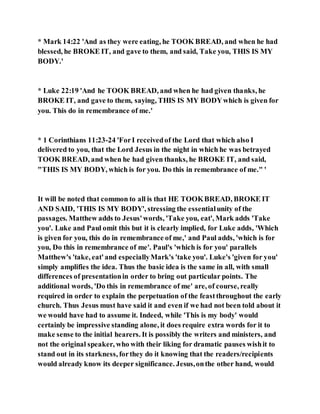
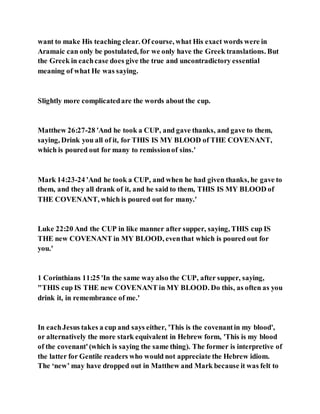
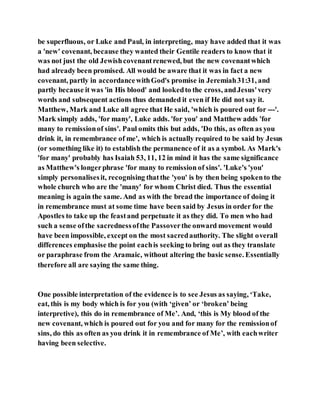
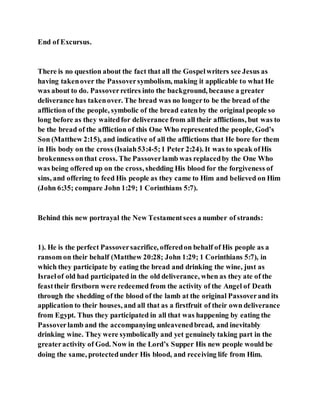
Matthew 26:28 This is My bloodof the covenant,
which is poured out for many for the forgiveness of
sins.
BIBLEHUB RESOURCES
"the BloodOf The New Covenant."
Matthew 26:28
W.F. Adeney
This verse is intensely interesting, because it contains one of our Lord's rare
sayings about the purpose of his death. For the most part the New Testament
teachings on that greattheme come from the apostles, who reflectedon the
event after it had passed into history, and with the light of the Resurrection
upon it. Still, it is not just to say that the apostles originatedthe doctrine of the
atonement. Not only is that doctrine foreshadowedin Isaiah53.; in the
institution of his Supper our Lord distinctly sets it forth. Before this he spoke
of his life being given as a ransom for many (Matthew 20:28), and he called
himself the goodShepherd who lays down his life for the sheep(John 10:15).
I. JESUS SPEAKS WITH STRANGE EMPHASIS OF HIS BLOOD. In the
present day some people shrink from all reference to the blood of Christ. They
are disgustedwith the coarse and unmeaning language ofa certain class of
preachers to whom the mere physical image seems to be more than the truth
typified. But our Lord himself directs us to the subjectin the wine of the
Communion. We must interpret his meaning in the light of Jewishideas. The
Jew taught that the blood was the life (Leviticus 17:11). Then Christ gives us
his essentiallife. The blood was shed in the sacrifice of the victim at the altar.
Christ is the greatSacrifice for our sins, and as such he sheds his blood; i.e.
the blood signifies Christ dying for us; and then, beyond the mere actof
dying, it signifies the preciousnessofhis life given to us.
II. THE BLOOD OF CHRIST SEALS HIS NEW COVENANT. He was
instituting a new order, a fresh relationship betweenman and God. The old
covenantof the JewishLaw was obsolete.Menhad outgrownit, and were
ready to receive something largerand more spiritual. Jesus himself teaches
that he institutes the fresh relation. As a covenantsignifies certain terms and
arrangements, this new covenantof Christ's has its new conditions. His whole
teaching about the kingdom of heaven is expository of his covenant.
Preparations in prophecy (e.g. Jeremiah31:31) and explanations in apostolic
writings help us further to understand it.
1. It is for all nations, not only for Jews.
2. It is of grace, not of law.
3. It is spiritual, not of "carnalordinances."
III. THIS NEW COVENANT BRINGS REMISSIONOF SINS.
1. Christ forgives sins. By exercising his right to do so our Lord roused early
antagonismamong the defenders of the old religion. But the world has since
seenthat here lay the very root and core of his work. Here is the essence ofthe
gospelfor us today - it promises forgiveness ofsins.
2. This forgiveness springs from the death of Christ. We may find it difficult
to trace the connection;but it is not an invention of human speculation, for we
find our Lord himself speaking of it. It is Christ's own teaching that our sins
are forgiven through the shedding of his blood.
IV. THE REMISSION OF SINS IS OF WIDE APPLICATION. Jesus says it
is "for many." He did not die merely to save an electfew. He had large aims,
and he will not "see of the travail of his soul and be satisfied" until he has
brought many souls out of darkness into light. Therefore the very institution
of the Lord's Supper is an encouragementfor the penitent to seek the pardon
which Christ is so bountiful in bestowing. - W.F.A.
Biblical Illustrator
And as they were eating, Jesus took bread, and blessedit.
Matthew 26:26-29
Relationof the Holy Communion to Christ
R. Hooker, D. D.
The bread and cup are His body and blood, because they are causes
instrumental, upon the receiptwhereofthe participation of His body and
blood ensueth. Every cause is in the effect which growethfrom it. Our souls
and bodies quickened to eternal life are effects, the cause. whereofis the
person of Christ; His body and blood are the true well-spring out of which
this life floweth What merit, force, or virtue soeverthere is in His sacrificed
body and blood we freely, fully, and wholly have by this sacrament;and
because the sacramentitself, being but a corruptible and earthly creature,
must needs be thought an unlikely instrument to work so admirable effects in
men, we are therefore to rest ourselves altogetherupon the strength of His
glorious power, who is able and will bring to pass that the bread and cup
which He giveth us shall be truly the thing He promiseth.
(R. Hooker, D. D.)
The Eucharistthe greatfeastof the Church
J. P. Lange, D. D.
I. A true feast — for the nourishment of the spiritual life.
II. A sacredfeast — sanctifying from all carnal enjoyment.
III. A covenant feast-sealing redemption.
IV. A love feast — uniting the redeemed.
V. A supper feastforefestivalofdeath, of the end of all things, of the coming of
Christ.
(J. P. Lange, D. D.)
SacrificialaspectofChrist's death shownin the Lord's
A. Maclaren, D. D.
Supper: — This rite shows us what Christ thought, and would have us think,
of His death. By it He points out the moment of His whole careerwhich He
desires that men should remember. Not His words of tenderness and wisdom;
not His miracles, amazing and gracious as these were;not the flawless beauty
of His character, though it touches all hearts, and wins the most rugged to
love and the most degraded to hope; but the moment in which He gave His life
is that which He would imprint for ever on the memory of the world. And not
only so, but in the rite He distinctly tells us in what aspectHe would have that
death remembered. Not as the tragic end of a noble careerwhich might be
hallowedby tears such as are shed over a martyr's ashes;not as the crowning
proof of love; not as the supreme act of patient forgiveness;but as a death for
us, in which, as by the blood of the sacrifice, is securedthe remissionof sins.
And not only so, but the double symbol in the Lord's Supper — whilst in some
respects the bread and wine speak the same truths, and certainly point to the
same cross — has in eachof its parts speciallessons entrustedto it, and
specialtruths to proclaim. The bread and the wine both say, "RememberMe
and My death." Takenin conjunction they point to the death as violent; taken
separatelythey eachsuggestvarious aspects ofit, and of the blessings that will
flow to us therefrom.
I. A Divine treaty or covenant.
II. The forgiveness ofsins.
III. A life infused.
IV. A festalgladness.
(A. Maclaren, D. D.)
The New Testament
Ibid.
God's covenants with His people: — Ancient Israelhad lived for nearly 2000
years under the charter of their national existence, which was given on Sinai
amidst thunderings and lightnings (Exodus 19:5, etc.). And that covenant, or
agreement, or treaty, on the part of God was ratified by a solemnact, in which
the blood of the sacrifice, divided into two portions, was sprinkled, half upon
the altar, and the other half, after their acceptanceofthe conditions and
obligations of the covenant, on the people who had pledged themselves to
obedience. And now here is a Galileanpeasant, in a borrowedupper room,
within four-and-twenty hours of His ignominious death, which might seemto
blast all His work, who steps forward and says, "I put awaythat ancient
covenantwhich knits this nation to God. It is antiquated. I am the true
offering and sacrifice, by the blood of which, sprinkled on altar and on people,
a new covenant, built upon better promises, shall henceforth be." What a
tremendous piece of audacity, except on the one hypothesis that He who spake
was indeed the Word of God, and that He was making that which Himself had
establishedof old to give way to that which He establishes now. The new
covenant, which Christ seals in His blood, is the charter, the better charter,
under the conditions of which the whole world may find a salvation which
dwarfs all the deliverances ofthe past. Betweenus and the infinite Divine
nature there is establisheda firm and unmoveable agreement. He has limited
Himself by the utterance of a faithful word, and we can now come to Him with
His own promise, and castit down before Him, and say, "Thou hast spoken,
and Thou art bound to fulfil it." We have a covenant; God has shown us what
He is going to do, and has thereby pledged Himself to the performance.
(Ibid.)
The Lord's Supper
C. Molyneux.
I. The NATURE of the institution. It is a supper — strictly and essentiallyin
its own particular nature it is nothing else. Was apparently in connectionwith
another supper, and it seemedto be almost a part of that other supper. The
supper was significantand emblematic-a representationof something else.
II. The OBJECTand design. The death of Christ is brought before us. The
death of Christ as an offering for sin is brought before us. The death of Christ
as the sealof the everlasting covenantbetweenthe Father and the Son is
brought before us.
III. The OBSERVANCE ofthe rite. Just as simple as its nature and object.
The frequency of receptionis left open. The posture may he considered
indifferent. The positive directions and the actualpractice of our Lord.
(C. Molyneux.)
The lastsupper
J. C. Gray.
I. The TIME OF THE INSTITUTION.
1. During the feastof the Passover. Christthe true Passover(Exodus 12:3, 6,
7, and others; with John 1:29; Revelation5:6).
2. On the eve of His being offered. The meaning and purpose of the Passover
lamb transferred to Jesus, and the sense widened. That for the Jews only, this
for the true Israelof God, etc.
II. THE METHOD OF THE INSTITUTION.
1. With thanksgiving.
2. The bread-broken, distributed, eaten. Christ the bread of life. Receivedby
faith.
3. The wine. All were to drink it. The blood of Christ shed for the remissionof
sin.
4. They sung a hymn — left the table with joy and thankfulness.
III. THE PURPOSE OF THE INSTITUTION.
1. TO supersede the JewishPassover.
2. A memorial feast. No less binding upon Christians than any other law of
Christ. A dying command. Sacrednessoflast words.
3. A bond of union among Christians, and public acknowledgmentof
indebtedness to and faith in Christ.
(J. C. Gray.)
The Passoverfeast
E. Stock.
Relate the history of this feast.
I. THE PASSOVER FEAST COMMEMORATEDA GREAT
DELIVERANCE.
1. A deliverance from what? From Egyptian bondage — the destroying angel
— God's judgment upon sin.
2. How was this deliverance effected?
3. Why was this deliverance commemoratedevery year?
II. THE PASSOVER FEAST POINTEDTO A GREATER DELIVERANCE.
1. A deliverance from what? From a worse bondage than that of Egypt, etc.
(John 8:34; Peter 2:19). And from a judgment more terrible than came upon
the first-born (Romans if. 3, 5, 8; Matthew 25:41).
2. How was this greaterdeliverance to be effected? Also by the blood of the
Lamb (1 Peter1:18, 19; Revelation5:8, 9). Who is this Lamb? (John 1:29;
Colossians 1:13, 14;Hebrews 9:12, 14). We must come to Christ and have
heart sprinkled (Hebrews 10:19, 22; 1 Peter1:2). Eachmust have his own sin
put away, etc.
3. How did the yearly feastpoint to this greaterdeliverance? Would show how
deliverance from death could only be by death of another (1 Corinthians 5:7).
III. CHRIST INSTITUTED THE LORD'S SUPPER TO COMMEMORATE
THIS GREATER DELIVERANCE. In the Lord's Supper two things done —
1. We commemorate Christ's death for us.
2. We feed upon Him by faith.
(E. Stock.)
The Lord's Supper
C. Hodge, D. D.
Nature and design.
I. A COMMEMORATION. Includes —(1) Adoration. Adoration due to God
in fashion of a man. It is this that makes Him the centralpoint of the universe,
to whom all eyes are turned.(2) Gratitude. The benefits — deliverance from
hell, power of Satan, and sin; restorationto the favour and fellowshipof God;
fellowship with Christ, including participation with His life and glory. The
costat which these benefits were secured — Christ's humiliation and
suffering.
II. A COMMUNION.
1. An act and means of participation. We participate in His body and blood,
i.e., of their sacrificialvirtue.
2. The effect of this makes us one with Him; one body. Illustration from the
Jewishrites. In this ordinance our union with Christ and with eachother is
far more intimate.
III. CONSECRATION.We cannotcommemorate Christ as our Saviour
without thereby acknowledging ourselvesto be His — the purchase of His
blood, and devoted to His service.
(C. Hodge, D. D.)
The institution and observance ofthe Lord's Supper
B. Noel, M. A.
I. A REMEMBRANCEofthe atonementof Christ.
1. How much He suffered.
2. How well He suffered.
3. How patiently -He suffered.
II. A PROCLAMATION of the atonement of Christ.
III. A PARTICIPATION in the atonement of Christ.
1. Greatfacilities granted.
2. A direct communication from Christ to His people.
(B. Noel, M. A.)
The new wine of the kingdom
J. Parsons.
I. THE WORDS OF THE SAVIOUR AS THEY REGARD THE ACT IN
WHICH HIMSELF AND HIS FOLLOWERS WERE THEN ENGAGED.
They were drinking of "the fruit," or, more properly, "the product" of the
vine. Nota mere ordinary socialcommunion, but in direct connectionwith the
Passover. Christdid not designto honour a Jewishrite as commemorating a
national deliverance, but as typical, holding a relationship to Him and the
economyof which He was the head.
1. That the Lord Jesus led His followers to regard the Passoveras being
representative of His mediatorial sufferings and death.
2. The Saviour led His followers to considerthe Passoveras originating an
ordinance to be perpetuated for important purposes throughout all the ages of
the Christian Church.
II. The words of the Saviour as they regard THE EVENTS HE TAUGHT HIS
FOLLOWERS TO ANTICIPATE,
1. An event of approaching" separation — "I will not henceforth drink of the
fruit of the vine until" a certain period afterwards-named;He and His
disciples were bound to part.
2. An event of ultimate re-union — "When I drink it new with you in My
Father's kingdom."
3. All the followers ofthe Saviour shall be brought to " the Father's
kingdom."
4. The mediation of Jesus Christ, of which the Paschalrite is to be regardedas
a:permanent and symbolical pledge, is of such a nature as to secure that all
those who have possesseda personalinterestin that mediatorial work shall be
brought into a state of glorious redemption in the bright worlds which lie
beyond the grave.
5. The followers of the Saviourshall possess unspeakable andeverlasting joy.
The drinking of wine indicates the fruition of all delight.
6. The pleasures which are to be enjoyed by the followers of the Saviour in the
Father's kingdom are especiallyto be regardedas associatedwith His
presence. How pre-eminently in the New Testamentis the presence ofChrist
setforth as constituting the happiness of the celestialworld(John 12:26).
Learn
(1)How vast and wonderful is the love of Christ to man.
(2)The vastimportance of being numbered amongst the followers of Christ
ourselves.
(J. Parsons.)
The new covenant
Selected.
I. The new covenantof forgiveness andlife. On God's side is pledged
forgiveness, remissionofsins, sustainedacceptance. Onman's side is pledged
the obedience offaith. Christ, as mediator for man, receives God's pledge;
and, as mediator for God, He receives man's pledge. As representative for
man, He offers to God the perfect obedience, and pledges us to a like
obedience;as representative for God, He brings and gives to us forgiveness
and life, pledging God therein.
II. The blood which seals the covenant. The blood represents the yielding or
taking of life.
1. In surrendering His life, Christ sealedour pledge that we will give our life
to God in all holy obedience.
2. In giving His blood, His life, for us, as it were, to eat, He gives us the
strength to keepour pledge.
III. The wine that recalls to mind and renews the covenant. God does not need
to be reminded of His pledge, but frail, forgetful, busy-minded man does.
(Selected.)
Christ's own accountof His blood-shedding
C. J. Brown, D. D.
I. WHOSE BLOOD WAS THIS? " My blood." It is a man, who sits at that
table with others, not an angel. But He is also the living God.
II. BY WHOM WAS THIS BLOOD SHED?
1. Himself, to speak with deepestreverence. JesusshedHis ownblood — was
the offereras well as the sacrifice. He freely laid down His life.
2. In some respects the principal party in this mysterious blood-shedding, even
the holy loving Father, as it is written, "Godspared not His own Son, but
delivered Him up for us all; .... This commandment have I receivedof My
Father;" "The cup which My Father hath given Me."
3. We, believers in Jesus. Our sins were the guilty cause.
III. TO WHAT END AND ISSUE WAS THIS BLOOD-SHEDDING? "For
the remissionof sins." Our Lord singles out from all the benefits of
redemption the remissionof sins, not only because it is that which stands most
intimately relatedto His blood-shedding, but because it is the foundation of
all, carrying the others along with it by necessaryconsequence(Jeremiah
31:33, 34). To what effectas well as design? A sure salvationfor a great
multitude whom no man can number.
(C. J. Brown, D. D.)
Substitution
C. J. Brown, D. D.
Let me mention here a circumstance in the last days of the distinguished Lord
ChancellorLyndhurst, who, at an extreme age, but in full possessionofall his
rare mental powers, was brought to know the Saviour. tie said, "I never used
to be able to understand what these goodpeople meant when they spoke of so
much blood, the blood. But I understand it now; it's just substitution." Ay,
that it is, in one word, "substitution;" "My blood shed for many for the
remissionof sins;" Christ's blood instead of ours; Christ's death for our
eternal death; Christ "made a curse, that we might be redeemed from the
curse of the law." Once, in conversation, my beloved friend, Dr. Duncan,
expressedit thus in his terse way, "A religion of blood is God's appointed
religion for a sinner, for the wagesofsin is death."
(C. J. Brown, D. D.)
COMMENTARIES
Ellicott's Commentary for English Readers
(28) Forthis is my blood of the new testament.—Better, this is My blood of the
Covenant; the best MSS. omitting the word “new” both here and in St. Mark.
It was probably introduced into the later MSS. to bring the text into harmony
with St. Luke’s report. Assuming the word “new” to have been actually
spokenby our Lord, we can understand its being passedover by some
reporters or transcribers whose attentionhad not been speciallycalledto the
greatprophecy of Jeremiah31:31-34. Thatprophecy was, however, certainto
have a prominent place in the minds of those who had come into contact, as
St. Luke must have done, with the line of thought indicated in the Epistle to
the Hebrews (Matthew 8, 9), and therefore we cannot wonder that we find it
in the report of the words given by him (Matthew 22:20) and by St. Paul
(1Corinthians 11:25). If we were to acceptthe other alternative, it would still
be true that the covenantof which our Lord spoke was ipso facto new, and
was therefore that of which Jeremiahhad spoken, and that the insertion of the
word (looking to the generalfreedom of the Gospels in reporting our Lord’s
discourses)was a legitimate way of emphasising that fact.
Dealing with the words, we note (1) that the word “covenant” is everywhere
(with, possibly, the one exceptionof Hebrews 9:16, but see Note there) the best
equivalent for the Greek word. The popular use of the “New Testament” for
the collectedwritings of the apostolic age,makes its employment here and in
the parallelpassagessingularlyinfelicitous. (2) That the “bloodof the
covenant” is obviously a reference to the history of Exodus 24:4-8. The blood
which the Son of Man was about to shed was to be to the true Israel of God
what the blood which Moses had sprinkled on the people had been to the
outward Israel. It was the true “blood of sprinkling” (Hebrews 12:24), and
Jesus was thus the “Mediator” of the New Covenant as Moses hadbeen of the
Old (Galatians 3:19). (3) That so far as this was, in fact or words, the sign of a
new covenant, it turned the thoughts of the disciples to that of which Jeremiah
had spoken. The essenceofthat covenantwas to be the inward working of the
divine law, which had before been brought before the conscience as an
external standard of duty—(“I will put My law in their inward parts,”
Jeremiah31:33)—a truer knowledge ofGod, and through that knowledge the
forgiveness ofiniquity; and all this, they were told, was to be brought about
through the sacrifice ofthe death of Christ.
Which is shed for many.—The participle is, as before, in the present tense—
which is being shed—the immediate future being presentedto them as if it
were actually passing before their eyes. As in Matthew 20:28, our Lord uses
the indefinite “for many,” as equivalent to the universal “for all.” St, Paul’s
language in 1Timothy 2:6 shows, beyondthe shadow of a doubt, how the
words “for many” had been interpreted.
For the remission of sins.—This had been from the outsetthe substance ofthe
gospelwhich our Lord had preached, both to the people collectively(Luke
4:16-19)and to individual souls (Matthew 9:2; Luke 7:48). What was new in
the words now was this connectionwith the shedding of His blood as that
which was instrumental in obtaining the forgiveness. Returning, with the
thoughts thus brought together, to the command of Matthew 26:27, “Drink ye
all of it,” we may see, as before in the case ofthe bread, an allusive reference
to the mysterious words of John 6:53-54. In the contrastbetweenthe
“sprinkling” of Exodus 24:6 and the “drinking” here enjoined, we may
legitimately see a symbol, not only of the participation of believers in the life
of Christ, as representedby the blood, but also of the difference betweenthe
outward characterof the Old Covenant and the inward nature of the New. It
is, perhaps, not altogetheroutside the range of associations thus suggestedto
note that to drink togetherof a cup filled with human blood had come to be
regardedas a kind of sacramentof closestand perpetual union, and as such
was chosenby evildoers—as in the case ofCatiline (Sallust, Catil. c. 22)—to
bind their partners in guilt more closelyto themselves. The cup which our
Lord gave His disciples, though filled with wine, was to be to them the pledge
of a union in holiness as deep and true as that which bound others in a league
of evil.
We cannotpass, however, from these words without dwelling for a moment on
their evidential aspect. Foreighteencenturies—without, so far as we can
trace, any interruption, even for a single week—the ChristianChurch, in all
its manifold divisions, under every conceivable variety of form and ritual, has
had its meetings to break bread and to drink wine, not as a socialfeast(from a
very early date, if not from the beginning, the limited quantity of bread and
wine must have excluded that idea), but as a commemorative act. It has
referred its observance to the command thus recorded, and no other
explanation has ever been suggested. Butthis being granted, we have in our
Lord’s words, at the very time when He had spokenof the guilt of the Traitor
and His own approaching death, the proof of a divine prescience. He knew
that His true work was beginning and not ending; that He was giving a
commandment that would last to the end of time; that He had obtained a
greaterhonour than Moses, andwas the Mediatorof a better covenant
(Hebrews 3:3; Hebrews 8:6).
Matthew Henry's Concise Commentary
26:26-30 This ordinance of the Lord's supper is to us the passoversupper, by
which we commemorate a much greaterdeliverance than that of Israelout of
Egypt. Take, eat;acceptofChrist as he is offeredto you; receive the
atonement, approve of it, submit to his grace and his government. Meat
lookedupon, be the dish ever so well garnished, will not nourish; it must be
fed upon: so must the doctrine of Christ. This is my body; that is, spiritually,
it signifies and represents his body. We partake of the sun, not by having the
sun put into our hands, but the beams of it darted down upon us; so we
partake of Christ by partaking of his grace, and the blessedfruits of the
breaking of his body. The blood of Christ is signified and representedby the
wine. He gave thanks, to teachus to look to God in every part of the
ordinance. This cup he gave to the disciples with a command, Drink ye all of
it. The pardon of sin is that greatblessing which is, in the Lord's supper,
conferredon all true believers; it is the foundation of all other blessings. He
takes leave of such communion; and assures themof a happy meeting againat
last; Until that day when I drink it new with you, may be understood of the
joys and glories ofthe future state, which the saints shall partake with the
Lord Jesus. Thatwill be the kingdom of his Father; the wine of consolation
will there be always new. While we look at the outward signs of Christ's body
broken and his blood shed for the remission of our sins, let us recollectthat
the feastcosthim as much as though he had literally given his flesh to be eaten
and his blood for us to drink.
Barnes'Notes on the Bible
For this is my blood - This "represents" my blood, as the bread does my body.
Luke and Paul vary the expression, adding what Matthew and Mark have
omitted. "This cup is the new testament in my blood." By this cup he meant
the wine in the cup, and not the cup itself. Pointing to it, probably, he said,
"This - 'wine' - represents my blood about to be, shed." The phrase "new
testament" should have been rendered "new covenant," referring to the
"covenantor compact" that God was about to make with people through a
Redeemer. The "old" covenant was that which was made with the Jews by the
sprinkling of the blood of sacrifices.See Exodus 24:8; "And Moses took the
blood and sprinkled it on the people, and said, Behold the blood of the
covenantwhich the Lord hath made with you," etc. In allusion to that, Jesus
says, this cup is the new "covenant" in my blood; that is, which is "ratified,
sealed, orsanctionedby my blood." In ancient times, covenants or contracts
were ratified by slaying an animal; by the shedding of its blood, imprecating
similar vengeance ifeither party failed in the compact. See the notes at
Hebrews 9:16. So Jesus says the covenantwhich God is about to form with
people the new covenant, or the gospeleconomyis sealedorratified with my
blood.
Which is shed for many for the remissionof sins - In order that sins may be
remitted, or forgiven. That is, this is the appointed way by which God will
pardon transgressions. Thatblood is efficacious forthe pardon of sin:
1. Becauseit is "the life" of Jesus, the "blood" being used by the sacred
writers as representing "life itself," or as containing the elements of life,
Genesis 9:4; Leviticus 17:14. It was forbidden, therefore, to eat blood, because
it contained the life, or was the life, of the animal. When, therefore, Jesus says
that his blood was shedfor many, it is the same as saying that His life was
given for many. See the notes at Romans 3:25.
2. His life was given for sinners, or he died in the place of sinners as their
substitute. By his death on the cross, the death or punishment due to them in
hell may be removed and their souls be saved. He endured so much suffering,
bore so much agony, that God was pleasedto acceptit in the place of the
eternal torments of all the redeemed. The interests of justice, the honor and
stability of his government, would be as secure in saving them in this manner
as if the suffering were inflicted on them personallyin hell. God, by giving his
Son to die for sinners, has shown his infinite abhorrence of sin; since,
according to his view, and therefore according to truth, nothing else would
show its evil nature but the awful sufferings of his ownSon. That he died "in
the steador place" of sinners is abundantly clearfrom the following passages
of Scripture: John 1:29; Ephesians 5:2; Hebrews 7:27; 1 John 2:2; 1 John
4:10; Isaiah 53:10;Romans 8:32; 2 Corinthians 5:15.
Jamieson-Fausset-BrownBible Commentary
Mt 26:17-30. Preparationfor and Last Celebrationof the Passover
Announcement of the Traitor, and Institution of the Supper. ( = Mr 14:12-26;
Lu 22:7-23;Joh13:1-3, 10, 11, 18-30).
For the exposition, see on[1362]Lu 22:7-23.
Matthew Poole's Commentary
See Poole on"Matthew 26:30".
Gill's Exposition of the Entire Bible
For this is my blood of the New Testament,.... Thatis, the red wine in the cup,
was an emblem and representationof his precious blood, whereby was
exhibited a new dispensation, or administration of the covenantof grace;and
by which it was ratified and confirmed; and whereby all the blessings ofit,
such as peace, pardon, righteousness,and eternallife, come to the people of
God: the allusion is to the first covenant, and the book of it being sprinkled
with the blood of bulls, and therefore calledthe blood of the covenant, Exodus
24:8. But the secondcovenant, or the new administration of the covenantof
grace, forwhich reasonit is calledthe New Testament, is exhibited and
establishedin the blood of Christ the testator. It was usual, even among the
Heathens, to make and confirm their covenants by drinking human blood,
and that sometimes mixed with wine (e),
Which is shed for many, for the remission of sins; that is, was very shortly to
be shed, and since has been, for all the electof God; for the many that were
ordained to eternal life, and the many that were given to Christ, the many that
are justified by him, and the many sons he will bring to glory: whereby the
full forgiveness ofall their sins was procured, in a way consistentwith, and
honourable to the justice of God; full satisfactionbeing made to the law of
God, for all their transgressions,
(e) Alex. ab Alex. Genial. Dier. l. 5. c. 3.
Geneva Study Bible
{o} Forthis is my blood of the {p} new testament, which is shed for many for
the remissionof sins.
(o) That is, this cup or wine is my blood sacramentally, as in Geneva Lu 22:20.
(p) Or covenant, that is to say, by which the new league and covenantis made,
for in the making of leagues they used the pouring of wine and shedding of
blood.
EXEGETICAL(ORIGINAL LANGUAGES)
Meyer's NT Commentary
Matthew 26:28. The death-symbolism is now applied to that which contains
the life (Genesis 9:4 ff., and comp. on Acts 15), viz. the blood, which is
describedas sacrificialbloodthat is to be shed in order to make atonement.
Neither here nor anywhere else in the New Testament(Hebrews 12:24 not
excepted)can there be any question of the glorified blood of Christ. Comp. on
Matthew 26:26, and on 1 Corinthians 10:16. According to New Testament
ideas, glorified blood is as much a contradictio in adjecto as glorified flesh.
This also in opposition to Hofmann, p. 220.
τοῦτο]this, which ye are about to drink, the wine which is in this cup.
Although this wine was red, it must not be supposed that the point of the
symbolism lay in the colour (Wetstein, Paulus), but in the circumstance ofits
being poured out (see below:τὸ π. πολλ. ἐκχυνόμ.)into the cup; the
outpouring is the symbolicalcorrelative to the breaking in the case ofthe
bread.
γάρ] justifies the πίετε … πάντες, on the ground of the interpretation given to
that which is about to be drunk.
ἐστί] as in Matthew 26:26.
τὸ αἷμά μου τῆς διαθήκης]This is the preferable reading; see the critical
remarks. “This is my blood of the covenant, my covenant blood (‫ַּד‬ ‫ם‬ ‫ה‬ַ ‫ְּב‬ ִ ‫,תב‬
Exodus 24:8), my blood which serves to ratify the covenant with God. This is
conceivedof as sacrificialblood (in opposition to Hofmann). See Delitzschon
Hebrews 9:20. In a similar way Mosesratified the covenant with God by
means of the sacrificialblood of an animal, Exodus 24:6 ff. On the double
genitive with only one noun, see Fritzsche, Quaest. Luc. p. 111 f.; Lobeck, ad
Aj. 309;Winer, p. 180 [E. T. 239]. For the arrangement of the words, comp.
Thuc. iv. 85. 2 : τῇ τε ἀποκλήσει μου τῶν πυλῶν. The connecting of the μου
with αἷμα corresponds to the τὸ σῶμά μου of Matthew 26:26, as well as to the
amplified form of our Lord’s words as given by Luke and Paul; consequently
we must not, with Rückert, connectthe pronoun with τ. διαθήκης (the blood
of my covenant). The covenantwhich Jesus has in view is that of grace, in
accordancewith Jeremiah31:31 ff., hence called the new one (by Paul and
Luke) in contradistinctionto the old one under the law. See on 1 Corinthians
11:26.
τὸ περὶ πολλῶν ἐκχυν. εἰς ἄφεσιν ἁμαρτιῶν]Epexegesisofτὸ αἷμά μου τῆς
διαθήκης, by way of indicating who are to participate in the covenant(περὶ
πολλῶν), the divine benefit conferred upon them (εἰς ἄφες. ἁμαρτ.), and the
means by which the covenantis ratified (ἐκχυνόμ.):which is shed (expressing
as present what, though future, is near and certain)for the benefit of many,
inasmuch as it becomes instrumental in procuring the forgiveness ofsins. The
last part of this statement, and consequently what is implied in it, viz. the
atoning purpose contemplatedby the shedding of blood (comp. Leviticus
17:11), is to be understood as setting forth more preciselythe idea expressed
by περί. It must not be supposed, however, that ὑπέρ, which is used by Luke
instead of περί, is essentiallydifferent from the latter; but is to be
distinguished from it only in respectof the different moral basis on which the
idea containedin it rests (like the German um and über), so that both the
prepositions are often interchangedin caseswhere they have exactly one and
the same reference, as in Demosthenes especially. See generally, on Galatians
1:4; 1 Corinthians 1:13; 1 Corinthians 15:3.
The shedding of the blood is the objective medium of the forgiveness ofsins;
the subjective medium, viz. faith, is containedby implication in the use made
in this instance, as in Matthew 20:28 (see on the passage),ofπολλῶν, as well
as in the symbolic reference of the πίετε.
It is to be observed, further, that the genuineness ofthe words εἰς ἄφες.
ἁμαρτ. is put beyond all suspicion by the unexceptionable evidence in their
favour (in opposition to David Schulz), although, from their being omitted in
every other record of the institution of the supper (also in Justin, Ap. i. 66, c.
Tr. 70), they should not be regardedas having been originally spokenby
Christ, but as an explanatory addition introduced into the tradition, and put
into the mouth of Jesus.
REMARK 1.
That Jesus meant to institute a regular ordinance to be similarly observedby
His church in all time coming, is not apparent certainly from the narrative in
Matthew and Mark; but it is doubtless to be inferred from 1 Corinthians
11:24-26, no less than from the practice of the apostolic church, that the
apostles were convincedthat such was the intention of our Lord, so much so,
that to the words of the institution themselves was addedthat express
injunction to repeatthe observance εἰς τ. ἐμὴν ἀνάμνησιν which Paul and
Luke have recorded. As bearing upon this matter, Paul’s declaration:
παρέλαβονἀπὸ τοῦ κυρίου, Matthew 26:23, is of such decisive importance that
there can no longer be any doubt (Rückert, p. 124 ff.) as to whether Jesus
intended to institute an ordinance for future observance. We cannot,
therefore, endorse the view that the repetition of the observance was due to
the impressionmade upon the minds of the grateful disciples by the first
celebrationof the supper (Paulus, comp. also Weisse,Evangelienfr. p. 195).
REMARK 2.
The two most recentand exhaustive Protestantmonographs treating of the
Lord’s supper on the lines of the Confessions, but also discussing the subject
exegetically, are:Ebrard, das Dogma vom heil. Abendm., Frankf. 1845 f., as
representing the Reformedview, and Kahnis, d. Lehre vom Abendm., Lpz.
1851, as representing the Lutheran. Rückert, on the other hand, d. Abendm.,
s. Wesenu. s. Gesch. (Lpz. 1856), ignores the Confessions altogether, and
proceeds on purely exegeticalprinciples. The result at which Ebrard arrives,
p. 110 (comp. what he says, Olshausen’s Leidensgesch. 1862, p. 103), is as
follows:“The breaking of the bread is a memorial of the death of Jesus;the
eating of the bread thus brokenis a symbolical act denoting that this death is
appropriated by the believer through his fellowship with the life of Christ. But
inasmuch as Jesus gives the bread to be eatenand the wine to be drunk, and
inasmuch as He declares those substances to be pledges of the new covenantin
His blood, the bread and the wine are, therefore, not mere symbols, but they
assume that he who partakes ofthem is an actualsharer in the atonement
brought about by the death of Christ. And since such a fellowship with
Christ’s death cannot exist apart from fellowship with His life; since, in other
words,” the new covenant“consists in an actualconnectionand union,—it
follows that partaking of the Lord’s supper involves as its result a true,
personalcentral union and fellowship of life with Christ.” The result at which
Kahnis arrives in his above-citedwork published in 1851[30]is the orthodox
Lutheran view, and is as follows:“The body which Christ gives us to feed
upon in the supper is the same that was broken for us on the cross,—justas its
substratum, the bread, was broken,—witha view to its being eaten. The blood
which Christ gives us to drink in the supper is the same that was shed for us
on the cross,—justas its substratum, the wine, was poured out,—with a view
to its being drunk” (p. 104). He comes back to Luther’s synecdoche in regard
to τοῦτο, which latter he takes as representing the concrete union of two
substances, the one of which, viz. the bread, constitutes the embodiment and
medium of the other (the body); the former he understands to be, logically
speaking, only accidentalin its nature, the essentialsubstance being brought
out in the predicate. As for the secondelement, he considers that it expresses
the identity of the communion blood with the blood of the atoning sacrifice,
and that not in respectof the function, but of the thing itself (for he regards it
as an arbitrary distinction to say that the former blood ratifies, and that the
latter propitiates); and that, accordingly, the reality in point of efficacywhich,
in the words of the institution, is ascribed to the latter necessarilyimplies a
corresponding efficacyin regard to the former.
By adopting the kind of exegesis thathas been employed in establishing the
strictly Lutheran view, it would not be difficult to make out a case in favour of
that doctrine of transubstantiation and the mass which is still keenlybut
awkwardlymaintained by Schegg, andwhich finds an abler but no less
arbitrary and mistakenadvocate in Döllinger(Christenth. u. Kirche, pp. 37
ff., 248 ff., ed. 2), because in both casesthe results are based upon the
application of the exegeticalmethod to dogmatic premises.
Then, in the lastplace, Rückertarrives at the conclusionthat, as far as
Matthew and Mark are concerned, the whole stress is intended to be laid upon
the actions, that these are to be understood symbolically, and that the words
spokenserve only as hints to enable us to interpret the actions aright. He
thinks that the idea of an actual eating of the body or drinking of the blood
never crossedthe mind either of Jesus or of the disciples;that it was Paul
who, in speculating as to the meaning of the material substances, beganto
attachto them a higher importance, and to entertain the view that in the
supper worthy and unworthy alike were partakers ofthe body and blood of
Christ in the supersensualand heavenly form in which he conceivedthem to
exist subsequent to the Lord’s ascension. In this way, according to Rückert,
Paul entered upon a line of interpretation for which sufficient justification
cannot be found either in what was done or in what was spokenby our Lord,
so that his view has furnished the germs of a version of the matter which, so
far at leastas its beneficial results are concerned, does not tell in his favour (p.
242). In answerto Rückertin reference to Paul, see on 1 Corinthians 10:16.
[30] In his Dogmatik, however(1861), I. pp. 516, 616 ff., II. p. 657 ff., Kahnis
candidly acknowledgesthe shortcomings of the Lutheran view, and the
necessityofcorrecting them, and manifests, at the same time, a decided
leaning in the direction of the Reformeddoctrine. The supper, he says, “is the
medium, of imparting to the believing communicant, in bread and wine, the
atoning efficacyof the body and blood of Christ that have been sacrificedfor
us, which atoning efficacyplaces him to whom it is imparted in mysterious
fellowship with the body of Christ.” Kahnis now rejects, in particular, the
Lutheran synecdoche and approves of the symbolical interpretation in so far
as bread and wine, being symbols of Christ’s body and blood, constitute, in
virtue of the act of institution, that sacramentalwordconcerning our Lord’s
body and blood which when emitted by Christ has the effectof conveying the
benefits of His death. He expresses himselfmore clearly in II. p. 557, where he
says:“The Lord’s supper is the sacramentof the altar which, in the form of
bread and wine, the symbols of the body and blood of Christ, which have been
sacrificedfor us, imparts to the believing communicant the sin-forgiving
efficacyof Christ’s death.” Those divinely-appointed symbols he regards as
the visible word concerning Christ’s body and blood, which word, as the
terms of the institution indicate, is the medium through which the atoning
powerof His death, i.e. the forgiveness ofsins, is communicated. From the
bread and wine Christ is supposedto create a eucharistic corporeality, which
He employs as the medium for the communication of Himself.
REMARK 3.
As for the different versions of the words of the institution that are to be met
with in the four evangelists,that of Mark is the most concise (Matthew’s
coming next), and, considering the situation (for when the mind is full and
deeply moved the words are few) and the connectionof this evangelistwith
Peter, it is to be regardedas the most original. Yet the supplementary
statements furnished by the others are serviceable in the way of exposition, for
they let us see whatview was takenof the nature of the Lord’s supper in the
apostolic age, as is pre-eminently the case with regard to the τοῦτο ποιεῖτε εἰς
τ. ἐμὴν ἀνάμνησιν of Paul and Luke. Comp. on Luke 22:19. According to
Gess, I. p. 147, the variations in question are to be accountedfor by supposing
that, while the elements were circulating, Jesus Himself made use of a variety
of expressions. But there canbe no doubt that on an occasionof such painful
emotion He would utter the few thoughtful words He made use of only once
for all. This is the only view that can be said to be in keeping with the sad and
sacrednature of the situation, especiallyas the texts do not lead us to suppose
that there was any further speaking;comp., in particular, Mark 14:23-24.
Expositor's Greek Testament
Matthew 26:28. τὸ αἷμά μου:the very colourof the wine suggestive;hence
calledαἷμα σταφυλῆς in Deuteronomy 32:14;my blood, pointing to the
passion, like the breaking of the bread.—τῆς διαθήκης (forthe two gen. μου τ.
δ. dependent on αἷμα, vide Winer, 30, 3, 3), the blood of me, of the covenant.
The introduction of the idea appropriate to the circumstances:dying men
make wills (διατίθενται οἱ ἀποθνήσκοντες, Euthy.). The epithet καινῆς in T.
R. is superfluous, because involved in the idea. The covenantof course is new.
It is Jeremiah’s new covenantcome at last. The blood of the covenantsuggests
an analogybetweenit and the covenantwith Israelratified by sacrifice
(Exodus 24:8).—τὸ περὶ πολλῶν ἐκχυνόμενον:the shedding for many suggests
sacrificialanalogies;the presentparticiple vividly conceives that which is
about to happen as now happening; περὶ πολλῶν is an echo of ἀντὶ πολλῶν in
Matthew 20:28.—εἰς ἄφεσινἁμαρτιῶν:not in Mk., and may be a comment on
Christ’s words, supplied by Mt.; but it is a true comment. Forwhat else could
the blood be shed according to Levitical analogies andeven Jeremiah’s new
covenant, which includes among its blessings the complete forgiveness ofsin?
Cambridge Bible for Schools andColleges
28. this is my blood] The blood of the sacrifice was the sealand assurance of
the old covenant, so wine is the sealof the new covenant, under which there is
no shedding of blood.
new testament] The word “new” is omitted in the most ancient MSS. here and
in Mark.
testament] The Greek word means either (1) a “covenant,” “contract,” or(2)
“a will.” The first is the preferable sense here, as in most passageswhere the
word occurs in N.T. the new covenant is contrastedwith “the covenantwhich
God made with our fathers,” Acts 3:25. It need hardly be remarked that the
title of the New Testamentis derived from this passage.
for many] i. e. to save many; “for” is used in the sense ofdying for one’s
country.
many] See note ch. Matthew 20:28.
for the remission of sins] “For” here marks the intention, “in order that there
may be remission of sins.” These words are in Matthew only.
Bengel's Gnomen
Matthew 26:28. Τοῦτο, this) The true blood of Christ is shownto be actually
present, just as the blood of the victims was in the Mosaic formula cited in
Hebrews 9:20; for that formula is here referred to.—τῆς καινῆς, ofthe New)
in contradistinction to the Old: see Exodus 24:8, sc. “And Mosestook the
blood, and sprinkled it on the people, and said “Beholdthe blood of the
covenant,” etc.—διαθήκης,testament, disposition, dispensation)Many
theologians ofthe ReformedChurch, and some even of the Evangelical
communion,[1135]endeavouredin the lastgenerationto reduce the whole
scheme of Christian doctrine to the form of a covenant:a method pre-
eminently suited to the Jewishtheology;but Scripture expressesthe New
divine economy in this case,as it is wont in other cases,by a word belonging to
the Old scheme, although employed in a sense notexactly coinciding with its
original meaning: nor can we easilyspeak of the NEW, διαθήκη,or
Dispensation(Dispositio), exceptin contrastto the Old, either expressedor
implied. In short, the very words ‫ב‬ ַּ‫ד‬ and ΔΙΑΘΉΚΗ [by which the Old and
New Dispensationare severallyindicated] differ from eachother, and their
difference corresponds wonderfully with the actual state of the case.Forthe
word ‫ב‬ ַּ‫ד‬ accords more with the Old economy, which had the form of a
covenant, whereas διαθήκηaccords more with the New economy, which has
the form of a testament; on which accountthe Talmudists employ the Greek
word ‫ַּקַּדַַּּד‬ [ΔΙΑΘΉΚΗ, written in Hebrew characters]as not having a
Hebrew word whereby to express it. But the idea of a covenant does not so
well agree with that entire son-ship which exists under the New Testament
dispensation. Even the very notion of a testament, will at last, as it were, come
to an end, on accountof our intimate union with God: see John17:21-22, and
1 Corinthians 15:28.—ΠΟΛΛῶΝ, many) even beyond the limits of Israel.—
ἐκχυνόμενον, which is being shed) The present tense. There is the same
potency in the Holy Supper, as if in that self-same moment the body of Christ
was always being given, and His blood being shed.—ἌΦΕΣΙΝ ἉΜΑΡΤΙῶΝ,
remissionof sins) the especialblessing ofthe New Testamentdispensation.
[Ephesians 1:7, E. B.]
[1135]In Bengel, Reformed= Calvinistic: Evangelical= Lutheran.—(I. B.)
Pulpit Commentary
Verse 28. - For. Yes, drink ye all hereof, for it is unspeakablyprecious. This
(τοῦτο, as before, ver. 26)is my blood. This which I here give you. The blood
separatedfrom the body represents Christ's death by violence;it was also the
sign of the ratification of a covenant. Of the new testament; διαθήκης:
covenant. The adjective"new"is omitted by some goodmanuscripts and
modern editors, but it gives the sense intended. The Vulgate has, novi
testamenti. The old covenantbetweenGod and his people had been ratified at
Sinai by the blood of many victims (Exodus 24:5-8;Hebrews 8:8-13;Hebrews
9:15, etc.);the blood of Christ shed upon the cross ratifies "the new or
Christian covenant to the world and the Church, and the same blood
sacramentallyapplied ratifies the covenantindividually to eachChristian"
(Sadler). The evangelicalcovenantsupersedes the Judaic, even as the sacrifice
of Christ fulfils and supersedes the Levitical sacrifices. Whichis shed (is being
shed) for many. The Vulgate has effundetur, in reference to the crucifixion of
the morrow; but this is tampering with the text. Rather, by using the present
tense, the Lord signifies that his death is certain - that the sacrifice has
already begun, that the "Lamb slain from the foundation of the world"
(Revelation13:8) was now offering the eternal sacrifice. The whole ordinance
is significant of the completionof the atonement. "Many" here is equivalent to
"all." Redemption is universal, though all men do not acceptthe offer (see on
ch. 20:28). Even Calvin says, "Nonpartem mundi tantum designat, sedtotum
humanum genus." Forthe remission of sins. "Forwithout shedding of blood
is no remission" (Hebrews 9:22); "The blood of Jesus Christ, his Son,
cleansethus from all sin (1 John 1:7). The sacrifices ofthe Law, the blood of
bulls and goats, couldnot take awaysin; at most they gave a ritual and
ceremonialpurification. But what the Mosaic Law could not effectwas
accomplishedby the precious blood of Christ, who offered himself a spotless
and perfectVictim unto God. This is our Lord's most complete announcement
of the propitiatory nature of his sacrifice, whichis appropriated by faith in
the receptionof his precious blood. St. Paul adds, "This do ye (τοῦτο ποιεῖτε),
as oft as ye drink it, in remembrance of me [εἰς τὴν ἐμὴν ἀνάμνησιν, 'for my
commemoration']." These were, ofcourse, Christ's words spokenat the time,
and are of most important bearing on what is calledthe sacrificialaspectof
the Holy Eucharist.
Vincent's Word Studies
Testament(διαθήκης)
From διατίθημι, to distribute; dispose of. Hence of the dispositionof one's
property. On the idea of disposing or arranging is basedthat of settlement or
agreement, and thence of a covenant. The Hebrew word of which this is a
translation is primarily covenant, from a verb meaning to cut. Hence the
phrase, to make a covenant, in connectionwith dividing the victims slain in
ratification of covenants (Genesis 15:9-18). Covenantis the generalOld
Testamentsense ofthe word (1 Kings 20:34; Isaiah28:15; 1 Samuel 18:3); and
so in the New Testament. Compare Mark 14:24;Luke 1:72; Luke 22:20;Acts
3:25; Acts 7:8. Bishop Lightfoot, on Galatians 3:15, observes that the word is
never found in the New Testamentin any other sense than that of covenant,
with the exceptionof Hebrews 9:15-17, where it is testament. We cannot
admit this exception, since we regardthat passageas one of the best
illustrations of the sense ofcovenant. See on Hebrews 9:15-17. Render here as
Rev., covenant.
Is shed (ἐκχυννόμενον)
The present participle, is being shed. Christ's thought goes forwardto the
consummation.
PRECEPTAUSTIN RESOURCES
WILLIAM BARCLAY
His Body And His Blood (Matthew 26:26-30)
26:26-30 While they were eating, Jesus took breadand blessedit and broke it,
and gave it to his disciples and said, "Take,eat;this is my body." Then he
took a cup, and when he had given thanks, he gave it to them. "Drink all of
you from it," he said, "for this is my blood, the blood of the covenant, which is
poured out for many, that their sins may be forgiven. I tell you that from now
on I will not drink of this fruit of the vine until that day when I drink it new
with you in the Kingdom of my Father." And when they had sung a hymn,
they went out to the Mount of Olives.
We have alreadyseenhow the prophets, when they wished to saysomething in
a way that people could not fail to understand, made use of symbolic actions.
We have alreadyseenJesus using that method both in his Triumphal Entry
and in the incident of the fig tree. That is what Jesus is doing here. All the
symbolism and all the ritual actionof the PassoverFeastwas a picture of what
he wished to say to men, for it was a picture of what he was to do for men.
What then was the picture which Jesus was using, and what is the truth which
lies behind it?
(i) The PassoverFeastwas a commemorationof deliverance;its whole
intention was to remind the people of Israel of how God had liberated them
from slavery in Egypt. First and foremostthen, Jesus claimedto be the great
liberator. He came to liberate men from fearand from sin. He liberates men
from the fears which haunt them and from the sins which will not let them go.
(ii) In particular the PassoverLamb was the symbol of safety. On that night of
destruction it was the blood of the PassoverLamb which kept Israel safe. So,
then, Jesus was claiming to be Saviour. He had come to save men from their
sins and from their consequences.He had come to give men safety on earth
and safetyin heaven, safety in time and safetyin eternity.
There is a word here which is a key word and enshrines the whole of Jesus'
work and intention. It is the word covenant. Jesus spoke ofhis blood being the
blood of the covenant. What did he mean by that? A covenantis a relationship
betweentwo people;but the covenantof which Jesus spokewas not between
man and man; it was betweenGod and man. That is to say, it was a new
relationship betweenGod and man. What Jesus was saying atthe Last Supper
was this: "Becauseofmy life, and above all because ofmy death, a new
relationship has become possible betweenyou and God." It is as if he said,
"You have seenme; and in me you have seenGod; I have told you, I have
shown you, how much God loves you; he loves you even enough to suffer this
that I am going through; that is what God is like." Becauseofwhat Jesus did,
the wayfor men is open to all the loveliness of this new relationship with God.
This passageconcludes by saying that, when the company of Jesus and the
disciples had sung a hymn, they went out to the Mount of Olives. An essential
part of the Passoverritual was the singing of the Hallel. Hallel means Praise
God! And the Hallel consistedof Psalms 113:1-9;Psalms 114:1-8;Psalms
115:1-18;Psalms 116:1-19;Psalms 117:1-2;Psalms 118:1-29, whichare all
praising psalms. At different points of the PassoverFeastthese psalms were
sung in sections;and at the very end there was sung The Great Hallel, which
is Psalms 136:1-26 . That was the hymn they sang before they went out to the
Mount of Olives.
Here is another thing to note. There was one basic difference betweenthe Last
Supper and the Sacramentwhich we observe. The Last Supper was a real
meal; it was, in fact, the law that the whole lamb and everything else must be
eatenand nothing left. This was no eating of a cube of bread and drinking of a
sip of wine. It was a meal for hungry men. We might well say that what Jesus
is teaching men is not only to assemble in church and eat a ritual and symbolic
Feast;he is telling them that every time they sit down to eat a meal, that meal
is in memory of him. Jesus is not only Lord of the Communion Table; he must
be Lord of the dinner table, too.
There remains one final thing. Jesus says that he will not feastwith his
disciples againuntil he does so in his Father's Kingdom. Here, indeed, is
divine faith and divine optimism. Jesus was going out to Gethsemane, outto
trial before the Sanhedrin, out to the Cross--andyet he is still thinking in
terms of a Kingdom. To Jesus the Cross was neverdefeat; it was the way to
glory. He was on his way to Calvary, but he was also on his way to a throne.
BRIAN BELL
INSTITUTION (26-30)[Lord’s Supper. Communion. Lord’s Table. Breaking
of Bread. Eucharist]
A. Bread& wine were 2 common items that were used at practically every
meal, but Jesus
gave them a wonderful new meaning. Now as memorials of His death.
1. Every detail of the Passoverpointed to that great day of Israel’s deliverance
from Egypt. Now, Jesus will redirect the details to Himself & to His
deliverance
of the world from sin.
a) When you do this again, do it in memory of Me and not of the lamb slain in
Egypt.
2. This is the Original Value Meal...andwhata value He placedon it :)
B. Lets look at these 6 things about communion:
C. Slide17a It’s Historical:Mt, Mark, Lk, John. From the earliestchurch
records the church
started observing this. Jesus Himself is the origin of the Lord Supper. He
commanded
that if be continued. And He is the focus and contentof it.
D. Slide17bIt’s Familial: The Lord’s Supper is an actof the gatheredfamily
of those who
believe in Jesus, the church. Though it’s not an act for unbelievers, they
should be present
and welcomed. As I said earlier it is not to be secretive. It’s about
proclamation not privacy.
E. Slide17c It’s Physical:it is not the consumption of a 7 course meal. It is
very simple.
We should not use playful substitutes (i.e. Oreo cookie & Coca-Cola)we
should celebrate it
with a sense ofweightiness.
F. Slide18a Bread:Note, He didn’t take the PassoverLamb, but bread &
wine. Thus He was
instituting a feast, not a sacrifice.
1. 1 Cor.5:7,8 Forindeed Christ, our Passover, was sacrificedfor us.
Therefore
let us keepthe feast, not with old leaven, nor with the leaven of malice and
wickedness, but with the unleavened bread of sincerity and truth.
2. Slide18bBroke it, gave it to them – Bread broken/Christ for us. Bread
eaten/
Christ in us. Breadpartakentogether/Christ among us.
G. Slide19 Cup: The Passoverrequires 4 cups of wine (2 before the meal, 2
after) [Ex.6:6,7]
1. The cup of Sanctification(kiddush) [separationfrom all other common
meals]
2. The cup of Deliverance/salvation(makkot)[Delfrom Egypt. Explaining/
Proclaiming]
4
3. The cup of Redemption (ha-geulah) [symbolized blood of passover
lamb/now
Jesus’]
a) This cup is the cup of wine lifted at communion, commemorating God’s
redemption of His people. This was Jesus establishing His New Cov [a sacred
binding contract]in His own blood.
4. The cup of Praise/hope/expectation(hallel) [took place during the hallel,
hymn]
a) This cup is the cup of wine that Jesus refusedto drink from until the
coming of His Father’s Kingdom.
5. Going back to the The 3rd cup...Redemption...
a) Old covenant(Sinai) ratified w/the blood of animals sacrifices.
New covenantwas ratified by His blood.
b) Slide20a RattlesnakeCommunion: Old Cov coveredour sin. New Cov puts
it away
(1) Heb.9:26 now, once at the end of the ages, He has appearedto put
awaysin by the sacrifice ofHimself.
(2) Slide20b The Old Law was like covering a rattlesnake w/a trashcan lid.
The New Cov is like taking his venom out…he can still bite, but it’s no
longerdeadly.
c) A venomoid is a venomous snake that has undergone a surgicalprocedure
to
remove or inhibit the production of snake venom.
(1) Slide21 It’s a Venomoid Communion :)
6. Gave thanks (27) - Thanksgiving is the expressionofJoy God-ward.
7. This is My blood (28) - Biblical covenants were always ratified by shed
blood.
H. Slide22a It’s Mental: Do this in remembrance of me...Rememberwhat?
1. Normally we celebrate someone’s Birthday not their Death-day.
a) Death-days are often difficult days to remember.
2. As we do the physical actof eating and drinking, we are to do the mental
active remembering.
3. How does the Lord’s Supper help us to remember Him?
5
a) It makes us come to a restful halt in our pilgrimage. It gives us a graphic
picture
of salvation. It reminds us of the reassuring promise of His Grace. It remains
clearprophecy of the future.
4. Rememberwhat? that He truly was a GoodMan, a GreatSavior, a Loving
Friend, a Living Hope, & a Coming Lord.
5. RememberHim in sicknessthat you might have patience.
6. RememberHim in persecutionthat you might have gentleness.
7. RememberHim in your service that you remember His burning zeal in His.
8. RememberHim in times of solitude as you remember His midnight prayers.
9. RememberHim so He becomes our pattern that we might be the
reproduction
of Himself, & thus become the best memorial of Him.
a) So it’s about Remembering. Not imagining. Not dreaming. Notchanneling.
Not
listening. Not going into neutral. It’s a consciousdirecting of the mind back in
history to Jesus and what He did, in the bible, in history. Breadand cup. Body
and
blood. Execution and death. (Piper)
I. Slide22bIt’s Spiritual: unbelievers can do everything we’ve named so far.
Eat, drink,
remember. There must be something more. There is. 1 Cor.10:16-18The cup
of blessing
which we bless, is it not the communion of the blood of Christ? The bread
which we
break, is it not the communion of the body of Christ? 17 For we, though
many, are one
bread and one body; for we all partake of that one bread. 18 Observe Israel
after the
flesh: Are not those who eatof the sacrifices partakers ofthe altar?
[communion = sharing/
fellowship/participation/koinonia]
1. These believers trust & treasure Jesus Christ. Paul says they’re
participating
in the body and blood of Christ. They are experiencing a sharing/koinonia in
His body & blood. They are experiencing a partnership in His death, by faith.
2. As the Jews (18) sharedin or benefited from what happened on the altar.
So we, enjoy forgiveness andrestoredfellowship with God in communion.
3. When we celebrate the Lord supper, we feastspiritually by faith on all the
promises of God bought by the blood of Jesus. No unbeliever cando that.
J. Slide22c It’s Sacred:believers are warned not to take communion in a
cavalier, callous, or
carelessway.
6
1. Notour goalto exclude anyone. Each persondecides for himself.
2. This is not the EpiscopalTable, nor the BaptistTable, nor the Calvary
Table,
but the Lord’s Table.
3. Slide23a Examine yourself. Q:Can you be more-bad than God is
good?don’tthink so
4. You canonly sin as a man, but God can forgive as God.
5. You sin as a finite creature but the Lord forgives as the infinite Creator.
6. Confess your sin to Him - For I will forgive their iniquity, & their sin I will
remember no more. Jer.31:34
K. Slide23b(29) The supper ends on a note of Hope...until that day when I
drink it new with
you in My Father’s Kingdom.
1. Jesus was sure of 2 things: He was to die & His kingdom was to come.
a) He was certainof His cross & certain of His glory.
b) He was certainof the Love of His Father & certainof man’s sin.
c) He was certainthat in the end that love would conquer sin.
L. Do Communion:
M.In Lk.22:15 Jesus saidto his disciples, With fervent desire I have desired to
eat
this Passoverwith you before I suffer.
1. He desired to eat it with them. Even though His body was about to be
broken,
His blood shed, His heart grieved. And 1 was about to betray Him, 1 about to
deny Him, & all about to forsake Him.
2. He desires to eat it with you. Even though you’ve betrayed Him...& will
again.
Even though you’ve grieved Him...& will again. Even though you’ve broken
his heart...& will again...He desires to eatwith you...oh what a love!
N. If you ever feelunworthy to come to His table, then just make sure you
bring your sin w/
you to the table.
1. Sin gives us a right to Christ. He is a Saviorfrom sin. It is as sinners we can
sit at the table to begin with. Sin is the handle by which I can take hold of
Christ.
O. *(30)Sung a hymn - Imagine the Lord singing when the cross was onlya
few hours away
1. Jesus sings praise to His Father In the face of rejection& suffering & death.
JOHN BROADUS
Matthew 26:26-30. The Lord's Supper
Mark 14:23-26, Luke 22:19-20, 1 Corinthians 11:23-25.
John gives no accountof the institution of the Lord's Supper. Paul says, "I
have receivedof the Lord," and judging from his similar expressions
elsewhere,we understand him to mean by direct revelation, which would
make this an independent account. It resembles that of his companion
Luke,(1) and Matt. and Mark form another pair. The place is an upper room
in the house of some friend (Matthew 26:18), and the time apparently some
hours after sunset, on the evening before the crucifixion. As they were eating,
compare Matthew 26:21; this is the secondthing described as occurring in the
course of the meal; so Mark 14:18, Mark 14:22. Jesus took bread, or a loaf
(Rev. Ver. margin); the common Greek text has an article, but wrongly. The
word is singular in all four accounts. It is sometimes employed collectivelyfor
bread in general, (Matthew 4:4, Matthew 6:11, Matthew 15:2, Matthew 15:16)
but more commonly for a loaf or cake ofbread (Matthew 4:3, Matthew 12:4,
Matthew 14:17, Matthew 14:19, Matthew 15:33 ff.; Matthew 16:5-11), and
probably so here. This is more likely to have been what we should call a cake
than a loaf (see Smith's "Dict.," Bread);such fiat cakesthe Jews atJerusalem
now eatat the passover. It was unleavened, of course, as required by the law
at the passover;(Exodus 12:15, Exodus 13:3, Exodus 13:7, Deuteronomy 16:3)
but our Lord makes no reference to this, and it is not wise to insist on using
only unleavened bread in the Lord's Supper. And blessed, naturally means
blessedthe loaf, that being the object of the preceding and the two following
verbs. Luke and Paul, however, have 'gave thanks' viz., to God, as below,
Mark 14:27; (2) and so some would here understand it to mean blessedGod.
But in Luke 9:16 it is distinctly 'he blessedthem,' viz., the loaves and fishes.
This shows that the idea of blessing the loaf is not repugnant to Scripture, and
as the connectionnaturally indicates that idea here, it should be preferred.
Compare 1 Corinthians 10:16, "The cup of blessing which we bless." To bless
a loaf is of course to invoke God's blessing upon it, to ask that God will make
it a means of blessing to those who partake. And brake it. Hence the
observance ofthis ordinance came to be described as 'the breaking of bread.' (
Acts 2:42, Acts 2:46, Acts 20:7; compare 1 Corinthians 10:16) And gave, is
according to the most probable Greek text(3) in the imperfect tense, which
may mean that he went on giving, himself breaking a piece for eachone, to be
passedon to those out of his reach;while as to the cup it is aorist, since he
simply gave the cup, and they passedit to eachother. But the imperfect in
such a case might only describe him as engagedin giving, and so would not
substantially differ from the aorist. Take, eat. Mark has simply 'take';Luke
and Paul in Rev. Ver. have neither. This is my body. 'This' is neuter, while the
masculine would be needed to agree with 'bread'; it means, this object
represents my body. Paul (1 Corinthians 11:24, Rev. Ver.) has 'This is my
body, which is for you,' where 'broken' was early inserted, probably suggested
by 1 Corinthians 10:16. The phrase current among us, "brokenfor you," is
thus not a Scripture expression. 'That is for you' means 'for your benefit;' we
should lovingly take what represents the body that is for us. Luke, Rev. Ver.,
has 'this is my body which is given for you,' which amounts to the same thing.
Weiss:"Notas a dark fatality were they to regardthe death which he was
now to meet, but as the way by which God would make them sharers in his
greatestgift of salvation;and that gift was not to be for mere contemplative
purposes:but for personalappropriation."
Four different views as to the meaning of the phrase, 'this is my body,' now
prevail in the Christian world. Two of them take the expressionliterally, the
others figuratively. (1) Transubstantiation, which represents the Roman
Catholic view, mean that the bread ceasesto be bread, and its substance is
changedinto the substance of the glorified body of Christ. This notion arose
from combining the expressionbefore us with John 6:48-58, the images there
used being taken literally. In Justin Martyr," 1 Apol." 66, Irenaeus, 4, 18, 5,
and even in Ignatius, Sin. 6, are expressions which do not in fact mean
transubstantiation or read presence, but which tend in that direction, and
doubtless helped to prepare the way for the doctrine subsequently developed.
There is nothing of the sort in the "Didache." The questionneed not be here
argued. The language seems evidently figurative, as in "I am the door," "I am
the vine," "and the rock was Christ," "the field is the world," etc. We must
remember that in Hebrew or Aramaic the copula 'is' would not be expressed
at all. (2) Consubstantiation, the term invented by Luther, and still used by
some of his followers, means that with the unchanged substance ofthe bread
is united the substance of the glorified body of Christ. Luther : "Whatis now
the sacramentofthe altar? Answer: It is the true body and blood of the Lord
Christ, in and under the bread and wine, which we Christians are through
Christ's word commanded to eatand to drink... but how the body is in the
bread, we know not." His followers have compared it to iron, with heat
superadded, or more recently to iron magnetized. But the whole notion is
obviously a mere makeshiftof persons unwilling to give up the literal sense of
'is,' and the mystical notion of Christ's real presence. And how could the
glorified body be invisibly dwelling in the bread, and the blood of that same
glorified body be separatelydwelling in the wine? They could be symbolized
separately, but how could they exist separately? (Compare Meyer.)(3) The
view of Calvin, now held by Presbyterians, Methodists, andmany
Episcopalians, appears to be that to the partaking of the bread is attachedby
divine appointment a specialspiritual blessing, which is receivedby all who
take the bread in faith, and which cannot be had without taking it. Hence,
they sometimes feelaggrievedthat other Christians who do not invite them to
partake of the bread and wine are denying them the opportunity of a spiritual
blessing, not to be otherwise enjoyedat that time. Some High Churchmen
have recededfrom the Calvinian view, and maintain the "RealPresence" of
Christ in the Sacrament, without undertaking to explain in what way or in
what sense it exists. (4) The view of Zwingli, now almost universally held by
Baptists, is that the bread is simply appointed as the symbol or memento,
which we take in remembrance of the Saviour's body, and that the natural
effectof such a memento or symbol in vividly reminding of the Saviour, and
kindling grateful affectiontoward him, is blessedto the devout participant. A
memento of the departed may be a very simple thing, and yet deeply move the
heart. But the blessing thus receivedis not supposedto be essentiallydifferent
in kind from other spiritual blessings, orto be associatedby mere divine
appointment with this particular means of grace. Hence no spiritual loss is
necessarilyinflicted by failing to invite to this ceremony persons who have
made a credible oral professionof faith, but have not yet submitted to the
prerequisite ceremony.
Matthew 26:27. Took the cup; a cup, is the correcttext in Matthew and Mark,
while it is 'the cup' in Luke and Paul. There was a cup on the table for
drinking wine according to the customof the paschalmeal; 'a cup' does not
say there were others. The paschalwine was usually mixed with a double
quantity of water (Edersheim). Gave thanks. From the Greek wordthus
translated comes 'the Eucharist,'i. e., 'the Thanksgiving,'as a phrase for
taking the bread and wine. It is used by Ignatius and the "Didache" to denote
the taking of bread and wine in connectionwith an agape, or'love feast',
(Judges 1:12) just as Paul seems to use his phrase 'the Lord's Supper.' (1
Corinthians 11:20) But the connectionwith a regularmeal in common is not
made a duty by Paul, nor the connectionwith the passoverby our Lord. What
he directs is not to eatthe passover, orto eat a supper, not to eat in the
evening, or at a table, or in a reclining posture, but to eat bread and drink
wine. Protestants unite in declaiming againstthe Romish practice of
withholding the wine from the laity, because the Saviour enjoined both the
eating and the drinking; and exactly what the Saviour enjoined we should do.
So as to baptism, there is no command to baptize "in living water," as the
"Didache" declarespreferable, orin any particular place, time,
circumstances, ormanner; the thing enjoined is to baptize, (Matthew 28:19)
viz., in water, (Matthew 3:11) and we should insist on nothing but waterand
the baptizing. (Compare on Matthew 3:6) Drink ye all of it, It would seem
unnecessaryto say that this means all of you, and not all of it, as the Greek
places beyond question; yet some have misunderstood. Mark records, not the
command, but the performance, 'and they all drank of it.' For, what follows
being a reasonfor drinking. This is my blood, i. e., this wine represents my
blood, like 'this is my body.' Of the new covenant; the correctreading here,(1)
and in Mark, does not contain"new." It was added by copyists from Luke
and Paul. (Compare Jeremiah31:31, Hebrews 8:8)(2) Moses atMount Sinai
"took the book of the covenantand read in the audience of the people," and
they promised to obey. Then he "took the blood "of oxen just slain," and
sprinkled it on the people, and said, Behold the blood of the covenant."
(Exodus 24:3-8 compare Hebrews 9:19 f.) So the new covenant predicted by
Jeremiah31:31-35 is about to he ratified by the Saviour's own blood as the
"blood of the covenant." (Compare Hebrews 10:29, Hebrews 13:20)For
world-wide symbolism of blood as sealing a covenant, and its participation as
denoting vital union, see Trumbull: "The BloodCovenant," especiallyp. 271-
286. Which is shed, present tense (in Mark also), expressing what is near and
certain, on the point of taking place, like 'is delivered,' Matthew 26:2, Rev.
Ver., and 'I keep,'Matthew 26:18, Rev. Ver. For many, so Mark. In Luke, if
Matthew 26:20 be genuine, it is 'for you.' The 'many' (compare Matthew
20:28)is simply a generalexpression(probably derived from Isaiah 53:12, "he
bare the sin of many," compare Isaiah52:15), not necessarilyindicating that
some are omitted. In one sense, Jesus "gave himselfa ransom for all", (1
Timothy 2:6) and to "taste death for every man" (Hebrews 2:9; compare 1
John 2:2), making salvation objectivelypossible for all; in another sense, his
atoning death definitely contemplatedthe salvationof the elect. Euthym.
understands that whereas the blood of the sacrificeswas shedfor Jews only, i.
e., few, this blood is shed for many, i. e., for Gentiles also. The preposition
here rendered 'for' means 'concerning'(peri), and so 'for the benefit of,' as in
John 16:26, John 17:9, John 17:20, Hebrews 5:3, Hebrews 11:40. This
preposition would not of itself suggestthe idea of substitution. That idea
would be readily, though not necessarily, suggestedby Mark 14:24, hyper
(which copyists easilychangedby assimilationto Matthew and so the common
Greek text of Mark has peri); and substitution is necessarilythe meaning of
anti, see on "Matthew 20:28". For, or unto, remissionof sins, in order that
sins may be remitted. (Hebrews 9:22) This is the natural and most probable
meaning of the preposition and its case, andis here entirely appropriate.
(Compare on Matthew 3:11) The bread and wine symbolize objectively the
Saviour's body and blood; our eating and drinking these symbolizes our
personalunion with Christ, and feeding our spiritual nature upon him; and
our doing this togetherwith others will, from the nature of the case,like any
other action in common, promote Christian fellowship and unity where these
already exist. Yet this last is a subordinate and incidental effectof the
ceremony, and the presence of some in whose piety we lack confidence should
not prevent our eating the bread and drinking the wine in remembrance of
Christ. The Lord's Supper is often called"the Communion," through a
misunderstanding of 1 Corinthians 10:16, where the word communion really
means 'participation,' as in Rev. Ver., margin. This wrong name for the
ordinance has often proved very misleading. (See T. G. Jones, "The Great
Misnomer," Nashville, Tenn.) Few have everquestioned that the apostles had
all been baptized before this ordinance was established;some urge that being
the baptism of John, this was not Christian baptism, and so they curiously
infer that Christian baptism is not a prerequisite to the Lord's Supper. But if
John's baptism was essentiallydistinct from Christian baptism, then how as to
the baptism administered by Christ himself, (John 3:22, John 3:26) i. e.,
through his disciples, (John 4:1 f.) at the same time with John, and upon the
same generalteaching? (Mark 1:15) If the baptism performed by Christ was
not Christian baptism, then what was it? (Compare on Matthew 11:11)
RICH CATHERS
Matthew 26:26-29
Thursday Evening Bible Study
June 7, 2007
Introduction
We are in the night that Jesus will be betrayed. We are in the middle of the
meal known as “The Last Supper”.
:26-29 Communion
:26 And as they were eating, Jesus took bread, blessedand broke it, and gave
it to the disciples and said, "Take, eat;this is My body."
this is My body – What does Jesus meanby this?
There has been a lot of discussionabout this over the centuries.
The Catholic church teaches thatwhen an officialordained priest says the
right words, that the bread turns into the real, literal flesh of Jesus Christand
the wine turns into the real blood of Jesus.
They believe this so much that when they are finished with the “Eucharist”
and there are leftovers, they have a specialway of disposing of the leftovers
since they have actualflesh and blood in front of them.
What does the Bible say?
1. Fleshversus Spirit
After Jesus fed the five thousand, He gave a very disturbing teaching. He
begantop tell them that He was the “Breadof Life” (John 6:35) and what that
meant. This is a passagethat the Catholic church will often refer to, but pay
attention to what it says.
(John 6:53-56 NKJV) Then Jesus saidto them, "Mostassuredly, I say to you,
unless you eat the flesh of the Son of Man and drink His blood, you have no
life in you. {54} "Whoevereats My flesh and drinks My blood has eternal life,
and I will raise him up at the lastday. {55} "ForMy flesh is foodindeed, and
My blood is drink indeed. {56} "He who eats My flesh and drinks My blood
abides in Me, and I in him.
Some of the people were quite confused. It sounded like some kind of
cannibalism. Some of those who were following Jesus didn’t follow Him any
more because ofthis (John 6:66).
But look at what Jesus saidright after this:
(John 6:63 NKJV) "It is the Spirit who gives life; the flesh profits nothing.
The words that I speak to you are spirit, and they are life.
The Catholic church would say that the bread becomes literal flesh, but Jesus
is saying that it’s not the “flesh” that counts, it’s the “spirit”.
Jesus is giving a spiritual teaching, telling us about the lessonof what it means
to “eatHis flesh” – throughout the entire chapter of John 6, Jesus makes is
very clearthat the key to eternal life is “believe”, notthe actualeating of
literal flesh.
(John 6:35-36 NKJV) And Jesus said to them, "I am the bread of life. He who
comes to Me shall never hunger, and he who believes in Me shall never thirst.
{36} "But I said to you that you have seenMe and yet do not believe.
(John 6:40 NKJV) "And this is the will of Him who sent Me, that everyone
who sees the Son and believes in Him may have everlasting life; and I will
raise him up at the last day."
(John 6:47 NKJV) "Mostassuredly, I say to you, he who believes in Me has
everlasting life.
2. The importance of remembering
Luke records Jesus as saying,
(Luke 22:19 NKJV) And He took bread, gave thanks and broke it, and gave it
to them, saying, "This is My body which is given for you; do this in
remembrance of Me."
The whole point of communion is about remembering. It’s about
remembering what Jesus did for us. It’s not about some magicalthing of
turning bread into flesh. Those ofyou raisedin the Catholic church – did the
wafertaste like a waferor like flesh?
3. The Passoveritself
This was the meal they are eating, and it was meant to be reminder of what
God had done before. It was also supposedto be a way of teaching the
children about their faith.
(Exo 12:14 NKJV) 'So this day shall be to you a memorial; and you shall keep
it as a feastto the LORD throughout your generations. Youshall keepit as a
feastby an everlasting ordinance.
Now Jesus is giving a new thing to remember, His death for our sins.
Jesus is replacing the ritual of the Passover, whichwas intended to be about
teaching and remembering, with a new ritual, communion.
The Passovermealis called the “Seder”. There are all sorts of things done
during the Seder to teachand remind the people at the table of how God
delivered the Israelites from Egypt.
Part of the tradition is that there is a plate with three “matzot”, three sheets of
unleavened bread. At the beginning of the meal, there is a time knownas the
“Yachatz”, when the middle matzot is broken, the largerhalf is calledthe
“afikomen” and is hidden until the end of the meal as a sort of dessert.
During the meal certain foods are eaten, the story of the first Passoveris told,
and two cups of wine are drunk. At the end of the meal, the afikomenis taken
out and eaten, followedby the third cup of wine known as the “cup of
blessing”. Thensongs ofpraise are sung, followedby the fourth and final cup
of wine.
I wonder if Jesus was using the afikomenas the picture of His body. It was
the secondofthree pieces ofbread – reminding us that Jesus is the second
person of the Trinity.
Perhaps the cup that Jesus refers to as the blood of the New Covenantis the
“cup of blessing”.
When Paul was teaching on the problems of eating things sacrificedto
demons, he wrote,
(1 Cor 10:16 NKJV) The cup of blessing which we bless, is it not the
communion of the blood of Christ? The bread which we break, is it not the
communion of the body of Christ?
Lesson
The body
1. Bearing our sins
One aspectof the bread is to remind us of the physical body of Christ that
died on the cross.
Luke says “My body which is given for you” – He gave His life for us.
Matthew records that Jesus “broke”the bread.
When Paul talks about communion, he teaches us that Jesus said
(1 Cor 11:24 NKJV) "Take, eat; this is My body which is brokenfor you; do
this in remembrance of Me."
Whateverthis breaking is, it was “for” us.
The breaking could not be a broken bone because Moseswrote,
(Exo 12:46 NKJV) "In one house it shall be eaten;you shall not carry any of
the flesh outside the house, nor shall you break one of its bones.
John records that indeed none of the bones of Jesus were broken(John 19:33-
36)
How could He be “broken”?
I think one aspectof His brokenness took place on the cross when our sins
were placed on Him.
(Isa 53:6 NKJV) All we like sheephave gone astray; We have turned, every
one, to his own way; And the LORD has laid on Him the iniquity of us all.
David heard the cry of Jesus as our sins would be laid on Him:
(Psa 22:1 NKJV) My God, My God, why have You forsakenMe?
These were the words Jesus spoke while on the cross.
He died for us, He died to pay for us.
Communion is a time when we remember that our sins were “heaped” upon
Jesus on the cross. His bones weren’tbroken, but His body was broken from
my sins.
2. The church as the body
There is anotheraspectof the body in communion.
There is a very clearsense in Scripture that we, the church, are the body of
Christ. There is a sense in which when we take communion, there is not just a
communing with Christ, but a communing with eachother.
In the Jewishmindset, when you ate a meal with a person, you were becoming
“one” with that person. I eat the same bread that you eat. We are nourished
with the same bread. We become one.
The Greek wordfor “communion” is also the same word translated
“fellowship”. Koinonia means “sharing”, “having something in common.
The church in Corinth was having problems because they had divisions in the
church, divisions in the body of Christ. Paul recognizedhow the problems
could be seenin communion:
(1 Cor 11:20-30 NKJV) Therefore whenyou come togetherin one place, it is
not to eatthe Lord's Supper. {21} For in eating, eachone takes his own
supper aheadof others; and one is hungry and another is drunk. {22} What!
Do you not have houses to eatand drink in? Or do you despise the church of
God and shame those who have nothing? What shall I sayto you? Shall I
praise you in this? I do not praise you. {23} For I receivedfrom the Lord that
which I also delivered to you: that the Lord Jesus on the same night in which
He was betrayed took bread; {24} and when He had given thanks, He broke it
and said, "Take, eat;this is My body which is broken for you; do this in
remembrance of Me." {25} In the same manner He also took the cup after
supper, saying, "This cup is the new covenantin My blood. This do, as often
as you drink it, in remembrance of Me."
Note Paul’s use of “remembrance” as well.
{26} For as often as you eat this bread and drink this cup, you proclaim the
Lord's death till He comes.
Communion is all about remembering Jesus’deathfor us.
{27} Therefore whoevereats this bread or drinks this cup of the Lord in an
unworthy manner will be guilty of the body and blood of the Lord.
The “unworthy” manner is not particularly talking about taking communion
with unconfessedsin in your life, but the problems of verse 21 – being selfish,
not sharing, getting drunk, etc.
{28} But let a man examine himself, and so let him eatof the bread and drink
of the cup.
Communion ought to be a time of self examination.
{29} For he who eats and drinks in an unworthy manner eats and drinks
judgment to himself, not discerning the Lord's body. {30} For this reason
many are weak and sick among you, and many sleep.
I’d saythat in the context, “not discerning the Lord’s body” could very well
be the problems and divisions in the Corinthians church. Paul would talk
about more of these problems in chapter twelve as he talks about the body of
Christ – how people didn’t feel they belonged, how some lookeddown on
others.
It is important that we as a church realize that we are all a part of the body of
Christ. Even in the biggerpicture, there are other Christians we know who
belong to other churches, and they too are also a part of the body of Christ.
I think there is a sense of weakness thatcomes from not recognizing the body
of Christ.
2. Communion and healing
Here’s anotherthought on the broken body and the illnesses in the church in
Corinth.
One suggestionis that when Jesus spoke ofHis body being “broken”, He
might have been referring to the scourging that He would endure before being
crucified (John 19:1)
The process ofscourging:
The scourging was calledthe “intermediate death” because it was so painful,
and because it took a personso close to death.
The condemned personwould be led out to the front of the Praetorium, where
the crowdwas.
The prisoner would be stripped, and tied to a low post, stretching out the skin
on the back so the whip would more easilycut through.
The Jewishlaw had a limit of 40 lashes, but keepin mind, these are Romans
administering the scourging, so we don’t know how many times Jesus was
beaten.
The Romans used a “flagrum”, also calleda “cat-o-nine-tails”, leatherstrips
with pieces of bone or metal weighing down the ends, designedto tear the
flesh as they hit.
Bishop Eusebius of Caesarea, the church historian of the third century, said
(Epistle of the Church in Smyrna) concerning the Roman scourging inflicted
on those to be executed: The sufferer’s “veins were laid bare, and that the
very muscles, sinews, and bowels ofthe victim were open to exposure”.
(McDowell’s “Evidencethat Demands a Verdict”, pg.204)
Isaiah’s prophecy of the suffering Messiahtells us something about the
scourging:
(Isa 53:4-5 NKJV) Surely He has borne our griefs And carriedour sorrows;
Yet we esteemedHim stricken, Smitten by God, and afflicted. {5} But He was
wounded for our transgressions,He was bruised for our iniquities; The
chastisementfor our peace was upon Him, And by His stripes we are healed.
The “stripes” that Isaiahspeaks ofare the wounds receivedthrough
scourging.
Isaiahlinks the “stripes” with healing.
This “healing” certainly involves a spiritual healing. Peterrefers to this
spiritual healing when he writes,
(1 Pet 2:24 NKJV) who Himself bore our sins in His own body on the tree,
that we, having died to sins, might live for righteousness;by whose stripes you
were healed.
But could this also have involved physical healing as well?
healed – rapha’ – to heal, make healthful. This is the same word used in:
(Exo 15:23-26 NKJV) Now when they came to Marah, they could not drink
the waters ofMarah, for they were bitter. Therefore the name of it was called
Marah. {24} And the people complained againstMoses, saying, "Whatshall
we drink?" {25} So he cried out to the LORD, and the LORD showedhim a
tree. When he castit into the waters, the waters were made sweet. There He
made a statute and an ordinance for them. And there He tested them, {26}
and said, "If you diligently heed the voice of the LORD your God and do what
is right in His sight, give earto His commandments and keepall His statutes, I
will put none of the diseases onyou which I have brought on the Egyptians.
For I am the LORD who heals you."
Even in this passage, we see a beautiful picture of both physical as well as
emotional and spiritual healing.
The waters were bitter – just like our lives getwhen we don’t learn to forgive
others. Jesus told the story about the man who was forgiven by his master of
a debt of $50million, but refused to forgive his friend for a debt of $50. The
master responded…
(Mat 18:34 NKJV) "And his masterwas angry, and delivered him to the
torturers until he should pay all that was due to him.
A few weeks agoI heard Cynthia Swindoll share some of her life story and the
horrible torture of depressionshe suffered under for the first fifteen years of
her marriage to Chuck Swindoll. The torture finally ended when she was
counseledby another galwho shared with her that she needed to forgive the
people who had hurt her in her life. She needed to forgive them because God
had forgiven her.
When we have bitterness, God will show us a “tree”, Godwill show us the
cross. It’s at the cross that we’ve been forgiven. We need to take that
forgiveness and learn to forgive others, even when it doesn’t seemthat they
deserve it. Our unforgiveness and bitterness only hurts us.
Communion ought to be a time of healing.
We ought to remember how His body was broken, the stripes across His back,
and the healing that comes from the scourging of Christ.
It might be a physical healing. It might be emotional. It might be spiritual.
:27 Then He took the cup, and gave thanks, and gave it to them, saying,
"Drink from it, all of you.
In the PassoverSeder, the eating of the “afikomen” was followedby the
“BirkatHamazon”, the “Grace After Meals”. This was a series offour
“blessings”that were basedon the Scripture:
(Deu 8:10 NKJV) "When you have eatenand are full, then you shall bless the
LORD your God for the goodland which He has given you.
After these “blessings”,the third cup, the “cup of blessing” was drunk by the
participants at the Seder.
:28 "Forthis is My blood of the new covenant, which is shed for many for the
remissionof sins.
The “Old Covenant” was God’s agreementwith Moses, anagreementthat the
Israelites would obey the Law and Yahweh would in turn be their God. This
contract, or “covenant”, was initiated by taking the blood and sprinkling it on
the people (Ex. 24:3-8).
Thought the Law of Moses wasa goodthing, it’s purpose was to show man
how far short he fell from God’s standards. All along God had planned for
another covenant, a “New Covenant”.
Jesus is now initiating the “New Covenant”, a new agreementbetweenGod
and man.
(Jer 31:31-34 NKJV) "Behold, the days are coming, says the LORD, when I
will make a new covenantwith the house of Israeland with the house of
Judah; {32} "not according to the covenantthat I made with their fathers in
the day that I took them by the hand to lead them out of the land of Egypt, My
covenantwhich they broke, though I was a husband to them, says the LORD.
{33} "But this is the covenantthat I will make with the house of Israelafter
those days, says the LORD: I will put My law in their minds, and write it on
their hearts; and I will be their God, and they shall be My people. {34} "No
more shall every man teach his neighbor, and every man his brother, saying,
'Know the LORD,' for they all shall know Me, from the leastof them to the
greatestofthem, says the LORD. ForI will forgive their iniquity, and their sin
I will remember no more."
Note: The new covenantincluded things like
1. Putting God's laws into the people's heart
2. Knowing God personally, and
3. Forgiveness ofsins.
Just as the first covenantwas initiated with a blood ritual, so the second
covenant, or new covenant, or new testament, was initiated with blood, Jesus'
own blood.
The cup we drink at communion is to help us remember that blood and
remember that we have this new relationship with God, not basedon our
works, but on His work for us.
Lesson
The blood
“What canwashaway my sins? Nothing but the blood of Jesus”.
The little cups of grape juice are supposedto remind us of the blood of Jesus
that was shed for us.
We’ve been purchased:
(1 Pet 1:17-19 NKJV) And if you callon the Father, who without partiality
judges according to eachone's work, conduct yourselves throughout the time
of your stay here in fear; {18} knowing that you were not redeemedwith
corruptible things, like silver or gold, from your aimless conduct receivedby
tradition from your fathers, {19} but with the precious blood of Christ, as of a
lamb without blemish and without spot.
We were purchasedby the most expensive thing in the universe, the blood of
God’s Son.
His blood cleansesus:
(1 John 1:7 NKJV) But if we walk in the light as He is in the light, we have
fellowship with one another, and the blood of Jesus ChristHis Son cleansesus
from all sin.
:29 "But I sayto you, I will not drink of this fruit of the vine from now on
until that day when I drink it new with you in My Father's kingdom."
There is an aspectto communion that should make us look to the future. The
next time Jesus will have communion with His disciples is when He comes
back.
Maybe the next time we have communion, we’ll be having it with Jesus.
Think about it.
:30 And when they had sung a hymn, they went out to the Mount of Olives.
It was traditional at the end of the Passovermealto sing from the Psalms.
The traditional PassoverPsalms were Psalms 113-118. Theywould sing the
songs atvarious points during the meal. The last Psalmwould be Psalm118,
the end of which is:
(Psa 118:22-29 NKJV) The stone which the builders rejectedHas become the
chief cornerstone. {23}This was the Lord's doing; It is marvelous in our eyes.
{24} This is the day the LORD has made; We will rejoice and be glad in it.
{25} Save now, I pray, O LORD; O LORD, I pray, send now prosperity. {26}
Blessedis he who comes in the name of the LORD! We have blessedyou from
the house of the LORD. {27} God is the LORD, And He has given us light;
Bind the sacrifice with cords to the horns of the altar. {28} You are my God,
and I will praise You; You are my God, I will exalt You. {29} Oh, give thanks
to the LORD, for He is good!For His mercy endures forever.
We’ve talked about the significance ofthis Psalmwith Jesus’triumphal entry
into Jerusalemon PsalmSunday.
Jesus was the stone that the builders rejected.
He entered Jerusalemon “the day” the Lord made – fulfilling Daniel’s
prophecy of the Messiah’s coming in Daniel9:24-27.
The words “Save now” are a translation of “Hosanna”, whichis what the
crowdshouted as Jesus enteredJerusalem.
Jesus would die on a cross – fulfilling the picture of binding the sacrifice to the
altar.
COMMENTARYON MATTHEW 26:17-30
by Dr. Knox Chamblin
THE LAST SUPPER. 26:17-30.
I. A PASSOVER MEAL.
Thus does Mt identify the meal (26:17-19). On the chronologicalquestion, see
Appendix B. As an alternative to the view that the Synoptics and Jn reflect
different calendars, it may be that Jesus, foreseeing that his life would end
before he could participate in the meal at the officialtime, conductedan
anticipatory Passoverwith his disciples. "My appointed time is near. I am
going to celebrate the Passoverwithmy disciples" (v. 18; cf. Lk 22:15). The
disciples'exactobedience to Jesus'instructions (vv. 1-8-19), recalls 21:1-6.
II. THE LAST SUPPER AND THE PASSOVER MEAL. See Appendix C.
A. The Preliminary Course.
For all four cups red wine was required, because the redemption from Egypt
was accomplishedby the shedding of blood. Jesus makes the statement of v. 23
during this course. The "bowl" contained herbs and a fruit puree (a sauce of
dates, raisins and sour wine), which were scoopedout with bread. Becauseall
the disciples "dipped their hands into the bowl" with Jesus, this statement
alone would not divulge the traitor's identity (but see Jn 13:26).
B. The PassoverLiturgy.
Lk 22:17, and this accountalone, refers to the drinking of the secondcup. The
placement of the saying "I will not drink again..." atthis point in Luke's
account(v. 18), indicates that Jesus himself did not partake of the third cup -
the cup over which he speaks the words of Mt 26:27-28.
C. The Main Meal.
1. Judas'departure. Jesus'words of judgment upon the traitor, and his
conversationwith Judas (vv. 24-25), come before the beginning of the main
meal. Joining Mt's evidence to Jn 13:26-30, we conclude that Judas left the
room before the main meal commenced, and therefore before the words of
institution were uttered. He is thus excluded from the "all" of v. 27;he is not
embracedby the promise of the forgiveness ofsins (v. 28; cf. the terrifying
words of v. 24). On v. 25b ("You have said," Su eipas) as indicative of Judas'
hypocrisy, see Gundry, 527.
2. The grace over the bread. Jesus, as the host (or paterfamilias), offers the
blessing over the unleavened bread (v. 26;it is God who is blessed, not the
bread), and then pronounces the words of v. 26b.
3. The meal itself. If this was an anticipatory Passovermeal(cf. A.), then Jesus
and his disciples "must have dispensedwith the paschallamb, which could be
slaughteredonly in the Temple on the officialdate (and no mention is made of
Jesus and His disciples'eating the lamb)" (Bruce, Matthew, 84). Moreover, as
Jesus himself was to be the PaschalLamb (1 Cor 5:7), his refraining from
eating the lamb on this occasionmight be consid-eredjust as appropriate as
his refraining from the bread and the wine over which he speaks the words of
institution.
4. The grace over the third cup, 26:27a. At this point Jesus offers the
interpretation of v. 28. Cf. the phrase "cup of blessing" in 1 Cor 10:16. The
saying which Lk presents before the main meal (22:18), Mt and Mk present
after the grace overthe third cup (26:29). Yet observe in both vv. 26 and 27,
the accentonthe disciples'partaking of the elements. Jesus himselfpartakes
of neither the bread nor the wine during the main meal (cf. B.). Quite
understandably he refuses, forhe interprets these elements as representing his
own body and blood.
D. The Conclusion.
"When they had sung a hymn, they went out to the Mount of Olives" (v. 30).
The "hymn" is the close ofthe Passoverhallel(cf. the use of Ps 118 at the
Triumphal Entry). That Matthew then speaks immediately of their departure,
strongly suggeststhat the fourth cup was omitted - not just by Jesus but by
the whole company. The reasonhas been given in v. 29. That last cup is
reservedfor the Messianic Banquet(cf. 8:11), when God's Kingdom is
consummated, when Jesus has vanquished all his enemies (lastly death itself),
and when righteous-ness and peace are fully and finally established.
III. THE WORDS OF INSTITUTION.
A. The Mystery.
Howeverwe interpret these words, we must acknowledgetheir elusiveness
and their mystery. We may say that the spiritual presence of Jesus is just as
real as the physical presence ofthe bread. But to saythat is not so much to
dispel the mystery as to deepen it. We believe and obey these words, but we do
not claim to have fathomed them. See further K. Chamblin, Paul and the Self,
Chapter 12, on "the Disclosure ofGod" in the Eucharist.
B. The Words over the Bread. 26:26.
The accentis upon the giving, not the breaking. The bread is brokenso that it
might be distributed. Jesus gives his body as an atoning sacrifice, in order to
save his people from their sins. As a sacrifice interpreted againstthe
backgroundof the Passover, it was essentialthat his body not be broken; it
was to be a whole, unblemished sacrifice till the end. Cf. the quotation of Ex
12:46 in Jn 19:36, "Notone of his bones will be broken."
C. The Words over the Cup. 26:27-28.
1. The forgiveness. ThatJesus promises "the forgiveness of sins" by the
shedding of his blood (v. 28), is extraordinarily reassuring to the reader of Mt.
For in no other Gospeldoes Jesus laysuch stress on radicalobedience (chs. 5-
7), and on goodworks as the proof of genuine discipleship (22:11-14;25:1-30).
"Despite his stressing obedience to Jesus' commands, Matthew bases forgive-
ness on the pouring out of Jesus'blood. Therefore obedience is evidential of
true discipleship, not meritorious of forgive-ness" (Gundry, 528).
2. The blood. Jesus closelyrelates this cup (and its red wine) to his own blood.
It is therefore shocking that he asks his followers to drink the cup, for Jews
were forbidden to consume blood. As "the life of a creature is in the blood"
(Lev 17:11), drinking blood would violate the Sixth Commandment. Yet this is
the very reasonJesus commands his followers to drink his blood: by this
means they partake of the Life he offers (cf. Jn 6:53-59).
3. The gift. The blood for the atonement (like the body of the victim) is
provided not by the personwho needs saving, but by the Savior. So it has been
from the very beginning. God provides the substitute for Isaac on the
mountain (Gen 22:8, 13). And, says Yahweh in Lev 17:11, "The life of a
creature is in the blood, and I have given it to you to make atonement for
yourselves on the altar; it is the blood that makes atonementfor one's life."
Thus God the Sonpours out his own blood (v. 28) to save his people from their
sins (1:21). Cf. Rom 3:25; 8:32.
4. The separation. The costlinessofthe gift is indicated in the very factthat
there is one word of institution over the bread, and another over the cup. That
separationsignals that salvationis to be accomplishedby the separationof
Jesus'blood from his body in a violent death (cf. Jeremias, Eucharistic
Words).
5. The new covenant. Jesus speaksthe words of v. 28 in consciousand
deliberate fulfillment of Jer 31:31-34. The word "new" is textually doubtful
here, but not in 1 Cor 11:25 and Lk 22:20. According to Jeremiah, the old
covenant(that of Sinai) and the new have a common Author, a common law,
and a common threefold objective (salvation, obedience, and fellowshipwith
God). But Jeremiahalso teaches,and the NT confirms, that under the New
Covenant(1) the Law is administered in a more personal way(it is
internalized, not replaced; cf. Paul passim); (2) more direct accessto God is
provided (cf. 27:51, and Heb passim); and (3) the forgiveness ofsins is actually
accomplishedby the death of Jesus (v. 28b, "the forgiveness of sins";cf. 1:21;
Rom 3:25-26).
6. Salvationfor "the many." Messiahdies not just for Jews (the "few")but
for Gentiles too ("the many," pollon); cf. comments on 20:28). Such is the
efficacyof Jesus'atoning blood, and such is the breadth of God's covenantal
love.
THOMAS CONSTABLE
Verse 28
Jesus revealedthat the sacrificialdeathHe was about to die would ratify
(make valid) a covenant(Gr. diatheke) with His people. Similarly the
sacrificialdeath of animals originally ratified the Abrahamic and Mosaic
Covenants with them (Gen. Genesis 15:9-10;Exodus 24:8). In all cases, blood
symbolized the life of the substitute sacrifice (cf. Leviticus 17:11). Jeremiah
had prophesied that God would make a New Covenantwith His people in the
future ( Jeremiah 31:31-34;Jeremiah32:37-40;cf. Exodus 24:8; Luke 22:20).
When Jesus died, His blood ratified that covenant. This meal memorialized
the ratificationof that covenant. MessiahsavedHis people from their sins by
His sacrificialdeath(cf. Matthew 1:21). The resulting relationship between
God and His people is a covenantrelationship.
"It appears, then, that Jesus understands the covenanthe is introducing to be
the fulfillment of Jeremiah"s prophecies and the antitype of the Sinai
covenant[cf. Exodus 24:8]. His sacrifice is thus foretold both in redemption
history and in the prophetic word. The Exodus becomes a "type" of a new and
greaterdeliverance;and as the people of God in the OT prospectively
celebratedin the first Passovertheir escapefrom Egypt, anticipating their
arrival in the Promised Land, so the people of God here prospectively
celebrate their deliverance from sin and bondage, anticipating the coming
kingdom ..." [Note: Carson, " Matthew ," p538.]
The Greek prepositiontranslated "on behalf of" or "for" is peri. Mark used
the preposition hyper, also translated"on behalf of" or "for" ( Mark 14:24).
Both Greek words imply substitution, though the force of peri is more on the
fact that Jesus died for us. The force of hyper is that He died both for us and
in our place. [Note:Richard C. Trench, Synonyms of the New Testament,
p291.]The "many" for whom Christ died includes everyone (cf. Matthew
20:28;Isaiah 53:11-12). Evidently Jesus used "many" in its Semitic sense to
contrastwith His one all-sufficient sacrifice (cf. Romans 5:15-19;Hebrews
9:26-28;Hebrews 10:10; Hebrews 10:12;Hebrews 10:14). [Note:See
TheologicalDictionaryof the New Testament, s.v. "polloi," by J. Jeremiah ,
6:543-45.]Jesus"deathprovides the basis for God to forgive sinners. The
phrase "for forgiveness ofsins" goes back to Jeremiah 31:34 where
forgiveness ofsins is one of the blessings of the New Covenant. There are
many allusions to the Suffering Servant in this verse (cf. Isaiah42:6; Isaiah
49:8; Isaiah 52:13 to Isaiah53:12).
Jeremiahpredicted that Godwould make a New Covenant "with the house of
Israeland with the house of Judah" ( Jeremiah31:31). This is a reference to
the nation of Israel. Therefore the New Covenant would be a covenantwith
Israelparticularly (but not exclusively). Jeremiahand Ezekielpredicted many
blessings that would come to Israelunder the New Covenant. The Jews would
experience regeneration( Jeremiah31:33), forgiveness ofsins ( Jeremiah
31:34), other spiritual blessings ( Jeremiah31:33-34;Jeremiah 32:38-40), and
regathering as a nation ( Jeremiah32:37). Jeremiah also prophesiedthat this
covenantwould be everlasting ( Jeremiah32:40) and that Israelwould enjoy
safetyand prosperity in the PromisedLand ( Jeremiah32:37; Ezekiel34:25-
31). Ezekieladded that God would dwell forever with Israel in His sanctuary(
Ezekiel37:26-28).
Even though Jesus ratified the New Covenant when He died on the cross, the
blessings that will come to Israeldid not begin then. They will begin when
Jesus returns and establishes His kingdom on the earth. Howeverthe church
enters into some of the blessing of the New Covenantnow. [Note:Cf. Kelly,
p491;Scofield, The Scofield. . ., pp1297-98 , footnote1.]The Apostle Paul
wrote of Christians serving under the New Covenant( 2 Corinthians 3:1
to2Co6:10;Galatians 4:21-31;cf. 1 Corinthians 11:25). The writer of the
Epistle to the Hebrews also spoke to Christians of presently enjoying benefits
of the New Covenant( Hebrews 7:1 to Hebrews 10:18).
The New Covenantis similar to a last will and testament. When Jesus died,
the provisions of His will went into effect. Immediately all people beganto
profit from His death. For example, the forgiveness ofsins and the possession
of the Holy Spirit become the inheritance of everyone who trusts in Him, Jew
and Gentile alike. Howeverthose provisions of Jesus""will" having to do
with Israelas His particular focus of blessing will not take effect until the
nation turns to Him in repentance at His secondcoming. Thus the church
partakes in the benefits of the New Covenanteven though God made it with
Israelparticularly.
"The church"s relationship to the new covenant is parallel in certainrespects
to its connectionwith the kingdom promises of Israel. The church is
constituted, blessed, and directed by the same Personwho shall bring about
the literal Jewishkingdom. It also will reign with Christ during the millennial
age. In a parallel manner, the church participates in the benefits of the new
covenant. Therefore, in instituting the new covenant, Christ makes provisions
for this covenantto include the present program of the church as well as the
future age of Israel." [Note:Toussaint, Beholdthe . . ., p303.]
Amillenarians and postmillenarians view the relationship of the church to the
New Covenantdifferently. They believe the church replaces Israelin God"s
plan. [Note:E.g, Carr, p291.]The only way they can explain how the church
fulfills all the promises in Jeremiahand Ezekielis to take them non-literally.
Yet the Apostle Paul revealedthat God is not finished with "Israel;" it has a
future in God"s plan ( Romans 11:26). It is very helpful to remember that
every reference to Israelin the New Testamentcanand does refer to the
physical descendants ofJacob.
Some premillenarians believe that the church has no relationship to the New
Covenantthat Jeremiah and Ezekielprophesied. [Note:E.g, Darby, 3:281;
Chafer, Systematic Theology, 4:325;L. Laurenson, Messiah, the Prince,
pp187-88;and John R. Master, "The New Covenant," in Issues in
Dispensationalism, pp93-110.]Theysee two new covenants, one with Israel
that Jesus will ratify when He returns and one with the church that He
ratified when He died. Mostpremillenarians, including myself, rejectthis view
because everything saidabout the New Covenant canbe explained adequately
with only one New Covenant.
THE SEVEN SURETIES OF THE SACRED SUPPER
Dr. W. A. Criswell
Matthew 26:26-30
8-5-90 10:30 a.m.
We welcome the throngs of you who share this hour on radio and on
television. You are now a part of our precious First Baptist Church in Dallas.
As Jody Mazzola announceda little while ago, the pastor’s sermonsubject,
The SevenSureties of the SacredSupper, it is a message preparedfor our
sharing this holy and heavenly ordinance. A surety, a thing assured, a
certainty as from the hands of God. And our text is in Matthew 26, beginning
at verse 26:
As they were eating the Passover, Jesus took bread, and blessedit, and brake
it, and gave it to the disciples, and said, Take, eat;this is My body.
And He took the cup, and gave thanks, and gave it to them, saying, Drink ye
all of you of it;
For this is My blood of the new testament, of the new covenant, which is shed
for the remission of sins.
But I sayunto you, I will not drink henceforth of this fruit of the vine, until
that day when I drink it new with you in My Father’s kingdom.
And when they had sung an hymn, they went out.
[Matthew 26:26-30]
The sevensureties of this sacredSupper.
First: it is called an “ordinance.” I read from the eleventh chapter of 1
Corinthians. It begins, “Now I praise you, brethren, that you remember me in
all things, and keepthe ordinances, as I delivered them to you” [1 Corinthians
11:2]. Paradosis:what is handed over; the ordinances, the institutions of
Christ that we are to observe and to keep. They are commanded of our Lord;
they are not optional, and they are not useless ceremonies. There are two of
them: the initial ordinance, when we are baptized into the family and
fellowship of God; and the recurring ordinance that we observe when we
break bread and drink the cup together. There are just two; there are not
more than two. There are only two, and those two are sacred, to be kept
faithfully and observedspiritually and prayerfully on the part of our people.
That’s the first certainty that obtains concerning this sacredSupper.
The secondone:it is a sharedmeal; it is representedand symbolized by eating
and drinking. “As they were eating, He took bread, Take, eat. And He took
the cup, and gave thanks, and said, Drink ye all of it, all of you drink of it”
[Matthew 26:26-27]. It is a shared meal, representedby eating and drinking.
Sometimes we have an immature and wrong remembrance of the sacrificesof
the Old Covenant. When we think of the sacrifice, we think of it as being
burned. Once in a while—and remember it is the exception—once in a while
the sacrificesofthe Old Testamentwere burnt. It was a whole burnt offering
[Leviticus 1:3-17, 6:8-13]. But that was the exception, not the rule. A sacrifice
was a sharedmeal; and the family brought it to the priest, and it was slain in
the presence ofthe Lord, many times confessing onthe head of the sacrificial
animal the sins of the family. Then they ate the sacrifice. Itwas shared by the
priest, it was sharedby the family, it was sharedby the friends they might
have invited to be with them in that sacredSupper [Leviticus 7:15-18]. That
is the beautiful meaning of sacrifice:it is a sharedmeal. And our Lord invites
us to that sharing. “As they were eating, Jesus took bread, and gave it to His
disciples, and said, Take, eat. And He did the same with the cup” [Matthew
26:26-28]. Our Lord provides the salvation, the communion, the sacrifice;
and He asks us to take it. And that is one of the sweetand heavenly privileges
of our communion with God, is to take the beautiful, loving grace ofour Lord,
representedunder the aegis ofbread and the fruit of the vine [Matthew 26:26-
28].
The third surety, certainty, of this sacredSupper: it is placedin the church. It
is a church ordinance. It is not celebratedatthe conclusionof a banquet of
the chamber of commerce;it has not been given in the prerogatives of a
legislature or a judiciary or an academic institution, it is a part of the church.
Our Lord in His GreatCommissionthat closedthe First Gospelof Matthew;
we are to make disciples, believers, converts of all the people of the earth. We
are to baptize them in the name of the triune God, and we are to teachthem to
observe all the things the Lord has commanded us [Matthew 28:19-20]. Itis a
church ordinance, and it belongs to the people of God who assemble in the
precious name of our Lord.
The fourth certainty of this sacred Supper: it is a memorial. In the beautiful
passagewritten by Paul, in 1 Corinthians 11, “He took bread, [and] when He
had given thanks, brake it, [and] said, Eat, this is My body: this do in
remembrance of Me” [1 Corinthians 11:23-24]. In that same, in this same
letter, 1 Corinthians 5:7, “Christ our Passoveris sacrificedfor us.”
The backgroundof that is known to us all. On that awesome night following
the nine visitations, plagues, judgments of God upon an unbelieving and
remonstrating Egypt [Exodus 7:14-10:23], that tenth plague [Exodus 11:1-
12:30], the Lord said:
My angelwill pass over. And if there is blood in the form of a cross on the
lintel at the top, on the doorposts on either side, if there is blood from the
sacrificiallamb, if there is blood on the lintel and the doorposts, the angelof
death will pass over; and there will be life and light in that home. But if there
is not the sign of the cross, the pouring out of the blood, the firstborn in every
home and every family will die that night.
[Exodus 12:7-27]
So those who believed, who acceptedthe grace ofGod, took a lamb, keptit
four days until it became identified with the family; slew the lamb [Exodus
12:3, 6]; poured out the blood; and took that crimson sacrifice oflife and put
it on the lintel at the top, and on either side on the doorposts [Exodus 12:7].
And that lamb was a picture of the sacrifice ofGod’s Son, the Lamb of God.
And this beautiful service that we observe is a memorial of the sacrifice ofour
Lord for us: “Christ our Passoveris sacrificedfor us” [1 Corinthians 5:17].
The [fifth] meaning of this beautiful, beautiful service:it is an Eucharist.
“And when He had eucharisteō, andwhen He had given thanks…” [1
Corinthians 11:24]. There are communions who call this the Eucharist; and it
is beautifully named. Eucharisteō, the Greek word for giving thanks: when
He had given thanks, He broke the bread, and they shared it together. And in
the same manner, giving thanks, they drank of that red crimson of the vine [1
Corinthians 11:25]. A eucharisteō, a thanksgiving to God—oh, how much we
owe to our Lord! Notonly in the pilgrimage of this life, but O Savior, how we
depend upon Thee in the life that is yet to come.
When I talk to children—and as you know, every child that comes forward I
have the family bring the youngsterto me, and I speak to the child of the
things of the kingdom, what it means to be saved, what it means to be
baptized, what it means to take the Lord’s Supper, what it means to be a good
church member—one of the things I do in talking to the child, “Do you realize
that somedayyou will die? Have you ever seena cemetery?” And the child
will always reply, “Yes. I know that somedayI will die and be carried out to
be buried in that cemetery.”
Who will stand by us in the hour of our death? Your mother? My mother has
been dead for a generation. Your father? My father has been dead even
longer. I, the pastor? All I can do is hold a memorial for you in the church, in
the sanctuaryof God. Who will stand by us in the hour of our death? That’s
why we take our poor, lostsouls, and we bow before our blessedLord Jesus,
“Lord, in that inevitable hour, You stand by. And precious Savior, may Your
gracious, nail-piercedhands open for me the door of heaven” [John 14:3]. We
have no other hope. Our hope lies in Him. And we are believing, we who
have found refuge in Christ, we are believing that He will stand by us in the
hour of our death, and that He will welcome us into the heavenof the life that
is yet to come [John 14:1-3]. This is our thanksgiving: “Lord, thank You for
dying for me [1 Corinthians 15:3; Galatians 2:20]. Thank You for washing
my sins away in Your blood [1 John 1:7; Revelation1:5]. Thank You for
giving Your life for my poor soul. And thank You, Lord, for the promise we’ll
see You when You come again[Mark 14:62; Revelation1:7], and that You
will take us to Yourself in heaven” [Matthew 25:31-34]. This, I say, is an
Eucharist; it is a thanksgiving to God[1 Corinthians 11:23-26].
Number six: it is a communion. I read from the tenth chapter of this 1
Corinthian letter, verses 16 and 17: “The cup of blessing which we bless, is it
not the koinōnia of the blood of Christ? And the bread which we break, is it
not the koinōnia of the body of Christ? For we being many are one bread,
and one body: and we are all partakers of that one bread” [1 Corinthians
10:16-17]. Koinōnia:almost always in the Bible it is translated“fellowship.”
Koinōnia, translated here “communion,” this is our communion with our
Savior. I can just feel His presence, His extended hands of blessing on our
congregation. It is a communion with Him; our hearts are raisedto bless His
name and to thank Him for His wondrous goodness to us. And it is a
koinōnia;it is a communion with God’s family: you, and I, and these who love
our Lord; a sweetand precious moment of sharing together, a koinōnia [1
Corinthians 10:16-17].
And seventh, and last: it is an eschatologicalpromise. Do you remember what
I read in the passagein Matthew? “Isay unto you, I will not drink henceforth
of this fruit of the vine, until that day when I drink it new with you in My
Father’s kingdom” [Matthew 26:29]; when we sit down with our Lord at the
marriage supper of the Lamb [Revelation 19:7-9]. “I will drink it new with
you in My Father’s kingdom” [MATTHEW 26:29]. And in this passage of
Paul in 1 Corinthians 11, “As often as you eat this bread, and as often as you
drink this cup, you dramatize, you show forth the Lord’s death till He come;
achris hou elthe, until He shall surely, surely come” [1 Corinthians 11:26].
What a beautiful memorial. It looks back to the death of our Lord on the
cross [Matthew 27:32-50];but it looks forwardto the glorious triumph when
our Saviorappears in glory [Matthew 25:31]. We shall have a new body. We
shall have a new world. We shall have a new fellowship. We shall have a new
communion [Revelation21:1-5]. O God, that when that day comes, that it will
be one of triumph and of glory for us, waiting, watching, for the return of our
blessedLord [Titus 2:13].
It may be at noonday, it may be at twilight,
It may be, perchance, that the blackness ofmidnight
Will burst into light in the blaze of His glory,
When Jesus comes for His own.
Oh, joy! Oh, delight! should I go without dying,
No sickness, no sadness,no dread and no crying.
Caught up with my Lord and the saints into glory,
When Jesus comes for His own.
O Lord Jesus, how long, how long,
Ere we shout the glad song,
Christ returneth! Christ returneth!
Hallelujah! Amen. Hallelujah! Amen.
[“Christ Returneth,” H. L. Turner]
The meaning of this sacredSupper.
And to you who have been a part of this service, may God bear to your heart
also this wonderful message ofhope and salvation. God hath intended some
better thing for us than that we die and turn back to the dust of the ground. It
is a purpose of God that we shall live in a new body, in a heavenly fellowship
forever and ever[1 Corinthians 15:42-50]. And that is the meaning of the
sacrifice ofJesus for us, that we might be saved[John 3:16]. And if you don’t
know how to acceptthe Lord as your Savior, there’s a number on that screen;
call us. It will be a joy unspeakable for one of our consecrated, devotedmen
and women to answerthat phone and show you the way into the kingdom of
God. And if you’ll open your heart to acceptHim, somedayI’ll see you in
glory.
And to the greatthrong in this sanctuary this beautiful Lord’s Daymorning
hour, in the balconyround, down one of those stairways;in the press of
people on this lowerfloor, down one of these aisles, “Pastor, this is God’s day
for me, and I’m answering with my life.” A one somebody you accepting
Christ as your Savior[Romans 10:9-13];a couple you answering the call of
God; a family you coming into the fellowshipof our dear church; as the Spirit
shall press the appealto your heart, answerwith your life. And welcome,
while we stand and while we sing our hymn of appeal.
CAN THE BLOOD OF JESUS SAVE US
Dr. W. A. Criswell
Matthew 26:28
3-28-86 12:00 p.m.
I thought today being the last in the series of these pre-Easterservices that I
might maybe take a moment longerin thinking of the death of our Lord. This
is GoodFriday; it is the day that our Lord was crucified. And the meaning of
that sacrifice is so eternally meaningful to us; and for us to have the privilege
of looking at it for this moment, I pray will bless our souls. In the series
delivered this week on “GodAnsweredQuestions” – : Is There a Hell to
Escape?;Is There a Heaven to Achieve?;Is There a Judgment to Face?;Does
My Soul Live Forever?;and this day, How Does the Blood of Christ Save Us?
This coming Lord’s Day evening, Easterevening, we shall observe the sacred
memorial of the Lord’s Supper; and in the heart of that celebrationour Lord
said, “This is My blood of the new covenant, shedfor the remissionof sins”
[Matthew 26:28]. This is the answerof why our Lord came from heaven
down to this dark and sinful world. There was something that drew our Lord,
a purpose that laid back of His incarnation; what was it? It was our hopeless
and helpless condition, sinners by nature, and facing death by judgment; all of
us.
In the tenth chapter of the Book ofHebrews, there is a dramatic presentation
of a scene in heaven. The avowalis made that burnt offerings and sacrifices –
animals, goats, bullocks, calves – these could not suffice to take our sin away
or to save us from the penalty of death [Hebrews 10:4]. Then the passage
continues, “A body has Thou prepared for Me; and lo, I come:in the roll of
the book it is written of Me to do Thy will, O God” [Hebrews 10:5-7]. Our
Lord came down from heaveninto this sinful and darkenedworld that He
might save us from the penalty, the death that accompanies oursins.
Our lost and darkened condition is traumatically emphasized in every area, in
every episode of our Lord’s life. When He came down from heaven to earth,
the angels sang. The holy family came to Bethlehem; the star came to
Bethlehem; the shepherds came to Bethlehem;the magi, the wise men, came
to Bethlehem [Matthew 2:1-11; Luke 2:1-8]. Then there followed the tramp,
tramp, tramp of Herod’s soldiers;the sword also came to Bethlehem
[Matthew 2:16]. And the song of the angels changedto the lamentation of
Rachel, “Beholda voice crying in Ramah; Rachelweeping for her children,
because they are not” [Matthew 2:18].
And when Jesus came to Nazareth, where He had been brought up, He
delivered a beautiful, precious message fromthe sixty-first chapter of Isaiah
[Luke 4:16-19;Isaiah 61:1-2]. Then the end of the episode;the townspeople
brought Him to the brow of the hill, upon which their city was built, to cast
Him down headlong [Luke 4:29]. When Jesus came to the Galilean
synagogue, He healeda man with a withered hand. And the story ends, “And
they took counselhow they might destroy Him” [Matthew 12:9-14]. When
Jesus came to Bethany, He raisedLazarus from the dead [John 11:43-44].
Then the story ends, “And they gatheredtogetherto seek ways by which they
could put Him to death” [Luke 4:22, 29].
When Jesus came to the temple, they soughtto entrap Him in their speech,
that they might accuse Him to Caesaras aninsurrectionist and a
revolutionary, denying tribute to the throne [Mark 12:13-17]. WhenJesus
came to trial, the bitterest things affront, hatred, blasphemy; even blindfolded
Him and struck Him on the face saying, “You are a prophet, tell me who
struck You” [Luke 22:63-64]. And when Jesus came to Calvary, they nailed
Him to a cross.
When Jesus came to Golgotha, they hanged Him on a tree.
They drove great nails through hands and feet and made a Calvary.
They crownedHim with a crown of thorns; red were His wounds and deep.
For those were crude and cruel days, and human flesh was cheap.
[G.A. Studdert Kennedy, “Indifference”]
All through the life of our Lord is emphatically seenthe sin and the darkness
of this world; and that is why He came. The purpose of the suffering of our
Lord: that we might be delivered from the penalty of our transgressions;He
suffered and died for us. And lestwe might think that this, the crucifixion of
our Lord, is strange, and unique, and unusual, and separatedfrom the usual
course of life; lestwe think that, we must look at the suffering and the pain
that lies back of all life and living.
There are two greatfigures in the Bible: in the Old Testament, Moses; and in
the New Testament, Paul. Of Moses, he was the son of Pharaoh’s daughter,
who named him “Ramses,”afterthe Egyptian god Rah, Ramses. Thenwhen
he became of age, according to the eleventh chapter of Hebrews, he refused to
be called “the sonof Pharaoh’s daughter,” and disowned his name “Rah”;
and chose ratherto be called, “drawn out of the watery grave for Jehovah,”
and chose to suffer, and chose to suffer affliction with the people of God
rather than to enjoy the pleasures ofsin for a season;suffering [Hebrews
11:24-25]. The other greatlay leader beside JehovahJesus, in the New
Testament, Godsaid of Saul of Tarsus whenHe calledHim, “I will show him
what greatthings he must suffer for My name’s sake” [Acts 9:16]. Suffering
is the price and the penalty for any worthy achievementin life, there is no
exception.
If a child is born, there is a mother who travails in pain, in suffering. If there
is a pastor worthy his calling, he has paid the price in study and prayer in
preparing his messages forthe people and in being a goodundershepherd for
the flock. If there is an achievementin any area of life, it is bought at the
price of pain and travail; whether it be a wonderful pianist, or a magnificent
violinist, or a glorious organist, or a marvelous painter. That’s why – and this
is just I – that’s why I have such contempt for Pablo Picasso. In fifteen
minutes, or maybe in ten minutes, or maybe in five minutes, Picasso would
paint one of his masterpieces. And I think of that in contrastwith Raphael;
the time, and the time, and the effort, and the toil he would pour into his
paintings. His last, the transfiguration of our Lord Jesus;and before he
finished it, he died on Good Friday, April 6, in 1520. And when Raphaeldied
in the midst of painting that glorious transfiguration, they laid the beautiful
Christian artist before his unfinished painting, in his studio, that all Rome
might pass by and pay a lasting tribute to that glorious artist of God.
And what I think when I read that, I think of Raphaeland the toil and the
effort that he poured into his marvelous painting, and they lay him in state
before it. And I think of the infidel and the agnostic Picasso;who would think
of placing him in state before one of those masterpiecesofcaricature that he
painted in five minutes? I am just saying that there is toil, and effort, and
commitment, and suffering poured into any worthwhile thing in life.
And how much more is that true of our wonderful and blessedSavior? He
came into this world to die. He was incarnate that He might carry our sins,
live our life, share our sorrows,weepour tears, die our death; He is one of us,
He belongs to us. He came to be named as one of us; and always in the Bible
is presented that great, holy purpose for which our Lord came into the world;
the protevangelium, Genesis 3:15, the Seedof the woman. Womandoesn’t
have seed, it’s the man that has seed;yet the Bible says, “The Seedofa
woman shall crush Satan’s head, but Satan will bruise His heel.” Bornof a
woman, the incarnation, the virgin birth of our Savior;made as one of us.
And the tremendous prophecy in Isaiah 53, “Godshall make His soul an
offering for sin, and the Lord God shall see the travail of His soul, and shall be
satisfied” [Isaiah53:10-11];paying the penalty for our sin, dying for us.
And the story of the crucifixion. I don’t see how heart could be so hard and
just look at our Savioron the cross and not be melted in tears. All of it, just
for us. “He who had no sin, became sin for us, that we might be made the
righteousness ofGod in Him” [2 Corinthians 5:21]. ForJesus’sake, the Lord
forgives us, loves us, adopts us into His family, opens the door for us into
glory; thus did He pay the penalty for my sins.
The goodnews from heaven; Paul defines it in 1 Corinthians 15:1-4, “My
brethren, I declare unto to you, I make known unto you the gospelwherein
you are saved.” What is it? Namely, “That Christ died for our sins according
to the Scriptures, He was buried, and the third day He was raised according
to the Scriptures”;that is the gospel. Oras Paul describes it in the [fourth]
chapter of the Book ofRomans, “He was delivered for our offenses, andwas
raisedfor our justification” [Romans 4:25]. He died to pay the penalty for
our sins, and He is in heavenat the right hand of God to declare us worthy, to
see that we are safely arrived in glory: not only to pay the penalty for our
transgressions, but to guide us, and to be our companion, and our prayer
partner, and our yokefellow, andour strength, and our friend, and our helper,
to grant us one day an answerto the roll callin heaven, “Lord, by His grace
here I am.” O Lord, what a message andwhat a gospel!
When we saythis preacher, this pastorpreaches the gospel, that’s what we
mean; he preaches that Jesus died for our sins and was raisedfor our
justification. When we send out a missionary, and we sayto the missionary,
“Preachthe gospel,”whatdo we mean? We mean, “PreachJesus, Jesusdied
for our sins and was raisedfor our justification.” For thirty-five years or
more, I went all over this world preaching the gospel;on practically every
mission field in this earth, I have gone preaching the gospel. And when I
would come back home, I would be askedtime and time again, “Pastor, when
you’re preaching to those Stone Age Indians in the Amazon jungle, or you’re
preaching to those black Hottentots in Africa, or you’re preaching to those
aborigines in Australia, pastor, what do you say? What is the gospelyou
preach? How do you present to them the messageofGod, how?”
And I say, “In the simplest way that you could think for. Number one: all of
us have a black drop in our hearts, all of us are sinners, all of us; all of us have
done wrong.” And when I say that I’m on common ground with the entire
creationof God’s humanity; we are all sinners alike, all of us. “And the
second: and I face the penalty of death; as my fathers have died, and as their
fathers have died, I also face the penalty of death, I am a lost sinner.”
Whether it is the Stone Age Indian, or the Hottentot, or the aborigine, all of us
alike;“I have sinned and I face the penalty of death.” Thenthe messenger
from heaven, “I have goodnews: Jesus is our hope, and our way, and our life;
He paid the penalty for our transgressions, andHe opens for us the door into
heaven. I need but to acceptHim in my heart.”
Could you think of a simpler message than that? Could you think of one more
universally applicable than that? But that is the gospel. “We have sinned, we
face death, and Jesus came to deliver us from so great a penalty, a
punishment, a sentence.” And that is our assignment. Preaching the gospel,
witnessing to His grace in our own hearts and lives; this is why He died, and
this is why He rose again. This is why GoodFriday, and this is why Easter
Sunday. May I close?
I one time read a fanciful scene in heaven; after our Lord’s death, and after
His resurrection;our Lord ascends back into glory, and He meets Gabriel.
And Gabriel welcomes his Lord back to heaven. And Gabriel says to the Lord
Jesus, “We followedYour life and Your death and now Your resurrection.
DearLord,” he says, “how many know of Your sacrifice for their sins?” And
the Lord Jesus answers, “Gabriel, justa little band in Judea.” And Gabriel
says, “And Lord Jesus, how will all the earth know?” And the Lord Jesus
replies, “I gave them the GreatCommission [Matthew 28:19-20], to witness to
all the people of the world.” Then Gabrielsays, “But Lord Jesus, whatif they
fail? And what if they forget?” And the Lord Jesus replies, “Gabriel, I have
no other plan.”
This is the greatassignmentand commission of our church, this is the great
commandment and commissionof my ownheart and life: as a church, to
make known to the world, the love and grace ofthe blessedJesus;and as a
minister of the gospel, and as one somebodyme, as I have any open door to
say a precious word about my Lord, who died for our sins, and was raisedfor
our justification [Romans 4:25].
Grant it Lord that this seasonofthe yearwill be the finest and most
triumphant we have ever known. And our Lord, in Thy love and grace, bless
us as we witness for you. We praise Thy name for assuming our humanity,
dying our death, and our Lord, we praise God forever for the atoning sacrifice
that opens for us the door into heaven. And bless our people, sweet, sweet,
dear people, as we prepare to celebrate on the Lord’s Day, the resurrectionof
our Saviorwho paid the penalty for our sins. And may our words of
invitation and witness be used of God to bring a multitude in saving faith to
Thee, precious Lord, wonderful Savior, glorious Redeemer, ourFriend and
Companion; we love Thee Lord Jesus, amen.
BOB DEFFINBAUGH
The PassoverPlan:Man Proposes,GodDisposes (Matthew 26:1-29)
RelatedMedia
Matthew 26:1-29296
1 When Jesus had finished saying all these things, he told his disciples, 2 “You
know that after two days the Passoveris coming, and the Sonof Man will be
handed over to be crucified.” 3 Then the chief priests and the elders of the
people met togetherin the palace of the high priest, who was named Caiaphas.
4 They planned to arrest Jesus by stealth and kill him. 5 But they said, “Not
during the feast, so that there won’t be a riot among the people.”
6 Now while Jesus was in Bethany at the house of Simon the leper, 7 a woman
came to him with an alabasterjarof expensive perfumed oil, and she poured
it on his head as he was at the table. 8 When the disciples saw this, they
became indignant and said, “Why this waste? 9 It could have been sold at a
high price and the money given to the poor!” 10 When Jesus learnedof this,
he said to them, “Why are you bothering this woman? She has done a good
service for me. 11 Foryou will always have the poor with you, but you will not
always have me! 12 When she poured this oil on my body, she did it to
prepare me for burial. 13 I tell you the truth, whereverthis gospelis
proclaimed in the whole world, what she has done will also be told in memory
of her.”
14 Then one of the twelve, the one named Judas Iscariot, went to the chief
priests 15 and said, “What will you give me to betray him into your hands?”
So they set out thirty silver coins for him. 16 From that time on, Judas began
looking for an opportunity to betray him.
17 Now on the first day of the feastof Unleavened Breadthe disciples came to
Jesus and said, “Where do you want us to prepare for you to eatthe
Passover?”18 He said, “Go into the city to a certain man and tell him, ‘The
Teachersays, “Mytime is near. I will observe the Passoverwithmy disciples
at your house.”’” 19 So the disciples did as Jesus had instructed them, and
they prepared the Passover. 20 Whenit was evening, he took his place at the
table with the twelve. 21 And while they were eating he said, “I tell you the
truth, one of you will betray me.” 22 They became greatlydistressedand each
one beganto say to him, “Surely not I, Lord?” 23 He answered, “The one who
has dipped his hand into the bowl with me will betray me. 24 The Sonof Man
will go as it is written about him, but woe to that man by whom the Son of
Man is betrayed! It would be better for him if he had never been born.” 25
Then Judas, the one who would betray him, said, “Surely not I, Rabbi?” Jesus
replied, “You have saidit yourself.”
26 While they were eating, Jesus took bread, and after giving thanks he broke
it, gave it to his disciples, and said, “Take, eat, this is my body.” 27 And after
taking the cup and giving thanks, he gave it to them, saying, “Drink from it,
all of you, 28 for this is my blood, the blood of the covenant, that is poured out
for many for the forgiveness ofsins. 29 I tell you, from now on I will not drink
of this fruit of the vine until that day when I drink it new with you in my
Father’s kingdom” (Matthew 26:1-29 NET Bible). 297
Introduction
There are all too many people who look upon the death of Jesus Christ as a
tragic accident, and upon our Lord Himself as the victim. I don’t know where
this idea comes from, but it is not from the Gospels themselves. The Gospel
writers are careful to demonstrate that the death of Jesus Christ is not only
the purpose of God, and of our Savior Jesus Christ, but it was also His doing,
in spite of significant opposition. I urge you to consider our text with this in
mind. Our text is not an unrelated conglomerationofstories;it is a carefully
laid out demonstration of the sovereigntyof our Lord in bringing about His
death as prophecy indicated and the purposes of God required.
Matthew 26:1-5
The Tensionin This Text: Something, or Someone, Has to Give
1 When Jesus had finished saying all these things, he told his disciples, 2 “You
know that after two days the Passoveris coming, and the Sonof Man will be
handed over to be crucified.” 3 Then the chief priests and the elders of the
people met togetherin the palace of the high priest, who was named Caiaphas.
4 They planned to arrest Jesus by stealth and kill him. 5 But they said, “Not
during the feast, so that there won’t be a riot among the people” (Matthew
26:1-5).
Our Lord’s DeclarationRegarding His Death
The first two verses of Matthew 26 containour Lord’s declarations regarding
His imminent death. Note that Matthew wants us to recognize that these
words follow the completion of the Olivet Discourse in chapters 24 and 25. I
believe our Lord wanted us to view His impending crucifixion in the light of
the largerplan, as He has just outlined it. The cross is part of God’s all-
encompassing plan of redeeming fallen man, and thereby to glorify Himself.
Note further that when Jesus speaksofHis death, He does so as something His
disciples already know:“You know that after two days the Passoveris
coming, and the Son of Man is to be delivered up for crucifixion” (verse 2).
The possibility of our Lord’s death had probably haunted His disciples for
some time. Think of all the attempts on His life. Forexample, Herod soughtto
kill Him while just an infant (Matthew 2). After Jesus healedthe man with the
withered hand, the Phariseesplotted to kill Him (Matthew 12:14). When Jesus
introduced Himself as the Messiahin the synagogue atNazareth, He then
spoke of His bringing salvation to the Gentiles, as well as to Jews. Hearing
this, the crowdsought to throw Jesus overa cliff (Luke 4:28-29). Jesus spenta
goodbit of His time in Galilee because the Jews in Judea were seeking to kill
Him (John 7:1). When Jesus determined to go to Bethany, where Lazarus
already had died, His disciples realized the danger that this posed:
So Thomas (called Didymus) said to his fellow disciples, “Let us go too, so that
we may die with him” (John 11:16).
Jesus was referring to more than just these attempts when He told His
disciples that they knew He was to die. On several earlier occasionsin
Matthew, Jesus specificallyforetoldHis coming death:
From that time on Jesus beganto show his disciples that he must go to
Jerusalemand suffer many things at the hands of the elders, chief priests, and
experts in the law, and be killed, and on the third day be raised(Matthew
16:21).
When they gathered togetherin Galilee, Jesus toldthem, “The Son of Man is
going to be betrayed into the hands of men (Matthew 17:22).
18 “Look, we are going up to Jerusalem, and the Son of Man will be handed
over to the chief priests and the experts in the law. They will condemn him to
death, 19 and will turn him overto the Gentiles to be mockedand flogged
severelyand crucified. Yet on the third day, he will be raised” (Matthew
20:18-19).
In Matthew 16:21, our Lord informed His disciples that He would suffer and
die in Jerusalem, and then be raised from the dead on the third day. He also
indicated that He would suffer at the hands of the elders, chief priests and
scribes. In Matthew 17:22, Jesus addedthat He would be betrayed. In
Matthew 20:18-19, our Lord added that He would be handed over to the
Gentiles, and that He would be crucified. All these things the disciples
“knew,” orshould have known, because Jesustold them so.
Now, in Matthew 26:1-2, Jesus underscores two very important details
regarding His death. The first is not new – He will be crucified. The second
detail is new – He will be crucified during Passover. The death of our Lord
will be soon, just a couple of days away. And His death will be by crucifixion,
a very public death.
The Conspiracyof the JewishLeaders
Matthew 26:3-5
Throughout His earthly ministry, Jesus was opposedby the scribes and
Pharisees.But now the most powerful Jews in Israelhave takenup the cause.
We know why from John’s Gospel. Not long before (after the raising of
Lazarus), they met to discuss how to dealwith Jesus and His popularity
among the people:
47 So the chief priests and the Pharisees calledthe counciltogetherand said,
“What are we doing? For this man is performing many miraculous signs. 48 If
we allow him to go on in this way, everyone will believe in him, and the
Romans will come and take awayour sanctuary and our nation.” 49 Then one
of them, Caiaphas, who was high priest that year, said, “You know nothing at
all! 50 You do not realize that it is more to your advantage to have one man
die for the people than for the whole nation to perish.” 51 (Now he did not say
this on his own, but because he was high priest that year, he prophesied that
Jesus was going to die for the Jewishnation, 52 and not for the Jewishnation
only, but to gather togetherinto one the children of God who are scattered.)
53 So from that day they planned togetherto kill him (John 11:47-53).
Jesus was becoming so popular and powerful among the people that the
religious leaders realized if He were not stopped, everyone would believe in
Him. What a testimony to the fact that Jesus was the Messiah. The religious
leaders knew that if Jesus wonthe crowds over, they would lose their positions
of prominence, power, and prestige. The Romans were willing to let them rule
so long as they maintained law and order, and Jesus appearedto be a threat
to the status quo.
It was none other than Caiaphas, the high priest, who proposedthat Jesus
must be killed. After our Lord’s triumphal entry and taking possessionof
Jerusalemand the temple, the Jewishelite were terrified by the threat Jesus
posed. And so they conspired to put Jesus to death. They weren’t quite sure
how they would do this, but they did agree on one thing: it could not be done
in a way that incited the crowds. They were resolvedto arrestJesus “by
stealth,” that is, they would do it in a very secretive (and likely underhanded)
manner. They wishedto do it in a way that did not attract attention, especially
the attention of the masses.Thus, they would not dare to kill Him during the
Passover, orthey would have a riot on their hands, or so they feared. They
would seize Jesus after the Passovercelebration(including the week-long
FeastofUnleavened Bread) was over.
I believe Matthew is laying out our Lord’s prophecy regarding His death in a
way that sets it in direct opposition to the plan of the Jewishleaders. At their
meeting in the palace ofCaiaphas, they agreedthat they would kill Jesus, but
it must be done in a way that did not incite the masses to riot. They did not
have all the particulars workedout. They did not determine how they would
gain access to Jesus, norpreciselyhow they would kill him. They did resolve
that they would kill Jesus by stealth, that is by treacherythat was secretly
executed. What they did to Jesus would be done in secret, as much as possible.
This meant that Jesus would most certainly not be killed by crucifixion. That
was far too public. Their method of choice was generally“stoning” because
that was what the law prescribed in the case of blasphemy (Leviticus 24:16;
Matthew 26:65-66), as wellas many other offenses. It was what some of the
Jews had attempted on severaloccasions(John8:59; 10:31; 11:8). Crucifixion
just wouldn’t accomplishwhat they had in mind.
A secondrestrictionthat the Jewishleaders agreedupon was that they did not
dare to kill Jesus during the feast(Matthew 26:5). That would surely provoke
the people to riot. Since the Feastof Unleavened Breadlasted for a week, the
entire feastperiod (plus the two days leading up to the feast) would be nearly
two weeks.
And so here is the dilemma. Jesus told His disciples He would die during
Passover, in just two days. The Jewishleaders agreedthat He must not be
killed for nearly two weeks.Jesus saidthat He would die by crucifixion, and
(earlier) that the Romans would be involved. In other words, Jesus indicated
that His death would be brought about in a very public matter, and it would
involve much suffering and persecution. The Jewishleaders purposedto wait
until after the feast;Jesus saidHe must die during the feast, as the Passover
Lamb.
No two plans for His death could be more diametrically opposed. What Jesus
told His disciples would happen was exactlywhat the Jewishleaders
determined would not happen. Somebodyis not going to get their way.
Someone is going to have to give way to the other. This is the tension Matthew
sets up at the beginning of the events leading to the cross. It is a tension
Matthew wants us to feel. Matthew wants his readers to pay attention to
whose plans are fulfilled, and whose plans are not. If Jesus is to die as He has
said (and as prophecy has required), He must do so againstthe plans and
efforts of the most powerful Jewishleaders in Jerusalem. I am reminded here
of the contestbetweenElijah and the prophets of Baalon Mount Carmel, or
of the “battle of the gods” at the exodus.
At the Table With Jesus:Worship and Whining
Matthew 26:6-13
6 Now while Jesus was in Bethany at the house of Simon the leper, 7 a woman
came to him with an alabasterjarof expensive perfumed oil, and she poured
it on his head as he was at the table. 8 When the disciples saw this, they
became indignant and said, “Why this waste? 9 It could have been sold at a
high price and the money given to the poor!” 10 When Jesus learnedof this,
he said to them, “Why are you bothering this woman? She has done a good
service for me. 11 Foryou will always have the poor with you, but you will not
always have me! 12 When she poured this oil on my body, she did it to
prepare me for burial. 13 I tell you the truth, whereverthis gospelis
proclaimed in the whole world, what she has done will also be told in memory
of her” (Matthew 26:6-13).
Those of us who live in the Westare predisposedto think chronologically, and
thus we would assume that verses 6-13 took place shortly after Jesus’words in
verses 1-2. But in factthis is not the case. Matthew gives us no clearindication
regarding the timing of this event, but John’s accountmakes a number of
things clear to us:
1 Then, six days before the Passover, Jesus came to Bethany, where Lazarus
lived, whom he had raised from the dead. 2 So they prepared a dinner for
Jesus there. Martha was serving, and Lazarus was among those present at the
table with him. 3 Then Mary took three quarters of a pound of expensive
aromatic oil from pure nard and anointed the feet of Jesus.298She then wiped
his feetdry with her hair. (Now the house was filled with the fragrance ofthe
perfumed oil.) 4 But Judas Iscariot, one of his disciples (the one who was
going to betray him) said, 5 “Why wasn’t this oil sold for three hundred silver
coins and the money given to the poor?” 6 (Now Judas said this not because he
was concernedabout the poor, but because he was a thief. As keeperof the
money box, he used to stealwhat was put into it.) 7 So Jesus said, “Leave her
alone. She has kept it for the day of my burial. 8 For you will always have the
poor with you, but you will not always have me!” (John 12:1-8)
This meal took place six days before the Passover, while Jesus’words in
Matthew 26:1-2 were spokentwo days before Passover. Matthew tells us
about an unnamed woman who anoints Jesus with precious perfumed oil;
John tells us that this woman was none other than Mary, the sisterof Martha
and Lazarus. We are not really surprised because this dinner was served in
Bethany, where Lazarus and his sisters lived. Matthew names only one person
in his account, Simon the leper (Matthew 26:6), a man whose name we don’t
really recognize. All others are nameless in Matthew’s account. Notso with
the Gospel ofJohn. He names Mary, and Martha, and Lazarus, but he does
not mention Simon the leper. He also names Judas. John informs us that it
was Judas who protested, apparently stirring up his fellow disciples. John also
provides the motive for Judas’protest. Judas was the treasurer of the group,
and he was accustomedto helping himself to some of the funds in his
possession.299
Let us considerthe relationship betweenMatthew 26:1-5 and verses 6-13, first
from Matthew’s perspective, and then from John’s.
In Matthew, Jesus tells His disciples that He will be crucified in just two days,
during Passover. No reactionfrom the disciples is recorded(either by
Matthew, or by any other Gospelwriter). The disciples seemoblivious to what
lies ahead. But then we read in the following verses about a meal that
occurredseveraldays earlier, a meal which Jesus and His disciples attended.
A woman takes this occasionto worship and adore her Lord by anointing Him
with an expensive fragrance. The disciples are incensed, protesting that this
money could have been put to better use. Better use? What better use could
this fragrance have? Who is more worthy of this extravagancethan Jesus?
And yet the disciples are angry with her for being wasteful.
Jesus seesmore than just an act of adoration in what this womanhas done;
He sees preparationfor His burial. Four days before He speaks to His
disciples concerning His death, this woman (Mary) seems to know what is
ahead.300She sees this, perhaps, as her final actof devotion to Jesus.
Matthew’s accountprovides us with one connectionbetweenverses 1-5 and
verses 6-13;John’s accountprovides us with yet another. Matthew’s focus is
on Mary (although unnamed) at this moment. Jesus’prediction of the manner
and timing of His death (just two days away) seemedto have little impact on
the disciples. Perhaps it just went over their heads. Mary, however, seems to
have been listening more intently. She was preparing Him for His burial, and
Jesus commendedher worship as such.
When we come to the accountof this anointing in John’s Gospel, we find that
it was Judas who protestedregarding this “waste”ofthe precious substance.
How fitting that it was Judas who objected. He believed that Jesus was not
worthy of such extravagantworship;301 Mary believed that He was worthy.
The disciples seemto have foolishly joined with Judas in his protest. We now
see that money was more important to Judas than Jesus was (whatMary did
to Jesus, Judas objected, was a waste of money). To Mary, Jesus was worthy
of her most precious possession. Marywas right.
A Dealwith the Devil
Matthew 26:14-16
14 Then one of the twelve, the one named Judas Iscariot, went to the chief
priests 15 and said, “What will you give me to betray him into your hands?”
So they set out thirty silver coins for him. 16 From that time on, Judas began
looking for an opportunity to betray him (Matthew 26:14-16).
Reading only Matthew, we might wonder what the connectionis between
verses 1-13 and verses 14-16. Thanks to John’s Gospel, we know what the
connectionis. Judas and Mary are the keys to this text. Mary represents the
godly response to Jesus and to His predictions regarding His death. She,
unlike Peter (Matthew 16:21-23), does not resistHis death; she prepares Him
for His death and burial. Judas does not considerJesus worthy to follow any
longer, and so for a few silver coins, he will betray Him. And this he does by
means of a kiss, a mock act of love and devotion.
After reading verses 3-5 of Matthew 26, we can see how Judas would appear
to be the perfect solution to the Jewishleaders’dilemma. Judas was one of the
intimate followers of Jesus. He could provide them with the ideal place and
time to seize Jesus privately, by stealth, and kill Him. Or so it would seem.
The meal describedin verses 6-13 provided the “straw that broke the camel’s
back” for Judas. He was angeredby the waste of the precious perfume, or
rather the money it could have produced if sold. He would have been able to
stealsome of that money unnoticed. Jesus’rebuke must have been the icing on
the cake. Thatwas it for Judas!If he could not getmoney the way he normally
did (by stealing some from the bag he kept as the treasurer), then he would
get it from the enemies of Jesus, who would pay well for his betrayal.
And so the deal was struck, a dealwith the devil himself. John put it this way:
1 Just before the Passoverfeast, Jesusknew that his time had come to depart
from this world to the Father. Having loved his own who were in the world, he
now loved them to the very end. 2 The evening meal was in progress, and the
devil had already put into the heart of Judas Iscariot, Simon’s son, that he
should betray Jesus (John 13:1-2).
For thirty silver coins Judas would give these leaders the inside information
which would facilitate the private seizure of Jesus. It was a bargain made in
hell.
Matthew began this chapter by establishing the tension betweenour Lord’s
prophecy regarding His death (in two days, on Passover, by crucifixion) and
the plans of the Jewishleaders (secretarrestand killing, not during the feast).
It would seemthat the Jewishleaders now have the upper hand. They now
appear to have the solutionto their problem of gaining access to Jesus
secretly, and at the right time.
Can you imagine the relief and the joy that the Jewishleaders feltwhen Judas
came to them with his offer of betraying Jesus? Ican almostsee the smiles on
their faces. Now, it would seem, they have the means to accomplishtheir plans
and to achieve their goalof removing Jesus and thus the threat He posed.
They should not count their chickens before they are hatched. The following
verses show how our Lord turns all of this to His advantage, so that His
prophecy (not to mention many other Old Testamentprophecies)is fulfilled.
The PerfectPrivate Opportunity for Betrayal – Or Was it?
Matthew 26:17-19
17 Now on the first day of the feastof Unleavened Breadthe disciples came to
Jesus and said, “Where do you want us to prepare for you to eatthe
Passover?”18 He said, “Go into the city to a certain man and tell him, ‘The
Teachersays, “Mytime is near. I will observe the Passoverwithmy disciples
at your house.”’” 19 So the disciples did as Jesus had instructed them, and
they prepared the Passover(Matthew 26:17-19).
Without further revelation, we might think that the end is near for Jesus,
nearer than He prophesied. According to Matthew’s bare-bones account, the
disciples know it is time for them to observe the Passoverwith their Lord, and
they don’t know where that will be. Surely they will need to make the
necessarypreparations. All Jesus needs to do, it would seem, is to tell them
where He wishes to observe Passoverand they will take care of these
preparations.
Matthew simply tells us that Jesus instructed them to go to the city “to a
certain man” and tell him that the Master’s time is near, and that He will
observe Passoverathis house. What man? What house? Which disciples?
Matthew withholds this information from his readers. He merely tells us that
the disciples did as Jesus instructed. Knowing what we do from verses 14-16,
we might easilyconclude that Jesus is walking straight into a trap. If Judas
knew where this private celebrationwould be held, all he had to do was to
inform the Jewishleaders and Jesus could be arrestedprivately.302
Matthew leaves us holding our breath, wondering if Jesus will be arrested.
From his abbreviated and somewhatvague descriptionof events, we might
conclude that Jesus informed all of His disciples where the Passoverwould be
observed. Thankfully, we are given a much more detailed accountby Mark:
12 Now on the first day of the feastof Unleavened Bread, when the Passover
lamb is sacrificed, Jesus’disciples saidto him, “Where do you want us to
prepare for you to eat the Passover?” 13 He sent two of his disciples and told
them, “Go into the city, and a man carrying a jar of waterwill meet you.
Follow him. 14 Wherever he enters, tell the owner of the house, ‘The Teacher
says, “Where is my guestroom where I may eatthe Passoverwith my
disciples?”’15 He will show you a large room upstairs, furnished and ready.
Make preparations for us there.” 16 So the disciples left, went into the city,
and found things just as he had told them, and they prepared the Passover
(Mark 14:12-16).
As always, Jesus had carefully made the necessarypreparations to assure that
His purposes would be accomplished. Mark informs us that Jesus told only
two of His disciples how to prepare for the Passover, andthanks to Luke
(Luke 22:8), we know that one of these was not Judas. The two disciples were
Peterand John, presumably the most trustworthy of the bunch, the two who
would become prominent leaders in the church after Pentecost.
Jesus had carefully prearrangedfor the Passoverwith an unnamed person,
who would appear to be a followerof Jesus as Messiah. Evenif overheard by
the other disciples (something I am inclined to assume), the instructions our
Lord gave to Peter and John would not have given the specific information
Judas would have required. Even Peterand John did not know where they
were going ahead of time. They would be met by a man carrying water. Was
this by previous arrangement, or by providence? We are not told. Did this
man know to meet the disciples, or did they providentially come upon him?
The two disciples were told to follow this man to the place where he was
taking the water. Was this the water for the disciples’feet to be washed? We
do not know. But inside they would meet the ownerof the house. They were to
indicate to him that they were looking for the room where “the Teacher”
would observe Passover. He will then show them the room he has already
prepared. Presumably the disciples would make any remaining preparations,
and then at the lastmoment Jesus would arrive with the rest of His disciples.
That would prevent Judas from slipping out and revealing the place where
they would privately gather. Judas may have been willing to betray Jesus at
this point, but he was not able, because Jesus hadprevented him from doing
so. Jesus is in control, not Judas, and not the other disciples, and not the
Jewishleaders who were determined to kill Him. Indeed, this meal would not
be the occasionfor them to getthe best of Jesus;it would be the occasionthat
Jesus would set in motion the events which would lead to the fulfillment of His
prophecies regarding His death, during Passover.
Another Shocking Revelation
Matthew 26:20-25
20 When it was evening, he took his place at the table with the twelve. 21 And
while they were eating he said, “I tell you the truth, one of you will betray
me.” 22 They became greatlydistressedand eachone began to say to him,
“Surely not I, Lord?” 23 He answered, “The one who has dipped his hand into
the bowl with me will betray me. 24 The Sonof Man will go as it is written
about him, but woe to that man by whom the Sonof Man is betrayed! It
would be better for him if he had never been born.” 25 Then Judas, the one
who would betray him, said, “Surely not I, Rabbi?” Jesus replied, “You have
said it yourself” (Matthew 26:20-25).
In the Book ofProverbs, we are told, “The wickedpersonflees when there is
no one pursuing, but the righteous personis as confident as a lion” (Proverbs
28:1). How could Judas be anything but uneasyabout His relationship with
Jesus and His disciples? And He had goodreason, for Jesus knew from
eternity who would betray Him:
“But there are some of you who do not believe.” (ForJesus had already
known from the beginning who those were who did not believe, and who it
was who would betray him.) (John 6:64)
70 Jesus replied, “Didn’t I choose you, the twelve, and yet one of you is the
devil?” 71 (Now he saidthis about Judas son of Simon Iscariot, for Judas, one
of the twelve, was going to betray him.) (John 6:70-71)
How Judas must have dreaded looking Jesus andhis fellow-disciples in the
eye, knowing he had agreedto betray them all. But he must hold out until he
could discern a favorable time to hand Jesus overto His enemies, and this
could only be done by remaining among them.
Unlike Mark, Matthew has kept his readers in suspense, wondering what will
come of all these things. Had we not known the outcome, we should be
wondering if Judas would have knownand revealedthe time and place of
their gathering for Passover. In the midst of the meal, Jesus drops a bomb
that shakes allof His disciples:One of them is going to betray Him. All of the
disciples are shocked, so much so that they are not thinking of others, but only
of themselves:“Surely not I, Lord?” (Matthew 26:22)
Judas knows he is the betrayer, and now he seeksto learn whether Jesus
knows it or not: “Surely not I, Rabbi?” (Matthew 26:25)
Note the subtle change from the disciples’ “Surely not I, Lord” to Judas’
“Surely not I, Rabbi.” In a conversationthat the others somehow did not
hear, or at leastdid not grasp, Jesus clearlyindicated to Judas that He knew
he would betray Him. Jesus did more than revealto Judas that his treachery
was known; He issued a warning to Him regarding the eternal consequences
of his actions:
“The Son of Man will go as it is written about him, but woe to that man by
whom the Son of Man is betrayed! It would be better for him if he had never
been born” (Matthew 26:24).
Once again, Matthew keeps us in suspense. He does not tell us how Judas
responded. He simply goes on to describe the significance ofour Lord’s death
at Passover. But John gives us some important additional details:
26 Jesus replied, “It is the one to whom I will give this piece of bread after I
have dipped it in the dish.” Then he dipped the piece of bread in the dish and
gave it to Judas Iscariot, Simon’s son. 27 And after Judas took the piece of
bread, Satanentered into him. Jesus said to him, “What you are about to do,
do quickly.” 28 (Now none of those present at the table understood why Jesus
said this to Judas. 29 Some thought that, because Judas had the money box,
Jesus was telling him to buy whatever they needed for the feast, or to give
something to the poor.) 30 Judas took the piece of bread and went out
immediately. (Now it was night.) (John 13:26-30)
From Matthew’s suspensefulaccount, we are left in doubt as to what became
of Judas after our Lord’s shocking revelationto him that he was the betrayer.
Jesus knew exactlywhat Judas was about to do. Did the disciples, sitting there
when the private words were exchangedbetweenJesus and Judas (which
informed Judas that Jesus knew it was him), hear? Did they understand what
Jesus had just said? If they did Judas was in grave danger. You will recall
that at leastPeterwas armed with a sword (see Luke 22:38;John 18:10-11). I
doubt that had he known what Judas was up to he would have hesitatedto use
his swordto defend his Lord, and to eliminate the threat Judas posed.
From John’s Gospel, we know that our Lord gave Judas permission to leave,
and, indeed, to geton with his mission: “What you are about to do, do
quickly” (John 18:27).
Judas could not get out of that room fastenough. He could never go back.
Jesus knew him to be His betrayer, and he could not be certainthat the
disciples might not figure it out. Whateverhe did, he must do it quickly. And
so Judas left the room and went immediately to the Jewishleaders to betray
the Lord Jesus. And so we now know, thanks to John, that the last verses of
our text are an accountof what took place after the departure of Judas. The
bread and the cup would be shared only among those who believed.
We dare not miss the significance ofwhat we have just read. Our Lord’s
revelation (to Judas at least)of the identity of His betrayer forced him and the
Jewishleaders to revise their plans. They had earlierresolvedthat the arrest
and murder of Jesus would not be during the feast. Now, if Judas were to
enable them to achieve their goalof arresting Jesus, it would have to be now,
during the feast. Judas could never return to our Lord’s inner circle of
disciples. Judas must act now or never, and acthe did. But that is the subject
of our next study. Fornow we will go back to that private room, back to our
Lord and His true disciples, and to the meaning of His death.
The Meaning of Passover
Matthew 26:26-29
26 While they were eating, Jesus took bread, and after giving thanks he broke
it, gave it to his disciples, and said, “Take, eat, this is my body.” 27 And after
taking the cup and giving thanks, he gave it to them, saying, “Drink from it,
all of you, 28 for this is my blood, the blood of the covenant, that is poured out
for many for the forgiveness ofsins. 29 I tell you, from now on I will not drink
of this fruit of the vine until that day when I drink it new with you in my
Father’s kingdom” (Matthew 26:26-29).
Jesus was the PassoverLamb:
4 But he lifted up our illnesses,
he carried our pain;
even though we thought he was being punished,
attackedby God, and afflicted for something he had done.
5 He was wounded because ofour rebellious deeds,
crushed because ofour sins;
he endured punishment that made us well;
because ofhis wounds we have been healed.
6 All of us had wanderedoff like sheep;
eachof us had strayed off on his own path,
but the Lord causedthe sin of all of us to attack him.
7 He was treated harshly and afflicted,
but he did not even open his mouth.
Like a lamb led to the slaughtering block,
like a sheepsilent before her shearers,
he did not even open his mouth (Isaiah53:4-7).
On the next day, John saw Jesus coming towardhim and said, “Look, the
Lamb of God who takes awaythe sin of the world!” (John 1:29)
32 Now the passageofscripture the man was reading was this:
“He was led like a sheepto slaughter,
and like a lamb before its sheareris silent,
so he did not open his mouth.
33 In humiliation justice was takenfrom him.
Who can describe his posterity?
For his life was takenawayfrom the earth.”
34 Then the eunuch said to Philip, “Pleasetellme, who is the prophet saying
this about—himself or someone else?”35 So Philip startedspeaking, and
beginning with this scripture proclaimedthe goodnews about Jesus to him
(Acts 8:32-35).
7 Cleanout the old yeastso that you may be a new batch of dough—you are,
in fact, without yeast. ForChrist, our Passoverlamb, has been sacrificed. 8 So
then, let us celebrate the festival, not with the old yeast, the yeastof vice and
evil, but with the bread without yeast, the bread of sincerity and truth (1
Corinthians 5:7-8).
14 So I said to him, “My lord, you know the answer.” Thenhe saidto me,
“These are the ones who have come out of the greattribulation. They have
washedtheir robes and made them white in the blood of the Lamb! 15 For
this reasonthey are before the throne of God, and they serve him day and
night in his temple, and the one seatedon the throne will shelter them. 16
They will never go hungry or be thirsty again, and the sun will not beat down
on them, nor any burning heat, 17 because the Lamb in the middle of the
throne will shepherd them and leadthem to springs of living water, and God
will wipe awayevery tear from their eyes” (Revelation7:14-17).
Verses 26-29 ofour text explain the significance ofour Lord’s death, at just
the right time – Passover. Leaving Judas behind, Matthew turns to our Lord,
who is the true focus of this text. Jesus is the PassoverLamb, the One
symbolized by the lamb sacrificedat the first Passover, just before the
Israelites left Egypt (Exodus 12). He is the One foretold by Isaiah(Isaiah
52:13—53:12,etc.). His death must take place during Passover, becauseHe is
the true PassoverLamb.
Matthew does not go into greatdetail in our text, but he does give us the
essentials.Our Lord gave the disciples bread, which symbolized His sinless
body. He alone was without sin, and thus qualified to die for the sins of others,
rather than for His own sins:
God made the one who did not know sin to be sin for us, so that in him we
would become the righteousness ofGod (2 Corinthians 5:21; see John 8:46).
18 You know that from your empty way of life inherited from your ancestors,
you were ransomed—notby perishable things like silver or gold, 19 but by
precious blood like that of an unblemished and spotless lamb, namely Christ
(1 Peter1:18-19).
Minutes after I had delivered this messagein our church, we were observing
communion. The relevance ofthis text came to me as we were partaking of the
bread. The bread does not symbolize the death of our Lord; the cup does,
symbolizing Christ’s shed blood. The bread symbolizes the perfectionof our
Lord’s body. He is the only One who has ever been without sin. He is the
unblemished, spotless SacrificialLamb. The bread is unleavened, symbolizing
the sinlessness ofour Lord. It is only because ofHis sinless perfectionthat He
could die for the sins of others. The sinlessnessofour Lord is the reasonwhy
His shed blood is precious and effective for us.
Mary’s actof selfless, sacrificialworshipnow comes into even sharper focus.
Mary’s fragrance was to be used for the purpose of anointing and enhancing
someone’s body. What better body to use it on than the perfect body of our
Lord, Jesus Christ? Her actof worship is a testimony to the perfectionof our
Lord, in a human body. Her sacrificialactnot only prepared our Lord’s body
for burial, it declaredthe perfection of His body as a suitable sacrifice.
Jesus then passedthe cup, symbolizing His blood, which would be shed on the
cross ofCalvary. The meaning and significance ofHis shed blood is further
explained as being “the blood of the covenant, that is poured out for many for
the forgiveness ofsins” (Matthew 26:28). Jesus’death on the cross instituted
the New Covenant, fulfilling Old Testamenttexts like this:
31 “Behold, days are coming,” declares the Lord, “whenI will make a new
covenantwith the house of Israel and with the house of Judah, 32 not like the
covenantwhich I made with their fathers in the day I took them by the hand
to bring them out of the land of Egypt, My covenantwhich they broke,
although I was a husband to them,” declares the Lord. 33 “But this is the
covenantwhich I will make with the house of Israelafter those days,” declares
the Lord, “I will put My law within them, and on their heart I will write it;
and I will be their God, and they shall be My people” (Jeremiah 31:31-33,
NASB).303
As the true PassoverLamb, Jesus fulfilled the New Covenant, and delivered
repentant sinners from the guilt of the Old. In so doing, He accomplishedthe
forgiveness ofsins, once for all, for all who believe (“for many,” Matthew
26:28). His words lookedforward, not only to His death at Calvary, but also to
His resurrection:
29 I tell you, from now on I will not drink of this fruit of the vine until that
day when I drink it new with you in my Father’s kingdom” (Matthew 26:29).
We cannow look back and see the hand of God in every portion of our
Scripture text. Jesus revealedHis plan to die by crucifixion at the time of the
Passover. The Jewishleaders resolvedthat He would die, but in a different
way and at a different time. The anointing of Jesus by an unknown woman
(unknown so far as Matthew is concerned, but we know her to be Mary) was
the straw that broke the camel’s back for Judas. He could not stand to see
such extravagance,suchwaste!And the disciples bought into this argument.
Only Mary, it would seem, had a graspof what was about to happen, and
actedappropriately.
Judas then went to the Jewishleaders and struck a deal. He would provide
them with just what they needed – an inside track to be able to find the right
time and place to seize Jesus. He would betray the Lord Jesus for 30 pieces of
silver. It lookedas though this could happen at our Lord’s observance ofthe
Passoverwith His disciples. But Jesus carefully eliminated this possibility by
sending only Peterand John, and in such a wayas to not revealthe
whereabouts of the meal ahead of time.
When they were all gatheredat the table, Jesus shockedJudas and the others
by revealing that one of them would betray Him. Judas alone receivedword
from Jesus that it was he who would betray Him. This sent Judas into a panic,
and thus while the others celebratedthe Passover(and the first communion
service)with Jesus, Judas was collaborating withthe Jewishleaders to bring
about the arrestof Jesus. But it would still be at the time and place of our
Lord’s choosing, as ournext lessonwill show.
Conclusion
My friend, Paul Johanon, reminded me of these words in Psalm2:
1 Why do the nations cause a commotion?
Why are the countries devising plots that will fail?
2 The kings of the earth form a united front;
the rulers collaborate againstthe Lord and his chosenking.
3 They say, “Let’s tear off the shacklesthey’ve put on us!
Let’s free ourselves from their ropes!”
4 The one enthroned in heaven laughs in disgust;
the sovereignMastertaunts them.
5 Then he angrily speaks to them
and terrifies them in his rage.
6 He says, “I myself have installed my king
on Zion, my holy hill” (Psalm2:1-6).
How foolish of men – no matter how powerful – to set themselves againstthe
Lord God and His Anointed, Jesus Christ. Their schemes and opposition will
come to nothing.
It was this very psalm that the early church cited when the same people who
determined to kill the Lord Jesus in our text set out to oppose the apostles and
the preaching of the gospelof the resurrectedChrist. Peterand John were
arrestedand jailed after the healing of the lame man at the temple (Acts 3 and
4). After being released, Peterand John went to the church to report what
had happened. Here is the response ofthe church:
23 When they were released, PeterandJohn went to their fellow believers and
reported everything the high priests and the elders had saidto them. 24 When
they heard this, they raisedtheir voices to God with one mind and said,
“Masterofall, you who made the heaven, the earth, the sea, and everything
that is in them, 25 who said by the Holy Spirit through your servant David
our forefather,
‘Why do the nations rage,
and the peoples plot foolish things?
26 The kings of the earth stood together,
and the rulers assembledtogether,
againstthe Lord and againsthis Christ.’
27 “Forindeed both Herod and Pontius Pilate, with the Gentiles and the
people of Israel, assembledtogetherin this city againstyour holy servant
Jesus, whomyou anointed, 28 to do as much as your powerand your plan had
decided beforehand would happen. 29 And now, Lord, pay attention to their
threats, and grant to your servants to speak your message withgreatcourage,
30 while you extend your hand to heal, and to bring about miraculous signs
and wonders through the name of your holy servant Jesus.”31 When they
had prayed, the place where they were assembledtogetherwas shaken, and
they were all filled with the Holy Spirit and began to speak the word of God
courageously(Acts 4:23-31).
What a joy for Christians to recognize that they serve the sovereignGodof
the universe, the Creatorof heaven and earth. Let the mighty men of this
world set themselves againstHim. They will somedaylearn, as Paul did, that
he was “kicking againstthe goads” (Acts 26:14). They will learn …
10 … that at the name of Jesus everyknee will bow —in heavenand on earth
and under the earth— 11 and every tongue confess thatJesus Christ is Lord
to the glory of God the Father(Philippians 2:10-11).
Even the greatand powerful Nebuchadnezzarwas brought to his knees before
the sovereignGod, acknowledging His sovereignty:
34 But at the end of the appointed time I, Nebuchadnezzar, lookedup toward
heaven, and my sanity returned to me.
I extolled the Most High,
and I praised and glorified the one who lives forever.
For his authority is an everlasting authority,
and his kingdom extends from one generationto the next.
35 All the inhabitants of the earth are regardedas nothing.
He does as he wishes with the army of heaven
and with those who inhabit the earth.
No one slaps his hand
and says to him, ‘What have you done?’(Daniel 4:34-35)
Matthew began our text by setting the Lord’s prophecy about His death
during Passoverin conflict with the Jewishleaders’plan that Jesus wouldbe
arrestedprivately and killed later, after the feast. Jesus won!And so He will
always.
Matthew gives his accountwithout connecting all the dots. At first, we are
tempted to think that this is just a sequence ofinteresting, but unrelated,
events. But when studied after the death and resurrectionof our Lord, and in
the light of the other Gospels,we learn that eachof these seeminglyincidental
accounts is a part of God’s marvelous plan. We now see that all the dots
connect.
The story of our lives is not complete, and thus we may be tempted to see the
various episodes and chapters of our lives as somewhatrandom or haphazard.
Some events may even appearto be contrary to God’s purposes for our lives.
The dots don’t seemto connect. But I assure you that there will be a day when
we (if we are true believers in Jesus)will see that Romans 8:28 is true, and
that the dots really do connect. We will see that God has carefully
orchestratedthe events of our lives to draw us near to Him, and to sanctify us
to Himself. That is something that Josephcame to see, althoughnot until he
had suffered greatly(see Genesis 41:50-52;50:20). I believe that it is
something that every believer will see as well.
In Matthew, Judas is not granted the spotlight; it is our Lord, and also the
woman (in this text), who makes the right choice to worship Him as worthy,
bestowing on Him her finest gifts. To Judas (and even the foolishdisciples),
anointing the perfect body of our Lord with a precious fragrance was a
criminal waste. Why is it that we hold back our finest gifts and possessions,
thinking somehow that there is a better use for them than the worship of our
Lord? Let us not be like Judas in this regard, seeking onlygain from our
Lord, and holding back our finest from Him.
Let me suggestanotherapplication of our text. We live in a day when even
EvangelicalChristians have bought into the feminist agenda. Theydemand
that women be granted the same leadershiproles and positions that are given
to men. They feel somehow cheatedand short-changedby God’s
“restrictions” concerning leadershipin the church (e.g., 1 Timothy 2:9-15; 1
Corinthians 11:2-16;14:33b-38). In our text, who would you rather be, one of
the disciples, or Mary, worshipping at the feetof Jesus?Who had the greater
insight into our Lord’s words, and our Lord’s death? Who enjoyed greater
intimacy with the Savior? Leadership does not make one more spiritual, nor
does it necessarilygrant one greaterintimacy with our Lord. If our goaland
desire is to know Christ, and to enjoy Him, then let us hastento His feet, and
not agonize about who is the greatest.
Finally, our text provides a wonderful example, both of the unity and the
inspiration of Scripture. The Bible is a divinely inspired book, not merely a
collectionof writings. We cannot read any one passageorbook in isolation;
we must read the Bible as a whole. This is why Matthew candeliberately omit
some incidents, or merely a detail. All the necessarydetails are there, but they
need not all be found in any one book. It is only with the assistance ofMark,
Luke, and John, that we gain a complete accountof the life and death of our
Lord. What a joy it is to study His Word, as an authoritative and sufficient
revelation from God Himself.
296 Copyright © 2005 by Community Bible Chapel, 418 E. Main Street,
Richardson, TX 75081. This is the edited manuscript of Lesson80 in the
Studies in the GospelofMatthew series preparedby RobertL. Deffinbaugh
on May 29, 2005. Anyone is at liberty to use this lessonfor educational
purposes only, with or without credit. The Chapel believes the material
presentedherein to be true to the teaching of Scripture, and desires to further,
not restrict, its potential use as an aid in the study of God’s Word. The
publication of this material is a grace ministry of Community Bible Chapel.
297 Unless otherwise indicated, all Scripture quotations are from the NET
Bible. The NEW ENGLISH TRANSLATION, also knownas THE NET
BIBLE, is a completelynew translation of the Bible, not a revision or an
update of a previous English version. It was completedby more than twenty
biblical scholars who workeddirectly from the best currently available
Hebrew, Aramaic, and Greek texts. The translation project originally started
as an attempt to provide an electronic versionof a modern translation for
electronic distribution overthe Internet and on CD (compactdisk). Anyone
anywhere in the world with an Internet connectionwill be able to use and
print out the NET Bible without costfor personalstudy. In addition, anyone
who wants to share the Bible with others can print unlimited copies and give
them awayfree to others. It is available on the Internet at: www.netbible.org.
298 Matthew’s accountportrays Mary as anointing the head of Jesus;John’s
accounthas Mary anointing His feet. I see no contradiction here. His head and
feet were all that would have been exposed. She anointed Jesus’headand foot.
In other words, she anointed all of Him that was available and appropriate.
Matthew focusedon one aspectof the anointing; John focusedon another.
Eachcompliments the accountof the other writer, without contradicting it.
Notice that in Matthew 26:12, Jesus speaksofMary anointing “my body.”
299 I am reminded of our Lord’s words in Luke 16:10:“The one who is
faithful in a very little is also faithful in much, and the one who is dishonestin
a very little is also dishonestin much.” Judas was not faithful in the “little”
matter of money, and he was surely not faithful in more important matters.
300 Some would argue that this woman did not know Jesus was aboutto die,
but that she inadvertently prepared Him for burial by her actof devotion. I’m
inclined to believe that she really did know Jesus was soonto die, and that her
actions were a consciousand deliberate act of preparing Jesus fordeath.
301 And yet he had appraised the value of the ointment.
302 I suspectthat if Jesus were arrestednow they would keepHim in custody
until after the feast, and then put Him to death privately.
Matthew:The Lord’s Supper: Kingdom Meal
Sermon by J. Ligon Duncan on November2, 1999
Matthew 26:26-29
Print This Post
If you have your Bibles, I’d invite you to turn with me to Matthew 26, if you’ll
look at verses 26 through 29. It’s appropriate that we look at this passage
about the institution of the ordinance of the Lord’s Supper on this, the 482nd
anniversary of the Reformation. About 482 years go, a little-known New
TestamentProfessorfrom Wittenberg, mailed ninety-five propositions on a
church door. This was basicallya way of wanting to start a debate. He dared
anyone to debate him about those disputed points of doctrine, and some
enterprising critter gothold of those ninety-five points, and printed them and
spread them all over town and all over that part of Germany. And that is
usually the incident which is pointed to as marking the beginning of the
ProtestantReformation. You just heard Gordon Young’s beautiful
arrangementof Luther’s meditation on Psalm46 which was his battle hymn
for his Reformation, as he prayed that the Lord would be his refuge, his
shield, his buckler, his defense in time of trouble. The mountains fall into the
sea, and though the earth be ruined, he would trust in the name of the Lord.
And so as we contemplate Matthew 26, we are thankful for those truths of the
Reformation.
This is the institution of the Lord’s Supper. We’ve said all along in Matthew
26, that the whole chapter is a prelude to the death of the Lord Jesus Christ,
and especiallythe passagewe’re going to look at today, because in the Lord’s
Supper and the institution of that Supper, Jesus is saying to His disciples
something very important about the meaning His death. And unless we
understand what Jesus is doing on the cross, we’llnever be able to appreciate
the cross itself. You have to know what the cross is for before the cross means
anything to you in the life of faith. So let’s hear God’s Holy Word here in
Matthew, chapter 26, verse 26:
“While they were eating, Jesus took some breadand after a blessing, He broke
it and gave it to the disciples, and said, ‘Take, eat, this is my body.’ And when
he had takena cup and given thanks, He gave it to them and said, ‘Drink
from it, all of you, for this is My blood of the Covenantwhich is poured out
for many for forgiveness ofsin. But I say to you I will not drink of this fruit of
the vine from now on until the day when I drink it new with you in my
Father’s Kingdom.’”
Thus ends this reading of God’s Holy, inspired and inerrant Word. May He
write His eternaltruths upon our hearts. Let’s pray.
Our Lord and our God, as we bow before You this morning before hearing
Your word, we ask that You would open our hearts to receive the truth of
Your word. If we come this day skepticalof the Lord Jesus Christ and His
work on the cross, having never embracedit, having never trusted in Him, I
pray that you would remove the scales from our eyes, and that You would
remove the incrustation from our heart, that we might believe and trust. We
come this day as believers who do not realize the scope, the intensity of the
Savior’s love, or the love of the Heavenly Father. We pray that we would be
moved to wonder, love and praise, by this display of God’s love to us in
Christ. We ask these things in Jesus’name, Amen.
I want you to remember two or three things about this passage before we
study it togethertoday. Let’s remember first of all where this is that Jesus is
instituting the Lord’s Supper. The place where the Lord Jesus is is significant.
He’s somewhere onthe Temple mount. We know that the early church
thought by common tradition that this was John Mark’s dad’s house. Perhaps
he was the one who was actually met by the disciples who came into town to
prepare for the Lord’s Supper early that morning. But whether that is the
case ornot, we know that somewhere Jesusis celebrating the Lord’s Supper
within the walls of Jerusalem. That was required by law. Somewhere nearthe
Temple mount the Lord Jesus is instituting the Lord’s Supper, and that’s so
significant, because that place, that Temple mount was very, very important
for severalsignificantevents in redemptive history. You remember when God
gave the Commandment to Abraham to find His way with Isaac, to the land of
Moriah, and to climb up the slopes ofa mountain there, and there to sacrifice
His Son.
Well it’s interesting, a thousand years after that event, a thousand years after
that event, David, the King of Israel, had taken a census. We’re told about this
in II Samuel 24. He had takena census to determine the number of fighting
men he had, and God punished David for trusting in his fighting men and in
his chariots and horses just as Moses hadpredicted the King of Israel would
all the way back in Deuteronomy. To punish David for trusting in chariots
and horses insteadof trusting in the Lord, God had senta destroying angel, a
plague upon Israel. And we are told in II Samuel 24 that 70,000people had
died. David was heartbroken, but as the destroying plague and angelcame
toward Israel, we are told that God instructed the death angelto stop. On that
very spot David erectedan altar to thank God for sparing Jerusalem, to thank
God for sparing Jerusalembecause ofHis sin. How many thousands upon
thousands would have died had God not done so. And we are told in the book
of Chronicles, in II Chronicles 3, verse 1 that that place where David had
erectedthe altar, which he actually bought from a Jebusite named Ornan,
that threshing floor where he had had erectedthat altar to thank God for
sparing Israel, was in fact the place that Solomonpurchased and used for the
constructionof the Temple. And on that site, on the site of Solomon’s temple,
thousands and thousands of sacrifices ofatonement for the people of God had
been offered year after year after year after year. Now think of it friends.
Somewhere onthe night of his betrayal, within a few yards of the place where
Solomon’s Temple had been erected, within a few yards of the place where
David had erectedthe altar of thanksgiving to God, within a few yards of the
place where Abraham had rendered up Isaac andthe substitute had been
found, the Lord Jesus Christis instituting the Lord’s Supper.
Remember the place from which Jesus is speaking. And remember the time at
which He is teaching. This is not any night, this the night of all nights. This is
the fourteenth of Nisan, this is the Passovernight, the night on which for
fourteen hundred and some odd years, the people of God had gatheredto
celebrate God’s deliverance of the children of Israelout of Egypt. This is the
night in which the families all over the land celebratedtheir deliverance from
evil. And let’s remember how they were delivered from Egypt. How were they
delivered from Egypt? They were delivered by the blood of the Passoverlamb.
Had that blood not been smearedon the doorpost, on the lintels of their
houses, they would have met the same fate that the Egyptians. What made the
difference betweenIsraeland Egypt? The blood of the Passoverlamb. And
it’s on that night and the Passovercelebrationthat Jesus chooses to institute
the Lord’s Supper in such a way to link it as closelyas He possibly can to the
Passoveritself, in all its rich theologicalbackground, so that we would
recognize that in the Lord’s Supper, everything that had been set forth in the
Passoverwas being fulfilled.
And let’s remember lastly that as Jesus institutes the Lord’s Supper, the
disciples themselves still had the taste of the Passoverlamb in their mouths.
Even as they are chewing the food of the feastof the Passover, Jesussays,
“Take,eat, this is My Body.” Notice the first words there of Matthew 26, verse
26, “While they were eating,” he said, “Take,eat, this is My Body.” So
remember that as background. And then let’s look at this greatpassage today.
In verse 26, you’ll see Jesus institution of the bread and His explanation of
what the bread means. In verses 27 and 28, you’ll see His institution of the cup
of the Lord’s Supper and His explanation of what it means. And then in verse
29, you’ll see Jesus make a glorious pledge. And it’s a pledge that every
Christian ought to take to heart and revel in. And I’d like to look at these
things with you today.
I. The Establishment of the Lord’s Supper and the meaning of the bread.
First, let’s look at verse 26 where we see the establishment of the Lord’s
Supper, and Jesus gives the bread, and it’s meaning. And these words here in
verse 26, “Take, eatthis is My Body,” emphasize what Jesus is going to do
tomorrow. And, in fact, those words explain, they pre-explain what Jesus is
going to do on the Cross. Jesusis doing severalthings simultaneously, as He
institutes the Lord’s Supper. He is linking the Lord’s Supper with the
celebrationof the Passover, in order that we might understand that He is
accomplishing a greater exodus than the Exodus led by Moses. Luke comes
out and tells us that explicitly in Luke, chapter 9, when he’s recording the
transfiguration. You remember that he says that when Moses and Elijah were
talking with the Lord Jesus on the Mount of Transfiguration, that they were
discussing the exodus that Jesus was aboutto accomplishin Jerusalem. Jesus
is linking for His disciples now, inextricably, the exodus of Israel, and the
exodus that He is going to accomplish. And, furthermore, He is pre-explaining
the meaning and significance of His death tomorrow. It is important that His
disciples realize that the death that He is going to die is not an accident. It is
something which He is embracing which is part of the plan of God, and so He
is pre-explaining what is going to happen to them tomorrow for their spiritual
ratification. And, of course, He is instituting a new ordinance which all
Christians are to observe in all ages until He comes again. And that ordinance
itself is designedto strengthenour faith and give us assurance ofHis love and
of the certainty of His benefits.
And so Jesus is celebrating the Passovermeal, and if the elements of the
Passoverthat were observedby the Lord Jesus and His disciples that night
were like the elements that had been observedby Jews fora number of years,
and even centuries before, and a number of years and centuries even
afterwards, there would have been four cups at that Passovermeal. And
apparently, from our best estimation, the cup which He raises is the third cup
in that Passover, and the bread which He raises is actually takenfrom the
unleavened bread that would have been used in the process ofthe Passover
meal itself.
But He does something utterly different. He comes to the breaking of the
bread and instead of saying the words that normally would have been spoken.
When he comes to the breaking of bread, the Jews would have ordinarily said
something like this “This is the bread of affliction, which our ancestorsate
when they left Egypt.” But the Lord Jesus doesn’tsaythat. He breaks the
bread, and then He says, “This is My Body.” And the disciples would have
been stunned. They would have been startled by this dramatic change, and the
Passovercelebration, and that dramatic change to focus on His body in the
bread is a change which is emphasized in all four the gospels.
Have you noticed that in every gospelaccount, it is emphasized that Jesus
broke the bread. This is at the essenceofthe Sacrament. Why? Because He is
pointing to His death as the fulfillment of Isaiah53. He would be bruised for
the iniquity of His people. He would have the wrath of God fall upon Him.
The chastisementofour peace would be upon Him. And so this broken bread
is of the essenceofthe sacrament. By His brokenness, He would win our
redemption. And He says to them, “Take,eat, this is My body.” What is Jesus
saying to them? Is He saying to them that the bread is somehow magically
turned into His own flesh? No. He’s saying this bread represents My Body. It
explains what I am going to do for you tomorrow. This bread is a symbol of
My body given for you. It pre-explains what is going to happen in the next few
hours.
We should not understand that this is literally My Body, just as Jesus’
contemporaries did not understand it literally when the Rabbi said“this is the
bread of affliction which your ancestors ate whenthey came out of the land of
Egypt.” The Rabbis were not suggesting that the bread was magically
transformed into fourteen hundred and forty-four year old bread. The point
is the bread representedthe bread which their ancestors ate when they came
out of Egypt.
No, Jesus is using the bread to point to two very important realities. Look at
them in the passage. First, He focuses His attention on His body. And
secondly, He focuses our attention on faith. He focuses ourattention on His
Body by speaking ofthe bread and identifying it with His Body. This is My
Body. This represents My Body. Jesus is saying here that He will give Himself
as a sacrifice on behalf of our sin. And He’s furthermore drawing attention to
our fate, by saying, “Takeit and eat it.”
Now we know that Jesus has usedthat kind of symbolism in His speaking and
preaching before. In John, chapter 6 for example, He talks about eating His
flesh and drinking His blood. What is that? That is symbolic language for
faith. Faith is spiritual eating. That’s why the metaphor of eating is used here.
If you don’t eat, what happens? You die. You need nourishment. How do you
get that nourishment? You getit eating. Jesus is saying, “If you don’t believe
on Me, if you don’t trust on Me you die” because faith is spiritual eating. And
so when He says, “Take, eat, this is My Body,” He’s saying to you, “Believe,
trust on what I am going to do tomorrow. It is the nourishment you need for
spiritual life. It is the way that you appropriate the benefits of My death.”
Now obviously in this passage there have been many Christians over the years
who have seena magicaltransformation. They have seenin this passage that
Jesus is literally and physically presentin the elements of the Lord’s Supper.
But let me just say here some very practicalreasons for believing that that
sort of idea would never have enteredeither into Jesus’mind or the minds of
the disciples, or the minds of the early Christians. First of all when Jesus says,
“This is my body,” He’s standing right in front of them. He’s not suggesting
that He sort of magically morphs into the bread: He’s standing before them.
That very fact emphasizes that this is representation.
Furthermore, in a moment He’s going to say“this cup is My blood.” Notice
He doesn’t say this wine is My blood. He says this cup is my blood. So, if
you’re going to take Him literally, you can’t say that the wine turns into His
blood. You’ve gotto say that the cup in which the wine is turns into His blood.
And so Jesus is not talking about some sort of a literal transformation of the
elements.
Furthermore, Jesus frequently uses that kind of symbolic language in His
earthly ministry in reference to Himself. For instance, you remember back in
John, chapter 2, verse 19, where He says, “Destroythe temple, and I’ll raise it
in three days.” Now is Jesus saying He had magicallytransformed into the
temple? No, He’s using metaphor for language. Think againin John, chapter
6, verse 51, He says, “I am the bread, the living bread, that came down out of
Heaven.” Now is Jesus saying that He was literally the manna that came down
out of heaven in the days of the Exodus? No, He is using a representation. Or,
think of John, chapter 10, verse 9. “I am the door. If anyone enters through
Me, he will be saved. And He will go in and out and find pasture.” Is Jesus
saying that He is a door? No, He’s using symbolic representative language.
And, of course, this is preciselythe kind of language that we see associated
with sacraments in the Bible. If you go back to Genesis, chapter17, verse 10,
you’ll see God saying to Abraham, that the sign of the Covenantis the
Covenant. The reality is given the name of the sign of the reality.
And, of course, the view that Jesus is physically present in the elements, is
actually a very late view. It doesn’t come on early in the Christian tradition. I
say this in passing for a very important reason. The importance of this
sacramentis not found in focusing on the sign, but in focusing on what the
sign wants you to focus on. The sign of the Lord’s Supper is designed to get
you to look awayfrom the Lord’s Supper to the work of Christ. When you are
traveling down a road and you see the sign that your destination is two miles
away, you don’t stop and have a celebratoryrally around the sign. You rejoice
that your destination is just a couple of miles away, and you head on to the
destination. So the function of a sign is not to draw attention to itself, but to
point to something else. And that’s the same way the Lord’s Supper functions.
The Lord’s Supper is designed to point us to a greaterreality. The reality of
the finished work of the Lord Jesus Christ.
During the secondWorld War, an acquaintance ofmine became engagedto a
young woman. And, in fact, as I recall this story, he actually was married to
her for a week, and then was sentto Iran for two years. Those were the days
when you didn’t just pick up the phone and call everyday and check on one
another. You couldn’t even write regularly. And for two years, he had a few
letters, and a picture to look at to remind him of his new bride, his wife. And
when they were reunited, do you think that what he was mostexcited about
was the picture or the reality? The picture was wonderful. It was the most
tangible reminder that he had while she was away. But when she was back, I
promise you that he embracedher and not that picture. The Lord’s Supper
points us to the reality of our Savior and His work on our behalf. It doesn’t
draw attention to itself. It’s designedto focus our faith on Him.
II. The cup links His death with the Old Covenantsacrifices,but it is better.
Secondly, if you look at verses 27 and 28, Jesus takes up the cup now; and He
urges His disciples to drink from it, emphasizing the unity of believers in their
union with Christ. And these words emphasized that Jesus establishedthe
new Covenantand He purchasedforgiveness ofsins. As He lifts up this cup,
and, as we say, our best guess is that this is the third cup, He lifts it up and He
says something that had never been uttered in the past severalmeals before.
Luke and Paul tell us that He says, “This cup is the new Covenant in My
blood.” Matthew records for us the saying like this: “This is My blood of the
Covenant. And in saying this, He is linking His death with Exodus, chapter 24,
verse 8.
You need to look at that passage, Exodus 24, verse 8 is the passage where the
covenantis establishedbetweenGod and His people in the days after the
Exodus. After Sinai, as the people of God are confirmed in the relationship,
this grace relationshipwith they had with God, Moses does something entirely
unique in the old Covenant. He takes the blood of the slaughteredanimals,
and he sprinkles some of it on the altar, and then he sprinkles some of it on
the people, symbolically showing that they have been joined with God, as their
Savior and Redeemer, symbolically showing that God is with them. And Jesus
is quoting almost verbatim Exodus 24, verse 8, which says, “This is the blood
of the Covenant.” That’s what Moses saidas he sprinkled the blood on the
altar and people. Jesus is quoting that verbatim.
Now I’d like you to see three or four things about this brief passagehere in
verses 27 and 28. First of all, that is the only place where blood and covenant
are linked in the Old Testamentand the blood is sprinkled on the people. So
Jesus is saying, “My death tomorrow is a covenant sacrifice. Justas the book
of Hebrews will remind us that the blood of bulls and goats does not forgive
sin, Jesus is saying, “That’s right. The blood of bulls and goats does not, has
not, will not, never will forgive sins, but My blood does.” He is saying My
death is going to be a covenant sacrifice whichwill actually bring about the
forgiveness ofsin.
Secondly, notice that Jesus makes one tiny, but very important change to the
phrase, “This is the blood of the Covenant.” What is He saying? He doesn’t
say “This is the blood of the Covenant.” He says, “This is My blood of the
Covenant.” He’s saying to the disciples, “Let me tell you something, My
friends, I am the one who through the shedding of My Bloodwill bring about
the forgiveness ofsins for all of God’s people.” Then He goes to say. “This is
My blood of the covenantwhich is shed, it’s poured out for many.”
Now that phrase for many is a wonderful phrase, filled with significance, and
it goes allthe way back to Isaiah 53. Turn with me there. In Isaiah 53, in that
greatpassagethat speaks aboutChrist’s substitution for us, we read – look at
the secondhalf of verse 11. Isaiah 53:11, the secondhalf: “By His knowledge,
the righteous one, My servant will justify the many.” Now do a study of that
phrase the many. It’s a code phrase for the chosenpeople of God in Isaiahand
in the prophets. But even the phrase itself is suggestive.It is not designedto
limit in our minds the objects of God’s grace, althoughthis passage, by the
way, is a beautiful example of the scriptural support for the doctrine of
particular redemption. But the passage is not designedto limit in our minds
the conceptof the extent of God’s mercy. Rather, the contrastis here: He dies
for the many, not for the few. He dies not merely for Old Testamentbelievers
but for a multitude that no man will remember from every tribe and tongue
and nation; for Jew and Greek, forslave and free, for male, for female. He
dies for a multitude no man could number. The Gentiles are going to be
brought in, and His death is going to be for them, as well as believers under
the old Covenant. So He dies for the covenantpeople, for the chosenofGod,
but not for a few, but for the many. Those from every tribe and tongue and
nation.
And notice again explicitly, He says, “And He dies.” Why? His blood is
poured out. Why? For the forgiveness ofsins. And for understanding that,
you’ll have to turn overto Jeremiah, chapter 31. In Jeremiah31, verse 34, we
read again, in the secondhalf of the verse:“They shall know me, they shall all
know me from the leastof them to the greatestofthem, to the greatestofthem
declares the Lord.” Why? Because, “ForI will forgive their iniquity and their
sin I will remember no more.” Jeremiah had promised that there was going to
come a day when the Lord was going to fully and finally forgive our iniquity.
The Lord Jesus Christ is saying to the disciples, “By the way, what I am going
to do tomorrow is going to bring about the realization of the prophecy that
Jeremiahgave over six hundred years ago. When I die, when My blood is
going to be poured out, sin is going to be forgiven. BecauseofMy death, sin
will be forgiven. So the Lord Jesus Christ says to them, “All of you drink of
this cup.”
What’s He saying? He’s saying, “Unless you trust on Me, as the covenant
sacrifice who has brought about the realization of the forgiveness ofsins, you
will not experience spiritual life and reality. Your drinking, your believing,
your trusting on Me as the covenantsacrifice is the source of your spiritual
nourishment.” Notice againhow the practice of the Lord’s Supper points to
the greaterreality behind it
And then finally, He makes anastonishing pledge. Look at verse 29. He says,
“I will not drink of this fruit of the vine from now own until the day when I
drink it new with you in My Father’s kingdom.” These words are a pledge
from the Lord Jesus Christ. They serve to strengthenthe disciples’hope for
future glory. They serve to strengthen our hope for future glory. Remember,
the disciples are about to go through one of the greatesttrials they would ever
experience. Forthree days, they would be almostwithout hope. And the Lord
Jesus Christ is basicallysaying to you, “My friends, let Me tell you how
serious I am about My promises to you. I am never, ever going to take the cup
of this ceremonial meal againuntil you and I are sitting down face-to-face,
and you are on the other side of the fulfillment of the promise. Right now, you
are still waiting for them to fulfilled. When we sit down the next time to take
this meal together, you will have experiencedall the blessings that I purchase
for you on the cross tomorrow, and you will be able to say with the people of
God and with Joshua, in Joshua 23, that not one of all the goodpromises of
the Lord failed to come to pass.”
In the secondWorld War, when our troops were withdrawing from the
Philippines, and as the Japanese troops were taking over that previously U.S.
occupiedterritory, Douglas McArthur gatheredthe news correspondents and
media personnel into his tent, and he said to them, “I want you to write to the
folks back home, and I want you to tell them ‘I shall return.’” And some of
the correspondents said, “Don’tyou want to say ‘we shall return?’” And he
said, “No, you write it this way. ‘I shall return.’” Now, McArthur had a little
bit of an ego. But he did want to send this message. He wanted to send a
messageto the folks back home, “We’re going to be back here. We’re going to
retake this land. This land is going to be U.S. territory again.” And he wanted
to send a message to the men who had been left behind, many of whom would
die before U.S. occupationcame again. Your death will not be in vain, we will
retake this land. And years later, countless lives later, he would walk ashore
again, and he would say, “I have returned.”
The Lord Jesus Christ is saying, in this passage, “Letme tell you something. I
will not sit down and eatthis feastagain, until it has been accomplished. I am
pledging to you that I will return, and we will sit down, and we will eat the
marriage supper of the lamb together.
You may face trials which make you think it will never happen, and the Lord
Jesus Christ with His own divine authority is saying, “Don’t you dare think it.
BecauseI will return, and I will sit down, and I will eat this meal with you in
glory.”
And my friends, that’s all the more poignant. Do you know that in Matthew
27, verse 48 tells us that the next thing to cross the lips of our Lord was the
bitter wine that He was given on the cross. He was absolutelycommitted to
death, to bring about this promise for you. And you and I should never, ever
forgetthat. And even more precious than that, He says, “Until I drink this
fruit of the vine with you in My Father’s Kingdom.” And that final word is
exceedinglyprecious to Me, My friends, because the Lord Jesus knew His
disciples, and He knows you, and He knows me. He knew that one of His
disciples would betray Him. He knew that all His disciples would abandon
Him, and that some of His disciples would deny Him. And yet He says, to
those disciples in the upper room, “I’m going to sit down with you.” That’s
exceedinglyprecious to me.
You know, sometimes Christians will saysomething nice to you. You will have
done something nice, and they’ll say something like, “What you did was a real
favor of Christ to me, it was such an encouragementto me.” You’re a little
embarrassedby it, and you don’t know quite how to respond. And you’re
thinking, “I’m glad I don’t know all of my thoughts. I’m glad they think that
of me.” Jesus knows ourheart. He knows it all, the goodand the bad.
Especiallythe bad. And still He says, “I’m going to sit down with you.” The
marriage supper of the lamb, and we’re going to take that meal. That’s an
exceedinglyprecious thought to me, my friends. My Savior knows me, He
knows all the secrets ofmy heart; and He’s going to sit down with me, and
He’s going to raise up that cup again, and He’s going to saymission
accomplished.
Let’s pray.
Apostles'Creed: I Believe in the Forgivness ofSins
Sermon by J. Ligon Duncan on May 11, 2003
Matthew 26:28
Print This Post
Matthew 26:28
I Believe in the Forgiveness ofSins
If you have your Bibles, I’d invite you to
turn with me to Matthew chapter 26, as we continue our study through The
Apostles’Creed. Many of us here this morning, perhaps, take for granted the
forgiveness ofsins, and we may take it for granted in different ways. Some of
us take for granted that it canhappen. We’ve known the forgiveness of sins
ourselves. The forgiveness ofsins is a way of life; we’re used to it. We have
our sins forgiven often, and maybe less often, we forgive others; it’s a wayof
life. Of course, sins canbe forgiven. We take that for granted.
We don’t pause to realize that many people don’t
believe that sins can be forgiven or that you should forgive sins. Some of us
take for granted the morality of forgiving sins. We’ll see in just a few minutes
that the ancient pagans accusedthe Christians of immorality in saying that
God
could forgive murderers and adulterers of their sin.
Some of us take for granted God’s forgiveness ofus;
we presume upon that forgiveness andsometimes it leads us to presumptuous
sin
because we presume upon that forgiveness. And perhaps, some of us are
struggling
more deeply with a matter of forgiveness ourselves–struggling to forgive
someone
who has wounded us deeply.
We come then, to this enormously important clause in
The Apostles’Creed in which we affirm that we believe in the forgiveness of
sins, that is, we state that it is our conviction that our God is able and
willing to forgive sins in Jesus Christ. But we need to pause for a moment and
realize just how radical an idea that is. Pagans did not agree with that and
attackedand mockedChristians as they taught the gospelof grace throughout
the
Roman and Greek world. Pagans oftenmockedthe Christian teaching that
sins
could be forgiven by another, even by God. As far as a paganwas concerned,
you
either make up for your misdeeds yourself, in other words, you self-atone or
you’re foreverguilty.
And pagans did not considerforgiveness a virtue. The
large-souledman in the paganworld, in which the gospelwas first being
preached, might disregard offenses in caseswhich he consideredto be beneath
his notice. But to forgive was to consideredto be weak spirited. Only
the weak spirited–the weak willed–wouldforgive. We need to realize just how
radical the Bible’s messageis of the forgiveness ofsins. It’s interesting that
in Rufinus’ commentary on The Apostles’Creed, written in the fifth century,
pagans were still attacking Christians for this very reason. WhenChristians
spoke about the forgiveness ofsins, the pagans said, “How can you talk about
a
murderer becoming not a murderer through the forgiveness ofGod? How can
you
talk about an adulterer being forgiven of adultery through the forgiveness of
God? You can’t do this. How can one person forgive another personof
something
that that personhas done without that person’s making up for it?”
Well, what does that Bible say? What does Jesus say
about this? What does the Apostles’ Creedmean when we saythat we believe
in
the forgiveness ofsins? Well, let’s turn our Bible to Matthew 26:28 and see.
Let’s hear God’s word and learn.
Jesus in the midst of the institution of the Lord’s Supper
says this:
“Forthis is My blood of the covenantwhich is poured out
for many for forgiveness ofsins.”
And thus ends this reading of God’s holy, inspired, and
inerrant Word. May He write its eternal truth upon our hearts. Let’s pray.
Lord God, we do bow before You, and we ask that You
would help us to understand forgiveness. It is alien to our nature in many
ways.
We don’t like to admit our need of it; we are stingy in our giving of it to
those who need it. So, teachus to understand it and, by Your grace, to flee to
You to get it and, by Your mercy, to show it. We ask in Jesus’name, Amen.
You know, there’s a lot more to talk about in
connectionwith forgiveness than you might think. You might think of
forgiveness
as sort of the ABC’s of Christianity
There’s a Christian woman. She and her husband have
been friends with another Christian couple for years. Her husband and her
friend’s husband have entered into a business agreement. Some things happen
in
which her husband believes that he is wronged in that business agreementand
she
is deeply wounded. She feels betrayed; she feels as if this other Christian man
has done her in, has done her family harm, has done her husband harm, and
has
done her damage to her well being. She says, in the weight of this blow from a
friend, “I’ll never forgive him as long as he lives.” The question before us
is: “Can a Christian refuse to forgive another Christian?” I don’t know
whether
her words were simply the words of a very wounded heart and whether those
wounds
dissipated in the idea of that heart overtime, but in the wake ofher wounds,
that was the expression.
Or, considerthis. Sue was a very responsible mother.
She was a good mother. She caredvery diligently and carefully for her
children. She was getting ready to go to church one day. She had
responsibilities at the church. She had secureda very responsible baby sitter
to take care of the children, including her three-year-old, while she went to
the church to do this particular activity on behalf of the church and between
the time that she had left the house to get into the car to pull out of the
driveway to go to the church, and the time that she had left her children with
the babysitter inside, somehow, the three-year-old gotout. Unbeknownst to
her,
as she backedher station wagonout of the driveway, she backedover her
three-year-old child who had gottenawayfrom the babysitter, out of the
house,
and somehow, under her car. In God’s mercy, though that child had a tire
print
on his back, there were no broken bones, no internal bleeding, and when they
returned from the emergencyroom and full scans from the doctor’s they were
rejoicing in the home but as you might imagine, Sue struggledfor a long time
with that incident. Finally, she sought counseling and her counselor, at one
point, said, “Sue, you’ve just got to forgive yourself and move on.” Well, I
think we know what the counselorwas getting at, but it does raise an
interesting question: “Cana person forgive himself?”
And then there’s anotherquestion. This Christian had
fallen under the influence of a religious guru in his community who saidto
him,
“Jim, guilt is self imposed. Don’t let a bunch of fundamentalist Christians
send
you on a sin trip–a guilt trip. The big lie is that you need to repent and be
forgiven; the truth is that God has alreadyforgiven us all. We just need to
acceptit.” Really? Is the gospeltelling people that God has already forgiven
and acceptedthem and that they just need to acceptthat He’s acceptedthem
already?
What about this conversationbetweentwo Christian
women? One has been reading some New Age literature recently and is about
to
inform, from her new wisdom, her friend, who has not been reading this
literature. “Laura, what you need is wholeness–notforgiveness.
Don’t get hung up on that sin thing; it’s negative.” The question: “Is
wholeness anacceptable biblicalalternative to holiness and forgiveness?”
Or, considerthis conversation. A friend says, “I’ve
got this greatbook calledA Course in Miracles, and it has really helped
me learn about forgiveness. Really? Is that New Age approach compatible
with Christianity? You see, there are a lot of questions that you can ask about
forgiveness. I’m not going to talk about any of those today. I’d rather zero in
on two other questions that I want to dwell on with you–two stories.
The pastoris sitting at a table; eight businessmen
are gatheredaround and one of the businessmenis not only cursing a blue
streak, but sharing lewd story after lewd story. His buddy, sitting next to him,
knows that pastor Bob from the localBaptist church is sitting at the table and
says, “Steve, youmay want to knock that off. This is pastor Bob from First
Baptist Church.” Somebodyelse quips lightly, comically, acrossthe table,
“Aw,
Steve, God’ll forgive ya.” And Steve, before anybody else cansay anything
says, “Sure, Godwill forgive me; that’s His job.” Really?
Perhaps you’ve perhaps heard something like this
before. “Hey, these are my college years. God’llcut me some slack.” Yousee,
the attitude is presumption of God’s forgiveness.“Sure, He’ll forgive
me; that’s His job. That’s the God-business, isn’t it?”
On the other hand, perhaps you’ve heard this kind of
conversationtoo. A woman goes into her minister’s office and says, “Pastor,
I’ve a very important question and I need help on it. I don’t know if God can
forgive me for what I’ve done.” The pastor begins to setforth the Scriptures
about God’s willingness to receive repentant sinners, and the womanstops
him,
“But pastor, you don’t know what I’ve done, and I don’t know how I can
know that
God can forgive me.”
Now those are important questions, my friends, and I
want to look at them with you today. And I want to look at them in three
parts.
I want to look at the problem, then I want to look at the provision, and then I
want to look at the appropriation.
I. What is sin? Understanding the problem.
Let’s start with the problem
because, friends, if you don’t getthe problem right; if you don’t diagnose the
problem, you miss everything else that the Scripture says. The problem,
Scripture says, is sin. What does the Apostle Paul say in Ephesians 2? That we
were, by nature, children of wrath; we were born dead in trespasses. Jesus
indicates that right here in Matthew 26:28. Why did He have to come into the
world? Forsins. His work had to do with sin. In God’s mercy, if love and
grace
was going to be bestowedupon this race, it would have to be done in such a
way
that sin is dealt with. Sin is the problem.
Well, what’s sin? All of us who were raised on The
Catechismknow to snap to attention and say, “Sin is any want of conformity
unto or transgressionofthe law of God,” if you memorized The Catechism
in the old version. In other words, The Catechismis mimicking 1st
John. What is sin? Sin is lawlessness.
The Bible uses severalgraphic words, actuallyseven
graphic words to describe sin, but I want to zero in on three pictures of sin
that the Bible gives us–first, the one right there in 1 John. Sin is
lawlessness. In other words, sin is not doing things the way they ought to
be done. God tells us how things ought to be done. And sin is when we decide,
“I’ve got a better idea–my way.” You understand that Frank Sinatra sings
the NationalAnthem of hell–“I did it my way.” That’s the essenceofsin;
deciding that though God has said to do it this way, I’m going to do it that
way
which is my way and which is better. It’s rejecting God’s way for our
own way; that’s sin. But the Bible also says sin is rebellion. That’s the
picture you see in the gardenin Genesis 3 when Adam and Eve rebel against
God.
God had said, “Look, everything is yours but don’t eat of the fruit of the tree
in the middle of the garden. Everything else is yours; don’t eat of that fruit.”
And what do Adam and Eve do? They rebel againstthe command of God.
At its essence,sin is rebellion, and rebellion
really boils down to betrayal, doesn’tit? They betrayed the bestof
friends. And the Bible describes sin in those terms; sin is betrayal of the best
of friends. Sin is rejecting a relationship with God in pursuit of whateverit
is that we’re pursuing. Lord, I value that over my relationship with you.
God says, “Walk before Me in integrity,” and the sinner says, “I don’t want to
walk before you in integrity. I want to do this.” Sin is betrayal; it’s
rebellion.
But Paul also uses an interesting word to describe
sin when he says that sin is missing the mark. Now, don’t have the
picture in your eye of the bull’s eye and you’re sortof missing it by two
inches; that’s not what Paul is saying. Missing the mark is not “just slightly”
because that gets you into the bell-curve thinking. “Yeah, we know, God’ll
grade
on the curve. I was pretty close.”That’s not what we mean at all. When Paul
describes sin as missing the mark he means missing the whole purpose of life,
the whole reasonfor being here. Totally missing the purpose of life is a little
more traumatic than being just a little bit off. Missing the mark means
rejecting God’s purpose for us as His image, and pursuing our own agendas.
God
made us to bear witness to Him; we are His image and He made us for
fellowship
with Himself. In sin we decide, “We don’t want to be your image and we don’t
want fellowship with you.” In other words, we miss the whole purpose that
God
put us here for.
And this lawlessness, this betrayal, this missing the
mark leads to guilt. Everyone who does it from time-to-time knows that they
deserve to be punished. You remember the funny story about Arthur Conan
Doyle,
author of the Sherlock Holmes series? He was a real practicaljokerand
apparently he hung out with some pretty dodgy company because on one
occasionhe
decided to play a practicaljoke. He sent a telegramto his close circle of
friends and it saidonly these words: “All is discovered. Flee at once.” Every
one of them left England. Now, my friends, those are men with guilty
consciences. I wonderwhat in the world that they thought had been
discovered.
But they knew that they deservedfor something to happen to them or they
wouldn’t have left the country.
Sin leads to uncleanness, moraldegradation. Sin
always promises to make our lives better, but what it does is that it
dehumanizes us. We don’t become more human. You’ve heard the little
dictum “To
err is human, to forgive divine.” To err is not humanto err is
fallen. You’re not more human because you err; you’re not more
human because yousin–you’re less human. Sin leads to a moral
degradation, an uncleanness, is the word the Bible uses. Sin leads to
alienation.
Have you ever offended a friend and then you’re just
a little bit nervous the next time you’re around them; you can’t quite make
eye
contact;you maybe avoid them at the party; you don’t respond to the e-mail;
you’re just a little bit weird around them. Why? Sin has brought alienation
into
your relationship and it brings anxiety, that inner-turmoil over the
consequencesofsin. That is the problem. And anytime someone tells you
that sin is not the problem and that forgiveness ofsins is not the centerof
Jesus’ministry, you may be assuredyou are talking to a false prophet. Here
at
the centerof Jesus’ministry, when He is explaining the meaning of His death,
the purpose of His coming into the world, He says, “My blood is shed and will
be
shed for the forgiveness ofsins.” Sin the problem.
II. God’s provision for the
problem. Understanding this amazing provision.
Now, what is the solution to this problem? Well, it’s a
surprising solution. It’s the most surprising news in the world; there is
forgiveness with God. God has provided forgiveness in answerto this problem
of
sin and He has provided it in Jesus Christ. It’s at the very heart and purpose
of His ministry. Look againat Matthew 26:28. “Forthis is My blood of the
covenantwhich is poured out for many for the forgiveness ofsins.”
What is Jesus saying but that His death is to the end
of, for the purpose of, the forgiveness of sins. God, in His love, is restoring
fellowship with sinners at the costof the cross ofChrist. Jesus is saying that
God has made a provision and that’s surprising news.
That’s not the news we were expecting. If we had been
in the garden with Adam after his sin, none of us would have said, “Look
Adam,
no problem. Just go ask God if He’ll give His Sonin your place.” None ofus
would have said that. Everyone would have expectedGod to rain down
judgment on
Adam. When we’re there with David and Nathan, and we see Nathan, David’s
dear
friend, confronting him after David’s sin with Bathsheba and his complicit
murder of her husband, Uriah, we would have been expecting that after
Nathan
tells that heart-rending story about the rich man who takes awaythat one
little
ewe lamb that the poor man has, and slaughters it, we would be expecting
Nathan
to say not only, “You are the man, but David, because ofthis God is going to
take your kingdom awayand He’s going to judge you and kill you.” And
we’re
stunned when we see David down on his knees saying, “God, be merciful to
me. On
Your grace I rest my plea.” We’re stunned when we see David. It’s the most
surprising thing in the world that there is forgiveness with God.
What is forgiveness? It’s pardon in a personal
setting. It’s taking back into friendship those who went againstyou and hurt
you and put themselves in the wrong with you. And though David had sinned,
and
notice that David knows that his sin is not only againstBathsheba and against
Uriah and againstall Israel, but it’s againstGod. And God takes David
back anyway. It’s the most surprising thing in the world. But it’s done not
because Daviddeserves it; it’s done not because Davidhasn’t done something
really serious;it’s not even done because David repents; it’s done because
Jesus has died.
David can count on that forgiveness because the
forgiveness ofGod is not basedon his deserving it, or on his repenting hard
enough; but it’s based upon the atoning death of Jesus Christ. God forgives us
not because ofus, but because of His Son. That’s why Jesus’forgiveness if
forever.
If our forgiveness was basedupon our repentance,
then it would be unstable because I have to question my motives every time I
repent. When I getcaught and have to repent, there’s no telling what the
motives of my heart are. I may simply want to escape yourdisapproval. I may
simply want to escape the consequencesofmy wrongdoing. There’s no telling
the
motive of my heart. If repentance is the basis of my security, I’m going to be
the most insecure personin the world. But because my forgiveness is based
upon
what Jesus has done, I realize that I have a forgiveness that sticks.
That’s why Paul talks about justification.
That’s Paul’s favorite way of talking about forgiveness. Godforgives us on
the basis of Christ; that’s what Jesus is talking about here in Matthew
26:28. “My blood is poured out for the forgiveness ofsins.” He is saying, “God
freely forgives you, My friends, not because ofyour faith, not because ofyour
repentance, not because ofsomething goodin you that He just can’t resist, not
because you’ve made up for what you’ve done or that you’re trying to be good
or
anything else;God forgives you because ofMe.” “He made Him who knew no
sin to
be sin that we might become the righteousness ofGod in Him.” Our
forgiveness
is basedon Jesus and therefore, Jesus’forgivenessis forever. That’s the
provision.
III. How
do you receive this forgiveness? Byfaith.
You say, “How do you getthat? How do you get that
forgiveness?”The Bible’s answeris by faith. You getthat forgiveness by
faith. Acceptedand forgiven of God by trusting in a righteous substitute. You
look awayfrom yourself and you look to Christ. You take seriouslyyour sin
and
you look to Christ. You make no excuse for your sin and you look to Christ.
You
know how it is when we sometimes grudgingly come to repentance? We sayto
our
wife, “I’m sorry. I was wrong.” And as our wife graciouslyforgives us, we
then
say, “But, of course, you have to remember…” and then all of the
qualification
comes and it undercuts everything we said before the “but” because we really
don’t think we need forgiveness.
You see, that’s how men are. We deal with forgiveness
in two ways. We deal with the issue of being right before God in two ways;we
want to self-justify ourselves in two ways. Some of us like to go the way of
denial. We like to pretend like we don’t need to be forgiven. Have you ever
visited a prison? It’s amazing. Our judicial systemmust by the worstjudicial
system in the world because 98%of the people in prison shouldn’t be there.
They
have not committed a crime; they were framed. If you ever workedin a
prison,
you know what I’m talking about. Nobodycommitted the crime that they’re
in
prison for. It is amazing how bad our judicial system is. They are all innocent.
Why? Because we wantto protect ourselves. But friends, you don’t have to
look
in prison to find that kind of behavior. Sometimes it’s harder to be
forgiven than it is to forgive somebody because youdon’t want to have to
admit
that you need to be forgiven. So we cope with our sin by denial.
Then there are other people who try to cope with it
through their works. Lord, “If you’ll just getme through this, I promise I’ll
go to church every week next year.” There’s some sortof deal with God. “You
do
this for me, God; I’ll do that for you.” Or maybe its, “I’ll give lots to
charity,” as if we canfix things by giving some money or being goodfor a
little while or being a goodperson.
See, both of those are ways of self-justifying,
self-atoning for sin; they don’t work. You have to look awayfrom
yourself because you are the problem. That’s the hard thing about sin; you
have to admit, “I am the problem.” And the problem does not have within
himself the solution. I have to look awayfrom the problem to the solution; I
have to look to Christ. Martin Luther put it this way. “Learn to know Christ
and
Him crucified. Learn to sing to Him and say, “Lord Jesus, You are my
righteousness;I am Your sin. You took on You what was mine; You seton me
what
was Yours. You became what You were not, so that I might become what I
was
not.” God “made Him who knew no sin to be sin that we might become the
righteousness in Him.” That’s how you receive forgiveness.You look away
from
yourself; you stop making the excuses and you look to God.
So what can keepyou from that kind of forgiveness?
God is offering that free forgiveness.Whatkeeps us from it? One thing is
presumption. Why is it that David in the Psalms prays that God would keep
him
from presumptuous sin? Becausepresumption that God will forgive you
proves
that you really don’t want forgiveness. A man, a woman, who wants
forgiveness
knows how deadly serious sin is, and so he/she is never, everpresumptuous
about
sin. Presumption that God will forgive you proves that you really don’t want
to
be forgiven.
What else can keepyou from this forgiveness?
Denying that you need it. “I’m a basically goodperson. God will acceptme.
Doesn’tHe accepteverybody?” Denying that you need it will keepyou from
this
glorious forgiveness. Trusting in your works. Thatwill keepyou from this
glorious forgiveness becausethis forgiveness isn’tbased on you; it’s basedon
Jesus.
When we say, “I believe in the forgiveness ofsin,”
we mean that our glorious God, at the coston the cross of His own dear Son,
has
purchased for us a just forgiveness ofsin that we appropriate by believing on
His Son. Looking awayfrom ourselves, and looking unto Him. May God grant
us
the ability to see our sin and to see our Savior, and then to become merciful in
the waywe deal with other sinners. Let’s pray.
Our Lord and our God, we acknowledgethat we are
sinners. We work hard not to acknowledgethat, because it’s embarrassing,
it’s
humiliating, but O God, it’s the first step to glory, because it is only when we
see our need that we c an seek it’s remedy, so show us the need and show us
that
the remedy is not in us. Sbow us the Savior, show us His perfection, show us
His cross, show us His love, show us His promises, show us His call, show us
His
claims, drive us to Him, draw us to Him, and then having brought us there,
assure us of Your pardon and make us into merciful giving people, because we
believe in the forgiveness of sins. We offer this prayer in Jesus’name, Amen.
********************************************
A Guide to the Morning
Service
The Sermon
Continues our study of the Apostles’ Creed. Forhundreds of years the
Apostles’Creed has served as an instrument for instructing Christians in the
basics of biblical faith. We recite it often in our public services. Butwhat
does it mean? What are we affirming in eachof the phrases? How do these
truths
relate to our daily lives? Check out the whole series to learn more through this
unique survey of an ancient confessionof Christian belief. Our study: (1)
Anchors the specific assertionsofthe Creedin text of the Scriptures – we
show clearly that the Bible teaches these truths. (2) Addresses contemporary
deterrents to belief – we respond to the cultural forces currently arrayed
againsthistoric Christian teaching. (3) Affirms Christian confidence in
biblical truth – we encourage Christians to whole-heartedlyembrace the
teachings of Scripture despite modern skepticism. (4)Aims to arrest
Christian defection from the biblical truth – we respond to false teaching
that often goes under the name “Christian.” (5) Applies the truth to specific
issues in the Christian life–— we show how goodtheologyserves to lead to
the goodlife.
The Psalmand Hymns
Come, Thou Almighty King
We open our worship today with a trinitarian hymn of praise. Terry Johnson
says:
“From its earliestdays the church understood that God had revealed Himself
as
both unity and diversity. God is one. Nothing could be clearerfrom Scripture.
But God is also three – the names, works, attributes, and honors of God are
shared by the Father, Son, and Holy Spirit. Thus in the one God there is a
trinity of persons. The three persons of the Godheadare “the same in
substance,
equal in powerand glory” (the WestminsterShorter Catechism, Q.6). The
doctrine of the Trinity is the centerpiece ofChristian theology, and a defining
doctrine of orthodoxy. “It is only when we contemplate this Trinity that we
know
who and what God is,” said the Dutch theologianHerman Bavinck – a very
appropriate thought to begin the morning’s corporate praise, in light of
Derek’s
messagelastSunday evening.
Now Thank We All Our God
“Martin Rinkart (1586-1649)was a Lutheran minister in Eilenburg, Saxony.
During
the Thirty Years’ War, the walledcity of Eilenburg saw a steadystream of
refugees pour through its gates. The Swedisharmy surrounded the city, and
famine and plague were rampant. Eight hundred homes were destroyed, and
the
people beganto perish. There was a tremendous strain on the pastors who
had to
conduct dozens of funerals daily. Finally, the pastors, too, succumbed, and
Rinkart was the only one left – doing 50 funerals a day. When the Swedes
demanded a huge ransom, Rinkart left the safety of the walls to plead for
mercy.
The Swedishcommander, impressedby his faith and courage, loweredhis
demands.
Soonafterward, the Thirty Years’ War ended, and Rinkart wrote this hymn
for a
grand celebrationservice. It is a testamentto his faith that, after such
misery, he was able to write a hymn of abiding trust and gratitude toward
God.”
God, Be Merciful to Me (Psalm 51:1-15)
This is the greatBible song of repentance. C.H. Spurgeonnotes of this psalm,
its heading says “Forthe chief musician” “Therefore [the psalm is] not
written
for private meditation only, but for the public service of song. Suitable for
the loneliness ofindividual penitence, this matchless Psalmis equally well
adapted for an assemblyof the poor in spirit. A Psalm of David. The Psalmis
David like all over. It would be far easierto imitate Milton, Shakespeare,or
Tennyson, than David. His style is altogethersui generis, and it is as
easilydistinguished as the touch of Rafaelle orthe colouring of Rubens.”
Marvelous Grace ofOur Loving Lord
The hymn’s author lived in Peoria, Illinois, where her father was pastorof the
First PresbyterianChurch, and she directed the First PresbyterianChurch
Children’s Sunday Schoolfor over 40 years. She also found time to serve as
president of the Presbyterian MissionarySocietyofPeoria for 20 years, and to
write more than 500 hymns.
This guide to worship is written by the minister and provided to the
congregationand our visitors in order (1) to assistthem in their worship by
explaining why we do what we do in worship and (2) to provide them
backgroundon
the various elements of the service.
GreatTexts of the Bible
The Bloodof the Covenant
This is my blood of the covenant, which is shed for many unto remissionof
sins.—Matthew 26:28.
1. This verse is intensely interesting, because it contains one of our Lord’s rare
sayings about the purpose of His death. Forthe most part the New Testament
teachings on that greattheme come from the Apostles, who reflectedon the
event after it had passedinto history, and had the light of the resurrection
upon it. Still, it is not just to say that the Apostles originated the doctrine of
the atonement. Not only is that doctrine foreshadowedin Isaiah 53; in the
institution of His Supper our Lord also distinctly sets it forth. Before this He
spoke of His life being given as a ransomfor many (Matthew 20:28), and He
calledHimself the GoodShepherd who lays down His life for the sheep(John
10:15).
2. In the institution of the Supper, Christ distinctly tells us in what aspectHe
would have that death remembered. Notas the tragic end of a noble career
which might be hallowedby tears such as are shed over a martyr’s ashes;not
as the crowning proof of love; not as the supreme act of patient forgiveness;
but as a death for us, in which, as by the blood of the sacrifice, is securedthe
remissionof sins. And not only so, but the double symbol in the Lord’s
Supper—whilst in some respects the bread and wine speak the same truths,
and certainly point to the same cross—hasin eachof its parts speciallessons
intrusted to it, and specialtruths to proclaim. The bread and the wine both
say, “RememberMe and My death.” Takenin conjunction they point to that
death as violent; taken separatelythey eachsuggestvarious aspects ofit, and
of the blessings that will flow to us therefrom.
It is said that old Dr. Alexander, of Princeton College,whena young student
used to start out to preach, always gave him a piece of advice. The old man
would stand with his grey locks and his venerable face and say, “Young man,
make much of the blood in your ministry.” Now I have travelled considerably
during the past few years, and never met a minister who made much of the
blood and much of the atonement but Godhad blessedhis ministry, and souls
were born into the light by it. But a man who leaves it out—the moment he
goes, his church falls to pieces like a rope of sand, and his preaching has been
barren of goodresults.1 [Note:D. L. Moody, Sermons, Addresses, and
Prayers, 161.]
I
The Covenant
1. Christ speaks here of a covenant. Mostreligions presuppose some form of
covenantwith the objectof their worship. The idea fills and dominates the
Old Testament. And thus Christ found a ready point of attachment, a
foundation of rock, on which He could build up His new order of truth. A
covenantis a compact, an arrangement, an agreement, a contractbetweentwo
persons or two parties, involving mutual privileges, conditions, obligations,
promises. The Hebrew word appears to have the idea of cutting, and hence
primitive contracts or covenants were made by the shedding of blood or the
sacrifice ofan animal.
2. After God had brought the children of Israel out of Egypt, He entered into
a covenantwith them at Mount Sinai. A covenantis an agreementbetwixt
two, securing on a certain condition a certain advantage. The advantage
under the covenantat Mount Sinai was that the Lord should be their Godand
they His people;and the condition was that they should observe His Law.
“And Moses came and told the people all the words of the Lord, and all the
judgements: and all the people answeredwith one voice, and said, All the
words which the Lord hath spokenwill we do.”
But the children of Israelproved unfaithful. In the pathetic language of
Scripture, “they went a whoring after other gods, and bowed themselves down
unto them: they turned aside quickly out of the way wherein their fathers
walked, obeying the commandments of the Lord; but they did not so.” And
therefore the covenantwas cancelled. “Theyrebelled, and grieved his Holy
Spirit: therefore he was turned to be their enemy.” He abandoned them to the
lust of their hearts, and they suffered disasterafter disastertill they were
strickenwith the final blow, the Babylonian Captivity, and laid in the very
dust.
But that was not the end.
What began best, can’t end worst,
Nor what God blessedonce, prove accurst.
His heart still yearned for them. “He remembered the days of old, Moses,and
his people.” He could not let them go, and He turned to them in their misery.
He raised up a prophet in their midst, and chargedhim with a messageof
hope. They had brokenthe first covenant, but He would grant them a fresh
opportunity and enter into a new and better covenantwith them. “Behold, the
days come, saith the Lord, that I will make a new covenantwith the house of
Israel, and with the house of Judah: not according to the covenant that I made
with their fathers in the day that I took them by the hand to bring them out of
the land of Egypt; which my covenant they brake, although I was an husband
unto them, saith the Lord. But this is the covenant that I will make with the
house of Israelafter those days, saith the Lord; I will put my law in their
inward parts, and in their hearts will I write it; and I will be their God, and
they shall be my people; and they shall teach no more every man his
neighbour, and every man his brother, saying, Know the Lord: for they shall
all know me, from the leastof them unto the greatestofthem, saith the Lord:
for I will forgive their iniquity, and their sin will I remember no more.”
Is it not a grand thought that betweenus and the infinite Divine nature there
is establisheda firm and unmovable agreement? ThenHe has revealedHis
purposes;we are not left to grope in darkness, at the mercy of
“peradventures” and “probablies”;nor reduced to consult the ambiguous
oracles ofnature or of Providence, or the varying voices of our ownhearts, or
painfully and dubiously to constructmore or less strong bases for confidence
in a loving God out of such hints and fragments of revelation as these supply.
He has come out of His darkness, and spokenarticulate words, plain words,
faithful words, which bind Him to a distinctly defined course ofaction. Across
the greatoceanofpossible modes of actionfor a Divine nature He has, if I
may say so, buoyed out for Himself a channel, so that we know His path,
which is in the deep waters. He has limited Himself by the utterance of a
faithful word, and we can now come to Him with His own promise, and castit
down before Him, and say, “Thou hast spoken, and Thou art bound to fulfil
it.” We have a covenantwherein God has shownus His hand, has told us what
He is going to do and has thereby pledged Himself to its performance.1 [Note:
A. Maclaren.]
3. This new covenant was to be, so the tremendous promise runs on, a
spiritual one, an experimental and universal knowledge ofGod, a covenantof
pardon, complete and sure. Jeremiahwas allowedto see the covenant only as
Moses saw the promised land from Pisgah. He never saw it realized, but he
knew that every promise of God is an oath and a covenant. Forhe had learnt
in the shocks andchanges ofhis life the unfailing pity of Him with whom he
had been privileged to have fellowshipand to hold “dialogues.”The old
agreementwas, “If ye will obey my voice and do my commandments, then”—
so and so will happen. The old condition was, “Do and live; be righteous and
blessed!” The new condition is, “Take andhave; believe and live!” The one
was law, the other is gift; the one was retribution, the other is forgiveness. One
was outward, hard, rigid law, fitly “gravenwith a pen of iron on the rocks for
ever”;the other is impulse, love, a power bestowedthat will make us obedient;
and the sole condition that we have to render is the condition of humble and
believing acceptanceofthe Divine gift. The new covenant, in the exuberant
fulness of its mercy, and in the tenderness of its gracious purposes, is at once
the completionand the antithesis of the ancient covenantwith its precepts and
its retribution.
This glad era was ushered in by the Lord Jesus Christ, “the mediator of a
better covenant, which hath been enactedupon better promises”;and, since it
was necessarythat a covenantshould be ratified by a sacrifice, He, the true
PaschalLamb, at once Victim and Priest, sealedthe new covenant with His
own precious blood. Thus it was that He interpreted His Deathin the Upper
Room. “He took a cup, and gave thanks, and gave it to them, saying, Drink ye
all of it; for this is my blood of the covenant, which is shed for many unto
remissionof sins.”
The covenantis explicitly declared to be founded on Christ’s expiatory death,
and to be receivedby the partaking of His body and blood. This importance of
the personand work of Jesus, both for the inauguration and the receptionof
the covenant, agreeswith the view that the covenantdesignates the present,
provisional blessednessofbelievers, for this stage is specificallycontrolled and
determined by the activity of Christ, so that St. Paul calls it the Kingdom of
Christ in distinction from the Kingdom of God, which is the final state. The
Covenantidea shares with the ideas of the Church this reference to the
present earthly form of possessionof the Messianic blessings, andthis
dependence on the person and work of the Messiah(cf. Matthew 16:18;
Matthew 18:17). The difference is that in the conceptionof the Church, the
organizationof believers into one body outwardly, as well as their spiritual
union inwardly, and the communication of a higher life through the Spirit
stand in the foreground, neither of which is reflectedupon in the idea of the
Covenant. The Covenantstands for that central, Godwardaspectof the state
of salvation, in which it means the atonement of sin and the full enjoyment of
fellowship with Godthrough the appropriation of this atonementin Christ.1
[Note:Geerhardus Vos, in Hastings’ Dictionaryof Christ and the Gospels, i.
380.]
II
The Sealing Blood
1. Christ regards His own blood as the sealand confirmation of the covenant.
Covenants were ratified in different ways;sometimes, for instance, the
contracting parties were held to be bound by eating salt together;sometimes
by partaking togetherof a sacrificialmeal; sometimes by passing betweenthe
divided pieces ofslaughteredanimals; and especiallyby the use, still prevalent
in many parts of the world, of blood, as by eachof the parties tasting each
other’s blood, or smearing himself with it, or letting it be mingled with his
own, etc., or by both jointly dipping their hands in the blood of the
slaughteredanimal. The idea, therefore, of a covenantin blood would not
appear strange and new to the Apostles, or occurto them as repugnant, as it
does to the minds of men of the Westernmodern civilization. To us, however
far from the ideal we fall, and whatevercompromises we adopt, we know our
word ought to be our bond, our “yea” yea, and our “nay” nay. We have our
stamped contracts because the ideal is still beyond the powers of human
nature at large. But in the early days the shedding of blood was a form of
ratification which no other emphasis could equal. It united, it “at-one-d,” the
parties concernedwith a firmness which no verbal agreementcould
accomplish.
Jeremiah’s reference to Sinai bids us turn to that wonderful scene where the
high mountains formed the pillars and walls of a natural temple, and where
the first covenant was ratified with abundance of sacrificialblood. Moses, we
are told, read the Book ofthe Covenantin the ears of the people; and, taking
the blood, sprinkled half of it upon the altar with the twelve pillars and half
upon the people. The law was thus given with a covenant of blood. God thus
bound the nation to Himself. He had offeredgreat blessings if the people
would keepthe words of His law; His people had responded: “All that
Jehovahhath spokenwe will do.”
Now it is impossible to suppose that Christ had no reference to the promises
made through Jeremiah, and, through them, to the scene at Sinai. His
Apostles, at least, so understood His words, “the new covenant in my blood.”
The writer of the Epistle to the Hebrews calls Him the new Moses,mediating a
better covenant, founded on better promises. The cross was in His view,
though none of His disciples saw it, in the Upper Room. But He saw that His
blood was to be the sacrificialblood in which the “new covenant” was to be
sealed, confirmed, ratified. He was inaugurating a “new people,” and was to
lead them forth out of the Egypt of sin and alienation into the Promised Land
of holiness and the fellowshipof God. He was to be the leader of a new
emigration from the kingdom of darkness into the kingdom of light and love.
The bonds broken under the old covenantwere to be reknit under the new
covenant. The cup is the pledge, the symbol, of that new bond. And every time
we drink the cup we are renewing the covenantwhich God has offered to all
men in and through Christ.
When the Greeks andthe Trojans calleda truce pending the single combat
betweenMenelaos andParis, they ratified it by a sacrifice.
He spake, and the throats of the lambs with pitiless blade he severed,
And laid them low on the earth all quivering and gasping
For lack of vital breath; for the blade their strength had stolen.
And anon from the mixing-bowl they drew the wine in goblets,
And poured it forth and prayed to the gods that live for ever.
And thus said one and another among the Achæans and Trojans:
“Whiche’erof us, breaking the oaths, may do harm unto the others,
Their brains on the ground be scatterede’enas this wine is outpourèd—
Theirs and their sons’—andtheir wives be a prize unto others.”
The custom was universal. The heathen observedit, and so did Israel. Thus it
is written: “Gathermy saints togetherunto me; those that have made a
covenantwith me by sacrifice.”1 [Note:D. Smith, The Feastofthe Covenant,
41.]
2. Christ’s death was the consummation of His infinite sacrifice, the further
reachof His redeeming Love. When He had yielded His life in steadfast
devotion to the Father’s honour and patient travail for the souls of men, what
more was possible? “Greaterlove hath no man than this, that a man lay down
his life for his friends.” “But God commendeth his love toward us, in that,
while we were yet sinners, Christ died for us.” The cross is our Lord’s divinest
glory; “for this,” says Clement of Alexandria, “is the greatestandkingliest
work of God—to save mankind.”
His death was not an isolatedevent. It did not stand alone. It was the
consummation of His life, the crownof His ministry, the completion of His
redemption. When the New TestamentspeaksofHis death, it means not
simply His crucifixion on Calvary, but all that led up to that supreme crisis—
His steadfastobedience to the Father’s will, which continued all the days of
His flesh and found its ultimate expressionwhen, with the cross before Him,
He said, “Notmy will, but thine, be done,” and so freely gave Himself into the
hands of wickedmen to be mockedand tortured and slain. His entire life was
sacrificial—a truth which St. Paul expresses whenhe says, “Being found in
fashion as a man, he humbled himself, becoming obedient even unto death,
yea, the death of the cross.”
Here is a fundamental truth, essentialto a just appreciation of our Lord’s
redeeming work;and in these moving lines the poethas perceived what
theologians have too often missed:
Very dear the Cross ofshame
Where He took the sinner’s blame,
And the tomb wherein the Saviour lay,
Until the third day came;
Yet He bore the self-same load,
And He went the same high road,
When the carpenterof Nazareth
Made common things for God.
A life of loving and constantobedience—this is God’s requirement. This it is
that we have failed to render; and His doing on our behalf what we have failed
to do is our BlessedLord’s Atonement for the sin of the world.1 [Note: D.
Smith, The Feastofthe Covenant, 52.]
III
The RemissionSecuredby the SealedCovenant
1. “Shedfor many unto remissionof sins.” Remissionliterally means “to
throw back, or throw away,” and the term is used simply because, whenGod
forgives our sins, He is contemplatedas throwing them away, tossing them
clearoff, outside of all subsequentthought or concernin regardto them.
There is anotherexpressionused in Scripture for the same thought, which is
also figurative. “Repentand turn,” says Peter, “that your sins may be blotted
out.” They are contemplated in that expressionas having been written down
in some book of God’s remembrance, as it were, and God in forgiving them is
figuratively representedas blotting out that writing. And blotting out with the
ancients was a little more complete than it is, usually, with us. When we write
something down with ink, and blot it out, there still remain some marks to
indicate that once there was writing there. If you write on a slate and rub it
out, some marks are often left. The ancients used a wax tablet. Take one of
our common slates and fill it with wax even with the frame, and you will have
an ancient wax tablet. A sharp-pointed instrument made the marks in the
wax, and when they wished to blot it out, they turned the flat end of the stylus
and rubbed it over, and there was an absolute erasure of every mark that had
been made. That is the figure, then, used by Peterfor the forgiveness ofsins—
indicating that when God forgives sins, they are not only thrown away, as in
the expressionremission, but they are blotted out—the last trace of them
being gone, and gone for ever.
From morn to eve they struggled—Life and Death,
At first it seemedto me that they in mirth
Contended, and as foes of equal worth,
So firm their feet, so undisturbed their breath.
But when the sharp red sun cut through its sheath
Of westernclouds, I saw the brown arm’s girth
Tighten and bear that radiant form to earth,
And suddenly both fell upon the heath.
And then the wonder came; for when I fled
To where those greatantagonists downfell,
I could not find the body that I sought,
And when and where it went I could not tell;
One only form was left of those who fought,
The long dark form of Death—andit was dead.1 [Note: Cosmo Monkhouse.]
2. But, it may be asked, how does our Lord’s life of “obedience evenunto
death” avail for us? It was His own life, and how is it linked on to our lives?
What is the nexus betweenit and them? View it as the sacrifice whichratified
the New Covenant. It is the covenant that links our lives to His. Remember
what the sacrifice atMount Sinai signified. The victim was presentedin the
name of the people; and the offering of its life at the altar was symbolic of the
surrender of their lives to God. And even so Jesus is our Representative. He is
the secondHeadof humanity, and as, by the operation of those mysterious
laws which link the generations, the entail of Adam’s sin is the heritage of his
children, so in like manner the righteousness ofJesus touches us too. He lived
His life and died His death in our name and on our behalf; and, that we may
enter into the covenantand appropriate its benefits, we have only to
acknowledge Him as our Representative and say Amen to all that He did and
all that He was. We have only to approachthe throne of mercy in our
sinfulness and weaknessandpoint to that holy life laid, in perfect devotion to
the Father’s will, on the altar of Calvary, making it our offering and
presenting it before God as the life which we fain would live and by His grace
shall live. And thus we lay our sins on Jesus, the spotless lamb of God, and,
making His sacrifice ourformula at once of confessionand of consecration,
win by it acceptanceand peace.
In all nations beyond the limits of Israel, the sacrifices ofliving victims spoke
not only of surrender and dependence, but likewise of the consciousnessof
demerit and evil on the part of the offerers, and were at once a confessionof
sin, a prayer for pardon, and a propitiation of an offended God. And the
sacrifices in Israelwere intended and adapted not only to meet the deep-felt
want of human nature, common to them as to all other tribes, but also were
intended and adapted to point onwards to Him in whose death a realwant of
mankind was met, in whose deatha real sacrifice was offered, in whose death
an angry God was not indeed propitiated, but in whose death the loving
Father of our souls Himself provided the Lamb for the offering, without
which, for reasons deeperthan we can wholly fathom, it was impossible that
sin should be remitted.
Let me mention here a circumstance in the last days of the distinguished Lord
ChancellorLyndhurst, who, at an extreme age, but in full possessionofall his
rare mental powers, was brought to the knowledge ofthe Saviour. He said, “I
never used to be able to understand what these goodpeople meant when they
spoke so much of the blood, the blood. But I understand it now; it’s just
Substitution!” Ay, that is it, in one word, Substitution—“my blood shed for
many for the remission of sins,”—Christ’s bloodinstead of ours,—Christ’s
death for our eternal death,—Christ “made a curse, that we might be
redeemedfrom the curse of the law.” Once in conversation, my beloved
friend, Dr. Duncan, expressedit thus in his terse way, “A religion of blood is
God’s appointed religion for a sinner, for the wagesofsin is death.”1 [Note:
C. J. Brown, The Word of Life, 94.]
3. Theologyhas long laboured to explain the death of Christ on the theory that
God, not man, was the problem: God’s angerrather than man’s cleaving to
his sin. God was thought of as caring supremely for His outragedlaw, as
indeed being bound by His law, as though law were a Divine Being with
independent rights and a claim to compensation, as though a father could love
a rule more than his own child. The difficulty lies in what we have made of
ourselves. God’s task is not to overcome His own resentment and say“I
forgive,” but to forgive so as to heal us of our self-inflicted wounds, to inspire
us to forgive ourselves, to trust and hope for ourselves by trusting and hoping
in His eternal love and patience. His forgiveness is not a word, or an act, but a
self-communication. God Himself is the Atonement. “He is the propitiation for
our sins.” We may have done badly, shamefully. Goodmen may condemn us,
suspectand distrust us, justly, for we condemn and distrust ourselves. But
One believes in us and for us, hopes for us. God in Christ stands by the soul
forsakenofall others. We “were redeemed, not with corruptible things, with
silver or gold, … but with precious blood … even the blood of Christ.”
No one that has ever read Tennyson’s Guinevere can have forgottenthe great
forgiveness scenewith which it closes. The guilty wife lies prostrate at her
husband’s feet, and grovels with her face againstthe floor. “Lo! I forgive thee
as Eternal God forgives,” saidArthur. “Do thou for thine own soulthe rest.”
Ah! but one who forgives like God should do and say something more. A
husband mediating God’s forgiveness should show himself able to trust a wife
that can no longertrust herself, love one that loathes herself, hope for one that
can only despairfor herself. So the atoning love of God takes hold of Arthur,
and he pours the ointment of love on the golden hair that lies so low, and he
pours hope like oil into the dark soul and lights the promise of future days:
“Hereafterin that world where all are pure
We two may meet before high God, and thou
Wilt spring to me, and claim me thine, and know
I am thine husband.”
And while she grovell’d at his feet,
She felt the King’s breath wander o’er her neck,
And in the darkness o’erher fallen head,
Perceivedthe waving of his hands that blest.
Does not the human truth of that come to you? Do you not see that beyond the
wrong done to Arthur was the wrong done to herself? The task of forgiveness
was not to slake the king’s wrath, but to redeemthe queen’s soul and cure her
of being the thing she had made of herself.1 [Note:J. M. Gibbon.]
4. The blood speaks ofa life infused. “The blood is the life,” says the
physiology of the Hebrews. The blood is the life, and when men drink of that
cup they symbolize the factthat Christ’s own life and spirit are imparted to
them that love Him. “Exceptye eatthe flesh, and drink the blood of the Son of
man, ye have no life in you.” The very heart of Christ’s gift to us is the gift of
His own very life to be the life of our lives. In deep, mystical reality He
Himself passes into our being, and the “law of the spirit of life makes us free
from the law of sin and death,” so that we may say, “He that is joined to the
Lord is one spirit,” and the humble believing soulmay rejoice in this; “I live,
yet not I, but Christ liveth in me.” This is, in one aspect, the very deepest
meaning of this Communion rite. As physicians sometimes tried to restore life
to an almostdead man by the transfusion into his shrunken veins of the fresh
warm blood from a young and healthy subject, so into our fevered life, into
our corrupted blood, there is poured the full tide of the pure and perfectlife
of Jesus Christ Himself, and we live, not by our own power, or for our own
will, or in obedience to our own caprices, but by Him and in Him, and with
Him and for Him. This is the heart of Christianity—the possessionwithin us
of the life, the immortal life, of Him who died for us.
Whateverlife had anywhere been found and lost, whateverlife had never
been found, was given to man in Christ. It may be that this or that portion of
the vastinheritance of life has never as yet been claimed, or has been but
doubtfully claimed, because faith in Him has been too petty or wilful in its
scope as wellas too feeble in its energy. But in Christ life was given in its
fulness nevertheless, andin that due subordination which alone secures that
nothing be lost. This is the one characterof the Gospelwhich takes
precedence ofall others; its many partial messagesare unfoldings of its
primary messageoflife. Salvationaccording to Scripture is nothing less than
the preservation, restoration, orexaltation of life: while nothing that partakes
or can partake of life is excluded from its scope;and as is the measure, grade,
and perfectionof life, such is the measure, grade, and perfection of salvation.1
[Note:F. J. A. Hort, The Way, The Truth, The Life, 100.]
5. “Shedfor many.” The terms of the covenantare comprehensive. The cup
commemorates the supreme moment when the barrier betweenGod and man
was sweptaway, and the accessto communion with God was openedby “a
new and living way.” It bids all men remember that the Divine life and love
are free for all who will receive them. Whosoeverwill may come and enter
into the covenant of God in Christ. None are excluded save those who exclude
themselves. Here is our comfort. Salvationdoes not rest on our goodnessof
characteror on our worthiness of conduct, but on the covenantrelationship in
Christ. Such an immense debt will prevent us from taking liberties with our
life, and will continually inspire in us a devotion to serve as our talents allow
and our opportunities permit.
Jesus died to bring in the Kingdom of God. That is one thing we can be sure
of. Now, what was this Kingdom of God as conceivedby Him? Subjectively
considered, it was the reign of God in men’s hearts, and to establishit thus
involved the bringing of men to God, so that His Spirit should possess their
hearts and they be made the true children and heirs of God. The Cross was
meant to be effectualfor this. Its aim was ethical, and nothing short of that
which would lead to an ethical Salvationwould be the bringing in of the
Kingdom of God. But the Kingdom had also an objective aspect. As such, it
was the Kingdom of God’s Grace;it was something that should come from
God as His greatgift to men; it was the drawing nigh of God to the sinful, and
as yet unrepentant, world, with the proclamation of Forgiveness, nay, with the
assurance ofit as the foundation of a solemnCovenant made with men; and it
was only through the coming of the Kingdom in this objective way that it
could come effectually, or, in its power, subjectively. Christ therefore intended
that His Cross should bring to men the assurance ofthe Divine Forgiveness.…
The Divine Forgiveness orRemissionof Sins that comes to men through the
Cross is not the Forgivenessofindividual sinners on their Repentance (which
was always opento men), but the ForgivenessofGod going forth to the whole
sinful world, in order to lead men to Repentance and to make them members
of God’s Kingdom. It comes as the proclamation of a Divine amnesty to men,
but it is of no avail unless it is acceptedby them so as to make them loyal
members of the Kingdom, and followers ofthat Righteousnesswhichalone
can give final entrance into it.1 [Note:W. L. Walker, The Cross and The
Kingdom, 241.]
The Bloodof the Covenant
The GreatTexts of the Bible - James Hastings
The Last Passoverand the First Lord’s Supper, part II
Matthew 26:26-29
Dr. S. Lewis Johnsoncontinues his study of Jesus'final Passoverfeastwith his
disciples, focusing on Christ's presentationof himself as the atoning sacrifice.
SLJ Institute > Gospelof Matthew > The LastPassover(the Last Supper) >
The Last Passover and the First Lord’s Supper, part II
Listen Now
Audio Player
00:00
00:00
Use Up/Down Arrow keys to increase ordecrease volume.
Readthe Sermon
Transcript
The passageforthe Scripture reading today is a very brief one, four verses of
the 26th chapterof the Gospelof Matthew. It is the secondin our series of
“The Last Passoverand the First Lord’s Supper. So will you turn to Matthew
chapter 26 and verse 26 and listen as I read verse 26 through verse 29.
Matthew, the publican writes
“And as they were eating, Jesus took bread, and blessedit, and
broke it, and gave to the disciples, and said, Take, eat;this is
my body. And he took the cup, and gave thanks, and gave it to
them, saying, Drink ye all of it; Forthis is my blood of the new
covenantor testament, which is shed for many for the remission
of sins. But I say unto you, I will not drink henceforth of this
fruit of the vine, until that day when I drink it new with you in
my Father’s kingdom.”
May the Lord, who through the Spirit inspired the word, bless the reading of
it to our understanding.
This is the secondof our series of two messagesonthe title of “The Last
Passoverand the First Lord’s Supper.” Atonement is probably the most
important word in Christian theology. You know, I am sure that it is derived
from the English preposition, at, plus an Old Middle English word, one-ment,
which we seldom use but which means “union.” So atonement refers to the
work of God by which man is brought into union with him. It’s that which
Jesus Christ did in his death when he restoredthe shatteredrelationship
betweensinners and the holy God. And the Scriptures make very evident that
the price of his death was the ransom price for the sinners.
Liberal Christianity has always resentedthe doctrine of the atonementas
taught in the New Testament. They have soughtto keepthe word,
Christianity. They have sought to keepthe word redemptive but eliminate the
historic Christian conviction that Jesus Christthe Son of God in his sacrificial
death on the cross wroughta reconciliationof men with God. Forfaith in a
crucified Redeemer, they have substituted a Christ-like attitude, or a religious
feeling, or even membership in the redemptive community.
Now it has been said that liberal Christianity lacks the powerto originate a
church and can only exist as a parasite growing up on some sturdier stock. I
do think that is true. I do think that if we had never had Christianity we
would never have liberal Christianity. We certainly would not have it
persisting through the years as it has persisted. They love the term
Christianity, but they dislike and are resentful of the doctrine of the
atonement as taught in the Bible. They love the term, Son of God for Jesus
Christ, but do not give it the biblical content of a full deity.
They love other things about Christianity. They even sing our songs. They
sing our songs in which the grace ofGod is magnified and the blood of Christ
is extolled, but they never themselves preachthat kind of doctrine. So it is a
parasiticalgrowthon the stock of true Christianity. B. B. Warfield who may
have been the greatesttheologianofthe 20th Century said there is indeed no
alternative, “The redeemedin the blood of Christ after all is said are a people
apart. Call them Christians or call them what you please;they are of a
specificallydifferent religion who know not no such experience.”
It is true that when you put by the side of one another a person who has come
to understand the saving work of the Lord Jesus in the light of his own guilt
and sin, and who has trusted in the atonement by pleading the atonementfor
his salvationbefore God, and then put by his side a person who thinks he is
justified by his Christian attitude or by his membership in some quote,
redemptive community, unquote, or who has some kind of feeling – and you
do have two people who have an entirely different experience – and it is the
former who have relied upon the saving work of the Lord Jesus who are
biblical Christians.
There are a number of passages in the New Testamentthat give us Jesus
Christ’s teaching concerning his death. For example, in John chapter 10 and
verse 11, the Lord Jesus says, “Iam the GoodShepherd. The GoodShepherd
giveth his life for the sheep.” Thattells us a greatdeal about what he thought
about his death. And then we read in Matthew chapter20 verse 28 a a few
months back, the Lord Jesus saying, “The Son of man came not to be
ministered unto but to minister and to give his life a ransomfor many.” He
said he came to give his life a ransom for many.
In my opinion, none are clearerthan the passage thatis found right here. In
that passagein chapter 20 verse 28 the Lord Jesus taught that his death was a
voluntary sacrifice. The Son of man came not to be ministered unto but to
minister and to give his life a ransom for many. He did not have to die. The
Roman soldiers did not force him to die. The Jewishleaders did not force him
to his death. He voluntarily gave his life a ransom for many. It was not only a
voluntary death, but it was a propitiatory ransom. That is it was a sacrifice
that satisfiedthe holy claims of God againstus or the claims of the Holy God
againstus, and those claims of the Holy God of againstus, really mean in the
final analysis, our life, for we owe our life in death. We are guilty. We are not
only sinners but we stand under the guilt and condemnation of sin and if there
is no redemption, we shall spend our eternities, according to the Bible the
word of God in the lake of fire. It is as plain and as down to earth as that.
Now the Lord Jesus taughtthat his death was a propitiatory ransom. That is,
he offered the sacrifice andon the basis of that sacrifice, Godsatisfiedis free
to bestow eternal life upon those for whom Christ died.
Now also it is taught in that passagethathe gave himself a ransom in a
substitutionary way. He gave himself a ransom for us in our place is the point.
So he paid for our sins vicariously as our substitute. We were culprits under
judgment, and he bore our judgment for us. We have actuallyalready
experiencedour eternaljudgment in the personof our substitute, and because
we have already experiencedour judgment in the person of our substitute, we
are free.
Now this doctrine as you cansee overthrows all moral influence theories of the
atonement to the effect that Jesus Christcame and gave us an unusual
instance of the love of God which is intended to so move our hearts that we
want to please him by our activities but at the same time deny that he died
under the penalty of sin. All of those moral influence theories of the
atonement which are so popular in evangelical—wellevangelicallynamed
churches—so popular in our standard Christian churches, not every one but
in so many of them, all of those theories are contrary to the theory of the
atonement taught in holy Scripture. I think also that if we will remember that
if Jesus Christ died as a substitute that establishes the principle of
particularism in the word of God. If it is true that our Lord Jesus died and
died under the judgment of Godas a substitute, then those for whom he
substituted shall go free.
Now if he died as a substitute for all, then all shall go free and we are
therefore then required to preacha universalism that everybody shall
ultimately be saved. But we know the facts of holy Scripture teach that not
everybody shall be saved. We know that there is, according to holy Scripture,
a place called the lake of fire, and it is so expounded in holy Scripture that it is
evident that a greatcompany of people shall spend their eternity in it. We
therefore cannot hold to universalism.
Now if we believe that he died as a substitute, then, for individuals, we must
hold to some form of particularism. That is, that he came to die for his own.
He came to give his life for his people, as is taught in the first chapterof the
Gospelof Matthew. Thou shalt call his name Jesus, forhe shall save his people
from their sins. And Toplady is right when he says, “PaymentGod cannot
twice demand first from my bleeding surety’s hand and then againat mine.”
If it is taught that Jesus Christdied simply to make all men savable, then
Christ has died for the sins of all, and those who refuse shall also die for them,
too, and that of course is contrary to the justice of God. Payment God cannot
twice demand, first from my bleeding surety’s hand and then again at mine.
So the doctrine of the atonementtaught by the Lord Jesus demands a
particularism: a definite atonement, a particular redemption.
Now the institution of the Lord’s Supper took place at the time of the last
Passover. The lastPassoverwas the last authorized Passover. Afterour Lord
Jesus and the apostles celebratedthat Passover, there was no Passoverin the
years that follow that was a valid Passover. Whenthe Jews todayobserve a
Passover, they do not observe a valid Passover. The lastPassoverhas already
been carried out by our Lord Jesus Christhimself. It was at this lastPassover
that he instituted the Lord’s Supper, and it is so beautifully woven in, that we
pass from the Last Supper to the First Lord’s Supper almostimperceptibly.
There were four parts in the Passovermeal:an opening course and a glass of
wine a word of praise and thanksgiving. Then the main dish was brought out,
and one of the little children turned to the father and said, “Explain to us
what this service means.” And then the pater familias or the head of the
family—it always ought to be the father who does the spiritual explaining. Mr.
Pyror, who’s not able to be with us today because ofillness often says, “The
best Bible teacherthat anyone will ever has is his own father.” How true that
is. That means really that ideally it is the father that teaches the children. I
challenge you men to live up to your responsibility.
The little child turned to the pater familias and asks, “Whatmeaneth this
service?” And then there was unfolded the significance ofthe Passoverand
how Israelhad been brought out of the land of Egypt by means of a blood
sacrifice that was substitutionary for them and a penal sacrifice. It was a
ransom price. I would love to have heard our Lord explain the significance of
the Passover. Ithink I could have learned a thing or two. Then the meal, the
real meal, was eatenand just before that the bread was broken, and it
probably was at that time, taking half of the aphikomen, that the Lord Jesus
instituted the part of the Lord’s Supper that had to do with the bread.
And then after they had eaten, there was a third cup that they partook of, and
it’s evident at this third when this time came the Lord Jesus raisedthat cup
and instituted the ceremonyof the wine with the use of the cup. Incidentally
that is called, in the Jewishliterature, the Cup of Blessing, and you’ll
remember that in 1stCorinthians chapter 10 Paul calls the cup at the Lord’s
Supper, the Cup of Blessing.
The service concludedwith the singing of the remainder of the halleo, and a
word of praise and it was in the midst of this that our Lord instituted the first
Lord’s Supper.
The backgroundof this then is the Passoverlamb. No one ever ate the
Passoverlamb like our Lord Jesus Christ. Those first Israelites in Egypt who
ate that lamb recognizedthat it was the blood of that lamb that was protecting
the firstborn. And so they thought of that animal as the animal from which
the blood had been takento be splatteredon the lentils and the door posts of
the door, so that God would hover over the door seeing the blood and prevent
the destroying angelfrom entering in to destroy the firstborn.
Ever since that time all of the Israelites lookedatthat lamb, and if they had
spiritual eyes would reflect in the unto the fact that it was by virtue of the
blood that was shed that they were protectedfrom the judgment that fell upon
Egypt. But our Lord looks atthe lamb in an entirely different way. He is the
only Israelite who always obeyed – never disobeyed – and yet as he lookedat
the lamb, it was something that condemned him to death because ofcourse it
signified to him that this is his place, and in just a few hours, having lookedat
that lamb and having eaten of that lamb which signified his death, he must
carry it out. So it was a lamb which condemned him to death to his face from
the divine standpoint.
Two lines we have said, meet in the guestchamber, and the switch is thrown
over, and we move proleptically from the old covenantto the new covenant. In
the Old Testamentaltars were the characteristic piecesoffurniture. It was by
the altars that the animals were slain. In the New Testament, it is a table, not
the altars, for the sacrifice is no more. In the Old Testamentthey looked
forward to the coming of the true Lamb of God when they partook of the
Passoverlamb. Now, in the new covenant days, as we partake of the bread
and the wine, we look back to the reality of a finished sacrifice. We do not eat
lamb, for there is no sacrifice now. “The sacrifice is o’er,” as the hymn writer
has put it.
Now the text, I think, is very significant in that it stressesvery, very definitely
the initiative that belongs to God in it. Will you look at the 26th verse in which
Matthew describes the ceremony of the bread? And as they were eating, Jesus
took bread –
Incidentally, he took bread because bread referred to his body, and the body
was a necessarymeans to the incarnation, and so he begins with the
incarnation but our Lord took the bread and he blessedit and he broke it.
Breadwas ordinarily broken, and so it beautifully symbolized not only the
incarnation but also the fact of his death. So Jesus took the bread.
Incidentally, when he says this bread is my body, he means this broken bread
is my body. We do not feed on a Christ who has not been sacrificed. We feed
upon a Christ who has been sacrificedin our Lord’s Supper. And when we
take the bread, we do not think simply of the factthat he became a man we
think also of broken bread. He is food for us only insofar as he has been
sacrificedfor us. There is no real spiritual food derived from just feeding on
an incarnate Saviorwho did not die. He only becomes foodfor us because he
dies and delivers us from judgment. So Jesus took bread and he broke it and
he gave it to the disciples.
Now wheneverwe talk about theology, we must start at the right place. It’s
like surveying. I don’t know anything about surveying, but I know this is true:
that a surveyor must put his transit compass atthe precise point, and he must
be very accurate in it, because if he doesn’tput his compass atthe right point,
every lot in the whole subdivision will be wrong. So he must begin at the right
place. He must put his transit compass right on the spot.
Now if we’re going to understand theology, one of the first things that we must
understand is the factthat in salvation, the work is the sovereignwork of God.
The sovereigninitiative of the triune God in salvationis our starting point. It
is here that we put our transit compass of salvation. We must recognize that it
begins with God. It does not begin with us. That’s why we read, Jesus took
bread. Jesus blessedit. Jesus broke it. Jesus gave it—all the initiative rests
with the Lord and not with the men.
Now that is, I think, extremely important, and is something we should never
forget. Even H. G. Wells, who as far as I know was not noted for his
fundamentalist doctrine, said, “Until man finds God and is found of God he
begins at no beginning and comes to no ending.” In the Bible theologybegins
with God, and comes to its proper ending only in the recognitionof the
initiative of the Lord Jesus in our salvation. We are not savedbecause we
want God, but we are saved because he wants us and comes to us by the Lord
and by the Spirit.
Now he took that bread and he said, “Take, eat;this is my body.” Now a great
deal of theologicalbloodas been spilled over the meaning of the expression,
this is my body. As you know, no doubt, there is a large religious organization
that teaches whenJesus saidthis is my body, that that bread was transformed
into the body of Christ. And when he said this blood is the blood of the new
covenant, he transformed the wine into the blood of Christ. That doctrine is
calledthe doctrine of transubstantiation. That organizationhas expressedin
it’s doctrinal statements it’s viewpoint that if you do not believe that or if you
are in a church that does not believe that, then anathema or a curse rests upon
you.
Now there have been different viewpoints and that’s not the only one. The
Lutherans for example have taught the doctrine of consubstantiation. The
Reformers have taught two doctrines. Some of the Reformers have taught the
doctrine of the personalpresence ofJesus Christ in the elements, and then one
of the Reformers particularly taught that the Lord’s Supper is simply a
memorial.
Now I do think the Bible makes it plain that when we take the bread and
when we take the wine it is a memorial. He does saythis do in remembrance
of me. There may be also more significance in it. It is not within our purview
this morning to go into all of the details. I want to simply sayit seems to me
quite plain that one thing he did not mean was that that bread was the body of
Christ. This organization, in an effort to get awayfrom the obvious objections
has said it is the substance of the bread that is changedand not the
appearance ofit. The substance is changedin the wine, the substance is
changedin the bread, but the appearances orthe accidents, to use the
technicalterm, remain the same. That is, it looks like bread, it tastes like
bread, it smells like bread, it feels like bread, but it’s not bread. And we are to
not follow our senses, but we are to believe the doctrines of the church.
When I was a just a brand new Christian someone put a book in my hands—I
don’t think he ever should have done it, really—but it profited me. It was
called, Forty Years in the Church of Rome. It was a volume written by a
priest by the name of FatherChinaqui. I’ll never forget it. I read every line in
it. It was a lengthy book with little tiny print, but it was an absorbing volume.
It explained the things that went on in Father Chinaqui’s mind and which
ultimately led him to part company with that organizationin which he had
grown up.
He later wrote a book calledFifty Years in the Church of Christ, which means
that he was ten years in the Church of Rome while he was a true believer in
Jesus Christ and trusting in the grace of God. He said one of the things that
made him question the doctrine of transubstantiation was the fact that in his
own church which was a cathedralin the middle west, as I remember, that
occasionallyas he was in the process ofcarrying out the ritual of the Mass and
Eucharist, he would put the bread on the altar with the wine and in going
through his liturgy, he would be required to go through certainliturgy and as
the bread and wine was there occasionallya little mouse would stealout from
behind the curtains and nibble on the bread while he was transforming it into
the body of Christ.
And he said that poseda theologicalproblem for him, and he wondered
whether if the mouse ate—I did say mouse in the service this morning at 8:30.
I have some real technicallisteners there. I said a mice this morning, and I
heard about it later [laughter]. I want you to know I’m saying a mouse—when
a mouse feeds upon the bread that has been transformed into the body of
Christ, really feed on the body of Christ?
Well now, Thomas Aquinas pronounces on that, so evidently it was a problem
that had faceda number of Roman theologians becausethey did minister in
cathedrals which were not always of the cleanest, and Aquinas says, yes that’s
a question that should be discussed, and he was very consistent. He said, if a
mouse feeds upon the bread that has been transformed into the body of Christ
the mouse does feed on the body of Christ.
What does it mean when it says, this is my body? Why it means the same thing
that the Lord means in chapter 13 when he says in the midst of one of his
parables, the field is the world. He means that the field represents the world.
The word, is, in the Bible, the verb to be, often is the is of symbolic
representation. In the Book of Revelation, we frequently have it in that sense:
chapter 1. It means is in the sense of represents. After all, if the Lord Jesus
took the bread and gave it to them saying, this is my body, how could it
possibly be his body when his body is here with blood flowing through it and
he is handing them the bread? It means this represents my body.
Now Luke tells us – it is not given us in Matthew – that he said, “This do in
remembrance of me.” By the way, this shows us, of course, that the atonement
is no afterthought with the Lord Jesus. He planned it all. But think of this for
a moment now. Here is a man a Jewishman. Let’s assume he’s only a man as
our liberal friends like to think of him; as only a man but perhaps a superior
man. Here is a Jewishman who has been told as all Jewishmen have, because
it’s in the word of God in Exodus chapter 12, that the Passoverservice is to be
remembered continually. It is the celebrationof the birth night of the nation
in Egypt. And every at a certaintime they are to carry it out. In fact, God said
in the Old Testament, it’s a night much to be observedamong you.
Now here is a simple Jewishman by the name of Jesus observing the Passover
with elevenof his friends, and he stands up in the midst of this gathering and
says, I’m doing awaywith the God-appointed service of the Passoverand I
want you, not to remember Moses,not to remember what happened in Egypt
– I want you to do this constantly in remembrance of me.
Now that is either arrogantaudacity, or it is the word of the living God. And
true believers do not have any doubt about the answerto that question. This
do in remembrance of me. What was he saying? He’s saying, I’m the true
paschallamb. I am in my death the true sacrifice, andin the shedding of my
blood there is true safety. That’s what he’s saying just as plain as day. And to
say he never taught a doctrine of the atonement, is to be so blind and
unfeeling with spiritual things that when you look at this, you see nothing even
though there is the revelationof the greatness ofthe work of the Son in it.
Then he takes the cup. The background is Exodus chapter24, and the
ratification of the old covenantwhich was a conditional covenant, for the
blood of the sacrifice was sprinkledon the people and on the book. Theyhad
obligations and God had obligations, but in the case ofthis new covenant, the
sole ground of the new covenantis the atoning sacrifice ofthe Lord Jesus;it is
absolutely unconditional. It is important that we remember that. The new
covenantis unconditional. We do not of our own selves do anything. When we
exercise faith and receive the blessing, it is God who gives us that faith. The
salvationis the work of the Lord that is taught is so plainly here.
Now he says, Matthew does, he took the cup and he gave it to them saying,
drink ye all of it. I grew up in a PresbyterianChurch. I canstill remember the
ministers getting up on the first Sunday of the quarter, and dispensing the
elements to the congregation. I can still remember them saying, drink ye all of
it. And it took that to mean that you were to drink all of the cup, and so I was
careful to drain every drop of it. I can remember still holding it up like this
when I was a little child to be sure I got every drop, because Jesushad said,
drink ye all of it. Then I opened up the Greek testamentyears later, and
discoveredthat the all was not in the objective case, but in the nominative
case, andit was, drink ye all of it. If he’d just saidin the Authorized Version,
drink ya’ll of it, [laughter] I would have understood. But it’s not like that so I
had to learn the hard way. Drink all of you of it.
Now when he says that, then he adds, for this is my blood of the new covenant
which is shed for many for the remission of sins. This may be the most
important statementfor the atonement in the New Testament. Whatis meant
by the blood? There are people who say, why blood means simply death. But
no, it means more than that. Our Lord Jesus if he had died of a heart attack
would not have been our redemption. If he had gottensick and died he would
not have been our Redeemer. No, in the Bible when you read about blood, you
do not think simply of death, you think of violent death, violent death – death
under the curse of God as a sacrifice. That’s whatmeant what’s meant when
it says this is my blood of the new covenant which is shed for the remission of
sins for many.
So we should never saythat blood means simply death. It means violent death.
If you’ll look at passageslike Numbers chapter 35 and verse 33 and then the
context of it through the Old Testamentyou’ll see that our Lord was speaking
here in sacrificiallanguage. This is my blood, so he means this represents the
violent death by sacrifice which I shall die. In fact, the bread and the wine are
a kind of two-fold parable. In the case ofthe bread, it is broken, suggesting
death and also suggesting violentdeath. And then in the case ofthe wine,
which is red like blood – remember in the Old Testamenteven wine is called
the blood of grapes. It was God’s wayof trying to teach Israelaheadof time
what was going to happen. So the bread, the broken body, the wine, the
outpoured blood of sacrifice, animal sacrifice, wasthe figure, but here is the
reality. So what he is saying then simply is this blood is that by which a new
covenantis ratified. It is basedon this new blood sacrifice that I will
accomplish, and it is made with the true seedof Abraham. It is for many.
Now I think that, for many, is a term that—it’s not specific here we have to
read the whole of the Bible to understand its full meaning—but it refers to all
of the seedof Abraham. It refers to those true Israelites who were believers in
the Old Testament; it also refers to all of those Gentiles who shall be brought
to faith and who form part of the seedof Abraham, as the apostle tells us in
the Epistle to the Galatians. So when he says it is shed for many, he means it is
shed for his redeemed. All those that make up the figure that the apostle uses
in the 11th chapter of Romans of the olive tree, inclusive of the root and
fatness of the covenant made with Abraham, the branches of Israeltrue in
faith and those branches of Gentiles graftedin who partake of the root of the
fatness of the olive tree for the redeemed community.
I am not suggesting that Israeland the church are the same. I am simply
suggesting that Israeland the church have their salvationby virtue of a
common relationship to our Lord Jesus Christ’s blood sacrifice, andnotice it
is unconditional. Unconditional. It is our Lord who takes the bread; it is our
Lord who takes the cup. It is he who says, take and eat. It is he who says,
drink all of it. It is unconditional. There is no probably about it. There is no
perhaps about it. There is no could be about it. No maybe about it. For when
he died he did accomplishthe salvationof those for whom he came to die.
That’s why we preach a sovereignGod.
Notice that blood is shed—notspilled—shed as a sacrifice. Notone drop was
wastedeither. And when our Lord Jesus came and shed that precious blood it
accomplishedexactlywhat the Father intended that it should accomplish. Not
one drop is wasted, becausehe was accomplishing his purposes.
I know that there are people who teachuniversal redemption. I taught
universal redemption myself for a number of years. I know that there are
those who say that the Lord Jesus came to make all men savable. I puzzled
about that even when I was teaching it, because my elders taught me that, and
I respectedthem. I still do. But the more I’ve reflectedon this over the years,
the more I have become convinced, and I don’t think I can be changed. I do
believe that when the Lord Jesus died, he did not die to make everyone
savable. I cannot tell you all of the reasons whyin a short time like this, but I
only say this, that universal redemption founders at this point, at the point of
a substitutionary sacrifice.
For ultimately, if it does not fail by crashing againstthe Scylla of
universalism, for if he died for all then all would be saved. All would have
borne their penalty in the substitute and cannot be called upon againto suffer
that penalty which has been borne in our Lord Jesus Christ. Or it sinks in the
Charybdis of its doctrine of a frustrated deity, a God who soughtto save
everybody but who was unable to accomplishhis purposes. That makes a
mockeryof sovereignty. As the poet has said, “The universe he feign would
say but longs for what he cannot have.” We therefore worship, praise and
laud a disappointed helpless God.
No we don’t. We don’t worship any disappointed, helpless God. We do not
have a frustrated deity who soughtto save everybody but failed, but we have a
God who has accomplishedhis precise purpose in the gift of his Son.
Now this stirs up a lot of people. The very idea that God should speak
particularly in the Bible makes people angry. Well that’s not necessarilybad.
I hope makes them so angry, they’ll say, I’ll see what God does say. Then
they’ll become one of us [laughter].
George Whitfield – I greatly admired Mr. Whitfield. One of his characteristic
statements he said, “This is one reasonamong others why I admire the
doctrine of electionand am convinced that it should have a place in gospel
ministrations and should be insisted on with faithfulness and care. It has a
natural tendency to rouse the soul out of carnalsecurity.” How true that is.
When we are telling you from the pulpit that there are some who are the
objects of our Lord’s saving work, that he has electedin the ages past, there is
a man sitting in the audience and he says, Godloves everybody and I’m loved
by God and God is for everybody in the Son and I’ve been died for and I’m in
my carnalsecurity and he says, that fellow is telling me there are some that
are going to be saved and there are some that are going to be lost, and it does
have a tendency to rouse him out of his carnalsecurity, out of his cozy
indifference, out of his, I’m-all-right-Jack-attitude, or his false peace to put it
in the sense ofthe Scriptures.
And then Mr. Whitfield goes onto say, “Whereas universalredemption is a
notion sadly adapted to keepthe soulin its lethargic, sleepy, condition, and
therefore so many natural men admire and applaud it.” Mr. Whitfield was
right. That’s why he was a greatevangelist;probably the greatestwe have
ever had in the United States. He was a great evangelist, becausehe preached
the truth of God and was fearless init, and taught plainly that God does have
his ownfor whom he has sent his Son.
Now if there’s someone in the audience wondering, am I one of the elect, am I
one of the nonelect, it’s a very simple matter to settle it. You know, if you have
any question about it at all, if you know you’re a sinner, if God has revealed
that you are under condemnation, he asks you to trust in the atonement. And
you trust in the atonementby pleading the atonement. You turn to the Lord
and say, Lord I’m a sinner, Christ died for sinners, you say. I want this
salvation;O Lord in Christ I trust Thee for it. You’re one of the elect.
But now you sit in the audience and say, I don’t like this, I don’t want it; I will
not trust in the atonement by pleading the atonement. What have you to
complain about? You’re getting exactly what you want – that’s exactly what
you want. You don’t want him, so you get what you want. May God rouse you
out of your carnalsecurity, out of your indifference.
He says this is for the remission of sins. Remissionis remitting of merited
punishment, and so this is a judicial term. Penal substitution is in view, in my
opinion. He says, for many for the remission of sins. That means that when
Mary BakerGloverPattersonEddy says that the blood of Jesus Christ was of
no more avail when it was shed upon the cursed tree than when it was flowing
through his veins in daily life, she is proclaiming heresy as Christian Science
does proclaim. It is for the remission of sins. What a wonderful thing that is.
Isn’t it greatto know we have pardon? Isn’t it great to know that we stand
before God justified by the grace of God through the sacrifice of the Lord
Jesus?
Will you pardon me for repeating an illustration? The man who led me to the
Lord was Donald Gray Barnhouse as many of you know, and many yeas ago
he was preaching in the church in Philadelphia, the Tenth Presbyterian
Church, in which I had often preachedin the past. That church is a very
historic church, and it has balconies downthe side, and a balcony in the back
where the choir sits, and then down the sides the balcony is rather close to the
pulpit, maybe fifteen feet – fifteen or twenty feet. It’s been some years now
since I’ve been there.
He was preaching one morning on forgiveness. He had a little statementhe
used to like to say wheneverhe preached. He said it constantly, but this
morning he was talking on forgiveness. There was a little boy, twelve years
old, sitting in the balconylooking intently at him just like some boys do, they
get like this and just look. And he was paying attention, and finally Dr.
Barnhouse said, “That morning, I summed it all up in a sentence. Oursins are
forgiven, forgotten, cleansed, pardoned, atonedfor, remitted, covered.
They’ve been castinto the depths of the sea, blottedout as thick cloud,
removed as far as the East is from the West, remembered againstus no more
forever, castbehind God’s back.”
And with that, pronounced the benediction and went out front, and later as he
was standing there, a little boy came up about twelve years of age. Dr.
Barnhouse was a realtall man. He came up, and he took Dr. Barnhouse by the
elbow and pulled on it like this, and when Dr. Barnhouse lookeddown at him,
he said, “Greatsermon, Doc.” [Laughter] And then, Dr. Barnhouse smiled, he
said, “Gee, we’re sure sittin’ purty, aren’t we?” [More laughter] That’s true.
That exactly what we are. We are sure sitting pretty.
Our Lord has made a covenantwith us. He has confirmed it in that he has
brought us to faith in the Lord Jesus. We have the remissionof sins.
Everything is optimism for the Christian throughout all the ages that are to
come.
Well I got a little too excited this morning. In the 29th verse, he talks about
the greatsupper. He converts the memorial into a prophesy: the new covenant
leads on to a new day. It implies that our Lord shall be exalted. I will not
drink henceforth of the fruit of this vine until that day when you drink it when
I drink it new with you in my Father’s kingdom. It implies that there will be a
consummating kingdom in which we do sit down and enjoy the things that we
have here. Incidentally, if our Lord Jesus was not telling us the truth, the
Lord’s Supper which we celebrate would be every Sunday a memory of the
mistakenestimate that he put on his own ministry, for he said, “Neverforget,
never forget what we are doing today.” But if he had not been exalted, if this
is not coming true, then every time we celebrate the Lord’s Supper, we
celebrate his ignorance and mistakes. We know better.
And finally he says, he is going to drink it new with you in the kingdom of
God. The cross and the communion lead on to the secondcoming just like
GoodFriday via Easterleads on to epiphany. So written unmistakably then
on the Lord’s Supper is his desire that his death, not his miracles, not his life,
not his ethics, but his death be remembered, and this one aspectis the
important point. He is the true Passoverlamb under whose blood there exists
safetyfor his people for whom he died.
What is our duty? Why our duty is the same duty that the children of Israel
had at the first Passover, exceptin symbolic fashion. What was their duty?
Why it was to take of the blood of the Passoverlamb and sprinkle it on the
door posts of that door, and so our duty is to take of to take our fingers, put
our fingers in the blood of the once and for all sacrifice whichthe Lord Jesus
accomplished, and sprinkle that upon the door posts of our hearts by pleading
the atonement.
This teaching, incidentally was given to believers men who had found virtue in
his blood to be shed and full atonement to be made. They like you had
responded to the unconditional offer in faith, and they had come to admire
him for his justice and to love him for his love. They had come to realize that
God’s law must be honored in the sacrifice for sinners. They had come to
realize that God’s law was so honored by God himself that he gave his only
Son that his law, his justice might be honored. And they reverencedhim as the
lawgiver.
But more than that, they saw that in his desire to uphold his law, he had given
his ownSon to uphold his own law, and by that sacrifice he had won their
love, and they had responded with we love him because he has first loved us.
May God speak to your heart in that way. If you are here this morning and
you have never believed in our Lord Jesus Christ, we remind you this
salvationis for you, for sinners. So vasta number of the redeemed shall be
savedthat John says you cannot even number them. Do not think for one
moment that salvationis a limited salvation. It is a vast salvationof a
multitude which no man can number. If you’re here and you’ve never
believed, we invite you, if you know you’re a sinner to plead the atonement by
trusting in the atonement. May God help you to do it. Let’s stand for the
benediction.
[Prayer] Father we thank Thee and praise Thee for all that lies back of the
observationof the last Passoverand the first Lord’s Supper. How wonderful it
is to look back and contemplate the redemptive work that Christ as
accomplishedand rejoice in the remissionof sins that is ours.
O God if there is someone in this auditorium who has not yet come to him,
Lord we pray that Thou glorify Thy name, enlarge the company of the saints.
Give us the joy, Lord of seeing men brought to Christ. May grace mercy and
peace go with us.
For Jesus’sake. Amen.
JOHN MACARTHUR
The Last Passover, Part2
Sermons Matthew 26:20–30 2383 Nov25, 1984
A + A - RESET
This morning it is our privilege to share at the Lord’s Table, as you know.
And in order to prepare our hearts for that table, I invite you to turn in your
Bible to Matthew chapter 26. It’s fitting that we should be in this passage ona
day when we come to the Lord’s Table, for it is a text that could be no more
apropos, since it is the very passage where ourLord institutes His table. We’ll
be looking at that, and then participating in the table, I trust, with new and
fresh meaning as we have shared togetherin this wonderful passage in
Matthew chapter 26.
Now, remember that Matthew is here giving us preparation for the cross of
Christ. Chapter 26 is devoted to preparing for the cross. We have discussed
the preparation that Godhad made, the preparation of the religious leaders,
the preparation of Mary, the sister of Martha and Lazarus who anointed
Jesus with costlyperfume. We have talkedabout the preparation of Judas.
And now, beginning in verse 17, we come to the preparation of the Lord
Himself as He begins to prepare for His owndeath. It involves the last
Passover, the establishment of His table. It involves a time of exhorting the
feeble disciples. It involves a time of intercessoryprayer before the Fatherin
the gardenof Gethsemane. All of these elements Matthew gives us as parts of
the preparation for the death of Jesus Christ, which, of course, is a climax of
His life and ministry.
Now, we have begun by looking at verse 17. And from verse 17 through 25 we
find our Lord experiencing the final Passover, the final Passover, anessential
act our Lord has with His disciples as He moves toward the cross. Now, as we
look at the text of verses 17 to 25 for a brief moment, we are reminded that
there are severalingredients or elements to that text that point us in the
direction of this final Passover.
First, setting the time. In verses 17 to 19, we lookedin greatdetail to the time
and the setting for this final Passover. We discussedwhy Jesus neededto
meet with His disciples. We discussedwhatthey would do at a Passover. We
discussedwhen it was, and found out it is late on Thursday after the sun has
gone down. The next day He will be crucified. We also discussedthe factthat
at that time in the history of Israel, Passoverwas celebratedboth on Thursday
and on Friday because the customs in Galilee differed from the customs in
Judea. And so, the Lord on Thursday evening celebrates a GalileanPassover
Day, and yet there is another PassoverDayon Friday which means that Jesus
can keepthe Passoverone day and die during the Passoveras the Passover
lamb the next day. And God had arranged history and tradition and custom
and circumstance to make that a reality.
And so, we lookedat our Lord setting the time for the Passovermeal, a meal
which He had to keep, which He had an intense desire to keepwith His
disciples in order that He might have time to instruct them, to teach them, to
give them the promise of the Holy Spirit, to institute His new memorial feast
which we know as the Lord’s Table, or Communion, time to unmask the
betrayer. It was a very important time. And we’ll see another and significant
reasonwhy He wanted to keepthat final Passoverin just a few moments.
So, we lookedatsetting the time. Let’s go then, this morning, to verse 20.
And the secondelement of this final Passover, aftersetting the time, is
“sharing the table.” And very briefly does Matthew treat this Passover. In
verse 20 it says, “And when evening was come, He reclined with the 12 and as
they did eat.” And we can stop at that point. That’s really all that Matthew
has to sayabout the supper itself, the Passovermeal, the Paschalmealas it
was called. Remembernow, it is after 6:00 on Thursday evening. Christ will
be captured later in the night, brought to a mock trial early in the morning,
crucified and He will die at about 3:00 on Friday afternoon. So, it’s only a
matter of hours before His death and they’re eating the Passovermeal. It has
to be eaten, you remember, that night. It has to be eatenbefore midnight. It
can’t be that anything is left for the morrow. And so, as we come to verse 20,
He is at table with His disciples, preparing to eat the meal.
Notice in verse 20 it says, “He reclined.” That’s an interesting note because
historically if you go all the way back to the Passoverin Exodus, you
remember that when God setthe Passoverup, He said you have to eat the
Passoverstanding up, you have to eat it with your loins girded in haste, you
have to eat it with your staff in your hand and your shoes on, ready to move
out. But through the years, the feasthad developed the customof being a
rather elongatedfeast, and since they were no longergoing to be hurrying out
of the country of Egypt, as in the first Passover, the custom was adopted that
they would recline as they did at very many feasts when the eating was
leisurely. And so, we find Jesus adapting Himself to that custom and having
no problem with that. He is reclining then with the 12.
And verse 21 says, “And as they did eat.” And that just takes us into the
Passovermealitself. Now, there was a very defined and inviable sequence in
the Passovermeal. The tradition is very clear: the first thing that happened
was the initial cup of red wine mixed with water. And it was their custom
always to mix wine with waterso that they would not become drunken. And
we know at the Passover, theymixed wine with a double amount of water, lest
they should desecratesucha sacredoccasionby becoming affectedby the
intake of wine. And so, they would mix it doubly with waterand take that
first cup which is called“the cup of blessing.” Actually, that first cup came
along with a blessing. We should probably not callit “the” cup of blessing;
that’s reservedfor the third cup, but it was “a” cup in which there was a
specialblessing. In other words, it symbolized the blessing of God. And you
can look at Luke 22:14 to 17, and you’ll find them there starting with that
first cup symbolizing God’s blessing.
And then, following that first cup, the next event, and this is a very significant
thing, in the Passovermealwould be the washing of their hands. This was a
ceremonialcleansing, and it was emblematic of the fact that before they could
actually getinto the meal itself, they needed to recognize the need for personal
holiness, for personalcleansing. Theywere, after all, celebrating God’s
salvation, God’s deliverance to them. And when celebrating the salvationof
God, they wanted to be sure that there was nothing in them that was unclean
for how could they celebrate the God who had savedthem while entertaining
the sin from which He had savedthem? So, there was a cleansing time, a time
of ceremonialwashing of hands.
Now, very likely it was at this time as they were washing their hands and there
was a little bit of an interlude in the actualfeast, that the conversationof the
disciples turned to a very familiar theme. In Luke chapter 22 and verse 24 it
says there was an argument among them: which of them should be accounted
the greatest. And here we are back to that again. They startedarguing right
in the midst of this event about which of them would be the greatest. It’s quite
an amazing thing. They were ceremonially washing their hands as a sign of
the cleansing oftheir inward soul, and all the while they were doing the
outward symbol, their souls were filled with pride, self-serving, self-gloryand
ambition. There was absolutelyno connectionbetweenwhat they were doing
on the outside, which was intended to be emblematic of what was going on in
the inside, and what they were really doing in the inside. Notunlike many
folks who come to the Lord’s Table and go through the motions while
entertaining sin in their own lives.
And so, they ignored the reality of the intent of this cleansing and went on
cultivating their own pride in the very actof symbolizing their inward
cleansing. Now, Ibelieve it was particularly at this time, while they were
washing of the hands, that it is very likely they also came to recognize the need
to washthe feet. You see, it says in John 13, “And after supper had begun.”
So, they’d alreadygotten into the meal to some extent, maybe just past that
first cup, and the supper had officially begun, the Passovermeal. And maybe
as they were washing their hands, it became very aware to everybody that the
feet were also dirty. And if the washing of the hands was symbolic, the
washing of the feet was just plain practical, especiallyif you were reclining at
a meal, and your head was a matter of inches from somebodyelse’s feet. And
feet in those days were coveredby sandals, and sandals didn’t keepout
anything, and so they were either muddy or dusty. And it was a common
custom that feetwere washedwhenever you came into a home. No servant
had done it, and no disciple would stoopto do it because they were arguing
about who was the greatest,and none wanted to take the role of a servant and
disqualify himself from real greatness.
So, in their pride they failed to do that. And I believe it was at that second
time, that’s as goodas any point in the feast, that Jesus, John13 describes the
whole thing, arose from the table and took of His outer garment, girded a
towelabout his waistand proceededto washthe feetof the disciples and gave
them a profound lessononhumility, a profound lessononcondescending love,
a profound lessonon meeting the needs of someone else and taking the role of
a slave. And He said, “You do what I have done. And if you call Me Lord
and Master, then do what I sayand do what I demonstrate to you,” and
taught them the lessonof humility.
Now, the lessonof humility was a strong rebuke to their pride. But Jesus also
gave them a verbal rebuke as well. In Luke 22:25 to 27, He literally verbally
rebuked them for their pride. So, you’re into the meal just two events. The
first cup and the washing, and already these men have been intimidated, they
have been confronted, they have been rebuked, they have been exhorted about
their pride and their ugliness and their self-centeredness andtheir personal
ambition and so forth. So, they’re pretty well whipped by the time they just
get into this. And it’s important for you to keepthat in mind. They have,
when Jesus rebukes somebody, I believe He really rebuked them. So, they
have been well-rebuked, and unmasked as egotisticalandso forth. And that
sets them up for what reactionwe see a little bit later.
So, John 13 probably slips right in at the point of the washing. Thatbrought
the third part of the Passoverfeastwhichwas the bitter herbs. And the bitter
herbs, then, symbolic of the bitterness of bondage in Egypt were brought
togetherwith unleavened bread and the charoset, whichwas the sauce that
they made at Passover. And into this sauce, the bread, unleavened bread, and
the herbs were dipped. And then, came the fourth part of the Passoverwhich
was the secondcup. Again, red wine mixed with water. And when the father,
or the head of the table, in this case the Lord Himself, took that cup,
instructed the company there as to the meaning of the Passovermeal. And
that’s why it’s the showing forth or the telling forth. So, a cup, a washing,
bitter herbs, unleavened bread dipped, a secondcup.
Following that there was some singing. And what was sung was the hallel,
from which we getthe word “hallelujah” which means “praise.” The hallel is
Psalm113 through 118, and at this point they would sing Psalm113 and 114.
And so, that would be sung. Now, after the singing of the first couple of
psalms in the hallel, the lamb would be brought out. And now, the major
portion of the meal began. The bitter herbs and the unleavened bread dipped
prior to this had been like an appetizer. And now, comes the main meal. And
the father againwould washhis hands, take pieces of bread, bless them, break
them, and eatthem with the lamb. And as he did that, he initiated the eating
of everybody else and they would all then begin to eatthe lamb. And so,
that’s where we are in the scene here in verse 21, as they did eat. They were
in at leastto the bitter herbs by this point, at least, perhaps, to the secondcup.
They’re into the meal to some extent.
And as they move into the meal, we come from the setting of the time, and the
sharing of the table to what I call the “shocking ofthe 12.” Look atverse 21
again. “And as they did eat, He said, ‘Truly I say unto you that one of you
shall deliver Me up, or hand Me over, or deliver Me over, or give Me over.’”
It is not really the word “betray.” The translators have done that because
Judas was a betrayer. But the word simply means, “one of you will deliver
Me up.” Mark adds the statementin Mark 14:18 in a parallel account, “One
of you who is eating with Me will deliver Me over.” Now, this is a shocking
thing. One of you who is eating with Me will deliver Me over. And, of course,
in that part of the world at that time in history, when you ate a meal with a
person, you were identifying yourself as a friend. And the idea of eating a
meal with someone and then turning them over to their executioners was just
unthinkable, because a meal was a symbol of friendship.
And you canremember back in Psalm 55 the words of David as he
contemplated such betrayal. He said, “Forit was not an enemy that
reproachedme then, I could have borne it; neither was it he that hated me
that did magnify himself againstme, then I would have hidden myself from
him; but it was you, a man my equal, my guide and my familiar friend. We
took sweetcounseltogetherand walkedinto the house of God in company.”
In other words, he says, the unbelievable part of this betrayal is that you were
my friend, not my enemy. It was unthinkable for a friend to do that. And yet,
Jesus saidone of you who is eating with Me will do it. And Jesus always spoke
the truth, so they knew one of them had done it. And they were jolted. In
verse 22 it says they were exceedinglysorrowful. And that is a strong wayto
indicate their sadness, their grief. There may have been tears. There may
have been a greatamount of agonizing inside as they heard Him say:one of
you who is eating at this table with Me will deliver Me up. They were
exceeding sorrowful.
John 13:22, paralleling this says, “Theydoubted of whom He spoke.” They
didn’t know who He was talking about. Theydidn’t know and say, ah, Judas.
No, they didn’t saythat. Judas was a very capable hypocrite. He was
excellentat playing out the masquerade. In fact, in Luke 22:23, againa
parallel account, it says, “Theybeganto ask eachother who it was,” and one
would say to the other, who is it? And he would say, well, I don’t know, who
is it? And the buzz was moving around that probably U-shaped table at
which they were reclining in the meal and they were saying to eachother, who
is it? Who is it? Who is it?
You see, Judas was very adept at his hypocrisy. The fact that they had chosen
him to be the treasurershows they didn’t have any doubt about his integrity.
They trusted him with their resourceswhichwere meagerat best. And Jesus
hadn’t done anything to outwardly expose him at all. In fact, if anything,
Jesus had done everything He could to pull Judas close to Him. Here he was
sitting on His left side at the table which Edersheim, the Jewishhistorian and
scholar, says was the place of greathonor. It was to him Jesus dipped the sop
and gave it. Again, a symbol of him as the honored guest. Jesus did
everything He could to show anything but the fact that He disdained and
despisedand hated Judas and did nothing to reveal him as a traitor.
So, they didn’t identify Judas as the one. Rather, you’ll notice verse 22,
“Every one of them beganto say to Him, ‘It is not I, is it, Lord?’” Every one
of them. Now, why would they be so quick to imagine that they themselves
might be the traitor? Very easyto understand and it’s what I set up a
moment ago. The fact that they had just been rebuked for the ugliness of
their pride, for their sin, and ambition, and self-will, and self-design, they
were whipped. I mean, they had their tails betweentheir legs. Theywere
shamed by their rebuke of Jesus. And then, they were doubly shamed by the
washing of their feet. You remember, Petersaid, “You’ll never washmy feet.
It is not to be that You will washmy feet.” And then, Jesus rebukedPeterand
said, “If I don’t washyour feet, you have no part with Me.” And so, they were
rebuked and they were shamed. And now, in that condition where their sin
has been exposed, and they can’t hide it, and they’re very much aware of their
weakness,they don’t even trust themselves in this regard and they begin to
say, every one of them, “It’s not I, is it? It’s not I, is it?” now that they have
been made very much aware of the capability of their evil.
And so, they’re asking the question thinking of themselves. Well, there’s
something honestin that. There’s some integrity in that. They knew that
deep down in them was a sinful principle that could be so ugly that it might
even lead them to betray the one they loved. They had, William Hendriksen
says, “A wholesome self-distrust.” And so, they said, surely not I, surely not I.
And verse 23, Jesus answeredandsaid, “He that dips the hand with Me in the
dish,” that’s dipping againthe unleavened bread or the bitter herbs into the
charoset, “the same shall betray Me.” They had no knives or forks;they ate
with the hand, dipping the bread, dipping the herbs, dipping perhaps the
lamb. He says, “The one who does that,” now, who did that? All of them did
it. All of them were eating. All of them were dipping. And what He is saying
is it’s one of you who is here, who is eating, who is dipping the sop. It’s one of
you. And in John 13:18 He quotes from Psalm41:9 and He says something
that points up the incongruity of this. He says in verse 18, “The Scripture is
fulfilled, he that eatethbread with Me hath lifted up his heel againstMe,”
Psalm41:9. And of course that speaks ofAhithophel. SecondSamuel chapter
16 talks about Ahithophel who was the familiar friend of David who betrayed
him. And Ahithophel is a picture of Judas, the ultimate, the arch-traitor, if
you will, who betrayed Jesus Christ. The wretchedone who satat the table,
dipped the sop, ate with Christ, turned around and betrayed Him.
Luke 22:21, againparalleling this, says, “Jesus said, ‘The hand of him that
betrays Me is with Me on the table.’” So, first He says one of you. Then, He
says one of you whose hand is on the table, and one of you who dips the sop.
And the shock is beyond description that one of them could do that. But verse
24 puts it in balance. He is no victim of a fool’s treachery. He is no victim of a
betrayer. And they need to know that and so do we. And so, in verse 24 He
says, calling Himself by His most familiar name for Himself, “The Sonof Man
goethas it is written of Him.” In other words, don’t think I’m a victim. Don’t
think this is a plan gone wrong. Don’t think this isn’t the way it was supposed
to be. It is exactly what God had prewritten in prophetic history. And no one
is doing anything to me that is not a direct and immediate fulfillment of the
eternal plan of God. And that is why the writer of Revelationsays, “He is the
lamb slain from before the foundation of the world.” That is why in Acts 2:23
as Peterpreaches on Pentecost,he says: “JesusofNazareth, who was slain is
slain not only by your wickedhands, but by the determinate counseland
foreknowledgeofGod,” he says. In other words, it is the divine plan.
So, Judas was a betrayer. Judas was a betrayer by his own choice. Judas was
a betrayer who rejectedgrace, and rejectedthe offer of salvation, and rejected
the grace that Christ presented to him on a personallevel. Judas rejectedall
of that, made his own choices and yet some way, somehow in God’s marvelous
mysterious sovereignty, he was planned right in to the very midst of the
betrayal of Jesus Christ to accomplishholy purposes. So, an unholy man in
the hand of a sovereignGodaccomplishes a holy end. But it doesn’tmake
him a goodman.
When I was in my senioryear in seminary, I decided to do my dissertation,
my thesis, on Judas. And I was amazedto read in many books people who
wanted us to take Judas as a hero who should be exaltedbecause it was Judas
who forcedthe issue, forcing Jesus to the cross to fulfill prophecy. And some
have even imagined that Judas knew what he was doing, planned for the
crucifixion of Christ so that the world could be redeemed.
Don’t believe that. If you look at verse 24, you will find Jesus says, “Woe, or
damnation, or curse, that man by whom the Son of Man is given over.” That
man is a cursed man. Jesus saidhe was a devil. The Bible says he was a thief.
He loved money. He sold Jesus for money. That’s all he wanted. He had no
desire to bring the Kingdom. He had no desire for the salvation of the world.
He wanted money. That was all he caredabout.
And yes, the Old Testamentsaid Jesus would die on a cross. Psalm22, it is
written of Him, the whole crucifixion is described with every detail in Psalm
22. Isaiah53 describes it again. It was written that He would die on the cross.
It was written that He would die for the sins of the world, that He would be a
sacrifice. Buteven though it was in the plan of God, the man who did it, who
turned Him overis a cursedand damned man. And Jesus says of him
something that is so terrifying that it’s hard to even express its intent. At the
end of verse 24, “It had been goodfor that man if he had not been born.” In
other words, better to have never been born than to have to endure what that
man will endure. Betterif the man never existed than to exist forever in
eternal hell. And, of course, we realize that the degrees ofpunishment in
eternal hell are related to the rejection. In other words, the more you reject,
the more truth you understand and refuse, the greaterthe punishment in hell.
Therefore, the severestdamnationin hell comes to Judas, who really, and the
words of Hebrews chapter 10, “Treadunderfoot the blood of the covenant,
counted it as an unholy thing,” who rejectedthe Jesus Christ that he walked
with for three years. And when the Lord says curse that man, He means it in
the most profound and eternalway. And when He says it would have been
better if he had never been born, that’s exactly what He means. Betternever
to have existed than to spend foreverin the very depths of hell.
So, Judas made his own choices, was the source of his own damnation, yet fit
perfectly into the sovereignplan of God. And that is to sayGod controls not
only the good of men, not only the righteous in the world, but their evil and
the wickedamong them to accomplishHis own ends. He doesn’t say who it is
in verse 24, He just pronounces damnation on the one who is guilty. And I
believe, in a sense, thatis a gracious reminder to Judas, and even a call for
him to repent. And so, the 12 sit in shock, having heard this unbelievable
word that one of them is going to deliver Jesus to the rulers to be killed.
That takes us to the last thought, “signifying the traitor,” signifying the
traitor. Verse 25, and this is specific. “Then, Judas, who delivered Him up,
answeredand said, ‘Master, surely not I.’” And he had to saythat. If he said
nothing, he would have been unmasked. He had to play the game. Everybody
was saying it so he had to say it. So, he considers himself a part of the group
and the group is saying, surely not I, and so he just chimes in, surely not I,
masquerading his hypocrisy as if he could hide anything, calling Jesus ho
didaskalos, the master, the rabbi, the teacherwhich he no more was
committed to than any other element of Jesus, truthfully. All he wantedwas
money and glory.
But he got a direct answer. The end of verse 25, Jesus saidto him, “You said
it. You said it. Out of your ownmouth it came. You said it.” At that
particular moment, John 13 verses 23 to 26 tells us that Simon Peterleaned
over to John who was on the right side of Jesus, Judas on the left, and Simon
said to John, “Ask the Lord who it is.” So, he didn’t hear this little discussion
betweenJudas and Jesus. Apparently, Judas was masquerading for the sake
of Jesus while all the rumble was going on. And obviously, Peterand John
didn’t hear it, so Peter says, “John, ask Jesuswho it is.” And so, John 13:23
to 26 says, “Johnleanedover and said, ‘Who is it?’ And Jesus says, ‘The one I
give the sop to.’ And He dipped it and He handed it to Judas.” Johnknew.
The rest didn’t know.
In that same passage inJohn 13 says they didn’t know, but John knew. The
one He gave the sopto. So, He told Judas, He identified to John who the
traitor was. John, His dear intimate beloved disciple. And then, it says in
John 13:27, a most frightening thing that ever happened in the life of Judas,
“And when He had dipped the sop, Satan enteredinto Judas.” Satanentered
into Judas.
A frightening thing. The very devil himself came in full personhoodto reside
in Judas. He was hellish to the core, atthis point. He was a supreme agentfor
the fallen angelLucifer to work his devilish deed againstJesus Christ. He was
a victim. No less, in a sense, than any man who rejects Christ, but more than
any man in the sense that he was the arch criminal of all time, indwelt by the
devil himself. Hellish as is possible in the realm of the natural and the
supernatural. And Jesus saidto him, “Get out, and what you do, do it fast.”
And it says the disciples didn’t know why He senthim away. Some thought he
was going to go buy some more food, and some thought he was going to give
money to the poor, so they still didn’t know. Judas knew. Jesus knew. John
knew. The rest didn’t know.
But Jesus gotrid of him before they actually ate the meal because he should
have no part, should he, in the Lord’s Table. So, he was dismissed. What a
scene ofpreparation as Jesus has the final Passover. After that, of course,
verse 26 says, “And as they were eating.” Theywent back to the meal, back to
the Passover.
Now, why this final Passover? Now,listenvery carefully to what I say, it’s
essentiallyimportant in your understanding of Scripture. This was a very,
very momentous time in history. Passoverwas the oldestJewishinstitution,
older than any other Jewishinstitution except the Sabbath itself. For 1,500
years they had celebratedPassover, evenbefore the Aaronic priesthood was
instituted, even before all of the Levitical ritual and the giving of the Mosaic
Law. The Passoverwas very old, very ancient. And it was ordained by God
to be held every year and every devout Jew did it every year. But now, listen,
this Passover, after1,500-plus years ofPassovers, wasthe lastdivinely
sanctionedand authorized Passovereverheld. Any Passoverevercelebrated
after this one is not authorized by God. It is a remnant of a bygone economy,
of an extinct dispensation, of a covenant no longer in vogue. It is vestigial. It
serves no significantpurpose. Jesus here celebratedthe Passoveras a wayto
bring it to its end.
The bell tolled in the upper room for the old economy. Christ ended the long
years of Passoverandbegan a new memorial feastwhich He begins to
institute in verse 26. And this new feastis the feastnot of the old economybut
the new economy, not the old covenantbut the new covenant, not the Old
Testamentbut the New Testament, not looking to a lamb in Egypt but a Lamb
of God on a hill of Calvary. So, Jesus ends the old before He begins the new.
And after having drawn the curtain on the Passoverofthe old economy, He
institutes the feastof the new. And we come to that in verse 26.
And I want you only to see three things, very quickly: the directive, the
doctrine, and the duration. This new feast, because we’ve studied it so many
times and gone through it in Corinthians, we don’t need to go into great
detail, just to capture the scene. Whatare the directives that He gives? “And
as they were eating,” as they were eating. Verse 21, it said, “And as they did
eat.” We don’t know exactly the point this takes place. I have a feeling that
they had had the first cup, they had broken the bread and the bitter herbs and
dipped them. They had had the secondcup and sung the hallel. They had
already been interrupted once with the footwashing and the lessons thatcame
with that. They had been interrupted a secondtime with the dismissalof
Judas. And now, as they just begin to eatthe full meal of the lamb, it was the
custom of the head of the feast, the father, or in this case Christ, to pick up the
bread, break it, eat it along with the lamb, and that beganthe feast. It may
have been at that very moment that this happens, we don’t know. It may have
been during the feastwhen they were already eating the lamb. We have no
way to know that. But at some point in the eating of the Passover, “Jesus took
bread and gave thanks,” that’s what the word means. He gave thanks. He
thanked God for the provision of bread. All things that are receivedwith
thanksgiving, 2 Timothy, or 1 Timothy 4:4 says, and so He thanks God for the
provision that God has given. Notonly for the provision God gave in the food
but the provision God gave in His delivering powersymbolized in this
wonderful feast. And then, He broke the bread. And He broke it for the
simple reasonthat it came in large, flat pieces and had to be broken to be
distributed. And then, He gave it to the disciples and said, “Takeand eat.”
And then, in verse 27, He took the cup. Or actually, the text here says “a
cup.” Mark uses a cup, Matthew uses a cup, Luke says “the cup” and Paul in
1 Corinthians 11 says “the cup.” And we conclude that it was a cup but it
became the cup. And He gave thanks again, euchariste, we get the Eucharist
from it because it means “to give thanks, or to bless.” And so, He gave thanks
for the bread. Gave thanks for the cup and gave it to them and said, “All of
you drink it.” All of you drink it. Now, those are the directives.
Now, frankly, to hear those things at this time in the feastwouldn’t be too
surprising. The breaking and passing of the bread could have happened at
the very initiation of the meal of the lamb itself so it wouldn’t have been out of
the ordinary, it wouldn’t have been any different at all than a normal
Passover. And the cup of verse 27 was probably the third cup which was
called“the cup of blessing,” the cup of blessing. In fact, Paul in 1 Corinthians
10:16 says, “The cup of blessing which we bless, is it not,” so forth and so on.
So, the cup of blessing which was a term for the third cup in the Passover
meal is also referred to as the Communion cup by Paul in that 16thverse of 1
Corinthians 10, which tells us, in a sense, thatit’s probably the same cup.
Very likely that third cup, calledthe cup of blessing, was the one the Lord
held up. By the way, a few verses laterin chapter10 verse 21 of 1
Corinthians, Paul changes its name and calls it “the cup of the Lord.” So, the
cup of blessing calledin the Passoverbecomes cupof the Lord in the new
feast.
So, nothing is really out of the ordinary. He’s breaking bread anyway. He
breaks it and passes it around. There’s no real symbolism in the breaking.
Some people think it symbolizes the broken body. But Christ’s body was not
broken. John 19:36, “Nota bone of Him was broken that the prophecies
might be fulfilled.” It was broken because that was the only way to pass it. It
was incidental, frankly. The symbolism isn’t in the breaking. And then, the
cup was takenand also blessed. Thatis a prayer of thanks was given. And it
was passed. Then, He said, “Takeand eat,” and He said, “all of you drink it.”
Now, that’s simple directives. By the way, Mark tells us that all 11 did drink
the cup. They all shared. And that is the idea that we want to stress, that all
of us who come to the Lord’s Table are participants. Formany, many years
and it may be changing in some places, the Catholic Church had the priest
alone drink the cup, never let the people do that. That’s foreign to what the
intent of Scripture is. And all of us participate in the blood of Christ and the
body of Christ in the death and resurrectionof Christ and are all partakers of
His table. And so, we find Him saying, all of you drink it, all of you take it
and eatit. And they did that.
Now, what about the doctrine? The directive is simple and really if that’s all
He said, we’d think we were still in the Passoverbecause there’s nothing
different. But the doctrine comes atthe end of verse 26 when He said: “This is
My body.” Now, that was something brand new. The unleavened bread had
always been a symbol of leaving Egypt, and baking a new bread that had no
leavenin it to symbolize that they were not taking anything with them from
their former life in Egypt. Leaven was taken, you know, off a loaf. When a
loaf was bakedbefore the baking of the loaf, a piece was takenoff and it was
allowedand it was allowedto ferment and it became the starterfor the next
loaf. It symbolized influences, as I told you last time. And the unleavened
bread was a way of saying “we’re starting new; there’s no influence of the old
life.” So, it was symbolic of new life. It was symbolic of cutting apart from
Egypt, of separating from worldliness.
But now it’s something different. Now, unleavened bread doesn’t talk
anymore of that which is not influenced by the evil of the world. Unleavened
bread now means “My body,” He says. And He is transforming the Passover.
Now, that takes a lot of authority, folks. You’re fooling with something that
God ordained. But Jesus is God in human flesh, and He can rewrite the
script. And having ended the old economy, He now initiates the new and says
“I want you to take and eat this bread as representative of My body.”
Now, some people think it’s really His body. The Catholic Church teaches the
doctrine of transubstantiation. That is, that the bread actually, literally,
physically becomes the body of Jesus Christ. That is not what this is saying.
That was the ridiculous thought of the Phariseesin John 6 which is laughable.
They even made a silly remark as to the effect, “Well, if we eat Your body,
how’s there going to be enough of You to go around?” That kind of thinking.
That’s implied in John 6.
So, the intent was not to saythat, any more than when it says, “Jesusis the
vine,” means He’s growing in a field and has branches. Or when He says He’s
the waterthat He’s liquid. These are image words. This is emblematic of My
body. This is symbolic of My body. And Luke 22:19 adds, “Which is given
for you. This do in remembrance of Me.” And that’s what Paul says in 1
Corinthians 11:24. So, He takes the bread and it becomes emblematic of His
body, a symbol and a picture.
Now, Christ is saying I give My body to die in death for you. That’s what
He’s saying. My body as this bread is broken and consumed;My body will be
given. And I want you to do this in remembrance of Me. Then, in verse 28 He
says, regarding the cup, “This is My blood of the covenant.” This is My blood
of the covenant. Matthew and Mark just say “the covenant.” Luke, again,
and Paul say“the new covenant.” And somehow the word “new” gotin the
authorized of Matthew. But what He is saying is, “This is My blood of the
covenant.” It is the new covenant, the new covenantwritten in His blood. If
you go back to Exodus 24 and verse 8, you will find that that’s basicallya
quote of Exodus 24:8. And what Jesus is saying is that God when He made a
covenantwith man required what? Blood. When Godmade a covenantwith
Abraham, there was blood shed by animals. When God made a covenantwith
Moses,there was blood shed. When God made a covenant with Noah, there
was a sacrifice laid on an altar. God required bloodshed in making covenants
with men. When God brought reconciliationwith Himself, the price was
blood, that men might know that a relationship to Godwas going to costthe
blood of a sacrifice.
And all of that pointed to Christ who would be that sacrifice. And when the
priest stood knee-deepin the blood of thousands upon thousands upon
thousands of lambs, it was a way of reminding them all of the costof God’s
reconciliationto man, that it costbloodshed, sacrifice. That’s why Hebrews
9:22 says “Without the shedding of blood there’s no forgiveness ofsin.” A
covenantwith God always demanded not just death, not just death, not just
hitting an animal on the head so that it died, but blood-shedding because the
life of the flesh in the blood, it says in Leviticus. And the pouring out of the
blood was a very graphic, a very painful, a very vivid demonstration of the
loss of life. And so, Jesus died to save us from our sin. But it wouldn’t be just
enough for Him to die, He had to die, and in His death pour out blood through
the wounds in His hands, the wounds in His feet, the wound in His side, the
thorn marks in His head. Bloodrunning everywhere to demonstrate that the
life was flowing out of Him graphically and visibly, that He was offering
Himself as a blood-shedding sacrifice for sin.
And so, Jesus says whenyou take this cup, it is not any more to remind you of
the blood of the lamb in Egypt, blood put on the doorposts and the lintel. It is
not anymore to remind you of that. It is to remind you from now on of My
blood which is shed. Thatword “shed” is the keyto the whole understanding
of the verse. It is shed blood. This is My blood of the covenant, the blood
being shed, the Greek says. It had to be shed blood, the graphic demonstrable
way of seeing the life poured out.
Now, obviously, we were saved through His death. There was nothing in the
chemistry of His blood to save us. We were savedin His dying, but He had to
pour out that blood because Godhad required a blood-letting, a blood-
shedding sacrifice so that there would be vividness, and so that it could be
seenthat the life was poured out. And so, Jesus says this cup will remind you
of My blood shed. Notice “formany.” Literally, “forthe benefit of many,”
for the benefit of many. And who are the many? All who believe, Jew and
Gentile. Not just the blood shed like in the old covenantfor the nation of
Israel, but the blood of Jew and Gentile, the many, beyond just Israel, to all.
“Forthe forgiveness ofsins.” In other words, His blood was shed to bring
forgiveness ofsins, the sacrificialbloodletting substitutionary death to bring
about forgiveness.
That’s why Jesus came. And He instituted the memorial to that the night
before His death. So, our Lord headedfor the cross to pour out His blood as a
sacrifice for sin. And He instituted the bread and the cup as a memorial for
all time that we might remember the self-sacrificing, blood-spilling death of
Christ for us. The old covenanthad all those animals, none of which could
take awaysin. The blood of Christ alone could do it. And so, the feastthat we
celebrate is here at this table with the bread and the cup.
Finally, the duration. How long do we do this? Passoverendedthat night.
There’s never been an authorized Passoversince. Alot of Jewishpeople still
doing it. It might be a nice custom, but it’s a dead feast. It has no purpose. It
ignores the true feastof redemption. So, if that ended then, how long do we
do this? Well, verse 29 says, “I say to you, I will not drink henceforth of the
fruit of the vine.” That’s just a colloquialismfor the wine, “until that day
when I drink it new with you in My Father’s Kingdom.” What He is saying is
keepdoing it until I do it with you in the Kingdom. When Jesus comes in His
SecondComing and sets up the Kingdom, that greatevent that He was talking
about in Matthew 24 and 25 was going to come. He was telling them here He
was going to die. He was telling them about pouring out His blood.
This is a pretty tragic thing to hear, and so He injects this thought that I’m
going to come back, and I’m going to do this with you in My Kingdom. Don’t
worry, I’ll be back. And there’s a reaffirmation in verse 29 of His Kingdom
promise. I’ll do it with you in My Kingdom. And I believe when Jesus comes,
and we enter into His Kingdom, we’re going to do this with Him. We’re going
to celebrate this with Him. We’re going to remember His sacrifice together
and I’m not sure that we won’t do that forever and ever and ever and ever
throughout all eternity in some marvelous way that He has designed, for it’s
an unforgettable and glorious redemption, never, never to be ignored, always
to be celebrated.
So, He says, do this, in effect, until I do it with you in My Father’s Kingdom.
But the emphasis is: I’m going to come back and drink it with you again. All
three gospels, by the way, state that the Lord saidthat. This is a wonderful,
wonderful thing that He assures us all that He’s coming to set up His glorious
Kingdom. And then, in verse 30 it says they sung a hymn. Literally, the
Greek says they hymned, they hymned. What was that? Well, they had
already sung Psalm113 and 14. They probably sung another 15 maybe, 16.
Then, there was a fourth cup and then they might have sung 117, 118 and
went to the Mount of Olives. And so, the final Passover;and so, the
institution of the Lord’s Supper. Put yourself there that night as we partake
together. Let’s pray.
BlessedLord Jesus, before Thy cross, we kneeland see the ugliness of our sin,
our iniquity that causedThee to be made a curse, the evil in us that brought
divine wrath on Thee. O Lord, show us the enormity of our guilt by the
crownof thorns, the pierced hands and feet, the bruised body, the dying cries,
the blood, Thy blood, is the blood of God incarnate. How infinite our evil our
must be, how severe our guilt to demand such a price. Sin indeed is our evil,
born in our very conception, alive through all our life, strong in our character,
so dominant in our faculties. It trails us like a shadow, intermingling itself
with every thought and motive and deed. It is like a chain that holds us
captive. And we ask, O God, why should Thou be gracious to us? And yet, we
bless Thee for the compassionthat yearns over us as sinners, the heart that
hurries to our rescue, the love that endures our punishment, the mercy that
bore our stripes. We confess our sin. O Lord, we ask that we might walk
humbly, tender of conscience. Thatwe might walk also gloriously as heirs of
salvation.
ALEXANDER MACLAREN
THE NEW PASSOVER
‘Now the first day of the feastof unleavened bread the disciples came to Jesus,
saying unto Him, Where wilt Thou that we prepare for Thee to eatthe
passover? 18. And He said, Go into the city to such a man, and sayunto him,
The Mastersaith, My time is at hand; I will keepthe passoveratthy house
with My disciples. 19. And the disciples did as Jesus had appointed them; and
they made ready the passover. 20. Now whenthe even was come, He satdown
with the twelve. 21. And as they did eat, He said, Verily I say unto you, That
one of you shall betray Me. 22. And they were exceeding sorrowful, and began
every one of them to say unto Him, Lord, is it I? 23. And He answeredand
said, He that dippeth his hand with Me in the dish, the same shall betray Me.
21. The Son of Man goethas it is written of Him; but woe unto that man by
whom the Son of Man is betrayed! it had been good for that man if he had not
been born. 25. Then Judas, which betrayed Him, answeredand said, Master,
is it I? He said unto him, Thou hastsaid 26. And as they were eating, Jesus
took bread, and blessedit, and brake it, and gave it to the disciples, and said,
Take, eat;this is My body. 27. And He took the cup, and gave thanks, and
gave it to them, saying, Drink ye all of it; 28. For this is My blood of the new
testament, which is shed for many for the remissionof sins. 29. But I say unto
you, I will not drink henceforth of this fruit of the vine, until that day when I
drink it new with you in My Father’s kingdom. 30. And when they had sung
an hymn, they went out into the Mount of Olives.’—MATT. xxvi. 17-30.
The Tuesdayof PassionWeek wasoccupiedby the wonderful discourses
which have furnished so many of our meditations. At its close Jesussought
retirement in Bethany, not only to soothe and prepare His spirit but to ‘hide
Himself’ from the Sanhedrin. There He spent the Wednesday. Who can
imagine His thoughts? While He was calmly reposing in Mary’s quiet home,
the rulers determined on His arrest, but were at a loss how to effectit without
a riot. Judas comes to them opportunely, and they leave it to him to give the
signal. Possiblywe may accountfor the peculiar secrecyobservedas to the
place for the last supper, by our Lord’s knowledge that His steps were
watched, and by His earnestwishto eatthe Passoverwith the disciples before
He suffered. The change betweenthe courting of publicity and almostinviting
of arrest at the beginning of the week, andthe evident desire to postpone the
crisis till the fitting moment which marks the close ofit, is remarkable, and
most naturally explained by the supposition that He wished the time of His
death to be that very hour when, according to law, the paschallamb was slain.
On the Thursday, then, he sent Peterand John into the city to prepare the
Passover;the others being in ignorance of the place till they were there, and
Judas being thus prevented from carrying out his purpose till after the
celebration.
The precautions takento ensure this have left their mark on Matthew’s
narrative, in the peculiar designationof the host,—’Sucha man!’ It is a kind
of echo of the mystery which he so well remembered as round the errand of
the two. He does not seemto have heard of the token by which they knew the
house, viz., the man with the pitcher whom they were to meet. But he does
know that Peterand John got secretinstructions, and that he and the others
wondered where they were to go. Had there been a previous arrangement
with this unnamed ‘such an one,’or were the token and the messagealike
instances of Christ’s supernatural knowledge andauthority? It is difficult to
say. I incline to the former supposition, which would be in accordance with
the distinct effort after secrecywhich marks these days; but the narratives do
not decide the question. At all events, the host was a disciple, as appears from
the authoritative ‘the Mastersaith’; and, whether he had knownbeforehand
that ‘this day’ incarnate ‘salvation would come to his house’ or no, he eagerly
accepts the peril and the honour. His messageis royal in its tone. The Lord
does not ask permission, but issues His commands. But He is a pauper King,
not having where to lay His head, and needing anotherman’s house in which
to gather His own household togetherfor the family feastof the Passover.
What profound truths are wrapped up in that ‘My time is come’! It speaks of
the voluntariness of His surrender, the consciousness thatHis Cross was the
centre point of His work, His superiority to all external influences as
determining the hour of His death, and His submission to the supreme
appointment of the Father. Obedience and freedom, choice and necessity, are
wonderfully blended in it.
So, late on that Thursday evening, the little band left Bethany for the last
time, in a fashion very unlike the joyous stir of the triumphal entry. As the
evening is falling, they thread their way through the noisy streets, all astir
with the festalcrowds, and reachthe upper room, Judas vainly watching for
an opportunity to slip away on his black errand. The chamber, prepared by
unknown hands, has vanished, and the hands are dust; but both are immortal.
How many of the living acts of His servants in like manner seemto perish, and
the doers of them to be forgottenor unknown! But He knows the name of
‘such an one,’and does not forgetthat he opened his door for Him to enter in
and sup.
The fact that Jesus put aside the Passoverand founded the Lord’s Supper in
its place, tells much both about His authority and its meaning. What must He
have conceivedof Himself, who bade Jew and Gentile turn awayfrom that
God-appointed festival, and think not of Moses, but of Him? What did He
mean by setting the Lord’s Supper in the place of the Passover, if He did not
mean that He was the true PaschalLamb, that His death was a true sacrifice,
that in His sprinkled blood was safety, that His death inaugurated the better
deliverance of the true Israelfrom a darker prison-house and a sorer
bondage, that His followers were a family, and that ‘the children’s bread’ was
the sacrifice whichHe had made? There are many reasons forthe doubling of
the commemorative emblem, but this is obviously one of the chief—that, by
the separationofthe two in the rite, we are carried back to the separationin
fact; that is to say, to the violent death of Christ. NotHis flesh alone, in the
sense ofIncarnation, but His body brokenand His blood shed, are what He
wills should be for ever remembered. His own estimate of the centre point of
His work is unmistakably pronounced in His institution of this rite.
But we may considerthe force of eachemblem separately. In many important
points they mean the same things, but they have eachtheir own significance as
well. Matthew’s condensedversion of the words of institution omits all
reference to the breaking of the body and to the memorial characterof the
observance, but both are implied. He emphasises the reception, the
participation, and the significance of the bread. As to the latter, ‘This is My
body’ is to be understood in the same way as ‘the field is the world,’ and many
other sayings. To speak in the language of grammarians, the copula is that of
symbolic relationship, not that of existence;or, to speak in the language of the
street, ‘is’ here means, as it often does, ‘represents.’How could it mean
anything else, when Christ sat there in His body, and His blood was in His
veins? What, then, is the teaching of this symbol? It is not merely that He in
His humanity is the bread of life, but that He in His death is the nourishment
of our true life. In that greatdiscourse in John’s Gospel, whichembodies in
words the lessons whichthe Lord’s Supper teaches by symbols, He advances
from the generalstatement, ‘I am the Bread of Life,’ to the yet more
mysterious and profound teaching that His flesh, which at some then future
point He will ‘give for the life of the world,’ is the bread; thus distinctly
foreshadowing His death, and asserting that by that death we live, and by
partaking of it are nourished. The participation in the benefits of Christ’s
death, which is symbolised by ‘Take, eat,’is effectedby living faith. We feed
on Christ when our minds are occupiedwith His truth, and our hearts
nourished by His love, when it is the ‘meat’ of our wills to do His will, and
when our whole inward man fastens on Him as its true object, and draws
from Him its best being. But the act of receptionteaches the greatlessonthat
Christ must be in us, if He is to do us any good. He is not ‘for us’ in any real
sense, unless He be ‘in us.’ The word rendered in John’s Gospel‘eateth’is
that used for the ruminating of cattle, and wonderfully indicates the calm,
continual, patient meditation by which alone we can receive Christ into our
hearts, and nourish our lives on Him. Bread eatenis assimilatedto the body,
but this bread eatenassimilates the eaterto itself, and he who feeds on Christ
becomes Christ-like, as the silk-worm takes the hue of the leaves on which it
browses. Breadeatento-day will not nourish us to-morrow, neither will past
experiences ofChrist’s sweetnesssustainthe soul. He must be ‘our daily
bread’ if we are not to pine with hunger.
The wine carries its own specialteaching, whichclearly appears in Matthew’s
version of the words of institution. It is ‘My blood,’ and by its being presented
in a form separate from the bread which is His body suggestsa violent death.
It is ‘covenant blood,’ the sealofthat ‘better covenant’than the old, which
God makes now with all mankind, wherein are given renewedhearts which
carry the divine law within themselves;the reciprocaland mutually blessed
possessionofGod by men and of men by God, the universally diffused
knowledge ofGod, which is more than head knowledge, being the
consciousnessofpossessing Him; and, finally, the oblivion of all sins. These
promises are fulfilled, and the covenantmade sure, by the shed blood of
Christ. So, finally, it is ‘shed for many, for the remission of sins.’ The end of
Christ’s death is pardon which canonly be extended on the ground of His
death. We are told that Christ did not teachthe doctrine of atonement. Did He
establishthe Lord’s Supper? If He did (and nobody denies that), what did He
mean by it, if He did not mean the setting forth by symbol of the very same
truth which, stated in words, is the doctrine of His atoning death? This rite
does not, indeed, explain the rationale of the doctrine; but it is a piece of
unmeaning mummery, unless it preaches plainly the fact that Christ’s death is
the ground of our forgiveness.
Breadis the ‘staff of life,’ but blood is the life. So ‘this cup’ teaches that ‘the
life’ of Jesus Christ must pass into His people’s veins, and that the secretof
the Christian life is ‘I live; yet not I, but Christ liveth in me.’ Wine is joy, and
the Christian life is not only to be a feeding of the soul on Christ as its
nourishment, but a glad partaking, as at a feast, of His life and therein of His
joy. Gladness of heart is a Christian duty, ‘the joy of the Lord is your
strength’ and should be our joy; and though here we eat with loins girt, and
go out, some of us to deny, some of us to flee, all of us to toil and suffer, yet we
may have His joy fulfilled in ourselves, evenwhilst we sorrow.
The Lord’s Supper is predominantly a memorial, but it is also a prophecy,
and is marked as such by the mysterious last words of Jesus, aboutdrinking
the new wine in the Father’s kingdom. They point the thoughts of the
saddenedeleven, on whom the dark shadow of parting lay heavily, to an
eternal reunion, in a land where ‘all things are become new,’and where the
festalcup shall be filled with a draught that has powerto gladden and to
inspire beyond any experience here. The joys of heaven will be so far
analogous to the Christian joys of earth that the same name may be applied to
both; but they will be so unlike that the old name will need a new meaning,
and communion with Christ at His table in His kingdom, and our exuberance
of joy in the full drinking in of His immortal life, will transcendthe selectest
hours of communion here. Compared with that fulness of joy they will be ‘as
waterunto wine,’—the new wine of the kingdom.
MACLAREN
‘THIS CUP’
‘And Jesus took the cup, and grave thanks, and gave it to them, saying, Drink
ye all of it; 28. For this is My blood of the new testament, which is shed for
many for the remission of sins’—MATT. xxvi. 27, 28.
The comparative silence of our Lord as to the sacrificialcharacterofHis
death has very often been urged as a reasonfor doubting that doctrine, and
for regarding it as no part of the original Christian teaching. That silence may
be accountedfor by sufficient reasons. It has been very much exaggerated,
and those who argue from it againstthe doctrine of the Atonement have
forgottenthat Jesus Christ founded the Lord’s Supper.
That rite shows us what He thought, and what He would have us think, of His
death; and in the presence ofits testimony it seems to me impossible to deny
that His conceptionof it was distinctly sacrificial. Byit He points out the
moment of His whole careerwhich He desires that men should remember. Not
His words of tenderness and wisdom; not His miracles, amazing and gracious
as these were; not the flawless beautyof His character, though it touches all
hearts and wins the most rugged to love, and the most degradedto hope; but
the moment in which He gave His life is what He would imprint for ever on
the memory of the world.
And not only so, but in the rite he distinctly tells us in what aspectHe would
have that death remembered. Not as the tragic end of a noble careerwhich
might be hallowedby tears such as are shed over a martyr’s ashes;not as the
crowning proof of love; not as the supreme act of patient forgiveness;but as a
death for us, in which, as by the blood of the sacrifice, is securedthe remission
of sins.
And not only so, but the double symbol in the Lord’s Supper—whilst in some
respects the bread and wine speak the same truths, and certainly point to the
same Cross—hasin eachof its parts speciallessons intrusted to it, and special
truths to proclaim. The bread and the wine both say:—‘Remember Me and
My death.’ Takenin conjunction they point to that death as violent; taken
separatelythey eachsuggestvarious aspects ofit, and of the blessings that will
flow to us therefrom. And it is my present purpose to bring out, as briefly and
as clearly as I can, the speciallessons whichour Lord would have us draw
from that cup which is the emblem of His shed blood.
I. First, then, observe that it speaks to us of a divine treaty or covenant.
Ancient Israelhad lived for nearly 2000 years under the charter of their
national existence which, as we read in the Old Testament, was givenon Sinai
amidst thunderings and lightnings—‘Now, therefore, if ye will obey My voice
indeed, and keepMy covenant, then ye shall be a peculiar treasure unto Me
above all people; for all the earth is Mine, and ye shall be unto Me a kingdom
of priests and an holy nation.’
And that covenant, or agreement, or treaty, on the part of God, was ratified
by a solemn act, in which the blood of the sacrifice, divided into two portions,
was sprinkled, one half upon the altar, and the other half, after their
acceptanceofthe conditions and obligations of the covenant, on the people,
who had pledged themselves to obedience.
And now, here is a Galileanpeasant, in a borrowed upper room, within four-
and-twenty hours of His ignominious death which might seem to blast all His
work, who steps forward and says, ‘I put awaythat ancient covenantwhich
knits this nation to God. It is antiquated. I am the true offering and sacrifice,
by the blood of which, sprinkled on altar and on people, a new covenant, built
upon better promises, shallhenceforth be.’
What a tremendous piece of audacity, excepton the one hypothesis that He
that spake was indeed the Word of God; and that He was making that which
Himself had establishedof old, to give way to that which He establishes now!
The new covenantwhich Christ seals in His blood, is the charter, the better
charter, under the conditions of which, not a nation but the world may find an
external salvationwhich dwarfs all the deliverances of the past. That idea of a
covenantconfirmed by Christ’s blood may sound to many hearers dry and
hard. But if you will try to think what greattruths are wrapped up in the
theologicalphraseology, youwill find them very real and very strong. Is it not
a grand thought that betweenus and the infinite divine Nature there is
establisheda firm and unmovable agreement? Then He has revealedHis
purposes;we are not left to grope in darkness, atthe mercy of
‘peradventures’ and ‘probablies’; nor reduced to consult the ambiguous
oracles ofnature or of Providence, or the varying voices of our ownhearts, or
painfully and dubiously to constructmore or less strong bases for confidence
in a loving God out of such hints and fragments of revelation as these supply.
He has come out of His darkness, and spokenarticulate words, plain words,
faithful words, which bind Him to a distinctly defined course ofaction. Across
the greatoceanofpossible modes of actionfor a divine nature He has, if I may
so say, buoyed out for Himself a channel, so as that we know His path, which
is in the deep waters. He has limited Himself by the utterance of a faithful
word, and we can now come to Him with His ownpromise, and castit down
before Him, and say: ‘Thou hast spoken, and Thou art bound to fulfil it.’ We
have a covenantwherein God has shownus His hand, has told us what He is
going to do and has thereby pledged Himself to its performance.
And, still further, in order to get the full sweetnessofthis thought, to break
the husk and reach to the kernel, you must remember what, according to the
New Testament, are the conditions of this covenant. The old agreementwas,
‘If ye will obey My voice and do My commandments, then,’—so and so will
happen. The old condition was, ‘Do and live; be righteous and blessed!’ The
new condition is: ‘Take and have; believe and live!’ The one was law, the
other is gift; the one was retribution, the other is forgiveness.One was
outward, hard, rigid law, fitly ‘graven with a pen of iron on the rocks for
ever’; the other is impulse, love, a power bestowedthat will make us obedient;
and the sole condition that we have to render is the condition of humble and
believing acceptanceofthe divine gift. The new covenant, in the exuberant
fulness of its mercy, and in the tenderness of its gracious purposes, is at once
the completionand the antithesis of the ancient covenantwith its precepts and
its retribution.
And, still further, this ‘new covenant,’of which the essenceis God’s
bestowmentof Himself on every heart that wills to possessHim; this new
covenant, according to the teaching of these words of my text and of the
symbol to which they refer, is ratified and sealedby that greatsacrifice. The
blood was sprinkled on the altar; the blood was sprinkled on the people,
which being translatedinto plain, unmetaphorical language is simply this,
that Christ’s death remains for everpresent to the divine mind as the great
reasonand motive which modifies His government, and which ensures that
His love shall everfind its wayto every seeking soul. His death is the token;
His death is the reason;His death is the pledge of the unending and the
inexhaustible mercy of God bestowedupon eachof us. ‘He that spared not His
own Son, shall He not with Him also freely give us all things?’ The outward
rite with its symbol is the exhibition in visible form of that truth, that the
blood of Jesus Christseals to the world the infinite mercy of God.
And, on the other hand, that same blood of the covenant, sprinkled upon the
other parties to the treaty, even our poor sinful hearts, binds them to the
fulfilment of the condition which belongs to them. That is to say, by the power
of that sacrifice there are evokedin our poor souls, faith, love, surrender. It,
and it alone, knits us to God; it, and it alone, binds us to the fulfilment of the
covenant. My brother, have you entered into that sweet, solemn, sacred
alliance and union with God? Have you acceptedand fulfilled the conditions?
Is your heart ’sprinkled with the blood so freely shed for you’; and have you
thereby been brought into living alliance with the God who has pledged His
being and His name to be the all-sufficient God to you?
II. Still further, this cup speaks to us of the forgiveness ofsins.
One theory, and one theory only, as it seems to me, of the meaning of Christ’s
death, is possible if these words of my text ever dropped from Christ’s lips, or
if He everinstituted the rite to which they refer; He must have believed that
His death was a sacrifice, withoutwhich the sins of the world were not
forgiven; and by which forgiveness came to us all.
And I do not think that we rightly conceive the relation betweenthe sacrifices
of barbarous heathen tribes, or the sacrificesappointed in Israel, and the
greatsacrifice on the Cross, if we saythat our Lord’s death is only
figuratively accommodatedto these in order to meet loweror grosser
conceptions, but rather, I take it, that the accommodationis the other way. In
all nations beyond the limits of Israelthe sacrifices ofliving victims spoke not
only of surrender and dependence, but likewise ofthe consciousness of
demerit and evil on the part of the offerers, and were at once a confessionof
sin, a prayer for pardon, and a propitiation of an offended God. And I believe
that the sacrifices in Israelwere intended and adapted not only to meet the
deep-felt want of human nature, common to them as to all other tribes, but
also were intended and adapted to point onwards to Him in whose death a
real want of mankind was met, in whose death a realsacrifice was offered, in
whose death an angry God was not indeed propitiated, but in whose death the
loving Father of our souls Himself provided the Lamb for the offering,
without which, for reasons deeperthan we can wholly fathom, it was
impossible that sin should be remitted.
I insist upon no theory of an Atonement. I believe there is no Gospel, worth
calling so, worth the preaching, worth your believing, or that will ever move
the world or purify society, exceptthe Gospelwhich begins with the fact of an
Atonement, and points to the Cross as the altar on which the Sacrifice for the
sins of the world, without whose death pardon is impossible, has died for us
all.
Oh! dear friends, do not let yourselves be confusedby the difficulties that
besetall human and incomplete statements of the philosophy of the death of
Christ; but getting awayfrom these, cleave you to the fact that your sins were
laid upon Christ, and that He has died for us all; that His death is a sacrifice;
His body broken for us; and for the remission of our sins, His blood freely
shed. Thus, and only thus, will you come to the understanding either of the
sweetness ofHis love or of the power of His example; then, and only then,
shall we know why it was that He electedto be remembered, out of all the
moments of His life, by that one when He hung in weaknessupon the Cross,
and out of the darkness came the cry, ‘My God, My God, why hast Thou
forsakenMe?’
III. And now, again, let me remind you that this cup speaks likewiseofa life
infused.
‘The blood is the life,’ says the physiology of the Hebrews. The blood is the
life, and when men drink of that cup they symbolise the fact that Christ’s own
life and spirit are imparted to them that love Him. ‘Except ye eat the flesh,
and drink the blood of the Son of Man, ye have no life in you.’ The very heart
of Christ’s gift to us is the gift of His ownvery life to be the life of our lives. In
deep, mystical reality He Himself passesinto our being, and the ‘law of the
spirit of life makes us free from the law of sin and death,’ so that we may say:
‘He that is joined to the Lord is one spirit,’ and the humble believing soul may
rejoice in this: ‘I live, yet not I, but Christ liveth in Me.’This is, in one aspect,
the very deepestmeaning of this Communion rite. As physicians sometimes
tried to restore life to an almost dead man by the transfusion into his
shrunken veins of the fresh warm blood from a young and healthy subject, so
into our fevered life, into our corrupted blood, there is poured the full tide of
the pure and perfect life of Jesus Christ Himself, and we live, not by our own
power, nor for our own will, nor in obedience to our own caprices, but by Him
and in Him, and with Him and for Him. This is the heart of Christianity, the
possessionwithin us of the life, the immortal life of Him that died for us.
My brother have you that greatgift in your heart? Be sure of this, that unless
the life of Christ is in you by faith, ye are dead, ‘dead in trespassesand in
sins’; dead, and sure to rot away and disintegrate into corruption. The cup of
blessing which we drink speaks to us of the transfusion into our spirits of the
Spirit of Jesus Christ.
IV. And lastly, it speaks ofa festalgladness.
The bread says nothing to us of the remission of sins. The broken bread
proclaims, indeed, our nourishment from Jesus, but falls short of the deep and
solemn truth that it is the very life-blood of Christ Himself which nourishes us
and vitalises us. And the bread, in like manner, proclaims indeed the fact that
we are fed on Him, but says nothing of the joy of that feeding. The wine is the
symbol of that, and it proclaims to us that the Christian life here on earth, just
because it is the feeding on and the drinking in of Jesus Christ, ought everto
be a life of blessedness, ofabounding joy, by whatsoeverdarkness, burdens,
cares, toils, sorrows,and solitude it may be shaded and saddened. They who
live on Christ, they who drink in of His spirit, they should be glad in all
circumstances, they, and they alone. We sit at a table, though it be in the
wilderness, though it be in the presence of our enemies, where there ought to
be joy and the voice of rejoicing.
But beyond that, as our MasterHimself taught these apostles in that upper
room, this cup points onwards to a future feast. At that solemnhour Jesus
stayed His own heart with the vision of the perfectedkingdom and the glad
festival then. So this Communion has a prophetic element in it, and links on
with predictions and parables which speak of the ‘marriage supper’ of the
greatKing, and of the time when we shall sit at His table in His kingdom.
For the past the Lord’s Supper speaks ofthe one sufficient oblation and
satisfactionforthe sins of the whole world. For the present it speaks oflife
produced and sustained by communion with Jesus Christ. And for the future
it speaks ofthe unending, joyful satisfactionofall desires in the ‘upper room’
of the heavens.
How unlike, and yet how like to that scene in the upper room at Jerusalem!
From it the sad disciples went out, some of them to deny their Master;all of
them to struggle, to sin, to lose Him from their sight, to toil, to sorrow, and at
last to die. From that other table we shall go no more out, but sit there with
Him in full fruition of unfailing blessedness andparticipation of His immortal
life for evermore.
Dearbrethren, these are the lessons, these the hopes, which this ‘blood of the
new covenant’teaches and inspires. Have you entered into that covenantwith
God? Have you made sure work of the forgiveness ofyour sins through His
blood? Have you receivedinto your spirits His immortal life? Then you may
humbly be confident that, after life’s weariness andlonesomenessare past,
you will be welcomedto the banqueting hall by the Lord of the feast, and sit
with Him and His servants who loved Him at that table and be glad.
SERIES:The GoodNews, as Reportedby Matthew
SERMON:The First Supper
SCRIPTURE:Matthew 26:14-30
SPEAKER:Dick High
INTRODUCTION:As I begin this morning I want to give full credit to Pastor
Phil. Today’s message
is his; it is built from his researchand it is 95% his text. Only some of the
personalillustrations have
been changed. On Wednesdayhe slipped on the ice and spent the night in the
hospital as a precaution
for head trauma. Under the advice of physicians he handed this baton to me.
One month ago today was New Year’s Day. It is one of the annual holidays
that is part of our culture.
Among the holidays that we celebrate eachyear, do you have a favorite?
Perhaps it is Christmas;
because you’re a student and can enjoy vacationfrom school. Perhaps it is
Thanksgiving;just thinking
about it stimulates my taste buds! Or perhaps it is July 4th; you enjoy the
fireworks.
During our study in the GospelofMatthew we’ve encountereda number of
holidays that were part of
the Jewishculture of Jesus’day. In DecemberPastorMike highlighted
aspects ofHanukah, the Feast
of Lights, detailing many ways in which Christ is its ultimate fulfillment.
Today, in Matthew 26, the
context is one of the most loved Jewishholidays, The FeastofUnleavened
Bread, which included the
Passovermeal, is still observedtoday in Jewishhomes.
Before we proceed, I want to ask againif you have a favorite holiday. I would
guess that for the one
you selectit would not be unusual to learn that there are predictable routines
in the way you observe
that holiday. It would not be surprising if those are parallel to or reflectthe
way in which things were
done in your home when you were a child. That familiarity may be one of the
things eachof us loves
about our favorite holiday.
Regardlessoffamiliarity and history, time and circumstances sometimes
influence the redefinition of a
holiday. As we grow older, as we marry and establish our own families, we
find that our holiday
celebrations oftenundergo change.
As we trace the life of Jesus in the Gospels, we observe that on more than one
occasionHe redefines
some of the central holidays or festivals of His day. Those holidays or festivals
were significant days in
first century Israel. We could callthem “Holy Days.” The Gospels revealhow
He places Himself
firmly in the center of their focus. Forexample, at the FeastofTabernacles, in
which water and the
lights of many candles played a crucial role, John recorded Jesus as saying, “I
AM the living water”,
and “I AM the Light of the World”. These were bold assertions, andlikely left
many people pondering
their full intent. In today’s text we will observe that Jesus does the same thing
with the most important
annual festivalin Israel:the Passover.
What we’ll soonobserve is that for His disciples, the Passoverwill be infused
with a radically new
meaning. Jesus will place himself in the very center of this meal by saying that
He is the bread and the
cup. We will examine that revolutionary redirection shortly, but let’s first set
some context.
Matthew leads into this seasonof celebrationwith an important piece of
backgroundinformation,
beginning in verse 14 of chapter26. As the time for the Passoverapproaches,
Judas makes his offer to
become Jesus’betrayer. “Then one of the Twelve—the one calledJudas
Iscariot—wentto the chief
2
priests and asked, “Whatare you willing to give me if I hand him over to
you?’ So they counted out for
him thirty silver coins. From then on Judas watchedfor an opportunity to
hand him over.”
It was no secretthat the chief priests and rulers of the Jews were jealous of
Jesus. Earlierin Matthew
26 we are told that they had gatheredwith the intent and purpose of
developing a sly plan to arrest and
kill Him (verses 3-5). It may have been during that very meeting that Judas
made his deal with them.
The Jewishrulers were probably amazed but likely thrilled as well that the
betrayal would be carried
out by one of the disciples. The price is set. What a stark contrastbetween
that which was the minimal
price for a common slave versus the lavish and extravagantsum expended in
worship of Christ by the
woman mentioned earlier in verse 7.
With that as background, let’s look now at verse 17 as Jesus and His disciples
prepare to observe the
Feats ofUnleavened Bread and the Passover. “Onthe first day of the Feastof
Unleavened Bread, the
disciples came to Jesus and asked, ‘Where do you want us to make
preparations for you to eatthe
Passover?’”
What was the FeastofUnleavened Bread and the Passover?
The FeastofUnleavened Bread, which included the Passover, wasthe central
feastof the JewishYear.
Put side by side these two feasts made for an eight-day celebrationthat began
with the Passoveronthe
14th day of the month of Nisan (the first month in the Jewishyear)and
concluded on the 21stday. As a
point of reference, in 2009 the JewishPassoveris April 9, three days before we
observe Easter.
These two feasts celebratedthe deliverance of Israelfrom Egyptian bondage.
The FeastofUnleavened
Breadwas named after the type of bread the Israelites ate at their final dinner
before they hurried out of
Egypt. Mostbread is made with yeastwhich when added to the flour makes
the bread rise, and makes
the bread soft. But since it takes severalhours for bread to rise, they made
bread without yeast, which
could be bakedand eatenas soonas it was cool.
Like the FeastofUnleavened Bread, the Passoveralso reminded the Israelites
of their deliverance from
Egypt. Initial instruction regarding the Passoveris recordedin Exodus 12. I
will read a number of
verses from that passage.The screens willgive an overview of the prominent
points.
1 The LORD said to Mosesand Aaron in Egypt, 2 "This month is to be for
you the first month, the first
month of your year. 3 Tell the whole community of Israel that on the tenth
day of this month eachman
is to take a lamb for his family, one for eachhousehold. 4 If any household is
too small for a whole
lamb, they must share one with their nearestneighbor, having takeninto
accountthe number of people
there are. You are to determine the amount of lamb needed in accordance
with what eachperson will
eat. 5 The animals you choose mustbe year-old males without defect, and you
may take them from the
sheepor the goats. 6 Take care ofthem until the fourteenth day of the month,
when all the people of
the community of Israelmust slaughter them at twilight. 7 Then they are to
take some of the blood and
put it on the sides and tops of the doorframes of the houses where they eatthe
lambs. 8 That same
night they are to eatthe meat roastedover the fire, along with bitter herbs,
and bread made without
yeast. 9 Do not eatthe meat raw or cookedin water, but roastit over the
fire—head, legs and inner
parts. 10 Do not leave any of it till morning; if some is left till morning, you
must burn it. 11 This is
how you are to eat it: with your cloak tuckedinto your belt, your sandals on
your feet and your staffin
your hand. Eat it in haste;it is the LORD's Passover.”
3
12 "On that same night I will pass through Egypt and strike down every
firstborn—both men and
animals—and I will bring judgment on all the gods of Egypt. I am the LORD.
13 The blood will be a
sign for you on the houses where you are; and when I see the blood, I will pass
over you. No
destructive plague will touch you when I strike Egypt.”
Later in the chapter God asks His people to remember this greatdeliverance
every year with these two
festivals. Of interest is the projectedcalculationthat during Jesus’day over
250,000 lambs were killed
during the PassoverFeast. Since tradition required that one lamb was to feed
no less than 10 people
and no more than 20, the number of people celebrating in Israelwas probably
more than 2 million,
which happens to be close to the population of Houston, TX.
Let’s return now to Matthew 26, now at verse 18. “He replied, ‘Go into the
city to a certain man and
tell him, 'The Teachersays:My appointed time is near. I am going to
celebrate the Passoverwith my
disciples at your house.' So the disciples did as Jesus had directed them and
prepared the Passover.”
In the Gospelof Luke we learn that Peter and John were given this
assignmentof locating the room.
This secretive wayof identifying the place for this meal may have been a
necessaryprecautionto keep
Judas from knowing in advance where it would be held. Jesus desiredan
uninterrupted time alone with
His disciples.
What was involved in preparing for the Passover?
As mentioned above the lamb would have been selectedseveraldays earlier,
but there were many
other preparations to make:
1. The selectedlamb would need to be slaughteredby a priest at the temple.
2. Unleavened bread, wine, bitter herbs, and the dip for the Passovermeal
would need to be
purchased.
3. Eachof the articles of food had specialmeaning of remembrance of God’s
actions on their
behalf:
• The Lamb – Its blood on the doorposts of homes in Egypt had had saved
them from the
angelof death. The lamb was roastedwhole and eaten.
• The Unleavened bread – signified the hurried manner in which the meal was
eaten.
• Four cups of wine – reminded them of the four promises God made to them
just before
they left Egypt.
• Charoset - Paste-like mixture of finely ground apples, pomegranates and
nuts –
symbolized the mud and clay used to make bricks for the Egyptians. It was
placed in a
bowl and the bread, herbs and bare hands were dipped into it.
• Bitter herbs (horseradish) – reminding them of the bitterness of bondage
contrastedwith
the sweetnessofdeliverance.
• Some people included a roastedegg and some parsleyas well.
What would be different about this Passovermeal?
• Someone at the meal would betray Jesus.
Verse 20 “Whenevening came, Jesus was reclining at the table with the
Twelve. And while they were
eating, he said, "I tell you the truth, one of you will betray me."
4
Literally, Jesus states thatone of these men will hand Him over to His
enemies. Interestingly, it is the
same word Judas himself uses in verse 15;“if I hand Him over to you?”
While this announcement must have stunned the disciples, it is possible that
the use of this very term
would have had an even strongerintended impact on Judas’ heart. It is as if
Christ had been listening to
his conversation.
The reactionof elevenof these men is given in verse 22. “They were very sad
and beganto say to him
one after the other, "Surely not I, Lord’” In making this observationMatthew
chooseswords that
indicate a very strong, almost vehement, heaviness ofheart. Eleven of the
disciples in turn voice the
same almost haunting question. The flow of the text will soonrevealthat
Judas is the last to speak.
Last Lord’s day PastorMike drew our attention to Judas’ critical spirit. In
his observations he stated
that “A spirit of greedand materialism is very often the first step toward
betrayal.” Jesus knows the
heart of Judas. Why does He involve the other disciples in this inquiry? Even
the statementis verse 23
initially seems puzzling. "The one who has dipped his hand into the bowl with
me will betray me.” Ah,
there’s that word again, the one from Judas’conversationwith the chief
priests!
I believe that Christ’s communication here with the disciples is at its deepest
level focusedon the heart
of Judas. I believe these words of Christ convey to Judas that Christ has
always knownhis heart; it
would be a significantstep toward freedom if Judas’ pretensionstops! I
believe these words also
convey Christ’s continued compassionfor Judas;here is another opportunity
to surrender his heart and
will to Christ. The evil intent of the chief priests did not necessitate the sinful
participation of Judas.
Their desire would be accomplishedwithout his involvement. Could Judas,
even at this moment grasp
the awful personalconsequencesofhis actions? Was there any small corner of
his heart that would
considerthe convicting voice of the Holy Spirit to turn awayfrom this
ultimate act of rejectionof
Christ?
I believe that is the intent of Christ’s word in verse 24. “The Son of Man will
go just as it is written
about him. But woe to that man who betrays the Sonof Man! It would be
better for him if he had not
been born."
At this point Judas speaks.Verse 25 – “ThenJudas, the one who would betray
him, said, ‘Surely not I,
Rabbi?’” We quickly notice the difference in his response to that given by the
other disciples (in verse
22)? It is just one word, but oh how different. They had said, “Surely not I,
Lord?” Judas replied,
“Surely not I, Rabbi?”
As PastorMike said last week, “Judaswas one of the chosenTwelve, who
walkedwith Jesus for3 ½
years, saw Him perform mighty deeds of mercy, and heard His great
discourses!And still he would
betray Him! The lessonin this seems to be that one may be very close to the
Lord and to other
Christians, yet far away spiritually.”
There is a profound difference in calling Jesus sovereignLord and Masterin
contrastto
acknowledging Him to be a goodteacher, a respectedperson.
Now that Judas makes this honest statementof his heart, Jesus responds,
"Yes, it is you."
5
It is quite likely that this exchange betweenJesus and Judas was whispered,
or perhaps not fully
graspedby most of the disciples, due in part, to their own self-focus atthis
time. From John’s Gospelit
seems evident that Judas’ identity as the betrayer at this moment was only
known by Judas, Jesus, and
John who was seatednext to Jesus and overheard this conversation. Soon
after the brief exchange of
words betweenJudas and Jesus, Johnrecords that Jesus sentJudas out to do
what he had chosento do.
It was after Judas left and Jesus was now alone with the eleven disciples that
He continued to lead
them in the Passovermeal.
The Passovermealhad been celebratedannually for 1500 years. THIS
Passovermealthat Jesus shares
with his disciples would be the last divinely sanctionedPassovereverto be
observed. It will be
superseded, as we’ll observe shortly. But not everyone understands or accepts
that.
Imagine being invited to a lavish dinner prepared by your friends for your
birthday. Just as you are
leaving to attend the phone rings. You are informed that someone has brought
a recentpicture of you
and setit at your place around the table. You don’t need to come. How would
you feel?
Although celebrating deliverance from bondage in Egypt was a significant
and meaningful event, it
also was a prophetic picture of a greaterdeliverance that was to come. The
one who would accomplish
that greater, and ultimate, deliverance was here. It would be completely
inappropriate to settle any
longerfor the picture of that which was to come. HE is the honored guestand
the focus of attention. In
a matter of hours He will hang on the cross as He accomplishes deliverance
from sin; that of which all
are in desperate need.
Besides being the lastdivinely sanctionedPassover, this meal is at the same
time the First Supper of
the Lord Jesus. In this one meal Jesus did awaywith the old and brought in
the new. It was a meal of
transition. In this meal with his disciples Christ instituted A NEW
MEMORIAL MEAL TO
HIMSELF. It would not focus on the lamb slain in Egypt but on the Lamb of
God slain on Calvary. It
would not recallthe blood sprinkled on doorposts so that firstborn sons were
spared. It would call us to
remember the blood of God’s Lamb, echoing the words of John the Baptist,
“Look, the Lamb of God,
who takes awaythe sin of the world!”
In verse 26 and following we read the very words of Christ as He establishes
the new focus of and
purpose for this meal. “While they were eating, Jesus took bread, gave thanks
and broke it, and gave it
to his disciples, saying, ‘Take and eat; this is my body.’ Then he took the cup,
gave thanks and offered
it to them, saying, ‘Drink from it, all of you. This is my blood of the covenant,
which is poured out for
many for the forgiveness ofsins.’” With these words Jesus places Himself
squarely as the focalpoint
of this meal! He reinterprets the elements of the meal making Himself the
centerof the meal.
The bread he took was the unleavened bread, and after giving thanks, he
broke it. Those actions were
typical for a Passovermeal. But then Christ said something new; "Take and
eat; this is MY body." In
the Passovermealthe unleavened bread reminded the Jews oftheir
deliverance from Egypt. Now Jesus
says the bread is His body, promising that true deliverance will come through
Him. The greatestand
most needed deliverance that all of us need is not from a country or any
human conqueror, but
deliverance from the bondage of sin.
Mostof us were born into an establishedfamily as sons or daughters, but the
Scriptures tell us that
none of us were born free. We were born with a sin nature, which we
demonstrate early and often,
giving witness to the words of Romans 3:23 which states that “all have sinned
and fall short of the
6
glory of God.” The Scriptures tell us that we are slaves to sin and that we
cannot getfree. Only God
can setus free. He made our freedom possible through the death of His Son,
Jesus Christ, on the cross.
What are we saying to God when we take and eat of the bread? We are
acknowledging the need of a
substitute, someone who gave Himself on our behalf, for the forgiveness ofour
sin. We are
acknowledging that we have placed our trust in Him as that one and only
acceptable substitute. We are
telling Him that He is our Delivererand we trust Him as the source of all we
need to sustain our
spiritual lives. By eating the bread we say that we are sharing in or benefiting
from what happened on
the cross. We are enjoying forgiveness andrestored fellowship with God.
What about the cup? At this time Jesus took one of the four cups that we part
of the Passovermeanand
said, "Drink from it, all of you. This is MY blood of the covenant, which is
poured out for many for the
forgiveness ofsins.”
A covenantis the agreementby which two parties enter into and maintain a
relationship. In the Bible
covenants were made officialby killing an animal and using its blood as a seal
of the covenant. Here
Jesus announces a new covenant, one in which blood is involved; but it is HIS
BLOOD!It’s no longer
the blood of animals but “MY BLOOD.”
On the cross the blood of Jesus Christ has been shed; it was “poured out.”
Ephesians 1:7 makes this
statement; “In him we have redemption through his blood, the forgiveness of
sins, in accordancewith
the riches of God’s grace.”Colossians 1:13 & 14 echo this truth by stating,
“Forhe (God) has rescued
us from the dominion of darkness and brought us into the kingdom of the Son
he loves, in whom we
have redemption, the forgiveness ofsins.”
The effectof the shed blood of Jesus Christ is “forgiveness ofsins.” Forthe
believer the Lord’s Supper
is a time to be reminded that our sins are forgiven and that we now stand
before God through the
redeeming work of Christ. It is all because ofthe brokenbody and shed blood
of Jesus.
In later Scriptures we are instructed to continue to gather togetherfor this
time of remembrance. The
frequency is not specified, but it is always to be in remembrance of Christ.
Interestingly, Christ states
that He will not share this newly establishedmeal with them until a later
reunion in the very presence
of God the Father. Verse 29 and 30 – “I tell you, I will not drink of this fruit of
the vine from now on
until that day when I drink it anew with you in my Father's kingdom." When
they had sung a hymn,
they went out to the Mount of Olives.”
We have made the choice to incorporate the Lord’s Supper, often called
Communion, into the first
service of every month. That is not a rigid, unbreakable decision. But it is a
purposeful and regular
decisionto give focus attention to the person of Jesus Christ. He is the Lamb
of God that takes away
the sin of the world. He is the BlessedRedeemer, our Living Lord. His
invitation to eachof us as
believers, and as a corporate body today, is to share in this meal with Him. He
wants to break bread
and drink wine with us, his closestfriends.
The Son of God requests your presence ata dinner that is expresslyheld in
His honor.
We are His guests, and He’s telling us, “Pleasecome. Everything is ready.”
DON ROBINSON
Three Views Of The Lord's Supper
Matthew 26:20-29
Although the event found in Matt. 26:20-29 is not stated as the Lord's Supper,
this title is used by Paul in view of the abuse the Corinthian brethren were
making of this event.
(1 COR 11:20) "WHEN YE COME TOGETHERTHEREFOREINTO ONE
PLACE, THIS IS NOT TO EAT THE LORD'S SUPPER."
Paul here puts in remembrance the significance of the Supper and their
responsibility towards partaking there of. In Acts 20:7, we find that the early
church met togetherto partake of this Supper on every First Day of the week.
Though most have come to understand the meaning and observance ofthe
Lord's Supper, one needs to also realize that such a weeklyobservance canbe
abused. It canbe abusedout of habit, unconcern, unawareness --- the danger
of becoming mere ritualistic or secondaryin nature. Paul reminds us that how
often we observe is not as important as our attitude of observance. It is to be
done in remembrance of Christ. It is necessarythat we have our minds
focusedin on the Death, Burial and Resurectionof Lord and SaviorJesus
Christ.
Our observance ofthe Lord's Supper should at leastcause eachand every
partakerto look in at leastThree directions.
I. As Partakers We Should Take The Time To Look Back To Jesus In
Remembrance. V24-25
A. This "in Remembrance of Me" consists of more than just the observance of
His final death on the Cross.
1. We should also remember the wonderful plan of God in sending His Son to
be our Savior.
2. We should remember His example and His teachings as wellas His death.
B. Although Christ's death on the cross is the ultimate proof of Love for us we
need to be put in "remembrance" that Christ's entire life portrayed His
unquestionable, unmatched love for mankind.
(JOHN 10:10)"THE THIEF COMETHNOT, BUT FOR TO STEAL, AND
TO KILL, AND TO DESTROY:I AM COME THAT THEY MIGHT HAVE
LIFE, AND THAT THEY MIGHT HAVE IT MORE ABUNDANTLY."
(LUKE 5:20) "AND WHEN HE SAW THEIR FAITH, HE SAID UNTO HIM,
MAN, THY SINS ARE FORGIVEN THEE."
(MAT 16:26) "FOR WHAT IS A MAN PROFITED, IF HE SHALL GAIN
THE WHOLE WORLD, AND LOSE HIS OWN SOUL? OR WHAT SHALL
A MAN GIVE IN EXCHANGE FOR HIS SOUL?"
(JOHN 4:14) "BUT WHOSOEVER DRINKETHOF THE WATER THAT I
SHALL GIVE HIM SHALL NEVER THIRST;BUT THE WATER THAT I
SHALL GIVE HIM SHALL BE IN HIM A WELL OF WATER SPRINGING
UP INTO EVERLASTING LIFE."
(1 PET 2:21) "FOR EVEN HEREUNTO WERE YE CALLED: BECAUSE
CHRIST ALSO SUFFEREDFOR US, LEAVING US AN EXAMPLE, THAT
YE SHOULD FOLLOW HIS STEPS:"
(HEB 12:2) "LOOKING UNTO JESUS THE AUTHOR AND FINISHER OF
OUR FAITH; WHO FOR THE JOY THAT WAS SET BEFOREHIM
ENDURED THE CROSS, DESPISINGTHE SHAME, AND IS SET DOWN
AT THE RIGHT HAND OF THE THRONE OF GOD."
C. We need to see that such love culminated in the eventual death on the cruel
cross ofCalvary.
1. We need to realize the supreme sacrifice.
a. He was the Son of God.
b. He was entirely righteous.
(1 JOHN 1:5) "THIS THEN IS THE MESSAGE WHICH WE HAVE
HEARD OF HIM, AND DECLARE UNTO YOU, THAT GOD IS LIGHT,
AND IN HIM IS NO DARKNESS AT ALL."
c. Having a full understanding of sin, He became sin for Me.
(2 COR 5:21) "FOR HE HATH MADE HIM TO BE SIN FOR US, WHO
KNEW NO SIN; THAT WE MIGHT BE MADE THE RIGHTEOUSNESS
OF GOD IN HIM."
(ROM 5:8) "BUT GOD COMMENDETHHIS LOVE TOWARD US, IN
THAT, WHILE WE WERE YET SINNERS, CHRIST DIED FOR US."
2. His death was not for His glorification; He was already in the presence of
God at the beginning of time.
3. But He suffered the shame, the scorn, and the terrible death on the cruel
cross ofCalvary for you and for me.
(ISA 53:5) "BUT HE WAS WOUNDED FOR OUR TRANSGRESSIONS, HE
WAS BRUISED FOR OUR INIQUITIES: THE CHASTISEMENT OF OUR
PEACE WAS UPON HIM; AND WITH HIS STRIPESWE ARE HEALED."
I. As Partakers We Should Take The Time To Look Back To Jesus In
Remembrance.
II. As Partakers We Should Look Forward Til He Comes. V26
A. We need to understand that our lives now are in fact a preparation for
eternity.
1. Jesus Christon the cross is the greatestpreparationfor eternity that man
has ever lookedupon.
(HEB 9:27-28)"AND AS IT IS APPOINTED UNTO MEN ONCE TO DIE,
BUT AFTER THIS THE JUDGMENT:{28} SO CHRIST WAS ONCE
OFFEREDTO BEAR THE SINS OF MANY; AND UNTO THEM THAT
LOOK FOR HIM SHALL HE APPEAR THE SECOND TIME WITHOUT
SIN UNTO SALVATION."
2. We as Christians live in the hope that we will one day receive our crowns of
life, and hear those wonderful words. "Welldone thy goodand faithful
servant."
B. We need to look to the events that surround Jesus'secondcoming.
1. The preparation will cease.
2. The material creationwill be destroyed.
3. The dead in Christ will rise.
4. Then comes the judgment.
C. With this in mind let us partake of the Lord's Supper with this view of
eternity in mind.
(REV 22:20) "HE WHICH TESTIFIETHTHESE THINGS SAITH,
SURELY I COME QUICKLY. AMEN. EVEN SO, COME, LORD JESUS."
I. As Partakers We Should Take The Time To Look Back To Jesus In
Remembrance.
II. As Partakers We Should Look Forward Til He Comes.
III. The Third Direction In Which To View The Lord's Supper Is Inward.
V27-29
A. Not in an unworthy manner.
1. Unworthy is to partake carelessly, irreverentspirit without the intention to
remember Christ at all.
2. This is also true when one does not adequately prepare his mind before
coming to services onSunday.
3. Failure to understand this as a communion with Christ.
a. "Communion" literally means "in common".
b. Through partaking of the Supper, we are identified with Christ, we share
common fellowship with Him.
c. This communion does not forgive sins, nor is this a confessionofsins but it
certainly is a reminder of the many wonderful blessing we receive in Christ
Jesus.
(EPH 1:3) "BLESSED BE THE GOD AND FATHER OF OUR LORD JESUS
CHRIST, WHO HATH BLESSED US WITH ALL SPIRITUAL BLESSINGS
IN HEAVENLY PLACES IN CHRIST:"
B. The Scripture clearly says that we are to examine ourselves.
1. Prove our purpose for doing so --- be sure our mind is on what we are
doing.
2. Examine our loyalty to Christ.
(MAT 6:24) "NO MAN CAN SERVE TWO MASTERS:FOR EITHER HE
WILL HATE THE ONE, AND LOVE THE OTHER;OR ELSE HE WILL
HOLD TO THE ONE, AND DESPISE THE OTHER. YE CANNOT SERVE
GOD AND MAMMON."
3. We need to realize that we have made an eternal commitment to Christ.
a. Many begin well but fade off into the dark.
b. Paul challengedus to not grow wearyin our work. Cf Gal 6:9
c. There is never a time to sit back and fold our hands.
4. Let us not to forget that we are to make a personalapplication and
commitment to the Lord.
When we view the cross we see the Mercy and Grace of God, The suffering
and agonyof Christ on the cross for us, and we see the hope that we have in
His greatsacrifice. Bypartaking of the memorial we must look a) Back at
Christ b) Forwardto eternity c) And inwardly to ourselves. If you are here
this evening and have not yet submitted your life to Christ, why not come
tonight and acceptHim as your Savior. Christian, why not come this evening
and do business with God. Let's examine ourselves this evening.
ARTHUR CARR
Matthew 26:28
For this is my blood of the new testament, which is shed for many for the
remissionof sins.
28. this is my blood] The blood of the sacrifice was the sealand assurance of
the old covenant, so wine is the sealof the new covenant, under which there is
no shedding of blood.
new testament] The word “new” is omitted in the most ancient MSS. here and
in Mark.
testament] The Greek word means either (1) a “covenant,” “contract,” or(2)
“a will.” The first is the preferable sense here, as in most passageswhere the
word occurs in N.T. the new covenant is contrastedwith “the covenantwhich
God made with our fathers,” Acts 3:25. It need hardly be remarked that the
title of the New Testamentis derived from this passage.
for many] i. e. to save many; “for” is used in the sense ofdying for one’s
country.
many] See note ch. Matthew 20:28.
for the remission of sins] “For” here marks the intention, “in order that there
may be remission of sins.” These words are in Matthew only.
ADAM CLARKE
Verse 28
For this is my blood of the New Testament - This is the reading both here and
in St. Mark; but St. Luke and St. Paul say, This cup is the New Testamentin
my blood. This passage has beenstrangelymistaken: by New Testament,
many understand nothing more than the book commonly knownby this
name, containing the four Gospels, Acts of the Apostles, apostolicalEpistles,
and book of the Revelation;and they think that the cup of the New Testament
means no more than merely that cup which the book called the New
Testamentenjoins in the sacramentof the Lord's Supper. As this is the case,it
is highly necessarythat this term should be explained. The original, Η Καινη
Διαθηκη, whichwe translate, The New Testament, and which is the general
title of all the contents of the book already described, simply means, the new
Covenant. Covenant, from con, together, and venio, I come, signifies an
agreement, contract, orcompact, betweentwo parties, by which both are
mutually bound to do certain things, on certainconditions and penalties. It
answers to the Hebrew ‫ב‬ ַּ‫ד‬ berith, which often signifies, not only the covenant
or agreement, but also the sacrifice whichwas slain on the occasion, by the
blood of which the covenantwas ratified; and the contracting parties
professedto subjectthemselves to such a death as that of the victim, in case of
violating their engagements. An oath of this kind, on slaying the covenant
sacrifice, was usualin ancient times: so in Homer, when a covenantwas made
betweenthe Greeks andthe Trojans, and the throats of lambs were cut, and
their blood poured out, the following form of adjuration was used by the
contracting parties: -
Ζευ κυδιϚε, μεγιϚε, και αθανατοιθεοι αλλοι,π
Οπποτεροι προτεροι υπερ ορκια πημηνειαν,π
Ωδε σφ 'εγκεφαλος χαμαδις ρεοι, ως οδε οινος,π
Αυτων, και τεκεων· αλοχοι δ 'αλλοισι μιγειεν.
All glorious Jove, and ye, the powers of heaven!
Whoso shall violate this contractfirst,
So be their blood, their children's and their own,
Poured out, as this libation, on the ground
And let their wives bring forth to other men!
Iliad l. iii. v. 298-301
Our blessedSavioris evidently calledthe Διαθηκη, ‫ב‬ ַּ‫ד‬ berith, or covenant
sacrifice, Isaiah42:6;Isaiah 49:8; Zechariah9:11. And to those Scriptures he
appears to allude, as in them the Lord promises to give him for a covenant
(sacrifice)to the Gentiles, and to send forth, by the blood of this covenant
(victim) the prisoners out of the pit. The passages in the sacredwritings which
allude to this grand sacrificialand atoning actare almost innumerable. See
the Preface to Matthew.
In this place, our Lord terms his blood the blood of the New covenant; by
which he means that grand plan of agreement, orreconciliation, which God
was now establishing betweenhimself and mankind, by the passionand death
of his Son, through whom alone men could draw nigh to God; and this New
covenantis mentioned in contradistinction from the Old covenant, η παλαια
Διαθηκη, 2 Corinthians 3:14, by which appellative all the books ofthe Old
Testamentwere distinguished, because they pointed out the way of
reconciliationto God by the blood of the various victims slain under the law;
but now, as the Lamb of God, which takethawaythe sin of the world, was
about to be offered up, a New and Living way was thereby constituted, so that
no one henceforth could come unto the Fatherbut by Him. Hence all the
books of the New Testament, which bear unanimous testimony to the doctrine
of salvationby faith through the blood of Jesus, are termed, Η Καινη
Διαθηκη, The New covenant. See the Preface.
Dr. Lightfoot's Observations on this are worthy of serious notice.
"This is my blood of the New Testament. Notonly the sealof the covenant, but
the sanctionof the new covenant. The end of the Mosaic economy, and the
confirming of a new one. The confirmation of the old covenantwas by the
blood of bulls and goats, Exodus 24, Hebrews 9, because bloodwas still to be
shed: the confirmation of the new was by a cup of wine, because under the
new covenantthere is no farther shedding of blood. As it is here said of the
cup, This cup is the New Testamentin my blood; so it might be said of the cup
of blood, Exodus 24, That cup was the Old Testamentin the blood of Christ:
there, all the articles of that covenantbeing read over, Mosessprinkled all the
people with blood, and said, This is the blood of the covenantwhich God hath
made with you; and thus the old covenantor testimony was confirmed. In like
manner, Christ, having published all the articles of the new covenant, he takes
the cup of wine, and gives them to drink, and saith. This is the New Testament
in my blood; and thus the new covenant was established." -Works, vol. ii. p.
260.
Which is shed (εκχυνομενον, poured out) for many - Εκχεω and εκχυω, to
pour out, are often used in a sacrificialsense in the Septuagint, and signify to
pour out or sprinkle the blood of the sacrificesbefore the altar of the Lord, by
way of atonement. See 2 Kings 16:15; Leviticus 8:15; Leviticus 9:9; Exodus
29:12;Leviticus 4:7, Leviticus 4:14, Leviticus 4:17, Leviticus 4:30, Leviticus
4:34; and in various other places. Our Lord, by this very remarkable mode of
expression, teachesus that, as his body was to be broken or crucified, υπερ
ημων, in our stead, so here the blood was to be poured out to make an
atonement, as the words, remission of sins, sufficiently prove for without
shedding of blood there was no remission, Hebrews 9:22, nor any remission by
shedding of blood, but in a sacrificialway. See the passagesabove, and on
Matthew 26:26; (note).
The whole of this passagewill receive additional light when collatedwith
Isaiah53:11, Isaiah 53:12. By his knowledge shallmy righteous servant justify
Many, for he shall bear their iniquities - because he hath Poured Out his soul
unto death, and he bare the sin of Many. The pouring out of the soulunto
death, in the prophet, answers to, this is the blood of the new covenantwhich
is poured out for you, in the evangelists;and the ‫ִַּב‬ , rabbim, multitudes, in
Isaiah, corresponds to the Many, πολλων, of Matthew and Mark. The passage
will soonappearplain, when we considerthat two distinct classesofpersons
are mentioned by the prophet.
The Jews. Isaiah53:4. Surely he hath borne Our griefs, and carried Our
sorrows. Isaiah53:5. But he was wounded for Our transgressions, he was
bruised for Our iniquities, the chastisementofOur peace was upon him.
Isaiah53:6. All We like sheephave gone astray, and the Lord hath laid upon
him the iniquity of Us all.
The Gentiles. Isaiah53:11. By his knowledge, ‫ודעדב‬bedaato, i.e. by his being
made known, published as Christ crucified among the Gentiles, he shall
justify ‫ִַּב‬ rabbim, the multitudes, (the Gentiles), for he shall (also)bear
Their offenses, as wellas Ours, the Jews, Isaiah53:4, etc.
It is well known that the Jewishdispensation, termed by the apostle as above,
η παλαια διαθηκη, the Old covenant, was partial and exclusive. None were
particularly interested in it save the descendants of the twelve sons of Jacob:
whereas the Christian dispensation, η καινη διαθηκη, the New covenant,
referred to by our Lord in this place, was universal; for as Jesus Christ by the
grace ofGod tasted death for Every man, Hebrews 2:9, and is that Lamb of
God that takethawaythe sin of the World, John 1:29, who would have All
Men to be saved, and come to the knowledge ofthe truth, 1 Timothy 2:4, even
that knowledge ofChrist crucified, by which they are to be justified, Isaiah
53:11, therefore he has commanded his disciples to go into all the world, and
preach the Gospelto Every Creature, Mark 16:15. The reprobate race, those
who were no people, and not beloved, were to be calledin; for the Gospelwas
to be preachedto all the world, though it was to begin at Jerusalem, Luke
24:47. For this purpose was the blood of the new covenantsacrifice poured
out for the multitudes, that there might be but one fold, as there is but one
Shepherd; and that God might be All and in All.
For the remission of sins - Εις αφεσις αμαρτιων, for (or, in reference to) the
taking awayof sins. For, although the blood is shed, and the atonement made,
no man's sins are takenaway until, as a true penitent, he returns to God, and,
feeling his utter incapacity to save himself, believes in Christ Jesus, who is the
justifier of the ungodly.
The phrase, αφεσις των αμαρτιων, remissionof sins, (frequently used by the
Septuagint), being thus explained by our Lord, is often used by the evangelists
and the apostles;and does not mean merely the pardon of sins, as it is
generallyunderstood, but the removal or taking awayof sins; not only the
guilt, but also the very nature of sin, and the pollution of the soul through it;
and comprehends all that is generallyunderstood by the terms justification
and sanctification. Forthe use and meaning of the phrase αφεσις αμαρτιων,
see Mark 1:4; Luke 1:77; Luke 3:3; Luke 24:47; Acts 2:38; Acts 5:31; Acts
10:43;Acts 13:38; Acts 26:18;Colossians1:14;Hebrews 10:18.
Both St. Luke and St. Paul add, that, after giving the bread, our Lord said, Do
this in remembrance of me. And after giving the cup, St. Paul alone adds, This
do ye, as oft as ye drink it, in remembrance of me. The account, as given by St.
Paul, should be carefully followed, being fuller, and received, according to his
own declaration, by especialrevelationfrom God. See 1 Corinthians 11:23,
For I have receivedof the Lord that which also I delivered unto you, etc. See
the harmonized view above.
JOHN GILL
Verse 28
For this is my blood of the New Testament,.... Thatis, the red wine in the cup,
was an emblem and representationof his precious blood, whereby was
exhibited a new dispensation, or administration of the covenantof grace;and
by which it was ratified and confirmed; and whereby all the blessings ofit,
such as peace, pardon, righteousness,and eternallife, come to the people of
God: the allusion is to the first covenant, and the book of it being sprinkled
with the blood of bulls, and therefore calledthe blood of the covenant, Exodus
24:8. But the secondcovenant, or the new administration of the covenantof
grace, forwhich reasonit is calledthe New Testament, is exhibited and
establishedin the blood of Christ the testator. It was usual, even among the
Heathens, to make and confirm their covenants by drinking human blood,
and that sometimes mixed with wineF5,
Which is shed for many, for the remission of sins; that is, was very shortly to
be shed, and since has been, for all the electof God; for the many that were
ordained to eternal life, and the many that were given to Christ, the many that
are justified by him, and the many sons he will bring to glory: whereby the
full forgiveness ofall their sins was procured, in a way consistentwith, and
honourable to the justice of God; full satisfactionbeing made to the law of
God, for all their transgressions,
MATTHEW HENRY
This cup he gave to the disciples,
(1.) With a command Drink ye all of it. Thus he welcomes his guests to his
table, obliges them all to drink of his cup. Why should he so expressly
command them all to drink, and to see that none let it pass them, and press
that more expresslyin this than in the other part of the ordinance? Surely it
was because he foresaw how in after-ages this ordinance would be
dismembered by the prohibition of the cup to the laity, with an express non
obstante--notwithstanding to the command.
(2.) With an explicationFor this is my blood of the New Testament. Therefore
drink it with appetite, delight, because it is so rich a cordial. Hitherto the
blood of Christ had been representedby the blood of beasts, realblood: but,
after it was actually shed, it was representedby the blood of grapes,
metaphoricalblood so wine is called in an Old-Testamentprophecy of Christ,
Genesis 49:10,11.
Now observe what Christ saith of his blood representedin the sacrament.
[1.] It is my blood of the New Testament. The Old Testamentwas confirmed
by the blood of bulls and goats (Hebrews 9:19,20;Exodus 24:8) but the New
Testamentwith the blood of Christ, which is here distinguished from that It is
my blood of the New Testament. The covenantGod is pleasedto make with
us, and all the benefits and privileges of it, are owing to the merits of Christ's
death.
[2.] It is shed it was not shed till next day, but it was now upon the point of
being shed, it is as goodas done. "Before you come to repeatthis ordinance
yourselves, it will be shed." He was now ready to be offered, and his blood to
be poured out, as the blood of the sacrifices whichmade atonement.
[3.] It is shed for many. Christ came to confirm a covenantwith many (Daniel
9:27), and the intent of his death agreed. The blood of the Old Testamentwas
shed for a few:it confirmed a covenant, which (saith Moses)the Lord has
made with you, Exodus 24:8. The atonementwas made only for the children
of Israel (Leviticus 16:34): but Jesus Christ is a propitiation for the sins of the
whole world, 1 John 2:2.
[4.] It is shed for the remission of sins, that is, to purchase remissionof sins for
us. The redemption which we have through his blood, is the remissionof sins,
Ephesians 1:7. The new covenantwhich is procured and ratified by the blood
of Christ, is a charterof pardon, an act of indemnity, in order to a
reconciliationbetweenGod and man for sin was the only thing that made the
quarrel, and without shedding of blood is no remission, Hebrews 9:22. The
pardon of sin is that great blessing which is, in the Lord's supper, conferred
upon all true believers it is the foundation of all other blessings, and the spring
of everlasting comfort, Matthew 9:2,3. A farewellis now bidden to the fruit of
the vine, Matthew 26:29. Christ and his disciples had now feastedtogether
with a deal of comfort, in both an Old Testamentand a New Testament
festival, fibula utriusque Testamenti--the connecting tie of both Testaments.
How amiable were these tabernacles!How goodto be here! Neversuch a
heaven upon earth as was at this table but it was not intended for a perpetuity
he now told them (John 16:16), that yet a little while and they should not see
him: and againa little while and they should see him, which explains this here.
First, He takes leave of such communion I will not drink henceforth of this
fruit of the vine, that is, now that I am no more in the world (John 17:11) I
have had enough of it, and am glad to think of leaving it, glad to think that
this is the last meal. Farewellthis fruit of the vine, this passover-cup, this
sacramentalwine. Dying saints take their leave of sacraments, andthe other
ordinances of communion which they enjoy in this world, with comfort, for
the joy and glory they enter into supersede them all when the sun rises,
farewellthe candles.
Secondly, He assures them of a happy meeting againat last. It is a long, but
not an everlasting, farewelluntil that day when I drink it new with you. 1.
Some understand it of the interviews he had with them after his resurrection,
which was the first stepof his exaltation into the kingdom of his Father and
though during those forty days he did not converse with them so constantlyas
he had done, yet he did eat and drink with them (Acts 10:41), which, as it
confirmed their faith, so doubtless it greatly comfortedtheir hearts, for they
were overjoyed at it, Luke 24:41. 2. Others understand it of the joys and
glories of the future state, which the saints shall partake of in everlasting
communion with the Lord Jesus, representedhere by the pleasures ofa
banquet of wine. That will be the kingdom of his Father, for unto him shall
the kingdom be then delivered up the wine of consolation(Jeremiah16:7)will
there be always new, never flat or sour, as wine with long keeping never
nauseous or unpleasant, as wine to those that have drank much but ever fresh.
Christ will himself partake of those pleasures it was the joy setbefore him,
which he had in his eye, and all his faithful friends and followers shallpartake
with him.
Lastly, Here is the close ofthe solemnity with a hymn (Matthew 26:30)They
sang a hymn or psalm whether the psalms which the Jews usually sang at the
close ofthe passover-supper, whichthey called the greathallel, that is, Psalm
113 and the five that follow it, or whether some new hymn more closely
adapted to the occasion, is uncertain I rather think the former had it been
new, John would not have omitted to recordit. Note, 1. Singing of psalms is a
gospel-ordinance. Christ's removing the hymn from the close ofthe passover
to the close ofthe Lord's supper, plainly intimates that he intended that
ordinance should continue in his church, that, as it had not its birth with the
ceremoniallaw, so it should not die with it. 2. It is very proper after the Lord's
supper, as an expressionof our joy in God through Jesus Christ, and a
thankful acknowledgmentof that greatlove wherewithGod has loved us in
him. 3. It is not unseasonable, no, not in times of sorrow and suffering the
disciples were in sorrow, and Christ was entering upon his sufferings, and yet
they could sing a hymn together. Our spiritual joy should not be interrupted
by outward afflictions.
When this was done, they went out into the mount of Olives. He would not
stay in the house to be apprehended, lesthe should bring the master of the
house into trouble nor would he stay in the city, lest it should occasionan
uproar but he retired into the adjacentcountry, the mount of Olives, the same
mount that David in his distress wentup the ascentof, weeping, 2 Samuel
15:30. They had the benefit of moon-light for this walk, for the passoverwas
always at the full moon. Note, After we have receivedthe Lord's supper, it is
goodfor us to retire for prayer and meditation, and to be alone with God.
PETER PETT
Verses 26-30
Jesus Institutes The Lord’s Supper and Establishes The New Covenantin His
Blood(26:26-30).
We are so used to the Lord’s Supper that this moment can almost pass us by
unmoved. It was, however, as sensationalas anything within the careerof
Jesus. He had made many remarkable claims, as we have seen, but none more
remarkable than this. For Jesus was here taking overthe most precious
ceremonyknown to the Jews, a ceremonyinstituted by God, centred on God
and pointing to God’s greatdeliverance, and turning it into a remembrance of
Himself and a portrayal of the salvationthat would be wrought through Him.
If Jesus had not been of unique heavenly status this would indeed have been
blasphemy of the most supreme kind. The institution of the Lord’s Supper
was the clearestofindications that Jesus saw Himself as on the divine side of
reality.
Moreovercentralto it was the factof His own death as a sacrifice, sealing the
new covenantin His blood, in the same way as Moses hadsealedthe old
covenantin blood so long before (Exodus 24). And it was, among other things
(compare Hebrews 8:6-13 where it spoke oftransforming men’s lives), a
covenantthat provided for the forgiveness and removal of sins. Here then the
full significance ofHis death is being portrayed (compare Matthew 20:28). He
will save His people from their sins (Matthew 1:21). Whateverelse we read
into the passage this must not be overlooked. It is central to Jesus’thinking,
and to Matthew’s purpose in writing the Gospel. And participation in the
Lord’s Supper involves recognitionthat it is through Him and His death on
our behalf that we receive the forgiveness ofour sins.
The connectionof the giving of the Lord’s Supper with the Passoveris very
relevant. Both were feasts ofdeliverance, and both would be continually
repeatedin remembrance of that deliverance. At the first Passoverthe
deliverance was yet to take place. In all later Passovers the participants looked
back to the first Passoverand its already accomplisheddeliverance, and in
spirit became a part of that deliverance. The first Passoverconsistedofa meal
in which the participants by eating it were closelyinvolved in God’s external
activity. It was the earnest(guarantee)of their deliverance. And they were
aware that what they were eating had been offered as a substitute for their
firstborn sons. God had provided a ransom, and all were participating in it.
Later participants lookedback to in remembrance and ‘participation by
faith’, and they too would remember that they had had to ransom their
firstborn sons (Exodus 13:13; Exodus 34:20;Numbers 18:15-16).
A similar situation applies to the Lord’s Supper. This initial institution has in
mind the events that will occuron that night and in the following day, while
all later participation will look back to that night and its accomplished
deliverance. In the original institution those who participated were being
calledon to recognise in it the earnestof the offering of Jesus as an offering
and sacrifice. It portrayed the guarantee of their future salvationand
deliverance. And they would themselves also to some extent share in the fall
out from Jesus’afflictions. But those who participated in the future would
‘participate’ in it by faith, looking back to the one sacrifice for sin for everas
it was offered at the cross, and responding to it in their hearts by faith. They
would be proclaiming the Lord’s death until He comes again(1 Corinthians
11:26).
But the question may be askedas to how the institution as describedby
Matthew fits in with the other descriptions found in Mark, Luke and Paul?
For at first sight all appear to be somewhatdifferent. Before going on
therefore we shall considerthat question first.
Excursus: A ComparisonOf The Accounts Of The Instituting Of The Lord’s
Supper.
The question is often asked, “Why are their different versions of the words
used by Jesus at the institution of the Lord’s Supper in the Gospels and in
Paul?” A partial answer, of course, lies in the factthat eachis an interpretive
translation of the original Aramaic. But in answering the question we will
therefore first considerthe breaking of the bread passages,putting in capitals
the words which are exactly the same, and we will do the same with the
offering of the wine. In doing this we must remember that none of the writers
always recordall Jesus’words. Eachis translating from the Aramaic, and
eachselects andtranslates keeping in mind what is particularly suitable to the
point that he is getting over, aware all the time of the lack of space on his
manuscript (it was a continuous roll. They could not just add on another
page). It is not therefore in the main a choice betweeneither/or but of
both/and. Nevertheless basicallytheir renderings are unquestionably similar.
Let us considerthem in the order in which we find them in the New
Testament.
* Matthew 26:26 'And as they were eating, Jesus TOOKBREAD, and blessed,
and BROKE IT, and he gave to the disciples, and said, Take you, eat; THIS IS
MY BODY.'
* Mark 14:22 'And as they were eating, he TOOK BREAD, and when he had
blessed, he BROKE IT, and gave to them, and said, Take you, THIS IS MY
BODY.'
* Luke 22:19 'And he TOOK BREAD, and when he had given thanks, he
BROKE IT, and gave to them, saying, THIS IS MY BODYwhich is given for
you. This do in remembrance of me.'
* 1 Corinthians 11:23-24 'ForI receivedof the Lord that which also I
delivered to you, that the Lord Jesus in the night in which he was betrayed
TOOK BREAD, and when he had given thanks, he BROKE IT, and said,
"THIS IS MY BODY, which is for you. Do this in remembrance of me." '
It will be noted that common to all is that HE TOOKBREAD, BROKE IT
AND SAID, 'THIS IS MY BODY', stressing the essentialunity of the
passages. Matthew adds to Jesus'words, 'Take you, eat', Mark adds 'Take
you'. Luke and Paul omit this but it is clearly implied, for Luke adds, 'Which
is given for you, this do in remembrance of me,' and Paul adds, 'which is for
you, Do this in remembrance of me'. Paul's 'which is for you' parallels
Matthew's 'take, eat'and especiallyMark's 'take you'. Luke's 'given for you'
simply amplifies the idea. Thus the basic idea is the same in all, with small
differences of presentationin order to bring out particular points. The
additional words, 'Do this in remembrance of me' are, of course, really
required in order to explain the perpetuation of the feastthroughout the early
church. Thus Jesus must have said it and even if we had not been told about it
we would have had to assume it. Indeed, while 'This is my body' would
certainly be impressive standing alone, it does require extra words for it to
make sense to the initial hearers. It is possibly the writers and ministers, and
not the original speaker, who with their liking for dramatic pauses wishit to
stand out in its starkness, forthey do it knowing that the readers/recipients
would already know its deeper significance. Jesus,onthe other hand, would
want to make His teaching clear. Of course, what His exact words were in
Aramaic can only be postulated, for we only have the Greek translations. But
the Greek in eachcase does give the true and uncontradictory essential
meaning of what He was saying.
Slightly more complicatedare the words about the cup.
Matthew 26:27-28 'And he took a CUP, and gave thanks, and gave to them,
saying, Drink you all of it, for THIS IS MY BLOOD of THE COVENANT,
which is poured out for many to remissionof sins.'
Mark 14:23-24 'And he took a CUP, and when he had given thanks, he gave to
them, and they all drank of it, and he said to them, THIS IS MY BLOOD of
THE COVENANT, which is poured out for many.'
Luke 22:20 And the CUP in like manner after supper, saying, THIS cup IS
THE new COVENANT in MY BLOOD, eventhat which is poured out for
you.'
1 Corinthians 11:25 'In the same wayalso the CUP, after supper, saying,
"THIS cup IS THE new COVENANT in MY BLOOD. Do this, as often as you
drink it, in remembrance of me.'
In eachJesus takes a cup and says either, 'This is the covenantin my blood',
or alternatively the more stark equivalent in Hebrew form, 'This is my blood
of the covenant'(which is saying the same thing). The former is interpretive of
the latter for Gentile readers who would not appreciate the Hebrew idiom.
The ‘new’ may have dropped out in Matthew and Mark because it was felt to
be superfluous, or Luke and Paul, in interpreting, may have added that it was
a 'new' covenant, because they wanted their Gentile readers to know that it
was not just the old Jewishcovenantrenewed, but the new covenantwhich
had already been promised. All would be aware that it was in fact a new
covenant, partly in accordancewithGod's promise in Jeremiah31:31, and
partly because it was 'in His blood' and lookedto the cross, andJesus'very
words and subsequent actions thus demanded it even if He did not say it.
Matthew, Mark and Luke all agree that He said, 'which is poured out for ---'.
Mark simply adds, 'for many', Luke adds. 'for you' and Matthew adds 'for
many to remissionof sins'. Paul omits this but adds, 'Do this, as often as you
drink it, in remembrance of me', which is actually required to be said by Jesus
(or something like it) to establish the permanence of it as a symbol. As Mark's
'for many' probably has Isaiah 53, 11, 12 in mind it has the same significance
as Matthew's longerphrase 'for many to remission of sins'. 'Luke's 'you'
simply personalisesit, recognising thatthe 'you' is by then being spokento the
whole church who are the 'many' for whom Christ died. Thus the essential
meaning is again the same. And as with the bread the importance of doing it
in remembrance must at some time have been said by Jesus in order for the
Apostles to take up the feastand perpetuate it as they did. To men who had
such a sense ofthe sacrednessofthe Passoverthe onward movement would
have been impossible, except on the most sacredauthority. The slight overall
differences emphasise the point eachis seeking to bring out as they translate
or paraphrase from the Aramaic, without altering the basic sense. Essentially
therefore all are saying the same thing.
One possible interpretation of the evidence is to see Jesus as saying, ‘Take,
eat, this is my body which is for you (with ‘given’ or ‘broken’ being
interpretive), this do in remembrance of Me’. And, ‘this is My blood of the
new covenant, which is poured out for you and for many for the remissionof
sins, do this as often as you drink it in remembrance of Me’, with eachwriter
having been selective.
End of Excursus.
There is no question about the fact that all the Gospelwriters see Jesus as
having takenover the Passoversymbolism, making it applicable to what He
was about to do. Passoverretires into the background, because a greater
deliverance has takenover. The bread was no longerto be the bread of the
affliction of the people, symbolic of the bread eatenby the original people so
long before as they waitedfor deliverance from all their afflictions, but was to
be the bread of the affliction of this One Who representedthe people, God’s
Son (Matthew 2:15), and indicative of all the afflictions that He bore for them
in His body on the cross (Isaiah53:4-5;1 Peter 2:24). It was to speak ofHis
brokenness onthat cross. The Passoverlamb was replacedby the One Who
was being offered up on the cross, shedding His blood for the forgiveness of
sins, and offering to feed His people as they came to Him and believed on Him
(John 6:35; compare John 1:29; 1 Corinthians 5:7).
Behind this new portrayal the New Testamentsees a number of strands:
1). He is the perfect Passoversacrifice, offeredon behalf of His people as a
ransom on their behalf (Matthew 20:28; John 1:29; 1 Corinthians 5:7), in
which they participate by eating the bread and drinking the wine, just as
Israelof old had participated in the old deliverance, when as they ate of the
feasttheir firstborn were redeemed from the activity of the Angel of Death
through the shedding of the blood of the lamb at the original Passoverand its
application to their houses, and all that as a firstfruit of their own deliverance
from Egypt. Thus they participated in all that was happening by eating the
Passoverlamb and the accompanying unleavenedbread, and inevitably
drinking wine. They were symbolically and yet genuinely taking part in the
greateractivity of God. Now in the Lord’s Supper His new people would be
doing the same, protectedunder His blood, and receiving life from Him.
2). He is the guilt offering offered for the forgiveness ofsins (Matthew 26:28;
Isaiah53; see also Matthew 20:28;1 Corinthians 11:26).
3). Through it He is offering participation in His body and blood as they eat
and drink of Him by coming to Him and believing on Him (John 6:33-58).
John 6:35 is the keyverse, which explains what ‘eating and drinking’ means.
It means continually coming and believing so that they never hunger or thirst
again. Connectedwith this was the idea of participating in the Messianic
Banquet which would indicate the arrival of His Kingly Rule. And this would
shortly come into fulfilment as they ate and drank with Him under His Kingly
Rule, and He ‘ate and drank’ with them (Acts 10:41), something which would
follow His death, resurrectionand enthronement (Matthew 28:18). All this in
anticipation of one day sharing it with Him in the everlasting Kingdom.
4). It is to be a table of fellowship, where they have fellowshipone with
another, and especiallytogetherwith their Lord with Whom they have been
made one by being united in His body (1 Corinthians 10:16-17).
5). It represents the covenant meal at which the new covenantwhich was
sealedby the offering of His blood is continually ratified by His people in the
most solemn way (Matthew 26:28;compare Exodus 24).
The aspects ofthese which are especiallybrought out in Matthew’s
description of the feastare the breaking of Jesus’body and the shedding of
Jesus blood as the blood of the covenant, togetherwith an indication of their
joint participation with Him in the heavenly banquet, in which they will share
once His Kingly Rule is revealedin power.
Analysis.
a And as they were eating, Jesus took bread, and blessed, and broke it, and he
gave to the disciples, and said, “Take,eat;this is my body” (Matthew 26:26).
b And he took a cup, and gave thanks, and gave to them, saying, “Drink you
all of it” (Matthew 26:27).
c “Forthis is my blood of the covenant, which is poured out for many unto
remissionof sins” (Matthew 26:28).
b “But I say to you, I will not drink henceforth of this fruit of the vine, until
that day when I drink it new with you in my Father’s kingly rule” (Matthew
26:29).
a And when they had sung a hymn, they went out to the mount of Olives
(Matthew 26:30).
Note that in ‘a’ Jesus blesses God, and in the parallelthe Hallel is sung in
which God is blessed. In ‘b’ His disciples are bidden to drink, and in the
parallel Jesus will not drink until the Kingly Rule of Heaven comes. Centrally
in ‘c’ we discoverthe significance to be read into the wine.
JOHN TRAPP
Verse 28
28 For this is my blood of the new testament, which is shed for many for the
remissionof sins.
Ver. 28. For this is my blood] This cup is my blood, viz. in a sacramental
sense;as before the bread is said to be Christ’s body. If the words of Christ
when he said, "this is my body," did change the substance, then, belike, when
Christ said, "this cup is my blood," the substance of the cup was likewise
changedinto his blood, said Shetterden the martyr to ArchdeaconHarpfield.
And you canno more enforce of necessity(saidanother martyr) from the
words of Christ the changing of the bread and wine into his body and blood,
than the wife’s flesh to be the natural and realflesh of her husband, because it
is written, "they are not two but one flesh." Besides, whereasit is forbidden
that any should eat or drink blood, the apostles notwithstanding took and
drank of the cup, &c. And when the sacramentwas administered, none of
them all croucheddown, and took it for his god. Quandoquidem Christiani
manducant Deum quem adorant, said Averroes the Arabian, sit anima mea
cum Philosophis. Since Christians eat their God, I’ll have none.
Which is shed] That is, shall shortly be shed. But all is delivered and setdown
in the present tense, here and elsewhere in this business:because to faith
(which at this sacramentwe should chiefly actuate and exercise)all things are
made present, whether they he things to come (as to these disciples)or things
past, as now to us. A communicant must callup his faith, and bespeak it as
Deborahdid herself, 5:12. Awake, awake,Deborah, utter a song. Ascend up to
heaven in the actof receiving, and fetch down Christ: lean by faith upon his
blessedbosom, cleave to his cross, suck honeyout of this rock, and oil out of
the flinty rock, Deuteronomy32:13, et intra ipsa redemptoris vulnera figite
linguam, as Cyprian expressethit. Let faith have her perfectwork, since she is
both the hand, mouth, and stomachof the soul.
For remissionof sins] This includes all the benefits of the New Covenant, all
the purchase of Christ’s passion, sweetlysealedup to every faithful receiver.
Christ instituted his holy supper, tanquam καθαρτηριοναλεξικακον, a
sovereignpreservative or purgative, saith Ignatius. And by this sacramentwe
are fencedand strengthenedagainstthe devil and all his assaults, saith
Chrysostom, Ita ut nos fugiat tanquam si leones ignem exspuentes essemus, so
that he shunneth us, as if we were so many lions spitting fire at him.
DANIEL WHEDON
Verse 28
28. This is my blood — As the grain is the body, so the juice is the blood of the
life of universal nature. And as the vine is the most beautiful pipe through
which the juice of nature’s life flows forth to exhilarate man, so its ruddy
colourreminds us that it is as it were the very blood which creationgives forth
from her own body to cheerand nourish man. Thereby how striking an image
does it become of the true blood which is shed forth from the body of nature’s
incarnate God! It reminds us at once of his death and our life. Hence, when he
poured the wine forth, how strong an image does he everpresent to us of that
streaming blood which assures us of the death of Him who died for all. Sense
thus aids faith.
Of the new testament — As the blood of the paschallamb was of the Old
Testament. The word testament properly signifies covenant, or agreementby
God with men; in the which he prescribes a system of duties and conditions,
and promises his blessings. Under Moses,he had the old covenant or
testament; under Christ, the new. And so the two volumes of the Bible are
calledthe Old Testamentand the New. Note here that the blood of the Old
Testament, that is, of the passover, was justas truly and really the blood of
the Saviouras the blood of the New, that is, the wine of the communion. The
one was symbolical, so was the other.
Shed for many — As the bread should be broken, so wine should be poured,
both acts representing the actionof death. For many — Forso many as are
born of Adam. “No stress is to be laid on this word πολλων, many, as not
being παντων, all, here; it is placedin opposition to the one life which is given
— the one for many — and not with any distinction from παντων.” — Alford.
For the remission of sins — As without the retaining of the blood in the living
system death ensues, so the blood is said in the ceremoniallaw to be the life.
And so the flowing of the blood is the true ceremonialexhibition to the sight of
vicarious or sacrificialdeath. Hence the apostle tells us that in the whole
sacrificialsystem“without the shedding of blood there is no remission.” So the
flowing blood of the Redeemer, both from his extremities and from his side, is
the visible manifestation of his death, as the reality of death is necessaryboth
to the performance of the entire work of redemption and to representthe
death of the soul from which he would save men.
G. CAMPBELLMORGAN
Then, still sitting there in the midst of the feastof a past and failing
dispensation, at a board
where there was still the unfermented wine of the Passoverfeast, andwhere
there was still the
unleavened cake fragments remaining, He instituted a new feast. He took
bread, some of that
which was there, and broke it, and said, “Take, eat;this is My body.” He took
the cup and said,
“Drink ye all of it; for this is My blood of the new testament, which is shed for
many for the
remissionof sins.”
Jesus was atthe Passoverboard, and He took the Passoverbread, and the cup
of the old economy
of anticipation; but as His hands touched that Passoverbread, He made all
things new; as His
hand took hold upon the Passovercup, He made it flush with the new glory of
a new dawn, and a
new age, and a new dispensation. In the simplicity of this picture we see the
establishment of the
Christian feast.
There are three things we need to remember concerning it.
- It is a commemoration. Christ said, “This do in remembrance of Me.”
- It is more than a commemoration, it is a communion, in which, through all
the coming age,
bands of His disciples shall sit down and take bread and fruit of the vine, and
in the sacred
material act enter into an actualand spiritual communion with Him.
- It is more, it is a covenant, declaring that those who sit at the board are
made one with Him in
all the enterprises of His heart.
The old Passoverfeastwas the feastof the exodus, and was a feastof hope.
The new is the feast
of the exodus, but the exodus that He has accomplished, which no longer fills
the heart with
hope, but with the certainty of an already achievedvictory.
When men and women gatherthrough the ages around that board, it is to
remember Him, it is to
commune with Him, it is to pledge themselves in loyalty to Him.
Neverlet us forgetthat. Away behind ecclesiasticalRome is paganRome, and
there among the
ruins of pagan Rome we still see upon the fresco the Romansoldier taking his
sacramentum.
This is our Sacramentum, our oath of allegiance to live and fight and die for
this King.
Thus symbolically He led His disciples through the shadows ofdarkness into
the sunlight of a
new morning. How simple it was;at the end of the Passoverfeast. He touched
the old bread and
it broke into infinite sustenance forthe world; He put His hand upon the old
cup, and out of it
came the red wine of the Kingdom of God. When we sit in simple symbolism
around the table let
us never forgetthat He is there, the King Himself.
PHIL NEWTON
THE KINGDOM MEAL
MATTHEW 26:26-30
JUNE 19, 2005
An odd curiosity settled on me as a young boy watching the observance ofthe
Lord's Supper. Eachquarter during the year, the pastor would come to the
front of a heavy oak table draped with a white cloth, holding his "Pastor's
Manual" in hand, rocking on his feet while waiting for the deacons to file to
the front. In choreographedorder, two deacons removedthe white cloth,
stepped to the side, and beganto pass out the chrome trays of bread and
grape juice to the other deacons for distribution. A few words were spoken,
Scripture passagesread, and without fanfare, the church observedthe Lord's
Supper.
For me, the Lord's Supper stoodas one of those marks of church life that did
not make a lot of sense to me, other than being aware that Christ had
commanded this memorial meal for His church. What did the little pieces of
dry bread mean? "This is My body," I had heard many times, but it was plain
to me that it was only a piece of bread. What did the little cup of deep red
grape juice mean? "This is My blood of the covenant," I had heard as well,
but what was this covenant, and why was His blood neededfor this covenant?
The trays were passed, and as a baptized church member, though not a
believer, I dutifully took my place at the Lord's Supper. It seemedto be only a
ritual that we observedwith little meaning to me, especiallyas one that did
not truly know Christ as my Redeemerand Lord.
I'm thankful to say that my understanding of the Lord's Supper has grown
considerablysince those early days, though my curiosity continues. I've found
the Lord's Supper to be spiritually nourishing, as I've been able to focus by
faith upon Jesus Christ and His death on my behalf as well as on behalf of my
brethren about me. Ratherthan the Supper being merely a ritual that we are
obligatedto endure, I see the Lord's Supper as a treasuredpart of church life-
a time when the body of Christ gathers as one to remember our Lord, to think
upon His sacrificialdeath, to consider the weightiness ofChrist dying in our
place before the wrath of God, and to know that the effects of that atoning
death take on everdeepening dimensions, especiallyas we are able to ponder
more clearly the work of Christ for us.
And so we gatherto consider the Lord's Supper, the Kingdom Mealas we
might call it in light of Matthew's emphasis upon the Kingdom of God. Not
only do we considerthe Lord's Supper but we actually partake this morning
with this aim: we desire to remember the substitutionary death of Jesus
Christ more vividly and realisticallythrough the Lord's Supper. How does the
Lord's Supper help us to do this? Let us considerthis ordinance of the church
instituted by Jesus Christ on the night in which He was betrayed.
I. The Supper
The first Lord's Supper was part of the PassoverMealcelebratedby Jesus
and His disciples. "While they were eating," Matthew tells us, "Jesus took
some bread, and after a blessing, He broke it and gave it to the disciples."
Breadwas part of the Passover Mealalong with the roastedlamb to
remember the Passoverlamb slain on their behalf, bitter herbs to remember
the toil of bondage in Egypt, and a dip of crushed fruit and vinegar that
appearedto symbolize the mud used to make bricks under Pharaoh's harsh
command. Unleavened bread was useddue to the haste in leaving Egypt on
Passovernight since the bread was still in the kneading bowls and had no time
to rise. So, as Jesus gatheredwith His disciples for this last Passoverfeast, He
begana new institution for His Church, a wonderful and permanent tradition
for the Church, the Lord's Supper. We find that what Christ instituted linked
clearly with the redemption we see in the Old Testament, and particularly,
associatedwith the sacrifices thatwere substituted for the people in
preparation for the final Sacrifice that God would send to redeem His people.
1. Historicallink with redemption
Passoverbrought back both bitter and sweetmemories for the Israelites. The
bitter memories focusedon their bondage or slavery to Egypt. The sweet
memories focusedon Jehovahdelivering them from bondage by the plagues,
especiallythe death of the firstborn, and His parting the Red Sea so that they
might escape the armies of Egypt. As families gatheredto eat the Passover
meal, talk about the meaning of eachsymbol in the meal, and sing the Hallel
(Psalms 113-118), they thought about redemption and what God provided to
deliver them.
But when Jesus instituted the Lord's Supper, the need for observing the
annual PassoverFeastended: "ForChrist our Passoveralso has been
sacrificed" (1 Cor. 5:7). The bondage remembered was no longer in Egypt but
the greaterbondage to sin, Satan, and the fear of death. No longerdo we
remember the Passoverlamb whose bloodwas spread on the doorposts of
eachhome among the Jews in Egypt, but we remember "Christ our Passover"
who was given for us to deliver us from sin, Satan, and death.
Redemption is needed only if someone is in a hopeless conditionof slavery.
That is the situation with eachof us apart from Christ. We are enslavedto
"the prince of the power of the air," in bondage to the deadness of trespasses
and sins, and suffering under the fear of death and judgment (Eph. 2:1-3;
Heb. 2:14-15). A Redeemercomes to the aid of those in this kind of bondage,
and through greatprice, provides the payment of redemption. In the case of
the children of Israelin Egypt, the Passoverlamb bore the price of their
redemption by offering its life in their stead. Forthe penitent on the Dayof
Atonement, it was the blood of a goatthat stoodin the place of the people to
bear their judgment away. But in our place, we have no blood of bulls or
goats, whichcan never take awaysin. We have the Sonof Man, Jesus Christ
as our Redeemer, who through the Incarnation became part of the race that
He came to redeem. Being the Son of God gave infinite value to His death for
us. Being a human just as we are, gave Him the right to bear awaythe
judgment of God for His brethren.
2. Historicalassociationwith a substitute for redemption
Let us return to the original Passoverfor a moment. After nine plagues in
Egypt, the hardness of Pharaohseemedunflagging. He commanded Moses to
leave his sight and never to appear before him again. Moses assuredhim that
he would see him no more (Ex. 10:2-29). Then the Lord warnedIsrael that He
would pass over Egypt and slay all the firstborn of man and beast, unless He
saw the blood of the PassoverLamb on their doorposts (Ex. 12:12-13). So
Moses instructedthe Israelites to selecta lamb for eachfamily, and upon
slaying it, dip a branch of hyssop in the blood and apply the blood to the lintel
and doorposts, and then remain in their houses until the morning.
For the Lord will pass through to smite the Egyptians; and when He sees the
blood on the lintel and on the two doorposts, the Lord will pass over the door
and will not allow the destroyerto come in to your houses to smite you... And
when your children say to you, 'What does this rite mean to you?' [that is, in
the observance ofPassover]you shall say, 'It is a Passoversacrificeto the
Lord who passedover the houses of the sons of Israelin Egypt when He smote
the Egyptians, but spared our homes." And the people bowed low and
worshiped [Ex. 12:23-27].
What kept these people from experiencing the same judgment as the
Egyptians? It was not a certain level of righteousness oracts of gooddeeds
that they offeredto God. It was only as the Passoverlamb stoodin their place
by the sacrifice ofits lifeblood that they were redeemed. The substitute
provided redemption.
Many lambs died as substitutes for the people in that original Passover. But
we have something far greater. The Son of God became our Substitute, and
felt in His own human nature the full measure of divine wrath due to us.
That's why Jesus declaredHis death in the Lord's Supper when He broke the
bread and said, "Take, eat;this is My body." And in the cup, "Drink from it,
all of you; for this is My blood of the covenant, which is poured out for many
for forgiveness ofsins."
II. The Symbols
Two very simple, common elements frame the practice of the Lord's Supper:
bread and wine. Breadserved as the staple for that part of the world, just as it
still does in many portions of the globe. Wine, usually cut two or three parts
with water, was part of feastdays and common to their lives. Both of these
elements were part of the PassoverMeal. So it was within the context of the
Passoverthat Jesus gave new meaning to these two elements, and gave them
as lasting memorials to the Church as to His death on our behalf. He did not
include the bitter herbs or crushed fruit that symbolized the difficulties and
bitterness of that pastera because Christhas takenaway the bitterness of our
sin and bondage. It does not include the annual slaying of the Passoverlamb
because Christour PassoverLamb was slain one time, and the effectof His
death secures us for eternity. The focus of the Lord's Supper is upon the body
and blood of Christ our Redeemer.
1. Bread-This is My body
"While they were eating, Jesus took some bread, and after a blessing, He
broke it and gave it to the disciples, and said, "Take, eat;this is My body"."
That last phrase, "This is My body," has been the subjectof endless debate.
Roman Catholicismholds that upon the consecrationofthe waferor "host,"
the bread becomes the actualbody of Christ. But just as the PassoverMeal
was filled with symbolism, so also is the bread at the Lord's Table. Christ our
Lord, the exalted God-Man, sits at the Father's right hand, not in a little plate
to be served. Christ has already been sacrificedfor us, "By this will we have
been sanctifiedthrough the offering of the body of Jesus Christ once for all,"
not in endless sacrifice.
Though Martin Luther rejectedCatholicism's view of transubstantiation, he
took the words, "This is My body," in a more literal sense. His view, called
consubstantiation, denied that the bread became the actual body of Christ in
the mass, but he did think that Christ's presence was mystically found in the
bread. Due to his very strong convictions upon this, he and Huldrich Zwingli,
a fellow Reformer from Zurich, could not come to terms. Zwingli held that the
bread and wine were purely symbolic, a view that Luther thought
unconscionable due to the words, "This is My body," so they never entered
into fellowship. John Calvin came in betweenLuther and Zwingli in his view.
He denied that the bread became the actual body of Christ and denied that
Christ's presence was found mystically in the bread. He also consideredmere
symbolism to go too far in the other direction. Rather, Christ Himself is
present through faith as believers gather at the Lord's Table. No mystical
powerresides in the bread or wine; it's just a piece of unleavened bread and a
small cup of grape juice. The merely physical eating of the bread or drinking
the wine imparts no grace to the partakers. Grace is given only as the
believers look to Christ in faith.
So, Christ's command to "take, eat;this is My body," calls for us to look to
Him, to think upon Him in His Incarnation, to considerthe necessitythat God
the Sonbecome part of the race that He came to redeem, and to realize anew
the price He bore on our behalf for our salvation.
2. Wine-This is My blood of the covenant
Four cups of wine were poured in the PassoverMealatfour intervals in the
feast. Many scholars speculate thatit was at the third cup that Jesus changed
the whole complexion of the feastwhen He took the cup, gave thanks, and
then gave it to the disciples, saying, "Drink from it, all of you; for this is My
Bloodof the covenant, which is poured out for many for forgiveness ofsins."
Just as with the bread, the wine or juice does not become the actualblood of
Jesus Christ. He shed His blood for us once, so no new sacrifice is needed to
give grace to sinners. Christ declared, "It is finished!" as He died for us at the
cross. No more can be added to His bloody death. Yet we are to remember
anew the costof the new covenantrelationship that we have with Him.
Moses ratifiedthe old covenant by sprinkling blood upon people after he had
read the book of the covenant, the Law, to them. "All that the Lord has
spokenwe will do, and we will be obedient!" the children of Israeldeclared
(Ex. 24:7). In order to show that they had covenantedwith God to fully obey
Him and that the Lord had committed to bless the people as long as they kept
their covenantpromise, Moses "tookthe blood and sprinkled it on the people,
and said, "Beholdthe blood of the covenant, which the Lord has made with
you in accordancewith all these words"" (Ex. 24:8).
But the blood of Christ enacteda new covenant, one that is not bilateral so
that eachmust keepup his covenantpromises, but rather one that is
unilateral or one-sided. The old covenant hinged on the people's faithfulness
to keepthe Law. Of course, we realize, that they failed miserably at that point,
just as we too would have done. The Law served its purpose to reveal the
depths of human sinfulness. But what we needed was not a new law to save us
but grace!Such is the new covenantenabled by the blood of Jesus Christ.
Jeremiahdescribes it:
31"Behold, days are coming," declares the LORD, "whenI will make a new
covenantwith the house of Israel and with the house of Judah, 32notlike the
covenantwhich I made with their fathers in the day I took them by the hand
to bring them out of the land of Egypt, My covenantwhich they broke,
although I was a husband to them," declares the LORD. 33"Butthis is the
covenantwhich I will make with the house of Israelafter those days," declares
the LORD, "I will put My law within them and on their heart I will write it;
and I will be their God, and they shall be My people. 34"Theywill not teach
again, eachman his neighbor and eachman his brother, saying, 'Know the
LORD,'for they will all know Me, from the leastof them to the greatestof
them," declares the LORD, "for I will forgive their iniquity, and their sin I
will remember no more."
Thus it was necessarythat the new covenantbe mediated by the blood of
Jesus Christ, the new covenantwith new promises of grace. The writer of
Hebrews declared, "But now He has obtained a more excellent ministry, by as
much as He is also the mediator of a better covenant, which has been enacted
on better promises. Forif that first covenanthad been faultless, there would
have been no occasionsoughtfor a second... WhenHe said, "A new
covenant," He has made the first obsolete" (Heb. 8:6-7, 13). He covenant,
which we enter into by grace through faith in Christ, promises "forgiveness of
sins." So, as we drink the cup, we are reminded of the price of our forgiveness,
the bloody death of Jesus Christthe Lord on our behalf. Each time we drink
of the cup in the Lord's Supper we also anticipate the day of consummation,
when all that Christ has securedfor us in His death and resurrectionwill
come to a grand consummation in His Kingdom forever: "But I say to you, I
will not drink of this fruit of the vine from now on until that day when I drink
it new with you in My Father's kingdom."
III. The Spiritual Realities
So, what are we doing this morning as we join togetherat the Lord's Table?
John Calvin offereda wonderfully helpful statement that I want to consider
and adapt as we prepare for the Lord's Supper.
But there are three mistakes againstwhichit is here necessaryto on our
guard; first, not to confound the spiritual blessing with the sign; secondly, not
to seek Christ on earth, or under earthly elements; thirdly, not to imagine any
other kind of eating that that which draws into us the life of Christ by the
secretpowerof the Spirit, and which we obtain by faith alone [Calvin's
Commentaries, XVII, 209].
1. The blessing
The blessing of the Lord's Supper is not found in the symbols but in Christ. It
is not the actual bread and cup of juice that gives the blessing, strength, or
grace;it is Christ. So our focus is not upon some mystical changing of the
elements at the Table but they serve only to help us focus our attention on
Christ given for us at the cross. The true mystery is not found in the bread
and wine but in the greatness ofGod's love and kindness to us that He would
be pleasedto send His Son to become part of the human race, and to suffer
His own infinite wrath on our behalf at the cross.
2. The Blesser
The One who blesses is not some powerin the bread and wine. Some approach
the Lord's Supper superstitiously, as though the actual eating of the little
piece of bread and drinking the small cup of juice serves as the source of
blessing. But they are but bread and juice. The One who blesses is Christ.
Look to Christ seatedat the right hand of the Father, exalted as Sovereign
Lord, and reigning until every enemy is put beneath His feet. And so, as
Calvin put it, "Our minds must not be fixed on the earth, but must ascend
upwards to the heavenly glory in which he dwells" [209-210].
3. The blessed
Again, Calvin expressesthis well: "We must not dream that his substance
passes,in a natural manner, into our souls [that is, by eating and drinking];
but we eat his flesh, when, by means of it, we receive life" [210]. And how do
we do that? Recallthat time that Jesus told His hearers, "Truly, truly, I say to
you, unless you eatthe flesh of the Son of Man and drink His blood, you have
no life in yourselves. He who eats My flesh and drinks My blood has eternal
life, and I will raise him up on the last day. For My flesh is true food, and My
blood is true drink" (John 6:53-55). Here was no call for cannibalism but by
the supernatural work of the Spirit, as we believe in Christ, we receive Him
and all of His life on our behalf. So in the Lord's Supper, we partake by faith,
receiving anew the life and death of Christ on our behalf, finding our
satisfactionin Him alone as our Savior and Lord.
Conclusion
So we come now to feastupon Jesus Christ-not upon some mystical
transformation in the elements on the table before us, but through faith,
looking to Jesus Christ, remembering Him in the Incarnation, His righteous
life, His substitutionary death at the cross, and His eternal satisfactionof
God's eternal justice for us. Let us look to Jesus Christ and remember with
deepestsatisfactionthat He alone can forgive us of our sins and give us new
life that never ends. Let us, as kingdom citizens, having been purchasedand
redeemedto be part of His kingdom through the blood of Christ, worship
Christ in the Kingdom Mealthat we call the Lord's Supper.
Permissions:You are permitted and encouragedto reproduce and distribute
this material in any format provided that you do not alter the wording in any
way and you do not charge a fee beyond the costof reproduction. For web
posting, a link to this document on our website is preferred. Any exceptions to
the above must be explicitly approved by South Woods BaptistChurch.
Please include the following statement on any distributed copy:
Copyright South Woods Baptist Church. Website: www.southwoodsbc.org.
Used by permission as granted on web site. Questions, comments, and
suggestionsaboutour site canbe senthere.
3175 GermantownRd. S. | Memphis, Tennessee| 38119| (901)758-1213
Copyright 2011, SouthWoods BaptistChurch, All Rights Reserved
The Cup
By J. Mike Minnix
Bible Book:Matthew 26 : 36-46
Subject: Forgiveness;Lord's Supper; Palm Sunday
THE CUP
Dr. J. Mike Minnix, editor, www.pastorlife.com
Introduction
Horace Bushnell said, "Forgivenessis man's greatestneedand highest
achievement." He was certainly correct, for sin is man's greatestproblem and
the removal of it is of eternal consequence. Since we all have sinned, we need a
place to be cleansedand washedfrom the inside out.
It is interesting to note how soapproducts have been enhanced in the lastfew
years. We have products now that can get almostany stain out of carpet.
There are soaps that can cleanyour skin of almost any stain. We now have
products on the market that a personcan pull out and remove a stain on a tie,
jacketor skirt right the restaurant at the moment the spill takes place. But, no
one has ever developed a stain-removerfor the soul. No one can cleanse the
heart – no one but Jesus cando that!
Thank about something interesting with me today. As far as we know God
only wrote with his own hand three times.
1) The Commandments
First, in Exodus 20, we note that God wrote The Commandments with His
own hand. Here he told us what we should do and not do.
2) The Condemnation
Then in Daniel 5 we find the writing on the wallby the hand of God. This can
best be called the Comdemnation. Belshazerwas weightedand found wanting
on the scales ofGod. That is the case with eachperson. We have all sinned
and fallen short of the glory of God.
3) The Cleansing
Third, we see Christ writing on the ground in John's gospel. We do not know
what he wrote but we do know that he spoke a word of forgiveness and
cleansing towardthe womantaken in adultery.
Note that we have Commandments, Condemnation and Cleansing. Without
the latter the former becomes the matter. We have all broken the
commandments and all stand condemned unless we have been cleansed. That
brings us to the thought of forgiveness, whichis fitting for this Palm Sunday.
Our text is Matthew 26:27-29, 39. Here we see Jesus offering a Cup and
accepting a Cup. These incidents are very significant. I want us to take them
in reverse order. We will begin the Garden of Gethsemane and then back up
to the Upper Room to see the full meaning of The Cup of the Lord.
I. THE CUP FOR ME
Please note that Jesus drank a Cup ForMe, and for you! What Cup am I
speaking of? It is the Cup He acceptedatGethsemane and Calvary.
A. The Wrath in the Cup
Jesus knew he had a terrible cup before him. In Matthew 20:22 he was
approachedby James and John who wanted seats ofauthority in the kingdom
to come. Jesus askedthem if they were able to drink the cup that he was going
to drink. It is apparent that the cup was going to be a difficult one and the two
disciples had no idea what they were asking for.
What was this cup that Jesus spoke of? To understand the nature of this Cup,
we must look at passagesin the Bible that speak ofit.
Look at Psalm 75:8,
8 “Forin the hand of the LORD there is a cup, And the wine is red;
It is fully mixed, and He pours it out;
Surely its dregs shall all the wickedof the earth Drain and drink down”
(NKJV)
This passagetells us that all the wickedmust drink from the cup of God's
wrath. Jesus was not wicked, but He was going to take our wickednessupon
Himself that He might cleanse us and provide us with forgiveness.He drank
the Cup of Wrath so that all those who would believe upon Him could avoid
the terrible consequencesoftheir sins. He took the Cup of wrath For Me and
drank it all!
Look at Isaiah 51:17,
“Awake, awake!
Stand up, O Jerusalem,
You who have drunk at the hand of the LORD The cup of His fury;
You have drunk the dregs of the cup of trembling, And drained it out.”
(NKJV)
The passagein Isaiahpoints out God’s judgment upon Jerusalemdue to her
sins. The “Cup” is a Cup of Wrath for sin – even the sins of a city against
God! It is a picture of the Cup Jesus took for us when He acceptedthe filth of
our sins into and upon Himself. O, What a Savior! He took the “fury” of
God’s wrath in that Cup.
ReadJeremiah 25:15-17, 27-29,
“Forthus says the LORD God of Israelto me: "Take this wine cup of fury
from My hand, and cause all the nations, to whom I send you, to drink it. 16
And they will drink and staggerand go mad because of the sword that I will
send among them." 17 Then I took the cup from the LORD's hand, and made
all the nations drink, to whom the LORD had sent me. 27 "Therefore you
shall say to them, 'Thus says the LORD of hosts, the God of Israel:"Drink, be
drunk, and vomit! Fall and rise no more, because ofthe swordwhich I will
send among you."' 28 And it shall be, if they refuse to take the cup from your
hand to drink, then you shall say to them, 'Thus says the LORD of hosts:
"You shall certainly drink! 29 For behold, I begin to bring calamity on the
city which is called by My name, and should you be utterly unpunished? You
shall not be unpunished, for I will call for a sword on all the inhabitants of the
earth," says the LORD of hosts.'(NKJV)
In Jeremiah we read about a cup mentioned as a Cup of Wrath for the
nations! Again, you will note how awful the description of this Cup is. It
involves guilt for sin and wrath from God. Do you see if? Can you feelit?
Jesus took our sin, took God’s wrath againstus at Calvary, in order that we
might not have to drink of that Cup.
There are other passages in the Bible about the Cup of Wrath, but I think you
get the point. What we see in these passagesis that the cup speaks ofwrath –
for a city, for a nation, and yes, even for you and me. The Cup which Jesus
spoke of was the Cup of our sins and our wrath! There is no way we can
imagine the horrible nature of the contents of the Cup Jesus drank at Calvary
for us!
The Cup Jesus prayed about at Gethsemane was the wrath of God againstsin.
Jesus drank it FOR me!
B. The Willingness of Christ
Jesus prayed, "Takethis cup from me, yet not my will, but yours be done."
It may be that Jesus did not want to die before he reachedthe Cross, as some
suppose he meant by this prayer. It could be that his holy nature was repulsed
by sinful dregs in the cup and askedthe Father above if there was not some
other way. It could be that His heavenly nature was nauseatedatthe thought
of the sinful wrath and judgment that floatedin that awful cup. Nonetheless,
he willing took the cup FOR me.
In John 8:11 we note that Peterpulled a sword upon Malchus, the servant of
the High Priest, as Jesus was being arrested. Note what Jesus said, "Put your
swordaway! Shall I not drink the cup the Fatherhas given me?" Jesus
willingly took the cup For eachof us.
Are you touched by this? Is your heart warmed by the thought that God
would love sinners like us enough to take the Cup we should have received?
How cold the heart must be not to be affectedby this truth.
On the cross Jesus once refusedthe vinegar offeredto him. Yet Matthew
states that he took the vinegar, at leastfiguratively, perhaps as a signthat he
was drinking the cup of the Lord's wrath to the full. Immediately thereafter
he said, "It is finished."
Jesus drank the terrible cup of your sins and mine. That is the Cup For Me.
But, I want you to notice something more about the Cup:
II. THE CUP THROUGH ME
In the Upper Room, before Jesus went out to Gethsemane and on to the Cross,
He told his disciples to "divide" the cup among themselves. There is in the cup
of forgiveness a necessity. We must serve eachother and forgive eachother.
A. God's ExpectationDemands It
Matthew 6:14-15 "Forif you forgive men when they sin againstyou, your
heavenly Farther will also forgive you. But if you do not forgive men their
sins, you Farther will not forgive your sins.
Ephesians 4:32 "Be king and compassionateto one another, forgiving each
other, just as in Christ.
As believers come to the Lord’s Supper, we are reminded of our need to love,
forgive and serve eachother. In fact, you can’t participate in the Lord’s
Supper without being servedand serving. Someone hands the bread to you.
Then you hand it to another. All of us are involved in the reminder that we
are to love, serve and forgive as God has loved, servedand forgiven us!
B. My Experience Demands It
Since I am forgiven, I am to forgive. As I have been served, I must serve!
Actually, the picture here is one of serving one another, forgiving one another
and living out Jesus’love to those around us. After all that Christ has done for
me, can I do less than obey His command that I love as He loves?
III. THE CUP TO ME
After Jesus drank the dreadful cup to the dregs he then cleansedit, poured in
his pure blood and offeredit to the world. He actually carriedout a symbolic
service involving this with his disciples during the LastSupper before going
out to die on the Cross. He was revealing all that the Cross wouldmean. The
Cup Jesus offeredthem was a symbol of the Cup that He would cleanse and
make available through His blood. Thank God, through Christ, the Cup of
Wrath has been removed, and the Cup of Salvationhas been given. What was
the meaning of the Cup Jesus offeredthe disciples in the Upper Room before
He went out to drink the awful wrath of God at Calvary?
A. The Forgiveness
All the world stands guilty before God. In the book, “Emotions, CanYou
Trust Them,” James Dobsontells of little children trying to describe their
conscience. One little girl said that the consciencewas something that burned
inside when you did something you should not do. One little boy said that he
did not know what the conscienceis but he thought it had something to do
with kicking girls and little dogs.
Actually, whether we are conscienceofit or not, the whole world stands guilty
before God. Some people are so guilty that they are very sensitive about it. A
woman beggedoften and finally gother husband to go to church. The
preacherspoke about drinking. The man saidhe would never go back because
the preacherwas preaching againsthim. His wife prevailed upon so he
returned to the church once more. The preacher spoke againstgambling. The
man was guilty of gambling and swore that the preacherwas picking on him
specifically. Finally the wife came up with a way to prove to her husband that
the preacherwas not pointing him out. She put him in the broom closetjust
off to the side of the sanctuary. In the middle of the sermon some kids were
cutting-up in the service. The preacherstopped and said, "If you kids don't
stop talking I'm going to getthe devil after you, and don't think I can't. I've
got him right over here in the broom closet."
Well, be sure your sins will find you out! We all need forgiveness. Jesus offers
it through his shed blood.
B. The Fellowship
His blood puts us in unique fellowship with God. Revelation3:20-21, “Behold,
I stand at the door and knock. If anyone hears My voice and opens the door, I
will come in to him and dine with him, and he with Me.21 To him who
overcomes I will grant to sit with Me on My throne, as I also overcame and sat
down with My Fatheron His throne.” (NKJV)
Wow!What fellowshipGod gives us through His Son. We are made heirs of
God and joint-heirs with Christ. We are called“Friends of God.” We are
made holy in Christ. We have our names written down in heaven. We have
the promise that God will never leave us nor forsake us. Jesus drank the cup
for me, offeredme the cup of fellowship with Him through salvation, and then
asks me to share the cup of love with others to show that His love abides in
me.
C. The Future
This cup Christ offers is an earthly symbol of a heavenly reality. We will
drink with him in Heaven. He will be faithful to us till we meet Him in heaven,
where we will enjoy What a day that will be! No religious book on earth
offers total forgiveness ofsin but the Bible! That is because only Jesus shedhis
blood for our sins, and only his blood will avail and supply forgiveness.
Conclusion
A man was dying and his friend came to visit him in the hospital. After a visit
that lastedfor some time, the friend askedthe dying man, “Is there anything I
can do for you?”
The very ill man replied, “No, there is nothing you cando for me. But, I do
need something.” His friend said, “Anything – I stand ready to help.”
The dying man said, “I need someone to ‘undo’ some things for me!”
It was apparent that the dying man was facing death with regrets. He wanted
somebody to go back in time and undo some things he had said and done. Oh,
can anyone go back and undo my past?
Certainly the dying man’s friend could not go back and undo anything for
him. Can anyone make right the things I have done wrong? Yes! There is only
ONE who can do that, and that is Jesus!Take the Cup of Love, Forgiveness,
Mercy, Grace – the Cup Jesus hands you today. Otherwise, one is forcedto
drink the Cup of Wrath. There is only one sensible choice – take the Cup of
His Forgivenessnow by accepting Him as your Lord and Savior!
GRANT RICHISON
26:28
For this [drink] is My blood of the new covenant,
The Old Testamentratified a covenantwith blood sacrifice. The covenant
here is the “new covenant.” This covenantreplacedthe Mosaic Covenant. The
New (omitted here in some manuscripts) Covenantis an unconditional
covenantbased on grace. Jesus’blood is sufficient to forgive sins. The idea of
a “new” covenantdistinguishes it from previous covenants.
Jesus’death for sin ratified the New Covenantof Jeremiah. Jeremiah
prophesied that God would make a New Covenant with His people (Je 31:31-
34; 32:37-40). The result was a covenant (contract)relationship betweenGod
and His people.
which is shed [literally—is being shed; that is, from this point to the cross]for
many for [with reference to] the remission of sins.
Jesus’blood effectivelyremoved the sin of those who believe. It is the basis of
forgiveness.
He 9: 22 And according to the law almost all things are purified with blood,
and without shedding of blood there is no remission.
1 Jn 1: 7 But if we walk in the light as He is in the light, we have fellowship
with one another, and the blood of Jesus Christ His Son cleanses us from all
sin.

Jesus was making a new covenant

  • 1.
    JESUS WAS MAKINGA NEW COVENANT EDITED BY GLENN PEASE Matthew 26:28 This is My bloodof the covenant, which is poured out for many for the forgiveness of sins. BIBLEHUB RESOURCES "the BloodOf The New Covenant." Matthew 26:28 W.F. Adeney This verse is intensely interesting, because it contains one of our Lord's rare sayings about the purpose of his death. For the most part the New Testament teachings on that greattheme come from the apostles, who reflectedon the event after it had passed into history, and with the light of the Resurrection upon it. Still, it is not just to say that the apostles originatedthe doctrine of the atonement. Not only is that doctrine foreshadowedin Isaiah53.; in the institution of his Supper our Lord distinctly sets it forth. Before this he spoke of his life being given as a ransom for many (Matthew 20:28), and he called himself the goodShepherd who lays down his life for the sheep(John 10:15). I. JESUS SPEAKS WITH STRANGE EMPHASIS OF HIS BLOOD. In the present day some people shrink from all reference to the blood of Christ. They
  • 2.
    are disgustedwith thecoarse and unmeaning language ofa certain class of preachers to whom the mere physical image seems to be more than the truth typified. But our Lord himself directs us to the subjectin the wine of the Communion. We must interpret his meaning in the light of Jewishideas. The Jew taught that the blood was the life (Leviticus 17:11). Then Christ gives us his essentiallife. The blood was shed in the sacrifice of the victim at the altar. Christ is the greatSacrifice for our sins, and as such he sheds his blood; i.e. the blood signifies Christ dying for us; and then, beyond the mere actof dying, it signifies the preciousnessofhis life given to us. II. THE BLOOD OF CHRIST SEALS HIS NEW COVENANT. He was instituting a new order, a fresh relationship betweenman and God. The old covenantof the JewishLaw was obsolete.Menhad outgrownit, and were ready to receive something largerand more spiritual. Jesus himself teaches that he institutes the fresh relation. As a covenantsignifies certain terms and arrangements, this new covenantof Christ's has its new conditions. His whole teaching about the kingdom of heaven is expository of his covenant. Preparations in prophecy (e.g. Jeremiah31:31) and explanations in apostolic writings help us further to understand it. 1. It is for all nations, not only for Jews. 2. It is of grace, not of law. 3. It is spiritual, not of "carnalordinances." III. THIS NEW COVENANT BRINGS REMISSIONOF SINS.
  • 3.
    1. Christ forgivessins. By exercising his right to do so our Lord roused early antagonismamong the defenders of the old religion. But the world has since seenthat here lay the very root and core of his work. Here is the essence ofthe gospelfor us today - it promises forgiveness ofsins. 2. This forgiveness springs from the death of Christ. We may find it difficult to trace the connection;but it is not an invention of human speculation, for we find our Lord himself speaking of it. It is Christ's own teaching that our sins are forgiven through the shedding of his blood. IV. THE REMISSION OF SINS IS OF WIDE APPLICATION. Jesus says it is "for many." He did not die merely to save an electfew. He had large aims, and he will not "see of the travail of his soul and be satisfied" until he has brought many souls out of darkness into light. Therefore the very institution of the Lord's Supper is an encouragementfor the penitent to seek the pardon which Christ is so bountiful in bestowing. - W.F.A.
  • 4.
    Biblical Illustrator And asthey were eating, Jesus took bread, and blessedit. Matthew 26:26-29 Relationof the Holy Communion to Christ R. Hooker, D. D. The bread and cup are His body and blood, because they are causes instrumental, upon the receiptwhereofthe participation of His body and blood ensueth. Every cause is in the effect which growethfrom it. Our souls and bodies quickened to eternal life are effects, the cause. whereofis the person of Christ; His body and blood are the true well-spring out of which this life floweth What merit, force, or virtue soeverthere is in His sacrificed body and blood we freely, fully, and wholly have by this sacrament;and because the sacramentitself, being but a corruptible and earthly creature, must needs be thought an unlikely instrument to work so admirable effects in men, we are therefore to rest ourselves altogetherupon the strength of His glorious power, who is able and will bring to pass that the bread and cup which He giveth us shall be truly the thing He promiseth. (R. Hooker, D. D.) The Eucharistthe greatfeastof the Church J. P. Lange, D. D. I. A true feast — for the nourishment of the spiritual life. II. A sacredfeast — sanctifying from all carnal enjoyment. III. A covenant feast-sealing redemption. IV. A love feast — uniting the redeemed.
  • 5.
    V. A supperfeastforefestivalofdeath, of the end of all things, of the coming of Christ. (J. P. Lange, D. D.) SacrificialaspectofChrist's death shownin the Lord's A. Maclaren, D. D. Supper: — This rite shows us what Christ thought, and would have us think, of His death. By it He points out the moment of His whole careerwhich He desires that men should remember. Not His words of tenderness and wisdom; not His miracles, amazing and gracious as these were;not the flawless beauty of His character, though it touches all hearts, and wins the most rugged to love and the most degraded to hope; but the moment in which He gave His life is that which He would imprint for ever on the memory of the world. And not only so, but in the rite He distinctly tells us in what aspectHe would have that death remembered. Not as the tragic end of a noble careerwhich might be hallowedby tears such as are shed over a martyr's ashes;not as the crowning proof of love; not as the supreme act of patient forgiveness;but as a death for us, in which, as by the blood of the sacrifice, is securedthe remissionof sins. And not only so, but the double symbol in the Lord's Supper — whilst in some respects the bread and wine speak the same truths, and certainly point to the same cross — has in eachof its parts speciallessons entrustedto it, and specialtruths to proclaim. The bread and the wine both say, "RememberMe and My death." Takenin conjunction they point to the death as violent; taken separatelythey eachsuggestvarious aspects ofit, and of the blessings that will flow to us therefrom. I. A Divine treaty or covenant.
  • 6.
    II. The forgivenessofsins. III. A life infused. IV. A festalgladness. (A. Maclaren, D. D.) The New Testament Ibid. God's covenants with His people: — Ancient Israelhad lived for nearly 2000 years under the charter of their national existence, which was given on Sinai amidst thunderings and lightnings (Exodus 19:5, etc.). And that covenant, or agreement, or treaty, on the part of God was ratified by a solemnact, in which the blood of the sacrifice, divided into two portions, was sprinkled, half upon the altar, and the other half, after their acceptanceofthe conditions and obligations of the covenant, on the people who had pledged themselves to obedience. And now here is a Galileanpeasant, in a borrowedupper room, within four-and-twenty hours of His ignominious death, which might seemto blast all His work, who steps forward and says, "I put awaythat ancient covenantwhich knits this nation to God. It is antiquated. I am the true offering and sacrifice, by the blood of which, sprinkled on altar and on people, a new covenant, built upon better promises, shall henceforth be." What a tremendous piece of audacity, except on the one hypothesis that He who spake was indeed the Word of God, and that He was making that which Himself had establishedof old to give way to that which He establishes now. The new covenant, which Christ seals in His blood, is the charter, the better charter, under the conditions of which the whole world may find a salvation which dwarfs all the deliverances ofthe past. Betweenus and the infinite Divine
  • 7.
    nature there isestablisheda firm and unmoveable agreement. He has limited Himself by the utterance of a faithful word, and we can now come to Him with His own promise, and castit down before Him, and say, "Thou hast spoken, and Thou art bound to fulfil it." We have a covenant; God has shown us what He is going to do, and has thereby pledged Himself to the performance. (Ibid.) The Lord's Supper C. Molyneux. I. The NATURE of the institution. It is a supper — strictly and essentiallyin its own particular nature it is nothing else. Was apparently in connectionwith another supper, and it seemedto be almost a part of that other supper. The supper was significantand emblematic-a representationof something else. II. The OBJECTand design. The death of Christ is brought before us. The death of Christ as an offering for sin is brought before us. The death of Christ as the sealof the everlasting covenantbetweenthe Father and the Son is brought before us. III. The OBSERVANCE ofthe rite. Just as simple as its nature and object. The frequency of receptionis left open. The posture may he considered indifferent. The positive directions and the actualpractice of our Lord. (C. Molyneux.) The lastsupper J. C. Gray. I. The TIME OF THE INSTITUTION.
  • 8.
    1. During thefeastof the Passover. Christthe true Passover(Exodus 12:3, 6, 7, and others; with John 1:29; Revelation5:6). 2. On the eve of His being offered. The meaning and purpose of the Passover lamb transferred to Jesus, and the sense widened. That for the Jews only, this for the true Israelof God, etc. II. THE METHOD OF THE INSTITUTION. 1. With thanksgiving. 2. The bread-broken, distributed, eaten. Christ the bread of life. Receivedby faith. 3. The wine. All were to drink it. The blood of Christ shed for the remissionof sin. 4. They sung a hymn — left the table with joy and thankfulness. III. THE PURPOSE OF THE INSTITUTION. 1. TO supersede the JewishPassover. 2. A memorial feast. No less binding upon Christians than any other law of Christ. A dying command. Sacrednessoflast words.
  • 9.
    3. A bondof union among Christians, and public acknowledgmentof indebtedness to and faith in Christ. (J. C. Gray.) The Passoverfeast E. Stock. Relate the history of this feast. I. THE PASSOVER FEAST COMMEMORATEDA GREAT DELIVERANCE. 1. A deliverance from what? From Egyptian bondage — the destroying angel — God's judgment upon sin. 2. How was this deliverance effected? 3. Why was this deliverance commemoratedevery year? II. THE PASSOVER FEAST POINTEDTO A GREATER DELIVERANCE. 1. A deliverance from what? From a worse bondage than that of Egypt, etc. (John 8:34; Peter 2:19). And from a judgment more terrible than came upon the first-born (Romans if. 3, 5, 8; Matthew 25:41).
  • 10.
    2. How wasthis greaterdeliverance to be effected? Also by the blood of the Lamb (1 Peter1:18, 19; Revelation5:8, 9). Who is this Lamb? (John 1:29; Colossians 1:13, 14;Hebrews 9:12, 14). We must come to Christ and have heart sprinkled (Hebrews 10:19, 22; 1 Peter1:2). Eachmust have his own sin put away, etc. 3. How did the yearly feastpoint to this greaterdeliverance? Would show how deliverance from death could only be by death of another (1 Corinthians 5:7). III. CHRIST INSTITUTED THE LORD'S SUPPER TO COMMEMORATE THIS GREATER DELIVERANCE. In the Lord's Supper two things done — 1. We commemorate Christ's death for us. 2. We feed upon Him by faith. (E. Stock.) The Lord's Supper C. Hodge, D. D. Nature and design. I. A COMMEMORATION. Includes —(1) Adoration. Adoration due to God in fashion of a man. It is this that makes Him the centralpoint of the universe, to whom all eyes are turned.(2) Gratitude. The benefits — deliverance from hell, power of Satan, and sin; restorationto the favour and fellowshipof God;
  • 11.
    fellowship with Christ,including participation with His life and glory. The costat which these benefits were secured — Christ's humiliation and suffering. II. A COMMUNION. 1. An act and means of participation. We participate in His body and blood, i.e., of their sacrificialvirtue. 2. The effect of this makes us one with Him; one body. Illustration from the Jewishrites. In this ordinance our union with Christ and with eachother is far more intimate. III. CONSECRATION.We cannotcommemorate Christ as our Saviour without thereby acknowledging ourselvesto be His — the purchase of His blood, and devoted to His service. (C. Hodge, D. D.) The institution and observance ofthe Lord's Supper B. Noel, M. A. I. A REMEMBRANCEofthe atonementof Christ. 1. How much He suffered. 2. How well He suffered.
  • 12.
    3. How patiently-He suffered. II. A PROCLAMATION of the atonement of Christ. III. A PARTICIPATION in the atonement of Christ. 1. Greatfacilities granted. 2. A direct communication from Christ to His people. (B. Noel, M. A.) The new wine of the kingdom J. Parsons. I. THE WORDS OF THE SAVIOUR AS THEY REGARD THE ACT IN WHICH HIMSELF AND HIS FOLLOWERS WERE THEN ENGAGED. They were drinking of "the fruit," or, more properly, "the product" of the vine. Nota mere ordinary socialcommunion, but in direct connectionwith the Passover. Christdid not designto honour a Jewishrite as commemorating a national deliverance, but as typical, holding a relationship to Him and the economyof which He was the head. 1. That the Lord Jesus led His followers to regard the Passoveras being representative of His mediatorial sufferings and death.
  • 13.
    2. The Saviourled His followers to considerthe Passoveras originating an ordinance to be perpetuated for important purposes throughout all the ages of the Christian Church. II. The words of the Saviour as they regard THE EVENTS HE TAUGHT HIS FOLLOWERS TO ANTICIPATE, 1. An event of approaching" separation — "I will not henceforth drink of the fruit of the vine until" a certain period afterwards-named;He and His disciples were bound to part. 2. An event of ultimate re-union — "When I drink it new with you in My Father's kingdom." 3. All the followers ofthe Saviour shall be brought to " the Father's kingdom." 4. The mediation of Jesus Christ, of which the Paschalrite is to be regardedas a:permanent and symbolical pledge, is of such a nature as to secure that all those who have possesseda personalinterestin that mediatorial work shall be brought into a state of glorious redemption in the bright worlds which lie beyond the grave. 5. The followers of the Saviourshall possess unspeakable andeverlasting joy. The drinking of wine indicates the fruition of all delight.
  • 14.
    6. The pleasureswhich are to be enjoyed by the followers of the Saviour in the Father's kingdom are especiallyto be regardedas associatedwith His presence. How pre-eminently in the New Testamentis the presence ofChrist setforth as constituting the happiness of the celestialworld(John 12:26). Learn (1)How vast and wonderful is the love of Christ to man. (2)The vastimportance of being numbered amongst the followers of Christ ourselves. (J. Parsons.) The new covenant Selected. I. The new covenantof forgiveness andlife. On God's side is pledged forgiveness, remissionofsins, sustainedacceptance. Onman's side is pledged the obedience offaith. Christ, as mediator for man, receives God's pledge; and, as mediator for God, He receives man's pledge. As representative for man, He offers to God the perfect obedience, and pledges us to a like obedience;as representative for God, He brings and gives to us forgiveness and life, pledging God therein. II. The blood which seals the covenant. The blood represents the yielding or taking of life. 1. In surrendering His life, Christ sealedour pledge that we will give our life to God in all holy obedience.
  • 15.
    2. In givingHis blood, His life, for us, as it were, to eat, He gives us the strength to keepour pledge. III. The wine that recalls to mind and renews the covenant. God does not need to be reminded of His pledge, but frail, forgetful, busy-minded man does. (Selected.) Christ's own accountof His blood-shedding C. J. Brown, D. D. I. WHOSE BLOOD WAS THIS? " My blood." It is a man, who sits at that table with others, not an angel. But He is also the living God. II. BY WHOM WAS THIS BLOOD SHED? 1. Himself, to speak with deepestreverence. JesusshedHis ownblood — was the offereras well as the sacrifice. He freely laid down His life. 2. In some respects the principal party in this mysterious blood-shedding, even the holy loving Father, as it is written, "Godspared not His own Son, but delivered Him up for us all; .... This commandment have I receivedof My Father;" "The cup which My Father hath given Me." 3. We, believers in Jesus. Our sins were the guilty cause.
  • 16.
    III. TO WHATEND AND ISSUE WAS THIS BLOOD-SHEDDING? "For the remissionof sins." Our Lord singles out from all the benefits of redemption the remissionof sins, not only because it is that which stands most intimately relatedto His blood-shedding, but because it is the foundation of all, carrying the others along with it by necessaryconsequence(Jeremiah 31:33, 34). To what effectas well as design? A sure salvationfor a great multitude whom no man can number. (C. J. Brown, D. D.) Substitution C. J. Brown, D. D. Let me mention here a circumstance in the last days of the distinguished Lord ChancellorLyndhurst, who, at an extreme age, but in full possessionofall his rare mental powers, was brought to know the Saviour. tie said, "I never used to be able to understand what these goodpeople meant when they spoke of so much blood, the blood. But I understand it now; it's just substitution." Ay, that it is, in one word, "substitution;" "My blood shed for many for the remissionof sins;" Christ's blood instead of ours; Christ's death for our eternal death; Christ "made a curse, that we might be redeemed from the curse of the law." Once, in conversation, my beloved friend, Dr. Duncan, expressedit thus in his terse way, "A religion of blood is God's appointed religion for a sinner, for the wagesofsin is death." (C. J. Brown, D. D.) COMMENTARIES
  • 17.
    Ellicott's Commentary forEnglish Readers (28) Forthis is my blood of the new testament.—Better, this is My blood of the Covenant; the best MSS. omitting the word “new” both here and in St. Mark. It was probably introduced into the later MSS. to bring the text into harmony with St. Luke’s report. Assuming the word “new” to have been actually spokenby our Lord, we can understand its being passedover by some reporters or transcribers whose attentionhad not been speciallycalledto the greatprophecy of Jeremiah31:31-34. Thatprophecy was, however, certainto have a prominent place in the minds of those who had come into contact, as St. Luke must have done, with the line of thought indicated in the Epistle to the Hebrews (Matthew 8, 9), and therefore we cannot wonder that we find it in the report of the words given by him (Matthew 22:20) and by St. Paul (1Corinthians 11:25). If we were to acceptthe other alternative, it would still be true that the covenantof which our Lord spoke was ipso facto new, and was therefore that of which Jeremiahhad spoken, and that the insertion of the word (looking to the generalfreedom of the Gospels in reporting our Lord’s discourses)was a legitimate way of emphasising that fact. Dealing with the words, we note (1) that the word “covenant” is everywhere (with, possibly, the one exceptionof Hebrews 9:16, but see Note there) the best equivalent for the Greek word. The popular use of the “New Testament” for the collectedwritings of the apostolic age,makes its employment here and in the parallelpassagessingularlyinfelicitous. (2) That the “bloodof the covenant” is obviously a reference to the history of Exodus 24:4-8. The blood which the Son of Man was about to shed was to be to the true Israel of God what the blood which Moses had sprinkled on the people had been to the outward Israel. It was the true “blood of sprinkling” (Hebrews 12:24), and Jesus was thus the “Mediator” of the New Covenant as Moses hadbeen of the Old (Galatians 3:19). (3) That so far as this was, in fact or words, the sign of a new covenant, it turned the thoughts of the disciples to that of which Jeremiah had spoken. The essenceofthat covenantwas to be the inward working of the divine law, which had before been brought before the conscience as an external standard of duty—(“I will put My law in their inward parts,” Jeremiah31:33)—a truer knowledge ofGod, and through that knowledge the
  • 18.
    forgiveness ofiniquity; andall this, they were told, was to be brought about through the sacrifice ofthe death of Christ. Which is shed for many.—The participle is, as before, in the present tense— which is being shed—the immediate future being presentedto them as if it were actually passing before their eyes. As in Matthew 20:28, our Lord uses the indefinite “for many,” as equivalent to the universal “for all.” St, Paul’s language in 1Timothy 2:6 shows, beyondthe shadow of a doubt, how the words “for many” had been interpreted. For the remission of sins.—This had been from the outsetthe substance ofthe gospelwhich our Lord had preached, both to the people collectively(Luke 4:16-19)and to individual souls (Matthew 9:2; Luke 7:48). What was new in the words now was this connectionwith the shedding of His blood as that which was instrumental in obtaining the forgiveness. Returning, with the thoughts thus brought together, to the command of Matthew 26:27, “Drink ye all of it,” we may see, as before in the case ofthe bread, an allusive reference to the mysterious words of John 6:53-54. In the contrastbetweenthe “sprinkling” of Exodus 24:6 and the “drinking” here enjoined, we may legitimately see a symbol, not only of the participation of believers in the life of Christ, as representedby the blood, but also of the difference betweenthe outward characterof the Old Covenant and the inward nature of the New. It is, perhaps, not altogetheroutside the range of associations thus suggestedto note that to drink togetherof a cup filled with human blood had come to be regardedas a kind of sacramentof closestand perpetual union, and as such was chosenby evildoers—as in the case ofCatiline (Sallust, Catil. c. 22)—to bind their partners in guilt more closelyto themselves. The cup which our Lord gave His disciples, though filled with wine, was to be to them the pledge of a union in holiness as deep and true as that which bound others in a league of evil.
  • 19.
    We cannotpass, however,from these words without dwelling for a moment on their evidential aspect. Foreighteencenturies—without, so far as we can trace, any interruption, even for a single week—the ChristianChurch, in all its manifold divisions, under every conceivable variety of form and ritual, has had its meetings to break bread and to drink wine, not as a socialfeast(from a very early date, if not from the beginning, the limited quantity of bread and wine must have excluded that idea), but as a commemorative act. It has referred its observance to the command thus recorded, and no other explanation has ever been suggested. Butthis being granted, we have in our Lord’s words, at the very time when He had spokenof the guilt of the Traitor and His own approaching death, the proof of a divine prescience. He knew that His true work was beginning and not ending; that He was giving a commandment that would last to the end of time; that He had obtained a greaterhonour than Moses, andwas the Mediatorof a better covenant (Hebrews 3:3; Hebrews 8:6). Matthew Henry's Concise Commentary 26:26-30 This ordinance of the Lord's supper is to us the passoversupper, by which we commemorate a much greaterdeliverance than that of Israelout of Egypt. Take, eat;acceptofChrist as he is offeredto you; receive the atonement, approve of it, submit to his grace and his government. Meat lookedupon, be the dish ever so well garnished, will not nourish; it must be fed upon: so must the doctrine of Christ. This is my body; that is, spiritually, it signifies and represents his body. We partake of the sun, not by having the sun put into our hands, but the beams of it darted down upon us; so we partake of Christ by partaking of his grace, and the blessedfruits of the breaking of his body. The blood of Christ is signified and representedby the wine. He gave thanks, to teachus to look to God in every part of the ordinance. This cup he gave to the disciples with a command, Drink ye all of it. The pardon of sin is that greatblessing which is, in the Lord's supper, conferredon all true believers; it is the foundation of all other blessings. He
  • 20.
    takes leave ofsuch communion; and assures themof a happy meeting againat last; Until that day when I drink it new with you, may be understood of the joys and glories ofthe future state, which the saints shall partake with the Lord Jesus. Thatwill be the kingdom of his Father; the wine of consolation will there be always new. While we look at the outward signs of Christ's body broken and his blood shed for the remission of our sins, let us recollectthat the feastcosthim as much as though he had literally given his flesh to be eaten and his blood for us to drink. Barnes'Notes on the Bible For this is my blood - This "represents" my blood, as the bread does my body. Luke and Paul vary the expression, adding what Matthew and Mark have omitted. "This cup is the new testament in my blood." By this cup he meant the wine in the cup, and not the cup itself. Pointing to it, probably, he said, "This - 'wine' - represents my blood about to be, shed." The phrase "new testament" should have been rendered "new covenant," referring to the "covenantor compact" that God was about to make with people through a Redeemer. The "old" covenant was that which was made with the Jews by the sprinkling of the blood of sacrifices.See Exodus 24:8; "And Moses took the blood and sprinkled it on the people, and said, Behold the blood of the covenantwhich the Lord hath made with you," etc. In allusion to that, Jesus says, this cup is the new "covenant" in my blood; that is, which is "ratified, sealed, orsanctionedby my blood." In ancient times, covenants or contracts were ratified by slaying an animal; by the shedding of its blood, imprecating similar vengeance ifeither party failed in the compact. See the notes at Hebrews 9:16. So Jesus says the covenantwhich God is about to form with people the new covenant, or the gospeleconomyis sealedorratified with my blood. Which is shed for many for the remissionof sins - In order that sins may be remitted, or forgiven. That is, this is the appointed way by which God will pardon transgressions. Thatblood is efficacious forthe pardon of sin:
  • 21.
    1. Becauseit is"the life" of Jesus, the "blood" being used by the sacred writers as representing "life itself," or as containing the elements of life, Genesis 9:4; Leviticus 17:14. It was forbidden, therefore, to eat blood, because it contained the life, or was the life, of the animal. When, therefore, Jesus says that his blood was shedfor many, it is the same as saying that His life was given for many. See the notes at Romans 3:25. 2. His life was given for sinners, or he died in the place of sinners as their substitute. By his death on the cross, the death or punishment due to them in hell may be removed and their souls be saved. He endured so much suffering, bore so much agony, that God was pleasedto acceptit in the place of the eternal torments of all the redeemed. The interests of justice, the honor and stability of his government, would be as secure in saving them in this manner as if the suffering were inflicted on them personallyin hell. God, by giving his Son to die for sinners, has shown his infinite abhorrence of sin; since, according to his view, and therefore according to truth, nothing else would show its evil nature but the awful sufferings of his ownSon. That he died "in the steador place" of sinners is abundantly clearfrom the following passages of Scripture: John 1:29; Ephesians 5:2; Hebrews 7:27; 1 John 2:2; 1 John 4:10; Isaiah 53:10;Romans 8:32; 2 Corinthians 5:15. Jamieson-Fausset-BrownBible Commentary Mt 26:17-30. Preparationfor and Last Celebrationof the Passover Announcement of the Traitor, and Institution of the Supper. ( = Mr 14:12-26; Lu 22:7-23;Joh13:1-3, 10, 11, 18-30). For the exposition, see on[1362]Lu 22:7-23. Matthew Poole's Commentary
  • 22.
    See Poole on"Matthew26:30". Gill's Exposition of the Entire Bible For this is my blood of the New Testament,.... Thatis, the red wine in the cup, was an emblem and representationof his precious blood, whereby was exhibited a new dispensation, or administration of the covenantof grace;and by which it was ratified and confirmed; and whereby all the blessings ofit, such as peace, pardon, righteousness,and eternallife, come to the people of God: the allusion is to the first covenant, and the book of it being sprinkled with the blood of bulls, and therefore calledthe blood of the covenant, Exodus 24:8. But the secondcovenant, or the new administration of the covenantof grace, forwhich reasonit is calledthe New Testament, is exhibited and establishedin the blood of Christ the testator. It was usual, even among the Heathens, to make and confirm their covenants by drinking human blood, and that sometimes mixed with wine (e), Which is shed for many, for the remission of sins; that is, was very shortly to be shed, and since has been, for all the electof God; for the many that were ordained to eternal life, and the many that were given to Christ, the many that are justified by him, and the many sons he will bring to glory: whereby the full forgiveness ofall their sins was procured, in a way consistentwith, and honourable to the justice of God; full satisfactionbeing made to the law of God, for all their transgressions, (e) Alex. ab Alex. Genial. Dier. l. 5. c. 3. Geneva Study Bible {o} Forthis is my blood of the {p} new testament, which is shed for many for the remissionof sins. (o) That is, this cup or wine is my blood sacramentally, as in Geneva Lu 22:20.
  • 23.
    (p) Or covenant,that is to say, by which the new league and covenantis made, for in the making of leagues they used the pouring of wine and shedding of blood. EXEGETICAL(ORIGINAL LANGUAGES) Meyer's NT Commentary Matthew 26:28. The death-symbolism is now applied to that which contains the life (Genesis 9:4 ff., and comp. on Acts 15), viz. the blood, which is describedas sacrificialbloodthat is to be shed in order to make atonement. Neither here nor anywhere else in the New Testament(Hebrews 12:24 not excepted)can there be any question of the glorified blood of Christ. Comp. on Matthew 26:26, and on 1 Corinthians 10:16. According to New Testament ideas, glorified blood is as much a contradictio in adjecto as glorified flesh. This also in opposition to Hofmann, p. 220. τοῦτο]this, which ye are about to drink, the wine which is in this cup. Although this wine was red, it must not be supposed that the point of the symbolism lay in the colour (Wetstein, Paulus), but in the circumstance ofits being poured out (see below:τὸ π. πολλ. ἐκχυνόμ.)into the cup; the outpouring is the symbolicalcorrelative to the breaking in the case ofthe bread. γάρ] justifies the πίετε … πάντες, on the ground of the interpretation given to that which is about to be drunk. ἐστί] as in Matthew 26:26.
  • 24.
    τὸ αἷμά μουτῆς διαθήκης]This is the preferable reading; see the critical remarks. “This is my blood of the covenant, my covenant blood (‫ַּד‬ ‫ם‬ ‫ה‬ַ ‫ְּב‬ ִ ‫,תב‬ Exodus 24:8), my blood which serves to ratify the covenant with God. This is conceivedof as sacrificialblood (in opposition to Hofmann). See Delitzschon Hebrews 9:20. In a similar way Mosesratified the covenant with God by means of the sacrificialblood of an animal, Exodus 24:6 ff. On the double genitive with only one noun, see Fritzsche, Quaest. Luc. p. 111 f.; Lobeck, ad Aj. 309;Winer, p. 180 [E. T. 239]. For the arrangement of the words, comp. Thuc. iv. 85. 2 : τῇ τε ἀποκλήσει μου τῶν πυλῶν. The connecting of the μου with αἷμα corresponds to the τὸ σῶμά μου of Matthew 26:26, as well as to the amplified form of our Lord’s words as given by Luke and Paul; consequently we must not, with Rückert, connectthe pronoun with τ. διαθήκης (the blood of my covenant). The covenantwhich Jesus has in view is that of grace, in accordancewith Jeremiah31:31 ff., hence called the new one (by Paul and Luke) in contradistinctionto the old one under the law. See on 1 Corinthians 11:26. τὸ περὶ πολλῶν ἐκχυν. εἰς ἄφεσιν ἁμαρτιῶν]Epexegesisofτὸ αἷμά μου τῆς διαθήκης, by way of indicating who are to participate in the covenant(περὶ πολλῶν), the divine benefit conferred upon them (εἰς ἄφες. ἁμαρτ.), and the means by which the covenantis ratified (ἐκχυνόμ.):which is shed (expressing as present what, though future, is near and certain)for the benefit of many, inasmuch as it becomes instrumental in procuring the forgiveness ofsins. The last part of this statement, and consequently what is implied in it, viz. the atoning purpose contemplatedby the shedding of blood (comp. Leviticus 17:11), is to be understood as setting forth more preciselythe idea expressed by περί. It must not be supposed, however, that ὑπέρ, which is used by Luke instead of περί, is essentiallydifferent from the latter; but is to be distinguished from it only in respectof the different moral basis on which the idea containedin it rests (like the German um and über), so that both the prepositions are often interchangedin caseswhere they have exactly one and the same reference, as in Demosthenes especially. See generally, on Galatians 1:4; 1 Corinthians 1:13; 1 Corinthians 15:3.
  • 25.
    The shedding ofthe blood is the objective medium of the forgiveness ofsins; the subjective medium, viz. faith, is containedby implication in the use made in this instance, as in Matthew 20:28 (see on the passage),ofπολλῶν, as well as in the symbolic reference of the πίετε. It is to be observed, further, that the genuineness ofthe words εἰς ἄφες. ἁμαρτ. is put beyond all suspicion by the unexceptionable evidence in their favour (in opposition to David Schulz), although, from their being omitted in every other record of the institution of the supper (also in Justin, Ap. i. 66, c. Tr. 70), they should not be regardedas having been originally spokenby Christ, but as an explanatory addition introduced into the tradition, and put into the mouth of Jesus. REMARK 1. That Jesus meant to institute a regular ordinance to be similarly observedby His church in all time coming, is not apparent certainly from the narrative in Matthew and Mark; but it is doubtless to be inferred from 1 Corinthians 11:24-26, no less than from the practice of the apostolic church, that the apostles were convincedthat such was the intention of our Lord, so much so, that to the words of the institution themselves was addedthat express injunction to repeatthe observance εἰς τ. ἐμὴν ἀνάμνησιν which Paul and Luke have recorded. As bearing upon this matter, Paul’s declaration: παρέλαβονἀπὸ τοῦ κυρίου, Matthew 26:23, is of such decisive importance that there can no longer be any doubt (Rückert, p. 124 ff.) as to whether Jesus intended to institute an ordinance for future observance. We cannot, therefore, endorse the view that the repetition of the observance was due to the impressionmade upon the minds of the grateful disciples by the first celebrationof the supper (Paulus, comp. also Weisse,Evangelienfr. p. 195).
  • 26.
    REMARK 2. The twomost recentand exhaustive Protestantmonographs treating of the Lord’s supper on the lines of the Confessions, but also discussing the subject exegetically, are:Ebrard, das Dogma vom heil. Abendm., Frankf. 1845 f., as representing the Reformedview, and Kahnis, d. Lehre vom Abendm., Lpz. 1851, as representing the Lutheran. Rückert, on the other hand, d. Abendm., s. Wesenu. s. Gesch. (Lpz. 1856), ignores the Confessions altogether, and proceeds on purely exegeticalprinciples. The result at which Ebrard arrives, p. 110 (comp. what he says, Olshausen’s Leidensgesch. 1862, p. 103), is as follows:“The breaking of the bread is a memorial of the death of Jesus;the eating of the bread thus brokenis a symbolical act denoting that this death is appropriated by the believer through his fellowship with the life of Christ. But inasmuch as Jesus gives the bread to be eatenand the wine to be drunk, and inasmuch as He declares those substances to be pledges of the new covenantin His blood, the bread and the wine are, therefore, not mere symbols, but they assume that he who partakes ofthem is an actualsharer in the atonement brought about by the death of Christ. And since such a fellowship with Christ’s death cannot exist apart from fellowship with His life; since, in other words,” the new covenant“consists in an actualconnectionand union,—it follows that partaking of the Lord’s supper involves as its result a true, personalcentral union and fellowship of life with Christ.” The result at which Kahnis arrives in his above-citedwork published in 1851[30]is the orthodox Lutheran view, and is as follows:“The body which Christ gives us to feed upon in the supper is the same that was broken for us on the cross,—justas its substratum, the bread, was broken,—witha view to its being eaten. The blood which Christ gives us to drink in the supper is the same that was shed for us on the cross,—justas its substratum, the wine, was poured out,—with a view to its being drunk” (p. 104). He comes back to Luther’s synecdoche in regard to τοῦτο, which latter he takes as representing the concrete union of two substances, the one of which, viz. the bread, constitutes the embodiment and medium of the other (the body); the former he understands to be, logically
  • 27.
    speaking, only accidentalinits nature, the essentialsubstance being brought out in the predicate. As for the secondelement, he considers that it expresses the identity of the communion blood with the blood of the atoning sacrifice, and that not in respectof the function, but of the thing itself (for he regards it as an arbitrary distinction to say that the former blood ratifies, and that the latter propitiates); and that, accordingly, the reality in point of efficacywhich, in the words of the institution, is ascribed to the latter necessarilyimplies a corresponding efficacyin regard to the former. By adopting the kind of exegesis thathas been employed in establishing the strictly Lutheran view, it would not be difficult to make out a case in favour of that doctrine of transubstantiation and the mass which is still keenlybut awkwardlymaintained by Schegg, andwhich finds an abler but no less arbitrary and mistakenadvocate in Döllinger(Christenth. u. Kirche, pp. 37 ff., 248 ff., ed. 2), because in both casesthe results are based upon the application of the exegeticalmethod to dogmatic premises. Then, in the lastplace, Rückertarrives at the conclusionthat, as far as Matthew and Mark are concerned, the whole stress is intended to be laid upon the actions, that these are to be understood symbolically, and that the words spokenserve only as hints to enable us to interpret the actions aright. He thinks that the idea of an actual eating of the body or drinking of the blood never crossedthe mind either of Jesus or of the disciples;that it was Paul who, in speculating as to the meaning of the material substances, beganto attachto them a higher importance, and to entertain the view that in the supper worthy and unworthy alike were partakers ofthe body and blood of Christ in the supersensualand heavenly form in which he conceivedthem to exist subsequent to the Lord’s ascension. In this way, according to Rückert, Paul entered upon a line of interpretation for which sufficient justification cannot be found either in what was done or in what was spokenby our Lord, so that his view has furnished the germs of a version of the matter which, so
  • 28.
    far at leastasits beneficial results are concerned, does not tell in his favour (p. 242). In answerto Rückertin reference to Paul, see on 1 Corinthians 10:16. [30] In his Dogmatik, however(1861), I. pp. 516, 616 ff., II. p. 657 ff., Kahnis candidly acknowledgesthe shortcomings of the Lutheran view, and the necessityofcorrecting them, and manifests, at the same time, a decided leaning in the direction of the Reformeddoctrine. The supper, he says, “is the medium, of imparting to the believing communicant, in bread and wine, the atoning efficacyof the body and blood of Christ that have been sacrificedfor us, which atoning efficacyplaces him to whom it is imparted in mysterious fellowship with the body of Christ.” Kahnis now rejects, in particular, the Lutheran synecdoche and approves of the symbolical interpretation in so far as bread and wine, being symbols of Christ’s body and blood, constitute, in virtue of the act of institution, that sacramentalwordconcerning our Lord’s body and blood which when emitted by Christ has the effectof conveying the benefits of His death. He expresses himselfmore clearly in II. p. 557, where he says:“The Lord’s supper is the sacramentof the altar which, in the form of bread and wine, the symbols of the body and blood of Christ, which have been sacrificedfor us, imparts to the believing communicant the sin-forgiving efficacyof Christ’s death.” Those divinely-appointed symbols he regards as the visible word concerning Christ’s body and blood, which word, as the terms of the institution indicate, is the medium through which the atoning powerof His death, i.e. the forgiveness ofsins, is communicated. From the bread and wine Christ is supposedto create a eucharistic corporeality, which He employs as the medium for the communication of Himself. REMARK 3. As for the different versions of the words of the institution that are to be met with in the four evangelists,that of Mark is the most concise (Matthew’s coming next), and, considering the situation (for when the mind is full and
  • 29.
    deeply moved thewords are few) and the connectionof this evangelistwith Peter, it is to be regardedas the most original. Yet the supplementary statements furnished by the others are serviceable in the way of exposition, for they let us see whatview was takenof the nature of the Lord’s supper in the apostolic age, as is pre-eminently the case with regard to the τοῦτο ποιεῖτε εἰς τ. ἐμὴν ἀνάμνησιν of Paul and Luke. Comp. on Luke 22:19. According to Gess, I. p. 147, the variations in question are to be accountedfor by supposing that, while the elements were circulating, Jesus Himself made use of a variety of expressions. But there canbe no doubt that on an occasionof such painful emotion He would utter the few thoughtful words He made use of only once for all. This is the only view that can be said to be in keeping with the sad and sacrednature of the situation, especiallyas the texts do not lead us to suppose that there was any further speaking;comp., in particular, Mark 14:23-24. Expositor's Greek Testament Matthew 26:28. τὸ αἷμά μου:the very colourof the wine suggestive;hence calledαἷμα σταφυλῆς in Deuteronomy 32:14;my blood, pointing to the passion, like the breaking of the bread.—τῆς διαθήκης (forthe two gen. μου τ. δ. dependent on αἷμα, vide Winer, 30, 3, 3), the blood of me, of the covenant. The introduction of the idea appropriate to the circumstances:dying men make wills (διατίθενται οἱ ἀποθνήσκοντες, Euthy.). The epithet καινῆς in T. R. is superfluous, because involved in the idea. The covenantof course is new. It is Jeremiah’s new covenantcome at last. The blood of the covenantsuggests an analogybetweenit and the covenantwith Israelratified by sacrifice (Exodus 24:8).—τὸ περὶ πολλῶν ἐκχυνόμενον:the shedding for many suggests sacrificialanalogies;the presentparticiple vividly conceives that which is about to happen as now happening; περὶ πολλῶν is an echo of ἀντὶ πολλῶν in Matthew 20:28.—εἰς ἄφεσινἁμαρτιῶν:not in Mk., and may be a comment on Christ’s words, supplied by Mt.; but it is a true comment. Forwhat else could the blood be shed according to Levitical analogies andeven Jeremiah’s new covenant, which includes among its blessings the complete forgiveness ofsin? Cambridge Bible for Schools andColleges
  • 30.
    28. this ismy blood] The blood of the sacrifice was the sealand assurance of the old covenant, so wine is the sealof the new covenant, under which there is no shedding of blood. new testament] The word “new” is omitted in the most ancient MSS. here and in Mark. testament] The Greek word means either (1) a “covenant,” “contract,” or(2) “a will.” The first is the preferable sense here, as in most passageswhere the word occurs in N.T. the new covenant is contrastedwith “the covenantwhich God made with our fathers,” Acts 3:25. It need hardly be remarked that the title of the New Testamentis derived from this passage. for many] i. e. to save many; “for” is used in the sense ofdying for one’s country. many] See note ch. Matthew 20:28. for the remission of sins] “For” here marks the intention, “in order that there may be remission of sins.” These words are in Matthew only. Bengel's Gnomen Matthew 26:28. Τοῦτο, this) The true blood of Christ is shownto be actually present, just as the blood of the victims was in the Mosaic formula cited in Hebrews 9:20; for that formula is here referred to.—τῆς καινῆς, ofthe New) in contradistinction to the Old: see Exodus 24:8, sc. “And Mosestook the blood, and sprinkled it on the people, and said “Beholdthe blood of the covenant,” etc.—διαθήκης,testament, disposition, dispensation)Many theologians ofthe ReformedChurch, and some even of the Evangelical
  • 31.
    communion,[1135]endeavouredin the lastgenerationtoreduce the whole scheme of Christian doctrine to the form of a covenant:a method pre- eminently suited to the Jewishtheology;but Scripture expressesthe New divine economy in this case,as it is wont in other cases,by a word belonging to the Old scheme, although employed in a sense notexactly coinciding with its original meaning: nor can we easilyspeak of the NEW, διαθήκη,or Dispensation(Dispositio), exceptin contrastto the Old, either expressedor implied. In short, the very words ‫ב‬ ַּ‫ד‬ and ΔΙΑΘΉΚΗ [by which the Old and New Dispensationare severallyindicated] differ from eachother, and their difference corresponds wonderfully with the actual state of the case.Forthe word ‫ב‬ ַּ‫ד‬ accords more with the Old economy, which had the form of a covenant, whereas διαθήκηaccords more with the New economy, which has the form of a testament; on which accountthe Talmudists employ the Greek word ‫ַּקַּדַַּּד‬ [ΔΙΑΘΉΚΗ, written in Hebrew characters]as not having a Hebrew word whereby to express it. But the idea of a covenant does not so well agree with that entire son-ship which exists under the New Testament dispensation. Even the very notion of a testament, will at last, as it were, come to an end, on accountof our intimate union with God: see John17:21-22, and 1 Corinthians 15:28.—ΠΟΛΛῶΝ, many) even beyond the limits of Israel.— ἐκχυνόμενον, which is being shed) The present tense. There is the same potency in the Holy Supper, as if in that self-same moment the body of Christ was always being given, and His blood being shed.—ἌΦΕΣΙΝ ἉΜΑΡΤΙῶΝ, remissionof sins) the especialblessing ofthe New Testamentdispensation. [Ephesians 1:7, E. B.] [1135]In Bengel, Reformed= Calvinistic: Evangelical= Lutheran.—(I. B.) Pulpit Commentary Verse 28. - For. Yes, drink ye all hereof, for it is unspeakablyprecious. This (τοῦτο, as before, ver. 26)is my blood. This which I here give you. The blood separatedfrom the body represents Christ's death by violence;it was also the sign of the ratification of a covenant. Of the new testament; διαθήκης: covenant. The adjective"new"is omitted by some goodmanuscripts and
  • 32.
    modern editors, butit gives the sense intended. The Vulgate has, novi testamenti. The old covenantbetweenGod and his people had been ratified at Sinai by the blood of many victims (Exodus 24:5-8;Hebrews 8:8-13;Hebrews 9:15, etc.);the blood of Christ shed upon the cross ratifies "the new or Christian covenant to the world and the Church, and the same blood sacramentallyapplied ratifies the covenantindividually to eachChristian" (Sadler). The evangelicalcovenantsupersedes the Judaic, even as the sacrifice of Christ fulfils and supersedes the Levitical sacrifices. Whichis shed (is being shed) for many. The Vulgate has effundetur, in reference to the crucifixion of the morrow; but this is tampering with the text. Rather, by using the present tense, the Lord signifies that his death is certain - that the sacrifice has already begun, that the "Lamb slain from the foundation of the world" (Revelation13:8) was now offering the eternal sacrifice. The whole ordinance is significant of the completionof the atonement. "Many" here is equivalent to "all." Redemption is universal, though all men do not acceptthe offer (see on ch. 20:28). Even Calvin says, "Nonpartem mundi tantum designat, sedtotum humanum genus." Forthe remission of sins. "Forwithout shedding of blood is no remission" (Hebrews 9:22); "The blood of Jesus Christ, his Son, cleansethus from all sin (1 John 1:7). The sacrifices ofthe Law, the blood of bulls and goats, couldnot take awaysin; at most they gave a ritual and ceremonialpurification. But what the Mosaic Law could not effectwas accomplishedby the precious blood of Christ, who offered himself a spotless and perfectVictim unto God. This is our Lord's most complete announcement of the propitiatory nature of his sacrifice, whichis appropriated by faith in the receptionof his precious blood. St. Paul adds, "This do ye (τοῦτο ποιεῖτε), as oft as ye drink it, in remembrance of me [εἰς τὴν ἐμὴν ἀνάμνησιν, 'for my commemoration']." These were, ofcourse, Christ's words spokenat the time, and are of most important bearing on what is calledthe sacrificialaspectof the Holy Eucharist. Vincent's Word Studies Testament(διαθήκης) From διατίθημι, to distribute; dispose of. Hence of the dispositionof one's property. On the idea of disposing or arranging is basedthat of settlement or
  • 33.
    agreement, and thenceof a covenant. The Hebrew word of which this is a translation is primarily covenant, from a verb meaning to cut. Hence the phrase, to make a covenant, in connectionwith dividing the victims slain in ratification of covenants (Genesis 15:9-18). Covenantis the generalOld Testamentsense ofthe word (1 Kings 20:34; Isaiah28:15; 1 Samuel 18:3); and so in the New Testament. Compare Mark 14:24;Luke 1:72; Luke 22:20;Acts 3:25; Acts 7:8. Bishop Lightfoot, on Galatians 3:15, observes that the word is never found in the New Testamentin any other sense than that of covenant, with the exceptionof Hebrews 9:15-17, where it is testament. We cannot admit this exception, since we regardthat passageas one of the best illustrations of the sense ofcovenant. See on Hebrews 9:15-17. Render here as Rev., covenant. Is shed (ἐκχυννόμενον) The present participle, is being shed. Christ's thought goes forwardto the consummation. PRECEPTAUSTIN RESOURCES WILLIAM BARCLAY His Body And His Blood (Matthew 26:26-30) 26:26-30 While they were eating, Jesus took breadand blessedit and broke it, and gave it to his disciples and said, "Take,eat;this is my body." Then he
  • 34.
    took a cup,and when he had given thanks, he gave it to them. "Drink all of you from it," he said, "for this is my blood, the blood of the covenant, which is poured out for many, that their sins may be forgiven. I tell you that from now on I will not drink of this fruit of the vine until that day when I drink it new with you in the Kingdom of my Father." And when they had sung a hymn, they went out to the Mount of Olives. We have alreadyseenhow the prophets, when they wished to saysomething in a way that people could not fail to understand, made use of symbolic actions. We have alreadyseenJesus using that method both in his Triumphal Entry and in the incident of the fig tree. That is what Jesus is doing here. All the symbolism and all the ritual actionof the PassoverFeastwas a picture of what he wished to say to men, for it was a picture of what he was to do for men. What then was the picture which Jesus was using, and what is the truth which lies behind it? (i) The PassoverFeastwas a commemorationof deliverance;its whole intention was to remind the people of Israel of how God had liberated them from slavery in Egypt. First and foremostthen, Jesus claimedto be the great liberator. He came to liberate men from fearand from sin. He liberates men from the fears which haunt them and from the sins which will not let them go. (ii) In particular the PassoverLamb was the symbol of safety. On that night of destruction it was the blood of the PassoverLamb which kept Israel safe. So, then, Jesus was claiming to be Saviour. He had come to save men from their sins and from their consequences.He had come to give men safety on earth and safetyin heaven, safety in time and safetyin eternity. There is a word here which is a key word and enshrines the whole of Jesus' work and intention. It is the word covenant. Jesus spoke ofhis blood being the
  • 35.
    blood of thecovenant. What did he mean by that? A covenantis a relationship betweentwo people;but the covenantof which Jesus spokewas not between man and man; it was betweenGod and man. That is to say, it was a new relationship betweenGod and man. What Jesus was saying atthe Last Supper was this: "Becauseofmy life, and above all because ofmy death, a new relationship has become possible betweenyou and God." It is as if he said, "You have seenme; and in me you have seenGod; I have told you, I have shown you, how much God loves you; he loves you even enough to suffer this that I am going through; that is what God is like." Becauseofwhat Jesus did, the wayfor men is open to all the loveliness of this new relationship with God. This passageconcludes by saying that, when the company of Jesus and the disciples had sung a hymn, they went out to the Mount of Olives. An essential part of the Passoverritual was the singing of the Hallel. Hallel means Praise God! And the Hallel consistedof Psalms 113:1-9;Psalms 114:1-8;Psalms 115:1-18;Psalms 116:1-19;Psalms 117:1-2;Psalms 118:1-29, whichare all praising psalms. At different points of the PassoverFeastthese psalms were sung in sections;and at the very end there was sung The Great Hallel, which is Psalms 136:1-26 . That was the hymn they sang before they went out to the Mount of Olives. Here is another thing to note. There was one basic difference betweenthe Last Supper and the Sacramentwhich we observe. The Last Supper was a real meal; it was, in fact, the law that the whole lamb and everything else must be eatenand nothing left. This was no eating of a cube of bread and drinking of a sip of wine. It was a meal for hungry men. We might well say that what Jesus is teaching men is not only to assemble in church and eat a ritual and symbolic Feast;he is telling them that every time they sit down to eat a meal, that meal is in memory of him. Jesus is not only Lord of the Communion Table; he must be Lord of the dinner table, too.
  • 36.
    There remains onefinal thing. Jesus says that he will not feastwith his disciples againuntil he does so in his Father's Kingdom. Here, indeed, is divine faith and divine optimism. Jesus was going out to Gethsemane, outto trial before the Sanhedrin, out to the Cross--andyet he is still thinking in terms of a Kingdom. To Jesus the Cross was neverdefeat; it was the way to glory. He was on his way to Calvary, but he was also on his way to a throne. BRIAN BELL INSTITUTION (26-30)[Lord’s Supper. Communion. Lord’s Table. Breaking of Bread. Eucharist] A. Bread& wine were 2 common items that were used at practically every meal, but Jesus gave them a wonderful new meaning. Now as memorials of His death. 1. Every detail of the Passoverpointed to that great day of Israel’s deliverance from Egypt. Now, Jesus will redirect the details to Himself & to His deliverance of the world from sin. a) When you do this again, do it in memory of Me and not of the lamb slain in Egypt. 2. This is the Original Value Meal...andwhata value He placedon it :) B. Lets look at these 6 things about communion: C. Slide17a It’s Historical:Mt, Mark, Lk, John. From the earliestchurch records the church started observing this. Jesus Himself is the origin of the Lord Supper. He commanded
  • 37.
    that if becontinued. And He is the focus and contentof it. D. Slide17bIt’s Familial: The Lord’s Supper is an actof the gatheredfamily of those who believe in Jesus, the church. Though it’s not an act for unbelievers, they should be present and welcomed. As I said earlier it is not to be secretive. It’s about proclamation not privacy. E. Slide17c It’s Physical:it is not the consumption of a 7 course meal. It is very simple. We should not use playful substitutes (i.e. Oreo cookie & Coca-Cola)we should celebrate it with a sense ofweightiness. F. Slide18a Bread:Note, He didn’t take the PassoverLamb, but bread & wine. Thus He was instituting a feast, not a sacrifice. 1. 1 Cor.5:7,8 Forindeed Christ, our Passover, was sacrificedfor us. Therefore let us keepthe feast, not with old leaven, nor with the leaven of malice and wickedness, but with the unleavened bread of sincerity and truth. 2. Slide18bBroke it, gave it to them – Bread broken/Christ for us. Bread eaten/ Christ in us. Breadpartakentogether/Christ among us. G. Slide19 Cup: The Passoverrequires 4 cups of wine (2 before the meal, 2 after) [Ex.6:6,7] 1. The cup of Sanctification(kiddush) [separationfrom all other common meals]
  • 38.
    2. The cupof Deliverance/salvation(makkot)[Delfrom Egypt. Explaining/ Proclaiming] 4 3. The cup of Redemption (ha-geulah) [symbolized blood of passover lamb/now Jesus’] a) This cup is the cup of wine lifted at communion, commemorating God’s redemption of His people. This was Jesus establishing His New Cov [a sacred binding contract]in His own blood. 4. The cup of Praise/hope/expectation(hallel) [took place during the hallel, hymn] a) This cup is the cup of wine that Jesus refusedto drink from until the coming of His Father’s Kingdom. 5. Going back to the The 3rd cup...Redemption... a) Old covenant(Sinai) ratified w/the blood of animals sacrifices. New covenantwas ratified by His blood. b) Slide20a RattlesnakeCommunion: Old Cov coveredour sin. New Cov puts it away (1) Heb.9:26 now, once at the end of the ages, He has appearedto put awaysin by the sacrifice ofHimself. (2) Slide20b The Old Law was like covering a rattlesnake w/a trashcan lid. The New Cov is like taking his venom out…he can still bite, but it’s no longerdeadly.
  • 39.
    c) A venomoidis a venomous snake that has undergone a surgicalprocedure to remove or inhibit the production of snake venom. (1) Slide21 It’s a Venomoid Communion :) 6. Gave thanks (27) - Thanksgiving is the expressionofJoy God-ward. 7. This is My blood (28) - Biblical covenants were always ratified by shed blood. H. Slide22a It’s Mental: Do this in remembrance of me...Rememberwhat? 1. Normally we celebrate someone’s Birthday not their Death-day. a) Death-days are often difficult days to remember. 2. As we do the physical actof eating and drinking, we are to do the mental active remembering. 3. How does the Lord’s Supper help us to remember Him? 5 a) It makes us come to a restful halt in our pilgrimage. It gives us a graphic picture of salvation. It reminds us of the reassuring promise of His Grace. It remains clearprophecy of the future. 4. Rememberwhat? that He truly was a GoodMan, a GreatSavior, a Loving Friend, a Living Hope, & a Coming Lord. 5. RememberHim in sicknessthat you might have patience. 6. RememberHim in persecutionthat you might have gentleness. 7. RememberHim in your service that you remember His burning zeal in His. 8. RememberHim in times of solitude as you remember His midnight prayers.
  • 40.
    9. RememberHim soHe becomes our pattern that we might be the reproduction of Himself, & thus become the best memorial of Him. a) So it’s about Remembering. Not imagining. Not dreaming. Notchanneling. Not listening. Not going into neutral. It’s a consciousdirecting of the mind back in history to Jesus and what He did, in the bible, in history. Breadand cup. Body and blood. Execution and death. (Piper) I. Slide22bIt’s Spiritual: unbelievers can do everything we’ve named so far. Eat, drink, remember. There must be something more. There is. 1 Cor.10:16-18The cup of blessing which we bless, is it not the communion of the blood of Christ? The bread which we break, is it not the communion of the body of Christ? 17 For we, though many, are one bread and one body; for we all partake of that one bread. 18 Observe Israel after the flesh: Are not those who eatof the sacrifices partakers ofthe altar? [communion = sharing/ fellowship/participation/koinonia] 1. These believers trust & treasure Jesus Christ. Paul says they’re participating in the body and blood of Christ. They are experiencing a sharing/koinonia in His body & blood. They are experiencing a partnership in His death, by faith.
  • 41.
    2. As theJews (18) sharedin or benefited from what happened on the altar. So we, enjoy forgiveness andrestoredfellowship with God in communion. 3. When we celebrate the Lord supper, we feastspiritually by faith on all the promises of God bought by the blood of Jesus. No unbeliever cando that. J. Slide22c It’s Sacred:believers are warned not to take communion in a cavalier, callous, or carelessway. 6 1. Notour goalto exclude anyone. Each persondecides for himself. 2. This is not the EpiscopalTable, nor the BaptistTable, nor the Calvary Table, but the Lord’s Table. 3. Slide23a Examine yourself. Q:Can you be more-bad than God is good?don’tthink so 4. You canonly sin as a man, but God can forgive as God. 5. You sin as a finite creature but the Lord forgives as the infinite Creator. 6. Confess your sin to Him - For I will forgive their iniquity, & their sin I will remember no more. Jer.31:34 K. Slide23b(29) The supper ends on a note of Hope...until that day when I drink it new with you in My Father’s Kingdom. 1. Jesus was sure of 2 things: He was to die & His kingdom was to come. a) He was certainof His cross & certain of His glory. b) He was certainof the Love of His Father & certainof man’s sin.
  • 42.
    c) He wascertainthat in the end that love would conquer sin. L. Do Communion: M.In Lk.22:15 Jesus saidto his disciples, With fervent desire I have desired to eat this Passoverwith you before I suffer. 1. He desired to eat it with them. Even though His body was about to be broken, His blood shed, His heart grieved. And 1 was about to betray Him, 1 about to deny Him, & all about to forsake Him. 2. He desires to eat it with you. Even though you’ve betrayed Him...& will again. Even though you’ve grieved Him...& will again. Even though you’ve broken his heart...& will again...He desires to eatwith you...oh what a love! N. If you ever feelunworthy to come to His table, then just make sure you bring your sin w/ you to the table. 1. Sin gives us a right to Christ. He is a Saviorfrom sin. It is as sinners we can sit at the table to begin with. Sin is the handle by which I can take hold of Christ. O. *(30)Sung a hymn - Imagine the Lord singing when the cross was onlya few hours away 1. Jesus sings praise to His Father In the face of rejection& suffering & death.
  • 43.
    JOHN BROADUS Matthew 26:26-30.The Lord's Supper Mark 14:23-26, Luke 22:19-20, 1 Corinthians 11:23-25. John gives no accountof the institution of the Lord's Supper. Paul says, "I have receivedof the Lord," and judging from his similar expressions elsewhere,we understand him to mean by direct revelation, which would make this an independent account. It resembles that of his companion Luke,(1) and Matt. and Mark form another pair. The place is an upper room in the house of some friend (Matthew 26:18), and the time apparently some hours after sunset, on the evening before the crucifixion. As they were eating, compare Matthew 26:21; this is the secondthing described as occurring in the course of the meal; so Mark 14:18, Mark 14:22. Jesus took bread, or a loaf (Rev. Ver. margin); the common Greek text has an article, but wrongly. The word is singular in all four accounts. It is sometimes employed collectivelyfor bread in general, (Matthew 4:4, Matthew 6:11, Matthew 15:2, Matthew 15:16) but more commonly for a loaf or cake ofbread (Matthew 4:3, Matthew 12:4, Matthew 14:17, Matthew 14:19, Matthew 15:33 ff.; Matthew 16:5-11), and probably so here. This is more likely to have been what we should call a cake than a loaf (see Smith's "Dict.," Bread);such fiat cakesthe Jews atJerusalem now eatat the passover. It was unleavened, of course, as required by the law at the passover;(Exodus 12:15, Exodus 13:3, Exodus 13:7, Deuteronomy 16:3) but our Lord makes no reference to this, and it is not wise to insist on using only unleavened bread in the Lord's Supper. And blessed, naturally means blessedthe loaf, that being the object of the preceding and the two following verbs. Luke and Paul, however, have 'gave thanks' viz., to God, as below, Mark 14:27; (2) and so some would here understand it to mean blessedGod. But in Luke 9:16 it is distinctly 'he blessedthem,' viz., the loaves and fishes. This shows that the idea of blessing the loaf is not repugnant to Scripture, and as the connectionnaturally indicates that idea here, it should be preferred. Compare 1 Corinthians 10:16, "The cup of blessing which we bless." To bless
  • 44.
    a loaf isof course to invoke God's blessing upon it, to ask that God will make it a means of blessing to those who partake. And brake it. Hence the observance ofthis ordinance came to be described as 'the breaking of bread.' ( Acts 2:42, Acts 2:46, Acts 20:7; compare 1 Corinthians 10:16) And gave, is according to the most probable Greek text(3) in the imperfect tense, which may mean that he went on giving, himself breaking a piece for eachone, to be passedon to those out of his reach;while as to the cup it is aorist, since he simply gave the cup, and they passedit to eachother. But the imperfect in such a case might only describe him as engagedin giving, and so would not substantially differ from the aorist. Take, eat. Mark has simply 'take';Luke and Paul in Rev. Ver. have neither. This is my body. 'This' is neuter, while the masculine would be needed to agree with 'bread'; it means, this object represents my body. Paul (1 Corinthians 11:24, Rev. Ver.) has 'This is my body, which is for you,' where 'broken' was early inserted, probably suggested by 1 Corinthians 10:16. The phrase current among us, "brokenfor you," is thus not a Scripture expression. 'That is for you' means 'for your benefit;' we should lovingly take what represents the body that is for us. Luke, Rev. Ver., has 'this is my body which is given for you,' which amounts to the same thing. Weiss:"Notas a dark fatality were they to regardthe death which he was now to meet, but as the way by which God would make them sharers in his greatestgift of salvation;and that gift was not to be for mere contemplative purposes:but for personalappropriation." Four different views as to the meaning of the phrase, 'this is my body,' now prevail in the Christian world. Two of them take the expressionliterally, the others figuratively. (1) Transubstantiation, which represents the Roman Catholic view, mean that the bread ceasesto be bread, and its substance is changedinto the substance of the glorified body of Christ. This notion arose from combining the expressionbefore us with John 6:48-58, the images there used being taken literally. In Justin Martyr," 1 Apol." 66, Irenaeus, 4, 18, 5, and even in Ignatius, Sin. 6, are expressions which do not in fact mean transubstantiation or read presence, but which tend in that direction, and doubtless helped to prepare the way for the doctrine subsequently developed. There is nothing of the sort in the "Didache." The questionneed not be here
  • 45.
    argued. The languageseems evidently figurative, as in "I am the door," "I am the vine," "and the rock was Christ," "the field is the world," etc. We must remember that in Hebrew or Aramaic the copula 'is' would not be expressed at all. (2) Consubstantiation, the term invented by Luther, and still used by some of his followers, means that with the unchanged substance ofthe bread is united the substance of the glorified body of Christ. Luther : "Whatis now the sacramentofthe altar? Answer: It is the true body and blood of the Lord Christ, in and under the bread and wine, which we Christians are through Christ's word commanded to eatand to drink... but how the body is in the bread, we know not." His followers have compared it to iron, with heat superadded, or more recently to iron magnetized. But the whole notion is obviously a mere makeshiftof persons unwilling to give up the literal sense of 'is,' and the mystical notion of Christ's real presence. And how could the glorified body be invisibly dwelling in the bread, and the blood of that same glorified body be separatelydwelling in the wine? They could be symbolized separately, but how could they exist separately? (Compare Meyer.)(3) The view of Calvin, now held by Presbyterians, Methodists, andmany Episcopalians, appears to be that to the partaking of the bread is attachedby divine appointment a specialspiritual blessing, which is receivedby all who take the bread in faith, and which cannot be had without taking it. Hence, they sometimes feelaggrievedthat other Christians who do not invite them to partake of the bread and wine are denying them the opportunity of a spiritual blessing, not to be otherwise enjoyedat that time. Some High Churchmen have recededfrom the Calvinian view, and maintain the "RealPresence" of Christ in the Sacrament, without undertaking to explain in what way or in what sense it exists. (4) The view of Zwingli, now almost universally held by Baptists, is that the bread is simply appointed as the symbol or memento, which we take in remembrance of the Saviour's body, and that the natural effectof such a memento or symbol in vividly reminding of the Saviour, and kindling grateful affectiontoward him, is blessedto the devout participant. A memento of the departed may be a very simple thing, and yet deeply move the heart. But the blessing thus receivedis not supposedto be essentiallydifferent in kind from other spiritual blessings, orto be associatedby mere divine appointment with this particular means of grace. Hence no spiritual loss is necessarilyinflicted by failing to invite to this ceremony persons who have
  • 46.
    made a credibleoral professionof faith, but have not yet submitted to the prerequisite ceremony. Matthew 26:27. Took the cup; a cup, is the correcttext in Matthew and Mark, while it is 'the cup' in Luke and Paul. There was a cup on the table for drinking wine according to the customof the paschalmeal; 'a cup' does not say there were others. The paschalwine was usually mixed with a double quantity of water (Edersheim). Gave thanks. From the Greek wordthus translated comes 'the Eucharist,'i. e., 'the Thanksgiving,'as a phrase for taking the bread and wine. It is used by Ignatius and the "Didache" to denote the taking of bread and wine in connectionwith an agape, or'love feast', (Judges 1:12) just as Paul seems to use his phrase 'the Lord's Supper.' (1 Corinthians 11:20) But the connectionwith a regularmeal in common is not made a duty by Paul, nor the connectionwith the passoverby our Lord. What he directs is not to eatthe passover, orto eat a supper, not to eat in the evening, or at a table, or in a reclining posture, but to eat bread and drink wine. Protestants unite in declaiming againstthe Romish practice of withholding the wine from the laity, because the Saviour enjoined both the eating and the drinking; and exactly what the Saviour enjoined we should do. So as to baptism, there is no command to baptize "in living water," as the "Didache" declarespreferable, orin any particular place, time, circumstances, ormanner; the thing enjoined is to baptize, (Matthew 28:19) viz., in water, (Matthew 3:11) and we should insist on nothing but waterand the baptizing. (Compare on Matthew 3:6) Drink ye all of it, It would seem unnecessaryto say that this means all of you, and not all of it, as the Greek places beyond question; yet some have misunderstood. Mark records, not the command, but the performance, 'and they all drank of it.' For, what follows being a reasonfor drinking. This is my blood, i. e., this wine represents my blood, like 'this is my body.' Of the new covenant; the correctreading here,(1) and in Mark, does not contain"new." It was added by copyists from Luke and Paul. (Compare Jeremiah31:31, Hebrews 8:8)(2) Moses atMount Sinai "took the book of the covenantand read in the audience of the people," and they promised to obey. Then he "took the blood "of oxen just slain," and sprinkled it on the people, and said, Behold the blood of the covenant."
  • 47.
    (Exodus 24:3-8 compareHebrews 9:19 f.) So the new covenant predicted by Jeremiah31:31-35 is about to he ratified by the Saviour's own blood as the "blood of the covenant." (Compare Hebrews 10:29, Hebrews 13:20)For world-wide symbolism of blood as sealing a covenant, and its participation as denoting vital union, see Trumbull: "The BloodCovenant," especiallyp. 271- 286. Which is shed, present tense (in Mark also), expressing what is near and certain, on the point of taking place, like 'is delivered,' Matthew 26:2, Rev. Ver., and 'I keep,'Matthew 26:18, Rev. Ver. For many, so Mark. In Luke, if Matthew 26:20 be genuine, it is 'for you.' The 'many' (compare Matthew 20:28)is simply a generalexpression(probably derived from Isaiah 53:12, "he bare the sin of many," compare Isaiah52:15), not necessarilyindicating that some are omitted. In one sense, Jesus "gave himselfa ransom for all", (1 Timothy 2:6) and to "taste death for every man" (Hebrews 2:9; compare 1 John 2:2), making salvation objectivelypossible for all; in another sense, his atoning death definitely contemplatedthe salvationof the elect. Euthym. understands that whereas the blood of the sacrificeswas shedfor Jews only, i. e., few, this blood is shed for many, i. e., for Gentiles also. The preposition here rendered 'for' means 'concerning'(peri), and so 'for the benefit of,' as in John 16:26, John 17:9, John 17:20, Hebrews 5:3, Hebrews 11:40. This preposition would not of itself suggestthe idea of substitution. That idea would be readily, though not necessarily, suggestedby Mark 14:24, hyper (which copyists easilychangedby assimilationto Matthew and so the common Greek text of Mark has peri); and substitution is necessarilythe meaning of anti, see on "Matthew 20:28". For, or unto, remissionof sins, in order that sins may be remitted. (Hebrews 9:22) This is the natural and most probable meaning of the preposition and its case, andis here entirely appropriate. (Compare on Matthew 3:11) The bread and wine symbolize objectively the Saviour's body and blood; our eating and drinking these symbolizes our personalunion with Christ, and feeding our spiritual nature upon him; and our doing this togetherwith others will, from the nature of the case,like any other action in common, promote Christian fellowship and unity where these already exist. Yet this last is a subordinate and incidental effectof the ceremony, and the presence of some in whose piety we lack confidence should not prevent our eating the bread and drinking the wine in remembrance of Christ. The Lord's Supper is often called"the Communion," through a
  • 48.
    misunderstanding of 1Corinthians 10:16, where the word communion really means 'participation,' as in Rev. Ver., margin. This wrong name for the ordinance has often proved very misleading. (See T. G. Jones, "The Great Misnomer," Nashville, Tenn.) Few have everquestioned that the apostles had all been baptized before this ordinance was established;some urge that being the baptism of John, this was not Christian baptism, and so they curiously infer that Christian baptism is not a prerequisite to the Lord's Supper. But if John's baptism was essentiallydistinct from Christian baptism, then how as to the baptism administered by Christ himself, (John 3:22, John 3:26) i. e., through his disciples, (John 4:1 f.) at the same time with John, and upon the same generalteaching? (Mark 1:15) If the baptism performed by Christ was not Christian baptism, then what was it? (Compare on Matthew 11:11) RICH CATHERS Matthew 26:26-29 Thursday Evening Bible Study June 7, 2007 Introduction We are in the night that Jesus will be betrayed. We are in the middle of the meal known as “The Last Supper”. :26-29 Communion
  • 49.
    :26 And asthey were eating, Jesus took bread, blessedand broke it, and gave it to the disciples and said, "Take, eat;this is My body." this is My body – What does Jesus meanby this? There has been a lot of discussionabout this over the centuries. The Catholic church teaches thatwhen an officialordained priest says the right words, that the bread turns into the real, literal flesh of Jesus Christand the wine turns into the real blood of Jesus. They believe this so much that when they are finished with the “Eucharist” and there are leftovers, they have a specialway of disposing of the leftovers since they have actualflesh and blood in front of them. What does the Bible say? 1. Fleshversus Spirit After Jesus fed the five thousand, He gave a very disturbing teaching. He begantop tell them that He was the “Breadof Life” (John 6:35) and what that meant. This is a passagethat the Catholic church will often refer to, but pay attention to what it says. (John 6:53-56 NKJV) Then Jesus saidto them, "Mostassuredly, I say to you, unless you eat the flesh of the Son of Man and drink His blood, you have no life in you. {54} "Whoevereats My flesh and drinks My blood has eternal life, and I will raise him up at the lastday. {55} "ForMy flesh is foodindeed, and My blood is drink indeed. {56} "He who eats My flesh and drinks My blood abides in Me, and I in him. Some of the people were quite confused. It sounded like some kind of cannibalism. Some of those who were following Jesus didn’t follow Him any more because ofthis (John 6:66). But look at what Jesus saidright after this:
  • 50.
    (John 6:63 NKJV)"It is the Spirit who gives life; the flesh profits nothing. The words that I speak to you are spirit, and they are life. The Catholic church would say that the bread becomes literal flesh, but Jesus is saying that it’s not the “flesh” that counts, it’s the “spirit”. Jesus is giving a spiritual teaching, telling us about the lessonof what it means to “eatHis flesh” – throughout the entire chapter of John 6, Jesus makes is very clearthat the key to eternal life is “believe”, notthe actualeating of literal flesh. (John 6:35-36 NKJV) And Jesus said to them, "I am the bread of life. He who comes to Me shall never hunger, and he who believes in Me shall never thirst. {36} "But I said to you that you have seenMe and yet do not believe. (John 6:40 NKJV) "And this is the will of Him who sent Me, that everyone who sees the Son and believes in Him may have everlasting life; and I will raise him up at the last day." (John 6:47 NKJV) "Mostassuredly, I say to you, he who believes in Me has everlasting life. 2. The importance of remembering Luke records Jesus as saying, (Luke 22:19 NKJV) And He took bread, gave thanks and broke it, and gave it to them, saying, "This is My body which is given for you; do this in remembrance of Me."
  • 51.
    The whole pointof communion is about remembering. It’s about remembering what Jesus did for us. It’s not about some magicalthing of turning bread into flesh. Those ofyou raisedin the Catholic church – did the wafertaste like a waferor like flesh? 3. The Passoveritself This was the meal they are eating, and it was meant to be reminder of what God had done before. It was also supposedto be a way of teaching the children about their faith. (Exo 12:14 NKJV) 'So this day shall be to you a memorial; and you shall keep it as a feastto the LORD throughout your generations. Youshall keepit as a feastby an everlasting ordinance. Now Jesus is giving a new thing to remember, His death for our sins. Jesus is replacing the ritual of the Passover, whichwas intended to be about teaching and remembering, with a new ritual, communion. The Passovermealis called the “Seder”. There are all sorts of things done during the Seder to teachand remind the people at the table of how God delivered the Israelites from Egypt. Part of the tradition is that there is a plate with three “matzot”, three sheets of unleavened bread. At the beginning of the meal, there is a time knownas the “Yachatz”, when the middle matzot is broken, the largerhalf is calledthe “afikomen” and is hidden until the end of the meal as a sort of dessert. During the meal certain foods are eaten, the story of the first Passoveris told, and two cups of wine are drunk. At the end of the meal, the afikomenis taken out and eaten, followedby the third cup of wine known as the “cup of blessing”. Thensongs ofpraise are sung, followedby the fourth and final cup of wine.
  • 52.
    I wonder ifJesus was using the afikomenas the picture of His body. It was the secondofthree pieces ofbread – reminding us that Jesus is the second person of the Trinity. Perhaps the cup that Jesus refers to as the blood of the New Covenantis the “cup of blessing”. When Paul was teaching on the problems of eating things sacrificedto demons, he wrote, (1 Cor 10:16 NKJV) The cup of blessing which we bless, is it not the communion of the blood of Christ? The bread which we break, is it not the communion of the body of Christ? Lesson The body 1. Bearing our sins One aspectof the bread is to remind us of the physical body of Christ that died on the cross. Luke says “My body which is given for you” – He gave His life for us. Matthew records that Jesus “broke”the bread. When Paul talks about communion, he teaches us that Jesus said
  • 53.
    (1 Cor 11:24NKJV) "Take, eat; this is My body which is brokenfor you; do this in remembrance of Me." Whateverthis breaking is, it was “for” us. The breaking could not be a broken bone because Moseswrote, (Exo 12:46 NKJV) "In one house it shall be eaten;you shall not carry any of the flesh outside the house, nor shall you break one of its bones. John records that indeed none of the bones of Jesus were broken(John 19:33- 36) How could He be “broken”? I think one aspectof His brokenness took place on the cross when our sins were placed on Him. (Isa 53:6 NKJV) All we like sheephave gone astray; We have turned, every one, to his own way; And the LORD has laid on Him the iniquity of us all. David heard the cry of Jesus as our sins would be laid on Him: (Psa 22:1 NKJV) My God, My God, why have You forsakenMe? These were the words Jesus spoke while on the cross.
  • 54.
    He died forus, He died to pay for us. Communion is a time when we remember that our sins were “heaped” upon Jesus on the cross. His bones weren’tbroken, but His body was broken from my sins. 2. The church as the body There is anotheraspectof the body in communion. There is a very clearsense in Scripture that we, the church, are the body of Christ. There is a sense in which when we take communion, there is not just a communing with Christ, but a communing with eachother. In the Jewishmindset, when you ate a meal with a person, you were becoming “one” with that person. I eat the same bread that you eat. We are nourished with the same bread. We become one. The Greek wordfor “communion” is also the same word translated “fellowship”. Koinonia means “sharing”, “having something in common. The church in Corinth was having problems because they had divisions in the church, divisions in the body of Christ. Paul recognizedhow the problems could be seenin communion: (1 Cor 11:20-30 NKJV) Therefore whenyou come togetherin one place, it is not to eatthe Lord's Supper. {21} For in eating, eachone takes his own supper aheadof others; and one is hungry and another is drunk. {22} What! Do you not have houses to eatand drink in? Or do you despise the church of God and shame those who have nothing? What shall I sayto you? Shall I praise you in this? I do not praise you. {23} For I receivedfrom the Lord that which I also delivered to you: that the Lord Jesus on the same night in which
  • 55.
    He was betrayedtook bread; {24} and when He had given thanks, He broke it and said, "Take, eat;this is My body which is broken for you; do this in remembrance of Me." {25} In the same manner He also took the cup after supper, saying, "This cup is the new covenantin My blood. This do, as often as you drink it, in remembrance of Me." Note Paul’s use of “remembrance” as well. {26} For as often as you eat this bread and drink this cup, you proclaim the Lord's death till He comes. Communion is all about remembering Jesus’deathfor us. {27} Therefore whoevereats this bread or drinks this cup of the Lord in an unworthy manner will be guilty of the body and blood of the Lord. The “unworthy” manner is not particularly talking about taking communion with unconfessedsin in your life, but the problems of verse 21 – being selfish, not sharing, getting drunk, etc. {28} But let a man examine himself, and so let him eatof the bread and drink of the cup. Communion ought to be a time of self examination. {29} For he who eats and drinks in an unworthy manner eats and drinks judgment to himself, not discerning the Lord's body. {30} For this reason many are weak and sick among you, and many sleep. I’d saythat in the context, “not discerning the Lord’s body” could very well be the problems and divisions in the Corinthians church. Paul would talk about more of these problems in chapter twelve as he talks about the body of
  • 56.
    Christ – howpeople didn’t feel they belonged, how some lookeddown on others. It is important that we as a church realize that we are all a part of the body of Christ. Even in the biggerpicture, there are other Christians we know who belong to other churches, and they too are also a part of the body of Christ. I think there is a sense of weakness thatcomes from not recognizing the body of Christ. 2. Communion and healing Here’s anotherthought on the broken body and the illnesses in the church in Corinth. One suggestionis that when Jesus spoke ofHis body being “broken”, He might have been referring to the scourging that He would endure before being crucified (John 19:1) The process ofscourging: The scourging was calledthe “intermediate death” because it was so painful, and because it took a personso close to death. The condemned personwould be led out to the front of the Praetorium, where the crowdwas. The prisoner would be stripped, and tied to a low post, stretching out the skin on the back so the whip would more easilycut through.
  • 57.
    The Jewishlaw hada limit of 40 lashes, but keepin mind, these are Romans administering the scourging, so we don’t know how many times Jesus was beaten. The Romans used a “flagrum”, also calleda “cat-o-nine-tails”, leatherstrips with pieces of bone or metal weighing down the ends, designedto tear the flesh as they hit. Bishop Eusebius of Caesarea, the church historian of the third century, said (Epistle of the Church in Smyrna) concerning the Roman scourging inflicted on those to be executed: The sufferer’s “veins were laid bare, and that the very muscles, sinews, and bowels ofthe victim were open to exposure”. (McDowell’s “Evidencethat Demands a Verdict”, pg.204) Isaiah’s prophecy of the suffering Messiahtells us something about the scourging: (Isa 53:4-5 NKJV) Surely He has borne our griefs And carriedour sorrows; Yet we esteemedHim stricken, Smitten by God, and afflicted. {5} But He was wounded for our transgressions,He was bruised for our iniquities; The chastisementfor our peace was upon Him, And by His stripes we are healed. The “stripes” that Isaiahspeaks ofare the wounds receivedthrough scourging. Isaiahlinks the “stripes” with healing. This “healing” certainly involves a spiritual healing. Peterrefers to this spiritual healing when he writes,
  • 58.
    (1 Pet 2:24NKJV) who Himself bore our sins in His own body on the tree, that we, having died to sins, might live for righteousness;by whose stripes you were healed. But could this also have involved physical healing as well? healed – rapha’ – to heal, make healthful. This is the same word used in: (Exo 15:23-26 NKJV) Now when they came to Marah, they could not drink the waters ofMarah, for they were bitter. Therefore the name of it was called Marah. {24} And the people complained againstMoses, saying, "Whatshall we drink?" {25} So he cried out to the LORD, and the LORD showedhim a tree. When he castit into the waters, the waters were made sweet. There He made a statute and an ordinance for them. And there He tested them, {26} and said, "If you diligently heed the voice of the LORD your God and do what is right in His sight, give earto His commandments and keepall His statutes, I will put none of the diseases onyou which I have brought on the Egyptians. For I am the LORD who heals you." Even in this passage, we see a beautiful picture of both physical as well as emotional and spiritual healing. The waters were bitter – just like our lives getwhen we don’t learn to forgive others. Jesus told the story about the man who was forgiven by his master of a debt of $50million, but refused to forgive his friend for a debt of $50. The master responded…
  • 59.
    (Mat 18:34 NKJV)"And his masterwas angry, and delivered him to the torturers until he should pay all that was due to him. A few weeks agoI heard Cynthia Swindoll share some of her life story and the horrible torture of depressionshe suffered under for the first fifteen years of her marriage to Chuck Swindoll. The torture finally ended when she was counseledby another galwho shared with her that she needed to forgive the people who had hurt her in her life. She needed to forgive them because God had forgiven her. When we have bitterness, God will show us a “tree”, Godwill show us the cross. It’s at the cross that we’ve been forgiven. We need to take that forgiveness and learn to forgive others, even when it doesn’t seemthat they deserve it. Our unforgiveness and bitterness only hurts us. Communion ought to be a time of healing. We ought to remember how His body was broken, the stripes across His back, and the healing that comes from the scourging of Christ. It might be a physical healing. It might be emotional. It might be spiritual. :27 Then He took the cup, and gave thanks, and gave it to them, saying, "Drink from it, all of you. In the PassoverSeder, the eating of the “afikomen” was followedby the “BirkatHamazon”, the “Grace After Meals”. This was a series offour “blessings”that were basedon the Scripture:
  • 60.
    (Deu 8:10 NKJV)"When you have eatenand are full, then you shall bless the LORD your God for the goodland which He has given you. After these “blessings”,the third cup, the “cup of blessing” was drunk by the participants at the Seder. :28 "Forthis is My blood of the new covenant, which is shed for many for the remissionof sins. The “Old Covenant” was God’s agreementwith Moses, anagreementthat the Israelites would obey the Law and Yahweh would in turn be their God. This contract, or “covenant”, was initiated by taking the blood and sprinkling it on the people (Ex. 24:3-8). Thought the Law of Moses wasa goodthing, it’s purpose was to show man how far short he fell from God’s standards. All along God had planned for another covenant, a “New Covenant”. Jesus is now initiating the “New Covenant”, a new agreementbetweenGod and man. (Jer 31:31-34 NKJV) "Behold, the days are coming, says the LORD, when I will make a new covenantwith the house of Israeland with the house of Judah; {32} "not according to the covenantthat I made with their fathers in the day that I took them by the hand to lead them out of the land of Egypt, My covenantwhich they broke, though I was a husband to them, says the LORD. {33} "But this is the covenantthat I will make with the house of Israelafter those days, says the LORD: I will put My law in their minds, and write it on their hearts; and I will be their God, and they shall be My people. {34} "No more shall every man teach his neighbor, and every man his brother, saying, 'Know the LORD,' for they all shall know Me, from the leastof them to the greatestofthem, says the LORD. ForI will forgive their iniquity, and their sin I will remember no more." Note: The new covenantincluded things like 1. Putting God's laws into the people's heart 2. Knowing God personally, and
  • 61.
    3. Forgiveness ofsins. Justas the first covenantwas initiated with a blood ritual, so the second covenant, or new covenant, or new testament, was initiated with blood, Jesus' own blood. The cup we drink at communion is to help us remember that blood and remember that we have this new relationship with God, not basedon our works, but on His work for us. Lesson The blood “What canwashaway my sins? Nothing but the blood of Jesus”. The little cups of grape juice are supposedto remind us of the blood of Jesus that was shed for us. We’ve been purchased: (1 Pet 1:17-19 NKJV) And if you callon the Father, who without partiality judges according to eachone's work, conduct yourselves throughout the time of your stay here in fear; {18} knowing that you were not redeemedwith corruptible things, like silver or gold, from your aimless conduct receivedby tradition from your fathers, {19} but with the precious blood of Christ, as of a lamb without blemish and without spot. We were purchasedby the most expensive thing in the universe, the blood of God’s Son. His blood cleansesus: (1 John 1:7 NKJV) But if we walk in the light as He is in the light, we have fellowship with one another, and the blood of Jesus ChristHis Son cleansesus from all sin. :29 "But I sayto you, I will not drink of this fruit of the vine from now on until that day when I drink it new with you in My Father's kingdom."
  • 62.
    There is anaspectto communion that should make us look to the future. The next time Jesus will have communion with His disciples is when He comes back. Maybe the next time we have communion, we’ll be having it with Jesus. Think about it. :30 And when they had sung a hymn, they went out to the Mount of Olives. It was traditional at the end of the Passovermealto sing from the Psalms. The traditional PassoverPsalms were Psalms 113-118. Theywould sing the songs atvarious points during the meal. The last Psalmwould be Psalm118, the end of which is: (Psa 118:22-29 NKJV) The stone which the builders rejectedHas become the chief cornerstone. {23}This was the Lord's doing; It is marvelous in our eyes. {24} This is the day the LORD has made; We will rejoice and be glad in it. {25} Save now, I pray, O LORD; O LORD, I pray, send now prosperity. {26} Blessedis he who comes in the name of the LORD! We have blessedyou from the house of the LORD. {27} God is the LORD, And He has given us light; Bind the sacrifice with cords to the horns of the altar. {28} You are my God, and I will praise You; You are my God, I will exalt You. {29} Oh, give thanks to the LORD, for He is good!For His mercy endures forever. We’ve talked about the significance ofthis Psalmwith Jesus’triumphal entry into Jerusalemon PsalmSunday. Jesus was the stone that the builders rejected. He entered Jerusalemon “the day” the Lord made – fulfilling Daniel’s prophecy of the Messiah’s coming in Daniel9:24-27. The words “Save now” are a translation of “Hosanna”, whichis what the crowdshouted as Jesus enteredJerusalem. Jesus would die on a cross – fulfilling the picture of binding the sacrifice to the altar.
  • 63.
    COMMENTARYON MATTHEW 26:17-30 byDr. Knox Chamblin THE LAST SUPPER. 26:17-30. I. A PASSOVER MEAL. Thus does Mt identify the meal (26:17-19). On the chronologicalquestion, see Appendix B. As an alternative to the view that the Synoptics and Jn reflect different calendars, it may be that Jesus, foreseeing that his life would end before he could participate in the meal at the officialtime, conductedan anticipatory Passoverwith his disciples. "My appointed time is near. I am going to celebrate the Passoverwithmy disciples" (v. 18; cf. Lk 22:15). The disciples'exactobedience to Jesus'instructions (vv. 1-8-19), recalls 21:1-6. II. THE LAST SUPPER AND THE PASSOVER MEAL. See Appendix C. A. The Preliminary Course. For all four cups red wine was required, because the redemption from Egypt was accomplishedby the shedding of blood. Jesus makes the statement of v. 23
  • 64.
    during this course.The "bowl" contained herbs and a fruit puree (a sauce of dates, raisins and sour wine), which were scoopedout with bread. Becauseall the disciples "dipped their hands into the bowl" with Jesus, this statement alone would not divulge the traitor's identity (but see Jn 13:26). B. The PassoverLiturgy. Lk 22:17, and this accountalone, refers to the drinking of the secondcup. The placement of the saying "I will not drink again..." atthis point in Luke's account(v. 18), indicates that Jesus himself did not partake of the third cup - the cup over which he speaks the words of Mt 26:27-28. C. The Main Meal. 1. Judas'departure. Jesus'words of judgment upon the traitor, and his conversationwith Judas (vv. 24-25), come before the beginning of the main meal. Joining Mt's evidence to Jn 13:26-30, we conclude that Judas left the room before the main meal commenced, and therefore before the words of institution were uttered. He is thus excluded from the "all" of v. 27;he is not embracedby the promise of the forgiveness ofsins (v. 28; cf. the terrifying words of v. 24). On v. 25b ("You have said," Su eipas) as indicative of Judas' hypocrisy, see Gundry, 527. 2. The grace over the bread. Jesus, as the host (or paterfamilias), offers the blessing over the unleavened bread (v. 26;it is God who is blessed, not the bread), and then pronounces the words of v. 26b.
  • 65.
    3. The mealitself. If this was an anticipatory Passovermeal(cf. A.), then Jesus and his disciples "must have dispensedwith the paschallamb, which could be slaughteredonly in the Temple on the officialdate (and no mention is made of Jesus and His disciples'eating the lamb)" (Bruce, Matthew, 84). Moreover, as Jesus himself was to be the PaschalLamb (1 Cor 5:7), his refraining from eating the lamb on this occasionmight be consid-eredjust as appropriate as his refraining from the bread and the wine over which he speaks the words of institution. 4. The grace over the third cup, 26:27a. At this point Jesus offers the interpretation of v. 28. Cf. the phrase "cup of blessing" in 1 Cor 10:16. The saying which Lk presents before the main meal (22:18), Mt and Mk present after the grace overthe third cup (26:29). Yet observe in both vv. 26 and 27, the accentonthe disciples'partaking of the elements. Jesus himselfpartakes of neither the bread nor the wine during the main meal (cf. B.). Quite understandably he refuses, forhe interprets these elements as representing his own body and blood. D. The Conclusion. "When they had sung a hymn, they went out to the Mount of Olives" (v. 30). The "hymn" is the close ofthe Passoverhallel(cf. the use of Ps 118 at the Triumphal Entry). That Matthew then speaks immediately of their departure, strongly suggeststhat the fourth cup was omitted - not just by Jesus but by the whole company. The reasonhas been given in v. 29. That last cup is reservedfor the Messianic Banquet(cf. 8:11), when God's Kingdom is consummated, when Jesus has vanquished all his enemies (lastly death itself), and when righteous-ness and peace are fully and finally established.
  • 66.
    III. THE WORDSOF INSTITUTION. A. The Mystery. Howeverwe interpret these words, we must acknowledgetheir elusiveness and their mystery. We may say that the spiritual presence of Jesus is just as real as the physical presence ofthe bread. But to saythat is not so much to dispel the mystery as to deepen it. We believe and obey these words, but we do not claim to have fathomed them. See further K. Chamblin, Paul and the Self, Chapter 12, on "the Disclosure ofGod" in the Eucharist. B. The Words over the Bread. 26:26. The accentis upon the giving, not the breaking. The bread is brokenso that it might be distributed. Jesus gives his body as an atoning sacrifice, in order to save his people from their sins. As a sacrifice interpreted againstthe backgroundof the Passover, it was essentialthat his body not be broken; it was to be a whole, unblemished sacrifice till the end. Cf. the quotation of Ex 12:46 in Jn 19:36, "Notone of his bones will be broken." C. The Words over the Cup. 26:27-28. 1. The forgiveness. ThatJesus promises "the forgiveness of sins" by the shedding of his blood (v. 28), is extraordinarily reassuring to the reader of Mt. For in no other Gospeldoes Jesus laysuch stress on radicalobedience (chs. 5- 7), and on goodworks as the proof of genuine discipleship (22:11-14;25:1-30). "Despite his stressing obedience to Jesus' commands, Matthew bases forgive-
  • 67.
    ness on thepouring out of Jesus'blood. Therefore obedience is evidential of true discipleship, not meritorious of forgive-ness" (Gundry, 528). 2. The blood. Jesus closelyrelates this cup (and its red wine) to his own blood. It is therefore shocking that he asks his followers to drink the cup, for Jews were forbidden to consume blood. As "the life of a creature is in the blood" (Lev 17:11), drinking blood would violate the Sixth Commandment. Yet this is the very reasonJesus commands his followers to drink his blood: by this means they partake of the Life he offers (cf. Jn 6:53-59). 3. The gift. The blood for the atonement (like the body of the victim) is provided not by the personwho needs saving, but by the Savior. So it has been from the very beginning. God provides the substitute for Isaac on the mountain (Gen 22:8, 13). And, says Yahweh in Lev 17:11, "The life of a creature is in the blood, and I have given it to you to make atonement for yourselves on the altar; it is the blood that makes atonementfor one's life." Thus God the Sonpours out his own blood (v. 28) to save his people from their sins (1:21). Cf. Rom 3:25; 8:32. 4. The separation. The costlinessofthe gift is indicated in the very factthat there is one word of institution over the bread, and another over the cup. That separationsignals that salvationis to be accomplishedby the separationof Jesus'blood from his body in a violent death (cf. Jeremias, Eucharistic Words). 5. The new covenant. Jesus speaksthe words of v. 28 in consciousand deliberate fulfillment of Jer 31:31-34. The word "new" is textually doubtful here, but not in 1 Cor 11:25 and Lk 22:20. According to Jeremiah, the old covenant(that of Sinai) and the new have a common Author, a common law, and a common threefold objective (salvation, obedience, and fellowshipwith
  • 68.
    God). But Jeremiahalsoteaches,and the NT confirms, that under the New Covenant(1) the Law is administered in a more personal way(it is internalized, not replaced; cf. Paul passim); (2) more direct accessto God is provided (cf. 27:51, and Heb passim); and (3) the forgiveness ofsins is actually accomplishedby the death of Jesus (v. 28b, "the forgiveness of sins";cf. 1:21; Rom 3:25-26). 6. Salvationfor "the many." Messiahdies not just for Jews (the "few")but for Gentiles too ("the many," pollon); cf. comments on 20:28). Such is the efficacyof Jesus'atoning blood, and such is the breadth of God's covenantal love. THOMAS CONSTABLE Verse 28 Jesus revealedthat the sacrificialdeathHe was about to die would ratify (make valid) a covenant(Gr. diatheke) with His people. Similarly the sacrificialdeath of animals originally ratified the Abrahamic and Mosaic Covenants with them (Gen. Genesis 15:9-10;Exodus 24:8). In all cases, blood symbolized the life of the substitute sacrifice (cf. Leviticus 17:11). Jeremiah had prophesied that God would make a New Covenantwith His people in the future ( Jeremiah 31:31-34;Jeremiah32:37-40;cf. Exodus 24:8; Luke 22:20). When Jesus died, His blood ratified that covenant. This meal memorialized the ratificationof that covenant. MessiahsavedHis people from their sins by His sacrificialdeath(cf. Matthew 1:21). The resulting relationship between God and His people is a covenantrelationship.
  • 69.
    "It appears, then,that Jesus understands the covenanthe is introducing to be the fulfillment of Jeremiah"s prophecies and the antitype of the Sinai covenant[cf. Exodus 24:8]. His sacrifice is thus foretold both in redemption history and in the prophetic word. The Exodus becomes a "type" of a new and greaterdeliverance;and as the people of God in the OT prospectively celebratedin the first Passovertheir escapefrom Egypt, anticipating their arrival in the Promised Land, so the people of God here prospectively celebrate their deliverance from sin and bondage, anticipating the coming kingdom ..." [Note: Carson, " Matthew ," p538.] The Greek prepositiontranslated "on behalf of" or "for" is peri. Mark used the preposition hyper, also translated"on behalf of" or "for" ( Mark 14:24). Both Greek words imply substitution, though the force of peri is more on the fact that Jesus died for us. The force of hyper is that He died both for us and in our place. [Note:Richard C. Trench, Synonyms of the New Testament, p291.]The "many" for whom Christ died includes everyone (cf. Matthew 20:28;Isaiah 53:11-12). Evidently Jesus used "many" in its Semitic sense to contrastwith His one all-sufficient sacrifice (cf. Romans 5:15-19;Hebrews 9:26-28;Hebrews 10:10; Hebrews 10:12;Hebrews 10:14). [Note:See TheologicalDictionaryof the New Testament, s.v. "polloi," by J. Jeremiah , 6:543-45.]Jesus"deathprovides the basis for God to forgive sinners. The phrase "for forgiveness ofsins" goes back to Jeremiah 31:34 where forgiveness ofsins is one of the blessings of the New Covenant. There are many allusions to the Suffering Servant in this verse (cf. Isaiah42:6; Isaiah 49:8; Isaiah 52:13 to Isaiah53:12). Jeremiahpredicted that Godwould make a New Covenant "with the house of Israeland with the house of Judah" ( Jeremiah31:31). This is a reference to the nation of Israel. Therefore the New Covenant would be a covenantwith Israelparticularly (but not exclusively). Jeremiahand Ezekielpredicted many blessings that would come to Israelunder the New Covenant. The Jews would experience regeneration( Jeremiah31:33), forgiveness ofsins ( Jeremiah
  • 70.
    31:34), other spiritualblessings ( Jeremiah31:33-34;Jeremiah 32:38-40), and regathering as a nation ( Jeremiah32:37). Jeremiah also prophesiedthat this covenantwould be everlasting ( Jeremiah32:40) and that Israelwould enjoy safetyand prosperity in the PromisedLand ( Jeremiah32:37; Ezekiel34:25- 31). Ezekieladded that God would dwell forever with Israel in His sanctuary( Ezekiel37:26-28). Even though Jesus ratified the New Covenant when He died on the cross, the blessings that will come to Israeldid not begin then. They will begin when Jesus returns and establishes His kingdom on the earth. Howeverthe church enters into some of the blessing of the New Covenantnow. [Note:Cf. Kelly, p491;Scofield, The Scofield. . ., pp1297-98 , footnote1.]The Apostle Paul wrote of Christians serving under the New Covenant( 2 Corinthians 3:1 to2Co6:10;Galatians 4:21-31;cf. 1 Corinthians 11:25). The writer of the Epistle to the Hebrews also spoke to Christians of presently enjoying benefits of the New Covenant( Hebrews 7:1 to Hebrews 10:18). The New Covenantis similar to a last will and testament. When Jesus died, the provisions of His will went into effect. Immediately all people beganto profit from His death. For example, the forgiveness ofsins and the possession of the Holy Spirit become the inheritance of everyone who trusts in Him, Jew and Gentile alike. Howeverthose provisions of Jesus""will" having to do with Israelas His particular focus of blessing will not take effect until the nation turns to Him in repentance at His secondcoming. Thus the church partakes in the benefits of the New Covenanteven though God made it with Israelparticularly. "The church"s relationship to the new covenant is parallel in certainrespects to its connectionwith the kingdom promises of Israel. The church is constituted, blessed, and directed by the same Personwho shall bring about the literal Jewishkingdom. It also will reign with Christ during the millennial
  • 71.
    age. In aparallel manner, the church participates in the benefits of the new covenant. Therefore, in instituting the new covenant, Christ makes provisions for this covenantto include the present program of the church as well as the future age of Israel." [Note:Toussaint, Beholdthe . . ., p303.] Amillenarians and postmillenarians view the relationship of the church to the New Covenantdifferently. They believe the church replaces Israelin God"s plan. [Note:E.g, Carr, p291.]The only way they can explain how the church fulfills all the promises in Jeremiahand Ezekielis to take them non-literally. Yet the Apostle Paul revealedthat God is not finished with "Israel;" it has a future in God"s plan ( Romans 11:26). It is very helpful to remember that every reference to Israelin the New Testamentcanand does refer to the physical descendants ofJacob. Some premillenarians believe that the church has no relationship to the New Covenantthat Jeremiah and Ezekielprophesied. [Note:E.g, Darby, 3:281; Chafer, Systematic Theology, 4:325;L. Laurenson, Messiah, the Prince, pp187-88;and John R. Master, "The New Covenant," in Issues in Dispensationalism, pp93-110.]Theysee two new covenants, one with Israel that Jesus will ratify when He returns and one with the church that He ratified when He died. Mostpremillenarians, including myself, rejectthis view because everything saidabout the New Covenant canbe explained adequately with only one New Covenant. THE SEVEN SURETIES OF THE SACRED SUPPER Dr. W. A. Criswell
  • 72.
    Matthew 26:26-30 8-5-90 10:30a.m. We welcome the throngs of you who share this hour on radio and on television. You are now a part of our precious First Baptist Church in Dallas. As Jody Mazzola announceda little while ago, the pastor’s sermonsubject, The SevenSureties of the SacredSupper, it is a message preparedfor our sharing this holy and heavenly ordinance. A surety, a thing assured, a certainty as from the hands of God. And our text is in Matthew 26, beginning at verse 26: As they were eating the Passover, Jesus took bread, and blessedit, and brake it, and gave it to the disciples, and said, Take, eat;this is My body. And He took the cup, and gave thanks, and gave it to them, saying, Drink ye all of you of it; For this is My blood of the new testament, of the new covenant, which is shed for the remission of sins. But I sayunto you, I will not drink henceforth of this fruit of the vine, until that day when I drink it new with you in My Father’s kingdom.
  • 73.
    And when theyhad sung an hymn, they went out. [Matthew 26:26-30] The sevensureties of this sacredSupper. First: it is called an “ordinance.” I read from the eleventh chapter of 1 Corinthians. It begins, “Now I praise you, brethren, that you remember me in all things, and keepthe ordinances, as I delivered them to you” [1 Corinthians 11:2]. Paradosis:what is handed over; the ordinances, the institutions of Christ that we are to observe and to keep. They are commanded of our Lord; they are not optional, and they are not useless ceremonies. There are two of them: the initial ordinance, when we are baptized into the family and fellowship of God; and the recurring ordinance that we observe when we break bread and drink the cup together. There are just two; there are not more than two. There are only two, and those two are sacred, to be kept faithfully and observedspiritually and prayerfully on the part of our people. That’s the first certainty that obtains concerning this sacredSupper. The secondone:it is a sharedmeal; it is representedand symbolized by eating and drinking. “As they were eating, He took bread, Take, eat. And He took the cup, and gave thanks, and said, Drink ye all of it, all of you drink of it” [Matthew 26:26-27]. It is a shared meal, representedby eating and drinking. Sometimes we have an immature and wrong remembrance of the sacrificesof the Old Covenant. When we think of the sacrifice, we think of it as being burned. Once in a while—and remember it is the exception—once in a while the sacrificesofthe Old Testamentwere burnt. It was a whole burnt offering
  • 74.
    [Leviticus 1:3-17, 6:8-13].But that was the exception, not the rule. A sacrifice was a sharedmeal; and the family brought it to the priest, and it was slain in the presence ofthe Lord, many times confessing onthe head of the sacrificial animal the sins of the family. Then they ate the sacrifice. Itwas shared by the priest, it was sharedby the family, it was sharedby the friends they might have invited to be with them in that sacredSupper [Leviticus 7:15-18]. That is the beautiful meaning of sacrifice:it is a sharedmeal. And our Lord invites us to that sharing. “As they were eating, Jesus took bread, and gave it to His disciples, and said, Take, eat. And He did the same with the cup” [Matthew 26:26-28]. Our Lord provides the salvation, the communion, the sacrifice; and He asks us to take it. And that is one of the sweetand heavenly privileges of our communion with God, is to take the beautiful, loving grace ofour Lord, representedunder the aegis ofbread and the fruit of the vine [Matthew 26:26- 28]. The third surety, certainty, of this sacredSupper: it is placedin the church. It is a church ordinance. It is not celebratedatthe conclusionof a banquet of the chamber of commerce;it has not been given in the prerogatives of a legislature or a judiciary or an academic institution, it is a part of the church. Our Lord in His GreatCommissionthat closedthe First Gospelof Matthew; we are to make disciples, believers, converts of all the people of the earth. We are to baptize them in the name of the triune God, and we are to teachthem to observe all the things the Lord has commanded us [Matthew 28:19-20]. Itis a church ordinance, and it belongs to the people of God who assemble in the precious name of our Lord. The fourth certainty of this sacred Supper: it is a memorial. In the beautiful passagewritten by Paul, in 1 Corinthians 11, “He took bread, [and] when He had given thanks, brake it, [and] said, Eat, this is My body: this do in remembrance of Me” [1 Corinthians 11:23-24]. In that same, in this same letter, 1 Corinthians 5:7, “Christ our Passoveris sacrificedfor us.”
  • 75.
    The backgroundof thatis known to us all. On that awesome night following the nine visitations, plagues, judgments of God upon an unbelieving and remonstrating Egypt [Exodus 7:14-10:23], that tenth plague [Exodus 11:1- 12:30], the Lord said: My angelwill pass over. And if there is blood in the form of a cross on the lintel at the top, on the doorposts on either side, if there is blood from the sacrificiallamb, if there is blood on the lintel and the doorposts, the angelof death will pass over; and there will be life and light in that home. But if there is not the sign of the cross, the pouring out of the blood, the firstborn in every home and every family will die that night. [Exodus 12:7-27] So those who believed, who acceptedthe grace ofGod, took a lamb, keptit four days until it became identified with the family; slew the lamb [Exodus 12:3, 6]; poured out the blood; and took that crimson sacrifice oflife and put it on the lintel at the top, and on either side on the doorposts [Exodus 12:7]. And that lamb was a picture of the sacrifice ofGod’s Son, the Lamb of God. And this beautiful service that we observe is a memorial of the sacrifice ofour Lord for us: “Christ our Passoveris sacrificedfor us” [1 Corinthians 5:17]. The [fifth] meaning of this beautiful, beautiful service:it is an Eucharist. “And when He had eucharisteō, andwhen He had given thanks…” [1 Corinthians 11:24]. There are communions who call this the Eucharist; and it is beautifully named. Eucharisteō, the Greek word for giving thanks: when He had given thanks, He broke the bread, and they shared it together. And in the same manner, giving thanks, they drank of that red crimson of the vine [1 Corinthians 11:25]. A eucharisteō, a thanksgiving to God—oh, how much we
  • 76.
    owe to ourLord! Notonly in the pilgrimage of this life, but O Savior, how we depend upon Thee in the life that is yet to come. When I talk to children—and as you know, every child that comes forward I have the family bring the youngsterto me, and I speak to the child of the things of the kingdom, what it means to be saved, what it means to be baptized, what it means to take the Lord’s Supper, what it means to be a good church member—one of the things I do in talking to the child, “Do you realize that somedayyou will die? Have you ever seena cemetery?” And the child will always reply, “Yes. I know that somedayI will die and be carried out to be buried in that cemetery.” Who will stand by us in the hour of our death? Your mother? My mother has been dead for a generation. Your father? My father has been dead even longer. I, the pastor? All I can do is hold a memorial for you in the church, in the sanctuaryof God. Who will stand by us in the hour of our death? That’s why we take our poor, lostsouls, and we bow before our blessedLord Jesus, “Lord, in that inevitable hour, You stand by. And precious Savior, may Your gracious, nail-piercedhands open for me the door of heaven” [John 14:3]. We have no other hope. Our hope lies in Him. And we are believing, we who have found refuge in Christ, we are believing that He will stand by us in the hour of our death, and that He will welcome us into the heavenof the life that is yet to come [John 14:1-3]. This is our thanksgiving: “Lord, thank You for dying for me [1 Corinthians 15:3; Galatians 2:20]. Thank You for washing my sins away in Your blood [1 John 1:7; Revelation1:5]. Thank You for giving Your life for my poor soul. And thank You, Lord, for the promise we’ll see You when You come again[Mark 14:62; Revelation1:7], and that You will take us to Yourself in heaven” [Matthew 25:31-34]. This, I say, is an Eucharist; it is a thanksgiving to God[1 Corinthians 11:23-26].
  • 77.
    Number six: itis a communion. I read from the tenth chapter of this 1 Corinthian letter, verses 16 and 17: “The cup of blessing which we bless, is it not the koinōnia of the blood of Christ? And the bread which we break, is it not the koinōnia of the body of Christ? For we being many are one bread, and one body: and we are all partakers of that one bread” [1 Corinthians 10:16-17]. Koinōnia:almost always in the Bible it is translated“fellowship.” Koinōnia, translated here “communion,” this is our communion with our Savior. I can just feel His presence, His extended hands of blessing on our congregation. It is a communion with Him; our hearts are raisedto bless His name and to thank Him for His wondrous goodness to us. And it is a koinōnia;it is a communion with God’s family: you, and I, and these who love our Lord; a sweetand precious moment of sharing together, a koinōnia [1 Corinthians 10:16-17]. And seventh, and last: it is an eschatologicalpromise. Do you remember what I read in the passagein Matthew? “Isay unto you, I will not drink henceforth of this fruit of the vine, until that day when I drink it new with you in My Father’s kingdom” [Matthew 26:29]; when we sit down with our Lord at the marriage supper of the Lamb [Revelation 19:7-9]. “I will drink it new with you in My Father’s kingdom” [MATTHEW 26:29]. And in this passage of Paul in 1 Corinthians 11, “As often as you eat this bread, and as often as you drink this cup, you dramatize, you show forth the Lord’s death till He come; achris hou elthe, until He shall surely, surely come” [1 Corinthians 11:26]. What a beautiful memorial. It looks back to the death of our Lord on the cross [Matthew 27:32-50];but it looks forwardto the glorious triumph when our Saviorappears in glory [Matthew 25:31]. We shall have a new body. We shall have a new world. We shall have a new fellowship. We shall have a new communion [Revelation21:1-5]. O God, that when that day comes, that it will be one of triumph and of glory for us, waiting, watching, for the return of our blessedLord [Titus 2:13].
  • 78.
    It may beat noonday, it may be at twilight, It may be, perchance, that the blackness ofmidnight Will burst into light in the blaze of His glory, When Jesus comes for His own. Oh, joy! Oh, delight! should I go without dying, No sickness, no sadness,no dread and no crying. Caught up with my Lord and the saints into glory, When Jesus comes for His own. O Lord Jesus, how long, how long, Ere we shout the glad song, Christ returneth! Christ returneth! Hallelujah! Amen. Hallelujah! Amen.
  • 79.
    [“Christ Returneth,” H.L. Turner] The meaning of this sacredSupper. And to you who have been a part of this service, may God bear to your heart also this wonderful message ofhope and salvation. God hath intended some better thing for us than that we die and turn back to the dust of the ground. It is a purpose of God that we shall live in a new body, in a heavenly fellowship forever and ever[1 Corinthians 15:42-50]. And that is the meaning of the sacrifice ofJesus for us, that we might be saved[John 3:16]. And if you don’t know how to acceptthe Lord as your Savior, there’s a number on that screen; call us. It will be a joy unspeakable for one of our consecrated, devotedmen and women to answerthat phone and show you the way into the kingdom of God. And if you’ll open your heart to acceptHim, somedayI’ll see you in glory. And to the greatthrong in this sanctuary this beautiful Lord’s Daymorning hour, in the balconyround, down one of those stairways;in the press of people on this lowerfloor, down one of these aisles, “Pastor, this is God’s day for me, and I’m answering with my life.” A one somebody you accepting Christ as your Savior[Romans 10:9-13];a couple you answering the call of God; a family you coming into the fellowshipof our dear church; as the Spirit shall press the appealto your heart, answerwith your life. And welcome, while we stand and while we sing our hymn of appeal. CAN THE BLOOD OF JESUS SAVE US
  • 80.
    Dr. W. A.Criswell Matthew 26:28 3-28-86 12:00 p.m. I thought today being the last in the series of these pre-Easterservices that I might maybe take a moment longerin thinking of the death of our Lord. This is GoodFriday; it is the day that our Lord was crucified. And the meaning of that sacrifice is so eternally meaningful to us; and for us to have the privilege of looking at it for this moment, I pray will bless our souls. In the series delivered this week on “GodAnsweredQuestions” – : Is There a Hell to Escape?;Is There a Heaven to Achieve?;Is There a Judgment to Face?;Does My Soul Live Forever?;and this day, How Does the Blood of Christ Save Us? This coming Lord’s Day evening, Easterevening, we shall observe the sacred memorial of the Lord’s Supper; and in the heart of that celebrationour Lord said, “This is My blood of the new covenant, shedfor the remissionof sins” [Matthew 26:28]. This is the answerof why our Lord came from heaven down to this dark and sinful world. There was something that drew our Lord, a purpose that laid back of His incarnation; what was it? It was our hopeless and helpless condition, sinners by nature, and facing death by judgment; all of us. In the tenth chapter of the Book ofHebrews, there is a dramatic presentation of a scene in heaven. The avowalis made that burnt offerings and sacrifices – animals, goats, bullocks, calves – these could not suffice to take our sin away or to save us from the penalty of death [Hebrews 10:4]. Then the passage
  • 81.
    continues, “A bodyhas Thou prepared for Me; and lo, I come:in the roll of the book it is written of Me to do Thy will, O God” [Hebrews 10:5-7]. Our Lord came down from heaveninto this sinful and darkenedworld that He might save us from the penalty, the death that accompanies oursins. Our lost and darkened condition is traumatically emphasized in every area, in every episode of our Lord’s life. When He came down from heaven to earth, the angels sang. The holy family came to Bethlehem; the star came to Bethlehem; the shepherds came to Bethlehem;the magi, the wise men, came to Bethlehem [Matthew 2:1-11; Luke 2:1-8]. Then there followed the tramp, tramp, tramp of Herod’s soldiers;the sword also came to Bethlehem [Matthew 2:16]. And the song of the angels changedto the lamentation of Rachel, “Beholda voice crying in Ramah; Rachelweeping for her children, because they are not” [Matthew 2:18]. And when Jesus came to Nazareth, where He had been brought up, He delivered a beautiful, precious message fromthe sixty-first chapter of Isaiah [Luke 4:16-19;Isaiah 61:1-2]. Then the end of the episode;the townspeople brought Him to the brow of the hill, upon which their city was built, to cast Him down headlong [Luke 4:29]. When Jesus came to the Galilean synagogue, He healeda man with a withered hand. And the story ends, “And they took counselhow they might destroy Him” [Matthew 12:9-14]. When Jesus came to Bethany, He raisedLazarus from the dead [John 11:43-44]. Then the story ends, “And they gatheredtogetherto seek ways by which they could put Him to death” [Luke 4:22, 29]. When Jesus came to the temple, they soughtto entrap Him in their speech, that they might accuse Him to Caesaras aninsurrectionist and a revolutionary, denying tribute to the throne [Mark 12:13-17]. WhenJesus came to trial, the bitterest things affront, hatred, blasphemy; even blindfolded Him and struck Him on the face saying, “You are a prophet, tell me who
  • 82.
    struck You” [Luke22:63-64]. And when Jesus came to Calvary, they nailed Him to a cross. When Jesus came to Golgotha, they hanged Him on a tree. They drove great nails through hands and feet and made a Calvary. They crownedHim with a crown of thorns; red were His wounds and deep. For those were crude and cruel days, and human flesh was cheap. [G.A. Studdert Kennedy, “Indifference”] All through the life of our Lord is emphatically seenthe sin and the darkness of this world; and that is why He came. The purpose of the suffering of our Lord: that we might be delivered from the penalty of our transgressions;He suffered and died for us. And lestwe might think that this, the crucifixion of our Lord, is strange, and unique, and unusual, and separatedfrom the usual course of life; lestwe think that, we must look at the suffering and the pain that lies back of all life and living. There are two greatfigures in the Bible: in the Old Testament, Moses; and in the New Testament, Paul. Of Moses, he was the son of Pharaoh’s daughter, who named him “Ramses,”afterthe Egyptian god Rah, Ramses. Thenwhen he became of age, according to the eleventh chapter of Hebrews, he refused to be called “the sonof Pharaoh’s daughter,” and disowned his name “Rah”; and chose ratherto be called, “drawn out of the watery grave for Jehovah,”
  • 83.
    and chose tosuffer, and chose to suffer affliction with the people of God rather than to enjoy the pleasures ofsin for a season;suffering [Hebrews 11:24-25]. The other greatlay leader beside JehovahJesus, in the New Testament, Godsaid of Saul of Tarsus whenHe calledHim, “I will show him what greatthings he must suffer for My name’s sake” [Acts 9:16]. Suffering is the price and the penalty for any worthy achievementin life, there is no exception. If a child is born, there is a mother who travails in pain, in suffering. If there is a pastor worthy his calling, he has paid the price in study and prayer in preparing his messages forthe people and in being a goodundershepherd for the flock. If there is an achievementin any area of life, it is bought at the price of pain and travail; whether it be a wonderful pianist, or a magnificent violinist, or a glorious organist, or a marvelous painter. That’s why – and this is just I – that’s why I have such contempt for Pablo Picasso. In fifteen minutes, or maybe in ten minutes, or maybe in five minutes, Picasso would paint one of his masterpieces. And I think of that in contrastwith Raphael; the time, and the time, and the effort, and the toil he would pour into his paintings. His last, the transfiguration of our Lord Jesus;and before he finished it, he died on Good Friday, April 6, in 1520. And when Raphaeldied in the midst of painting that glorious transfiguration, they laid the beautiful Christian artist before his unfinished painting, in his studio, that all Rome might pass by and pay a lasting tribute to that glorious artist of God. And what I think when I read that, I think of Raphaeland the toil and the effort that he poured into his marvelous painting, and they lay him in state before it. And I think of the infidel and the agnostic Picasso;who would think of placing him in state before one of those masterpiecesofcaricature that he painted in five minutes? I am just saying that there is toil, and effort, and commitment, and suffering poured into any worthwhile thing in life.
  • 84.
    And how muchmore is that true of our wonderful and blessedSavior? He came into this world to die. He was incarnate that He might carry our sins, live our life, share our sorrows,weepour tears, die our death; He is one of us, He belongs to us. He came to be named as one of us; and always in the Bible is presented that great, holy purpose for which our Lord came into the world; the protevangelium, Genesis 3:15, the Seedof the woman. Womandoesn’t have seed, it’s the man that has seed;yet the Bible says, “The Seedofa woman shall crush Satan’s head, but Satan will bruise His heel.” Bornof a woman, the incarnation, the virgin birth of our Savior;made as one of us. And the tremendous prophecy in Isaiah 53, “Godshall make His soul an offering for sin, and the Lord God shall see the travail of His soul, and shall be satisfied” [Isaiah53:10-11];paying the penalty for our sin, dying for us. And the story of the crucifixion. I don’t see how heart could be so hard and just look at our Savioron the cross and not be melted in tears. All of it, just for us. “He who had no sin, became sin for us, that we might be made the righteousness ofGod in Him” [2 Corinthians 5:21]. ForJesus’sake, the Lord forgives us, loves us, adopts us into His family, opens the door for us into glory; thus did He pay the penalty for my sins. The goodnews from heaven; Paul defines it in 1 Corinthians 15:1-4, “My brethren, I declare unto to you, I make known unto you the gospelwherein you are saved.” What is it? Namely, “That Christ died for our sins according to the Scriptures, He was buried, and the third day He was raised according to the Scriptures”;that is the gospel. Oras Paul describes it in the [fourth] chapter of the Book ofRomans, “He was delivered for our offenses, andwas raisedfor our justification” [Romans 4:25]. He died to pay the penalty for our sins, and He is in heavenat the right hand of God to declare us worthy, to see that we are safely arrived in glory: not only to pay the penalty for our transgressions, but to guide us, and to be our companion, and our prayer partner, and our yokefellow, andour strength, and our friend, and our helper,
  • 85.
    to grant usone day an answerto the roll callin heaven, “Lord, by His grace here I am.” O Lord, what a message andwhat a gospel! When we saythis preacher, this pastorpreaches the gospel, that’s what we mean; he preaches that Jesus died for our sins and was raisedfor our justification. When we send out a missionary, and we sayto the missionary, “Preachthe gospel,”whatdo we mean? We mean, “PreachJesus, Jesusdied for our sins and was raisedfor our justification.” For thirty-five years or more, I went all over this world preaching the gospel;on practically every mission field in this earth, I have gone preaching the gospel. And when I would come back home, I would be askedtime and time again, “Pastor, when you’re preaching to those Stone Age Indians in the Amazon jungle, or you’re preaching to those black Hottentots in Africa, or you’re preaching to those aborigines in Australia, pastor, what do you say? What is the gospelyou preach? How do you present to them the messageofGod, how?” And I say, “In the simplest way that you could think for. Number one: all of us have a black drop in our hearts, all of us are sinners, all of us; all of us have done wrong.” And when I say that I’m on common ground with the entire creationof God’s humanity; we are all sinners alike, all of us. “And the second: and I face the penalty of death; as my fathers have died, and as their fathers have died, I also face the penalty of death, I am a lost sinner.” Whether it is the Stone Age Indian, or the Hottentot, or the aborigine, all of us alike;“I have sinned and I face the penalty of death.” Thenthe messenger from heaven, “I have goodnews: Jesus is our hope, and our way, and our life; He paid the penalty for our transgressions, andHe opens for us the door into heaven. I need but to acceptHim in my heart.” Could you think of a simpler message than that? Could you think of one more universally applicable than that? But that is the gospel. “We have sinned, we face death, and Jesus came to deliver us from so great a penalty, a
  • 86.
    punishment, a sentence.”And that is our assignment. Preaching the gospel, witnessing to His grace in our own hearts and lives; this is why He died, and this is why He rose again. This is why GoodFriday, and this is why Easter Sunday. May I close? I one time read a fanciful scene in heaven; after our Lord’s death, and after His resurrection;our Lord ascends back into glory, and He meets Gabriel. And Gabriel welcomes his Lord back to heaven. And Gabriel says to the Lord Jesus, “We followedYour life and Your death and now Your resurrection. DearLord,” he says, “how many know of Your sacrifice for their sins?” And the Lord Jesus answers, “Gabriel, justa little band in Judea.” And Gabriel says, “And Lord Jesus, how will all the earth know?” And the Lord Jesus replies, “I gave them the GreatCommission [Matthew 28:19-20], to witness to all the people of the world.” Then Gabrielsays, “But Lord Jesus, whatif they fail? And what if they forget?” And the Lord Jesus replies, “Gabriel, I have no other plan.” This is the greatassignmentand commission of our church, this is the great commandment and commissionof my ownheart and life: as a church, to make known to the world, the love and grace ofthe blessedJesus;and as a minister of the gospel, and as one somebodyme, as I have any open door to say a precious word about my Lord, who died for our sins, and was raisedfor our justification [Romans 4:25]. Grant it Lord that this seasonofthe yearwill be the finest and most triumphant we have ever known. And our Lord, in Thy love and grace, bless us as we witness for you. We praise Thy name for assuming our humanity, dying our death, and our Lord, we praise God forever for the atoning sacrifice that opens for us the door into heaven. And bless our people, sweet, sweet, dear people, as we prepare to celebrate on the Lord’s Day, the resurrectionof our Saviorwho paid the penalty for our sins. And may our words of
  • 87.
    invitation and witnessbe used of God to bring a multitude in saving faith to Thee, precious Lord, wonderful Savior, glorious Redeemer, ourFriend and Companion; we love Thee Lord Jesus, amen. BOB DEFFINBAUGH The PassoverPlan:Man Proposes,GodDisposes (Matthew 26:1-29) RelatedMedia Matthew 26:1-29296 1 When Jesus had finished saying all these things, he told his disciples, 2 “You know that after two days the Passoveris coming, and the Sonof Man will be handed over to be crucified.” 3 Then the chief priests and the elders of the people met togetherin the palace of the high priest, who was named Caiaphas. 4 They planned to arrest Jesus by stealth and kill him. 5 But they said, “Not during the feast, so that there won’t be a riot among the people.” 6 Now while Jesus was in Bethany at the house of Simon the leper, 7 a woman came to him with an alabasterjarof expensive perfumed oil, and she poured it on his head as he was at the table. 8 When the disciples saw this, they became indignant and said, “Why this waste? 9 It could have been sold at a high price and the money given to the poor!” 10 When Jesus learnedof this, he said to them, “Why are you bothering this woman? She has done a good service for me. 11 Foryou will always have the poor with you, but you will not always have me! 12 When she poured this oil on my body, she did it to prepare me for burial. 13 I tell you the truth, whereverthis gospelis
  • 88.
    proclaimed in thewhole world, what she has done will also be told in memory of her.” 14 Then one of the twelve, the one named Judas Iscariot, went to the chief priests 15 and said, “What will you give me to betray him into your hands?” So they set out thirty silver coins for him. 16 From that time on, Judas began looking for an opportunity to betray him. 17 Now on the first day of the feastof Unleavened Breadthe disciples came to Jesus and said, “Where do you want us to prepare for you to eatthe Passover?”18 He said, “Go into the city to a certain man and tell him, ‘The Teachersays, “Mytime is near. I will observe the Passoverwithmy disciples at your house.”’” 19 So the disciples did as Jesus had instructed them, and they prepared the Passover. 20 Whenit was evening, he took his place at the table with the twelve. 21 And while they were eating he said, “I tell you the truth, one of you will betray me.” 22 They became greatlydistressedand each one beganto say to him, “Surely not I, Lord?” 23 He answered, “The one who has dipped his hand into the bowl with me will betray me. 24 The Sonof Man will go as it is written about him, but woe to that man by whom the Son of Man is betrayed! It would be better for him if he had never been born.” 25 Then Judas, the one who would betray him, said, “Surely not I, Rabbi?” Jesus replied, “You have saidit yourself.” 26 While they were eating, Jesus took bread, and after giving thanks he broke it, gave it to his disciples, and said, “Take, eat, this is my body.” 27 And after taking the cup and giving thanks, he gave it to them, saying, “Drink from it, all of you, 28 for this is my blood, the blood of the covenant, that is poured out for many for the forgiveness ofsins. 29 I tell you, from now on I will not drink of this fruit of the vine until that day when I drink it new with you in my Father’s kingdom” (Matthew 26:1-29 NET Bible). 297
  • 89.
    Introduction There are alltoo many people who look upon the death of Jesus Christ as a tragic accident, and upon our Lord Himself as the victim. I don’t know where this idea comes from, but it is not from the Gospels themselves. The Gospel writers are careful to demonstrate that the death of Jesus Christ is not only the purpose of God, and of our Savior Jesus Christ, but it was also His doing, in spite of significant opposition. I urge you to consider our text with this in mind. Our text is not an unrelated conglomerationofstories;it is a carefully laid out demonstration of the sovereigntyof our Lord in bringing about His death as prophecy indicated and the purposes of God required. Matthew 26:1-5 The Tensionin This Text: Something, or Someone, Has to Give 1 When Jesus had finished saying all these things, he told his disciples, 2 “You know that after two days the Passoveris coming, and the Sonof Man will be handed over to be crucified.” 3 Then the chief priests and the elders of the people met togetherin the palace of the high priest, who was named Caiaphas. 4 They planned to arrest Jesus by stealth and kill him. 5 But they said, “Not during the feast, so that there won’t be a riot among the people” (Matthew 26:1-5). Our Lord’s DeclarationRegarding His Death The first two verses of Matthew 26 containour Lord’s declarations regarding His imminent death. Note that Matthew wants us to recognize that these words follow the completion of the Olivet Discourse in chapters 24 and 25. I believe our Lord wanted us to view His impending crucifixion in the light of the largerplan, as He has just outlined it. The cross is part of God’s all- encompassing plan of redeeming fallen man, and thereby to glorify Himself.
  • 90.
    Note further thatwhen Jesus speaksofHis death, He does so as something His disciples already know:“You know that after two days the Passoveris coming, and the Son of Man is to be delivered up for crucifixion” (verse 2). The possibility of our Lord’s death had probably haunted His disciples for some time. Think of all the attempts on His life. Forexample, Herod soughtto kill Him while just an infant (Matthew 2). After Jesus healedthe man with the withered hand, the Phariseesplotted to kill Him (Matthew 12:14). When Jesus introduced Himself as the Messiahin the synagogue atNazareth, He then spoke of His bringing salvation to the Gentiles, as well as to Jews. Hearing this, the crowdsought to throw Jesus overa cliff (Luke 4:28-29). Jesus spenta goodbit of His time in Galilee because the Jews in Judea were seeking to kill Him (John 7:1). When Jesus determined to go to Bethany, where Lazarus already had died, His disciples realized the danger that this posed: So Thomas (called Didymus) said to his fellow disciples, “Let us go too, so that we may die with him” (John 11:16). Jesus was referring to more than just these attempts when He told His disciples that they knew He was to die. On several earlier occasionsin Matthew, Jesus specificallyforetoldHis coming death: From that time on Jesus beganto show his disciples that he must go to Jerusalemand suffer many things at the hands of the elders, chief priests, and experts in the law, and be killed, and on the third day be raised(Matthew 16:21). When they gathered togetherin Galilee, Jesus toldthem, “The Son of Man is going to be betrayed into the hands of men (Matthew 17:22).
  • 91.
    18 “Look, weare going up to Jerusalem, and the Son of Man will be handed over to the chief priests and the experts in the law. They will condemn him to death, 19 and will turn him overto the Gentiles to be mockedand flogged severelyand crucified. Yet on the third day, he will be raised” (Matthew 20:18-19). In Matthew 16:21, our Lord informed His disciples that He would suffer and die in Jerusalem, and then be raised from the dead on the third day. He also indicated that He would suffer at the hands of the elders, chief priests and scribes. In Matthew 17:22, Jesus addedthat He would be betrayed. In Matthew 20:18-19, our Lord added that He would be handed over to the Gentiles, and that He would be crucified. All these things the disciples “knew,” orshould have known, because Jesustold them so. Now, in Matthew 26:1-2, Jesus underscores two very important details regarding His death. The first is not new – He will be crucified. The second detail is new – He will be crucified during Passover. The death of our Lord will be soon, just a couple of days away. And His death will be by crucifixion, a very public death. The Conspiracyof the JewishLeaders Matthew 26:3-5 Throughout His earthly ministry, Jesus was opposedby the scribes and Pharisees.But now the most powerful Jews in Israelhave takenup the cause. We know why from John’s Gospel. Not long before (after the raising of Lazarus), they met to discuss how to dealwith Jesus and His popularity among the people:
  • 92.
    47 So thechief priests and the Pharisees calledthe counciltogetherand said, “What are we doing? For this man is performing many miraculous signs. 48 If we allow him to go on in this way, everyone will believe in him, and the Romans will come and take awayour sanctuary and our nation.” 49 Then one of them, Caiaphas, who was high priest that year, said, “You know nothing at all! 50 You do not realize that it is more to your advantage to have one man die for the people than for the whole nation to perish.” 51 (Now he did not say this on his own, but because he was high priest that year, he prophesied that Jesus was going to die for the Jewishnation, 52 and not for the Jewishnation only, but to gather togetherinto one the children of God who are scattered.) 53 So from that day they planned togetherto kill him (John 11:47-53). Jesus was becoming so popular and powerful among the people that the religious leaders realized if He were not stopped, everyone would believe in Him. What a testimony to the fact that Jesus was the Messiah. The religious leaders knew that if Jesus wonthe crowds over, they would lose their positions of prominence, power, and prestige. The Romans were willing to let them rule so long as they maintained law and order, and Jesus appearedto be a threat to the status quo. It was none other than Caiaphas, the high priest, who proposedthat Jesus must be killed. After our Lord’s triumphal entry and taking possessionof Jerusalemand the temple, the Jewishelite were terrified by the threat Jesus posed. And so they conspired to put Jesus to death. They weren’t quite sure how they would do this, but they did agree on one thing: it could not be done in a way that incited the crowds. They were resolvedto arrestJesus “by stealth,” that is, they would do it in a very secretive (and likely underhanded) manner. They wishedto do it in a way that did not attract attention, especially the attention of the masses.Thus, they would not dare to kill Him during the Passover, orthey would have a riot on their hands, or so they feared. They would seize Jesus after the Passovercelebration(including the week-long FeastofUnleavened Bread) was over.
  • 93.
    I believe Matthewis laying out our Lord’s prophecy regarding His death in a way that sets it in direct opposition to the plan of the Jewishleaders. At their meeting in the palace ofCaiaphas, they agreedthat they would kill Jesus, but it must be done in a way that did not incite the masses to riot. They did not have all the particulars workedout. They did not determine how they would gain access to Jesus, norpreciselyhow they would kill him. They did resolve that they would kill Jesus by stealth, that is by treacherythat was secretly executed. What they did to Jesus would be done in secret, as much as possible. This meant that Jesus would most certainly not be killed by crucifixion. That was far too public. Their method of choice was generally“stoning” because that was what the law prescribed in the case of blasphemy (Leviticus 24:16; Matthew 26:65-66), as wellas many other offenses. It was what some of the Jews had attempted on severaloccasions(John8:59; 10:31; 11:8). Crucifixion just wouldn’t accomplishwhat they had in mind. A secondrestrictionthat the Jewishleaders agreedupon was that they did not dare to kill Jesus during the feast(Matthew 26:5). That would surely provoke the people to riot. Since the Feastof Unleavened Breadlasted for a week, the entire feastperiod (plus the two days leading up to the feast) would be nearly two weeks. And so here is the dilemma. Jesus told His disciples He would die during Passover, in just two days. The Jewishleaders agreedthat He must not be killed for nearly two weeks.Jesus saidthat He would die by crucifixion, and (earlier) that the Romans would be involved. In other words, Jesus indicated that His death would be brought about in a very public matter, and it would involve much suffering and persecution. The Jewishleaders purposedto wait until after the feast;Jesus saidHe must die during the feast, as the Passover Lamb.
  • 94.
    No two plansfor His death could be more diametrically opposed. What Jesus told His disciples would happen was exactlywhat the Jewishleaders determined would not happen. Somebodyis not going to get their way. Someone is going to have to give way to the other. This is the tension Matthew sets up at the beginning of the events leading to the cross. It is a tension Matthew wants us to feel. Matthew wants his readers to pay attention to whose plans are fulfilled, and whose plans are not. If Jesus is to die as He has said (and as prophecy has required), He must do so againstthe plans and efforts of the most powerful Jewishleaders in Jerusalem. I am reminded here of the contestbetweenElijah and the prophets of Baalon Mount Carmel, or of the “battle of the gods” at the exodus. At the Table With Jesus:Worship and Whining Matthew 26:6-13 6 Now while Jesus was in Bethany at the house of Simon the leper, 7 a woman came to him with an alabasterjarof expensive perfumed oil, and she poured it on his head as he was at the table. 8 When the disciples saw this, they became indignant and said, “Why this waste? 9 It could have been sold at a high price and the money given to the poor!” 10 When Jesus learnedof this, he said to them, “Why are you bothering this woman? She has done a good service for me. 11 Foryou will always have the poor with you, but you will not always have me! 12 When she poured this oil on my body, she did it to prepare me for burial. 13 I tell you the truth, whereverthis gospelis proclaimed in the whole world, what she has done will also be told in memory of her” (Matthew 26:6-13). Those of us who live in the Westare predisposedto think chronologically, and thus we would assume that verses 6-13 took place shortly after Jesus’words in verses 1-2. But in factthis is not the case. Matthew gives us no clearindication regarding the timing of this event, but John’s accountmakes a number of things clear to us:
  • 95.
    1 Then, sixdays before the Passover, Jesus came to Bethany, where Lazarus lived, whom he had raised from the dead. 2 So they prepared a dinner for Jesus there. Martha was serving, and Lazarus was among those present at the table with him. 3 Then Mary took three quarters of a pound of expensive aromatic oil from pure nard and anointed the feet of Jesus.298She then wiped his feetdry with her hair. (Now the house was filled with the fragrance ofthe perfumed oil.) 4 But Judas Iscariot, one of his disciples (the one who was going to betray him) said, 5 “Why wasn’t this oil sold for three hundred silver coins and the money given to the poor?” 6 (Now Judas said this not because he was concernedabout the poor, but because he was a thief. As keeperof the money box, he used to stealwhat was put into it.) 7 So Jesus said, “Leave her alone. She has kept it for the day of my burial. 8 For you will always have the poor with you, but you will not always have me!” (John 12:1-8) This meal took place six days before the Passover, while Jesus’words in Matthew 26:1-2 were spokentwo days before Passover. Matthew tells us about an unnamed woman who anoints Jesus with precious perfumed oil; John tells us that this woman was none other than Mary, the sisterof Martha and Lazarus. We are not really surprised because this dinner was served in Bethany, where Lazarus and his sisters lived. Matthew names only one person in his account, Simon the leper (Matthew 26:6), a man whose name we don’t really recognize. All others are nameless in Matthew’s account. Notso with the Gospel ofJohn. He names Mary, and Martha, and Lazarus, but he does not mention Simon the leper. He also names Judas. John informs us that it was Judas who protested, apparently stirring up his fellow disciples. John also provides the motive for Judas’protest. Judas was the treasurer of the group, and he was accustomedto helping himself to some of the funds in his possession.299 Let us considerthe relationship betweenMatthew 26:1-5 and verses 6-13, first from Matthew’s perspective, and then from John’s.
  • 96.
    In Matthew, Jesustells His disciples that He will be crucified in just two days, during Passover. No reactionfrom the disciples is recorded(either by Matthew, or by any other Gospelwriter). The disciples seemoblivious to what lies ahead. But then we read in the following verses about a meal that occurredseveraldays earlier, a meal which Jesus and His disciples attended. A woman takes this occasionto worship and adore her Lord by anointing Him with an expensive fragrance. The disciples are incensed, protesting that this money could have been put to better use. Better use? What better use could this fragrance have? Who is more worthy of this extravagancethan Jesus? And yet the disciples are angry with her for being wasteful. Jesus seesmore than just an act of adoration in what this womanhas done; He sees preparationfor His burial. Four days before He speaks to His disciples concerning His death, this woman (Mary) seems to know what is ahead.300She sees this, perhaps, as her final actof devotion to Jesus. Matthew’s accountprovides us with one connectionbetweenverses 1-5 and verses 6-13;John’s accountprovides us with yet another. Matthew’s focus is on Mary (although unnamed) at this moment. Jesus’prediction of the manner and timing of His death (just two days away) seemedto have little impact on the disciples. Perhaps it just went over their heads. Mary, however, seems to have been listening more intently. She was preparing Him for His burial, and Jesus commendedher worship as such. When we come to the accountof this anointing in John’s Gospel, we find that it was Judas who protestedregarding this “waste”ofthe precious substance. How fitting that it was Judas who objected. He believed that Jesus was not worthy of such extravagantworship;301 Mary believed that He was worthy. The disciples seemto have foolishly joined with Judas in his protest. We now see that money was more important to Judas than Jesus was (whatMary did
  • 97.
    to Jesus, Judasobjected, was a waste of money). To Mary, Jesus was worthy of her most precious possession. Marywas right. A Dealwith the Devil Matthew 26:14-16 14 Then one of the twelve, the one named Judas Iscariot, went to the chief priests 15 and said, “What will you give me to betray him into your hands?” So they set out thirty silver coins for him. 16 From that time on, Judas began looking for an opportunity to betray him (Matthew 26:14-16). Reading only Matthew, we might wonder what the connectionis between verses 1-13 and verses 14-16. Thanks to John’s Gospel, we know what the connectionis. Judas and Mary are the keys to this text. Mary represents the godly response to Jesus and to His predictions regarding His death. She, unlike Peter (Matthew 16:21-23), does not resistHis death; she prepares Him for His death and burial. Judas does not considerJesus worthy to follow any longer, and so for a few silver coins, he will betray Him. And this he does by means of a kiss, a mock act of love and devotion. After reading verses 3-5 of Matthew 26, we can see how Judas would appear to be the perfect solution to the Jewishleaders’dilemma. Judas was one of the intimate followers of Jesus. He could provide them with the ideal place and time to seize Jesus privately, by stealth, and kill Him. Or so it would seem. The meal describedin verses 6-13 provided the “straw that broke the camel’s back” for Judas. He was angeredby the waste of the precious perfume, or rather the money it could have produced if sold. He would have been able to stealsome of that money unnoticed. Jesus’rebuke must have been the icing on the cake. Thatwas it for Judas!If he could not getmoney the way he normally did (by stealing some from the bag he kept as the treasurer), then he would get it from the enemies of Jesus, who would pay well for his betrayal.
  • 98.
    And so thedeal was struck, a dealwith the devil himself. John put it this way: 1 Just before the Passoverfeast, Jesusknew that his time had come to depart from this world to the Father. Having loved his own who were in the world, he now loved them to the very end. 2 The evening meal was in progress, and the devil had already put into the heart of Judas Iscariot, Simon’s son, that he should betray Jesus (John 13:1-2). For thirty silver coins Judas would give these leaders the inside information which would facilitate the private seizure of Jesus. It was a bargain made in hell. Matthew began this chapter by establishing the tension betweenour Lord’s prophecy regarding His death (in two days, on Passover, by crucifixion) and the plans of the Jewishleaders (secretarrestand killing, not during the feast). It would seemthat the Jewishleaders now have the upper hand. They now appear to have the solutionto their problem of gaining access to Jesus secretly, and at the right time. Can you imagine the relief and the joy that the Jewishleaders feltwhen Judas came to them with his offer of betraying Jesus? Ican almostsee the smiles on their faces. Now, it would seem, they have the means to accomplishtheir plans and to achieve their goalof removing Jesus and thus the threat He posed. They should not count their chickens before they are hatched. The following verses show how our Lord turns all of this to His advantage, so that His prophecy (not to mention many other Old Testamentprophecies)is fulfilled. The PerfectPrivate Opportunity for Betrayal – Or Was it?
  • 99.
    Matthew 26:17-19 17 Nowon the first day of the feastof Unleavened Breadthe disciples came to Jesus and said, “Where do you want us to prepare for you to eatthe Passover?”18 He said, “Go into the city to a certain man and tell him, ‘The Teachersays, “Mytime is near. I will observe the Passoverwithmy disciples at your house.”’” 19 So the disciples did as Jesus had instructed them, and they prepared the Passover(Matthew 26:17-19). Without further revelation, we might think that the end is near for Jesus, nearer than He prophesied. According to Matthew’s bare-bones account, the disciples know it is time for them to observe the Passoverwith their Lord, and they don’t know where that will be. Surely they will need to make the necessarypreparations. All Jesus needs to do, it would seem, is to tell them where He wishes to observe Passoverand they will take care of these preparations. Matthew simply tells us that Jesus instructed them to go to the city “to a certain man” and tell him that the Master’s time is near, and that He will observe Passoverathis house. What man? What house? Which disciples? Matthew withholds this information from his readers. He merely tells us that the disciples did as Jesus instructed. Knowing what we do from verses 14-16, we might easilyconclude that Jesus is walking straight into a trap. If Judas knew where this private celebrationwould be held, all he had to do was to inform the Jewishleaders and Jesus could be arrestedprivately.302 Matthew leaves us holding our breath, wondering if Jesus will be arrested. From his abbreviated and somewhatvague descriptionof events, we might conclude that Jesus informed all of His disciples where the Passoverwould be observed. Thankfully, we are given a much more detailed accountby Mark:
  • 100.
    12 Now onthe first day of the feastof Unleavened Bread, when the Passover lamb is sacrificed, Jesus’disciples saidto him, “Where do you want us to prepare for you to eat the Passover?” 13 He sent two of his disciples and told them, “Go into the city, and a man carrying a jar of waterwill meet you. Follow him. 14 Wherever he enters, tell the owner of the house, ‘The Teacher says, “Where is my guestroom where I may eatthe Passoverwith my disciples?”’15 He will show you a large room upstairs, furnished and ready. Make preparations for us there.” 16 So the disciples left, went into the city, and found things just as he had told them, and they prepared the Passover (Mark 14:12-16). As always, Jesus had carefully made the necessarypreparations to assure that His purposes would be accomplished. Mark informs us that Jesus told only two of His disciples how to prepare for the Passover, andthanks to Luke (Luke 22:8), we know that one of these was not Judas. The two disciples were Peterand John, presumably the most trustworthy of the bunch, the two who would become prominent leaders in the church after Pentecost. Jesus had carefully prearrangedfor the Passoverwith an unnamed person, who would appear to be a followerof Jesus as Messiah. Evenif overheard by the other disciples (something I am inclined to assume), the instructions our Lord gave to Peter and John would not have given the specific information Judas would have required. Even Peterand John did not know where they were going ahead of time. They would be met by a man carrying water. Was this by previous arrangement, or by providence? We are not told. Did this man know to meet the disciples, or did they providentially come upon him? The two disciples were told to follow this man to the place where he was taking the water. Was this the water for the disciples’feet to be washed? We do not know. But inside they would meet the ownerof the house. They were to indicate to him that they were looking for the room where “the Teacher” would observe Passover. He will then show them the room he has already prepared. Presumably the disciples would make any remaining preparations,
  • 101.
    and then atthe lastmoment Jesus would arrive with the rest of His disciples. That would prevent Judas from slipping out and revealing the place where they would privately gather. Judas may have been willing to betray Jesus at this point, but he was not able, because Jesus hadprevented him from doing so. Jesus is in control, not Judas, and not the other disciples, and not the Jewishleaders who were determined to kill Him. Indeed, this meal would not be the occasionfor them to getthe best of Jesus;it would be the occasionthat Jesus would set in motion the events which would lead to the fulfillment of His prophecies regarding His death, during Passover. Another Shocking Revelation Matthew 26:20-25 20 When it was evening, he took his place at the table with the twelve. 21 And while they were eating he said, “I tell you the truth, one of you will betray me.” 22 They became greatlydistressedand eachone began to say to him, “Surely not I, Lord?” 23 He answered, “The one who has dipped his hand into the bowl with me will betray me. 24 The Sonof Man will go as it is written about him, but woe to that man by whom the Sonof Man is betrayed! It would be better for him if he had never been born.” 25 Then Judas, the one who would betray him, said, “Surely not I, Rabbi?” Jesus replied, “You have said it yourself” (Matthew 26:20-25). In the Book ofProverbs, we are told, “The wickedpersonflees when there is no one pursuing, but the righteous personis as confident as a lion” (Proverbs 28:1). How could Judas be anything but uneasyabout His relationship with Jesus and His disciples? And He had goodreason, for Jesus knew from eternity who would betray Him:
  • 102.
    “But there aresome of you who do not believe.” (ForJesus had already known from the beginning who those were who did not believe, and who it was who would betray him.) (John 6:64) 70 Jesus replied, “Didn’t I choose you, the twelve, and yet one of you is the devil?” 71 (Now he saidthis about Judas son of Simon Iscariot, for Judas, one of the twelve, was going to betray him.) (John 6:70-71) How Judas must have dreaded looking Jesus andhis fellow-disciples in the eye, knowing he had agreedto betray them all. But he must hold out until he could discern a favorable time to hand Jesus overto His enemies, and this could only be done by remaining among them. Unlike Mark, Matthew has kept his readers in suspense, wondering what will come of all these things. Had we not known the outcome, we should be wondering if Judas would have knownand revealedthe time and place of their gathering for Passover. In the midst of the meal, Jesus drops a bomb that shakes allof His disciples:One of them is going to betray Him. All of the disciples are shocked, so much so that they are not thinking of others, but only of themselves:“Surely not I, Lord?” (Matthew 26:22) Judas knows he is the betrayer, and now he seeksto learn whether Jesus knows it or not: “Surely not I, Rabbi?” (Matthew 26:25) Note the subtle change from the disciples’ “Surely not I, Lord” to Judas’ “Surely not I, Rabbi.” In a conversationthat the others somehow did not hear, or at leastdid not grasp, Jesus clearlyindicated to Judas that He knew he would betray Him. Jesus did more than revealto Judas that his treachery
  • 103.
    was known; Heissued a warning to Him regarding the eternal consequences of his actions: “The Son of Man will go as it is written about him, but woe to that man by whom the Son of Man is betrayed! It would be better for him if he had never been born” (Matthew 26:24). Once again, Matthew keeps us in suspense. He does not tell us how Judas responded. He simply goes on to describe the significance ofour Lord’s death at Passover. But John gives us some important additional details: 26 Jesus replied, “It is the one to whom I will give this piece of bread after I have dipped it in the dish.” Then he dipped the piece of bread in the dish and gave it to Judas Iscariot, Simon’s son. 27 And after Judas took the piece of bread, Satanentered into him. Jesus said to him, “What you are about to do, do quickly.” 28 (Now none of those present at the table understood why Jesus said this to Judas. 29 Some thought that, because Judas had the money box, Jesus was telling him to buy whatever they needed for the feast, or to give something to the poor.) 30 Judas took the piece of bread and went out immediately. (Now it was night.) (John 13:26-30) From Matthew’s suspensefulaccount, we are left in doubt as to what became of Judas after our Lord’s shocking revelationto him that he was the betrayer. Jesus knew exactlywhat Judas was about to do. Did the disciples, sitting there when the private words were exchangedbetweenJesus and Judas (which informed Judas that Jesus knew it was him), hear? Did they understand what Jesus had just said? If they did Judas was in grave danger. You will recall that at leastPeterwas armed with a sword (see Luke 22:38;John 18:10-11). I doubt that had he known what Judas was up to he would have hesitatedto use his swordto defend his Lord, and to eliminate the threat Judas posed.
  • 104.
    From John’s Gospel,we know that our Lord gave Judas permission to leave, and, indeed, to geton with his mission: “What you are about to do, do quickly” (John 18:27). Judas could not get out of that room fastenough. He could never go back. Jesus knew him to be His betrayer, and he could not be certainthat the disciples might not figure it out. Whateverhe did, he must do it quickly. And so Judas left the room and went immediately to the Jewishleaders to betray the Lord Jesus. And so we now know, thanks to John, that the last verses of our text are an accountof what took place after the departure of Judas. The bread and the cup would be shared only among those who believed. We dare not miss the significance ofwhat we have just read. Our Lord’s revelation (to Judas at least)of the identity of His betrayer forced him and the Jewishleaders to revise their plans. They had earlierresolvedthat the arrest and murder of Jesus would not be during the feast. Now, if Judas were to enable them to achieve their goalof arresting Jesus, it would have to be now, during the feast. Judas could never return to our Lord’s inner circle of disciples. Judas must act now or never, and acthe did. But that is the subject of our next study. Fornow we will go back to that private room, back to our Lord and His true disciples, and to the meaning of His death. The Meaning of Passover Matthew 26:26-29 26 While they were eating, Jesus took bread, and after giving thanks he broke it, gave it to his disciples, and said, “Take, eat, this is my body.” 27 And after taking the cup and giving thanks, he gave it to them, saying, “Drink from it, all of you, 28 for this is my blood, the blood of the covenant, that is poured out for many for the forgiveness ofsins. 29 I tell you, from now on I will not drink
  • 105.
    of this fruitof the vine until that day when I drink it new with you in my Father’s kingdom” (Matthew 26:26-29). Jesus was the PassoverLamb: 4 But he lifted up our illnesses, he carried our pain; even though we thought he was being punished, attackedby God, and afflicted for something he had done. 5 He was wounded because ofour rebellious deeds, crushed because ofour sins; he endured punishment that made us well; because ofhis wounds we have been healed. 6 All of us had wanderedoff like sheep;
  • 106.
    eachof us hadstrayed off on his own path, but the Lord causedthe sin of all of us to attack him. 7 He was treated harshly and afflicted, but he did not even open his mouth. Like a lamb led to the slaughtering block, like a sheepsilent before her shearers, he did not even open his mouth (Isaiah53:4-7). On the next day, John saw Jesus coming towardhim and said, “Look, the Lamb of God who takes awaythe sin of the world!” (John 1:29) 32 Now the passageofscripture the man was reading was this: “He was led like a sheepto slaughter, and like a lamb before its sheareris silent,
  • 107.
    so he didnot open his mouth. 33 In humiliation justice was takenfrom him. Who can describe his posterity? For his life was takenawayfrom the earth.” 34 Then the eunuch said to Philip, “Pleasetellme, who is the prophet saying this about—himself or someone else?”35 So Philip startedspeaking, and beginning with this scripture proclaimedthe goodnews about Jesus to him (Acts 8:32-35). 7 Cleanout the old yeastso that you may be a new batch of dough—you are, in fact, without yeast. ForChrist, our Passoverlamb, has been sacrificed. 8 So then, let us celebrate the festival, not with the old yeast, the yeastof vice and evil, but with the bread without yeast, the bread of sincerity and truth (1 Corinthians 5:7-8). 14 So I said to him, “My lord, you know the answer.” Thenhe saidto me, “These are the ones who have come out of the greattribulation. They have washedtheir robes and made them white in the blood of the Lamb! 15 For this reasonthey are before the throne of God, and they serve him day and night in his temple, and the one seatedon the throne will shelter them. 16 They will never go hungry or be thirsty again, and the sun will not beat down on them, nor any burning heat, 17 because the Lamb in the middle of the throne will shepherd them and leadthem to springs of living water, and God will wipe awayevery tear from their eyes” (Revelation7:14-17).
  • 108.
    Verses 26-29 ofourtext explain the significance ofour Lord’s death, at just the right time – Passover. Leaving Judas behind, Matthew turns to our Lord, who is the true focus of this text. Jesus is the PassoverLamb, the One symbolized by the lamb sacrificedat the first Passover, just before the Israelites left Egypt (Exodus 12). He is the One foretold by Isaiah(Isaiah 52:13—53:12,etc.). His death must take place during Passover, becauseHe is the true PassoverLamb. Matthew does not go into greatdetail in our text, but he does give us the essentials.Our Lord gave the disciples bread, which symbolized His sinless body. He alone was without sin, and thus qualified to die for the sins of others, rather than for His own sins: God made the one who did not know sin to be sin for us, so that in him we would become the righteousness ofGod (2 Corinthians 5:21; see John 8:46). 18 You know that from your empty way of life inherited from your ancestors, you were ransomed—notby perishable things like silver or gold, 19 but by precious blood like that of an unblemished and spotless lamb, namely Christ (1 Peter1:18-19). Minutes after I had delivered this messagein our church, we were observing communion. The relevance ofthis text came to me as we were partaking of the bread. The bread does not symbolize the death of our Lord; the cup does, symbolizing Christ’s shed blood. The bread symbolizes the perfectionof our Lord’s body. He is the only One who has ever been without sin. He is the unblemished, spotless SacrificialLamb. The bread is unleavened, symbolizing the sinlessness ofour Lord. It is only because ofHis sinless perfectionthat He
  • 109.
    could die forthe sins of others. The sinlessnessofour Lord is the reasonwhy His shed blood is precious and effective for us. Mary’s actof selfless, sacrificialworshipnow comes into even sharper focus. Mary’s fragrance was to be used for the purpose of anointing and enhancing someone’s body. What better body to use it on than the perfect body of our Lord, Jesus Christ? Her actof worship is a testimony to the perfectionof our Lord, in a human body. Her sacrificialactnot only prepared our Lord’s body for burial, it declaredthe perfection of His body as a suitable sacrifice. Jesus then passedthe cup, symbolizing His blood, which would be shed on the cross ofCalvary. The meaning and significance ofHis shed blood is further explained as being “the blood of the covenant, that is poured out for many for the forgiveness ofsins” (Matthew 26:28). Jesus’death on the cross instituted the New Covenant, fulfilling Old Testamenttexts like this: 31 “Behold, days are coming,” declares the Lord, “whenI will make a new covenantwith the house of Israel and with the house of Judah, 32 not like the covenantwhich I made with their fathers in the day I took them by the hand to bring them out of the land of Egypt, My covenantwhich they broke, although I was a husband to them,” declares the Lord. 33 “But this is the covenantwhich I will make with the house of Israelafter those days,” declares the Lord, “I will put My law within them, and on their heart I will write it; and I will be their God, and they shall be My people” (Jeremiah 31:31-33, NASB).303 As the true PassoverLamb, Jesus fulfilled the New Covenant, and delivered repentant sinners from the guilt of the Old. In so doing, He accomplishedthe forgiveness ofsins, once for all, for all who believe (“for many,” Matthew
  • 110.
    26:28). His wordslookedforward, not only to His death at Calvary, but also to His resurrection: 29 I tell you, from now on I will not drink of this fruit of the vine until that day when I drink it new with you in my Father’s kingdom” (Matthew 26:29). We cannow look back and see the hand of God in every portion of our Scripture text. Jesus revealedHis plan to die by crucifixion at the time of the Passover. The Jewishleaders resolvedthat He would die, but in a different way and at a different time. The anointing of Jesus by an unknown woman (unknown so far as Matthew is concerned, but we know her to be Mary) was the straw that broke the camel’s back for Judas. He could not stand to see such extravagance,suchwaste!And the disciples bought into this argument. Only Mary, it would seem, had a graspof what was about to happen, and actedappropriately. Judas then went to the Jewishleaders and struck a deal. He would provide them with just what they needed – an inside track to be able to find the right time and place to seize Jesus. He would betray the Lord Jesus for 30 pieces of silver. It lookedas though this could happen at our Lord’s observance ofthe Passoverwith His disciples. But Jesus carefully eliminated this possibility by sending only Peterand John, and in such a wayas to not revealthe whereabouts of the meal ahead of time. When they were all gatheredat the table, Jesus shockedJudas and the others by revealing that one of them would betray Him. Judas alone receivedword from Jesus that it was he who would betray Him. This sent Judas into a panic, and thus while the others celebratedthe Passover(and the first communion service)with Jesus, Judas was collaborating withthe Jewishleaders to bring
  • 111.
    about the arrestofJesus. But it would still be at the time and place of our Lord’s choosing, as ournext lessonwill show. Conclusion My friend, Paul Johanon, reminded me of these words in Psalm2: 1 Why do the nations cause a commotion? Why are the countries devising plots that will fail? 2 The kings of the earth form a united front; the rulers collaborate againstthe Lord and his chosenking. 3 They say, “Let’s tear off the shacklesthey’ve put on us! Let’s free ourselves from their ropes!” 4 The one enthroned in heaven laughs in disgust; the sovereignMastertaunts them. 5 Then he angrily speaks to them
  • 112.
    and terrifies themin his rage. 6 He says, “I myself have installed my king on Zion, my holy hill” (Psalm2:1-6). How foolish of men – no matter how powerful – to set themselves againstthe Lord God and His Anointed, Jesus Christ. Their schemes and opposition will come to nothing. It was this very psalm that the early church cited when the same people who determined to kill the Lord Jesus in our text set out to oppose the apostles and the preaching of the gospelof the resurrectedChrist. Peterand John were arrestedand jailed after the healing of the lame man at the temple (Acts 3 and 4). After being released, Peterand John went to the church to report what had happened. Here is the response ofthe church: 23 When they were released, PeterandJohn went to their fellow believers and reported everything the high priests and the elders had saidto them. 24 When they heard this, they raisedtheir voices to God with one mind and said, “Masterofall, you who made the heaven, the earth, the sea, and everything that is in them, 25 who said by the Holy Spirit through your servant David our forefather, ‘Why do the nations rage,
  • 113.
    and the peoplesplot foolish things? 26 The kings of the earth stood together, and the rulers assembledtogether, againstthe Lord and againsthis Christ.’ 27 “Forindeed both Herod and Pontius Pilate, with the Gentiles and the people of Israel, assembledtogetherin this city againstyour holy servant Jesus, whomyou anointed, 28 to do as much as your powerand your plan had decided beforehand would happen. 29 And now, Lord, pay attention to their threats, and grant to your servants to speak your message withgreatcourage, 30 while you extend your hand to heal, and to bring about miraculous signs and wonders through the name of your holy servant Jesus.”31 When they had prayed, the place where they were assembledtogetherwas shaken, and they were all filled with the Holy Spirit and began to speak the word of God courageously(Acts 4:23-31). What a joy for Christians to recognize that they serve the sovereignGodof the universe, the Creatorof heaven and earth. Let the mighty men of this world set themselves againstHim. They will somedaylearn, as Paul did, that he was “kicking againstthe goads” (Acts 26:14). They will learn … 10 … that at the name of Jesus everyknee will bow —in heavenand on earth and under the earth— 11 and every tongue confess thatJesus Christ is Lord to the glory of God the Father(Philippians 2:10-11).
  • 114.
    Even the greatandpowerful Nebuchadnezzarwas brought to his knees before the sovereignGod, acknowledging His sovereignty: 34 But at the end of the appointed time I, Nebuchadnezzar, lookedup toward heaven, and my sanity returned to me. I extolled the Most High, and I praised and glorified the one who lives forever. For his authority is an everlasting authority, and his kingdom extends from one generationto the next. 35 All the inhabitants of the earth are regardedas nothing. He does as he wishes with the army of heaven and with those who inhabit the earth. No one slaps his hand and says to him, ‘What have you done?’(Daniel 4:34-35)
  • 115.
    Matthew began ourtext by setting the Lord’s prophecy about His death during Passoverin conflict with the Jewishleaders’plan that Jesus wouldbe arrestedprivately and killed later, after the feast. Jesus won!And so He will always. Matthew gives his accountwithout connecting all the dots. At first, we are tempted to think that this is just a sequence ofinteresting, but unrelated, events. But when studied after the death and resurrectionof our Lord, and in the light of the other Gospels,we learn that eachof these seeminglyincidental accounts is a part of God’s marvelous plan. We now see that all the dots connect. The story of our lives is not complete, and thus we may be tempted to see the various episodes and chapters of our lives as somewhatrandom or haphazard. Some events may even appearto be contrary to God’s purposes for our lives. The dots don’t seemto connect. But I assure you that there will be a day when we (if we are true believers in Jesus)will see that Romans 8:28 is true, and that the dots really do connect. We will see that God has carefully orchestratedthe events of our lives to draw us near to Him, and to sanctify us to Himself. That is something that Josephcame to see, althoughnot until he had suffered greatly(see Genesis 41:50-52;50:20). I believe that it is something that every believer will see as well. In Matthew, Judas is not granted the spotlight; it is our Lord, and also the woman (in this text), who makes the right choice to worship Him as worthy, bestowing on Him her finest gifts. To Judas (and even the foolishdisciples), anointing the perfect body of our Lord with a precious fragrance was a criminal waste. Why is it that we hold back our finest gifts and possessions, thinking somehow that there is a better use for them than the worship of our
  • 116.
    Lord? Let usnot be like Judas in this regard, seeking onlygain from our Lord, and holding back our finest from Him. Let me suggestanotherapplication of our text. We live in a day when even EvangelicalChristians have bought into the feminist agenda. Theydemand that women be granted the same leadershiproles and positions that are given to men. They feel somehow cheatedand short-changedby God’s “restrictions” concerning leadershipin the church (e.g., 1 Timothy 2:9-15; 1 Corinthians 11:2-16;14:33b-38). In our text, who would you rather be, one of the disciples, or Mary, worshipping at the feetof Jesus?Who had the greater insight into our Lord’s words, and our Lord’s death? Who enjoyed greater intimacy with the Savior? Leadership does not make one more spiritual, nor does it necessarilygrant one greaterintimacy with our Lord. If our goaland desire is to know Christ, and to enjoy Him, then let us hastento His feet, and not agonize about who is the greatest. Finally, our text provides a wonderful example, both of the unity and the inspiration of Scripture. The Bible is a divinely inspired book, not merely a collectionof writings. We cannot read any one passageorbook in isolation; we must read the Bible as a whole. This is why Matthew candeliberately omit some incidents, or merely a detail. All the necessarydetails are there, but they need not all be found in any one book. It is only with the assistance ofMark, Luke, and John, that we gain a complete accountof the life and death of our Lord. What a joy it is to study His Word, as an authoritative and sufficient revelation from God Himself. 296 Copyright © 2005 by Community Bible Chapel, 418 E. Main Street, Richardson, TX 75081. This is the edited manuscript of Lesson80 in the Studies in the GospelofMatthew series preparedby RobertL. Deffinbaugh on May 29, 2005. Anyone is at liberty to use this lessonfor educational purposes only, with or without credit. The Chapel believes the material
  • 117.
    presentedherein to betrue to the teaching of Scripture, and desires to further, not restrict, its potential use as an aid in the study of God’s Word. The publication of this material is a grace ministry of Community Bible Chapel. 297 Unless otherwise indicated, all Scripture quotations are from the NET Bible. The NEW ENGLISH TRANSLATION, also knownas THE NET BIBLE, is a completelynew translation of the Bible, not a revision or an update of a previous English version. It was completedby more than twenty biblical scholars who workeddirectly from the best currently available Hebrew, Aramaic, and Greek texts. The translation project originally started as an attempt to provide an electronic versionof a modern translation for electronic distribution overthe Internet and on CD (compactdisk). Anyone anywhere in the world with an Internet connectionwill be able to use and print out the NET Bible without costfor personalstudy. In addition, anyone who wants to share the Bible with others can print unlimited copies and give them awayfree to others. It is available on the Internet at: www.netbible.org. 298 Matthew’s accountportrays Mary as anointing the head of Jesus;John’s accounthas Mary anointing His feet. I see no contradiction here. His head and feet were all that would have been exposed. She anointed Jesus’headand foot. In other words, she anointed all of Him that was available and appropriate. Matthew focusedon one aspectof the anointing; John focusedon another. Eachcompliments the accountof the other writer, without contradicting it. Notice that in Matthew 26:12, Jesus speaksofMary anointing “my body.” 299 I am reminded of our Lord’s words in Luke 16:10:“The one who is faithful in a very little is also faithful in much, and the one who is dishonestin a very little is also dishonestin much.” Judas was not faithful in the “little” matter of money, and he was surely not faithful in more important matters.
  • 118.
    300 Some wouldargue that this woman did not know Jesus was aboutto die, but that she inadvertently prepared Him for burial by her actof devotion. I’m inclined to believe that she really did know Jesus was soonto die, and that her actions were a consciousand deliberate act of preparing Jesus fordeath. 301 And yet he had appraised the value of the ointment. 302 I suspectthat if Jesus were arrestednow they would keepHim in custody until after the feast, and then put Him to death privately. Matthew:The Lord’s Supper: Kingdom Meal Sermon by J. Ligon Duncan on November2, 1999 Matthew 26:26-29 Print This Post If you have your Bibles, I’d invite you to turn with me to Matthew 26, if you’ll look at verses 26 through 29. It’s appropriate that we look at this passage about the institution of the ordinance of the Lord’s Supper on this, the 482nd anniversary of the Reformation. About 482 years go, a little-known New TestamentProfessorfrom Wittenberg, mailed ninety-five propositions on a church door. This was basicallya way of wanting to start a debate. He dared anyone to debate him about those disputed points of doctrine, and some enterprising critter gothold of those ninety-five points, and printed them and spread them all over town and all over that part of Germany. And that is
  • 119.
    usually the incidentwhich is pointed to as marking the beginning of the ProtestantReformation. You just heard Gordon Young’s beautiful arrangementof Luther’s meditation on Psalm46 which was his battle hymn for his Reformation, as he prayed that the Lord would be his refuge, his shield, his buckler, his defense in time of trouble. The mountains fall into the sea, and though the earth be ruined, he would trust in the name of the Lord. And so as we contemplate Matthew 26, we are thankful for those truths of the Reformation. This is the institution of the Lord’s Supper. We’ve said all along in Matthew 26, that the whole chapter is a prelude to the death of the Lord Jesus Christ, and especiallythe passagewe’re going to look at today, because in the Lord’s Supper and the institution of that Supper, Jesus is saying to His disciples something very important about the meaning His death. And unless we understand what Jesus is doing on the cross, we’llnever be able to appreciate the cross itself. You have to know what the cross is for before the cross means anything to you in the life of faith. So let’s hear God’s Holy Word here in Matthew, chapter 26, verse 26: “While they were eating, Jesus took some breadand after a blessing, He broke it and gave it to the disciples, and said, ‘Take, eat, this is my body.’ And when he had takena cup and given thanks, He gave it to them and said, ‘Drink from it, all of you, for this is My blood of the Covenantwhich is poured out for many for forgiveness ofsin. But I say to you I will not drink of this fruit of the vine from now on until the day when I drink it new with you in my Father’s Kingdom.’” Thus ends this reading of God’s Holy, inspired and inerrant Word. May He write His eternaltruths upon our hearts. Let’s pray.
  • 120.
    Our Lord andour God, as we bow before You this morning before hearing Your word, we ask that You would open our hearts to receive the truth of Your word. If we come this day skepticalof the Lord Jesus Christ and His work on the cross, having never embracedit, having never trusted in Him, I pray that you would remove the scales from our eyes, and that You would remove the incrustation from our heart, that we might believe and trust. We come this day as believers who do not realize the scope, the intensity of the Savior’s love, or the love of the Heavenly Father. We pray that we would be moved to wonder, love and praise, by this display of God’s love to us in Christ. We ask these things in Jesus’name, Amen. I want you to remember two or three things about this passage before we study it togethertoday. Let’s remember first of all where this is that Jesus is instituting the Lord’s Supper. The place where the Lord Jesus is is significant. He’s somewhere onthe Temple mount. We know that the early church thought by common tradition that this was John Mark’s dad’s house. Perhaps he was the one who was actually met by the disciples who came into town to prepare for the Lord’s Supper early that morning. But whether that is the case ornot, we know that somewhere Jesusis celebrating the Lord’s Supper within the walls of Jerusalem. That was required by law. Somewhere nearthe Temple mount the Lord Jesus is instituting the Lord’s Supper, and that’s so significant, because that place, that Temple mount was very, very important for severalsignificantevents in redemptive history. You remember when God gave the Commandment to Abraham to find His way with Isaac, to the land of Moriah, and to climb up the slopes ofa mountain there, and there to sacrifice His Son. Well it’s interesting, a thousand years after that event, a thousand years after that event, David, the King of Israel, had taken a census. We’re told about this in II Samuel 24. He had takena census to determine the number of fighting men he had, and God punished David for trusting in his fighting men and in his chariots and horses just as Moses hadpredicted the King of Israel would
  • 121.
    all the wayback in Deuteronomy. To punish David for trusting in chariots and horses insteadof trusting in the Lord, God had senta destroying angel, a plague upon Israel. And we are told in II Samuel 24 that 70,000people had died. David was heartbroken, but as the destroying plague and angelcame toward Israel, we are told that God instructed the death angelto stop. On that very spot David erectedan altar to thank God for sparing Jerusalem, to thank God for sparing Jerusalembecause ofHis sin. How many thousands upon thousands would have died had God not done so. And we are told in the book of Chronicles, in II Chronicles 3, verse 1 that that place where David had erectedthe altar, which he actually bought from a Jebusite named Ornan, that threshing floor where he had had erectedthat altar to thank God for sparing Israel, was in fact the place that Solomonpurchased and used for the constructionof the Temple. And on that site, on the site of Solomon’s temple, thousands and thousands of sacrifices ofatonement for the people of God had been offered year after year after year after year. Now think of it friends. Somewhere onthe night of his betrayal, within a few yards of the place where Solomon’s Temple had been erected, within a few yards of the place where David had erectedthe altar of thanksgiving to God, within a few yards of the place where Abraham had rendered up Isaac andthe substitute had been found, the Lord Jesus Christis instituting the Lord’s Supper. Remember the place from which Jesus is speaking. And remember the time at which He is teaching. This is not any night, this the night of all nights. This is the fourteenth of Nisan, this is the Passovernight, the night on which for fourteen hundred and some odd years, the people of God had gatheredto celebrate God’s deliverance of the children of Israelout of Egypt. This is the night in which the families all over the land celebratedtheir deliverance from evil. And let’s remember how they were delivered from Egypt. How were they delivered from Egypt? They were delivered by the blood of the Passoverlamb. Had that blood not been smearedon the doorpost, on the lintels of their houses, they would have met the same fate that the Egyptians. What made the difference betweenIsraeland Egypt? The blood of the Passoverlamb. And it’s on that night and the Passovercelebrationthat Jesus chooses to institute the Lord’s Supper in such a way to link it as closelyas He possibly can to the
  • 122.
    Passoveritself, in allits rich theologicalbackground, so that we would recognize that in the Lord’s Supper, everything that had been set forth in the Passoverwas being fulfilled. And let’s remember lastly that as Jesus institutes the Lord’s Supper, the disciples themselves still had the taste of the Passoverlamb in their mouths. Even as they are chewing the food of the feastof the Passover, Jesussays, “Take,eat, this is My Body.” Notice the first words there of Matthew 26, verse 26, “While they were eating,” he said, “Take,eat, this is My Body.” So remember that as background. And then let’s look at this greatpassage today. In verse 26, you’ll see Jesus institution of the bread and His explanation of what the bread means. In verses 27 and 28, you’ll see His institution of the cup of the Lord’s Supper and His explanation of what it means. And then in verse 29, you’ll see Jesus make a glorious pledge. And it’s a pledge that every Christian ought to take to heart and revel in. And I’d like to look at these things with you today. I. The Establishment of the Lord’s Supper and the meaning of the bread. First, let’s look at verse 26 where we see the establishment of the Lord’s Supper, and Jesus gives the bread, and it’s meaning. And these words here in verse 26, “Take, eatthis is My Body,” emphasize what Jesus is going to do tomorrow. And, in fact, those words explain, they pre-explain what Jesus is going to do on the Cross. Jesusis doing severalthings simultaneously, as He institutes the Lord’s Supper. He is linking the Lord’s Supper with the celebrationof the Passover, in order that we might understand that He is accomplishing a greater exodus than the Exodus led by Moses. Luke comes out and tells us that explicitly in Luke, chapter 9, when he’s recording the transfiguration. You remember that he says that when Moses and Elijah were
  • 123.
    talking with theLord Jesus on the Mount of Transfiguration, that they were discussing the exodus that Jesus was aboutto accomplishin Jerusalem. Jesus is linking for His disciples now, inextricably, the exodus of Israel, and the exodus that He is going to accomplish. And, furthermore, He is pre-explaining the meaning and significance of His death tomorrow. It is important that His disciples realize that the death that He is going to die is not an accident. It is something which He is embracing which is part of the plan of God, and so He is pre-explaining what is going to happen to them tomorrow for their spiritual ratification. And, of course, He is instituting a new ordinance which all Christians are to observe in all ages until He comes again. And that ordinance itself is designedto strengthenour faith and give us assurance ofHis love and of the certainty of His benefits. And so Jesus is celebrating the Passovermeal, and if the elements of the Passoverthat were observedby the Lord Jesus and His disciples that night were like the elements that had been observedby Jews fora number of years, and even centuries before, and a number of years and centuries even afterwards, there would have been four cups at that Passovermeal. And apparently, from our best estimation, the cup which He raises is the third cup in that Passover, and the bread which He raises is actually takenfrom the unleavened bread that would have been used in the process ofthe Passover meal itself. But He does something utterly different. He comes to the breaking of the bread and instead of saying the words that normally would have been spoken. When he comes to the breaking of bread, the Jews would have ordinarily said something like this “This is the bread of affliction, which our ancestorsate when they left Egypt.” But the Lord Jesus doesn’tsaythat. He breaks the bread, and then He says, “This is My Body.” And the disciples would have been stunned. They would have been startled by this dramatic change, and the Passovercelebration, and that dramatic change to focus on His body in the bread is a change which is emphasized in all four the gospels.
  • 124.
    Have you noticedthat in every gospelaccount, it is emphasized that Jesus broke the bread. This is at the essenceofthe Sacrament. Why? Because He is pointing to His death as the fulfillment of Isaiah53. He would be bruised for the iniquity of His people. He would have the wrath of God fall upon Him. The chastisementofour peace would be upon Him. And so this broken bread is of the essenceofthe sacrament. By His brokenness, He would win our redemption. And He says to them, “Take,eat, this is My body.” What is Jesus saying to them? Is He saying to them that the bread is somehow magically turned into His own flesh? No. He’s saying this bread represents My Body. It explains what I am going to do for you tomorrow. This bread is a symbol of My body given for you. It pre-explains what is going to happen in the next few hours. We should not understand that this is literally My Body, just as Jesus’ contemporaries did not understand it literally when the Rabbi said“this is the bread of affliction which your ancestors ate whenthey came out of the land of Egypt.” The Rabbis were not suggesting that the bread was magically transformed into fourteen hundred and forty-four year old bread. The point is the bread representedthe bread which their ancestors ate when they came out of Egypt. No, Jesus is using the bread to point to two very important realities. Look at them in the passage. First, He focuses His attention on His body. And secondly, He focuses our attention on faith. He focuses ourattention on His Body by speaking ofthe bread and identifying it with His Body. This is My Body. This represents My Body. Jesus is saying here that He will give Himself as a sacrifice on behalf of our sin. And He’s furthermore drawing attention to our fate, by saying, “Takeit and eat it.”
  • 125.
    Now we knowthat Jesus has usedthat kind of symbolism in His speaking and preaching before. In John, chapter 6 for example, He talks about eating His flesh and drinking His blood. What is that? That is symbolic language for faith. Faith is spiritual eating. That’s why the metaphor of eating is used here. If you don’t eat, what happens? You die. You need nourishment. How do you get that nourishment? You getit eating. Jesus is saying, “If you don’t believe on Me, if you don’t trust on Me you die” because faith is spiritual eating. And so when He says, “Take, eat, this is My Body,” He’s saying to you, “Believe, trust on what I am going to do tomorrow. It is the nourishment you need for spiritual life. It is the way that you appropriate the benefits of My death.” Now obviously in this passage there have been many Christians over the years who have seena magicaltransformation. They have seenin this passage that Jesus is literally and physically presentin the elements of the Lord’s Supper. But let me just say here some very practicalreasons for believing that that sort of idea would never have enteredeither into Jesus’mind or the minds of the disciples, or the minds of the early Christians. First of all when Jesus says, “This is my body,” He’s standing right in front of them. He’s not suggesting that He sort of magically morphs into the bread: He’s standing before them. That very fact emphasizes that this is representation. Furthermore, in a moment He’s going to say“this cup is My blood.” Notice He doesn’t say this wine is My blood. He says this cup is my blood. So, if you’re going to take Him literally, you can’t say that the wine turns into His blood. You’ve gotto say that the cup in which the wine is turns into His blood. And so Jesus is not talking about some sort of a literal transformation of the elements. Furthermore, Jesus frequently uses that kind of symbolic language in His earthly ministry in reference to Himself. For instance, you remember back in John, chapter 2, verse 19, where He says, “Destroythe temple, and I’ll raise it
  • 126.
    in three days.”Now is Jesus saying He had magicallytransformed into the temple? No, He’s using metaphor for language. Think againin John, chapter 6, verse 51, He says, “I am the bread, the living bread, that came down out of Heaven.” Now is Jesus saying that He was literally the manna that came down out of heaven in the days of the Exodus? No, He is using a representation. Or, think of John, chapter 10, verse 9. “I am the door. If anyone enters through Me, he will be saved. And He will go in and out and find pasture.” Is Jesus saying that He is a door? No, He’s using symbolic representative language. And, of course, this is preciselythe kind of language that we see associated with sacraments in the Bible. If you go back to Genesis, chapter17, verse 10, you’ll see God saying to Abraham, that the sign of the Covenantis the Covenant. The reality is given the name of the sign of the reality. And, of course, the view that Jesus is physically present in the elements, is actually a very late view. It doesn’t come on early in the Christian tradition. I say this in passing for a very important reason. The importance of this sacramentis not found in focusing on the sign, but in focusing on what the sign wants you to focus on. The sign of the Lord’s Supper is designed to get you to look awayfrom the Lord’s Supper to the work of Christ. When you are traveling down a road and you see the sign that your destination is two miles away, you don’t stop and have a celebratoryrally around the sign. You rejoice that your destination is just a couple of miles away, and you head on to the destination. So the function of a sign is not to draw attention to itself, but to point to something else. And that’s the same way the Lord’s Supper functions. The Lord’s Supper is designed to point us to a greaterreality. The reality of the finished work of the Lord Jesus Christ. During the secondWorld War, an acquaintance ofmine became engagedto a young woman. And, in fact, as I recall this story, he actually was married to her for a week, and then was sentto Iran for two years. Those were the days when you didn’t just pick up the phone and call everyday and check on one another. You couldn’t even write regularly. And for two years, he had a few
  • 127.
    letters, and apicture to look at to remind him of his new bride, his wife. And when they were reunited, do you think that what he was mostexcited about was the picture or the reality? The picture was wonderful. It was the most tangible reminder that he had while she was away. But when she was back, I promise you that he embracedher and not that picture. The Lord’s Supper points us to the reality of our Savior and His work on our behalf. It doesn’t draw attention to itself. It’s designedto focus our faith on Him. II. The cup links His death with the Old Covenantsacrifices,but it is better. Secondly, if you look at verses 27 and 28, Jesus takes up the cup now; and He urges His disciples to drink from it, emphasizing the unity of believers in their union with Christ. And these words emphasized that Jesus establishedthe new Covenantand He purchasedforgiveness ofsins. As He lifts up this cup, and, as we say, our best guess is that this is the third cup, He lifts it up and He says something that had never been uttered in the past severalmeals before. Luke and Paul tell us that He says, “This cup is the new Covenant in My blood.” Matthew records for us the saying like this: “This is My blood of the Covenant. And in saying this, He is linking His death with Exodus, chapter 24, verse 8. You need to look at that passage, Exodus 24, verse 8 is the passage where the covenantis establishedbetweenGod and His people in the days after the Exodus. After Sinai, as the people of God are confirmed in the relationship, this grace relationshipwith they had with God, Moses does something entirely unique in the old Covenant. He takes the blood of the slaughteredanimals, and he sprinkles some of it on the altar, and then he sprinkles some of it on the people, symbolically showing that they have been joined with God, as their Savior and Redeemer, symbolically showing that God is with them. And Jesus is quoting almost verbatim Exodus 24, verse 8, which says, “This is the blood
  • 128.
    of the Covenant.”That’s what Moses saidas he sprinkled the blood on the altar and people. Jesus is quoting that verbatim. Now I’d like you to see three or four things about this brief passagehere in verses 27 and 28. First of all, that is the only place where blood and covenant are linked in the Old Testamentand the blood is sprinkled on the people. So Jesus is saying, “My death tomorrow is a covenant sacrifice. Justas the book of Hebrews will remind us that the blood of bulls and goats does not forgive sin, Jesus is saying, “That’s right. The blood of bulls and goats does not, has not, will not, never will forgive sins, but My blood does.” He is saying My death is going to be a covenant sacrifice whichwill actually bring about the forgiveness ofsin. Secondly, notice that Jesus makes one tiny, but very important change to the phrase, “This is the blood of the Covenant.” What is He saying? He doesn’t say “This is the blood of the Covenant.” He says, “This is My blood of the Covenant.” He’s saying to the disciples, “Let me tell you something, My friends, I am the one who through the shedding of My Bloodwill bring about the forgiveness ofsins for all of God’s people.” Then He goes to say. “This is My blood of the covenantwhich is shed, it’s poured out for many.” Now that phrase for many is a wonderful phrase, filled with significance, and it goes allthe way back to Isaiah 53. Turn with me there. In Isaiah 53, in that greatpassagethat speaks aboutChrist’s substitution for us, we read – look at the secondhalf of verse 11. Isaiah 53:11, the secondhalf: “By His knowledge, the righteous one, My servant will justify the many.” Now do a study of that phrase the many. It’s a code phrase for the chosenpeople of God in Isaiahand in the prophets. But even the phrase itself is suggestive.It is not designedto limit in our minds the objects of God’s grace, althoughthis passage, by the way, is a beautiful example of the scriptural support for the doctrine of particular redemption. But the passage is not designedto limit in our minds
  • 129.
    the conceptof theextent of God’s mercy. Rather, the contrastis here: He dies for the many, not for the few. He dies not merely for Old Testamentbelievers but for a multitude that no man will remember from every tribe and tongue and nation; for Jew and Greek, forslave and free, for male, for female. He dies for a multitude no man could number. The Gentiles are going to be brought in, and His death is going to be for them, as well as believers under the old Covenant. So He dies for the covenantpeople, for the chosenofGod, but not for a few, but for the many. Those from every tribe and tongue and nation. And notice again explicitly, He says, “And He dies.” Why? His blood is poured out. Why? For the forgiveness ofsins. And for understanding that, you’ll have to turn overto Jeremiah, chapter 31. In Jeremiah31, verse 34, we read again, in the secondhalf of the verse:“They shall know me, they shall all know me from the leastof them to the greatestofthem, to the greatestofthem declares the Lord.” Why? Because, “ForI will forgive their iniquity and their sin I will remember no more.” Jeremiah had promised that there was going to come a day when the Lord was going to fully and finally forgive our iniquity. The Lord Jesus Christ is saying to the disciples, “By the way, what I am going to do tomorrow is going to bring about the realization of the prophecy that Jeremiahgave over six hundred years ago. When I die, when My blood is going to be poured out, sin is going to be forgiven. BecauseofMy death, sin will be forgiven. So the Lord Jesus Christ says to them, “All of you drink of this cup.” What’s He saying? He’s saying, “Unless you trust on Me, as the covenant sacrifice who has brought about the realization of the forgiveness ofsins, you will not experience spiritual life and reality. Your drinking, your believing, your trusting on Me as the covenantsacrifice is the source of your spiritual nourishment.” Notice againhow the practice of the Lord’s Supper points to the greaterreality behind it
  • 130.
    And then finally,He makes anastonishing pledge. Look at verse 29. He says, “I will not drink of this fruit of the vine from now own until the day when I drink it new with you in My Father’s kingdom.” These words are a pledge from the Lord Jesus Christ. They serve to strengthenthe disciples’hope for future glory. They serve to strengthen our hope for future glory. Remember, the disciples are about to go through one of the greatesttrials they would ever experience. Forthree days, they would be almostwithout hope. And the Lord Jesus Christ is basicallysaying to you, “My friends, let Me tell you how serious I am about My promises to you. I am never, ever going to take the cup of this ceremonial meal againuntil you and I are sitting down face-to-face, and you are on the other side of the fulfillment of the promise. Right now, you are still waiting for them to fulfilled. When we sit down the next time to take this meal together, you will have experiencedall the blessings that I purchase for you on the cross tomorrow, and you will be able to say with the people of God and with Joshua, in Joshua 23, that not one of all the goodpromises of the Lord failed to come to pass.” In the secondWorld War, when our troops were withdrawing from the Philippines, and as the Japanese troops were taking over that previously U.S. occupiedterritory, Douglas McArthur gatheredthe news correspondents and media personnel into his tent, and he said to them, “I want you to write to the folks back home, and I want you to tell them ‘I shall return.’” And some of the correspondents said, “Don’tyou want to say ‘we shall return?’” And he said, “No, you write it this way. ‘I shall return.’” Now, McArthur had a little bit of an ego. But he did want to send this message. He wanted to send a messageto the folks back home, “We’re going to be back here. We’re going to retake this land. This land is going to be U.S. territory again.” And he wanted to send a message to the men who had been left behind, many of whom would die before U.S. occupationcame again. Your death will not be in vain, we will retake this land. And years later, countless lives later, he would walk ashore again, and he would say, “I have returned.”
  • 131.
    The Lord JesusChrist is saying, in this passage, “Letme tell you something. I will not sit down and eatthis feastagain, until it has been accomplished. I am pledging to you that I will return, and we will sit down, and we will eat the marriage supper of the lamb together. You may face trials which make you think it will never happen, and the Lord Jesus Christ with His own divine authority is saying, “Don’t you dare think it. BecauseI will return, and I will sit down, and I will eat this meal with you in glory.” And my friends, that’s all the more poignant. Do you know that in Matthew 27, verse 48 tells us that the next thing to cross the lips of our Lord was the bitter wine that He was given on the cross. He was absolutelycommitted to death, to bring about this promise for you. And you and I should never, ever forgetthat. And even more precious than that, He says, “Until I drink this fruit of the vine with you in My Father’s Kingdom.” And that final word is exceedinglyprecious to Me, My friends, because the Lord Jesus knew His disciples, and He knows you, and He knows me. He knew that one of His disciples would betray Him. He knew that all His disciples would abandon Him, and that some of His disciples would deny Him. And yet He says, to those disciples in the upper room, “I’m going to sit down with you.” That’s exceedinglyprecious to me. You know, sometimes Christians will saysomething nice to you. You will have done something nice, and they’ll say something like, “What you did was a real favor of Christ to me, it was such an encouragementto me.” You’re a little embarrassedby it, and you don’t know quite how to respond. And you’re thinking, “I’m glad I don’t know all of my thoughts. I’m glad they think that of me.” Jesus knows ourheart. He knows it all, the goodand the bad. Especiallythe bad. And still He says, “I’m going to sit down with you.” The marriage supper of the lamb, and we’re going to take that meal. That’s an
  • 132.
    exceedinglyprecious thought tome, my friends. My Savior knows me, He knows all the secrets ofmy heart; and He’s going to sit down with me, and He’s going to raise up that cup again, and He’s going to saymission accomplished. Let’s pray. Apostles'Creed: I Believe in the Forgivness ofSins Sermon by J. Ligon Duncan on May 11, 2003 Matthew 26:28 Print This Post Matthew 26:28 I Believe in the Forgiveness ofSins If you have your Bibles, I’d invite you to turn with me to Matthew chapter 26, as we continue our study through The Apostles’Creed. Many of us here this morning, perhaps, take for granted the forgiveness ofsins, and we may take it for granted in different ways. Some of us take for granted that it canhappen. We’ve known the forgiveness of sins
  • 133.
    ourselves. The forgivenessofsins is a way of life; we’re used to it. We have our sins forgiven often, and maybe less often, we forgive others; it’s a wayof life. Of course, sins canbe forgiven. We take that for granted. We don’t pause to realize that many people don’t believe that sins can be forgiven or that you should forgive sins. Some of us take for granted the morality of forgiving sins. We’ll see in just a few minutes that the ancient pagans accusedthe Christians of immorality in saying that God could forgive murderers and adulterers of their sin. Some of us take for granted God’s forgiveness ofus; we presume upon that forgiveness andsometimes it leads us to presumptuous sin because we presume upon that forgiveness. And perhaps, some of us are struggling more deeply with a matter of forgiveness ourselves–struggling to forgive someone who has wounded us deeply. We come then, to this enormously important clause in The Apostles’Creed in which we affirm that we believe in the forgiveness of sins, that is, we state that it is our conviction that our God is able and willing to forgive sins in Jesus Christ. But we need to pause for a moment and
  • 134.
    realize just howradical an idea that is. Pagans did not agree with that and attackedand mockedChristians as they taught the gospelof grace throughout the Roman and Greek world. Pagans oftenmockedthe Christian teaching that sins could be forgiven by another, even by God. As far as a paganwas concerned, you either make up for your misdeeds yourself, in other words, you self-atone or you’re foreverguilty. And pagans did not considerforgiveness a virtue. The large-souledman in the paganworld, in which the gospelwas first being preached, might disregard offenses in caseswhich he consideredto be beneath his notice. But to forgive was to consideredto be weak spirited. Only the weak spirited–the weak willed–wouldforgive. We need to realize just how radical the Bible’s messageis of the forgiveness ofsins. It’s interesting that in Rufinus’ commentary on The Apostles’Creed, written in the fifth century, pagans were still attacking Christians for this very reason. WhenChristians spoke about the forgiveness ofsins, the pagans said, “How can you talk about a murderer becoming not a murderer through the forgiveness ofGod? How can you talk about an adulterer being forgiven of adultery through the forgiveness of God? You can’t do this. How can one person forgive another personof something
  • 135.
    that that personhasdone without that person’s making up for it?” Well, what does that Bible say? What does Jesus say about this? What does the Apostles’ Creedmean when we saythat we believe in the forgiveness ofsins? Well, let’s turn our Bible to Matthew 26:28 and see. Let’s hear God’s word and learn. Jesus in the midst of the institution of the Lord’s Supper says this: “Forthis is My blood of the covenantwhich is poured out for many for forgiveness ofsins.” And thus ends this reading of God’s holy, inspired, and inerrant Word. May He write its eternal truth upon our hearts. Let’s pray. Lord God, we do bow before You, and we ask that You would help us to understand forgiveness. It is alien to our nature in many ways. We don’t like to admit our need of it; we are stingy in our giving of it to those who need it. So, teachus to understand it and, by Your grace, to flee to You to get it and, by Your mercy, to show it. We ask in Jesus’name, Amen.
  • 136.
    You know, there’sa lot more to talk about in connectionwith forgiveness than you might think. You might think of forgiveness as sort of the ABC’s of Christianity There’s a Christian woman. She and her husband have been friends with another Christian couple for years. Her husband and her friend’s husband have entered into a business agreement. Some things happen in which her husband believes that he is wronged in that business agreementand she is deeply wounded. She feels betrayed; she feels as if this other Christian man has done her in, has done her family harm, has done her husband harm, and has done her damage to her well being. She says, in the weight of this blow from a friend, “I’ll never forgive him as long as he lives.” The question before us is: “Can a Christian refuse to forgive another Christian?” I don’t know whether her words were simply the words of a very wounded heart and whether those wounds dissipated in the idea of that heart overtime, but in the wake ofher wounds, that was the expression. Or, considerthis. Sue was a very responsible mother.
  • 137.
    She was agood mother. She caredvery diligently and carefully for her children. She was getting ready to go to church one day. She had responsibilities at the church. She had secureda very responsible baby sitter to take care of the children, including her three-year-old, while she went to the church to do this particular activity on behalf of the church and between the time that she had left the house to get into the car to pull out of the driveway to go to the church, and the time that she had left her children with the babysitter inside, somehow, the three-year-old gotout. Unbeknownst to her, as she backedher station wagonout of the driveway, she backedover her three-year-old child who had gottenawayfrom the babysitter, out of the house, and somehow, under her car. In God’s mercy, though that child had a tire print on his back, there were no broken bones, no internal bleeding, and when they returned from the emergencyroom and full scans from the doctor’s they were rejoicing in the home but as you might imagine, Sue struggledfor a long time with that incident. Finally, she sought counseling and her counselor, at one point, said, “Sue, you’ve just got to forgive yourself and move on.” Well, I think we know what the counselorwas getting at, but it does raise an interesting question: “Cana person forgive himself?” And then there’s anotherquestion. This Christian had
  • 138.
    fallen under theinfluence of a religious guru in his community who saidto him, “Jim, guilt is self imposed. Don’t let a bunch of fundamentalist Christians send you on a sin trip–a guilt trip. The big lie is that you need to repent and be forgiven; the truth is that God has alreadyforgiven us all. We just need to acceptit.” Really? Is the gospeltelling people that God has already forgiven and acceptedthem and that they just need to acceptthat He’s acceptedthem already? What about this conversationbetweentwo Christian women? One has been reading some New Age literature recently and is about to inform, from her new wisdom, her friend, who has not been reading this literature. “Laura, what you need is wholeness–notforgiveness. Don’t get hung up on that sin thing; it’s negative.” The question: “Is wholeness anacceptable biblicalalternative to holiness and forgiveness?” Or, considerthis conversation. A friend says, “I’ve got this greatbook calledA Course in Miracles, and it has really helped me learn about forgiveness. Really? Is that New Age approach compatible with Christianity? You see, there are a lot of questions that you can ask about forgiveness. I’m not going to talk about any of those today. I’d rather zero in on two other questions that I want to dwell on with you–two stories.
  • 139.
    The pastoris sittingat a table; eight businessmen are gatheredaround and one of the businessmenis not only cursing a blue streak, but sharing lewd story after lewd story. His buddy, sitting next to him, knows that pastor Bob from the localBaptist church is sitting at the table and says, “Steve, youmay want to knock that off. This is pastor Bob from First Baptist Church.” Somebodyelse quips lightly, comically, acrossthe table, “Aw, Steve, God’ll forgive ya.” And Steve, before anybody else cansay anything says, “Sure, Godwill forgive me; that’s His job.” Really? Perhaps you’ve perhaps heard something like this before. “Hey, these are my college years. God’llcut me some slack.” Yousee, the attitude is presumption of God’s forgiveness.“Sure, He’ll forgive me; that’s His job. That’s the God-business, isn’t it?” On the other hand, perhaps you’ve heard this kind of conversationtoo. A woman goes into her minister’s office and says, “Pastor, I’ve a very important question and I need help on it. I don’t know if God can forgive me for what I’ve done.” The pastor begins to setforth the Scriptures about God’s willingness to receive repentant sinners, and the womanstops him, “But pastor, you don’t know what I’ve done, and I don’t know how I can know that
  • 140.
    God can forgiveme.” Now those are important questions, my friends, and I want to look at them with you today. And I want to look at them in three parts. I want to look at the problem, then I want to look at the provision, and then I want to look at the appropriation. I. What is sin? Understanding the problem. Let’s start with the problem because, friends, if you don’t getthe problem right; if you don’t diagnose the problem, you miss everything else that the Scripture says. The problem, Scripture says, is sin. What does the Apostle Paul say in Ephesians 2? That we were, by nature, children of wrath; we were born dead in trespasses. Jesus indicates that right here in Matthew 26:28. Why did He have to come into the world? Forsins. His work had to do with sin. In God’s mercy, if love and grace was going to be bestowedupon this race, it would have to be done in such a way that sin is dealt with. Sin is the problem. Well, what’s sin? All of us who were raised on The Catechismknow to snap to attention and say, “Sin is any want of conformity unto or transgressionofthe law of God,” if you memorized The Catechism
  • 141.
    in the oldversion. In other words, The Catechismis mimicking 1st John. What is sin? Sin is lawlessness. The Bible uses severalgraphic words, actuallyseven graphic words to describe sin, but I want to zero in on three pictures of sin that the Bible gives us–first, the one right there in 1 John. Sin is lawlessness. In other words, sin is not doing things the way they ought to be done. God tells us how things ought to be done. And sin is when we decide, “I’ve got a better idea–my way.” You understand that Frank Sinatra sings the NationalAnthem of hell–“I did it my way.” That’s the essenceofsin; deciding that though God has said to do it this way, I’m going to do it that way which is my way and which is better. It’s rejecting God’s way for our own way; that’s sin. But the Bible also says sin is rebellion. That’s the picture you see in the gardenin Genesis 3 when Adam and Eve rebel against God. God had said, “Look, everything is yours but don’t eat of the fruit of the tree in the middle of the garden. Everything else is yours; don’t eat of that fruit.” And what do Adam and Eve do? They rebel againstthe command of God. At its essence,sin is rebellion, and rebellion really boils down to betrayal, doesn’tit? They betrayed the bestof friends. And the Bible describes sin in those terms; sin is betrayal of the best
  • 142.
    of friends. Sinis rejecting a relationship with God in pursuit of whateverit is that we’re pursuing. Lord, I value that over my relationship with you. God says, “Walk before Me in integrity,” and the sinner says, “I don’t want to walk before you in integrity. I want to do this.” Sin is betrayal; it’s rebellion. But Paul also uses an interesting word to describe sin when he says that sin is missing the mark. Now, don’t have the picture in your eye of the bull’s eye and you’re sortof missing it by two inches; that’s not what Paul is saying. Missing the mark is not “just slightly” because that gets you into the bell-curve thinking. “Yeah, we know, God’ll grade on the curve. I was pretty close.”That’s not what we mean at all. When Paul describes sin as missing the mark he means missing the whole purpose of life, the whole reasonfor being here. Totally missing the purpose of life is a little more traumatic than being just a little bit off. Missing the mark means rejecting God’s purpose for us as His image, and pursuing our own agendas. God made us to bear witness to Him; we are His image and He made us for fellowship with Himself. In sin we decide, “We don’t want to be your image and we don’t want fellowship with you.” In other words, we miss the whole purpose that God put us here for.
  • 143.
    And this lawlessness,this betrayal, this missing the mark leads to guilt. Everyone who does it from time-to-time knows that they deserve to be punished. You remember the funny story about Arthur Conan Doyle, author of the Sherlock Holmes series? He was a real practicaljokerand apparently he hung out with some pretty dodgy company because on one occasionhe decided to play a practicaljoke. He sent a telegramto his close circle of friends and it saidonly these words: “All is discovered. Flee at once.” Every one of them left England. Now, my friends, those are men with guilty consciences. I wonderwhat in the world that they thought had been discovered. But they knew that they deservedfor something to happen to them or they wouldn’t have left the country. Sin leads to uncleanness, moraldegradation. Sin always promises to make our lives better, but what it does is that it dehumanizes us. We don’t become more human. You’ve heard the little dictum “To err is human, to forgive divine.” To err is not humanto err is fallen. You’re not more human because you err; you’re not more human because yousin–you’re less human. Sin leads to a moral degradation, an uncleanness, is the word the Bible uses. Sin leads to
  • 144.
    alienation. Have you everoffended a friend and then you’re just a little bit nervous the next time you’re around them; you can’t quite make eye contact;you maybe avoid them at the party; you don’t respond to the e-mail; you’re just a little bit weird around them. Why? Sin has brought alienation into your relationship and it brings anxiety, that inner-turmoil over the consequencesofsin. That is the problem. And anytime someone tells you that sin is not the problem and that forgiveness ofsins is not the centerof Jesus’ministry, you may be assuredyou are talking to a false prophet. Here at the centerof Jesus’ministry, when He is explaining the meaning of His death, the purpose of His coming into the world, He says, “My blood is shed and will be shed for the forgiveness ofsins.” Sin the problem. II. God’s provision for the problem. Understanding this amazing provision. Now, what is the solution to this problem? Well, it’s a surprising solution. It’s the most surprising news in the world; there is forgiveness with God. God has provided forgiveness in answerto this problem of
  • 145.
    sin and Hehas provided it in Jesus Christ. It’s at the very heart and purpose of His ministry. Look againat Matthew 26:28. “Forthis is My blood of the covenantwhich is poured out for many for the forgiveness ofsins.” What is Jesus saying but that His death is to the end of, for the purpose of, the forgiveness of sins. God, in His love, is restoring fellowship with sinners at the costof the cross ofChrist. Jesus is saying that God has made a provision and that’s surprising news. That’s not the news we were expecting. If we had been in the garden with Adam after his sin, none of us would have said, “Look Adam, no problem. Just go ask God if He’ll give His Sonin your place.” None ofus would have said that. Everyone would have expectedGod to rain down judgment on Adam. When we’re there with David and Nathan, and we see Nathan, David’s dear friend, confronting him after David’s sin with Bathsheba and his complicit murder of her husband, Uriah, we would have been expecting that after Nathan tells that heart-rending story about the rich man who takes awaythat one little ewe lamb that the poor man has, and slaughters it, we would be expecting Nathan to say not only, “You are the man, but David, because ofthis God is going to
  • 146.
    take your kingdomawayand He’s going to judge you and kill you.” And we’re stunned when we see David down on his knees saying, “God, be merciful to me. On Your grace I rest my plea.” We’re stunned when we see David. It’s the most surprising thing in the world that there is forgiveness with God. What is forgiveness? It’s pardon in a personal setting. It’s taking back into friendship those who went againstyou and hurt you and put themselves in the wrong with you. And though David had sinned, and notice that David knows that his sin is not only againstBathsheba and against Uriah and againstall Israel, but it’s againstGod. And God takes David back anyway. It’s the most surprising thing in the world. But it’s done not because Daviddeserves it; it’s done not because Davidhasn’t done something really serious;it’s not even done because David repents; it’s done because Jesus has died. David can count on that forgiveness because the forgiveness ofGod is not basedon his deserving it, or on his repenting hard enough; but it’s based upon the atoning death of Jesus Christ. God forgives us not because ofus, but because of His Son. That’s why Jesus’forgiveness if forever.
  • 147.
    If our forgivenesswas basedupon our repentance, then it would be unstable because I have to question my motives every time I repent. When I getcaught and have to repent, there’s no telling what the motives of my heart are. I may simply want to escape yourdisapproval. I may simply want to escape the consequencesofmy wrongdoing. There’s no telling the motive of my heart. If repentance is the basis of my security, I’m going to be the most insecure personin the world. But because my forgiveness is based upon what Jesus has done, I realize that I have a forgiveness that sticks. That’s why Paul talks about justification. That’s Paul’s favorite way of talking about forgiveness. Godforgives us on the basis of Christ; that’s what Jesus is talking about here in Matthew 26:28. “My blood is poured out for the forgiveness ofsins.” He is saying, “God freely forgives you, My friends, not because ofyour faith, not because ofyour repentance, not because ofsomething goodin you that He just can’t resist, not because you’ve made up for what you’ve done or that you’re trying to be good or anything else;God forgives you because ofMe.” “He made Him who knew no sin to be sin that we might become the righteousness ofGod in Him.” Our forgiveness is basedon Jesus and therefore, Jesus’forgivenessis forever. That’s the
  • 148.
    provision. III. How do youreceive this forgiveness? Byfaith. You say, “How do you getthat? How do you get that forgiveness?”The Bible’s answeris by faith. You getthat forgiveness by faith. Acceptedand forgiven of God by trusting in a righteous substitute. You look awayfrom yourself and you look to Christ. You take seriouslyyour sin and you look to Christ. You make no excuse for your sin and you look to Christ. You know how it is when we sometimes grudgingly come to repentance? We sayto our wife, “I’m sorry. I was wrong.” And as our wife graciouslyforgives us, we then say, “But, of course, you have to remember…” and then all of the qualification comes and it undercuts everything we said before the “but” because we really don’t think we need forgiveness. You see, that’s how men are. We deal with forgiveness in two ways. We deal with the issue of being right before God in two ways;we want to self-justify ourselves in two ways. Some of us like to go the way of denial. We like to pretend like we don’t need to be forgiven. Have you ever
  • 149.
    visited a prison?It’s amazing. Our judicial systemmust by the worstjudicial system in the world because 98%of the people in prison shouldn’t be there. They have not committed a crime; they were framed. If you ever workedin a prison, you know what I’m talking about. Nobodycommitted the crime that they’re in prison for. It is amazing how bad our judicial system is. They are all innocent. Why? Because we wantto protect ourselves. But friends, you don’t have to look in prison to find that kind of behavior. Sometimes it’s harder to be forgiven than it is to forgive somebody because youdon’t want to have to admit that you need to be forgiven. So we cope with our sin by denial. Then there are other people who try to cope with it through their works. Lord, “If you’ll just getme through this, I promise I’ll go to church every week next year.” There’s some sortof deal with God. “You do this for me, God; I’ll do that for you.” Or maybe its, “I’ll give lots to charity,” as if we canfix things by giving some money or being goodfor a little while or being a goodperson. See, both of those are ways of self-justifying, self-atoning for sin; they don’t work. You have to look awayfrom
  • 150.
    yourself because youare the problem. That’s the hard thing about sin; you have to admit, “I am the problem.” And the problem does not have within himself the solution. I have to look awayfrom the problem to the solution; I have to look to Christ. Martin Luther put it this way. “Learn to know Christ and Him crucified. Learn to sing to Him and say, “Lord Jesus, You are my righteousness;I am Your sin. You took on You what was mine; You seton me what was Yours. You became what You were not, so that I might become what I was not.” God “made Him who knew no sin to be sin that we might become the righteousness in Him.” That’s how you receive forgiveness.You look away from yourself; you stop making the excuses and you look to God. So what can keepyou from that kind of forgiveness? God is offering that free forgiveness.Whatkeeps us from it? One thing is presumption. Why is it that David in the Psalms prays that God would keep him from presumptuous sin? Becausepresumption that God will forgive you proves that you really don’t want forgiveness. A man, a woman, who wants forgiveness knows how deadly serious sin is, and so he/she is never, everpresumptuous about
  • 151.
    sin. Presumption thatGod will forgive you proves that you really don’t want to be forgiven. What else can keepyou from this forgiveness? Denying that you need it. “I’m a basically goodperson. God will acceptme. Doesn’tHe accepteverybody?” Denying that you need it will keepyou from this glorious forgiveness. Trusting in your works. Thatwill keepyou from this glorious forgiveness becausethis forgiveness isn’tbased on you; it’s basedon Jesus. When we say, “I believe in the forgiveness ofsin,” we mean that our glorious God, at the coston the cross of His own dear Son, has purchased for us a just forgiveness ofsin that we appropriate by believing on His Son. Looking awayfrom ourselves, and looking unto Him. May God grant us the ability to see our sin and to see our Savior, and then to become merciful in the waywe deal with other sinners. Let’s pray. Our Lord and our God, we acknowledgethat we are sinners. We work hard not to acknowledgethat, because it’s embarrassing, it’s
  • 152.
    humiliating, but OGod, it’s the first step to glory, because it is only when we see our need that we c an seek it’s remedy, so show us the need and show us that the remedy is not in us. Sbow us the Savior, show us His perfection, show us His cross, show us His love, show us His promises, show us His call, show us His claims, drive us to Him, draw us to Him, and then having brought us there, assure us of Your pardon and make us into merciful giving people, because we believe in the forgiveness of sins. We offer this prayer in Jesus’name, Amen. ******************************************** A Guide to the Morning Service The Sermon Continues our study of the Apostles’ Creed. Forhundreds of years the Apostles’Creed has served as an instrument for instructing Christians in the basics of biblical faith. We recite it often in our public services. Butwhat does it mean? What are we affirming in eachof the phrases? How do these truths relate to our daily lives? Check out the whole series to learn more through this unique survey of an ancient confessionof Christian belief. Our study: (1) Anchors the specific assertionsofthe Creedin text of the Scriptures – we show clearly that the Bible teaches these truths. (2) Addresses contemporary
  • 153.
    deterrents to belief– we respond to the cultural forces currently arrayed againsthistoric Christian teaching. (3) Affirms Christian confidence in biblical truth – we encourage Christians to whole-heartedlyembrace the teachings of Scripture despite modern skepticism. (4)Aims to arrest Christian defection from the biblical truth – we respond to false teaching that often goes under the name “Christian.” (5) Applies the truth to specific issues in the Christian life–— we show how goodtheologyserves to lead to the goodlife. The Psalmand Hymns Come, Thou Almighty King We open our worship today with a trinitarian hymn of praise. Terry Johnson says: “From its earliestdays the church understood that God had revealed Himself as both unity and diversity. God is one. Nothing could be clearerfrom Scripture. But God is also three – the names, works, attributes, and honors of God are shared by the Father, Son, and Holy Spirit. Thus in the one God there is a trinity of persons. The three persons of the Godheadare “the same in substance, equal in powerand glory” (the WestminsterShorter Catechism, Q.6). The doctrine of the Trinity is the centerpiece ofChristian theology, and a defining doctrine of orthodoxy. “It is only when we contemplate this Trinity that we know
  • 154.
    who and whatGod is,” said the Dutch theologianHerman Bavinck – a very appropriate thought to begin the morning’s corporate praise, in light of Derek’s messagelastSunday evening. Now Thank We All Our God “Martin Rinkart (1586-1649)was a Lutheran minister in Eilenburg, Saxony. During the Thirty Years’ War, the walledcity of Eilenburg saw a steadystream of refugees pour through its gates. The Swedisharmy surrounded the city, and famine and plague were rampant. Eight hundred homes were destroyed, and the people beganto perish. There was a tremendous strain on the pastors who had to conduct dozens of funerals daily. Finally, the pastors, too, succumbed, and Rinkart was the only one left – doing 50 funerals a day. When the Swedes demanded a huge ransom, Rinkart left the safety of the walls to plead for mercy. The Swedishcommander, impressedby his faith and courage, loweredhis demands. Soonafterward, the Thirty Years’ War ended, and Rinkart wrote this hymn for a grand celebrationservice. It is a testamentto his faith that, after such
  • 155.
    misery, he wasable to write a hymn of abiding trust and gratitude toward God.” God, Be Merciful to Me (Psalm 51:1-15) This is the greatBible song of repentance. C.H. Spurgeonnotes of this psalm, its heading says “Forthe chief musician” “Therefore [the psalm is] not written for private meditation only, but for the public service of song. Suitable for the loneliness ofindividual penitence, this matchless Psalmis equally well adapted for an assemblyof the poor in spirit. A Psalm of David. The Psalmis David like all over. It would be far easierto imitate Milton, Shakespeare,or Tennyson, than David. His style is altogethersui generis, and it is as easilydistinguished as the touch of Rafaelle orthe colouring of Rubens.” Marvelous Grace ofOur Loving Lord The hymn’s author lived in Peoria, Illinois, where her father was pastorof the First PresbyterianChurch, and she directed the First PresbyterianChurch Children’s Sunday Schoolfor over 40 years. She also found time to serve as president of the Presbyterian MissionarySocietyofPeoria for 20 years, and to write more than 500 hymns.
  • 156.
    This guide toworship is written by the minister and provided to the congregationand our visitors in order (1) to assistthem in their worship by explaining why we do what we do in worship and (2) to provide them backgroundon the various elements of the service. GreatTexts of the Bible The Bloodof the Covenant This is my blood of the covenant, which is shed for many unto remissionof sins.—Matthew 26:28. 1. This verse is intensely interesting, because it contains one of our Lord’s rare sayings about the purpose of His death. Forthe most part the New Testament teachings on that greattheme come from the Apostles, who reflectedon the event after it had passedinto history, and had the light of the resurrection upon it. Still, it is not just to say that the Apostles originated the doctrine of the atonement. Not only is that doctrine foreshadowedin Isaiah 53; in the institution of His Supper our Lord also distinctly sets it forth. Before this He spoke of His life being given as a ransomfor many (Matthew 20:28), and He calledHimself the GoodShepherd who lays down His life for the sheep(John 10:15).
  • 157.
    2. In theinstitution of the Supper, Christ distinctly tells us in what aspectHe would have that death remembered. Notas the tragic end of a noble career which might be hallowedby tears such as are shed over a martyr’s ashes;not as the crowning proof of love; not as the supreme act of patient forgiveness; but as a death for us, in which, as by the blood of the sacrifice, is securedthe remissionof sins. And not only so, but the double symbol in the Lord’s Supper—whilst in some respects the bread and wine speak the same truths, and certainly point to the same cross—hasin eachof its parts speciallessons intrusted to it, and specialtruths to proclaim. The bread and the wine both say, “RememberMe and My death.” Takenin conjunction they point to that death as violent; taken separatelythey eachsuggestvarious aspects ofit, and of the blessings that will flow to us therefrom. It is said that old Dr. Alexander, of Princeton College,whena young student used to start out to preach, always gave him a piece of advice. The old man would stand with his grey locks and his venerable face and say, “Young man, make much of the blood in your ministry.” Now I have travelled considerably during the past few years, and never met a minister who made much of the blood and much of the atonement but Godhad blessedhis ministry, and souls were born into the light by it. But a man who leaves it out—the moment he goes, his church falls to pieces like a rope of sand, and his preaching has been barren of goodresults.1 [Note:D. L. Moody, Sermons, Addresses, and Prayers, 161.] I The Covenant 1. Christ speaks here of a covenant. Mostreligions presuppose some form of covenantwith the objectof their worship. The idea fills and dominates the
  • 158.
    Old Testament. Andthus Christ found a ready point of attachment, a foundation of rock, on which He could build up His new order of truth. A covenantis a compact, an arrangement, an agreement, a contractbetweentwo persons or two parties, involving mutual privileges, conditions, obligations, promises. The Hebrew word appears to have the idea of cutting, and hence primitive contracts or covenants were made by the shedding of blood or the sacrifice ofan animal. 2. After God had brought the children of Israel out of Egypt, He entered into a covenantwith them at Mount Sinai. A covenantis an agreementbetwixt two, securing on a certain condition a certain advantage. The advantage under the covenantat Mount Sinai was that the Lord should be their Godand they His people;and the condition was that they should observe His Law. “And Moses came and told the people all the words of the Lord, and all the judgements: and all the people answeredwith one voice, and said, All the words which the Lord hath spokenwill we do.” But the children of Israelproved unfaithful. In the pathetic language of Scripture, “they went a whoring after other gods, and bowed themselves down unto them: they turned aside quickly out of the way wherein their fathers walked, obeying the commandments of the Lord; but they did not so.” And therefore the covenantwas cancelled. “Theyrebelled, and grieved his Holy Spirit: therefore he was turned to be their enemy.” He abandoned them to the lust of their hearts, and they suffered disasterafter disastertill they were strickenwith the final blow, the Babylonian Captivity, and laid in the very dust. But that was not the end. What began best, can’t end worst,
  • 159.
    Nor what Godblessedonce, prove accurst. His heart still yearned for them. “He remembered the days of old, Moses,and his people.” He could not let them go, and He turned to them in their misery. He raised up a prophet in their midst, and chargedhim with a messageof hope. They had brokenthe first covenant, but He would grant them a fresh opportunity and enter into a new and better covenantwith them. “Behold, the days come, saith the Lord, that I will make a new covenantwith the house of Israel, and with the house of Judah: not according to the covenant that I made with their fathers in the day that I took them by the hand to bring them out of the land of Egypt; which my covenant they brake, although I was an husband unto them, saith the Lord. But this is the covenant that I will make with the house of Israelafter those days, saith the Lord; I will put my law in their inward parts, and in their hearts will I write it; and I will be their God, and they shall be my people; and they shall teach no more every man his neighbour, and every man his brother, saying, Know the Lord: for they shall all know me, from the leastof them unto the greatestofthem, saith the Lord: for I will forgive their iniquity, and their sin will I remember no more.” Is it not a grand thought that betweenus and the infinite Divine nature there is establisheda firm and unmovable agreement? ThenHe has revealedHis purposes;we are not left to grope in darkness, at the mercy of “peradventures” and “probablies”;nor reduced to consult the ambiguous oracles ofnature or of Providence, or the varying voices of our ownhearts, or painfully and dubiously to constructmore or less strong bases for confidence in a loving God out of such hints and fragments of revelation as these supply. He has come out of His darkness, and spokenarticulate words, plain words, faithful words, which bind Him to a distinctly defined course ofaction. Across the greatoceanofpossible modes of actionfor a Divine nature He has, if I may say so, buoyed out for Himself a channel, so that we know His path, which is in the deep waters. He has limited Himself by the utterance of a
  • 160.
    faithful word, andwe can now come to Him with His own promise, and castit down before Him, and say, “Thou hast spoken, and Thou art bound to fulfil it.” We have a covenantwherein God has shownus His hand, has told us what He is going to do and has thereby pledged Himself to its performance.1 [Note: A. Maclaren.] 3. This new covenant was to be, so the tremendous promise runs on, a spiritual one, an experimental and universal knowledge ofGod, a covenantof pardon, complete and sure. Jeremiahwas allowedto see the covenant only as Moses saw the promised land from Pisgah. He never saw it realized, but he knew that every promise of God is an oath and a covenant. Forhe had learnt in the shocks andchanges ofhis life the unfailing pity of Him with whom he had been privileged to have fellowshipand to hold “dialogues.”The old agreementwas, “If ye will obey my voice and do my commandments, then”— so and so will happen. The old condition was, “Do and live; be righteous and blessed!” The new condition is, “Take andhave; believe and live!” The one was law, the other is gift; the one was retribution, the other is forgiveness. One was outward, hard, rigid law, fitly “gravenwith a pen of iron on the rocks for ever”;the other is impulse, love, a power bestowedthat will make us obedient; and the sole condition that we have to render is the condition of humble and believing acceptanceofthe Divine gift. The new covenant, in the exuberant fulness of its mercy, and in the tenderness of its gracious purposes, is at once the completionand the antithesis of the ancient covenantwith its precepts and its retribution. This glad era was ushered in by the Lord Jesus Christ, “the mediator of a better covenant, which hath been enactedupon better promises”;and, since it was necessarythat a covenantshould be ratified by a sacrifice, He, the true PaschalLamb, at once Victim and Priest, sealedthe new covenant with His own precious blood. Thus it was that He interpreted His Deathin the Upper Room. “He took a cup, and gave thanks, and gave it to them, saying, Drink ye
  • 161.
    all of it;for this is my blood of the covenant, which is shed for many unto remissionof sins.” The covenantis explicitly declared to be founded on Christ’s expiatory death, and to be receivedby the partaking of His body and blood. This importance of the personand work of Jesus, both for the inauguration and the receptionof the covenant, agreeswith the view that the covenantdesignates the present, provisional blessednessofbelievers, for this stage is specificallycontrolled and determined by the activity of Christ, so that St. Paul calls it the Kingdom of Christ in distinction from the Kingdom of God, which is the final state. The Covenantidea shares with the ideas of the Church this reference to the present earthly form of possessionof the Messianic blessings, andthis dependence on the person and work of the Messiah(cf. Matthew 16:18; Matthew 18:17). The difference is that in the conceptionof the Church, the organizationof believers into one body outwardly, as well as their spiritual union inwardly, and the communication of a higher life through the Spirit stand in the foreground, neither of which is reflectedupon in the idea of the Covenant. The Covenantstands for that central, Godwardaspectof the state of salvation, in which it means the atonement of sin and the full enjoyment of fellowship with Godthrough the appropriation of this atonementin Christ.1 [Note:Geerhardus Vos, in Hastings’ Dictionaryof Christ and the Gospels, i. 380.] II The Sealing Blood 1. Christ regards His own blood as the sealand confirmation of the covenant. Covenants were ratified in different ways;sometimes, for instance, the contracting parties were held to be bound by eating salt together;sometimes
  • 162.
    by partaking togetherofa sacrificialmeal; sometimes by passing betweenthe divided pieces ofslaughteredanimals; and especiallyby the use, still prevalent in many parts of the world, of blood, as by eachof the parties tasting each other’s blood, or smearing himself with it, or letting it be mingled with his own, etc., or by both jointly dipping their hands in the blood of the slaughteredanimal. The idea, therefore, of a covenantin blood would not appear strange and new to the Apostles, or occurto them as repugnant, as it does to the minds of men of the Westernmodern civilization. To us, however far from the ideal we fall, and whatevercompromises we adopt, we know our word ought to be our bond, our “yea” yea, and our “nay” nay. We have our stamped contracts because the ideal is still beyond the powers of human nature at large. But in the early days the shedding of blood was a form of ratification which no other emphasis could equal. It united, it “at-one-d,” the parties concernedwith a firmness which no verbal agreementcould accomplish. Jeremiah’s reference to Sinai bids us turn to that wonderful scene where the high mountains formed the pillars and walls of a natural temple, and where the first covenant was ratified with abundance of sacrificialblood. Moses, we are told, read the Book ofthe Covenantin the ears of the people; and, taking the blood, sprinkled half of it upon the altar with the twelve pillars and half upon the people. The law was thus given with a covenant of blood. God thus bound the nation to Himself. He had offeredgreat blessings if the people would keepthe words of His law; His people had responded: “All that Jehovahhath spokenwe will do.” Now it is impossible to suppose that Christ had no reference to the promises made through Jeremiah, and, through them, to the scene at Sinai. His Apostles, at least, so understood His words, “the new covenant in my blood.” The writer of the Epistle to the Hebrews calls Him the new Moses,mediating a better covenant, founded on better promises. The cross was in His view, though none of His disciples saw it, in the Upper Room. But He saw that His
  • 163.
    blood was tobe the sacrificialblood in which the “new covenant” was to be sealed, confirmed, ratified. He was inaugurating a “new people,” and was to lead them forth out of the Egypt of sin and alienation into the Promised Land of holiness and the fellowshipof God. He was to be the leader of a new emigration from the kingdom of darkness into the kingdom of light and love. The bonds broken under the old covenantwere to be reknit under the new covenant. The cup is the pledge, the symbol, of that new bond. And every time we drink the cup we are renewing the covenantwhich God has offered to all men in and through Christ. When the Greeks andthe Trojans calleda truce pending the single combat betweenMenelaos andParis, they ratified it by a sacrifice. He spake, and the throats of the lambs with pitiless blade he severed, And laid them low on the earth all quivering and gasping For lack of vital breath; for the blade their strength had stolen. And anon from the mixing-bowl they drew the wine in goblets, And poured it forth and prayed to the gods that live for ever. And thus said one and another among the Achæans and Trojans: “Whiche’erof us, breaking the oaths, may do harm unto the others,
  • 164.
    Their brains onthe ground be scatterede’enas this wine is outpourèd— Theirs and their sons’—andtheir wives be a prize unto others.” The custom was universal. The heathen observedit, and so did Israel. Thus it is written: “Gathermy saints togetherunto me; those that have made a covenantwith me by sacrifice.”1 [Note:D. Smith, The Feastofthe Covenant, 41.] 2. Christ’s death was the consummation of His infinite sacrifice, the further reachof His redeeming Love. When He had yielded His life in steadfast devotion to the Father’s honour and patient travail for the souls of men, what more was possible? “Greaterlove hath no man than this, that a man lay down his life for his friends.” “But God commendeth his love toward us, in that, while we were yet sinners, Christ died for us.” The cross is our Lord’s divinest glory; “for this,” says Clement of Alexandria, “is the greatestandkingliest work of God—to save mankind.” His death was not an isolatedevent. It did not stand alone. It was the consummation of His life, the crownof His ministry, the completion of His redemption. When the New TestamentspeaksofHis death, it means not simply His crucifixion on Calvary, but all that led up to that supreme crisis— His steadfastobedience to the Father’s will, which continued all the days of His flesh and found its ultimate expressionwhen, with the cross before Him, He said, “Notmy will, but thine, be done,” and so freely gave Himself into the hands of wickedmen to be mockedand tortured and slain. His entire life was sacrificial—a truth which St. Paul expresses whenhe says, “Being found in fashion as a man, he humbled himself, becoming obedient even unto death, yea, the death of the cross.”
  • 165.
    Here is afundamental truth, essentialto a just appreciation of our Lord’s redeeming work;and in these moving lines the poethas perceived what theologians have too often missed: Very dear the Cross ofshame Where He took the sinner’s blame, And the tomb wherein the Saviour lay, Until the third day came; Yet He bore the self-same load, And He went the same high road, When the carpenterof Nazareth Made common things for God. A life of loving and constantobedience—this is God’s requirement. This it is that we have failed to render; and His doing on our behalf what we have failed
  • 166.
    to do isour BlessedLord’s Atonement for the sin of the world.1 [Note: D. Smith, The Feastofthe Covenant, 52.] III The RemissionSecuredby the SealedCovenant 1. “Shedfor many unto remissionof sins.” Remissionliterally means “to throw back, or throw away,” and the term is used simply because, whenGod forgives our sins, He is contemplatedas throwing them away, tossing them clearoff, outside of all subsequentthought or concernin regardto them. There is anotherexpressionused in Scripture for the same thought, which is also figurative. “Repentand turn,” says Peter, “that your sins may be blotted out.” They are contemplated in that expressionas having been written down in some book of God’s remembrance, as it were, and God in forgiving them is figuratively representedas blotting out that writing. And blotting out with the ancients was a little more complete than it is, usually, with us. When we write something down with ink, and blot it out, there still remain some marks to indicate that once there was writing there. If you write on a slate and rub it out, some marks are often left. The ancients used a wax tablet. Take one of our common slates and fill it with wax even with the frame, and you will have an ancient wax tablet. A sharp-pointed instrument made the marks in the wax, and when they wished to blot it out, they turned the flat end of the stylus and rubbed it over, and there was an absolute erasure of every mark that had been made. That is the figure, then, used by Peterfor the forgiveness ofsins— indicating that when God forgives sins, they are not only thrown away, as in the expressionremission, but they are blotted out—the last trace of them being gone, and gone for ever. From morn to eve they struggled—Life and Death,
  • 167.
    At first itseemedto me that they in mirth Contended, and as foes of equal worth, So firm their feet, so undisturbed their breath. But when the sharp red sun cut through its sheath Of westernclouds, I saw the brown arm’s girth Tighten and bear that radiant form to earth, And suddenly both fell upon the heath. And then the wonder came; for when I fled To where those greatantagonists downfell, I could not find the body that I sought, And when and where it went I could not tell;
  • 168.
    One only formwas left of those who fought, The long dark form of Death—andit was dead.1 [Note: Cosmo Monkhouse.] 2. But, it may be asked, how does our Lord’s life of “obedience evenunto death” avail for us? It was His own life, and how is it linked on to our lives? What is the nexus betweenit and them? View it as the sacrifice whichratified the New Covenant. It is the covenant that links our lives to His. Remember what the sacrifice atMount Sinai signified. The victim was presentedin the name of the people; and the offering of its life at the altar was symbolic of the surrender of their lives to God. And even so Jesus is our Representative. He is the secondHeadof humanity, and as, by the operation of those mysterious laws which link the generations, the entail of Adam’s sin is the heritage of his children, so in like manner the righteousness ofJesus touches us too. He lived His life and died His death in our name and on our behalf; and, that we may enter into the covenantand appropriate its benefits, we have only to acknowledge Him as our Representative and say Amen to all that He did and all that He was. We have only to approachthe throne of mercy in our sinfulness and weaknessandpoint to that holy life laid, in perfect devotion to the Father’s will, on the altar of Calvary, making it our offering and presenting it before God as the life which we fain would live and by His grace shall live. And thus we lay our sins on Jesus, the spotless lamb of God, and, making His sacrifice ourformula at once of confessionand of consecration, win by it acceptanceand peace. In all nations beyond the limits of Israel, the sacrifices ofliving victims spoke not only of surrender and dependence, but likewise of the consciousnessof demerit and evil on the part of the offerers, and were at once a confessionof sin, a prayer for pardon, and a propitiation of an offended God. And the sacrifices in Israelwere intended and adapted not only to meet the deep-felt want of human nature, common to them as to all other tribes, but also were
  • 169.
    intended and adaptedto point onwards to Him in whose death a realwant of mankind was met, in whose deatha real sacrifice was offered, in whose death an angry God was not indeed propitiated, but in whose death the loving Father of our souls Himself provided the Lamb for the offering, without which, for reasons deeperthan we can wholly fathom, it was impossible that sin should be remitted. Let me mention here a circumstance in the last days of the distinguished Lord ChancellorLyndhurst, who, at an extreme age, but in full possessionofall his rare mental powers, was brought to the knowledge ofthe Saviour. He said, “I never used to be able to understand what these goodpeople meant when they spoke so much of the blood, the blood. But I understand it now; it’s just Substitution!” Ay, that is it, in one word, Substitution—“my blood shed for many for the remission of sins,”—Christ’s bloodinstead of ours,—Christ’s death for our eternal death,—Christ “made a curse, that we might be redeemedfrom the curse of the law.” Once in conversation, my beloved friend, Dr. Duncan, expressedit thus in his terse way, “A religion of blood is God’s appointed religion for a sinner, for the wagesofsin is death.”1 [Note: C. J. Brown, The Word of Life, 94.] 3. Theologyhas long laboured to explain the death of Christ on the theory that God, not man, was the problem: God’s angerrather than man’s cleaving to his sin. God was thought of as caring supremely for His outragedlaw, as indeed being bound by His law, as though law were a Divine Being with independent rights and a claim to compensation, as though a father could love a rule more than his own child. The difficulty lies in what we have made of ourselves. God’s task is not to overcome His own resentment and say“I forgive,” but to forgive so as to heal us of our self-inflicted wounds, to inspire us to forgive ourselves, to trust and hope for ourselves by trusting and hoping in His eternal love and patience. His forgiveness is not a word, or an act, but a self-communication. God Himself is the Atonement. “He is the propitiation for our sins.” We may have done badly, shamefully. Goodmen may condemn us,
  • 170.
    suspectand distrust us,justly, for we condemn and distrust ourselves. But One believes in us and for us, hopes for us. God in Christ stands by the soul forsakenofall others. We “were redeemed, not with corruptible things, with silver or gold, … but with precious blood … even the blood of Christ.” No one that has ever read Tennyson’s Guinevere can have forgottenthe great forgiveness scenewith which it closes. The guilty wife lies prostrate at her husband’s feet, and grovels with her face againstthe floor. “Lo! I forgive thee as Eternal God forgives,” saidArthur. “Do thou for thine own soulthe rest.” Ah! but one who forgives like God should do and say something more. A husband mediating God’s forgiveness should show himself able to trust a wife that can no longertrust herself, love one that loathes herself, hope for one that can only despairfor herself. So the atoning love of God takes hold of Arthur, and he pours the ointment of love on the golden hair that lies so low, and he pours hope like oil into the dark soul and lights the promise of future days: “Hereafterin that world where all are pure We two may meet before high God, and thou Wilt spring to me, and claim me thine, and know I am thine husband.” And while she grovell’d at his feet, She felt the King’s breath wander o’er her neck,
  • 171.
    And in thedarkness o’erher fallen head, Perceivedthe waving of his hands that blest. Does not the human truth of that come to you? Do you not see that beyond the wrong done to Arthur was the wrong done to herself? The task of forgiveness was not to slake the king’s wrath, but to redeemthe queen’s soul and cure her of being the thing she had made of herself.1 [Note:J. M. Gibbon.] 4. The blood speaks ofa life infused. “The blood is the life,” says the physiology of the Hebrews. The blood is the life, and when men drink of that cup they symbolize the factthat Christ’s own life and spirit are imparted to them that love Him. “Exceptye eatthe flesh, and drink the blood of the Son of man, ye have no life in you.” The very heart of Christ’s gift to us is the gift of His own very life to be the life of our lives. In deep, mystical reality He Himself passes into our being, and the “law of the spirit of life makes us free from the law of sin and death,” so that we may say, “He that is joined to the Lord is one spirit,” and the humble believing soulmay rejoice in this; “I live, yet not I, but Christ liveth in me.” This is, in one aspect, the very deepest meaning of this Communion rite. As physicians sometimes tried to restore life to an almostdead man by the transfusion into his shrunken veins of the fresh warm blood from a young and healthy subject, so into our fevered life, into our corrupted blood, there is poured the full tide of the pure and perfectlife of Jesus Christ Himself, and we live, not by our own power, or for our own will, or in obedience to our own caprices, but by Him and in Him, and with Him and for Him. This is the heart of Christianity—the possessionwithin us of the life, the immortal life, of Him who died for us.
  • 172.
    Whateverlife had anywherebeen found and lost, whateverlife had never been found, was given to man in Christ. It may be that this or that portion of the vastinheritance of life has never as yet been claimed, or has been but doubtfully claimed, because faith in Him has been too petty or wilful in its scope as wellas too feeble in its energy. But in Christ life was given in its fulness nevertheless, andin that due subordination which alone secures that nothing be lost. This is the one characterof the Gospelwhich takes precedence ofall others; its many partial messagesare unfoldings of its primary messageoflife. Salvationaccording to Scripture is nothing less than the preservation, restoration, orexaltation of life: while nothing that partakes or can partake of life is excluded from its scope;and as is the measure, grade, and perfectionof life, such is the measure, grade, and perfection of salvation.1 [Note:F. J. A. Hort, The Way, The Truth, The Life, 100.] 5. “Shedfor many.” The terms of the covenantare comprehensive. The cup commemorates the supreme moment when the barrier betweenGod and man was sweptaway, and the accessto communion with God was openedby “a new and living way.” It bids all men remember that the Divine life and love are free for all who will receive them. Whosoeverwill may come and enter into the covenant of God in Christ. None are excluded save those who exclude themselves. Here is our comfort. Salvationdoes not rest on our goodnessof characteror on our worthiness of conduct, but on the covenantrelationship in Christ. Such an immense debt will prevent us from taking liberties with our life, and will continually inspire in us a devotion to serve as our talents allow and our opportunities permit. Jesus died to bring in the Kingdom of God. That is one thing we can be sure of. Now, what was this Kingdom of God as conceivedby Him? Subjectively considered, it was the reign of God in men’s hearts, and to establishit thus involved the bringing of men to God, so that His Spirit should possess their hearts and they be made the true children and heirs of God. The Cross was meant to be effectualfor this. Its aim was ethical, and nothing short of that
  • 173.
    which would leadto an ethical Salvationwould be the bringing in of the Kingdom of God. But the Kingdom had also an objective aspect. As such, it was the Kingdom of God’s Grace;it was something that should come from God as His greatgift to men; it was the drawing nigh of God to the sinful, and as yet unrepentant, world, with the proclamation of Forgiveness, nay, with the assurance ofit as the foundation of a solemnCovenant made with men; and it was only through the coming of the Kingdom in this objective way that it could come effectually, or, in its power, subjectively. Christ therefore intended that His Cross should bring to men the assurance ofthe Divine Forgiveness.… The Divine Forgiveness orRemissionof Sins that comes to men through the Cross is not the Forgivenessofindividual sinners on their Repentance (which was always opento men), but the ForgivenessofGod going forth to the whole sinful world, in order to lead men to Repentance and to make them members of God’s Kingdom. It comes as the proclamation of a Divine amnesty to men, but it is of no avail unless it is acceptedby them so as to make them loyal members of the Kingdom, and followers ofthat Righteousnesswhichalone can give final entrance into it.1 [Note:W. L. Walker, The Cross and The Kingdom, 241.] The Bloodof the Covenant The GreatTexts of the Bible - James Hastings The Last Passoverand the First Lord’s Supper, part II Matthew 26:26-29 Dr. S. Lewis Johnsoncontinues his study of Jesus'final Passoverfeastwith his disciples, focusing on Christ's presentationof himself as the atoning sacrifice.
  • 174.
    SLJ Institute >Gospelof Matthew > The LastPassover(the Last Supper) > The Last Passover and the First Lord’s Supper, part II Listen Now Audio Player 00:00 00:00 Use Up/Down Arrow keys to increase ordecrease volume. Readthe Sermon Transcript The passageforthe Scripture reading today is a very brief one, four verses of the 26th chapterof the Gospelof Matthew. It is the secondin our series of “The Last Passoverand the First Lord’s Supper. So will you turn to Matthew chapter 26 and verse 26 and listen as I read verse 26 through verse 29. Matthew, the publican writes “And as they were eating, Jesus took bread, and blessedit, and broke it, and gave to the disciples, and said, Take, eat;this is my body. And he took the cup, and gave thanks, and gave it to them, saying, Drink ye all of it; Forthis is my blood of the new
  • 175.
    covenantor testament, whichis shed for many for the remission of sins. But I say unto you, I will not drink henceforth of this fruit of the vine, until that day when I drink it new with you in my Father’s kingdom.” May the Lord, who through the Spirit inspired the word, bless the reading of it to our understanding. This is the secondof our series of two messagesonthe title of “The Last Passoverand the First Lord’s Supper.” Atonement is probably the most important word in Christian theology. You know, I am sure that it is derived from the English preposition, at, plus an Old Middle English word, one-ment, which we seldom use but which means “union.” So atonement refers to the work of God by which man is brought into union with him. It’s that which Jesus Christ did in his death when he restoredthe shatteredrelationship betweensinners and the holy God. And the Scriptures make very evident that the price of his death was the ransom price for the sinners. Liberal Christianity has always resentedthe doctrine of the atonementas taught in the New Testament. They have soughtto keepthe word, Christianity. They have sought to keepthe word redemptive but eliminate the historic Christian conviction that Jesus Christthe Son of God in his sacrificial death on the cross wroughta reconciliationof men with God. Forfaith in a
  • 176.
    crucified Redeemer, theyhave substituted a Christ-like attitude, or a religious feeling, or even membership in the redemptive community. Now it has been said that liberal Christianity lacks the powerto originate a church and can only exist as a parasite growing up on some sturdier stock. I do think that is true. I do think that if we had never had Christianity we would never have liberal Christianity. We certainly would not have it persisting through the years as it has persisted. They love the term Christianity, but they dislike and are resentful of the doctrine of the atonement as taught in the Bible. They love the term, Son of God for Jesus Christ, but do not give it the biblical content of a full deity. They love other things about Christianity. They even sing our songs. They sing our songs in which the grace ofGod is magnified and the blood of Christ is extolled, but they never themselves preachthat kind of doctrine. So it is a parasiticalgrowthon the stock of true Christianity. B. B. Warfield who may have been the greatesttheologianofthe 20th Century said there is indeed no alternative, “The redeemedin the blood of Christ after all is said are a people apart. Call them Christians or call them what you please;they are of a specificallydifferent religion who know not no such experience.” It is true that when you put by the side of one another a person who has come to understand the saving work of the Lord Jesus in the light of his own guilt and sin, and who has trusted in the atonement by pleading the atonementfor his salvationbefore God, and then put by his side a person who thinks he is justified by his Christian attitude or by his membership in some quote, redemptive community, unquote, or who has some kind of feeling – and you do have two people who have an entirely different experience – and it is the former who have relied upon the saving work of the Lord Jesus who are biblical Christians.
  • 177.
    There are anumber of passages in the New Testamentthat give us Jesus Christ’s teaching concerning his death. For example, in John chapter 10 and verse 11, the Lord Jesus says, “Iam the GoodShepherd. The GoodShepherd giveth his life for the sheep.” Thattells us a greatdeal about what he thought about his death. And then we read in Matthew chapter20 verse 28 a a few months back, the Lord Jesus saying, “The Son of man came not to be ministered unto but to minister and to give his life a ransomfor many.” He said he came to give his life a ransom for many. In my opinion, none are clearerthan the passage thatis found right here. In that passagein chapter 20 verse 28 the Lord Jesus taught that his death was a voluntary sacrifice. The Son of man came not to be ministered unto but to minister and to give his life a ransom for many. He did not have to die. The Roman soldiers did not force him to die. The Jewishleaders did not force him to his death. He voluntarily gave his life a ransom for many. It was not only a voluntary death, but it was a propitiatory ransom. That is it was a sacrifice that satisfiedthe holy claims of God againstus or the claims of the Holy God againstus, and those claims of the Holy God of againstus, really mean in the final analysis, our life, for we owe our life in death. We are guilty. We are not only sinners but we stand under the guilt and condemnation of sin and if there is no redemption, we shall spend our eternities, according to the Bible the word of God in the lake of fire. It is as plain and as down to earth as that. Now the Lord Jesus taughtthat his death was a propitiatory ransom. That is, he offered the sacrifice andon the basis of that sacrifice, Godsatisfiedis free to bestow eternal life upon those for whom Christ died. Now also it is taught in that passagethathe gave himself a ransom in a substitutionary way. He gave himself a ransom for us in our place is the point. So he paid for our sins vicariously as our substitute. We were culprits under judgment, and he bore our judgment for us. We have actuallyalready
  • 178.
    experiencedour eternaljudgment inthe personof our substitute, and because we have already experiencedour judgment in the person of our substitute, we are free. Now this doctrine as you cansee overthrows all moral influence theories of the atonement to the effect that Jesus Christcame and gave us an unusual instance of the love of God which is intended to so move our hearts that we want to please him by our activities but at the same time deny that he died under the penalty of sin. All of those moral influence theories of the atonement which are so popular in evangelical—wellevangelicallynamed churches—so popular in our standard Christian churches, not every one but in so many of them, all of those theories are contrary to the theory of the atonement taught in holy Scripture. I think also that if we will remember that if Jesus Christ died as a substitute that establishes the principle of particularism in the word of God. If it is true that our Lord Jesus died and died under the judgment of Godas a substitute, then those for whom he substituted shall go free. Now if he died as a substitute for all, then all shall go free and we are therefore then required to preacha universalism that everybody shall ultimately be saved. But we know the facts of holy Scripture teach that not everybody shall be saved. We know that there is, according to holy Scripture, a place called the lake of fire, and it is so expounded in holy Scripture that it is evident that a greatcompany of people shall spend their eternity in it. We therefore cannot hold to universalism. Now if we believe that he died as a substitute, then, for individuals, we must hold to some form of particularism. That is, that he came to die for his own. He came to give his life for his people, as is taught in the first chapterof the Gospelof Matthew. Thou shalt call his name Jesus, forhe shall save his people from their sins. And Toplady is right when he says, “PaymentGod cannot
  • 179.
    twice demand firstfrom my bleeding surety’s hand and then againat mine.” If it is taught that Jesus Christdied simply to make all men savable, then Christ has died for the sins of all, and those who refuse shall also die for them, too, and that of course is contrary to the justice of God. Payment God cannot twice demand, first from my bleeding surety’s hand and then again at mine. So the doctrine of the atonementtaught by the Lord Jesus demands a particularism: a definite atonement, a particular redemption. Now the institution of the Lord’s Supper took place at the time of the last Passover. The lastPassoverwas the last authorized Passover. Afterour Lord Jesus and the apostles celebratedthat Passover, there was no Passoverin the years that follow that was a valid Passover. Whenthe Jews todayobserve a Passover, they do not observe a valid Passover. The lastPassoverhas already been carried out by our Lord Jesus Christhimself. It was at this lastPassover that he instituted the Lord’s Supper, and it is so beautifully woven in, that we pass from the Last Supper to the First Lord’s Supper almostimperceptibly. There were four parts in the Passovermeal:an opening course and a glass of wine a word of praise and thanksgiving. Then the main dish was brought out, and one of the little children turned to the father and said, “Explain to us what this service means.” And then the pater familias or the head of the family—it always ought to be the father who does the spiritual explaining. Mr. Pyror, who’s not able to be with us today because ofillness often says, “The best Bible teacherthat anyone will ever has is his own father.” How true that is. That means really that ideally it is the father that teaches the children. I challenge you men to live up to your responsibility. The little child turned to the pater familias and asks, “Whatmeaneth this service?” And then there was unfolded the significance ofthe Passoverand how Israelhad been brought out of the land of Egypt by means of a blood sacrifice that was substitutionary for them and a penal sacrifice. It was a
  • 180.
    ransom price. Iwould love to have heard our Lord explain the significance of the Passover. Ithink I could have learned a thing or two. Then the meal, the real meal, was eatenand just before that the bread was broken, and it probably was at that time, taking half of the aphikomen, that the Lord Jesus instituted the part of the Lord’s Supper that had to do with the bread. And then after they had eaten, there was a third cup that they partook of, and it’s evident at this third when this time came the Lord Jesus raisedthat cup and instituted the ceremonyof the wine with the use of the cup. Incidentally that is called, in the Jewishliterature, the Cup of Blessing, and you’ll remember that in 1stCorinthians chapter 10 Paul calls the cup at the Lord’s Supper, the Cup of Blessing. The service concludedwith the singing of the remainder of the halleo, and a word of praise and it was in the midst of this that our Lord instituted the first Lord’s Supper. The backgroundof this then is the Passoverlamb. No one ever ate the Passoverlamb like our Lord Jesus Christ. Those first Israelites in Egypt who ate that lamb recognizedthat it was the blood of that lamb that was protecting the firstborn. And so they thought of that animal as the animal from which the blood had been takento be splatteredon the lentils and the door posts of the door, so that God would hover over the door seeing the blood and prevent the destroying angelfrom entering in to destroy the firstborn. Ever since that time all of the Israelites lookedatthat lamb, and if they had spiritual eyes would reflect in the unto the fact that it was by virtue of the blood that was shed that they were protectedfrom the judgment that fell upon Egypt. But our Lord looks atthe lamb in an entirely different way. He is the only Israelite who always obeyed – never disobeyed – and yet as he lookedat
  • 181.
    the lamb, itwas something that condemned him to death because ofcourse it signified to him that this is his place, and in just a few hours, having lookedat that lamb and having eaten of that lamb which signified his death, he must carry it out. So it was a lamb which condemned him to death to his face from the divine standpoint. Two lines we have said, meet in the guestchamber, and the switch is thrown over, and we move proleptically from the old covenantto the new covenant. In the Old Testamentaltars were the characteristic piecesoffurniture. It was by the altars that the animals were slain. In the New Testament, it is a table, not the altars, for the sacrifice is no more. In the Old Testamentthey looked forward to the coming of the true Lamb of God when they partook of the Passoverlamb. Now, in the new covenant days, as we partake of the bread and the wine, we look back to the reality of a finished sacrifice. We do not eat lamb, for there is no sacrifice now. “The sacrifice is o’er,” as the hymn writer has put it. Now the text, I think, is very significant in that it stressesvery, very definitely the initiative that belongs to God in it. Will you look at the 26th verse in which Matthew describes the ceremony of the bread? And as they were eating, Jesus took bread – Incidentally, he took bread because bread referred to his body, and the body was a necessarymeans to the incarnation, and so he begins with the incarnation but our Lord took the bread and he blessedit and he broke it. Breadwas ordinarily broken, and so it beautifully symbolized not only the incarnation but also the fact of his death. So Jesus took the bread. Incidentally, when he says this bread is my body, he means this broken bread is my body. We do not feed on a Christ who has not been sacrificed. We feed
  • 182.
    upon a Christwho has been sacrificedin our Lord’s Supper. And when we take the bread, we do not think simply of the factthat he became a man we think also of broken bread. He is food for us only insofar as he has been sacrificedfor us. There is no real spiritual food derived from just feeding on an incarnate Saviorwho did not die. He only becomes foodfor us because he dies and delivers us from judgment. So Jesus took bread and he broke it and he gave it to the disciples. Now wheneverwe talk about theology, we must start at the right place. It’s like surveying. I don’t know anything about surveying, but I know this is true: that a surveyor must put his transit compass atthe precise point, and he must be very accurate in it, because if he doesn’tput his compass atthe right point, every lot in the whole subdivision will be wrong. So he must begin at the right place. He must put his transit compass right on the spot. Now if we’re going to understand theology, one of the first things that we must understand is the factthat in salvation, the work is the sovereignwork of God. The sovereigninitiative of the triune God in salvationis our starting point. It is here that we put our transit compass of salvation. We must recognize that it begins with God. It does not begin with us. That’s why we read, Jesus took bread. Jesus blessedit. Jesus broke it. Jesus gave it—all the initiative rests with the Lord and not with the men. Now that is, I think, extremely important, and is something we should never forget. Even H. G. Wells, who as far as I know was not noted for his fundamentalist doctrine, said, “Until man finds God and is found of God he begins at no beginning and comes to no ending.” In the Bible theologybegins with God, and comes to its proper ending only in the recognitionof the initiative of the Lord Jesus in our salvation. We are not savedbecause we want God, but we are saved because he wants us and comes to us by the Lord and by the Spirit.
  • 183.
    Now he tookthat bread and he said, “Take, eat;this is my body.” Now a great deal of theologicalbloodas been spilled over the meaning of the expression, this is my body. As you know, no doubt, there is a large religious organization that teaches whenJesus saidthis is my body, that that bread was transformed into the body of Christ. And when he said this blood is the blood of the new covenant, he transformed the wine into the blood of Christ. That doctrine is calledthe doctrine of transubstantiation. That organizationhas expressedin it’s doctrinal statements it’s viewpoint that if you do not believe that or if you are in a church that does not believe that, then anathema or a curse rests upon you. Now there have been different viewpoints and that’s not the only one. The Lutherans for example have taught the doctrine of consubstantiation. The Reformers have taught two doctrines. Some of the Reformers have taught the doctrine of the personalpresence ofJesus Christ in the elements, and then one of the Reformers particularly taught that the Lord’s Supper is simply a memorial. Now I do think the Bible makes it plain that when we take the bread and when we take the wine it is a memorial. He does saythis do in remembrance of me. There may be also more significance in it. It is not within our purview this morning to go into all of the details. I want to simply sayit seems to me quite plain that one thing he did not mean was that that bread was the body of Christ. This organization, in an effort to get awayfrom the obvious objections has said it is the substance of the bread that is changedand not the appearance ofit. The substance is changedin the wine, the substance is changedin the bread, but the appearances orthe accidents, to use the technicalterm, remain the same. That is, it looks like bread, it tastes like bread, it smells like bread, it feels like bread, but it’s not bread. And we are to not follow our senses, but we are to believe the doctrines of the church.
  • 184.
    When I wasa just a brand new Christian someone put a book in my hands—I don’t think he ever should have done it, really—but it profited me. It was called, Forty Years in the Church of Rome. It was a volume written by a priest by the name of FatherChinaqui. I’ll never forget it. I read every line in it. It was a lengthy book with little tiny print, but it was an absorbing volume. It explained the things that went on in Father Chinaqui’s mind and which ultimately led him to part company with that organizationin which he had grown up. He later wrote a book calledFifty Years in the Church of Christ, which means that he was ten years in the Church of Rome while he was a true believer in Jesus Christ and trusting in the grace of God. He said one of the things that made him question the doctrine of transubstantiation was the fact that in his own church which was a cathedralin the middle west, as I remember, that occasionallyas he was in the process ofcarrying out the ritual of the Mass and Eucharist, he would put the bread on the altar with the wine and in going through his liturgy, he would be required to go through certainliturgy and as the bread and wine was there occasionallya little mouse would stealout from behind the curtains and nibble on the bread while he was transforming it into the body of Christ. And he said that poseda theologicalproblem for him, and he wondered whether if the mouse ate—I did say mouse in the service this morning at 8:30. I have some real technicallisteners there. I said a mice this morning, and I heard about it later [laughter]. I want you to know I’m saying a mouse—when a mouse feeds upon the bread that has been transformed into the body of Christ, really feed on the body of Christ? Well now, Thomas Aquinas pronounces on that, so evidently it was a problem that had faceda number of Roman theologians becausethey did minister in
  • 185.
    cathedrals which werenot always of the cleanest, and Aquinas says, yes that’s a question that should be discussed, and he was very consistent. He said, if a mouse feeds upon the bread that has been transformed into the body of Christ the mouse does feed on the body of Christ. What does it mean when it says, this is my body? Why it means the same thing that the Lord means in chapter 13 when he says in the midst of one of his parables, the field is the world. He means that the field represents the world. The word, is, in the Bible, the verb to be, often is the is of symbolic representation. In the Book of Revelation, we frequently have it in that sense: chapter 1. It means is in the sense of represents. After all, if the Lord Jesus took the bread and gave it to them saying, this is my body, how could it possibly be his body when his body is here with blood flowing through it and he is handing them the bread? It means this represents my body. Now Luke tells us – it is not given us in Matthew – that he said, “This do in remembrance of me.” By the way, this shows us, of course, that the atonement is no afterthought with the Lord Jesus. He planned it all. But think of this for a moment now. Here is a man a Jewishman. Let’s assume he’s only a man as our liberal friends like to think of him; as only a man but perhaps a superior man. Here is a Jewishman who has been told as all Jewishmen have, because it’s in the word of God in Exodus chapter 12, that the Passoverservice is to be remembered continually. It is the celebrationof the birth night of the nation in Egypt. And every at a certaintime they are to carry it out. In fact, God said in the Old Testament, it’s a night much to be observedamong you. Now here is a simple Jewishman by the name of Jesus observing the Passover with elevenof his friends, and he stands up in the midst of this gathering and says, I’m doing awaywith the God-appointed service of the Passoverand I want you, not to remember Moses,not to remember what happened in Egypt – I want you to do this constantly in remembrance of me.
  • 186.
    Now that iseither arrogantaudacity, or it is the word of the living God. And true believers do not have any doubt about the answerto that question. This do in remembrance of me. What was he saying? He’s saying, I’m the true paschallamb. I am in my death the true sacrifice, andin the shedding of my blood there is true safety. That’s what he’s saying just as plain as day. And to say he never taught a doctrine of the atonement, is to be so blind and unfeeling with spiritual things that when you look at this, you see nothing even though there is the revelationof the greatness ofthe work of the Son in it. Then he takes the cup. The background is Exodus chapter24, and the ratification of the old covenantwhich was a conditional covenant, for the blood of the sacrifice was sprinkledon the people and on the book. Theyhad obligations and God had obligations, but in the case ofthis new covenant, the sole ground of the new covenantis the atoning sacrifice ofthe Lord Jesus;it is absolutely unconditional. It is important that we remember that. The new covenantis unconditional. We do not of our own selves do anything. When we exercise faith and receive the blessing, it is God who gives us that faith. The salvationis the work of the Lord that is taught is so plainly here. Now he says, Matthew does, he took the cup and he gave it to them saying, drink ye all of it. I grew up in a PresbyterianChurch. I canstill remember the ministers getting up on the first Sunday of the quarter, and dispensing the elements to the congregation. I can still remember them saying, drink ye all of it. And it took that to mean that you were to drink all of the cup, and so I was careful to drain every drop of it. I can remember still holding it up like this when I was a little child to be sure I got every drop, because Jesushad said, drink ye all of it. Then I opened up the Greek testamentyears later, and discoveredthat the all was not in the objective case, but in the nominative case, andit was, drink ye all of it. If he’d just saidin the Authorized Version, drink ya’ll of it, [laughter] I would have understood. But it’s not like that so I had to learn the hard way. Drink all of you of it.
  • 187.
    Now when hesays that, then he adds, for this is my blood of the new covenant which is shed for many for the remission of sins. This may be the most important statementfor the atonement in the New Testament. Whatis meant by the blood? There are people who say, why blood means simply death. But no, it means more than that. Our Lord Jesus if he had died of a heart attack would not have been our redemption. If he had gottensick and died he would not have been our Redeemer. No, in the Bible when you read about blood, you do not think simply of death, you think of violent death, violent death – death under the curse of God as a sacrifice. That’s whatmeant what’s meant when it says this is my blood of the new covenant which is shed for the remission of sins for many. So we should never saythat blood means simply death. It means violent death. If you’ll look at passageslike Numbers chapter 35 and verse 33 and then the context of it through the Old Testamentyou’ll see that our Lord was speaking here in sacrificiallanguage. This is my blood, so he means this represents the violent death by sacrifice which I shall die. In fact, the bread and the wine are a kind of two-fold parable. In the case ofthe bread, it is broken, suggesting death and also suggesting violentdeath. And then in the case ofthe wine, which is red like blood – remember in the Old Testamenteven wine is called the blood of grapes. It was God’s wayof trying to teach Israelaheadof time what was going to happen. So the bread, the broken body, the wine, the outpoured blood of sacrifice, animal sacrifice, wasthe figure, but here is the reality. So what he is saying then simply is this blood is that by which a new covenantis ratified. It is basedon this new blood sacrifice that I will accomplish, and it is made with the true seedof Abraham. It is for many. Now I think that, for many, is a term that—it’s not specific here we have to read the whole of the Bible to understand its full meaning—but it refers to all of the seedof Abraham. It refers to those true Israelites who were believers in the Old Testament; it also refers to all of those Gentiles who shall be brought
  • 188.
    to faith andwho form part of the seedof Abraham, as the apostle tells us in the Epistle to the Galatians. So when he says it is shed for many, he means it is shed for his redeemed. All those that make up the figure that the apostle uses in the 11th chapter of Romans of the olive tree, inclusive of the root and fatness of the covenant made with Abraham, the branches of Israeltrue in faith and those branches of Gentiles graftedin who partake of the root of the fatness of the olive tree for the redeemed community. I am not suggesting that Israeland the church are the same. I am simply suggesting that Israeland the church have their salvationby virtue of a common relationship to our Lord Jesus Christ’s blood sacrifice, andnotice it is unconditional. Unconditional. It is our Lord who takes the bread; it is our Lord who takes the cup. It is he who says, take and eat. It is he who says, drink all of it. It is unconditional. There is no probably about it. There is no perhaps about it. There is no could be about it. No maybe about it. For when he died he did accomplishthe salvationof those for whom he came to die. That’s why we preach a sovereignGod. Notice that blood is shed—notspilled—shed as a sacrifice. Notone drop was wastedeither. And when our Lord Jesus came and shed that precious blood it accomplishedexactlywhat the Father intended that it should accomplish. Not one drop is wasted, becausehe was accomplishing his purposes. I know that there are people who teachuniversal redemption. I taught universal redemption myself for a number of years. I know that there are those who say that the Lord Jesus came to make all men savable. I puzzled about that even when I was teaching it, because my elders taught me that, and I respectedthem. I still do. But the more I’ve reflectedon this over the years, the more I have become convinced, and I don’t think I can be changed. I do believe that when the Lord Jesus died, he did not die to make everyone savable. I cannot tell you all of the reasons whyin a short time like this, but I
  • 189.
    only say this,that universal redemption founders at this point, at the point of a substitutionary sacrifice. For ultimately, if it does not fail by crashing againstthe Scylla of universalism, for if he died for all then all would be saved. All would have borne their penalty in the substitute and cannot be called upon againto suffer that penalty which has been borne in our Lord Jesus Christ. Or it sinks in the Charybdis of its doctrine of a frustrated deity, a God who soughtto save everybody but who was unable to accomplishhis purposes. That makes a mockeryof sovereignty. As the poet has said, “The universe he feign would say but longs for what he cannot have.” We therefore worship, praise and laud a disappointed helpless God. No we don’t. We don’t worship any disappointed, helpless God. We do not have a frustrated deity who soughtto save everybody but failed, but we have a God who has accomplishedhis precise purpose in the gift of his Son. Now this stirs up a lot of people. The very idea that God should speak particularly in the Bible makes people angry. Well that’s not necessarilybad. I hope makes them so angry, they’ll say, I’ll see what God does say. Then they’ll become one of us [laughter]. George Whitfield – I greatly admired Mr. Whitfield. One of his characteristic statements he said, “This is one reasonamong others why I admire the doctrine of electionand am convinced that it should have a place in gospel ministrations and should be insisted on with faithfulness and care. It has a natural tendency to rouse the soul out of carnalsecurity.” How true that is.
  • 190.
    When we aretelling you from the pulpit that there are some who are the objects of our Lord’s saving work, that he has electedin the ages past, there is a man sitting in the audience and he says, Godloves everybody and I’m loved by God and God is for everybody in the Son and I’ve been died for and I’m in my carnalsecurity and he says, that fellow is telling me there are some that are going to be saved and there are some that are going to be lost, and it does have a tendency to rouse him out of his carnalsecurity, out of his cozy indifference, out of his, I’m-all-right-Jack-attitude, or his false peace to put it in the sense ofthe Scriptures. And then Mr. Whitfield goes onto say, “Whereas universalredemption is a notion sadly adapted to keepthe soulin its lethargic, sleepy, condition, and therefore so many natural men admire and applaud it.” Mr. Whitfield was right. That’s why he was a greatevangelist;probably the greatestwe have ever had in the United States. He was a great evangelist, becausehe preached the truth of God and was fearless init, and taught plainly that God does have his ownfor whom he has sent his Son. Now if there’s someone in the audience wondering, am I one of the elect, am I one of the nonelect, it’s a very simple matter to settle it. You know, if you have any question about it at all, if you know you’re a sinner, if God has revealed that you are under condemnation, he asks you to trust in the atonement. And you trust in the atonementby pleading the atonement. You turn to the Lord and say, Lord I’m a sinner, Christ died for sinners, you say. I want this salvation;O Lord in Christ I trust Thee for it. You’re one of the elect. But now you sit in the audience and say, I don’t like this, I don’t want it; I will not trust in the atonement by pleading the atonement. What have you to complain about? You’re getting exactly what you want – that’s exactly what you want. You don’t want him, so you get what you want. May God rouse you out of your carnalsecurity, out of your indifference.
  • 191.
    He says thisis for the remission of sins. Remissionis remitting of merited punishment, and so this is a judicial term. Penal substitution is in view, in my opinion. He says, for many for the remission of sins. That means that when Mary BakerGloverPattersonEddy says that the blood of Jesus Christ was of no more avail when it was shed upon the cursed tree than when it was flowing through his veins in daily life, she is proclaiming heresy as Christian Science does proclaim. It is for the remission of sins. What a wonderful thing that is. Isn’t it greatto know we have pardon? Isn’t it great to know that we stand before God justified by the grace of God through the sacrifice of the Lord Jesus? Will you pardon me for repeating an illustration? The man who led me to the Lord was Donald Gray Barnhouse as many of you know, and many yeas ago he was preaching in the church in Philadelphia, the Tenth Presbyterian Church, in which I had often preachedin the past. That church is a very historic church, and it has balconies downthe side, and a balcony in the back where the choir sits, and then down the sides the balcony is rather close to the pulpit, maybe fifteen feet – fifteen or twenty feet. It’s been some years now since I’ve been there. He was preaching one morning on forgiveness. He had a little statementhe used to like to say wheneverhe preached. He said it constantly, but this morning he was talking on forgiveness. There was a little boy, twelve years old, sitting in the balconylooking intently at him just like some boys do, they get like this and just look. And he was paying attention, and finally Dr. Barnhouse said, “That morning, I summed it all up in a sentence. Oursins are forgiven, forgotten, cleansed, pardoned, atonedfor, remitted, covered. They’ve been castinto the depths of the sea, blottedout as thick cloud, removed as far as the East is from the West, remembered againstus no more forever, castbehind God’s back.”
  • 192.
    And with that,pronounced the benediction and went out front, and later as he was standing there, a little boy came up about twelve years of age. Dr. Barnhouse was a realtall man. He came up, and he took Dr. Barnhouse by the elbow and pulled on it like this, and when Dr. Barnhouse lookeddown at him, he said, “Greatsermon, Doc.” [Laughter] And then, Dr. Barnhouse smiled, he said, “Gee, we’re sure sittin’ purty, aren’t we?” [More laughter] That’s true. That exactly what we are. We are sure sitting pretty. Our Lord has made a covenantwith us. He has confirmed it in that he has brought us to faith in the Lord Jesus. We have the remissionof sins. Everything is optimism for the Christian throughout all the ages that are to come. Well I got a little too excited this morning. In the 29th verse, he talks about the greatsupper. He converts the memorial into a prophesy: the new covenant leads on to a new day. It implies that our Lord shall be exalted. I will not drink henceforth of the fruit of this vine until that day when you drink it when I drink it new with you in my Father’s kingdom. It implies that there will be a consummating kingdom in which we do sit down and enjoy the things that we have here. Incidentally, if our Lord Jesus was not telling us the truth, the Lord’s Supper which we celebrate would be every Sunday a memory of the mistakenestimate that he put on his own ministry, for he said, “Neverforget, never forget what we are doing today.” But if he had not been exalted, if this is not coming true, then every time we celebrate the Lord’s Supper, we celebrate his ignorance and mistakes. We know better. And finally he says, he is going to drink it new with you in the kingdom of God. The cross and the communion lead on to the secondcoming just like GoodFriday via Easterleads on to epiphany. So written unmistakably then on the Lord’s Supper is his desire that his death, not his miracles, not his life,
  • 193.
    not his ethics,but his death be remembered, and this one aspectis the important point. He is the true Passoverlamb under whose blood there exists safetyfor his people for whom he died. What is our duty? Why our duty is the same duty that the children of Israel had at the first Passover, exceptin symbolic fashion. What was their duty? Why it was to take of the blood of the Passoverlamb and sprinkle it on the door posts of that door, and so our duty is to take of to take our fingers, put our fingers in the blood of the once and for all sacrifice whichthe Lord Jesus accomplished, and sprinkle that upon the door posts of our hearts by pleading the atonement. This teaching, incidentally was given to believers men who had found virtue in his blood to be shed and full atonement to be made. They like you had responded to the unconditional offer in faith, and they had come to admire him for his justice and to love him for his love. They had come to realize that God’s law must be honored in the sacrifice for sinners. They had come to realize that God’s law was so honored by God himself that he gave his only Son that his law, his justice might be honored. And they reverencedhim as the lawgiver. But more than that, they saw that in his desire to uphold his law, he had given his ownSon to uphold his own law, and by that sacrifice he had won their love, and they had responded with we love him because he has first loved us. May God speak to your heart in that way. If you are here this morning and you have never believed in our Lord Jesus Christ, we remind you this salvationis for you, for sinners. So vasta number of the redeemed shall be savedthat John says you cannot even number them. Do not think for one moment that salvationis a limited salvation. It is a vast salvationof a multitude which no man can number. If you’re here and you’ve never believed, we invite you, if you know you’re a sinner to plead the atonement by
  • 194.
    trusting in theatonement. May God help you to do it. Let’s stand for the benediction. [Prayer] Father we thank Thee and praise Thee for all that lies back of the observationof the last Passoverand the first Lord’s Supper. How wonderful it is to look back and contemplate the redemptive work that Christ as accomplishedand rejoice in the remissionof sins that is ours. O God if there is someone in this auditorium who has not yet come to him, Lord we pray that Thou glorify Thy name, enlarge the company of the saints. Give us the joy, Lord of seeing men brought to Christ. May grace mercy and peace go with us. For Jesus’sake. Amen. JOHN MACARTHUR The Last Passover, Part2 Sermons Matthew 26:20–30 2383 Nov25, 1984 A + A - RESET This morning it is our privilege to share at the Lord’s Table, as you know. And in order to prepare our hearts for that table, I invite you to turn in your Bible to Matthew chapter 26. It’s fitting that we should be in this passage ona day when we come to the Lord’s Table, for it is a text that could be no more apropos, since it is the very passage where ourLord institutes His table. We’ll be looking at that, and then participating in the table, I trust, with new and
  • 195.
    fresh meaning aswe have shared togetherin this wonderful passage in Matthew chapter 26. Now, remember that Matthew is here giving us preparation for the cross of Christ. Chapter 26 is devoted to preparing for the cross. We have discussed the preparation that Godhad made, the preparation of the religious leaders, the preparation of Mary, the sister of Martha and Lazarus who anointed Jesus with costlyperfume. We have talkedabout the preparation of Judas. And now, beginning in verse 17, we come to the preparation of the Lord Himself as He begins to prepare for His owndeath. It involves the last Passover, the establishment of His table. It involves a time of exhorting the feeble disciples. It involves a time of intercessoryprayer before the Fatherin the gardenof Gethsemane. All of these elements Matthew gives us as parts of the preparation for the death of Jesus Christ, which, of course, is a climax of His life and ministry. Now, we have begun by looking at verse 17. And from verse 17 through 25 we find our Lord experiencing the final Passover, the final Passover, anessential act our Lord has with His disciples as He moves toward the cross. Now, as we look at the text of verses 17 to 25 for a brief moment, we are reminded that there are severalingredients or elements to that text that point us in the direction of this final Passover. First, setting the time. In verses 17 to 19, we lookedin greatdetail to the time and the setting for this final Passover. We discussedwhy Jesus neededto meet with His disciples. We discussedwhatthey would do at a Passover. We discussedwhen it was, and found out it is late on Thursday after the sun has gone down. The next day He will be crucified. We also discussedthe factthat at that time in the history of Israel, Passoverwas celebratedboth on Thursday and on Friday because the customs in Galilee differed from the customs in Judea. And so, the Lord on Thursday evening celebrates a GalileanPassover Day, and yet there is another PassoverDayon Friday which means that Jesus can keepthe Passoverone day and die during the Passoveras the Passover lamb the next day. And God had arranged history and tradition and custom and circumstance to make that a reality.
  • 196.
    And so, welookedat our Lord setting the time for the Passovermeal, a meal which He had to keep, which He had an intense desire to keepwith His disciples in order that He might have time to instruct them, to teach them, to give them the promise of the Holy Spirit, to institute His new memorial feast which we know as the Lord’s Table, or Communion, time to unmask the betrayer. It was a very important time. And we’ll see another and significant reasonwhy He wanted to keepthat final Passoverin just a few moments. So, we lookedatsetting the time. Let’s go then, this morning, to verse 20. And the secondelement of this final Passover, aftersetting the time, is “sharing the table.” And very briefly does Matthew treat this Passover. In verse 20 it says, “And when evening was come, He reclined with the 12 and as they did eat.” And we can stop at that point. That’s really all that Matthew has to sayabout the supper itself, the Passovermeal, the Paschalmealas it was called. Remembernow, it is after 6:00 on Thursday evening. Christ will be captured later in the night, brought to a mock trial early in the morning, crucified and He will die at about 3:00 on Friday afternoon. So, it’s only a matter of hours before His death and they’re eating the Passovermeal. It has to be eaten, you remember, that night. It has to be eatenbefore midnight. It can’t be that anything is left for the morrow. And so, as we come to verse 20, He is at table with His disciples, preparing to eat the meal. Notice in verse 20 it says, “He reclined.” That’s an interesting note because historically if you go all the way back to the Passoverin Exodus, you remember that when God setthe Passoverup, He said you have to eat the Passoverstanding up, you have to eat it with your loins girded in haste, you have to eat it with your staff in your hand and your shoes on, ready to move out. But through the years, the feasthad developed the customof being a rather elongatedfeast, and since they were no longergoing to be hurrying out of the country of Egypt, as in the first Passover, the custom was adopted that they would recline as they did at very many feasts when the eating was leisurely. And so, we find Jesus adapting Himself to that custom and having no problem with that. He is reclining then with the 12. And verse 21 says, “And as they did eat.” And that just takes us into the Passovermealitself. Now, there was a very defined and inviable sequence in
  • 197.
    the Passovermeal. Thetradition is very clear: the first thing that happened was the initial cup of red wine mixed with water. And it was their custom always to mix wine with waterso that they would not become drunken. And we know at the Passover, theymixed wine with a double amount of water, lest they should desecratesucha sacredoccasionby becoming affectedby the intake of wine. And so, they would mix it doubly with waterand take that first cup which is called“the cup of blessing.” Actually, that first cup came along with a blessing. We should probably not callit “the” cup of blessing; that’s reservedfor the third cup, but it was “a” cup in which there was a specialblessing. In other words, it symbolized the blessing of God. And you can look at Luke 22:14 to 17, and you’ll find them there starting with that first cup symbolizing God’s blessing. And then, following that first cup, the next event, and this is a very significant thing, in the Passovermealwould be the washing of their hands. This was a ceremonialcleansing, and it was emblematic of the fact that before they could actually getinto the meal itself, they needed to recognize the need for personal holiness, for personalcleansing. Theywere, after all, celebrating God’s salvation, God’s deliverance to them. And when celebrating the salvationof God, they wanted to be sure that there was nothing in them that was unclean for how could they celebrate the God who had savedthem while entertaining the sin from which He had savedthem? So, there was a cleansing time, a time of ceremonialwashing of hands. Now, very likely it was at this time as they were washing their hands and there was a little bit of an interlude in the actualfeast, that the conversationof the disciples turned to a very familiar theme. In Luke chapter 22 and verse 24 it says there was an argument among them: which of them should be accounted the greatest. And here we are back to that again. They startedarguing right in the midst of this event about which of them would be the greatest. It’s quite an amazing thing. They were ceremonially washing their hands as a sign of the cleansing oftheir inward soul, and all the while they were doing the outward symbol, their souls were filled with pride, self-serving, self-gloryand ambition. There was absolutelyno connectionbetweenwhat they were doing on the outside, which was intended to be emblematic of what was going on in the inside, and what they were really doing in the inside. Notunlike many
  • 198.
    folks who cometo the Lord’s Table and go through the motions while entertaining sin in their own lives. And so, they ignored the reality of the intent of this cleansing and went on cultivating their own pride in the very actof symbolizing their inward cleansing. Now, Ibelieve it was particularly at this time, while they were washing of the hands, that it is very likely they also came to recognize the need to washthe feet. You see, it says in John 13, “And after supper had begun.” So, they’d alreadygotten into the meal to some extent, maybe just past that first cup, and the supper had officially begun, the Passovermeal. And maybe as they were washing their hands, it became very aware to everybody that the feet were also dirty. And if the washing of the hands was symbolic, the washing of the feet was just plain practical, especiallyif you were reclining at a meal, and your head was a matter of inches from somebodyelse’s feet. And feet in those days were coveredby sandals, and sandals didn’t keepout anything, and so they were either muddy or dusty. And it was a common custom that feetwere washedwhenever you came into a home. No servant had done it, and no disciple would stoopto do it because they were arguing about who was the greatest,and none wanted to take the role of a servant and disqualify himself from real greatness. So, in their pride they failed to do that. And I believe it was at that second time, that’s as goodas any point in the feast, that Jesus, John13 describes the whole thing, arose from the table and took of His outer garment, girded a towelabout his waistand proceededto washthe feetof the disciples and gave them a profound lessononhumility, a profound lessononcondescending love, a profound lessonon meeting the needs of someone else and taking the role of a slave. And He said, “You do what I have done. And if you call Me Lord and Master, then do what I sayand do what I demonstrate to you,” and taught them the lessonof humility. Now, the lessonof humility was a strong rebuke to their pride. But Jesus also gave them a verbal rebuke as well. In Luke 22:25 to 27, He literally verbally rebuked them for their pride. So, you’re into the meal just two events. The first cup and the washing, and already these men have been intimidated, they have been confronted, they have been rebuked, they have been exhorted about
  • 199.
    their pride andtheir ugliness and their self-centeredness andtheir personal ambition and so forth. So, they’re pretty well whipped by the time they just get into this. And it’s important for you to keepthat in mind. They have, when Jesus rebukes somebody, I believe He really rebuked them. So, they have been well-rebuked, and unmasked as egotisticalandso forth. And that sets them up for what reactionwe see a little bit later. So, John 13 probably slips right in at the point of the washing. Thatbrought the third part of the Passoverfeastwhichwas the bitter herbs. And the bitter herbs, then, symbolic of the bitterness of bondage in Egypt were brought togetherwith unleavened bread and the charoset, whichwas the sauce that they made at Passover. And into this sauce, the bread, unleavened bread, and the herbs were dipped. And then, came the fourth part of the Passoverwhich was the secondcup. Again, red wine mixed with water. And when the father, or the head of the table, in this case the Lord Himself, took that cup, instructed the company there as to the meaning of the Passovermeal. And that’s why it’s the showing forth or the telling forth. So, a cup, a washing, bitter herbs, unleavened bread dipped, a secondcup. Following that there was some singing. And what was sung was the hallel, from which we getthe word “hallelujah” which means “praise.” The hallel is Psalm113 through 118, and at this point they would sing Psalm113 and 114. And so, that would be sung. Now, after the singing of the first couple of psalms in the hallel, the lamb would be brought out. And now, the major portion of the meal began. The bitter herbs and the unleavened bread dipped prior to this had been like an appetizer. And now, comes the main meal. And the father againwould washhis hands, take pieces of bread, bless them, break them, and eatthem with the lamb. And as he did that, he initiated the eating of everybody else and they would all then begin to eatthe lamb. And so, that’s where we are in the scene here in verse 21, as they did eat. They were in at leastto the bitter herbs by this point, at least, perhaps, to the secondcup. They’re into the meal to some extent. And as they move into the meal, we come from the setting of the time, and the sharing of the table to what I call the “shocking ofthe 12.” Look atverse 21 again. “And as they did eat, He said, ‘Truly I say unto you that one of you
  • 200.
    shall deliver Meup, or hand Me over, or deliver Me over, or give Me over.’” It is not really the word “betray.” The translators have done that because Judas was a betrayer. But the word simply means, “one of you will deliver Me up.” Mark adds the statementin Mark 14:18 in a parallel account, “One of you who is eating with Me will deliver Me over.” Now, this is a shocking thing. One of you who is eating with Me will deliver Me over. And, of course, in that part of the world at that time in history, when you ate a meal with a person, you were identifying yourself as a friend. And the idea of eating a meal with someone and then turning them over to their executioners was just unthinkable, because a meal was a symbol of friendship. And you canremember back in Psalm 55 the words of David as he contemplated such betrayal. He said, “Forit was not an enemy that reproachedme then, I could have borne it; neither was it he that hated me that did magnify himself againstme, then I would have hidden myself from him; but it was you, a man my equal, my guide and my familiar friend. We took sweetcounseltogetherand walkedinto the house of God in company.” In other words, he says, the unbelievable part of this betrayal is that you were my friend, not my enemy. It was unthinkable for a friend to do that. And yet, Jesus saidone of you who is eating with Me will do it. And Jesus always spoke the truth, so they knew one of them had done it. And they were jolted. In verse 22 it says they were exceedinglysorrowful. And that is a strong wayto indicate their sadness, their grief. There may have been tears. There may have been a greatamount of agonizing inside as they heard Him say:one of you who is eating at this table with Me will deliver Me up. They were exceeding sorrowful. John 13:22, paralleling this says, “Theydoubted of whom He spoke.” They didn’t know who He was talking about. Theydidn’t know and say, ah, Judas. No, they didn’t saythat. Judas was a very capable hypocrite. He was excellentat playing out the masquerade. In fact, in Luke 22:23, againa parallel account, it says, “Theybeganto ask eachother who it was,” and one would say to the other, who is it? And he would say, well, I don’t know, who is it? And the buzz was moving around that probably U-shaped table at which they were reclining in the meal and they were saying to eachother, who is it? Who is it? Who is it?
  • 201.
    You see, Judaswas very adept at his hypocrisy. The fact that they had chosen him to be the treasurershows they didn’t have any doubt about his integrity. They trusted him with their resourceswhichwere meagerat best. And Jesus hadn’t done anything to outwardly expose him at all. In fact, if anything, Jesus had done everything He could to pull Judas close to Him. Here he was sitting on His left side at the table which Edersheim, the Jewishhistorian and scholar, says was the place of greathonor. It was to him Jesus dipped the sop and gave it. Again, a symbol of him as the honored guest. Jesus did everything He could to show anything but the fact that He disdained and despisedand hated Judas and did nothing to reveal him as a traitor. So, they didn’t identify Judas as the one. Rather, you’ll notice verse 22, “Every one of them beganto say to Him, ‘It is not I, is it, Lord?’” Every one of them. Now, why would they be so quick to imagine that they themselves might be the traitor? Very easyto understand and it’s what I set up a moment ago. The fact that they had just been rebuked for the ugliness of their pride, for their sin, and ambition, and self-will, and self-design, they were whipped. I mean, they had their tails betweentheir legs. Theywere shamed by their rebuke of Jesus. And then, they were doubly shamed by the washing of their feet. You remember, Petersaid, “You’ll never washmy feet. It is not to be that You will washmy feet.” And then, Jesus rebukedPeterand said, “If I don’t washyour feet, you have no part with Me.” And so, they were rebuked and they were shamed. And now, in that condition where their sin has been exposed, and they can’t hide it, and they’re very much aware of their weakness,they don’t even trust themselves in this regard and they begin to say, every one of them, “It’s not I, is it? It’s not I, is it?” now that they have been made very much aware of the capability of their evil. And so, they’re asking the question thinking of themselves. Well, there’s something honestin that. There’s some integrity in that. They knew that deep down in them was a sinful principle that could be so ugly that it might even lead them to betray the one they loved. They had, William Hendriksen says, “A wholesome self-distrust.” And so, they said, surely not I, surely not I. And verse 23, Jesus answeredandsaid, “He that dips the hand with Me in the dish,” that’s dipping againthe unleavened bread or the bitter herbs into the charoset, “the same shall betray Me.” They had no knives or forks;they ate
  • 202.
    with the hand,dipping the bread, dipping the herbs, dipping perhaps the lamb. He says, “The one who does that,” now, who did that? All of them did it. All of them were eating. All of them were dipping. And what He is saying is it’s one of you who is here, who is eating, who is dipping the sop. It’s one of you. And in John 13:18 He quotes from Psalm41:9 and He says something that points up the incongruity of this. He says in verse 18, “The Scripture is fulfilled, he that eatethbread with Me hath lifted up his heel againstMe,” Psalm41:9. And of course that speaks ofAhithophel. SecondSamuel chapter 16 talks about Ahithophel who was the familiar friend of David who betrayed him. And Ahithophel is a picture of Judas, the ultimate, the arch-traitor, if you will, who betrayed Jesus Christ. The wretchedone who satat the table, dipped the sop, ate with Christ, turned around and betrayed Him. Luke 22:21, againparalleling this, says, “Jesus said, ‘The hand of him that betrays Me is with Me on the table.’” So, first He says one of you. Then, He says one of you whose hand is on the table, and one of you who dips the sop. And the shock is beyond description that one of them could do that. But verse 24 puts it in balance. He is no victim of a fool’s treachery. He is no victim of a betrayer. And they need to know that and so do we. And so, in verse 24 He says, calling Himself by His most familiar name for Himself, “The Sonof Man goethas it is written of Him.” In other words, don’t think I’m a victim. Don’t think this is a plan gone wrong. Don’t think this isn’t the way it was supposed to be. It is exactly what God had prewritten in prophetic history. And no one is doing anything to me that is not a direct and immediate fulfillment of the eternal plan of God. And that is why the writer of Revelationsays, “He is the lamb slain from before the foundation of the world.” That is why in Acts 2:23 as Peterpreaches on Pentecost,he says: “JesusofNazareth, who was slain is slain not only by your wickedhands, but by the determinate counseland foreknowledgeofGod,” he says. In other words, it is the divine plan. So, Judas was a betrayer. Judas was a betrayer by his own choice. Judas was a betrayer who rejectedgrace, and rejectedthe offer of salvation, and rejected the grace that Christ presented to him on a personallevel. Judas rejectedall of that, made his own choices and yet some way, somehow in God’s marvelous mysterious sovereignty, he was planned right in to the very midst of the betrayal of Jesus Christ to accomplishholy purposes. So, an unholy man in
  • 203.
    the hand ofa sovereignGodaccomplishes a holy end. But it doesn’tmake him a goodman. When I was in my senioryear in seminary, I decided to do my dissertation, my thesis, on Judas. And I was amazedto read in many books people who wanted us to take Judas as a hero who should be exaltedbecause it was Judas who forcedthe issue, forcing Jesus to the cross to fulfill prophecy. And some have even imagined that Judas knew what he was doing, planned for the crucifixion of Christ so that the world could be redeemed. Don’t believe that. If you look at verse 24, you will find Jesus says, “Woe, or damnation, or curse, that man by whom the Son of Man is given over.” That man is a cursed man. Jesus saidhe was a devil. The Bible says he was a thief. He loved money. He sold Jesus for money. That’s all he wanted. He had no desire to bring the Kingdom. He had no desire for the salvation of the world. He wanted money. That was all he caredabout. And yes, the Old Testamentsaid Jesus would die on a cross. Psalm22, it is written of Him, the whole crucifixion is described with every detail in Psalm 22. Isaiah53 describes it again. It was written that He would die on the cross. It was written that He would die for the sins of the world, that He would be a sacrifice. Buteven though it was in the plan of God, the man who did it, who turned Him overis a cursedand damned man. And Jesus says of him something that is so terrifying that it’s hard to even express its intent. At the end of verse 24, “It had been goodfor that man if he had not been born.” In other words, better to have never been born than to have to endure what that man will endure. Betterif the man never existed than to exist forever in eternal hell. And, of course, we realize that the degrees ofpunishment in eternal hell are related to the rejection. In other words, the more you reject, the more truth you understand and refuse, the greaterthe punishment in hell. Therefore, the severestdamnationin hell comes to Judas, who really, and the words of Hebrews chapter 10, “Treadunderfoot the blood of the covenant, counted it as an unholy thing,” who rejectedthe Jesus Christ that he walked with for three years. And when the Lord says curse that man, He means it in the most profound and eternalway. And when He says it would have been
  • 204.
    better if hehad never been born, that’s exactly what He means. Betternever to have existed than to spend foreverin the very depths of hell. So, Judas made his own choices, was the source of his own damnation, yet fit perfectly into the sovereignplan of God. And that is to sayGod controls not only the good of men, not only the righteous in the world, but their evil and the wickedamong them to accomplishHis own ends. He doesn’t say who it is in verse 24, He just pronounces damnation on the one who is guilty. And I believe, in a sense, thatis a gracious reminder to Judas, and even a call for him to repent. And so, the 12 sit in shock, having heard this unbelievable word that one of them is going to deliver Jesus to the rulers to be killed. That takes us to the last thought, “signifying the traitor,” signifying the traitor. Verse 25, and this is specific. “Then, Judas, who delivered Him up, answeredand said, ‘Master, surely not I.’” And he had to saythat. If he said nothing, he would have been unmasked. He had to play the game. Everybody was saying it so he had to say it. So, he considers himself a part of the group and the group is saying, surely not I, and so he just chimes in, surely not I, masquerading his hypocrisy as if he could hide anything, calling Jesus ho didaskalos, the master, the rabbi, the teacherwhich he no more was committed to than any other element of Jesus, truthfully. All he wantedwas money and glory. But he got a direct answer. The end of verse 25, Jesus saidto him, “You said it. You said it. Out of your ownmouth it came. You said it.” At that particular moment, John 13 verses 23 to 26 tells us that Simon Peterleaned over to John who was on the right side of Jesus, Judas on the left, and Simon said to John, “Ask the Lord who it is.” So, he didn’t hear this little discussion betweenJudas and Jesus. Apparently, Judas was masquerading for the sake of Jesus while all the rumble was going on. And obviously, Peterand John didn’t hear it, so Peter says, “John, ask Jesuswho it is.” And so, John 13:23 to 26 says, “Johnleanedover and said, ‘Who is it?’ And Jesus says, ‘The one I give the sop to.’ And He dipped it and He handed it to Judas.” Johnknew. The rest didn’t know.
  • 205.
    In that samepassage inJohn 13 says they didn’t know, but John knew. The one He gave the sopto. So, He told Judas, He identified to John who the traitor was. John, His dear intimate beloved disciple. And then, it says in John 13:27, a most frightening thing that ever happened in the life of Judas, “And when He had dipped the sop, Satan enteredinto Judas.” Satanentered into Judas. A frightening thing. The very devil himself came in full personhoodto reside in Judas. He was hellish to the core, atthis point. He was a supreme agentfor the fallen angelLucifer to work his devilish deed againstJesus Christ. He was a victim. No less, in a sense, than any man who rejects Christ, but more than any man in the sense that he was the arch criminal of all time, indwelt by the devil himself. Hellish as is possible in the realm of the natural and the supernatural. And Jesus saidto him, “Get out, and what you do, do it fast.” And it says the disciples didn’t know why He senthim away. Some thought he was going to go buy some more food, and some thought he was going to give money to the poor, so they still didn’t know. Judas knew. Jesus knew. John knew. The rest didn’t know. But Jesus gotrid of him before they actually ate the meal because he should have no part, should he, in the Lord’s Table. So, he was dismissed. What a scene ofpreparation as Jesus has the final Passover. After that, of course, verse 26 says, “And as they were eating.” Theywent back to the meal, back to the Passover. Now, why this final Passover? Now,listenvery carefully to what I say, it’s essentiallyimportant in your understanding of Scripture. This was a very, very momentous time in history. Passoverwas the oldestJewishinstitution, older than any other Jewishinstitution except the Sabbath itself. For 1,500 years they had celebratedPassover, evenbefore the Aaronic priesthood was instituted, even before all of the Levitical ritual and the giving of the Mosaic Law. The Passoverwas very old, very ancient. And it was ordained by God to be held every year and every devout Jew did it every year. But now, listen, this Passover, after1,500-plus years ofPassovers, wasthe lastdivinely sanctionedand authorized Passovereverheld. Any Passoverevercelebrated after this one is not authorized by God. It is a remnant of a bygone economy,
  • 206.
    of an extinctdispensation, of a covenant no longer in vogue. It is vestigial. It serves no significantpurpose. Jesus here celebratedthe Passoveras a wayto bring it to its end. The bell tolled in the upper room for the old economy. Christ ended the long years of Passoverandbegan a new memorial feastwhich He begins to institute in verse 26. And this new feastis the feastnot of the old economybut the new economy, not the old covenantbut the new covenant, not the Old Testamentbut the New Testament, not looking to a lamb in Egypt but a Lamb of God on a hill of Calvary. So, Jesus ends the old before He begins the new. And after having drawn the curtain on the Passoverofthe old economy, He institutes the feastof the new. And we come to that in verse 26. And I want you only to see three things, very quickly: the directive, the doctrine, and the duration. This new feast, because we’ve studied it so many times and gone through it in Corinthians, we don’t need to go into great detail, just to capture the scene. Whatare the directives that He gives? “And as they were eating,” as they were eating. Verse 21, it said, “And as they did eat.” We don’t know exactly the point this takes place. I have a feeling that they had had the first cup, they had broken the bread and the bitter herbs and dipped them. They had had the secondcup and sung the hallel. They had already been interrupted once with the footwashing and the lessons thatcame with that. They had been interrupted a secondtime with the dismissalof Judas. And now, as they just begin to eatthe full meal of the lamb, it was the custom of the head of the feast, the father, or in this case Christ, to pick up the bread, break it, eat it along with the lamb, and that beganthe feast. It may have been at that very moment that this happens, we don’t know. It may have been during the feastwhen they were already eating the lamb. We have no way to know that. But at some point in the eating of the Passover, “Jesus took bread and gave thanks,” that’s what the word means. He gave thanks. He thanked God for the provision of bread. All things that are receivedwith thanksgiving, 2 Timothy, or 1 Timothy 4:4 says, and so He thanks God for the provision that God has given. Notonly for the provision God gave in the food but the provision God gave in His delivering powersymbolized in this wonderful feast. And then, He broke the bread. And He broke it for the
  • 207.
    simple reasonthat itcame in large, flat pieces and had to be broken to be distributed. And then, He gave it to the disciples and said, “Takeand eat.” And then, in verse 27, He took the cup. Or actually, the text here says “a cup.” Mark uses a cup, Matthew uses a cup, Luke says “the cup” and Paul in 1 Corinthians 11 says “the cup.” And we conclude that it was a cup but it became the cup. And He gave thanks again, euchariste, we get the Eucharist from it because it means “to give thanks, or to bless.” And so, He gave thanks for the bread. Gave thanks for the cup and gave it to them and said, “All of you drink it.” All of you drink it. Now, those are the directives. Now, frankly, to hear those things at this time in the feastwouldn’t be too surprising. The breaking and passing of the bread could have happened at the very initiation of the meal of the lamb itself so it wouldn’t have been out of the ordinary, it wouldn’t have been any different at all than a normal Passover. And the cup of verse 27 was probably the third cup which was called“the cup of blessing,” the cup of blessing. In fact, Paul in 1 Corinthians 10:16 says, “The cup of blessing which we bless, is it not,” so forth and so on. So, the cup of blessing which was a term for the third cup in the Passover meal is also referred to as the Communion cup by Paul in that 16thverse of 1 Corinthians 10, which tells us, in a sense, thatit’s probably the same cup. Very likely that third cup, calledthe cup of blessing, was the one the Lord held up. By the way, a few verses laterin chapter10 verse 21 of 1 Corinthians, Paul changes its name and calls it “the cup of the Lord.” So, the cup of blessing calledin the Passoverbecomes cupof the Lord in the new feast. So, nothing is really out of the ordinary. He’s breaking bread anyway. He breaks it and passes it around. There’s no real symbolism in the breaking. Some people think it symbolizes the broken body. But Christ’s body was not broken. John 19:36, “Nota bone of Him was broken that the prophecies might be fulfilled.” It was broken because that was the only way to pass it. It was incidental, frankly. The symbolism isn’t in the breaking. And then, the cup was takenand also blessed. Thatis a prayer of thanks was given. And it was passed. Then, He said, “Takeand eat,” and He said, “all of you drink it.”
  • 208.
    Now, that’s simpledirectives. By the way, Mark tells us that all 11 did drink the cup. They all shared. And that is the idea that we want to stress, that all of us who come to the Lord’s Table are participants. Formany, many years and it may be changing in some places, the Catholic Church had the priest alone drink the cup, never let the people do that. That’s foreign to what the intent of Scripture is. And all of us participate in the blood of Christ and the body of Christ in the death and resurrectionof Christ and are all partakers of His table. And so, we find Him saying, all of you drink it, all of you take it and eatit. And they did that. Now, what about the doctrine? The directive is simple and really if that’s all He said, we’d think we were still in the Passoverbecause there’s nothing different. But the doctrine comes atthe end of verse 26 when He said: “This is My body.” Now, that was something brand new. The unleavened bread had always been a symbol of leaving Egypt, and baking a new bread that had no leavenin it to symbolize that they were not taking anything with them from their former life in Egypt. Leaven was taken, you know, off a loaf. When a loaf was bakedbefore the baking of the loaf, a piece was takenoff and it was allowedand it was allowedto ferment and it became the starterfor the next loaf. It symbolized influences, as I told you last time. And the unleavened bread was a way of saying “we’re starting new; there’s no influence of the old life.” So, it was symbolic of new life. It was symbolic of cutting apart from Egypt, of separating from worldliness. But now it’s something different. Now, unleavened bread doesn’t talk anymore of that which is not influenced by the evil of the world. Unleavened bread now means “My body,” He says. And He is transforming the Passover. Now, that takes a lot of authority, folks. You’re fooling with something that God ordained. But Jesus is God in human flesh, and He can rewrite the script. And having ended the old economy, He now initiates the new and says “I want you to take and eat this bread as representative of My body.” Now, some people think it’s really His body. The Catholic Church teaches the doctrine of transubstantiation. That is, that the bread actually, literally, physically becomes the body of Jesus Christ. That is not what this is saying. That was the ridiculous thought of the Phariseesin John 6 which is laughable.
  • 209.
    They even madea silly remark as to the effect, “Well, if we eat Your body, how’s there going to be enough of You to go around?” That kind of thinking. That’s implied in John 6. So, the intent was not to saythat, any more than when it says, “Jesusis the vine,” means He’s growing in a field and has branches. Or when He says He’s the waterthat He’s liquid. These are image words. This is emblematic of My body. This is symbolic of My body. And Luke 22:19 adds, “Which is given for you. This do in remembrance of Me.” And that’s what Paul says in 1 Corinthians 11:24. So, He takes the bread and it becomes emblematic of His body, a symbol and a picture. Now, Christ is saying I give My body to die in death for you. That’s what He’s saying. My body as this bread is broken and consumed;My body will be given. And I want you to do this in remembrance of Me. Then, in verse 28 He says, regarding the cup, “This is My blood of the covenant.” This is My blood of the covenant. Matthew and Mark just say “the covenant.” Luke, again, and Paul say“the new covenant.” And somehow the word “new” gotin the authorized of Matthew. But what He is saying is, “This is My blood of the covenant.” It is the new covenant, the new covenantwritten in His blood. If you go back to Exodus 24 and verse 8, you will find that that’s basicallya quote of Exodus 24:8. And what Jesus is saying is that God when He made a covenantwith man required what? Blood. When Godmade a covenantwith Abraham, there was blood shed by animals. When God made a covenantwith Moses,there was blood shed. When God made a covenant with Noah, there was a sacrifice laid on an altar. God required bloodshed in making covenants with men. When God brought reconciliationwith Himself, the price was blood, that men might know that a relationship to Godwas going to costthe blood of a sacrifice. And all of that pointed to Christ who would be that sacrifice. And when the priest stood knee-deepin the blood of thousands upon thousands upon thousands of lambs, it was a way of reminding them all of the costof God’s reconciliationto man, that it costbloodshed, sacrifice. That’s why Hebrews 9:22 says “Without the shedding of blood there’s no forgiveness ofsin.” A covenantwith God always demanded not just death, not just death, not just
  • 210.
    hitting an animalon the head so that it died, but blood-shedding because the life of the flesh in the blood, it says in Leviticus. And the pouring out of the blood was a very graphic, a very painful, a very vivid demonstration of the loss of life. And so, Jesus died to save us from our sin. But it wouldn’t be just enough for Him to die, He had to die, and in His death pour out blood through the wounds in His hands, the wounds in His feet, the wound in His side, the thorn marks in His head. Bloodrunning everywhere to demonstrate that the life was flowing out of Him graphically and visibly, that He was offering Himself as a blood-shedding sacrifice for sin. And so, Jesus says whenyou take this cup, it is not any more to remind you of the blood of the lamb in Egypt, blood put on the doorposts and the lintel. It is not anymore to remind you of that. It is to remind you from now on of My blood which is shed. Thatword “shed” is the keyto the whole understanding of the verse. It is shed blood. This is My blood of the covenant, the blood being shed, the Greek says. It had to be shed blood, the graphic demonstrable way of seeing the life poured out. Now, obviously, we were saved through His death. There was nothing in the chemistry of His blood to save us. We were savedin His dying, but He had to pour out that blood because Godhad required a blood-letting, a blood- shedding sacrifice so that there would be vividness, and so that it could be seenthat the life was poured out. And so, Jesus says this cup will remind you of My blood shed. Notice “formany.” Literally, “forthe benefit of many,” for the benefit of many. And who are the many? All who believe, Jew and Gentile. Not just the blood shed like in the old covenantfor the nation of Israel, but the blood of Jew and Gentile, the many, beyond just Israel, to all. “Forthe forgiveness ofsins.” In other words, His blood was shed to bring forgiveness ofsins, the sacrificialbloodletting substitutionary death to bring about forgiveness. That’s why Jesus came. And He instituted the memorial to that the night before His death. So, our Lord headedfor the cross to pour out His blood as a sacrifice for sin. And He instituted the bread and the cup as a memorial for all time that we might remember the self-sacrificing, blood-spilling death of Christ for us. The old covenanthad all those animals, none of which could
  • 211.
    take awaysin. Theblood of Christ alone could do it. And so, the feastthat we celebrate is here at this table with the bread and the cup. Finally, the duration. How long do we do this? Passoverendedthat night. There’s never been an authorized Passoversince. Alot of Jewishpeople still doing it. It might be a nice custom, but it’s a dead feast. It has no purpose. It ignores the true feastof redemption. So, if that ended then, how long do we do this? Well, verse 29 says, “I say to you, I will not drink henceforth of the fruit of the vine.” That’s just a colloquialismfor the wine, “until that day when I drink it new with you in My Father’s Kingdom.” What He is saying is keepdoing it until I do it with you in the Kingdom. When Jesus comes in His SecondComing and sets up the Kingdom, that greatevent that He was talking about in Matthew 24 and 25 was going to come. He was telling them here He was going to die. He was telling them about pouring out His blood. This is a pretty tragic thing to hear, and so He injects this thought that I’m going to come back, and I’m going to do this with you in My Kingdom. Don’t worry, I’ll be back. And there’s a reaffirmation in verse 29 of His Kingdom promise. I’ll do it with you in My Kingdom. And I believe when Jesus comes, and we enter into His Kingdom, we’re going to do this with Him. We’re going to celebrate this with Him. We’re going to remember His sacrifice together and I’m not sure that we won’t do that forever and ever and ever and ever throughout all eternity in some marvelous way that He has designed, for it’s an unforgettable and glorious redemption, never, never to be ignored, always to be celebrated. So, He says, do this, in effect, until I do it with you in My Father’s Kingdom. But the emphasis is: I’m going to come back and drink it with you again. All three gospels, by the way, state that the Lord saidthat. This is a wonderful, wonderful thing that He assures us all that He’s coming to set up His glorious Kingdom. And then, in verse 30 it says they sung a hymn. Literally, the Greek says they hymned, they hymned. What was that? Well, they had already sung Psalm113 and 14. They probably sung another 15 maybe, 16. Then, there was a fourth cup and then they might have sung 117, 118 and went to the Mount of Olives. And so, the final Passover;and so, the
  • 212.
    institution of theLord’s Supper. Put yourself there that night as we partake together. Let’s pray. BlessedLord Jesus, before Thy cross, we kneeland see the ugliness of our sin, our iniquity that causedThee to be made a curse, the evil in us that brought divine wrath on Thee. O Lord, show us the enormity of our guilt by the crownof thorns, the pierced hands and feet, the bruised body, the dying cries, the blood, Thy blood, is the blood of God incarnate. How infinite our evil our must be, how severe our guilt to demand such a price. Sin indeed is our evil, born in our very conception, alive through all our life, strong in our character, so dominant in our faculties. It trails us like a shadow, intermingling itself with every thought and motive and deed. It is like a chain that holds us captive. And we ask, O God, why should Thou be gracious to us? And yet, we bless Thee for the compassionthat yearns over us as sinners, the heart that hurries to our rescue, the love that endures our punishment, the mercy that bore our stripes. We confess our sin. O Lord, we ask that we might walk humbly, tender of conscience. Thatwe might walk also gloriously as heirs of salvation. ALEXANDER MACLAREN THE NEW PASSOVER ‘Now the first day of the feastof unleavened bread the disciples came to Jesus, saying unto Him, Where wilt Thou that we prepare for Thee to eatthe passover? 18. And He said, Go into the city to such a man, and sayunto him, The Mastersaith, My time is at hand; I will keepthe passoveratthy house with My disciples. 19. And the disciples did as Jesus had appointed them; and they made ready the passover. 20. Now whenthe even was come, He satdown with the twelve. 21. And as they did eat, He said, Verily I say unto you, That one of you shall betray Me. 22. And they were exceeding sorrowful, and began every one of them to say unto Him, Lord, is it I? 23. And He answeredand
  • 213.
    said, He thatdippeth his hand with Me in the dish, the same shall betray Me. 21. The Son of Man goethas it is written of Him; but woe unto that man by whom the Son of Man is betrayed! it had been good for that man if he had not been born. 25. Then Judas, which betrayed Him, answeredand said, Master, is it I? He said unto him, Thou hastsaid 26. And as they were eating, Jesus took bread, and blessedit, and brake it, and gave it to the disciples, and said, Take, eat;this is My body. 27. And He took the cup, and gave thanks, and gave it to them, saying, Drink ye all of it; 28. For this is My blood of the new testament, which is shed for many for the remissionof sins. 29. But I say unto you, I will not drink henceforth of this fruit of the vine, until that day when I drink it new with you in My Father’s kingdom. 30. And when they had sung an hymn, they went out into the Mount of Olives.’—MATT. xxvi. 17-30. The Tuesdayof PassionWeek wasoccupiedby the wonderful discourses which have furnished so many of our meditations. At its close Jesussought retirement in Bethany, not only to soothe and prepare His spirit but to ‘hide Himself’ from the Sanhedrin. There He spent the Wednesday. Who can imagine His thoughts? While He was calmly reposing in Mary’s quiet home, the rulers determined on His arrest, but were at a loss how to effectit without a riot. Judas comes to them opportunely, and they leave it to him to give the signal. Possiblywe may accountfor the peculiar secrecyobservedas to the place for the last supper, by our Lord’s knowledge that His steps were watched, and by His earnestwishto eatthe Passoverwith the disciples before He suffered. The change betweenthe courting of publicity and almostinviting of arrest at the beginning of the week, andthe evident desire to postpone the crisis till the fitting moment which marks the close ofit, is remarkable, and most naturally explained by the supposition that He wished the time of His death to be that very hour when, according to law, the paschallamb was slain. On the Thursday, then, he sent Peterand John into the city to prepare the Passover;the others being in ignorance of the place till they were there, and Judas being thus prevented from carrying out his purpose till after the celebration.
  • 214.
    The precautions takentoensure this have left their mark on Matthew’s narrative, in the peculiar designationof the host,—’Sucha man!’ It is a kind of echo of the mystery which he so well remembered as round the errand of the two. He does not seemto have heard of the token by which they knew the house, viz., the man with the pitcher whom they were to meet. But he does know that Peterand John got secretinstructions, and that he and the others wondered where they were to go. Had there been a previous arrangement with this unnamed ‘such an one,’or were the token and the messagealike instances of Christ’s supernatural knowledge andauthority? It is difficult to say. I incline to the former supposition, which would be in accordance with the distinct effort after secrecywhich marks these days; but the narratives do not decide the question. At all events, the host was a disciple, as appears from the authoritative ‘the Mastersaith’; and, whether he had knownbeforehand that ‘this day’ incarnate ‘salvation would come to his house’ or no, he eagerly accepts the peril and the honour. His messageis royal in its tone. The Lord does not ask permission, but issues His commands. But He is a pauper King, not having where to lay His head, and needing anotherman’s house in which to gather His own household togetherfor the family feastof the Passover. What profound truths are wrapped up in that ‘My time is come’! It speaks of the voluntariness of His surrender, the consciousness thatHis Cross was the centre point of His work, His superiority to all external influences as determining the hour of His death, and His submission to the supreme appointment of the Father. Obedience and freedom, choice and necessity, are wonderfully blended in it. So, late on that Thursday evening, the little band left Bethany for the last time, in a fashion very unlike the joyous stir of the triumphal entry. As the evening is falling, they thread their way through the noisy streets, all astir with the festalcrowds, and reachthe upper room, Judas vainly watching for an opportunity to slip away on his black errand. The chamber, prepared by unknown hands, has vanished, and the hands are dust; but both are immortal. How many of the living acts of His servants in like manner seemto perish, and the doers of them to be forgottenor unknown! But He knows the name of
  • 215.
    ‘such an one,’anddoes not forgetthat he opened his door for Him to enter in and sup. The fact that Jesus put aside the Passoverand founded the Lord’s Supper in its place, tells much both about His authority and its meaning. What must He have conceivedof Himself, who bade Jew and Gentile turn awayfrom that God-appointed festival, and think not of Moses, but of Him? What did He mean by setting the Lord’s Supper in the place of the Passover, if He did not mean that He was the true PaschalLamb, that His death was a true sacrifice, that in His sprinkled blood was safety, that His death inaugurated the better deliverance of the true Israelfrom a darker prison-house and a sorer bondage, that His followers were a family, and that ‘the children’s bread’ was the sacrifice whichHe had made? There are many reasons forthe doubling of the commemorative emblem, but this is obviously one of the chief—that, by the separationofthe two in the rite, we are carried back to the separationin fact; that is to say, to the violent death of Christ. NotHis flesh alone, in the sense ofIncarnation, but His body brokenand His blood shed, are what He wills should be for ever remembered. His own estimate of the centre point of His work is unmistakably pronounced in His institution of this rite. But we may considerthe force of eachemblem separately. In many important points they mean the same things, but they have eachtheir own significance as well. Matthew’s condensedversion of the words of institution omits all reference to the breaking of the body and to the memorial characterof the observance, but both are implied. He emphasises the reception, the participation, and the significance of the bread. As to the latter, ‘This is My body’ is to be understood in the same way as ‘the field is the world,’ and many other sayings. To speak in the language of grammarians, the copula is that of symbolic relationship, not that of existence;or, to speak in the language of the street, ‘is’ here means, as it often does, ‘represents.’How could it mean anything else, when Christ sat there in His body, and His blood was in His veins? What, then, is the teaching of this symbol? It is not merely that He in
  • 216.
    His humanity isthe bread of life, but that He in His death is the nourishment of our true life. In that greatdiscourse in John’s Gospel, whichembodies in words the lessons whichthe Lord’s Supper teaches by symbols, He advances from the generalstatement, ‘I am the Bread of Life,’ to the yet more mysterious and profound teaching that His flesh, which at some then future point He will ‘give for the life of the world,’ is the bread; thus distinctly foreshadowing His death, and asserting that by that death we live, and by partaking of it are nourished. The participation in the benefits of Christ’s death, which is symbolised by ‘Take, eat,’is effectedby living faith. We feed on Christ when our minds are occupiedwith His truth, and our hearts nourished by His love, when it is the ‘meat’ of our wills to do His will, and when our whole inward man fastens on Him as its true object, and draws from Him its best being. But the act of receptionteaches the greatlessonthat Christ must be in us, if He is to do us any good. He is not ‘for us’ in any real sense, unless He be ‘in us.’ The word rendered in John’s Gospel‘eateth’is that used for the ruminating of cattle, and wonderfully indicates the calm, continual, patient meditation by which alone we can receive Christ into our hearts, and nourish our lives on Him. Bread eatenis assimilatedto the body, but this bread eatenassimilates the eaterto itself, and he who feeds on Christ becomes Christ-like, as the silk-worm takes the hue of the leaves on which it browses. Breadeatento-day will not nourish us to-morrow, neither will past experiences ofChrist’s sweetnesssustainthe soul. He must be ‘our daily bread’ if we are not to pine with hunger. The wine carries its own specialteaching, whichclearly appears in Matthew’s version of the words of institution. It is ‘My blood,’ and by its being presented in a form separate from the bread which is His body suggestsa violent death. It is ‘covenant blood,’ the sealofthat ‘better covenant’than the old, which God makes now with all mankind, wherein are given renewedhearts which carry the divine law within themselves;the reciprocaland mutually blessed possessionofGod by men and of men by God, the universally diffused knowledge ofGod, which is more than head knowledge, being the consciousnessofpossessing Him; and, finally, the oblivion of all sins. These promises are fulfilled, and the covenantmade sure, by the shed blood of
  • 217.
    Christ. So, finally,it is ‘shed for many, for the remission of sins.’ The end of Christ’s death is pardon which canonly be extended on the ground of His death. We are told that Christ did not teachthe doctrine of atonement. Did He establishthe Lord’s Supper? If He did (and nobody denies that), what did He mean by it, if He did not mean the setting forth by symbol of the very same truth which, stated in words, is the doctrine of His atoning death? This rite does not, indeed, explain the rationale of the doctrine; but it is a piece of unmeaning mummery, unless it preaches plainly the fact that Christ’s death is the ground of our forgiveness. Breadis the ‘staff of life,’ but blood is the life. So ‘this cup’ teaches that ‘the life’ of Jesus Christ must pass into His people’s veins, and that the secretof the Christian life is ‘I live; yet not I, but Christ liveth in me.’ Wine is joy, and the Christian life is not only to be a feeding of the soul on Christ as its nourishment, but a glad partaking, as at a feast, of His life and therein of His joy. Gladness of heart is a Christian duty, ‘the joy of the Lord is your strength’ and should be our joy; and though here we eat with loins girt, and go out, some of us to deny, some of us to flee, all of us to toil and suffer, yet we may have His joy fulfilled in ourselves, evenwhilst we sorrow. The Lord’s Supper is predominantly a memorial, but it is also a prophecy, and is marked as such by the mysterious last words of Jesus, aboutdrinking the new wine in the Father’s kingdom. They point the thoughts of the saddenedeleven, on whom the dark shadow of parting lay heavily, to an eternal reunion, in a land where ‘all things are become new,’and where the festalcup shall be filled with a draught that has powerto gladden and to inspire beyond any experience here. The joys of heaven will be so far analogous to the Christian joys of earth that the same name may be applied to both; but they will be so unlike that the old name will need a new meaning, and communion with Christ at His table in His kingdom, and our exuberance of joy in the full drinking in of His immortal life, will transcendthe selectest
  • 218.
    hours of communionhere. Compared with that fulness of joy they will be ‘as waterunto wine,’—the new wine of the kingdom. MACLAREN ‘THIS CUP’ ‘And Jesus took the cup, and grave thanks, and gave it to them, saying, Drink ye all of it; 28. For this is My blood of the new testament, which is shed for many for the remission of sins’—MATT. xxvi. 27, 28. The comparative silence of our Lord as to the sacrificialcharacterofHis death has very often been urged as a reasonfor doubting that doctrine, and for regarding it as no part of the original Christian teaching. That silence may be accountedfor by sufficient reasons. It has been very much exaggerated, and those who argue from it againstthe doctrine of the Atonement have forgottenthat Jesus Christ founded the Lord’s Supper. That rite shows us what He thought, and what He would have us think, of His death; and in the presence ofits testimony it seems to me impossible to deny that His conceptionof it was distinctly sacrificial. Byit He points out the moment of His whole careerwhich He desires that men should remember. Not His words of tenderness and wisdom; not His miracles, amazing and gracious as these were; not the flawless beautyof His character, though it touches all hearts and wins the most rugged to love, and the most degradedto hope; but the moment in which He gave His life is what He would imprint for ever on the memory of the world.
  • 219.
    And not onlyso, but in the rite he distinctly tells us in what aspectHe would have that death remembered. Not as the tragic end of a noble careerwhich might be hallowedby tears such as are shed over a martyr’s ashes;not as the crowning proof of love; not as the supreme act of patient forgiveness;but as a death for us, in which, as by the blood of the sacrifice, is securedthe remission of sins. And not only so, but the double symbol in the Lord’s Supper—whilst in some respects the bread and wine speak the same truths, and certainly point to the same Cross—hasin eachof its parts speciallessons intrusted to it, and special truths to proclaim. The bread and the wine both say:—‘Remember Me and My death.’ Takenin conjunction they point to that death as violent; taken separatelythey eachsuggestvarious aspects ofit, and of the blessings that will flow to us therefrom. And it is my present purpose to bring out, as briefly and as clearly as I can, the speciallessons whichour Lord would have us draw from that cup which is the emblem of His shed blood. I. First, then, observe that it speaks to us of a divine treaty or covenant. Ancient Israelhad lived for nearly 2000 years under the charter of their national existence which, as we read in the Old Testament, was givenon Sinai amidst thunderings and lightnings—‘Now, therefore, if ye will obey My voice indeed, and keepMy covenant, then ye shall be a peculiar treasure unto Me above all people; for all the earth is Mine, and ye shall be unto Me a kingdom of priests and an holy nation.’ And that covenant, or agreement, or treaty, on the part of God, was ratified by a solemn act, in which the blood of the sacrifice, divided into two portions, was sprinkled, one half upon the altar, and the other half, after their
  • 220.
    acceptanceofthe conditions andobligations of the covenant, on the people, who had pledged themselves to obedience. And now, here is a Galileanpeasant, in a borrowed upper room, within four- and-twenty hours of His ignominious death which might seem to blast all His work, who steps forward and says, ‘I put awaythat ancient covenantwhich knits this nation to God. It is antiquated. I am the true offering and sacrifice, by the blood of which, sprinkled on altar and on people, a new covenant, built upon better promises, shallhenceforth be.’ What a tremendous piece of audacity, excepton the one hypothesis that He that spake was indeed the Word of God; and that He was making that which Himself had establishedof old, to give way to that which He establishes now! The new covenantwhich Christ seals in His blood, is the charter, the better charter, under the conditions of which, not a nation but the world may find an external salvationwhich dwarfs all the deliverances of the past. That idea of a covenantconfirmed by Christ’s blood may sound to many hearers dry and hard. But if you will try to think what greattruths are wrapped up in the theologicalphraseology, youwill find them very real and very strong. Is it not a grand thought that betweenus and the infinite divine Nature there is establisheda firm and unmovable agreement? Then He has revealedHis purposes;we are not left to grope in darkness, atthe mercy of ‘peradventures’ and ‘probablies’; nor reduced to consult the ambiguous oracles ofnature or of Providence, or the varying voices of our ownhearts, or painfully and dubiously to constructmore or less strong bases for confidence in a loving God out of such hints and fragments of revelation as these supply. He has come out of His darkness, and spokenarticulate words, plain words, faithful words, which bind Him to a distinctly defined course ofaction. Across the greatoceanofpossible modes of actionfor a divine nature He has, if I may so say, buoyed out for Himself a channel, so as that we know His path, which is in the deep waters. He has limited Himself by the utterance of a faithful word, and we can now come to Him with His ownpromise, and castit down
  • 221.
    before Him, andsay: ‘Thou hast spoken, and Thou art bound to fulfil it.’ We have a covenantwherein God has shownus His hand, has told us what He is going to do and has thereby pledged Himself to its performance. And, still further, in order to get the full sweetnessofthis thought, to break the husk and reach to the kernel, you must remember what, according to the New Testament, are the conditions of this covenant. The old agreementwas, ‘If ye will obey My voice and do My commandments, then,’—so and so will happen. The old condition was, ‘Do and live; be righteous and blessed!’ The new condition is: ‘Take and have; believe and live!’ The one was law, the other is gift; the one was retribution, the other is forgiveness.One was outward, hard, rigid law, fitly ‘graven with a pen of iron on the rocks for ever’; the other is impulse, love, a power bestowedthat will make us obedient; and the sole condition that we have to render is the condition of humble and believing acceptanceofthe divine gift. The new covenant, in the exuberant fulness of its mercy, and in the tenderness of its gracious purposes, is at once the completionand the antithesis of the ancient covenantwith its precepts and its retribution. And, still further, this ‘new covenant,’of which the essenceis God’s bestowmentof Himself on every heart that wills to possessHim; this new covenant, according to the teaching of these words of my text and of the symbol to which they refer, is ratified and sealedby that greatsacrifice. The blood was sprinkled on the altar; the blood was sprinkled on the people, which being translatedinto plain, unmetaphorical language is simply this, that Christ’s death remains for everpresent to the divine mind as the great reasonand motive which modifies His government, and which ensures that His love shall everfind its wayto every seeking soul. His death is the token; His death is the reason;His death is the pledge of the unending and the inexhaustible mercy of God bestowedupon eachof us. ‘He that spared not His own Son, shall He not with Him also freely give us all things?’ The outward
  • 222.
    rite with itssymbol is the exhibition in visible form of that truth, that the blood of Jesus Christseals to the world the infinite mercy of God. And, on the other hand, that same blood of the covenant, sprinkled upon the other parties to the treaty, even our poor sinful hearts, binds them to the fulfilment of the condition which belongs to them. That is to say, by the power of that sacrifice there are evokedin our poor souls, faith, love, surrender. It, and it alone, knits us to God; it, and it alone, binds us to the fulfilment of the covenant. My brother, have you entered into that sweet, solemn, sacred alliance and union with God? Have you acceptedand fulfilled the conditions? Is your heart ’sprinkled with the blood so freely shed for you’; and have you thereby been brought into living alliance with the God who has pledged His being and His name to be the all-sufficient God to you? II. Still further, this cup speaks to us of the forgiveness ofsins. One theory, and one theory only, as it seems to me, of the meaning of Christ’s death, is possible if these words of my text ever dropped from Christ’s lips, or if He everinstituted the rite to which they refer; He must have believed that His death was a sacrifice, withoutwhich the sins of the world were not forgiven; and by which forgiveness came to us all. And I do not think that we rightly conceive the relation betweenthe sacrifices of barbarous heathen tribes, or the sacrificesappointed in Israel, and the greatsacrifice on the Cross, if we saythat our Lord’s death is only figuratively accommodatedto these in order to meet loweror grosser conceptions, but rather, I take it, that the accommodationis the other way. In all nations beyond the limits of Israelthe sacrifices ofliving victims spoke not only of surrender and dependence, but likewise ofthe consciousness of demerit and evil on the part of the offerers, and were at once a confessionof
  • 223.
    sin, a prayerfor pardon, and a propitiation of an offended God. And I believe that the sacrifices in Israelwere intended and adapted not only to meet the deep-felt want of human nature, common to them as to all other tribes, but also were intended and adapted to point onwards to Him in whose death a real want of mankind was met, in whose death a realsacrifice was offered, in whose death an angry God was not indeed propitiated, but in whose death the loving Father of our souls Himself provided the Lamb for the offering, without which, for reasons deeperthan we can wholly fathom, it was impossible that sin should be remitted. I insist upon no theory of an Atonement. I believe there is no Gospel, worth calling so, worth the preaching, worth your believing, or that will ever move the world or purify society, exceptthe Gospelwhich begins with the fact of an Atonement, and points to the Cross as the altar on which the Sacrifice for the sins of the world, without whose death pardon is impossible, has died for us all. Oh! dear friends, do not let yourselves be confusedby the difficulties that besetall human and incomplete statements of the philosophy of the death of Christ; but getting awayfrom these, cleave you to the fact that your sins were laid upon Christ, and that He has died for us all; that His death is a sacrifice; His body broken for us; and for the remission of our sins, His blood freely shed. Thus, and only thus, will you come to the understanding either of the sweetness ofHis love or of the power of His example; then, and only then, shall we know why it was that He electedto be remembered, out of all the moments of His life, by that one when He hung in weaknessupon the Cross, and out of the darkness came the cry, ‘My God, My God, why hast Thou forsakenMe?’ III. And now, again, let me remind you that this cup speaks likewiseofa life infused.
  • 224.
    ‘The blood isthe life,’ says the physiology of the Hebrews. The blood is the life, and when men drink of that cup they symbolise the fact that Christ’s own life and spirit are imparted to them that love Him. ‘Except ye eat the flesh, and drink the blood of the Son of Man, ye have no life in you.’ The very heart of Christ’s gift to us is the gift of His ownvery life to be the life of our lives. In deep, mystical reality He Himself passesinto our being, and the ‘law of the spirit of life makes us free from the law of sin and death,’ so that we may say: ‘He that is joined to the Lord is one spirit,’ and the humble believing soul may rejoice in this: ‘I live, yet not I, but Christ liveth in Me.’This is, in one aspect, the very deepestmeaning of this Communion rite. As physicians sometimes tried to restore life to an almost dead man by the transfusion into his shrunken veins of the fresh warm blood from a young and healthy subject, so into our fevered life, into our corrupted blood, there is poured the full tide of the pure and perfect life of Jesus Christ Himself, and we live, not by our own power, nor for our own will, nor in obedience to our own caprices, but by Him and in Him, and with Him and for Him. This is the heart of Christianity, the possessionwithin us of the life, the immortal life of Him that died for us. My brother have you that greatgift in your heart? Be sure of this, that unless the life of Christ is in you by faith, ye are dead, ‘dead in trespassesand in sins’; dead, and sure to rot away and disintegrate into corruption. The cup of blessing which we drink speaks to us of the transfusion into our spirits of the Spirit of Jesus Christ. IV. And lastly, it speaks ofa festalgladness. The bread says nothing to us of the remission of sins. The broken bread proclaims, indeed, our nourishment from Jesus, but falls short of the deep and solemn truth that it is the very life-blood of Christ Himself which nourishes us and vitalises us. And the bread, in like manner, proclaims indeed the fact that
  • 225.
    we are fedon Him, but says nothing of the joy of that feeding. The wine is the symbol of that, and it proclaims to us that the Christian life here on earth, just because it is the feeding on and the drinking in of Jesus Christ, ought everto be a life of blessedness, ofabounding joy, by whatsoeverdarkness, burdens, cares, toils, sorrows,and solitude it may be shaded and saddened. They who live on Christ, they who drink in of His spirit, they should be glad in all circumstances, they, and they alone. We sit at a table, though it be in the wilderness, though it be in the presence of our enemies, where there ought to be joy and the voice of rejoicing. But beyond that, as our MasterHimself taught these apostles in that upper room, this cup points onwards to a future feast. At that solemnhour Jesus stayed His own heart with the vision of the perfectedkingdom and the glad festival then. So this Communion has a prophetic element in it, and links on with predictions and parables which speak of the ‘marriage supper’ of the greatKing, and of the time when we shall sit at His table in His kingdom. For the past the Lord’s Supper speaks ofthe one sufficient oblation and satisfactionforthe sins of the whole world. For the present it speaks oflife produced and sustained by communion with Jesus Christ. And for the future it speaks ofthe unending, joyful satisfactionofall desires in the ‘upper room’ of the heavens. How unlike, and yet how like to that scene in the upper room at Jerusalem! From it the sad disciples went out, some of them to deny their Master;all of them to struggle, to sin, to lose Him from their sight, to toil, to sorrow, and at last to die. From that other table we shall go no more out, but sit there with Him in full fruition of unfailing blessedness andparticipation of His immortal life for evermore.
  • 226.
    Dearbrethren, these arethe lessons, these the hopes, which this ‘blood of the new covenant’teaches and inspires. Have you entered into that covenantwith God? Have you made sure work of the forgiveness ofyour sins through His blood? Have you receivedinto your spirits His immortal life? Then you may humbly be confident that, after life’s weariness andlonesomenessare past, you will be welcomedto the banqueting hall by the Lord of the feast, and sit with Him and His servants who loved Him at that table and be glad. SERIES:The GoodNews, as Reportedby Matthew SERMON:The First Supper SCRIPTURE:Matthew 26:14-30 SPEAKER:Dick High INTRODUCTION:As I begin this morning I want to give full credit to Pastor Phil. Today’s message is his; it is built from his researchand it is 95% his text. Only some of the personalillustrations have been changed. On Wednesdayhe slipped on the ice and spent the night in the hospital as a precaution for head trauma. Under the advice of physicians he handed this baton to me. One month ago today was New Year’s Day. It is one of the annual holidays that is part of our culture. Among the holidays that we celebrate eachyear, do you have a favorite? Perhaps it is Christmas; because you’re a student and can enjoy vacationfrom school. Perhaps it is Thanksgiving;just thinking
  • 227.
    about it stimulatesmy taste buds! Or perhaps it is July 4th; you enjoy the fireworks. During our study in the GospelofMatthew we’ve encountereda number of holidays that were part of the Jewishculture of Jesus’day. In DecemberPastorMike highlighted aspects ofHanukah, the Feast of Lights, detailing many ways in which Christ is its ultimate fulfillment. Today, in Matthew 26, the context is one of the most loved Jewishholidays, The FeastofUnleavened Bread, which included the Passovermeal, is still observedtoday in Jewishhomes. Before we proceed, I want to ask againif you have a favorite holiday. I would guess that for the one you selectit would not be unusual to learn that there are predictable routines in the way you observe that holiday. It would not be surprising if those are parallel to or reflectthe way in which things were done in your home when you were a child. That familiarity may be one of the things eachof us loves about our favorite holiday. Regardlessoffamiliarity and history, time and circumstances sometimes influence the redefinition of a holiday. As we grow older, as we marry and establish our own families, we find that our holiday celebrations oftenundergo change. As we trace the life of Jesus in the Gospels, we observe that on more than one occasionHe redefines
  • 228.
    some of thecentral holidays or festivals of His day. Those holidays or festivals were significant days in first century Israel. We could callthem “Holy Days.” The Gospels revealhow He places Himself firmly in the center of their focus. Forexample, at the FeastofTabernacles, in which water and the lights of many candles played a crucial role, John recorded Jesus as saying, “I AM the living water”, and “I AM the Light of the World”. These were bold assertions, andlikely left many people pondering their full intent. In today’s text we will observe that Jesus does the same thing with the most important annual festivalin Israel:the Passover. What we’ll soonobserve is that for His disciples, the Passoverwill be infused with a radically new meaning. Jesus will place himself in the very center of this meal by saying that He is the bread and the cup. We will examine that revolutionary redirection shortly, but let’s first set some context. Matthew leads into this seasonof celebrationwith an important piece of backgroundinformation, beginning in verse 14 of chapter26. As the time for the Passoverapproaches, Judas makes his offer to become Jesus’betrayer. “Then one of the Twelve—the one calledJudas Iscariot—wentto the chief 2
  • 229.
    priests and asked,“Whatare you willing to give me if I hand him over to you?’ So they counted out for him thirty silver coins. From then on Judas watchedfor an opportunity to hand him over.” It was no secretthat the chief priests and rulers of the Jews were jealous of Jesus. Earlierin Matthew 26 we are told that they had gatheredwith the intent and purpose of developing a sly plan to arrest and kill Him (verses 3-5). It may have been during that very meeting that Judas made his deal with them. The Jewishrulers were probably amazed but likely thrilled as well that the betrayal would be carried out by one of the disciples. The price is set. What a stark contrastbetween that which was the minimal price for a common slave versus the lavish and extravagantsum expended in worship of Christ by the woman mentioned earlier in verse 7. With that as background, let’s look now at verse 17 as Jesus and His disciples prepare to observe the Feats ofUnleavened Bread and the Passover. “Onthe first day of the Feastof Unleavened Bread, the disciples came to Jesus and asked, ‘Where do you want us to make preparations for you to eatthe Passover?’” What was the FeastofUnleavened Bread and the Passover? The FeastofUnleavened Bread, which included the Passover, wasthe central feastof the JewishYear.
  • 230.
    Put side byside these two feasts made for an eight-day celebrationthat began with the Passoveronthe 14th day of the month of Nisan (the first month in the Jewishyear)and concluded on the 21stday. As a point of reference, in 2009 the JewishPassoveris April 9, three days before we observe Easter. These two feasts celebratedthe deliverance of Israelfrom Egyptian bondage. The FeastofUnleavened Breadwas named after the type of bread the Israelites ate at their final dinner before they hurried out of Egypt. Mostbread is made with yeastwhich when added to the flour makes the bread rise, and makes the bread soft. But since it takes severalhours for bread to rise, they made bread without yeast, which could be bakedand eatenas soonas it was cool. Like the FeastofUnleavened Bread, the Passoveralso reminded the Israelites of their deliverance from Egypt. Initial instruction regarding the Passoveris recordedin Exodus 12. I will read a number of verses from that passage.The screens willgive an overview of the prominent points. 1 The LORD said to Mosesand Aaron in Egypt, 2 "This month is to be for you the first month, the first month of your year. 3 Tell the whole community of Israel that on the tenth day of this month eachman is to take a lamb for his family, one for eachhousehold. 4 If any household is too small for a whole
  • 231.
    lamb, they mustshare one with their nearestneighbor, having takeninto accountthe number of people there are. You are to determine the amount of lamb needed in accordance with what eachperson will eat. 5 The animals you choose mustbe year-old males without defect, and you may take them from the sheepor the goats. 6 Take care ofthem until the fourteenth day of the month, when all the people of the community of Israelmust slaughter them at twilight. 7 Then they are to take some of the blood and put it on the sides and tops of the doorframes of the houses where they eatthe lambs. 8 That same night they are to eatthe meat roastedover the fire, along with bitter herbs, and bread made without yeast. 9 Do not eatthe meat raw or cookedin water, but roastit over the fire—head, legs and inner parts. 10 Do not leave any of it till morning; if some is left till morning, you must burn it. 11 This is how you are to eat it: with your cloak tuckedinto your belt, your sandals on your feet and your staffin your hand. Eat it in haste;it is the LORD's Passover.” 3 12 "On that same night I will pass through Egypt and strike down every firstborn—both men and animals—and I will bring judgment on all the gods of Egypt. I am the LORD. 13 The blood will be a
  • 232.
    sign for youon the houses where you are; and when I see the blood, I will pass over you. No destructive plague will touch you when I strike Egypt.” Later in the chapter God asks His people to remember this greatdeliverance every year with these two festivals. Of interest is the projectedcalculationthat during Jesus’day over 250,000 lambs were killed during the PassoverFeast. Since tradition required that one lamb was to feed no less than 10 people and no more than 20, the number of people celebrating in Israelwas probably more than 2 million, which happens to be close to the population of Houston, TX. Let’s return now to Matthew 26, now at verse 18. “He replied, ‘Go into the city to a certain man and tell him, 'The Teachersays:My appointed time is near. I am going to celebrate the Passoverwith my disciples at your house.' So the disciples did as Jesus had directed them and prepared the Passover.” In the Gospelof Luke we learn that Peter and John were given this assignmentof locating the room. This secretive wayof identifying the place for this meal may have been a necessaryprecautionto keep Judas from knowing in advance where it would be held. Jesus desiredan uninterrupted time alone with His disciples. What was involved in preparing for the Passover?
  • 233.
    As mentioned abovethe lamb would have been selectedseveraldays earlier, but there were many other preparations to make: 1. The selectedlamb would need to be slaughteredby a priest at the temple. 2. Unleavened bread, wine, bitter herbs, and the dip for the Passovermeal would need to be purchased. 3. Eachof the articles of food had specialmeaning of remembrance of God’s actions on their behalf: • The Lamb – Its blood on the doorposts of homes in Egypt had had saved them from the angelof death. The lamb was roastedwhole and eaten. • The Unleavened bread – signified the hurried manner in which the meal was eaten. • Four cups of wine – reminded them of the four promises God made to them just before they left Egypt. • Charoset - Paste-like mixture of finely ground apples, pomegranates and nuts – symbolized the mud and clay used to make bricks for the Egyptians. It was placed in a bowl and the bread, herbs and bare hands were dipped into it. • Bitter herbs (horseradish) – reminding them of the bitterness of bondage contrastedwith the sweetnessofdeliverance.
  • 234.
    • Some peopleincluded a roastedegg and some parsleyas well. What would be different about this Passovermeal? • Someone at the meal would betray Jesus. Verse 20 “Whenevening came, Jesus was reclining at the table with the Twelve. And while they were eating, he said, "I tell you the truth, one of you will betray me." 4 Literally, Jesus states thatone of these men will hand Him over to His enemies. Interestingly, it is the same word Judas himself uses in verse 15;“if I hand Him over to you?” While this announcement must have stunned the disciples, it is possible that the use of this very term would have had an even strongerintended impact on Judas’ heart. It is as if Christ had been listening to his conversation. The reactionof elevenof these men is given in verse 22. “They were very sad and beganto say to him one after the other, "Surely not I, Lord’” In making this observationMatthew chooseswords that indicate a very strong, almost vehement, heaviness ofheart. Eleven of the disciples in turn voice the same almost haunting question. The flow of the text will soonrevealthat Judas is the last to speak. Last Lord’s day PastorMike drew our attention to Judas’ critical spirit. In his observations he stated
  • 235.
    that “A spiritof greedand materialism is very often the first step toward betrayal.” Jesus knows the heart of Judas. Why does He involve the other disciples in this inquiry? Even the statementis verse 23 initially seems puzzling. "The one who has dipped his hand into the bowl with me will betray me.” Ah, there’s that word again, the one from Judas’conversationwith the chief priests! I believe that Christ’s communication here with the disciples is at its deepest level focusedon the heart of Judas. I believe these words of Christ convey to Judas that Christ has always knownhis heart; it would be a significantstep toward freedom if Judas’ pretensionstops! I believe these words also convey Christ’s continued compassionfor Judas;here is another opportunity to surrender his heart and will to Christ. The evil intent of the chief priests did not necessitate the sinful participation of Judas. Their desire would be accomplishedwithout his involvement. Could Judas, even at this moment grasp the awful personalconsequencesofhis actions? Was there any small corner of his heart that would considerthe convicting voice of the Holy Spirit to turn awayfrom this ultimate act of rejectionof Christ? I believe that is the intent of Christ’s word in verse 24. “The Son of Man will go just as it is written
  • 236.
    about him. Butwoe to that man who betrays the Sonof Man! It would be better for him if he had not been born." At this point Judas speaks.Verse 25 – “ThenJudas, the one who would betray him, said, ‘Surely not I, Rabbi?’” We quickly notice the difference in his response to that given by the other disciples (in verse 22)? It is just one word, but oh how different. They had said, “Surely not I, Lord?” Judas replied, “Surely not I, Rabbi?” As PastorMike said last week, “Judaswas one of the chosenTwelve, who walkedwith Jesus for3 ½ years, saw Him perform mighty deeds of mercy, and heard His great discourses!And still he would betray Him! The lessonin this seems to be that one may be very close to the Lord and to other Christians, yet far away spiritually.” There is a profound difference in calling Jesus sovereignLord and Masterin contrastto acknowledging Him to be a goodteacher, a respectedperson. Now that Judas makes this honest statementof his heart, Jesus responds, "Yes, it is you." 5 It is quite likely that this exchange betweenJesus and Judas was whispered, or perhaps not fully graspedby most of the disciples, due in part, to their own self-focus atthis time. From John’s Gospelit
  • 237.
    seems evident thatJudas’ identity as the betrayer at this moment was only known by Judas, Jesus, and John who was seatednext to Jesus and overheard this conversation. Soon after the brief exchange of words betweenJudas and Jesus, Johnrecords that Jesus sentJudas out to do what he had chosento do. It was after Judas left and Jesus was now alone with the eleven disciples that He continued to lead them in the Passovermeal. The Passovermealhad been celebratedannually for 1500 years. THIS Passovermealthat Jesus shares with his disciples would be the last divinely sanctionedPassovereverto be observed. It will be superseded, as we’ll observe shortly. But not everyone understands or accepts that. Imagine being invited to a lavish dinner prepared by your friends for your birthday. Just as you are leaving to attend the phone rings. You are informed that someone has brought a recentpicture of you and setit at your place around the table. You don’t need to come. How would you feel? Although celebrating deliverance from bondage in Egypt was a significant and meaningful event, it also was a prophetic picture of a greaterdeliverance that was to come. The one who would accomplish that greater, and ultimate, deliverance was here. It would be completely inappropriate to settle any
  • 238.
    longerfor the pictureof that which was to come. HE is the honored guestand the focus of attention. In a matter of hours He will hang on the cross as He accomplishes deliverance from sin; that of which all are in desperate need. Besides being the lastdivinely sanctionedPassover, this meal is at the same time the First Supper of the Lord Jesus. In this one meal Jesus did awaywith the old and brought in the new. It was a meal of transition. In this meal with his disciples Christ instituted A NEW MEMORIAL MEAL TO HIMSELF. It would not focus on the lamb slain in Egypt but on the Lamb of God slain on Calvary. It would not recallthe blood sprinkled on doorposts so that firstborn sons were spared. It would call us to remember the blood of God’s Lamb, echoing the words of John the Baptist, “Look, the Lamb of God, who takes awaythe sin of the world!” In verse 26 and following we read the very words of Christ as He establishes the new focus of and purpose for this meal. “While they were eating, Jesus took bread, gave thanks and broke it, and gave it to his disciples, saying, ‘Take and eat; this is my body.’ Then he took the cup, gave thanks and offered it to them, saying, ‘Drink from it, all of you. This is my blood of the covenant, which is poured out for
  • 239.
    many for theforgiveness ofsins.’” With these words Jesus places Himself squarely as the focalpoint of this meal! He reinterprets the elements of the meal making Himself the centerof the meal. The bread he took was the unleavened bread, and after giving thanks, he broke it. Those actions were typical for a Passovermeal. But then Christ said something new; "Take and eat; this is MY body." In the Passovermealthe unleavened bread reminded the Jews oftheir deliverance from Egypt. Now Jesus says the bread is His body, promising that true deliverance will come through Him. The greatestand most needed deliverance that all of us need is not from a country or any human conqueror, but deliverance from the bondage of sin. Mostof us were born into an establishedfamily as sons or daughters, but the Scriptures tell us that none of us were born free. We were born with a sin nature, which we demonstrate early and often, giving witness to the words of Romans 3:23 which states that “all have sinned and fall short of the 6 glory of God.” The Scriptures tell us that we are slaves to sin and that we cannot getfree. Only God can setus free. He made our freedom possible through the death of His Son, Jesus Christ, on the cross.
  • 240.
    What are wesaying to God when we take and eat of the bread? We are acknowledging the need of a substitute, someone who gave Himself on our behalf, for the forgiveness ofour sin. We are acknowledging that we have placed our trust in Him as that one and only acceptable substitute. We are telling Him that He is our Delivererand we trust Him as the source of all we need to sustain our spiritual lives. By eating the bread we say that we are sharing in or benefiting from what happened on the cross. We are enjoying forgiveness andrestored fellowship with God. What about the cup? At this time Jesus took one of the four cups that we part of the Passovermeanand said, "Drink from it, all of you. This is MY blood of the covenant, which is poured out for many for the forgiveness ofsins.” A covenantis the agreementby which two parties enter into and maintain a relationship. In the Bible covenants were made officialby killing an animal and using its blood as a seal of the covenant. Here Jesus announces a new covenant, one in which blood is involved; but it is HIS BLOOD!It’s no longer the blood of animals but “MY BLOOD.” On the cross the blood of Jesus Christ has been shed; it was “poured out.” Ephesians 1:7 makes this statement; “In him we have redemption through his blood, the forgiveness of sins, in accordancewith
  • 241.
    the riches ofGod’s grace.”Colossians 1:13 & 14 echo this truth by stating, “Forhe (God) has rescued us from the dominion of darkness and brought us into the kingdom of the Son he loves, in whom we have redemption, the forgiveness ofsins.” The effectof the shed blood of Jesus Christ is “forgiveness ofsins.” Forthe believer the Lord’s Supper is a time to be reminded that our sins are forgiven and that we now stand before God through the redeeming work of Christ. It is all because ofthe brokenbody and shed blood of Jesus. In later Scriptures we are instructed to continue to gather togetherfor this time of remembrance. The frequency is not specified, but it is always to be in remembrance of Christ. Interestingly, Christ states that He will not share this newly establishedmeal with them until a later reunion in the very presence of God the Father. Verse 29 and 30 – “I tell you, I will not drink of this fruit of the vine from now on until that day when I drink it anew with you in my Father's kingdom." When they had sung a hymn, they went out to the Mount of Olives.” We have made the choice to incorporate the Lord’s Supper, often called Communion, into the first service of every month. That is not a rigid, unbreakable decision. But it is a purposeful and regular
  • 242.
    decisionto give focusattention to the person of Jesus Christ. He is the Lamb of God that takes away the sin of the world. He is the BlessedRedeemer, our Living Lord. His invitation to eachof us as believers, and as a corporate body today, is to share in this meal with Him. He wants to break bread and drink wine with us, his closestfriends. The Son of God requests your presence ata dinner that is expresslyheld in His honor. We are His guests, and He’s telling us, “Pleasecome. Everything is ready.” DON ROBINSON Three Views Of The Lord's Supper Matthew 26:20-29 Although the event found in Matt. 26:20-29 is not stated as the Lord's Supper, this title is used by Paul in view of the abuse the Corinthian brethren were making of this event. (1 COR 11:20) "WHEN YE COME TOGETHERTHEREFOREINTO ONE PLACE, THIS IS NOT TO EAT THE LORD'S SUPPER." Paul here puts in remembrance the significance of the Supper and their responsibility towards partaking there of. In Acts 20:7, we find that the early church met togetherto partake of this Supper on every First Day of the week.
  • 243.
    Though most havecome to understand the meaning and observance ofthe Lord's Supper, one needs to also realize that such a weeklyobservance canbe abused. It canbe abusedout of habit, unconcern, unawareness --- the danger of becoming mere ritualistic or secondaryin nature. Paul reminds us that how often we observe is not as important as our attitude of observance. It is to be done in remembrance of Christ. It is necessarythat we have our minds focusedin on the Death, Burial and Resurectionof Lord and SaviorJesus Christ. Our observance ofthe Lord's Supper should at leastcause eachand every partakerto look in at leastThree directions. I. As Partakers We Should Take The Time To Look Back To Jesus In Remembrance. V24-25 A. This "in Remembrance of Me" consists of more than just the observance of His final death on the Cross. 1. We should also remember the wonderful plan of God in sending His Son to be our Savior. 2. We should remember His example and His teachings as wellas His death. B. Although Christ's death on the cross is the ultimate proof of Love for us we need to be put in "remembrance" that Christ's entire life portrayed His unquestionable, unmatched love for mankind.
  • 244.
    (JOHN 10:10)"THE THIEFCOMETHNOT, BUT FOR TO STEAL, AND TO KILL, AND TO DESTROY:I AM COME THAT THEY MIGHT HAVE LIFE, AND THAT THEY MIGHT HAVE IT MORE ABUNDANTLY." (LUKE 5:20) "AND WHEN HE SAW THEIR FAITH, HE SAID UNTO HIM, MAN, THY SINS ARE FORGIVEN THEE." (MAT 16:26) "FOR WHAT IS A MAN PROFITED, IF HE SHALL GAIN THE WHOLE WORLD, AND LOSE HIS OWN SOUL? OR WHAT SHALL A MAN GIVE IN EXCHANGE FOR HIS SOUL?" (JOHN 4:14) "BUT WHOSOEVER DRINKETHOF THE WATER THAT I SHALL GIVE HIM SHALL NEVER THIRST;BUT THE WATER THAT I SHALL GIVE HIM SHALL BE IN HIM A WELL OF WATER SPRINGING UP INTO EVERLASTING LIFE." (1 PET 2:21) "FOR EVEN HEREUNTO WERE YE CALLED: BECAUSE CHRIST ALSO SUFFEREDFOR US, LEAVING US AN EXAMPLE, THAT YE SHOULD FOLLOW HIS STEPS:" (HEB 12:2) "LOOKING UNTO JESUS THE AUTHOR AND FINISHER OF OUR FAITH; WHO FOR THE JOY THAT WAS SET BEFOREHIM ENDURED THE CROSS, DESPISINGTHE SHAME, AND IS SET DOWN AT THE RIGHT HAND OF THE THRONE OF GOD." C. We need to see that such love culminated in the eventual death on the cruel cross ofCalvary.
  • 245.
    1. We needto realize the supreme sacrifice. a. He was the Son of God. b. He was entirely righteous. (1 JOHN 1:5) "THIS THEN IS THE MESSAGE WHICH WE HAVE HEARD OF HIM, AND DECLARE UNTO YOU, THAT GOD IS LIGHT, AND IN HIM IS NO DARKNESS AT ALL." c. Having a full understanding of sin, He became sin for Me. (2 COR 5:21) "FOR HE HATH MADE HIM TO BE SIN FOR US, WHO KNEW NO SIN; THAT WE MIGHT BE MADE THE RIGHTEOUSNESS OF GOD IN HIM." (ROM 5:8) "BUT GOD COMMENDETHHIS LOVE TOWARD US, IN THAT, WHILE WE WERE YET SINNERS, CHRIST DIED FOR US." 2. His death was not for His glorification; He was already in the presence of God at the beginning of time. 3. But He suffered the shame, the scorn, and the terrible death on the cruel cross ofCalvary for you and for me.
  • 246.
    (ISA 53:5) "BUTHE WAS WOUNDED FOR OUR TRANSGRESSIONS, HE WAS BRUISED FOR OUR INIQUITIES: THE CHASTISEMENT OF OUR PEACE WAS UPON HIM; AND WITH HIS STRIPESWE ARE HEALED." I. As Partakers We Should Take The Time To Look Back To Jesus In Remembrance. II. As Partakers We Should Look Forward Til He Comes. V26 A. We need to understand that our lives now are in fact a preparation for eternity. 1. Jesus Christon the cross is the greatestpreparationfor eternity that man has ever lookedupon. (HEB 9:27-28)"AND AS IT IS APPOINTED UNTO MEN ONCE TO DIE, BUT AFTER THIS THE JUDGMENT:{28} SO CHRIST WAS ONCE OFFEREDTO BEAR THE SINS OF MANY; AND UNTO THEM THAT LOOK FOR HIM SHALL HE APPEAR THE SECOND TIME WITHOUT SIN UNTO SALVATION." 2. We as Christians live in the hope that we will one day receive our crowns of life, and hear those wonderful words. "Welldone thy goodand faithful servant." B. We need to look to the events that surround Jesus'secondcoming.
  • 247.
    1. The preparationwill cease. 2. The material creationwill be destroyed. 3. The dead in Christ will rise. 4. Then comes the judgment. C. With this in mind let us partake of the Lord's Supper with this view of eternity in mind. (REV 22:20) "HE WHICH TESTIFIETHTHESE THINGS SAITH, SURELY I COME QUICKLY. AMEN. EVEN SO, COME, LORD JESUS." I. As Partakers We Should Take The Time To Look Back To Jesus In Remembrance. II. As Partakers We Should Look Forward Til He Comes. III. The Third Direction In Which To View The Lord's Supper Is Inward. V27-29 A. Not in an unworthy manner.
  • 248.
    1. Unworthy isto partake carelessly, irreverentspirit without the intention to remember Christ at all. 2. This is also true when one does not adequately prepare his mind before coming to services onSunday. 3. Failure to understand this as a communion with Christ. a. "Communion" literally means "in common". b. Through partaking of the Supper, we are identified with Christ, we share common fellowship with Him. c. This communion does not forgive sins, nor is this a confessionofsins but it certainly is a reminder of the many wonderful blessing we receive in Christ Jesus. (EPH 1:3) "BLESSED BE THE GOD AND FATHER OF OUR LORD JESUS CHRIST, WHO HATH BLESSED US WITH ALL SPIRITUAL BLESSINGS IN HEAVENLY PLACES IN CHRIST:" B. The Scripture clearly says that we are to examine ourselves.
  • 249.
    1. Prove ourpurpose for doing so --- be sure our mind is on what we are doing. 2. Examine our loyalty to Christ. (MAT 6:24) "NO MAN CAN SERVE TWO MASTERS:FOR EITHER HE WILL HATE THE ONE, AND LOVE THE OTHER;OR ELSE HE WILL HOLD TO THE ONE, AND DESPISE THE OTHER. YE CANNOT SERVE GOD AND MAMMON." 3. We need to realize that we have made an eternal commitment to Christ. a. Many begin well but fade off into the dark. b. Paul challengedus to not grow wearyin our work. Cf Gal 6:9 c. There is never a time to sit back and fold our hands. 4. Let us not to forget that we are to make a personalapplication and commitment to the Lord. When we view the cross we see the Mercy and Grace of God, The suffering and agonyof Christ on the cross for us, and we see the hope that we have in His greatsacrifice. Bypartaking of the memorial we must look a) Back at Christ b) Forwardto eternity c) And inwardly to ourselves. If you are here this evening and have not yet submitted your life to Christ, why not come
  • 250.
    tonight and acceptHimas your Savior. Christian, why not come this evening and do business with God. Let's examine ourselves this evening. ARTHUR CARR Matthew 26:28 For this is my blood of the new testament, which is shed for many for the remissionof sins. 28. this is my blood] The blood of the sacrifice was the sealand assurance of the old covenant, so wine is the sealof the new covenant, under which there is no shedding of blood. new testament] The word “new” is omitted in the most ancient MSS. here and in Mark. testament] The Greek word means either (1) a “covenant,” “contract,” or(2) “a will.” The first is the preferable sense here, as in most passageswhere the word occurs in N.T. the new covenant is contrastedwith “the covenantwhich God made with our fathers,” Acts 3:25. It need hardly be remarked that the title of the New Testamentis derived from this passage. for many] i. e. to save many; “for” is used in the sense ofdying for one’s country. many] See note ch. Matthew 20:28.
  • 251.
    for the remissionof sins] “For” here marks the intention, “in order that there may be remission of sins.” These words are in Matthew only. ADAM CLARKE Verse 28 For this is my blood of the New Testament - This is the reading both here and in St. Mark; but St. Luke and St. Paul say, This cup is the New Testamentin my blood. This passage has beenstrangelymistaken: by New Testament, many understand nothing more than the book commonly knownby this name, containing the four Gospels, Acts of the Apostles, apostolicalEpistles, and book of the Revelation;and they think that the cup of the New Testament means no more than merely that cup which the book called the New Testamentenjoins in the sacramentof the Lord's Supper. As this is the case,it is highly necessarythat this term should be explained. The original, Η Καινη Διαθηκη, whichwe translate, The New Testament, and which is the general title of all the contents of the book already described, simply means, the new Covenant. Covenant, from con, together, and venio, I come, signifies an agreement, contract, orcompact, betweentwo parties, by which both are mutually bound to do certain things, on certainconditions and penalties. It answers to the Hebrew ‫ב‬ ַּ‫ד‬ berith, which often signifies, not only the covenant or agreement, but also the sacrifice whichwas slain on the occasion, by the blood of which the covenantwas ratified; and the contracting parties professedto subjectthemselves to such a death as that of the victim, in case of violating their engagements. An oath of this kind, on slaying the covenant sacrifice, was usualin ancient times: so in Homer, when a covenantwas made betweenthe Greeks andthe Trojans, and the throats of lambs were cut, and their blood poured out, the following form of adjuration was used by the contracting parties: -
  • 252.
    Ζευ κυδιϚε, μεγιϚε,και αθανατοιθεοι αλλοι,π Οπποτεροι προτεροι υπερ ορκια πημηνειαν,π Ωδε σφ 'εγκεφαλος χαμαδις ρεοι, ως οδε οινος,π Αυτων, και τεκεων· αλοχοι δ 'αλλοισι μιγειεν. All glorious Jove, and ye, the powers of heaven! Whoso shall violate this contractfirst, So be their blood, their children's and their own, Poured out, as this libation, on the ground And let their wives bring forth to other men! Iliad l. iii. v. 298-301 Our blessedSavioris evidently calledthe Διαθηκη, ‫ב‬ ַּ‫ד‬ berith, or covenant sacrifice, Isaiah42:6;Isaiah 49:8; Zechariah9:11. And to those Scriptures he
  • 253.
    appears to allude,as in them the Lord promises to give him for a covenant (sacrifice)to the Gentiles, and to send forth, by the blood of this covenant (victim) the prisoners out of the pit. The passages in the sacredwritings which allude to this grand sacrificialand atoning actare almost innumerable. See the Preface to Matthew. In this place, our Lord terms his blood the blood of the New covenant; by which he means that grand plan of agreement, orreconciliation, which God was now establishing betweenhimself and mankind, by the passionand death of his Son, through whom alone men could draw nigh to God; and this New covenantis mentioned in contradistinction from the Old covenant, η παλαια Διαθηκη, 2 Corinthians 3:14, by which appellative all the books ofthe Old Testamentwere distinguished, because they pointed out the way of reconciliationto God by the blood of the various victims slain under the law; but now, as the Lamb of God, which takethawaythe sin of the world, was about to be offered up, a New and Living way was thereby constituted, so that no one henceforth could come unto the Fatherbut by Him. Hence all the books of the New Testament, which bear unanimous testimony to the doctrine of salvationby faith through the blood of Jesus, are termed, Η Καινη Διαθηκη, The New covenant. See the Preface. Dr. Lightfoot's Observations on this are worthy of serious notice. "This is my blood of the New Testament. Notonly the sealof the covenant, but the sanctionof the new covenant. The end of the Mosaic economy, and the confirming of a new one. The confirmation of the old covenantwas by the blood of bulls and goats, Exodus 24, Hebrews 9, because bloodwas still to be shed: the confirmation of the new was by a cup of wine, because under the new covenantthere is no farther shedding of blood. As it is here said of the cup, This cup is the New Testamentin my blood; so it might be said of the cup of blood, Exodus 24, That cup was the Old Testamentin the blood of Christ:
  • 254.
    there, all thearticles of that covenantbeing read over, Mosessprinkled all the people with blood, and said, This is the blood of the covenantwhich God hath made with you; and thus the old covenantor testimony was confirmed. In like manner, Christ, having published all the articles of the new covenant, he takes the cup of wine, and gives them to drink, and saith. This is the New Testament in my blood; and thus the new covenant was established." -Works, vol. ii. p. 260. Which is shed (εκχυνομενον, poured out) for many - Εκχεω and εκχυω, to pour out, are often used in a sacrificialsense in the Septuagint, and signify to pour out or sprinkle the blood of the sacrificesbefore the altar of the Lord, by way of atonement. See 2 Kings 16:15; Leviticus 8:15; Leviticus 9:9; Exodus 29:12;Leviticus 4:7, Leviticus 4:14, Leviticus 4:17, Leviticus 4:30, Leviticus 4:34; and in various other places. Our Lord, by this very remarkable mode of expression, teachesus that, as his body was to be broken or crucified, υπερ ημων, in our stead, so here the blood was to be poured out to make an atonement, as the words, remission of sins, sufficiently prove for without shedding of blood there was no remission, Hebrews 9:22, nor any remission by shedding of blood, but in a sacrificialway. See the passagesabove, and on Matthew 26:26; (note). The whole of this passagewill receive additional light when collatedwith Isaiah53:11, Isaiah 53:12. By his knowledge shallmy righteous servant justify Many, for he shall bear their iniquities - because he hath Poured Out his soul unto death, and he bare the sin of Many. The pouring out of the soulunto death, in the prophet, answers to, this is the blood of the new covenantwhich is poured out for you, in the evangelists;and the ‫ִַּב‬ , rabbim, multitudes, in Isaiah, corresponds to the Many, πολλων, of Matthew and Mark. The passage will soonappearplain, when we considerthat two distinct classesofpersons are mentioned by the prophet.
  • 255.
    The Jews. Isaiah53:4.Surely he hath borne Our griefs, and carried Our sorrows. Isaiah53:5. But he was wounded for Our transgressions, he was bruised for Our iniquities, the chastisementofOur peace was upon him. Isaiah53:6. All We like sheephave gone astray, and the Lord hath laid upon him the iniquity of Us all. The Gentiles. Isaiah53:11. By his knowledge, ‫ודעדב‬bedaato, i.e. by his being made known, published as Christ crucified among the Gentiles, he shall justify ‫ִַּב‬ rabbim, the multitudes, (the Gentiles), for he shall (also)bear Their offenses, as wellas Ours, the Jews, Isaiah53:4, etc. It is well known that the Jewishdispensation, termed by the apostle as above, η παλαια διαθηκη, the Old covenant, was partial and exclusive. None were particularly interested in it save the descendants of the twelve sons of Jacob: whereas the Christian dispensation, η καινη διαθηκη, the New covenant, referred to by our Lord in this place, was universal; for as Jesus Christ by the grace ofGod tasted death for Every man, Hebrews 2:9, and is that Lamb of God that takethawaythe sin of the World, John 1:29, who would have All Men to be saved, and come to the knowledge ofthe truth, 1 Timothy 2:4, even that knowledge ofChrist crucified, by which they are to be justified, Isaiah 53:11, therefore he has commanded his disciples to go into all the world, and preach the Gospelto Every Creature, Mark 16:15. The reprobate race, those who were no people, and not beloved, were to be calledin; for the Gospelwas to be preachedto all the world, though it was to begin at Jerusalem, Luke 24:47. For this purpose was the blood of the new covenantsacrifice poured out for the multitudes, that there might be but one fold, as there is but one Shepherd; and that God might be All and in All. For the remission of sins - Εις αφεσις αμαρτιων, for (or, in reference to) the taking awayof sins. For, although the blood is shed, and the atonement made, no man's sins are takenaway until, as a true penitent, he returns to God, and, feeling his utter incapacity to save himself, believes in Christ Jesus, who is the justifier of the ungodly.
  • 256.
    The phrase, αφεσιςτων αμαρτιων, remissionof sins, (frequently used by the Septuagint), being thus explained by our Lord, is often used by the evangelists and the apostles;and does not mean merely the pardon of sins, as it is generallyunderstood, but the removal or taking awayof sins; not only the guilt, but also the very nature of sin, and the pollution of the soul through it; and comprehends all that is generallyunderstood by the terms justification and sanctification. Forthe use and meaning of the phrase αφεσις αμαρτιων, see Mark 1:4; Luke 1:77; Luke 3:3; Luke 24:47; Acts 2:38; Acts 5:31; Acts 10:43;Acts 13:38; Acts 26:18;Colossians1:14;Hebrews 10:18. Both St. Luke and St. Paul add, that, after giving the bread, our Lord said, Do this in remembrance of me. And after giving the cup, St. Paul alone adds, This do ye, as oft as ye drink it, in remembrance of me. The account, as given by St. Paul, should be carefully followed, being fuller, and received, according to his own declaration, by especialrevelationfrom God. See 1 Corinthians 11:23, For I have receivedof the Lord that which also I delivered unto you, etc. See the harmonized view above. JOHN GILL Verse 28 For this is my blood of the New Testament,.... Thatis, the red wine in the cup, was an emblem and representationof his precious blood, whereby was exhibited a new dispensation, or administration of the covenantof grace;and by which it was ratified and confirmed; and whereby all the blessings ofit, such as peace, pardon, righteousness,and eternallife, come to the people of God: the allusion is to the first covenant, and the book of it being sprinkled with the blood of bulls, and therefore calledthe blood of the covenant, Exodus 24:8. But the secondcovenant, or the new administration of the covenantof
  • 257.
    grace, forwhich reasonitis calledthe New Testament, is exhibited and establishedin the blood of Christ the testator. It was usual, even among the Heathens, to make and confirm their covenants by drinking human blood, and that sometimes mixed with wineF5, Which is shed for many, for the remission of sins; that is, was very shortly to be shed, and since has been, for all the electof God; for the many that were ordained to eternal life, and the many that were given to Christ, the many that are justified by him, and the many sons he will bring to glory: whereby the full forgiveness ofall their sins was procured, in a way consistentwith, and honourable to the justice of God; full satisfactionbeing made to the law of God, for all their transgressions, MATTHEW HENRY This cup he gave to the disciples, (1.) With a command Drink ye all of it. Thus he welcomes his guests to his table, obliges them all to drink of his cup. Why should he so expressly command them all to drink, and to see that none let it pass them, and press that more expresslyin this than in the other part of the ordinance? Surely it was because he foresaw how in after-ages this ordinance would be dismembered by the prohibition of the cup to the laity, with an express non obstante--notwithstanding to the command. (2.) With an explicationFor this is my blood of the New Testament. Therefore drink it with appetite, delight, because it is so rich a cordial. Hitherto the blood of Christ had been representedby the blood of beasts, realblood: but,
  • 258.
    after it wasactually shed, it was representedby the blood of grapes, metaphoricalblood so wine is called in an Old-Testamentprophecy of Christ, Genesis 49:10,11. Now observe what Christ saith of his blood representedin the sacrament. [1.] It is my blood of the New Testament. The Old Testamentwas confirmed by the blood of bulls and goats (Hebrews 9:19,20;Exodus 24:8) but the New Testamentwith the blood of Christ, which is here distinguished from that It is my blood of the New Testament. The covenantGod is pleasedto make with us, and all the benefits and privileges of it, are owing to the merits of Christ's death. [2.] It is shed it was not shed till next day, but it was now upon the point of being shed, it is as goodas done. "Before you come to repeatthis ordinance yourselves, it will be shed." He was now ready to be offered, and his blood to be poured out, as the blood of the sacrifices whichmade atonement. [3.] It is shed for many. Christ came to confirm a covenantwith many (Daniel 9:27), and the intent of his death agreed. The blood of the Old Testamentwas shed for a few:it confirmed a covenant, which (saith Moses)the Lord has made with you, Exodus 24:8. The atonementwas made only for the children of Israel (Leviticus 16:34): but Jesus Christ is a propitiation for the sins of the whole world, 1 John 2:2. [4.] It is shed for the remission of sins, that is, to purchase remissionof sins for us. The redemption which we have through his blood, is the remissionof sins, Ephesians 1:7. The new covenantwhich is procured and ratified by the blood of Christ, is a charterof pardon, an act of indemnity, in order to a
  • 259.
    reconciliationbetweenGod and manfor sin was the only thing that made the quarrel, and without shedding of blood is no remission, Hebrews 9:22. The pardon of sin is that great blessing which is, in the Lord's supper, conferred upon all true believers it is the foundation of all other blessings, and the spring of everlasting comfort, Matthew 9:2,3. A farewellis now bidden to the fruit of the vine, Matthew 26:29. Christ and his disciples had now feastedtogether with a deal of comfort, in both an Old Testamentand a New Testament festival, fibula utriusque Testamenti--the connecting tie of both Testaments. How amiable were these tabernacles!How goodto be here! Neversuch a heaven upon earth as was at this table but it was not intended for a perpetuity he now told them (John 16:16), that yet a little while and they should not see him: and againa little while and they should see him, which explains this here. First, He takes leave of such communion I will not drink henceforth of this fruit of the vine, that is, now that I am no more in the world (John 17:11) I have had enough of it, and am glad to think of leaving it, glad to think that this is the last meal. Farewellthis fruit of the vine, this passover-cup, this sacramentalwine. Dying saints take their leave of sacraments, andthe other ordinances of communion which they enjoy in this world, with comfort, for the joy and glory they enter into supersede them all when the sun rises, farewellthe candles. Secondly, He assures them of a happy meeting againat last. It is a long, but not an everlasting, farewelluntil that day when I drink it new with you. 1. Some understand it of the interviews he had with them after his resurrection, which was the first stepof his exaltation into the kingdom of his Father and though during those forty days he did not converse with them so constantlyas he had done, yet he did eat and drink with them (Acts 10:41), which, as it confirmed their faith, so doubtless it greatly comfortedtheir hearts, for they were overjoyed at it, Luke 24:41. 2. Others understand it of the joys and glories of the future state, which the saints shall partake of in everlasting communion with the Lord Jesus, representedhere by the pleasures ofa
  • 260.
    banquet of wine.That will be the kingdom of his Father, for unto him shall the kingdom be then delivered up the wine of consolation(Jeremiah16:7)will there be always new, never flat or sour, as wine with long keeping never nauseous or unpleasant, as wine to those that have drank much but ever fresh. Christ will himself partake of those pleasures it was the joy setbefore him, which he had in his eye, and all his faithful friends and followers shallpartake with him. Lastly, Here is the close ofthe solemnity with a hymn (Matthew 26:30)They sang a hymn or psalm whether the psalms which the Jews usually sang at the close ofthe passover-supper, whichthey called the greathallel, that is, Psalm 113 and the five that follow it, or whether some new hymn more closely adapted to the occasion, is uncertain I rather think the former had it been new, John would not have omitted to recordit. Note, 1. Singing of psalms is a gospel-ordinance. Christ's removing the hymn from the close ofthe passover to the close ofthe Lord's supper, plainly intimates that he intended that ordinance should continue in his church, that, as it had not its birth with the ceremoniallaw, so it should not die with it. 2. It is very proper after the Lord's supper, as an expressionof our joy in God through Jesus Christ, and a thankful acknowledgmentof that greatlove wherewithGod has loved us in him. 3. It is not unseasonable, no, not in times of sorrow and suffering the disciples were in sorrow, and Christ was entering upon his sufferings, and yet they could sing a hymn together. Our spiritual joy should not be interrupted by outward afflictions. When this was done, they went out into the mount of Olives. He would not stay in the house to be apprehended, lesthe should bring the master of the house into trouble nor would he stay in the city, lest it should occasionan uproar but he retired into the adjacentcountry, the mount of Olives, the same mount that David in his distress wentup the ascentof, weeping, 2 Samuel 15:30. They had the benefit of moon-light for this walk, for the passoverwas
  • 261.
    always at thefull moon. Note, After we have receivedthe Lord's supper, it is goodfor us to retire for prayer and meditation, and to be alone with God. PETER PETT Verses 26-30 Jesus Institutes The Lord’s Supper and Establishes The New Covenantin His Blood(26:26-30). We are so used to the Lord’s Supper that this moment can almost pass us by unmoved. It was, however, as sensationalas anything within the careerof Jesus. He had made many remarkable claims, as we have seen, but none more remarkable than this. For Jesus was here taking overthe most precious ceremonyknown to the Jews, a ceremonyinstituted by God, centred on God and pointing to God’s greatdeliverance, and turning it into a remembrance of Himself and a portrayal of the salvationthat would be wrought through Him. If Jesus had not been of unique heavenly status this would indeed have been blasphemy of the most supreme kind. The institution of the Lord’s Supper was the clearestofindications that Jesus saw Himself as on the divine side of reality. Moreovercentralto it was the factof His own death as a sacrifice, sealing the new covenantin His blood, in the same way as Moses hadsealedthe old covenantin blood so long before (Exodus 24). And it was, among other things (compare Hebrews 8:6-13 where it spoke oftransforming men’s lives), a covenantthat provided for the forgiveness and removal of sins. Here then the full significance ofHis death is being portrayed (compare Matthew 20:28). He will save His people from their sins (Matthew 1:21). Whateverelse we read
  • 262.
    into the passagethis must not be overlooked. It is central to Jesus’thinking, and to Matthew’s purpose in writing the Gospel. And participation in the Lord’s Supper involves recognitionthat it is through Him and His death on our behalf that we receive the forgiveness ofour sins. The connectionof the giving of the Lord’s Supper with the Passoveris very relevant. Both were feasts ofdeliverance, and both would be continually repeatedin remembrance of that deliverance. At the first Passoverthe deliverance was yet to take place. In all later Passovers the participants looked back to the first Passoverand its already accomplisheddeliverance, and in spirit became a part of that deliverance. The first Passoverconsistedofa meal in which the participants by eating it were closelyinvolved in God’s external activity. It was the earnest(guarantee)of their deliverance. And they were aware that what they were eating had been offered as a substitute for their firstborn sons. God had provided a ransom, and all were participating in it. Later participants lookedback to in remembrance and ‘participation by faith’, and they too would remember that they had had to ransom their firstborn sons (Exodus 13:13; Exodus 34:20;Numbers 18:15-16). A similar situation applies to the Lord’s Supper. This initial institution has in mind the events that will occuron that night and in the following day, while all later participation will look back to that night and its accomplished deliverance. In the original institution those who participated were being calledon to recognise in it the earnestof the offering of Jesus as an offering and sacrifice. It portrayed the guarantee of their future salvationand deliverance. And they would themselves also to some extent share in the fall out from Jesus’afflictions. But those who participated in the future would ‘participate’ in it by faith, looking back to the one sacrifice for sin for everas it was offered at the cross, and responding to it in their hearts by faith. They would be proclaiming the Lord’s death until He comes again(1 Corinthians 11:26).
  • 263.
    But the questionmay be askedas to how the institution as describedby Matthew fits in with the other descriptions found in Mark, Luke and Paul? For at first sight all appear to be somewhatdifferent. Before going on therefore we shall considerthat question first. Excursus: A ComparisonOf The Accounts Of The Instituting Of The Lord’s Supper. The question is often asked, “Why are their different versions of the words used by Jesus at the institution of the Lord’s Supper in the Gospels and in Paul?” A partial answer, of course, lies in the factthat eachis an interpretive translation of the original Aramaic. But in answering the question we will therefore first considerthe breaking of the bread passages,putting in capitals the words which are exactly the same, and we will do the same with the offering of the wine. In doing this we must remember that none of the writers always recordall Jesus’words. Eachis translating from the Aramaic, and eachselects andtranslates keeping in mind what is particularly suitable to the point that he is getting over, aware all the time of the lack of space on his manuscript (it was a continuous roll. They could not just add on another page). It is not therefore in the main a choice betweeneither/or but of both/and. Nevertheless basicallytheir renderings are unquestionably similar. Let us considerthem in the order in which we find them in the New Testament. * Matthew 26:26 'And as they were eating, Jesus TOOKBREAD, and blessed, and BROKE IT, and he gave to the disciples, and said, Take you, eat; THIS IS MY BODY.'
  • 264.
    * Mark 14:22'And as they were eating, he TOOK BREAD, and when he had blessed, he BROKE IT, and gave to them, and said, Take you, THIS IS MY BODY.' * Luke 22:19 'And he TOOK BREAD, and when he had given thanks, he BROKE IT, and gave to them, saying, THIS IS MY BODYwhich is given for you. This do in remembrance of me.' * 1 Corinthians 11:23-24 'ForI receivedof the Lord that which also I delivered to you, that the Lord Jesus in the night in which he was betrayed TOOK BREAD, and when he had given thanks, he BROKE IT, and said, "THIS IS MY BODY, which is for you. Do this in remembrance of me." ' It will be noted that common to all is that HE TOOKBREAD, BROKE IT AND SAID, 'THIS IS MY BODY', stressing the essentialunity of the passages. Matthew adds to Jesus'words, 'Take you, eat', Mark adds 'Take you'. Luke and Paul omit this but it is clearly implied, for Luke adds, 'Which is given for you, this do in remembrance of me,' and Paul adds, 'which is for you, Do this in remembrance of me'. Paul's 'which is for you' parallels Matthew's 'take, eat'and especiallyMark's 'take you'. Luke's 'given for you' simply amplifies the idea. Thus the basic idea is the same in all, with small differences of presentationin order to bring out particular points. The additional words, 'Do this in remembrance of me' are, of course, really required in order to explain the perpetuation of the feastthroughout the early church. Thus Jesus must have said it and even if we had not been told about it we would have had to assume it. Indeed, while 'This is my body' would certainly be impressive standing alone, it does require extra words for it to make sense to the initial hearers. It is possibly the writers and ministers, and not the original speaker, who with their liking for dramatic pauses wishit to stand out in its starkness, forthey do it knowing that the readers/recipients would already know its deeper significance. Jesus,onthe other hand, would
  • 265.
    want to makeHis teaching clear. Of course, what His exact words were in Aramaic can only be postulated, for we only have the Greek translations. But the Greek in eachcase does give the true and uncontradictory essential meaning of what He was saying. Slightly more complicatedare the words about the cup. Matthew 26:27-28 'And he took a CUP, and gave thanks, and gave to them, saying, Drink you all of it, for THIS IS MY BLOOD of THE COVENANT, which is poured out for many to remissionof sins.' Mark 14:23-24 'And he took a CUP, and when he had given thanks, he gave to them, and they all drank of it, and he said to them, THIS IS MY BLOOD of THE COVENANT, which is poured out for many.' Luke 22:20 And the CUP in like manner after supper, saying, THIS cup IS THE new COVENANT in MY BLOOD, eventhat which is poured out for you.' 1 Corinthians 11:25 'In the same wayalso the CUP, after supper, saying, "THIS cup IS THE new COVENANT in MY BLOOD. Do this, as often as you drink it, in remembrance of me.' In eachJesus takes a cup and says either, 'This is the covenantin my blood', or alternatively the more stark equivalent in Hebrew form, 'This is my blood of the covenant'(which is saying the same thing). The former is interpretive of the latter for Gentile readers who would not appreciate the Hebrew idiom. The ‘new’ may have dropped out in Matthew and Mark because it was felt to
  • 266.
    be superfluous, orLuke and Paul, in interpreting, may have added that it was a 'new' covenant, because they wanted their Gentile readers to know that it was not just the old Jewishcovenantrenewed, but the new covenantwhich had already been promised. All would be aware that it was in fact a new covenant, partly in accordancewithGod's promise in Jeremiah31:31, and partly because it was 'in His blood' and lookedto the cross, andJesus'very words and subsequent actions thus demanded it even if He did not say it. Matthew, Mark and Luke all agree that He said, 'which is poured out for ---'. Mark simply adds, 'for many', Luke adds. 'for you' and Matthew adds 'for many to remissionof sins'. Paul omits this but adds, 'Do this, as often as you drink it, in remembrance of me', which is actually required to be said by Jesus (or something like it) to establish the permanence of it as a symbol. As Mark's 'for many' probably has Isaiah 53, 11, 12 in mind it has the same significance as Matthew's longerphrase 'for many to remission of sins'. 'Luke's 'you' simply personalisesit, recognising thatthe 'you' is by then being spokento the whole church who are the 'many' for whom Christ died. Thus the essential meaning is again the same. And as with the bread the importance of doing it in remembrance must at some time have been said by Jesus in order for the Apostles to take up the feastand perpetuate it as they did. To men who had such a sense ofthe sacrednessofthe Passoverthe onward movement would have been impossible, except on the most sacredauthority. The slight overall differences emphasise the point eachis seeking to bring out as they translate or paraphrase from the Aramaic, without altering the basic sense. Essentially therefore all are saying the same thing. One possible interpretation of the evidence is to see Jesus as saying, ‘Take, eat, this is my body which is for you (with ‘given’ or ‘broken’ being interpretive), this do in remembrance of Me’. And, ‘this is My blood of the new covenant, which is poured out for you and for many for the remissionof sins, do this as often as you drink it in remembrance of Me’, with eachwriter having been selective.
  • 267.
    End of Excursus. Thereis no question about the fact that all the Gospelwriters see Jesus as having takenover the Passoversymbolism, making it applicable to what He was about to do. Passoverretires into the background, because a greater deliverance has takenover. The bread was no longerto be the bread of the affliction of the people, symbolic of the bread eatenby the original people so long before as they waitedfor deliverance from all their afflictions, but was to be the bread of the affliction of this One Who representedthe people, God’s Son (Matthew 2:15), and indicative of all the afflictions that He bore for them in His body on the cross (Isaiah53:4-5;1 Peter 2:24). It was to speak ofHis brokenness onthat cross. The Passoverlamb was replacedby the One Who was being offered up on the cross, shedding His blood for the forgiveness of sins, and offering to feed His people as they came to Him and believed on Him (John 6:35; compare John 1:29; 1 Corinthians 5:7). Behind this new portrayal the New Testamentsees a number of strands: 1). He is the perfect Passoversacrifice, offeredon behalf of His people as a ransom on their behalf (Matthew 20:28; John 1:29; 1 Corinthians 5:7), in which they participate by eating the bread and drinking the wine, just as Israelof old had participated in the old deliverance, when as they ate of the feasttheir firstborn were redeemed from the activity of the Angel of Death through the shedding of the blood of the lamb at the original Passoverand its application to their houses, and all that as a firstfruit of their own deliverance from Egypt. Thus they participated in all that was happening by eating the Passoverlamb and the accompanying unleavenedbread, and inevitably drinking wine. They were symbolically and yet genuinely taking part in the greateractivity of God. Now in the Lord’s Supper His new people would be doing the same, protectedunder His blood, and receiving life from Him.
  • 268.
    2). He isthe guilt offering offered for the forgiveness ofsins (Matthew 26:28; Isaiah53; see also Matthew 20:28;1 Corinthians 11:26). 3). Through it He is offering participation in His body and blood as they eat and drink of Him by coming to Him and believing on Him (John 6:33-58). John 6:35 is the keyverse, which explains what ‘eating and drinking’ means. It means continually coming and believing so that they never hunger or thirst again. Connectedwith this was the idea of participating in the Messianic Banquet which would indicate the arrival of His Kingly Rule. And this would shortly come into fulfilment as they ate and drank with Him under His Kingly Rule, and He ‘ate and drank’ with them (Acts 10:41), something which would follow His death, resurrectionand enthronement (Matthew 28:18). All this in anticipation of one day sharing it with Him in the everlasting Kingdom. 4). It is to be a table of fellowship, where they have fellowshipone with another, and especiallytogetherwith their Lord with Whom they have been made one by being united in His body (1 Corinthians 10:16-17). 5). It represents the covenant meal at which the new covenantwhich was sealedby the offering of His blood is continually ratified by His people in the most solemn way (Matthew 26:28;compare Exodus 24). The aspects ofthese which are especiallybrought out in Matthew’s description of the feastare the breaking of Jesus’body and the shedding of Jesus blood as the blood of the covenant, togetherwith an indication of their joint participation with Him in the heavenly banquet, in which they will share once His Kingly Rule is revealedin power. Analysis.
  • 269.
    a And asthey were eating, Jesus took bread, and blessed, and broke it, and he gave to the disciples, and said, “Take,eat;this is my body” (Matthew 26:26). b And he took a cup, and gave thanks, and gave to them, saying, “Drink you all of it” (Matthew 26:27). c “Forthis is my blood of the covenant, which is poured out for many unto remissionof sins” (Matthew 26:28). b “But I say to you, I will not drink henceforth of this fruit of the vine, until that day when I drink it new with you in my Father’s kingly rule” (Matthew 26:29). a And when they had sung a hymn, they went out to the mount of Olives (Matthew 26:30). Note that in ‘a’ Jesus blesses God, and in the parallelthe Hallel is sung in which God is blessed. In ‘b’ His disciples are bidden to drink, and in the parallel Jesus will not drink until the Kingly Rule of Heaven comes. Centrally in ‘c’ we discoverthe significance to be read into the wine. JOHN TRAPP Verse 28
  • 270.
    28 For thisis my blood of the new testament, which is shed for many for the remissionof sins. Ver. 28. For this is my blood] This cup is my blood, viz. in a sacramental sense;as before the bread is said to be Christ’s body. If the words of Christ when he said, "this is my body," did change the substance, then, belike, when Christ said, "this cup is my blood," the substance of the cup was likewise changedinto his blood, said Shetterden the martyr to ArchdeaconHarpfield. And you canno more enforce of necessity(saidanother martyr) from the words of Christ the changing of the bread and wine into his body and blood, than the wife’s flesh to be the natural and realflesh of her husband, because it is written, "they are not two but one flesh." Besides, whereasit is forbidden that any should eat or drink blood, the apostles notwithstanding took and drank of the cup, &c. And when the sacramentwas administered, none of them all croucheddown, and took it for his god. Quandoquidem Christiani manducant Deum quem adorant, said Averroes the Arabian, sit anima mea cum Philosophis. Since Christians eat their God, I’ll have none. Which is shed] That is, shall shortly be shed. But all is delivered and setdown in the present tense, here and elsewhere in this business:because to faith (which at this sacramentwe should chiefly actuate and exercise)all things are made present, whether they he things to come (as to these disciples)or things past, as now to us. A communicant must callup his faith, and bespeak it as Deborahdid herself, 5:12. Awake, awake,Deborah, utter a song. Ascend up to heaven in the actof receiving, and fetch down Christ: lean by faith upon his blessedbosom, cleave to his cross, suck honeyout of this rock, and oil out of the flinty rock, Deuteronomy32:13, et intra ipsa redemptoris vulnera figite linguam, as Cyprian expressethit. Let faith have her perfectwork, since she is both the hand, mouth, and stomachof the soul.
  • 271.
    For remissionof sins]This includes all the benefits of the New Covenant, all the purchase of Christ’s passion, sweetlysealedup to every faithful receiver. Christ instituted his holy supper, tanquam καθαρτηριοναλεξικακον, a sovereignpreservative or purgative, saith Ignatius. And by this sacramentwe are fencedand strengthenedagainstthe devil and all his assaults, saith Chrysostom, Ita ut nos fugiat tanquam si leones ignem exspuentes essemus, so that he shunneth us, as if we were so many lions spitting fire at him. DANIEL WHEDON Verse 28 28. This is my blood — As the grain is the body, so the juice is the blood of the life of universal nature. And as the vine is the most beautiful pipe through which the juice of nature’s life flows forth to exhilarate man, so its ruddy colourreminds us that it is as it were the very blood which creationgives forth from her own body to cheerand nourish man. Thereby how striking an image does it become of the true blood which is shed forth from the body of nature’s incarnate God! It reminds us at once of his death and our life. Hence, when he poured the wine forth, how strong an image does he everpresent to us of that streaming blood which assures us of the death of Him who died for all. Sense thus aids faith. Of the new testament — As the blood of the paschallamb was of the Old Testament. The word testament properly signifies covenant, or agreementby God with men; in the which he prescribes a system of duties and conditions, and promises his blessings. Under Moses,he had the old covenant or testament; under Christ, the new. And so the two volumes of the Bible are calledthe Old Testamentand the New. Note here that the blood of the Old Testament, that is, of the passover, was justas truly and really the blood of
  • 272.
    the Saviouras theblood of the New, that is, the wine of the communion. The one was symbolical, so was the other. Shed for many — As the bread should be broken, so wine should be poured, both acts representing the actionof death. For many — Forso many as are born of Adam. “No stress is to be laid on this word πολλων, many, as not being παντων, all, here; it is placedin opposition to the one life which is given — the one for many — and not with any distinction from παντων.” — Alford. For the remission of sins — As without the retaining of the blood in the living system death ensues, so the blood is said in the ceremoniallaw to be the life. And so the flowing of the blood is the true ceremonialexhibition to the sight of vicarious or sacrificialdeath. Hence the apostle tells us that in the whole sacrificialsystem“without the shedding of blood there is no remission.” So the flowing blood of the Redeemer, both from his extremities and from his side, is the visible manifestation of his death, as the reality of death is necessaryboth to the performance of the entire work of redemption and to representthe death of the soul from which he would save men. G. CAMPBELLMORGAN Then, still sitting there in the midst of the feastof a past and failing dispensation, at a board where there was still the unfermented wine of the Passoverfeast, andwhere there was still the unleavened cake fragments remaining, He instituted a new feast. He took bread, some of that
  • 273.
    which was there,and broke it, and said, “Take, eat;this is My body.” He took the cup and said, “Drink ye all of it; for this is My blood of the new testament, which is shed for many for the remissionof sins.” Jesus was atthe Passoverboard, and He took the Passoverbread, and the cup of the old economy of anticipation; but as His hands touched that Passoverbread, He made all things new; as His hand took hold upon the Passovercup, He made it flush with the new glory of a new dawn, and a new age, and a new dispensation. In the simplicity of this picture we see the establishment of the Christian feast. There are three things we need to remember concerning it. - It is a commemoration. Christ said, “This do in remembrance of Me.” - It is more than a commemoration, it is a communion, in which, through all the coming age, bands of His disciples shall sit down and take bread and fruit of the vine, and in the sacred material act enter into an actualand spiritual communion with Him. - It is more, it is a covenant, declaring that those who sit at the board are made one with Him in all the enterprises of His heart. The old Passoverfeastwas the feastof the exodus, and was a feastof hope. The new is the feast
  • 274.
    of the exodus,but the exodus that He has accomplished, which no longer fills the heart with hope, but with the certainty of an already achievedvictory. When men and women gatherthrough the ages around that board, it is to remember Him, it is to commune with Him, it is to pledge themselves in loyalty to Him. Neverlet us forgetthat. Away behind ecclesiasticalRome is paganRome, and there among the ruins of pagan Rome we still see upon the fresco the Romansoldier taking his sacramentum. This is our Sacramentum, our oath of allegiance to live and fight and die for this King. Thus symbolically He led His disciples through the shadows ofdarkness into the sunlight of a new morning. How simple it was;at the end of the Passoverfeast. He touched the old bread and it broke into infinite sustenance forthe world; He put His hand upon the old cup, and out of it came the red wine of the Kingdom of God. When we sit in simple symbolism around the table let us never forgetthat He is there, the King Himself. PHIL NEWTON THE KINGDOM MEAL
  • 275.
    MATTHEW 26:26-30 JUNE 19,2005 An odd curiosity settled on me as a young boy watching the observance ofthe Lord's Supper. Eachquarter during the year, the pastor would come to the front of a heavy oak table draped with a white cloth, holding his "Pastor's Manual" in hand, rocking on his feet while waiting for the deacons to file to the front. In choreographedorder, two deacons removedthe white cloth, stepped to the side, and beganto pass out the chrome trays of bread and grape juice to the other deacons for distribution. A few words were spoken, Scripture passagesread, and without fanfare, the church observedthe Lord's Supper. For me, the Lord's Supper stoodas one of those marks of church life that did not make a lot of sense to me, other than being aware that Christ had commanded this memorial meal for His church. What did the little pieces of dry bread mean? "This is My body," I had heard many times, but it was plain to me that it was only a piece of bread. What did the little cup of deep red grape juice mean? "This is My blood of the covenant," I had heard as well, but what was this covenant, and why was His blood neededfor this covenant? The trays were passed, and as a baptized church member, though not a believer, I dutifully took my place at the Lord's Supper. It seemedto be only a
  • 276.
    ritual that weobservedwith little meaning to me, especiallyas one that did not truly know Christ as my Redeemerand Lord. I'm thankful to say that my understanding of the Lord's Supper has grown considerablysince those early days, though my curiosity continues. I've found the Lord's Supper to be spiritually nourishing, as I've been able to focus by faith upon Jesus Christ and His death on my behalf as well as on behalf of my brethren about me. Ratherthan the Supper being merely a ritual that we are obligatedto endure, I see the Lord's Supper as a treasuredpart of church life- a time when the body of Christ gathers as one to remember our Lord, to think upon His sacrificialdeath, to consider the weightiness ofChrist dying in our place before the wrath of God, and to know that the effects of that atoning death take on everdeepening dimensions, especiallyas we are able to ponder more clearly the work of Christ for us. And so we gatherto consider the Lord's Supper, the Kingdom Mealas we might call it in light of Matthew's emphasis upon the Kingdom of God. Not only do we considerthe Lord's Supper but we actually partake this morning with this aim: we desire to remember the substitutionary death of Jesus Christ more vividly and realisticallythrough the Lord's Supper. How does the Lord's Supper help us to do this? Let us considerthis ordinance of the church instituted by Jesus Christ on the night in which He was betrayed.
  • 277.
    I. The Supper Thefirst Lord's Supper was part of the PassoverMealcelebratedby Jesus and His disciples. "While they were eating," Matthew tells us, "Jesus took some bread, and after a blessing, He broke it and gave it to the disciples." Breadwas part of the Passover Mealalong with the roastedlamb to remember the Passoverlamb slain on their behalf, bitter herbs to remember the toil of bondage in Egypt, and a dip of crushed fruit and vinegar that appearedto symbolize the mud used to make bricks under Pharaoh's harsh command. Unleavened bread was useddue to the haste in leaving Egypt on Passovernight since the bread was still in the kneading bowls and had no time to rise. So, as Jesus gatheredwith His disciples for this last Passoverfeast, He begana new institution for His Church, a wonderful and permanent tradition for the Church, the Lord's Supper. We find that what Christ instituted linked clearly with the redemption we see in the Old Testament, and particularly, associatedwith the sacrifices thatwere substituted for the people in preparation for the final Sacrifice that God would send to redeem His people. 1. Historicallink with redemption Passoverbrought back both bitter and sweetmemories for the Israelites. The bitter memories focusedon their bondage or slavery to Egypt. The sweet
  • 278.
    memories focusedon Jehovahdeliveringthem from bondage by the plagues, especiallythe death of the firstborn, and His parting the Red Sea so that they might escape the armies of Egypt. As families gatheredto eat the Passover meal, talk about the meaning of eachsymbol in the meal, and sing the Hallel (Psalms 113-118), they thought about redemption and what God provided to deliver them. But when Jesus instituted the Lord's Supper, the need for observing the annual PassoverFeastended: "ForChrist our Passoveralso has been sacrificed" (1 Cor. 5:7). The bondage remembered was no longer in Egypt but the greaterbondage to sin, Satan, and the fear of death. No longerdo we remember the Passoverlamb whose bloodwas spread on the doorposts of eachhome among the Jews in Egypt, but we remember "Christ our Passover" who was given for us to deliver us from sin, Satan, and death. Redemption is needed only if someone is in a hopeless conditionof slavery. That is the situation with eachof us apart from Christ. We are enslavedto "the prince of the power of the air," in bondage to the deadness of trespasses and sins, and suffering under the fear of death and judgment (Eph. 2:1-3; Heb. 2:14-15). A Redeemercomes to the aid of those in this kind of bondage, and through greatprice, provides the payment of redemption. In the case of the children of Israelin Egypt, the Passoverlamb bore the price of their redemption by offering its life in their stead. Forthe penitent on the Dayof Atonement, it was the blood of a goatthat stoodin the place of the people to bear their judgment away. But in our place, we have no blood of bulls or goats, whichcan never take awaysin. We have the Sonof Man, Jesus Christ
  • 279.
    as our Redeemer,who through the Incarnation became part of the race that He came to redeem. Being the Son of God gave infinite value to His death for us. Being a human just as we are, gave Him the right to bear awaythe judgment of God for His brethren. 2. Historicalassociationwith a substitute for redemption Let us return to the original Passoverfor a moment. After nine plagues in Egypt, the hardness of Pharaohseemedunflagging. He commanded Moses to leave his sight and never to appear before him again. Moses assuredhim that he would see him no more (Ex. 10:2-29). Then the Lord warnedIsrael that He would pass over Egypt and slay all the firstborn of man and beast, unless He saw the blood of the PassoverLamb on their doorposts (Ex. 12:12-13). So Moses instructedthe Israelites to selecta lamb for eachfamily, and upon slaying it, dip a branch of hyssop in the blood and apply the blood to the lintel and doorposts, and then remain in their houses until the morning. For the Lord will pass through to smite the Egyptians; and when He sees the blood on the lintel and on the two doorposts, the Lord will pass over the door and will not allow the destroyerto come in to your houses to smite you... And when your children say to you, 'What does this rite mean to you?' [that is, in the observance ofPassover]you shall say, 'It is a Passoversacrificeto the
  • 280.
    Lord who passedoverthe houses of the sons of Israelin Egypt when He smote the Egyptians, but spared our homes." And the people bowed low and worshiped [Ex. 12:23-27]. What kept these people from experiencing the same judgment as the Egyptians? It was not a certain level of righteousness oracts of gooddeeds that they offeredto God. It was only as the Passoverlamb stoodin their place by the sacrifice ofits lifeblood that they were redeemed. The substitute provided redemption. Many lambs died as substitutes for the people in that original Passover. But we have something far greater. The Son of God became our Substitute, and felt in His own human nature the full measure of divine wrath due to us. That's why Jesus declaredHis death in the Lord's Supper when He broke the bread and said, "Take, eat;this is My body." And in the cup, "Drink from it, all of you; for this is My blood of the covenant, which is poured out for many for forgiveness ofsins." II. The Symbols
  • 281.
    Two very simple,common elements frame the practice of the Lord's Supper: bread and wine. Breadserved as the staple for that part of the world, just as it still does in many portions of the globe. Wine, usually cut two or three parts with water, was part of feastdays and common to their lives. Both of these elements were part of the PassoverMeal. So it was within the context of the Passoverthat Jesus gave new meaning to these two elements, and gave them as lasting memorials to the Church as to His death on our behalf. He did not include the bitter herbs or crushed fruit that symbolized the difficulties and bitterness of that pastera because Christhas takenaway the bitterness of our sin and bondage. It does not include the annual slaying of the Passoverlamb because Christour PassoverLamb was slain one time, and the effectof His death secures us for eternity. The focus of the Lord's Supper is upon the body and blood of Christ our Redeemer. 1. Bread-This is My body "While they were eating, Jesus took some bread, and after a blessing, He broke it and gave it to the disciples, and said, "Take, eat;this is My body"." That last phrase, "This is My body," has been the subjectof endless debate. Roman Catholicismholds that upon the consecrationofthe waferor "host," the bread becomes the actualbody of Christ. But just as the PassoverMeal was filled with symbolism, so also is the bread at the Lord's Table. Christ our Lord, the exalted God-Man, sits at the Father's right hand, not in a little plate to be served. Christ has already been sacrificedfor us, "By this will we have
  • 282.
    been sanctifiedthrough theoffering of the body of Jesus Christ once for all," not in endless sacrifice. Though Martin Luther rejectedCatholicism's view of transubstantiation, he took the words, "This is My body," in a more literal sense. His view, called consubstantiation, denied that the bread became the actual body of Christ in the mass, but he did think that Christ's presence was mystically found in the bread. Due to his very strong convictions upon this, he and Huldrich Zwingli, a fellow Reformer from Zurich, could not come to terms. Zwingli held that the bread and wine were purely symbolic, a view that Luther thought unconscionable due to the words, "This is My body," so they never entered into fellowship. John Calvin came in betweenLuther and Zwingli in his view. He denied that the bread became the actual body of Christ and denied that Christ's presence was found mystically in the bread. He also consideredmere symbolism to go too far in the other direction. Rather, Christ Himself is present through faith as believers gather at the Lord's Table. No mystical powerresides in the bread or wine; it's just a piece of unleavened bread and a small cup of grape juice. The merely physical eating of the bread or drinking the wine imparts no grace to the partakers. Grace is given only as the believers look to Christ in faith. So, Christ's command to "take, eat;this is My body," calls for us to look to Him, to think upon Him in His Incarnation, to considerthe necessitythat God the Sonbecome part of the race that He came to redeem, and to realize anew the price He bore on our behalf for our salvation.
  • 283.
    2. Wine-This isMy blood of the covenant Four cups of wine were poured in the PassoverMealatfour intervals in the feast. Many scholars speculate thatit was at the third cup that Jesus changed the whole complexion of the feastwhen He took the cup, gave thanks, and then gave it to the disciples, saying, "Drink from it, all of you; for this is My Bloodof the covenant, which is poured out for many for forgiveness ofsins." Just as with the bread, the wine or juice does not become the actualblood of Jesus Christ. He shed His blood for us once, so no new sacrifice is needed to give grace to sinners. Christ declared, "It is finished!" as He died for us at the cross. No more can be added to His bloody death. Yet we are to remember anew the costof the new covenantrelationship that we have with Him. Moses ratifiedthe old covenant by sprinkling blood upon people after he had read the book of the covenant, the Law, to them. "All that the Lord has spokenwe will do, and we will be obedient!" the children of Israeldeclared (Ex. 24:7). In order to show that they had covenantedwith God to fully obey Him and that the Lord had committed to bless the people as long as they kept their covenantpromise, Moses "tookthe blood and sprinkled it on the people, and said, "Beholdthe blood of the covenant, which the Lord has made with you in accordancewith all these words"" (Ex. 24:8).
  • 284.
    But the bloodof Christ enacteda new covenant, one that is not bilateral so that eachmust keepup his covenantpromises, but rather one that is unilateral or one-sided. The old covenant hinged on the people's faithfulness to keepthe Law. Of course, we realize, that they failed miserably at that point, just as we too would have done. The Law served its purpose to reveal the depths of human sinfulness. But what we needed was not a new law to save us but grace!Such is the new covenantenabled by the blood of Jesus Christ. Jeremiahdescribes it: 31"Behold, days are coming," declares the LORD, "whenI will make a new covenantwith the house of Israel and with the house of Judah, 32notlike the covenantwhich I made with their fathers in the day I took them by the hand to bring them out of the land of Egypt, My covenantwhich they broke, although I was a husband to them," declares the LORD. 33"Butthis is the covenantwhich I will make with the house of Israelafter those days," declares the LORD, "I will put My law within them and on their heart I will write it; and I will be their God, and they shall be My people. 34"Theywill not teach again, eachman his neighbor and eachman his brother, saying, 'Know the LORD,'for they will all know Me, from the leastof them to the greatestof them," declares the LORD, "for I will forgive their iniquity, and their sin I will remember no more." Thus it was necessarythat the new covenantbe mediated by the blood of Jesus Christ, the new covenantwith new promises of grace. The writer of Hebrews declared, "But now He has obtained a more excellent ministry, by as much as He is also the mediator of a better covenant, which has been enacted on better promises. Forif that first covenanthad been faultless, there would have been no occasionsoughtfor a second... WhenHe said, "A new
  • 285.
    covenant," He hasmade the first obsolete" (Heb. 8:6-7, 13). He covenant, which we enter into by grace through faith in Christ, promises "forgiveness of sins." So, as we drink the cup, we are reminded of the price of our forgiveness, the bloody death of Jesus Christthe Lord on our behalf. Each time we drink of the cup in the Lord's Supper we also anticipate the day of consummation, when all that Christ has securedfor us in His death and resurrectionwill come to a grand consummation in His Kingdom forever: "But I say to you, I will not drink of this fruit of the vine from now on until that day when I drink it new with you in My Father's kingdom." III. The Spiritual Realities So, what are we doing this morning as we join togetherat the Lord's Table? John Calvin offereda wonderfully helpful statement that I want to consider and adapt as we prepare for the Lord's Supper. But there are three mistakes againstwhichit is here necessaryto on our guard; first, not to confound the spiritual blessing with the sign; secondly, not to seek Christ on earth, or under earthly elements; thirdly, not to imagine any other kind of eating that that which draws into us the life of Christ by the secretpowerof the Spirit, and which we obtain by faith alone [Calvin's Commentaries, XVII, 209].
  • 286.
    1. The blessing Theblessing of the Lord's Supper is not found in the symbols but in Christ. It is not the actual bread and cup of juice that gives the blessing, strength, or grace;it is Christ. So our focus is not upon some mystical changing of the elements at the Table but they serve only to help us focus our attention on Christ given for us at the cross. The true mystery is not found in the bread and wine but in the greatness ofGod's love and kindness to us that He would be pleasedto send His Son to become part of the human race, and to suffer His own infinite wrath on our behalf at the cross. 2. The Blesser The One who blesses is not some powerin the bread and wine. Some approach the Lord's Supper superstitiously, as though the actual eating of the little piece of bread and drinking the small cup of juice serves as the source of blessing. But they are but bread and juice. The One who blesses is Christ. Look to Christ seatedat the right hand of the Father, exalted as Sovereign Lord, and reigning until every enemy is put beneath His feet. And so, as Calvin put it, "Our minds must not be fixed on the earth, but must ascend upwards to the heavenly glory in which he dwells" [209-210].
  • 287.
    3. The blessed Again,Calvin expressesthis well: "We must not dream that his substance passes,in a natural manner, into our souls [that is, by eating and drinking]; but we eat his flesh, when, by means of it, we receive life" [210]. And how do we do that? Recallthat time that Jesus told His hearers, "Truly, truly, I say to you, unless you eatthe flesh of the Son of Man and drink His blood, you have no life in yourselves. He who eats My flesh and drinks My blood has eternal life, and I will raise him up on the last day. For My flesh is true food, and My blood is true drink" (John 6:53-55). Here was no call for cannibalism but by the supernatural work of the Spirit, as we believe in Christ, we receive Him and all of His life on our behalf. So in the Lord's Supper, we partake by faith, receiving anew the life and death of Christ on our behalf, finding our satisfactionin Him alone as our Savior and Lord. Conclusion So we come now to feastupon Jesus Christ-not upon some mystical transformation in the elements on the table before us, but through faith,
  • 288.
    looking to JesusChrist, remembering Him in the Incarnation, His righteous life, His substitutionary death at the cross, and His eternal satisfactionof God's eternal justice for us. Let us look to Jesus Christ and remember with deepestsatisfactionthat He alone can forgive us of our sins and give us new life that never ends. Let us, as kingdom citizens, having been purchasedand redeemedto be part of His kingdom through the blood of Christ, worship Christ in the Kingdom Mealthat we call the Lord's Supper. Permissions:You are permitted and encouragedto reproduce and distribute this material in any format provided that you do not alter the wording in any way and you do not charge a fee beyond the costof reproduction. For web posting, a link to this document on our website is preferred. Any exceptions to the above must be explicitly approved by South Woods BaptistChurch. Please include the following statement on any distributed copy: Copyright South Woods Baptist Church. Website: www.southwoodsbc.org. Used by permission as granted on web site. Questions, comments, and suggestionsaboutour site canbe senthere. 3175 GermantownRd. S. | Memphis, Tennessee| 38119| (901)758-1213 Copyright 2011, SouthWoods BaptistChurch, All Rights Reserved The Cup
  • 289.
    By J. MikeMinnix Bible Book:Matthew 26 : 36-46 Subject: Forgiveness;Lord's Supper; Palm Sunday THE CUP Dr. J. Mike Minnix, editor, www.pastorlife.com Introduction Horace Bushnell said, "Forgivenessis man's greatestneedand highest achievement." He was certainly correct, for sin is man's greatestproblem and the removal of it is of eternal consequence. Since we all have sinned, we need a place to be cleansedand washedfrom the inside out. It is interesting to note how soapproducts have been enhanced in the lastfew years. We have products now that can get almostany stain out of carpet. There are soaps that can cleanyour skin of almost any stain. We now have products on the market that a personcan pull out and remove a stain on a tie, jacketor skirt right the restaurant at the moment the spill takes place. But, no one has ever developed a stain-removerfor the soul. No one can cleanse the heart – no one but Jesus cando that! Thank about something interesting with me today. As far as we know God only wrote with his own hand three times. 1) The Commandments First, in Exodus 20, we note that God wrote The Commandments with His own hand. Here he told us what we should do and not do. 2) The Condemnation
  • 290.
    Then in Daniel5 we find the writing on the wallby the hand of God. This can best be called the Comdemnation. Belshazerwas weightedand found wanting on the scales ofGod. That is the case with eachperson. We have all sinned and fallen short of the glory of God. 3) The Cleansing Third, we see Christ writing on the ground in John's gospel. We do not know what he wrote but we do know that he spoke a word of forgiveness and cleansing towardthe womantaken in adultery. Note that we have Commandments, Condemnation and Cleansing. Without the latter the former becomes the matter. We have all broken the commandments and all stand condemned unless we have been cleansed. That brings us to the thought of forgiveness, whichis fitting for this Palm Sunday. Our text is Matthew 26:27-29, 39. Here we see Jesus offering a Cup and accepting a Cup. These incidents are very significant. I want us to take them in reverse order. We will begin the Garden of Gethsemane and then back up to the Upper Room to see the full meaning of The Cup of the Lord. I. THE CUP FOR ME Please note that Jesus drank a Cup ForMe, and for you! What Cup am I speaking of? It is the Cup He acceptedatGethsemane and Calvary. A. The Wrath in the Cup Jesus knew he had a terrible cup before him. In Matthew 20:22 he was approachedby James and John who wanted seats ofauthority in the kingdom to come. Jesus askedthem if they were able to drink the cup that he was going
  • 291.
    to drink. Itis apparent that the cup was going to be a difficult one and the two disciples had no idea what they were asking for. What was this cup that Jesus spoke of? To understand the nature of this Cup, we must look at passagesin the Bible that speak ofit. Look at Psalm 75:8, 8 “Forin the hand of the LORD there is a cup, And the wine is red; It is fully mixed, and He pours it out; Surely its dregs shall all the wickedof the earth Drain and drink down” (NKJV) This passagetells us that all the wickedmust drink from the cup of God's wrath. Jesus was not wicked, but He was going to take our wickednessupon Himself that He might cleanse us and provide us with forgiveness.He drank the Cup of Wrath so that all those who would believe upon Him could avoid the terrible consequencesoftheir sins. He took the Cup of wrath For Me and drank it all! Look at Isaiah 51:17, “Awake, awake!
  • 292.
    Stand up, OJerusalem, You who have drunk at the hand of the LORD The cup of His fury; You have drunk the dregs of the cup of trembling, And drained it out.” (NKJV) The passagein Isaiahpoints out God’s judgment upon Jerusalemdue to her sins. The “Cup” is a Cup of Wrath for sin – even the sins of a city against God! It is a picture of the Cup Jesus took for us when He acceptedthe filth of our sins into and upon Himself. O, What a Savior! He took the “fury” of God’s wrath in that Cup. ReadJeremiah 25:15-17, 27-29, “Forthus says the LORD God of Israelto me: "Take this wine cup of fury from My hand, and cause all the nations, to whom I send you, to drink it. 16 And they will drink and staggerand go mad because of the sword that I will send among them." 17 Then I took the cup from the LORD's hand, and made all the nations drink, to whom the LORD had sent me. 27 "Therefore you shall say to them, 'Thus says the LORD of hosts, the God of Israel:"Drink, be drunk, and vomit! Fall and rise no more, because ofthe swordwhich I will send among you."' 28 And it shall be, if they refuse to take the cup from your hand to drink, then you shall say to them, 'Thus says the LORD of hosts: "You shall certainly drink! 29 For behold, I begin to bring calamity on the city which is called by My name, and should you be utterly unpunished? You shall not be unpunished, for I will call for a sword on all the inhabitants of the earth," says the LORD of hosts.'(NKJV)
  • 293.
    In Jeremiah weread about a cup mentioned as a Cup of Wrath for the nations! Again, you will note how awful the description of this Cup is. It involves guilt for sin and wrath from God. Do you see if? Can you feelit? Jesus took our sin, took God’s wrath againstus at Calvary, in order that we might not have to drink of that Cup. There are other passages in the Bible about the Cup of Wrath, but I think you get the point. What we see in these passagesis that the cup speaks ofwrath – for a city, for a nation, and yes, even for you and me. The Cup which Jesus spoke of was the Cup of our sins and our wrath! There is no way we can imagine the horrible nature of the contents of the Cup Jesus drank at Calvary for us! The Cup Jesus prayed about at Gethsemane was the wrath of God againstsin. Jesus drank it FOR me! B. The Willingness of Christ Jesus prayed, "Takethis cup from me, yet not my will, but yours be done." It may be that Jesus did not want to die before he reachedthe Cross, as some suppose he meant by this prayer. It could be that his holy nature was repulsed by sinful dregs in the cup and askedthe Father above if there was not some other way. It could be that His heavenly nature was nauseatedatthe thought of the sinful wrath and judgment that floatedin that awful cup. Nonetheless, he willing took the cup FOR me.
  • 294.
    In John 8:11we note that Peterpulled a sword upon Malchus, the servant of the High Priest, as Jesus was being arrested. Note what Jesus said, "Put your swordaway! Shall I not drink the cup the Fatherhas given me?" Jesus willingly took the cup For eachof us. Are you touched by this? Is your heart warmed by the thought that God would love sinners like us enough to take the Cup we should have received? How cold the heart must be not to be affectedby this truth. On the cross Jesus once refusedthe vinegar offeredto him. Yet Matthew states that he took the vinegar, at leastfiguratively, perhaps as a signthat he was drinking the cup of the Lord's wrath to the full. Immediately thereafter he said, "It is finished." Jesus drank the terrible cup of your sins and mine. That is the Cup For Me. But, I want you to notice something more about the Cup: II. THE CUP THROUGH ME In the Upper Room, before Jesus went out to Gethsemane and on to the Cross, He told his disciples to "divide" the cup among themselves. There is in the cup of forgiveness a necessity. We must serve eachother and forgive eachother. A. God's ExpectationDemands It Matthew 6:14-15 "Forif you forgive men when they sin againstyou, your heavenly Farther will also forgive you. But if you do not forgive men their sins, you Farther will not forgive your sins.
  • 295.
    Ephesians 4:32 "Beking and compassionateto one another, forgiving each other, just as in Christ. As believers come to the Lord’s Supper, we are reminded of our need to love, forgive and serve eachother. In fact, you can’t participate in the Lord’s Supper without being servedand serving. Someone hands the bread to you. Then you hand it to another. All of us are involved in the reminder that we are to love, serve and forgive as God has loved, servedand forgiven us! B. My Experience Demands It Since I am forgiven, I am to forgive. As I have been served, I must serve! Actually, the picture here is one of serving one another, forgiving one another and living out Jesus’love to those around us. After all that Christ has done for me, can I do less than obey His command that I love as He loves? III. THE CUP TO ME After Jesus drank the dreadful cup to the dregs he then cleansedit, poured in his pure blood and offeredit to the world. He actually carriedout a symbolic service involving this with his disciples during the LastSupper before going out to die on the Cross. He was revealing all that the Cross wouldmean. The Cup Jesus offeredthem was a symbol of the Cup that He would cleanse and make available through His blood. Thank God, through Christ, the Cup of Wrath has been removed, and the Cup of Salvationhas been given. What was the meaning of the Cup Jesus offeredthe disciples in the Upper Room before He went out to drink the awful wrath of God at Calvary? A. The Forgiveness All the world stands guilty before God. In the book, “Emotions, CanYou Trust Them,” James Dobsontells of little children trying to describe their
  • 296.
    conscience. One littlegirl said that the consciencewas something that burned inside when you did something you should not do. One little boy said that he did not know what the conscienceis but he thought it had something to do with kicking girls and little dogs. Actually, whether we are conscienceofit or not, the whole world stands guilty before God. Some people are so guilty that they are very sensitive about it. A woman beggedoften and finally gother husband to go to church. The preacherspoke about drinking. The man saidhe would never go back because the preacherwas preaching againsthim. His wife prevailed upon so he returned to the church once more. The preacher spoke againstgambling. The man was guilty of gambling and swore that the preacherwas picking on him specifically. Finally the wife came up with a way to prove to her husband that the preacherwas not pointing him out. She put him in the broom closetjust off to the side of the sanctuary. In the middle of the sermon some kids were cutting-up in the service. The preacherstopped and said, "If you kids don't stop talking I'm going to getthe devil after you, and don't think I can't. I've got him right over here in the broom closet." Well, be sure your sins will find you out! We all need forgiveness. Jesus offers it through his shed blood. B. The Fellowship His blood puts us in unique fellowship with God. Revelation3:20-21, “Behold, I stand at the door and knock. If anyone hears My voice and opens the door, I will come in to him and dine with him, and he with Me.21 To him who overcomes I will grant to sit with Me on My throne, as I also overcame and sat down with My Fatheron His throne.” (NKJV)
  • 297.
    Wow!What fellowshipGod givesus through His Son. We are made heirs of God and joint-heirs with Christ. We are called“Friends of God.” We are made holy in Christ. We have our names written down in heaven. We have the promise that God will never leave us nor forsake us. Jesus drank the cup for me, offeredme the cup of fellowship with Him through salvation, and then asks me to share the cup of love with others to show that His love abides in me. C. The Future This cup Christ offers is an earthly symbol of a heavenly reality. We will drink with him in Heaven. He will be faithful to us till we meet Him in heaven, where we will enjoy What a day that will be! No religious book on earth offers total forgiveness ofsin but the Bible! That is because only Jesus shedhis blood for our sins, and only his blood will avail and supply forgiveness. Conclusion A man was dying and his friend came to visit him in the hospital. After a visit that lastedfor some time, the friend askedthe dying man, “Is there anything I can do for you?” The very ill man replied, “No, there is nothing you cando for me. But, I do need something.” His friend said, “Anything – I stand ready to help.” The dying man said, “I need someone to ‘undo’ some things for me!” It was apparent that the dying man was facing death with regrets. He wanted somebody to go back in time and undo some things he had said and done. Oh, can anyone go back and undo my past?
  • 298.
    Certainly the dyingman’s friend could not go back and undo anything for him. Can anyone make right the things I have done wrong? Yes! There is only ONE who can do that, and that is Jesus!Take the Cup of Love, Forgiveness, Mercy, Grace – the Cup Jesus hands you today. Otherwise, one is forcedto drink the Cup of Wrath. There is only one sensible choice – take the Cup of His Forgivenessnow by accepting Him as your Lord and Savior! GRANT RICHISON 26:28 For this [drink] is My blood of the new covenant, The Old Testamentratified a covenantwith blood sacrifice. The covenant here is the “new covenant.” This covenantreplacedthe Mosaic Covenant. The New (omitted here in some manuscripts) Covenantis an unconditional covenantbased on grace. Jesus’blood is sufficient to forgive sins. The idea of a “new” covenantdistinguishes it from previous covenants. Jesus’death for sin ratified the New Covenantof Jeremiah. Jeremiah prophesied that God would make a New Covenant with His people (Je 31:31- 34; 32:37-40). The result was a covenant (contract)relationship betweenGod and His people. which is shed [literally—is being shed; that is, from this point to the cross]for many for [with reference to] the remission of sins.
  • 299.
    Jesus’blood effectivelyremoved thesin of those who believe. It is the basis of forgiveness. He 9: 22 And according to the law almost all things are purified with blood, and without shedding of blood there is no remission. 1 Jn 1: 7 But if we walk in the light as He is in the light, we have fellowship with one another, and the blood of Jesus Christ His Son cleanses us from all sin.