JESUS WAS THE PERFECTSACRIFICE
EDITED BY GLENN PEASE
Hebrews 10:14 14Forby one sacrificehe has made
perfect foreverthose who are being made holy.
Hebrews 10:10 10And by that will, we have been made
holy through the sacrificeof the body of Jesus Christ
once for all.
BIBLEHUB RESOURCES
Pulpit Commentary Homiletics
The Sacrifice And SovereigntyOf Christ
Hebrews 10:12, 13
W. Jones
But this Man, after he had offered one sacrifice, etc.
I. THE SACRIFICE OFFEREDBY CHRIST.
1. Self-sacrifice. The Jewishpriests offeredgoats, lambs, etc. But Jesus Christ
"gave himself." The whole of his life upon earth was a sacrifice. The
sufferings of the closing scenes were sacrificial. His death was sacrificial. In all
he acted with entire spontaneity (John 10:17, 18). All was the outcome of the
infinite love wherewithhe loved us. It is of the very nature of love to sacrifice
self for the beloved. No sacrifice is so Divine as that of self. "Greaterlove hath
no man than this," etc. (John 15:13).
2. Self-sacrificefor sin. The death of Jesus was neither
(1) a mere martyrdom; nor
(2) an offering to pacify the wrath of God; but
(3) it was a "sacrifice forsins." "He appearedto put awaysin by the sacrifice
of himself." "Christ also suffered for sins once, the righteous for the
unrighteous," etc.
3. Self-sacrificefor sin of perpetual efficacy. "He offered one sacrifice for sins
for ever." Christ's sacrifice was offeredonce for all It needs no repetition. It is
completely efficacious forall sins of all men for ever (cf. Hebrews 9:25-28). It
seems to us that to speak of "offering Christ upon the altar" in the Lord's
Supper is utterly unscriptural, and a reflection on the sufficiencyof the "one
sacrifice for sins forever" which our Lord offered.
II. THE POSITION OCCUPIED BYCHRIST. "Satdown on the right hand
of God." This position is suggestive of:
1. Rest. The sitting down is opposedto the standing of the preceding verse.
Christ's sacrificialwork is completed. The sufferings of his earthly life are
over forever. The toil and conflict are all past. He has finished the work that
was given him to do (cf. Hebrews 1:3).
2. Honor. "The right hand" is the position of honor. He is "crownedwith
glory and honor" (Hebrews 2:9; cf. Philippians 2:6-11). The glory of
redemption is his.
3. His exaltation is a guarantee that all who are one with hire in sacrifice shall
be one with him in sovereignty. There is a cross for eachof his disciples;there
is also a crownfor every one who faithfully bears that cross (cf. Matthew
16:24;John 12:26;Romans 8:17; Revelation3:21).
III. THE EXPECTATION ENTERTAINED BYCHRIST. "From henceforth
expecting till his enemies be made the footstoolof his feet." The foes of our
Lord are rebellious angels and rebellious men. All persons and all things
which are opposedto his characterand sovereigntyare his enemies.
Ignorance, the darkness ofthe mind, is opposedto him as "the Light" and
"the Truth." Tyranny is opposedto him as the greatEmancipator. He
proclaimed the universal brotherhood of men. Sin is opposedto him as the
Savior and the Sovereignof men. Death is opposedto him as the Life and the
Lifegiver. All these he will completelyand for ever vanquish. "He must reign
till he hath put all his enemies under his feet." Let us endeavorto realize the
certainty of this.
1. History points to it. During nearly nineteen centuries the spirit and the
principles of Christ have been advancing and gaining strength in the world.
Tyrannical despotisms passing away;free governments spreading; slavery
losing its place and power;liberty and the recognitionof human brotherhood
constantly growing;cruelties and oppressions everdecreasing;Christian
charities and generositieseverincreasing;the night of ignorance receding;the
day of intelligence advancing and brightening. The past is prophetic of the
complete triumph of Christ.
2. The spirit of the age points to it. There is much of evil in the age;but there
are also many goodand hope-inspiring things. The age is one of broadening
freedom, earnestinquiry, growing intelligence, and many and ever-increasing
charities. All these are in harmony with Christianity, results of Christianity;
and as men advance in them they will be the more fitted and disposedto
embrace Christianity.
3. God's Word assures it. (See Psalm2:8; Psalm72:8-17;Daniel 7:13, 14.)4.
Christ is waiting for it. "Fromhenceforth expecting" - implying his
undoubted assurance ofit. He cannotbe disappointed. - W.J.
Biblical Illustrator
Perfectedfor ever them that are sanctified.
Hebrews 10:14
Perfectionin faith
C. H. Spurgeon.
I. THE CHILDREN OF GOD ARE HERE INTENDED, UNDER THE
TERM "SANCTIFIED";they are describedas sanctifiedpersons. There are
two meanings to the term "sanctified." One is, "setapart." Godhas set apart
His people from before the foundation of the world, to be His chosenand
peculiar inheritance. We are sanctifiedby God the Father. There is a second
signification, which implies not the decree of the Father, but the work of the
Holy Spirit. But the word here, I think, includes both of these senses;and I
must try to find a figure which will embrace them both. And what is the
apostle speaking about? In the ninth chapter he is speaking about the
tabernacle, and the candlestick, andthe table, and the shewbread, and the
sanctuary, and the goldencenser, and the ark of the covenantoverlaid with
gold, and the pot of manna; he is talking about priests, and holy things; and
he is declaring that all these things of which he speaks were sanctifiedthings,
but that though they were sanctified things, they wantedto be made perfect
by the sprinkling of blood, Now I believe the sanctificationof our text is to be
understood in this sense.
II. IN WHAT SENSE ARE WE TO UNDERSTANDTHAT CHRIST HAS
PERFECTEDTHESE THAT ARE SANCTIFIED? Whenthe goldenvessels
were brought into the temple or into the sanctuary, they were sanctifiedthe
very first moment that they were dedicatedto God. No one dared to employ
them for anything but holy uses. But they were not perfect. What did they
need, then, to make them perfect? Why, to have blood sprinkled on them;
and, as soonas the blood was sprinkled on them, those golden vessels were
perfect vessels,officiallyperfect. God acceptedthem as being holy and perfect
things, and they stoodin His sight as instruments of an acceptable worship.
Just so was it with the Levites and the priests. As soonas everthey were set
apart to their office;as soonas ever they were bern, in fact, they were
consecrated, they belongedto God; they were His peculiar priesthood. But
they were not perfectuntil they had passedthrough divers washings, and had
the blood sprinkled upon them. Then God lookedupon them in their official
priestly character, as being perfect persons. Here is one sense ofthe text. The
apostle says that we who are the priests of God have a right as priests to go to
God's mercy-seatthat is within the veil; but it were to our death to go there
unless we were perfect. But we are perfect, for the blood of Christ has been
sprinkled on us, and, therefore, our standing before God is the standing of
perfection. Our standing, in our own conscience,is imperfection, just as the
characterof the priest might be imperfect. But that has nothing to do with it.
Our standing in the sight of God is a standing of perfection;and when He sees
the blood, as of old the destroying angelpassedover Israel, so this day, when
He sees the blood, God passes overour sins, and accepts us at the throne of
His mercy, as if we were perfect. Therefore, letus come boldly; let us "draw
near with a true heart in frill assurance offaith, having our hearts sprinkled
from an evil conscience, andour bodies washedwith pure water." And now
we will have one more thought, and then I shall have given you the full
meaning of the text. In the seventh chapter, the nineteenth verse, there is a
word that is a key to the meaning of my text, and that helped me all through
it. "Forthe law made nothing perfect, but the bringing in of a better hope did,
by the which we draw nigh unto God." Then with this, compare the tenth
chapter and first verse, "The law having a shadow of goodthings to come, and
not the very image of the things, can never with those sacrifices whichthey
offered year by year, continually make the comers thereunto perfect." There
is the word "perfect";and we have it in the text; "forthen," says he, if they
had been perfect, "would they not have ceasedto be offered." Why offer any
more, if you are a perfect man? "If the sacrifice made is perfect, the
worshippers, once purged, should have had no more conscienceofsin." Now
mark. The Jewishsacrifice wasneverintended to make the Jew's moral
characterany better, and it did not; it had no effectupon what we callhis
sanctification;all the sacrifice dealtwith was his justification, and the
perfection would be sought after; the perfectionis not of sanctification, but of
official standing, as he stoodjustified before God. Now that is the meaning of
the word "perfect" here. It does not mean that the sacrifice did not make the
man perfectly holy, and perfectly moral, and so forth; the sacrifice hadno
tendency to do that; it was quite another matter. It means that it did not
perfectly make him justified in his own conscienceandin the sight of God,
because he had to come and offer again. But now behold the glory of Christ
Jesus as revealedto us in our text. "Those sacrificescouldnot make the
comers thereunto perfect." They could not feel in their own conscience that
they were perfectly justified, and they wanted fresh offerings; but I see the
slaughteredLamb on Calvary. Years ago I sought Him and I found Him. I do
not want another Lamb; I do not want another sacrifice. I can still see that
blood flowing, and I canfeel continually that I have no more conscienceofsin.
(C. H. Spurgeon.)
The one perfect offering
G. Lawson.
1. The act is to perfect, which may be to a thing perfect; and seeing the end of
Christ's sacrifice is man's full happiness, therefore to perfect is to make us
perfectly and fully happy.
2. The subject of this consecrationare the sanctified.
3. The effect is glorious and most excellent, and includes regeneration,
justification, reconciliation, adoptionwith the inferior degrees ofthem all, and
also the resurrection and eternal glorification. And surely so rare an effect
must have some excellentcause;and so it hath, and that is, that one offering of
Christ.
(G. Lawson.)
Perfected
A. Saphir.
The word "perfected" falls with a strange sound on those who are
experiencing daily their sad imperfections. But the Christian is a strange
paradox. We are unknown, yet wellknown; chastened, yet not killed; dying,
and, behold, we live; poor, yet making many rich; having nothing, yet
possessing allthings. Let me speak to you then of this twofoldaspectof the
Christian. You may be caught up into the third heaven, and yet the
abundance of thin revelationwill not burn up the dross that is within you, or
kill the old man, the flesh which warreth againstthe spirit. We have died once
in Christ, and in Christ are acceptedandperfect; but our old nature is not
dead, the flesh in us is not annihilated, there is still within us that which has
no pleasure in the will and ways of God. Painful this struggle will ever be,
though God is with us, and our joy is greaterthan our pain. We have in us the
death of Adam, and we have in us the resurrectionof Jesus Christ. By the one
we are broken and tormented through sin, and darkness, and sluggishness,
and earthliness, and gloom; by Christ we are raised, and strengthened, and
comforted. We sin, we fall, we carry about with us a mind resisting God's will,
criticising it, and rebelling; and we shall experience to the very last breath we
draw on earth, that there is a conflict, and that we must strive and suffer in
order to be faithful unto death.
(A. Saphir.)
Importance of the death of Christ
R. W. Dale, LL. D.
Speculate on it how we may, the death of the Lord Jesus Christis presented to
us in the New Testamentas the everlasting reasonofevery happy relation
betweensinful man and the moral government of God.
(R. W. Dale, LL. D.)
By one offering
S. H. Kellogg, D. D.
As our burnt-offering, Christ became our righteousness in full consecration;
as our peace-offering, ourlife; as our sin-offering, the expiation for our sins;
as our guilt-offering, He made satisfactionand' plenary reparationin our
behalf to the God on whose inalienable rights in us, by our sins we had
trespassedwithout measure.
(S. H. Kellogg, D. D.)
COMMENTARIES
EXPOSITORY(ENGLISHBIBLE)
Ellicott's Commentary for English Readers
(14) No repetition of His offering is needed, for by one offering He hath
brought all unto “perfection,” and that “for ever.” In Hebrews 7:11 we have
read that “perfection” did not come through the Levitical priesthood or
through the law (Hebrews 10:19);the objectof man’s hopes and of all priestly
service has at lastbeen attained, since through the “greatHigh Priest” “we
draw nigh to God” (Hebrews 7:19). In this is involved salvationto the
uttermost (Hebrews 7:25). The last word of this verse has occurredbefore, in
Hebrews 2:11. As was there explained, it literally means those who are being
sanctified, all those who, from age to age, through faith (Hebrews 10:22)
receive as their own that which has been procured for all men.
MacLaren's Expositions
Hebrews
PERFECTEDAND BEING SANCTIFIED
Hebrews 10:14IN the preceding sentence there is another ‘for ever,’ which
refers to the sacrifice ofChrist, and declares its perpetual efficacy. It is one,
the world’s sins are many, but the single sacrifice is more than all of them. It
is a past act, but its consequencesare eternal, and flow down through all the
ages. The text explains wherein consists the perpetual efficacyof Christ’s
sacrifice, andthe reasonwhy it needs no repetition while the world lasts. It
endures for ever, because it has perfectedfor everthem that are sanctified.
Now, in looking at these words, two things are noteworthy. One is the double
designationhere of the persons whom Christ influences by His offering, in
that they are ‘perfected,’ and in that they are ‘sanctified.’ Another is the
double aspectofour Lord’s work here setforth in regard to time, in that it is,
in the first part of the sentence, spokenofas a past act whose consequences
endure - ‘He hath perfected’ - and in the latter part of our text, according to
the accurate rendering, it is spokenof as continuous and progressive, as yet
incomplete and going on to perfection- For the text ought to read - ‘He hath
perfectedfor ever them that are being sanctified.’So there you have these two
things, the double view of what Christ does, ‘perfects’and ‘sanctifies,’and the
double view of His ‘work, in that in one aspectit is past and complete, and in
another aspectit is running on, continuous, and as yet unfinished.
I. First, then, look at the twofoldaspectof the effectof Christ’s sacrifice.
By it we are ‘perfected,’‘sanctified.’ Now, these two words, so to speak, cover
the same facts, but they look at them from two different points of view. One of
them looks at the completed Christian characterfrom the human point of
view, and the other looks at it from the divine. For, what does ‘perfect’ mean
in the New Testament? It means, as many a passagemight be quoted to show,
‘mature,’ ‘full grown,’in opposition to ‘babes in Christ.’ This very Epistle
uses the two phrases in that antithesis, but the literal meaning of the word is
that which has reachedits end, that which has attained what it was meant to
be; and, according to the New Testamentteaching, a man is perfectedwhen he
has all his capabilities and possibilities of progress andgoodness and
communion with God made into realities and facts in His life, when the bud
has flowered, and the flowerhas fruited, When capacityis developed,
privileges enjoyed, duties attended to,. relationships enteredinto and
maintained - when these things have takenplace the man is perfect. It is to be
observedthat there is no reference in the word to any standard outside of
human nature. If a man has become all that it is possible for him to be, he is,
in the fullest sense, perfect. But Scripture also recognisesa relative perfection,
as we have already remarked, which consists in a certain maturity of
Christian character, and has for its opposite the condition of ‘babes in Christ.’
So Paul exhorts ‘as many as be perfect’to be ‘thus minded’ - namely, not to
count themselves to have apprehended, but to stretch forward to the things
which rare before, and to press towards the goalwhich still gleams far in
advance. Consider, now, that other description of a Christian characteras
‘sanctified.’
The same setof facts in a man’s nature is thought of in that word, only they
are lookedatfrom another point of view. I suppose I do not need to enlarge
upon the factwhich, however, I am afraid a greatmany goodpeople do not
realise as they should, that the Biblical notion of ‘saint’ and ‘sanctified’ does
not begin with character, but with relation, or, if I might put it more plainly, it
does not, primarily and to start with, mean righteous, but ‘belonging to God.’
The Old and the New Testamentconcurin this conceptionof ‘sanctity,’ or
‘holiness,’which are the same thing, only one is a Latin word and the other a
Teutonic one - namely, that it starts from being consecratedand given up to
God, and that out of that consecrationwill come all manner of righteousness
and virtues, beauties of character, and dispositions and deeds which all men
own to be ‘lovely... and of goodreport.’ The saint is, first of all, a man who
knows that he belongs to God, and is glad to belong to Him, and then,
afterwards, he becomes righteous and pure and radiant, but it all starts with
yielding myself to God.
So the same set of characteristicswhichin the word ‘perfected’ were
consideredas fulfilling the idea of manhood, as God has given it to us, are
massedin this other word, and consideredas being the result of our yielding
ourselves to Him. That is to say, no man has reachedthe end which he was
createdand adapted to reach, unless he has surrendered himself to God. You
never be ‘perfected’until you are ‘sanctified.’
You must begin with consecration, and then holiness of character, and beauty
of conduct, and purity of heart will all come after that. It is vain to put the
cart before the horse, and to try to work at mending your characters, before
you have setright your relationship to God. Begin with sanctifying, and you
will come to perfecting. That is the New Testamentteaching. And there is no
way of getting to that perfectionexcept, as we shall see, through the one
offering.
II. In the next place notice here the completedwork.
‘By one offering He hath "perfected"‘us, the Christian people of this
generation, the Christian people yet to be born into the world, the men that
have not yet learned that they belong to Him, but who will learn it some day.
Were they all ‘perfected’ eighteencenturies ago? In what sense canthat
perfecting be said to be a past act? Suppose you take some purifying agent,
and throw it in at the headwaters ofa river, and it goes downthe stream,
down and down and down, and by degrees purifies it all If you like to use
long- winded words, you cansay that ‘potentially’ the river was purified when
the precipi-rating agentwas flung into it, though its waves were still foul with
impurity. Or you can put it into plainer English and saythat the past acthas
its abiding consequences, forthere has been thrown into the centre of human
history, as it were, that which is amply adequate to the ‘perfecting’ and the
‘sanctifying’ of every soul of the race. And that is what the writer of this
Epistle means when he says ‘He hath perfected,’ because thatsacrifice, like
the precipitating agentthat I have spokenabout, has been flung into the
stream of the world’s history, and has power to make pure as the dew-drop,
or as the waterthat flows from melting ice, every foul-smelling, darkly dyed
drop of the filthy stream.
‘By one offering; Now the word that the writer employs there is a very
unusual one in Scripture. He has just been using it in a previous verse, where
he speaks about‘the offering of the body of Jesus Christ.’ Did you ever notice
that remarkable expression‘the offering of the body,’ not as we usually read,
the ‘blood.’ What does that mean? I think it means this, that the writer is
contemplating not only the culminating sacrifice ofCalvary, but Christ’s
offering of Himself all through His earthly life; and knitting togetherin one
the life and the death, the totality of His work, as that by which He has
‘perfected for ever all them that are being sanctified.’And that, I think, is
made quite certain, because he has just been speaking, and the words of my
text refer back to the declarationin one of the psalms ‘Lo! I come to do Thy
will, O God,’as expressing the whole meaning of the sacrifice ofJesus Christ.
That saying of the psalmist was fulfilled not only on the Cross but in all His
daily life.
Jesus Christ, then, in His whole manifestation, in His life, but not only in His
life; and in His death, but not only in His death, has offered Himself unto God,
‘the Lamb without blemish, and without spot.’ And in that offering
culminating in the death upon the Cross, but not confined thereto, there does
lie the powerwhich is triumphantly more than adequate to deal with all the
foulnesses andsins of the world, and to perfect for ever any man that attaches
himself to it. It deals with our guilt as nothing else can. It speaks to our
consciencesas nothing else can. It takes awayall the agonyand the pain, or all
the doggeddeadness, ofa searedconscience. It deals with character. In that
greatoffering, consideredas including Christ’s life as well as His death, and
consideredas including Christ’s death as well as His life, you have folded up
in indissoluble unity the pattern, the motive, and the powerfor all
righteousness ofcharacter;and he reaches the end for which God created
him, who, laying his hand on the head of that offering, not only transfers his
sins to it, but receives its righteousness into him. By one offering that dealt
with guilt, and wiped it all out, and that deals with the tyranny of evil, and
emancipates us from it, and that communicates to us a new life formed in
righteousness afterthe image of Him that createdus, we are delivered from
the burden of our sins and perfected, in so far as we lay hold of the powerthat
is meant to cleanse us.
There is no other way of being perfected. You will never reach the point which
it is possible for you to attain, and you will never fulfil the purpose for which
God made you, unless you have joined yourself by faith to Jesus Christ, and
are receiving into your life, and developing in your character, the power
which He has lodgedin the heart of humanity for redemption and purifying.
III. Now one lastword. We have here the continuous and progressive work of
Christ, and the growing experience, ofChristians.
As I have remarked, the last clause ofmy text would be more completely
rendered if we read, ‘them that are being sanctified.’ The same idea is set
forth by the apostle Paul in that solemn passage in the first Epistle to the
Corinthians, where he speaks aboutthe double effectof the gospelupon ‘them
that are perishing; and on them that are being saved.’In both cases there is a
process going on. The same idea is brought out, too, in the other expressionin
the Acts of the Apostles, about the ‘Lord adding to the Church daily,’ not, as
the Authorised Version has it, ‘such as should be saved,’but ‘them that were
being saved.’We may speak of salvationas past, as all included in the initial
act by which we are knit to Jesus Christ through faith, when as guilty sinners
we come to Him and eastourselves onHim. We may speak of salvationas
being future, and lying beyond this vale of tears and battlefield of sins and
sorrow. But we canspeak of it more accuratelythan in either of these aspects,
as a point in the past, prolongedinto a line in the present, and running on into
the future. Forsalvation is a process whichis going on day by day, if we are
right, and which I am afraid is not progressive in a very greatmany
professing Christian people. Perfected, I said, meant full-grown. I wonder
about how many of us it would need to be said, ‘Ye are babes in Christ, and
when for the time ye ought to be teachers ye have need that one teach you
which be the first principles of the oracles ofGod.’ Salvation is a progressive
process. Thatis to say, if we are truly joined to Jesus Christ, we are growingly
influenced by the powers of His Cross and the gift of His Spirit.
There is no limit to that growth. It is like a spiral which goes up and up and
up, and in every convolution ‘draws nearer to the centre, but never reaches it.
Our hearts and spirits are wonderfully elastic. They cantake in a great deal
more of God than we think they can, or than they ever have taken in. We can
receive just as much of that infinite Life into our finite spirits as we will. Let
us eachstrive to getmore and more of Jesus Christin us, that we may know
Him, and the ‘power of His resurrection, and the fellowshipof His sufferings,’
more fully, more deeply, and may keepit more constantly. Oh, brethren! if we
are not ascending the ladder that reaches to heaven, which is Christ Himself,
we are descending;and if we are not growing we are dwindling; and if we
cannot saythat we are being sanctified, we are being made more and more
common and profane.
I am not going to sayone word about whether absolute perfection or absolute
sanctificationcanbe reachedin this life. If you and I were many hundreds of
miles farther on the road, it would be worth discussing whetherwe could
reachthe goalor not. Never mind about the possibilities of abstractand
perfect sanctification, we are a goodlong way off that.
Look after the next step in advance, and leave the ultimate one to take care of
itself. Only remember, that whilst Christ’s past work has in it perpetual and
absolute power to make any man perfect, no man will be sanctified unless he
is sanctified by ‘faith that is in Me,’ and by the effort to work into his life and
characterthe gift of the Divine Spirit and of the life of Christ which he
receives by faith. It is ‘them that are being sanctified’ to whom the large hopes
of this greattext apply, and who may be sure that one day they will be
absolutely perfected.
Matthew Henry's Concise Commentary
10:11-18 Under the new covenant, or gospeldispensation, full and final
pardon is to be had. This makes a vast difference betweenthe new covenant
and the old one. Under the old, sacrificesmust be often repeated, and after all,
only pardon as to this world was to be obtained by them. Under the new, one
Sacrifice is enough to procure for all nations and ages, spiritualpardon, or
being freed from punishment in the world to come. Well might this be called a
new covenant. Let none suppose that human inventions canavail those who
put them in the place of the sacrifice ofthe Son of God. What then remains,
but that we seek aninterest in this Sacrifice by faith; and the sealof it to our
souls, by the sanctificationofthe Spirit unto obedience? So that by the law
being written in our hearts, we may know that we are justified, and that God
will no more remember our sins.
Barnes'Notes on the Bible
For by one offering - By offering himself once on the cross. The Jewishpriest
offered his sacrifices often, and still they did not avail to put awaysin; the
Saviour made one sacrifice, andit was sufficient for the sins of the world.
He hath perfected forever - He hath laid the foundation of the eternal
perfection. The offering is of such a characterthat it secures theirfinal
freedom from sin, and will make them forever holy. It cannotmean that those
for whom he died are made at once perfectly holy, for that is not true; but the
idea is, that the offering was complete, and did not need to be repeated; and
that it was of such a nature as entirely to remove the penalty due to sin, and to
lay the foundation for their final and eternal holiness. The offerings made
under the JewishLaw were so defective that there was a necessityfor
repeating them every day; the offering made by the Saviour was so perfect
that it needed not to be repeated, and that it securedthe complete and final
salvationof those who availedthemselves of it.
Them that are sanctified- Those who are made holy by that offering. It does
not mean that they are as yet "wholly" sanctified, but that they have been
brought under the influence of that gospelwhich sanctifies and saves;see
Hebrews 2:11; Hebrews 9:14. The doctrine taught in this verse is, that all
those who are in any measure sanctifiedwill be perfected forever. It is not a
temporary work which has been begun in their souls, but one which is
designedto be carried forward to perfection. In the atonement made by the
Redeemerthere is the foundation laid for their eternalperfection, and it was
with reference to that, that it was offered. Respecting this work and the
consequencesofit, we may remark, that there is:
(1) perfection in its nature, it being of such a characterthat it needs not to be
repeated;
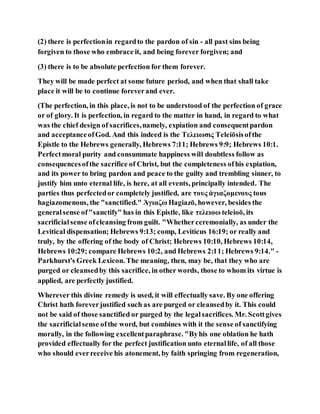
(2) there is perfectionin regardto the pardon of sin - all past sins being
forgiven to those who embrace it, and being forever forgiven; and
(3) there is to be absolute perfection for them forever.
They will be made perfect at some future period, and when that shall take
place it will be to continue foreverand ever.
(The perfection, in this place, is not to be understood of the perfection of grace
or of glory. It is perfection, in regard to the matter in hand, in regard to what
was the chief design of sacrifices,namely, expiation and consequentpardon
and acceptanceofGod. And this indeed is the Τελειωσις Teleiōsisofthe
Epistle to the Hebrews generally, Hebrews 7:11; Hebrews 9:9; Hebrews 10:1.
Perfectmoral purity and consummate happiness will doubtless follow as
consequencesofthe sacrifice of Christ, but the completeness ofhis expiation,
and its power to bring pardon and peace to the guilty and trembling sinner, to
justify him unto eternal life, is here, at all events, principally intended. The
parties thus perfectedor completely justified, are τους ἁγιαζομενους tous
hagiazomenous, the "sanctified." Ἁγιαζω Hagiazō, however, besides the
generalsense of"sanctify" has in this Epistle, like τελειοω teleioō, its
sacrificialsense ofcleansing from guilt. "Whetherceremonially, as under the
Levitical dispensation; Hebrews 9:13; comp, Leviticus 16:19; or really and
truly, by the offering of the body of Christ; Hebrews 10:10, Hebrews 10:14,
Hebrews 10:29; compare Hebrews 10:2, and Hebrews 2:11; Hebrews 9:14." -
Parkhurst's Greek Lexicon. The meaning, then, may be, that they who are
purged or cleansedby this sacrifice, in other words, those to whom its virtue is
applied, are perfectly justified.
Wherever this divine remedy is used, it will effectually save. By one offering
Christ hath foreverjustified such as are purged or cleansedby it. This could
not be said of those sanctified or purged by the legalsacrifices. Mr. Scottgives
the sacrificialsense ofthe word, but combines with it the sense of sanctifying
morally, in the following excellentparaphrase. "Byhis one oblation he hath
provided effectually for the perfect justification unto eternallife, of all those
who should everreceive his atonement, by faith springing from regeneration,
and evidenced'by the sanctificationof the Spirit unto obedience,'and who
were thus setapart and consecratedto the service of God.")
Jamieson-Fausset-BrownBible Commentary
14. For—The sacrifice being "for ever" in its efficacy(Heb 10:12) needs no
renewal.
them that are sanctified—ratheras Greek, "themthat are being sanctified."
The sanctification(consecrationto God) of the elect(1Pe 1:2) believers is
perfect in Christ once for all (see on [2578]Heb10:10). (Contrast the law, Heb
7:19; 9:9; 10:1). The development of that sanctificationis progressive.
Matthew Poole's Commentary
For by one offering: for here gives the reasonof the precedent effect, and it is
opposedto the reasonof the legalofferings’ defect;their sacrifices multiplied
could not perfect sinners, but this one doth it fully.
He hath perfected for ever: Christ, God-man, the gospelHigh Priest, by the
one offering of himself a sacrifice forsin to God his Father, and once
performed by him, hath securedperfectionof justification, sanctification, and
blessedness, perpetually to be continued, whereby the persons interestedin it
are qualified and consecratedto be priests to God and his Father, (as the
Aaronical priests were by the sacrifice ofthe ram of consecration, Exodus
29:22,24), to serve in their proportion here, but especiallyafter the completion
of it by their resurrection, they shall perfectly serve him before his throne in
the holy of holiestfor ever, 1 Peter2:9 Revelation1:6 5:10 20:6.
Them that are sanctified;the renewedsouls by the Holy Ghost, such whose
conscienceshe hath sprinkled with the blood of Jesus, andby it freed them
from the guilt of sin and its punishment, and whose natures he regenerates
and sanctifieth, freeing them from their evil habits, and making them
inherently holiness unto the Lord, Psalm110:3 1 Corinthians 6:11.
Gill's Exposition of the Entire Bible
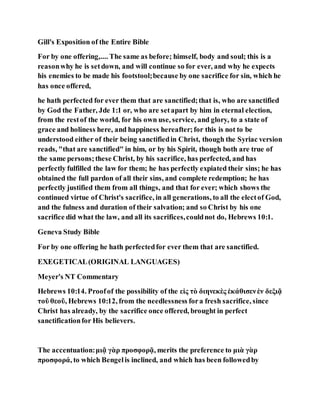
For by one offering,.... The same as before; himself, body and soul; this is a
reasonwhy he is setdown, and will continue so for ever, and why he expects
his enemies to be made his footstool;because by one sacrifice for sin, which he
has once offered,
he hath perfected for ever them that are sanctified;that is, who are sanctified
by God the Father, Jde 1:1 or, who are setapart by him in eternal election,
from the restof the world, for his own use, service, and glory, to a state of
grace and holiness here, and happiness hereafter;for this is not to be
understood either of their being sanctifiedin Christ, though the Syriac version
reads, "that are sanctified" in him, or by his Spirit, though both are true of
the same persons;these Christ, by his sacrifice, has perfected, and has
perfectly fulfilled the law for them; he has perfectly expiated their sins; he has
obtained the full pardon of all their sins, and complete redemption; he has
perfectly justified them from all things, and that for ever; which shows the
continued virtue of Christ's sacrifice, in all generations, to all the electof God,
and the fulness and duration of their salvation; and so Christ by his one
sacrifice did what the law, and all its sacrifices,couldnot do, Hebrews 10:1.
Geneva Study Bible
For by one offering he hath perfectedfor ever them that are sanctified.
EXEGETICAL(ORIGINAL LANGUAGES)
Meyer's NT Commentary
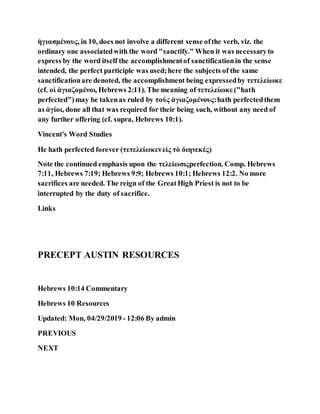
Hebrews 10:14. Proofof the possibility of the εἰς τὸ διηνεκὲς ἐκάθισενἐν δεξιᾷ
τοῦ θεοῦ, Hebrews 10:12, from the needlessness fora fresh sacrifice, since
Christ has already, by the sacrifice once offered, brought in perfect
sanctificationfor His believers.
The accentuation:μιᾷ γὰρ προσφορᾷ, merits the preference to μιὰ γὰρ
προσφορά, to which Bengelis inclined, and which has been followedby
Ewald, since by the former the words acquire an immediate reference to
Christ.
τοὺς ἁγιαζομένους]them that are sanctified, sc. as regards the decree ofGod.
The participle present is used substantively, as Hebrews 2:11, without respect
to time.
Cambridge Bible for Schools andColleges
14. he hath perfected] Hebrews 7:11; Hebrews 7:25.
them that are sanctified]“those who are in the way of sanctification”
(Hebrews 2:11; comp. Acts 2:47).
Bengel's Gnomen
Hebrews 10:14. Μιᾷ γὰρ προσφορᾷ, for by one offering) Or should we rather
read μία γὰρ προσφορὰ, for one offering?[63]Forthe language is framed
(moves on) in the abstractalso in Hebrews 10:11; and with the same verb
ΤΕΛΕΙΟῦΝ,to perfect, which here sustains the Apodosis, it was similarly
framed, ch. Hebrews 7:19, Hebrews 9:9, Hebrews 10:1.—γὰρ, for) The
assigning of a reason(Ætiology, Append.) is to be referred to (has reference
to) Hebrews 10:12.—τοὺς ἁγιαζομένους, those who were sanctified)A
participle of the imperfect tense. Forthis sanctificationwas accomplishedin
the very act of offering the sacrifice, Hebrews 10:10.
[63] The Germ. Vers., following the reasons assignedby the Gnomon, prefers
this reading, which was consideredofequal authority by the margin of both
Ed.—E. B.
Pulpit Commentary
Verse 14. - For by one offering he hath perfected foreverthem that are
sanctified. The tense of the participle ἁγιαζομένους,insteadof as ver.
ἡγιασμένους, in 10, does not involve a different sense ofthe verb, viz. the
ordinary one associatedwith the word "sanctify." When it was necessaryto
express by the word itself the accomplishmentof sanctificationin the sense
intended, the perfect participle was used;here the subjects of the same
sanctificationare denoted, the accomplishment being expressedby τετελείωκε
(cf. οἱ ἁγιαζομένοι, Hebrews 2:11). The meaning of τετελείωκε ("hath
perfected")may be takenas ruled by τοὺς ἁγιαζομένους:hath perfectedthem
as ἁγίοι, done all that was required for their being such, without any need of
any further offering (cf. supra, Hebrews 10:1).
Vincent's Word Studies
He hath perfected forever (τετελείωκενεἰς τὸ διηνεκές)
Note the continued emphasis upon the τελείωσιςperfection. Comp. Hebrews
7:11, Hebrews 7:19; Hebrews 9:9; Hebrews 10:1; Hebrews 12:2. No more
sacrifices are needed. The reign of the GreatHigh Priest is not to be
interrupted by the duty of sacrifice.
Links
PRECEPT AUSTIN RESOURCES
Hebrews 10:14 Commentary
Hebrews 10 Resources
Updated: Mon, 04/29/2019 - 12:06 By admin
PREVIOUS
NEXT
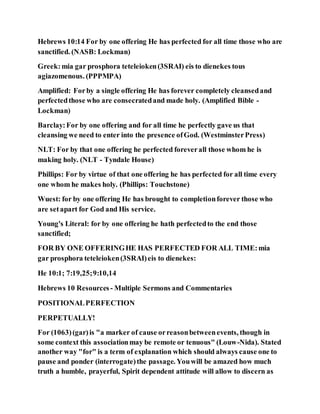
Hebrews 10:14 For by one offering He has perfected for all time those who are
sanctified. (NASB: Lockman)
Greek:mia gar prosphora teteleioken(3SRAI) eis to dienekes tous
agiazomenous. (PPPMPA)
Amplified: Forby a single offering He has forever completely cleansedand
perfectedthose who are consecratedand made holy. (Amplified Bible -
Lockman)
Barclay:For by one offering and for all time he perfectly gave us that
cleansing we need to enter into the presence ofGod. (WestminsterPress)
NLT: For by that one offering he perfected foreverall those whom he is
making holy. (NLT - Tyndale House)
Phillips: For by virtue of that one offering he has perfected for all time every
one whom he makes holy. (Phillips: Touchstone)
Wuest: for by one offering He has brought to completionforever those who
are setapart for God and His service.
Young's Literal: for by one offering he hath perfectedto the end those
sanctified;
FOR BY ONE OFFERINGHE HAS PERFECTED FOR ALL TIME:mia
gar prosphora teteleioken(3SRAI)eis to dienekes:
He 10:1; 7:19,25;9:10,14
Hebrews 10 Resources - Multiple Sermons and Commentaries
POSITIONALPERFECTION
PERPETUALLY!
For (1063)(gar)is "a marker of cause orreasonbetweenevents, though in
some context this associationmay be remote or tenuous" (Louw-Nida). Stated
another way "for" is a term of explanation which should always cause one to
pause and ponder (interrogate)the passage. Youwill be amazed how much
truth a humble, prayerful, Spirit dependent attitude will allow to discern as
you simply observe the text! In the presentcontext, "for" explains or
amplifies why Jesus is waiting (Heb 10:13-note)and not daily offering
sacrifices like the earthly priests (Heb 10:11, 12-note). The explanation is that
His one sacrifice sufficedfor all time!
Spurgeon- Those for whom Christ has died were perfectedby His death. It
does not mean that He made them perfect in character, so that they are no
longersinners, but that He made those for whom He died perfectly free from
the guilt of sin. When Christ took their sins upon Himself, sin remained no
longerupon them, for it could not be in two places at one and the same time.
If it was on Christ, it was not upon them. They were acquitted at the bar of
God when Christ was, ontheir behalf, “countedwith the transgressors” (Isa
53:12). When Jesus sufferedthe penalty due to His people’s sins to the last jot
and tittle, then their sins ceasedto be, and the covenant was fulfilled: “I will
forgive their iniquity and their sin I will no longer remember” (Jer31:34).
There was a cleansweepmade of sin. He has “put an end to the transgression
and sealedup sin” (Dan 9:24), and that for all His people. They need no other
washing, no further purging, as far as pardon of sin and acceptancewith God
in the matter of justification are concerned, for they are all perfectedby His
sacrifice.
ATTAINMENT OF THE GOAL
R C H Lenskiwrites that… A simple explanatory clause is added: “Forby
means of a single sacrifice he has brought to completion in perpetuity those
being sanctified.” This (for) connects with all that has been saidregarding the
teleiosis (completion, reaching of the goal)which the whole Jewishsystem
lackedand could never achieve, but which Christ’s single sacrifice did achieve
at one stroke. To see to what extent the writer uses the idea of completeness, of
reaching the telos or goal, follow this verb (teleioo)as it runs through this
epistle in Hebrews 2:10; 5:9; 7:19, 28; 10:14;11:40; 12:23;then the three
nouns in Hebrews 6:1 ("maturity" = teleiotes);Hebrews 7:11 ("perfection" =
teleiosis);Hebrews 12:2 ("Perfecter" = teleiosis), and the comparative
adjective in Hebrews 9:11 ("perfect" = teleios). It is God Who sets the goal;
this goalis our complete restoration. All that is containedin the law-testament
(covenantof law) that was given through Moses is preliminary to (and
preparation for) that goal, (and) could (never) be any more. Christ brings
completely to the goalyet is Himself made complete by suffering in order to
do this ("made perfect" = teleioo in Hebrews 5:9). His complete sacrifice
attains the goal. By His sacrifice we become complete, are at the goalwhich
God setfor us. This is one of the golden threads that is woveninto the
wonderful pattern of this Epistle. It combines with all the others. (The
Interpretation of the Epistle to the Hebrews and of the Epistle of James)
(Bolding added - All comments in parentheses added)
Steven Cole makes the point that…
The totality of our forgiveness is illustrated by the contrastbetweenthe
unfinished, repetitive ministry of the Old Testamentpriests and the finished,
sufficient sacrifice of Christ (Hebrews 10:11-14).
Hebrews 10:11 portrays the priest, who stooddaily “offering time after time
the same sacrifices, whichcan never take awaysins.” You canfeel a sense of
futility in these words! But Hebrews 10:12 contrasts the “one sacrifice forsins
for all time” that Jesus offered, after which He “satdown at the right hand of
God.” The standing of the priests indicates unfinished work that is never done
(there were no chairs in the sanctuary). The sitting of Jesus indicates that His
work of sacrifice is finished, and that He has been exalted to the place of
supreme honor.
The author could have ended the quote (from Ps 110:1)after the reference to
Jesus’sitting at God’s right hand, but he adds (Hebrews 10:13), “waiting
from that time onward until His enemies be made a footstoolfor His feet.” He
may have done this for two reasons.
First, he didn’t want his readers to grow discouragedbecause ofthe Cross, as
if it representeda defeat for God. Perhaps their unbelieving Jewishfriends
were taunting them for their belief in a crucified Messiah. If Jesus is really
Lord, then why do His people suffer persecutionand martyrdom? The author
says, “Justwait! The day is coming when Jesus’enemies will all become His
footstool, just as Psalm110 predicts.”
Second, the author may be giving a subtle warning to his readers. If they
abandoned the faith and went back to Judaism, they would be placing
themselves on the losing side in history. They would be making themselves
enemies of Jesus, and that’s not where you want to be, because Jesus’enemies
are headedfor certain defeatand judgment.
In Hebrews 10:14, the author againrepeats the effectof Jesus’one offering:
“He has perfected for all time those who are being sanctified” (literal
translation). This verse brings togethertwo vital truths.
First, the position of believers before God is that they are perfect. God has
forgiven all of their sins through Christ’s sacrifice, and He has imputed
Christ’s perfect righteousness to them. These greatfacts are the basis of our
standing before God.
Second, the practice of believers is that they are being sanctified. They are
growing in holiness in thought, word, and deed. The position is granted
instantly at the moment of saving faith. The practice is workedout over a
lifetime of growth in obedience. If there is no growth in holiness, there is
reasonto question whether the personhas been perfectedin his position
through faith in Christ. (Hebrews 10:1-18 TotalForgiveness)
One (mia) - Is placed first in the Greek text for emphasis.
Offering (4376)(phosphora from prós = toward, before + phero = bring)
literally means to bring before. Phosphora is used in the Septuagint (LXX =
Greek translationof the Hebrew OT) for the sacrifice offeredon the altar.
Prosphora clearlywas part of the vocabulary of priestly worship and in the
NT it was usedof Christ’s sacrificialoffering (Eph 5:2-note ; Heb10:10-note
of His body).
Phosphora - 9x in 9v (not surprisingly is used most often in Hebrews) - Acts
21:26;24:17; Ro 15:16; Eph 5:2; Heb 10:5, 8, 10, 14, 18
THE BELIEVER'S
POSITION
Wuest - The word “perfected” is the translation of teleioo which means “to
bring to a state of completion.” Here, the completeness ofthe state of salvation
of the believer is in view. Everything essentialto the salvationof the individual
is included in the gift of salvationwhich the sinner receives by faith in
Messiah’s sacrifice. The words “forever” here are to be construedwith
“perfected.” It is a permanent state of completeness in salvationto which
reference is made. The words “them that are sanctified” are descriptive of the
believer. He is one setapart for God. (Hebrews Commentary online)
Gromacki- Through the cross Christ “perfected” everybeliever. The verb
(teteleiōken)focusesonthe event of regenerationand the permanent standing
of spiritual completeness whichresulted from conversion.9 Eachbelieverhas
positional perfectionin Christ, although he must advance toward maturity in
his daily practice. Before Godthe believer is as perfect today as he will be in
eternity future. God supplied in the death of Christ all that men need to have
a perfect position before Him. (Stand Bold in Grace)
Spurgeon- The glory of the text is that we are perfectedforever—notfor
tomorrow and then allowed to fall from grace;not for the next twenty years
and then turned out of the covenant. The blood of Christ has been sprinkled
on us; and, therefore, our standing before God is the standing of perfection.
And we are always perfect, always fit to come to the throne of God, whatever
our doubts, whateverour sins. I do not say this of our character. We come
before God in our station (position in Christ) not in our character;and,
therefore, we may come as perfectpeople at all times. (Amen!)
Perfected(5048)(teleioo [wordstudy] related to teleios [word study] from
telos = an end, a purpose, an aim, a goal, consummate soundness, idea of
being whole) means to accomplishor bring to an end or to the intended goal
(telos). It means to be complete, mature, fully developed, full grown, brought
to its end, finished, wanting nothing necessaryto completeness orin good
working order. It does not mean simply to terminate something but to carry it
out to the full finish which is pickedup in the translation "perfected". Teleioo
signifies the attainment of consummate soundness and includes the idea of
being made whole. Interestingly the Gnostics used teleios ofone fully initiated
into their mysteries and that may have been why Paul used teleios in this
epistle.
The perfecttense in Hebrews 10:14 speaks ofthe permanence of this
perfection. In other words this describes pasttense salvation (justification).
Believers are forever "perfect" in Christ (our position).
In Hebrews 12:2 (note) Jesus is designatedas "the Author and Perfecterof
faith" where Perfecteris teleiotes, the Completer, the Accomplisher, the One
Who has reachedthe goalso as to win the prize so to speak. Jesusis the one
Who has brought faith to its perfect conclusion. TDNT adds that teleiotes
signifies that "Jesus gives faith its perfect basis by His high-priestly work and
thus completes it. At the same time, he exercises complete faith as
demonstrated by his passion."
Wuest has this note on the NT word group (telos, teleioo, teleios,teleiosis,
teleiotes)- Teleios the adjective, and teleioo the verb. The adjective is used in
the papyri, of heirs being of age, ofwomen who have attained maturity, of
full-grown cocks, ofacacia trees in goodcondition, of a complete lampstand,
of something in goodworking order or condition. To summarize; the meaning
of the adjective includes the ideas of full-growth, maturity, workability,
soundness, and completeness. The verb refers to the act of bringing the person
or thing to any one of the aforementionedconditions. When applied to a
Christian, the word refers to one that is spiritually mature, complete, well-
rounded in his Christian character.
Richards commenting on the word group (telos, teleioo, teleios, teleiosis,
teleiotes)writes that
These words emphasize wholeness and completeness.In the biologicalsense
they mean "mature," or "full grown":the person, animal, or plant achieved
the potential inherent in its nature. The perfectis the thing or person that is
complete, in which nothing that belongs to its essence has beenleft out. It is
perfect because everypotential it possesses has beenrealized. (Richards, L O:
Expository Dictionary of Bible Words: Regency)
Teleioo is used 9 times of 24 total NT uses in Hebrews, often in the sense of to
make perfect or fully cleanse from sin in contrastto ceremonial(Levitical)
cleansing. The writer is emphasizing the importance of perfection… (which
should cause any Jew who is contemplating the worth of Christ and the New
Covenantto realize his utter hopelessnessto every attain perfectionunder the
Old Covenant).
Hebrews 2:10 (note) For it was fitting for Him, for Whom are all things, and
through Whom are all things, in bringing many sons to glory, to perfectthe
author of their salvationthrough sufferings (What sufferings? Certainly one
would consider His temptation by Satan in the barren wilderness [see Mt 4:1-
11, Lk 4:1, 2, 3ff, Mk 1:12, 13]and Gethsemane [Mt 26:36,44, Lk 22:39,44][in
agonyHe was praying very fervently]). (Comment: This does not imply any
moral imperfection in the Lord Jesus, but speaks ofthe consummation of the
human experience of suffering the death of the Cross, through which He must
pass if He is to become the Author or Captain of our salvation.)
Hebrews 5:9 (note) And having been made perfect, He became to all those
who obey Him the source of eternal salvation,
Hebrews 7:19 (note) (for the Law made nothing perfect), and on the other
hand there is a bringing in of a better hope, through which we draw near to
God. (Comment: This means to carry through completely, to make complete,
to finish, bring to an end. The old covenantcould bring nothing to conclusion.
The Mosaic economycould revealsin but it could never remove sin, and so it
had to be removed. It gave no security. It gave no peace. A man never had a
cleanconscience.)
Hebrews 7:28 (note) For the Law appoints men as high priests who are weak,
but the word of the oath, which came after the Law, appoints a Son, made
perfect forever.
Hebrews 9:9 (note) which is a symbol for the present time. Accordingly both
gifts and sacrificesare offeredwhich cannotmake the worshiper perfectin
conscience,
Hebrews 10:1 (note) For the Law, since it has only a shadow of the good
things to come and not the very form of things, can never by the same
sacrifices yearby year, which they offer continually, make perfect those who
draw near. (Contrastwith Jesus in Hebrews 5:9 above. The idea in Hebrews
10:1 is that the ceremoniallaw could not actually save the believer. Its work
was always short of completeness.)
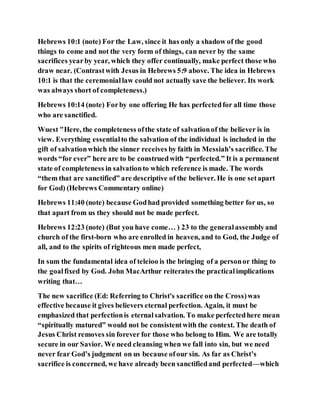
Hebrews 10:14 (note) Forby one offering He has perfectedfor all time those
who are sanctified.
Wuest "Here, the completeness ofthe state of salvationof the believer is in
view. Everything essentialto the salvation of the individual is included in the
gift of salvationwhich the sinner receives by faith in Messiah’s sacrifice. The
words “for ever” here are to be construedwith “perfected.” It is a permanent
state of completeness in salvationto which reference is made. The words
“them that are sanctified” are descriptive of the believer. He is one setapart
for God) (Hebrews Commentary online)
Hebrews 11:40 (note) because Godhad provided something better for us, so
that apart from us they should not be made perfect.
Hebrews 12:23 (note) (But you have come… ) 23 to the generalassemblyand
church of the first-born who are enrolled in heaven, and to God, the Judge of
all, and to the spirits of righteous men made perfect,
In sum the fundamental idea of teleioo is the bringing of a personor thing to
the goalfixed by God. John MacArthur reiterates the practicalimplications
writing that…
The new sacrifice (Ed: Referring to Christ's sacrifice on the Cross)was
effective because it gives believers eternal perfection. Again, it must be
emphasized that perfectionis eternalsalvation. To make perfectedhere mean
“spiritually matured” would not be consistentwith the context. The death of
Jesus Christ removes sin forever for those who belong to Him. We are totally
secure in our Savior. We need cleansing when we fall into sin, but we need
never fear God’s judgment on us because ofour sin. As far as Christ’s
sacrifice is concerned, we have already been sanctifiedand perfected—which
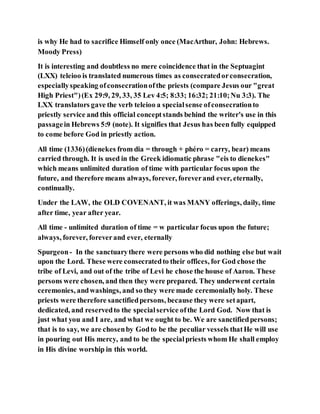
is why He had to sacrifice Himself only once (MacArthur, John: Hebrews.
Moody Press)
It is interesting and doubtless no mere coincidence that in the Septuagint
(LXX) teleioo is translated numerous times as consecratedorconsecration,
especiallyspeaking ofconsecrationofthe priests (compare Jesus our "great
High Priest")(Ex 29:9, 29, 33, 35 Lev 4:5; 8:33; 16:32; 21:10;Nu 3:3). The
LXX translators gave the verb teleioo a specialsense ofconsecrationto
priestly service and this official conceptstands behind the writer's use in this
passagein Hebrews 5:9 (note). It signifies that Jesus has been fully equipped
to come before God in priestly action.
All time (1336)(dienekes from dia = through + phéro = carry, bear) means
carried through. It is used in the Greek idiomatic phrase "eis to dienekes"
which means unlimited duration of time with particular focus upon the
future, and therefore means always, forever, foreverand ever, eternally,
continually.
Under the LAW, the OLD COVENANT, it was MANY offerings, daily, time
after time, year after year.
All time - unlimited duration of time = w particular focus upon the future;
always, forever, foreverand ever, eternally
Spurgeon- In the sanctuarythere were persons who did nothing else but wait
upon the Lord. These were consecratedto their offices, for God chose the
tribe of Levi, and out of the tribe of Levi he chose the house of Aaron. These
persons were chosen, and then they were prepared. They underwent certain
ceremonies, andwashings, and so they were made ceremoniallyholy. These
priests were therefore sanctifiedpersons, because they were setapart,
dedicated, and reservedto the specialservice ofthe Lord God. Now that is
just what you and I are, and what we ought to be. We are sanctifiedpersons;
that is to say, we are chosenby Godto be the peculiar vessels thatHe will use
in pouring out His mercy, and to be the specialpriests whom He shall employ
in His divine worship in this world.
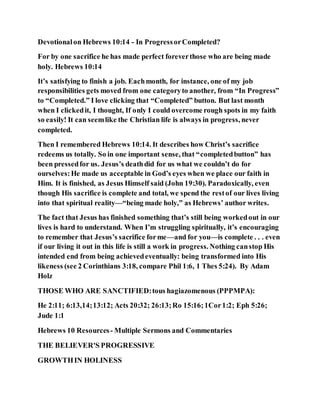
Devotionalon Hebrews 10:14 - In ProgressorCompleted?
For by one sacrifice he has made perfect foreverthose who are being made
holy. Hebrews 10:14
It’s satisfying to finish a job. Eachmonth, for instance, one of my job
responsibilities gets moved from one categoryto another, from “In Progress”
to “Completed.” I love clicking that “Completed” button. But last month
when I clickedit, I thought, If only I could overcome rough spots in my faith
so easily! It can seemlike the Christian life is always in progress, never
completed.
Then I remembered Hebrews 10:14. It describes how Christ’s sacrifice
redeems us totally. So in one important sense, that “completedbutton” has
been pressedfor us. Jesus’s deathdid for us what we couldn’t do for
ourselves:He made us acceptable in God’s eyes when we place our faith in
Him. It is finished, as Jesus Himself said (John 19:30). Paradoxically, even
though His sacrifice is complete and total, we spend the restof our lives living
into that spiritual reality—“being made holy,” as Hebrews’ author writes.
The fact that Jesus has finished something that’s still being workedout in our
lives is hard to understand. When I’m struggling spiritually, it’s encouraging
to remember that Jesus’s sacrifice forme—and for you—is complete . . . even
if our living it out in this life is still a work in progress. Nothing canstop His
intended end from being achievedeventually: being transformed into His
likeness (see 2 Corinthians 3:18, compare Phil 1:6, 1 Thes 5:24). By Adam
Holz
THOSE WHO ARE SANCTIFIED:tous hagiazomenous (PPPMPA):
He 2:11; 6:13,14;13:12; Acts 20:32; 26:13;Ro 15:16;1Cor1:2; Eph 5:26;
Jude 1:1
Hebrews 10 Resources- Multiple Sermons and Commentaries
THE BELIEVER'S PROGRESSIVE
GROWTHIN HOLINESS
Whereas perfecteddescribes everybeliever's eternal position before the Holy
God, sanctifieddescribes the daily practice which assures fellowshipand
communion with Him.
Those who are sanctified - This could be paraphrasedas "those who are
continually being sanctified, set apart or made holy" (see more discussion
below). The NIV translation is more accurate in this passagethan the NASB.
"By one sacrifice he has made perfectforever those who are being made
holy." (NIV)
As John Piper points out "the translation, "those who are sanctified," at the
end of the verse, could also look in Englishas if the sanctifying is also
complete. They "are (now, already) sanctified." But that is not what the tense
in the original Greek means. It is the present tense and signifies an ongoing
process. (Sermon)
Sanctified (37)(hagiazo [word study] form hagios [word study] = set apart
ones in turn from a = privative + ge = the earth ~ because everything offered
or consecratedto Godwas separatedfrom all earthly use) means to set apart
(or be setapart), to make holy, to consecrate (as ofthings setapart for sacred
purposes).
Hagiazo - 29x in 26v - NAS -- hallowed(2), keepholy(1), sanctified(16),
sanctifies(2), sanctify(7).
Mt 6:9; 23:17, 19; Lk. 11:2; Jn. 10:36; 17:17, 19;Acts 20:32;26:18; Rom.
15:16;1 Co. 1:2; 6:11; 7:14; Eph. 5:26; 1Th 5:23; 1 Tim. 4:5; 2 Tim. 2:21;
Heb. 2:11; 9:13; 10:10, 14, 29;13:12; 1 Pet. 3:15; Jude 1:1; Rev. 22:11
A sanctified personis one setapart from ordinary (profane, common,
"vulgar" [originally meant "common"]) use to be God’s own possession, for
His use, and enjoyment (cp 1Co 6:19, 20). The opposite of sanctificationis
profanation (the actof making profane - treating with abuse, irreverence
and/or contempt).
Without going into greatdetail, it should be noted that there are four types of
sanctificationin Scripture: pre-conversionsanctification, positional
sanctification(our initial salvationexperience when we were justified by faith
in Christ, representing a one time setting apart, eg Acts 26:18), practical
sanctification(where believers live day by day, thus representing an ongoing
event until the next stage ofour salvation, cp 1Co 1:18), and perfect
sanctification(or glorification, when we see Jesus we willbe like Him, 1 John
3:2, 3). (See also Three Tenses ofSalvation). As you read Hebrews
sanctificationis used severaltimes and the context should help determine
which meaning is in view but sometimes only knowing the verb tense will aid
this distinction.
Hagiazo means to render or acknowledgeto be venerable or to hallow. It
means to separate from things profane and dedicate to God, to consecrateand
so render them inviolable. It means to purify or cleanse, eitherexternally as in
the Levitical systemor to purify by expiation so that one is free from the guilt
of sin. In general, Christians are called "holy ones" indicating that they are
those who have been freed from the impurity of wickedness,having been
brought near to God by grace through faith. This latter meaning is seenin
Acts were Luke records Jesus'charge to Paul to go to the Gentiles…
to open their eyes so that they may turn from darkness to light and from the
dominion of Satanto God, in order that they may receive forgiveness ofsins
and an inheritance among those who have been sanctified(describes the initial
setting apart at the time of salvation)by faith in Me.'(Acts 26:18)
Hagiazo is in the present tense, passive voice which signifies that believers are
"works in progress" so to speak. We are all involved in the process ofbeing
continually sanctified. This process will not cease until the day we see Jesus
face to face and are then glorified forever. The passive voice signifies that the
process is being carried out by an outside force acting upon and in believers.
The outside force (Who is at the same time the indwelling source - 1Cor3:16,
1Cor6:19-note) is the Spirit of Christ, Who is making us holy by exertion of
His power, not as a result of our own power. (Cp Jesus in Hebrews 2:11-note])
This process is referred to as Practicalsanctificationis a day by day (moment
by moment) growthin holiness of believers who are in Christ positionally
(positional sanctification - see 1Th 4:3-note) In summary, Hebrews 10:14
describes a process whereasHebrews 10:10-note describes ourposition in
Christ.
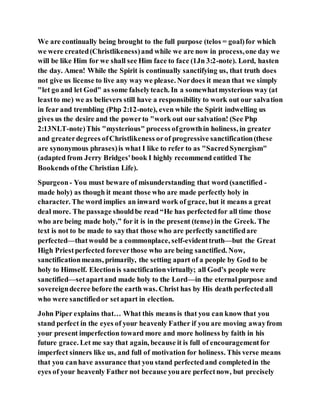
We are continually being brought to the full purpose (telos = goal)for which
we were created(Christlikeness)and while we are now in process,one day we
will be like Him for we shall see Him face to face (1Jn 3:2-note). Lord, hasten
the day. Amen! While the Spirit is continually sanctifying us, that truth does
not give us license to live any way we please. Nordoes it mean that we simply
"let go and let God" as some falselyteach. In a somewhatmysterious way (at
leastto me) we as believers still have a responsibility to work out our salvation
in fear and trembling (Php 2:12-note), even while the Spirit indwelling us
gives us the desire and the powerto "work out our salvation! (See Php
2:13NLT-note)This "mysterious" process ofgrowthin holiness, in greater
and greaterdegrees ofChristlikeness orof progressive sanctification(these
are synonymous phrases)is what I like to refer to as "SacredSynergism"
(adapted from Jerry Bridges'book I highly recommend entitled The
Bookends ofthe Christian Life).
Spurgeon- You must beware of misunderstanding that word (sanctified -
made holy) as though it meant those who are made perfectly holy in
character. The word implies an inward work of grace, but it means a great
deal more. The passage shouldbe read “He has perfectedfor all time those
who are being made holy,” for it is in the present (tense) in the Greek. The
text is not to be made to saythat those who are perfectly sanctifiedare
perfected—thatwould be a commonplace, self-evidenttruth—but the Great
High Priestperfected foreverthose who are being sanctified. Now,
sanctificationmeans, primarily, the setting apart of a people by God to be
holy to Himself. Electionis sanctificationvirtually; all God’s people were
sanctified—setapartand made holy to the Lord—in the eternalpurpose and
sovereigndecree before the earth was. Christ has by His death perfectedall
who were sanctifiedor setapart in election.
John Piper explains that… What this means is that you can know that you
stand perfect in the eyes of your heavenly Father if you are moving awayfrom
your present imperfection toward more and more holiness by faith in his
future grace. Let me say that again, because it is full of encouragementfor
imperfect sinners like us, and full of motivation for holiness. This verse means
that you canhave assurance that you stand perfectedand completedin the
eyes of your heavenly Father not because youare perfectnow, but precisely
because you are not perfectnow but are "being sanctified", "being made
holy", that, by faith in God's promises, you are moving awayfrom your
lingering imperfection towardmore and more holiness. (See Hebrews 10:32,
33, 34, 35; 11:24, 25, 26 etc. for examples of how faith in future grace
sanctifies, cp1Peter1:13-note)(John Piper's entire message"Perfectedfor All
Time by a Single Offering")
KJV Bible Commentary notes that here in Hebrews 10 where we see the verb
sanctify (here and Hebrews 10:10) used twice the writer is describing…
the twofoldnature of salvation(see Three Tenses ofSalvation). The believer
possesses a positional, judicial standing of righteousness and, second, a
remaining need for practical, progressive holiness. Three factors within this
verse make perfected absolute, suggesting the eternalsecurity of the believer.
The word itself (Greek teleioo from telos = goal)involves completion, the
bringing of something to its end. Second, the use of the Greek perfecttense
(have been sanctified -- He 10:10-note)suggests thatthe perfectionhas been
accomplishedand its effects are continuing. Third, the modifier, forever,
expresses securityfor the believer.
The need, however, of a progressive sanctificationis expressedby the word
sanctified. The use of the present participle implies the thought of a
sanctificationthat is continuing, rather than completed. There is an initial, or
positional, sanctificationinvolved in regeneration(1Cor1:2; 6:1). Equally,
there is a progressive sanctificationby which the Holy Spirit continually
maintains and strengthens the holiness imparted in regeneration(Ro 6:19-
note; 2Cor7:1-note; 1Th 4:3-note). Finally, there exists for the people of God
an ultimate or completedsanctificationwhereby we will be freed from even
the very presence of sin within our lives (1Th 5:23-note). Even though the
believer’s sanctificationis still in progress, yetbecause ofChrist’s once-for-all
sacrifice, he stands eternally secure and perfect because ofChrist’s
righteousness (2Cor5:21). (Dobson, E G, Charles Feinberg, E Hindson,
Woodrow Kroll, H L. Wilmington: KJV Bible Commentary: Nelson)(Bolding
added)
OswaldChambers writes on The Impartial PowerofGod
We trample the blood of the Son of God underfoot if we think we are forgiven
because we are sorry for our sins. The only reasonfor the forgiveness ofour
sins by God, and the infinite depth of His promise to forget them, is the death
of Jesus Christ. Our repentance is merely the result of our personal
realization of the atonementby the Cross of Christ, which He has provided
for us. "… Christ Jesus … became for us wisdom from God--and
righteousness andsanctificationand redemption … " ( 1Co 1:30 ). Once we
realize that Christ has become all this for us, the limitless joy of God begins in
us. And whereverthe joy of God is not present, the death sentence is still in
effect.
No matter who or what we are, God restores us to right standing with Himself
only by means of the death of Jesus Christ. Goddoes this, not because Jesus
pleads with Him to do so but because He died. It cannot be earned, just
accepted. All the pleading for salvationwhich deliberately ignores the Cross
of Christ is useless.It is knocking at a door other than the one which Jesus has
already opened. We protest by saying, "But I don’t want to come that way. It
is too humiliating to be receivedas a sinner." God’s response, throughPeter,
is, "… there is no other name … by which we must be saved" (Acts 4:12).
What at first appears to be heartlessness onGod’s part is actually the true
expressionof His heart. There is unlimited entrance His way. "In Him we
have redemption through His blood … " ( Ephesians 1:7-note). To identify
with the death of Jesus Christ means that we must die to everything that was
never a part of Him.
God is just in saving bad people only as He makes them good. Our Lord does
not pretend we are all right when we are all wrong. The atonementby the
Cross of Christ is the propitiation God uses to make unholy people holy. (My
Utmost for His Highest)
THE SANCTIFIED
PERFECTEDFOR EVER
Andrew Murray
Hebrews 10:14
THIS verse is in reality the conclusionof the doctrinal part of the Epistle. The
four following verses are simply the citation of the words of the new covenant
to confirm its teaching with the witness of the Holy Spirit. The writer having,
in the context, expounded the nature of Christ's sacrifice, as showing what the
way into the Holiest is, sums up his proof of its worth and efficacyin the
words: By one offering He hath perfected for ever them that are sanctified.
We find here five of the most important words that occurin the Epistle.
Sanctified. That looks back to the greatpurpose of Christ's coming, as we had
it in Hebrews 2. Sanctified is cleansedfrom sin, taken out of the sphere and
powerof the world and sin, and brought to live in the sphere and power of
God's holiness in the Holiest of All. It looks back, too, to Hebrews 2:10: In
which will we are sanctified by the offering of the body of Christ.
He hath perfected them that are sanctified. It not only says that He has
finished and completedfor them all they need. The word points back to what
was said of His own being made perfect. All He became was for us. In His one
sacrifice He was not only perfectedHimself, but He perfectedus; He took us
into the fellowship of His own perfectness, implanted His ownperfect life in
us, and gave His perfected human nature to us what we were to put on, and to
live in.
For ever. He hath perfectedus once for all and for ever. His perfectionis ours;
our whole life is prepared for us, to be receivedout of His hand.
By sacrifice. The death, the blood, the sacrifice ofChrist, is the power by
which we have been alike sanctifiedand perfected. It is the way which He
opened up, in which He leads us with Himself into what He is and does as the
One who is perfectedfor evermore, and the Holiest of All.
By one sacrifice. One because there is none other needed, either by others or
Himself; one divine, and therefore sufficient and for ever.
The chief thought of the passageis:He hath for ever perfectedthem that are
being sanctified. The words in Hebrews 10:10, In which will we have been
sanctified, speak of our sanctificationas an accomplishedfact:we are saints,
holy in Christ, in virtue of our real union with Him, and His holy life planted
in the centre of our being. Here we are spokenof as being sanctified. There is
a process by which our new life in Christ has to master and to perfect holiness
through our whole outer being. But the progressive sanctificationhas its rest
and its assurance in the ONCE and FOR EVER of Christ's work. He hath
perfectedfor ever them that are being sanctified.
In Hebrews 9:9-10. I we read that the sacrifices couldnever, as touching the
conscience, make the worshipper perfect, never make perfect them that draw
nigh, so that they have no more conscienceofsins. Our conscienceis that
which defines what our consciousnessofourselves before Godshould be:
Christ makes the worshipper perfect, as touching the conscience, so thatthere
is no more conscience ofsins. He hath perfectedfor ever them that are
sanctified. At the close ofthe chapter on Christ's priesthood we read of
Himself (Hebrews 7:28): He is a High Priest, a Son, perfectedfor evermore.
Here at the close ofthe unfolding of His work, it is said of His saints:He hath
perfectedthem for ever. The perfection in both cases is one and the same. The
sanctificationand the perfectionof the believer are prepared as a new nature
in Christ,, to be appropriated in the daily life of faith. To know this is the
secretof power.
And wherein His perfectionconsists we know too. (See in Hebrews 2:10 and
5:9.) A Leaderin the way of glory, God made Him perfect through suffering;
perfectedin Him that humility and meekness andpatience which mark Him
as the Lamb, which are what God asks ofman, and are man's only fitness for
dwelling with God. Having offered up prayer, and having been heard for His
godly fear, though He was a Son, yet He learned obedience by what He
suffered, and was made perfect. His godly fear, His waiting on God in the
absolute surrender of His will, His submitting to learn obedience, His spirit of
self-sacrifice,evenunto death,--it was by this that as man He was perfected, it
was in this He perfected human nature, and perfected His people too. In His
death He accomplisheda threefold work. He perfectedHimself, His own
human nature and character. He perfectedour redemption, perfectly putting
awaysin from the place it had in heaven(Hebrews 9:23), and in our hearts.
He perfected us, taking us up into His ownperfection, and making us
partakers of that perfecthuman nature, which in suffering and obedience, in
the body prepared for Him, and the will of God done in it, He had wrought
out for us. Christ Himself is our perfection; in Him it is complete;abiding in
Him continually is perfection.
Let us press on to perfection, was the call with which we were led into the
higher-life teaching of the Epistle. Here is our goal. Christ, by one offering,
hath perfectedus for ever. We know Him as the Priest for ever, the Minister
of the new sanctuary, and the Mediator of the new covenant, who by His
blood entered into the Holiest; there He lives for ever, in the powerof an
endless life, to impart to us and maintain within us His perfect life. It is the
walk in this path of perfection, which as our Leader He opened up in doing
the will of God, which is the new and living way into the Holiest.
1. The work of Christ is a perfectand perfectedwork. Everything is finished
and complete for ever. And we have just by faith to behold and enter in, and
seek and rejoice, and receive out of His fulness grace forgrace. Let every
difficulty you feel in understanding or claiming the different blessings set
before you, or in connecting them, find its solution in the one thought--Christ
has perfectedus for ever; trust Him, cling to Him, He will do all.
2. One sacrifice forever. We perfected for ever. And HE who did It all, HE
for everseatedon the throne. Our blessedPriest-King, He lives to make it all
ours. In the powerof an endless life, in which He offeredHimself unto God, In
which He entered the Holiest, He now lives to give and be in our hearts all He
hath accomplished. What more canwe need? Wherefore, holy brethren!
partakers of a heavenly calling, considerJesus. (Andrew Murray. The Holiest
of All)
END PRECEPTAUSTIN RESOURCES
Author: Ron Graham
Jesus the PerfectSacrifice
—It's seven attributes
We now come to the central topic in the letter to the Hebrews — the offering
of Christ’s own life, flesh, and blood, for the sins of the world.
The body and blood of Jesus, becausehe was without sin, made an offering
that satisfiedGod once and for all. By that perfect offering we are perfected
and are being sanctified.
The plan for this lessonis simply to look at seventhings the Hebrew writer
says about Christ’s perfect sacrifice. We will take them in the order in which
he first mentions them, but as we take eachone we will skip ahead to other
verses (if any) where he revisits the point.
These sevenattributes of Christ's sacrifice are interdependent. We are
studying them as we might study a steamengine, pulling it apart, examining
the pieces. Butof course it needs to be put togetheragainto work. The whole
is greaterthan the sum of its parts. As we think about eachattribute, we must
see it as fitting into the whole.
1 A sacrifice suchthat God will remember sins no more
Hebrews 8:12, Hebrews 9:15, Hebrews 10:3-7,17
The Hebrew writer believes that whilst people under the old covenant were
certainly justified and forgiven, it was not by any sacrifice of blood offered
under the old covenant, but by anticipation of Christ’s sacrifice onthe cross.
Forgivenessbefore the cross was provisional.
The sins forgiven were not taken awayand remembered no more. The
Hebrew writer explains that "in those sacrifices there is a reminder of sins
year by year".
When Christ made his perfectsacrifice, those othermerely symbolic sacrifices
could —and should— have ceased. Now there is a forgiveness of sins in which
there is no more remembrance of sin.
2 A sacrifice ofhis own blood not a substitute
Hebrews 9:12, Hebrews 13:12, Hebrews 10:5-7
The Hebrew writer emphasises that Jesus offered"his own blood". The
priests of old offered the blood of animals which was a substitute that could
sanctify and purify only by virtue of its symbolism of Christ’s blood.
It had long been known that forgiveness required a sacrifice of blood. Most
people did not realise, however, that the blood sacrifices offeredwere not of
themselves acceptable to God
A blood sacrifice made in its own right cannot please God, and cannotdo the
worshipper any good. Godacceptedsuch sacrifices, if they were offered
genuinely in faith, only because they foreshadowedthe perfect sacrifice by
God of "his own blood."
3 A sacrifice for eternalredemption
Hebrews 9:12-15
The Hebrew writer uses the word "eternal" six times in his letter. He speaks
of eternal salvation, eternal judgment, eternalredemption, the eternalSpirit,
eternal inheritance, and the eternalcovenant. Three of those instances are
here (Hebrews 9:12-15).
The old sacrifices were temporal, that is to saythey were offered and were
effective on a week by week, month by month, or year by yearbasis. They
were linked to times and seasons, to new moons and sabbaths. They were tied
to time.
But faith looks to an "eternalinheritance" that is "a heavenly one" which
exists beyond earthly time and space (cf Hebrews 9:15 with Hebrews 11:13-
16)
Christ's sacrifice was made "at the end of the ages"(see Hebrews 9:26)also
referred to as the "lastdays" (see Hebrews 1:2).
The sacrifice ofChrist was timely made, howeverits effecttranscends time.
Even when time itself is no more, the redemption we have through Christ’s
sacrifice will remain.
4 A sacrifice to fully cleanse the conscience
Hebrews 9:9,14, Hebrews 10:1-2,22, Leviticus 11:23-47
Chapters nine and ten mention the consciencefour times. The writer is
looking at how man can become "perfectin conscience"andcome near to
God in "full assurance"that his heart is "sprinkled cleanfrom an evil
conscience"
Worshippers offering the old sacrificeswere leftwith sin still on their
consciences. The sacrifice ofChrist, however, can"cleanse yourconscience
from dead works". Under the old law, if certaindead things touched you or
you touched them, you were unclean and had to go through a purification of
the flesh.
The Hebrew writer may be making an analogyof this. Our sins are "dead
works" in the sense that they touch our consciencesandmake them vile and
unclean. How canour consciencesbe purified from this defilement? Only by
Christ’s sacrifice.
5 A sacrifice made once for all
Hebrews 10:10-14
Imagine there was a car washor floor cleanerthat you applied once, and it
kept your car or floor sparkling cleanforever, and you never had to repeat
the washing everagain. In Old Testamenttimes, the sacrificesand ceremonies
performed for cleansing from sin had to be repeatedover and over.
Christ’s sacrifice was a once and for all offering. That is why in Christianity
we offer no sacrificesfor sin.
It is also why baptism "for the remission of sins" (Acts 2:38) is not a repeated
ceremony. We only need once to be "baptized into his death" (Romans 6:3-4)
because he died "once for all".
Becausewe are crucified with Christ, whenever we genuinely seek forgiveness
of sins, God grants it without even requiring another baptism, let alone more
sacrifices andofferings for sin.
6 A sacrifice that made the impossible possible
Hebrews 10:4
One of the most categoricalstatements thatthe Hebrew writer makes is this:
"It is impossible for the blood of bulls and goats to take awaysins". We need
to remember that these sacrificeswere commandedby God.
If it was "impossible" for sacrifices thatGod commanded to take away sin,
then it is certainly impossible for man to find any other sacrifice thatwas
acceptable to God, isn't it?
On this basis, we would bring our sins to God for forgiveness, only to have
him shout "Impossible!Impossible!" Since we are thus helpless and impotent,
God himself made the sacrifice for us, sending his only begotten Sonto make
atonement for our sins. Of course he accepts his own sacrifice. No wonderwe
sing "Amazing grace..." Jesus made the impossible possible.
7 A sacrifice in which Christ bore reproach
Hebrews 12:2-3, Hebrews 13:11-13, Hebrews 11:24-26
Christ was crucifiedbetweentwo thieves, and was treated as a criminal, yet he
had done no wrong. He was willing, for the joy of our salvation, to "endure
the cross despising the shame".
When following Christ seems difficult and painful, and we are in danger of
becoming weary and discouragedin our souls, we only have to considerthe
reproachthat Jesus bore for us.
The Hebrew writer points out that Jesus died "outside the gate" — an
outcast. This was symbolised of old by destroying the bodies of animals
"outside the camp".
They were a reproach. We too will often be outcasts, yet we are honoured to
share the reproachof Christ, and we know we will be welcome into the city of
Heaven. Having entered its gate we will never be castout.
Like Moses,therefore, we "choose ratherto suffer affliction with the people of
God than to enjoy the passing pleasures ofsin, esteeming the reproachof
Christ greaterriches than the treasures in Egypt..."
BOB DEFFINBAUGH
The PerfectSacrifice:The Sacrifice that Perfects (Hebrews 10:1-18)
RelatedMedia
00:00
00:00
January 11, 2009
1 For the law possesses a shadow ofthe goodthings to come but not the reality
itself, and is therefore completely unable, by the same sacrifices offered
continually, year after year, to perfect those who come to worship. 2 For
otherwise would they not have ceasedto be offered, since the worshipers
would have been purified once for all and so have no further consciousness of
sin? 3 But in those sacrifices there is a reminder of sins year after year. 4 For
the blood of bulls and goats cannottake awaysins.
5 So when he came into the world, he said, “Sacrifice and offering you did not
desire, but a body you prepared for me. 6 “Whole burnt offerings and sin-
offerings you took no delight in. 7 “ThenI said, ‘Here I am: I have come - it is
written of me in the scroll of the book - to do your will, O God.’” 8 When he
says above, “Sacrificesandofferings and whole burnt offerings and sin-
offerings you did not desire nor did you take delight in them” (which are
offered according to the law), 9 then he says, “Here I am: I have come to do
your will.” He does awaywith the first to establishthe second. 10 By his will
we have been made holy through the offering of the body of Jesus Christ once
for all.
11 And every priest stands day after day serving and offering the same
sacrifices againand again - sacrifices that cannever take awaysins. 12 But
when this priest had offered one sacrifice for sins for all time, he satdown at
the right hand of God, 13 where he is now waiting until his enemies are made
a footstoolfor his feet. 14 For by one offering he has perfectedfor all time
those who are made holy.
15 And the Holy Spirit also witnesses to us, for after saying, 16 “This is the
covenantthat I will establishwith them after those days, says the Lord. I will
put my laws on their hearts and I will inscribe them on their minds,” 17 then
he says, “Their sins and their lawless deeds I will remember no longer.” 18
Now where there is forgiveness ofthese, there is no longer any offering for
sin.1
Introduction
A number of years ago I was speaking ata banquet. I chose encouragementas
the subjectof my message, and Barnabas as an excellentexample of
encouragement. Throughoutmy message Iwas urged on (encouraged?)by
individuals in the audience. Some would comment “onthe beat” while others
chimed in on the “offbeat.” But there was one woman in particular that stood
out. When I reachedthe main emphasis of my talk she could be heard from
the back of the group. It went something like this: “Ohhhhhhhhh.” If I could
translate or paraphrase what she meant it was something like this: “I can see
it coming. He’s about to tell us what he’s been working up to all this time.”
And she was right.
If that woman were in the gathering of Hebrew Christians that first received
this epistle, at this point in the reading of Hebrews she would have said,
“Ohhhhhhh!” We have now come to the place in the Book of Hebrews where
the author is summing up his argument. This is the bottom line, and from
here he will begin to spell out how we should apply what he has been teaching.
When we come to Hebrews 10:1-18 we should expect some repetition. After
all, when an author concludes his argument he repeats his major points and
then underscores where all of this has brought the reader. Thus, much of what
we read in our text is not new. Not only does the author repeat significant
points he has already made, he also cites Old TestamentScriptures to buttress
his argument. Thus, we find another reference to Psalm 110 in our text, and so
also to Jeremiahchapter 31. The Old Testamenttext which is given the
greatestprominence on our passageis new to Hebrews. The author cites from
Psalm40 and builds a case onit in Hebrews 10:5-10. The author’s use of
Psalm40 raises severalimportant questions:
How can our author use these words of David and apply them to Jesus, the
Messiah?
How do we explain the author’s deviation from the wording of the secondline
of Psalm 40:6?
What is the unique meaning and contribution of this Old Testamenttext?
I will tell you up front that verses 5-10 of our text contain a unique
contribution to the argument of Hebrews and it is my intention to spend a
disproportionate amount of time considering these verses. As the title of this
messageindicates, I believe that the words of Psalm40 cited in Hebrews
chapter 10 are some of the most beautiful words in the entire Bible. Let us
listen carefully to what the Spirit of God is saying to us from Psalm40, and
from the words of our author in this magnificent text.
Prototypes are not Perfection(Hebrews 10:1-4)
1 For the law possesses a shadow ofthe goodthings to come but not the reality
itself, and is therefore completely unable, by the same sacrifices offered
continually, year after year, to perfect those who come to worship. 2 For
otherwise would they not have ceasedto be offered, since the worshipers
would have been purified once for all and so have no further consciousness of
sin? 3 But in those sacrifices there is a reminder of sins year after year. 4 For
the blood of bulls and goats cannottake awaysins.
There is a greatdifference betweena shadow and the reality it reflects. As I
was sitting in the pew during the Lord’s Table I was leaning forward in such a
way that the ceiling lights casta shadow of my head on the pew in front of me.
As I observed my shadow I was a little troubled. It appearedthat my hair was
in disarray. My wife Jeannette is out of town helping one of our daughters
with a new baby, so I had to getmyself ready for church – a risky endeavor
indeed. I was fairly confident that my socks were the same color, and that they
matched my pants and shoes. Buthad I forgottento comb my hair? A hasty
look in the bathroom mirror put my mind at rest. The shadow was not reality;
my hair was combed. The shadow was not an exactrepresentationof the
reality in the same way that Jesus is an exactrepresentationof the Father.2
The Old TestamentLaw and the Levitical priesthood(with all of its sacrifices)
was but a shadow of the “goodthings to come,” namely the New Covenant as
inaugurated by the incarnation and sacrificialdeath of the Lord Jesus. The
Levitical sacrifices were made year after year, and this repetition was
evidence of their ineffectiveness. If, the author reasons, these sacrificeswere
able to perfect those who drew near then they would not have had to be
offered over and over again. One offering would have been sufficient. The
offerer would have been cleansedofsin and likewise his consciencewould
have been cleansedas well. There should be no guilty conscienceregarding sin
where the guilt and penalty of sin has been removed.
As though being ineffective was not bad enough, the Old Testamentsacrifices
also servedas a reminder of past sins, as yet not removed. If I were to get
distracted as I was driving and run into a guard rail, there would be some tell-
tale evidences ofmy failure somewhere on my car. Until that damage was
repaired, every time I lookedat my car I would see the damage and be
reminded of my failure. So, too, with the Old Testamentsacrifices. Everytime
a sacrifice was offered(again)I would be reminded of the fact that my sin had
not been permanently removed. It would be like getting a monthly credit card
statementwhen I had been unable to make a payment. The statement would
not remove my debt, but it would surely remind me that I was in debt.
The reasonfor the failure of the Old Testamentsacrificesto remove sin is
given in verse 4: “the blood of bulls and goats cannottake awaysins.” Animal
blood is not a sufficient sacrifice for sins. It would be like me trying to pay my
credit card bill with Monopolymoney.
The ineffective nature of the Old Testamentsacrificesis not a new revelation.
The author of Hebrews is only repeating something that was commonly taught
in the Old TestamentScriptures:
Then Samuel said, “Doesthe Lord take pleasure in burnt offerings and
sacrifices as much as he does in obedience? Certainly, obedience is better than
sacrifice;paying attention is better than the fat of rams (1 Samuel 15:22).
16 Certainly you do not want a sacrifice, orelse I would offer it; you do not
desire a burnt sacrifice. 17 The sacrificesGoddesires are a humble spirit – O
God, a humble and repentant heart you will not reject(Psalm 51:16-17).
11 “Of what importance to me are your many sacrifices?”says the Lord. “I
am stuffed with burnt sacrificesoframs and the fat from steers. The blood of
bulls, lambs, and goats I do not want. 12 When you enter my presence, do you
actually think I want this – animals trampling on my courtyards? 13 Do not
bring any more meaningless offerings;I consideryour incense detestable!You
observe new moon festivals, Sabbaths, and convocations, but I cannot tolerate
sin-stained celebrations!(Isaiah 1:11-13)
For I delight in faithfulness, not simply in sacrifice;I delight in acknowledging
God, not simply in whole burnt offerings (Hosea 6:6).
21 “I absolutelydespise your festivals!I get no pleasure from your religious
assemblies!22 Even if you offer me burnt and grain offerings, I will not be
satisfied;I will not look with favor on your peace offerings of fattened calves.
23 Take awayfrom me your noisy songs;I don’t want to hear the music of
your stringed instruments. 24 Justice must flow like torrents of water,
righteous actions like a streamthat never dries up” (Amos 5:21-24).
6 With what should I enter the Lord’s presence? With what should I bow
before the sovereignGod? Should I enter his presence with burnt offerings,
with year-old calves? 7 Will the Lord accepta thousand rams, or ten thousand
streams of olive oil? Should I give him my firstborn child as payment for my
rebellion, my offspring – my own flesh and blood – for my sin? 8 He has told
you, O man, what is good, and what the Lord really wants from you: He
wants you to promote justice, to be faithful, and to live obediently before your
God (Micah 6:6-8).
When Jerusalemwas destroyedalong with the temple in 70 A.D. the Jews
could no longeroffer sacrifices as they had formerly done. Hughes points out
that they were forcedto recognize that their animal sacrifices couldnot atone
for sin:
“It is a factthat at the time of Christ many pious Jews honoredthe sacrificial
system and even offered sacrifices,but realized that those sacrifices couldnot
remove sin. This is why, when the Temple was destroyedand the sacrifices
ended, the people so easily adapted. They understood that animal sacrifice
was insufficient to obtain forgiveness.”3
The PerfectSacrifice Perfects (Hebrews 10:5-10)
5 So [Therefore]4 when he came into the world, he said, “Sacrificeand
offering you did not desire, but a body you prepared for me. 6 “Whole burnt
offerings and sin-offerings you took no delight in. 7 “ThenI said, ‘Here I am:
I have come - it is written of me in the scroll of the book - to do your will, O
God.’” 8 When he says above, “Sacrificesandofferings and whole burnt
offerings and sin-offerings you did not desire nor did you take delight in
them” (which are offeredaccording to the law), 9 then he says, “Here I am: I
have come to do your will.” He does awaywith the first to establishthe
second. 10 By his will we have been made holy through the offering of the
body of Jesus Christ once for all (Hebrews 10:5-10).
Verses 1-4 do not contain new revelationin Hebrews, but rather a review and
summary of what the author has repeatedlystated in the development of his
argument thus far. The essenceofverses 1-4 is that the Old TestamentLaw
was a prototype of the goodthings to come in Jesus, but it was still powerless
to perfect, something that only Jesus coulddo. And so it is (“therefore”—
verse 5) that we read of the incarnation of the SecondPersonof the Godhead,
and of His infinitely superior priestly work of atoning for sins once for all.
The emphasis on our Lord’s incarnation is not new, either, for it dominates
the first two chapters of this greatepistle, particularly 1:1-4 and 2:5-18. There
is something new pertaining to our Lord’s incarnation in our text, however.
For the first time in Hebrews the author turns the readers’ attention to the
prophetic words of David in Psalm40:6-8a.5
As quoted, it is quite easyto read these words from Psalm40 as those of the
SecondPersonof the Trinity, spokenin eternity past, expressing His
commitment to the incarnation, an earthly ministry (accompaniedby much
affliction – Hebrews 5:7-8), and to a sacrificialdeath, the agony of which is
beyond human comprehension. It may be more difficult to read these words
as applying to David, the human author. We might be benefitted to recall how
the words of David in Psalm22 so aptly describe the suffering of our Lord on
the cross ofCalvary. David’s description of his own suffering, poetically
dramatized, preciselydescribes the suffering of the Son of David at Calvary.
We cansee how the first portion of this citation nicely conforms to what has
already been said in verses 1-4;namely that the Old Testamentsacrificesand
rituals failed to atone for man’s sins and thus to cleanse man’s guilt-ridden
conscience, due to sin. Something different – something better -- was needed,
and that something was the sacrificialdeathof Messiah, made possible by the
incarnation and priestly ministry of the SecondPersonofthe Godhead.
Years ago I was driving our children to schoolTerrace ElementarySchool,
just a few blocks from here. I had done this many times, but on this occasionI
noted that a police officer had pulled over one of the parents, just aheadof
me. When I enteredto little drop-off loop in front of the schoolI let the kids
off and proceededto go back home. I came to Dorothy Streetand made a left-
hand turn back towards our house. The police officer (of whose presence I
was well aware)signaledfor me to pull over. He proceededto give me a ticket
for an “illegalu-turn.” I was amazed. What “u-turn”? The next day I took
careful notice of the “no U-turn” signthat was posted, but then watchedcar
after car make the same “left-hand turn” I had made. I decided that this was
a ticketI was going to protest. Just days before my court appearance I
observeda new sign had been posted, which read, “NO Left Turn.” Needless
to say, the judge threw out my ticket, and all others like it. The new sign
proved the old sign to be ineffective and overruled by the new one. So, too,
with the Old Covenant. It didn’t work, so God provided a New Covenant,
inaugurated by the Lord Jesus.
As cited, the SecondPersonofthe Trinity saw in the Scriptures6 the new “job
description” of the Messiah, and committed Himself to obediently carry out
His mission. In so doing, our author continues, He also indicated that the first
(the Old Covenant)would have to be set aside and replacedby the second(the
New Covenant). This “will,” set forth in the Scriptures, declaredthe means by
which we have been made holy, through the sacrifice of Christ.
What is problematic about the author’s citationfrom Hebrews is its variation
from what we read in our EnglishBibles (which represents accuratelywhat is
found in the Hebrew Old Testament):
The Author’s Citation
“Sacrifice andoffering you did not desire, but a body you prepared for me”
(Hebrews 10:5, underscoring mine).
The Text of Psalm40
Sacrifice and meal offering You have not desired;
My ears You have opened;
Burnt offering and sin offering You have not required (Psalm 40:6, NASB95;
emphasis mine).
How in the world could the author’s citation differ so greatly in middle line of
Hebrews 10:5 from the words of David as found in the middle line of Psalm
40, verse 6? The answeris both easyand difficult. The easyansweris that the
author of Hebrews is not citing from the Hebrew text of Psalm40, but rather
from the Septuagint, the Greek translationof the Psalm. He accuratelycites
the words of Psalm 40:6-8a from the Septuagint. But how did the translators
of the Septuagint find it possible, evennecessary, to change the statement,
“my ears you have dug out” (literally), to “a body you have createdfor me”?
Various explanations have been offered for this rather unusual variation in
translation. One is that creating one’s ears (digging them out, forming them)
is really just a small part of the largertask of creating the whole person. Thus,
the smalleract (of digging out ears)is really a reference to the larger actof
creating a body. Other explanations have been setforth as well.
My intention is not to spend a greatdeal of time seeking a satisfactory
explanation for this variation, but rather to explore its implications. We know
that all Scripture is inspired of God and therefore inerrant (Psalm 12:6; 2
Timothy 3:16-17;2 Peter1:16-21).7 Thus, if the author cites from Psalm 40
from the translationof the Septuagint as God’s Word, it must be what God
intended for us to hear as His Word. While it would have been more difficult
to grasp these words of David as the words of God Himself, the translation of
the Septuagintmakes it easyfor the readerto read these words as the words
of the SecondPersonofthe Trinity. Thus, God providentially rendered this
Psalmin a way that it even more clearlyreferred to the Messiah.
With this as backgroundmaterial, let us seek to discern what this citation
uniquely contributes to the author’s argument. As we have already seenfrom
the Old Testamentcitations above, there is nothing new about David’s
statementthat God takes no pleasure in Israel’s ritual sacrifices.The reason
why is particularly clearin 1 Samuel chapter 15. God had commanded Saul to
annihilate the Amalekites for what they had done to the Israelites when they
were leaving Egypt.8 Saul’s obedience was only partial, and thus it was really
disobedience.9 WhenSamuel arrived, Saul claimed to have fully carried out
God’s instructions:
12 Then Samuelgot up early to meet Saul the next morning. But Samuel was
informed, “Saulhas gone to Carmel where he is setting up a monument for
himself. Then Samuelleft and went down to Gilgal.” 13 When Samuelcame to
him, Saul said to him, “Maythe Lord bless you! I have done what the Lord
said” (1 Samuel 15:12-13, emphasis mine).
Samuel was not impressed. He responded with these (amusing, at leastto me)
words: “Whatthen is this bleating of the sheep?” (1 Samuel 15:14)Here is
where things getvery interesting. Saul is not willing to acknowledgehis sin,
and so he seeks to deny it with this feeble excuse:
Saul said, “They were brought from the Amalekites;the army spared the best
of the flocks and cattle to sacrifice to the Lord our God. But everything else
we slaughtered” (1 Samuel 15:15).
The reasonwhy Saul spared the best of the flock, he rationalized, was in order
to offer them as sacrificesto God. I don’t believe this was true. I think he
savedthe best for himself. But even if it were true it would not have been an
acceptable reasonto disobey God’s clearinstructions. And this is what
Samuel will tell Saul in the next verses:
17 Samuel said, “Is it not true that when you were insignificant in your own
eyes, you became head of the tribes of Israel? The Lord chose you as king over
Israel. 18 The Lord sent you on a campaign saying, ‘Go and exterminate those
sinful Amalekites!Fight againstthem until you have destroyed them.’ 19 Why
haven’t you obeyedthe Lord? Instead you have greedily rushed upon the
plunder! You have done what is wrong in the Lord’s estimation.” 20 Then
Saul said to Samuel, “But I have obeyedthe Lord! I went on the campaign the
Lord sent me on. I brought back King Agag of the Amalekites after
exterminating the Amalekites. 21 But the army took from the plunder some of
the sheepand cattle - the best of what was to be slaughtered- to sacrifice to
the Lord your God in Gilgal.” 22 Then Samuel said, “Does the Lord take
pleasure in burnt offerings and sacrificesas much as he does in obedience?
Certainly, obedience is better than sacrifice;paying attention is better than
the fat of rams. 23 For rebellion is like the sin of divination, and presumption
is like the evil of idolatry. Becauseyou have rejectedthe word of the Lord, he
has rejectedyou as king” (1 Samuel 15:17-23).
The Old Testamentsacrificescouldnever remove sins, but sacrifices offered
by those who are disobedient were offensive to God. Saul’s “sacrifices,”
offered in disobedience, were anoffense to God.
21 The Lord said to the people of Judah, “The Lord God of Israel who rules
over all says:‘You might as well go ahead and add the meat of your burnt
offerings to that of the other sacrifices andeat it, too!22 Considerthis: When
I spoke to your ancestorsafterI brought them out of Egypt, I did not merely
give them commands about burnt offerings and sacrifices. 23 I also explicitly
commanded them: “Obeyme. If you do, I will be your God and you will be
my people. Live exactlythe way I tell you and things will go well with you.” 24
But they did not listen to me or pay any attention to me. They followedthe
stubborn inclinations of their own wickedhearts. Theyacted worse and worse
instead of better (Jeremiah 7:21-24).
I believe that this is the point at which our text in Hebrews (and in particular
the citationfrom Psalm 40)makes its unique contribution. There is a
somewhatparallelpassage in Philippians chapter2:
5 You should have the same attitude toward one anotherthat Christ Jesus
had, 6 who though he existed in the form of God did not regard equality with
God as something to be grasped, 7 but emptied himself by taking on the form
of a slave, by looking like other men, and by sharing in human nature. 8 He
humbled himself, by becoming obedient to the point of death - even death on a
cross!(Philippians 2:5-8)
It is clearfrom Paul’s words in Philippians chapter2 that our Lord was
obedient to the will of the Father – that He take on human flesh and that He
die on the cross of Calvary.
But what seems to be even more clearfrom our author’s citation from Psalm
40:6-8a is that our Lord was willingly – I would even sayjoyfully obedient to
the plan that was yet to be laid out for Him in the Scriptures. In His
omniscience, He knew what the Scriptures would say regarding His
incarnation and atoning work on the cross ofCalvary. But in Psalm40 I get
the impressionthat our Lord volunteered for this mission, and that He
joyfully undertook this mediatorial mission. I think that our author further
underscores this fact in chapter 12:
1 Therefore, since we are surrounded by such a greatcloud of witnesses, we
must get rid of every weightand the sin that clings so closely, and run with
endurance the race set out for us, 2 keeping our eyes fixed on Jesus, the
pioneer and perfecterof our faith. For the joy set out for him he endured the
cross, disregarding its shame, and has takenhis seatat the right hand of the
throne of God (Hebrews 12:1-2, emphasis mine).
There is a greatdeal of difference betweenreluctant, teeth-gritted, obedience
and joyful obedience. Our Lord’s obedience is of the better – joyful – kind.
And here is the point to all of this emphasis on joyful obedience. If sacrifice
without obedience displeasesGodthen surely sacrifice accomplishedwith
joyful obedience is pleasing. And this is preciselythe kind of sacrifice our
Lord has offered.
I have sometimes wonderedwhy God would require animal sacrificesfor sin.
It occurredto me that animals do not sin. Now I have had some animals which
have causedme to question this fact – they seemedto manifest a depravity of
their own. But animals cannot sin in the same manner that men do. In this
sense, animals offeredas sacrificesare “innocent” so far as human sin is
concerned. But while we may, in some sense, referto sacrificialanimals as
innocent, we dare not call them willing. One day I was taking some garbage to
the transfer stationnot far away, the one that is locatedby the farm where
pork sausageis made. This particular day happened to be when they were
slaughtering some of the animals. The sounds were horrible, and difficult to
explain to a granddaughter. These animals were headed for slaughter, but not
willingly.
Our Lord’s sacrifice was the shedding of human blood, and more than this it
was innocent blood. He had no sin of His own to atone for; He took the guilt of
our sins upon Himself when He died for men.10 But in addition to His
sacrifice being that of innocent human blood it was also a sacrifice that was
willingly, joyfully made in obedience to His calling, so that sinners like us
could be forgiven and assuredof intimate fellowshipwith God, now and for
all eternity. This sets the sacrifice ofour Lord above and apart from any other
sacrifice evermade. This, my friend, is amazing grace!
Sacrifices Oldand New (Hebrews 10:11-14)
11 And every priest stands day after day serving and offering the same
sacrifices againand again - sacrifices that cannever take awaysins. 12 But
when this priest had offered one sacrifice for sins for all time, he satdown at
the right hand of God, 13 where he is now waiting until his enemies are made
a footstoolfor his feet. 14 For by one offering he has perfectedfor all time
those who are made holy (Hebrews 10:11-14).
How evident our author makes the contrasts betweenthe sacrifices made
under the Old Covenant(the Law) and those made by our Lord, inaugurating
the New Covenant:
Under the Old Covenant – Verse 11
Under the New Covenant – Verse 12
The priests remained standing
The Lord Jesus satdown
The priests offered daily
The Lord Jesus offeredonce
Sacrifices didn’t remove sins
His one sacrifice removed sin, perfecting men for all time11
Verses 12 and 13 are an allusion, once againto Psalm 110:1-2:
1 Here is the Lord’s proclamation to my lord:
“Sit down at my right hand until I make your enemies your footstool!”
2 The Lord extends your dominion from Zion.
Rule in the midst of your enemies! (Psalm110:1-2)
It seems to me that the word “until” in verse 1 is the key. Our author has
made a point of the fact that our Lord satdown once He had finished His
work of atoning for our sins once for all at Calvary. His saving work was
finished. But the word “until” underscores anotherimportant truth. Our
Lord Jesus is “sitting” so far as His saving work is concerned, but He has yet
another work to be done at the time of His SecondComing – that of judging
those rebels who rejectedHim and His atoning work at Calvary. While He
came as the “Suffering Servant,” He will return as the triumphant king, who
will tread under foot those who oppose Him. The One who is our GreatHigh
Priestis also the same One who is our Triumphant King.
There is a sense, then, in which we can saythis: Our Lord is currently
“sitting” at the right hand of the Father, but one of these days He is going to
“stand up.” When He stands, those who have rejectedHim will fall down
before Him.12 I was thinking about this in relation to Stephen’s death as
describedfor us in the Book of Acts:
54 When they heard these things, they became furious and ground their teeth
at him. 55 But Stephen, full of the Holy Spirit, lookedintently toward heaven
and saw the glory of God, and Jesus standing at the right hand of God. 56
“Look!” he said. “I see the heavens opened, and the Son of Man standing at
the right hand of God!” (Acts 7:54-56, emphasis mine)
I am aware ofthe commonly held interpretation that our Lord “stood” to
honor Stephen as he entered heaven. But suppose that we were to understand
our Lord’s “standing” in the light of Psalm 110? Suppose that our Lord was
standing in order to assure Stephenthat He was soongoing to return to the
earth to judge those who were His enemies, those who were at this moment
seeking to take Stephen’s life.13
The Witness of the Spirit (Hebrews 10:15-18)
15 And the Holy Spirit also witnesses to us, for after saying, 16 “This is the
covenantthat I will establishwith them after those days, says the Lord. I will
put my laws on their hearts and I will inscribe them on their minds,” 17 then
he says, “Their sins and their lawless deeds I will remember no longer.” 18
Now where there is forgiveness ofthese, there is no longer any offering for sin
(Hebrews10:15-18.
Our author has a high view of Scripture. He begins by telling us that God has
perfectly revealedHimself in and through the Son (1:1-4), and then cautions
us to give careful heed to what He has revealed(2:1-4). He indicates that
God’s Word is living and active and sharper than any two-edgedsword,
thereby exposing the thoughts and intents of our hearts (4:12-13). In our text
he has used the words of Psalm 40 as the words of the SecondPersonof the
Trinity, and now he is so bold as to say that the Holy Spirit witnessesto us in
the words of Jeremiah 31.
I find it interesting to observe that the Book ofHebrews does not put a great
deal of emphasis on the person and work of the Holy Spirit. This could also be
said of the work of the Father. This may be explained by the factthat the
author of Hebrews is intent upon exalting the person and work of the Son. We
should also recallthat it the ministry of the Spirit is to exalt and glorify the
Son.
13 “But when he, the Spirit of truth, comes, he will guide you into all truth.
For he will not speak on his own authority, but will speak whateverhe hears,
and will tell you what is to come. 14 He will glorify me, because he will receive
from me what is mine and will tell it to you” (John 16:13-14).
You might say that the Holy Spirit is at work through the words of Hebrews,
for in these words the Son is exalted and glorified.
Referring to the words of Jeremiah31 once againthe author calls attention to
the factthat by means of the New CovenantGod will write His laws on the
hearts of men. And not only this, He will also deal finally and fully with sin, so
that He can say, “Their sins I will remember no more” (Hebrews 10:17, citing
Jeremiah31:34). The “no more” is emphasized once againin verse 18, where
the author comments that there is no longer the need for any further offering
for sin once complete forgiveness ofsins has been achieved.
Conclusion
Reading these words from Jeremiah31:33 which speak ofGod writing His
law on men’s hearts reminded me of the words of Psalm 40, verse 8:
I delight to do Thy will, O my God;
Thy Law is within my heart (Psalm 40:8, emphasis mine).
It now becomes easyto see how the author can see the relationship between
Jeremiah31 and Psalm 40. Was it the secondline of Psalm 40:8 which drew
the author’s attention to this psalm? Why, then, did he ceaseciting the words
of this psalm after the first line of verse 8? Why not continue through the
secondline?
Maybe the author wants us to meditate on Psalm 40, and to observe the
similarity of these words to those found in Jeremiah 31:33. Or perhaps the
author wants us to see beyond this. Maybe he wants us to observe that the
entire portion cited in Hebrews 10 is worthy of our attention. As I have
reflectedon the use of Psalm40 I have come to an even more surprising
conclusion. Psalm40 tells us that the words of Scripture were written on the
heart of our Lord, prompting Him to joyfully embrace His incarnation and
atoning work at Calvary. Our Lord therefore has setfor us an example of
joyful (as opposedto begrudging) obedience. We should respond to our calling
(as laid out in the Scriptures) as our Lord did to His.
The omissionof Psalm 40:8b in Hebrews 10 may be meant to suggestto the
reader that more than the verses cited apply. I am suggesting that this is not
just true so far as their application to Messiahis concerned;I am suggesting
that all of Psalm 40 applies to the Hebrew Christians to whom the epistle is
written. When I considerDavid’s circumstances andcompare them to the
circumstances facedby the Hebrews, I see that they are similar:
David experiencedcircumstances that appeareddestructive, and so he cried
out to God for deliverance and God heard and answeredhis petitions. Because
of this David saw himself as greatly blessed, along with all those who place
their trust in God (Psalm 40:1-3).
The Hebrew Christians had also suffered serious persecutionand loss, but
God safelybrought them through it all. They, too, could agree with David that
those who trust in Messiahare greatly blessed(Hebrews 10:32-35).
As a result of David’s earlierdeliverance he joyfully proclaimedthe good
news of God’s righteousness in the greatcongregation(Psalm40:8-10).
The Hebrew saints were likewise to faithfully assemble with their fellow-
believers, and to seek to be an encouragementto them (Hebrews 10:19-25).
David was once againfacing difficulties and danger. He was assuredof God’s
faithfulness, and so he calledout to God for deliverance, trusting Him to be
faithful, as He had been in the past (Psalm40:11-17).
The Hebrews were soonto face serious oppositionand persecution – to the
point of shedding blood (Hebrews 12:4). They were to persevere,
remembering God’s past deliverance in Christ, and assuredthat He will
continue to faithfully deliver them in the future.
And so it is that I am now inclined to believe that the author of Hebrews has
cited Psalm40, not just as a proof text, but as a psalm which greatlyimpacted
Messiah, andwhich will also encourageand strengthen us in our times of
adversity. It’s application to Messiahis merely a sample of its value and
importance to us. And, our Lord’s joyful embracing of God’s plan for Him is
likewise anexample for Christians to joyfully embrace God’s will and purpose
for us, one that will likely include suffering:
Now in fact all who want to live godly lives in Christ Jesus will be persecuted
(2 Timothy 3:12).
3 Blessedbe the God and Father of our Lord Jesus Christ! By his greatmercy
he gave us new birth into a living hope through the resurrection of Jesus
Christ from the dead, 4 that is, into an inheritance imperishable, undefiled,
and unfading. It is reservedin heaven for you, 5 who by God’s powerare
protectedthrough faith for a salvationready to be revealedin the last time. 6
This brings you greatjoy, although you may have to suffer for a short time in
various trials. 7 Such trials show the proven characterof your faith, which is
much more valuable than gold - gold that is tested by fire, even though it is
passing away- and will bring praise and glory and honor when Jesus Christ is
revealed(1 Peter1:3-7).14
One of the contributions of our text for me has been to help put other biblical
texts into perspective. When I think of the incarnation, saving work of Christ
I think of severalbiblical texts:
36 Then Jesus wentwith them to a place called Gethsemane, andhe saidto
the disciples, “Sithere while I go overthere and pray.” 37 He took with him
Peterand the two sons of Zebedee, and became anguishedand distressed. 38
Then he saidto them, “My soul is deeply grieved, even to the point of death.
Remain here and stayawake with me.” 39 Going a little farther, he threw
himself down with his face to the ground and prayed, “My Father, if possible,
let this cup pass from me! Yet not what I will, but what you will” (Matthew
26:36-39).
5 You should have the same attitude toward one anotherthat Christ Jesus
had, 6 who though he existed in the form of God did not regard equality with
God as something to be grasped, 7 but emptied himself by taking on the form
of a slave, by looking like other men, and by sharing in human nature. 8 He
humbled himself, by becoming obedient to the point of death - even death on a
cross!(Philippians 2:5-8).
When he had receivedthe sour wine, Jesus said, “It is completed!” Then he
bowed his head and gave up his spirit (John 19:30).
The Book ofHebrews, and particularly our text in Hebrews chapter 10, helps
me to better understand and appreciate these other texts. In Matthew 26 we
find our Lord in the Garden of Gethsemane, andwe canidentify with His
agonyas He contemplates what He will soonexperience. I do not believe that
the physical suffering (as bad as it would be) is paramount in His thinking,
but rather the spiritual agonyof being forsakenby God in our place. But
Hebrews 10 puts this into perspective because it underscores the joyful
obedience of our Lord to His calling. This is not to deny the suffering and
agony, or the joyful embracing of the work of salvation. It is something like
the waya wife looks at child-bearing. There is great joy in bearing a child, but
there is also suffering involved. You cannot setthe suffering apart from the
rejoicing. Both are there.
Our text also gives me helpful insight into Paul’s exhortation in Romans
chapter 12:
1 Therefore I exhort you, brothers and sisters, by the mercies of God, to
present your bodies as a sacrifice - alive, holy, and pleasing to God - which is
your reasonable service.2 Do not be conformedto this present world, but be
transformed by the renewing of your mind, so that you may test and approve
what is the will of God - what is goodand well-pleasing and perfect(Romans
12:1-2).
What better example of a sacrifice is there than our Lord? We, like our Lord,
are to see our mission in life as being called to offer ourselves as a sacrifice to
God. We are to do this joyfully, and in a way that pleases God. And in so
doing we will grasp God’s will for our lives.
As I was teaching the other day I came to this text in Romans chapter 10,
which suddenly came alive in the light of the teaching of Hebrews regarding
the New Covenant:
3 For ignoring the righteousness that comes from God, and seeking insteadto
establishtheir own righteousness, theydid not submit to God’s righteousness.
4 For Christ is the end of the law, with the result that there is righteousness
for everyone who believes. 5 For Moses writes aboutthe righteousness thatis
by the law: “The one who does these things will live by them.” 6 But the
righteousness thatis by faith says:“Do not say in your heart, ‘Who will
ascendinto heaven?’” (that is, to bring Christ down) 7 or “Who will descend
into the abyss?” (that is, to bring Christ up from the dead). 8 But what does it
say? “The word is near you, in your mouth and in your heart” (that is, the
word of faith that we preach), 9 because if you confess with your mouth that
Jesus is Lord and believe in your heart that God raised him from the dead,
you will be saved. 10 For with the heart one believes and thus has
righteousness andwith the mouth one confesses andthus has salvation
(Romans 10:3-10).
In Romans chapter 9 Paul has been explaining why so many Jews have
rejectedthe gospel, while a number of Gentiles have come to faith. The reason
why many Jews have not come to faith is that God has not chosenevery Jew,
but only some (Romans 9:6-26). This is also consistentwith the past because
God often preserved only a small remnant of faithful Jews, through whom He
would fulfill His covenant promises (see 9:27-29). Now, in Romans 9:30 Paul
gives yet another reasonwhy so many Jews are unbelievers:they have not
chosenGod. Rather than trust in Jesus, God’s provision for salvation apart
from human striving, many Jews have soughtto earn righteousnessthrough
their own efforts. Gentiles were savedwithout working for it, while Jews
remained unsaved because they were working for it. In short, unbelieving
Jews remain lostbecause they seek salvationby works, ratherthan by faith in
Jesus, the Messiah(9:39-33).
Paul makes it very clear that striving for salvationby keeping the law doesn’t
save, while trusting in what Jesus has accomplishedat Calvary does:
1 Brothers and sisters, my heart’s desire and prayer to God on behalf of my
fellow Israelites is for their salvation. 2 For I can testify that they are zealous
for God, but their zeal is not in line with the truth. 3 Forignoring the
righteousness thatcomes from God, and seeking insteadto establishtheir own
righteousness, theydid not submit to God’s righteousness.4 For Christ is the
end of the law, with the result that there is righteousness foreveryone who
believes. 5 ForMoses writes aboutthe righteousness thatis by the law:”The
one who does these things will live by them” (Romans 10:1-5, emphasis mine).
Since striving to keepthe Old Covenantcannot save anyone, it is only by
means of the New Covenant that people can be saved:
5 For Moses writes aboutthe righteousness that is by the law: “The one who
does these things will live by them.” 6 But the righteousness thatis by faith
says:“Do not sayin your heart, ‘Who will ascendinto heaven?’” (that is, to
bring Christ down) 7 or “Who will descendinto the abyss?” (that is, to bring
Christ up from the dead). 8 But what does it say? “The word is near you, in
your mouth and in your heart” (that is, the word of faith that we preach), 9
because if you confess withyour mouth that Jesus is Lord and believe in your
heart that God raisedhim from the dead, you will be saved. 10 Forwith the
heart one believes and thus has righteousness and with the mouth one
confesses andthus has salvation. 11 For the scripture says, ”Everyone who
believes in him will not be put to shame” (Romans 10:5-11).
Men do not attain salvation by means of their own efforts. Men do not need to
ascendto heaven, as though doing so would bring Christ down. Neither do
men need to ascendinto hell, to bring Christ up. Of His own volition our Lord
took on humanity and descended to the earth. So, too, it was His joyful
obedience to God’s plan for man that prompted Him to give Himself as the
PassoverLamb to make atonement for our sins.
It is not man’s striving to attain righteousness thatsaves him. It is not man’s
efforts to bring God near that has done so. This God did on His own initiative,
just as we read in Psalm40. And the goodnews of the gospelis not far off for
those who are being saved. In fulfillment of His promise of a New Covenant
God writes His law upon men’s hearts. It is this word that is near the one God
has chosen, and thus all that this lostsaint needs to do is to receive the gospel
God has written on their hearts.
And so I will close, my friend, by asking you this simple question. Whose work
will save you? Is it your works, your efforts to keepthe Old Testamentlaw, or
is it Christ’s New Covenant work? Is it your striving or is it Christ’s shed
blood that gains you forgiveness ofsins? It is Godwho saves, Godwho writes
His law on your heart. You do not need to ascendinto heaven to bring Christ
down for He has already done so. You do not need to raise Christ from the
dead, and from eternalpunishment. All you must do is to believe that the
work of salvation is finished, complete, and to receive it as God’s gracious gift.
If you are a Christian, you can rejoice that your salvation is God’s work, not
yours. And you canthank Him for willingly taking on humanity, and for
bearing the guilt and punishment for your sins. And you can also follow in His
footsteps, imitating His example of joyful obedience to the gracious plans and
purposes of God, even if these lead to suffering, and even to death.
Copyright © 2008 by RobertL. Deffinbaugh. This is the edited manuscript of
Lesson22 in the series, Nearto the Heart of God – A Study of the Book of
Hebrews, prepared by RobertL. Deffinbaugh on January 11, 2008. Anyone is
at liberty to use this lessonfor educationalpurposes only, with or without
credit.
1 Unless otherwise indicated, all Scripture quotations are from the NET Bible.
The NEW ENGLISH TRANSLATION, also knownas THE NET BIBLE, is a
completely new translationof the Bible, not a revision or an update of a
previous English version. It was completed by more than twenty biblical
scholars who workeddirectly from the best currently available Hebrew,
Aramaic, and Greek texts. The translation project originally started as an
attempt to provide an electronic version of a modern translation for electronic
distribution over the Internet and on CD (compact disk). Anyone anywhere
in the world with an Internet connectionwill be able to use and print out the
NET Bible without costfor personal study. In addition, anyone who wants to
share the Bible with others can print unlimited copies and give them away
free to others. It is available on the Internet at: www.netbible.org
2 Hebrews 1:3.
3 R. Kent Hughes, Hebrews (Wheaton, Illinois: CrosswayBooks,1993), vol.
2, p. 21.
4 I believe the traditional rendering “therefore” better conveys the direct
logicallink betweenverses 1-4 (the deficiency of the Law and the Levitical
sacrifices)andverses 5-10 (the coming of Messiahand His ultimate sacrifice).
5 I will have more to say later in this lessonregarding the last part of Psalm
40:8, which the author does not cite.
6 These Scriptures would have been knownto God, but were yet to be written
if this was a commitment made in eternity past, before the creationof the
world.
7 See also Hebrews 10:15-17, where the author cites from Jeremiah31,
attributing it to the Holy Spirit, who bears witness in these words of Jeremiah.
8 1 Samuel 15:2-3; Exodus 17:8-16.
9 See my message on1 Samuel15 on bible.org:
http://www.bible.org/page.php?page_id=362
10 See 2 Corinthians 5:21.
11 This is true for all who receive the gift of forgiveness through the sacrifice
of our Lord Jesus.
12 See Philippians 2:9-11.
13 Compare Revelation6:9-11 and 2 Thessalonians 1:3-10.
14 See also Hebrews 12:1-13;1 Peter4:12-19.
Jesus Christ Offered the One PerfectSacrifice forSinners
The sacrifice ofJesus Christ was completedat the cross whenHe shouted, “It
is finished!” (John 19:30). It was finished and as a result it is foreverdone. “It
stands finished.” Nothing else neededto be done from the moment Christ
died. It was a once-and-for-allcompletedsacrifice for sin.
It was in the shedding of His blood on the cross that Christ both ratified the
New Testamentand purchased the believer’s redemption. The prominent
term used in reference to the atonement in the New Testamentis the “blood.”
The blood of Christ indicates the all-encompassing redemptive work of Christ
on the cross.
Since the sacrifice ofJesus Christ was completedon the cross atCalvary it is
not correctto saythat Christ offered His blood upon the heavenly mercy seat.
Christ ascendedinto heavenbecause His work of atonement was finished, not
in order to compete it. He did not need to present His blood in heaven because
our redemption was alreadyan accomplishedfact(Hebrews 9:7-12, 24-25;
10:19;13:12, 20; 1 John 2:2, etc). Christ did not have to make an offering for
Himself like the Old Testamenthigh priest did yearafter yearon the Day of
Atonement. He was already perfectin His relationship with the LORD God.
There was no need for Christ to present blood in heaven for anything. He
needed only to present Himself in heavenbecause He is the perfectHigh
Priest.
Christ enteredheaven after securing our eternal redemption at the cross—His
ascensionwas the enthronement in heavenas the High Priest who had
completed the work of redemption.
The implications of this greattransactionare great. Our salvation is all by the
grace ofGod through faith in the sacrifice ofJesus Christ for the sinner. The
work of atonement was completedon the cross, and nothing else neededto be
accomplished. It was not a partially completed work. He did not leave things
half-done. Our salvationdoes not depend upon something we need to do to
complete it. Christ did not have to do some atoning act in heaven like an
earthly high priest, and neither do we. “It is finished!” “Done!” “Complete.”
The sacrifice ofChrist was made once for all by Christ on the cross the
moment He died. Any theory of atonementthat suggests thatJesus Christ
needed to take His blood with Him into heaven denies the finished work of
Christ on the cross.
Becausethe sacrifice ofthe Lamb of God was completedon the cross the
subsequent benefits of His sacrifice extends to every believer and heavenitself
(Hebrews 9:23).
The shed blood of Jesus on the cross is the only righteous basis for God to
forgive every sinner who puts his faith in Christ for salvation. The atoning
death of Christ is all-sufficient to save every sinner who calls upon His name
for salvation.
You do not need the “divine sacrifice which is celebratedin the Mass” to be
made right with God. The one historical factthat Christ died for your sins is
all-sufficient to save the greatestofsinners. You do not need another sacrifice.
The one will do for all sins. There is no further need for “an unbloody”
sacrifice.
Jesus Christ in obedience to the Father offered Himself in the place of the
condemned sinner by shedding His blood as the price of our redemption
(Matt. 20:28). The sinner is in bondage to sin and under the sentence of death
(Romans 7:14; 5:12; 6:23). Jesus died in the sinner’s place. The purchase
price to redeem the slave of sin is the blood of Jesus Christ(Rev. 5:9). The
Lamb of God alone is worthy because He was slain, “and did purchase for
God with Thy blood men from very tribe and tongue and people and nation.”
Every person who believes on Jesus Christ for salvation is eternally secure in
Him (John 10:28-29). We have been redeemedout of slavery forever
(Galatians 3:13; 4:4-5). He purchased us and took us out of the market place.
We are no longeravailable; we are off the market. We are now owned by
Someone else—God. He refuses to sell His precious possessions.Those who
have been redeemedhave been setfree forever.
Another greatbenefit of the finished atonementof Christ is that we have been
made right with God. We now have fellowship with Him because the believer
has been reconciledto Godby the blood of Christ (Heb. 10:19; Ephesians
2:16; Colossians1:20-22). Jesus satisfiedthe righteous and holy demands of
God, and reconciledus to Him.
The sacrificialdeath of Christ turns away the wrath of God from everyone
who believes on Christ as their Savior. He is our propitiation; He is our mercy
seat;His death alone is all-sufficient to save. Christ is the mercy seatwho was
sprinkled with His own blood.
Jesus Christ was the priest who offered up the perfect sacrifice ofHimself on
the cross forour sins. He died in our place (2 Cor. 5:21; Gal. 1:4; 3:13; Eph.
5:2, 25; Matt. 20:28;Rom. 5:6, 8).
Jesus Christ has obtained eternalredemption for everyone trusting in Him
alone for salvation. He pleads with you this day to trust in His death to make
you right with God. The one offering of Christ on the cross is the perfect
redemption, propitiation, and satisfaction, forall the sins of all who will call
upon His name and be saved. There is none other satisfactionforsin, but His
death alone. Believe on Him and you will have eternal life.
Selah!
Messageby Wil Pounds (c) 2006
Why is there a need for a perfect sacrifice?Why does Jesus have to be
perfect?
Ask Question
Asked4 years, 3 months ago
Active 11 months ago
Viewed 5k times
0
Theologically, why was it necessarythat Jesus be perfect? Couldn’t there be
another ordinary human who said “I will be the sacrifice and take on all the
sins of the world past, present, and future and suffer and die as a
substitutionary atonement for all of mankind”? Why did it have to be Jesus
and why did it have to be a perfect Jesus?
christologyatonement sacrifice
share
improve this question
edited Dec 11 '18 at 21:59
Nathaniel
33k10
10 gold badges
97
97 silver badges
238
238 bronze badges
askedAug 5 '15 at 8:23
noblerare
3082
2 gold badges
8
8 silver badges
14
14 bronze badges
If Jesus had sinned he would have been under the penalty of death for his own
sin and could not have paid our sin debt which demands our lives in forfeiture
for our 0wn sins. – BYE Aug 5 '15 at 11:27
There are a number of different types of substitutionary atonement. Different
types will have different answers to this question. – NathanielAug 5 '15 at
11:37
add a comment
4 Answers
active
oldest
votes
1
Fallenhuman beings are all disqualified because we all inherit the sinful
nature.
If Jesus had even one sin, He could never die for others' sins because He
would have to die for His own. Therefore Christ knew no sin (2 Cor. 5:21;
Heb. 4:15). He was made only in the likeness ofthe flesh of sin (Rom. 8:3). He
was without spot or blemish (1 Pet. 1:19).
Him who knew no sin he made to be sin on our behalf; that we might become
the righteousnessofGod in him (2 Cor. 5:21). For we have not a high priest
that cannotbe touched with the feeling of our infirmities; but one that hath
been in all points tempted like as we are, yet without sin. (Heb. 4:15)
Yet if Jesus were only a sinless man, we would still have a greatproblem. His
death would be goodfor only one man; in fact, it would be goodfor only one
sin. God requires man to die because ofsin—evenone sin. Suppose in your
entire life you committed only one sin. As a sinless man, Jesus coulddie as a
substitute for that sin. But if you were to sin again you would have to die for
that secondsin. Well, you know that you have sinned more than once in your
life! How could one man, Jesus, die for all your sins and for all the sins of
mankind? And how could it work for us two thousand years after His death?
He was a genuine man, yet also the complete God. His being God added an
eternal element to His redeeming blood. Hebrews 9:14 says that the Lord
offered Himself up through the eternalSpirit. He has accomplishedan eternal
redemption for us (Heb. 9:12). Now Jesus'blood is effective for all men of all
times. It can cleanse everysin of every man on the earth throughout time and
space.
12 nor yet through the blood of goats and calves, but through his own blood,
entered in once for all into the holy place, having obtained eternal
redemption.
14 how much more shall the blood of Christ, who through the eternal Spirit
offered himself without blemish unto God, cleanse your conscience fromdead
works to serve the living God?
share
improve this answer
answeredAug 7 '15 at 9:39
pehkay
6831
1 gold badge
4
4 silver badges
10
10 bronze badges
Thank you for your answer. This answerednot only my statedquestion but all
the other follow-up questions that I had as well. – noblerare Aug 9 '15 at 14:59
add a comment
4
According to the levitical priesthood a sacrifice had to be without defect
Lev 22:20 Do not bring anything with a defect, because it will not be accepted
on your behalf.
In this case any sacrifice offeredto God has to be without defect. We humans
are born into sin and no one lives a life without sin. Romans 3:23 tells us we
have all sinned and fallen short of the glory of God. Sin is bad because it
separates us from God.
Isaiah59:2 But your iniquities have separatedyou from your God; your sins
have hidden his face from you, so that he will not hear.
So ideally God would not acceptany sacrifice by any man since sin has
already made them impure. The one person who lived without sin was Jesus
so He was the only one capable of being offered as an acceptable sacrifice
share
improve this answer
answeredAug 5 '15 at 8:51
Magondu
1031
1 gold badge
1
1 silver badge
8
8 bronze badges
add a comment
2
I'd just add that anyone other than a perfectsacrifice (Jesus)would also be
tainted with sin and would require a savior themselves. How could any sinful
person provide salvationfor others when they themselves need savedfrom
their own sinful condition?
share
improve this answer
answeredAug 5 '15 at 10:50
user22562
211
1 bronze badge
Welcome to the site. We are glad you decided to participate. The community
here prefers longeranswers. Is there more you can edit in, or at leasta verse
or source or something? Please seeGuidelines for writing effective answers
and What is a well-sourced, dispassionateanswer? I hope to see you post
againsoon. – 3961 Aug 5 '15 at 14:50
add a comment
0
The factorwhich makes a sacrifice acceptable to God has to do with obedience
to the original command of God not to eat of the tree of the knowledge ofgood
and evil.
When Adam and Eve ate from the tree of the knowledge ofgoodand evil,
their souls were contaminated in two ways, which made them no longer
acceptable to God.
They disobeyed God.
Matthew 10:28 KJV And fear not them which kill the body, but are not able
to kill the soul: but rather fearhim which is able to destroy both soul and
body in hell.
Satanusurped The position of God as the main influence in their lives.
Genesis 3:1 through 5 KJV Now the serpent was more subtil than any beastof
the field which the LORD God had made. And he said unto the woman, Yea,
hath God said, Ye shall not eatof every tree of the garden? 2 And the woman
said unto the serpent, We may eat of the fruit of the trees of the garden: 3 But
of the fruit of the tree which is in the midst of the garden, God hath said, Ye
shall not eatof it, neither shall ye touch it, lest ye die. 4 And the serpent said
unto the woman, Ye shall not surely die: 5 For God doth know that in the day
ye eat thereof, then your eyes shall be opened, and ye shall be as gods,
knowing goodand evil.
Eve believed Satanmore than she regardedGod's command not to eat. When
Adam ate he was not deceivedbut obeyed not only Satanbut also Eve who:
Genesis 3:6 KJV And when the woman saw that the tree was goodfor food,
and that it was pleasantto the eyes, and a tree to be desired to make one wise,
she took of the fruit thereof, and did eat, and gave also unto her husband with
her; and he did eat.
Adam knew that he was disobeying God; but ate disregarding God.
Once their souls were contaminated their progeny (us) were no longer
acceptable since impure cannot begatpure.
Hope this helps.
https://christianity.stackexchange.com/questions/42396/why-is-there-a-need-
for-a-perfect-sacrifice-why-does-jesus-have-to-be-perfect
Jesus, The PerfectSacrifice Series
Contributed by Rodney Buchananon Apr 15, 2002
based on 104 ratings
(rate this sermon)
| 19,249 views
Scripture: Hebrews 10:1-14
Denomination: Methodist
Summary: Jesus Christwas the perfectsacrifice, because:1. He was one of us.
2. He was sinless. 3. He was deathless.
1 2 3
Next
I have just returned from a trip to England where a friend and I walkedpart
of the Pilgrim Way. The Pilgrim Way is one of the many footpaths throughout
England, but it is unique in that it was the path that Christians, for hundreds
of years, took as a pilgrimage. Forsome it was a way to do penance and earn
merit with God. Forothers it was a specialtime which they used to
concentrate ontheir relationship with Godand deepen their spiritual walk. It
was a greatexperience to walk where so many before us had walked. The trail
ends at Canterbury at the Canterbury Cathedral where Christians completed
their pilgrimage by kneeling at the spot where Thomas Becketwas killedby
the knights of Henry II. As we walkedinto the town of Canterbury and
entered the great Cathedralthere, we, like so many before us, went to the
place which marks Becket’smartyrdom. We knelt there to ask God that we
would, like Becket,live courageouslyfor him in spite of the powers and
pressures of the world.
The story behind the death of Becketis that he was a close friend of Henry II
who appointed him to his court. When the position of Archbishop of
Canterbury came open, Henry placed Thomas Becketin the position thinking
he would do his bidding. But something happened to Becketafter he was
appointed as spiritual leaderof England. He stopped being complacentabout
his faith. He put politics and luxury behind him. He gave up his former wealth
and style of life. And to his peril, he beganto oppose the king when it came to
differences betweenthe church and the government. He paid the ultimate
sacrifice.
But Becket’s willingness to be a martyr for the faith did not earn him a place
in heaven. Neitherdid the pilgrimage to this site, greatsacrifice though it was
for many of those Christians, earn them merit points with God and celestial
favors. The whole point of the Christian faith is that we could never earn our
salvationno matter how hard we worked, orhow greata sacrifice we could
make. Even if we gave our bodies to be burned for the love of Christ, it would
not make us one bit more worthy. If we could crawlto Jerusalemon broken
glass it would not make us one bit more worthy of heaven. There is only one
way that our sins can be takenaway — only one sacrifice thatis sufficient to
atone for our sins. It is the perfectsacrifice of Christ, and this sacrifice makes
all other sacrificesunnecessary.
Jesus’sacrifice was the perfectsacrifice, first of all, because:He was one of us.
In Old Testamenttimes God told the people to sacrifice animals as a
temporary covering for their sins. It was a temporary plan for the perfect
sacrifice that was coming. As they confessedtheir sins and laid their hands on
the head of the animal which was to be sacrificed, they understood that
something was dying in their place. They deservedto die, but God was
providing a substitute. This sacrificiallamb was to be a picture of the perfect
Lamb of God who would come. After the lamb was sacrificedonthe altar, the
person who offeredthe lamb would take it home and the whole family would
eat the lamb in a sacrificialfeast. The sacrifice would actually become a part
of them. The sins of the people in Old Testamenttimes were coveredas they
lookedforward to the perfect sacrifice that was coming. Our sins are taken
awayas we look backwardto the perfect sacrifice ofChrist.
PowerfulPreaching with PRO
14 days FREE, getstarted now...
Enter your name and email to begin. Credit card required, cancelany time.
Plus, getemail updates & offers from SermonCentral. Privacy
We are here today to confess oursins and have them placedon the head of the
one who was our substitute and sacrifice. Becausehe died in our place and
was offeredas a sacrifice forour sins, we partake of his body and blood as we
receive the wine and bread of communion. It becomes a part of us as we ingest
it. And now, when God sees us, he sees the sacrifice ofChrist. We do not come
depending on our own ability to make a worthy sacrifice — we know that is
impossible — we come depending only on the sacrifice ofChrist.
The sacrifice ofanimals could never take awayour sins, exceptas they were
representations ofthe true and perfectsacrifice ofthe Lamb of God. An
animal could not take awayhuman sins. The perfectsacrifice had to be one of
us. The writer of Hebrews puts it like this: “The law is only a shadow of the
goodthings that are coming — not the realities themselves. Forthis reasonit
can never, by the same sacrificesrepeatedendlesslyyearafter year, make
perfect those who draw near to worship. If it could, would they not have
stopped being offered? For the worshipers would have been cleansedonce for
all, and would no longerhave felt guilty for their sins. But those sacrifices are
an annual reminder of sins, because it is impossible for the blood of bulls and
goats to take awaysins” (Hebrews 10:1-4).
An animal sacrifice would not do for human sin. That is why the Bible says,
“Forthis reasonhe had to be made like his brothers in every way, in order
that he might become a merciful and faithful high priest in service to God,
and that he might make atonementfor the sins of the people” (Hebrews 2:17).
The secondpoint is that Jesus was the perfect sacrifice because:He was
sinless. There was a problem with priests offering sacrifices forthe sins of the
people — they were sinners just like the restof the people. Before they could
offer sacrifices foranyone else’s sins they had to offer sacrifices fortheir own
sins. They were human like all the rest, but how can one sinner atone for the
sin of another sinner? This is why I cannot atone for my own sin, no matter
how greatthe sacrifice, because Iam a sinner. A sinful person cannot do
something that can take awaysin. What we needed was someone who was a
part of the human race, but one who was sinless. The prospectlooked
hopeless. No one could fill this requirement. But God had a plan. He would
come to us as one of us, and then sacrifice himselffor us. In doing this, he
would do something that no one else was able to do — he would become both
the priest who would offer the sacrifice, andalso become the sacrifice himself.
If you could be good enoughto getinto heaven on your own, then Jesus Christ
died for nothing. If you could make a sacrifice sufficient to earn you eternal
life, then the sacrifice ofChrist was irrelevant.
That is what is meant when the Bible says, “Butwhen this priest had offered
for all time one sacrifice forsins, he satdown at the right hand of God”
(Hebrews 10:12). He sat down, because his work was complete. He was able to
do this because he was sinless. The Bible says, “Forwe do not have a high
priest who is unable to sympathize with our weaknesses, but we have one who
has been tempted in every way, just as we are — yet was without sin”
(Hebrews 4:15). It says, “Unlike the other high priests, he does not need to
offer sacrifices dayafter day, first for his own sins, and then for the sins of the
people. He sacrificedfor their sins once for all when he offered himself”
(Hebrews 7:27).
PowerfulPreaching with PRO
14 days FREE, getstarted now...
Enter your name and email to begin. Credit card required, cancelany time.
Plus, getemail updates & offers from SermonCentral. Privacy
The third point is that Jesus is the perfect sacrifice because:He was deathless.
There was one greatproblem with the Old Testamentsacrificialsystem —
when the lamb was sacrificedit died. To be sure it died in the place of the one
who had sinned and deservedto die according to the law, but it could not
continue to be a sacrifice forthe person. BecauseJesus Christis alive, he is
able to continually be our living sacrifice before God. The Bible says, “Now
there have been many of those priests, since death prevented them from
continuing in office;but because Jesus lives forever, he has a permanent
priesthood. Therefore he is able to save completelythose who come to God
through him, because he always lives to intercede for them. Such a high priest
meets our need — one who is holy, blameless, pure, set apart from sinners,
exalted above the heavens” (Hebrews 7:23-26).
During Napoleon’s Austrian campaign, his army advancedto within six miles
of Feldkirch. It is a beautiful little village nestled in the mountains of Austria.
It lookedas though Bonaparte’s men would take the little unprotected town of
Feldkirchwithout resistance. Butas Napoleon’s army advancedtoward their
objective in the night, the Christians of Feldkirch gatheredin a little church to
pray. It was Saturday night before Eastermorning. At sunrise the bells of the
village pealedout acrossthe countryside. Napoleon’s army, not realizing it
was EasterSunday, thought that the Austrian army had moved into Feldkirch
during the night and that the bells were ringing in jubilation. Napoleon
ordered a hasty retreat, and the battle at Feldkirch never took place. The
Easterbells causedthe enemy to retreat, and peace reignedin the Austrian
countryside.
What a wonderful God we have who has put our spiritual enemy in retreat
and given us spiritual peace because ofthe resurrection of Christ. He always
lives to intercede for us. Becausehe lives, our spiritual enemy has not only
retreated, he has been totally defeated. We come here today to eat the
sacrificialmealof our PerfectSacrifice who is alive and here with us.
Rodney J. Buchanan
April 14, 2002
Mulberry St. UMC
Mt. Vernon, OH
www.MulberryUMC.org
Rod.Buchanan@MulberryUMC.org
QUESTIONS FOR DISCUSSION (April 14, 2002)
1. ReadHebrews 10:4. Why were animal sacrifices inadequate for the removal
of sins? Think of severalreasons.
2. The priests had to sacrifice for their own sins before they could sacrifice for
the sins of the people. Read Hebrews 4:15. How was Jesus different and why
was this important?
3. ReadHebrews 10:1-2, and then read verse10. Payspecialattentionto the
last three words. What important way was Jesus’sacrificedifferent from the
Old Testamentsacrifices?
4. The Old Testamentsacrificialsystemwas important because it taught us
about what Jesus would do on the cross. How do Jesus’sacrificeand the
sacrificialsystemof the Old Testamentrelate to eachother?
5. ReadHebrews 10:12. What is significant about Jesus sitting down?
6. ReadHebrews 7:23-26. What important truths is this scripture teaching?
What is Jesus doing for us now as the ever-living Sacrifice?
7. Jesus fulfilled two roles at the same time. What were these according to
Hebrews 7:27?
8. In the Old Testamentthe people ate the sacrifice that had been killed in
their place. How is this actedout in the church today?
Why was Jesus a Sacrifice
QUESTION:Why was Jesus a sacrifice?
ANSWER:
Multiple reasons existfor Jesus Christ's sacrifice ofHimself on Calvary. This
answerwill use the book of Hebrews to explain only a few of the major
reasons why Jesus was a sacrifice.
Jesus was a sacrifice becausehuman beings sin againstGod's holiness. Sin
must be and is punished. There is no exception to this rule. Anyone with
unforgiven sin in his life faces the horrifying prospectof eternal separation
from God. No forgiveness exists unless someone capable offorgiving our sins
pays the penalty of shedding his blood. Hebrews 9:22 says, "In fact, the law
requires that nearly everything be cleansedwith blood, and without the
shedding of blood there is no forgiveness."
The blood shed by bulls and goats under Moses delayedGod's wrath against
sin (Hebrews 9:6-10). An animal's blood had to be endlesslyand repeatedly
shed because it couldn't once for all remove sin (Hebrews 10:1-4, 11). Their
blood could cleanse the instruments and symbols of forgiveness, but only
human blood could cleanse human beings (Hebrews 9:18-23).
Christ, however, singly, solely, by himself alone had sufficient worth to die in
place of every mortal in history. Everything prior to Him was preparatory to
His perfectsacrifice. This is true by virtue of:
His deity (Hebrews 1:8-9).
His acceptance ofsuffering to be made perfect(Hebrews 2:10, 5:8-9).
His personalsuperiority to Moses (Hebrews 3:1-6).
His ability to provide an eternalSabbath rest for God's people (Hebrews 4:9).
God's call of Him as a priest in the order of Melchizedek (Hebrews 5:1-6, 7:1-
22).
His establishmentof an eternal priesthood(Hebrews 7:23-28).
His presence atGod's right hand as eternal priest, after offering a perfect
sacrifice (Hebrews 1:3, 8:1-2)
His superiority to the Aaronic priesthood of animal sacrifices (Hebrews 8:3-
13).
His ability to carry the results of his sacrifice into Heaven itself, not merely
into the Holy of Holies (Hebrews 9:11-14, 23-25).
His once-for-all-perfectsacrificeforsins (Hebrews 9:25-10:4).
His willingness to be the sacrifice, notmerely to offer one (Hebrews 10:1-10).
Jesus was a sacrifice becauseonly His blood could roll backwards to the first
sinner and forward to the last. Whatever temporary measure God used before
Christ in history to secure forgiveness, He alone was eternally slain in God's
mind as the perfect sacrifice forsin. That's why death exalted Jesus from
being a mortal Jew, to being the universal Lord.
Jesus was a sacrifice because - when God tore the veil in two from top to
bottom when Jesus died - it meant that Christ's death openedan unobstructed
way to God (Matthew 27:51). Before, only the high priest could enter the Holy
of Holies (only once a year), and never without blood to coverhis personaland
national sins. Hebrews 9:7 says, "But only the high priest enteredthe inner
room, and that only once a year, and never without blood, which he offered
for himself and for the sins the people had committed in ignorance."
Jesus was a sacrifice becauseGod honored it alone - of all the sacrifices ever
offered - with the victory of bodily resurrection. That single success
illuminated the cross as anobject of pleasure for us and victory for Christ.
That's why Paul noted that Christ's death made a spectacle of all opposition to
God (Colossians2:15). The Roman conquestof Antonia fortress in late July,
A.D. 70, and the entire city a month later, eliminating the daily sacrifice, made
no difference whateverto God's will. No further sacrifice was needed. Christ's
own perfect sacrifice forty years before not only eliminated the temple's
relevance, but receivedGod's imprimatur three days later.
That's also why we need neither trust our righteousness, norfear our sins.
Christ's resurrectionguaranteedour emancipationfrom sin while it obligated
us to his grace. Since His sacrifice was allsufficient, there is nothing we cando
to deserve it. Since His resurrectionverified His sacrifice's sufficiency, there is
NOTHING we won't do for Him in appreciation.
Learn More about Being a Living Sacrifice!
What do you think?
We have all sinned and deserve God’s judgment. God, the Father, sent His
only Son to satisfythat judgment for those who believe in Him. Jesus, the
creatorand eternalSon of God, who lived a sinless life, loves us so much that
He died for our sins, taking the punishment that we deserve, was buried, and
rose from the dead according to the Bible. If you truly believe and trust this in
your heart, receiving Jesus alone as your Savior, declaring, "Jesus is Lord,"
you will be savedfrom judgment and spend eternity with God in heaven.
https://www.allaboutfollowingjesus.org/why-was-jesus-a-sacrifice-faq.htm
Jesus — the perfect sacrifice
By Jentezen Franklin
| Saturday, April 20, 2019
Facebook
Twitter
Email
Menu
Comment
The crucifixion of Jesus as depictedat the BibleWalk museum in Mansfield,
Ohio. | (Photo:Courtesy of the BibleWalk Museum)
Fitness is a $27 billion dollar industry. Every January gym memberships
shootup, but eighty percent of those who join a fitness centerat the beginning
of the year quit by the secondweek ofFebruary. Apparently we love the idea
of being fit, but we lack the discipline to do what it takes to actually be fit.
In Leviticus 16:21, Godis looking for a fit man:
“And Aaron shall lay both his hands upon the head of the live goat, and
confess overhim all the iniquities of the children of Israel, and all their
transgressions in all their sins, putting them upon the head of the goat, and
shall send him awayby the hand of a fit man into the wilderness.”
In the Old Testamenttimes, God had a system to take awaythe sins of the
people. On the Day of Atonement eachyear, the high priest had to choose
three things:
1. The Lord’s Goat. This goatwas offeredas a sacrifice for sin. Sin cannotbe
forgiven without the shedding of blood. The Lord’s goathad to die as a sin
offering for forgiveness of every sin committed that year.
2. The Scapegoat. In the days leading up to the Dayof Atonement, eachfamily
came to the priest to confess out loud every sin committed in the previous
year. At the end of all the confessions,the priest laid his hands on the head of
the scapegoatand transferred all the sin and evil the people had committed
onto that goat.
3. The Fit Man. The fit man took the scapegoatcarrying the peoples’sins deep
into the wilderness, so far awayit could never find its way back. If the
scapegoatevercame back, it would bring a curse on the nation. It took a
certain type of man to make the journey.
So, one goathad to die to shed the blood needed for forgiveness of sin. And
one goathad to live to provide separationfrom sin. And eachyear the priest
went through the process again. The confession, the sacrifice, the scapegoat,
and the fit man were neededyear after year.
But then Jesus came to earth and everything changed.
The death and resurrectionof Jesus Christ is powerful. He is the Lord’s Goat;
He died and shed His blood so our sins could be forgiven. He’s also the
Scapegoatbecauseafterthree days He rose from the dead. He takes the place
of both the goatthat died and the goatthat lived. And He’s also the Fit Man,
removing our sin so far away that it can never come back. Because ofJesus,
not only canour sin be forgiven but we can be releasedfrom its bondage.
Through Jesus’death and resurrection, you can be rid of shame, guilt,
depression, and fear. You canbe delivered from addiction, alcoholism, and
immorality. Notonly are you forgiven of your sins, you are setfree.
Hallelujah! It’s not God’s plan for us to saya prayer asking for forgiveness
and then to keepliving in our sin. Salvation requires separationfrom our old
way of living.
Giving your heart to the Lord and being forgiven of sin is amazing. It’s a
miracle. But if you go right back to what you were doing and living how you
were living, you haven’t experiencedthe fullness of salvation. When you get
saved, there must be separation. There are things that leave your life. You
didn’t get savedto stay in the filth you were rescuedfrom. Separation
matters.
Remember, Jesus was the forever Fit Man. No more goats were needed. Jesus
was the Lamb who paid the price once for everyone and for all time. He was
fit to be the sacrifice for sin. He was blameless and without sin. He alone was
able to lay down His life to redeem ours. He was “cross fit,” to offer His life as
a sacrifice.
BecauseJesus wascrossfit, our sin can be forgiven and removed. We become
a new creation. The old person is gone, and the Fit Man takes up residence in
us. He makes us fit to say“no” to what is wrong and “yes” to what is right.
You can never be fit enough relying on just your own willpower. You can
never be strong enough to be a “goodperson” on your own. You must be born
again. You must have the Fit Man living in your heart.
The only way to really change is from the inside out. Get the Fit Man in your
heart, and He will make you what you need to be. He will transform you. He
will change your life. He will change your attitudes. He will change your
family and your circumstances. He will make you fit for His use and prepared
for every goodwork.
Jesus:The PerfectSacrifice
Was the coming of Jesus the fulfilment or the postponementof the promises
God made to Abraham? Does Godhave one covenantpeople today or two? Is
the Church the Bride of Christ or a parenthesis to God’s continuing
relationship with the Jewishpeople? Does the Temple in Jerusalemstill need
to be rebuilt before Jesus returns? Hebrews was written in part, to answer
these questions. Jewishbelievers in Jesus living in the First Century were
confusedon whether they should attend Temple services?Shouldthey
continue to keepthe Law? Should they celebrate JewishFestivals? Should
they offer animal sacrifices? Theywere torn betweenloyalty to their heritage
on the one hand and loyalty to their Gentile brothers and sisters. The on-
going conflict betweenJews and Palestinians overthe Holy Land is a
controversialsubject. It arouses strong emotions and heated debate among
Christians. This too has its theologicalorigins in passagessuchas the one was
are looking at today. It helps us see that Bible study is not theoreticalbut can
have profound ramifications in people’s lives and world affairs. This morning
we are going to focus on Hebrews 10:1-18 but you may find this outline
helpful, which gives the wider Biblical contextto these questions. I hope it will
stimulate your thinking and enrich your Bible study.
One of my favourite places to walk is the Pilgrim Way. It follows one of the
ancient footpaths from Winchesterto Canterbury across the Downs. Now
there are many public footpaths in England but this one is unique. As the
name suggests,forhundreds of years it has been used by pilgrims. For some it
was a way to do penance and earn merit with God. Forothers it was a special
time which they used to concentrate on their relationship with God and
deepen their spiritual walk. It was a greatexperience to walk where so many
before us had walked. The trail ends at the Canterbury Cathedralwhere
pilgrims knelt at the spot where Thomas Becketwas killedby the knights of
Henry II. There is a simple memorial which marks the place of Becket’s
martyrdom. Fornearly a thousand years, Christians have knelt there to ask
God that they, like Becket, might live courageouslyforhim in spite of the
powers of the world. Becketwas a close friend of King Henry II who
appointed him to his court. When the position of Archbishop of Canterbury
fell vacant, Henry appointed Thomas Becketin the position thinking he would
do his bidding. But something happened to Becketafterhe was appointed as
spiritual leader of England. He stopped being complacentabout his faith. He
put politics and luxury behind him. He gave up his former wealth and style of
life. And to his peril, he beganto oppose the king when it came to differences
betweenthe church and the government. He paid the ultimate sacrifice. But
Becket’swillingness to be a martyr for the faith did not earn him a place in
heaven. Neither does a pilgrimage walking to Canterbury or indeed to
Jerusalem.
There is only one way our sins can be taken away — only one sacrifice
sufficient to atone for our sins. It is the perfect sacrifice ofChrist, and this
sacrifice makes allother sacrifices unnecessary. I want us to observe 3 reasons
from Hebrews 10.
1. Jesus was the PerfectSacrifice:Because He was one of us
“Therefore, whenChrist came into the world, he said: “Sacrifice andoffering
you did not desire, but a body you prepared for me.” (Hebrews 10:5)
In Old Testamenttimes God told the people to sacrifice animals as a
temporary covering for their sins. It was a temporary plan for the perfect
sacrifice that was coming. As they confessedtheir sins and laid their hands on
the head of the animal which was to be sacrificed, they understood that
something was dying in their place. They deservedto die, but God was
providing a substitute. This sacrificiallamb was to be a picture of the perfect
Lamb of God who would come. After the lamb was sacrificedonthe altar, the
person who offeredthe lamb would take it home and the whole family would
eat the lamb in a sacrificialfeast. The sacrifice would actually become a part
of them. The sins of the people in Old Testamenttimes were coveredas they
lookedforward to the perfect sacrifice that was coming. Our sins are taken
awayas we look backwardto the perfect sacrifice ofChrist.
Daily we must confess oursins and in prayer have them placedon the head of
the one who was our substitute and sacrifice. Becausehe died in our place and
was offeredas a sacrifice forour sins, we partake of his body and blood
metaphorically as we receive the wine and bread of communion. It becomes a
part of us as we ingest it. And now, when God sees us, he sees the sacrifice of
Christ. We do not come depending on our own ability to make a worthy
sacrifice — we know that is impossible — we come depending only on the
sacrifice ofChrist.
Remember Hebrews was written at a time when the Temple was still standing
and animal sacrifices were stillbeing offereddaily. That is why God insists:
“The law is only a shadow of the goodthings that are coming—not the
realities themselves. Forthis reasonit can never, by the same sacrifices
repeatedendlesslyyear after year, make perfect those who draw near to
worship. Otherwise, wouldthey not have stopped being offered? For the
worshipers would have been cleansedonce for all, and would no longerhave
felt guilty for their sins. But those sacrificesare an annual reminder of sins. It
is impossible for the blood of bulls and goats to take awaysins.” (Hebrews
10:1-4)
The sacrifice ofanimals could never take away our sins. We deserve to die for
our sin. The perfectsacrifice had to be one of us. That’s why Hebrews 2 says
“Since the children have flesh and blood, he too shared in their humanity so
that by his death he might break the powerof him who holds the powerof
death—that is, the devil— and free those who all their lives were held in
slavery by their fear of death…Forthis reasonhe had to be made like his
brothers in every way, in order that he might become a merciful and faithful
high priest in service to God, and that he might make atonementfor the sins
of the people” (Hebrews 2:14-15,17).
Jesus was the perfectsacrifice, first of all, because:He was one of us.
2. Jesus was the PerfectSacrifice:BecauseHe was Sinless
“Then he said, “Here I am, I have come to do your will.” He sets aside the first
to establishthe second. And by that will, we have been made holy through the
sacrifice ofthe body of Jesus Christ once for all… For by one sacrifice he has
made perfect forever those who are being made holy.” (Hebrews 10:9-10, 14)
We have been made holy, made perfectlike him. Rememberwhat you learnt
from Hebrews 1:
“The Son is the radiance of God’s glory and the exactrepresentationof his
being, sustaining all things by his powerful word.” (Hebrews 1:3)
And from Hebrews 4
“Forwe do not have a high priest who is unable to empathize with our
weaknesses, but we have one who has been tempted in every way, just as we
are—yethe did not sin.” (Hebrews 4:15)
And from Hebrews 7
“Sucha high priest truly meets our need—one who is holy, blameless, pure,
setapart from sinners, exalted above the heavens. Unlike the other high
priests, he does not need to offer sacrifices dayafter day, first for his own sins,
and then for the sins of the people. He sacrificedfor their sins once for all
when he offeredhimself” (Hebrews 7:26-27)
There was just one problem with priests offering sacrifices forthe sins of the
people — they were sinners just like the restof the people. So before they
could offer sacrifices foranyone else’s sin the priests had to offer sacrificesfor
their own. And the sacrifices hadto be repeated, not because they kept
sinning, but because the sacrificesonly provided a temporary covering for sin.
They did not actually remove sin. No sinner could atone for anyone else. But
God had a plan. He would become one of us, and then die in our place, to be
our ransom. In doing this, he would do something that no one else was able to
do — he would become the temple – the place of sacrifice, the priest who
would offer the sacrifice, and above all, he is the Passoverlamb the atonement
sacrifice – all in himself.
The perfectsacrifice because he was one of us and because he was sinless. And
there’s a third reasonthat Jesus is the perfect sacrifice:
3. Jesus is the PerfectSacrifice:BecauseHe is Divine
We know his self-sacrifice was acceptedbecause God’s wordtells us:
“But when this priest had offered for all time one sacrifice for sins, he sat
down at the right hand of God, and since that time he waits for his enemies to
be made his footstool. Forby one sacrifice he has made perfect foreverthose
who are being made holy.” (Hebrews 10:12-14)
He sat down. He sat down because his work was complete. He was able to do
this because his sacrifice was acceptedand also because he is Divine. Do you
see the past event that now has presenteffects?
“Forby one sacrifice he has made perfect forever those who are being made
holy.” You have been made perfect. You are being made holy. That is because
he continues to intercede for us, applying his work on the cross in our place,
defending us againstour accuserbefore the very throne of God.
“Now there have been many of those priests, since death prevented them from
continuing in office;but because Jesus lives forever, he has a permanent
priesthood. Therefore he is able to save completelythose who come to God
through him, because he always lives to intercede for them. Such a high priest
meets our need — one who is holy, blameless, pure, set apart from sinners,
exalted above the heavens” (Hebrews 7:23-26).
Let’s sum up what we have found. Jesus was the PerfectSacrifice:BecauseHe
was one of us Jesus was the PerfectSacrifice:BecauseHe was Sinless Jesus is
the PerfectSacrifice:BecauseHe is Divine
Let me close by illustrating the significance ofthis.
During Napoleon’s Austrian campaign, his army advancedto within six miles
of Feldkirch.
It is a beautiful little village nestled in the mountains of Austria. It lookedas
though Bonaparte’s men would take the little unprotected town without
resistance.But as Napoleon’s army advanced in the night, the Christians of
Feldkirchgathered in a little church to pray. It was Saturday night before
Eastermorning. At sunrise the bells of the village pealed out acrossthe
countryside. Napoleon’s army, not realizing it was EasterSunday, thought
that the Austrian army had moved into Feldkirchduring the night and that
the bells were ringing in jubilation. Napoleonordereda hasty retreat, and the
battle at Feldkirchnever took place. The Easterbells causedthe enemy to
retreat, and peace reignedin the Austrian countryside. What a wonderful
God we have who has put our spiritual enemy in retreat and given us victory,
given us peace, givenus assurance ofsins forgiven and the hope of eternal life
because ofthe death, the resurrectionand the ascensionofthe Lord Jesus
Christ. He always lives to intercede for us. Because he lives, our enemy has not
only retreated, he has been totally defeated. Jesus is indeed the Perfect
sacrifice. Amen.
With grateful thanks to Rodney Buchananfor his sermon, Jesus, the Perfect
Sacrifice on www.sermoncentral.comfor inspiration and content.
https://stephensizer.com/2012/01/jesus-the-perfect-sacrifice/
Jesus, the perfect sacrifice
A number of years ago I attended a weekendDiscipleshipCourse at the High
Barbuchany Christian Centre, Scotland, where God used one of the speakers,
David Antrobus, to setme free from a feeling of unworthiness before God.
The following is taken from David’s talk and was a real revelationto me.
‘Only the innocent can pay the price for the guilty!’
To begin an understanding of what this means we first of all have to go to the
very beginning of the Bible, to the book of Genesis.
In chapter 3 we see Adam and Eve living in the paradise of the garden. There
is no sin in the world and God Himself would come and walk with them in the
coolof the day. Not only did they have direct accessto God, they had accessto
everything else in the garden, all exceptthe fruit of the tree of knowledge of
goodand evil,
‘for in the day that thou eatestthereofthou shalt surely die’ God had told
them (2:17).
Satanappeared as a serpent and tempted the woman saying, ‘For God doth
know that in the day ye eatthereof then your eyes shall be opened, and ye
shall be as gods, knowing goodand evil’. Gen. 3:5.
Well, they both ate the fruit and their eyes were opened to the knowledge of
goodand evil. They became no longeracceptable to God.Verse 21 says,
‘Unto Adam also and to his wife did the Lord God make coats of skin, and
clothed them’‘ Gen. 3:21
This meant that something had to die – probably an innocent lamb. God killed
it to clothe Adam and Eve, to make them acceptable. Fromthat time onwards
there was a process ofcontinual sacrifice of the innocent to pay the price for
the guilty.
God gave specific instructions to the people regarding the sacrifices andwe
will look at these right now
The Book ofExodus describes the deliverance of Israelfrom Egypt, only after
God had sent many plagues because Pharaohrefusedto let the people go free.
Chapter 12 describes the ‘Passover’whenGod is about to send the angel of
death to Egypt to take every firstborn sonin the land. How could the firstborn
sons of Israelescape? Verse 5 tells us that they were to take a first yearlamb
without defectfrom the sheepor goats, they were to kill this perfectlamb
without blemish and put the blood on the sides and tops of the door frames of
the houses. Bydoing this, the angelof death ‘passedover’ those houses and
they were safe. The innocent lamb had paid the price!
Leviticus 22 tells how the Israelites should worship God, and the proper way
to make sacrifices.
‘You shall offer at your own will a male without blemish …. Leviticus 22:19
‘But whatsoeverhath a blemish, that shall ye not offer: for it shall not be
acceptable foryou.’ Leviticus 22:20‘
‘And ye shall offer that day when ye wave the sheafan he lamb without
blemish of the first yearfor a burnt offering to the Lord’ Leviticus 23:12
It is quite clearfrom these instructions that the sacrifice must be perfectto be
accepted. Deuteronomy15 gives further instructions regarding sacrificing
firstborn animals to God.
‘And if there be any blemish therein, as if it be lame, or blind, or have any ill
blemish, thou shall not sacrifice it unto the Lord thou God’ Deut.15:21
Report this ad
Report this ad
You see the whole point is this. If the farmers swappedsheepand offered
imperfect animals, then the sacrifice was notacceptable to the Lord on their
behalf, and their sin would remain. You see, some of them were cheating.
They were offering lambs that were blind, bruised and lame. They didn’t
realise that what made them worthy before God was the ‘quality’ of the
sacrifice, notthe actions.Likewise, we are worthy before God right now
because ofthe quality of the sacrifice for us, Jesus, the Lamb without blemish
or spot.
In Malachi, the lastbook of the Old Testament, the Israelites have once again
strayed from God. They are just going through the motions and still
wondering why God wasn’tblessing them. God is saying to them ‘where is my
honour, you offer defiled food on my altar.’ Malchi1:6a-8‘
Who is there even among you that would shut the doors for nought? Neither
do ye kindle fire on mine altar for nought. I have no pleasure in you, saith the
Lord of hosts, neither will I acceptanoffering at your hand’. Malachi1:10
‘But ye have profaned it.’ Malachi1:12.
Again, you see, the people were offering sick and diseasedanimals.
‘But cursed be the deceiverwhich hath in his flock a male, and voweth, and
sacrificethunto the Lord a corrupt thing …’ Malachi1:14
There then followed400 years of oblivion for Israelwhen God virtually
doesn’t speak to them at all.But God so loves us and He had a plan to save us.
Since man wouldn’t sacrifice that what was right and perfect, God sent His
one and only Son, to be the perfect sacrifice forus.
‘The next day John seethJesus coming unto him, and saith, ‘Behold the Lamb
of God, which taketh awaythe sins of the world.’ John 1:29
Hallelujah! He takes awaymy sin! He takes awayyour sin!
Meditate on this and understand it. My standing with God (your standing
with God) is not dependent on my (your) life but on the quality of the
sacrifice, Jesus, the Lamb without blemish.
‘Forasmuchas ye know that ye were not redeemedwith corruptible things, as
silver and gold …. But with the precious blood of Christ, as of a lamb without
blemish and without spot.’1 Peter 1:18-19
God offered His own Son, perfectand without spot or blemish. What a
sacrifice!
‘But Christ being come an high priest of goodthings to come, by a greaterand
more perfect tabernacle, not made with hands, that is to say, not of this
building; Neither by the blood of goats and calves, but by his own blood he
entered in once into the holy place, having obtained eternal redemption for us.
Hebrews 9:11-12
Report this ad
The sacrifice ofJesus was so pure that it only had to be done once and the
whole world was cleansedforever. Hallelujah!
What is God saying to us? Well if you have truly surrendered your life to
Jesus and you’ve repented of your sins – you’ve been washed, cleansedand
forgiven – and made worthy by the blood of the Lamb. If you feelunworthy
don’t kid yourself that it is humility. If you feelunworthy, what you are
saying is that the quality of the sacrifice is not worthy. Remember Jesus can
cleanse ALL people, everywhere of ALL sin. This revelation should setus
free. There is no greatersacrifice, ofquality, than Jesus, givenby the Father.
‘For God so loved the world that he gave his only begottenSon that
whosoeverbelievethin him should not perish but have everlasting life’. John
3:16
We are free! Our worthiness costa greatprice, but we are worthy – we have
been made worthy by the blood of Jesus.
WE ARE WORTHY!
Neverlet anyone tell you otherwise!(especiallySatan, the greatdeceiver).
Where do we go from here? Well, we have an opportunity to put things right.
‘I beseechyou therefore bretheren, by the mercies of God, that ye present
your bodies a living sacrifice, holy, acceptable unto God, which is your
reasonable service.’Romans 12:1
Jesus has washedus, cleansedus and setus free and therefore, we are now
acceptable sacrificesourselves!
‘And do not be conformed to this world: but be ye transformed by the
renewing of your mind.’ Romans 12:2
This is not a popular messageandmost people don’t want to or won’t hear it.
Do you hear it?
Israelgave God what was blemished, they did not give Him their best.
Do we give the best of ourselves to God?
Remember that it is because ofthe quality of the sacrifice onour behalf that
we are forgiven – we are set free, and we are worthy before God.
I want to finish with Ephesians 5:27 where the ‘church’ presented it to
Himself – ‘without spot or blemish’.
‘That he might present it to himself a glorious church, not having spot or
wrinkle, or any other such thing; but that it should be holy and without
blemish.’ Ephesians 5:27
WOW!When Jesus comes back the ‘church’ will be like this ‘without stain or
wrinkle or any other blemish…’ – the church of Jesus Christ not the
organised, manmade, religious, lame excuses for many of the churches we see
in the world today.
Report this ad
‘And beheld, and I heard the voice of many angels round about the throne
and the beasts and the elders: and the number of them was ten thousand times
ten thousand, and thousands of thousands; saying with a loud voice, Worthy is
the Lamb that was slain to receive power, and riches, and wisdom, and
strength, and honour, and glory, and blessing.’Revelation5:11-12
There seems to be quite a party going on here doesn’t there? I want to be
there! the question for you is this. Will you be part of it? Will you be there? I
hope so!
https://ajtony.wordpress.com/christian-teachings/jesus-the-perfect-sacrifice/
Jesus, the PerfectSacrifice, Loves You
Postedon
March 9, 2019
Categories
Hope, Jesus, Salvation
Tags
Eternal life (Christianity), Jesus, sacrifice, salvation, Sin
Photo by Aaron Burden on Unsplash
Frustrated because youcan’t seemto be the kind of person that you want to
be?
Although you get up in the morning and you tell yourself that you will be
kind, not offend, and have a greatoutlook, you slip up before you get out the
door.
You think no one cares.
There is someone who cares deeply. In fact, He loves you. Jesus loves you.
All of us have sinned, fallen short of God’s requirements. That’s you and me.
We’re all failures.
The consequences ofthat sin is death and separationfrom God forever–hell.
But God, in all His glory, loved you and me so much that He sentHis Son,
Jesus, into the world.
Jesus shedthe glory that He had in heaven with God to enter the world as a
baby, born to a poor virgin and a carpenter who was engagedto her. Jesus
walkedthe countryside proclaiming “the kingdom of heaven is at hand.” He
taught the people, healed all who came to Him, raised the dead, and
performed miracles. Jesus showedthe people God in the flesh. He lived His
life serving others and loving others.
No greaterlove has a man than to lay His life down for others. That is what
Jesus did for you, for me. He who never sinned became sin, your sin, my sin.
He paid the price we owed, death.
Jesus was the PerfectSacrifice.
Jesus, the PerfectSacrifice, died on the cross.
Jesus, the PerfectSacrifice, laythree days in the tomb because ofour sins.
Jesus, the PerfectSacrifice, rose from the dead, conquering death after three
days.
Jesus, the PerfectSacrifice, LIVES!
Jesus, the PerfectSacrifice, carriedHis blood into the heavenly Holy of Holies
and sprinkled His blood.
Jesus, the PerfectSacrifice, made the way into the Holy of Holies through the
veil, His torn flesh.
Jesus, the PerfectSacrifice, paid the price for our sins.
Jesus, the PerfectSacrifice, now sits at the right hand of the Majestyin the
heavens and serves as our High Priest.
Jesus, the PerfectSacrifice, now sits at the right hand of the Majestyin the
heavens.
Jesus, the PerfectSacrifice, is the Superior High Priest.
Jesus, the PerfectSacrifice, speaksto the Father on our behalf.
Jesus, the PerfectSacrifice, LIVES!
Jesus, PerfectSacrifice, has givenus new life, eternallife!
Jesus, PerfectSacrifice, loves you.
If you would like to know this PerfectSacrifice, you can – today.
The Bible tells us that while we were sinners, Jesus died for us, and this
demonstrated God’s love for us, Romans 5:8. Why was it necessaryforJesus
to sacrifice His life for us? Romans 6:23 tells us, “the wages ofsin is death, but
the free gift of God is eternal life in Christ Jesus our Lord.”
What must you do?
Confess with your mouth that Jesus is Lord of your life and believe in your
heart that God raisedJesus from the dead, Romans 10:9.
If you have confessedJesus as Lord, and you believe that God raisedJesus
from the dead, that Jesus has conquered death, then you have an amazing
adventure aheadof you. Romans 12:1 tells us that we need to present our
bodies to God as a living sacrifice, holy and acceptable as ourservice to Him.
Tips for moving forward
Find a Bible teaching church, a church that teaches word-by-word from the
books of the Bible.
Attend it regularly.
Join a Bible study group in that church.
Readyour Bible every day.
Before you read, pray that the Holy Spirit will teach you what you need to
know from that Scripture.
Ask yourself what you learn about God.
Ask yourself what you learn about yourself.
Ask yourself how you can apply what you have learned today.
Pray for a mature Christian to mentor/disciple you.
Thank God for what He is doing in your life.
Watch Godwork.
My prayer
Father in heaven, thank You for Your greatlove for Your createdones.
Thank You, Jesus, for becoming the PerfectSacrifice andcreating the way to
new and eternallife in You. We praise You and honor You. In Your name, we
pray, Amen.
https://possesshispromises.com/2019/03/09/jesus-the-perfect-sacrifice/
The author and copyright holder remains Terry Larm.
Hebrews 10:1-18:Jesus Christ, the Final Sacrifice
Hebrews is a word of exhortation, centering on Jesus Christ our high priest.
This essayis a look at the doctrine of the atonement in Hebrews, especiallyas
it is laid out in 10:1-18. In this sectionof the book He is upheld as the final
sacrifice. The question that we are looking to answeris, What does the death
of Jesus Christ mean? To that end we will proceedby first defining the text.
Here we are answering the question, Why chapter ten and why verses one to
eighteen? Nextwe will look at some generalcharacteristics ofour chosentext
in order to getan overview:What is generally going on? After that we will dig
into the eachof the eighteenverses doing our exegesis, trying to find out,
What does the text say? In the final two sections we will be trying to find out
what the text means and what does it mean for us?
I. Defining the TextThe definitive work on the structure of Hebrews has been
done by Vanhoye. He puts Hebrews 8:1-9:29 into one sectionand 10:1-18 in
another. Attridge, on the other hand, disputes this separationand argues for
the unity of 8:1-10:18. Vanhoye thinks 8:1-9:28 deals with the theme of
perfection, while 10:1-18 deals with Christ as the "cause ofeternal salvation,"
both announced in 5:9-10. Attridge sees the overarching theme to be the self
offering of Christ, announced in 7:27, and developedin 8:1-10:10. Attridge's
arguments are very convincing and his development of the antitheses working
in these chapters is quite revealing. There is a greatdeal of connection
between8:1-9:28 and 10:1-18. Many of the same themes are present in both.
However, it is too large of a task for this paper to try to tackle such a large
segmentof scripture for exegesis. Instead, we will focus on 10:1-18, noting
some connections that exist with the previous material. Verse 19, widely
acceptedas a natural breaking point in the text, starts the final paraenetic
section, which will conclude the book.
II. GeneralCharacteristicsSince we have seenwhere the chosentext is
situated within the largerframework of Hebrews, we now turn to the general
flow of our section. We will follow the UBS text, Lane and Ellingworth in
dividing the material into four paragraphs: vv. 1-4, 5-10, 11-14, and15-18.
The first two paragraphs contrastthe impotent sacrifices ofthe law with the
decisive offering of Christ in conformity to God's will. What even the Day of
Atonement could not do, because its sacrifices occurredyearafter year,
Christ's sacrifice has accomplishedonce for all. The third paragraph
reiterates the contrastof the first two, this time more in terms of the priests
who offer the sacrifices ratherthan the sacrificesby themselves. In the final
paragraph, scripture backs up the claims that the author has made. Although
it is a confirmation of the presentation in the last three paragraphs, it also
concludes the whole argument since 8:1.
In the last three paragraphs, the author uses scripture extensively to back up
his claims. The UBS text puts what it considers to be quoted words in bold.
Out of a hundred and ninety-nine words in verses 5-18, eighty-sevenare bold,
meaning that 44 percent of the text is quoted material. Three texts are quoted,
Psalm40:6-8, Psalm110:1, and Jeremiah 31:33-34. The author puts the words
of Psalm 40 into the mouth of Christ and the Holy Spirit speaks Jeremiah31,
but Psalm110 is left on its own. Hebrews also shifts the time aspects ofthe
quotations. Psalm 40 is spoken"when Christ came into the world." Psalm110
is set "whenChrist had offered for all time a single sacrifice for sins." And the
introduction to the quotation from Jeremiahis set in the present tense,
indicating that the Holy Spirit is speaking it now.
This sectionof Hebrews also includes all three phases of the Christ event.
"When Christ came into the world" (10:5) speaks ofthe pre-existence and the
incarnate existence. Christ's offering then sitting "atthe right hand of God"
moves from the incarnation to the exaltationphase.
III. Exposition10:1 This verse starts by contrasting betweenthe "shadow"
(skian) of the law and the "true form" (eikona)of these realities. We have
already seenthis kind of distinction in 8:5-6 and something of it againin 9:23.
However, the contrastbetween skia and eikwn presents some difficulties.
While the sentence structure of this verse clearly marks off eikwnas the
opposite of skia, which would give it a meaning of "substance" or"reality,"
its normal meaning is "figure," "image," "form," or
"appearance."Reflections onHebrews 10:1-18" The Greek Orthodox
TheologicalReview, 17 no 2 (February 1972):218. These alternate meanings
may have been why the scribe of P46 (the earliestknowncopy of Hebrews)
changedthe verse to read "Since the law has only a shadow of the goodthings
which are to come and the mere copy of those realities" (he removed ouk
authn and replacedit with kai). Yet, since platonic and middle-platonic
thought used eikwnas an image in contrastto the true form, universe with
skia at the low end, eikwnin the middle, and the true form at the top. Cf.
Harold W. Attridge, The Epistle to the Hebrews:a Commentary on the
Epistle to the Hebrews, Hermeneia--a Critical and HistoricalCommentary on
the Bible, edited by Helmut Koester(Philadelphia: Fortress Press, 1989), 270.
Cf. Stylianopoulos (219)and Ellingworth (490)both of whom see skia and
eikwnas having essentiallythe same meaning. Whether or not skia and eikwn
had the same meaning in the philosophers, eikwn still did not have the
meaning of reality itself. the question comes, how can Hebrews use eikwnfor
reality? Evidence from Philo shows that during Hellenistic times eikwn was
sometimes used as an opposite to skia in the way that our author uses it here.
Attridge also points to the Jewishexegeticaltradition and the emphatic authn
as evidence of the breakdownbetweeneikwn and reality.
Hebrews also connects the "law" (nomoj) with the "sacrifices"(qusiaij). This
supports Ellingworth's proposalthat nomoj, here as elsewhere in Hebrews,
refers primarily to the law's cultic aspect. Ellingworthalso understands "the
same sacrifices"(taij autaij qusiaij) to refer to the sacrificialrites rather than
the sacrificedanimals. This cultic arrangement, reflecting what Hebrews has
already said in 7:11 and 19, influences the way we read "perfect" (teleiwsai),
and leads us to agree with Braun's translation"consecrate." Perfectionis
what allows the worshipers to "approach" (proserxomenous)God.
Since the sacrificeshave to be repeatedyear after year, a reference to the Day
of Atonement, they cannever really perfect the community, by bringing God's
plan to completion, so that they canapproach God. But since the sacrificesare
prescribed by the law, this indictment on the sacrificesis also a charge against
the law itself. Hebrews is arguing that merely by the need to prescribe a
repetition in the sacrifices the weaknessofthe whole systemis evident. The
law and its sacrificesturn out to be only an empty shadow of reality that
cannot bring us into the presence ofGod.
10:2 This is a rhetoricalquestion implying an affirmative answer, where the
futility of the old system is brought to the fore. Since the law does not mention
any conditions under which the sacrificialsystemcould come to completion,
its inherent weaknessis againevident. This argument bridges with earlier
discussions ofperfection, cleansing, and conscience(9:9, 14, 22, and 23) and
further clarifies the author's point. Although Lane takes 10:1-18 as a
discussionof the subjective aspectof the atonement, the discussionof
consciencein chapter nine, along with the objective aspects ofchapter ten,
indicates Hebrews is not making such a decisive split. The primary interest of
this verse is on what it takes forsacrifices to cease, notjust the subjective need
that sacrificesmeet.
10:3 The verse opens with "but" (alla) to contrastthe unreal condition of
verse two with the real situation that follows. The sacrifices are a "reminder
of sin" (anamnhsij amartiwn) for the people, not God. The reference to "year
after year" is another reference to the Day of Atonement. Leviticus 16:20-22
calls for a confessionofsins on this day, a sure reminder. Ratherthan the new
covenanthope of Jeremiah31:34 (Hebrews 8:12 and 10:17) where God
promises to "remember their sins no more," the yearly sacrificesserve as a
continual remembrance of sins. Notonly are the cultic sacrificesofno positive
value, they are a disadvantage because they remind us of our sins.
10:4 Continuing the argument in verse three, here we have the reasonthe Day
of Atonement was only a remembrance of sins. The connectionwith verse one
is also strong. making a break after three as some commentators have
proposed. The explanatory clause "forit is impossible" (adunaton gar)
resumes the "cannever" (oudepote dunatai) of verse one. The expression"the
blood of bulls and goats," corresponds to "the same sacrifices." Verse four
also bridges to the argument in chapter nine. While associating with earlier
discussions, this is perhaps the author's strongestnegative injunction against
the sacrificesofthe law. Not only do the sacrificesfailto perfectthe worshiper
they do not even remove sins. If his readers still thought that the old sacrifices
could be worth something, even after Christ's sacrifice, they are proven
wrong. This verse offers a decisive blow by, in effect, saying that the old cultus
is of no value whatsoever.
10:5-7 Now that Hebrews has establishedthat the old cultus is ineffectual, he
turns to the scriptures to find what is an effective way of dealing with sin. In
these verses the words of Psalm40:6-8 are put in the mouth of Christ as He
"came into the world." "Coming into the world" is a Jewishmetaphor of
birth, and reflects Johannine language associatedwith the incarnation. Even
without the affinity to John this is still incarnational language. Perhaps the
simplest way to understand this is to see it as the words of the pre-incarnate
Christ speaking as He is coming into the world. Yet, as seenby the connection
of "body" (swmatoj) to "sacrifice"(prosforaj)in Hebrews 10:10, the author is
thinking of the whole span of Jesus'incarnate life. The effect of putting this
psalm into the mouth of Christ is to give it an explicit christological
interpretation.
There are severaldifficulties with the quotation of the psalm. The most
obvious is the substitution of "prepared a body for me" where the MT has
"piercedmy ears." The LXX manuscript that the author of Hebrews used is
likely to have had "body" (swma). Although the author did not change this
part of the psalm, he did make other changes ofhis own. The LXX rendering
of "I desiredto do your will, O my God" becomes "to do your will, O God."
The omissionof the final verb "I desired" (eboulhqhn)adds emphasis by
effectively connecting Christ's coming to the doing of God's will. Christ's
willing obedience is emphasized, instead of the inadequacies ofthe old
sacrifices whichwere the focus of verses 1-4.
10:8 Hebrews collects the references to the sacrificesand restates them in the
plural for emphasis. They probably include the whole of the sacrificialsystem,
but the emphasis is on the multiplicity of the sacrifices as opposedto the one
sacrifice ofChrist. The grouping of the verses allows the writer to separate the
negative and positive parts of the quotation into easilydistinguished sections.
As in verse one, the law is connectedto the sacrifices. He reiterates the
negative injunction on the law and its sacrifices. As in the earlierdiscussionof
7:11-19, the focus now expands beyond the Day of Atonement to include the
whole sacrificialsystem.
10:9 Again he quotes part of the psalm, pared down for emphasis. The point is
that the first is annulled in order to establish the second. There has been a
progressionin the author's argument that is brought to its finish: in 7:12 the
levitical order was setaside, 7:12 and 18 abrogatedthe mosaic law, then in
8:7ff. the old covenantwas deemed obsolete, now the sacrificesofthe mosaic
cult are abolished.
The commentaries agree that "first" refers to the sacrifices ofthe law, but
what is the "second"? Lane thinks it is in the way that worshippers are
consecrated, whereasAttridge says it has to do with obedience to God's will.
Stylianopoulos connects this argument with earlier arguments of Christ's
sacrifice replacing the mosaic cult, thus claiming that the secondis "the
sacrifice (ofthe body) of Christ . . . firmly establishedin accordancewith
God's will." Ellingworth correctlysees that verse ten is decisive for discerning
the meaning of second;he concludes with Attridge that the secondis the
"will," although the verse mentions both "will" and "sanctified." "second"
referred to it rather than "will." Yet, the "will" of Godis, as Stylianopoulos
has seen, and as verse ten states, the sacrifice of the body of Christ. We can
best take "second" to be referring to the sacrifice ofChrist, in
contradistinction to the sacrifices ofthe law, realizing that it is the will of God.
10:10 In this verse Hebrews goes beyond a strict commentary on Psalm 40 to
sum up his whole position. This verse is also the first place in the book that the
full name "Jesus Christ" appears. This use of the full name, the shift from
third person to first personplural, and the final occurrence of"once for all"
(efapax) contribute to the climactic feelof the verse.
The phrase "by this will" (en w qelhmati) leaves open the question of whose
will it is, and just how does that will affectthe sacrifice itself? While many
modern translations replace the relative pronoun with "God," correctly
connecting it to the contentof the psalm, it may also denote Christ's will. The
question is, Was the offering made by God or by Jesus? The answeris both.
The question is still left, What effect on the sacrifice does the will of God and
the willful offering of the body of Jesus Christ have? Some older
commentators have pointed to the "will" as the definitive aspectof Jesus'
actions, putting it over the sacrificialaspect. (Edinburgh: T. & T. Clark,
1913), 369, 371. Moderncommentators, onthe other hand, see that the actual
bodily sacrifice of Christ is important to Hebrews. However, given the
primacy of the sacrificialquality of the offering, does the willingness of it, and
the conformity to God's will in it, make the sacrifice interiorand therefore
heavenly and spiritual? This seems to lean in the wrong direction. Lane gets it
right when he says,
The term 'body' shows that the contrastthe writer wishes to establishis not
betweenthe sacrifice ofanimals and the sacrifice ofobedience, but between
the ineffective sacrifice ofanimals and the personaloffering of Christ's own
body as the one complete and effective sacrifice.
Hebrews is trying to anticipate an objectionthat his readers might have had,
How can you set aside the sacrificesofthe law when they were what God
wanted? I.e., they were God's will. Instead, scripture itself (Psalm40) says
that God's will was not for animal sacrifices, but for the sacrifice ofa human
"body." Jesus truly fulfilled God's will by making the correctsacrifice:not
the sacrificesofthe law, but the one sacrifice that conformed to the will of
God.
10:11 With this verse we turn againto the priesthoodof Christ. The men . . .
de comparisonof this and the next verse connects the reasoning in both. Verse
elevengives the negative part of the comparisonwhile verse twelve gives the
positive. He is emphasizing the vast difference betweenChrist and the
cult.This time Hebrews moves the contrastfrom the high-priest's role in the
Day of Atonement to the generalleviticalpriesthood with its daily offerings.
This verse also has severalconnections to 10:1 as Lane and others have noted:
10:1
10:11
kat' eniauton
kath' hmeran
"yearby year"
"day by day"
autaij qusiaij
autaj . . . qusiaj
"the same sacrifices"
"the same...sacrifices"
oudepote dunatai . . . teleiwsai
oudepote dunantai perielein
"cannever...decisivelypurge"
"cannever remove utterly"
The repetitive "day by day" nature of the old sacrificesis a familiar critique
in Hebrews. Deuteronomy 18:5 designates standing as the position the aaronic
priests are to take while ministering before the Lord. Our author is pointing
out their standing position because it emphasizes the unfinished nature of the
priestly duties under the old covenant. It is this day by day, unfinished
element of the old system that shows why it cannot take awaysins.
10:12 The positive half of the contrastemphasizes the singular nature of the
sacrifice ofChrist and its continuing efficatiousness.Again, the argument is
not new to Hebrews. The "one" (mian) offering of Christ compared to the
many sacrifices ofthe old order was present in chapter nine and the early part
of chapter ten. The aoristparticiple for Christ's "offering" (prosenegkaj)
contrasts with the present participle of the priest's "offerings" (prosferwn),
bringing out the completed characterof Christ's sacrifice evenmore.
The fact that Christ "satdown at the right hand of God" recalls earlier
references to Psalm110:1 (Hebrews 1:3, 13 and 8:1-2). Since His sitting is in
contrastto the standing of the priests, it implies that Christ's work is finished.
It has little to do with royal enthronement points out that Christ is not just
seatedin the presence of God, but at His right hand. A position that indicates
more than just an end to his work. But the author of Hebrews does not
expand on the meaning of this specialposition. or the nature of Christ's
session. We must understand it from the framework of Hebrews where the
emphasis is on the honor and glory rather than the sovereigntyof Christ.
Verse fourteen brings this out more when the author argues for the decisive
nature of Christ's finished work.
Authorities debate whether the offering or sessionis "for all time" (eij to
dihnekej). The NRSV, Lane, and Stylianopoulos take it with the offering
whereas (N)JB, Attridge and Ellingworth put it with the session. Eitherway,
the perpetuity of the effectiveness ofthe offering is in view. The mention of
Christ's sessiondenotes the offering's finality and therefore its ongoing
efficacy.
10:13 The allusion to Psalm 110:1 continues, and its application to Christ is
assumed. The psalm seems to suggestthe reality of Christ's position and His
ongoing ministry, insisting on the value of His offering. According to 7:25,
Jesus is also engaging in a ministry of intercessionfor those He has savedby
His offering, not just waiting.
10:14 Once again Hebrews stresses, by sheerrepetitive force, the singleness of
Christ's offering. Thus, by association, he is reminding us of the multiple
offerings of the mosaic cult. While the previous development centeredon the
death and sessionofChrist himself, this verse focuses more on its meaning for
believers. Christ's offering is the means by which we are perfected. Since the
perfection is of "those who are sanctified" (touj agiazomenouj), the ideas of
perfection and sanctificationthat were developedearlier in this chapter are
now more closelyconnected. The use of the present tense is probably a
stylistic variation, although it may connote the ongoing effects ofChrist's
offering for us.
10:15 The witness of the Holy Spirit is further evidence of the truth of what
the author has been saying. He uses the present tense, giving the quotation
that follows a presentreality, because the Holy Spirit is speaking now. The
Holy Spirit has previously been associatedwith scripture in 3:7 and 9:8.
10:16-17 Hebrews selectsportions of Jeremiah31:33-34 (quoted at length in
Hebrews 8:8-12) and changes them to fit his present needs better; he does this
without radically changing the meaning. Making these changes helps him
better apply the text to his readers. His main messagehere is forgiveness. By
associating the quotation with his earlier argument, the author is forcing the
interpretation that Christ's sacrificialoffering in willing obedience to God
brings the new covenantinto effect. Jeremiah's prophecy is now real in
Christ.
10:18 The ultimate end of the sacrifice ofChrist is forgiveness ofsins. Since
Christ's death achieves forgiveness there is no longerany need for further
sacrifice. We are reminded of the insights of 10:8-9 where the old system of
sacrifices has beendone awaywith. "Where" (opou) is probably spatial in
that it refers to the believing community. The forgiveness ofsins obtains in the
believing community, doing awaywith the need for sacrifices. This verse is not
only the conclusionto the quotation from Jeremiahit also completes
everything from 8:1.
IV. InterpretationThe Christ event, the climax of which is His death on the
cross, is the heart of the message in chapter ten. sectionfrom 8:1 to 10:18 as
well as the entire New Testament. The once for all bodily sacrifice of Jesus
Christ, in conformity to the will of God, supersedes allother offerings (10:9-
10). This is the theologicalcenterofour exposition. What might well have
been affirmed by his first readers, that "without the shedding of blood there is
no forgiveness ofsins" (9:22), later turns out to have been a setup. In 10:4 he
says that "it is impossible for the blood of bulls and goats to take awaysins."
But these are the only blood sacrifices thatthe law calledfor. Not only are the
sacrifices condemned, but the law is useless. The only thing left is what
Hebrews has been arguing for all along:Jesus Christ.
Jesus Christ has done what could not be done by the law (10:1), all the
sacrifices--including the Day of Atonement--(10:1, 2, 3, 4, 5, 6, 8), or the
levitical priesthood (10:11). His sacrifice has permanently (10:10, 12, 14)
cleansedour consciences(10:2, cf. 10:22), done the will of God (10:7, 9, 10),
takenawaysins (10:12), perfectedthose who are sanctified(10:13), abolished
the old (10:1, 9), establisheda new covenant(10:1, 16), written God's law on
our hearts and in our minds (10:16), brought forgiveness ofsins (10:17, 18),
and put an end to sacrifices(10:18).
How does sacrifice, whetheranimal or human, atone for sins? Hebrews
apparently does not say. He seems to assume that it does (9:22, 10:10), but
many people in Hellenistic times questioned the validity of sacrifice. Lindars
sees "consciousness"(suneidesij)as the crucial issue, however, ofthe four
actualuses of the word in Hebrews (9:14; 10:2, 22;13:18) none of them
actually develops the point, they only mention it. Cleansing our conscienceis
only one of the many things Christ's sacrifice accomplishes.
Obedience and the will of God might offer a better explanation. At leastfrom
the standpoint of 10:1-18, the will of Godand Christ's willing obedience to it
are the key points at which the sacrifices ofthe law and Christ's sacrifice
differ. From verse two the question becomes, Whatdoes it take to put an end
to sacrifices?There is one sacrifice, and only one, that puts an end to all other
sacrifices.It is the sacrifice that God has willed. It is the sacrifice that is
willingly given in absolute obedience to God's will. But it is not just a matter
of obedience and will. It is also sacrifice. The "body" that God has prepared
for the offering must be sacrificed. This atonementis the permanent one.
What makes the sacrifice of Jesus permanent? Chapter ten assumes thatit is
permanent, and I have argued that its permanence comes because it is
according to God's will. Yet, the perpetuity of a Day of Atonement type
sacrifice wouldnot have been obvious to the first readers of Hebrews. The
Day of Atonement sacrifices were done in order to deal with past sins, not
future ones.
Hebrews uses two different types of sacrifice to make his case:legalsacrifices
like those on the Day of Atonement (Leviticus 16) and covenantsacrifice from
Exodus 24. Although Hebrews never completelysegregateshis arguments,
9:15-28 mainly deals with the covenantsacrifice which was introduced in
chapter eight. It is in the sectionon covenantsacrifice that the permanence of
Christ's atonement is arguedfor most
vigorously. Hebrews uses the idea of a "will" (as in testament) because the
same Greek word means both "will" and "covenant" (diaqhkhj). Once
someone dies their will takes affectin perpetuity. Hebrews argues that a
covenantworks in the same way. Therefore, Jesus'death, because it is a
covenantsacrifice, extends eternally into the future.
Hebrews does not say, however, that the atonement sacrifice ofJesus only
covers pastsins. BecauseJesussatdown after his sacrifice and does not repeat
His offering, it is a permanent atoning sacrifice. Like the covenant
inaugurating sacrifice, Jesus deathis not repeated, therefore its effectis
perpetual.
The argument in Hebrews 9:1-14 and 10:1-18 revolve around the sacrificesof
the law. The Day of Atonement is the main legalsacrifice that Hebrews uses
because it is the highestsacrificialactof the law. Whateversins had not been
atoned for during the previous year, the sacrificesonthe Day of Atonement
made up for. By showing that even these highest sacrifices do not really
remove sins, but only remind us of our sins, Hebrews is nullifying the whole
mosaic cultus. If the greatestthing we have put our hope in is no goodthen we
are left with nothing. It's here that Hebrews makes his point. There is one
thing that we can trust in, the final sacrifice made by Jesus Christ.
Becausethe atonementsecuredby Christ is permanent, it "make[s]perfect
those who approach" (10:1, cf. 14) where the sacrifices thatwere repeated
could not. Becauseit is permanent there is no more sacrifice, so they "no
longerhave any consciousnessofsin" (10:2) like they had with the repeated
offerings. Becauseit is not repeated, there is no "reminder of sin year after
year" (10:3). Because the sacrifice according to God's will is once for all "we
have been sanctified" (10:10). Because itis permanent, the priest who offered
it (Christ) "satdown at the right hand of God" (10:12). Becauseit is
permanent God will never "remember their sins" (10:17). Eachof these
verses speaksofeither the repetition of the old sacrifices orthe singleness of
Christ's offering. The difference betweenthese two is that Jesus'sacrificeis
the offering that God willed. The elaborate proof of Jesus'priesthoodin
chapter sevenis necessaryin order for Hebrews to be able to have Him
perform the priestly half of this act. The sinlessness, willing obedience, and
prepared body are needed for Him to properly perform the bodily sacrifice
part.
It is the once for all characterofJesus'ministry that sets it apart most from
the leviticalcultus. Jesus'ministry has this permanence because it is the "true
form," (10:1) it conforms perfectly to the will of God (10:7, 9, 10), and it
fulfills the new covenant. Since God no longer remembers sins, there is true
and lasting forgiveness. Since sins have been decisivelyforgiven there is no
longerany need for sacrifices.
Perfectionlanguage also speaks to the permanence of Christ's ministry. By
perfecting us once and for all we are now free to approach God without the
need for more sacrificesbecausewe are sanctifiedand always have a clean
conscience. The old systemhas served its purpose as a shadow of the good
things to come, but since the "goodthings to come" have arrived in Jesus
Christ they are no longer necessary.
We have talkeda lot about Christ as the sacrificialvictim, but Hebrews also
talks about Him as the one who offers the sacrifice. Ofthe two major title of
Christ in Hebrews, "Son" and "high priest," neither are explicitly mentioned
in chapter ten, but the secondis alluded to in 10:11. Jesus, as the high priest,
offers the supreme offering of himself. Although there is no explicit
formulation of Jesus as priest and sacrifice the arguments that Hebrews make
involve both aspects ofJesus'ministry. His body was offeredin 10:10 and He
is the offererof the definitive sacrifice in 10:11. His offering is different
because it is a one time offering effective forever. Jesus Christ, the final
sacrifice, is also the greathigh priest who offers that sacrifice.
V. TheologicalSummationWhatdoes all this matter to my church today?
They would too easilyagree with the author of Hebrews that God does not
desire sacrifice and that the blood of bulls and goats does not take awaysins.
The whole sacrificialsystemis foreign to them. They do not even think about
slaughtering animals in order to deal with their sins. What would they care
about the repetition of sacrificesthat Hebrews is so concernedabout?
The concerns that Hebrews has and the questions that he is answering are not
our concerns and questions. Yet, we still must deal with sin and guilt. Maybe
that is why so many commentaries concentrate onthe interior aspects of
chapter ten. We have to deal with our conscience, evenif we do not handle it
with animal sacrifices. No matter what we do to deal with sin, Jesus Christ has
said the final word. We may try to dealwith our own sins by attempting to do
God's will. We might substitute our own kinds of sacrifices forthose required
by the mosaic law, but only Jesus fulfilled the will of God.
Attempting to be obedient to the moral aspects ofthe law is just as futile as
trying to be obedient to its cultic aspects. However, is Hebrews dealing with
the moral law by speaking about doing the will of God? He is talking about
fulfilling what God had already willed as the way to deal with sins. A body
was prepared for offering and Jesus was that body and made that offering.
Yet, Jesus was sinless and made an offering that was without any blemish. His
sacrifice is put in moral terms, but those moral terms are absent from chapter
ten. It's too much to read chapter ten in terms of Jesus making a moral
sacrifice.
Where does that leave us? There are at leasttwo options. We can learn to
think in ritualistic and cultic ways by studying the Old Testament. We need to
learn more about what our scriptures teachus. We could also focus on the
permanent quality of Jesus'sacrifice.BecauseJesushas fulfilled the will of
God, bringing forgiveness ofsins we no longer have to worry about sacrifices.
We canunderstand the single sacrifice for sins without having to first fathom
the many ineffectual sacrifices. We do not need to be reminded of our sins by
putting ourselves into the sacrificialcult. Hebrews is trying to get us to stop
thinking in terms of the cultic repetitions. Maybe my church has a better
understanding of the argument of Hebrews than his first readers might have
had. They were thinking in terms of the legalsacrifices.Hebrews is trying to
get them to stop looking at the cult and look at Jesus Christ, the final sacrifice.
by Terry A. Larm
Pasadena,CA
Jesus Christ a PerfectSacrifice!
by Shaila Touchton· December20, 2014
Jesus is the word of God, through him all things are made
In the beginning was the Word, and the Word was with God,
And the Word was God
The Word became flesh and dwelt among us
So that we could behold God’s glory
He came to the world to love us and deliver us from all sins
God was revealedvisibly through Jesus Christ
He is holy, blameless, pure, setapart from sinners, exalted above the heavens
He redeemed us from the curse of the law by becoming a curse for us
He shows his love for us in that while we were still sinners
The sacrifice ofanimals could never take awayour sins
Jesus offeredthe perfect sacrifice for the sins of the world
Jesus receivedblasphemous false accusations from the world
He was denied, abandoned, mocked, was arrestedand bound.
He was rejectedby his own hometown and was askeddeceitful questions.
He was ridiculed by his own family members, he was blindfolded, beaten
Struck with blows, was arrested, wounded, bruised unaccompaniedby his
accusers
He was falsely charged, chastised, enduredstripes, oppressed, ledto the
slaughter
Cut off from the land of the living, he was abusedby the roman soldiers
He was scourged, put on a crown of thorns on his head, a reed in His right
hand
Struck Him on the head with the reed
The soldiers striped him and divided His garments, nailed on the cross
He bore his own cross and was crucified.
The chief priests with the scribes mockedand sneeredat him
Jesus Christ a PerfectSacrifice!
Jesus paid a debt of sin that He did not owe
We oweda debt of sin that we could not pay
Jesus came to serve, to take awaythe sins of many people
He willingly paid the ultimate sacrifice for the sins of the world
Our sins had to be paid with Jesus blood
Without shedding of His blood there is no remission of sins
He took up our infirmities and carried our sorrows
He was wounded for our transgressions, crushedfor our iniquities
He died on the cross as our perfect, unblemished, unspotted substitute
Who did not suffer for his own sins, but for the sins of others
Like a lamb that is led to the slaughter
He is the perfect Lamb without spot and without blemish
He is The Lamb of God who took awaythe sins of the world
He made a peace betweenGodand man through His death.
To reconcile to Himself all things,
Whether things on earth or things in heaven
Through His blood shed on the cross
We have been made holy through his one perfect sacrifice
We are saved and redeemed by His blood
Our sins are forgiven and we are justified through His blood
We have eternallife, communion and fellowship with God
Through His blood
He who follows Him shall not walk in darkness,
But have the light of life
For He is the way, the truth, and the light
The resurrectionand the life
He is the Alpha and Omega, the beginning and the end
Jesus Christ is the same yesterday, today, and forever
He is the one who baptized with the Holy Spirit
Wonderful Counselor, Mighty God, Everlasting Father, Prince of Peace
Jesus is our advocate, our comforter
He is Wonderful Counselor, Mighty God, Everlasting Father, Prince of Peace
He is the image of the invisible God, the firstborn over all creation
He sent us ANOTHER comforterwhich is Holy Spirit
Lord Jesus Christ is the comforting Holy Spirit
And we must not grieve the Holy Spirit of God
For we are sealedunto the day of redemption.
For in Christ all the fullness of the Deity lives in bodily form
But laid aside his mighty powerand glory,
Taking the disguise of a slave and becoming like men
God was manifest in the flesh, justified in the Spirit,
Seenof angels, preachedunto the Gentiles
Believedon in the world, receivedup into glory
He was manifested to take awayour sins
And in him there is no sin
For Jesus Christis in the Father and the Father in him
The Holy Spirit is the spirit of God which is the spirit of Jesus Christ
For Fatherand Jesus are One
And Salvationis found only in Jesus Christ.
Shaila Touchton
Home > AA-Media > Articles > Christ the PerfectSacrifice – Fugentius
St. Fulgentius of Ruspe
Here St. Fulgentius of Ruspe, an Early Church Father, shows how all the
animal sacrificesofthe Old Testamentwere merely signs foreshadowing the
ultimate sacrifice, the only sacrifice that could take awayall sin and reconcile
the human race with God, the self-offering of the Lord Jesus Christ on the
cross. It is a goodillustration of the spiritual interpretation of the Old
Testamentby the early Church fathers who saw the realities of the Old
Covenantscriptures as types or signs of the events, persons, and sacraments
of the New Covenant.
T
he sacrifices ofanimal victims which our forefathers were commanded to
offer to God by the holy Trinity itself, the one God of the old and the new
testaments, foreshadowedthe most acceptable giftof all. This was the offering
which in his compassionthe only Sonof God would make of himself in his
human nature for our sake.
The Apostle teaches thatChrist offeredhimself for us to God as a fragrant
offering and sacrifice. He is the true God and the true high priest who for our
sake enteredonce for all into the holy of holies, taking with him not the blood
of bulls and goats but his own blood. This was foreshadowedby the high
priest of old when eachyear he took blood and enteredthe holy of holies.
Christ is therefore the one who in himself alone embodied all that he knew to
be necessaryto achieve our redemption. He is at once priest and sacrifice, God
and temple. He is the priest through whom we have been reconciled, the
sacrifice by which we have been reconciled, the temple in which we have been
reconciled, the God with whom we have been reconciled. He alone is priest,
sacrifice and temple because he is all these things as God in the form of a
servant; but he is not alone as God, for he is this with the Father and the Holy
Spirit in the form of God.
Hold fast to this and never doubt it: the only-begotten Son, God the Word,
becoming man offered himself for us to God as a fragrant offering and
sacrifice. In the time of the old testament, patriarchs, prophets and priests
sacrificedanimals in his honor, and in honor of the Father and the Holy Spirit
as well.
Now in the time of the new testament the holy catholic Church throughout the
world never ceasesto offer the sacrifice ofbread and wine, in faith and love,
to him and to the Fatherand the Holy Spirit, with whom he shares one
godhead.
Those animal sacrifices foreshadowedthe flesh of Christ which he would offer
for our sins, though himself without sin, and the blood which he would pour
out for the forgiveness ofour sins. In this sacrifice there is thanksgiving for,
and commemorationof, the flesh of Christ that he offeredfor us, and the
blood that the same God poured out for us. On this Saint Paul says in the Acts
of the Apostles:Keep watch over yourselves and over the whole flock, in
which the Holy Spirit has appointed you as bishops to rule the Church of God,
which he won for himself by his blood.
Those sacrificesofold pointed in signto what was to be given to us. In this
sacrifice we see plainly what has already been given to us. Those sacrifices
foretold the death of the Sonof God for sinners. In this sacrifice he is
proclaimed as already slain for sinners, as the Apostle testifies:Christ died for
the wickedata time when we were still powerless,and when we were enemies
we were reconciledwith God through the death of his Son.
This reading on Christ as the perfectsacrifice that fulfills all Old Testament
sacrifices andinaugurates a New Covenant is takenby Fulgentius of Ruspe’s
treatise on faith addressedto Peter(Cap. 22, 62:CCL 91 A, 726. 750-751)and
is used in the Roman Office of Readings for Friday of the 5th week in Lent
with the biblical reading taken from Hebrews 7:11-28.
Originally postedon Feb01 2016
Fulgentius of Ruspe, St.
St. Fulgentius of Ruspe was born in Carthage, a city in modern day Tunisia, a
generationor so after the barbarian Vandals conqueredNorth Africa from
the RomanEmpire. His mother taught him both Latin and Greek, and
prepared him well for a political career. After a short time in government
service, Fulgentius grew tired of the world and entered monastic life. After
becoming bishop of Ruspe, a city near Carthage, Fulgentius tirelesslybattled
againstthe Arian heresywhich denied Christ’s full divinity and which was
favored by the state. Forthis he was twice exiled to Sardinia. On this and
other matters, He found greatinspiration in the writings of an earlier N.
African bishop, St. Augustine of Hippo. He died around AD 530, about100
years after the death of his master, St. Augustine.
Understand Why Jesus DeathWas A PerfectSacrifice by yommyuk: 9:48pm
On May 31, 2011
One of the most natural images for people with a Jewishbackgroundwas the
picture of sacrifice. Animals were sacrificedas part of the regular ritual in the
temple, as they were more generallyin the ancientworld. Sacrificiallanguage
is used to explain and comment on the death of Jesus throughout the New
Testament. When John the Baptist saw Jesus he exclaimed:‘Behold the lamb
of God’ (John 1:29), Apostle Paul wrote of ‘Christ our Passoverlamb’ (1
Corin 5:7), while Peterdescribed Jesus as ‘like a lamb without blemish or
spot’ (1 Peter1:19) and the book of Hebrews went to extraordinary lengths to
compare Jesus death with the sacrificialrituals of Judaism and to presentit as
in some way the fulfilment of them all.
However, this image raises particular questions especiallyamong non
believers (Inc Muslims). Some even call it cannibalism. Therefore I have done
a bit of researchand hope this thread will help us in gaining more
understanding regarding this important issue.
WHAT WAS THE LAMB TO WHICH JESUS WAS COMPARED?
The New Testamentgenerallyconnects Jesus’death as a sacrifice with the
consciousnessthatour sins had been forgiven, so the most obvious connection
of the imagery is likely to be with the various sacrificialprocedures of the Old
Testamentthat were designedto procure forgiveness from sin. These sin
offerings are well documented in Leviticus 5:15-17
“If one of you commits a sin by unintentionally defiling the Lord’s sacred
property, you must bring a guilt offering to the Lord. The offering must be
your own ram with no defects, or you must buy one of equal value with silver,
as measured by the weightof the sanctuary shekel. You must make restitution
for the sacredproperty you have harmed by paying for the loss, plus an
additional 20 percent. When you give payment to the priest, he will purify you
with the ram sacrificedas a guilt offering, making you right with the Lord,
and you will be forgiven.
We canalso refer back to the well knownevent of the first Passover, atwhich
the people of Israel were delivered from slavery in Egypt, and in which the
sacrifice ofa lamb played a large part in Exodus 12. In the context of the last
supper, Jesus himself made a deliberate connectionbetweenhis own death
and the annual death of the Passoverlambs, reminding his disciples that what
he was to do on the cross was to be as great a turning point in their own lives
as the Passoverhad been in the experience of their ancestors.
Mark 14:22-25
22 While they were eating, Jesus took bread, and when he had given thanks,
he broke it and gave it to his disciples, saying, “Take it; this is my body.” 23
Then he took a cup, and when he had given thanks, he gave it to them, and
they all drank from it. 24 “This is my blood of the[a] covenant, which is
poured out for many,” he saidto them. 25 “Truly I tell you; I will not drink
againfrom the fruit of the vine until that day when I drink it new in the
kingdom of God.”
My question:
What is the relation and link betweenthe guilt offering in the book of
Leviticus, the Passoverlamb in Exodus and the sacrificialdeath of Jesus on
the cross?
In my honestopinion, there is no need to choose betweenthese two somewhat
different sacrificialimages. The lamb of the sin offering and the lamb of the
Passoverwere eachregardedas relevant images for the death of Jesus.
WHAT DID THE ACT OF SACRIFICE MEAN?
In the westernworld, relatively few people have seenan animal sacrifice.
Majority tend to think of it as a rather barbarous ritual from an uncivilised
past. Even in Africa, some Christian groups tend to frown at such rituals. But
those with better understanding know that the real importance is generally
locatednot so much in the physical brutality as in what the action as a whole
can be understood to represent or symbolise. Worship in ancient Israel was
basedon a strong conceptof difference betweenordinary people and God.
This difference could be understood in both spatial and moral terms.
Spatially, ‘ uncleanness’disqualified people from dealing with the ‘holiness’
that was equated with religious shrines, so that only certain speciallyequipped
people (usually priest) could touch, or even come into close contactwith, the
presence ofGod. Morally, ‘sin’ whether deliberate or accidentalwrongdoing
similarly disqualified a person from acceptanceby God. Both forms of
alienation were dealt with by the offering of appropriate sacrifices. Notall
sacrificialprocedures were exactlythe same, but a typical sacrifice might
begin with the worshipper approaching the altar (representing God’s
presence)with the sacrifice, hand placedon the animal’s head. This identified
the worshipper with the animal, indicating that what happened physically and
outwardly to the animal was understood to be happening to the worshipper
inwardly and spiritually.
After that, the animal will be killed, usually according to carefully laid-down
regulation. In the context of sin offering, this actionitself reflected the
seriousnessofsin, reminding the sinner that they too deserve to die. The priest
would then take the blood of the sacrifice (which now symbolically
representedthe sinner’s life given up to God) to the altar. This act of
reconciliationor ‘atonement’ indicated that the sin had been dealt with, and
God and the sinner had been reconciledto eachother. At this point the
animal’s body could be placedon the altar in the temple, signifying that the
forgiven worshippers were offering their whole being to God. Finally, much of
the meat would be eaten in a meal shared with others, thereby showing that
sacrifice not only reconciledpeople to God, but also to one another.
CONCLUSION
This, in generalterms, is what we learn from the NT were it describes Jesus’
death as a ‘sacrifice’. The book of Hebrews in particular goes further,
however, and argues that there was some inherent connectionbetweenthe
inherited Jewishunderstanding of sacrifice and the death of Jesus, with Jesus’
death being the actual fulfilment of the OT rites. His death was the reality, the
sacrifices the picture.
Hebrew 14:13-15
Under the old system, the blood of goats and bulls and the ashes of a young
cow could cleanse people’s bodies from ceremonialimpurity. Just think how
much more the blood of Christ will purify our consciencesfrom sinful deeds
so that we canworship the living God. Forby the power of the eternalspirit,
Christ offeredhimself to God as a prefect sacrifice for our sins
https://www.nairaland.com/679944/understand-why-jesus-death-perfect
Hebrews 9:11-22 – The Christ, the Unblemished Sacrifice
The writer of Hebrews has argued throughout the book that various elements
of the Old Covenantwere shadows orhints at the reality fully realized in
Jesus Christ. Perhaps the most important of these comparisons is the
assertionin chapter 9 that the Day of Atonement foreshadowedthe work of
Christ. Only some of the aspects ofthe Day of Atonement are important for
the comparison, others are not mentioned. Entry into the Holy of Holies to
make atonement is featured, but some of the other rituals are omitted.
The Tabernacle Jesusenteredwas not the earthly one, but rather the real
heavenly one. This may not mean that someplace in heaven is a “perfect”
tabernacle, physically similar to the tabernacle of the Old Testament. The
tabernacle servers as a metaphor for the separatenessofGod in heaven. God
is within the holy of holies and only those who are without sin may approach
his altar. This does not mean Jesus had more work to do after his death on the
cross in order to complete salvation. The cross is the provision of blood in the
holy place and is completely sufficient for salvation. The writer of Hebrews
nowhere implies Jesus had to perform some ritual in heavento complete the
atonement.
Jesus canbe the perfectsacrifice because he is “unblemished.” This is a
deliberate allusionto the Old Testamentlaw which required a worshiper to
bring a lamb from the flock which was “unblemished” or “without defect.”
The animal to be sacrificedwas to be the best member of the flock, not a sick,
unhealthy animal that was not of any value. The sacrifices were neverreally
perfect since there was not truly perfect lamb or goat. It was only in the
person of Jesus that there was a possibility of perfectionbecause he was the
God-Man, perfectly unified and perfectly fulfilling all of the law.
As the perfect Sacrifice, Christcan provide a ransomfor sin committed under
the first covenant (9:15). Christ is the mediator of the New Covenant, the one
that administers the new salvation. The High Priestwas the mediator of the
Old Covenant, administering salvationto the people.
The conceptof a “ransom” is introduced here for the first time in Hebrews.
“Ransom” has a different meaning in modern English that perhaps was
intended by the Greek word. A ransom is a price paid to a criminal to get
them to release a person they have kidnaped. There might be other
connotations of ransom, but we tend to think forestof a bad guy getting paid
off, and somehow true justice is not served.
The Greek here does not have that connotationat all. This is the conceptof
buying a slave out of bondage, “to release orsetfree, with the implied analogy
to the process offreeing a slave. This is the conceptof redemption in the New
Testament, Godbuying us out of the slave market of sin and giving us a new
master, himself. It is wrong to think of the death of Jesus as a payment to
Satanin order to “ransom” us back to God.
In Hebrews, the ransom for sin is the shedding of blood (9:16-22). The often
quoted verse “without the shedding of blood, there is no forgiveness ofsins” is
basedon a common principle in the Old Testamentof God requires the
shedding of blood, a death, for sin. This is not because Godis some maniac in
heaven that demands death and enjoys killing. The only penalty for sin is
death. One single sin does spoil the whole soul, and the sinner must die.
The “shedding of blood” is actually the mercy of God, allowing a substitute in
our place. Evenin the garden, Adam and Eve were coveredwith animal skins
after the first sin. There was a shedding of blood to cover their sins. This
principle runs through scripture, leading up to the cross, whichwas a “once
for all” shedding of blood.
Share this:
Click to email this to a friend (Opens in new window)
Click to print (Opens in new window)
Click to share on Twitter (Opens in new window)
Click to share on Facebook (Opens in new window)
Click to share on Reddit (Opens in new window)
More
Related
Hebrews 1 - Jesus and the Angels
In "JewishChristian Literature"
Hebrews 4:16 - Boldly, Before the Throne of Grace
In "JewishChristian Literature"
Hebrews 6:1-3 - Leaving Elementary Teachings Behind
In "Hebrews"
Hebrews, JewishChristian Literature
Always Saved, Election, Hebrews, JewishChristianLiterature, Once Saved
Postnavigation
← Two Horizons Commentary Sale
Hebrews 10:32-39 – Recallthe Former Days →
18 thoughts on “Hebrews 9:11-22 – The Christ, the Unblemished Sacrifice”
kerriclassen
February 10, 2016
The deepermeaning of Jesus’death as the final and perfect sacrifice connects
all the dots from the Old Testamentto the day Jesus will come back to earth.
Jobes points out that Hebrews sees the completion or fulfillment of God’s
redemptive plan to have been accomplishedby Jesus Christ, bringing God’s
plan to its perfection. The day that Adam and Eve sinned and obtained the
knowledge ofgoodand evil, God immediately began to restore them to him by
setting up his redemptive plan. Jobes explains how God’s expelling of Adam
and Eve from the garden was really a gracious act, so that they would not eat
from the tree of Life and live forever in sin. The penalty of sin is death
because it means eternal separationfrom God.This is why the first covenant
law required animals to die in place of God’s children to atone for their
eternal separationfrom God in death. But when Jesus declaredin John 19:30,
“It is finished,” he was referring to his actas the perfect and holy sacrifice,
which was the atonementfor all of humanities sins, that now makes it possible
to have eternal life with God after death.
Like
Reply
SHupp26
February 14, 2016
One thought that I have that makes Christ’s sacrifice standout more than just
a perfect sacrifice is the fact that Christ did not have to do it necessarilyfor
the same reasonas the other sacrifices thatwere done. Sacrifices done in the
Old Testamentwere to coverthe sins that were committed. The sacrifices
were out of obedience to coversins while Christ did not need this cleansing,
but rather His sacrifice was to coverothers’ sins because of His love for them.
God sent Christ as the sacrifice becauseHe knows Christ is the only one who
can be a perfect sacrifice, andChrist is worth sacrificing because He loves His
creationas stated in John 3:16. As mentioned in John 15:13 there is no greater
love than to lay down one’s life for another. This is significantbecause in 1
Peter4:8, it is mentioned that love covers multitude of sins. Christ’s sacrifice
was not on the day of Atonement, but it servedthe same purpose because it
was out of love and so perfect it would coverall sins in a way the day of
Atonement could never.
Like
Reply
adamshultz94
February 11, 2016
I had never realized the parallels betweenthe old and new covenants and the
more I see how Jesus is the perfect fulfillment, the more I am astounded. In
the old testament, people needed atonementfrom their sins which could only
be brought about by a sacrifice. Jesus, becauseHe was without sin, was able to
be the perfect sacrifice thatno longerhas to be repeated. It is an everlasting
sacrifice, andwe no longer have to do anything to appease God. Hebrews 9:18
says that the first covenantwas with blood and that was the only way for the
secondone as well. I like your point that it doesn’t mean that God is
bloodthirsty and that He enjoys it but Romans 6:23 says the wages ofsin is
death. This does not just mean that we ceaseto live, but because ofsin, the
only way to defeatsin is a sacrifice, innocentand pleasing to God. Jesus was
perfect in every way, and therefore was the only one who could be the perfect
sacrifice. Jobestalks aboutthe need for Jesus to be perfect and without sin, as
well as to live forever, and so the sacrifice neverhas to be repeated.
Like
Reply
willisblogspot
February 13, 2016
In doing more researchonthe backgroundof Hebrews I would have to agree
with Adam here in the sense that I never realized there were so many parallels
with the Old and New Covenants for our sins and as I learn only a human
could suffice for human sins the more I am excited to learn more about this
section. Hebrews has always been a tough sectionof the Bible to decipher and
understand but it is important that we as Christians geta strong hold on this
topic. In doing further research, Jobes saysin Letters to the Church that the
Incarnation of the Son was necessaryforJesus’Priesthoodas no animal
sacrifice couldsuffice for human sins (Letters to the Church, 96). It was
important to have the Son crucified in this way so that we would do nothing
more to appease Godand continue to kill off animals. I would agree with your
point that Jesus doesn’tlike to crucify people for their sins but for something
so massive to take place the only way to take care of such sin is death as seen
in Romans 6:23. In order for the human race to quit making sacrifices every
time a sin had been committed was to offer a human sacrifice. In doing my
research, the only perfect and sinless sacrifice wouldhave been in the time of
the Incarnation of the Son as the Son Jesus Christ. It was his job to end sins
and start to restore the human race back to perfection as it were before
humankind was createdso that the sins and the sacrifice would never have to
be repeated.
Like
Reply
bjohnston7415
February 13, 2016
While reading this I realized just how much allusion to the old testament there
is when we think of Jesus as a sacrifice. It is also interesting that the author of
Hebrews uses ransom as an adjective or word to describe Jesus’deathon the
cross. I always only think of Jesus as a sacrifice for sin and never think to the
allusions of the Old Testamentthat state that talk of a spotless lamb without
fault or blemish. Although in the back of my mind I know that is what they
mean I never think of that when reading through the Bible sometimes. It is
also interesting to think about how Jesus wasn’ta way to be bought back from
Satanbut rather truly was the last sacrifice thatwas needed to complete the
bringing of the New Covenant. As well as bringing us back into relationship
with God. I just never think about how much the Old Testamenttruly does
allude to the sacrifice that Jesus truly is in the New Testamentand what it
means for us in our sin.
Like
Reply
gomariajohnson
February 14, 2016
When Karen Jobes speaksofGod dealing with His people under the Old
Covenant, she discussesthe duties of the high priest. Representing the people
before God meant to present an atoning sacrifice for the sins of the people.
“This representationbrought people symbolically into the presence of God
and involved elaborate rituals” (Jobes 95). With the book of Hebrews telling
that the law is only a shadow of the goodthings that are coming (10:1), I
especiallyenjoyedstudying the Day of Atonement and the many ways it
foreshadows the work of Christ as atonement for our sins.
Hebrews 9:7 reminds us that only the high priest was allowedto enter the
inner room of the tabernacle. This happened only once a year, and only with
blood to coverthe sins of the people and the priest himself. When we look at
Christ’s work in the establishment of the New Covenant, we see that He is the
only one who can enter into God’s holy presence, that this only neededto
happen once, and that Christ’s blood was sufficient to coverthe sins of all
people.
Leviticus 16:4 explains the rituals the high priest would go through on the Day
of Atonement. He was to put on specific garments in preparation for making
sacrifices.Similarly, it was necessaryfor Jesus to put on flesh and become a
man so that He could make atonement for our sins. The high priest was the
mediator of the old covenant, but Jesus administers salvation under the New
Covenant.
Like
Reply
sydneyjacobson
February 15, 2016
The final analogyyou made about Adam and Eve was an admirable
connectionand I am impressed (goodjob). After reading about how Jesus had
to die on the cross to save our sins, two questions are brought up again in my
mind. 1.) Why did God think it was necessaryforJesus to be sacrificedfor us
to be savedand 2.) Does Godgetwhat he wants? I was facedwith that second
question earlier today and it still roams my mind. Jesus was God’s perfectson
and he let him die for us. God put a tree in the middle of the garden that we
could eat from wheneverwe want even though Godknew the consequences
that would stem from that. I think that we too often see Godas unfair and our
own lives being bad somehow, but maybe God is the one who is being hurt in
the end. We are so engulfed in sin that we cannotsee the extent of which
Christ has paid so that we may live for God (1 Corinthians 5:15). So did God
really need Jesus’perfectblood? If God lived to be happy, Jesus would have
lived and we would all be loving Him. However, Godwanted us to have the
choice of whether or not we would follow him and the only way He could do
that was to give up his owndesires.
Like
Reply
Pingback:February 2016 BiblicalStudies Carnival | Pursuing Veritas
bibletimewithtroy
February 2, 2018
There are so many correlations between the Old and New Testamentthat
point back to Christ and his death. We see in Isaiah61:1 that the messiah
came to bring goodnews to the poor and to also proclaim freedom for the
captives and release the prisoners from darkness The blood that Christ shed
for us serves as a ransomfor our sin which was alluded all throughout the Old
Testament. Animal sacrifice was a common thing for the people of Israelto do
as the death of the animal was the ransom for their sin. However Hebrews
11:15 reads “For this reasonChrist is the mediator of a new covenant, that
those who are calledmay receive the promised eternal inheritance now that he
has died as a ransom to setthem free from the sins committed under the first
covenant” (NIV). God has promised to bless those who followedthe Old
Covenant(Deuteronomy 30:15–18)and now after Christ’s death, we see a new
covenantformed as the ransom for sin has now been paid! It’s important to
understand that Jesus’s deathis a mercy towards us sinners.
Like
Reply
therealslimsmiddy
February 3, 2018
I agree that it is important to understand this with the view point that Jesus’
death is a mercy towards us sinners. This canalso be related in a sense to the
paper we’re writing in class now. If you go back a chapter in Hebrews and
read Hebrews 10:5-7 NIV, it says that, “Therefore, whenChrist came into the
world, he said: ‘Sacrifice and offering you did not desire, but a body you
prepared for me; with burnt offerings and sin offerings you were not pleased.’
Then I said, ‘Here I am-it is written about me in the scroll-Ihave come to do
your will, O God.” To me, this is another way of describing a ransom and
Jesus realizing that in order to put God’s plan into motion, it was Jesus
himself that was going to have to be the ransom. Would you agree Troy?
Like
Reply
Abbi Cairns
February 4, 2018
I guess this is the first time it has clickedin my head that before Christ died,
all of the animal blood sacrifices were incapable ofbeing perfect. I knew
obviously that they weren’t enough on their own, but it never connectedthat
even the bestlamb in a flock wasn’tgood enough. BecauseofJesus’holiness
and perfection, He fills the void, and like you said: “administers the new
covenant.”
I also love the mention of the fact the ransom Jesus provided for us was not a
payment unto Satan as if God owedsomething to Satan. Rather, the ransom
paid was an act of genuine love, mercy, and grace.
Like
Reply
SeanMurphy
February 4, 2018
Jesus was the ultimate sacrifice. Thesesacrificesthat kept occurring were not
going to be able to forgive all of humanity, and Jesus was ultimately the
sacrifice that needed to be made. This was an ultimate act of mercy on every
front, and I personallywonder what our world would look like if there still
were sacrifices justlike there was in the OT. Jesus’s actofmercy and sacrifice
changedthe course ofhistory forever, and did more than just free us of our
sins.
Like
Reply
jaredbradford
February 5, 2018
I agree the comment made by Seanabove. Jesus was the ultimate sacrifice. It
can be seenin Hebrews 9:15 like P. Long states above. However, it can be seen
in Jobes as well. “Hebrews presents Jesus as the mediator of a new and better
covenantthat supersedes the old. God’s” (Jobes 121). Ialso like how Sean
commented on what if sacrificeswere still going on like the OT? What would
that look like? Yet, we know that Jesus did the ultimate act of kindness. A
perfect man and a perfect God. Gave his only Son so that we canbe free of
sin. The beauty is the promise of eternallife. If we confess Jesusas our Lord
and Saviorand know and believe he walkedin flesh we will be saved.
Like
Reply
MeganHedwall
February 7, 2018
It is interesting to look back at everything that Israelhad to do in the Old
Covenantin order to covertheir sins, comparedto the New Covenant when
Christ died on the cross. The high priest would have to make the sacrifice for
himself and the people. Jesus was not only the High Priestbut He was also the
sacrifice;pure without sin. When Jesus died on the cross forthe sins of the
world, there was no need for another animal sacrifice to be made. His was
enough since He never sinned, His blood was enoughto pay for the sins of
those who believe and trust in His sacrifice.
Like
Reply
Seth Parker
February 8, 2018
I think the word that would better describe what Jesus is NOT or what
ransom did not intend to mean is a bribe. Jesus was not a bribe. He was not
simply an acceptable payment that God would deem “enough” to setthese
people free of their death sentence. But, rather, Jesus was the only ransom
and the payment neededto pay the price for all of humanities sin. He was
literally the only answer, and the payment God was “looking for”. It was the
only thing that could satisfy and defeat death. It’s like their was an incurable
disease in the world and the only antidote that could ever cure the disease was
Christ on the cross. Its not that God was looking for death, or wanted death to
be the penalty for sin, it just is! that’s just a factof how things are, death is the
penalty for sin because the opposite of God is sin, and the opposite life is death
and God is life.
Like
Reply
macsjewishchristianlitblog
February 10, 2018
This blog post makes me realize just how cleverGod truly is. Throughout the
whole entire Old TestamentGod was alluding to the cross that would save all
of us. From the very beginning with Adam and Eve’s first sin. I knew that
they were clothed, but I never took the time to think about what that actually
meant. There was a “bloodshed” so that they could have clothes all because of
their sin. Then, obviously, as stated the Old Covenant sacrificesalso alluded to
the cross. Godhad planned His story from the very beginning. He was even
sending hints the entire time. How greatis our God? Clever.
Also, in thinking about the idea that one single sin spoils the entire soul, I am
in awe of Jesus Christ willpower. In order for him to be the perfect sacrifice
he had to be without sin completely. In my humanity, I will never understand
how he never fell to temptation. I will just always be thankful that he didn’t. I
would not want to be under the Old Covenant laws, or even more so bound by
sin.
-McKenzie McCord-
https://readingacts.com/2018/02/02/the-christ-the-unblemished-sacrifice-
hebrews-911-22/
Dr. Jack L. Arnold Equipping Pastors International Hebrews
Lesson27 The Supreme Sacrifice ofChrist Hebrews 10:1-18
This sermon is somewhatof a specialmessage in the exposition of the Book of
Hebrews. Hebrews 10:18 ends the doctrinal sectionof this book. I think all of
us would agree that there have been some deep truths presentedin the first
ten chapters, but starting with the next message,we will begin our study in the
practicalsectionof Hebrews. I do not know about you, but I am personally
anxious to get more into practicalapplication of God’s Word to our lives.
The author of Hebrews, you remember, is writing to a group of professing
Hebrew-Christians who were seriouslyconsidering leaving Christianity and
going back into Judaism because ofthe persecutionthey were experiencing as
Christians. They began to rationalize their faith and compromise the truth.
They were asking, “Why can’t I believe in Christ in the Old Testamentsense,
for that was goodenough to save Abraham, Isaac and Jacoband all other
Jews up to the death of Christ?”
The author of Hebrews counters all the arguments of these professing
Hebrew-Christians by showing that Christ’s sacrifice for sin is the supreme
sacrifice and that one sacrifice is the fulfillment and end of all Old Testament
sacrifices. The author’s ultimate point is that there is no salvation apart from
the death of Jesus Christ for sin and sinners.
THE DESIGN BEHIND CHRIST’S SACRIFICE - Hebrews 10:1-4
“Forthe Law, since it has only a shadow of the goodthings to come and not
the very form of things...” -- This is the cleareststatementin the whole Bible
that the Mosaic Law was designedby God to be a type, picture or shadow that
pointed forward to Christ who was to come. The Old Testamentdealtwith
shadows but the New Testamentdeals with the actualsubstance of Jesus
Christ and the new spiritual economyHe brought in His life, death,
resurrectionand ascension. The “shadow”is a faint outline but the “form” is
a complete and perfect likeness.
When an artist conceives a picture in his mind, he first sketchesthe outline
and then he paints the actual picture. Old Testamentsacrifices were but a
faint outline of the finished product which was Jesus Christ.
“... can never by the same sacrifices yearby year, which they offer
continually, make perfectthose who draw near.” -- The Old Testamentsystem
in itself could not save a person because only the death of Christ has been the
basis of salvation for all believers of all time. Old Testamentsaints were saved
by God’s grace through faith in the Messiahto come, but Old Testament
sacrifices in themselves could not make a person “perfect” before God
because they were only shadows and not the actualsubstance.
For people to be saved, they must be perfect, for only perfect people can have
fellowship with a perfectGod. Obviously there are no perfect people, but
there is One who was perfect, even
Christ Jesus. Thosewho receive Christ by faith have the death of Christ
applied to them and they receive a perfectstanding or position before God.
All true believers in Christ stand perfectedin Christ and this is why they are
acceptedby God(“acceptedin the Beloved” - Eph. 1:6). Every Christian, in
his experience, still sins but his position in Christ is perfect.
“Otherwise, wouldthey not have ceasedto be offeredbecause the worshipers,
having once been cleansed, wouldno longer have had consciousness
(conscience)ofsins?” -- Old Testamentsaints made repeatedanimal sacrifices
for their sins and eachyear the high priest in Israelmade a sacrifice onthe
Day of Atonement for the sins of ignorance done by the people. It was a
repeatedprocess and could never cleanse the conscience ofsins. Only Christ’s
death can actually cleanse one’s conscience. “How much more will the blood
of Christ ... cleanse your consciencefrom dead works to serve the living God”
(Heb. 9:14)? Old Testamentanimal sacrifices merelycoveredsins until Christ
would come to die for sin. Eachyear the debt of sin for every true believer in
Israelwas coveredbut not taken away. This debt continued to pile up against
the Old Testamentbeliever, and this debt was not paid until Christ died for
sins.
The covering of Israel’s sins and the debt accruing againstthem is like a
housewife who keeps sweeping dirt under the rug. Eachsweeping of dirt
accumulates but there is a day coming when the dirt will be taken awayby a
thorough house cleaning.
“But in these sacrifices there is a reminder of sins year by year. For it is
impossible for the blood of bulls and goats to take awaysins.” -- Eachtime an
Old Testamentbelieveroffered an animal sacrifice, he was reminded of his
sins and he made offering over and over again. The Old Testamentworshiper
should have understood that his sins were coveredbut not takenaway. Yet,
these sins would one day be paid for by Christ.
For these Hebrew-Christians to go back into Judaism would actually take
them awayfrom the real Christ and real salvation.
Christians today do not remember their sins constantly but they remember
the One who took awaytheir sins, even Jesus Christ.
THE SOURCE OF CHRIST’S SACRIFICE - Hebrews 10:5-7
“Therefore, whenHe comes into the world. He says ...” -- The author of
Hebrews now quotes from Psalm40:6-8 which is a direct reference to King
David but is applied to the Lord Jesus Christ.
“SACRIFICE AND OFFERINGTHOU HAST NOT DESIRED, BUT A
BODY THOU HAST PREPAREDFOR ME. IN WHOLE BURNT
OFFERINGSAND SACRIFICES FOR SIN THOU HAST TAKEN NO
PLEASURE.” -- God’s real desire was not the death of sacrificedanimals but
the death of Jesus Christ. God was really not pleasedwith the Old Testament
sacrificialsystembecause it could not forgive sins but only coveredthem. In
one sense, Godnever careda snap of His fingers for all the rivers of blood that
flowed on Jewishaltars. Christians two hundred years ago used to sing this
song:
Notall the blood of bulls On Jewishaltars slain Could give the guilty
consciencepeace Orwashawaythe stain.
God was well pleasedwhen Old Testamentsaints offered sacrifices because
this was a demonstration of their faith in God and the promise of the Messiah
to come. However, God only delighted in animal sacrificesas they pointed to
the Lord Jesus Christ, the Lamb who takes awaythe sin of all in the world
who lay hold of Him by faith.
These animal sacrifices pointedforward to Christ’s body, which had been
“prepared” by God. Christ’s body was speciallyprepared by all members of
the Triune God. In the eternal councils of God, the Father, Sonand Holy
Spirit agreedthat Christ, the secondperson of the Trinity, would leave
heaven’s glory, take upon Himself a sinless human nature and die on the cross
for the sins of God’s people. When Jesus was being formed in the virgin
Mary’s womb, a miracle was taking place. Godwas preparing the perfect
body to be a sacrifice forsins. Christ was a Lamb slain in the eternal plan of
God.
“Forasmuchas ye know that ye were not redeemedwith corruptible things, as
silver and gold, from the vain conversationreceivedby tradition from your
fathers; but with the precious blood of Christ, as of a lamb without blemish
and without spot: Who verily was foreordainedbefore the foundation of the
world, but was manifest in these last times for you” (‘1 Pet. 1:18-20 KJV)
“... whose names are not written in the book of life of the Lamb slain from the
foundation of the world” (Rev. 13:8 KJV).
“THEN I SAID, ‘BEHOLD, I HAVE COME (IN THE ROLE OF THE
BOOK IT IS WRITTEN OF ME) TO DO THY WILL O GOD.’” -- In the
eternal councils of God, it was written that Christ would do the Father’s will.
We know from the Gospels thatChrist always did the will of Godin life, but
the primary place that Christ did the Father’s will was at the cross. There He
died for sinners! There He solvedthe sin problem! Calvary was the ultimate
performance of the Father’s will.
Christ’s death was no afterthought in God’s mind; His death was no accident,
but was planned by God in the eternaldecree. God sent the Son, and Christ
voluntarily submitted Himself to the Father’s will and He redeemed God’s
people forever. The very source of Christ’s sacrifice was the sovereignwill of
God.
THE CHARACTER OF CHRIST’S SACRIFICE - Hebrews 10:8-9
“After saying above, ‘SACRIFICES AND OFFERINGSAND WHOLE
BURNT OFFERINGSAND SACRIFICES FOR SIN THOU HAST NOT
DESIRED, NOR HAST THOU TAKEN PLEASURE IN THEM’(which are
offered according to the Law) ...” -- The whole animal sacrifice systemwas
basedon the Mosaic Law, but neither the Law nor the animal sacrifices could
save people. However, most Jews had perverted the intention of the Law and
felt they could only be savedif they kept the works ofthe Law.
“... then He said, ‘BEHOLD, I HAVE COME TO DO THY WILL.’ He takes
awaythe first in order to establish the second.” -- Christ’s sacrifice was based
on His own character. He voluntarily gave Himself in obedience that He
might redeem the true people of God.
“... just as Christ also loved the church and gave Himself up for her” (Eph.
5:25b).
“I am the goodshepherd; the goodshepherd lays down His life for the sheep”
(John 10:11).
“... and you shall callHis name Jesus, for it is He who will save His people
from their sins” (Matt. 1:21).
Christ’s death brought an end to the Mosaic Law (Old Covenant) and
establishedthe New Covenant. The death of Christ was not only the
beginning of something new but it was also the final and complete termination
of the old.
THE PURPOSE OF CHRIST’S SACRIFICE - Hebrews 10:10
“By this will we have been sanctified...” -- Animal sacrifices couldnot save
rational human beings, but in Christ there is realsalvation. “Sanctification”
in this context means “to setapart” and refers to salvation; that is, when a
Christian is positionally setapart to God at the moment of salvation. This is
equivalent to Paul’s teaching of “justificationby His blood” (Rom. 5:9).
Believers have fellowship with Christ because ofChrist’s work for their sins.
Christ’s death occurred to save us and setus apart to fellowship with God.
Why did Christ save us? To accomplishGod’s will! All true believers in
Christ have been, are, and will be saved by God’s will. Each and every
Christian is savedbecause ofGod’s will, for our salvationis part of the eternal
purpose of God.
“Justas He chose us in Him before the foundation of the world, that we
should be holy and blameless before Him. In love He predestined us to
adoption as sons through Jesus Christ Himself, according to the kind
intention of His will” (Eph. 1:4-5).
“Also we have obtained an inheritance, having been predestined according to
His purpose who works allthings after the counselof His will” (Eph. 1:11).
“Who has savedus, and calledus with a holy calling, not according to our
works, but according to His own purpose and grace whichwas granted us in
Christ Jesus from all eternity” (2 Tim. 1:9).
It was the Father’s eternalwill that sent the Son to be a sacrifice forour sins
and it was the same will that planned our salvationin the eternalcounsels.
“... through the offering of the body of Jesus once forall.” -- The purpose of
Christ’s sacrifice
was to save the people of God. Christ positionally sanctifiedpeople through
His sacrificialdeath. Christ offered His holy, sinless body as a sacrifice for
our sins. “And He Himself bore our sins in His body on the cross, thatwe
might die to sin and live to righteousness ...” (1 Pet. 2:24).
Christ’s sacrifice is once and for all and forever. His death has provided a
total, complete and perfectsalvation for sin and sinners, and this salvation is
offered to all and anyone who will believe that Christ died for his sins. The
purpose of Christ’s sacrifice was to redeem men that men might be saved and
positionally setapart to God.
THE GUARANTEE OF CHRIST’S SACRIFICE - Hebrews 10:11-14
“And every priest stands daily ministering and offering time after time the
same sacrifices whichcan never take awaysins; but He, having offered one
sacrifice for sins for all time, satdown at the right hand of God ...” -- The
priests, in their tabernacle service, neversatdown for there were no chairs in
the whole tabernacle. The priests never satdown because their work for sin
was never finished. However, Christ made His sacrifice forsin, which was
final, complete and perfect. Then He sat down because He had finished the
work for sin.
The guarantee to Christ and to us that His death alone is acceptable to forgive
sins was that God raised Him from the dead, and He ascendedinto heaven
where He reigns at God’s right hand.
Christ has substituted for sin and sinners! Christ has shed His blood that men
might be saved! Christ has sacrificedHimself that God’s people might be
saved! Who are God’s people? Any and all who truly believe that Christ died
for their sins!
“... waiting from that time onward UNTIL HIS ENEMIES BE MADE A
FOOTSTOOLFOR HIS FEET.” --This is a quote from Psalm110:1. Christ
reigns because He has a position on God’s right hand in a place of sovereign
power. He presently rules with His Father, but the day is coming when Christ
shall againleave heaven and come to earth in His secondadvent to destroy
His enemies and set up His kingdom. Christ is anxiously anticipating His
return at the Father’s appointed hour.
Those who reject Christ are His enemies and all Christ’s enemies will be
judged without partiality.
“Forby one offering He has perfected for all time those who are sanctified.” --
Christ, through His death, has positionally perfected and sanctifiedthose who
believe in Christ. This salvationis “for all time;” it is eternal.
“... but through His own blood, He enteredthe holy place once for all, having
obtained eternal redemption” (Heb. 9:12).
“So Christ also, having been offered once to bear the sins of many, shall
appear a secondtime ...” (Heb. 9:28).
“By this will we have been sanctifiedthrough the offering of the body of Jesus
Christ once for all” (Heb. 10:10).
All who have trusted in Christ have been guaranteedeternal salvationbecause
of the sacrifice ofChrist for sins.
THE REWARDS OF CHRIST’S SACRIFICE - Hebrews 10:15-18
“And the Holy Spirit also bears witness to us; for after saying ...” -- The
author now points out that the Holy Spirit also bears witness to the death of
Christ through the Scriptures and he quotes from Jeremiah 31 concerning the
New Covenant.
“THIS IS THE COVENANT THAT I WILL MAKE WITH THEM AFTER
THOSE DAYS, SAYS THE LORD: I WILL PUT MY LAWS UPON THEIR
HEART, AND UPON THEIR MIND I WILL WRITE THEM ...” -- God has
done awaywith the Mosaic Law as a rule of practice, but now in the age of
grace or the age of the gospel, He writes the eternal moral law of God on the
hearts of all true believers in Christ. God’s law is stamped upon our hearts
because Christ’s sacrifice has savedus.
“He then says, ‘AND THEIR SINS AND THEIR LAWLESS DEEDS I WILL
REMEMBERNO MORE.’” -- The Mosaic Law and the sacrifices ofthe Law
brought a remembrance of sin and the offerer’s consciencecouldnot be
cleansed. ButChrist’s sacrifice is the basis for the New Covenantand any
sinner who comes to Christ will have his sins forgiven and God will remember
them no more.
Sins are forever washedawayby the sacrifice ofChrist and the sins of God’s
blood-purchased people cannot againcome up. Why? They are remembered
no more, having been castinto the sea of God’s forgetfulness “forever.”
“Now where there is forgiveness ofthese things, there is no longer any
offering made for sin.” -- These words conclude the doctrinal portion of the
Book ofHebrews and the argument is convincing and irrefutable: “Christ’s
death is complete and final! All the purposes of an atonement are met in
Christ. There is no more need for the shedding of one drop of blood, nor the
death of one more single lamb. The death of Christ is adequate for the total
history of humanity for all eternity.
Think on this! Sins are atoned for once and for all by the one offering of
Christ. Sins have been takenawayforever by Christ. Christ’s death is
complete, final and efficacious andthere is no more offering for sins..
This truth must grip us: The one perfect sin offering has been made in Christ
and cannotbe made again, nor need it be. Christ has done all for us!
How many times have people said to me, “I have prayed again and again that
Jesus would come into my life and save me. This is a wrong understanding
for you can receive Christ only once for salvation just in the same way Christ
died only once for your sins. We must stop asking and start
believing in Christ’s once for all and forever sacrifice forsins. If we have once
appropriated by faith Christ’s death for sin, then we must not keepasking
Him to forgive us but thank Him that He has died for us.
About ten weeks afterI had receivedChrist as my Saviorand Lord, I came
into the assurance ofmy salvation. I remember sitting at my desk in my
fraternity house meditating upon the fact that Christ died for my sins. I
realized that Christ had done something for me that I could never do. He died
in my place. He died for my sins. From that moment on, I stopped trusting in
me, my efforts, my faith, and trusted wholly in Christ who died for my sins. I
have often wondered if that was the day I was truly saved, for this was my
first inkling of what biblical grace is all about.
CONCLUSION
Have you come to the place in your experience where you believe that Christ
died once and for all and forever for your sins? If you do not believe it, the
Bible says you are lost. But if you will believe it, Christ will forgive your sins
and give you a new life in Him. Christ does save all who draw near to Him in
faith.
http://cleartheology.com/expo/07Hebrews/Hebrews%2027.pdf
JESUS;THE PERFECTSACRIFICE
April 11, 2015 SamuelMacharia 1 Comment
In the old testament, when sacrificeswere made unto the Lord, he consumed
them totally. His judgment was directed to the sacrifice and he wholly
consumed it. Nothing was left. In 1 kings 18:38, he consumed the sacrifice, the
wood, the stones, the soil and even the waterin the trench. That’s just how
greatand powerful his wrath is. That was the sacrifice of lambs that was the
sacrifice in the old covenant.
1 Kings 18:38
Then the fire of the LORD fell and burned up the sacrifice, the wood, the
stones and the soil, and also lickedup the waterin the trench.
In the new covenant, Jesus the perfect sacrifice was also put before the wrath
of God. The judgment of sin was directed to him. Jesus is not like the old
covenantsacrifices, insteadofbeing consumed by the judgment, instead of
being consumed by our condemnation and diseases whichwere all directed to
him, he consumedthem!
When you read the story of his crucifixion well, you will realize that after
being hanged on the cross, he didn’t die immediately. Stuff happened.
Physically, you can see Jesus crying to God, talking to a thief…talking to some
friends crying down there…that’s the physical picture. This is what happened
spiritually; your diseases, your condemnation, the judgment of the Lord was
fully placed on Jesus…he being our perfect sacrifice took in all your shame
and defeaton that cross. Unlike the old testamentsacrifices, he was not
consumed by the judgment…when you read down Mathew 27, john 19 and
Luke 23 you realize that he committed his Spirit to God…it was not taken
awayfrom him. You’ll see that the veils in the temples divided before he died.
In other words…he conqueredsin while still alive! That’s the perfect
sacrifice!
Diseasescouldn’t take him down, shame couldn’t take him down, sin could
not conquerorhim death was below his feet! Friend, the Old Testament
sacrifices were too weakto stand the wrath of God. Too weak that they had to
be sacrificedover and over again. Too weak that people still lived under
curses. Lastweekend, we markedthe offering of the perfectsacrifice!He died
once and for all! On that cross 2000 years ago…he took in everything that the
devil is trying to bother you with today. He took in ALL! When fire consumes
something, it means that the fire remains… right? But Jesus the perfect
sacrifice CONSUMED THE FIRE!SO instead of the fire remaining…HE
REMAINED!!! Instead of disease, shame, guilt, condemnation, judgment,
pain remaining…JESUS REMAINED!!!
Friend, sacrifices ofthe law gave temporary remissionof judgment…Jesus
gave a permanent salvation!This sacrifice consumedjudgment and when he
consumed it all…he said…IT IS FINISHED!Stand on this knowledge…he
consumed all the devil is trying to bother you with! When you feel the
symptoms…they are not realif you’re a child of God…they are lying
symptoms…trying to make you feel what you are not! To make you feel
pain…yet pain doesn’t exist in your world! Jesus took in all the pain…leaving
nothing behind! When you feel the symptoms…confess youare healed, when
you see a dry area in your life…confess living waters!Hallelujah!
Jesus - The PerfectSacrifice
Phillip Jensen
22nd Jul 2008
undefined
Jesus had endured the suffering for sin to the uttermost. He had learned what
it meant to be obedient to his Father in a sinful world. He had been made
perfect or complete as the sacrifice for our sins.
As he died and the curtain in the temple was ripped in two, the way to heaven
was opened up. For the sin of the whole world was paid for, in that one death.
This was the "one full perfect and sufficient sacrifice oblationand satisfaction
for the sins of the whole world"•.
It was never repeated- for it could never be repeated. It was never repeated -
for it never needed repeating.
Jesus sacrificialdeathwas sufficient for all sin for all time.
To repeat the sacrifice implies that there is something insufficient in Jesus’
sacrifice. There is nothing lacking. "Itwas finished."•
Whereas the Jewishpriests stooddaily offering the same sacrifices thatwould
never take awaysins, Jesus offeredhimself once for all to take awayall our
sins.
And Jesus did not stay standing at this post daily offering sacrifices but sat
down at God’s right hand - having completedthis perfect sacrifice and
waiting for his enemies to be placed under his feet.
And in finishing this work, he finished the necessityofpriestly sacrifices
forever. No longerdo we have mediators making intercessions forus.
There is one God and one mediator betweenGod and humanity - Jesus Christ
our Lord who gave himself as a ransom for all.
The finished work of Christ on the cross ofCalvary is a very greatand
important truth. It is vital that we continue to teachit.
For natural religionis always trying to find a place for human contribution to
salvation.
People always wantto do something for which they can claim credit.
People always imagine that they are able to make amends for their sins.
People foolishly think that they canmake God their debtor by doing sufficient
goodworks as to be able to demand reward from him.
But wheneverthere is an addition of human effort to the work of salvation -
the sacrifice ofJesus is undermined. If Jesus’work was unfinished or
incomplete then we have no assuranceofsalvation or forgiveness.
However, there are a couple of aspects ofthe work of Christ that are
unfinished.
There are the sufferings of the Christ that are being filled up by the
persecutionof Christians.
For as we suffer we share in the sufferings of Christ, and Christ himself
suffers.
On the Damascus roadPaul was askedby the risen Christ "why are you
persecuting me?"• (Acts 9:4). Many years later, this same Paul could say
about his own sufferings that he was "filling up what was lacking in Christ’s
afflictions."• (Colossians1:24).
But more important still is the ongoing work of Christ interceding for his
people.
For having willingly offered the perfectsacrifice in his death - Jesus our great
high priest rose from the dead to sit at God’s right hand. There he does the
priestly work of intercessionon our behalf. He pleads our cause to God as our
advocate and mediator. (Romans 8:34, Hebrews 7:25).
The intercessionthat Christ makes with his Father on our behalf is never our
innocence or even mitigating circumstances.
His plea before the Fatheris his own sacrificialdeathon our behalf - turning
aside his Father’s wrath on our sinfulness.
For his death was a sacrifice of propitiation - turning aside God’s righteous
anger.
Thus the Apostle John wrote:My little children, I am writing these things to
you so that you may not sin. But if anyone does sin, we have an advocate with
the Father, Jesus Christ the righteous. He is the propitiation for our sins, and
not for ours only but also for the sins of the whole world. (1 John 2:1-2).
As our advocate he makes intercessionfor us. Jesus intercessorywork is not a
new or different ministry that he is engagedin. His continued work is the
application of his finished work.
For he pleads his own finished payment for sin on our behalf.
THE EXTENT OF THE PERFECT SACRIFICE OF CHRISTbyDr. William
D. Barrick
I. Introduction and Soteriological Semantics II. The Vicarious Sacrifice of
Christ III. Redemption IV. PropitiationV. ReconciliationandConclusion
INTRODUCTION
The definition of the results ofthe death ofChrist is as necessaryto the
believertoday as it was to the apostle Paul(asis evidentin his epistles—
especially, the letterto the Ephesians). The believerhas no basis for his
salvationoutside the work ofChrist in His substitutionary deathand
resurrection(1 Cor. 15:1-4). The Scriptures clearlyindicate that the bodily
resurrectionofChrist is inseparable fromthe efficacyofthe perfectsacrifice of
the Savior(Rom4:23-25; 1 Pet. 1:18-21; Heb. 9:23-28; 10:12). The groundof
our salvationis both the shed blood and the bodily resurrectionof Jesus Christ.
Due to an unwarrantedoversimplification ofthe Scripture’s teaching
concerning the work ofChrist in His sacrificial death, the delineationofthe
accomplishments is ofutmost importance in the contemporarytheological
scene. No Christianought to be guilty eitherof taking for grantedthe results of
Christ’s death or oftreating the subjectcarelesslybynot heeding the plain
sense ofthe Word ofGod. Erroneous hermeneutics, whichsome men
formulate in order to support a preconceivedtheological notion, mustbe
avoided. Itis not enoughto quote othermen or to write polemics attacking the
positions ofothers—weoughtnotto be satisfieduntil we have searchedthe
Scriptures for the truth. The truth does notcome by greatphilosophical
discussions—theScriptures are truth (John17:17). The purpose ofthis study
is to objectivelyapproachthe Word ofGod in order to setforth its teachings
concerning the extent of the perfectsacrifice ofour Lord Jesus Christ.
Therefore, letthe readerenterthis study with his Bible in hand.
2
CHAPTER 1
SOTERIOLOGICALSEMANTICS
Semantic difficulties cause a greatamountofconfusionin theological circles.
In the area ofthe accomplishedwork ofChrist, the problem is acute. The
supernaturalness ofthe deathand resurrectionof Christnaturally presents
descriptive problems. Who canfathomthe intricate design? Who candefine
the infinite value? Manis ata loss whenhe must describe the accomplishment
of the cross andthe resurrection. However, we mustattemptto define this
work so thatwe might state whatwe believe and whatothers ought to believe.
What terminologybestdefines the extent of the perfectsacrifice ofourLord
Jesus Christ? The following terms are insufficient because of
oversimplification:
1.”for” (asin: “Christdiedfor the electonly” or“Christ died for allmen”).
2.”limited” or“unlimited” (as in: “limitedor unlimited atonement”).
3.”atonement” (asin“the work ofthe atonement”). 4.”direct”or“indirect” (as
in: “director indirect substitution”). 5.”provision” (asin: “the provisionfor
salvation”).
The preposition“for” does notexpress the difference between“inthe place
of” and “forthe benefit of”. The GreekNewTestamentuses anti(ajntiv) for
“in the place of” and huper (uJpevr) for“forthe benefit of” (huper
occasionallyhas the meaning of “in the place of”). The Englishexpressionof
Christ’s substitutionary sacrifice bythe use of the simple preposition “for” is
not adequate. It is much more definitive to utilize the complexprepositional
constructions “inthe place of” (or, “inthe steadof”) and“forthe benefit of”
(or, “inbehalfof”). “Limited” and “unlimited” are perhaps the most abused
terms in the field ofsoteriology(the studyofthe doctrine of salvation).
Actually, the terms are oversimplified. Obviously, the deathand resurrection
of Christcannotbe limited to any specific group. Thereare definite universal
aspects to the work ofChrist (Col. 1:20; Rom8:23; 1 John2:1-2; 2 Cor. 5:17-21;
John1:29). Onthe otherhand, it cannotbe saidthat the work ofChrist is
“unlimited”—forthere are certainaspects ofthe work whichare definitely
limited to certainobjects. “Limited” and“unlimited” are more accurately
expressedas “definite” and“indefinite”. Somemendo conceive ofa definite
designor contentwhenthey claimto hold a “limited” view. We cannotdeny
the factthat God absolutelydecreeddefinite results and potential for the elect
by the work ofthe Savior. The aspectofthe work ofChrist for the non-elect,
however, is equallyas definite. The value ofChrist’s perfectsubstitution is
infinite but the extent is definite. The extentis definite both in respect to the
electandto the non-elect. Letus not accuse Godofignorance. Goddefined the
results of the Lord’s sacrifice andresurrection. There is not one wastedor
unapplied aspectofthe work. The workofChristhad its source inthe
sovereigndecretorywillofGod. The results are neitheroutside ofthe decree
nor short ofthe decree—theyare definite. Therefore, the issue is betweena
definite and an indefinite “atonement”. Eitherthe perfectwork ofthe Lord is
specific in all aspects (no partofChrist’s work being frustrated by the death of
the unbeliever), orthe work ofthe Lord is the same in all aspects, atalltimes,
and in reference to allmen (thatis, indefinite).
3
“Atonement” is not the best term for technicallydescribing the
accomplishments ofthe deathand resurrectionofChrist. It actuallyhas
reference to a “covering” forsin(inthe Old Testament) andis oftentakenfor
the un-Scriptural conceptof“at-one-ment”. Ratherthan this confusing
theological termthis paperwill utilize such terms as “work”,
“accomplishment”, and“perfect sacrifice”. “Direct” and“indirect” are
sometimes usedto distinguish “anti-substitution” and “huper-substitution”,
respectively. However, allareasofthe substitutionary sacrifice ofChristare
“direct”. The term is similar to “absolute” or“definite”. The beneficial aspect
of Christ’s substitution is just as absolute ordirect as the “in the place of”
aspect. Letus utilize the more exactterms of“intimate” and “remote”
substitution. Visualized, the conceptappearas follows:
Spirit Beings
Physical Creation
Unsaved Mankind
Elect
1 = Intimate 2 = Remote
CHRIST'S DeathandResurrection(one work)
1 2
** *
*dottedline because theseelecthave not had the potential of salvation
applied-- theyare yet unsaved.
**this portionof the circle ofthe electare saved.
The substitutionary aspectinrespectto the electis intimate—more ofa
familial aspectspiritually. Intimate substitution is the “in the place of” type.
The substitutionary aspectto allthe unsaved(and, especially, the non-elect) is
remote—notpossessing the identicalcontentas the supply forthe elect.
“Provision” has the idea oftentativeness ora conditional quality. Being
tentative, a provisionis subjectto change orwithdrawal. The “supply”,
however, is more potential — possessing a definite applied quality in its final
state. The potentialis not creative (thatis, itdoes not come aboutwhena
personbelieves the Gospel). Itis alreadyexistentas a result ofthe finished
work ofChrist. Itis not, however, a possessionofthe unsavedelect. The
unsavedelecthave none ofthe intimate benefits till they are applied by the
Holy Spirit at salvation. The potential is not tentative, it is definite. The intent
or designofthe decretorywill of Godis not frustrated. The supply was not
made blindly, but purposefully. The potential supply is mainly in reference to
the electonly—sincenearlyallof the aspects ofthe remote area are presently
realizedby all mankind (whetherornot they are aware ofit). The remaining
supply (suchas the final redemption at resurrection)
4
is in an intermediate state. Eventually, itshall be actualizedor realized—not
one aspectshallbe withdrawn or changed. The potential needs only to be
applied. It is my contentionthat the Word of Godteaches thatthere is no
“provision” outof which all men may take part indiscriminately. No aspectof
the Savior’s vicarious work abides unusedoris withdrawn. The indefinite
atonementadherent (the classical “unlimited atonement” man) holds to a
nebulous blob of salvationawaiting the exercise offaith—a supplybeyond
God’s determinate application—a tentative force whichwillnot be fully
realized.
5
CHAPTER 2
THE VICARIOUS SACRIFICE OF CHRIST
The Scriptures revealthatthere are two distinct aspects ofthe deathof
Christ: (1) thatin which His perfectsacrifice onlyserves as a benefit(remote
substitution), and(2) thatinwhich His perfectsacrifice was specifically
vicarious (intimate substitution). Itis very important to realize that Christ’s
sacrifice is but one sacrifice, nottwo—the remote andintimate aspects do not
stemfrom two substitutionary sacrifices. Christ’s substitutionary work is
singularand complete in itself. The sacrifice ofChristis basicallyintimate.
The intimate sacrifice, however, has definite remote benefits. ByChrist’s
sacrifice, He securedcertainbenefits whichaccrue to allmen. However, He
securedcertainresults whichcannotbe realizedexceptby personal application
through God-givenfaith. Thoseresults whichwere securedforapplicationare
never seenby Godas being separate fromthe purpose of the sacrifice— the
sacrifice wasdesignedbyGodfor an intended application to specific and
definite groups. The worldreceivedthe majority oftheir benefits immediately
(forexample, the reconciliationwhichdoes notimpute their trespassesto them,
2 Cor. 5:19). To the electHe grants the necessaryprerequisite offaith (Heb. 11,
especiallyverse 6; Romans 4; John6:29; Eph. 2:1-10; Titus 3:4-7) forthe
applicationof their specific supply. There are too many groups among the
electto considereachindividually in this paper. Eachgrouphas a separate
contentto their salvationin relation to the perfectwork ofChrist. To consider
the electofIsraeland their salvationin relation to the perfectwork ofChrist
would alone be too complexto considerin this brief study. Onthe following
pages, the work ofChristwill be viewedin respectto the Church since we
belong to that particular groupin the program ofGod. Manyprinciples and
truths derived from this study, however, willapply equally to the othergroups
of the elect. An analysis ofthe decree ofGodreveals a distinct relationship
betweenelectionandthe applicationof the work ofChrist in His death and
resurrection. In the logicalorderofthe decree knownas infra-lapsarianism,
electiontook place inthe mind of Godprior to the supply for salvation.* Ifthe
supply precededthe election, thenGodwouldhave supplied an undefined,
indefinite, and blind provision. The Scriptures clearlyteachthatthe supply
was made with specific ends in mind. Godis not blind. God’s mind is not
indefinite. God’s willis sovereign--notlegislatedevenby His ownattributes
and activities (God’s willlegislatesHis attributes and activities). The supply
was designedaccording to His sovereignchoice. God’s election(sovereign
choice) was notdictatedby the supply forsalvation--ifthe supply did dictate
the electionofGod, thenthe activities ofGod wouldbe legislating His will,
which is to destroythe SovereigntyofGodand would produce a grotesque
deity not know in Scriptures. Toplace the supply before electionalso allows
for the heretical view that Godchose onthe basis of foreseenhuman
acceptanceofthe supply. God’s will, however, is notdictatedby the human
will (see John1:12-13; James1:18). Letus not be so brazen as to impose our
depraved will upon the sovereignwillof God. The vicariousness ofthe sacrifice
offeredonce forall is reflectedby the use ofthe Greek prepositionanti, huper,
peri, and dia in the text ofthe New Testament. Huper is the mostfrequently
usedpreposition. Hupermay conveythe idea ofintimate substitution
* See Charton page 7
6
as much as the emphatic prepositionanti. An example where huper must be
given the intimate meaning native to anti is Colossians 1:7(“Epaphras our
belovedfellow-servant, who is a faithful minister ofChrist on our behalf”,
American Standard Version) where “onourbehalf” should be more
accuratelyrendered“in our place”. Another example of this idea for huper is
found in Philemon 13 (“thatin thy behalfhe might minister unto me in the
bonds ofthe gospel,”ASV) where “inthy behalf” is correctlyrendered“in thy
stead” (thatis, “inthy place”) inthe King James Version. The contextand its
identification is often the only means by which it may be determined whether
huper is used ofintimate orremote substitution. Galatians3:13reflectsthe
intimate aspectofthe sacrifice ofChristin respectto Israel—”Christredeemed
us from the curse ofthe law, having become a curse forus,” ASV). “Forus” is
more accurately, “inourplace”. FirstTimothy 2:6 offers anexcellent
opportunity forviewing the use ofhuper and anti in one verse. The words “a
ransomfor all” are antilutron huper panton in the Greek. The “all” ofthis
verse is definitely “allwithout exception”, sinceChristis seenas the one
MediatorbetweenGodand mankind in verse 5. The meaning ofthis phrase in
verse 6 may be paraphrasedthusly: “anintimately substitutionary ransom
with benefits forall mankind.” The Englishtranslation“for” is the cause of
the oversimplificationreflectedin various positions concerning the extent of
the “atonement”. It is just as much an errorin oversimplificationto saythat
Christ died “forall men” as it is to saythat Christ died “only for the elect”.
Neitherstatementcanbe Biblically acceptable withoutfurther explanation—
as they stand, both are false. The vicarious deathofChrist as a perfectsacrifice
is objective (made to Godirrespective ofits receptionby any man), forensic
(meeting everyjudicial demand of God’s holiness, andsatisfying Him
completely), effectual (inseparable fromimmediate or actualapplication), and
definite (being found to fulfill all which it was intended to accomplishin
reference to those forwhom eachaspectwas designed). The universalizationof
the extent ofthe accomplishment of the sacrifice ofChrist, as presentedinthis
study, does not limit the efficacy, because: (1) the sacrificeofChristis
forensic—itmetthe judicial demands of Godirrespective ofthe quantity of
guilt or the extent ofthe application; and, (2) allthe benefits stemming from
the sacrifice ofChristare equally actual in their application—theyare
effectual. It is not Scriptural to saythat the remote aspectsuppliednatural
benefits and the intimate supplied spiritual benefits. Bothaspectsofthe
sacrifice suppliedspiritual benefits. The spiritual benefits in the remote aspect
are not salvationbut they do have to do with the unsavedperson’s relationship
to God. Threemajorresults ofthe perfectsacrifice ofthe Lord Jesus Christ
shallnow be consideredin their logical order: (1) Redemption, (2)
Propitiation, and(3) Reconciliation. These are butdifferent areas ofthe one
work ofChrist in His deathand resurrection. Theyare byno means allthat
was accomplishedin that perfectwork.
THE ORDER OF THE DECREEOF GOD
SupralapsarianSublapsarianArminian Sublapsarian
Infralapsarian
Electionofsome to eternallife.**
Creationofall men.
Creationofall men.
Creationofall men.
Creationofall
Permissionofthe Fall.
7
men.
Permissionofthe Fall.
Provisionofsalvation.**
Provisionofsalvation.
Electionofsome to eternallife.**
Provisionofsalvationfor the elect.
Electionofsome to eternallife.
Electionofthose who are foreseento believe.**
Provisionofsalvation.
Application of salvationto the elect.
**The distinguishing point to eachview as comparedto the others. In
Supralapsarianism, the electionis first. InSublapsarianism, electionis based
upon Godforeseeing who wouldbelieve. InInfralapsarianism, election
precedes provision.
NOTE: The discussionsofthe orders ofthe decree ofGodin Volume III of
Lewis Sperry Chafer’s Systematic Theologywasinadvertentlymisconstrued
by Mr. A.H. DeweyDuncanwhile preparing Dr. Chafer’s manuscripts for
publication. Whenthe first edition came out in 1948, Dr. Chafercorrectedthis
sectionin class (asthose students have testified). The corrections neverhave
beenmade. Thus, inalleditions Infralapsarianshould be Sublapsarian, and,
Sublapsarianshould be Infralapsarian. This pointmay be double-checkedby
referring to the theologies ofShedd, Hodge, andrecentlyBaker. (Pages178-
182, Vol. IIISystematic Theology, Lewis SperryChafer.)
8
CHAPTER 3
REDEMPTION
Christ’s work in His deathincludes the purchase orredemption of men by the
removalof Adamic sin-guilt. The mode ofredemption was the shedding ofHis
ownprecious bloodas a perfectsacrifice (Heb. 9:12, 22, 26; IPet. 1:18; John
1:29, Col. 1:14; Eph. 1:7). In the redemptive facetofthe work ofChrist, there
does exista universal aspectsince, byredemption, He became Lordof the
living and the dead(Rom. 14:9-10). As the conqueroroverphysical death,
Christ is able to resurrectboth the believerand the unbeliever in their order
and unto their respective ends (1 Cor. 15:22). Anotheruniversal aspectis that
of the redemption ofthe creation, whichis implied in Romans 8:20-23. Adamic
sin-guiltincurs a penalty whichis two-fold: (1) physical deathand(2) spiritual
death (Rom. 5:12). The firstpart of that penalty is “laidaside, annulled,” (Heb.
9:26) forallmen without exception—asevidencedbythe factthat all will be
resurrected. The universal annulment of the powerofphysical deathis
accomplishedin the remote aspectofthe sacrifice ofChrist. The intimate
aspectofthe sacrifice ofChristis more specific than the remote aspect. For
example, the secondpartof the penalty is not foreverannulled for the
unbeliever (Rev. 20:14). Christ’s vicarious death“in the place of” men is only
in reference to the electofGod(Titus 2:14). In Matthew 20:28, Christ’s
ransompayment was “inthe place of(anti) many”—notall. Christ’s
intimately vicarious deathis not directly effectual forthe redemption of
creation(Rom. 8:20-23)—Christdid not die “in the place of” creation
(intimate substitution), but “forthe benefit of” creation(remote substitution).
The creationwill, however, receive this benefitbecause Christdid effectan
intimate substitution. The believerreceivescertainresults ofredemption
through the intimately vicarious sacrifice whichthe unsavedwill neverreceive:
(1) “forgivenessofsins” (Col. 1:14), (2)“forgivenessoftrespasses”(Eph. 1:7),
and (3) a specialwork ofthe Holy Spirit in His sealing ministry keeping the
Christians to the “dayof redemption” (Eph. 4:30)—thatis, thatday in which
we will receive the physicalredemption ofour bodies (Rom. 8:23). The
believeralso has “eternal life” due to Christ’s indwelling presence (this eternal
life being the present applicationof the removal ofthe secondpart ofthe
penalty for Adamic sin-guilt). Thatthe unsaved does nothave any respite from
the penalty of spiritual death is obvious from suchpassagesas Ephesians 2:1ff.
Redemption is forensic in its entirety—itmet the demands of a just and holy
God. Christ, inthe intimate directionof His sacrifice, evensufferedspiritual
separationfrom the Father(Matt. 27:46) inorderto pay the penalty of
spiritual death for His elect. Redemptionis objective in that it did not depend
upon a recipient. Thatis, Goddidnot look through the corridorof time to see
who would believe. GodsawChristas “a lambslainfrom the foundation of the
world” (Rev. 13:8; seealso, 1 Pet. 1:18-21). Redemptionis effectual in both its
remote and intimate aspects: (1) the unsaveddo have the penalty ofAdamic
sin-guilttemporarily annulled, and (2) the saveddo presentlypossesseternal
life. Redemptionis also definite because itaccomplishedthe exactdesignof
God’s intent—the primary or intimate purpose ofwhich was to redeemHis
elect(Titus 2:14; Eph. 5:2, 25; 1 Pet. 1:18-21, Heb. 9:12). Also Godspecifically
redeemedcreation. Godpurposedredemption after this fashion—no element
was accidental.
9
CHAPTER 4
PROPITIATION
The doctrine concerning propitiationhas been so oversimplified by some men
that the few texts ofScripture mentioning this aspectofChrist’s death and
resurrectionhave beenwretchedly abused. The universality of propitiation
resulting from Christ’s work cannotbe Biblicallydenied. Onthe other hand,
the inspired Word does notteachthat that is the only facetofpropitiation.
Two majorpassages revealto us the contentofpropitiation: Romans 3:25and
1 John 2:1-2. Inthese two passageswe findthat propitiation has to do with
personal sins. Propitiationis the Godwardsupply of a place where a holy God
may deal with men who have outragedHis holiness by their sinful acts. In1
John1:5-2:2 wefind that propitiation allows the Christian to exercise personal
and direct confessioninorder to be cleansedfromall unrighteousness and
forgivenall personal sins. Ameeting place forcommunicationGodwardhas
beensupplied by the perfectsacrifice ofthe Savior. ChristHimself is that
meeting place—He is the one through Whom we pray (John16:23) andthe one
Who acts as ourAdvocate before the Father(1 John2:1). There is a phrase in
1 John 2:2, however, whichsome menhave utilized to claim the identical
propitiation forthe unregenerate world. Others, equallyas abusive of
Scripture and its plain sense, have soughtto make “the whole world” referto
less thanit signifies. The phrase ofwhich we speak is “notforours only, but for
the sins of the whole world”. “The whole world” does meanallmankind
without exception. The Greek, however, reveals anotheraspectwhichdeserves
our attention. “Propitiation” (hilasmos)is anarthrous (withoutthe article).
Christ is therefore describedas “having the characteristics ofa kindof
propitiation” for the sins ofbelievers and for the sins of the whole world. It
does notsaythat Christ is the identical propitiation for the believer’s sins and
the sins of the whole world. The whole worlddoes nothave forgivenessof
personal sins by confessing themto God, nordo they have an Advocate in
Christ in the case thatthey do sin. InRomans 3:25 “propitiation” (hilasterion)
may be consideredas articular—the articalis implied by the relative pronoun
which conveys the definite concept. Yet, the idea of definiteness neednot come
from the relative pronoun alone, forthe prepositional phrase following
“propitiation” bears its ownlimitation: “through faith”. This propitiation is
not that which is concernedwith the whole world, but with the believer only.
Some see difficulty with the two different forms: Hilasmos andhilasterion. The
only difference is that the first emphasizes the action(the propitiating—Christ
performed this action) andthe latteremphasizes the quality (thatis,
propitiatory—see the marginalreading ofthe ASV onthis verse in Romans).
This is akinto Christ being at the same time the high priest and the sacrifice.
Christ is at the same time the one propitiating (the mercy seatsupplying the
place ofcommunication for sinful men Godward) andthat which is
propitiatory (the sacrifice). The wrathofGod, arising from His outraged
holiness, canneverbe revealedagainstthe Christiansince Christis his intimate
substitute. Christarose bodilyfrom the grave and is now atthe throne of the
Fatherto actas ourAdvocate. The meeting place before Godis supplied in
reference to the world for the express purpose ofshowing men that, evenwhen
Godis merciful, they will not come to Him that they might have eternallife.
10
Since Christdid not die “in the place of” the whole world, the unsavedmust yet
suffer the penalty ofthe lake offire because ofpersonal sin—primarilyand
specifically, the personal sinofunbelief. Propitiationis forensic because the
demands ofa just and holy Godhave beenfully met to prevent His wrathfrom
being brought againstthe world in this Dispensation, andagainstthe Christian
throughout all ages. The full judicial requirement was satisfiedwhetherin
reference to allmen or none. Propitiationis objective inthat Jesus Christ
supplied the propitiation without reference to whetheror not it would work in
men’s hearts to produce faith in a GodWho will withhold His wrath in mercy.
Propitiation has to do with the offended God, notthe offenderof God.
Propitiation is effectual because the Christiandoes have anAdvocate before
the Father, andbecause the worldis not presently experiencing the wrath
which stems from the outragedholiness ofGod. Propitiationis definite due to
God’s intent and designto show Himself merciful to all men and especiallyto
secure the personal priesthoodofthe believerin direct confessionofsins.
11
CHAPTER 5
RECONCILIATION
Togetherwiththe redemptive area ofthe work ofChrist in relationto sin-
guilt, and the propitiatory area ofHis sacrifice towardGodin relationto
personal sins, manhas also beenreconciledto God. Reconciliationis in
reference to the creature’s relationshipto God. Propitiationis relatedto
reconciliationby dealing with the corresponding truth ofGod’s relationship to
man. This area ofthe accomplishment of Christ’s sacrifice is also an
oversimplified by theologians andBible expositors as the previous areas of
redemption and propitiation. In 2 Corinthians 5:19 we seeanimmediate
universal aspectas faras mankindin concerned: “Godwas inChrist
reconciling the world unto Himself” (ASV). In Colossians 1:20Godhas
reconciled“allthings unto Himself, having made peace throughthe blood of
His cross; throughHim, I say, whetherthings upon the earthor things in the
heavens” (ASV). Clearly, allintelligentbeings alienatedfrom God(including
the fallen Spirit beings) have beenreconciledto God. Theirreconciliation
accounts fortheir access to the throne of God(Job1:6; Rev. 12:7-10). The
world ofman is reconciledto Godin reference to their“trespasses”(2
Corinthians 5:19)—Godis notimputing orcounting them against the world
eventhough they are continually offending His holiness. Becauseofthis
reconciliation, Godis able to delaytheir judgment until those various times He
has setfor consigning themto the final state ofspiritual (or, eternal) death
(Rev. 19:20; 20:10-15). The same statements maybe made of the spirit beings
which are reconciledto God. The unbelievers are yet enemies ofGodbut their
condemnationhas not been actualizeddue to their presentreconciliationto
God(see Rom5:9-10). There is, however, anaspectofreconciliationwhichis
intimate in its extent and result. In2 Corinthians 5:18 the “reconciled” are
given “the ministry of reconciliation” whichteachesthatthe world is already
reconciledto Godin reference to trespasses (5:19),but now that same worldof
lostmen is exhorted: “be ye reconciledto God” (5:20). This second
reconciliationis connectedwiththe factthat Christ was made to have (or, had
imputed to Him) the characterofthe sin nature “in our place” in orderthat we
might be made the righteousness ofGodinHim (5:21). This reconciliationis
limited to the believerin Christand is in reference to the sin nature, not
personal trespasses. The sacrifice ofChristobtainedboth aspects of
reconciliationbut the intimate aspectofthe substitution of the SonofGod
specificallysecuredthe secondreconciliation. His being made to be “sin
(nature) inour place” is forthe believeronly. The designofthe intimate
substitution of Christ in reconciliationis notuniversal. (Notealso the dual
aspectofreconciliationwhichis so evidentin Romans 5:9-11—thatis, while
enemies we were reconciledto Godin its remote aspect, but“much more”
there is an intimate aspectofreconciliationinsalvationwhich the one
remaining in the unsavedstate cannotrealize.) Reconciliationis forensic inthe
same manner as redemption and propitiation: it met completelythe demands
of a just and holy God. Reconciliationis objective becauseitis a resultof that
sacrifice whichis viewedby God to have been“from the foundation of the
world”. Also, according to Romans 5:9-11we seethatwe (andthe present
unsavedworld) were reconciledwithoutfaith orresponse as enemies.
12
Reconciliationis effectual inthat the world is not now having their trespasses
imputed to them. Also, the born-againones inChristare presently possessing
and countedto be “the righteousness ofGod”. Reconciliationis definite due to
the factthat God specificallyincludedall those atenmity with Him. These
could only be intellectual beings. The intimate aspectofreconciliation
stemming from the vicarious work ofChrist is limited to the believer.
CONCLUSION
The accomplishments ofthe vicarious deathand resurrectionofChrist are
seento have four characteristics: theyare (1) forensic, (2) objective, (3)
effectual, and(4) definite. The distinctionbetweenthe intimate aspectof
Christ’s substitution and the benefits accruing from the remote aspectmustbe
observed. The facets ofredemption, propitiation, andreconciliationare
universal to a certainextent and in a certainsense, butas suchthey are not
identical to the comparable area forthe electofGod. The intimate aspectis the
primary purpose ofGod in Christ’s deathand resurrection. The intimate
aspectofsubstitution is the designof Godintended for the electonly. Whatis
the practical applicationofthese truths in the life of the Christian? The
following outline reveals the benefits for the believerwhich are basedupon His
vicarious work in respectto the major areas ofredemption, propitiation, and
reconciliation.
Redemption 1. Forgivenessofsins (Col. 1:14) 2. Forgivenessoftrespasses
(Eph. 1:7) 3. Anew body (Rom. 8:23; Eph. 4:30) 4. Eternal life (Rom. 5:21; 6:23;
1 John 5:19-20; Gal. 2:20) 5. Justification(Rom. 4:24) 6. Hope (Rom. 8:23ff) 7.
Sanctification(Titus 2:14; Eph. 5:25-26) 8. Purgedconscience(Heb. 9:14) 9.
The promise ofHis Coming (Heb. 9:28) 10. Christ, ourHighPriest(Heb. 9:23-
28) 11. Love ofChrist(Eph. 5:3, 26) 12. Believer’spriesthood(Rev. 5:9-10) 13.
Deliverance fromwrath ofGod in Tribulation (1 Thess. 5:9-10) 14. Freedfrom
bondage offearand death (Heb. 2:9, 15) 15. ReleasedfrompowerofSatan
(Heb. 2:14) 16. Deliverancefrompresentevil age (Col. 1:14)
Propitiation 1. Privilege ofdirectconfessionofpersonal sins (1 John1:8-2:2) 2.
Christ, our Advocate (1 John2:1-2) 3. Love ofGod(1 John4:10) 4. Helpin
time of temptation (Heb. 2:17-18) 5. Boldness to approachthe throne of grace
in time of need(Heb. 4:16) 6. Efficacyofprayer(John16:23)
Reconciliation
13
1. Ministry orreconciliation(2 Cor. 5:18) 2. The wordofreconciliation(2Cor.
5:19) 3. The righteousness ofGod—the new nature—poweroverthe oldnature
(2 Cor. 5:21) 4. Joy(Rom. 5:11) 5. Presentedas holy, unblamable, and
unreprovable in His sight(Col. 1:22) 6. The one bodyofChrist into which we
are baptized by the Holy Spirit (1 Cor. 12:13; Eph. 2:16).
Perhaps Christ’s Mediatorshipis applicable to all three areas since the context
of 1 Timothy 2:5 speaksofthe ransomorredemption price and the title of
Mediatorintimates His position as the meeting place in both propitiation and
reconciliation. Byrealizing the benefits we have as believers inChrist, we will
have a richer Christianwalk. Forexample, whenone realizes thathe has
sanctificationby means ofthe redemption in Christ and that he has the
righteousness ofGodby means ofthe reconciliatoryaspectofthe vicarious
sacrifice ofChrist, he discovers thathe is now able to presenthimself “a living
sacrifice, holyand acceptable unto God” (Rom. 12:1-2). Another precious
claim ofthe born-againone is that of “boldly” approaching “the throne of
grace thatwe may find mercy, and grace to helpin a time ofneed” (Heb. 4:16).
This claim finds initial basis in the personal priesthoodofthe believer resulting
from redemption and realizationin the place ofmeeting as a definite result of
propitiation. As a further illustration ofthe precious truths to be learnedfrom
this study, we may look ata passagesuchas 2 Cor. 5:9-10. Thatpassagehas
beentaught as substantiating a punitive judgment atthe Judgment Seatof
Christ (especiallywhenthe verb “receive” is comparedto its occurrence inCol.
3:25). However, the reconciliationresulting from the vicarious work ofChrist
guarantees thatHe will presentus “holy and without blemish and
unreprovable before Him” (Col. 1:22, ASV). See, also, 1 Cor. 1:8. Due to the
reconciliatorywork ofthe vicarious sacrifice ofourSaviorwe are delivered
from all condemnationand cannotever be calledto account orreprovedbefore
Him for anything we have done. This does notteachfreedomto sin, however,
for atthe same Bema seatwe maybe refusedrewardfor being unfruitful in
acceptable works. The truth of the vicarious deathand resurrectionis most
precious to the Christian whenhe realizes its content. This studyhas not
exhaustedthe fathomless riches ofthis doctrine. The subjectcouldtax the
interpretive efforts of all scholars forallages. Doubtless, whenwe are inglory,
the vicarious work ofthe SonofGod will be the focus of “the exceeding riches
of His grace inkindness towardus in Christ Jesus” whichwe willbe shown
throughout the future ages ineternity (Eph. 2:7).

Jesus was the perfect sacrifice

  • 1.
    JESUS WAS THEPERFECTSACRIFICE EDITED BY GLENN PEASE Hebrews 10:14 14Forby one sacrificehe has made perfect foreverthose who are being made holy. Hebrews 10:10 10And by that will, we have been made holy through the sacrificeof the body of Jesus Christ once for all. BIBLEHUB RESOURCES Pulpit Commentary Homiletics The Sacrifice And SovereigntyOf Christ Hebrews 10:12, 13 W. Jones But this Man, after he had offered one sacrifice, etc. I. THE SACRIFICE OFFEREDBY CHRIST. 1. Self-sacrifice. The Jewishpriests offeredgoats, lambs, etc. But Jesus Christ "gave himself." The whole of his life upon earth was a sacrifice. The sufferings of the closing scenes were sacrificial. His death was sacrificial. In all he acted with entire spontaneity (John 10:17, 18). All was the outcome of the
  • 2.
    infinite love wherewithheloved us. It is of the very nature of love to sacrifice self for the beloved. No sacrifice is so Divine as that of self. "Greaterlove hath no man than this," etc. (John 15:13). 2. Self-sacrificefor sin. The death of Jesus was neither (1) a mere martyrdom; nor (2) an offering to pacify the wrath of God; but (3) it was a "sacrifice forsins." "He appearedto put awaysin by the sacrifice of himself." "Christ also suffered for sins once, the righteous for the unrighteous," etc. 3. Self-sacrificefor sin of perpetual efficacy. "He offered one sacrifice for sins for ever." Christ's sacrifice was offeredonce for all It needs no repetition. It is completely efficacious forall sins of all men for ever (cf. Hebrews 9:25-28). It seems to us that to speak of "offering Christ upon the altar" in the Lord's Supper is utterly unscriptural, and a reflection on the sufficiencyof the "one sacrifice for sins forever" which our Lord offered. II. THE POSITION OCCUPIED BYCHRIST. "Satdown on the right hand of God." This position is suggestive of: 1. Rest. The sitting down is opposedto the standing of the preceding verse. Christ's sacrificialwork is completed. The sufferings of his earthly life are over forever. The toil and conflict are all past. He has finished the work that was given him to do (cf. Hebrews 1:3). 2. Honor. "The right hand" is the position of honor. He is "crownedwith glory and honor" (Hebrews 2:9; cf. Philippians 2:6-11). The glory of redemption is his. 3. His exaltation is a guarantee that all who are one with hire in sacrifice shall be one with him in sovereignty. There is a cross for eachof his disciples;there is also a crownfor every one who faithfully bears that cross (cf. Matthew 16:24;John 12:26;Romans 8:17; Revelation3:21).
  • 3.
    III. THE EXPECTATIONENTERTAINED BYCHRIST. "From henceforth expecting till his enemies be made the footstoolof his feet." The foes of our Lord are rebellious angels and rebellious men. All persons and all things which are opposedto his characterand sovereigntyare his enemies. Ignorance, the darkness ofthe mind, is opposedto him as "the Light" and "the Truth." Tyranny is opposedto him as the greatEmancipator. He proclaimed the universal brotherhood of men. Sin is opposedto him as the Savior and the Sovereignof men. Death is opposedto him as the Life and the Lifegiver. All these he will completelyand for ever vanquish. "He must reign till he hath put all his enemies under his feet." Let us endeavorto realize the certainty of this. 1. History points to it. During nearly nineteen centuries the spirit and the principles of Christ have been advancing and gaining strength in the world. Tyrannical despotisms passing away;free governments spreading; slavery losing its place and power;liberty and the recognitionof human brotherhood constantly growing;cruelties and oppressions everdecreasing;Christian charities and generositieseverincreasing;the night of ignorance receding;the day of intelligence advancing and brightening. The past is prophetic of the complete triumph of Christ. 2. The spirit of the age points to it. There is much of evil in the age;but there are also many goodand hope-inspiring things. The age is one of broadening freedom, earnestinquiry, growing intelligence, and many and ever-increasing charities. All these are in harmony with Christianity, results of Christianity; and as men advance in them they will be the more fitted and disposedto embrace Christianity. 3. God's Word assures it. (See Psalm2:8; Psalm72:8-17;Daniel 7:13, 14.)4. Christ is waiting for it. "Fromhenceforth expecting" - implying his undoubted assurance ofit. He cannotbe disappointed. - W.J.
  • 4.
    Biblical Illustrator Perfectedfor everthem that are sanctified. Hebrews 10:14 Perfectionin faith C. H. Spurgeon. I. THE CHILDREN OF GOD ARE HERE INTENDED, UNDER THE TERM "SANCTIFIED";they are describedas sanctifiedpersons. There are two meanings to the term "sanctified." One is, "setapart." Godhas set apart His people from before the foundation of the world, to be His chosenand peculiar inheritance. We are sanctifiedby God the Father. There is a second signification, which implies not the decree of the Father, but the work of the Holy Spirit. But the word here, I think, includes both of these senses;and I must try to find a figure which will embrace them both. And what is the apostle speaking about? In the ninth chapter he is speaking about the tabernacle, and the candlestick, andthe table, and the shewbread, and the sanctuary, and the goldencenser, and the ark of the covenantoverlaid with gold, and the pot of manna; he is talking about priests, and holy things; and he is declaring that all these things of which he speaks were sanctifiedthings, but that though they were sanctified things, they wantedto be made perfect
  • 5.
    by the sprinklingof blood, Now I believe the sanctificationof our text is to be understood in this sense. II. IN WHAT SENSE ARE WE TO UNDERSTANDTHAT CHRIST HAS PERFECTEDTHESE THAT ARE SANCTIFIED? Whenthe goldenvessels were brought into the temple or into the sanctuary, they were sanctifiedthe very first moment that they were dedicatedto God. No one dared to employ them for anything but holy uses. But they were not perfect. What did they need, then, to make them perfect? Why, to have blood sprinkled on them; and, as soonas the blood was sprinkled on them, those golden vessels were perfect vessels,officiallyperfect. God acceptedthem as being holy and perfect things, and they stoodin His sight as instruments of an acceptable worship. Just so was it with the Levites and the priests. As soonas everthey were set apart to their office;as soonas ever they were bern, in fact, they were consecrated, they belongedto God; they were His peculiar priesthood. But they were not perfectuntil they had passedthrough divers washings, and had the blood sprinkled upon them. Then God lookedupon them in their official priestly character, as being perfect persons. Here is one sense ofthe text. The apostle says that we who are the priests of God have a right as priests to go to God's mercy-seatthat is within the veil; but it were to our death to go there unless we were perfect. But we are perfect, for the blood of Christ has been sprinkled on us, and, therefore, our standing before God is the standing of perfection. Our standing, in our own conscience,is imperfection, just as the characterof the priest might be imperfect. But that has nothing to do with it. Our standing in the sight of God is a standing of perfection;and when He sees the blood, as of old the destroying angelpassedover Israel, so this day, when He sees the blood, God passes overour sins, and accepts us at the throne of His mercy, as if we were perfect. Therefore, letus come boldly; let us "draw near with a true heart in frill assurance offaith, having our hearts sprinkled from an evil conscience, andour bodies washedwith pure water." And now we will have one more thought, and then I shall have given you the full meaning of the text. In the seventh chapter, the nineteenth verse, there is a word that is a key to the meaning of my text, and that helped me all through it. "Forthe law made nothing perfect, but the bringing in of a better hope did, by the which we draw nigh unto God." Then with this, compare the tenth
  • 6.
    chapter and firstverse, "The law having a shadow of goodthings to come, and not the very image of the things, can never with those sacrifices whichthey offered year by year, continually make the comers thereunto perfect." There is the word "perfect";and we have it in the text; "forthen," says he, if they had been perfect, "would they not have ceasedto be offered." Why offer any more, if you are a perfect man? "If the sacrifice made is perfect, the worshippers, once purged, should have had no more conscienceofsin." Now mark. The Jewishsacrifice wasneverintended to make the Jew's moral characterany better, and it did not; it had no effectupon what we callhis sanctification;all the sacrifice dealtwith was his justification, and the perfection would be sought after; the perfectionis not of sanctification, but of official standing, as he stoodjustified before God. Now that is the meaning of the word "perfect" here. It does not mean that the sacrifice did not make the man perfectly holy, and perfectly moral, and so forth; the sacrifice hadno tendency to do that; it was quite another matter. It means that it did not perfectly make him justified in his own conscienceandin the sight of God, because he had to come and offer again. But now behold the glory of Christ Jesus as revealedto us in our text. "Those sacrificescouldnot make the comers thereunto perfect." They could not feel in their own conscience that they were perfectly justified, and they wanted fresh offerings; but I see the slaughteredLamb on Calvary. Years ago I sought Him and I found Him. I do not want another Lamb; I do not want another sacrifice. I can still see that blood flowing, and I canfeel continually that I have no more conscienceofsin. (C. H. Spurgeon.) The one perfect offering G. Lawson. 1. The act is to perfect, which may be to a thing perfect; and seeing the end of Christ's sacrifice is man's full happiness, therefore to perfect is to make us perfectly and fully happy. 2. The subject of this consecrationare the sanctified.
  • 7.
    3. The effectis glorious and most excellent, and includes regeneration, justification, reconciliation, adoptionwith the inferior degrees ofthem all, and also the resurrection and eternal glorification. And surely so rare an effect must have some excellentcause;and so it hath, and that is, that one offering of Christ. (G. Lawson.) Perfected A. Saphir. The word "perfected" falls with a strange sound on those who are experiencing daily their sad imperfections. But the Christian is a strange paradox. We are unknown, yet wellknown; chastened, yet not killed; dying, and, behold, we live; poor, yet making many rich; having nothing, yet possessing allthings. Let me speak to you then of this twofoldaspectof the Christian. You may be caught up into the third heaven, and yet the abundance of thin revelationwill not burn up the dross that is within you, or kill the old man, the flesh which warreth againstthe spirit. We have died once in Christ, and in Christ are acceptedandperfect; but our old nature is not dead, the flesh in us is not annihilated, there is still within us that which has no pleasure in the will and ways of God. Painful this struggle will ever be, though God is with us, and our joy is greaterthan our pain. We have in us the death of Adam, and we have in us the resurrectionof Jesus Christ. By the one we are broken and tormented through sin, and darkness, and sluggishness, and earthliness, and gloom; by Christ we are raised, and strengthened, and comforted. We sin, we fall, we carry about with us a mind resisting God's will, criticising it, and rebelling; and we shall experience to the very last breath we draw on earth, that there is a conflict, and that we must strive and suffer in order to be faithful unto death. (A. Saphir.)
  • 8.
    Importance of thedeath of Christ R. W. Dale, LL. D. Speculate on it how we may, the death of the Lord Jesus Christis presented to us in the New Testamentas the everlasting reasonofevery happy relation betweensinful man and the moral government of God. (R. W. Dale, LL. D.) By one offering S. H. Kellogg, D. D. As our burnt-offering, Christ became our righteousness in full consecration; as our peace-offering, ourlife; as our sin-offering, the expiation for our sins; as our guilt-offering, He made satisfactionand' plenary reparationin our behalf to the God on whose inalienable rights in us, by our sins we had trespassedwithout measure. (S. H. Kellogg, D. D.) COMMENTARIES EXPOSITORY(ENGLISHBIBLE) Ellicott's Commentary for English Readers (14) No repetition of His offering is needed, for by one offering He hath brought all unto “perfection,” and that “for ever.” In Hebrews 7:11 we have read that “perfection” did not come through the Levitical priesthood or through the law (Hebrews 10:19);the objectof man’s hopes and of all priestly service has at lastbeen attained, since through the “greatHigh Priest” “we draw nigh to God” (Hebrews 7:19). In this is involved salvationto the
  • 9.
    uttermost (Hebrews 7:25).The last word of this verse has occurredbefore, in Hebrews 2:11. As was there explained, it literally means those who are being sanctified, all those who, from age to age, through faith (Hebrews 10:22) receive as their own that which has been procured for all men. MacLaren's Expositions Hebrews PERFECTEDAND BEING SANCTIFIED Hebrews 10:14IN the preceding sentence there is another ‘for ever,’ which refers to the sacrifice ofChrist, and declares its perpetual efficacy. It is one, the world’s sins are many, but the single sacrifice is more than all of them. It is a past act, but its consequencesare eternal, and flow down through all the ages. The text explains wherein consists the perpetual efficacyof Christ’s sacrifice, andthe reasonwhy it needs no repetition while the world lasts. It endures for ever, because it has perfectedfor everthem that are sanctified. Now, in looking at these words, two things are noteworthy. One is the double designationhere of the persons whom Christ influences by His offering, in that they are ‘perfected,’ and in that they are ‘sanctified.’ Another is the double aspectofour Lord’s work here setforth in regard to time, in that it is, in the first part of the sentence, spokenofas a past act whose consequences endure - ‘He hath perfected’ - and in the latter part of our text, according to the accurate rendering, it is spokenof as continuous and progressive, as yet incomplete and going on to perfection- For the text ought to read - ‘He hath perfectedfor ever them that are being sanctified.’So there you have these two things, the double view of what Christ does, ‘perfects’and ‘sanctifies,’and the
  • 10.
    double view ofHis ‘work, in that in one aspectit is past and complete, and in another aspectit is running on, continuous, and as yet unfinished. I. First, then, look at the twofoldaspectof the effectof Christ’s sacrifice. By it we are ‘perfected,’‘sanctified.’ Now, these two words, so to speak, cover the same facts, but they look at them from two different points of view. One of them looks at the completed Christian characterfrom the human point of view, and the other looks at it from the divine. For, what does ‘perfect’ mean in the New Testament? It means, as many a passagemight be quoted to show, ‘mature,’ ‘full grown,’in opposition to ‘babes in Christ.’ This very Epistle uses the two phrases in that antithesis, but the literal meaning of the word is that which has reachedits end, that which has attained what it was meant to be; and, according to the New Testamentteaching, a man is perfectedwhen he has all his capabilities and possibilities of progress andgoodness and communion with God made into realities and facts in His life, when the bud has flowered, and the flowerhas fruited, When capacityis developed, privileges enjoyed, duties attended to,. relationships enteredinto and maintained - when these things have takenplace the man is perfect. It is to be observedthat there is no reference in the word to any standard outside of human nature. If a man has become all that it is possible for him to be, he is, in the fullest sense, perfect. But Scripture also recognisesa relative perfection, as we have already remarked, which consists in a certain maturity of Christian character, and has for its opposite the condition of ‘babes in Christ.’ So Paul exhorts ‘as many as be perfect’to be ‘thus minded’ - namely, not to count themselves to have apprehended, but to stretch forward to the things which rare before, and to press towards the goalwhich still gleams far in advance. Consider, now, that other description of a Christian characteras ‘sanctified.’
  • 11.
    The same setoffacts in a man’s nature is thought of in that word, only they are lookedatfrom another point of view. I suppose I do not need to enlarge upon the factwhich, however, I am afraid a greatmany goodpeople do not realise as they should, that the Biblical notion of ‘saint’ and ‘sanctified’ does not begin with character, but with relation, or, if I might put it more plainly, it does not, primarily and to start with, mean righteous, but ‘belonging to God.’ The Old and the New Testamentconcurin this conceptionof ‘sanctity,’ or ‘holiness,’which are the same thing, only one is a Latin word and the other a Teutonic one - namely, that it starts from being consecratedand given up to God, and that out of that consecrationwill come all manner of righteousness and virtues, beauties of character, and dispositions and deeds which all men own to be ‘lovely... and of goodreport.’ The saint is, first of all, a man who knows that he belongs to God, and is glad to belong to Him, and then, afterwards, he becomes righteous and pure and radiant, but it all starts with yielding myself to God. So the same set of characteristicswhichin the word ‘perfected’ were consideredas fulfilling the idea of manhood, as God has given it to us, are massedin this other word, and consideredas being the result of our yielding ourselves to Him. That is to say, no man has reachedthe end which he was createdand adapted to reach, unless he has surrendered himself to God. You never be ‘perfected’until you are ‘sanctified.’ You must begin with consecration, and then holiness of character, and beauty of conduct, and purity of heart will all come after that. It is vain to put the cart before the horse, and to try to work at mending your characters, before you have setright your relationship to God. Begin with sanctifying, and you will come to perfecting. That is the New Testamentteaching. And there is no way of getting to that perfectionexcept, as we shall see, through the one offering.
  • 12.
    II. In thenext place notice here the completedwork. ‘By one offering He hath "perfected"‘us, the Christian people of this generation, the Christian people yet to be born into the world, the men that have not yet learned that they belong to Him, but who will learn it some day. Were they all ‘perfected’ eighteencenturies ago? In what sense canthat perfecting be said to be a past act? Suppose you take some purifying agent, and throw it in at the headwaters ofa river, and it goes downthe stream, down and down and down, and by degrees purifies it all If you like to use long- winded words, you cansay that ‘potentially’ the river was purified when the precipi-rating agentwas flung into it, though its waves were still foul with impurity. Or you can put it into plainer English and saythat the past acthas its abiding consequences, forthere has been thrown into the centre of human history, as it were, that which is amply adequate to the ‘perfecting’ and the ‘sanctifying’ of every soul of the race. And that is what the writer of this Epistle means when he says ‘He hath perfected,’ because thatsacrifice, like the precipitating agentthat I have spokenabout, has been flung into the stream of the world’s history, and has power to make pure as the dew-drop, or as the waterthat flows from melting ice, every foul-smelling, darkly dyed drop of the filthy stream. ‘By one offering; Now the word that the writer employs there is a very unusual one in Scripture. He has just been using it in a previous verse, where he speaks about‘the offering of the body of Jesus Christ.’ Did you ever notice that remarkable expression‘the offering of the body,’ not as we usually read, the ‘blood.’ What does that mean? I think it means this, that the writer is contemplating not only the culminating sacrifice ofCalvary, but Christ’s offering of Himself all through His earthly life; and knitting togetherin one the life and the death, the totality of His work, as that by which He has ‘perfected for ever all them that are being sanctified.’And that, I think, is made quite certain, because he has just been speaking, and the words of my text refer back to the declarationin one of the psalms ‘Lo! I come to do Thy
  • 13.
    will, O God,’asexpressing the whole meaning of the sacrifice ofJesus Christ. That saying of the psalmist was fulfilled not only on the Cross but in all His daily life. Jesus Christ, then, in His whole manifestation, in His life, but not only in His life; and in His death, but not only in His death, has offered Himself unto God, ‘the Lamb without blemish, and without spot.’ And in that offering culminating in the death upon the Cross, but not confined thereto, there does lie the powerwhich is triumphantly more than adequate to deal with all the foulnesses andsins of the world, and to perfect for ever any man that attaches himself to it. It deals with our guilt as nothing else can. It speaks to our consciencesas nothing else can. It takes awayall the agonyand the pain, or all the doggeddeadness, ofa searedconscience. It deals with character. In that greatoffering, consideredas including Christ’s life as well as His death, and consideredas including Christ’s death as well as His life, you have folded up in indissoluble unity the pattern, the motive, and the powerfor all righteousness ofcharacter;and he reaches the end for which God created him, who, laying his hand on the head of that offering, not only transfers his sins to it, but receives its righteousness into him. By one offering that dealt with guilt, and wiped it all out, and that deals with the tyranny of evil, and emancipates us from it, and that communicates to us a new life formed in righteousness afterthe image of Him that createdus, we are delivered from the burden of our sins and perfected, in so far as we lay hold of the powerthat is meant to cleanse us. There is no other way of being perfected. You will never reach the point which it is possible for you to attain, and you will never fulfil the purpose for which God made you, unless you have joined yourself by faith to Jesus Christ, and are receiving into your life, and developing in your character, the power which He has lodgedin the heart of humanity for redemption and purifying.
  • 14.
    III. Now onelastword. We have here the continuous and progressive work of Christ, and the growing experience, ofChristians. As I have remarked, the last clause ofmy text would be more completely rendered if we read, ‘them that are being sanctified.’ The same idea is set forth by the apostle Paul in that solemn passage in the first Epistle to the Corinthians, where he speaks aboutthe double effectof the gospelupon ‘them that are perishing; and on them that are being saved.’In both cases there is a process going on. The same idea is brought out, too, in the other expressionin the Acts of the Apostles, about the ‘Lord adding to the Church daily,’ not, as the Authorised Version has it, ‘such as should be saved,’but ‘them that were being saved.’We may speak of salvationas past, as all included in the initial act by which we are knit to Jesus Christ through faith, when as guilty sinners we come to Him and eastourselves onHim. We may speak of salvationas being future, and lying beyond this vale of tears and battlefield of sins and sorrow. But we canspeak of it more accuratelythan in either of these aspects, as a point in the past, prolongedinto a line in the present, and running on into the future. Forsalvation is a process whichis going on day by day, if we are right, and which I am afraid is not progressive in a very greatmany professing Christian people. Perfected, I said, meant full-grown. I wonder about how many of us it would need to be said, ‘Ye are babes in Christ, and when for the time ye ought to be teachers ye have need that one teach you which be the first principles of the oracles ofGod.’ Salvation is a progressive process. Thatis to say, if we are truly joined to Jesus Christ, we are growingly influenced by the powers of His Cross and the gift of His Spirit. There is no limit to that growth. It is like a spiral which goes up and up and up, and in every convolution ‘draws nearer to the centre, but never reaches it. Our hearts and spirits are wonderfully elastic. They cantake in a great deal more of God than we think they can, or than they ever have taken in. We can receive just as much of that infinite Life into our finite spirits as we will. Let us eachstrive to getmore and more of Jesus Christin us, that we may know
  • 15.
    Him, and the‘power of His resurrection, and the fellowshipof His sufferings,’ more fully, more deeply, and may keepit more constantly. Oh, brethren! if we are not ascending the ladder that reaches to heaven, which is Christ Himself, we are descending;and if we are not growing we are dwindling; and if we cannot saythat we are being sanctified, we are being made more and more common and profane. I am not going to sayone word about whether absolute perfection or absolute sanctificationcanbe reachedin this life. If you and I were many hundreds of miles farther on the road, it would be worth discussing whetherwe could reachthe goalor not. Never mind about the possibilities of abstractand perfect sanctification, we are a goodlong way off that. Look after the next step in advance, and leave the ultimate one to take care of itself. Only remember, that whilst Christ’s past work has in it perpetual and absolute power to make any man perfect, no man will be sanctified unless he is sanctified by ‘faith that is in Me,’ and by the effort to work into his life and characterthe gift of the Divine Spirit and of the life of Christ which he receives by faith. It is ‘them that are being sanctified’ to whom the large hopes of this greattext apply, and who may be sure that one day they will be absolutely perfected. Matthew Henry's Concise Commentary 10:11-18 Under the new covenant, or gospeldispensation, full and final pardon is to be had. This makes a vast difference betweenthe new covenant and the old one. Under the old, sacrificesmust be often repeated, and after all, only pardon as to this world was to be obtained by them. Under the new, one Sacrifice is enough to procure for all nations and ages, spiritualpardon, or being freed from punishment in the world to come. Well might this be called a new covenant. Let none suppose that human inventions canavail those who put them in the place of the sacrifice ofthe Son of God. What then remains, but that we seek aninterest in this Sacrifice by faith; and the sealof it to our
  • 16.
    souls, by thesanctificationofthe Spirit unto obedience? So that by the law being written in our hearts, we may know that we are justified, and that God will no more remember our sins. Barnes'Notes on the Bible For by one offering - By offering himself once on the cross. The Jewishpriest offered his sacrifices often, and still they did not avail to put awaysin; the Saviour made one sacrifice, andit was sufficient for the sins of the world. He hath perfected forever - He hath laid the foundation of the eternal perfection. The offering is of such a characterthat it secures theirfinal freedom from sin, and will make them forever holy. It cannotmean that those for whom he died are made at once perfectly holy, for that is not true; but the idea is, that the offering was complete, and did not need to be repeated; and that it was of such a nature as entirely to remove the penalty due to sin, and to lay the foundation for their final and eternal holiness. The offerings made under the JewishLaw were so defective that there was a necessityfor repeating them every day; the offering made by the Saviour was so perfect that it needed not to be repeated, and that it securedthe complete and final salvationof those who availedthemselves of it. Them that are sanctified- Those who are made holy by that offering. It does not mean that they are as yet "wholly" sanctified, but that they have been brought under the influence of that gospelwhich sanctifies and saves;see Hebrews 2:11; Hebrews 9:14. The doctrine taught in this verse is, that all those who are in any measure sanctifiedwill be perfected forever. It is not a temporary work which has been begun in their souls, but one which is designedto be carried forward to perfection. In the atonement made by the Redeemerthere is the foundation laid for their eternalperfection, and it was with reference to that, that it was offered. Respecting this work and the consequencesofit, we may remark, that there is: (1) perfection in its nature, it being of such a characterthat it needs not to be repeated;
  • 17.
    (2) there isperfectionin regardto the pardon of sin - all past sins being forgiven to those who embrace it, and being forever forgiven; and (3) there is to be absolute perfection for them forever. They will be made perfect at some future period, and when that shall take place it will be to continue foreverand ever. (The perfection, in this place, is not to be understood of the perfection of grace or of glory. It is perfection, in regard to the matter in hand, in regard to what was the chief design of sacrifices,namely, expiation and consequentpardon and acceptanceofGod. And this indeed is the Τελειωσις Teleiōsisofthe Epistle to the Hebrews generally, Hebrews 7:11; Hebrews 9:9; Hebrews 10:1. Perfectmoral purity and consummate happiness will doubtless follow as consequencesofthe sacrifice of Christ, but the completeness ofhis expiation, and its power to bring pardon and peace to the guilty and trembling sinner, to justify him unto eternal life, is here, at all events, principally intended. The parties thus perfectedor completely justified, are τους ἁγιαζομενους tous hagiazomenous, the "sanctified." Ἁγιαζω Hagiazō, however, besides the generalsense of"sanctify" has in this Epistle, like τελειοω teleioō, its sacrificialsense ofcleansing from guilt. "Whetherceremonially, as under the Levitical dispensation; Hebrews 9:13; comp, Leviticus 16:19; or really and truly, by the offering of the body of Christ; Hebrews 10:10, Hebrews 10:14, Hebrews 10:29; compare Hebrews 10:2, and Hebrews 2:11; Hebrews 9:14." - Parkhurst's Greek Lexicon. The meaning, then, may be, that they who are purged or cleansedby this sacrifice, in other words, those to whom its virtue is applied, are perfectly justified. Wherever this divine remedy is used, it will effectually save. By one offering Christ hath foreverjustified such as are purged or cleansedby it. This could not be said of those sanctified or purged by the legalsacrifices. Mr. Scottgives the sacrificialsense ofthe word, but combines with it the sense of sanctifying morally, in the following excellentparaphrase. "Byhis one oblation he hath provided effectually for the perfect justification unto eternallife, of all those who should everreceive his atonement, by faith springing from regeneration,
  • 18.
    and evidenced'by thesanctificationof the Spirit unto obedience,'and who were thus setapart and consecratedto the service of God.") Jamieson-Fausset-BrownBible Commentary 14. For—The sacrifice being "for ever" in its efficacy(Heb 10:12) needs no renewal. them that are sanctified—ratheras Greek, "themthat are being sanctified." The sanctification(consecrationto God) of the elect(1Pe 1:2) believers is perfect in Christ once for all (see on [2578]Heb10:10). (Contrast the law, Heb 7:19; 9:9; 10:1). The development of that sanctificationis progressive. Matthew Poole's Commentary For by one offering: for here gives the reasonof the precedent effect, and it is opposedto the reasonof the legalofferings’ defect;their sacrifices multiplied could not perfect sinners, but this one doth it fully. He hath perfected for ever: Christ, God-man, the gospelHigh Priest, by the one offering of himself a sacrifice forsin to God his Father, and once performed by him, hath securedperfectionof justification, sanctification, and blessedness, perpetually to be continued, whereby the persons interestedin it are qualified and consecratedto be priests to God and his Father, (as the Aaronical priests were by the sacrifice ofthe ram of consecration, Exodus 29:22,24), to serve in their proportion here, but especiallyafter the completion of it by their resurrection, they shall perfectly serve him before his throne in the holy of holiestfor ever, 1 Peter2:9 Revelation1:6 5:10 20:6. Them that are sanctified;the renewedsouls by the Holy Ghost, such whose conscienceshe hath sprinkled with the blood of Jesus, andby it freed them from the guilt of sin and its punishment, and whose natures he regenerates and sanctifieth, freeing them from their evil habits, and making them inherently holiness unto the Lord, Psalm110:3 1 Corinthians 6:11.
  • 19.
    Gill's Exposition ofthe Entire Bible For by one offering,.... The same as before; himself, body and soul; this is a reasonwhy he is setdown, and will continue so for ever, and why he expects his enemies to be made his footstool;because by one sacrifice for sin, which he has once offered, he hath perfected for ever them that are sanctified;that is, who are sanctified by God the Father, Jde 1:1 or, who are setapart by him in eternal election, from the restof the world, for his own use, service, and glory, to a state of grace and holiness here, and happiness hereafter;for this is not to be understood either of their being sanctifiedin Christ, though the Syriac version reads, "that are sanctified" in him, or by his Spirit, though both are true of the same persons;these Christ, by his sacrifice, has perfected, and has perfectly fulfilled the law for them; he has perfectly expiated their sins; he has obtained the full pardon of all their sins, and complete redemption; he has perfectly justified them from all things, and that for ever; which shows the continued virtue of Christ's sacrifice, in all generations, to all the electof God, and the fulness and duration of their salvation; and so Christ by his one sacrifice did what the law, and all its sacrifices,couldnot do, Hebrews 10:1. Geneva Study Bible For by one offering he hath perfectedfor ever them that are sanctified. EXEGETICAL(ORIGINAL LANGUAGES) Meyer's NT Commentary Hebrews 10:14. Proofof the possibility of the εἰς τὸ διηνεκὲς ἐκάθισενἐν δεξιᾷ τοῦ θεοῦ, Hebrews 10:12, from the needlessness fora fresh sacrifice, since Christ has already, by the sacrifice once offered, brought in perfect sanctificationfor His believers. The accentuation:μιᾷ γὰρ προσφορᾷ, merits the preference to μιὰ γὰρ προσφορά, to which Bengelis inclined, and which has been followedby
  • 20.
    Ewald, since bythe former the words acquire an immediate reference to Christ. τοὺς ἁγιαζομένους]them that are sanctified, sc. as regards the decree ofGod. The participle present is used substantively, as Hebrews 2:11, without respect to time. Cambridge Bible for Schools andColleges 14. he hath perfected] Hebrews 7:11; Hebrews 7:25. them that are sanctified]“those who are in the way of sanctification” (Hebrews 2:11; comp. Acts 2:47). Bengel's Gnomen Hebrews 10:14. Μιᾷ γὰρ προσφορᾷ, for by one offering) Or should we rather read μία γὰρ προσφορὰ, for one offering?[63]Forthe language is framed (moves on) in the abstractalso in Hebrews 10:11; and with the same verb ΤΕΛΕΙΟῦΝ,to perfect, which here sustains the Apodosis, it was similarly framed, ch. Hebrews 7:19, Hebrews 9:9, Hebrews 10:1.—γὰρ, for) The assigning of a reason(Ætiology, Append.) is to be referred to (has reference to) Hebrews 10:12.—τοὺς ἁγιαζομένους, those who were sanctified)A participle of the imperfect tense. Forthis sanctificationwas accomplishedin the very act of offering the sacrifice, Hebrews 10:10. [63] The Germ. Vers., following the reasons assignedby the Gnomon, prefers this reading, which was consideredofequal authority by the margin of both Ed.—E. B. Pulpit Commentary Verse 14. - For by one offering he hath perfected foreverthem that are sanctified. The tense of the participle ἁγιαζομένους,insteadof as ver.
  • 21.
    ἡγιασμένους, in 10,does not involve a different sense ofthe verb, viz. the ordinary one associatedwith the word "sanctify." When it was necessaryto express by the word itself the accomplishmentof sanctificationin the sense intended, the perfect participle was used;here the subjects of the same sanctificationare denoted, the accomplishment being expressedby τετελείωκε (cf. οἱ ἁγιαζομένοι, Hebrews 2:11). The meaning of τετελείωκε ("hath perfected")may be takenas ruled by τοὺς ἁγιαζομένους:hath perfectedthem as ἁγίοι, done all that was required for their being such, without any need of any further offering (cf. supra, Hebrews 10:1). Vincent's Word Studies He hath perfected forever (τετελείωκενεἰς τὸ διηνεκές) Note the continued emphasis upon the τελείωσιςperfection. Comp. Hebrews 7:11, Hebrews 7:19; Hebrews 9:9; Hebrews 10:1; Hebrews 12:2. No more sacrifices are needed. The reign of the GreatHigh Priest is not to be interrupted by the duty of sacrifice. Links PRECEPT AUSTIN RESOURCES Hebrews 10:14 Commentary Hebrews 10 Resources Updated: Mon, 04/29/2019 - 12:06 By admin PREVIOUS NEXT
  • 22.
    Hebrews 10:14 Forby one offering He has perfected for all time those who are sanctified. (NASB: Lockman) Greek:mia gar prosphora teteleioken(3SRAI) eis to dienekes tous agiazomenous. (PPPMPA) Amplified: Forby a single offering He has forever completely cleansedand perfectedthose who are consecratedand made holy. (Amplified Bible - Lockman) Barclay:For by one offering and for all time he perfectly gave us that cleansing we need to enter into the presence ofGod. (WestminsterPress) NLT: For by that one offering he perfected foreverall those whom he is making holy. (NLT - Tyndale House) Phillips: For by virtue of that one offering he has perfected for all time every one whom he makes holy. (Phillips: Touchstone) Wuest: for by one offering He has brought to completionforever those who are setapart for God and His service. Young's Literal: for by one offering he hath perfectedto the end those sanctified; FOR BY ONE OFFERINGHE HAS PERFECTED FOR ALL TIME:mia gar prosphora teteleioken(3SRAI)eis to dienekes: He 10:1; 7:19,25;9:10,14 Hebrews 10 Resources - Multiple Sermons and Commentaries POSITIONALPERFECTION PERPETUALLY! For (1063)(gar)is "a marker of cause orreasonbetweenevents, though in some context this associationmay be remote or tenuous" (Louw-Nida). Stated another way "for" is a term of explanation which should always cause one to pause and ponder (interrogate)the passage. Youwill be amazed how much truth a humble, prayerful, Spirit dependent attitude will allow to discern as
  • 23.
    you simply observethe text! In the presentcontext, "for" explains or amplifies why Jesus is waiting (Heb 10:13-note)and not daily offering sacrifices like the earthly priests (Heb 10:11, 12-note). The explanation is that His one sacrifice sufficedfor all time! Spurgeon- Those for whom Christ has died were perfectedby His death. It does not mean that He made them perfect in character, so that they are no longersinners, but that He made those for whom He died perfectly free from the guilt of sin. When Christ took their sins upon Himself, sin remained no longerupon them, for it could not be in two places at one and the same time. If it was on Christ, it was not upon them. They were acquitted at the bar of God when Christ was, ontheir behalf, “countedwith the transgressors” (Isa 53:12). When Jesus sufferedthe penalty due to His people’s sins to the last jot and tittle, then their sins ceasedto be, and the covenant was fulfilled: “I will forgive their iniquity and their sin I will no longer remember” (Jer31:34). There was a cleansweepmade of sin. He has “put an end to the transgression and sealedup sin” (Dan 9:24), and that for all His people. They need no other washing, no further purging, as far as pardon of sin and acceptancewith God in the matter of justification are concerned, for they are all perfectedby His sacrifice. ATTAINMENT OF THE GOAL R C H Lenskiwrites that… A simple explanatory clause is added: “Forby means of a single sacrifice he has brought to completion in perpetuity those being sanctified.” This (for) connects with all that has been saidregarding the teleiosis (completion, reaching of the goal)which the whole Jewishsystem lackedand could never achieve, but which Christ’s single sacrifice did achieve at one stroke. To see to what extent the writer uses the idea of completeness, of reaching the telos or goal, follow this verb (teleioo)as it runs through this epistle in Hebrews 2:10; 5:9; 7:19, 28; 10:14;11:40; 12:23;then the three nouns in Hebrews 6:1 ("maturity" = teleiotes);Hebrews 7:11 ("perfection" = teleiosis);Hebrews 12:2 ("Perfecter" = teleiosis), and the comparative adjective in Hebrews 9:11 ("perfect" = teleios). It is God Who sets the goal; this goalis our complete restoration. All that is containedin the law-testament (covenantof law) that was given through Moses is preliminary to (and
  • 24.
    preparation for) thatgoal, (and) could (never) be any more. Christ brings completely to the goalyet is Himself made complete by suffering in order to do this ("made perfect" = teleioo in Hebrews 5:9). His complete sacrifice attains the goal. By His sacrifice we become complete, are at the goalwhich God setfor us. This is one of the golden threads that is woveninto the wonderful pattern of this Epistle. It combines with all the others. (The Interpretation of the Epistle to the Hebrews and of the Epistle of James) (Bolding added - All comments in parentheses added) Steven Cole makes the point that… The totality of our forgiveness is illustrated by the contrastbetweenthe unfinished, repetitive ministry of the Old Testamentpriests and the finished, sufficient sacrifice of Christ (Hebrews 10:11-14). Hebrews 10:11 portrays the priest, who stooddaily “offering time after time the same sacrifices, whichcan never take awaysins.” You canfeel a sense of futility in these words! But Hebrews 10:12 contrasts the “one sacrifice forsins for all time” that Jesus offered, after which He “satdown at the right hand of God.” The standing of the priests indicates unfinished work that is never done (there were no chairs in the sanctuary). The sitting of Jesus indicates that His work of sacrifice is finished, and that He has been exalted to the place of supreme honor. The author could have ended the quote (from Ps 110:1)after the reference to Jesus’sitting at God’s right hand, but he adds (Hebrews 10:13), “waiting from that time onward until His enemies be made a footstoolfor His feet.” He may have done this for two reasons. First, he didn’t want his readers to grow discouragedbecause ofthe Cross, as if it representeda defeat for God. Perhaps their unbelieving Jewishfriends were taunting them for their belief in a crucified Messiah. If Jesus is really Lord, then why do His people suffer persecutionand martyrdom? The author says, “Justwait! The day is coming when Jesus’enemies will all become His footstool, just as Psalm110 predicts.”
  • 25.
    Second, the authormay be giving a subtle warning to his readers. If they abandoned the faith and went back to Judaism, they would be placing themselves on the losing side in history. They would be making themselves enemies of Jesus, and that’s not where you want to be, because Jesus’enemies are headedfor certain defeatand judgment. In Hebrews 10:14, the author againrepeats the effectof Jesus’one offering: “He has perfected for all time those who are being sanctified” (literal translation). This verse brings togethertwo vital truths. First, the position of believers before God is that they are perfect. God has forgiven all of their sins through Christ’s sacrifice, and He has imputed Christ’s perfect righteousness to them. These greatfacts are the basis of our standing before God. Second, the practice of believers is that they are being sanctified. They are growing in holiness in thought, word, and deed. The position is granted instantly at the moment of saving faith. The practice is workedout over a lifetime of growth in obedience. If there is no growth in holiness, there is reasonto question whether the personhas been perfectedin his position through faith in Christ. (Hebrews 10:1-18 TotalForgiveness) One (mia) - Is placed first in the Greek text for emphasis. Offering (4376)(phosphora from prós = toward, before + phero = bring) literally means to bring before. Phosphora is used in the Septuagint (LXX = Greek translationof the Hebrew OT) for the sacrifice offeredon the altar. Prosphora clearlywas part of the vocabulary of priestly worship and in the NT it was usedof Christ’s sacrificialoffering (Eph 5:2-note ; Heb10:10-note of His body). Phosphora - 9x in 9v (not surprisingly is used most often in Hebrews) - Acts 21:26;24:17; Ro 15:16; Eph 5:2; Heb 10:5, 8, 10, 14, 18 THE BELIEVER'S POSITION
  • 26.
    Wuest - Theword “perfected” is the translation of teleioo which means “to bring to a state of completion.” Here, the completeness ofthe state of salvation of the believer is in view. Everything essentialto the salvationof the individual is included in the gift of salvationwhich the sinner receives by faith in Messiah’s sacrifice. The words “forever” here are to be construedwith “perfected.” It is a permanent state of completeness in salvationto which reference is made. The words “them that are sanctified” are descriptive of the believer. He is one setapart for God. (Hebrews Commentary online) Gromacki- Through the cross Christ “perfected” everybeliever. The verb (teteleiōken)focusesonthe event of regenerationand the permanent standing of spiritual completeness whichresulted from conversion.9 Eachbelieverhas positional perfectionin Christ, although he must advance toward maturity in his daily practice. Before Godthe believer is as perfect today as he will be in eternity future. God supplied in the death of Christ all that men need to have a perfect position before Him. (Stand Bold in Grace) Spurgeon- The glory of the text is that we are perfectedforever—notfor tomorrow and then allowed to fall from grace;not for the next twenty years and then turned out of the covenant. The blood of Christ has been sprinkled on us; and, therefore, our standing before God is the standing of perfection. And we are always perfect, always fit to come to the throne of God, whatever our doubts, whateverour sins. I do not say this of our character. We come before God in our station (position in Christ) not in our character;and, therefore, we may come as perfectpeople at all times. (Amen!) Perfected(5048)(teleioo [wordstudy] related to teleios [word study] from telos = an end, a purpose, an aim, a goal, consummate soundness, idea of being whole) means to accomplishor bring to an end or to the intended goal (telos). It means to be complete, mature, fully developed, full grown, brought to its end, finished, wanting nothing necessaryto completeness orin good working order. It does not mean simply to terminate something but to carry it out to the full finish which is pickedup in the translation "perfected". Teleioo signifies the attainment of consummate soundness and includes the idea of being made whole. Interestingly the Gnostics used teleios ofone fully initiated
  • 27.
    into their mysteriesand that may have been why Paul used teleios in this epistle. The perfecttense in Hebrews 10:14 speaks ofthe permanence of this perfection. In other words this describes pasttense salvation (justification). Believers are forever "perfect" in Christ (our position). In Hebrews 12:2 (note) Jesus is designatedas "the Author and Perfecterof faith" where Perfecteris teleiotes, the Completer, the Accomplisher, the One Who has reachedthe goalso as to win the prize so to speak. Jesusis the one Who has brought faith to its perfect conclusion. TDNT adds that teleiotes signifies that "Jesus gives faith its perfect basis by His high-priestly work and thus completes it. At the same time, he exercises complete faith as demonstrated by his passion." Wuest has this note on the NT word group (telos, teleioo, teleios,teleiosis, teleiotes)- Teleios the adjective, and teleioo the verb. The adjective is used in the papyri, of heirs being of age, ofwomen who have attained maturity, of full-grown cocks, ofacacia trees in goodcondition, of a complete lampstand, of something in goodworking order or condition. To summarize; the meaning of the adjective includes the ideas of full-growth, maturity, workability, soundness, and completeness. The verb refers to the act of bringing the person or thing to any one of the aforementionedconditions. When applied to a Christian, the word refers to one that is spiritually mature, complete, well- rounded in his Christian character. Richards commenting on the word group (telos, teleioo, teleios, teleiosis, teleiotes)writes that These words emphasize wholeness and completeness.In the biologicalsense they mean "mature," or "full grown":the person, animal, or plant achieved the potential inherent in its nature. The perfectis the thing or person that is complete, in which nothing that belongs to its essence has beenleft out. It is perfect because everypotential it possesses has beenrealized. (Richards, L O: Expository Dictionary of Bible Words: Regency)
  • 28.
    Teleioo is used9 times of 24 total NT uses in Hebrews, often in the sense of to make perfect or fully cleanse from sin in contrastto ceremonial(Levitical) cleansing. The writer is emphasizing the importance of perfection… (which should cause any Jew who is contemplating the worth of Christ and the New Covenantto realize his utter hopelessnessto every attain perfectionunder the Old Covenant). Hebrews 2:10 (note) For it was fitting for Him, for Whom are all things, and through Whom are all things, in bringing many sons to glory, to perfectthe author of their salvationthrough sufferings (What sufferings? Certainly one would consider His temptation by Satan in the barren wilderness [see Mt 4:1- 11, Lk 4:1, 2, 3ff, Mk 1:12, 13]and Gethsemane [Mt 26:36,44, Lk 22:39,44][in agonyHe was praying very fervently]). (Comment: This does not imply any moral imperfection in the Lord Jesus, but speaks ofthe consummation of the human experience of suffering the death of the Cross, through which He must pass if He is to become the Author or Captain of our salvation.) Hebrews 5:9 (note) And having been made perfect, He became to all those who obey Him the source of eternal salvation, Hebrews 7:19 (note) (for the Law made nothing perfect), and on the other hand there is a bringing in of a better hope, through which we draw near to God. (Comment: This means to carry through completely, to make complete, to finish, bring to an end. The old covenantcould bring nothing to conclusion. The Mosaic economycould revealsin but it could never remove sin, and so it had to be removed. It gave no security. It gave no peace. A man never had a cleanconscience.) Hebrews 7:28 (note) For the Law appoints men as high priests who are weak, but the word of the oath, which came after the Law, appoints a Son, made perfect forever. Hebrews 9:9 (note) which is a symbol for the present time. Accordingly both gifts and sacrificesare offeredwhich cannotmake the worshiper perfectin conscience,
  • 29.
    Hebrews 10:1 (note)For the Law, since it has only a shadow of the good things to come and not the very form of things, can never by the same sacrifices yearby year, which they offer continually, make perfect those who draw near. (Contrastwith Jesus in Hebrews 5:9 above. The idea in Hebrews 10:1 is that the ceremoniallaw could not actually save the believer. Its work was always short of completeness.) Hebrews 10:14 (note) Forby one offering He has perfectedfor all time those who are sanctified. Wuest "Here, the completeness ofthe state of salvationof the believer is in view. Everything essentialto the salvation of the individual is included in the gift of salvationwhich the sinner receives by faith in Messiah’s sacrifice. The words “for ever” here are to be construedwith “perfected.” It is a permanent state of completeness in salvationto which reference is made. The words “them that are sanctified” are descriptive of the believer. He is one setapart for God) (Hebrews Commentary online) Hebrews 11:40 (note) because Godhad provided something better for us, so that apart from us they should not be made perfect. Hebrews 12:23 (note) (But you have come… ) 23 to the generalassemblyand church of the first-born who are enrolled in heaven, and to God, the Judge of all, and to the spirits of righteous men made perfect, In sum the fundamental idea of teleioo is the bringing of a personor thing to the goalfixed by God. John MacArthur reiterates the practicalimplications writing that… The new sacrifice (Ed: Referring to Christ's sacrifice on the Cross)was effective because it gives believers eternal perfection. Again, it must be emphasized that perfectionis eternalsalvation. To make perfectedhere mean “spiritually matured” would not be consistentwith the context. The death of Jesus Christ removes sin forever for those who belong to Him. We are totally secure in our Savior. We need cleansing when we fall into sin, but we need never fear God’s judgment on us because ofour sin. As far as Christ’s sacrifice is concerned, we have already been sanctifiedand perfected—which
  • 30.
    is why Hehad to sacrifice Himself only once (MacArthur, John: Hebrews. Moody Press) It is interesting and doubtless no mere coincidence that in the Septuagint (LXX) teleioo is translated numerous times as consecratedorconsecration, especiallyspeaking ofconsecrationofthe priests (compare Jesus our "great High Priest")(Ex 29:9, 29, 33, 35 Lev 4:5; 8:33; 16:32; 21:10;Nu 3:3). The LXX translators gave the verb teleioo a specialsense ofconsecrationto priestly service and this official conceptstands behind the writer's use in this passagein Hebrews 5:9 (note). It signifies that Jesus has been fully equipped to come before God in priestly action. All time (1336)(dienekes from dia = through + phéro = carry, bear) means carried through. It is used in the Greek idiomatic phrase "eis to dienekes" which means unlimited duration of time with particular focus upon the future, and therefore means always, forever, foreverand ever, eternally, continually. Under the LAW, the OLD COVENANT, it was MANY offerings, daily, time after time, year after year. All time - unlimited duration of time = w particular focus upon the future; always, forever, foreverand ever, eternally Spurgeon- In the sanctuarythere were persons who did nothing else but wait upon the Lord. These were consecratedto their offices, for God chose the tribe of Levi, and out of the tribe of Levi he chose the house of Aaron. These persons were chosen, and then they were prepared. They underwent certain ceremonies, andwashings, and so they were made ceremoniallyholy. These priests were therefore sanctifiedpersons, because they were setapart, dedicated, and reservedto the specialservice ofthe Lord God. Now that is just what you and I are, and what we ought to be. We are sanctifiedpersons; that is to say, we are chosenby Godto be the peculiar vessels thatHe will use in pouring out His mercy, and to be the specialpriests whom He shall employ in His divine worship in this world.
  • 31.
    Devotionalon Hebrews 10:14- In ProgressorCompleted? For by one sacrifice he has made perfect foreverthose who are being made holy. Hebrews 10:14 It’s satisfying to finish a job. Eachmonth, for instance, one of my job responsibilities gets moved from one categoryto another, from “In Progress” to “Completed.” I love clicking that “Completed” button. But last month when I clickedit, I thought, If only I could overcome rough spots in my faith so easily! It can seemlike the Christian life is always in progress, never completed. Then I remembered Hebrews 10:14. It describes how Christ’s sacrifice redeems us totally. So in one important sense, that “completedbutton” has been pressedfor us. Jesus’s deathdid for us what we couldn’t do for ourselves:He made us acceptable in God’s eyes when we place our faith in Him. It is finished, as Jesus Himself said (John 19:30). Paradoxically, even though His sacrifice is complete and total, we spend the restof our lives living into that spiritual reality—“being made holy,” as Hebrews’ author writes. The fact that Jesus has finished something that’s still being workedout in our lives is hard to understand. When I’m struggling spiritually, it’s encouraging to remember that Jesus’s sacrifice forme—and for you—is complete . . . even if our living it out in this life is still a work in progress. Nothing canstop His intended end from being achievedeventually: being transformed into His likeness (see 2 Corinthians 3:18, compare Phil 1:6, 1 Thes 5:24). By Adam Holz THOSE WHO ARE SANCTIFIED:tous hagiazomenous (PPPMPA): He 2:11; 6:13,14;13:12; Acts 20:32; 26:13;Ro 15:16;1Cor1:2; Eph 5:26; Jude 1:1 Hebrews 10 Resources- Multiple Sermons and Commentaries THE BELIEVER'S PROGRESSIVE GROWTHIN HOLINESS
  • 32.
    Whereas perfecteddescribes everybeliever'seternal position before the Holy God, sanctifieddescribes the daily practice which assures fellowshipand communion with Him. Those who are sanctified - This could be paraphrasedas "those who are continually being sanctified, set apart or made holy" (see more discussion below). The NIV translation is more accurate in this passagethan the NASB. "By one sacrifice he has made perfectforever those who are being made holy." (NIV) As John Piper points out "the translation, "those who are sanctified," at the end of the verse, could also look in Englishas if the sanctifying is also complete. They "are (now, already) sanctified." But that is not what the tense in the original Greek means. It is the present tense and signifies an ongoing process. (Sermon) Sanctified (37)(hagiazo [word study] form hagios [word study] = set apart ones in turn from a = privative + ge = the earth ~ because everything offered or consecratedto Godwas separatedfrom all earthly use) means to set apart (or be setapart), to make holy, to consecrate (as ofthings setapart for sacred purposes). Hagiazo - 29x in 26v - NAS -- hallowed(2), keepholy(1), sanctified(16), sanctifies(2), sanctify(7). Mt 6:9; 23:17, 19; Lk. 11:2; Jn. 10:36; 17:17, 19;Acts 20:32;26:18; Rom. 15:16;1 Co. 1:2; 6:11; 7:14; Eph. 5:26; 1Th 5:23; 1 Tim. 4:5; 2 Tim. 2:21; Heb. 2:11; 9:13; 10:10, 14, 29;13:12; 1 Pet. 3:15; Jude 1:1; Rev. 22:11 A sanctified personis one setapart from ordinary (profane, common, "vulgar" [originally meant "common"]) use to be God’s own possession, for His use, and enjoyment (cp 1Co 6:19, 20). The opposite of sanctificationis profanation (the actof making profane - treating with abuse, irreverence and/or contempt). Without going into greatdetail, it should be noted that there are four types of sanctificationin Scripture: pre-conversionsanctification, positional sanctification(our initial salvationexperience when we were justified by faith
  • 33.
    in Christ, representinga one time setting apart, eg Acts 26:18), practical sanctification(where believers live day by day, thus representing an ongoing event until the next stage ofour salvation, cp 1Co 1:18), and perfect sanctification(or glorification, when we see Jesus we willbe like Him, 1 John 3:2, 3). (See also Three Tenses ofSalvation). As you read Hebrews sanctificationis used severaltimes and the context should help determine which meaning is in view but sometimes only knowing the verb tense will aid this distinction. Hagiazo means to render or acknowledgeto be venerable or to hallow. It means to separate from things profane and dedicate to God, to consecrateand so render them inviolable. It means to purify or cleanse, eitherexternally as in the Levitical systemor to purify by expiation so that one is free from the guilt of sin. In general, Christians are called "holy ones" indicating that they are those who have been freed from the impurity of wickedness,having been brought near to God by grace through faith. This latter meaning is seenin Acts were Luke records Jesus'charge to Paul to go to the Gentiles… to open their eyes so that they may turn from darkness to light and from the dominion of Satanto God, in order that they may receive forgiveness ofsins and an inheritance among those who have been sanctified(describes the initial setting apart at the time of salvation)by faith in Me.'(Acts 26:18) Hagiazo is in the present tense, passive voice which signifies that believers are "works in progress" so to speak. We are all involved in the process ofbeing continually sanctified. This process will not cease until the day we see Jesus face to face and are then glorified forever. The passive voice signifies that the process is being carried out by an outside force acting upon and in believers. The outside force (Who is at the same time the indwelling source - 1Cor3:16, 1Cor6:19-note) is the Spirit of Christ, Who is making us holy by exertion of His power, not as a result of our own power. (Cp Jesus in Hebrews 2:11-note]) This process is referred to as Practicalsanctificationis a day by day (moment by moment) growthin holiness of believers who are in Christ positionally (positional sanctification - see 1Th 4:3-note) In summary, Hebrews 10:14 describes a process whereasHebrews 10:10-note describes ourposition in Christ.
  • 34.
    We are continuallybeing brought to the full purpose (telos = goal)for which we were created(Christlikeness)and while we are now in process,one day we will be like Him for we shall see Him face to face (1Jn 3:2-note). Lord, hasten the day. Amen! While the Spirit is continually sanctifying us, that truth does not give us license to live any way we please. Nordoes it mean that we simply "let go and let God" as some falselyteach. In a somewhatmysterious way (at leastto me) we as believers still have a responsibility to work out our salvation in fear and trembling (Php 2:12-note), even while the Spirit indwelling us gives us the desire and the powerto "work out our salvation! (See Php 2:13NLT-note)This "mysterious" process ofgrowthin holiness, in greater and greaterdegrees ofChristlikeness orof progressive sanctification(these are synonymous phrases)is what I like to refer to as "SacredSynergism" (adapted from Jerry Bridges'book I highly recommend entitled The Bookends ofthe Christian Life). Spurgeon- You must beware of misunderstanding that word (sanctified - made holy) as though it meant those who are made perfectly holy in character. The word implies an inward work of grace, but it means a great deal more. The passage shouldbe read “He has perfectedfor all time those who are being made holy,” for it is in the present (tense) in the Greek. The text is not to be made to saythat those who are perfectly sanctifiedare perfected—thatwould be a commonplace, self-evidenttruth—but the Great High Priestperfected foreverthose who are being sanctified. Now, sanctificationmeans, primarily, the setting apart of a people by God to be holy to Himself. Electionis sanctificationvirtually; all God’s people were sanctified—setapartand made holy to the Lord—in the eternalpurpose and sovereigndecree before the earth was. Christ has by His death perfectedall who were sanctifiedor setapart in election. John Piper explains that… What this means is that you can know that you stand perfect in the eyes of your heavenly Father if you are moving awayfrom your present imperfection toward more and more holiness by faith in his future grace. Let me say that again, because it is full of encouragementfor imperfect sinners like us, and full of motivation for holiness. This verse means that you canhave assurance that you stand perfectedand completedin the eyes of your heavenly Father not because youare perfectnow, but precisely
  • 35.
    because you arenot perfectnow but are "being sanctified", "being made holy", that, by faith in God's promises, you are moving awayfrom your lingering imperfection towardmore and more holiness. (See Hebrews 10:32, 33, 34, 35; 11:24, 25, 26 etc. for examples of how faith in future grace sanctifies, cp1Peter1:13-note)(John Piper's entire message"Perfectedfor All Time by a Single Offering") KJV Bible Commentary notes that here in Hebrews 10 where we see the verb sanctify (here and Hebrews 10:10) used twice the writer is describing… the twofoldnature of salvation(see Three Tenses ofSalvation). The believer possesses a positional, judicial standing of righteousness and, second, a remaining need for practical, progressive holiness. Three factors within this verse make perfected absolute, suggesting the eternalsecurity of the believer. The word itself (Greek teleioo from telos = goal)involves completion, the bringing of something to its end. Second, the use of the Greek perfecttense (have been sanctified -- He 10:10-note)suggests thatthe perfectionhas been accomplishedand its effects are continuing. Third, the modifier, forever, expresses securityfor the believer. The need, however, of a progressive sanctificationis expressedby the word sanctified. The use of the present participle implies the thought of a sanctificationthat is continuing, rather than completed. There is an initial, or positional, sanctificationinvolved in regeneration(1Cor1:2; 6:1). Equally, there is a progressive sanctificationby which the Holy Spirit continually maintains and strengthens the holiness imparted in regeneration(Ro 6:19- note; 2Cor7:1-note; 1Th 4:3-note). Finally, there exists for the people of God an ultimate or completedsanctificationwhereby we will be freed from even the very presence of sin within our lives (1Th 5:23-note). Even though the believer’s sanctificationis still in progress, yetbecause ofChrist’s once-for-all sacrifice, he stands eternally secure and perfect because ofChrist’s righteousness (2Cor5:21). (Dobson, E G, Charles Feinberg, E Hindson, Woodrow Kroll, H L. Wilmington: KJV Bible Commentary: Nelson)(Bolding added) OswaldChambers writes on The Impartial PowerofGod
  • 36.
    We trample theblood of the Son of God underfoot if we think we are forgiven because we are sorry for our sins. The only reasonfor the forgiveness ofour sins by God, and the infinite depth of His promise to forget them, is the death of Jesus Christ. Our repentance is merely the result of our personal realization of the atonementby the Cross of Christ, which He has provided for us. "… Christ Jesus … became for us wisdom from God--and righteousness andsanctificationand redemption … " ( 1Co 1:30 ). Once we realize that Christ has become all this for us, the limitless joy of God begins in us. And whereverthe joy of God is not present, the death sentence is still in effect. No matter who or what we are, God restores us to right standing with Himself only by means of the death of Jesus Christ. Goddoes this, not because Jesus pleads with Him to do so but because He died. It cannot be earned, just accepted. All the pleading for salvationwhich deliberately ignores the Cross of Christ is useless.It is knocking at a door other than the one which Jesus has already opened. We protest by saying, "But I don’t want to come that way. It is too humiliating to be receivedas a sinner." God’s response, throughPeter, is, "… there is no other name … by which we must be saved" (Acts 4:12). What at first appears to be heartlessness onGod’s part is actually the true expressionof His heart. There is unlimited entrance His way. "In Him we have redemption through His blood … " ( Ephesians 1:7-note). To identify with the death of Jesus Christ means that we must die to everything that was never a part of Him. God is just in saving bad people only as He makes them good. Our Lord does not pretend we are all right when we are all wrong. The atonementby the Cross of Christ is the propitiation God uses to make unholy people holy. (My Utmost for His Highest) THE SANCTIFIED PERFECTEDFOR EVER Andrew Murray Hebrews 10:14
  • 37.
    THIS verse isin reality the conclusionof the doctrinal part of the Epistle. The four following verses are simply the citation of the words of the new covenant to confirm its teaching with the witness of the Holy Spirit. The writer having, in the context, expounded the nature of Christ's sacrifice, as showing what the way into the Holiest is, sums up his proof of its worth and efficacyin the words: By one offering He hath perfected for ever them that are sanctified. We find here five of the most important words that occurin the Epistle. Sanctified. That looks back to the greatpurpose of Christ's coming, as we had it in Hebrews 2. Sanctified is cleansedfrom sin, taken out of the sphere and powerof the world and sin, and brought to live in the sphere and power of God's holiness in the Holiest of All. It looks back, too, to Hebrews 2:10: In which will we are sanctified by the offering of the body of Christ. He hath perfected them that are sanctified. It not only says that He has finished and completedfor them all they need. The word points back to what was said of His own being made perfect. All He became was for us. In His one sacrifice He was not only perfectedHimself, but He perfectedus; He took us into the fellowship of His own perfectness, implanted His ownperfect life in us, and gave His perfected human nature to us what we were to put on, and to live in. For ever. He hath perfectedus once for all and for ever. His perfectionis ours; our whole life is prepared for us, to be receivedout of His hand. By sacrifice. The death, the blood, the sacrifice ofChrist, is the power by which we have been alike sanctifiedand perfected. It is the way which He opened up, in which He leads us with Himself into what He is and does as the One who is perfectedfor evermore, and the Holiest of All. By one sacrifice. One because there is none other needed, either by others or Himself; one divine, and therefore sufficient and for ever. The chief thought of the passageis:He hath for ever perfectedthem that are being sanctified. The words in Hebrews 10:10, In which will we have been sanctified, speak of our sanctificationas an accomplishedfact:we are saints, holy in Christ, in virtue of our real union with Him, and His holy life planted
  • 38.
    in the centreof our being. Here we are spokenof as being sanctified. There is a process by which our new life in Christ has to master and to perfect holiness through our whole outer being. But the progressive sanctificationhas its rest and its assurance in the ONCE and FOR EVER of Christ's work. He hath perfectedfor ever them that are being sanctified. In Hebrews 9:9-10. I we read that the sacrifices couldnever, as touching the conscience, make the worshipper perfect, never make perfect them that draw nigh, so that they have no more conscienceofsins. Our conscienceis that which defines what our consciousnessofourselves before Godshould be: Christ makes the worshipper perfect, as touching the conscience, so thatthere is no more conscience ofsins. He hath perfectedfor ever them that are sanctified. At the close ofthe chapter on Christ's priesthood we read of Himself (Hebrews 7:28): He is a High Priest, a Son, perfectedfor evermore. Here at the close ofthe unfolding of His work, it is said of His saints:He hath perfectedthem for ever. The perfection in both cases is one and the same. The sanctificationand the perfectionof the believer are prepared as a new nature in Christ,, to be appropriated in the daily life of faith. To know this is the secretof power. And wherein His perfectionconsists we know too. (See in Hebrews 2:10 and 5:9.) A Leaderin the way of glory, God made Him perfect through suffering; perfectedin Him that humility and meekness andpatience which mark Him as the Lamb, which are what God asks ofman, and are man's only fitness for dwelling with God. Having offered up prayer, and having been heard for His godly fear, though He was a Son, yet He learned obedience by what He suffered, and was made perfect. His godly fear, His waiting on God in the absolute surrender of His will, His submitting to learn obedience, His spirit of self-sacrifice,evenunto death,--it was by this that as man He was perfected, it was in this He perfected human nature, and perfected His people too. In His death He accomplisheda threefold work. He perfectedHimself, His own human nature and character. He perfectedour redemption, perfectly putting awaysin from the place it had in heaven(Hebrews 9:23), and in our hearts. He perfected us, taking us up into His ownperfection, and making us partakers of that perfecthuman nature, which in suffering and obedience, in the body prepared for Him, and the will of God done in it, He had wrought
  • 39.
    out for us.Christ Himself is our perfection; in Him it is complete;abiding in Him continually is perfection. Let us press on to perfection, was the call with which we were led into the higher-life teaching of the Epistle. Here is our goal. Christ, by one offering, hath perfectedus for ever. We know Him as the Priest for ever, the Minister of the new sanctuary, and the Mediator of the new covenant, who by His blood entered into the Holiest; there He lives for ever, in the powerof an endless life, to impart to us and maintain within us His perfect life. It is the walk in this path of perfection, which as our Leader He opened up in doing the will of God, which is the new and living way into the Holiest. 1. The work of Christ is a perfectand perfectedwork. Everything is finished and complete for ever. And we have just by faith to behold and enter in, and seek and rejoice, and receive out of His fulness grace forgrace. Let every difficulty you feel in understanding or claiming the different blessings set before you, or in connecting them, find its solution in the one thought--Christ has perfectedus for ever; trust Him, cling to Him, He will do all. 2. One sacrifice forever. We perfected for ever. And HE who did It all, HE for everseatedon the throne. Our blessedPriest-King, He lives to make it all ours. In the powerof an endless life, in which He offeredHimself unto God, In which He entered the Holiest, He now lives to give and be in our hearts all He hath accomplished. What more canwe need? Wherefore, holy brethren! partakers of a heavenly calling, considerJesus. (Andrew Murray. The Holiest of All) END PRECEPTAUSTIN RESOURCES Author: Ron Graham
  • 40.
    Jesus the PerfectSacrifice —It'sseven attributes We now come to the central topic in the letter to the Hebrews — the offering of Christ’s own life, flesh, and blood, for the sins of the world. The body and blood of Jesus, becausehe was without sin, made an offering that satisfiedGod once and for all. By that perfect offering we are perfected and are being sanctified. The plan for this lessonis simply to look at seventhings the Hebrew writer says about Christ’s perfect sacrifice. We will take them in the order in which he first mentions them, but as we take eachone we will skip ahead to other verses (if any) where he revisits the point. These sevenattributes of Christ's sacrifice are interdependent. We are studying them as we might study a steamengine, pulling it apart, examining the pieces. Butof course it needs to be put togetheragainto work. The whole is greaterthan the sum of its parts. As we think about eachattribute, we must see it as fitting into the whole. 1 A sacrifice suchthat God will remember sins no more Hebrews 8:12, Hebrews 9:15, Hebrews 10:3-7,17 The Hebrew writer believes that whilst people under the old covenant were certainly justified and forgiven, it was not by any sacrifice of blood offered under the old covenant, but by anticipation of Christ’s sacrifice onthe cross. Forgivenessbefore the cross was provisional. The sins forgiven were not taken awayand remembered no more. The Hebrew writer explains that "in those sacrifices there is a reminder of sins year by year". When Christ made his perfectsacrifice, those othermerely symbolic sacrifices could —and should— have ceased. Now there is a forgiveness of sins in which there is no more remembrance of sin.
  • 41.
    2 A sacrificeofhis own blood not a substitute Hebrews 9:12, Hebrews 13:12, Hebrews 10:5-7 The Hebrew writer emphasises that Jesus offered"his own blood". The priests of old offered the blood of animals which was a substitute that could sanctify and purify only by virtue of its symbolism of Christ’s blood. It had long been known that forgiveness required a sacrifice of blood. Most people did not realise, however, that the blood sacrifices offeredwere not of themselves acceptable to God A blood sacrifice made in its own right cannot please God, and cannotdo the worshipper any good. Godacceptedsuch sacrifices, if they were offered genuinely in faith, only because they foreshadowedthe perfect sacrifice by God of "his own blood." 3 A sacrifice for eternalredemption Hebrews 9:12-15 The Hebrew writer uses the word "eternal" six times in his letter. He speaks of eternal salvation, eternal judgment, eternalredemption, the eternalSpirit, eternal inheritance, and the eternalcovenant. Three of those instances are here (Hebrews 9:12-15). The old sacrifices were temporal, that is to saythey were offered and were effective on a week by week, month by month, or year by yearbasis. They were linked to times and seasons, to new moons and sabbaths. They were tied to time. But faith looks to an "eternalinheritance" that is "a heavenly one" which exists beyond earthly time and space (cf Hebrews 9:15 with Hebrews 11:13- 16) Christ's sacrifice was made "at the end of the ages"(see Hebrews 9:26)also referred to as the "lastdays" (see Hebrews 1:2).
  • 42.
    The sacrifice ofChristwas timely made, howeverits effecttranscends time. Even when time itself is no more, the redemption we have through Christ’s sacrifice will remain. 4 A sacrifice to fully cleanse the conscience Hebrews 9:9,14, Hebrews 10:1-2,22, Leviticus 11:23-47 Chapters nine and ten mention the consciencefour times. The writer is looking at how man can become "perfectin conscience"andcome near to God in "full assurance"that his heart is "sprinkled cleanfrom an evil conscience" Worshippers offering the old sacrificeswere leftwith sin still on their consciences. The sacrifice ofChrist, however, can"cleanse yourconscience from dead works". Under the old law, if certaindead things touched you or you touched them, you were unclean and had to go through a purification of the flesh. The Hebrew writer may be making an analogyof this. Our sins are "dead works" in the sense that they touch our consciencesandmake them vile and unclean. How canour consciencesbe purified from this defilement? Only by Christ’s sacrifice. 5 A sacrifice made once for all Hebrews 10:10-14 Imagine there was a car washor floor cleanerthat you applied once, and it kept your car or floor sparkling cleanforever, and you never had to repeat the washing everagain. In Old Testamenttimes, the sacrificesand ceremonies performed for cleansing from sin had to be repeatedover and over. Christ’s sacrifice was a once and for all offering. That is why in Christianity we offer no sacrificesfor sin. It is also why baptism "for the remission of sins" (Acts 2:38) is not a repeated ceremony. We only need once to be "baptized into his death" (Romans 6:3-4) because he died "once for all".
  • 43.
    Becausewe are crucifiedwith Christ, whenever we genuinely seek forgiveness of sins, God grants it without even requiring another baptism, let alone more sacrifices andofferings for sin. 6 A sacrifice that made the impossible possible Hebrews 10:4 One of the most categoricalstatements thatthe Hebrew writer makes is this: "It is impossible for the blood of bulls and goats to take awaysins". We need to remember that these sacrificeswere commandedby God. If it was "impossible" for sacrifices thatGod commanded to take away sin, then it is certainly impossible for man to find any other sacrifice thatwas acceptable to God, isn't it? On this basis, we would bring our sins to God for forgiveness, only to have him shout "Impossible!Impossible!" Since we are thus helpless and impotent, God himself made the sacrifice for us, sending his only begotten Sonto make atonement for our sins. Of course he accepts his own sacrifice. No wonderwe sing "Amazing grace..." Jesus made the impossible possible. 7 A sacrifice in which Christ bore reproach Hebrews 12:2-3, Hebrews 13:11-13, Hebrews 11:24-26 Christ was crucifiedbetweentwo thieves, and was treated as a criminal, yet he had done no wrong. He was willing, for the joy of our salvation, to "endure the cross despising the shame". When following Christ seems difficult and painful, and we are in danger of becoming weary and discouragedin our souls, we only have to considerthe reproachthat Jesus bore for us. The Hebrew writer points out that Jesus died "outside the gate" — an outcast. This was symbolised of old by destroying the bodies of animals "outside the camp".
  • 44.
    They were areproach. We too will often be outcasts, yet we are honoured to share the reproachof Christ, and we know we will be welcome into the city of Heaven. Having entered its gate we will never be castout. Like Moses,therefore, we "choose ratherto suffer affliction with the people of God than to enjoy the passing pleasures ofsin, esteeming the reproachof Christ greaterriches than the treasures in Egypt..." BOB DEFFINBAUGH The PerfectSacrifice:The Sacrifice that Perfects (Hebrews 10:1-18) RelatedMedia 00:00
  • 45.
    00:00 January 11, 2009 1For the law possesses a shadow ofthe goodthings to come but not the reality itself, and is therefore completely unable, by the same sacrifices offered continually, year after year, to perfect those who come to worship. 2 For otherwise would they not have ceasedto be offered, since the worshipers would have been purified once for all and so have no further consciousness of sin? 3 But in those sacrifices there is a reminder of sins year after year. 4 For the blood of bulls and goats cannottake awaysins.
  • 46.
    5 So whenhe came into the world, he said, “Sacrifice and offering you did not desire, but a body you prepared for me. 6 “Whole burnt offerings and sin- offerings you took no delight in. 7 “ThenI said, ‘Here I am: I have come - it is written of me in the scroll of the book - to do your will, O God.’” 8 When he says above, “Sacrificesandofferings and whole burnt offerings and sin- offerings you did not desire nor did you take delight in them” (which are offered according to the law), 9 then he says, “Here I am: I have come to do your will.” He does awaywith the first to establishthe second. 10 By his will we have been made holy through the offering of the body of Jesus Christ once for all. 11 And every priest stands day after day serving and offering the same sacrifices againand again - sacrifices that cannever take awaysins. 12 But when this priest had offered one sacrifice for sins for all time, he satdown at the right hand of God, 13 where he is now waiting until his enemies are made a footstoolfor his feet. 14 For by one offering he has perfectedfor all time those who are made holy. 15 And the Holy Spirit also witnesses to us, for after saying, 16 “This is the covenantthat I will establishwith them after those days, says the Lord. I will put my laws on their hearts and I will inscribe them on their minds,” 17 then he says, “Their sins and their lawless deeds I will remember no longer.” 18 Now where there is forgiveness ofthese, there is no longer any offering for sin.1 Introduction A number of years ago I was speaking ata banquet. I chose encouragementas the subjectof my message, and Barnabas as an excellentexample of encouragement. Throughoutmy message Iwas urged on (encouraged?)by individuals in the audience. Some would comment “onthe beat” while others chimed in on the “offbeat.” But there was one woman in particular that stood out. When I reachedthe main emphasis of my talk she could be heard from the back of the group. It went something like this: “Ohhhhhhhhh.” If I could translate or paraphrase what she meant it was something like this: “I can see
  • 47.
    it coming. He’sabout to tell us what he’s been working up to all this time.” And she was right. If that woman were in the gathering of Hebrew Christians that first received this epistle, at this point in the reading of Hebrews she would have said, “Ohhhhhhh!” We have now come to the place in the Book of Hebrews where the author is summing up his argument. This is the bottom line, and from here he will begin to spell out how we should apply what he has been teaching. When we come to Hebrews 10:1-18 we should expect some repetition. After all, when an author concludes his argument he repeats his major points and then underscores where all of this has brought the reader. Thus, much of what we read in our text is not new. Not only does the author repeat significant points he has already made, he also cites Old TestamentScriptures to buttress his argument. Thus, we find another reference to Psalm 110 in our text, and so also to Jeremiahchapter 31. The Old Testamenttext which is given the greatestprominence on our passageis new to Hebrews. The author cites from Psalm40 and builds a case onit in Hebrews 10:5-10. The author’s use of Psalm40 raises severalimportant questions: How can our author use these words of David and apply them to Jesus, the Messiah? How do we explain the author’s deviation from the wording of the secondline of Psalm 40:6? What is the unique meaning and contribution of this Old Testamenttext? I will tell you up front that verses 5-10 of our text contain a unique contribution to the argument of Hebrews and it is my intention to spend a disproportionate amount of time considering these verses. As the title of this messageindicates, I believe that the words of Psalm40 cited in Hebrews chapter 10 are some of the most beautiful words in the entire Bible. Let us listen carefully to what the Spirit of God is saying to us from Psalm40, and from the words of our author in this magnificent text. Prototypes are not Perfection(Hebrews 10:1-4)
  • 48.
    1 For thelaw possesses a shadow ofthe goodthings to come but not the reality itself, and is therefore completely unable, by the same sacrifices offered continually, year after year, to perfect those who come to worship. 2 For otherwise would they not have ceasedto be offered, since the worshipers would have been purified once for all and so have no further consciousness of sin? 3 But in those sacrifices there is a reminder of sins year after year. 4 For the blood of bulls and goats cannottake awaysins. There is a greatdifference betweena shadow and the reality it reflects. As I was sitting in the pew during the Lord’s Table I was leaning forward in such a way that the ceiling lights casta shadow of my head on the pew in front of me. As I observed my shadow I was a little troubled. It appearedthat my hair was in disarray. My wife Jeannette is out of town helping one of our daughters with a new baby, so I had to getmyself ready for church – a risky endeavor indeed. I was fairly confident that my socks were the same color, and that they matched my pants and shoes. Buthad I forgottento comb my hair? A hasty look in the bathroom mirror put my mind at rest. The shadow was not reality; my hair was combed. The shadow was not an exactrepresentationof the reality in the same way that Jesus is an exactrepresentationof the Father.2 The Old TestamentLaw and the Levitical priesthood(with all of its sacrifices) was but a shadow of the “goodthings to come,” namely the New Covenant as inaugurated by the incarnation and sacrificialdeath of the Lord Jesus. The Levitical sacrifices were made year after year, and this repetition was evidence of their ineffectiveness. If, the author reasons, these sacrificeswere able to perfect those who drew near then they would not have had to be offered over and over again. One offering would have been sufficient. The offerer would have been cleansedofsin and likewise his consciencewould have been cleansedas well. There should be no guilty conscienceregarding sin where the guilt and penalty of sin has been removed. As though being ineffective was not bad enough, the Old Testamentsacrifices also servedas a reminder of past sins, as yet not removed. If I were to get distracted as I was driving and run into a guard rail, there would be some tell- tale evidences ofmy failure somewhere on my car. Until that damage was repaired, every time I lookedat my car I would see the damage and be
  • 49.
    reminded of myfailure. So, too, with the Old Testamentsacrifices. Everytime a sacrifice was offered(again)I would be reminded of the fact that my sin had not been permanently removed. It would be like getting a monthly credit card statementwhen I had been unable to make a payment. The statement would not remove my debt, but it would surely remind me that I was in debt. The reasonfor the failure of the Old Testamentsacrificesto remove sin is given in verse 4: “the blood of bulls and goats cannottake awaysins.” Animal blood is not a sufficient sacrifice for sins. It would be like me trying to pay my credit card bill with Monopolymoney. The ineffective nature of the Old Testamentsacrificesis not a new revelation. The author of Hebrews is only repeating something that was commonly taught in the Old TestamentScriptures: Then Samuel said, “Doesthe Lord take pleasure in burnt offerings and sacrifices as much as he does in obedience? Certainly, obedience is better than sacrifice;paying attention is better than the fat of rams (1 Samuel 15:22). 16 Certainly you do not want a sacrifice, orelse I would offer it; you do not desire a burnt sacrifice. 17 The sacrificesGoddesires are a humble spirit – O God, a humble and repentant heart you will not reject(Psalm 51:16-17). 11 “Of what importance to me are your many sacrifices?”says the Lord. “I am stuffed with burnt sacrificesoframs and the fat from steers. The blood of bulls, lambs, and goats I do not want. 12 When you enter my presence, do you actually think I want this – animals trampling on my courtyards? 13 Do not bring any more meaningless offerings;I consideryour incense detestable!You observe new moon festivals, Sabbaths, and convocations, but I cannot tolerate sin-stained celebrations!(Isaiah 1:11-13) For I delight in faithfulness, not simply in sacrifice;I delight in acknowledging God, not simply in whole burnt offerings (Hosea 6:6). 21 “I absolutelydespise your festivals!I get no pleasure from your religious assemblies!22 Even if you offer me burnt and grain offerings, I will not be satisfied;I will not look with favor on your peace offerings of fattened calves. 23 Take awayfrom me your noisy songs;I don’t want to hear the music of
  • 50.
    your stringed instruments.24 Justice must flow like torrents of water, righteous actions like a streamthat never dries up” (Amos 5:21-24). 6 With what should I enter the Lord’s presence? With what should I bow before the sovereignGod? Should I enter his presence with burnt offerings, with year-old calves? 7 Will the Lord accepta thousand rams, or ten thousand streams of olive oil? Should I give him my firstborn child as payment for my rebellion, my offspring – my own flesh and blood – for my sin? 8 He has told you, O man, what is good, and what the Lord really wants from you: He wants you to promote justice, to be faithful, and to live obediently before your God (Micah 6:6-8). When Jerusalemwas destroyedalong with the temple in 70 A.D. the Jews could no longeroffer sacrifices as they had formerly done. Hughes points out that they were forcedto recognize that their animal sacrifices couldnot atone for sin: “It is a factthat at the time of Christ many pious Jews honoredthe sacrificial system and even offered sacrifices,but realized that those sacrifices couldnot remove sin. This is why, when the Temple was destroyedand the sacrifices ended, the people so easily adapted. They understood that animal sacrifice was insufficient to obtain forgiveness.”3 The PerfectSacrifice Perfects (Hebrews 10:5-10) 5 So [Therefore]4 when he came into the world, he said, “Sacrificeand offering you did not desire, but a body you prepared for me. 6 “Whole burnt offerings and sin-offerings you took no delight in. 7 “ThenI said, ‘Here I am: I have come - it is written of me in the scroll of the book - to do your will, O God.’” 8 When he says above, “Sacrificesandofferings and whole burnt offerings and sin-offerings you did not desire nor did you take delight in them” (which are offeredaccording to the law), 9 then he says, “Here I am: I have come to do your will.” He does awaywith the first to establishthe second. 10 By his will we have been made holy through the offering of the body of Jesus Christ once for all (Hebrews 10:5-10).
  • 51.
    Verses 1-4 donot contain new revelationin Hebrews, but rather a review and summary of what the author has repeatedlystated in the development of his argument thus far. The essenceofverses 1-4 is that the Old TestamentLaw was a prototype of the goodthings to come in Jesus, but it was still powerless to perfect, something that only Jesus coulddo. And so it is (“therefore”— verse 5) that we read of the incarnation of the SecondPersonof the Godhead, and of His infinitely superior priestly work of atoning for sins once for all. The emphasis on our Lord’s incarnation is not new, either, for it dominates the first two chapters of this greatepistle, particularly 1:1-4 and 2:5-18. There is something new pertaining to our Lord’s incarnation in our text, however. For the first time in Hebrews the author turns the readers’ attention to the prophetic words of David in Psalm40:6-8a.5 As quoted, it is quite easyto read these words from Psalm40 as those of the SecondPersonof the Trinity, spokenin eternity past, expressing His commitment to the incarnation, an earthly ministry (accompaniedby much affliction – Hebrews 5:7-8), and to a sacrificialdeath, the agony of which is beyond human comprehension. It may be more difficult to read these words as applying to David, the human author. We might be benefitted to recall how the words of David in Psalm22 so aptly describe the suffering of our Lord on the cross ofCalvary. David’s description of his own suffering, poetically dramatized, preciselydescribes the suffering of the Son of David at Calvary. We cansee how the first portion of this citation nicely conforms to what has already been said in verses 1-4;namely that the Old Testamentsacrificesand rituals failed to atone for man’s sins and thus to cleanse man’s guilt-ridden conscience, due to sin. Something different – something better -- was needed, and that something was the sacrificialdeathof Messiah, made possible by the incarnation and priestly ministry of the SecondPersonofthe Godhead. Years ago I was driving our children to schoolTerrace ElementarySchool, just a few blocks from here. I had done this many times, but on this occasionI noted that a police officer had pulled over one of the parents, just aheadof me. When I enteredto little drop-off loop in front of the schoolI let the kids off and proceededto go back home. I came to Dorothy Streetand made a left-
  • 52.
    hand turn backtowards our house. The police officer (of whose presence I was well aware)signaledfor me to pull over. He proceededto give me a ticket for an “illegalu-turn.” I was amazed. What “u-turn”? The next day I took careful notice of the “no U-turn” signthat was posted, but then watchedcar after car make the same “left-hand turn” I had made. I decided that this was a ticketI was going to protest. Just days before my court appearance I observeda new sign had been posted, which read, “NO Left Turn.” Needless to say, the judge threw out my ticket, and all others like it. The new sign proved the old sign to be ineffective and overruled by the new one. So, too, with the Old Covenant. It didn’t work, so God provided a New Covenant, inaugurated by the Lord Jesus. As cited, the SecondPersonofthe Trinity saw in the Scriptures6 the new “job description” of the Messiah, and committed Himself to obediently carry out His mission. In so doing, our author continues, He also indicated that the first (the Old Covenant)would have to be set aside and replacedby the second(the New Covenant). This “will,” set forth in the Scriptures, declaredthe means by which we have been made holy, through the sacrifice of Christ. What is problematic about the author’s citationfrom Hebrews is its variation from what we read in our EnglishBibles (which represents accuratelywhat is found in the Hebrew Old Testament): The Author’s Citation “Sacrifice andoffering you did not desire, but a body you prepared for me” (Hebrews 10:5, underscoring mine). The Text of Psalm40 Sacrifice and meal offering You have not desired; My ears You have opened; Burnt offering and sin offering You have not required (Psalm 40:6, NASB95; emphasis mine). How in the world could the author’s citation differ so greatly in middle line of Hebrews 10:5 from the words of David as found in the middle line of Psalm
  • 53.
    40, verse 6?The answeris both easyand difficult. The easyansweris that the author of Hebrews is not citing from the Hebrew text of Psalm40, but rather from the Septuagint, the Greek translationof the Psalm. He accuratelycites the words of Psalm 40:6-8a from the Septuagint. But how did the translators of the Septuagint find it possible, evennecessary, to change the statement, “my ears you have dug out” (literally), to “a body you have createdfor me”? Various explanations have been offered for this rather unusual variation in translation. One is that creating one’s ears (digging them out, forming them) is really just a small part of the largertask of creating the whole person. Thus, the smalleract (of digging out ears)is really a reference to the larger actof creating a body. Other explanations have been setforth as well. My intention is not to spend a greatdeal of time seeking a satisfactory explanation for this variation, but rather to explore its implications. We know that all Scripture is inspired of God and therefore inerrant (Psalm 12:6; 2 Timothy 3:16-17;2 Peter1:16-21).7 Thus, if the author cites from Psalm 40 from the translationof the Septuagint as God’s Word, it must be what God intended for us to hear as His Word. While it would have been more difficult to grasp these words of David as the words of God Himself, the translation of the Septuagintmakes it easyfor the readerto read these words as the words of the SecondPersonofthe Trinity. Thus, God providentially rendered this Psalmin a way that it even more clearlyreferred to the Messiah. With this as backgroundmaterial, let us seek to discern what this citation uniquely contributes to the author’s argument. As we have already seenfrom the Old Testamentcitations above, there is nothing new about David’s statementthat God takes no pleasure in Israel’s ritual sacrifices.The reason why is particularly clearin 1 Samuel chapter 15. God had commanded Saul to annihilate the Amalekites for what they had done to the Israelites when they were leaving Egypt.8 Saul’s obedience was only partial, and thus it was really disobedience.9 WhenSamuel arrived, Saul claimed to have fully carried out God’s instructions: 12 Then Samuelgot up early to meet Saul the next morning. But Samuel was informed, “Saulhas gone to Carmel where he is setting up a monument for
  • 54.
    himself. Then Samuelleftand went down to Gilgal.” 13 When Samuelcame to him, Saul said to him, “Maythe Lord bless you! I have done what the Lord said” (1 Samuel 15:12-13, emphasis mine). Samuel was not impressed. He responded with these (amusing, at leastto me) words: “Whatthen is this bleating of the sheep?” (1 Samuel 15:14)Here is where things getvery interesting. Saul is not willing to acknowledgehis sin, and so he seeks to deny it with this feeble excuse: Saul said, “They were brought from the Amalekites;the army spared the best of the flocks and cattle to sacrifice to the Lord our God. But everything else we slaughtered” (1 Samuel 15:15). The reasonwhy Saul spared the best of the flock, he rationalized, was in order to offer them as sacrificesto God. I don’t believe this was true. I think he savedthe best for himself. But even if it were true it would not have been an acceptable reasonto disobey God’s clearinstructions. And this is what Samuel will tell Saul in the next verses: 17 Samuel said, “Is it not true that when you were insignificant in your own eyes, you became head of the tribes of Israel? The Lord chose you as king over Israel. 18 The Lord sent you on a campaign saying, ‘Go and exterminate those sinful Amalekites!Fight againstthem until you have destroyed them.’ 19 Why haven’t you obeyedthe Lord? Instead you have greedily rushed upon the plunder! You have done what is wrong in the Lord’s estimation.” 20 Then Saul said to Samuel, “But I have obeyedthe Lord! I went on the campaign the Lord sent me on. I brought back King Agag of the Amalekites after exterminating the Amalekites. 21 But the army took from the plunder some of the sheepand cattle - the best of what was to be slaughtered- to sacrifice to the Lord your God in Gilgal.” 22 Then Samuel said, “Does the Lord take pleasure in burnt offerings and sacrificesas much as he does in obedience? Certainly, obedience is better than sacrifice;paying attention is better than the fat of rams. 23 For rebellion is like the sin of divination, and presumption is like the evil of idolatry. Becauseyou have rejectedthe word of the Lord, he has rejectedyou as king” (1 Samuel 15:17-23).
  • 55.
    The Old Testamentsacrificescouldneverremove sins, but sacrifices offered by those who are disobedient were offensive to God. Saul’s “sacrifices,” offered in disobedience, were anoffense to God. 21 The Lord said to the people of Judah, “The Lord God of Israel who rules over all says:‘You might as well go ahead and add the meat of your burnt offerings to that of the other sacrifices andeat it, too!22 Considerthis: When I spoke to your ancestorsafterI brought them out of Egypt, I did not merely give them commands about burnt offerings and sacrifices. 23 I also explicitly commanded them: “Obeyme. If you do, I will be your God and you will be my people. Live exactlythe way I tell you and things will go well with you.” 24 But they did not listen to me or pay any attention to me. They followedthe stubborn inclinations of their own wickedhearts. Theyacted worse and worse instead of better (Jeremiah 7:21-24). I believe that this is the point at which our text in Hebrews (and in particular the citationfrom Psalm 40)makes its unique contribution. There is a somewhatparallelpassage in Philippians chapter2: 5 You should have the same attitude toward one anotherthat Christ Jesus had, 6 who though he existed in the form of God did not regard equality with God as something to be grasped, 7 but emptied himself by taking on the form of a slave, by looking like other men, and by sharing in human nature. 8 He humbled himself, by becoming obedient to the point of death - even death on a cross!(Philippians 2:5-8) It is clearfrom Paul’s words in Philippians chapter2 that our Lord was obedient to the will of the Father – that He take on human flesh and that He die on the cross of Calvary. But what seems to be even more clearfrom our author’s citation from Psalm 40:6-8a is that our Lord was willingly – I would even sayjoyfully obedient to the plan that was yet to be laid out for Him in the Scriptures. In His omniscience, He knew what the Scriptures would say regarding His incarnation and atoning work on the cross ofCalvary. But in Psalm40 I get the impressionthat our Lord volunteered for this mission, and that He
  • 56.
    joyfully undertook thismediatorial mission. I think that our author further underscores this fact in chapter 12: 1 Therefore, since we are surrounded by such a greatcloud of witnesses, we must get rid of every weightand the sin that clings so closely, and run with endurance the race set out for us, 2 keeping our eyes fixed on Jesus, the pioneer and perfecterof our faith. For the joy set out for him he endured the cross, disregarding its shame, and has takenhis seatat the right hand of the throne of God (Hebrews 12:1-2, emphasis mine). There is a greatdeal of difference betweenreluctant, teeth-gritted, obedience and joyful obedience. Our Lord’s obedience is of the better – joyful – kind. And here is the point to all of this emphasis on joyful obedience. If sacrifice without obedience displeasesGodthen surely sacrifice accomplishedwith joyful obedience is pleasing. And this is preciselythe kind of sacrifice our Lord has offered. I have sometimes wonderedwhy God would require animal sacrificesfor sin. It occurredto me that animals do not sin. Now I have had some animals which have causedme to question this fact – they seemedto manifest a depravity of their own. But animals cannot sin in the same manner that men do. In this sense, animals offeredas sacrificesare “innocent” so far as human sin is concerned. But while we may, in some sense, referto sacrificialanimals as innocent, we dare not call them willing. One day I was taking some garbage to the transfer stationnot far away, the one that is locatedby the farm where pork sausageis made. This particular day happened to be when they were slaughtering some of the animals. The sounds were horrible, and difficult to explain to a granddaughter. These animals were headed for slaughter, but not willingly. Our Lord’s sacrifice was the shedding of human blood, and more than this it was innocent blood. He had no sin of His own to atone for; He took the guilt of our sins upon Himself when He died for men.10 But in addition to His sacrifice being that of innocent human blood it was also a sacrifice that was willingly, joyfully made in obedience to His calling, so that sinners like us could be forgiven and assuredof intimate fellowshipwith God, now and for
  • 57.
    all eternity. Thissets the sacrifice ofour Lord above and apart from any other sacrifice evermade. This, my friend, is amazing grace! Sacrifices Oldand New (Hebrews 10:11-14) 11 And every priest stands day after day serving and offering the same sacrifices againand again - sacrifices that cannever take awaysins. 12 But when this priest had offered one sacrifice for sins for all time, he satdown at the right hand of God, 13 where he is now waiting until his enemies are made a footstoolfor his feet. 14 For by one offering he has perfectedfor all time those who are made holy (Hebrews 10:11-14). How evident our author makes the contrasts betweenthe sacrifices made under the Old Covenant(the Law) and those made by our Lord, inaugurating the New Covenant: Under the Old Covenant – Verse 11 Under the New Covenant – Verse 12 The priests remained standing The Lord Jesus satdown The priests offered daily The Lord Jesus offeredonce Sacrifices didn’t remove sins His one sacrifice removed sin, perfecting men for all time11 Verses 12 and 13 are an allusion, once againto Psalm 110:1-2: 1 Here is the Lord’s proclamation to my lord: “Sit down at my right hand until I make your enemies your footstool!” 2 The Lord extends your dominion from Zion. Rule in the midst of your enemies! (Psalm110:1-2)
  • 58.
    It seems tome that the word “until” in verse 1 is the key. Our author has made a point of the fact that our Lord satdown once He had finished His work of atoning for our sins once for all at Calvary. His saving work was finished. But the word “until” underscores anotherimportant truth. Our Lord Jesus is “sitting” so far as His saving work is concerned, but He has yet another work to be done at the time of His SecondComing – that of judging those rebels who rejectedHim and His atoning work at Calvary. While He came as the “Suffering Servant,” He will return as the triumphant king, who will tread under foot those who oppose Him. The One who is our GreatHigh Priestis also the same One who is our Triumphant King. There is a sense, then, in which we can saythis: Our Lord is currently “sitting” at the right hand of the Father, but one of these days He is going to “stand up.” When He stands, those who have rejectedHim will fall down before Him.12 I was thinking about this in relation to Stephen’s death as describedfor us in the Book of Acts: 54 When they heard these things, they became furious and ground their teeth at him. 55 But Stephen, full of the Holy Spirit, lookedintently toward heaven and saw the glory of God, and Jesus standing at the right hand of God. 56 “Look!” he said. “I see the heavens opened, and the Son of Man standing at the right hand of God!” (Acts 7:54-56, emphasis mine) I am aware ofthe commonly held interpretation that our Lord “stood” to honor Stephen as he entered heaven. But suppose that we were to understand our Lord’s “standing” in the light of Psalm 110? Suppose that our Lord was standing in order to assure Stephenthat He was soongoing to return to the earth to judge those who were His enemies, those who were at this moment seeking to take Stephen’s life.13 The Witness of the Spirit (Hebrews 10:15-18) 15 And the Holy Spirit also witnesses to us, for after saying, 16 “This is the covenantthat I will establishwith them after those days, says the Lord. I will put my laws on their hearts and I will inscribe them on their minds,” 17 then he says, “Their sins and their lawless deeds I will remember no longer.” 18
  • 59.
    Now where thereis forgiveness ofthese, there is no longer any offering for sin (Hebrews10:15-18. Our author has a high view of Scripture. He begins by telling us that God has perfectly revealedHimself in and through the Son (1:1-4), and then cautions us to give careful heed to what He has revealed(2:1-4). He indicates that God’s Word is living and active and sharper than any two-edgedsword, thereby exposing the thoughts and intents of our hearts (4:12-13). In our text he has used the words of Psalm 40 as the words of the SecondPersonof the Trinity, and now he is so bold as to say that the Holy Spirit witnessesto us in the words of Jeremiah 31. I find it interesting to observe that the Book ofHebrews does not put a great deal of emphasis on the person and work of the Holy Spirit. This could also be said of the work of the Father. This may be explained by the factthat the author of Hebrews is intent upon exalting the person and work of the Son. We should also recallthat it the ministry of the Spirit is to exalt and glorify the Son. 13 “But when he, the Spirit of truth, comes, he will guide you into all truth. For he will not speak on his own authority, but will speak whateverhe hears, and will tell you what is to come. 14 He will glorify me, because he will receive from me what is mine and will tell it to you” (John 16:13-14). You might say that the Holy Spirit is at work through the words of Hebrews, for in these words the Son is exalted and glorified. Referring to the words of Jeremiah31 once againthe author calls attention to the factthat by means of the New CovenantGod will write His laws on the hearts of men. And not only this, He will also deal finally and fully with sin, so that He can say, “Their sins I will remember no more” (Hebrews 10:17, citing Jeremiah31:34). The “no more” is emphasized once againin verse 18, where the author comments that there is no longer the need for any further offering for sin once complete forgiveness ofsins has been achieved. Conclusion
  • 60.
    Reading these wordsfrom Jeremiah31:33 which speak ofGod writing His law on men’s hearts reminded me of the words of Psalm 40, verse 8: I delight to do Thy will, O my God; Thy Law is within my heart (Psalm 40:8, emphasis mine). It now becomes easyto see how the author can see the relationship between Jeremiah31 and Psalm 40. Was it the secondline of Psalm 40:8 which drew the author’s attention to this psalm? Why, then, did he ceaseciting the words of this psalm after the first line of verse 8? Why not continue through the secondline? Maybe the author wants us to meditate on Psalm 40, and to observe the similarity of these words to those found in Jeremiah 31:33. Or perhaps the author wants us to see beyond this. Maybe he wants us to observe that the entire portion cited in Hebrews 10 is worthy of our attention. As I have reflectedon the use of Psalm40 I have come to an even more surprising conclusion. Psalm40 tells us that the words of Scripture were written on the heart of our Lord, prompting Him to joyfully embrace His incarnation and atoning work at Calvary. Our Lord therefore has setfor us an example of joyful (as opposedto begrudging) obedience. We should respond to our calling (as laid out in the Scriptures) as our Lord did to His. The omissionof Psalm 40:8b in Hebrews 10 may be meant to suggestto the reader that more than the verses cited apply. I am suggesting that this is not just true so far as their application to Messiahis concerned;I am suggesting that all of Psalm 40 applies to the Hebrew Christians to whom the epistle is written. When I considerDavid’s circumstances andcompare them to the circumstances facedby the Hebrews, I see that they are similar: David experiencedcircumstances that appeareddestructive, and so he cried out to God for deliverance and God heard and answeredhis petitions. Because of this David saw himself as greatly blessed, along with all those who place their trust in God (Psalm 40:1-3).
  • 61.
    The Hebrew Christianshad also suffered serious persecutionand loss, but God safelybrought them through it all. They, too, could agree with David that those who trust in Messiahare greatly blessed(Hebrews 10:32-35). As a result of David’s earlierdeliverance he joyfully proclaimedthe good news of God’s righteousness in the greatcongregation(Psalm40:8-10). The Hebrew saints were likewise to faithfully assemble with their fellow- believers, and to seek to be an encouragementto them (Hebrews 10:19-25). David was once againfacing difficulties and danger. He was assuredof God’s faithfulness, and so he calledout to God for deliverance, trusting Him to be faithful, as He had been in the past (Psalm40:11-17). The Hebrews were soonto face serious oppositionand persecution – to the point of shedding blood (Hebrews 12:4). They were to persevere, remembering God’s past deliverance in Christ, and assuredthat He will continue to faithfully deliver them in the future. And so it is that I am now inclined to believe that the author of Hebrews has cited Psalm40, not just as a proof text, but as a psalm which greatlyimpacted Messiah, andwhich will also encourageand strengthen us in our times of adversity. It’s application to Messiahis merely a sample of its value and importance to us. And, our Lord’s joyful embracing of God’s plan for Him is likewise anexample for Christians to joyfully embrace God’s will and purpose for us, one that will likely include suffering: Now in fact all who want to live godly lives in Christ Jesus will be persecuted (2 Timothy 3:12). 3 Blessedbe the God and Father of our Lord Jesus Christ! By his greatmercy he gave us new birth into a living hope through the resurrection of Jesus Christ from the dead, 4 that is, into an inheritance imperishable, undefiled, and unfading. It is reservedin heaven for you, 5 who by God’s powerare protectedthrough faith for a salvationready to be revealedin the last time. 6 This brings you greatjoy, although you may have to suffer for a short time in various trials. 7 Such trials show the proven characterof your faith, which is much more valuable than gold - gold that is tested by fire, even though it is
  • 62.
    passing away- andwill bring praise and glory and honor when Jesus Christ is revealed(1 Peter1:3-7).14 One of the contributions of our text for me has been to help put other biblical texts into perspective. When I think of the incarnation, saving work of Christ I think of severalbiblical texts: 36 Then Jesus wentwith them to a place called Gethsemane, andhe saidto the disciples, “Sithere while I go overthere and pray.” 37 He took with him Peterand the two sons of Zebedee, and became anguishedand distressed. 38 Then he saidto them, “My soul is deeply grieved, even to the point of death. Remain here and stayawake with me.” 39 Going a little farther, he threw himself down with his face to the ground and prayed, “My Father, if possible, let this cup pass from me! Yet not what I will, but what you will” (Matthew 26:36-39). 5 You should have the same attitude toward one anotherthat Christ Jesus had, 6 who though he existed in the form of God did not regard equality with God as something to be grasped, 7 but emptied himself by taking on the form of a slave, by looking like other men, and by sharing in human nature. 8 He humbled himself, by becoming obedient to the point of death - even death on a cross!(Philippians 2:5-8). When he had receivedthe sour wine, Jesus said, “It is completed!” Then he bowed his head and gave up his spirit (John 19:30). The Book ofHebrews, and particularly our text in Hebrews chapter 10, helps me to better understand and appreciate these other texts. In Matthew 26 we find our Lord in the Garden of Gethsemane, andwe canidentify with His agonyas He contemplates what He will soonexperience. I do not believe that the physical suffering (as bad as it would be) is paramount in His thinking, but rather the spiritual agonyof being forsakenby God in our place. But Hebrews 10 puts this into perspective because it underscores the joyful obedience of our Lord to His calling. This is not to deny the suffering and agony, or the joyful embracing of the work of salvation. It is something like the waya wife looks at child-bearing. There is great joy in bearing a child, but
  • 63.
    there is alsosuffering involved. You cannot setthe suffering apart from the rejoicing. Both are there. Our text also gives me helpful insight into Paul’s exhortation in Romans chapter 12: 1 Therefore I exhort you, brothers and sisters, by the mercies of God, to present your bodies as a sacrifice - alive, holy, and pleasing to God - which is your reasonable service.2 Do not be conformedto this present world, but be transformed by the renewing of your mind, so that you may test and approve what is the will of God - what is goodand well-pleasing and perfect(Romans 12:1-2). What better example of a sacrifice is there than our Lord? We, like our Lord, are to see our mission in life as being called to offer ourselves as a sacrifice to God. We are to do this joyfully, and in a way that pleases God. And in so doing we will grasp God’s will for our lives. As I was teaching the other day I came to this text in Romans chapter 10, which suddenly came alive in the light of the teaching of Hebrews regarding the New Covenant: 3 For ignoring the righteousness that comes from God, and seeking insteadto establishtheir own righteousness, theydid not submit to God’s righteousness. 4 For Christ is the end of the law, with the result that there is righteousness for everyone who believes. 5 For Moses writes aboutthe righteousness thatis by the law: “The one who does these things will live by them.” 6 But the righteousness thatis by faith says:“Do not say in your heart, ‘Who will ascendinto heaven?’” (that is, to bring Christ down) 7 or “Who will descend into the abyss?” (that is, to bring Christ up from the dead). 8 But what does it say? “The word is near you, in your mouth and in your heart” (that is, the word of faith that we preach), 9 because if you confess with your mouth that Jesus is Lord and believe in your heart that God raised him from the dead, you will be saved. 10 For with the heart one believes and thus has righteousness andwith the mouth one confesses andthus has salvation (Romans 10:3-10).
  • 64.
    In Romans chapter9 Paul has been explaining why so many Jews have rejectedthe gospel, while a number of Gentiles have come to faith. The reason why many Jews have not come to faith is that God has not chosenevery Jew, but only some (Romans 9:6-26). This is also consistentwith the past because God often preserved only a small remnant of faithful Jews, through whom He would fulfill His covenant promises (see 9:27-29). Now, in Romans 9:30 Paul gives yet another reasonwhy so many Jews are unbelievers:they have not chosenGod. Rather than trust in Jesus, God’s provision for salvation apart from human striving, many Jews have soughtto earn righteousnessthrough their own efforts. Gentiles were savedwithout working for it, while Jews remained unsaved because they were working for it. In short, unbelieving Jews remain lostbecause they seek salvationby works, ratherthan by faith in Jesus, the Messiah(9:39-33). Paul makes it very clear that striving for salvationby keeping the law doesn’t save, while trusting in what Jesus has accomplishedat Calvary does: 1 Brothers and sisters, my heart’s desire and prayer to God on behalf of my fellow Israelites is for their salvation. 2 For I can testify that they are zealous for God, but their zeal is not in line with the truth. 3 Forignoring the righteousness thatcomes from God, and seeking insteadto establishtheir own righteousness, theydid not submit to God’s righteousness.4 For Christ is the end of the law, with the result that there is righteousness foreveryone who believes. 5 ForMoses writes aboutthe righteousness thatis by the law:”The one who does these things will live by them” (Romans 10:1-5, emphasis mine). Since striving to keepthe Old Covenantcannot save anyone, it is only by means of the New Covenant that people can be saved: 5 For Moses writes aboutthe righteousness that is by the law: “The one who does these things will live by them.” 6 But the righteousness thatis by faith says:“Do not sayin your heart, ‘Who will ascendinto heaven?’” (that is, to bring Christ down) 7 or “Who will descendinto the abyss?” (that is, to bring Christ up from the dead). 8 But what does it say? “The word is near you, in your mouth and in your heart” (that is, the word of faith that we preach), 9 because if you confess withyour mouth that Jesus is Lord and believe in your
  • 65.
    heart that Godraisedhim from the dead, you will be saved. 10 Forwith the heart one believes and thus has righteousness and with the mouth one confesses andthus has salvation. 11 For the scripture says, ”Everyone who believes in him will not be put to shame” (Romans 10:5-11). Men do not attain salvation by means of their own efforts. Men do not need to ascendto heaven, as though doing so would bring Christ down. Neither do men need to ascendinto hell, to bring Christ up. Of His own volition our Lord took on humanity and descended to the earth. So, too, it was His joyful obedience to God’s plan for man that prompted Him to give Himself as the PassoverLamb to make atonement for our sins. It is not man’s striving to attain righteousness thatsaves him. It is not man’s efforts to bring God near that has done so. This God did on His own initiative, just as we read in Psalm40. And the goodnews of the gospelis not far off for those who are being saved. In fulfillment of His promise of a New Covenant God writes His law upon men’s hearts. It is this word that is near the one God has chosen, and thus all that this lostsaint needs to do is to receive the gospel God has written on their hearts. And so I will close, my friend, by asking you this simple question. Whose work will save you? Is it your works, your efforts to keepthe Old Testamentlaw, or is it Christ’s New Covenant work? Is it your striving or is it Christ’s shed blood that gains you forgiveness ofsins? It is Godwho saves, Godwho writes His law on your heart. You do not need to ascendinto heaven to bring Christ down for He has already done so. You do not need to raise Christ from the dead, and from eternalpunishment. All you must do is to believe that the work of salvation is finished, complete, and to receive it as God’s gracious gift. If you are a Christian, you can rejoice that your salvation is God’s work, not yours. And you canthank Him for willingly taking on humanity, and for bearing the guilt and punishment for your sins. And you can also follow in His footsteps, imitating His example of joyful obedience to the gracious plans and purposes of God, even if these lead to suffering, and even to death. Copyright © 2008 by RobertL. Deffinbaugh. This is the edited manuscript of Lesson22 in the series, Nearto the Heart of God – A Study of the Book of
  • 66.
    Hebrews, prepared byRobertL. Deffinbaugh on January 11, 2008. Anyone is at liberty to use this lessonfor educationalpurposes only, with or without credit. 1 Unless otherwise indicated, all Scripture quotations are from the NET Bible. The NEW ENGLISH TRANSLATION, also knownas THE NET BIBLE, is a completely new translationof the Bible, not a revision or an update of a previous English version. It was completed by more than twenty biblical scholars who workeddirectly from the best currently available Hebrew, Aramaic, and Greek texts. The translation project originally started as an attempt to provide an electronic version of a modern translation for electronic distribution over the Internet and on CD (compact disk). Anyone anywhere in the world with an Internet connectionwill be able to use and print out the NET Bible without costfor personal study. In addition, anyone who wants to share the Bible with others can print unlimited copies and give them away free to others. It is available on the Internet at: www.netbible.org 2 Hebrews 1:3. 3 R. Kent Hughes, Hebrews (Wheaton, Illinois: CrosswayBooks,1993), vol. 2, p. 21. 4 I believe the traditional rendering “therefore” better conveys the direct logicallink betweenverses 1-4 (the deficiency of the Law and the Levitical sacrifices)andverses 5-10 (the coming of Messiahand His ultimate sacrifice). 5 I will have more to say later in this lessonregarding the last part of Psalm 40:8, which the author does not cite. 6 These Scriptures would have been knownto God, but were yet to be written if this was a commitment made in eternity past, before the creationof the world. 7 See also Hebrews 10:15-17, where the author cites from Jeremiah31, attributing it to the Holy Spirit, who bears witness in these words of Jeremiah. 8 1 Samuel 15:2-3; Exodus 17:8-16.
  • 67.
    9 See mymessage on1 Samuel15 on bible.org: http://www.bible.org/page.php?page_id=362 10 See 2 Corinthians 5:21. 11 This is true for all who receive the gift of forgiveness through the sacrifice of our Lord Jesus. 12 See Philippians 2:9-11. 13 Compare Revelation6:9-11 and 2 Thessalonians 1:3-10. 14 See also Hebrews 12:1-13;1 Peter4:12-19. Jesus Christ Offered the One PerfectSacrifice forSinners The sacrifice ofJesus Christ was completedat the cross whenHe shouted, “It is finished!” (John 19:30). It was finished and as a result it is foreverdone. “It stands finished.” Nothing else neededto be done from the moment Christ died. It was a once-and-for-allcompletedsacrifice for sin. It was in the shedding of His blood on the cross that Christ both ratified the New Testamentand purchased the believer’s redemption. The prominent term used in reference to the atonement in the New Testamentis the “blood.” The blood of Christ indicates the all-encompassing redemptive work of Christ on the cross. Since the sacrifice ofJesus Christ was completedon the cross atCalvary it is not correctto saythat Christ offered His blood upon the heavenly mercy seat. Christ ascendedinto heavenbecause His work of atonement was finished, not in order to compete it. He did not need to present His blood in heaven because our redemption was alreadyan accomplishedfact(Hebrews 9:7-12, 24-25; 10:19;13:12, 20; 1 John 2:2, etc). Christ did not have to make an offering for Himself like the Old Testamenthigh priest did yearafter yearon the Day of
  • 68.
    Atonement. He wasalready perfectin His relationship with the LORD God. There was no need for Christ to present blood in heaven for anything. He needed only to present Himself in heavenbecause He is the perfectHigh Priest. Christ enteredheaven after securing our eternal redemption at the cross—His ascensionwas the enthronement in heavenas the High Priest who had completed the work of redemption. The implications of this greattransactionare great. Our salvation is all by the grace ofGod through faith in the sacrifice ofJesus Christ for the sinner. The work of atonement was completedon the cross, and nothing else neededto be accomplished. It was not a partially completed work. He did not leave things half-done. Our salvationdoes not depend upon something we need to do to complete it. Christ did not have to do some atoning act in heaven like an earthly high priest, and neither do we. “It is finished!” “Done!” “Complete.” The sacrifice ofChrist was made once for all by Christ on the cross the moment He died. Any theory of atonementthat suggests thatJesus Christ needed to take His blood with Him into heaven denies the finished work of Christ on the cross. Becausethe sacrifice ofthe Lamb of God was completedon the cross the subsequent benefits of His sacrifice extends to every believer and heavenitself (Hebrews 9:23). The shed blood of Jesus on the cross is the only righteous basis for God to forgive every sinner who puts his faith in Christ for salvation. The atoning death of Christ is all-sufficient to save every sinner who calls upon His name for salvation. You do not need the “divine sacrifice which is celebratedin the Mass” to be made right with God. The one historical factthat Christ died for your sins is all-sufficient to save the greatestofsinners. You do not need another sacrifice. The one will do for all sins. There is no further need for “an unbloody” sacrifice.
  • 69.
    Jesus Christ inobedience to the Father offered Himself in the place of the condemned sinner by shedding His blood as the price of our redemption (Matt. 20:28). The sinner is in bondage to sin and under the sentence of death (Romans 7:14; 5:12; 6:23). Jesus died in the sinner’s place. The purchase price to redeem the slave of sin is the blood of Jesus Christ(Rev. 5:9). The Lamb of God alone is worthy because He was slain, “and did purchase for God with Thy blood men from very tribe and tongue and people and nation.” Every person who believes on Jesus Christ for salvation is eternally secure in Him (John 10:28-29). We have been redeemedout of slavery forever (Galatians 3:13; 4:4-5). He purchased us and took us out of the market place. We are no longeravailable; we are off the market. We are now owned by Someone else—God. He refuses to sell His precious possessions.Those who have been redeemedhave been setfree forever. Another greatbenefit of the finished atonementof Christ is that we have been made right with God. We now have fellowship with Him because the believer has been reconciledto Godby the blood of Christ (Heb. 10:19; Ephesians 2:16; Colossians1:20-22). Jesus satisfiedthe righteous and holy demands of God, and reconciledus to Him. The sacrificialdeath of Christ turns away the wrath of God from everyone who believes on Christ as their Savior. He is our propitiation; He is our mercy seat;His death alone is all-sufficient to save. Christ is the mercy seatwho was sprinkled with His own blood. Jesus Christ was the priest who offered up the perfect sacrifice ofHimself on the cross forour sins. He died in our place (2 Cor. 5:21; Gal. 1:4; 3:13; Eph. 5:2, 25; Matt. 20:28;Rom. 5:6, 8). Jesus Christ has obtained eternalredemption for everyone trusting in Him alone for salvation. He pleads with you this day to trust in His death to make you right with God. The one offering of Christ on the cross is the perfect redemption, propitiation, and satisfaction, forall the sins of all who will call upon His name and be saved. There is none other satisfactionforsin, but His death alone. Believe on Him and you will have eternal life.
  • 70.
    Selah! Messageby Wil Pounds(c) 2006 Why is there a need for a perfect sacrifice?Why does Jesus have to be perfect? Ask Question Asked4 years, 3 months ago Active 11 months ago Viewed 5k times 0 Theologically, why was it necessarythat Jesus be perfect? Couldn’t there be another ordinary human who said “I will be the sacrifice and take on all the sins of the world past, present, and future and suffer and die as a substitutionary atonement for all of mankind”? Why did it have to be Jesus and why did it have to be a perfect Jesus? christologyatonement sacrifice share
  • 71.
    improve this question editedDec 11 '18 at 21:59 Nathaniel 33k10 10 gold badges 97 97 silver badges 238 238 bronze badges askedAug 5 '15 at 8:23 noblerare 3082 2 gold badges 8 8 silver badges 14 14 bronze badges
  • 72.
    If Jesus hadsinned he would have been under the penalty of death for his own sin and could not have paid our sin debt which demands our lives in forfeiture for our 0wn sins. – BYE Aug 5 '15 at 11:27 There are a number of different types of substitutionary atonement. Different types will have different answers to this question. – NathanielAug 5 '15 at 11:37 add a comment 4 Answers active oldest votes 1 Fallenhuman beings are all disqualified because we all inherit the sinful nature. If Jesus had even one sin, He could never die for others' sins because He would have to die for His own. Therefore Christ knew no sin (2 Cor. 5:21; Heb. 4:15). He was made only in the likeness ofthe flesh of sin (Rom. 8:3). He was without spot or blemish (1 Pet. 1:19). Him who knew no sin he made to be sin on our behalf; that we might become the righteousnessofGod in him (2 Cor. 5:21). For we have not a high priest that cannotbe touched with the feeling of our infirmities; but one that hath been in all points tempted like as we are, yet without sin. (Heb. 4:15)
  • 73.
    Yet if Jesuswere only a sinless man, we would still have a greatproblem. His death would be goodfor only one man; in fact, it would be goodfor only one sin. God requires man to die because ofsin—evenone sin. Suppose in your entire life you committed only one sin. As a sinless man, Jesus coulddie as a substitute for that sin. But if you were to sin again you would have to die for that secondsin. Well, you know that you have sinned more than once in your life! How could one man, Jesus, die for all your sins and for all the sins of mankind? And how could it work for us two thousand years after His death? He was a genuine man, yet also the complete God. His being God added an eternal element to His redeeming blood. Hebrews 9:14 says that the Lord offered Himself up through the eternalSpirit. He has accomplishedan eternal redemption for us (Heb. 9:12). Now Jesus'blood is effective for all men of all times. It can cleanse everysin of every man on the earth throughout time and space. 12 nor yet through the blood of goats and calves, but through his own blood, entered in once for all into the holy place, having obtained eternal redemption. 14 how much more shall the blood of Christ, who through the eternal Spirit offered himself without blemish unto God, cleanse your conscience fromdead works to serve the living God? share improve this answer answeredAug 7 '15 at 9:39 pehkay 6831 1 gold badge
  • 74.
    4 4 silver badges 10 10bronze badges Thank you for your answer. This answerednot only my statedquestion but all the other follow-up questions that I had as well. – noblerare Aug 9 '15 at 14:59 add a comment 4 According to the levitical priesthood a sacrifice had to be without defect Lev 22:20 Do not bring anything with a defect, because it will not be accepted on your behalf. In this case any sacrifice offeredto God has to be without defect. We humans are born into sin and no one lives a life without sin. Romans 3:23 tells us we have all sinned and fallen short of the glory of God. Sin is bad because it separates us from God. Isaiah59:2 But your iniquities have separatedyou from your God; your sins have hidden his face from you, so that he will not hear. So ideally God would not acceptany sacrifice by any man since sin has already made them impure. The one person who lived without sin was Jesus so He was the only one capable of being offered as an acceptable sacrifice
  • 75.
    share improve this answer answeredAug5 '15 at 8:51 Magondu 1031 1 gold badge 1 1 silver badge 8 8 bronze badges add a comment 2 I'd just add that anyone other than a perfectsacrifice (Jesus)would also be tainted with sin and would require a savior themselves. How could any sinful person provide salvationfor others when they themselves need savedfrom their own sinful condition? share
  • 76.
    improve this answer answeredAug5 '15 at 10:50 user22562 211 1 bronze badge Welcome to the site. We are glad you decided to participate. The community here prefers longeranswers. Is there more you can edit in, or at leasta verse or source or something? Please seeGuidelines for writing effective answers and What is a well-sourced, dispassionateanswer? I hope to see you post againsoon. – 3961 Aug 5 '15 at 14:50 add a comment 0 The factorwhich makes a sacrifice acceptable to God has to do with obedience to the original command of God not to eat of the tree of the knowledge ofgood and evil. When Adam and Eve ate from the tree of the knowledge ofgoodand evil, their souls were contaminated in two ways, which made them no longer acceptable to God. They disobeyed God.
  • 77.
    Matthew 10:28 KJVAnd fear not them which kill the body, but are not able to kill the soul: but rather fearhim which is able to destroy both soul and body in hell. Satanusurped The position of God as the main influence in their lives. Genesis 3:1 through 5 KJV Now the serpent was more subtil than any beastof the field which the LORD God had made. And he said unto the woman, Yea, hath God said, Ye shall not eatof every tree of the garden? 2 And the woman said unto the serpent, We may eat of the fruit of the trees of the garden: 3 But of the fruit of the tree which is in the midst of the garden, God hath said, Ye shall not eatof it, neither shall ye touch it, lest ye die. 4 And the serpent said unto the woman, Ye shall not surely die: 5 For God doth know that in the day ye eat thereof, then your eyes shall be opened, and ye shall be as gods, knowing goodand evil. Eve believed Satanmore than she regardedGod's command not to eat. When Adam ate he was not deceivedbut obeyed not only Satanbut also Eve who: Genesis 3:6 KJV And when the woman saw that the tree was goodfor food, and that it was pleasantto the eyes, and a tree to be desired to make one wise, she took of the fruit thereof, and did eat, and gave also unto her husband with her; and he did eat. Adam knew that he was disobeying God; but ate disregarding God. Once their souls were contaminated their progeny (us) were no longer acceptable since impure cannot begatpure. Hope this helps. https://christianity.stackexchange.com/questions/42396/why-is-there-a-need- for-a-perfect-sacrifice-why-does-jesus-have-to-be-perfect Jesus, The PerfectSacrifice Series
  • 78.
    Contributed by RodneyBuchananon Apr 15, 2002 based on 104 ratings (rate this sermon) | 19,249 views Scripture: Hebrews 10:1-14 Denomination: Methodist Summary: Jesus Christwas the perfectsacrifice, because:1. He was one of us. 2. He was sinless. 3. He was deathless. 1 2 3 Next I have just returned from a trip to England where a friend and I walkedpart of the Pilgrim Way. The Pilgrim Way is one of the many footpaths throughout England, but it is unique in that it was the path that Christians, for hundreds of years, took as a pilgrimage. Forsome it was a way to do penance and earn merit with God. Forothers it was a specialtime which they used to concentrate ontheir relationship with Godand deepen their spiritual walk. It was a greatexperience to walk where so many before us had walked. The trail ends at Canterbury at the Canterbury Cathedral where Christians completed their pilgrimage by kneeling at the spot where Thomas Becketwas killedby the knights of Henry II. As we walkedinto the town of Canterbury and entered the great Cathedralthere, we, like so many before us, went to the place which marks Becket’smartyrdom. We knelt there to ask God that we would, like Becket,live courageouslyfor him in spite of the powers and pressures of the world.
  • 79.
    The story behindthe death of Becketis that he was a close friend of Henry II who appointed him to his court. When the position of Archbishop of Canterbury came open, Henry placed Thomas Becketin the position thinking he would do his bidding. But something happened to Becketafter he was appointed as spiritual leaderof England. He stopped being complacentabout his faith. He put politics and luxury behind him. He gave up his former wealth and style of life. And to his peril, he beganto oppose the king when it came to differences betweenthe church and the government. He paid the ultimate sacrifice. But Becket’s willingness to be a martyr for the faith did not earn him a place in heaven. Neitherdid the pilgrimage to this site, greatsacrifice though it was for many of those Christians, earn them merit points with God and celestial favors. The whole point of the Christian faith is that we could never earn our salvationno matter how hard we worked, orhow greata sacrifice we could make. Even if we gave our bodies to be burned for the love of Christ, it would not make us one bit more worthy. If we could crawlto Jerusalemon broken glass it would not make us one bit more worthy of heaven. There is only one way that our sins can be takenaway — only one sacrifice thatis sufficient to atone for our sins. It is the perfectsacrifice of Christ, and this sacrifice makes all other sacrificesunnecessary. Jesus’sacrifice was the perfectsacrifice, first of all, because:He was one of us. In Old Testamenttimes God told the people to sacrifice animals as a temporary covering for their sins. It was a temporary plan for the perfect sacrifice that was coming. As they confessedtheir sins and laid their hands on the head of the animal which was to be sacrificed, they understood that something was dying in their place. They deservedto die, but God was providing a substitute. This sacrificiallamb was to be a picture of the perfect Lamb of God who would come. After the lamb was sacrificedonthe altar, the person who offeredthe lamb would take it home and the whole family would eat the lamb in a sacrificialfeast. The sacrifice would actually become a part of them. The sins of the people in Old Testamenttimes were coveredas they lookedforward to the perfect sacrifice that was coming. Our sins are taken awayas we look backwardto the perfect sacrifice ofChrist.
  • 80.
    PowerfulPreaching with PRO 14days FREE, getstarted now... Enter your name and email to begin. Credit card required, cancelany time. Plus, getemail updates & offers from SermonCentral. Privacy We are here today to confess oursins and have them placedon the head of the one who was our substitute and sacrifice. Becausehe died in our place and was offeredas a sacrifice forour sins, we partake of his body and blood as we receive the wine and bread of communion. It becomes a part of us as we ingest it. And now, when God sees us, he sees the sacrifice ofChrist. We do not come depending on our own ability to make a worthy sacrifice — we know that is impossible — we come depending only on the sacrifice ofChrist. The sacrifice ofanimals could never take awayour sins, exceptas they were representations ofthe true and perfectsacrifice ofthe Lamb of God. An animal could not take awayhuman sins. The perfectsacrifice had to be one of us. The writer of Hebrews puts it like this: “The law is only a shadow of the goodthings that are coming — not the realities themselves. Forthis reasonit can never, by the same sacrificesrepeatedendlesslyyearafter year, make perfect those who draw near to worship. If it could, would they not have stopped being offered? For the worshipers would have been cleansedonce for all, and would no longerhave felt guilty for their sins. But those sacrifices are an annual reminder of sins, because it is impossible for the blood of bulls and goats to take awaysins” (Hebrews 10:1-4). An animal sacrifice would not do for human sin. That is why the Bible says, “Forthis reasonhe had to be made like his brothers in every way, in order that he might become a merciful and faithful high priest in service to God, and that he might make atonementfor the sins of the people” (Hebrews 2:17). The secondpoint is that Jesus was the perfect sacrifice because:He was sinless. There was a problem with priests offering sacrifices forthe sins of the people — they were sinners just like the restof the people. Before they could offer sacrifices foranyone else’s sins they had to offer sacrifices fortheir own
  • 81.
    sins. They werehuman like all the rest, but how can one sinner atone for the sin of another sinner? This is why I cannot atone for my own sin, no matter how greatthe sacrifice, because Iam a sinner. A sinful person cannot do something that can take awaysin. What we needed was someone who was a part of the human race, but one who was sinless. The prospectlooked hopeless. No one could fill this requirement. But God had a plan. He would come to us as one of us, and then sacrifice himselffor us. In doing this, he would do something that no one else was able to do — he would become both the priest who would offer the sacrifice, andalso become the sacrifice himself. If you could be good enoughto getinto heaven on your own, then Jesus Christ died for nothing. If you could make a sacrifice sufficient to earn you eternal life, then the sacrifice ofChrist was irrelevant. That is what is meant when the Bible says, “Butwhen this priest had offered for all time one sacrifice forsins, he satdown at the right hand of God” (Hebrews 10:12). He sat down, because his work was complete. He was able to do this because he was sinless. The Bible says, “Forwe do not have a high priest who is unable to sympathize with our weaknesses, but we have one who has been tempted in every way, just as we are — yet was without sin” (Hebrews 4:15). It says, “Unlike the other high priests, he does not need to offer sacrifices dayafter day, first for his own sins, and then for the sins of the people. He sacrificedfor their sins once for all when he offered himself” (Hebrews 7:27). PowerfulPreaching with PRO 14 days FREE, getstarted now... Enter your name and email to begin. Credit card required, cancelany time. Plus, getemail updates & offers from SermonCentral. Privacy The third point is that Jesus is the perfect sacrifice because:He was deathless. There was one greatproblem with the Old Testamentsacrificialsystem — when the lamb was sacrificedit died. To be sure it died in the place of the one who had sinned and deservedto die according to the law, but it could not
  • 82.
    continue to bea sacrifice forthe person. BecauseJesus Christis alive, he is able to continually be our living sacrifice before God. The Bible says, “Now there have been many of those priests, since death prevented them from continuing in office;but because Jesus lives forever, he has a permanent priesthood. Therefore he is able to save completelythose who come to God through him, because he always lives to intercede for them. Such a high priest meets our need — one who is holy, blameless, pure, set apart from sinners, exalted above the heavens” (Hebrews 7:23-26). During Napoleon’s Austrian campaign, his army advancedto within six miles of Feldkirch. It is a beautiful little village nestled in the mountains of Austria. It lookedas though Bonaparte’s men would take the little unprotected town of Feldkirchwithout resistance. Butas Napoleon’s army advancedtoward their objective in the night, the Christians of Feldkirch gatheredin a little church to pray. It was Saturday night before Eastermorning. At sunrise the bells of the village pealedout acrossthe countryside. Napoleon’s army, not realizing it was EasterSunday, thought that the Austrian army had moved into Feldkirch during the night and that the bells were ringing in jubilation. Napoleon ordered a hasty retreat, and the battle at Feldkirch never took place. The Easterbells causedthe enemy to retreat, and peace reignedin the Austrian countryside. What a wonderful God we have who has put our spiritual enemy in retreat and given us spiritual peace because ofthe resurrection of Christ. He always lives to intercede for us. Becausehe lives, our spiritual enemy has not only retreated, he has been totally defeated. We come here today to eat the sacrificialmealof our PerfectSacrifice who is alive and here with us. Rodney J. Buchanan April 14, 2002 Mulberry St. UMC Mt. Vernon, OH www.MulberryUMC.org
  • 83.
    Rod.Buchanan@MulberryUMC.org QUESTIONS FOR DISCUSSION(April 14, 2002) 1. ReadHebrews 10:4. Why were animal sacrifices inadequate for the removal of sins? Think of severalreasons. 2. The priests had to sacrifice for their own sins before they could sacrifice for the sins of the people. Read Hebrews 4:15. How was Jesus different and why was this important? 3. ReadHebrews 10:1-2, and then read verse10. Payspecialattentionto the last three words. What important way was Jesus’sacrificedifferent from the Old Testamentsacrifices? 4. The Old Testamentsacrificialsystemwas important because it taught us about what Jesus would do on the cross. How do Jesus’sacrificeand the sacrificialsystemof the Old Testamentrelate to eachother? 5. ReadHebrews 10:12. What is significant about Jesus sitting down? 6. ReadHebrews 7:23-26. What important truths is this scripture teaching? What is Jesus doing for us now as the ever-living Sacrifice? 7. Jesus fulfilled two roles at the same time. What were these according to Hebrews 7:27? 8. In the Old Testamentthe people ate the sacrifice that had been killed in their place. How is this actedout in the church today? Why was Jesus a Sacrifice QUESTION:Why was Jesus a sacrifice?
  • 84.
    ANSWER: Multiple reasons existforJesus Christ's sacrifice ofHimself on Calvary. This answerwill use the book of Hebrews to explain only a few of the major reasons why Jesus was a sacrifice. Jesus was a sacrifice becausehuman beings sin againstGod's holiness. Sin must be and is punished. There is no exception to this rule. Anyone with unforgiven sin in his life faces the horrifying prospectof eternal separation from God. No forgiveness exists unless someone capable offorgiving our sins pays the penalty of shedding his blood. Hebrews 9:22 says, "In fact, the law requires that nearly everything be cleansedwith blood, and without the shedding of blood there is no forgiveness." The blood shed by bulls and goats under Moses delayedGod's wrath against sin (Hebrews 9:6-10). An animal's blood had to be endlesslyand repeatedly shed because it couldn't once for all remove sin (Hebrews 10:1-4, 11). Their blood could cleanse the instruments and symbols of forgiveness, but only human blood could cleanse human beings (Hebrews 9:18-23). Christ, however, singly, solely, by himself alone had sufficient worth to die in place of every mortal in history. Everything prior to Him was preparatory to His perfectsacrifice. This is true by virtue of: His deity (Hebrews 1:8-9). His acceptance ofsuffering to be made perfect(Hebrews 2:10, 5:8-9). His personalsuperiority to Moses (Hebrews 3:1-6).
  • 85.
    His ability toprovide an eternalSabbath rest for God's people (Hebrews 4:9). God's call of Him as a priest in the order of Melchizedek (Hebrews 5:1-6, 7:1- 22). His establishmentof an eternal priesthood(Hebrews 7:23-28). His presence atGod's right hand as eternal priest, after offering a perfect sacrifice (Hebrews 1:3, 8:1-2) His superiority to the Aaronic priesthood of animal sacrifices (Hebrews 8:3- 13). His ability to carry the results of his sacrifice into Heaven itself, not merely into the Holy of Holies (Hebrews 9:11-14, 23-25). His once-for-all-perfectsacrificeforsins (Hebrews 9:25-10:4). His willingness to be the sacrifice, notmerely to offer one (Hebrews 10:1-10). Jesus was a sacrifice becauseonly His blood could roll backwards to the first sinner and forward to the last. Whatever temporary measure God used before Christ in history to secure forgiveness, He alone was eternally slain in God's mind as the perfect sacrifice forsin. That's why death exalted Jesus from being a mortal Jew, to being the universal Lord. Jesus was a sacrifice because - when God tore the veil in two from top to bottom when Jesus died - it meant that Christ's death openedan unobstructed way to God (Matthew 27:51). Before, only the high priest could enter the Holy of Holies (only once a year), and never without blood to coverhis personaland national sins. Hebrews 9:7 says, "But only the high priest enteredthe inner room, and that only once a year, and never without blood, which he offered for himself and for the sins the people had committed in ignorance." Jesus was a sacrifice becauseGod honored it alone - of all the sacrifices ever offered - with the victory of bodily resurrection. That single success illuminated the cross as anobject of pleasure for us and victory for Christ.
  • 86.
    That's why Paulnoted that Christ's death made a spectacle of all opposition to God (Colossians2:15). The Roman conquestof Antonia fortress in late July, A.D. 70, and the entire city a month later, eliminating the daily sacrifice, made no difference whateverto God's will. No further sacrifice was needed. Christ's own perfect sacrifice forty years before not only eliminated the temple's relevance, but receivedGod's imprimatur three days later. That's also why we need neither trust our righteousness, norfear our sins. Christ's resurrectionguaranteedour emancipationfrom sin while it obligated us to his grace. Since His sacrifice was allsufficient, there is nothing we cando to deserve it. Since His resurrectionverified His sacrifice's sufficiency, there is NOTHING we won't do for Him in appreciation. Learn More about Being a Living Sacrifice! What do you think? We have all sinned and deserve God’s judgment. God, the Father, sent His only Son to satisfythat judgment for those who believe in Him. Jesus, the creatorand eternalSon of God, who lived a sinless life, loves us so much that He died for our sins, taking the punishment that we deserve, was buried, and rose from the dead according to the Bible. If you truly believe and trust this in your heart, receiving Jesus alone as your Savior, declaring, "Jesus is Lord," you will be savedfrom judgment and spend eternity with God in heaven. https://www.allaboutfollowingjesus.org/why-was-jesus-a-sacrifice-faq.htm Jesus — the perfect sacrifice
  • 87.
    Jesus — theperfect sacrifice By Jentezen Franklin | Saturday, April 20, 2019 Facebook Twitter Email Menu Comment The crucifixion of Jesus as depictedat the BibleWalk museum in Mansfield, Ohio. | (Photo:Courtesy of the BibleWalk Museum) Fitness is a $27 billion dollar industry. Every January gym memberships shootup, but eighty percent of those who join a fitness centerat the beginning of the year quit by the secondweek ofFebruary. Apparently we love the idea of being fit, but we lack the discipline to do what it takes to actually be fit. In Leviticus 16:21, Godis looking for a fit man:
  • 88.
    “And Aaron shalllay both his hands upon the head of the live goat, and confess overhim all the iniquities of the children of Israel, and all their transgressions in all their sins, putting them upon the head of the goat, and shall send him awayby the hand of a fit man into the wilderness.” In the Old Testamenttimes, God had a system to take awaythe sins of the people. On the Day of Atonement eachyear, the high priest had to choose three things: 1. The Lord’s Goat. This goatwas offeredas a sacrifice for sin. Sin cannotbe forgiven without the shedding of blood. The Lord’s goathad to die as a sin offering for forgiveness of every sin committed that year. 2. The Scapegoat. In the days leading up to the Dayof Atonement, eachfamily came to the priest to confess out loud every sin committed in the previous year. At the end of all the confessions,the priest laid his hands on the head of the scapegoatand transferred all the sin and evil the people had committed onto that goat. 3. The Fit Man. The fit man took the scapegoatcarrying the peoples’sins deep into the wilderness, so far awayit could never find its way back. If the scapegoatevercame back, it would bring a curse on the nation. It took a certain type of man to make the journey. So, one goathad to die to shed the blood needed for forgiveness of sin. And one goathad to live to provide separationfrom sin. And eachyear the priest went through the process again. The confession, the sacrifice, the scapegoat, and the fit man were neededyear after year. But then Jesus came to earth and everything changed. The death and resurrectionof Jesus Christ is powerful. He is the Lord’s Goat; He died and shed His blood so our sins could be forgiven. He’s also the Scapegoatbecauseafterthree days He rose from the dead. He takes the place of both the goatthat died and the goatthat lived. And He’s also the Fit Man,
  • 89.
    removing our sinso far away that it can never come back. Because ofJesus, not only canour sin be forgiven but we can be releasedfrom its bondage. Through Jesus’death and resurrection, you can be rid of shame, guilt, depression, and fear. You canbe delivered from addiction, alcoholism, and immorality. Notonly are you forgiven of your sins, you are setfree. Hallelujah! It’s not God’s plan for us to saya prayer asking for forgiveness and then to keepliving in our sin. Salvation requires separationfrom our old way of living. Giving your heart to the Lord and being forgiven of sin is amazing. It’s a miracle. But if you go right back to what you were doing and living how you were living, you haven’t experiencedthe fullness of salvation. When you get saved, there must be separation. There are things that leave your life. You didn’t get savedto stay in the filth you were rescuedfrom. Separation matters. Remember, Jesus was the forever Fit Man. No more goats were needed. Jesus was the Lamb who paid the price once for everyone and for all time. He was fit to be the sacrifice for sin. He was blameless and without sin. He alone was able to lay down His life to redeem ours. He was “cross fit,” to offer His life as a sacrifice. BecauseJesus wascrossfit, our sin can be forgiven and removed. We become a new creation. The old person is gone, and the Fit Man takes up residence in us. He makes us fit to say“no” to what is wrong and “yes” to what is right. You can never be fit enough relying on just your own willpower. You can never be strong enough to be a “goodperson” on your own. You must be born again. You must have the Fit Man living in your heart. The only way to really change is from the inside out. Get the Fit Man in your heart, and He will make you what you need to be. He will transform you. He will change your life. He will change your attitudes. He will change your
  • 90.
    family and yourcircumstances. He will make you fit for His use and prepared for every goodwork. Jesus:The PerfectSacrifice Was the coming of Jesus the fulfilment or the postponementof the promises God made to Abraham? Does Godhave one covenantpeople today or two? Is the Church the Bride of Christ or a parenthesis to God’s continuing relationship with the Jewishpeople? Does the Temple in Jerusalemstill need to be rebuilt before Jesus returns? Hebrews was written in part, to answer these questions. Jewishbelievers in Jesus living in the First Century were confusedon whether they should attend Temple services?Shouldthey continue to keepthe Law? Should they celebrate JewishFestivals? Should they offer animal sacrifices? Theywere torn betweenloyalty to their heritage on the one hand and loyalty to their Gentile brothers and sisters. The on- going conflict betweenJews and Palestinians overthe Holy Land is a controversialsubject. It arouses strong emotions and heated debate among Christians. This too has its theologicalorigins in passagessuchas the one was are looking at today. It helps us see that Bible study is not theoreticalbut can have profound ramifications in people’s lives and world affairs. This morning we are going to focus on Hebrews 10:1-18 but you may find this outline helpful, which gives the wider Biblical contextto these questions. I hope it will stimulate your thinking and enrich your Bible study. One of my favourite places to walk is the Pilgrim Way. It follows one of the ancient footpaths from Winchesterto Canterbury across the Downs. Now there are many public footpaths in England but this one is unique. As the name suggests,forhundreds of years it has been used by pilgrims. For some it was a way to do penance and earn merit with God. Forothers it was a special time which they used to concentrate on their relationship with God and deepen their spiritual walk. It was a greatexperience to walk where so many before us had walked. The trail ends at the Canterbury Cathedralwhere pilgrims knelt at the spot where Thomas Becketwas killedby the knights of
  • 91.
    Henry II. Thereis a simple memorial which marks the place of Becket’s martyrdom. Fornearly a thousand years, Christians have knelt there to ask God that they, like Becket, might live courageouslyforhim in spite of the powers of the world. Becketwas a close friend of King Henry II who appointed him to his court. When the position of Archbishop of Canterbury fell vacant, Henry appointed Thomas Becketin the position thinking he would do his bidding. But something happened to Becketafterhe was appointed as spiritual leader of England. He stopped being complacentabout his faith. He put politics and luxury behind him. He gave up his former wealth and style of life. And to his peril, he beganto oppose the king when it came to differences betweenthe church and the government. He paid the ultimate sacrifice. But Becket’swillingness to be a martyr for the faith did not earn him a place in heaven. Neither does a pilgrimage walking to Canterbury or indeed to Jerusalem. There is only one way our sins can be taken away — only one sacrifice sufficient to atone for our sins. It is the perfect sacrifice ofChrist, and this sacrifice makes allother sacrifices unnecessary. I want us to observe 3 reasons from Hebrews 10. 1. Jesus was the PerfectSacrifice:Because He was one of us “Therefore, whenChrist came into the world, he said: “Sacrifice andoffering you did not desire, but a body you prepared for me.” (Hebrews 10:5) In Old Testamenttimes God told the people to sacrifice animals as a temporary covering for their sins. It was a temporary plan for the perfect sacrifice that was coming. As they confessedtheir sins and laid their hands on the head of the animal which was to be sacrificed, they understood that something was dying in their place. They deservedto die, but God was providing a substitute. This sacrificiallamb was to be a picture of the perfect Lamb of God who would come. After the lamb was sacrificedonthe altar, the person who offeredthe lamb would take it home and the whole family would eat the lamb in a sacrificialfeast. The sacrifice would actually become a part of them. The sins of the people in Old Testamenttimes were coveredas they
  • 92.
    lookedforward to theperfect sacrifice that was coming. Our sins are taken awayas we look backwardto the perfect sacrifice ofChrist. Daily we must confess oursins and in prayer have them placedon the head of the one who was our substitute and sacrifice. Becausehe died in our place and was offeredas a sacrifice forour sins, we partake of his body and blood metaphorically as we receive the wine and bread of communion. It becomes a part of us as we ingest it. And now, when God sees us, he sees the sacrifice of Christ. We do not come depending on our own ability to make a worthy sacrifice — we know that is impossible — we come depending only on the sacrifice ofChrist. Remember Hebrews was written at a time when the Temple was still standing and animal sacrifices were stillbeing offereddaily. That is why God insists: “The law is only a shadow of the goodthings that are coming—not the realities themselves. Forthis reasonit can never, by the same sacrifices repeatedendlesslyyear after year, make perfect those who draw near to worship. Otherwise, wouldthey not have stopped being offered? For the worshipers would have been cleansedonce for all, and would no longerhave felt guilty for their sins. But those sacrificesare an annual reminder of sins. It is impossible for the blood of bulls and goats to take awaysins.” (Hebrews 10:1-4) The sacrifice ofanimals could never take away our sins. We deserve to die for our sin. The perfectsacrifice had to be one of us. That’s why Hebrews 2 says “Since the children have flesh and blood, he too shared in their humanity so that by his death he might break the powerof him who holds the powerof death—that is, the devil— and free those who all their lives were held in slavery by their fear of death…Forthis reasonhe had to be made like his brothers in every way, in order that he might become a merciful and faithful high priest in service to God, and that he might make atonementfor the sins of the people” (Hebrews 2:14-15,17). Jesus was the perfectsacrifice, first of all, because:He was one of us.
  • 93.
    2. Jesus wasthe PerfectSacrifice:BecauseHe was Sinless “Then he said, “Here I am, I have come to do your will.” He sets aside the first to establishthe second. And by that will, we have been made holy through the sacrifice ofthe body of Jesus Christ once for all… For by one sacrifice he has made perfect forever those who are being made holy.” (Hebrews 10:9-10, 14) We have been made holy, made perfectlike him. Rememberwhat you learnt from Hebrews 1: “The Son is the radiance of God’s glory and the exactrepresentationof his being, sustaining all things by his powerful word.” (Hebrews 1:3) And from Hebrews 4 “Forwe do not have a high priest who is unable to empathize with our weaknesses, but we have one who has been tempted in every way, just as we are—yethe did not sin.” (Hebrews 4:15) And from Hebrews 7 “Sucha high priest truly meets our need—one who is holy, blameless, pure, setapart from sinners, exalted above the heavens. Unlike the other high priests, he does not need to offer sacrifices dayafter day, first for his own sins, and then for the sins of the people. He sacrificedfor their sins once for all when he offeredhimself” (Hebrews 7:26-27) There was just one problem with priests offering sacrifices forthe sins of the people — they were sinners just like the restof the people. So before they could offer sacrifices foranyone else’s sin the priests had to offer sacrificesfor their own. And the sacrifices hadto be repeated, not because they kept sinning, but because the sacrificesonly provided a temporary covering for sin. They did not actually remove sin. No sinner could atone for anyone else. But God had a plan. He would become one of us, and then die in our place, to be our ransom. In doing this, he would do something that no one else was able to do — he would become the temple – the place of sacrifice, the priest who would offer the sacrifice, and above all, he is the Passoverlamb the atonement sacrifice – all in himself.
  • 94.
    The perfectsacrifice becausehe was one of us and because he was sinless. And there’s a third reasonthat Jesus is the perfect sacrifice: 3. Jesus is the PerfectSacrifice:BecauseHe is Divine We know his self-sacrifice was acceptedbecause God’s wordtells us: “But when this priest had offered for all time one sacrifice for sins, he sat down at the right hand of God, and since that time he waits for his enemies to be made his footstool. Forby one sacrifice he has made perfect foreverthose who are being made holy.” (Hebrews 10:12-14) He sat down. He sat down because his work was complete. He was able to do this because his sacrifice was acceptedand also because he is Divine. Do you see the past event that now has presenteffects? “Forby one sacrifice he has made perfect forever those who are being made holy.” You have been made perfect. You are being made holy. That is because he continues to intercede for us, applying his work on the cross in our place, defending us againstour accuserbefore the very throne of God. “Now there have been many of those priests, since death prevented them from continuing in office;but because Jesus lives forever, he has a permanent priesthood. Therefore he is able to save completelythose who come to God through him, because he always lives to intercede for them. Such a high priest meets our need — one who is holy, blameless, pure, set apart from sinners, exalted above the heavens” (Hebrews 7:23-26). Let’s sum up what we have found. Jesus was the PerfectSacrifice:BecauseHe was one of us Jesus was the PerfectSacrifice:BecauseHe was Sinless Jesus is the PerfectSacrifice:BecauseHe is Divine Let me close by illustrating the significance ofthis. During Napoleon’s Austrian campaign, his army advancedto within six miles of Feldkirch. It is a beautiful little village nestled in the mountains of Austria. It lookedas though Bonaparte’s men would take the little unprotected town without
  • 95.
    resistance.But as Napoleon’sarmy advanced in the night, the Christians of Feldkirchgathered in a little church to pray. It was Saturday night before Eastermorning. At sunrise the bells of the village pealed out acrossthe countryside. Napoleon’s army, not realizing it was EasterSunday, thought that the Austrian army had moved into Feldkirchduring the night and that the bells were ringing in jubilation. Napoleonordereda hasty retreat, and the battle at Feldkirchnever took place. The Easterbells causedthe enemy to retreat, and peace reignedin the Austrian countryside. What a wonderful God we have who has put our spiritual enemy in retreat and given us victory, given us peace, givenus assurance ofsins forgiven and the hope of eternal life because ofthe death, the resurrectionand the ascensionofthe Lord Jesus Christ. He always lives to intercede for us. Because he lives, our enemy has not only retreated, he has been totally defeated. Jesus is indeed the Perfect sacrifice. Amen. With grateful thanks to Rodney Buchananfor his sermon, Jesus, the Perfect Sacrifice on www.sermoncentral.comfor inspiration and content. https://stephensizer.com/2012/01/jesus-the-perfect-sacrifice/ Jesus, the perfect sacrifice A number of years ago I attended a weekendDiscipleshipCourse at the High Barbuchany Christian Centre, Scotland, where God used one of the speakers, David Antrobus, to setme free from a feeling of unworthiness before God. The following is taken from David’s talk and was a real revelationto me. ‘Only the innocent can pay the price for the guilty!’ To begin an understanding of what this means we first of all have to go to the very beginning of the Bible, to the book of Genesis.
  • 96.
    In chapter 3we see Adam and Eve living in the paradise of the garden. There is no sin in the world and God Himself would come and walk with them in the coolof the day. Not only did they have direct accessto God, they had accessto everything else in the garden, all exceptthe fruit of the tree of knowledge of goodand evil, ‘for in the day that thou eatestthereofthou shalt surely die’ God had told them (2:17). Satanappeared as a serpent and tempted the woman saying, ‘For God doth know that in the day ye eatthereof then your eyes shall be opened, and ye shall be as gods, knowing goodand evil’. Gen. 3:5. Well, they both ate the fruit and their eyes were opened to the knowledge of goodand evil. They became no longeracceptable to God.Verse 21 says, ‘Unto Adam also and to his wife did the Lord God make coats of skin, and clothed them’‘ Gen. 3:21 This meant that something had to die – probably an innocent lamb. God killed it to clothe Adam and Eve, to make them acceptable. Fromthat time onwards there was a process ofcontinual sacrifice of the innocent to pay the price for the guilty. God gave specific instructions to the people regarding the sacrifices andwe will look at these right now The Book ofExodus describes the deliverance of Israelfrom Egypt, only after God had sent many plagues because Pharaohrefusedto let the people go free. Chapter 12 describes the ‘Passover’whenGod is about to send the angel of death to Egypt to take every firstborn sonin the land. How could the firstborn sons of Israelescape? Verse 5 tells us that they were to take a first yearlamb without defectfrom the sheepor goats, they were to kill this perfectlamb without blemish and put the blood on the sides and tops of the door frames of the houses. Bydoing this, the angelof death ‘passedover’ those houses and they were safe. The innocent lamb had paid the price!
  • 97.
    Leviticus 22 tellshow the Israelites should worship God, and the proper way to make sacrifices. ‘You shall offer at your own will a male without blemish …. Leviticus 22:19 ‘But whatsoeverhath a blemish, that shall ye not offer: for it shall not be acceptable foryou.’ Leviticus 22:20‘ ‘And ye shall offer that day when ye wave the sheafan he lamb without blemish of the first yearfor a burnt offering to the Lord’ Leviticus 23:12 It is quite clearfrom these instructions that the sacrifice must be perfectto be accepted. Deuteronomy15 gives further instructions regarding sacrificing firstborn animals to God. ‘And if there be any blemish therein, as if it be lame, or blind, or have any ill blemish, thou shall not sacrifice it unto the Lord thou God’ Deut.15:21 Report this ad Report this ad You see the whole point is this. If the farmers swappedsheepand offered imperfect animals, then the sacrifice was notacceptable to the Lord on their behalf, and their sin would remain. You see, some of them were cheating. They were offering lambs that were blind, bruised and lame. They didn’t realise that what made them worthy before God was the ‘quality’ of the sacrifice, notthe actions.Likewise, we are worthy before God right now because ofthe quality of the sacrifice for us, Jesus, the Lamb without blemish or spot. In Malachi, the lastbook of the Old Testament, the Israelites have once again strayed from God. They are just going through the motions and still wondering why God wasn’tblessing them. God is saying to them ‘where is my honour, you offer defiled food on my altar.’ Malchi1:6a-8‘
  • 98.
    Who is thereeven among you that would shut the doors for nought? Neither do ye kindle fire on mine altar for nought. I have no pleasure in you, saith the Lord of hosts, neither will I acceptanoffering at your hand’. Malachi1:10 ‘But ye have profaned it.’ Malachi1:12. Again, you see, the people were offering sick and diseasedanimals. ‘But cursed be the deceiverwhich hath in his flock a male, and voweth, and sacrificethunto the Lord a corrupt thing …’ Malachi1:14 There then followed400 years of oblivion for Israelwhen God virtually doesn’t speak to them at all.But God so loves us and He had a plan to save us. Since man wouldn’t sacrifice that what was right and perfect, God sent His one and only Son, to be the perfect sacrifice forus. ‘The next day John seethJesus coming unto him, and saith, ‘Behold the Lamb of God, which taketh awaythe sins of the world.’ John 1:29 Hallelujah! He takes awaymy sin! He takes awayyour sin! Meditate on this and understand it. My standing with God (your standing with God) is not dependent on my (your) life but on the quality of the sacrifice, Jesus, the Lamb without blemish. ‘Forasmuchas ye know that ye were not redeemedwith corruptible things, as silver and gold …. But with the precious blood of Christ, as of a lamb without blemish and without spot.’1 Peter 1:18-19 God offered His own Son, perfectand without spot or blemish. What a sacrifice! ‘But Christ being come an high priest of goodthings to come, by a greaterand more perfect tabernacle, not made with hands, that is to say, not of this building; Neither by the blood of goats and calves, but by his own blood he entered in once into the holy place, having obtained eternal redemption for us. Hebrews 9:11-12
  • 99.
    Report this ad Thesacrifice ofJesus was so pure that it only had to be done once and the whole world was cleansedforever. Hallelujah! What is God saying to us? Well if you have truly surrendered your life to Jesus and you’ve repented of your sins – you’ve been washed, cleansedand forgiven – and made worthy by the blood of the Lamb. If you feelunworthy don’t kid yourself that it is humility. If you feelunworthy, what you are saying is that the quality of the sacrifice is not worthy. Remember Jesus can cleanse ALL people, everywhere of ALL sin. This revelation should setus free. There is no greatersacrifice, ofquality, than Jesus, givenby the Father. ‘For God so loved the world that he gave his only begottenSon that whosoeverbelievethin him should not perish but have everlasting life’. John 3:16 We are free! Our worthiness costa greatprice, but we are worthy – we have been made worthy by the blood of Jesus. WE ARE WORTHY! Neverlet anyone tell you otherwise!(especiallySatan, the greatdeceiver). Where do we go from here? Well, we have an opportunity to put things right. ‘I beseechyou therefore bretheren, by the mercies of God, that ye present your bodies a living sacrifice, holy, acceptable unto God, which is your reasonable service.’Romans 12:1 Jesus has washedus, cleansedus and setus free and therefore, we are now acceptable sacrificesourselves! ‘And do not be conformed to this world: but be ye transformed by the renewing of your mind.’ Romans 12:2 This is not a popular messageandmost people don’t want to or won’t hear it. Do you hear it? Israelgave God what was blemished, they did not give Him their best.
  • 100.
    Do we givethe best of ourselves to God? Remember that it is because ofthe quality of the sacrifice onour behalf that we are forgiven – we are set free, and we are worthy before God. I want to finish with Ephesians 5:27 where the ‘church’ presented it to Himself – ‘without spot or blemish’. ‘That he might present it to himself a glorious church, not having spot or wrinkle, or any other such thing; but that it should be holy and without blemish.’ Ephesians 5:27 WOW!When Jesus comes back the ‘church’ will be like this ‘without stain or wrinkle or any other blemish…’ – the church of Jesus Christ not the organised, manmade, religious, lame excuses for many of the churches we see in the world today. Report this ad ‘And beheld, and I heard the voice of many angels round about the throne and the beasts and the elders: and the number of them was ten thousand times ten thousand, and thousands of thousands; saying with a loud voice, Worthy is the Lamb that was slain to receive power, and riches, and wisdom, and strength, and honour, and glory, and blessing.’Revelation5:11-12 There seems to be quite a party going on here doesn’t there? I want to be there! the question for you is this. Will you be part of it? Will you be there? I hope so! https://ajtony.wordpress.com/christian-teachings/jesus-the-perfect-sacrifice/ Jesus, the PerfectSacrifice, Loves You
  • 101.
    Postedon March 9, 2019 Categories Hope,Jesus, Salvation Tags Eternal life (Christianity), Jesus, sacrifice, salvation, Sin Photo by Aaron Burden on Unsplash Frustrated because youcan’t seemto be the kind of person that you want to be? Although you get up in the morning and you tell yourself that you will be kind, not offend, and have a greatoutlook, you slip up before you get out the door. You think no one cares. There is someone who cares deeply. In fact, He loves you. Jesus loves you. All of us have sinned, fallen short of God’s requirements. That’s you and me. We’re all failures. The consequences ofthat sin is death and separationfrom God forever–hell. But God, in all His glory, loved you and me so much that He sentHis Son, Jesus, into the world. Jesus shedthe glory that He had in heaven with God to enter the world as a baby, born to a poor virgin and a carpenter who was engagedto her. Jesus walkedthe countryside proclaiming “the kingdom of heaven is at hand.” He taught the people, healed all who came to Him, raised the dead, and performed miracles. Jesus showedthe people God in the flesh. He lived His life serving others and loving others.
  • 102.
    No greaterlove hasa man than to lay His life down for others. That is what Jesus did for you, for me. He who never sinned became sin, your sin, my sin. He paid the price we owed, death. Jesus was the PerfectSacrifice. Jesus, the PerfectSacrifice, died on the cross. Jesus, the PerfectSacrifice, laythree days in the tomb because ofour sins. Jesus, the PerfectSacrifice, rose from the dead, conquering death after three days. Jesus, the PerfectSacrifice, LIVES! Jesus, the PerfectSacrifice, carriedHis blood into the heavenly Holy of Holies and sprinkled His blood. Jesus, the PerfectSacrifice, made the way into the Holy of Holies through the veil, His torn flesh. Jesus, the PerfectSacrifice, paid the price for our sins. Jesus, the PerfectSacrifice, now sits at the right hand of the Majestyin the heavens and serves as our High Priest. Jesus, the PerfectSacrifice, now sits at the right hand of the Majestyin the heavens. Jesus, the PerfectSacrifice, is the Superior High Priest. Jesus, the PerfectSacrifice, speaksto the Father on our behalf. Jesus, the PerfectSacrifice, LIVES! Jesus, PerfectSacrifice, has givenus new life, eternallife! Jesus, PerfectSacrifice, loves you. If you would like to know this PerfectSacrifice, you can – today.
  • 103.
    The Bible tellsus that while we were sinners, Jesus died for us, and this demonstrated God’s love for us, Romans 5:8. Why was it necessaryforJesus to sacrifice His life for us? Romans 6:23 tells us, “the wages ofsin is death, but the free gift of God is eternal life in Christ Jesus our Lord.” What must you do? Confess with your mouth that Jesus is Lord of your life and believe in your heart that God raisedJesus from the dead, Romans 10:9. If you have confessedJesus as Lord, and you believe that God raisedJesus from the dead, that Jesus has conquered death, then you have an amazing adventure aheadof you. Romans 12:1 tells us that we need to present our bodies to God as a living sacrifice, holy and acceptable as ourservice to Him. Tips for moving forward Find a Bible teaching church, a church that teaches word-by-word from the books of the Bible. Attend it regularly. Join a Bible study group in that church. Readyour Bible every day. Before you read, pray that the Holy Spirit will teach you what you need to know from that Scripture. Ask yourself what you learn about God. Ask yourself what you learn about yourself. Ask yourself how you can apply what you have learned today. Pray for a mature Christian to mentor/disciple you. Thank God for what He is doing in your life. Watch Godwork. My prayer
  • 104.
    Father in heaven,thank You for Your greatlove for Your createdones. Thank You, Jesus, for becoming the PerfectSacrifice andcreating the way to new and eternallife in You. We praise You and honor You. In Your name, we pray, Amen. https://possesshispromises.com/2019/03/09/jesus-the-perfect-sacrifice/ The author and copyright holder remains Terry Larm. Hebrews 10:1-18:Jesus Christ, the Final Sacrifice Hebrews is a word of exhortation, centering on Jesus Christ our high priest. This essayis a look at the doctrine of the atonement in Hebrews, especiallyas it is laid out in 10:1-18. In this sectionof the book He is upheld as the final sacrifice. The question that we are looking to answeris, What does the death of Jesus Christ mean? To that end we will proceedby first defining the text. Here we are answering the question, Why chapter ten and why verses one to eighteen? Nextwe will look at some generalcharacteristics ofour chosentext in order to getan overview:What is generally going on? After that we will dig into the eachof the eighteenverses doing our exegesis, trying to find out, What does the text say? In the final two sections we will be trying to find out what the text means and what does it mean for us? I. Defining the TextThe definitive work on the structure of Hebrews has been done by Vanhoye. He puts Hebrews 8:1-9:29 into one sectionand 10:1-18 in another. Attridge, on the other hand, disputes this separationand argues for
  • 105.
    the unity of8:1-10:18. Vanhoye thinks 8:1-9:28 deals with the theme of perfection, while 10:1-18 deals with Christ as the "cause ofeternal salvation," both announced in 5:9-10. Attridge sees the overarching theme to be the self offering of Christ, announced in 7:27, and developedin 8:1-10:10. Attridge's arguments are very convincing and his development of the antitheses working in these chapters is quite revealing. There is a greatdeal of connection between8:1-9:28 and 10:1-18. Many of the same themes are present in both. However, it is too large of a task for this paper to try to tackle such a large segmentof scripture for exegesis. Instead, we will focus on 10:1-18, noting some connections that exist with the previous material. Verse 19, widely acceptedas a natural breaking point in the text, starts the final paraenetic section, which will conclude the book. II. GeneralCharacteristicsSince we have seenwhere the chosentext is situated within the largerframework of Hebrews, we now turn to the general flow of our section. We will follow the UBS text, Lane and Ellingworth in dividing the material into four paragraphs: vv. 1-4, 5-10, 11-14, and15-18. The first two paragraphs contrastthe impotent sacrifices ofthe law with the decisive offering of Christ in conformity to God's will. What even the Day of Atonement could not do, because its sacrifices occurredyearafter year, Christ's sacrifice has accomplishedonce for all. The third paragraph reiterates the contrastof the first two, this time more in terms of the priests who offer the sacrifices ratherthan the sacrificesby themselves. In the final paragraph, scripture backs up the claims that the author has made. Although it is a confirmation of the presentation in the last three paragraphs, it also concludes the whole argument since 8:1. In the last three paragraphs, the author uses scripture extensively to back up his claims. The UBS text puts what it considers to be quoted words in bold. Out of a hundred and ninety-nine words in verses 5-18, eighty-sevenare bold, meaning that 44 percent of the text is quoted material. Three texts are quoted, Psalm40:6-8, Psalm110:1, and Jeremiah 31:33-34. The author puts the words of Psalm 40 into the mouth of Christ and the Holy Spirit speaks Jeremiah31,
  • 106.
    but Psalm110 isleft on its own. Hebrews also shifts the time aspects ofthe quotations. Psalm 40 is spoken"when Christ came into the world." Psalm110 is set "whenChrist had offered for all time a single sacrifice for sins." And the introduction to the quotation from Jeremiahis set in the present tense, indicating that the Holy Spirit is speaking it now. This sectionof Hebrews also includes all three phases of the Christ event. "When Christ came into the world" (10:5) speaks ofthe pre-existence and the incarnate existence. Christ's offering then sitting "atthe right hand of God" moves from the incarnation to the exaltationphase. III. Exposition10:1 This verse starts by contrasting betweenthe "shadow" (skian) of the law and the "true form" (eikona)of these realities. We have already seenthis kind of distinction in 8:5-6 and something of it againin 9:23. However, the contrastbetween skia and eikwn presents some difficulties. While the sentence structure of this verse clearly marks off eikwnas the opposite of skia, which would give it a meaning of "substance" or"reality," its normal meaning is "figure," "image," "form," or "appearance."Reflections onHebrews 10:1-18" The Greek Orthodox TheologicalReview, 17 no 2 (February 1972):218. These alternate meanings may have been why the scribe of P46 (the earliestknowncopy of Hebrews) changedthe verse to read "Since the law has only a shadow of the goodthings which are to come and the mere copy of those realities" (he removed ouk authn and replacedit with kai). Yet, since platonic and middle-platonic thought used eikwnas an image in contrastto the true form, universe with skia at the low end, eikwnin the middle, and the true form at the top. Cf. Harold W. Attridge, The Epistle to the Hebrews:a Commentary on the Epistle to the Hebrews, Hermeneia--a Critical and HistoricalCommentary on the Bible, edited by Helmut Koester(Philadelphia: Fortress Press, 1989), 270. Cf. Stylianopoulos (219)and Ellingworth (490)both of whom see skia and eikwnas having essentiallythe same meaning. Whether or not skia and eikwn had the same meaning in the philosophers, eikwn still did not have the meaning of reality itself. the question comes, how can Hebrews use eikwnfor reality? Evidence from Philo shows that during Hellenistic times eikwn was
  • 107.
    sometimes used asan opposite to skia in the way that our author uses it here. Attridge also points to the Jewishexegeticaltradition and the emphatic authn as evidence of the breakdownbetweeneikwn and reality. Hebrews also connects the "law" (nomoj) with the "sacrifices"(qusiaij). This supports Ellingworth's proposalthat nomoj, here as elsewhere in Hebrews, refers primarily to the law's cultic aspect. Ellingworthalso understands "the same sacrifices"(taij autaij qusiaij) to refer to the sacrificialrites rather than the sacrificedanimals. This cultic arrangement, reflecting what Hebrews has already said in 7:11 and 19, influences the way we read "perfect" (teleiwsai), and leads us to agree with Braun's translation"consecrate." Perfectionis what allows the worshipers to "approach" (proserxomenous)God. Since the sacrificeshave to be repeatedyear after year, a reference to the Day of Atonement, they cannever really perfect the community, by bringing God's plan to completion, so that they canapproach God. But since the sacrificesare prescribed by the law, this indictment on the sacrificesis also a charge against the law itself. Hebrews is arguing that merely by the need to prescribe a repetition in the sacrifices the weaknessofthe whole systemis evident. The law and its sacrificesturn out to be only an empty shadow of reality that cannot bring us into the presence ofGod. 10:2 This is a rhetoricalquestion implying an affirmative answer, where the futility of the old system is brought to the fore. Since the law does not mention any conditions under which the sacrificialsystemcould come to completion, its inherent weaknessis againevident. This argument bridges with earlier discussions ofperfection, cleansing, and conscience(9:9, 14, 22, and 23) and further clarifies the author's point. Although Lane takes 10:1-18 as a discussionof the subjective aspectof the atonement, the discussionof consciencein chapter nine, along with the objective aspects ofchapter ten, indicates Hebrews is not making such a decisive split. The primary interest of this verse is on what it takes forsacrifices to cease, notjust the subjective need that sacrificesmeet. 10:3 The verse opens with "but" (alla) to contrastthe unreal condition of verse two with the real situation that follows. The sacrifices are a "reminder
  • 108.
    of sin" (anamnhsijamartiwn) for the people, not God. The reference to "year after year" is another reference to the Day of Atonement. Leviticus 16:20-22 calls for a confessionofsins on this day, a sure reminder. Ratherthan the new covenanthope of Jeremiah31:34 (Hebrews 8:12 and 10:17) where God promises to "remember their sins no more," the yearly sacrificesserve as a continual remembrance of sins. Notonly are the cultic sacrificesofno positive value, they are a disadvantage because they remind us of our sins. 10:4 Continuing the argument in verse three, here we have the reasonthe Day of Atonement was only a remembrance of sins. The connectionwith verse one is also strong. making a break after three as some commentators have proposed. The explanatory clause "forit is impossible" (adunaton gar) resumes the "cannever" (oudepote dunatai) of verse one. The expression"the blood of bulls and goats," corresponds to "the same sacrifices." Verse four also bridges to the argument in chapter nine. While associating with earlier discussions, this is perhaps the author's strongestnegative injunction against the sacrificesofthe law. Not only do the sacrificesfailto perfectthe worshiper they do not even remove sins. If his readers still thought that the old sacrifices could be worth something, even after Christ's sacrifice, they are proven wrong. This verse offers a decisive blow by, in effect, saying that the old cultus is of no value whatsoever. 10:5-7 Now that Hebrews has establishedthat the old cultus is ineffectual, he turns to the scriptures to find what is an effective way of dealing with sin. In these verses the words of Psalm40:6-8 are put in the mouth of Christ as He "came into the world." "Coming into the world" is a Jewishmetaphor of birth, and reflects Johannine language associatedwith the incarnation. Even without the affinity to John this is still incarnational language. Perhaps the simplest way to understand this is to see it as the words of the pre-incarnate Christ speaking as He is coming into the world. Yet, as seenby the connection of "body" (swmatoj) to "sacrifice"(prosforaj)in Hebrews 10:10, the author is thinking of the whole span of Jesus'incarnate life. The effect of putting this psalm into the mouth of Christ is to give it an explicit christological interpretation.
  • 109.
    There are severaldifficultieswith the quotation of the psalm. The most obvious is the substitution of "prepared a body for me" where the MT has "piercedmy ears." The LXX manuscript that the author of Hebrews used is likely to have had "body" (swma). Although the author did not change this part of the psalm, he did make other changes ofhis own. The LXX rendering of "I desiredto do your will, O my God" becomes "to do your will, O God." The omissionof the final verb "I desired" (eboulhqhn)adds emphasis by effectively connecting Christ's coming to the doing of God's will. Christ's willing obedience is emphasized, instead of the inadequacies ofthe old sacrifices whichwere the focus of verses 1-4. 10:8 Hebrews collects the references to the sacrificesand restates them in the plural for emphasis. They probably include the whole of the sacrificialsystem, but the emphasis is on the multiplicity of the sacrifices as opposedto the one sacrifice ofChrist. The grouping of the verses allows the writer to separate the negative and positive parts of the quotation into easilydistinguished sections. As in verse one, the law is connectedto the sacrifices. He reiterates the negative injunction on the law and its sacrifices. As in the earlierdiscussionof 7:11-19, the focus now expands beyond the Day of Atonement to include the whole sacrificialsystem. 10:9 Again he quotes part of the psalm, pared down for emphasis. The point is that the first is annulled in order to establish the second. There has been a progressionin the author's argument that is brought to its finish: in 7:12 the levitical order was setaside, 7:12 and 18 abrogatedthe mosaic law, then in 8:7ff. the old covenantwas deemed obsolete, now the sacrificesofthe mosaic cult are abolished. The commentaries agree that "first" refers to the sacrifices ofthe law, but what is the "second"? Lane thinks it is in the way that worshippers are consecrated, whereasAttridge says it has to do with obedience to God's will. Stylianopoulos connects this argument with earlier arguments of Christ's sacrifice replacing the mosaic cult, thus claiming that the secondis "the sacrifice (ofthe body) of Christ . . . firmly establishedin accordancewith God's will." Ellingworth correctlysees that verse ten is decisive for discerning the meaning of second;he concludes with Attridge that the secondis the
  • 110.
    "will," although theverse mentions both "will" and "sanctified." "second" referred to it rather than "will." Yet, the "will" of Godis, as Stylianopoulos has seen, and as verse ten states, the sacrifice of the body of Christ. We can best take "second" to be referring to the sacrifice ofChrist, in contradistinction to the sacrifices ofthe law, realizing that it is the will of God. 10:10 In this verse Hebrews goes beyond a strict commentary on Psalm 40 to sum up his whole position. This verse is also the first place in the book that the full name "Jesus Christ" appears. This use of the full name, the shift from third person to first personplural, and the final occurrence of"once for all" (efapax) contribute to the climactic feelof the verse. The phrase "by this will" (en w qelhmati) leaves open the question of whose will it is, and just how does that will affectthe sacrifice itself? While many modern translations replace the relative pronoun with "God," correctly connecting it to the contentof the psalm, it may also denote Christ's will. The question is, Was the offering made by God or by Jesus? The answeris both. The question is still left, What effect on the sacrifice does the will of God and the willful offering of the body of Jesus Christ have? Some older commentators have pointed to the "will" as the definitive aspectof Jesus' actions, putting it over the sacrificialaspect. (Edinburgh: T. & T. Clark, 1913), 369, 371. Moderncommentators, onthe other hand, see that the actual bodily sacrifice of Christ is important to Hebrews. However, given the primacy of the sacrificialquality of the offering, does the willingness of it, and the conformity to God's will in it, make the sacrifice interiorand therefore heavenly and spiritual? This seems to lean in the wrong direction. Lane gets it right when he says, The term 'body' shows that the contrastthe writer wishes to establishis not betweenthe sacrifice ofanimals and the sacrifice ofobedience, but between the ineffective sacrifice ofanimals and the personaloffering of Christ's own body as the one complete and effective sacrifice. Hebrews is trying to anticipate an objectionthat his readers might have had, How can you set aside the sacrificesofthe law when they were what God wanted? I.e., they were God's will. Instead, scripture itself (Psalm40) says
  • 111.
    that God's willwas not for animal sacrifices, but for the sacrifice ofa human "body." Jesus truly fulfilled God's will by making the correctsacrifice:not the sacrificesofthe law, but the one sacrifice that conformed to the will of God. 10:11 With this verse we turn againto the priesthoodof Christ. The men . . . de comparisonof this and the next verse connects the reasoning in both. Verse elevengives the negative part of the comparisonwhile verse twelve gives the positive. He is emphasizing the vast difference betweenChrist and the cult.This time Hebrews moves the contrastfrom the high-priest's role in the Day of Atonement to the generalleviticalpriesthood with its daily offerings. This verse also has severalconnections to 10:1 as Lane and others have noted: 10:1 10:11 kat' eniauton kath' hmeran "yearby year" "day by day" autaij qusiaij autaj . . . qusiaj "the same sacrifices" "the same...sacrifices" oudepote dunatai . . . teleiwsai oudepote dunantai perielein "cannever...decisivelypurge" "cannever remove utterly"
  • 112.
    The repetitive "dayby day" nature of the old sacrificesis a familiar critique in Hebrews. Deuteronomy 18:5 designates standing as the position the aaronic priests are to take while ministering before the Lord. Our author is pointing out their standing position because it emphasizes the unfinished nature of the priestly duties under the old covenant. It is this day by day, unfinished element of the old system that shows why it cannot take awaysins. 10:12 The positive half of the contrastemphasizes the singular nature of the sacrifice ofChrist and its continuing efficatiousness.Again, the argument is not new to Hebrews. The "one" (mian) offering of Christ compared to the many sacrifices ofthe old order was present in chapter nine and the early part of chapter ten. The aoristparticiple for Christ's "offering" (prosenegkaj) contrasts with the present participle of the priest's "offerings" (prosferwn), bringing out the completed characterof Christ's sacrifice evenmore. The fact that Christ "satdown at the right hand of God" recalls earlier references to Psalm110:1 (Hebrews 1:3, 13 and 8:1-2). Since His sitting is in contrastto the standing of the priests, it implies that Christ's work is finished. It has little to do with royal enthronement points out that Christ is not just seatedin the presence of God, but at His right hand. A position that indicates more than just an end to his work. But the author of Hebrews does not expand on the meaning of this specialposition. or the nature of Christ's session. We must understand it from the framework of Hebrews where the emphasis is on the honor and glory rather than the sovereigntyof Christ. Verse fourteen brings this out more when the author argues for the decisive nature of Christ's finished work. Authorities debate whether the offering or sessionis "for all time" (eij to dihnekej). The NRSV, Lane, and Stylianopoulos take it with the offering whereas (N)JB, Attridge and Ellingworth put it with the session. Eitherway, the perpetuity of the effectiveness ofthe offering is in view. The mention of Christ's sessiondenotes the offering's finality and therefore its ongoing efficacy. 10:13 The allusion to Psalm 110:1 continues, and its application to Christ is assumed. The psalm seems to suggestthe reality of Christ's position and His
  • 113.
    ongoing ministry, insistingon the value of His offering. According to 7:25, Jesus is also engaging in a ministry of intercessionfor those He has savedby His offering, not just waiting. 10:14 Once again Hebrews stresses, by sheerrepetitive force, the singleness of Christ's offering. Thus, by association, he is reminding us of the multiple offerings of the mosaic cult. While the previous development centeredon the death and sessionofChrist himself, this verse focuses more on its meaning for believers. Christ's offering is the means by which we are perfected. Since the perfection is of "those who are sanctified" (touj agiazomenouj), the ideas of perfection and sanctificationthat were developedearlier in this chapter are now more closelyconnected. The use of the present tense is probably a stylistic variation, although it may connote the ongoing effects ofChrist's offering for us. 10:15 The witness of the Holy Spirit is further evidence of the truth of what the author has been saying. He uses the present tense, giving the quotation that follows a presentreality, because the Holy Spirit is speaking now. The Holy Spirit has previously been associatedwith scripture in 3:7 and 9:8. 10:16-17 Hebrews selectsportions of Jeremiah31:33-34 (quoted at length in Hebrews 8:8-12) and changes them to fit his present needs better; he does this without radically changing the meaning. Making these changes helps him better apply the text to his readers. His main messagehere is forgiveness. By associating the quotation with his earlier argument, the author is forcing the interpretation that Christ's sacrificialoffering in willing obedience to God brings the new covenantinto effect. Jeremiah's prophecy is now real in Christ. 10:18 The ultimate end of the sacrifice ofChrist is forgiveness ofsins. Since Christ's death achieves forgiveness there is no longerany need for further sacrifice. We are reminded of the insights of 10:8-9 where the old system of sacrifices has beendone awaywith. "Where" (opou) is probably spatial in that it refers to the believing community. The forgiveness ofsins obtains in the believing community, doing awaywith the need for sacrifices. This verse is not
  • 114.
    only the conclusiontothe quotation from Jeremiahit also completes everything from 8:1. IV. InterpretationThe Christ event, the climax of which is His death on the cross, is the heart of the message in chapter ten. sectionfrom 8:1 to 10:18 as well as the entire New Testament. The once for all bodily sacrifice of Jesus Christ, in conformity to the will of God, supersedes allother offerings (10:9- 10). This is the theologicalcenterofour exposition. What might well have been affirmed by his first readers, that "without the shedding of blood there is no forgiveness ofsins" (9:22), later turns out to have been a setup. In 10:4 he says that "it is impossible for the blood of bulls and goats to take awaysins." But these are the only blood sacrifices thatthe law calledfor. Not only are the sacrifices condemned, but the law is useless. The only thing left is what Hebrews has been arguing for all along:Jesus Christ. Jesus Christ has done what could not be done by the law (10:1), all the sacrifices--including the Day of Atonement--(10:1, 2, 3, 4, 5, 6, 8), or the levitical priesthood (10:11). His sacrifice has permanently (10:10, 12, 14) cleansedour consciences(10:2, cf. 10:22), done the will of God (10:7, 9, 10), takenawaysins (10:12), perfectedthose who are sanctified(10:13), abolished the old (10:1, 9), establisheda new covenant(10:1, 16), written God's law on our hearts and in our minds (10:16), brought forgiveness ofsins (10:17, 18), and put an end to sacrifices(10:18). How does sacrifice, whetheranimal or human, atone for sins? Hebrews apparently does not say. He seems to assume that it does (9:22, 10:10), but many people in Hellenistic times questioned the validity of sacrifice. Lindars sees "consciousness"(suneidesij)as the crucial issue, however, ofthe four actualuses of the word in Hebrews (9:14; 10:2, 22;13:18) none of them actually develops the point, they only mention it. Cleansing our conscienceis only one of the many things Christ's sacrifice accomplishes. Obedience and the will of God might offer a better explanation. At leastfrom the standpoint of 10:1-18, the will of Godand Christ's willing obedience to it are the key points at which the sacrifices ofthe law and Christ's sacrifice
  • 115.
    differ. From versetwo the question becomes, Whatdoes it take to put an end to sacrifices?There is one sacrifice, and only one, that puts an end to all other sacrifices.It is the sacrifice that God has willed. It is the sacrifice that is willingly given in absolute obedience to God's will. But it is not just a matter of obedience and will. It is also sacrifice. The "body" that God has prepared for the offering must be sacrificed. This atonementis the permanent one. What makes the sacrifice of Jesus permanent? Chapter ten assumes thatit is permanent, and I have argued that its permanence comes because it is according to God's will. Yet, the perpetuity of a Day of Atonement type sacrifice wouldnot have been obvious to the first readers of Hebrews. The Day of Atonement sacrifices were done in order to deal with past sins, not future ones. Hebrews uses two different types of sacrifice to make his case:legalsacrifices like those on the Day of Atonement (Leviticus 16) and covenantsacrifice from Exodus 24. Although Hebrews never completelysegregateshis arguments, 9:15-28 mainly deals with the covenantsacrifice which was introduced in chapter eight. It is in the sectionon covenantsacrifice that the permanence of Christ's atonement is arguedfor most vigorously. Hebrews uses the idea of a "will" (as in testament) because the same Greek word means both "will" and "covenant" (diaqhkhj). Once someone dies their will takes affectin perpetuity. Hebrews argues that a covenantworks in the same way. Therefore, Jesus'death, because it is a covenantsacrifice, extends eternally into the future. Hebrews does not say, however, that the atonement sacrifice ofJesus only covers pastsins. BecauseJesussatdown after his sacrifice and does not repeat His offering, it is a permanent atoning sacrifice. Like the covenant inaugurating sacrifice, Jesus deathis not repeated, therefore its effectis perpetual. The argument in Hebrews 9:1-14 and 10:1-18 revolve around the sacrificesof the law. The Day of Atonement is the main legalsacrifice that Hebrews uses because it is the highestsacrificialactof the law. Whateversins had not been atoned for during the previous year, the sacrificesonthe Day of Atonement
  • 116.
    made up for.By showing that even these highest sacrifices do not really remove sins, but only remind us of our sins, Hebrews is nullifying the whole mosaic cultus. If the greatestthing we have put our hope in is no goodthen we are left with nothing. It's here that Hebrews makes his point. There is one thing that we can trust in, the final sacrifice made by Jesus Christ. Becausethe atonementsecuredby Christ is permanent, it "make[s]perfect those who approach" (10:1, cf. 14) where the sacrifices thatwere repeated could not. Becauseit is permanent there is no more sacrifice, so they "no longerhave any consciousnessofsin" (10:2) like they had with the repeated offerings. Becauseit is not repeated, there is no "reminder of sin year after year" (10:3). Because the sacrifice according to God's will is once for all "we have been sanctified" (10:10). Because itis permanent, the priest who offered it (Christ) "satdown at the right hand of God" (10:12). Becauseit is permanent God will never "remember their sins" (10:17). Eachof these verses speaksofeither the repetition of the old sacrifices orthe singleness of Christ's offering. The difference betweenthese two is that Jesus'sacrificeis the offering that God willed. The elaborate proof of Jesus'priesthoodin chapter sevenis necessaryin order for Hebrews to be able to have Him perform the priestly half of this act. The sinlessness, willing obedience, and prepared body are needed for Him to properly perform the bodily sacrifice part. It is the once for all characterofJesus'ministry that sets it apart most from the leviticalcultus. Jesus'ministry has this permanence because it is the "true form," (10:1) it conforms perfectly to the will of God (10:7, 9, 10), and it fulfills the new covenant. Since God no longer remembers sins, there is true and lasting forgiveness. Since sins have been decisivelyforgiven there is no longerany need for sacrifices. Perfectionlanguage also speaks to the permanence of Christ's ministry. By perfecting us once and for all we are now free to approach God without the need for more sacrificesbecausewe are sanctifiedand always have a clean conscience. The old systemhas served its purpose as a shadow of the good things to come, but since the "goodthings to come" have arrived in Jesus Christ they are no longer necessary.
  • 117.
    We have talkedalot about Christ as the sacrificialvictim, but Hebrews also talks about Him as the one who offers the sacrifice. Ofthe two major title of Christ in Hebrews, "Son" and "high priest," neither are explicitly mentioned in chapter ten, but the secondis alluded to in 10:11. Jesus, as the high priest, offers the supreme offering of himself. Although there is no explicit formulation of Jesus as priest and sacrifice the arguments that Hebrews make involve both aspects ofJesus'ministry. His body was offeredin 10:10 and He is the offererof the definitive sacrifice in 10:11. His offering is different because it is a one time offering effective forever. Jesus Christ, the final sacrifice, is also the greathigh priest who offers that sacrifice. V. TheologicalSummationWhatdoes all this matter to my church today? They would too easilyagree with the author of Hebrews that God does not desire sacrifice and that the blood of bulls and goats does not take awaysins. The whole sacrificialsystemis foreign to them. They do not even think about slaughtering animals in order to deal with their sins. What would they care about the repetition of sacrificesthat Hebrews is so concernedabout? The concerns that Hebrews has and the questions that he is answering are not our concerns and questions. Yet, we still must deal with sin and guilt. Maybe that is why so many commentaries concentrate onthe interior aspects of chapter ten. We have to deal with our conscience, evenif we do not handle it with animal sacrifices. No matter what we do to deal with sin, Jesus Christ has said the final word. We may try to dealwith our own sins by attempting to do God's will. We might substitute our own kinds of sacrifices forthose required by the mosaic law, but only Jesus fulfilled the will of God. Attempting to be obedient to the moral aspects ofthe law is just as futile as trying to be obedient to its cultic aspects. However, is Hebrews dealing with the moral law by speaking about doing the will of God? He is talking about fulfilling what God had already willed as the way to deal with sins. A body was prepared for offering and Jesus was that body and made that offering. Yet, Jesus was sinless and made an offering that was without any blemish. His sacrifice is put in moral terms, but those moral terms are absent from chapter
  • 118.
    ten. It's toomuch to read chapter ten in terms of Jesus making a moral sacrifice. Where does that leave us? There are at leasttwo options. We can learn to think in ritualistic and cultic ways by studying the Old Testament. We need to learn more about what our scriptures teachus. We could also focus on the permanent quality of Jesus'sacrifice.BecauseJesushas fulfilled the will of God, bringing forgiveness ofsins we no longer have to worry about sacrifices. We canunderstand the single sacrifice for sins without having to first fathom the many ineffectual sacrifices. We do not need to be reminded of our sins by putting ourselves into the sacrificialcult. Hebrews is trying to get us to stop thinking in terms of the cultic repetitions. Maybe my church has a better understanding of the argument of Hebrews than his first readers might have had. They were thinking in terms of the legalsacrifices.Hebrews is trying to get them to stop looking at the cult and look at Jesus Christ, the final sacrifice. by Terry A. Larm Pasadena,CA Jesus Christ a PerfectSacrifice! by Shaila Touchton· December20, 2014 Jesus is the word of God, through him all things are made In the beginning was the Word, and the Word was with God, And the Word was God The Word became flesh and dwelt among us
  • 119.
    So that wecould behold God’s glory He came to the world to love us and deliver us from all sins God was revealedvisibly through Jesus Christ He is holy, blameless, pure, setapart from sinners, exalted above the heavens He redeemed us from the curse of the law by becoming a curse for us He shows his love for us in that while we were still sinners The sacrifice ofanimals could never take awayour sins Jesus offeredthe perfect sacrifice for the sins of the world Jesus receivedblasphemous false accusations from the world He was denied, abandoned, mocked, was arrestedand bound. He was rejectedby his own hometown and was askeddeceitful questions. He was ridiculed by his own family members, he was blindfolded, beaten Struck with blows, was arrested, wounded, bruised unaccompaniedby his accusers He was falsely charged, chastised, enduredstripes, oppressed, ledto the slaughter Cut off from the land of the living, he was abusedby the roman soldiers He was scourged, put on a crown of thorns on his head, a reed in His right hand Struck Him on the head with the reed The soldiers striped him and divided His garments, nailed on the cross He bore his own cross and was crucified. The chief priests with the scribes mockedand sneeredat him Jesus Christ a PerfectSacrifice!
  • 120.
    Jesus paid adebt of sin that He did not owe We oweda debt of sin that we could not pay Jesus came to serve, to take awaythe sins of many people He willingly paid the ultimate sacrifice for the sins of the world Our sins had to be paid with Jesus blood Without shedding of His blood there is no remission of sins He took up our infirmities and carried our sorrows He was wounded for our transgressions, crushedfor our iniquities He died on the cross as our perfect, unblemished, unspotted substitute Who did not suffer for his own sins, but for the sins of others Like a lamb that is led to the slaughter He is the perfect Lamb without spot and without blemish He is The Lamb of God who took awaythe sins of the world He made a peace betweenGodand man through His death. To reconcile to Himself all things, Whether things on earth or things in heaven Through His blood shed on the cross We have been made holy through his one perfect sacrifice We are saved and redeemed by His blood Our sins are forgiven and we are justified through His blood We have eternallife, communion and fellowship with God Through His blood He who follows Him shall not walk in darkness,
  • 121.
    But have thelight of life For He is the way, the truth, and the light The resurrectionand the life He is the Alpha and Omega, the beginning and the end Jesus Christ is the same yesterday, today, and forever He is the one who baptized with the Holy Spirit Wonderful Counselor, Mighty God, Everlasting Father, Prince of Peace Jesus is our advocate, our comforter He is Wonderful Counselor, Mighty God, Everlasting Father, Prince of Peace He is the image of the invisible God, the firstborn over all creation He sent us ANOTHER comforterwhich is Holy Spirit Lord Jesus Christ is the comforting Holy Spirit And we must not grieve the Holy Spirit of God For we are sealedunto the day of redemption. For in Christ all the fullness of the Deity lives in bodily form But laid aside his mighty powerand glory, Taking the disguise of a slave and becoming like men God was manifest in the flesh, justified in the Spirit, Seenof angels, preachedunto the Gentiles Believedon in the world, receivedup into glory He was manifested to take awayour sins And in him there is no sin For Jesus Christis in the Father and the Father in him
  • 122.
    The Holy Spiritis the spirit of God which is the spirit of Jesus Christ For Fatherand Jesus are One And Salvationis found only in Jesus Christ. Shaila Touchton Home > AA-Media > Articles > Christ the PerfectSacrifice – Fugentius St. Fulgentius of Ruspe Here St. Fulgentius of Ruspe, an Early Church Father, shows how all the animal sacrificesofthe Old Testamentwere merely signs foreshadowing the ultimate sacrifice, the only sacrifice that could take awayall sin and reconcile the human race with God, the self-offering of the Lord Jesus Christ on the cross. It is a goodillustration of the spiritual interpretation of the Old Testamentby the early Church fathers who saw the realities of the Old Covenantscriptures as types or signs of the events, persons, and sacraments of the New Covenant. T he sacrifices ofanimal victims which our forefathers were commanded to offer to God by the holy Trinity itself, the one God of the old and the new testaments, foreshadowedthe most acceptable giftof all. This was the offering which in his compassionthe only Sonof God would make of himself in his human nature for our sake. The Apostle teaches thatChrist offeredhimself for us to God as a fragrant offering and sacrifice. He is the true God and the true high priest who for our sake enteredonce for all into the holy of holies, taking with him not the blood of bulls and goats but his own blood. This was foreshadowedby the high priest of old when eachyear he took blood and enteredthe holy of holies.
  • 123.
    Christ is thereforethe one who in himself alone embodied all that he knew to be necessaryto achieve our redemption. He is at once priest and sacrifice, God and temple. He is the priest through whom we have been reconciled, the sacrifice by which we have been reconciled, the temple in which we have been reconciled, the God with whom we have been reconciled. He alone is priest, sacrifice and temple because he is all these things as God in the form of a servant; but he is not alone as God, for he is this with the Father and the Holy Spirit in the form of God. Hold fast to this and never doubt it: the only-begotten Son, God the Word, becoming man offered himself for us to God as a fragrant offering and sacrifice. In the time of the old testament, patriarchs, prophets and priests sacrificedanimals in his honor, and in honor of the Father and the Holy Spirit as well. Now in the time of the new testament the holy catholic Church throughout the world never ceasesto offer the sacrifice ofbread and wine, in faith and love, to him and to the Fatherand the Holy Spirit, with whom he shares one godhead. Those animal sacrifices foreshadowedthe flesh of Christ which he would offer for our sins, though himself without sin, and the blood which he would pour out for the forgiveness ofour sins. In this sacrifice there is thanksgiving for, and commemorationof, the flesh of Christ that he offeredfor us, and the blood that the same God poured out for us. On this Saint Paul says in the Acts of the Apostles:Keep watch over yourselves and over the whole flock, in which the Holy Spirit has appointed you as bishops to rule the Church of God, which he won for himself by his blood. Those sacrificesofold pointed in signto what was to be given to us. In this sacrifice we see plainly what has already been given to us. Those sacrifices foretold the death of the Sonof God for sinners. In this sacrifice he is proclaimed as already slain for sinners, as the Apostle testifies:Christ died for the wickedata time when we were still powerless,and when we were enemies we were reconciledwith God through the death of his Son.
  • 124.
    This reading onChrist as the perfectsacrifice that fulfills all Old Testament sacrifices andinaugurates a New Covenant is takenby Fulgentius of Ruspe’s treatise on faith addressedto Peter(Cap. 22, 62:CCL 91 A, 726. 750-751)and is used in the Roman Office of Readings for Friday of the 5th week in Lent with the biblical reading taken from Hebrews 7:11-28. Originally postedon Feb01 2016 Fulgentius of Ruspe, St. St. Fulgentius of Ruspe was born in Carthage, a city in modern day Tunisia, a generationor so after the barbarian Vandals conqueredNorth Africa from the RomanEmpire. His mother taught him both Latin and Greek, and prepared him well for a political career. After a short time in government service, Fulgentius grew tired of the world and entered monastic life. After becoming bishop of Ruspe, a city near Carthage, Fulgentius tirelesslybattled againstthe Arian heresywhich denied Christ’s full divinity and which was favored by the state. Forthis he was twice exiled to Sardinia. On this and other matters, He found greatinspiration in the writings of an earlier N. African bishop, St. Augustine of Hippo. He died around AD 530, about100 years after the death of his master, St. Augustine. Understand Why Jesus DeathWas A PerfectSacrifice by yommyuk: 9:48pm On May 31, 2011 One of the most natural images for people with a Jewishbackgroundwas the picture of sacrifice. Animals were sacrificedas part of the regular ritual in the temple, as they were more generallyin the ancientworld. Sacrificiallanguage is used to explain and comment on the death of Jesus throughout the New Testament. When John the Baptist saw Jesus he exclaimed:‘Behold the lamb of God’ (John 1:29), Apostle Paul wrote of ‘Christ our Passoverlamb’ (1
  • 125.
    Corin 5:7), whilePeterdescribed Jesus as ‘like a lamb without blemish or spot’ (1 Peter1:19) and the book of Hebrews went to extraordinary lengths to compare Jesus death with the sacrificialrituals of Judaism and to presentit as in some way the fulfilment of them all. However, this image raises particular questions especiallyamong non believers (Inc Muslims). Some even call it cannibalism. Therefore I have done a bit of researchand hope this thread will help us in gaining more understanding regarding this important issue. WHAT WAS THE LAMB TO WHICH JESUS WAS COMPARED? The New Testamentgenerallyconnects Jesus’death as a sacrifice with the consciousnessthatour sins had been forgiven, so the most obvious connection of the imagery is likely to be with the various sacrificialprocedures of the Old Testamentthat were designedto procure forgiveness from sin. These sin offerings are well documented in Leviticus 5:15-17 “If one of you commits a sin by unintentionally defiling the Lord’s sacred property, you must bring a guilt offering to the Lord. The offering must be your own ram with no defects, or you must buy one of equal value with silver, as measured by the weightof the sanctuary shekel. You must make restitution for the sacredproperty you have harmed by paying for the loss, plus an additional 20 percent. When you give payment to the priest, he will purify you with the ram sacrificedas a guilt offering, making you right with the Lord, and you will be forgiven. We canalso refer back to the well knownevent of the first Passover, atwhich the people of Israel were delivered from slavery in Egypt, and in which the
  • 126.
    sacrifice ofa lambplayed a large part in Exodus 12. In the context of the last supper, Jesus himself made a deliberate connectionbetweenhis own death and the annual death of the Passoverlambs, reminding his disciples that what he was to do on the cross was to be as great a turning point in their own lives as the Passoverhad been in the experience of their ancestors. Mark 14:22-25 22 While they were eating, Jesus took bread, and when he had given thanks, he broke it and gave it to his disciples, saying, “Take it; this is my body.” 23 Then he took a cup, and when he had given thanks, he gave it to them, and they all drank from it. 24 “This is my blood of the[a] covenant, which is poured out for many,” he saidto them. 25 “Truly I tell you; I will not drink againfrom the fruit of the vine until that day when I drink it new in the kingdom of God.” My question: What is the relation and link betweenthe guilt offering in the book of Leviticus, the Passoverlamb in Exodus and the sacrificialdeath of Jesus on the cross? In my honestopinion, there is no need to choose betweenthese two somewhat different sacrificialimages. The lamb of the sin offering and the lamb of the Passoverwere eachregardedas relevant images for the death of Jesus. WHAT DID THE ACT OF SACRIFICE MEAN?
  • 127.
    In the westernworld,relatively few people have seenan animal sacrifice. Majority tend to think of it as a rather barbarous ritual from an uncivilised past. Even in Africa, some Christian groups tend to frown at such rituals. But those with better understanding know that the real importance is generally locatednot so much in the physical brutality as in what the action as a whole can be understood to represent or symbolise. Worship in ancient Israel was basedon a strong conceptof difference betweenordinary people and God. This difference could be understood in both spatial and moral terms. Spatially, ‘ uncleanness’disqualified people from dealing with the ‘holiness’ that was equated with religious shrines, so that only certain speciallyequipped people (usually priest) could touch, or even come into close contactwith, the presence ofGod. Morally, ‘sin’ whether deliberate or accidentalwrongdoing similarly disqualified a person from acceptanceby God. Both forms of alienation were dealt with by the offering of appropriate sacrifices. Notall sacrificialprocedures were exactlythe same, but a typical sacrifice might begin with the worshipper approaching the altar (representing God’s presence)with the sacrifice, hand placedon the animal’s head. This identified the worshipper with the animal, indicating that what happened physically and outwardly to the animal was understood to be happening to the worshipper inwardly and spiritually. After that, the animal will be killed, usually according to carefully laid-down regulation. In the context of sin offering, this actionitself reflected the seriousnessofsin, reminding the sinner that they too deserve to die. The priest would then take the blood of the sacrifice (which now symbolically representedthe sinner’s life given up to God) to the altar. This act of reconciliationor ‘atonement’ indicated that the sin had been dealt with, and God and the sinner had been reconciledto eachother. At this point the animal’s body could be placedon the altar in the temple, signifying that the forgiven worshippers were offering their whole being to God. Finally, much of the meat would be eaten in a meal shared with others, thereby showing that sacrifice not only reconciledpeople to God, but also to one another.
  • 128.
    CONCLUSION This, in generalterms,is what we learn from the NT were it describes Jesus’ death as a ‘sacrifice’. The book of Hebrews in particular goes further, however, and argues that there was some inherent connectionbetweenthe inherited Jewishunderstanding of sacrifice and the death of Jesus, with Jesus’ death being the actual fulfilment of the OT rites. His death was the reality, the sacrifices the picture. Hebrew 14:13-15 Under the old system, the blood of goats and bulls and the ashes of a young cow could cleanse people’s bodies from ceremonialimpurity. Just think how much more the blood of Christ will purify our consciencesfrom sinful deeds so that we canworship the living God. Forby the power of the eternalspirit, Christ offeredhimself to God as a prefect sacrifice for our sins https://www.nairaland.com/679944/understand-why-jesus-death-perfect Hebrews 9:11-22 – The Christ, the Unblemished Sacrifice The writer of Hebrews has argued throughout the book that various elements of the Old Covenantwere shadows orhints at the reality fully realized in Jesus Christ. Perhaps the most important of these comparisons is the assertionin chapter 9 that the Day of Atonement foreshadowedthe work of Christ. Only some of the aspects ofthe Day of Atonement are important for the comparison, others are not mentioned. Entry into the Holy of Holies to make atonement is featured, but some of the other rituals are omitted.
  • 129.
    The Tabernacle Jesusenteredwasnot the earthly one, but rather the real heavenly one. This may not mean that someplace in heaven is a “perfect” tabernacle, physically similar to the tabernacle of the Old Testament. The tabernacle servers as a metaphor for the separatenessofGod in heaven. God is within the holy of holies and only those who are without sin may approach his altar. This does not mean Jesus had more work to do after his death on the cross in order to complete salvation. The cross is the provision of blood in the holy place and is completely sufficient for salvation. The writer of Hebrews nowhere implies Jesus had to perform some ritual in heavento complete the atonement. Jesus canbe the perfectsacrifice because he is “unblemished.” This is a deliberate allusionto the Old Testamentlaw which required a worshiper to bring a lamb from the flock which was “unblemished” or “without defect.” The animal to be sacrificedwas to be the best member of the flock, not a sick, unhealthy animal that was not of any value. The sacrifices were neverreally perfect since there was not truly perfect lamb or goat. It was only in the person of Jesus that there was a possibility of perfectionbecause he was the God-Man, perfectly unified and perfectly fulfilling all of the law. As the perfect Sacrifice, Christcan provide a ransomfor sin committed under the first covenant (9:15). Christ is the mediator of the New Covenant, the one that administers the new salvation. The High Priestwas the mediator of the Old Covenant, administering salvationto the people. The conceptof a “ransom” is introduced here for the first time in Hebrews. “Ransom” has a different meaning in modern English that perhaps was intended by the Greek word. A ransom is a price paid to a criminal to get them to release a person they have kidnaped. There might be other connotations of ransom, but we tend to think forestof a bad guy getting paid off, and somehow true justice is not served. The Greek here does not have that connotationat all. This is the conceptof buying a slave out of bondage, “to release orsetfree, with the implied analogy to the process offreeing a slave. This is the conceptof redemption in the New Testament, Godbuying us out of the slave market of sin and giving us a new
  • 130.
    master, himself. Itis wrong to think of the death of Jesus as a payment to Satanin order to “ransom” us back to God. In Hebrews, the ransom for sin is the shedding of blood (9:16-22). The often quoted verse “without the shedding of blood, there is no forgiveness ofsins” is basedon a common principle in the Old Testamentof God requires the shedding of blood, a death, for sin. This is not because Godis some maniac in heaven that demands death and enjoys killing. The only penalty for sin is death. One single sin does spoil the whole soul, and the sinner must die. The “shedding of blood” is actually the mercy of God, allowing a substitute in our place. Evenin the garden, Adam and Eve were coveredwith animal skins after the first sin. There was a shedding of blood to cover their sins. This principle runs through scripture, leading up to the cross, whichwas a “once for all” shedding of blood. Share this: Click to email this to a friend (Opens in new window) Click to print (Opens in new window) Click to share on Twitter (Opens in new window) Click to share on Facebook (Opens in new window) Click to share on Reddit (Opens in new window) More Related Hebrews 1 - Jesus and the Angels In "JewishChristian Literature" Hebrews 4:16 - Boldly, Before the Throne of Grace
  • 131.
    In "JewishChristian Literature" Hebrews6:1-3 - Leaving Elementary Teachings Behind In "Hebrews" Hebrews, JewishChristian Literature Always Saved, Election, Hebrews, JewishChristianLiterature, Once Saved Postnavigation ← Two Horizons Commentary Sale Hebrews 10:32-39 – Recallthe Former Days → 18 thoughts on “Hebrews 9:11-22 – The Christ, the Unblemished Sacrifice” kerriclassen February 10, 2016 The deepermeaning of Jesus’death as the final and perfect sacrifice connects all the dots from the Old Testamentto the day Jesus will come back to earth. Jobes points out that Hebrews sees the completion or fulfillment of God’s redemptive plan to have been accomplishedby Jesus Christ, bringing God’s plan to its perfection. The day that Adam and Eve sinned and obtained the knowledge ofgoodand evil, God immediately began to restore them to him by setting up his redemptive plan. Jobes explains how God’s expelling of Adam and Eve from the garden was really a gracious act, so that they would not eat from the tree of Life and live forever in sin. The penalty of sin is death because it means eternal separationfrom God.This is why the first covenant law required animals to die in place of God’s children to atone for their eternal separationfrom God in death. But when Jesus declaredin John 19:30, “It is finished,” he was referring to his actas the perfect and holy sacrifice, which was the atonementfor all of humanities sins, that now makes it possible to have eternal life with God after death.
  • 132.
    Like Reply SHupp26 February 14, 2016 Onethought that I have that makes Christ’s sacrifice standout more than just a perfect sacrifice is the fact that Christ did not have to do it necessarilyfor the same reasonas the other sacrifices thatwere done. Sacrifices done in the Old Testamentwere to coverthe sins that were committed. The sacrifices were out of obedience to coversins while Christ did not need this cleansing, but rather His sacrifice was to coverothers’ sins because of His love for them. God sent Christ as the sacrifice becauseHe knows Christ is the only one who can be a perfect sacrifice, andChrist is worth sacrificing because He loves His creationas stated in John 3:16. As mentioned in John 15:13 there is no greater love than to lay down one’s life for another. This is significantbecause in 1 Peter4:8, it is mentioned that love covers multitude of sins. Christ’s sacrifice was not on the day of Atonement, but it servedthe same purpose because it was out of love and so perfect it would coverall sins in a way the day of Atonement could never. Like Reply adamshultz94 February 11, 2016 I had never realized the parallels betweenthe old and new covenants and the more I see how Jesus is the perfect fulfillment, the more I am astounded. In the old testament, people needed atonementfrom their sins which could only
  • 133.
    be brought aboutby a sacrifice. Jesus, becauseHe was without sin, was able to be the perfect sacrifice thatno longerhas to be repeated. It is an everlasting sacrifice, andwe no longer have to do anything to appease God. Hebrews 9:18 says that the first covenantwas with blood and that was the only way for the secondone as well. I like your point that it doesn’t mean that God is bloodthirsty and that He enjoys it but Romans 6:23 says the wages ofsin is death. This does not just mean that we ceaseto live, but because ofsin, the only way to defeatsin is a sacrifice, innocentand pleasing to God. Jesus was perfect in every way, and therefore was the only one who could be the perfect sacrifice. Jobestalks aboutthe need for Jesus to be perfect and without sin, as well as to live forever, and so the sacrifice neverhas to be repeated. Like Reply willisblogspot February 13, 2016 In doing more researchonthe backgroundof Hebrews I would have to agree with Adam here in the sense that I never realized there were so many parallels with the Old and New Covenants for our sins and as I learn only a human could suffice for human sins the more I am excited to learn more about this section. Hebrews has always been a tough sectionof the Bible to decipher and understand but it is important that we as Christians geta strong hold on this topic. In doing further research, Jobes saysin Letters to the Church that the Incarnation of the Son was necessaryforJesus’Priesthoodas no animal sacrifice couldsuffice for human sins (Letters to the Church, 96). It was important to have the Son crucified in this way so that we would do nothing more to appease Godand continue to kill off animals. I would agree with your point that Jesus doesn’tlike to crucify people for their sins but for something so massive to take place the only way to take care of such sin is death as seen in Romans 6:23. In order for the human race to quit making sacrifices every
  • 134.
    time a sinhad been committed was to offer a human sacrifice. In doing my research, the only perfect and sinless sacrifice wouldhave been in the time of the Incarnation of the Son as the Son Jesus Christ. It was his job to end sins and start to restore the human race back to perfection as it were before humankind was createdso that the sins and the sacrifice would never have to be repeated. Like Reply bjohnston7415 February 13, 2016 While reading this I realized just how much allusion to the old testament there is when we think of Jesus as a sacrifice. It is also interesting that the author of Hebrews uses ransom as an adjective or word to describe Jesus’deathon the cross. I always only think of Jesus as a sacrifice for sin and never think to the allusions of the Old Testamentthat state that talk of a spotless lamb without fault or blemish. Although in the back of my mind I know that is what they mean I never think of that when reading through the Bible sometimes. It is also interesting to think about how Jesus wasn’ta way to be bought back from Satanbut rather truly was the last sacrifice thatwas needed to complete the bringing of the New Covenant. As well as bringing us back into relationship with God. I just never think about how much the Old Testamenttruly does allude to the sacrifice that Jesus truly is in the New Testamentand what it means for us in our sin. Like Reply
  • 135.
    gomariajohnson February 14, 2016 WhenKaren Jobes speaksofGod dealing with His people under the Old Covenant, she discussesthe duties of the high priest. Representing the people before God meant to present an atoning sacrifice for the sins of the people. “This representationbrought people symbolically into the presence of God and involved elaborate rituals” (Jobes 95). With the book of Hebrews telling that the law is only a shadow of the goodthings that are coming (10:1), I especiallyenjoyedstudying the Day of Atonement and the many ways it foreshadows the work of Christ as atonement for our sins. Hebrews 9:7 reminds us that only the high priest was allowedto enter the inner room of the tabernacle. This happened only once a year, and only with blood to coverthe sins of the people and the priest himself. When we look at Christ’s work in the establishment of the New Covenant, we see that He is the only one who can enter into God’s holy presence, that this only neededto happen once, and that Christ’s blood was sufficient to coverthe sins of all people. Leviticus 16:4 explains the rituals the high priest would go through on the Day of Atonement. He was to put on specific garments in preparation for making sacrifices.Similarly, it was necessaryfor Jesus to put on flesh and become a man so that He could make atonement for our sins. The high priest was the mediator of the old covenant, but Jesus administers salvation under the New Covenant. Like Reply sydneyjacobson February 15, 2016
  • 136.
    The final analogyyoumade about Adam and Eve was an admirable connectionand I am impressed (goodjob). After reading about how Jesus had to die on the cross to save our sins, two questions are brought up again in my mind. 1.) Why did God think it was necessaryforJesus to be sacrificedfor us to be savedand 2.) Does Godgetwhat he wants? I was facedwith that second question earlier today and it still roams my mind. Jesus was God’s perfectson and he let him die for us. God put a tree in the middle of the garden that we could eat from wheneverwe want even though Godknew the consequences that would stem from that. I think that we too often see Godas unfair and our own lives being bad somehow, but maybe God is the one who is being hurt in the end. We are so engulfed in sin that we cannotsee the extent of which Christ has paid so that we may live for God (1 Corinthians 5:15). So did God really need Jesus’perfectblood? If God lived to be happy, Jesus would have lived and we would all be loving Him. However, Godwanted us to have the choice of whether or not we would follow him and the only way He could do that was to give up his owndesires. Like Reply Pingback:February 2016 BiblicalStudies Carnival | Pursuing Veritas bibletimewithtroy February 2, 2018 There are so many correlations between the Old and New Testamentthat point back to Christ and his death. We see in Isaiah61:1 that the messiah came to bring goodnews to the poor and to also proclaim freedom for the captives and release the prisoners from darkness The blood that Christ shed for us serves as a ransomfor our sin which was alluded all throughout the Old Testament. Animal sacrifice was a common thing for the people of Israelto do as the death of the animal was the ransom for their sin. However Hebrews
  • 137.
    11:15 reads “Forthis reasonChrist is the mediator of a new covenant, that those who are calledmay receive the promised eternal inheritance now that he has died as a ransom to setthem free from the sins committed under the first covenant” (NIV). God has promised to bless those who followedthe Old Covenant(Deuteronomy 30:15–18)and now after Christ’s death, we see a new covenantformed as the ransom for sin has now been paid! It’s important to understand that Jesus’s deathis a mercy towards us sinners. Like Reply therealslimsmiddy February 3, 2018 I agree that it is important to understand this with the view point that Jesus’ death is a mercy towards us sinners. This canalso be related in a sense to the paper we’re writing in class now. If you go back a chapter in Hebrews and read Hebrews 10:5-7 NIV, it says that, “Therefore, whenChrist came into the world, he said: ‘Sacrifice and offering you did not desire, but a body you prepared for me; with burnt offerings and sin offerings you were not pleased.’ Then I said, ‘Here I am-it is written about me in the scroll-Ihave come to do your will, O God.” To me, this is another way of describing a ransom and Jesus realizing that in order to put God’s plan into motion, it was Jesus himself that was going to have to be the ransom. Would you agree Troy? Like Reply Abbi Cairns
  • 138.
    February 4, 2018 Iguess this is the first time it has clickedin my head that before Christ died, all of the animal blood sacrifices were incapable ofbeing perfect. I knew obviously that they weren’t enough on their own, but it never connectedthat even the bestlamb in a flock wasn’tgood enough. BecauseofJesus’holiness and perfection, He fills the void, and like you said: “administers the new covenant.” I also love the mention of the fact the ransom Jesus provided for us was not a payment unto Satan as if God owedsomething to Satan. Rather, the ransom paid was an act of genuine love, mercy, and grace. Like Reply SeanMurphy February 4, 2018 Jesus was the ultimate sacrifice. Thesesacrificesthat kept occurring were not going to be able to forgive all of humanity, and Jesus was ultimately the sacrifice that needed to be made. This was an ultimate act of mercy on every front, and I personallywonder what our world would look like if there still were sacrifices justlike there was in the OT. Jesus’s actofmercy and sacrifice changedthe course ofhistory forever, and did more than just free us of our sins. Like Reply
  • 139.
    jaredbradford February 5, 2018 Iagree the comment made by Seanabove. Jesus was the ultimate sacrifice. It can be seenin Hebrews 9:15 like P. Long states above. However, it can be seen in Jobes as well. “Hebrews presents Jesus as the mediator of a new and better covenantthat supersedes the old. God’s” (Jobes 121). Ialso like how Sean commented on what if sacrificeswere still going on like the OT? What would that look like? Yet, we know that Jesus did the ultimate act of kindness. A perfect man and a perfect God. Gave his only Son so that we canbe free of sin. The beauty is the promise of eternallife. If we confess Jesusas our Lord and Saviorand know and believe he walkedin flesh we will be saved. Like Reply MeganHedwall February 7, 2018 It is interesting to look back at everything that Israelhad to do in the Old Covenantin order to covertheir sins, comparedto the New Covenant when Christ died on the cross. The high priest would have to make the sacrifice for himself and the people. Jesus was not only the High Priestbut He was also the sacrifice;pure without sin. When Jesus died on the cross forthe sins of the world, there was no need for another animal sacrifice to be made. His was enough since He never sinned, His blood was enoughto pay for the sins of those who believe and trust in His sacrifice. Like Reply
  • 140.
    Seth Parker February 8,2018 I think the word that would better describe what Jesus is NOT or what ransom did not intend to mean is a bribe. Jesus was not a bribe. He was not simply an acceptable payment that God would deem “enough” to setthese people free of their death sentence. But, rather, Jesus was the only ransom and the payment neededto pay the price for all of humanities sin. He was literally the only answer, and the payment God was “looking for”. It was the only thing that could satisfy and defeat death. It’s like their was an incurable disease in the world and the only antidote that could ever cure the disease was Christ on the cross. Its not that God was looking for death, or wanted death to be the penalty for sin, it just is! that’s just a factof how things are, death is the penalty for sin because the opposite of God is sin, and the opposite life is death and God is life. Like Reply macsjewishchristianlitblog February 10, 2018 This blog post makes me realize just how cleverGod truly is. Throughout the whole entire Old TestamentGod was alluding to the cross that would save all of us. From the very beginning with Adam and Eve’s first sin. I knew that they were clothed, but I never took the time to think about what that actually meant. There was a “bloodshed” so that they could have clothes all because of their sin. Then, obviously, as stated the Old Covenant sacrificesalso alluded to the cross. Godhad planned His story from the very beginning. He was even sending hints the entire time. How greatis our God? Clever.
  • 141.
    Also, in thinkingabout the idea that one single sin spoils the entire soul, I am in awe of Jesus Christ willpower. In order for him to be the perfect sacrifice he had to be without sin completely. In my humanity, I will never understand how he never fell to temptation. I will just always be thankful that he didn’t. I would not want to be under the Old Covenant laws, or even more so bound by sin. -McKenzie McCord- https://readingacts.com/2018/02/02/the-christ-the-unblemished-sacrifice- hebrews-911-22/ Dr. Jack L. Arnold Equipping Pastors International Hebrews Lesson27 The Supreme Sacrifice ofChrist Hebrews 10:1-18 This sermon is somewhatof a specialmessage in the exposition of the Book of Hebrews. Hebrews 10:18 ends the doctrinal sectionof this book. I think all of us would agree that there have been some deep truths presentedin the first ten chapters, but starting with the next message,we will begin our study in the practicalsectionof Hebrews. I do not know about you, but I am personally anxious to get more into practicalapplication of God’s Word to our lives. The author of Hebrews, you remember, is writing to a group of professing Hebrew-Christians who were seriouslyconsidering leaving Christianity and going back into Judaism because ofthe persecutionthey were experiencing as Christians. They began to rationalize their faith and compromise the truth. They were asking, “Why can’t I believe in Christ in the Old Testamentsense,
  • 142.
    for that wasgoodenough to save Abraham, Isaac and Jacoband all other Jews up to the death of Christ?” The author of Hebrews counters all the arguments of these professing Hebrew-Christians by showing that Christ’s sacrifice for sin is the supreme sacrifice and that one sacrifice is the fulfillment and end of all Old Testament sacrifices. The author’s ultimate point is that there is no salvation apart from the death of Jesus Christ for sin and sinners. THE DESIGN BEHIND CHRIST’S SACRIFICE - Hebrews 10:1-4 “Forthe Law, since it has only a shadow of the goodthings to come and not the very form of things...” -- This is the cleareststatementin the whole Bible that the Mosaic Law was designedby God to be a type, picture or shadow that pointed forward to Christ who was to come. The Old Testamentdealtwith shadows but the New Testamentdeals with the actualsubstance of Jesus Christ and the new spiritual economyHe brought in His life, death, resurrectionand ascension. The “shadow”is a faint outline but the “form” is a complete and perfect likeness. When an artist conceives a picture in his mind, he first sketchesthe outline and then he paints the actual picture. Old Testamentsacrifices were but a faint outline of the finished product which was Jesus Christ. “... can never by the same sacrifices yearby year, which they offer continually, make perfectthose who draw near.” -- The Old Testamentsystem in itself could not save a person because only the death of Christ has been the basis of salvation for all believers of all time. Old Testamentsaints were saved by God’s grace through faith in the Messiahto come, but Old Testament
  • 143.
    sacrifices in themselvescould not make a person “perfect” before God because they were only shadows and not the actualsubstance. For people to be saved, they must be perfect, for only perfect people can have fellowship with a perfectGod. Obviously there are no perfect people, but there is One who was perfect, even Christ Jesus. Thosewho receive Christ by faith have the death of Christ applied to them and they receive a perfectstanding or position before God. All true believers in Christ stand perfectedin Christ and this is why they are acceptedby God(“acceptedin the Beloved” - Eph. 1:6). Every Christian, in his experience, still sins but his position in Christ is perfect. “Otherwise, wouldthey not have ceasedto be offeredbecause the worshipers, having once been cleansed, wouldno longer have had consciousness (conscience)ofsins?” -- Old Testamentsaints made repeatedanimal sacrifices for their sins and eachyear the high priest in Israelmade a sacrifice onthe Day of Atonement for the sins of ignorance done by the people. It was a repeatedprocess and could never cleanse the conscience ofsins. Only Christ’s death can actually cleanse one’s conscience. “How much more will the blood of Christ ... cleanse your consciencefrom dead works to serve the living God” (Heb. 9:14)? Old Testamentanimal sacrifices merelycoveredsins until Christ would come to die for sin. Eachyear the debt of sin for every true believer in Israelwas coveredbut not taken away. This debt continued to pile up against the Old Testamentbeliever, and this debt was not paid until Christ died for sins. The covering of Israel’s sins and the debt accruing againstthem is like a housewife who keeps sweeping dirt under the rug. Eachsweeping of dirt accumulates but there is a day coming when the dirt will be taken awayby a thorough house cleaning.
  • 144.
    “But in thesesacrifices there is a reminder of sins year by year. For it is impossible for the blood of bulls and goats to take awaysins.” -- Eachtime an Old Testamentbelieveroffered an animal sacrifice, he was reminded of his sins and he made offering over and over again. The Old Testamentworshiper should have understood that his sins were coveredbut not takenaway. Yet, these sins would one day be paid for by Christ. For these Hebrew-Christians to go back into Judaism would actually take them awayfrom the real Christ and real salvation. Christians today do not remember their sins constantly but they remember the One who took awaytheir sins, even Jesus Christ. THE SOURCE OF CHRIST’S SACRIFICE - Hebrews 10:5-7 “Therefore, whenHe comes into the world. He says ...” -- The author of Hebrews now quotes from Psalm40:6-8 which is a direct reference to King David but is applied to the Lord Jesus Christ. “SACRIFICE AND OFFERINGTHOU HAST NOT DESIRED, BUT A BODY THOU HAST PREPAREDFOR ME. IN WHOLE BURNT OFFERINGSAND SACRIFICES FOR SIN THOU HAST TAKEN NO PLEASURE.” -- God’s real desire was not the death of sacrificedanimals but the death of Jesus Christ. God was really not pleasedwith the Old Testament sacrificialsystembecause it could not forgive sins but only coveredthem. In one sense, Godnever careda snap of His fingers for all the rivers of blood that flowed on Jewishaltars. Christians two hundred years ago used to sing this song:
  • 145.
    Notall the bloodof bulls On Jewishaltars slain Could give the guilty consciencepeace Orwashawaythe stain. God was well pleasedwhen Old Testamentsaints offered sacrifices because this was a demonstration of their faith in God and the promise of the Messiah to come. However, God only delighted in animal sacrificesas they pointed to the Lord Jesus Christ, the Lamb who takes awaythe sin of all in the world who lay hold of Him by faith. These animal sacrifices pointedforward to Christ’s body, which had been “prepared” by God. Christ’s body was speciallyprepared by all members of the Triune God. In the eternal councils of God, the Father, Sonand Holy Spirit agreedthat Christ, the secondperson of the Trinity, would leave heaven’s glory, take upon Himself a sinless human nature and die on the cross for the sins of God’s people. When Jesus was being formed in the virgin Mary’s womb, a miracle was taking place. Godwas preparing the perfect body to be a sacrifice forsins. Christ was a Lamb slain in the eternal plan of God. “Forasmuchas ye know that ye were not redeemedwith corruptible things, as silver and gold, from the vain conversationreceivedby tradition from your fathers; but with the precious blood of Christ, as of a lamb without blemish and without spot: Who verily was foreordainedbefore the foundation of the world, but was manifest in these last times for you” (‘1 Pet. 1:18-20 KJV) “... whose names are not written in the book of life of the Lamb slain from the foundation of the world” (Rev. 13:8 KJV).
  • 146.
    “THEN I SAID,‘BEHOLD, I HAVE COME (IN THE ROLE OF THE BOOK IT IS WRITTEN OF ME) TO DO THY WILL O GOD.’” -- In the eternal councils of God, it was written that Christ would do the Father’s will. We know from the Gospels thatChrist always did the will of Godin life, but the primary place that Christ did the Father’s will was at the cross. There He died for sinners! There He solvedthe sin problem! Calvary was the ultimate performance of the Father’s will. Christ’s death was no afterthought in God’s mind; His death was no accident, but was planned by God in the eternaldecree. God sent the Son, and Christ voluntarily submitted Himself to the Father’s will and He redeemed God’s people forever. The very source of Christ’s sacrifice was the sovereignwill of God. THE CHARACTER OF CHRIST’S SACRIFICE - Hebrews 10:8-9 “After saying above, ‘SACRIFICES AND OFFERINGSAND WHOLE BURNT OFFERINGSAND SACRIFICES FOR SIN THOU HAST NOT DESIRED, NOR HAST THOU TAKEN PLEASURE IN THEM’(which are offered according to the Law) ...” -- The whole animal sacrifice systemwas basedon the Mosaic Law, but neither the Law nor the animal sacrifices could save people. However, most Jews had perverted the intention of the Law and felt they could only be savedif they kept the works ofthe Law. “... then He said, ‘BEHOLD, I HAVE COME TO DO THY WILL.’ He takes awaythe first in order to establish the second.” -- Christ’s sacrifice was based on His own character. He voluntarily gave Himself in obedience that He might redeem the true people of God.
  • 147.
    “... just asChrist also loved the church and gave Himself up for her” (Eph. 5:25b). “I am the goodshepherd; the goodshepherd lays down His life for the sheep” (John 10:11). “... and you shall callHis name Jesus, for it is He who will save His people from their sins” (Matt. 1:21). Christ’s death brought an end to the Mosaic Law (Old Covenant) and establishedthe New Covenant. The death of Christ was not only the beginning of something new but it was also the final and complete termination of the old. THE PURPOSE OF CHRIST’S SACRIFICE - Hebrews 10:10 “By this will we have been sanctified...” -- Animal sacrifices couldnot save rational human beings, but in Christ there is realsalvation. “Sanctification” in this context means “to setapart” and refers to salvation; that is, when a Christian is positionally setapart to God at the moment of salvation. This is equivalent to Paul’s teaching of “justificationby His blood” (Rom. 5:9). Believers have fellowship with Christ because ofChrist’s work for their sins. Christ’s death occurred to save us and setus apart to fellowship with God. Why did Christ save us? To accomplishGod’s will! All true believers in Christ have been, are, and will be saved by God’s will. Each and every Christian is savedbecause ofGod’s will, for our salvationis part of the eternal purpose of God.
  • 148.
    “Justas He choseus in Him before the foundation of the world, that we should be holy and blameless before Him. In love He predestined us to adoption as sons through Jesus Christ Himself, according to the kind intention of His will” (Eph. 1:4-5). “Also we have obtained an inheritance, having been predestined according to His purpose who works allthings after the counselof His will” (Eph. 1:11). “Who has savedus, and calledus with a holy calling, not according to our works, but according to His own purpose and grace whichwas granted us in Christ Jesus from all eternity” (2 Tim. 1:9). It was the Father’s eternalwill that sent the Son to be a sacrifice forour sins and it was the same will that planned our salvationin the eternalcounsels. “... through the offering of the body of Jesus once forall.” -- The purpose of Christ’s sacrifice was to save the people of God. Christ positionally sanctifiedpeople through His sacrificialdeath. Christ offered His holy, sinless body as a sacrifice for our sins. “And He Himself bore our sins in His body on the cross, thatwe might die to sin and live to righteousness ...” (1 Pet. 2:24). Christ’s sacrifice is once and for all and forever. His death has provided a total, complete and perfectsalvation for sin and sinners, and this salvation is offered to all and anyone who will believe that Christ died for his sins. The purpose of Christ’s sacrifice was to redeem men that men might be saved and positionally setapart to God.
  • 149.
    THE GUARANTEE OFCHRIST’S SACRIFICE - Hebrews 10:11-14 “And every priest stands daily ministering and offering time after time the same sacrifices whichcan never take awaysins; but He, having offered one sacrifice for sins for all time, satdown at the right hand of God ...” -- The priests, in their tabernacle service, neversatdown for there were no chairs in the whole tabernacle. The priests never satdown because their work for sin was never finished. However, Christ made His sacrifice forsin, which was final, complete and perfect. Then He sat down because He had finished the work for sin. The guarantee to Christ and to us that His death alone is acceptable to forgive sins was that God raised Him from the dead, and He ascendedinto heaven where He reigns at God’s right hand. Christ has substituted for sin and sinners! Christ has shed His blood that men might be saved! Christ has sacrificedHimself that God’s people might be saved! Who are God’s people? Any and all who truly believe that Christ died for their sins! “... waiting from that time onward UNTIL HIS ENEMIES BE MADE A FOOTSTOOLFOR HIS FEET.” --This is a quote from Psalm110:1. Christ reigns because He has a position on God’s right hand in a place of sovereign power. He presently rules with His Father, but the day is coming when Christ shall againleave heaven and come to earth in His secondadvent to destroy His enemies and set up His kingdom. Christ is anxiously anticipating His return at the Father’s appointed hour.
  • 150.
    Those who rejectChrist are His enemies and all Christ’s enemies will be judged without partiality. “Forby one offering He has perfected for all time those who are sanctified.” -- Christ, through His death, has positionally perfected and sanctifiedthose who believe in Christ. This salvationis “for all time;” it is eternal. “... but through His own blood, He enteredthe holy place once for all, having obtained eternal redemption” (Heb. 9:12). “So Christ also, having been offered once to bear the sins of many, shall appear a secondtime ...” (Heb. 9:28). “By this will we have been sanctifiedthrough the offering of the body of Jesus Christ once for all” (Heb. 10:10). All who have trusted in Christ have been guaranteedeternal salvationbecause of the sacrifice ofChrist for sins. THE REWARDS OF CHRIST’S SACRIFICE - Hebrews 10:15-18 “And the Holy Spirit also bears witness to us; for after saying ...” -- The author now points out that the Holy Spirit also bears witness to the death of Christ through the Scriptures and he quotes from Jeremiah 31 concerning the New Covenant.
  • 151.
    “THIS IS THECOVENANT THAT I WILL MAKE WITH THEM AFTER THOSE DAYS, SAYS THE LORD: I WILL PUT MY LAWS UPON THEIR HEART, AND UPON THEIR MIND I WILL WRITE THEM ...” -- God has done awaywith the Mosaic Law as a rule of practice, but now in the age of grace or the age of the gospel, He writes the eternal moral law of God on the hearts of all true believers in Christ. God’s law is stamped upon our hearts because Christ’s sacrifice has savedus. “He then says, ‘AND THEIR SINS AND THEIR LAWLESS DEEDS I WILL REMEMBERNO MORE.’” -- The Mosaic Law and the sacrifices ofthe Law brought a remembrance of sin and the offerer’s consciencecouldnot be cleansed. ButChrist’s sacrifice is the basis for the New Covenantand any sinner who comes to Christ will have his sins forgiven and God will remember them no more. Sins are forever washedawayby the sacrifice ofChrist and the sins of God’s blood-purchased people cannot againcome up. Why? They are remembered no more, having been castinto the sea of God’s forgetfulness “forever.” “Now where there is forgiveness ofthese things, there is no longer any offering made for sin.” -- These words conclude the doctrinal portion of the Book ofHebrews and the argument is convincing and irrefutable: “Christ’s death is complete and final! All the purposes of an atonement are met in Christ. There is no more need for the shedding of one drop of blood, nor the death of one more single lamb. The death of Christ is adequate for the total history of humanity for all eternity. Think on this! Sins are atoned for once and for all by the one offering of Christ. Sins have been takenawayforever by Christ. Christ’s death is complete, final and efficacious andthere is no more offering for sins..
  • 152.
    This truth mustgrip us: The one perfect sin offering has been made in Christ and cannotbe made again, nor need it be. Christ has done all for us! How many times have people said to me, “I have prayed again and again that Jesus would come into my life and save me. This is a wrong understanding for you can receive Christ only once for salvation just in the same way Christ died only once for your sins. We must stop asking and start believing in Christ’s once for all and forever sacrifice forsins. If we have once appropriated by faith Christ’s death for sin, then we must not keepasking Him to forgive us but thank Him that He has died for us. About ten weeks afterI had receivedChrist as my Saviorand Lord, I came into the assurance ofmy salvation. I remember sitting at my desk in my fraternity house meditating upon the fact that Christ died for my sins. I realized that Christ had done something for me that I could never do. He died in my place. He died for my sins. From that moment on, I stopped trusting in me, my efforts, my faith, and trusted wholly in Christ who died for my sins. I have often wondered if that was the day I was truly saved, for this was my first inkling of what biblical grace is all about. CONCLUSION Have you come to the place in your experience where you believe that Christ died once and for all and forever for your sins? If you do not believe it, the Bible says you are lost. But if you will believe it, Christ will forgive your sins and give you a new life in Him. Christ does save all who draw near to Him in faith. http://cleartheology.com/expo/07Hebrews/Hebrews%2027.pdf
  • 153.
    JESUS;THE PERFECTSACRIFICE April 11,2015 SamuelMacharia 1 Comment In the old testament, when sacrificeswere made unto the Lord, he consumed them totally. His judgment was directed to the sacrifice and he wholly consumed it. Nothing was left. In 1 kings 18:38, he consumed the sacrifice, the wood, the stones, the soil and even the waterin the trench. That’s just how greatand powerful his wrath is. That was the sacrifice of lambs that was the sacrifice in the old covenant. 1 Kings 18:38 Then the fire of the LORD fell and burned up the sacrifice, the wood, the stones and the soil, and also lickedup the waterin the trench. In the new covenant, Jesus the perfect sacrifice was also put before the wrath of God. The judgment of sin was directed to him. Jesus is not like the old covenantsacrifices, insteadofbeing consumed by the judgment, instead of being consumed by our condemnation and diseases whichwere all directed to him, he consumedthem! When you read the story of his crucifixion well, you will realize that after being hanged on the cross, he didn’t die immediately. Stuff happened. Physically, you can see Jesus crying to God, talking to a thief…talking to some friends crying down there…that’s the physical picture. This is what happened spiritually; your diseases, your condemnation, the judgment of the Lord was fully placed on Jesus…he being our perfect sacrifice took in all your shame and defeaton that cross. Unlike the old testamentsacrifices, he was not consumed by the judgment…when you read down Mathew 27, john 19 and Luke 23 you realize that he committed his Spirit to God…it was not taken awayfrom him. You’ll see that the veils in the temples divided before he died.
  • 154.
    In other words…heconqueredsin while still alive! That’s the perfect sacrifice! Diseasescouldn’t take him down, shame couldn’t take him down, sin could not conquerorhim death was below his feet! Friend, the Old Testament sacrifices were too weakto stand the wrath of God. Too weak that they had to be sacrificedover and over again. Too weak that people still lived under curses. Lastweekend, we markedthe offering of the perfectsacrifice!He died once and for all! On that cross 2000 years ago…he took in everything that the devil is trying to bother you with today. He took in ALL! When fire consumes something, it means that the fire remains… right? But Jesus the perfect sacrifice CONSUMED THE FIRE!SO instead of the fire remaining…HE REMAINED!!! Instead of disease, shame, guilt, condemnation, judgment, pain remaining…JESUS REMAINED!!! Friend, sacrifices ofthe law gave temporary remissionof judgment…Jesus gave a permanent salvation!This sacrifice consumedjudgment and when he consumed it all…he said…IT IS FINISHED!Stand on this knowledge…he consumed all the devil is trying to bother you with! When you feel the symptoms…they are not realif you’re a child of God…they are lying symptoms…trying to make you feel what you are not! To make you feel pain…yet pain doesn’t exist in your world! Jesus took in all the pain…leaving nothing behind! When you feel the symptoms…confess youare healed, when you see a dry area in your life…confess living waters!Hallelujah! Jesus - The PerfectSacrifice Phillip Jensen 22nd Jul 2008
  • 155.
    undefined Jesus had enduredthe suffering for sin to the uttermost. He had learned what it meant to be obedient to his Father in a sinful world. He had been made perfect or complete as the sacrifice for our sins. As he died and the curtain in the temple was ripped in two, the way to heaven was opened up. For the sin of the whole world was paid for, in that one death. This was the "one full perfect and sufficient sacrifice oblationand satisfaction for the sins of the whole world"•. It was never repeated- for it could never be repeated. It was never repeated - for it never needed repeating. Jesus sacrificialdeathwas sufficient for all sin for all time. To repeat the sacrifice implies that there is something insufficient in Jesus’ sacrifice. There is nothing lacking. "Itwas finished."• Whereas the Jewishpriests stooddaily offering the same sacrifices thatwould never take awaysins, Jesus offeredhimself once for all to take awayall our sins. And Jesus did not stay standing at this post daily offering sacrifices but sat down at God’s right hand - having completedthis perfect sacrifice and waiting for his enemies to be placed under his feet. And in finishing this work, he finished the necessityofpriestly sacrifices forever. No longerdo we have mediators making intercessions forus. There is one God and one mediator betweenGod and humanity - Jesus Christ our Lord who gave himself as a ransom for all. The finished work of Christ on the cross ofCalvary is a very greatand important truth. It is vital that we continue to teachit. For natural religionis always trying to find a place for human contribution to salvation. People always wantto do something for which they can claim credit.
  • 156.
    People always imaginethat they are able to make amends for their sins. People foolishly think that they canmake God their debtor by doing sufficient goodworks as to be able to demand reward from him. But wheneverthere is an addition of human effort to the work of salvation - the sacrifice ofJesus is undermined. If Jesus’work was unfinished or incomplete then we have no assuranceofsalvation or forgiveness. However, there are a couple of aspects ofthe work of Christ that are unfinished. There are the sufferings of the Christ that are being filled up by the persecutionof Christians. For as we suffer we share in the sufferings of Christ, and Christ himself suffers. On the Damascus roadPaul was askedby the risen Christ "why are you persecuting me?"• (Acts 9:4). Many years later, this same Paul could say about his own sufferings that he was "filling up what was lacking in Christ’s afflictions."• (Colossians1:24). But more important still is the ongoing work of Christ interceding for his people. For having willingly offered the perfectsacrifice in his death - Jesus our great high priest rose from the dead to sit at God’s right hand. There he does the priestly work of intercessionon our behalf. He pleads our cause to God as our advocate and mediator. (Romans 8:34, Hebrews 7:25). The intercessionthat Christ makes with his Father on our behalf is never our innocence or even mitigating circumstances. His plea before the Fatheris his own sacrificialdeathon our behalf - turning aside his Father’s wrath on our sinfulness. For his death was a sacrifice of propitiation - turning aside God’s righteous anger.
  • 157.
    Thus the ApostleJohn wrote:My little children, I am writing these things to you so that you may not sin. But if anyone does sin, we have an advocate with the Father, Jesus Christ the righteous. He is the propitiation for our sins, and not for ours only but also for the sins of the whole world. (1 John 2:1-2). As our advocate he makes intercessionfor us. Jesus intercessorywork is not a new or different ministry that he is engagedin. His continued work is the application of his finished work. For he pleads his own finished payment for sin on our behalf. THE EXTENT OF THE PERFECT SACRIFICE OF CHRISTbyDr. William D. Barrick I. Introduction and Soteriological Semantics II. The Vicarious Sacrifice of Christ III. Redemption IV. PropitiationV. ReconciliationandConclusion INTRODUCTION The definition of the results ofthe death ofChrist is as necessaryto the believertoday as it was to the apostle Paul(asis evidentin his epistles— especially, the letterto the Ephesians). The believerhas no basis for his salvationoutside the work ofChrist in His substitutionary deathand resurrection(1 Cor. 15:1-4). The Scriptures clearlyindicate that the bodily resurrectionofChrist is inseparable fromthe efficacyofthe perfectsacrifice of
  • 158.
    the Savior(Rom4:23-25; 1Pet. 1:18-21; Heb. 9:23-28; 10:12). The groundof our salvationis both the shed blood and the bodily resurrectionof Jesus Christ. Due to an unwarrantedoversimplification ofthe Scripture’s teaching concerning the work ofChrist in His sacrificial death, the delineationofthe accomplishments is ofutmost importance in the contemporarytheological scene. No Christianought to be guilty eitherof taking for grantedthe results of Christ’s death or oftreating the subjectcarelesslybynot heeding the plain sense ofthe Word ofGod. Erroneous hermeneutics, whichsome men formulate in order to support a preconceivedtheological notion, mustbe avoided. Itis not enoughto quote othermen or to write polemics attacking the positions ofothers—weoughtnotto be satisfieduntil we have searchedthe Scriptures for the truth. The truth does notcome by greatphilosophical discussions—theScriptures are truth (John17:17). The purpose ofthis study is to objectivelyapproachthe Word ofGod in order to setforth its teachings concerning the extent of the perfectsacrifice ofour Lord Jesus Christ. Therefore, letthe readerenterthis study with his Bible in hand. 2 CHAPTER 1 SOTERIOLOGICALSEMANTICS Semantic difficulties cause a greatamountofconfusionin theological circles. In the area ofthe accomplishedwork ofChrist, the problem is acute. The supernaturalness ofthe deathand resurrectionof Christnaturally presents descriptive problems. Who canfathomthe intricate design? Who candefine the infinite value? Manis ata loss whenhe must describe the accomplishment of the cross andthe resurrection. However, we mustattemptto define this work so thatwe might state whatwe believe and whatothers ought to believe. What terminologybestdefines the extent of the perfectsacrifice ofourLord Jesus Christ? The following terms are insufficient because of oversimplification:
  • 159.
    1.”for” (asin: “Christdiedforthe electonly” or“Christ died for allmen”). 2.”limited” or“unlimited” (as in: “limitedor unlimited atonement”). 3.”atonement” (asin“the work ofthe atonement”). 4.”direct”or“indirect” (as in: “director indirect substitution”). 5.”provision” (asin: “the provisionfor salvation”). The preposition“for” does notexpress the difference between“inthe place of” and “forthe benefit of”. The GreekNewTestamentuses anti(ajntiv) for “in the place of” and huper (uJpevr) for“forthe benefit of” (huper occasionallyhas the meaning of “in the place of”). The Englishexpressionof Christ’s substitutionary sacrifice bythe use of the simple preposition “for” is not adequate. It is much more definitive to utilize the complexprepositional constructions “inthe place of” (or, “inthe steadof”) and“forthe benefit of” (or, “inbehalfof”). “Limited” and “unlimited” are perhaps the most abused terms in the field ofsoteriology(the studyofthe doctrine of salvation). Actually, the terms are oversimplified. Obviously, the deathand resurrection of Christcannotbe limited to any specific group. Thereare definite universal aspects to the work ofChrist (Col. 1:20; Rom8:23; 1 John2:1-2; 2 Cor. 5:17-21; John1:29). Onthe otherhand, it cannotbe saidthat the work ofChrist is “unlimited”—forthere are certainaspects ofthe work whichare definitely limited to certainobjects. “Limited” and“unlimited” are more accurately expressedas “definite” and“indefinite”. Somemendo conceive ofa definite designor contentwhenthey claimto hold a “limited” view. We cannotdeny the factthat God absolutelydecreeddefinite results and potential for the elect by the work ofthe Savior. The aspectofthe work ofChrist for the non-elect, however, is equallyas definite. The value ofChrist’s perfectsubstitution is infinite but the extent is definite. The extentis definite both in respect to the electandto the non-elect. Letus not accuse Godofignorance. Goddefined the results of the Lord’s sacrifice andresurrection. There is not one wastedor unapplied aspectofthe work. The workofChristhad its source inthe sovereigndecretorywillofGod. The results are neitheroutside ofthe decree nor short ofthe decree—theyare definite. Therefore, the issue is betweena definite and an indefinite “atonement”. Eitherthe perfectwork ofthe Lord is specific in all aspects (no partofChrist’s work being frustrated by the death of
  • 160.
    the unbeliever), orthework ofthe Lord is the same in all aspects, atalltimes, and in reference to allmen (thatis, indefinite). 3 “Atonement” is not the best term for technicallydescribing the accomplishments ofthe deathand resurrectionofChrist. It actuallyhas reference to a “covering” forsin(inthe Old Testament) andis oftentakenfor the un-Scriptural conceptof“at-one-ment”. Ratherthan this confusing theological termthis paperwill utilize such terms as “work”, “accomplishment”, and“perfect sacrifice”. “Direct” and“indirect” are sometimes usedto distinguish “anti-substitution” and “huper-substitution”, respectively. However, allareasofthe substitutionary sacrifice ofChristare “direct”. The term is similar to “absolute” or“definite”. The beneficial aspect of Christ’s substitution is just as absolute ordirect as the “in the place of” aspect. Letus utilize the more exactterms of“intimate” and “remote” substitution. Visualized, the conceptappearas follows: Spirit Beings Physical Creation Unsaved Mankind Elect 1 = Intimate 2 = Remote CHRIST'S DeathandResurrection(one work) 1 2 ** * *dottedline because theseelecthave not had the potential of salvation applied-- theyare yet unsaved. **this portionof the circle ofthe electare saved.
  • 161.
    The substitutionary aspectinrespecttothe electis intimate—more ofa familial aspectspiritually. Intimate substitution is the “in the place of” type. The substitutionary aspectto allthe unsaved(and, especially, the non-elect) is remote—notpossessing the identicalcontentas the supply forthe elect. “Provision” has the idea oftentativeness ora conditional quality. Being tentative, a provisionis subjectto change orwithdrawal. The “supply”, however, is more potential — possessing a definite applied quality in its final state. The potentialis not creative (thatis, itdoes not come aboutwhena personbelieves the Gospel). Itis alreadyexistentas a result ofthe finished work ofChrist. Itis not, however, a possessionofthe unsavedelect. The unsavedelecthave none ofthe intimate benefits till they are applied by the Holy Spirit at salvation. The potential is not tentative, it is definite. The intent or designofthe decretorywill of Godis not frustrated. The supply was not made blindly, but purposefully. The potential supply is mainly in reference to the electonly—sincenearlyallof the aspects ofthe remote area are presently realizedby all mankind (whetherornot they are aware ofit). The remaining supply (suchas the final redemption at resurrection) 4 is in an intermediate state. Eventually, itshall be actualizedor realized—not one aspectshallbe withdrawn or changed. The potential needs only to be applied. It is my contentionthat the Word of Godteaches thatthere is no “provision” outof which all men may take part indiscriminately. No aspectof the Savior’s vicarious work abides unusedoris withdrawn. The indefinite atonementadherent (the classical “unlimited atonement” man) holds to a nebulous blob of salvationawaiting the exercise offaith—a supplybeyond God’s determinate application—a tentative force whichwillnot be fully realized. 5 CHAPTER 2 THE VICARIOUS SACRIFICE OF CHRIST
  • 162.
    The Scriptures revealthatthereare two distinct aspects ofthe deathof Christ: (1) thatin which His perfectsacrifice onlyserves as a benefit(remote substitution), and(2) thatinwhich His perfectsacrifice was specifically vicarious (intimate substitution). Itis very important to realize that Christ’s sacrifice is but one sacrifice, nottwo—the remote andintimate aspects do not stemfrom two substitutionary sacrifices. Christ’s substitutionary work is singularand complete in itself. The sacrifice ofChristis basicallyintimate. The intimate sacrifice, however, has definite remote benefits. ByChrist’s sacrifice, He securedcertainbenefits whichaccrue to allmen. However, He securedcertainresults whichcannotbe realizedexceptby personal application through God-givenfaith. Thoseresults whichwere securedforapplicationare never seenby Godas being separate fromthe purpose of the sacrifice— the sacrifice wasdesignedbyGodfor an intended application to specific and definite groups. The worldreceivedthe majority oftheir benefits immediately (forexample, the reconciliationwhichdoes notimpute their trespassesto them, 2 Cor. 5:19). To the electHe grants the necessaryprerequisite offaith (Heb. 11, especiallyverse 6; Romans 4; John6:29; Eph. 2:1-10; Titus 3:4-7) forthe applicationof their specific supply. There are too many groups among the electto considereachindividually in this paper. Eachgrouphas a separate contentto their salvationin relation to the perfectwork ofChrist. To consider the electofIsraeland their salvationin relation to the perfectwork ofChrist would alone be too complexto considerin this brief study. Onthe following pages, the work ofChristwill be viewedin respectto the Church since we belong to that particular groupin the program ofGod. Manyprinciples and truths derived from this study, however, willapply equally to the othergroups of the elect. An analysis ofthe decree ofGodreveals a distinct relationship betweenelectionandthe applicationof the work ofChrist in His death and resurrection. In the logicalorderofthe decree knownas infra-lapsarianism, electiontook place inthe mind of Godprior to the supply for salvation.* Ifthe supply precededthe election, thenGodwouldhave supplied an undefined, indefinite, and blind provision. The Scriptures clearlyteachthatthe supply was made with specific ends in mind. Godis not blind. God’s mind is not indefinite. God’s willis sovereign--notlegislatedevenby His ownattributes and activities (God’s willlegislatesHis attributes and activities). The supply
  • 163.
    was designedaccording toHis sovereignchoice. God’s election(sovereign choice) was notdictatedby the supply forsalvation--ifthe supply did dictate the electionofGod, thenthe activities ofGod wouldbe legislating His will, which is to destroythe SovereigntyofGodand would produce a grotesque deity not know in Scriptures. Toplace the supply before electionalso allows for the heretical view that Godchose onthe basis of foreseenhuman acceptanceofthe supply. God’s will, however, is notdictatedby the human will (see John1:12-13; James1:18). Letus not be so brazen as to impose our depraved will upon the sovereignwillof God. The vicariousness ofthe sacrifice offeredonce forall is reflectedby the use ofthe Greek prepositionanti, huper, peri, and dia in the text ofthe New Testament. Huper is the mostfrequently usedpreposition. Hupermay conveythe idea ofintimate substitution * See Charton page 7 6 as much as the emphatic prepositionanti. An example where huper must be given the intimate meaning native to anti is Colossians 1:7(“Epaphras our belovedfellow-servant, who is a faithful minister ofChrist on our behalf”, American Standard Version) where “onourbehalf” should be more accuratelyrendered“in our place”. Another example of this idea for huper is found in Philemon 13 (“thatin thy behalfhe might minister unto me in the bonds ofthe gospel,”ASV) where “inthy behalf” is correctlyrendered“in thy stead” (thatis, “inthy place”) inthe King James Version. The contextand its identification is often the only means by which it may be determined whether huper is used ofintimate orremote substitution. Galatians3:13reflectsthe intimate aspectofthe sacrifice ofChristin respectto Israel—”Christredeemed us from the curse ofthe law, having become a curse forus,” ASV). “Forus” is more accurately, “inourplace”. FirstTimothy 2:6 offers anexcellent opportunity forviewing the use ofhuper and anti in one verse. The words “a ransomfor all” are antilutron huper panton in the Greek. The “all” ofthis verse is definitely “allwithout exception”, sinceChristis seenas the one MediatorbetweenGodand mankind in verse 5. The meaning ofthis phrase in verse 6 may be paraphrasedthusly: “anintimately substitutionary ransom with benefits forall mankind.” The Englishtranslation“for” is the cause of
  • 164.
    the oversimplificationreflectedin variouspositions concerning the extent of the “atonement”. It is just as much an errorin oversimplificationto saythat Christ died “forall men” as it is to saythat Christ died “only for the elect”. Neitherstatementcanbe Biblically acceptable withoutfurther explanation— as they stand, both are false. The vicarious deathofChrist as a perfectsacrifice is objective (made to Godirrespective ofits receptionby any man), forensic (meeting everyjudicial demand of God’s holiness, andsatisfying Him completely), effectual (inseparable fromimmediate or actualapplication), and definite (being found to fulfill all which it was intended to accomplishin reference to those forwhom eachaspectwas designed). The universalizationof the extent ofthe accomplishment of the sacrifice ofChrist, as presentedinthis study, does not limit the efficacy, because: (1) the sacrificeofChristis forensic—itmetthe judicial demands of Godirrespective ofthe quantity of guilt or the extent ofthe application; and, (2) allthe benefits stemming from the sacrifice ofChristare equally actual in their application—theyare effectual. It is not Scriptural to saythat the remote aspectsuppliednatural benefits and the intimate supplied spiritual benefits. Bothaspectsofthe sacrifice suppliedspiritual benefits. The spiritual benefits in the remote aspect are not salvationbut they do have to do with the unsavedperson’s relationship to God. Threemajorresults ofthe perfectsacrifice ofthe Lord Jesus Christ shallnow be consideredin their logical order: (1) Redemption, (2) Propitiation, and(3) Reconciliation. These are butdifferent areas ofthe one work ofChrist in His deathand resurrection. Theyare byno means allthat was accomplishedin that perfectwork. THE ORDER OF THE DECREEOF GOD SupralapsarianSublapsarianArminian Sublapsarian Infralapsarian
  • 165.
    Electionofsome to eternallife.** Creationofallmen. Creationofall men. Creationofall men. Creationofall Permissionofthe Fall. Permissionofthe Fall. Permissionofthe Fall. 7 men. Permissionofthe Fall.
  • 166.
    Provisionofsalvation.** Provisionofsalvation. Electionofsome to eternallife.** Provisionofsalvationforthe elect. Electionofsome to eternallife. Electionofthose who are foreseento believe.** Provisionofsalvation. Application of salvationto the elect. Application of salvationto the elect. Application of salvationto the elect. Application of salvationto the elect.
  • 167.
    **The distinguishing pointto eachview as comparedto the others. In Supralapsarianism, the electionis first. InSublapsarianism, electionis based upon Godforeseeing who wouldbelieve. InInfralapsarianism, election precedes provision. NOTE: The discussionsofthe orders ofthe decree ofGodin Volume III of Lewis Sperry Chafer’s Systematic Theologywasinadvertentlymisconstrued by Mr. A.H. DeweyDuncanwhile preparing Dr. Chafer’s manuscripts for publication. Whenthe first edition came out in 1948, Dr. Chafercorrectedthis sectionin class (asthose students have testified). The corrections neverhave beenmade. Thus, inalleditions Infralapsarianshould be Sublapsarian, and, Sublapsarianshould be Infralapsarian. This pointmay be double-checkedby referring to the theologies ofShedd, Hodge, andrecentlyBaker. (Pages178- 182, Vol. IIISystematic Theology, Lewis SperryChafer.) 8 CHAPTER 3 REDEMPTION Christ’s work in His deathincludes the purchase orredemption of men by the removalof Adamic sin-guilt. The mode ofredemption was the shedding ofHis ownprecious bloodas a perfectsacrifice (Heb. 9:12, 22, 26; IPet. 1:18; John 1:29, Col. 1:14; Eph. 1:7). In the redemptive facetofthe work ofChrist, there does exista universal aspectsince, byredemption, He became Lordof the living and the dead(Rom. 14:9-10). As the conqueroroverphysical death, Christ is able to resurrectboth the believerand the unbeliever in their order and unto their respective ends (1 Cor. 15:22). Anotheruniversal aspectis that of the redemption ofthe creation, whichis implied in Romans 8:20-23. Adamic sin-guiltincurs a penalty whichis two-fold: (1) physical deathand(2) spiritual death (Rom. 5:12). The firstpart of that penalty is “laidaside, annulled,” (Heb. 9:26) forallmen without exception—asevidencedbythe factthat all will be resurrected. The universal annulment of the powerofphysical deathis accomplishedin the remote aspectofthe sacrifice ofChrist. The intimate aspectofthe sacrifice ofChristis more specific than the remote aspect. For
  • 168.
    example, the secondpartofthe penalty is not foreverannulled for the unbeliever (Rev. 20:14). Christ’s vicarious death“in the place of” men is only in reference to the electofGod(Titus 2:14). In Matthew 20:28, Christ’s ransompayment was “inthe place of(anti) many”—notall. Christ’s intimately vicarious deathis not directly effectual forthe redemption of creation(Rom. 8:20-23)—Christdid not die “in the place of” creation (intimate substitution), but “forthe benefit of” creation(remote substitution). The creationwill, however, receive this benefitbecause Christdid effectan intimate substitution. The believerreceivescertainresults ofredemption through the intimately vicarious sacrifice whichthe unsavedwill neverreceive: (1) “forgivenessofsins” (Col. 1:14), (2)“forgivenessoftrespasses”(Eph. 1:7), and (3) a specialwork ofthe Holy Spirit in His sealing ministry keeping the Christians to the “dayof redemption” (Eph. 4:30)—thatis, thatday in which we will receive the physicalredemption ofour bodies (Rom. 8:23). The believeralso has “eternal life” due to Christ’s indwelling presence (this eternal life being the present applicationof the removal ofthe secondpart ofthe penalty for Adamic sin-guilt). Thatthe unsaved does nothave any respite from the penalty of spiritual death is obvious from suchpassagesas Ephesians 2:1ff. Redemption is forensic in its entirety—itmet the demands of a just and holy God. Christ, inthe intimate directionof His sacrifice, evensufferedspiritual separationfrom the Father(Matt. 27:46) inorderto pay the penalty of spiritual death for His elect. Redemptionis objective in that it did not depend upon a recipient. Thatis, Goddidnot look through the corridorof time to see who would believe. GodsawChristas “a lambslainfrom the foundation of the world” (Rev. 13:8; seealso, 1 Pet. 1:18-21). Redemptionis effectual in both its remote and intimate aspects: (1) the unsaveddo have the penalty ofAdamic sin-guilttemporarily annulled, and (2) the saveddo presentlypossesseternal life. Redemptionis also definite because itaccomplishedthe exactdesignof God’s intent—the primary or intimate purpose ofwhich was to redeemHis elect(Titus 2:14; Eph. 5:2, 25; 1 Pet. 1:18-21, Heb. 9:12). Also Godspecifically redeemedcreation. Godpurposedredemption after this fashion—no element was accidental. 9
  • 169.
    CHAPTER 4 PROPITIATION The doctrineconcerning propitiationhas been so oversimplified by some men that the few texts ofScripture mentioning this aspectofChrist’s death and resurrectionhave beenwretchedly abused. The universality of propitiation resulting from Christ’s work cannotbe Biblicallydenied. Onthe other hand, the inspired Word does notteachthat that is the only facetofpropitiation. Two majorpassages revealto us the contentofpropitiation: Romans 3:25and 1 John 2:1-2. Inthese two passageswe findthat propitiation has to do with personal sins. Propitiationis the Godwardsupply of a place where a holy God may deal with men who have outragedHis holiness by their sinful acts. In1 John1:5-2:2 wefind that propitiation allows the Christian to exercise personal and direct confessioninorder to be cleansedfromall unrighteousness and forgivenall personal sins. Ameeting place forcommunicationGodwardhas beensupplied by the perfectsacrifice ofthe Savior. ChristHimself is that meeting place—He is the one through Whom we pray (John16:23) andthe one Who acts as ourAdvocate before the Father(1 John2:1). There is a phrase in 1 John 2:2, however, whichsome menhave utilized to claim the identical propitiation forthe unregenerate world. Others, equallyas abusive of Scripture and its plain sense, have soughtto make “the whole world” referto less thanit signifies. The phrase ofwhich we speak is “notforours only, but for the sins of the whole world”. “The whole world” does meanallmankind without exception. The Greek, however, reveals anotheraspectwhichdeserves our attention. “Propitiation” (hilasmos)is anarthrous (withoutthe article). Christ is therefore describedas “having the characteristics ofa kindof propitiation” for the sins ofbelievers and for the sins of the whole world. It does notsaythat Christ is the identical propitiation for the believer’s sins and the sins of the whole world. The whole worlddoes nothave forgivenessof personal sins by confessing themto God, nordo they have an Advocate in Christ in the case thatthey do sin. InRomans 3:25 “propitiation” (hilasterion) may be consideredas articular—the articalis implied by the relative pronoun which conveys the definite concept. Yet, the idea of definiteness neednot come from the relative pronoun alone, forthe prepositional phrase following
  • 170.
    “propitiation” bears itsownlimitation: “through faith”. This propitiation is not that which is concernedwith the whole world, but with the believer only. Some see difficulty with the two different forms: Hilasmos andhilasterion. The only difference is that the first emphasizes the action(the propitiating—Christ performed this action) andthe latteremphasizes the quality (thatis, propitiatory—see the marginalreading ofthe ASV onthis verse in Romans). This is akinto Christ being at the same time the high priest and the sacrifice. Christ is at the same time the one propitiating (the mercy seatsupplying the place ofcommunication for sinful men Godward) andthat which is propitiatory (the sacrifice). The wrathofGod, arising from His outraged holiness, canneverbe revealedagainstthe Christiansince Christis his intimate substitute. Christarose bodilyfrom the grave and is now atthe throne of the Fatherto actas ourAdvocate. The meeting place before Godis supplied in reference to the world for the express purpose ofshowing men that, evenwhen Godis merciful, they will not come to Him that they might have eternallife. 10 Since Christdid not die “in the place of” the whole world, the unsavedmust yet suffer the penalty ofthe lake offire because ofpersonal sin—primarilyand specifically, the personal sinofunbelief. Propitiationis forensic because the demands ofa just and holy Godhave beenfully met to prevent His wrathfrom being brought againstthe world in this Dispensation, andagainstthe Christian throughout all ages. The full judicial requirement was satisfiedwhetherin reference to allmen or none. Propitiationis objective inthat Jesus Christ supplied the propitiation without reference to whetheror not it would work in men’s hearts to produce faith in a GodWho will withhold His wrath in mercy. Propitiation has to do with the offended God, notthe offenderof God. Propitiation is effectual because the Christiandoes have anAdvocate before the Father, andbecause the worldis not presently experiencing the wrath which stems from the outragedholiness ofGod. Propitiationis definite due to God’s intent and designto show Himself merciful to all men and especiallyto secure the personal priesthoodofthe believerin direct confessionofsins.
  • 171.
    11 CHAPTER 5 RECONCILIATION Togetherwiththe redemptivearea ofthe work ofChrist in relationto sin- guilt, and the propitiatory area ofHis sacrifice towardGodin relationto personal sins, manhas also beenreconciledto God. Reconciliationis in reference to the creature’s relationshipto God. Propitiationis relatedto reconciliationby dealing with the corresponding truth ofGod’s relationship to man. This area ofthe accomplishment of Christ’s sacrifice is also an oversimplified by theologians andBible expositors as the previous areas of redemption and propitiation. In 2 Corinthians 5:19 we seeanimmediate universal aspectas faras mankindin concerned: “Godwas inChrist reconciling the world unto Himself” (ASV). In Colossians 1:20Godhas reconciled“allthings unto Himself, having made peace throughthe blood of His cross; throughHim, I say, whetherthings upon the earthor things in the heavens” (ASV). Clearly, allintelligentbeings alienatedfrom God(including the fallen Spirit beings) have beenreconciledto God. Theirreconciliation accounts fortheir access to the throne of God(Job1:6; Rev. 12:7-10). The world ofman is reconciledto Godin reference to their“trespasses”(2 Corinthians 5:19)—Godis notimputing orcounting them against the world eventhough they are continually offending His holiness. Becauseofthis reconciliation, Godis able to delaytheir judgment until those various times He has setfor consigning themto the final state ofspiritual (or, eternal) death (Rev. 19:20; 20:10-15). The same statements maybe made of the spirit beings which are reconciledto God. The unbelievers are yet enemies ofGodbut their condemnationhas not been actualizeddue to their presentreconciliationto God(see Rom5:9-10). There is, however, anaspectofreconciliationwhichis intimate in its extent and result. In2 Corinthians 5:18 the “reconciled” are given “the ministry of reconciliation” whichteachesthatthe world is already reconciledto Godin reference to trespasses (5:19),but now that same worldof lostmen is exhorted: “be ye reconciledto God” (5:20). This second reconciliationis connectedwiththe factthat Christ was made to have (or, had imputed to Him) the characterofthe sin nature “in our place” in orderthat we
  • 172.
    might be madethe righteousness ofGodinHim (5:21). This reconciliationis limited to the believerin Christand is in reference to the sin nature, not personal trespasses. The sacrifice ofChristobtainedboth aspects of reconciliationbut the intimate aspectofthe substitution of the SonofGod specificallysecuredthe secondreconciliation. His being made to be “sin (nature) inour place” is forthe believeronly. The designofthe intimate substitution of Christ in reconciliationis notuniversal. (Notealso the dual aspectofreconciliationwhichis so evidentin Romans 5:9-11—thatis, while enemies we were reconciledto Godin its remote aspect, but“much more” there is an intimate aspectofreconciliationinsalvationwhich the one remaining in the unsavedstate cannotrealize.) Reconciliationis forensic inthe same manner as redemption and propitiation: it met completelythe demands of a just and holy God. Reconciliationis objective becauseitis a resultof that sacrifice whichis viewedby God to have been“from the foundation of the world”. Also, according to Romans 5:9-11we seethatwe (andthe present unsavedworld) were reconciledwithoutfaith orresponse as enemies. 12 Reconciliationis effectual inthat the world is not now having their trespasses imputed to them. Also, the born-againones inChristare presently possessing and countedto be “the righteousness ofGod”. Reconciliationis definite due to the factthat God specificallyincludedall those atenmity with Him. These could only be intellectual beings. The intimate aspectofreconciliation stemming from the vicarious work ofChrist is limited to the believer. CONCLUSION The accomplishments ofthe vicarious deathand resurrectionofChrist are seento have four characteristics: theyare (1) forensic, (2) objective, (3) effectual, and(4) definite. The distinctionbetweenthe intimate aspectof Christ’s substitution and the benefits accruing from the remote aspectmustbe observed. The facets ofredemption, propitiation, andreconciliationare universal to a certainextent and in a certainsense, butas suchthey are not identical to the comparable area forthe electofGod. The intimate aspectis the primary purpose ofGod in Christ’s deathand resurrection. The intimate
  • 173.
    aspectofsubstitution is thedesignof Godintended for the electonly. Whatis the practical applicationofthese truths in the life of the Christian? The following outline reveals the benefits for the believerwhich are basedupon His vicarious work in respectto the major areas ofredemption, propitiation, and reconciliation. Redemption 1. Forgivenessofsins (Col. 1:14) 2. Forgivenessoftrespasses (Eph. 1:7) 3. Anew body (Rom. 8:23; Eph. 4:30) 4. Eternal life (Rom. 5:21; 6:23; 1 John 5:19-20; Gal. 2:20) 5. Justification(Rom. 4:24) 6. Hope (Rom. 8:23ff) 7. Sanctification(Titus 2:14; Eph. 5:25-26) 8. Purgedconscience(Heb. 9:14) 9. The promise ofHis Coming (Heb. 9:28) 10. Christ, ourHighPriest(Heb. 9:23- 28) 11. Love ofChrist(Eph. 5:3, 26) 12. Believer’spriesthood(Rev. 5:9-10) 13. Deliverance fromwrath ofGod in Tribulation (1 Thess. 5:9-10) 14. Freedfrom bondage offearand death (Heb. 2:9, 15) 15. ReleasedfrompowerofSatan (Heb. 2:14) 16. Deliverancefrompresentevil age (Col. 1:14) Propitiation 1. Privilege ofdirectconfessionofpersonal sins (1 John1:8-2:2) 2. Christ, our Advocate (1 John2:1-2) 3. Love ofGod(1 John4:10) 4. Helpin time of temptation (Heb. 2:17-18) 5. Boldness to approachthe throne of grace in time of need(Heb. 4:16) 6. Efficacyofprayer(John16:23) Reconciliation 13 1. Ministry orreconciliation(2 Cor. 5:18) 2. The wordofreconciliation(2Cor. 5:19) 3. The righteousness ofGod—the new nature—poweroverthe oldnature (2 Cor. 5:21) 4. Joy(Rom. 5:11) 5. Presentedas holy, unblamable, and unreprovable in His sight(Col. 1:22) 6. The one bodyofChrist into which we are baptized by the Holy Spirit (1 Cor. 12:13; Eph. 2:16). Perhaps Christ’s Mediatorshipis applicable to all three areas since the context of 1 Timothy 2:5 speaksofthe ransomorredemption price and the title of Mediatorintimates His position as the meeting place in both propitiation and reconciliation. Byrealizing the benefits we have as believers inChrist, we will have a richer Christianwalk. Forexample, whenone realizes thathe has sanctificationby means ofthe redemption in Christ and that he has the
  • 174.
    righteousness ofGodby meansofthe reconciliatoryaspectofthe vicarious sacrifice ofChrist, he discovers thathe is now able to presenthimself “a living sacrifice, holyand acceptable unto God” (Rom. 12:1-2). Another precious claim ofthe born-againone is that of “boldly” approaching “the throne of grace thatwe may find mercy, and grace to helpin a time ofneed” (Heb. 4:16). This claim finds initial basis in the personal priesthoodofthe believer resulting from redemption and realizationin the place ofmeeting as a definite result of propitiation. As a further illustration ofthe precious truths to be learnedfrom this study, we may look ata passagesuchas 2 Cor. 5:9-10. Thatpassagehas beentaught as substantiating a punitive judgment atthe Judgment Seatof Christ (especiallywhenthe verb “receive” is comparedto its occurrence inCol. 3:25). However, the reconciliationresulting from the vicarious work ofChrist guarantees thatHe will presentus “holy and without blemish and unreprovable before Him” (Col. 1:22, ASV). See, also, 1 Cor. 1:8. Due to the reconciliatorywork ofthe vicarious sacrifice ofourSaviorwe are delivered from all condemnationand cannotever be calledto account orreprovedbefore Him for anything we have done. This does notteachfreedomto sin, however, for atthe same Bema seatwe maybe refusedrewardfor being unfruitful in acceptable works. The truth of the vicarious deathand resurrectionis most precious to the Christian whenhe realizes its content. This studyhas not exhaustedthe fathomless riches ofthis doctrine. The subjectcouldtax the interpretive efforts of all scholars forallages. Doubtless, whenwe are inglory, the vicarious work ofthe SonofGod will be the focus of “the exceeding riches of His grace inkindness towardus in Christ Jesus” whichwe willbe shown throughout the future ages ineternity (Eph. 2:7).