JESUS WAS A TROUBLEAVOIDER
EDITESD BY GLENN PEASE
John 7:1 1After this, Jesus went around in Galilee. He
did not want to go about in Judea because the Jewish
leaders there were lookingfor a way to kill him.
BIBLEHUB RESOURCES
Pulpit Commentary Homiletics
The Departure Of The Many Consolidating The Few
John 6:67-69
B. Thomas
Notice -
I. JESUS" QUESTION. "Willye also," etc.? This implies:
1. His regard for the freedom of the will. Christ does not destroy, nor even
interfere with, the freedom of the human will, but ever preserves and respects
it. He ever acknowledgesthe sovereigntyof the human soul and will.
2. That it was his wish that eachdisciple should decide for himself. "Will ye,"
etc.?
(1) The personality of religious decision. Religionis personal. Every religious
act must be personal, and is ever judged as such.
(2) The importance of religious decision, "Will ye," etc.? A most important
question to them in its immediate and remote issues. Theirdestiny hangs upon
it.
(3) The urgency of immediate decision. If they had a wish to leave him, the
soonerthe better. The question of our relationship to Christ cannot be settled
too soon. It demands immediate consideration.
3. That it was not his wish to retain them againsttheir will.
(1) This would be againstthe principle of his ownlife.
(2) It would be againstthe principle of all spiritual life.
(3) And againstthe greatprinciple of his kingdom, which is willing obedience
and voluntary service. Whateveris done to him againstthe will, or without its
hearty concurrence, has no virtue, no spiritual value. All his true soldiers are
volunteers. Unwilling service must leadto separationsoonerorlater.
4. His independency of them.
(1) He is not disheartenedby the greatdeparture. Many went back. He was
doubtless grieved with this, with their want of faith and gratitude, but was not
disheartened.
(2) He is independent of even his most intimate followers. "Willye," etc.? If
even they had the will to go away, he could afford it. One might think that he
could ill afford to ask this question after the greatdeparture from him. He
had apparently now only twelve, and to these he asks, "Willye also," etc.? He
is not dependent upon his disciples. If these were silent, the very stones would
speak;if the children of the kingdom reject him, "many shall come from the
east," etc.
5. His affectionate care for them. "Will ye also," etc.? In this question we
hear:
(1) The sound of tender solicitude. There is the note of independency and test
of character;but not less distinctly is heard the note of affectionate solicitude
for their spiritual safety. He did not ask the question of those who went away.
(2) The sound of danger. Even the twelve were not out of danger. Although
they were in one of the inner circles of his attraction, they were in danger of
being carried awaywith the flood.
(3) The sound of tender warning. "Will ye also," etc.?You are in danger. And
their danger was greaterand more serious than that of those who left; they
were more advanced, and could not go awaywithout committing a greatersin.
(4) The sound of confidence. The question does not seemto anticipate an
affirmative reply. With regardto all, with the exception of one, he was
confident of their allegiance.
II. THE DISCIPLES ANSWER. SimonPeterwas the mouthpiece of all. The
answerimplies:
1. A right discernment of their chief good. "Eternallife." This, they thought,
was their greatestneed, and to obtain it was the chief aim of their life and
energy; and in this they were right.
2. A right discernment of Jesus as their only Helper to obtain it. Little as they
understood of the real meaning of his life, and less still of his death, they
discernedhim
(1) as the only Source of eternal life;
(2) as the only Revealerof eternallife;
(3) as the only Giver of eternallife. "With thee are the words," etc.
3. Implicit faith in his Divine character. "We believe and know," etc. They
had faith in him, not as their national, but as their personaland spiritual
Deliverer- the Saviour of the soul. and the Possessorand Giver of eternal life.
4. A determination to cling to him.
(1) This determination is warmly prompt. It is not the fruit of study, but the
warm and natural outburst of the heart and soul.
(2) It is wise. "To whom shall we go?" Theysaw no other one to go to. To the
Pharisees orheathen philosophers? They could see no hope of eternal life
from either. To Moses? He would only send them back to Christ. It would be
well for all who are inclined to go awayfrom Christ to ask first, "To whom
shall we go?"
(3) It is independent. They are determined to cling to Christ, although many
left him. They manifest greatindividuality of character, independency of
conduct, and spirituality and firmness of faith.
(4) It is very strong.
(a) The strength of satisfaction. Believing that Christ had the words of eternal
life, what more could they need or desire?
(b) The strength of thorough conviction. They not only believe, but also know.
They have the inward testimony of faith and experience. True faith has a tight
grasp. Strong convictionhas a tenacious hold.
(c) The strength of willing loyalty. "Lord, to whom," etc.? "Thouart our Lord
and our King, and we are thy loyal subjects." Theirwill was on the side of
Christ, and their determination to cling to him was consequentlystrong.
(d) The strength of loving attachment. The answeris not only the language of
their reason, but also the language of their affection. Their heart was with
Jesus. Theycould not only see no way to go from him, but they had no wish.
(e) The strength of a double hold. The Divine and the human. The hold of
Jesus on them, and their hold on him. They had felt the Divine drawing, and
they were within the irresistible attractionof Jesus. Theywere all, with one
notorious exception, by faith safelyin his hand.
LESSONS.
1. Loving faith in the Saviour is strengthened by trials. It stands the test of
adverse circumstances. In spite of forces which have a tendency to draw away
from Christ, it clings all the more to him.
2. The success ofthe ministry must not always be judged by additions.
Subtractions are sometimes inevitable and beneficial. The sincerity of the
following should be regarded even more than the number of the followers.
3. It is afar greaterloss for us to lose Jesus than for Jesus to lose us. He can do
without us, but we cannot do without him. He can go elsewhere fordisciples;
but "to whom shall we go?" B.T.
Biblical Illustrator
After these things Jesus walkedin Galilee.
John 7:1-18
The situation surveyed
T. Whitelaw, D. D.
I. THE SCENE IN GALILEE: the attitude of Christ's brethren.
1. The counselthey offered. That Christ should repair to the centre of the
theocratic kingdom and make His Messianic claims where they could be
competently examined (ver. 3).
2. The argument they used. He could not acquire fame in Galileanobscurity,
but only in the metropolis (ver. 4) — a perilous temptation He had twice
encountered(Matthew 4:9; John 6:15).
3. The spirit they cherished. They disbelieved in His Messiahship, but could
not deny His miracles. Hence they wanted His true charactersettled. If He
was the Christ they wanted to see Him crowned, if not, the bubble should
burst.
4. The reply they received. Christ was not going up for the purpose
suggested.(1)His hour for that had not come — there being for every purpose
under heaven (Ecclesiastes 3:1), much more for this, a seasonable moment.(2)
To go before that time would not secure what they desired — the greatworld
of Jerusalemnot being prepared to welcome Him (ver. 7). Any time would do
for them, but not for Him.
II. THE SCENE AT JERUSALEM.
1. The bloodthirsty Sanhedrists —(1) Searchedfor their victim among the city
throngs.(2)With unsleeping hostility, which they had nursed for eighteen
months.(3) With murderous intent.(4) With eagerinquiry.(5) With
contemptuous scorn. "Thatcelebrity who has been dazzling you with His
wonders."
2. The whispering multitudes. These were —(1)Divided in their judgments
concerning Him, as Simeon had predicted (Luke 2:34), and Christ affirmed
they would be (Matthew 10:34, 35), and as history proves they everhave
been.(2)Afraid to speak openly about Him, which betokenedinsincerity as
well. They were prepared to do as their leaders bade them. Miserable
crew!Learn:
1. It is becoming and right to walk prudently: Christ did so.
2. In religion the wisdom of this world is almostwholly wrong. It was so with
Christ's brethren.
3. A man's friends are often the last to believe in His greatnessand goodness.
It was so with Christ.
4. The more a man resembles Christ, the more he will be hated by the world.
5. The best of men may be evil spokenof. Christ was.
(T. Whitelaw, D. D.)
Infidelity
D. Thomas, D. D.
I. SELDOM LACKS EVIDENCE. These brethren must have had ample
evidence of Christ's Messiahship. As boys they must have seensomething of
His transcendentcharacter. No doubt many had pointed out to them
extraordinary phases of His birth and life, and how they had witnessedHis
public life for a considerable time, with its teaching and miracles. So infidels
have plenty of evidence. All nature is full of proofs of God; and as for Christ
the congruity of His biography with contemporaneous history, and of His
system with the conscience, reason, and wants of humanity, and the immense
and growing influence of His gospelupon the sentiment, spirit, and character
of mankind are evidence enough. The cause of infidelity is in the heart rather
than the head.
II. IS ALWAYS VAIN. His brethren mainly from vanity counselHim to make
a display in Jerusalemon a greatnational occasion(ver. 4). His life was too
obscure and His works too unostentatious. They wanted to share the honour
that would accrue. Infidelity is always vain. The vainest speakers, authors,
members of society, are those who profess infidel opinions. They are vain of
their imaginary intellectual independency, of their superior mental insight
and grasp, of their superiority to current creeds. It must be so. The man who
believes in nothing greaterthan himself, will have both space and aliments in
his mind in which his egotismcangrow to the most offensive proportions.
Faith in the infinitely greatand goodcan alone burn out the native vanity of
the corrupt heart. Infidelity is a negation. "Light empty minds," says
Leighton, "are like bladders blown up with anything."
III. IS EVER IN AGREEMENT WITHTHE WORLD (ver. 6, 7). By the
world is meant the prevailing ideas, spirit, and aims of corrupt humanity. And
the mind of His brethren was in accordwith this, but it was deadagainstHim.
What is the spirit of the world? Materialism — the body is everything.
Practicalatheism— God is ignored. Regnantselfishness — self is supreme.
Infidelity agrees with all this; there is no moral discrepancy, no reasonfor
mutual antipathies and battling.
IV. NEVER THWARTS THE DIVINE PURPOSE (ver. 10). Christ's plan was
not to go up to Jerusalemat the time they requested Him; but in His own
time. Their counselling influenced Him not. Infidelity can never modify,
check, orretard the decrees ofheaven. Conclusion:Such is infidelity in some
of its phases. Iris a wretchedthing, howeverenriched with learning, energized
with logic, embellished with culture and genius. "I seem," says Hume,
"affrighted and confounded with the solitude in which I am placed by my
philosophy. When I look abroad on every side I see dispute, contradiction, and
distraction. When I turn my eye inward, I find nothing but doubt and
ignorance. Where am I? What am I? From what cause do I derive my
existence? To whatcondition shall I return? I am con. founded with questions,
I begin to fancy myself in a very deplorable condition, surrounded with
darkness on every side."
(D. Thomas, D. D.)
Christ and man
Bp. Ryle.
I. THE DESPERATE HARDNESSAND UNBELIEF OF HUMAN NATURE.
Even His brethren did not believe in Him, who should have been the first to
do so. This was worse than the unbelief of the Jews.
1. The doctrine of man's need of preventing and converting grace stands out
here as a sunbeam. Seeing Christ's miracles, hearing Christ's teaching, living
in Christ's own company, were not enoughto make men believers. The mere
possessioncfspiritual privileges never made any one a Christian. All is useless
without the work of the Holy Ghost (chap. John 6:44).
2. Christians in every age will do wellto remember this. They are often
troubled to find that they stand alone, and are ready to blame themselves
because their families remain worldly and unbelieving. But let them look at
the case before us. In our Lord Jesus Christ there was no fault either in
temper, word, or deed. Yet even Christ's own "brethren did not believe in
Him."
3. Christ has truly learned by experience how to sympathize with His people
who stand alone. He has drunk this bitter cup. Let all who are castdown
because relations despise religionturn to Him for comfort (Hebrews 2:18).
II. THE REASON WHY MANY HATE CHRIST (ver. 7).
1. It was not so much the high doctrines He preachedas the high standard of
practice;not so much His Messianic claims as His protest againsttheir
wicked. hess. Theycould have tolerated His opinions if He had sparedtheir
sins.
2. This principle is of universal application and holds goodto-day. Men dislike
the gospelbecauseofits holy demands. Teachabstractdoctrines, and few will
find any fault. Denounce the fashionable sins of the day, and call on men to
repent, and thousands at once will be offended. The reasonwhy many profess
to be infidels and abuse Christianity is the witness that Christianity bears
againsttheir own bad lives (1 Kings 22:8).
III. THE STRANGE VARIETY OF OPINIONS ABOUT CHRIST, WHICH
WERE CURRENT FROM THE BEGINNING (ver, 12). The words which old
Simeon had spokenthirty years before were here accomplished(Luke 2:34-
35).
1. In the face of such a passageas this, the endless modern divisions about
religion ought never to surprise us. The open hatred of some towards Christ
— the carping, prejudiced spirit of others — the bold confessionofthe few
faithful — the timid, man-fearing temper of the many faithless — the warof
words and strife of tongues — are only modern symptoms of an old disease.
Such is the corruption of human nature, that Christ is the cause ofdivisions
among men, wherever He is preached. So long as the world stands, some,
when they hear of Him, will love and some will hate — some will believe, and
some will believe not (Matthew 10:34).
2. What think we of Christ ourselves? This is the one question with which we
have to do. Let us never be ashamedto be of that number who believe, hear,
follow, and confess Him before men. While others waste their time in vain
jangling and unprofitable controversy, let us take up the cross. The world
may hate us as it hated Him because ourreligion is a standing witness against
them.
(Bp. Ryle.)
Christ an example of prudence
Bp. Ryle.
Our Lord's example recordedin this verse shows clearlythat Christians are
not meant to court martyrdom, or wilfully expose themselves to certain death,
under the idea that it is their duty. Many primitive martyrs seemnot to have
understood this.
(Bp. Ryle.)
How Christians should act in times of danger
J. Trapp.
The Roman rule in battle was neither to fly from dangers nor to follow them.
The Christian's motto is, "Neithertimorous nor temeranous." We must not
baselydesert the cause of Christ when calledout to defend it. "Either
vanquish or die," the Black Prince's fathersaid to him. Either live with the
gospelor die for it. Yet we may not rashly run ourselves upon unnecessary
dangers, but decline them when we canwith a goodconscience. Christians are

permitted to fly when they are soughtfor to the slaughter, so it be with the
wings of a dove, and not with the pinions of a dragon.
(J. Trapp.)
We must not seek martyrdom
In Tourney, about 1544, a very noted professorof the Protestantreligion,
being earnestly soughtafter, had concealedhimself so closelythat his
persecutors were unable to discoverwhere he was hid. Contrary, however, to
the advice and entreaty of his wife and friends, he gave himself up, desirous of
the glory of martyrdom; but being adjudged to be burnt, he recanted, and
abjured the faith in order to be beheaded. The Papists improved this in order
to decoy his fellow-sufferers to the like recantation;but they replied, "He had
tempted God by rushing upon danger without a call, but they had to the
utmost of their powershunned it, and hoped that, since He had called them to
suffer, He would support them under it." And it so happened they went to the
fire in solemn pomp, and were consumed loudly singing the praise of God
even in the flames, till their strength was exhausted. We are not to court
sufferings; it is enough if we cheerfully endure them when, in the providence
of God, we are calledto it, Our Lord Himself says to His disciples, "When
they persecute you in one city, flee ye into another."
The Jews'feastoftabernacles was athand
The feastof tabernacles
Prof. Luthardt., J. T. Bannister, LL. D.
(Leviticus 23:34-43;Exodus 23:16;Deuteronomy 16:13-15)lastedsevendays,
from the fifteenth to the twenty-first of the seventh month, Tisri, October. An
eighth day was further celebratedas a closing festival, like the first day, with a
Sabbath rest and a holy convocation. The feastservedas a thankful
remembrance of God's gracious protectionof the nation during its desert
wanderings, and as a joyous celebrationof the harvest then completedwith
the gathering in of the fruit and wine. It was therefore consideredby the Jews
after the exile to be the greatestandmoss glorious feast, and its celebration
was distinguished by various customs.
1. By an arbitrary interpretation of Leviticus 23:40, those who visited the feast
carried in the left hand a lemon, and in the right a palm branch, bound with
sprays of willow and myrtle.
2. At every morning offering, a priest, amid music and songs of praise, poured
into two perforatedvessels onthe next side of the altar water which he had
drawn in a goldenpitcher from the fountain of Shiloah (comp. Isaiah 12:3).
3. On the evening of the first day of the feast — according to later Rabbinical
accounts, oneachof the sevendays — there was an illumination in the court
of the women by means of a greatgoldencandelabra, accompaniedby a torch
dance before them.
(Prof. Luthardt.)This was perhaps the most joyous of all the Jewishfestivals
— the greatannual holiday of the nation. During this festive period the people
all left their houses and lived in tents or booths, which were erectedin the
streets and market places, and on the flat terracedroofs of the houses. From
this circumstance it was calledthe "feastof tents" (text and Leviticus 23:34).
It was likewise namedthe "feastof ingatherings" (Exodus 23:16; Exodus
34:22), because it took place at the close ofthe vintage, when the fruits of the
year were gatheredin. It was designedas a sort of a national praise-offering.
The people assembledin the courts of the sanctuary to adore the bountiful
providence of God which had crownedtheir labours with success, to rejoice in
His goodness, andto implore His blessing on the following year. Josephus calls
it " a most holy and eminent feast."
(J. T. Bannister, LL. D.)
Church festivals
Hooker.
Let it suffice men of sober minds to know, that the law both of Godand
nature allowethgenerallydays of rest and festivalsolemnity to be observed,
by way of thankful and joyful remembrance, if such miraculous favours be
showedtowards mankind, as require the same; that such graces Godhath
bestowedupon His Church as well in later as in former times; that in some
particulars, when they have fallen out, Himself hath demanded His own
honour, and in the rest hath left it to the wisdom of the Church, directed by
those precedents and enlightened by other means, always to judge, when the
like is requisite. Touching those festival days, therefore, which we now
observe, what remaineth but to keepthem throughout all generations holy,
severedby manifest notes of difference from other times, adorned with that
which most may betokentrue, virtuous, and celestialjoy.
(Hooker.)
His brethren
P. Schaff, D. D.
The family dispute which John relates from personalknowledge, with the
frankness and simplicity of a genuine historian, gives us an insight into the
domestic trials of our Saviour. The unbelief of His brothers need not surprise
us any more than the unbelief of the Nazarenes generally(John 4:44). Notun-
frequently the nearestrelatives throw more obstaclesin the wayof God's
children than strangers. Christ enteredinto the condition of fallen humanity
with all its temptations and miseries. Hence His sympathy in this as in all
(Hebrews 2:17, 18; Hebrews 5:7, 8). But the full significance ofthe passage
depends upon the proper view of the brothers of Jesus. Here I must dissent
from the cousintheory of , which assumes that three of them, James, Simon,
and Jude, were apostles. This passageis one of the strongestarguments in
favour of the more natural view that they were members of the Holy family,
and under the care of Josephand Mary, in whose company they constantly
appear.
1. It is plain that John here, as in chap. John 2:12, and in harmony with the
Synoptists and Acts 1:13, 1 Corinthians 9:5, distinguishes the brothers of
Jesus from the apostles.
2. But what is more conclusive, Johnrepresents the brothers as unbelievers,
and as using irreverent language againstChrist, which could not have been
the case hadthey been apostles. Notthat they were unbelievers in the same
sense as Jews orpagans, but not believers as the apostles must have been, at
leastfrom the miracle at Cana (John 2:11; comp. ver. 22; 16:17; 17:8). It
would have been easyfor John to have said, "some" ofHis brethren did not
believe, had the others been believing apostles. Johnrecognizes different
degrees ofbelief (comp. John 2:23; John 4:39; John 8:31; John 12:42), and of
unbelief, but he never confounds the sharp lines between belief and unbelief.
Moreover, the language ofthe brothers contrasts with the reverence shownby
the apostles onevery occasion, evenwhen they could not understand His
conduct (John 4:27).
3. Our Lord characterizesthem as men of the world whom the world cannot
hate (ver. 7); while He says the very reverse of the apostles (John 15:18;
Matthew 10:5, 22, 40). We infer, then, that all the four brothers were distinct
from the apostles, andnot convertedtill after the Resurrection(Acts 1:14; 1
Corinthians 15:7). As to the other question whether they were older from a
former, otherwise unknown, marriage of Joseph(the Greek tradition
defended by ), or younger children of Mary and Joseph(the view held by and ,
and denounced first by as hereticaland profane, because ofits conflict with
the tenet of Mary's perpetual virginity), the passagegives no decisive answer.
The patronizing tone of the brothers seems to favour the former view; but
may be found also with younger brothers.
(P. Schaff, D. D.)
Jesus and His brethren
Prof. Godet.
The injunction was neither inspired by a too impatient zeal for the glory of
Jesus, nor by the odious desire of seeing Him fall into the hands of His
enemies. The truth lies betweenboth these extremes. They seemto have been
puzzled by the claims of their brother. On the one hand, they could not deny
the extraordinary facts which they every day witnessed;on the other, they
could not decide upon regarding as the Messiahone with whom they were
accustomedto live upon terms of the greatestfamiliarity. They desired,
therefore, to see Him abandon the equivocal position in which He placed
Himself, and was keeping them, by so persistently absenting Himself from
Jerusalem. If He were really the Messiah, whyshould He fearto appear
before judges more capable of deciding on His pretensions than ignorant
Galileans? Was notthe capitalthe theatre on which Messiahwas to play His
part, and the place where the recognitionof His mission should begin? The
approaching festival, which seemedto make it a duty that He should visit
Jerusalem, appeared, therefore, to make a favourable opportunity for taking
a decided step. There is a certain amount of similarity betweenthis and
Mary's request (chap. John 2.), as there is also betweenour Lord's conduct on
the two occasions.
(Prof. Godet.)
For there is no man that doeth anything in secret, and he himself seekethto be
known openly
Show thyself to the world
P. B. Power, M. A.
A single word will often lay bare a man's object, habit of mind, whole bent of
nature. This is a revealing sentence involving a perpetual principle of the
carnalmind. Christ had been doing and saying greatthings, but of the latter
these people made no account. They fix upon that which struck the eye.
I. THIS IS A SPEECHOF WORLDLY MINDED MEN, and presents to us
the worldly mind in its foolishness, making false deductions because unable to
understand the things of God. Rising no higher than Christ's outward deeds,
no wonder that they anticipated no nobler result than the world's praise. It is
just the old story "What will the world say?" It is sad to judge and live with a
false standard of value. Were a man to go about with a piece of straw and
measure men and even principles by his worthless standard we should think
him mad; and yet this is the world all over. It takes its own empty opinion as
the standard of all things. What did this involve? It put before Christ a false
end of action, and had He gone on the principles here suggested, He would
have become alienatedfrom the Father, and been "ofthe world," and so no
Saviour. Forthere is here involved an entire perversion of His mission. His
whole life was a testimony againstthe world, but His brethren say, "Go and
take its admiration by storm with your wonderful deeds." Note the following
lessons —
1. How entirely the things of God are mistaken by the world, and not only by
the profligate, but by the simply unbelieving.
2. How foolishfor the people of God to be led by the world's opinion.
3. How it requires sympathy with the mind of Jesus to detectand repel the
mind of the world.
4. What mischief results from ignorant or bad advice, even when well meant
and of friends.
5. What a warning againstwhat is merely colourablygood!
6. What little importance is to be attachedto the terrible formula, "What will
the world say?"
7. Beware ofmistaking the end of your position, life, gifts, none of which is
given to gain the world's praise.
8. Beware ofreasoning on the world's principles.
9. Be wary when a course of action has as its simple end your own honour.
10. In all solicitations ofthe world go down into the mind of God and your
relationship with Him, and judge eachby the light you have of them.
II. THE WRONG THOUGHTS WHICH, IN CONNECTION WITHTHIS
MATTER, RISE IN THE MINDS OF THE PEOPLE OF GOD.
1. Discontentat being put and kept in the background — and hence
discomfort and weaknessin work. This arises from exaggeratedviews of our
importance, and from not seeing that God will appoint what is best, and from
that superficiality which prevents our seeing that show and noise are Dot
power, and that many of the greatestprocesseswhichissue in manifold results
are secret. We do not under. stand the beauties of the backgroundof the
Christian life where Jesus was for many a long year. This backgroundis at
leastsafe, and many of God's dearestwalk there unnoticed of men but
honoured by Him.
2. Discontentat there being so little to show. What is this but coming into the
world's court and pleading for a verdict there. The believer must have no care
about his work being seenby the world. If he live there will be no occasionfor
him to thrust himself forward. He must by his life condemn it, and that will
create sufficient attention. God's child must not be discontentedat seeing
honours and riches flowing in upon those who serve the world. "The world
loves its own." Let us calmly live before God. Here is comfort for those who
are laid aside too weak or poor to do aught that can attract observation. They
are seenby God in secretand will be rewarded openly.
(P. B. Power, M. A.)
Self revelation
J. Spencer.
Cnidius, a skilful architect, building a watch-towerfor the King of Egypt,
causedhis own name to be engravedupon a stone in the wall in great letters,
and afterwards coveredit with lime and mortar, and upon the outside of that
wrote the name of the King of Egypt in goldenletters, as pretending that all
was done for his honour and glory. But herein was his cunning, he very well
knew that the dashing of the water would in a little while consume the
plastering (as it did) and then his name and memory should abide to after
generations. Thus there be many in this world, who pretend to seek onlythe
glory of God, the goodof His Church, and the happiness of the state;but if
there were a window to look into their hearts we should find nothing there
within but self-seeking.
(J. Spencer.)
For neither did His brethren believe in Him
J. Orton.
The prophecy that the Messiahshouldbe "despisedand rejectedby men" was
here fulfilled to the very letter. His brethren, who should have been the first,
were the lastto believe on Him.
I. HOW STRANGE THIS WAS.
1. They had heard His doctrine, not as strangers or near neighbours, but in
the familiar intercourse of home.
2. They had seenHis miracles (John 2:11, 12).
3. They had knownthe circumstances andmanner of His life. They had heard
no doubt of the marvels attendent on His birth, and had watchedHis pure and
benevolent life for thirty-three years.
II. HOW IT MAY BE ACCOUNTED FOR. This is necessary, forthe text is a
greatfavourite with modern Jews and infidels, who hold that His brethren
could not have been more incredulous than others. It is singular, however, on
this theory, that John should have made so damaging an admission. But —
1. It is no uncommon thing for men to disbelieve in the face of the clearest
evidence. To the Jews we reply that the Israelites did not believe in the Lord
and Moses,though they could not deny the miracles;and to the deists that
many deny God and immortality, notwithstanding the variety and strength of
arguments in favour of both.
2. These men had strong prejudices againstChrist.(1) Some were common to
them as sinful men, arising from the purity of His doctrine and the stringency
of His demands.(2) Some were peculiar to them as Jews arising from their
conceptions ofa temporal Messiah. Theydid not contestHis miracles but
thought that they should be displayed, if Messianic,atJerusalem, so as to
receive the suffrages of the great, and not in the obscurity of Galilee.
3. They were under the influence of an ambitious worldly spirit as Christ
intimates in the next verse.Application:
1. Let us not wonder if some, who have enjoyed the greatestreligious
advantages, do not believe. What advantages these brethren must have had!
And yet how little the impression produced. Do not wonder then, Christian
parents, if, with the best of training, your children are not yet converted. But
do not despair. Remember that Christ's brethen eventually became His
disciples (Acts 1:14).
2. See whatan enemy to Christianity a worldly spirit is. With their views
Christ's brethren held that if He were Messiahthey would share His temporal
glory. A worldly covetous dispositionhinders multitudes from believing and
obeying Christ. How much better is a relation to Christ by faith than by
nature.
(J. Orton.)
The unbelief of Christ's brethren
Mathematicus.
The subject suggests that —
I. CHRIST OWED NOTHING TO MAN'S SYMPATHY. A man's own
relations of all men ought to manifest this. They are his own flesh and blood.
To feel for him is only a step beyond feeling for selves. We do for the inner
circle of our relatives what we should never think of doing for outsiders. But
this common privilege was denied our Lord. We gatherthat His brethren
were aware of His pretentions and of His works in support of them. But all
they do is to dare Him to go to Judaea (ver. 4). An enemy might have spoken
so, as indeed the Pharisees (Matthew 16:1), the chief priests (Matthew 27:41-
43), and the soldiers (Matthew 27:29). In all casesHe was treated as one who
bad His claims to make good, so great was the chasmbetweenthose nearestto
Him and Himself. There was one world of feeling within Him, and another
around Him. How much went out from the One; how little came in from the
other.
II. HE OWED NOTHING TO MAN'S HELP. The rare instances in which He
receiveda little sympathy show this. The confessionof Peter(Matthew 16:16)
fell on His heart like coldwater on a thirsty tongue;but. like waterspilt on the
ground, so the next moment it was gone. In Gethsemane the disciples so far
sympathized with Him as to catchthe infection of His grief, but that which
made Him watch made them sleep. It was not by His disciples, or mother, or
brethren (Luke 2:49; John 2:4), but notwithstanding them that He effected
His greatwork. Considerthe costof that work to Himself. It was one
continuous sacrifice, andthrough the whole He was unaided and alone.
(Mathematicus.)
An unsuccessfulministry
D. Lewis.
I. THE UNSUCCESSFULNESS OF OUR SAVIOUR'S MINISTRY.
1. The causes ofour unsuccessfulministry.(1) Ignorance of Scripture
truths.(2) Lack of effective expression.(3)Want of harmony betweenthe
minister's private life and public teaching.(4)Absence of a prayerful spirit.
2. These causesdid not operate in the case ofChrist. He knew the Scriptures,
spake as never man spake, was blameless, andwent about doing good, and
was mighty in prayer. Still, His brethren did not believe in Him.
3. The lessons which the Saviour's unsuccessfulministry suggest.(1)Thata
man should not always be held responsible for the unreligiousness ofhis
family.(2) A true ministry may be unsuccessfulwhen the greatestsuccessmay
be expected.(3)Successis no proof of the true value of a ministry.
II. INFIDELITY EXISTING IN THE MOST FAVOURABLE
CIRCUMSTANCESTO BELIEF. This must be because of —
1. Prejudice.
2. Intellectual pride.
3. Hardness of heart.
(D. Lewis.)
Unbelief an obstruction
An empty vesselcapable ofholding water, if tightly corkednone canenter it,
though wateris poured upon it in abundance; nay, it may be thrown into the
sea and still remain empty. So it is with our hearts. Unbelief closes them so
that overwhelming evidence canbring no conviction of the truth, and the most
powerful influence cansecure no entrance for the grace of God.
Want of religious sympathy at home
"Pilgrim's Progress."
When Bunyan's Pilgrim became alarmed about his state he found no
sympathy from his friends. He told them of his fears, but "at this his relatives
were sore amazed, nor for that they believed what he had saidto them was
true, but because they thought some frenzy distemper had gotinto his head,
therefore, it drawing toward night, and they, hoping that sleepmight settle his
brains, with all haste they gothim to bed. When the morning was come they
would know how he did. He told them worse and worse. Theythought to drive
awayhis distemper by harsh and surly carriage to him; sometimes they would
deride; sometimes they would chide, and sometimes they would quite neglect
him."
("Pilgrim's Progress.")
My time is not yet come;but your time is alwayready
L. Shackleford.
I. GLORIOUS DANGER.
1. Jesus was in extreme peril. The storm, the first mutterings of which had
been heard long before seemednow to concentrate its violence upon Him.
Derisionhad become inveterate hatred. The scribes, etc., now longed to kill
Him, and were doing all in their power to compass that end. That end was
only a matter of time, and the limit was only imposed by Christ Himself.
2. He might have escapedit all, and been the leaderand King of the people
had He conciliated, compromised, and compounded.
3. But He would not. "He saved others, Himself He cannot save." His danger
was glorious, because itarose from a persistentrefusal —
(1)To live any life lowerthan the highest.
(2)To acceptany modification of the supreme law of righteousness.
(3)To become anything less than the Saviourof the world.
II. INGLORIOUS SAFETY. His brethren were safe. Theymight go when and
where they liked. They would meet with no exasperatedenemies, lint rather
with their true relations — unbelievers They were safe because —
1. They were not opposing evil. Their true kinship was with the world, and the
world would love and spare its own (John 15:19; cf. 1 John 4:5). They were
going with the stream.
2. They were not accomplishing any high mission in life. Having no work of
Divine appointment — their "time was alwayready"; they had no "hour," no
climax.
III. IN VARYING DEGREES THE CHOICE BETWEENGLORIOUS
DANGER AND INGLORIOUS SAFETYLIES BEFORE EACHONE OF
US, in regard to —
1. Business. Whichshall we conform to, the average standardof commercial
morality or the highest?
2. Politics. Shallwe merely follow the party, or be true to our deepest
conviction of rights?
3. Religion. Shall we acceptdoctrines and creeds that are simply popular, or
stand by that which in our heart we feel to be the truth?Conclusion:
1. To live the high life, to be true to conviction, to dare to stand alone — if
need be, oppose evil, breast the stream — this is hard, painful, dangerous, but
gloriously so.
2. To live the average life, to acceptthe present condition of things, to
conform, to compromise, to go with the tide; this is easy, generallypleasant,
profitable, and for awhile safe, but inglorious.
(L. Shackleford.)
Salvation
Massillon.
The world never ready for Christ's salvation, but always ready for its own
secularpleasures and profit.
I. The ABSORBING EXCELLENCE ofChrist's salvation.
1. We fail to properly esteemit.
2. Or, confessing its excellence,we are too indolent to give it the preference
over our other pursuits. Other things take our time and energy.
3. Or, proposing to pursue it, we do not make it our sovereignpleasure.(1)
This is because ofour vitiated taste.(2)We do not acquire the liking for
religious duties by sufficient practice of them.(3) Or, if we give them time, we
do not give to them more than half our hearts.
II. HELPFUL RULES.
1. Study the reasons forChristian life until you have a strong conviction
regarding them.
2. In all doubt, be reminded that Christian life alone has a hope setbefore it.
Let this determine the scale.
(Massillon.)
Limitations of human greatness
J. B. Thomas, D. D.
1. Those who believe in the Divinity of Christ may wonder that He should be
under the limitations of time. It was not until the time appointed that He was
born, nor could He die till His hour was come. The Redeemeris put under
sharper restrictions than are His disciples, for their time was alway.
2. Here was a focalcentre to which preparatory events converged. The
promise in the garden; the words of prophecy, the symbolism of ancientdays
— all were knit into the Redemption's plan. But why was salvationso
circuitous? Why wait so long?
3. We cannot comprehend the secrets ofthe Infinite Mind, nor argue a priori
in the matter. We must move from our standpoint upward. Considerthe
limitations of human greatnessand, by inference, those of Omnipotence itself.
I. INCREASE OF POWER DOESNOT INCREASE THE RANGE OF
FREEDOMFROM LAW. It rather hinders. Powercando some things, and
some things it cannotdo. To weld iron to iron, a man needs a blacksmith's
arm and muscle. To instruct a child's intellect or develop its moral nature,
physical power is not counted.
1. We cannot argue from the almightiness of God, seenin the material
creation, that He will force men into heaven. The order of things is a
narrowing condition. Forexample, an actof parliament cannot banish the
plague. The disciples would have calleddown fire from heaven and have
honoured God by destroying His enemies. This spirit establishedthe
Inquisition. It would break through the order of the universe to accomplisha
subsidiary end. But God does not propose to outrage man's faculties in man's
salvation.
2. Increasing powerputs under restraint, by making needful the hiding of
power. The crowdwould proclaim Christ king. He checkedthem. So, again
and again, He said to those on whom He had wrought miracles, "Tellit to no
man," knowing that the blazing abroad of it at: that time would precipitate
His conflictwith the civil power. He also guarded these miraculous energies,
so as not to paralyze human responsibility. Thousands of hungry ones were
fed. Their horizon is openedand they thought, perhaps, that no more labour
would be needful, now that the granaries ofheaven were open by Divine
power. "Gatherup the fragments!" How strange, when there is such a power
to create supplies! So, too, there was danger of becoming estrangedfrom the
practicalduties of life, as in the case ofPeter, who wished to abide on the
mount. This was rebuked by Christ. He kept in the realm of humanity. He
laboured to prove Himself human. Men were already convincedthat He was
Divine.
3. This necessarycontroland restrictionof increasing power is seenamong
men. A little boat in the river moves hither and thither as its rower pleases,
but the huge oceansteamer, with its vast momentum, must be guarded in its
movements, lestits iron weight and onward speedsend it crashing into other
craft, like some blind Polyphemus to devour and destroy. A child's movements
may not affectanything outside its home, but a Napoleonis watchedby the
nations with fear. How much more the tremendous power of God and His
responsibility as related to the order and harmony of the universe!
II. THE INCREASE OF KNOWLEDGE ALSO BRINGS RESTRICTIONS.
1. The child sees no significance in the congeriesofforces about him. He
moves about freely. He plays with water, and knows not that eachdrop is a
universe, and that every motion of his finger is felt in Sirius. Higher
knowledge puts us under sense of higher responsibility.
2. The power and use of speechis another field of illustration. As childhood
ripens into manhood, this trust is more appreciated. Christ's use of parables is
a solemn rebuke to those who, had they fully known the truth, would have
abused it — would have "held down the truth in unrighteousness" (Romans
1:18). Throw pearls to swine, and they will rend you. Fools rush in where
angels dare not tread. Knowledge dwarfs our self esteem. The more wisdom
the more modesty. The ignorant look at the sky and see but specks oflight,
and fancy this globe great. The astronomerreveals a gigantic system. We
shrink abashedbefore the Fatherof lights, and fear to despise His mercy or
trifle awayour probation.
III. GOODNESSDOESNOT BROADEN,BUT LIMITS FREEDOM IN
SOME RESPECTS.
1. The wickedhave "no bands in their death," and in life they often revel in
unlicensed liberty; but men like Paul deny themselves meat if it cause a
brother to fall. Christ says, "Fortheir sakesI sanctify Myself." The goodman
separates himselffrom luxury and ease,and from all that hinders his work.
2. The man obtuse through sin or self-will shuts his eyes and ears to the
suffering. The goodman is sensitive. "If any suffer, I suffer; if any is weak, I
am weak."
3. A pure heart, too, is pained by sin, as a cultured earis pained by the
discords of music. The man who is destitute of musical sensibility is
unaffected. Holiness, essentially, is a separating process. A Brahmin cannot
touch food or drink prepared by one of lower caste. The shadow ofsuch a one
pollutes the air. He must therefore assume the burden of furnishing himself
with food.Conclusion:
1. As obedient to the Father's will, Christ the Holy One was under restrictions
the most exacting. Stepby step He fulfilled His course. Christcould not
wander a vagrant. He steeredbetweenthose who, on the one hand, said,
"Show Thyself," and those who, like Peter, cried, "Farbe it from Thee," and
kept to the lines appointed him. When the clock ofthe universe pointed to the
hour, He must be put upon the cross.
2. Gaze into the heavens where stars are wheeling in courses,the delicacyand
exactness ofwhose curves it takes pagesoffigures to compute. The safetyof
worlds depend on their perfect harmony of movement. The astronomer
calculates,centuries in advance, their various intersections. But in the moral
world there is the same exactness. Jerusalemhad her "day of visitation." You
and I have our day of mercy. The hour hastens when it will be said, "It is the
last time." God will not then move back the index on the dial plate.
(J. B. Thomas, D. D.)
Misusedopportunity
Bp. Horne., T. Jones, D. D.
Your time is alway ready. — Did we see the husbandman dreaming awayhis
time, when all his fields lay uncultivated; or the generals ofan army trifling
an hour at cards, when the enemy was preparing to storm the camp; or a pilot
asleep, whenthe ship was running directly upon a rock;and did all these
allege, as the reasonof their behaviour, that they had "nothing to do," we
should think a madhouse the only proper place for them: and we should think
right. But why do we not perceive that there is not less ofabsurdity and
madness in the con- duct of that Christian who wastes his precious hours in
idleness, and apologizes for it by saying in the same manner, that he has
"nothing to do," when perhaps the work of his salvation, that greatestof all
works, the very work for which God senthim into the world, is not yet so
much as enteredupon, or eventhought of (John 11:9; 1 Corinthians 4:2).
(Bp. Horne.)
Misusedopportunity: — Many do with opportunities as children do at the sea
shore;they fill their little hands with sand, and then let the grains fall
through, one by one, till they are all gone.
(T. Jones, D. D.)
Opportunity unused
Union Magazine.
Opportunity is like a strip of sand which stretches around a seaside cove.The
greedy tide is lapping up the sand. The narrow strip will quickly become
impassable;and then how sadthe fate of the thoughtless children who are
now playing and gathering shells and seaweedinside the cove!
(Union Magazine.)
Opportunities of doing goodshould be seized eagerly
Richard Baxter.
When the earth is soft the plough will enter. Take a man when he is mourning,
or newly stirred by some moving sermon, and then setit home and you may
do him good. Christian faithfulness doth require us not only to do goodwhen
it falls in our way, but to watch for opportunities of doing good.
(Richard Baxter.)
Christians may find opportunities of doing goodat any time and anywhere
R. Brewin, "Lecture on Uncle John Vassar."
Some persons are so extremely particular as to where they begin to work for
Christ that they lose much time in what they think is wise waiting for
opportunities. But it was not so with Uncle John Vassar(the American
colporteur). He would begin anywhere. One day a minister met him at the
railway stationand was about to take him home with him before commencing
his work. Uncle John proposedthat they should work on the wayhome. "But
where shall we begin?" said the minister. "Oh," he replied, "letus begin at
the station-master's."Theydid so, and before ten minutes had passedone
poor discouragedbacksliderhad openedher heart to the stranger's earnest
appeals and was kneeling in true penitence at the throne of Divine mercy.
(R. Brewin, "Lecture on Uncle John Vassar.")
The world cannot hate you; but Me it hateth
The antagonismbetweenChrist and the world
G. Calthrop, M. A.
I. CHRIST'S POSITION ONE OF ANTAGONISM TO THE GENERAL
CURRENT OF HUMAN THOUGHT AND FEELING. The great idol of
humanity is self. Every one worships it in one form or other. Christ comes to
overthrow this idol and to claim all men for His Father. This claim is resented.
In other words, Christ, by His Person, teaching, example, testifies of the world
that its works are evil. The light rebukes the darkness. Christdoes not say,
"You are very nearly right"; but, "You are altogetherwrong." Norwill He
rest until His statements are believed and His claims accepted. So He is hated.
Men say they are indifferent, but they hate.
II. IT IS THE FACT OF THIS ANTAGONISM WHICH MAKES MANY
SHRINK FROM JOINING HIM. They dread running counter to general
opinion. They cannotstand oppositionor ridicule. They feel instinctively that
the dislike with which the worm regards Christ is extended to His disciples;
and at this dislike they shudder. But their condition is a very perilous one. It is
to Him that "overcometh" that the blessing is given. The "fearful" are cast
out with the "false and abominable." Hence infer —(1) that weakness towards
the world is hardness towards Christ; and(2) that Christ, if we look to Him,
will give us the needful strength.
(G. Calthrop, M. A.)
The world's treatment of Christ
W. H. Van Doren, D. D.
The world gave Him a cradle, but it was a manger; a throne, but it was a
cross;a crown, but it was thorns; a sceptre, but it was a reed; homage, but it
was derisive mockeryand bitter scorn;companions, but they were crucified
criminals; a kingdom, but it was a grave (James 4:4).
(W. H. Van Doren, D. D.)
The world's treatment of the Church
S. Coley., Terence.
In Brazil there grows a common plant, which is calledthe matodor, or
murderer. Its slenderstein creeps at first along the ground; but no sooner
does it meet a vigorous tree than with clinging graspit cleaves to it, and
climbs it, and as it climbs, sends out at short intervals arm-like tendrils that
embrace the tree. As the murderer ascends,these ligatures grow larger, and
clasptighter. Up, up it climbs, one hundred feet, nay, two hundred, if needs
be, until the lastloftiest spire is gained and fettered. Then, as if in triumph,
the parasite shoots a huge flowery head above the strangledsummit, and
thence from the dead tree's crown, scatters its seedto do again the work of
death. Even thus does worldliness strangle churches.
(S. Coley.)
Truth begets hate.
(Terence.)
Go ye up to this feast
T. Whitelaw, D. D.
Go ye up to this feast. I go not up yet, nor the final departure from Galilee
(Matthew 19:1, 2), both of which were public. Though Christ's journey was in
secretit is not said that His visit to the feastwas.
(T. Whitelaw, D. D.)
Then the Jews soughtHim at the feast
Striking contrasts
D. Thomas, D. D.
I. BASE COWARDICE AND SUBLIME COURAGE.
1. Base cowardice (vers. 11-13).(1)Forthese chief men of the nation to be in
cunning searchfor the life of one lonely man. "Where is He?" We want Him.
What for? To listen to His doctrines? honestlyto testHis merits, to do honour
to His person or His mission? No;but to kill Him. Here are a number of
influential men banded togetherto crush one humble peasant!(2) In the
people meeting together in secrecy, and talking about Him. Why not openly?
Sin is always cowardly:virtue alone is courageous. Sin's talk is swaggering,
and its attitude often defiant; but it is essentiallycraven-hearted. "Thouwear
a lion's hide! Doff it for shame, and hang a calf's skin on those recreant
limbs" (Shakespeare).
2. In contrast with this, we have the sublimest courage (ver. 14). When the
festival was at its height, and the concourseswollento the greatestnumber,
and national enthusiasm most intense, this poor peasantReformerconfronted
public sentiment when its billows were thundering at high tide. Where in all
history have you an example of courage comparable to this?
II. CONVENTIONALSCHOLARSHIP AND DIVINE INTELLIGENCE.
1. Conventionalscholarship(ver. 15). The question breathes contempt. The
idea is, He has never been to our seats oflearning and studied under our
rabbis; what can He know? He is an uneducated man and, forsooth, presumes
to teach. There is much of this spirit now. There are those who hold that a
man cannot know much unless he has graduatedat some university. This is a
greatfallacy; some of the most educatedmen have never passedthe college
curriculum. This idea fills societywith pedants, and our pulpits with men who
have neither the kind of lore, or genius to preach the gospel.
2. Divine intelligence. Note here that(1) God is the sole Teacherofthe highest
doctrine (ver. 16). Although I have not studied under you, rabbis, I have got
my knowledge directlyfrom the primal source of all true intelligence. Do not
content yourself with sipping at the streams of conventional teachings, go to
the fountain head.(2)Obedience is the qualification for obtaining the highest
knowledge (ver. 17). Philosophy and experience show the truth of this. "The
essenceofgoodness consistsin wishing to be good," says Seneca. And well too
as Pascalsaid, that "a man must know earthly things in order to love them,
but that he must love heavenly things in order to know them."(3) Entire
devotion of self to the Divine is necessaryin order to communicate the highest
knowledge (ver. 18). It is not only as a man becomes self-oblivious, and lostin
the love and thoughts of God, that he can reflect the bright rays of Divine
intelligence upon his fellow-men. We must allow ourselves to become mere
channels through which the Divine will flow.
(D. Thomas, D. D.)
Why Christ hid himself
J. Trapp.
To kindle the desire of seeing and hearing Him so much the more; or to
discoverwhether there were any numbers disposedby His first preaching to
receive Him, to the end that He might not show Himself in vain.
(J. Trapp.)
Where is He
C. H. Spurgeon.
Jesus wentto the feastin secret, and the Jews soughtHim. From differing
motives they inquire for Him, but they did inquire. No man, having once
heard of Jesus, canany longerremain indifferent to Him: he must take some
sort of interest in the Lord Jesus. Frommany quarters come the question,
"Where is He?" We will at this time —
I. CONSIDERTHE WAYS IN WHICH THE QUESTION HAS BEEN
ASKED.
1. Hate, ferociouslydesiring to slay Him, and overthrow His cause. Herodwas
the type of this school.
2. Infidelity, sneeringlydenying His existence, taunting His followers because
His cause does notmake progress (2 Peter3:4).
3. Timorous fear, sadly doubting His presence, power, and prevalence (Job
23:8, 9).
4. Penitence, humbly seeking Him that she may confess hersin, trust her
Lord, and show her gratitude to Him (Job 23:3).
5. Love, heartily pining for communion with Him, and for an opportunity to
serve Him (Song of Solomon3:3).
6. Fear, bitterly lamenting His absence, and craving His return.
7. Desire, ardently aspiring to meet Him in His secondadvent, and to behold
His glory (Revelation22:20).
II. GIVE THE SAINTS' EXPERIMENTALANSWER. He is —
1. At the mercy-seatwhen we cry in secret.
2. In the Word as we searchthe sacredpage.
3. In the assemblies ofHis people, even with two or three.
4. At His table, known in the breaking of bread.
5. In the field of service, aiding, sympathizing, guiding, and prospering. In all
things glorified before the eyes of faith.
6. In the furnace of trial, revealing Himself, sanctifying the trial, bearing us
through.
7. Nearus, yea, with us, and in us.
III. RETURN THE QUESTION TO YOU. Is He —
1. At the bottom of your trust?
2. At the rootof your joys?
3. On the throne of your heart?
4. Nearby constantconverse?
5. Is His Spirit manifested in your spirit, words, and actions?
6. Is He before you, that to the end of your journey, the terminus towards
which you are daily hastening?
IV. ASK IT OF THE ANGELS. They, with one voice, reply that He is —
1. In the bosomof the Father.
2. In the centre of glory.
3. On the throne of government.
4. In the place of representation.
5. In the armoury of mercy.
6. Within reach of you and all needy sinners who will now seek
Him.Conclusion:
1. Come, let us go and find Him. We will hold no feasttill He is among us.
(C. H. Spurgeon.)
Where is He
Homiletic Review.
I. IS HE IN YOUR CHURCH ON SUNDAY?
1. Do you thither repair expecting to meet Him?
2. Does His presence banish every irreverent and worldly feeling?
3. Does He meet out to you the Word of Life, and render it sweetto your taste,
and nourishing to your soul?
II. IS HE IN YOUR PRAYER-MEETING?
1. Do you, in company with others, meet togetherweeklyand claim the
fulfilment of His promise?
2. Is He then causing your hearts to burn within you, and strengthening your
graspon His promises?
3. When you leave does your conduct say, "We have been with Jesus"?
III. IS HE IN YOUR FAMILY?
1. Has he made your home His abode?
2. Does His presence refreshthe weariness oftoil, loosenthe burden of care,
and brighten the smile of affection?
3. Does He take your children in His arms and bless them?
4. Does He assure you that you shall form an individual family in heaven?
IV. IS HE IN YOUR HEART?
1. If so He is ever near.
2. If not, seek the Lord while He may be found.
(Homiletic Review.)
Motives for seeking Christ
W. H. Van Doren, D. D.
How diverse were the motives from which men soughtJesus:the Magito
adore Him; Herod to crush a rival prince; Greeks to satisfy curiosity; Jews to
see miracles, or to crownHim a king to promote their carnalinterests;only a
few hungry souls soughtHim as the Breadof Life. Some seek Him to find
ground of objectionto His mission. How many frequent His church and
ordinances but never seek Him. To how many of the earth's feasters would He
prove an unwelcome guest?
(W. H. Van Doren, D. D.)
Christ found
C. H. Spurgeon.
Many years ago, there was a young man in Birmingham whose dissipation
and excess hadbrought into a condition from which he endeavouredto
extricate himself by crime. The fear of detection, exposure, and ruin goaded
him on to such a pitch of desperationthat he left his father's house resolutely
bent on self-destruction. God's goodprovidence led him through Bond Street;
and, under some inexplicable impulse, he found himself sitting in the Baptist
Chapel almostbefore he was aware. The minister, a Mr. Edmonds, was
reading from the Book ofJob, occasionallythrowing in some shrewd
parenthetic remark. Coming to verses 8 and 9, the young man's attention was
irresistibly arrested:"Job, Job," the preachercried entreatingly, "why don't
you look upward?" These words were as nails fastenedin a sure place, and
the young man ever thanked God for the belief that he was unconsciously
drawn by the Holy Spirit to enter that place, and that the preacherwas
impelled to the use of those words, to the end that his life might be redeemed
from destruction, and crowned with lovingkindness and tender mercy.
(C. H. Spurgeon.)
Where to find Christ
C. H. Spurgeon.
I saw a young brother last Friday, and, in answerto the question, How were
you converted? he said it was through reading Luther on the Galatians. I said,
"I am glad to see the man that reads Luther on the Galatians." He was a
young man employed in the city, and I admired him for preferring Luther to
the wretchednovels of the period. "I read it two or three times," he said, "and
I saw the difference betweenthe covenant of works and the covenantof grace;
I saw how man was ruined by his works, and how he must be saved by faith,
and I found the Saviour while reading that book." Oh, if people would but
read the Bible, and books about the Bible, with the desire to know what the
gospelis, they would soonfind Him of whom Moses andthe prophets wrote.
(C. H. Spurgeon.)
And there was much murmuring among the people concerning Him
Christ when He comes brings division
G. Calthrop, M. A.
Describe the scene, the variety of characters andfeelings and opinions, at this
most popular of all the feasts;the movement, the stir, all circling round the
central figure, Christ. Now discussionabout Christ may be allowable enough,
but as discussionproceeds the crowd takes sides, andthere is a party for, and
a party against, Christ. It is so now. The proclamationof truth separatesmen.
Jesus is either a greatfoundation or else a stone of stumbling. Men are
attractedor repelled, hardened or softened. Let us considerthen —
I. THE DIVINE INTENTION.This is that all men shall be saved. God so
loved the world, and His goodness shouldlead to repentance. But —
II. Such is the mystery that attaches to our creation, that MAN HAS IT IN
HIS POWER TO FRUSTRATE THIS INTENTION OF GOD. The Holy
Spirit pleads with him, but he resists. He can resist. Were it not so, he would
be but a machine. Hearts cannot be compelled; they can only be drawn. Christ
knocks atthe door; but we can, if we choose,keepit bolted on the inside, and
Christ will not force the way in. We must be persuaded to admit Him. He
wishes to be a guest. "I will come in and sup with him, and he with me."
III. GOD DOES ALL IN HIS POWER TO WIN THE HUMAN HEART. To
say that He multiplies kindnesses is to saylittle. He sends, He gives, He spares
not His own Son. This is His last effort. Beyond this there is nothing. And if
the heart canresist such an evidence of His love, its case is hopeless. There is
nothing left that will touch it. How is it with us? Which side are we taking?
For Christ? or againstHim? "He that is not with Me is againstMe." There is
no intermediate region;no neutral ground. Men start in lifo as boys, hand-in-
hand, but on opposite sides of a little mountain rill. The widening stream soon
compels them to unclasp their hands; and the distance betweenthem increases
as they advance. Presentlythey are out of sight of eachother; and at last a
broad, impassable gulf rolls betweenthem.
(G. Calthrop, M. A.)
Diverse effects of contactwith Christ
Canon Liddon.
The coating of our Lord actedas a moral shock upon the existing fabric of
thought and life; it broke up the stagnant, fixed modes of feelings and
thinking; it set men in movement; it led to anxious self-questionings, to
widespreadanxiety of mind, to generalunsettlement; it destroyedthat
tranquil satisfactionwith things as they were in Israelwhich had securedso
much repose of mind to so many classes. Suchan event would reveal above all
the true characterof the time; it would act as many a flash of lightning on the
crew of a wreck;it would dispel illusions somewhatrudely, often at the costof
happiness and temper, and as a result it would be regardedin more ways than
one. Those who wish to know the truth and to live in it at all costs, would
welcome it, and thank God for it; those who did not wish this would slink
awayfrom an influence which made them uncomfortable, even though they
might have reasonto think that in the end it would make them better than
they were. In ordinary life there are occurrences whichactupon men in
different ways, which bring out unsuspectedtendencies for goodor for evil. A
railway accident, a fire, the outburst of aa epidemic, or the sudden inheritance
of a fortune, are eachin their ownway revelations of character. Theybreak
through the ordinary habits, and surprise men for the moment into being
perfectly natural, They revealunexpected beauties in this man's character,
heroism, generosity, etc.;or they bring any little weaknessto the surface in
that man, and show him to be selfishor cowardly, or in other ways unlike
what he was supposed to be. In the same way a greatcontroversyacts as a
solvent upon all sorts of persons. It throws them back upon the principles
which really rule them; it precipitates a greatdeal in them which else might
have remained undecided; it forces them to take a side, and, by taking that
side, to make a revelationof character. And much more is this the case when
men are brought into contactwith a mind and heart of unwonted greatness.
Such a personality is too imperative to leave other men just as they were;such
a personality sets feeling, thought, will, all in motion — not always in friendly
motion — towards itself, not unfrequently in hostile and prejudiced motion.
And this was especiallythe case with our Lord. Men could not, if they would,
regard Him with indifference. They could not escape from some sort of
profound emotion at coming into contactwith Him. When He made His entry
into Jerusalem, allthe city was moved, saying, "Who is this?" And this was a
sort of concrete representationofwhat took place on a vast historicalscale on
His entrance into the world. That event produced a varied and prolonged
emotion in human souls. It stirred the lowestinstincts as well as the highest
thoughts of men. It was a fulfilment of that pregnant saying, "Yet once more
do I shake, not the earth only, but heaven." But its result was not, could not
be, uniform. It was for the rising or fall of many a human soul.
(Canon Liddon.)
Howbeit no man spake openly of Him for fear of the Jews
Moralcowardice
J. W. Burn.
I. THE FACT — "No man spake openly of Him." To this there was a large
exception. His friends were silent, not His enemies. Theywere loud enough in
their reproaches, etc. This is the case still to a large and lamentable extent.
How much there is saidand written againstChrist which His professed
followers allow to pass without protestor counterdemonstration! There is no
lack of private confessionit may be. They that fear the Lord still speak "one
to another"; but those who love Him will surely speak to others also. What
Christ wants is confessionbefore men, for the defence of His honour, the
confutation of unbelief, the extension of His cause.
II. ITS EXPLANATION — "Forfear of the Jews." This fearwas and is
twofold.
1. Nervous shrinking. To men, e.g., in the position of Nicodemus, there was
not much to dread from the hostile majority. So many to-day hesitate to
confess Christand rebuke sin, say, to relatives and intimate friends, not
because ofconsequences, but because ofthe tax it would make upon a highly-
strung nervous organization. Over sensitivenessanenemy to the cause of
Christ.
2. Rank cowardice. Taking sides for and with Christ in the case ofmany then
meant pains and penalties, and they were not prepared to pay the costof their
convictions. To some extent discipleship still involves tribulation, but of how
much milder a type! Yet men and women sealtheir lips because theyare
afraid of being calledcontemptuous names.
III. THE LESSONS FOR US.
1. Our duty — to make a bold, manly, and decisive stand for Christ.(1) He
deserves it. What a stand He made for us! hie fear of the Jews deterredHim
from pleading our cause.(2)He will reward it with presentapproval and final
blessedness.
2. Our privilege. "God hath not given us the spirit of cowardice," etc. Christ
does not ask us to under. take this or any duty without qualifying us for its
discharge.
3. Our warning. "Whoso is ashamed of Me of him will I be ashamed."
(J. W. Burn.)
The folly of moral cowardice
J. Beaumont, M. D.
When the passengersgallopby as if fear made them speedy, the cur follows
them with an open mouth. Let them walk by in confident neglect, and the dog
will not stir at all. It is a weaknessthat every creature takes advantage of.
(J. Beaumont, M. D.)
Cowardly Christians
C. H. Spurgeon.
What would Her Majestythink of her soldiers, if they should swearthey were
loyal and true, and yet should say, "Your Majesty, we prefer not to wear these
regimentals;let us wearthe dress of civilians! we are right honest men, and
upright; but do not care to stand in your ranks, acknowledgedas your
soldiers;we had rather slink into the enemy's camp, and into your camp too,
we therefore prefer not to wearanything that would mark us as being your
soldiers!" Ah! some of you do the same with Christ. You are going to be secret
Christians, are you, and slink into the devil's camp, and into Christ's camp,
but acknowledgedby none? Well, ye must take the chance of it, if ye will be
double-minded; but I should not like to risk it. It is a solemn threatening —
"Of him will I be ashamedwhen I come in the glory of My Father, and all His
holy angels with Me!" It is a solemn thing, I say, when Christ says, "Excepta
man take up his cross and follow Me, he cannotbe My disciple."
(C. H. Spurgeon.)
We must openly show our love to Christ
Dr. Cuyler.
Some time ago, when in a mine, looking through its dark corridors, I now and
then saw the glimmer of a moving lamp, and I could track it all through the
mine. The reasonwas the miner carried it on his hat — it was a part of
himself and showedwhere he was. I said, "Would that in this dark world
every miner of the Mastercarried his lamp to show where he walks."
(Dr. Cuyler.)
Openly religious
Hooker.
It is not sufficient to carry religion in our hearts, as fire is carriedin flint
stones;but we are outwardly, visibly, apparently, to serve and honour the
living God.
(Hooker.)
Christ must be openly praised
Dr. Guthrie.
If people are loud in the praise of a physician who has cured them of some
deadly malady — recommending others to trust and seek his skill, why should
not Christ's people crown Him with equal honours, commend Him to a dying
world and proclaim what He has done for them?
(Dr. Guthrie.)
COMMENTARIES
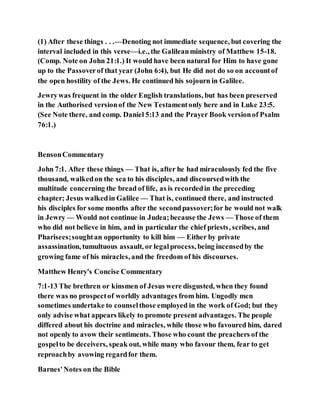
Ellicott's Commentary for English Readers
(1) After these things . . .—Denoting not immediate sequence, but covering the
interval included in this verse—i.e., the Galileanministry of Matthew 15-18.
(Comp. Note on John 21:1.) It would have been natural for Him to have gone
up to the Passoverof that year (John 6:4), but He did not do so on accountof
the open hostility of the Jews. He continued his sojourn in Galilee.
Jewrywas frequent in the older English translations, but has been preserved
in the Authorised versionof the New Testamentonly here and in Luke 23:5.
(See Note there, and comp. Daniel 5:13 and the Prayer Book versionof Psalm
76:1.)
BensonCommentary
John 7:1. After these things — That is, after he had miraculously fed the five
thousand, walkedon the sea to his disciples, and discoursed with the
multitude concerning the bread of life, as is recordedin the preceding
chapter; Jesus walkedin Galilee — That is, continued there, and instructed
his disciples for some months after the secondpassover;for he would not walk
in Jewry — Would not continue in Judea;because the Jews — Those of them
who did not believe in him, and in particular the chief priests, scribes, and
Pharisees;soughtan opportunity to kill him — Either by private
assassination, tumultuous assault, or legalprocess, being incensedby the
growing fame of his miracles, and the freedom of his discourses.
Matthew Henry's Concise Commentary
7:1-13 The brethren or kinsmen of Jesus were disgusted, when they found
there was no prospectof worldly advantages from him. Ungodly men
sometimes undertake to counselthose employed in the work of God; but they
only advise what appears likely to promote present advantages. The people
differed about his doctrine and miracles, while those who favoured him, dared
not openly to avow their sentiments. Those who count the preachers of the
gospelto be deceivers, speak out, while many who favour them, fear to get
reproachby avowing regardfor them.
Barnes'Notes on the Bible
After these things - After the transactions which are recordedin the last
chapters had takenplace, and after the offence he had given the Jews. See
John 5:18.
Jesus walked- Or Jesus lived, or taught. He traveled around Galilee teaching.
In Jewry - In Judea, the southern division of Palestine. Compare the notes at
John 4:3.
The Jews sought - That is, the rulers of the Jews. It does not appear that the
common people ever attempted to take his life.
Jamieson-Fausset-BrownBible Commentary
CHAPTER 7
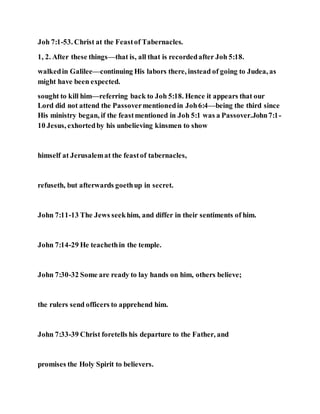
Joh 7:1-53. Christ at the Feastof Tabernacles.
1, 2. After these things—that is, all that is recordedafter Joh 5:18.
walkedin Galilee—continuing His labors there, instead of going to Judea, as
might have been expected.
sought to kill him—referring back to Joh 5:18. Hence it appears that our
Lord did not attend the Passovermentionedin Joh6:4—being the third since
His ministry began, if the feastmentioned in Joh 5:1 was a Passover.John7:1-
10 Jesus, exhortedby his unbelieving kinsmen to show
himself at Jerusalemat the feastof tabernacles,
refuseth, but afterwards goethup in secret.
John 7:11-13 The Jews seekhim, and differ in their sentiments of him.
John 7:14-29 He teachethin the temple.
John 7:30-32 Some are ready to lay hands on him, others believe;
the rulers send officers to apprehend him.
John 7:33-39 Christ foretells his departure to the Father, and
promises the Holy Spirit to believers.
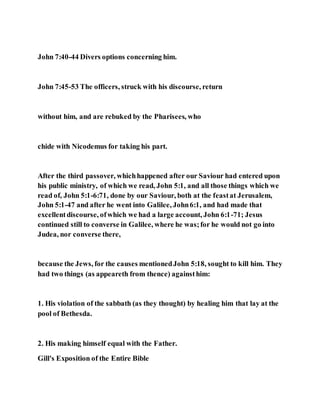
John 7:40-44 Divers options concerning him.
John 7:45-53 The officers, struck with his discourse, return
without him, and are rebuked by the Pharisees, who
chide with Nicodemus for taking his part.
After the third passover, whichhappened after our Saviour had entered upon
his public ministry, of which we read, John 5:1, and all those things which we
read of, John 5:1-6:71, done by our Saviour, both at the feastat Jerusalem,
John 5:1-47 and after he went into Galilee, John6:1, and had made that
excellentdiscourse, ofwhich we had a large account, John 6:1-71; Jesus
continued still to converse in Galilee, where he was;for he would not go into
Judea, nor converse there,
because the Jews, for the causes mentionedJohn 5:18, sought to kill him. They
had two things (as appeareth from thence) againsthim:
1. His violation of the sabbath (as they thought) by healing him that lay at the
pool of Bethesda.
2. His making himself equal with the Father.
Gill's Exposition of the Entire Bible
After these things Jesus walkedin Galilee,....Thatis, after he had fed the five
thousand with five loaves and two fishes, near Bethsaida;and had had that
long discourse with the Jews atCapernaum, concerning himself, as the bread
of life, and about eating his flesh, and drinking his blood; and had been up to
the feastof the passoverat Jerusalem, saidto be nigh, when he went over the
sea of Galilee, John6:4; otherwise the above places were in Galilee:but the
case seems to be this, that after he had been at Capernaum, he went to
Jerusalem, to keepthe passover;and finding that the Jews still sought to take
awayhis life, he returned to Galilee, and "walked" there;he did not sit still,
or lie at home, and live an inactive indolent life, but went about from place to
place, preaching the Gospel, and healing diseases;he walked, and walked
about; but not as the enemy of souls, seeking to do all mischief, but to do all
good, to the bodies and souls of men:
for he would not walk in Jewry; in the land of Judea, where he had been, and
tarried, and made disciples; but being rejectedand ill treated, he left them;
which was a prelude of the Gospelbeing takenfrom them, and carriedto
another people; which afterwards took place, in the times of the apostles:his
reasonfor it was,
because the Jews soughtto kill him; for healing a man on the sabbath day,
and for asserting his equality with God: not that he was afraid to die, but his
time was not come; and he had work to do for the glory of God, and the good
of men; and therefore it was both just and prudent to withdraw and preserve
his life; for like reasons he advised his disciples, when persecutedin one city,
to flee to another: and very lawful and advisable it is for goodmen, when their
lives are in danger, to make use of proper means to preserve them, for further
usefulness in the cause of God, and for the benefit of men.
Geneva Study Bible
After these things Jesus walkedin Galilee:for he would not walk in Jewry,
because the Jews soughtto kill him.
Ellicott's Commentary for English Readers
(1) After these things . . .—Denoting not immediate sequence, but covering the
interval included in this verse—i.e., the Galileanministry of Matthew 15-18.
(Comp. Note on John 21:1.) It would have been natural for Him to have gone
up to the Passoverof that year (John 6:4), but He did not do so on accountof
the open hostility of the Jews. He continued his sojourn in Galilee.
Jewrywas frequent in the older English translations, but has been preserved
in the Authorised versionof the New Testamentonly here and in Luke 23:5.
(See Note there, and comp. Daniel 5:13 and the Prayer Book versionof Psalm
76:1.)
BensonCommentary
John 7:1. After these things — That is, after he had miraculously fed the five
thousand, walkedon the sea to his disciples, and discoursedwith the
multitude concerning the bread of life, as is recordedin the preceding
chapter; Jesus walkedin Galilee — That is, continued there, and instructed
his disciples for some months after the secondpassover;for he would not walk
in Jewry — Would not continue in Judea;because the Jews — Those of them
who did not believe in him, and in particular the chief priests, scribes, and
Pharisees;soughtan opportunity to kill him — Either by private
assassination, tumultuous assault, or legalprocess, being incensedby the
growing fame of his miracles, and the freedom of his discourses.
Matthew Henry's Concise Commentary
7:1-13 The brethren or kinsmen of Jesus were disgusted, when they found
there was no prospectof worldly advantages from him. Ungodly men
sometimes undertake to counselthose employed in the work of God; but they
only advise what appears likely to promote present advantages. The people
differed about his doctrine and miracles, while those who favoured him, dared
not openly to avow their sentiments. Those who count the preachers of the
gospelto be deceivers, speak out, while many who favour them, fear to get
reproachby avowing regardfor them.
Barnes'Notes on the Bible
After these things - After the transactions which are recordedin the last
chapters had takenplace, and after the offence he had given the Jews. See
John 5:18.
Jesus walked- Or Jesus lived, or taught. He traveled around Galilee teaching.
In Jewry - In Judea, the southern division of Palestine. Compare the notes at
John 4:3.
The Jews sought - That is, the rulers of the Jews. It does not appear that the
common people ever attempted to take his life.
Jamieson-Fausset-BrownBible Commentary
CHAPTER 7
Joh 7:1-53. Christ at the Feastof Tabernacles.
1, 2. After these things—that is, all that is recordedafter Joh 5:18.
walkedin Galilee—continuing His labors there, instead of going to Judea, as
might have been expected.
sought to kill him—referring back to Joh 5:18. Hence it appears that our
Lord did not attend the Passovermentionedin Joh6:4—being the third since
His ministry began, if the feastmentioned in Joh 5:1 was a Passover.John7:1-
10 Jesus, exhortedby his unbelieving kinsmen to show
himself at Jerusalemat the feastof tabernacles,
refuseth, but afterwards goethup in secret.
John 7:11-13 The Jews seekhim, and differ in their sentiments of him.
John 7:14-29 He teachethin the temple.
John 7:30-32 Some are ready to lay hands on him, others believe;
the rulers send officers to apprehend him.
John 7:33-39 Christ foretells his departure to the Father, and
promises the Holy Spirit to believers.
John 7:40-44 Divers options concerning him.
John 7:45-53 The officers, struck with his discourse, return
without him, and are rebuked by the Pharisees, who
chide with Nicodemus for taking his part.
After the third passover, whichhappened after our Saviour had entered upon
his public ministry, of which we read, John 5:1, and all those things which we
read of, John 5:1-6:71, done by our Saviour, both at the feastat Jerusalem,
John 5:1-47 and after he went into Galilee, John6:1, and had made that
excellentdiscourse, ofwhich we had a large account, John 6:1-71; Jesus
continued still to converse in Galilee, where he was;for he would not go into
Judea, nor converse there,
because the Jews, for the causes mentionedJohn 5:18, sought to kill him. They
had two things (as appeareth from thence) againsthim:
1. His violation of the sabbath (as they thought) by healing him that lay at the
pool of Bethesda.
2. His making himself equal with the Father.
Gill's Exposition of the Entire Bible
After these things Jesus walkedin Galilee,....Thatis, after he had fed the five
thousand with five loaves and two fishes, near Bethsaida;and had had that
long discourse with the Jews atCapernaum, concerning himself, as the bread
of life, and about eating his flesh, and drinking his blood; and had been up to
the feastof the passoverat Jerusalem, saidto be nigh, when he went over the
sea of Galilee, John6:4; otherwise the above places were in Galilee:but the
case seems to be this, that after he had been at Capernaum, he went to
Jerusalem, to keepthe passover;and finding that the Jews still sought to take
awayhis life, he returned to Galilee, and "walked" there;he did not sit still,
or lie at home, and live an inactive indolent life, but went about from place to
place, preaching the Gospel, and healing diseases;he walked, and walked
about; but not as the enemy of souls, seeking to do all mischief, but to do all
good, to the bodies and souls of men:
for he would not walk in Jewry; in the land of Judea, where he had been, and
tarried, and made disciples; but being rejectedand ill treated, he left them;
which was a prelude of the Gospelbeing takenfrom them, and carriedto
another people; which afterwards took place, in the times of the apostles:his
reasonfor it was,
because the Jews soughtto kill him; for healing a man on the sabbath day,
and for asserting his equality with God: not that he was afraid to die, but his
time was not come; and he had work to do for the glory of God, and the good
of men; and therefore it was both just and prudent to withdraw and preserve
his life; for like reasons he advised his disciples, when persecutedin one city,
to flee to another: and very lawful and advisable it is for goodmen, when their
lives are in danger, to make use of proper means to preserve them, for further
usefulness in the cause of God, and for the benefit of men.
Geneva Study Bible
After these things Jesus walkedin Galilee:for he would not walk in Jewry,
because the Jews soughtto kill him.
Calvin's Commentary on the Bible
1.Jesus walkedin Galilee. The Evangelistappears not to pursue a continued
narrative, but to selectout of what occurredat different times those events
which were worthy of being related. He says that Christ sojournedfor a time
in Galilee, because he could not remain in safetyanywhere among the Jews. If
any personthink it strange that Christ soughta place of concealment, who, by
the mere actof his will, could break and render powerless allthe efforts of his
enemies, it is easyto reply, that he remembered the commissionwhich he had
receivedfrom the Father, and determined to confine himself within the limits
which belonged to him as man; for,
having takenupon him the form of a servant,
he emptied himself, till the Fatherexalted him,
(Philippians 2:6.)
If it be objectedthat, as he knew the time of his death, which had been
foreordainedand determined in the purpose of God, (178)he had no reason
for avoiding it, the former solution applies here also;for he conducted himself
as a man who was liable to dangers, and, therefore, it was not proper that he
should throw himself at random into dangerous situations. In encountering
dangers, it is not our business to inquire what God has determined respecting
us in his decree, but what he commands and enjoins on us, what our office
requires and demands, and what is the proper method of regulating our life.
Besides, while Christ avoided dangers, he did not turn aside a hairsbreadth
from the course ofduty; for to what purpose would life be maintained and
defended, but that we may serve the Lord? We ought always to take care,
therefore, that we do not, for the sake oflife, lose the reasons forliving. When
a small and despisedcorner of Galilee grants a lodging to Christ, whom Judea
cannot endure, we learn from it that piety and the fear of God are not always
to be found in the chief places ofthe Church.
What does John 7:1 mean? [⇑ See verse text ⇑]
As with the first verse of chapter 6, chapter 7 opens with something of an
understatement. The time gapbetweenthe end of chapter 5 and the start of
chapter 6 was about six months. Here there is a similar leap: from the time of
Passoverto the FeastofBooths (John 7:2). This puts the events of the next few
chapters around six months prior to Jesus'eventualcrucifixion.
The gospelof John presents Jesus as a man always obedient to God's timeline.
Conflict with the religious leaders of Jerusalemis inevitable, and so Jesus
spends much of His time in Galilee, awayfrom their direct influence. This
only delays the eventual outcome, of course. Jesus has alreadydone enough to
earn a death sentence in their eyes, since they interpret His earlier actions as a
form of blasphemy (John 5:18). This desire to see Jesus killedwill be greatly
increaseddue to His actions during the FeastofBooths.
As is usually the case in the gospelofJohn, the term "the Jews"is a reference
to the religious leaders of Jerusalem and their supporters. This is an
important distinction when interpreting the reactions of the crowd to Jesus'
words. "The Jews," as describedhere, are a somewhatseparate groupfrom
"the people
https://www.bibleref.com/John/7/John-7-1.html
John 7:1—Whydid Jesus feardeath and yet tell His disciples not to do so?
Problem: John informs us here that “Jesus walkedin Galilee;for He did not
want to walk in Judea, because the Jews soughtto kill Him.” Yet Jesus saidto
His disciples, “Myfriends, do not be afraid of those who kill the body” (Luke
12:4).
Solution: Jesus did not fear death; He merely avoided dying prematurely.
Before the appropriate time Jesus would say, “My hour has not yet come”
(John 2:4; 8:20). But when “His hour came” (cf. John 12:23), Jesus faceddeath
bravely and courageously. Thoughhumanly speaking Jesus shrunk from the
horror of the Cross (see comments on Heb. 5:7b); nevertheless, He prayed,
“whatshall I say? `Father, save Me from this hour’?” to which He answered
with an emphatic no: “But for this purpose I came to this hour” (John 12:27).
Jesus knew from the very beginning that He had come to die (cf. John 2:19–
20; 10:10–11), andHe never hesitatedin His resolute purpose “to give His life
a ransom for many” (Mark 10:45). However, to accomplishthis as God had
ordained and the prophets predicted, Jesus had to watch out for attempts on
His life before the appointed time and way. For example, He was to be
crucified (cf. Ps. 22:16; Zech. 12:10), not to be stoned, as the Jews soughtto do
on one occasion(see John10:32–33).
https://defendinginerrancy.com/bible-solutions/John_7.1.php
BARCLAY
There is one unique thing in this passagewhichwe mustnote. According to the
RevisedStandardVersion(John7:7) Jesus says: "Mytime is not yet come."
Jesus frequently spoke abouthis time or his hour. But here he uses a different
word, anduses it for the only time. In the other passages(John2:4; John7:30;
John8:20; John12:27)the wordthat Jesus orJohnuses is hora (Greek#5610),
which means the destinedhour of God. Sucha time or hour was not movable
nor avoidable. Ithad to be acceptedwithoutargumentand without alteration
because itwas the hour at which the plan ofGod had decidedthat something
must happen. But in this passagethe wordis kairos (Greek #2540), which
characteristicallymeans anopportunity; that is, the best time to do something,
the moment when circumstances are mostsuitable, the psychological moment.
Jesus is notsaying here that the destined hour of Godhas not come but
something much simpler. He is saying that that was notthe moment which
would give him the chance forwhich he was waiting.
Thatexplains why Jesus lateractuallydid go to Jerusalem. Manypeople have
beentroubled about the factthat he first told his brothers he would not go and
then went. Schopenhauer, the Germanphilosopher, actuallysaid: "Jesus
Christ did ofsetpurpose utter a falsehood."Otherpeople have arguedthat it
means that Jesus saidthathe was notgoing up to the festivalpublicly but that
did not preclude him from going privately. But Jesus is saying simply: "If I go
up with you just now I will not getthe opportunity I am looking for. The time is
not opportune." So he delayedhis going until the middle ofthe festival, since to
arrive with the crowds allassembledandexpectantgave him a far better
opportunity than to go at the very beginning. Jesus is choosing his time with
carefulprudence in order to getthe most effective results.
From this passagewe learntwo things:
(i) Itis impossible to force Jesus' hand. His brothers tried to force him into
going to Jerusalem. Itwas whatwe might calla dare. Theywere quite right
from the human point of view. Jesus'greatmiracleshadbeenwrought in
Galilee--the changing ofthe waterinto wine (John2:1ff); the healing ofthe
nobleman's son(John4:46); the feeding ofthe five thousand (John6:1 ff). The
only miracle that he had wroughtin Jerusalemwas the curing ofthe impotent
man at the pool(John5:1 ff). Itwas notunnatural to tell Jesus to go to
Jerusalemandlet his supporters there see whathe could do. The storymakes it
clearthat the healing ofthe impotent man had been regardedfarmore as an
actofSabbath breaking than as a miracle. Further, ifJesus was everto succeed
in winning men, he couldnot hope to do so by hiding in a comer; he mustactin
sucha waythat everyone couldsee whathe did. Still further, Jerusalemwas
the keypoint. The Galilaeanswere notoriouslyhot-bloodedandhot-headed.
Anyone who wanteda following would have no difficulty in raising one in the
excitable atmosphere ofGalilee; butJerusalemwas a verydifferent
proposition. It was the acidtest.
Jesus'brothers couldhave put up a goodcasefortheirinsistence; butJesus'
hand is not to be forced. He does things, notin man's time, but in God's. Man's
impatience of man must learnto waiton God's wisdom.
(ii) Itis impossible to treat Jesus withindifference. Itdid not matter when his
brothers wentto Jerusalem, forno one would notice they were there and
nothing whateverdepended on their going. ButJesus' going wasa very
different thing. Why? Becausehis brothers were in tune with the world and
they did not make it uncomfortable. ButJesus' coming is a condemnationof
the world's wayof life and a challenge to selfishness andlethargy. Jesus hadto
choose his moment, forwhenhe arrives something happens.
STEVEN COLE
God’sTimeor Man’sTime? (John7:1-13)
Related Media
December29, 2013
A young man came to W. E. Gladstone when he was Prime Minister of
England and said, “Mr. Gladstone, I would appreciate your giving me a few
minutes in which I might lay before you my plans for the future. I would like
to study law.” “Yes,” saidthe greatstatesman, “andwhat then?”
“Then, sir, I would like to gain entrance to the Bar of England.” “Yes, young
man, and what then?”
“Then, sir, I hope to have a place in Parliament, in the House of Lords.” “Yes,
young man, what then?” pressedGladstone.
“Then I hope to do greatthings for Britain.” “Yes, young man, and what
then?”
“Then, sir, I hope to retire and take life easy.” “Yes, young man, and what
then?” he tenaciouslyasked.
“Well, then, Mr. Gladstone, I suppose I will die.” “Yes, young man, and what
then?” The young man hesitatedand then said, “I never thought any further
than that, sir.”
Looking at the young man sternly and steadily, Gladstone said, “Young man,
you are a fool. Go home and think life through!” (Told by Leonard Griffith,
This is Living [Abingdon Press], pp. 48, 49.)
Since the old year is almost gone and the New Year is upon us, I thought it
may be profitable to revisit the same text that we studied last time from a
slightly different perspective, considering the topic of God’s time versus man’s
time. In John 7:6, Jesus says to his half-brothers who advised Him to go up to
the FeastofBooths and do some miracles to make Himself known, “My time
is not yet here, but your time is always opportune.” Jesus was drawing a
contrastbetweenhow He lived in view of God’s time versus how His brothers
lived their lives. I want to develop the thought:
Since life is short and eternity is forever, live by God’s time, not by man’s
time.
The first point is obvious, and yet worth thinking about often:
1. Life is short and eternity is forever.
Billy Graham was once askedwhathe was mostsurprised by in life. He
answered, “Its brevity.” (Christianity Today, 10/06, p. 90)An older man gave
this perspective on how he viewed time differently as he aged(DeweyGill,
Reader’s Digest[5/83]):
Days were plentiful and cheapwhen I was young. Like penny candy. I always
had a pocketful—andspent them casually. Now my supply is diminished, and
their value has soared. Eachone becomes worthits weightin the gold of
dawn. Suddenly I live in unaccustomedthrift, cherishing hours the way lovers
prize moments. Even at that, when the week is ended, it seems I’ve gone
through another fortune. A day doesn’t go as far as it used to.
I can relate to those thoughts! We just came from being with my Dad on his
90th birthday. It was sadto see his declining physical and mental condition.
But it was also sobering to think that in just over 23 years, if I’m still alive, I
will be that old! Life is short and then eternity is forever!
If Jesus had been born in our times, His parents would have recognizedthat
He was an unusually gifted child. They would have begun His educationearly,
put Him on the gifted child track, and had Him preaching by age 12 when He
made an impressionon the scholars in the temple. By the time He was 20, He
would have a huge international following. With a goodpublic relations man,
He could have learned to tone down some of His more offensive comments so
that the religious leaders would not have plotted to kill Him. Think how much
more He could have accomplishedif He had lived to 70 or 80!
But Jesus, living by God’s time, didn’t begin His ministry until He was about
30 and after three short years He could pray (John 17:4), “I glorified You on
the earth, having accomplishedthe work which You have given me to do.”
Amazing!
If we want to think like Jesus, we needto live with the awareness ofhow short
life is and that one day we will give an accountto God for how we spent our
lives. In Psalm90, as Mosesthought on these things, he concluded with the
prayer (90:17), “Let the favor of the Lord our God be upon us; and confirm
for us the work of our hands; yes, confirm the work of our hands.” If none
other than Moses hadto ask Godto confirm the work of his hands, how much
more do we need to pray that prayer repeatedly!
2. Jesus’brothers were living by man’s time: Their time was always
opportune.
Jesus told His brothers that they could go up to the feastwhenever they
wanted to go, because their time was “always opportune” (7:6). The
implication is that they were not living under God’s time, as Jesus was. D. A.
Carson(The GospelAccording to John [Eerdmans/Apollos], p. 308)says that
Jesus meant “that what they did was utterly without significance as far as God
was concerned.” We candraw three implications about what it means to live
by man’s time:
A. Those living by man’s time are not living under the lordship of Christ.
As John 7:5 adds, “Fornot even His brothers were believing in Him.” As we
saw in our laststudy, Jesus’brothers had grownup with Him, so they knew
Him better than most people would have. They had heard His teaching and
seensome of His miracles. They were good, religious Jews, who observedthe
various feasts in Israel, such as this Feastof Booths. But they didn’t believe in
Jesus as Saviorand Lord. They probably did not see their need for a Savior
from sin, because they thought of themselves as good, religious Jews in
comparisonwith the paganGentiles.
So if you want to live by God’s time and not waste your life living by man’s
time, the first order of business is to trust in Christ as Savior and Lord. When
you are born again, you repent of the sin of living for yourself and you begin
to live for the glory of your wonderful Savior and Lord. You realize that if He
is Lord of all, then He is Lord of your time. So you begin to seek Him
earnestlyto figure out how He wants you to spend your life. If you determine
your goals and priorities apart from submissionto God and His Word, then
you’re living by man’s time, not by God’s time. Such living is ultimately futile.
B. Those living by man’s time go along with their culture apart from Christ.
Jesus draws a sharp contrasthere betweenHis brothers’ time and His time. If
you’re using your time as our culture does, you aren’t living by God’s time.
The brothers went up to this religious feastbut they went without Jesus. They
went because it was the thing that all Jewishmen did at that time of the year.
It was a God-ordained ritual, but they did it without reality because they did
it without Jesus and without faith in Him. They were living by man’s time, not
by God’s time.
We, of course, live in a godless,corrupt culture that exalts selfishpleasure and
materialism as the ultimate aims in life. To go along with our culture and live
for those fleeting pleasures is obviously to waste your life. But it’s possible to
be a part of the Christian wing of our culture, to go to church and go through
Christian rituals (such as communion) and yet leave Jesus out. You’re just
doing it because it’s the thing that other Christians do. But that is to live by
man’s time, not by God’s time.
C. Those living by man’s time operate by worldly wisdom, not by God’s
wisdom.
As we saw lasttime, Jesus’brothers offered some worldly-wise advice on how
He could advance His “career.” Theymay have meant well, but as I pointed
out, their advice was in line with Satan’s temptation for Jesus to jump off the
pinnacle of the temple, have the angels floatHim gently to the ground, and
impress everyone with His miraculous powers. The brothers’ advice was, “For
no one does anything in secretwhenhe himself seeks to be known publicly. If
You do these things, show Yourself to the world.” (7:4).
As Carsonpoints out (ibid., pp. 306-307), by the world, Jesus’brothers meant,
“to everyone,” but John no doubt saw irony in their comment. We already
know that such a display of Jesus’miraculous powers would have the
multitude clamoring to make Him a political Messiah(6:14-15), but it would
not have resulted in genuine faith (2:23-25). In one sense Jesushad no
intention of showing Himself to the world (14:22). And yet in another sense
(Carson, p. 307), “it is in Jerusalemwhere Jesus reveals himselfmost
dramatically—not in the spectacularmiracles the brothers want but in the
ignominy of the cross, the very cross by which Jesus draws all men to Himself
(12:32) and becomes the Savior of the world (4:42).” The cross is foolishness
to the wise of this world, but to us who are called, it is God’s powerand
wisdom (1 Cor. 1:23-24).
One of the books that has most impacted my life is Shadow of the Almighty
[Zondervan], by Elisabeth Elliot. It’s the story of her first husband, Jim Elliot,
who was martyred at age 28 in Ecuador (along with four other young men) by
the fierce Auca tribe that they were seeking to reachwith the gospel. Whenhe
was a college student, Jim had written (p. 15), “He is no foolwho gives what
he cannot keepto gain what he cannotlose.”
Recentlythe news featured the story of chemistry teacherRonnie Smith, a
young husband and father who was shotto death by Muslim radicals while he
joggedin Benghazi, Libya. He was there to show Christ’s love to those lost
and hopeless people. I saw an interview with his wife, who said that she loves
and forgives those who murdered her husband. The world would say that to
go to a fierce, primitive tribe or to a dangerous place like Benghazito share
the gospel, is not wise. But God’s ways are not our ways and His thoughts are
not our thoughts. In the epilogue to Shadow of the Almighty (p. 246),
ElisabethElliot wrote,
W. SomersetMaugham, in Of Human Bondage, wrote, “Theseoldfolk had
done nothing, and when they died it would be just as if they had never been.”
Jim’s comment on this was, “Goddeliver me!”
May He deliver us all from living by man’s time, in worldly wisdom, rather
than by God’s time, in His wisdom. To understand how to live by God’s time,
we must look at how Jesus lived:
3. Jesus lived by God’s time: He submitted fully to God’s plan for His life.
Throughout John’s Gospel, there is the repeatedtheme of Jesus’“hour,”
which refers to the cross (2:4; 7:30; 8:20; 12:23, 27;13:1; 16:32; 17:1; see
Luke 22:53). But here (7:6, 8) John uses the Greek word that refers to an
opportune time. Jesus means that the God-appointed time for Him to go up to
Jerusalemand reveal Himself was not yet at hand. In other words, in contrast
to His brothers, who lived by the world’s agenda, Jesus lived by God’s
agenda. This meant five things:
A. To live by God’s time, be directly accountable to Him for how you spend
your time.
Jesus always had a sense ofobeying the Fatherwith regard to His use of time.
He did not allow His ownmother to determine when He should turn the water
into wine, but He did it as the Father directed Him (2:4). Here, He does not
allow His brothers’ advice to govern when He went up to the feast, but went in
response to the Father’s timetable. He was accountable to the Father to do
everything in His life and ministry as the Father directed.
I’ll grant that it’s not easyto determine God’s will for the specifics ofour
schedules, whetherit concerns the major decisions in life or the daily and
weeklyschedules that we all must make. But we can determine our overall
priorities and goals from the wisdom of God’s Word and prayerfully seek to
use our time with the awareness thatwe will give an accountto God for how
we spent the time that He gave us. If I may be gently blunt, to spend countless
hours watching TV or playing computer games is not a godly way to spend
your life.
One New Year’s Day when I was in college, I spent the entire day watching all
the collegebowlgames. By the end of the day, I felt rotten, as if I had stuffed
myself on junk food all day. I realized that I had just wasteda precious day of
my life. I swore off my TV addiction and have never gone back.
B. To live by God’s time, live with the purpose of glorifying God and
accomplishing what He has given you to do.
Jesus came to do the Father’s will and to accomplishthe Father’s work (4:34).
He finished it in three years, as we have seen(17:4). Jesus’purpose should be
our purpose, namely, to glorify God on this earth and to accomplishwhatever
it is that He has given eachof us to do.
Obviously, God does not calleveryone to be a foreign missionary or to serve
full time in ministry here at home. But He does call us all to live in such a way
that we glorify Him in everything we do (1 Cor. 10:31). All behavior begins in
our hearts or thoughts (Mark 7:21), so begin there, by ordering your thoughts
in line with God’s Word (Phil. 4:8). All our behavior is to be governedby
God’s love, which seeks the highest goodfor others (Rom. 12:9-10;1 Cor. 13;
16:14). Also, God has uniquely gifted eachone for service so that we might
glorify Him (1 Cor. 12; 1 Pet. 4:10-11). So figure out what He has gifted you to
do and structure your schedule so that you can do it.
C. To live by God’s time, develop a harvest mindset that views every situation
in light of eternity.
As we saw in the story of Jesus with the womanat the well, the disciples had a
temporal mindset. They were focusedon getting Jesus to eat His lunch so that
they could get on with their journey. But Jesus had a harvest mindset. He
turned their focus toward what God was doing with His encounter with the
woman and the Samaritans in that village (4:31-38). Jesus was awareofGod’s
perspective in every situation. He never actedout of selfishmotives, but only
for the purpose of furthering God’s kingdom. He told us that in contrastto
seeking allthe things that the world so eagerlyseeks, (Matt. 6:33), “But seek
first His kingdom and His righteousness, andall these things will be added to
you.”
You’ve gotto figure out how that verse applies to your sphere of influence. It
may apply to rearing your children to know and follow Christ. It may apply to
helping a family member, friend, co-worker, orstrangerwhom you meet
come to know the Savior or to grow in Him. Ask the Lord to give you a
harvest mindset.
D. To live by God’s time, use reasonable prudence, but do not put personal
safetyabove doing the will of God.
Jesus stayedin Galilee because the Jews were trying to kill Him (7:1), but
when it was God’s will for Him to go to the feast, He went. We see the same
thing in John 10:39-11:15:Jesus was ministering out of the reachof the
Pharisees who were seekingto kill Him, but when it was God’s time, He went
to Bethany, just outside of Jerusalem, to raise Lazarus from the dead.
Jeremy Lundgren, our former youth pastor, is writing his master’s thesis on
the theologyof risk and safety: when is it right to protectyourself from
possible harm versus expend yourself for the sake ofthe gospel? On some
occasions,the apostle Paulescapedimpending threats to his life (2 Cor. 11:32-
33; Acts 17:10, 14; 22:18), but at other times, he was willing to walk into what
almost certainly would result in either persecutionor death (Acts 19:30-31;
21:11-13). I can’t give you a hard and fast rule for determining when to risk
your life for the sake ofthe gospeland when to use caution and escape. Butwe
all should have the mindset that our highest aim is to glorify God through the
gospel. Sometimes that may entail exposing ourselves to substantial risks.
E. To live by God’s time, be willing to confront our godless culture.
Here, Jesus confrontedHis brothers’ worldly perspective. He never backed
awayfrom confronting the worldly or godless views ofthose He came into
contactwith, even though it inevitably led to His death. When He went to have
lunch with a Pharisee, Jesus deliberatelydid not follow their custom for
ceremonialwashing before the meal and then He laid into the Pharisee for his
hypocrisy in cleaning the outside of the cup, while inside he was full of
wickedness. Whenone of the lawyers present heard Jesus’condemnation of
the Pharisees, he said (Luke 11:45), “Teacher, whenYou say this, You insult
us too.” Did Jesus reply, “I’m sorry, I didn’t mean any offense”? No, rather
He said (11:46), “Woe to you lawyers as well!” And He proceededto expose
their many sins. Jesus always confrontedthe godlessnessaround Him.
This doesn’t mean that we should be rude or insensitive. Paul tells us that our
speechshould be both gracious andseasonedwith salt(Col. 4:6). He tells us
not to be quarrelsome, but to be kind to all and to correctwith gentleness (2
Tim. 2:24-25). But probably most of us need to be a bit bolder than we are to
speak out againstgodlessnesswhenwe encounter it. I appreciatedreading
that Rick Warren recently told Piers Morganon CNN with regard to
Warren’s opposition to homosexualmarriage, “I fearthe disapproval of God
more than I fear your disapproval or the disapproval of society.”
(http://piersmorgan.blogs.cnn.com/2013/12/06)
Conclusion
To review and offer some specific actionpoints, here are some steps to help
you live by God’s time so that your life counts for eternity and isn’t wasted
because you lived for man’s time:
(1) Make sure that you have trusted in Jesus Christ as Savior and that you are
fully submitted to His lordship. Apart from that, anything that you do will be
empty and vain at the judgment.
(2) Write out a one-sentence purpose statementfor your life and two or three
short-term goals that will help move you in that direction in the coming year.
Granted, Jesus probably didn’t write out His life purpose in a single sentence,
but He was clearenough about it that He knew when He had accomplished
the Father’s work (John 17:4). The same could be said of the apostle Paul. He
said (1 Cor. 9:23), “I do all things for the sake ofthe gospel.”He saidthat his
aim was (Phil. 3:10), “ThatI may know Him.” He told Timothy (1 Tim. 4:7),
“Discipline yourself for the purpose of godliness.” Thoseaims are all in line
and show that Paul lived with God’s purpose in mind.
(3) Clear your life of clutter and busyness that do not relate to your overall
purpose. Kevin DeYoung’s recentshort book, Crazy Busy [Crossway]is
helpful in this regard.
(4) Figure out what God has gifted you to do and begin serving Him now.
Don’t wait until some “better time” in the future. You may never get to such a
time. Start now. What is your “missionfield”? Who are the 8-15 people with
whom you have regular contactthat you can influence for Christ? God wants
all disciples of Jesus to help make disciples who make disciples.
(5) Don’t despise the mundane as the place where God wants you to serve.
You don’t have to go to the mission field or go into full time ministry to serve
the Lord. You can serve and glorify God daily in your present circumstances.
As Peter puts it (1 Pet. 4:11), “Whoeverspeaks, is to do so as one who is
speaking the utterances of God; whoeverserves is to do so as one who is
serving by the strength which God supplies; so that in all things Godmay be
glorified through Jesus Christ, to whom belongs the glory and dominion
forever and ever. Amen.”
Application Questions
When we live under God’s time, how do we determine how much time to
spend in leisure or recreation?
How can a Christian discoverhis/her spiritual gifts? (See my messageon
Romans 12:4-6.)
How does Matthew 6:33 apply to a believer who works in a “secular” job?
How can he “seek firstGod’s kingdom”?
Prayerfully write a brief life purpose statementand 2-3 goals for the New
Year.
Copyright, Steven J. Cole, 2013,All Rights Reserved.
Dr. S. Lewis Johnsondiscusses Jesus'rebuke of his disciples' desire that the
Lord reveal himself before the time of God's plan.
SLJ Institute > Gospelof John > Before the Feastofthe Tabernacle
Listen Now
Audio Player
00:00
00:00
Use Up/Down Arrow keys to increase ordecrease volume.
Readthe Sermon
Transcript
[Message]This morning we are turning, as usual, to the Gospelof John and
we are looking now at the opening part of the 7th chapter reading verses 1
through 13 for our Scripture reading. And so if you have a New Testamentor
a Bible with you, turn with me to chapter and we’ll begin with the 1stverse.
Remember that in the 6th chapter the Lord Jesus had performed two mighty
signs, and that had followedwith conversationwith the Jews oversome of the
leading spiritual principles that were found within it as a result of some of the
words the Lord spoke concerning the sovereigntyof God. Many of his
disciples went back and walkedno more with him. The Lord Jesus turned to
the twelve and askedthem, “Will ye also go away?” And Peter had replied,
“Lord, to whom shall we go? Thou hast the words of eternal life.” And Jesus
just reminded Peterthat while it’s true that they were going to stick with him,
nevertheless not all of them would. He reminded Peterthat one of the ones
who he had chosenwas a devil. And of course he was speaking ofJudas
Iscariot. Now, in the 7th chapterJohn writes,
“After these things Jesus walkedin Galilee:for he would not walk in Jewry,
because the Jews soughtto kill him. Now the Jew’s feastoftabernacles was at
hand. His brethren therefore said unto him, Depart hence, and go into
Judaea, that thy disciples also may see the works that thou doest. (By the way,
the expression“his brethren” refers to his physical brethren, the brothers
who were the sons of Mary and Joseph. Verse 4,)For there is no man that
doeth any thing in secret, and he himself seekethto be knownopenly. If thou
do these things, shew thyself to the world. For neither did his brethren believe
in him. Then Jesus saidunto them, My time is not yet come:but your time is
always ready. (Now, notice the expressionas “my time,” not “mine hour” has
not yet come, but my time, my season, my opportunity.) The world cannot
hate you; but me it hateth, because I testify of it, that the works thereofare
evil. Go ye up unto this feast: I go not unto this feast:for my time is not yet
come. (Now, if you have an Authorized Version, as I have before me, you’ve
noticed that I’ve left out the first “yet” in verse 8. “I go not up yet.” The
reasonfor that is that probably the text should read here, “I go not up unto
this feast, for my time is not yet full come.”)When he had said these words
unto them, he abode still in Galilee. But when his brethren were gone up, then
went he also up unto the feast, not openly, but as it were in secret. (Fromthis I
think we learn the meaning of the statement in verse 8, “I am not going up to
this feast.” He means he’s not going up to it now, and he’s not going up to it in
the sense in which the brethren had askedhim to, to go up publicly and
demonstrate his Messiahshipby his mighty works.)Thenthe Jews soughthim
at the feast, and said, Where is he? And there was much murmuring among
the people concerning him: for some said, He is a goodman: others said, Nay;
but he deceiveththe people. Howbeit no man spake openly of him for fear of
the Jews.”
May God bless this, his inspired word. Our subjectthis morning in the
exposition of the Gospelof John is “Before the FeastofTabernacles Rising
Hostility.” With the 7th chapter of the gospela new sectionof John begins.
And in the opening verses ofthe 7th chapterthe apostle describes some events
that occurredjust before the feastof the tabernacles. The restof chapters 7
and 8 have to do with things that transpired during that greatJewishfeastof
the tabernacles. So thatduring the feastand on and after the last day of the
feastmake up the remainder of the sectionof John’s 7th and 8th chapters.
Mostreaders of John chapter 7 do not find in John chapter 7 the interesting
and intriguing things that they find in chapter 6, but it is nevertheless a
masterly piece of writing. Many warnings againstthe prevalent ills of the
Christian church are found here. Forexample, in the encouragementthat the
brothers of the Lord Jesus made to him that he should go up to Jerusalemand
manifest himself to the world, and thus individuals would respond to him and
to his Messiahshipillustrates one of the banes of the modern church, and that
is it’s worldly policy.
If there is one thing that characterizes professing evangelicalismtodayit is the
tendency to worldly policy. Someone wrote in a rather semi-liberal exposition
of the Gospelof John that some would-be prophets of our day and not a few of
the confident planners have no faith at all in the still small voice, the fire, the
earthquake, and the mighty rushing wind. These are what tell and impress
and gain results. One thing that has impressed me is the fact that our politics,
our sociology, ourother fads and trends have made a greatimpact on the
doctrines of the Christian church, so far as its professing testimony is
concerned. Todaywe have the church in many cases ina mild uproar over the
place of women. Now, the reasonthat this has happened is largely traceable to
the uproar that has takenplace over the place of women in society. But the
place of women in societyshould not, it would seem, have any real impact on
what the Scriptures say about the place of women in the church. But, of
course, we know that that is not true. And so consequentlythe church is torn
and disturbed over the place of women in the church, largely because the
church is now listening to the fads and trends of the time.
This is especiallytrue in the relationship of homosexualityto biblical doctrine.
Now, no one would ever have thought that the Christian church could read
the Old Testamentand the New Testamentand not come to the conviction
that homosexuality was a sin. That was the obvious teaching of the Old
Testament. It is the obvious teaching of the New Testamentand has been for
nineteen hundred years. But today things are different. We are seeing some of
the large professing Christian organizations and denominations torn in two
over the role of homosexuals. Notsimply the role of homosexuals in church
membership and whether they should be members of a church in good
standing, but now over the role of homosexuals in the ministry of the church.
And we have the instance in more than one place of the ordination of
homosexuals for the ministry of the word of God supposedly in the Christian
church.
Now, why and how is such a thing possible? Wellin recent years we are told
biblical scholars have but forward new understanding of those passagesmost
often cited to condemn homosexuality. What are these new interpretations?
Well there have been some attempts, naturally. Some have clearly seenthat if
we are going to make a place for homosexual ministry then we must deal with
the passagesofthe Bible that so plainly teach otherwise. But I think if anyone
would read the interpretations that are put upon those passageshe would see
that it is manifestly an attempt to make the Bible conform to the social
practices ofour day. What we are seeing, it seems to me, is very plainly the
church influenced by the trends and fads and movements of our day.
Now, that was the same principle that moved the brethren of our Lord to
suggestthat he should go to Jerusalemand manifest himself, because that’s
the wayyou do things. You do things through public relations. And if you go
to the city of Jerusalemand perform your miracles there in headquarters,
they will, of course respondto you. There are many other ways in which this
manifests itself. The church’s relationship to money is another. In the
Christian church today we do not follow the biblical principles of money but
rather we follow the principles of the present day. If a movement of if a man
becomes financially in peril, then the thing to do is to send out a prayer letter,
an appeal to the believers to give money in order that the work may not go
under. In Bible times it was not so. In Bible times, so far as I cantell from the
teaching of the New Testament, no one ever made an appealfor money for
himself. It was perfectly all right to appeal for money for the poor saints in
Jerusalembecause those who made the appeal were not the poor saints in
Jerusalem. The apostles and others freely felt that they could call upon the
saints to give for others. But to give for themselves, so far as I cantell not only
does the New Testamentnot recordanything like that, but the whole spirit of
the Bible is opposedto that. In fact John the Apostle puts it very vividly, that
we should “go forth taking nothing of the Gentiles.” In other words, our
appeal is to be to the Lord and in appealing to the Lord we have a wonderful
test of whether we are doing the Lord’s work or not.
Now, in yesterday’s paper here in Dallas some illustrations were given of this
in three of three well knownmen and movements. When they gotinto
financial problems the things that they did were predictable. They sent out
letters in appealfor funds. And the individuals to whom the letters were sent,
not realizing the teaching of the word of God, yielded to the exhortation and
the appeals that were made to them and respondedand got them out of their
difficulties one more time. It’s very characteristic andpredominant in the
lives of individuals who are influenced by the world to use worldly methods in
order to carry on the Lord’s work. I still believe with all my heart that if we
look to the Lord for the supply of the funds necessaryto carry out his work,
we will have a very goodtest of just how much our work is in the will of God.
George Herbet, who was no outstanding Christian once said, “Money, thou
bain of bliss and source of woe.” And we see that so vividly in the Christian
church. But I know my words won’t count for anything, because you’ll go out
and do the same thing you’ve been doing all along. Somebody will send you an
appeal, and you’ll respond to that appeal. Why? I don’t know why, but we
just do not pay attention to what the Scriptures teachany longer it would
seem.
There is anotherthing that appears here that I think is very important, and
that is those within the church accusedJesusChrist of deception. It is no new
evil for men to differ over Jesus Christ, and it’s no new evil for men to differ
over Jesus Christ and over the Scriptures in the very bosom of the church of
Jesus Christ. And right in Jerusalemwhere headquarters of the movement of
God was ostensiblyand outwardly men differed over the ministry of the Lord
Jesus Christ. “Piety and the fear of God are not always outstanding in the
chief places of the church,” one of the old commentators has said. That is so
wonderfully illustrated here, that it ought to warn us that piety and the fearof
God are not necessarilyto be found in what we think are the important places
of evangelicalministry of the word of God.
There is anotherthing that is, I think, outstanding about this passage. And
that is men refuse him out of the closestofrelationships to him. Here are the
brothers of the Lord Jesus Christ. Many who read the word of God together
with him in their youth now think that he is nothing more than a Messianic
pretender of sorts who has been able to perform mighty miracles. They have
an understanding and appreciationof his power to perform miracles. But as
John says, “Theywere not believers in him.” Isn’t it an amazing thing when
you think about it, that these individuals grew up under the same roofwith
the Lord Jesus Christbut they did not believe in him? It is possible for us to
have the closesfamiliarity with the Lord Jesus and not really know him. It’s
possible for you to sit in Believers Chapeland not know him. It’s possible for
you young people to grow up in Believers Chapel, to grow up in a Christian
family with a Christian father and a Christian mother and not know the Lord
Jesus Christ in a saving way. How important it is that we lay hold ourselves of
the salvationthat exists in the Lord Jesus Christ. We can never say, “He is a
Christian. His father and mother are Christians. They attend Believers
Chapel.” Or they attend some other evangelicalchurch, and they’ve been
brought up in that environment and canspeak the language as these brethren
of the Lord Jesus were able to do.
I think it’s also interesting to notice that though imposters exist within the
professing body of believers, there are always, it seems, some right thinking
believers in the midst of the confusion and chaos that characterizes Christian
activity. And confusion and chaos characterizedthe days of the Lord Jesus
Christ. Of course, there are those who refusedhim because ofprejudice, but
later on in the chapter we shall dealwith that. People today do think, because
they’re prejudiced againstChristianity that the Bible cannot really say
anything to us. That Christianity is really an irrelevancy. For a personto be
concernedover the state of his soul is somewhatpathological, is it not? All of
these things, this rather insignificant sounding and looking passagespeaks to
us.
The chapter begins with the words, “After these things.” Six months, roughly,
after the events of the preceding chapter, for that was the period of time
betweenthe Feastofthe Passoveraround which the other events were
gatheredand the Feastofthe Tabernacles. Whathappened in betweenis not
given us in the Gospelof John, which illustrates the factthat John is not
giving us a life or a biography of the Lord Jesus. Actually, none of the gospel
writers do that. They write gospels, notbiographies. And so they are very
selective, as a rule, in the things in our Lord’s ministry which they use in their
gospels. The intervening period of time is found described for us in Mark
chapters 7, 8, and 9. And it appears that the Lord Jesus for the six months
engagedin what might be calledan itinerate ministry like a localrabbi’s
itinerate ministry. “After these things Jesus walkedin Galilee:for he would
not walk in Jewry, because the Jews soughtto kill him.” So he engagedin
ministry, an itinerate ministry, in the northern part of the land.
That’s the introduction to the chapter. One thing I think this illustrates for us
is the factthat the Lord Jesus Christ was a very prudent man naturally. “We
must always beware,” some has said, “that we do not for the sake of life lose
the purpose of living.” And our Lord did not rush pale male to Jerusalem
againwhen he knew they were seeking to kill him, because he had a purpose
for living, and he was following the directions that the Father had given him.
And his hour had not yet come. And so he engagedin the itinerate ministry in
the mean time. It is important for us to realize in the mean time that we
should not fail to use our reason, which has been given to us under the
direction of the Holy Spirit simply because we are believers.
Well the occasionofthe events is describedin the secondverse. “Now the
Jew’s feastoftabernacles was athand.” This was a very interesting feast. It
usually occurred, or was supposedto occur, in what is our month of October.
It was a harvest thanksgiving feastprimarily. It was designedto celebrate the
wilderness blessings that the Lord had given to the nation Israel. These things
had become attachedto it. And so at that time they celebratedthe way in
which God brought them through their wilderness experience in the past. And
so they had a libation every morning. The waterwas poured out in a
ceremonyto celebrate the fact that when they were thirsty and had no water,
God supplied them with water. And then in the evening they would light the
candelabra in testimony to the fact that God guided them through the
wilderness with the pillar of cloud by day and the pillar of fire by night. It was
also, of course, a time at which people came from all over the land, and in fact
all over the Easterworld to celebrate it. And so it was calledthe Feastof
Tabernacles,becausethey made little booths out of boughs off of trees and
shrubbery and lived in these little booths like so many tents. It reminds of the
camp meetings that Christians used to hold in the south in the earlier part of
this century. So it was a kind of a Jewishcamping festival, Goodspeedsays.
But if we call it a Jewishcamping festival we lose sight of the factthat it had
an important spiritual significance. Ultimately it pointed on to the day of the
future when the nation Israelshould be gatheredtogetherin the land for the
celebrationof the FeastofTabernacles in the kingdom.
Well, the brethren of our Lord, because they were going up to Jerusalemto
celebrate this feast, knowing that he too would most likely go up, came to him
and said, “Departhence, and go into Judaea, that thy disciples also may see
the works that thou doest. Forthere is no man that doeth any thing in secret,
and he himself seekethto be known openly. If thou do these things, shew
thyself to the world.” Now that is imminently rational advice. If you are
manifesting yourself to the world, do you do that by hiding? Is it not to be
expectedif you are going to manifest yourself to the world you should go up
where the world is and there perform some of your miracles. And in
performing some of your miracles they will come to the conviction that you
are truly the Messiah. Furthermore, Jesus, they might have said to him, “Do
you not remember that six months ago when you were there you spoke some
rather hard words about sovereignsovereignty. Something that Dr. Johnson
will later speak aboutin Believers Chapel. [Laughter] And it upset quite a few
of the people, because many of your disciples went back and walkedno more
with you, do you remember? And so if you go back now and perform some
miracles you canprobably also not only gain recognitionas a Messianic
possibility, but also you can get some of your disciples back who used to follow
you but who are not following you now, because you’re preaching the doctrine
of sovereignsovereignty.” It would have made imminent goodsense. The only
thing is that it was not in accordancewith the will of God for the Lord Jesus
Christ.
It’s so easyto rationalize and to make things that are wrong appear, not only
to be right, but most reasonablyright. How important it is that we have good
theology. “Shew yourselfto the world.” It was a worldly suggestion. Go up to
the headquarters of religion today; let them pass judgment on you. Now, what
made it even more difficult to dealwith is the fact that it was true in one sense.
He is to manifest himself ultimately in Jerusalem. That’s the place that the
Messianic possibilities shouldmanifest themselves. The Messiahis to be seen
as the Messiahparticularly in Jerusalem, as the final testimony of it. But Jesus
said, “I do not receive honor from men.” That’s a statement that he’s already
made.
Now, the brethren, of course, believe not in the Lord Jesus Christ. And John
traces their worldly reasoning to their unbelief. He says in the 5th verse,
“For,” this is why they said this, “neither did his brethren believe in him.”
Now I, it seems to me, this passageteachesaboutas clearly as any other
passagecouldteachthat carnal relationship to the Lord Jesus Christis
absolutely worthless so far as eternal life is concerned. Now you and I, of
course, do not have the possibility of the fleshly relationship to him that his
own brethren had. But it’s obvious that we may have a very close relationship
to people who are related to him. All of those relationships Jesus Christ
disowns in so far as eternal life is concerned.
One day he was preaching and in the midst of his preaching someone blurted
out, “Blessedis the womb that bear Thee, and the breasts that Thou didst
suck.” In other words, blessedis the mother who gave birth to you and upon
whose breastyou were nurtured. The Lord Jesus said, “Yea, rather, blessed
are they that hear the word of God.” In other words, he denied the earthly
relationship; the fleshly relationship in so far as spiritual blessing was
concerned, and acknowledgedthat that came through hearing the word of
God. One can see that when large church organizations appeal
rationalisticallyto pray through the mother of our Lord. For she has great
influence upon him. How far that thinking is from the thinking of the apostles,
“Blessedare they that hear the word of God.” Now we do not in any way
denigrate the Virgin Mary. She was a godly woman. And her godliness is
expressedmost imminently when she said that her soulrejoicedin God her
Savior. “And whatsoeverhe saith unto you, do it.”
Now, I sayit was a very reasonable kind of request. The Lord Jesus deals with
it very abruptly. In the 6th verse through the 9th verse he gives his reasons for
refusing to go at this time. Then Jesus saidunto them, “My time is not yet
come.” Now notice he does not say, “Mine hour,” that usually is a reference to
the cross. This, however, is his time to go up for the Feastof Tabernacles. My
time has not yet come, the word that is used here is the Greek expression
kairos, which means something like opportunity or season. The other word
hour is the Greek wordhora, which means “hour.” So my time, my season,
my opportunity to go up has not yet come, but your time is always ready.
What did he mean by that? Why I think the simplest understanding of this is
that he meant you may always go up to Jerusalemwithout any fear of any
difficulty, because you are of the world. And the world, as he will saylater, the
world loves its own. But I’m not of the world. In fact, the world hates me. And
therefore I must use prudence and be sure that I go up at the beck and call of
my Fatherin heaven. My time, my season, my opportunity has not yet come,
but your time is always ready. The world cannot hate you, but me it hateth.
That tells you a greatdeal about the attitude of the world to the Lord Jesus
Christ. He was hated by the world.
Now, later on in this gospelhe will go into more detail about this. He will say
he was actually hated by the world. And furthermore he wills ay that all of his
disciple may expectto be hated by the world. If we are never hated by the
world, one has goodreasonto say, “Am I really a disciple of the Lord Jesus
Christ in the way that he would have me to be a disciple of him? How is it that
the world loves me, but it hates the one whom I’m supposedto represent?”
Me, it hates. Now, isn’t it striking that in spite of the factthat the Lord Jesus
Christ was hated, he was at perfectpeace. Lateron he will speak about his
peace. He will say that he conveys his peace to them. He gives his peace to
them, and in the midst of it all he feels at perfectpeace even with the world.
Why is this? How is it that an individual can be so hated by the world and yet
at the same time in such peace? Why, I have some friends that cannot be
really happy if one of their friends is saying things about them that upset
them. They find it very difficult to be at peace. The Lord Jesus Christ was
assailedconstantly, but he was in perfect peace.
A few years ago I read of a greatand goodman who was assailedin his public
life from some quarters by ferocious persistence of misrepresentationand
dislike that was nothing short of venomous. So much so that finally an
individual askedthis man, “How is that you can stand these criticisms that
men falselybring concerning you?” He said, “I’m happy at home, and given
that a man canface anything.” Well, I think that’s true. When a man is
perchance standing for something that is right and he is assailedfor it, if he is
happy at home he can find a place of peace. The Lord Jesus was happy at
home. Now, he was not happy at home such as you and I might be happy at
home. We might be assailedby people out in the world, and we go home to
our husbands or to our wives and our children, and there we have a respite.
We have a place where we are happy. I do appreciate that. I have such a
place. But Jesus did not even have that. He had not where he could lay his
head. Where was his home? Why his home was in heaven. He was happy at
home, because he was in right relationship with his Father. That’s the
ultimate happiness. That’s the happiness that will sustainus in all of the
experiences oflife, to be right with him.
Now then, his journey to Jerusalemis describedin the final words. After he
has said to them, “You go on up to the feast. I am not going to this feast. “He
means I am not in process ofdoing it now and particularly as you want me to
do with those motives. “My time has not yet come. When he had said these
words unto them, he abode still in Galilee.” He did not go. But when his
brethren were gone up, and usually they went up in crowds, and so the great
crowds went up. He also went up unto the feast, not openly, not in
manifestation. And in fact the adverb that’s used to describe our Lord’s going
up, not manifestly, is derived from the same root of this exhortation that they
addressedto him, “Show thyself to the world.” So he specificallyreversedthe
advice that they gave to him and did not do what they suggested;it was a
worldly suggestion. He went up not openly but as it were, in secret. Then the
Jews soughthim at the feast. They expectedJesus to be there. They knew he
was a personwho observed the feasts and observedthe Law of Moses, andso
they lookedabout for him. And they were saying, “Where is he?” And there
was a greatdeal of murmuring among the people.
Now, that word usually mean murmuring in a bad sense ofcomplaining
againstGod. But in this case it most likely refers to quiet discussion. In other
words, they were discussing the relationship of the Lord Jesus Christ to the
things that were happening in the land. It was quiet discussionon the street
corners and perhaps in what were the cafes andrestaurants of the time. And
they kept their conversationon a rather mild level because offear of the
authorities. Isn’t it interesting that in the discussionsome were saying he’s a
goodman. Others were saying, “No, he deceiveth the people.” Oh the peril of
poor theology. Here were individuals who were aware ofhis characterbut
unaware of his nature. They knew him for what he was outwardly. They knew
him as a goodman. But they had not yet graspedthe fact that he was not only
a goodman, but he was the divine Son of God. You see, theologyreally does
count. Ultimately our lives depend our theology. They had a good
understanding of the effects ofour Lord’s ministry among the people, but
they had not yet come to graspwho he was.
And today there are people just like that. I think there are some like that in
Believers Chapel. And there are some perhaps here today like that. They
think of the Lord Jesus Christ as a goodman, but they are not really aware of
the factthat he was not simply a good man, but the divine Son of God. And I
want to say to you with all of the urgency that I can, if you do not come to
know him as the divine Son of God, you may pass from this earthly existence
out into separationfrom the triune God. Come to Christ. Come to him who is
the divine Son of God and restyourself upon him.
There are three significant lessons.I’ll just mention them, because our time is
really up. Proximity to Jesus Christ does not preclude perishing. In verse 7 we
read, “The world cannot hate you, but me it hateth.” It’s not enough to be a
human being in order to be saved. In verse 12 we read, “And there was much
murmuring among the people concerning him: for some said, He is a good
man: others said, Nay; but he deceiveth the people.” It’s not enough to have
the proper nationality to have Christ. And finally in verse 5 we read, “For
neither did his brethren believe in him.” It’s not enough to have membership
in the family physically to have Christ. It isn’t enough to be a human being. It
isn’t enough to be a member of a particular nationality. It isn’t enough to be a
member of a particular church, as Israel was. It’s not enough to be related to
him in a personalphysical way. Proximity to Jesus Christmay be the place
from which men proceedto hell fire.
One thief on the cross right by his side heard the Lord Jesus sayto him,
“Today, thou shalt be with me in paradise.” The other thief passedfrom the
side of Christ, the very side physically of the Lord Jesus into eternal
separationfrom God. To one of the thieves he said, “Thoushall be with me in
paradise today.” That’s the refutation of sacramentalism, for he didn’t have
time to be baptized. It’s the refutation of purgatory, because he said, “Today
thou shall be with me in paradise.” It’s the refutation of universalism. He did
not say, “Todayye shall be with me in paradise,” but “Todaythou,” the
believing thief, “Thoushall be with me in paradise.” It’s the best illustration I
know of “Nothing in my hands I bring, simply to Thy cross I cling.” That’s all
the dying thief had, the Lord Jesus Christ in his saving word.”
Secondly, religion without personalfaith brings ruin. Here are individuals, the
brethren, who believed in his powerto perform mighty works but they were
lost. Religionwithout personalfaith is useless.And finally, impact with deity
brings conflictin humanity. I know it’s very distasteful to people to hear
words like these that I’m going to read. But they are the words of Jesus
Christ. This is what he said, “I am come to send fire on the fire. And what will
I, if it be already kindled? I have a baptism to be baptized with, and how am I
straighteneduntil it be accomplished. Suppose ye that I am come to give peace
on earth? I tell you, No, but rather division. Forfrom henceforththere shall
be five in one house divided, three againsttwo and two againstthree. The
father shall be divided againstthe son, and the sonagainstthe father; the
mother againstthe daughter and the daughter againstthe mother.” Now the
last two illustrations we can understand, because they happen constantly,
“The mother-in-law againsther daughter-in-law and the daughter-in-law
againsther mother-in-law,” but for different reasons. Jesus said, “Ihave not
come to bring peace onthe earth, I have come to bring division.”
The words of Jesus Christ and salvationthrough him ought to ultimately
divide men one from another. The Apostle Paul said, “We the apostles are a
saverof life unto life, and of death unto death.” Forthose who are on the way
to perishing, we are death unto death. Forthose who are the way unto being
saved, we are life unto life.” The ministry of the gospelof the Lord Jesus
Christ is a dividing thing. Oh may God deliver us from division to death. The
two thieves illustrate it beautifully. Even the sun that shines from heaven,
shines on the plants illustrates it, for the branch that is not in living touch with
the trunk is slain by the rays of the sun, while the branch in living vital union
is helped by it. The same Sun that melts the butter hardens the clay, it has
been said. Why is it that Jesus Christdivides men? Because ofsin.
I read a story, which I had in my notes. I had completely forgottenit, about a
man who preachedthe gospelamong some English fishermen. His subjectwas
justification and he was trying to make Christ’s work on the cross clearand
plain, and finally he askedthe men the question, “Now will one of you tell me
in your own words what the Lord Jesus Christ did on the cross?” And an old
fisherman who had been deeply moved by the message,with some tears in his
eyes lookedup at the preacherand answered, “He swappedwith me.” Words
that ultimately are explained by the penal substitutionary sacrifice ofthe Lord
Jesus Christ. Our salvation is only in him.
One might ask the question, what happened to the brethren of the Lord Jesus
Christ. Well, I wish I knew what happened to all of them. What about James
and Joses, andSimon, and Judas who are mentioned specificallyin Matthew
13 as the brothers of the Lord Jesus Christ. Well, we know they later came to
faith in Jesus Christ, because Acts chapter1 in verse 14 states as much. Of
Joses,church tradition does not tell us anything else. Early Christian writers
tell us that Simon became a devoted servant of the Lord Jesus formany years.
James we know a greatdeal about, because James became the leaderof the
church in Jerusalem. He was knownas “Old CamelKnees” because
supposedly he spent so much time in prayer that his knees were affected
physically by it and lookedlike the knees ofa camel. He became a servantof
the Lord Jesus Christand when he wrote his book, the Epistle of James, he
describes himself as, “James a servant of God and the Lord Jesus Christ.”
This man has come to faith in Christ and calls his own brother, the Lord Jesus
Christ. And then there’s Judas, or Jude as we know him, who wrote the
Epistle of Jude. Jude describes himself also as a servant of Jesus Christ. And
then in his book he speaks aboutlooking for the mercy of our Lord Jesus
Christ unto eternallife. He too came to understand the mercy of God in
Christ. That’s my prayer for you this morning.
[Prayer] Father, we are grateful to Thee for these magnificent statements that
the Apostle John has given to us. We thank Thee for the divisive powerof the
gospelof Jesus Christ, because we know that Thou dost rejoice in the things
that are pleasing to the triune God and exalt the name of the triune God.
There are many things that we do understand, but Lord we pray if there
should be some in this audience who have not come to faith in Christ, who like
the world of Jesus’day have hated him. Oh God, deliver them from their sin
and guilt and condemnationand hatred of the Lord Jesus Christand bring
them to repentance and faith and to the place where they look for the mercy
of God through…
JOHN MACARTHUR
Well, we finished the sixth chapter of John. Hate to see it go. It passeson
now into history, and I hope we’ll find a permanent place in your memory,
and the Lord will use it to serve you well in the future. But we now arrive at
chapter 7 of the Gospelof John, and we really step into a new sectionof
John’s Gospel. We move at this point from Galilee where our Lord has been
ministering for over a year into Judea, again, where he started his ministry
originally.
We’re back in Judea, and the picture is not good. Whatwe’re going to see in
chapter 7 and then in chapter 8 is escalating hatred. Escalating hatred. In
fact, you could almost call chapter 7 and 8 high intensity hatred of the Lord
Jesus. Now remember, Jesus has been in Galilee for a year ministering,
preaching, teaching concerning the kingdom, healing people, casting out
demons, doing miracles. He’s been awayfrom Judea, awayfrom Jerusalem
as far as His ministry is concerned, but the hatred has been smoldering and
seething there, and it isn’t diminished. It’s perhaps even worse because
reports have been coming back from spies in Galilee to the leaders of Judea
about the impact of His ministry there.
So as we come into chapter 7, the desire to have him murdered is maybe
strongerthan ever. We know they wanted to kill him earlierwhen he was in
Judea because we saw that in chapter5. “Theywere seeking to kill Him,”
verse 18. That’s why He went to Galilee. And while He’s been in Galilee, the
fury has continued, fed by reports coming down from Galilee in the north.
So in chapter 7 and 8, He returns finally to Judea. But he does so secretly, as
we’ll see, and He stays out of Jerusalemfor a number of months until finally,
with the intense hatred still escalating, He makes a grand entrance into
Jerusalem, triumphantly declaredto the by the messiah. Bythe end of the
week, He’s crucified and risen. So now you know where we are in the big
picture. As we begin this section, let me read the opening 13 verses.
“After these things, Jesus was walking in Galilee, for he was unwilling to walk
in Judea because the Jews were seeking to kill him. Now the fastof the Jews,
the FeastofBooths or tabernacles was near. Therefore,his brothers said to
him, ‘Leave here and go to Judea so that your disciples also may see your
works which you are doing, for no one does anything in secretwhen he
himself seeksto be knownpublicly. If you do these things, show yourself to
the world.’ But not even his brothers were believing in him. So Jesus saidto
him, ‘My time is not yet here, but your time is always opportune. The world
cannot hate you, but it hates me because I testify of it, that its deeds are evil.
Go up to the feastyourselves. I do not go up to this feastbecause my time has
not yet fully come.’ Having saidthese things to them, he stayed in Galilee.”
“But when His brothers had gone up to the feast, then He himself also went up
not publicly, but as if in secret. So the Jews were seeking Him at the feastand
were saying, ‘Where is He?’ There was much murmuring among the crowds
concerning Him. Some were saying, ‘He’s a goodman.’ Others were saying,
‘No, on the contrary. He leads the people astray.’ Yet no one was speaking
openly of Him for fear of the Jews.” So whatwas the popular opinion What
was the discussion? Some saidHe’s a goodman. Some saidHe’s leading
people stray, He’s a deceiver.
Well we know who saidHe’s a deceiverbecause in Matthew 27:63, the Jewish
leaders sayof Jesus, “Thatdeceiver.” And a little later, even in chapter 7
when the chief priest in the Pharisees sentsome people to Jesus and they came
back with a report, they said, “Has He deceivedyou also?” So they were
pressing hard that Jesus was a deceiver. There was some pushback from
people who had been affectedpositively by his compassionate healing ministry
who said, “He’s a goodman. He’s a goodman.”
To say, “He’s a goodman,” is not enough. That’s infinitely below the truth.
To say He’s a deceiveris not true. That’s hellish. Neitherof these is a right
assessmentofJesus, and every soul is required to make that assessment.
Right? If that soul is to enter into eternal heaven. You have to decide who he
is. Everyone does. Bothof these are wrong. As CS Lewis said, “Goodmen
don’t say they’re God. Liars and crazy people do.” Is He then a deceiver?
Deceivers don’t demonstrate the power of God, don’t raise people from the
dead, and don’t speak the wayJesus spoke.
The right assessmentof Jesus is the most important assessmentany human
being will ever make. Now we start to see the final decisions being made by
the people under the influence of the leaders. The leaders have already made
their decision. He’s a deceiver. He’s leading people astray. And the people
will eventually buy into that and cry for His death. So we start on that road
now in chapter 7 verse 1, high intensity hatred in Judea.
In the coming chapters, we’re going to really get into the antagonismbetween
Jesus and the leaders of Israel, the leaders of apostate legalistic Judaism, and
we’re going to see how much power they had overthe people. I want to just
remind you of the distinguishing mark that we noted in the sixth chapter.
There were in the sixth chapter, remember, many people following Jesus.
Then there was a cleardivision at the end of the chapter, right, starting in
verse 60 to 71. There were some His disciples who left and didn’t walk with
Him anymore. We calledthose the false disciples.
And then there were the true disciples who stayed. Jesus said, “Are you going
to go away,” and they said, “No.” And we mark the difference. The different
is those who left didn’t like the words of Jesus. Thosewho stayed embraced
the words of Jesus. The distinguishing identification of Jesus is not his works.
The false disciples embracedhis works, they followedthe crowd, they loved
the supernatural, they wantedto cashin on it. They were attractedto the
miraculous. Theyeven made demands on Jesus’miracle power.
But when He began to speak, He immediately offended them, and they were
alienated. So I just remind you that it’s always going to be the words of Jesus.
There’s a lot of sortof patronizing of Jesus as if he were some kind of good
man, some kind of man better than other men, some kind of noble, religious
leader, some kind of heroic, righteous moralist, some kind of merciful,
compassionateperson. None ofthat matters. That’s all irrelevant. To say
that Jesus is a goodman and to throw those kinds of accoladesatHim falls
infinitely short of the truth. You canmake that assessmentbasedupon what
you want to see in his life in ministry, but soonerorlater, the decisionis going
to have to be rendered on His words. It’s always about His words, and we’re
going to see that that plays out as this part of John’s Gospelcontinues.
In fact, you’re going to see in verse 7 where he says, “The world hates me
because I testify of it that its deeds are evil.” Again, it’s his words that are
unacceptable. You see that in the popular world today in which you live.
People like the idea of a benevolent, kind, merciful, compassionateJesus, but
they want to gag him. And as soonas you start hearing from His words, it
becomes offensive, but it’s always going to be the words. Downin verse 14,
when He did arrive at this FeastofTabernacles,He began immediately to
teach. Immediately, He beganto teach, and that generatedthe offense.
Downin Verse 19, it refers to the fact that they desiredto kill Him. Verse 20
indicates that they were saying He’s demonic. They didn’t saythat because of
His works. Theydidn’t say that because of His compassion. It was His words
that generatedthat kind of response. And we’re going to see that as we go
through chapters 7 and 8. Verse 43, for example, of chapter 8. “Why do you
not understand what I’m saying? It is because you cannot hearmy word.
Why can’t you? Becauseyou’re of your father, the devil, and you want the
desires of your father. He’s a murderer from the beginning, doesn’t stand in
the truth because there’s no truth in him. Whenever he speaks a lie, he speaks
from his ownnature for he’s a liar and the father of lies, but because I speak
the truth, you do not believe me.”
It comes back to words, verse 47. “He who is of God hears the words of God.
For this reason, you do not hear them because youare not of God.” You
follow that down to verse 51. Truly, truly, I say to you, if anyone keeps my
word, he will never see death.” And then in verse 59, it says, “Theypicked up
stones to throw at Him. Jesus hid himself. Went out of the temple. Why did
they want to stone Him? Not because ofwhat He did, but because ofwhat He
said.” This follows him all the way into chapter12, which is the chapter
before the final week ofhis life.
In chapter 12, as Jesus is getting ready in chapter 13 to have the final supper
with his disciples, he says this in verse 47. “If anyone hears my sayings, my
words, and doesn’t keepthem, I do not judge him, for I didn’t come to judge
the world but save the world. He who rejects me and doesn’t receive my
sayings or my words has one that judges him. The word I spoke is what will
judge him at the last day, for I didn’t speak on my own initiative. But the
father himself who sent me has given me a commandment as to what to say
and what to speak. I know that his commandment is eternal life. Therefore,
the things I speak I speak just as the father has told me. You rejectthe words
of Jesus, you rejectGod.”
It’s always about the words. It’ll continue to be about the words, and that’s
how it is in your life and mine. It isn’t enough to patronize Jesus. Isaid at the
end of the early service that I did some reading this week on some famous sort
of enlightenment era atheists, people like Diderot and Renon and a little later,
John StewartMill, others. And I wanted to read what these atheists who were
so much a part of the enlightenment who were coming out of the religious era,
some of them teaching theologyin various places, whatdid they say about
Jesus. And it’s amazing how they extol Jesus.
The flowerof humanity. The greatestman that ever lived. The youth with
God in His heart, they said. And they just go on and on with all this flowery
language about Jesus. I’m talking about classic atheists, philosophical
atheists. People have said, “He’s a goodman,” who completelyreject the
Bible and rejectGod. That’s not enough. What they will not accept – they
will acceptthe Jesus oftheir own imagination, the sortof tolerable Jesus.
What they will not acceptis what the Bible records that he said, but that’s
what has to be acceptedbecause that’s dividing point. If you’re going to go
into the kingdom of God, you have to believe what he said to be true.
So we’re going to see that continue to play out, what we learned in chapter6,
about the dividing point being the words of Jesus will continue to be the case.
Now in the sectionthat we just lookedat, verses 1 to 13, and we will go
through it because it’s a very simple narrative text, there’s one thing that I
want you to see that stands out. There’s so many aspects. This is what’s so
frustrating about this for me. I could follow so many trails here, and I have to
make a decision, and it’s a challenging one to make because I’m always leaving
something out.
The bad news is I know what I’m leaving out. The goodnews is you don’t, so
you’re not going to miss it like I miss it. But then again, I know it, so that’s
okay. What I want you to see is how Jesus was operating on a divine
timetable. Becauseone of the things that you have to understand about Jesus
is that He is the son of God. He is God incarnate. He is the bread who came
down from heaven. Right? He is the eternal secondmember of the trinity
come into human form in the world.
That’s part of what you have to believe. This is not just a man kind of
working his thing out, trying to getwhere he wants to go, trying to accomplish
what he wants to accomplish. This is the son of God on a divine mission, and
it plays out in this passagein a really wonderful way because yousee the
sovereigntyof God operating in every aspectof His life from a time
standpoint. We know that He leaned back hard on the sovereigntyof God
when people didn’t believe and said, “But no man can come to me unless the
Father draws him.” Right? He said that.
He said, “You can’tcome unless it’s the Father’s will.” So He leaned hard on
the sovereigntyof God in terms of the responses He was getting, but He also
completely leanedon the sovereigntyof God in terms of the timing of
everything He did. Everything in His life was on schedule. Everything. In
Galatians 4:4, it says, “In the fullness of time, God sent forth his son made of a
woman.” Perfecttiming. First Timothy 6:14 and 15 says, “At the exactproper
time, He will return all fixed in the purposes of God. Boththe incarnation
virgin birth and his secondcoming in glory fixed.” In the middle while He’s
living His life, everything is on schedule.
Many times, He says, “Mytime has not come. My time has not come. My
time has not come.” He operatedon this sovereignschedule. Thatcomes out
so powerfully here. Paulin Romans 5 says, “He dies and makes his life a
ransom at the proper time, at the precise time.” First Timothy 2:6, essentially
exactly the same thing. Now as we come to chapter 7, Jesus is walking in
Galilee. He’s walking in Galilee. This is sevenmonths later from six. This is
about seven months later. How do we know that? Becausein chapter 6 in
verse 4, there was a Passover.
The Passoverwas the event that triggered everything in six, which only took
place in a few days. In chapter 7, verse 2, you have another feast, which is the
FeastofTabernacles orthe Feastof Booths, and that’s about sevenmonths
later. Passoveris a spring event, and FeastofTabernacles is an October
event. So about sevenmonths have gone by. For sevenmonths then, Jesus
has been walking in Galilee. As we pick the story up, those sevenmonths have
now passed.
John doesn’ttell us about those sevenmonths, but the other writers do. The
other gospelwriters tell us about those sevenmonths, and I’ll comment on
that in a few minutes. During the seven months that He has been in Galilee,
He’s not been in Judea. But the attitude of the people in Judea that wanted to
kill Him has continued to seethe and smolder and escalatebecauseit says at
the secondpart of verse 1, “He was unwilling to walk, meaning to go there and
to conduct His life in Judea because the Jews were seeking to kill Him, even
though He had been gone a year. His Galileanministry extended beyond a
year, but He’d been gone over a year, something over a year. In His absence,
the fury continued to escalate. The hospitality continued to grow, so much so
that He wouldn’t go back because He had to wait until it was the right time in
God’s perfectplan.”
So as we look at these verses, we’llfirst of all look at the opening nine verses,
and we’llsee something about the wrong time, and then we’llcome to verse 10
and see something about the right time. The events, which occurredduring
this period of time from Passoverin April to the FeastofTabernacles in
October. About a half a year, a little more. Sevenmonths has gone by. The
trigger is after these things. That’s a time interval . You saw it at the
beginning of 6 and the beginning of 5 the same phrase, meaning time has
passed. So whatdid he do during those sevenmonths? Very interesting. His
public ministry kind of faded away. Reallyone of the massive event of
chapter 6 was sortof the pinnacle of his public ministry.
During those sevenmonths, we get information from the other gospelwriters
about those sevenmonths, all three of them. We learn that He for the most
part disappearedfrom the public areas. Insteadof remaining in Capernaum,
and He never went to Tiberius. Insteadof remaining in the populace centers,
during that period of time, He goes off to Tyre and Sidon, which is north and
westover Phoenicianarea over towards the Mediterranean. Then He goes to
the eastside of the Sea of Galilee, southdown into the area of Decapolis,
which was ten cities – were essentiallygentile cities. Mark 7 tells us about
that.
Matthew 15 tells us about Him going into the area on the Phoenicianborder.
He also went into the extreme north, so He’s on the perimeter now. He’s
pulled back. Many things happen during that time. There are records of
miracles. Yes, He did do miracles in those places. Yes. Primarily he’s
teaching and instructing.
There’s anothergreatevent that occurredduring that seven months, and
that’s the transfiguration where He revealedHis glory, and also during those
same months, He told His disciples for the very first time that He was going to
die. Be rejected, die, rise from the dead, Matthew 16. This is important
because while the public ministry diminished during those sevenmonths,
primarily His focus was on the 12. So this would have been the most intense
period of training the 12. The false disciples are gone. Theyleft in chapter 6
verse 66, walkedwith him no more. The true stayed. Where are we going to
go? You have the words of eternal life, and we’re sure that you’re the holy one
of God. We’re sticking with you.
And so they declare themselves. He now has His 12, minus Judas as we noted
at the end of chapter 6, and perhaps a collectionof others who were true
believers, and now He takes those true believers, and for seven months, He
teaches them the truths concerning the kingdom of God, preparing them for
what is to come and for even what is after what is to come, which is the
fulfillment of the great commission. He begins to talk now about His death,
about His resurrection. He gets detailed.
He says He’ll be arrested, He’llbe scourged, He’llbe spit on. He’s telling them
all these things that are to come. And then He gives them a glimpse, a
necessaryglimpse, I think, of His glory. Peter, James,and John, who then
report all that. So they’ve got word about His death, which is hard for them
to understand and might create some doubt, so to balance that off, He shows
them his glory. These are specialtimes for them. Now those sevenmonths are
pretty much up by now because it’s FeastofTabernacles. Now it’s time to go
to the next feast. Now there were three main feasts among the Jews that all
men had to attend, and He had done that all his life. So they’re going to
gather and go. And He’s still connected, apparently, to his family, and so his
brothers start to put pressure on them to go with Him, and that’s what begins
this seventh chapter.
Just a reminder, in chapter 6, He gave a couple of days to the crowd. And in
between6 and 7, He gave sevenmonths to the disciples. Do I need to make the
obvious connectionthat the priority for Jesus was discipleship? This is what
God does. Godgathers a crowdfor the proclamation of the gospel, forthe
proclamation of the truth to declare who He is and why He has come. Then
God sorts out the true disciples and the false disciples, and then the realwork
begins of training the true disciples.
That’s why the greatcommissionsays, “Go unto all the world and make
disciples.” Thatmeans teaching them to observe all things whatsoeverI have
commanded you. This is a very extensive call. Easyto geta crowd. That’s
the easypart. Lots of ways to get a crowd. Very difficult to make a disciple.
Hard work. Successofany spiritual enterprise is not the crowd. That’s not
the measure of the success. Youall the time hear particularly younger pastors
say, “Well, we have 5,000 people.” “We have 10,000 people. How many
thousand people do you have?” That’s notthe measure of anything. You
know, my answeris you don’t have as many as the Super Bowl. Who are you
kidding? You think you canget a crowd?
There’s a lot of ways to geta crowd. Yours may appear more noble on the
surface, but that’s never a measure of a ministry. It’s not how many people
show up. It’s what kind of people they are and where they are in the process
of spiritual development and growth. Bible doesn’tsay, “Geta crowd. See if
you cankeepthem whether they believe or not.” Bible says, “Geta crowd, hit
them with the words of Jesus, and find out who stays, and whoeverstays,
make disciples out of them.”
That’s whatministry is. Ministry to the mass doesn’tprove anything. You
may be – you may have the same kind of crowdJesus did, and I think He
probably was a pretty good communicator. Like the best ever by far. And He
collectedpeople who were superficial, and He made it so clearby His words
what they needed to believe that He drove them away. Then He poured
Himself into those who believed.
See, this is what discipleship is. It’s like 1 Thessalonians 1:6 where Paul says
to the church of Thessa – “Thisis the measure of a church. You became
imitators of us. You became imitators of us. Now you’ve got a church. But
not a crowd. It’s imitators. Be followers ofme as I am of Christ. We need
depth. My, my, do we need depth.” Easyto geta crowd. Awfully difficult to
make a disciple. Wellnone of that is in verse 1, but you needed to hear it. So
sorry. He stays in Galilee. That’s whathe does, and then it’s time, verse 2, for
the feastof the Jews, the FeastofBooths or Tabernacles becauseit comes
near.
So I find this so interesting. His brothers come to Him. This would be His
actualbrothers who are named, by the way, in scripture, they’re not just some
nebulous unknown sort of mysterious group of people. They are clearly
identified on the pages of scripture by name. His brothers come to Him, and
they say, “Leave here, and go into Judea so that your disciples also may see
your works which you’re doing. For no one does anything in secretwhen he
himself seeksto be knownpublicly. If you do these things, show yourself to
the world.”
For not even His brothers were believing in Him. Okayit’s time for the Feast
of Tabernacles. Whatwas it? Well, you can go to Leviticus 23. Readthe
whole thing. God instituted a feastwhich biannually they would remember
their time in the wilderness, whenthey lived in tents, booths, shelters, and for
a period of time, a weeklong, usedto be celebratedbetweenthe 15th and 22nd
of Tishri, which puts it in October, they had a weeklong celebration
commemorating the provision of God. Josephus says it was the most
celebratoryof all Jewishfeasts andfestivals. It was the happiest occasion. It
was a couple of weeksafterthe day of atonement.
Now that had been settled, and this was a great, joyous event. They would
erectbooths all over the place, in the little villages in the streets. Some of
them put booths on the roofs of their houses when they were in crowdedcity
quarters, but it was all to remind them of living in temporary shelters in the
wilderness, and how God protectedthem, brought them through, brought
them finally – the ones that he allowedinto the land to constitute the nation,
and this was a joyous time.
By the way, Zachariah, chapter 14 around verse 16 or so, tells us that the feast
will be celebratedagainin the millennial kingdom as they look back and are
reminded again of God’s deliverance. So they’re in the midst of this
celebration. There are some elements of it we’llsee laterin chapter 7.
Pouring out of waterbecause Godprovided water in the wilderness and all of
that. It was a very joyous occasion. So His brothers come to him, and they
think it’s time to go down to Jerusalemas it always was, andall men were
required to go.
His brothers are named, by the way, I just thought I should give you that. It’s
Matthew 13:55. His brothers James, Joseph, Simon, and Judas. So at least
four brothers that He has. And they say, “Look, this is required. We’ve gotto
go. We want you to go with us.” Now there’s allkinds of speculationabout
why did they want Him to go. Some people have said, “Well, they wanted Him
to get arrested. Theywere tired of Him getting all the accolades. Theydidn’t
believe in Him. They wanted to see Him fall into the hands of the enemy.”
There’s no scripture to support that at all. It does say they didn’t believe in
Him. It doesn’tsay they willed that He be executed. Others have made the
crazy suggestionthat they wantedto take Him down there to force His hand
so He could become the messiahthat the crowdback in chapter6 wanted Him
to be. Remember when they wanted to take Him by force and make Him a
king because He could create food? His brothers, they could eatthat food just
like anybody else, so they were trying to force His hand.
There’s no justification for either of those. You say, “Wellwhy did they want
Him to go?” Ithink He irritated them. You’d be irritated if you grew up your
entire life with a personin your family who was perfect who was a rebuke to
you every waking moment, who gave every right answerto every question and
had every right attitude on every occasion. Theydidn’t believe in Him, but
perhaps they were aware, ofcourse, of His miracles. They were very aware of
that. They were in Galilee the whole time. They were close to Him because
here they are. On one occasion, do you remember when they went to find
Him with Mary? “Whatare you doing? Where are you? Your mother and
your brothers seek for you.”
They once explained that He was insane. Maybe He could be the political
messiah. Maybe the powerwas there. Maybe He could provide food. Maybe
He could overthrow Rome. Maybe He might be the guy. But their conclusion
was it’s never going to happen in Galilee. Notgoing to happen here. Seven
months of hiding on the fringes of Galilee is not going to do it.
So they get a little proverbial on Him. That’s what verse 4 is, a proverb or an
axiom, which is a self-evident statement. No one does anything in secretwhen
he himself seeks to be known publicly. That’s obvious. Right? Everybody
would understand that. So they throw that axiomatic statementat Him, and
then they say, “If you do these things, show yourself to the world. I mean
come on, if you are who you say you are, then go down to Jerusalem. That’s
the theologicalworld. That’s where the verdict will be rendered. That’s the
decisionwill be made. Jerusalemis the acid test. You can’tbe up here on the
fringe if you want to be realized and recognized. You’ve gotto go to
Jerusalem.” And there, they say, “Your disciples,” whichmeans they knew He
had gainedfollowers in Judea from the early months when He was there at
the beginning of his ministry. “So go to Jerusalem. Let them settle it.”
I think in the back of their minds, they were open to the fact that maybe if He
went, they’d get a final verdict. And they rationalized it by saying it’s only
obvious. If you want to be knownpublicly, you can’tbe in secret. Look atthis
statement. If you do these things, show yourself to the world. If you are who
you sayyou are. That’s whatthat is. If you are for real, if the works that you
do are really the evidence of your divinity, if, if, if. Familiar to you? Who
said that to Jesus three times early in His ministry? Who? Satan.
If you’re the son of God, do this. If you’re the son of God, do that. If you’re
the sonof God, do this. That was saidto Him at the end of His ministry all the
way into Matthew 27. He’s hanging on the cross, and they say, “If you are the
son of God,” what? “Come down.” Ifyou are – and what they’re doing is
shoving his claims into His face and telling Him to prove it. So we kind of
know whose side they’re on. He who is not for me is againstme.
So they want to press the issue. See whathappens. But verse 5, “Notfor any
noble reason, for not even His brothers were believing in Him.” They didn’t
believe. That’s really greattestimony to the obstinatesyof unbelief. Isn’tit?
They’ve seenHim since they were born in the house. Wouldn’t believe.
Wouldn’t believe. Wouldn’t believe. I simply remind you what Jesus saidin
chapter 6. “Youcan’tbelieve unless the Fatherdraws you.”
At this point, the Fatherhad not drawn them. They did not believe. So they
say, “Go down. Prove yourself.” Verse 8. Skipdown to Verse 8 for a minute.
“Go up to the feastyourselves,” He says. “Ido not go up to this feastbecause
my time has not yet fully come.” Having said these things to them, He stayed
in Galilee a little longer. “Yougo. I’m not coming.” So He stayed in Galilee.
No one forces Jesus’hand. He’s not going with them.
If He had gone with them, He would have been a part of a huge caravan, the
caravanthat would go down from Galilee with His relatives and friends and
family and extended family was huge. How do I know that? Becausein Luke
2:44, when they had come down for the PassoverwhenHe was 12 years old,
the whole caravanwas one day’s journey all the way back toward Galilee
before they realized He wasn’tthere. Remember that?
So this is a large, large caravan. He’s not going to be part of that. Everybody
knows who is coming. They know the groups. He doesn’twant that exposure.
He’s not going. He’s not going because it’s not His time to go. It’s not His time
to die. It’s not His time for that public exposure. My time has not yet fully
come.
Then He explains that if you back up to Verse 6. Jesus saidto them, “Mytime
is not yet here. My time is not yet here.” When was His time? Six months
later at the next Passover. Thatwould be His time to become the Passover
lamb. His hour was coming. We’llsee more about that in chapter 12. He will
go down eventually. Go back to verse 6. “Mytime is not yet here.” ThenHe
says this. “Your time is always opportune.” What a statement. Every day
matters in my life. Every hour is determined by God. Foryou, doesn’t
matter. If you’re unbelievers, you have one appointment with God. Death.
The rest, you’re on your own.
It isn’t that God doesn’torder the provinces of your behavior and your life.
It’s just that it’s irrelevant. It doesn’tmatter. It’s purposeless, pointless. You
go, you stay. You’re not operating in the kingdom on kingdom time. What a
statement. You just have one appointment to keepwith God: Death. That’s
not the case with me. And also, verse 7, “The world cannot hate you. You’re
part of it.” So you’re safe. I mean you fit into this world, but it hates me. And
why does it hate me? Notbecause ofmy works, but because Itestify of it that
its deeds are evil.
You know, I read 1 Timothy 1 this morning, and that was pretty stark stuff.
Wasn’tit? Godless sinners, immoral, homosexuals, perjurers. That’s as
straight as it gets, and that’s the gospeltruth. That’s what the law reveals, but
those words – those words could get somebodykilled. But Jesus is on a divine
timetable. He can’tgo. Time is not right. What they do doesn’tmatter. The
world absorbs them. They’re part of it. But not so Him. They hate Him
because He tells them their deeds are evil.
Again, do I have to spell it out? Have you noticed how popular the benign
Jesus ofacceptance is and how unpopular his words are? Gagging Jesus is a
constantreality. So He’s not going with them. In verse 9, it says He stayed in
Galilee. He stayedthere. Didn’t stay long. It was the wrong time. We’re
talking probably days. Then all of a sudden, in verse 10, it was the right time.
When His brothers had gone up to the feast, up because everything goes up to
Jerusalembecause it’s so high, when His brothers had gone up to the feast,
then He Himself also went up.
Not publicly, but as if in secret. Bythe way, He did something very unusual.
He did what they didn’t do. He went through Samaria according to Luke 9.
When they would go, they would not go. They would go around Samaria
because they were hostile towards Samaritans. So they would migrate and do
their little pilgrimage around Samaria. Jesus wentright through it, Luke 9:51
to 56 or 57. Tellus about that little journey through Samaria.
That would give Him more secrecybecauseHe wouldn’t be going in the
crowds that were flowing to Jerusalem. So He did come down, but they
couldn’t find Him. The Jews were seeking Him at the feast. Why? What
made them think He’d be there? All men had to be there. Theyknew He
would be there. And they knew that whereverHe was, there were huge
crowds. Theyknew Galileans. Theyknew their accent. Couldn’tfind Him.
Couldn’t find Him.
They were saying, “Where is He? Where is He?” And He wasn’tthere where
they could see Him, but there was much mumbling, murmuring among the
crowds concerning Him. He was the topic of whispers. “Where is He?
Where’s Jesus?” Theyall knew He was a miracle worker. The people in
Judea knew it. The people in Galilee knew it. They had all convergedinto the
place. He was the topic of discussion. Theycouldn’t find Him. People were
talking about Him, and some were saying, “He’s a goodman.” And others
were saying, “No, on the contrary, He’s a deceiver.” Verse 13, no one was
speaking openly of Him for fearof the Jews. That’show much power those
Jewishleaders had in that legalistic apostasyJudaistic system. People were
afraid to give an opinion.
And they all knew that they wanted Jesus dead. They all knew that. They
wanted Him dead. They wanted Him killed. So they were afraid to say
anything. This is the power of this horrible legalistic system. So He comes
down, privately, secretly, kind of sneaking His waythrough Samaria. And
He’s in Judea now betweenthe FeastofTabernacles andthe feast – the
Passoverwhere He will present Himself and be crucified. In those intervening
months, He ministers in Judea, and it’s all recordedin Luke 9 to 19. That
whole sectionof Luke.
If you have a copy of One PerfectLife, you can see how that kind of goes in
the chronology. So He’s ministering there, and Luke records all of that
wonderful, wonderful sectionof Luke’s Gospel. ButHe refusedto go to
Jerusalem. He stayed in the villages and the towns and the small places. He
refused to go to Jerusalemand declare Himself messiahuntil the next
Passover. And that would be His lastPassoverleadto his murder.
Just to say this, He is operating on a divine schedule. Nothing in His life is
random. Nothing in His life is unplanned. Nothing goes wrong. Everything is
according exactlyto God’s eternalpurpose. This is one of the greatevidences
of His deity. One of the greatconfidences that assure us that He was who He
claimed to be.
Mark it. This againproves Him to be the sonof God. They didn’t like His
words. They didn’t like that He said He was from heaven. They didn’t like
that He said He was the only bread. They didn’t like that He said He could
give eternallife, and He was the only one who could give eternal life. He
didn’t buy those words. They didn’t buy that He was going to give His flesh
for the life of the world. They weren’twilling to eatHis flesh and drink His
blood, acceptHis death.
And I’ll tell you right now, they really didn’t like that He testified to them that
their deeds were what? Were evil. If you had an opportunity to stand before
the leaders of any place that you might work or any schoolorthe faculty of a
university or some group of important people, would you launch on the fact
that their deeds are evil and start spelling them out? What would you assume
would be the reaction? Yeah, of course. You’d be thrown out. With the fear
of man and the fall and need to be acceptedand loved by people, we tend to
shy awayfrom the boldness that Christ had.
But He confronted them and told them their deeds are evil. From the very
beginning, He talkedlike that. You see that in chapter2 when He goes to the
temple and just exposes the corruption of the whole thing and attacks it.
Again, I go back to the fact that it’s both what Jesus saidabout Himself
positively and what He said about people negatively. It was those words that
turned them so much againstHim.
How evil are they? Well, their father is whom? The devil. Still true, by the
way. Your father is the devil if you’re not saved, and your father is God, your
father is the devil. John 15:18, “If the world hates you, you know that it has
hated me before it hated you. If you are of the world, the world would love its
own. But because you’re not of the world but I chose you out of the world
because ofthis, the world hates you.”
And then he goes on to say, “A slave is not greaterthan his master. If they
hated me, they’ll hate you.” So it’s again the words of Jesus that are the issue.
So here we begin entering into this amazing time of confrontationthat leads to
the cross. I’mgoing to close with some goodnews. Turn to Acts 1:14. Well
let’s actually back up to 12. Acts 1:12. This is the apostles who were there at
the ascensionofJesus into heaven.
They returned to Jerusalemfrom the Mount of Olivet, which is near
Jerusalem, a Sabbath day’s journey away, meaning a very short distance.
“Theyentered the city. They went to the upper room where they were staying.
That is Peterand John and James and Andrew, Philip, and Thomas,
Bartholomew and Matthew, James, the son of Alpheus, and Simon, the zealot,
Judas, the sonof James.” That’s11 becauseJudas Iscariotis gone. “Theseall
with one mind were continually devoting themselves to prayer along with the
women, and Mary, the mother of Jesus, andby the way, with his –” what? His
brothers.
With his brothers. They were there with 120 in the upper room on the day of
Pentecostbecause afterthe resurrection, they had come to believe in Jesus
Christ. It was the resurrection, no doubt, that convinced them that He was
who He claimed to be, that obviously greatestsignof all signs, that He came
out of the grave having conquered death. They made the right decision
finally. Didn’t they? That’s what I proposedbefore you. You will be held
accountable for whateverit is you do with Christ.
Goodmen, not enough. Badmen, terrible error. Deceiver, that’s a devilish
notion. You will be held responsible for the right answer. And what is the
right answer? Petergave it in chapter 6 verse 69. “We believe that you are
the holy one of God. The holy one of God. The holy one of God.” My prayer
for you is that you would come to that conviction, that you would put your
trust in Christ in the same way that those true disciples did. Notbe a false
disciple and walk awayand not be hostile to the truth. Let’s pray.
Lord, we have scratchedthe surface of all that’s here. Just pray that
somehow, you cangive us enoughof this not to disappoint heaven with our
understanding and help us to meditate on it, think about it, go back, read it
again, searchit out. So rich, so wonderful, and so shocking that one so perfect
could be calleda deceiverafter having rendered all evidences. How profound
is human sin and unbelief? But we know that. We understand that.
They do not believe. They cannot believe. Their hearts are hardened. Their
eyes are made blind. Their ears cannothear. Theycannot understand, says
Isaiah, when it comes to Christ. But Lord, still we cry out, and we plead with
men to believe. We know it’s a work that you have to do. We ask that you
would grant faith to all who hear this message. Mayno one escape the
responsibility, the accountability, the understanding of the urgency of
believing in the holy one of God. We thank you againthat every journey that
we take in the gospels is an experience with Christ that transcends any other
kind of experience, that the word is alive, powerful, penetrating, captivating,
transforming. What a privilege. Do your work, Lord, in every heart we pray.
Lord, we ask now that you will bless the truth to us how rich we are, how
grateful we are, and may these things find their way to a level beyond which I
can go, may they be takenby the Holy Spirit himself and buried deep in our
understanding, and may we find them accessible for our own joy and for our
own witness to the glory of Christ, and we’llthank you in His name. Amen.
RUSSELL SMITH
EVERBODY'S TALKING
A Sermon on John 7:1-13
By Rev. RussellB. Smith
In John 6:60-71 we saw that after hearing the hard things Jesus said, many
disciples desertedhim. We saw the differences betweendeserters andtrue
believers. Deserters grumble while true believers trust; deserters rely on
themselves while true believers rely on Jesus;deserters startstrong while true
believers finish strong.
Now we move to a whole new section. The next two chapters turn our
attention back to Jerusalematthe FeastofTabernacles. In this section, John
prepares us for what is to come by setting the stage. Whatwe see is a
Jerusalemabuzz with conversationand whispers. Jesus has caughtthe
attention of the countryside, and everybody's talking. The problem is that
when everybody's talking, very little substance is said. We see that even
though Jesus speakstruth, people misinterpret him. This passageshowsthree
types of people who misinterpret Jesus:the Advisers, the admirers, and the
despisers.
First, some backgrounddata for you. Look at verse 1: "After this, Jesus went
around in Galilee, purposely staying awayfrom Judea." We have here
summarized in one verse what the other gospels focus upon: the Galilean
ministry of Jesus. Forthose who wonder, "Why is the gospelofJohn so
different?" here's the answer:John was focusing on different things. He had
his ownstory to tell and he didn't want to spend a lot of time repeating what
had already been said. So, what we have here is about a six-month time lag
betweenchapter 6 and chapter 7.
Then we see the event that causes Jesus to come down from the north country
of Galilee into Jerusalem:The Feastof Tabernacles. This feastwas one of the
three major annual feasts of Judaism. It memorialized the wandering in the
desert. Pilgrims would come to the city and setup tents all around the outside
walls. Inhabitants of Jerusalempitched tents on their roofs and they would
stay in these tents for sevendays as a remembrance of wandering in the
wilderness for forty years. All work in the city stopped, and there were daily
religious activities such as the blowing of horns, a ritual of carrying water
from the pool of Siloam, and a torchlight processional. In the meantime there
was feasting and celebrationand telling of stories. The historian Josephus tells
us that this was the most popular of all the feasts, so it is reasonable to assume
that the city would be packedwith people.
Now throw into this mix the stories about this strange prophet who had been
wandering in the north. When he had last been in Jerusalem, he had caused
quite a ruckus, arguing with the leaders of Israel. Let's admit it, we all know
the tendency of people to gossip. Everybody has a juicy tidbit they want to
share, or they want to prove that they're in the know. You can just imagine
the whispering going on. Everybody's talking about Jesus.
In verses 3-5 we see how some people misinterpret Jesus. First, we see the
advisers in the form of his own brothers. They're giving him worldly wisdom:
"If you're going to be so great, you need to go where the people are. You need
to make a big spectacle.Everybody's talking about you. Now is your chance;
step to the centerstage and show them your stuff." You see, his brothers are
trying to advise him because they think they know better. Verse 5 says that
they didn't believe in him — certainly they knew he could work miracles. The
point is that they didn't believe in the significance ofwhat he had come to do.
So, they tried to put him in the mold of their own thinking. They assumedthat
he must have been thinking like they thought.
This is a common pattern. In its most extreme reality, we see it in the
completely secularmind. The secularmind cannot understand those who are
led spiritually. The self-seeking mind assumes that everyone must be the same
way. Any show of religion is really just a put-on to advance some hidden
scheme of powergrabbing. I've been reading Tolkien's classicwork The Lord
of the Rings. The story is a fantasy that tells of a greatwarbetweengood and
evil. The villain is the dark wizard Sauron who createda magic ring that gives
the wearerimmense power. Sauronlost the ring and was defeatedin battle
many years ago, but as the story begins he is rebuilding his strength,
preparing to attack the forces ofgood. He has his minions searching for the
ring. Meanwhile, the ring has fallen into the hands of the forces of good. They
debate what they should do with it. Ultimately they decide that the ring is too
dangerous to use — it will corrupt anyone who wears it. If they use it to defeat
Sauron, the wearerwill rise up and become a tyrant just as bad. They decide
to destroy the ring, but the only way they can destroyit is by returning it to
the fiery forge where it was made, deep in Sauron's territory. Now here's the
catch— they are able to do this because Sauronnever expects them to destroy
the ring. Sauron expects them to use the ring againsthim, and he is prepared
for that course. He cannot comprehend that anyone would willingly throw
awayso much power. He cannot conceive ofsuch a mindset.
So it is with the secularmind. It cannotconceive of obedience to a creator
God. It cannotconceive of a world that is not setup for its own enjoyment.
Paul talks about this cognitive difficulty in 1 Corinthians 1:18-25 where he
paints worldly wisdom as foolishness.The wise, the seekers ofpenetrating
knowledge, caneasilymiss the true wisdom that comes from God.
Thomas Jeffersonis widely consideredone of the greatestintellects everto
have lived. He is commonly pictured as a Renaissanceman — a man of both
science andletters; a man of cultivation, yet practicality; an accomplished
architect, a statesman, a botanist, the founder the University of Virginia, and
the author of the DeclarationofIndependence. However, his worldly wisdom
afforded him little in matters of faith. Jeffersoncompiled his own gospelby
taking scissors,cutting out the gospelpassageshe thought to be true, and
pasting them in a book in the order he thought they belonged. It is interesting
to note that he omitted most of the miracle stories and kept Jesus "ethical
teaching." In doing this he was a precursorto the contemporary Jesus
Seminar, a group of scholars who seek to advise Jesus on what he actually said
or did by voting on its authenticity.
We do this today any time we disregard a sectionofScripture because we
think we know better. Remember what 2 Timothy 3:16-17 says:"All scripture
is God-breathed and is useful for teaching, rebuking, correcting, and training
in righteousness, so that the man of God may be thoroughly equipped for
every goodwork." The Scriptures are not a buffet from which we may pick
and choose whatwe like. The Scriptures, all of them, are our basic
instructions before leaving earth. We are not in a position to advise.
The secondgroup of people who misinterpret Jesus is the admirers (John
7:11-12). These people think Jesus to be a goodman, based on his ethic, but
they don't understand his divinity.
As an example of this type, consider anothertowering intellect: Benjamin
Franklin. In a letter to Ezra Stiles dated March 9, 1790, Franklinsaid this,
"As to Jesus ofNazareth, my opinion of whom you particularly desire, I think
the systemof morals and his religion, as he left them to us, the best the world
ever saw or is likely to see;but I apprehend it has receivedvarious corrupting
changes, andI have ... some doubts as to his Divinity."1 Do you hear that?
Franklin is saying he thinks Jesus is a goodman, but not fully the Sonof God.
To further hammer this problem out, listen to this list of doctrines that
Franklin drafted in 1731 as a list of what should be preached.
"Thatthere is one God Father of the Universe
That he is infinately good, poowerfuland wise
That he is omnipotent
That he ought to be worshipped, by Adoration Prayer and Thanksgiving both
in Publick and private
That he loves such of his Creatures as love and do goodto others and will
reward them either in this world or hereafter.
That men's minds do not die with their Bodies, but are made more happy or
miserable after this Life according to their Actions.
That Virtuous men ought to league togetherto strengthenthe Interest of
Virtue in the world, and so strengthen themselves in virtue.
That knowledge and learning is to be cultivated and ignorance dissipated.
That none but the Virtuous are wise
That man's perfection is in Virtue..."2
What's missing there? Grace. Franklinand Jeffersonboth adopt Christian
language, but they leave out the centerpiece ofthe Christian faith: grace.
Radicalgrace. Gracethat we don't earn, but is bestowedupon us. As Paul
says in Ephesians 2:8-9, "Forit is by grace you have been saved, through faith
— and this is not from yourselves, it is the gift of God — not by works, so that
no one can boast." We don't come to God because we're virtuous, we become
virtuous because Godhas come to us. The admirers get the order all wrong.
So we've seenthe advisers and the admirers. Now we turn to the despisers
(John 7:11-13). These are the people who say Jesus is a deceiver. They
genuinely think Jesus is malevolent. They're out there today. The kinder of
them will say, "I don't have a problem with Jesus, it's his followers I can't
stand." But don't forget that Christ doesn't immediately make his people
perfect; he puts them in the process ofbecoming holy. Certainly there are
Christians who do bad things. Certainly there are eras, such as the crusades,
when the church authorizes bad things. What else should we expect from a
sinful and fallen world where even the redeemedcontinue to struggle? What
do we expectwhen Paul himself says in Romans 7:19, "Forwhat I do is not
the goodI want to do, no, the evil that I do not want to do — this I keepon
doing"; and later in verse 24, "What a wretchedman I am! Who will rescue
me from this body of death?"
The problem that the advisers, the admirers, and the despisers have is their
faulty picture of who humanity is and who Jesus is. They all think they are in
a position of equality, as though they could dictate the terms. The challenge is
for us to be clearon the nature of Jesus and his work. This is why we've been
going through the gospelof John in such detail. It's why we've been
rediscovering Jesus.
In the next few weeks, we'llsee Jesus directlyconfronting in a new and
different way. This is why it is important that we be establishedin what we've
learned about Jesus'identity. We saw that Jesus is fully God and fully man in
chapter 1. We saw in chapter 2 that Jesus'self-offering is the perfect
completion of all the Jewishreligious rituals. We saw that Jesus alone
provides fulfillment through the metaphor of the bread of life. We saw that
Jesus continually meets us in unexpected ways. We saw that Jesus continually
reaches outto unexpected people. We saw that Jesus brings about new birth.
We saw that Jesus makes the Holy Spirit available to us. We saw that we don't
earn our wayinto Jesus'goodgraces,but he choosesus because he loves us.
And that's the truth. Amen.
ROBERTRAYBURN
The World’s Hatred of Jesus Christ John 7:1-13
This entry was postedin John (Rayburn) on August 27, 2000 by Rev. Dr.
Robert S. Rayburn.
Downloadsermon
John 7:1-13
Text Comment
v.1 The concertedeffort on the part of the religious leadership to rid itself
of Jesus was concentratedin the capital and so long as the Lord stayedin
Galilee, though he faced opposition, it did not pose the same direct threat to
his life. His decisionto remain in Galilee for this reasonwas part of his
strategyto delay that final confrontation with the religious authorities that
would lead to his death until the time was right. It was not fear on his part, for
he would later throw himself into the maw of those forces waiting to kill him.
But he knew there was a right time, a time appointed for his death, and that
hour had not arrived.
v.2 The FeastofTabernacles was associatedwith the harvest of grapes and
olives, just as Passoverand Pentecost, earlierin the year, were associatedwith
the harvests of barley and wheat. The Feastran for seven days in the Jewish
lunar month of Tishri, which falls in our September-October. The time in
question, therefore, is about six months after the previous Passoverwhen the
miracle of the feeding of the five thousand occurredand about six months
before the cross. The “afterthis” with which chapter 7 begins indicates only
sequence, not the immediate proximity of events. This happened after that.
According to Josephus, among the Jews ofthat time, Tabernacleswas the
most popular of the three principal feasts and it brought Jews flocking to the
capital in huge numbers.
v.3 By far the most natural understanding of this reference to Jesus’
brothers, the Roman Catholic doctrine of the perpetual virginity of Mary
notwithstanding, is to the other children of Mary and Joseph, born after
Jesus, their firstborn. At this time they were not converted as the Synoptic
gospels also tellus. After the resurrection, however, they are found among the
followers of the Lord. James and Jude who wrote letters now found in the NT
were among them.
It appears that his brothers were saying to him that if he wanted to stanch the
defectionof disciples from his cause and movement – they can’t have been
unaware of recent developments and the large number of disciples who had
desertedhim – then he should take his miracle show to Jerusalemand take
advantage of the enormous crowds that would be gathered in the capital for
the feast. Furthermore, if he were to win the nation to himself, he would
sooneror later have to take on the capital and the temple and make an impact
there in the heart and centerof Jewishreligious life.
v.5 John ascribes the brothers’ advice to their lack of faith. They were
superficial disciples only. They did not graspthe true significance oftheir
elder brother or what he had come into the world to do. They were thinking in
the same worldly wayabout Jesus’miracles that had led the greatcrowds to
be so enthusiastic about him after the miracle of the feeding of the 5,000,only
to lose interest in the Lord after he explained more fully who he was and what
he had come to do.
v.6 In other words, they had advised Jesus to take the path they would
have takenin his shoes. But, of course, they had no real inkling of the Lord’s
purpose and calling.
v.8 The word “yet” was probably not in John’s original. It looks very
much like a scribal addition meant to resolve the problem createdin v. 10 by
the factthat after seeming to say that he wouldn’t go to the feast, the Lord
went anyway. But even without the “yet” there is no realproblem. The Lord
did not tell his brothers that he would never go to Jerusalem, only that he
would not go to feastwhen they thought he should nor for the reasonfor
which they urged him to go. He himself at the end of v. 8 even suggestedthat
when the right time, when God’s time comes, he would go.
As Calvin put it, it was not right for the Lord to rush headlong into danger,
but, at the same time, “He did not turn aside a hair’s breadth from the course
of his duty.” Calvin drew the moral for us from the Lord’s example: “We
must always beware that we do not for the sake oflife lose the purpose for
living.”
v.11 “The Jews” here clearlyis a reference of the religious leadership, as
opposedto “the crowds” in v. 12 who were, of course, Jews as well. They
thought that the Feastof Tabernacleswoulddraw Jesus outof Galilee and
into the net they planned to close around him.
v.13 The antipathy of the authorities is so pronounced that it is obvious to
the public. The people knew that to speak positively about the Lord Jesus
would be to incur official wrath and like vast multitudes who would follow
them in the world, they were more concernedfor their own skins than for the
truth or the glory of God.
I suppose there is not a book in the New Testamentmore often recommended
to seekersthan the GospelofJohn. One reasonfor that is, of course, that it is
book whose explicit purpose is to lead people to faith in Jesus Christ. But,
another reason, I’m sure, that we think of the Gospelof John as a book for
seekersorbrand new Christians is that it strikes us as such a gentle book. It is
the gospelofthe four gospels thatseems to us to breathe the spirit of the love
of God and of Christ’s love. John refers to himself, we remember, as the
disciple whom Jesus loved. It is John, in his first letter, who writes that “God
is love.” And, of course, it is in this Gospelthat we read, “ThatGod so loved
the world that he gave his only begottenson, that whosoeverbelieves in him
should not perish but have everlasting life.” In John, we think, we getthe
clearestpresentationofJesus Christ as the Saviorof sinners and we getit in
the most winsome, winning, attractive way. And, I would say, that is all
certainly true.
But true as all that is, we have already discoveredthat the Gospelof John is
full of hard sayings. Time and again we encounter in this Gospelstatements
that must be very hard for people who are not yet Christians to read without
offense. Johnshows us Christ and his sacrificiallove for us, to be sure, but he
also shows us Christ saying things that drove people awayfrom him and doing
things that offended large numbers of his countrymen. Apparently, we cannot
have the happy and wonderful truth without the hard, difficult, and
demanding truth. We cannot even have the one without the other in this most
gentle of all the Gospels.
It is, of course, true that many people have fashioneda view of Jesus Christ
that is all gentleness and no offense. Liberal ProtestantChristianity in the
later 19th and early 20th century attempted to do that. It taught that Jesus
was a rabbi who went around teaching the fatherhood of Godand the
brotherhood of man. The problem with that view of Jesus was, ofcourse, that
it could not accountfor the fact that Jesus was murdered at the instigation of
the religious authorities. As Archbishop William Temple once observed,
“Why anyone would have wantedto crucify the Christ of liberal
Protestantismhas always been a mystery.” Do-goodersmay sometimes prove
a nuisance, but they hardly pose such a threat as to require their
extermination. But nothing could be clearerfrom the Gospels and, even
especiallyfrom the Gospelof John, than that in the mind of the Jewish
religious leadership Jesus poseda direct threat so grave that he had to be
exterminated.
What did they perceive to be the problem? Well the gospels make it clearthat
the largestpart of the problem was envy. They were jealous ofhis popularity,
of his power, of the authority of his teaching, even, dare we sayit, of his
goodness.Theygnashedtheir teeth at the sight of the immense crowds that
rushed to see him wherever he went. They may not have said much publicly –
like anyone else they would have knownhow it would have sounded – , but
they hated the sight of those whom he had healed, the people who had been
possessedof demons now walking about sound in mind and cheerfully giving
thanks to God and Jesus fortheir deliverance. They hated goodness itself
because it did not serve their own interests. It was so obvious – the envy that
motivated the religious leaders againstJesus – that even Pontius Pilate could
see it, according to the GospelofMark!
Now, to be sure, they would never have put it that way to themselves or to
anyone else. Theywould never have admitted, even to themselves, that they
were eatenup with pride and jealousy. Their antipathy for the Lord Jesus
they saw in terms of his assaulton cherishedJewishdoctrines and laws – he
didn’t take their view of how the Sabbath should be sanctified (which was the
occasionofthe first indication in the Gospelof a plot to kill him, that in 5:18),
he didn’t observe any number of the rabbinical additions to the law of Moses,
and he was outspokenlycritical of a religious life framed in terms of obedience
to rules and regulations, which was the religious life they observedthemselves
and taught others to observe. He was loyal to Moses andthe law of Moses,of
course, but not to their interpretations of that law or applications of it.
Later they would speak ofthe threat he posedto the public order and to
Rome’s willingness to allow the Jews a measure of self-government. But, that
is an old ploy. Controversies thatare really about power and position are
always posedin terms of goodorder instead.
Still, all of the popularity that the Lord had enjoyed with the crowds, his
extraordinary accomplishments in healing the sick, might not have produced
such hostility or envy except for the fact that the Lord Jesus presentedhimself
as the enemy of the Jewishreligious establishment and over and again
representedthem as wrong, as wicked, and as dangerous to the well-being of
the people.
This is preciselywhat Jesus saidagain here in v. 7. He told his brothers that
the world – that is the unbelieving world of the Jewishoppositionto him – did
not hate them because theydid not confront it, they did not condemn it, they
did not criticize it publicly. “The world cannot hate you because youare in
agreementwith it and accepting of it,” Jesus said. “But I am not.” He called
the world evil and it hated him for it. He told men who were proud of their
goodness thatthey were, in fact, sinful and bad. And, by and large, someone
who does that canexpect to be the objectof scornand their hatred. Men and
women do not like to be told that they are evil. They bitterly resent those who
say they are. And, if the accusationsare true, as they were in Jesus’case, they
resentit all the more.
Over and againin the gospels we discoverthat the first difference between
those who come to Jesus and believe in him and those who refuse to come and
instead take offense at him is that the first group knows they are bad and
acknowledgesthatthey need God’s mercy and the other group – whatever
they may sayfor public consumption (for even the proudest man rarely is
stupid enoughto declare that he thinks himself better than others) – they do
not really think themselves bad and they do not really wonder if God could be
merciful to people as sinful as they are. No Pharisee would ever write,
“Amazing grace how sweetthe sound that saveda wretch like me!”
Some of the immortal scenes ofthe Gospels have exactlythis theme. The
immoral woman who wetthe Lord’s feetwith her tears is contrastedwith
proud Simon the Pharisee complaining about the Lord consorting with such a
person as she was!She loved, Jesus said, because she had been forgiven much.
Simon didn’t feel any particular need for forgiveness. Or the tax collectorwho
stoodat a distance in the temple and prayed, “Lord be merciful to me a
sinner,” while the Pharisee, in his private thoughts was saying to God, “How
glad I am that I am not as that tax collector.”Or Peterfalling to his knees
when first he saw the powerof Christ on display, “Lord, depart from me for I
am a sinful man,” – the Lord hadn’t said anything to Peter about his sins, but
finding himself in the presence of the Son of God, all Petercould think of was
his unworthiness – while Herod jailed John the Baptistand later executedhim
for having the temerity to criticize in public his incestuous marriage.
As the Lord made clearmany times in his ministry, he came not to callthe
righteous, but sinners to repentance. It is not, he said, the healthy who need a
doctor, but the sick. By which, as the context makes clear, he meant not those
who were actually healthy or actually righteous, but those who thought
themselves healthy and thought themselves righteous, namely the supposedly
devout people to whom Jesus was preaching. Whenin Luke 15 the Savior
gave his parable of the lost sheepand told how the shepherd leaves the ninety-
nine to look for the one sheepwho is lost, it is obvious in the context that the
ninety-sine sheepare not the saved, but the Jews who think themselves saved,
the self-righteous and the proud, whose pride and self-righteousnessrender
them indifferent to Christ and to his salvation. It was the Lord’s peculiar use
of “righteous” and “healthy” that Blaise Pascalwas referring to when he
wrote “There are only two kinds of men: the righteous who believe themselves
sinners, and the rest, sinners who believe themselves righteous.”
And there, brothers and sisters, is our problem. We cannot getstarted with
our friends and our neighbors and our workmates, we cannotgetstarted
telling them of Jesus Christ and how he cansave them without telling them in
one way or another that they need to be saved, that they are sinners, that
God’s wrath rests upon them, that they are so habitually sinful that they could
never in themselves make themselves goodenoughfor God. That is not a
popular message, but it is the essentialfirst step in the gospelofJesus Christ.
It was for Christ and it must be for us. If one does not think he needs saving
from his sins, then Jesus Christ canbe of no greatimportance. If one is
healthy and righteous as so many think, then there is nothing particularly
newsworthyin the GoodNews, the Gospel, becauseit offers a remedy only to
a phantom problem. As the Lord said, it is not the healthy who need a doctor,
but the sick. Those who think themselves healthy won’t move heaven and
earth to find the doctor.
In our day when popular psychologyhas made it virtually a heresyto accuse
people of being bad, many Christian pastors have decided that, whether or
not it is true that human beings are as comprehensivelysinful as the Lord
Jesus saidthey were, it is impolitic and counter-productive to say so. We will
never make progress, so theythink, by being so negative.
This movement awayfrom the Lord’s own method of telling the world that it
was evil and needed his salvation, was already well underway in the 1920s and
30s. J. GreshamMachen, with what I think was a remarkable foresight,
predicted the outcome.
“The fundamental fault of the modern church is that it is busily engagedin an
absolutely impossible task calling the righteous to repentance. Modern
preachers are trying to bring men into the church without requiring them to
relinquish their pride; they are trying to help men avoid the conviction of
sin…. But it is entirely futile. Even our Lord did not callthe righteous to
repentance, and probably we shall be no more successfulthan he.”
[Christianity and Liberalism]
As James Stewart, the greatScottishpreacher, put it more bluntly,
“Christianity is not for the well-meaning; it is for the desperate…” [The
Strong Name, 151]And as C. S. Lewis observed – no doubt on the strength of
his ownexperience as well as his reading of the Bible – “The Christian
religion…does notbegin in comfort; it begins in…dismay… In religion, as in
war and everything else, comfort is the one thing you cannot getby looking
for it. If you look for truth, you may find comfort in the end: if you look for
comfort you will not geteither comfort or truth – only soft soapand wishful
thinking to begin with and, in the end, despair.” [Mere Christianity, 39]
When a person falls under the spell of divine grace and comes to see the truth
about himself, to see herselfas God sees her, this badness, this sinfulness, this
evil – the word the Lord used – is something we see with the clearestsight. We
know we are proud and have no real reasonto be. We know we don’t love
God very much and that we do not love our neighbors with anything like the
devotion we lavish on ourselves. We know that we are selfish beyond our
powerto describe:self-absorbed, self-pitying, self-serving. We know how little
interest we have in others, for their own sake, how little sympathy we have for
others. We know how little we do what is truly goodand how even the best we
do is tainted by the impurity of our motives. We know how ungrateful we are
for the indescribably greatmercies God has lavished upon us. We all know
ourselves to be as William Cowper, the greatpoet described himself:
When I would speak whatthou hast done
To save me from my sin,
I cannot make thy mercies known,
But self-applause creeps in.
And, something more. We know now how insidious pride really is. It comes in
a thousand forms, it expresses itselfin every conceivable state of mind. Alexis
de Tocqueville made this point in regardto those ancient enemies:the English
and the French. “The French,” he said, want no one to be their superior. The
English want inferiors. The Frenchman constantly raises his eyes above him
with anxiety. The English man lowers his beneath him with satisfaction. On
either side it is pride, but understood in a different way.”
Today we might say that the person with an inflated self-image and the person
with a low self-image are both equally proud in thinking so much of
themselves and seeing the world so much in terms of themselves. Both are, as
the Bible says human beings are at the root, lovers of themselves. They are all,
as Augustine describedthem, homo incurvatus in se, “man curved in on
himself.” How subtle pride is. It rages even in the heart of the man or woman
who is torn by the thought that he or she is a nobody. And this pride, this self-
love, this self-worshipis then the root of all other sins as we seek before all
else, our own pleasure, our own power, our own glory, our own peace and
prosperity, no matter God’s will, no matter the welfare of others.
It was pride that brought Satandown from heavento hell. It was pride that
took root in the heart of Adam and Eve in the Garden. It was pride that led
those people who had so long awaitedthe coming of the Messiahto put him to
death when he appearedamong them.
And it is that pride that first prevented them from receiving the truth about
the Lord Jesus. To do that they had to admit that they were bad, sinful, guilty,
helpless. This they would not do. And it is that same pride that stands in the
way of eternal life for so many today. Oh, I’ve seenit. I’ve seenpride block
the truth from entering the heart. I’ve seenit ruin and destroy a soul. I’ve
seenit preventing a soul from uttering a desperate plea to Jesus for help and
mercy even in the very last moments of a person’s life. That damned pride! So
foolish, so dishonest, so poisonous.
I want you to hate pride as you see here what it led to, what it must always
lead to if not checkedby the grace and the power of God. I want you to see it
for the dishonesty that it is and the anti-God state of mind that it is. And I
want you to see it for what it does as these people who had the Prince of Life
among them, wished him dead because he was better than they! Here we see
men being destroyed by pride. We see them willing to kill the one man who
could raise them to everlasting joy simply to avoid having to admit the truth
about themselves. And we can see that same pride, in all of its same ugliness
and destructiveness allaround us in the world today, if only we will look. The
unkind remark, the looking down on others, the constantexcusing of oneself,
the defending of oneself, the offense one takes atcriticism of any kind,
howeverjust, and on and on it goes. How self-absorbedeveryone is. How
much the world seems to revolve around him or her.
And what will we do if we can gain the hatred of pride as we should? I will tell
you. We will, you and I, walk humbly with our God and show the world that
humility – an honestreckoning with our sin and our need –is not the ugly
thing the world imagines it to be, but a very beautiful thing, a liberating thing.
We canennoble the confessionand the convictionof sin before the eyes of the
world. We canshow them ourselves that acknowledging the evil that is in our
hearts and lives is the path to the most peaceful, happy, and fruitful kind of
life, because it is the path to the forgiveness andthe mercy and the blessing of
God.
The world thinks that humility and humiliation are the same thing and that a
humble personis a weak person, probably a kind of pathetic, defeatedperson
who is always telling you that he or she is a nobody. But that isn’t humility,
nothing like it. If you met a truly humble person, you would probably only
think that he or she was a cheerful, attractive sort who seemedto care,
genuinely care, about you and what you had to say. And then, if you thought
about him or her still more, it would occurto you that what was different
about that person is that he didn’t seemto be always thinking about himself,
she didn’t seemto be takenup with herself. He, she was free from that self-
absorption that peeps out of every pore of most people.
We cannotovercome the pride that rages in a human heart. We can tell
people about and show it to them, but we cannot make them admit the truth
about themselves. We cannot convince them that they are in desperate needof
the mercy of God in Christ though there is no fact easierto prove in all the
world. Only the might of God can overcome a power so greatas the pride of
man.
But, we can adorn the humble spirit. But will we? Do you and I not see the
same thing in ourselves still that we can see in the Jews ofJesus’day? The
envy, the defensiveness, the lust to vindicate ourselves, the hatred of those who
rise above us, who prosper, at leastin our minds, in some fashion at our
expense. How quick we are to defend ourselves whenwe are criticized. How
slow really to admit the truth when it reflects poorly on us. And, how much
our minds and hearts still so completely revolve around ourselves – our
pleasures, our desires, our needs, our wants, as if we really were the center of
the universe. How easily angeredwe are when things do not go well, as if we
deservedbetter.
Pride being the first and the bottom sin of all sins, it is also the sin that lasts
the longestin the Christian’s life. It was the sin that was first to live in our
hearts and, alas, it is the sin that is lastto die. “Thatwhich first overcomes
man,” said Augustine, “is the last thing man overcomes.”[Citedin Shedd,
Sermons to the Spiritual Man, 282]I know it is so with me! I find it
everywhere I look in my heart and life. And the wise and more sharpsighted I
become, the more of it I find.
Well, we stand in our text this morning before men being destroyedby their
pride. Should it not make us hate that pride and hate the fact that so much of
it remains in us. Shouldn’t that terrible sight of men hating the Son of God
because he told the truth about them, make us stand againstthe pride in our
own hearts with might and main, confess it as the evil that it is, seek to root it
out of every corner of our lives, work very hard at placing others before our
selves – not only because it is goodand right to do so;not only because thatis
what Jesus Christ did for us that we might live – but because nothing better
lays the axe to the root of our pride than living in defiance of it. And, we can
over and over again, in all kinds of ways, give glory to God and to Christ our
Savior for being so goodto us when we were and are so bad to him and
rejoicing before the world and one another in that greatlove with which we
have been loved in defiance of our unloveliness.
Everyone is unlovely, whether they will admit it or not. It is ours to show how
life-giving that admission is, that honestreckoning with our own evil, if only
that admissionbrings us then to seek mercy from God and find in the Son of
God forgiveness, love, joy and life.
Look at the Jews here and see againhow poisonous pride is and renew your
determination that you will not be proud; that you will not live your
remaining years in this world in pride before God and man. Humble
yourselves before the Lord and he will lift you up!

Jesus was a trouble avoider

  • 1.
    JESUS WAS ATROUBLEAVOIDER EDITESD BY GLENN PEASE John 7:1 1After this, Jesus went around in Galilee. He did not want to go about in Judea because the Jewish leaders there were lookingfor a way to kill him. BIBLEHUB RESOURCES Pulpit Commentary Homiletics The Departure Of The Many Consolidating The Few John 6:67-69 B. Thomas Notice - I. JESUS" QUESTION. "Willye also," etc.? This implies: 1. His regard for the freedom of the will. Christ does not destroy, nor even interfere with, the freedom of the human will, but ever preserves and respects it. He ever acknowledgesthe sovereigntyof the human soul and will. 2. That it was his wish that eachdisciple should decide for himself. "Will ye," etc.?
  • 2.
    (1) The personalityof religious decision. Religionis personal. Every religious act must be personal, and is ever judged as such. (2) The importance of religious decision, "Will ye," etc.? A most important question to them in its immediate and remote issues. Theirdestiny hangs upon it. (3) The urgency of immediate decision. If they had a wish to leave him, the soonerthe better. The question of our relationship to Christ cannot be settled too soon. It demands immediate consideration. 3. That it was not his wish to retain them againsttheir will. (1) This would be againstthe principle of his ownlife. (2) It would be againstthe principle of all spiritual life. (3) And againstthe greatprinciple of his kingdom, which is willing obedience and voluntary service. Whateveris done to him againstthe will, or without its hearty concurrence, has no virtue, no spiritual value. All his true soldiers are volunteers. Unwilling service must leadto separationsoonerorlater. 4. His independency of them. (1) He is not disheartenedby the greatdeparture. Many went back. He was doubtless grieved with this, with their want of faith and gratitude, but was not disheartened. (2) He is independent of even his most intimate followers. "Willye," etc.? If even they had the will to go away, he could afford it. One might think that he could ill afford to ask this question after the greatdeparture from him. He had apparently now only twelve, and to these he asks, "Willye also," etc.? He is not dependent upon his disciples. If these were silent, the very stones would speak;if the children of the kingdom reject him, "many shall come from the east," etc. 5. His affectionate care for them. "Will ye also," etc.? In this question we hear:
  • 3.
    (1) The soundof tender solicitude. There is the note of independency and test of character;but not less distinctly is heard the note of affectionate solicitude for their spiritual safety. He did not ask the question of those who went away. (2) The sound of danger. Even the twelve were not out of danger. Although they were in one of the inner circles of his attraction, they were in danger of being carried awaywith the flood. (3) The sound of tender warning. "Will ye also," etc.?You are in danger. And their danger was greaterand more serious than that of those who left; they were more advanced, and could not go awaywithout committing a greatersin. (4) The sound of confidence. The question does not seemto anticipate an affirmative reply. With regardto all, with the exception of one, he was confident of their allegiance. II. THE DISCIPLES ANSWER. SimonPeterwas the mouthpiece of all. The answerimplies: 1. A right discernment of their chief good. "Eternallife." This, they thought, was their greatestneed, and to obtain it was the chief aim of their life and energy; and in this they were right. 2. A right discernment of Jesus as their only Helper to obtain it. Little as they understood of the real meaning of his life, and less still of his death, they discernedhim (1) as the only Source of eternal life; (2) as the only Revealerof eternallife; (3) as the only Giver of eternallife. "With thee are the words," etc. 3. Implicit faith in his Divine character. "We believe and know," etc. They had faith in him, not as their national, but as their personaland spiritual Deliverer- the Saviour of the soul. and the Possessorand Giver of eternal life. 4. A determination to cling to him.
  • 4.
    (1) This determinationis warmly prompt. It is not the fruit of study, but the warm and natural outburst of the heart and soul. (2) It is wise. "To whom shall we go?" Theysaw no other one to go to. To the Pharisees orheathen philosophers? They could see no hope of eternal life from either. To Moses? He would only send them back to Christ. It would be well for all who are inclined to go awayfrom Christ to ask first, "To whom shall we go?" (3) It is independent. They are determined to cling to Christ, although many left him. They manifest greatindividuality of character, independency of conduct, and spirituality and firmness of faith. (4) It is very strong. (a) The strength of satisfaction. Believing that Christ had the words of eternal life, what more could they need or desire? (b) The strength of thorough conviction. They not only believe, but also know. They have the inward testimony of faith and experience. True faith has a tight grasp. Strong convictionhas a tenacious hold. (c) The strength of willing loyalty. "Lord, to whom," etc.? "Thouart our Lord and our King, and we are thy loyal subjects." Theirwill was on the side of Christ, and their determination to cling to him was consequentlystrong. (d) The strength of loving attachment. The answeris not only the language of their reason, but also the language of their affection. Their heart was with Jesus. Theycould not only see no way to go from him, but they had no wish. (e) The strength of a double hold. The Divine and the human. The hold of Jesus on them, and their hold on him. They had felt the Divine drawing, and they were within the irresistible attractionof Jesus. Theywere all, with one notorious exception, by faith safelyin his hand. LESSONS.
  • 5.
    1. Loving faithin the Saviour is strengthened by trials. It stands the test of adverse circumstances. In spite of forces which have a tendency to draw away from Christ, it clings all the more to him. 2. The success ofthe ministry must not always be judged by additions. Subtractions are sometimes inevitable and beneficial. The sincerity of the following should be regarded even more than the number of the followers. 3. It is afar greaterloss for us to lose Jesus than for Jesus to lose us. He can do without us, but we cannot do without him. He can go elsewhere fordisciples; but "to whom shall we go?" B.T. Biblical Illustrator After these things Jesus walkedin Galilee. John 7:1-18 The situation surveyed T. Whitelaw, D. D. I. THE SCENE IN GALILEE: the attitude of Christ's brethren. 1. The counselthey offered. That Christ should repair to the centre of the theocratic kingdom and make His Messianic claims where they could be competently examined (ver. 3). 2. The argument they used. He could not acquire fame in Galileanobscurity, but only in the metropolis (ver. 4) — a perilous temptation He had twice encountered(Matthew 4:9; John 6:15). 3. The spirit they cherished. They disbelieved in His Messiahship, but could not deny His miracles. Hence they wanted His true charactersettled. If He was the Christ they wanted to see Him crowned, if not, the bubble should burst.
  • 6.
    4. The replythey received. Christ was not going up for the purpose suggested.(1)His hour for that had not come — there being for every purpose under heaven (Ecclesiastes 3:1), much more for this, a seasonable moment.(2) To go before that time would not secure what they desired — the greatworld of Jerusalemnot being prepared to welcome Him (ver. 7). Any time would do for them, but not for Him. II. THE SCENE AT JERUSALEM. 1. The bloodthirsty Sanhedrists —(1) Searchedfor their victim among the city throngs.(2)With unsleeping hostility, which they had nursed for eighteen months.(3) With murderous intent.(4) With eagerinquiry.(5) With contemptuous scorn. "Thatcelebrity who has been dazzling you with His wonders." 2. The whispering multitudes. These were —(1)Divided in their judgments concerning Him, as Simeon had predicted (Luke 2:34), and Christ affirmed they would be (Matthew 10:34, 35), and as history proves they everhave been.(2)Afraid to speak openly about Him, which betokenedinsincerity as well. They were prepared to do as their leaders bade them. Miserable crew!Learn: 1. It is becoming and right to walk prudently: Christ did so. 2. In religion the wisdom of this world is almostwholly wrong. It was so with Christ's brethren. 3. A man's friends are often the last to believe in His greatnessand goodness. It was so with Christ. 4. The more a man resembles Christ, the more he will be hated by the world. 5. The best of men may be evil spokenof. Christ was. (T. Whitelaw, D. D.) Infidelity
  • 7.
    D. Thomas, D.D. I. SELDOM LACKS EVIDENCE. These brethren must have had ample evidence of Christ's Messiahship. As boys they must have seensomething of His transcendentcharacter. No doubt many had pointed out to them extraordinary phases of His birth and life, and how they had witnessedHis public life for a considerable time, with its teaching and miracles. So infidels have plenty of evidence. All nature is full of proofs of God; and as for Christ the congruity of His biography with contemporaneous history, and of His system with the conscience, reason, and wants of humanity, and the immense and growing influence of His gospelupon the sentiment, spirit, and character of mankind are evidence enough. The cause of infidelity is in the heart rather than the head. II. IS ALWAYS VAIN. His brethren mainly from vanity counselHim to make a display in Jerusalemon a greatnational occasion(ver. 4). His life was too obscure and His works too unostentatious. They wanted to share the honour that would accrue. Infidelity is always vain. The vainest speakers, authors, members of society, are those who profess infidel opinions. They are vain of their imaginary intellectual independency, of their superior mental insight and grasp, of their superiority to current creeds. It must be so. The man who believes in nothing greaterthan himself, will have both space and aliments in his mind in which his egotismcangrow to the most offensive proportions. Faith in the infinitely greatand goodcan alone burn out the native vanity of the corrupt heart. Infidelity is a negation. "Light empty minds," says Leighton, "are like bladders blown up with anything." III. IS EVER IN AGREEMENT WITHTHE WORLD (ver. 6, 7). By the world is meant the prevailing ideas, spirit, and aims of corrupt humanity. And the mind of His brethren was in accordwith this, but it was deadagainstHim. What is the spirit of the world? Materialism — the body is everything. Practicalatheism— God is ignored. Regnantselfishness — self is supreme. Infidelity agrees with all this; there is no moral discrepancy, no reasonfor mutual antipathies and battling.
  • 8.
    IV. NEVER THWARTSTHE DIVINE PURPOSE (ver. 10). Christ's plan was not to go up to Jerusalemat the time they requested Him; but in His own time. Their counselling influenced Him not. Infidelity can never modify, check, orretard the decrees ofheaven. Conclusion:Such is infidelity in some of its phases. Iris a wretchedthing, howeverenriched with learning, energized with logic, embellished with culture and genius. "I seem," says Hume, "affrighted and confounded with the solitude in which I am placed by my philosophy. When I look abroad on every side I see dispute, contradiction, and distraction. When I turn my eye inward, I find nothing but doubt and ignorance. Where am I? What am I? From what cause do I derive my existence? To whatcondition shall I return? I am con. founded with questions, I begin to fancy myself in a very deplorable condition, surrounded with darkness on every side." (D. Thomas, D. D.) Christ and man Bp. Ryle. I. THE DESPERATE HARDNESSAND UNBELIEF OF HUMAN NATURE. Even His brethren did not believe in Him, who should have been the first to do so. This was worse than the unbelief of the Jews. 1. The doctrine of man's need of preventing and converting grace stands out here as a sunbeam. Seeing Christ's miracles, hearing Christ's teaching, living in Christ's own company, were not enoughto make men believers. The mere possessioncfspiritual privileges never made any one a Christian. All is useless without the work of the Holy Ghost (chap. John 6:44). 2. Christians in every age will do wellto remember this. They are often troubled to find that they stand alone, and are ready to blame themselves because their families remain worldly and unbelieving. But let them look at the case before us. In our Lord Jesus Christ there was no fault either in temper, word, or deed. Yet even Christ's own "brethren did not believe in Him."
  • 9.
    3. Christ hastruly learned by experience how to sympathize with His people who stand alone. He has drunk this bitter cup. Let all who are castdown because relations despise religionturn to Him for comfort (Hebrews 2:18). II. THE REASON WHY MANY HATE CHRIST (ver. 7). 1. It was not so much the high doctrines He preachedas the high standard of practice;not so much His Messianic claims as His protest againsttheir wicked. hess. Theycould have tolerated His opinions if He had sparedtheir sins. 2. This principle is of universal application and holds goodto-day. Men dislike the gospelbecauseofits holy demands. Teachabstractdoctrines, and few will find any fault. Denounce the fashionable sins of the day, and call on men to repent, and thousands at once will be offended. The reasonwhy many profess to be infidels and abuse Christianity is the witness that Christianity bears againsttheir own bad lives (1 Kings 22:8). III. THE STRANGE VARIETY OF OPINIONS ABOUT CHRIST, WHICH WERE CURRENT FROM THE BEGINNING (ver, 12). The words which old Simeon had spokenthirty years before were here accomplished(Luke 2:34- 35). 1. In the face of such a passageas this, the endless modern divisions about religion ought never to surprise us. The open hatred of some towards Christ — the carping, prejudiced spirit of others — the bold confessionofthe few faithful — the timid, man-fearing temper of the many faithless — the warof words and strife of tongues — are only modern symptoms of an old disease. Such is the corruption of human nature, that Christ is the cause ofdivisions among men, wherever He is preached. So long as the world stands, some, when they hear of Him, will love and some will hate — some will believe, and some will believe not (Matthew 10:34). 2. What think we of Christ ourselves? This is the one question with which we have to do. Let us never be ashamedto be of that number who believe, hear, follow, and confess Him before men. While others waste their time in vain jangling and unprofitable controversy, let us take up the cross. The world
  • 10.
    may hate usas it hated Him because ourreligion is a standing witness against them. (Bp. Ryle.) Christ an example of prudence Bp. Ryle. Our Lord's example recordedin this verse shows clearlythat Christians are not meant to court martyrdom, or wilfully expose themselves to certain death, under the idea that it is their duty. Many primitive martyrs seemnot to have understood this. (Bp. Ryle.) How Christians should act in times of danger J. Trapp. The Roman rule in battle was neither to fly from dangers nor to follow them. The Christian's motto is, "Neithertimorous nor temeranous." We must not baselydesert the cause of Christ when calledout to defend it. "Either vanquish or die," the Black Prince's fathersaid to him. Either live with the gospelor die for it. Yet we may not rashly run ourselves upon unnecessary dangers, but decline them when we canwith a goodconscience. Christians are permitted to fly when they are soughtfor to the slaughter, so it be with the wings of a dove, and not with the pinions of a dragon. (J. Trapp.) We must not seek martyrdom In Tourney, about 1544, a very noted professorof the Protestantreligion, being earnestly soughtafter, had concealedhimself so closelythat his
  • 11.
    persecutors were unableto discoverwhere he was hid. Contrary, however, to the advice and entreaty of his wife and friends, he gave himself up, desirous of the glory of martyrdom; but being adjudged to be burnt, he recanted, and abjured the faith in order to be beheaded. The Papists improved this in order to decoy his fellow-sufferers to the like recantation;but they replied, "He had tempted God by rushing upon danger without a call, but they had to the utmost of their powershunned it, and hoped that, since He had called them to suffer, He would support them under it." And it so happened they went to the fire in solemn pomp, and were consumed loudly singing the praise of God even in the flames, till their strength was exhausted. We are not to court sufferings; it is enough if we cheerfully endure them when, in the providence of God, we are calledto it, Our Lord Himself says to His disciples, "When they persecute you in one city, flee ye into another." The Jews'feastoftabernacles was athand The feastof tabernacles Prof. Luthardt., J. T. Bannister, LL. D. (Leviticus 23:34-43;Exodus 23:16;Deuteronomy 16:13-15)lastedsevendays, from the fifteenth to the twenty-first of the seventh month, Tisri, October. An eighth day was further celebratedas a closing festival, like the first day, with a Sabbath rest and a holy convocation. The feastservedas a thankful remembrance of God's gracious protectionof the nation during its desert wanderings, and as a joyous celebrationof the harvest then completedwith the gathering in of the fruit and wine. It was therefore consideredby the Jews after the exile to be the greatestandmoss glorious feast, and its celebration was distinguished by various customs. 1. By an arbitrary interpretation of Leviticus 23:40, those who visited the feast carried in the left hand a lemon, and in the right a palm branch, bound with sprays of willow and myrtle.
  • 12.
    2. At everymorning offering, a priest, amid music and songs of praise, poured into two perforatedvessels onthe next side of the altar water which he had drawn in a goldenpitcher from the fountain of Shiloah (comp. Isaiah 12:3). 3. On the evening of the first day of the feast — according to later Rabbinical accounts, oneachof the sevendays — there was an illumination in the court of the women by means of a greatgoldencandelabra, accompaniedby a torch dance before them. (Prof. Luthardt.)This was perhaps the most joyous of all the Jewishfestivals — the greatannual holiday of the nation. During this festive period the people all left their houses and lived in tents or booths, which were erectedin the streets and market places, and on the flat terracedroofs of the houses. From this circumstance it was calledthe "feastof tents" (text and Leviticus 23:34). It was likewise namedthe "feastof ingatherings" (Exodus 23:16; Exodus 34:22), because it took place at the close ofthe vintage, when the fruits of the year were gatheredin. It was designedas a sort of a national praise-offering. The people assembledin the courts of the sanctuary to adore the bountiful providence of God which had crownedtheir labours with success, to rejoice in His goodness, andto implore His blessing on the following year. Josephus calls it " a most holy and eminent feast." (J. T. Bannister, LL. D.) Church festivals Hooker. Let it suffice men of sober minds to know, that the law both of Godand nature allowethgenerallydays of rest and festivalsolemnity to be observed, by way of thankful and joyful remembrance, if such miraculous favours be showedtowards mankind, as require the same; that such graces Godhath bestowedupon His Church as well in later as in former times; that in some particulars, when they have fallen out, Himself hath demanded His own honour, and in the rest hath left it to the wisdom of the Church, directed by those precedents and enlightened by other means, always to judge, when the
  • 13.
    like is requisite.Touching those festival days, therefore, which we now observe, what remaineth but to keepthem throughout all generations holy, severedby manifest notes of difference from other times, adorned with that which most may betokentrue, virtuous, and celestialjoy. (Hooker.) His brethren P. Schaff, D. D. The family dispute which John relates from personalknowledge, with the frankness and simplicity of a genuine historian, gives us an insight into the domestic trials of our Saviour. The unbelief of His brothers need not surprise us any more than the unbelief of the Nazarenes generally(John 4:44). Notun- frequently the nearestrelatives throw more obstaclesin the wayof God's children than strangers. Christ enteredinto the condition of fallen humanity with all its temptations and miseries. Hence His sympathy in this as in all (Hebrews 2:17, 18; Hebrews 5:7, 8). But the full significance ofthe passage depends upon the proper view of the brothers of Jesus. Here I must dissent from the cousintheory of , which assumes that three of them, James, Simon, and Jude, were apostles. This passageis one of the strongestarguments in favour of the more natural view that they were members of the Holy family, and under the care of Josephand Mary, in whose company they constantly appear. 1. It is plain that John here, as in chap. John 2:12, and in harmony with the Synoptists and Acts 1:13, 1 Corinthians 9:5, distinguishes the brothers of Jesus from the apostles. 2. But what is more conclusive, Johnrepresents the brothers as unbelievers, and as using irreverent language againstChrist, which could not have been the case hadthey been apostles. Notthat they were unbelievers in the same sense as Jews orpagans, but not believers as the apostles must have been, at leastfrom the miracle at Cana (John 2:11; comp. ver. 22; 16:17; 17:8). It would have been easyfor John to have said, "some" ofHis brethren did not
  • 14.
    believe, had theothers been believing apostles. Johnrecognizes different degrees ofbelief (comp. John 2:23; John 4:39; John 8:31; John 12:42), and of unbelief, but he never confounds the sharp lines between belief and unbelief. Moreover, the language ofthe brothers contrasts with the reverence shownby the apostles onevery occasion, evenwhen they could not understand His conduct (John 4:27). 3. Our Lord characterizesthem as men of the world whom the world cannot hate (ver. 7); while He says the very reverse of the apostles (John 15:18; Matthew 10:5, 22, 40). We infer, then, that all the four brothers were distinct from the apostles, andnot convertedtill after the Resurrection(Acts 1:14; 1 Corinthians 15:7). As to the other question whether they were older from a former, otherwise unknown, marriage of Joseph(the Greek tradition defended by ), or younger children of Mary and Joseph(the view held by and , and denounced first by as hereticaland profane, because ofits conflict with the tenet of Mary's perpetual virginity), the passagegives no decisive answer. The patronizing tone of the brothers seems to favour the former view; but may be found also with younger brothers. (P. Schaff, D. D.) Jesus and His brethren Prof. Godet. The injunction was neither inspired by a too impatient zeal for the glory of Jesus, nor by the odious desire of seeing Him fall into the hands of His enemies. The truth lies betweenboth these extremes. They seemto have been puzzled by the claims of their brother. On the one hand, they could not deny the extraordinary facts which they every day witnessed;on the other, they could not decide upon regarding as the Messiahone with whom they were accustomedto live upon terms of the greatestfamiliarity. They desired, therefore, to see Him abandon the equivocal position in which He placed Himself, and was keeping them, by so persistently absenting Himself from Jerusalem. If He were really the Messiah, whyshould He fearto appear
  • 15.
    before judges morecapable of deciding on His pretensions than ignorant Galileans? Was notthe capitalthe theatre on which Messiahwas to play His part, and the place where the recognitionof His mission should begin? The approaching festival, which seemedto make it a duty that He should visit Jerusalem, appeared, therefore, to make a favourable opportunity for taking a decided step. There is a certain amount of similarity betweenthis and Mary's request (chap. John 2.), as there is also betweenour Lord's conduct on the two occasions. (Prof. Godet.) For there is no man that doeth anything in secret, and he himself seekethto be known openly Show thyself to the world P. B. Power, M. A. A single word will often lay bare a man's object, habit of mind, whole bent of nature. This is a revealing sentence involving a perpetual principle of the carnalmind. Christ had been doing and saying greatthings, but of the latter these people made no account. They fix upon that which struck the eye. I. THIS IS A SPEECHOF WORLDLY MINDED MEN, and presents to us the worldly mind in its foolishness, making false deductions because unable to understand the things of God. Rising no higher than Christ's outward deeds, no wonder that they anticipated no nobler result than the world's praise. It is just the old story "What will the world say?" It is sad to judge and live with a false standard of value. Were a man to go about with a piece of straw and measure men and even principles by his worthless standard we should think him mad; and yet this is the world all over. It takes its own empty opinion as the standard of all things. What did this involve? It put before Christ a false end of action, and had He gone on the principles here suggested, He would have become alienatedfrom the Father, and been "ofthe world," and so no Saviour. Forthere is here involved an entire perversion of His mission. His whole life was a testimony againstthe world, but His brethren say, "Go and
  • 16.
    take its admirationby storm with your wonderful deeds." Note the following lessons — 1. How entirely the things of God are mistaken by the world, and not only by the profligate, but by the simply unbelieving. 2. How foolishfor the people of God to be led by the world's opinion. 3. How it requires sympathy with the mind of Jesus to detectand repel the mind of the world. 4. What mischief results from ignorant or bad advice, even when well meant and of friends. 5. What a warning againstwhat is merely colourablygood! 6. What little importance is to be attachedto the terrible formula, "What will the world say?" 7. Beware ofmistaking the end of your position, life, gifts, none of which is given to gain the world's praise. 8. Beware ofreasoning on the world's principles. 9. Be wary when a course of action has as its simple end your own honour. 10. In all solicitations ofthe world go down into the mind of God and your relationship with Him, and judge eachby the light you have of them. II. THE WRONG THOUGHTS WHICH, IN CONNECTION WITHTHIS MATTER, RISE IN THE MINDS OF THE PEOPLE OF GOD. 1. Discontentat being put and kept in the background — and hence discomfort and weaknessin work. This arises from exaggeratedviews of our importance, and from not seeing that God will appoint what is best, and from that superficiality which prevents our seeing that show and noise are Dot power, and that many of the greatestprocesseswhichissue in manifold results are secret. We do not under. stand the beauties of the backgroundof the Christian life where Jesus was for many a long year. This backgroundis at
  • 17.
    leastsafe, and manyof God's dearestwalk there unnoticed of men but honoured by Him. 2. Discontentat there being so little to show. What is this but coming into the world's court and pleading for a verdict there. The believer must have no care about his work being seenby the world. If he live there will be no occasionfor him to thrust himself forward. He must by his life condemn it, and that will create sufficient attention. God's child must not be discontentedat seeing honours and riches flowing in upon those who serve the world. "The world loves its own." Let us calmly live before God. Here is comfort for those who are laid aside too weak or poor to do aught that can attract observation. They are seenby God in secretand will be rewarded openly. (P. B. Power, M. A.) Self revelation J. Spencer. Cnidius, a skilful architect, building a watch-towerfor the King of Egypt, causedhis own name to be engravedupon a stone in the wall in great letters, and afterwards coveredit with lime and mortar, and upon the outside of that wrote the name of the King of Egypt in goldenletters, as pretending that all was done for his honour and glory. But herein was his cunning, he very well knew that the dashing of the water would in a little while consume the plastering (as it did) and then his name and memory should abide to after generations. Thus there be many in this world, who pretend to seek onlythe glory of God, the goodof His Church, and the happiness of the state;but if there were a window to look into their hearts we should find nothing there within but self-seeking. (J. Spencer.) For neither did His brethren believe in Him
  • 18.
    J. Orton. The prophecythat the Messiahshouldbe "despisedand rejectedby men" was here fulfilled to the very letter. His brethren, who should have been the first, were the lastto believe on Him. I. HOW STRANGE THIS WAS. 1. They had heard His doctrine, not as strangers or near neighbours, but in the familiar intercourse of home. 2. They had seenHis miracles (John 2:11, 12). 3. They had knownthe circumstances andmanner of His life. They had heard no doubt of the marvels attendent on His birth, and had watchedHis pure and benevolent life for thirty-three years. II. HOW IT MAY BE ACCOUNTED FOR. This is necessary, forthe text is a greatfavourite with modern Jews and infidels, who hold that His brethren could not have been more incredulous than others. It is singular, however, on this theory, that John should have made so damaging an admission. But — 1. It is no uncommon thing for men to disbelieve in the face of the clearest evidence. To the Jews we reply that the Israelites did not believe in the Lord and Moses,though they could not deny the miracles;and to the deists that many deny God and immortality, notwithstanding the variety and strength of arguments in favour of both. 2. These men had strong prejudices againstChrist.(1) Some were common to them as sinful men, arising from the purity of His doctrine and the stringency of His demands.(2) Some were peculiar to them as Jews arising from their conceptions ofa temporal Messiah. Theydid not contestHis miracles but thought that they should be displayed, if Messianic,atJerusalem, so as to receive the suffrages of the great, and not in the obscurity of Galilee. 3. They were under the influence of an ambitious worldly spirit as Christ intimates in the next verse.Application:
  • 19.
    1. Let usnot wonder if some, who have enjoyed the greatestreligious advantages, do not believe. What advantages these brethren must have had! And yet how little the impression produced. Do not wonder then, Christian parents, if, with the best of training, your children are not yet converted. But do not despair. Remember that Christ's brethen eventually became His disciples (Acts 1:14). 2. See whatan enemy to Christianity a worldly spirit is. With their views Christ's brethren held that if He were Messiahthey would share His temporal glory. A worldly covetous dispositionhinders multitudes from believing and obeying Christ. How much better is a relation to Christ by faith than by nature. (J. Orton.) The unbelief of Christ's brethren Mathematicus. The subject suggests that — I. CHRIST OWED NOTHING TO MAN'S SYMPATHY. A man's own relations of all men ought to manifest this. They are his own flesh and blood. To feel for him is only a step beyond feeling for selves. We do for the inner circle of our relatives what we should never think of doing for outsiders. But this common privilege was denied our Lord. We gatherthat His brethren were aware of His pretentions and of His works in support of them. But all they do is to dare Him to go to Judaea (ver. 4). An enemy might have spoken so, as indeed the Pharisees (Matthew 16:1), the chief priests (Matthew 27:41- 43), and the soldiers (Matthew 27:29). In all casesHe was treated as one who bad His claims to make good, so great was the chasmbetweenthose nearestto Him and Himself. There was one world of feeling within Him, and another around Him. How much went out from the One; how little came in from the other.
  • 20.
    II. HE OWEDNOTHING TO MAN'S HELP. The rare instances in which He receiveda little sympathy show this. The confessionof Peter(Matthew 16:16) fell on His heart like coldwater on a thirsty tongue;but. like waterspilt on the ground, so the next moment it was gone. In Gethsemane the disciples so far sympathized with Him as to catchthe infection of His grief, but that which made Him watch made them sleep. It was not by His disciples, or mother, or brethren (Luke 2:49; John 2:4), but notwithstanding them that He effected His greatwork. Considerthe costof that work to Himself. It was one continuous sacrifice, andthrough the whole He was unaided and alone. (Mathematicus.) An unsuccessfulministry D. Lewis. I. THE UNSUCCESSFULNESS OF OUR SAVIOUR'S MINISTRY. 1. The causes ofour unsuccessfulministry.(1) Ignorance of Scripture truths.(2) Lack of effective expression.(3)Want of harmony betweenthe minister's private life and public teaching.(4)Absence of a prayerful spirit. 2. These causesdid not operate in the case ofChrist. He knew the Scriptures, spake as never man spake, was blameless, andwent about doing good, and was mighty in prayer. Still, His brethren did not believe in Him. 3. The lessons which the Saviour's unsuccessfulministry suggest.(1)Thata man should not always be held responsible for the unreligiousness ofhis family.(2) A true ministry may be unsuccessfulwhen the greatestsuccessmay be expected.(3)Successis no proof of the true value of a ministry. II. INFIDELITY EXISTING IN THE MOST FAVOURABLE CIRCUMSTANCESTO BELIEF. This must be because of — 1. Prejudice. 2. Intellectual pride.
  • 21.
    3. Hardness ofheart. (D. Lewis.) Unbelief an obstruction An empty vesselcapable ofholding water, if tightly corkednone canenter it, though wateris poured upon it in abundance; nay, it may be thrown into the sea and still remain empty. So it is with our hearts. Unbelief closes them so that overwhelming evidence canbring no conviction of the truth, and the most powerful influence cansecure no entrance for the grace of God. Want of religious sympathy at home "Pilgrim's Progress." When Bunyan's Pilgrim became alarmed about his state he found no sympathy from his friends. He told them of his fears, but "at this his relatives were sore amazed, nor for that they believed what he had saidto them was true, but because they thought some frenzy distemper had gotinto his head, therefore, it drawing toward night, and they, hoping that sleepmight settle his brains, with all haste they gothim to bed. When the morning was come they would know how he did. He told them worse and worse. Theythought to drive awayhis distemper by harsh and surly carriage to him; sometimes they would deride; sometimes they would chide, and sometimes they would quite neglect him." ("Pilgrim's Progress.") My time is not yet come;but your time is alwayready L. Shackleford. I. GLORIOUS DANGER.
  • 22.
    1. Jesus wasin extreme peril. The storm, the first mutterings of which had been heard long before seemednow to concentrate its violence upon Him. Derisionhad become inveterate hatred. The scribes, etc., now longed to kill Him, and were doing all in their power to compass that end. That end was only a matter of time, and the limit was only imposed by Christ Himself. 2. He might have escapedit all, and been the leaderand King of the people had He conciliated, compromised, and compounded. 3. But He would not. "He saved others, Himself He cannot save." His danger was glorious, because itarose from a persistentrefusal — (1)To live any life lowerthan the highest. (2)To acceptany modification of the supreme law of righteousness. (3)To become anything less than the Saviourof the world. II. INGLORIOUS SAFETY. His brethren were safe. Theymight go when and where they liked. They would meet with no exasperatedenemies, lint rather with their true relations — unbelievers They were safe because — 1. They were not opposing evil. Their true kinship was with the world, and the world would love and spare its own (John 15:19; cf. 1 John 4:5). They were going with the stream. 2. They were not accomplishing any high mission in life. Having no work of Divine appointment — their "time was alwayready"; they had no "hour," no climax. III. IN VARYING DEGREES THE CHOICE BETWEENGLORIOUS DANGER AND INGLORIOUS SAFETYLIES BEFORE EACHONE OF US, in regard to — 1. Business. Whichshall we conform to, the average standardof commercial morality or the highest? 2. Politics. Shallwe merely follow the party, or be true to our deepest conviction of rights?
  • 23.
    3. Religion. Shallwe acceptdoctrines and creeds that are simply popular, or stand by that which in our heart we feel to be the truth?Conclusion: 1. To live the high life, to be true to conviction, to dare to stand alone — if need be, oppose evil, breast the stream — this is hard, painful, dangerous, but gloriously so. 2. To live the average life, to acceptthe present condition of things, to conform, to compromise, to go with the tide; this is easy, generallypleasant, profitable, and for awhile safe, but inglorious. (L. Shackleford.) Salvation Massillon. The world never ready for Christ's salvation, but always ready for its own secularpleasures and profit. I. The ABSORBING EXCELLENCE ofChrist's salvation. 1. We fail to properly esteemit. 2. Or, confessing its excellence,we are too indolent to give it the preference over our other pursuits. Other things take our time and energy. 3. Or, proposing to pursue it, we do not make it our sovereignpleasure.(1) This is because ofour vitiated taste.(2)We do not acquire the liking for religious duties by sufficient practice of them.(3) Or, if we give them time, we do not give to them more than half our hearts. II. HELPFUL RULES. 1. Study the reasons forChristian life until you have a strong conviction regarding them. 2. In all doubt, be reminded that Christian life alone has a hope setbefore it. Let this determine the scale.
  • 24.
    (Massillon.) Limitations of humangreatness J. B. Thomas, D. D. 1. Those who believe in the Divinity of Christ may wonder that He should be under the limitations of time. It was not until the time appointed that He was born, nor could He die till His hour was come. The Redeemeris put under sharper restrictions than are His disciples, for their time was alway. 2. Here was a focalcentre to which preparatory events converged. The promise in the garden; the words of prophecy, the symbolism of ancientdays — all were knit into the Redemption's plan. But why was salvationso circuitous? Why wait so long? 3. We cannot comprehend the secrets ofthe Infinite Mind, nor argue a priori in the matter. We must move from our standpoint upward. Considerthe limitations of human greatnessand, by inference, those of Omnipotence itself. I. INCREASE OF POWER DOESNOT INCREASE THE RANGE OF FREEDOMFROM LAW. It rather hinders. Powercando some things, and some things it cannotdo. To weld iron to iron, a man needs a blacksmith's arm and muscle. To instruct a child's intellect or develop its moral nature, physical power is not counted. 1. We cannot argue from the almightiness of God, seenin the material creation, that He will force men into heaven. The order of things is a narrowing condition. Forexample, an actof parliament cannot banish the plague. The disciples would have calleddown fire from heaven and have honoured God by destroying His enemies. This spirit establishedthe Inquisition. It would break through the order of the universe to accomplisha subsidiary end. But God does not propose to outrage man's faculties in man's salvation. 2. Increasing powerputs under restraint, by making needful the hiding of power. The crowdwould proclaim Christ king. He checkedthem. So, again
  • 25.
    and again, Hesaid to those on whom He had wrought miracles, "Tellit to no man," knowing that the blazing abroad of it at: that time would precipitate His conflictwith the civil power. He also guarded these miraculous energies, so as not to paralyze human responsibility. Thousands of hungry ones were fed. Their horizon is openedand they thought, perhaps, that no more labour would be needful, now that the granaries ofheaven were open by Divine power. "Gatherup the fragments!" How strange, when there is such a power to create supplies! So, too, there was danger of becoming estrangedfrom the practicalduties of life, as in the case ofPeter, who wished to abide on the mount. This was rebuked by Christ. He kept in the realm of humanity. He laboured to prove Himself human. Men were already convincedthat He was Divine. 3. This necessarycontroland restrictionof increasing power is seenamong men. A little boat in the river moves hither and thither as its rower pleases, but the huge oceansteamer, with its vast momentum, must be guarded in its movements, lestits iron weight and onward speedsend it crashing into other craft, like some blind Polyphemus to devour and destroy. A child's movements may not affectanything outside its home, but a Napoleonis watchedby the nations with fear. How much more the tremendous power of God and His responsibility as related to the order and harmony of the universe! II. THE INCREASE OF KNOWLEDGE ALSO BRINGS RESTRICTIONS. 1. The child sees no significance in the congeriesofforces about him. He moves about freely. He plays with water, and knows not that eachdrop is a universe, and that every motion of his finger is felt in Sirius. Higher knowledge puts us under sense of higher responsibility. 2. The power and use of speechis another field of illustration. As childhood ripens into manhood, this trust is more appreciated. Christ's use of parables is a solemn rebuke to those who, had they fully known the truth, would have abused it — would have "held down the truth in unrighteousness" (Romans 1:18). Throw pearls to swine, and they will rend you. Fools rush in where angels dare not tread. Knowledge dwarfs our self esteem. The more wisdom the more modesty. The ignorant look at the sky and see but specks oflight,
  • 26.
    and fancy thisglobe great. The astronomerreveals a gigantic system. We shrink abashedbefore the Fatherof lights, and fear to despise His mercy or trifle awayour probation. III. GOODNESSDOESNOT BROADEN,BUT LIMITS FREEDOM IN SOME RESPECTS. 1. The wickedhave "no bands in their death," and in life they often revel in unlicensed liberty; but men like Paul deny themselves meat if it cause a brother to fall. Christ says, "Fortheir sakesI sanctify Myself." The goodman separates himselffrom luxury and ease,and from all that hinders his work. 2. The man obtuse through sin or self-will shuts his eyes and ears to the suffering. The goodman is sensitive. "If any suffer, I suffer; if any is weak, I am weak." 3. A pure heart, too, is pained by sin, as a cultured earis pained by the discords of music. The man who is destitute of musical sensibility is unaffected. Holiness, essentially, is a separating process. A Brahmin cannot touch food or drink prepared by one of lower caste. The shadow ofsuch a one pollutes the air. He must therefore assume the burden of furnishing himself with food.Conclusion: 1. As obedient to the Father's will, Christ the Holy One was under restrictions the most exacting. Stepby step He fulfilled His course. Christcould not wander a vagrant. He steeredbetweenthose who, on the one hand, said, "Show Thyself," and those who, like Peter, cried, "Farbe it from Thee," and kept to the lines appointed him. When the clock ofthe universe pointed to the hour, He must be put upon the cross. 2. Gaze into the heavens where stars are wheeling in courses,the delicacyand exactness ofwhose curves it takes pagesoffigures to compute. The safetyof worlds depend on their perfect harmony of movement. The astronomer calculates,centuries in advance, their various intersections. But in the moral world there is the same exactness. Jerusalemhad her "day of visitation." You and I have our day of mercy. The hour hastens when it will be said, "It is the last time." God will not then move back the index on the dial plate.
  • 27.
    (J. B. Thomas,D. D.) Misusedopportunity Bp. Horne., T. Jones, D. D. Your time is alway ready. — Did we see the husbandman dreaming awayhis time, when all his fields lay uncultivated; or the generals ofan army trifling an hour at cards, when the enemy was preparing to storm the camp; or a pilot asleep, whenthe ship was running directly upon a rock;and did all these allege, as the reasonof their behaviour, that they had "nothing to do," we should think a madhouse the only proper place for them: and we should think right. But why do we not perceive that there is not less ofabsurdity and madness in the con- duct of that Christian who wastes his precious hours in idleness, and apologizes for it by saying in the same manner, that he has "nothing to do," when perhaps the work of his salvation, that greatestof all works, the very work for which God senthim into the world, is not yet so much as enteredupon, or eventhought of (John 11:9; 1 Corinthians 4:2). (Bp. Horne.) Misusedopportunity: — Many do with opportunities as children do at the sea shore;they fill their little hands with sand, and then let the grains fall through, one by one, till they are all gone. (T. Jones, D. D.) Opportunity unused Union Magazine. Opportunity is like a strip of sand which stretches around a seaside cove.The greedy tide is lapping up the sand. The narrow strip will quickly become impassable;and then how sadthe fate of the thoughtless children who are now playing and gathering shells and seaweedinside the cove!
  • 28.
    (Union Magazine.) Opportunities ofdoing goodshould be seized eagerly Richard Baxter. When the earth is soft the plough will enter. Take a man when he is mourning, or newly stirred by some moving sermon, and then setit home and you may do him good. Christian faithfulness doth require us not only to do goodwhen it falls in our way, but to watch for opportunities of doing good. (Richard Baxter.) Christians may find opportunities of doing goodat any time and anywhere R. Brewin, "Lecture on Uncle John Vassar." Some persons are so extremely particular as to where they begin to work for Christ that they lose much time in what they think is wise waiting for opportunities. But it was not so with Uncle John Vassar(the American colporteur). He would begin anywhere. One day a minister met him at the railway stationand was about to take him home with him before commencing his work. Uncle John proposedthat they should work on the wayhome. "But where shall we begin?" said the minister. "Oh," he replied, "letus begin at the station-master's."Theydid so, and before ten minutes had passedone poor discouragedbacksliderhad openedher heart to the stranger's earnest appeals and was kneeling in true penitence at the throne of Divine mercy. (R. Brewin, "Lecture on Uncle John Vassar.") The world cannot hate you; but Me it hateth The antagonismbetweenChrist and the world G. Calthrop, M. A.
  • 29.
    I. CHRIST'S POSITIONONE OF ANTAGONISM TO THE GENERAL CURRENT OF HUMAN THOUGHT AND FEELING. The great idol of humanity is self. Every one worships it in one form or other. Christ comes to overthrow this idol and to claim all men for His Father. This claim is resented. In other words, Christ, by His Person, teaching, example, testifies of the world that its works are evil. The light rebukes the darkness. Christdoes not say, "You are very nearly right"; but, "You are altogetherwrong." Norwill He rest until His statements are believed and His claims accepted. So He is hated. Men say they are indifferent, but they hate. II. IT IS THE FACT OF THIS ANTAGONISM WHICH MAKES MANY SHRINK FROM JOINING HIM. They dread running counter to general opinion. They cannotstand oppositionor ridicule. They feel instinctively that the dislike with which the worm regards Christ is extended to His disciples; and at this dislike they shudder. But their condition is a very perilous one. It is to Him that "overcometh" that the blessing is given. The "fearful" are cast out with the "false and abominable." Hence infer —(1) that weakness towards the world is hardness towards Christ; and(2) that Christ, if we look to Him, will give us the needful strength. (G. Calthrop, M. A.) The world's treatment of Christ W. H. Van Doren, D. D. The world gave Him a cradle, but it was a manger; a throne, but it was a cross;a crown, but it was thorns; a sceptre, but it was a reed; homage, but it was derisive mockeryand bitter scorn;companions, but they were crucified criminals; a kingdom, but it was a grave (James 4:4). (W. H. Van Doren, D. D.) The world's treatment of the Church
  • 30.
    S. Coley., Terence. InBrazil there grows a common plant, which is calledthe matodor, or murderer. Its slenderstein creeps at first along the ground; but no sooner does it meet a vigorous tree than with clinging graspit cleaves to it, and climbs it, and as it climbs, sends out at short intervals arm-like tendrils that embrace the tree. As the murderer ascends,these ligatures grow larger, and clasptighter. Up, up it climbs, one hundred feet, nay, two hundred, if needs be, until the lastloftiest spire is gained and fettered. Then, as if in triumph, the parasite shoots a huge flowery head above the strangledsummit, and thence from the dead tree's crown, scatters its seedto do again the work of death. Even thus does worldliness strangle churches. (S. Coley.) Truth begets hate. (Terence.) Go ye up to this feast T. Whitelaw, D. D. Go ye up to this feast. I go not up yet, nor the final departure from Galilee (Matthew 19:1, 2), both of which were public. Though Christ's journey was in secretit is not said that His visit to the feastwas. (T. Whitelaw, D. D.) Then the Jews soughtHim at the feast Striking contrasts D. Thomas, D. D. I. BASE COWARDICE AND SUBLIME COURAGE.
  • 31.
    1. Base cowardice(vers. 11-13).(1)Forthese chief men of the nation to be in cunning searchfor the life of one lonely man. "Where is He?" We want Him. What for? To listen to His doctrines? honestlyto testHis merits, to do honour to His person or His mission? No;but to kill Him. Here are a number of influential men banded togetherto crush one humble peasant!(2) In the people meeting together in secrecy, and talking about Him. Why not openly? Sin is always cowardly:virtue alone is courageous. Sin's talk is swaggering, and its attitude often defiant; but it is essentiallycraven-hearted. "Thouwear a lion's hide! Doff it for shame, and hang a calf's skin on those recreant limbs" (Shakespeare). 2. In contrast with this, we have the sublimest courage (ver. 14). When the festival was at its height, and the concourseswollento the greatestnumber, and national enthusiasm most intense, this poor peasantReformerconfronted public sentiment when its billows were thundering at high tide. Where in all history have you an example of courage comparable to this? II. CONVENTIONALSCHOLARSHIP AND DIVINE INTELLIGENCE. 1. Conventionalscholarship(ver. 15). The question breathes contempt. The idea is, He has never been to our seats oflearning and studied under our rabbis; what can He know? He is an uneducated man and, forsooth, presumes to teach. There is much of this spirit now. There are those who hold that a man cannot know much unless he has graduatedat some university. This is a greatfallacy; some of the most educatedmen have never passedthe college curriculum. This idea fills societywith pedants, and our pulpits with men who have neither the kind of lore, or genius to preach the gospel. 2. Divine intelligence. Note here that(1) God is the sole Teacherofthe highest doctrine (ver. 16). Although I have not studied under you, rabbis, I have got my knowledge directlyfrom the primal source of all true intelligence. Do not content yourself with sipping at the streams of conventional teachings, go to the fountain head.(2)Obedience is the qualification for obtaining the highest knowledge (ver. 17). Philosophy and experience show the truth of this. "The essenceofgoodness consistsin wishing to be good," says Seneca. And well too as Pascalsaid, that "a man must know earthly things in order to love them,
  • 32.
    but that hemust love heavenly things in order to know them."(3) Entire devotion of self to the Divine is necessaryin order to communicate the highest knowledge (ver. 18). It is not only as a man becomes self-oblivious, and lostin the love and thoughts of God, that he can reflect the bright rays of Divine intelligence upon his fellow-men. We must allow ourselves to become mere channels through which the Divine will flow. (D. Thomas, D. D.) Why Christ hid himself J. Trapp. To kindle the desire of seeing and hearing Him so much the more; or to discoverwhether there were any numbers disposedby His first preaching to receive Him, to the end that He might not show Himself in vain. (J. Trapp.) Where is He C. H. Spurgeon. Jesus wentto the feastin secret, and the Jews soughtHim. From differing motives they inquire for Him, but they did inquire. No man, having once heard of Jesus, canany longerremain indifferent to Him: he must take some sort of interest in the Lord Jesus. Frommany quarters come the question, "Where is He?" We will at this time — I. CONSIDERTHE WAYS IN WHICH THE QUESTION HAS BEEN ASKED. 1. Hate, ferociouslydesiring to slay Him, and overthrow His cause. Herodwas the type of this school. 2. Infidelity, sneeringlydenying His existence, taunting His followers because His cause does notmake progress (2 Peter3:4).
  • 33.
    3. Timorous fear,sadly doubting His presence, power, and prevalence (Job 23:8, 9). 4. Penitence, humbly seeking Him that she may confess hersin, trust her Lord, and show her gratitude to Him (Job 23:3). 5. Love, heartily pining for communion with Him, and for an opportunity to serve Him (Song of Solomon3:3). 6. Fear, bitterly lamenting His absence, and craving His return. 7. Desire, ardently aspiring to meet Him in His secondadvent, and to behold His glory (Revelation22:20). II. GIVE THE SAINTS' EXPERIMENTALANSWER. He is — 1. At the mercy-seatwhen we cry in secret. 2. In the Word as we searchthe sacredpage. 3. In the assemblies ofHis people, even with two or three. 4. At His table, known in the breaking of bread. 5. In the field of service, aiding, sympathizing, guiding, and prospering. In all things glorified before the eyes of faith. 6. In the furnace of trial, revealing Himself, sanctifying the trial, bearing us through. 7. Nearus, yea, with us, and in us. III. RETURN THE QUESTION TO YOU. Is He — 1. At the bottom of your trust? 2. At the rootof your joys? 3. On the throne of your heart? 4. Nearby constantconverse? 5. Is His Spirit manifested in your spirit, words, and actions?
  • 34.
    6. Is Hebefore you, that to the end of your journey, the terminus towards which you are daily hastening? IV. ASK IT OF THE ANGELS. They, with one voice, reply that He is — 1. In the bosomof the Father. 2. In the centre of glory. 3. On the throne of government. 4. In the place of representation. 5. In the armoury of mercy. 6. Within reach of you and all needy sinners who will now seek Him.Conclusion: 1. Come, let us go and find Him. We will hold no feasttill He is among us. (C. H. Spurgeon.) Where is He Homiletic Review. I. IS HE IN YOUR CHURCH ON SUNDAY? 1. Do you thither repair expecting to meet Him? 2. Does His presence banish every irreverent and worldly feeling? 3. Does He meet out to you the Word of Life, and render it sweetto your taste, and nourishing to your soul? II. IS HE IN YOUR PRAYER-MEETING? 1. Do you, in company with others, meet togetherweeklyand claim the fulfilment of His promise?
  • 35.
    2. Is Hethen causing your hearts to burn within you, and strengthening your graspon His promises? 3. When you leave does your conduct say, "We have been with Jesus"? III. IS HE IN YOUR FAMILY? 1. Has he made your home His abode? 2. Does His presence refreshthe weariness oftoil, loosenthe burden of care, and brighten the smile of affection? 3. Does He take your children in His arms and bless them? 4. Does He assure you that you shall form an individual family in heaven? IV. IS HE IN YOUR HEART? 1. If so He is ever near. 2. If not, seek the Lord while He may be found. (Homiletic Review.) Motives for seeking Christ W. H. Van Doren, D. D. How diverse were the motives from which men soughtJesus:the Magito adore Him; Herod to crush a rival prince; Greeks to satisfy curiosity; Jews to see miracles, or to crownHim a king to promote their carnalinterests;only a few hungry souls soughtHim as the Breadof Life. Some seek Him to find ground of objectionto His mission. How many frequent His church and ordinances but never seek Him. To how many of the earth's feasters would He prove an unwelcome guest? (W. H. Van Doren, D. D.)
  • 36.
    Christ found C. H.Spurgeon. Many years ago, there was a young man in Birmingham whose dissipation and excess hadbrought into a condition from which he endeavouredto extricate himself by crime. The fear of detection, exposure, and ruin goaded him on to such a pitch of desperationthat he left his father's house resolutely bent on self-destruction. God's goodprovidence led him through Bond Street; and, under some inexplicable impulse, he found himself sitting in the Baptist Chapel almostbefore he was aware. The minister, a Mr. Edmonds, was reading from the Book ofJob, occasionallythrowing in some shrewd parenthetic remark. Coming to verses 8 and 9, the young man's attention was irresistibly arrested:"Job, Job," the preachercried entreatingly, "why don't you look upward?" These words were as nails fastenedin a sure place, and the young man ever thanked God for the belief that he was unconsciously drawn by the Holy Spirit to enter that place, and that the preacherwas impelled to the use of those words, to the end that his life might be redeemed from destruction, and crowned with lovingkindness and tender mercy. (C. H. Spurgeon.) Where to find Christ C. H. Spurgeon. I saw a young brother last Friday, and, in answerto the question, How were you converted? he said it was through reading Luther on the Galatians. I said, "I am glad to see the man that reads Luther on the Galatians." He was a young man employed in the city, and I admired him for preferring Luther to the wretchednovels of the period. "I read it two or three times," he said, "and I saw the difference betweenthe covenant of works and the covenantof grace; I saw how man was ruined by his works, and how he must be saved by faith, and I found the Saviour while reading that book." Oh, if people would but read the Bible, and books about the Bible, with the desire to know what the gospelis, they would soonfind Him of whom Moses andthe prophets wrote.
  • 37.
    (C. H. Spurgeon.) Andthere was much murmuring among the people concerning Him Christ when He comes brings division G. Calthrop, M. A. Describe the scene, the variety of characters andfeelings and opinions, at this most popular of all the feasts;the movement, the stir, all circling round the central figure, Christ. Now discussionabout Christ may be allowable enough, but as discussionproceeds the crowd takes sides, andthere is a party for, and a party against, Christ. It is so now. The proclamationof truth separatesmen. Jesus is either a greatfoundation or else a stone of stumbling. Men are attractedor repelled, hardened or softened. Let us considerthen — I. THE DIVINE INTENTION.This is that all men shall be saved. God so loved the world, and His goodness shouldlead to repentance. But — II. Such is the mystery that attaches to our creation, that MAN HAS IT IN HIS POWER TO FRUSTRATE THIS INTENTION OF GOD. The Holy Spirit pleads with him, but he resists. He can resist. Were it not so, he would be but a machine. Hearts cannot be compelled; they can only be drawn. Christ knocks atthe door; but we can, if we choose,keepit bolted on the inside, and Christ will not force the way in. We must be persuaded to admit Him. He wishes to be a guest. "I will come in and sup with him, and he with me." III. GOD DOES ALL IN HIS POWER TO WIN THE HUMAN HEART. To say that He multiplies kindnesses is to saylittle. He sends, He gives, He spares not His own Son. This is His last effort. Beyond this there is nothing. And if the heart canresist such an evidence of His love, its case is hopeless. There is nothing left that will touch it. How is it with us? Which side are we taking? For Christ? or againstHim? "He that is not with Me is againstMe." There is no intermediate region;no neutral ground. Men start in lifo as boys, hand-in- hand, but on opposite sides of a little mountain rill. The widening stream soon compels them to unclasp their hands; and the distance betweenthem increases
  • 38.
    as they advance.Presentlythey are out of sight of eachother; and at last a broad, impassable gulf rolls betweenthem. (G. Calthrop, M. A.) Diverse effects of contactwith Christ Canon Liddon. The coating of our Lord actedas a moral shock upon the existing fabric of thought and life; it broke up the stagnant, fixed modes of feelings and thinking; it set men in movement; it led to anxious self-questionings, to widespreadanxiety of mind, to generalunsettlement; it destroyedthat tranquil satisfactionwith things as they were in Israelwhich had securedso much repose of mind to so many classes. Suchan event would reveal above all the true characterof the time; it would act as many a flash of lightning on the crew of a wreck;it would dispel illusions somewhatrudely, often at the costof happiness and temper, and as a result it would be regardedin more ways than one. Those who wish to know the truth and to live in it at all costs, would welcome it, and thank God for it; those who did not wish this would slink awayfrom an influence which made them uncomfortable, even though they might have reasonto think that in the end it would make them better than they were. In ordinary life there are occurrences whichactupon men in different ways, which bring out unsuspectedtendencies for goodor for evil. A railway accident, a fire, the outburst of aa epidemic, or the sudden inheritance of a fortune, are eachin their ownway revelations of character. Theybreak through the ordinary habits, and surprise men for the moment into being perfectly natural, They revealunexpected beauties in this man's character, heroism, generosity, etc.;or they bring any little weaknessto the surface in that man, and show him to be selfishor cowardly, or in other ways unlike what he was supposed to be. In the same way a greatcontroversyacts as a solvent upon all sorts of persons. It throws them back upon the principles which really rule them; it precipitates a greatdeal in them which else might have remained undecided; it forces them to take a side, and, by taking that side, to make a revelationof character. And much more is this the case when
  • 39.
    men are broughtinto contactwith a mind and heart of unwonted greatness. Such a personality is too imperative to leave other men just as they were;such a personality sets feeling, thought, will, all in motion — not always in friendly motion — towards itself, not unfrequently in hostile and prejudiced motion. And this was especiallythe case with our Lord. Men could not, if they would, regard Him with indifference. They could not escape from some sort of profound emotion at coming into contactwith Him. When He made His entry into Jerusalem, allthe city was moved, saying, "Who is this?" And this was a sort of concrete representationofwhat took place on a vast historicalscale on His entrance into the world. That event produced a varied and prolonged emotion in human souls. It stirred the lowestinstincts as well as the highest thoughts of men. It was a fulfilment of that pregnant saying, "Yet once more do I shake, not the earth only, but heaven." But its result was not, could not be, uniform. It was for the rising or fall of many a human soul. (Canon Liddon.) Howbeit no man spake openly of Him for fear of the Jews Moralcowardice J. W. Burn. I. THE FACT — "No man spake openly of Him." To this there was a large exception. His friends were silent, not His enemies. Theywere loud enough in their reproaches, etc. This is the case still to a large and lamentable extent. How much there is saidand written againstChrist which His professed followers allow to pass without protestor counterdemonstration! There is no lack of private confessionit may be. They that fear the Lord still speak "one to another"; but those who love Him will surely speak to others also. What Christ wants is confessionbefore men, for the defence of His honour, the confutation of unbelief, the extension of His cause. II. ITS EXPLANATION — "Forfear of the Jews." This fearwas and is twofold.
  • 40.
    1. Nervous shrinking.To men, e.g., in the position of Nicodemus, there was not much to dread from the hostile majority. So many to-day hesitate to confess Christand rebuke sin, say, to relatives and intimate friends, not because ofconsequences, but because ofthe tax it would make upon a highly- strung nervous organization. Over sensitivenessanenemy to the cause of Christ. 2. Rank cowardice. Taking sides for and with Christ in the case ofmany then meant pains and penalties, and they were not prepared to pay the costof their convictions. To some extent discipleship still involves tribulation, but of how much milder a type! Yet men and women sealtheir lips because theyare afraid of being calledcontemptuous names. III. THE LESSONS FOR US. 1. Our duty — to make a bold, manly, and decisive stand for Christ.(1) He deserves it. What a stand He made for us! hie fear of the Jews deterredHim from pleading our cause.(2)He will reward it with presentapproval and final blessedness. 2. Our privilege. "God hath not given us the spirit of cowardice," etc. Christ does not ask us to under. take this or any duty without qualifying us for its discharge. 3. Our warning. "Whoso is ashamed of Me of him will I be ashamed." (J. W. Burn.) The folly of moral cowardice J. Beaumont, M. D. When the passengersgallopby as if fear made them speedy, the cur follows them with an open mouth. Let them walk by in confident neglect, and the dog will not stir at all. It is a weaknessthat every creature takes advantage of. (J. Beaumont, M. D.)
  • 41.
    Cowardly Christians C. H.Spurgeon. What would Her Majestythink of her soldiers, if they should swearthey were loyal and true, and yet should say, "Your Majesty, we prefer not to wear these regimentals;let us wearthe dress of civilians! we are right honest men, and upright; but do not care to stand in your ranks, acknowledgedas your soldiers;we had rather slink into the enemy's camp, and into your camp too, we therefore prefer not to wearanything that would mark us as being your soldiers!" Ah! some of you do the same with Christ. You are going to be secret Christians, are you, and slink into the devil's camp, and into Christ's camp, but acknowledgedby none? Well, ye must take the chance of it, if ye will be double-minded; but I should not like to risk it. It is a solemn threatening — "Of him will I be ashamedwhen I come in the glory of My Father, and all His holy angels with Me!" It is a solemn thing, I say, when Christ says, "Excepta man take up his cross and follow Me, he cannotbe My disciple." (C. H. Spurgeon.) We must openly show our love to Christ Dr. Cuyler. Some time ago, when in a mine, looking through its dark corridors, I now and then saw the glimmer of a moving lamp, and I could track it all through the mine. The reasonwas the miner carried it on his hat — it was a part of himself and showedwhere he was. I said, "Would that in this dark world every miner of the Mastercarried his lamp to show where he walks." (Dr. Cuyler.) Openly religious
  • 42.
    Hooker. It is notsufficient to carry religion in our hearts, as fire is carriedin flint stones;but we are outwardly, visibly, apparently, to serve and honour the living God. (Hooker.) Christ must be openly praised Dr. Guthrie. If people are loud in the praise of a physician who has cured them of some deadly malady — recommending others to trust and seek his skill, why should not Christ's people crown Him with equal honours, commend Him to a dying world and proclaim what He has done for them? (Dr. Guthrie.) COMMENTARIES Ellicott's Commentary for English Readers (1) After these things . . .—Denoting not immediate sequence, but covering the interval included in this verse—i.e., the Galileanministry of Matthew 15-18. (Comp. Note on John 21:1.) It would have been natural for Him to have gone up to the Passoverof that year (John 6:4), but He did not do so on accountof the open hostility of the Jews. He continued his sojourn in Galilee. Jewrywas frequent in the older English translations, but has been preserved in the Authorised versionof the New Testamentonly here and in Luke 23:5. (See Note there, and comp. Daniel 5:13 and the Prayer Book versionof Psalm 76:1.) BensonCommentary
  • 43.
    John 7:1. Afterthese things — That is, after he had miraculously fed the five thousand, walkedon the sea to his disciples, and discoursed with the multitude concerning the bread of life, as is recordedin the preceding chapter; Jesus walkedin Galilee — That is, continued there, and instructed his disciples for some months after the secondpassover;for he would not walk in Jewry — Would not continue in Judea;because the Jews — Those of them who did not believe in him, and in particular the chief priests, scribes, and Pharisees;soughtan opportunity to kill him — Either by private assassination, tumultuous assault, or legalprocess, being incensedby the growing fame of his miracles, and the freedom of his discourses. Matthew Henry's Concise Commentary 7:1-13 The brethren or kinsmen of Jesus were disgusted, when they found there was no prospectof worldly advantages from him. Ungodly men sometimes undertake to counselthose employed in the work of God; but they only advise what appears likely to promote present advantages. The people differed about his doctrine and miracles, while those who favoured him, dared not openly to avow their sentiments. Those who count the preachers of the gospelto be deceivers, speak out, while many who favour them, fear to get reproachby avowing regardfor them. Barnes'Notes on the Bible After these things - After the transactions which are recordedin the last chapters had takenplace, and after the offence he had given the Jews. See John 5:18. Jesus walked- Or Jesus lived, or taught. He traveled around Galilee teaching. In Jewry - In Judea, the southern division of Palestine. Compare the notes at John 4:3. The Jews sought - That is, the rulers of the Jews. It does not appear that the common people ever attempted to take his life. Jamieson-Fausset-BrownBible Commentary CHAPTER 7
  • 44.
    Joh 7:1-53. Christat the Feastof Tabernacles. 1, 2. After these things—that is, all that is recordedafter Joh 5:18. walkedin Galilee—continuing His labors there, instead of going to Judea, as might have been expected. sought to kill him—referring back to Joh 5:18. Hence it appears that our Lord did not attend the Passovermentionedin Joh6:4—being the third since His ministry began, if the feastmentioned in Joh 5:1 was a Passover.John7:1- 10 Jesus, exhortedby his unbelieving kinsmen to show himself at Jerusalemat the feastof tabernacles, refuseth, but afterwards goethup in secret. John 7:11-13 The Jews seekhim, and differ in their sentiments of him. John 7:14-29 He teachethin the temple. John 7:30-32 Some are ready to lay hands on him, others believe; the rulers send officers to apprehend him. John 7:33-39 Christ foretells his departure to the Father, and promises the Holy Spirit to believers.
  • 45.
    John 7:40-44 Diversoptions concerning him. John 7:45-53 The officers, struck with his discourse, return without him, and are rebuked by the Pharisees, who chide with Nicodemus for taking his part. After the third passover, whichhappened after our Saviour had entered upon his public ministry, of which we read, John 5:1, and all those things which we read of, John 5:1-6:71, done by our Saviour, both at the feastat Jerusalem, John 5:1-47 and after he went into Galilee, John6:1, and had made that excellentdiscourse, ofwhich we had a large account, John 6:1-71; Jesus continued still to converse in Galilee, where he was;for he would not go into Judea, nor converse there, because the Jews, for the causes mentionedJohn 5:18, sought to kill him. They had two things (as appeareth from thence) againsthim: 1. His violation of the sabbath (as they thought) by healing him that lay at the pool of Bethesda. 2. His making himself equal with the Father. Gill's Exposition of the Entire Bible
  • 46.
    After these thingsJesus walkedin Galilee,....Thatis, after he had fed the five thousand with five loaves and two fishes, near Bethsaida;and had had that long discourse with the Jews atCapernaum, concerning himself, as the bread of life, and about eating his flesh, and drinking his blood; and had been up to the feastof the passoverat Jerusalem, saidto be nigh, when he went over the sea of Galilee, John6:4; otherwise the above places were in Galilee:but the case seems to be this, that after he had been at Capernaum, he went to Jerusalem, to keepthe passover;and finding that the Jews still sought to take awayhis life, he returned to Galilee, and "walked" there;he did not sit still, or lie at home, and live an inactive indolent life, but went about from place to place, preaching the Gospel, and healing diseases;he walked, and walked about; but not as the enemy of souls, seeking to do all mischief, but to do all good, to the bodies and souls of men: for he would not walk in Jewry; in the land of Judea, where he had been, and tarried, and made disciples; but being rejectedand ill treated, he left them; which was a prelude of the Gospelbeing takenfrom them, and carriedto another people; which afterwards took place, in the times of the apostles:his reasonfor it was, because the Jews soughtto kill him; for healing a man on the sabbath day, and for asserting his equality with God: not that he was afraid to die, but his time was not come; and he had work to do for the glory of God, and the good of men; and therefore it was both just and prudent to withdraw and preserve his life; for like reasons he advised his disciples, when persecutedin one city, to flee to another: and very lawful and advisable it is for goodmen, when their lives are in danger, to make use of proper means to preserve them, for further usefulness in the cause of God, and for the benefit of men. Geneva Study Bible After these things Jesus walkedin Galilee:for he would not walk in Jewry, because the Jews soughtto kill him. Ellicott's Commentary for English Readers
  • 47.
    (1) After thesethings . . .—Denoting not immediate sequence, but covering the interval included in this verse—i.e., the Galileanministry of Matthew 15-18. (Comp. Note on John 21:1.) It would have been natural for Him to have gone up to the Passoverof that year (John 6:4), but He did not do so on accountof the open hostility of the Jews. He continued his sojourn in Galilee. Jewrywas frequent in the older English translations, but has been preserved in the Authorised versionof the New Testamentonly here and in Luke 23:5. (See Note there, and comp. Daniel 5:13 and the Prayer Book versionof Psalm 76:1.) BensonCommentary John 7:1. After these things — That is, after he had miraculously fed the five thousand, walkedon the sea to his disciples, and discoursedwith the multitude concerning the bread of life, as is recordedin the preceding chapter; Jesus walkedin Galilee — That is, continued there, and instructed his disciples for some months after the secondpassover;for he would not walk in Jewry — Would not continue in Judea;because the Jews — Those of them who did not believe in him, and in particular the chief priests, scribes, and Pharisees;soughtan opportunity to kill him — Either by private assassination, tumultuous assault, or legalprocess, being incensedby the growing fame of his miracles, and the freedom of his discourses. Matthew Henry's Concise Commentary 7:1-13 The brethren or kinsmen of Jesus were disgusted, when they found there was no prospectof worldly advantages from him. Ungodly men sometimes undertake to counselthose employed in the work of God; but they only advise what appears likely to promote present advantages. The people differed about his doctrine and miracles, while those who favoured him, dared not openly to avow their sentiments. Those who count the preachers of the gospelto be deceivers, speak out, while many who favour them, fear to get reproachby avowing regardfor them. Barnes'Notes on the Bible
  • 48.
    After these things- After the transactions which are recordedin the last chapters had takenplace, and after the offence he had given the Jews. See John 5:18. Jesus walked- Or Jesus lived, or taught. He traveled around Galilee teaching. In Jewry - In Judea, the southern division of Palestine. Compare the notes at John 4:3. The Jews sought - That is, the rulers of the Jews. It does not appear that the common people ever attempted to take his life. Jamieson-Fausset-BrownBible Commentary CHAPTER 7 Joh 7:1-53. Christ at the Feastof Tabernacles. 1, 2. After these things—that is, all that is recordedafter Joh 5:18. walkedin Galilee—continuing His labors there, instead of going to Judea, as might have been expected. sought to kill him—referring back to Joh 5:18. Hence it appears that our Lord did not attend the Passovermentionedin Joh6:4—being the third since His ministry began, if the feastmentioned in Joh 5:1 was a Passover.John7:1- 10 Jesus, exhortedby his unbelieving kinsmen to show himself at Jerusalemat the feastof tabernacles, refuseth, but afterwards goethup in secret. John 7:11-13 The Jews seekhim, and differ in their sentiments of him.
  • 49.
    John 7:14-29 Heteachethin the temple. John 7:30-32 Some are ready to lay hands on him, others believe; the rulers send officers to apprehend him. John 7:33-39 Christ foretells his departure to the Father, and promises the Holy Spirit to believers. John 7:40-44 Divers options concerning him. John 7:45-53 The officers, struck with his discourse, return without him, and are rebuked by the Pharisees, who chide with Nicodemus for taking his part. After the third passover, whichhappened after our Saviour had entered upon his public ministry, of which we read, John 5:1, and all those things which we read of, John 5:1-6:71, done by our Saviour, both at the feastat Jerusalem, John 5:1-47 and after he went into Galilee, John6:1, and had made that excellentdiscourse, ofwhich we had a large account, John 6:1-71; Jesus continued still to converse in Galilee, where he was;for he would not go into Judea, nor converse there,
  • 50.
    because the Jews,for the causes mentionedJohn 5:18, sought to kill him. They had two things (as appeareth from thence) againsthim: 1. His violation of the sabbath (as they thought) by healing him that lay at the pool of Bethesda. 2. His making himself equal with the Father. Gill's Exposition of the Entire Bible After these things Jesus walkedin Galilee,....Thatis, after he had fed the five thousand with five loaves and two fishes, near Bethsaida;and had had that long discourse with the Jews atCapernaum, concerning himself, as the bread of life, and about eating his flesh, and drinking his blood; and had been up to the feastof the passoverat Jerusalem, saidto be nigh, when he went over the sea of Galilee, John6:4; otherwise the above places were in Galilee:but the case seems to be this, that after he had been at Capernaum, he went to Jerusalem, to keepthe passover;and finding that the Jews still sought to take awayhis life, he returned to Galilee, and "walked" there;he did not sit still, or lie at home, and live an inactive indolent life, but went about from place to place, preaching the Gospel, and healing diseases;he walked, and walked about; but not as the enemy of souls, seeking to do all mischief, but to do all good, to the bodies and souls of men: for he would not walk in Jewry; in the land of Judea, where he had been, and tarried, and made disciples; but being rejectedand ill treated, he left them; which was a prelude of the Gospelbeing takenfrom them, and carriedto another people; which afterwards took place, in the times of the apostles:his reasonfor it was, because the Jews soughtto kill him; for healing a man on the sabbath day, and for asserting his equality with God: not that he was afraid to die, but his time was not come; and he had work to do for the glory of God, and the good
  • 51.
    of men; andtherefore it was both just and prudent to withdraw and preserve his life; for like reasons he advised his disciples, when persecutedin one city, to flee to another: and very lawful and advisable it is for goodmen, when their lives are in danger, to make use of proper means to preserve them, for further usefulness in the cause of God, and for the benefit of men. Geneva Study Bible After these things Jesus walkedin Galilee:for he would not walk in Jewry, because the Jews soughtto kill him. Calvin's Commentary on the Bible 1.Jesus walkedin Galilee. The Evangelistappears not to pursue a continued narrative, but to selectout of what occurredat different times those events which were worthy of being related. He says that Christ sojournedfor a time in Galilee, because he could not remain in safetyanywhere among the Jews. If any personthink it strange that Christ soughta place of concealment, who, by the mere actof his will, could break and render powerless allthe efforts of his enemies, it is easyto reply, that he remembered the commissionwhich he had receivedfrom the Father, and determined to confine himself within the limits which belonged to him as man; for, having takenupon him the form of a servant, he emptied himself, till the Fatherexalted him, (Philippians 2:6.) If it be objectedthat, as he knew the time of his death, which had been foreordainedand determined in the purpose of God, (178)he had no reason for avoiding it, the former solution applies here also;for he conducted himself as a man who was liable to dangers, and, therefore, it was not proper that he should throw himself at random into dangerous situations. In encountering
  • 52.
    dangers, it isnot our business to inquire what God has determined respecting us in his decree, but what he commands and enjoins on us, what our office requires and demands, and what is the proper method of regulating our life. Besides, while Christ avoided dangers, he did not turn aside a hairsbreadth from the course ofduty; for to what purpose would life be maintained and defended, but that we may serve the Lord? We ought always to take care, therefore, that we do not, for the sake oflife, lose the reasons forliving. When a small and despisedcorner of Galilee grants a lodging to Christ, whom Judea cannot endure, we learn from it that piety and the fear of God are not always to be found in the chief places ofthe Church. What does John 7:1 mean? [⇑ See verse text ⇑] As with the first verse of chapter 6, chapter 7 opens with something of an understatement. The time gapbetweenthe end of chapter 5 and the start of chapter 6 was about six months. Here there is a similar leap: from the time of Passoverto the FeastofBooths (John 7:2). This puts the events of the next few chapters around six months prior to Jesus'eventualcrucifixion. The gospelof John presents Jesus as a man always obedient to God's timeline. Conflict with the religious leaders of Jerusalemis inevitable, and so Jesus spends much of His time in Galilee, awayfrom their direct influence. This only delays the eventual outcome, of course. Jesus has alreadydone enough to earn a death sentence in their eyes, since they interpret His earlier actions as a form of blasphemy (John 5:18). This desire to see Jesus killedwill be greatly increaseddue to His actions during the FeastofBooths. As is usually the case in the gospelofJohn, the term "the Jews"is a reference to the religious leaders of Jerusalem and their supporters. This is an important distinction when interpreting the reactions of the crowd to Jesus'
  • 53.
    words. "The Jews,"as describedhere, are a somewhatseparate groupfrom "the people https://www.bibleref.com/John/7/John-7-1.html John 7:1—Whydid Jesus feardeath and yet tell His disciples not to do so? Problem: John informs us here that “Jesus walkedin Galilee;for He did not want to walk in Judea, because the Jews soughtto kill Him.” Yet Jesus saidto His disciples, “Myfriends, do not be afraid of those who kill the body” (Luke 12:4). Solution: Jesus did not fear death; He merely avoided dying prematurely. Before the appropriate time Jesus would say, “My hour has not yet come” (John 2:4; 8:20). But when “His hour came” (cf. John 12:23), Jesus faceddeath bravely and courageously. Thoughhumanly speaking Jesus shrunk from the horror of the Cross (see comments on Heb. 5:7b); nevertheless, He prayed, “whatshall I say? `Father, save Me from this hour’?” to which He answered with an emphatic no: “But for this purpose I came to this hour” (John 12:27). Jesus knew from the very beginning that He had come to die (cf. John 2:19– 20; 10:10–11), andHe never hesitatedin His resolute purpose “to give His life a ransom for many” (Mark 10:45). However, to accomplishthis as God had ordained and the prophets predicted, Jesus had to watch out for attempts on His life before the appointed time and way. For example, He was to be crucified (cf. Ps. 22:16; Zech. 12:10), not to be stoned, as the Jews soughtto do on one occasion(see John10:32–33). https://defendinginerrancy.com/bible-solutions/John_7.1.php BARCLAY
  • 54.
    There is oneunique thing in this passagewhichwe mustnote. According to the RevisedStandardVersion(John7:7) Jesus says: "Mytime is not yet come." Jesus frequently spoke abouthis time or his hour. But here he uses a different word, anduses it for the only time. In the other passages(John2:4; John7:30; John8:20; John12:27)the wordthat Jesus orJohnuses is hora (Greek#5610), which means the destinedhour of God. Sucha time or hour was not movable nor avoidable. Ithad to be acceptedwithoutargumentand without alteration because itwas the hour at which the plan ofGod had decidedthat something must happen. But in this passagethe wordis kairos (Greek #2540), which characteristicallymeans anopportunity; that is, the best time to do something, the moment when circumstances are mostsuitable, the psychological moment. Jesus is notsaying here that the destined hour of Godhas not come but something much simpler. He is saying that that was notthe moment which would give him the chance forwhich he was waiting. Thatexplains why Jesus lateractuallydid go to Jerusalem. Manypeople have beentroubled about the factthat he first told his brothers he would not go and then went. Schopenhauer, the Germanphilosopher, actuallysaid: "Jesus Christ did ofsetpurpose utter a falsehood."Otherpeople have arguedthat it means that Jesus saidthathe was notgoing up to the festivalpublicly but that did not preclude him from going privately. But Jesus is saying simply: "If I go up with you just now I will not getthe opportunity I am looking for. The time is not opportune." So he delayedhis going until the middle ofthe festival, since to arrive with the crowds allassembledandexpectantgave him a far better opportunity than to go at the very beginning. Jesus is choosing his time with carefulprudence in order to getthe most effective results. From this passagewe learntwo things: (i) Itis impossible to force Jesus' hand. His brothers tried to force him into going to Jerusalem. Itwas whatwe might calla dare. Theywere quite right from the human point of view. Jesus'greatmiracleshadbeenwrought in Galilee--the changing ofthe waterinto wine (John2:1ff); the healing ofthe nobleman's son(John4:46); the feeding ofthe five thousand (John6:1 ff). The only miracle that he had wroughtin Jerusalemwas the curing ofthe impotent
  • 55.
    man at thepool(John5:1 ff). Itwas notunnatural to tell Jesus to go to Jerusalemandlet his supporters there see whathe could do. The storymakes it clearthat the healing ofthe impotent man had been regardedfarmore as an actofSabbath breaking than as a miracle. Further, ifJesus was everto succeed in winning men, he couldnot hope to do so by hiding in a comer; he mustactin sucha waythat everyone couldsee whathe did. Still further, Jerusalemwas the keypoint. The Galilaeanswere notoriouslyhot-bloodedandhot-headed. Anyone who wanteda following would have no difficulty in raising one in the excitable atmosphere ofGalilee; butJerusalemwas a verydifferent proposition. It was the acidtest. Jesus'brothers couldhave put up a goodcasefortheirinsistence; butJesus' hand is not to be forced. He does things, notin man's time, but in God's. Man's impatience of man must learnto waiton God's wisdom. (ii) Itis impossible to treat Jesus withindifference. Itdid not matter when his brothers wentto Jerusalem, forno one would notice they were there and nothing whateverdepended on their going. ButJesus' going wasa very different thing. Why? Becausehis brothers were in tune with the world and they did not make it uncomfortable. ButJesus' coming is a condemnationof the world's wayof life and a challenge to selfishness andlethargy. Jesus hadto choose his moment, forwhenhe arrives something happens. STEVEN COLE God’sTimeor Man’sTime? (John7:1-13) Related Media December29, 2013 A young man came to W. E. Gladstone when he was Prime Minister of England and said, “Mr. Gladstone, I would appreciate your giving me a few
  • 56.
    minutes in whichI might lay before you my plans for the future. I would like to study law.” “Yes,” saidthe greatstatesman, “andwhat then?” “Then, sir, I would like to gain entrance to the Bar of England.” “Yes, young man, and what then?” “Then, sir, I hope to have a place in Parliament, in the House of Lords.” “Yes, young man, what then?” pressedGladstone. “Then I hope to do greatthings for Britain.” “Yes, young man, and what then?” “Then, sir, I hope to retire and take life easy.” “Yes, young man, and what then?” he tenaciouslyasked. “Well, then, Mr. Gladstone, I suppose I will die.” “Yes, young man, and what then?” The young man hesitatedand then said, “I never thought any further than that, sir.” Looking at the young man sternly and steadily, Gladstone said, “Young man, you are a fool. Go home and think life through!” (Told by Leonard Griffith, This is Living [Abingdon Press], pp. 48, 49.) Since the old year is almost gone and the New Year is upon us, I thought it may be profitable to revisit the same text that we studied last time from a slightly different perspective, considering the topic of God’s time versus man’s time. In John 7:6, Jesus says to his half-brothers who advised Him to go up to the FeastofBooths and do some miracles to make Himself known, “My time is not yet here, but your time is always opportune.” Jesus was drawing a contrastbetweenhow He lived in view of God’s time versus how His brothers lived their lives. I want to develop the thought: Since life is short and eternity is forever, live by God’s time, not by man’s time. The first point is obvious, and yet worth thinking about often: 1. Life is short and eternity is forever.
  • 57.
    Billy Graham wasonce askedwhathe was mostsurprised by in life. He answered, “Its brevity.” (Christianity Today, 10/06, p. 90)An older man gave this perspective on how he viewed time differently as he aged(DeweyGill, Reader’s Digest[5/83]): Days were plentiful and cheapwhen I was young. Like penny candy. I always had a pocketful—andspent them casually. Now my supply is diminished, and their value has soared. Eachone becomes worthits weightin the gold of dawn. Suddenly I live in unaccustomedthrift, cherishing hours the way lovers prize moments. Even at that, when the week is ended, it seems I’ve gone through another fortune. A day doesn’t go as far as it used to. I can relate to those thoughts! We just came from being with my Dad on his 90th birthday. It was sadto see his declining physical and mental condition. But it was also sobering to think that in just over 23 years, if I’m still alive, I will be that old! Life is short and then eternity is forever! If Jesus had been born in our times, His parents would have recognizedthat He was an unusually gifted child. They would have begun His educationearly, put Him on the gifted child track, and had Him preaching by age 12 when He made an impressionon the scholars in the temple. By the time He was 20, He would have a huge international following. With a goodpublic relations man, He could have learned to tone down some of His more offensive comments so that the religious leaders would not have plotted to kill Him. Think how much more He could have accomplishedif He had lived to 70 or 80! But Jesus, living by God’s time, didn’t begin His ministry until He was about 30 and after three short years He could pray (John 17:4), “I glorified You on the earth, having accomplishedthe work which You have given me to do.” Amazing! If we want to think like Jesus, we needto live with the awareness ofhow short life is and that one day we will give an accountto God for how we spent our lives. In Psalm90, as Mosesthought on these things, he concluded with the prayer (90:17), “Let the favor of the Lord our God be upon us; and confirm for us the work of our hands; yes, confirm the work of our hands.” If none
  • 58.
    other than Moseshadto ask Godto confirm the work of his hands, how much more do we need to pray that prayer repeatedly! 2. Jesus’brothers were living by man’s time: Their time was always opportune. Jesus told His brothers that they could go up to the feastwhenever they wanted to go, because their time was “always opportune” (7:6). The implication is that they were not living under God’s time, as Jesus was. D. A. Carson(The GospelAccording to John [Eerdmans/Apollos], p. 308)says that Jesus meant “that what they did was utterly without significance as far as God was concerned.” We candraw three implications about what it means to live by man’s time: A. Those living by man’s time are not living under the lordship of Christ. As John 7:5 adds, “Fornot even His brothers were believing in Him.” As we saw in our laststudy, Jesus’brothers had grownup with Him, so they knew Him better than most people would have. They had heard His teaching and seensome of His miracles. They were good, religious Jews, who observedthe various feasts in Israel, such as this Feastof Booths. But they didn’t believe in Jesus as Saviorand Lord. They probably did not see their need for a Savior from sin, because they thought of themselves as good, religious Jews in comparisonwith the paganGentiles. So if you want to live by God’s time and not waste your life living by man’s time, the first order of business is to trust in Christ as Savior and Lord. When you are born again, you repent of the sin of living for yourself and you begin to live for the glory of your wonderful Savior and Lord. You realize that if He is Lord of all, then He is Lord of your time. So you begin to seek Him earnestlyto figure out how He wants you to spend your life. If you determine your goals and priorities apart from submissionto God and His Word, then you’re living by man’s time, not by God’s time. Such living is ultimately futile. B. Those living by man’s time go along with their culture apart from Christ. Jesus draws a sharp contrasthere betweenHis brothers’ time and His time. If you’re using your time as our culture does, you aren’t living by God’s time.
  • 59.
    The brothers wentup to this religious feastbut they went without Jesus. They went because it was the thing that all Jewishmen did at that time of the year. It was a God-ordained ritual, but they did it without reality because they did it without Jesus and without faith in Him. They were living by man’s time, not by God’s time. We, of course, live in a godless,corrupt culture that exalts selfishpleasure and materialism as the ultimate aims in life. To go along with our culture and live for those fleeting pleasures is obviously to waste your life. But it’s possible to be a part of the Christian wing of our culture, to go to church and go through Christian rituals (such as communion) and yet leave Jesus out. You’re just doing it because it’s the thing that other Christians do. But that is to live by man’s time, not by God’s time. C. Those living by man’s time operate by worldly wisdom, not by God’s wisdom. As we saw lasttime, Jesus’brothers offered some worldly-wise advice on how He could advance His “career.” Theymay have meant well, but as I pointed out, their advice was in line with Satan’s temptation for Jesus to jump off the pinnacle of the temple, have the angels floatHim gently to the ground, and impress everyone with His miraculous powers. The brothers’ advice was, “For no one does anything in secretwhenhe himself seeks to be known publicly. If You do these things, show Yourself to the world.” (7:4). As Carsonpoints out (ibid., pp. 306-307), by the world, Jesus’brothers meant, “to everyone,” but John no doubt saw irony in their comment. We already know that such a display of Jesus’miraculous powers would have the multitude clamoring to make Him a political Messiah(6:14-15), but it would not have resulted in genuine faith (2:23-25). In one sense Jesushad no intention of showing Himself to the world (14:22). And yet in another sense (Carson, p. 307), “it is in Jerusalemwhere Jesus reveals himselfmost dramatically—not in the spectacularmiracles the brothers want but in the ignominy of the cross, the very cross by which Jesus draws all men to Himself (12:32) and becomes the Savior of the world (4:42).” The cross is foolishness
  • 60.
    to the wiseof this world, but to us who are called, it is God’s powerand wisdom (1 Cor. 1:23-24). One of the books that has most impacted my life is Shadow of the Almighty [Zondervan], by Elisabeth Elliot. It’s the story of her first husband, Jim Elliot, who was martyred at age 28 in Ecuador (along with four other young men) by the fierce Auca tribe that they were seeking to reachwith the gospel. Whenhe was a college student, Jim had written (p. 15), “He is no foolwho gives what he cannot keepto gain what he cannotlose.” Recentlythe news featured the story of chemistry teacherRonnie Smith, a young husband and father who was shotto death by Muslim radicals while he joggedin Benghazi, Libya. He was there to show Christ’s love to those lost and hopeless people. I saw an interview with his wife, who said that she loves and forgives those who murdered her husband. The world would say that to go to a fierce, primitive tribe or to a dangerous place like Benghazito share the gospel, is not wise. But God’s ways are not our ways and His thoughts are not our thoughts. In the epilogue to Shadow of the Almighty (p. 246), ElisabethElliot wrote, W. SomersetMaugham, in Of Human Bondage, wrote, “Theseoldfolk had done nothing, and when they died it would be just as if they had never been.” Jim’s comment on this was, “Goddeliver me!” May He deliver us all from living by man’s time, in worldly wisdom, rather than by God’s time, in His wisdom. To understand how to live by God’s time, we must look at how Jesus lived: 3. Jesus lived by God’s time: He submitted fully to God’s plan for His life. Throughout John’s Gospel, there is the repeatedtheme of Jesus’“hour,” which refers to the cross (2:4; 7:30; 8:20; 12:23, 27;13:1; 16:32; 17:1; see Luke 22:53). But here (7:6, 8) John uses the Greek word that refers to an opportune time. Jesus means that the God-appointed time for Him to go up to Jerusalemand reveal Himself was not yet at hand. In other words, in contrast to His brothers, who lived by the world’s agenda, Jesus lived by God’s agenda. This meant five things:
  • 61.
    A. To liveby God’s time, be directly accountable to Him for how you spend your time. Jesus always had a sense ofobeying the Fatherwith regard to His use of time. He did not allow His ownmother to determine when He should turn the water into wine, but He did it as the Father directed Him (2:4). Here, He does not allow His brothers’ advice to govern when He went up to the feast, but went in response to the Father’s timetable. He was accountable to the Father to do everything in His life and ministry as the Father directed. I’ll grant that it’s not easyto determine God’s will for the specifics ofour schedules, whetherit concerns the major decisions in life or the daily and weeklyschedules that we all must make. But we can determine our overall priorities and goals from the wisdom of God’s Word and prayerfully seek to use our time with the awareness thatwe will give an accountto God for how we spent the time that He gave us. If I may be gently blunt, to spend countless hours watching TV or playing computer games is not a godly way to spend your life. One New Year’s Day when I was in college, I spent the entire day watching all the collegebowlgames. By the end of the day, I felt rotten, as if I had stuffed myself on junk food all day. I realized that I had just wasteda precious day of my life. I swore off my TV addiction and have never gone back. B. To live by God’s time, live with the purpose of glorifying God and accomplishing what He has given you to do. Jesus came to do the Father’s will and to accomplishthe Father’s work (4:34). He finished it in three years, as we have seen(17:4). Jesus’purpose should be our purpose, namely, to glorify God on this earth and to accomplishwhatever it is that He has given eachof us to do. Obviously, God does not calleveryone to be a foreign missionary or to serve full time in ministry here at home. But He does call us all to live in such a way that we glorify Him in everything we do (1 Cor. 10:31). All behavior begins in our hearts or thoughts (Mark 7:21), so begin there, by ordering your thoughts in line with God’s Word (Phil. 4:8). All our behavior is to be governedby
  • 62.
    God’s love, whichseeks the highest goodfor others (Rom. 12:9-10;1 Cor. 13; 16:14). Also, God has uniquely gifted eachone for service so that we might glorify Him (1 Cor. 12; 1 Pet. 4:10-11). So figure out what He has gifted you to do and structure your schedule so that you can do it. C. To live by God’s time, develop a harvest mindset that views every situation in light of eternity. As we saw in the story of Jesus with the womanat the well, the disciples had a temporal mindset. They were focusedon getting Jesus to eat His lunch so that they could get on with their journey. But Jesus had a harvest mindset. He turned their focus toward what God was doing with His encounter with the woman and the Samaritans in that village (4:31-38). Jesus was awareofGod’s perspective in every situation. He never actedout of selfishmotives, but only for the purpose of furthering God’s kingdom. He told us that in contrastto seeking allthe things that the world so eagerlyseeks, (Matt. 6:33), “But seek first His kingdom and His righteousness, andall these things will be added to you.” You’ve gotto figure out how that verse applies to your sphere of influence. It may apply to rearing your children to know and follow Christ. It may apply to helping a family member, friend, co-worker, orstrangerwhom you meet come to know the Savior or to grow in Him. Ask the Lord to give you a harvest mindset. D. To live by God’s time, use reasonable prudence, but do not put personal safetyabove doing the will of God. Jesus stayedin Galilee because the Jews were trying to kill Him (7:1), but when it was God’s will for Him to go to the feast, He went. We see the same thing in John 10:39-11:15:Jesus was ministering out of the reachof the Pharisees who were seekingto kill Him, but when it was God’s time, He went to Bethany, just outside of Jerusalem, to raise Lazarus from the dead. Jeremy Lundgren, our former youth pastor, is writing his master’s thesis on the theologyof risk and safety: when is it right to protectyourself from possible harm versus expend yourself for the sake ofthe gospel? On some
  • 63.
    occasions,the apostle Paulescapedimpendingthreats to his life (2 Cor. 11:32- 33; Acts 17:10, 14; 22:18), but at other times, he was willing to walk into what almost certainly would result in either persecutionor death (Acts 19:30-31; 21:11-13). I can’t give you a hard and fast rule for determining when to risk your life for the sake ofthe gospeland when to use caution and escape. Butwe all should have the mindset that our highest aim is to glorify God through the gospel. Sometimes that may entail exposing ourselves to substantial risks. E. To live by God’s time, be willing to confront our godless culture. Here, Jesus confrontedHis brothers’ worldly perspective. He never backed awayfrom confronting the worldly or godless views ofthose He came into contactwith, even though it inevitably led to His death. When He went to have lunch with a Pharisee, Jesus deliberatelydid not follow their custom for ceremonialwashing before the meal and then He laid into the Pharisee for his hypocrisy in cleaning the outside of the cup, while inside he was full of wickedness. Whenone of the lawyers present heard Jesus’condemnation of the Pharisees, he said (Luke 11:45), “Teacher, whenYou say this, You insult us too.” Did Jesus reply, “I’m sorry, I didn’t mean any offense”? No, rather He said (11:46), “Woe to you lawyers as well!” And He proceededto expose their many sins. Jesus always confrontedthe godlessnessaround Him. This doesn’t mean that we should be rude or insensitive. Paul tells us that our speechshould be both gracious andseasonedwith salt(Col. 4:6). He tells us not to be quarrelsome, but to be kind to all and to correctwith gentleness (2 Tim. 2:24-25). But probably most of us need to be a bit bolder than we are to speak out againstgodlessnesswhenwe encounter it. I appreciatedreading that Rick Warren recently told Piers Morganon CNN with regard to Warren’s opposition to homosexualmarriage, “I fearthe disapproval of God more than I fear your disapproval or the disapproval of society.” (http://piersmorgan.blogs.cnn.com/2013/12/06) Conclusion To review and offer some specific actionpoints, here are some steps to help you live by God’s time so that your life counts for eternity and isn’t wasted because you lived for man’s time:
  • 64.
    (1) Make surethat you have trusted in Jesus Christ as Savior and that you are fully submitted to His lordship. Apart from that, anything that you do will be empty and vain at the judgment. (2) Write out a one-sentence purpose statementfor your life and two or three short-term goals that will help move you in that direction in the coming year. Granted, Jesus probably didn’t write out His life purpose in a single sentence, but He was clearenough about it that He knew when He had accomplished the Father’s work (John 17:4). The same could be said of the apostle Paul. He said (1 Cor. 9:23), “I do all things for the sake ofthe gospel.”He saidthat his aim was (Phil. 3:10), “ThatI may know Him.” He told Timothy (1 Tim. 4:7), “Discipline yourself for the purpose of godliness.” Thoseaims are all in line and show that Paul lived with God’s purpose in mind. (3) Clear your life of clutter and busyness that do not relate to your overall purpose. Kevin DeYoung’s recentshort book, Crazy Busy [Crossway]is helpful in this regard. (4) Figure out what God has gifted you to do and begin serving Him now. Don’t wait until some “better time” in the future. You may never get to such a time. Start now. What is your “missionfield”? Who are the 8-15 people with whom you have regular contactthat you can influence for Christ? God wants all disciples of Jesus to help make disciples who make disciples. (5) Don’t despise the mundane as the place where God wants you to serve. You don’t have to go to the mission field or go into full time ministry to serve the Lord. You can serve and glorify God daily in your present circumstances. As Peter puts it (1 Pet. 4:11), “Whoeverspeaks, is to do so as one who is speaking the utterances of God; whoeverserves is to do so as one who is serving by the strength which God supplies; so that in all things Godmay be glorified through Jesus Christ, to whom belongs the glory and dominion forever and ever. Amen.” Application Questions When we live under God’s time, how do we determine how much time to spend in leisure or recreation?
  • 65.
    How can aChristian discoverhis/her spiritual gifts? (See my messageon Romans 12:4-6.) How does Matthew 6:33 apply to a believer who works in a “secular” job? How can he “seek firstGod’s kingdom”? Prayerfully write a brief life purpose statementand 2-3 goals for the New Year. Copyright, Steven J. Cole, 2013,All Rights Reserved. Dr. S. Lewis Johnsondiscusses Jesus'rebuke of his disciples' desire that the Lord reveal himself before the time of God's plan. SLJ Institute > Gospelof John > Before the Feastofthe Tabernacle Listen Now Audio Player 00:00 00:00
  • 66.
    Use Up/Down Arrowkeys to increase ordecrease volume. Readthe Sermon Transcript [Message]This morning we are turning, as usual, to the Gospelof John and we are looking now at the opening part of the 7th chapter reading verses 1 through 13 for our Scripture reading. And so if you have a New Testamentor a Bible with you, turn with me to chapter and we’ll begin with the 1stverse. Remember that in the 6th chapter the Lord Jesus had performed two mighty signs, and that had followedwith conversationwith the Jews oversome of the leading spiritual principles that were found within it as a result of some of the words the Lord spoke concerning the sovereigntyof God. Many of his disciples went back and walkedno more with him. The Lord Jesus turned to the twelve and askedthem, “Will ye also go away?” And Peter had replied, “Lord, to whom shall we go? Thou hast the words of eternal life.” And Jesus just reminded Peterthat while it’s true that they were going to stick with him, nevertheless not all of them would. He reminded Peterthat one of the ones who he had chosenwas a devil. And of course he was speaking ofJudas Iscariot. Now, in the 7th chapterJohn writes, “After these things Jesus walkedin Galilee:for he would not walk in Jewry, because the Jews soughtto kill him. Now the Jew’s feastoftabernacles was at hand. His brethren therefore said unto him, Depart hence, and go into Judaea, that thy disciples also may see the works that thou doest. (By the way, the expression“his brethren” refers to his physical brethren, the brothers who were the sons of Mary and Joseph. Verse 4,)For there is no man that doeth any thing in secret, and he himself seekethto be knownopenly. If thou do these things, shew thyself to the world. For neither did his brethren believe in him. Then Jesus saidunto them, My time is not yet come:but your time is always ready. (Now, notice the expressionas “my time,” not “mine hour” has not yet come, but my time, my season, my opportunity.) The world cannot hate you; but me it hateth, because I testify of it, that the works thereofare evil. Go ye up unto this feast: I go not unto this feast:for my time is not yet
  • 67.
    come. (Now, ifyou have an Authorized Version, as I have before me, you’ve noticed that I’ve left out the first “yet” in verse 8. “I go not up yet.” The reasonfor that is that probably the text should read here, “I go not up unto this feast, for my time is not yet full come.”)When he had said these words unto them, he abode still in Galilee. But when his brethren were gone up, then went he also up unto the feast, not openly, but as it were in secret. (Fromthis I think we learn the meaning of the statement in verse 8, “I am not going up to this feast.” He means he’s not going up to it now, and he’s not going up to it in the sense in which the brethren had askedhim to, to go up publicly and demonstrate his Messiahshipby his mighty works.)Thenthe Jews soughthim at the feast, and said, Where is he? And there was much murmuring among the people concerning him: for some said, He is a goodman: others said, Nay; but he deceiveththe people. Howbeit no man spake openly of him for fear of the Jews.” May God bless this, his inspired word. Our subjectthis morning in the exposition of the Gospelof John is “Before the FeastofTabernacles Rising Hostility.” With the 7th chapter of the gospela new sectionof John begins. And in the opening verses ofthe 7th chapterthe apostle describes some events that occurredjust before the feastof the tabernacles. The restof chapters 7 and 8 have to do with things that transpired during that greatJewishfeastof the tabernacles. So thatduring the feastand on and after the last day of the feastmake up the remainder of the sectionof John’s 7th and 8th chapters. Mostreaders of John chapter 7 do not find in John chapter 7 the interesting and intriguing things that they find in chapter 6, but it is nevertheless a masterly piece of writing. Many warnings againstthe prevalent ills of the Christian church are found here. Forexample, in the encouragementthat the brothers of the Lord Jesus made to him that he should go up to Jerusalemand manifest himself to the world, and thus individuals would respond to him and to his Messiahshipillustrates one of the banes of the modern church, and that is it’s worldly policy. If there is one thing that characterizes professing evangelicalismtodayit is the tendency to worldly policy. Someone wrote in a rather semi-liberal exposition of the Gospelof John that some would-be prophets of our day and not a few of
  • 68.
    the confident plannershave no faith at all in the still small voice, the fire, the earthquake, and the mighty rushing wind. These are what tell and impress and gain results. One thing that has impressed me is the fact that our politics, our sociology, ourother fads and trends have made a greatimpact on the doctrines of the Christian church, so far as its professing testimony is concerned. Todaywe have the church in many cases ina mild uproar over the place of women. Now, the reasonthat this has happened is largely traceable to the uproar that has takenplace over the place of women in society. But the place of women in societyshould not, it would seem, have any real impact on what the Scriptures say about the place of women in the church. But, of course, we know that that is not true. And so consequentlythe church is torn and disturbed over the place of women in the church, largely because the church is now listening to the fads and trends of the time. This is especiallytrue in the relationship of homosexualityto biblical doctrine. Now, no one would ever have thought that the Christian church could read the Old Testamentand the New Testamentand not come to the conviction that homosexuality was a sin. That was the obvious teaching of the Old Testament. It is the obvious teaching of the New Testamentand has been for nineteen hundred years. But today things are different. We are seeing some of the large professing Christian organizations and denominations torn in two over the role of homosexuals. Notsimply the role of homosexuals in church membership and whether they should be members of a church in good standing, but now over the role of homosexuals in the ministry of the church. And we have the instance in more than one place of the ordination of homosexuals for the ministry of the word of God supposedly in the Christian church. Now, why and how is such a thing possible? Wellin recent years we are told biblical scholars have but forward new understanding of those passagesmost often cited to condemn homosexuality. What are these new interpretations? Well there have been some attempts, naturally. Some have clearly seenthat if we are going to make a place for homosexual ministry then we must deal with the passagesofthe Bible that so plainly teach otherwise. But I think if anyone would read the interpretations that are put upon those passageshe would see that it is manifestly an attempt to make the Bible conform to the social
  • 69.
    practices ofour day.What we are seeing, it seems to me, is very plainly the church influenced by the trends and fads and movements of our day. Now, that was the same principle that moved the brethren of our Lord to suggestthat he should go to Jerusalemand manifest himself, because that’s the wayyou do things. You do things through public relations. And if you go to the city of Jerusalemand perform your miracles there in headquarters, they will, of course respondto you. There are many other ways in which this manifests itself. The church’s relationship to money is another. In the Christian church today we do not follow the biblical principles of money but rather we follow the principles of the present day. If a movement of if a man becomes financially in peril, then the thing to do is to send out a prayer letter, an appeal to the believers to give money in order that the work may not go under. In Bible times it was not so. In Bible times, so far as I cantell from the teaching of the New Testament, no one ever made an appealfor money for himself. It was perfectly all right to appeal for money for the poor saints in Jerusalembecause those who made the appeal were not the poor saints in Jerusalem. The apostles and others freely felt that they could call upon the saints to give for others. But to give for themselves, so far as I cantell not only does the New Testamentnot recordanything like that, but the whole spirit of the Bible is opposedto that. In fact John the Apostle puts it very vividly, that we should “go forth taking nothing of the Gentiles.” In other words, our appeal is to be to the Lord and in appealing to the Lord we have a wonderful test of whether we are doing the Lord’s work or not. Now, in yesterday’s paper here in Dallas some illustrations were given of this in three of three well knownmen and movements. When they gotinto financial problems the things that they did were predictable. They sent out letters in appealfor funds. And the individuals to whom the letters were sent, not realizing the teaching of the word of God, yielded to the exhortation and the appeals that were made to them and respondedand got them out of their difficulties one more time. It’s very characteristic andpredominant in the lives of individuals who are influenced by the world to use worldly methods in order to carry on the Lord’s work. I still believe with all my heart that if we look to the Lord for the supply of the funds necessaryto carry out his work, we will have a very goodtest of just how much our work is in the will of God.
  • 70.
    George Herbet, whowas no outstanding Christian once said, “Money, thou bain of bliss and source of woe.” And we see that so vividly in the Christian church. But I know my words won’t count for anything, because you’ll go out and do the same thing you’ve been doing all along. Somebody will send you an appeal, and you’ll respond to that appeal. Why? I don’t know why, but we just do not pay attention to what the Scriptures teachany longer it would seem. There is anotherthing that appears here that I think is very important, and that is those within the church accusedJesusChrist of deception. It is no new evil for men to differ over Jesus Christ, and it’s no new evil for men to differ over Jesus Christ and over the Scriptures in the very bosom of the church of Jesus Christ. And right in Jerusalemwhere headquarters of the movement of God was ostensiblyand outwardly men differed over the ministry of the Lord Jesus Christ. “Piety and the fear of God are not always outstanding in the chief places of the church,” one of the old commentators has said. That is so wonderfully illustrated here, that it ought to warn us that piety and the fearof God are not necessarilyto be found in what we think are the important places of evangelicalministry of the word of God. There is anotherthing that is, I think, outstanding about this passage. And that is men refuse him out of the closestofrelationships to him. Here are the brothers of the Lord Jesus Christ. Many who read the word of God together with him in their youth now think that he is nothing more than a Messianic pretender of sorts who has been able to perform mighty miracles. They have an understanding and appreciationof his power to perform miracles. But as John says, “Theywere not believers in him.” Isn’t it an amazing thing when you think about it, that these individuals grew up under the same roofwith the Lord Jesus Christbut they did not believe in him? It is possible for us to have the closesfamiliarity with the Lord Jesus and not really know him. It’s possible for you to sit in Believers Chapeland not know him. It’s possible for you young people to grow up in Believers Chapel, to grow up in a Christian family with a Christian father and a Christian mother and not know the Lord Jesus Christ in a saving way. How important it is that we lay hold ourselves of the salvationthat exists in the Lord Jesus Christ. We can never say, “He is a Christian. His father and mother are Christians. They attend Believers
  • 71.
    Chapel.” Or theyattend some other evangelicalchurch, and they’ve been brought up in that environment and canspeak the language as these brethren of the Lord Jesus were able to do. I think it’s also interesting to notice that though imposters exist within the professing body of believers, there are always, it seems, some right thinking believers in the midst of the confusion and chaos that characterizes Christian activity. And confusion and chaos characterizedthe days of the Lord Jesus Christ. Of course, there are those who refusedhim because ofprejudice, but later on in the chapter we shall dealwith that. People today do think, because they’re prejudiced againstChristianity that the Bible cannot really say anything to us. That Christianity is really an irrelevancy. For a personto be concernedover the state of his soul is somewhatpathological, is it not? All of these things, this rather insignificant sounding and looking passagespeaks to us. The chapter begins with the words, “After these things.” Six months, roughly, after the events of the preceding chapter, for that was the period of time betweenthe Feastofthe Passoveraround which the other events were gatheredand the Feastofthe Tabernacles. Whathappened in betweenis not given us in the Gospelof John, which illustrates the factthat John is not giving us a life or a biography of the Lord Jesus. Actually, none of the gospel writers do that. They write gospels, notbiographies. And so they are very selective, as a rule, in the things in our Lord’s ministry which they use in their gospels. The intervening period of time is found described for us in Mark chapters 7, 8, and 9. And it appears that the Lord Jesus for the six months engagedin what might be calledan itinerate ministry like a localrabbi’s itinerate ministry. “After these things Jesus walkedin Galilee:for he would not walk in Jewry, because the Jews soughtto kill him.” So he engagedin ministry, an itinerate ministry, in the northern part of the land. That’s the introduction to the chapter. One thing I think this illustrates for us is the factthat the Lord Jesus Christ was a very prudent man naturally. “We must always beware,” some has said, “that we do not for the sake of life lose the purpose of living.” And our Lord did not rush pale male to Jerusalem againwhen he knew they were seeking to kill him, because he had a purpose
  • 72.
    for living, andhe was following the directions that the Father had given him. And his hour had not yet come. And so he engagedin the itinerate ministry in the mean time. It is important for us to realize in the mean time that we should not fail to use our reason, which has been given to us under the direction of the Holy Spirit simply because we are believers. Well the occasionofthe events is describedin the secondverse. “Now the Jew’s feastoftabernacles was athand.” This was a very interesting feast. It usually occurred, or was supposedto occur, in what is our month of October. It was a harvest thanksgiving feastprimarily. It was designedto celebrate the wilderness blessings that the Lord had given to the nation Israel. These things had become attachedto it. And so at that time they celebratedthe way in which God brought them through their wilderness experience in the past. And so they had a libation every morning. The waterwas poured out in a ceremonyto celebrate the fact that when they were thirsty and had no water, God supplied them with water. And then in the evening they would light the candelabra in testimony to the fact that God guided them through the wilderness with the pillar of cloud by day and the pillar of fire by night. It was also, of course, a time at which people came from all over the land, and in fact all over the Easterworld to celebrate it. And so it was calledthe Feastof Tabernacles,becausethey made little booths out of boughs off of trees and shrubbery and lived in these little booths like so many tents. It reminds of the camp meetings that Christians used to hold in the south in the earlier part of this century. So it was a kind of a Jewishcamping festival, Goodspeedsays. But if we call it a Jewishcamping festival we lose sight of the factthat it had an important spiritual significance. Ultimately it pointed on to the day of the future when the nation Israelshould be gatheredtogetherin the land for the celebrationof the FeastofTabernacles in the kingdom. Well, the brethren of our Lord, because they were going up to Jerusalemto celebrate this feast, knowing that he too would most likely go up, came to him and said, “Departhence, and go into Judaea, that thy disciples also may see the works that thou doest. Forthere is no man that doeth any thing in secret, and he himself seekethto be known openly. If thou do these things, shew thyself to the world.” Now that is imminently rational advice. If you are manifesting yourself to the world, do you do that by hiding? Is it not to be
  • 73.
    expectedif you aregoing to manifest yourself to the world you should go up where the world is and there perform some of your miracles. And in performing some of your miracles they will come to the conviction that you are truly the Messiah. Furthermore, Jesus, they might have said to him, “Do you not remember that six months ago when you were there you spoke some rather hard words about sovereignsovereignty. Something that Dr. Johnson will later speak aboutin Believers Chapel. [Laughter] And it upset quite a few of the people, because many of your disciples went back and walkedno more with you, do you remember? And so if you go back now and perform some miracles you canprobably also not only gain recognitionas a Messianic possibility, but also you can get some of your disciples back who used to follow you but who are not following you now, because you’re preaching the doctrine of sovereignsovereignty.” It would have made imminent goodsense. The only thing is that it was not in accordancewith the will of God for the Lord Jesus Christ. It’s so easyto rationalize and to make things that are wrong appear, not only to be right, but most reasonablyright. How important it is that we have good theology. “Shew yourselfto the world.” It was a worldly suggestion. Go up to the headquarters of religion today; let them pass judgment on you. Now, what made it even more difficult to dealwith is the fact that it was true in one sense. He is to manifest himself ultimately in Jerusalem. That’s the place that the Messianic possibilities shouldmanifest themselves. The Messiahis to be seen as the Messiahparticularly in Jerusalem, as the final testimony of it. But Jesus said, “I do not receive honor from men.” That’s a statement that he’s already made. Now, the brethren, of course, believe not in the Lord Jesus Christ. And John traces their worldly reasoning to their unbelief. He says in the 5th verse, “For,” this is why they said this, “neither did his brethren believe in him.” Now I, it seems to me, this passageteachesaboutas clearly as any other passagecouldteachthat carnal relationship to the Lord Jesus Christis absolutely worthless so far as eternal life is concerned. Now you and I, of course, do not have the possibility of the fleshly relationship to him that his own brethren had. But it’s obvious that we may have a very close relationship
  • 74.
    to people whoare related to him. All of those relationships Jesus Christ disowns in so far as eternal life is concerned. One day he was preaching and in the midst of his preaching someone blurted out, “Blessedis the womb that bear Thee, and the breasts that Thou didst suck.” In other words, blessedis the mother who gave birth to you and upon whose breastyou were nurtured. The Lord Jesus said, “Yea, rather, blessed are they that hear the word of God.” In other words, he denied the earthly relationship; the fleshly relationship in so far as spiritual blessing was concerned, and acknowledgedthat that came through hearing the word of God. One can see that when large church organizations appeal rationalisticallyto pray through the mother of our Lord. For she has great influence upon him. How far that thinking is from the thinking of the apostles, “Blessedare they that hear the word of God.” Now we do not in any way denigrate the Virgin Mary. She was a godly woman. And her godliness is expressedmost imminently when she said that her soulrejoicedin God her Savior. “And whatsoeverhe saith unto you, do it.” Now, I sayit was a very reasonable kind of request. The Lord Jesus deals with it very abruptly. In the 6th verse through the 9th verse he gives his reasons for refusing to go at this time. Then Jesus saidunto them, “My time is not yet come.” Now notice he does not say, “Mine hour,” that usually is a reference to the cross. This, however, is his time to go up for the Feastof Tabernacles. My time has not yet come, the word that is used here is the Greek expression kairos, which means something like opportunity or season. The other word hour is the Greek wordhora, which means “hour.” So my time, my season, my opportunity to go up has not yet come, but your time is always ready. What did he mean by that? Why I think the simplest understanding of this is that he meant you may always go up to Jerusalemwithout any fear of any difficulty, because you are of the world. And the world, as he will saylater, the world loves its own. But I’m not of the world. In fact, the world hates me. And therefore I must use prudence and be sure that I go up at the beck and call of my Fatherin heaven. My time, my season, my opportunity has not yet come, but your time is always ready. The world cannot hate you, but me it hateth. That tells you a greatdeal about the attitude of the world to the Lord Jesus Christ. He was hated by the world.
  • 75.
    Now, later onin this gospelhe will go into more detail about this. He will say he was actually hated by the world. And furthermore he wills ay that all of his disciple may expectto be hated by the world. If we are never hated by the world, one has goodreasonto say, “Am I really a disciple of the Lord Jesus Christ in the way that he would have me to be a disciple of him? How is it that the world loves me, but it hates the one whom I’m supposedto represent?” Me, it hates. Now, isn’t it striking that in spite of the factthat the Lord Jesus Christ was hated, he was at perfectpeace. Lateron he will speak about his peace. He will say that he conveys his peace to them. He gives his peace to them, and in the midst of it all he feels at perfectpeace even with the world. Why is this? How is it that an individual can be so hated by the world and yet at the same time in such peace? Why, I have some friends that cannot be really happy if one of their friends is saying things about them that upset them. They find it very difficult to be at peace. The Lord Jesus Christ was assailedconstantly, but he was in perfect peace. A few years ago I read of a greatand goodman who was assailedin his public life from some quarters by ferocious persistence of misrepresentationand dislike that was nothing short of venomous. So much so that finally an individual askedthis man, “How is that you can stand these criticisms that men falselybring concerning you?” He said, “I’m happy at home, and given that a man canface anything.” Well, I think that’s true. When a man is perchance standing for something that is right and he is assailedfor it, if he is happy at home he can find a place of peace. The Lord Jesus was happy at home. Now, he was not happy at home such as you and I might be happy at home. We might be assailedby people out in the world, and we go home to our husbands or to our wives and our children, and there we have a respite. We have a place where we are happy. I do appreciate that. I have such a place. But Jesus did not even have that. He had not where he could lay his head. Where was his home? Why his home was in heaven. He was happy at home, because he was in right relationship with his Father. That’s the ultimate happiness. That’s the happiness that will sustainus in all of the experiences oflife, to be right with him. Now then, his journey to Jerusalemis describedin the final words. After he has said to them, “You go on up to the feast. I am not going to this feast. “He
  • 76.
    means I amnot in process ofdoing it now and particularly as you want me to do with those motives. “My time has not yet come. When he had said these words unto them, he abode still in Galilee.” He did not go. But when his brethren were gone up, and usually they went up in crowds, and so the great crowds went up. He also went up unto the feast, not openly, not in manifestation. And in fact the adverb that’s used to describe our Lord’s going up, not manifestly, is derived from the same root of this exhortation that they addressedto him, “Show thyself to the world.” So he specificallyreversedthe advice that they gave to him and did not do what they suggested;it was a worldly suggestion. He went up not openly but as it were, in secret. Then the Jews soughthim at the feast. They expectedJesus to be there. They knew he was a personwho observed the feasts and observedthe Law of Moses, andso they lookedabout for him. And they were saying, “Where is he?” And there was a greatdeal of murmuring among the people. Now, that word usually mean murmuring in a bad sense ofcomplaining againstGod. But in this case it most likely refers to quiet discussion. In other words, they were discussing the relationship of the Lord Jesus Christ to the things that were happening in the land. It was quiet discussionon the street corners and perhaps in what were the cafes andrestaurants of the time. And they kept their conversationon a rather mild level because offear of the authorities. Isn’t it interesting that in the discussionsome were saying he’s a goodman. Others were saying, “No, he deceiveth the people.” Oh the peril of poor theology. Here were individuals who were aware ofhis characterbut unaware of his nature. They knew him for what he was outwardly. They knew him as a goodman. But they had not yet graspedthe fact that he was not only a goodman, but he was the divine Son of God. You see, theologyreally does count. Ultimately our lives depend our theology. They had a good understanding of the effects ofour Lord’s ministry among the people, but they had not yet come to graspwho he was. And today there are people just like that. I think there are some like that in Believers Chapel. And there are some perhaps here today like that. They think of the Lord Jesus Christ as a goodman, but they are not really aware of the factthat he was not simply a good man, but the divine Son of God. And I want to say to you with all of the urgency that I can, if you do not come to
  • 77.
    know him asthe divine Son of God, you may pass from this earthly existence out into separationfrom the triune God. Come to Christ. Come to him who is the divine Son of God and restyourself upon him. There are three significant lessons.I’ll just mention them, because our time is really up. Proximity to Jesus Christ does not preclude perishing. In verse 7 we read, “The world cannot hate you, but me it hateth.” It’s not enough to be a human being in order to be saved. In verse 12 we read, “And there was much murmuring among the people concerning him: for some said, He is a good man: others said, Nay; but he deceiveth the people.” It’s not enough to have the proper nationality to have Christ. And finally in verse 5 we read, “For neither did his brethren believe in him.” It’s not enough to have membership in the family physically to have Christ. It isn’t enough to be a human being. It isn’t enough to be a member of a particular nationality. It isn’t enough to be a member of a particular church, as Israel was. It’s not enough to be related to him in a personalphysical way. Proximity to Jesus Christmay be the place from which men proceedto hell fire. One thief on the cross right by his side heard the Lord Jesus sayto him, “Today, thou shalt be with me in paradise.” The other thief passedfrom the side of Christ, the very side physically of the Lord Jesus into eternal separationfrom God. To one of the thieves he said, “Thoushall be with me in paradise today.” That’s the refutation of sacramentalism, for he didn’t have time to be baptized. It’s the refutation of purgatory, because he said, “Today thou shall be with me in paradise.” It’s the refutation of universalism. He did not say, “Todayye shall be with me in paradise,” but “Todaythou,” the believing thief, “Thoushall be with me in paradise.” It’s the best illustration I know of “Nothing in my hands I bring, simply to Thy cross I cling.” That’s all the dying thief had, the Lord Jesus Christ in his saving word.” Secondly, religion without personalfaith brings ruin. Here are individuals, the brethren, who believed in his powerto perform mighty works but they were lost. Religionwithout personalfaith is useless.And finally, impact with deity brings conflictin humanity. I know it’s very distasteful to people to hear words like these that I’m going to read. But they are the words of Jesus Christ. This is what he said, “I am come to send fire on the fire. And what will
  • 78.
    I, if itbe already kindled? I have a baptism to be baptized with, and how am I straighteneduntil it be accomplished. Suppose ye that I am come to give peace on earth? I tell you, No, but rather division. Forfrom henceforththere shall be five in one house divided, three againsttwo and two againstthree. The father shall be divided againstthe son, and the sonagainstthe father; the mother againstthe daughter and the daughter againstthe mother.” Now the last two illustrations we can understand, because they happen constantly, “The mother-in-law againsther daughter-in-law and the daughter-in-law againsther mother-in-law,” but for different reasons. Jesus said, “Ihave not come to bring peace onthe earth, I have come to bring division.” The words of Jesus Christ and salvationthrough him ought to ultimately divide men one from another. The Apostle Paul said, “We the apostles are a saverof life unto life, and of death unto death.” Forthose who are on the way to perishing, we are death unto death. Forthose who are the way unto being saved, we are life unto life.” The ministry of the gospelof the Lord Jesus Christ is a dividing thing. Oh may God deliver us from division to death. The two thieves illustrate it beautifully. Even the sun that shines from heaven, shines on the plants illustrates it, for the branch that is not in living touch with the trunk is slain by the rays of the sun, while the branch in living vital union is helped by it. The same Sun that melts the butter hardens the clay, it has been said. Why is it that Jesus Christdivides men? Because ofsin. I read a story, which I had in my notes. I had completely forgottenit, about a man who preachedthe gospelamong some English fishermen. His subjectwas justification and he was trying to make Christ’s work on the cross clearand plain, and finally he askedthe men the question, “Now will one of you tell me in your own words what the Lord Jesus Christ did on the cross?” And an old fisherman who had been deeply moved by the message,with some tears in his eyes lookedup at the preacherand answered, “He swappedwith me.” Words that ultimately are explained by the penal substitutionary sacrifice ofthe Lord Jesus Christ. Our salvation is only in him. One might ask the question, what happened to the brethren of the Lord Jesus Christ. Well, I wish I knew what happened to all of them. What about James and Joses, andSimon, and Judas who are mentioned specificallyin Matthew
  • 79.
    13 as thebrothers of the Lord Jesus Christ. Well, we know they later came to faith in Jesus Christ, because Acts chapter1 in verse 14 states as much. Of Joses,church tradition does not tell us anything else. Early Christian writers tell us that Simon became a devoted servant of the Lord Jesus formany years. James we know a greatdeal about, because James became the leaderof the church in Jerusalem. He was knownas “Old CamelKnees” because supposedly he spent so much time in prayer that his knees were affected physically by it and lookedlike the knees ofa camel. He became a servantof the Lord Jesus Christand when he wrote his book, the Epistle of James, he describes himself as, “James a servant of God and the Lord Jesus Christ.” This man has come to faith in Christ and calls his own brother, the Lord Jesus Christ. And then there’s Judas, or Jude as we know him, who wrote the Epistle of Jude. Jude describes himself also as a servant of Jesus Christ. And then in his book he speaks aboutlooking for the mercy of our Lord Jesus Christ unto eternallife. He too came to understand the mercy of God in Christ. That’s my prayer for you this morning. [Prayer] Father, we are grateful to Thee for these magnificent statements that the Apostle John has given to us. We thank Thee for the divisive powerof the gospelof Jesus Christ, because we know that Thou dost rejoice in the things that are pleasing to the triune God and exalt the name of the triune God. There are many things that we do understand, but Lord we pray if there should be some in this audience who have not come to faith in Christ, who like the world of Jesus’day have hated him. Oh God, deliver them from their sin and guilt and condemnationand hatred of the Lord Jesus Christand bring them to repentance and faith and to the place where they look for the mercy of God through… JOHN MACARTHUR Well, we finished the sixth chapter of John. Hate to see it go. It passeson now into history, and I hope we’ll find a permanent place in your memory, and the Lord will use it to serve you well in the future. But we now arrive at
  • 80.
    chapter 7 ofthe Gospelof John, and we really step into a new sectionof John’s Gospel. We move at this point from Galilee where our Lord has been ministering for over a year into Judea, again, where he started his ministry originally. We’re back in Judea, and the picture is not good. Whatwe’re going to see in chapter 7 and then in chapter 8 is escalating hatred. Escalating hatred. In fact, you could almost call chapter 7 and 8 high intensity hatred of the Lord Jesus. Now remember, Jesus has been in Galilee for a year ministering, preaching, teaching concerning the kingdom, healing people, casting out demons, doing miracles. He’s been awayfrom Judea, awayfrom Jerusalem as far as His ministry is concerned, but the hatred has been smoldering and seething there, and it isn’t diminished. It’s perhaps even worse because reports have been coming back from spies in Galilee to the leaders of Judea about the impact of His ministry there. So as we come into chapter 7, the desire to have him murdered is maybe strongerthan ever. We know they wanted to kill him earlierwhen he was in Judea because we saw that in chapter5. “Theywere seeking to kill Him,” verse 18. That’s why He went to Galilee. And while He’s been in Galilee, the fury has continued, fed by reports coming down from Galilee in the north. So in chapter 7 and 8, He returns finally to Judea. But he does so secretly, as we’ll see, and He stays out of Jerusalemfor a number of months until finally, with the intense hatred still escalating, He makes a grand entrance into Jerusalem, triumphantly declaredto the by the messiah. Bythe end of the week, He’s crucified and risen. So now you know where we are in the big picture. As we begin this section, let me read the opening 13 verses. “After these things, Jesus was walking in Galilee, for he was unwilling to walk in Judea because the Jews were seeking to kill him. Now the fastof the Jews, the FeastofBooths or tabernacles was near. Therefore,his brothers said to him, ‘Leave here and go to Judea so that your disciples also may see your works which you are doing, for no one does anything in secretwhen he himself seeksto be knownpublicly. If you do these things, show yourself to the world.’ But not even his brothers were believing in him. So Jesus saidto
  • 81.
    him, ‘My timeis not yet here, but your time is always opportune. The world cannot hate you, but it hates me because I testify of it, that its deeds are evil. Go up to the feastyourselves. I do not go up to this feastbecause my time has not yet fully come.’ Having saidthese things to them, he stayed in Galilee.” “But when His brothers had gone up to the feast, then He himself also went up not publicly, but as if in secret. So the Jews were seeking Him at the feastand were saying, ‘Where is He?’ There was much murmuring among the crowds concerning Him. Some were saying, ‘He’s a goodman.’ Others were saying, ‘No, on the contrary. He leads the people astray.’ Yet no one was speaking openly of Him for fear of the Jews.” So whatwas the popular opinion What was the discussion? Some saidHe’s a goodman. Some saidHe’s leading people stray, He’s a deceiver. Well we know who saidHe’s a deceiverbecause in Matthew 27:63, the Jewish leaders sayof Jesus, “Thatdeceiver.” And a little later, even in chapter 7 when the chief priest in the Pharisees sentsome people to Jesus and they came back with a report, they said, “Has He deceivedyou also?” So they were pressing hard that Jesus was a deceiver. There was some pushback from people who had been affectedpositively by his compassionate healing ministry who said, “He’s a goodman. He’s a goodman.” To say, “He’s a goodman,” is not enough. That’s infinitely below the truth. To say He’s a deceiveris not true. That’s hellish. Neitherof these is a right assessmentofJesus, and every soul is required to make that assessment. Right? If that soul is to enter into eternal heaven. You have to decide who he is. Everyone does. Bothof these are wrong. As CS Lewis said, “Goodmen don’t say they’re God. Liars and crazy people do.” Is He then a deceiver? Deceivers don’t demonstrate the power of God, don’t raise people from the dead, and don’t speak the wayJesus spoke. The right assessmentof Jesus is the most important assessmentany human being will ever make. Now we start to see the final decisions being made by the people under the influence of the leaders. The leaders have already made their decision. He’s a deceiver. He’s leading people astray. And the people
  • 82.
    will eventually buyinto that and cry for His death. So we start on that road now in chapter 7 verse 1, high intensity hatred in Judea. In the coming chapters, we’re going to really get into the antagonismbetween Jesus and the leaders of Israel, the leaders of apostate legalistic Judaism, and we’re going to see how much power they had overthe people. I want to just remind you of the distinguishing mark that we noted in the sixth chapter. There were in the sixth chapter, remember, many people following Jesus. Then there was a cleardivision at the end of the chapter, right, starting in verse 60 to 71. There were some His disciples who left and didn’t walk with Him anymore. We calledthose the false disciples. And then there were the true disciples who stayed. Jesus said, “Are you going to go away,” and they said, “No.” And we mark the difference. The different is those who left didn’t like the words of Jesus. Thosewho stayed embraced the words of Jesus. The distinguishing identification of Jesus is not his works. The false disciples embracedhis works, they followedthe crowd, they loved the supernatural, they wantedto cashin on it. They were attractedto the miraculous. Theyeven made demands on Jesus’miracle power. But when He began to speak, He immediately offended them, and they were alienated. So I just remind you that it’s always going to be the words of Jesus. There’s a lot of sortof patronizing of Jesus as if he were some kind of good man, some kind of man better than other men, some kind of noble, religious leader, some kind of heroic, righteous moralist, some kind of merciful, compassionateperson. None ofthat matters. That’s all irrelevant. To say that Jesus is a goodman and to throw those kinds of accoladesatHim falls infinitely short of the truth. You canmake that assessmentbasedupon what you want to see in his life in ministry, but soonerorlater, the decisionis going to have to be rendered on His words. It’s always about His words, and we’re going to see that that plays out as this part of John’s Gospelcontinues. In fact, you’re going to see in verse 7 where he says, “The world hates me because I testify of it that its deeds are evil.” Again, it’s his words that are unacceptable. You see that in the popular world today in which you live. People like the idea of a benevolent, kind, merciful, compassionateJesus, but
  • 83.
    they want togag him. And as soonas you start hearing from His words, it becomes offensive, but it’s always going to be the words. Downin verse 14, when He did arrive at this FeastofTabernacles,He began immediately to teach. Immediately, He beganto teach, and that generatedthe offense. Downin Verse 19, it refers to the fact that they desiredto kill Him. Verse 20 indicates that they were saying He’s demonic. They didn’t saythat because of His works. Theydidn’t say that because of His compassion. It was His words that generatedthat kind of response. And we’re going to see that as we go through chapters 7 and 8. Verse 43, for example, of chapter 8. “Why do you not understand what I’m saying? It is because you cannot hearmy word. Why can’t you? Becauseyou’re of your father, the devil, and you want the desires of your father. He’s a murderer from the beginning, doesn’t stand in the truth because there’s no truth in him. Whenever he speaks a lie, he speaks from his ownnature for he’s a liar and the father of lies, but because I speak the truth, you do not believe me.” It comes back to words, verse 47. “He who is of God hears the words of God. For this reason, you do not hear them because youare not of God.” You follow that down to verse 51. Truly, truly, I say to you, if anyone keeps my word, he will never see death.” And then in verse 59, it says, “Theypicked up stones to throw at Him. Jesus hid himself. Went out of the temple. Why did they want to stone Him? Not because ofwhat He did, but because ofwhat He said.” This follows him all the way into chapter12, which is the chapter before the final week ofhis life. In chapter 12, as Jesus is getting ready in chapter 13 to have the final supper with his disciples, he says this in verse 47. “If anyone hears my sayings, my words, and doesn’t keepthem, I do not judge him, for I didn’t come to judge the world but save the world. He who rejects me and doesn’t receive my sayings or my words has one that judges him. The word I spoke is what will judge him at the last day, for I didn’t speak on my own initiative. But the father himself who sent me has given me a commandment as to what to say and what to speak. I know that his commandment is eternal life. Therefore, the things I speak I speak just as the father has told me. You rejectthe words of Jesus, you rejectGod.”
  • 84.
    It’s always aboutthe words. It’ll continue to be about the words, and that’s how it is in your life and mine. It isn’t enough to patronize Jesus. Isaid at the end of the early service that I did some reading this week on some famous sort of enlightenment era atheists, people like Diderot and Renon and a little later, John StewartMill, others. And I wanted to read what these atheists who were so much a part of the enlightenment who were coming out of the religious era, some of them teaching theologyin various places, whatdid they say about Jesus. And it’s amazing how they extol Jesus. The flowerof humanity. The greatestman that ever lived. The youth with God in His heart, they said. And they just go on and on with all this flowery language about Jesus. I’m talking about classic atheists, philosophical atheists. People have said, “He’s a goodman,” who completelyreject the Bible and rejectGod. That’s not enough. What they will not accept – they will acceptthe Jesus oftheir own imagination, the sortof tolerable Jesus. What they will not acceptis what the Bible records that he said, but that’s what has to be acceptedbecause that’s dividing point. If you’re going to go into the kingdom of God, you have to believe what he said to be true. So we’re going to see that continue to play out, what we learned in chapter6, about the dividing point being the words of Jesus will continue to be the case. Now in the sectionthat we just lookedat, verses 1 to 13, and we will go through it because it’s a very simple narrative text, there’s one thing that I want you to see that stands out. There’s so many aspects. This is what’s so frustrating about this for me. I could follow so many trails here, and I have to make a decision, and it’s a challenging one to make because I’m always leaving something out. The bad news is I know what I’m leaving out. The goodnews is you don’t, so you’re not going to miss it like I miss it. But then again, I know it, so that’s okay. What I want you to see is how Jesus was operating on a divine timetable. Becauseone of the things that you have to understand about Jesus is that He is the son of God. He is God incarnate. He is the bread who came down from heaven. Right? He is the eternal secondmember of the trinity come into human form in the world.
  • 85.
    That’s part ofwhat you have to believe. This is not just a man kind of working his thing out, trying to getwhere he wants to go, trying to accomplish what he wants to accomplish. This is the son of God on a divine mission, and it plays out in this passagein a really wonderful way because yousee the sovereigntyof God operating in every aspectof His life from a time standpoint. We know that He leaned back hard on the sovereigntyof God when people didn’t believe and said, “But no man can come to me unless the Father draws him.” Right? He said that. He said, “You can’tcome unless it’s the Father’s will.” So He leaned hard on the sovereigntyof God in terms of the responses He was getting, but He also completely leanedon the sovereigntyof God in terms of the timing of everything He did. Everything in His life was on schedule. Everything. In Galatians 4:4, it says, “In the fullness of time, God sent forth his son made of a woman.” Perfecttiming. First Timothy 6:14 and 15 says, “At the exactproper time, He will return all fixed in the purposes of God. Boththe incarnation virgin birth and his secondcoming in glory fixed.” In the middle while He’s living His life, everything is on schedule. Many times, He says, “Mytime has not come. My time has not come. My time has not come.” He operatedon this sovereignschedule. Thatcomes out so powerfully here. Paulin Romans 5 says, “He dies and makes his life a ransom at the proper time, at the precise time.” First Timothy 2:6, essentially exactly the same thing. Now as we come to chapter 7, Jesus is walking in Galilee. He’s walking in Galilee. This is sevenmonths later from six. This is about seven months later. How do we know that? Becausein chapter 6 in verse 4, there was a Passover. The Passoverwas the event that triggered everything in six, which only took place in a few days. In chapter 7, verse 2, you have another feast, which is the FeastofTabernacles orthe Feastof Booths, and that’s about sevenmonths later. Passoveris a spring event, and FeastofTabernacles is an October event. So about sevenmonths have gone by. For sevenmonths then, Jesus has been walking in Galilee. As we pick the story up, those sevenmonths have now passed.
  • 86.
    John doesn’ttell usabout those sevenmonths, but the other writers do. The other gospelwriters tell us about those sevenmonths, and I’ll comment on that in a few minutes. During the seven months that He has been in Galilee, He’s not been in Judea. But the attitude of the people in Judea that wanted to kill Him has continued to seethe and smolder and escalatebecauseit says at the secondpart of verse 1, “He was unwilling to walk, meaning to go there and to conduct His life in Judea because the Jews were seeking to kill Him, even though He had been gone a year. His Galileanministry extended beyond a year, but He’d been gone over a year, something over a year. In His absence, the fury continued to escalate. The hospitality continued to grow, so much so that He wouldn’t go back because He had to wait until it was the right time in God’s perfectplan.” So as we look at these verses, we’llfirst of all look at the opening nine verses, and we’llsee something about the wrong time, and then we’llcome to verse 10 and see something about the right time. The events, which occurredduring this period of time from Passoverin April to the FeastofTabernacles in October. About a half a year, a little more. Sevenmonths has gone by. The trigger is after these things. That’s a time interval . You saw it at the beginning of 6 and the beginning of 5 the same phrase, meaning time has passed. So whatdid he do during those sevenmonths? Very interesting. His public ministry kind of faded away. Reallyone of the massive event of chapter 6 was sortof the pinnacle of his public ministry. During those sevenmonths, we get information from the other gospelwriters about those sevenmonths, all three of them. We learn that He for the most part disappearedfrom the public areas. Insteadof remaining in Capernaum, and He never went to Tiberius. Insteadof remaining in the populace centers, during that period of time, He goes off to Tyre and Sidon, which is north and westover Phoenicianarea over towards the Mediterranean. Then He goes to the eastside of the Sea of Galilee, southdown into the area of Decapolis, which was ten cities – were essentiallygentile cities. Mark 7 tells us about that. Matthew 15 tells us about Him going into the area on the Phoenicianborder. He also went into the extreme north, so He’s on the perimeter now. He’s
  • 87.
    pulled back. Manythings happen during that time. There are records of miracles. Yes, He did do miracles in those places. Yes. Primarily he’s teaching and instructing. There’s anothergreatevent that occurredduring that seven months, and that’s the transfiguration where He revealedHis glory, and also during those same months, He told His disciples for the very first time that He was going to die. Be rejected, die, rise from the dead, Matthew 16. This is important because while the public ministry diminished during those sevenmonths, primarily His focus was on the 12. So this would have been the most intense period of training the 12. The false disciples are gone. Theyleft in chapter 6 verse 66, walkedwith him no more. The true stayed. Where are we going to go? You have the words of eternal life, and we’re sure that you’re the holy one of God. We’re sticking with you. And so they declare themselves. He now has His 12, minus Judas as we noted at the end of chapter 6, and perhaps a collectionof others who were true believers, and now He takes those true believers, and for seven months, He teaches them the truths concerning the kingdom of God, preparing them for what is to come and for even what is after what is to come, which is the fulfillment of the great commission. He begins to talk now about His death, about His resurrection. He gets detailed. He says He’ll be arrested, He’llbe scourged, He’llbe spit on. He’s telling them all these things that are to come. And then He gives them a glimpse, a necessaryglimpse, I think, of His glory. Peter, James,and John, who then report all that. So they’ve got word about His death, which is hard for them to understand and might create some doubt, so to balance that off, He shows them his glory. These are specialtimes for them. Now those sevenmonths are pretty much up by now because it’s FeastofTabernacles. Now it’s time to go to the next feast. Now there were three main feasts among the Jews that all men had to attend, and He had done that all his life. So they’re going to gather and go. And He’s still connected, apparently, to his family, and so his brothers start to put pressure on them to go with Him, and that’s what begins this seventh chapter.
  • 88.
    Just a reminder,in chapter 6, He gave a couple of days to the crowd. And in between6 and 7, He gave sevenmonths to the disciples. Do I need to make the obvious connectionthat the priority for Jesus was discipleship? This is what God does. Godgathers a crowdfor the proclamation of the gospel, forthe proclamation of the truth to declare who He is and why He has come. Then God sorts out the true disciples and the false disciples, and then the realwork begins of training the true disciples. That’s why the greatcommissionsays, “Go unto all the world and make disciples.” Thatmeans teaching them to observe all things whatsoeverI have commanded you. This is a very extensive call. Easyto geta crowd. That’s the easypart. Lots of ways to get a crowd. Very difficult to make a disciple. Hard work. Successofany spiritual enterprise is not the crowd. That’s not the measure of the success. Youall the time hear particularly younger pastors say, “Well, we have 5,000 people.” “We have 10,000 people. How many thousand people do you have?” That’s notthe measure of anything. You know, my answeris you don’t have as many as the Super Bowl. Who are you kidding? You think you canget a crowd? There’s a lot of ways to geta crowd. Yours may appear more noble on the surface, but that’s never a measure of a ministry. It’s not how many people show up. It’s what kind of people they are and where they are in the process of spiritual development and growth. Bible doesn’tsay, “Geta crowd. See if you cankeepthem whether they believe or not.” Bible says, “Geta crowd, hit them with the words of Jesus, and find out who stays, and whoeverstays, make disciples out of them.” That’s whatministry is. Ministry to the mass doesn’tprove anything. You may be – you may have the same kind of crowdJesus did, and I think He probably was a pretty good communicator. Like the best ever by far. And He collectedpeople who were superficial, and He made it so clearby His words what they needed to believe that He drove them away. Then He poured Himself into those who believed. See, this is what discipleship is. It’s like 1 Thessalonians 1:6 where Paul says to the church of Thessa – “Thisis the measure of a church. You became
  • 89.
    imitators of us.You became imitators of us. Now you’ve got a church. But not a crowd. It’s imitators. Be followers ofme as I am of Christ. We need depth. My, my, do we need depth.” Easyto geta crowd. Awfully difficult to make a disciple. Wellnone of that is in verse 1, but you needed to hear it. So sorry. He stays in Galilee. That’s whathe does, and then it’s time, verse 2, for the feastof the Jews, the FeastofBooths or Tabernacles becauseit comes near. So I find this so interesting. His brothers come to Him. This would be His actualbrothers who are named, by the way, in scripture, they’re not just some nebulous unknown sort of mysterious group of people. They are clearly identified on the pages of scripture by name. His brothers come to Him, and they say, “Leave here, and go into Judea so that your disciples also may see your works which you’re doing. For no one does anything in secretwhen he himself seeksto be knownpublicly. If you do these things, show yourself to the world.” For not even His brothers were believing in Him. Okayit’s time for the Feast of Tabernacles. Whatwas it? Well, you can go to Leviticus 23. Readthe whole thing. God instituted a feastwhich biannually they would remember their time in the wilderness, whenthey lived in tents, booths, shelters, and for a period of time, a weeklong, usedto be celebratedbetweenthe 15th and 22nd of Tishri, which puts it in October, they had a weeklong celebration commemorating the provision of God. Josephus says it was the most celebratoryof all Jewishfeasts andfestivals. It was the happiest occasion. It was a couple of weeksafterthe day of atonement. Now that had been settled, and this was a great, joyous event. They would erectbooths all over the place, in the little villages in the streets. Some of them put booths on the roofs of their houses when they were in crowdedcity quarters, but it was all to remind them of living in temporary shelters in the wilderness, and how God protectedthem, brought them through, brought them finally – the ones that he allowedinto the land to constitute the nation, and this was a joyous time.
  • 90.
    By the way,Zachariah, chapter 14 around verse 16 or so, tells us that the feast will be celebratedagainin the millennial kingdom as they look back and are reminded again of God’s deliverance. So they’re in the midst of this celebration. There are some elements of it we’llsee laterin chapter 7. Pouring out of waterbecause Godprovided water in the wilderness and all of that. It was a very joyous occasion. So His brothers come to him, and they think it’s time to go down to Jerusalemas it always was, andall men were required to go. His brothers are named, by the way, I just thought I should give you that. It’s Matthew 13:55. His brothers James, Joseph, Simon, and Judas. So at least four brothers that He has. And they say, “Look, this is required. We’ve gotto go. We want you to go with us.” Now there’s allkinds of speculationabout why did they want Him to go. Some people have said, “Well, they wanted Him to get arrested. Theywere tired of Him getting all the accolades. Theydidn’t believe in Him. They wanted to see Him fall into the hands of the enemy.” There’s no scripture to support that at all. It does say they didn’t believe in Him. It doesn’tsay they willed that He be executed. Others have made the crazy suggestionthat they wantedto take Him down there to force His hand so He could become the messiahthat the crowdback in chapter6 wanted Him to be. Remember when they wanted to take Him by force and make Him a king because He could create food? His brothers, they could eatthat food just like anybody else, so they were trying to force His hand. There’s no justification for either of those. You say, “Wellwhy did they want Him to go?” Ithink He irritated them. You’d be irritated if you grew up your entire life with a personin your family who was perfect who was a rebuke to you every waking moment, who gave every right answerto every question and had every right attitude on every occasion. Theydidn’t believe in Him, but perhaps they were aware, ofcourse, of His miracles. They were very aware of that. They were in Galilee the whole time. They were close to Him because here they are. On one occasion, do you remember when they went to find Him with Mary? “Whatare you doing? Where are you? Your mother and your brothers seek for you.”
  • 91.
    They once explainedthat He was insane. Maybe He could be the political messiah. Maybe the powerwas there. Maybe He could provide food. Maybe He could overthrow Rome. Maybe He might be the guy. But their conclusion was it’s never going to happen in Galilee. Notgoing to happen here. Seven months of hiding on the fringes of Galilee is not going to do it. So they get a little proverbial on Him. That’s what verse 4 is, a proverb or an axiom, which is a self-evident statement. No one does anything in secretwhen he himself seeks to be known publicly. That’s obvious. Right? Everybody would understand that. So they throw that axiomatic statementat Him, and then they say, “If you do these things, show yourself to the world. I mean come on, if you are who you say you are, then go down to Jerusalem. That’s the theologicalworld. That’s where the verdict will be rendered. That’s the decisionwill be made. Jerusalemis the acid test. You can’tbe up here on the fringe if you want to be realized and recognized. You’ve gotto go to Jerusalem.” And there, they say, “Your disciples,” whichmeans they knew He had gainedfollowers in Judea from the early months when He was there at the beginning of his ministry. “So go to Jerusalem. Let them settle it.” I think in the back of their minds, they were open to the fact that maybe if He went, they’d get a final verdict. And they rationalized it by saying it’s only obvious. If you want to be knownpublicly, you can’tbe in secret. Look atthis statement. If you do these things, show yourself to the world. If you are who you sayyou are. That’s whatthat is. If you are for real, if the works that you do are really the evidence of your divinity, if, if, if. Familiar to you? Who said that to Jesus three times early in His ministry? Who? Satan. If you’re the son of God, do this. If you’re the son of God, do that. If you’re the sonof God, do this. That was saidto Him at the end of His ministry all the way into Matthew 27. He’s hanging on the cross, and they say, “If you are the son of God,” what? “Come down.” Ifyou are – and what they’re doing is shoving his claims into His face and telling Him to prove it. So we kind of know whose side they’re on. He who is not for me is againstme. So they want to press the issue. See whathappens. But verse 5, “Notfor any noble reason, for not even His brothers were believing in Him.” They didn’t
  • 92.
    believe. That’s reallygreattestimony to the obstinatesyof unbelief. Isn’tit? They’ve seenHim since they were born in the house. Wouldn’t believe. Wouldn’t believe. Wouldn’t believe. I simply remind you what Jesus saidin chapter 6. “Youcan’tbelieve unless the Fatherdraws you.” At this point, the Fatherhad not drawn them. They did not believe. So they say, “Go down. Prove yourself.” Verse 8. Skipdown to Verse 8 for a minute. “Go up to the feastyourselves,” He says. “Ido not go up to this feastbecause my time has not yet fully come.” Having said these things to them, He stayed in Galilee a little longer. “Yougo. I’m not coming.” So He stayed in Galilee. No one forces Jesus’hand. He’s not going with them. If He had gone with them, He would have been a part of a huge caravan, the caravanthat would go down from Galilee with His relatives and friends and family and extended family was huge. How do I know that? Becausein Luke 2:44, when they had come down for the PassoverwhenHe was 12 years old, the whole caravanwas one day’s journey all the way back toward Galilee before they realized He wasn’tthere. Remember that? So this is a large, large caravan. He’s not going to be part of that. Everybody knows who is coming. They know the groups. He doesn’twant that exposure. He’s not going. He’s not going because it’s not His time to go. It’s not His time to die. It’s not His time for that public exposure. My time has not yet fully come. Then He explains that if you back up to Verse 6. Jesus saidto them, “Mytime is not yet here. My time is not yet here.” When was His time? Six months later at the next Passover. Thatwould be His time to become the Passover lamb. His hour was coming. We’llsee more about that in chapter 12. He will go down eventually. Go back to verse 6. “Mytime is not yet here.” ThenHe says this. “Your time is always opportune.” What a statement. Every day matters in my life. Every hour is determined by God. Foryou, doesn’t matter. If you’re unbelievers, you have one appointment with God. Death. The rest, you’re on your own.
  • 93.
    It isn’t thatGod doesn’torder the provinces of your behavior and your life. It’s just that it’s irrelevant. It doesn’tmatter. It’s purposeless, pointless. You go, you stay. You’re not operating in the kingdom on kingdom time. What a statement. You just have one appointment to keepwith God: Death. That’s not the case with me. And also, verse 7, “The world cannot hate you. You’re part of it.” So you’re safe. I mean you fit into this world, but it hates me. And why does it hate me? Notbecause ofmy works, but because Itestify of it that its deeds are evil. You know, I read 1 Timothy 1 this morning, and that was pretty stark stuff. Wasn’tit? Godless sinners, immoral, homosexuals, perjurers. That’s as straight as it gets, and that’s the gospeltruth. That’s what the law reveals, but those words – those words could get somebodykilled. But Jesus is on a divine timetable. He can’tgo. Time is not right. What they do doesn’tmatter. The world absorbs them. They’re part of it. But not so Him. They hate Him because He tells them their deeds are evil. Again, do I have to spell it out? Have you noticed how popular the benign Jesus ofacceptance is and how unpopular his words are? Gagging Jesus is a constantreality. So He’s not going with them. In verse 9, it says He stayed in Galilee. He stayedthere. Didn’t stay long. It was the wrong time. We’re talking probably days. Then all of a sudden, in verse 10, it was the right time. When His brothers had gone up to the feast, up because everything goes up to Jerusalembecause it’s so high, when His brothers had gone up to the feast, then He Himself also went up. Not publicly, but as if in secret. Bythe way, He did something very unusual. He did what they didn’t do. He went through Samaria according to Luke 9. When they would go, they would not go. They would go around Samaria because they were hostile towards Samaritans. So they would migrate and do their little pilgrimage around Samaria. Jesus wentright through it, Luke 9:51 to 56 or 57. Tellus about that little journey through Samaria. That would give Him more secrecybecauseHe wouldn’t be going in the crowds that were flowing to Jerusalem. So He did come down, but they couldn’t find Him. The Jews were seeking Him at the feast. Why? What
  • 94.
    made them thinkHe’d be there? All men had to be there. Theyknew He would be there. And they knew that whereverHe was, there were huge crowds. Theyknew Galileans. Theyknew their accent. Couldn’tfind Him. Couldn’t find Him. They were saying, “Where is He? Where is He?” And He wasn’tthere where they could see Him, but there was much mumbling, murmuring among the crowds concerning Him. He was the topic of whispers. “Where is He? Where’s Jesus?” Theyall knew He was a miracle worker. The people in Judea knew it. The people in Galilee knew it. They had all convergedinto the place. He was the topic of discussion. Theycouldn’t find Him. People were talking about Him, and some were saying, “He’s a goodman.” And others were saying, “No, on the contrary, He’s a deceiver.” Verse 13, no one was speaking openly of Him for fearof the Jews. That’show much power those Jewishleaders had in that legalistic apostasyJudaistic system. People were afraid to give an opinion. And they all knew that they wanted Jesus dead. They all knew that. They wanted Him dead. They wanted Him killed. So they were afraid to say anything. This is the power of this horrible legalistic system. So He comes down, privately, secretly, kind of sneaking His waythrough Samaria. And He’s in Judea now betweenthe FeastofTabernacles andthe feast – the Passoverwhere He will present Himself and be crucified. In those intervening months, He ministers in Judea, and it’s all recordedin Luke 9 to 19. That whole sectionof Luke. If you have a copy of One PerfectLife, you can see how that kind of goes in the chronology. So He’s ministering there, and Luke records all of that wonderful, wonderful sectionof Luke’s Gospel. ButHe refusedto go to Jerusalem. He stayed in the villages and the towns and the small places. He refused to go to Jerusalemand declare Himself messiahuntil the next Passover. And that would be His lastPassoverleadto his murder. Just to say this, He is operating on a divine schedule. Nothing in His life is random. Nothing in His life is unplanned. Nothing goes wrong. Everything is according exactlyto God’s eternalpurpose. This is one of the greatevidences
  • 95.
    of His deity.One of the greatconfidences that assure us that He was who He claimed to be. Mark it. This againproves Him to be the sonof God. They didn’t like His words. They didn’t like that He said He was from heaven. They didn’t like that He said He was the only bread. They didn’t like that He said He could give eternallife, and He was the only one who could give eternal life. He didn’t buy those words. They didn’t buy that He was going to give His flesh for the life of the world. They weren’twilling to eatHis flesh and drink His blood, acceptHis death. And I’ll tell you right now, they really didn’t like that He testified to them that their deeds were what? Were evil. If you had an opportunity to stand before the leaders of any place that you might work or any schoolorthe faculty of a university or some group of important people, would you launch on the fact that their deeds are evil and start spelling them out? What would you assume would be the reaction? Yeah, of course. You’d be thrown out. With the fear of man and the fall and need to be acceptedand loved by people, we tend to shy awayfrom the boldness that Christ had. But He confronted them and told them their deeds are evil. From the very beginning, He talkedlike that. You see that in chapter2 when He goes to the temple and just exposes the corruption of the whole thing and attacks it. Again, I go back to the fact that it’s both what Jesus saidabout Himself positively and what He said about people negatively. It was those words that turned them so much againstHim. How evil are they? Well, their father is whom? The devil. Still true, by the way. Your father is the devil if you’re not saved, and your father is God, your father is the devil. John 15:18, “If the world hates you, you know that it has hated me before it hated you. If you are of the world, the world would love its own. But because you’re not of the world but I chose you out of the world because ofthis, the world hates you.” And then he goes on to say, “A slave is not greaterthan his master. If they hated me, they’ll hate you.” So it’s again the words of Jesus that are the issue. So here we begin entering into this amazing time of confrontationthat leads to
  • 96.
    the cross. I’mgoingto close with some goodnews. Turn to Acts 1:14. Well let’s actually back up to 12. Acts 1:12. This is the apostles who were there at the ascensionofJesus into heaven. They returned to Jerusalemfrom the Mount of Olivet, which is near Jerusalem, a Sabbath day’s journey away, meaning a very short distance. “Theyentered the city. They went to the upper room where they were staying. That is Peterand John and James and Andrew, Philip, and Thomas, Bartholomew and Matthew, James, the son of Alpheus, and Simon, the zealot, Judas, the sonof James.” That’s11 becauseJudas Iscariotis gone. “Theseall with one mind were continually devoting themselves to prayer along with the women, and Mary, the mother of Jesus, andby the way, with his –” what? His brothers. With his brothers. They were there with 120 in the upper room on the day of Pentecostbecause afterthe resurrection, they had come to believe in Jesus Christ. It was the resurrection, no doubt, that convinced them that He was who He claimed to be, that obviously greatestsignof all signs, that He came out of the grave having conquered death. They made the right decision finally. Didn’t they? That’s what I proposedbefore you. You will be held accountable for whateverit is you do with Christ. Goodmen, not enough. Badmen, terrible error. Deceiver, that’s a devilish notion. You will be held responsible for the right answer. And what is the right answer? Petergave it in chapter 6 verse 69. “We believe that you are the holy one of God. The holy one of God. The holy one of God.” My prayer for you is that you would come to that conviction, that you would put your trust in Christ in the same way that those true disciples did. Notbe a false disciple and walk awayand not be hostile to the truth. Let’s pray. Lord, we have scratchedthe surface of all that’s here. Just pray that somehow, you cangive us enoughof this not to disappoint heaven with our understanding and help us to meditate on it, think about it, go back, read it again, searchit out. So rich, so wonderful, and so shocking that one so perfect could be calleda deceiverafter having rendered all evidences. How profound is human sin and unbelief? But we know that. We understand that.
  • 97.
    They do notbelieve. They cannot believe. Their hearts are hardened. Their eyes are made blind. Their ears cannothear. Theycannot understand, says Isaiah, when it comes to Christ. But Lord, still we cry out, and we plead with men to believe. We know it’s a work that you have to do. We ask that you would grant faith to all who hear this message. Mayno one escape the responsibility, the accountability, the understanding of the urgency of believing in the holy one of God. We thank you againthat every journey that we take in the gospels is an experience with Christ that transcends any other kind of experience, that the word is alive, powerful, penetrating, captivating, transforming. What a privilege. Do your work, Lord, in every heart we pray. Lord, we ask now that you will bless the truth to us how rich we are, how grateful we are, and may these things find their way to a level beyond which I can go, may they be takenby the Holy Spirit himself and buried deep in our understanding, and may we find them accessible for our own joy and for our own witness to the glory of Christ, and we’llthank you in His name. Amen. RUSSELL SMITH EVERBODY'S TALKING A Sermon on John 7:1-13 By Rev. RussellB. Smith In John 6:60-71 we saw that after hearing the hard things Jesus said, many disciples desertedhim. We saw the differences betweendeserters andtrue believers. Deserters grumble while true believers trust; deserters rely on themselves while true believers rely on Jesus;deserters startstrong while true believers finish strong. Now we move to a whole new section. The next two chapters turn our attention back to Jerusalematthe FeastofTabernacles. In this section, John prepares us for what is to come by setting the stage. Whatwe see is a Jerusalemabuzz with conversationand whispers. Jesus has caughtthe
  • 98.
    attention of thecountryside, and everybody's talking. The problem is that when everybody's talking, very little substance is said. We see that even though Jesus speakstruth, people misinterpret him. This passageshowsthree types of people who misinterpret Jesus:the Advisers, the admirers, and the despisers. First, some backgrounddata for you. Look at verse 1: "After this, Jesus went around in Galilee, purposely staying awayfrom Judea." We have here summarized in one verse what the other gospels focus upon: the Galilean ministry of Jesus. Forthose who wonder, "Why is the gospelofJohn so different?" here's the answer:John was focusing on different things. He had his ownstory to tell and he didn't want to spend a lot of time repeating what had already been said. So, what we have here is about a six-month time lag betweenchapter 6 and chapter 7. Then we see the event that causes Jesus to come down from the north country of Galilee into Jerusalem:The Feastof Tabernacles. This feastwas one of the three major annual feasts of Judaism. It memorialized the wandering in the desert. Pilgrims would come to the city and setup tents all around the outside walls. Inhabitants of Jerusalempitched tents on their roofs and they would stay in these tents for sevendays as a remembrance of wandering in the wilderness for forty years. All work in the city stopped, and there were daily religious activities such as the blowing of horns, a ritual of carrying water from the pool of Siloam, and a torchlight processional. In the meantime there was feasting and celebrationand telling of stories. The historian Josephus tells us that this was the most popular of all the feasts, so it is reasonable to assume that the city would be packedwith people. Now throw into this mix the stories about this strange prophet who had been wandering in the north. When he had last been in Jerusalem, he had caused quite a ruckus, arguing with the leaders of Israel. Let's admit it, we all know the tendency of people to gossip. Everybody has a juicy tidbit they want to share, or they want to prove that they're in the know. You can just imagine the whispering going on. Everybody's talking about Jesus.
  • 99.
    In verses 3-5we see how some people misinterpret Jesus. First, we see the advisers in the form of his own brothers. They're giving him worldly wisdom: "If you're going to be so great, you need to go where the people are. You need to make a big spectacle.Everybody's talking about you. Now is your chance; step to the centerstage and show them your stuff." You see, his brothers are trying to advise him because they think they know better. Verse 5 says that they didn't believe in him — certainly they knew he could work miracles. The point is that they didn't believe in the significance ofwhat he had come to do. So, they tried to put him in the mold of their own thinking. They assumedthat he must have been thinking like they thought. This is a common pattern. In its most extreme reality, we see it in the completely secularmind. The secularmind cannot understand those who are led spiritually. The self-seeking mind assumes that everyone must be the same way. Any show of religion is really just a put-on to advance some hidden scheme of powergrabbing. I've been reading Tolkien's classicwork The Lord of the Rings. The story is a fantasy that tells of a greatwarbetweengood and evil. The villain is the dark wizard Sauron who createda magic ring that gives the wearerimmense power. Sauronlost the ring and was defeatedin battle many years ago, but as the story begins he is rebuilding his strength, preparing to attack the forces ofgood. He has his minions searching for the ring. Meanwhile, the ring has fallen into the hands of the forces of good. They debate what they should do with it. Ultimately they decide that the ring is too dangerous to use — it will corrupt anyone who wears it. If they use it to defeat Sauron, the wearerwill rise up and become a tyrant just as bad. They decide to destroy the ring, but the only way they can destroyit is by returning it to the fiery forge where it was made, deep in Sauron's territory. Now here's the catch— they are able to do this because Sauronnever expects them to destroy the ring. Sauron expects them to use the ring againsthim, and he is prepared for that course. He cannot comprehend that anyone would willingly throw awayso much power. He cannot conceive ofsuch a mindset. So it is with the secularmind. It cannotconceive of obedience to a creator God. It cannotconceive of a world that is not setup for its own enjoyment. Paul talks about this cognitive difficulty in 1 Corinthians 1:18-25 where he
  • 100.
    paints worldly wisdomas foolishness.The wise, the seekers ofpenetrating knowledge, caneasilymiss the true wisdom that comes from God. Thomas Jeffersonis widely consideredone of the greatestintellects everto have lived. He is commonly pictured as a Renaissanceman — a man of both science andletters; a man of cultivation, yet practicality; an accomplished architect, a statesman, a botanist, the founder the University of Virginia, and the author of the DeclarationofIndependence. However, his worldly wisdom afforded him little in matters of faith. Jeffersoncompiled his own gospelby taking scissors,cutting out the gospelpassageshe thought to be true, and pasting them in a book in the order he thought they belonged. It is interesting to note that he omitted most of the miracle stories and kept Jesus "ethical teaching." In doing this he was a precursorto the contemporary Jesus Seminar, a group of scholars who seek to advise Jesus on what he actually said or did by voting on its authenticity. We do this today any time we disregard a sectionofScripture because we think we know better. Remember what 2 Timothy 3:16-17 says:"All scripture is God-breathed and is useful for teaching, rebuking, correcting, and training in righteousness, so that the man of God may be thoroughly equipped for every goodwork." The Scriptures are not a buffet from which we may pick and choose whatwe like. The Scriptures, all of them, are our basic instructions before leaving earth. We are not in a position to advise. The secondgroup of people who misinterpret Jesus is the admirers (John 7:11-12). These people think Jesus to be a goodman, based on his ethic, but they don't understand his divinity. As an example of this type, consider anothertowering intellect: Benjamin Franklin. In a letter to Ezra Stiles dated March 9, 1790, Franklinsaid this, "As to Jesus ofNazareth, my opinion of whom you particularly desire, I think the systemof morals and his religion, as he left them to us, the best the world ever saw or is likely to see;but I apprehend it has receivedvarious corrupting changes, andI have ... some doubts as to his Divinity."1 Do you hear that? Franklin is saying he thinks Jesus is a goodman, but not fully the Sonof God.
  • 101.
    To further hammerthis problem out, listen to this list of doctrines that Franklin drafted in 1731 as a list of what should be preached. "Thatthere is one God Father of the Universe That he is infinately good, poowerfuland wise That he is omnipotent That he ought to be worshipped, by Adoration Prayer and Thanksgiving both in Publick and private That he loves such of his Creatures as love and do goodto others and will reward them either in this world or hereafter. That men's minds do not die with their Bodies, but are made more happy or miserable after this Life according to their Actions. That Virtuous men ought to league togetherto strengthenthe Interest of Virtue in the world, and so strengthen themselves in virtue. That knowledge and learning is to be cultivated and ignorance dissipated. That none but the Virtuous are wise That man's perfection is in Virtue..."2 What's missing there? Grace. Franklinand Jeffersonboth adopt Christian language, but they leave out the centerpiece ofthe Christian faith: grace. Radicalgrace. Gracethat we don't earn, but is bestowedupon us. As Paul says in Ephesians 2:8-9, "Forit is by grace you have been saved, through faith — and this is not from yourselves, it is the gift of God — not by works, so that no one can boast." We don't come to God because we're virtuous, we become virtuous because Godhas come to us. The admirers get the order all wrong. So we've seenthe advisers and the admirers. Now we turn to the despisers (John 7:11-13). These are the people who say Jesus is a deceiver. They genuinely think Jesus is malevolent. They're out there today. The kinder of them will say, "I don't have a problem with Jesus, it's his followers I can't stand." But don't forget that Christ doesn't immediately make his people perfect; he puts them in the process ofbecoming holy. Certainly there are
  • 102.
    Christians who dobad things. Certainly there are eras, such as the crusades, when the church authorizes bad things. What else should we expect from a sinful and fallen world where even the redeemedcontinue to struggle? What do we expectwhen Paul himself says in Romans 7:19, "Forwhat I do is not the goodI want to do, no, the evil that I do not want to do — this I keepon doing"; and later in verse 24, "What a wretchedman I am! Who will rescue me from this body of death?" The problem that the advisers, the admirers, and the despisers have is their faulty picture of who humanity is and who Jesus is. They all think they are in a position of equality, as though they could dictate the terms. The challenge is for us to be clearon the nature of Jesus and his work. This is why we've been going through the gospelof John in such detail. It's why we've been rediscovering Jesus. In the next few weeks, we'llsee Jesus directlyconfronting in a new and different way. This is why it is important that we be establishedin what we've learned about Jesus'identity. We saw that Jesus is fully God and fully man in chapter 1. We saw in chapter 2 that Jesus'self-offering is the perfect completion of all the Jewishreligious rituals. We saw that Jesus alone provides fulfillment through the metaphor of the bread of life. We saw that Jesus continually meets us in unexpected ways. We saw that Jesus continually reaches outto unexpected people. We saw that Jesus brings about new birth. We saw that Jesus makes the Holy Spirit available to us. We saw that we don't earn our wayinto Jesus'goodgraces,but he choosesus because he loves us. And that's the truth. Amen. ROBERTRAYBURN The World’s Hatred of Jesus Christ John 7:1-13 This entry was postedin John (Rayburn) on August 27, 2000 by Rev. Dr. Robert S. Rayburn.
  • 103.
    Downloadsermon John 7:1-13 Text Comment v.1The concertedeffort on the part of the religious leadership to rid itself of Jesus was concentratedin the capital and so long as the Lord stayedin Galilee, though he faced opposition, it did not pose the same direct threat to his life. His decisionto remain in Galilee for this reasonwas part of his strategyto delay that final confrontation with the religious authorities that would lead to his death until the time was right. It was not fear on his part, for he would later throw himself into the maw of those forces waiting to kill him. But he knew there was a right time, a time appointed for his death, and that hour had not arrived. v.2 The FeastofTabernacles was associatedwith the harvest of grapes and olives, just as Passoverand Pentecost, earlierin the year, were associatedwith the harvests of barley and wheat. The Feastran for seven days in the Jewish lunar month of Tishri, which falls in our September-October. The time in question, therefore, is about six months after the previous Passoverwhen the miracle of the feeding of the five thousand occurredand about six months before the cross. The “afterthis” with which chapter 7 begins indicates only sequence, not the immediate proximity of events. This happened after that. According to Josephus, among the Jews ofthat time, Tabernacleswas the most popular of the three principal feasts and it brought Jews flocking to the capital in huge numbers. v.3 By far the most natural understanding of this reference to Jesus’ brothers, the Roman Catholic doctrine of the perpetual virginity of Mary notwithstanding, is to the other children of Mary and Joseph, born after Jesus, their firstborn. At this time they were not converted as the Synoptic gospels also tellus. After the resurrection, however, they are found among the followers of the Lord. James and Jude who wrote letters now found in the NT were among them.
  • 104.
    It appears thathis brothers were saying to him that if he wanted to stanch the defectionof disciples from his cause and movement – they can’t have been unaware of recent developments and the large number of disciples who had desertedhim – then he should take his miracle show to Jerusalemand take advantage of the enormous crowds that would be gathered in the capital for the feast. Furthermore, if he were to win the nation to himself, he would sooneror later have to take on the capital and the temple and make an impact there in the heart and centerof Jewishreligious life. v.5 John ascribes the brothers’ advice to their lack of faith. They were superficial disciples only. They did not graspthe true significance oftheir elder brother or what he had come into the world to do. They were thinking in the same worldly wayabout Jesus’miracles that had led the greatcrowds to be so enthusiastic about him after the miracle of the feeding of the 5,000,only to lose interest in the Lord after he explained more fully who he was and what he had come to do. v.6 In other words, they had advised Jesus to take the path they would have takenin his shoes. But, of course, they had no real inkling of the Lord’s purpose and calling. v.8 The word “yet” was probably not in John’s original. It looks very much like a scribal addition meant to resolve the problem createdin v. 10 by the factthat after seeming to say that he wouldn’t go to the feast, the Lord went anyway. But even without the “yet” there is no realproblem. The Lord did not tell his brothers that he would never go to Jerusalem, only that he would not go to feastwhen they thought he should nor for the reasonfor which they urged him to go. He himself at the end of v. 8 even suggestedthat when the right time, when God’s time comes, he would go. As Calvin put it, it was not right for the Lord to rush headlong into danger, but, at the same time, “He did not turn aside a hair’s breadth from the course of his duty.” Calvin drew the moral for us from the Lord’s example: “We must always beware that we do not for the sake oflife lose the purpose for living.”
  • 105.
    v.11 “The Jews”here clearlyis a reference of the religious leadership, as opposedto “the crowds” in v. 12 who were, of course, Jews as well. They thought that the Feastof Tabernacleswoulddraw Jesus outof Galilee and into the net they planned to close around him. v.13 The antipathy of the authorities is so pronounced that it is obvious to the public. The people knew that to speak positively about the Lord Jesus would be to incur official wrath and like vast multitudes who would follow them in the world, they were more concernedfor their own skins than for the truth or the glory of God. I suppose there is not a book in the New Testamentmore often recommended to seekersthan the GospelofJohn. One reasonfor that is, of course, that it is book whose explicit purpose is to lead people to faith in Jesus Christ. But, another reason, I’m sure, that we think of the Gospelof John as a book for seekersorbrand new Christians is that it strikes us as such a gentle book. It is the gospelofthe four gospels thatseems to us to breathe the spirit of the love of God and of Christ’s love. John refers to himself, we remember, as the disciple whom Jesus loved. It is John, in his first letter, who writes that “God is love.” And, of course, it is in this Gospelthat we read, “ThatGod so loved the world that he gave his only begottenson, that whosoeverbelieves in him should not perish but have everlasting life.” In John, we think, we getthe clearestpresentationofJesus Christ as the Saviorof sinners and we getit in the most winsome, winning, attractive way. And, I would say, that is all certainly true. But true as all that is, we have already discoveredthat the Gospelof John is full of hard sayings. Time and again we encounter in this Gospelstatements that must be very hard for people who are not yet Christians to read without offense. Johnshows us Christ and his sacrificiallove for us, to be sure, but he also shows us Christ saying things that drove people awayfrom him and doing things that offended large numbers of his countrymen. Apparently, we cannot have the happy and wonderful truth without the hard, difficult, and demanding truth. We cannot even have the one without the other in this most gentle of all the Gospels.
  • 106.
    It is, ofcourse, true that many people have fashioneda view of Jesus Christ that is all gentleness and no offense. Liberal ProtestantChristianity in the later 19th and early 20th century attempted to do that. It taught that Jesus was a rabbi who went around teaching the fatherhood of Godand the brotherhood of man. The problem with that view of Jesus was, ofcourse, that it could not accountfor the fact that Jesus was murdered at the instigation of the religious authorities. As Archbishop William Temple once observed, “Why anyone would have wantedto crucify the Christ of liberal Protestantismhas always been a mystery.” Do-goodersmay sometimes prove a nuisance, but they hardly pose such a threat as to require their extermination. But nothing could be clearerfrom the Gospels and, even especiallyfrom the Gospelof John, than that in the mind of the Jewish religious leadership Jesus poseda direct threat so grave that he had to be exterminated. What did they perceive to be the problem? Well the gospels make it clearthat the largestpart of the problem was envy. They were jealous ofhis popularity, of his power, of the authority of his teaching, even, dare we sayit, of his goodness.Theygnashedtheir teeth at the sight of the immense crowds that rushed to see him wherever he went. They may not have said much publicly – like anyone else they would have knownhow it would have sounded – , but they hated the sight of those whom he had healed, the people who had been possessedof demons now walking about sound in mind and cheerfully giving thanks to God and Jesus fortheir deliverance. They hated goodness itself because it did not serve their own interests. It was so obvious – the envy that motivated the religious leaders againstJesus – that even Pontius Pilate could see it, according to the GospelofMark! Now, to be sure, they would never have put it that way to themselves or to anyone else. Theywould never have admitted, even to themselves, that they were eatenup with pride and jealousy. Their antipathy for the Lord Jesus they saw in terms of his assaulton cherishedJewishdoctrines and laws – he didn’t take their view of how the Sabbath should be sanctified (which was the occasionofthe first indication in the Gospelof a plot to kill him, that in 5:18), he didn’t observe any number of the rabbinical additions to the law of Moses, and he was outspokenlycritical of a religious life framed in terms of obedience
  • 107.
    to rules andregulations, which was the religious life they observedthemselves and taught others to observe. He was loyal to Moses andthe law of Moses,of course, but not to their interpretations of that law or applications of it. Later they would speak ofthe threat he posedto the public order and to Rome’s willingness to allow the Jews a measure of self-government. But, that is an old ploy. Controversies thatare really about power and position are always posedin terms of goodorder instead. Still, all of the popularity that the Lord had enjoyed with the crowds, his extraordinary accomplishments in healing the sick, might not have produced such hostility or envy except for the fact that the Lord Jesus presentedhimself as the enemy of the Jewishreligious establishment and over and again representedthem as wrong, as wicked, and as dangerous to the well-being of the people. This is preciselywhat Jesus saidagain here in v. 7. He told his brothers that the world – that is the unbelieving world of the Jewishoppositionto him – did not hate them because theydid not confront it, they did not condemn it, they did not criticize it publicly. “The world cannot hate you because youare in agreementwith it and accepting of it,” Jesus said. “But I am not.” He called the world evil and it hated him for it. He told men who were proud of their goodness thatthey were, in fact, sinful and bad. And, by and large, someone who does that canexpect to be the objectof scornand their hatred. Men and women do not like to be told that they are evil. They bitterly resent those who say they are. And, if the accusationsare true, as they were in Jesus’case, they resentit all the more. Over and againin the gospels we discoverthat the first difference between those who come to Jesus and believe in him and those who refuse to come and instead take offense at him is that the first group knows they are bad and acknowledgesthatthey need God’s mercy and the other group – whatever they may sayfor public consumption (for even the proudest man rarely is stupid enoughto declare that he thinks himself better than others) – they do not really think themselves bad and they do not really wonder if God could be
  • 108.
    merciful to peopleas sinful as they are. No Pharisee would ever write, “Amazing grace how sweetthe sound that saveda wretch like me!” Some of the immortal scenes ofthe Gospels have exactlythis theme. The immoral woman who wetthe Lord’s feetwith her tears is contrastedwith proud Simon the Pharisee complaining about the Lord consorting with such a person as she was!She loved, Jesus said, because she had been forgiven much. Simon didn’t feel any particular need for forgiveness. Or the tax collectorwho stoodat a distance in the temple and prayed, “Lord be merciful to me a sinner,” while the Pharisee, in his private thoughts was saying to God, “How glad I am that I am not as that tax collector.”Or Peterfalling to his knees when first he saw the powerof Christ on display, “Lord, depart from me for I am a sinful man,” – the Lord hadn’t said anything to Peter about his sins, but finding himself in the presence of the Son of God, all Petercould think of was his unworthiness – while Herod jailed John the Baptistand later executedhim for having the temerity to criticize in public his incestuous marriage. As the Lord made clearmany times in his ministry, he came not to callthe righteous, but sinners to repentance. It is not, he said, the healthy who need a doctor, but the sick. By which, as the context makes clear, he meant not those who were actually healthy or actually righteous, but those who thought themselves healthy and thought themselves righteous, namely the supposedly devout people to whom Jesus was preaching. Whenin Luke 15 the Savior gave his parable of the lost sheepand told how the shepherd leaves the ninety- nine to look for the one sheepwho is lost, it is obvious in the context that the ninety-sine sheepare not the saved, but the Jews who think themselves saved, the self-righteous and the proud, whose pride and self-righteousnessrender them indifferent to Christ and to his salvation. It was the Lord’s peculiar use of “righteous” and “healthy” that Blaise Pascalwas referring to when he wrote “There are only two kinds of men: the righteous who believe themselves sinners, and the rest, sinners who believe themselves righteous.” And there, brothers and sisters, is our problem. We cannot getstarted with our friends and our neighbors and our workmates, we cannotgetstarted telling them of Jesus Christ and how he cansave them without telling them in one way or another that they need to be saved, that they are sinners, that
  • 109.
    God’s wrath restsupon them, that they are so habitually sinful that they could never in themselves make themselves goodenoughfor God. That is not a popular message, but it is the essentialfirst step in the gospelofJesus Christ. It was for Christ and it must be for us. If one does not think he needs saving from his sins, then Jesus Christ canbe of no greatimportance. If one is healthy and righteous as so many think, then there is nothing particularly newsworthyin the GoodNews, the Gospel, becauseit offers a remedy only to a phantom problem. As the Lord said, it is not the healthy who need a doctor, but the sick. Those who think themselves healthy won’t move heaven and earth to find the doctor. In our day when popular psychologyhas made it virtually a heresyto accuse people of being bad, many Christian pastors have decided that, whether or not it is true that human beings are as comprehensivelysinful as the Lord Jesus saidthey were, it is impolitic and counter-productive to say so. We will never make progress, so theythink, by being so negative. This movement awayfrom the Lord’s own method of telling the world that it was evil and needed his salvation, was already well underway in the 1920s and 30s. J. GreshamMachen, with what I think was a remarkable foresight, predicted the outcome. “The fundamental fault of the modern church is that it is busily engagedin an absolutely impossible task calling the righteous to repentance. Modern preachers are trying to bring men into the church without requiring them to relinquish their pride; they are trying to help men avoid the conviction of sin…. But it is entirely futile. Even our Lord did not callthe righteous to repentance, and probably we shall be no more successfulthan he.” [Christianity and Liberalism] As James Stewart, the greatScottishpreacher, put it more bluntly, “Christianity is not for the well-meaning; it is for the desperate…” [The Strong Name, 151]And as C. S. Lewis observed – no doubt on the strength of his ownexperience as well as his reading of the Bible – “The Christian religion…does notbegin in comfort; it begins in…dismay… In religion, as in war and everything else, comfort is the one thing you cannot getby looking
  • 110.
    for it. Ifyou look for truth, you may find comfort in the end: if you look for comfort you will not geteither comfort or truth – only soft soapand wishful thinking to begin with and, in the end, despair.” [Mere Christianity, 39] When a person falls under the spell of divine grace and comes to see the truth about himself, to see herselfas God sees her, this badness, this sinfulness, this evil – the word the Lord used – is something we see with the clearestsight. We know we are proud and have no real reasonto be. We know we don’t love God very much and that we do not love our neighbors with anything like the devotion we lavish on ourselves. We know that we are selfish beyond our powerto describe:self-absorbed, self-pitying, self-serving. We know how little interest we have in others, for their own sake, how little sympathy we have for others. We know how little we do what is truly goodand how even the best we do is tainted by the impurity of our motives. We know how ungrateful we are for the indescribably greatmercies God has lavished upon us. We all know ourselves to be as William Cowper, the greatpoet described himself: When I would speak whatthou hast done To save me from my sin, I cannot make thy mercies known, But self-applause creeps in. And, something more. We know now how insidious pride really is. It comes in a thousand forms, it expresses itselfin every conceivable state of mind. Alexis de Tocqueville made this point in regardto those ancient enemies:the English and the French. “The French,” he said, want no one to be their superior. The English want inferiors. The Frenchman constantly raises his eyes above him with anxiety. The English man lowers his beneath him with satisfaction. On either side it is pride, but understood in a different way.” Today we might say that the person with an inflated self-image and the person with a low self-image are both equally proud in thinking so much of themselves and seeing the world so much in terms of themselves. Both are, as the Bible says human beings are at the root, lovers of themselves. They are all, as Augustine describedthem, homo incurvatus in se, “man curved in on
  • 111.
    himself.” How subtlepride is. It rages even in the heart of the man or woman who is torn by the thought that he or she is a nobody. And this pride, this self- love, this self-worshipis then the root of all other sins as we seek before all else, our own pleasure, our own power, our own glory, our own peace and prosperity, no matter God’s will, no matter the welfare of others. It was pride that brought Satandown from heavento hell. It was pride that took root in the heart of Adam and Eve in the Garden. It was pride that led those people who had so long awaitedthe coming of the Messiahto put him to death when he appearedamong them. And it is that pride that first prevented them from receiving the truth about the Lord Jesus. To do that they had to admit that they were bad, sinful, guilty, helpless. This they would not do. And it is that same pride that stands in the way of eternal life for so many today. Oh, I’ve seenit. I’ve seenpride block the truth from entering the heart. I’ve seenit ruin and destroy a soul. I’ve seenit preventing a soul from uttering a desperate plea to Jesus for help and mercy even in the very last moments of a person’s life. That damned pride! So foolish, so dishonest, so poisonous. I want you to hate pride as you see here what it led to, what it must always lead to if not checkedby the grace and the power of God. I want you to see it for the dishonesty that it is and the anti-God state of mind that it is. And I want you to see it for what it does as these people who had the Prince of Life among them, wished him dead because he was better than they! Here we see men being destroyed by pride. We see them willing to kill the one man who could raise them to everlasting joy simply to avoid having to admit the truth about themselves. And we can see that same pride, in all of its same ugliness and destructiveness allaround us in the world today, if only we will look. The unkind remark, the looking down on others, the constantexcusing of oneself, the defending of oneself, the offense one takes atcriticism of any kind, howeverjust, and on and on it goes. How self-absorbedeveryone is. How much the world seems to revolve around him or her. And what will we do if we can gain the hatred of pride as we should? I will tell you. We will, you and I, walk humbly with our God and show the world that
  • 112.
    humility – anhonestreckoning with our sin and our need –is not the ugly thing the world imagines it to be, but a very beautiful thing, a liberating thing. We canennoble the confessionand the convictionof sin before the eyes of the world. We canshow them ourselves that acknowledging the evil that is in our hearts and lives is the path to the most peaceful, happy, and fruitful kind of life, because it is the path to the forgiveness andthe mercy and the blessing of God. The world thinks that humility and humiliation are the same thing and that a humble personis a weak person, probably a kind of pathetic, defeatedperson who is always telling you that he or she is a nobody. But that isn’t humility, nothing like it. If you met a truly humble person, you would probably only think that he or she was a cheerful, attractive sort who seemedto care, genuinely care, about you and what you had to say. And then, if you thought about him or her still more, it would occurto you that what was different about that person is that he didn’t seemto be always thinking about himself, she didn’t seemto be takenup with herself. He, she was free from that self- absorption that peeps out of every pore of most people. We cannotovercome the pride that rages in a human heart. We can tell people about and show it to them, but we cannot make them admit the truth about themselves. We cannot convince them that they are in desperate needof the mercy of God in Christ though there is no fact easierto prove in all the world. Only the might of God can overcome a power so greatas the pride of man. But, we can adorn the humble spirit. But will we? Do you and I not see the same thing in ourselves still that we can see in the Jews ofJesus’day? The envy, the defensiveness, the lust to vindicate ourselves, the hatred of those who rise above us, who prosper, at leastin our minds, in some fashion at our expense. How quick we are to defend ourselves whenwe are criticized. How slow really to admit the truth when it reflects poorly on us. And, how much our minds and hearts still so completely revolve around ourselves – our pleasures, our desires, our needs, our wants, as if we really were the center of the universe. How easily angeredwe are when things do not go well, as if we deservedbetter.
  • 113.
    Pride being thefirst and the bottom sin of all sins, it is also the sin that lasts the longestin the Christian’s life. It was the sin that was first to live in our hearts and, alas, it is the sin that is lastto die. “Thatwhich first overcomes man,” said Augustine, “is the last thing man overcomes.”[Citedin Shedd, Sermons to the Spiritual Man, 282]I know it is so with me! I find it everywhere I look in my heart and life. And the wise and more sharpsighted I become, the more of it I find. Well, we stand in our text this morning before men being destroyedby their pride. Should it not make us hate that pride and hate the fact that so much of it remains in us. Shouldn’t that terrible sight of men hating the Son of God because he told the truth about them, make us stand againstthe pride in our own hearts with might and main, confess it as the evil that it is, seek to root it out of every corner of our lives, work very hard at placing others before our selves – not only because it is goodand right to do so;not only because thatis what Jesus Christ did for us that we might live – but because nothing better lays the axe to the root of our pride than living in defiance of it. And, we can over and over again, in all kinds of ways, give glory to God and to Christ our Savior for being so goodto us when we were and are so bad to him and rejoicing before the world and one another in that greatlove with which we have been loved in defiance of our unloveliness. Everyone is unlovely, whether they will admit it or not. It is ours to show how life-giving that admission is, that honestreckoning with our own evil, if only that admissionbrings us then to seek mercy from God and find in the Son of God forgiveness, love, joy and life. Look at the Jews here and see againhow poisonous pride is and renew your determination that you will not be proud; that you will not live your remaining years in this world in pride before God and man. Humble yourselves before the Lord and he will lift you up!