

Sleep Bruxism
for the Sleep Professional
Jeffrey Prall
Senior Sales Consultant
Respiratory Diagnostics
646-456-1999
Jeffrey.Prall@Carefusion.com
Sleep Bruxism
© 2015 CareFusion Corporation or one of its subsidiaries. All rights reserved.
• Sleep Bruxism is no longer considered a
parasomnia
• Bruxism is considered to be primarily a sleep
related movement disorder with yet to be
determined multifactorial etiology involving
multisystem physiological processes
Classification of Bruxism
© 2015 CareFusion Corporation or one of its subsidiaries. All rights reserved.
Bruxism can be divided into two distinct entities
◦ Awake
◦ Sleep bruxism
Sleep Bruxism
© 2015 CareFusion Corporation or one of its subsidiaries. All rights reserved.
• Sleep Bruxism is no longer simply related to
mechanistic factors such as occlusal
discrepancies, or psychological issues such as
stress, anxiety or depression
• Sleep Bruxism is considered to be primarily a
sleep related movement disorder with a yet to be
discerned multifactorial etiology
Sleep Bruxism Definitions (AASM)
© 2015 CareFusion Corporation or one of its subsidiaries. All rights reserved.
• 1990 (ICSD) “Sleep Bruxism is a stereotyped
movement disorder characterized by grinding and
clenching of the teeth.
• 2005 (ICSD) “Sleep Bruxism is defined as oral para
functional activity characterized by tooth grinding or
jaw clenching during sleep usually associated with
sleep arousals.
• Third Edition (ICSD) “Sleep Bruxism a repetitive jaw
muscle activity characterized by clenching and
grinding of the teeth and/or by bracing and thrusting
of the mandible.”
• Sleep related bruxism. In: International classification of sleep disorders. 3rd ed. Darien, IL.: American Academy of Sleep
Medicine; 2014.
Bruxism Classification
© 2015 CareFusion Corporation or one of its subsidiaries. All rights reserved.
• Primary Bruxism
• Idiopathic Bruxism (no known cause)
• Secondary Bruxism which is related to socio-
psychological or medical condition (movement or
sleep disorder including PLMS, rhythmic moving
disorders such as head banging, sleep disordered
breathing due to upper airway resistance or
apnea hypopnea events)
Diagnostic Grading System for
Sleep and Wake Bruxism
© 2015 CareFusion Corporation or one of its subsidiaries. All rights reserved.
Possible – Based on self report using a
questionnaire and/or the anamnestic part of clinical
exam.
Probable – Based on self report plus the inspection
report of the clinical examination.
Definite – Based on self report, a clinical
examination, a polysomnographic recording
preferably containing audio/visual recordings or a
medical grade sleep bruxism monitor.
Diagnostic Criteria for
Sleep Related Bruxism (ICSD third edition)
© 2015 CareFusion Corporation or one of its subsidiaries. All rights reserved.
• Presence of regular or frequent tooth grinding
sounds occurring during sleep
• Presence of one or more of the following clinical
signs
◦ Abnormal tooth wear consistent with above reports of
tooth grinding during sleep
◦ Transient morning jaw muscle pain or fatigue; and/or
temporal headache; and/or jaw locking on awakening
consistent with the above reports of tooth grinding during
sleep
Tooth Wear as a Diagnosis of
Sleep Bruxism
© 2015 CareFusion Corporation or one of its subsidiaries. All rights reserved.
• Causes of tooth wear
◦ Oral habits
◦ Food consistency
◦ Acid Reflux
• Occlusal attrition does not reliably confirm sleep
bruxism without report of tooth grinding as
witnessed by a bed partner.
• Tooth wear is present in 100% of sleep Bruxism
patients it also occurred in 40% of asymptomatic
individuals.
Scoring Rules for Sleep Bruxism
© 2015 CareFusion Corporation or one of its subsidiaries. All rights reserved.
• EMG, 10-100 Hz band-pass filtered, AASM 2007
criteria
◦ Bruxism may consist if the chin EMG activities are at least
twice the amplitude of the background EMG.
◦ Calculation of Bruxism Episodes Index or BEI calculates all
bruxism events per hour of sleep
◦ Types of bruxism episodes:
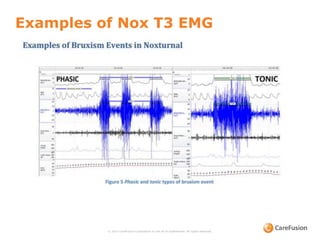
• PHASIC: at least 3 EMG bursts lasting ≥ 0.25 seconds and < 2
seconds
• TONIC: 1 EMG burst lasting > 2 seconds
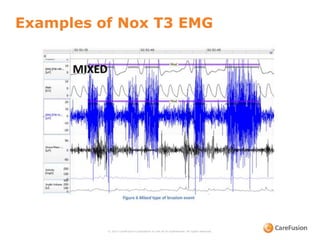
• MIXED : phasic and tonic bursts
Note: EMG bursts must not be separated by > 3 seconds to
be considered part of the same episode.
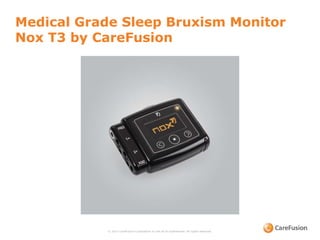
Medical Grade Sleep Bruxism Monitor
Nox T3 by CareFusion
© 2015 CareFusion Corporation or one of its subsidiaries. All rights reserved.
• Sounds
◦ Teeth grinding and exclusion of other oro-facial activities
by listening.
◦ Additionally autonomic arousals can be marked in the
following manner:
• Mark spontaneous arousals if the pulse wave amplitude (PWA)
drops by 30% or more in a 20 second period before Rhythmic
Masticatory Muscle Activity (RMMA).
Scoring Rules for Sleep Bruxism
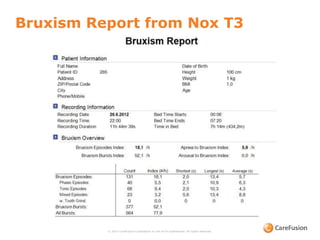
Bruxism Episodes Index - BEI
• Bruxism episode index: number of episodes per
hour of sleep (phasic, tonic and mixed)
• Bruxism burst index: number of EMG bursts per
hour of sleep
• Apnea to bruxism index: number of episodes per
hour of sleep (phasic, tonic and mixed) where
apnea is scored after each episode of bruxism.
• Arousal to bruxism index: number of episodes per
hour of sleep (phasic, tonic and mixed) where
arousal is scored after each episode of bruxism.
© 2015 CareFusion Corporation or one of its subsidiaries. All rights reserved.
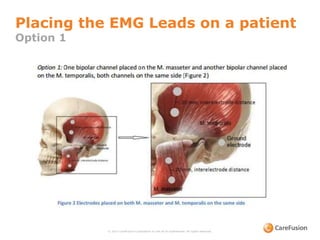
Placing the EMG Leads on a patient
Option 1
© 2015 CareFusion Corporation or one of its subsidiaries. All rights reserved.
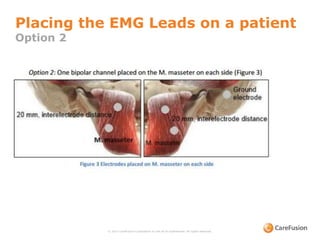
Placing the EMG Leads on a patient
Option 2
© 2015 CareFusion Corporation or one of its subsidiaries. All rights reserved.
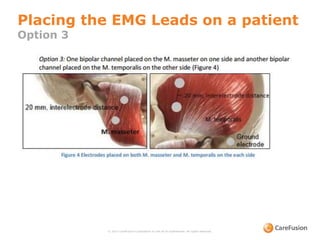
Placing the EMG Leads on a patient
Option 3
Examples of Nox T3 EMG
© 2015 CareFusion Corporation or one of its subsidiaries. All rights reserved.
Examples of Nox T3 EMG
© 2015 CareFusion Corporation or one of its subsidiaries. All rights reserved.
Bruxism Report from Nox T3
© 2015 CareFusion Corporation or one of its subsidiaries. All rights reserved.
Stress and Psychological Factors
© 2015 CareFusion Corporation or one of its subsidiaries. All rights reserved.
• Sleep Bruxism cases are more likely to deny the
impact of life events because of coping style or
personality.
• EMG activity increased during sleep following
days with emotional or physical stressors.
• PSG studies report no association between sleep
bruxism and anxiety or depression however the
link with insomnia exists.
Current Hypotheses
© 2015 CareFusion Corporation or one of its subsidiaries. All rights reserved.
• Bruxism-RMMA episodes occur during transient (3-
10s) arousal associated with brain and cardiac activity
as shown by a rapid increase in heart rate at the onset
of RMMA during frequent micro arousal episodes.
• Micro arousals are natural activities during sleep that
consist of a repetitive rise in heart rate, muscle tone
and brain activity 8-15 times/hr of sleep.
• Most sleep bruxism episodes are observed during light
non REM sleep
• 10% of episodes occur during REM sleep in association
with sleep arousal
Role of Respiration in
Sleep Bruxism
© 2015 CareFusion Corporation or one of its subsidiaries. All rights reserved.
• Respiration in Sleep Bruxism is not well
understood however it may play a role in some
patients.
• RMMA tends to occur with large breaths and oral
appliances used to improve airway patency help
to reduce bruxism-RMMA frequency.
• Direct cause and effect relationship between
breathing disorders and sleep bruxism cannot be
assumed.
Treatment
© 2015 CareFusion Corporation or one of its subsidiaries. All rights reserved.
• Sleep Bruxism can be managed through behavioral
strategies including risk factor avoidance (smoking,
alcohol and drugs).
• Patient education, relaxation and sleep hygiene.
• Biofeedback aimed at reducing EMG activity in the
temporalis without disrupting sleep shows promise.
• Occlusal appliances to remove occlusal interference,
protect dentition and relax masticatory muscles are in
routine clinical use however no evidence supports their
role in stopping sleep bruxism.
◦ 20% of patients report an increase in EMG activity during sleep
when they wear an occlusal appliance especially the soft mouth
guard type.
References
• Journal of Canadian Dental Association 2015;81f2
◦ http://www.jcda.ca.php5-9.dfw1-
2.websitetestlink.com/article/f2
• Sleep Bruxism Customer Support Document –
Nox Medical
◦ 22-Sleep Bruxism.pdf
© 2015 CareFusion Corporation or one of its subsidiaries. All rights reserved.
Questions
Thank you

Jeffrey prall sleep bruxism final

  • 1.
    Sleep Bruxism for theSleep Professional Jeffrey Prall Senior Sales Consultant Respiratory Diagnostics 646-456-1999 Jeffrey.Prall@Carefusion.com
  • 2.
    Sleep Bruxism © 2015CareFusion Corporation or one of its subsidiaries. All rights reserved. • Sleep Bruxism is no longer considered a parasomnia • Bruxism is considered to be primarily a sleep related movement disorder with yet to be determined multifactorial etiology involving multisystem physiological processes
  • 3.
    Classification of Bruxism ©2015 CareFusion Corporation or one of its subsidiaries. All rights reserved. Bruxism can be divided into two distinct entities ◦ Awake ◦ Sleep bruxism
  • 4.
    Sleep Bruxism © 2015CareFusion Corporation or one of its subsidiaries. All rights reserved. • Sleep Bruxism is no longer simply related to mechanistic factors such as occlusal discrepancies, or psychological issues such as stress, anxiety or depression • Sleep Bruxism is considered to be primarily a sleep related movement disorder with a yet to be discerned multifactorial etiology
  • 5.
    Sleep Bruxism Definitions(AASM) © 2015 CareFusion Corporation or one of its subsidiaries. All rights reserved. • 1990 (ICSD) “Sleep Bruxism is a stereotyped movement disorder characterized by grinding and clenching of the teeth. • 2005 (ICSD) “Sleep Bruxism is defined as oral para functional activity characterized by tooth grinding or jaw clenching during sleep usually associated with sleep arousals. • Third Edition (ICSD) “Sleep Bruxism a repetitive jaw muscle activity characterized by clenching and grinding of the teeth and/or by bracing and thrusting of the mandible.” • Sleep related bruxism. In: International classification of sleep disorders. 3rd ed. Darien, IL.: American Academy of Sleep Medicine; 2014.
  • 6.
    Bruxism Classification © 2015CareFusion Corporation or one of its subsidiaries. All rights reserved. • Primary Bruxism • Idiopathic Bruxism (no known cause) • Secondary Bruxism which is related to socio- psychological or medical condition (movement or sleep disorder including PLMS, rhythmic moving disorders such as head banging, sleep disordered breathing due to upper airway resistance or apnea hypopnea events)
  • 7.
    Diagnostic Grading Systemfor Sleep and Wake Bruxism © 2015 CareFusion Corporation or one of its subsidiaries. All rights reserved. Possible – Based on self report using a questionnaire and/or the anamnestic part of clinical exam. Probable – Based on self report plus the inspection report of the clinical examination. Definite – Based on self report, a clinical examination, a polysomnographic recording preferably containing audio/visual recordings or a medical grade sleep bruxism monitor.
  • 8.
    Diagnostic Criteria for SleepRelated Bruxism (ICSD third edition) © 2015 CareFusion Corporation or one of its subsidiaries. All rights reserved. • Presence of regular or frequent tooth grinding sounds occurring during sleep • Presence of one or more of the following clinical signs ◦ Abnormal tooth wear consistent with above reports of tooth grinding during sleep ◦ Transient morning jaw muscle pain or fatigue; and/or temporal headache; and/or jaw locking on awakening consistent with the above reports of tooth grinding during sleep
  • 9.
    Tooth Wear asa Diagnosis of Sleep Bruxism © 2015 CareFusion Corporation or one of its subsidiaries. All rights reserved. • Causes of tooth wear ◦ Oral habits ◦ Food consistency ◦ Acid Reflux • Occlusal attrition does not reliably confirm sleep bruxism without report of tooth grinding as witnessed by a bed partner. • Tooth wear is present in 100% of sleep Bruxism patients it also occurred in 40% of asymptomatic individuals.
  • 10.
    Scoring Rules forSleep Bruxism © 2015 CareFusion Corporation or one of its subsidiaries. All rights reserved. • EMG, 10-100 Hz band-pass filtered, AASM 2007 criteria ◦ Bruxism may consist if the chin EMG activities are at least twice the amplitude of the background EMG. ◦ Calculation of Bruxism Episodes Index or BEI calculates all bruxism events per hour of sleep ◦ Types of bruxism episodes: • PHASIC: at least 3 EMG bursts lasting ≥ 0.25 seconds and < 2 seconds • TONIC: 1 EMG burst lasting > 2 seconds • MIXED : phasic and tonic bursts Note: EMG bursts must not be separated by > 3 seconds to be considered part of the same episode.
  • 11.
    Medical Grade SleepBruxism Monitor Nox T3 by CareFusion © 2015 CareFusion Corporation or one of its subsidiaries. All rights reserved.
  • 12.
    © 2015 CareFusionCorporation or one of its subsidiaries. All rights reserved. • Sounds ◦ Teeth grinding and exclusion of other oro-facial activities by listening. ◦ Additionally autonomic arousals can be marked in the following manner: • Mark spontaneous arousals if the pulse wave amplitude (PWA) drops by 30% or more in a 20 second period before Rhythmic Masticatory Muscle Activity (RMMA). Scoring Rules for Sleep Bruxism
  • 13.
    Bruxism Episodes Index- BEI • Bruxism episode index: number of episodes per hour of sleep (phasic, tonic and mixed) • Bruxism burst index: number of EMG bursts per hour of sleep • Apnea to bruxism index: number of episodes per hour of sleep (phasic, tonic and mixed) where apnea is scored after each episode of bruxism. • Arousal to bruxism index: number of episodes per hour of sleep (phasic, tonic and mixed) where arousal is scored after each episode of bruxism. © 2015 CareFusion Corporation or one of its subsidiaries. All rights reserved.
  • 14.
    Placing the EMGLeads on a patient Option 1 © 2015 CareFusion Corporation or one of its subsidiaries. All rights reserved.
  • 15.
    © 2015 CareFusionCorporation or one of its subsidiaries. All rights reserved. Placing the EMG Leads on a patient Option 2
  • 16.
    © 2015 CareFusionCorporation or one of its subsidiaries. All rights reserved. Placing the EMG Leads on a patient Option 3
  • 17.
    Examples of NoxT3 EMG © 2015 CareFusion Corporation or one of its subsidiaries. All rights reserved.
  • 18.
    Examples of NoxT3 EMG © 2015 CareFusion Corporation or one of its subsidiaries. All rights reserved.
  • 19.
    Bruxism Report fromNox T3 © 2015 CareFusion Corporation or one of its subsidiaries. All rights reserved.
  • 20.
    Stress and PsychologicalFactors © 2015 CareFusion Corporation or one of its subsidiaries. All rights reserved. • Sleep Bruxism cases are more likely to deny the impact of life events because of coping style or personality. • EMG activity increased during sleep following days with emotional or physical stressors. • PSG studies report no association between sleep bruxism and anxiety or depression however the link with insomnia exists.
  • 21.
    Current Hypotheses © 2015CareFusion Corporation or one of its subsidiaries. All rights reserved. • Bruxism-RMMA episodes occur during transient (3- 10s) arousal associated with brain and cardiac activity as shown by a rapid increase in heart rate at the onset of RMMA during frequent micro arousal episodes. • Micro arousals are natural activities during sleep that consist of a repetitive rise in heart rate, muscle tone and brain activity 8-15 times/hr of sleep. • Most sleep bruxism episodes are observed during light non REM sleep • 10% of episodes occur during REM sleep in association with sleep arousal
  • 22.
    Role of Respirationin Sleep Bruxism © 2015 CareFusion Corporation or one of its subsidiaries. All rights reserved. • Respiration in Sleep Bruxism is not well understood however it may play a role in some patients. • RMMA tends to occur with large breaths and oral appliances used to improve airway patency help to reduce bruxism-RMMA frequency. • Direct cause and effect relationship between breathing disorders and sleep bruxism cannot be assumed.
  • 23.
    Treatment © 2015 CareFusionCorporation or one of its subsidiaries. All rights reserved. • Sleep Bruxism can be managed through behavioral strategies including risk factor avoidance (smoking, alcohol and drugs). • Patient education, relaxation and sleep hygiene. • Biofeedback aimed at reducing EMG activity in the temporalis without disrupting sleep shows promise. • Occlusal appliances to remove occlusal interference, protect dentition and relax masticatory muscles are in routine clinical use however no evidence supports their role in stopping sleep bruxism. ◦ 20% of patients report an increase in EMG activity during sleep when they wear an occlusal appliance especially the soft mouth guard type.
  • 24.
    References • Journal ofCanadian Dental Association 2015;81f2 ◦ http://www.jcda.ca.php5-9.dfw1- 2.websitetestlink.com/article/f2 • Sleep Bruxism Customer Support Document – Nox Medical ◦ 22-Sleep Bruxism.pdf © 2015 CareFusion Corporation or one of its subsidiaries. All rights reserved.
  • 25.
  • 26.